A Complete Course in Quiz Bowl · Volume 4
Classical Myth
The gods and heroes of Greece and Rome
32 chapters · 247 answers · 1283 clues · 375 pages in print
Contents
The Beginning of the World
The Olympians
Gods and Mortals
The Heroes Before Troy
- 14Perseus and Medusa
- 15Pegasus, Bellerophon, and the Chimera
- 16Heracles and the Labors of the Peloponnese
- 17Heracles: The Six Labors Abroad
- 18Heracles After the Labors: Troy, Omphale, and the Pyre
- 19Jason, Medea, and the Golden Fleece
- 20Minos, Daedalus, and the Bull from the Sea
- 21Theseus: The Road to Athens and the Minotaur
- 22Theseus the King, the Lapiths, and the Centaurs
- 23Meleager, Atalanta, and the Calydonian Boar
- 24Oedipus and the Seven Against Thebes
Troy and the Returns
Aeneas and Rome
Back matter
The Stage: Gods, Heroes, and the Poets Who Told of Them
In about 430 BC, a Greek traveler named Herodotus (hih-rod-uh-tus) was finishing his Histories, a long book about the wars between the Greeks and the Persian Empire and about every land he had visited along the way. In Egypt he had questioned priests about their gods, and he came home with a startling idea about his own. The Greeks, he wrote, had prayed to their gods for ages without knowing where each one came from or what each one looked like. Those things had been settled only “yesterday, as it were,” by two poets, Homer and Hesiod (hee-see-ud), who had lived about four hundred years before him. In G. C. Macaulay’s translation of 1890, “these are they who made a theogony for the Hellenes and gave the titles to the gods.” The Hellenes (hel-eenz) are the Greeks, as they called themselves, and a theogony (thee-og-uh-nee) is an account of how the gods were born.
Herodotus was half right. Clay tablets from the palaces of Bronze Age Greece, the age of bronze tools and weapons that ended about 1100 BC, already name Zeus (zooss), Poseidon (puh-sy-dun), and Dionysus (dy-uh-ny-sus), centuries before Homer (Vol. 6, The Greeks). But he was right that the Greeks knew their gods mainly through poets, and so do we. A myth, in this book, is a traditional story about gods, monsters, and heroes, told and retold for centuries before anyone wrote it down. Every story in this volume reached us because some poet, playwright, or scholar put it into writing, and each of them told it a little differently. Before the first chapter, then, the reader needs six things. They are a map of the world the myths imagined, the family tree of the gods, and the Roman names that stand beside the Greek ones. Then come the writers who preserved the stories, the order in which the stories happen, and the special titles that the poets gave to gods and heroes.
The world of the myths
The Greeks of Homer’s day pictured the earth as a flat, round land with the sea in its middle. Around its rim flowed Ocean, in Greek Okeanos (oh-kee-uh-nos), a great river that circled the whole world, with only a few strange lands on its far side. From Ocean the sun, the moon, and the stars rose each day, and into it they sank. Near the middle of the land stood Delphi (del-fy), Apollo’s shrine on the slopes of Mount Parnassus (par-nas-us), which the Greeks called the navel of the world. Out toward the rim lived peoples half real and half fable. The Hyperboreans (hy-pur-bor-ee-unz) lived “beyond the North Wind,” which is what their name means, in a blessed land far to the north. The Ethiopians lived at the far edges of the earth, some where the sun rises and some where it sets, and the gods went there to feast. The far west, where the sun set, was the land of marvels: the island of Erytheia (err-ih-thee-uh), where the three-bodied giant Geryon (jeer-ee-un) kept his red cattle, and the garden of the Hesperides (hes-perr-ih-deez), the nymphs who guarded a tree of golden apples. Beneath the earth lay the land of the dead, which the living could reach only through a few dark entrances.

The real world showed through this picture. Greek sailors knew the Mediterranean well, and from the eighth century BC onward, Greek cities planted colonies around it, in southern Italy, in Sicily, and along the Black Sea. Cumae (kyoo-mee), near modern Naples, was the first Greek colony on the mainland of Italy. As the colonists sailed west, the myths sailed with them. Greeks in Sicily decided that the wandering hero Odysseus (oh-dis-ee-us) had met the one-eyed giants on their island and that the sea monster Scylla (sil-uh) and the whirlpool Charybdis (kuh-rib-dis) lurked in the narrow strait between Sicily and Italy. Figure S.1 shows the whole stage, from Ocean in the west to the Caucasus (kaw-kuh-sus) Mountains in the east.
At the eastern end of the Black Sea lay Colchis (kol-kis), in what is now the country of Georgia, the land of the Golden Fleece. To reach it a ship had to pass the Hellespont (hel-ih-spont), the narrow strait between Europe and Asia now called the Dardanelles, and then the Bosporus (bos-puh-rus), where the Clashing Rocks were said to slam together on any ship that tried to pass. Near the mouth of the Hellespont, on the Asian side, stood Troy, the city of King Priam (pry-um). South across the sea lay Egypt, which the Greeks admired for its great age, and Libya, which was the Greeks’ name for all of Africa west of Egypt, not only the modern country. Farther west, on the African coast, rose the Atlas Mountains, named for Atlas, who in the myths holds up the sky.
The myths happen above all in Greece itself, shown in Figure S.2. Greece is a land of mountains, and its people lived in small plains between them, each plain with its own city, its own kings, and its own heroes. In Boeotia (bee-oh-shuh) stood Thebes, founded by Cadmus (kad-mus) and ruled later by Oedipus (ed-ih-pus), its most unlucky king. The large southern part of Greece, the Peloponnese (pel-uh-puh-neez), is joined to the mainland only by the Isthmus of Corinth, a neck of land about 4 miles wide. In its northeast lies the Argolid (ar-guh-lid), the plain of Argos (ar-gos), where three strongholds stood within 10 miles of one another: Argos, Tiryns (ty-rinz), and Mycenae (my-see-nee). They were the homes of Perseus (pur-see-us), who cut off the head of snake-haired Medusa, of the family of Heracles (herr-uh-kleez), the strongest of heroes, and of Agamemnon (ag-uh-mem-non), who led the Greeks against Troy. Athens, in the region of Attica (at-ih-kuh), was the city of Theseus (thee-see-us), who killed the Minotaur. Sparta was the kingdom of Menelaus (men-uh-lay-us) and his wife Helen, over whom the Trojan War was fought. Iolcus (eye-ol-kus) in Thessaly (thes-uh-lee) was the home of Jason, who sailed for the Golden Fleece, and Calydon (kal-ih-don) the home of the hunter Meleager (mel-ee-ay-jur). Pylos (py-los) was the city of old Nestor, the wise counselor of the Greeks at Troy, and the small island of Ithaca was the kingdom of Odysseus.

Certain places belonged to the gods. Mount Olympus, the highest mountain in Greece at about 9,570 feet (2,918 m), was the gods’ home, its peak hidden in cloud. Apollo spoke through his priestess at Delphi, and Zeus through the rustling oaks of Dodona (doh-doh-nuh). Apollo and his sister Artemis (ar-tuh-mis) were born on the small island of Delos (dee-los), in the Aegean (ih-jee-un) Sea. The secret rites of Demeter (dih-mee-tur), goddess of grain, were held at Eleusis (ih-loo-sis), near Athens, and the sick came to Epidaurus (ep-ih-dor-us) to be healed by the god Asclepius (uh-sklee-pee-us). A sanctuary was a sacred enclosure of this kind, with an altar and usually a temple, where a god was believed to be present. The Muses, goddesses of poetry and song, lived on Mount Helicon (hel-ih-kon). The wise centaur Chiron (ky-ron), half man and half horse, lived on Mount Pelion (pee-lee-un), and on Mount Oeta (ee-tuh) Heracles would end his life. Off the south coast lies Crete, the largest Greek island, where King Minos (my-nos) ruled from Knossos (noss-us).
Many of these places are real ruins that can be visited today. Archaeologists have dug up Troy, Mycenae, Tiryns, Pylos, and Knossos, and found that they were rich and powerful cities in the Bronze Age, centuries before Homer. How much of the myths remembers that age is a question for another volume (Vol. 6, The Greeks). This volume tells the stories as the Greeks and Romans told them.
The family of the gods
The Greek gods were a family, and their quarrels were family quarrels. The oldest account of how that family began is Hesiod’s Theogony, a poem of 1,022 lines composed in about 700 BC, and Figure S.3 follows it. Read the tree from left to right: each column is a generation, and a line runs from parents to their children. Chapter 1 tells the story the tree only outlines, so this section names the family and leaves the deeds for later.

At first, Hesiod says, there was Chaos (kay-oss). The word did not mean a mess, as it does in English today. It meant a yawning gap, an empty space. After Chaos came three more beings, apparently without parents: Gaia (gay-uh), the Earth; Tartarus (tar-tuh-rus), a gloomy pit deep beneath her; and Eros (eer-oss), the power of love and desire. From Chaos came Erebus (err-uh-bus), the darkness under the earth, and Nyx (niks), or Night. Night bore many children by herself, among them Sleep and Death, Strife, and the three Fates, who spin, measure, and cut the thread of each life.
Gaia bore Uranus (yoor-uh-nus), the starry Sky, as large as herself, to cover her on every side. Then she lay with him and bore twelve children, the Titans (ty-tunz): six sons, Oceanus (oh-see-uh-nus), Coeus (see-us), Crius (kry-us), Hyperion (hy-peer-ee-un), Iapetus (eye-ap-ih-tus), and Cronus (kroh-nus), and six daughters, Theia (thee-uh), Rhea (ree-uh), Themis (thee-mis), Mnemosyne (nih-moz-ih-nee), Phoebe (fee-bee), and Tethys (tee-this). Cronus was the youngest. She also bore two sets of brothers who were monsters to look at. The three Cyclopes (sy-kloh-peez) each had a single round eye in his forehead, and their names, Brontes (bron-teez), Steropes (sterr-uh-peez), and Arges (ar-jeez), mean Thunder, Lightning, and Flash. The three Hundred-Handers had a hundred arms and fifty heads apiece. Their Greek name is the Hecatonchires (hek-uh-tong-kih-reez).
Three gods ruled the world in turn, each the son of the one before: Uranus, then Cronus, then Zeus. Each son overthrew his father, by force or by trickery, and Chapter 1 tells how. When Cronus wounded Uranus, Gaia caught the drops of his blood and bore more children, among them the Furies, goddesses of vengeance, and the Giants; the tree sets these two broods beside the Cyclopes. Several Titans married their own sisters, and their children matter later in this volume. Hyperion and Theia were the parents of Helios (hee-lee-oss), Selene (sih-lee-nee), and Eos (ee-oss), the Sun, the Moon, and the Dawn (Chapter 3). Coeus and Phoebe were the parents of Leto (lee-toh), the mother of Apollo and Artemis (Chapter 5). Iapetus was the father of Atlas, who holds up the sky, and of Prometheus (pruh-mee-thee-us) and Epimetheus (ep-ih-mee-thee-us), who play a large part in the making of mankind (Chapter 9). Oceanus and Tethys had three thousand daughters, the Oceanids (oh-see-uh-nidz), and as many sons, the rivers of the world.
Cronus and Rhea had six children: Hestia (hes-tee-uh), Demeter, Hera (heer-uh), Hades (hay-deez), Poseidon, and Zeus, the youngest. After Zeus won power, he had children by several goddesses, one after another. Metis (mee-tis), a daughter of Ocean, was the mother of Athena (uh-thee-nuh). Leto bore Apollo and Artemis, and Maia (may-uh), a daughter of Atlas, bore Hermes (hur-meez). Demeter bore Persephone (pur-sef-uh-nee), and Mnemosyne, whose name means Memory, bore the nine Muses. Hera, the last of his wives and his queen, bore Ares (air-eez), the god of war; Hebe (hee-bee), the goddess of youth; and Eileithyia (eye-ly-thy-uh), the goddess of childbirth. In anger at her husband, Hera bore Hephaestus (hih-fes-tus) by herself, Hesiod says, though Homer calls him the son of both. Dionysus was the son of Zeus and a mortal woman, Semele (sem-uh-lee), a princess of Thebes. Aphrodite (af-ruh-dy-tee) was older than any of them in Hesiod’s telling, since she rose from the sea in the days of Uranus.
The most important of these gods lived on Mount Olympus and were called the Olympians (oh-lim-pee-unz). Greeks often spoke of twelve: Zeus, Hera, Poseidon, Demeter, Athena, Apollo, Artemis, Ares, Aphrodite, Hephaestus, Hermes, and Hestia, the goddess of the hearth. Some lists put Dionysus in Hestia’s place, so the tree gives a red frame to all thirteen. Hades was the brother of Zeus and Poseidon and as great a god as either, but he was not counted among the Olympians, because his kingdom was the world of the dead, far from Olympus.
Below the great gods lived a crowd of lesser immortals. A nymph was a minor goddess of nature, young and beautiful, who lived in a particular spring, river, tree, mountain, or stretch of sea; her life was far longer than any mortal’s, though in some stories not endless. The Oceanids were nymphs, and so were the fifty daughters of the sea god Nereus (neer-ee-us). Rivers were gods too, pictured as bearded men or as bulls. Most of the stories, though, are about mortals, and especially about heroes. To the Greeks a hero was a man of the distant past, often the son of a god and a mortal woman, who did great deeds and was honored with offerings at his tomb after he died. Heracles, Perseus, Theseus, Jason, Achilles (uh-kil-eez), and Odysseus are heroes in this sense.
Greek and Roman names
The Romans had gods of their own long before they knew Greek stories. As Rome came into close contact with the Greek cities of southern Italy, and later conquered Greece itself in the second century BC, Roman writers matched each of their gods with a Greek one. Their sky god Jupiter was matched with Zeus, and their goddess Juno with Hera. Then they took over the Greek stories wholesale, so that a Roman poet telling of Jupiter’s love affairs was telling of Zeus’s. Table S.1 gives the pairs that this volume needs, and in the tree of the gods the gray name under each Olympian is the Roman one.
| Greek | Roman | God or goddess of |
|---|---|---|
| Zeus | Jupiter, Jove | the sky and thunder; king of the gods |
| Hera | Juno | marriage; queen of the gods |
| Poseidon | Neptune | the sea, earthquakes, and horses |
| Demeter | Ceres | grain and the harvest |
| Hestia | Vesta | the hearth and its fire |
| Athena | Minerva | wisdom, war, and crafts |
| Apollo | Apollo | music, prophecy, healing, and archery |
| Artemis | Diana | hunting and wild animals |
| Ares | Mars | war |
| Aphrodite | Venus | love and beauty |
| Hephaestus | Vulcan | fire and the forge |
| Hermes | Mercury | messages, travelers, and thieves |
| Dionysus | Bacchus | wine and the theater |
| Hades | Pluto | the dead and the underworld |
| Persephone | Proserpina | queen of the underworld |
| Cronus | Saturn | a Titan; father of Zeus |
| Rhea | Ops | a Titan; mother of Zeus |
| Uranus | Caelus | the sky; father of the Titans |
| Helios | Sol | the sun |
| Eos | Aurora | the dawn |
| Selene | Luna | the moon |
| Eros | Cupid | love and desire |
| Heroes | ||
| Heracles | Hercules | the strongest of heroes |
| Odysseus | Ulysses | the cleverest of heroes |
A few of the Roman names are easy to stumble over: Ceres (seer-eez), Proserpina (proh-sur-pih-nuh), Bacchus (bak-us), and Caelus (see-lus). For centuries English used the heroes’ Roman names, Hercules and Ulysses (yoo-lis-eez), which is why a strong man can still be called “a Hercules.”
The match was never perfect. Some Roman gods had no Greek twin at all, like Janus (jay-nus), the two-faced god of doorways, whom Chapter 32 meets with the other gods of Rome. The Roman names also live on in the sky. Five planets can be seen without a telescope, and they carry the names of Mercury, Venus, Mars, Jupiter, and Saturn. When a seventh planet, counting the Earth, was found in 1781, astronomers named it Uranus, which is the Greek name, not the Roman one, and they named the eighth, found in 1846, Neptune.
One more convention concerns spelling. Greek names came into English through Latin, and Latin spelled them its own way, writing c for the Greek k and -us for the Greek ending -os. This book uses the Latin spellings that English has used for centuries: Cronus, not Kronos; Heracles, not Herakles; Achilles, not Akhilleus. Some modern books keep closer to the Greek, so the reader will meet Kronos, Herakles, and Ouranos elsewhere and should not be thrown by them.
Who wrote the stories down, and when
The myths are older than the Greek alphabet. For centuries they were sung by bards who learned them by ear and never read a word, and every bard changed the story a little as he sang. What we have are the versions that someone happened to write down, and of those, only the ones whose copies survived the next two thousand years. Figure S.4 sets the main writers in order. The lives of these authors, and the works as works, belong to the volumes on the Greeks (Vol. 6, The Greeks) and the Romans (Vol. 7, The Romans). Here they appear only as witnesses, each with a date.

The earliest poets. The two great epics credited to Homer, the Iliad and the Odyssey, each now divided into twenty-four books, took the form we have in about 750 to 700 BC. They are epics, long poems in a grand style about heroes, a form taught in an earlier volume (Vol. 1, The Toolkit). The Iliad tells a few weeks in the tenth year of the Trojan War, and the Odyssey tells how Odysseus came home. Hesiod, a farmer-poet from Boeotia, composed the Theogony and a second poem, Works and Days, about farming, justice, and the hard life of men. The thirty-three Homeric Hymns are poems in Homer’s style addressed to single gods, most of them composed in the seventh and sixth centuries BC. Many ancient readers thought that Homer wrote them, but he did not. The long hymns to Demeter, Apollo, Hermes, and Aphrodite each tell a full story. Other early epics, called the Epic Cycle, told the rest of the Trojan War, including the Cypria (sip-ree-uh) about its beginnings and the Telegony (tih-leg-uh-nee) about the death of Odysseus. They are lost except for short summaries and a few quoted lines.

Lyric poets and playwrights. Stesichorus (stih-sik-uh-rus), a Greek poet of southern Italy and Sicily, lived from about 630 to 555 BC. He was a lyric poet, a maker of songs to be sung to the lyre, a small harp, and he told long stories in his songs, among them a poem about the giant Geryon. His work survives only in scraps: lines quoted by later writers, and torn pieces of papyrus, the reed paper of the ancient world, found in Egypt. Pindar (pin-dur), from Thebes, was a lyric poet of the fifth century BC. He wrote victory odes, songs sung by a chorus in honor of winners at the Olympic and other games (Vol. 1, The Toolkit), and each ode works a myth into its praise. In Athens in the same century, the playwrights Aeschylus (es-kih-lus), Sophocles (sof-uh-kleez), and Euripides (yoo-rip-ih-deez) turned myths into tragedies, serious plays that end in suffering (Vol. 1, The Toolkit), for the city’s festivals of Dionysus.
Scholars and handbooks. After the conquests of Alexander the Great, who died in 323 BC, Greek kings ruled Egypt, and Greek learning gathered at the great library in their capital, Alexandria. One of its scholars, Apollonius (ap-uh-loh-nee-us) of Rhodes, wrote the Argonautica (ar-guh-naw-tih-kuh) in the third century BC, an epic in four books about Jason’s voyage. Much later, in the first or second century AD, someone wrote a prose handbook of Greek myth called the Library. It was long credited to a scholar named Apollodorus (uh-pol-uh-dor-us), who in fact lived centuries earlier, so the author is often called Pseudo-Apollodorus, the false Apollodorus; this book, like most, calls him Apollodorus. The Library tells the family histories of gods and heroes plainly and in order. Its last part is lost, but two short summaries of the whole book preserve the end. In the second century AD, Pausanias (paw-say-nee-us), a Greek traveler, wrote a Description of Greece in ten books, a guide to its cities and shrines that records the local stories told at each.
The Roman poets. Virgil wrote the Aeneid (ih-nee-id), an epic in twelve books about the Trojan hero Aeneas (ih-nee-us), between 29 and 19 BC. Ovid (ov-id) finished his Metamorphoses (met-uh-mor-fuh-seez) in about AD 8. Its fifteen books tell more than 250 stories of transformation, of people turned into trees, birds, stars, and stones, from the creation of the world to Ovid’s own day. Many of this volume’s stories come from it, and some from nowhere else. Ovid also wrote the Fasti (fas-tee), a poem on the first six months of the Roman calendar that explains their holidays with stories. Statius (stay-shee-us), a Roman poet of the first century AD, wrote the Thebaid (thee-bay-id), an epic in twelve books about the Seven against Thebes, seven champions who marched on that city. He also began an Achilleid (uh-kil-ee-id) about the boyhood of Achilles, which he left unfinished at his death. In the second century AD, Apuleius (ap-yoo-lee-us), a writer from North Africa, wrote a comic Latin novel called The Golden Ass, whose hero is turned into a donkey; in the middle of it an old woman tells the story of Cupid and Psyche (sy-kee).
The last poet, and two writers of history. Nonnus (non-us), a Greek poet from the town of Panopolis (pan-op-uh-lis) in Egypt, wrote the Dionysiaca (dy-uh-nih-sy-uh-kuh) in the fifth century AD. It tells the life of Dionysus in forty-eight books, more than 21,000 lines, the longest poem to survive from ancient Greece or Rome. Two writers of history tell some of the stories too. Livy, a Roman historian of Virgil’s time, began his history of Rome with Aeneas and Romulus (rom-yuh-lus), and Plutarch (ploo-tark), a Greek of the first and second centuries AD, wrote lives of Theseus and Romulus beside his lives of real statesmen.
The generations of the myths
Taken together, the myths make a kind of history, running from the birth of the world to the founding of Rome. Most Greeks believed that the heroes had really lived, and they traced their own families and cities back to them. Figure S.6 lays that history out in the order this volume follows. First come the gods, then the first men and women, then the heroes, generation by generation, then the Trojan War and the long voyages home, and last of all Aeneas and the kings of Rome.

Hesiod had his own scheme of the ages, which he set out in Works and Days. Mankind, he said, had come in five races. The golden race lived in the time of Cronus, without work or sorrow. Then came a foolish silver race, and a violent race of bronze who destroyed one another. In a later version, told by Apollodorus, the bronze race ended in the great flood that Deucalion (doo-kay-lee-un) and his wife survived (Chapter 9). The fourth was, in H. G. Evelyn-White’s translation of 1914, “a god-like race of hero-men,” who died in the wars at Thebes and at Troy. Last came the iron race of Hesiod’s own day, condemned to toil and trouble. The heroes’ race takes up most of this volume.
Ancient scholars tried to put dates to the heroic age. Eratosthenes (err-uh-toss-thuh-neez), the head of the library at Alexandria in the third century BC, counted back through the generations and dated the fall of Troy to 1184 BC. The Roman scholar Varro (var-oh) fixed the founding of Rome at 753 BC, and his date became the standard one. Between the two lay four centuries, and Roman writers filled them with a line of kings at Alba Longa, the city Aeneas’s son was said to have founded.
The generations do not fit together perfectly, because each city’s family trees were made separately, by different poets. Cadmus, who founded Thebes, and Europa (yoo-roh-puh), the mother of Minos, were brother and sister. Yet Europa’s great-grandson Idomeneus (eye-dom-uh-nee-us) fought at Troy, while Cadmus’s family needed five generations to reach Oedipus’s son Polynices (pol-ih-ny-seez), who died a generation before the Trojan War. Where such clashes matter, the chapter says so.
Epithets and patronymics
Homer seldom names a hero without adding something. Achilles is “swift-footed,” Hera is “white-armed,” and the dawn is “rosy-fingered.” A word or phrase like this, attached to a name and repeated each time the name comes up, is an epithet (ep-ih-thet). The bards who first sang these poems made them up as they went, line by line, in a fixed rhythm (Vol. 1, The Toolkit). A stock of ready-made phrases, each of a known length, let a singer fill out a line at once, so Achilles is “swift-footed” even while he sits in his tent and sulks.
The other common kind of title names a man by his father. “Son of Atreus” (ay-tree-us) means Agamemnon, or sometimes his brother Menelaus, and “son of Peleus” (pee-lee-us) means Achilles. A name built from a father’s name is a patronymic (pat-ruh-nim-ik). In Greek it often ends in -ides, “son of,” so Agamemnon is Atreides (uh-try-deez). A patronymic can also come from a grandfather. Heracles is sometimes called Alcides (al-sy-deez), after his grandfather Alcaeus (al-see-us). Sometimes a poet leaves the name out entirely and gives only the parents, as the first lines of the Iliad show.
In those few lines Achilles is “the Pelean Achilles,” Peleus’s son, and “godlike.” Agamemnon is not named at all but is “Atrides the King,” Clough’s spelling of Atreides. Apollo is only “Zeus and Leto’s son.” The reader is expected to know the families. Table S.2 gives the titles that come up most often in this volume.
| Title | Whom it names |
|---|---|
| “father of gods and men,” “cloud-gatherer,” “son of Cronus” | Zeus |
| “cow-eyed,” “white-armed” | Hera |
| “Earthshaker” | Poseidon, whose trident shakes the ground |
| “gray-eyed,” “Pallas” | Athena |
| “Phoebus,” meaning “bright” | Apollo |
| “laughter-loving” | Aphrodite |
| “slayer of Argus” (Argeiphontes) | Hermes |
| “twice-born” | Dionysus |
| “rosy-fingered” | Eos, the Dawn |
| “the Maiden” (Kore) | Persephone |
| “swift-footed,” “son of Peleus” | Achilles |
| “son of Atreus,” “king of men” | Agamemnon |
| “son of Tydeus” | Diomedes |
| “Telamonian” | Ajax the Greater, son of Telamon |
| “son of Laertes,” “of many wiles” | Odysseus |
| “tamer of horses” | Hector |
| “Alcides” | Heracles, grandson of Alcaeus |
| “pious” | Aeneas, in Virgil |
Some of these titles need a word more. Hera’s boōpis (boh-oh-pis) means “cow-eyed,” which sounds odd in English but was praise: her eyes were large and dark, like a cow’s. Athena’s glaukōpis (glow-koh-pis) is usually translated “gray-eyed” or “bright-eyed.” Apollo’s name Phoebus (fee-bus) means “bright.” Hermes’s title Argeiphontes (ar-jih-fon-teez) was explained by the Greeks as “slayer of Argus,” meaning Argus (ar-gus), the hundred-eyed watchman he killed, though the real meaning of the old word is uncertain. Virgil’s pius Aeneas, “pious Aeneas,” means a man dutiful toward his gods, his father, and his people, not only a religious one.
Homer has no single word for the Greek army at Troy. He calls the Greeks the Achaeans (uh-kee-unz), the Danaans (dan-ay-unz), after the ancient king Danaus (dan-ay-us), or the Argives (ar-jyvz), after the city of Argos, and all three mean the same men. The word “Greeks” comes from the Romans, who called them Graeci (gry-kee). The Greeks themselves came to call their whole people the Hellenes, after Hellen, a son of Deucalion, the survivor of the flood.
How this volume tells the myths
The volume follows the order of the old handbooks, Apollodorus’s among them, which is the order of Figure S.6. After Hesiod’s creation it takes the Olympians one or two to a chapter, then the stories in which gods meet mortals, the heroes, the Trojan War, and Rome. Each figure is introduced in the chapter that tells his or her main story. When a great god or hero, such as Zeus, Athena, or Heracles, turns up later in someone else’s story, the text treats the figure as an old acquaintance and does not start over. Where the sources disagree, the text names the version it follows in a few words, such as “in Apollonius” or “in Apollodorus and Ovid,” and where two versions both matter it tells both. Sometimes the stories cannot all be true at once. Ovid’s Perseus turns Atlas to stone, yet Atlas is still standing when Perseus’s great-grandson Heracles comes for the golden apples. Where that happens, the chapter says so once, plainly, and moves on.
Where a later volume teaches a work or an object in full, this one tells the myth and points ahead. The tragedies as plays, the gold mask of Agamemnon, and the bull-leaping fresco from Knossos are taught with the Greeks (Vol. 6, The Greeks), and the Aeneid as a poem with the Romans (Vol. 7, The Romans). Carthage, the city of Queen Dido (dy-doh) in the Aeneid, is taught in a later volume (Vol. 5, In the Beginning), and so is Anne Carson’s modern verse novel about Geryon (Vol. 35, Stage, Screen, and Verse). Family trees in the chapters are drawn like Figure S.3, with gods and other immortals in gold boxes, monsters in violet, and mortals in white, but there a red frame marks the people the chapter is about. Each tree begins where its family enters the story, so none repeats the tree of the gods in this Stage. Each map says in its caption whose route it draws.
The Beginning of the World
Chapter 1 · 48 clues
From Chaos to the Throne of Zeus
The gods of Greece were not always there. They were born, as puppies and princes are, and they had parents and grandparents and quarrels about who should inherit what. Zeus, the king of the gods, was only the third to sit on the throne of heaven, and he won it the way the two kings before him had won theirs: by force, from his own father. His grandfather was the sky itself. His father ate his own children. Zeus spent his first years hidden in a cave on the island of Crete while his father, fooled, gulped down a stone wrapped up like a baby.
How did a family of gods come to behave like this, and how did the youngest son end up ruling them all? The Greeks answered with a long and violent story, and the first person we know to have written it down was a farmer who said that nine goddesses had come to him on a mountainside and taught him to sing.
Hesiod’s Theogony
The farmer was Hesiod, and he lived about 700 BC at Ascra (ass-kruh), a village under Mount Helicon in central Greece. What is known of his life, and of his other poem, a book of advice to his lazy brother, belongs to a later volume (Vol. 6, The Greeks). Here what matters is his song of the gods, the Theogony. The title means “the birth of the gods,” and the poem is exactly that: 1,022 lines telling who was born from whom, from the very beginning of the world down to the family of Zeus. It is written in hexameter, the six-beat line of Homer’s epics (Vol. 1, The Toolkit), and it was meant to be sung aloud.
The poem begins as a hymn, a song in praise of gods, and the first gods it praises are the Muses, the nine goddesses of song and poetry (Chapter 12 tells their own stories). They dance on Helicon, Hesiod says, and one day they found him there, shepherding his lambs under the mountain. They did not flatter him. In H. G. Evelyn-White’s translation of 1914, the goddesses call the shepherds “mere bellies” and then announce: “we know how to speak many false things as though they were true; but we know, when we will, to utter true things.” Then, in Hesiod’s own words, they “plucked and gave me a rod, a shoot of sturdy olive, a marvellous thing, and breathed into me a divine voice.”

Notice what the Muses claim. They can tell lies that sound true, and they can tell the truth when they choose. Hesiod never says which his poem is. He simply sets out the generations of the gods as a family record, with long lists of names, and between the lists he tells a story in three acts. In each act a king of heaven fears his children and tries to stop them from growing up, and in the first two acts he fails. The third king is Zeus, and the poem is, in the end, a hymn to his victory and his rule.
The lists are longer than a modern reader expects. Hesiod names all fifty daughters of the sea god Nereus, one after another, and more than forty daughters of Oceanus, the river around the world. Then he admits that there are “three thousand” of them and that their brothers, the rivers, are too many to name. These lists were not padding to a Greek audience. A town, a family, or a shrine could find its own river or its own nymph in them, and they gave every local story a place in one great family of the gods.
Hesiod did not make the story up from nothing. A text in Hittite, the language of a people who ruled much of what is now Turkey, more than five hundred years older than Hesiod, tells of a line of kings of heaven much like Hesiod’s. Anu, the sky, is overthrown and mutilated by the god Kumarbi (koo-mar-bee), and Kumarbi is overthrown in turn by Teshub, a storm god who fights with thunder, as Zeus does. Scholars began setting it beside Hesiod in the 1940s, and the likeness showed that the Greeks had borrowed the bones of their creation story from older neighbors in the East.
Hesiod also left many things out. Who nursed the infant Zeus? How did the gods defeat the Giants? For these the later writers introduced in the Stage fill in the gaps, above all Apollodorus, whose handbook of myths was written about eight hundred years after Hesiod, and the Roman poet Ovid. They do not always agree. Where they differ, this chapter says whose version it is telling.
Chaos, Gaia, and Uranus
“At the first Chaos came to be,” Hesiod sings, and Chaos, as the Stage explained, was not a mess but a gap: an empty, yawning space with nothing in it. Then, in Hesiod’s telling, Gaia came next, with Tartarus and Eros.In Hesiod’s Theogony, this figure appears after Chaos, alongside Tartarus and Eros. → Gaia• Gaia was “wide-bosomed Earth,” the solid ground on which everything else would stand. Tartarus was a dim pit deep beneath the earth, later the prison of defeated gods. Eros was Love, “fairest among the deathless gods,” who “unnerves the limbs” of gods and men alike. Here he is not the winged boy with a bow who is Aphrodite’s son, but one of the first powers of the world, the force that would make all the later births happen (Chapter 7 sets the two side by side). From Chaos came darkness, which the Greeks called Erebus, and black Night, and Night in turn bore the bright upper air and Day. Gods like these, who were there from the very beginning, are called primordial, from the Latin for “beginning.”
Gaia did not live on the earth. She was the earth. The Greeks thought of the ground, the sky, and the sea as beings with minds and wills, and when they spoke of a thing as if it were a person they were making a personification. Gaia was the Greek personification of Mother Earth,This figure is the Greek personification of Mother Earth. → Gaia• the mother from whom, sooner or later, nearly every god and monster in these stories came. In Hesiod’s words she was “the ever-sure foundation of all,” and the Greeks never forgot it. In Aeschylus’s play The Eumenides (yoo-men-ih-deez), the priestess of Apollo at Delphi opens her prayers by naming Earth as the first prophet who ever spoke there, long before Apollo came (Chapter 5).
She began alone. Without any partner, Gaia first bore Uranus, the starry sky,This primordial Greek sky god was born to Gaia. → Uranus•• another primordial god, whose name is simply the Greek word for sky. Hesiod says she made him “equal to herself, to cover her on every side,” like a dome over a plate. Homer calls the sky bronze, as if it were a great metal bowl arched over the earth. Then, still alone, she gave birth to the mountains, Ourea (oor-ee-uh), and the sea, Pontus.This figure gave birth to Ourea, the mountains, and Pontus, the sea. → Gaia• Ourea means “mountains,” and Hesiod calls them the “long Hills,” where the nymphs of the glens would live. Pontus was the open sea, with its “raging swell.”
The world now had its parts: earth below, sky above, sea around, darkness beneath. What it did not yet have was a ruler. Uranus, the sky, took that place, and Gaia became his wife as well as his mother. The first gods had no one else to marry, so brothers married sisters and sons married mothers. The Greeks did not think such marriages proper among mortals; they were simply how the first family had to begin.
With Uranus, Gaia bore the twelve Titans:This figure bore the Titans to Uranus. → Gaia• six sons and six daughters, all drawn on the family tree of the gods in the Stage. The eldest, Oceanus, was the great river that the Greeks believed flowed in a ring around the whole flat earth. Hyperion would become the father of the Sun (Chapter 3), and Iapetus the father of two famous sons, Atlas and Prometheus. Among the daughters were Themis, who stood for right order, and Mnemosyne, Memory, who would be the mother of the Muses. The youngest of all was Cronus. Hesiod calls him “the wily, youngest and most terrible of her children,” and adds that “he hated his lusty sire.” Cronus and his sister Rhea were Titans,Cronus and Rhea belonged to this group of figures. → Titans•• and Cronus and Rhea would become the parents of Zeus.
Gaia had not finished. Her next sons did not look like the Titans, and in the wars to come they would matter more than most of the Titans did. These were the Cyclopes, the next children of Gaia,This figure gave birth to the Cyclopes. → Gaia• and their names were Brontes, Steropes, and Arges, which mean Thunder, Lightning, and Flash. Those are the crash and the flash of a thunderstorm, and they tell you at once what kind of work these brothers would one day do. In everything else they were like the gods, says Hesiod, except that each had only one eye,These Greek mythological giants had one eye. → Cyclops••Cyclops are characterized by having just one of these body parts. → eyes• set in the middle of his forehead. That is why they were called Cyclopes, “round-eyes” (one of them is a Cyclops). They were craftsmen, and “strength and might and craft were in their works.”
The last three sons of Earth and Sky were the most frightening. Each of them, Cottus, Briareus (bry-air-ee-us), and Gyges (jy-jeez), had a hundred arms growing from his shoulders and fifty heads. The Greeks called them the Hecatonchires, from the words for “hundred” and “hands,” and in English they are the Hundred-Handers. Uranus fathered the Hundred-HandersThis figure was the father of the Hecatonchires. → Uranus• too, and he hated them, Hesiod says, “from the first.” Homer remembered one of them, Briareus, as a friend of Zeus. In Homer’s Iliad, the sea goddess Thetis (thee-tis) once saved Zeus when his wife Hera, his brother Poseidon, and his daughter Athena plotted to tie him up. She called the hundred-handed giant up to Olympus, he sat down beside Zeus, and the plotters were too frightened to go on.
Uranus could not bear any of his children. As soon as each one was born, he pushed it back inside Gaia,Uranus hid his children inside this figure. → Gaia•This figure hid his children inside their mother Gaia's body. → Uranus• into a hidden place deep in the earth, and “would not suffer them to come up into the light.” And Heaven, as the translation calls Uranus, “rejoiced in his evil doing.” Gaia groaned. Her body was crammed with her own imprisoned children, and she grew angry enough to plot against her husband. She took gray flint, the hard stone that early people chipped into blades, and from it she shaped a great sickle, a curved blade on a handle, the tool that farmers used to cut grain. Then she called her children together and asked which of them would punish their father.
They were all afraid, except the youngest. “Mother, I will undertake to do this deed,” said Cronus, “for I reverence not our father of evil name.” Gaia hid him in an ambush and put the sickle in his hand. When night came, Uranus came with it and lay down over the earth, longing for his wife. Cronus reached out from his hiding place. With the flint sickle his mother had made, Cronus cut off his father’s genitals.This figure created the flint sickle used by Kronos to castrate his father. → Gaia•This figure castrated his father Uranus with a sickle. → Cronus•This figure was castrated by his son Cronus with a sickle. → Uranus•• He flung them away behind him. Apollodorus adds that the Titans then freed their monstrous brothers, and that Cronus, once he was king, shut the Cyclopes and the Hundred-Handers away again, this time in Tartarus.
Even what Cronus threw away was full of life. Drops of blood fell on the earth, and from them, as the seasons turned, Gaia bore three new kinds of creature. From Uranus’s blood came the FuriesThese figures arose from the blood of the castrated Uranus. → Furies••This figure’s blood gave rise to the Furies and the Meliae, or ash-tree nymphs. → Uranus• and the Meliae (mee-lee-ee), and also the Giants, “with gleaming armour, holding long spears in their hands,” who would one day fight the gods themselves. The Furies, or Erinyes (ih-rin-ee-eez), were spirits of vengeance who would hunt down anyone who harmed his own family, a fitting birth for beings made from a father’s wound (Chapter 13 gives their names). The Meliae were nymphs, the minor goddesses of nature who lived in a spring, a tree, or a mountain; their home was the ash tree, which in Greek is melia.
Uranus’s severed genitals fell into the sea and drifted for a long time. A white foam spread around the immortal flesh, and in the foam a girl grew. She drifted first near the island of Cythera (sih-theer-uh), off the southern tip of Greece, and then on to Cyprus, far to the east (Figure 1.5). When she stepped ashore, grass sprang up under her feet. This was the goddess of love and beauty, and in Hesiod’s telling Aphrodite was born from that foam.This figure was born from sea foam produced by Uranus's severed genitals. → Aphrodite••Aphrodite foamed out of this figure's severed genitals. → Uranus• The Greek word for foam is aphros, and Hesiod says that is why she is called Aphrodite, the “foam-born.” Her journey gave her two more titles: Cytherea (sith-uh-ree-uh), because she came to Cythera, and Cyprogenes (sy-proj-ih-neez), “Cyprus-born,” because she came ashore on Cyprus. Near Paphos (pay-fos), on the southwest coast of Cyprus, a great rock standing in the sea is still pointed out as the place where she landed. Homer told a different story, in which she is simply the daughter of Zeus, and Chapter 7 sets the two births side by side.
Uranus was not killed, for gods cannot die. But he never ruled again, and he took his revenge in words. Uranus, the Titans’ father, named them,This figure was the father of the Titans. → Uranus• Hesiod says. He called them Titans, “Strainers,” a pun on a Greek verb for straining or reaching too far, because they had reached out to do a terrible deed. He warned them that “vengeance for it would come afterwards.” He and Gaia remained in the story only as the wise old parents whom younger gods ask for advice.
The Romans, who took over the Greek gods under their own names, called Uranus Caelus, from caelum, the Latin for sky, which gives English the word “celestial.” So Uranus was the Greek Caelus:This figure is the Greek analogue of the Roman god Caelus. → Uranus• the same god, with a Greek name and a Latin one. When the astronomer William Herschel (hur-shul) found a new planet on March 13, 1781, it was eventually named Uranus, and it is the only planet whose English name comes from a Greek god rather than a Roman one.
Cronus and the stone
Now Cronus ruled. The Greeks remembered his reign as a happy time for mortals: in the Works and Days, Hesiod puts the golden race of men, who lived without work or sorrow, in the time of Cronus (the Stage). Cronus married his sister Rhea, and she bore him six children: three daughters, Hestia, Demeter, and Hera, and three sons, Hades, Poseidon, and, last of all, Zeus. But Gaia and Uranus had told Cronus a secret: “he was destined to be overcome by his own son.” He had overthrown his father, and a son of his would overthrow him.
So Cronus swallowed his own children,This figure swallowed his own children. → Cronus•• one after another, as each came from the womb. He did not chew them. He gulped each baby down whole, and because they were gods they did not die but lived on inside him, in the dark. Hestia, the eldest, went first, then the other four. Hesiod says plainly why: so “that no other of the proud sons of Heaven should hold the kingly office amongst the deathless gods.”

Rhea grieved for her children. When she was about to give birth to the sixth, she begged her own parents, Earth and Sky, to help her save him and to punish Cronus (also spelled Cronos). They told her what was fated, and Gaia helped her daughter Rhea.This figure helped her daughter Rhea save Zeus from Cronos. → Gaia• They sent her to Lyctus (lik-tus), a town on the island of Crete, to bear her baby there. Gaia herself took the newborn Zeus and hid him in a cave deep in a wooded mountain.
That left Cronus, waiting for his sixth child. Hesiod and Apollodorus both say that he was handed a stone wrapped in swaddling clothes, the long strips of cloth in which newborn babies were bound tight. Hesiod’s lines leave it unclear whether Gaia or Rhea handed it over; in Apollodorus, whom most later tellers follow, Rhea gave Cronus the swaddled stoneRhea gave Cronus one of these objects wrapped in swaddling clothes in place of Zeus. → stones•Rhea gave Cronus a rock to swallow instead of this figure. → Zeus• in place of Zeus. Hesiod tells what happened next: “he took it in his hands and thrust it down into his belly: wretch! he knew not in his heart that in place of the stone his son was left behind.”

Where exactly did Zeus grow up? The writers disagree, and the disagreement is about real places. Hesiod puts the cave near Lyctus. Apollodorus puts it on Mount Dicte (dik-tee), in eastern Crete, and says that young warriors called the Curetes (kyoo-ree-teez) stood guard at the mouth of the cave, clashing their spears against their shields so that Cronus would not hear the baby cry. Young men in Crete danced the same armed dance in the god’s honor, and a hymn they sang, calling on the young Zeus to bring them plenty, was found carved in stone at Palaikastro (pal-eye-kas-troh) in eastern Crete. Ovid, and many others, say that Zeus was raised on Mount Ida,This figure was raised on Mount Ida. → Zeus• the highest mountain in Crete, 2,456 meters tall. A great cave high on Ida, the Idaean Cave (eye-dee-un), was shown to visitors as the nursery of the god, and worshipers left offerings there for centuries.

Someone had to feed the baby. In the earliest tellings his nurse was a nymph named Amalthea (am-ul-thee-uh), who fed him the milk of a goat. Beginning with the poet Callimachus (kuh-lim-uh-kus), who wrote in the third century BC, writers often make Amalthea the goat herself, and so Zeus was nursed by the goat Amalthea.This figure was nursed by the goat Amalthea. → Zeus• Ovid, in the Fasti, keeps Amalthea a nymph who owns the goat. One of the goat’s horns broke off on a tree, he says, and Amalthea filled it with fruit and brought it to the child. This was the horn of plenty, in Latin the cornucopia, which in later art pours out fruit and flowers without end. When Zeus was grown, Ovid says, he set the goat in the sky as a star, Capella, which is still one of the brightest stars in the winter sky. Not every Cretan story pleased the poets, though. The Cretans even showed visitors a tomb of Zeus, and Callimachus, in his Hymn to Zeus, called them liars for it, since a god cannot die.
Zeus was soon full grown and strong. Then he came back for his brothers and sisters. Hesiod says only that Cronus was tricked by Gaia’s clever advice. Apollodorus says that Zeus enlisted Metis, a daughter of Oceanus whose name means “cunning,” and that she gave Cronus a drug to drink. With it Zeus forced his father to vomit upThis figure forced his father to regurgitate his siblings. → Zeus• everything he had swallowed. Out came the stone first, since it had gone down last, and then Poseidon, Hades, Hera, Demeter, and Hestia, now fully grown. Zeus set the stone up at Delphi, under Mount Parnassus, “to be a sign thenceforth and a marvel to mortal men,” and visitors to Delphi were still being shown it many centuries later (Chapter 5).
The war with the Titans
Five gods freed from their father’s belly, and one who had grown up in a cave, now faced the generation that had ruled before them. Zeus and his brothers and sisters made their base on Mount Olympus, the highest mountain in Greece. Cronus and the Titans held Mount Othrys (oth-ris), about 120 kilometers to the south across the plain of Thessaly (Figure 1.5). In the war that followed, the Titans fought the Olympians,These figures fought the Titanomachy against the Olympians. → Titans•• as Zeus and his family came to be called, and the Greeks named it the Titanomachy (ty-tuh-nom-uh-kee), “the battle of the Titans.”

Not every Titan fought for Cronus. Themis took the side of Zeus. So did a son of the Titan Iapetus named Prometheus, whose name means “forethought.” In Aeschylus’s play Prometheus Bound, he says he warned the Titans that the war would be won by cunning, not by force, and when they scorned his advice, he went over to Zeus. The children of the Titans were often counted as Titans themselves, so Prometheus is one of the Titans,Prometheus is one of these figures. → Titans•• though his great story, the theft of fire for mankind, comes later (Chapter 9). His brother Atlas chose the other side. In a Latin handbook of myths called the Fabulae (fab-yoo-lee), written under the name of Hyginus (hih-jy-nus), Atlas even leads the old gods in battle. Like Prometheus, Atlas was one of the Titans,Atlas is one of these figures. → Titans•• and he would lose more than any of them when the war ended.
For ten years the two sides fought, and neither could win. Then Gaia gave her grandson advice: free the prisoners. In Apollodorus, the Cyclopes and the Hundred-Handers were still shut in Tartarus, where Cronus had put them back, guarded by a she-monster named Campe (kam-pee). Zeus killed Campe and set his uncles free. Hesiod’s order is a little different: Zeus freed the Cyclopes, still bound where Uranus had left them, as soon as his brothers and sisters were out of their father, and it was the Hundred-Handers he brought up into the light on Gaia’s advice.
The Cyclopes repaid him with the weapon that would make him king. As smiths, Brontes, Steropes, and Arges forged the thunderboltBrontes, Steropes, and Arges were three of these beings who made Zeus’s thunderbolts. → Cyclops•• for Zeus: the lightning flash and the thunderclap together, made into a weapon he could hurl. Before that, Hesiod says, Gaia had kept the thunder hidden. Apollodorus adds two more gifts from the same smiths. They gave Poseidon a trident, a three-pronged spear like the ones fishermen used, and they gave Hades a helmet, or cap, that made its wearer invisible. So Zeus’s lightning came from the same forgeThese weapons were crafted alongside Hades' helm of invisibility and Poseidon's trident. → lightning•• as Poseidon’s trident and Hades’s helm of invisibility, and the brothers carry these gifts through many of the stories that follow.
The Hundred-Handers needed only food. Zeus gave them nectar and ambrosia, the drink and food of the gods, and reminded them who had brought them back into the light. Cottus answered for all three. “With fixed purpose and deliberate counsel,” he promised, “we will aid your power in dreadful strife and will fight against the Titans in hard battle.” Hesiod describes the fighting as if the world itself were breaking: “the boundless sea rang terribly around, and the earth crashed loudly,” and Olympus shook to its roots. Zeus “no longer held back his might.” He hurled thunderbolt after thunderbolt, the forests burned, and the sea boiled. Cottus, Briareus, and Gyges threw three hundred rocks at a time, until the Titans were buried under them.
So Zeus overthrew the Titans.This figure overthrew the Titans. → Zeus• He hurled them down beneath the earth, into Tartarus, and bound them there in chains. Hesiod says Tartarus is as far below the earth as the sky is above it, and he gives a way to measure.
The Hundred-Handers became the guards at the bronze gates of Tartarus. As for Cronus, Hesiod leaves him in Tartarus with the others. The Romans, who called him Saturn, told a gentler story, in which the old king escaped to Italy and ruled there over a golden age (Chapter 32).
The winners divided the world. In Homer and in Apollodorus, the three brothers drew lots. Zeus won the sky, Poseidon the sea, and Hades the underworld, the dark kingdom of the dead below the earth; the earth itself and Mount Olympus belonged to all of them. Hesiod says the other gods asked Zeus to be their king, and he shared out their honors among them.

Atlas was punished on his own. Hesiod tells it in a single sentence, set at the western edge of the world beside the garden of the Hesperides, the nymphs of the evening who guarded a tree of golden apples. In Evelyn-White’s translation: “Atlas through hard constraint upholds the wide heaven with unwearying head and arms, standing at the borders of the earth before the clear-voiced Hesperides; for this lot wise Zeus assigned to him.” That is, Atlas was condemned to hold up the sky,This figure was condemned to hold up the sky. → Atlas•• forever. He comes into two later stories that cannot both be true. In one, Heracles holds up the sky for him for a while (Chapter 17); in the other, Heracles’s great-grandfather Perseus turns him to stone (Chapter 14), long before Heracles was born. Later Greeks and Romans gave his name to the high mountains of North Africa, the Atlas Mountains, which seemed to prop up the sky in the far west.
The three Fates
The war with the Titans made Zeus king, but there were powers in the world that even Zeus had not made. The oldest of them, in Hesiod’s poem, were the daughters of Night. Night bore them with no father, as Gaia had borne the sky, and among them were the Fates, called in Greek the Moirai (moy-ry), “the portions.” Every person, the Greeks believed, received a portion of life at birth: a share of good and bad, and a length of days. The Fates were the goddesses who handed out those portions. Hesiod says they “give men at their birth both evil and good to have.”
Later in the same poem Hesiod gives the Fates a different family, as daughters of Zeus and Themis, which makes them part of Zeus’s own order. He does not explain how both can be true, and later writers chose whichever parentage suited them. What they agreed on was the number. There were three Fates: Clotho (kloh-thoh), Lachesis (lak-ih-sis), and AtroposGreek mythology has this many Fates. → three•These figures are comprised of Lachesis, Clotho, and Atropos. → Fates• (at-ruh-pos).
Their names come from the work of spinning. Before machines, every thread in the world was spun by hand. A woman held a distaff, a stick with a mass of raw wool tied to it, and pulled out a few fibers at a time. She twisted them into thread, which wound onto a spindle, a weighted stick that hung and twirled below her hand. Greek women did this every day, and so the Greeks pictured a life as a thread. The Fates oversaw each person’s thread of life.These figures oversaw each person’s thread of life in Greek mythology. → Fates•• Clotho, “the Spinner,” drew it out from her distaff. Lachesis, “the Allotter,” measured how long it would be. Atropos, “the one who cannot be turned,” cut it with her shears, and when she cut, the life was over. The philosopher Plato later gave them the three parts of time instead: Lachesis sings of what has been, Clotho of what is, and Atropos of what will be.

The Romans had their own three Fates, the Parcae (par-see): Nona, “Ninth,” who spun the thread; Decima, “Tenth,” who measured it; and Morta, “Death,” who cut it. Nona was said to fix the length of a baby’s life on the day the child was named, which for a Roman boy was the ninth day after his birth.
How much power did the Fates have over the gods? The poets never quite settled it. In the Iliad, Zeus longs to snatch his own son Sarpedon (sar-pee-dun) away from the death that is fated for him, but Hera warns him that the other gods will not approve, and he lets his son die, weeping a rain of blood (Chapter 26). Mortals were in their hands from the start. The Greeks told how the Fates came to a newborn child in its first nights of life to settle what that life would be. In the myths they appear at the birth of the hero Meleager, tying his life to a log burning in the hearth (Chapter 23), and Apollo once gets them drunk to win a friend a longer life (Chapter 18). But in the next war Zeus had to fight, the Fates did more than spin. They went into battle.
The Giants and Typhon
Gaia was the mother of the Titans, and she had not forgiven Zeus for chaining her sons in Tartarus. In Apollodorus’s version she now raised a new army against him. Gaia’s sons the Giants fought the OlympiansThese children of Gaia fight the Olympian gods in the Gigantomachy. → giants•• in the war the Greeks called the Gigantomachy (jy-gan-tom-uh-kee), “the battle of the Giants.” Hesiod had said that the Giants grew from the blood of Uranus, and he pictured them as warriors in armor. Apollodorus makes them huge and terrifying, with long hair and beards and the scaly coils of serpents in place of feet. They were born, he says, at a place called Phlegra (fleg-ruh), “the burning place,” or at Pallene (puh-lee-nee), a peninsula in northern Greece; other Greeks said that Phlegra was simply the old name of Pallene. From there they hurled rocks and burning oak trees at the sky.
There was a prophecy that the gods could not kill a single Giant by themselves; they would need the help of a mortal. Gaia went looking for a magic herb that would protect her sons even from mortal hands. Zeus was quicker. He ordered Dawn, the Moon, and the Sun not to shine, gathered the herb himself in the darkness, and sent Athena to fetch his mortal son Heracles, the greatest of the Greek heroes (Chapter 16). That detail shows something odd about the order of the myths. Heracles belongs to the age of heroes, long after the gods were born, so the war with the Giants, though the handbooks tell it here, must have been fought in the time of heroes.
Apollodorus names two Giants as the strongest of all. The first, Alcyoneus (al-sy-oh-nee-us), could not die as long as he fought on the land where he was born. Heracles shot him, and he fell and rose again; so Heracles, on Athena’s advice, dragged him over the border of Pallene, where he died. The other, Porphyrion (por-fir-ee-on), whom the poet Pindar calls the king of the Giants, attacked Hera, and Zeus struck him with a thunderbolt while Heracles finished him with an arrow.
Athena was in the thick of the fighting. She was the warrior goddess, Zeus’s daughter, who had sprung fully armed from her father’s head (Chapter 4), and Apollodorus gives her two Giants. The first, Enceladus (en-sel-uh-dus), ran from her, and she picked up an entire island and threw it after him. In Apollodorus, Athena pinned Enceladus under Sicily,This figure trapped the giant Enceladus under Sicily. → Athena•• the large triangular island off the toe of Italy. Roman poets such as Virgil placed him under Mount Etna in particular, and said that whenever the Giant turned his weary side, all Sicily shook.

The second was a Giant named Pallas. Athena killed him, stripped off his skin, and wore it to protect her own body for the rest of the battle. Athena is often called “Pallas Athena,” and the Greeks told two stories to explain the name. In one tradition Athena took the name PallasIn one tradition, this figure gained the epithet “Pallas” after killing and flaying a giant of that name. → Athena•• from this Giant she had killed and flayed; in the other, Pallas was a girl, her friend in childhood (Chapter 4). This Giant is the first of four people named Pallas in this volume.

Poseidon chased a Giant called Polybotes (pol-ih-boh-teez) across the sea, as far as the island of Kos, off the coast of what is now Turkey. There Poseidon tore off a piece of KosThis figure tore off part of Kos and hurled it at Polybotes, forming Nisyros. → Poseidon•• and hurled it on top of the Giant, and the piece became a separate island, Nisyros (nis-ih-ros). Nisyros is real: a round island about 8 kilometers across, a short way south of Kos. It is also a volcano, still steaming, and geologists count the sea floor between the two islands as part of the same volcano, so the story of an island torn from its neighbor is not as wild as it sounds.
Even the Fates fought. Armed with bronze clubs, the Fates killed Agrius (ag-ree-us) and ThoonThese figures killed Agrius and Thoon with bronze clubs during the Gigantomachy. → Fates•• (thoh-on), two of the Giants. (A different Agrius, the wild son of a woman and a bear, comes in Chapter 5.) Hermes, the messenger of the gods, wore Hades’s cap of invisibility and killed one Giant unseen. Artemis, the huntress, shot another, and Hephaestus, the smith god, pelted a third with red-hot iron. Zeus struck down the rest with thunderbolts, and Heracles shot each of them with an arrow as he fell, so that a mortal had a hand in every death, as the prophecy required. Greek builders carved this battle on their temples and monuments again and again. It runs along the treasury, a small temple-shaped storehouse for offerings, that the island of Siphnos built at Delphi about 525 BC and across the eastern end of the Parthenon in Athens. It also wraps around the great altar of Pergamon, in what is now western Turkey, built in the second century BC, whose carved panels now stand in a museum in Berlin.
Gaia had one child left. Her last and youngest was born, says Hesiod, of her union with Tartarus, the pit beneath the earth. His name was Typhon (ty-fon), or in Hesiod Typhoeus (ty-fee-us), and he was the most dreadful creature in Greek myth. From his shoulders grew a hundred snake heads with dark flickering tongues, and fire flashed from their eyes. The heads made every kind of sound. Sometimes they spoke so that the gods understood; sometimes they bellowed like a bull, roared like a lion, or yelped like puppies; and sometimes they hissed until the mountains echoed. Apollodorus adds that he was born in Cilicia (sih-lish-ee-uh), on the southern coast of what is now Turkey. He was taller than the mountains, so that his head brushed the stars, he had wings, and below the thighs he was a mass of coiled vipers (Figure 1.10). Hesiod makes him the father of monsters, too. With Echidna (ih-kid-nuh), a nymph who was half woman and half snake, he fathered Cerberus, the many-headed hound of the underworld (Chapter 13). Their brood also included the Hydra, the water serpent of Lerna (lur-nuh) that Heracles would kill (Chapter 16), and Orthrus (or-thrus), also spelled Orthus, the two-headed dog of the monster Geryon (Chapter 17).

When Typhon charged at heaven, hurling burning rocks and spouting fire, the gods lost their nerve. As Apollodorus tells it, the gods fled to Egypt in animal form,The gods fled to this place in animal form to escape from Typhon. → Egypt•• changing their shapes so that he would not find them. Ovid gives the list, in a song sung by the daughters of Pierus (pye-er-us) in their contest with the Muses (Chapter 12). In F. J. Miller’s translation, “Jove thus became a ram,” and that is why, Ovid explains, “Libyan Ammon even to this day is represented with curving horns.” Ammon (am-un) was the Egyptian god Amun, whom the Greeks took for their Zeus and who was shown with a ram’s horns. Apollo became a crow, Dionysus a goat, Artemis a cat, Hera a white cow, Aphrodite a fish, and Hermes an ibis, the long-billed bird of the Nile. Typhon and Egypt stayed linked: Greek writers who described Egyptian religion, Plutarch among them, called the Egyptian god of deserts, storms, and disorder, Set, by Typhon’s name.
Only Zeus stood his ground. He struck at Typhon with thunderbolts from far off, and when he came close he slashed at him with a sickle of adamant, an unbreakable metal of legend. Typhon fled, wounded, to Mount Kasios (kay-see-os) in Syria (Figure 1.11), and there Zeus closed in to wrestle him. It was a mistake. Typhon wrapped his snake coils around the god, tore the sickle away, and cut the sinews out of Zeus’s hands and feet. Sinews are the tough cords, also called tendons, that join the muscles to the bones; without them a body cannot move. Typhon slung the helpless king of the gods over his shoulders, carried him across the sea to the Corycian (kuh-rish-ee-un) Cave in Cilicia, and left him there. He wrapped the sinews in a bearskin and set a she-dragon named Delphyne (del-fy-nee), half woman and half serpent, to guard them.

Zeus was rescued by thieves. Hermes, the cleverest thief in heaven (Chapter 8), went to the cave with a goat-legged god called Aegipan (ee-jih-pan), whose name means “Goat-Pan,” after Pan, the goat-footed god of shepherds. Together Hermes and Aegipan stole back the sinewsDuring the battle with Typhon, this figure and Aegipan recovered the sinews of Zeus. → Hermes• of Zeus and fitted them into his body again without being seen. Zeus rose, mounted a chariot drawn by winged horses, and went after Typhon with his thunderbolts.
Typhon ran to a mountain called Nysa (ny-suh), and there he met the Fates. They offered him fruit and told him it would make him stronger. It was a trick: the Fates tricked Typhon into eatingThese figures tricked Typhon into eating fruit from the mountain Nysa. → Fates•• fruits that Apollodorus calls ephemeral, meaning that they last only a day, and instead of strength they brought weakness. The English word “ephemeral,” meaning short-lived, comes from the same Greek word.
Typhon fled north to Thrace, the wild country north of the Aegean Sea, and made his stand on a mountain range. He tore up whole mountains and threw them at Zeus, but Zeus’s thunderbolts drove them back on him, and his blood poured out over the range. The Greek word for blood is haima, and that, Apollodorus says, is why the range was called the Haemus (hee-mus). Today these are the Balkan Mountains of Bulgaria.
Then Typhon turned and fled across the sea to the west. As he crossed to Sicily, Zeus caught him at last. Zeus pinned Typhon under Mount EtnaZeus trapped Typhon beneath Mount Etna on this island. → Sicily•Mount Etna, under which Typhon is imprisoned in one tradition, is one of these geological features. → volcano•• in Sicily, and Etna is a volcano: a mountain built up over thousands of years by melted rock, ash, and gas bursting out through an opening in the earth’s crust. Etna stands about 3,400 meters high, more than ten times the height of the Eiffel Tower, and it is one of the most active volcanoes on earth. In 396 BC, the historian Diodorus (dy-uh-dor-us) records, an eruption of Etna had cut the coast road. An army from Carthage, the great trading city of North Africa, was marching on the Greek city of Syracuse, and it had to go the long way around the mountain.
The Greeks had more than one way of explaining the fire. Apollodorus says that the flames still blasting from the top of Etna come from the thunderbolts that buried Typhon. Other Greeks put the forge of Hephaestus inside the same mountain, with the Cyclopes as his workmen (Chapter 4). The poet Pindar, about 470 BC, already pictured Typhon lying under Etna. Ovid, in the Muses’ answer to the daughters of Pierus, buries him under the whole island of Sicily. Its three capes, Pelorus (peh-lor-us), Pachynus (puh-ky-nus), and Lilybaeum (lil-ih-bee-um), pin down his hands and legs, and Etna sits on his head. In Miller’s translation, “Flung on his back beneath this mountain, the fierce Typhoeus spouts forth ashes and vomits flames from his mouth.”
Hesiod tells the fight more simply, as a single duel that shook the universe. “The whole earth seethed, and sky and sea,” he sings, and “Hades trembled where he rules over the dead below, and the Titans under Tartarus who live with Cronos.” Zeus leaped down from Olympus, burned all the monster’s heads with his thunderbolts, and threw Typhoeus into Tartarus, where the wild storm winds that wreck ships are his children. Either way, Gaia had no more sons to send. No one challenged Zeus for the throne of heaven again. He married, ruled, and fathered the gods and heroes of the stories that follow, beginning with his own household on Olympus (Chapter 2).
What to remember
- Hesiod’s Theogony, written about 700 BC, is a hymn of 1,022 lines that opens with the Muses on Mount Helicon and tells the birth of the gods and the rise of Zeus.
- First came Chaos, then Gaia (Earth), Tartarus, and Eros. Gaia alone bore Uranus (the sky; Roman Caelus), the mountains (Ourea), and the sea (Pontus).
- Gaia and Uranus had the twelve Titans, the three one-eyed Cyclopes (Brontes, Steropes, Arges), and the three Hundred-Handers. Uranus hid them inside Gaia.
- Gaia made a flint sickle, and Cronus castrated Uranus with it. Uranus’s blood produced the Furies, the Giants, and the Meliae; Aphrodite grew from the foam in the sea.
- Cronus swallowed his children by Rhea. Rhea gave him a stone in swaddling clothes instead of Zeus, who grew up on Crete (on Mount Ida, in Ovid), nursed by the goat Amalthea.
- Zeus made Cronus vomit up his siblings and won the ten-year Titanomachy. The Cyclopes forged his thunderbolt, Poseidon’s trident, and Hades’s helm of invisibility.
- The Titans went to Tartarus; Atlas was condemned to hold up the sky.
- The three Fates, Clotho, Lachesis, and Atropos, spin, measure, and cut each person’s thread of life.
- In the Gigantomachy, Athena buried Enceladus under Sicily and flayed Pallas, Poseidon threw part of Kos (Nisyros) on Polybotes, and the Fates clubbed Agrius and Thoon.
- Typhon drove the gods to Egypt in animal form and cut out Zeus’s sinews; Hermes and Aegipan recovered them, the Fates tricked Typhon with the fruit of Nysa, and Zeus buried him under Mount Etna, a volcano in Sicily.
The Olympians
Chapter 2 · 32 clues
Zeus, Hera, and Poseidon
On August 2, 1913, three men climbed out of the clouds onto a spike of gray rock in northern Greece. Two of them were Swiss mountaineers, the photographer Frédéric Boissonnas (bwah-soh-nah) and his friend Daniel Baud-Bovy (boh-boh-vee). The third, who scrambled up the last stretch ahead of them, was Christos Kakkalos (kah-kah-los), a hunter of wild goats from the village of Litochoro (lee-toh-khoh-roh) at the foot of the mountain. The summit they stood on, called Mytikas (mee-tee-kahs), “the nose,” rises 9,573 feet (2,918 meters), higher than any other point in Greece. No one had ever recorded standing there before.
They found wind, bare stone, and a view down to the sea. They did not find what the ancient Greeks had put there. To the Greeks this mountain was Olympus, and above the clouds that usually hide its top lived their gods. A farmer on the plain below could look up at the cloud cap on the summit and imagine Zeus at dinner behind it, with his wife Hera beside him and his brother Poseidon arriving late from the sea.
The twelve on Olympus
Olympus is not one peak but a whole cluster of more than fifty, rising steeply from the shore of the northern Aegean Sea at the edge of the plain of Thessaly (Figure 2.1). Snow lies on its top for much of the year, and clouds gather around it most afternoons. From below, the summit is often invisible, as if someone up there wanted privacy. In the myths, Mount Olympus was home to the twelveThis mountain is home to the twelve major gods of Greek mythology. → Mount Olympus•• greatest gods of Greece, who are called the Olympians after it. Homer, the poet of the Iliad and the Odyssey (the Stage), imagined a little town of palaces above the clouds, one for each god, all built by the lame craftsman god Hephaestus.

Who were the twelve? The family tree of the gods (the Stage) shows where they came from. Five of them were children of the Titans Cronus and Rhea, the brothers and sisters who overthrew their father (Chapter 1): Zeus, Hera, Poseidon, Demeter, and Hestia. Their brother Hades drew the underworld as his kingdom and lived beneath the earth, so he never counted as a god of the mountain. Six more belonged to the next generation, the children of Zeus and of Hera: Athena, Apollo, Artemis, Ares, Hephaestus, and Hermes. Aphrodite, the goddess of love, made twelve. Hesiod says that she rose from the sea before Zeus was born, while Homer makes her Zeus’s daughter (Chapter 7).
The Greeks never fixed the list for good. The number twelve mattered more than the names, and some lists dropped Hestia to make room for Dionysus, the god of wine, a son of Zeus by a mortal mother (Chapter 11). When the Athenians carved a long marble band of figures around the top of the inner wall of the Parthenon, Athena’s great temple, about 440 BC, they seated twelve gods in two groups of six. Dionysus is among them, and Hestia is nowhere to be seen (Figure 2.2).

The way into Olympus led through the clouds. In Homer, the gates of heaven are made of cloud, and they swing open by themselves when a god drives out. The gatekeepers are the Horae (hor-ee), the goddesses of the seasons and of the right moment for everything. Hesiod calls them daughters of Zeus and the Titan Themis, who stood for right order (Chapter 1), and he names three: Eunomia (yoo-noh-mee-uh) (Good Order), Dike (dy-kee) (Justice), and Eirene (eye-ree-nee) (Peace). Their Greek name, hōrai, passed through Latin into English as the word “hour.” In the Iliad, the Horae guard Olympus’s gates.The Horae, or Hours, guard the gates of this place. → Mount Olympus• When Hera drives her chariot down to the battlefield at Troy, in A. T. Murray’s translation of 1924, “self-bidden groaned upon their hinges the gates of heaven which the Hours had in their keeping.” Their task, Homer says, was “to throw open the thick cloud or shut it to.”
Inside, the gods ate together in the hall of Zeus, and like any Greek household at a feast they had servants to fill their cups. A cupbearer was the person who poured the wine and carried each cup to a guest, a job of honor at a king’s table. On Olympus Hebe and Ganymede (gan-ih-meed) poured for the gods.Hebe and Ganymede served as cupbearers to the gods living at this place. → Mount Olympus•• Hebe was a daughter of Zeus and Hera, and her name means “youth.” In the Iliad the gods sit on a golden floor, “and in their midst the queenly Hebe poured them nectar,” and they toast one another with golden cups. Ganymede was a mortal, a prince of Troy whom Homer calls “the fairest of mortal men,” and the gods took him up to live among them as Zeus’s own cupbearer. How he was carried off belongs to the stories of Zeus’s loves (Chapter 10).
What was in those cups mattered. The gods had bodies, and the bodies could be hurt. In the fifth book of the Iliad, the Greek hero Diomedes (dy-uh-mee-deez) (Chapter 26) stabs Aphrodite in the wrist with his spear while she is carrying her wounded son, the Trojan hero Aeneas, out of the battle. Homer stops to say what came out: “the immortal blood of the goddess, the ichor, such as floweth in the blessed gods; for they eat not bread neither drink flaming wine, wherefore they are bloodless, and are called immortals.” The gods, in other words, have no blood at all. In its place runs ichor (eye-kor). Homer gives it no color, but later retellings picture ichor as a golden bloodIchor is a golden analogue of this substance possessed by the Greek gods and immortals. → blood•• that flows in the gods and all the other immortals, as bright and incorruptible as the metal.
Homer’s reasoning runs from diet to nature. Men eat bread and drink wine, and so they have red blood and die. The gods live on two foods of their own. Ambrosia is their food, and nectar is their drink, sweet and fragrant, and no mortal kitchen can make either. The Greek word ambrosia is built from a-, “not,” and brotos, “mortal,” so its name means something close to “deathlessness.” That is exactly what it does: ambrosia and nectar keep them immortal,Consuming ambrosia and nectar grants this trait. → immortality• and in some stories a mortal who is fed them becomes immortal too. Aphrodite’s wound, Homer says, was healed at once by her mother, the goddess Dione (dy-oh-nee). Gods could suffer pain, fear, and humiliation, and the myths give them all three. What they could not do was die.
Hestia of the hearth
The eldest of Cronus’s children was a daughter, Hestia. When Cronus swallowed his children one by one to stop any of them from overthrowing him, she went down first. When Zeus forced him to vomit them up again (Chapter 1), she came out last. A poem of about the seventh century BC, the Homeric Hymn to Aphrodite, plays on this. In H. G. Evelyn-White’s translation of 1914, she was “the first-born child of wily Cronos and youngest too.” The usual explanation is that she was born twice, first from her mother and last from her father.

Her name is the ordinary Greek word for the hearth, the fireplace at the center of a house. In a Greek home the hearth was the kitchen stove, the heater, and the household altar all at once, and the family gathered around it. Its fire was not supposed to go out. Hestia was the goddess of that fire and of the home it held together.
Two gods wanted to marry her, her brother Poseidon and her nephew Apollo. The Hymn tells the rest. Hestia “was wholly unwilling, nay, stubbornly refused.” Touching the head of Zeus, she swore a great oath that she would stay a maiden all her days. Zeus accepted it and gave her something in exchange for a husband: “she has her place in the midst of the house and has the richest portion.” With Athena and Artemis, she was one of only three goddesses whom Aphrodite could never make fall in love, which is why a hymn to the goddess of love tells her story at all.
The “richest portion” was a real share of every meal the gods received. When a Greek family sacrificed an animal, the first offering went into the fire for Hestia, before any other god was served. At a feast, the first and the last cup of wine were poured out for her; one of the two short Homeric Hymns addressed to her says that without her “mortals hold no banquet.” Every Greek city also kept a public hearth in its town hall, where the fire burned day and night. When a city sent out settlers to found a colony overseas, they carried fire from that hearth to light the first fire in the new town.
Hestia has almost no stories, because she never goes anywhere. The other Olympians travel, quarrel, and fall in love, and she stays at the center of the house, tending the flame. The Romans called her Vesta, and in Rome her fire burned in a round temple in the Forum, the city’s main square, guarded by priestesses who could not marry while they served. That fire belongs to the Romans’ own gods (Chapter 32), and its priestesses to the history of Rome (Vol. 7, The Romans).
Father of gods and men
In Hesiod’s telling, Zeus was the youngest of Cronus’s children and the only one his father never swallowed. Cronus was handed a stone wrapped in baby clothes instead, and the boy grew up in a cave on Crete, came back to free his brothers and sisters, and led them to victory in the ten-year war against the Titans (Chapter 1). Afterward the three brothers divided the world, and the sky fell to Zeus. His name comes from an old word for the bright sky of day. The Roman Jupiter is the same name with a word for “father” attached, “sky father.” Thus Zeus, the sky god, ruled the Olympians,This figure is the Greek sky god who rules the Olympians. → Zeus••• and the weather was his to command. Homer calls him the “cloud-gatherer,” and the Greeks said simply “Zeus is raining” where we say “it is raining.”

Zeus freed the one-eyed Cyclopes from their prison under the earth, and in gratitude they forged his weapons (Chapter 1). From then on Zeus wielded the thunderbolt,This Greek figure wields thunderbolts. → Zeus•• and artists gave it to him in almost every picture. A thunderbolt, in Greek art, is a kind of spindle, pointed at both ends, with jagged flames or prongs bursting out of each (Figure 2.4). It is both the thunder and the flash. In A. T. Murray’s translation of the Iliad, Poseidon greets his brother as “thou lord of the bright lightning.”
The bolt was not decoration. Zeus threw it, and it killed. With it he beat the Titans and the monster Typhon (Chapter 1), and with it he would knock Phaethon (fay-uh-thon) out of the Sun’s runaway chariot (Chapter 3). For the Greeks, lightning was Zeus’s own weapon,This phenomenon is wielded as a weapon by Zeus. → lightning•• the sign that the king of the gods had acted. A tree or a house struck by lightning had been touched by him. His bird was the eagle, the bird that flies highest, and painters often perched it on his scepter.
His greatest sanctuary was at Olympia, a valley in the western Peloponnese far from Mount Olympus, where the Olympic Games were held in his honor every four years (Figure 2.1). Inside its temple sat a statue of Zeus about 41 feet (12 meters) tall, made of gold and ivory by the sculptor Phidias (fid-ee-us) about 435 BC. Later ages counted it among the Seven Wonders of the World (Vol. 6, The Greeks).
One of Homer’s favorite titles for Zeus is “father of gods and men.” In the Iliad, when the gods themselves go to war, “terribly thundered the father of gods and men from on high.” The phrase is not a family tree. Zeus was not the father of his own brothers and sisters, nor of every human being. Homer’s “father of gods and men”Homer calls this deity "father of gods and men." → Zeus• means that Zeus ruled gods and mortals alike the way a Greek father ruled his household: he gave the orders, he kept the peace, and nobody else in the house was his equal. Still, the title was nearly true. Zeus fathered children by many goddesses and many mortal women. Athena, Apollo, Artemis, Hermes, and Dionysus were all his, and so were heroes such as Heracles and Perseus.
His wife was his own sister. As Hesiod tells it, Zeus married several goddesses in turn, and the last of them was Hera, the daughter of Cronus and Rhea. Gods did not keep the rules that mortals kept, and Zeus was the husband of HeraThis figure is the husband of Hera. → Zeus•• for the rest of time. Among their children was Ares, the god of war, whose own stories come later (Chapter 7). Zeus did not much like him. In the fifth book of the Iliad, Diomedes wounds Ares too, and the war god runs up to Olympus to complain. His father answers, in Murray’s version: “Most hateful to me art thou of all gods that hold Olympus, for ever is strife dear to thee and wars and fightings. Thou hast the unbearable, unyielding spirit of thy mother, even of Hera.” Still, he could not disown him. Zeus was the father of Ares,This figure is the father of Ares. → Zeus• and he had his own wounded son healed on the spot.
Whether Zeus was also the father of Hephaestus, the smith god (Chapter 4), depends on which poet you read. In Homer, Hephaestus calls Zeus his father and Hera his mother, so he is the son of both. Hesiod, though, says that Hera was furious when Zeus produced Athena by himself, out of his own head, so she bore Hephaestus with no father at all. Zeus is Hephaestus’s father in only one tradition,In one tradition, this figure is the father of Hephaestus. → Zeus• the one that Homer follows (Figure 2.6).


A god who rules the world can also be asked about it. An oracle was a sanctuary where people put questions to a god and received answers; the word also means the answer itself. The most famous oracle in Greece belonged to Apollo, at Delphi (Chapter 5). Zeus’s own oracle was at Dodona,This figure had a namesake oracle at Dodona. → Zeus•• in the mountains of Epirus (ih-py-rus) in the far northwest of Greece (Figure 2.1). The historian Herodotus (Vol. 6, The Greeks), who visited in the fifth century BC, wrote in G. C. Macaulay’s translation of 1890 that Dodona “is accounted to be the most ancient of the Oracles which are among the Hellenes.” Archaeologists have found offerings there from before 1200 BC.
Zeus spoke at Dodona through a tree. His sacred oak grew in the middle of the sanctuary, and its priests listened to the rustling of its leaves, and perhaps to bronze objects hung in the branches that rang in the wind. Homer knew the place. In the Iliad, the hero Achilles prays to “Zeus, thou king, Dodonaean,” and adds a strange detail: “about thee dwell the Selli (sel-eye), thine interpreters, men with unwashen feet that couch on the ground.” By Herodotus’s day the oracle had priestesses instead, and they told him how it began. Two black doves had flown from Thebes in Egypt. One reached Libya and ordered an oracle founded there. The other landed on the oak at Dodona and declared in a human voice that an oracle of Zeus must be founded there (Figure 2.5). The ordinary people who came to ask were less poetic. Excavators have found more than 4,200 of their questions, scratched on thin strips of lead and folded up for the god to answer. The Argonauts, the heroes of the ship Argo, had a speaking beam of this oak built into it (Chapter 19). People were still consulting Zeus at Dodona in the late fourth century AD, when the Christian emperors closed the old temples and, the story goes, the oak was cut down.
Hera, queen of heaven
Like Zeus, Hera was a child of Cronus and Rhea, and she married him after all his other wives. The traveler Pausanias, who saw her great temple near Argos in the second century AD, heard how Zeus first won her. While she was still unmarried, he turned himself into a cuckoo, a small gray bird, and she caught it and held it as a pet. That is why her statue there carried a scepter with a cuckoo perched on top. However it began, Hera was the wife of Zeus,This figure is the wife of Zeus. → Hera••• and Homer’s gods treat her as the first lady of heaven, in Murray’s words “Hera of the golden throne.” The Romans called her Juno and gave her the same place beside Jupiter.


She was the only one of Zeus’s wives who reigned beside him, and so Hera was queen of the Olympian gods.This figure is the queen of the Olympian gods. → Hera•• She could not overrule her husband, who was stronger than all the other gods together, but she could argue with him, scheme against him, and more than once put him to sleep. Her worshipers gave her some of the first and largest temples the Greeks ever built. The oldest temple at Olympia was hers, not Zeus’s, and the temple of Hera on the island of Samos (say-mos) was among the biggest in the Greek world (Figure 2.1).
Above all, Hera was the goddess of marriage,This figure is the Greek goddess of marriage. → Hera•• the protector of weddings and of wives, and brides and married women prayed to her. In Athens the winter month that fell across our January and February, the favorite season for weddings, was called Gamelion, the “wedding month,” and in it the city celebrated the marriage of Zeus and Hera. The goddess of marriage had the stormiest marriage on Olympus. Zeus was unfaithful again and again, and Hera never punished him directly. She took her revenge on the women he loved and on their children, as the stories of Zeus’s loves will show (Chapter 10).
Homer gives every hero and god a set of epithets, short descriptive words that come with the name like a title (the Stage). Hera’s most famous is boōpis, made from bous, “cow” or “ox,” and ōps, “eye.” Hera is “cow-eyed”:This figure is called "cow-eyed." → Hera••The eyes of these animals provide a common epithet for Hera. → cattle•Hera’s epithet "boōpis" compares these body parts to a cow’s. → eyes• her eyes are as large, dark, and calm as a cow’s. Murray translates the phrase “ox-eyed, queenly Hera” (the Stage). To a people who lived among cattle and valued them above most property, it was high praise.
Cattle and Hera went together in her worship as well. At her great festival near Argos, the priestess rode to the temple in a cart drawn by oxen, and from that ride comes a famous story. Herodotus tells it as a conversation between Solon (soh-lun), the wise lawmaker of Athens (Vol. 6, The Greeks), and Croesus (kree-sus), king of Lydia (lid-ee-uh) in what is now western Turkey and the richest man alive (Vol. 5, In the Beginning). Croesus showed Solon his treasure and asked whom he thought the happiest of men, expecting to hear his own name. Solon named an Athenian who had died bravely in battle. Then, for second place, he named two young men of Argos (Figure 2.8).

They were the brothers Cleobis (klee-uh-bis) and Biton (by-tun), both prize winners in the games. Their mother had to be at Hera’s festival, but the oxen had not come back from the fields in time. So the young men put themselves under the yoke and pulled the cart, with their mother in it, forty-five furlongs, about 5 miles (8 kilometers), all the way to the temple. The crowd cheered. The men praised their strength, and the women praised the mother who had such sons. Overjoyed, she stood before the statue of the goddess and prayed that Hera would give her boys the best thing a human being can receive. That night, after the sacrifice and the feast, the brothers lay down to sleep in the temple and never woke. Hera rewarded them with deathCleobis and Biton pulled their mother’s cart to this figure’s festival and were rewarded with death in their sleep. → Hera•• at the height of their glory. In this, Solon says in Macaulay’s translation, “the deity declared that it was better for man to die than to continue to live.” The people of Argos set up statues of the brothers at Delphi. Croesus was furious at being ranked below two dead young men, but his own story had not yet reached its end (Vol. 5, In the Beginning).
Hesiod gives Hera three children by Zeus: Hebe, the cupbearer; Ares, the war god; and Eileithyia. A fourth child came either from both parents or from Hera alone, but in every version Hera was the mother of Hephaestus.This figure is the mother of Hephaestus. → Hera• Homer adds that she was ashamed of her lame baby and threw him out of heaven, a story told with the smith god himself (Chapter 4). Hebe kept her post as cupbearer until the hero Heracles became a god at the end of his life, and then she became his wife (Chapter 18). Hera’s other daughter had the gentlest work in the family. Eileithyia was the goddess of childbirth.Eileithyia was the Greek goddess of this process. → childbirth•• Women in labor called on her, and her statues often held a torch, perhaps because she brought babies out of the dark of the womb into the light. Since no child could be born without her, she was also a weapon in her mother’s hands. Hera could simply keep Eileithyia from helping, and the birth would not come. She did exactly that to the mother of Heracles (Chapter 16).

Most Olympians had a sacred animal, and Hera had more than one: the cow, the cuckoo, and above all a bird that came to Greece from far away. The peacock was Hera’s sacred bird.The peacock is this figure's sacred bird. → Hera•• Peacocks are native to India, and when they reached the Mediterranean world they were rare and astonishing, a fitting pet for the queen of heaven. Later artists harnessed them to her chariot (Figure 2.9). Why a peacock’s tail is covered with eyes is a story of Hera’s jealousy and a watchman with a hundred eyes (Chapter 10).
Hera’s scheming once went too far. Long before the Trojan War, Heracles, Zeus’s son by a mortal woman, sacked the city of Troy (Chapter 18). Hera hated him. As he sailed home, she persuaded the god Sleep to close Zeus’s eyes, and then she sent the winds to drive Heracles off course to the island of Cos. Zeus woke in a rage and hurled the other gods about his palace. In the fifteenth book of the Iliad he reminds her of what came next. “Dost thou not remember when thou wast hung from on high, and from thy feet I suspended two anvils, and about thy wrists cast a band of gold that might not be broken?” So Zeus hung Hera from heavenZeus hung this figure from heaven in golden bonds. → Hera• by golden bonds, with an anvil weighing down each foot, and none of the gods could set her free. Zeus brings it up because she has just done the same thing again, lulling him to sleep so that Poseidon could help the Greeks at Troy, and he is warning her what he can do.
Hera usually saved her anger for Zeus’s lovers. One of them was Lamia (lay-mee-uh), a beautiful queen of Libya, in North Africa, who bore Zeus children. The rest of her story survives only in late Greek writers. Hera robbed Lamia of her children, killing them or, in some tellings, driving Lamia to kill them herself. Mad with grief, Lamia began to steal other women’s children and eat them, and her lovely face twisted into a beast’s. Hera’s persecution had turned Lamia into a monster,This figure’s persecution of Lamia turned her into a child-eating monster. → Hera•• a child-eater. In one version Hera also took away her sleep, and Zeus, pitying her, gave Lamia eyes she could take out of her head so that she could rest. Greek nurses used her name to scare children into behaving. The historian Diodorus of Sicily, writing in the first century BC, says they still did so in his day.
Poseidon the Earthshaker
When the sons of Cronus divided the world, they did not fight over it. In the Iliad, they cast lots and let chance decide. Poseidon tells the story himself, angry because Zeus has ordered him out of the war at Troy as if he were an underling. “I verily, when the lots were shaken, won for my portion the grey sea to be my habitation for ever,” he says, “and Hades won the murky darkness, while Zeus won the broad heaven amid the air and the clouds.” The earth and Olympus belonged to all three. So Poseidon became the god of the sea,This figure is the Greek god of the sea. → Poseidon••• the god whom the Romans called Neptune. To a people who sailed everywhere and drowned often, he mattered as much as any god alive. Sailors prayed to him before a voyage, and a storm or a wreck was a sign that he was angry.
Homer gives him a palace of gold at Aegae (ee-jee), deep under the water, and a chariot to match. In the thirteenth book of the Iliad he reaches it in four strides, harnesses “his two bronze hooved horses, swift of flight, with flowing manes of gold,” and drives over the waves. Sea creatures leap around him in welcome, the water parts in front of him, and “the axle of bronze was not wetted beneath.”

His mark was a weapon taken from the fisherman’s trade. Poseidon carried a trident,Poseidon wielded this weapon. → trident• forged for him by the Cyclopes, Apollodorus says, just as Zeus’s thunderbolt was (Chapter 1). Nearly every picture of him shows it (Figure 2.10). The trident is a fishing spear for large fish, a long wooden shaft tipped with iron or bronze. The name tells you its shape. It comes from the Latin tridens, “three-toothed,” because a trident is a spear with three prongsThis weapon has three prongs. → trident• instead of one point.
The trident was not only for spearing. When Poseidon struck the ground with it, the earth shook. Homer’s favorite names for him mean “earth-shaker,” and Murray translates one of them as “the Shaker of Earth.” Greece lies in one of the most earthquake-prone regions in Europe. Poseidon was called the EarthshakerThis Greek figure was called the Earthshaker because he caused earthquakes with his trident. → Poseidon•• because his trident set off its earthquakes. In the Iliad he shakes the ground so hard that the god of the dead is terrified. Hades leaps from his throne with a cry, afraid “lest above him the earth be cloven by Poseidon, the Shaker of Earth, and his abode be made plain to view for mortals and immortals.”
One night in the winter of 373 BC, an earthquake struck the Greek city of Helike (hel-ih-kee), on the north coast of the Peloponnese, and the sea poured in after it. The town, with its famous temple of Poseidon, sank and vanished, and the ancient accounts say that not one of its people survived. Strabo (stray-boh), a Greek geographer writing more than three centuries later, followed an older writer in blaming Poseidon’s anger: the people of Helike had refused to give their statue of the god to some colonists who asked for it. A century and a half after the disaster, Eratosthenes, a scholar of the great library at Alexandria (Vol. 5, In the Beginning), reported that a bronze Poseidon still stood upright under the water, snagging the nets of fishermen.
The god of the sea was also the god of horses. He was called Hippios, “of horses,” and the Greeks believed that Poseidon created the first horse.Horses were sacred to this Greek figure, who was credited with creating the first horse. → Poseidon•• In the plain of Thessaly, people said, he struck a rock with his trident and the first horse leaped out of it. In the mountains of the Peloponnese, Pausanias heard another story: Rhea saved the baby Poseidon from Cronus the same way she later saved Zeus, by telling her husband she had given birth to a foal and handing him a young horse to swallow. Chariot races were run in Poseidon’s honor at the Isthmian (is-mee-un) Games, held on the narrow neck of land at Corinth. Horses were sacred to him, and some of the most famous horses in myth were his own children, among them the winged Pegasus (peg-uh-sus) (Chapter 15) and the talking horse Arion (uh-ry-on) (Chapter 6). Why horses and the sea? No ancient writer says for certain, but anyone who has watched breakers roll in can see manes of foam, and English sailors still call them “white horses.”
A sea god needed a sea queen. Amphitrite (am-fih-try-tee) was one of the fifty Nereids (neer-ee-idz), the sea nymphs who were daughters of the old sea god Nereus and his wife Doris. In a Latin handbook of the constellations that goes under the name of Hyginus, she did not want to marry Poseidon and fled to the far edge of the sea, where the Titan Atlas held up the sky (Chapter 1). Poseidon sent creatures out to look for her, and a dolphin found her and talked her into accepting him. Poseidon put the dolphin among the stars as a reward, and it is still there, the constellation, or picture in the stars, called Delphinus (del-fy-nus). Hesiod tells only the result: Poseidon married Amphitrite, who bore TritonThis figure is the husband of Amphitrite. → Poseidon•••This figure fathered Triton with Amphitrite. → Poseidon• (try-tun). Triton was a merman, a man from the waist up and a fish below, who lived with his parents in their golden house at the bottom of the sea. Later writers give him a conch shell, which he blew like a trumpet to raise the waves or calm them.
Poseidon turns up again and again in the stories ahead, usually angry. He quarreled with other gods over cities, and more often than not he lost. At Argos, Pausanias was told, the river god Inachus (in-uh-kus) and two other rivers judged between him and Hera and gave the land to her. Poseidon took their water away, and that, the Argives said, is why their rivers run only after rain. He loses Athens to Athena in the same way (Chapter 4), and he spends years tormenting Odysseus for blinding his son, the Cyclops Polyphemus (pol-ih-fee-mus) (Chapter 28). He was Zeus’s equal by birth and his inferior only by the luck of the lots, and he never quite forgot it.
What to remember
- Mount Olympus, the highest mountain in Greece, was the home of the twelve Olympians. The Horae guarded its cloud gates, and Hebe and Ganymede were the gods’ cupbearers.
- The gods ate ambrosia and drank nectar, which kept them immortal; in place of blood they had ichor.
- Hestia, eldest child of Cronus, refused Poseidon and Apollo, swore to stay a maiden, and became the goddess of the hearth, honored first at every sacrifice. The Romans called her Vesta.
- Zeus, the sky god and ruler of the Olympians, wielded the thunderbolt forged by the Cyclopes. Homer calls him “father of gods and men.” His oracle at Dodona, said to be the oldest in Greece, spoke through a sacred oak.
- Zeus and Hera were the parents of Ares, Hebe, and Eileithyia, goddess of childbirth. Hephaestus was Hera’s son in every version, and Zeus’s too in Homer’s.
- Hera, queen of the gods and goddess of marriage, is “cow-eyed” (boōpis) in Homer. Her bird was the peacock, and Zeus once hung her from heaven in golden bonds.
- In Herodotus, Cleobis and Biton pulled their mother’s cart to Hera’s festival, and Hera gave them death in their sleep. Hera’s persecution turned Lamia into a child-eating monster.
- Poseidon, god of the sea, carried the three-pronged trident; as the Earthshaker he caused earthquakes, and he created the first horse. His wife Amphitrite bore him Triton.
Chapter 3 · 27 clues
Sun, Moon, Dawn, and the Winds
Every morning, as the Greeks imagined it, the day began with a door. Far in the east, at the edge of the earth, a goddess with rose-colored fingers threw open the gates of heaven, and light spilled up into the sky. Behind her came her brother, standing in a golden chariot drawn by four horses that breathed fire. All day he drove them up the steep road of the sky and down again toward the west, until he sank into the sea at the end of the world. Then, as darkness fell, their sister yoked her own team and drove the moon across the night.
Dawn, Sun, and Moon were one family, and the Greeks never quite stopped thinking of them as the sky itself. Their names were the everyday words for those things, so a Greek who spoke of the sun might mean a god with a crown of rays or the hot white disk overhead, and often he meant both at once. Their stories are some of the strangest in Greek myth. A boy borrows his father’s chariot and sets the world on fire. A goddess wins her mortal lover eternal life and forgets to ask for youth. A young man lies asleep in a cave and never wakes. And the dawn goddess, it turns out, is also the mother of the winds.
Helios and his chariot
The family begins with two Titans, children of Earth and Sky who ruled the world before Zeus (Chapter 1). They were Hyperion and Theia, a brother and sister who married, as Titans often did, and the family tree at the front of this book shows them among the twelve (the Stage). Hyperion’s name means something like “he who goes on high,” a fitting name for the father of the lights in the sky. In H. G. Evelyn-White’s translation of Hesiod’s Theogony, Theia “bare great Helius (Sun) and clear Selene (Moon) and Eos (Dawn).” So Helios was the son of HyperionThis figure is a son of Hyperion. → Helios•• (Figure 3.1). Poets sometimes called him Hyperionides (hy-peer-ee-on-ih-deez), “son of Hyperion,” a patronymic, or name built from a father’s name, of the kind the front of this book explains. Homer goes further and now and then calls the sun himself Hyperion, as if the son had taken over the father’s name along with his job.

Helios was the Greek god of the sun,This figure is the Greek god of the sun. → Helios•• but he was never only a person who looked after it. His name is simply the Greek word for the sun, the word still used in Greece today. From it comes helium, the gas first detected in 1868 in the light of the sun. When a Greek poet said that Helios rose, he meant both that a god had woken and that a new day had come. The god was the sun itself, given a face:The Greek god Helios represented this celestial body. → the Sun•• the blazing disk crossing the sky could be his body, his chariot wheel, or his crown, depending on who told the story. The Romans called him Sol, which is their everyday word for the sun, and from it English gets solar.
Artists showed him as a handsome young man with a crown of sunbeams around his head (Figure 3.2). The Greek picture of his work centered on one machine. Every morning Helios drives a chariot drawn by four horsesHelios crosses the sky in one of these vehicles drawn by four horses. → chariots•• up and across the sky. A chariot was a light, two-wheeled cart that the driver rode standing up, used for war in Homer’s poems and for racing in later Greece. A team of four horses running side by side was the fastest and most splendid kind, and the Romans called such a chariot a quadriga. The Roman poet Ovid even names the Sun’s horses: Pyrois (py-roh-is), Eous (ee-oh-us), Aethon (ee-thon), and Phlegon (flee-gon), names that mean “the Fiery,” “the Dawn One,” “the Blazing,” and “the Burning.”

The road ran from east to west. Helios rose out of Ocean, the great river that the Greeks believed ran in a ring around the flat earth (Chapter 1), climbed to the top of the sky at noon, and sank into Ocean again in the west. That left a puzzle: how did he get back to the east by morning? The Sicilian poet Stesichorus, who lived about 600 BC, had an answer. At sunset Helios stepped into an enormous golden cup and sailed in it around the rim of the world, along Ocean, back to the place where he would rise. The hero Heracles would one day borrow that cup for a voyage of his own (Chapter 17). Ovid adds that the god kept a palace in the far east and pastures in the far west, where his tired horses grazed on ambrosia, the food of the gods (Chapter 2), while Night took her turn.
Because he crossed the whole sky every day, Helios saw everything that happened under it. When Greeks swore a solemn oath, they called on him as a witness. In the Iliad, the Greek commander Agamemnon prays before a duel to “thou Sun, that beholdest all things and hearest all things,” in A. T. Murray’s translation. The Sun’s sharp eyes set several later stories in motion. He alone saw Hades carry off Persephone, the daughter of the harvest goddess Demeter, and he told her mother where she had gone (Chapter 6). He caught Aphrodite with Ares, the god of war, and reported it to her husband Hephaestus (Chapter 7). On the island of Thrinacia (thrih-nay-shuh) he kept herds of sacred cattle, and the hero Odysseus’s men paid with their lives for eating them (Chapter 28).
Few Greeks worshiped Helios as one of their great gods, but one island made him its patron. The poet Pindar tells how Zeus and the other gods divided up the earth by lot while Helios was away driving his chariot, so that he was left with nothing. Then he saw an island rising from the floor of the sea, and he asked for it as his share. It was Rhodes, off the southwest corner of Asia Minor (the peninsula that is now Turkey). There Helios took as his wife the island’s own nymph, Rhode (roh-dee), whose name means “rose,” and they had seven sons, called the Heliadae (hee-ly-uh-dee).

The Rhodians never forgot him. Their silver coins carried the god’s face on one side and a rose on the other (Figure 3.3). About 280 BC they set up a bronze statue of Helios about 33 meters (108 feet) tall beside their harbor. The Colossus of Rhodes was one of the Seven Wonders of the ancient world, and it stood only until an earthquake threw it down fifty-four years later (Vol. 6, The Greeks). Rhodian legend also remembered Helios’s sons. They were famous for their learning, especially in the study of the stars, and the cleverest of the seven was Tenages (ten-uh-jeez). The Greek historian Diodorus of Sicily, who wrote in the first century BC, tells what came of his gifts. Four of the brothers grew so jealous of him that they murdered their brother Tenages.This figure's son Tenages was murdered by four of his brothers. → Helios• When the crime came out, the four fled the island in four directions: one to Lesbos, one to Cos, one to Caria (kair-ee-uh) on the mainland, and one, Actis, to Egypt, where he was said to have founded Heliopolis, “the city of the sun.” The two brothers who had no part in it stayed on Rhodes. One married the other’s daughter, and their three sons were said to have given their names to the island’s three old cities.
Helios had other partners, and some of their children matter later in this book. With Perse (pur-see), a daughter of Ocean, he had, among other children, a son and two daughters. The son was Aeetes (ee-ee-teez), the king of Colchis on the Black Sea, who owned the Golden Fleece (Chapter 19). The daughters were Circe (sur-see), the enchantress who turned men into pigs (Chapter 28), and Pasiphaë (puh-sif-ay-ee), the queen of Crete who bore the Minotaur (Chapter 20). With another of Ocean’s daughters, Clymene (klim-uh-nee), he had a son, Phaethon, whose story comes next. But two of the Sun’s loves ended worse than any of these.
Clytie and Leucothoe
Ovid tells their story in the fourth book of his Metamorphoses, his long poem of transformations, and he puts it in the mouth of a young woman who would rather spin wool than worship the god Dionysus (Chapter 11). It begins with revenge. Helios had told on Aphrodite and Ares, and the goddess of love paid him back in his own coin: she made the all-seeing Sun unable to see anyone but one girl. She was Leucothoe (loo-koth-oh-ee), a daughter of Orchamus (or-kuh-mus), a king of Persia, and of his wife Eurynome (yoo-rin-uh-mee). The lovesick Sun began to rise too early and set too late, so that he could look at her longer, and his light grew pale and dim.

One evening, while his horses grazed in the west, the god slipped into Leucothoe’s room disguised as her mother. He sent her twelve maids away, as a mother might, and then threw off the disguise and showed himself in all his brightness. But the Sun had left a jealous rival behind him. Clytie (kly-tee-ee), a water nymph and another of Ocean’s daughters, had once been loved by Helios, and she loved him still. Wild with jealousy, she spread the story and made sure it reached Leucothoe’s father. Orchamus would not listen when his daughter cried that the god had forced her. He had her buried alive in a deep pit under a heavy mound of sand. So Clytie’s jealousy buried Leucothoe alive,Clytie's jealousy caused this figure's lover Leucothoe to be buried alive. → Helios• and when Helios broke through the sand with his rays, he came too late. He could not bring the dead girl back, so he sprinkled her body with nectar, the drink of the gods. From the ground rose a shrub of frankincense, the sweet-smelling resin that the ancient world burned in its temples.
Clytie gained nothing by it. Helios never came near her again. She sat on the bare ground under the open sky for nine days, eating nothing, drinking only dew and her own tears, and turning her face to follow the god as he crossed the sky. At last her limbs took root, and Clytie, pining for Helios, became a flowerClytie became a flower after pining for this figure. → Helios•• that still turns its face to follow the sun (Figure 3.4). Ovid says only that it was “much like a violet,” in Frank Justus Miller’s translation. Later writers named it the heliotrope, Greek for “sun-turner.” Painters and poets of the last few centuries often made Clytie a sunflower instead. But the sunflower grew wild only in the Americas and was unknown in Europe until the sixteenth century, so Ovid cannot have meant it.
Phaethon’s ride
The most famous story about the Sun is a story about his son. Ovid tells it at length, from the end of the first book of the Metamorphoses through much of the second, and this section follows him. Phaethon was the son of Helios and Clymene,This figure was a son of Helios and Clymene. → Phaethon•• but he had never met his father. He grew up far to the south, in Ethiopia, where his mother had married a mortal king named Merops. To a Greek, “Ethiopia” meant all the lands of dark-skinned people south of Egypt, out toward the edge of the world, not only the country that bears the name today. Phaethon’s own name means “shining,” and he was proud of where it came from.
His friend and rival was Epaphus (ep-uh-fus), a boy of the same age. Epaphus was a son of Zeus by Io (eye-oh), a princess whom Hera’s jealousy drove all the way to Egypt (Chapter 10), and in Egypt he and his mother were honored in temples. One day Phaethon was boasting that his father was the Sun, and Epaphus challenged the boast:This figure is challenged by Epaphus. → Phaethon•• “You are a fool to believe all your mother tells you,” as Miller translates him. Phaethon went red with rage and shame, said nothing, and ran to Clymene. She stretched her arms toward the sky and swore by the sun itself that he was the god’s son. If he still doubted it, she said, he could go and ask, for the place where the sun rose was not far from their land.
So Phaethon set out east, across Ethiopia and India, to the edge of the world where the sun comes up (Figure 3.5). The Sun’s palace stood on tall columns, blazing with gold and bronze. Its silver doors had been carved by Hephaestus, the smith of the gods (Chapter 4), with pictures of the earth, the sea, and the twelve signs of the zodiac, the band of constellations through which the sun seems to travel in a year. Inside, Helios sat on a throne of emeralds, with the Days, the Months, the Years, and the Seasons standing around him. Ovid calls him Phoebus, a name of the god Apollo, for reasons the box below explains. The boy could not come close, the glare was so strong. His father took off his crown of rays, embraced him, and told him that Clymene had spoken the truth: Helios was indeed Phaethon’s father.This figure is the father of Phaethon. → Helios••• To prove it, he swore by the river Styx, the oath that binds even the gods (Chapter 13), to give the boy anything he asked.
Phaethon asked at once for his father’s chariot, and the right to drive the horses of the sun for one day. Helios regretted his oath the moment he heard the words. “Thy lot is mortal,” he warned; not even Zeus could drive this chariot. At the start the road climbs so steeply that the fresh horses can barely manage it. At noon it runs so high that the god himself is afraid to look down, and at the end it plunges so sharply that Tethys, the sea goddess waiting in the west, fears he will fall. On the way lie the beasts of the zodiac: the Bull, the Lion, the Scorpion, and the Crab. He begged his son to choose any other gift in the world. Phaethon would not, and an oath sworn by the Styx could not be taken back.
In the east, Aurora, the dawn goddess, opened her purple gates, and the stars fled. The Horae, the goddesses of the seasons who keep the gates of heaven (Chapter 2), led out the four horses, snorting fire. Helios rubbed a sacred ointment on his son’s face to protect it from the flames and set the crown of rays on his head. Then he gave his last advice: hold the reins tight, spare the whip, and fly neither too high, where you will burn the sky, nor too low, where you will burn the earth. “In the middle is the safest path,” he said. Ovid’s Latin for that line, medio tutissimus ibis, “you will go most safely in the middle,” became a proverb.
The horses burst out of the gates and found the chariot strangely light, like a ship without ballast pitching on the waves. They felt the difference, and they left the road. Phaethon did not know the way, could not have steered if he had known it, and did not even know the horses’ names. From the top of the sky he looked down, went pale, and wished he had never asked who his father was. Then he saw the Scorpion of the zodiac stretching its claws across two whole signs and raising its poisoned tail, and in terror he let go. So Phaethon lost control of his father’s chariot.This figure died after losing control of his father’s solar chariot. → Phaethon••• The horses felt the reins lying slack across their backs and ran wherever they liked, up among the stars and then down close to the ground.
The earth caught fire. In Ovid’s long list, the mountains blazed: Etna in Sicily, Athos and Parnassus in Greece, the Caucasus, the Alps, and the Apennines (ap-uh-nynz). Rivers boiled in their beds. The Nile fled in terror to the end of the earth and hid its head, “and it is hidden yet,” Ovid says. That was his way of explaining why no one in his day knew where the river began, a riddle Europeans did not solve until the 1860s (Vol. 3, Geography: Europe, Asia, and Africa). Libya, the Greek name for North Africa west of Egypt, dried into desert. And it was then, Ovid writes, “as men think,” that the ride scorched the Ethiopians’ skinIn Ovid’s account, this figure’s disastrous chariot ride scorched the Ethiopians’ skin. → Phaethon•• black, as the heat drew their blood to the surface of their bodies. The story turns a Greek name into a tale, for Aithiopes was taken to mean “burnt faces.”
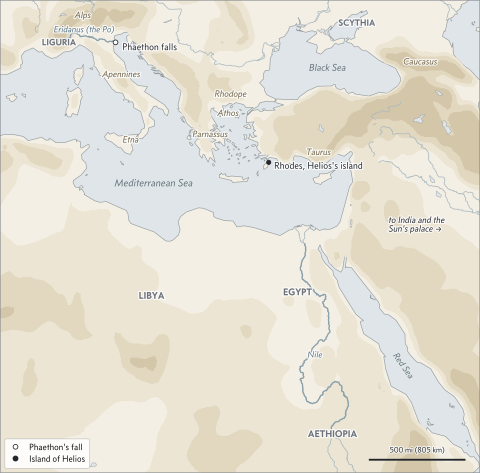
Earth herself, choking on the smoke, lifted her scorched face and begged Zeus to act before the whole world fell back into Chaos. Zeus climbed to the top of heaven to send rain, but there were no clouds left to gather. So he took up a thunderbolt, the bolt of lightning that the Cyclopes had forged for him (Chapter 1), and he hurled it at the driver. Zeus’s thunderbolt killed PhaethonPhaethon was killed by this weapon. → lightning• and threw him from the chariot. The horses broke loose and scattered the wreckage across the sky, with the reins in one place, the axle in another, and spokes and wheels everywhere.
With his red hair on fire, Phaethon fell through the air like a shooting star. Far from home, in the west, he fell into the river EridanusZeus struck this figure with a thunderbolt, sending him into the Eridanus River. → Phaethon•• (ih-rid-uh-nus), whose waters cooled his burning face. Greek poets placed the Eridanus vaguely at the edge of the world, and later Greek and Roman writers decided it was the Po, the great river of northern Italy. The nymphs of the river buried him and carved a verse on his tomb, which Miller turns into a rhyming couplet.
Helios hid his face in grief, and the story goes that for one whole day the world had no sun and was lit only by its own fires. Clymene wandered the earth until she found her son’s grave beside the river. His sisters, the Heliades (hee-ly-uh-deez), “daughters of the Sun,” came with her and wept at the tomb day and night for four months. Then the eldest, Phaethusa (fay-uh-thoo-suh), found that her feet had grown stiff and cold. Lampetia (lam-pee-shee-uh) could not move, held fast by sudden roots, and a third, reaching to tear her hair, found leaves in her hands. Bark closed over them while their mother tried to tear it away. So his sisters became poplar trees,This figure’s sisters became poplar trees and shed tears of amber while mourning him. → Phaethon•• and their tears, hardened by the sun, dropped from the branches as amber, which the river carried away to be worn, Ovid says, by the brides of Rome (Figure 3.6).

Amber is real, and the story has a real geography behind it. Amber is the hardened resin of ancient trees, golden and see-through, sometimes with an insect trapped inside, and much of it washes up on the shores of the Baltic Sea in northern Europe. Traders carried it south overland, along what is now called the Amber Road, to the head of the Adriatic Sea, near the mouth of the Po. A Greek who bought amber there could believe it came from the tears of the Sun’s daughters on the Eridanus. The Greek word for amber was elektron. Rubbed with cloth, amber picks up bits of straw and feather, and in 1600 the English doctor William Gilbert called that power electricus, “like amber.” From his word comes electricity.
One more mourner walked the riverbank. Cygnus was the king of the Ligurians, in what is now the northwest of Italy, and Phaethon’s kinsman on his mother’s side, but closer still as his friend. He left his kingdom and wandered weeping along the Eridanus among the new poplar trees, until his voice grew thin and shrill. White feathers covered his hair, his neck stretched out, and webs joined his fingers. In this way Cygnus, mourning his friend, became a swan.A companion of this figure turns into a swan while mourning his death. → Phaethon••Cygnus is this type of animal. → birds• Even his name was the word for that bird, kyknos in Greek and cygnus in Latin, and a young swan is still called a cygnet. Ovid adds that the new bird remembered the thunderbolt that had killed his friend. He never trusted himself to the upper air, where Zeus ruled, and chose lakes and quiet pools instead, as far from fire as he could get.
Phaethon became the Greek and Roman picture of a young man who reaches for a power he cannot handle. Euripides wrote a tragedy about him, now lost except for fragments, and later artists such as Michelangelo and Rubens loved to show the fall (Vol. 13, Valois, Bourbon, and Orange). The story did not quite end with the poplars. In Apollonius’s Argonautica, when Jason and his heroes later row up the Eridanus, Phaethon’s body still smolders in a lake along its course, and the stench of it sickens the crew (Chapter 19).
Dawn and Tithonus
Before the Sun could drive out each morning, his sister had to open the way. Eos was the Greek goddess of the dawn,This figure is the Greek goddess of dawn. → Eos• the first light that spreads up the eastern sky before sunrise. In the stories she rose from her bed beside Ocean, put on a saffron-yellow robe, and drove up into the sky in a chariot of her own, scattering light and dew. Artists gave her great wings like a bird’s. The Romans called her Aurora, their own word for dawn, so that Eos was the Greek Aurora,This figure is the Greek counterpart of the Roman Aurora. → Eos• and it is Aurora who opens the purple gates in Ovid’s story of Phaethon.
Homer gave her the most famous of all his epithets. Again and again in the Iliad and the Odyssey a new day begins with the same words, which A. T. Murray translates in the last book of the Iliad: “soon as early Dawn appeared, the rosy-fingered.” This is a formula, a ready-made phrase that a poet composing aloud could slot into his line whenever he needed it (Vol. 1, The Toolkit). Within that formula, Dawn’s epithet was rosy-fingered,This figure is called "rosy-fingered." → Eos• the standing label attached to her name (the Stage). Anyone who has watched streaks of pink light reach up over a dark horizon before sunrise has seen the fingers Homer meant.
Eos had a weakness, and the Greeks had a story to explain it. In the handbook of Apollodorus, she once took Ares, the god of war, as her lover, and Aphrodite, who loved Ares herself, punished her with a curse: from then on Eos would fall in love again and again with mortal men. So the dawn goddess became the great kidnapper of handsome young mortals. She carried off the giant hunter Orion (oh-ry-un) (Chapter 5), and she carried off a prince of Troy named Tithonus (tih-thoh-nus).

Tithonus was a son of Laomedon (lay-om-ih-don), king of Troy, and a brother of Priam, who would rule Troy during the Trojan War (Chapter 18). Eos took him away to her home by the streams of Ocean at the eastern edge of the world (Figure 3.7). Homer knew the story, and the eleventh book of the Iliad opens, in Murray’s words, as “Dawn rose from her couch from beside lordly Tithonus, to bring light to immortals and to mortal men.” The cruel part of the tale comes from the Homeric Hymn to Aphrodite, a poem of about the seventh century BC. Eos went to Zeus and asked him to make Tithonus immortal, and Zeus nodded his consent. But she won him immortality, not eternal youth.This figure obtained immortality but not eternal youth for her lover Tithonus. → Eos• “Too simple was queenly Eos,” the poet says in Evelyn-White’s translation: “she thought not in her heart to ask youth for him.”
For a while they lived happily. Then gray hairs began to show on Tithonus’s head and chin, and Eos stopped sharing his bed, though she still kept him in her house, fed him ambrosia, and dressed him in fine clothes. He grew older, and older still, until he could not move or lift his limbs. Then she laid him in a room and shut the shining doors on him. “There he babbles endlessly,” the Hymn says. Later writers gave the story a stranger ending, in which Eos turned the shriveled old man into a cicada, the insect that sheds its skin and sings on and on through the summer heat. The Greek poet Sappho (saf-oh) wrote of Tithonus about 600 BC (Vol. 6, The Greeks), and the Victorian poet Alfred Tennyson made him speak for himself in his poem “Tithonus,” finished in 1859 (Vol. 17, The Victorians).
Before he aged, Tithonus gave Eos two sons. One of them, Memnon (mem-non), grew up to be king of the Ethiopians and led an army to help his uncle Priam at Troy, where Achilles killed him (Chapter 27). Ovid writes that the dew covering the grass each morning is Dawn’s tears for her son.
Selene and Endymion
The third child of Hyperion ruled the night. Selene was the goddess of the moon, and like her brother she was the thing itself, since selēnē was the Greek word for the moon. Each evening, the Homeric Hymn to Selene says, she bathed in the waters of Ocean, put on her shining robes, and yoked her “long-maned horses.” Then Selene drove the moon across the sky,Selene personifies this celestial body and drives it across the sky. → the Moon••• her light brightest at mid-month, when the moon is full. Artists often gave her two horses where Helios had four, or seated her on a single horse, with a crescent moon at her brow or a billowing veil arched over her head like the night.
The Romans called her Luna, and once again the name was simply their word for the thing. Luna was the Roman moon goddess,The Roman goddess Luna represented this celestial object. → the Moon•• and her name lives on in the English lunar. It survives less kindly in lunatic, from the old belief that the full moon drove people mad.

The sculptors of the Parthenon, Athena’s great temple on the Acropolis of Athens, framed a whole scene with the Sun and the Moon. The gable over its eastern entrance showed the birth of Athena in the middle (Chapter 4). In the left corner, Helios’s horses rose up out of the sea, and in the right corner Selene’s horses sank down into it (Figure 3.8). Sunrise at one end and moonset at the other seem to have marked the hour: the goddess was born at daybreak.
Selene, too, loved a mortal. His name was Endymion (en-dim-ee-un), and ancient writers could not agree who he was. To some he was a king of Elis (ee-lis), the region of Olympia in the western Peloponnese. To others he was a shepherd or a hunter on Mount Latmus, in Caria on the coast of Asia Minor, where the local people kept a shrine to him. Most agreed that he was the most beautiful of men and that Selene loved the sleeping Endymion.This figure loved the eternally sleeping Endymion. → Selene•• Every night, as the moon crossed the sky, she came down to the cave on Latmus where he lay asleep and gazed at him.
He never woke, and the writers gave different reasons why. Apollodorus says that Zeus let Endymion choose any gift he liked, and he chose to sleep forever, never dying and never growing old. Other tellers said that Selene herself asked Zeus to keep him asleep, so that she could look at him forever. The traveler Pausanias heard in Elis that Selene bore him fifty daughters, and the Scottish scholar James Frazer later connected them with the fifty months between one Olympic Games and the next. The Romans had a saying for a very long sleep, “to sleep the sleep of Endymion.” The young English poet John Keats began his long poem Endymion, published in 1818, with a line still quoted everywhere: “A thing of beauty is a joy for ever” (Vol. 15, The Age of Revolution).
The four winds
Eos had a second family, among the gods. Her partner there was Astraeus (uh-stree-us), whose name means “the starry one,” a younger Titan, the son of the Titan Crius. Hesiod says their children were the winds, and after them the Morning Star and all the stars that crown the sky. He names three winds, “brightening Zephyrus, and Boreas, headlong in his course, and Notus,” in Evelyn-White’s words. Later writers added a fourth brother, Eurus (yoor-us). So Eos and Astraeus had four wind gods,With the Titan Astraeus, Eos gave birth to the four primary gods of this domain. → wind• one for each quarter of the sky (Figure 3.1).
The Greeks called them the Anemoi (an-eh-moy), which simply means “the winds.” Each was named for the direction it blew from, so a north wind comes from the north, and a west wind blows toward the east. In this way the four winds matched the four directionsThe Anemoi, including Boreas, Zephyrus, Eurus, and Notus, personify this phenomenon in the four cardinal directions. → wind••• (Figure 3.9). Boreas (bor-ee-us) was the north wind, Zephyrus (zef-uh-rus) the west, Notus (noh-tus) the south, and Eurus the east. Being gods, they had characters to match their weather. Boreas was cold and violent, the bringer of winter, and painters showed him as a shaggy, bearded old man. Notus brought the wet storms of late summer and autumn, and Eurus was a rough wind that tossed ships about.

Gentlest of the four was Zephyrus, the god of the west wind,Zephyrus, a god of this phenomenon, represents the west. → wind• whose warm breath off the sea brought the spring flowers. In English a soft breeze is still a zephyr. Three of his stories come later in this book. A jealous Zephyrus is said to have blown a discus off course and killed the boy Hyacinthus (hy-uh-sin-thus) (Chapter 5). He fathered the immortal horses that drew Achilles’s chariot at Troy (Chapter 25). And at Cupid’s command he carried the princess Psyche gently down to her unseen husband’s palace (Chapter 7).
Boreas lived in Thrace, the wild, cold country north of the Aegean Sea. He fell in love with Orithyia (or-ih-thy-uh), a daughter of Erechtheus (ih-rek-thee-us), king of Athens, and when wooing failed he snatched her up from the bank of the river Ilissus (ih-lis-us) and carried her off to Thrace. Their twin sons grew wings like their father’s as young men and later sailed with Jason on the Argo (Chapter 19). Because of Orithyia, the Athenians thought of Boreas as their son-in-law. In 480 BC the Persian king Xerxes (zurk-seez) invaded Greece, and while his huge fleet lay anchored off its coast, the Athenians prayed to Boreas for help. A northeasterly gale blew for three days and wrecked at least four hundred Persian ships. The historian Herodotus, who tells the story, would not say whether Boreas had really done it, but the Athenians were sure, and they built him a shrine beside the Ilissus (Vol. 6, The Greeks).

The Romans had their own names for the winds: Aquilo (ak-wih-loh) for Boreas, Favonius (fuh-voh-nee-us) for Zephyrus, Auster for Notus, and Vulturnus for Eurus, though Roman poets often kept the Greek names. Two of them hide in modern words. The Latin australis, “southern,” comes from Auster and gave its name to Australia, the southern continent. And in 1619 the Italian scientist Galileo called the shimmering curtains of light in the northern night sky the aurora borealis, the “northern dawn,” joining the Roman name of Eos to the name of her son Boreas. Their twin in the far south is the aurora australis.
The winds did not always roam free. In the Odyssey and the Aeneid they are kept by a king named Aeolus (ee-oh-lus), who holds them shut up on his island and lets them out when the gods wish (Chapter 28, Chapter 30). In Athens, the astronomer Andronicus (an-druh-ny-kus) of Cyrrhus built them a home of their own, probably about 50 BC. It is a marble tower 12 meters (39 feet) high with eight sides, one facing each of the eight winds the Greeks had come to count by then, and each side carries a carving of its wind as a winged man (Figure 3.10). Sundials on the walls told the hour by day, a water clock inside measured time, and a bronze Triton on the roof turned in the breeze as a weather vane. The Tower of the Winds still stands in Athens, nearly whole.
What to remember
- The Titans Hyperion and Theia were the parents of Helios, the Sun (Roman Sol), Selene, the Moon (Roman Luna), and Eos, the Dawn (Roman Aurora). Each god was also the thing itself.
- Helios drives a chariot drawn by four horses across the sky from east to west, sees everything, and was the patron god of Rhodes, where his son Tenages was murdered by four jealous brothers.
- Clytie’s jealousy got Helios’s love Leucothoe buried alive, and Clytie, pining for him, became a flower that turns to follow the sun. Leucothoe is not Leucothea, who is Ino (eye-noh).
- In Ovid, Phaethon, son of Helios and Clymene, is challenged by Epaphus, drives his father’s chariot, loses control, scorches the earth and the Ethiopians, and is killed by Zeus’s thunderbolt, falling into the Eridanus.
- Phaethon’s sisters, the Heliades, became poplars weeping amber, and his friend Cygnus became a swan.
- Eos is “rosy-fingered” in Homer. She won her Trojan lover Tithonus immortality without youth, and their son Memnon fell at Troy.
- Selene loved Endymion, who sleeps forever on Mount Latmus.
- Eos and the Titan Astraeus were the parents of the four winds, the Anemoi: Boreas from the north, Zephyrus from the west, Notus from the south, and Eurus from the east.
Chapter 4 · 36 clues
Athena, Hephaestus, and the First Kings of Athens
In the late summer of 480 BC, a Persian army invading Greece stormed the Acropolis of Athens, the steep rock in the middle of the city where the Athenians kept their holiest temples. Most Athenians had already gone, their families to safety across the water and their men to the fleet at Salamis (sal-uh-mis). The Persians killed the few men who stayed behind, looted the temples, and set them on fire (Vol. 6, The Greeks). Among the things that burned was an old olive tree that grew in a walled yard beside the temple of the city’s goddess.
The historian Herodotus collected the story a generation later. On the day after the fire, he says, Athenian exiles who had marched with the Persians climbed the rock to sacrifice, and they found that a green shoot as long as a man’s forearm had already sprung from the blackened stump. Athenians took it as a sign that their goddess had not abandoned them. To see why one tree could mean so much, you have to know who planted it, and against whom. The story begins with a goddess who was born from her father’s head.
Born from the head of Zeus
When Zeus had beaten the Titans and taken the throne of heaven (Chapter 1), his first wife was not Hera. She was Metis, a daughter of the Titans Oceanus and Tethys, and her name is the Greek word for cunning intelligence: the practical wisdom that finds a way out of a trap. In Apollodorus’s telling she had already helped Zeus once, by mixing the drug that made his father Cronus vomit up the children he had swallowed.
Then Gaia and Uranus, Zeus’s grandparents, gave him a warning. Metis was fated to bear wise children, first a daughter equal to her father in strength and good sense, and after her a son who would take his father’s place as king of gods and men. Zeus knew what such a prophecy meant, because his grandfather Uranus had been overthrown by his son Cronus, and Cronus by his son Zeus. So, as Hesiod tells it in the Theogony, Zeus “craftily deceived her with cunning words,” in H. G. Evelyn-White’s translation, and then he swallowed Metis while she was pregnant.This figure swallowed his first wife, Metis, to prevent her from having a son who would overthrow him. → Zeus•Zeus swallowed this figure’s mother Metis before her birth. → Athena•• He wanted her wisdom inside him, where she could give him advice, and her children nowhere at all. The daughter Metis was carrying was Athena (Figure 4.1).

The child kept growing inside her father anyway. In time Zeus had a splitting headache, and someone had to open his head. The poet Pindar says that Hephaestus, the smith of the gods, struck the blow with a bronze axe, and Apollodorus gives the axe to Prometheus, the Titan who would later steal fire for mankind (Chapter 9), or to Hephaestus. (Hesiod makes Hephaestus younger than Athena, so the poets who hand him the axe are telling a different story from Hesiod’s.) Out of the wound Athena sprang, fully grown and armed,This figure was born fully grown and armed from Zeus’s head after it was split with an axe. → Athena••• in helmet and armor and shaking a spear, with a war cry that rang across the sky. In Evelyn-White’s translation of the Homeric Hymn to Athena, “great Olympus began to reel horribly at the might of the bright-eyed goddess.” The earth cried out, the sea heaved, and the sun god Helios “stopped his swift-footed horses a long while” until she took her armor off (Figure 4.2).

She kept her mother’s gift. Athena was the Greek goddess of wisdom,This figure is a Greek deity of wisdom. → Athena•• and her wisdom was the kind Metis stood for: good counsel, clever plans, and skill with the hands. She was a goddess of war as well, though not the war of her brother Ares, who loved battle for its own sake (Chapter 7). Athena was the general who wins by thinking, and she stood beside clever heroes such as Odysseus (Chapter 28). She was also the goddess of crafts, above all spinning and weaving, and a girl named Arachne (uh-rak-nee) would learn what it cost to challenge her at the loom (Chapter 12). The Romans called her Minerva, the name of their own goddess of crafts. She never married, and the Greeks called her Parthenos (par-theh-nos), “the maiden.”
Her commonest title in poetry is Pallas, as in “Pallas Athena.” No one knows what the word first meant, and the Greeks themselves told two stories to explain it. In one, she killed and skinned a giant named Pallas in the war with the Giants (Chapter 1). The other is sadder, and Apollodorus tells it. As a girl, Athena was brought up by Triton, the merman son of Poseidon (Chapter 2), together with his daughter, who was also called Pallas. The two girls practiced fighting together, until one day their practice turned into a real quarrel. Pallas was about to strike when Zeus, afraid for his daughter, held up the aegis (ee-jis), his terrifying war-cloak. Pallas flinched and looked up at it, and Athena’s blow went home and killed her. Athena had never meant to hurt her friend. Apollodorus speaks only of her grief, but the story was told to explain her title: in mourning, the goddess took her dead friend’s name, Pallas,This figure gained the epithet "Pallas" after accidentally killing her childhood friend of the same name. → Athena•• and wore it before her own.
Then she carved a likeness of the girl in wood and set it up beside Zeus in heaven. This was the Palladium (puh-lay-dee-um), “the image of Pallas,” and since Athena herself now bore that name, the Greeks came to think of it as a statue of Athena. Later Zeus threw it down from heaven to the land of Troy, just as a prince named Ilus (eye-lus) was founding the city there, and Ilus built a temple to house it. The wooden statue called the PalladiumA wooden statue of this figure was known as the Palladium. → Athena• became Troy’s most precious possession, because the Trojans believed their city could never fall while it stood inside the walls. That is why two Greek heroes would one day creep into Troy by night to steal it (Chapter 27).
The aegis that distracted Pallas belonged to Zeus, whom Homer calls “aegis-bearing,” and Hephaestus had made it for him. When Zeus or Athena shook it, thunder rolled and armies panicked. In A. T. Murray’s translation of the Iliad, Athena throws “the tasselled aegis, fraught with terror” about her shoulders, and on it is “the head of the dread monster, the Gorgon.” The ancients could not agree on what the aegis actually looked like, and they described it as a goatskin, a breastplate, or a shield.This protective object associated with Zeus and Athena was described as a goatskin, breastplate, or shield. → aegis••• The word seems to come from aix, “goat,” and a Roman handbook of star myths that goes under the name of Hyginus says it was the hide of Amalthea, the goat that nursed baby Zeus on Crete (Chapter 1). Vase painters drew it as a short cape of scaly skin, fringed with snakes and worn over Athena’s chest like a breastplate, and Roman poets made it a breastplate outright. Later writers turned it into a shield. Whatever its shape, it protected, and English keeps that meaning: to do something “under the aegis” of someone is to do it under that person’s protection.

Athena’s bird was the owl. Homer’s favorite word for her is glaukopis (glow-koh-pis), usually translated “gray-eyed” or “bright-eyed,” and the Greek word for the little owl that nests among the rocks of Athens, glaux, comes from the same root, perhaps because of the bird’s own staring eyes. The owl was so closely Athena’s birdThis figure is commonly associated with owls. → Athena• that scientists still call the little owl Athene noctua. Athens stamped it on its silver coins, which people simply called “owls” (Figure 4.3), and a Greek proverb said that bringing owls to Athens was wasted effort, like bringing sand to the beach. Much later, Europeans made the owl a sign of wisdom because it had belonged to the goddess of wisdom.
The contest for Athens
In the days when the gods were choosing which cities should honor them, Attica, the rocky triangle of land around Athens, had a strange king. His name was Cecrops (see-krops), and he had been born from the earth itself. From the waist up he was a man, and from the waist down he was a coiling snake. Athenians remembered Cecrops, half man and half snake,Cecrops, a half-snake legendary founder, was the first king of this city. → Athens•• as the first king of their city, and they said he had taught their ancestors to marry, to bury their dead, and to worship Zeus. The high rock at the center of his kingdom, the later Acropolis, was called Cecropia (sih-kroh-pee-uh) after him.
Two gods wanted his land: Poseidon, lord of the sea (Chapter 2), and Athena. Each would give it a gift. Apollodorus, who tells the story most fully, says that Poseidon arrived first. He strode onto the Acropolis and struck the rock with his trident, his three-pronged spear, and seawater welled up into a pool, a salt spring on the top of a hill. Then Athena came, called Cecrops to watch, and planted an olive tree beside it. In the contest that followed, her olive tree beat Poseidon’s salt spring,This figure won the patronage of Athens by offering an olive tree instead of Poseidon’s salt spring. → Athena•••Athena’s olive tree defeated Poseidon’s salt spring in a contest for this city. → Athens••This figure lost the contest for Athens after offering a salt spring instead of Athena’s olive tree. → Poseidon••• and the land was hers.
The gift was better than it looks. Nobody can drink salt water or water a field with it. The olive, on the other hand, gave Athenians food, wood, and oil for cooking, for their lamps, and for cleaning their skin after exercise. Olive oil became Athens’s great export, and winners at Athena’s own games took home large painted jars filled with oil pressed from her sacred trees.
Apollodorus is careful about who chose between the gifts. He says the two gods kept quarreling until Zeus parted them and appointed judges, the twelve gods of Olympus. They awarded the land to Athena because Cecrops swore that she had planted her tree first. Apollodorus also admits that other writers made Cecrops himself the judge, and many later retellings follow them. In that version the half-snake king weighed the two gifts himself, and Poseidon’s blow produced either a spring or something grander. Virgil hails Neptune, the Roman Poseidon, as the god whose trident struck the earth and brought forth the first horse. Later Roman scholars who explained Virgil’s poems set that horse in the contest for Athens, where the trident’s stroke brought forth a horse,In a contest judged by Cecrops, a figure used this weapon to create either a horse or a wellspring. → trident• leaping out of the rock. The olive won all the same.
Poseidon took his defeat badly. In his anger he flooded the plain to the west of the city, and the Athenians, wisely, still kept an altar to him on the Acropolis. The winner was honored in the plainest way possible: the city took the goddess’s nameThe city of Athens was named after this figure. → Athena••This city is named after the Greek goddess of wisdom. → Athens•• and became Athens, the city of Athena, the goddess of wisdom. The name probably ran the other way, from a much older city to its goddess, but every Athenian knew the story. For centuries afterward, guides on the Acropolis showed visitors the salt spring, the marks of the trident in the rock, and Athena’s olive tree, the same tree that sprouted again after the Persian fire.
The lame smith
Hephaestus was the god who could make anything. He was the god of the forge and of blacksmiths,This figure is the Greek god of the forge and blacksmiths. → Hephaestus••• the god of fire used as a tool. A forge is a smith’s hearth: a bed of charcoal blown white-hot by bellows, hot enough to soften bronze and iron so that they can be hammered on an anvil into blades, armor, and pots. Every Greek town had its smiths, sooty men with scarred arms and huge shoulders, and their god looked like one of them. The Romans called him Vulcan. He built the gods’ bronze houses on Olympus and made the aegis for Zeus, and he would make Pandora, the first woman (Chapter 9), and new armor for Achilles (Chapter 26).

He was also the only Olympian who was not beautiful. Homer calls him the lame god: his feet were twisted, and he walked with a stick. In Murray’s Iliad, he rises from his anvil, “a huge, panting bulk,” and as he limps across his hall, “handmaidens wrought of gold in the semblance of living maids” hurry to hold him up. They are golden robots that can think and speak, the finest things he ever made.
In Homer, the lameness came with him into the world, and his mother could not bear it. Whether or not Zeus was his father (Chapter 2), Hera was ashamed of her crippled baby and threw him out of heaven. In the Iliad Hephaestus remembers how he fell “through the will of my shameless mother, that was fain to hide me away by reason of my lameness.” He fell far, into the sea, where two sea goddesses, Thetis and Eurynome, caught him. For nine years he lived hidden in their cave, making brooches and necklaces.
He did not forget. Pausanias, who saw the story painted in a shrine of Dionysus at Athens, tells how Hephaestus sent his mother a present: a golden throne. When Hera sat down, invisible bonds closed around her, and she could not get up. So Hephaestus trapped his mother in a golden throne,This figure trapped his mother Hera using a cursed chair or golden throne she could not escape. → Hephaestus••Hephaestus trapped this figure in a magical throne. → Hera•• and none of the other gods could set her free. In the end it was the wine god Dionysus who coaxed him home to let her go (Chapter 11 tells how).
Hephaestus fell from heaven a second time, and this time it was for taking his mother’s side. Homer says only that he had tried to rescue Hera from Zeus; Apollodorus explains that it happened when Zeus hung Hera from the sky (Chapter 2). Zeus caught Hephaestus by the foot and hurled him from the threshold of heaven. As he later told it, he fell for a whole day and landed at sunset on the island of Lemnos (lem-nos), in the northern Aegean, with hardly any life left in him. There the Sintians (sin-tee-unz) of Lemnos took care of him.In one tradition, this figure landed on Lemnos after being thrown from Olympus and was cared for by the Sintians. → Hephaestus•• The Sintians were the island’s first people, a tribe from Thrace, the rough country north of the Aegean, and Lemnos stayed Hephaestus’s favorite place on earth; one of its towns was named after him (Figure 4.5). Apollodorus says it was this second fall that lamed him.

Hephaestus tells the story of his second fall at the end of the Iliad’s first book, in a scene that shows what kind of god he was. The sea goddess Thetis, the same one who had saved him as a baby, has just persuaded Zeus to help the Trojans until the Greeks honor her son Achilles, whom their commander has insulted (Chapter 26). Hera, who hates the Trojans, attacks her husband for it in front of all the gods, and Zeus threatens her. The feast goes silent. Then Hephaestus stands up. He begs his mother to give way, reminds her what happened the last time he stood up to Zeus, and puts a cup in her hand, and Hera smiles. Hephaestus goes limping around the hall pouring nectar for everyone, doing the work of the graceful cupbearer Hebe, and the gods burst out laughing at him.At the end of Book 1 of the Iliad, the Olympians laugh at this figure as he attempts to end a quarrel among the gods. → Hephaestus• The laughter ends the quarrel, which is exactly what he wanted.
Homer puts Hephaestus’s workshop in his bronze house on Olympus. Later Greeks and Romans moved it underground. Mount Etna in Sicily, where Zeus had pinned the monster Typhon (Chapter 1), rumbles, flashes, and pours out molten rock, and to them it looked like the chimney of a gigantic smithy. So poets placed his forge beneath the volcano Etna,This figure's workshop is beneath Mount Etna. → Hephaestus••Mount Etna, traditionally associated with the forge of Hephaestus or Vulcan, is one of these geological features. → volcano•• with the mountain’s smoke rising from his fires. Now and then they moved it to a smaller volcano nearby. Hiera, a smoking island off the north coast of Sicily, was known to the Romans as Vulcan’s island, and it is still called Vulcano. From its name comes our word “volcano.”
A forge that size needed workmen, and the poets gave him the best there were. The one-eyed Cyclopes, who in Hesiod’s poem had forged Zeus’s thunderbolt (Chapter 1), became the workmen at Hephaestus’s anvils.These beings were workers in Hephaestus's workshop. → Cyclops• In the eighth book of the Aeneid, Virgil shows three of them sweating in a cave under Vulcan’s island. They are hammering out a thunderbolt for Jupiter and a chariot for Mars, and polishing the aegis of Minerva, until Vulcan orders them to drop everything and make armor for the hero Aeneas.
For a wife, Homer’s Odyssey gives the ugliest of the gods the most beautiful: there Hephaestus is married to Aphrodite,This figure is married to Aphrodite. → Hephaestus•• the goddess of love. The marriage went badly. A singer in the Odyssey tells how she betrayed her husband with Ares, and how Hephaestus caught the two of them in a net too fine to see (Chapter 7). Other poems gave him a different and happier wife, one of the Graces, three daughters of Zeus who stood for beauty and charm. The Iliad calls her Charis (kair-is), “Grace,” and in the Theogony Hesiod names her Aglaea (uh-glee-uh), the youngest Grace.In Hesiod’s Theogony, this figure’s wife is Aglaea, the youngest of the Graces. → Hephaestus•• Aglaea means “splendor.”
Not far from Lemnos lies Samothrace (sam-oh-thrays), an island whose mountain is so high that in the Iliad Poseidon sits on its peak to watch the fighting at Troy. On both islands people worshipped gods called the Cabeiri (kuh-by-ree). Greek writers made them the sons of Hephaestus,This figure is the father of the Cabeiri, worshipped on Samothrace. → Hephaestus•• by a sea nymph named Cabeiro, and like their father they were smiths. Their worship on Samothrace was a mystery cult, a set of secret rites shown only to people who had been initiated and sworn to silence, like the Mysteries of Eleusis (Chapter 6). Sailors prayed to these “Great Gods” in storms, and pilgrims came from all over the Greek world to be initiated; Herodotus hints that he was one of them. They kept the secret so well that we still do not know what happened inside.
Cecrops and Erichthonius
Athena and Hephaestus, the two children of Zeus who worked with their hands, met again in a story the Athenians told about their own beginnings. It explains how Erichthonius (er-ik-thoh-nee-us), the next great king of Athens after Cecrops, came to be born. Apollodorus tells it most fully. Athena came to Hephaestus’s forge to order new weapons. Hephaestus, whom Aphrodite had deserted, fell in love with her on the spot and chased her. He was lame and she was fast, but he caught up with her and tried to force himself on her. She fought him off, and his attempt to rape her failed.Erichthonius was born after Hephaestus's failed attempt to rape this figure. → Athena••
In the struggle, before she broke free, his seed fell on her leg. In disgust she wiped it off with a tuft of wool and threw the wool away onto the ground. But the ground was Gaia, the Earth herself (Chapter 1), and from the seed that fell to earthThis figure’s attempted assault on Athena led to the birth of Erichthonius when his semen fell to earth. → Hephaestus•• she conceived a child. When he was born, Gaia rose up out of the ground and handed the baby to Athena, who took him as her own (Figure 4.8). Athenians explained his name as erion, “wool,” joined to chthon, “earth,” though no one can be sure of that.
Athena wanted to raise the boy in secret, hidden from the other gods; Apollodorus says she hoped to make him immortal. She put him in a box, closed the lid, and gave the box to Cecrops’s three daughters,This figure entrusted Erichthonius in a box to Herse, Pandrosus, and Aglauros, forbidding them to look inside. → Athena•• Herse (hur-see), Pandrosus (pan-droh-sus), and Aglauros (uh-glaw-ros), with one order: they must not look inside. Pandrosus obeyed. Her sisters could not stand the suspense, and they lifted the lid. What they saw differs from teller to teller: a baby with a snake coiled around him, or a baby whose legs ended in snakes. Pausanias, who heard the story in Athens, says that the two who looked went mad and threw themselves off the steepest part of the Acropolis. Pandrosus, who kept her word, had a shrine on the Acropolis, the walled yard where Athena’s olive grew.
Ovid tells it differently in the Metamorphoses. In his version only Aglauros opened the box, and a crow saw her do it and flew off to tell Athena. The crow expected thanks, but the goddess drove the telltale away and took the owl as her bird instead. Herse lived on to be loved by a god. Hermes, flying over the city during Athena’s festival, looked down on the procession of girls carrying offerings up to the goddess’s temple and saw Herse, a princess of Athens,Herse is from this city. → Athens• the loveliest of them all. Aglauros, sick with envy of her sister, sat in the doorway of their house to block his way, and Hermes turned her to stone.
Erichthonius grew up in Athena’s sanctuary on the Acropolis. When he was grown, he drove out a man who had seized the throne from Cecrops’s successors, and the half-serpent Erichthonius ruled AthensErichthonius, a half-serpent king, ruled this city. → Athens•• as its king. He set up a wooden statue of Athena on the Acropolis and founded her greatest festival, the Panathenaia (pan-ath-uh-nee-uh), with games and processions in her honor. Like Cecrops, he had a problem that no ordinary king had: his legs, some said, were the tails of snakes. In one tradition he invented the chariot to hideIn one tradition, this figure invented the chariot to conceal his serpent feet. → Erichthonius•• his serpent feet: standing in a chariot box, he could cover his lower body and still go anywhere at speed. Virgil calls him the first man who dared to yoke four horses to a chariot, and Athenian chariot races began with him.
When he died, the story goes, Zeus so admired his driving that he set Erichthonius among the stars as the constellation AurigaThis figure was commemorated as the constellation Auriga. → Erichthonius•• (aw-ry-guh), “the Charioteer.” You can find it high in the winter sky in the Northern Hemisphere. The figure is usually drawn with a goat on his shoulder, because the bright star Capella, “the little she-goat,” was said to be Amalthea, whose hide, in one story, became the aegis.
From Erichthonius the line of kings ran down to Aegeus (ee-jee-us) and his son Theseus, the hero who killed the Minotaur (Chapter 21). The last king of all, the Athenians said, was Kodros (kod-ros). In his reign the Dorians, Greek-speaking invaders who had already overrun most of southern Greece, marched on Athens. They asked the oracle of Apollo at Delphi (Chapter 5) how the war would go, and the answer came back that they would win so long as they did not kill the Athenian king. News of the oracle reached Kodros. He put on the rags of a poor peasant, walked out to the Dorian camp, and picked a quarrel with some soldiers, who killed him without knowing who he was. When the Dorians learned whom they had killed, they lost heart and went home. So Kodros died to fulfill the prophecy,This city's king Kodros was killed to fulfill a prophecy. → Athens• and saved his city by it. The Athenians decided that no one was worthy to succeed him as king, and afterward they were ruled by officials called archons, at first chosen from his own family (Vol. 6, The Greeks). The oldest full telling that survives is in a speech by the Athenian orator Lycurgus (ly-kur-gus) of about 330 BC, some seven centuries after the date later Greeks gave for Kodros’s death.
The Parthenon and a painted vase
Athenians in the fifth century BC could see these stories every time they climbed the Acropolis. After the Persian fire of 480 BC, the statesman Pericles (per-ih-kleez) persuaded the city to rebuild on a grand scale (Vol. 6, The Greeks). Between 447 and 432 BC the architects Ictinus (ik-ty-nus) and Callicrates (kuh-lik-ruh-teez) raised the Parthenon, the temple of AthenaThe Parthenon is dedicated to this figure. → Athena•• the Maiden, a marble building about 70 meters long, with eight columns across each end (Figure 4.6). Its name comes from Parthenos, her title as the goddess who never married.

The sculptor Phidias, who directed the work, filled the two triangular gables at the ends of the roof, called pediments, with Athena’s two great stories. Over the east front, where the main door opened, was her birth from the head of Zeus. Over the west front, which visitors saw first, was her contest with Poseidon, the two gods springing apart, probably with the olive tree between them. Little of either scene survives. The middle of the birth scene was cleared away in the Middle Ages, while the temple was a church. The contest was still largely in place when an artist drew it in 1674. In 1687, while Venice was at war with the Ottoman Turks, who then ruled Athens, a Venetian shell set off gunpowder that the Turkish garrison had stored in the temple. The next year Venetian soldiers smashed the figure of Poseidon and Athena’s chariot horses while trying to take them down. We know the scene partly from those drawings, made thirteen years before the explosion.

Inside the temple stood Phidias’s statue of Athena Parthenos, about 12 meters tall, made of wood covered with ivory for her skin and with about a ton of gold for her clothes and armor. It is lost, but small Roman copies show how it looked (Figure 4.7). She wore her helmet and the aegis, held a winged figure of Victory in her right hand, and rested her left hand on her shield. Inside the shield coiled a great snake. Pausanias, who saw the statue, thought the snake was Erichthonius.
The olive tree and the salt spring were not in the Parthenon but a few steps to the north, at a smaller and oddly shaped temple built in the last decades of the century, the Erechtheion (eh-rek-thee-on). Its north porch had a hole left open in the roof above marks in the rock that guides said Poseidon’s trident had made, and in the yard of Pandrosus beside it grew Athena’s olive. The building was named for Erechtheus, a later king, Erichthonius’s grandson, whom the oldest writers did not always tell apart from him.

Athenian painters told the same stories on pottery. In the red-figure technique, the painter left the figures in the orange color of the clay and painted the background around them black, so that they glow against the dark. Between 470 and 460 BC a painter named Hermonax (hur-moh-naks) decorated a stamnos, a wide-shouldered jar for mixing wine, with the birth of Erichthonius (Figure 4.8). At the bottom of the scene, Gaia rises from the earthAn ancient vase depicts this figure rising from the earth to hand Erichthonius to Athena. → Gaia• only as far as her waist, because the rest of her is still the ground. She lifts the baby up in both hands, and Athena, wearing the aegis with its fringe of snakes, bends to take him. Hephaestus stands at the edge of the scene and watches.
What to remember
- Zeus swallowed his first wife, Metis, because her son was fated to overthrow him; Athena, the goddess of wisdom (Roman Minerva), sprang fully armed from his head when it was split with an axe.
- Athena took the name Pallas from the friend she killed by accident and carved her likeness, the wooden Palladium that later protected Troy.
- The aegis, made by Hephaestus, was described as a goatskin, a breastplate, or a shield; the owl was Athena’s bird.
- Poseidon’s trident brought forth a salt spring (or, in later Roman tellings, a horse), but Athena’s olive tree won Attica, and the city took her name; the judges were the twelve gods in Apollodorus and Cecrops in other tellings.
- Hephaestus (Roman Vulcan), god of the forge, was lame and fell from heaven twice: thrown by Hera at birth and by Zeus, landing on Lemnos among the Sintians. He trapped Hera in a golden throne.
- His forge was placed under Mount Etna, with the Cyclopes as workmen; his wives were Aphrodite and, in Hesiod, Aglaea; the Cabeiri of Samothrace were his sons.
- Cecrops, half snake, was the first king of Athens. Erichthonius, born from the earth after Hephaestus’s failed assault on Athena, was hidden in a box given to Cecrops’s daughters, became king, invented the chariot, and became Auriga.
- Kodros, the last king of Athens, let himself be killed so that a prophecy would save the city.
- The Parthenon was Athena’s temple; its pediments showed her birth and her contest with Poseidon.
Chapter 5 · 68 clues
Apollo and Artemis, the Children of Leto
In the winter of 426 BC, in the sixth year of their long war with Sparta (Vol. 6, The Greeks), the Athenians sent workmen to a small island in the middle of the Aegean Sea. The island was Delos, a granite ridge about 3 miles (5 km) long, with little water and less soil. The workmen dug up every grave on it and carried the bones across a narrow strait to the larger island of Rheneia (ree-nee-uh). Then Athens decreed that from now on no one might die on Delos and no one might be born there. A woman about to give birth, or a sick man about to die, had to be ferried across the strait first. The Athenian historian Thucydides (thoo-sid-ih-deez), who lived through that winter, records the law.
Birth and death were kept away from Delos because a god had been born there, or rather two. Every Greek knew the story. A goddess heavy with twins had wandered the world looking for a single place that would let her give birth, and only this bare rock had said yes. Her children were Apollo, the god of light, music, and prophecy, and Artemis, the huntress. Their stories run from that birth to the great oracle at Delphi, to the sickrooms of Apollo’s son, and into the forests where Artemis hunted and punished.
The birth on Delos
Leto was a Titan’s daughter. Her parents were Coeus and Phoebe, two of the twelve Titans whom Gaia, the Earth, bore to Uranus, the Sky (Chapter 1). Hesiod’s Theogony remembers her kindly. In H. G. Evelyn-White’s translation she is “dark-gowned Leto, always mild, kind to men and to the deathless gods.” The Romans called her Latona (luh-toh-nuh). She had a sister, Asteria (ass-teer-ee-uh), whose name means “starry,” and the sisters’ troubles began when Zeus, the king of the gods, fell in love with both of them (Figure 5.1).

Zeus was married to his sister Hera, the queen of heaven and the goddess of marriage (Chapter 2), and Hera made his loves suffer. Leto became pregnant with Zeus’s twins, and Hera set out to make sure she had nowhere to bear them. The Greek poet Callimachus says that every land refused Leto for fear of the queen of heaven. Later retellings add a monster to the chase: Hera sent a serpent after Leto,Hera sent one of these creatures in pursuit of Leto during her pregnancy. → snakes• the enormous snake Python, which lived by a spring under Mount Parnassus in central Greece. In the Latin handbook of Hyginus, Hera only forbids the birth, and the serpent hunts Leto for a reason of its own: it had been warned that a child of Leto would one day kill it. So the pregnant goddess fled from place to place, and wherever she stopped, the ground would not have her.
The Homeric Hymn to Apollo, the oldest telling of her flight, lists the places that turned her away: Crete and Athens, Aegina (ee-jy-nuh) and Euboea (yoo-bee-uh), Mount Athos, Lemnos, Lesbos, Chios (ky-os), Samos, Naxos (nak-sos), and many more. (The Homeric Hymns, as the Stage explained, are poems in Homer’s style composed in praise of single gods.) At last Leto came to Delos. Later poets explained why that island alone could take her in. Delos had once been Leto’s sister: fleeing Zeus, Asteria had turned herself into a quail, plunged into the sea, and become a floating island that drifted with the waves. Because it was fixed to nothing, some said, Hera’s ban on every land did not cover it. The quail gave the island its old name, Ortygia (or-tij-ee-uh), from the Greek word for “quail.”


Delos was poor, and it knew it (Figure 5.3). In the Hymn, Leto makes it an offer: if the island will receive her son, men will bring sacrifices from all over the world, and Delos will be fed by strangers, since its own rocky soil will never feed it. Delos is tempted but afraid. It has heard that this child will be proud and violent, and it fears that the newborn god will scorn so poor a place and kick it to the bottom of the sea. So Delos asks for an oath. Leto swears by the water of the Styx, the river of the underworld by which the gods swear their most binding oaths, that her son will build his first temple there and honor Delos above every other land.
Even then the birth would not come. Leto labored nine days and nine nights,In the Homeric Hymn to Apollo, Leto labored for this many days and nights before giving birth to Apollo. → nine• for Hera had kept Eileithyia, the goddess of childbirth (Chapter 2), at her side on Olympus, where the birth goddess had heard nothing of Leto’s pain. In Evelyn-White’s translation of the Hymn, “Leto was racked nine days and nine nights with pangs beyond wont.” The goddesses who had come to Delos to help her sent Iris, the swift messenger of the gods, to fetch Eileithyia secretly, with the promise of a golden necklace 9 cubits long, about 13 feet (4 m). The moment Eileithyia set foot on the island, the pains of birth seized Leto. She threw her arms around a palm tree beside the hill called Cynthus (sin-thus), knelt in the soft grass, and the child leaped out into the light while the earth laughed for joy.
The Hymn is interested only in the son, and it even puts his sister’s birth on another island. Most later writers tell it differently: the twins, Apollo and Artemis, were born on Delos.This figure, Artemis’s twin brother, was born on Delos. → Apollo•••This figure is Apollo’s twin sister, born to Leto on Delos. → Artemis••• Apollodorus says that Artemis was born first and at once helped her mother deliver her brother, which is one reason Greek women in labor prayed to the virgin huntress for help. The poets often called him Letoides (lee-toh-ih-deez), a reminder that Apollo was the son of Leto.This figure is the son of Leto. → Apollo•• The name is built like a patronymic, the “son of” names that the Stage explained, but it is formed from his mother’s name rather than his father’s.
The newborn god did not stay a baby for long. The goddesses washed him, wrapped him in white cloth, and tied him with golden bands, and Themis, the goddess of divine law, fed him nectar and ambrosia, the drink and food of the gods. As soon as he tasted them the golden bands burst. The child stood up and announced what he would be.
Those three things, the lyre, the bow, and prophecy, are Apollo for the rest of his career. Apollo is usually shown with a bow,Apollo is commonly depicted wielding this type of weapon. → bows•• or with a quiver of arrows on his back, and his arrows could kill from far away. The poets call him the “far-shooter.” At the opening of the Iliad his arrows bring a plague on the Greek camp before Troy (Chapter 26). The lyre came to him from his baby half-brother Hermes, who invented it and gave it to Apollo to make peace after stealing his cattle (Chapter 8). Painters showed him with a lyre or its larger cousin, the kithara (Figure 5.4). Leader of the Muses, the nine goddesses of song (Chapter 12), Apollo was the Greek god of light and music,This figure is the Greek god of light and music. → Apollo•• of poetry, of prophecy, and of healing.
Of all the Olympians, he alone had the same name in Greek and in Latin, for the Romans simply borrowed him. His most common title was Phoebus, meaning “bright” or “shining,” the masculine form of his grandmother Phoebe’s name, and poets in both languages write Phoebus Apollo, or simply Phoebus.This figure has the epithet "Phoebus." → Apollo•• Greeks also called him Loxias (lok-see-us), which they took to mean “the slanting one,” because his oracles so often meant something other than they seemed to say. Homer keeps the sun and Apollo apart: the sun is Helios, a separate god who drives his chariot across the sky every day (Chapter 3). But the bright god and the sun were easy to join. In the centuries after Homer, and above all in the Hellenistic age, the three centuries after Alexander the Great when Greek culture spread across the East, writers merged Helios with Apollo.This figure was often conflated with Apollo by Hellenistic or post-Homeric authors. → Helios•• By Roman times many readers took “Phoebus” to mean the sun itself.

Delos got what Leto had promised, and the promise lasted into history: from 478 BC the Athenians and their allies kept the treasury of their league against Persia in Apollo’s sanctuary there (Vol. 6, The Greeks). In the Hymn the whole island blossoms with gold, like a hilltop covered in spring flowers, for joy that the god chose it above every other land. Every year the Ionians, the Greeks of the islands and the coast of Asia Minor, sailed there with their wives and children to honor him with boxing, dancing, and song, and a famous choir of Delian girls sang hymns to Apollo, Leto, and Artemis.
Everything so far comes from the first half of the Homeric Hymn to Apollo. That half ends with the poet speaking of himself. He asks the girls who sing at Apollo’s festival on Delos to remember him, and to tell any stranger who asks who the sweetest singer was: “He is a blind man, and dwells in rocky Chios.” Then the poem starts again, as if from the beginning, and tells a different story at a different place: how Apollo found his oracle at Delphi. The seam is so plain that the Homeric Hymn to Apollo divides into two parts,The Homeric Hymn to this deity is split into two distinct parts, perhaps originally separate songs about his role at two major religious sites. → Apollo• one about Delos and one about Delphi, and scholars have argued for more than two hundred years over whether the halves began as two separate songs, one for each shrine.
Delphi and the Python
People came to an oracle (Chapter 2) to ask whether to marry, where to found a city, or how to end a plague. The god answered through a priest or priestess, and the answer was believed to be his will. In the second half of the Hymn, Apollo walks down from Olympus to find a site for his own oracle. He tries one place after another across central Greece. At a spring called Telphusa (tel-foo-suh), he begins to lay foundations, but the nymph of the spring, who wants the honor for herself, talks him out of it. She tells him that the noise of horses and chariots will disturb his temple, and that he should build instead at Crisa (kry-suh), below Mount Parnassus (Figure 5.2).
Crisa lay on a steep slope under the cliffs of Parnassus, and a monster lived there. In the Hymn it is a huge she-dragon, a female serpent, who had once nursed Typhon, the monster that fought Zeus for the throne of the world (Chapter 1). She killed men and their sheep, and whoever met her died that day. Apollo shot her with a single strong arrow. She writhed, gasping, and died in a pool of her own blood, and the young god boasted over her. “Now rot here upon the soil that feeds man!” he says in Evelyn-White’s translation. The sun rotted the body where it lay, and the Hymn explains that this is why the place was called Pytho (py-thoh), from a Greek verb meaning “to rot,” and why Apollo was called Pythian.
Later writers gave the dragon the name Python and made it male, and this is the version most people know: Apollo killed the serpent Python at DelphiThis figure slew the Python to establish his oracle at Delphi. → Apollo••According to myth, Apollo slew Python at this place. → Delphi••Apollo killed one of these creatures named Python near Delphi. → snakes•• and took the place for his oracle. Pytho was the old name of Delphi itself, and Crisa, in the Hymn, is the name of the whole district around it. Ovid, the Roman poet whose Metamorphoses tells hundreds of stories of transformation, says Apollo nearly emptied his quiver into the beast, and that he founded the Pythian Games to keep the victory in men’s memories. Killing even a monster left a stain, and later Greeks said that the young god had to be purified of the blood. In one tradition he went north to the beautiful valley of Tempe (tem-pee) in Thessaly to be cleansed, and came back crowned with laurel; every eighth year the Delphians acted out the killing and the journey in a festival. The Pythian Games really were held at Delphi every four years. They began as contests in music and song, to which athletics were later added, and the winners were crowned with laurel.

A temple needs priests, and Apollo found his at sea. A ship full of Cretans from Knossos, the city of King Minos, was sailing to the sandy coast of Pylos to trade. Apollo leaped onto the deck in the shape of a great dolphin, and when the frightened sailors tried to throw it overboard, he shook the whole ship until the timbers quivered. They sat in silence while a wind drove them on, past Cape Malea (muh-lee-uh) and Taenarum (ten-uh-rum), all along the coast of the Peloponnese, and into the long gulf that leads to Crisa (Figure 5.5). There the ship ran aground, and the god leaped off like a star at noon, with flashes of fire. He came back as a handsome young man and told the Cretans that they would never go home: they would keep his temple. In this way Apollo, as a dolphin, led Cretan priestsApollo assumed the form of a dolphin to lead Cretan priests to this place. → Delphi•• to his new shrine. Because he had first come to them as a dolphin, he told them to worship him as Apollo Delphinius (del-fin-ee-us), “of the dolphin,” and the Greeks believed that Delphi took its name from the same word.
Delphi stood at a very special spot. The Greeks said that Zeus, wishing to find the middle of the earth, released two eagles from its opposite ends, one in the far east and one in the far west. They flew toward each other at the same speed and met above Delphi. Inside the temple, near the place where the god’s answers were given, stood a stone called the omphalos (om-fuh-los), the Greek word for “navel,” because Delphi was the navel of the world. Scholars use a Latin phrase, axis mundi, “the axis of the world,” for any such point where heaven and earth were thought to be joined. The omphalos marked where Zeus’s eagles met,The omphalos at this place marked the center of the world, where two eagles sent by Zeus were said to have met. → Delphi••This sacred object at Delphi marks the meeting point of two eagles sent out by Zeus. → omphalos•At Delphi, one of these objects called the omphalos represented the axis mundi or navel of the world. → stones•• and gold eagles are said to have stood beside it.

Another sacred stone was kept nearby, and readers of Chapter 1 have met it before. When Cronus, the father of the gods, tried to swallow his newborn son Zeus, Rhea gave him a stone wrapped in baby’s blankets instead. Later, when he was forced to vomit his children up, the stone came out too, and Zeus set it up at Pytho as a marvel. So the stone that Cronus swallowedA stone that Cronus swallowed is kept at this location. → Delphi•• was shown at Delphi to every visitor. The Greek traveler Pausanias, who saw it in the second century AD, says it was a small stone, that oil was poured over it every day, and that unspun wool was laid on it at festivals. Some later writers simply called it the omphalos (Figure 5.6).
Every visitor first had to be made clean. In a rocky ravine between two great cliffs flowed the Castalian (kass-tay-lee-un) Spring, used for purification,The Castalian Spring at this place was used for ritual purification. → Delphi•• and pilgrims washed there before they approached the god. The priestess who gave Apollo’s answers bathed in its water too. A late story said the spring had once been a girl, Castalia, who threw herself into it to escape Apollo when he chased her, and later poets made its water the drink that brought poets their inspiration.
Even the temple had a myth. Pausanias heard at Delphi that there had been four temples before the one he saw. The first was a hut of laurel branches cut in the valley of Tempe. The second was built of beeswax and feathers,A structure made of beeswax and feathers once stood at this location. → Delphi•• made by bees for the god, who sent it away, the Delphians said, to the Hyperboreans, the happy people who lived “beyond the North Wind” and loved Apollo above all gods. Later writers said that Apollo spent the winter months with them every year, and that while he was away the Delphians honored Dionysus, the god of wine, in his place. The third was of bronze. In a song of the poet Pindar, Hephaestus made golden singing maidensHephaestus crafted golden singing statues called the Celedones for a temple at this place. → Delphi• for this bronze temple. They were the Celedones (kel-uh-doh-neez), the “Charmers,” and Hephaestus, the smith of the gods, is the god who built golden handmaids for himself (Chapter 4). Pindar says their song was so sweet that visitors forgot their homes and wasted away listening, until the gods buried the temple in the earth. Pausanias did not believe that Hephaestus built it, or Pindar’s story of the golden singers. The fourth temple was of stone, the work, the Delphians said, of two legendary builders, Trophonius (troh-foh-nee-us) and Agamedes (ag-uh-mee-deez). A stone temple really did stand there until it burned in 548 BC, and the ruined temple that visitors see today was built in the fourth century BC, after an earthquake in 373 BC destroyed its successor (Figure 5.7).

Apollo’s unlucky loves
The god of prophecy could see what was coming to everyone except himself, at least in love. Nearly every story of someone Apollo loved ends in flight, death, or a transformation. Ovid begins with the first of them, and he ties it straight to the killing of the Python.
Still flushed with that victory, Apollo saw Cupid, the boy god of love (Chapter 7), stringing his little bow, and mocked him: what was a child doing with a warrior’s weapon? Cupid answered that his own arrows could pierce Apollo’s heart. He flew to the top of Parnassus and drew two arrows. One, tipped with gold, made its target fall in love; the other, blunt and tipped with lead, made its target flee from love. He shot the golden arrow into Apollo and the lead one into a nymph named Daphne (daf-nee), the daughter of Peneus (pih-nee-us), the god of a river in Thessaly. Daphne already wanted no husband. She loved hunting in the forests, and she had begged her father to let her stay unmarried forever, like Artemis.

Apollo saw her and burned with love, and she ran. As he chased her he called out who he was: lord of Delphi, son of Zeus, master of the lyre, inventor of medicine. None of it slowed her down. Ovid compares the god to a hound and the girl to a hare it has almost caught. When her strength gave out, she saw her father’s river and prayed to him to destroy the beauty that had brought this on her. At once her limbs grew heavy, bark closed around her body, her hair became leaves, her arms branches, and her feet roots. So Daphne became a laurel tree, escaping ApolloDaphne was transformed into a laurel tree while fleeing this figure. → Apollo••This figure is transformed into a laurel tree to escape Apollo’s pursuit. → Daphne•• (Figure 5.8). The Greek word daphne means “laurel,” the evergreen tree also called bay.
Even then Apollo loved her. He put his hand on the trunk and felt her heart still beating under the bark, and in F. J. Miller’s translation of Ovid he says: “Since thou canst not be my bride, thou shalt at least be my tree.” He promised that laurel would always crown his hair, his lyre, and his quiver, and that Roman generals would wear it in their triumphs, the victory parades through Rome. That is why winners at the Pythian Games were crowned with laurel. Ovid adds that the first victors there had worn oak, because the laurel tree did not exist yet.
The second love ended worse. Hyacinthus was a prince of Sparta, from the town of Amyclae (uh-my-klee) just south of the city, and Apollo loved him so much that he left Delphi to spend his days with the boy, carrying his nets and holding his hounds. One noon they stripped and oiled their bodies, as Greek athletes did, to throw the discus. In the version later Greek writers told, the west wind, Zephyrus, also loved Hyacinthus, and he was jealous. When Apollo threw, jealous Zephyrus blew Apollo’s discus off course,A discus thrown by this figure killed his lover Hyacinthus after the jealous Zephyrus redirected it. → Apollo••Jealous of Apollo, this figure diverted a discus that killed Hyacinthus. → Zephyrus•• and it struck Hyacinthus on the head. Ovid, who leaves out the jealous wind and has the discus simply bounce off the hard ground, says that Apollo held the dying boy, and all his medicine could not save him.
The god could not die with his friend, so he made a memorial. From Hyacinthus’s blood sprang a flower,A flower sprang from this figure’s blood after a discus thrown by Apollo killed him. → Hyacinthus•• the hyacinth, and Apollo wrote his own grief on its petals: the letters AI AI, the Greek cry “alas!” The ancient flower, with its marked petals, was probably not the garden hyacinth we know today but a kind of larkspur or iris. Every early summer the Spartans held a three-day festival at Amyclae, the Hyacinthia: the first day was given to plain meals and mourning for the dead boy, and the next to songs, races, and feasting.
The third story is gentler, but it also ends in grief. Ovid tells of Cyparissus (sip-uh-riss-us), a youth from the island of Ceos (see-os) whom Apollo loved. The boy’s own darling was a tame stag with gilded antlers. He led it to grass and water, hung garlands on its horns, and rode on its back. One hot summer day the stag lay down in the shade to sleep, and Cyparissus killed his pet stag by accidentThis figure’s lover Cyparissus became a cypress tree after accidentally killing his pet stag. → Apollo•• with a hunting javelin. He wanted to die, and he begged the gods to let him mourn forever. Apollo turned him into the cypress, the slender dark tree that Greeks and Romans planted beside graves.
Apollo’s next love, for once, ended happily. The poet Pindar, who wrote songs in honor of the winners at the great athletic games, told it in 474 BC for a runner from the Greek city of Cyrene (sy-ree-nee) in North Africa, and he began with the city’s namesake. That was Cyrene, the daughter of a king of the Lapiths (lap-iths), a people of Thessaly. She cared nothing for weaving or for feasts; she guarded her father’s flocks with spear and sword. One day Apollo saw Cyrene wrestling a lionApollo saw Cyrene wrestling one of these animals before abducting her. → lions• on Mount Pelion, with no weapon at all. Amazed, he called out to the wise centaur Chiron, who lived in a cave on that mountain, and asked who she was and whether he should take her. Chiron, smiling, told him what he already knew: that he would carry her across the sea to Libya and make her queen of a rich land. Apollo swept her into his golden chariot and flew her to North Africa (Figure 5.2). There a Greek city was named after her. Real Cyrene was founded about 630 BC by settlers from the island of Thera.
Their son was a god of the countryside. Apollo fathered Aristaeus (ar-iss-tee-us), the beekeeper,This figure fathered the beekeeper Aristaeus. → Apollo• who taught men to keep bees, to curdle milk into cheese, and to grow olives. The nymphs who raised him were said to have taught him these crafts. Two later stories will bring him back. He married Autonoe (aw-ton-oh-ee), a daughter of Cadmus, the founder of Thebes (Chapter 11), and their son was Actaeon (ak-tee-on), whose fate is told later in this chapter. And when he chased the nymph Eurydice (yoo-rid-ih-see), she stepped on a snake as she fled, and died, a death that sent her husband Orpheus (or-fee-us) down to the underworld. That story belongs to Orpheus and is told in Chapter 13.
Asclepius the healer
Apollo’s most famous son had the saddest birth. Apollo fathered Asclepius with CoronisThis figure fathered Asclepius with Coronis. → Apollo•• (kuh-roh-nis), a princess of Thessaly and the daughter of Phlegyas (flej-ee-us), king of the Lapiths. (The Romans called the son Aesculapius (es-kyoo-lay-pee-us).) Coronis was still carrying the child when she fell in love with a mortal man, Ischys (iss-kis), and took him as her lover. Pindar says that Apollo knew it at once, because he knows everything. Ovid gives the god a spy.
In Ovid’s telling, Apollo had a talking bird, a raven as white as a dove or a swan. It saw Coronis with Ischys and flew off to tell its master. On the way a crow warned it to keep its beak shut. The crow had once told Athena that the daughters of Cecrops had opened a forbidden box (Chapter 4), and it had been thrown out of her service for its trouble. The raven paid no attention and told Apollo everything. In his fury Apollo seized his bow and shot Coronis through the heart. Dying, she told him that she ought to have been punished only after her child was born: now two would die in one. Apollo was sorry at once, and he punished the messenger who had made him so angry. Apollo turned the raven from white to black,Apollo turned this animal from white to black after it reported that his lover Coronis had been unfaithful. → ravens•• and so, Ovid explains, ravens are black to this day.

Coronis’s body was laid on a funeral pyre. Gods cannot weep, Ovid says, so Apollo groaned like a cow watching her calf struck down, and he poured sweet incense over the dead girl. As the flames rose, he could not bear for his son to burn with her. He cut the baby from Coronis’s wombApollo cut this figure from the womb of Coronis. → Asclepius•• and carried him away (Figure 5.9). The child, born in fire and death, grew up to fight death himself.
Apollo gave the baby to Chiron to raise in his cave on Mount Pelion. Chiron, the son of Cronus, was the wisest of the centaurs, the creatures who were men above the waist and horses below, and he taught hunting, music, and healing to a whole generation of heroes, among them Jason and Achilles (Chapter 19). In Ovid, Chiron’s daughter, a prophetess, takes one look at the child and foretells his whole life. He will bring health to the whole world and dare to bring back the dead, and then his own grandfather’s lightning will strike him down, only for him to become a god again. Asclepius learned everything Chiron could teach, and more. He became so skilled that in time Asclepius was the Greek god of medicine,This figure is the Greek god of medicine. → Asclepius•• worshipped all over the ancient world.
His skill went too far. Apollodorus says that Athena gave him blood from the Gorgon Medusa (Chapter 14): the blood from the veins on her left side was a deadly poison, and the blood from her right side could bring the dead to life. Asclepius used it. Different writers name the men he raised, and one of them is Hippolytus (hih-pol-ih-tus), the son of Theseus (Chapter 22). This broke the order of the world. If one doctor could undo death, mortals would no longer be mortal, and Hades would lose his subjects. So Zeus killed Asclepius with a thunderbolt for raising the dead.Zeus killed this figure with a thunderbolt for raising the dead. → Asclepius••
Euripides lets Apollo tell what happened next himself, in the opening speech of his play Alcestis. Apollo could not strike back at Zeus, but he could strike at the makers of Zeus’s weapon. The thunderbolt had been forged by the Cyclopes, the one-eyed smiths whom Zeus had freed from the underworld (Chapter 1). Apollo killed the Cyclopes to avenge Asclepius,Apollo killed the Cyclopes to avenge this figure’s death. → Asclepius••Apollo killed these beings as revenge for the death of his son Asclepius. → Cyclops• shooting them down with his arrows. This was murder, and Zeus was ready to hurl his own son into Tartarus, the deepest pit beneath the world. Leto begged for him, and Zeus chose a strange punishment instead: for a year, the god would work as a hired servant to a mortal man.
So Apollo was forced to serve King Admetus (ad-mee-tus),This figure was forced to serve King Admetus after killing the Cyclopes to avenge Asclepius. → Apollo•• the young ruler of Pherae (feer-ee) in Thessaly. He kept the king’s cattle, and while he was their herdsman every cow bore twin calves. Admetus treated his divine servant well, and Apollo repaid him. The king wanted to marry Alcestis (al-ses-tis), the daughter of Pelias (pee-lee-us), king of the nearby city of Iolcus. Pelias had set a test that no suitor could pass: the man who married his daughter must come for her in a chariot drawn by a lion and a wild boar. Apollo yoked a lion and a boar to a chariot,This figure yoked a lion and a boar to a chariot so Admetus could win Alcestis. → Apollo• Admetus drove it to Iolcus, and Alcestis became his wife. Apollo had one more gift for him, a way to escape his own death, and how that gift nearly cost Alcestis her life is told with Heracles in Chapter 18.

The healer became a god, and he brought a family with him. His wife was Epione (eh-py-oh-nee), whose name means “soothing.” Hygieia (hy-jee-uh), the goddess of health, was his daughter,Hygieia is a daughter of this figure. → Asclepius• and her name gives English the word “hygiene.” Artists showed her as a young woman feeding a snake from a shallow bowl, and the bowl with a snake coiled around it is still a sign of pharmacists in many countries. Another daughter, Panacea (pan-uh-see-uh),Panacea is a daughter of this figure. → Asclepius• “the cure for everything,” gives English its word for a remedy that cures all ills. Three more daughters, Iaso (eye-ay-soh), Aceso (uh-see-soh), and Aegle (ee-glee), had names that meant healing, curing, and the glow of good health. His sons were mortal doctors who went to war with the Greek army. Machaon (muh-kay-on), son of Asclepius,Machaon is a son of this figure. → Asclepius• and his brother Podalirius (pod-uh-leer-ee-us) sailed to Troy with the Greeks, and in the Iliad Machaon draws an arrow out of the wounded Menelaus and spreads on the wound a salve that Chiron had given his father. Greek doctors swore by the whole family. The oath that bears the name of the physician Hippocrates (hih-pok-ruh-teez) (Vol. 6, The Greeks) begins by calling to witness Apollo the Physician, Asclepius, Hygieia, and Panacea.
His sign was a snake. Snakes shed their old skins and seem to come out new, and the Greeks thought them wise and healing creatures. So Asclepius carries a staff with a single snakeThis figure is depicted carrying a staff with a single snake wrapped around it. → Asclepius•• wrapped around it (Figure 5.10). A large, harmless snake of southern Europe, which lived in his sanctuaries, is still called the Aesculapian (es-kyoo-lay-pee-un) snake. After his death, some said, Zeus set Asclepius among the stars as the constellation Ophiuchus (oh-fee-yoo-kus), the Serpent-Holder.
Healing dreams at Epidaurus
Many towns claimed to be the birthplace of Asclepius, but none mattered more than Epidaurus, on the east coast of the Peloponnese. Its people said that Coronis had borne her child there in secret and left him on a mountainside, where a goat fed him and a dog guarded him. Whatever the truth, the main sanctuary of Asclepius was at Epidaurus.This figure's main sanctuary was located in Epidaurus. → Asclepius•• In the fourth century BC its people built him a temple with a gold and ivory statue and a round marble building whose purpose is still argued over. In the hills nearby they built a theater that can seat about 13,000 people and is still used for plays every summer.
The sick came from all over Greece, and what they did there was a religious rite, not a hospital visit. A pilgrim first bathed to be clean and offered a sacrifice, often a rooster or a small cake. At nightfall he lay down on a pallet in the abaton (ab-uh-ton), the “place not to be entered” by anyone who had not been purified, a long colonnaded hall beside the temple (Figure 5.11). There the sick hoped for healing dreams.Sick devotees of Asclepius hoped to experience these events at the Epidaurus sanctuary, a practice called incubation. → dreams• The practice of sleeping in a holy place to receive a dream from a god is called incubation, from the Latin for “lying down in.” The god might come in a dream and touch the sore place, or give a prescription; the sanctuary’s sacred snakes and dogs, which roamed freely, might lick a wound. In the morning the priests helped the patient understand his dream.

An Athenian comedy shows what a night in such a shrine was like. In Wealth, by the comic poet Aristophanes (ar-ih-stof-uh-neez), staged in 388 BC, a slave describes taking the blind god of wealth to sleep in a temple of Asclepius. The priest blows out the lamps and tells everyone to sleep, then creeps around collecting the cakes and figs from the altar for himself, and the slave steals an old woman’s porridge. At last Asclepius arrives with his daughters, and two great snakes from the temple lick the patient’s eyes until he can see.
Those who were cured paid the god, and the priests carved the best stories on stone tablets so that new pilgrims could read them. Several of these tablets survive, written in the fourth century BC. In one, a woman who had been pregnant for five years slept in the abaton and gave birth to a son the next morning; the boy at once washed himself at the fountain and walked about with his mother. In another, a man who could move only one finger of his hand laughed at the tablets and refused to believe them; the god straightened his fingers in a dream and named him Unbeliever. Grateful patients also left models in clay or marble of the part of the body that had been healed: eyes, ears, legs, and hands.
From Epidaurus the god’s cult spread, and wherever it went it took a sacred snake. Athens received Asclepius about 420 BC, and the playwright Sophocles was said to have welcomed the god into his own house until his shrine was ready. In 293 BC a terrible plague struck Rome. The Romans sent ambassadors to Epidaurus to bring back the god, and they came home with one of his snakes. When their ship sailed up the Tiber, the story goes, the snake slipped overboard and swam to an island in the river, and there the Romans built his temple. A hospital still stands on that island.
Another great shrine of Asclepius grew up at Pergamon, a wealthy city in western Asia Minor, now Turkey. Its most famous patient was Aelius Aristides (ee-lee-us ar-iss-ty-deez), a Greek orator of the second century AD. In AD 143 he set out for Rome to make his name as a speaker, but he fell so ill on the way that his career seemed over. For years he lived in the sanctuary at Pergamon, sleeping in the precinct and obeying every dream the god sent him. The cures were hard: fasting, strange diets, bloodletting, vomiting, and plunges into icy rivers in winter. Aristides believed they saved him, and in AD 171 he began to write them all down. His Sacred Tales record the dreams Asclepius sent himVisions this figure sent to Aelius Aristides are detailed in Aristides' Sacred Tales. → Asclepius• over almost thirty years, and they are the fullest account of a patient’s life with a healing god that survives from the ancient world.
The last words of an Athenian philosopher show how ordinary the worship of the god of medicine had become. Condemned to death, Socrates drank the poison hemlock in an Athenian prison in 399 BC. His pupil Plato reports that his last words to his friend Crito were a reminder that they owed a rooster to Asclepius, as if death itself were a cure to be paid for (Vol. 6, The Greeks).
The huntress and her victims
Apollo’s twin sister was a very different god. Artemis was the virgin goddess of the hunt,This figure is the Greek deity of the hunt. → Artemis•••The virgin goddess Artemis presides over and patronizes this activity. → hunting•• of wild animals, and of the wild places where they live, the mountains, forests, and marshes far from towns. The Romans called her Diana. The poet Callimachus tells how, as a small child, she sat on her father’s knee and asked Zeus for everything she wanted. She would never marry, and she would have as many names as her brother. She wanted a bow and arrows, a tunic short enough to run in, a band of nymphs as companions, and all the mountains for her own. Zeus laughed and gave her all of it, and thirty cities besides.

Like her brother, Artemis is usually shown with a bow,Artemis is commonly depicted wielding this type of weapon. → bows•• and her arrows were as deadly as his. When a man died suddenly and gently, the Greeks said Apollo had shot him; when a woman did, Artemis had. Her favorite animal was the deer (Figure 5.12). Homer calls her the mistress of wild animals, and in the Iliad she is, in A. T. Murray’s translation, “the queen of the wild beasts, Artemis of the wild wood.” The Iliad also shows her at her worst moment. When the gods fight one another during the Trojan War, Hera snatches Artemis’s bow away and boxes her ears with it, and the huntress runs weeping to her father’s lap, while Leto gathers up her scattered arrows.
Just as later writers made her brother the sun, they identified Artemis with the moonThe Greek goddess Artemis represented this celestial object. → the Moon••This figure was identified with the moon and with Selene. → Artemis• and with Selene, the old goddess of the moon who drives her silver chariot across the night sky (Chapter 3). The Greeks already pictured Artemis carrying a torch through the dark, and the Romans thought of Diana as the moon goddess. Ovid often calls her Phoebe, the feminine of her brother’s Phoebus, and Roman poets also call her Cynthia and Delia, after the hill and the island where she was born.
Artemis was quick to take offense, and whole kingdoms paid for forgetting her. When King Oeneus (ee-nee-us) of Calydon left her out of his harvest sacrifices, she sent a monstrous boar to ravage his land (Chapter 23). When Agamemnon, the king who led the Greeks against Troy, offended her before the war began, she held his fleet at Aulis (aw-lis) with contrary winds until he agreed to sacrifice his daughter (Chapter 25). Even Admetus, the king whom Apollo served, forgot to sacrifice to her at his wedding, Apollodorus says, and opened his bridal chamber to find it full of coiled snakes. Apollo had to calm his sister for him.
Artemis expected her companions to stay unmarried as she did, and she punished any man who intruded on her or any woman who broke her vow. One of her nymphs, Callisto (kuh-lis-toh), was seduced by Zeus and paid for it (Chapter 10). Her other victims fill a long list. The most famous is a hunter who only went for a walk.
Actaeon was the son of Aristaeus and Autonoe, so he was Apollo’s grandson and a grandson of Cadmus of Thebes. Chiron had taught him to hunt. Ovid tells his story in the Metamorphoses. One hot midday, after a morning’s hunt on the mountain, Actaeon sent his friends home and wandered alone through the woods. He came to a valley of pine and cypress where, in a cave with a spring, the goddess was bathing among her nymphs. Without meaning to, Actaeon came upon Artemis bathing.After seeing Artemis bathing, this figure was turned into a stag and killed by his own hounds. → Actaeon••• The nymphs screamed and crowded around to hide her, but the goddess stood a head taller than all of them. She had no arrows to hand, so she scooped up water and flung it in his face. In Miller’s translation she says: “Now you are free to tell that you have seen me all unrobed—if you can tell.”
Horns sprouted from his forehead. His neck stretched, his ears grew pointed, his hands became hooves, and his body was covered with a spotted hide. Artemis turned Actaeon into a deer,Artemis transformed Actaeon into one of these animals. → deer•• a stag, and last of all she put fear in his heart. He ran, amazed at his own speed, until he saw his face in a pool and tried to cry out, but only a groan came. Then his hounds caught his scent. Ovid names more than thirty of them, among them Melampus (mih-lam-pus), “Blackfoot,” and Ichnobates, “Tracker,” and they chased their master over rocks and cliffs where there was no path at all. He longed to cry out “I am Actaeon! Recognise your own master!” but he had no words. They brought him down, and his own hounds tore him apartThis figure turned Actaeon into a deer, after which his own dogs devoured him. → Artemis••• while his friends, who did not know him, cheered them on and called for Actaeon to come and see the kill (Figure 5.13). Other writers give other reasons for his death: Euripides says he boasted that he hunted better than Artemis.

The greatest hunter of all was Orion, a giant so tall that he could wade through the sea with his head above the waves. Orion was famous for his skill in hunting,Orion was known for his skill in this activity. → hunting•• and in the Odyssey his ghost is still hunting in the underworld with a bronze club. His birth was one of the strangest in Greek myth. In one account, an old man named Hyrieus (hy-ree-yoos), who lived near Tanagra (tan-uh-gruh) in Boeotia, gave a feast for three gods who visited him in disguise, Zeus, Poseidon, and Hermes, and roasted a whole bull for them. When they offered him a gift in return, he asked for a son. The gods urinated into Hyrieus’s cowhide,In one account, this figure is born after three gods urinate on Hyrieus’s cowhide and bury it. → Orion• the hide of the bull he had roasted, and buried it. Ten months later a baby boy was dug up from the ground. Ovid, who tells this in his Fasti, a poem about the Roman calendar, says the boy was named Urion, after the Greek word for urine, and that the first letter later wore away. Other writers make Orion a son of Poseidon.

Orion also chased the seven Pleiades (plee-uh-deez), the daughters of Atlas, for years, until the gods set them in the sky as a cluster of stars that still runs ahead of him (Chapter 8). The giant’s strength was matched by his violence. He came to the island of Chios, ruled by King Oenopion (ee-noh-pee-on), a son of Dionysus, the god of wine, and he asked to marry the king’s daughter Merope (mer-uh-pee). This Merope is not the only woman of that name in the myths; another was one of those same Pleiades and married Sisyphus (sis-ih-fus), the trickster king of Corinth (Chapter 13). One night, drunk, Orion attacked Merope. Oenopion blinded Orion for assaulting Merope,Oenopion blinded this figure after he assaulted Merope. → Orion• putting out his eyes while he slept. Blind, the giant made his way to the island of Lemnos, Hephaestus’s favorite place on earth (Chapter 4), and the smith god gave him a boy named Cedalion (seh-day-lee-on) to guide him. With Cedalion riding on his shoulders, Orion walked east toward the place where the sun rises, and the rays of the sun healed his eyes (Figure 5.14).
The stories of his death disagree. In the Odyssey, Artemis shoots him because Eos, the goddess of the dawn, has fallen in love with him (Chapter 3). In another version Apollo, jealous of his sister’s friendship with Orion, dares her to hit a dark speck far out in the sea, which is Orion’s head as he swims. In the most famous account, Orion went hunting with Artemis and Leto on Crete and boasted that he would kill every wild animal on earth. Gaia sent a scorpion to kill Orion,In one account, Gaia sends a scorpion to kill this figure. → Orion•• for the Earth was the mother of all the beasts. Zeus set both hunter and scorpion among the stars as the constellations Orion and Scorpius. They are on opposite sides of the sky, so that as the Scorpion rises in the east, Orion sinks in the west, still running from it.
Mortal women also learned not to compare themselves with Artemis. Ovid tells of Chione (ky-oh-nee), the daughter of a man named Daedalion (dee-day-lee-on), a girl so beautiful that two gods wanted her on the same day. She bore twin sons, Philammon (fih-lam-on), Apollo’s child, who became a famous singer, and Autolycus (aw-tol-ih-kus), the child of Hermes, who became a famous thief (Chapter 8). Proud of her beauty and of her two divine lovers, Chione went too far. Chione boasted she outshone Artemis,Chione boasted that she was more beautiful than this figure, who killed her with an arrow. → Artemis• and the goddess answered with an arrow through her tongue. Her father, mad with grief, threw himself from a cliff of Parnassus, and Apollo took pity on him and turned him into a hawk as he fell.
Not all of Artemis’s stories end in punishment; she also saved her own. Ovid tells of Arethusa (ar-uh-thoo-zuh), a nymph of Elis in the western Peloponnese, one of the goddess’s hunting companions. One hot day, tired from the chase, she bathed in a clear, quiet river, and she heard a murmur from the depths. The river was the Alpheus (al-fee-us), which runs past Olympia, and like every Greek river it had a god of its own. The river god AlpheusGods of these entities include Alpheus. → rivers• rose from his waters and called her name. Arethusa ran, as she was, without her clothes, and he chased her for miles, over plains and mountains, until she could hear him panting behind her and see his long shadow in front of her. She cried out to the goddess whose bow she had so often carried.

Artemis rescued Arethusa from Alpheus.This figure rescued the nymph Arethusa from Alpheus. → Artemis• She wrapped the nymph in a thick cloud, and while the river god circled the cloud, calling her name, Arethusa broke into a cold sweat that streamed from her whole body until she melted into a stream of water. The river god knew his love even so, and changed back into water to mingle with her. Then Artemis split the earth. Arethusa plunged through the dark underground, under the sea, and came up far to the west, on the little island of Ortygia in the harbor of Syracuse in Sicily, where her spring still flows beside the sea (Figure 5.15). The Syracusans made her the guardian of their city and put her head, ringed by leaping dolphins, on their silver coins for centuries. The Greeks said that Alpheus followed her under the sea to join her there, and the geographer Strabo heard that a cup thrown into the river at Olympia would come up in Arethusa’s spring. In Ovid, Arethusa tells this story to Demeter, after giving the goddess news of her lost daughter.
The last great Greek poem about the gods, the Dionysiaca of Nonnus, written in Egypt in the fifth century AD, tells a darker story of a companion who mocked Artemis. Aura (aw-ruh), a huntress as swift as the wind, told the goddess that her own body was hard like a man’s while Artemis looked too much like a woman to be a true maiden. Artemis asked Nemesis, the goddess of revenge, to punish her. Nemesis had Eros, the Greek Cupid, shoot the god Dionysus with love for Aura, and Dionysus overcame her while she lay asleep, drunk on wine. Aura bore twin sons, and in her rage and madness she killed one of them. Artemis rescued Iacchus (eye-uh-kus) from his mother,In Nonnus’s Dionysiaca, this figure rescued Iacchus from his mother Aura after engineering her punishment. → Artemis•• snatching the second twin away, and Aura drowned herself in a river. In Nonnus, the rescued child grew up to be Iacchus, a god honored in the procession of the Eleusinian (el-yoo-sin-ee-un) Mysteries, the secret rites of Demeter at Eleusis (Chapter 6).
The twins could also hunt together, and their most terrible hunt was in defense of their mother. Niobe (ny-oh-bee) was the queen of Thebes, the daughter of Tantalus, a king punished in the underworld for his crimes (Chapter 13), and the wife of Amphion (am-fy-on), whose lyre had charmed the stones into building the city’s walls (Chapter 11). In Ovid she had seven sons and seven daughters, and she was proud of them all. When the women of Thebes gathered to honor Leto, Niobe stopped them. Why worship a goddess who had once been refused a place to give birth, she asked, and who had only two children, a seventh as many as Niobe’s own?

Leto had been insulted before. The giant Tityus (tit-ee-us), a son of Gaia, had once tried to carry her off on her way to Delphi, and her children had shot him down; his punishment in the underworld is told in Chapter 13. Now Leto called her children to the top of Mount Cynthus and told them of the new insult. They came down to Thebes hidden in clouds, and Apollo and Artemis killed Niobe’s children.This figure and Artemis killed Niobe’s children after she boasted of being greater than their mother Leto. → Apollo•• Apollo began. He shot the seven sons one after another as they rode their horses and wrestled on the plain outside the walls, and their father Amphion stabbed himself in grief. Even then Niobe boasted that she still had more children than Leto. So Artemis killed Niobe’s daughtersThis figure killed Niobe’s daughters after Niobe boasted of being greater than Leto. → Artemis•• one by one as they stood around their brothers’ biers. Niobe covered the last with her body and her robes and begged, in Miller’s translation, “Oh, leave me one, the littlest!” But the arrow came (Figure 5.16). Niobe turned to stone where she sat, and a whirlwind carried her to Mount Sipylus (sip-ih-lus) in Asia Minor, where the rock still weeps. Pausanias climbed Sipylus to see her. Close up, he says, the cliff looks nothing like a woman, but from farther off you seem to see a woman bowed down and in tears. Homer gives her six sons and six daughters, and in the Iliad Achilles tells the story to persuade Priam, the grieving king of Troy, to eat. The twins, he says in Murray’s translation, “for all they were but twain, destroyed them all.”
One last story shows how fiercely Artemis guarded her rule. It survives only in a collection of transformation tales made by a Greek writer named Antoninus Liberalis (an-tuh-ny-nus lib-uh-ray-lis), probably about AD 200. Polyphonte (pol-ih-fon-tee), a girl of Thrace, the wild country north of the Aegean, and a granddaughter of Ares, the war god, scorned marriage and went to the mountains to hunt with Artemis. Aphrodite, insulted, drove her mad with love for a bear. Artemis was so disgusted that she set all the wild beasts against her, and Polyphonte fled home. There a bear fathered the giants Agrius and OreiusOne of these animals fathered the giants Agrius and Oreius with Polyphonte. → bears• (oh-ry-us) with Polyphonte. (This Agrius is not the giant whom the Fates clubbed in the war with the gods, Chapter 1.) The two brothers grew huge and fierce; they feared no god and ate the strangers they caught on the road. Zeus sent Hermes to punish them, and in the end Hermes and Ares turned the whole family into birds of ill omen.
Brauron and Sparta
The bear in that story was not chosen by chance. Artemis had an old link with bears, and nowhere was it plainer than at Brauron (braw-ron), on the east coast of Attica, the countryside of Athens, about 15 miles (24 km) from the city, where a river runs into the sea. The Athenians told how a tame bear once lived in the sanctuary there. A little girl teased it, the bear scratched her, and her brothers killed it. Artemis sent a plague, and when the Athenians asked an oracle what to do, they were told that their girls must “play the bear” for the goddess before they married.
So they did. At Brauron, Athenian girls in saffron robes played she-bearsThis figure had a major cult center at Brauron. → Artemis••At this deity's festivals, young girls acted as she-bears. → Artemis••Young Athenian girls in saffron robes imitated these animals in a ritual practiced at Brauron. → bears• for Artemis. Girls of about five to ten were chosen from good families to serve the goddess for a time. Every four years a procession went out from the Acropolis of Athens to Brauron for the festival, and the girls, called the arktoi (ark-toy), “the bears,” danced and raced in honor of the goddess. They wore robes dyed yellow with saffron, the costly spice made from the threads of a crocus, and at the end they shed them. The rite was still alive in 411 BC, when a chorus of women in Aristophanes’s comedy Lysistrata lists the services they gave the city as girls, among them being a bear at Brauron. The Persians who burned Athens in 480 BC carried off the goddess’s statue from Brauron, but the Athenians rebuilt the temple and added a long colonnade with dining rooms for the feasts. Statues of children, given by grateful parents, filled the colonnade (Figure 5.17).

Brauron also kept the memory of Iphigenia (if-ih-jih-ny-uh), Agamemnon’s daughter, whom Artemis demanded as a sacrifice before the Greek fleet could sail for Troy (Chapter 25). At the end of Euripides’s play Iphigenia among the Taurians, the goddess Athena orders Iphigenia to serve Artemis at Brauron as her priestess and to be buried there. The goddess adds that the fine-woven clothes of women who died in childbirth will be offered to Iphigenia.
Across the Aegean, the Greeks of Ephesus (ef-uh-sus), on the coast of Asia Minor, worshipped an Artemis who looked very different. Her statue stood stiff and upright, hung with rows of rounded ornaments and covered in carved animals, and she was more a great mother of the land than a girl with a bow. Her temple there, rebuilt in marble in the sixth century BC, was counted among the Seven Wonders of the World. In 356 BC, ancient writers say, a man named Herostratus (hih-ros-truh-tus) burned it down for no other reason than to make his name remembered, and the Ephesians built it again, larger than before. Four centuries later, the Book of Acts in the New Testament tells how the silversmiths of Ephesus, who sold little models of her shrine, rioted against the apostle Paul, shouting, in the words of the King James Bible, “Great is Diana of the Ephesians” (Vol. 5, In the Beginning).
Sparta worshipped Artemis in a harsher way. At Sparta, Artemis was worshipped as OrthiaThis figure was worshipped in Sparta with the epithet Orthia. → Artemis• (or-thee-uh), in a sanctuary on the bank of the river Eurotas (yoo-roh-tus). Her old wooden statue, Pausanias was told, was the very image that Iphigenia and her brother Orestes (oh-res-teez) had stolen from the Taurians on the Black Sea, and it still loved human blood. At its altar Spartan boys were tested. The Athenian soldier and historian Xenophon (zen-uh-fun) describes cheeses piled on the altar and men with whips guarding them, and the boys had to steal as many as they could while being beaten. Under Roman rule the rite became a contest of endurance in which young men were flogged, sometimes to death, while tourists watched, and in the third century AD a stone amphitheater was built around the altar to hold the crowds. Pausanias says the priestess stood by holding the little statue, which grew so heavy if the whippers spared a boy that she could barely carry it.

British archaeologists dug the sanctuary between 1906 and 1910. Under the Roman seats they found a vast hoard of offerings from Sparta’s early centuries: carved ivories, clay masks, and more than 100,000 little pieces of lead. Many of these are tiny wreaths, and among the lead figures are warriors, musicians, deer, and the goddess herself, often shown with wings and a bird or beast in each hand (Figure 5.18). Because the offerings lay in layers, one century above another, the dig gave archaeologists a sequence by which to date early Spartan art.
What to remember
- Leto, daughter of the Titans Coeus and Phoebe, was hunted by Hera’s jealousy (and, in later writers, by the serpent Python) and labored nine days and nights on the floating island of Delos before bearing Apollo and Artemis.
- The Homeric Hymn to Apollo has two halves, one about Delos and one about Delphi. Apollo, called Phoebus, is the god of light, music, prophecy, and the bow; later writers merged him with Helios, the sun.
- Apollo killed the Python and founded his oracle at Delphi, bringing Cretan priests there as a dolphin. Delphi held the omphalos, the navel of the world where Zeus’s two eagles met, the stone Cronus swallowed, and the Castalian Spring.
- Apollo’s loves ended badly: Daphne became the laurel, Hyacinthus died by a discus that jealous Zephyrus blew astray, and Cyparissus became the cypress. Cyrene, seen wrestling a lion, bore Aristaeus the beekeeper.
- A raven, turned from white to black, told Apollo of Coronis’s lover; Apollo cut their son Asclepius from her body, and Chiron raised him to be the god of medicine, with the staff and its single snake.
- Zeus killed Asclepius for raising the dead; Apollo killed the Cyclopes in revenge and served King Admetus for a year, yoking a lion and a boar so that Admetus could win Alcestis.
- The sick slept at the sanctuaries of Asclepius, above all Epidaurus, hoping for healing dreams (incubation); Aelius Aristides recorded his dreams at Pergamon in the Sacred Tales.
- Artemis (Diana), the virgin huntress with her bow, was identified with the moon. She turned Actaeon into a stag to be eaten by his hounds, saved Arethusa from Alpheus, and shot Chione; Gaia’s scorpion killed the hunter Orion.
- The twins killed Niobe’s children when she boasted over Leto. Athenian girls played the bear for Artemis at Brauron, and Spartan boys were whipped at the altar of Artemis Orthia.
Chapter 6 · 35 clues
Demeter, Persephone, and the Mysteries
A girl is picking flowers in a meadow with her friends. She has gathered roses, crocuses, violets, irises, and hyacinths. Now she sees a flower more wonderful than any of them: a narcissus with a hundred blossoms on a single root, so sweet that the sky and the sea seem to laugh at its scent. She reaches for it with both hands. The ground splits open, and a chariot drawn by immortal horses bursts out of the earth.
That moment begins one of the oldest stories the Greeks told. A poem of about 600 BC, the Homeric Hymn to Demeter, tells it at length. For about a thousand years afterward, crowds walked every September from Athens to the little town of Eleusis to honor the mother and daughter of this story. Every one of them swore never to reveal what happened there, and nearly all of them kept the oath. We know the story they honored. We still do not know exactly what they saw at the end of the road.
The abduction of Persephone
Demeter was the second child of the Titans Cronus and Rhea. Like her brothers and sisters, she was swallowed at birth by her father and freed when Zeus forced him to vomit them up (Chapter 1). She grew up to be the goddess of grain and the harvest,This figure is the Greek deity of agriculture and the harvest. → Demeter••• the power that made barley and wheat sprout, ripen, and fill the storage jars. The Romans called her Ceres, and her Roman name gives English the word “cereal.” Artists showed her as a grave, handsome woman in a long robe, holding ears of grain, a torch, or a scepter.

Zeus fathered children with many partners, and with his sister Demeter he had a daughter. So Demeter was the mother of PersephoneThis figure is the mother of Persephone. → Demeter••• (Figure 6.1). Mother and daughter were rarely apart, and in vase paintings they often stand side by side, the mother holding ears of grain and the daughter a torch. The Romans called the girl Proserpina, but many Greeks avoided saying her real name at all, because she was also the queen of the dead and the name was thought unlucky. They called her KoreThis figure was also known by the name Kore, meaning "the maiden." → Persephone•• (kor-ee), a word that means “the maiden” or simply “the girl,” and at Eleusis mother and daughter were known together as “the Two Goddesses.”
The girl had a powerful admirer. Hades, the eldest of Cronus’s sons, had drawn the underworld as his share when the brothers divided the world, and he ruled the dead in a gloomy house beneath the earth (Chapter 13). The Romans called him Pluto, from a Greek name meaning “the rich one,” because grain and metals both come up out of the ground. He wanted a wife. In the Hymn, Zeus promised him Persephone and did not tell Demeter, because he knew she would never agree.
So Zeus laid a trap for his own child. Demeter’s daughter, Persephone,This figure is the daughter of Demeter. → Persephone••• was playing in a meadow with the daughters of Ocean, the great river that the Greeks imagined flowing around the world, gathering spring flowers in the soft grass. At Zeus’s wish, Earth grew the hundred-headed narcissus there as bait, a flower so lovely that no girl could pass it by. When the girl bent to pick it, Hades seized her among the flowers.Hades abducted this figure while she was picking flowers. → Persephone••• He swept her into his golden chariot (Figure 6.2) and drove down into the earth while she screamed for her father. Zeus did not answer. He was sitting far away in a temple, receiving sacrifices, and he had planned it all.

The god of the dead had not come courting with gifts, as a Greek bridegroom would. He took what he wanted: Hades made the stolen girl his wife,This figure abducted Persephone and made her his wife. → Hades•• and in time his queen. At first, only two gods heard her cries. One was Hecate (hek-uh-tee), a goddess of the night, of crossroads, and of magic, who heard from her cave. The other was Helios, the Sun, who sees everything that happens under the sky (Chapter 3).
The Roman poet Ovid told the story again in his Metamorphoses, and he gave the girl new friends. In Ovid, the Sirens (sye-renz), the daughters of a river god, were Persephone’s companionsThese creatures were companions of Persephone. → sirens•• in the meadow. After she vanished, they searched every land for her. When they had failed on land, they prayed for wings so that the sea, too, would see how hard they looked, and the gods granted it. They kept their maidens’ faces and their lovely voices. That is why the Sirens were part-bird women,These creatures were depicted as part-bird women. → sirens• with the bodies of birds and the heads of girls, and why their song was later so deadly to sailors (Chapter 28).
Demeter’s search
Demeter heard the echo of her daughter’s scream. She tore the veil from her hair, threw a dark cloak over her shoulders, and rushed over land and sea like a bird. For nine days she searched with a flaming torch in each hand. She did not touch ambrosia or nectar, the food and drink that keep the gods immortal, and she did not bathe. On the tenth day Hecate met her, carrying a light, and told her what she had heard. Together they went to Helios. He told Demeter the truth: Zeus had given her daughter to Hades. Hades, he added, was no shameful son-in-law, since he ruled a third of the world.
The answer turned Demeter’s grief to fury. She left Olympus and the company of the gods, disguised herself as an old woman, and wandered among the cities of men, so changed that no one who saw her knew her. In another story her grief made her careless: at the dreadful banquet where King Tantalus served his son to the gods, she alone ate from the dish (Chapter 13).

Ovid adds a stop on the road. His Ceres, as he calls her, lit her torches at the fires of Mount Etna, the volcano of Sicily, and searched the world (Figure 6.3). Worn out and parched, she knocked at a cottage, and an old woman brought her a sweet drink thickened with roasted barley. As the goddess gulped it down, a bold boy stood watching and laughed at her for being greedy. Ceres was in no mood for jokes. She threw the rest of the drink in his face. Spots broke out on his skin, his arms became legs, a tail grew, and he shrank to a size too small to do much harm: she turned the mocking boy into a lizard.This figure turned a boy into a lizard for mocking her eager drinking. → Demeter•• Ovid calls it the stellio, a lizard named for the star-shaped spots on its back.
The nurse at Eleusis
In the Hymn, Demeter’s wandering ended at Eleusis, a town on the coast northwest of Athens. She sat down by a well in the shade of an olive tree. The four daughters of the local king, Celeus (see-lee-us), came to draw water, and they pitied the old stranger. She told them a made-up story: she had been carried off from Crete by pirates, had escaped, and was looking for work as a nurse. The girls ran home and brought her to their mother, Metaneira (met-uh-ny-ruh), who had just borne a son late in life.
As the old woman crossed the threshold, her head touched the roof beam and light filled the doorway. Metaneira was afraid and offered her own chair. The goddess would not sit there, and when she did sit, on a plain stool, she stayed silent and would not eat. At last a servant woman named Iambe (eye-am-bee) made her smile with rude jokes. Metaneira offered red wine. Demeter refused it and asked instead for barley meal stirred into water with mint. This drink, the kykeon (ky-kee-on), would be drunk at Eleusis for a thousand years.
The baby was called Demophon (dem-uh-fon), and Demeter decided to give him the greatest gift a god could offer: she would make him immortal. By day she rubbed him with ambrosia and breathed on him. By night, when the house was asleep, she laid the baby in the fireThis figure tried to make Demophon immortal by placing him in a fire. → Demeter••• like a log, to burn away the part of him that could die. He grew like a god, and his parents wondered at it. Then one night Metaneira crept in to watch, saw her son in the flames, and screamed.
Demeter snatched the child out and set him on the floor. Then she threw off her disguise. She stood tall and beautiful, her golden hair on her shoulders, her fragrance and light filling the house. Mortals were fools, she said, who could not tell good luck from bad. The boy would have been deathless and ageless, and now he would die like other men, though he would always be honored. She commanded the people of Eleusis to build her a temple and an altar below their citadel. (Apollodorus, whose Greek handbook of myths the Stage introduced, tells a grimmer version, in which the baby burns to death.)
The people built the temple, and Demeter sat inside it, alone, mourning her daughter. Then she withheld the harvestThis figure withheld the harvest while grieving for her abducted daughter. → Demeter•• from the whole earth. The Hymn calls it the most dreadful year mankind had known: seed lay in the ground and did not sprout, and the oxen dragged plows through the fields for nothing. People were starving, and soon the gods would lose their sacrifices, the gifts of meat and grain that mortals burned on altars. Zeus sent Iris, the rainbow messenger, to beg Demeter to come home. Then he sent every god in turn, with every gift they could think of. She refused them all. No grain would grow until she saw her daughter with her own eyes.
The pomegranate seeds
Zeus gave in. He sent Hermes, his messenger, down to the house of Hades with an order to release Persephone, and Hades smiled and obeyed. But before she left, he secretly gave her a pomegranate seed, sweet as honey, and made her eat it. He knew the rule of his kingdom: whoever eats the food of the dead belongs to them. So the pomegranate seed bound PersephoneThis figure tricked Persephone into eating pomegranate seeds, forcing her to stay in his realm. → Hades••After eating pomegranate seeds, this figure had to spend part of each year in the underworld. → Persephone••• to the underworld. Hermes drove her up to Eleusis, and mother and daughter ran into each other’s arms. Then Demeter asked the question she dreaded: had her daughter eaten anything below? She had, and so she would have to spend part of every year in the underworld, a third of it in the Hymn and half of it in Ovid.

In Ovid’s version, Proserpina ate seven seeds from a pomegranate tree while she wandered in the garden of the dead, thinking that no one saw. Someone did. Ascalaphus (as-kal-uh-fus), the son of an underworld river and a nymph, had been watching, and he told. The sources disagree about how he was punished. In the version of Apollodorus, Demeter pinned Ascalaphus beneath a boulder,This figure pinned Ascalaphus beneath a boulder for informing on her daughter. → Demeter• a huge rock in the underworld, and he lay under it until Heracles rolled it away when he went down to fetch Cerberus, the three-headed dog that guards the dead, on one of his labors (Chapter 17 tells that journey).
Ovid gives the revenge to the girl herself, and he makes the punishment fit the tale-bearer. In the Metamorphoses, Persephone turned Ascalaphus into an owl.In Ovid’s Metamorphoses, this figure turns Ascalaphus into an owl. → Persephone•• She sprinkled his face with water from the underworld’s river of fire, and he grew a beak, feathers, and huge eyes. He became an owl, a sluggish bird of the night whose cry the Romans heard as a warning of death.
Persephone did not stay a frightened girl. Every year she went back below and sat beside Hades as the queen of the underworld,This figure became Queen of the Underworld. → Persephone•• ruling the dead with him, and nothing happened in that kingdom without her. Heroes who came down alive had to deal with her. Orpheus sang to her for his dead wife, and Sisyphus talked her into letting him go back up (both in Chapter 13). Theseus and his friend Pirithous (py-rith-oh-us) came down to carry her off and found themselves stuck fast to the seats Hades offered them (Chapter 22).
As the wife of Hades,This figure is the wife of Hades. → Persephone•• Persephone also had a rival. Minthe (min-thee), a nymph of one of the underworld’s rivers, had been Hades’s mistress before his marriage, and she tried to seduce him away from his new queen. Oppian, a Greek poet of the second century AD, says that she boasted she was more beautiful than Persephone and that Hades would soon come back to her, and in his telling it was Demeter who trampled her for it. Strabo, a Greek geographer of about the time of Christ, gives the revenge to the wife herself. Persephone trampled the nymph who had tried to seduce her husband, and she turned Minthe into mint,Minthe attempted to seduce this figure. → Hades•This figure turned the nymph Minthe into a mint plant. → Persephone•• the sweet-smelling herb whose Greek name, minthe, is the nymph’s own. Mint went into the kykeon of Eleusis, so the rival’s plant ended up in Demeter’s own drink.
Triptolemus and the gift of grain
Once she had her daughter back, Demeter let the fields grow again, and the whole wide earth was heavy with leaves and flowers. Before she returned to Olympus, she taught her sacred rites to the princes of Eleusis. The Hymn names five of them, among them Celeus himself, Eumolpus (yoo-mol-pus), whose descendants would serve as her priests, and Triptolemus (trip-tol-uh-mus).

Later tellers made Triptolemus the hero of the gift. Apollodorus calls him the elder son of Celeus and Metaneira, the brother of the baby Demophon. In this tradition Demeter taught Triptolemus the art of farming:This figure taught agriculture to Triptolemus. → Demeter••• how to yoke oxen, plow, sow wheat, and reap it. She gave him seed grain and a chariot drawn by winged dragons and sent him flying over the world to teach every people to grow grain (Figure 6.5). Athenians were proud of this story. It made their own countryside the place where farming, and with it settled life, began.
Ovid follows the flying chariot over Europe and Asia to Scythia (sith-ee-uh), the land of horse-riding nomads north of the Black Sea. Its king, Lyncus (ling-kus), welcomed the young man and asked about his errand. When he heard that his guest was carrying the gift of grain, Lyncus wanted the glory for himself. That night he crept up on the sleeping Triptolemus with a sword. Ceres stopped him in the act: she turned King Lyncus into a lynx,This figure turned King Lyncus into a lynx. → Demeter•• a wild cat as fierce as he was, and Ovid enjoys the pun on his name. Triptolemus flew on, and the seed went out over the world.
Erysichthon’s hunger
Demeter was a kind goddess to farmers, and a terrible one to those who insulted her. Ovid tells the worst case in Book 8 of the Metamorphoses. Erysichthon (er-ih-sik-thon) was a king in Thessaly, the broad plain of northern Greece, and he despised the gods. Near his home stood a grove sacred to Ceres, a wood that belonged to the goddess, where no one was allowed to cut a branch. In the middle of it grew an ancient oak, hung with ribbons and with tablets thanking the goddess for prayers she had answered.
Nymphs are the minor goddesses who live in springs, mountains, and woods, long-lived and lovely, though not all of them are immortal. Those of the woods are the dryads (dry-adz), from the Greek word for an oak or any tree. Dryads lived in the trees themselves,Dryads, a type of nymph, reside in these objects. → trees•• and some of them were born with a single tree and died when it died. The dryads of Ceres’s grove used to dance around the great oak, holding hands in a ring.
Erysichthon took his axes into the grove and ordered his servants to cut down the great oak. When they hesitated, he grabbed an axe and said that he would bring it down even if it were the goddess herself. As he swung, the oak shuddered and groaned, its leaves turned pale, and blood ran from the cut in the bark. One servant tried to stop him, and Erysichthon cut off the man’s head. Then a voice came from inside the trunk. It was the dryad of the oak, dying with her tree, and she promised him punishment. The oak crashed down and flattened the trees around it.
The dryad’s sisters, in mourning clothes, begged Ceres for revenge, and the goddess agreed. She could not meet Famine in person, because fate keeps the goddess of plenty and the spirit of hunger apart. So she sent a mountain nymph in her own dragon chariot to the frozen edge of Scythia, where Famine lived in a stony field, scratching at the few weeds with her nails. At night Famine breathed herself into the sleeping king. That was how Demeter cursed Erysichthon with endless hunger.This figure cursed Erysichthon with insatiable hunger after he cut down her sacred trees. → Demeter•• He woke up starving and began to eat. Whole banquets disappeared down his throat, and the more he ate, the hungrier he grew, as a fire burns hotter the more wood is thrown on it. He sold his lands and his treasure to buy food until nothing was left.
Nothing, that is, except his daughter, and he sold her as a slave. Ovid leaves her unnamed, but older Greek poets call her Mestra (mes-truh). She ran down to the shore and prayed to Poseidon, the sea god, who had once loved her. He heard her, and Poseidon gave Mestra the power to change shape.This figure granted Mestra the ability to shapeshift. → Poseidon• When her new master came looking for her, he found only a fisherman on the beach, and he asked the fisherman whether he had seen a girl. The fisherman was Mestra herself in a new shape, and she sent him away and walked home free. Then her father saw a way to make money: he sold her again and again, and each time she escaped as a mare, a bird, a cow, or a deer. It was never enough. At last Erysichthon began to tear his own limbs with his teeth, and he fed his body by eating it away.
Demeter in Arcadia
Arcadia (ar-kay-dee-uh) is the mountainous heart of the Peloponnese, the big peninsula of southern Greece. Its shepherds, cut off by their mountains, kept old gods and strange rites long after the rest of Greece had moved on. Most of what we know about them comes from Pausanias, the Greek traveler whom the Stage introduced. He lived in the second century AD, and he walked from shrine to shrine writing down what the local guides told him.

At Thelpusa (thel-poo-suh), a town on the river Ladon (lay-don), the local guides told Pausanias a story about Demeter and Poseidon. While Demeter wandered in search of her daughter, Poseidon followed her, wanting her. She turned herself into a mare and hid among a local king’s herd of horses. Poseidon was not fooled. He became a stallion and took her by force. In this Arcadian story, Demeter bore Poseidon a daughter and Arion.In Arcadian myth, this figure bore Despoina and the horse Arion to Poseidon. → Demeter••This figure fathered the horse Arion with Demeter after taking the form of a stallion. → Poseidon••Arion, a child of Demeter, was a talking example of these animals. → horses•• The daughter was a goddess the Arcadians called Despoina (des-poy-nuh), “the Mistress,” and Arion was an immortal horse with a black mane. Arion was the fastest horse in the world, and later poets gave him a voice: the Roman poet Propertius (proh-pur-shus) says that Arion spoke, which made him a talking horse. Heracles rode him, and in the war of the Seven Against Thebes (Chapter 24) Arion carried King Adrastus (uh-dras-tus) of Argos alive from the battlefield when every other leader died.
Poseidon, as Chapter 2 showed, was the god who made horses and loved them, so the story fit him. Demeter was so angry about what he had done that the people of Thelpusa called her “the Fury.” Later, they said, she washed away her anger in the river Ladon. The daughter was harder to talk about. “Mistress” was only a title. Her real name was a secret, told only to people who had gone through her rites, and Pausanias was afraid to write it down. Because she too was a daughter of Demeter and the queen of secret rites, Despoina was sometimes identified with Persephone,This figure has sometimes been identified with the Arcadian goddess Despoina. → Persephone•• as if the two were one goddess under two names.
Her greatest temple stood at Lycosura (ly-koh-soo-ruh), in the southwest of Arcadia, a town that Pausanias called the oldest city the sun had ever seen. Inside the temple Demeter and Despoina sat side by side on one throne, carved in marble larger than life (Figure 6.6). People came from all over the region for the mysteries of Despoina at Lycosura,The mysteries of Despoina were celebrated at Lycosura in this region. → Arcadia• and the women who took part had to obey rules about what they wore and what they carried in. Pieces of the statues survive in Athens, among them a marble robe carved with dancers who have animals’ heads.
The people of Phigalia (fig-uh-ly-uh), about 10 miles west of Lycosura, told the story another way. Demeter had borne Poseidon a daughter, they said, not a horse. Angry at Poseidon and grieving for Persephone, she put on black clothes and shut herself in a cave on Mount Elaios (eh-ly-os), and the crops of the whole earth died. None of the gods knew where she was until Pan, the goat-legged god of the Arcadian shepherds (Chapter 8), wandered past and saw her. Zeus then sent the Fates, who persuaded her to put her anger aside.
The Phigalians honored the cave as the shrine of “Black Demeter,” and her image there had a horse’s head.A horse-headed image of this figure was worshipped in a cave on Arcadia’s Mount Elaios. → Demeter• Pausanias describes the old wooden statue as a seated woman with a horse’s head and mane, with snakes and other beasts growing out of her head, a dolphin in one hand, and a dove in the other. That statue burned. When the people stopped honoring the goddess, a famine struck, and the oracle at Delphi told them to restore her worship. They had a famous sculptor make a bronze image, but by the time Pausanias came looking for it, rocks falling from the roof of the cave had crushed it, and he found only an altar in front of the cave.
The Eleusinian Mysteries
Most Greek worship was public. Anyone could watch a sacrifice, march in a procession, or sit in the theater at a festival of the gods. A mystery cult, like the worship of the Cabeiri on Samothrace (Chapter 4), was different. Its rites were open only to people who had been initiated, that is, admitted in a ceremony, and they were sworn never to tell what they had seen. The Greek word for an initiate, mystes, comes from a verb meaning “to close,” as of the eyes or the lips, and it gives English the word “mystery.” The most famous of all were the Eleusinian Mysteries, honoring DemeterThe Eleusinian Mysteries honored this figure and her daughter. → Demeter••• and her daughter at Eleusis, on the spot where the Hymn says the goddess ordered her temple built.
The city of Athens ran the festival, and the priests came from two old families, one of them descended from Eumolpus. Anyone who spoke Greek and had no blood on his hands could join: men and women, rich and poor, citizens and foreigners, even slaves. Every September the sacred objects of Eleusis were carried to Athens in closed baskets. A few days later, each would-be initiate washed in the sea near Athens with a piglet and then sacrificed it. Then the great procession set out for Eleusis, thousands of people in wreaths walking the 14 miles of the Sacred Way. At a bridge over a river, jokers shouted insults at the marchers, in memory of Iambe’s rude jokes. The crowd reached Eleusis after dark, by torchlight, as Demeter had searched by torchlight.
At Eleusis the initiates did what the goddess had done. They fasted as she had fasted, and they drank the kykeon, the drink of barley, water, and mint that she had asked for in Celeus’s house. The Mysteries honored Persephone and her motherThe Eleusinian Mysteries honored this figure and her mother. → Persephone•• together, with priestesses serving each of them. Then the initiates entered the Telesterion (tel-es-teer-ee-on), the “hall of initiation,” a great square room lined with rows of steps on which thousands could stand. In its center stood a small stone chamber that only one man could enter: the hierophant (hy-er-uh-fant), “the one who shows the sacred things,” the high priest of Eleusis.

What happened inside, the ancient writers sum up in three phrases: things done, things said, and things shown. The rest stayed secret. Revealing it was a crime punishable by death, and the playwright Aeschylus (Vol. 6, The Greeks), who was born at Eleusis, was accused, the story went, of giving away part of it in a play, and barely escaped. Hippolytus, a Christian writer of the third century AD, claimed that the high point was the hierophant holding up a single ear of grain, cut in silence. No one can say whether he knew, because the secret was kept.
Romans came too, as the empire grew. The emperors Augustus, Hadrian, and Marcus Aurelius were initiated at Eleusis. The end came with Christianity. In AD 392 the Christian emperor Theodosius I (thee-uh-doh-shus) banned the old sacrifices, and in 396 the Goths, a Germanic people led by their king Alaric, plundered Attica and ruined what was left of the sanctuary (Vol. 7, The Romans). The rites of the Two Goddesses had been held for more than a thousand years. Today the Telesterion is a broad stone floor with rows of rock-cut steps on one side, and the secret went with the last initiates.
The Thesmophoria
Demeter had another great festival, very old and far more widespread than the Mysteries. The Thesmophoria (thez-moh-for-ee-uh) was celebrated in cities all over the Greek world, from Sicily to Asia Minor. It took its name from one of Demeter’s titles, Thesmophoros, “the bringer of laws.” Ovid puts the idea simply in the Metamorphoses: Ceres was the first to plow, the first to give mankind grain, and the first to give laws. In this view farming came first, and settled homes, marriage, and law grew out of it. This was a festival honoring DemeterThe Thesmophoria was a festival honoring this figure. → Demeter•• and her daughter at the time of sowing, when the seed went into the ground as Persephone had gone under it.
In Athens the Thesmophoria lasted three days in late October, after the first autumn rains had softened the fields. Only married women of citizen families took part. Men were barred from the festival,Men were excluded from this festival honoring Demeter and Persephone. → Thesmophoria•• and from the shrine where it was held, and for its three days the city’s women camped there in tents, away from their husbands. The days had names. The first was “the Way Up,” when the women climbed to the shrine. The second was “the Fast,” when they sat on the ground and ate nothing, as Demeter had mourned. The third was “Fair Birth,” when they feasted and prayed for children and good crops.

The strangest rite involved pigs. Pigs were cheap, and they bred fast, so they stood for plenty. During the festival piglets were thrown into pitsPiglets were thrown into pits during this festival honoring Demeter and Persephone. → Thesmophoria• in the earth, called megara. Later, women called “bailers,” who had kept themselves pure for three days, climbed down into the pits and brought up the rotting remains. These were laid on the goddesses’ altars and then mixed with the seed grain, so that the fields would bear well. A later Greek explanation tied the rite to the story. When the earth opened for Hades, it swallowed a herd of pigs along with Persephone, the pigs of a swineherd named Eubouleus (yoo-boo-lee-us).
Because no man could watch, men could only imagine what went on. In 411 BC the Athenian comic playwright Aristophanes did exactly that in his play Thesmophoriazusae (thez-moh-for-ee-uh-zoo-see), or Women at the Thesmophoria (Vol. 6, The Greeks). In it the women of Athens use the festival to plot revenge on the tragic poet Euripides for the wicked women in his plays, and an old relative of Euripides shaves, dresses as a woman, and sneaks in to defend him. He is caught. The joke worked because every man in the audience knew he could never get in.
What to remember
- Demeter (Roman Ceres), daughter of Cronus and Rhea, was the goddess of grain and the harvest; her daughter by Zeus was Persephone (Roman Proserpina), called Kore, “the maiden.”
- Hades (Roman Pluto) carried Persephone off as she picked flowers; in Ovid, her companions the Sirens asked for wings to search the sea, which is why they are part bird.
- Searching in disguise, Demeter turned a mocking boy into a lizard, tried to make the baby Demophon immortal in the fire at Eleusis, and then withheld the harvest until Zeus gave in.
- Hades gave Persephone a pomegranate seed, so she spends part of every year below as queen of the underworld: a third in the Homeric Hymn, half in Ovid. Ascalaphus told on her: Demeter pinned him under a boulder (Apollodorus), or Persephone turned him into an owl (Ovid).
- Persephone turned Minthe, the nymph who tried to win back Hades, into mint.
- Demeter taught Triptolemus to farm and sent him out in a dragon chariot; she turned King Lyncus of Scythia, who tried to murder him, into a lynx.
- Erysichthon cut down Demeter’s sacred oak and its dryad and was cursed with endless hunger; Poseidon let his daughter Mestra change shape, and her father sold her again and again.
- In Arcadia, Poseidon as a stallion fathered on Demeter the horse Arion and Despoina, “the Mistress,” worshiped at Lycosura; at Phigalia, Black Demeter had a horse-headed image in a cave on Mount Elaios.
- The Eleusinian Mysteries honored Demeter and Persephone with secret rites that promised a better lot after death; the Thesmophoria was a festival for married women only, with piglets thrown into pits.
Chapter 7 · 41 clues
Aphrodite, Ares, and Eros
When the goddess first stepped out of the sea, the grass sprang up under her feet. That is how Hesiod told it. Cronus had wounded his father Uranus, the Sky, and thrown the severed parts into the sea, and around them gathered a white foam (Chapter 1). The foam drifted past the island of Cythera, south of the Peloponnese, and came to shore on Cyprus, and out of it walked a grown woman, already beautiful.
Aphrodite was the goddess of love, of beauty, and of the desire that draws two people together. Hesiod says that Eros, Love himself, walked beside her from her first day. Her stories are among the most retold in the world: a husband’s trap, a goddess in love with a herdsman, a young hunter killed by a boar, a statue that comes alive, and a girl who marries a husband she is forbidden to see. Most of them are love stories, and a good many end badly.
Two births and two forms
Homer knew a different Aphrodite. In his Iliad she has a father and a mother, like any other child of Olympus: Zeus, and a goddess named Dione. When the Greek hero Diomedes wounds her on the battlefield at Troy, cutting her wrist as she carries her son Aeneas out of the fighting, she flies up to Olympus and throws herself on her mother’s knees (Chapter 26). Dione comforts her. Zeus only smiles. In A. T. Murray’s translation he tells his daughter: “Not unto thee, my child, are given works of war; nay, follow thou after the lovely works of marriage.”
The same poem gives her a fixed descriptive word, an epithet of the kind the Stage explained. Homer’s Aphrodite is Philomeides, the “laughter-loving”This figure's Homeric epithets include Philomeides, meaning "smile-loving" or "laughter-loving." → Aphrodite• (fil-oh-may-deez) goddess, and Murray translates the word just so: in the third book of the Iliad, “laughter-loving Aphrodite” sets a chair for Helen, the queen of Sparta whose flight to Troy started the war. The smile is part of her power. Her other gifts in Homer are soft words, charm, and a girdle, or embroidered sash, so full of desire that even Hera once borrowed it to bewitch Zeus. Her birds were the dove, the sparrow, the swan, and the goose, and painters showed her riding them across the sky (Figure 7.1).

So the Greeks had two stories of where Aphrodite came from. In Hesiod’s, she is older than Zeus and has no mother at all; in Homer’s, she is Zeus’s daughter. About 385 BC the Athenian philosopher Plato (Vol. 6, The Greeks) made the two births into two goddesses. In his Symposium, which describes a dinner party at which each guest makes a speech in praise of love, one guest argues that there must be two Aphrodites, because there are two kinds of love. The elder, born of Uranus without a mother, is Aphrodite Ourania (oo-rah-nee-uh), “the heavenly,” who inspires love of a person’s mind and character. The younger, the child of Zeus and Dione, is Aphrodite Pandemos (pan-dee-mos), “of all the people,” the goddess of ordinary bodily love. Plato did not invent the names. The goddess really was worshiped under a heavenly form and a popular one,This figure had "popular" and "heavenly" forms named Pandemos and Ourania. → Aphrodite• and Athens had shrines to her under both titles.
Eros led the same double life. In Hesiod he is one of the first four powers of the world, as old as Earth herself, the force that makes things join and breed (Chapter 1). Later poets made him younger and smaller: a winged boy, mischievous and dangerous, and the son of Aphrodite.This figure is Eros’s mother. → Aphrodite• Athenian vase painters of the fifth century BC show him as a winged youth fluttering at his mother’s side. By the third century BC he had shrunk to a greedy child: in the Argonautica of Apollonius of Rhodes, he is cheating at knucklebones, a game like jacks, when his mother comes to send him on an errand (Chapter 19). Poets also armed him. He shoots arrows from a bow,This figure uses a bow and arrows to induce love. → Cupid (or Eros)••Cupid used this type of weapon to make people fall in love. → bows• and whoever they strike falls in love, whether that person wants to or not. Ovid gives him two kinds of arrow: a golden one that kindles love, and a blunt one tipped with lead that drives love away. It was with these two arrows that he made Apollo chase Daphne, and made Daphne run (Chapter 5).
The Romans called him Cupid, from their word cupido, “desire,” or Amor, “love.” To them he was the son of Venus,This Roman god of love was Venus’s son. → Cupid (or Eros)•• as they called Aphrodite, and Roman painters showed the two together again and again. Theocritus (thee-ock-rih-tus), a Greek poet from Syracuse in Sicily who wrote poems about shepherds in the third century BC, shows him as a spoiled child. In a little poem handed down among his works, Eros steals honey from a hive, and a bee stings his fingers.This figure is stung by bees in a Theocritus poem. → Cupid (or Eros)• He runs to his mother, blowing on his hand, and complains that so small a creature can make such a wound. Aphrodite laughs. Is he not just like the bees, she asks: so small, and yet the wounds he gives are so great?

Aphrodite had many children (Figure 7.2). Hesiod says that she bore Ares two terrible sons,This figure is the mother of Phobos and Deimos. → Aphrodite•• Phobos (foh-bos) and Deimos (dy-mos), whose names mean Fear and Terror. Ares was the god of war, and with him she also had a daughter, Harmonia, whom Cadmus, the founder of Thebes, would take as his wife (Chapter 11). By a mortal, the Trojan Anchises (an-ky-seez), she was the mother of Aeneas. And in the commonest account she was the mother of PriapusThis figure is the mother of Priapus. → Aphrodite• (pry-ay-pus), whose father was Dionysus, the god of wine. Priapus was a coarse country god of gardens, vineyards, and flocks, worshiped above all at Lampsacus (lamp-suh-kus) on the Hellespont. Roman farmers set up his rough wooden statue in their gardens, holding a sickle, to scare away thieves and birds.
Ares and the net
Ares was the son of Zeus and Hera, and the god of warThis domain is governed by Ares in Greek myth. → war••• in its ugliest form. Athena was a war goddess too, but she stood for strategy and the defense of cities (Chapter 4). Ares stood for the slaughter itself: the crash of shields, the bloodlust, the panic that sends an army running. The Greeks honored him, because no city could do without soldiers, but they did not love him, and neither did his father. In the fifth book of the Iliad, Zeus tells him to his face that he is the most hateful of all the gods on Olympus (Chapter 2).
The stories about Ares are full of his defeats. In the same book a mortal, the hero Diomedes, guided by Athena, wounds him with a spear and sends him bellowing back to Olympus (Chapter 26). Two young giants once stuffed him into a bronze jar and kept him there for thirteen months (Chapter 8). His home was Thrace, the wild country north of the Aegean, whose fierce tribes the Greeks thought fit for a war god. The Romans identified Ares with Mars,This figure’s Roman counterpart is Mars. → Ares• their own war god, who was a far grander figure. He was the father of Romulus, the founder of Rome (Chapter 31), the guardian of Roman armies and of Roman fields, and the god who gave his name to the month of March (Chapter 32).

Ares rode to war in a chariot, and his sons rode with him. In the fifteenth book of the Iliad he “bade Terror and Rout yoke his horses,” Murray’s names for Deimos and Phobos (Figure 7.3). Ares was their father,This figure is the father of Phobos and Deimos. → Ares•• Aphrodite their mother, and in battle they did their father’s work, spreading fear through the ranks until men broke and fled. When the American astronomer Asaph Hall discovered two small moons circling the red planet Mars in August 1877, he named them Phobos and Deimos, after the war god’s sons, as an English schoolmaster had suggested (Vol. 56, Astronomy and Earth Science).
The most famous story about Ares is a comedy, and it is sung inside a poem. In the eighth book of the Odyssey, Odysseus, shipwrecked on his way home from Troy and still unknown to his hosts, is a guest at the court of the Phaeacians (fee-ay-shunz), a seafaring people on a far island (Chapter 28). After the feast their blind singer, Demodocus (dih-mod-uh-kus), takes his lyre and sings of the love of Ares and Aphrodite. Aphrodite was married to Hephaestus, the lame smith of the gods (Chapter 4). Ares came to her in her husband’s house while he was away, and they thought no one knew. But Helios, the Sun, saw them.This figure reported the affair of Ares and Aphrodite to Hephaestus. → Helios•• Helios crosses the sky every day and sees everything under it (Chapter 3), and he went to Hephaestus and told him what he had seen.
Hephaestus said nothing. He went down to his forge and hammered out chains finer than a spider’s thread, so fine that not even a god could see them, and he hung them like a net all around his bed. Then he announced that he was going to Lemnos, the island he loved best of all, and left. Ares saw him go and hurried to the house. When the lovers lay down together, the invisible chains closed over them, and they could not move a limb. Hephaestus had caught them in his net.This figure was caught in a net with Ares by her husband Hephaestus. → Aphrodite•••Hephaestus traps this figure and Aphrodite together in a net. → Ares••This figure used a net to catch his wife Aphrodite and her lover Ares during their affair. → Hephaestus•• Helios, still watching, sent word, and the smith came home in a fury. He stood in his doorway and roared for all the gods to come and see.
The gods came: Poseidon, Hermes, Apollo, and the rest. The goddesses stayed home, ashamed. The gods stood in the doorway and laughed and laughed, and they said that bad deeds do not prosper: the slow had caught the swift, for lame Hephaestus had caught Ares, the fastest of the gods. Apollo asked Hermes whether he would like to lie in such chains beside golden Aphrodite. Hermes said he would gladly take three times as many, with every god and goddess looking on, and the laughter rose again. Only Poseidon did not laugh. He begged Hephaestus to let Ares go, and he promised that Ares would pay a fine for what he had done. When the chains were loosed, Ares fled to Thrace, and Aphrodite went home to her temple at Paphos on Cyprus, where the Graces, three goddesses of charm who attended her, bathed her and dressed her again in lovely clothes. More than two thousand years later the Spanish painter Diego Velázquez (vuh-lahs-kez) painted the moment the news reached the forge (Figure 7.4).

Later writers added a sentry. In their version, Ares feared exactly what happened, so he posted a young friend named Alectryon (uh-lek-tree-on) at the door to wake him before the Sun came up. Alectryon fell asleep. Helios rose, saw the lovers, and told Hephaestus. The satirist Lucian, who wrote in Greek in the second century AD, tells how Ares turned Alectryon into a roosterThis figure turned Alectryon into a rooster after he failed to keep watch. → Ares• in his anger. The punishment fit the failure. Alektryon is the Greek word for a rooster, and ever since, the story goes, roosters have crowed at dawn to warn that the Sun is coming.
Ares had a daughter of his own, Alcippe (al-sip-ee), by Aglauros, one of the daughters of the early Athenian king Cecrops (Chapter 4). Near a spring below the Acropolis of Athens, Alcippe was assaulted by Halirrhothius (hal-ih-roh-thee-us), a son of Poseidon, and Ares killed him for it. Poseidon wanted justice for his son and brought Ares to trial. The gods sat as judges on a rocky hill beside the Acropolis, and after hearing the case they set Ares free: he was acquitted of killing Halirrhothius,This figure was tried and acquitted for killing Halirrhothius after he assaulted Alcippe. → Ares• because he had avenged his daughter. Apollodorus and Pausanias tell the story, and Athenians told it to explain the name of the hill. It was the Areopagus (ar-ee-op-uh-gus), “the hill of Ares,” the place where the first trial for bloodshed had been held (Figure 7.5).

Anchises and Adonis
Aphrodite made the other gods fall in love with mortals, and she laughed at them for it. Only three goddesses were proof against her: Athena, Artemis, and Hestia. So Zeus turned her own weapon on her. The long Homeric Hymn to Aphrodite, a poem of perhaps the seventh century BC, tells how he filled her with desire for a mortal man, so that she could never again mock the gods for their mortal loves. The man was Anchises, a young prince from a junior branch of the royal house of Troy. He was as handsome as a god, and he was herding cattle on the slopes of Mount Ida, the mountain above the city.
Aphrodite went first to Paphos, where the Graces bathed her and dressed her in her finest clothes and gold. Then she crossed the sea to Ida, and as she climbed toward the herdsmen’s huts, wolves, lions, bears, and leopards came out of the woods and fawned on her. She found Anchises alone, playing his lyre. She came disguised as a young unmarried girl. Anchises guessed at once that she was a goddess, but she told him a careful lie. She was a mortal princess, she said, the daughter of a king of Phrygia (frij-ee-uh), the country east of Troy, and the god Hermes had carried her off from a dance and brought her here to be the young herdsman’s bride. Anchises believed her, and the goddess became his lover.This figure had an affair with Venus. → Anchises••
When he woke, she stood over him in her true shape, tall enough to touch the roof beam, and he was terrified. A man who lay with a goddess, he feared, would lose his strength. Aphrodite calmed him. She would bear him a son, she said, who would rule among the Trojans, and his sons after him. The mountain nymphs would raise the boy, and in his fifth year she would bring him to his father. His name would be Aeneas, which sounds like the Greek ainon, “terrible,” because a terrible grief, ainon achos, had seized her for sleeping with a man who must grow old and die. So Aphrodite and Anchises had a son, Aeneas,This figure had the son Aeneas with Anchises, whose affair with her is recounted in a Homeric Hymn. → Aphrodite•• whose wanderings after the fall of Troy are the subject of Virgil’s Aeneid (Chapter 30).

Aphrodite left him with a warning. He was to tell anyone who asked that the boy’s mother was a nymph of the mountain. In H. G. Evelyn-White’s translation of the Hymn, she adds: “if you tell all and foolishly boast that you lay with rich-crowned Aphrodite, Zeus will smite you in his anger with a smoking thunderbolt.” In the Hymn, that is where the story stops. Later tradition finished it: Anchises could not hold his tongue and boasted of his goddess, and Zeus struck the boaster with his thunderbolt.This figure was struck by Zeus’s thunderbolt after boasting of his affair with Aphrodite. → Anchises•• Some said the bolt blinded him, and others that it lamed him. In Virgil’s Aeneid, the old man in burning Troy says that Jupiter had blasted him with the wind of his lightning long ago, and his son Aeneas has to carry him out of the city on his back.
Aphrodite’s other mortal love ended worse. Adonis (uh-don-is) was a Cypriot boy of royal blood, born in a strange way. In Ovid’s telling his mother, Myrrha (meer-uh), a daughter of King Cinyras (sin-ih-rus) of Cyprus, had been seized by a forbidden love for her own father. She fled in shame and was changed into the myrrh tree, which still weeps drops of fragrant gum, and the baby was born from its bark. Apollodorus, following an older poet, tells what happened next. Aphrodite saw that the baby was beautiful. She hid him in a chest, out of sight of the other gods, and gave the chest to Persephone, queen of the underworld, to keep (Chapter 6).

Persephone looked inside. She too fell in love with what she saw, and she raised the boy herselfThis figure disputed with Aphrodite over Adonis, whom she had raised. → Persephone•• in her palace below the earth. When Aphrodite came back for him, he had grown into a beautiful youth, and Persephone refused to give him up. Aphrodite had trusted the queen of the dead with a treasure, and the queen of the dead does not easily give anything back. So the two goddesses quarreled over Adonis,This figure disputed with Persephone over Adonis. → Aphrodite•• and the quarrel went to Zeus. He divided the boy’s year into three parts: one part Adonis would spend with Persephone below the earth, one with Aphrodite above it, and one wherever he chose. Adonis gave his own share to Aphrodite, so that for two-thirds of every year he lived as Aphrodite’s loverThis figure was a lover of Adonis. → Aphrodite•• in the world of the living.
Adonis loved to hunt. In Ovid’s telling, Venus, as the Roman poet calls Aphrodite, followed him through the woods with her skirts tied up like a huntress, and she begged him to chase only timid game and keep away from lions and boars. He would not listen. One day his hounds roused a wild boar, and when Adonis wounded it with his spear, the boar turned on him and gored him with its tusks. Later writers blamed jealous Ares, or Artemis, for sending it. Venus heard his groans from her swan-drawn chariot and came down, too late. She sprinkled nectar on his blood, and up from it sprang the red anemone,Anemones sprang from this figure’s blood after he was killed by a boar. → Adonis•• a flower that blooms only for a short time. Each summer the women of Athens mourned him at a festival, the Adonia (uh-doh-nee-uh), planting seeds in shallow pots on their rooftops, where the shoots sprang up fast and withered in the sun. The story is close kin to an older one from Mesopotamia, in which the goddess Inanna’s shepherd lover Dumuzid must spend half of every year among the dead (Vol. 5, In the Beginning).
Pygmalion’s statue
In Ovid’s Metamorphoses, the story of Adonis is sung by Orpheus, the greatest musician of myth (Chapter 13), and just before it he sings of a sculptor. Pygmalion (pig-may-lee-un) was a man of Cyprus who had seen the shameless women of his island and wanted nothing to do with any of them. He lived alone, and he worked in ivory. One day he carved a woman more beautiful than any woman alive. The carving was so lifelike that it seemed to want to move, and Pygmalion fell in love with his own work. He stroked it to see whether it was flesh or ivory. He brought it presents, shells and polished pebbles, little birds and flowers and drops of amber. He dressed it in fine clothes and put rings on its fingers.
On the feast day of Venus, when all Cyprus crowded her altars, Pygmalion made his offering and prayed. He did not quite dare to ask for the statue itself. Instead he asked the gods for a wife like his ivory maiden. Venus, who was present at her own festival, understood what he meant, and the flame on her altar leaped three times. Pygmalion went home and kissed the statue, and its lips felt warm. He touched it again, and the ivory softened under his fingers, the way wax softens in the sun. Then he felt a pulse beating. The statue opened her eyes and saw, at the same moment, the light of day and the man who loved her.
Venus came to the wedding. In Ovid’s family tree, the couple’s child gave her name to Paphos, and from that child came Cinyras, the king whose daughter Myrrha would be Adonis’s mother. Ovid never names the statue. Writers more than a thousand years later called her Galatea (gal-uh-tee-uh), and that is the name the story usually carries now. George Bernard Shaw borrowed the sculptor’s name for his play Pygmalion, in which a professor of speech turns a London flower girl into a lady (Vol. 17, The Victorians).
Cupid and Psyche
The longest love story in this chapter comes from a novel. Apuleius, a writer from Roman North Africa, wrote it in Latin in the second century AD, and he called it the Metamorphoses; readers have long called it The Golden Ass, because its hero is accidentally turned into a donkey (Vol. 7, The Romans). In the middle of the book, an old woman in a robbers’ cave tells a frightened captive girl a fairy tale to comfort her. It tells how a mortal girl named Psyche came to marry Cupid,In Apuleius’s The Golden Ass, this figure marries Cupid. → Psyche•• the god of love, and it fills nearly a fifth of the novel. Apuleius uses the Roman names, so this section does too: Venus for Aphrodite, Jupiter for Zeus, Juno for Hera, Ceres for Demeter, and Proserpina for Persephone.
A king and queen had three daughters. The two elder were pretty, and they married kings. The youngest, Psyche, was so beautiful that people came from far countries to worship her as a new Venus, and the real goddess’s temples stood empty. Venus was furious. She called her winged son and ordered him to make the girl fall in love with the vilest man on earth. Meanwhile no one asked to marry Psyche, because everyone was too much in awe of her. Her worried father asked the oracle of Apollo what to do, and the answer was terrible. He must dress his daughter for her funeral and leave her on a mountain crag, to be the bride of a winged monster whom even Jupiter feared.
So Psyche was led up the mountain in a wedding that was also a funeral, and left alone. But Zephyrus, or Zephyr, the West Wind, lifted her gently from the rock and set her down in a flowering valley (Chapter 3). There stood a palace with golden columns and silver walls. Invisible servants waited on her, and unseen voices sang. At night a husband came to her in the dark. He was kind, and she grew to love him, but he left before dawn and warned her never to try to see his face. If she did, she would lose him.
Psyche missed her family, and at last her husband allowed her sisters to visit. Zephyrus carried them down to the valley. They saw the gold and the jewels, and they burned with envy. On their next visit they reminded her of the oracle and said that her husband was surely a huge snake, who would fatten her up and then devour her. Frightened, Psyche did what they told her. That night she hid a lamp and a sharp razor by the bed. When her husband was asleep, she lifted the lamp to look at him, ready to cut off the monster’s head.
She saw no monster. On the bed lay Cupid himself, the most beautiful of the gods, with his bow and quiver on the floor. Venus’s order had misfired: Cupid had wounded himself with his own arrow and fallen in love with the girl he was sent to punish. Now Psyche, handling his arrows, pricked her thumb on one and fell even more deeply in love. As she leaned over him, a drop of hot oil fell from the lampThis figure spilled hot lamp oil on Cupid while trying to see her unseen lover. → Psyche••Hot lamp oil spills on this figure when his wife tries to see him. → Cupid (or Eros)•• onto his shoulder and burned him awake. Cupid saw what she had done, reproached her, and flew away.

Psyche wandered the earth looking for him. Her first act was revenge. She went to each of her sisters in turn and told her that Cupid now wanted to marry her instead. Each sister hurried to the crag and leaped off, calling on Zephyrus to carry her down to her new husband. The wind did not come, and each sister fell to her deathThis figure's sisters die after jumping off a cliff expecting Zephyr to catch them. → Psyche•• on the rocks below. Psyche asked the goddesses Ceres and Juno for help, and both refused: they would not cross Venus. In the end Psyche gave herself up to Venus, who had her whipped by her servants Worry and Sadness and then set out to break her with work. So Venus gave Psyche a series of impossible tasks,This figure is assigned a series of difficult tasks by Venus. → Psyche•• each meant to be the last.
First Venus poured out a great heap of wheat, barley, millet, poppy seeds, chickpeas, lentils, and beans, all mixed together, and ordered Psyche to sort them into piles by nightfall. Psyche sat and stared at it. But a little ant took pity on the wife of the god of love and called its whole people together. The ants sorted every grainAnts helped this figure sort grains into separate piles. → Psyche•• into its proper pile, and when Venus came home from a wedding feast the work was done.
Next Venus sent Psyche across a river to bring back wool from a flock of sheep with fleeces of gold. Psyche went meaning to drown herself. But a green reed at the river’s edge spoke to her.A talking reed helps this woman gather golden wool from a briar patch. → Psyche• The sheep, it whispered, were wild and dangerous in the heat of the day, with sharp horns and poisonous bites. She should wait until the afternoon, when they lay down to rest, and then gather the golden wool caught on the thorny bushes of the briar thicket where they had grazed. She did, and brought Venus her arms full of gold.
The third task was worse. On a cliff top too steep to climb, guarded by dragons that never slept, rose a black spring that fed the Styx and the Cocytus (koh-sy-tus), rivers of the underworld. Venus gave Psyche a crystal jar and told her to fill it there. This time help came from the sky. Jupiter’s eagle, who owed Cupid a favor, swooped past the dragons, filled the jar, and brought it back to her.
Venus saved the worst for last. Tending her burned son had worn out her beauty, she said. So Venus sent Psyche to ProserpinaThis figure sent Psyche to obtain a box of beauty from Persephone. → Aphrodite•Venus sent this figure to fetch a box of beauty from Proserpina. → Psyche•• with a little box, to ask the queen of the dead for a day’s supply of her beauty. Psyche believed that only the dead could reach the underworld, so she climbed a high tower, meaning to throw herself off. But the tower spoke. It told her to go to Taenarum, a cape south of Sparta, where a cave led down to the house of the dead. She must take two barley cakes soaked in honeyed wine for Cerberus, the watchdog of the dead, and two coins in her mouth for Charon (kair-un), who ferried souls across the river: one of each to go down, and one to come back. Along the way, people would beg her for help: a lame man driving a donkey, a dead man swimming in the river, and old women weaving at a loom.A tower advised this figure how to reach Proserpina, warning her to ignore women weaving. → Psyche•• The tower warned her to ignore them all, for they were traps to make her drop a cake. And she must never open the box.
Psyche did everything the tower said, and Proserpina filled the box. But on the way home she thought that a little of a goddess’s beauty might win back her husband, and she opened the lid (Figure 7.8). There was no beauty inside, only the sleep of the dead, and it covered her like a cloud. Cupid, healed at last, flew out of his mother’s house and found her lying on the road. He wiped the sleep from her face, shut it back in the box, and woke her with a harmless prick of his arrow. Then he flew to Jupiter and begged him to let them marry.
Jupiter called the gods to an assembly and announced that Cupid’s wild days were over. He handed Psyche a cup of ambrosia, the food of the gods, and she drank it and became immortal, so that the marriage would be between equals. So Cupid married PsycheThis figure marries Psyche. → Cupid (or Eros)•• before all the gods, at a feast where Vulcan cooked the dinner, Apollo sang to his lyre, the Graces sprinkled perfume, and Venus herself danced. In time Psyche bore a daughter, whom the Romans called Voluptas (voh-lup-tahs) and the Greeks Hedone (hee-duh-nee). Their child was Pleasure,This figure gives birth to Voluptas, the personification of pleasure. → Psyche••This figure fathers Hedone, the goddess of pleasure. → Cupid (or Eros)• the goddess of delight. Psyche’s own name is the Greek word for the soul, and also for a butterfly. Artists often gave her butterfly wings, and readers ever since have taken the story as the tale of a soul that wins its way to love through suffering.
Narcissus, Echo, Pyramus, and Thisbe
Ovid’s Metamorphoses is full of lovers who never come together, and two of its stories became as famous as any myth. The first begins with a prophecy. When Narcissus (nar-sis-us) was born to the river god Cephisus (seh-fy-sus) and the nymph Liriope (lih-ry-uh-pee), his mother asked the blind prophet Tiresias (ty-ree-see-us) whether her son would live to a ripe old age. Tiresias answered that he would, if he never came to know himself. No one understood him. Narcissus grew into a youth so beautiful that young men and girls alike fell in love with him, and he scorned every one of them.
One who loved him was a mountain nymph named Echo. She had once been a great talker. When Jupiter was off on the mountains with the nymphs, Echo would keep his wife Juno chatting for hours while the nymphs got away. Juno, whom the Greeks called Hera, discovered the trick, and she cursed the tongue that had fooled her.This figure cursed Echo to repeat only the last words spoken by others. → Hera• From then on Echo could only repeat the last words that someone else had said, and she could never speak first. So when Echo saw Narcissus hunting in the woods and fell in love, she could not tell him. She followed him, waiting for him to speak. Once, separated from his friends, he called out to ask whether anyone was near, and she called back his last word, near! He cried Come here and meet me! She cried meet me! and ran out of the trees to throw her arms around his neck. Narcissus pulled away and fled. I would rather die than be yours! he shouted, and all she could answer was be yours! She hid in caves, ashamed, and wasted away with grief until nothing was left of her but her bones, which turned to stone, and her voice, which still answers in lonely places. Another story of how she lost her body is told with the god Pan (Chapter 8).

At last one of the young men Narcissus had scorned prayed that the proud youth might one day love in the same way and never win what he loved, and Nemesis, the goddess of retribution, heard. Narcissus came, hot from hunting, to a clear pool that no shepherd or animal had ever disturbed. He bent to drink, and he saw a face in the water more beautiful than any he had seen. He reached for it, and it reached for him. He tried to kiss it, and it rose to meet him, and his lips touched only water. Too late he understood that the face was his own. He could not leave the pool, and he could not have what he loved. He wasted away on the bank. When the nymphs came to carry him to his funeral pyre, his body was gone: he had become a flower,This figure fell in love with his own reflection and became a flower. → Narcissus•• with white petals around a yellow center, and we still call it the narcissus. His story also gave the language of psychology the word “narcissism,” an excessive love of oneself.
The second story is set in Babylon, the great city of Mesopotamia, whose brick walls Ovid credits to its queen Semiramis (seh-mir-uh-mis). Pyramus (pir-uh-mus) and Thisbe (thiz-bee) lived in houses that shared a wall. They grew up next door to each other and fell in love, but their fathers forbade them to marry. The wall had a thin crack in it, which no one had noticed for years. The lovers found it, and every night they whispered through the crack and cursed the wall for keeping them apart. At last they agreed to slip out of their houses after dark and meet outside the city, at the tomb of Ninus (ny-nus), a king of legend, under a tall mulberry tree heavy with snow-white berries, beside a cold spring.

Thisbe got there first, her face hidden by her veil. In the moonlight she saw a lioness coming to the spring to drink, her jaws still bloody from a kill. Thisbe ran into a cave, and as she ran her veil slipped off. The lioness drank, found the veil on her way back to the woods, and tore it with her bloody mouth. Pyramus came late. He saw the tracks of a great beast in the dust, and then the torn veil smeared with blood. He believed at once that a lion had torn Thisbe apart,Pyramus believed one of these animals had killed Thisbe after finding her bloodied veil. → lions• and that it was his fault for sending her out alone at night. He carried the veil to the tree, kissed it, and drove his sword into his side. His blood leaped high, “just as when a pipe has broken at a weak spot in the lead,” in Frank Justus Miller’s translation of Ovid. It splashed the white berries and soaked into the roots, and the fruit turned dark red.
Thisbe came back from the cave, eager to tell him of her escape, and did not recognize the tree with its changed berries. Then she saw Pyramus on the ground. She held him and called his name, and he opened his eyes, looked at her, and died. When she saw her veil and his empty scabbard, she understood. She prayed that their parents would bury them in one tomb, and that the tree would keep dark fruit forever in mourning. Then she fell on the same sword. The gods and the parents granted both prayers: ripe mulberries are dark to this day, and the lovers’ ashes rest in a single urn. Shakespeare’s Romeo and Juliet, which descends from Ovid’s story through Italian tales, ends with the same mistake and the same two deaths. In A Midsummer Night’s Dream the story returns as farce, acted out by a troupe of clumsy workmen (Figure 7.10; Vol. 11, The Age of Shakespeare).
What to remember
- Hesiod has Aphrodite born from sea foam; Homer makes her the daughter of Zeus and Dione. Plato turned the two births into two Aphrodites, the heavenly Ourania and the popular Pandemos.
- Homer calls her Philomeides, “laughter-loving.” Her children include Eros (Cupid), Harmonia, Aeneas, Priapus, and, by Ares, Phobos and Deimos, Fear and Terror.
- Eros is a first power of the world in Hesiod and Aphrodite’s archer son in later poets; a bee stings him in a poem of Theocritus.
- Ares, the Roman Mars, is the god of war. In the Odyssey, Helios tells Hephaestus of Ares’s affair with Aphrodite, and Hephaestus traps the lovers in an invisible net. Later writers say Ares turned his sleepy sentry Alectryon into a rooster.
- The gods tried Ares on the Areopagus for killing Halirrhothius, who had assaulted his daughter Alcippe, and acquitted him.
- In the Homeric Hymn, Aphrodite seduces the Trojan herdsman Anchises and bears Aeneas; later, Anchises boasts and is struck by Zeus’s thunderbolt.
- Aphrodite and Persephone quarrel over Adonis, who is killed by a boar; anemones spring from his blood.
- Ovid’s Pygmalion carves an ivory woman, later called Galatea, whom Venus brings to life.
- In Apuleius, Psyche spills lamp oil on Cupid, survives Venus’s tasks (the ants, the golden wool, the water of the Styx, the box of beauty), marries him, and bears Voluptas.
- Hera cursed Echo to repeat others’ last words; Narcissus loved his reflection and became a flower; Pyramus killed himself believing a lion had killed Thisbe.
Chapter 8 · 43 clues
Hermes, Pan, and the Messengers
Before sunrise on the fourth day of a month, in a cave on a mountain in southern Greece, a nymph gave birth to a son. By noon the baby had invented a musical instrument and was singing to it. By sunset he had climbed out of his cradle and set off on the road. By the next dawn he had stolen fifty cows from Apollo, the most dangerous archer in heaven, and was back in bed, wrapped in his blankets and looking as innocent as a newborn can.
The baby was Hermes, and the poem that tells his first day is one of the funniest things to survive from ancient Greece. It is the Homeric Hymn to Hermes, about 580 lines long, made by a poet whose name is lost, probably in the sixth century BC. Like the other Homeric Hymns, it was once credited to Homer (the Stage). In H. G. Evelyn-White’s translation of 1914, the poet gives away the whole plot in a single sentence: “Born with the dawning, at mid-day he played on the lyre, and in the evening he stole the cattle of far-shooting Apollo.” Everything the Greeks later believed about Hermes as messenger, patron of thieves, and guide of the dead grew out of that first day’s work.
The baby who stole Apollo’s cattle
The mother was Maia, a nymph, one of the lesser goddesses who lived in caves, springs, and woods. The Hymn calls her a shy goddess who kept away from the other gods and lived in a deep, shady cave on Mount Cyllene (sih-lee-nee). That peak, nearly 7,800 feet high, stands on the northern edge of Arcadia, the mountain country in the middle of the Peloponnese (Chapter 6). Zeus, the king of the gods, came to her cave at dead of night, while his jealous wife Hera lay asleep. The child of those secret nights was Hermes, the son of MaiaThis figure is a son of Maia. → Hermes•• and Zeus. The Romans later matched him with their own god of trade and called him Mercury.

Maia came from a famous family (Figure 8.1). Her father was the Titan Atlas, whom Zeus had condemned to hold up the sky at the western edge of the world (Chapter 1). Her mother was the sea nymph Pleione (plee-oh-nee). Atlas and Pleione had seven daughters, called the Pleiades, and Maia was the eldest of the seven.Hermes's mother Maia was a member of this group. → Pleiades• Three of the sisters became mothers by Zeus: Maia of Hermes, Electra of the founder of the royal line of Troy, and Taygete (tay-ij-eh-tee) of the founder of Sparta.
The sisters’ beauty brought them trouble. Orion, the giant hunter whose life and death belong to the story of Artemis (Chapter 5), saw them and wanted them, and Orion chased the seven sistersThis group's members were pursued by Orion. → Pleiades• through the countryside. In one telling the chase went on for years, until Zeus took pity on the girls and changed them, first into doves and then into stars. That is the story behind the small, bright knot of stars in the constellation of the Bull: the seven daughters of AtlasThis group of seven sisters, daughters of Atlas, gives its name to a star cluster. → Pleiades• gave their name to the star cluster still called the Pleiades. Orion went to the sky as well. His constellation rises after theirs on winter nights, so that he seems to follow them across the heavens forever.

The Pleiades rise in the east just before dawn in May, and Greek farmers set their calendar by them. Hesiod, the farmer-poet of about 700 BC (the Stage), told his brother when to work: “When the Pleiades, daughters of Atlas, are rising, begin your harvest, and your ploughing when they are going to set.” Most people can see only six stars in the cluster, not seven, and the Greeks explained the missing sister too. One story said that Merope hid her face for shame, because she alone had married a mortal man. Another said that Electra veiled herself in grief when the city of her descendants, Troy, was destroyed.
Maia’s baby did not stay long in his cradle. As he stepped over the threshold of the cave, he found a tortoise waddling along and eating the grass. A tortoise is a turtle that lives on land, and in Greek one word, chelone (kee-loh-nee), served for both. The baby laughed and greeted the animal as “an omen of great luck.” Then he carried it inside, cut off its legs, and hollowed out its shell with a scoop of gray iron. In Evelyn-White’s words, “it was Hermes who first made the tortoise a singer.”

What he made was a lyre, a small stringed instrument held against the body and plucked (Figure 8.3). The hollow shell was the sound box, the part that makes a plucked string loud enough to hear. Hermes cut reeds to measure and fixed them through the shell, stretched ox hide over it like the skin of a drum, and fitted two horns into it as arms, with a crossbar joining their tips. From the crossbar to the shell he “stretched seven strings of sheep-gut.” Gut strings are made from an animal’s intestines, cleaned, twisted, and dried, and some violin and harp strings are still made the same way. The baby tried each string in turn, and the lyre answered him beautifully. He sang a song about himself: how Zeus had loved his mother, and how he had been born.
At sunset he laid the lyre in his cradle and went looking for meat. He ran north to Pieria (py-eer-ee-uh), the slopes beneath Mount Olympus where the gods kept their herds, a journey of more than 150 miles as the crow flies. There, in the dark, he cut fifty cows out of the herd that Apollo, the god of archery and music, kept for the gods. A herd that size leaves a trail, and Apollo could read a trail. So Hermes reversed the marks of the hoofs, “making the front behind and the hind before,” as the Hymn puts it, while he himself walked the other way. In plain words, he drove Apollo’s sacred cattle backward,This figure stole Apollo’s cattle and reversed their hoofprints to hide the theft. → Hermes•••The infant Hermes stole some of these animals sacred to Apollo. → cattle•• so that their hoofprints pointed toward the meadow they were leaving and hid the theft.
His own feet were the next problem, for a child’s footprints beside the cattle would give him away. Down by the sand of the sea, he gathered tamarisk and myrtle twigs, leaves and all, and wove himself a pair of sandals,In a Homeric hymn, this figure weaves a pair of sandals. → Hermes• wide and strange, so that the tracks he left looked like no creature’s at all. Then he drove the herd south through the night, over many shadowy mountains and echoing gorges (Figure 8.4).

In Boeotia, the farming country north of Athens, he passed through Onchestus (on-kes-tus), a town with a sacred grove of Poseidon. An old man was digging in his vineyard there, and he saw everything. Hermes did not threaten him. He promised him a fine wine harvest and warned the old man to keep quiet,In a Homeric hymn, this figure tells an old man at Onchestus not to reveal what he has seen. → Hermes• telling him to “remember not to have seen what you have seen, and not to have heard what you have heard.” Then the baby hurried the cattle on.
By dawn he had reached the river Alpheus, in the west of the Peloponnese. He penned the cattle in a shed and then, says the Hymn, invented fire sticks, the trick of spinning one stick against another until the wood smokes and catches. He killed two cows, roasted their meat, and divided it into twelve portions, as if for the twelve gods of Olympus (Chapter 2). A day-old child, it seems, had quietly counted himself among the twelve. He longed to eat, but the Hymn says his proud heart would not let him. The gods took their share of a sacrifice as smoke, not meat, and he would eat like a god or not at all. He burned the heads and hoofs, threw his sandals into the river, and went home to Cyllene. At the cave he slipped through the keyhole like an autumn breeze, crept into his cradle, and pulled the blankets up. His mother was not fooled, and she scolded him. Hermes answered that if Zeus would not give him honor among the gods, he would make himself “a prince of robbers.”
Apollo, meanwhile, had found his herd gone. At Onchestus he asked the old man, who said that he thought he had seen a child with a staff, walking from side to side and driving cattle backward, with their heads toward him. A bird flew past, and Apollo, who could read the gods’ messages in the flight of birds, knew from it that the thief was a son of Zeus, and he followed the baffling tracks to Maia’s cave. When Hermes saw him coming, he curled up in his blankets like a sleepy newborn. Apollo threatened to throw him into Tartarus, the pit beneath the world (Chapter 1). The baby protested that he knew nothing about cows: “I was born yesterday and my feet are soft and the ground beneath is rough.”
Apollo laughed and carried the child off to be judged. Zeus, sitting among the gods on Olympus, heard both sides. Hermes swore that he was “truthful” and “cannot tell a lie.” Zeus laughed out loud at his lying son and ordered the two of them to go together and find the cattle. At the river Alpheus, Apollo saw the two hides stretched out on a rock and was frightened by the strength of this baby.
Then Hermes took out his lyre and began to play. Apollo had never heard anything like it, and he wanted the instrument more than he wanted his cows. So Hermes gave Apollo the lyreThis figure gave Apollo a lyre as compensation for stealing his cattle. → Hermes••This figure received a lyre from Hermes in compensation for stolen cattle. → Apollo•• in payment for the stolen cattle, and Apollo gladly accepted it. In return he gave Hermes his shining herdsman’s whip and made him the keeper of the herds. That is why the lyre belongs to Apollo, the god of music, in every later story (Chapter 5). Hermes did not stay without music for long. He “made himself the pipes whose sound is heard afar,” and Apollo gave him a golden staff of wealth. The two half-brothers swore to be friends, and Zeus made Hermes lord of the flocks and the one messenger allowed to go down to Hades, the king of the dead.
Apollodorus, whose handbook of myths (the Stage) tells the same story more briefly, puts the events in a different order. In his version the baby wriggles out of his swaddling bands, steals the cattle, and puts shoes on their feet instead of driving them backward. He hides them in a cave near Pylos, kills two, and nails their hides to a rock. Only when he gets home to Cyllene does he find a tortoise grazing in front of the cave. He cleans out the shell and strings the tortoise shell with cattle gut,This figure made the first lyre from a tortoise shell strung with cattle intestines. → Hermes••Hermes invented this instrument from a tortoise shell. → lyre•The shell of one of these animals was used to create the lyre. → turtle•• using strings made from the intestines of the cows he has just killed. In this telling, then, the first lyre was built from a turtle’s shell and from the stolen cattle themselves. Apollodorus adds that Hermes invented the plectrum too, the little pick for striking the strings.

The Roman poet Ovid, in the second book of his Metamorphoses, tells it differently again (Figure 8.5). His Apollo is working as a herdsman in the west of the Peloponnese, so busy with love and with his reed pipe that his cattle wander off into the fields of Pylos. Mercury drives them into the woods. Only one man sees him, an old herdsman named Battus (bat-us) (Battos in Greek), who watched the mares of Neleus (nee-lee-us), the king of Pylos. Mercury bribes him with a heifer, a young cow, to keep silent. In F. J. Miller’s translation the old man swears, “That stone will tell of your thefts sooner than I,” and points to a rock. The god goes away, comes back in another shape and voice, and offers a cow and a bull to anyone who can find the stolen herd. Battus points at once. Mercury laughs at him, and turns Battus into a stone,This figure turned Battos to stone after he failed to keep a secret. → Hermes•• a flint that Ovid says was still called index, the Latin word for an informer. The same word meant a touchstone, the dark stone on which goldsmiths rubbed gold to test how pure it was.
Messenger, thief, and guide of souls
When the quarrel over the cattle was settled, Zeus made Hermes his herald. In Greek life a herald was an official messenger who carried a king’s words to other kings and walked safely between enemy armies, because to harm one was a crime against the gods. Hermes carried the words of Zeus to the other gods, to mortals on earth, and down to the house of Hades. Homer gives him the title Argeiphontes, “slayer of Argus,” after the hundred-eyed watchman he put to sleep and killed (Chapter 10).

A messenger needs speed, and Hermes was the fastest of the gods. Every Greek knew him by three things that he wore or carried. The first was the petasos (pet-uh-sos), the broad-brimmed hat that travelers wore against sun and rain. The second was his sandals. Zeus sends him to Troy in the last book of the Iliad, and Homer shows him getting ready. In A. T. Murray’s translation, he binds on “his beautiful sandals, immortal, golden, which were wont to bear him over the waters of the sea and over the boundless land swift as the blasts of the wind.” Homer does not mention wings. The vase painters added them, on the sandals or on the hat, so that anyone could see how fast he flew. Ever since, the messenger god has worn winged sandalsThis Greek messenger god wears winged sandals. → Hermes••• (Figure 8.6).
The third thing was his staff. A Greek herald carried a staff called a kerykeion (kay-roo-kay-on), a sign that he came in peace, so that anyone who saw it knew the bearer must not be harmed. The Romans called it a caduceus, the name English uses. Hermes carried the caduceusThis figure carries a snake-wrapped staff called the caduceus. → Hermes••• as the herald of the gods, and in Homer it is also a magic wand that closes the eyes of whomever he wishes, or wakes them from sleep. In the Hymn it is probably the golden staff that Apollo gave him. On vases it is a rod topped by two loops, and in many pictures the loops are alive: two snakes twine around the caduceus,Two of these creatures are entwined around the caduceus staff belonging to Hermes. → snakes•• their heads facing each other at the top, often under a pair of small wings. The Latin writer Hyginus told how that happened. Mercury once saw two snakes fighting and laid his staff between them, and they stopped; so the staff with two snakes became a sign of peace. Do not mix it up with the staff of Asclepius, the god of healing, which has a single snake and stands for medicine (Chapter 5).

Hermes was not the only messenger. In the Iliad, Zeus usually sends a goddess named Iris (Figure 8.7). Hesiod makes her the daughter of Thaumas (thaw-mus), a son of the Sea, and of Electra, a daughter of Ocean (not the Pleiad Electra), and the sister of the Harpies, the storm-winged “snatchers” (Chapter 19). Her name is the Greek word for the rainbow, and Iris was the rainbow in person:Iris, a messenger of the Greek gods, personifies this phenomenon. → rainbows•• the bright arch that seems to join sky and earth after rain was the road she ran along. Hesiod says that when one of the gods tells a lie, Zeus sends Iris to fetch the water of the Styx, the river of the underworld, “in a golden jug.” The guilty god must swear the great oath on it. Later poets made her the special messenger of Hera. The colored ring of the eye, the iris flower, and the word “iridescent,” for anything that shimmers in rainbow colors, all take their names from her.
The god who had stolen fifty cows on his first night could hardly stay respectable. The Greeks made Hermes the god of thieves,This figure is the Greek god of thieves. → Hermes•• and of liars, gamblers, and tricksters too. He was also the god of everyone else who traveled the roads and lived by quick wits: merchants, herdsmen, heralds, and messengers. A lucky find on the road was a hermaion, “a gift of Hermes.” The Romans worshiped their Mercury chiefly as the god of trade. The fastest planet, which circles the sun in just eighty-eight days, carries his Roman name, and so does the French word for Wednesday, mercredi, “Mercury’s day.”
One of his sons inherited the family talent. Chione, the daughter of Daedalion, was the girl whose boasting cost her her life to the arrows of Artemis (Chapter 5). Before that, she had borne twin sons to two gods: Philammon, the singer, to Apollo, and Autolycus to Hermes.This figure fathered Autolycus with Chione. → Hermes•• Autolycus took after his father. His name means “the wolf himself.” The Odyssey says that he outdid all men in thieving and in swearing oaths he did not mean, a gift from Hermes, to whom he burned rich offerings. Ovid says that he could make white of black and black of white, and Hyginus adds that he could turn a horned beast into a hornless one, so that the owners of the animals he stole could not recognize them. Only Sisyphus, the cleverest king in Greece, beat him, by marking the hoofs of his own cattle (Chapter 13). Autolycus’s daughter Anticleia (an-tih-kly-uh) married Laertes (lay-ur-teez), the king of Ithaca, and the grandfather himself named their baby. The baby was Odysseus, the cleverest of all the Greeks at Troy (Chapter 29).

The road Hermes knew best led downward. The Greeks called him the psychopompos (sy-koh-pom-pos), “guide of souls,” because he led the souls of the deadThis Greek god guides souls to the underworld. → Hermes• to the underworld. He was the one god who could pass freely between the land of the living and the house of Hades, and so it was Hermes whom Zeus sent to bring Persephone back to her mother (Chapter 6). At the start of the last book of the Odyssey, he gathers the ghosts of the men Odysseus has killed. With his golden wand he rouses them, and they follow him squeaking like bats in a cave, past the streams of Ocean, down to the meadow of asphodel, a pale wildflower, where the dead live. Athenian potters painted Hermes on the white oil flasks that families left in graves (Figure 8.8). On them he waits beside the dead person, ready to lead the way to the ferryman who rowed the dead across the river of the underworld (Chapter 13).
Hermes was also a god of athletes, and his statues stood in the places where young Greeks exercised. One story gave him a daughter who invented a sport. Philostratus (fih-los-truh-tus), a Greek writer of the third century AD, wrote a book called Imagines, “Pictures,” describing a gallery of paintings in a villa near Naples. One painting showed a tough, sunburned girl in the hills of Arcadia, and Philostratus explains that she was Palaestra (puh-les-truh), the daughter of Hermes, and that Palaestra invented wrestling,Palaestra, a daughter of Hermes, was credited with inventing this sport. → wrestling•• so that men would have something to do in times of peace. Her name lived on in the word palaestra, a wrestling school, the open sanded yard where Greek boys learned to throw one another.
Another child had a stranger fate. Hermes and Aphrodite, the goddess of love (Chapter 7), had a son whose name joined both of theirs: Hermaphroditus (hur-maf-roh-dy-tus). Ovid tells his story in the fourth book of the Metamorphoses. Water nymphs raised him on Mount Ida, near Troy, and at fifteen he went traveling in Caria, the southwest corner of what is now Turkey. There he came to a clear pool that belonged to a nymph named Salmacis (sal-muh-sis), who fell in love with him at first sight. He refused her. When he swam in her pool, she held on to him and prayed that they might never be parted. The gods granted the prayer, and Hermaphroditus was fused with SalmacisThis figure was fused with the nymph Salmacis. → Hermaphroditus•• into a single body that was both male and female. He asked his parents to put a spell on the pool, so that any man who bathed in it would come out only half a man. English takes the word hermaphrodite from his name.
Herms
Long before the Greeks carved statues of their gods, they piled up stones. At a crossroads, on a mountain pass, or at the edge of a field, a heap of stones, called a cairn, marked the spot, and every traveler who passed added one. The Greek word for such a heap or pillar was herma, and the god’s name may have grown out of it. Hermes, the god of roads and boundaries, may have begun as the spirit of the roadside cairn.

By the sixth century BC the heap had become a carved stone. A herm was a square stone pillar about as tall as a man, with nothing human about it except two things. On top was the bearded head of Hermes. Halfway down, on the front of the pillar, were carved a man’s genitals, a sign of luck and new life. The Greeks named these pillars hermai, “Hermeses,” after the god, because a herm showed his head on a stone pillar,This figure's namesake columns depict his head atop a stone pillar with genitalia attached. → Hermes• with the genitals carved below. Herms stood at front doors, at street corners and crossroads, at the borders of farms, and in the gymnasiums, and they were thought to keep harm away from the place they guarded. People hung garlands on them and poured offerings of oil at their feet.
In Athens the herms were everywhere. In the sixth century BC the city was governed by Pisistratus (py-sis-truh-tus), a tyrant, which meant a ruler who had seized power for himself. His son Hipparchus (hih-par-kus) set up herms along the country roads, each halfway between the city and a village, carved with a short line of good advice. The copy from Pergamon in the picture (Figure 8.9) names the Athenian sculptor Alcamenes (al-kam-ih-neez) as the maker of its original, and its inscription ends with the advice carved at Apollo’s temple in Delphi, “Know thyself.” Because the herms stood for the safety of the whole city, an attack on them was an attack on its luck. One night in 415 BC, just before a great Athenian fleet sailed for Sicily, someone smashed the faces of almost every herm in Athens, and the scandal helped bring down the brilliant general Alcibiades (al-sih-by-uh-deez) (Vol. 6, The Greeks).

Some towns had a Hermes of their own. Pausanias, the Greek traveler of the second century AD who wrote down the local stories told at each shrine (the Stage), visited Tanagra, a town of eastern Boeotia (Figure 8.4). He found a temple of Hermes the Ram-Bearer, Kriophoros (kree-of-or-os) in Greek. The people of Tanagra told him that a plague had once struck their town and that Hermes carried a ram around their walls,In Boeotia, this figure carried a ram on his shoulders around a city's walls to avert a plague. → Hermes•• on his shoulders, and so drove the sickness away. The sculptor Calamis (kal-uh-mis) made the statue of the god with the ram for the temple. Every year, at the festival of Hermes, the young man judged the most handsome in Tanagra walked around the walls with a lamb on his shoulders, repeating what the god had done (Figure 8.10). Centuries later, Christian painters in Rome showed Christ as the Good Shepherd in the very same pose, with a lamb across his shoulders.
The Aloadae
Hermes’s greatest theft was not a herd of cows. It was a god, and he stole him from two giants.
Their mother was Iphimedia (if-ih-meh-dy-uh), the wife of a king named Aloeus (uh-loh-yoos). According to Apollodorus, she fell in love with the sea god Poseidon, and she would walk down to the shore, scoop up the waves in her hands, and pour the seawater into her lap. Poseidon answered her. Poseidon’s affair with Iphimedia produced twins,This figure's affair with Iphimedia resulted in the birth of the Aloadae, Otus and Ephialtes. → Poseidon• Otus (oh-tus) and Ephialtes (ef-ee-al-teez). Because their mother’s husband was Aloeus, the boys were called the Aloadae (uh-loh-uh-dee), “the sons of Aloeus,” although their real father was the god.
The twins grew at a terrifying rate. Every year they added a cubit to their width and a fathom to their height, so that by the age of nine they were 9 cubits broad and 9 fathoms tall. Homer says in the Odyssey that they were the tallest men the earth ever fed, and the handsomest after Orion. With bodies like that, they decided to make war on the gods.
To reach the gods, the twins decided to build a road to heaven. They lifted Mount Ossa (os-uh) and set it on top of Olympus, the gods’ own mountain, and then lifted Mount Pelion onto Ossa. All three mountains stand in a row along the coast of Thessaly, in the north of Greece (Figure 8.4), so the giants had only to stack their neighbors. In this way the brothers piled Pelion on Ossa,These brothers tried to reach Olympus by piling Mount Pelion on Mount Ossa. → the Aloadae•• to climb into heaven and storm the gods of Olympus. They threatened to fill the sea with mountains and turn dry land into sea. Each of them also chose a goddess to carry off: Ephialtes wanted Hera, and Otus wanted Artemis. English still uses “to pile Pelion on Ossa” for heaping one huge difficulty on top of another.
Before they died, they did real harm. In the fifth book of the Iliad, Aphrodite is wounded in battle and runs crying to her mother Dione, who comforts her with stories of other gods who suffered at the hands of mortals. One of them was Ares, the god of war (Chapter 7). In Murray’s translation, the twins “bound him in cruel bonds, and in a brazen jar he lay bound for thirteen months.” The jar was a huge bronze storage jar, like the clay jars in which Greek farmers kept their grain and oil. Ares, who loved war more than anything, would have wasted away inside it, but the twins’ stepmother Eeriboea (ee-er-ih-bee-uh), a wife of Aloeus who was not their mother, told Hermes where he was. So Hermes freed Ares from the bronze jarThis figure freed Ares from imprisonment in a bronze jar by the giants Otus and Ephialtes. → Hermes••The Aloadae imprison this figure in a bronze jar for thirteen months. → Ares•• after thirteen months, stealing him away so worn out that he could hardly move. It was the most useful theft the god of thieves ever made.
Homer says that Apollo killed the twins with his arrows before their beards had grown. Apollodorus tells a better story, and it is the one people remember. The giants were on the island of Naxos, in the middle of the Aegean Sea, when a beautiful deer leaped out and dashed between them. Each brother hurled his spear at it. The deer was too quick, and the spears flew past it into the brothers themselves. The deer was Artemis, the goddess of the hunt, and Artemis ran between them as a doe,This figure took the form of a deer and ran between Otus and Ephialtes, causing them to kill each other. → Artemis•••Artemis turns into a doe and runs between these brothers, who kill each other with their spears. → the Aloadae• so that Otus and Ephialtes killed each other with their own spears. Otus had meant to carry Artemis off, and instead she was the death of him.
Pan of Arcadia
Hermes had been born in Arcadia, and Arcadia was the home of his most famous son. As Chapter 6 explained, Arcadia is the mountainous heartThis region is a mountainous region in the Peloponnese. → Arcadia• of the Peloponnese, the large peninsula of southern Greece. In ancient times it had no coastline at all, only ridges, high valleys, and forests. Its people were shepherds and hunters, and the other Greeks thought them very old-fashioned. The Arcadians boasted that their people were older than the moon. Their own god was the shepherd’s god, and Pan belonged to ArcadiaPan was associated with this region. → Arcadia• above every other place. His great sanctuary stood on Mount Lycaeus (ly-see-us), in the southwest of the region (Figure 8.4).

The Homeric Hymn to Pan tells how he was born. Hermes fell in love with the daughter of a mortal named Dryops (dry-ops), and to be near her he took a job tending sheep for a man in Arcadia. She bore him a son “with goat’s feet and two horns,” a noisy, laughing baby with a full beard. When the nurse saw his face, she took fright and ran. But Hermes was delighted. He wrapped the baby in the skins of mountain hares, carried him up to Olympus, and showed him to Zeus and the other gods. All of them were glad, Dionysus most of all, and in Evelyn-White’s translation “they called the boy Pan because he delighted all their hearts.” The Greek word pan means “all.” Later writers gave Pan other parents, but in the Hymn Hermes is the father of Pan.This figure is the father of Pan. → Hermes• Other gods took an animal’s shape for a while and then put it off; Pan was born half animal and stayed that way.
Greek and Roman artists gave Pan a man’s head and chest, often with a beard and pointed ears, while Pan had a goat’s horns and legs,This figure possessed the horns and lower body of a goat. → Pan•• with shaggy thighs and hoofs instead of feet. That made him look like one of the satyrs (say-turz), the wild men of the woods who follow Dionysus (Chapter 11), and he is sometimes counted as one of them. The Hymn shows him at home on snowy peaks and in thick woods, hunting all day and dancing with the nymphs at evening. Above all, Pan was the god of shepherds,This figure is a Greek god of shepherds, nature, and the wild. → Pan•• of their flocks, and of the wild country where nobody plowed. Pan could be dangerous. He liked to sleep at noon, and shepherds took care not to wake him. A sudden terror that came over people for no reason in lonely places was blamed on him, and from his name English gets the word panic.
The Greeks of the classical age believed that Pan had once fought on their side. In 490 BC, when a Persian army landed at Marathon, near Athens, the Athenians sent a runner named Pheidippides (fy-dip-ih-deez) to Sparta for help. The historian Herodotus says that on the way, in the mountains of Arcadia, Pheidippides met Pan. The god asked why the Athenians ignored him, when he had often been kind to them and would be again. After the victory at Marathon (Vol. 6, The Greeks), the Athenians gave Pan a shrine in a cave under the Acropolis and honored him every year with sacrifices and a torch race.
Pan’s music came from a love that failed. Ovid tells the story in the first book of the Metamorphoses, and he gives it to Mercury, who tells it to put the hundred-eyed watchman Argus to sleep (Chapter 10). Syrinx (seer-inks) was a nymph of the Arcadian mountains who wanted no husband and hunted like Artemis. One day Pan saw her coming home from Mount Lycaeus and chased her. She fled until the river Ladon blocked her way, and there she begged her sisters, the nymphs of the stream, to change her shape. When Pan thought he had caught her, he was holding only a bundle of marsh reeds. He sighed, and his breath, moving over the reeds, made a low, sad sound. “This union, at least, shall I have with thee,” he said in Miller’s translation. He cut reeds of different lengths and joined them with wax, and so Pan made his pipes from Syrinx,This figure made pipes from the reeds into which Syrinx transformed while fleeing him. → Pan•• the reeds she had become. The pipes kept her name: a syrinx, or panpipe.
A panpipe is a kind of flute. Each reed is closed at the bottom, and the player blows across its open top, the way you can make a note by blowing across the mouth of a bottle. Short pipes give high notes, long pipes low ones, so a row of pipes of different lengths gives a whole scale. So when the old stories say that the satyr Pan plays a flute,The satyr Pan plays this instrument. → flute• they mean his reed pipes, and the goat-legged god, piping in the shade, is the picture of country music in all later art. His music was good enough that he once dared to compete against Apollo’s lyre (Chapter 12).
His love for Echo ended worse. In Ovid, as Chapter 7 told, Echo was cursed by Hera to repeat the last words of others. A Greek novel tells a darker tale. Daphnis and Chloe, written by Longus (long-gus) in the second century AD, is the love story of two children found as babies and raised by herdsmen on the island of Lesbos. In one scene Daphnis tells Chloe the story of Echo, in exchange for ten more kisses. In his version Echo was the mortal daughter of a nymph and a man, a girl whom the Muses taught to sing and play, and who would give her love to no man and no god. Pan was jealous of her music and angry that he could not have her. He sent madness on the shepherds and goatherds, and Pan had Echo torn to piecesIn Longus's Daphnis and Chloe, this figure jealously ordered that Echo be torn to pieces. → Pan• by them, as dogs or wolves tear their prey. The Earth hid the pieces, which still sang. That is why the hills give back every sound. Longus’s Echo, unlike Ovid’s, was never punished for talking too much.
In other tellings Pan and Echo had a daughter. Iynx (ee-inks) was a daughter of PanThis figure's children include Iynx. → Pan• and Echo, or in some versions of Peitho (py-thoh), the goddess of persuasion. Iynx cast a love spell on Zeus, so that he fell in love with Io, the princess whose story comes in Chapter 10 (or, some said, with Iynx herself), and the angry Hera turned her into a bird. The iynx, or wryneck, is a small woodpecker that can twist its head around to look backward. Greeks who wanted to win a lover tied the bird to a spinning wheel as a charm, and the English word jinx, a spell of bad luck, probably comes in the end from her name.

The Greeks also saw Pan in the sky. In astrology each of the twelve constellations of the zodiac (Chapter 3) is a “sign” that stands for about a month. One of them is Capricornus, Latin for “goat-horned,” drawn as a goat with the tail of a fish. The Romans told how it got that shape. When the monster Typhon attacked heaven and the gods fled to Egypt in animal form (Chapter 1), Pan jumped into the Nile. The half of him under the water turned into a fish, and the half above it stayed a goat, and Zeus set the clever shape among the stars. Others linked the constellation with the goat who nursed the baby Zeus (Chapter 1), though Ovid sets that goat in the sky as the star Capella. Either way, Capricorn is the sign of the goat,This animal is associated with the astrological sign Capricorn. → goats• and the sun passes through it from about December 22 to January 20.
Once, the death of Pan was reported as news. Plutarch, the Greek biographer (the Stage), was also a priest of Apollo at Delphi, and about AD 100 he wrote a dialogue called On the Failure of Oracles, asking why so many of the old oracles had fallen silent. In it, one speaker repeats a story told by his old teacher. In the reign of the Roman emperor Tiberius (ty-beer-ee-us), who ruled from AD 14 to 37, a ship bound for Italy lay becalmed one evening near the little island of Paxi (pak-see), off the west coast of Greece. A voice from the island called out the name of the pilot, the man who steered the ship, an Egyptian named Thamus (thay-mus). At the third call he answered. The voice told him that when he came opposite a place called Palodes (puh-loh-deez), he must announce that the great Pan was dead. Thamus made up his mind to sail past in silence if a wind was blowing there, and to obey only if the sea was calm. At Palodes the sea lay flat and windless, so Thamus shouted that great Pan is dead.In Plutarch’s On the Failure of Oracles, Thamus hears an announcement that this “great god” is dead. → Pan•• A great cry of mourning answered from the shore, not of one voice but of many. The emperor sent for Thamus and questioned him. Christian writers later read the story as the moment when the old gods died, for it was set in the very years of Christ’s death. Yet Pausanias, traveling through Greece more than a century after Tiberius, found Pan’s caves and mountain shrines still full of worshipers.
Hermes’s story began with a tortoise, and it ends with one. Servius (sur-vee-us), a Roman scholar of about AD 400 who wrote a long commentary explaining Virgil’s poems, tells of a nymph named Chelone, who lived in a house beside a river. When Zeus married Hera, he sent Hermes as his herald to invite every god, every person, and every animal to the wedding. Chelone alone stayed home, to show what she thought of it. Hermes came down from Olympus, threw her house into the river with her inside it, and made her carry it on her back forever. Her name was the Greek word for the creature she became: Chelone was turned into a tortoise,A Greek nymph named Chelone was turned into this animal. → turtle• a land turtle, slow and silent under its shell. The fable writer Aesop (ee-sop) told the same story about Zeus and the tortoise, who explained that there is no place like home.
What to remember
- Hermes (Roman Mercury) was the son of Zeus and Maia, the eldest of the Pleiades, the seven daughters of Atlas; Orion chased the sisters, and they became the star cluster that bears their name.
- In the Homeric Hymn, the newborn Hermes made the first lyre from a tortoise shell strung with sheep gut, stole fifty of Apollo’s cattle, drove them backward, wove himself sandals of twigs, and told the old man at Onchestus to keep quiet. He paid Apollo with the lyre. In Apollodorus, he strings the shell with gut from the stolen cattle.
- In Ovid, Hermes turned Battus to stone for betraying the theft.
- Hermes was the herald of the gods, with the traveler’s hat, winged sandals, and the caduceus, a staff with two snakes; the staff of Asclepius has one snake. Iris, the rainbow, was the other messenger.
- He was the god of thieves, merchants, travelers, and athletes, and the guide who led souls to the underworld. His children included the thief Autolycus (by Chione), Palaestra, who invented wrestling, and Hermaphroditus (by Aphrodite), who was fused with the nymph Salmacis.
- Herms were stone pillars with his head on top. At Tanagra in Boeotia, he carried a ram around the walls to end a plague.
- The Aloadae, Otus and Ephialtes, sons of Poseidon by Iphimedia, piled Pelion on Ossa to reach heaven and kept Ares in a bronze jar for thirteen months until Hermes freed him; Artemis ran between them as a deer, and they killed each other.
- Pan, Hermes’s goat-legged son, was the god of shepherds and of Arcadia. Syrinx became the reeds of his pipes; in Longus he had Echo torn apart; his daughter was Iynx; Capricorn is a goat in the sky; and Thamus heard that “great Pan is dead” (Plutarch).
- Hermes turned the nymph Chelone into a tortoise for staying away from the wedding of Zeus and Hera.
Gods and Mortals
Chapter 9 · 35 clues
Prometheus, Pandora, and the Flood
In the second century AD the Greek traveler Pausanias, who walked from shrine to shrine writing down the stories local people told (the Stage), came to Panopeus (puh-noh-pee-us), an old town of central Greece near the road to Delphi. By his day it had shrunk to a cluster of huts, like shepherds’ shelters in the hills, at the edge of a ravine. Its people still had one thing worth showing a visitor. Beside the ravine lay two big boulders of a sandy clay color, and they had a strange smell. They smelled, Pausanias says, very much like human skin. The people of Panopeus knew why. The stones, they told him, were what was left of the clay from which Prometheus had made the human race.
The Greeks had no holy book to settle how mankind began, and they told the story many ways. The version they told most often is less about creation than about a quarrel. A Titan takes the side of men against Zeus. A trick is played with the carcass of an ox, fire is stolen, a beautiful gift turns out to be a punishment, and a flood nearly wipes the slate clean. At the center of it all stands the clay-worker of Panopeus.
Prometheus and the stolen fire
Prometheus was a son of the Titan Iapetus, and in the war against the Titans he had fought on Zeus’s side (Chapter 1). Hesiod’s Theogony names his mother as Clymene, a daughter of Oceanus, the river that circles the world (she shares her name with Phaethon’s mother in Chapter 3), and gives him three brothers (Figure 9.1). Atlas holds up the sky. Menoetius (meh-nee-shee-us), a man of “mad presumption and exceeding pride” in H. G. Evelyn-White’s translation, was struck down by Zeus’s thunderbolt. Last came Epimetheus, whom the same translation calls “scatter-brained.” The brothers’ names describe them. In Greek pro means “before” and epi means “after,” and both names end in a word for planning. Prometheus is “forethought,” the one who sees what is coming, while Epimetheus means “afterthought” or “hindsight”:This figure’s name means "afterthought" or "hindsight." → Epimetheus• he understood his mistakes only after he had made them.

The best story of the two brothers at work comes from the philosopher Plato (Vol. 6, The Greeks), who put it in the mouth of a famous teacher, Protagoras (proh-tag-uh-rus), in a dialogue, or written conversation, named after him. When the gods had shaped the mortal creatures inside the earth, Protagoras says, they gave the brothers the job of equipping them before they came out into the light. Epimetheus begged to do the sharing out himself, and Prometheus let him. He was careful in his way. Small creatures got wings to fly away or burrows to hide in, and big ones got size to protect them. The weak got speed and the slow got strength, and every kind got fur against the winter and hooves or tough skin for its feet. So Epimetheus gave every animal its protection,This figure gave protective traits to the animals but left humans unequipped. → Epimetheus• and only then did he find that he had used up all his gifts before he reached man. When Prometheus came to inspect the work, he found, in Benjamin Jowett’s translation, that “man alone was naked and shoeless, and had neither bed nor arms of defence.” In Plato’s version Prometheus made up the loss by stealing fire, together with the crafts of Hephaestus and Athena, so that a creature with no claws could at least make tools.

Other tellers gave Prometheus a larger part. In Hesiod’s poems the gods themselves make the races of men. But in the handbook of Apollodorus and in Ovid’s Metamorphoses, both written many centuries later (the Stage), Prometheus made the first humans from clay.This figure created humans from clay in Greek mythology. → Prometheus•• Ovid, who offers it as one of two possible beginnings, describes “the son of Iapetus” mixing earth with fresh running water and molding it in the likeness of the gods. Every other animal, Ovid adds, walks bent over with its eyes on the ground, but Prometheus made man stand upright and gave him a face that looks up at the sky. That was the clay the people of Panopeus showed to Pausanias.
Then came the quarrel that set gods and men apart for good. Hesiod sets it at Mecone (meh-koh-nee), which later Greeks said was the old name of Sicyon (sish-ee-on), a town near Corinth (Figure 9.4). In Evelyn-White’s translation this was the time “when the gods and mortal men had a dispute at Mecone,” a meeting to settle what each side owed the other. Prometheus offered to carve up a great ox and let Zeus choose his share. He made two portions. In the first he put the meat and the rich inner organs, and he covered them with the ox’s stomach, the least tempting thing on the carcass. In the second he put the bare white bones, arranged with care and wrapped in glistening fat, so that the heap looked like the best part of the animal.
Zeus complained that the portions were unfairly divided. Prometheus smiled and told him to take whichever his heart chose. Hesiod insists that Zeus, “whose wisdom is everlasting,” saw through the trick and chose the fat anyway, already planning trouble for mankind; but when he lifted the fat and found nothing under it but bones, he was furious all the same. The choice made at Mecone stood forever. Ever since, when the Greeks sacrifice an ox, they burn the bones wrapped in fatAt Mecone, this figure offered Zeus bones wrapped in fat while reserving the meat for humans. → Prometheus•••Prometheus tricked Zeus into accepting a sacrifice consisting of these objects wrapped in fat. → bones•Prometheus’s division of an ox at Mecone explained the Greek practice of burning bones and fat during these rituals. → sacrifices• for the gods and keep the meat to eat themselves. In Hesiod’s words, that is why mortals “burn white bones to the deathless gods upon fragrant altars.”

Zeus answered the trick by taking something away. He would no longer let men have fire. Without it there was no cooking, no warmth in winter, no light after dark, no metal tools, and no smoke to carry a sacrifice up to heaven. Prometheus stole it back. He used giant fennel, a plant of Greek hillsides whose tall stalk is filled with a dry, spongy white core called pith. A live coal pushed into the pith smolders slowly inside the tough outer stalk without burning through, so a man can carry it a long way. Hesiod says that Prometheus hid “the far-seen gleam of unwearying fire” in a hollow fennel stalk, and so he stole fire and gave it to men.This figure stole fire from the gods and gave it to humans. → Prometheus•••Prometheus stole this from the gods and carried it in a hollow fennel stalk. → fire••• Far up on Olympus, Zeus saw the glow of fire among men again, and Hesiod says that his heart was stung.

Greek sacrifice
The trick at Mecone was a story the Greeks told to explain something they did all the time. The central act of their worship was the sacrifice, an animal killed for a god and burned, or partly burned, on an altar. The Greeks called the ritual thysiaThis ritual was called thysia in Greece. → sacrifices• (thoo-see-uh), from a verb that meant to offer a gift by burning it. The altar was a block of stone in the open air. It stood outside the temple, not inside, so that the smoke could rise straight to the sky, and the worship happened in front of the god’s house rather than within it.
A sacrifice was a procession and a feast as much as a killing (Figure 9.5). The animal had to be perfect of its kind: a bull or a cow for a great occasion, more often a sheep or a goat, and a pig for a poor family. It was hung with garlands and led to the altar, with a girl walking in front carrying a basket in which the knife lay hidden under barley. Water was sprinkled on the beast’s head, and when it shook off the drops, the Greeks took the movement for a nod of consent. A few hairs were cut from its forehead and thrown on the fire. Then the throat was cut, the women raised a shrill cry, and the blood was poured over the altar.

The butchering followed the rule of Mecone. The thigh bones, wrapped in fat, went onto the altar fire with wine poured over them, and the smoke and the smell went up to the god. Burning the remains won the gods’ favor,In these events, animal remains were burned to earn the Greek gods' favor. → sacrifices• or so the worshippers hoped. The heart, liver, and other innards were roasted on spits and tasted at once by those standing nearest. Then the meat was cut up, cooked, and shared out among the people. The Greeks noticed that men did rather better out of a sacrifice than the gods did, and their comic playwrights joked about it. Hesiod’s far older story had already answered them: the gods’ poor share was the price of a trick, and Zeus had chosen it himself.
The grandest offering was the hecatomb (hek-uh-tohm), from the Greek words for “a hundred” and “ox.” A hecatomb was a sacrifice on a grand scale,A large-scale or particularly elaborate type of this ritual was the hecatomb. → sacrifices• in name a hundred cattle, though in practice a dozen might be enough to earn the word. At the great festivals of a city, cattle were killed by the hundred and thousands of citizens shared the meat. For many Greeks, a festival was one of the few times in the year when they ate beef.
Not every sacrifice ended in a meal. The Olympian gods lived in the bright sky, and men shared a dinner with them, so to speak, at the altar. Other powers lived below. These were the chthonic (thon-ik) gods, from chthon, “earth”: Hades and Persephone, the Furies, the ghosts of the dead, and the heroes in their tombs. Nobody wanted to eat with them. For the chthonic powers the whole animal burned,Chthonic deities were honored by the atypical "holocaust" form of these events. → sacrifices• and this unusual rite was called a holocaust, from Greek words meaning “burned whole.” The victim was often black and killed at night, its blood running down into a pit or a low hearth rather than up from a tall altar. In the twentieth century the English word took on a darker meaning, the murder of Europe’s Jews in the Second World War (Vol. 23, Revolution and Ruin).
For most Greeks, eating meat meant eating a sacrifice, and a feast without one was hardly a feast. Every banquet began with a sacrifice,One of these events was required at the beginning of every Ancient Greek banquet. → sacrifices• so that the gods were served before the guests, and the first share of the offering went into the fire for Hestia, goddess of the hearth (Chapter 2). Even in a poor man’s hut the rule held. In Homer’s Odyssey, when the swineherd Eumaeus (yoo-mee-us) kills a pig to feed a ragged stranger, he first throws hairs from its head into the fire and prays to the gods (Chapter 29).
Pandora’s jar
Fire, once given, could not be taken back, so Zeus decided to give men something else to go with it. Hesiod tells this part of the story most fully in his Works and Days, a poem of advice to farmers. There Zeus promises men, in exchange for the fire, an evil thing in which they will all delight, and then he laughs aloud. As the price of the stolen fire, Zeus ordered Hephaestus to make a woman,Zeus ordered Hephaestus to make this figure as punishment for Prometheus’s theft of fire. → Pandora•• Pandora, a punishment that would last as long as mankind did.
The lame smith of the gods, whose forge is described in Chapter 4, set to work. Hesiod says that he mixed earth with water and put into it a human voice and strength, and he gave the figure a face like an immortal goddess. So Hephaestus made Pandora out of clay,This figure created Pandora. → Hephaestus• and the other gods added their gifts. Athena taught her to weave and dressed her. Aphrodite poured grace over her head and, with it, painful longing. Hermes, the messenger god (Chapter 8), gave her, in Evelyn-White’s words, “a shameless mind and a deceitful nature.” The three Graces, goddesses of charm and beauty, joined the goddess of Persuasion in hanging necklaces of gold around her neck,The Graces adorned this figure with gold necklaces, and the Horae crowned her with spring flowers. → Pandora• and the Horae, the goddesses of the seasons who keep the gates of Olympus (Chapter 2), crowned her with spring flowers. Because all who lived on Olympus gave her a gift, she was called Pandora, “all-gifted” (Figure 9.6).

Hesiod is clear about what she was meant to be, and about what came before her. Pandora was the first woman.This figure is the first woman in Greek mythology. → Pandora• Before her, Hesiod says, men lived on the earth “remote and free from ills and hard toil and heavy sicknesses.” The Theogony tells the same story more briefly, without giving her name, and it says that the whole race of women came from her. Hesiod had little good to say about wives (Vol. 6, The Greeks), and he calls her “the beautiful evil” given as “the price for the blessing” of fire.
Zeus sent Hermes to deliver her, as a present, to the brother who never thought ahead. Prometheus had warned Epimetheus never to accept a giftThis figure warned his brother Epimetheus not to accept gifts from Zeus. → Prometheus•• from Zeus, but to send any such gift straight back, in case it brought harm to men. Epimetheus forgot. In Evelyn-White’s translation, “he took the gift, and afterwards, when the evil thing was already his, he understood.” The present he had taken into his house would be the ruin of mankind. Pandora became the wife of Epimetheus,This figure was sent to Epimetheus as a gift and became his wife. → Pandora•• and later writers, Apollodorus among them, give the couple a daughter.
Hesiod next speaks of a great storage jar with a lid, the kind of jar every farmhouse kept. He never says where it stood, where it came from, or how it came to be full of evils. Pandora took the great lid off the jar,This figure opened a jar, traditionally called her "box," releasing afflictions while leaving Hope inside. → Pandora•• the jar that later centuries would call Pandora’s box, and out flew everything that had been shut inside. Toil, sickness, and sorrow scattered over the world. In Hesiod’s words, “countless plagues, wander amongst men; for earth is full of evils and the sea is full.” Diseases come upon men by day and by night, he adds, and they come silently, because Zeus took away their voices so that no one hears them coming.
One thing, and only one, stayed behind. In Evelyn-White’s translation, “Only Hope remained there in an unbreakable home within under the rim of the great jar, and did not fly out at the door,” because the lid came down in time, as Zeus intended. Hesiod’s word for Hope is elpis, which can also mean expectation, and in his poem Elpis stayed inside the jarElpis—hope or expectation—remained inside this container after human afflictions escaped. → Pandora's box•• after every trouble had flown out. Hesiod does not say whether hope is the one comfort left to men in their misery or one more evil, kept back in the jar and out of reach. Readers have argued about it ever since.


Then Zeus turned on Prometheus himself. In the Theogony Zeus binds him with “cruel chains” and drives a shaft through his middle. Later writers, Apollodorus among them, say that Hephaestus fastened him to a rock in the Caucasus Mountains,This figure was chained to a rock in the Caucasus Mountains. → Prometheus••• the high wall of peaks between the Black Sea and the Caspian, which the early Greeks thought of as the eastern edge of the world. In Aeschylus’s play Prometheus Bound (Vol. 6, The Greeks), the Titan hangs chained to a crag at the end of the earth, defying Zeus, and the wandering Io comes to him there (Chapter 10).

Zeus sent his own bird to carry out the sentence. Every day an eagle ate his liver,An eagle ate this figure's liver every day. → Prometheus••• “a long-winged eagle” in Hesiod’s words, and because Prometheus was immortal, every night the liver grew back as large as before. The torment had no natural end. It ended many generations later because Zeus allowed it to: the hero Heracles shot the eagle and set Prometheus free, as Chapter 17 tells, and Hesiod explains that Zeus let it happen so that the glory of his son Heracles would grow. The drops of blood that fell from the wound, Apollonius says, gave life to the flower whose juice Medea (mih-dee-uh) later used to protect Jason from fire (Chapter 19).
Lycaon and the flood
The men of those early days, in Ovid’s telling, went from bad to worse, and the rumors of their crimes reached heaven. Jupiter, as the Romans called Zeus, decided to see for himself. He came down from Olympus disguised as a man and traveled through Arcadia, the mountain country in the middle of the Peloponnese, until at nightfall he reached the house of its king, Lycaon (ly-kay-on). Lycaon was a son of Pelasgus (peh-laz-gus), whom the Arcadians called the first man of their land, and he was known for his cruelty. Jupiter gave signs that a god had come, and the common people began to pray to him. Lycaon laughed at them and decided to test the stranger (Figure 9.9).

His test broke every rule the Greeks held sacred about a guest. He planned to murder Jupiter in his sleep that night. Not content with that, he cut the throat of a hostage who had been sent to him by the Molossians (muh-loss-ee-unz), a people of Epirus in the northwest. He boiled some of the limbs, roasted the rest, and set the dish before his guest. Jupiter brought the house down on its master with a thunderbolt. Lycaon fled into the silent fields and tried to speak, but only a howl came out. His mouth foamed, he turned on the sheep, and his clothes became shaggy hair and his arms legs. So Zeus turned Lycaon into a wolfZeus turned this figure into a wolf after he served human flesh at a feast. → Lycaon•Zeus transforms King Lycaon into one of these animals after he serves human flesh to the god. → wolf•• for the human flesh he had served at his table. He kept, says Ovid in F. J. Miller’s translation, “the same grey hair, the same fierce face, the same gleaming eyes.”
Ovid’s is the version most people know, but it is not the only one. In Apollodorus, Lycaon had fifty sons, the most arrogant men alive. When Zeus came to them disguised as a laborer, they mixed the guts of a slaughtered boy into the sacrificial meal. Zeus overturned the table and blasted Lycaon and his sons with thunderbolts, all except the youngest, Nyctimus (nik-tih-mus), whom the Earth saved. Lycaon’s daughter Callisto has her own story, which Chapter 10 tells.
Back on Olympus, in Ovid’s version, Jupiter called the gods to a council in his marble hall and told them what Lycaon had done. One house had fallen, he said, but the whole earth deserved to fall with it. He reached for his thunderbolts, then laid them aside, afraid that so huge a fire might set the sky itself alight. He chose water instead. So Zeus sent a great floodThis figure sent a great flood after Lycaon tried to serve him human flesh. → Zeus• upon the world, because Lycaon had served him human flesh and because the rest of mankind was little better.
He shut up the north wind in its cave and let loose the wet south wind. Iris, the rainbow messenger, drew up water to feed the clouds, and Neptune, as the Romans called Poseidon, struck the earth with his trident and told the rivers to burst their banks. Soon nobody could tell land from sea. In Ovid’s picture a man rows his boat over the field he plowed in the spring, another catches fish in the top of an elm, dolphins knock against the branches of oaks, and “the wolf swims among the sheep.” Those whom the water did not drown, hunger killed.
Two people survived, and both came from the family of the Titans. Deucalion, the son of Prometheus,This figure is the father of Deucalion. → Prometheus•• was king of Phthia (thy-uh) in Thessaly, in Apollodorus’s account, and his father warned him that the flood was coming. Apollodorus says that Zeus meant to wipe out the bronze race, the third of the races of men. Deucalion built a great chest, filled it with food, and climbed in with his wife. He survived the flood in a chest with PyrrhaThis figure survived a great flood in a chest with his wife Pyrrha. → Deucalion••• (pir-uh), floating for nine days and nine nights until the chest came to rest on Mount Parnassus, the mountain above Delphi. In Ovid the pair come to land in a little boat, on the two peaks of Parnassus that still stood above the waves.
Pyrrha was Deucalion’s cousin, the daughter of Epimetheus and Pandora,This figure gave birth to Pyrrha. → Pandora• so the two survivors were the children of forethought and afterthought, and grandchildren of Iapetus (Figure 9.1). There was no better man than Deucalion, says Ovid, and no woman more reverent of the gods than Pyrrha. When Jupiter looked down and saw that of all those thousands only one man and one woman were left, both innocent, the god who had sent the flood called it off.This figure sent the flood survived by Deucalion and Pyrrha. → Zeus• He drove away the clouds, and Neptune told his son Triton to blow on his conch shell and call the waters back. The rivers returned to their beds, the hills rose out of the water, and the trees showed their tops, still hung with slime.
The world was saved, and it was empty. Deucalion wept and wished he had his father’s skill, so that he could mold people out of clay. The two went to the shrine of Themis, the Titan goddess of right and order (Chapter 1), who kept the oracle there in those days, and begged her to tell them how mankind could be restored. The goddess answered with a riddle. In Miller’s translation she told them to veil their heads, loosen their robes, and “throw behind you as you go the bones of your great mother.”

Pyrrha refused. She would not insult her mother’s ghost by scattering her bones. Deucalion turned the words over until he saw what they meant: “our great mother is the earth,” he said, and her bones must be the stones in her body. So they threw stones over their shoulders,This figure repopulated the earth with his wife by throwing stones behind them, interpreting the stones as their "mother’s bones." → Deucalion•••Deucalion and Pyrrha threw these objects over their shoulders to create humans. → stones• the mother’s bones of the riddle, as they walked down from the shrine (Figure 9.10). The stones grew soft and began to take shape, like statues just roughed out of marble. Their earthy, damp parts became flesh, their hard parts bone, and the veins in the rock stayed veins. The stones Deucalion threw became men, and those Pyrrha threw became women. That, says Ovid, is why our race is hard and used to toil. In Apollodorus there is no riddle: Zeus sends Hermes to offer Deucalion any wish, and he asks for people. The poet Pindar enjoyed a pun hidden in the story, since in Greek a stone is laas and a people is laos.
Deucalion and Pyrrha then had children in the ordinary way. Their son Hellen gave his name to the Hellenes, as the Greeks have always called themselves. Hellen’s sons gave their names to the peoples of Greece: Dorus to the Dorians, Aeolus (not the keeper of the winds in Chapter 3) to the Aeolians (ee-oh-lee-unz), and Xuthus (zoo-thus), through his sons Ion and Achaeus (uh-kee-us), to the Ionians and the Achaeans. The children of Aeolus, Sisyphus among them, have their own stories in Chapter 13.
The cult on Mount Lykaion
Lycaon’s story was not only a tale. It belonged to a real place and a real cult. Mount Lykaion (lee-kye-on), more than 4,500 feet high, rises in southwestern Arcadia; the Romans called it Mount Lycaeus. It was sacred to Zeus Lykaios. The Arcadians claimed that Zeus had been born there, not on Crete, and they said that Lycaon himself had founded the worship. To Greek ears the god’s title sounded like lykos, “wolf,” and the stories told about the mountain were the stories of Lycaon.
On the southern summit stood the altar, and it was not built of stone. It was a low mound of earth and ash about a hundred feet across, made by centuries of burned offerings. In front of it stood two columns that had once carried gilded eagles. Beside it lay a sacred enclosure that no one was allowed to enter. Anyone who did, people said, would die within the year, and inside it nothing living cast a shadow. Pausanias climbed the mountain and saw the altar, but the sacrifices there were secret, and he chose not to ask about them.
Other Greeks were less discreet, and the rumors were terrible. The cult of Zeus on Mount LykaionCannibalism and werewolf transformation were associated with the cult of this figure at Mount Lykaion. → Zeus• was said to involve cannibalism and werewolves. A werewolf is a man who turns into a wolf; the Greeks called such a creature a lykanthropos, a “wolf-man,” and the English word lycanthropy comes from it. Plato, writing in Athens in the fourth century BC, repeats a tale told about the shrine of Lycaean (ly-see-un) Zeus: one scrap of human flesh was mixed in with the meat of the animal victims, and whoever ate it became a wolf. Pausanias says that Lycaon had sacrificed a baby on the altar and poured its blood over it, and that he turned into a wolf the moment the sacrifice was done. Men had been changing into wolves at that sacrifice ever since, he was told. One of them was supposed to be Damarchus (duh-mar-kus), an Arcadian boxer who won at the Olympic Games, who became a wolf at the sacrifice and turned back into a man years later. Pausanias doubted it, since the boxer’s victory inscription at Olympia said nothing about a wolf.
Pausanias did believe the story of Lycaon. In those days, he thought, men were so upright and pious that the gods sat down to eat at their tables and openly rewarded the good and punished the wicked, as they no longer did in his own time.
Since 2006, archaeologists from the University of Pennsylvania and the University of Arizona have been digging into the ash altar. They found pottery showing that people were making offerings on the summit as early as about 3000 BC, long before anyone in Greece worshipped a god called Zeus, and the bones of sheep and goats eaten at feasts there around 1500 BC. Lower down the mountain lay the grounds of the Lykaia, games held every four years with footraces, horse and chariot races, boxing, and wrestling. Their racecourse for horses, its excavators say, is the only one to survive from ancient Greece.
Ovid’s Metamorphoses
Many of the stories in this chapter, and dozens more in this book, reach us in the shape a Roman poet gave them. Publius Ovidius Naso, called Ovid in English, was born in 43 BC at Sulmo, in the hills east of Rome, the year after Julius Caesar was murdered. He became the most fashionable poet in the Rome of the emperor Augustus, famous for witty poems about love (Vol. 7, The Romans). His longest work, finished about AD 8, is the Metamorphoses, Greek for “transformations.” It is a poem in fifteen books,This narrative poem is in fifteen books. → Metamorphoses• nearly twelve thousand lines long, written in dactylic hexameter, the long six-beat line of Homer’s epics (Vol. 1, The Toolkit), and it tells more than 250 stories.

Its subject is change of shape, and its plan is the history of the world. Ovid announces it in his first line, which Miller translates as “My mind is bent to tell of bodies changed into new forms.” The poem begins with Chaos and the making of the world, runs through the ages of mankind, Lycaon, the flood, and Deucalion and Pyrrha, and ends in Ovid’s own time, with the murdered Julius Caesar turned into a star. Every story contains a transformation, and the stories run into one another without a break: a character in one tale tells the next, or a passing remark opens a new one. Book 1 alone moves on from the flood to Apollo and Daphne (Chapter 5), to Io (Chapter 10), and to Phaethon (Chapter 3). Ovid is also the main source for Narcissus and Echo and for Pygmalion (Chapter 7), for Arachne (Chapter 12), and for Daedalus (ded-uh-lus) and Icarus (Chapter 20).
In the same year that he finished the poem, AD 8, Augustus banished Ovid to Tomis (toh-mis), a Greek town on the cold western shore of the Black Sea (Figure 9.4). Ovid blamed carmen et error, “a poem and a mistake.” The poem was probably his Art of Love, and the mistake he never explained. He spent his last years writing letters in verse that begged to be allowed home, and he died in Tomis about AD 17. At the end of the Metamorphoses he had boasted that neither Jupiter’s anger nor fire nor the sword could destroy his work, and that he would live on in it.
The boast came true. More than four hundred medieval manuscripts of the Metamorphoses survive, and the poem became later Europe’s handbook of classical myth. Shakespeare read it in Arthur Golding’s English translation of 1567 (Vol. 11, The Age of Shakespeare), and painters for five centuries took their subjects from it, as several pictures in this chapter show.
Baucis and Philemon
Ovid’s Lycaon is the worst host in the poem. Its best hosts appear in Book 8, in a story told nowhere else in ancient literature. At a feast in the house of a river god, a young guest sneers that the gods cannot really change one thing into another. An old man named Lelex (lee-leks) answers him with something he has seen with his own eyes. In the hills of Phrygia, the inland country of western Asia Minor, there stand an oak and a linden side by side inside a low wall, and near them lies a marsh that was once dry land.
Once, Lelex says, Jupiter came to that country disguised as a mortal, and with him came Mercury, the Roman name for Hermes, carrying his herald’s staff, the caduceus, with his wings laid aside. In Miller’s translation, “To a thousand homes they came, seeking a place for rest,” and a thousand homes were barred against them. Only one cottage let them in, a tiny hut thatched with straw and reeds. In it lived Baucis (baw-sis) and Philemon (fih-lee-mon), who had married there when they were young and had grown old there together. They were poor, but they made their poverty light by admitting it and bearing it cheerfully.
Ovid lingers over their supper as if he were setting the table himself. Philemon brought out a bench for the guests, and Baucis blew the coals into flame with her old breath and cut up a cabbage, while her husband reached down a side of smoked bacon from the rafters. One leg of the table was too short, so Baucis propped it up with a broken piece of pottery and wiped the top with mint. There were olives, pickled cherries, radishes, cheese, and eggs roasted in the ashes, then nuts, figs, dates, plums, apples, grapes, and a white honeycomb, with cheap young wine in cups of beechwood. Then the old couple noticed that the wine bowl kept filling itself up (Figure 9.12). Terrified, they understood that their guests were gods, and they begged pardon for so poor a meal.

They owned one goose, which guarded their little yard, and they tried to catch it and kill it for the gods. The goose was too quick for them and fled to the gods for protection, and the gods forbade them to kill it. Then the visitors revealed who they were. The wicked neighborhood would be punished, they said, but the old couple would be spared, and they must climb the mountain with their guests. Leaning on their sticks, Baucis and Philemon struggled up the slope. A bowshot from the top they looked back and saw the whole valley under water, a second and smaller flood, with only their own house left standing. As they watched, it became a temple, with marble columns in place of its wooden posts and a golden roof where the thatch had been.
Jupiter told them to ask for anything they wished. Philemon talked it over with Baucis and gave their answer. They asked to be the priests and keepers of the temple, and, since they had lived their whole lives together, that the same hour should take them both, so that neither would have to see the other’s grave. The gods granted it. Long afterward, when they were very old and standing before the temple, Baucis saw leaves sprouting from Philemon, and Philemon saw them sprouting from Baucis. As the bark closed over their faces they called out together, in Miller’s words, “Farewell, dear mate.” So the old couple who welcomed Zeus and Hermes became two trees,These figures receive Zeus and Hermes as guests and are eventually transformed into adjoining trees. → Baucis and Philemon•• an oak and a linden growing side by side. Lelex says he saw the trees himself, hung with wreaths, and added a fresh one of his own.
What to remember
- Prometheus (“forethought”), son of the Titan Iapetus, had a brother Epimetheus (“afterthought”). In Plato’s Protagoras, Epimetheus gave every animal a protection and left man bare; in Apollodorus and Ovid, Prometheus made the first humans from clay.
- At Mecone (Sicyon), Prometheus tricked Zeus into choosing bones wrapped in fat, which is why Greeks burned bones and fat for the gods and ate the meat. Then he stole fire in a fennel stalk.
- A Greek sacrifice (thysia) was an animal killed at an open-air altar, its bones and fat burned for the god and its meat shared. A hecatomb was a sacrifice of a hundred oxen in name; a holocaust, burned whole, was for the chthonic powers below; every banquet began with a sacrifice.
- As the price of fire, Zeus had Hephaestus make Pandora, the first woman, adorned by the gods. Epimetheus took her despite Prometheus’s warning, and she opened the jar (a pithos; the “box” is Erasmus’s word). Only Hope stayed inside.
- Prometheus was chained in the Caucasus, where an eagle ate his liver every day, until Heracles freed him.
- Lycaon served Zeus human flesh and was turned into a wolf; then Zeus sent the flood. Deucalion, son of Prometheus, and Pyrrha, daughter of Pandora, survived in a chest, landed on Parnassus, and made new people by throwing stones, the oracle’s “bones of your great mother.”
- Mount Lykaion in Arcadia held the ash altar of Zeus Lykaios, with tales of cannibalism and werewolves, and the Lykaia games.
- Ovid’s Metamorphoses is a poem of fifteen books and more than 250 stories of transformation, finished about AD 8, the year Augustus exiled him to Tomis.
- Baucis and Philemon welcomed Zeus and Hermes when no one else would, and became an oak and a linden.
Chapter 10 · 30 clues
Zeus’s Loves and Hera’s Revenge
In January 1610 the Italian scientist Galileo Galilei turned his new telescope on the planet Jupiter and saw three small points of light lined up beside it. The next night they had moved. Within a week he had found a fourth, and he understood what he was seeing: moons, circling Jupiter as our Moon circles the Earth. Galileo called them the Medicean Stars, to flatter the Medici (med-ih-chee), the family that ruled Florence. The names that stuck came instead from a German astronomer, Simon Marius, who had found the moons on his own at almost the same time. In 1614, on the advice of his friend Johannes Kepler, Marius named them for four of the loves of Jupiter, the Roman name of Zeus: Io, Europa, Ganymede, and Callisto. The moons themselves belong to astronomy (Vol. 56, Astronomy and Earth Science).
Marius knew what he was doing. The poets, he wrote, had a great deal to say against Jupiter’s wandering loves. Zeus, king of the gods, was married to his sister Hera, the queen of heaven and goddess of marriage (Chapter 2). He was unfaithful to her again and again, with goddesses, nymphs, and mortal women. Hera could not punish her husband, who was the strongest of the gods, so she punished the women he loved, and often their children. The stories that follow share a shape: a disguise, often a revenge, and a name that outlived everyone in it, written on a sea, a strait, a country, a continent, or the stars.
Io and Argus
The river Inachus runs past Argos, the city in the northeast of the Peloponnese that honored Hera above all the gods. In myth Inachus was both the god of the river and, some said, the first king of the land. His daughter Io was a priestess in Hera’s great temple near Argos. Zeus saw her coming back from her father’s stream one hot noon, and he wanted her.
Ovid tells what happened next in the first book of his Metamorphoses, his long Latin poem of changes of shape (Chapter 9). Zeus hid the countryside under a thick, dark cloud so that no one would see him with Io. But Hera, looking down on Argos, wondered why clouds had turned day into night under a clear sky. She knew her husband’s tricks. When she could not find him in heaven, she came down to earth and ordered the clouds away. Zeus had felt her coming, and to hide what he had done, he turned Io into a white heifer,Zeus turned his lover Io into one of these animals. → cattle•• a young cow that has not yet had a calf. Apollodorus, the Greek author of the handbook of myths that this book often follows, also says it was Zeus who changed her into one of the cattle.
Hera admired the heifer and asked, as if she did not know, which herd it came from. Zeus said it had sprung from the earth. Then Hera asked to have it as a present. Zeus was caught. To refuse his wife so small a gift would give the secret away, so he handed Io over to the one goddess who hated her most. The cow was an animal sacred to Hera, and now Hera owned a very particular cow.
She wanted a guard who never slept, and she had one. Hera set Argus Panoptes (pan-op-teez) to guardThis figure ordered Argus Panoptes to guard Io. → Hera•• the heifer. Argus was a giant herdsman, in some tellings a son of Earth herself, so strong that he had once killed a bull that was ravaging Arcadia and worn its hide. His second name, Panoptes, means “all-seeing,” and it was well earned. In Ovid he is a watchman with a hundred eyesThis figure had a hundred eyes. → Argus Panoptes•Argus possesses one hundred of these body parts. → eyes• set all around his head. In F. J. Miller’s translation of Ovid, the eyes took their rest “two at a time in turn, while the others watched and remained on guard.” Wherever Argus stood, he could see Io, even with his back to her. By day he let her graze, and at night he tied a halter around her neck.
Ovid makes us feel what it is to be changed. Io tried to stretch out her arms to beg Argus for mercy and found that she had no arms. She tried to speak and heard herself moo, and the sound terrified her. She wandered to her father’s river, where she had played as a girl, and saw horns reflected in the water. Inachus did not know her. He held out a handful of grass, and she licked his hand. Then she told him who she was in the only way left to her, with “letters which she traced in the dust with her hoof.” Her name has only two letters. Inachus threw his arms around the heifer’s neck and wept, until Argus drove her off to a pasture on a distant hill.

Zeus could not bear to watch. He sent his son Hermes, the messenger of the gods (Chapter 8), to kill the watchman (Figure 10.1). Hermes flew down to earth, took off his cap and his wings, kept only his wand, and went on disguised as a goatherd, playing a set of reed pipes. Argus liked the music and invited the stranger to sit with him on his rock. Hermes talked the hours away and piped, but some of the hundred eyes always stayed open. Then Argus asked how the pipes had been invented, and Hermes began the story of the nymph Syrinx, who escaped the god Pan by turning into a bed of reeds (Chapter 8). Before he could finish, every eye had closed. So Hermes lulled Argus to sleep.This figure lulled the hundred-eyed Argus to sleep and killed him to free Io. → Hermes•• He touched the eyes with his wand to make the sleep deeper and cut off the giant’s head with a curved sword. “One darkness fills thy hundred eyes,” says Ovid.
The killing gave Hermes a title. Homer, centuries before Ovid, already calls him Argeiphontes, which most Greeks understood as “Argus-slayer.” Apollodorus tells the killing more bluntly: an informer named Hierax (hy-er-aks) gave Hermes away before he could steal the heifer, so Hermes struck Argus down with a stone. Either way, Io had lost her hundred-eyed guard,The hundred-eyed Argus guarded this figure until Hermes killed him. → Io•• and for a moment she was free.
Hera came down to the hillside where her servant lay. She could not bring him back to life, but she did not let his eyes go to waste either. She gathered them up and set Argus’s eyes on the peacock’s feathers,After Argus was killed, this figure placed his eyes on the feathers of the peacock. → Hera••Hera transferred Argus's one hundred of these body parts to the feathers of peacocks. → eyes• “filling his tail with star-like jewels,” as Miller puts it. That is why the peacock, Hera’s sacred bird (Chapter 2), carries a hundred eyes on its tail. Look closely at a peacock’s train, and every round spot has a dark center and bright rings around it, like an eye that never closes.
Then she turned on Io. In a play by the Athenian tragedian Aeschylus and in Apollodorus’s handbook, Hera sent a gadfly to sting Io,This figure sent a gadfly to sting Io. → Hera••Hera sent a gadfly to torment this figure after Zeus transformed her into a cow. → Io•• a big biting fly of the kind that drives cattle wild in summer. Its Greek name, oistros, also meant a mad frenzy, and the fly drove Io out of Greece in a frenzy that lasted for years. Ovid, who liked to vary the old stories, sends a Fury instead, one of the avenging spirits born from the blood of Uranus (Chapter 1), to chase her “fleeing in terror through all the world.”
Io’s children
Where did the gadfly drive her? The fullest answer comes from Aeschylus, who wrote in the fifth century BC, in his tragedy Prometheus Bound (Vol. 6, The Greeks). Its scene is a crag at the edge of the world in Scythia, the wild plains north of the Black Sea. There Zeus has chained the Titan Prometheus as punishment for giving fire to mankind (Chapter 9). Halfway through the play, into that empty place, Io comes to Prometheus’s rock.In a play, this figure is visited by Io. → Prometheus• Aeschylus brings her on as a girl with a cow’s horns, half mad with pain, the fly still at her. The two of them are victims of the same god, and they know it.
Prometheus, whose name means “forethought,” knows the past and the future, and he tells her both (Figure 10.2). He recounts her past to prove that he can see the rest. The fly had driven her north from Argos to Dodona, where the speaking oaks of Zeus’s oracle (Chapter 2) hailed her as the god’s future bride. From there she ran down to the coast and along the great gulf of the sea west of Greece. That sea, he tells her, will be called Ionian (eye-oh-nee-un) after her, and so it is. Then her future. She will go east past the Scythian nomads, who live in wagons, and over the Caucasus, the highest of mountains. She will turn south to the Amazons, a nation of women warriors, and they will guide her to a narrow strait at the mouth of Lake Maeotis (mee-oh-tis), the shallow sea now called the Sea of Azov. She will swim it, and the crossing will name it the Bosporus, “cow’s ford.” The Greeks called that strait the Cimmerian (sih-meer-ee-un) Bosporus. Later writers told the same story of the better-known Bosporus at Byzantium, now Istanbul, where Europe and Asia nearly touch.

Beyond the strait lay lands no Greek had seen, and Aeschylus filled them with wonders. Io will pass the snake-haired Gorgons (gor-gunz) (Chapter 14); the griffins, beasts with an eagle’s beak and wings on a lion’s body, which he calls the hounds of Zeus that never bark; and the one-eyed Arimaspians (ar-ih-mas-pee-unz), who ride beside a river of gold. At last she will reach a black-skinned people, the Ethiopians, who live by the springs of the Sun, and from their country she will follow the Nile north. At Canopus (kuh-noh-pus), a town at the westernmost mouth of the Nile, Zeus will restore her to her senses with a touch of his hand. Her son will be named Epaphus, from the Greek word for “touch.” He is the same Epaphus whose taunt sent Phaethon on his fatal ride in the Sun’s chariot (Chapter 3). Prometheus adds one more prophecy: a descendant of Io, an archer, will one day set him free. That archer is Heracles (Chapter 17).
Ovid ends the wandering more simply. Io reached the Nile, fell on her knees on its bank, and lifted her face to the stars, mooing her grief to Zeus. Zeus threw his arms around Hera’s neck and swore by the Styx, the river of the underworld by which the gods swear their most binding oaths, that Io would never trouble her again. Hera gave way. Io’s hair fell away, her horns shrank, and each hoof split into five nails. She stood up as a woman, and for a while she was afraid to speak in case she mooed.

The Greeks who traveled in Egypt decided that Io had stayed there and become a goddess. The Egyptians worshipped Isis (eye-sis), the wife of the god Osiris and mother of the falcon god Horus, a great goddess of magic and motherhood whose own myths are told in a later volume (Vol. 5, In the Beginning). In Egyptian art Isis often wears a crown of cow’s horns with the disk of the sun between them. To a Greek eye she looked like a horned woman, and the horned woman of Greek myth was Io. Apollodorus says plainly that the Egyptians called Io by the name Isis. Ovid ends her story with Io worshipped “as a goddess by the linen-robed throng,” the priests of Isis in their white linen. Romans built temples to Isis across their empire, and at Pompeii (pom-pay) one of them had Io’s arrival in Egypt painted on its walls (Figure 10.3).
In a later book of the Metamorphoses, Ovid gives this Isis a miracle of her own, and he calls her by Io’s old title, the daughter of Inachus. On Crete, in the town of Phaestus (fes-tus), lived a poor and honest man named Ligdus (lig-dus). When his wife Telethusa (tel-eh-thoo-suh) was expecting a baby, he told her that they could never afford a daughter’s dowry, the money and goods a bride’s family had to give when she married. If the child was a girl, he said, it must be put to death. In a dream Isis came to Telethusa with a train of Egyptian gods and told her to raise the child, whatever it was. The baby was a girl. Telethusa told Ligdus it was a boy, and he named the child after its grandfather, Iphis (eye-fis), a name that suited either sex, to Telethusa’s great relief. She brought the child up as a son. When Iphis was thirteen, Ligdus arranged a marriage with the loveliest girl in Phaestus, Ianthe (eye-an-thee). The two loved each other, and Iphis despaired, because the wedding could not take place. On the day before it, mother and daughter prayed at the altar of Isis, and the temple doors shook. As they walked home, Iphis took longer strides, her face grew darker and her hair shorter, and Isis had changed Iphis into a man.This figure changed Iphis from a woman to a man. → Isis• The wedding went ahead the next day.

Back in Egypt, Io’s family grew and spread across three lands (Figure 10.4). Hera was not finished with them. Apollodorus says she had the baby Epaphus stolen, and Io searched until she found him at Byblos, in Phoenicia (fih-nish-uh), the coast of what is now Lebanon, and brought him home to Egypt, where she married the king. Epaphus grew up to rule Egypt himself. Herodotus, the Greek historian who visited Egypt in the fifth century BC, says the Greeks’ Epaphus was the Egyptians’ Apis, the sacred bull of Memphis (Vol. 5, In the Beginning). Epaphus married Memphis, a daughter of the Nile, whose god the Greeks called Nilus (ny-lus), and he named the city of Memphis for her. Their daughter Libya gave her name to Libya, which for the Greeks meant all of Africa west of Egypt. With the sea god Poseidon, Libya had twin sons, Agenor (uh-jee-nor) and Belus (bee-lus). Agenor sailed to Phoenicia and became king of Tyre. His daughter is the next story. Belus stayed to rule Egypt.
Belus too married a daughter of the Nile, a naiad, or nymph of fresh water, named Achiroe (uh-keer-oh-ee); Apollodorus spells her name Anchinoe. Achiroe bore Belus twin sons,Belus and the naiad Achiroe were the parents of Aegyptus, the mythical namesake of this land. → Egypt• Aegyptus (ee-jip-tus), who would give his name to Egypt, and Danaus. Belus gave Danaus Libya to rule and Aegyptus Arabia. Aegyptus conquered a land called the country of the Black-Feet and renamed it after himself: Egypt. Apollodorus, like this chapter, calls the land Egypt even before Aegyptus named it. Each brother had many wives. Aegyptus had fifty sons, and Danaus had fifty daughters, called the Danaids (dan-ay-idz).
The brothers quarreled over their father’s kingdom. Aegyptus offered to end the feud by marrying his fifty sons to his brother’s fifty daughters, and Danaus suspected a plot to take his throne. On Athena’s advice he built a ship, the first ever made, and fled with his daughters across the sea to Argos, the home of their ancestor Io. There the king gave up the throne to him. Pausanias, the Greek traveler of the second century AD, heard that the people of Argos had settled the matter by an omen. A wolf attacked their herds and killed the bull that led them, and they took the stranger for the wolf. From Danaus, Homer often calls the Greeks the Danaans.
The sons of Aegyptus followed. Danaus pretended to give way and shared out his daughters among them by lot, but he gave each bride a dagger. So the sons of the king who gave Egypt its name married the Danaids,This land was named for Aegyptus, whose sons married the Danaids. → Egypt•• and on the wedding night forty-nine of the brides killed their husbands. Only Hypermnestra (hy-perm-nes-truh) spared hers, Lynceus (lin-see-us), because he had treated her with respect. Aeschylus wrote three plays about the sisters, and the first, The Suppliant Women, survives; it shows them arriving at Argos to beg for protection. Later poets put the forty-nine murderers in the underworld, forever carrying water in jars full of holes. Lynceus became king of Argos after Danaus. His son Abas (ay-bas) had twin sons, Acrisius (uh-kris-ee-us) and Proetus (pree-ee-tus), who quarreled even in their mother’s womb. When they grew up they split the kingdom: Acrisius kept Argos (Chapter 14), and Proetus took Tiryns (Chapter 15).
Europa and the bull
Agenor’s daughter Europa grew up at Tyre, the greatest port of Phoenicia, where the king’s cattle grazed on the hills above the sea. In Ovid’s telling, Zeus sent Hermes to drive the herd down to the beach where Europa played with her friends. Then Zeus himself laid aside his scepter and his majesty, took the shape of a bull, and walked among the cattle. He was beautiful. His color, in Miller’s translation, was “white as the untrodden snow,” and his small horns gleamed “more clear than pearls.”
Europa was afraid at first. Then she held out flowers to him, and he kissed her hands. She hung garlands on his horns and patted his chest, and at last she dared to sit on his back. The bull edged to the water, waded out, and swam. Europa held a horn with one hand and looked back at the shore, while her robe streamed out behind her in the wind. So Zeus, as a white bull, carried off Europa:This figure abducted Europa in the form of a white bull. → Zeus•Zeus took the form of a white one of these animals to abduct Europa. → cattle•• the king of the gods had made himself one of the cattle to steal a princess. An earlier Greek poem on the story, by Moschus (mos-kus), a poet from Sicily of the second century BC, sets the scene in a meadow by the sea, where Europa and her friends are picking flowers.

The bull swam west across some 600 miles of open sea, about a hundred miles less than the straight-line distance from New York to Chicago, and brought Europa to the island of CreteZeus took the form of a white bull to bring Europa to this island. → Crete•• (Figure 10.5). There he took his own shape again. At Gortyn (gor-tin), in the south of the island, people later showed visitors a plane tree that never lost its leaves, because, they said, Zeus had made Europa his bride beneath it. Europa bore him three sons, Minos, Rhadamanthys (rad-uh-man-thiss), and Sarpedon. The king of Crete, Asterion (as-teer-ee-on), married her and brought up the boys as his own (Chapter 20).

Zeus left Europa three gifts, later writers say. One was Talos (tay-los), a giant of bronze who strode around Crete three times a day to guard it (Chapter 19). One was a javelin that never missed. The third was a hunting dog: Zeus gave Europa the hound LaelapsZeus gave this hound to Europa. → Laelaps•• (lee-laps), whose name means “hurricane.” The hound was fated to catch whatever it chased, a gift that would cause a famous puzzle a generation later, far from Crete. Zeus also placed among the stars the white bull he had been, as the constellation Taurus, the Bull,These animals are represented in the sky as Taurus. → cattle• which shines in the winter evening sky. So a beast of the herd above Tyre still shines overhead, and the princess left a larger mark. The continent of Europe may be named for her, and the Greek two-euro coin shows her riding the bull. Herodotus noticed the oddity: Europa was a woman of Asia who never set foot in Europe, since she went only from Phoenicia to Crete, and from Crete to Lycia (lish-ee-uh), on the coast of Asia Minor.
At Tyre, Agenor sent his sons out to find their sister and told them not to come home without her. None of them came home. Phoenix (fee-niks) stayed in Phoenicia, which some said was named after him. Cilix (sy-liks) settled in the land to the north that became Cilicia. Their mother, Telephassa (tel-eh-fas-uh), wandered with Cadmus until she died, and Cadmus, sent on by the oracle at Delphi, founded the city of Thebes (Chapter 11).
Laelaps outlived its first mistress. In Apollodorus the hound passed to Europa’s son Minos, and Minos gave it to Procris (proh-kris), a princess of Athens; Ovid says instead that Artemis gave it to her. Procris brought it home to her husband, Cephalus (sef-uh-lus), a young hunter. In those years a monstrous fox was raiding the farms around Thebes from its den near the hill of Teumessus (tyoo-mes-us). The Teumessian (tyoo-mess-ee-un) fox had been sent by an angry god and was fated never to be caught, and the people of Thebes set out a child for it every month.
Amphitryon (am-fit-ree-on), a prince from Tiryns who was living in exile at Thebes, needed Theban soldiers for a war of his own. Creon (kree-on), who ruled Thebes at the time, would lend them only if Amphitryon first rid the country of the fox. (Amphitryon will be the stepfather of Heracles, Chapter 16.) So Amphitryon begged Cephalus for his hound, and the dog Laelaps was set on the fox.One of these animals involved in the Teumessian fox paradox is named Laelaps. → dogs•• Now the fields held a paradox, a situation in which two things that must both be true cannot both be true. A dog fated to catch everything was chasing a fox fated never to be caught. If the dog caught the fox, one fate was broken; if the fox got away, the other was. The chase could have gone on to the end of the world. Zeus settled the matter: he turned both animals to stone.This hound was fated to catch any prey but was set against the uncatchable Teumessian fox; Zeus turned both to stone. → Laelaps•• In Ovid, Cephalus tells the story himself. He looked away for a moment to ready his javelin, and when he looked back he saw “two marble images in the plain; the one you would think was fleeing, the other catching at the prey.”
Callisto and the bear
Artemis, Zeus’s daughter and the goddess of the hunt (Chapter 5), roamed the mountains of Arcadia with a band of nymphs and girls who had sworn, as she had, never to marry. Her favorite was Callisto, whose name means “most beautiful.” Ovid and most other writers make her a daughter of King Lycaon, the man Zeus turned into a wolf for serving him human flesh (Chapter 9).
Zeus came to Callisto in disguise, and the disguise he chose was cruel. He took the shape of Artemis herself, and the girl did not see the trick until it was too late. Months later, when the band stopped to bathe in a stream, the goddess saw that Callisto was going to have a baby and drove her out of the company in disgrace. Alone, Callisto, a follower of Artemis, bore ArcasThis figure, a follower of Artemis, bore Arcas to Zeus. → Callisto•• (ar-kus), the son of Zeus.
Hera had waited for this moment. In Ovid she seized Callisto by the hair and threw her to the ground. As the girl stretched out her arms to beg, they grew shaggy with black hair. Her hands curved into claws, and her voice became a growl. Callisto was a bear, with a human mind trapped inside. She was afraid of the hunters whose company she had shared, and she even hid from other bears, forgetting that she was one. Other writers tell it differently. In a lost poem credited to Hesiod, Artemis herself changed the girl in anger, and in Apollodorus’s handbook, Zeus made her a bear to hide her, and Artemis shot the bear at Hera’s urging.

Ovid’s story has a second act. When Arcas was fifteen, he was hunting in the Arcadian woods and came face to face with a bear that stood still and stared at him as if it knew him. Frightened, he raised his spear. Zeus stopped the blow, swept mother and son up into the sky in a whirlwind, and made them neighboring stars. So Callisto became the Great Bear,This figure was transformed into a bear and placed in the sky as Ursa Major. → Callisto•• Ursa Major (Figure 10.7), and Arcas a constellation beside her. Some writers make him the Little Bear and others the herdsman Boötes (boh-oh-teez), who seems to follow the Bear around the sky. Arcas also gave his name to Arcadia.
Hera’s revenge had turned her rival into a goddess, and she was furious. She went down to the ancient sea gods Tethys and Oceanus, who had brought her up, and begged them never to let the Bear bathe in their waters. Ovid is explaining something anyone could see. In his day, seen from Greece and Rome, the bright stars of the Great Bear circled the pole of the sky all night and never set: they never sank below the horizon into the sea. The Greek word for bear, arktos, gave English the word “Arctic,” the far north that lies under the Bear.
Leda and the egg
Leda (lee-duh) was a princess of Aetolia (ee-toh-lee-uh), in western Greece, the daughter of King Thestius (thes-tee-us), and she married Tyndareus (tin-dair-ee-us), the king of Sparta. This time Zeus came with wings: he came to Leda as a swan.This figure seduced Leda in the form of a swan. → Zeus••Zeus seduced Leda in the guise of one of these animals. → birds•• Euripides lets Helen tell the story in his play Helen. Zeus took the form of a swan, she says, and flew to her mother as if fleeing from an eagle, and so won her, if the story is true. This swan is not Cygnus, the friend of Phaethon who became a swan (Chapter 3).
Because the father had come as a bird, the children came in an egg. In the most common version, Leda also lay with her husband that same night and bore four children. Two were the god’s: Helen, and the boy the Greeks called Polydeuces (pol-ih-dyoo-seez) and the Romans Pollux, who was born immortal. Two were Tyndareus’s and mortal: Castor, and Clytemnestra (kly-tem-nes-truh), who would marry Agamemnon, the king of Mycenae. In one common telling Helen and Pollux came from the eggZeus took this animal’s form to approach Leda, who bore Helen and Pollux from an egg. → swan•• the swan had fathered, and some writers give Castor and Clytemnestra a second egg of their own.

This account of Helen’s birth had an older rival. In the Cypria, a lost early epic about the causes of the Trojan War, Helen’s mother was the goddess Nemesis, whose name means “retribution.” Apollodorus records the details. Nemesis fled from Zeus and turned into a goose, and Zeus became a swan and caught her. A shepherd found the egg she laid and gave it to Leda, who kept it in a chest until it hatched. Either way, Helen hatched from an eggThis figure hatched from an egg after Zeus approached Leda as a swan. → Helen of Troy•• (Figure 10.8), and the Spartans were proud of it. In the second century AD Pausanias saw an egg hanging by ribbons from the roof of a shrine at Sparta, and the Spartans told him it was the very one Leda had borne. Helen grew up to be the most beautiful woman in the world and the cause of the Trojan War (Chapter 25).
Her brothers were inseparable. Homer calls Castor a tamer of horses and Polydeuces a boxer, and together they were the Dioscuri (dy-os-kyoor-eye), “the sons of Zeus,” though only one of them was. Though they had different fathers, the two boys were twins, born at a single birth. They sailed with Jason on the Argo (Chapter 19) and rode to Athens to rescue their sister when Theseus carried her off as a girl (Chapter 22). Their end came in a feud with their cousins Idas (eye-das) and Lynceus (not the Lynceus whom Hypermnestra spared) over a herd of stolen cattle. Idas speared Castor. Polydeuces killed Lynceus, and Zeus struck Idas down with a thunderbolt.
Polydeuces found his brother dying and begged Zeus to let him die too. In the poet Pindar’s telling, Zeus offered him a choice. He could live forever on Olympus alone, or he could share his immortality with Castor, the two of them spending one day among the gods and the next beneath the earth. Polydeuces chose to share. In the end Zeus set them in the sky, and the twins Castor and Pollux became Gemini,Castor and Pollux, known as the Dioscuri and represented by Gemini, have this familial relationship. → twins•• the constellation of “the Twins,” whose two brightest stars still bear their names. Sailors prayed to them in storms. The glowing balls of electricity that sometimes flicker on a ship’s mast in bad weather, now called St. Elmo’s fire, were taken for the Dioscuri come to save them. In the sonnet “Leda and the Swan” (Vol. 21, Trenches and Modernists), the Irish poet William Butler Yeats goes back to the moment where all of this began.
Ganymede
Not all of Zeus’s loves were women. Tros (trohs), the king who gave the Trojans their name, had three sons: Ilus, who would found the city of Troy (Chapter 4); Assaracus (uh-sar-uh-kus); and Ganymede, the handsomest boy alive (Chapter 2). The family tree of the Trojan kings comes with Heracles’s visit to Troy (Chapter 18).

Homer says only that the gods caught Ganymede up to Olympus for his beauty. The Homeric Hymn to Aphrodite gives the deed to Zeus alone, who snatched the boy away in a whirlwind. Later writers sent an eagle, Zeus’s bird, to seize him from the slopes of Mount Ida, the mountain above Troy, where he was herding his father’s sheep, and in Ovid Zeus becomes the eagle himself. All the tellings agree on the purpose. Zeus carried Ganymede off to be cupbearerThis figure abducted Ganymede so he could be cup-bearer at Mount Olympus. → Zeus• to the gods on Mount Olympus, pouring their nectar at the feasts, where he would never grow old (Figure 10.9).
Tros did not know where the whirlwind had taken his son, and he mourned him day after day. Zeus took pity. He sent Hermes to tell the father that Ganymede would live forever among the gods, and as payment for the son Zeus gave Tros horsesZeus gave these animals to Tros to compensate for the abduction of Ganymede. → horses• of the breed that carries the gods. In the Iliad, in A. T. Murray’s translation, they are “the best of all horses that are beneath the dawn and the sun.” Their bloodline stayed in the family. Tros’s great-grandson Anchises secretly sent his own mares to them, and the foals pulled the chariot of his son Aeneas at Troy. Tros’s grandson Laomedon promised the horses themselves to Heracles and then broke his word (Chapter 18).
Hera never forgave the Trojan boy her husband had brought home to Olympus. Virgil names the honors given to the stolen Ganymede among the reasons for her hatred of every Trojan (Chapter 30). The cupbearer went to the stars too. The constellation Aquarius, the Water-Bearer, is Ganymede pouring, and Aquila, the Eagle, flies close beside him.
What to remember
- Zeus took many disguises to reach the women he loved, and Hera, who could not punish him, punished them. Four of them name Jupiter’s four great moons: Io, Europa, Ganymede, and Callisto.
- Io, daughter of the river god Inachus of Argos, was turned into a white heifer. Hera set the hundred-eyed Argus Panoptes to guard her; Hermes lulled him to sleep and killed him; Hera put his eyes in the peacock’s tail and sent a gadfly after Io.
- The gadfly drove Io across the world. In Aeschylus’s Prometheus Bound she meets the chained Prometheus; she names the Ionian Sea and the Bosporus and bears Epaphus in Egypt. The Greeks and Ovid made her the goddess Isis, who in Ovid turns Iphis into a man.
- Io’s line: Epaphus, Libya, the twins Agenor and Belus, Belus’s twins Aegyptus (who named Egypt) and Danaus, whose fifty daughters, the Danaids, killed the sons of Aegyptus on their wedding night, all except Hypermnestra.
- Zeus carried Europa from Tyre to Crete as a white bull, now the constellation Taurus. He gave her the hound Laelaps, which later chased the uncatchable Teumessian fox until Zeus turned both to stone.
- Callisto, a follower of Artemis, bore Arcas to Zeus, was turned into a bear, and became Ursa Major, the Great Bear.
- Zeus came to Leda as a swan. Helen hatched from an egg; her brothers Castor and Pollux, the Dioscuri, are the twins of Gemini.
- Zeus carried the Trojan prince Ganymede to Olympus to be cupbearer of the gods and gave his father Tros horses fit for the gods in payment.
Chapter 11 · 45 clues
Dionysus and the House of Cadmus
A stranger came to Thebes with a crowd of foreign women dancing behind him. He was young, with long perfumed curls, and he had come a long way: through Lydia and Phrygia, through Persia and Arabia, through all the cities of Asia. Near the royal palace he stopped at a ruin. Years before, lightning had struck a house there and killed a princess. The ruin was fenced off as holy ground, a vine had grown over it, and the fire of Zeus was said to smolder in it still.
The stranger looked at the ruin the way a son looks at his mother’s grave, because that is what it was. So Euripides begins The Bacchae (bak-ee), one of the last plays he wrote. The stranger was a god in disguise, and he had come home to punish the city that refused to believe in him. To see why the city refused, and why the god was so angry, the story has to start two generations earlier, with a young man from Phoenicia looking for his lost sister.
Cadmus founds Thebes
You met Europa in Chapter 10: the princess whom Zeus, in the shape of a white bull, carried across the sea to Crete. Her father, Agenor, king of the Phoenician city of Tyre, did not know where she had gone. He sent his sons out to search for her and told them not to come home without her. One of those sons was Cadmus, and he never came home. With his mother, Telephassa, he wandered as far as Thrace, the rough country north of the Aegean, and there she died.
Cadmus then went to Delphi to ask Apollo’s oracle where his sister was (Chapter 5). The god’s answer, as Apollodorus reports it, ignored the question. Cadmus was to give up the search, follow a cow, and found a city where she lay down.This figure founded Thebes where a cow he followed lay down. → Cadmus•• He found the cow among the herds of a local king, Pelagon; Pausanias says she had a white mark like a full moon on each flank. Cadmus walked behind her eastward through the hills until she sank down to rest in a broad plain. There he built his citadel, which the Greeks called the Cadmea (kad-mee-uh), and the city that grew around it became Thebes (Figure 11.1).
The land was not empty. Pausanias, the traveler of the second century AD whom the Stage introduced, heard at Thebes that the first people on the land were the EctenesPausanias recounts that this city was built on the land of the Ectenes. → Thebes• (ek-teh-neez), ruled by a native king named Ogygus (oh-jih-gus). A plague destroyed them, and two peoples called the Hyantes (hy-an-teez) and the Aonians (ay-oh-nee-unz) came after. In this telling Cadmus came with an army of Phoenicians and beat them both: the Hyantes fled by night, and the Aonians begged for mercy and were allowed to stay. Myths of this kind remembered that Greece was full of older peoples before the heroes came.

Cadmus meant to sacrifice the cow to Athena, so he sent his companions to fetch water from a spring nearby. The spring belonged to Ares, the god of war, and a dragon guarded it: to the Greeks a dragon (drakon) was a giant serpent, not a winged lizard. It killed most of the men. Cadmus killed the dragon in turn; in Ovid’s telling he pinned its neck to an oak tree with his spear. Then Athena told him to pull out the monster’s teeth and sow the teeth in the earthThis figure sowed the teeth of a dragon he had killed, producing the Spartoi warriors. → Cadmus•• like seed. Armed men sprang up out of the furrows. In the version Apollodorus takes from an older writer, Pherecydes (fuh-rek-ih-deez), Cadmus threw a stone into their midst, and each man, thinking another had thrown it, turned on his neighbor; in Ovid they turned on one another unprompted. They fought until only five were left (Figure 11.4). These were the Spartoi (spar-toy), the “Sown Men,” and the noblest families of Thebes later claimed to descend from them. One of them, Echion (eh-ky-on), would marry a daughter of Cadmus.


Killing a god’s serpent had a price. Apollodorus says Cadmus had to serve Ares for an everlasting year, which in those days meant eight years, before the gods forgave him. The Greeks also gave Cadmus credit for something real. Herodotus (Vol. 6, The Greeks) wrote that the Phoenicians who came with Cadmus taught the Greeks their letters. He was right about the letters, though not about the date: the Greek alphabet was adapted from the Phoenician one, but around 800 BC, long after any Bronze Age prince could have carried it.

When his years of service were over, Zeus gave Cadmus a wife: Harmonia, the daughter of Ares and Aphrodite (Chapter 7). All the gods came down to the Cadmea for the wedding, bringing gifts, and the Muses sang. Among the gifts was a golden necklace, which most tellings say Hephaestus made. In the Roman poet Statius’s version he made it in anger, because Harmonia was the child of his wife Aphrodite’s affair with Ares, and he worked misfortune into the gold. Whatever its origin, the Necklace of Harmonia brought misfortuneThe Necklace of Harmonia brought misfortune to this city. → Thebes• to Thebes. It passed from one royal woman to the next, and each owner came to grief; Oedipus’s son Polynices would one day use it as a bribe in the war of the Seven against Thebes (Chapter 24).
Cadmus and Harmonia had four daughters, Autonoe, Ino, Semele, and Agave (uh-gah-vee), and a son, Polydorus (pol-ih-dor-us) (Figure 11.2). Through Polydorus came the kings of Thebes: his son Labdacus (lab-duh-kus), his grandson Laius (lay-us), and his great-grandson Oedipus, whose story is told in Chapter 24. The daughters’ stories fill most of this chapter, and hardly one of them ends well.
Thebes still needed walls, and it got them from outsiders. A generation or two after Cadmus, while the prince Laius was still a child, the city was seized by twin brothers, Amphion and Zethus (zee-thus). They were sons of Zeus by Antiope (an-ty-oh-pee), a Theban princess whom the city’s rulers had kept as a cruelly treated captive. Zethus was a herdsman who trusted his own strength. Amphion was a musician, and Hermes had given him a lyre. Euripides wrote a play, now lost, in which the twins argue whether a man should spend his life in hard work, like Zethus, or in music and thought, like Amphion; the philosopher Plato later borrowed their quarrel. When the brothers built the walls, Zethus heaved his blocks into place by hand, while the stones moved to Amphion’s lyreThis figure’s lyre made stones move into place to build Thebes’s walls. → Amphion•• and settled into the wall by themselves. The walls had seven gates, and ever after poets called the city “seven-gated Thebes.” Amphion married Niobe, whose boasting would cost her all her children (Chapter 5).
The twice-born god
The youngest of Cadmus’s daughters was Semele, and Semele was a princess of ThebesDionysus' mother Semele was a princess of this city. → Thebes• when Zeus first saw her. He visited her in secret, as he had visited Io and Europa (Chapter 10), and she was soon expecting his child. Hera, Zeus’s wife and the queen of the gods, had already hounded Io across half the world for the same offense. Now she learned that Semele was Zeus’s newest love,This figure's lovers included Semele. → Zeus• and she set out to destroy her.
In Ovid’s telling, Hera disguised herself as Semele’s old nurse, Beroe (beh-roh-ee), and came to gossip with her. Was Semele sure her lover was really Zeus? Plenty of men had claimed to be gods to win a girl. Let him prove it, the old woman said: let him come to her as he came to Hera. The next time Zeus visited, Semele asked him to promise her anything she wished, and he swore by the river Styx, the most binding oath a god can take (Chapter 13). Then she asked to see him in his full glory.This figure died after asking Zeus to reveal his full glory. → Semele• Zeus tried to stop her mouth, but the words were already spoken, and an oath by the Styx could not be unsaid, so he had to obey. He came to her as he came to Hera in their own palace, as the lord of the storm, with thunder and lightning blazing around him. No mortal body could bear such a sight, and Semele burned to death before him,This figure’s mother Semele died after seeing Zeus in his full glory. → Dionysus••• with her son Dionysus still unborn inside her.
Zeus snatched the unborn child from the ashes before the fire could reach it. It was far too young to live outside its mother’s body, and there was no mother left to carry it. So Zeus, who had already brought Athena out of his own head (Chapter 4), played the mother a second time: he sewed the child into his thighZeus sewed this figure into his thigh after Semele's death. → Dionysus•••This figure gave birth to Dionysus from his thigh. → Zeus• and carried it there until its time had come. In due course the baby was born from his father’s leg. He had come into the world twice, once from his mother and once from his father, and the Greeks called him the “twice-born” god.This figure has the epithet "twice-born." → Dionysus•• One of the Homeric Hymns, in H. G. Evelyn-White’s translation, calls him simply “Insewn.” Of all the Olympians, Dionysus alone had a mortal mother.
He had another name too. Greeks also called him Bakchos, the god of the baccheia, the frenzy he brought on his worshippers, and the Romans knew him as Bacchus.This figure was known to the Romans as Bacchus. → Dionysus•• They also identified him with Liber, their own old god of wine and of freedom. Later Greek and Roman artists showed him young and beardless, crowned with grapes or ivy, though the older Greek vase painters had given him a long dark beard.
Hermes carried the newborn to Semele’s sister Ino and her husband Athamas (ath-uh-mas), a king in Boeotia, the region around Thebes. Athamas already had a troubled household, as Chapter 19 will tell. Hermes asked them to raise the baby as a girl, so that Hera would not recognize him. The trick failed. Hera drove Athamas and Ino madHera drove Athamas mad after he and Ino raised this figure. → Dionysus•• for sheltering her husband’s son. Athamas hunted his own son Learchus (lee-ar-kus) as if he were a deer and killed him. Ino, in Apollodorus’s grim version, threw her younger son, Melicertes (mel-ih-sur-teez), into a boiling cauldron, then ran with the body to a cliff and leaped into the sea.
The sea gods took pity on her. The Theban princess and queen, Ino,Ino, later worshipped as Leucothea, was a queen of this city. → Thebes• became a sea goddess, Leucothea, “the white goddess,” who helps sailors in storms (not Leucothoe, the Sun’s love in Chapter 3), and Melicertes became the sea god Palaemon (puh-lee-mon). Long afterward a sisterhood of Dionysus’s worshippers at Thebes traced its descent from Ino, the god’s first foster mother.
Apollodorus says that Zeus next changed the baby into a young goat to hide him, and Hermes carried him to the nymphs of Nysa, the mountain no one could find on a map. Other tellings give him other guardians. In Nonnus’s Dionysiaca, the epic in forty-eight books about the god’s life, Zeus set a dozen spirits of the river LamosA dozen of these creatures from the Lamos River guarded the infant Dionysus. → centaurs• to guard the child. Hera, furious, turned them into centaurs: creatures with the body and four legs of a horse and, where the horse’s neck should be, a man’s chest, arms, and head. Nonnus’s twelve even have the horns of oxen. The other centaurs of Greek myth, and where they came from, belong to Chapter 16.
Apollodorus adds that Zeus later set the nymphs who nursed Dionysus among the stars as the Hyades (hy-uh-deez). Other writers make the Hyades the daughters of the Titan Atlas, who holds up the sky (Chapter 1), and so half-sisters of the Pleiades (Chapter 8). When their brother Hyas (hy-us) was killed on a hunt, by a lioness in Ovid’s version, they wept until Zeus turned them into stars. They form the V-shaped cluster in the head of Taurus, the bull (Chapter 10), and because they rose and set in the rainy seasons, their name was taken to mean “the rainy ones.”
The boy grew up among nymphs and satyrs, and Nonnus gives him a best friend. Ampelos (am-peh-los) was a young satyr in Lydia, in western Asia Minor, the god’s companion in wrestling and racing, and Dionysus loved him. One day Ampelos rode a wild bull to show off, and the bull threw him and killed him. Grieving, Dionysus changed his friend’s body into a new plant, and Ampelos became the first grapevine.In Nonnus’s account, this figure’s lover Ampelos died and became a grapevine. → Dionysus•• The Greek word ampelos still means “vine” today. Nonnus says that Dionysus crushed the first grapes from the vine that had been his friend, drank the first wine, and found that it eased his grief as nothing else could. Ever after, Dionysus was the god of wine,Dionysus, identified with Bacchus, is associated with this drink. → wine• and of the joy and forgetting it brings.
Zagreus
There was another, darker story of the god’s birth. It belonged to the Orphic tradition: poems passed around under the name of Orpheus, the legendary singer of Thrace (Chapter 13), by people who believed the soul could be purified and saved from a cycle of rebirth. The Orphic poems told the history of the gods in their own way, and in their history Dionysus was born twice over in a different sense.
In this telling Zeus took the shape of a serpent and came to Persephone, the daughter of Demeter and later the queen of the underworld (Chapter 6), and Persephone bore him a son, ZagreusIn Orphic tradition, this figure is the mother of Zagreus. → Persephone•• (zag-roos). Zeus meant the child to rule the world after him. He set the infant on his own throne and let him play with the thunderbolts. The dancing Curetes, who had once guarded the baby Zeus (Chapter 1), stood guard over him too.
Hera hated the son of Zeus and PersephoneIn Orphic tradition, this figure is the son of Zeus and Persephone. → Zagreus•• as she hated all her husband’s children by other women, and she found allies in the Titans, the old gods whom Zeus had overthrown (Chapter 1). They whitened their faces with chalk so as not to be known and lured the child away with toys: a spinning top, knucklebones, golden apples, and a mirror. While he gazed into the mirror, the Titans tore Zagreus apart.In Orphic tradition, the Titans tore this figure apart. → Zagreus••• They boiled and roasted the pieces and ate them. Zeus struck the Titans with his thunderbolt, but Athena had saved the boy’s heart, still beating. From that heart Zeus made the child again. In one version he ground it into a drink and gave it to Semele, and she conceived a son. So in the Orphic story Zagreus was the first Dionysus,In Orphic tradition, Zagreus was the first incarnation of this figure. → Dionysus••• and the son of Semele was the same god born a second time.
A Greek philosopher of the sixth century AD named Olympiodorus (oh-lim-pee-oh-dor-us) adds one more step. From the soot of the burned Titans, he says, Zeus made the human race. People therefore carry something of the wicked Titans in them, and also something divine, because the Titans had eaten the god. Our evidence for the whole story comes from many late writers, each supplying a piece. Even the name Zagreus comes from them, not from the surviving Orphic poems, which never use it, and scholars still argue about how much of the story the early Orphics believed.
Maenads and satyrs
When Dionysus grew up, he did not stay at home. He traveled, and wherever he went a band traveled with him. Its Greek name is the thiasus (thy-uh-sus), and his thiasus of satyrs and maenadsThis figure’s thiasus included satyrs and maenads carrying thyrsi. → Dionysus••• (mee-nadz), wild men of the woods and frenzied women who waved staffs called thyrsi, was the strangest company in Greek myth. Painters loved it. On thousands of vases the god walks or reclines in the middle of a swirl of dancers, drinkers, and musicians with pipes and drums.
The women of the band were the maenads, a name that means “raving ones.” The maenads followed DionysusThis figure’s female followers were called maenads. → Dionysus••• over the mountains, dancing to drums and pipes until they fell into a trance. A maenad wore a fawn skin over her dress and a crown of ivy, and sometimes she wound live snakes into her hair. Such women were also called Bacchae or Bacchantes (buh-kan-teez), after Bacchus, and in Thrace his women were called BassaridsThis figure’s female followers were sometimes called Bassarids. → Dionysus• (bas-uh-ridz), probably from a Thracian word for the fox skins they wore there. In Euripides’s play they suckle fawns and wolf cubs, let snakes lick their cheeks, and cannot be burned by fire or cut by iron.

The god and every one of his maenads carried the same badge,the thyrsus (thur-sus), a staff tipped with a pinecone.This figure carried a thyrsus, a staff tipped with a pinecone. → Dionysus••• A thyrsus was a stalk of giant fennel, a tall plant with a light, hollow stem, wound with ivy and topped with a pinecone or a bunch of ivy leaves. In Euripides’s Bacchae, it worked miracles. One maenad struck a rock with her thyrsus and water gushed out; another struck the ground with hers, and a spring of wine bubbled up. The same staff could also be a weapon, and the play shows what happens when the god’s enemies meet it.
The men of the band were the satyrs, wild spirits of the woods and hills. Satyrs had animal ears and tails,These Greek followers of Dionysus were depicted with animal ears, tails, and sometimes goat legs, resembling Pan. → satyrs•• snub noses, and shaggy hair, and the earliest Greek painters gave them the ears and tails of horses. They loved wine, music, and dancing, chased the nymphs without much success, and were cowards in a fight. In time they came to look more like Pan, the goat-legged god of shepherds (Chapter 8), and the Romans matched them with their own woodland spirits, the fauns. So later artists gave satyrs goat legs,In later depictions, satyrs often have the legs of these animals. → goats• and that is how most pictures since the Renaissance show them. One satyr, Marsyas (mar-see-us), was rash enough to challenge Apollo to a contest in music, and paid for it with his skin (Chapter 12).
Oldest of the satyrs was Silenus (sy-lee-nus), fat, bald, bearded, and usually drunk, who rode a donkey because he could not walk straight. He was also wise, and he had been the god’s tutor when Dionysus was a boy. Silenus was always at Dionysus’s side,This figure was often in the company of the satyr Silenus. → Dionysus•• and the most famous story about him, in which a king takes him in and is rewarded with a touch of gold, is told in Chapter 12.
Satyrs turn up in other stories too, usually behaving badly. Danaus, the king of Argos whom you met in Chapter 10, had fifty daughters, and in a time of drought he sent one of them, Amymone (uh-mim-oh-nee), to look for water. On the way she threw a javelin at a deer and hit a sleeping satyr instead, who leaped up and tried to seize her. She cried out for help, and Poseidon saved Amymone from the satyr,Poseidon saves Amymone from being raped by one of these beings. → satyrs• driving him off, in one telling, with a throw of his trident. Then the sea god courted the girl himself. Where his trident had struck the rock, a spring burst out: the springs of Lerna, where the Hydra would later live (Chapter 16).

Aesop, the teller of animal fables (Vol. 6, The Greeks), has a gentler satyr. A traveler lost in the snow is taken in by a satyr, and the man blows on his fingers to warm them. Then the satyr serves him a bowl of hot soup, and he blows on it to cool it. At that the satyr throws him out, because the man blows hot and coldIn Aesop, one of these creatures rejects a man for blowing to warm his hands and cool his soup. → satyrs• with the same breath, and a creature of the woods wants nothing to do with anyone so two-faced. The English saying “to blow hot and cold” comes from this fable.
Ecstatic rites
The god of wine was also the god of losing yourself. The Greek word ekstasis, from which “ecstasy” comes, means “standing outside” oneself, and Dionysus’s worshippers sought exactly that: to dance until the self dropped away and the god took its place. That is why Dionysus is the god of ecstatic frenzyThis figure is the Greek god associated with ecstatic frenzy and madness. → Dionysus••• and of madness. The madness could be holy, a gift to those who welcomed him, or a punishment he sent on those who did not.
Real Greek women did go to the mountains for the god. Every other winter, bands of women from the cities climbed into the hills at night with torches, drums, and thyrsi. At Delphi they were called the Thyiades (thy-uh-deez), and they danced on the slopes of Mount Parnassus. Plutarch, a Greek writer who served as a priest at Delphi about AD 100, tells of a band that wandered in its trance into the town of Amphissa (am-fis-uh) during a war, when the town was full of soldiers, and fell asleep in the market square. The women of Amphissa stood in a ring around them to guard them until they woke, and then saw them safely home.
In myth, the frenzy went further. The maenads seized wild animals, a fawn or a bull, and tore the victim apart and ate it raw.The cult of this figure practiced sparagmos, tearing a victim apart, and omophagia, eating raw flesh. → Dionysus•• Greek has a word for each act. Sparagmos (spuh-rag-mos) means tearing to pieces with bare hands, and omophagia (oh-moh-fay-jee-uh) means eating raw flesh. Both run through the myths, and the Zagreus story shows the god himself suffering what his followers did to their animals. How often real worshippers did either is far less certain; the evidence for real raw-flesh feasts is thin, and much of what we “know” comes from plays and poems.
The Romans were less tolerant. In 186 BC the Roman Senate learned of secret Bacchic societies meeting at night across Italy, and it treated them as a conspiracy. Thousands were arrested, many were executed, and the rites were allowed only in small groups with official permission. The historian Livy tells the story, and a bronze tablet with the Senate’s decree still survives.
The enemies of Dionysus
The oldest story of a king who fought Dionysus is in the Iliad. Lycurgus, the son of Dryas (dry-us), ruled the Edonians (ih-doh-nee-unz), a Thracian people who lived by the river Strymon (stry-mon) (Figure 11.1). When Dionysus was still young, Lycurgus attacked his nurses on the holy mountain of Nysa. In A. T. Murray’s translation, he drove down “the nursing mothers of mad Dionysus” and beat them with an ox-goad, a sharp stick for driving cattle. The young god fled into the sea, where the sea goddess Thetis took him in. In Homer, Zeus struck Lycurgus blind, and he did not live long.
Later writers made the punishment worse. In Apollodorus, Dionysus drives Lycurgus mad. Lycurgus killed his son Dryas,The Thracian king Lycurgus opposed this figure and, driven mad, killed his son while mistaking him for a vine. → Dionysus•• swinging an axe at him in the belief that he was pruning a vine; when he came to his senses, the boy was dead. The land of the Edonians stopped bearing crops. An oracle said it would bear again only when Lycurgus died, so his own people bound him and left him on Mount Pangaeus (pan-jee-us) to be torn apart by horses. A Roman glass cup of the fourth century AD, now in the British Museum and called the Lycurgus Cup, shows the king caught in the coils of a vine. The glass looks green in ordinary light and glows red when a lamp shines through it.
From Thrace, Apollodorus says, the god went on to India. The fullest account of that war is the one Nonnus, a Greek poet from Egypt, wrote in the fifth century AD. In the Dionysiaca, Dionysus invades IndiaIn Nonnus's Dionysiaca, Dionysus invades this country. → India• with an army of satyrs, maenads, centaurs, and Greek heroes to teach the Indians the use of the vine (Figure 11.7). Nonnus had read Homer closely, and he gives the war a catalog of troops, single combats, and a battle at sea, as if India were a second Troy. The Indian king, Deriades (deh-ry-uh-deez), is a son of the river Hydaspes (hy-das-peez), now the Jhelum (jay-lum) of Kashmir and Pakistan. He scorns the vine, and Deriades fights DionysusIn an epic by Nonnus, this god campaigns against the Indian king Deriades. → Dionysus••• into the seventh year of the war, with war elephants on land and fleets on the rivers. At last the god grazes him with his thyrsus, the king falls into his father’s river, and the war is over.

The story had real history behind it. When Alexander the Great’s army reached the borders of India, about 326 BC, his Macedonians came to a town that its people called Nysa, near a mountain called Meros. The Greek word meros means “thigh.” The soldiers decided that Dionysus himself had founded the place, crowned themselves with ivy, and sang to him.
Then the god came home to Thebes. This is the story Euripides told in The Bacchae (Vol. 6, The Greeks), first staged in Athens in 405 BC, the year after his death. Cadmus had given up the throne to his grandson Pentheus (pen-thee-us), the son of Agave and the Sown Man Echion. Semele’s sisters had spread the story that she had lied about Zeus to hide an affair with a mortal, and that the lightning was her punishment. So Dionysus drove the women of Thebes mad, his aunts among them, and sent them to dance in the woods of Mount Cithaeron (sih-thee-ron).
Only Pentheus resisted. Old Cadmus and the blind prophet Tiresias put on fawn skins and went to join the dancing, and the young king mocked them. Tiresias answered him with a lesson: mankind had received two great gifts, bread from Demeter and wine from Dionysus, and a man who scorned the second was a fool. Pentheus had the long-haired stranger arrested and chained in the palace stables. An earthquake shook the palace, fire leaped up at Semele’s tomb, and the prisoner walked out unharmed. Then a herdsman came down from the mountain with reports of miracles. The stranger offered to show the king the women’s secret rites, if he would dress as a woman to spy on them. Pentheus, already half under the god’s spell, agreed. Dressed in a long gown and a wig of flowing hair, he fussed over the folds of his skirt and asked whether he looked like his mother.
On Cithaeron the stranger bent down a tall fir tree, set Pentheus in its top, and let it spring back up. Then he vanished, and a voice called to the women to punish the man who mocked them. They tore the tree out by its roots. Pentheus fell among them, and the maenads, led by his mother Agave, tore Pentheus apart.This figure’s maenads, led by Agave, tore apart King Pentheus of Thebes. → Dionysus••• Agave carried his head home on her thyrsus, proud of the young lion she believed she had killed. Cadmus gently led her back to her senses until she saw what she held. At the end of the play the god banished Agave from Thebes and foretold that Cadmus and Harmonia would be turned into serpents. At the last, he promised, they would be carried to the Isles of the Blessed, at the edge of the world, where a few favored heroes live forever. In Ovid’s shorter version of the killing, Agave strikes first, and her sisters Ino and Autonoe tear off his arms. Ovid adds that the old couple did become snakes, far away in Illyria, on the eastern shore of the Adriatic.
The daughters of Minyas (min-ee-us), king of Orchomenus (or-kom-ih-nus) near Thebes, made a quieter mistake. When a festival of Dionysus was proclaimed, all the women left their work for the hills except these three sisters, the Minyades (mih-ny-uh-deez). They stayed at home weaving instead of honoring Dionysus,The Minyades were turned into bats after performing this action instead of honoring Dionysus. → weaving• and to pass the time they told one another stories. Ovid gives us their stories, among them the tales of Pyramus and Thisbe (Chapter 7), of Leucothoe (Chapter 3), and of Salmacis (Chapter 8). As the last story ended, drums and flutes sounded in the empty house, the threads on their looms sprouted ivy and grape leaves, and the room filled with torchlight and the howls of animals. The sisters fled into the dark corners and found themselves shrinking. In F. J. Miller’s translation of Ovid, they could only “give voice to their grief in thin squeaks.” They had become bats. Later Greek writers tell a darker ending: maddened by the god, the sisters drew lots, and Leucippe (loo-sip-ee), one of the three, gave up her own son, Hippasus (hip-uh-sus), whom they tore apart. Plutarch says the men of Orchomenus descended from them were still called the “mourners” in his own day.
The god met his last enemies at sea. In the Homeric Hymn to Dionysus, he appeared as a young man in a purple cloak on a headland, and pirates sailing past seized him, thinking him a rich king’s son worth a ransom. In H. G. Evelyn-White’s translation they were “Tyrsenian pirates on a well-decked ship—a miserable doom led them on.” Later Greeks usually spelled the name Tyrrhenian (tih-ree-nee-un) and took it to mean the Etruscans, a people of central Italy. The pirates tried to tie him up, but the ropes fell off. Only the helmsman understood that their prisoner was a god. “Madmen! what god is this whom you have taken and bind, strong that he is?” he cried, but the captain only taunted him.

Then wine came streaming across the deck, a vine spread along the sail, and ivy climbed the mast. The god turned into a lion, and a bear appeared in the middle of the ship. The terrified crew leaped overboard, and the pirates became dolphins.This figure turned his Tyrrhenian pirate kidnappers into dolphins, sparing Acoetes. → Dionysus••• The god spared only the helmsman. Ovid, retelling the story, names the helmsman Acoetes (uh-see-teez). He sets the voyage before the god came home to Thebes, and has Acoetes tell it to Pentheus as a warning. In Ovid the voyage began at Chios, and the god had asked to be taken to Naxos.
The newest Olympian
Dionysus once did the gods of Olympus a famous favor. When Hephaestus, the lame smith of the gods, had trapped his mother Hera in a golden throne in revenge for throwing him out of heaven (Chapter 4), he refused to come back and set her free. Dionysus went to him, made friends, and got him drunk. Then Dionysus brought Hephaestus back to OlympusDionysus brought this figure back to Olympus drunk on a mule. → Hephaestus•• on the back of a mule, swaying and singing, with satyrs dancing around them, and the smith released his mother. Athenian vase painters drew the procession again and again (Figure 11.9), and it was painted on the wall of the god’s temple at Athens where Pausanias saw it (Chapter 4).

Dionysus never forgot that his mother was the mortal Semele,This figure's mother was Semele. → Dionysus••• and he brought her home as well. He went down to the underworld, led her out, and took her up to Olympus as a goddess, where she was called Thyone (thy-oh-nee).
Three more of his stories belong to other chapters. On the island of Naxos he found and married Ariadne (ar-ee-ad-nee), the Cretan princess whom Theseus had abandoned there (Chapter 21). His maenads tore apart the singer Orpheus (Chapter 13). And King Midas won the golden touch from him, and soon regretted it, for his kindness to Silenus (Chapter 12).
That left the question of a seat. The Greeks spoke of twelve Olympian gods, but their lists did not agree, and some dropped Hestia, the goddess of the hearth, to make room for Dionysus. On the Parthenon frieze he sits among the twelve and Hestia is absent (Chapter 2). No ancient author explains the swap; to the Greeks the hearth, and its goddess, never moved. The story of Hestia giving up her seat is modern. Robert Graves, an English poet, told it to fill the gap in The Greek Myths of 1955: Hestia gave Dionysus her placeIn a modern retelling, this figure takes Hestia’s place among the twelve Olympians. → Dionysus• among the twelve, he wrote, glad to escape her family’s quarrels. Many later retellings have borrowed it from him.
The Dionysia
Dionysus had one more gift for the Greeks, and it may be the greatest. Every spring Athens held a festival in his honor called the City Dionysia (dy-uh-nis-ee-uh), in the month the Athenians called Elaphebolion (el-uh-fuh-boh-lee-on), our late March and early April. The god’s old wooden statue, Dionysus of Eleutherae (el-yoo-thee-ree), a village on the border of Boeotia, was carried in procession into the city. Bulls were sacrificed, and the whole city feasted. Athens honored him at other festivals too: the Lenaia (lih-nee-uh) in midwinter, where comedy was the main event, and the Anthesteria (an-thes-teer-ee-uh) in early spring, when the jars of new wine were opened.
Choruses at the festival competed in the dithyramb (dith-ih-ram), a hymn sung and danced by a chorus of fifty men or boys moving in a circle to the music of the pipes. Dithyrambs were hymns to Dionysus,Dithyrambs were hymns that honored this figure. → Dionysus•• often telling a story from his life. Each of the ten tribes into which the Athenian citizens were divided entered one chorus of men and one of boys, and a wealthy citizen paid each chorus’s costs. Herodotus says a poet named Arion first made the dithyramb an art, at Corinth. The philosopher Aristotle, writing a century after Herodotus, thought that tragedy had grown out of the dithyramb, from the men who led its choruses.
Then came the plays. Tradition said that a poet named Thespis put on the first tragedy at the Dionysia in 534 BC, and actors are still called “thespians” after him. By the fifth century BC the festival was a contest. Playwrights competed at the DionysiaCompetitions between playwrights were held at a festival honoring this figure in Athens. → Dionysus•• for first prize, an ivy crown. Three tragic poets were chosen each year, and each presented three tragedies and a satyr play, a comic piece whose chorus was dressed as satyrs, with Silenus as their father. From 486 BC comedies competed too. Aeschylus, Sophocles, and Euripides all wrote for these contests, and nearly every Greek play that survives was written for Dionysus. The Bacchae itself won first prize. The only satyr play that survives complete is Euripides’s Cyclops, a comic retelling of Odysseus and the one-eyed giant (Chapter 28).

The plays were performed in his own sanctuary, on the slope below the Acropolis (Figure 11.10), beside his temple, and the priest of Dionysus sat in the best seat in the house. For an Athenian, to watch Oedipus discover the truth or Pentheus walk to his death was not entertainment that happened to fall on a holiday. It was worship of the god who makes people forget themselves and become someone else. So Dionysus became the god of theater,This figure is the Greek god of theater. → Dionysus• and in later centuries the traveling guilds of Greek actors called themselves the Artists of Dionysus.
What to remember
- Cadmus, Agenor’s son, followed a cow from Delphi and founded Thebes where it lay down; he killed Ares’s dragon and sowed its teeth, and the Spartoi, the Sown Men, sprang up.
- Cadmus married Harmonia, daughter of Ares and Aphrodite; her wedding gift, the Necklace of Harmonia, brought misfortune to Thebes. Amphion’s lyre moved the stones into Thebes’s walls.
- Semele, Cadmus’s daughter, asked Zeus to show his full glory and burned to death; Zeus sewed their son into his thigh, so Dionysus is “twice-born.” The Romans called him Bacchus.
- Hera drove Athamas and Ino mad for raising him; Ino became the sea goddess Leucothea. Nymphs, the Hyades, and Nonnus’s twelve centaurs of the Lamos guarded the child.
- In the Orphic story, Zagreus, son of Zeus and Persephone, was torn apart by the Titans and reborn as Dionysus.
- His thiasus included maenads (or Bassarids) carrying the pinecone-tipped thyrsus, satyrs with animal ears and tails, and old Silenus. His rites meant ecstasy, and in myth sparagmos and omophagia.
- His enemies paid: Lycurgus killed his son, Pentheus was torn apart by Agave and the maenads, the Minyades became bats, and the Tyrrhenian pirates became dolphins, all but the helmsman Acoetes.
- In Nonnus’s Dionysiaca he conquers India and King Deriades; there Ampelos dies and becomes the vine.
- He brought Hephaestus back to Olympus on a mule. The City Dionysia at Athens, with its dithyrambs and its playwrights’ contests, made him the god of theater.
Chapter 12 · 46 clues
The Muses and the Mortals Who Challenged the Gods
The oldest poem in Greek does not begin with its poet. It begins with an order to a goddess, to sing of the anger of Achilles, the son of Peleus. “Sing, O goddess, the destructive wrath of Achilles, son of Peleus,” runs the opening of the Iliad in T. A. Buckley’s prose translation. In the second book, before he names the Greek captains who sailed to Troy, Homer stops to ask for help a second time. He calls on the Muses, in A. T. Murray’s translation of 1924, “for ye are goddesses and are at hand and know all things, whereas we hear but a rumour and know not anything.” A singer, in other words, knew only what the Muses told him. Every Greek poet said so, and the Romans copied them.
A hundred lines later the same list of ships passes a small town called Dorium, and Homer pauses to remember a singer who forgot whose gift his song was. This chapter is about the nine goddesses who gave that gift, and about the mortals who challenged a god at the god’s own art. One was a singer, one a weaver, one a piper, and one a king who judged a music contest badly. None of them won. Between the contests stands a darker story, of a woman who lost her voice and told the truth with a loom instead.
The nine Muses
The Muses were the daughters of Zeus and Mnemosyne,This group was born to Zeus and Mnemosyne, the personification of memory. → Muses•• one of the twelve Titans on the family tree of the gods (the Stage). Her name is simply the Greek word for memory, and she was memory itself made into a goddess. That parentage made sense to the Greeks. Their first poems were not written down at all. A singer held them in his head and sang them aloud at feasts, and the Iliad alone runs to more than 15,000 lines. Without memory there could be no song.
Hesiod, the farmer-poet whose Theogony tells how the gods came to be (Chapter 1), gives the fullest account of the Muses’ birth. Zeus lay with Mnemosyne for nine nights. A year later, in Pieria, the green country at the northern foot of Mount Olympus, she bore nine daughters, all of one mind,The Greek Muses number this many daughters of Zeus and Mnemosyne. → nine•• whose hearts, Hesiod says, cared for nothing but song. They went up to Olympus to sing at the feasts of the gods, and their father loved to hear them. Other poets add that Apollo, the god of music, led their dances with his lyre, and so he was called Musagetes (myoo-saj-ih-teez), “leader of the Muses.”

Hesiod names all nine, and the names are themselves small poems: Clio (kly-oh) “the one who makes famous,” Thalia (thuh-lye-uh) “the blooming one,” Calliope (kuh-lye-uh-pee) “the beautiful voice,” and six more (Figure 12.1). In his poem they all share one gift, song. Over the next five hundred years, Greek and then Roman writers gave each sister a single art of her own, and painters and sculptors gave each an object to carry, so that a viewer could tell them apart. By the time of the Roman Empire they had become the nine goddesses of the arts,This group consists of nine goddesses of the arts. → Muses•• and the list in Figure 12.1 is the one most later writers used. A poet who began a work by calling on the Muse was asking for that art to come to him from outside, as a gift.
Calliope, Hesiod says, was the chief of them all, because she attends on kings. Her art was the grandest kind of poetry, the long story of gods and heroes told in verse. Calliope was the Muse of epic poetry,Calliope, associated with epic poetry, belongs to this group. → Muses•• the kind of poem the Iliad is (Vol. 1, The Toolkit), and she is usually shown holding a scroll or writing tablets. Her son was Orpheus, the greatest of all mortal singers, whose father was a Thracian king named Oeagrus (ee-ay-grus). His journey to the land of the dead is told in Chapter 13.

Clio was the Muse of history,Clio is a member of this group. → Muses•• the art of remembering what people had done, and she carries a scroll or writing tablets. When scholars in Alexandria divided the Histories of Herodotus (Vol. 6, The Greeks) into nine books, centuries after his death, they named each book after a Muse, and the first is called Clio. Melpomene (mel-pom-ih-nee) took tragedy and holds a tragic mask with a grim, open mouth. Her sister Thalia was the Muse of comedy,Thalia, associated with comedy, belongs to this group. → Muses• and she holds a laughing comic mask and a shepherd’s crook, because she also looked after poems about life in the countryside. The rest divided music and learning between them: Euterpe (yoo-tur-pee) had the music of the pipes, Terpsichore (turp-sik-uh-ree) dance, Erato (er-uh-toh) love poetry, Polyhymnia (pol-ee-him-nee-uh) sacred hymns, and Urania (yoo-ray-nee-uh) astronomy (Figure 12.2).
The Muses sang wherever the gods celebrated or mourned. They sang at the wedding of Cadmus and Harmonia at Thebes (Chapter 11) and at the wedding of Peleus and the sea goddess Thetis, the parents of Achilles (Chapter 25). When Achilles himself was killed at Troy, the Odyssey says, all nine came to his funeral and sang the lament for him, answering one another in turn, and not one Greek in the army could hold back his tears. Their name survives in everyday English. The Greek word mousikē, “the art of the Muses,” meant poetry, singing, and dance together, and it gave us music. A mouseion was a shrine of the Muses. The most famous one was founded in Alexandria, in Egypt, by its first Greek kings, Ptolemy I (tol-uh-mee) and his son, early in the third century BC, as a home for scholars with a great library beside it (Vol. 5, In the Beginning). Every museum in the world is named after it.
Mountains and springs
The Muses lived wherever there was high ground and running water. Their birthplace gave them a name. Because they were born in Pieria, beside Olympus, the Muses were called the PieridesThis group was sometimes called the Pierides. → Muses• (pye-er-ih-deez), “the Pierian ones,” and English poets still speak of the “Pierian spring” when they mean the source of learning. Olympus was their home among the gods. But the place most often named as theirs lay about 120 miles to the south, in Boeotia, the farming country northwest of Athens (Figure 12.3).

There the Muses lived on Mount Helicon,This group resided on Mount Helicon. → Muses•• a long mountain whose top rises about 5,700 feet above the sea. Hesiod grew up in its shadow. In the Theogony he says the Muses met him there while he was herding sheep, gave him a staff, and breathed into him the voice to sing of the gods (Chapter 1). The Greek word for the staff’s wood means laurel, Apollo’s tree, though Evelyn-White’s translation says olive. The people of the nearby town of Thespiae (thes-pee-ee) kept a sanctuary for the Muses in a valley on the mountain’s slopes and held a festival of music and poetry there. Pausanias, the Greek traveler of the second century AD who recorded the stories told at each shrine (the Stage), walked up that valley and wrote down what he saw. He was told that the first people to worship the Muses on Helicon, the giant brothers Otus and Ephialtes (Chapter 8), knew only three of them: Practice, Memory, and Song.

Near the top of Helicon was a spring with a story. Pegasus, the winged horse whose adventures fill Chapter 15, struck the rock with his hoof, and fresh water gushed out. The spring was called the Hippocrene (hip-oh-kree-nee), “the horse’s fountain.” Antoninus Liberalis, the Greek collector of transformation tales (Chapter 5), explains why the horse kicked: when the Muses sang, Helicon swelled with delight and rose toward the sky, until Pegasus, at Poseidon’s order, stamped it back into place. The Hippocrene was sacred to the Muses,The Hippocrene spring was sacred to this group. → Muses•• and a poet who drank from it was supposed to come away inspired. When the English poet John Keats wanted to praise a cup of good wine in his “Ode to a Nightingale” of 1819 (Vol. 15, The Age of Revolution), he called it “the true, the blushful Hippocrene.”
West of Helicon, across a narrow valley, rises Parnassus, a mountain over 8,000 feet high. On its southern slope, above a gorge, stood Delphi, the most famous oracle of Apollo, where the god spoke to those who asked his advice (Chapter 5). The Muses haunted Mount ParnassusThese goddesses are associated with Mount Parnassus. → Muses• because their leader Apollo was its lord, and the spring of Castalia, which runs down from the cliffs at Delphi, was theirs as well. In later centuries “climbing Parnassus” meant writing poetry.
The third of their haunts lay back in the north. Between Olympus and its southern neighbor, Mount Ossa, the river Peneus cuts a gorge about 6 miles long and in places only 80 feet wide, with cliffs nearly 1,600 feet high on either side. This is the Vale of Tempe, and Greek poets made it the loveliest valley in their world. Laurels grew there by a temple of Apollo, and the branches that crowned the winners of the Pythian Games, the god’s own festival at Delphi, were cut there. The Muses were believed to inhabit TempeThis group was believed to inhabit the Vale of Tempe. → Muses• as well, singing beside the river with Apollo.
Three strings at Delphi
Not every town counted nine Muses. At Delphi itself, Apollo’s priests honored three, and they gave them strange names: Hypate (hip-uh-tee), Mese (mee-see), and Nete (nee-tee). Plutarch, a Greek writer of the first and second centuries AD who served for many years as a priest at Delphi, explains them. In his account the Muses were worshipped as Hypate, Mese, and NeteThis group was worshipped as Hypate, Nete, and Mese at a temple in Delphi. → Muses• in a temple there, and those were the names of three strings of the lyre. Greek players named the strings by where they lay as the instrument was held. Hypate, “the uppermost,” was the top string, and it gave the lowest note; nete, “the lowest,” was at the bottom and gave the highest; mese was “the middle.” At Delphi the Muses were the low note, the middle note, and the high note, the three points from which every Greek scale was tuned.
Even goddesses need someone to bring them up. Pausanias says the Muses’ nurse was EuphemeAccording to Pausanias, this group was nursed by Eupheme. → Muses• (yoo-fee-mee), whose name means “fair speech,” and he saw her likeness carved on a rock on Helicon. Eupheme had a son by Pan, the goat-legged god of shepherds (Chapter 8), named Crotus (kroh-tus). He grew up among the Muses as their foster brother. According to a book of star stories handed down under the name of Eratosthenes, a scholar of Alexandria in the third century BC, Crotus was a hunter who invented archery. He also invented applause: he clapped his hands in time when the Muses sang, and they liked the clapping better than any words of praise. To honor him, the Muses asked Zeus to set him among the stars, and he became the constellation Sagittarius (saj-ih-tair-ee-us), the Archer. Other stargazers saw a centaur in the same stars, a creature half man and half horse, and some said it was the wise centaur Chiron, the teacher of heroes (Chapter 19).
Singing against the Muses
The Muses gave their gift freely, but they would not be equaled. Ovid, the Roman poet whose Metamorphoses gathers some 250 stories of transformation (the Stage), tells how Athena once climbed Helicon to see the new spring that Pegasus had made. One of the Muses showed her the Hippocrene, and as they talked, a flock of birds in the trees overhead began to chatter in what sounded almost like human words. The Muse explained who the birds had been.
Pierus was a rich king who owned the plains around Pella, in Macedon, north of Olympus. He had nine daughters, and because their number matched the Muses’, the girls became proud. They traveled south through Greece until they reached Helicon, and there they challenged the goddesses to a singing contest. If the Muses lost, they were to give up their springs on Helicon. If the girls lost, they would give up the plains of Macedon. The judges were the nymphs of the mountain, spirits of its streams and woods, who swore by their own rivers to judge fairly.
The sister who had made the challenge sang first. Her song was about the war between the gods and the giants, and she gave the giants all the glory. She sang of the monster Typhon, who frightened the Olympians so badly that they fled to Egypt and hid in the shapes of animals, Zeus as a ram and Apollo as a crow (Chapter 1). For the Muses, Calliope answered. She took up her lyre and sang the long story of Demeter and her daughter Persephone, carried off to the underworld (Chapter 6). The nymphs voted, all together, for the goddesses.
The nine sisters would not accept it. They jeered at the Muses and waved their hands at them rudely. As they shouted, feathers sprouted from their fingers, their arms spread into wings, and each girl saw her sister’s mouth harden into a beak. The Muses had turned them into magpies,Members of this group turned the daughters of Pierus into magpies after defeating them in a singing contest. → Muses•• black-and-white birds famous for their harsh, endless chatter, which still copy every sound they hear. Ovid’s Latin calls them picae. Because their father was Pierus, the sisters were also called the Pierides, the same name as the Muses themselves, and readers have mixed the two groups up ever since.
The Sirens lose their feathers
The Sirens were singers too, but deadly ones, the part-bird women who had once been Persephone’s companions (Chapter 6). They sat on a rocky island and sang so sweetly that sailors steered toward the voices and were wrecked, and Odysseus will meet them on his way home from Troy (Chapter 28). Their father was the river god Achelous (ak-eh-loh-us). Their mother, in the handbook of Apollodorus (the Stage), was one of the Muses themselves, Melpomene. In Ovid, the story of their wings is part of the very song that Calliope sang against the daughters of Pierus.
Pausanias heard their story in Boeotia. In the town of Coronea (kor-uh-nee-uh) he saw an ancient statue of Hera, queen of the gods, holding Sirens in her hand. The local people told him that Hera had persuaded the Sirens to compete with the Muses in singing. The Muses won, pulled out the Sirens’ feathers, and wore their feathers as crowns.After defeating these creatures in a singing contest, the Muses wore their feathers as crowns. → sirens•• A Roman sculptor of the third century AD carved the whole scene on the side of a coffin (Figure 12.5). The Muses stand in a row with their instruments, and on every head is a plume. At the right end they are still plucking.

Thamyris
The oldest story of a mortal who challenged the Muses is about a man, and Homer tells it in seven lines. Thamyris (tham-ih-ris) came from Thrace, the wild country north of the Aegean Sea that the Greeks thought of as a land of singers, the home of Orpheus too. His father, Philammon, was a singer and a son of Apollo, and Thamyris was the most famous singer of his day. He boasted that he could win even if the Muses themselves sang against him. Near the town of Dorium, in the southwestern Peloponnese, they took him at his word. In Murray’s translation of the Iliad, “they in their wrath maimed him, and took from him his wondrous song, and made him forget his minstrelsy.”
Later writers filled in the terms of the contest. Apollodorus says that Thamyris asked, if he won, to take all nine Muses as his lovers, and agreed that if he lost they could take from him whatever they pleased. He lost the singing contest, and the Muses put out his eyesThamyris was blinded following a contest of this activity. → singing• and took his gift of song as well. When the painter Polygnotus (pol-ig-noh-tus) filled a hall at Delphi with scenes of the underworld, in the fifth century BC, he showed Thamyris sitting among the dead. Pausanias saw the painting: the singer is blind and utterly dejected, his hair and beard are long, and a broken lyre lies at his feet. The Athenian playwright Sophocles (Vol. 6, The Greeks) wrote a tragedy about Thamyris that is now lost, and an old story says that Sophocles, a fine musician as a young man, played the lyre on stage himself in the title role.
Arachne and Philomela
Ovid tells the next story straight after the magpies. Athena, he says, listened to the Muse and approved of the Muses’ anger. Then, in F. J. Miller’s translation of 1916, she said to herself: “To praise is not enough; let me be praised myself.” She remembered a girl who had refused to give her credit.
The girl was Arachne, and she lived in Lydia, a kingdom of western Asia Minor (now Turkey) whose capital was Sardis (Figure 12.11). She came from nobody in particular. Her mother was dead. Her father, Idmon (id-mun), came from the coastal town of Colophon (kol-uh-fon) and dyed wool with purple, and they lived in the small hill town of Hypaepa (hih-pee-puh). Yet her weaving was famous across Lydia. The nymphs of Mount Tmolus (tmoh-lus), the mountain above Sardis, left their vineyards to watch her work, and the nymphs of the river Pactolus (pak-toh-lus) left their waters. It was a pleasure, Ovid says, to see her roll the rough wool into balls, draw it out into long soft threads, and spin it with a flick of her thumb.
Anyone could see that she had been taught by Athena, the goddess of weaving and of every skilled craft (Chapter 4). Arachne denied it, and said the goddess was welcome to compete with her. An old woman with gray hair, leaning on a stick, came and warned her to be content with the highest fame among mortals and to ask the goddess’s pardon. Arachne told her she had lived too long. Then the old woman threw off her disguise and stood there as Athena. The nymphs and the Lydian women bowed down. Arachne blushed, but she did not take back a word.
Two looms were set up side by side. A loom is a frame that holds a set of threads, the warp, stretched tight and parallel; the weaver passes a second thread, the weft, over and under them with a shuttle, a small pointed spool, and so builds up the cloth line by line. Both weavers worked with purple and every other color, and with threads of gold, so finely shaded that where two colors met, the eye could not see the join.

Athena wove her own contest with Poseidon for Athens, with twelve gods sitting as judges and her olive tree winning (Chapter 4). In each corner she wove a warning, a small scene of mortals turned into mountains, birds, or stone for daring to rival a god, and she framed it all with olive leaves. Arachne’s answer was an insult. The Lydian who had challenged Athena to a weaving contestThis Lydian figure challenged Athena to a weaving contest and depicted the gods’ sexual deceptions in her tapestry. → Arachne••Arachne challenged Athena to a contest in this activity. → weaving•• filled her cloth with the gods’ worst behavior: every time a god had taken a false shape to trick a mortal woman into his bed. There was Zeus as a bull carrying Europa over the sea and Zeus as a swan with Leda (Chapter 10). Zeus came to Danaë (dan-ay-ee) as a shower of gold (Chapter 14) and to Mnemosyne, the Muses’ own mother, as a shepherd. Poseidon was a ram, a horse, and a dolphin; Dionysus was a bunch of grapes.
Athena could find no fault in it, and neither, Ovid says, could Envy itself. Furious at the girl’s success, she tore the tapestry to pieces and struck Arachne three or four times on the forehead with her shuttle, made of boxwood. Arachne could not bear it, and she hanged herself. As the body swung, Athena took pity of a cruel kind and lifted her up. “Live on, indeed, wicked girl, but hang thou still,” she said in Miller’s translation, and she laid the same punishment on all Arachne’s descendants forever.
Then the goddess sprinkled her with Hecate’s herb,Athena transformed this figure by sprinkling her with Hecate’s herb. → Arachne• the juice of a poisonous plant belonging to Hecate, a goddess of witchcraft, night, and crossroads. At the first touch Arachne’s hair fell out, and her nose and ears with it. Her head shrank to almost nothing and her whole body became tiny. Her slender fingers clung to her sides as legs, and the rest of her was belly, from which she still draws out thread. This is how Athena turned Arachne into a spider,This figure turned Arachne into a spider after a weaving contest. → Athena••Athena turned Arachne into one of these animals. → spiders••• and she still weaves her web. Arachne is the Greek word for spider, and zoologists still call spiders, scorpions, and their relatives arachnids. The Spanish painter Diego Velázquez painted the story in about 1657 (Vol. 10, Rebirth), and his picture shows both the spinning and the punishment (Figure 12.6).
Philomela
Later in the same book Ovid tells another tale of weaving, but the weaver in it is the victim, not the boaster. It begins in Athens, with King Pandion (pan-dye-on), a son of the serpent-footed king Erichthonius (Chapter 4). Pandion had two daughters, Procne (prok-nee) and Philomela (fil-oh-mee-luh), and sons, among them Erechtheus, who would be king after him (Figure 12.7). When foreign armies besieged Athens, Tereus (teer-ee-us), the king of Thrace and a son of Ares, the war god, came to the rescue. As his reward, Pandion gave him Procne as his wife. Ovid says the wedding had every bad omen: no goddess of marriage came, the Furies held the torches, and an owl sat on the roof. The couple sailed home to Thrace, and Procne bore a son, Itys (eye-tis).

After five years Procne grew homesick for her sister and begged Tereus to fetch Philomela for a visit. He sailed to Athens. The moment he saw Philomela, he wanted her for himself. Old Pandion wept as he let her go and made Tereus promise to guard her like a father. But when the ship reached Thrace, Tereus dragged Philomela to a hut deep in the forest and raped her. She swore she would tell the world: if she were shut away, she would fill the woods and the rocks with her story. Afraid and enraged, he cut out her tongue with his sword and left her locked in the hut under guard. Then he went home and told Procne, in tears, that her sister had died on the journey.
A whole year passed. Philomela had no voice, and the walls of the hut were stone. But she had a loom. In Miller’s words, “grief has sharp wits, and in trouble cunning comes.” Weaving purple signs on a white background, she told the story of her wrongs in cloth, and she gave it, with gestures, to the old woman who served her, to carry to the queen. In this way, Philomela used her weaving to tellAfter Tereus cut out her tongue, Philomela used this activity to tell Procne what had happened. → weaving•• Procne what Tereus had done. Sophocles told this story too, in a tragedy, Tereus, of which only scraps survive. The philosopher Aristotle (Vol. 6, The Greeks), writing about how a play brings a hidden truth to light, mentions “the shuttle’s voice” in that tragedy, in Ingram Bywater’s translation.

Procne read the cloth and said nothing. It was the season of the festival of Dionysus (Chapter 11), when the women of Thrace went out at night into the hills. Procne dressed as one of his frenzied worshippers, broke into the hut, put the same costume on her sister, and brought her home in secret. Then she planned her revenge. Little Itys ran to greet her, and she saw how much he looked like his father. She killed the boy, and the two sisters cooked him. Procne served the meal to Tereus alone, saying it was a sacred feast of her country that only a husband might eat. When he had eaten, he asked for his son. Procne told him that the boy he wanted was inside him, and Philomela, her hair wild, threw the boy’s head in his face.
Tereus drew his sword and chased them, and as they ran, all three became birds. Tereus became a hoopoe (hoo-poo), a bird with a tall crest like a helmet and a long, sharp beak like a sword. Ovid says one sister flew to the woods and the other under the roof, as swallows nest under the eaves, but he does not say which was which. The Greeks made Procne the nightingale, forever singing her lament for Itys, and the tongueless Philomela the swallow, which only twitters. The Roman poets turned it around and made Philomela, whose name means “lover of song,” the nightingale; English poets have called the bird “Philomel” ever since. The Athenian comic poet Aristophanes (Vol. 6, The Greeks) brought the hoopoe on stage in The Birds (414 BC). Two Athenians, sick of their city, go looking for Tereus, because a bird who was once a man can tell them where to find a better place to live. He calls to his wife the nightingale, hidden in a thicket, and her answering song is played offstage on the aulos (ow-los), the instrument of the next story.
Marsyas and the aulos
The Greeks had two great kinds of instrument. One was the lyre, a set of strings on a frame, which belonged to Apollo; Hermes had made the first one from a tortoise shell and given it to him (Chapter 8). The other was the aulos, the instrument the Greeks heard at sacrifices, drinking parties, plays, and processions. It was a pair of pipes played together, one in each hand, and each pipe had a vibrating reed in its mouthpiece, like an oboe’s. Translators usually call it a “flute,” but it sounded more like an oboe or a bagpipe: loud, piercing, and exciting. The lyre was the instrument of calm and order, the aulos of wildness and Dionysus.

The poet Pindar (Vol. 6, The Greeks) gives the oldest story of how the aulos was born. Pindar wrote odes for athletes who won the great games, and one of them honors the winner of the pipe-playing contest at Delphi, a man from Sicily who happened to be named Midas. The myth in that ode begins with the Gorgons, three winged sisters with snakes for hair, whose gaze turned men to stone. Two of them were immortal; the third, Medusa, was not, and the hero Perseus cut off her head with Athena’s help (Chapter 14). As Perseus fled, the two surviving sisters screamed and wailed after him. Athena invented the aulos to imitateAccording to Pindar, Athena invented the aulos to imitate the lament of these creatures. → Gorgons• that lament, Pindar says: she heard the shrill cry from their jaws and made an instrument that could copy it.
Hyginus, the Latin writer of myth summaries (Chapter 1), and other late writers explained why the goddess gave up her invention. She played it at a feast of the gods, and Hera and Aphrodite laughed at her. Puzzled, she went to a stream and looked at her reflection as she played. Her cheeks were puffed out, and her face was ugly with the effort. She threw the pipes away and laid a curse on whoever picked them up (Figure 12.9). The sculptor Myron (my-ron) made a famous bronze group of the scene in the fifth century BC, in which Athena turns on the satyr who has found her pipes, and Pausanias saw a statue of Athena striking the satyr on the Acropolis of Athens.
The finder was Marsyas. Marsyas was a satyr,Marsyas is one of these beings. → satyrs•• one of the wild companions of Dionysus, men with an animal’s pointed ears and a horse’s tail (Chapter 11). He lived in Phrygia, the high country east of Lydia, near the town of Celaenae (seh-lee-nee), where the river Meander rises (Figure 12.11). Wandering by the stream, Marsyas picked up the pipes Athena had thrown away.This figure picked up a flute discarded by Athena. → Marsyas• The curse did not stop him. He taught himself to play them so well that he came to believe he could beat Apollo himself.
He challenged Apollo. In Hyginus’s handbook the Muses judged the contest, and in Apollodorus’s account the two agreed that the winner could do whatever he liked with the loser. At first the music seemed even. Then Apollo turned his lyre upside down and played it as well as ever, and he told Marsyas to do the same with his pipes. That was impossible. The historian Diodorus of Sicily (Chapter 2) says Apollo also sang while he played, which no piper can do with his mouth full of reeds. Either way, Apollo won with his lyre,This figure defeated Marsyas in a music contest on the lyre and flayed him. → Apollo•• and he used his prize without mercy.

The penalty Apollo chose was the cruelest in all these stories, and the old writers do not soften it. He had the satyr hung by his wrists from the branch of a tall pine tree, with his feet off the ground. Then he flayed the satyr alive,Apollo flayed this figure after defeating him in a music contest. → Marsyas•• stripping off his skin. In Ovid’s telling the satyr cried out that no pipe was worth such a price, and then he was all one wound. The satyrs and nymphs and shepherds of Phrygia wept for him, and their tears ran together into a stream, the river Marsyas, the clearest in Phrygia. The Greek historian Herodotus (Vol. 6, The Greeks) adds that in his day the satyr’s skin still hung in the town of Celaenae, where the river rises. On the Mantinea (man-tih-nee-uh) relief (Figure 12.10) the knife is held by a Scythian, a man from the steppes north of the Black Sea, like the Scythian archers whom the Athenians kept as public slaves to police their city.
The story took sides in an argument the Greeks really had. In Athens the lyre was the instrument a well-born boy learned at school, to accompany poetry, while the aulos belonged to drinking parties and wild rites. Plutarch says that the young Alcibiades, later a famous and reckless general (Vol. 6, The Greeks), refused to learn the pipes, because blowing them twisted a gentleman’s face so badly that his friends would hardly know him. He pointed to the gods as his authorities: Athena had thrown the pipes away, and Apollo had flayed the piper. After that, Plutarch says, Athenian boys of good family gave up the aulos. The philosopher Plato (Vol. 6, The Greeks) went further. In his Republic, his teacher Socrates, speaking as a character, plans a perfect city, keeps the lyre, banishes the pipes, and says that he is only choosing Apollo over Marsyas.
Silenus and the golden touch
Phrygia also had a king whom the myths made famous. Midas was a son of GordiasThis Phrygian king was a son of Gordias. → King Midas•• (gor-dee-us), a poor farmer. An oracle told the Phrygians that their king would come to them riding in a wagon, and the farmer’s ox cart drove into town. The Roman historian Justin says they crowned Gordias; the Greek historian Arrian says they crowned young Midas, who was riding in it with his parents. The cart was kept in the temple at Gordium (gor-dee-um), the capital, with its yoke tied on by a knot no one could untie. This was the Gordian knot, and the famous story says that Alexander the Great cut it with his sword in 333 BC (Vol. 6, The Greeks). Phrygia was also the land of a great mother goddess, Cybele (sib-ih-lee), whom the Greeks identified with Rhea, the mother of Zeus, and whose chief temple stood at Pessinus (pes-ih-nus). Some writers gave Midas a grander birth: Midas was a son of CybeleIn one tradition, this figure is a son of Cybele. → King Midas• herself, in that tradition, and Gordias was his adopted father.

There was a real Midas. The Assyrians, whose empire was centered in what is now northern Iraq, left records of the late eighth century BC that name a king called Mita who ruled this region and fought them. Herodotus says a King Midas sent a throne to Delphi, the first foreign king to give a gift there. At Gordium a burial mound 175 feet high still covers a wooden tomb of about 740 BC, full of bronze bowls from a funeral feast. Its excavators called it “Midas Mound,” though it was probably built for his father. Stories gathered around the real king’s name, and one of them told how his wealth was foretold. When Midas was a baby, ants carried grainsAnts were said to carry grain into this figure’s mouth as a child. → King Midas• of wheat into his mouth as he slept, and the fortune-tellers said he would be the richest of men.
The myths of Midas begin with Silenus, the oldest of the satyrs, whom Chapter 11 introduces as the god’s companion and foster father: fat, bald, snub-nosed, usually drunk, and much wiser than he looked. In the older story, Midas wanted that wisdom and caught Silenus by a trick. He mixed wine into the spring where the satyr came to drink, and when the old satyr fell asleep, Midas’s men tied him up. The Athenian soldier Xenophon (Vol. 6, The Greeks), marching through Phrygia in 401 BC, was shown a spring by the road and told that it was where Midas had caught the satyr.

Midas asked his captive what was the best thing for a man. For a long time Silenus said nothing. When the king would not stop pressing him, he answered in words the Greeks never forgot: the best thing is never to be born,This figure said that the best fate is not to be born, or otherwise to die as soon as possible. → Silenus• and the next best is to die as soon as possible. Aristotle told the story in a dialogue now lost, and Plutarch quoted it. More than two thousand years later the German philosopher Friedrich Nietzsche (nee-chuh) made “the wisdom of Silenus” a central idea of his first book, The Birth of Tragedy, published in 1872 (Vol. 19, Wagner and Verdi).
Ovid tells a gentler story. Silenus wandered away drunk from Dionysus’s band of followers, and some Phrygian farmers found him, tied him with garlands of flowers, and brought him to their king. Midas recognized the old satyr at once, because he had himself been taught the rites of Dionysus. He welcomed him and held a feast for ten days and nights. On the eleventh day he brought Silenus back to Dionysus in Lydia. The god was so glad to have his foster father back that Dionysus granted Midas any rewardThis figure granted Midas the golden touch for showing hospitality to Silenus. → Dionysus•• he wished, in thanks for his hospitality. Midas did not stop to think. He loved gold above everything, so he asked that whatever he touched should turn to gold. Dionysus granted the wish, sorry that his friend had not asked for something better.
The golden touch, Midas’s reward for caring for old Silenus,Midas received the golden touch for caring for this figure. → Silenus•• turned out to be a curse. On the way home Midas broke a twig from an oak, and it turned to gold; he picked up a stone, a clod of earth, an ear of wheat, and an apple, and each turned gold in his hand. When he reached his palace, the doorposts turned to gold as he passed. At dinner Dionysus’s gift of the golden touchDionysus rewarded this figure with the golden touch for caring for Silenus. → King Midas•• showed its other side. The bread hardened in his fingers, and the meat turned to metal between his teeth. When he mixed his wine with water, as Greeks and Romans always did, liquid gold ran into his mouth. He was hungry and thirsty in the middle of a feast. Because the golden touch stopped him eating or drinking,This figure’s golden touch prevented him from eating or drinking. → King Midas•• the richest man in the world was going to starve.
Midas raised his shining arms and begged Dionysus to take the gift back. The god told him to go to the river that runs past Sardis, follow it up toward Mount Tmolus to its spring, and plunge his head and body under the water where it gushes out. Midas did as he was told, and washed the golden touch into the Pactolus.This figure washed away the golden touch in the Pactolus River. → King Midas••The river Pactolus became a major source of this substance after a Phrygian king washed his hands in it. → gold• The power passed into the river, and its sands turned to gold. The myth explains something real. The Pactolus did carry flakes of electrum, a natural mixture of gold and silver, washed down from Mount Tmolus. It made the Lydian kings rich, and in the seventh century BC Lydia struck the first coins in the world from it. The last and richest of those kings, Croesus, is taught in a later volume (Vol. 5, In the Beginning).

No ancient writer gave Midas a child in this story. The American novelist Nathaniel Hawthorne, author of The Scarlet Letter (Vol. 30, Whitman to Wharton), added one in “The Golden Touch,” one of the Greek myths he retold for children in A Wonder-Book for Girls and Boys (1851). In Hawthorne’s retelling, Midas turns his daughterIn Nathaniel Hawthorne’s retelling, this figure turns his daughter into gold. → King Midas•• to gold. She is a little girl named Marygold, the one thing he loves more than gold. When she runs to comfort him at breakfast, he kisses her, and she becomes a golden statue. Midas is saved by washing in a river, and he sprinkles its water over her to bring her back to life.
The ears of an ass
After the golden touch, Ovid says, Midas hated riches. He left his palace and lived in the woods and fields, a worshipper of Pan, the goat-legged god of shepherds (Chapter 8). Pan played the panpipes, a row of reeds of different lengths bound side by side, which he had made from the reeds the nymph Syrinx turned into when she fled from him. One day, on the slopes of Mount Tmolus, Pan boasted to the nymphs that his music was better than Apollo’s, and he challenged the god to a contest.
The judge was Tmolus himself, the god of the mountain, an old man who sat down on his own peak and cleared the trees away from his ears so that he could hear. He wore a crown of oak leaves, with acorns hanging over his forehead. Pan blew a rough country tune on his reeds, and Midas, who happened to be there, was enchanted by it. Then Apollo stood up in a robe of purple, with laurel in his golden hair, and played on a lyre inlaid with gems and ivory. The mountain did not hesitate: Tmolus favored ApolloMidas favored this figure over Apollo in a music contest, but the judge Tmolus favored Apollo. → Pan•• and told Pan that his reeds must bow to the lyre. Everyone on the mountainside agreed with that verdict except one listener. Midas had loved the rough tune, and he could not keep quiet. In front of the god, the mountain, and the nymphs, Midas favored Pan over ApolloThis figure favored Pan over Apollo in a music contest judged by Tmolus. → King Midas•• and said aloud that the judgment was unfair.
Apollo would not let such dull ears keep a human shape. He stretched them long, filled them with gray hair, and made them twitch at the base. Everything else about Midas stayed human, but Apollo gave him donkey’s ears,Apollo gave this figure donkey ears for his judgment of a music contest. → King Midas••• the long ears of an ass, as the reward for his judgment. The donkey was the Greeks’ picture of a slow, stupid beast, and the punishment told everyone what Apollo thought of a man who could not hear the difference between a god’s lyre and a shepherd’s reeds. Unlike Thamyris, Arachne, and Marsyas, Midas had boasted of nothing. His only offense was his taste, and Apollo punished Midas with asses’ earsThis figure gave Midas asses’ ears for judging Pan the winner of their music contest. → Apollo•• for judging Pan the winner. The contests of Pan and Marsyas were so alike that writers sometimes mixed them up. Hyginus, a Roman whose handbook of myths survives in a short and garbled form, says the rival was either Pan or Marsyas, and that Midas favored Marsyas over ApolloIn one version, this figure favored Marsyas over Apollo in a music contest. → King Midas•In one version, Midas favored this figure over Apollo in a music contest. → Marsyas• instead.
Whichever rival it was, the ears stayed. The king was ashamed, and he could not bear to be laughed at by his own people. He told no one, and he kept his head covered by day and by night. In this way Midas hid his donkey earsThis figure hid his donkey ears under a cap. → King Midas•• under a purple turban, a tall cap of the kind Phrygian men wore. But a king’s hair has to be cut, and the servant who cut it, the royal barber, saw the secret. He dared not tell anyone, and he could not bear to keep it. So he went out into a field, dug a hole, and whispered the secret into the hole:This figure’s barber whispered the secret of his donkey ears into a hole, from which reeds grew and repeated it. → King Midas•• King Midas has an ass’s ears. Then he filled the hole with earth and went home. A thick bed of reeds grew up on the spot, and after a year, when they were fully grown, the south wind stirred them. As they rustled, they repeated the buried words, and the whole country learned what the barber had heard.
The real Midas died in about 700 BC. Later Greeks, among them the geographer Strabo, said that raiders from the steppes beyond the Black Sea overran Phrygia, and that he killed himself by drinking bull’s blood, which they believed was a deadly poison. The stories outlived his kingdom, and the ears outlived the gold. An Athenian painter of about 440 BC had already given them to the king who captured Silenus (Figure 12.12).
What to remember
- The nine Muses were the daughters of Zeus and Mnemosyne (Memory), born in Pieria and so called the Pierides. Calliope was the Muse of epic poetry, Clio of history, and Thalia of comedy.
- The Muses lived on Mount Helicon, where Pegasus struck out the Hippocrene spring, and haunted Mount Parnassus above Delphi and the Vale of Tempe. At Delphi three Muses were worshipped as Hypate, Mese, and Nete, the names of three lyre strings. Pausanias names their nurse Eupheme, whose son Crotus became Sagittarius.
- The Muses turned the nine daughters of Pierus into magpies, plucked the Sirens’ feathers to wear as crowns, and blinded the Thracian singer Thamyris.
- Arachne, a Lydian weaver, challenged Athena and wove the gods’ deceptions; Athena sprinkled her with Hecate’s herb and turned her into a spider.
- Tereus of Thrace raped Philomela and cut out her tongue; she wove her story for her sister Procne, who killed their son Itys and served him to Tereus. All three became birds, Tereus the hoopoe.
- Athena invented the aulos, the double pipe played with reeds, to imitate the Gorgons’ lament (Pindar), then threw it away. The satyr Marsyas picked it up, lost a contest to Apollo’s lyre, and was flayed.
- Midas of Phrygia, son of Gordias, caught Silenus, who said it is best never to be born. In Ovid, Dionysus rewarded his kindness to Silenus with the golden touch, which he washed off in the Pactolus.
- Midas preferred Pan’s pipes to Apollo’s lyre in a contest judged by Tmolus, got donkey’s ears, and hid them under a cap; his barber whispered the secret into a hole, and the reeds repeated it.
Chapter 13 · 64 clues
The House of Hades
In Athens in the fifth century BC, when someone died, the women of the family washed the body, dressed it in clean clothes, and laid it on a couch with its feet toward the door. Friends came to sing laments. Before the body was carried out to the cemetery beyond the city walls, a relative sometimes slipped a small silver coin between its lips. The coin was an obol, and it had a job to do. In the story every Greek child knew, the dead man’s soul would soon stand on the bank of a dark river, and the old man who rowed the ferry across it did not work for nothing.
Where was the soul going? The Greeks had no holy book to tell them. They had poets, and over about seven hundred years the poets drew and redrew the land of the dead, adding rivers, judges, and punishments as they went. Homer’s dead are thin, witless shadows in a gloomy hall. Virgil’s, in the first century BC, are sorted into a prison ringed with fire and a meadow full of light. This chapter walks through that country as the poets mapped it and meets the gods and monsters who kept it. Then it tells the stories of the mortals punished there forever, and of the one man who went down alive to bring someone back.
The geography of the dead
The god of the dead was Hades, the eldest son of Cronus and Rhea and the brother of Zeus and Poseidon. After the war with the Titans, the three brothers drew lots for the world. Zeus won the sky, Poseidon the sea, and Hades the darkness beneath the earth (Chapter 1). So Hades ruled the Greek underworld,This figure rules the Greek underworld. → Hades•• and he rarely left it. He had almost no temples. Pausanias, the traveler of the second century AD (the Stage), says that the people of Elis were the only Greeks he knew who worshipped Hades in a temple of his own, and even they opened it only once a year. Hades has almost no myths either. The one great story about him is how he seized Persephone and made her his queen (Chapter 6). He was grim and unbending, but he was not wicked. The Greek god of the dead punished no one for fun and tempted no one to sin. He simply kept what was his, and everything that died was his.
Even his name kept its distance. Many Greeks believed that it meant “the Unseen One,” and they preferred not to say it aloud. They called him Plouton (ploo-ton), “the rich one,” instead, because grain and silver both come up out of the ground, and from that title the Romans made their name Pluto. In Homer, Hades is always the god and never the place: the dead go “to the house of Hades.” Later Greeks began to say that a man had gone “to Hades” as if it were a country, and English still uses the word both ways. To keep the two apart, this book calls the place the underworld that Hades ruled,This place is ruled by Hades in Greek mythology. → the underworld••• a word for the whole land of the dead beneath the earth.

Hades owned one famous treasure. When Zeus freed the one-eyed Cyclopes from their prison, the grateful smiths gave each brother a gift: the thunderbolt to Zeus, the trident to Poseidon, and a cap to Hades (Chapter 1). It was Hades’s helm of invisibility,This figure possesses a helm of invisibility, also known as the Helm of Darkness. → Hades• also called the Helm of Darkness, and it hid its wearer even from the gods. Hades seldom needed it in his own dark country, but he lent it out. In the Iliad, Athena puts it on so that the war god Ares cannot see her coming at him, and the hero Perseus borrows it to escape the Gorgons (Chapter 14).
No ancient writer drew the whole underworld in one plan. Homer, in the eighth or seventh century BC, gave it rivers and a meadow. Hesiod named its watchdog and described the pit called Tartarus. Plato, the Athenian philosopher of the fourth century BC (Vol. 6, The Greeks), added judges at a crossroads, and Virgil, in Book 6 of his Aeneid, laid out the route from the riverbank to the gates (Chapter 30). The living knew where the doors were, too. Greeks pointed to caves and rivers in their own country, and Romans to Lake Avernus (uh-vur-nus) near Naples, a crater lake with poisonous fumes, where Virgil’s hero Aeneas goes down. Figure 13.2 puts the poets’ pieces together in the order a soul met them.

The ferryman
The journey began in the world above. Hermes, the guide of souls (Chapter 8), led each new ghost down through the dark to the bank of a river. There it met Charon, an old but tireless ferryman who poled a flat boat across the black water and took only the souls of the properly buried. Virgil gives him a filthy cloak and eyes like burning coals. In the English poet John Dryden’s translation of 1697, Charon is “A sordid God; down from his hoary Chin / A length of Beard descends; uncomb’d, unclean.” He wants no conversation, and he drives back with his pole anyone not entitled to a seat.

The Greek writers put Charon on the Acheron (ak-uh-ron), one of the rivers of the dead. Virgil’s poem gives the main role to the Styx, and later Roman poets followed him. In his version Charon’s boat carried the dead across the Styx.The recently-deceased cross one of these locations with the assistance of Charon. → rivers••Charon transports newly dead spirits to the underworld on one of these vehicles. → ships••The ferryman Charon brings people across the River Styx in this place. → the underworld•• On either river, the ferry was the only way in. A dead man left unburied had no right to the boat. In the Iliad, the ghost of Achilles’s friend Patroclus (puh-troh-klus) comes to him in a dream and begs to be buried quickly, because the other spirits will not let him through the gates until he is. Virgil says that the unburied wander on the near bank for a hundred years before Charon will take them. That is why burial mattered so much to the Greeks, and why leaving an enemy’s body to the dogs was the worst insult a victor could give.
Five rivers
Rivers ran all through the land of the dead. As the later poets counted them, the Greek underworld had five rivers,The Greek version of this place has five rivers. → the underworld• and each name says what its water was like. The Styx was the “hateful” river. The Acheron was the river of woe, the Cocytus the river of wailing, the Phlegethon (fleg-uh-thon) the river of fire, and the Lethe (lee-thee) the river of forgetting. In the Odyssey, the witch Circe tells Odysseus where to call up the dead: at the rock where the Phlegethon and the Cocytus run together into the Acheron. The Cocytus, in Samuel Butler’s translation of 1900, “is a branch of the river Styx” (Chapter 28).
The greatest of them was the Styx, a goddess as well as a stream. Hesiod says she was the eldest daughter of Ocean, the river that circles the earth (Chapter 1). When Zeus called the gods to fight the Titans, Styx came first, bringing her children Victory, Strength, Force, and Rivalry, and Zeus rewarded her by making her water the great oath of the gods. When the gods quarreled, Zeus sent Iris, the messenger of the rainbow, to bring Styx water in a golden jug, and the gods swore their binding oathsThe gods swear their most binding oaths on the Styx, one of these features. → rivers•• on it. A god who swore falsely by the Styx, in Hugh Evelyn-White’s translation of Hesiod, “lies breathless until a full year is completed,” with no nectar or ambrosia. Then he is shut out of the gods’ councils and feasts for nine more years. Virgil adds that the Styx winds through the underworldThe River Styx flows through this place. → the underworld•• in nine loops, hemming the dead in. A river wound nine times around a country is the poet’s way of saying that nobody crossed it by accident, and nobody crossed it twice.

The Greeks also found these rivers on the map of their own country (Figure 13.5). The Acheron was a riverAcheron is one of these entities in the underworld. → rivers• of the underworld and also a real river of Epirus, in the northwest of Greece. Near its mouth stood an oracle of the dead, where people came to question ghosts. The historian Herodotus says that Periander (perr-ee-an-dur), the ruler of Corinth around 600 BC, sent messengers there to ask his dead wife Melissa where she had put money that a friend had left in their keeping. A small stream nearby was called the Cocytus, and Pausanias thought that Homer had borrowed both names from these rivers of Epirus. The real Styx was a waterfall high on a mountain in Arcadia. Its water was so cold, people said, that only a vessel made of a horse’s hoof could hold it, and a rumor reported by the biographer Plutarch claimed that Alexander the Great had been poisoned with it.

The other three rivers each had a character. The Cocytus was the river of wailing,Cocytus is one of these entities in the underworld, associated with wailing. → rivers• its name taken from the Greek word for a loud lament, the kind of shrieking the women sang over a corpse. Dante, writing in Italian in the fourteenth century, froze it into a lake of ice at the very bottom of his Hell (Vol. 9, Cathedrals and Crusades). The Phlegethon burned. Plato describes it as a stream of fire, and Virgil makes the Phlegethon a fiery riverThe Phlegethon is a river of this substance in the Greek underworld. → fire••Phlegethon is a fiery one of these entities in the underworld. → rivers••The Phlegethon flows through this place. → the underworld•• that runs around the walls of Tartarus, a moat of flame with boulders rolling in it. No sinner could get out past it.
Lethe was the gentlest and the strangest. Its name is the Greek word for forgetting. Plato tells of a soldier named Er who came back to life after twelve days and described what he had seen. Before being born again, he said, every soul had to drink from the River of Unmindfulness on the Plain of Lethe and forget everything. Virgil puts the same water beside Elysium (ih-liz-ee-um), the land of the blessed, where souls who have waited a thousand years crowd to its bank like bees around flowers before their next life. “In Lethe’s Lake they long Oblivion tast,” writes Dryden, “Of future Life secure, forgetful of the Past.” So Lethe was the river of forgetfulness,Lethe is one of these entities in the underworld. → rivers•This river of the Greek underworld causes forgetfulness. → Lethe•The Lethe flows through this place. → the underworld•• and to drink from it was to start over.
The watchdog
The dead could get in, but they could not get out, and the guard who made sure of it was a dog. Hesiod says that Cerberus was born to Typhon, the monster Zeus buried under Mount Etna (Chapter 1), and to Echidna, who was half woman and half snake. His brother was the two-headed hound Orthrus, who guarded the giant Geryon’s cattle (Chapter 17), and his sister was the many-headed Hydra (Chapter 16). Hesiod gives Cerberus fifty heads and a bronze voice. Almost everyone after him settled on three. So, as most of the stories and pictures show him, Cerberus was a three-headed dogThis creature is a three-headed dog from Greek mythology. → Cerberus••• (Figure 13.1). Apollodorus adds a snake for a tail and more snakes growing along his back like a mane.
Hesiod gives Cerberus “a cruel trick.” In Evelyn-White’s translation, “On those who go in he fawns with his tail and both his ears, but suffers them not to go out back again, but keeps watch and devours whomsoever he catches going out.” Cerberus guarded the gatesThis creature guards the gates of the Greek underworld. → Cerberus••• of the house of Hades, and he was friendly only one way. A living visitor had to get past him somehow. In the Aeneid, the prophetess who guides Aeneas throws him a cake of honey soaked in drugs, and he gulps it down and falls asleep (Chapter 30). That is the origin of the English phrase “a sop to Cerberus,” a small bribe to quiet someone dangerous. Heracles, for his last labor, simply wrestled the dog and dragged him up into daylight (Chapter 17). Nobody else managed it. As long as Cerberus guarded the underworld,Cerberus guards this place. → the underworld• no ghost could leave it.
Three countries of the dead
Beyond the gate, where did the dead go? In Homer, almost all of them went to the same place, and it was a sad one. When Odysseus calls up the ghosts in the Odyssey, they come flocking with a strange, screaming cry, and most of them cannot recognize him or speak with him until they have drunk the blood of a sacrifice. He meets the soul of Achilles, the greatest warrior of the Trojan War, and congratulates him on being a king among the dead. Achilles will have none of it. In Butler’s translation: “I would rather be a paid servant in a poor man’s house and be above ground than king of kings among the dead.”
Homer’s ordinary dead wandered in a meadow of asphodel, a real plant of the Greek hills with tall stalks of pale, grayish flowers. The Fields of Asphodel were partThe Fields of Asphodel are part of this place. → the underworld•• of the underworld where most souls drifted forever, neither rewarded nor punished. Achilles strides away across that meadow at the end of his talk with Odysseus, and in the last book of the poem Hermes leads the souls of dead men there, squeaking like bats in a cave. Later writers made the Asphodel Meadows the home of everyone who was neither very good nor very wicked, which is to say most people.
A lucky few were spared all this. In the Odyssey, the sea god Proteus (proh-tee-us) tells Menelaus, king of Sparta, that he will not die at all. Because his wife Helen is a daughter of Zeus, the gods will send him to the Elysian Plain at the end of the earth, where there is no snow or storm and the west wind always blows cool. Hesiod speaks of the Isles of the Blessed, where heroes live at ease beside Ocean. By Virgil’s time the happy land had moved underground and become Elysium, a country of meadows with its own sun and stars, where good souls and heroes feast and sing. Elysium was part of the underworldElysium is part of this place. → the underworld•• in the Roman poets, the reward at the end of the right-hand road. Christian painters later borrowed the picture of the ferry for their own heaven and hell (Figure 13.6). The French named their grandest avenue in Paris after Elysium, the Champs-Élysées (shahn-zay-lee-zay), the Elysian Fields.

The left-hand road went down to Tartarus, the pit as far below the earth as the sky is above it, where Zeus had locked up the defeated Titans (Chapter 1). Later poets filled it with great sinners as well, and Tartarus was located in the underworld,Tartarus is located in this place. → the underworld•• at its very bottom. Odysseus saw some of the prisoners from a distance. One was Tityus, a giant so huge that his body, stretched on the ground, covered 9 acres. Homer calls him the son of Gaia, the Earth. Later writers make Zeus his father and explain his birth from the earth another way: Zeus hid the giant’s mother, Elara, deep under the ground from Hera’s jealousy, so the child came into the world out of the earth itself. Either way, the Earth brought him forth: Tityus was earth-born, a son of Gaia.Tityus is described as earth-born, a son of this figure. → Gaia• On the road to Delphi he attacked the goddess Leto, the mother of Apollo and Artemis, and her children shot him dead with their arrows (Chapter 5). In the underworld two vultures tear at his liver, which the Greeks thought was where desire lived, and it grows back as fast as they eat it.
Tityus had company. Ixion (ik-sy-on), a king who tried to seduce Hera, spun forever on a burning wheel (Chapter 16). The Danaids, the daughters of Danaus who killed their husbands on their wedding night (Chapter 10), carried water in jars full of holes to fill a tub that never filled. The three most famous sinners of all, Tantalus, Salmoneus (sal-moh-nee-us), and Sisyphus, have stories long enough to need sections of their own. Before them come the powers who sent sinners to Tartarus and kept them there.
Judges, Furies, and dreams
Somebody had to decide which road each soul would take. Homer shows only one judge. Odysseus sees Minos, the old king of Crete, seated with a golden scepter in his hand, giving judgments while the dead crowd around to hear him. Plato, in his dialogue Gorgias, sets out a whole court. Rhadamanthys judges the souls that come from Asia and Aeacus (ee-uh-kus) those from Europe, while Minos hears appeals and settles the hard cases. They sit in a meadow at a fork in the road, and each soul goes either to the Isles of the Blessed or to Tartarus. So the judges of the dead were Minos, Aeacus, and Rhadamanthys,Rhadamanthus, Aeacus, and Minos are the three judges of this place in Greek myth. → the underworld•• whose name is also spelled Rhadamanthus. Plato even explains why the court sits below the earth. In the days of Cronus, he says, men were judged on the day they died, while still alive and dressed in their best clothes, and the judges were fooled by handsome bodies, rich robes, and lying witnesses. So Zeus ordered that every soul be judged after death, stripped of everything, by judges who were dead themselves.
Why these three? All were sons of Zeus, and all had been famous for justice while they lived. Minos and Rhadamanthys were brothers, born to Europa after Zeus carried her to Crete (Chapter 10). Minos gave Crete its laws (Chapter 20), and Rhadamanthys was so upright that Homer places him on the Elysian Plain and Pindar makes him a judge in the Isles of the Blessed. Aeacus was a son of Zeus by the river nymph Aegina, whose kidnapping comes into the story of Sisyphus later in this chapter. He was the grandfather of Achilles and of Ajax (Chapter 25). In The Frogs, Aristophanes makes him the doorkeeper of the house of Hades, a gruff porter, and Apollodorus says that even after death he kept the keys of Hades.

The judges gave sentence, and the Furies carried it out. These goddesses, the Erinyes, had been born from the blood of Uranus when his son Cronus wounded him (Chapter 1), though Aeschylus calls them the daughters of Night. The Furies were spirits of vengeance,These figures are Greek spirits who embodied vengeance. → Furies•• and their work was to punish crimes that no human court could reach: a child who killed a parent, a host who murdered a guest, a man who broke an oath sworn by the gods. Pausanias says that Aeschylus was the first to give them snakes for hair. They wore black, carried torches and whips, and hounded a guilty man until he went mad or died. Most writers left their number vague, but Virgil names three sisters, and his names stuck: Alecto (uh-lek-toh), “the Unresting”; Megaera (meh-jeer-uh), “the Grudging”; and Tisiphone (tih-sif-uh-nee), “the Avenger of Murder,” who in the Aeneid keeps the gate of Tartarus. Ever since, the Furies have been Alecto, Megaera, and Tisiphone,These figures were individually named Megaera, Tisiphone, and Alecto. → Furies•• and Alecto has a part to play when Aeneas reaches Italy (Chapter 30).
In one of Aeschylus’s plays they are so hideous that Apollo’s priestess at Delphi, finding them asleep in the temple, crawls out again on her hands and knees. The Greeks were so afraid of the Furies that they avoided their real name. They called them the Revered Ones, or the Eumenides, the “Kindly Ones”,These figures were also known as the Eumenides or "Kindly Ones." → Furies•• hoping that flattery would keep them away. Eumenides is also the title of Aeschylus’s play of 458 BC, which ends the story of Orestes. He has killed his mother, Clytemnestra, to avenge his father, and the Furies have chased him across Greece. At the end of the play Athena persuades them to accept the verdict of a court and to settle at Athens as honored goddesses (Chapter 27; Vol. 6, The Greeks).
Night had other children who visited mortals more gently. Hesiod’s Night, whom the Greeks called Nyx, had no husband for this part of her family. In Evelyn-White’s words, “she bare Sleep and the tribe of Dreams,” and Death as well. Sleep was Hypnos (hip-nos) and Death was Thanatos (than-uh-tos), twin brothers who lived together at the edge of the world, where the sun never shone. Hesiod says that Sleep “is kindly to men,” but that Death “has a heart of iron.” In the Iliad the two brothers carry the body of a dead hero, Sarpedon, home to his own country (Chapter 26). Sleep could overpower even the gods. In the same poem Hera wants Zeus out of the way while the Greeks win a battle, so she bribes Sleep with the promise of a wife. He perches in a tall fir tree on Mount Ida in the shape of a bird and closes the eyes of the king of the gods.

The Greeks pictured dreams as winged spirits that flew up from the underworld each night and stood at a sleeper’s head. Their name in Greek was oneiroi, “dreams,” and the poet Euripides calls them black-winged. So the dark-winged Oneiroi (oh-ny-roy), children of Nyx,The dark-winged Oneiroi, children of Nyx, personify these experiences. → dreams•• were the dreams themselves, given bodies. They could lie. In the second book of the Iliad, Zeus sends a Dream to Agamemnon, the Greek commander, with false news that he can take Troy that very day. Homer’s Odyssey says that true dreams come up through a gate of horn and false ones through a gate of ivory (Chapter 29).
The Roman poet Ovid gave the dreams a household of their own. In his Metamorphoses, the god of sleep, whom the Romans called Somnus (som-nus), lives in a cave near the land of the Cimmerians (sih-meer-ee-unz), at the dark edge of the world. No rooster crows there and no dog barks, and a stream of Lethe murmurs over the pebbles. Poppies grow at his door. He has a thousand sons, and the most skillful is Morpheus (mor-fee-us), whose name comes from the Greek word for shape. As Dryden translates it, “Morpheus, of all his numerous Train, express’d / The Shape of Man, and imitated best.” Morpheus brought dreams in human form,Morpheus presides over these events. → dreams•• copying a person’s walk, face, voice, and clothes. His brothers take other shapes. Icelos (is-ih-los), whom men call Phobetor (foh-bee-tor), “the Frightener,” brings dreams of beasts, birds, and snakes, and Phantasos (fan-tuh-sos) becomes rocks, water, and trees. When the queen Alcyone (al-sy-uh-nee) prays for her husband Ceyx (see-iks), who has drowned at sea without her knowing it, Morpheus takes Ceyx’s shape and stands, dripping, at her bed to tell her the truth. The German pharmacist Friedrich Sertürner (zair-toor-ner), who first drew a sleep-bringing drug out of the opium poppy in 1804, named it after this god, and we still call it morphine.
Tantalus and Pelops
Of all the mortals who ever lived, Tantalus was the one who came closest to the gods, and he fell the farthest. He was a son of Zeus by a nymph named Pluto (no relation to the god), and he was king of a rich land around Mount Sipylus, in Lydia, on the western coast of what is now Turkey. The gods were his friends. They invited him to dine with them on Olympus, and once, in the most famous version of his story, he invited them back.
What he served them was his own son. Tantalus served his son PelopsThis figure served his son Pelops to the gods. → Tantalus•• (pee-lops) to the gods: he killed the boy, cut him up, and boiled him in a cauldron. No ancient writer is sure why he did it. Servius, the Roman commentator on Virgil (Chapter 8), says that he wanted to test whether the gods could really tell human flesh from meat. The gods knew at once and pushed the dish away, all except one. Demeter was still grieving for her lost daughter Persephone (Chapter 6), and she ate without noticing what she ate. Demeter ate Pelops’s shoulder,This figure accidentally ate Pelops’s shoulder, which was replaced with ivory. → Demeter••• and when the gods put the boy back together and brought him to life, that piece was missing. Clotho, the Fate who spins the thread of life (Chapter 1), drew him whole out of the cauldron, and the gods gave him a shoulder of gleaming ivory in place of the one that had been eaten.
Not everyone believed this story. The poet Pindar, in an ode of 476 BC for a winner at the Olympic Games, flatly refuses it. He will not call any god a cannibal, he says. In his version Poseidon fell in love with the beautiful boy at the feast and carried him off to Olympus, the way Zeus later carried off Ganymede (Chapter 10), and envious neighbors made up the tale of the stew to explain why Pelops had vanished. For Pindar, Tantalus’s crime was different. He stole the nectar and ambrosia that kept the gods immortal and shared it with his mortal friends. Other writers say that he told the gods’ secrets.
There was yet another charge. When baby Zeus was hidden on Crete from his father Cronus (Chapter 1), a golden dog had guarded him, and the dog was later set to guard Zeus’s temple on the island. A thief named Pandareus (pan-dair-ee-us) stole it and gave it to Tantalus to keep. When Hermes came looking for it, Tantalus swore that he had never seen it. So Tantalus joined in Pandareus’s theftThis figure was implicated in Pandareus’s theft of a golden dog from Zeus’s temple. → Tantalus• of Zeus’s golden dog, and he added a false oath to the crime.
For one crime or another, Tantalus ended in Tartarus, and Odysseus saw his punishment. In Butler’s translation, he “stood in a lake that reached his chin,” yet “whenever the poor creature stooped to drink, it dried up and vanished.” Fruit trees hung over his head, with “pears, pomegranates, apples, sweet figs and juicy olives, but whenever the poor creature stretched out his hand to take some, the wind tossed the branches back again to the clouds.” Other poets hung a great rock over him, always about to fall. From his name comes the English verb tantalize: to torment someone by showing him what he wants and keeping it just out of reach. His daughter Niobe had her own punishment, for boasting that she had more children than Leto (Chapter 5). The family even reached the periodic table. In 1802 the Swedish chemist Anders Ekeberg named a new metal tantalum, because it could sit in acid without soaking any up, like Tantalus standing in water he could not drink. When chemists later showed that the same ores held a second, very similar metal, it was named niobium, after Tantalus’s daughter.

Pelops, with his ivory shoulder, grew up to make a famous marriage. In Pindar’s story, Poseidon had kept him on Olympus as a favorite until his father’s crimes got him sent back to earth. Across the sea from Lydia, at Pisa in Elis, in the west of the Peloponnese, ruled Oenomaus (ee-nom-ay-us), a son of the war god Ares. An oracle had warned him that his son-in-law would kill him, so he made sure his daughter Hippodamia (hip-oh-duh-my-uh) never married. Any man who wanted her had to race the king in a chariot. The suitor set off first with the girl beside him, while Oenomaus stayed behind to sacrifice a ram. Then the king followed with the horses his father Ares had given him, the fastest in the world, caught the suitor, and speared him in the back. He nailed the heads of the losers over his palace door. Pindar counts thirteen dead before Pelops came.
Pelops went down to the shore and prayed to Poseidon, reminding the god of their old love, and Poseidon gave him a golden chariot drawn by winged horses. In Pindar’s ode, that was enough. Other tellers say that Pelops took no chances. He went to Myrtilus (mur-tih-lus), a son of Hermes and the king’s own charioteer, and promised him half the kingdom. The night before the race, Myrtilus took the bronze pins that held the wheels on the axle of the king’s chariot and put in pins of wax. Some say that it was Hippodamia herself, already in love with the stranger, who talked Myrtilus into it. Either way, Myrtilus sabotaged his master’s chariot,Myrtilus sabotaged a rival’s chariot to help this figure win a race. → Pelops•• and in the middle of the race the wheels flew off. The king’s chariot lurched and broke apart. Oenomaus was thrown, tangled in the reins, and dragged to death by his own horses, cursing Myrtilus as he died. In this way Pelops won Hippodamia in a chariot race,This figure won Hippodamia in a chariot race. → Pelops•• and with her the kingdom.
Pelops did not keep his bargain. On the road home Myrtilus tried to take Hippodamia for himself, and Pelops threw him off a cliff into the sea. The water there, between the Peloponnese and the Aegean islands, was afterward called the Myrtoan (mur-toh-un) Sea. As he fell, Myrtilus cursed Pelops and all his descendants. Pelops went on to rule so well and so widely that the whole southern half of Greece took his name. The Peloponnese means “the island of Pelops.”
At Olympia, a few miles from Pisa, the Greeks showed Pelops’s tomb, a mound beside the temple of Zeus, and sacrificed a black ram there every year. The great temple’s east pediment, carved about 460 BC, showed Oenomaus and Pelops standing on either side of Zeus before the race began, and the chariot race was the grandest event of the Olympic Games. The curse worked slowly. Pelops’s sons Atreus and Thyestes (thy-es-teez) would feud with a cruelty that made their house a byword for horror (Chapter 25). Another son, Chrysippus (kry-sip-us), was carried off by Laius of Thebes, the father of Oedipus, a crime that brought a curse on Laius’s own family as well (Chapter 24).
The race for Hippodamia had an echo in the north. Parthenius (par-thee-nee-us), a Greek poet who taught in Rome in the first century BC, collected a story about Sithon (sy-thon), a king in Thrace, and his daughter Pallene. Like Oenomaus, Sithon killed every suitor who fought him for her. When he grew old, he made the suitors fight each other instead, and the next two were Dryas and Clitus (kly-tus), who were to fight from chariots. Pallene loved Clitus. Her old tutor bribed Dryas’s charioteer to pull the pins from the wheels, and so Dryas’s chariot was sabotagedSithon threatened to sacrifice his daughter Pallene after the servants of Dryas were bribed to sabotage one of these vehicles. → chariots• and he was killed. Sithon found out. He built a funeral pyre for Dryas and meant to burn his daughter on it, as a sacrifice to the dead man. Then a sudden downpour from the sky put out the fire (in another telling, Aphrodite appeared in the night and saved her), and Sithon took it as a sign of the gods’ will and let her marry Clitus. Of the three fingers of land that reach into the Aegean south of Thessalonica, the westernmost was called Pallene after her, and the Greeks linked the name of the middle one, Sithonia, with her father.
Salmoneus and Sisyphus
The next two sinners were brothers. After the great flood, Deucalion and Pyrrha had a son named Hellen, from whom all Greeks were called Hellenes (Chapter 9). Hellen’s son was Aeolus, king of Thessaly, in the north. He is not the keeper of the winds whom Odysseus visits (Chapter 28), who has the same name. This Aeolus had a large and troublesome family. Four of his sons were Salmoneus, Sisyphus, Athamas, and Cretheus (kree-thee-us), and their children and grandchildren fill the stories of half of Greece (Figure 13.10).

Salmoneus left Thessaly and founded a city in Elis, which he named Salmone after himself. Success went to his head. He told his people to worship him as Zeus and to bring their sacrifices to him. To prove that he was the god, he made his own weather. He drove his chariot over a bridge of bronze at full speed, dragging bronze cauldrons and dried hides behind it, so that the rattle and boom sounded like thunder, and he hurled blazing torches into the air for lightning. The real Zeus answered with a real thunderbolt. It killed Salmoneus and wiped out his city and everyone in it. So Salmoneus faked Zeus’s thunder and lightningThis figure imitated Zeus’s thunder with bronze cauldrons dragged behind his chariot and was killed by a thunderbolt. → Salmoneus••Salmoneus imitated this weapon of Zeus with torches and was killed by the real thing. → lightning•• and was killed by the real thing. Virgil puts him among the sinners in Tartarus. Dryden’s lines call him an “Ambitious Fool” who tried “To rival Thunder, in its rapid Course: / And imitate inimitable Force.”
Salmoneus had a beautiful daughter named Tyro (ty-roh), raised in the house of her uncle Cretheus. She fell in love with a river, the Enipeus (eh-nip-ee-us), and used to wander along its banks. Poseidon saw her there and wanted her. Poseidon disguised himself as the river god EnipeusDisguised as the river god Enipeus, this figure seduced Tyro. → Poseidon• and came to her at the river’s mouth. Homer says that a dark wave rose and arched over them like a mountain, hiding them from sight. Tyro bore twin sons named Pelias and Neleus. Pelias became the king who sent Jason for the Golden Fleece (Chapter 19), and Neleus became the father of Nestor, the old counselor of the Iliad. Tyro later married her uncle Cretheus, and their grandson was Jason himself.
The cleverest of Aeolus’s sons was Sisyphus, the founder and king of Ephyre (ef-ih-ree), the old name of Corinth. Corinth sat on the narrow neck of land that joins the Peloponnese to the rest of Greece, a crossroads for every traveler and trader. In the Iliad, a Trojan ally named Glaucus (glaw-kus), Sisyphus’s great-great-grandson, tells the story of his family. In A. T. Murray’s translation it begins: “There is a city Ephyre in the heart of Argos, pasture-land of horses, and there dwelt Sisyphus that was craftiest of men, Sisyphus, son of Aeolus.” Sisyphus’s own son was another Glaucus, and his grandson was Bellerophon (buh-lair-uh-fon), who rode the winged horse Pegasus (Chapter 15).
Sisyphus married a nymph. His wife was Merope, one of the Pleiades, the seven daughters of Atlas who were set in the sky as a cluster of stars (Chapter 8). Her sisters had married gods, and she alone had married a man. Only six of the seven Pleiades are easy to see without a telescope, and Ovid explained why: Merope hid in shame for marrying Sisyphus,Merope, a member of this group, was said to hide in shame for marrying Sisyphus. → Pleiades• a mortal, and so her star is the faint one.
Every story about Sisyphus shows him outwitting someone. His neighbor was Autolycus, the son of Hermes and the greatest thief who ever lived, who could change the color and shape of the cattle he stole so that their owners did not know them (Chapter 8). Sisyphus’s herds kept shrinking, and he could prove nothing. So he cut a mark into the underside of each of his cattle’s hooves. The next time animals went missing, he followed the hoofprints, which carried his mark, straight to Autolycus’s pastures, and lifted the hooves of the strange-looking beasts there to show his mark. That is how Sisyphus marked his cattle’s hoovesThis figure exposed Autolycus’s theft by marking his cattle’s hooves. → Sisyphus•• and exposed the thief.
While he was in Autolycus’s house, the story goes on, Sisyphus seduced the thief’s daughter Anticleia, who was about to marry Laertes, king of Ithaca. Her son was Odysseus, the trickiest hero of the Trojan War, and his enemies liked to say that his cunning came from his real father. So Sisyphus may have fathered Odysseus.This figure may have been the father of Odysseus through Anticleia. → Sisyphus•• Homer calls Odysseus the son of Laertes, but in plays by Sophocles and Euripides the men who hate him call him the son of Sisyphus as an insult.
Long before the thunderbolt fell, Sisyphus had hated his brother Salmoneus, and here his cleverness turned ugly. Hyginus, the Latin writer of myth summaries (Chapter 1), tells how he asked Apollo’s oracle how to destroy his brother. The god answered that sons born to Sisyphus by Salmoneus’s daughter Tyro would avenge him. So Sisyphus fathered children with TyroThis figure fathered children with Tyro as part of a plot against her father Salmoneus; she killed the children to thwart it. → Sisyphus•• as part of a plot against her father. Tyro learned of the prophecy, and to save her father she killed the children herself. It is one of the darkest stories in Greek myth, and Hyginus tells it in a few flat lines.

Sisyphus could also sell a secret. One day the river god Asopus (uh-soh-pus) came to Corinth searching for his daughter Aegina, who had vanished. Sisyphus had seen what happened: Zeus had carried her off. Corinth’s citadel, a towering rock called Acrocorinth (ak-roh-kor-inth), had no water, and Sisyphus offered a trade. Sisyphus told the river god AsopusThis figure revealed to the river god Asopus that Zeus had taken Asopus's daughter Aegina. → Sisyphus•• that Zeus had taken Aegina, and in return Asopus made a spring flow on the rock, the spring now called Upper Pirene (py-ree-nee). Asopus chased Zeus and was driven back to his riverbed with thunderbolts. Zeus took Aegina to an island, which was named after her, and there she bore Aeacus, the future judge of the dead. Zeus did not forget who had told.
He sent Death to fetch Sisyphus. In a story that goes back at least to the fifth century BC, Thanatos came with chains, but Sisyphus saw him coming and turned the chains on him, and so Sisyphus bound Thanatos in chains.This figure bound Thanatos in chains, preventing anyone from dying. → Sisyphus•• (Modern retellings add that he tricked Death into showing how the chains worked.) Then no one on earth could die. Wounded men did not die of their wounds, and the old and the sick lingered on in misery. Ares, the god of war, was the angriest, because battles had stopped making sense. At last he freed Death and handed Sisyphus over to him.
Sisyphus had one trick left. Before he died, he told his wife not to bury him and not to make the offerings that every dead person was owed. Down below, he went to Persephone and complained that his wife had neglected her duty, leaving his body to rot. He begged to be allowed back up for just a little while to punish her and to see himself properly buried. Persephone agreed, not knowing that Sisyphus had told his wife Merope to leave him unburiedThis figure told his wife Merope to leave him unburied, then persuaded Persephone to let him return to punish her. → Sisyphus•• for exactly this purpose. Once back in the sunlight he simply stayed. In one telling he lived on to a ripe old age. In another, Hermes finally dragged him back by force.
Not everything Sisyphus did was a trick. His brother Athamas had a second wife, Ino, a daughter of Cadmus of Thebes. When Hera drove the couple mad, Ino leaped into the sea with her little son Melicertes in her arms (Chapter 11). Both became sea gods, but a dolphin carried the boy’s body to shore on the Isthmus of Corinth, the narrow neck of land beside Sisyphus’s city. Sisyphus found it and buried it, and in the dead child’s honor Sisyphus founded the Isthmian Games.This figure founded the Isthmian games. → Sisyphus• They were held every two years beside the sanctuary of Poseidon, and they became one of the four great athletic festivals of Greece, alongside the Olympic Games.
The gods had the last word. For his crimes, Sisyphus was given the most famous punishment in the underworld, one designed to keep the cleverest man in the world busy forever. In Butler’s translation of the Odyssey, Odysseus sees him “at his endless task raising his prodigious stone with both his hands.” He pushes it with hands and feet up a hill, and each time he nears the top, “its weight would be too much for him, and the pitiless stone would come thundering down again on to the plain.” So Sisyphus rolled a boulder uphill foreverSisyphus was condemned to roll one of these objects up a hill for all time. → stones••This figure endlessly rolled a boulder uphill in Tartarus. → Sisyphus••• in Tartarus, and every time he had to begin again. A task that is hard, endless, and useless is still called Sisyphean. The Roman poet Lucretius (loo-kree-shus), in the first century BC, read the myth as a picture of a politician who keeps running for office and keeps losing, pushing his ambition uphill only to see it roll back down (Vol. 7, The Romans). In 1942 the French writer Albert Camus wrote an essay on him, The Myth of Sisyphus, arguing that the man pushing the rock again and again is a picture of every human life, and that we should imagine him happy (Vol. 22, The Lost Peace).
Orpheus and Eurydice
Every sinner in this chapter went down to the underworld and, in the end, stayed there. Only a handful of the living ever met the dead and came back: Heracles, who fetched Cerberus (Chapter 17); Theseus, who went down with a friend to carry off Persephone (Chapter 22); Odysseus, who called the ghosts up to him at the edge of the world (Chapter 28); and Aeneas (Chapter 30). The most famous story of all is about a man who went down alive, by choice, and came back up. He was Orpheus, the greatest singer who ever lived. His father was Oeagrus, a king in Thrace, the wild country north of the Aegean, and Orpheus was the son of the Muse Calliope,This figure was the son of the Muse Calliope. → Orpheus••Orpheus was the son of one member of this group. → Muses•• whom Hesiod calls the chief of the nine (Chapter 12). Apollo gave him a lyre, and his mother taught him to sing. When he played, wild animals came out of the woods to lie at his feet, trees pulled up their roots and followed him, and rivers stopped to listen. He sailed with Jason on the Argo, and his singing drowned out the song of the Sirens (Chapter 19).

He married Eurydice, a nymph, and almost at once he lost her. The two great Roman poets tell her death differently. In Virgil’s Georgics, a poem about farming finished about 29 BC (Vol. 7, The Romans), she was walking by a river when Aristaeus, a son of Apollo who kept bees (Chapter 5), saw her and chased her. Running from him along the bank, she did not see a huge water snake lying in the long grass, and it bit her. So Eurydice died from a snakebite while fleeing Aristaeus,This figure died from a snakebite while fleeing Aristaeus. → Eurydice••• and the nymphs, her sisters, punished him by killing all his bees. In Ovid’s Metamorphoses there is no pursuer. Eurydice is walking through a meadow with her friends on her wedding day when a snake bites her on the ankle.
Orpheus mourned her until he could bear it no longer. Then he did what no grieving husband had ever dared to do. He went to the cave at Taenarum, at the southern tip of the Peloponnese, and walked down into the dark. Orpheus descended to the underworldThis figure descends to the underworld to recover his wife Eurydice. → Orpheus••• to bring his wife back. His music carried him past every barrier. Virgil says that the thin ghosts rose from the depths to listen, as many as the birds that crowd into the leaves when evening or a winter storm drives them down from the hills. Charon, charmed, ferried a living man across. At the gate, Cerberus forgot to bark, and as Orpheus played, all three heads drooped. Orpheus’s lyre lulled Cerberus to sleep,Orpheus lulled this creature to sleep with his lyre. → Cerberus•This figure used music to pass Cerberus on his journey to the underworld. → Orpheus• and he walked past the monster into the house of Hades.

He stood before Hades and Persephone and sang, as Ovid tells it in the tenth book of the Metamorphoses, a plea to the rulers of the dead (Figure 13.13). Everyone comes to you in the end, he sang, and she will be yours again when she has lived out her years. Only lend her to me. If you will not, I will not go back either, and you may have us both. As he sang, the whole underworld stopped. The ghosts wept. The sinners forgot their punishments. Even the Furies wept, for the first time. The Furies wept as Orpheus played,The Furies weep as this figure’s husband plays music to win her release from the underworld. → Eurydice• and neither Hades nor Persephone could refuse him.
They gave Eurydice back on one condition. She would follow him up the steep, dark path, and he must not turn to look at her until both of them had come out into the light. If he looked, she would be lost. They climbed in silence through the fog and the dark. They were almost at the top, with daylight just ahead, when Orpheus, afraid that she was not behind him and longing to see her, turned around. Orpheus looked back at EurydiceThis figure loses his wife by looking back while leading her out of the underworld. → Orpheus•• too soon, and she slipped away into the dark. He reached for her and caught only air. In Ovid’s telling she did not blame him. In Congreve’s version, “Again she dy’d, nor yet her Lord reprov’d; / What could she say, but that too well he lov’d?” Eurydice returned to the underworldThis figure returns to the underworld when her husband looks back at her. → Eurydice•• with one faint farewell that he barely heard.

Orpheus had come within a few steps of bringing a dead woman back to life. That act is called resurrection, and in Greek myth it was almost never allowed. When the healer Asclepius raised the dead, Zeus killed him with a thunderbolt (Chapter 5). Heracles once wrestled Death himself to win back a dead queen, Alcestis (Chapter 18), but that was a gift from the gods to a man who had earned it. Orpheus had won more than anyone, and still his attempt to bring Eurydice back to lifeOrpheus failed in his attempt to perform this action for his wife Eurydice. → resurrection• failed, because he could not trust what he could not see. Plato, who disliked poets, gave the story a sharper twist. The gods, says one of the speakers in his Symposium, showed Orpheus only a ghost of his wife, because he had been too soft to die for her and had tried to sneak into the underworld alive.
Orpheus ran back down to the river, but this time Charon would not take him. Ovid says that he sat on the bank for seven days without food, and then went home to Thrace. For three years he would have nothing to do with women. In Ovid’s account he turned to the love of young men instead, and the women of Thrace never forgave him. One morning a band of Thracian women, followers of Dionysus from the tribe that Ovid calls the Ciconians (sih-koh-nee-unz), looked down from a hilltop and saw him singing. They threw stones and spears at him, but his music charmed them all, and they fell harmlessly at his feet. Then the women raised such a din of shrieks, drums, and pipes that the music could not be heard, and the stones struck home. The Thracian women killed OrpheusIn Ovid’s account, Thracian women killed this figure after he rejected women for male lovers. → Orpheus•• for scorning them, tearing him apart with their hands and with the hoes and mattocks that farmers had dropped in the fields.

An older version blamed a god. In Aeschylus’s lost play The Bassarids, as later writers summarized it, Orpheus came back from the underworld and stopped honoring Dionysus, the god of wine and wild rites (Chapter 11). He worshipped the Sun instead, whom he called Apollo, and every night he climbed Mount Pangaeus to greet the dawn. In anger Dionysus sent his frenzied women, the maenads, against him, and Dionysus’s maenads killed OrpheusThis figure’s maenads killed Orpheus. → Dionysus•• and scattered his limbs (Figure 13.15). In Ovid, Dionysus punishes the murderers by rooting them into the ground and turning them into oak trees.

Even then the music did not stop. The women threw Orpheus’s head and his lyre into the river Hebrus (hee-brus), and they floated down toward the sea. Orpheus’s severed head kept singingThis figure’s severed head continued singing as it floated down a river. → Orpheus•• as it drifted, and the lyre’s strings murmured with it, while the riverbanks answered in grief. The current carried them out to sea and over to the island of Lesbos, where they washed up at the town of Methymna (meh-thim-nuh) (Figure 13.5). A snake slid up to bite the head, and Apollo turned it to stone with its mouth still open. The people of Lesbos buried the head, and for a time it gave prophecies like an oracle. Later Greeks said that visitors came to consult it from all over the Greek world, until Apollo, whose own oracles were losing visitors, told it to be silent.

His mother and the other Muses gathered the rest of his body and buried it at Leibethra (ly-beth-ruh), below Mount Olympus, where nightingales were said to sing more sweetly than anywhere else. The lyre was not buried. In the star book that goes under the name of Eratosthenes, a Greek scholar of the third century BC, Zeus set it in the sky at the Muses’ request, so that Orpheus’s lyre was placed among the stars.This instrument belonging to Orpheus was placed among the stars as a constellation. → lyre• It is the small constellation Lyra (ly-ruh), whose brightest star, Vega (vee-guh), is one of the brightest in the summer sky. As for Orpheus himself, Ovid gives him a happy ending at last. His ghost went down to the Fields of the Blessed, found Eurydice, and walked with her there. In Samuel Croxall’s translation of 1717, “Aft or before the Bard securely goes, / And, without Danger, can review his Spouse.”
The Orphic mysteries
A singer who had been to the land of the dead and come back seemed to know something the rest of mankind did not. From about the sixth century BC, poems about the gods and the soul circulated in Greece under Orpheus’s name, along with others credited to Musaeus (myoo-zee-us), his pupil or, some said, his son. People who followed their teachings were called Orphics, and their beliefs and rites are known today as Orphism, a religion said to be founded by Orpheus.This figure supposedly founded a namesake mystery religion. → Orpheus•• Like the rites of Demeter at Eleusis (Chapter 6), it was a mystery cult, with secret rites open only to the initiated, and it promised them a better life after death.
The Orphic poems told the story of the gods differently from Hesiod. In their version, the most important death was that of Zagreus, the first Dionysus, the son of Zeus and Persephone, whom the Titans tore to pieces as a baby (Chapter 11). Some late writers add that Zeus burned the Titans with his thunderbolt and that men were made from their ashes, so that every human being carries something of the wicked Titans and something of the god they had eaten. Some Orphic poems began the world not with Chaos, as Hesiod did, but with an egg, from which a shining winged god called Phanes (fay-neez), “the one who brings to light,” hatched and created everything. The comic poet Aristophanes made fun of the idea in The Birds, where black-winged Night lays an egg in the dark and golden-winged Love breaks out of it. Whatever the details, the Orphics taught that the soul was divine and immortal. It was trapped in the body, which they called the soul’s tomb, and it was born again and again, in human or even animal form, until it was set free.
That belief shaped how they lived. Orphics would not eat meat, because an animal might hold a human soul and every sacrifice was a kind of murder. They avoided beans and eggs, wore white, and would not be buried in wool. Other Greeks found them odd. Plato sneers at wandering priests who knocked on rich men’s doors carrying piles of books by Musaeus and Orpheus, selling cures for the sins of the living and the dead. In Euripides’s play Hippolytus, a father mocks his son for his strict diet and his piety, calling him a follower of Orpheus.

The most vivid evidence of what Orphics hoped for was found in their graves. In southern Italy, Crete, and Thessaly, archaeologists have found thin sheets of gold, small enough to fit in a palm, buried with the dead from the fourth century BC onward. They carry instructions for the soul’s journey. The Petelia tablet tells the dead person that he will find a spring on the left of the house of Hades, beside a white cypress, and that he must not go near it. That spring is Lethe, the water of forgetting. Farther on is cold water flowing from the lake of Memory, with guards in front of it. To them the soul is to say that it is a child of Earth and starry Heaven, whose race is of Heaven, and to ask for a drink. An initiate who remembered, the tablets promised, would rule among the heroes.
In 1962, in a tomb at Derveni (dehr-veh-nee), near Thessalonica in northern Greece, archaeologists found the charred remains of a papyrus roll on the ashes of a funeral pyre. Written about 340 BC, it is the oldest surviving manuscript in Europe, and it is a commentary on an Orphic poem about the birth of the gods. The fire that was meant to destroy it had baked it hard enough to last. So Orphism, a religion of secret books, is known partly from a book that someone tried to burn. Aristotle, Plato’s pupil, doubted that Orpheus had ever lived at all, and he may have been right. But the Greeks who carried his poems and his gold tablets into the grave trusted the singer who had once made the Furies weep.
What to remember
- Hades, called Plouton or Pluto, ruled the underworld with Persephone. His helm of invisibility hid even gods.
- The dead crossed a river in Charon’s boat, on the Acheron in the Greek writers and the Styx in Virgil, and paid an obol.
- The underworld had five rivers: the Styx of the gods’ oaths, the Acheron of woe, the Cocytus of wailing, the fiery Phlegethon, and Lethe, the river of forgetting.
- The three-headed dog Cerberus guarded the gate and let no one out.
- Most souls drifted in the Fields of Asphodel; the blessed went to Elysium; great sinners like Tityus went down to Tartarus.
- Minos, Aeacus, and Rhadamanthys judged the dead. The Furies, Alecto, Megaera, and Tisiphone, punished crimes; the Greeks called them the Eumenides. Night bore Sleep, Death, and the dreams, and Ovid’s Morpheus brought dreams in human form.
- Tantalus served his son Pelops to the gods and stands forever just out of reach of food and drink. Pelops won Hippodamia when Myrtilus sabotaged her father’s chariot.
- Salmoneus faked Zeus’s thunder and was killed by a real thunderbolt. His clever brother Sisyphus chained Death, cheated his way out of the underworld, and now rolls a boulder uphill forever.
- Orpheus, son of the Muse Calliope, charmed the underworld to win back Eurydice, then lost her by looking back. Thracian women or maenads tore him apart; his head sang down the river, and his lyre became the constellation Lyra.
- Orphism, a mystery religion credited to Orpheus, taught that the soul is immortal and reborn, and its gold tablets told the dead to avoid Lethe.
The Heroes Before Troy
Chapter 14 · 47 clues
Perseus and Medusa
On a clear autumn evening in the Northern Hemisphere, a whole family rises in the eastern sky. A W of five bright stars is Cassiopeia (kas-ee-oh-pee-uh), a queen seated on her throne. Beside her is her husband, King Cepheus (see-fee-us), and below them their daughter Andromeda (an-drom-ih-duh), her arms stretched wide as if chained. A hero stands near her holding a severed head, and a winged horse flies at her side. Far down toward the southern horizon swims a sea monster. Of the forty-eight constellations listed by the astronomer Ptolemy in the second century AD, six belong to this one story.
The hero is Perseus, and the head in his hand belonged to Medusa, the monster whose face turned living things to stone. He was one of the earliest of the great Greek monster-killers, three generations older than Heracles, and later heroes would borrow almost every piece of his story. It begins in Argos, with a king who wanted a son and was told something he did not want to hear.
Danaë and the shower of gold
Perseus came from Argos, in the northeast of the Peloponnese, and you have already met his ancestors (Chapter 10): Danaus, whose daughters killed their husbands on their wedding night, and Lynceus, the one husband spared, who ruled Argos after him. Lynceus’s grandsons were the quarreling twins Acrisius and Proetus (Figure 14.1).
The twins went on hating each other. Apollodorus, whose handbook of the myths is our fullest guide to this family, says that when they grew up they fought over the throne, and that in that war shields were used for the first time. Proetus lost and fled across the sea to Lycia, in the southwest of what is now Turkey, where he married the king’s daughter. He came back with a Lycian army, and in the end the brothers split the kingdom. Acrisius kept Argos. Proetus took Tiryns, a fortress on a low hill about 5 miles away, near the sea.

Acrisius had one child, a daughter named Danaë, and no son. A Greek king without a son had no heir to hold his throne after him, so Acrisius went to the oracle of Apollo at Delphi (Chapter 5) and asked how he might get one. The answer was worse than none. He would never have a son, the god said, but his daughter would, and that grandson would kill him.
A king who killed his own child brought the Furies down on himself (Chapter 1), so Acrisius made sure Danaë would never have a child at all. In Apollodorus’s version he locked his daughter in an underground chamberThis figure was imprisoned by her father Acrisius. → Danaë•• lined with bronze and set guards over it. Later poets moved her up into a bronze tower, which is how most paintings show her. In the second century AD, the traveler Pausanias, whose guidebook to Greece records the stories told at each place (the Stage), was shown the very spot in Argos where the bronze chamber had stood, until a tyrant of the city had it pulled down.

Bronze could keep out men, but not gods. Zeus (Jupiter to the Romans) saw the girl in her prison and wanted her. He came to her in a form no guard could stop: he came as a shower of goldZeus approached this figure as a shower of gold. → Danaë•• that poured through the roof and fell into her lap. The Iliad remembers her among his loves as “Danaë of the fair ankles,” in A. T. Murray’s translation of 1924, and Greek painters loved to show the golden rain. In time, inside her bronze room, Danaë bore a son, Perseus.This figure was the son of Danae. → Perseus•••
When Acrisius learned of the baby, Apollodorus says, he refused to believe that Zeus was the father. The oracle now had a face and a cry, but Acrisius still would not shed his family’s blood with his own hands, so he let the sea do it for him. He shut mother and baby in a wooden chestAcrisius cast this figure and his mother adrift in a wooden chest. → Perseus••• and had it thrown into the sea. A Greek poet of about 500 BC, Simonides (sy-mon-ih-deez), imagined Danaë in the dark of the box as the wind howled and the waves tossed it. In the lines that survive she puts her arm around the baby in his purple blanket and marvels that he can sleep so soundly. She asks the sea to sleep, and her trouble to sleep with it, and she prays to Zeus for a change of heart.
The chest drifted east-southeast for about 100 miles, across open water, and washed up on Seriphos (seh-ry-fos), a small rocky island in the middle of the Aegean Sea (Figure 14.4). A fisherman was working his nets on the shore. His name was Dictys (dik-tis), from the Greek word for a fishing net, and it was in his net that the fisherman Dictys found the chest.The fisherman Dictys rescued this figure. → Perseus•• He pulled it out of the surf, opened it, found a woman and a living baby inside, and took them home. Aeschylus played the scene for laughs. In his Net-Haulers, a satyr play (a rowdy short play with a chorus of satyrs, the shaggy, half-wild followers of Dionysus, Chapter 11), Dictys shouts for help with his heavy catch, and the satyrs come running. Only scraps of it survive, on papyrus found in Egypt.
Dictys was kind, and he raised the boy as his own. So Perseus grew up on Seriphos,This figure lived on the island of Seriphos. → Perseus•• a poor islander with no money of his own and a father no one could see. The Athenians later honored Dictys at an altar as one of Perseus’s saviors, Pausanias says. But Dictys had a brother, and the brother was the king of Seriphos.
The Graeae and the Gorgons
The king was Polydectes (pol-ee-dek-teez), and as the years went by he fell in love with Danaë. She wanted nothing to do with him, and by now she had a grown son to guard her. So the king looked for a way to send Perseus off for good. He invited the young men of the island to a feast and announced that he meant to court Hippodamia, a princess whose hand many kings were seeking (Pelops won her in a chariot race, Chapter 13). Each guest was to bring a gift toward the bride-price, and the gift the king asked for was a horse. In Greece a horse was a rich man’s animal. It ate grain, did no plowing, and was kept for war, racing, and show, so asking every guest for one was asking a great deal.
Perseus had grown up in a fisherman’s house. He had no horse to give the king,Polydectes sent this figure to fetch a Gorgon’s head after he failed to provide a horse as a gift. → Perseus•• and he was too proud to say so humbly. Instead he boasted that he would bring Polydectes anything at all, even the head of a Gorgon. The king held him to it. The others could bring horses; Perseus would bring the Gorgon’s head. It was a death sentence dressed up as a dare.
The Gorgons were three sisters, daughters of two ancient powers of the sea, Phorcys (for-sis) and Ceto (see-toh). Hesiod, the earliest poet to name them, puts their home at the edge of the world, beyond the river Ocean that circles the earth, out toward the place where night begins. He calls them Stheno (sthee-noh), Euryale (yoo-ry-uh-lee), and Medusa. Two of the sisters, the Gorgons Stheno and Euryale,Stheno and Euryale are two of these creatures. → Gorgons•• were goddesses who would never grow old or die. Apollodorus gives a close-up view of all three: heads wrapped in a dragon’s scales, tusks like a wild boar’s, hands of bronze, and wings of gold to fly with. Most writers add that instead of hair they had snakes,These creatures have snakes for hair. → Gorgons• alive and hissing around their faces. Greek sculptors and painters also knotted snakes around their waists as belts (Figure 14.6).
The third sister was Medusa, and she is the one everybody remembers. Later Greeks and Romans often said “the Gorgon” when they meant her, though Medusa was one Gorgon of threeMedusa is one of these creatures. → Gorgons•• and looked like the others. Her name means “guardian” or “ruler.” The oldest Greek pictures give her a broad grinning face with tusks and a tongue sticking out, but by 490 BC the poet Pindar could praise her fair cheeks, and artists began to make her beautiful. What set her apart from her sisters was this: Medusa was the mortal sister.This figure was the mortal sister of Stheno and Euryale. → Medusa•• Stheno and Euryale could not be killed by any weapon, but she could. Hesiod never explains why one sister was different; he simply says so, and every later writer followed him. That one fact decided which Gorgon would lose her head.
All three were deadly in the same way, and their danger was in their eyes. Their gaze turned people to stone.This figure's gaze turned people to stone. → Medusa••These creatures could turn people to stone with their gaze. → Gorgons••Medusa's head had the power to turn people into this material. → stones• Whoever met a Gorgon’s eyes stiffened where he stood and became a statue of himself. Ovid describes the fields and roads around their home dotted with the stone shapes of men and animals, each caught in the moment it looked. So when Polydectes named a Gorgon’s head, the only head that could be taken belonged to the one sister who could die. He had said only “a Gorgon,” but in effect Polydectes demanded the head of Medusa,Polydectes demanded this figure’s severed head. → Medusa• a creature that killed with a glance.
How did a girl become a monster? Ovid gives an answer in the Metamorphoses, his long Latin poem of transformations (Chapter 9). In his telling Medusa was once a beautiful young woman with many suitors, and her hair was the loveliest thing about her. After Poseidon violated her inside a temple of Athena, the goddess punished the girl rather than the god: Athena changed her hair into snakes.In Ovid’s Metamorphoses, Athena changed this figure’s hair into snakes after Poseidon assaulted her in Athena’s temple. → Medusa••In Ovid’s Metamorphoses, this figure changed Medusa’s hair into snakes. → Athena••In Ovid’s Metamorphoses, this figure violated Medusa in Athena’s temple. → Poseidon•• It is a cruel story, and Ovid tells it in a few quick lines. Apollodorus knew another version, in which Medusa lost her head because she had dared to compare her beauty with Athena’s. Hesiod tells it differently. For him, Poseidon lay with Medusa in a soft meadow among spring flowers, with no temple and no punishment. Ovid’s version became the famous one, and it is why most people picture Medusa with snakes for hairIn Greek mythology, Medusa's hair is made of these animals. → snakes•• and a face that was once lovely.
The one eye
Before Perseus could fight the Gorgons he had to find them, and only their own sisters knew the way. These were the Graeae (gree-ee), whose name means “the gray ones.” Like the Gorgons they were daughters of Phorcys and Ceto, and they were born with gray hair, old women from the day of their birth. Hesiod names two of them. Apollodorus counts three, and his names are the ones that stuck: Deino (dy-noh), Enyo (eh-ny-oh), and Pemphredo (pem-free-doh).These figures were named Deino, Enyo, and Pemphredo. → Graeae• Between the three of them they had one eye and one tooth, and they passed them from hand to hand, each taking her turn to see.
Two gods guided Perseus to them: Hermes, the messenger of the gods (Chapter 8), and Athena, the goddess of clever planning (Chapter 4). Both were children of Zeus, which made them the young man’s half-brother and half-sister, and both liked a hero who used his wits. Perseus crept close and waited for the moment when the eye was passing from one sister to the next, when none of them could see. Then he snatched the single eye they shared.This figure stole the single eye shared by the Graeae. → Perseus•••These figures shared a single eye, which Perseus stole. → Graeae••The Graeae shared just one of these organs, which Perseus stole. → eyes•• In Apollodorus he took the tooth as well. Blind and helpless, the old women begged for them back, and Perseus named his price: they must tell him the way (Figure 14.3).

The Graeae told him where to find certain nymphs who kept the gear for such a hunt, and once he knew, he gave back what he had taken. The nymphs had three gifts for him. The first was a pair of winged sandals, and from then on Perseus flew on winged sandalsThis figure employed winged sandals during his quest. → Perseus••• wherever his quest took him. The second was a kibisis (kib-ih-sis), a strong shoulder bag to carry the head in, because even a dead Gorgon’s eyes could kill. The third was the cap of Hades, the helmet the Cyclopes had forged for the god of the dead (Chapter 1). Whoever wore it could not be seen, and so Perseus received Hades’s helm of invisibilityThis figure received the helm of invisibility of Hades for his quest. → Perseus•• for the hunt. From Hermes himself came a weapon, the harpe (har-pee), a sword curved like a sickle and made of adamant, the unbreakable metal of the myths.
That is Apollodorus’s version, the fullest account that survives. Later retellings make it simpler. They drop the nymphs and let the gods hand over everything directly: Athena lends Perseus her polished shield, and Hermes takes off his own winged sandals, the ones he wears as the gods’ messenger. In this version, which most modern books follow, Hermes gave Perseus the winged sandals,This figure gave Perseus his winged sandals. → Hermes•• and the hero sets off looking like a younger brother of the god.
The head of Medusa
With the sandals on his feet and the cap on his head, Perseus flew west to the edge of the world. He found the Gorgons asleep among their stone victims. Now he faced the problem that had killed everyone before him: how do you kill a thing you cannot look at? The answer was a mirror. In the days before glass mirrors, the Greeks used polished bronze, and a Gorgon’s face seen in bronze was only a picture, harmless as a painting.

So Perseus kept his face turned away, watching Medusa’s reflection in his bronze shield,This figure used a reflective shield to kill a Gorgon by looking only at her reflection. → Perseus••• while Athena stood beside him and guided his hand, as Apollodorus tells it. Ovid lets Perseus tell the story himself at his wedding feast, and in his account Medusa and her snakes were sound asleep. He stepped close and struck once with the curved blade. Perseus cut off Medusa’s head,This figure slew the Gorgon Medusa. → Perseus•••Perseus beheaded this figure. → Medusa•• and the only mortal Gorgon died without waking. The hard part of the quest, finding the Gorgons and getting close to them, was over. The dangerous part, getting away with the head, was about to begin.

What happened next surprised even the hero. Medusa had been carrying Poseidon’s children, and now two creatures sprang from her severed neck,Pegasus and Chrysaor sprang from this figure’s severed neck. → Medusa•• the winged horse Pegasus and his brother Chrysaor (kry-say-or). Hesiod says Pegasus was named for the pegai, the springs of Ocean, beside which he was born, and that he flew straight up to Olympus to live in Zeus’s house and carry his thunder and lightning. His later adventures are told in Chapter 15.
A winged horse made sense to anyone who knew his father. Poseidon, god of the sea, was also the god who had given horses to mankind and loved them above all animals (Chapter 2). Poseidon fathered the winged horse Pegasus,This figure fathered Pegasus. → Poseidon•• and the son took after him. Pegasus was not even the only wonderful horse Poseidon fathered, for Demeter bore him the swift horse Arion (Chapter 6). The second creature, Chrysaor, looked like a man, or a giant, holding a golden sword, and his name means “golden sword.” Chrysaor’s father was PoseidonThis figure fathered Chrysaor. → Poseidon•• too. Chrysaor would one day father Geryon, the three-bodied herdsman whose cattle Heracles was sent to fetch (Chapter 17).

Perseus pushed the head into his bag and rose into the air. The two immortal sisters woke to find Medusa’s body headless, and they flew after him shrieking. They could not catch what they could not see, for the cap of Hades hid him. Pindar says that Athena later invented the double pipe to copy the shrill wailing of the Gorgons for their sister (Chapter 12). Many centuries later, the sculptor Benvenuto Cellini cast the moment of triumph in bronze for the rulers of Florence, and in 1554 it was unveiled in the city’s main square: Perseus stands on the headless body and holds the dripping head high (Vol. 10, Rebirth).

Perseus took a long road home. The Greeks called Africa west of Egypt “Libya,” and as he flew over its deserts, Ovid says, drops of blood fell from the head in the bag. Wherever they landed, the sand came alive with snakes, and that, said Ovid and Apollonius of Rhodes, is why Libya swarms with serpents. The snakes outlived the hero. Generations later the Argonauts (Chapter 19) were stranded in that desert, and a snake from Medusa’s blood killed MopsusSnakes born from this figure’s blood included the one that killed the Argonaut Mopsus. → Medusa•• (mop-sus), their seer, who could read the future in the flight of birds. He stepped on its back, it bit him in the leg, and he died on the sand. He is not the other seer named Mopsus, the son of Manto (Chapter 27).
At sunset Perseus came down at the far western edge of the world, in the kingdom of Atlas, the Titan whom Zeus had condemned to hold up the sky (Chapter 1). In Ovid, Atlas was a giant king with a thousand flocks and an orchard of trees whose leaves, branches, and fruit were all gold. Long before, the goddess Themis had warned him that a son of Zeus would one day come and steal his gold. So when Perseus landed and asked for shelter as a son of Zeus, Atlas tried to throw him out by force. Perseus was the smaller of the two. He turned his own face away and held up Medusa’s head, and Perseus turned Atlas into a mountain.In Ovid’s Metamorphoses, this figure turned Atlas into a mountain after being refused hospitality. → Perseus•• Ovid describes the change from top to bottom. The giant’s beard and hair became forests, his shoulders and hands became ridges, his head became the summit, and his bones became rock. Then he grew in every direction until the whole sky, with all its stars, came to rest on him.
The joke was on Atlas. The son of Zeus in the prophecy was not Perseus at all but Perseus’s great-grandson Heracles, who in another story comes to Atlas for the golden apples and finds him alive and well (Chapter 17). The two stories cannot both be true, and the ancient poets told both. The mountains of northwest Africa still bear the Titan’s name.
Trace the route on the map (Figure 14.4) and the size of the journey becomes clear. From Seriphos to the Atlas Mountains is about 1,850 miles as the crow flies. From Atlas east to the land of the Ethiopians beyond Egypt is about 2,750 more, and from there home to Seriphos about 1,500. That is more than 6,000 miles without the side trip to the Gorgons, or about a quarter of the way around the earth. Perseus did it in sandals.
Andromeda and the sea monster
From the far west Perseus turned east and flew along the edge of the world until he reached the land the Greeks called Aethiopia (ee-thee-oh-pee-uh), which for them meant the country beyond Egypt where the sun burned hottest. Its king was Cepheus, its queen was Cassiopeia, and their daughter was Andromeda. The queen could not keep quiet about her own looks. She boasted that she was more beautiful than the Nereids, the fifty sea nymphs who were daughters of the old sea god Nereus. That was a dangerous boast to make, because one of the Nereids, Amphitrite, was Poseidon’s wife (Chapter 2).
This was the pride the Greeks called hubris, the mortal’s boast that she is the equal of the gods, and the gods seldom let it pass (Chapter 12). Poseidon took up the insult. He sent a flood over the land and a monster out of the sea. So, because her mother had boasted against the Nereids,A sea monster threatened this figure after her mother boasted of being more beautiful than the Nereids. → Andromeda• a sea monster now threatened Andromeda’s country, and soon it would threaten Andromeda herself. The Greek word for such a beast was ketos, any huge creature of the deep, and from it comes the Latin name of its constellation, Cetus (see-tus). Cepheus asked the oracle of Ammon, the Egyptian god whom the Greeks took to be Zeus, whose shrine stood at an oasis in the Libyan desert. The oracle said the land would have no peace until the king gave his daughter to the monster. Her father had no choice. His own people demanded the sacrifice, Apollodorus says, and Cepheus chained his daughter Andromeda to a rockThis figure, a daughter of Cepheus, was chained to a rock before Perseus rescued her from a sea monster. → Andromeda•• at the edge of the sea.

That is where Perseus saw her as he flew over. In Ovid’s telling he took her at first for a marble statue, until the breeze stirred her hair and he saw that she was crying, and he was so struck that he almost forgot to beat his wings. He came down and asked her name. She was ashamed to speak to a stranger, and she would have hidden her face in her hands if they had not been chained; her eyes filled with tears instead. At last she told him who she was and what her mother had done, but before she could finish, the water churned and the monster came for her.
Perseus did not waste a moment. He made a bargain with her weeping parents. In Ovid he lists his qualifications like a suitor: he is Perseus, son of Jupiter and of the woman Jupiter visited as gold, the conqueror of the snake-haired Gorgon, a man who dares to fly. If he saved her, she would be his wife. They agreed at once and promised him a kingdom as her dowry. Then he dived at the beast from above, like an eagle on a snake, and stabbed it again and again with his curved sword until it was dead. Later writers have him simply hold up the Gorgon’s head and turn the monster to stone. Either way, Perseus rescued Andromeda and married her,This figure rescued Andromeda from the sea monster Cetus and married her. → Perseus••• and her parents welcomed him as a son-in-law and a hero.
After the fight Perseus went to wash the blood from his hands. So that the snaky head would not be scraped on the rough sand, he spread a bed of leaves and fresh seaweed and laid the head on it. Ovid says the living seaweed soaked up the Gorgon’s power and grew hard, and the sea nymphs, delighted, tried it again with more twigs and scattered their seeds in the sea. That, in his telling, is the origin of coral: Medusa’s head hardened seaweed into coral,In Ovid’s Metamorphoses, this figure’s severed head hardened seaweed into coral. → Medusa• which is soft and bending under the water, he says, and turns to stone in the air. Real coral is not a plant at all but the stony skeleton built by tiny sea animals, though no one knew that in Ovid’s day.
Ovid says that Perseus first gave thanks to the gods who had helped him. He built three altars of turf and sacrificed a cow to Athena, a calf to Hermes, and a bull to Zeus, the greatest of the three. The wedding feast that followed did not go quietly. Andromeda had been promised before to her uncle Phineus (fin-ee-us), Cepheus’s brother, who had done nothing to save her. He burst into the hall with armed men to claim her, and a battle broke out among the tables. When Perseus was outnumbered, he called on his friends to turn away and held up the head, and Phineus and his followers stood frozen in stone. Perseus and Andromeda had a son in Aethiopia, Perses (pur-seez), whom they left behind to be Cepheus’s heir. Herodotus says the Persians took their name from him, and he repeats a story told in Greece that the Persian king Xerxes, before he invaded in 480 BC, tried to win over Argos by claiming the Argives as his kin (Vol. 6, The Greeks).
The rescue became one of the most popular stories in Greece. Euripides put it on the Athenian stage in his tragedy Andromeda in 412 BC. The play is lost, but it was a hit: in The Frogs, a comedy by Aristophanes staged seven years later, the god Dionysus says that reading the Andromeda on board ship filled him with longing for the dead Euripides (Vol. 6, The Greeks).
Where was Andromeda’s rock? Ovid and Apollodorus put it in Aethiopia, but by the first century BC, travelers were being shown it farther north, at Joppa (jop-uh), the port on the coast of what is now Israel, today called Jaffa. Pausanias says the spring there ran red because Perseus had washed off the monster’s blood in it. Wherever the rock was, Andromeda’s story ended in the stars. Athena, says a Greek handbook of the constellations that goes under the name of Eratosthenes, set her in the sky with her arms spread wide, as they had been chained.
Home to Seriphos
Perseus flew home with his bride and found that things had gone badly while he was away. Polydectes had tried to take Danaë by force, and she and Dictys had run to the altars of the gods for safety, where no one could lawfully touch them. Perseus walked into the palace while the king was feasting with his friends. He told them he had brought the gift he promised. Then he looked away and lifted the head out of the bag. Polydectes and every guest in the hall turned to stone, each, as Apollodorus says, in whatever pose he happened to be in. Perseus made Dictys, the fisherman who had pulled him from the sea, king of Seriphos.
His work was done, and he gave back everything he had borrowed. Hermes took the sandals, the bag, and the cap of Hades and returned them to the nymphs. The head went to Athena, who had helped him from the start, and Athena set Medusa’s head on her aegis,This figure’s head adorned Athena’s aegis. → Medusa••This figure attached the head of Medusa to her shield, known as the aegis. → Athena•Athena affixed Medusa’s head to this protective object. → aegis•• the goatskin cape or shield made by Hephaestus that she wore in battle (Chapter 4). From then on the Gorgon’s face stared out from the goddess’s breast (Figure 14.9), and her enemies ran from it as men had once run from Medusa herself.

The Greeks copied the goddess. A Gorgon’s face, called a gorgoneion (gor-guh-ny-on), was painted on shields and on the ends of roof tiles, stamped on coins, and drawn in the bottom of drinking cups, wherever people wanted something to scare evil away.
The founding of Mycenae
At last Perseus set out for Argos with his mother and his wife, meaning to make peace with his grandfather. Acrisius heard he was coming and remembered the oracle. He fled north to Larissa (luh-ris-uh) in Thessaly, a city on the river Peneus about 140 miles from Argos. As it happened, the king of Larissa was holding athletic games in honor of his dead father, and Perseus came north to compete in them.
He competed in the pentathlon, the five-event contest of running, jumping, wrestling, the javelin, and the discus, a heavy, flat disk of stone or bronze thrown for distance. Perseus spun and let his discus fly, and it came down on one of the spectators, striking him on the foot. The old man died on the spot. It was Acrisius. So Perseus accidentally killed his grandfather AcrisiusThis figure accidentally killed his grandfather Acrisius with a discus. → Perseus••• with a discus, as Apollodorus tells it, and the oracle came true after all. Pausanias tells the story more gently. In his version Perseus went to Larissa on purpose, to greet his grandfather with kind words, and was showing off the discus, which he was proud of having invented, when Acrisius stepped into its path.
Perseus buried his grandfather outside Larissa. By right he was now king of Argos, but he was ashamed to take the throne of a man he had killed. So he went to Tiryns, where his great-uncle Proetus had been king and his cousin Megapenthes (meg-uh-pen-theez) now ruled, and Perseus exchanged kingdoms with his cousin Megapenthes,This figure exchanged kingdoms with his cousin Megapenthes, who killed him in another tradition. → Perseus•• whose name means “great mourning.” Megapenthes took Argos, and Perseus took Tiryns. Not every teller let the cousins part as friends. In Ovid, Proetus had driven Acrisius out of Argos, and Perseus had turned Proetus to stone for it. A Latin handbook of myths, written under the name of Hyginus, says that Megapenthes later killed Perseus to avenge his father.
Tiryns was not enough for Perseus. He wanted a city of his own, and he found its place about 9 miles to the north, among the hills above the plain of Argos. Pausanias heard two stories of how Perseus named it, and both turn on the Greek word mykes, which meant both a mushroom and the cap on the end of a sword’s sheath. In one, the cap fell off Perseus’s scabbard there, and he took it as a sign. In the other, he was thirsty and pulled a mushroom from the ground, and water flowed from the spot. In W. H. S. Jones’s translation of 1918, Pausanias writes that “drinking with joy water that flowed from it, he gave to the place the name of Mycenae.” So, according to legend, Perseus founded Mycenae where he found a mushroom,This figure was said to have founded Mycenae where he found a mushroom. → Perseus•••According to legend, Perseus founded this city at a place associated with a mushroom. → Mycenae•• and the city would one day be the seat of Agamemnon, the king who led the Greeks to Troy. Apollodorus adds that Perseus fortified Midea (my-dee-uh) as well, a third stronghold on the edge of the same plain.
A city needed walls, and the walls of Mycenae were enormous. The Greeks could not believe that ordinary men had lifted such stones, and they gave the credit to giants. The Cyclopes built the walls of Mycenae,According to legend, the Cyclopes built the walls of this city founded by Perseus. → Mycenae• the legend said, the same race of builders who had already walled Tiryns for Proetus. These were not Hesiod’s three smiths who forged Zeus’s thunderbolt (Chapter 1), nor Homer’s one-eyed shepherds (Chapter 28), but a third kind, master builders. The geographer Strabo says there were seven of them, and that Proetus brought them from Lycia.


Tiryns was the older wonder. Homer calls it “Tiryns, famed for its walls” (Figure 14.10), in Murray’s translation of the Iliad, and when Pausanias came there in the second century AD, the walls were all that was left of the city. The tradition was that the Cyclopes built the walls of Tiryns,These beings were traditionally credited with building the walls of Tiryns. → Cyclops•• and Pausanias, in Jones’s translation, says each stone was “so big that a pair of mules could not move the smallest from its place to the slightest degree.” Archaeologists still call walls of huge, unshaped boulders like these Cyclopean masonry. The real walls of Mycenae and Tiryns were built by the kings of the Bronze Age, between about 1350 and 1250 BC (Vol. 6, The Greeks).
Not every enemy Perseus fought was a monster. At Argos, Pausanias was shown graves from a war between the hero and Dionysus, who came with a band of women from the islands of the Aegean to win the city for his worship (Chapter 11). Perseus won the battle and put most of the women to the sword. One of them, a maenad named Chorea, was buried apart from the rest because of her high rank. Later, the Argives said, the god laid aside his anger and was given great honors in their city, with a sacred precinct of his own.
Perseus ruled Tiryns and Mycenae for the rest of his life, and Andromeda bore him more children there. Their sons were Alcaeus, Sthenelus (sthen-uh-lus), Electryon (ee-lek-tree-on), and others, and their daughter was named Gorgophone (gor-gof-uh-nee), “Gorgon-killer.” Alcaeus had a son, Amphitryon. Electryon had a daughter, Alcmene (alk-mee-nee), and the two cousins married; Alcmene would bear Heracles. Sthenelus had a son, Eurystheus (yoo-ris-thee-us). Within two generations of the mushroom at Mycenae, Perseus’s grandson Eurystheus and great-grandson Heracles would be locked in one of the most famous quarrels in Greek myth (Chapter 16). The family held Mycenae until Eurystheus died. Then, as the historian Thucydides tells it, the city passed to another house, that of Atreus, the son of Pelops (Chapter 13), and Atreus’s son Agamemnon was its king when the Greeks sailed for Troy. When Heinrich Schliemann, a German businessman turned archaeologist, dug inside the Lion Gate in 1876, he found royal graves full of gold, and he was sure he had found Agamemnon’s (Vol. 6, The Greeks).
The Greek stories lose sight of Danaë once her son is grown, but the Romans gave her a second life. Virgil says that she sailed to Italy with settlers from Argos and founded the town of Ardea (ar-dee-uh), south of Rome, which later became the city of Turnus, the enemy Aeneas had to defeat (Chapter 30).
The Greeks never forgot the hero. Pausanias saw a shrine to Perseus beside the road from Mycenae to Argos, and he says the greatest honors of all were paid to the hero on Seriphos and at Athens. When Perseus died, the story goes, he was set among the stars beside his wife, with the Gorgon’s head still in his hand. The star that marks the head is Algol, from the Arabic for “the demon’s head,” and it really does blink. Every 2.87 days a dimmer companion star passes in front of it, and for about ten hours it fades to less than a third of its usual brightness.
What to remember
- Acrisius of Argos, told that his daughter’s son would kill him, locked Danaë in a bronze chamber; Zeus came to her as a shower of gold, and she bore Perseus.
- Acrisius set mother and baby adrift in a chest; the fisherman Dictys found it on Seriphos, where Perseus grew up.
- King Polydectes of Seriphos, given no horse by Perseus, sent him for a Gorgon’s head.
- The Gorgons were Stheno, Euryale, and Medusa, with snakes for hair and a gaze that turned people to stone; only Medusa was mortal.
- Perseus stole the one eye of the Graeae (Deino, Enyo, Pemphredo), received winged sandals, a bag, and Hades’s helm, and cut off Medusa’s head while watching her reflection in a shield.
- Pegasus and Chrysaor, Poseidon’s sons, sprang from Medusa’s neck; in Ovid, Athena had turned Medusa’s hair to snakes, and Perseus turned Atlas into a mountain and seaweed into coral.
- Perseus saved Andromeda, daughter of Cepheus and Cassiopeia, from a sea monster sent because her mother boasted against the Nereids, and married her.
- Athena set Medusa’s head on her aegis.
- Perseus killed Acrisius by accident with a discus, swapped Argos for Tiryns with his cousin Megapenthes, and founded Mycenae, whose walls, like Tiryns’s, were said to be the work of the Cyclopes.
Chapter 15 · 26 clues
Pegasus, Bellerophon, and the Chimera
In the sixth book of Homer’s Iliad, in the tenth year of the war at Troy, two warriors step out into the open ground between the armies. One is Diomedes, a young king from Argos and the most dangerous Greek on the field, who earlier that same day has wounded both Aphrodite and Ares (Chapter 7). The other is Glaucus, a prince of Lycia, a land on the southern coast of what is now Turkey, who has come to fight for the Trojans. Diomedes does not know him, and he has no wish to fight another god by mistake. So before he strikes, he asks the stranger who he is.
Glaucus answers with a sigh about how little a family tree matters: “Even as are the generations of leaves, such are those also of men,” in A. T. Murray’s translation. Then he tells it anyway, and it takes him some sixty lines. His grandfather, he says, was a Greek from Corinth who was sent to Lycia with a letter asking for his own death, who killed a monster, married a princess, and ended his life wandering alone, hated by the gods. The grandfather’s name was Bellerophon. Homer’s poem is the oldest full telling of his story to survive. It leaves out the most famous part of it, the winged horse.
The winged horse
The horse was born on the day the Gorgon died. You met the Gorgons in Chapter 14: three sisters at the edge of the world with snakes for hair, whose faces turned to stone anyone who looked at them. Only one of them, Medusa, could die, and the hero Perseus came for her head. Medusa was pregnant by the sea god Poseidon. When Perseus cut through her neck, the winged horse Pegasus sprang from Medusa’s neck,This creature was born from Medusa’s neck when Perseus beheaded her. → Pegasus•• and with it a second child of the same birth.
That second child was Chrysaor, the giant with the golden sword (Chapter 14). He has almost no story of his own, except that he grew up to father Geryon, the three-bodied herdsman whose cattle Heracles would steal (Chapter 17). Still, Chrysaor was Pegasus’s brother,Chrysaor is the brother of this creature. → Pegasus•• born of the same mother and father at the same stroke of the blade. The horse was the twin who mattered.

He had the head, mane, and hooves of an ordinary horse, but great feathered wings grew from his shoulders: Pegasus was a winged horse,This creature is a winged horse from Greek mythology. → Pegasus••• the most famous horse in Greek myth. Hesiod named him for the springs of Ocean beside which he was born (Chapter 14), and springs followed him all his life. In Greek stories a hoof that strikes rock can open a fountain, and the stories gave Pegasus several. The city of Corinth, at the narrow neck of land that joins southern Greece to the north, put him on its silver coins for centuries (Figure 15.1). People called those coins “colts.” Under the horse they stamped a koppa (kop-uh), an old Greek letter that began the city’s name.
The most famous of his springs was on Mount Helicon, the mountain of the Muses, the nine goddesses of poetry and music. As Chapter 12 told, when the Muses’ singing made the mountain swell toward the sky, Poseidon sent his son to stop it: Pegasus struck Helicon with his hoof,This creature struck Mount Helicon with its hoof and created the Hippocrene spring. → Pegasus•• the mountain settled back, and where the hoof had landed, water began to flow. That spring was the Hippocrene, the Muses’ own fountain.
The golden bridle
Corinth was proud of Pegasus because a Corinthian had tamed him. Homer calls the city Ephyre, its old name, and says that it was the home of Sisyphus, the cleverest man who ever lived and the one who rolls a boulder up a hill forever in the underworld (Chapter 13). Sisyphus had a son named Glaucus (not the Glaucus at Troy, who was named after him), and this Glaucus had a son named Bellerophon. Some said that Glaucus was only the boy’s father on earth, and that his real father was Poseidon, who was the god of horses as well as of the sea. That would make Bellerophon the half-brother of Pegasus.
Bellerophon wanted the horse. Pegasus sometimes came down to drink at Pirene, a spring at Corinth, but no one could get near him, let alone ride him. The poet Pindar tells what happened next in an ode he wrote in 464 BC for a Corinthian who had just won both the sprint and the pentathlon, a contest of five events, at the same Olympic Games. To honor the winner, Pindar told the story of Corinth’s own hero. Bellerophon, he says, suffered a great deal trying to catch the horse. At last he went to Polyidus (pol-ee-eye-dus), the best seer in the city, a prophet who could read the will of the gods, and asked what to do. Polyidus told him to spend the night in Athena’s temple, beside her altar.

Athena was the goddess of craft and clever planning, and in Corinth she was also the goddess of horses. Bellerophon lay down on the stone beside her altar and fell asleep, and in his sleep the goddess came to him. She asked him whether he was sleeping. She told him to take the charm she had brought for the horse and to sacrifice a white bull to Poseidon the Tamer, whom Pindar’s Athena calls the young man’s father. Then she was gone. When he woke, he held a golden bridle in his hand,After sleeping in Athena’s temple, this figure received a golden bridle to tame Pegasus. → Bellerophon•• the set of straps that fits around a horse’s head. He had slept in Athena’s temple, and the dream had left a real object behind.
He did as he was told. He sacrificed the bull, and he set up an altar to Athena of Horses as well. Then he went back to the spring with the golden bridle. He found Pegasus drinking at PireneThis figure found Pegasus at the Pirene well. → Bellerophon• and, while the horse’s head was down at the water, slipped the bridle over it and settled the bit, the metal bar that lets a rider steer, in the horse’s mouth. Pindar credits Corinth with inventing the bit. This one had come from a goddess, and the golden bridle tamed the wild horseAthena’s golden bridle allowed Bellerophon to tame this creature. → Pegasus•• at once. The winged colt that no one had touched stood still and let Bellerophon climb on his back. For centuries afterward the Corinthians worshiped Athena under a title of her own, Athena of the Bridle.
The letter to Iobates
The young man with the flying horse did not stay home for long. He killed a man, and in Greek myth a killing, even an accidental one, made the killer unclean, something like a contagious disease of the spirit. He had to leave his city and find a king who would purify him with the proper sacrifices and washings. One story says that the dead man was a Corinthian named Belleros, and that this is why the young man was called Bellerophon, “the killer of Belleros.” Apollodorus, who wrote a handbook of the myths, knows that story too, but his first version is that he killed his own brother by accident. Either way he went into exile.
He went south to Tiryns, a fortress near Argos, where the king was Proetus, the twin brother of Perseus’s grandfather Acrisius (Chapter 14). The generations do not quite fit, since Proetus lived long before the Trojan War, yet Bellerophon’s own grandson would fight at Troy. Proetus purified him and took him in. But the king’s wife, Stheneboea (sthen-uh-bee-uh), fell in love with the handsome guest. (Homer calls her Anteia (an-tee-uh).) She tried to win him in secret, and he refused her. In Murray’s translation Homer says he refused “for that his heart was upright.” Hurt and furious, she went to her husband and turned the truth upside down. Stheneboea falsely accused Bellerophon,Stheneboea falsely accused this figure after he rejected her advances. → Bellerophon•• telling Proetus that the young man had tried to seduce her and that the king must kill him or die himself.
Proetus believed her, but he could not do it with his own hands. The Greeks held one bond sacred: guest-friendship, the duty of a host to protect anyone who had eaten at his table and slept under his roof. Zeus himself guarded it, and a host who murdered his guest could expect the gods’ revenge. So Proetus found a way to have someone else do it. His wife was the daughter of Iobates (eye-ob-uh-teez), the king of Lycia, far across the sea (Figure 15.3). Proetus sent Bellerophon to King IobatesProetus sent this man to King Iobates bearing a sealed letter falsely accusing him. → Bellerophon•• carrying a sealed letter. The letter accused the bearer of attacking Iobates’s daughter, and it asked Iobates to kill him.

In Homer the letter is a folded tablet, and Proetus “graving in a folded tablet many signs and deadly” is the only place in either of Homer’s poems where anyone writes anything down. Bellerophon carried it without knowing what it said. He set off for Lycia, the mountain country on the southern shore of Asia Minor, the great peninsula that is now Turkey (Figure 15.4), and came to the king’s city on the river Xanthus (zan-thus).

Iobates welcomed the stranger as a good host should. For nine days he feasted him and killed an ox for each day. On the tenth morning he asked to see what his son-in-law had sent, and he read the letter. Now he was in Proetus’s position: he had eaten with this man, and he too feared to murder a guest. But Lycia had a monster that no one had been able to kill. Iobates sent Bellerophon against the ChimeraIobates sent this figure to kill the Chimera, hoping he would die. → Bellerophon•• (ky-meer-uh), hoping, as Apollodorus says, that the beast would do what he himself could not.
Killing the Chimera
The Chimera was a child of the worst family in Greek myth. In Hesiod’s family of monsters, as Apollodorus reads it, she is a daughter of Typhon, the storm giant who nearly overthrew Zeus (Chapter 1), and of Echidna, a monster who was a beautiful woman above and a speckled snake below. Her brothers and sisters included Cerberus, the dog of the underworld, and the many-headed Hydra. She lived in the hills of Lycia, where she ravaged the countryside and killed the herds.

Homer gives the oldest description of her. She was, in Murray’s translation, “in the fore part a lion, in the hinder a serpent, and in the midst a goat, breathing forth in terrible wise the might of blazing fire.” Put plainly, she had a lion’s head and front,This monster had a lion’s head, a goat’s body, and a serpent’s tail. → Chimera•• a goat’s body in the middle, and a serpent for a tail, and she breathed fire. Hesiod gave her three heads, a lion’s, a goat’s, and a snake’s, and the artists followed him: most of them made her a lion with two extra heads. A goat’s head grew from her back,This animal's head or neck protrudes from the back of the Chimera. → goats•• sticking up from between the lion’s shoulders, and the snake’s head was at the end of the tail (Figure 15.5). The goat was not a small part of her: in Greek, chimaira means “she-goat.”
Her fire may have been real. In the mountains of Lycia, above an ancient town called Olympos (no relation to the gods’ mountain), there is a hillside where flames burn out of cracks in the rock day and night, fed by gas seeping up from deep underground. Ancient writers gave the place the monster’s name, and sailors steered by its light. In Turkish it is called Yanartaş (yah-nar-tash), “the flaming rock,” and the fires are still burning today.


Homer does not say how the hero won. Hesiod gives him a partner: “Her did Pegasus and noble Bellerophon slay,” in H. G. Evelyn-White’s translation. Bellerophon killed the Chimera from horseback:This figure killed the Chimera while riding Pegasus. → Bellerophon••• Apollodorus says that he soared up high and shot her down with his arrows, out of reach of her fire. The scene became a favorite of Greek painters in Corinth and Athens long before anyone wrote it out in detail (Figure 15.6). In every version after Homer’s, Bellerophon rode Pegasus against the Chimera,Bellerophon rode this creature to slay the Chimera. → Pegasus•• and the horse’s wings were the whole plan, since no one standing on the ground could get close to that fire and live.
A later version, the one most modern retellings follow, makes the victory a trick instead. Bellerophon fixed a lump of lead to the point of his spear and flew straight at the Chimera’s open mouth. As she breathed fire at him, he drove the lead into her throat.This figure killed the Chimera by lodging lead in its throat. → Bellerophon•• Her own flames melted it, and the hot metal ran down inside her and choked her.
Iobates was not pleased to see him come back alive, and the letter still asked for his death. He sent him next against the Solymi (sol-ih-my), a warlike people who held the mountains on Lycia’s northern edge. Bellerophon defeated the Solymi,This figure defeated the Solymi tribe. → Bellerophon•• though Homer has his grandson say that it was the hardest battle he ever fought. Then the king sent him against the Amazons, the nation of warrior women, and he beat them too. At last Iobates gave up on monsters and enemies and tried murder. He hid the bravest men of Lycia in an ambush on the road. Not one of them came home.
That was enough to convince the king that his guest had a god on his side. Apollodorus says that Iobates showed him the letter, told him everything, and begged him to stay. Bellerophon married PhilonoeThis figure was betrothed to Philonoe, the daughter of King Iobates. → Bellerophon•• (fih-lon-oh-ee), Iobates’s daughter and the younger sister of the woman who had accused him. Iobates gave him half of his kingdom, and when he died he left him the rest. Philonoe bore him two sons, Isander (eye-san-der) and Hippolochus (hih-pol-uh-kus), and a daughter, Laodamia (lay-od-uh-my-uh), whom Zeus loved and who bore Zeus a son, Sarpedon.
The Lycians themselves told the story differently, and the Greek writer Plutarch, about AD 100, wrote their version down in an essay on brave women. Their version gives Bellerophon a human enemy who looks very like the Chimera. Bellerophon fought the pirate captain CheirmarrhusThis figure fought pirates led by Cheirmarrhus. → Bellerophon• (kyr-mar-us), whose ship carried a lion at its prow and a serpent at its stern, and drove his raiders off the Lycian coast. Iobates gave him nothing for it. Angry, Bellerophon waded into the sea and prayed to his father Poseidon to ruin the land. Poseidon’s sea flooded the Xanthian plain,This figure asked Poseidon to flood the Xanthian Plain, but relented when local women lifted their robes at him. → Bellerophon•• the farmland along the Xanthus, rolling inland behind Bellerophon as he walked toward the city. The Lycian men begged him to stop, and he would not. Then the women of Lycia came out to meet him with their robes lifted up. Bellerophon was so ashamed that he turned and went back toward the shore, and the sea, Plutarch says, went back with him.
Stheneboea, who had started it all, did not escape. The Athenian playwright Euripides wrote a tragedy named after her, now lost except for fragments and an ancient summary. In it Bellerophon came back to Tiryns and offered to carry her away on Pegasus, then threw her from the horse’s back into the sea near the island of Melos. His enemies were dead or defeated, and he had a kingdom of his own.
The fall of Bellerophon
The Greeks had a word, hubris (Chapter 12), for the pride that makes a mortal forget the difference between himself and a god, and they believed that the gods always punished it. Bellerophon had killed a monster, beaten armies, and won a kingdom, and he owned the only horse in the world that could climb the sky. Pindar says that he wanted to ride up to the houses of heaven and sit among the company of Zeus. So he turned Pegasus upward, toward Mount Olympus, the home of the gods (Chapter 2).
The gods did not let him arrive. In the version most often told, Zeus sent a gadfly to sting PegasusZeus sent a gadfly to sting Pegasus as this figure tried to fly to Olympus, causing him to fall. → Bellerophon•••A gadfly stung this creature as Bellerophon tried to reach Olympus, causing Bellerophon to fall. → Pegasus••Bellerophon tried to fly to this location on Pegasus but fell after a gadfly stung his mount. → Mount Olympus•• as they climbed toward Olympus. A gadfly is a large fly whose bite drives cattle and horses wild; Hera sent one to torment Io (Chapter 10). Stung, Pegasus bucked in midair, and Bellerophon fell all the way back to earth. Later tellings add that he landed in a thornbush and was lamed, or blinded, or both. Euripides made the flight and the fall the subject of another tragedy, Bellerophon, now lost. The comic poet Aristophanes mocked that play: in his Peace, of 421 BC, a farmer flies up to Zeus on a giant dung beetle (Vol. 6, The Greeks).
Pegasus did not fall. He flew on without his rider and reached Olympus, and Zeus kept him there. The horse spent the rest of his days in the stables of the king of the gods, and Pegasus carried thunderbolts for Zeus.This creature carried thunderbolts for Zeus. → Pegasus•• Hesiod, who knows nothing of a gadfly, sends him there on the day he was born: he “dwells in the house of Zeus and brings to wise Zeus the thunder and lightning.” Zeus later set his image among the stars, and the constellation Pegasus still bears his name.
Homer tells the end of Bellerophon’s life with no gadfly at all, only grief. When he “came to be hated of all the gods,” Murray’s translation says, “then verily he wandered alone over the Aleian plain, devouring his own soul, and shunning the paths of men.” His son Isander was killed by Ares, the god of war, while fighting the Solymi, and his daughter Laodamia was struck down by Artemis. He wandered the Plain of AleionThis figure spent his final days wandering the Plain of Aleion. → Bellerophon•• (uh-lee-on) until he died. Its name means something like “the plain of wandering,” and later Greek geographers placed it in Cilicia, east of Lycia, far from the kingdom he had won (Figure 15.4).
His family lived on. His son Hippolochus had a son, Glaucus, named after Bellerophon’s own father, and it is Bellerophon’s grandson GlaucusThis figure was the grandfather of the Trojan warrior Glaucus. → Bellerophon•• who tells the story to Diomedes at Troy. Laodamia’s son Sarpedon led the Lycians there beside him. When Glaucus finishes, Diomedes is glad, and he plants his spear in the ground. His own grandfather was Oeneus, king of Calydon in western Greece (Chapter 23), and long ago Oeneus had hosted Bellerophon in his hallsDiomedes' grandfather Oeneus had hosted this man. → Bellerophon• for twenty days. The two men had exchanged gifts: Oeneus gave a belt bright with scarlet, and Bellerophon a golden two-handled cup, which Diomedes says is still in his house. Their grandfathers’ guest-friendship bound the grandsons too. The enemies agreed not to fight each other, and they traded armor on the spot (Chapter 26). Homer remarks that Zeus must have taken away Glaucus’s wits, for he gave gold armor for bronze, “the worth of an hundred oxen for the worth of nine.”
What to remember
- Pegasus, the winged horse, and his brother Chrysaor sprang from Medusa’s neck when Perseus beheaded her; their father was Poseidon.
- Pegasus struck Mount Helicon with his hoof and opened the Hippocrene, the Muses’ spring; he appears on the coins of Corinth.
- Bellerophon of Corinth, grandson of Sisyphus, slept in Athena’s temple, woke with a golden bridle, and caught Pegasus drinking at the spring of Pirene.
- Stheneboea, wife of King Proetus of Tiryns, falsely accused him; Proetus sent him with a sealed letter to her father, King Iobates of Lycia, asking that he be killed.
- Iobates sent him against the Chimera, a fire-breathing lion with a goat’s head on its back and a serpent for a tail; riding Pegasus, he killed it, in a later version by melting lead in its throat.
- He also defeated the Solymi and the Amazons, married Iobates’s daughter Philonoe, and in Plutarch’s Lycian version fought the pirate Cheirmarrhus and was turned back from flooding the Xanthian plain by the Lycian women.
- When he tried to ride to Olympus, Zeus sent a gadfly to sting Pegasus; Bellerophon fell, and Homer says he wandered alone on the Plain of Aleion. Pegasus went on to carry Zeus’s thunderbolts.
- His grandson Glaucus fought for Troy and swapped armor with Diomedes, whose grandfather Oeneus had once been Bellerophon’s host.
Chapter 16 · 44 clues
Heracles and the Labors of the Peloponnese
On the morning Heracles was to be born, Zeus could not keep a secret. He stood up among the gods on Olympus and announced that before the day was out, a child of his own blood would be born who would rule over everyone who lived around him. His wife Hera heard him and asked him, sweetly, to swear to it. Zeus swore. By nightfall that oath had made another baby a king and had made the son Zeus loved into that king’s servant.
Heracles was the greatest of the Greek heroes, and the Romans, who loved him just as much, called him Hercules. More stories were told about him than about anyone else in Greek myth, and at the end of his life he became a god (Chapter 18). This chapter follows him from his birth in Thebes to the first six of his twelve famous labors, all of them fought within a few days’ walk of the citadel of Mycenae. Most of the story comes from the handbook of Apollodorus that the Stage introduced, which tells the labors in the order most later books use.
Alcmene’s son
Heracles belonged to the family of Perseus, the hero who killed Medusa and founded Mycenae (Chapter 14). Three of Perseus’s sons matter here: Alcaeus, Electryon, and Sthenelus (Figure 16.1). Electryon ruled Mycenae after his father, and he promised his daughter Alcmene in marriage to her cousin Amphitryon, the son of Alcaeus. Then an accident wrecked the family. Apollodorus says that Amphitryon threw a club at a runaway cow, the club bounced off the cow’s horns, and it killed Electryon. Sthenelus, the third brother, seized the throne and banished his nephew.

Amphitryon fled north with Alcmene to Thebes, the city Cadmus had founded (Chapter 11). The Greeks believed that anyone who shed blood, even by accident, carried a stain called pollution, which could bring plague or bad luck on everyone near him. A king or a priest could wash it away in a ritual called purification, with sacrifices and water, and at Thebes King Creon purified Amphitryon. But Alcmene set a condition before she would live with him as his wife. Her brothers had been killed defending their cattle against raiders from the islands off western Greece, and Amphitryon must first avenge them. So he raised an army and sailed away to war.
Zeus had seen Alcmene, and he wanted her. While her husband was away, Zeus disguised himself as Amphitryon,This figure was born after Zeus disguised himself as Alcmene's husband, Amphitryon. → Heracles•• walked into her house with news of a great victory, and spent the night with her. Apollodorus says he made that one night last as long as three. When the real Amphitryon came home, his wife greeted him calmly, as if he had been home the night before, and he had to ask a prophet what had happened. Alcmene was carrying two sons,Alcmene was the mother of this figure. → Heracles•• one by each father, and Zeus’s son was Heracles.
Nine months later, Zeus made his boast on Olympus. The scene is in Homer’s Iliad, where King Agamemnon tells it at Troy to show that even the king of the gods could be blinded by folly (Chapter 26). In A. T. Murray’s translation, Zeus declares: “This day shall Eileithyia, the goddess of childbirth, bring to the light a man that shall be the lord of all them that dwell round about.” Eileithyia was Hera’s own daughter (Chapter 2). Hera guessed that he meant Alcmene’s child, and in her jealousy she made Zeus swear that the ruler would be any child of his blood born that day.
Then she flew to Mycenae. The wife of Sthenelus was seven months pregnant there, and her child was a grandson of Perseus, Zeus’s son, so he too was of Zeus’s blood. Hera brought Eurystheus into the world early,This figure caused the early birth of Eurystheus to spite Heracles. → Hera• two months before his time, and at the same moment she held back Alcmene’s labor. Then she told her husband the news: Eurystheus, son of Sthenelus, had been born, and he would rule Mycenae and all the country around it. Zeus was furious. He seized Ate (ay-tee), the goddess of folly who had blinded him, by the hair and hurled her out of heaven forever, but he could not take back an oath.
Holding back the birth was the other half of Hera’s plan. Ovid tells this part in his Metamorphoses, where Alcmene herself, as an old woman, remembers it. She lay in labor for seven days and nights. Outside her door sat the goddess of childbirth, whom Ovid calls by her Roman name, Lucina (loo-sy-nuh), sent by Juno (Ovid’s name for Hera). The goddess sat with her right knee crossed over her left and her fingers locked together, muttering spells. As long as her body stayed knotted, the baby could not come out. A golden-haired servant girl named Galanthis (guh-lan-this) noticed the strange woman and guessed what she was doing. She ran out and cried that her mistress had been safely delivered.
The startled goddess leaped up, her hands came apart, and the babies were born. Galanthis laughed at the trick she had played. In her rage the goddess dragged her by the hair to the ground and turned Galanthis into a weasel.Galanthis was turned into a weasel after thwarting this figure’s plan to delay Heracles’s birth. → Hera••Galanthis was turned into a weasel for helping in the birth of this figure. → Heracles• Because a lie from her mouth had helped a mother give birth, Ovid says, the weasel now gives birth through its mouth, which is what many ancient people believed about weasels. She still lives in houses, as weasels did in Roman homes.
Alcmene’s twins were born one night apart. The elder was the son of Zeus and, through his mother, a great-grandson of Perseus. The younger, Amphitryon’s own son, was Heracles’s twin half-brother, IphiclesThis figure's twin half-brother was Iphicles. → Heracles•• (if-ih-kleez), a brave man who would fight beside his brother but never match him. At first nobody could tell which baby was the god’s son, and in one telling it took a test to show it. Heracles was not yet called Heracles. His parents named him Alcaeus, after Amphitryon’s father,This figure's birth name was Alcaeus. → Heracles• and some writers give the name as Alcides, which means “descendant of Alcaeus.” The name by which everyone knows him came later, and it came with a bitter joke.
Hera’s enemy
The joke was this. The name Heracles means “glory of Hera,” yet he was a son of Zeus and Hera’s enemyThis figure was a son of Zeus and an enemy of Hera. → Heracles• from the hour of his birth. Hera was the goddess of marriage, and she could not punish her husband for his love affairs, so she punished the women he loved and the children they bore him (Chapter 10). Heracles was the most famous of those children, and she pursued him for the rest of his life.
There is one story in which she fed him instead. In the star book that goes under the name of Eratosthenes, a Greek scholar of the third century BC, no son of Zeus could share the honors of heaven unless Hera had nursed him. So Hermes carried the newborn Heracles up to Olympus and laid him at Hera’s breast, and the baby fed. When Hera saw whose child it was, she pushed him away, and her milk sprayed across the night sky. That is how the Milky Way was made,The Milky Way was created after this figure pulled her breast away from the feeding Heracles. → Hera• the pale band of stars that crosses the sky on a dark night. The Greeks called it the “milky circle,” and from their word for milk, gala, comes our word “galaxy.”
When the twins were eight months old, Hera tried again. One night she sent two huge snakes into their bedroom. Iphicles screamed. Heracles sat up, seized a snake in each fist, and strangled the two snakes Hera sent.This figure sent snakes to attack the infant Heracles. → Hera•As an infant, this figure strangled two snakes sent by Hera. → Heracles•• By the time Amphitryon ran in with his sword drawn, the baby was holding up two dead serpents. An Athenian writer of the fifth century BC, Pherecydes, told the story differently. In his version Amphitryon put the snakes in the cradle himself, to learn which twin was his. The child who fled was his son, and the child who fought was the son of a god.
Amphitryon gave the boy the best teachers in Greece. He taught him to drive a chariot himself, and others taught him to wrestle and to shoot the bow. His music teacher was Linus (ly-nus), a brother of the singer Orpheus (Chapter 13), who taught him to play the lyre. Heracles was a poor pupil, and one day Linus lost his temper and struck him. Heracles hit back with the instrument in his hands and killed Linus with the lyre.This figure killed his music teacher Linus with a lyre. → Heracles•• He was put on trial for murder. He defended himself by quoting a law of Rhadamanthys, the just king who now judges the dead (Chapter 13): a man who kills someone who attacked him first is innocent. The judges let him go. Amphitryon, afraid of what the boy might do next, sent him away to herd cattle on the mountain of Cithaeron, south of Thebes.
He came back down a young man of enormous size and strength, and he found Thebes humiliated. Some years before, a Theban had killed the king of the Minyans (min-yunz), the people of Orchomenus, a rich city a day’s march to the northwest. The dead king’s son Erginus (er-jy-nus) had beaten the Thebans in war and made them pay him a hundred cattle a year for twenty years. Heracles met the Minyan heralds on the road as they came to collect. He cut off their ears and noses, tied them around their necks, and sent the men home. Erginus marched on Thebes. Athena gave the young hero weapons, and Heracles led Thebes against Erginus.This figure led Thebes against Erginus. → Heracles• He killed the king, routed the Minyans, and made Orchomenus pay Thebes twice the old tribute. Amphitryon died fighting bravely in the battle. As a reward, Creon gave Heracles his eldest daughter, Megara (meg-uh-ruh), as his wife.
Madness and the twelve years
For a few years Heracles lived at Thebes as a hero and a husband, and Megara bore him three sons. Then Hera struck again, and this time she struck at his mind. In Apollodorus’s account she drove him mad, and in his madness he threw his own sons, and two sons of his brother Iphicles, into a fire. Iphicles’s son Iolaus (eye-oh-lay-us), born of an earlier wife, lived to become his uncle’s companion. When Heracles came to himself and saw what he had done, he sentenced himself to exile. He had to be purified again, this time of the worst pollution there was.

Then he went to Delphi to ask Apollo’s oracle what he should do (Chapter 5). Apollodorus says that the Pythia, the god’s priestess, was the first to call him Heracles. She told him to go and live at Tiryns, a fortress near Mycenae, and to serve Eurystheus for twelve years, doing whatever ten tasks the king might set him. When the tasks were done, she said, he would become immortal. So after killing his children in madness,After killing his children in a fit of madness, this figure performed twelve labors for Eurystheus. → Heracles•• Heracles went to work for Eurystheus, the king Hera had made. The tasks are called his labors. The Greek word for them, athloi, means “contests” or “ordeals,” and it gives English the word “athlete.”
Eurystheus had every reason to fear his servant, and he chose the tasks to kill him or to shame him. Hera helped by raising or sending some of the monsters. The first six labors all took place in the Peloponnese, the large peninsula of southern Greece that hangs from the mainland by the narrow Isthmus of Corinth. Figure 16.3 shows them in Apollodorus’s order. The other six would take Heracles to the ends of the known world (Chapter 17).

The lion and the Hydra
A lion was killing the people and flocks around Nemea (nee-mee-uh), a valley a few hours’ walk north of Mycenae. It was no ordinary lion. Apollodorus says it was a child of Typhon, the monster that once fought Zeus for the rule of the world (Chapter 1). Worst of all, its hide could not be piercedThis creature had a hide that weapons could not pierce. → the Nemean lion••• by any weapon, whether bronze, iron, or stone. Hesiod, in H. G. Evelyn-White’s translation, calls it the Nemean lion “which Hera, the good wife of Zeus, brought up and made to haunt the hills of Nemea, a plague to men.” Hera had raised it, and now her enemy would have to face it. The first labor was to killHeracles' first labor was to kill one of these animals from Nemea. → lions••• this lion from Nemea and bring back its skin.
On his way, Heracles stopped for the night in the village of Cleonae (klee-oh-nee) with a poor laborer named Molorchus (moh-lor-kus). Molorchus wanted to honor his guest by sacrificing a ram. Heracles told him to wait thirty days. If he came back alive, they would sacrifice it together to Zeus the Savior. If he did not, Molorchus should sacrifice it to Heracles himself, as one sacrifices to a dead hero. Molorchus waited for his return,Molorchus waited for this figure’s return from killing the Nemean lion before sacrificing to Zeus. → Heracles• counting the days.
At Nemea, Heracles shot an arrow at the lion, and it bounced off. He chased the beast with his club until it took refuge in a cave with two entrances. He blocked one, went in by the other, and wrestled the lion in the dark. Then he locked his arm around its neck and strangled the Nemean lionHeracles strangled this creature as his first labor. → the Nemean lion•• with his bare hands.
He carried the body back to Cleonae on his shoulders. He arrived on the thirtieth day, just as Molorchus was about to sacrifice to him as a dead man. Instead, the two men gave the ram to Zeus, and the hero who had slain the Nemean lionThis figure slew the Nemean lion as one of his twelve labors. → Heracles••• went on to Mycenae. Nemea later held one of the four great athletic festivals of Greece, the Nemean Games, every other year in honor of Zeus (Vol. 6, The Greeks), and some Greeks said that Heracles had founded them after this labor. The skin itself was a problem. In a poem handed down under the name of the poet Theocritus, no knife or stone would go through it, until a god put it into Heracles’s head to slice it with the lion’s own claws. He wore it ever after. The lion’s head became his helmet, and its paws were knotted across his chest. Greek and Roman artists showed Heracles wearing the lion’s skinThis figure was depicted wearing the Nemean lion’s skin and carrying a club. → Heracles•• and carrying a heavy wooden club, and these two things tell you at a glance whom a picture shows.

The lion had one more future. Greek writers on the stars said that Zeus set it in the sky, some say to honor his son’s first labor. There the constellation Leo represents the lion.This animal is represented by the constellation Leo. → lions•• Leo is one of the twelve constellations of the zodiac (Chapter 3), and its brightest star, Regulus, marks the lion’s heart.

Eurystheus was so frightened by the sight of the lion that he forbade Heracles ever to enter the city again. From then on the hero had to show what he had brought outside the gates. Apollodorus says the king also had a great bronze storage jar sunk in the earth for a hiding place. Eurystheus hid in a bronze jarMany of this figure's actions terrified King Eurystheus to the point that he hid in a bronze jar. → Heracles•• whenever Heracles came near, and sent his orders out by a herald named Copreus (kop-ree-us), whose name means something like “dung man.” Vase painters loved the scene and drew the king peeping over the rim of his jar.
The second labor was in the marshes of Lerna, on the coast south of Argos. There lived the Hydra, a water serpent with many heads, known from its home as the Lernaean (ler-nee-un) Hydra. Hesiod calls it a child of Typhon and of Echidna, the monster who was half woman and half snake (Chapter 15). In Evelyn-White’s translation it is “the evil-minded Hydra of Lerna, whom the goddess, white-armed Hera nourished, being angry beyond measure with the mighty Heracles.” In Apollodorus it had nine heads. Eight could be killed, and the one in the middle was immortal. It crept out of the swamp to devour the cattle and wreck the farmland.
This time Heracles did not go alone. His nephew Iolaus drove him to Lerna in a chariot. They found the monster in its den beside a spring, and Heracles shot flaming arrows into the hole to drive it out. When it came, he seized it, and it coiled itself around one of his legs. He began smashing its heads with his club, but for every head he crushed, two grew in its place. Then a giant crab scuttled out of the marsh to help the Hydra, and the crab pinched Heracles’s foot.A crab pinched this figure's toe during his fight with the Hydra. → Heracles• He stamped it to death. Later writers said that Hera set it in the sky as Cancer, the constellation beside Leo. It is the faintest of the twelve constellations of the zodiac, a small group of dim stars between Leo and Gemini, the heavenly twins, as if the crab were still hiding in the reeds.
Heracles called on his nephew Iolaus to help him,This figure's nephew Iolaus assisted him in the fight against the Hydra. → Heracles•• and Iolaus set fire to part of a nearby wood. Each time Heracles cut off a head, Iolaus burned the stump of the neck with a blazing branch, and no new heads could grow from the scorched flesh. At last Heracles cut off the immortal head and buried it, still alive, under a heavy rock beside the road. In this way Heracles killed the Lernaean HydraThis figure killed the Lernaean Hydra as one of his twelve labors. → Heracles••• (Figure 16.6), though Eurystheus would later refuse to count the labor, because Heracles had not done it alone. The monster’s body still had one use. Later writers said it was so venomous that its breath alone could kill. Before he left, Heracles slit open the body. Apollodorus says he dipped his arrows in its gall, the bitter juice of the liver; later retellings usually say that he dipped his arrows in its poisonous blood.Heracles dipped his arrows in this creature’s poisonous blood. → Lernaean Hydra• From then on the slightest scratch from one of his arrows could kill. That poison would kill many creatures, and in the end it would kill Heracles himself (Chapter 18).

The hind, the boar, and the centaurs
The third task was a chase. A hind is a female deer, and this one was a marvel: a hind with golden antlers, though among real deer only the female reindeer grows antlers. It was sacred to Artemis, goddess of the hunt (Chapter 5), and so Heracles dared not kill or wound it. His orders were to bring it back alive. The labor of catching the hind of CeryneiaHeracles' third labor involved catching one of these animals in Ceryneia. → deer•• (ser-ih-nee-uh), a town in the hills above the Gulf of Corinth, took him a whole year, because the animal could outrun any hunter. Pindar says the chase led him all the way to the land of the Hyperboreans, a happy people who lived beyond the North Wind. There, he says, Heracles first saw the olive trees that he later planted at Olympia, whose leaves crowned the winners of the Olympic Games. In Apollodorus the hunt stays closer to home. In the end, worn out, the hind tried to cross the river Ladon in Arcadia. Heracles shot it as it reached the water, just lightly enough to stop it, and caught it.

As he carried it through Arcadia on his shoulders, Artemis and her brother Apollo met him on the road. Artemis was angry that he had dared to hunt her sacred animal. Heracles told her the truth: Eurystheus had ordered it, and he had no choice. The goddess forgave him and let him carry the hind to Mycenae alive.
The fourth labor was to bring back, alive again, a huge boar that came down from Mount Erymanthus (er-ih-man-thus) to ravage the fields of Psophis (soh-fis), in the northwest of Arcadia. On the way Heracles passed through Pholoe (foh-loh-ee), a wooded upland that was home to centaurs. Centaurs were half-human, half-horse creatures:These creatures are half-human, half-horse beings from Greek mythology. → centaurs••• from the waist up they had the body of a man, and below the waist the body and four legs of a horse. They were wild, strong, and fond of wine, and they lived in the mountains.
How there came to be such creatures is a story about a very bad guest. Ixion was a king of the Lapiths, a people of Thessaly, in northern Greece. He murdered his own father-in-law by tricking him into a pit of burning coals. No one on earth would purify him, but Zeus took pity on him, cleansed him, and even invited him to dine with the gods. At Zeus’s own table, Ixion tried to seduce Hera. Zeus tested him. He shaped a cloud to look exactly like his wife, and Ixion, thinking it was the goddess, lay with it. The cloud was called Nephele (nef-uh-lee), which is simply the Greek word for “cloud,” and Nephele was made in Hera’s likeness.Nephele was created in the likeness of this figure, whom Ixion tried to seduce. → Hera•• Zeus now had proof of his guest’s treachery. He had Ixion bound to a winged wheel of fire that spins forever, first across the sky and later down in the underworld, where it still turns as a warning to every sinner.
The cloud, meanwhile, was pregnant. Most writers say that centaurs were born from Ixion and Nephele.These creatures were born from Ixion’s union with Nephele, a cloud resembling Hera. → centaurs••• The poet Pindar adds a generation. In his version, Ixion and the cloud had one strange son, Centaurus, who mated with wild mares on the slopes of Mount Pelion in Thessaly, and from them came the whole race. Pindar’s mares came from Magnesia, the country around Pelion, which is why the centaurs hail from MagnesiaThese creatures are said to hail from Magnesia. → centaurs• in many tellings. Nonnus, the late poet of the Dionysiaca (the Stage), knew of yet another race, with ox horns on their heads. They sprang up on Cyprus where Zeus’s seed fell on the ground as he chased Aphrodite, so some centaurs were created on Cyprus.Some of these creatures were created after Zeus ejaculated onto the island of Cyprus. → centaurs• (Another Nephele, the mother of Phrixus (frik-sus) and Helle (hel-ee) in Chapter 19, is a different figure.)
The centaur at Pholoe was different from his neighbors. Pholus (foh-lus) was a son of Silenus, the old companion of Dionysus, and of a nymph of the ash trees, and he was gentle and hospitable. He served his guest roasted meat, though he ate his own raw. When Heracles asked for wine, Pholus hesitated. The great jar in his cave belonged to all the centaurs together. The Greek historian Diodorus of Sicily, writing in the first century BC, says that Dionysus himself had left the wine with them, to be opened only when Heracles came, and so in Diodorus Pholus opened the sacred wineThis figure opened sacred wine while hosting Heracles, attracting other centaurs. → Pholus•• for his guest. In Apollodorus, Heracles told his host not to worry and opened the jar himself.

The smell drifted across the mountain. Soon the other centaurs came galloping to the cave, armed with rocks and fir trees torn up by the roots. The first two to force their way inside were driven back with burning branches from the fire. Then the centaurs attacked HeraclesA group of these creatures attacked Heracles after sacred wine was opened. → centaurs•• in a body at the cave’s mouth. He shot them down with his poisoned arrows, chasing them all the way south to Cape Malea, at the tip of the Peloponnese. There they took refuge with Chiron, the wisest of the centaurs, who had been driven out of his old home on Pelion by the Lapiths.
Chiron was not one of Ixion’s brood. He was a son of the Titan Cronus, and he was immortal. As the centaurs crowded around him, Heracles shot again. The arrow passed through one centaur’s arm and stuck in Chiron’s knee. Heracles ran to him, pulled out the arrow, and put on a medicine Chiron gave him, but the Hydra’s poison could not be cured. Chiron lay in agony in his cave. He wanted to die, and he could not, because he was immortal. Apollodorus says that his immortality was given to Prometheus, the Titan whom Zeus had chained to a rock for stealing fire (Chapter 9). So Chiron gave up his immortality,After being wounded by a poisoned arrow, this figure gave up his immortality in exchange for Prometheus’s release. → Chiron•• and his death became the price of Prometheus’s release, which Heracles would bring about on a later labor (Chapter 17).
Yet in other stories Chiron is alive and well, raising the young Jason, who would sail on the Argo beside Heracles himself (Chapter 19), and a generation later teaching the young Achilles (Chapter 25). These stories cannot all be true together. They were told by many people in many places over hundreds of years, and nobody made them agree.
Back at Pholoe, another death was waiting. While Heracles chased the centaurs, Pholus pulled an arrow out of one of the dead, and he wondered how so small a thing could kill so large a creature. The arrow slipped from his fingers and fell point first onto his foot,This figure died after dropping a poisoned arrow on his foot. → Pholus•• and the same poison killed him at once. Heracles came back, found his host dead, and buried him.
Then he went on to Mount Erymanthus and the fourth labor. The boar was huge and fierce, but this labor needed patience more than strength. Heracles had to deliver it alive, and a boar cornered in a thicket would fight to the death. So he shouted and beat the bushes until the animal broke out of its thicket and ran for the high ground. He chased it up the mountain until it was exhausted, and then drove the Erymanthian (err-ih-man-thee-un) boar into deep snow,This figure captured the Erymanthian Boar by driving it into deep snow. → Heracles•Heracles trapped the Erymanthian one of these animals in deep snow during his fourth labor. → boars•• where its short legs sank and it could not run. He tied it up and carried it to Mycenae on his shoulders.

When Eurystheus saw what was coming toward his gates, he dived straight back into his bronze jar. The vase painters made this the funniest scene in the whole cycle of labors: the hero holding the bristling boar above the jar, and the little king inside, peeping out with his hands in the air.
The stables and the birds
For the fifth labor, Eurystheus chose humiliation. Augeas (aw-jee-us), king of Elis in the northwest of the Peloponnese, owned more cattle than anyone in Greece. Some said he was a son of Helios, the Sun. His stables and cattle yards had piled up dung for years. Heracles was ordered to carry it all out in a single day. A hero who had killed the Nemean lion was to work as a stable boy.
Heracles went to Augeas without telling him that Eurystheus had ordered the job. He offered to clear the yards in one day if the king would give him a tenth of his cattle. Augeas did not believe it could be done, so he agreed, and Heracles took the king’s son Phyleus (fy-lee-us) as a witness. Then he knocked a hole in the wall at one end of the cattle yard and another at the far end. Two rivers flowed close together nearby, and Heracles turned the rivers Alpheus and PeneusThis figure redirected the rivers Alpheus and Peneus to clean the Augean stables. → Heracles••Heracles used two of these entities to clean the Augean Stables. → rivers•• out of their beds and through the yard. The water rushed in at one gap, swept the filth out of the other, and the job was done by evening. This Peneus was a river of Elis; it shares its name with the river of Thessaly whose god was Daphne’s father (Chapter 5).
Then Augeas learned that Eurystheus had sent him. He refused to pay, and in the end he denied that he had promised anything at all. So Heracles was cheated of his tenthThis figure was cheated out of one-tenth of the cattle promised to him for cleaning the Augean Stables. → Heracles• of the cattle. The quarrel went before judges, and young Phyleus testified against his own father. Before the judges could vote, Augeas in a rage banished them both from Elis. Eurystheus, for his part, refused to count the labor, because Heracles had done it for pay. Years later, Pindar says, Heracles came back with an army, killed Augeas, and founded the Olympic Games beside the Alpheus at Olympia (Vol. 6, The Greeks). English still uses the story: to “clean the Augean stables” means to clear away a huge, long-neglected mess, often of corruption.
The sixth labor took Heracles back into the mountains of Arcadia, to the lake at Stymphalus (stim-fay-lus). The lake was hemmed in by a thick wood, and a vast flock of birds had taken shelter there. Apollodorus says they had fled from wolves. Pausanias, the traveler, was told that they ate men, and later tellings gave them feathers they could shoot like arrows. Either way, Heracles could not get at them, because the birds stayed hidden in the thick trees around the water. Athena came to his rescue with a gift. Athena gave Heracles a rattle,This figure gave Heracles a rattle to help him defeat the Stymphalian Birds. → Athena• a pair of bronze clappers that Hephaestus, the smith of the gods, had made.

Heracles climbed a mountain above the lake and clashed the clappers together. The din was more than the birds could bear. They burst out of the trees in a panic, and as they flew up he shot them down with his arrows. That is how Heracles drove out the Stymphalian birds.This figure drove out the Stymphalian Birds as one of his labors. → Heracles•• The trick was remembered. In Apollonius’s Argonautica, an Arcadian sailing with Jason recalls how Heracles cleared Stymphalus with his rattle, and the heroes drive off a flock of feather-shooting birds on an island in the Black Sea the same way, by shouting and clashing their shields. Killing the Stymphalian birdsHeracles killed the Stymphalian ones of these animals as his sixth labor. → birds•• was his sixth labor, and with it the Peloponnese was clear of monsters.
Every one of the six had been done within a few days’ walk of Mycenae. Eurystheus had refused to count two of them, and the hardest tasks were yet to come. The next six would send Heracles to Crete, to Thrace, to the Amazons by the Black Sea, to the far western edge of the world, and at last into the land of the dead (Chapter 17).
What to remember
- Heracles (Roman Hercules), born at Thebes, was the son of Zeus, who came to Alcmene disguised as her husband Amphitryon; his twin half-brother Iphicles was Amphitryon’s son, and his birth name was Alcaeus.
- Zeus swore that a child of his blood born that day would rule; Hera sped up the birth of Eurystheus and held back Alcmene’s labor, so Eurystheus became Heracles’s master. In Ovid, Galanthis tricked the birth goddess and was turned into a weasel.
- Hera hated Heracles: she sent two snakes to his cradle, which he strangled, and her spilled milk made the Milky Way.
- Heracles killed his music teacher Linus with a lyre, led Thebes against Erginus of Orchomenus, and married Megara.
- In Apollodorus, Hera drove him mad and he killed his children; Delphi sent him to serve Eurystheus for twelve years. In Euripides’s Heracles, the madness comes after the labors.
- The first six labors, in the Peloponnese: the Nemean lion, strangled, whose skin he wore with a club (the lion is the constellation Leo); the Lernaean Hydra, whose blood poisoned his arrows, killed with Iolaus’s help despite the crab; the Ceryneian (ser-ih-nee-un) hind of Artemis; the Erymanthian boar, driven into deep snow; the Augean (aw-jee-un) stables, washed out by the Alpheus and Peneus; and the Stymphalian birds, scared up with Athena’s rattle.
- Eurystheus hid in a bronze jar from Heracles, and refused to count the Hydra and the stables, so ten labors became twelve.
- Centaurs, half human and half horse, were born of Ixion and Nephele, a cloud shaped like Hera. Pholus opened the centaurs’ wine for Heracles and died when a poisoned arrow fell on his foot; the wounded Chiron gave up his immortality for Prometheus’s release.
Chapter 17 · 45 clues
Heracles: The Six Labors Abroad
Six labors were done, and Heracles had hardly needed to leave the Peloponnese to do them. The lion of Nemea, the Hydra of Lerna, the golden-horned hind, the Erymanthian boar, the stables of Augeas, and the birds of Stymphalus all lay within a few days’ walk of Mycenae. There his mother’s cousin Eurystheus sat on the throne that Hera had arranged for him, and from the nearby fortress of Tiryns Heracles had to serve him for twelve years, to pay for the killing of his own children (Chapter 16). Eurystheus could not kill Heracles, but he could send him away, and now he began to send him farther.
Each of the next six orders carried the hero out of the Peloponnese, and most of them past the edge of the Greek world. The first took him south across the sea to Crete, the second north to the wild coast of Thrace, and the third east to the southern shore of the Black Sea. The fourth sent him west to an island where the sun goes down. The last two took him off the map altogether, to a garden at the end of the earth and to the gate of the dead. The order of the labors, and most of their details, come from Apollodorus, the author of the Greek handbook of myths that the Stage introduced. This chapter follows his order and his roads (Figure 17.1), and it names the other writers wherever they tell a story differently.

The bull and the mares
The seventh labor began on Crete, the long, mountainous island that closes the southern end of the Aegean Sea. Its king was Minos, a son of Zeus and Europa, who had kept for himself a magnificent white bull that Poseidon sent up from the sea for him to sacrifice; Chapter 20 will tell the whole story. Poseidon punished the broken promise by driving the bull mad, and it ran wild across the island. Apollodorus adds that one older writer thought it was a different animal: the very bull that had carried Europa to Crete.

Eurystheus wanted the bull brought to him alive. Minos offered no help and told Heracles that he could have the bull if he caught it himself. Heracles did, with his bare hands and a rope. So the seventh labor ended with Heracles, who had caught the white bull on Crete,Heracles captured a white one of these animals on Crete as his seventh labor. → cattle•• bringing it back across the sea and showing it to Eurystheus outside the gates of Mycenae (Figure 17.2). Then, strangely, Heracles let it go. The bull wandered south to Sparta and through all Arcadia, then crossed the narrow Isthmus of Corinth, and settled on the plain of Marathon near Athens. There it went on killing people for years, until a younger hero dealt with it (Chapter 21).
For the eighth labor Eurystheus sent Heracles north, to Thrace. The Greeks used that name for the rough country along the northern shore of the Aegean, where wooded mountains run down to the sea; it lies today in Bulgaria, northeastern Greece, and the European corner of Turkey. Its tribes were horsemen and fierce fighters. One of them, the Bistones (bis-toh-neez), was ruled by a king named Diomedes, a son of the war god Ares. He is not the Diomedes who fought at Troy (Chapter 26); the two men share nothing but a name. This Diomedes kept a team of mares that ate human flesh, and he fed them on the strangers who came to his country.
Heracles sailed north with a band of volunteers. They overpowered the grooms and drove the mares down to the shore. When the Bistones came after them in arms, Heracles left the mares in the care of a young companion, Abderus (ab-deer-us), a son of Hermes, and turned to fight. He killed Diomedes and routed his people, but while he was fighting, the mares dragged Abderus to his death. Heracles buried his friend and founded a city beside the grave, named Abdera (ab-deer-uh) after him. Abdera was a real Greek town on the Thracian coast, and this is the story its people told about their own beginning. So Heracles captured the man-eating mares of DiomedesThis figure captured the man-eating mares of Diomedes. → Heracles••• and brought them to Mycenae. Eurystheus let them go, and like the bull they wandered free, as far as Mount Olympus, where wild beasts killed them.
Others told a grimmer version. Diodorus, a Greek historian of the first century BC who retold many myths in his history of the world, says that Heracles threw Diomedes to his own mares, and that once they had eaten their master they became tame. The playwright Euripides (Vol. 6, The Greeks) adds a scene on the road north: in his play Alcestis, Heracles stops for the night at the house of his friend King Admetus on his way to fetch the mares, and what he finds there is told in Chapter 18.
The Amazons’ girdle
The Greeks told many stories about peoples who lived just beyond the places they knew, and the most famous were the Amazons, a tribe of warrior women.These people are a tribe of warrior women in Greek mythology. → Amazons•• They rode horses, shot bows, and fought in battle, and no men lived among them. Homer already knew of them. In the Iliad, old King Priam of Troy remembers fighting as a young man “on the day when the Amazons came, the peers of men,” as A. T. Murray translates his words: women who were the equals of men in war. Most writers put their homeland on the Thermodon (ther-moh-don), a river that flows into the southern shore of the Black Sea in what is now northern Turkey. Their capital was Themiscyra (theh-miss-ih-ruh), near its mouth, and many said they were daughters of Ares, which suited a nation that lived for war.
Greek writers liked to explain how such a people could exist, and the name itself seemed to offer an answer. In Greek, a-mazos could be read as “without a breast.” So some ancient accounts claimed they removedSome ancient accounts claimed these warrior women removed a breast to improve their archery. → Amazons•• one breast, the right one, so that it would not get in the way of a drawn bowstring or a thrown javelin. No Greek artist ever painted them that way, and the story was almost certainly made up to explain the name. The geographer Strabo, a Greek who wrote in the time of the first Roman emperor, Augustus, passed on another report from older writers. The Amazons kept no men at home, he said, but every spring they climbed a mountain on their border and met the GargareansThese people annually mate with the Gargareans so their race doesn't die out. → Amazons• (gar-guh-ree-unz), a nation of men, for two months, in order to have children. Then each people went home. The Amazons kept the girls who were born, and sent the boys to grow up among the Gargareans. That was how, the story went, a nation of women did not die out.
Roman writers added details of their own. Pliny (plin-ee) the Elder, a Roman officer of the first century AD who gathered everything he could learn into an encyclopedia called the Natural History (Vol. 7, The Romans), kept a list of the people who first invented things. In it he writes that an Amazon invented the battle-axe:According to Pliny the Elder, one of these people invented the battleaxe. → Amazons• Penthesilea (pen-thuh-sih-lee-uh), a queen who in later stories led her warriors to Troy and died fighting Achilles, the greatest of the Greeks. Greek vase painters often armed Amazons with a light axe on a long handle, the weapon of the horsemen who roamed the grasslands north of the Black Sea.

The queen of the Amazons in Heracles’s day was Hippolyta (hih-pol-ih-tuh). Her father Ares had given her a war belt, which the Greeks called a zoster and English translators call a girdle. It was not a piece of underwear, as the word means today, but a broad belt worn around the waist over armor or a tunic, and it marked her as first among her people. Eurystheus’s daughter Admete (ad-mee-tee) wanted it for herself, and her father made fetching it the ninth labor, the girdle of Hippolyta.In this-numbered labor, Heracles steals the girdle of the Amazonian queen Hippolyta. → nine•
Heracles sailed with a single shipload of volunteers. He passed through the Hellespont, the narrow strait that leads from the Aegean toward the Black Sea, and followed the Black Sea’s southern shore to Themiscyra. At first all went well. Hippolyta came down to the ship, asked why he had come, and promised him the belt. But Hera, who had hated Heracles since the day he was born (Chapter 16), took the shape of an Amazon and ran through the crowd crying that the strangers were carrying off the queen. The Amazons armed and charged the ship on horseback (Figure 17.3). Heracles saw them coming and believed that Hippolyta had betrayed him. He killed her, took the girdle from the Amazon queen,Heracles took Hippolyta’s girdle from the queen of these people. → Amazons•• fought off her warriors, and sailed away.
A gift freely offered had ended in a killing, and Hera had arranged it. On the way home Heracles stopped at Troy, where another quarrel began (Chapter 18). Some tellings add a famous companion. In them the young Athenian hero Theseus sailed with Heracles, or followed him later, and carried off an Amazon of his own, called Antiope in some versions (not the Theban mother of Amphion and Zethus, Chapter 11) and, in those that let her live, Hippolyta herself. She became the mother of his son, and her story is told in Chapter 22.
The cattle of Geryon
For the tenth labor Eurystheus sent Heracles as far west as a Greek could imagine. He was ordered to steal the cattle of Geryon,Heracles's tenth labor involved stealing this figure's cattle. → Geryon•• a monstrous giant, and drive them back to Mycenae, from one end of the known world to the other. Beyond the end of the Mediterranean, the Greeks believed, the river Ocean flowed around the rim of the whole earth. Near its shore lay an island called Erytheia, “the red one,” named for the red light of the setting sun. Geryon kept his herd on Erytheia,This figure kept his cattle on Erytheia. → Geryon•• and his red cattle were famous all over the world.

Geryon’s family was strange even for a myth (Figure 17.4). His father was Chrysaor, “golden sword,” the warrior who sprang from the neck of Medusa, together with the winged horse Pegasus, when Perseus cut off her head (Chapter 14). His mother was Callirhoe (kuh-lir-oh-ee), one of the daughters of Ocean. Geryon, the son of Callirhoe and Chrysaor,This figure is a son of Callirhoe and Chrysaor. → Geryon• was therefore a grandson of Medusa and of Poseidon, who had fathered Chrysaor. Through his mother he was also a grandson of Ocean, the great river that flowed past his island. He was built like no one else, even in that family of monsters. Apollodorus says he had three bodies and six feet:This figure, whose cattle Heracles stole, had three bodies and six feet. → Geryon•• three men grown together at the waist, with three chests, three heads, and six arms above, and three pairs of legs below. Hesiod, the oldest writer to mention him, simply calls him three-headed. Painters gave him three helmets and three shields, and some gave him wings.
Heracles set out by way of Libya, which was the Greek name for all of Africa west of Egypt. At the narrow strait where the Mediterranean meets Ocean, he set up two pillars, one on the coast of Europe and one on the coast of Africa, to mark how far he had come. These were the Pillars of Heracles, which the Romans called the Pillars of Hercules: the great rocks on either side of what is now the Strait of Gibraltar. On the road he was so tormented by the heat that he lost his temper, fitted an arrow to his bow, and aimed it at the Sun himself.

Helios, the sun god who drives his chariot across the sky every day (Chapter 3), was not angry. As the poets told it, Helios did not leave his chariot in the west at night: he stepped into a vast golden cup and floated around the stream of Ocean back to the east, ready to rise again in the morning. Now, admiring the nerve of a man who would aim an arrow at the Sun, he lent Heracles his golden cup to reach Erytheia.This figure threatened Helios with an arrow and received a golden cup for his journey to obtain Geryon’s cattle. → Heracles•After Heracles aimed an arrow at him, this figure lent Heracles a golden cup to sail to Erytheia. → Helios••To reach this figure, a hero used Helios' golden goblet. → Geryon• Heracles climbed in and sailed across Ocean to Geryon’s red island (Figure 17.5). Apollodorus says he camped on a mountain called Abas, above the pastures where the red cattle grazed.
The herd had two guards. One was a dog from the worst family in Greek myth. His father was Typhon, the storm giant whom Zeus had buried under Mount Etna (Chapter 1). His mother was Echidna, half woman and half snake, and among his brothers and sisters were Cerberus, the dog at the gate of the dead (Chapter 13), and the Hydra that Heracles had already killed. So Geryon’s cattle were kept by the herdsman Eurytion (yoo-rit-ee-on) and the two-headed dog Orthrus,This figure’s cattle were guarded by Eurytion and the two-headed dog Orthrus. → Geryon••Orthrus was a two-headed one of these animals that guarded Geryon’s cattle before Heracles killed it. → dogs••Orthrus, who guarded Geryon’s cattle, was this creature’s brother. → Cerberus•• Cerberus’s own brother. As soon as Heracles landed, Orthrus rushed at him, and Heracles killed the dog with one blow of his club. When the herdsman Eurytion ran up to help, Heracles killed him too.
Nearby, another herdsman was grazing cattle that belonged to Hades, and he ran to tell Geryon what was happening. Geryon caught up with the thief beside a river as Heracles was driving the herd away. The three-bodied giant fought him there, and Heracles shot him dead with his bow. Then he loaded the cattle into the golden cup, sailed back to the mainland, and returned the cup to the Sun with thanks. Heracles had stolen Geryon’s cattle for his tenth labor,Heracles stole these animals from Geryon as his tenth labor. → cattle•• but that was only half the work; now he had to drive them home on foot, across the whole width of Europe.
The road home ran along the coasts of Iberia and southern Gaul, now Spain and France, and down through Italy. Apollodorus lists fights with robbers on the way, but the Romans remembered one of them above all, because it happened, they said, on the spot where Rome would one day stand. The poet Virgil tells it in the eighth book of the Aeneid (Vol. 7, The Romans), through King Evander (ih-van-dur), who ruled a small Greek settlement there and who, years later, told the story to the Trojan prince Aeneas (Chapter 30). In a cave on the Aventine (av-un-tyn) Hill lived Cacus (kay-kus), a half-human, fire-breathing monster, the son of Vulcan, the Roman Hephaestus. The floor of his cave reeked with fresh blood, and the heads of his victims hung over his door. While the herd grazed in the valley below, Cacus stole eight of the finest animals, four bulls and four heifers. To hide his trail, he dragged them backward into his cave by their tails, so that their hoofprints seemed to lead out of it, the same trick the infant Hermes had played on Apollo (Chapter 8).
When Heracles drove the herd away, the cattle lowed, and one of the stolen heifers lowed back from inside the hill. Cacus blocked his cave with a huge rock. Heracles, whom the Romans called Hercules, tore the top off the hill, leaped down into the smoke and flame that Cacus belched at him, and strangled him. So Heracles killed Cacus, who had stolen Geryon’s cattle,This figure killed Cacus after Cacus stole some of Geryon’s cattle. → Heracles•• and the grateful people of the place began to worship him at an altar called the Ara Maxima, the “Greatest Altar.” It stood beside what became the cattle market of Rome, where the Romans later built a round marble temple to him (Chapter 32).
At the head of the Ionian Sea, between Italy and Greece, Hera struck once more. To scatter Geryon’s herd, she sent a gadfly,Hera sent a gadfly to interfere with the retrieval of this figure's cattle after his death. → Geryon• a large biting fly that drives cattle wild with pain, just as she had once sent a gadfly to torment Io (Chapter 10). The cattle stampeded into the mountains of Thrace. Heracles chased them down and caught some, but the rest escaped, and Apollodorus says their descendants ran wild there ever after. When at last he drove the survivors to Mycenae, Heracles had brought back the cattle of Geryon,This figure retrieved the cattle of Geryon as one of his twelve labors. → Heracles•• the tenth of his labors. Eurystheus sacrificed the whole herd to Hera.
Geryon in poetry
To Apollodorus, Geryon was one more monster in a list. To an earlier poet he was a person. Stesichorus, the Sicilian poet of about 600 BC whom the Stage introduced, composed long stories in verse to be sung, and one of them, the Geryoneis, or “Song of Geryon,” told the tenth labor from the losing side. It ran to perhaps 1,300 lines. Like almost all of his work it was lost, and for centuries only a few lines quoted by later writers survived. Then, in 1967, scholars published dozens of torn scraps from an ancient copy of the poem, written on papyrus, the paper of the ancient world, which was made from a reed that grows by the Nile. They had been dug up from the rubbish heaps of Oxyrhynchus (ok-sih-ring-kus), a town in Egypt where the dry sand had preserved paper for two thousand years.

The scraps are enough to show what Stesichorus did. His Geryon has wings, six hands, and six feet, and he has a family who loves him (Figure 17.6). His mother, Callirhoe, begs him not to fight. In a proud speech, Geryon talks like one of Homer’s heroes: if he is immortal, he can face Heracles without fear, and if he must grow old and die like other men, it is better to die bravely now. On Olympus the gods argue over his fate, and Athena warns Poseidon, Geryon’s grandfather, that she will stand by Heracles. Then comes the fight. Heracles shoots an arrow dipped in the poison of the Hydra, and it splits Geryon’s forehead. In the most famous lines of the poem, the wounded Geryon bends his neck like a drooping poppy,In a fragmentary song about this figure, Stesichorus compared his death to a drooping poppy. → Geryon•• a flower that spoils its soft beauty and sheds its petals all at once.
The picture was borrowed, and Stesichorus’s listeners would have known it. In the eighth book of the Iliad, the Greek archer Teucer (tyoo-sur) shoots at the Trojan hero Hector and misses. His arrow strikes instead a young son of King Priam named Gorgythion (gor-gith-ee-on), and Homer describes his death with the same flower.
Homer gave the poppy to a young prince of Troy, killed by an arrow meant for someone else. Stesichorus gave it to a monster, and so asked his audience to feel for the creature whom Heracles had come to rob.
The scraps found a new reader twenty-five centuries later in Anne Carson, a Canadian poet who is also a professor of ancient Greek (Vol. 35, Stage, Screen, and Verse). She began translating the fragments for pleasure, decided that they were too broken to carry what moved her in them, and in 1998 published Autobiography of Red, which she called a novel in verse. It begins with an essay on Stesichorus and her own playful versions of his fragments and then retells Geryon’s story in modern times.This figure inspired Anne Carson's verse novel Autobiography of Red. → Geryon• Carson’s Geryon is a shy, red-skinned boy with small red wings, growing up on an island, who falls in love with an older boy named Herakles, a careless charmer who breaks his heart. Years later the grown Geryon, now a photographer, meets him again in Buenos Aires, and they travel together to the volcanoes of Peru. Where Stesichorus’s Heracles kills Geryon with an arrow, Carson’s Herakles only leaves him, and the book follows Geryon through what comes after.
The golden apples
Ten labors had taken eight years and a month, Apollodorus says, but Eurystheus refused to count two of them. The Hydra did not count, he said, because Heracles’s nephew Iolaus had helped him, and the stables of Augeas did not count because Heracles had asked to be paid (Chapter 16). So he set two more. The eleventh was to fetch golden applesObtaining these objects was Heracles' eleventh labor. → golden apples•• from the garden of the Hesperides, which no living man had seen. Nobody in Mycenae even knew the way there, for the stories put it at the very edge of the world.
Those apples had a history. When Hera married Zeus, the gods brought wedding presents, and Gaia gave Hera the golden apples:This figure gave Hera the golden apples later guarded by the Hesperides. → Gaia• branches of a tree whose fruit was solid gold. Gaia was Earth herself, the oldest of the goddesses and the grandmother of both bride and groom (Chapter 1). That is how the Athenian writer Pherecydes told it; Apollodorus says instead that Earth gave the apples to Zeus. Hera loved the gift so much that she planted it in a garden at the far western edge of the world, near the place where the Titan Atlas stands holding up the sky. She set the Hesperides to tend it. They were nymphs, goddesses of a place, and their name means “daughters of evening,” from the Greek hespera, evening, which is also the west, where the sun goes down.
The real guard of the tree was a serpent named Ladon, which coiled around its trunk and never slept. The Greeks called such a creature a drakon, a dragon, which to them was a gigantic serpent (Chapter 11), sometimes with many heads, set to guard a sacred place or a treasure, like the serpent Python that Apollo killed at Delphi (Chapter 5). Apollodorus gives Ladon a hundred heads, each speaking in a different voice. So a dragon named Ladon guardedOne of these creatures named Ladon guarded the golden apples of the Hesperides. → dragons• the golden apples, with the Hesperides beside him. Hesiod, who does not name the snake, makes it the youngest child of two ancient sea gods, Phorcys and Ceto, which makes Ladon a brother of Medusa (Figure 17.4).

Vase painters loved the garden and painted it as a quiet place: graceful nymphs in long dresses, a tree heavy with fruit, and Ladon guarding the apples in the Hesperides’ garden,The dragon Ladon guards these objects in the garden of the Hesperides. → golden apples••• wound around the trunk with his head among the leaves (Figure 17.7). The garden was easy to paint and hard to find. Apollodorus, unlike most writers, puts it in the far north, among the Hyperboreans, the happy people beyond the North Wind. So his Heracles went north first, to the river Eridanus, where nymphs told him to ask Nereus, the old sea god who knew everything but would answer only if he was caught. Heracles seized him while he slept and held on while Nereus turned into one shape after another, until the old god gave up and told him the way.
The road ran through Libya. Its ruler in those days was the giant Antaeus (an-tee-us), a son of Poseidon by Gaia, the Earth. Antaeus lived by wrestling, the sport in which two unarmed men grapple until one throws the other to the ground; in Greek wrestling, a man thrown three times had lost. Antaeus forced every traveler to wrestle him, and every traveler died. He had an advantage no opponent could match. Whenever the Libyan giant touched the ground, he drew new strength from his mother,This Libyan figure drew strength from contact with his mother Gaia, the earth. → Antaeus••• Gaia, the Earth, so that each fall that should have beaten him sent him up stronger than before.
The poet Pindar, who wrote songs in honor of the winners at the great Greek games (Vol. 6, The Greeks), adds a grim detail. Antaeus kept the skulls of the men he killed and was using them to roof a temple of Poseidon,This figure built a temple to Poseidon from the skulls of his victims. → Antaeus• his father. Pindar told the story in a song for a short, tough fighter from Thebes, and he reminded his listeners that Heracles, too, had looked small beside the giant, though his spirit was one that could not be bent. When Heracles came to wrestle Poseidon’s son,This figure fought Antaeus, a son of Poseidon whose strength increased as he touched the earth. → Heracles• he threw him again and again, and each time the giant came up off the earth stronger still.
Heracles understood the trick and turned it around. Instead of trying to throw Antaeus down, he kept him up. He seized the giant around the waist, lifted him off the ground and crushed himHeracles defeated this figure by lifting him away from the earth and crushing him. → Antaeus•• in his arms, holding him in the air, where his mother could not help him, until his ribs broke and he died. Painters and sculptors showed the moment again and again, from Greek vases to the bronzes of the Italian Renaissance, and Heracles’s wrestling match with AntaeusHeracles defeated Antaeus in this activity. → wrestling•• became the most famous bout in all of Greek myth.
From Libya Heracles went on into Egypt. Its king was Busiris (byoo-sy-ris), another son of Poseidon. Egypt had suffered nine years of famine, and a prophet from Cyprus had told Busiris that the famine would end if he sacrificed a foreigner to Zeus every year. Busiris began with the prophet, who was a foreigner himself, and went on to kill every stranger who landed. His men seized Heracles and led him to the altar. There Heracles burst his bonds and killed Busiris, the king of Egypt,This figure killed the Egyptian king Busiris, who sacrificed all visitors to his realm. → Heracles••Busiris, a king of this land, tried to sacrifice Heracles and was killed by him. → Egypt•• together with his son. Athenian vase painters made the scene into comedy: one huge hero scattering a crowd of small, panicking priests. The historian Herodotus (Vol. 6, The Greeks), who had traveled in Egypt, thought the whole tale absurd. The Egyptians, he pointed out, would not even sacrifice most animals, so the story only showed how little the Greeks knew about them.
Apollodorus then sends Heracles the long way round, through Asia to the Caucasus, the high wall of mountains between the Black Sea and the Caspian. Chained to a rock there hung Prometheus, the Titan who had stolen fire for mankind, while Zeus’s eagle fed on his liver (Chapter 9). Heracles shot the eagle with an arrow and freed Prometheus from his rock,Heracles freed this figure from being chained to a rock. → Prometheus•• with Zeus’s consent. Still, a prisoner of Zeus could not simply walk away: someone had to give up his immortality in his place, and the wise centaur Chiron, wounded by one of Heracles’s own poisoned arrows (Chapter 16), agreed to die for him. Prometheus repaid Heracles with advice. Do not go into the garden yourself, he said. Send Atlas.
Atlas was the Titan whom Zeus had condemned to hold up the sky forever after the war of the gods and Titans (Chapter 1). In many tellings he was also the father of the Hesperides, so he could walk into their garden freely. Heracles offered a trade: he would hold up the heavens while Atlas fetchedThis figure held up the heavens while Atlas fetched the Hesperides’ apples for one of his labors. → Heracles•• the apples. Atlas agreed, set the sky on Heracles’s shoulders, and came back with three golden apples. But now that he had felt what freedom was like, he did not want the sky back. He would carry the apples to Eurystheus himself, he said, and Heracles could stay where he was. Heracles pretended to agree and asked one small favor: would Atlas take the weight for a moment, while he put a pad on his head to ease the load? Atlas laid the apples on the ground and took back the sky. Heracles picked up the apples and walked away.
This story cannot be fitted together with Ovid’s, in which Heracles’s great-grandfather Perseus had already turned Atlas into a mountain, generations before Heracles was born (Chapter 14). The two come from different writers who never meant them to agree.
Some writers left Atlas out altogether: in their version Heracles walked into the garden himself, killed Ladon, and took the apples. Apollonius of Rhodes, whose Argonautica tells the voyage of Jason (Chapter 19), has the Argonauts reach the garden the very next day, to find the Hesperides weeping and the great snake dead, only the tip of its tail still twitching. However he got them, Heracles brought the apples to Eurystheus, who did not dare keep them and gave them back. Athena carried them home to the garden, because it was not lawful for them to be anywhere else.
Down for Cerberus
The twelfth labor was one that no living man was expected to come back from. Eurystheus ordered Heracles to go down to the house of Hades and bring back its watchdog. Capturing Cerberus was the twelfth and last labor,Capturing this creature was the twelfth and final labor of Heracles. → Cerberus•• and it was already an old story when Homer sang. In the Iliad, Athena recalls the day Eurystheus sent Heracles “to bring from out of Erebus the hound of loathed Hades,” in A. T. Murray’s translation. Erebus is the darkness below the earth. Cerberus was the three-headed dog at the gate of the dead (Chapter 13), who welcomed the souls coming in and devoured any who tried to leave. Apollodorus adds a serpent for a tail and the heads of snakes all along his back.
First Heracles needed to be made clean. He had killed many people, the centaurs among them (Chapter 16), and a man with blood on his hands could not take part in sacred things. He also wished to be initiated into the Mysteries at Eleusis, the secret rites of Demeter and Persephone that promised their members a happier lot after death (Chapter 6). The sources disagree about who received him. Apollodorus says it was Eumolpus, the founder of the family of priests who ran the Mysteries; Diodorus says it was Musaeus, a legendary singer and a son of Orpheus. Either way, purified at Eleusis by Eumolpus or Musaeus,Either Musaeus or Eumolpus purified a hero at Eleusis before their attempt to capture this creature. → Cerberus• Heracles was ready to go down.
He went in through a cave at Taenarum, the cape at the southern tip of the Peloponnese, where the Greeks believed a road led into the underworld. When the ghosts saw a living man, they fled from him, all but two. One was Medusa, against whom Heracles drew his sword until Hermes reminded him that she was only an empty shade. The other was Meleager, the prince of Calydon who had killed a monstrous boar and died young because of it (Chapter 23). The lyric poet Bacchylides (buh-kil-ih-deez), who wrote in the fifth century BC, tells their meeting in a song for a victory at the Olympic Games. Meleager’s ghost told the story of his death, and Heracles, Bacchylides says, wept for the only time in his life. Then he asked whether Meleager had left at home an unmarried sister who looked like him, for he would gladly marry her. Meleager named Deianira (dee-uh-ny-ruh). The promise led, years later, to Heracles’s own death (Chapter 18).
Near the gates Heracles found two living men stuck fast. They were the Athenian hero Theseus and his friend Pirithous, king of the Lapiths, who had come down to carry off Persephone as a bride for Pirithous. Hades had seated them on chairs from which they could not rise (Chapter 22). Heracles took Theseus by the hand and pulled him free, but when he tried to raise Pirithous, the earth shook, and he let go. Pirithous stayed below.
Then Heracles asked the king of the dead for his dog. Hades, whom the Romans called Pluto, was Zeus’s brother and the master of everything beneath the earth, and even Heracles could not take what he guarded by force. In Apollodorus’s account, Hades allowed Heracles to take Cerberus,This figure allowed Heracles to take Cerberus as part of the Twelve Labors. → Hades• but he set a condition that he must have thought would settle the matter. Each of the dog’s three heads had jaws that could tear a man apart, and the snakes along its back could bite from every side. Heracles had to master it without weapons, shield, or iron.Hades required that this creature be captured without weapons, shields, or iron. → Cerberus• Apollodorus says only that he must not use the weapons he carried; the shield and the iron come from an ancient scholar’s note on the Iliad. He found Cerberus at the gates of the river Acheron. He laid aside his club and bow, wrapped himself in his lion skin, and threw his arms around the dog’s necks. The serpent in its tail bit him again and again as he squeezed, but he did not loosen his grip for a moment until the dog gave in, half choked. So Heracles captured Cerberus from the underworldThis figure captured Cerberus from the underworld as one of his labors. → Heracles•• with his bare hands and dragged it up toward the light.
Other writers made the visit gentler and left out the struggle altogether. In Diodorus, Persephone, the wife of Hades, welcomed Heracles like a brother, and the queen of the dead herself gave Heracles Cerberus,In some myths, Heracles was given this creature by Persephone rather than capturing it. → Cerberus• already bound in chains, so that he had only to lead the dog away. Where the dog came up into the daylight, the stories differ again. Ovid, in the seventh book of his Metamorphoses, does not name the place, but he adds a strange detail. The dog, dazzled by a sunlight it had never seen, barked with rage from all three throats, and its foaming saliva fell on the ground.The aconite plant arose from this creature's saliva falling on rocky ground. → Cerberus•• Where the white flecks landed, a plant sprang up and took root: aconite (ak-uh-nite), also called monkshood or wolfsbane, one of the deadliest poisons known. It flourishes on hard, rocky ground, and its name, Ovid explains, comes from the rocks it grows on. He tells the story to explain the poison that the sorceress Medea, who had brought it from the shores of Scythia, the grasslands north of the Black Sea, mixed into a cup for the young Theseus (Chapter 21).

Heracles brought Cerberus to Mycenae. Eurystheus kept a great bronze storage jar sunk in the ground, to hide in whenever Heracles came near (Chapter 16). Now, seeing the three heads of the dog of the dead come through his gate, he dived into his jar in terrorEurystheus hid in a jar in fear upon seeing this creature. → Cerberus•• once again (Figure 17.8). He wanted nothing to do with the animal. Heracles took Cerberus back down to Hades, and the twelve labors were over. He was free of Eurystheus at last. His life after the labors, with its new wars, its new marriage, and its terrible end, is the subject of Chapter 18.
What to remember
- The six labors abroad, in Apollodorus’s order: the Cretan bull (seventh), the man-eating mares of the Thracian king Diomedes (eighth), the girdle of the Amazon queen Hippolyta (ninth), the cattle of Geryon (tenth), the golden apples of the Hesperides (eleventh), and Cerberus (twelfth).
- The Amazons were a nation of warrior women on the Thermodon by the Black Sea. Ancient stories said they removed a breast to fight better and met the Gargareans once a year to have children.
- Geryon, son of Chrysaor and Callirhoe, had three bodies and kept red cattle on Erytheia, guarded by Eurytion and the two-headed dog Orthrus, Cerberus’s brother. Heracles reached the island in the golden cup of Helios.
- On the way home Heracles killed Cacus on the future site of Rome, and Hera’s gadfly scattered the herd.
- Stesichorus’s Geryoneis told the story from Geryon’s side, comparing his death to a drooping poppy; Anne Carson’s Autobiography of Red (1998) retells it in modern times.
- The golden apples were Gaia’s wedding gift to Hera, guarded by the dragon Ladon. On the way Heracles wrestled Antaeus, lifting him off his mother Earth, killed the Egyptian king Busiris, and freed Prometheus.
- Heracles held up the sky while Atlas fetched the apples, a story that cannot be reconciled with Ovid’s Perseus turning Atlas to stone.
- Hades let Heracles take Cerberus if he used no weapons; Eurystheus hid in his jar, and the dog’s saliva made aconite.
Chapter 18 · 22 clues
Heracles After the Labors: Troy, Omphale, and the Pyre
Long ago, Zeus had told his son how he would die. No living creature would ever kill Heracles, the prophecy ran; he would die at the hands of one who was already dead. So Sophocles tells it, and to a man who had strangled the Nemean lion and dragged the hound of Hades up into daylight, it must have sounded almost like a promise of safety (Chapter 16, Chapter 17).
Now the twelve labors were done, and King Eurystheus had no more orders to give. The stories of his last years carry him to the walls of Troy, into a house of mourning in Thessaly, into slavery in Asia, and to a riverbank in western Greece where a dying centaur gave his wife a gift. The first two began during the labors. The prophecy was waiting at the end of the last.
Laomedon’s Troy
Troy stood on a low hill in the northwest corner of Asia Minor, near the Hellespont, the strait between Europe and Asia (the Stage). Its king in Heracles’s day was Laomedon, the son of Ilus, who had founded the city. His walls had been built by gods, and he cheated them.
Homer tells how it happened. At Zeus’s command, Poseidon and Apollo went down to Troy and served its king for a year at a fixed wage, like hired laborers. Poseidon and Apollo built Troy’s walls for Laomedon,With Poseidon, this deity served under King Laomedon while assisting in building the walls of Troy. → Apollo•Apollo and Poseidon built the walls of this city for its king, Laomedon. → Troy•• so strong, in A. T. Murray’s translation of the Iliad, “that the city might never be broken.” Laomedon was their taskmaster, Poseidon remembers, and laid his commands on them; in that speech he claims the wall for himself and has Apollo herding the king’s cattle on Mount Ida. When the year was up, Laomedon refused to pay the gods.This figure helped Apollo build Troy’s walls for Laomedon, who refused to pay them. → Poseidon••• He sent them away with threats: he would bind their hands and feet, sell them “into isles that lie afar,” and lop off their ears.
Apollodorus tells the gods’ revenge. Apollo sent a plague on Troy, and Poseidon sent a sea monster that rode in on a flood and snatched people from the plain. The oracles said the city would be saved only if the king gave the monster his daughter, Hesione (heh-sy-oh-nee). Laomedon had her fastened to the rocks by the shore.
At that moment Heracles came ashore, homeward bound from the land of the Amazons (Chapter 17). He offered to kill the monster for a price: the matchless mares that Zeus had given Laomedon’s grandfather Tros in exchange for his son Ganymede, whom Zeus had carried off to Olympus (Chapter 10). Laomedon agreed. Homer remembers that the Trojans and Athena heaped up a high wall of earth on the shore so that Heracles could retreat behind it when the monster drove him from the beach. Heracles killed the monster and saved Hesione,This figure rescued Hesione from a sea monster. → Heracles••Heracles rescued Hesione, a princess of this city, from a sea monster. → Troy•• the Trojan princess, at the last moment (Figure 18.1). Then Laomedon cheated again and kept his horses. Heracles sailed away, swearing to come back.

Years later he returned to make Laomedon pay. Homer says he came “with but six ships”; Apollodorus gives him eighteen. Beside him sailed Telamon (tel-uh-mon), the king of the island of Salamis, near Athens, and later the father of the great warrior Ajax (Chapter 25). Telamon broke through the wall first. Heracles, who could not bear to be second, drew his sword on him, and Telamon at once began piling up stones. He was building an altar, he explained, to Heracles the Glorious Victor, and the hero’s anger passed.
So, as Apollodorus tells it, Heracles sacked Troy and spared Priam,This figure sacked Troy after Laomedon refused to pay him, sparing Priam. → Heracles•• the only one of Laomedon’s sons he left alive, though Priam was not yet his name. He shot the king and the rest of his sons and gave Hesione to Telamon as his prize. He let her free one captive, and she chose her youngest brother, a boy called Podarces (poh-dar-seez). First, Heracles said, the boy must become a slave and be bought. Hesione took the veil from her head and paid it as his ransom. That is why Podarces was renamed Priam:This figure was originally named Podarces before Hesione ransomed him. → Priam•• the Greeks heard in the name their verb priamai, “to buy.” The bought boy grew up to rule Troy through its great war, with his wife Hecuba (hek-yoo-buh) and his sons Hector and Paris. Hesione went to Salamis with Telamon and bore him a son, Teucer, who would fight against her brother’s city as an archer (Chapter 26).

The family Heracles broke was old (Figure 18.2). Dardanus (dar-duh-nus), a son of Zeus, founded the first town in the land. His son Erichthonius was, in Homer, the richest of mortal men, and Erichthonius’s son Tros had three sons: Ilus, who built Ilium, Troy’s other name; Assaracus; and Ganymede. One of Laomedon’s sons, Tithonus, had been carried off by the Dawn (Chapter 3). The younger branch ran through Assaracus’s son Capys (kap-is) to Anchises and his son by Aphrodite, Aeneas, who would carry what was left of Troy to Italy (Chapter 30).
Alcestis
Back during the labors, on his way north to Thrace to fetch the man-eating mares of King Diomedes (Chapter 17), Euripides says, Heracles stopped at Pherae, in Thessaly, at the palace of his friend King Admetus. He found the household in mourning, and the reason went back years.
Apollo had once served Admetus for a year, as his punishment for killing the Cyclopes (Chapter 5). The king treated him kindly, and the god helped him win his bride, Alcestis. Then Apollo learned that Admetus was fated to die young. He went to the Fates, the three sisters who spin, measure, and cut the thread of every life (Chapter 1). Aeschylus, the earliest of the great Athenian playwrights, says that Apollo got the old goddesses drunk on wine. They agreed that Admetus might escape his death if someone else would die in his place.
When the day came, Admetus asked his old father and mother, and both refused. Only Alcestis agreed. The play Alcestis by Euripides (Vol. 6, The Greeks), staged at Athens in 438 BC, begins on the day she must die. Death himself, Thanatos, comes for her with a sword, and she dies with her children beside her.
Then Heracles knocks at the door. A Greek host owed his guest a welcome, whatever his own troubles, so Admetus hides his grief and has the servants feast him. Heracles eats, drinks, crowns himself with myrtle, and sings, until a servant tells him whose funeral he has interrupted. Ashamed, he goes to the tomb to wait for Death. Apollo’s wine had made the Fates spare Admetus; now Heracles wrestles Death and wins back Alcestis.This figure got the Fates drunk to allow Admetus to escape death. → Apollo••This figure wrestled Death to restore Alcestis to life. → Heracles• He returns leading a veiled woman and lifts the veil. It is the queen. She cannot speak for three days, until she is purified of the touch of the dead.
A slave in Lydia
Heracles’s next trouble began with a woman he wanted and a father who would not give her. Eurytus (yoo-rih-tus), king of Oechalia (ee-kay-lee-uh), was the finest archer of his age, and Apollodorus says he had taught the young Heracles to shoot. He offered his daughter Iole (eye-oh-lee) to any man who could beat him and his sons with the bow. Heracles beat them, and Eurytus refused him anyway: a man who had killed his own children in a fit of madness (Chapter 16) would not marry his daughter. Only the king’s eldest son, Iphitus (if-ih-tus), said the prize had been fairly won.
Soon afterward some of Eurytus’s cattle were stolen, and the king blamed Heracles. Iphitus came to Tiryns to look for them, and Heracles, mad again, threw him from the city’s walls. The killing left him polluted, unclean in the eyes of gods and men. Neleus, king of Pylos, refused to purify him with the rites that cleansed a killer, and a wasting sickness fell on him. When Apollo’s priestess at Delphi would not answer him, he seized the sacred tripod, the three-legged seat from which she prophesied, to set up an oracle of his own, and Apollo fought him until Zeus parted his two sons with a thunderbolt. Then the oracle spoke. Heracles must be sold as a slave for three years (Sophocles says one), and the price must go to the family of the man he had killed.
Hermes took him across the Aegean and sold him in Asia. So Heracles served the queen of Lydia, OmphaleThis figure served Queen Omphale in Lydia as a slave after killing Iphitus. → Heracles••• (om-fuh-lee), as a slave to atone for the death of Iphitus. Lydia was a rich kingdom in western Asia Minor, and Omphale was a widow. Later poets, Ovid among them, loved the comedy of it: the strongest man in the world in a woman’s gown, spinning wool among her maids, while the queen wore his lion skin and carried his club (Figure 18.3).

When his three years were over, Heracles settled his accounts. It was now that he sacked Laomedon’s Troy, and then he besieged Pylos, in the southwest of the Peloponnese, to punish Neleus. He killed the king and eleven of his twelve sons; only the youngest, Nestor, who was being raised far away, survived to be the old counselor of the Iliad. Some gods fought for the Pylians and suffered for it. In the Iliad, the goddess Dione comforts her wounded daughter Aphrodite (Chapter 7) by recalling that Heracles once shot even Hades “in Pylos amid the dead.” Hades took the arrow in his shoulderDuring the siege of Pylos, this figure suffered an arrow wound in the shoulder at the hands of Heracles. → Hades• and climbed to Olympus in agony to be healed.
Deianira and Nessus
When Heracles went down for Cerberus, he had promised the ghost of the hero Meleager to marry his sister (Chapter 17; Meleager’s own story is in Chapter 23). She was Deianira, the daughter of Oeneus, king of Calydon in Aetolia, the rugged country north of the Gulf of Corinth (Figure 18.5). She already had a suitor, and she dreaded him.
He was not a man. Achelous was the god of a river,Achelous was a god of one of these features. → rivers•• the Achelous, one of the longest rivers in Greece, which runs 137 miles (220 km) to the Ionian Sea. In Sophocles’s The Women of Trachis, Deianira remembers how he came courting in three shapes: a bull, a coiling serpent, and a man with an ox’s face and streams of water pouring from his beard. She prayed to die rather than marry him.
Heracles wrestled the river for her. In Ovid’s telling, Achelous fought first as a man, then as a snake, and last as a bull. Heracles seized the bull by the horns, forced its head to the ground, and broke off one of Achelous’s horns.This figure broke Achelous’s horn while fighting him for Deianira. → Heracles•• Water nymphs filled the broken horn with fruit and flowers, and it became the Horn of Plenty, the cornucopia. Elsewhere Ovid says the horn of plenty was a horn of the goat that nursed Zeus, filled with fruit by the goat’s owner, the nymph Amalthea (Chapter 1).
The marriage began with blood. At a feast in Oeneus’s hall, Heracles struck a careless serving boy and killed him. The boy’s father forgave him, but the law exiled a killer, and Heracles set out with Deianira for Trachis (tray-kis), a town below Mount Oeta where King Ceyx was his friend.
At the river Evenus (ih-vee-nus) they met Nessus, a centaur who carried travelers across on his back for a fee. Heracles had fought his wild, half-horse kind before (Chapter 16). The hero crossed by himself and left Deianira to the ferryman. In midstream Nessus tried to carry her off and force himself on her. She screamed, and Heracles shot him through the heart with an arrow dipped, like all his arrows, in the poison of the Hydra (Figure 18.4).

Dying, Nessus played his last trick. He told Deianira his blood was a love charm:This figure told Deianira his blood was a love charm, but it poisoned Heracles. → Nessus••• if Heracles ever loved another woman, a robe smeared with it would turn his heart back to her. She believed him and kept the blood in a bronze urn, hidden from the light. It was no charm. It was blood mixed with the Hydra’s poison, and one day it would kill her husband.
On the road to Trachis the couple crossed the land of the Dryopes (dry-oh-peez), around Mount Oeta. Heracles was hungry. He met their king, Theiodamas (thee-od-uh-mus), plowing with a pair of bulls, and he unyoked one and ate it. Apollodorus tells only of the meal, but Apollonius of Rhodes says that when Theiodamas fought for his beast, Heracles killed Theiodamas over the bull.This figure killed Theiodamas, king of the Dryopes, in a dispute over a bull. → Heracles• Apollonius, who sets the quarrel years earlier, adds that the hero took the dead king’s young son Hylas (hy-lus) to be his squire (Chapter 19).

The Women of Trachis
Sophocles, one of the three great writers of tragedy in fifth-century Athens (Vol. 6, The Greeks), told the end of the story in his play The Women of Trachis. No one knows when it was first staged; guesses run from about 450 to 425 BC. Its title comes from its chorus, the group of performers who sing and dance between the scenes, here the young women of Trachis. In many translations Deianira’s name is spelled Deianeira, closer to the Greek.
The play opens at Trachis, where Heracles’s family lives in exile in another man’s house. He has been away fifteen months without a word, and Deianira sends their son Hyllus (hil-us) to find him. Then comes good news: Heracles has won a war and is sacrificing to Zeus at Cape Cenaeum (sih-nee-um), on the island of Euboea, across a narrow strait. His herald Lichas (ly-kus) arrives with captive women, and Deianira pities one of them, a silent girl of noble bearing. Lichas pretends not to know who she is. The messenger who brought the first news tells the truth: Heracles sacked Oechalia to take Iole,In this play, Oechalia is sacked to capture the king's daughter Iole. → The Women of Trachis• the daughter Eurytus had refused him, and he is sending her home to live in his house.
Deianira does not rage. She is gentle and afraid, and she remembers the centaur’s gift. She smears his blood on a fine robe and sends it with Lichas, warning that it must be kept from sun and fire until Heracles puts it on. Then she sees what has become of the tuft of wool she spread the charm with. Lying in a patch of sunlight, it has crumbled to dust, and a foam boils up from the ground where it lay. Deianira has poisoned her husband by accident,In this play, Deianeira accidentally poisons her husband. → The Women of Trachis• trying only to win back his love.
Hyllus returns with the news. Heracles put on the robe for his sacrifice, and as the altar fire warmed it, it clung to his skin and began to eat his flesh. Mad with pain, he seized Lichas by the foot and dashed him against a rock in the sea. So a robe soaked in Nessus’s bloodThis figure died after Deianira gave him a garment soaked in Nessus’s poisoned blood. → Heracles•• was killing the man who had shot the centaur, and the gift came from his own wife. Hyllus curses his mother. Deianira goes into the house without a word and kills herself with a sword on her marriage bed.
Heracles is carried in, raving. When he hears the name Nessus, he understands the prophecy at last: no living creature has killed him, but one long dead. He gives his son two last orders. Hyllus must carry him to the top of Mount Oeta and burn him on a pyre, and he must marry Iole. The play ends as the procession sets out for the mountain.
Death on Mount Oeta
Other writers tell the rest. The pyre rose on Oeta’s summit, but Hyllus would not set fire to his living father, and no one else would either. In Apollodorus, a man named Poeas (pee-us), who happened to pass by looking for his flocks, lit the fire, and Heracles gave him his bow. In the version later poets prefer, Ovid’s among them, the fire was lit by Poeas’s son, Philoctetes (fil-ok-tee-teez), and so Heracles gave his bow to Philoctetes,In one tradition, this figure gave his bow to Philoctetes after Philoctetes lit his funeral pyre. → Heracles•• with the quiver and the arrows. They would be needed again: Philoctetes took them to Troy, and a seer later declared that the city could not fall without them (Chapter 25, Chapter 27).
As the pyre burned, Apollodorus says, a cloud passed under Heracles and lifted him to heaven with a peal of thunder. The hero was a god now, and Heracles went to live on OlympusAfter his death, Heracles came to live at this location. → Mount Olympus• among the immortals. Ovid adds that the fire had consumed only what he took from his mortal mother, Alcmene, and left what he took from Zeus. Hera, who had hounded him since before his birth (Chapter 16), made peace with him at last, and even accepted him as her son-in-law.
Heracles married Hebe,After ascending to godhood, this figure married Hebe. → Heracles• the goddess of youth, the daughter of Zeus and Hera who poured the gods their nectar (Chapter 2). The story is old. Hesiod’s Theogony, in H. G. Evelyn-White’s translation, says that when Heracles “had finished his grievous toils,” he made Hebe “his shy wife in snowy Olympus,” and it adds: “Happy he!” Homer’s Odyssey has it both ways: Odysseus meets Heracles’s phantom, bow in hand, among the dead, while the hero himself feasts with the gods and has Hebe as his wife.
Heracles the god
Greeks honored a dead hero and a god in different ways. A hero’s offerings were poured into the earth at his tomb, usually at evening; a god received sacrifices burned on a high altar by day. Heracles, who had died and yet lived on Olympus, received both.
The Greek historian Herodotus (Vol. 6, The Greeks) wanted to know how old this god was. He sailed to Tyre, a Phoenician port on an island just off the coast of what is now Lebanon, to see a famous temple of Heracles. He found two pillars there, one of gold and one of a green stone that shone at night, and the priests told him the temple had stood since the city’s founding, 2,300 years before. Its god was Melqart (mel-kart), whose name means “king of the city,” the protector of Tyre (Vol. 5, In the Beginning). Phoenician traders built him temples wherever they settled, as far west as Gades (gay-deez), in Spain.
Greeks who met this mighty god of sailors and colonists decided he was their own hero. The merging of two peoples’ gods into one is called syncretism, and Heracles was identified with MelqartThis figure was syncretized with the Phoenician god Melqart. → Heracles• so completely that Greeks simply called Tyre’s god Heracles. Tyre’s coins show the change (Figure 18.6). In 332 BC Alexander the Great asked to sacrifice to Heracles in that temple; the Tyrians refused to let him in, and he took their city after a siege of seven months (Vol. 6, The Greeks). Herodotus concluded that the Greeks who worshipped him both ways were right. The Romans worshipped him too, as Hercules (Chapter 32).


What to remember
- Poseidon and Apollo built Troy’s walls for King Laomedon, who refused to pay them; their sea monster nearly cost him his daughter Hesione.
- Heracles saved Hesione, and when Laomedon cheated him of Zeus’s mares, he came back with Telamon and sacked Troy.
- Hesione ransomed her brother Podarces with her veil, and he was renamed Priam, “the bought one.”
- Apollo got the Fates drunk so that Admetus could escape death; Alcestis died in his place, and Heracles wrestled Death to bring her back.
- For killing Iphitus, Heracles served Omphale, queen of Lydia, as a slave; at Pylos he wounded Hades in the shoulder.
- Heracles won Deianira by breaking a horn off the river god Achelous; the centaur Nessus told her his blood was a love charm.
- In Sophocles’s The Women of Trachis, Heracles sacks Oechalia for Iole, and Deianira kills him by accident with the robe soaked in Nessus’s blood.
- Poeas (in Apollodorus) or Philoctetes lit the pyre on Mount Oeta and received the bow; Heracles rose to Olympus and married Hebe.
- Heracles was worshipped as both hero and god, and he was identified with Melqart, the god of Tyre.
Chapter 19 · 59 clues
Jason, Medea, and the Golden Fleece
The king of Iolcus was sacrificing to the gods on the seashore when the stranger walked into the crowd. He was a young man, tall, with his hair grown long and loose down his back. The poet Pindar, who told the story in 462 BC, gives him two spears and a leopard skin thrown over his shoulders against the rain. He wore a sandal on one foot. The other foot was bare and muddy. King Pelias looked at that bare foot and went cold, because years before an oracle had warned him to beware of a man wearing one sandal.
The young man was Jason, and the oracle was right. Before the story ends, Pelias will be dead, and the young man will have sailed to the end of the known world and back, carrying off a fleece of gold and a king’s daughter who could work magic. To see why a sheepskin was worth such a voyage, the story starts a generation earlier, with a stepmother’s plot in Boeotia and a ram that could fly.
The golden ram
Athamas was a king in Boeotia, the farming country north of Athens, and a brother of the clever Sisyphus whose punishment Chapter 13 described. His first wife was Nephele, whose name means “cloud,” and in some tellings she was a goddess of the clouds. She bore him two children, a boy named Phrixus and a girl named Helle. Then Athamas put Nephele aside and married Ino, a daughter of Cadmus of Thebes (Chapter 11). Ino had sons of her own, and she wanted her stepchildren out of the way.
Her plan, as Apollodorus tells it in his Greek handbook of the myths (the Stage), was patient and cruel. She persuaded the women of the country to roast the seed grain in secret before the sowing. Roasted seed cannot sprout, so that spring nothing came up, and the farmers faced famine. Athamas sent messengers to the oracle at Delphi to ask what had angered the gods. Ino bribed the messengers, and they came home with a false answer: the famine would end only if Athamas sacrificed his son Phrixus to Zeus. The hungry people pressed the king, and he led the boy to the altar.

Nephele saved her children. She snatched them from the altar and set them on the back of a ram with a fleece of gold, which Hermes had given her. The ram rose into the air and carried them east over the sea. As it crossed the narrow strait that divides Europe from Asia, Helle lost her grip, fell, and drowned. The strait was named for her: the Hellespont, “the sea of Helle,” the passage now called the Dardanelles. Phrixus held on. The ram flew on along the whole length of the Black Sea and set him down at its far eastern end, in Colchis, a rich land where the river Phasis (fay-sis) runs into the sea, in what is now western Georgia.
The king of Colchis was Aeetes, a son of the Sun god Helios, who ruled from the city of Aea (ee-uh) near the mouth of the Phasis. He took the boy in kindly. Phrixus, grateful to be alive, sacrificed the ram to Zeus as the god who had helped him escape, and he gave the golden fleece to King AeetesPhrixus gave this object to Aeetes after sacrificing the ram that had carried him and Helle. → Golden Fleece•• as a gift to his host. The ram itself was set among the stars as the constellation Aries. Aeetes gave Phrixus his daughter Chalciope (kal-sy-oh-pee) as a wife, and they had four sons. Phrixus lived out his life in Colchis, far from the family that had tried to kill him. Ino’s cruelty did not prosper: Chapter 11 tells how Hera later drove both her and Athamas mad.
The fleece was now the greatest treasure of Colchis. Aeetes hung it in the grove of Ares,This object hung in Ares’s sacred grove under the guard of a dragon. → Golden Fleece•• the war god, nailed to an oak tree, and he set a dragon to guard it, a huge serpent that never slept. There it hung for a generation. The Greek geographer Strabo, writing around the time of Augustus, the first Roman emperor, offered a plain explanation for the legend. Among a mountain people of the Caucasus, above Colchis, he reported, people laid sheepskins in the streams to catch the grains of gold that the water carried down. Whatever its origin, the story needed only a hero to go and get it.
Jason and Pelias
Iolcus stood on a bay of Thessaly, in northern Greece, at the foot of Mount Pelion. It had been founded by Cretheus, another brother of Athamas. His wife was Tyro, whom the sea god Poseidon had seduced in the shape of a river (Chapter 13, whose family tree shows this whole house). By Poseidon, Tyro bore Pelias; by her husband Cretheus she bore Aeson (ee-son). So Pelias and Aeson were half-brothers, and Aeson, the son of the king, was the rightful heir. Pelias was the stronger and the more ruthless. He took the throne and kept Aeson powerless in his own city.
When Aeson’s wife bore a son, the parents feared that Pelias would kill any boy who might one day claim the throne. They pretended the baby had died, mourned him in public, and sent him away in secret to be raised on the wooded slopes of Mount Pelion. That boy was Jason.
His teacher there was Chiron. Like all centaurs, he was a man to the waist and a horse below (Chapter 11), but he was nothing like the drunken, violent centaurs of the other stories. Chiron was a son of Cronus,This centaur was a son of Cronus. → Chiron• the Titan who had ruled the world before Zeus (Chapter 1): Cronus had courted the nymph Philyra (fil-ih-ruh) in the shape of a stallion, and so their son was born half horse. Chiron was immortal, wise, and gentle, a master of medicine, music, and hunting, and he lived in a cave on the mountain. This is the same Chiron whose wounding Chapter 16 told; as that chapter said, the stories do not fit together, and here he is alive and teaching.
Heroes’ sons were sent to him the way princes were later sent to famous schools. He raised the healer Asclepius, and he taught Jason on Mount Pelion,This figure taught Achilles and Jason on Mount Pelion. → Chiron••• as a generation later he would teach Achilles there (Chapter 25). Pindar says the centaur gave the boy his name. Jason grew up a fine hunter and a strong young man. He also learned, from Chiron, who he really was.

At about twenty, Jason came down from the mountain to claim his father’s throne. On the way he reached the river Anaurus (uh-naw-rus), swollen with winter rain. An old woman stood on the bank and asked him to carry her across. Jason lifted her onto his shoulders and waded in. The mud of the riverbed sucked one sandal off his foot, and he came out on the far bank without it. The old woman was the goddess Hera in disguise. In the Argonautica of Apollonius of Rhodes, the fullest ancient telling of the voyage, Pelias had never given her the honors she was owed. Apollodorus gives a darker reason: years before, Pelias had cut down his stepmother Sidero (sid-er-oh), who had mistreated his mother, as she clung to Hera’s own altar. Either way the goddess hated him, and she now took Jason’s side. So Jason lost a sandal carrying Hera across a river,This figure lost a sandal while carrying Hera across a river. → Jason•• and he walked into Iolcus with one bare foot, straight into the scene at the sacrifice.
Pindar tells the arrival more grandly. In his ode the stranger stands in the crowded marketplace, and the people wonder aloud whether he is Apollo or the war god Ares come down among them. Pelias drives up in his mule cart, sees the single sandal, and hides his fear behind a question: who are you, and where do you come from? Jason answers openly. He is Aeson’s son, raised by Chiron, and after twenty years on the mountain he has come home for his father’s honor. Six days later, in Pelias’s own hall, Jason offers terms: Pelias may keep the flocks and the fields he has taken, but the scepter and the throne must go back to the rightful line.
Pelias could not simply kill a guest in front of his people at a holy rite. He chose a cleverer road. In Apollodorus’s version he asked the young man what he would do if he knew that one of his own citizens was fated to kill him. Jason answered, perhaps because Hera put the words in his mouth, that he would send that man to fetch the Golden Fleece. “Then go,” said Pelias. So his uncle Pelias sent Jason to fetch the fleece.This figure's uncle Pelias sent him on his quest to Colchis. → Jason••Pelias ordered Jason to retrieve this object. → Golden Fleece•• In Pindar’s version Pelias swears by Zeus to give up the throne in return, and he adds a reason: the ghost of Phrixus, buried far from home, wanted the fleece and his own spirit brought back to Greece.
The errand looked like a death sentence, and Pelias meant it as one. The fleece Jason was sent for belonged to King AeetesKing Aeetes possessed this object in Colchis. → Golden Fleece••The Golden Fleece this man sought was a possession of King Aeetes of Colchis. → Jason•• and hung in Colchis, at the far end of the Black Sea, more than a thousand miles away by water. The way there led through straits where rocks crashed together, along coasts of warlike tribes, and into the kingdom of a son of the Sun who would not give up his treasure. Pelias expected never to see his nephew again.
The Argonautica
Many poets told this story. Homer’s Odyssey already speaks of the Argo as a ship everyone knew, the one ship that had sailed home safely past the deadly rocks of the western sea. Pindar’s fourth Pythian ode, written for a chariot race won in 462 BC, gives the fullest early version, with Jason’s arrival at Iolcus and his contest in Colchis. But the oldest complete telling to survive is a long poem with Jason as its hero, the Argonautica by Apollonius of Rhodes,This figure is the subject of an epic by Apollonius of Rhodes. → Jason•This group's adventures were recorded in an epic poem by Apollonius of Rhodes. → Argonauts• “the story of the Argonauts.”
Apollonius lived in the third century BC in Alexandria, the Greek city in Egypt founded by Alexander the Great, where the kings of Egypt kept the largest library in the world. He was one of its scholars and for a time its chief librarian (Vol. 5, In the Beginning). That makes him a poet of the Hellenistic age (Chapter 5), the three centuries after Alexander’s death in 323 BC, when Greek kings ruled from Egypt to Afghanistan and Greek learning was gathered into great collections. Almost nothing else is known of his life. The name “of Rhodes” may mean that he moved to that island later.
The Argonautica is an epic, the kind of long poem about heroes that Homer wrote (Vol. 1, The Toolkit), and it uses Homer’s meter and much of Homer’s vocabulary. But it is far shorter, four books of about 5,800 lines in all, less than half the length of the Odyssey. Books 1 and 2 carry the Argo out to Colchis; Book 3 stays in Colchis and tells how Medea, the daughter of King Aeetes, fell in love with Jason; Book 4 brings the ship home by a strange roundabout route. Book 1 opens with a long roll call of the heroes, each with his father and his hometown, as the Iliad lists the Greek ships and their captains. Apollonius was a scholar as well as a poet, and he loved to explain the origins of things: why a strait or an island has its name, why a town still holds a certain rite. Many of the details below, from the name of a group of islands to a town’s yearly search for a lost boy, come from those explanations.
What later readers admired most was Book 3. No earlier epic had followed a young woman’s mind so closely: Medea lying awake through a whole night, torn between loyalty to her father and her love for a stranger, deciding, and changing her mind, and deciding again. Jason, by contrast, is no Achilles. He wins by charm, by persuasion, and by help from others, and the poem lets the reader see what that costs. Roman poets learned from all of it. In the first century AD Valerius Flaccus wrote a Latin Argonautica, which breaks off unfinished. Virgil modeled the love of Dido, queen of Carthage, for Aeneas on Medea’s love for Jason (Chapter 30; Vol. 7, The Romans). Unless another author is named, the voyage below follows Apollonius.
The voyage out
Jason needed a ship, and a crew worthy of the errand. The ship was built at Pagasae (pag-uh-see), the harbor of Iolcus, by a shipwright named Argus, with the goddess Athena guiding his work and pine from the slopes of Pelion for timber. It was named the Argo, after its builder or after the Greek word for “swift.” Apollodorus says it had fifty oars. That made the Argo, the most famous ship in myth,The Argo is an example of these vehicles. → ships•• a penteconter, a long, narrow galley rowed by fifty men, twenty-five to a side, with a single square sail for a following wind (Figure 19.4).

One timber in the Argo was not like the others. Athena fitted into the ship a beam cut from the sacred oak of Zeus at Dodona, the grove in northwestern Greece where the god’s oaks gave oracles (Chapter 2). The beam from Dodona could speak and prophesy,This ship contains wood from Dodona that can speak and prophesy. → Argo••• and on the voyage the ship itself would tell the crew what the gods required. Apollonius says that on the day of sailing the Argo called out, eager to be gone.

Heroes came from all over Greece to row it, about fifty of them, and they were called the Argonauts, “the sailors of the Argo.” Heracles came, already famous for his labors. So did Orpheus, the singer whose music charmed even the dead (Chapter 13), and the twin brothers Castor and Polydeuces. Peleus and his brother Telamon joined them, along with Tiphys (ty-fis) the helmsman, the seers Idmon and Mopsus, and Lynceus, whose eyes could see through the earth. The crew first wanted Heracles as their leader, but he refused and named Jason, whose voyage it was. So Jason led the Argonauts in the quest for the Golden Fleece,This figure led the Argonauts in the quest for the Golden Fleece. → Jason•••This group was led by Jason on a quest for the Golden Fleece. → Argonauts••Jason and the Argonauts went on a quest to obtain this object. → Golden Fleece•• and on a fair morning they launched the ship and rowed out of the bay of Pagasae. Their whole route, out and back, is drawn in Figure 19.3.
Lemnos and Cyzicus
Their first landing was on Lemnos, an island in the northern Aegean where no men were left alive. A year before, the women of Lemnos had killed every man on the island. The goddess Aphrodite, angry that they had neglected her worship, had turned their husbands against them, and the men had brought home captive women from Thrace instead. In one terrible night the wives murdered them all. Only one man escaped. The princess Hypsipyle (hip-sip-ih-lee) hid her father, King Thoas (thoh-us), a son of the god Dionysus, and set him adrift in a wooden chest.
Hypsipyle became queen of an island of women, and they needed men to farm the land and defend it. So Queen Hypsipyle welcomed the Argonauts to Lemnos,Queen Hypsipyle welcomed this group to Lemnos. → Argonauts• and the women invited them to stay and marry. Many did, and the crew stayed on day after day, while the Argo lay idle on the beach. Hypsipyle offered Jason her father’s throne, and he lived with her in the palace as if he meant to stay for good. Jason fathered twins with HypsipyleThis figure fathered twins with Hypsipyle on Lemnos. → Jason•• before he left. One of them, Euneus (yoo-nee-us), grew up to be king of Lemnos. Homer remembers him in the Iliad as a wine merchant to the Greek army at Troy: in A. T. Murray’s translation the wine came from “Jason’s son, Euneus, whom Hypsipyle bare to Jason, shepherd of the host.” In the end it was Heracles, who had stayed with the ship, who shamed the crew into sailing on.
On the advice of Orpheus, the crew stopped next at the island of Samothrace to be initiated into the secret rites of its gods, which were believed to protect sailors. Then the Argo passed through the Hellespont, where Helle had fallen, into the small inland sea the Greeks called the Propontis (proh-pon-tis), now the Sea of Marmara. On its southern shore lived a people called the Doliones (doh-ly-oh-neez), whose young king, Cyzicus (siz-ih-kus), had just married. He welcomed the heroes with a feast and sent them off with directions. That night the wind turned against them, and in the dark they were blown back to the same shore without knowing it. The Doliones heard ships landing and took the strangers for pirates. The Doliones attacked the Argonauts by night,The Doliones accidentally attacked this group, leading to the death of King Cyzicus. → Argonauts• and the two sides fought in the dark, friend against friend.
Spears flew blind, and no man could see whom he was striking. In the fighting, Jason drove his spear into the chest of a man he could not see. At dawn both sides understood what they had done. Jason’s crew had killed King CyzicusThis figure’s crew accidentally killed King Cyzicus after returning to his land at night. → Jason• and many of his people. The Argonauts tore their hair and mourned for three days, and they held funeral games in his honor. His young wife, Cleite (kly-tee), hanged herself in her grief. Apollonius adds that the nymphs of the woods wept for her, and their tears became a spring that still bore her name.
Hylas and the Harpies
On the coast of Mysia (mish-ee-uh), in what is now northwestern Turkey, the crew rowed a race to see who could last longest, and Heracles pulled so hard that his oar snapped. He went into the forest to cut a pine for a new one. With him on the voyage was his young squire Hylas, a boy Heracles had raised after killing his father, Theiodamas (Chapter 18). Hylas took a bronze pitcher and went to fetch water from a spring.
The nymph of the spring rose to the surface as he bent over it. She saw his face in the moonlight and fell in love with him. As he dipped his pitcher, she put her arm around his neck and drew him down into the water to be her husband. So Heracles’s young companion Hylas was carried off by water nymphs.This figure’s companion Hylas was abducted by water nymphs. → Heracles•• Another Argonaut, Polyphemus (not the Cyclops of Chapter 28), heard the boy cry out and ran to Heracles. The two of them searched the woods all night, shouting his name.
At dawn a fair wind rose, and the Argo sailed without noticing that three men were missing. Heracles left the Argonauts to search for Hylas,Heracles left this group to search for Hylas after nymphs abducted him. → Argonauts•• and he never rejoined them. When the crew realized it, they nearly came to blows, until the sea god Glaucus rose from the waves and told them it was the will of Zeus: Heracles had his own labors to finish (Chapter 16). Before he left Mysia, Heracles made the local people promise to keep looking for the boy. Apollonius says that the people of the nearby town of Cius (sy-us) still searched for Hylas every year, calling his name in the hills.

Near the Bosporus, the strait that leads from the Propontis into the Black Sea, the Argonauts met a bully. Amycus (am-ih-kus), a son of Poseidon and king of a people called the Bebrycians (beh-brish-unz), made every stranger who landed on his shore box against him, and he had killed many of them. Polydeuces, Castor’s twin and the best boxer among the Greeks, took up the challenge. The huge king came at him like a storm at sea, but Polydeuces dodged and wore him down, then struck him one blow above the ear that broke his skull.
On the European shore of the Bosporus, the Argonauts found an old king starving. He was Phineus, a prophet whom Zeus had blinded for revealing the gods’ plans too plainly (not the Phineus whom Perseus turned to stone, Chapter 14). Zeus had also sent the Harpies, whose name means “snatchers,” to torment him: birds with the faces of women. Whenever a meal was set before Phineus they swooped down, snatched most of the food, and left the rest stinking and fouled. He was nothing but skin and bones (Figure 19.5).
Two of the Argonauts could fly. Zetes (zee-teez) and his brother Calais (kal-ay-is) had wings, because they were sons of Boreas, the north windThis figure is the father of the winged brothers Calais and Zetes. → Boreas•• (Chapter 3), and of an Athenian princess, Orithyia, whom he had carried off. Phineus had long foreseen that the sons of Boreas would one day free him, and he begged them to do it. When the table was laid and the Harpies came down, the brothers drew their swords and rose after them. Calais and Zetes drove the Harpies away from Phineus,Zetes and Calais, members of this group, drove the Harpies away from Phineus. → Argonauts••These winged brothers chased the Harpies away from Phineus. → Calais and Zetes•• chasing them far out over the sea. They would have killed them, but Iris, the rainbow goddess and the Harpies’ own sister (Chapter 8), stopped them and swore that the Harpies would never trouble Phineus again. The brothers turned back, and the islands where they turned were named the Strophades (strof-uh-deez), “the Islands of Turning.”
Phineus repaid Jason’s crew with what he knew best, the future. He told them the way to ColchisThis figure’s crew freed Phineus from the Harpies and received his advice on reaching Colchis. → Jason•• and the peoples along the coast, and he told them that in Colchis their best hope lay with Aphrodite, the goddess of love. Above all, he told them how to pass the danger that guarded the mouth of the Black Sea.
The Clashing Rocks
Where the Bosporus opens into the Black Sea stood two great cliffs of dark rock that were not rooted to the seabed. Whenever anything passed between them, they rushed together and crushed it, then drew apart again in a burst of spray. The Greeks called them the Symplegades (sim-pleg-uh-deez), “the Clashers,” or the Clashing Rocks. Phineus told the heroes what to do: release a dove and watch. If the bird got through, they should row with all their strength the moment the rocks drew back. If it was crushed, they should turn home, because the gods were against them.
At the strait, the Argonauts let a dove go. The Argo passed through the Clashing RocksThis group sent a dove ahead to find a safe passage through the Clashing Rocks. → Argonauts••This figure sailed through the Clashing Rocks, or Symplegades. → Jason•This ship carries the Argonauts to Colchis and passes through the clashing rocks. → Argo••The Argo braved a "clashing" pair of these objects called the Symplegades. → stones• after it: the dove flew between the cliffs, and the rocks slammed shut and nipped off the tip of its tail, but it was through. As the rocks parted, the crew rowed into the gap with a shout. A great wave held the ship back between the cliffs, and Athena herself set her hand against the hull and pushed it through. The rocks closed on the ornament at the very tip of the stern, and the Argo was out in the Black Sea. Since a ship had passed them, the rocks were fated to move no more, and they stood rooted in place from that day.
The rest of the voyage out followed the southern shore of the Black Sea. The seer Idmon was killed by a boar, and Tiphys the helmsman died of a sickness. The crew sailed past the land of the Amazons, the warrior women of Chapter 17. On an island of Ares they drove off birds that shot their feathers like arrows, scaring them away with a clatter of shields, as Heracles had once frightened the Stymphalian birds (Chapter 16). There they rescued four shipwrecked young men: the sons of Phrixus, sailing for their father’s homeland in Greece, who turned back to guide them. Near the end they saw the eagle that fed on Prometheus fly overhead toward the Caucasus Mountains, and heard the Titan’s groans. Then, at nightfall, they rowed into the mouth of the Phasis and hid the Argo in the reeds.
Medea in Colchis
Aeetes came from an old and frightening family. His father was Helios, the Sun, who drives his chariot across the sky (Chapter 3), and his mother was Perse, a daughter of the river Ocean. His sister Circe was a goddess and enchantress who lived on the island of Aeaea (ee-ee-uh); another sister, Pasiphaë, was the queen of Crete who would bear the Minotaur (Chapter 20). Phaethon, the son of Helios who drove the Sun’s chariot and crashed, was their half-brother. Aeetes himself had a son, Apsyrtus (ap-sur-tus), by a nymph named Asterodeia (as-ter-oh-dee-uh) before his marriage, and two daughters by his queen, Idyia (ih-dy-uh): Chalciope, Phrixus’s widow, and the younger Medea (Figure 19.6).

Medea, the daughter of Aeetes and granddaughter of Helios,This sorceress was a daughter of Aeëtes of Colchis and a granddaughter of Helios. → Medea•• was a priestess of Hecate, the goddess of witchcraft and of the night, and she knew more about drugs and spells than anyone in Colchis. In Apollonius she is a girl still living in her father’s house. The goddesses Hera and Athena, wanting Jason to succeed, went to Aphrodite and asked for her son Eros. Aphrodite found the boy cheating at knucklebones (Chapter 7) and bribed him with the promise of a golden ball.
Meanwhile Jason walked up to the palace of Aeetes with two companions and the sons of Phrixus, who could speak for him in their grandfather’s house. Eros slipped in behind them unseen. As Jason stood in the courtyard, the god crouched at his feet, drew his bow, and shot Medea through the heart. She stared at the stranger and could not look away. From that moment she loved him, and she hated herself for it.
Her father heard Jason’s request with fury. He suspected that the Greeks had come to take his kingdom, not just a sheepskin. Still, he offered terms he was sure no man could meet. He owned two bulls with hooves of bronze that breathed fire from their mouths, and Hephaestus had made the bulls for Aeetes.This figure created bulls for King Aeetes. → Hephaestus• The smith god (Chapter 4) made them as a thank-offering to Helios, who had carried him home in his chariot when he was worn out from the war of the gods against the giants (Chapter 1).
It was a task that Aeetes himself could do. Whoever wanted the fleece must yoke the fire-breathing pair of bulls,Jason had to control a fire-breathing pair of these animals to win the Golden Fleece. → cattle• plow a field sacred to Ares with them, and sow the furrows with dragon’s teeth. These were teeth of the dragon that Cadmus had killed at Thebes, the dragon whose sown teeth grew into armed men (Chapter 11); Athena had given half of them to Aeetes. From these teeth, too, armed men would spring up, and Jason must kill them all before the day was out. Jason accepted, and walked back to the ship in despair.
Help came through Medea’s family. Aeetes threatened the sons of Phrixus as traitors for bringing the Greeks, and their mother, Chalciope, was terrified for them. The eldest son, another Argus, suggested asking Medea, the one person in Colchis who could save a man from the bulls. So Medea’s elder sister, Chalciope,This figure is a sister of Chalciope. → Medea•• came to her and begged. Medea, who wanted nothing more, pretended to agree only for her sister’s sake. Then she lay awake all night, as Apollonius tells it, torn between her father and the stranger. If she helped Jason, she would betray her father and be the shame of Colchis; if she did not, she would watch him die. At one point she took out her box of drugs, meaning to swallow poison and end the struggle. Then she thought of the sunlight and of all the pleasant things of life, and she put the box away. When dawn came, she had chosen Jason.

She met him at a temple of Hecate outside the city. From her girdle she took a small box of ointment, the strongest of her drugs, and gave it to him. It was made from a flower that had grown in the Caucasus from drops of blood. The eagle tearing at the liver of Prometheus, the Titan chained there for stealing fire (Chapter 9), let the drops fall to the ground. So Medea gave Jason an ointment from flowers nourished by Prometheus’s blood,This figure gives a hero ointment from flowers nourished by Prometheus's blood to protect him while yoking fire-breathing bulls. → Medea•• and she taught him how to use it. At midnight he must bathe in the river and offer a sacrifice to Hecate. At dawn he must rub the ointment over his body, his shield, and his spear.
For a whole day, she promised, neither the bronze of spears nor the fire of the bulls could hurt him. So Medea gave Jason a protective ointment to plow with the bulls.Medea gave this figure a protective ointment to help him plow a field with fire-breathing bulls. → Jason•• She told him one more thing, and it was the key to the whole contest. When the teeth were sown, armed men would rise out of every furrow, far too many for one man to fight together. He must not try to fight them all at once. Instead, Medea advised him to throw a rockThis figure advised a hero to throw a rock into a crowd of warriors who grew from dragons' teeth. → Medea• into the middle of the crowd. Jason promised that if she saved him he would take her to Greece and marry her.
The contest
The next morning, with all Colchis watching, Jason did everything she had said. The bulls burst from their underground stall, breathing fire, and charged him. He stood his ground behind his shield, and the flames washed around him without burning. He seized one bull by the horn, kicked its legs out from under it, forced it to its knees, and threw down the second the same way. He yoked them, drove them across the field of Ares with his spear as a goad, and by afternoon the field was plowed and sown.
The armed men came up out of the ground like a crop of wheat, gleaming in bronze, all along the furrows. Jason picked up a huge round boulder, which Apollonius says four strong men could not have lifted, and hurled it into their midst. The warriors fell on one another over it like dogs over a bone. So Jason threw a stone among the warriors grown from dragon’s teeth,In Colchis, this figure threw a stone among warriors grown from dragon’s teeth, making them fight one another. → Jason•• and they cut one another down, while he went through the ranks killing the rest. By sunset the field was red. Aeetes went home in silence, already planning to burn the ship.

Medea knew her father had guessed her part, and that night she fled to the Argo. She led Jason through the dark to the grove of Ares, where the fleece glowed on its oak like a cloud lit by the rising sun. The dragon reared its coils and hissed. Medea sang to it, calling on Sleep and on Hecate, and with a sprig of juniper she sprinkled a drug on its eyes until its head sank to the ground. So Medea helped Jason steal the fleece from her father.Medea helped Jason steal this object from her father Aeetes. → Golden Fleece•This figure helps a hero obtain the Golden Fleece. → Medea•• Jason pulled it from the tree, and they ran for the ship with the fleece shining over his shoulder. Before dawn the Argo was rowing hard down the Phasis for the open sea, with a princess of Colchis aboard.
The voyage home
Aeetes sent the Colchian fleet after them, and here the ancient sources split into two stories.
In Apollonius, Medea’s brother Apsyrtus is a grown man and commands the pursuit. The Argonauts fled across the Black Sea and up the Ister, the river now called the Danube. Apollonius imagined that the Ister split far inland, with one branch running to the Black Sea and another to the Adriatic, and the Argo followed that second branch, which does not exist. Apsyrtus, sailing by a shorter way, got there first. The Colchians cut off the Argo in the Adriatic, near a group of islands sacred to Artemis that Apollonius calls the Brygean (bry-jee-un) Islands. Outnumbered, the Argonauts made a bargain: they would keep the fleece, but leave Medea on one of the islands until a king of that coast judged whether she must go home. Medea was furious at being bargained away, and she turned the bargain into a trap. She sent her brother gifts and a message asking him to meet her alone at night at the temple of Artemis. Apsyrtus came. Jason was waiting behind the door, and Jason killed Apsyrtus with Medea’s help,In one account, this figure killed Apsyrtus with Medea’s help. → Jason• striking him down like a bull at the altar while Medea turned her eyes away behind her veil. With their leader dead, the Colchians were scattered.
In Apollodorus, and in Ovid, Apsyrtus is a little boy whom Medea has taken with her from the palace. When her father’s ships came close, Medea dismembered her brother Absyrtus,This figure dismembers her brother Absyrtus to escape from her father. → Medea•• as the name is also spelled. She cut the child to pieces and threw them one by one into the sea. Aeetes stopped to gather every piece for burial, and the Argo escaped. Ovid, who was exiled by the emperor Augustus to the town of Tomis on the Black Sea, told this version there to explain the town’s name, which was said to come from the Greek word for “cutting.”
Either way, a brother had been murdered, and Zeus was angry. The speaking beam from Dodona cried out that the crew would never see home unless Circe purified them of the killing. So the Argo set out to find her, by a route that only Apollonius could have imagined. It turned up the Eridanus, the river now called the Po. This was the river into which Phaethon had fallen when Zeus struck him from the Sun’s chariot (Chapter 3). His body still smoldered in a lake on its course, and his sisters still wept tears of amber along the banks. The stench of Phaethon’s smoldering corpse sickened the ArgonautsThe Argonauts are sickened by the stench of this figure's smoldering corpse while sailing on the Eridanus river. → Phaethon•• on the Eridanus, and for days they could neither eat nor drink. They passed from it into the Rhodanus, the Rhone, by another river link that exists only in the poem. Then they sailed down to the sea and along the coast past the Stoechades (stee-kuh-deez), the islands off what is now southern France.
On Aeaea, off the western coast of Italy, they found Circe, Medea’s aunt. She took them in as suppliants, people who throw themselves on someone’s mercy at the hearth. Without asking who they were, she performed the rite of purification that washed away blood guilt. She held a suckling pig over them, cut its throat, and sprinkled their hands with its blood. So Circe purified Jason and Medea after the murderThis figure purified Jason and Medea after the murder of Apsyrtus. → Circe•• of Apsyrtus. Then she asked their story. Medea answered in the Colchian tongue and told of the voyage, but she said nothing of her brother. Circe guessed it all the same. She would do no harm to her own niece, a suppliant at her hearth, but she ordered her out of the house.
Sirens and Phaeacians
Next came the island of the Sirens, the singing women with the bodies of birds whom Chapter 6 described. Their song drew every sailor who heard it to his death on their rocks. Orpheus had joined the voyage at Chiron’s bidding, Apollonius says, and here the crew needed him. As the sweet voices came over the water, Orpheus took up his lyre and played a fast, ringing song as loudly as he could. Orpheus drowned out the Sirens’ songs,Orpheus, a member of this group, played his lyre to drown out the Sirens’ songs. → Argonauts••Orpheus’s music helped this figure’s crew pass the Sirens. → Jason••This figure helped the Argonauts by drowning out the Sirens' songs. → Orpheus••Orpheus’s music saved the Argonauts from these creatures. → sirens•• and the rowers heard his music instead of theirs and kept rowing.
One man still heard. Butes (byoo-teez), an Argonaut from Athens, was so overcome by the Sirens’ voices that he leaped overboard and swam toward them. He would have died on the rocks, but the goddess of love took pity on him. Aphrodite saved Butes from the Sirens,Aphrodite saved Butes from these creatures. → sirens• catching him up out of the waves and setting him down safe at Lilybaeum, on the western tip of Sicily. Beyond the Sirens lay the monster Scylla, the whirlpool Charybdis (Chapter 28), and the Wandering Rocks, and at Hera’s request the sea goddess Thetis and her sisters guided the ship past them all.
The Argo reached Drepane (drep-uh-nee), the island of the Phaeacians, a seafaring people ruled by King Alcinous (al-sin-oh-us) and Queen Arete (uh-ree-tee). A second Colchian fleet, which had come by another route, arrived at almost the same moment and demanded Medea back. Alcinous gave a careful judgment: if Medea was still unmarried, she belonged to her father and must go home; if she was Jason’s wife, he would not part a husband from his wife. Arete secretly sent word of the ruling to Jason. That same night, in a sacred cave on the island, Jason and Medea were married, with the Golden Fleece spread over their marriage bed. Medea married to gain King Alcinous’s protection,This figure entered into marriage to gain protection from King Alcinous. → Medea•• and the Colchians, unable to take her and afraid to go home empty-handed, settled on the island rather than face Aeetes. Nymphs brought flowers for the bride, and the heroes sang the wedding song, with Orpheus leading them on his lyre.
The wedding was a hurried one, held at night to keep the bride out of her father’s hands. Still, Jason married Medea, the daughter of Aeetes,This figure married Medea, the daughter of Aeetes. → Jason• before the gods, and the marriage bound them both. In Greek eyes Jason now owed his wife the faithfulness that a husband swore, and everything later in the story turns on that oath.
Libya and Crete
Almost in sight of home, a storm drove the Argo south across the sea to the shallows of the Syrtis (sur-tis), off the coast of Libya, and stranded it on a sandbank. The heroes could not float it off. In the end they lifted the ship onto their shoulders and carried it across the desert for twelve days and nights to a lake that Apollonius calls Tritonis (try-toh-nis).
Parched, they stumbled into the garden of the Hesperides, the nymphs who kept the golden apples (Chapter 17), and found the nymphs weeping. Only the day before, a huge stranger in a lion skin had killed their dragon and carried off the apples. It was Heracles, whom the Argonauts had left behind in Mysia, and he had struck a rock to make a spring of water, which now saved their lives. Libya cost them two more men. Canthus was killed by a shepherd whose sheep he tried to drive off for food. The seer Mopsus died of the bite of a snake, one of those born from the drops of Medusa’s blood that fell on Libya when Perseus flew over it (Chapter 14). At last the sea god Triton appeared and showed them the channel from the lake to the open sea. As a guest gift he gave the Argonaut Euphemus (yoo-fee-mus) a clod of Libyan earth. Euphemus later dropped it into the sea, and it grew into the island of Thera, whose settlers would one day found the Greek city of Cyrene in Libya.

Their last great danger waited at Crete. Talos guarded the island of Crete:Talos guarded this island. → Crete•• he was a giant man of bronze, the last of an ancient bronze race, given by Zeus to Europa (Chapter 10) to protect the island. Three times a day he ran around the whole coast, and when he saw strangers he tore boulders from the cliffs and hurled them at their ships. Bronze could not be wounded, but Talos had one weakness: a vein that carried his life. In Apollonius it ran by his ankle, covered by only a thin skin.
In Apollonius, Medea killed him from the deck. She chanted spells, called up the spirits of death, and fixed him with her evil eye until he lost his footing, grazed his ankle on a sharp rock, and bled out. The ichor, the golden fluid that runs in the veins of gods, poured out like molten lead, and he crashed down like a felled pine. Apollodorus tells it otherwise, and so do many later tellings: there the single vein ran from his neck down to his ankle and was sealed at the ankle by a bronze nail. Medea promised to make Talos immortal, and instead she pulled the nail from Talos’s ankle vein,This figure removed the nail from the vein of the bronze giant Talos, causing him to bleed to death. → Medea••This bronze figure had one vein sealed at the ankle by a nail. → Talos• and all his ichor ran out, and he died.
The rest of the voyage was short, with one last fright. North of Crete a night fell so black that the crew could not see the sea or the sky, and they prayed to Apollo. The god stood on a rock and raised his golden bow, and its flash showed them a small island close at hand. They named it Anaphe (an-uh-fee), from a Greek word meaning “to reveal,” and built Apollo an altar there. From Anaphe they rowed past Aegina and up the coast of Euboea, and at last into the bay of Pagasae, long after they had left.
Medea’s revenges
In Ovid’s Metamorphoses, Jason came home to find his father, Aeson, old and failing, and he asked Medea to take years from his own life and give them to his father. She refused to shorten his life but promised something better. For nine days and nights she gathered herbs in a chariot drawn by flying dragons. Then she cut the old man’s throat, let the old blood drain away, and filled his veins with her boiling brew. His gray hair and beard turned black, his wrinkles filled out, and his limbs grew strong. In F. J. Miller’s translation, “Aeson was filled with wonder, and remembered that this was he forty years ago.” So Medea rejuvenated the old Aeson,This figure rejuvenated the old Aeson, her lover's father. → Medea• her husband’s father.

Pelias was still king, and he had no intention of giving up the throne. Apollodorus tells a grimmer story than Ovid: in his version Aeson never saw his son again, because Pelias had driven him to his death while the Argo was away. Either way, Medea now turned her arts against Pelias. She went to Pelias’s daughters and offered to make their father young again, as everyone believed she could. To prove it, she cut an old ram into pieces, boiled them in a cauldron with her herbs, and out of the pot sprang a living lamb. That night Medea tricked the daughters of PeliasThis figure tricks the daughters of Pelias by boiling a chopped-up ram to restore its youth. → Medea•• into doing the same to their father. They cut him up and boiled him, but this time Medea added no herbs, and Pelias was simply dead.
The murder won Jason nothing. Pelias’s son Acastus (uh-kas-tus), who had sailed on the Argo himself, buried his father, took the throne, and drove Jason and Medea out of Iolcus. They went to live in Corinth, and Medea bore Jason two sons.
Corinth
Apollodorus says they lived in Corinth happily for ten years. Then Creon, the king of Corinth, offered Jason his daughter in marriage, and Jason, an exile with no throne of his own, accepted. Later writers give the princess two names, Creusa (kree-oo-suh) and Glauce (glaw-see). She is not the Creusa who was Aeneas’s wife at Troy (Chapter 30), and Glauce is not to be confused with any of the men named Glaucus. So Jason abandoned Medea to marry the princess of Corinth,This figure abandoned Medea to marry the Corinthian princess called Creusa or Glauce. → Jason•• and in Euripides’s play Medea he tells his wife that she ought to be grateful to live in Greece at all.

Medea’s answer was the most terrible act in Greek myth. She sent the bride a wedding gift of a fine robe and a golden crown, both soaked in poison. When the princess put them on, they burst into flame and stuck to her flesh, and her father, Creon, died trying to pull her free. Then Medea killed Jason’s children as revenge,This figure's children were killed by Medea as revenge for abandoning her. → Jason•• her own two sons, so that he would be left with nothing. She escaped through the air in a chariot drawn by winged dragons, sent by her grandfather the Sun. She went first to Athens, where her story continues with Theseus (Chapter 21). A Roman sculptor carved the revenge on a coffin, scene after scene (Figure 19.12).

This is the story that Euripides put on the stage at Athens in 431 BC, in his tragedy Medea (Vol. 6, The Greeks). In the play Medea is a foreigner with no family and no city to protect her, and Jason a man who calls his betrayal good sense. Euripides is the main reason Medea is remembered above all as the mother who killed her children.
Jason outlived his children by many years, but not happily. He had broken the oath he swore to Medea before the gods, he had lost his sons and his new bride, and no city wanted him. The Argo had been hauled ashore at the Isthmus of Corinth and dedicated to Poseidon, and it lay there rotting. One day the old hero sat down in the shade of its hull, and as he slept a falling piece of the rotting Argo killed him.This figure is killed by a falling piece of his decaying ship, the Argo. → Jason•• In Euripides’s play Medea foretells exactly this end. Medea herself was granted a gentler one: she lives forever as the wife of Achilles, in the Elysian Fields in Apollonius and in the Isles of the Blessed in Apollodorus (Chapter 27).
What to remember
- Phrixus and Helle fled their stepmother Ino on a golden ram; Helle fell into the Hellespont, and Phrixus sacrificed the ram in Colchis and gave its fleece to King Aeetes, who hung it in the grove of Ares under a sleepless dragon.
- Jason, raised by the centaur Chiron on Mount Pelion, lost a sandal carrying Hera across a river, and his uncle Pelias sent him for the fleece.
- The Argo carried a speaking beam from Zeus’s oak at Dodona. Apollonius of Rhodes told the whole voyage in the Argonautica in the third century BC.
- On the way out: Hypsipyle and the women of Lemnos, the night battle that killed King Cyzicus, Heracles left behind searching for Hylas, the sons of Boreas chasing the Harpies from Phineus, and the dove sent through the Clashing Rocks.
- Medea, daughter of Aeetes and granddaughter of Helios, gave Jason an ointment made from Prometheus’s blood to yoke Hephaestus’s fire-breathing bulls, and told him to throw a stone among the dragon-tooth warriors.
- Apsyrtus dies two ways: ambushed by Jason in Apollonius, cut to pieces by Medea in Apollodorus and Ovid.
- On the way home: Phaethon’s stench on the Eridanus, Circe’s purification, Orpheus outsinging the Sirens while Aphrodite saved Butes, the marriage on the Phaeacians’ island, and the death of the bronze Talos of Crete.
- Medea rejuvenated Aeson and tricked Pelias’s daughters with the ram in the cauldron; in Corinth, abandoned for Creusa (Glauce), she killed the princess and her own sons. Jason died under a falling beam of the Argo.
Chapter 20 · 41 clues
Minos, Daedalus, and the Bull from the Sea
In the eighteenth book of Homer’s Iliad, the smith god Hephaestus forges a new shield for Achilles. He covers it with pictures of the whole world: two cities, one at peace and one at war, men plowing and reaping, a vineyard at harvest, a herd of cattle attacked by lions. Last among the scenes he makes a dancing floor crowded with young men and girls. To say how fine it was, Homer compares it with the most famous dancing floor he knew. In A. T. Murray’s translation, the god “cunningly wrought a dancing-floor like unto that which in wide Cnosus Daedalus fashioned of old for fair-tressed Ariadne.”
That one line is the oldest mention of Daedalus in Greek poetry, and it takes a great deal for granted. Homer’s listeners already knew Knossos (Murray spells it Cnosus), the chief city of Crete. They knew Ariadne, the daughter of its king, and they knew Daedalus, a craftsman so skilled that a god could be measured against him. Behind those names lay a cluster of stories that the Greeks told about the great island to their south. They told of a king who cheated a god and a queen who loved a bull, of a monster in a maze, a boy drowned in honey, and a father and son who flew. All of them begin with a princess carried across the sea on a bull’s back.
Europa’s sons
The princess was Europa, a daughter of the king of Tyre, the great port of Phoenicia. Chapter 10 told how Zeus, disguised as a white bull, carried her off from the beach and swam with her across the sea to Crete, the long, mountainous island that closes the southern end of the Aegean. Crete is about 160 miles from end to end but never more than 37 miles wide, and a spine of mountains runs down its length (Figure 20.1). Zeus knew the island well. In the usual story he had been born there and hidden from his father Cronus in a cave on Mount Dicte or Mount Ida (Chapter 1). On Crete he took his own shape again, and Europa bore him three sons: Minos, Rhadamanthys, and Sarpedon.

Zeus did not stay to raise them. The island had a mortal king, Asterion, who married Europa. He had no sons, so Asterion, king of Crete, adopted Europa’s sonsA king of this island named Asterion adopted the sons of Europa. → Crete• and brought them up as princes, heirs to his throne. His name means “starry,” and the same name comes back later in this story, attached to a very different creature.
The three boys grew up to be very different men. Minos’s brother RhadamanthysThis figure's brother is Rhadamanthys. → Minos•• was famous above all for justice. Apollodorus says that he made laws for the islanders, and that he later left Crete for Boeotia, where he married Alcmene, the widowed mother of Heracles. The young Heracles once escaped a murder charge by quoting one of his laws (Chapter 16). Sarpedon, the third brother, quarreled with Minos when they were grown, lost, and sailed away with his followers to Lycia, on the southern coast of Asia Minor, now Turkey. There he became a king, and Zeus, Apollodorus says, granted him a life three generations long. That long life let some writers make him the Sarpedon who fought for Troy, though Homer calls that Sarpedon a son of Zeus by Laodamia (Chapter 15).
When Asterion died, Minos claimed the throne, and not everyone agreed that he should have it. Minos answered that the gods themselves had given him the kingdom. He said he could prove it, too: whatever he asked of them, they would grant. He chose to ask the god of the sea.
Poseidon’s white bull
Minos went down to the shore and prayed to Poseidon to send a bull up out of the waves, and he promised to sacrifice the animal to the god as soon as it appeared. A sacrifice, as Chapter 9 explained, was the heart of Greek worship: an animal killed for a god at an altar, its fat and bones burned so that the smoke rose to heaven. A bull was the richest offering a man could give. Poseidon answered at once. Out of the sea walked a bull so splendid that no one who saw it could doubt where it had come from, and later poets, Ovid among them, make it gleaming white. The Greeks came to call it the Cretan bull.
The people accepted the sign, and Minos became king. But he could not bear to kill so beautiful an animal. He drove it off to graze among his own herds and sacrificed an ordinary bull in its place. So Minos refused to sacrifice the white bullMinos refused to sacrifice a white one of these animals sent by Poseidon. → cattle•• that Poseidon had sent him, and he kept the god’s gift for himself. Poseidon said nothing, and for a while it seemed that the cheat had worked.
In every other way Minos was remembered as the greatest king of his age. Minos ruled Crete from Knossos,This island was ruled by King Minos. → Crete•• and the Greeks honored him as a lawgiver. Homer calls him a companion of great Zeus, and the philosopher Plato took Homer’s words to mean that every ninth year Minos climbed to the god’s cave to receive his laws from his own father. The Athenian historian Thucydides, writing in the fifth century BC, believed that Minos had been a real king who ruled the sea. In Richard Crawley’s translation, “the first person known to us by tradition as having established a navy is Minos.” His fleet, Thucydides says, swept the pirates from the Aegean, and his sons governed its islands for him.
His queen was Pasiphaë, a daughter of Helios, the Sun, and the sister of the enchantress Circe and of King Aeetes of Colchis (Chapter 3). She bore Minos four sons, Androgeos (an-droj-ee-os) (also spelled Androgeus), Glaucus, Catreus (kay-tree-us), and Deucalion, who is not the Deucalion of the great flood. She also bore him daughters, among them Ariadne and Phaedra (fee-druh), whose lives would both be bound up with the Athenian hero Theseus (Chapter 21). Figure 20.2 sets out the family.

Poseidon had seen the cheat, and he took his revenge through the king’s wife. In Apollodorus’s account the god drove the white bull wild, and he made Pasiphaë desire the bull.This figure caused Pasiphaë to desire the Cretan Bull after Minos failed to sacrifice it. → Poseidon•• The queen fell in love with an animal from her husband’s herds, and she could think of nothing else. To the Greeks this was no ordinary love but a punishment, a madness sent by a god, and nothing the queen could do would cure it. Minos had held back one animal from a god, and the sacrifice he failed to makeMinos’s failure to perform this ritual on Poseidon’s bull led to Pasiphaë’s desire for it. → sacrifices• came back on his own household.

The queen needed help that no ordinary servant could give, and Crete held the one man able to give it. Daedalus was an Athenian, descended from the old kings of Athens, and the most skilled craftsman in the world: a builder, a sculptor, and an inventor. His name meant “cunning worker,” and his statues were said to be so lifelike that they seemed to move; in one of Plato’s dialogues, Socrates jokes that a statue by Daedalus had to be tied down or it would run away. He had come to Minos’s court as an exile, banished from Athens, Apollodorus says, for murdering his own nephew. Pasiphaë told him her secret, and he found a way. He built a hollow cow of wood, set it on wheels, and covered it with the hide of a real cow, then rolled it out to the meadow where the bull grazed (Figure 20.3). The bull took the wooden cow for a real one, and Pasiphaë, hidden in Daedalus’s wooden cow,This figure made a wooden cow so Pasiphaë could mate with the Cretan Bull. → Daedalus•••Pasiphaë conceived this creature with the Cretan Bull while hidden in a wooden cow. → Minotaur••Pasiphaë's union with one of these animals produced the Minotaur. → cattle••• conceived a child by the bull, the creature that the Greeks would call the Minotaur.
In time the child was born, and the king could no longer pretend that nothing had happened in his house. The Athenian playwright Euripides made a tragedy of that moment, The Cretans, which is lost except for scraps of papyrus. In the longest scrap, published in 1907, Pasiphaë defends herself to her furious husband. She would never have chosen such a lover, she says; a god sent her this madness, and he sent it because Minos broke his promise to Poseidon. Minos is not persuaded and condemns her to death; how the play ended is lost. Whatever her fate on the stage, no version could undo the birth: Minos’s wife Pasiphaë bore the Minotaur,This Cretan king was married to Pasiphaë, who gave birth to the Minotaur. → Minos•• the most famous monster of Crete.
Euripides described the creature in two lines that Plutarch later quoted. In the version of Plutarch’s Lives revised by A. H. Clough, it was “a mingled form, where two strange shapes combined, / And different natures, bull and man, were joined.” The child was half man and half bull,This creature is a half-man, half-bull monster. → Minotaur•• a creature that belonged to no herd and to no household. In one of the scraps of The Cretans, someone describes it to the king: it walks on two legs like a man, but it has a tail. The painters and the writers all agreed about which half was which. The Minotaur had a bull’s head,The Minotaur has the head of this animal. → cattle••• horns and all, on the body of a man; Apollodorus says it had the face of a bull and that the rest of it was human. He also gives the child’s own name: Asterius, another form of Asterion, the name of the king who had raised Minos. So the Minotaur was also called Asterion,This creature is also known as Asterion. → Minotaur•• the “starry one,” though few writers use it. People knew him by a name that pinned the shame on the king: Minotauros, “the bull of Minos.”
The Labyrinth and the tribute
Minos could not let the creature roam free, and he would not kill it. Apollodorus says that he obeyed certain oracles and shut it away; Ovid says that he wanted to hide the disgrace of his house. Minos ordered Daedalus to buildThis figure commissioned Daedalus to construct the Labyrinth. → Minos•• him a prison, and the craftsman designed the most bewildering building in the world, a tangle of passages in which anyone who entered would be lost. It was called the Labyrinth, and in English the word still means a maze. It had one purpose: to hold the Minotaur where no oneMinos commissioned the Labyrinth to contain this creature. → Minotaur•• would ever see it and from which it could never get out.
Ovid compares the Labyrinth to the river Meander in Asia Minor, which loops back and forth across its plain so often that it seems to flow back toward its own source; the English verb “meander” comes from its name. The passages turned and turned again, crossing and doubling back, until any sense of direction was lost. The work was so clever that Daedalus, who built the LabyrinthThis figure built the Labyrinth for Minos to contain the Minotaur. → Daedalus••• for the monster, could barely find his own way out. In F. J. Miller’s translation of Ovid, he “was himself scarce able to find his way back to the place of entry, so deceptive was the enclosure he had built.”

Every Greek who told the story placed the Labyrinth on Crete, beside Minos’s cityThe Labyrinth was located on this island. → Crete•• of Knossos, and the people of Knossos were proud of it. Centuries later they stamped the maze on their coins, as if it were a famous building in town (Figure 20.4). The word itself is older than Greek, and no one knows for certain what it meant. One guess, made in 1892 and later taken up by the archaeologists who dug up Knossos, connects it with labrys (lab-ris), a word for a double-headed axe. That was the holiest sign of Bronze Age Crete, carved on walls and set up in shrines. On this guess the Labyrinth was named for the double axe:This place's name may derive from a ceremonial double-headed axe. → the Labyrinth• it was “the house of the double axe.” Other scholars doubt it, and the question is still open.
The monster in the maze had to be fed, and its food came from Athens, because of the death of Minos’s son Androgeos. Androgeos was a famous athlete. He went to Athens for the Panathenaia, the great festival of Athena, with its games (Chapter 4), and won every contest. The king of Athens, Aegeus, sent the young champion out against a wild bull that was ravaging the plain of Marathon, northeast of the city. It was the very bull that had come up from the sea to Minos. Heracles, as his seventh labor, had caught it on Crete and brought it to Greece, where he let it go, and it had wandered to Marathon (Chapter 17). There the bull Heracles had captured killed Androgeos.After its capture by Heracles, one of these animals ravaged Marathon and killed Androgeus. → cattle•• The animal that Minos had refused to sacrifice had killed his son. Apollodorus also knows another version, in which jealous rivals ambushed Androgeos on the road.

The news reached Minos on the island of Paros (pair-os), where he was sacrificing to the Graces, the goddesses of beauty and charm. He tore the garland from his head and silenced the flute player, but he finished the sacrifice. Apollodorus says that for centuries afterward, the people of Paros sacrificed to the Graces without flutes or garlands. Then Minos gathered his fleet and sailed for Athens (Figure 20.5).
On the way he attacked Megara, a city on the Isthmus of Corinth, west of Athens, not to be confused with Megara, the wife of Heracles. Its king was Nisus (ny-sus), a brother of King Aegeus. Among the gray hairs of his head grew one bright purple lock, and on it, an oracle said, his life and his city depended. For six months, Ovid says, the siege dragged on. Nisus’s daughter, Scylla, used to climb a tower in the city walls where Apollo was said to have laid down his lyre, so that the stones still rang like music when she dropped a pebble on them. (She is not the six-headed sea monster of the strait near Sicily.) From that tower she watched the Cretan army, and she fell in love with its leader. One night she crept into her father’s room, and Scylla cut off his purple lockScylla helped this figure conquer Megara by cutting a purple lock from Nisus’s head. → Minos•• and carried it through the enemy lines to Minos, offering him her city with it. Nisus died, and Megara fell to the Cretans.
Minos took the city but not the girl. He recoiled from a daughter who had betrayed her father, and in Miller’s Ovid he cursed her: “May both land and sea be denied to you!” The endings differ. Apollodorus says that Minos tied her by the feet to the stern of his ship and drowned her. In Ovid she first rages at him from the shore, flinging his family’s shame in his face: “Now, now I do not wonder that Pasiphaë preferred the bull to you,” she cries in Miller’s translation, “for you were a more savage beast than he.” Then she swims after the fleet and clings to the stern. Her father, changed into an osprey, a hawk that hunts fish, swoops down to tear at her with his hooked beak. As she lets go, she too becomes a seabird, the ciris (sy-ris), a name Ovid connects with the Greek word for “cut.”
Athens itself did not fall. As the war wore on, Minos prayed to Zeus to punish the city, and Zeus sent famine and plague. The Athenians asked an oracle what to do and were told to give Minos whatever satisfaction he chose. Minos named his price for his son’s death. A tribute is a payment that a defeated people must make to the victor, and this one was paid in children: Athens must send seven youths and seven maidensThis figure demanded Athenian youths as tribute after the death of his son Androgeos. → Minos••This city sent youths as tribute for the Minotaur. → Athens•Athenian youths and maidens were sent as tribute to feed this figure. → Minotaur•••After Androgeos’s death, Athenian youths were sent as tribute to this structure. → the Labyrinth•• to Crete, unarmed, to be shut in the Labyrinth as food for the Minotaur. Ovid and Plutarch say that the tribute was due every ninth year, Virgil every year; Virgil adds that the victims were chosen by lots drawn from an urn.
And so, tribute after tribute, the Minotaur lived on CreteAccording to myth, the Minotaur lived on this island. → Crete•• in the dark heart of the maze, while the ship from Athens came and went with its black sail. The third time it came, one of the fourteen was Aegeus’s own son, Theseus, who had volunteered to go. His story belongs to Chapter 21.
Glaucus and the honey jar
Not every disaster in Minos’s house came from the bull. One day his small son Glaucus, playing in the palace, ran after a mouse, Apollodorus says, and vanished. Minos searched everywhere and could not find him. At last he asked his seers, the men who could read the will of the gods, what to do. The answer came from the Curetes, the young warriors who had once guarded the infant Zeus on Crete (Chapter 1), and it was a riddle: there was a marvelous creature among his herds, and whoever could best describe it would find the boy.
The marvel was a newborn calf. The Latin handbook of myths that goes under the name of Hyginus says that Minos owned a calf that changed colorThis figure owned a color-changing calf. → Minos• three times a day, from white to red to black, like no other animal in his herds. Minos gathered the wisest men of his kingdom to explain it. Only one found the answer. Polyidus, a seer from Argos, said that the calf was like the fruit of the mulberry, or in Apollodorus the bramble, whose berries begin white, turn red, and ripen black. This was probably the same Polyidus who, in Pindar’s ode, told Bellerophon to sleep beside Athena’s altar, where the goddess gave him the golden bridle (Chapter 15).
Having solved the riddle, Polyidus had to find the child. Hyginus says that he noticed an owl perched over a storeroom, driving away the bees that swarmed there. Inside stood the great clay jars of the palace, like the storage jar shown in Chapter 9, and one of them was full of honey. Chasing his mouse, the boy had tumbled into it, and Glaucus had drowned in the honey jar.This figure, a son of Minos, drowned in a jar of honey. → Glaucus (son of Minos)•• Polyidus pulled out the body.
Minos was not grateful. He told the seer to bring the boy back to life, and when Polyidus protested that no one could, the king shut him in the tomb with the body. As Polyidus sat in the dark, a snake crept toward the corpse, and he killed it with a stone. Soon a second snake came, saw its dead mate, and went away. It came back carrying an herb, laid it on the first snake, and the dead snake came back to life. Polyidus saw his chance. Polyidus laid the snake’s herb on Glaucus,Polyidus revived this figure after seeing a snake use an herb to revive another snake. → Glaucus (son of Minos)•• and the boy began to breathe again (Figure 20.6).

Even then Minos would not let Polyidus go home. He kept him on Crete until he had taught Glaucus the whole art of prophecy. Polyidus did as he was told, but as his ship was about to sail, he asked the boy to spit into his mouth. Glaucus did, and at once forgot everything he had learned. Aeschylus, Sophocles, and Euripides all put this story on the stage, in plays that are now lost except for scraps.
Daedalus and Icarus
Daedalus’s own story had begun in Athens, long before he came to Crete. His sister sent him her son to be trained as his apprentice, a quick-witted boy who had just turned twelve. In Ovid the boy’s name is Perdix (pur-diks). Perdix studied the backbone of a fish and copied its row of spines in iron, and so he invented the saw. Then he pinned two iron arms together at one end, so that one arm could stand still while the other traced a circle, and invented the compass for drawing circles. Daedalus could not bear to be outdone by a child. He took the boy up to the Acropolis, the rocky citadel of Athena at the heart of the city, and Daedalus threw his nephew PerdixThis figure threw his talented nephew Perdix from a height out of jealousy; Athena saved the boy by turning him into a partridge. → Daedalus••• from its height, then told everyone that the boy had fallen. But Athena loves the clever, and she caught the falling boy in mid-air and turned him into a bird, the partridge, which in Latin is perdix. Ovid says that the partridge still remembers its fall: it flies low, never nests in trees, and lays its eggs in hedges near the ground.
Apollodorus calls the nephew Talos, the same name as the bronze giant who guarded Crete (Chapter 19). In his version the boy died, and his body was found. Daedalus was tried for murder at the Areopagus, the court that met on the Hill of Ares in Athens, and condemned, and he fled to Minos. On Crete he made the wooden cow, the Labyrinth, and Ariadne’s dancing floor. There, too, a slave woman of the palace named Naucrate (naw-kruh-tee) bore him a son, so Daedalus became the father of Icarus,This figure is the father of Icarus. → Daedalus••• the boy who would share his last and most famous adventure.
The adventure began with a prison. In Apollodorus, Minos learned that Daedalus had told Ariadne how Theseus could find his way out of the Labyrinth: tie a thread at the door and follow it back. In his fury the king shut Daedalus and Icarus inside the Labyrinth itself. Ovid tells it differently: the craftsman, tired of exile and longing for home, was simply not allowed to leave, because Minos barred every way off the island by land and sea. Either way, Daedalus saw that the king controlled the land and the sea but not the sky. In Miller’s translation he says: “Though Minos rules over all, he does not rule the air.”
So Daedalus made wings of feathers and wax.This figure created wings out of feathers and wax. → Daedalus•• He laid the feathers in rows, from the smallest to the longest, so that they rose in a gentle slope like the pipes of a shepherd’s panpipe. He bound them in the middle with thread and at the base with wax, then bent them into the curve of a bird’s wing. Icarus stood by and played, catching at feathers blown by the breeze and pressing the yellow wax with his thumb. When the wings were finished, Daedalus tried them himself and hung in the air. Then he fitted the second pair to his son’s shoulders and gave him his instructions. In Miller’s Ovid he tells the boy:
Daedalus kissed his son, rose on his wings, and led the way, looking back like a bird with a fledgling. Far below, Ovid says, a fisherman, a shepherd leaning on his crook, and a plowman at his plow looked up and took them for gods. Father and son escaped from MinosThis figure and Icarus escaped Minos’s imprisonment by flying on artificial wings. → Daedalus•• on their artificial wings, out over the Aegean, the first men to fly on wings of their own making. They headed north, with the islands of Delos and Paros on their left and Lebinthos (lih-bin-thos) and Calymne (kuh-lim-nee) on their right (Figure 20.5).
Then the boy forgot his father’s warning. Delighting in flight, he left his guide and climbed higher and higher toward the open sky. Icarus flew too close to the sun,This figure flew too close to the sun, melting the wax in his wings, and drowned. → Icarus••• which softened the wax that held his feathers. The wings came apart, and he beat his bare arms on the air, which no longer held him. Calling his father’s name, he fell into the sea and drowned. Daedalus, “now no longer father,” as Miller translates Ovid, cried out for him, saw the feathers floating on the waves, and cursed his own skill. He buried the boy on the nearest island, which was named Icaria (ih-kair-ee-uh) after him, and the waters where he fell became the Icarian Sea. As he was burying his son, Ovid adds, a partridge watched from a ditch and clapped its wings for joy. It was Perdix.

Daedalus flew on alone. Ovid brings him to Sicily, “the land of Aetna,” the volcano now called Etna, and to its king, Cocalus (kok-uh-lus), who took him in. Apollodorus names the king’s town: Camicus (kam-ih-kus), in the south of the island. Virgil, in the sixth book of the Aeneid, lands him instead at Cumae, on the coast of Italy, where he hung up his wings in a temple he built for Apollo. On its doors he carved the story of Crete, from the death of Androgeos to the Labyrinth, but one scene he could not carve (Figure 20.7).
Minos had not forgotten. He set out after Daedalus with a fleet and a trick. In every country he searched, he carried a spiral seashell and offered a reward to anyone who could pass a thread through all its twisting chambers, knowing that only one man alive could do it. At Camicus, Cocalus took the shell and secretly gave it to his guest. Daedalus bored a tiny hole at the tip, tied a thread to an ant, and let the ant walk through the spiral and out the other end. When the threaded shell came back, Minos knew he had tracked Daedalus downMinos tracked this figure after he used an ant to thread a string through a spiral shell. → Daedalus•• and demanded that Cocalus hand him over.
Cocalus promised to do so, and first offered his royal guest a feast and a bath. Minos never left the bath alive. Apollodorus says that the daughters of Cocalus killed him, and he adds that some said they drenched him in boiling water. Later writers make Daedalus the mind behind the plan. So Cocalus’s daughters, with Daedalus’s help, scalded MinosThe daughters of Cocalus scalded this figure to death in a bath. → Minos••In one tradition, this figure engineered Minos’s death in a boiling bath. → Daedalus•• to death in his bath, far from Crete.
The Cretans did not let it rest. Herodotus, writing about 430 BC, tells how a great Cretan army sailed to Sicily to avenge their king and besieged Camicus for five years. They failed, and on the voyage home a storm wrecked them on the coast of Iapygia (eye-uh-pij-ee-uh), the heel of Italy. Unable to return to Crete, they settled there, founded a city called Hyria (hy-ree-uh), and in time became Iapygians (eye-uh-pij-ee-unz) themselves. The Iapygians were said to take their name from a hero, Iapyx (eye-ay-piks). The geographer Strabo, writing in the time of the emperor Augustus, records a tradition that Daedalus was the father of IapyxThis figure is often credited as the father of Iapyx. → Daedalus• by a Cretan woman and that Iapyx led the Cretans to Italy. So the craftsman of Knossos became, in story, the ancestor of a people of southern Italy. Crete itself, Herodotus says, filled up with newcomers, and in the third generation after Minos came the Trojan War. Homer names the Cretans’ leader there: Minos’s grandson Idomeneus (Figure 20.2).
Death did not end the just king’s work. Homer’s Odysseus sees him among the dead with a golden scepter, giving judgment, and by Plato’s time there was a court of three, all sons of Zeus who had been famous for justice in life (Chapter 13). Minos judges the dead beside Aeacus and Rhadamanthys,This figure judged the dead alongside Aeacus and Rhadamanthys. → Minos•• his brother.
Bulls and snake goddesses at Knossos
For more than two thousand years the Labyrinth was only a story. Then, in March 1900, the English archaeologist Arthur Evans began to dig at Knossos, on a low hill a few miles inland from the north coast of Crete. Within weeks his workmen were uncovering a palace far older than any Greek temple, built around 1900 BC and rebuilt again and again over the next five centuries. Its hundreds of rooms, corridors, stairways, and storerooms spread over several acres, and walking through them was confusing enough to make anyone think of a maze. Evans called the people who built it Minoans (mih-noh-unz), after Minos, and the name has stuck, though no one knows what they called themselves (Vol. 6, The Greeks).
Evans found the double axe carved on the palace’s stone blocks and pillars, and he believed that he had found more than a palace. He argued that this building had given rise to the myth: that it was itself the Labyrinth that the Greeks said Daedalus built for King Minos,Daedalus built this structure for King Minos. → the Labyrinth•• remembered by later Greeks who saw its ruins and heard old stories of its kings. The idea has never been proved. But one clay tablet from Knossos, written in Linear B, the early Greek script of the palaces, records a jar of honey offered to “the Mistress of the Labyrinth.” That is the usual reading of its words, and if it is right, some kind of labyrinth was known there in the Bronze Age.

Bulls were everywhere in the palace: carved, painted, and modeled in clay, and the stone “horns” that Evans called horns of consecration lined its roofs. The most famous image is a painting. A fresco (Vol. 1, The Toolkit) is a painting made on wet plaster, so that the colors sink in as the plaster dries. A fresco at Knossos shows athletes leaping a bull:A fresco discovered at the Palace of Knossos depicts athletes leaping over one of these animals. → cattle•• one young acrobat seizes the horns, another flips over the animal’s back, and a third waits behind it with outstretched arms (Figure 20.8). Whether this was a sport, a religious rite, or both, and whether anyone could really vault a charging bull, are questions no one can yet answer. No later Greek ever saw this painting, which lay in the ruins until Evans’s workmen found it. Still, a memory of such games, of young people facing a bull in a Cretan palace, could have grown into the Greek story of young Athenians thrown to a monster with a bull’s head, though that is only a guess.

In 1903 Evans’s workmen opened a stone-lined pit in the palace floor and found two small figurines of women in long, flounced skirts, made of faience (fay-ahns), a glazed paste of crushed quartz that shines like colored glass. Snakes coil around the arms of the larger one, and the smaller goddess holds two snakesA goddess holding two of these animals appears in figurines from Knossos. → snakes•• high in her raised fists (Figure 20.9). Evans called the larger a snake goddess and the smaller a priestess, and today both are usually called snake goddesses. Who the two women were, and what the snakes meant to the people of Knossos, are still argued over. The figurines, the fresco, and the palace itself are the subject of a later volume (Vol. 6, The Greeks).
What to remember
- Europa bore Zeus three sons on Crete: Minos, Rhadamanthys, and Sarpedon. Asterion, king of Crete, married her and adopted them.
- Minos won the throne by praying to Poseidon, who sent a white bull from the sea. Minos refused to sacrifice it, so Poseidon made his wife Pasiphaë, a daughter of Helios, desire the bull.
- Daedalus built Pasiphaë a wooden cow, and she bore the Minotaur, half man and half bull, also called Asterion. Daedalus then built the Labyrinth on Crete to hold it; its name may come from the labrys, the double axe.
- The same bull, brought to Greece by Heracles, killed Minos’s son Androgeos at Marathon. Minos took Megara when Scylla cut her father Nisus’s purple lock, and he made Athens send seven youths and seven maidens as tribute to the Minotaur.
- Minos’s son Glaucus drowned in a jar of honey. The seer Polyidus solved the riddle of the color-changing calf and revived the boy with an herb he saw a snake use.
- Daedalus threw his nephew Perdix from the Acropolis, and Athena made the boy a partridge. Daedalus and his son Icarus escaped Crete on wings of feathers and wax; Icarus flew too close to the sun and drowned.
- Minos found Daedalus in Sicily with a spiral shell that only Daedalus could thread, by tying the thread to an ant, and the daughters of Cocalus scalded Minos to death in his bath. Minos became a judge of the dead with Aeacus and Rhadamanthys.
- At Knossos, Arthur Evans uncovered the palace he named Minoan, with the Bull-Leaping Fresco and the faience snake goddesses (Vol. 6, The Greeks).
Chapter 21 · 41 clues
Theseus: The Road to Athens and the Minotaur
In 399 BC an Athenian jury condemned the philosopher Socrates to death (Vol. 6, The Greeks), and then the city had to wait to carry out its own sentence. On the day before the trial, a priest of Apollo had hung garlands on the stern of a ship, and while that ship was away on its yearly voyage to the holy island of Delos, Athens could put no one to death. The voyage took about a month that year, and Socrates spent it in prison, talking with his friends. His pupil Plato explained the delay at the start of the Phaedo (fee-doh), a dialogue, which is a conversation written down like a play. In Benjamin Jowett’s translation, “It is the ship in which, according to Athenian tradition, Theseus went to Crete when he took with him the fourteen youths, and was the saviour of them and of himself.”
The Athenians had vowed to Apollo that if those fourteen young people came home alive, they would send a mission to Delos every year. They kept the vow for centuries, and they believed that they kept the very ship, patching its old timbers again and again. To see why it mattered so much, follow the man who first sailed in it, from before he was born. His story begins with a king who had no son, and a riddle.
Sword and sandals under the rock
The king was Aegeus, and his family had ruled Athens for generations. It went back to Erichthonius, the serpent-footed king whom Athena had raised (Chapter 4). Apollodorus, whose handbook gives this family most fully, lists the kings who came after him: Erichthonius’s son Pandion, then Erechtheus, then a second Cecrops and a second Pandion, whom modern books number to keep them apart (Figure 21.1). The second Pandion was driven out of Athens by his own cousins and died in exile at Megara, a city on the road west toward Corinth. His four sons marched back, drove the cousins out, and divided the land, but Aegeus held the power. One brother, Nisus, became king of Megara (Chapter 20). Another, Pallas, stayed in Attica with fifty sons of his own.

That was the trouble. Aegeus had married twice and still had no son, and a Greek king without a son had no heir of his own to hold the throne after him. Plutarch, who wrote a life of Theseus as if he had been a real statesman, says that Pallas’s fifty sons despised their uncle for it and waited for the kingdom to fall to them. So Aegeus went to Apollo’s oracle at Delphi (Chapter 5) and asked how he might have a son (Figure 21.2). The answer came, as answers from Delphi often did, as a riddle. Plutarch quotes it, and an old English translation of his book, revised by Arthur Hugh Clough in 1859, turns it into a rhyming couplet.

A wineskin was a goat’s hide sewn up into a bag, with one leg or the neck left open as a spout and tied shut with a cord. To loosen its foot was to open the bag and let the wine pour out. The god was speaking in a picture, and the picture meant that Aegeus must not lie with a woman until he got home to Athens. Before Theseus was even conceived, Aegeus was warned not to loosen his wineskin’s mouth,Before this figure’s birth, Aegeus was warned not to loosen the mouth of his wineskin. → Theseus•• but he could not make sense of the warning. In Euripides’s tragedy Medea, he passes through Corinth on his way to Troezen (tree-zun) and tells the riddle to Medea, Jason’s wife (Chapter 19). She promises him drugs that will give him children and makes him swear to shelter her in Athens if she ever needs it. That oath will matter again.
Instead of sailing straight home, Aegeus crossed to Troezen, a small city in the northeast corner of the Peloponnese, across the Saronic (suh-ron-ik) Gulf from Athens. Its king, Pittheus (pit-thee-us), was a son of Pelops (Chapter 13) and was famous all over Greece for his wisdom, so Aegeus told him the riddle. Pittheus understood it at once, and he used it. He got his guest drunk and put his own daughter, Aethra (ee-thruh), in his bed. Plutarch admits that no one knew whether Pittheus persuaded his guest or tricked him.
That same night, Apollodorus says, the sea god Poseidon also lay with Aethra. Pausanias, the traveler who wrote down the stories told at each Greek shrine, heard the local version at Troezen. Athena sent Aethra a dream that told her to cross to Sphaeria (sfeer-ee-uh), a tiny island just off the shore, with an offering, and Poseidon came to her there. The people of Troezen honored Poseidon above all the gods and stamped his trident on their coins. Pittheus let it be known that the child was Poseidon’s, and so Theseus, like Heracles (Chapter 16), grew up with two fathers, one a man and one a god.
Aegeus guessed that Aethra might be carrying his child, and before he left, he made a plan. Near Troezen lay a huge stone with a hollow under it. Into the hollow he put his sword and a pair of sandals, and he told Aethra what to do. If she bore a son, and the boy grew strong enough to lift the stone, she must send him to Athens with the sword and the sandals, in secret. Secrecy mattered, because Aegeus feared what Pallas’s fifty sons would do to an heir who stood between them and the throne.
The child was a boy, and Aethra named her son Theseus.This figure is a son of Aethra. → Theseus• Some, Plutarch says, explained the name by the tokens his father had “placed” under the stone, a word that sounds like it in Greek. The boy grew up in his grandfather’s palace, not knowing who his father was. The Troezenians told Pausanias a story about his childhood. When Theseus was about seven, the great Heracles came to visit Pittheus and laid his lion skin aside at dinner. The other children saw it and ran away screaming, thinking it was a live lion. Theseus grabbed an axe from a servant and attacked it.

When he was grown, Aethra led him to the stone and told him the truth. He lifted it without any trouble and took out the sword and sandals (Figure 21.3). Now he knew the secret of his birth: Theseus was Aegeus’s son and heir,This figure is a son of Aegeus. → Theseus••• and the king of Athens was his father. Centuries later, Pausanias was shown the stone itself on the road from Troezen to the town of Hermione (hur-my-uh-nee), and the local people called it the Rock of Theseus.
Six labors on the road
There were two ways to Athens. By sea it lay about 35 miles from Troezen, a day’s sail across the Saronic Gulf. By land it was more than twice as far, around the head of the gulf, and robbers held every stretch of the road. Plutarch explains why. Strong, cruel men had once made a trade of robbing and killing travelers, and Heracles had cleared out many of them. But Heracles was far away now, serving as a slave to Queen Omphale in Lydia (Chapter 18), and the killers had come back.
Pittheus described each one of them to his grandson, and he and Aethra begged him to go by ship. But Theseus chose the land routeThis figure chose the land route to Athens instead of the safer sea route. → Theseus• all the same. He had grown up on stories of Heracles, who was his kinsman, since their mothers were cousins, and Plutarch says he dreamed of Heracles’s deeds at night. To slip across the water while the robbers lived would be running away. He wanted to prove his birth by what he did, not only by the tokens he carried.
So Theseus set out from TroezenThis figure started his journey to Athens at Troezen. → Theseus•• on foot, with his father’s sword at his side. He meant, Plutarch says, to harm no one but to repay anyone who attacked him in his own coin. That had been the rule of Heracles, and Theseus would keep it to the letter. On the way he fought six famous enemies, one after another, and the fights are often counted as the six labors of his journey to his father,This figure performed six labors while traveling to meet his father. → Theseus•• a set to match the twelve labors of Heracles. Figure 21.4 numbers them in the order Plutarch gives.

The first came near Epidaurus, the town of the healing god Asclepius, where the road from Troezen turns north along the coast. Periphetes (pair-ih-fee-teez) was a son of the smith god Hephaestus,This figure is the father of Periphetes, whom Theseus killed. → Hephaestus•• and like his father he was lame: Apollodorus says that his legs were weak. He made up for them with a heavy club, which gave him his nickname, Corynetes (kor-ih-nee-teez), from koryne, the Greek word for a club, and so “the Club-Man.” He beat travelers to death with it as they passed. Theseus killed him and took Periphetes’s club for himself.This figure took Periphetes’s club after killing him. → Theseus•• He kept it as his weapon from then on, Plutarch says, as Heracles wore the skin of the lion he had killed: proof of whom he had beaten. Painters gave Theseus the club as his sign (Figure 21.6).
At the Isthmus of Corinth, the 4-mile neck of land that joins the Peloponnese to the rest of Greece (the Stage), lived Sinis (sy-nis), called the Pine-Bender. He was so strong that he could bend a pine tree down to the ground. Apollodorus says he made travelers bend a pine down, and when their strength gave out, the tree sprang up and flung them through the air. Pausanias, who was shown the spot at the start of the Isthmus, gives the version most retellings follow, and it is worse. He tied them between two bent pinesThis figure killed travelers by tying them to two bent pine trees and letting the trees spring apart. → Sinis•• and let both trees go, so that they sprang apart and tore his victims in two. The Greeks called him Pityocamptes (pit-ee-oh-kamp-teez), which means exactly what his English nickname does, the Pine-Bender. Theseus had never practiced the trick, but he bent the pines himself, and Theseus killed Sinis by his own method.This figure killed the bandit Sinis. → Theseus••
Sinis had a tall, beautiful daughter, Perigune (pair-ih-goo-nee). When her father died, she ran and hid in a thicket of brushwood and wild asparagus, and Plutarch says she begged the plants to hide her, promising never to cut or burn them. Theseus called to her and promised that she would come to no harm. She came out, and in time Perigune bore Theseus a son, MelanippusThis figure fathered Melanippus with Perigune. → Theseus•• (mel-uh-nip-us). Theseus later gave her in marriage to another man. Her son’s descendants settled in Caria, in Asia Minor, and in Plutarch’s day they still refused to burn asparagus, for her sake.
East of the Isthmus, near the coast village of Crommyon (krom-ee-on), a wild sow was terrorizing the farmers and laying waste their fields. She was called Phaea (fee-uh), “the Gray,” and Apollodorus says that she took the name from the old woman who raised her, though some said her parents were the monsters Typhon and Echidna (Chapter 1). The road did not force Theseus to meet her. He went out of his way, Plutarch says, because a brave man should hunt noble beasts as well as punish wicked men, and Theseus killed the Crommyonian (krom-ee-oh-nee-un) Sow.This figure slew the Crommyonian Sow. → Theseus•

Beyond Crommyon the road climbed onto cliffs that drop straight into the sea (Figure 21.5). Here, on the border of Megara, the path ran along a narrow ledge, and on it sat Sciron (sky-ron). He stuck out his feet and ordered each traveler to wash them. As the traveler knelt over the basin, Sciron kicked him off the cliff into the sea, where a giant turtle swam below the rocks, waiting to eat him. When Theseus came by and the feet were stuck out at him, he seized them and threw Sciron off his own cliff. So Sciron’s turtle ate its master too,This figure forced travelers to wash his feet, then kicked them off a cliff to a sea turtle. → Sciron••This figure killed the bandit Sciron. → Theseus•••Sciron kicked travelers off a cliff to be eaten by one of these animals while they stooped to wash his feet. → turtle•• and the travelers who had washed his feet were avenged. Ovid adds that neither the land nor the sea would accept the robber’s bones. They were tossed about until they hardened into the cliffs that still bear his name.
At Eleusis, the town of Demeter’s mysteries (Chapter 6), the king himself was the danger. Cercyon (sur-see-on) made every passerby wrestle with him, and he killed every man he beat. Cercyon won by sheer weight and strength. Theseus, Pausanias says, was the first man to wrestle by skill instead of mere size and strength, and later Greeks believed that the art of wrestling began with him. So Theseus beat King Cercyon at wrestlingThis figure defeated King Cercyon in a wrestling match at Eleusis. → Theseus•• on his own ground at Eleusis. Centuries later, Pausanias saw the place beside the road west of Eleusis, still called the Wrestling Ground of Cercyon. Apollodorus says that Theseus lifted the king high in the air and dashed him to the ground, and that throw killed Cercyon in the wrestling bout.Theseus killed Cercyon of Eleusis in this activity. → wrestling•• The road was safe one more stage toward Athens.
The last robber lived on the Sacred Way, the road from Eleusis to Athens, at a place called Erineus (eh-rin-ee-us), a little beyond Eleusis. Pausanias says it lay beside the Cephisus that flows past Eleusis, a wilder stream than the river of the same name just outside Athens. His name was Procrustes (proh-krus-teez), “the Stretcher,” a word for a smith who hammers metal out, though Apollodorus calls him Damastes (duh-mas-teez). He offered tired travelers a bed for the night. Apollodorus says he had two beds, a short one and a long one. He laid tall men on the short bed and sawed off whatever hung over the end, and he laid short men on the long bed and hammered them out until they filled it. In the version most retellings give, he had a single iron bed, and he stretched or cut them to fitThis figure stretched or cut travelers to fit an iron bed. → Procrustes•• it. Nobody, of course, ever fit it exactly, and travelers who accepted his hospitality never left his house. Theseus turned the trick on its inventor. He made Procrustes lie down on his own bed and treated him the same way, and so Theseus killed Procrustes,This figure killed the bandit Procrustes. → Theseus••• the sixth and last of the killers on the road. English still calls any rule that forces things to fit, whatever damage it does, a “Procrustean bed.”
At the other Cephisus, the river just outside Athens, men of an old Attic family met Theseus. With the proper rites they washed him clean of the blood he had shed, and they gave him a meal. It was the first kindness, Plutarch says, that he had met on the whole road. Killing even a robber left a stain that had to be washed away before a man entered a city. Then Theseus walked into Athens.
Medea and the bull of Marathon
He found the city full of quarrels, and his father’s house full of trouble. Medea had come. After she killed her own children at Corinth, she had fled through the air in the Sun’s dragon chariot (Chapter 19), and Aegeus, bound by the oath he had sworn to her, had taken her in. In Ovid and in Apollodorus he did more than that, for he married her. Apollodorus adds that she bore Aegeus a son, Medus (mee-dus). Aegeus was growing old and afraid of everyone, with Pallas’s sons waiting for him to die.
Medea, the sorceress, knew at once who the young stranger was, though Aegeus did not. If Aegeus found his elder son, her own boy would never rule. So she told her husband that the stranger had come to kill him, and she offered a quiet way to be rid of him: a cup of poisoned wine at a feast. Aegeus agreed, and Medea, now queen of Athens, mixed poisonThis figure attempts to poison Theseus while queen of Athens. → Medea•• for her husband’s own son. Ovid says it was aconite, the plant that sprang from the foam of the hound Cerberus when Heracles dragged him up into the light (Chapter 17).
Theseus came to the feast and said nothing about who he was, because he wanted his father to find him out. When the meat was served, he drew his sword as if to carve it. Ovid says Aegeus had already handed him the cup and that it was at his lips. The old king saw the ivory hilt and dashed the cup away. Aegeus knew the sword and sandalsAegeus recognized this figure by the sword and sandals he had hidden under a rock. → Theseus•• he had hidden under the rock at Troezen, and he embraced his son and presented him to the people of Athens.
Ovid says that Medea escaped in a dark whirlwind raised by her spells. In Apollodorus, Theseus drove her out of Athens with her son as punishment for Medea’s attempt to poison Theseus.Medea tried to poison this figure. → Theseus•• Medus went east, conquered a land, and named it Media after himself, the home of the people the Greeks called the Medes (Vol. 5, In the Beginning). Medea went home to Colchis in secret. There she found that her father, Aeetes, had been driven from his throne by his own brother Perses, another son of the Sun. Medea avenged him: she killed her uncle PersesThis figure killed her uncle Perses to restore her father to the throne. → Medea• and gave the kingdom back to her father.
Pallas and his fifty sons understood that the throne was lost to them, and they rose in arms. Plutarch says they split into two bands, one to march on the city and one to lie in ambush, but a herald, one of the criers who carried official messages, betrayed the plan. Theseus fell on the ambush and killed every man in it, and the rest scattered.
The new prince still needed to show Athens what he could do. On the plain of Marathon, about 17 miles northeast of the city, a maddened bull was killing people. It was the white bull that Poseidon had sent to Minos, king of Crete, the one Heracles had carried to Greece and then let go (Chapter 17). Apollodorus says that it had killed Minos’s own son Androgeos (Chapter 20), and that was a death Athens would pay for. Plutarch puts this adventure after the feast. Apollodorus tells it the other way around: Medea had Aegeus send the stranger against the bull, hoping that it would kill him, and offered the poison only when he came back alive.

On the way to Marathon, Theseus took shelter in the hut of a poor old woman. Plutarch, who found the story in an Athenian local historian, says that an old woman named HecaleThis figure was sheltered by an old woman named Hecale while trying to capture the Marathonian Bull. → Theseus• (hek-uh-lee) welcomed the young man, fussed over him with pet names as grandmothers do, and promised Zeus a sacrifice if he came home safe. To her he was still hardly more than a boy. Theseus went on and found the bull. Plutarch says that Theseus captured the bull of MarathonThis figure killed or captured the Marathonian Bull. → Theseus•• alive, drove it in triumph through the streets of Athens, and sacrificed it to Apollo Delphinius (Chapter 5). When he went back to thank Hecale, she was dead. He ordered the villages around her home to honor her with a sacrifice to Zeus, and Plutarch says they long kept up the custom. Callimachus, the poet of the third century BC (Chapter 1), made her the heroine of a short epic, the Hecale, in which a storm drives Theseus to her door; it survives only in scraps.
Into the Labyrinth
Athens owed a debt to Crete, and it paid in children. Ever since Androgeos died in Attica, the Athenians had sent seven youths and seven maidens to Crete every ninth year, to be shut in the Labyrinth and eaten by the Minotaur (Chapter 20). Twice the city had paid. Soon after Theseus came home, Minos’s men arrived for the third tribute.
The fourteen were chosen by lot, and Athenian parents were bitter that the king’s own son was safe from it. Plutarch says that Theseus offered himself without waiting for the lot. Aegeus begged him not to go and could not change his mind. The tribute ship had always sailed with a black sail, for it carried the condemned. This time Aegeus gave the pilot, the man who steered, a white sail too. If Theseus came home alive, the ship was to raise the white one; if not, the black.
Before he sailed, the oracle at Delphi told Theseus to take Aphrodite as the guide of his voyage. He sacrificed a she-goat to her on the beach, killing it at her altar as a gift, the way the Greeks honored all their gods (Chapter 9). As he sacrificed it, the she-goat turned into a he-goat.In a story explaining Aphrodite’s epithet Epitragia, a she-goat changed sex before this ritual. → sacrifices• The goddess was worshipped ever after under a new title, Aphrodite Epitragia (ep-ih-tray-jee-uh), “of the he-goat,” from the Greek tragos, a billy goat.
The voyage gave Theseus his chance to prove his other father. Bacchylides, a lyric poet of the fifth century BC, tells it in a song that was lost for centuries, until a papyrus from Egypt brought it back at the end of the nineteenth century. In his version Minos himself sailed on the tribute ship, and when he laid his hand on one of the Athenian girls, Theseus stood up to him. He was a son of Poseidon, he said, and would not stand by. Minos prayed to his own father, Zeus, for a sign, and lightning flashed across the sky. Then he pulled off his gold ring and threw it into the sea. If Theseus was Poseidon’s son, let him fetch it.
Theseus leaped overboard. Dolphins carried him down to his father’s palace under the sea, where Amphitrite, Poseidon’s queen (Chapter 2), wrapped him in a purple cloak and set a wreath on his head. Then he rose beside the ship, not even wet. Pausanias tells the end of the story: Theseus brought Minos’s ring back from the sea,This figure retrieved a ring from the sea to prove that Poseidon was his father. → Theseus•• along with a golden crown from Amphitrite, and no one could doubt any longer that Poseidon was his father. Minos, who had meant to shame him, had only proved his claim.
The ship sailed on to Crete, and at Knossos, Minos’s palace city, the Athenians met the king’s daughter. Ariadne, a princess of Crete,Ariadne was a princess of this island. → Crete•• was the child of Minos and Pasiphaë, and so a half-sister of the Minotaur itself. She fell in love with Theseus the moment she saw him, and Apollodorus says she offered him a bargain: she would save him if he would take her to Athens and marry her. He swore to it. Then she went to Daedalus, the man who had built the Labyrinth (Chapter 20), and asked him how anyone could get out of it.
The answer was simple. Ariadne gave Theseus a ball of thread,This daughter of Minos gave Theseus a ball of thread to escape the Labyrinth. → Ariadne••Ariadne gave this figure a ball of string to navigate the Labyrinth. → Theseus•••Theseus used Ariadne’s thread to escape the Labyrinth after killing this creature. → Minotaur••Ariadne gave Theseus a ball of thread to help him navigate this place. → the Labyrinth•• and he tied one end to the door of the Labyrinth and unwound it behind him as he walked in, so that after killing the Minotaur he could follow it back out. An old English word for a ball of thread was “clew,” and because a clew led Theseus out of the maze, the word, spelled “clue,” came to mean anything that leads to the answer of a puzzle.

In the innermost part of the maze, Theseus found the beast. Apollodorus says that he beat it to death with his fists, but the vase painters, from the sixth century BC on, put a sword in his hand (Figure 21.7). Either way, Theseus killed the Minotaur,This figure killed the Minotaur. → Theseus••• and the long tribute of Athens was over. The monster was Ariadne’s half-brother, but she had chosen the stranger over her own family. Holding the thread, Theseus wound it back up, step by step through the dark passages, and walked out of the Labyrinth that had held the monster.This structure housed the Minotaur, whom Theseus killed. → the Labyrinth•• The young Athenians and Ariadne were waiting. Pherecydes, an early Athenian writer whom Plutarch quotes, adds that Theseus bored holes in the bottoms of the Cretan ships so that no one could follow them. Then they sailed away in the dark.
Ariadne on Naxos
Their first landfall was Naxos, the largest island of the central Aegean, about 125 miles north of Crete. It was famous for its vines and sacred to Dionysus, the god of wine (Chapter 11), and some poets called it by an older name, Dia (dy-uh). They went ashore, and Ariadne fell asleep on the beach. When she woke, the ship was gone. Theseus had left Ariadne on NaxosThis figure abandoned Ariadne on the island of Naxos. → Theseus•• and sailed for home without her (Figure 21.8).

The ancient writers never agreed on why he did it. Apollodorus says that Dionysus fell in love with Ariadne and carried her off, so Theseus had no choice. Plutarch knew a line, once found in Hesiod’s poems, that said Theseus had fallen in love with another girl. Catullus (kuh-tul-us), a Roman poet of the first century BC (Vol. 7, The Romans), made him simply forget her. In his poem Ariadne wakes, sees the sails far out to sea, and calls down a curse on the man who left her. Unless a god forced him, it was a cruel thing to do to a girl who had betrayed her own father and her own island to save his life.
Ariadne was not alone for long. Dionysus came to the island with his followers, found her weeping on the shore, and loved her at once. Dionysus married the princess Theseus had abandoned,Theseus abandoned this figure on Naxos, where she married Dionysus. → Ariadne••This figure married Ariadne after Theseus abandoned her on Naxos. → Dionysus•• and she became the wife of a god. At the wedding she wore a jeweled crown, the god’s own gift in some tellings; in Ovid’s Fasti, his poem on the Roman calendar, it was a gift from Venus, the Roman Aphrodite. Ovid’s Metamorphoses, in F. J. Miller’s translation, tells what happened to it: Dionysus, whom Ovid calls by his Roman name, Bacchus, “sent the crown she wore up to the skies,” and “as it flew its gems were changed to gleaming fires.”
So Ariadne’s wedding crown became a constellation,The constellation Corona Borealis represented a wedding crown given to this figure. → Ariadne•• the half-circle of stars called Corona Borealis (kuh-roh-nuh bor-ee-al-is), Latin for “the Northern Crown.” On a summer evening in the Northern Hemisphere, it hangs high overhead, a small arc of seven stars.
Ariadne bore Dionysus several sons, and two of them have names drawn from wine and grapes. Her sons Oenopion, Staphylus (staf-ih-lus), and ThoasOenopion, Staphylus, and Thoas were sons of this figure. → Ariadne•• are the best known. Oenopion, whose name means something like “wine-face,” became king of Chios, and he was the king who blinded the giant hunter Orion (Chapter 5). Staphylus has a name that means “bunch of grapes.” Thoas became king of Lemnos, and he is the king whose daughter Hypsipyle hid him in a chest when the women of Lemnos killed their men (Chapter 19).
Homer tells a different and darker end. In the Odyssey, when Odysseus calls up the ghosts of the dead, he sees Ariadne among them (Chapter 28). Theseus was bringing her from Crete to Athens, Homer says, but he never brought her home, because Artemis killed her on the island of Dia on the word of Dionysus. Homer does not explain what Dionysus had against her. The two endings cannot both be true, and later writers, Ovid among them, followed the happier one.
The black sails
On the way home, the ship put in at Delos, Apollo’s island (Chapter 5). There Theseus set up a small statue of Aphrodite that Ariadne had given him. Then, Plutarch says, he and the young Athenians danced around the god’s altar, which was built entirely of horns, in a dance of twists and turns that copied the windings of the Labyrinth. The people of Delos called it “the Crane,” and they still danced it in Plutarch’s day.
As the ship came up the coast of Attica, Theseus forgot to change the black sail.This figure forgot to change his ship’s black sails, causing Aegeus to believe him dead and jump into the sea. → Theseus••• Apollodorus blames his grief for Ariadne, and Catullus makes it the work of her curse, which Jupiter granted with a nod. Old Aegeus had been watching the sea every day for the ship. When at last he saw it, it carried the black sail. He believed that his son was dead, and he threw himself down to his death.
Every version agrees about what the old king thought he saw: a ship coming home in mourning, its captain killed by the Minotaur.Aegeus died after mistakenly believing Theseus had been killed by this creature. → Minotaur• The versions disagree about where he died. Apollodorus and Pausanias say that Aegeus watched from the Acropolis, the rock at the center of Athens, and threw himself from its edge. In the Latin handbook that goes under the name of Hyginus (Chapter 1), he throws himself into the sea, and the sea takes his name: ever since, it has been the Aegean.
Theseus landed at Phalerum (fuh-leer-um), the old harbor of Athens, and stayed on the beach to make the sacrifices he had vowed to the gods. He sent a herald ahead to the city with the good news. The herald found the people weeping for their king. Plutarch says that at an Athenian autumn festival in his own day, the crowd still cried out two cries together, “Eleleu!” for a victory and “Iou, iou!” for a disaster, in memory of that homecoming. Theseus buried his father and became king of Athens, and his reign is told in Chapter 22.
The ship that carried him became a monument. Plutarch says that it had thirty oars, and that the Athenians kept it until the time of Demetrius of Phalerum, who governed the city at the end of the fourth century BC. Whenever a timber rotted, they took it out and put in a new one. In time philosophers asked whether a ship with every plank replaced was still the same ship, and the puzzle is still called the Ship of Theseus (Vol. 6, The Greeks). The Athenians had no doubt. Year after year they crowned its stern and sent it to Delos, and while it was gone, no one in Athens could be put to death.
What to remember
- Aegeus, king of Athens, was warned at Delphi not to loosen the foot of his wineskin. At Troezen, Pittheus’s daughter Aethra bore him Theseus, whose second father was Poseidon.
- Aegeus hid his sword and sandals under a rock. Theseus lifted it and chose the dangerous land road to Athens over the sea.
- The six labors, in Plutarch’s order: Periphetes, son of Hephaestus, whose club Theseus kept; Sinis the Pine-Bender, whose daughter Perigune bore Melanippus; the Crommyonian Sow; Sciron and his turtle; Cercyon, killed at wrestling at Eleusis; and Procrustes and his bed.
- In Athens, Medea, now Aegeus’s wife, tried to poison Theseus, but Aegeus knew the sword. Medea fled and, in Apollodorus, killed her uncle Perses to restore her father. Sheltered by old Hecale, Theseus captured the bull of Marathon.
- Setting out with the tribute, he saw a she-goat sacrificed to Aphrodite become a he-goat (Epitragia) and brought Minos’s ring up from the sea.
- Ariadne, Minos’s daughter, gave him the thread; he killed the Minotaur, then left her on Naxos. Dionysus married her, her crown became Corona Borealis, and her sons were Oenopion, Staphylus, and Thoas.
- Theseus forgot to change the black sail, and Aegeus, thinking him dead, threw himself to his death.
Chapter 22 · 28 clues
Theseus the King, the Lapiths, and the Centaurs
Theseus came home from Crete a hero and an orphan. He had killed the Minotaur and led the young Athenians of the tribute out of the Labyrinth, but he forgot to hoist the white sail he had promised his father, and old King Aegeus, seeing the black sail, threw himself to his death (Chapter 21). The young man who had walked into Athens a few years before as a stranger from Troezen now ruled it.
Most Greek heroes were remembered for their adventures. Theseus was remembered also as a king, the man who made Athens what it was. The Athenians told of his war with the Amazons, his friendship with a wild young king from the north, a wedding that ended in a battle with the centaurs, and a last adventure so reckless that it cost him his throne. Plutarch, who wrote the life of Theseus in about AD 100, gives these stories in that order, and this chapter follows him, ending on the day in the fifth century BC when the Athenians brought their hero’s bones home.
King of Athens
The country Theseus now ruled was Attica, the rocky triangle of land around Athens (Chapter 4). It covers about a thousand square miles, a little less than the state of Rhode Island. In the Athenians’ memory it had once held twelve separate towns, each with its own council house and its own officials, and the towns sometimes went to war with one another. The snake-tailed first king, Cecrops, was said to have founded them. Athens, on its steep rock, was only the largest of the twelve. Figure 22.1 shows where the others stood: Eleusis to the west, Marathon and Brauron near the east coast, and Aphidna (uh-fid-nuh) and Decelea (des-uh-lee-uh) in the northern hills.

Theseus was now king of Athens,Theseus was a king of this city. → Athens•• and he set out to make the twelve towns one. Plutarch says he went from town to town and from clan to clan, persuading. To the common people he offered a share in a single great city. To the powerful he promised a state without a king, in which he would keep only the command in war and the guarding of the laws. Those who were not persuaded gave way because they feared him. Then he closed the council houses of the other towns and built one council house in Athens for everyone. A farmer at Marathon kept his farm, but from then on he was an Athenian, and Athens was the only city in Attica.
The Greeks called such a joining of many communities into one a synoikismos (sin-oy-kiz-mos), “a settling together,” and Theseus was credited with uniting Attica under AthensThis figure was credited with uniting Attica under Athens through synoikismos. → Theseus••• in this way. He celebrated the union with a yearly festival, the Synoikia (sin-oy-kee-uh), or Feast of Union. Plutarch adds that he gave Athena’s great festival the name Panathenaia, the festival of all the Athenians, though others said Erichthonius had founded it (Chapter 4). Even Thucydides, the Athenian historian who trusted few old stories, believed this one. Before Theseus, he wrote, Attica had been “a number of independent townships,” and Theseus left behind “a great state,” in Richard Crawley’s translation of 1874. No one knows when Attica really became a single state, or whether any one king did it. But the Athenians of the democracy liked to believe that their city had begun with a king who gave away part of his power.
Theseus also had adventures abroad. He sailed to the Black Sea, to the warrior women whom Heracles had fought for Hippolyta’s war belt (Chapter 17), and carried an Amazon off with him; some said Heracles gave her to him as a prize. Most writers call her Antiope, but some say she was Hippolyta, the queen herself. The Amazons came after her. They marched around the Black Sea and down through Thrace into Attica, and, Aeschylus says, they camped on the Areopagus, the Hill of Ares, inside Athens itself. Plutarch says the two armies fought in the streets below the Acropolis, and that the Athenians still showed the Amazons’ graves in his day. After four months the Amazon wife herself made the peace.

She bore Theseus a son, Hippolytus (Figure 22.2). In other tellings she died in that battle, fighting at her husband’s side, struck down by another Amazon. Athenian sculptors carved the war with the Amazons on the Parthenon, the great temple of Athena on the Acropolis (Vol. 6, The Greeks), and Shakespeare would open A Midsummer Night’s Dream with Theseus, “Duke of Athens,” four days from his wedding to Hippolyta, queen of the Amazons (Vol. 11, The Age of Shakespeare).
The battle at Pirithous’s wedding
North of Attica, beyond Boeotia, lay Thessaly, a land of wide plains and horse pastures ringed by mountains, among them Olympus, Ossa, and Pelion. One of its peoples in the age of heroes was the Lapiths, and in Theseus’s time their king was Pirithous,Pirithous was a king of this Thessalian people. → Lapiths• a son of the wicked Ixion, who had tried to seduce Hera (Chapter 16). Pirithous had heard so much about the hero of Athens that he wanted to test him. Plutarch says he came south into Attica and drove off Theseus’s cattle from Marathon. When Theseus came after him in arms, Pirithous turned to face him instead of running. The two young men looked at each other and liked what they saw. Pirithous held out his hand and told Theseus to name his own penalty for the theft. Theseus asked only for his friendship, and they swore an oath to be brothers in arms. That oath would one day lead them both into the land of the dead.
The centaurs turned Pirithous’s wedding to HippodamiaThe centaurs attacked the Lapiths at this figure’s wedding to Hippodamia. → Pirithous• into a battle, and the trouble began as a family matter. This Hippodamia is not the bride whom Pelops won in a chariot race (Chapter 13). The centaurs, half man and half horse, were the children of Ixion and the cloud Nephele (Chapter 16), and so they were kin to the bridegroom. Diodorus, a Greek historian of the first century BC, says they had quarreled with Pirithous over a share of their father’s kingdom and had only lately made peace. So Pirithous invited them, along with Theseus and the Lapith chiefs. Ovid tells the wedding in the twelfth book of the Metamorphoses, and in John Dryden’s translation of 1700 the “Cloud-begotten Race, half Men, half Beast,” came “to grace the Nuptial Feast.”

The feast was laid in a cool cave shaded by trees. The bride came in among her women, and every guest wished her joy. The Greeks drank their wine mixed with water in a great bowl, but the centaurs were not used to wine at all, and it went straight to their heads. The wildest of them, whom Ovid calls Eurytus, overturned the table, grabbed the bride by the hair, and dragged her away. At once his brothers seized whatever woman or boy was nearest. When the centaurs tried to carry off Hippodamia,These creatures’ attempt to abduct Hippodamia at her wedding to Pirithous sparked their war with the Lapiths. → centaurs••• they started a war with the Lapiths. The Greeks called it the Centauromachy (sen-taw-rom-uh-kee), “the battle with the centaurs.”
Theseus was first on his feet. In Dryden’s version he cries out that the centaur has wronged two men at once, Pirithous and his sworn friend, “two Friends conjoin’d in one.” He pushed through the crowd and pulled the bride free. Eurytus answered with his fists. Theseus snatched up the nearest weapon, an ancient mixing bowl rough with figures of raised gold, and hurled it full in the centaur’s face. Theseus killed the centaur EurytusThis figure killed the centaur Eurytus at a wedding during the Centauromachy. → Theseus• with that one blow.
The fight spread through the cave and out onto the mountain. Ovid fills it with weapons snatched from the feast: a burning brand from the hearth, a stone altar, the antlers of a stag hung up as an offering, a maple table swung by its leg. In the middle of this war between the Lapiths and the centaursThese people fought a war with the Centaurs. → Lapiths• he sets a love story. Cyllarus (sil-uh-rus) was the handsomest of the centaurs, with a young golden beard and a horse’s body glossy black. Hylonome (hy-lon-uh-mee), the loveliest of the centaur women, loved him. She combed her hair for him, crowned it with roses and violets, and hunted at his side. Ovid’s centaur lovers, Cyllarus and Hylonome,Hylonome and Cyllarus were lovers among these creatures. → centaurs• came to the wedding together and fought together. A javelin from no one knew whose hand struck Cyllarus in the heart. Hylonome caught him as he fell and kissed his dying lips, then seized the javelin that had killed him and fell on it herself.
The Lapiths won. Homer says that Pirithous took his revenge on the shaggy centaurs and drove them out of Pelion, the wooded mountain that had been their home. Not every centaur was a brute. The wisest of the centaurs, Chiron,The wisest of these creatures was named Chiron. → centaurs••• the gentle teacher of Jason and of the healer Asclepius (Chapter 19), was a son of Cronus and no kin of Ixion’s brood, and he took no part in the brawl. But he lost his cave on Pelion with the rest, and he went south to Cape Malea, at the tip of the Peloponnese, where Heracles found him (Chapter 16).
Homer already knew this war as an old story. In the first book of the Iliad, old Nestor, the king of Pylos, tells the quarreling Agamemnon and Achilles (Chapter 26) to listen to him, because in his youth he fought beside better men than they. The Polyphemus he names was a Lapith, not the Cyclops whom Odysseus blinded (Chapter 28).
Caeneus
The strangest of the Lapiths at the wedding could not be wounded, and he had been born a girl. Ovid tells his story through the mouth of Nestor, years later, in the Greek camp at Troy. Achilles has just strangled a son of Poseidon whom no weapon could pierce (Chapter 25), and the Greeks are marveling at a man whom bronze could not cut. Nestor has seen such a man before.
Caenis (see-nis), the daughter of a Lapith named Elatus (el-uh-tus), was the most beautiful girl in Thessaly, and she refused every man who asked to marry her. One day, as she walked alone along the shore, Poseidon saw her and took her by force. Then, pleased with himself, the god told her to ask for anything she wanted. Her answer, in Ovid, was bitter. She had suffered a great wrong, she said, and she asked never to be able to suffer it again: let her be a woman no longer. As she spoke, her voice deepened into a man’s. Poseidon granted her wish to become a man,After assaulting Caenis, this figure granted her wish to become the invulnerable man Caeneus. → Poseidon•• Caeneus (see-nee-us), and added a gift she had not asked for: no sword or spear would ever pierce his skin.
At Pirithous’s wedding Caeneus killed five centaurs. A huge, graying centaur galloped up and down the line, jeering that he was only Caenis, a woman who ought to go home and spin, until Caeneus’s spear went into his side. The centaur struck back, and his spear bounced off Caeneus’s chest “Like Hail from Tiles,” as Dryden puts it. His sword broke on Caeneus’s neck. The centaurs crowded around this one warrior and threw everything they had, and every weapon fell away. Then a centaur named Monychus shouted that a nation of horse-men was being beaten by half a man. If they could not wound him, he said, they could bury him.

They tore up pines and firs from the slopes of Pelion and Othrys and flung whole trees at him. The centaurs piled rocks and tree trunks on CaeneusThese creatures crushed the invulnerable warrior Caeneus under rocks and tree trunks. → centaurs•• until the heap rose over his head (Figure 22.4). He heaved under it and struggled for air, and the pile shook like a forest in an earthquake. Then it was still. For the Greek writers, that was the end of him. In Apollonius the centaurs could neither bend Caeneus nor kill him, and so, still unwounded, he sank beneath the tree trunksAfter Poseidon made this figure an invulnerable man, centaurs buried him under tree trunks. → Caeneus• into the earth. Pindar and Apollodorus tell it the same way: the centaurs struck him with fir trees and drove him down into the ground.
Ovid gives him a stranger ending. When the heap stopped moving, the seer Mopsus, a Lapith who later sailed with Jason on the Argo (Chapter 19), saw a bird with golden wings rise out of the pile and circle over the Lapith army. Nestor says he saw it too. Mopsus hailed it as Caeneus, “Once first of Men below, now first of Birds above,” in Dryden’s line. So in Ovid Caeneus escaped as a golden bird,In Ovid’s account, this figure escaped from beneath the centaurs’ piled trees as a golden bird. → Caeneus• a bird such as Nestor, in all his long life, had never seen before.
The Lapiths did not end with the wedding. Caeneus’s son Coronus (kuh-roh-nus) sailed on the Argo too, and Homer says that Hippodamia conceived Pirithous’s son Polypoetes (pol-ih-pee-ee-teez) on the very day of the battle with the centaurs. A generation later, Polypoetes and Leonteus (lee-on-tee-us) led the LapithsThese people's forces at the Trojan War were commanded by Leonteus and Polypoetes. → Lapiths• to Troy in forty black ships. Leonteus was Coronus’s son and so the grandson of Caeneus (Figure 22.2). In the twelfth book of the Iliad the two of them hold the gate of the Greek camp against a Trojan charge, standing, in A. T. Murray’s translation of 1924, “even as oaks of lofty crest among the mountains.”
Phaedra and Hippolytus
After his Amazon wife died, Theseus married again. His new queen was Phaedra, a daughter of King Minos of Crete and his wife Pasiphaë (Chapter 20). She was the younger sister of Ariadne, the princess Theseus had abandoned on Naxos (Chapter 21), and Diodorus says that her brother, the new king of Crete, gave her to Theseus to seal an alliance. Phaedra bore Theseus two sons, Acamas (ak-uh-mus) and Demophon, who is not the baby Demeter nursed at Eleusis (Chapter 6). Hippolytus, the Amazon’s son, grew up at Troezen, in the house of his great-grandfather Pittheus. He became a hunter, and he worshiped Artemis, the virgin goddess of the hunt (Chapter 5), above all other gods. He would have nothing to do with Aphrodite, the goddess of love, or with women, or with marriage.
The fullest telling is the tragedy Hippolytus by Euripides (Vol. 6, The Greeks), first staged at Athens in 428 BC, where it won first prize. Aphrodite herself speaks the opening lines. Hippolytus, she says, calls her the vilest of the gods, and today she will have her revenge. Theseus and Phaedra have come to Troezen for a year of exile, because Theseus has killed his cousins, the sons of Pallas (Chapter 21). Aphrodite made Phaedra fall in love with her stepson the day she first saw him at Athens, and the love has come with her to Troezen. Phaedra has told no one, and she is starving herself to death rather than give way.

Her old nurse drags the secret out of her and, meaning to help, carries it to Hippolytus after making him swear to keep it. He bursts out in disgust and threatens to break his oath (“My tongue an oath did take, but not my heart,” in E. P. Coleridge’s translation of 1891), but in the end he keeps it. Phaedra is sure that he will betray her. She hangs herself, and in her hand is found a writing tablet saying that Hippolytus attacked her. So Phaedra, who fell in love with her stepson Hippolytus,This figure fell in love with Hippolytus and falsely accused him after he rejected her. → Phaedra•• ruined him with a lie when he refused her, and she was dead before anyone could question her (Figure 22.5).
Theseus came home to find his wife dead with the letter in her hand, and he believed it at once. His divine father, Poseidon, had once promised to grant him three prayers, and now he used one. “O father Poseidon, once didst thou promise to fulfil three prayers of mine,” he cries in Coleridge’s translation; “answer one of these and slay my son.” With that prayer Theseus cursed Hippolytus,This figure cursed Hippolytus after accepting Phaedra’s false accusation. → Theseus• trusting Phaedra’s lie, and he banished him as well. Hippolytus harnessed his horses and drove along the shore road out of Troezen. A great wave rose out of the sea, and out of the wave came a bull, bellowing. The horses bolted, the chariot smashed against the rocks, and Hippolytus, tangled in the reins, was dragged over the stones. He was carried back dying. Then Artemis appeared and told Theseus the truth, and Hippolytus, with his last breath, forgave his father.
His story did not quite end on the beach. Apollo’s son Asclepius brought Hippolytus back to life,This figure brought Hippolytus back from the dead. → Asclepius•• one of several men the greatest of healers was said to have raised from the dead. It was for raising the dead that Zeus killed Asclepius with a thunderbolt (Chapter 5). The Romans told what happened next. In Virgil’s Aeneid, Diana, the Roman Artemis, hid the young man in her sacred grove at Aricia (uh-rish-ee-uh), near Rome, where he lived on under a new name, Virbius (vur-bee-us). Horses were kept out of her grove forever after, Virgil says, because horses had killed him.
Helen and Persephone
By now both friends were widowers, for Hippodamia had died as well as Phaedra. Apollodorus says that the two friends agreed to marry daughters of Zeus, and Plutarch that each promised to help the other win his bride. Theseus was about fifty years old. The first daughter of Zeus they chose was Helen of Sparta, the girl hatched from Leda’s egg (Chapter 10), already famous for her beauty though she was still a child. The two friends rode to Sparta, snatched her as she danced in the temple of Artemis Orthia (Chapter 5), and fled north. So Theseus carried off the young Helen,This figure abducted a very young Helen of Troy. → Theseus•• years before Paris did (Chapter 25).

The friends drew lots for her, and Theseus won. Since she was far too young to marry, he hid her at Aphidna, which Plutarch calls Aphidnae (uh-fid-nee), a stronghold in the hills of Attica, and left his mother Aethra to look after her (Figure 22.1). Then it was Pirithous’s turn. He chose the most dangerous bride in the world, and Pirithous set out to carry off Persephone,Pirithous tried to abduct this figure from the underworld. → Persephone•• the daughter of Zeus and Demeter. She was the wife of Hades and queen of the dead (Chapter 6), and to steal her was to rob one of the three greatest gods. Theseus thought the plan was madness, but he had sworn an oath, and he would not break it. So Theseus went down to the underworldThis figure went to the underworld with Pirithous to abduct Persephone. → Theseus••• with his friend to help him steal its queen.
Hades pretended to welcome the two living men, as a host welcomes guests, and invited them to sit. Apollodorus calls their seat the Chair of Forgetfulness. As soon as the friends sat down, they grew fast to the stone, and coils of serpents held them there. They forgot why they had come and who they were, as the dead forget when they drink from the river Lethe (Chapter 13). Hades trapped them on the Chair of ForgetfulnessThis figure trapped Theseus and Pirithous on the Chair of Forgetfulness. → Hades•• without ever lifting a hand against them, and there they sat in the dark.
While they sat, Helen’s brothers came for her. Castor and Pollux, the twins called the Dioscuri (also spelled Dioscouri; Chapter 10), marched into Attica with an army and demanded their sister. The Athenians said they did not know where she was, until a man named Academus (ak-uh-dee-mus) told the twins about Aphidna. The Spartans never forgot the favor: centuries later, Plutarch says, their raiding armies still spared the grove named after him, the Academy, where Plato would teach (Vol. 6, The Greeks). The twins stormed the stronghold, and Castor and Pollux rescued Helen.Theseus abducted this figure, who was rescued by Castor and Pollux. → Helen of Troy•• She went home to Sparta to grow up, and in time every prince in Greece would come to court her (Chapter 25).
The twins did not leave Attica empty-handed, and their revenge fell on an old woman. To punish the man who had stolen their sister, the Dioscuri carried off Aethra,The Dioscouri kidnapped this figure's mother in retribution for his abduction of Helen. → Theseus• Theseus’s mother, and made her Helen’s servant. She was still serving Helen at Troy many years later. Homer names her among the maids who walk with Helen to the city wall: “Aethra, daughter of Pittheus, and ox-eyed Clymene,” in Murray’s translation. The twins also left Athens with a new king, Menestheus (men-es-thee-us), a descendant of the old royal house who had been stirring the people against Theseus.
How long the friends sat in the underworld, no one says. At last a living man came down whom Hades could not refuse. When Heracles came for Cerberus, the last of his twelve labors (Chapter 17), the two friends stretched out their hands to him, and Heracles pulled Theseus free of the chair.Heracles rescued this figure from the Chair of Forgetfulness while seeking Cerberus. → Theseus••• But when he took Pirithous by the hand, the whole earth shook, and he let go. The gods would not forgive a man who had tried to steal the queen of the dead, the wife of Zeus’s own brother, and so Pirithous was left in the underworld.This figure accompanied Theseus to the underworld to abduct Persephone but was left imprisoned there. → Pirithous•• Most writers say that he sat on the chair forever; some said that Hades fed him to Cerberus. The timing cannot be squared with Plutarch’s story that Heracles had already finished his labors, and was serving Queen Omphale, when the young Theseus walked to Athens (Chapter 21). The old tales were never made to agree.
Theseus himself did not come away whole. He had sat so long that his flesh had grown into the stone, and when Heracles wrenched him up, part of his thighs stayed on the seat.This figure lost part of his thighs or buttocks when rescued from the underworld. → Theseus• Athenian comedians made a joke of it: the great hero had left his backside behind in the underworld. Virgil did not let Theseus go at all. In the Aeneid, when Aeneas visits the land of the dead, he is still there: “Unhappy Theseus, doom’d for ever there, / Is fix’d by Fate on his Eternal Chair,” in John Dryden’s translation of 1697.
Theseus came home to a city that no longer wanted him. Menestheus ruled, and the nobles, whose little kingdoms Theseus had abolished, had never forgiven him. Plutarch says he sent his sons to safety on Euboea, laid a curse on the Athenians, and sailed for the island of Skyros (sky-ros), where his father had owned land. Its king, Lycomedes (ly-kuh-mee-deez), was either jealous of so great a man or eager to please Menestheus. He led Theseus up the highest cliff on the island, as if to show him his estates, and pushed him off. A generation later the boy Achilles would hide, disguised as a girl, at the court of the same Lycomedes (Chapter 25). Menestheus led the Athenians to Troy, and Theseus’s sons Acamas and Demophon went too. When Troy fell, they found their grandmother Aethra among the captive women and brought her home.
Cimon and the bones of Theseus
Theseus belongs to legend, but what the Athenians later did with his memory is history, and it begins with a war. In 490 BC a Persian army landed at Marathon, on the coast of Attica, and the Athenians marched out and beat it (Vol. 6, The Greeks). Plutarch says that many of the soldiers believed they saw Theseus himself, in armor, charging ahead of them against the enemy. The Persians came back ten years later and were beaten again. After that war the Athenians asked Apollo’s oracle at Delphi for advice, and the answer came back that they must find the bones of Theseus and bring them home. But Skyros belonged to the Dolopians (doh-loh-pee-unz), a people who lived by piracy, and no Athenian could search it.
The task fell to Cimon (sy-mun), the son of Miltiades (mil-ty-uh-deez), the general who had won at Marathon. In about 476 BC Cimon led an Athenian fleet to Skyros, drove out the Dolopians, and settled Athenians on the island. Then he looked for the grave. Plutarch says Cimon saw an eagle on a rise of ground, pecking at the earth and tearing it with its claws, and took it for a sign. His men dug there and found, in the old translation of Plutarch that Arthur Hugh Clough revised in 1859, “a coffin of a man of more than ordinary size, and a brazen spear-head, and a sword lying by it.” Cimon brought the bones of Theseus homeThis figure died on Skyros, where Cimon later recovered his bones. → Theseus•• from Skyros, the island where the hero had died, and the Athenians went out to meet his ship with processions and sacrifices, as if Theseus himself were coming back alive.
Cimon buried the bones in the middle of the city, and the tomb became a shrine called the Theseion (thee-see-on). Because Theseus had protected the weak in his lifetime, Plutarch says, his tomb was a refuge where runaway slaves and poor men in trouble could shelter from the powerful. The return of the bones made Cimon famous at the very moment when Athens was taking the lead of a league of Greek cities against Persia (Vol. 6, The Greeks). Pausanias saw the Theseion in about AD 150 and describes the paintings on its walls, of the Athenians fighting the Amazons and the Lapiths fighting the centaurs. Since then it has vanished, and no one knows where it stood.

For a long time, though, visitors thought they had found it. Above the Agora (ag-uh-ruh), the open square at the heart of Athens where citizens met to trade and argue, stands a marble temple in the plain style the Greeks called Doric, with six columns across each end and thirteen down each side (Figure 22.7). Its carved panels show the labors of Heracles and the deeds of Theseus on the road to Athens, and one of its friezes, the long bands of carving behind the columns, shows the Lapiths fighting the centaurs. Later visitors who saw Theseus on its walls called it the Theseion, and the temple was long taken for Theseus’s tomb.Athens' Temple of Hephaestus was once misidentified as this figure's tomb. → Theseus• Inscriptions found there, and Pausanias’s own description, proved that it was really the temple of Hephaestus, the smith god (Chapter 4), built from 449 BC in a quarter full of metalworkers’ and potters’ shops.
What to remember
- As king of Athens, Theseus was credited with synoikismos, joining the towns of Attica into one state.
- He carried off an Amazon, Antiope or Hippolyta, who bore him Hippolytus; the Amazons invaded Attica to get her back.
- Pirithous, king of the Lapiths of Thessaly, became Theseus’s sworn friend after stealing his cattle at Marathon.
- At Pirithous’s wedding to Hippodamia, drunken centaurs tried to carry off the bride. Theseus killed Eurytus, and the Lapiths won the Centauromachy. Ovid’s centaur lovers Cyllarus and Hylonome died together.
- Caeneus, born Caenis, was made an invulnerable man by Poseidon. The centaurs buried him under rocks and trees; in Ovid he flew out as a golden bird. His grandson Leonteus and Pirithous’s son Polypoetes led the Lapiths at Troy.
- Phaedra, Minos’s daughter, loved her stepson Hippolytus and falsely accused him. Theseus’s curse sent a bull from the sea that killed him, and Asclepius brought him back to life.
- Theseus carried off the young Helen; the Dioscuri rescued her and took his mother Aethra. He and Pirithous went down for Persephone, and Hades held them on the Chair of Forgetfulness. Heracles freed Theseus, minus part of his thighs; Pirithous stayed.
- Theseus died on Skyros, pushed from a cliff by King Lycomedes. Cimon brought his bones home in about 476 BC, and the Temple of Hephaestus above the Agora was long mistaken for his tomb.
Chapter 23 · 29 clues
Meleager, Atalanta, and the Calydonian Boar
In the second century AD, the Greek traveler Pausanias (the Stage) climbed into the mountains of Arcadia to the old city of Tegea (tee-jee-uh) and visited its great temple of Athena. Among the offerings in the temple was a boar’s hide, so old that it had rotted and lost every bristle. It was, the people of Tegea said, the hide of the Calydonian (kal-ih-doh-nee-un) boar. The beast’s tusks had been kept in the same temple until 31 BC, when the future emperor Augustus beat his rival Mark Antony at the Battle of Actium (ak-tee-um) (Vol. 7, The Romans). Tegea had fought on Antony’s side, and Augustus punished the city by carrying the tusks off to Rome. One of them broke. The other, Pausanias was told, was kept in a shrine of Dionysus in the emperor’s gardens, and it was about half a fathom long, roughly 3 feet.
Relics like these were proof, for the Greeks, that the age of heroes had really happened. This one came from a story that begins with a forgotten sacrifice and ends with a mother killing her son with a piece of firewood.
The log in the hearth
Calydon stood in Aetolia, the rugged country north of the Gulf of Corinth, a few miles from the sea on the river Evenus. Its king was Oeneus, whose name means “wine man.” Apollodorus says he was the first Greek to receive a vine from Dionysus, the god of wine (Chapter 11). He was a generous host, the same king who once kept Bellerophon as his guest for twenty days (Chapter 15). His queen was Althaea (al-thee-uh), a daughter of Thestius, another king of Aetolia. Her sister was Leda, the mother of Helen and of the twins Castor and Polydeuces (Chapter 10), and among her brothers were Toxeus (tok-see-us) and Plexippus (plek-sip-us). Remember those two brothers; they will die in this story.
Oeneus and Althaea had a son, Meleager, and daughters, among them Gorge (gor-jee) and Deianira. People whispered that the gods had a hand in the family: Apollodorus reports that some called Ares the real father of Meleager, and Dionysus the father of Deianira. After Althaea’s death, Oeneus took a second wife, Periboea (per-ih-bee-uh), and had another son, Tydeus (ty-dee-us), who would fight in the war of the Seven against Thebes (Chapter 24). Tydeus’s son was Diomedes, the young hero of the Iliad, so Oeneus was Diomedes’s grandfather (Figure 23.1).

When Meleager was a baby, three goddesses came into the queen’s room. They were the Fates, who spin, measure, and cut the thread of every life (Chapter 1). In Apollodorus they came when he was seven days old, and they looked at the fire. Every Greek house had a hearth, an open fire on the floor of its main room, where meals were cooked and the family made offerings to the gods. A log was burning in it. The goddesses declared that the child would die when that log had burned away, and so the Fates tied his life to the firebrand,These figures prophesied that Meleager's life would be tied to a firebrand in the family hearth. → Fates• the burning stick, in his family’s hearth. Ovid tells it more grandly. In his telling the Fates throw the log into the fire themselves and sing, in F. J. Miller’s translation of 1916, “An equal span of life we give to thee and to this wood, O babe new-born.”
As soon as they vanished, Althaea snatched the burning log out of the fire and put it out with water. Then she hid it in a chest, where nobody would find it. As long as the log was safe, her son was safe. He grew up strong and brave, and for years nothing happened.
Every year, when the crops came in, Oeneus offered the first fruits, the first and best of the harvest, to the gods in thanks. Ovid lists them: grain for Demeter, wine for Dionysus, and olive oil for Athena. One year, every god received a share except one. Oeneus left out Artemis, the goddess of the hunt and of wild animals (Chapter 5). Homer, who tells this part in the Iliad, cannot say why. In A. T. Murray’s translation, Oeneus left her out “whether haply he forgat, or marked it not; and he was greatly blinded in heart.”
Artemis never let an insult pass. To punish the king for neglecting her, Artemis sent a boar against Calydon.This figure sent the Calydonian Boar after Oeneus neglected her in his sacrifices. → Artemis•••Oeneus’s failure to honor Artemis led her to send the beast hunted in this event. → Calydonian Boar Hunt••Artemis sent the Calydonian one of these animals after Oeneus failed to honor her. → boars•Artemis sent one of these animals to ravage Calydon after Oeneus neglected her. → pigs•• Greece would remember the beast as the Calydonian boar, and the hunt that killed it as the Calydonian boar hunt. A boar is a wild pig, especially a male; the pigs on farms are its tame descendants. A big wild boar can weigh as much as two grown men. Its lower tusks curve up out of its mouth and are kept razor-sharp against the upper ones, and with one sideways sweep of its head it can open a man’s leg to the bone. Artemis’s boar was far bigger than any real one.
Ovid makes it a monster. It was as big as the famous bulls of Epirus, in northwestern Greece, its bristles stood up like a fence of spears, and its tusks were as long as an elephant’s. Lightning flashed from its mouth, and the grass withered under its breath. It trampled the young wheat, flattened the vines and olive trees, and killed the cattle in the fields. Homer says it tore whole fruit trees out of the ground. The farmers fled inside the city walls, and no one could sow or harvest.
The hunt
Oeneus sent messengers all over Greece. He promised the boar’s hide to whoever killed it, and the best hunters of the age came to Calydon, with Meleager, now a young man, at their head. Ovid’s list runs to more than thirty names. They included Althaea’s nephews Castor and Polydeuces, Theseus of Athens and his friend Pirithous (Chapter 22), and Jason (Chapter 19). The brothers Peleus and Telamon came, the future fathers of Achilles and of Ajax, and so did the seer Amphiaraus (am-fee-uh-ray-us) and young Nestor of Pylos, who would one day be the oldest Greek at Troy. Ancaeus (an-see-us), a burly Arcadian who fought with a double-headed axe, came too, and so did Althaea’s brothers, Toxeus and Plexippus. Many of these men had also sailed together on the Argo.
One of the hunters was a young woman. Her name was Atalanta (at-uh-lan-tuh), and she came from Arcadia, the mountain country in the middle of the Peloponnese. Ovid describes her plain dress: a robe fastened at the neck with a polished buckle, her hair tied in a single knot, an ivory quiver hanging from her left shoulder, and a bow in her hand. Her face, in Miller’s translation, “was one which you could truly say was maidenly for a boy or boyish for a maiden.” Meleager fell in love with her at first sight. Apollodorus adds that he was already married, to Cleopatra (not the queen of Egypt, who came much later), but he wanted a child by Atalanta. When Ancaeus and some others refused to hunt beside a woman, Meleager forced them to accept her. Oeneus feasted his guests for nine days, and on the tenth they went out after the boar.
Ovid tells the hunt blow by blow. The hunters stretched nets across a forest that had never felt an axe and loosed their dogs. The boar burst out of a marshy hollow full of reeds and charged straight at them, scattering the dogs. The first spear hit a tree. Jason threw too hard and missed. The seer Mopsus prayed to Apollo for a true aim, and his spear did strike, but Artemis had pulled off its iron point in flight, so only the wooden shaft hit home. One young hunter had the tendons behind his knee slashed as he turned to run, and Nestor saved himself only by vaulting on his spear into the branches of a tree. The boar stopped to sharpen its tusks against an oak. Then, with one sweep, it ripped open the thigh of Hippasus,Hippasus's thigh is ripped open during this event. → Calydonian Boar Hunt• another of the hunters.
Telamon tripped over a root, and while Peleus was helping him up, Atalanta fitted an arrow to her bow and shot. The arrow grazed the boar’s back and stuck below its ear, and a trickle of blood ran down the bristles. Atalanta had drawn the first bloodThis figure drew first blood in the Calydonian Boar Hunt, whose beast Artemis had sent. → Atalanta••• of the hunt from Artemis’s boar. Meleager was the first to see it, and he shouted to the others, “Due honour shall your brave deed receive.”

The men were ashamed to be beaten by a girl, and they hurled their spears so wildly that none of them hit. Ancaeus raised his axe and boasted that he would show everyone “how far a man’s weapons surpass a girl’s.” Before he could swing it, the boar drove both tusks into his groin, and he fell dead. Theseus threw next, and a branch knocked his spear aside. Then Meleager threw two spears. The first stuck in the ground, but the second struck the boar in the middle of the back. As the animal spun around in pain, Meleager ran in and drove his hunting spear through its shoulder. So Meleager made the kill after Atalanta’s arrowMeleager killed the beast in this hunt after Atalanta drew first blood. → Calydonian Boar Hunt•• had first wounded it (Figure 23.2). Apollodorus tells the end of the hunt more briefly: Atalanta shot the boar in the back, the seer Amphiaraus shot it in the eye, and Meleager stabbed it in the flank. The hunters crowded around the huge body, each dipping his spear in its blood.
Meleager set his foot on the boar’s head and turned to Atalanta. “Take thou the prize that is of my right, O fair Arcadian,” he said in Miller’s Ovid, “and let my glory be shared with thee.” Then he gave her the bristly hide and the great tusked head. Meleager, in love, gave Atalanta the hide,Meleager, who loved this figure, awarded her the Calydonian Boar’s hide. → Atalanta••• and she was as glad of the giver as of the gift. The other hunters muttered. Toxeus and Plexippus stepped forward and took the hide out of her hands. Apollodorus says they claimed that if Meleager did not want the prize himself, it belonged to them by right of birth.
Meleager lost his temper. He drove his spear into Plexippus’s heart, and as Toxeus stood wondering whether to avenge his brother or run, he killed him too. In a few moments, Meleager had killed his uncles Toxeus and PlexippusThis figure killed Toxeus and Plexippus after they disputed his award of the Calydonian Boar’s hide to Atalanta. → Meleager•• over a boar’s skin, and he gave it back to Atalanta.
In Calydon, Althaea was at the temple giving thanks for her son’s victory when she saw her brothers’ bodies carried in. She beat her breast and filled the city with mourning. Then she learned who had killed them, and her grief turned into a thirst for revenge. She took the old log out of its chest, built a fire, and stood before it. Four times she raised her hand to throw the log in, and four times she stopped. “At last,” Miller translates, “the sister in her overcomes the mother.” She turned her face away and threw it into the flames.

Far away, Meleager suddenly felt a fire burning inside him. He bore the pain bravely, but he grieved to die without a wound, and he envied Ancaeus, who had at least fallen fighting. As the log burned down, his strength burned with it, and when the last coals turned to white ash, he died. Althaea had killed her son by burning the brandAlthaea killed this figure by burning the firebrand to which his life was bound. → Meleager•• that the Fates had bound to his life (Figure 23.3). Then, horrified at what she had done, she killed herself. Ovid says she stabbed herself; in Apollodorus she hanged herself, and Meleager’s wife Cleopatra did the same.
Meleager’s sisters wept over his tomb for so long that Artemis, satisfied at last, turned them into birds. Later Greeks called the guinea fowl meleagrides (mel-ee-ag-rih-deez), “Meleager’s birds,” and in 1758 the Swedish naturalist Linnaeus (lih-nee-us) (Vol. 54, Biology: Life's Diversity) borrowed the name for the turkey, whose scientific name is still Meleagris. Only two sisters escaped the change, Gorge and Deianira. Years later, Heracles met Meleager’s ghost in the underworld and promised to marry his sister Deianira, and the marriage led to Heracles’s own death (Chapter 17, Chapter 18).
Atalanta the huntress
The woman who drew the first blood had a strange childhood. In Apollodorus’s account, Atalanta was the daughter of Iasus (eye-uh-sus), a prince of Arcadia, and his wife Clymene. Iasus wanted sons, not a daughter, so he had the baby exposed: left out on a mountainside to die. Greek parents sometimes did this with children they did not want, and in myth such babies are nearly always saved. A she-bear came and suckled her,This figure was suckled by a she-bear as an infant. → Atalanta•• again and again, until hunters found the child and raised her as their own. The bear was Artemis’s animal: Callisto became one (Chapter 10), and the girls who served Artemis at Brauron were called her “bears” (Chapter 5).

Raised among hunters in the wild hills, the girl grew up to live like Artemis herself. She refused to marry and spent her days in the woods, and Apollodorus says she was always armed. Atalanta became the most famous huntressAtalanta was known for her skill in this activity. → hunting•• in Greece, faster on her feet than any man and deadly with the bow.
The wild country had dangers of its own. The centaurs, the half-human, half-horse creatures that Heracles fought in these same Arcadian hills (Chapter 16), were strong, drunken, and lawless. Two of them, Hylaeus (hy-lee-us) and Rhoecus (ree-kus), caught sight of Atalanta alone and tried to take her by force. They did not get near her. Atalanta shot and killed Hylaeus and RhoecusThis figure killed Hylaeus and Rhoecus when they tried to assault her. → Atalanta••• with her arrows before they could touch her. The poet Callimachus, in his hymn to Artemis, says that the centaurs’ blood ran down an Arcadian mountainside, and that not even their ghosts in the underworld could find fault with her archery.
Her name stayed fixed to the land. Pausanias, traveling along the east coast of Laconia (luh-koh-nee-uh), the country of Sparta (Figure 23.4), came to the ruined town of Cyphanta (sy-fan-tuh) and saw cold water gushing from a rock. The people there told him that Atalanta had come that way while hunting and, desperate with thirst, struck the rock with her spear.This figure created a spring near Cyphanta by striking a rock with a spear. → Atalanta• Water poured out, and the spring had flowed ever since. Greek stories are full of springs struck from stone, like the ones that Pegasus opened with his hoof (Chapter 15).
Some said that Atalanta also sailed on the Argo. Apollodorus counts her among the Argonauts, the only woman in the crew. Apollonius of Rhodes says that she wanted to come, but Jason refused her, afraid that love for her would set the men quarreling.
Whether or not she sailed, she met the heroes again at Iolcus. After Medea tricked Pelias’s daughters into killing their father (Chapter 19), his son Acastus held funeral games in his honor. A dead hero was honored with funeral games, contests in running, boxing, chariot racing, and wrestling, with prizes given by the dead man’s family. One of the wrestlers was Peleus, who had helped Telamon to his feet at Calydon and would later be the father of Achilles. Wrestling was the sport in which two unarmed fighters grappled until one threw the other (Chapter 17). She stepped in against him, and at the funeral games of Pelias, Atalanta beat Peleus at wrestling.This figure defeated Peleus in wrestling at Pelias’s funeral games. → Atalanta••Atalanta defeats Peleus in this activity. → wrestling• Do not confuse the two names: Pelias was the dead king, and Peleus was the man she threw. Greek vase painters loved the match, and they drew Atalanta in short wrestler’s trunks, gripping the bearded hero.
The race and the golden apples
Atalanta’s most famous story is a race, and here the old sources part ways. In the oldest version we have, the runner was not the Arcadian huntress at all. She was another Atalanta, from Boeotia, the farming country north of Athens, and her father was Schoeneus (skee-nee-us), a son of King Athamas, whose other children appear in Chapter 19 and Chapter 11. Her story was told in a lost poem credited to Hesiod, the Catalogue of Women, a long list of the women who bore the heroes, which now survives only in quotations and scraps of papyrus. Apollodorus knew both traditions. He makes Atalanta the daughter of Iasus, notes that Hesiod and others call her the daughter of Schoeneus, and gives the race to the Arcadian, with a husband named Melanion (meh-lay-nee-un). Table 23.1 sets the two side by side.
| The Arcadian | The Boeotian | |
|---|---|---|
| Father | Iasus, a prince of Arcadia | Schoeneus, son of Athamas |
| Known for | hunting; the Calydonian boar; the centaurs; wrestling Peleus | running; racing her suitors |
| Husband | Melanion, who wins her with golden apples (Apollodorus) | Hippomenes, who wins her with golden apples |
| End | lions, after making love on ground sacred to Zeus (Apollodorus) | lions, after making love in a temple of Cybele (Ovid) |
| Main sources | Apollodorus, Callimachus, Pausanias | Hesiod’s lost Catalogue; Ovid |
Ovid tells the race best, and he puts it in the mouth of Aphrodite, whom he calls Venus. She tells it to the young hunter Adonis, whom she loves, as they rest in the shade (Chapter 7). Atalanta, she says, once asked an oracle whether she should marry, and the god answered that a husband would be her ruin. So she fled to the woods and drove her suitors off with a cruel bargain. Any man who wanted her must race her. If he won, he would have her as his wife. If he lost, he would die. She was the fastest runner alive, and many young men died.
One day a young man named Hippomenes (hih-pom-uh-neez) came to watch. He was the son of Megareus (meg-uh-roos) of Onchestus, a town in Boeotia, and a great-grandson of the sea god Poseidon. He had come to laugh at the fools who risked their lives for a bride. Then he saw Atalanta run, with her hair streaming behind her, and he wanted to race her himself. Atalanta, Ovid says, looked at him and wavered. She pitied him for being so young, and she half wished he would not run. But the crowd and her father demanded the race.
Hippomenes prayed to Venus, the goddess of love, to help the love she had put in his heart. Venus heard him. She owned a sacred field on Cyprus where a tree grew with golden leaves and branches of gold, and she had just picked three of its golden apples. Unseen by anyone else, she brought them to Hippomenes and taught him how to use them.
The trumpet sounded, and the two shot off over the sand. When Atalanta drew ahead, Hippomenes threw the first apple. She stopped, dazzled by the rolling gold, and stooped to pick it up, and he ran past her. She caught him again, and he threw the second. Near the end, with the goal in sight, he threw the third apple sideways, off the track, so that she would have to run farther to get it. Venus made the apple heavier in her hand. Atalanta could not resist it, and Hippomenes reached the goal first. Aphrodite’s three golden apples won the race,This figure gave Hippomenes golden apples to help him win a race against Atalanta. → Aphrodite••Hippomenes defeated this figure in a footrace by distracting her with Aphrodite’s golden apples. → Atalanta•••Hippomenes dropped three of these objects to distract Atalanta in their race. → golden apples••Hippomenes won Atalanta’s hand by defeating her in one of these contests, distracting her with golden apples. → races•• and with it Atalanta’s hand in marriage (Figure 23.5).

Then Hippomenes made a mistake. A Greek who had been helped by a god owed the god thanks, with a prayer and an offering on the altar. Hippomenes forgot: he burned no incense for Venus and said no prayer. In Ovid’s telling, the thanks Hippomenes forgot to give VenusIn Ovid’s account, Hippomenes forgot to thank this figure, who in anger brought about his and Atalanta’s transformation into lions. → Aphrodite•• brought on everything that followed. The angry goddess waited. As the couple traveled home, they stopped to rest beside a temple of Cybele, the Great Mother of the Gods, a goddess from Asia Minor (Chapter 12). Venus filled Hippomenes with sudden desire, and the two lay together in a sacred cave beside the temple, where the old wooden images of the gods were kept. The images turned away their eyes. Cybele thought of drowning the pair in the river of the underworld, but that seemed too light a punishment. Instead, Atalanta and Hippomenes became lions.This figure and Hippomenes were turned into lions after having sex in a temple. → Atalanta•••Atalanta and Hippomenes were transformed into these animals after having sex in a temple. → lions•• Their fingers curved into claws, tawny manes covered their necks, and their voices became roars. Cybele yoked them to her chariot, and in Ovid’s story that is why lions draw her chariot in art or sit at her feet.
Venus told the story to Adonis as a warning. Keep away from lions and boars, she begged him, the beasts that stand their ground. He went hunting anyway, and a boar killed him (Chapter 7).
Apollodorus ends the Arcadian’s story almost the same way. Atalanta and Melanion went hunting together, entered a precinct of Zeus, a walled piece of sacred ground, lay together there, and were changed into lions. Before that, Atalanta had a son, Parthenopaeus (par-thuh-noh-pee-us). Apollodorus names Melanion or the war god Ares as the father, and later writers named Meleager. Parthenopaeus grew up to be one of the Seven who marched against Thebes, beside Meleager’s half-brother Tydeus (Chapter 24).
Two great boar hunts
For a Greek hunter the boar was the most dangerous animal in the woods. Lions were rare, and deer and hares ran away, but a cornered boar charged. The Athenian writer Xenophon (Vol. 6, The Greeks), in a handbook on hunting written in the fourth century BC, explains how it was done: nets stretched across the boar’s path, packs of hounds, and heavy spears held low to meet the charge. He even reports that a boar’s tusks are so hot that hairs laid on them just after it dies shrivel up. A boar on Mount Parnassus left Odysseus with a scar he carried all his life, and by it his old nurse knew him when he came home in disguise (Chapter 29).
Greek myth remembered two great boar hunts, at Erymanthus and Calydon.In Greek myth, two of these events targeted creatures in Erymanthos and Calydon. → boar hunts•• They make a neat pair, because they were opposites. At Erymanthus (Erymanthos, in Greek), in Arcadia, one hero hunted alone, on the orders of a king: Heracles had to deliver the boar alive to Eurystheus at Mycenae as his fourth labor. He chased it up the mountain until it was exhausted, and trapped the Erymanthian boar in deep snow,Heracles trapped the Erymanthian one of these animals in deep snow during his fourth labor. → boars•• then carried it home on his shoulders and sent the king diving into his jar (Chapter 16). No one shared the work, and no one quarreled over a prize.
At Calydon, the boar was sent by an angry goddess, a crowd of heroes hunted it, and the beast was killed, not caught. Its death was a shared achievement, and sharing was the trouble. Atalanta was the first to wound the boar,Atalanta was the first to wound the Calydonian one of these animals. → boars•• and in the eyes of a Greek hunter that earned her a claim on the prize. Ancaeus had scorned hunting beside a woman, and the uncles thought a woman had no right to the prize at all. The final blow belonged to her admirer, and Oeneus’s son Meleager killed the boar.Meleager killed the Calydonian one of these animals. → boars••This figure, a son of Oeneus, killed the Calydonian Boar. → Meleager• The hide went from one hand to another, and Meleager, his mother, and her two brothers were dead before the quarrel ended.

The Calydonian boar became a badge. When the cities of Aetolia joined together in a league in the fourth and third centuries BC, they stamped the boar on their coins, with a spearhead underneath, as a sign of who they were (Figure 23.6). At Tegea, the temple where Pausanias saw the hide had the hunt carved across its east pediment, the triangular gable at the front, with the boar in the middle and Atalanta and Meleager among the hunters. Painters and sculptors kept coming back to the scene, from the François Vase (frahn-swah) to the Roman coffins that showed Meleager’s death. And the hide itself, whatever animal it once covered, was still kept in that temple at Tegea, bald with age, when Pausanias came to look at it some seven hundred years after Kleitias (kly-tee-us) painted the hunt.
What to remember
- Oeneus, king of Calydon in Aetolia, left Artemis out of his harvest sacrifices, and she sent the Calydonian boar to ravage his land. Oeneus was also Bellerophon’s host and Diomedes’s grandfather.
- At Meleager’s birth the Fates tied his life to a log burning in the hearth; his mother, Althaea, snatched it out and hid it.
- In the Calydonian boar hunt, the boar ripped open Hippasus’s thigh and killed Ancaeus; Atalanta drew first blood, and Meleager killed the boar and gave her the hide.
- When his uncles Toxeus and Plexippus took the hide from her, Meleager killed them, and Althaea burned the log and killed her son. His sisters became guinea fowl, except Gorge and Deianira; Deianira later married Heracles.
- In the Iliad, Phoenix tells a version with no log: Althaea curses her son, and Meleager sulks until his city is nearly lost.
- The Arcadian Atalanta, daughter of Iasus, was suckled by a she-bear, shot the centaurs Hylaeus and Rhoecus, struck a spring from a rock at Cyphanta, and beat Peleus at wrestling at Pelias’s funeral games.
- The Boeotian Atalanta, daughter of Schoeneus, raced her suitors; Hippomenes won with Aphrodite’s three golden apples, forgot to thank her, and the two were turned into lions in Cybele’s temple (Ovid). Apollodorus gives the race to the Arcadian and Melanion.
- The two famous boar hunts of myth are the Erymanthian, where Heracles caught the boar alive in the snow, and the Calydonian, where many heroes killed it.
Chapter 24 · 25 clues
Oedipus and the Seven Against Thebes
East of Delphi, the road through the mountains of Phocis (foh-sis) meets a road coming down from the town of Daulis (daw-lis), and a traveler there must choose his way. The Greeks called the spot the Cleft Road. One day in the age of heroes, a young man came down it on foot, walking fast, away from home. Toward him rolled a carriage carrying an old man, with a herald and a few servants, and the driver ordered the young man off the road. He would not go. The driver shoved him, and he struck the driver in anger. Then the old man leaned out and brought a two-pointed goad down on his head, and the young man swung his traveler’s staff. When he walked on, the old man lay dead in the road, and so did all but one of his servants.
The young man was Oedipus, and the old man was his father. Neither of them knew it. Within days Oedipus would save the city of Thebes from a monster and marry its widowed queen, who was his mother. To see how such a thing could happen, the story must start a generation earlier, with a crime committed by the man who died in the road.
The curse of Laius
The old man was Laius, king of Thebes, a great-grandson of Cadmus, who had founded the city (Chapter 11). Figure 24.1 shows his family. His father, Labdacus, died while Laius was still a child, and the twins Amphion and Zethus seized the city and built its seven-gated walls. The young prince fled south into the Peloponnese, to Pisa in Elis, where Pelops, the hero who had won his bride Hippodamia in a chariot race (Chapter 13), was now king (Figure 24.6).

Pelops took the exile into his house as a guest. To the Greeks the bond between host and guest was holy, and Zeus himself protected it, so a guest who wronged his host wronged the god. Laius broke that bond. He fell in love with Pelops’s young son Chrysippus, whose name means “golden horse,” and while he was teaching the boy to drive a chariot, Laius carried off ChrysippusThis figure abducted Chrysippus, bringing a curse on his family. → Laius•• to Thebes. In one telling the boy killed himself for shame. Pelops laid a curse on the guest who had repaid him this way, in one version praying that Laius would die by his own son’s hand, and later Greeks traced every disaster in his house back to that curse. Euripides wrote a play about the crime, now lost.
When Amphion and Zethus were dead, Laius came home and took his father’s throne. He married Jocasta (joh-kas-tuh), the daughter of a Theban noble named Menoeceus (mih-nee-see-us), whose family claimed descent from the Sown Men who had sprung from the dragon’s teeth. Her brother was Creon, of whom the city would hear a great deal. The marriage was childless, and Laius asked Apollo’s oracle at Delphi for a son. The god warned him not to father one, Euripides says, because that son would kill him. For a time Laius obeyed. Then one night, as Apollodorus tells it, he drank too much wine and lay with his wife, and in due course Jocasta bore a boy.
Laius meant to cheat the oracle. When the baby was three days old, he pierced its ankles and pinned them together,As an infant, this man had his ankles pierced and tied together. → Oedipus•• and had a herdsman leave it on Mount Cithaeron, the wild range south of Thebes. Leaving an unwanted baby in the wild to die was called exposure, and the Greeks really did it. It rid a parent of a child without shedding the child’s blood by his own hand. But the herdsman pitied the baby. In Sophocles’s version he handed it to a shepherd from Corinth who was grazing his flocks on the same mountain. The Corinthian carried it home to his king, Polybus (pol-ih-bus), who had no children. Polybus and his queen raised the boy as their own son. Sophocles calls her Merope, a third woman of that name (Chapter 5), and in Apollodorus it is the queen who heals the baby’s feet. They named him for his wound, since Oedipus means “swollen foot.”
Oedipus grew up a prince of Corinth. Then, at a feast, a drunken guest jeered that he was not Polybus’s son. His parents denied it, but the words stuck, and Oedipus went secretly to Delphi to ask Apollo who his parents were. The god did not answer the question. Instead the priestess told him something worse: he would kill his father and marry his mother.This man was prophesied to kill his father and marry his mother. → Oedipus•• Horrified, Oedipus resolved never to see Corinth again. He took the road east, away from the only parents he knew, and met Laius at the crossroads.
The riddle of the Sphinx
The city Oedipus reached was in mourning for its king and in terror of a monster. Apollodorus says that Hera had sent the monster, though he does not say why. It was the Sphinx. Hesiod made her a daughter of Echidna, the nymph who was half woman and half snake (Chapter 1), and of Orthrus, the two-headed dog of Geryon (Chapter 17). In H. G. Evelyn-White’s translation she is “the deadly Sphinx which destroyed the Cadmeans,” that is, the Thebans, the people of Cadmus. In the same breath Hesiod names her brother, the Nemean lion that Heracles strangled (Chapter 16). Apollodorus describes her as having a woman’s face, a lion’s breast, feet, and tail, and a bird’s wings. The Egyptians carved sphinxes too, as at Giza (Vol. 5, In the Beginning), but theirs were usually male, had no wings, and stood guard instead of killing.
She sat on a mountain near the city, Apollodorus says, and put a riddle to everyone who came by. The Muses had taught it to her. Whoever could not answer, she seized and ate. Travelers stopped coming, and the Sphinx held Thebes under siege:This city was besieged by a Sphinx that prevented passage to it. → Thebes• no one could reach the city, or leave it, without passing her. Meanwhile the king was gone. Laius had set out on a journey and never come back; a single servant returned to say that robbers had killed him on the road. Creon, Jocasta’s brother, ruled in his place, and he made a proclamation. Whoever answered the Sphinx’s riddle would have the kingdom of Thebes and the widowed queen for his wife.

Oedipus was a homeless stranger with nothing left to lose, and he went out to face her (Figure 24.2). The riddle, as Apollodorus gives it, asked what has one voice and yet becomes four-footed, two-footed, and three-footed. Oedipus answered: a man. A baby crawls on all fours, a grown man walks on two feet, and an old man leans on a stick as a third. Later tellers turned the riddle into a single day, with four feet in the morning, two at noon, and three in the evening. Beaten, the Sphinx threw herself from the citadelThis creature killed itself after Oedipus solved its riddle. → Sphinx• and died on the rocks below.
So the stranger won the throne of Thebes and married Jocasta, the widow of the man he had killed on the road. She was his mother, and neither of them knew it. Apollodorus says they had four children: two daughters, Antigone (an-tig-uh-nee) and Ismene (is-mee-nee), and two sons, Eteocles (ih-tee-uh-kleez) and Polynices. Oedipus, the father of Polynices,This man is the father of Polynices. → Oedipus• could not know that this son would one day bring an army against his own city. For years Oedipus ruled well, and the Thebans called him the man who had saved them.
Oedipus Rex
Sophocles turned the end of the story into a tragedy for the Athenian festival of Dionysus (Chapter 11), probably about 429 BC. Its Greek title is Oidipous Tyrannos, “Oedipus the King,” and English readers know it by its Latin title, Oedipus Rex. The play is set in Thebes,This city was the setting of Sophocles's Oedipus Rex. → Thebes• before the royal palace, many years after the wedding. It won only second prize, yet it became the most famous of all Greek tragedies, and a later volume (Vol. 6, The Greeks) teaches it scene by scene.
Everything told so far has happened before the play begins. A plague is killing the people, the crops, and the herds of Thebes. Creon comes back from Delphi with Apollo’s answer: the killer of Laius lives in the city, and the plague will end only when he is driven out. Oedipus curses the unknown killer and vows to find him. He sends for Tiresias, the city’s blind seer, who knows the truth and will not say it. Goaded, he does. In R. C. Jebb’s translation, “I say that thou art the slayer of the man whose slayer thou seekest.” Oedipus decides that Creon has bribed him.
Jocasta tries to calm her husband by proving that prophets are often wrong. Laius had been told that his son would kill him, she says, yet robbers killed him “at a place where three highways meet,” and their baby died on the mountain. The words about the crossroads stop Oedipus cold. A messenger arrives from Corinth: King Polybus is dead. For a moment Oedipus is relieved, until the messenger reveals that Polybus was not his father. He himself was the shepherd who had received a baby on Cithaeron. The Theban herdsman, the one servant who had escaped from the crossroads, is brought in and forced to tell the rest.
Jocasta is the first to understand that the man she married is her own son, and she goes silently into the palace. A servant later describes what was found there: Jocasta had hanged herselfIn this play, Jocasta hangs herself after discovering that she married her son. → Oedipus Rex• in her bedroom. Oedipus tore the golden brooches from her dress and drove their pins into his own eyes, so that they would never again see what he had done. At the end he begs Creon to cast him out of Thebes. Aristotle, a century later, held the play up as the model of a tragedy, in which a great man falls through a mistake, and the moment he learns the truth is the moment his fortune turns (Vol. 6, The Greeks).

Sophocles did not invent the story’s dark heart. Homer already knew it. In the Odyssey, Odysseus sees among the dead Oedipus’s mother, whom Homer calls Epicaste (ep-ih-kas-tee). She had hanged herself when the gods made the truth known, while Oedipus, in Samuel Butler’s translation, “remained king of Thebes, in great grief.” The blinding and the exile came into the story later. Sophocles’s version has outlived every other. In 1585 it opened the Teatro Olimpico in Vicenza (vih-chen-zuh), in northern Italy, the last design of the architect Andrea Palladio (puh-lah-dee-oh) (Vol. 10, Rebirth), and its painted streets of Thebes still stand on the stage. Much later, the Viennese doctor Sigmund Freud gave the hero’s name to his “Oedipus complex,” the idea that a small boy secretly wants his mother to himself and sees his father as a rival (Vol. 58, Social Science).
Tiresias
The seer who told Oedipus the truth had served Thebes for longer than anyone could remember. You have met him twice already: dancing in a fawn skin beside old Cadmus (Chapter 11), and warning the mother of Narcissus (Chapter 7). Tiresias was the son of a Theban of the Sown Men’s line and of the nymph CharicloThis figure’s mother is Chariclo. → Tiresias•• (kar-ih-kloh), a favorite companion of Athena. A lost poem credited to Hesiod said that Zeus granted him a life of seven generations. He advised Cadmus, and he outlived the sons of Oedipus.
Tiresias was a seer, in Greek a mantis: a person to whom the gods showed what others could not see. Seers read the gods’ will in the flight of birds, in the organs of a sacrificed animal, and in dreams, and the greatest of them saw visions of the futurePeople with this occupation had visions of the future. → seers• outright. A seer’s warnings were often unwelcome, and a king who disliked one might call the seer a liar or a bribe-taker, as Oedipus did. Kings kept seers at their side all the same, armies marched with them, and the Argonauts carried two (Chapter 19). Among them all, Tiresias was the greatest seer,Tiresias had this occupation. → seers•• the one whose warnings were never wrong.

He was also blind, and the Greeks told two stories of how he lost his sight. One comes from Pherecydes, an Athenian who wrote down myths in prose in the fifth century BC, and the poet Callimachus later retold it in verse. Young Tiresias was hunting on Mount Helicon at noon and came to a spring to drink, where Athena and his mother were bathing. He saw the goddess undressed, and Athena blinded him for seeing her bathe.In one tradition, this figure blinded Tiresias after he saw her bathing. → Athena• She did not choose to, Callimachus says: an ancient law of the gods took the sight of any mortal who saw an immortal against the immortal’s will. Chariclo wept, and Athena reminded her that Actaeon would one day pay far more for the same mistake (Chapter 5). The goddess could not give back the boy’s eyes. Instead, Pherecydes says, she cleaned his ears until he understood the speech of birds, and gave him a staff of cornel wood to walk with as surely as any sighted man.
The other story, from the same lost poem credited to Hesiod and retold by Ovid, begins with snakes. Walking in a forest, Tiresias came upon two great snakes mating. He struck the mating snakesThis figure was transformed into a woman for seven years after striking a pair of mating snakes. → Tiresias•• with his staff and at once became a woman, and he lived as a woman for seven years. In the eighth year he met the same pair, struck them again, and became a man. Long afterward, Zeus and Hera fell into a teasing argument over who has more pleasure in love, a man or a woman. Zeus said the woman; Hera said the man. They asked Tiresias, the only person who had been both. He took Zeus’s side, and in Evelyn-White’s translation of Hesiod’s lines he said: “Of ten parts a man enjoys one only; but a woman’s sense enjoys all ten in full.” For that answer Hera struck him blind.This figure blinded Tiresias for claiming that women derive more pleasure than men from sex. → Hera•• Zeus could not undo it, for, as F. J. Miller translates Ovid, “no god may undo what another god has done.” Instead he gave Tiresias the power to know the future and, in the Hesiodic poem, his life of seven generations.
Either way, Tiresias lived out his life blind,Tiresias has this condition. → blindness• led from place to place by a boy or by his daughter Manto, who was a prophet too. His blindness became part of what he meant. He was the one man in Thebes who could not see the world and yet saw the truth, and in Oedipus Rex the king who mocks the old man’s blind eyes ends the play blind himself. Even death did not dim him. In the Odyssey, Persephone lets Tiresias keep his mind among the witless dead, and Odysseus sails to the edge of the world to ask his ghost the way home (Chapter 28).
Seers ran in families, and the most famous family began with Melampus, “Black-foot,” a prince of Pylos in the west of the Peloponnese. Apollodorus tells how he got his gift. An oak grew before his house with a nest of snakes in it, and his servants killed the parent snakes. Melampus burned the bodies on a pyre and raised the young ones. When they were grown, they came to him one night as he slept, coiled at his shoulders, and cleaned out his ears with their tongues. He woke in terror and found he understood the birds talking above him. Because the snakes had licked his ears,Two of these animals granted Melampus the power to understand animals by licking his ears. → snakes• he could understand animals from then on and foretell the future from what they said. Melampus became a great healer, and his great-grandson Amphiaraus, a seer like him, would march against Thebes knowing that he would not come home.
Polynices and the Seven
Oedipus did not leave Thebes at once. In Sophocles’s last play, Oedipus at Colonus, first staged in 401 BC after the poet’s death, the blind king stayed on in the palace for years. Then Creon and the city drove him out, and his sons, now grown men, did nothing to stop it. He cursed them: they would die in blood, each by the other’s hand. Then he set out as a beggar, with Antigone to lead him.

His wandering ended near Athens, at Colonus (kuh-loh-nus), the village where Sophocles himself had been born. There Oedipus sat down in a grove that no one was allowed to enter, because it belonged to the Furies, the spirits who punished crimes against one’s own family (Chapter 13). The people of Colonus called them the Eumenides, the “Kindly Ones,” and in Jebb’s translation they are “the dread goddesses … the daughters of Earth and Darkness.” Apollo had told Oedipus long before that he would end his life in such a place. Theseus, the king of Athens (Chapter 22), took him under his protection. Polynices, whom his brother had shut out of Thebes, came to beg his father’s blessing for a war on the city, and his father cursed him again. Then thunder rolled, and Oedipus died at Colonus,Oedipus dies at a grove sacred to these beings at Colonus. → Furies•• in the Furies’ grove, in a way only Theseus saw. His grave was a secret, and Athenians believed it guarded their city.
Back in Thebes, the two sons had agreed to share the kingdom. Each would rule for a year while the other lived abroad. In the version most tellers follow, Eteocles ruled first and refused to give up the throne when his year was over. Polynices went into exile at Argos, and he took the family’s treasures with him: the necklace and robe of Harmonia, Cadmus’s bride (Chapter 11).
The king of Argos, Adrastus, had been told by an oracle to marry his two daughters to a boar and a lion. One night two exiles reached his palace porch at the same time and fought over a place to sleep. One was Polynices. The other was Tydeus, a son of King Oeneus of Calydon and so a half-brother of Meleager (Chapter 23), driven from home for killing a kinsman. Apollodorus says their shields bore the boar and the lion. Adrastus remembered the oracle, parted the fighters, and married his daughters to them: Argia (ar-jy-uh) to Polynices and Deipyle (dee-ip-ih-lee) to Tydeus. He promised to win back both men’s kingdoms, starting with Thebes.
Thebes had seven gates, so Adrastus raised an army under seven champions, one for each gate. These were the Seven who attacked ThebesThe legendary Seven attacked this Greek city. → Thebes•• (Table 24.1). One of them refused at first. Amphiaraus, the seer of Argos who had hunted the Calydonian boar (Chapter 23), foresaw that every leader except Adrastus would die. But he had once sworn to let his wife, Eriphyle (err-ih-fy-lee), who was Adrastus’s sister, settle any quarrel between him and Adrastus, and Polynices bribed her with the necklace of Harmonia. She sent her husband to war. As it had in the royal house of Thebes, the necklace brought misfortuneThe Necklace of Harmonia brought misfortune to this city. → Thebes• to whoever held it. Before he marched, Amphiaraus made his sons promise that when they were grown they would avenge him on their mother, and then he led out his chariot knowing that he would never drive it home.
| Champion | Who he was | His end |
|---|---|---|
| Adrastus | king of Argos, father-in-law of Polynices and Tydeus | the only one to escape, on his horse Arion |
| Polynices | Oedipus’s son, the exile | killed in single combat by his brother Eteocles, who dies too |
| Tydeus | son of Oeneus of Calydon | wounded by Melanippus; Athena withholds immortality |
| Amphiaraus | seer of Argos, great-grandson of Melampus | swallowed by the earth with his chariot |
| Capaneus | an Argive giant and boaster | struck by Zeus’s thunderbolt on the wall |
| Hippomedon | an Argive kinsman of Adrastus | killed at the gate by a Theban, Ismarus |
| Parthenopaeus | Atalanta’s son, from Arcadia | killed in the fighting at the gates |
The youngest of them was Atalanta’s son Parthenopaeus,This figure's son Parthenopaios was one of the Seven Against Thebes. → Atalanta•• in Greek Parthenopaios. His name means “son of a maiden,” because his mother was the huntress of Chapter 23, who had refused to marry. In Aeschylus’s play Seven Against Thebes, staged in 467 BC, he carries a shield showing the Sphinx with a Theban in her claws. The last two were Argives. Capaneus (kap-uh-noos) was a giant of a man and a boaster, and Hippomedon (hih-pom-ih-don) was a kinsman of Adrastus.
On the march the army stopped at Nemea to find water. A slave woman nursing the local king’s baby son, Opheltes (oh-fel-teez), led them to a spring and set the child down in the grass, and a serpent killed him. The nurse was Hypsipyle, once the queen of Lemnos who had welcomed the Argonauts (Chapter 19), and since sold into slavery. The Seven killed the serpent and held funeral games for the child, and some Greeks said this was how the Nemean Games began; others gave the honor to Heracles (Chapter 16). Amphiaraus renamed the dead boy Archemorus (ar-kem-uh-rus), “beginning of doom,” and read his death as a sign of their own.
Near Thebes, Adrastus sent Tydeus ahead to demand the throne for Polynices. In A. T. Murray’s translation of the Iliad, “Tydeus was small in stature, but a warrior.” He found the Theban lords feasting, challenged them all to contests, and with Athena’s help beat every one. Fifty Thebans lay in ambush for him on his way back, and he killed all but one.
Then the battle began at the seven gates. Tiresias told the Thebans they would win if Creon’s son Menoeceus gave his life to Ares, and the young man killed himself before the walls. Capaneus climbed a ladder up the wall, boasting that not even the fire of Zeus would stop him, and Zeus struck him down with a thunderbolt. Tydeus was wounded in the belly by a Theban named Melanippus, and, wounded as he was, he killed his attacker. Athena loved Tydeus, and she hurried to Zeus for a drug that would make him immortal. But Amphiaraus hated Tydeus for pushing the Argives into this war against his advice. He cut off Melanippus’s head and gave it to the dying man, and Tydeus split it open and swallowed the brains. When Athena arrived with the drug, she turned away in disgust. So Athena withheld the gift of immortality,Athena denied this member of the Seven against Thebes immortality after he ate Melanippus’s brains. → Tydeus•• and Tydeus died. This Melanippus is not Theseus’s son of the same name (Chapter 21). Tydeus’s own son, Diomedes, would be Athena’s favorite at Troy (Chapter 26).

Amphiaraus fled in his chariot along the river beside the city, with a Theban spearman close behind him. Just before the spear could strike, Zeus split the earth with a thunderbolt, and the seer vanished into it with his chariot and his driver. Zeus made him immortal, and at Oropus (or-uh-pus), on the border of Attica, the sick slept in his sanctuary for centuries, hoping for dreams that would cure them (Figure 24.6). Parthenopaeus and Hippomedon fell at their gates. At the last, Polynices and Eteocles met in single combat, and, as their father had cursed them, each killed the other. Only Adrastus escaped, carried off by his immortal horse Arion (Chapter 6). With both brothers dead, Creon ruled ThebesThis city was ruled by Creon. → Thebes• once more, now as king. He was the same Creon who had once given his daughter Megara to Heracles (Chapter 16), though the story of Oedipus leaves no room for the long reign that the stories of Heracles give him.

The war at Thebes was famous long before anyone wrote a play about it. Homer knew Tydeus, Capaneus, and Adrastus, and an early Greek epic, also called the Thebaid but now lost except for a few lines, told the whole war. Hesiod set the war at Thebes beside the war at Troy as the two great events of the age of heroes (the Stage). The Etruscans of Italy carved the brothers’ duel again and again on the urns that held the ashes of their dead (Figure 24.7).
Antigone
Creon’s first act as king was a decree. Eteocles, who had died defending his city, would be buried with every honor. Polynices, who had led a foreign army against it, would lie where he fell, for the dogs and birds, and anyone who buried him would be stoned to death. To a Greek this was a terrible sentence, because the soul of an unburied man could not cross into the land of the dead (Chapter 13).
After her father’s death, Antigone had come home to Thebes,This city was home to Antigone. → Thebes• and she believed the dead belonged to the gods, not to kings. She asked her sister Ismene to help her bury their brother. Ismene was afraid and refused: they were women, and the law was the king’s. So Antigone went alone. She sprinkled dust over the body and poured offerings, the least that counted as a burial. Guards found the body covered, uncovered it, and lay in wait, and when she came back they caught her. This is the story of Sophocles’s Antigone, staged about 441 BC, which a later volume (Vol. 6, The Greeks) teaches as a play.

Brought before Creon, Antigone did not deny it. His decree, she said in Jebb’s translation, could not override “the unwritten and unfailing statutes of heaven.” When Creon answered that an enemy is still an enemy when he is dead, she said: “’Tis not my nature to join in hating, but in loving.” Creon would not shed her blood in the city. He ordered her shut alive in a tomb cut into the rock, with a little food, and left there to die. His son Haemon (hee-mon), who was to marry her, pleaded for her life, and his father scorned him.
Then Tiresias came. The birds were tearing at one another, he said, the offerings would not burn, and the altars of Thebes were fouled with flesh that dogs and birds had carried from the unburied corpse. Creon would pay for the dead with a child of his own. At last Creon gave way. He buried Polynices and hurried to the tomb, but he came too late. Antigone had hanged herself with a noose of linen, and Haemon was clinging to her body. He spat in his father’s face, lunged at him with his sword and missed, and then drove the sword into himself. When Creon’s wife, Eurydice, heard the news, she went into the palace and killed herself, cursing her husband. Creon was left alone with his decree.
The Argive (ar-jyv) dead were buried in the end. Athens told how their mothers came to Theseus as suppliants, and how he marched on Thebes and won back the bodies; Euripides made the story into a play, The Suppliants.
The Epigoni
Ten years later the sons of the Seven came back for revenge. The Greeks called them the Epigoni (ih-pig-uh-ny), “those born after.” Their leader was Alcmaeon (alk-mee-on), the son of Amphiaraus. Polynices’s son Thersander (thur-san-dur) bribed Eriphyle a second time, now with Harmonia’s robe, to send her son to war as she had sent her husband. In the battle, Eteocles’s son Laodamas (lay-od-uh-mas) killed Adrastus’s son, the only one of the Epigoni to fall, just as his father had been the only one of the Seven to live. Tiresias told the Thebans to slip away by night, and the old seer died on the road after drinking from a spring. The Epigoni captured ThebesThe Epigoni captured this city after their fathers’ failed attack. → Thebes•• and pulled down its walls, and Thersander became its king.
Two of the Epigoni, Diomedes, the son of Tydeus, and Sthenelus, the son of Capaneus (not Perseus’s son of the same name), later sailed to Troy. In Murray’s Iliad, Sthenelus boasts: “We declare ourselves to be better men by far than our fathers: we took the seat of Thebe of the seven gates.” Alcmaeon, meanwhile, kept his promise to his father and killed his mother, and the Furies drove him mad for it.
Statius’s Thebaid
Five hundred years after Sophocles, the war of the brothers became a Latin epic. Statius, a Roman poet whom the Stage introduced, was born in Naples, the son of a teacher and poet, and he made his career at the court of the emperor Domitian (doh-mish-un). Statius’s epic about Thebes,This city is the subject of an epic by Statius. → Thebes•• the Thebaid, appeared about AD 92, in twelve books and nearly 10,000 lines. He worked on it, he says, for twelve years. Its first lines promise, in J. H. Mozley’s translation of 1928, “the strife of brethren, and the battle of the alternate reign fought out with impious hatred.”
Statius tells the story at its grimmest. The poem opens with the blind Oedipus in his dark room, praying to Tisiphone, one of the Furies (Chapter 13), to set his sons against each other, and she flies up from the underworld to do it. Polynices and Tydeus fight at Adrastus’s door in a storm. The march stops at Nemea for several books, while Hypsipyle tells her own story of Lemnos. In Statius it is Tisiphone who drives Tydeus to gnaw his enemy’s head. At the end, Antigone and Polynices’s widow Argia steal his body by night and lay it on a burning pyre. It is Eteocles’s pyre, and in Mozley’s words “a flame streams up with double head,” the brothers’ hatred still alive in the fire. Then Theseus arrives, kills Creon, and gives the dead their burial.

In his last lines Statius sends his book out into the world with a warning: “nor rival the divine Aeneid, but follow afar and ever venerate its footsteps.” The Aeneid (Vol. 7, The Romans) had made Virgil the master of Latin epic. Yet in the Middle Ages Statius’s poem was copied, read in schools, and loved (Figure 24.9). A French poet of about 1150 retold it as the Romance of Thebes. Dante made Statius a guide on the mountain of Purgatory, beside Virgil himself (Vol. 9, Cathedrals and Crusades). Boccaccio (boh-kah-chee-oh), an Italian writer of the fourteenth century, took up the story where the Thebaid ends, with two young Theban cousins found among the dead after Theseus’s victory, and the English poet Chaucer retold his poem as “The Knight’s Tale” (Vol. 8, The Northern Worlds).
What to remember
- Laius carried off Pelops’s son Chrysippus and brought a curse on his house. Warned that his son would kill him, he pierced his baby’s ankles and had him exposed on Mount Cithaeron.
- Oedipus, “swollen foot,” grew up in Corinth. Told at Delphi that he would kill his father and marry his mother, he fled, killed Laius at a crossroads, answered the Sphinx’s riddle (“man”), and married Jocasta. The Sphinx killed herself.
- In Sophocles’s Oedipus Rex, set in Thebes, Oedipus hunts the killer of Laius and finds himself. Jocasta hangs herself, and Oedipus blinds himself with her brooches.
- Tiresias, son of the nymph Chariclo, was blinded by Athena for seeing her bathe or by Hera for saying that women enjoy love more. He spent seven years as a woman after striking two mating snakes. Melampus learned the speech of animals when snakes licked his ears.
- Oedipus died at Colonus, near Athens, in a grove of the Furies. His son Polynices led the Seven against Thebes. Tydeus ate Melanippus’s brains and lost Athena’s gift of immortality; Amphiaraus was swallowed by the earth; the brothers killed each other; Creon ruled.
- Antigone buried Polynices against Creon’s decree and hanged herself in her tomb; Haemon and Eurydice killed themselves. Ten years later the Epigoni took Thebes.
- Statius’s Latin epic Thebaid (about AD 92) retells the war of the brothers.
Troy and the Returns
Chapter 25 · 50 clues
The Road to Troy
The oldest poem about the beginning of the Trojan War opened with a terrible idea. It was the Cypria, one of the lost epics of the Epic Cycle (the Stage), and one of its scraps seems to come from its opening. Once upon a time, it says in H. G. Evelyn-White’s translation of 1914, “the countless tribes of men, though wide-dispersed, oppressed the surface of the deep-bosomed earth.” Zeus pitied the overburdened Earth and resolved to lighten her “by causing the great struggle of the Ilian war, that the load of death might empty the world.” Ilium was Troy’s other name. In this telling, the greatest war of the age of heroes began as a plan to thin out mankind.
On earth the war needed causes of its own, and the poets supplied them, each a generation in the making. A family curse ran down from Pelops to his grandsons. An oath sworn over a dead horse bound the princes of Greece to one man’s marriage. A goddess nobody had invited threw a golden apple among the guests at a wedding. The threads drew together on a beach below Troy, ten years before the city fell.
The house of Atreus
The curse came first. Pelops, the son of Tantalus, had won his bride Hippodamia when the charioteer Myrtilus sabotaged her father’s chariot, and then he threw Myrtilus into the sea instead of paying him. As he fell, Myrtilus cursed Pelops and all his descendants (Chapter 13). Pelops prospered anyway, and the southern half of Greece took his name: the Peloponnese, “the island of Pelops.” The curse waited for his sons, Atreus and Thyestes.
The brothers made their fortune at Mycenae, the hill fortress in the Argolid that Perseus had founded (Chapter 14). Its last king of Perseus’s line was Eurystheus, the man who had set Heracles his labors (Chapter 16), and when he died in battle he left no heir. Apollodorus, whose handbook tells the story most plainly, says that an oracle told the Mycenaeans (my-sih-nee-unz) to choose a son of Pelops as their king. They sent for Atreus and Thyestes, and the two brothers began to fight over the throne.
Atreus had once vowed to sacrifice to Artemis the finest animal born in his flocks. Then a lamb was born with a fleece of gold. He could not bear to give it up. He strangled the lamb and hid its golden fleece in a chest, and so cheated the goddess of her due. His wife, Aerope (ay-er-oh-pee), a granddaughter of King Minos of Crete (Chapter 20), was secretly the lover of Thyestes, and she gave the fleece to him. Thyestes then made a proposal to the people: whoever owned the golden lamb should be king. Atreus agreed at once, knowing that the fleece lay in his own chest. Thyestes brought it out, and Mycenae was his.
Zeus took the side of Atreus against the cheat. He sent Hermes with advice: Atreus should propose that if the sun ever ran backward, the kingdom would be his. Thyestes agreed, since the sun had never done such a thing. That day, Apollodorus says, the sun set in the east. The people took it as a sign from heaven, and Atreus became king and drove his brother out.
Then he learned about Aerope. Atreus sent for Thyestes and offered to make peace. He killed his brother’s young sons, cut them up, boiled them, and kept back only their hands and feet. So, in the palace at Mycenae, Atreus served Thyestes his own childrenAccording to myth, Atreus, a king of this city, served his brother Thyestes a meal of the latter’s children. → Mycenae• at a feast that was meant to look like a reconciliation. When Thyestes had eaten his fill, Atreus showed him the hands and feet and threw him out of the city. It was the cannibal banquet of Tantalus over again, a father’s crime against his son turned into a brother’s crime against his brother. The Roman playwright Seneca made the feast into a tragedy, Thyestes, in which daylight itself flees from the sight (Vol. 7, The Romans).

Thyestes wanted revenge, and he asked an oracle how to get it. The answer was monstrous. A son born to him by his own daughter, Pelopia (pel-oh-py-uh), would avenge him. Thyestes obeyed, and the son was Aegisthus (ee-jis-thus). When he had grown up, Aegisthus killed Atreus and gave the throne back to his father.
Aerope bore Atreus two sons, Agamemnon and Menelaus.This figure was a son of Atreus and brother of Menelaus. → Agamemnon• Homer calls either one of them “son of Atreus,” and the pair together are the Atreidae (uh-try-dee). When their father died, the two boys were in danger of their lives. Their nurse smuggled them away, and they grew up as exiles in the houses of foreign kings. At last Tyndareus, the king of Sparta, helped them home. Agamemnon drove Thyestes out of Mycenae and became its king, the richest in Greece.

The two brothers married two sisters, and that bound the house of Atreus to Sparta. Agamemnon married Clytemnestra, the daughter of Tyndareus, and she bore him four children: Iphigenia, Electra, Chrysothemis (kry-soth-uh-mis), and Orestes (Figure 25.2). Menelaus, the younger brother of Agamemnon,This figure is the brother of Agamemnon. → Menelaus•• stayed at Sparta and courted Clytemnestra’s sister, the most beautiful woman in the world. Myrtilus’s curse had now reached a third generation, and its worst was still to come.
Helen’s suitors
Sparta lay in the valley of the river Eurotas, in the south of the Peloponnese, and Tyndareus was king of Sparta.According to myth, Tyndareus ruled this city. → Sparta• He had not held the throne easily. Pausanias, the Greek traveler of the second century AD, heard that his half-brother Hippocoon (hih-pok-oh-on) had driven him into exile, and that Heracles had killed Hippocoon and brought Tyndareus home again. His wife was Leda, and not all of her children were his. Zeus had come to Leda in the form of a swan, and from the egg she laid hatched Helen, a daughter of the king of the gods (Chapter 10). Homer calls Helen the daughter of Zeus, and so does everyone after him. All the same, Tyndareus raised Helen as his own,Tyndareus was this person's putative father or stepfather. → Helen of Troy• and in her own house she counted as his daughter.
She grew up in a crowded household. Leda had borne four children, two to Zeus and two to her husband, and Helen was never short of protectors. Castor the horseman and Polydeuces the boxer, whom the Romans called Pollux, were inseparable twins who had sailed on the Argo (Chapter 19), and Helen’s brothers were the Dioscuri,The Dioscuri, also known as Castor and Pollux, were this person's brothers. → Helen of Troy• “the sons of Zeus,” a name the twins shared though only Polydeuces was Zeus’s son. Years earlier, when Theseus of Athens had carried Helen off as a young girl, the twins had ridden to Attica and brought her home, with Theseus’s mother Aethra as her servant (Chapter 22). Clytemnestra, Helen’s sister,This figure was the sister of Clytemnestra. → Helen of Troy•• was the fourth child, Leda’s daughter by Tyndareus. By the time Helen was old enough to marry, Clytemnestra was already Agamemnon’s wife and the queen of Mycenae.
The poet Stesichorus, who sang in Sicily in about 600 BC, told why the sisters’ marriages went so badly. A later scholar summarizes him, in Evelyn-White’s translation. Tyndareus, while sacrificing to the gods, “forgot Aphrodite,” and the goddess was angry and made his daughters “twice and thrice wed and deserters of their husbands.” Both sisters would leave their husbands, and the house of Atreus would pay for it.
When it was time for Helen to marry, princes came from all over Greece to ask for her, or sent messengers with gifts. Apollodorus lists thirty-one of them, and his list looks very like the roll of Greek captains at Troy. Odysseus came from Ithaca; Diomedes, the son of Tydeus, from Argos; the towering Ajax, Telamon’s son, from Salamis; Philoctetes from Thessaly; and Idomeneus, Minos’s grandson, from Crete. The Catalogue of Women, a poem credited to Hesiod that survives only in fragments, explains who was missing. Achilles, it says in Evelyn-White’s translation, “was still a boy,” being raised by the centaur Chiron on Mount Pelion.
The crowd of suitors frightened Tyndareus. Whomever he chose, the losers would be angry, and some of them were kings with armies. Odysseus saw the danger and offered a solution, at a price. Tyndareus must help him win a different bride: Penelope (puh-nel-uh-pee), the daughter of Tyndareus’s brother Icarius (ih-kair-ee-us). Tyndareus agreed, and Odysseus told him what to do. Before anyone was chosen, every suitor must swear to defend the man who won Helen against anyone who wronged him over the marriage.
So Helen’s suitors swore the Oath of Tyndareus.The Oath of Tyndareus was sworn by this person's suitors. → Helen of Troy•• Pausanias was shown the spot on the road outside Sparta, a mound called the Tomb of the Horse. There, in W. H. S. Jones’s translation, Tyndareus sacrificed a horse and swore in the suitors, “making them stand upon the pieces of the horse,” and afterward he buried it. A man who broke such an oath could expect the fate of the cut-up animal beneath his feet. Every suitor swore it, because each one hoped to be the lucky man.
Then came the choice, and wealth decided it. In the Catalogue, Menelaus became Helen’s husbandThis figure is the husband of Helen of Troy. → Menelaus•• because he gave the richest gifts; his brother Agamemnon, already Tyndareus’s son-in-law, did the wooing for him. Apollodorus says simply that Tyndareus chose Menelaus. Odysseus had his reward as well. In Apollodorus, Tyndareus kept his bargain and helped him win Penelope. Pausanias heard another story at Sparta: Icarius held a footrace for Penelope’s suitors, starting them down a street that kept the name of the race. In that story Odysseus won Penelope in a footraceIn one tradition, Odysseus won Penelope’s hand in a footrace arranged by Icarius in this city. → Sparta• through the streets of Sparta and took her home to Ithaca.

Back in Sparta, the Dioscuri soon left the world of men. Castor was killed in a feud with their cousins over stolen cattle, Polydeuces chose to share his immortality with him, and Zeus set them among the stars (Chapter 10). Tyndareus had no son to succeed him. He handed Sparta to his son-in-law, and Menelaus ruled SpartaAccording to myth, Menelaus ruled this city. → Sparta• with Helen as his queen. They had a daughter, Hermione. The Spartans never forgot them. Pausanias saw a temple of Menelaus at Therapne (thuh-rap-nee), across the Eurotas from the city, where Menelaus and Helen were said to be buried, and Spartans brought them gifts there for centuries (Figure 25.3).
So, in Sparta, Helen was safely married, and every powerful man in Greece had sworn to keep her that way. The oath looked like a guarantee of peace. It turned out to be the machinery of a war.
The wedding of Peleus and Thetis
The other family in this story was older and stranger. Its founder was Aeacus, a son of Zeus by the river nymph Aegina, whom Zeus carried off to an island in the Saronic Gulf, near Athens; the island took her name. Aeacus grew up its king and became so famous for justice that after his death he judged the dead (Chapter 13). Hesiod says that Aeacus was lonely on his island, so Zeus made him a people. In Evelyn-White’s translation, Zeus “made all the ants that were in the lovely isle into men and wide-girdled women.” The Greek word for “ant” is myrmex, and their descendants, the Myrmidons (mur-mih-donz), would follow Achilles to Troy.
Aeacus had two sons by his wife Endeis (en-dee-is): Peleus and Telamon. By a sea goddess, the Nereid Psamathe (sam-uh-thee), he had a third, Phocus (foh-kus), who grew up to be the best athlete of the three. His half-brothers killed him out of jealousy. In Apollodorus, Telamon threw a discus at his head during a contest, and Aeacus banished the two killers from Aegina. Telamon became king of the island of Salamis, sailed with Heracles against Troy, and won the Trojan princess Hesione (Chapter 18). Peleus settled at Phthia, in Thessaly (Figure 25.4). He sailed on the Argo with Jason and lost a famous wrestling match to the huntress Atalanta (Chapter 19, Chapter 23).

Peleus’s great prize was a goddess. Thetis was one of the fifty daughters of the old sea god Nereus, the Nereids (the Stage). She had caught the infant Hephaestus when Hera threw him from heaven (Chapter 4), and Zeus and Poseidon both wanted her. Then they learned a secret. The poet Pindar says that Themis, the goddess of right order, warned them that Thetis was fated to bear a son greater than his father. Zeus had overthrown his own father, and he wanted no son of that kind (Chapter 1). So the gods decided that Thetis must marry a mortal, whose son could be as great as he liked. The Cypria gave a different reason: Thetis refused Zeus to please Hera, and Zeus in anger swore that she should marry a mortal.
Thetis did not want a mortal husband, and she had the sea’s gift of changing shape. Apollodorus says that when Peleus seized her she became fire, then water, then a wild beast. Peleus held on through every shape until she returned to her own, and she married him. The wedding was held on Mount Pelion, near the cave of Chiron, the wise centaur who had taught Jason and would teach the son of this marriage (Chapter 19). All the gods came down to feast, each bringing a gift, and the Muses sang (Chapter 12; Figure 25.5).
Two of the gifts mattered later. Chiron cut an ash spear for PeleusThis figure fashions an ash spear for Peleus. → Chiron• from a tree on the mountain, and the Cypria adds that Athena polished the shaft and Hephaestus fitted it with a head. Years later Achilles carried it to Troy, where, in the Iliad, no other Greek could wield it. It was “the Pelian spear of ash,” in A. T. Murray’s translation, “that Cheiron had given to his dear father from the peak of Pelion, to be for the slaying of warriors.”

Poseidon gave Peleus two immortal horses,At Peleus’s wedding, this figure presented him with the immortal horses Balius and Xanthus. → Poseidon•• Balius (bay-lee-us) and Xanthus, whose names mean “Dapple” and “Bay.” Even among immortal horses they were special, and they had a wild ancestry. Homer says they were foals of a Harpy, one of the storm spirits that were birds with the faces of women (Chapter 19), and of a god of the winds. Zephyrus, the west wind, was their fatherThis figure fathered Achilles’s horses Balius and Xanthus with the harpy Podarge. → Zephyrus•• (Chapter 3). In Murray’s translation they “flew swift as the winds, horses that the Harpy Podarge (poh-dar-jee) conceived to the West Wind, as she grazed on the meadow beside the stream of Oceanus.” Peleus gave the pair to his son. Through the whole siege of Troy, Balius and Xanthus drew Achilles’s chariot,This figure's horses were Balius and Xanthus. → Achilles•• and in the Iliad Achilles boasts that no horses can match them, since they are immortal and Poseidon gave them to his father.
One goddess was not on the guest list. Eris (eer-is), whose name means “Strife,” was a daughter of Night (the Stage), and no one wanted quarrels at a wedding. She came anyway. From the doorway, Eris threw her gift among the wedding guestsEris threw the apple marked “for the fairest” at one of these events held for Peleus and Thetis. → weddings [or marriages]• of Peleus and Thetis, and was gone. The Cypria, as its surviving summary puts it, says only that “Strife arrives while the gods are feasting at the marriage of Peleus and starts a dispute between Hera, Athena, and Aphrodite as to which of them is fairest.” Later writers, among them Hyginus in his Latin handbook (Chapter 1), describe how she did it. The gift was an apple of solid gold, and on it was written tē kallistē, “for the fairest.” Three goddesses reached for it at once: Hera, the queen of the gods; Athena; and Aphrodite, the goddess of beauty herself. Zeus would not judge among his wife, his favorite daughter, and the goddess of love. So the golden apple meant for the fairestEris threw one of these objects marked “to the fairest” at Peleus and Thetis’s wedding, provoking a dispute judged by Paris. → golden apples•• went to a mortal judge, a young herdsman on a mountain near Troy, whose name was Paris.
The Judgment of Paris
Paris was a prince who grew up as a herdsman’s son. His father was Priam, the boy whom Heracles had spared when he sacked Troy and whom his sister Hesione had bought back with her veil (Chapter 18). Priam was now the old king, and his city stood on a low hill in the northwest corner of Asia Minor, near the Hellespont. Troy was ruled by PriamThis city was ruled by Priam. → Troy•• and his queen, Hecuba, and they had many children: Hector the eldest, Cassandra, Polyxena (puh-lik-suh-nuh), Troilus (troy-lus), and others.
Before Paris was born, Apollodorus says, Hecuba dreamed that she gave birth to a burning torch, and the fire spread until the whole city burned. A seer among Priam’s sons explained the dream: the child would be the ruin of his country. So Priam gave the newborn to a herdsman, Agelaus (aj-uh-lay-us), to leave to die on Mount Ida, the mountain above the plain of Troy. A she-bear nursed the baby for five days. When Agelaus came back and found him alive, he took him home and raised him as his own, and called him Paris. The boy grew up tall, handsome, and brave. He drove off cattle thieves so boldly that he was given a second name, Alexander, which means “defender of men.” Homer usually calls him by it.
Paris was still herding cattle on Ida when the three goddesses came to him. In the Cypria, Hermes leads them there at Zeus’s command (Figure 25.6). Each goddess offered a bribe. Euripides, in his play The Trojan Women, has Helen recall the offers years later. In E. P. Coleridge’s translation she says: “Hera promised he should spread his dominion over Asia, and the utmost bounds of Europe.” So Hera offered Paris rule of Europe and Asia,This figure offered Paris control of Europe and Asia. → Hera•• the whole known world. Athena, whom Helen calls Pallas, offered him command of the Trojans and the conquest of Greece; in Apollodorus, she offers victory in war.

Aphrodite offered something closer to a young herdsman’s heart. She promised him the love of the most beautiful woman in the world. That woman was Helen, though she was already married to Menelaus. Paris chose love over power and victory, and Aphrodite won by promising him Helen.This figure won the Judgment of Paris by promising him Helen. → Aphrodite•• He gave her the golden apple. Homer, who never tells the story outright, mentions it once, near the end of the Iliad, as the reason why Hera, Poseidon, and Athena hated Troy. In Murray’s translation it was “by reason of the sin of Alexander, for that he put reproach upon those goddesses when they came to his steading, and gave precedence to her who furthered his fatal lustfulness.” The two losing goddesses never forgave him, and through ten years of war they fought for the Greeks.
Aphrodite kept her promise, but first Paris had to become a prince again. In Hyginus’s story, the young herdsman came to Troy to compete in games and beat the princes. One of them drew a sword on him, and his sister Cassandra, a prophetess, recognized him as Priam’s lost son. The palace took him back, and the old dream was forgotten.
Then, in the Cypria, Aphrodite told Paris to build ships, and he sailed for Sparta with her son Aeneas, a Trojan prince of the younger branch of the royal house (Chapter 7). Menelaus received him as a guest. Between host and guest the Greeks recognized a sacred bond, guest-friendship, which Zeus himself protected (Chapter 15). For nine days, Apollodorus says, Menelaus feasted the Trojan prince. Then he sailed to Crete for the funeral of his grandfather Catreus, Aerope’s father, leaving Helen to look after their guest. That was the chance. Aphrodite gave Helen to Paris,Aphrodite offered this person to a prince in exchange for a golden apple inscribed "For the fairest." → Helen of Troy•• as she had promised for the golden apple marked for the fairest. The poets argued ever after whether Helen went willingly or was carried off by force or by the goddess’s power. Homer’s Helen blames herself. Mourning Hector near the end of the Iliad, she says in Murray’s translation, “In sooth my husband is godlike Alexander, that brought me to Troy-land—would I died ere then!” Paris and Helen loaded his ships with Menelaus’s treasure and sailed away by night (Figure 25.7). Apollodorus adds that Helen left behind her daughter Hermione, then nine years old.

In one fragment of the Cypria, Paris reached Troy in three days with a following wind. In the summary, Hera sent a storm that drove the lovers south to Sidon, in Phoenicia, before they came home. Either way, Priam’s son had broken guest-friendship, taken another man’s wife, and robbed his host’s house, and Paris’s flight with Helen started the war.Paris’s departure with Helen sparked this war. → Trojan War•• Menelaus called on his brother Agamemnon, and the two sent heralds through Greece to remind every former suitor of the oath he had sworn on the pieces of the horse.
Achilles and Odysseus before the war
The two greatest Greek heroes of the war both had to be tricked into it. The younger was the son of the wedding on Pelion. Peleus was the father of Achilles,Peleus is this figure's father. → Achilles•• so Homer calls Achilles “son of Peleus.” His mother was a goddess, and she knew from the start that her son was born to die young. The story everyone remembers comes from long after Homer. Its earliest surviving trace is in Statius’s Achilleid, a Latin epic of the first century AD that breaks off after a book and a half (the Stage).
Thetis, the mother of Achilles,Thetis is this figure's mother. → Achilles••• tried to make him immortal, as Demeter once tried with a baby prince at Eleusis (Chapter 6). In Apollodorus, she laid the baby in the fire at night to burn away his mortal parts and rubbed him with ambrosia, the food of the gods, by day. One night Peleus saw his son in the flames and cried out, and Thetis, thwarted, left her husband and went back to the sea. Statius tells it differently. In his poem Thetis reminds her son that at his birth she armed him with the waters of the Styx, and wishes she had done it wholly. Later writers explained the wish: Thetis dipped him in the Styx, holding his heel.This figure was dipped in the River Styx by his mother as an infant. → Achilles•••This figure's heel was his only vulnerable point. → Achilles••• The waters of the river of the underworld (Chapter 13) made his skin proof against every weapon, except for the one place they never touched. The heel by which his mother held him stayed mortal, and an arrow would find it at the end of his life (Chapter 27). Homer knows nothing of this. His Achilles bleeds like any man: in the twenty-first book of the Iliad the spear of Asteropaeus (as-tur-oh-pee-us), a Trojan ally, grazes his right forearm and, in Murray’s words, “the black blood gushed forth.”
The heel stayed in the language. A weak point in something strong is still an “Achilles’ heel,” and the thick cord at the back of the human ankle is the Achilles tendon. The oldest written record of that name is in a book of 1693 by the Flemish anatomist Philip Verheyen, who said that the tendon was already commonly called the cord of Achilles.
Peleus gave his son to Chiron to raise in the cave on Pelion. Apollodorus says the centaur fed him on the innards of lions and wild boars and the marrow of bears. Chiron also taught him to hunt and, Homer says, to heal. Chiron is alive here, although an earlier story had him die of Heracles’s poisoned arrow; the two tales were never made to agree (Chapter 16). Thetis knew that her son faced a choice between two fates. In the Iliad Achilles himself explains it, in Murray’s translation: “if I abide here and war about the city of the Trojans, then lost is my home-return, but my renown shall be imperishable.” If he went home instead, his fame would be lost, but he would live a long life.
When Achilles was nine years old, Apollodorus says, the Greek seer Calchas (kal-kus) declared that Troy could not be taken without him. Thetis decided to hide him. She dressed him as a girl and took him to the island of Skyros, also spelled Scyros (sky-ros), in the Aegean, where King Lycomedes brought up a houseful of daughters. He was the same king who had thrown the aged Theseus from a cliff (Chapter 22). In Statius’s poem she tells the king that the tall newcomer is her daughter, raised wild like an Amazon, who must now learn to be a proper girl. The Roman handbook of Hyginus says the girls called Achilles Pyrrha, “the red-haired.” So Achilles hid among the girls of Skyros,This figure hid among girls on Skyros to avoid fighting at Troy. → Achilles•• living and dancing with the princesses as one of them. For a while the trick worked, and the king never suspected the truth.

The disguise did not survive his feelings for one of the king’s daughters. At the court of Lycomedes, Achilles fell in love with DeidamiaThis figure had an affair with Deidamia while in the court of Lycomedes. → Achilles• (dee-ih-duh-my-uh). In Statius she alone learned who he was and kept his secret, and she bore him a son named Neoptolemus (nee-op-tol-uh-mus), “new warrior,” who was also called Pyrrhus, “red-haired,” after his father’s girlhood name. Neoptolemus would grow up in time to fight at Troy himself (Chapter 27).
The Greek leaders, told that they needed Achilles, sent the cleverest of them to find him. In Statius, Odysseus and Diomedes came to Skyros as the king’s honored guests, and at Odysseus’s direction Diomedes set out gifts for the princesses. There was jewelry for their hair, with wands and drums for dancing, and, lying among them, a shield and a spear. The girls reached for the ornaments, but one tall girl’s eyes went to the weapons. That was how Odysseus exposed Achilles with weapons among jewelry.Odysseus exposed this disguised figure by offering weapons among jewelry. → Achilles•• A girl who liked the look of a shield proved little, though, and Achilles might still have laughed it off, so Odysseus finished the test. At his signal, one of his men blew a war trumpet, as if an enemy were landing on the island, and the girls ran screaming. In the uproar Odysseus’s battle horn exposed Achilles:This figure sounded a battle horn to foil the disguise of Achilles hiding on Scyros. → Odysseus• the hero tore off his dress, grabbed the shield and spear, and stood ready to fight. Apollodorus tells the story more briefly, with only the trumpet. Either way, Achilles sailed for the war, and Deidamia stayed behind on Skyros (Figure 25.8).
Odysseus had played the same game himself, and lost. He was the son of Laertes, king of Ithaca, and of Anticleia, the daughter of the thief Autolycus (Chapter 8). He had just married Penelope, and they had a baby son, Telemachus (tuh-lem-uh-kus). When the heralds came to Ithaca with the summons, he had no wish to leave them, and an oracle had warned him that if he went to Troy he would be twenty years away. So he pretended to be mad. In Hyginus’s telling, he yoked a horse and an ox together to a plow, a team no sane farmer would use, and drove it up and down his field. In later tellings, Odysseus sowed his furrows with salt,This figure feigned madness by sowing salt to avoid the Trojan War. → Odysseus• which kills a field instead of feeding it.
One of the envoys saw through him. Palamedes (pal-uh-mee-deez) was a prince of Euboea, the son of King Nauplius (naw-plee-us), and he was as clever as Odysseus. Later Greeks said he had invented letters, numbers, and dice. In the oldest version, from the Cypria, the Greeks seized the baby Telemachus on Palamedes’s advice and threatened to punish him; in Apollodorus, Palamedes snatched the child from Penelope’s arms and drew his sword. In the version told by Hyginus, he set the baby down in front of the plow. Odysseus swerved to miss his son, and the madness was over. He went to war, and he never forgave the man who had made him go.
Aulis and Lemnos
The fleet gathered at Aulis, a harbor in Boeotia on the narrow strait that divides the mainland from the long island of Euboea. Homer’s catalog of the army, in the second book of the Iliad, names twenty-nine contingents from all over Greece and counts 1,186 ships. The largest, a hundred ships, came from Mycenae and the towns around it, and Agamemnon, king of Mycenae, led the Greeks.This ruler of Mycenae led the Greeks at Troy. → Agamemnon•• He was the richest of the kings, he brought the most ships, and the woman they were fighting for was his brother’s wife. Achilles brought fifty ships of Myrmidons, Menelaus sixty, and Odysseus twelve.
While the army sacrificed at Aulis beside a spring under a plane tree, Homer says, a blood-red snake slid from beneath the altar. It climbed the tree, ate eight baby sparrows in a nest, and then caught their mother. Zeus turned the snake to stone. The man who explained this sign was Calchas, the son of Thestor, whom Homer calls the best reader of birds among the Greeks. Calchas was the army’s seer,Calchas had this occupation. → seers•• a man the gods allowed to see what others could not, as Tiresias was at Thebes (Chapter 24). In Murray’s translation he read the omen this way: as the snake ate “the eight, and the mother that bare them was the ninth,” so “shall we war there for so many years, but in the tenth shall we take the broad-wayed city.” The Greeks were promised victory and warned of a long wait. Nine years of failure would come first, and Troy would fight ten years against the Greeks.This city fought a ten-year war against the Greeks. → Troy••
The first voyage went wrong at once. In the Cypria, the fleet landed in Mysia, on the coast of Asia Minor south of Troy, mistook it for the Trojan country, and sacked the town of Teuthrania (tyoo-thray-nee-uh). Its king was Telephus (tel-uh-fus), a son of Heracles who had been adopted by the old king of Mysia, and he fought back fiercely until, in Apollodorus, he tripped on a vine and Achilles wounded him in the thigh. Then a storm scattered the Greek ships, and the expedition straggled home to Greece (Figure 25.9).

Telephus’s wound would not heal. He asked Apollo’s oracle why, and the answer was a riddle: the one who wounded him would cure him. So Telephus traveled to Argos, where the Greek leaders were gathering again, dressed in rags like a beggar. Euripides put this journey on the stage in 438 BC, in a play now lost, in which Telephus snatched up Agamemnon’s baby son, Orestes, as a hostage. In return for his cure, Telephus promised to show the Greeks the sea road to Troy. Achilles scraped some rust from the point of his spear, the ash spear from Pelion, and sprinkled it into the wound. So Achilles healed Telephus with his spear,This figure healed the king of Mysia, Telephus, with his spear. → Achilles• and the king of Mysia led the fleet to the right shore.

When the fleet gathered at Aulis for the second time, the winds turned against it. The Cypria explains why. Agamemnon, out hunting, shot a deer and boasted that not even Artemis could have shot better. Artemis, the huntress, was quick to punish an insult (Chapter 5), and she sent winds that kept the ships in harbor. Calchas named the price of her anger. To appease the goddess, Agamemnon must kill his own daughter on her altar. The fleet would sail for Troy only after Agamemnon sacrificed his daughter Iphigenia to Artemis.This figure was told to sacrifice his daughter Iphigenia to appease Artemis and obtain favorable winds at Aulis. → Agamemnon••Agamemnon was told to sacrifice Iphigenia at Aulis to appease this figure. → Artemis••This character's sacrifice allows the Greek fleets to sail from Aulis to Troy. → Iphigenia•Artemis demanded this ritual involving Iphigenia before the Greek fleet could sail. → sacrifices•
Agamemnon gave way. He sent word to Mycenae that Iphigenia was to marry Achilles, and Clytemnestra brought the girl to Aulis dressed for a wedding. Euripides tells what came next in Iphigenia in Aulis, written at the end of his life (Vol. 6, The Greeks). Agamemnon wavers, Clytemnestra learns the truth and pleads, and Achilles, furious that his name has been used as bait, offers to fight for the girl. It is Iphigenia who ends the argument (Figure 25.10). She agrees to die, so that Greece may sail and no foreigner, no “barbarian” in her Greek word, may again carry off a Greek wife.
At the altar, according to the Cypria and to Euripides, the knife never touched her. Artemis took pity at the last moment and snatched the girl away, and in Ovid she hid the exchange in a mist. When the priests looked again, a deer lay sacrificed in Iphigenia’s place,One of these animals was sacrificed in place of Iphigenia. → deer• and they went on with the rite. In Dryden’s Ovid, “in the Virgin’s room, a Hind she plac’d.” Iphigenia herself was alive, but far away. The goddess had taken her across the sea to the Taurians, a people of the Crimea, on the north coast of the Black Sea, who killed every stranger shipwrecked on their shore. She made her the priestess of her own temple there. So Artemis carried Iphigenia to the Taurians,This character was substituted with a deer and taken to the land of the Taureans. → Iphigenia• and no one at Aulis knew it. Her brother Orestes would find her there years later (Chapter 5).
Not everyone believed in the deer. In Aeschylus’s Agamemnon, the girl dies on the altar, gagged so that she cannot curse her father, and her mother never forgives him (Chapter 27). Whatever happened, the goddess was satisfied. In Dryden’s Ovid, “A favourable Gale arose from Shore,” and the wind carried the Greek warships to Troy.This phenomenon allowed Greek warships to sail to Troy. → wind•
They stopped on the way at Tenedos (ten-uh-dos), a small island off the Trojan coast. The Cypria says that Achilles quarreled there with Agamemnon for inviting him late to a feast, a small warning of the great quarrel to come. While the army feasted, a snake bit Philoctetes on the foot. He was the son of Poeas, and he carried the bow and arrows of Heracles, a reward for lighting the hero’s pyre, given to Philoctetes himself in the version Ovid follows and to his father in Apollodorus’s (Chapter 18). His wound festered and gave off such a stench, and his cries of pain were so terrible, that no one could bear to be near him. Odysseus, on Agamemnon’s orders, put him ashore alone on Lemnos, the island where Hypsipyle had welcomed the Argonauts (Chapter 19). In Murray’s Iliad he lay there “in anguish with an evil wound from a deadly water-snake.” He lived for nearly ten years by shooting birds with Heracles’s arrows, until a prophecy made the Greeks come back for him (Chapter 27).
The landing and the first nine years

Troy stood on a low ridge above a plain, about 3 miles (5 km) from today’s shore, near the mouth of the Hellespont (Figure 25.11). Two rivers watered the plain. The larger was the Scamander (skuh-man-dur), which ran down from Mount Ida, and the Scamander flowed past TroyThe river Scamander flowed near this city. → Troy• to the sea. The smaller, the Simois (sim-oh-is), joined it from the east. Out to sea lay Tenedos, and to the southeast the long ridge of Ida, where Paris had judged the goddesses and from which Zeus watched the war (the Stage). Poseidon and Apollo had built the city’s walls for Priam’s father, and only Heracles’s army had ever broken through them (Chapter 18).
In Apollodorus, Thetis had warned her son that the first Greek to set foot on Trojan soil would be the first to die. As the ships ran onto the beach, nobody wanted to be first. The late Roman poet Ausonius (aw-soh-nee-us) preserves the trick that Odysseus played. Odysseus jumped onto his shield,This figure stepped onto his shield to avoid being the first Greek to land at Troy. → Odysseus•• which he had thrown down on the sand ahead of him, so that his feet never touched the soil of Troy. Protesilaus (proh-tes-ih-lay-us), the leader of the men from Phylace (fil-uh-see) in Thessaly, leaped down after him onto the beach itself. Homer leaves his killer nameless, but the Cypria names him: Hector, Priam’s eldest son and the best warrior in Troy. So Hector killed ProtesilausThis man slew Protesilaus, the first Greek to set foot on Trojan soil. → Hector•• on the beach, and in Dryden’s Ovid, “By Hector’s fatal Hand / Protesilaus falls, and bites the Strand.”
The poets remembered the waste of it. In Murray’s Iliad his wife, “her two cheeks torn in wailing, was left in Phylace and his house but half established.” Later writers named her Laodamia, the same name as Bellerophon’s daughter. The gods let him come back from the dead to see her for three hours, and when he had to go again, she died with him. His tomb stood across the Hellespont, at Elaeus (ee-lee-us), and a Greek poet of the first century AD wrote that the elms planted on it withered whenever their tops grew tall enough to see Troy. Every version agreed on the one fact that mattered: Protesilaus was the first Greek killedProtesilaus was the first Greek killed in this war. → Trojan War• in the war.
The Trojans had an invulnerable champion of their own. Cygnus was a son of Poseidon who ruled the town of Colonae (kuh-loh-nee), on the coast across from Tenedos. Ovid tells the story in the twelfth book of the Metamorphoses. No weapon could pierce his skin, and Achilles’s spear bounced off him again and again. At last Achilles knocked him down, knelt on his chest, and strangled him with the straps of his own helmet. When he went to strip the armor, the body was gone. In Dryden’s translation, “His Sea-God Sire, t’immortalize his Frame, / Had turn’d it to a Bird that bears his Name.” The Latin cygnus means “swan,” and Poseidon turned his strangled son into a swan.A son of Poseidon was turned into this animal after being strangled by Achilles. → swan• He is not the Cygnus who became a swan while mourning his friend Phaethon (Chapter 3).
After the landing, the Cypria says, the Greeks sent envoys into Troy to demand Helen and the stolen treasure. In the Iliad the old Trojan Antenor (an-tee-nor), speaking to Helen, remembers the visit, for “goodly Odysseus came hither also on an embassy concerning thee, together with Menelaus,” and Antenor gave them dinner in his own house. The Trojans refused. The Greeks drew their ships up on the beach, built huts beside them, and began a siege that would last the rest of the decade.

The cruelest deed of those years was the death of Troilus. He was a young son of Priam and Hecuba, a boy who loved horses, though Apollodorus reports that some called Apollo his true father. Several prophecies tied his fate to the city’s. In one, preserved in a Latin collection of myths made in the Middle Ages, Troy could never fall if Troilus lived to be twenty; in the Roman comic playwright Plautus, his death is one of three things that must happen before Troy can be taken. So the death of Troilus doomed Troy,Troilus’s death was linked by a prophecy to the fall of the city in this war. → Trojan War• and the Greeks had every reason to want him dead. One morning he rode out with his sister Polyxena to water his horses at a spring in the Thymbra (thim-bruh), outside the walls, near a temple of Apollo. Achilles lay in wait behind the fountain house. Troilus galloped for the temple, and Achilles caught him and killed him at the altar of the god. Vase painters drew the ambush again and again (Figure 25.12). Apollo did not forget the murder in his own sanctuary, and the god would have his share in Achilles’s death (Chapter 27).
Palamedes did not survive the siege either. Odysseus had never forgiven him for the trick with the plow. In the Cypria, as Pausanias read it, Palamedes went out fishing, and Odysseus and Diomedes drowned him. Later writers made the story worse. In Hyginus, Odysseus buried a hoard of gold under Palamedes’s tent and forged a letter from Priam promising him that gold for betraying the Greeks. The letter was found, the gold was dug up, and the army stoned Palamedes to death as a traitor. One way or another, Odysseus brought about Palamedes’s death.This figure ensured Palamedes' death. → Odysseus• His father Nauplius took his revenge years later, when the fleet was sailing home: he lit false beacon fires on the rocky coast of Euboea and lured the ships onto the rocks.
The Greeks spent nine years in these raids and quarrels, and the walls of Troy did not fall. In the tenth year, as Calchas had foretold, came the quarrel that made the war’s most famous poem, the Iliad. Homer’s poem of the war at TroyThis city's war is depicted in Homer's Iliad. → Troy•• begins with that quarrel and covers only a few weeks, between the anger of Achilles and the burial of Hector (Chapter 26).
What to remember
- Atreus of Mycenae served his brother Thyestes his own children at a feast. Thyestes’s son Aegisthus killed Atreus, and Atreus’s sons, Agamemnon and Menelaus, won Mycenae back.
- Helen, Zeus’s daughter by Leda, was raised by Tyndareus, king of Sparta. Her sister was Clytemnestra, Agamemnon’s wife, and her brothers were the Dioscuri, Castor and Pollux.
- On Odysseus’s advice, Helen’s suitors swore the Oath of Tyndareus to defend her husband. Menelaus won Helen and ruled Sparta; Odysseus won Penelope, in one story by a footrace.
- At the wedding of Peleus and the sea goddess Thetis, Chiron gave an ash spear and Poseidon the immortal horses Balius and Xanthus, foals of Zephyrus and the Harpy Podarge. Eris threw a golden apple marked “for the fairest.”
- On Mount Ida, Paris, Priam’s son, judged Hera, Athena, and Aphrodite. Hera offered rule of Europe and Asia, Athena victory in war, and Aphrodite the love of Helen; Aphrodite won, and Paris took Helen from Sparta.
- In the story that begins with Statius, Thetis dipped Achilles in the Styx, and only the heel she held stayed vulnerable. Hidden on Skyros, he fathered Neoptolemus on Deidamia, until Odysseus exposed him with weapons and a trumpet. Odysseus himself feigned madness by sowing salt, and Palamedes exposed him with the baby Telemachus.
- At Aulis the seer Calchas foretold a ten-year war and told Agamemnon to sacrifice Iphigenia to Artemis. In the gentler version a deer took her place and she was carried to the Taurians. Philoctetes, bitten by a snake, was left on Lemnos.
- Achilles healed Telephus of Mysia with rust from his spear. At Troy Odysseus landed on his shield, Hector killed Protesilaus, Achilles strangled Cygnus, who became a swan, and Achilles killed Troilus. Odysseus brought about the death of Palamedes.
Chapter 26 · 39 clues
The Iliad
Twice in the Iliad an old man comes to the Greek camp at Troy with a ransom for his child. The first is a priest of Apollo, who walks along the beach holding a golden staff and asks for his daughter back. He is sent away with threats, and his god answers for him with arrows. The second comes at night, with one old herald and a wagon of treasure, and kneels to kiss the hands of the man who has killed his son. This time the ransom is taken, and the poem ends.
Between the two visits lie some forty days in the tenth year of the war, and a great deal of killing. Yet the story that carries them is not the war itself. It is the anger of one man, Achilles, the best fighter in the Greek army: how a quarrel over a captive woman set it off, what it cost his friends, and how, in the end, it gave way to pity.
The poem and its plan
The Iliad takes its name from Ilion, or Ilium, Troy’s other name (Chapter 25), so the title means “the poem about Ilion.” It is an epic, the long poem in a grand style about heroes (Vol. 1, The Toolkit), and a very long one: 15,693 lines of Greek hexameter, the six-beat line of all Greek epic, divided by later scholars into twenty-four books. It took the form we read in about 750 to 700 BC. Who made it, and how, are questions for a later volume (Vol. 6, The Greeks).
Homer does not tell the whole war. He begins in medias res, “in the middle of things,” as epics do (Vol. 1, The Toolkit), and he expects his listeners to know already how the war began (Chapter 25). He stops before the death of Achilles and the fall of Troy (Chapter 27). His subject is narrower, and his first word names it: “wrath,” the “anger” of the translation quoted in the Stage.
The plan follows from that subject. The poem opens with a quarrel over Chryseis (kry-see-is) and BriseisAt the beginning of this poem, warriors argue over Briseis and Chryseis. → the Iliad• (bry-see-is), two young women the Greeks had captured in raids, between Agamemnon, the commander of the army, and Achilles. Insulted, Achilles refuses to fight, and for seventeen books the Greeks learn what their army is worth without him. Their losses bring about the death of his dearest friend, Patroclus, and Achilles returns to the war in a new rage, this time against Hector, the Trojan who killed him. The last two books turn the rage to grief and then, at last, to pity.

Time in the poem moves very unevenly (Figure 26.1). The first and last books cover about three weeks each, but Books 2 to 22 cover only four days of fighting, with a truce and a night between. Homer slows down where the story matters most. Nearly every warrior who dies is named, often with a line about his home or his father, and many deaths are lit up by a simile, a comparison spun out at length with “as” or “like” (Vol. 1, The Toolkit). A spear-thrust may open onto shepherds on a hillside or a storm at sea.
Above the battlefield the gods take sides. Hera and Athena fight for the Greeks, because Paris had judged against them (Chapter 25), and so does Poseidon, who never forgave Priam’s father, Laomedon, for cheating him of his pay (Chapter 18). Apollo, Aphrodite, and Ares help the Trojans. Zeus stands above them all, at times weighing the fates of men in golden scales. Some of the greatest scenes are a hero’s aristeia (ar-iss-ty-uh), from the Greek for “being the best”: a day when one warrior outfights everyone else and the poem follows him across the field. Diomedes has one, and so do Agamemnon, Patroclus, and, at the end, Achilles.
The wrath of Achilles
The poem opens in the Greek camp on the beach below Troy, where the ships were drawn up on the sand with the soldiers’ huts beside them. In their raids on the towns nearby, the Greeks had taken captives and shared them out with the rest of the plunder. One of them, Chryseis, had been given to Agamemnon. Her name means only “daughter of Chryses,” and her father, Chryses (kry-seez), was a priest of Apollo. He came to the ships with a ransom past counting and begged for her back. The army shouted that he should have her. Agamemnon drove him off: the girl would grow old in his house in Greece, working at his loom.
Chryses walked away along the shore and prayed to the god he served. Apollo came down from Olympus with his bow and quiver, and in T. A. Buckley’s prose translation, “he went along like unto the night.” He shot the mules and the dogs first, then the men, and Apollo’s arrows brought a plagueAt the beginning of the Iliad, this figure sends a plague among the Greeks. → Apollo• on the Greek army. Sudden sickness was what the Greeks expected from Apollo’s arrows (Chapter 5). For nine days the funeral fires burned.
On the tenth day Achilles called the army to an assembly. He was the leader of the Myrmidons of Phthia, the greatest fighter at Troy, and the son of the mortal king Peleus and the sea goddess Thetis (Chapter 25). The seer Calchas would speak only after Achilles swore to protect him from an angry king. Then he named the cause. The plague was punishment for Agamemnon’s seizure of Chryseis,Apollo sent a plague on this man's army in response to his capture of Chryseis. → Agamemnon•• the daughter of the god’s own priest, and it would end only when she went home to her father without ransom.
Agamemnon raged. He liked Chryseis better than his own wife, he said, but he would give her up if the army found him another prize, or else he would take someone else’s. Achilles called him shameless and greedy and said he would sail home. Then go, said Agamemnon, and I will take your prize myself. Achilles began to draw his sword. At that moment Athena, sent by Hera, came down and caught him by his fair hair, seen by no one else, and told him to fight with words instead. He put the sword back. Then he swore an oath: the day would come when Hector was killing Greeks in crowds, and Agamemnon would regret that he had dishonored the best of them.
Chryseis was sent home by ship with a sacrifice for the god, and the plague lifted. Then Agamemnon sent two heralds, the messengers who carried a leader’s orders and were protected by Zeus, to Achilles’s hut. Agamemnon seized Briseis from Achilles.This figure seized Briseis from Achilles, causing Achilles to stop fighting. → Agamemnon•• She had been Achilles’s own prize, taken when he sacked her town and killed her husband. Achilles did not resist. He told the heralds they were not to blame, and he had his friend Patroclus bring her out to them (Figure 26.2). She went with them unwillingly. Then, as he had sworn, Achilles withdrew from the fighting,This figure withdrew from battle after Agamemnon took Briseis. → Achilles•• and his Myrmidons with him. He sat alone by the gray sea and wept.

He called to his mother, and Thetis rose from the sea like a mist and sat beside him. He asked her to go to Zeus, who owed her a favor, since she had once rescued him when the other gods plotted to tie him up (Chapter 1). Let Zeus give the Trojans victory, he said, until the Greeks, penned against their ships, learned to honor him. Zeus was away feasting with the Ethiopians at the edge of the world (the Stage), and Thetis waited twelve days. Then she climbed Olympus and clasped his knees with one hand and his chin with the other, the gesture of a suppliant, someone who begs a favor that is hard to refuse.
Zeus sat silent for a long time, because he knew Hera would be furious. At last he agreed. In Buckley’s translation, he “nodded thereupon with his dark eyebrows. And then the ambrosial locks of the king were shaken over him from his immortal head; and he made mighty Olympus tremble.” A nod from Zeus could never be taken back. Hera quarreled with him as soon as he returned to the other gods, until Hephaestus, limping around the hall with the wine jug, made the gods laugh and ended it (Chapter 4).
To keep his promise, Zeus sent Agamemnon a false dream that Troy would fall that day, and in the second book both armies march out, the Greeks listed captain by captain in the Catalogue of Ships (Chapter 25). On the plain, Paris, the Trojan prince who had carried off Helen, challenged the best of the Greeks, then slipped back into the crowd when he saw Helen’s husband, Menelaus, coming. His brother Hector, Priam’s eldest son and the best of the Trojans, shamed him into making good his challenge. Paris and Menelaus would fight for Helen and her treasure, and the duel would end the war. Both armies swore to the truce and sat down to watch.
Iris, the messenger of the gods (Chapter 8), went into Troy to fetch Helen. She found her in the hall of her house at her loom, the frame on which cloth is woven by passing threads over and under one another. So Helen is first seen weaving,In the Iliad, Helen is first seen performing this action. → weaving• and her work is the war. On a great purple cloth she was picturing, in A. T. Murray’s words, “many battles of the horse-taming Trojans and the brazen-coated Achaeans, that for her sake they had endured.” Weaving was the daily work of Greek women, queens included (Chapter 12). Helen went up to the wall, where the old men of Troy watched her pass and said that no one could blame the armies for fighting so long over such a woman.
The duel was short. Menelaus’s spear went through Paris’s shield, and his sword shattered on Paris’s helmet. He seized the helmet by its crest and dragged Paris toward the Greeks, choking him with the strap, until Aphrodite broke it. Then she snatched Paris away in a thick mist and set him down in his own bedroom. By the terms both sides had sworn to, the Greeks had won.
The gods would not let it end there. Hera hated Troy, and Zeus agreed to let the war go on. Athena went down disguised as a Trojan soldier and found Pandarus (pan-duh-rus), a Trojan ally famous for his bow, and she told him how much glory he would win by killing Menelaus with a single shot. Pandarus fired. Athena turned the arrow from a deadly spot, in Murray’s words “even as a mother sweepeth a fly from her child when he lieth in sweet slumber,” and it struck the clasp of Menelaus’s belt. Still the point broke the skin, and blood ran down his legs. So Pandarus wounded Menelaus with an arrowThis figure is wounded by an arrow shot by Pandarus shortly after a duel. → Menelaus• a few hours after his duel, and the Trojans had broken the truce they had sworn. The armies closed, and the fighting began in earnest.
Diomedes’s great day
With Achilles out of the war, the Greeks needed another champion, and in the fifth book Athena gave them one. Diomedes, son of Tydeus, ruled Argos,This ruler of Argos was the son of Tydeus. → Diomedes•• the old city of the Argolid (the Stage). His father, Tydeus, had been one of the Seven who marched against Thebes, and his grandfather was Oeneus of Calydon (Chapter 24, Chapter 23). His mother was a daughter of Adrastus, the king of Argos who led the Seven, and in time the kingdom passed to Diomedes. He had already helped the sons of the Seven take Thebes (Chapter 24), and he was Athena’s favorite. He is not the Thracian king Diomedes, whose man-eating mares Heracles captured (Chapter 17); the hero only shares the Thracian king’s name.This Trojan War hero shares his name with the Thracian owner of man-eating mares. → Diomedes••
This was Diomedes’s aristeia. Athena made fire blaze from his helmet and shield, and she took the mist from his eyes so that he could tell gods from men. Fight no god, she told him, except Aphrodite. Pandarus shot Diomedes in the shoulder, and Diomedes had the arrow pulled out and killed him. Aeneas, a Trojan prince and Aphrodite’s son by Anchises (Chapter 7), stood over the body to guard it. Diomedes picked up a stone so heavy, Homer says, that two men of his own day could not lift it, and threw it. The boulder crushed Aeneas’s hipThis character nearly kills Aeneas by crushing his hip with a rock during his aristeia. → Diomedes•This figure's hip is crushed by a boulder thrown by Diomedes. → Aeneas•• where the thigh turns in the hip joint, and he sank to his knees as darkness covered his eyes.
His mother came for him. Aphrodite threw her arms around her son and held a fold of her shining robe in front of him as a shield against the Greek spears. Diomedes, who could see gods now, went after her. His spear cut through her robe and into her wrist, and out ran ichor, the bloodless blood of the gods (Chapter 2). Diomedes wounded Aphrodite,This character wounds Aphrodite during the Trojan War. → Diomedes•• the goddess of love, and she screamed and dropped Aeneas. Apollo caught him up in a dark cloud and carried him off to his temple in Troy to be healed.
Aphrodite borrowed her brother Ares’s chariot, with Iris at the reins, and fled up to Olympus, where she fell on the knees of her mother, Dione.In the Iliad, this figure goes to her mother Dione after being wounded by Diomedes. → Aphrodite•• This is Homer’s account of her family: he makes her the daughter of Zeus and the goddess Dione, not Hesiod’s goddess born from the sea foam (Chapter 7). Dione comforted her with stories of other gods whom mortals had wounded (Chapter 18) and wiped the ichor away, and the arm healed at once. Zeus only smiled (Chapter 7).
Later that day Ares himself came down to fight for the Trojans. Athena pulled Diomedes’s driver out of his chariot, took the reins herself, and drove straight at the god of war. Diomedes wounded AresThis character wounds Ares during the Trojan War. → Diomedes•• with a spear thrust that Athena drove home low in the god’s belly. Ares bellowed as loud as nine or ten thousand men shouting in battle and fled to Olympus to complain to his father, who had no pity for him (Chapter 2). In one day Diomedes had wounded two of the twelve Olympians.

In the next book Diomedes met a Trojan ally he did not know, Glaucus, a prince of Lycia, and asked who he was. Glaucus told him the story of his grandfather, Bellerophon, and Diomedes found that their grandfathers had been guest-friends, so that these two enemies were friends by inheritance (Chapter 15). They agreed to keep away from each other in battle. Then, so that both armies would know it, they exchanged armor, Diomedes’s bronze for Glaucus’s goldThis figure exchanged his bronze armor for Glaucus’s gold armor after discovering their families’ guest-friendship. → Diomedes•• (Figure 26.3). It was the bargain that made Homer say Zeus must have taken away Glaucus’s wits.
Hector and Andromache
While Diomedes raged, the best warrior in Troy went back into the city to ask his mother to pray to Athena and to drag his brother Paris back to the fighting. Hector was the eldest son of King Priam and Queen Hecuba (Chapter 18), the commander of the Trojans and their allies, and the man on whom the safety of the city rested. Homer often calls him Hector of the flashing helmet. He is also Hector, “tamer of horses,”This character is called "tamer of horses." → Hector• a title the poem gives to the whole Trojan people too, and the one on which it ends.
He went to find his wife. She was Andromache (an-drom-uh-kee), a king’s daughter from a town southeast of Troy, and she had no family left but Hector. Achilles had sacked her city and killed her father and her seven brothers in a single day. Hector met her at the Scaean Gate (see-un), the main gate of Troy on the side facing the plain. A nurse carried their baby son, whom the Trojans called Astyanax (uh-sty-uh-naks), “lord of the city,” because his father alone defended it.
Andromache begged Hector not to go back out. In Murray’s translation she says: “Hector, thou art to me father and queenly mother, thou art brother, and thou art my stalwart husband.” He answered that he would be ashamed to hang back. He believed that Troy would fall one day, and what hurt him most was the thought of Andromache led away into slavery. Then he reached out for his son. The baby shrank back crying into the nurse’s arms, frightened, in Murray’s words, “of the bronze and the crest of horse-hair” nodding on his father’s helmet. His parents laughed. Hector took off the helmet, laid it on the ground, kissed the boy, and prayed that men would one day call him better than his father (Figure 26.4).

He laid the child in his wife’s arms, and she took him, Homer says, “smiling through her tears.” Then Hector went back to the war. Andromache walked home, turning to look back again and again, and her maids mourned for Hector in his own house while he was still alive. Astyanax would not grow up to rule anything (Chapter 27).
That afternoon Hector challenged the best of the Greeks to fight him alone, and the lot fell to Ajax. He was the son of Telamon, king of Salamis, and Achilles’s first cousin (Chapter 25). He was the biggest man in the Greek army, taller by a head and shoulders than the rest, slow, stubborn, and steady, and after Achilles the best fighter the Greeks had. He is called Ajax the Greater, to tell him from a smaller Ajax, the son of Oileus (oh-eye-lee-us) from Locris (loh-kris), in central Greece. He carried a shield “like a city wall,” in Murray’s words, made of seven layers of oxhide under an eighth layer of bronze. Hector’s spear cut through six of the hides and stopped in the seventh.
They fought with spears and then with stones until nightfall, when the heralds of both armies came between them and declared a draw. Hector proposed that they exchange gifts, so that men on both sides would say they had fought in fury and parted as friends. Ajax received Hector’s silver-studded swordAfter their duel ended in a draw, this figure exchanged gifts with Hector, receiving a sword. → Ajax the Greater•• and gave Hector a belt bright with scarlet. It was an unlucky gift. In Sophocles’s play Ajax, Ajax dies on that same sword (Chapter 27).
After a day’s truce to bury the dead, during which the Greeks built a wall and a ditch around their ships, the fighting began again, and the Trojans drove the Greeks back. Ajax fought beside his half-brother Teucer, the son of Telamon and Hesione, the Trojan princess whom Heracles had given to Telamon as his prize (Chapter 18). Teucer was the best archer in the Greek army, and his uncle was Priam himself. The brothers fought as a team. Ajax sheltered Teucer behind his seven-hide shield,This figure sheltered his half-brother Teucer with a shield covered in seven ox hides. → Ajax the Greater•• lowering it for a moment while Teucer shot. After each shot, in Murray’s translation, Teucer would run back and, “as a child beneath his mother, so betake him for shelter to Aias,” which is Murray’s spelling of Ajax. By nightfall the Greeks were penned inside their wall, and the Trojans camped on the open plain beside a thousand fires.
The embassy and the night raid
That night Agamemnon admitted that he had been wrong. He offered Achilles a fortune: tripods, gold, horses, seven skilled women, Briseis herself, and one of his own daughters in marriage. Three men carried the offer to Achilles’s hut: Odysseus, the cleverest of the Greeks; Ajax, Achilles’s cousin; and old Phoenix, who had helped to raise him. They found Achilles playing the lyre and singing of the deeds of heroes. He refused. No gifts could pay for the insult, he said, and he told them of the choice his mother had revealed: glory and an early death at Troy, or a long life without glory at home (Chapter 25). He would not fight until Hector reached his own ships.
Neither side slept well. In the Greek camp Diomedes offered to spy on the Trojans and chose Odysseus to go with him. In the Trojan camp a man named Dolon (doh-lon), ugly but fast on his feet, offered to go and spy on the Greeks if Hector would give him Achilles’s own chariot and horses as his reward. He set out in the skin of a gray wolf. Diomedes and Odysseus heard him coming, let him run past, and cut off his retreat. Trembling, Dolon told them everything. The newest allies of Troy, he said, were the Thracians, from the wild country north of the Aegean, and their king, Rhesus (ree-sus), had horses “whiter than snow, and in speed like the winds,” in Murray’s translation.
Dolon begged for his life, and Diomedes cut off the spy’s headDuring a night mission, this character beheads the spy Dolon. → Diomedes• while he was still speaking. The two Greeks crept on into the sleeping Thracian camp. Diomedes killed twelve men in their sleep, while Odysseus dragged each body aside so that the horses would not shy at the dead. The thirteenth sleeper was the king. Diomedes killed Rhesus and took his horses,This figure killed Rhesus and stole his horses during a night raid. → Diomedes•• and the raiders rode them back to the Greek ships before dawn (Figure 26.5).

In the morning Agamemnon led the Greeks out himself and fought the best day of his life. Among the men he killed was Iphidamas (ih-fid-uh-mus), a young son of the old Trojan counselor Antenor (Chapter 25). Iphidamas’s eldest brother, Coon (koh-on), saw him fall. To avenge his brother, Coon wounded Agamemnon,Coon wounded this figure while avenging Iphidamas. → Agamemnon• coming at him from the side, unseen, and driving his spear through the king’s arm below the elbow. Agamemnon killed Coon over his brother’s body, but the pain of the wound soon drove him from the field, and Diomedes and Odysseus were wounded after him.
From the stern of his ship Achilles watched the Greeks fall back. He saw old Nestor, the king of Pylos, driving a wounded man from the field, and he sent Patroclus to ask who it was. That errand, Homer says, was the beginning of Patroclus’s doom.
The death of Patroclus
Patroclus was Achilles’s dearest friend. As a boy he had killed a playmate in a quarrel over a game of dice, and his father, Menoetius, had brought him to Peleus’s house in Phthia. There he grew up beside Achilles as his squire and companion, a little older and much gentler. Nestor told him how the army was suffering. If Achilles would not fight, said Nestor, let him at least send Patroclus out in his armor, so that the Trojans might think Achilles had come back.
For four more books the Greeks fell back. Hector smashed the gate of their wall with a stone, and the fighting reached the ships. Hera lulled Zeus to sleep so that Poseidon could rally the Greeks (Chapter 13), but Zeus woke, and the Trojans pressed on. Patroclus went back to Achilles in tears, and Achilles let him go. He lent him his armor, his Myrmidons, his charioteer Automedon (aw-tom-uh-don), and his immortal horses, Balius and Xanthus, Poseidon’s wedding gift to Peleus (Chapter 25). But he warned him to drive the Trojans from the ships and then come back. He must not go near the city. At that moment fire leaped up from one of the ships.
Patroclus drove the Trojans back across the plain, and Sarpedon came out to meet him. He was the king of the Lycians and the son of Zeus by Bellerophon’s daughter, Laodamia, and so a cousin of Glaucus (Chapter 15); he is not the Sarpedon who was a son of Europa (Chapter 20). Zeus longed to snatch his son out of the fight, but Hera warned him that every god would then want to save a son of his own (Chapter 1). Zeus let him die. Still, Zeus sent a rain of bloodThis figure sent blood-red rain to honor his doomed son Sarpedon. → Zeus•• upon the earth to honor his doomed son. In Murray’s translation, “he shed bloody rain-drops on the earth, shewing honour to his dear son.” Patroclus killed Sarpedon, and Sleep and Death carried the body home to Lycia for burial (Chapter 13).
Then Patroclus forgot Achilles’s warning. He chased the Trojans to the foot of their walls, and there, at Troy, Patroclus met his death.Patroclus was killed at this city. → Troy• Three times he climbed the angle of the wall, and three times Apollo thrust him back. In the fighting that followed, the god came up behind him wrapped in mist and struck him between the shoulders. His helmet rolled in the dust, his spear broke, and his armor fell loose. A young Trojan, Euphorbus (yoo-for-bus), speared him in the back and ran. Then Hector drove his spear into Patroclus’s belly.
So Hector killed Patroclus,This man killed Patroclus. → Hector•• finishing the work that a god and a young man had begun. Hector boasted over him, and the dying man answered in Murray’s translation: “it was baneful Fate and the son of Leto that slew me, and of men Euphorbus, while thou art the third in my slaying.” Leto’s son is Apollo. Then Patroclus warned Hector that Achilles would kill him soon.

Menelaus was the first Greek to stand over the body. When Euphorbus came to strip it, Menelaus killed him, and as he bent to take Euphorbus’s armor, Hector came up and drove him back (Figure 26.6). Hector stripped Achilles’s armor from Patroclus and put it on, while Zeus watched with pity, knowing that Hector would never wear it home. All day the armies fought over the dead man. Apart from the battle, the immortal horses Balius and Xanthus stood as still as a gravestone, and in Murray’s words “hot tears ever flowed from their eyes to the ground.” Automedon pleaded with them from the chariot,While using one of these vehicles, Automedon consoled Balius and Xanthus after Patroclus's death. → chariots• coaxing and whipping by turns, but they stood mourning Patroclus and would not move. Zeus pitied them. He had given immortal horses to a mortal king, he said, only for them to share the sorrows of men, and he breathed new strength into them.
In the end Menelaus sent Nestor’s son Antilochus (an-til-uh-kus) running to tell Achilles the news. Menelaus recovered Patroclus’s bodyThis figure recovered Patroclus's body. → Menelaus• at last: he and a Cretan warrior, Meriones (mih-ry-uh-neez), lifted it onto their shoulders and carried it toward the ships, while the two Ajaxes held off the Trojans behind them.
When Achilles heard, he poured dust over his head and lay in the dirt. Thetis heard his cry from the bottom of the sea and came to him. She warned him that his own death would follow soon after Hector’s, and he accepted it. Without armor, he went out to the ditch, and Athena set a blaze of fire around his head. Three times he shouted, and the Trojans panicked so badly that the Greeks carried the body safely into camp. That night Hector refused the advice of a cautious Trojan, Polydamas (poh-lid-uh-mus), to take the army back inside the walls. He meant to beat Achilles in the open.

Thetis went to Hephaestus, who owed her his life, since she had caught him when Hera threw him out of heaven (Chapter 4). He set his twenty bellows working at once, and Hephaestus crafted new armor for AchillesThis figure crafted Achilles's armor. → Hephaestus•• overnight: a helmet with a golden crest, a breastplate brighter than fire, leg guards, and a great shield. Homer spends some 130 lines on the shield alone (Figure 26.7). First Hephaestus put on it the earth, the sky, and the sea, with the sun, the moon, and the stars. Next he made “two cities of mortal men exceeding fair,” in Murray’s words: one with weddings and a trial, the other under siege. Then came men plowing and reaping, a vineyard at the grape harvest, two lions seizing a bull, sheep in a valley, and a dancing floor like the one Daedalus built at Knossos (Chapter 20). Around the rim ran the river Ocean (the Stage). Achilles would carry into battle a picture of the whole world he was giving up.
The death of Hector
In the morning Thetis laid the armor at her son’s feet, and it shone so brightly that the Myrmidons could not look at it. Achilles and Agamemnon made peace before the army. Agamemnon blamed his folly on the gods and sent the gifts he had promised, and Briseis came back. She threw herself on Patroclus’s body and wept, because he had always been kind to her.
Achilles climbed into his chariot and spoke to his horses. Bring your driver back alive this time, he told them, and do not leave him dead on the field as you left Patroclus. Xanthus bowed his head until his mane swept the ground, and Hera gave the horse Xanthus a voice.Hera gives one of these animals named Xanthus the power of speech. → horses• They would save Achilles today, he said, but his day of doom was near. It was not their fault that Patroclus had died; Apollo had killed him. And Achilles himself was fated to die by a god and a man. So Achilles’s horse foretold his death,This figure's horse foretells his death. → Achilles•• before the Furies, the avenging spirits of the underworld, stopped his voice (Chapter 13). Achilles answered that he knew it already, and drove into battle.
Zeus now let the gods go down and fight as they pleased. Apollo sent Aeneas against Achilles, and before they fought, Aeneas recited his family tree. It reached back to Dardanus, a son of Zeus, and to Dardanus’s son Erichthonius, the richest of mortal men, who had three thousand mares grazing in the marshes near Troy (Chapter 18). The north wind, Boreas (Chapter 3), fell in love with them. In Murray’s translation, “he likened himself to a dark-maned stallion,” and Boreas fathered twelve foals on Erichthonius’s mares.In the Iliad, this figure fathers twelve foals with Erichthonius’s mares. → Boreas• They could run across a field of grain without bending the ears. This Erichthonius was a king of Troy, not the serpent-footed king of Athens (Chapter 4). Aeneas would have died on Achilles’s spear, but Poseidon carried him off, because he was fated to survive the war and rule the Trojans (Chapter 30).
Achilles drove the Trojans into the river of Troy, the Scamander, which the gods call Xanthus (Chapter 25), and he choked it with so many dead that it could not flow to the sea. The river god rose against him, hurled a flood at him, and chased him across the plain. He was about to drown the greatest of the Greeks when Hera called on her son Hephaestus. The smith god set the plain on fire. He burned the dead, the elms and willows, the reeds, and the river itself, until the eels writhed in the scalding water. So Hephaestus fought the river with fireHephaestus saved this figure from the river Scamander with fire. → Achilles•••This figure fought the river Scamander to save Achilles. → Hephaestus•• to save Achilles. The river begged Hera for mercy and swore never to help the Trojans again, and she called her son off.
The Trojans fled inside their walls, all but Hector, who stood alone outside the Scaean Gate. His father and mother begged him from the wall to come in. He would not. He had refused Polydamas’s advice, and so many Trojans had died for it that he was ashamed to face the city. Then Achilles came at him, gleaming in his new armor, and Hector’s nerve broke, and he ran. Homer calls Achilles “swift-footed”Homer uses the epithet "swift-footed" or "fleet-footed" to describe this figure. → Achilles•• again and again, even when he is sitting in his tent (the Stage), and here the title fits at last. Three times the two men ran right around the walls of Troy, like runners in a race, with Hector’s life as the prize.
Zeus lifted his golden scales and weighed their fates, and Hector’s sank. Athena came down and appeared to Hector disguised as his brother Deiphobus (dee-if-uh-bus), promising to fight beside him, and Hector stopped running. Before they fought, Hector proposed a pact:When this man proposes a pact, he is told "There can be no covenants between men and lions." → Hector• whoever won would take the other’s armor but give his body back to his own people for burial. Achilles refused. In Murray’s translation he said, “As between lions and men there are no oaths of faith, nor do wolves and lambs have hearts of concord.” Achilles threw his spear and missed, and Athena brought it back to him unseen. Hector’s spear bounced off the shield of Hephaestus. He turned to his brother for another, and no one was there. Then he knew.
He drew his sword and charged. He was wearing Achilles’s own old armor, stripped from Patroclus, and it covered him everywhere except at the throat. There Achilles drove his spear. Dying, Hector begged again for burial, and Achilles swore that dogs would eat him. With his last breath Hector foretold that Paris and Apollo would kill Achilles at the Scaean Gate (Chapter 27). Achilles pierced the tendons at the back of Hector’s feet, tied them to his chariot with leather straps, and dragged the body back to the ships, the dark hair trailing in the dust.
Andromache had not heard. She was at her loom, weaving flowers into a purple cloth, and she had told her maids to heat water for Hector’s bath when he came home. Then she heard the wailing from the wall. She ran up, saw her husband dragged across the plain, and fell in a faint.
Funeral games and Priam’s ransom
That night the ghost of Patroclus came to Achilles in a dream and begged to be burned quickly, since the dead would not let him pass into the house of Hades until he was (Chapter 13). He asked that their bones should one day lie together in a single urn. The next day the Greeks built a pyre a hundred feet square. Achilles killed twelve Trojan prisoners and laid them on it, and Homer, who seldom judges, says that grim was the work he planned in his heart. Afterward they gathered Patroclus’s bones into a golden urn and heaped a barrow, a mound of earth, where the pyre had stood. Keep it small, Achilles told them. It could be made wide and high when he lay in it too.
Then Achilles held funeral games, contests of strength and skill in honor of the dead, with prizes from his own stores. Book 23 of the Iliad describes the gamesBook 23 of this poem describes funeral games for Patroclus. → the Iliad• for Patroclus, the oldest account of Greek athletics to survive. There were a chariot race, boxing, wrestling, a footrace, a fight in armor, throwing a lump of iron, archery, and throwing the spear (Figure 26.8). Diomedes won the chariot race, with Athena’s help.

The wrestling match set the strongest Greek against the cleverest. Ajax lifted Odysseus off the ground, Odysseus kicked the back of Ajax’s knee and brought him down, and neither could throw the other. As they began a third bout, Achilles stopped the wrestling match.Achilles halts a contest in this activity between Ajax and Odysseus. → wrestling• “Victory is with you both,” he told them in Murray’s translation; “take then equal prizes and go your ways, that other Achaeans too may strive.”
In the footrace Odysseus ran against the other Ajax, the son of Oileus, a famous runner, who led all the way. Near the finish Odysseus prayed to Athena. She made his legs light, and she made Ajax slip in the dung of the cattle killed for the funeral. Thus Athena helped Odysseus beat the Locrian Ajax,At Patroclus’s funeral games, Athena helped Odysseus beat the Locrian Ajax in one of these events. → races•• who came up with his mouth and nose full of dung. Spitting, he complained that the goddess always stood by Odysseus like a mother, and the whole army laughed.
The games were over, but Achilles could not sleep. At every dawn he yoked his horses, tied Hector behind the chariot, and dragged Hector around Patroclus’s tombThis figure dragged a corpse behind his chariot around the tomb of his companion. → Achilles•• three times, then left him lying face down in the dust (Figure 26.9). Apollo kept the body from harm and covered it with the golden aegis, the war-cloak of Zeus (Chapter 4). On the twelfth day Apollo protested to the gods that Achilles had lost all pity. Zeus sent Thetis to tell her son to accept a ransom, and Iris to tell Priam to go and offer one.

Priam loaded a wagon with robes, gold, and a precious cup and set out at nightfall with one old herald. On the road Hermes met them, disguised as a young Myrmidon, and guided them past the Greek sentries (Chapter 8). Priam walked into Achilles’s hut unseen. He knelt, clasped Achilles’s knees, and kissed his hands, “the terrible, man-slaying hands that had slain his many sons,” as Murray puts it.
Achilles thought of his own father, old Peleus, whom he would never see again, and he wept. Priam wept for Hector. When they had wept enough, Achilles raised the old man up. He had the body washed and dressed out of Priam’s sight, so that the grieving father would not cry out and rouse his anger, and he lifted it onto a bier with his own hands (Figure 26.10). Then he made Priam eat, telling him the story of Niobe, who ate even after Apollo and Artemis had killed her twelve children, as Homer counts them (Chapter 5). He promised the Trojans eleven days of truce to bury their prince. Before dawn Hermes woke Priam and led him home.

In Troy, Andromache, Hecuba, and Helen each sang a lament over Hector. Helen remembered that in twenty years he had never spoken one harsh word to her. For nine days the Trojans gathered wood, and on the tenth they burned the body. They laid the white bones in a golden urn wrapped in purple robes and heaped a barrow over the grave. The Iliad ends with Hector’s funeral,The Iliad ends with this man's funeral and proper burial. → Hector•• and its last line, in Murray’s translation, is “On this wise held they funeral for horse-taming Hector.” The war was not over. Achilles would soon die, and Troy would burn (Chapter 27). But the poem stops with a body given back and a burial done, after a father and the man who killed his son had wept together.
What to remember
- The Iliad, Homer’s epic of twenty-four books, covers about fifty days in the tenth year of the Trojan War. Its subject is the wrath of Achilles, and it ends with Hector’s funeral.
- Agamemnon refused to ransom Chryseis, daughter of Apollo’s priest Chryses, and Apollo sent a plague. Forced to return her, Agamemnon took Achilles’s prize, Briseis, and Achilles withdrew from the fighting. Thetis begged Zeus to let the Trojans win, and he nodded.
- Helen is first seen weaving the battles fought for her. Aphrodite rescued Paris from his duel with Menelaus, and Pandarus broke the truce by wounding Menelaus with an arrow.
- Diomedes, son of Tydeus and king of Argos, crushed Aeneas’s hip with a boulder and wounded both Aphrodite, who fled to her mother Dione, and Ares. He exchanged his bronze armor for Glaucus’s gold, and with Odysseus he killed the spy Dolon and the Thracian king Rhesus and took his horses.
- Hector, “tamer of horses,” said farewell to Andromache and their son Astyanax, who was frightened by his helmet’s crest. Hector and Ajax the Greater fought to a draw and exchanged gifts, and Ajax sheltered his half-brother Teucer behind his seven-hide shield. Coon wounded Agamemnon to avenge his brother Iphidamas.
- Zeus sent a rain of blood for his son Sarpedon. Hector killed Patroclus at Troy; Menelaus recovered the body; Achilles’s horses wept, and Automedon could not move them. Hephaestus made Achilles new armor, with a shield showing the whole world.
- Hera gave the horse Xanthus speech to foretell Achilles’s death. Hephaestus fought the river Scamander with fire to save Achilles. Swift-footed Achilles chased Hector around Troy, refused his pact, and killed him.
- At Patroclus’s funeral games, Athena tripped the Locrian Ajax so that Odysseus won the footrace, and Achilles stopped the wrestling between Ajax and Odysseus. Achilles dragged Hector around Patroclus’s tomb until Priam came by night to ransom the body.
Chapter 27 · 36 clues
The Wooden Horse and the Homecomings
The Iliad ends with a funeral. Achilles has let old King Priam carry home the body of his son, the Trojans have spent nine days hauling wood for the pyre, and the last line lays Hector to rest (Chapter 26). Some ancient copies did not stop there. They ran straight on into the next poem, and in H. G. Evelyn-White’s translation the joined line reads: “Thus they performed the burial of Hector. Then came the Amazon, the daughter of great-souled Ares the slayer of men.”
Homer never told how Troy fell. That story, and the stories of the Greeks’ voyages home, were sung in other epics of the Epic Cycle, the poems that the Stage described, and Figure 27.1 sets them in order. The poems themselves are lost. We know them from a summary made by a later scholar named Proclus, from a few quoted lines, and from the poets and playwrights who retold them.
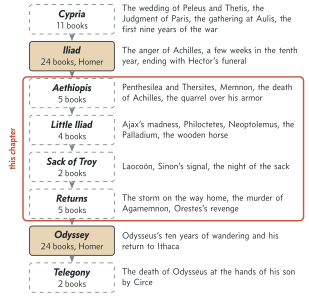
The death of Achilles
Achilles knew that he would not live long. His mother, the sea goddess Thetis, had told him that he could have a long life without fame or a short one with glory that would never die, and he had chosen glory. In the Iliad she warned him that his own death would follow soon after Hector’s, and he killed Hector anyway (Chapter 26). He was the son of King Peleus of Phthia, in Thessaly, and the best fighter the Greeks had at Troy.
The first new ally to reach the Trojans was a woman. Penthesilea was a daughter of Ares, the god of war, and queen of the Amazons,This group of warrior women included Penthesilea. → Amazons•• the nation of warrior women whose earlier queen Heracles had killed for her belt (Chapter 17). She led her women out onto the plain of Troy and killed many Greeks. Then she met Achilles, who drove his spear through her (Figure 27.2). Apollodorus, the author of the handbook of myths, says simply that after killing her Achilles fell in love with Penthesilea.Achilles fell in love with this figure after killing her in the Trojan War. → Penthesilea••This figure fell in love with the Amazon queen Penthesilea after killing her. → Achilles•• The scene was a favorite of Athenian vase painters, and one of them, who worked about 460 BC, is known today only as the Penthesilea Painter, because his finest cup, now in Munich, shows Achilles killing her.

One man laughed. Thersites (thur-sy-teez) was the loudmouth of the Greek camp, a common soldier who mocked the kings to raise a laugh. Homer describes him in A. T. Murray’s translation of the Iliad: “Evil-favoured was he beyond all men that came to Ilios: he was bandy-legged and lame in the one foot.” Now he jeered at Achilles for mooning over the dead Amazon, and Achilles turned on Thersites and killed him.This figure killed Thersites after Thersites mocked his feelings for Penthesilea. → Achilles•• Even this killing had a price. Spilled blood left a stain of guilt that only the proper rites could wash away, so Achilles sailed to the island of Lesbos, sacrificed to Apollo, Artemis, and Leto, and was purified by Odysseus.
The next ally came from the edge of the world. Memnon was the son of Eos, the Dawn, and of the Trojan prince Tithonus, for whom she had won immortality but not youth (Chapter 3). Tithonus was Priam’s brother, so Memnon was the old king’s nephew. He ruled the Ethiopians, the far-off people who lived where the sun rises, and he came to Troy in armor made by Hephaestus. He killed Antilochus, the young son of Nestor and, after Patroclus, Achilles’s dearest friend. To avenge his friend, Achilles killed Memnon, king of the Ethiopians,This figure killed Memnon, king of the Ethiopians. → Achilles• in a duel that Greek vase painters showed again and again, with each hero’s goddess mother standing anxiously behind him. In the Aethiopis (ee-thee-oh-pis), the lost epic named for Memnon’s Ethiopians, Eos went to Zeus and won immortality for her son.
Ovid, in the thirteenth book of the Metamorphoses, gives the story a stranger end. The grieving Eos, whom he calls by her Roman name, Aurora, begged Jupiter to give her son some honor. As Memnon’s pyre burned, its black smoke gathered into a shape, grew wings, and became a flock of birds called the MemnonidesIn Ovid’s Metamorphoses, birds called Memnonides arose from the funeral pyre of this figure’s son Memnon, king of Ethiopia. → Eos• (mem-non-ih-deez). They circled the pyre three times, split into two flocks, and fought each other until they fell into the fire as offerings to the dead king. Every year, Ovid says, they come back to fight again at his tomb. In Samuel Croxall’s translation of 1717, “And, as they liv’d, they dye for Memnon’s Sake.”
Hector, dying, had foretold how Achilles would die and where, and he named two killers, a man and a god. In Murray’s translation he warned of “the day when Paris and Phoebus Apollo shall slay thee, valorous though thou art, at the Scaean gate.” The Scaean Gate was the great gate in Troy’s walls that faced the plain, where Hector had said goodbye to his wife (Chapter 26). After Memnon fell, Achilles drove the Trojans back across the plain and tried to burst into the city behind them, and there, before the gate Hector had named, Achilles was killed at Troy.Achilles was killed at this city. → Troy•
The man was Paris, the Trojan prince whose theft of Helen had started the war (Chapter 25). He fought with the bow, and the Greeks scorned archers for killing from a safe distance. The god was Apollo, who had favored the Trojans throughout the war, and he guided the arrow. So Paris killed Achilles,Paris killed this figure. → Achilles•• the greatest warrior of the Greeks, with a single shot. Apollodorus says it struck him in the ankle. Long after Homer, the Roman poet Statius told how Thetis had dipped her baby in the river Styx to make him invulnerable. Later writers explained why such a wound could kill: she had held him by the heel, and the water never touched it (Chapter 25).
A fierce fight raged over the body. Ajax, the huge son of Telamon, lifted Achilles onto his shoulders and carried him to the ships, while Odysseus held off the Trojans behind. Thetis rose from the sea with her sister nymphs to wail over her son, and the nine Muses came to sing his dirge. In the Odyssey, the ghost of Agamemnon remembers that the Greeks mourned for seventeen days before they burned the body, and laid his ashes with those of Patroclus in a golden jar.
The armor of Achilles
Achilles’s armor was the richest prize at Troy, made for him by Hephaestus (Chapter 26), and Thetis offered it to the bravest of the Greeks. Two men claimed it: Ajax, who had carried the body out of the fighting, and Odysseus, who had saved it from the Trojans. So Ajax and Odysseus fought over the armor,This figure's armor was fought over by Ajax the Greater and Odysseus after his death. → Achilles••This figure was angered that Odysseus was given the armor of Achilles. → Ajax the Greater•This figure disputed with Ajax over who would inherit Achilles's armor. → Odysseus• not with swords but with speeches, each listing his deeds. Odysseus, the better speaker, won, and Ajax, the stronger fighter, was enraged that the prize he thought his by right had gone to a talker. Ovid gives both speeches in full at the start of his thirteenth book.
The poets did not agree on who the judges were. In the Odyssey they were the Trojan prisoners and Athena. In the lost Little Iliad, the Greeks sent men to eavesdrop under Troy’s walls and heard two Trojan girls arguing. One praised Ajax for carrying the body; the other, prompted by Athena, said that even a woman could carry a load once a man had put it on her shoulder, but she could not fight. The poet Pindar says the Greeks voted in secret, and Athenian vase painters liked to show the vote (Figure 27.3).

Ajax could not bear it. As Sophocles tells it in his play Ajax (Vol. 6, The Greeks), he went out that night with his sword to kill Agamemnon, Menelaus, and Odysseus. Athena clouded his mind, and he fell instead on the army’s cattle and sheep, slaughtering them as if they were the Greek commanders. At dawn he came to himself among the carcasses. He could not live with the shame. He fixed in the ground the sword that Hector had given him after their duel (Chapter 26) and fell on it. Ovid says that from his blood sprang the same flower that had grown from the blood of Apollo’s friend Hyacinthus (Chapter 5). Its petals carry the letters AI, which spell the Greek cry of grief and begin Ajax’s name in Greek, Aias. Even among the dead he did not forgive. When Odysseus met his ghost, in Samuel Butler’s translation of the Odyssey, “He would not answer, but turned away to Erebus and to the other ghosts.”
Odysseus’s stratagem
Ten years of war had not opened Troy, and the Greeks turned to prophecy. Their seer was Calchas, the son of Thestor, who had his gift from Apollo; at Aulis he had read the omens and told Agamemnon that Artemis wanted his daughter (Chapter 25). Now he declared that Troy could not be taken without the bow of Heracles. Heracles had given that bow to Philoctetes for lighting his funeral pyre (Chapter 18). On the way to Troy a snake had bitten Philoctetes, and his wound stank so badly and made him scream so loudly that the Greeks had left him on the island of Lemnos (Chapter 25). He had lived there alone for nearly ten years, shooting birds to eat.
In Apollodorus’s version, Odysseus and Diomedes sailed to Lemnos, got hold of the bow by a trick, and talked the bitter man into coming. Sophocles, in his play Philoctetes (Vol. 6, The Greeks), sends Odysseus with Achilles’s young son instead, and in the end only a god can change the archer’s mind: Heracles himself appears and orders him to Troy. There, Apollodorus says, Podalirius, a son of the healer Asclepius (Chapter 5), cured his wound; in the Little Iliad it was his brother Machaon. Philoctetes went into battle with Heracles’s bow, and one of his arrows, still poisoned with the blood of the Hydra, struck Paris. Achilles’s killer died of it.
With Paris dead, Helen was married again, to his brother Deiphobus. Another brother, the seer Helenus (hel-ih-nus), had wanted her for himself, and he left the city in anger. Odysseus caught him on Mount Ida, and Helenus told the Greeks what Troy’s own prophecies said. The city would not fall unless Achilles’s son came to fight, and unless the Palladium was carried out of it.
Achilles’s son was still a boy, on the island of Skyros. Before the war, while his mother hid him there disguised among the daughters of King Lycomedes, Achilles had fathered NeoptolemusThis figure fathered Neoptolemus. → Achilles•• on the princess Deidamia (Chapter 25). Odysseus fetched the boy and gave him his father’s armor, the armor that Ajax had died for. He fought like his father, and he had none of his father’s pity.
The Palladium was harder to get. It was the ancient wooden image of Pallas that Zeus had thrown down to Troy when the city was founded, and the Trojans believed that Troy could never fall while it stood inside the walls (Chapter 4). Odysseus went in first alone, as a spy. He gashed his own body, put on rags, and walked into Troy as a beggar. Only Helen knew him, and she kept his secret. Then on a dark night he came back with Diomedes, the young king of Argos who had wounded two gods in the Iliad (Chapter 26), and Odysseus and Diomedes stole the PalladiumThis figure worked with Diomedes to steal the Palladium. → Odysseus•With Odysseus, this character steals the Palladium. → Diomedes• from its shrine in the citadel. Now, by the Trojans’ own belief, nothing protected their city. Argos later claimed it, and the Romans believed that the true Palladium had been rescued from the burning city and kept in their own temple of Vesta (Vol. 7, The Romans).
Last came the idea that won the war, the stratagem remembered ever since as the Trojan Horse. Odysseus devised the wooden horse,This figure devised the stratagem of the Trojan Horse. → Odysseus••The Greeks won this war by entering the enemy city inside a wooden horse. → Trojan War••This city was conquered using a wooden horse. → Troy•• a hollow figure of planks so big that soldiers could hide inside it, which the Trojans themselves would haul into their city. Epeius (eh-pee-us), a carpenter and boxer, built it with Athena’s help from timber cut on Mount Ida. Apollodorus says that fifty of the bravest Greeks climbed into it, and Homer names Odysseus, Menelaus, Diomedes, and Neoptolemus among them. On its side the Greeks wrote that it was their thank-offering to Athena for a safe voyage home. Then the rest of the army burned their huts, launched their ships, and sailed out of sight behind Tenedos, the small island off the coast where the fleet had stopped on its way to the war (Figure 27.4). One Greek, Sinon (sy-non), stayed behind to be captured, with a lie ready.

The Trojans poured out to look at it. Some wanted to drag it into the city, others to burn it or throw it over the cliffs. Laocoön (lay-ok-oh-on), a Trojan priest, came running down from the citadel, and Virgil tells what happened in the second book of the Aeneid. The horse, Laocoön shouted, was full of Greeks or was a machine for battering the walls. In John Dryden’s translation of 1697 he ends, “Trust not their Presents, nor admit the Horse.” Virgil’s own Latin, timeo Danaos et dona ferentes, says that he fears the Greeks even when they bring gifts, and it has been a proverb ever since. Then Laocoön hurled his spear at the horse.This Trojan priest threw a spear at the wooden horse before being killed. → Laocoön•• It stuck quivering in the planks, and the hollow belly rang.
Just then shepherds brought in Sinon, his hands tied, and he told his lie. The Greeks, he said, had built the horse to make up to Athena for the stolen Palladium, and they had made it too big to pass the gates, because if it ever stood inside Troy the goddess would protect the city forever. While the Trojans listened, Laocoön was sacrificing a bull at the altar. Two huge serpents came swimming over the sea from Tenedos (Figure 27.5). They seized his two young sons and then the priest himself, crushed them all in their coils, and glided off to Athena’s temple to curl up at the feet of her statue. The Trojans decided that Laocoön had been punished for striking the goddess’s gift. They broke open their own wall and dragged the horse inside. The death of Laocoön and his sons is also carved in a famous marble group, found in Rome in 1506 and now in the Vatican Museums.

One voice still warned them. Cassandra, Priam’s daughter, could see the future, a gift from Apollo, who had wanted her love. She promised it and then refused him, and since a god could not take back a gift, he added a curse: no one would ever believe her. In Aeschylus’s play Agamemnon, she says in H. W. Smyth’s translation, “Ever since that fault I could persuade no one of aught.” She told the Trojans that the horse was full of armed men, and they did not listen.
That night the Trojans feasted. Helen came to look at the horse with Deiphobus and walked around it three times, patting its sides and calling the Greek chiefs inside by name. Menelaus tells the story years later in the fourth book of the Odyssey. She mimicked the voices of their wives,This figure mimicked the voices of hidden warriors' wives to torment them. → Helen of Troy• so that each hidden man heard his own wife calling him from far across the sea. In Butler’s translation, Menelaus reminds her how “you called our chiefs each by his own name, and mimicked all our wives.” One young warrior began to answer, and Odysseus clapped his hands over the man’s mouth and held them there until she had gone. At midnight Sinon opened the horse and raised a fire signal for the fleet waiting behind Tenedos.
The sack of Troy
The Greeks climbed down from the horse, killed the drowsy guards, and opened the gates to their army. The city that had held out for ten years fell in a single night. The poets remembered it as a night of murder at the altars of the gods, and the Greeks’ crimes that night would follow them home.
Cassandra fled to the temple of Athena and threw her arms around the goddess’s old statue, where by every law of gods and men a suppliant was safe. There Ajax the Lesser found her. He was the son of Oileus, king of Locris in central Greece, the fast runner whom Athena tripped in the footrace at Patroclus’s funeral games (Chapter 26), and no kin to the great Ajax who had died. Cassandra clung to Athena’s statue,During the fall of Troy, Cassandra clung to a statue of this figure before being abducted by Ajax the Lesser. → Athena• but Ajax dragged her away so violently that, in the lost Sack of Troy, the statue came with her (Figure 27.6). Apollodorus says the image turned its eyes up to heaven rather than watch. The Greeks wanted to stone Ajax for the sacrilege, but he clung in turn to Athena’s altar, and they let him live.

Old Priam put on armor he had not worn for years. His wife, Hecuba, made him sit with her at the altar of Zeus in the palace courtyard, where she had taken refuge with her daughters. There Neoptolemus found them. Virgil tells how he cut down one of Priam’s young sons before his father’s eyes. The old man flung a spear that barely dented his shield and cursed him: Achilles, he said, had respected a suppliant and given back Hector’s body. In Dryden’s translation Neoptolemus answers, “Go thou from me to Fate; And to my Father my foul deeds relate.” Then Neoptolemus killed PriamNeoptolemus killed this figure during the sack of Troy. → Priam•• at the altar of Zeus. He dragged the old man up to it, slipping in his son’s blood, and drove the sword into his side. The king who had been ransomed from Heracles as a boy (Chapter 18) had ruled Troy through its whole long war.
Hector’s son Astyanax was still a baby, but the Greeks feared that he would grow up to avenge his father. In the version of the lost Little Iliad, as Evelyn-White translates a fragment of it, Neoptolemus snatched him “from the bosom of his rich-haired nurse and seized him by the foot and cast him from a tower.” So Neoptolemus threw Hector’s son from the walls,This man's son is thrown from the walls of Troy by Neoptolemus. → Hector• and he took Hector’s widow, Andromache, home as his slave. Other poets give the deed to Odysseus, and in Euripides’s The Trojan Women (Vol. 6, The Greeks) the whole Greek council orders it.
Menelaus went looking for his wife. In the sixth book of the Aeneid, the ghost of Deiphobus tells Aeneas what happened in his house that night. Helen led the Trojan women in a dance and waved a torch from the citadel to call in the Greeks. Then, while her husband slept, she carried his weapons out of the house, and Helen hid his sword:This figure betrayed Deiphobus by hiding his sword. → Helen of Troy• in Dryden’s words, she “from beneath my head my Sword convey’d.” She opened the door to Menelaus and Odysseus, and they hacked Deiphobus to death. Menelaus meant to kill Helen next. But in the Little Iliad, when he saw her, he let his sword fall.
The women of Troy were shared out among the victors as slaves, and Hecuba fell to Odysseus. Her daughter Polyxena was sacrificed at the tomb of Achilles, whose ghost demanded her as his share of the spoils. Then, on the shore of Thrace, Hecuba found the body of her youngest son, Polydorus. Priam had sent the boy away with gold to the Thracian king Polymestor (pol-ih-mes-tor) for safekeeping, and when Troy fell, the king had murdered him for the gold. Hecuba lured Polymestor to her with talk of more treasure and tore out his eyes. Ovid tells what happened next. The Thracians stoned her, and she snapped at the stones, opened her mouth to curse them, and barked: Hecuba was turned into a dog.Hecuba, the wife of Priam, was turned into one of these creatures. → dogs• In Temple Stanyan’s translation of 1717 she tries to speak, “But barks, and thence the yelping Brute betrays.” Sailors on the Hellespont pointed out her grave on a headland called Cynossema (sin-oh-see-muh), “the dog’s tomb.”
Agamemnon’s homecoming
Athena had helped the Greeks take Troy, but they had let the Lesser Ajax go unpunished, and now she turned against them all. Agamemnon and Menelaus quarreled over when to sail. Menelaus left at once, while Agamemnon stayed to offer sacrifices that might win back the goddess. Storms scattered the fleets. Ajax himself was wrecked, and in the Odyssey the sea god Poseidon let him climb onto a rock, but Ajax boasted that he had escaped in spite of the gods. Poseidon split the rock with his trident, and Ajax drowned. For centuries afterward the people of Locris sent girls to serve in Athena’s temple at Troy, in payment for his crime. Other ships broke on Cape Caphareus (kuh-fair-ee-us), the southeastern tip of the island of Euboea. Apollodorus says that Nauplius, the father of Palamedes, whom Odysseus had destroyed (Chapter 25), took his revenge by lighting fires on the cliffs there, as if to guide ships into harbor.
Agamemnon reached home with Cassandra, his share of the captives. Waiting for him was his wife, Clytemnestra, Helen’s sister, and she had reasons to hate him. At Aulis he had sacrificed their daughter Iphigenia to win a wind for the fleet (Chapter 25). While he was away she had taken a lover, Aegisthus, who had a grudge of his own. He was the son of Thyestes, whose children Agamemnon’s father, Atreus, had served to him at a feast. Thyestes had fathered Aegisthus to avenge that crime, and Aegisthus had killed Atreus, only to see Agamemnon come home and drive Thyestes out of Mycenae (Chapter 25). Now he wanted the son’s throne and the son’s life.
Homer and Aeschylus tell the murder differently. In the Odyssey, Agamemnon’s ghost tells Odysseus that Aegisthus invited him to a feast and “butchered me most miserably as though I were a fat beast in a slaughter house,” in Butler’s words, while Clytemnestra killed Cassandra beside him. Aeschylus, in his play Agamemnon, gives the deed to the queen. She welcomes her husband with a flattering speech and spreads purple cloths for him to walk on into the palace. Then, as he steps from his bath, she throws a robe over him and strikes him three times. “Round him, like as to catch a haul of fish, I cast a net impassable,” she boasts in Smyth’s translation. Cassandra, who has foreseen it all, goes in to die after him. Either way, Clytemnestra and Aegisthus murdered Agamemnon,Clytemnestra and Aegisthus murdered this figure after his return from Troy. → Agamemnon•• and they ruled his kingdom together, from Mycenae in Homer and from Argos, a few miles away, in Aeschylus.
Electra and Orestes
Agamemnon’s young son, Orestes, was not at home. Before the king returned, Aeschylus says, Clytemnestra had sent the boy to Strophius (stroh-fee-us), an ally of the family in Phocis, the mountain country around Delphi. There he grew up beside Strophius’s son Pylades (pil-uh-deez), who became his inseparable friend. His sister Electra stayed in the palace, treated like a servant and mourning her father. Aeschylus told the whole story in the Oresteia, a trilogy, or set of three connected tragedies performed on one day, staged at Athens in 458 BC (Vol. 6, The Greeks). The first play, the Agamemnon, shows the murder; the second, The Libation Bearers, tells what came next.
When Orestes was grown, Apollo’s oracle at Delphi ordered him to avenge his father. He came home in secret with Pylades and laid a lock of his hair on Agamemnon’s tomb as an offering. The night before, Clytemnestra had dreamed that she gave birth to a snake, and that it drew blood from her breast with her milk. Frightened, she sent Electra with offerings to pour on the tomb. Electra found the lock of hair and saw that it matched her own, and that the footprints by the grave matched hers. Then Orestes stepped out and showed her a cloth she had once woven for him, and brother and sister knew each other.

They made their plan. Orestes and Pylades came to the palace door disguised as travelers from Phocis, bringing the news that Orestes was dead. Clytemnestra let them in, and Aegisthus hurried home to hear the news and was killed. Then Orestes faced his mother. She bared the breast that had nursed him and begged for her life, and in Smyth’s translation he falters: “Pylades, what shall I do? Shall I for pity spare my mother?” Pylades, who speaks only once in the play, reminds him of Apollo’s command, and Orestes kills her.
At once the Furies came for him, the goddesses of vengeance who punish those who kill their kin (Chapter 13). No one else could see them, but the Furies pursued OrestesThese figures pursued Orestes after he killed his mother Clytemnestra. → Furies• out of the palace and across Greece. He fled to Delphi, where Apollo purified him of the blood, but the Furies still hunted him. So Apollo sent him on to Athens, to beg the help of Athena.
In the third play, the Eumenides, Athena does something new. Instead of deciding the case herself, she chooses citizens of Athens as judges and founds a court on the Areopagus, the rocky hill of Ares below the Acropolis, to try cases of murder for all time. Apollo speaks for Orestes, and the Furies prosecute. Athena casts her own vote for Orestes and rules that if the votes are equal, he goes free. When they are counted, they are equal. “This man stands acquitted on the charge of murder. The numbers of the casts are equal,” she announces in Smyth’s translation, and in Athens ever after a tied vote set the accused free. The Furies rage that the young gods have trampled the old laws. Athena calms them by promising them a home in a cave beneath the hill and the worship of the whole city. Thus the Furies became the Eumenides,In Aeschylus’s trilogy, these figures become the Eumenides after Orestes’s trial. → Furies• the Kindly Ones, the guardians of the city they had threatened to curse.
The mask of Agamemnon
In 1876 Heinrich Schliemann, the German businessman turned archaeologist who had already dug at Troy, began digging at Mycenae (Chapter 14). Just inside the Lion Gate he found a ring of royal graves, cut deep into the rock and packed with gold and bronze weapons. Five of the men buried there had masks of thin gold laid over their faces. The finest came from the fifth grave, uncovered at the end of November 1876. It shows a man with a narrow face, closed eyes, a long nose, and a pointed beard and mustache, beaten out of a single sheet of gold.

Schliemann was sure he had found the king who led the Greeks to Troy. A story that he telegraphed the king of Greece, “I have gazed upon the face of Agamemnon,” is famous but probably untrue. The name stuck anyway, and Schliemann’s mask of Agamemnon from MycenaeA golden funerary mask attributed to Agamemnon was unearthed at this city by Heinrich Schliemann. → Mycenae• is now among the most famous objects in the National Archaeological Museum in Athens. The man who wore it, though, was not Agamemnon. Archaeologists date the graves to about 1600 to 1500 BC, three or four hundred years before 1184 BC, the date that ancient scholars gave for the fall of Troy (the Stage). The story of the graves and the dig is told in full in a later volume (Vol. 6, The Greeks).
Other homecomings
Some Greeks had easy voyages. In the Odyssey, old Nestor remembers that he and Diomedes sailed from Troy by way of Tenedos and Lesbos, crossed the open sea to the tip of Euboea, and were home in a few days (Figure 27.9). Menelaus was not so lucky. Off Cape Malea, the southeastern tip of the Peloponnese, a storm wrecked part of his fleet on Crete and carried him with five ships to Egypt. He wandered for eight years before he came back to Sparta with Helen, where Odysseus’s son Telemachus finds them in the Odyssey (Chapter 29).
A stranger story held that Helen had never been at Troy at all. Stesichorus, the Sicilian poet of about 600 BC (the Stage), was said to have lost his sight for slandering her, and to have regained it only when he took back what he had said. Plato, in the dialogue Phaedrus (fee-drus), quotes his recantation in Benjamin Jowett’s translation: “False is that word of mine—the truth is that thou didst not embark in ships, nor ever go to the walls of Troy.” The historian Herodotus heard much the same from priests in Egypt. Euripides built a play on it, his Helen of 412 BC. There Helen explains that Hera, angry at losing the beauty contest, gave Paris “not Helen, but a phantom endowed with life, that she made in my image out of the breath of heaven,” in E. P. Coleridge’s translation. The Greeks and Trojans died for a cloud, while Helen spent the whole war in Egypt,By several accounts, Helen of Troy spent the entire Trojan War in this region. → Egypt• in the palace of its just old king, Proteus, who shares his name with the shape-shifting sea god of the Odyssey, until Menelaus found her there.
Helen outlived Menelaus, but the people of Rhodes told a grim story of her end. Pausanias heard it in the second century AD. After Menelaus died, his sons drove Helen out of Sparta, and she fled to Rhodes, to her friend Polyxo (puh-lik-soh). Polyxo’s husband, Tlepolemus (tleh-pol-uh-mus), a son of Heracles, had been killed at Troy, and she blamed Helen for his death. So, in W. H. S. Jones’s translation, “she sent against her when she was bathing handmaidens dressed up as Furies, who seized Helen and hanged her on a tree.” Thus, in the Rhodian story, Helen was hanged on Polyxo’s orders,According to Rhodians, this person was hanged in a tree by handmaidens dressed as the Furies on the orders of Polyxo. → Helen of Troy• and the Rhodians worshipped her afterward as Helen of the Tree.
The king of Crete came home to a different kind of disaster. Idomeneus was a grandson of Minos, through Minos’s son Deucalion (Chapter 20), and he had brought eighty ships to Troy. Idomeneus ruled the island of Crete,This island was home to King Idomeneus. → Crete•• the old kingdom of Knossos. As a Roman commentator on Virgil named Servius tells the story, a storm caught his fleet on the way home, and Idomeneus vowed to Poseidon that if he came home safe he would sacrifice the first living thing he met. The first to meet him on the shore was his own son. Idomeneus kept his vow and sacrificed his son,This figure promised to sacrifice the first living thing he saw on returning from Troy, then encountered his son. → Idomeneus•• and a plague fell on Crete. The Cretans drove their king out, and he sailed to the heel of Italy. In Dryden’s Aeneid, Aeneas later hears that “There fierce Idomeneus his City builds, And guards with Arms the Salentinian Fields.” The Bible tells a story of the same shape, Jephthah’s vow (Vol. 5, In the Beginning), and Mozart made Idomeneus the hero of an opera in 1781 in which the god relents (Vol. 14, From Luther to Mozart).
Diomedes, too, made a new home in Italy. He had wounded the goddess Aphrodite in the Iliad, and when he reached Argos he found that his wife had been unfaithful, which some said was Aphrodite’s revenge. He sailed west to Daunia (daw-nee-uh), on the Adriatic coast of Italy, where he married the daughter of its king and founded the city of Argyripa (ar-jir-ih-puh), later called Arpi. The Greek geographer Strabo collected the stories told about him there. In one, he began cutting a canal to the sea near the town of Urium (yoor-ee-um), on the rocky promontory of Garganus. In Hamilton and Falconer’s translation, Strabo reports that “Diomed attempted to cut a canal to the sea, but being sent for to return home, where he died, left it incomplete.” So Diomedes left the canal at Urium unfinished.According to Strabo, this character leaves a canal at Urium unfinished to return home, where he dies. → Diomedes• In another story his companions were turned into seabirds on two small islands offshore, and the birds, Strabo heard, were tame with good men and fled from wicked ones.
Calchas, the old seer, went home by land, walking with a few companions from Troy down the coast of Asia Minor to Colophon. It had been foretold that he would die when he met a seer greater than himself. At Claros (klair-os), near Colophon, where Apollo had an oracle, he met the seer Mopsus, the son of Manto and grandson of the Theban prophet Tiresias (Chapter 24); he was not the Argonaut of the same name (Chapter 19). Calchas pointed to a wild fig tree and asked how many figs it carried. Mopsus answered, in Hesiod’s version as Strabo quotes it, that there were ten thousand, enough to fill a standard grain measure with one fig left over. They counted, and he was right. So Calchas lost a contest of prophecy to Mopsus,This figure died after losing a prophetic contest to Mopsus. → Calchas•Mopsus had this occupation. → seers•• a better seer than himself, and died of grief.
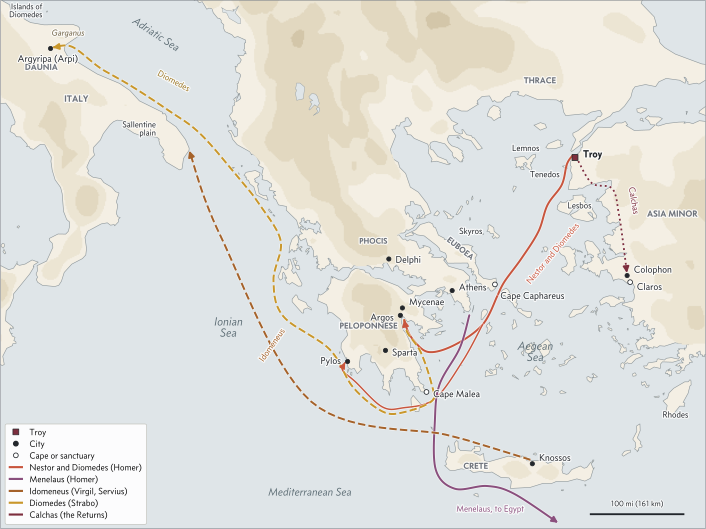
Odysseus took ten more years to reach Ithaca, and his wanderings fill Chapter 28. Achilles never came home at all, and yet the poets could not leave him dead. In the Odyssey his ghost tells Odysseus that he would rather be a hired laborer on earth than king among the dead. But the Aethiopis said that Thetis snatched her son from the pyre and carried him to the White Island, in the Black Sea, and Pindar placed him in the Isles of the Blessed, where heroes live at ease beside Ocean (Chapter 13). There, the stories said, he took a wife. In Pausanias’s story, set on the White Island, it was Helen. In Apollodorus it is the sorceress whom Jason abandoned: Medea married AchillesAccording to Apollodorus, after this figure's death, she married Achilles in the Isles of the Blessed. → Medea• after her death, and lives with him in the Isles of the Blessed (Chapter 19).
What to remember
- Achilles killed the Amazon queen Penthesilea and fell in love with her, killed Thersites for mocking him, and killed Memnon, son of Eos, whose pyre made the Memnonides birds in Ovid.
- Paris, guided by Apollo, shot Achilles at Troy. Ajax and Odysseus fought over his armor; Odysseus won, and Ajax went mad and killed himself.
- Philoctetes brought Heracles’s bow and killed Paris; Neoptolemus, Achilles’s son, joined the army; Odysseus and Diomedes stole the Palladium.
- Odysseus devised the wooden horse. The priest Laocoön threw a spear at it and was killed by serpents; Helen mimicked the hidden men’s wives.
- In the sack, Ajax the Lesser dragged Cassandra from Athena’s statue, Neoptolemus killed Priam and threw Astyanax from the walls, Helen hid Deiphobus’s sword, and Hecuba became a dog.
- Clytemnestra and Aegisthus murdered Agamemnon. Orestes and Electra avenged him in Aeschylus’s Oresteia; the Furies pursued Orestes and, after his trial at Athens, became the Eumenides.
- Schliemann’s gold mask from Mycenae is centuries older than any Trojan War.
- Idomeneus of Crete sacrificed his son to keep a vow; Diomedes left a canal at Urium unfinished; Calchas died after losing a contest to Mopsus; Medea married Achilles in the Isles of the Blessed.
Chapter 28 · 48 clues
The Wanderings of Odysseus
On the island of Scheria (skeer-ee-uh), far out in the western sea, King Alcinous of the Phaeacians was giving a feast for a stranger. The man had been washed up on the shore, naked and half drowned, and he had still not told anyone his name. After the meal the blind singer Demodocus took up his lyre, and the stranger asked for one particular song: the wooden horse and the fall of Troy. As the singer told how the Greeks poured out of the horse and sacked the city, the stranger pulled his cloak over his head and wept. He wept, in Samuel Butler’s translation of 1900, “as a woman weeps when she throws herself on the body of her husband who has fallen before his own city.”
Only the king noticed. Alcinous stopped the music and asked his guest who he was. The stranger answered that he was Odysseus, the son of Laertes, from the rocky island of Ithaca. Then, far into the night, he told the Phaeacians everything that had happened to him since he sailed from Troy.
The Odyssey as a poem
Odysseus was the king of Ithaca, a small island off the west coast of Greece, and the cleverest of the Greeks at Troy. Chapter 25 told how he tried to dodge the war, and Chapter 27 told how his wooden horse ended it. Through his mother, Anticleia, he was a great-grandson of Hermes, the god of tricksters (Figure 28.1). At home he had left his wife, Penelope, and a baby son, Telemachus. The Romans called him Ulixes, which became Ulysses in English.

The poem about him is the Odyssey, “the story of Odysseus.” Like the Iliad (Chapter 26), it is an epic credited to Homer and composed in about 700 BC (Vol. 6, The Greeks), and it runs to twenty-four books and 12,109 lines. Its first line asks the Muse, one of the goddesses of song (Chapter 12), to sing of a man of many turns, in Butler’s prose “that ingenious hero who travelled far and wide after he had sacked the famous town of Troy.” He had been away twenty years, ten of them at war and ten more trying to get home,This figure takes ten years to return home from the Trojan War. → Odysseus••• just as an oracle had warned him before he sailed (Chapter 25).

The opening lines also give away the fate of his crew, the men who had sailed with him from Troy in twelve ships. Odysseus tried to save his men but could not, because they ate the cattle of the Sun,In this work, the protagonist's crew eat the cattle of the sun god Helios and are cursed. → The Odyssey• and the Sun god, Helios, took away their homecoming. In Butler’s words, “they perished through their own sheer folly.” Homer’s listeners knew from the start where the voyage would end. What held them was how it would get there.
Like the Iliad, the poem begins in medias res, “in the middle of things” (Vol. 1, The Toolkit), in the tenth year after Troy fell. Books 1 to 4 follow Telemachus. On Ithaca more than a hundred young men are courting Penelope and eating up her husband’s wealth, and he sails to the mainland to look for news of his father (Chapter 29). In Book 5 Odysseus is freed from the island where he is held, and in Books 6 to 8 he reaches the Phaeacians. In Books 9 to 12 he tells his own adventures. They come as a flashback, a story told by a character about what happened earlier. The last twelve books take him home. So most of the wonders of the Odyssey have one witness, Odysseus himself, the best liar in Greek myth, telling his tale to strangers whose help he needs. This chapter tells his adventures in the order in which they happened.
Homer names real places only at the beginning and the end: Troy, the coast of Thrace, Cape Malea at the southern tip of Greece with the island of Cythera off it, and Ithaca. Later Greeks, sailing west to Sicily and Italy (the Stage), found his other places wherever they went, and Figure 28.3 shows the most famous of their guesses. The historian Thucydides took Scheria to be the island of Corcyra (kor-sy-ruh), now Corfu. Not everyone was convinced. Eratosthenes, the head of the library at Alexandria, joked that you would find where Odysseus wandered when you found the cobbler who stitched up the bag of the winds.

The Lotus-Eaters and the Cyclops
Odysseus sailed from Troy with twelve ships. The wind took him first to Ismarus (iz-muh-rus), a town on the coast of Thrace whose people, the Cicones (sik-uh-neez), had fought for Troy. The Greeks sacked it and divided the plunder, but instead of sailing at once, as Odysseus ordered, the men stayed on the beach drinking. By the next evening the Cicones of the countryside had killed six men from every ship. One man of Ismarus had been spared, Maron, a priest of Apollo. He gave Odysseus twelve jars of a dark, sweet wine so strong that it was drunk mixed with twenty parts of water.
Rounding Cape Malea, the fleet was caught by a north wind and driven for nine days out to sea, to the land of the Lotus-Eaters. They harmed no one. They only offered the three men Odysseus sent ashore a taste of their food, the lotus, a fruit as sweet as honey, and in Butler’s words “those who ate of it left off caring about home.” Odysseus dragged them back weeping, tied them under the rowing benches, and sailed before anyone else could take a bite. In English a lotus-eater is still someone lost in a pleasant, idle forgetting.
Next came the land of the Cyclopes. These were not the three smiths whom Hesiod calls Cyclopes (Chapter 1), nor the giant builders of the walls of Tiryns (Chapter 14), but a whole people of huge, one-eyed shepherds. They planted nothing and plowed nothing, built no ships, held no meetings, and kept no laws. Each lived in his own cave with his family and ignored his neighbors. To a Greek, for whom a city was the mark of civilized life, this was the life of beasts.
The fleet anchored at a wooded island just offshore, full of wild goats. From there Odysseus crossed with his own ship and climbed with twelve men to a great cave, carrying a goatskin of Maron’s wine. Its owner was out with his flocks. The men begged their captain to take the cheeses and run, but Odysseus wanted to see the owner and ask for a guest’s gift. The owner was Polyphemus, the one Cyclops whom Homer names,This character is a cyclops from The Odyssey. → Polyphemus•• and his name means “much spoken of.” He was the strongest of all the Cyclopes, Homer says.
Homer gives his family in the poem’s first book, at a council of the gods, where Zeus explains to Athena why Odysseus is still kept from home. Polyphemus’s father was Poseidon,This figure is the father of the cyclops Polyphemus. → Poseidon••• the god of the sea and Zeus’s brother (Chapter 2), and Zeus says that this god is still furious over his son’s eye. He would not kill Odysseus outright, Zeus says, but he would keep him wandering far from home. Only when all the other gods agreed to bring Odysseus home would Poseidon have to give up his anger. Polyphemus’s mother was the sea nymph ThoösaThis character is a son of the nymph Thoösa. → Polyphemus• (thoh-oh-suh), a daughter of the old sea god Phorcys, whose other daughters were the Gorgons (Chapter 14). Figure 28.4 shows this family, which reached further into the story than Odysseus knew.

That evening the Cyclops drove his flocks home and rolled a stone across the door, so heavy, Odysseus says, that twenty-two wagons could not have moved it. When Odysseus asked for hospitality in the name of Zeus, the protector of strangers, the Cyclops answered that Cyclopes cared nothing for Zeus. Then he snatched up two men, dashed them against the floor, and ate them. In the morning he ate two more and went out, closing the door behind him.
Odysseus could not kill him in his sleep, because no one else could move the stone. So he took the Cyclops’s club, a trunk of green olive wood as long as a ship’s mast, and cut off 6 feet of it. He sharpened the end, hardened the point in the fire, and hid it under the dung. That evening, when the giant had eaten two more men, Odysseus brought him a bowl of Maron’s wine. Polyphemus liked it and drained three bowls, one after another. Thus the Cyclops was made drunk on sweet wine,This character is tricked into getting drunk on sweet wine. → Polyphemus•• the gift of the priest of Ismarus.
Pleased, the giant asked his guest’s name and promised him a present. Odysseus answered, in Butler’s version, “my name is Noman”; in Greek he said Outis (oo-tis), “Nobody.” The present, said the Cyclops, would be to eat Nobody last. Odysseus’s false name, “Nobody,”This figure calls himself "Nobody" before blinding Polyphemus with a stake. → Odysseus••Odysseus tricked this figure by giving his name as “Nobody.” → Polyphemus••• was a trick whose point would show itself later. Then the giant fell on his back, dead drunk, and sleep took him.
Odysseus heated the stake in the embers until the green wood was about to blaze. With four men he lifted it, and they drove the sharpened stakeOdysseus blinded this figure with a sharpened stake. → Polyphemus••• home, Odysseus leaning on the top and twisting it like a shipwright boring a plank. The blood boiled around it, the lashes and brows were scorched, and the eye hissed, Homer says, like an axe that a smith dips red-hot into cold water. So Odysseus put out the Cyclops’s single eye,Odysseus stabbed one of these body parts belonging to the cyclops Polyphemus. → eyes• and Polyphemus tore out the stake and roared until the cave rang.
His neighbors came running and called through the door to ask whether someone was killing him. “Noman is killing me by fraud; no man is killing me by force,” Polyphemus shouted back, in Butler’s translation. The neighbors were Cyclopes like Polyphemus himself,Polyphemus, a son of Poseidon, belonged to this race. → Cyclops•• and they gave him the only advice they could. If no one was hurting him, his pain must come from Zeus, and he had better pray to his father Poseidon. Then they went home. In Greek, the neighbors’ words “if no one” sound like metis, “cunning,” the gift for which Odysseus was famous.
In the morning the blind giant rolled the stone aside and sat in the doorway, feeling the back of every animal that passed. During the night Odysseus had tied the big rams together in threes with willow twigs, and each man rode under a sheep’s belly,Sailors escape this character's cave by riding on the undersides of sheep. → Polyphemus•• hidden in the wool. He kept the largest ram for himself and hung beneath it, gripping the fleece. It came out last, and Polyphemus stopped it and stroked its back, asking his favorite why it was slow today. Was it grieving for its master’s eye? He let it go.

Once clear of the cave, the men drove the flock down to the ship and rowed away. Then Odysseus could not resist shouting his real name. If anyone asked, he called, let the Cyclops say that Odysseus of Ithaca, the son of Laertes, had blinded him. Polyphemus groaned. A prophet, he cried, had foretold that he would lose his eye to Odysseus, but he had expected a giant, not a little weakling who got him drunk. He hurled a rock that nearly swamped the ship.
Next he prayed to his father. If Odysseus must reach home, let him come late, in misery, having lost all his men, in a stranger’s ship, and let him find trouble in his house. The god heard, and from that day on Poseidon blocked Odysseus’s way home.This figure obstructed Odysseus’s return after Odysseus blinded his son Polyphemus. → Poseidon••• Every word of the curse came true. On the beach where the other ships waited, Odysseus sacrificed the great ram to Zeus, but Zeus, Homer says, ignored the offering and was already planning the loss of the ships and the men.
Polyphemus in love
Later writers gave the Cyclops a home and a past. They placed his home near Mount Etna,Later writers placed this figure’s home near Mount Etna. → Polyphemus• the volcano of eastern Sicily (Chapter 1). The black rocks off the shore below it, at Aci Trezza, are still called the Islands of the Cyclopes, as if Polyphemus had thrown them at the departing ship. Theocritus, a Greek poet of Sicily in the third century BC, imagined him younger, a lovesick shepherd singing to the sea nymph Galatea, one of the fifty daughters of Nereus (Chapter 7).
Ovid, in the thirteenth book of the Metamorphoses, made the courtship a tragedy and let Galatea tell it. She loved Acis (ay-sis), a beautiful youth of sixteen, the son of the woodland god Faunus (faw-nus). Polyphemus loved her, and for her sake he tried to look handsome. In John Dryden’s translation he “comb’d, with Teeth of Rakes, his rugged Hair,” and he trimmed his beard with a scythe. Then he found her lying in Acis’s arms (Figure 28.6). He roared until Etna echoed, and as Acis ran, Polyphemus crushed Acis with a boulderJealous of Galatea’s love for Acis, this figure crushed Acis with a boulder. → Polyphemus••• torn from the mountain. Galatea turned the young man’s blood into a stream, and the little river Acis still runs from Etna to the sea.

Some told a happier ending, in which Galatea came to love the Cyclops after all. Appian, a Greek from Alexandria who wrote a history of Rome’s wars in the second century AD, tells it at the start of his book on the Illyrians, a people of the Balkans. Polyphemus fathered Celtus and Galas,According to Appian, this figure fathered Celtus and Galas, ancestors of the Celts and Gauls. → Polyphemus• he says, and a third son, Illyrius (ih-lir-ee-us), and the three gave their names to the Celts, the Gauls, and the Illyrians.
Euripides’s Cyclops
In Athens the Cyclops became a figure of fun. Each tragic poet at the festival of Dionysus offered three tragedies and a satyr play, a short, rowdy piece whose chorus dressed as satyrs, the wild, horse-tailed followers of Dionysus (Chapter 11). Hundreds were written, and the only satyr play that survives completeThe only fully extant satyr play is named for these beings. → Cyclops• is named for the Cyclops: Euripides’s Cyclops, probably from late in his life, perhaps about 408 BC. Much of what we know about how a satyr play worked comes from it.
Euripides sets it beside Etna. Old Silenus, the father of the satyrs, explains that pirates had carried off Dionysus (Chapter 11), and that he and his sons, sailing in pursuit, were wrecked here and became the Cyclops’s slaves. Odysseus arrives with wine to trade, and Silenus sells him his master’s cheeses, then blames the theft on Odysseus. The play adds an argument to Homer’s story. Odysseus pleads for the laws of hospitality, and the Cyclops answers like a clever Athenian who thinks laws are for fools. In the English poet Percy Bysshe Shelley’s translation of 1819 (Vol. 15, The Age of Revolution), the Cyclops says that “Wealth, my good fellow, is the wise man’s God,” and he worships only “this great belly, first of deities.” When the moment comes, the satyrs, who had sworn to help, find excuses, and at the end they sail away with Odysseus to look for their god.
Aeolus and Circe
Next came the floating island of Aeolia (ee-oh-lee-uh), walled all around with bronze. Its king was Aeolus, the son of Hippotes (hip-uh-teez), not the Aeolus whose sons were Sisyphus and Salmoneus (Chapter 13). He lived there with his six sons and six daughters, whom he had married to one another, and Zeus had made Aeolus keeper of the winds,Aeolus presides over this phenomenon. → wind•• to rouse or calm each one as he pleased (Chapter 3). Later Greeks set his island among the volcanic islands north of Sicily, still called the Aeolian (ee-oh-lee-un) or Lipari (lip-uh-ree) Islands.
Aeolus kept Odysseus for a month, asking about Troy, and when his guest asked to leave, Aeolus gave him a bag of winds.Aeolus gives this figure a bag of winds to help him get home. → Odysseus•• He had shut up all the stormy winds in an ox-hide, tied it with a silver cord, and left only the West Wind free to blow the ships home. For nine days the ships ran before the West Wind, Odysseus never leaving the steering oar, and on the tenth they came so close that they could see fires burning on Ithaca. Then he fell asleep. His men, sure that the bag held gold their captain meant to keep, untied it. The winds burst out and blew the fleet all the way back to Aeolia, and this time the king drove Odysseus away. A man so plainly hated by the gods, he said, would get no help from him.
Six days of rowing brought them to the Laestrygonians (les-trih-goh-nee-unz), giants who ate men. Eleven ships moored in their harbor between steep cliffs, and the giants crushed them with boulders and speared the men like fish. Only Odysseus’s ship, tied up outside, escaped.
That one ship came to the island of Aeaea. Aeaea was the home of Circe,This figure lives on the island of Aeaea. → Circe•• a goddess and witch who lived alone in a stone house in the middle of a forest, with nymphs of the springs and woods for servants. Homer calls her a dread goddess who speaks like a woman, and he gives her family in a few lines. Circe was a daughter of Helios,This figure was a daughter of Helios and a sister of Pasiphaë. → Circe•• the Sun, and of Perse, a daughter of Ocean, and her brother was King Aeetes of Colchis. Her sister Pasiphaë was the queen of Crete (Chapter 20), and her niece Medea became the greatest witch in Greek myth (Chapter 19). Diodorus of Sicily, a Greek historian of the first century BC, records another tradition, in which Hecate was Circe’s mother.In one tradition, Hecate was the mother of this sorceress of Aeaea. → Circe• Diodorus liked to explain myths away. His Hecate, a goddess of night and witchcraft in other tellings (Chapter 6), is a mortal woman skilled in drugs and the wife of Aeetes, so that Circe and Medea become sisters.
Climbing a hill, Odysseus saw smoke above the trees, and he sent twenty-two men under his kinsman Eurylochus (yoo-ril-uh-kus) to see who lived there. As they reached the house, mountain wolves and lions rose to meet them, but the beasts only wagged their tails and fawned on the men like dogs greeting their master. They were creatures the goddess had drugged, and wild beasts lay tame around Circe’s house,This figure's home is surrounded by tame animals, including lions and wolves. → Circe•• a warning that no one understood.
Inside, Circe was singing at her loom. She invited the men in and gave them cheese, barley, and honey mixed in strong wine, with her drugs stirred in. When they had drunk, she struck them with her wand, and Circe turned the men into pigs.This figure transforms Odysseus’s men into pigs. → Circe••• They had the heads, bristles, and grunts of pigs, but their minds were still their own, and they knew what had become of them as she drove them into her sties and threw them acorns. One man had not gone in. Eurylochus alone escaped the trap,Eurylochus alone avoids being tricked by this figure. → Circe•• because he had suspected one, and he ran back to the ship so shaken that at first he could not speak.

Odysseus set out alone to rescue them. On the forest path he met a young man who took his hand. It was Hermes, the guide of travelers (Chapter 8). He pulled a plant from the ground, black at the root, with a flower as white as milk, which the gods call moly (moh-lee) and mortals cannot dig up. So Hermes gave Odysseus moly against Circe’s magic.Hermes gave this figure moly to avoid being turned into a pig by Circe. → Odysseus••Hermes gave Odysseus moly to resist this figure’s magic. → Circe••This figure provided Odysseus with the herb moly to overcome Circe's magic. → Hermes•• When she struck him with her wand, Hermes said, he must draw his sword as if to kill her and make her swear by the gods to do him no harm.
It went as Hermes said. Circe gave him the drugged drink and struck him, and nothing happened. Odysseus drew his sword, and she fell at his knees, crying that no man had ever resisted her drugs (Figure 28.7). He must be Odysseus, whom Hermes had always said would come. She swore the oath and turned the pigs back into men, younger and handsomer than before. They stayed with her a year.
Hesiod knew of children from that year. At the end of his Theogony, Circe bore Latinus to OdysseusIn Hesiod’s account, this figure bore Latinus to Odysseus. → Circe• (luh-ty-nus), with other sons (Figure 28.1). Latinus is the hero of the Latins, the people of the plain around Rome, so the line makes a Greek hero the father of an Italian people. Virgil gives Latinus a different father, the god Faunus, and makes him the king whose daughter Aeneas comes to marry (Chapter 30).
When the men at last reminded their captain of home, Circe let them go. First, though, Circe sent Odysseus to consult Tiresias,This figure told Odysseus to consult Tiresias in the underworld. → Circe•• the blind prophet of Thebes (Chapter 24), now a ghost in the underworld, the only one whose mind Persephone, the queen of the dead, had left whole. In the bustle of leaving, one man was forgotten. Elpenor (el-pee-nor), the youngest of the crew, had drunk too much and gone up to sleep on the cool roof. Woken by the noise, he forgot where he was and walked off the edge, and Elpenor fell to his deathElpenor dies from a fall at this figure's home. → Circe•• from Circe’s roof.
Circe had other victims, and Ovid tells of them in the fourteenth book of the Metamorphoses. One was Scylla, a nymph who liked to bathe in a quiet bay on the coast of Italy. The sea god Glaucus loved her. He had been a fisherman in Boeotia until he tasted a magic herb, leaped into the sea, and was made a god with a fish’s tail. He was the same Glaucus who rose from the waves to speak to the Argonauts (Chapter 19). Frightened of his strange body, Scylla ran from him, and Glaucus asked Circe for a love charm. Circe wanted him for herself, but he told her that trees would grow in the sea before he stopped loving Scylla. Circe could not harm a god, but she could harm the girl. Circe poisoned the water where Scylla bathed,Rejected by Glaucus, this figure poisoned Scylla’s bathing water and turned her into a monster. → Circe••Circe transformed this figure into a monster out of jealousy over Glaucus. → Scylla• and when Scylla waded in, the lower half of her body turned into a pack of barking dogs.
The other victim was Picus (py-kus), an early king of Latium (lay-shee-um), the country of the Latins, and a son of Saturn, the Roman Cronus (Chapter 32). He was married to Canens (kay-nenz), a nymph whose singing could stop rivers. Circe, out gathering herbs, saw him hunting and fell in love. She conjured a phantom boar to lure him away from his friends and offered him her love, and Picus refused: he belonged to Canens. So Circe turned Picus into a woodpecker,This figure turned Picus into a woodpecker after he rejected her advances. → Circe•• the bird that hammers at the trunks of oaks. Picus is the Latin word for woodpecker, and Samuel Garth’s translation of 1717 sums up the change in one line: “Of Picus nothing but the Name remains.”
Among the dead
Circe’s wind carried the ship in a single day to the stream of Ocean at the edge of the world, the land of the Cimmerians, wrapped in mist where the sun never shines. Odysseus did not go down into the underworld, as Heracles and Theseus did (Chapter 13). He called the dead up to him. He dug a trench, poured in honey and milk, wine, and water, and cut the throats of a ram and a black ewe over it. The ghosts came swarming up with a thin, screaming cry, eager for the blood, because most ghosts could not know the living or speak with them until they had drunk it. Odysseus held them back with his sword. The first was Elpenor, who begged to be buried with his oar set up on his tomb. Next came Odysseus’s own mother, Anticleia. He wept, but he would not let her drink before the prophet.

Then Tiresias came and drank. Poseidon was still angry over his son’s eye, he said, but they might all reach home even so, if they kept their hands off one thing. Tiresias warned Odysseus not to harm the Sun’s cattleTiresias advises this figure to avoid eating the cattle of Helios. → Odysseus•• grazing on the island of Thrinacia. If he spared them, he would come home. If not, he would lose his ship and all his men and come home late, alone, on a stranger’s ship, to find his house full of men courting his wife. Even after that, he must carry an oar inland until he met people who had never seen the sea and mistook the oar for a winnowing fan, the shovel farmers used to toss grain. His own death would come gently, from the sea, in old age (Chapter 29).
His mother drank next and knew him. Penelope was still waiting, she said, and she herself had died of longing for her son. Three times he tried to hold her, and three times she slipped through his arms like a shadow.
Persephone sent up famous women next. Among them was Ariadne, the Cretan princess who saved Theseus in the Labyrinth (Chapter 21). Theseus never brought her home to Athens, Odysseus says, because Artemis killed Ariadne on Dia,On seeing this figure's spirit, Odysseus claims that she was killed by Artemis. → Ariadne• the island also called Naxos, on the word of Dionysus, who in other tellings married her there. Then came the men. Agamemnon told how Aegisthus, with his wife’s help, had murdered him on the day he came home (Chapter 27). Achilles said that he would rather be a poor man’s servant on earth than king among the dead (Chapter 13). Ajax, still angry that Odysseus had won the armor of Achilles (Chapter 27), turned away without a word. At last the dead came crowding up in thousands, and Odysseus, afraid that Persephone would send up the Gorgon’s head, ran for his ship.
Sirens, Scylla, and the cattle of the Sun
Back on Aeaea the crew buried Elpenor and planted his oar on his mound, and Circe told Odysseus the dangers ahead. First came the Sirens, whose deadly song Chapter 12 described. In Homer there are only two, sitting in a green meadow beside a heap of bones with the skin still rotting on them. The Sirens sang sailors to their deaths,These creatures sang to lure sailors to their death. → sirens•• for whoever heard them steered in to listen and never left.
As the ship neared their island the wind dropped, the sea fell calm, and the men took to their oars. Odysseus kneaded a wheel of beeswax soft and stopped every man’s ears. Then, as Circe had advised, his crew tied him to the mast,This figure has his crew plug their ears with wax and tie him to the mast to hear the Sirens. → Odysseus•• with orders to tie him tighter if he begged to be freed. The Sirens sang to him by name. In Butler’s translation, “he who listens will go on his way not only charmed, but wiser,” for they knew everything that had happened at Troy and in all the world. Odysseus signaled to be untied, and two of his men, Eurylochus and Perimedes (per-ih-mee-deez), bound him tighter until the song died away behind them (Figure 28.9).

Later writers gave the Sirens an ending. Hyginus, a Roman who gathered the myths into a Latin handbook, says that they were fated to live only until a man heard their song and sailed safely past, so the Sirens died when Odysseus passed.In one tradition, these creatures died when Odysseus passed them without being lured away. → sirens• In the usual telling they threw themselves into the sea, and in a Greek legend told at Naples the body of one of them, Parthenope (par-then-uh-pee), washed ashore where that city now stands. The Argo had passed the same Sirens a generation earlier and broken no spell, because Orpheus drowned out their song and no one aboard heard it but Butes, who leaped overboard (Chapter 19).
Next Odysseus had to choose between two routes. One led past the Wandering Rocks, which smashed every ship but the Argo. The other ran between two cliffs a bowshot apart. Under a fig tree on the lower cliff lived Charybdis, a whirlpool that sucked down the sea three times a day and spewed it out again, and Scylla lived across the narrow straitThis creature lives across a narrow strait from the whirlpool-generating Charybdis. → Scylla• in a cave high on the other. Circe told him to keep to Scylla’s side. It was better to lose six men than the whole ship.
In Homer, Scylla is not a girl whom Circe changed, as in Ovid’s later story, but a monster born to be one. Her voice was a puppy’s yelp, but Scylla had six heads and twelve feet.In the Odyssey, this monster has six heads on long necks and twelve feet. → Scylla• The heads sat on six long necks, each mouth had three rows of close-set teeth, and she fished from her cave for dolphins, dogfish, and any larger sea beast. Odysseus asked whether he could fight her off. No, said Circe: she was not mortal, and the longer he stayed to fight, the more men she would take. He should row past fast and call on Crataeis, Scylla’s motherCirce advised Odysseus to call on Crataeis, this creature’s mother, to prevent a second attack. → Scylla• (kruh-tee-is), who would stop her daughter from striking twice.
Odysseus warned his crew about Charybdis but not about Scylla, for fear that they would stop rowing. He put on his armor anyway and stood in the bow with two spears. As every eye watched the whirlpool, sucking so hard that the black sand of the bottom showed, Scylla struck. Scylla snatched six of Odysseus’s men,This monster kills six of Odysseus's men. → Scylla• one in each mouth, and swung them up the cliff, calling his name. In Butler’s translation, “This was the most sickening sight that I saw throughout all my voyages.”
Then they reached Thrinacia, the island of the Sun. Its name sounds like Trinacria (trih-nak-ree-uh), “three-cornered,” an old name for Sicily and its three capes. Here grazed seven herds of cattle and seven flocks of sheep, fifty head in each, which were never born and never died. Helios’s daughters Lampetia and PhaethusaThis figure’s daughters Lampetia and Phaethusa guarded his cattle on Thrinacia. → Helios•• guarded them, shepherd goddesses whose mother, Homer says, was the nymph Neaera (nee-ee-ruh). Ovid gives the same two names to the sisters of Phaethon who turned into poplars (Chapter 3). Since poplars cannot herd cattle, the two stories cannot both be about the same girls.
Odysseus wanted to sail straight past. Eurylochus called him a man of iron who would drive tired men on through the night, and the crew sided with Eurylochus. Every man swore not to touch the cattle. Then for a month the wind blew from the south and east, and when the food ran out the men fished and trapped birds and went hungry. One day Odysseus walked inland to pray, and the gods sent him to sleep.
Eurylochus made the hungry men a speech. Every death is hateful, he said, but starving is the worst. They would sacrifice the best of the cattle and promise the Sun a temple at home, and if he drowned them anyway, that was better than starving by inches. So Odysseus’s men ate the Sun’s sacred cattleOdysseus’s men ate this figure’s sacred cattle on Thrinacia. → Helios•• on Thrinacia, scattering oak leaves for want of barley and pouring water for want of wine. Lampetia ran to tell her father. Helios warned Zeus that unless he was paid back, he would go down and shine among the dead, and Zeus promised revenge. At once the hides began to crawl, and the meat, raw and roasted, lowed on the spits.
After six days of feasting the wind dropped, and they sailed. Out of sight of land a squall struck, the mast fell and crushed the helmsman’s skull, and Zeus hurled his thunderbolt into the ship. The men were thrown into the sea, bobbing like seabirds, and drowned. The men were shipwrecked for eating the cattleOdysseus's crew were shipwrecked after they killed and ate these animals belonging to Helios. → cattle•• of Helios, as the poem’s first lines had promised. Odysseus alone survived. He lashed the mast to the keel and rode it all night back to Charybdis, where he clung to the fig tree above the whirlpool like a bat until his timbers came up again. Then for nine days he drifted, and on the tenth night the sea threw him up on Ogygia (oh-jij-ee-uh).
Calypso and the Phaeacians
Ogygia lay far out at the navel of the sea, Homer says, and it belonged to Calypso (kuh-lip-soh), a goddess and a daughter of the Titan Atlas, who holds up the sky (Chapter 1). Her name seems to mean “she who hides.” She lived in a great cave hung with vines, among alder, poplar, and cypress, with four springs running through meadows of violets. She loved the shipwrecked man and wanted to keep him forever, and she offered to make him immortal and ageless if he would stay as her husband.
Odysseus would not stay willingly, and he could not leave. Calypso held Odysseus on her islandThis figure is held captive on the island of Calypso. → Odysseus•• for seven years. By day he sat on the rocks of the shore, weeping and staring across the empty sea toward home, with no ship and no crew to take him there.
At last Athena, who loved Odysseus for his cleverness (Chapter 4), pleaded for him among the gods while Poseidon was away feasting with the Ethiopians. Zeus sent Hermes to Ogygia with his order. Calypso protested that the gods were jealous whenever a goddess loved a mortal man, but she obeyed. She gave Odysseus a bronze axe, and in four days he built a raft. For seventeen days he sailed, steering by the stars, and on the eighteenth he saw the mountains of Scheria.
Just then Poseidon, coming home from the Ethiopians, caught sight of him and raised every wind at once, and the waves tore the raft apart. Odysseus would have drowned but for Ino, the daughter of Cadmus, who had leaped into the sea and become the goddess Leucothea, the friend of sailors in storms (Chapter 11). She gave him her veil to tie around his chest, and it kept him afloat for two days and nights. On the third day he crawled ashore at a river mouth and fell asleep in a pile of dry leaves under two olive bushes.
That night Athena came in a dream to Nausicaa (naw-sik-ay-uh), the daughter of King Alcinous and Queen Arete, and told her to wash the family’s clothes, since she might soon be married. In the morning Nausicaa drove the laundry in a mule cart to the washing pools by the river, and when the work was done, she and her maids played ball. A wild throw sent the ball into the river, the girls shrieked, and Odysseus woke.

He came out of the bushes crusted with salt, holding a leafy branch before him to cover his nakedness, and looking, Homer says, like a hungry lion. The maids ran, but Nausicaa stood her ground. Odysseus did not dare to clasp her knees, the gesture of a man begging for mercy, so he spoke to her from a distance. He asked whether she was a goddess, and he compared her to a young palm tree he had once seen beside Apollo’s altar on Delos. She gave him clothes and oil and showed him the way. He was to follow the wagon only to the edge of town, so that no one would gossip, and then go to the palace and beg her mother, Arete, for help (Figure 28.10).
Arete and Alcinous ruled the Phaeacians, the finest sailors in the world, and their family went back to Poseidon. Alcinous’s father, Nausithous (naw-sith-oh-us), a son of Poseidon, had led the Phaeacians to Scheria from their old home beside the Cyclopes, who kept raiding them. Nausithous’s mother was Periboea, a daughter of Eurymedon (yoo-rim-uh-don), and Eurymedon once ruled over the Giants,In the Odyssey, Eurymedon, an ancestor of Alcinous, rules these beings. → giants• a reckless people whom he led to ruin. So Odysseus was saved by a grandson of the god who wanted him drowned, and by the great-niece of the Cyclops he had blinded (Figure 28.4).
Alcinous welcomed the stranger and promised him a ship home. At the next day’s feast Demodocus sang of Troy, and the stranger covered his face and wept, which is where this chapter began. Asked his name, Odysseus gave it, and he told the Phaeacians everything in this chapter, from Ismarus to the fig tree over Charybdis. The next evening they laid him asleep in one of their ships, and he woke on the beach of Ithaca (Chapter 29).
What to remember
- Homer’s Odyssey tells how Odysseus took ten years to get home from Troy. It begins in the middle of things, and Odysseus tells most of his adventures himself, in Books 9 to 12, at the court of the Phaeacians.
- Calling himself “Nobody,” he blinded the Cyclops Polyphemus, son of Poseidon and the nymph Thoösa, with a stake after making him drunk; the men escaped under the sheep, and Poseidon’s anger followed Odysseus home.
- Later writers put Polyphemus near Etna, where in Ovid he crushes Acis out of love for Galatea. Euripides’s Cyclops is the only complete satyr play.
- Aeolus, keeper of the winds, gave Odysseus a bag of winds, which his crew opened within sight of Ithaca.
- Circe of Aeaea, daughter of Helios and sister of Pasiphaë, turned the men into pigs; Eurylochus escaped, Hermes gave Odysseus moly, and Elpenor fell from her roof. In Ovid she poisoned Scylla and turned Picus into a woodpecker; in Hesiod she bore Odysseus Latinus.
- Among the dead, Tiresias warned Odysseus not to harm the Sun’s cattle, and he saw his mother and Ariadne, whom Artemis killed.
- He heard the Sirens tied to the mast, his men’s ears stopped with wax. Scylla, with six heads and twelve feet, took six men from her cave across the strait from Charybdis.
- On Thrinacia his crew ate the cattle of Helios, guarded by Lampetia and Phaethusa, and died in the wreck. Calypso held Odysseus seven years; Nausicaa found him on Scheria and brought him to Alcinous, whose ancestor Eurymedon ruled the Giants.
Chapter 29 · 25 clues
Odysseus in Ithaca
Every day, in a great house on a small rocky island off the west coast of Greece, more than a hundred young men sat down to dinner without being asked. They slaughtered the owner’s pigs, goats, and cattle, drank his wine, and ordered his servants about, and after dinner they called for music and dancing. The owner had sailed for Troy nearly twenty years before and had never come home. The young men had come to marry his wife, and they meant to go on eating until she chose one of them.
The owner was Odysseus, the cleverest of the Greeks at Troy, and the island was Ithaca. Chapter 28 followed him over the sea for ten years, to the Phaeacians, who promised to take him home. The rest of Homer’s Odyssey belongs to the place he was trying to reach, and it runs in two strands. First the son goes looking for the father. Then the father comes home as a beggar, to a house that does not know him, and has to win it back.
Telemachus goes looking
Odysseus had left a family behind. His father, Laertes, had been king before him, but he was old now and lived alone on a farm outside the town, grieving. The woman the young men wanted was Penelope, the wife of Odysseus,This woman is the wife of Odysseus. → Penelope•• the daughter of Icarius of Sparta and a cousin of Helen (Figure 29.1). In the story Pausanias heard at Sparta, Odysseus had won her in a footrace through its streets (Chapter 25). The young men were her suitors, men asking to marry her. After twenty years without a word, everyone outside her household had decided that Odysseus was dead, and a widow was free to marry again.

Telemachus, the son of Odysseus,This figure is the father of Telemachus. → Odysseus•• had been a baby when his father sailed, so he was now about twenty. He had grown up in a house without a master and watched the suitors eat his inheritance without lifting a hand. The first four of the poem’s twenty-four books follow him, and they are called the Telemachy (tuh-lem-uh-kee).
The poem opens among the gods. Poseidon, who hated Odysseus for blinding his son the Cyclops (Chapter 28), was away feasting with the Ethiopians at the edge of the world. While he was gone, Athena persuaded Zeus to let her favorite go home. Then she flew down to Ithaca disguised as Mentes (men-teez), a seafaring chief and an old friend of the family. She told Telemachus to call the men of Ithaca to an assembly and order the suitors out. Then he should sail to Pylos and to Sparta, whose kings had come home from Troy, and ask for news of his father.
The assembly failed. The suitors’ leader, Antinous (an-tin-oh-us), said that the fault was Penelope’s, for she had tricked them for years, and that they would not leave until she married one of them. So Athena took the shape of Mentor, the old friend in whose care Odysseus had left his house, and found him a ship and a crew. That night Telemachus sailed, without a word to his mother, Penelope.This woman is the mother of Telemachus. → Penelope•• Only his old nurse, Eurycleia (yoor-ih-klee-uh), knew, and he made her swear to keep the secret. Athena’s disguise later gave English a word. In 1699 a French archbishop, François Fénelon (fay-nuh-lohn), made the wise Mentor the hero’s guide in a popular novel about Telemachus, and a mentor came to mean any trusted older adviser.
At dawn the ship reached Pylos, on the southwest coast of the Peloponnese (Figure 29.2). The people of Pylos were on the beach sacrificing black bulls to Poseidon: nine companies of five hundred men, with nine bulls for every company, eighty-one bulls in all. Their king was old Nestor, who had fought at Troy. He told his guests how the Greeks had scattered on the voyage home and how Agamemnon had been murdered in his own house (Chapter 27). Of Odysseus he knew nothing. When “Mentor” rose to leave, the guest turned into a bird of prey and flew away, and Nestor understood that he had been dining with Athena. He sent Telemachus on by chariot with his son Pisistratus. They slept at Pherae, on the Messenian Gulf, and came the next evening to Sparta.
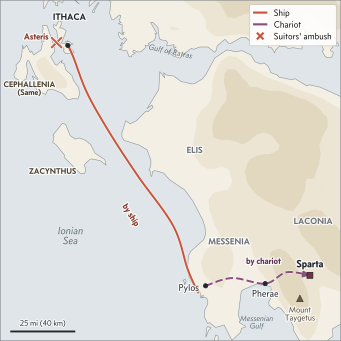
Menelaus and Proteus
They found the king of Sparta, Helen’s husband, holding a double wedding. Menelaus was sending his daughter HermioneThis figure is the father of Hermione. → Menelaus•• to Thessaly to marry Neoptolemus, the son of Achilles, as he had promised at Troy. In Homer, Hermione was Helen’s only child, for the gods gave her no more. Menelaus also had a son, born late to a slave woman, and on the same day he married his son MegapenthesThis figure fathers a son named Megapenthes. → Menelaus• to a Spartan girl. The name means “great grief.” He is not the Megapenthes who traded kingdoms with Perseus (Chapter 14).
Helen, at home again since the fall of Troy (Chapter 27), knew Telemachus at once by his likeness to his father. Talk of Odysseus set the whole hall weeping, so Helen slipped a drug into the wine. In Samuel Butler’s translation of 1900, it was “an herb that banishes all care, sorrow, and ill humour,” so strong that a man who drank it would not weep that day even if he saw his own son cut down before his eyes. Helen had the drug from PolydamnaThis figure received the drug nepenthe from Polydamna. → Helen of Troy• (pol-ih-dam-nuh), the wife of an Egyptian lord named Thon, for Egypt, Homer says, grows more herbs than any other land, some healing and some deadly. English calls the drug nepenthe (nih-pen-thee), from Homer’s Greek for “no grief.” Its penthos, “grief,” is the same word that ends the name Megapenthes.
The next morning Menelaus told his own story. After Troy he had wandered for eight years, to Cyprus, Phoenicia, and Egypt, and on the way home the gods held him back, because he had not paid them the sacrifices they were owed. Off Egypt lay an island called PharosMenelaus encountered Proteus on the island of Pharos off this land. → Egypt•• (fair-os), “about as far as a ship can sail in a day,” in Butler’s words. There his fleet lay becalmed for twenty days, and his men fished with hooks to keep from starving. A sea goddess named Eidothea (eye-doh-thee-uh) took pity on him. Her father, she said, was Proteus, the Old Man of the Sea, an Egyptian god who served Poseidon; he is not the Egyptian king Proteus of Euripides’s Helen (Chapter 27). If Menelaus could catch him and hold on, whatever shapes he took, Proteus would tell him how to get home.
Catching a god takes a trick. Every day at noon Proteus came up out of the waves to sleep on the beach among his seals, after counting them as a shepherd counts sheep. At dawn Eidothea brought four freshly skinned sealskins, scooped four hollows in the sand, and laid Menelaus and three of his men in them. The stench was dreadful, so she put ambrosia, the fragrant food of the gods, under each man’s nose. Menelaus lay hidden under a sealskinThis figure wore a sealskin to ambush the shape-shifting Proteus and learn how to return home from Troy. → Menelaus•• all morning, waiting to ambush the shape-shifter and learn his way home. At noon the old god counted the four men among his seals and lay down to sleep, and they leaped on him. Proteus became a lion, then a serpent, a leopard, and a huge boar, then running water, then a tall tree. They held on until he gave up and answered.
Menelaus, he said, must sail back up the Nile and make the sacrifices he owed. Ajax the Lesser had drowned, Agamemnon had been murdered, and Odysseus was alive, held against his will on the island of the nymph Calypso. As for Menelaus, because his wife was a daughter of Zeus, he would never die, but would be carried to the Elysian Plain at the end of the earth (Chapter 13). Centuries later, Plutarch says, Alexander the Great, the Macedonian king who conquered Persia, dreamed that an old man recited Homer’s lines about Pharos, and he founded Alexandria on the shore opposite. The lighthouse later built on the island became one of the wonders of the world (Vol. 5, In the Beginning).
Telemachus now knew that his father was alive. Menelaus offered him three horses and a chariot as a parting gift. Telemachus asked for something else instead, because there was no level ground for horses on Ithaca, the island where he lived.This island is home to Telemachus. → Ithaca•• Menelaus laughed, pleased with the young man’s good sense, and gave him a silver mixing bowl rimmed with gold. At home, meanwhile, the suitors had learned that the boy was gone. Antinous took a ship and twenty men to the rocky islet of Asteris (as-tuh-ris), between Ithaca and the larger island of Same (say-mee), to kill him on his way back.
The beggar in his own house
The Phaeacians kept their promise. They sailed by night, and Odysseus slept so soundly in the stern that when they reached Ithaca at dawn they lifted him ashore on his blanket without waking him. They piled his gifts under an olive tree and sailed for home, and Poseidon, furious, turned their ship to stone within sight of its own harbor. So Odysseus came home after twenty years,Odysseus returns to this island after twenty years away. → Ithaca•• ten at Troy and ten on the sea, and he did not know it. Athena had wrapped the island in mist, and when he woke he thought he had been abandoned on a foreign shore.
She came to him as a young shepherd, and he told her a long lie about being a Cretan exile. Athena laughed and showed herself: no one could outdo him for cunning, she said, except herself. She cleared the mist, and they hid his treasure in a cave of the nymphs. Then she touched him with her wand and made him old. His skin shriveled, his hair fell out, his eyes grew dim, and his clothes became filthy rags. In that shape he could learn who was loyal before he struck.
She sent him first to Eumaeus, his swineherd, a king’s son kidnapped as a child by Phoenician traders and sold to Laertes. He kept twelve sties of fifty sows each, but only 360 boars, because every day he had to send the fattest to the palace for the suitors. He did not know the beggar, but he took him in and killed a hog for him, throwing hairs from its head into the fire as the gods’ share (Chapter 9).
Telemachus was already sailing home. On the beach at Pylos a stranger had begged to come aboard. He was Theoclymenus (thee-oh-klim-uh-nus), a seer of the family of Melampus, the prince whose ears the snakes had licked (Chapter 24), and he was fleeing Argos after killing a kinsman. Telemachus took him in, and so a seer from Argos sailed to Ithaca.A person with this occupation from Argos traveled to Ithaca with Telemachus. → seers• They slipped past the ambush in the dark. As they landed, a hawk flew by on the right with a dove in its claws, and Theoclymenus read the sign: no family on Ithaca would be more royal than Telemachus’s own.
Telemachus walked up to Eumaeus’s hut. While the swineherd was away carrying the news to Penelope, Athena gave Odysseus back his own face, and father and son met for the first time since the boy was a baby. They wept aloud, in Butler’s words, “like eagles or vultures with crooked talons that have been robbed of their half fledged young.” Then they made a plan. Odysseus would go to the palace as a beggar, and Telemachus would quietly clear the weapons from the walls of the hall.
The next day Eumaeus led his ragged guest down to the town. On the road the goatherd Melanthius (muh-lan-thee-us), driving his best goats to the palace for the suitors’ dinner, jeered at the beggar and kicked him on the hip. At the palace gate an old dog lay on a heap of dung, neglected and crawling with fleas. He was Argos (some books spell him Argus, like the hundred-eyed watchman of Chapter 10), whom Odysseus had raised as a puppy before he sailed, a hunting dog who had once run down wild goats, deer, and hares. Through the rags and the wrinkles he knew his master. He dropped his ears and wagged his tail, but he was too weak to crawl to him. Odysseus could not greet him without giving himself away, so he wiped away a tear where Eumaeus could not see and walked into the hall, and the old dog died.
Inside, Odysseus went around the tables begging scraps, to learn which of the suitors had any decency. Most gave him something. Antinous threw a footstool that struck him on the shoulder, and Odysseus stood like a rock and shook his head in silence.
Penelope and the suitors
The queen upstairs had chosen her husband once before, on the road out of Sparta. Pausanias, the Greek traveler, heard the story there. Her father, Icarius, could not bear to lose her, and when the newly married couple set out for Ithaca, he followed their chariot, begging her to stay. At last Odysseus told her to choose: come with him willingly, or go back to her father. In the translation by W. H. S. Jones and H. A. Ormerod, she “made no reply, but covered her face with a veil in reply to the question.” Icarius understood and let her go. On the spot, about 3.5 miles from Sparta, Icarius set up a statue of Modesty,This woman's father Icarius erects a statue of modesty where she leaves with her husband. → Penelope•• in Greek Aidos (eye-dos), where his daughter had veiled her face. Aidos meant the sense of shame and respect that keeps a person from doing what others would despise, and a bride’s veil was its sign. The statue still stood by the road in Pausanias’s day.
So Penelope chose Ithaca over Sparta,This island is home to Penelope. → Ithaca•• and on Ithaca she waited. With Laertes on his farm and her son a child, she ran the great house herself: its storerooms of gold, bronze, and oil, its herds, and its fifty women servants, who spun, wove, and ground the grain. The suitors were courting the queen of Ithaca,This woman is queen of Ithaca. → Penelope• and whoever married her would be master of Odysseus’s house and perhaps king of the islands. When the killing began, one of them would claim that Antinous had wanted the throne more than the woman.
Penelope could not refuse them outright, and she would not accept them, so she played for time. She set up a great loom in her room. A shroud is the cloth in which a dead body is wrapped for burial. She told the suitors that before she chose she must finish a shroud for old Laertes, so that no one could say a rich man had been buried without one. All day she wove. At night, by torchlight, she pulled the day’s work apart. So she wove by day and unraveled by nightPenelope delayed this group by weaving Laertes’s shroud by day and secretly unravelling it at night. → suitors of Penelope••Penelope undid her work in this activity each night while making Laertes’s shroud. → weaving•• for three years, until in the fourth one of her maids betrayed her and the suitors caught her at it (Figure 29.3).


Not all the maids were loyal. One of them, Melantho (muh-lan-thoh), was the sister of Melanthius the goatherd, and Penelope had raised her like a daughter and given her toys as a child. She repaid her mistress by sleeping with the suitor Eurymachus (yoo-rim-uh-kus) and caring nothing for her grief. Melantho took the suitors’ side,Melantho aided this group. → suitors of Penelope• and twice she sneered at the beggar for lingering in the hall.
That night Penelope sent for the stranger. He said he was a Cretan who had once entertained Odysseus, and when she tested him, he described the purple cloak her husband had worn, with its gold brooch showing a hound and a fawn. She had given him that cloak herself, and she wept. Then she ordered a bath for his feet. He would let no young maid touch him, so the task fell to Eurycleia, the nurse who had cared for Odysseus since the night he was born, and later for his son. As she took his leg in her hands, she felt a long scar above the knee and knew it. As a young man, visiting his mother’s father, Autolycus the master thief (Chapter 8), Odysseus had been gashed there by a wild boar on Mount Parnassus. The old woman let his foot fall, and the basin rang and tipped over. Odysseus seized her by the throat and whispered that she must say nothing. Athena had turned Penelope’s eyes away.
Before she went to bed, Penelope asked the stranger what a dream meant. In it an eagle swooped down and killed her twenty geese, then spoke in a man’s voice and said that he was Odysseus. The beggar said the dream was plain. Penelope was not sure, and in Butler’s words she explained why: “There are two gates through which these unsubstantial fancies proceed; the one is of horn, and the other ivory.” In the Odyssey, true dreams come through the gate of horn,In this work, dreams pass through gates of horn or ivory according to whether they are true or false. → The Odyssey•• and false ones through the gate of ivory. It is a Greek pun, for the word for horn sounds like the verb “to fulfill,” and the word for ivory like “to deceive.” Virgil borrowed the two gates for his own poem (Chapter 30).
Penelope feared that her dream had come through the ivory gate, and she had decided to end the waiting. Odysseus, she said, used to set up twelve axes in a row and shoot an arrow through them all. Tomorrow she would bring out his great bow, and she would follow whichever suitor could string it and shoot through the twelve axes.
The bow and the bed
The bow had a history. As a young man, sent to the mainland to recover three hundred sheep that raiders had stolen from Ithaca, Odysseus had met Iphitus, the son of the archer Eurytus, who gave him his father’s bow. They swore friendship but never met again, for Heracles killed Iphitus soon afterward (Chapter 18). Odysseus never took the bow to war. It hung in a storeroom, and on the morning of the contest Penelope took it down and wept over it.
Eumaeus came down from the hills with fat hogs for the feast, and Philoetius (fih-lee-shee-us), the cowherd, brought a heifer over from the mainland; he too had never stopped hoping for his master’s return. Telemachus dug a trench across the floor and set the twelve axes in a straight line. No one today is sure how the target looked. Most readers picture iron axe heads, each with a hole or ring, lined up so that one arrow could fly through them all.
To string a bow, an archer must bend it far enough to slip the string’s loop over its tip. Telemachus would have strung it on his fourth try, but his father shook his head, and he stopped. Then the suitors tried, one after another. They warmed the bow by the fire and rubbed it with fat, and still none of them could bend it.
Meanwhile Odysseus took the two herdsmen outside, showed them the scar, and gave his orders. Eumaeus was to put the bow into his hands and lock the women in their rooms, and Philoetius was to tie the courtyard gate shut with a ship’s cable. Inside, the beggar asked for a turn with the bow. The suitors howled at his insolence, but Penelope said he should have his chance, and Telemachus, who knew what was coming, sent her up to her room.
Eumaeus put the bow in his master’s hands. Odysseus strung it as easily as a singer fits a new string to his lyre and plucked the string, which, in Butler’s words, “sang sweetly under his touch like the twittering of a swallow.” Zeus thundered. Penelope had promised herself to the man who could shoot an arrow through twelve axes, and without rising from his stool the beggar sent an arrow through all twelve axes.This woman promised to marry the first man who could shoot an arrow through twelve axes. → Penelope•A hero shoots an arrow through twelve axes before the slaughter of this group. → suitors of Penelope•• The next arrow began the slaughter of the suitors. It took Antinous in the throat as he lifted a gold cup to drink (Figure 29.4).

Then Odysseus told them who he was. Eurymachus blamed everything on dead Antinous and offered to repay all they had eaten, the worth of twenty oxen from every man. Odysseus refused, and Eurymachus died with his sword drawn. Telemachus ran to the storeroom for armor and spears, but he left the door open, and Melanthius armed the suitors.Melanthius aided this group. → suitors of Penelope•• The goatherd crept around by a back passage and carried shields, helmets, and spears out to them. On his second trip Eumaeus and Philoetius caught him, tied his hands and feet, and hauled him up by a rope to the rafters.
Then they ran back and stood with Odysseus and Telemachus at the door. Eumaeus and Philoetius fought besidePhiloetius and Eumaeus aid in the slaughter of members of this group. → suitors of Penelope• their master in the slaughter of the suitors, and each of them killed his man. Athena, who had come in the shape of Mentor, held up the aegis, her terrifying war-cloak, and the suitors ran about the hall like cattle maddened by flies. Only the bard and the herald, whom the suitors had forced to serve them, were spared. Then Eurycleia named the twelve maids, out of fifty, who had slept with the suitors. They were made to carry out the bodies and scrub the floor, and then they were hanged in the courtyard, and Melanthius was cut to pieces. It was a merciless revenge, and Homer tells it without apology.
Penelope had slept through it all. When Eurycleia woke her, she would not believe the news. She came down and sat facing the stranger in silence, until Telemachus called her heart harder than stone. Then she tested him. She told Eurycleia to carry the bed out of their bedroom and make it up for him. Odysseus was furious. No one could move that bed, he said, because he had built it himself. A young olive tree had grown in the courtyard, as thick as a pillar, and he had built the bedroom around it. He cut off the top, shaped the trunk into a bedpost, and built the bed upon it, inlaid with gold, silver, and ivory. Only he, Penelope, and one maid knew. His bed was carved from a living olive tree,This figure proves his identity by explaining that his bed is carved from a living olive tree. → Odysseus•• and by saying so he proved who he was. Penelope ran to him and threw her arms around his neck.
Every homecoming in the poem turns on a token. The dog knows his master by sight, the nurse and the herdsmen by a scar, the suitors by the bow, and his wife by a secret that almost no one else shares. That night Athena held back the Dawn at the edge of Ocean, so that their first night together would be long.
The death of Odysseus
The Odyssey has one more book. Odysseus found his father hoeing a vine on his farm, in a patched old shirt, and proved who he was by the scar and by naming the trees Laertes had given him as a boy: thirteen pears, ten apples, and forty figs. The suitors’ families came for revenge, and old Laertes, made strong again by Athena, killed Antinous’s father with a spear. Then Athena called on both sides to stop, and there the poem ends.
But Homer’s audience knew there was more. In the land of the dead, the seer Tiresias had told Odysseus to carry an oar inland, far from the sea, and to sacrifice to Poseidon there (Chapter 28). On his first night home Odysseus told Penelope the rest of the prophecy. In Butler’s words, “death should come to me from the sea,” gently, in old age. Homer’s Greek can also be read “away from the sea,” but the story that followed took it the first way.
The lost epic called the Telegony told how it came true. It was credited to Eugammon (yoo-gam-un), a poet of the sixth century BC from Cyrene, a Greek city on the coast of Libya, and only a short summary of it survives. A year with the goddess Circe had left a child behind (Chapter 28). Circe was the mother of TelegonusThis figure is the mother of Telegonus. → Circe•• (tuh-leg-uh-nus), whose name means “born far away,” and he grew up on her island. When he was grown, she told him who his father was, and he sailed to find him. The summary says only that he landed on Ithaca and plundered it; in Hyginus’s Latin handbook (Chapter 1), a storm drove him there and hunger made him a raider. He began to carry off cattle, and Odysseus came down to the shore to defend his herds. In the fight, as Apollodorus tells it, Telegonus killed his father unknowinglyThis figure accidentally killed his father Odysseus with a spear tipped with a stingray spine. → Telegonus•• with a spear tipped with the spine of a stingray. Death had come from the sea after all, on the barb of a fish.

When Telegonus learned whom he had killed, he grieved and carried his father’s body to Circe, with Penelope and Telemachus. There, the summary says, Circe made them immortal, Telegonus married Penelope, and Telemachus married Circe. The Romans gave the story an Italian ending. They called Telegonus the founder of Tusculum (tus-kyuh-lum), a town in the hills southeast of Rome, and the Mamilii (muh-mil-ee-eye), a family of Tusculum, traced their line back to him (Figure 29.5).
What to remember
- Penelope, daughter of Icarius, was the wife of Odysseus and the mother of Telemachus. She veiled her face to show she chose her husband, and Icarius set up a statue of Modesty on the spot.
- The first four books of the Odyssey, the Telemachy, follow Telemachus to Nestor at Pylos and Menelaus at Sparta, with Athena disguised as Mentor.
- At Sparta, Menelaus married off his daughter Hermione and his son Megapenthes; Helen’s drug nepenthe was a gift from the Egyptian Polydamna.
- On Pharos, off Egypt, Menelaus hid under a sealskin to seize the shape-shifting Proteus, who told him the way home.
- Odysseus came home to Ithaca after twenty years, as a beggar. The dog Argos knew him and died, and Eurycleia knew him by his boar-hunt scar.
- Penelope held off 108 suitors by weaving Laertes’s shroud by day and unraveling it at night. Melanthius and Melantho helped the suitors; Eumaeus and Philoetius helped Odysseus.
- In the Odyssey, true dreams come through the gate of horn, false ones through the gate of ivory.
- Odysseus shot an arrow through twelve axes and killed the suitors; Penelope knew him by their bed, carved from a living olive tree.
- In the lost Telegony, Telegonus, his son by Circe, killed Odysseus by mistake with a stingray-tipped spear.
Aeneas and Rome
Chapter 30 · 52 clues
The Aeneid
In September of 19 BC, a sick man of fifty was brought ashore at Brundisium (brun-diz-ee-um), the harbor on the heel of Italy where ships from Greece came in. He was Publius Vergilius Maro, whom English calls Virgil, and he was the most admired poet in Rome. For about ten years he had been writing a long poem about the Trojan prince Aeneas. It was not finished. Some of its lines still stopped halfway, and he had meant to spend three more years polishing it. Before he died there a few days later, on September 21, the story goes, he asked his friends to burn the manuscript.
The emperor Augustus would not allow it. He ordered two of Virgil’s friends to publish the poem as it stood, and the Aeneid became the book every Roman schoolboy studied, and every educated European after them. It tells how Aeneas escaped from burning Troy, wandered the sea for seven years, loved and left a queen in Africa, went down alive among the dead, and fought a war in Italy to found the people who would one day build Rome. This chapter follows the story in the order things happened to Aeneas, which is not quite the order in which Virgil tells it.
Virgil’s poem
Aeneas was famous long before Virgil. In Homer’s Iliad he is a Trojan prince, the son of the goddess Aphrodite and a herdsman of royal blood named Anchises (Chapter 7), and second only to Hector among the fighters of Troy. In the twentieth book of that poem, the sea god Poseidon snatches him away from Achilles because fate has other plans for him: Aeneas, Poseidon says, will survive the war, and he and his children’s children will rule the Trojans (Chapter 26). Later Greeks and Romans read those lines as a promise about the future. Long before Virgil, Romans were telling the world that Aeneas had come to Italy and that they were his descendants, a claim at least as old as the 200s BC.
One Roman family made the claim personally. The Julii (joo-lee-eye), the clan of Julius Caesar, traced their line to Aeneas’s son, whose second name was Iulus (yoo-lus). Caesar’s adopted son Octavian defeated his rival Mark Antony and Cleopatra, the queen of Egypt, in a sea battle off Actium, on the west coast of Greece, in 31 BC, and became the master of the Roman world. In 27 BC he took the title Augustus (Vol. 7, The Romans). Virgil had begun his epic two years before. A poem about Aeneas was a poem about the emperor’s own ancestor, written for a city tired of civil war and hungry to hear that its history had a purpose.

The poem has twelve books and 9,896 lines in dactylic hexameter, the long six-beat meter of Homer (Vol. 1, The Toolkit). Its Latin title, Aeneis (ih-nee-is), means “the poem of Aeneas,” just as the Iliad is “the poem of Ilium,” or Troy. So Aeneas is the title characterThis figure is the title character of a namesake epic by Virgil. → Aeneas••• of Virgil’s epic, and every book follows him. Figure 30.1 shows its plan. The first six books are a voyage of many adventures, like the Odyssey, and the last six are a war, like the Iliad. Virgil was rewriting both of Homer’s poems at once, and his readers, who had read Homer at school, were meant to notice.
Like Homer, Virgil begins in medias res, “in the middle of things” (Vol. 1, The Toolkit). Book 1 opens with a storm that wrecks the Trojans on the coast of Africa, and only in Books 2 and 3 does Aeneas tell, at a queen’s banquet, how Troy fell and where he has been since. In John Dryden’s translation of 1697, the poem begins: “Arms, and the Man I sing, who forc’d by Fate, / And haughty Juno’s unrelenting Hate.” Those two lines name the forces that drive the whole story. Fate means that Aeneas must reach Italy. Juno, the Roman Hera, hates him and does everything she can to stop him. The gods can delay fate, but they cannot change it.

Aeneas is a different kind of hero from Achilles. Virgil’s great word for Aeneas is pius, “dutiful” (the Stage): faithful to his gods, his father, and his people. Again and again Aeneas gives up what he wants for what he owes, and the poem counts the cost of that duty without pretending it is small. Virgil read three books aloud to Augustus and his family, the second, the fourth, and the sixth. In the sixth, among the souls of Romans waiting to be born, appears the young Marcellus, Augustus’s nephew and chosen heir, who had died in 23 BC. His mother Octavia, the emperor’s sister, is said to have fainted when she heard it. The Aeneid as a work of art, and Virgil’s own life and other poems, belong to a later volume (Vol. 7, The Romans). This chapter tells its story.
Out of burning Troy
Before the war, Aeneas was a prince of a younger branch of Troy’s royal house (Chapter 18 draws its family tree). Like Achilles, he had a goddess for a parent: Venus, the Roman Aphrodite, was his mother.This Roman goddess is the mother of Aeneas. → Venus• She had loved a mortal herdsman on Mount Ida, the mountain above Troy, and Chapter 7 tells how she came to him in disguise and promised him a son who would rule the Trojans. That herdsman was Anchises, a kinsman of King Priam, so Aeneas’s father was the mortal Anchises.This figure is the father of Aeneas. → Anchises•• Long ago Jupiter had struck Anchises with a thunderbolt for boasting of the goddess’s love, and by the time Troy fell he was old and frail. Aeneas had married Creusa, one of Priam’s daughters. She is not the Corinthian princess of the same name whom Medea killed (Chapter 19). Their small son was Ascanius (as-kay-nee-us), so Aeneas was the father of Ascanius,This man is the father of Ascanius. → Aeneas•• whom Virgil also calls Iulus, the name that the Julian family claimed.
On Troy’s last night the Greeks came out of the wooden horse and opened the gates (Chapter 27). Aeneas was asleep in his father’s house and knew nothing of it until Hector appeared to him in a dream.Hector appears to this man in a dream, telling him to flee Troy. → Aeneas•• Hector was Priam’s eldest son and the greatest of the Trojan fighters, whom Achilles had killed and dragged behind his chariot (Chapter 26). His ghost came grimy with dust and blood, his wounds still open. Troy was lost, he said, and nothing could save it now. Aeneas must flee, and carry Troy’s holy things and its household gods across the sea to found a great new city. The Penates (puh-nay-teez) were the household gods, small images kept at the hearth and worshipped by the family; a whole city had its Penates too, and these were Troy’s.
Aeneas woke to the roar of fire. He grabbed his weapons and ran into the streets with a handful of young men, ready to die fighting. From the roof of Priam’s palace he watched Achilles’s son Neoptolemus cut down the old king at his own altar. Then his mother stood before him. Venus drew back the mist from his eyes and showed him what mortals could not see: the gods themselves tearing Troy apart, Neptune heaving up its walls, Juno at the gates calling in the Greeks, Minerva on the citadel with her aegis. It was useless to fight the gods. Aeneas went home.

Anchises refused to leave. He had lived too long already, he said, and would die in Troy. Aeneas would not leave him to die alone, and he was arming to go back into the fighting when a sign came. A flame flickered harmlessly on the hair of little Ascanius, and his parents rushed to put it out. Anchises, overjoyed, asked Jupiter for a second sign. Thunder sounded on the left, and a shooting star slid across the sky and vanished over Mount Ida. Now the old man agreed to go.
Aeneas would not touch the holy images himself, with his hands still red from battle, so he gave them to his father to hold. Then he threw a lion’s skin over his shoulders, bent down, and took his father Anchises on his back.This man carries his father Anchises on his back. → Aeneas•• “Haste, my dear Father, (tis no time to wait,) / And load my Shoulders with a willing Fraight,” he says in Dryden’s version. Ascanius held his hand and trotted to keep up, and Creusa followed a little way behind. In the dark and the smoke, with Greek soldiers in the streets, Anchises left the burning city of TroyThis figure is carried out of the burning city of Troy on his son's shoulders. → Anchises• riding on his son’s shoulders, the household gods in his arms (Figure 30.3). No picture of Aeneas was dearer to the Romans. Augustus set it up as a statue in his new forum in Rome, and it was stamped on coins, as Chapter 7 shows.
At the meeting place outside the walls, Creusa was gone. Aeneas ran back alone through the burning city, shouting her name, until the ghost of his wife CreusaThe ghost of this man's wife Creusa tells him to leave his homeland. → Aeneas•• rose before him, taller than in life. She told him not to grieve. The gods had not meant her to leave Troy, and Cybele, the great mother goddess whom the Phrygians worshipped on Mount Ida (Chapter 12), kept her in that land; she would never be a slave in a Greek house. Aeneas had a long exile ahead of him, she said, but at its end lay a land in the west, where the Tiber flows, and a kingdom and a royal bride. She asked him to keep his love for their son. Three times he tried to throw his arms around her neck, and three times she slipped through them like a breath of wind.
At dawn he went back to his father. A crowd of refugees had gathered, men and women ready to follow him anywhere. So Aeneas escaped the sack of TroyThis Trojan hero escaped the sack of Troy. → Aeneas•• with his father, his son, and his people, but without his wife. They climbed into the forests of Mount Ida, and there through the winter they built a fleet.
Harpies and omens
The voyage that followed lasted seven years. Virgil sends the Trojans around most of the Mediterranean, and Figure 30.4 draws the route in his order. Each landing taught them something about where they were meant to go, and most lessons were painful.

First they sailed to Thrace, the wild country across the sea to the north, and began a city there. When Aeneas pulled up myrtle shoots to decorate an altar, dark blood dripped from the roots, and a groan came out of the ground. A voice spoke from the mound. It was Polydorus, Priam’s youngest son (not Cadmus’s son of Chapter 11), whose murder Chapter 27 told. Priam had sent him to the king of Thrace for safekeeping with a store of gold, and when Troy fell the king had killed him for it. The spears thrown into his body had taken root and grown into the bushes. The Trojans gave him a proper funeral and fled from that greedy land.
At Delos, the island where Apollo was born (Chapter 5), the god himself answered their prayers. Seek out your ancient mother, his voice told them; the land your ancestors came from will take you back. Anchises thought he knew what it meant. The Trojans’ oldest ancestor, an early king named Teucer (not Telamon’s son, the archer of Chapter 26), had come from Crete, and Crete had a Mount Ida of its own. So Anchises read Apollo’s oracle as Crete,This figure misreads Apollo’s oracle about his ancestors’ land as directing his party to Crete. → Anchises• and the fleet sailed there joyfully. They built a town, and then plague struck the people and drought burned the crops. One night the household gods appeared to Aeneas in a dream. Apollo had meant Italy, they said, which the Greeks called Hesperia (hes-peer-ee-uh), the land of the west. Dardanus, the other founder of the Trojan royal line, had been born there. Anchises admitted his mistake. He remembered now that his kinswoman Cassandra had spoken of Italy, but Cassandra was a prophetess whom, by Apollo’s curse, no one ever believed (Chapter 27).
A three-day storm drove them west to the Strophades, the islands in the Ionian Sea where the Harpies had lived since the sons of Boreas chased them away from old King Phineus (Chapter 19). Virgil’s Harpies are birds with girls’ faces, hooked claws, filthy bellies, and an endless hunger. The Trojans found herds of cattle and goats grazing unguarded, killed some, and sat down to feast. Down came the Harpies, screaming, snatching the meat and fouling what they left. The Trojans fought back with swords, but the blows bounced off the monsters’ feathers. Then their leader, Celaeno (sih-lee-noh), perched on a high rock and spoke a curse. They had made war on the Harpies over cattle that were not theirs, so they would reach Italy, but before they built their city’s walls they would eat their own tables,The harpy Celaeno prophesies that this man's group will eat their own tables. → Aeneas•• driven by hunger. In Dryden’s words, they would be “Reduc’d to grind the Plates on which you feed.” Anchises lifted his hands and prayed the gods to turn the curse aside.
They sailed north past Ithaca, cursing the island that had raised Ulysses, as the Romans called Odysseus. At Actium they held games on the beach beside Apollo’s temple, the same shore where Augustus would one day win his great battle. At Buthrotum (byoo-throh-tum), in Epirus, they found a little copy of Troy. Helenus, Priam’s son and a seer, now ruled there, and he had married Andromache, Hector’s widow. Both had been carried off as captives by Neoptolemus, Achilles’s son; after his death, Helenus had inherited part of his kingdom. Helenus gave Aeneas his directions. Sail around Sicily and keep away from Scylla and Charybdis in the narrow strait (the Stage). Visit the Sibyl, the prophetess at Cumae. Look for a white sow with thirty piglets, which would mark the place for a city. And do not fear the curse of the tables, for the gods would find a way.
Sicily brought the strangest meeting of all. The Trojans landed at night under the smoking volcano Etna, on the coast where the Cyclopes lived (Chapter 28). At dawn a starved, ragged man came running out of the woods. He was Achaemenides (ak-ih-men-ih-deez), a Greek, one of Ulysses’s own crew, left behind in the rush to escape from the Cyclops’s cave. For three months he had lived on berries and roots, hiding from the giants. He begged the Trojans to take him away, or else to kill him. While he spoke, the blinded Cyclops Polyphemus came down the mountain with his sheep, leaning on a pine trunk for a staff, and waded into the sea to wash the blood from his empty eye. The Trojans cut their cables and rowed away in silence, taking the Greek with them. So Aeneas rescued Achaemenides from Polyphemus’s island,In the Aeneid, Aeneas rescued Achaemenides from this figure’s island. → Polyphemus•• an enemy saved because he came as a suppliant, a person who kneels and begs for protection in the name of the gods. The Greek repaid him by guiding the fleet around Sicily.
At Drepanum (drep-uh-num), at the western tip of Sicily, Anchises died. He had been carried out of Troy and across the sea, and he never saw Italy. With that loss Aeneas ends the long story he tells at the queen’s banquet.
Juno’s storm
Virgil’s poem begins at this point, as the fleet leaves Sicily on the last short run to Italy. Juno watched it go, and her old anger burned. She had loved one city above all others, a new one rising on the African shore. Carthage was Juno’s favorite city,In the Aeneid, this city is Juno’s favorite. → Carthage• dearer to her than any other land, even her own island of Samos, and she meant it to rule the nations. But she had heard what the Fates had spun: a people descended from Troy would one day destroy Carthage. Old wounds made it worse. Paris, a Trojan, had judged Venus more beautiful than Juno (Chapter 25), and Jupiter had carried off the Trojan boy Ganymede to Olympus and showered him with honors (Chapter 10).
So Juno went to Aeolus, the king who kept the winds shut up in a cave under a mountain on his island (Chapter 3). She asked him to sink the Trojan fleet, and she offered a bribe. She had fourteen lovely nymphs to attend her, and she promised Aeolus the nymph DeiopeaJuno promised this figure the nymph Deiopea in return for unleashing a storm against Aeneas. → Aeolus•• (dee-yoh-pee-uh), the loveliest of them, as his wife for life. Aeolus answered that his power was hers to command. He struck the mountain’s side with his spear, and the winds rushed out of the opening together. Night fell at noon. Aeneas, soaked and terrified, wished he had died fighting at Troy. One ship sank before his eyes, and the rest were scattered. Neptune, angry that anyone else should stir up his sea, rose from the deep, scolded the winds, and smoothed the waves. By then Aeolus’s storm had driven the Trojan fleetAeolus sends a storm that blows this figure’s fleet toward Carthage. → Aeneas• far south to the coast of Africa, near Carthage. Aeneas reached a sheltered harbor with seven of his twenty ships.
Dido
Aeneas climbed a hill to look around, and in the woods he met a young huntress with a bow on her shoulder. She was his mother in disguise. Venus told him that he had come to Carthage, a new city ruled by a queen from Tyre, the great trading city of Phoenicia (Chapter 10). Her name was Dido, and Dido is the great heroine of Virgil’s Aeneid,This character appears in Virgil's Aeneid. → Dido• though her story is older than the poem; the Greek historian Timaeus (ty-mee-us) of Sicily had told it more than two hundred years before.
Venus told the story. Dido had married Sychaeus (sih-kee-us), the richest man in Tyre, and loved him deeply. Then her brother Pygmalion became king. He was greedy and godless, and Pygmalion murdered her husband SychaeusThis character flees her brother Pygmalion, who killed her husband Sychaeus. → Dido•• in secret, at the altar, for his gold. This Pygmalion is not the sculptor of Ovid’s story (Chapter 7). For a while he fooled his sister with lies, but the ghost of Sychaeus came to her in a dream, showed her his wounds, and told her where his treasure was buried. Dido gathered everyone who hated or feared the tyrant, seized ships, loaded the gold, and sailed west. A woman led the whole expedition.
They landed on the coast of Libya, as the Greeks and Romans called northern Africa, and bargained with the people there for a place to settle: only as much ground as a bull’s hide could surround. Virgil says no more than that, and that the hill took its name, Byrsa (bur-suh), the Greek word for a hide, from the bargain. Later writers, such as the Roman historian Justin, tell the trick. Dido cut the oxhide into thin strips,This woman cut an oxhide into thin strips to demarcate the boundaries of her land. → Dido••• tied them end to end, and with that long leather cord she enclosed a whole hill.
On that hill Dido built her citadel, and the city grew around it. Dido founded Carthage and ruled as its queen,This woman is the legendary founder and queen of Carthage. → Dido•• and her people prospered. Her neighbors watched her closely. The most powerful was Iarbas (eye-ar-bus), an African king whose father was Jupiter Ammon, the god of a famous oracle in the Libyan desert. Iarbas wanted to marry the newcomer, but Dido rejected Iarbas,This character rejects the courtship of Iarbas, who had granted her land for Carthage. → Dido•• though he had granted her the land for her city. She had sworn to stay faithful to her dead husband. The real Carthage was a Phoenician colony, founded, by the traditional date, in 814 BC (Vol. 5, In the Beginning), and that puts Dido more than three hundred years after the Trojan War. Virgil knew the dates did not fit and joined the two stories anyway.

Hidden by his mother in a cloud, Aeneas walked into Carthage unseen, and he stopped in wonder. Where there had been huts, gates and paved streets were rising, and a harbor, a theater, and a council house. In one of his long comparisons, the epic simile (Vol. 1, The Toolkit), Virgil compares the building of CarthageThis poem compares the building of Carthage to bees working in early summer. → The Aeneid• to bees at work in early summer (Figure 30.5).
In the middle of the city stood a new temple of Juno, and on its walls were painted the battles of the Trojan War: Agamemnon and Priam, Achilles dragging Hector’s body around the walls, as Virgil tells it, the Amazon queen Penthesilea. Here, on the far side of the sea, strangers knew Troy’s story and grieved for it. Aeneas wept at the pictures of Troy.This figure weeps on seeing images of the Trojan War in Carthage. → Aeneas•• “Our known Disasters fill ev’n foreign Lands,” he says to his friend Achates (uh-kay-teez) in Dryden’s version. Then Dido herself arrived, and with her came the captains of the lost ships, safe after all. The cloud melted, Aeneas stepped out, and the queen welcomed the Trojans to her city.

Venus did not trust Juno’s city. To make sure that Dido would protect her son, she sent her other son, Cupid, to make the queen fall in love with him. Venus carried the real Ascanius away asleep to her sanctuary on Cyprus, and Cupid took the shape of AscaniusCupid, disguised as Ascanius, causes this character to fall in love. → Dido• (Figure 30.6). At the welcoming banquet, Dido held the false child on her lap and hugged him, not knowing what god she held. Little by little he wiped the memory of Sychaeus from her heart and filled it with a living love.
All night the queen kept her guest talking, and at last she begged him to tell the whole story from the beginning. So Aeneas told the queen’s courtThis figure recounts his escape from Troy at a queen’s court. → Aeneas• of the wooden horse, of Troy’s last night and his escape, and of his seven years at sea. Those are Books 2 and 3 of the poem, the story inside the story, which this chapter has already followed.
The cave and the pyre
The next morning Dido poured out her heart to her sister Anna,This woman is the sister of Anna. → Dido•• the person she trusted most. She had sworn never to marry again, she said, and now she felt the old flame returning. Anna argued that the vow was foolish. Dido had refused Iarbas and every other African prince, and she was surrounded by enemies, with her brother threatening war from Tyre. With the Trojans beside her, Carthage could grow great. Dido let herself be persuaded. She made sacrifices and searched the victims’ insides for signs, but no prayer could cure her.
Virgil shows her wandering through the city, unable to rest, and he compares Dido to a wounded deer.This character is compared to a wounded deer. → Dido• A shepherd hunting in the woods has shot a careless doe from far off, without even knowing that he hit her. She runs through the forests and glades of Crete, but the arrow runs with her. In Dryden’s lines, “still the fatal Dart / Sticks in her side; and rankles in her Heart.” The shepherd in the simile is Aeneas, who has wounded the queen without meaning to.
Juno saw her chance. If Aeneas married Dido, he would stay in Africa and never found Rome. She proposed the match to Venus and told her how it would happen: a storm in the middle of a hunt would drive the pair into the same cave. Venus pretended to agree, knowing that Jupiter would never allow it. Dido gave a great hunt, and the whole court rode out into the hills, the queen in purple and gold, Aeneas beside her as handsome as Apollo, and little Ascanius galloping ahead and wishing for a lion. In the middle of the chase Juno sent a stormThis figure sends a storm that forces Dido and Aeneas to take shelter in a cave. → Juno• of hail and black rain, just as she had planned. Torrents came roaring down the hillsides. The riders scattered in every direction to find cover in farmhouses and gullies, and in the confusion the queen and her guest found themselves alone together, far from the rest. Dido and Aeneas sheltered in the same cave.This character takes shelter with her lover in a cave during a storm. → Dido•• Lightning flashed, and the nymphs wailed on the mountaintops. “From this ill Omen’d Hour,” writes Dryden, “in Time arose / Debate and Death, and all succeeding Woes.” Dido called it a marriage. Aeneas never did.
Rumor, a monster with an eye, a tongue, and an ear under every feather, flew through the cities of Africa with the news. It reached Iarbas, who prayed in fury to his father Jupiter: the woman he had let settle on his coast, who had refused to marry him, had taken a Trojan instead. Jupiter sent his messenger Mercury to Carthage. Mercury found Aeneas dressed in a purple cloak that Dido had woven for him, laying out the towers of her city, and told him to sail at once. Aeneas was thunderstruck. He gave orders to ready the fleet in secret, but Dido found out. She called him faithless and begged him to stay. He answered that he was going to Italy not of his own will. That night Mercury came to him again in a dream and warned him to leave before dawn. So Aeneas abandoned Dido,This character is abandoned by her lover Aeneas. → Dido•• cutting the ships’ ropes with his sword.
At first light the queen saw the harbor empty and the fleet far out at sea. She cursed him. May he be driven out by war in Italy, she prayed, torn from his son, forced to watch his friends die, and killed before his time, to lie unburied on the sand. Let her people hate his people forever, and let an avenger rise from her bonesThis character commands an avenger to rise from her bones and pursue the Trojans to Italy. → Dido• to hunt the Trojans with fire and sword. Romans heard a name in that line: Hannibal, the general of Carthage who crossed the Alps in 218 BC and came close to destroying Rome. In 146 BC the Romans destroyed Carthage instead (Vol. 5, In the Beginning).
Dido had already ordered a great pyre built in the courtyard of her palace, telling Anna it was for a magic rite to burn away every memory of the Trojan. On it lay his sword, the clothes he had left, and the bed they had shared. She climbed the pyre and lay down on the bed, and Dido stabbed herself on the funeral pyreAfter this figure leaves Carthage for Italy, his lover kills herself on a funeral pyre. → Aeneas•••This character stabs herself on her funeral pyre. → Dido•• with Aeneas’s own sword. Anna ran up the steps and held her sister as she died (Figure 30.7). Juno at last took pity and sent Iris, the goddess of the rainbow, to cut a lock of Dido’s hair, which set her soul free to leave her body.

The descent to the underworld
From the sea the Trojans saw a glow over Carthage and could only guess what it meant. A storm turned them back to Sicily, to the friendly King Acestes (uh-ses-teez), whose mother was a Trojan. It was a year to the day since Anchises had died there. Aeneas made offerings at his tomb, and then, nine days later, he held funeral games for Anchises,Book 5 of the Aeneid describes one of these events held in honor of Anchises. → funeral games•• which fill Book 5. Funeral games were contests of strength and skill held in honor of a dead hero, with rich prizes for the winners, like the games Achilles held for his friend Patroclus in the Iliad (Chapter 26). Virgil’s games had a ship race around a rock, a footrace, a boxing match, and an archery contest. Last came the Troy Game, a display of riding in which the Trojan boys, led by Ascanius, wove complicated patterns on horseback. Virgil says the Romans still rode it in his own day, and Augustus had revived it.
While the men watched the games, Juno struck again. Iris, in the shape of an old Trojan woman, persuaded the women, sick of seven years at sea, to set fire to the ships. Four were lost before Jupiter sent a downpour. Aeneas left the weary and the old behind in a new town in Sicily and sailed for Italy with the rest.
Venus begged Neptune to see them safely across, and the sea god agreed, at a price. In Dryden’s words, “one destin’d Head alone / Shall perish, and for Multitudes attone.” That night the god of Sleep (Chapter 13) came down to Aeneas’s helmsman, Palinurus (pal-ih-nyoor-us) in the shape of a fellow sailor and offered to take the helm while he rested. Palinurus refused. He kept his eyes on the stars and his hands on the tiller. So the god shook a branch dripping with the water of Lethe over his eyes, and when he slumped asleep, threw him overboard, still clutching the tiller. Palinurus the helmsman was the sacrificeThis man's helmsman Palinurus's fall serves as a sacrifice to ensure safe passage to his crew. → Aeneas•• that bought a safe passage for everyone else. Aeneas woke to find his ship drifting toward the rocks and steered it himself, grieving for his friend.
The golden bough
Book 6 opens as the fleet lands at Cumae, near the Bay of Naples, the first Greek city on the mainland of Italy (the Stage). On its hill stood a temple of Apollo, and in the cliff below it lived a sibyl (sib-il), a prophetess through whom Apollo spoke. The Cumaean (kyoo-mee-un) Sibyl, whom Virgil names Deiphobe (dee-if-uh-bee), sang her prophecies in a cave with a hundred openings, so that her answers rushed out of a hundred mouths at once (Figure 30.8). Aeneas asked her to take him down to the land of the dead, where he could see his father again. Her answer is one of the most quoted passages in the poem: “The Gates of Hell are open Night and Day; / Smooth the Descent, and easie is the Way: / But, to return, and view the chearful Skies; / In this the Task, and mighty Labour lies.”

Before he went down, the Sibyl said, he had to do two things. Somewhere in the dark forest grew a tree with one branch of gold, sacred to Proserpina, the queen of the dead. No living man could enter her kingdom without that golden bough as a gift. And one of his own men lay dead and unburied, and his body must be buried first. The dead man was Misenus (my-see-nus), the Trojans’ trumpeter, who had once marched beside Hector. Proud of his playing, he had blown his conch shell at the shore and challenged the gods of the sea to match him, and the sea god Triton, jealous, had drowned him among the rocks. Aeneas led his men into the forest, swinging an axe himself, to cut oak and pine, and he built Misenus a funeral pyre.This person builds a funeral pyre for the drowned Misenus. → Aeneas• The cape above the shore, Misenum (my-see-num), still carries the trumpeter’s name.
As he worked, Aeneas looked at the endless forest and wondered how he would ever find one branch in it. He prayed to his mother. Two doves, Venus’s own birds, came gliding down and landed on the grass in front of him. They fed, then fluttered a little way ahead, always staying in sight, and he followed them to the edge of the dark lake of Avernus. So two doves guided Aeneas to the golden bough,Two doves guided this figure to the golden bough needed for his journey to the underworld. → Aeneas• which glinted among the leaves like mistletoe on a winter oak. He broke it off and carried it to the Sibyl (Figure 30.9).

Among the dead
At dawn, after sacrifices to the powers below, the Sibyl led Aeneas down through a cave by Lake Avernus, the crater lake that Chapter 13 described. They passed shapes of Grief and Fear and Hunger at the entrance and came to the river, where the ferryman Charon refused to carry a living man until the Sibyl showed him the golden bough. On the bank, among the unburied, Aeneas met the ghost of Palinurus, who told him that he had swum ashore after three days in the sea and been murdered there by people who took him for plunder. The Sibyl promised that his name would live in a cape on that coast, and Cape Palinuro, south of Naples, carries it still. Across the river lay Cerberus, the three-headed watchdog of the dead. The Sibyl threw him a lump of honey cake mixed with sleeping drugs. He gulped it down and collapsed across his cave. The Sibyl drugged Cerberus with honey cake,The Cumaean Sibyl subdued this creature with a drugged honey cake in the Aeneid. → Cerberus•• and the travelers walked past him.
Then came the Fields of Mourning, where the souls of those whom love had killed wandered among myrtle groves. Among them, with her wound still fresh, was Dido’s shade, as poets call a ghost. Aeneas wept when he saw her. He swore that he had left her shore unwillingly, forced by the gods, and that he had never thought his going would bring her such grief. She did not answer. Dido ignored his pleas,In the Underworld, this character ignores her former lover’s pleas. → Dido•• her eyes fixed on the ground, her face as unmoved as a cliff of stone. In Dryden’s words, she “regards no more” what he says and swears “Than the deaf Rocks, when the loud Billows roar.” At last she turned and fled into a shady grove, where she rejoined her first husband, Sychaeus,This figure meets Dido’s shade in the underworld, where she retreats to her former husband Sychaeus. → Aeneas•• who returned her love. Aeneas followed her with his eyes, weeping.
Past the walls of Tartarus, where sinners suffered behind a river of fire, Aeneas laid the golden bough on the threshold of the palace and came into Elysium, the green land of the blessed. There he found Anchises. Three times he tried to embrace his father, and three times, as with Creusa, his arms closed on empty air. Anchises showed him souls crowding to drink from the river Lethe, which made them forget their past lives before they were born again. Among them were the Romans of the future. There was Silvius, a son whom Aeneas would have in Italy, and the kings of Alba Longa after him; Romulus, who would found Rome; Julius Caesar; and Augustus, who would bring back the golden age. The Romans’ gift, Anchises said, would be ruling. In Dryden’s words: “But, Rome, ’tis thine alone, with awful sway, / To rule Mankind; and make the World obey.”
There were two ways out of the underworld. True dreams went up through a gate of horn, and false ones through a gate of ivory. Anchises led his son and the Sibyl to the gates, and Aeneas left the underworld through the ivory gate,Guided by the Cumaean Sibyl, Aeneas visits this place in Book 6 of the Aeneid and leaves through the ivory gate of false dreams. → the underworld•• the gate of false dreams. Readers have argued about that choice ever since. Some think Virgil hints that the whole vision was only a dream. Others point out that Virgil’s gate of horn is for “true shades,” the souls of the dead, so a living man had to leave by the other one. Virgil does not explain. Aeneas went straight back to his ships.
War in Latium
The fleet sailed north along the coast of Italy. At Caieta (kay-yee-tuh), Aeneas buried his old nurse, who gave the town her name. That night the ships slipped past the promontory of Circe, the witch who turned men into beasts (Chapter 28), and the Trojans heard lions roaring in her halls. At dawn they came to the mouth of a broad, yellow river winding out of the woods. It was the Tiber, and they rowed into it and landed.
Hungry after the voyage, they sat down on the grass to eat. They had no plates, so they laid their fruit on flat cakes of wheat bread. When the fruit was gone, they ate the bread too, and Ascanius laughed. “See, we devour the Plates on which we fed,” he says in Dryden’s version. Celaeno’s terrible curse had come true as a child’s joke, and Aeneas knew that they had reached the land of the prophecy.
The land was Latium, the plain of the Latin people south of the Tiber. Their king was Latinus, old and peaceful. In Virgil he is the son of Faunus, a god of the woods, and of a nymph, Marica, and the great-grandson of Saturn, the Roman Cronus. Hesiod, as Chapter 28 told, had made him a son of Circe and Odysseus instead. Latinus had no son, only a daughter, Lavinia (luh-vin-ee-uh), and many princes wanted to marry her. The strongest was Turnus, a young king whose city was Ardea, which Danaë had founded long before (Chapter 14). Turnus was king of the RutuliThis man is a king of the Rutuli. → Turnus•• (roo-tyoo-ly), a warlike people on the coast south of the Tiber, and Latinus’s wife, Queen Amata (uh-may-tuh), favored him.
But the gods had sent warnings. Bees swarmed in the sacred laurel in the palace courtyard, and once, at the altar, Lavinia’s hair caught fire without burning her. Latinus consulted his father’s oracle in a sulfur-smelling grove, and Faunus told him not to give his daughter to a Latin; a son-in-law would come from abroad whose descendants would rule the world. So Turnus, Lavinia’s chief suitor,This man was the main suitor of Latinus's daughter Lavinia. → Turnus• lost her before the Trojans had even arrived. When Aeneas’s messengers reached the palace, Latinus welcomed them and offered his daughter to their prince.
Juno could not stop fate, but she could make it cost blood. If she could not move the gods above, she said, she would stir up the powers below. She called up Alecto, one of the Furies (Chapter 13), who slipped a snake under Queen Amata’s robe and flung a torch into the heart of Turnus as he slept. Turnus woke in a rage for war. Then, while Ascanius was out hunting, Alecto guided his arrow into a tame stag, the pet of a country girl. The farmers seized their axes, the Trojans came running, and blood was spilled. Latinus would not open the Gates of War, the doors of the temple of Janus that Romans opened only in wartime (Chapter 32), so Juno pushed them open herself. All Latium armed for Turnus, among them the Etruscan exile Mezentius (meh-zen-shee-us), who scorned the gods, and Camilla, a girl of the Volsci (vol-sky) who rode to war at the head of her horsemen.
Aeneas needed allies. On the advice of the river god Tiber, who spoke to him in a dream, he sailed up the Tiber to a small town on a hill. It was Pallanteum (pal-un-tee-um), ruled by Evander, a Greek king from Arcadia. Evander told him how Hercules had killed the monster Cacus nearby (Chapter 17), and walked him over his humble hills, where cattle lowed among the bushes. The hill was the Palatine (pal-uh-tyn), and the cattle were grazing where the Roman Forum would one day stand. Evander was too old to fight, so he gave Aeneas his son, the young Pallas, and a troop of horsemen. He also sent him on to the Etruscans, who had driven out their cruel king Mezentius and were waiting for a foreign leader to march against him. This is the fourth Pallas of this volume (Chapter 4). Meanwhile Venus brought her son armor made by Vulcan, with a shield showing the history of Rome down to the battle of Actium.
While Aeneas was away, Turnus attacked the Trojan camp and tried to burn the ships drawn up beside it. But those ships had been built of pines from a sacred grove on Mount Ida, the grove of Cybele, the mother goddess who had kept Creusa’s spirit in the land of Troy. Jupiter had promised her that ships made of her trees would not perish. As the torches touched them, the ships snapped their cables, dove under the water like dolphins, and came up as sea nymphs. The burning ships became sea nymphs,When this person's fleet is set on fire, the ships reappear as sea nymphs. → Aeneas• and Turnus and his men stared in terror.
The belt of Pallas
Aeneas came back by sea with an Etruscan fleet, and a great battle was fought on the beach. Turnus sought out Pallas, who was a boy against a grown warrior. Pallas threw first and barely grazed him; Turnus’s spear smashed through the boy’s shield and breastplate and killed him. Turnus put his foot on the body and stripped off Pallas’s sword belt, a heavy band of gold, engraved with the story of the daughters of Danaus, the brides who murdered their husbands on their wedding night (Chapter 13). He buckled it on as a trophy. The time will come, Virgil warns, when Turnus will wish he had never touched it.
Mad with grief for Pallas, Aeneas raged through the battle, killing everyone in his path. Juno, afraid for Turnus, made a phantom out of mist in the shape of Aeneas, with his helmet and shield and voice, and sent it to taunt Turnus. Turnus hurled his spear, and the phantom fled. Turnus chased the phantom onto a shipThis man chases a phantom of his enemy onto an anchored ship. → Turnus• moored against the shore, and Juno cut the cable. Swept out to sea, Turnus was carried away to his father’s city, sick with shame that his men were dying while he sailed away.
During a truce to bury the dead, the Latins gathered in council. Their envoys had come back from Diomedes, the Greek hero who had fought at Troy and now ruled the city of Arpi in southern Italy (Chapter 27). The Latins had begged for his help. He refused it. He had seen the gods punish the Greeks for Troy, he said: his own companions had been turned into birds. He had fought Aeneas and felt the force of his spear. Diomedes urged Turnus’s people to make peaceIn the Aeneid, this character urges Turnus to make peace with Aeneas. → Diomedes• with the Trojans while they still could. Old Latinus heard the report and proposed to give the newcomers land and ships and end the war. Then Drances (dran-seez) rose to speak. He was rich, eloquent, and no fighter, and he had long envied the young king. Now Drances openly opposed Turnus.Drances opposes this man. → Turnus• Let Turnus give up Lavinia, he said, or else fight Aeneas alone and settle it. Turnus answered him with fury. Soon after, Camilla died in battle, and the Latin army broke.

Turnus agreed to settle it in single combat. But Juno spoke to Turnus’s sister JuturnaThis man's sister is Juturna. → Turnus• (joo-tur-nuh), a nymph of springs and pools whom Jupiter had loved and made immortal, and urged her to save her brother if she could. Juturna, in disguise, stirred up the Rutuli to break the truce. In the fighting Aeneas was wounded by an arrow, and Venus secretly healed him. Then Juturna took the place of Turnus’s charioteer and drove him all over the battlefield, always away from Aeneas. When Turnus finally turned to fight, his sword snapped on Aeneas’s armor, for in his haste he had snatched up his charioteer’s, and Juturna brought him back his own. At last Jupiter sent one of the Furies in the shape of a small owl, which beat its wings against Turnus’s face. Juturna knew the sign. She tore her hair, cursed the gift of immortality that would not let her die with her brother, and plunged into her river. “O hard Conditions of Immortal State!” she cries in Dryden’s version.
The last duel
Up on Olympus, before he sent the Fury, Jupiter had made Juno give way at last. She had asked only that the Latins keep their own name, language, and dress, and that the Trojans be absorbed into them, and Jupiter had agreed. Below, Turnus faced Aeneas alone. He heaved up a huge stone that marked the boundary of a field and hurled it, but it fell short. Aeneas’s spear struck him in the thigh, and he fell to his knees. He admitted that he deserved to die. But Aeneas, too, had loved a father, and for the sake of Anchises, Turnus begged him to pity the old age of DaunusWounded by a spear, this character begs his rival to "pity Daunus’ old age." → Turnus•• (daw-nus), Turnus’s own father, and to give him back to his people, alive or dead. In Dryden’s lines: “Pity my Sire, now sinking to the Grave; / And for Anchises sake, old Daunus save!” Lavinia was Aeneas’s, he said. The Latins had seen him beg.
Aeneas hesitated, his sword lowered, and began to soften. Then he saw, on Turnus’s shoulder, the golden belt that Turnus had stripped from the dead boy. Aeneas recognized the belt of Pallas,This character takes Pallas’s belt after killing him and is later killed when his opponent recognizes it. → Turnus•• and fury seized him. “Tis Pallas, Pallas gives this deadly Blow,” he cries in Dryden, and he drove his sword into Turnus’s chest. Turnus’s soul fled with a groan down to the shadows, and with that line the poem ends. There is no wedding and no victory feast, and Virgil never says whether the dutiful Aeneas was right to give way to rage at the very end.
The rest of the story comes from other writers, such as the historian Livy and the poet Ovid. Aeneas married Lavinia,This figure married Lavinia. → Aeneas•• as fate had promised, and founded a town that he named Lavinium (luh-vin-ee-um) after her. A few years later, in a battle beside the river Numicus (noo-mih-kus), he vanished, and his body was never found. In Ovid’s telling, Venus begged Jupiter to make her son a god; the river washed away everything mortal in him, and she anointed him with ambrosia and nectar. The Latins worshipped him at a shrine by the river, and Aeneas was deified as Jupiter IndigesThis man was deified as Jupiter Indiges. → Aeneas• (in-dih-jeez), a title the Romans gave to gods who belonged to their own soil. Thirty years after the landing, Ascanius founded a new city, Alba Longa, in the hills nearby, and from the line of Alban kings that followed him, three hundred years later by Virgil’s count, came Romulus (Chapter 31). So Aeneas was the ancestor of the Romans,This figure is the ancestor or progenitor of the Romans. → Aeneas•• the father of a whole people as well as of the family of Augustus.
What to remember
- Virgil wrote the Aeneid, an epic in twelve books, between 29 and 19 BC, under Augustus, whose family claimed descent from Aeneas’s son Iulus. Its first half is a voyage like the Odyssey, its second a war like the Iliad.
- Aeneas, son of Venus and Anchises, was told by Hector’s ghost to flee Troy. He carried Anchises out on his back and led his son Ascanius; his wife Creusa was lost, and her ghost sent him on to the west.
- Anchises misread Apollo’s oracle and led the Trojans to Crete; the Harpy Celaeno cursed them to eat their tables; they rescued the Greek Achaemenides from the Cyclops Polyphemus; Anchises died in Sicily.
- Juno, whose favorite city was Carthage, bribed Aeolus with the nymph Deiopea to raise the storm that drove the fleet to Africa.
- Dido of Tyre, sister of Anna, fled her brother Pygmalion after he murdered her husband Sychaeus, enclosed her land with strips of an oxhide, founded Carthage, and refused King Iarbas.
- Cupid, disguised as Ascanius, made Dido love Aeneas; Juno’s storm drove them into a cave; Mercury sent Aeneas away; Dido cursed him, calling for an avenger from her bones, and killed herself on a pyre.
- Book 5 holds the funeral games for Anchises; the helmsman Palinurus is lost as the one life Neptune demanded.
- In Book 6, doves lead Aeneas to the golden bough, the Cumaean Sibyl drugs Cerberus with a honey cake, Dido’s shade turns from him to Sychaeus, Anchises shows him the Romans to come, and he leaves by the ivory gate of false dreams.
- In Latium, Aeneas wins Lavinia, daughter of King Latinus, from Turnus, king of the Rutuli. Turnus kills Pallas and takes his belt; seeing it, Aeneas kills Turnus despite his plea to pity Daunus’s old age.
- Aeneas later married Lavinia, was worshipped as Jupiter Indiges, and was honored as the ancestor of the Romans.
Chapter 31 · 29 clues
Romulus and the Founding of Rome
In 12 BC, the year the emperor Augustus lost his old friend and greatest general, Agrippa, some crows on the Palatine Hill in Rome snatched pieces of burning meat from an altar and dropped them on a thatched roof. The roof caught fire. It covered a one-room hut of wooden posts and mud-plastered walls that stood a short walk from the emperor’s own house. The Romans rebuilt it exactly as it had been, with the same straw and the same mud, as they had after every earlier fire. They called it the Hut of Romulus. Romulus was the founder of their city, and they believed he had lived in it.
They had some reason to. In 1946, archaeologists digging on that corner of the Palatine found holes cut into the rock for the posts of huts very like it, built in the early Iron Age, between about 900 and 700 BC. People really were living on the hill in the centuries the stories describe. The stories themselves were written down much later. The fullest version opens the history of Rome that Livy began under Augustus (the Stage), and Ovid tells parts of it in the Fasti, his poem on the Roman calendar. The Greek writer Plutarch wrote a life of Romulus too. The three do not always agree, and this chapter follows Livy unless it says otherwise. The story begins where Virgil’s Aeneid ends.
The kings of Alba Longa
Aeneas, the Trojan prince whose mother was the goddess Venus, the Roman Aphrodite, reached Italy at the end of his wanderings and won a home there by war (Chapter 30). He settled in Latium, the country of the Latin people, south and east of the river Tiber. Livy says that he married Lavinia, the daughter of the Latin king Latinus, and built a town that he named Lavinium after her. When he died, the Latins worshipped him as a god.
His son Ascanius took his place. Livy admits that he cannot say who the boy’s mother was. Some said it was Creusa, the Trojan wife whom Aeneas lost on the night Troy fell, and others said Lavinia. The Julian family of Rome, the family of Julius Caesar, claimed Ascanius as its ancestor under another name, Iulus. About thirty years after Lavinium was built, Livy says, Ascanius left that town to Lavinia and founded a new city along a ridge of the Alban Hills, about 13 miles southeast of the place where Rome would stand (Figure 31.1). It stretched along the hillside, so it was called Alba Longa, the Long White City. Virgil explains the name and the thirty years together. In the Aeneid the god of the Tiber tells Aeneas that he will find a white sow lying under the oak trees with thirty newborn piglets, and that in thirty years Ascanius will found a city named for her color.

Twelve kings followed Ascanius at Alba, each the son of the one before, and Livy lists them all: Silvius, Aeneas Silvius, Latinus Silvius, Alba, Atys, Capys, Capetus, Tiberinus (ty-buh-ry-nus), Agrippa, Romulus Silvius, Aventinus (av-en-ty-nus), and Proca (proh-kuh). The first of them was called Silvius because he had been born in a forest, silva in Latin, and the name passed to all the kings after him. In Livy he is the son of Ascanius; Virgil, as Chapter 30 told, makes him a son born to Aeneas late in life, in Italy. Three of them have a scrap of story each. Tiberinus drowned while crossing a river called the Albula, which took his name and has been the Tiber ever since. Romulus Silvius was killed by lightning. Aventinus was buried on a hill beside the Tiber that would one day be part of Rome. Figure 31.2 sets out the whole line.
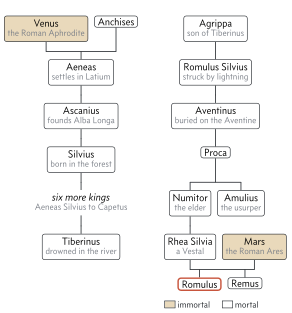
The kings are a list with almost nothing in it, and there is a reason. Rome’s first great poet, Ennius (en-ee-us), writing in the decades after 200 BC, made Romulus the grandson of Aeneas through a daughter of his named Ilia (il-ee-uh). But Greek scholars had dated the fall of Troy to 1184 BC, and the Romans came to date their own city to the 750s BC (the Stage). That left four centuries between Aeneas and Romulus, and a line of quiet kings at Alba filled them.
Proca, the last of the line before the crisis, had two sons, Numitor (noo-mih-tor) and Amulius (uh-myoo-lee-us). He left his throne to Numitor, the elder. Amulius took it anyway. He was a usurper, a man who seizes a throne that belongs to someone else, and like many usurpers he made sure nobody could take it back. He drove his brother out and murdered his brother’s sons. Numitor’s daughter, Rhea Silvia, he made a Vestal Virgin: a priestess of Vesta, the goddess of the hearth whom the Greeks called Hestia, who tended the goddess’s sacred fire and had to stay unmarried while she served. In the translation of Livy by the English clergyman Canon Roberts, published in 1905, Amulius did it “under the pretence of honouring her.” A Vestal could have no lawful children, so Numitor would have no grandson to avenge him. The Vestals who later kept Vesta’s fire in Rome belong to a later volume (Vol. 7, The Romans).
The plan failed. Rhea Silvia became pregnant and gave birth to twin boys. She named Mars as their father,This figure fathered the twins Romulus and Remus with Rhea Silvia. → Mars•• the Roman god of war whom the Greeks called Ares. Livy, who did not believe every story he told, adds that she said so “either because she really believed it, or because the fault might appear less heinous if a deity were the cause of it.” Ovid tells it as a love story of the god’s. In the Fasti, Silvia goes down to a stream early one morning to fetch water for the goddess’s rites, sits on the bank, and falls asleep, and Mars sees her and loves her. Either way, the Vestal Rhea Silvia became the mother of RomulusThis Vestal Virgin was the mother of Romulus and Remus. → Rhea Silvia••• and of his twin brother, Remus (ree-mus). The boys were the grandsons of the rightful king of Alba and the sons of a god.
The twins and the wolf
Amulius had his niece chained and thrown into prison, and he ordered servants to drown the babies in the Tiber. But the river was in flood. It had spread out over the low ground at the foot of the hills, and the servants could not get near the main stream. They set the basket with the two babies down at the edge of the floodwater, beside a wild fig tree at the foot of the Palatine Hill, and assumed that the water would do the rest. Instead the flood went down and left the basket on dry ground. The Romans later honored that tree as the Ficus Ruminalis (roo-mih-nay-lis), the fig of Rumina, a goddess who watched over nursing mothers and babies.

A she-wolf came down from the hills to drink. She heard the babies crying, and instead of killing them she lay down and gave them her teats. So a she-wolf suckled the twinsThese twins were suckled by a she-wolf. → Romulus and Remus•••A female one of these animals suckled the twin founders of Rome, Romulus and Remus. → wolf•• who would found Rome. Plutarch adds a woodpecker that brought them food and stood guard. Both animals were sacred to Mars, so a Roman could see the father’s own creatures caring for his sons. The wolf was said to have kept them in a cave at the foot of the Palatine, which the Romans called the Lupercal (loo-pur-kal) and connected with lupus, their word for wolf. They honored it for as long as the city worshipped its old gods.
The king’s chief herdsman, a man named Faustulus (faw-styuh-lus), found the she-wolf licking the babies with her tongue. Livy says he took them home to his hut and gave them to his wife, Acca Larentia (ak-uh luh-ren-shee-uh), to bring up. So Faustulus raised the boysThe shepherd Faustulus raised these twins. → Romulus and Remus• as his own, among the shepherds of the hills by the Tiber. He had guessed from the start whose children they were, because the time he found them matched the time the king’s babies had been taken to the river, but he kept quiet and waited.

Romulus and his twin, Remus,This figure is Remus’s twin brother. → Romulus•• grew into strong young men under the herdsman’s roof. They herded the flocks, but what they loved was hunting in the woods, and in time they took to ambushing robbers and sharing the plunder with the shepherds. The robbers had their revenge during the Lupercalia (loo-pur-kay-lee-uh), an old festival that the shepherds of the Palatine celebrated every February. They lay in wait for the brothers. Romulus fought them off, but Remus was captured and dragged before King Amulius, accused of raiding the lands of Numitor, the old king, who still kept his estates near Alba. So Amulius handed Remus over to Numitor for punishment.
Numitor looked at the prisoner. He learned that Remus had a twin, that they were about the age his grandsons would have been, and that the young man carried himself like no shepherd. Meanwhile Faustulus, afraid for Remus, told Romulus the truth. Livy says Romulus knew his shepherds were no match for the king’s soldiers in open battle. So he sent them to the palace by different roads, to meet there at a fixed hour, while Remus came from Numitor’s house with a second band. Together the twins killed Amulius,These twins killed Amulius, who had usurped their grandfather Numitor’s throne. → Romulus and Remus• who had stolen their grandfather’s throne. Numitor called the people together, told them the whole story, and his grandsons saluted him as king. The usurper was dead, and the rightful king of Alba Longa was home.
The augury and the wall
Alba was Numitor’s again, so the twins decided to build a city of their own in the place where they had been left as babies and brought up. Alba and the Latin towns had more people than they needed, and the shepherds would come too. But the twins quarreled from the start. Being twins, neither could claim the right of the elder, so they agreed to let the gods decide who would name the new city and rule it. They would do it by augury, the Roman art of reading the will of the gods from the flight of birds. Each man would mark out a stretch of sky and watch it. Romulus took his post on the Palatine Hill, and Remus took his on the Aventine Hill, the next hill to the south (Figure 31.5).
The Aventine has more than one story attached to its name. Livy’s is the Alban king Aventinus, buried there. Virgil gives the hill a second Aventinus in the seventh book of the Aeneid. When Heracles, whom the Romans called Hercules, came through Italy driving the cattle of Geryon, he killed the monster Cacus in his cave on this hill (Chapter 17). On the same hill, Virgil says, a priestess named Rhea secretly bore a son of Hercules named Aventinus.This figure's son Aventinus, in Virgil's Aeneid, was born on the Aventine Hill, which shares his name. → Heracles• Virgil leaves it open which was named for which: the boy may be the hill’s namesake, but Servius, the Roman scholar who explained Virgil’s poems (Chapter 8), thought the boy took his name from the hill. Virgil’s Aventinus grows up to fight against Aeneas, a warrior who wears a lion’s skin like his father’s and carries his father’s emblem: in John Dryden’s translation of 1697, “His Father’s Hydra fills the ample Shield.”

Remus, on the Aventine, saw his birds first: six vultures. A messenger had only just carried the news to the Palatine when twelve vultures appeared to Romulus,This figure claimed victory in an augury contest after seeing twelve vultures. → Romulus•• double the number. Each brother’s followers hailed him as king, one side because their man had seen birds first, the other because theirs had seen more. Words turned to blows, Livy says, and in the brawl Remus was killed.
Livy knew a second version, which he calls the more common one, and Ovid knew a third. In Ovid’s Fasti, Romulus chose a holy day for the founding of Rome. He dug a trench down to solid rock, threw in offerings of grain and earth, and built an altar over it. Then, holding a plow behind a white cow and a snow-white bull, Romulus plowed the line of his cityThis event involved Romulus establishing a new city. → founding of Rome• in a single furrow. The furrow marked where the wall would run. He prayed to Jupiter, Mars, and Vesta, and Jupiter answered with thunder on the left, which to a Roman was a lucky sign. The work began at once, with a man named Celer (see-lur) as foreman, and Romulus gave him an order: kill anyone who crosses the wall or the furrow.
Remus did not hear the order. He looked at the wall, still low, and sneered that the people would be safe behind it, and he jumped over it. Here the versions part. In the one Livy calls more common, which most people know, Remus leaped the new wall in mockery, and in a fury Romulus struck down his brother.This figure killed Remus after Remus leapt over his new city wall. → Romulus••• In Canon Roberts’s translation, Romulus cried, “So shall it be henceforth with every one who leaps over my walls.” In Ovid’s version, Celer obeyed his orders and killed Remus with a blow of his shovel. Ovid’s Romulus swallowed his tears in front of his men, but at the funeral he wept, kissed his brother’s body, and said farewell to a brother taken from him against his will.
However it happened, Romulus now ruled alone. He was the first king of Rome,This figure was the legendary founder and first king of Rome. → Romulus••• and Roman historians counted the years of their history from his founding. Livy says that his first work was to fortify the Palatine, the hill where he had grown up. He gave his people laws, and to make them respect his power he took twelve attendants, the lictors, to walk before him. Some Romans thought he chose twelve because of his twelve vultures. The city itself was named Rome after its founder:According to legend, Romulus founded this city. → Rome• Roma in Latin, and its people were the Romans.
Ovid adds an ending that Livy does not have. One night Remus’s bloody ghost appeared at the bedside of Faustulus and Acca Larentia, who had raised him, and asked them to beg Romulus to honor his spirit. The king did as the ghost asked: Romulus founded a festival for the deadIn Ovid’s account, this figure established the Lemuria to appease his dead brother Remus. → Romulus• and named it the Remuria (rih-myoor-ee-uh), after his brother. In time, Ovid says, the rough R at the start of the name softened into an L, and it became the Lemuria (lih-myoor-ee-uh). On three nights in May, the father of each Roman household rose at midnight, walked barefoot through the house, and threw black beans behind him without looking back, to buy off the lemures (lem-yuh-reez), the restless ghosts of the dead.
The day of the founding was April 21. It was already a festival, the Parilia (puh-ril-ee-uh), held in honor of Pales (pay-leez), a deity of shepherds and their flocks. On that day shepherds swept out their sheep pens, purified the animals with smoke, and leaped through bonfires of straw. Rome had begun as a town of shepherds, and the Romans liked to think their founder had chosen a shepherds’ holiday for the work. As the city grew and fewer Romans kept sheep, the meaning of the day changed. Under the emperors the Parilia became Rome’s birthday,During the Imperial period, the festival Parilia transitioned to being a holiday celebrating this event. → founding of Rome• the natalis urbis, or “birthday of the City.” In AD 121, the emperor Hadrian chose that day to found a great temple to Venus and Roma, the goddess of the city, and renamed the festival the Romaea (roh-mee-uh). Rome still celebrates its birthday on April 21, with parades in Roman costume.
The Sabine women
Romulus’s city grew fast, and its new citizens were almost all men. To fill it, he opened a refuge, or asylum, on the Capitoline (kap-ih-tuh-lyn) Hill, where anyone fleeing from a neighboring town, free man or runaway slave, could come and be safe. He chose a hundred of the leading men as his council, the first Roman Senate, and called them the patres, the “fathers”; their descendants were the patricians. But a city of men would last one lifetime. Romulus sent envoys to the towns around to ask for the right of marriage, so that Romans could take wives from among their neighbors. Everywhere the envoys were turned away, and mocked. In Roberts’s translation of Livy, the neighbors asked “whether they had opened an asylum for women.”
The most important of those neighbors were the Sabines (say-bynz), a people of the hill country to the northeast of Rome, up the valley of the Tiber. Their chief town was Cures (kyoo-reez), and Livy praises the old Sabines for the strictest way of life of any people of their day. Romulus hid his anger and planned a trick. He announced a great festival with games, the Consualia (kon-soo-ay-lee-uh), in honor of Consus (kon-sus), a god who protected the harvest once it was stored away. Consus had an altar buried underground in the valley between the Palatine and the Aventine, uncovered only on his festival days, and his games included races of horses. Livy says the games honored “Equestrian Neptune,” because the Romans linked Consus with Neptune, the god of horses. So Romulus used games for Consus as a pretextThis legendary founder used the Consualia festival as a pretext for abducting the Sabine women. → Romulus•• to bring the families of the whole region to Rome, and with them the daughters his men could not marry.

They came in crowds to see the new city: the people of Caenina (see-ny-nuh), Antemnae (an-tem-nee), and Crustumerium (krus-tuh-meer-ee-um), and the whole Sabine (say-byn) people with their wives and children. The Romans showed them through their houses and fed them. When the games began and every eye was on the races, Romulus gave the signal. In Plutarch’s account he rose, gathered up his cloak, and threw it around himself again. At once the young Roman men ran into the crowd and carried off the Sabines’ daughtersEarly Romans abducted these people’s women to obtain wives. → Sabines•• and the other unmarried girls. The parents fled in terror, calling on the god whose festival had been used to rob them. The scene is traditionally called the Rape of the Sabine Women, from the Latin rapere, “to seize and carry off.”
Romulus went to the captured girls himself. Their parents’ pride had caused this, Livy has him say, by refusing marriage to their neighbors. They would be lawful wives, sharing their husbands’ property and citizenship, and the mothers of free men. Romulus took a wife too, a woman named Hersilia (hur-sil-ee-uh). The girls were slowly won over. Their fathers were not.
The men of Caenina were the angriest and the quickest. They did not wait for their allies, and their army marched into Roman land alone. Romulus caught them scattered and plundering. Plutarch says that their king, Acron (ay-kron), challenged Romulus to fight him man to man while the two armies watched. Romulus vowed to Jupiter that if he won he would dedicate the king’s armor to him, and he killed King Acron in single combat.This figure defeated a king named Acron in single combat. → Romulus• Then he routed the leaderless army and took Caenina at the first assault. He carried Acron’s armor up the Capitoline Hill on a frame and hung it on an oak that the shepherds held sacred, and there he marked out the first temple in Rome, to Jupiter Feretrius (fuh-ree-tree-us). Armor stripped from an enemy commander killed by a Roman commander in single combat became the spolia opima (spoh-lee-uh oh-py-muh), the “richest spoils.” Only two later Romans ever won them. Antemnae fell next. Then Hersilia begged her husband to forgive the parents of the stolen girls and make them Romans, which he did, and Crustumerium fell after that. The Sabines had not yet moved.
Tarpeia and Titus Tatius
The Sabines took their time, and when they came they came in force. They were led by Titus Tatius, king of the SabinesTitus Tatius was a ruler of these people. → Sabines• (tay-shee-us), who ruled from Cures and whose name counted for more than any other in that country. He did not attack in anger, as Caenina had. He looked for a way into the city without a fight, and he found one.
The Romans’ citadel stood on the Capitoline Hill, and its commander was a man named Spurius Tarpeius. His daughter, Tarpeia (tar-pee-uh), went outside the walls one day to fetch water for a sacrifice, and Tatius bribed her to let his soldiers in. Livy gives the most famous form of her bargain. The Sabines wore heavy gold bracelets and jeweled rings on their left arms, and Tarpeia asked to be paid, in Roberts’s words, with “what they had on their left arms.” She let them in. But the Sabines also carried their shields on their left arms, and once they were inside, the soldiers crushed her under their shields,This figure was crushed beneath Sabine shields after betraying Rome. → Tarpeia•• heaping them on her until she died. Livy says that they did it so that the citadel would seem to have been taken by force, or else to show that no one keeps faith with a traitor. The cliff on the Capitoline was named the Tarpeian Rock after her, and for centuries Rome threw murderers and traitors from it. Other writers changed her story. The poet Propertius made her betray the city for love of Tatius, and some made her a Vestal (Vol. 7, The Romans).

With the citadel lost, the Sabines came down to attack the Palatine. In Ovid’s Fasti, the goddess Juno, who still held a grudge against the Trojans and their descendants, quietly unbarred a gate for them. Rome was saved by a god who had no Greek counterpart: Janus, the two-faced god of doorways, who looks both ways at once (Chapter 32). Janus did not dare to fight so great a goddess, so he used a trick of his own. He opened the mouths of the springs at the gate and poured sulfur into them, so that Janus sent boiling water gushingThis figure repelled Titus Tatius’s Sabines by making boiling water erupt at Lautolae. → Janus•• across the Sabines’ path and turned them back. The place was called Lautolae (law-toh-lee), “the Baths,” and the Roman scholar Varro says that warm springs had once flowed there, in the Forum valley beside the shrine of Janus. In the Metamorphoses, Ovid gives the deed to the water nymphs of the place instead, at the request of Venus.
The two armies finally met in the marshy valley between the Palatine and the Capitoline, where the Forum would later be. The Sabines charged, and the Romans broke and ran for the gate of the Palatine. Romulus raised his hands to heaven and vowed a temple to Jupiter Stator, “Jupiter the Stayer,” the god who makes fleeing men stand. The Romans turned and drove the Sabines back, and the Sabine champion, Mettius Curtius, galloped his horse into a swamp and barely got out.
Then the Sabine women ran between the armies, their hair loose and their clothes torn, with arrows and spears flying over them. They begged their fathers on one side and their husbands on the other not to kill each other. If the men were tired of the marriages, they cried, they should turn their anger on the women, who had caused the war, because the women would rather die than lose either their husbands or their fathers. The fighting stopped. The two kings stepped forward, and they made more than a peace. The Romans and the Sabines became one people, with Rome as their city, and Romulus and Tatius ruled togetherThis figure agreed to co-rule with Titus Tatius after making peace. → Romulus• as joint kings. In honor of the Sabines, the whole people took the name Quirites (kwih-ry-teez), which Livy derives from Cures.
The Sabines brought their gods with them. Varro, who studied the Latin language as well as Rome’s history, made a list of Roman gods with Sabine names. On it are Feronia (fuh-roh-nee-uh), a goddess worshipped in sacred groves, and Minerva, the Roman Athena. So by Varro’s account Minerva came from the SabinesAccording to Varro, Minerva was imported to Rome from the mythology of these people. → Sabines•• to Rome, though the Etruscans, Rome’s neighbors to the north, also worshipped her, as Menrva (Vol. 7, The Romans). The Sabines also brought Sancus (sang-kus), a god of oaths and good faith, who watched over promises, contracts, and the guest’s trust in his host. The Roman statesman Cato the Elder, who wrote a history of the peoples of Italy, called him the Sabine god Sancus,Sancus was a deity worshipped by these people. → Sabines• the father of Sabus, the first ancestor of the Sabines. Romans swore oaths by him for centuries.
The joint rule lasted only a few years. Some of Tatius’s kinsmen mistreated ambassadors from a Latin town, and when Tatius went to a yearly sacrifice at Lavinium, he was killed in a riot. Livy says Romulus did not grieve much.
Romulus becomes a god
Romulus ruled alone after that, and won more wars, against the nearby towns of Fidenae (fih-dee-nee) and Veii (vee-eye). The common people loved him more than the senators did, and the soldiers loved him most of all. Livy says that he kept three hundred armed men around him as a bodyguard, in peace as well as in war, and called them the Celeres (sel-uh-reez), the “swift ones.” Their name puzzled later Romans. Most said it came from celer, the Latin word for swift. Others said that their first commander was Celer, the foreman who killed Remus in Ovid’s story, so that the guard was named for Celer, the foremanCeler, this figure’s foreman, was traditionally linked with the name of his bodyguards, the Celeres. → Romulus• who had obeyed his king.
The end came in the thirty-seventh year of his reign. Romulus was reviewing his army on the Campus Martius, the open field of Mars beside the Tiber, near a pool called the Goat’s Marsh. Suddenly a storm broke, with thunder and a cloud so thick that it hid the king from the whole assembly. When the sun came out again, his seat was empty, and Romulus was never seen on earth again. The senators who had stood beside him said that a whirlwind had carried him up to heaven. Livy adds that even then a few people whispered something darker: that the senators had torn their king to pieces. Plutarch says that each of them was supposed to have carried a piece away under his robe.
Then a man named Proculus Julius (prok-yuh-lus), respected by everyone, came before the people and swore that Romulus had come down from the sky at dawn and appeared to him. In Roberts’s translation of Livy, Romulus told him, “Go, tell the Romans that it is the will of heaven that my Rome should be the head of all the world.” The Romans believed him. They prayed to their vanished king, and they worshipped him as the god QuirinusAfter disappearing during a storm, this figure was identified with Quirinus. → Romulus•• (kwih-ry-nus). Ovid, in the Metamorphoses, shows the moment from above: Mars drives his chariot down through the storm and lifts his son away, and the king’s mortal body melts in the air like a lead bullet flung from a sling. Roman coins later showed the god Quirinus as a long-haired, bearded king (Figure 31.8).


Quirinus was older than the story. He was an ancient god of the Roman state, the third in rank after Jupiter and Mars, with his own priest. His temple stood on the Quirinal Hill (kwir-ih-nul), where the Sabines had settled when they joined the city, and Ovid suggests that his name came from curis, which he says was an old Sabine word for a spear, or else from Cures. So Quirinus was probably a Sabine godQuirinus probably originated from these people. → Sabines• whom the Romans adopted and later merged with their founder. The Quirinal Hill still carries his name, and so does the palace on its summit, today the home of the president of Italy.
Rome had no king for a year after Romulus vanished. The senators took turns governing, five days each, and the Sabine families insisted that the next king must be one of them, since no Sabine had reigned since the death of Tatius. At last everyone agreed on a man known for his justice and his knowledge of the gods: Numa Pompilius (noo-muh pom-pil-ee-us), who lived at Cures. Numa was a SabineNuma Pompilius was a semi-mythical Roman ruler descended from these people. → Sabines• by birth. Like the kings after him, he stands halfway between legend and history: the priesthoods credited to him really existed, but no one wrote his story down until centuries after his time. An augur, a priest who read the birds, led him up to the citadel, laid his hand on Numa’s head, and asked Jupiter for a sign. The sign came, and Numa Pompilius succeeded Romulus.This figure's successor was Numa Pompilius. → Romulus•• He reigned for forty-three years, and Livy says that what Romulus had built by war, Numa built again by law and religion. His laws, his priests, and the kings after him belong to a later volume (Vol. 7, The Romans).
What to remember
- Ascanius, the son of Aeneas, founded Alba Longa, and a line of kings descended from him to Proca, the father of Numitor and Amulius.
- Amulius took the throne from his elder brother Numitor and made Numitor’s daughter, Rhea Silvia, a Vestal, but she bore twins, Romulus and Remus, and named Mars as their father.
- Left at the edge of the flooded Tiber, the twins were suckled by a she-wolf and raised by the herdsman Faustulus and his wife; grown up, they killed Amulius and restored Numitor.
- In the augury, Remus on the Aventine saw six vultures and Romulus on the Palatine twelve. Remus leaped the new wall and was killed by Romulus (Livy) or by the foreman Celer (Ovid), and Ovid says Romulus founded the Lemuria for his ghost.
- Rome was founded on April 21, the Parilia, which became the city’s birthday; Varro’s date was 753 BC.
- Romulus used the Consualia, the games of Consus, to carry off the Sabine women, and he killed King Acron of Caenina in single combat.
- Tarpeia let the Sabines into the citadel and was crushed under their shields; Janus stopped them with boiling springs at Lautolae.
- The Sabine women made peace, and Romulus shared his throne with the Sabine king Titus Tatius. The Sabines brought gods such as Sancus and, according to Varro, Minerva.
- Romulus vanished in a storm and was worshipped as Quirinus; Numa Pompilius, a Sabine from Cures, succeeded him.
Chapter 32 · 49 clues
The Gods of Rome
On the first morning of the year, a Roman watched his words. Whatever was said or done at the start of anything, the Romans believed, was an omen of all that would follow, so on New Year’s Day neighbors greeted each other with good wishes and kept their quarrels to themselves. They exchanged small presents: dates, dried figs, and honey, so that the year would taste sweet, and a copper coin or two, so that it would bring money. Workmen did a little of their usual work, so that the whole year would not turn out idle. On the Capitol, the hill above the city’s main square, the two new consuls, the men elected to head the Roman state for that year, sacrificed white bulls to Jupiter.
The Romans had worshipped their gods for centuries before they learned the Greek stories that fill this volume, and many of their own gods had no stories at all. A Roman god was less a character than a power at work in one place or one act: in a doorway, a furrow, a hearth, or a battle line. What mattered was not what the god had done long ago but what he wanted now. Priests, who were also senators and generals, performed exact rites on fixed days of the calendar, word for word, so that the gods would keep what the Romans called the peace of the gods (pax deorum) with their city. This last chapter meets the gods of Rome as the Romans themselves worshipped them, then the gods who came to Rome from the East. It ends with a Roman tale of a runaway slave and a lion.
Janus of the doorway
The Latin word for a door is ianua, and the god of the door was Janus. Janus was the Roman god of doorways and gates:This figure is a Roman god of doorways and gates. → Janus•• of the front door of every house, of the gates of the city, and of the arched passages called iani that led into the Forum, Rome’s great square. Romans took their doorways seriously: a bride was lifted over the threshold of her new home, because to stumble on it was an evil omen. A door faces two ways, toward the street and toward the house, and so does its god. In art he has two faces, a key, and a staff:This figure is depicted with two faces, often holding a key and staff. → Janus••• the key to lock the door, and the staff of a doorkeeper, to turn away anyone with no business inside. Virgil describes the carved figures of the first kings of Latium, the land of the Latin people around Rome, that stood above the door of King Latinus’s palace (Chapter 30). In John Dryden’s translation of 1697 they include “ancient Janus, with his double Face, / And Bunch of Keys, the Porter of the place.” A porter is a doorkeeper.
Unlike most of the Roman gods, Janus had no twin among the Greek gods (the Stage). His nearest relative lived just to the north. The Etruscans, whose cities filled the country north of Rome and whose kings had once ruled Rome itself (Vol. 7, The Romans), had a two-faced guardian of their own. The Etruscan god CulsansThe Etruscan god Culsans is regarded as an equivalent to this figure. → Janus•• (kool-sanz) is known from a few inscriptions, coins, and small bronze figures, two of them found beside city gates, and much of this evidence comes from the hill town of Cortona (kor-toh-nuh). Scholars regard him as Janus’s Etruscan equivalent.
Everything that begins passes through a doorway, and so Janus was the god of beginnings and endings,This Roman figure was associated with beginnings and endings. → Janus•• of every going out and coming in. In the old Roman prayers his name came first, even before Jupiter’s, because he opened the way to the other gods. He watched over the start of each day and of each year, and the first month, January, is named for Janus.This figure is the namesake of the first month of the year. → Janus•• The Romans said that their earliest calendar, which they credited to Romulus, had only ten months and began in March, the month of the war god Mars. Numa Pompilius, the peaceful king who came after Romulus (Chapter 31), was said to have added January and February. Plutarch, who tells the story, says that Numa put January first because he wanted the arts of peace to come before the arts of war.
The Romans’ own poet of the calendar was Ovid, whose Fasti explains their holidays month by month (the Stage). In its first book, Ovid interviews Janus himself.Ovid interviews this figure in Book I of the Fasti. → Janus•• The poet is sitting with his writing tablets, he says, when the room suddenly grows brighter, and there stands the god, two-headed, holding a staff in his right hand and a key in his left. Ovid freezes with fear. Janus tells him not to be afraid and answers his questions one by one. The ancients called him Chaos, he says, which for Ovid meant the shapeless jumble of everything before the world was sorted out, not Hesiod’s empty gap. His two faces recall that confused old shape. Now he keeps the gates of heaven, and Jupiter himself goes out and comes in by his leave. Like a doorkeeper who sits at the entrance of a house and sees both who comes in and who goes out, he looks east and west at once. Ovid asks why people give each other sweets at the New Year, and Janus answers: so that the year may be sweet. When Ovid asks why they give coins too, the god laughs at him for knowing so little of his own greedy age.

Then Ovid asks about the oldest Roman bronze coins, which show a two-headed god on one side and a ship on the other (Figure 32.1). The ship, Janus explains, is the one that brought the god Saturn to Italy long ago, and later generations stamped it on their money to remember the stranger’s coming. Later writers added the rest of the story: Janus had minted the first coins,In Roman tradition, this figure was credited with minting the first coins. → Janus•• with his own face on one side and Saturn’s ship on the other. Macrobius (muh-kroh-bee-us), a Roman writer of about AD 400 who collected old lore in a long dialogue named after Saturn’s festival, says so. He adds that Roman boys tossing a coin in his own day still called out “heads or ships,” as children today call out “heads or tails.”
In this story Janus was not yet a god but the first king of the land. Macrobius, citing the older Roman scholar Hyginus, says that Janus ruled Latium together with CameseIn one tradition, this figure ruled Latium alongside Camese before becoming a god. → Janus•• (kam-uh-see), a native ruler, and that after Camese died Janus reigned alone. His town stood on the hill across the Tiber from Rome that still bears his name, the Janiculum (juh-nik-yuh-lum). One day a ship came up the river carrying a god driven out of heaven by his own son. It was Saturn, the Roman name for Cronus. Janus welcomed the exiled SaturnThis figure welcomed the exiled Saturn to Latium, where Saturn taught agriculture. → Janus• as his guest, and Saturn repaid him by teaching his people to farm: to sow grain and to tend vines and orchards. Janus shared his kingdom with him, and Saturn built a town of his own, Saturnia, on the Capitol, on the other side of the river. Centuries later, in the eighth book of the Aeneid, King Evander leads Aeneas past their ruins (Chapter 30). In Dryden’s words, they saw “Saturnia’s and Janicula’s Remains: / And, either place, the Founder’s Name retains.”

The stories gave Janus a family of springs and rivers, as suits a god of a well-watered land (Figure 32.2). In Macrobius, Camese is a man, but Greek writers made Camese Janus’s sister as well as his wife. Servius, the late Roman scholar who explained Virgil’s poems line by line (Chapter 8), says that Janus and Camese were the parents of Tiberinus,In one tradition, this figure fathered Tiberinus with Camese. → Janus•• the god of the river Tiber. He is the bearded old god who, in Virgil, rises from the reeds in a dream to guide Aeneas upstream (Chapter 30). A Christian writer of about AD 300, Arnobius (ar-noh-bee-us), who collected the old stories in order to mock them, says that Janus fathered Fontus with Juturna,This figure fathered Fontus with Juturna. → Janus•• the nymph of springs whom Virgil makes the sister of Turnus (Chapter 30). Fontus was the god of springs and wells. On his festival, October 13, Romans threw garlands into springs and hung them around the mouths of wells. Juturna’s own pool bubbled up in the Forum, close to the temple of Vesta. In Ovid’s Metamorphoses, Janus has a daughter as well, by a nymph named Venilia (veh-nil-ee-uh): Canens, the singing nymph who married Picus (Chapter 28).
Ovid tells one darker story about Janus, in the sixth book of the Fasti, for the first of June. In a grove beside the Tiber lived a nymph called Crane (kray-nee), a name also spelled Cranae. She was a huntress who wanted no husband. Whenever a young man courted her, she told him that the place was too public and sent him ahead into a cave, promising to follow; then she slipped into the bushes and was gone. She tried the trick on Janus, but a god with a face on the back of his head saw where she hid. He caught her and took her by force. Afterward, as payment for what he had taken, Janus gave Crane power over hinges,In Ovid’s Fasti, this figure assaulted Cranae and gave her power over hinges and a protective hawthorn. → Janus•• and a branch of white hawthorn with which to drive harm away from doors. The Latin for a hinge is cardo, and later writers called the goddess of hinges Cardea (kar-dee-uh). She soon had to use her gift. Witches in the shape of screech owls, which the Romans called striges (stry-jeez), came by night to drink the blood of a newborn prince, Proca, who would one day be king of Alba Longa (Chapter 31). Crane touched the doorposts three times with leaves, sprinkled water on the threshold, and set her hawthorn branch in the window, and the baby lived.

Janus’s best-known shrine stood in the Forum itself (Figure 32.3). Numa built the shrine of Janus GeminusNuma Pompilius was credited with building this figure’s Geminus shrine in the Roman Forum. → Janus•• (jem-ih-nus), the “twin” Janus, named for the god’s two faces. The Greek historian Procopius (proh-koh-pee-us), who saw it in the sixth century AD, describes not a great temple but a small bronze shrine, with a door at each end and a bronze statue of the two-faced god inside. Numa meant it, in Canon Roberts’s translation of Livy, as “an index of peace and war, to signify when it was open that the State was under arms, and when it was shut that all the surrounding nations were at peace.” So its doors stood open in wartime,The gates to this figure's temple were kept open during wartime and closed during times of peace. → Janus•••The doors to the Temple of Janus were kept open during these events. → war•• and they were closed only when Rome was at peace everywhere.

Numa kept the doors shut all his reign. After him, Rome was almost never at peace with everyone. Livy, writing in the 20s BC, says that since Numa they had been closed only twice. The first time was in 235 BC, a few years after Rome’s first war with Carthage, and the second in 29 BC, after the battle of Actium, when Augustus had ended the civil wars (Vol. 7, The Romans). Augustus closed them twice more during his long reign, and he boasted of all three closings in the record of his deeds that was set up at his tomb. Nero closed them once more and put the shuttered shrine on his coins. Virgil gave the custom to the kings of Latium. When war threatened between the Latins and the Trojans, old King Latinus refused to open the gates of war, so Juno came down from heaven and burst them open herself (Chapter 30). In Dryden’s lines, “Then Heav’ns Imperious Queen shot down from high; / At her Approach the Brazen Hinges fly.”
The doors outlived the religion. The Christian emperors closed the temples of the old gods in the 390s AD. Yet in 537, when the Goths were besieging Rome, Procopius reports that some Romans secretly tried to force the shrine’s doors open, as their ancestors had done when war came. The doors moved only a little, and no one ever found out who had tried.
Saturn and the Saturnalia
The stranger in the ship was a fallen king. In Greek myth, Cronus swallowed his children until Zeus overthrew him, and Hesiod leaves him in Tartarus with the other defeated Titans (Chapter 1). The Romans matched their god Saturn with Cronus,This Roman god was the equivalent of the Greek titan Cronus. → Saturn•• and so the Greek story became Saturn’s, with Jupiter as the son who drove his father from the throne of heaven. But the Romans also remembered Saturn as an ancient god of their own land, with one of the oldest temples in their city, and their poets gave his story a gentler ending. Exiled by his son, Saturn fled to Latium,This figure was exiled by his son to Latium. → Saturn• and the land took its name, the Romans said, from their verb latere, “to lie hidden,” because the god had hidden there. In the Aeneid, Evander tells Aeneas how it happened.

So Saturn’s reign in Latium was the Golden Age,This figure ruled during a Golden Age in Latium. → Saturn• the Roman form of the golden race that Hesiod had placed in the time of Cronus (the Stage). Under Saturn, the Roman historian Justin wrote, no one was a slave and no one owned private property; everything belonged to everyone. The Romans remembered him above all as a farmer’s god. The scholar Varro derived his name from satus, “sowing,” and Saturn was the god of sowing and agriculture,This Roman god was associated with sowing and agriculture. → Saturn• shown with a curved pruning knife, the tool of the vine grower. His temple at the foot of the Capitol was one of the oldest in Rome, dedicated, tradition said, in 497 BC, and its strong rooms held the treasury of the Roman state. All year long the feet of his statue inside were bound with woolen bands.
Saturn’s wife was Ops,This figure's consort was Ops. → Saturn•• whose name means “plenty” and survives in the English word opulent. The Romans matched her with Rhea, the wife of Cronus (the Stage), and her festival, on December 19, fell in the middle of her husband’s. Saturn had a second, grimmer wife. Lua (loo-uh) was a goddess of destruction, or perhaps of release; scholars are not sure which. The spoils of war went to Lua,War spoils were sacrificed to this figure's wife Lua. → Saturn•• whom the Romans called the Lua of Saturn. After a victory, a Roman general might gather the weapons of the enemy dead, heap them up, and burn them in her honor, and Livy tells how a consul who had routed the Volscians, a hill people south of Rome, did exactly that.
Saturn also had a son. In Virgil, the royal line of Latium runs down from him. Latinus, the old king who welcomed Aeneas (Chapter 30), was the son of Faunus, a god of the woods and fields whom the Romans matched with Pan (Chapter 8), and, in Dryden’s translation, “Faunus came from Picus, Picus drew / His Birth from Saturn, if Records be true.” Picus was a king and a seer who read the future in the flight of birds, and his name is the Latin word for a woodpecker. Other Italians told it differently. The woodpecker was the sacred bird of Mars, and some made Mars, not Saturn, Picus’s father.Both Mars and this figure were named as Picus’s father. → Saturn•• Either way his end was the same. In Ovid he married Canens, the daughter of Janus, and when the enchantress Circe fell in love with him and he refused her, she turned him into a woodpecker (Chapter 28). The purple of his royal cloak stayed in its feathers, and the gold of his brooch became a ring of gold around its neck. Canens searched for him for six days and nights, then lay down by the Tiber and wasted away, singing, until she vanished into the air.
Saturn’s own festival was the merriest of the Roman year. The Saturnalia (sat-ur-nay-lee-uh) was held in Saturn’s honor,The Saturnalia was held in honor of this figure. → Saturn•• and for a few days it brought back the equality of his golden age, when no one had been a slave. It fell at midwinter, when the autumn sowing was done and farmers had time to spare. In 217 BC, after a terrible defeat in the war with Hannibal, the Romans made it grander, to win back the favor of the gods. It began on December 17This Roman festival began on December 17. → Saturnalia• with a sacrifice at his temple and a public banquet. The woolen bands were untied from the feet of his statue, and people ran through the streets shouting “Io, Saturnalia!” Officially the festival lasted one day, but by the end of the Republic, before Rome had emperors, the celebrations ran for seven, until December 23. Schools closed, the law courts did not sit, and no war could be declared. The philosopher Seneca, who disapproved, grumbled in a letter to a friend, which Richard Mott Gummere translated in 1917: “It is the month of December, and yet the city is at this very moment in a sweat.”

For those days, the order of Roman society turned upside down. Men put aside the toga, the formal dress of a citizen, for bright dinner clothes, and everyone, free or slave, wore the pilleus (pil-ee-us), the felt cap of a freed slave; Seneca calls the crowd “the liberty-capped throng.” Masters and slaves exchanged roles:During this Roman festival, masters and slaves exchanged social roles. → Saturnalia•• slaves were feasted like their owners and could speak their minds without punishment, and in some households they sat at dinner while their masters served them. The poet Horace wrote a satire in which his own slave, using the freedom of December, lectures him on his faults. Gambling was permitted during the Saturnalia,Gambling was permitted during this Roman festival. → Saturnalia•• though Roman law forbade it the rest of the year, and slaves and masters played at dice together for nuts or small coins. Friends sent each other wax candles and little clay figures, and at dinner parties a mock king, chosen by lot, gave everyone absurd orders. The poet Catullus called it the best of days. The lawyer Pliny the Younger, who wanted to work, built himself a quiet room at his country house where the noise could not reach him. The festival outlived the old religion, and its gifts, its feasting, and its mock king are easy to recognize in the Christmas customs of Christian Europe.
Mars and the Salii
Among the gods the Romans honored most was the father of their founder. Mars was the Roman god of war,This figure is the Roman god of war. → Mars•• a far grander figure than the Greek Ares, whom Homer’s gods despised (Chapter 7). He was the father of Romulus and Remus (Chapter 31), and so of the Roman people. March was his month, and in the oldest Roman calendar it was the first month of the year, when the snows melted and the armies marched out. His altar stood on the Campus Martius, the “Field of Mars” beside the Tiber, where armies gathered and young men trained. As Mars Gradivus (gruh-dy-vus), “the Marcher,” he led soldiers into battle, and the wolf and the woodpecker were his sacred animals.
Mars also guarded fields, and his oldest worshippers were farmers, for whom the plowman and the soldier were the same man. Cato the Elder, a Roman statesman of the second century BC who wrote a handbook on running a farm, tells the farmer how to bless his land. He was to lead a suckling pig, lamb, and calf all the way around its boundaries and pray to Father Mars to keep away sickness, storms, and blight and to make his grain, vines, and cattle thrive. Then all three animals were sacrificed to him. This triple sacrifice to Mars was the suovetauriliaThe suovetaurilia was a triple sacrifice made to this figure. → Mars• (soo-oh-vet-aw-ril-ee-uh), and its name is simply the three animals run together: sus, a pig; ovis, a sheep; and taurus, a bull. The state performed it too. Every five years, when the officials called censors had finished counting the citizens, the people were drawn up in their ranks on the Campus Martius, and the three animals were led around them to purify the whole of Rome (Figure 32.7).

The most sacred object in Mars’s worship fell from the sky. Plutarch says that during a plague in the reign of Numa, a small bronze shield came floating down from heaven into the king’s hands. Numa announced that it was a gift of the gods, and that Rome would be safe as long as it was kept safe. It was an odd shape, like a figure eight, curved inward on each side, and the Romans called it the ancile (an-sy-lee). A thief who stole it might steal Rome’s luck. So Numa had eleven exact copies madeNuma Pompilius had eleven copies made of this shield after it fell from heaven. → ancile•• of the shield that fell from heaven and kept all twelve together, so that no one could tell which was the real one. The smith who made them, Mamurius Veturius (muh-myoor-ee-us veh-toor-ee-us), worked so well that, Plutarch says, Numa himself could not pick out the original. Mamurius asked for only one reward: that his name be sung forever in the hymn of the priests who kept the shields.
Those priests were the Salii (say-lee-eye), whose name means “leapers.” The Salii were twelve leaping priests of Mars,The Salii were twelve leaping priests of this figure. → Mars•• young men from Rome’s oldest noble families. In Roberts’s translation of Livy, Numa gave them “the distinctive dress of an embroidered tunic and over it a brazen cuirass,” a bronze breastplate, and they wore tall pointed caps. Every March they carried the twelve shields through the city “in solemn procession,” Livy says, “singing hymns accompanied by a solemn dance in triple time.” They leaped and stamped in their three-beat step and struck the shields with staves, stopping at shrine after shrine. Each night they feasted so richly that a “Salian dinner” became a Roman byword for a banquet. Their hymn was so old that by the time of Augustus even the priests could hardly understand it. In October, at the end of the season for war, the shields were put away again.
Mars did not go to war alone. With him went Bellona (beh-loh-nuh), a Roman goddess of warBellona was a Roman goddess of this domain. → war•• whose name comes from bellum, the Latin word for war. Poets made her the sister or wife of Mars, or the driver of his chariot, and gave her a bloody whip. In 296 BC, in the middle of a battle against the Etruscans and their allies, the Roman general Appius Claudius, who built Rome’s great road to the south, the Appian Way, vowed her a temple. It rose beside the Campus Martius, just outside the city’s sacred boundary. An army could not enter the city under arms, so the Senate met at her temple to hear generals who had come home asking for a triumph, the victory parade through Rome (Vol. 7, The Romans), and to receive envoys from Rome’s enemies. In front of the temple stood a column. To declare war on a faraway enemy, a priest threw a spear over it, as if into the enemy’s land. In 32 BC Octavian, the future Augustus, declared war on Cleopatra, the queen of Egypt, at Bellona’s temple, performing the old priestly rites himself.
Juno, Vesta, and Salacia
Juno was the Roman queen of the gods and the wife of Jupiter, and Juno’s Greek equivalent is HeraThis figure's Greek equivalent is Hera. → Juno• (Chapter 2), whose stories she took over. In her own Roman form she was the goddess of women and of marriage, and as Juno Lucina she helped at the birth of children. Ovid uses the name Lucina alone for the birth goddess who, at Juno’s command, held back the birth of Hercules (Chapter 16). On March 1 the married women of Rome brought her gifts at her festival, the Matronalia (mat-ruh-nay-lee-uh), and Ovid lets her claim that June is named for her. On the Capitol she shared Rome’s greatest temple with Jupiter and with Minerva, the Roman Athena.
Her sacred birds once saved that hill. In 390 BC, as Roman historians dated it, an army of Gauls, a Celtic people from beyond the Alps who had settled in the valley of the Po, routed the Romans at the river Allia and marched into Rome (Vol. 7, The Romans). The city fell, and only the Capitol held out on its cliffs above the Forum, with a garrison growing hungry. One night the Gauls found a way up the rock. They climbed in silence, passing their weapons from hand to hand, and not even the dogs woke. But, in Roberts’s translation of Livy, “they did not escape the notice of the geese, which were sacred to Juno and had been left untouched in spite of the extremely scanty supply of food.” Their cackling and the beating of their wings woke Marcus Manlius (man-lee-us), a former consul, who ran to the edge and knocked the first Gaul off the cliff with his shield, and the men behind him fell too. Virgil set the scene on the shield that Vulcan made for Aeneas: in Dryden’s lines, “The Silver Goose before the shining Gate / There flew; and by her Cackle, sav’d the State.”
In 345 BC a Roman general vowed a temple to Juno Moneta (moh-nee-tuh), and it was built on the northern summit of the Capitol, where Manlius’s house had once stood. The Romans explained her title as “the Warner,” from their verb monere, “to warn.” The orator Cicero said that a voice from her temple had once warned of an earthquake, but others tied the name to that night on the Capitol, when Juno’s sacred geese warned Rome of the Gauls.This figure’s sacred geese warned Rome of a Gallic attack, an incident linked to her epithet “Moneta.” → Juno• From 273 BC the workshops where Rome struck its silver coins stood beside her temple, and so moneta became the Latin word for a mint and for the coins it made. English has taken both words from her title: money and mint.
Vesta, the Roman Hestia (Chapter 2), had the simplest temple and the most important task. Her shrine in the Forum was round, like the huts of the first Romans, and it held no statue at all. Ovid admits that he long believed there were images of Vesta under its curved roof, and then learned there were none: the goddess was the fire. The flame on her hearth was the hearth of the whole city, and it was never allowed to go out. It was renewed only once a year, on March 1, the old New Year’s Day, and if it ever died by accident, Romans feared that disaster was coming. Its keepers were the Vestal Virgins, whom the story of Rhea Silvia introduced (Chapter 31) and whose order belongs to a later volume (Vol. 7, The Romans). In a hidden storeroom of the temple the Romans kept the holiest objects of their state, among them, they believed, the Palladium that had been rescued from Troy (Chapter 27).
The sea had a queen in Rome too. Neptune, the Roman Poseidon, may once have been a god of fresh water, before the Romans matched him with the Greek god of the sea (the Stage). His wife was Salacia (suh-lay-shee-uh), whose name comes from salt,In Roman mythology, Neptune's wife is named for this substance. → salt• sal in Latin, and she was the goddess of the salt sea. The Romans matched her with Amphitrite, the wife of Poseidon (Chapter 2).
Two temples
Two temples in Rome show the gods of this chapter in marble, built more than a century apart, and both still stand in part (Figure 32.8). The newer one began with a son’s revenge. In 44 BC Julius Caesar was murdered in the Senate (Vol. 7, The Romans). His adopted son, Octavian, hunted down the leaders of the plot, Brutus and Cassius, and before the battle of Philippi (fih-lip-eye), in northern Greece in 42 BC, he vowed a temple to Mars if the god let him avenge his father. He won. Twenty-two years later he had a second revenge to celebrate. In 53 BC the Parthians (par-thee-unz), rulers of the great empire beyond the Euphrates, had destroyed a Roman army and its general, Crassus, at Carrhae (kar-ee), and carried off its standards, the sacred eagles of the legions. In 20 BC Octavian, now the emperor Augustus, got them back by treaty.


So Augustus built a temple to Mars UltorA temple dedicated to the "Ultor," or "Avenger," aspect of this figure was erected by Augustus in his Forum. → Mars•• (ul-tor), “Mars the Avenger,” as the centerpiece of a new forum of his own, and dedicated it in 2 BC. Eight tall Corinthian columns of gleaming white marble from Luna, near modern Carrara, stood across its front. Inside stood Mars in full armor beside Venus, the ancestor of Augustus’s family, and probably the deified Julius Caesar, and there the recovered standards were kept. Around the forum stood statues of Aeneas, of Romulus, and of the great men of Rome’s past. Augustus moved there the Senate’s debates about war, which had been held in Bellona’s temple, and from there governors set out for their provinces. He boasted, the biographer Suetonius (swee-toh-nee-us) says, that he had found Rome a city of brick and left it a city of marble.
The other temple is older and humbler, and it stands almost whole. Down by the river below the Capitol lay the Forum Boarium (boh-air-ee-um), the cattle market, where the Romans believed that Hercules, as they called Heracles, had killed the cattle thief Cacus. There they worshipped him at the Ara Maxima, the “Greatest Altar” (Chapter 17). Near the altar, in the late second century BC, someone built Hercules a round temple, ringed by twenty slender columns about 35 feet (10.7 m) tall. Its marble came by sea from Mount Pentelicus (pen-tel-ih-kus), near Athens, the quarry of the Parthenon (Vol. 6, The Greeks), and it is the oldest surviving marble building in Rome.The earliest surviving marble building in Rome is an unusually circular temple in the Forum Boarium dedicated to this figure. → Heracles• Most Roman temples were still built of local stone coated with painted plaster; this one was Greek stone and Greek taste. The builder may have been Lucius Mummius, the general who sacked Corinth in 146 BC, or a rich merchant; no one knows. It survived because it was made into a church in the twelfth century, and nineteen of its twenty columns still stand.
Cults from the East
In 205 BC Rome was desperate. Hannibal, the Carthaginian general, had been marching up and down Italy for thirteen years (Vol. 7, The Romans). In emergencies the Romans consulted the Sibylline Books, a collection of old prophecies in Greek verse kept locked in the temple of Jupiter, and the books gave a strange answer. A foreign invader could be driven from Italy, they said, if the Great Mother of the Gods were brought to Rome from Pessinus, in Phrygia (Chapter 12). She was Cybele, the Asian mother goddess whose lions drew her chariot (Chapter 23), and at Pessinus she took the form of a black stone that had fallen from the sky. Rome’s ally Attalus (at-uh-lus), king of Pergamon, helped the envoys bring it home. Ovid tells that the ship stuck fast in the mud of the Tiber, and that a noblewoman named Claudia Quinta, whose good name had been doubted, prayed to the goddess and pulled the ship free by herself. That part is legend, but the stone’s arrival, in 204 BC, is history, and the next year Hannibal sailed home to Africa.

The Romans called her Magna Mater, the “Great Mother.” They built her a temple on the Palatine, dedicated in 191 BC, and held games in her honor every April (Figure 32.9). Her own priests, the Galli (gal-eye), were wild men from Asia who danced to drums and cymbals and begged in the streets, and for a long time no Roman citizen was allowed to join them. Under the emperors her worship took on a new rite, the taurobolium (tor-uh-boh-lee-um), “bull-slaying.” Inscriptions record it from the second century AD, often performed for the emperor’s health. A Christian poet of about AD 400, Prudentius (proo-den-shus), describes a bull killed on a platform of planks pierced with holes above a pit. Through the holes the bull’s blood rained downCults of Magna Mater, or Cybele, collected the blood of these animals. → cattle• on the priest standing below, who climbed out drenched and, his fellows believed, made new. Prudentius hated the rite and may have made it worse than it was.
One more god rose to the very top, with help from the East, though he was no newcomer. Sol, the sun, had been worshipped in Rome since its earliest days, and the Romans matched him with Helios (Chapter 3). In the second and third centuries AD he was more and more often given the title Invictus (in-vik-tus), “Unconquered.” The teenage emperor Elagabalus (el-uh-gab-uh-lus), a priest of the sun god of Emesa (em-ih-suh) in Syria, brought that god’s sacred black stone to Rome and tried to make him the chief god of the empire; he was murdered in 222, and his god was sent home. Fifty years later the emperor Aurelian (aw-ree-lee-un), fresh from reconquering the East, did it properly. In 274 he built a great temple in Rome to Sol Invictus, the Unconquered Sun,A god with the title 'Invictus' was associated with this entity. → the Sun• and gave him a college of priests drawn from the Senate. A Roman calendar of AD 354 marks December 25 as the birthday of the Unconquered. Constantine, the first Christian emperor (Vol. 7, The Romans), still put Sol on his coins as his “companion” until about 325, and in 321 he made the day of the Sun a day of rest each week, our Sunday.

The third eastern god was the most secret of all. Mithra (mith-ruh) was an old god of the Persians, the god of oaths and of light. Late in the first century AD a new religion appeared in the Roman Empire under his name, Mithras (mith-rus), and though its worshippers called it Persian, much of it seems to have been invented in Rome. The earliest mention is in Statius’s Thebaid, begun about AD 80, which pictures Mithras in a Persian cave, twisting the horns of a bull (the Stage). Like the Eleusinian Mysteries of Demeter (Chapter 6), it was a mystery cult, with rites revealed only to the initiated. The mystery cult of Mithras was popular among Roman soldiers,This figure was at the center of a mystery cult popular among Roman soldiers. → Mithras•• and also among merchants, customs officers, and the slaves and freedmen who ran the emperor’s household. As far as anyone knows, it admitted only men. Wherever the legions went, its sanctuaries followed (Figure 32.10). The worshippers kept their secrets so well that not one of their sacred books survives, and everything known about Mithras’s story comes from carvings and paintings, about seven hundred of them showing a single scene.
The pictures tell the story in order. Mithras emerged from a rock holding a torch,This figure is depicted emerging from a rock while holding a torch. → Mithras• already a young man in a pointed cap, with a knife in his other hand, ready for the work ahead. In some carvings flames leap from the rock around him, and shepherds look on in wonder as he rises. In a time of drought he shot an arrow into a rock,This figure causes water to flow by shooting an arrow into a rock. → Mithras• and water gushed out for a worshipper kneeling to drink. Then came his great deed. He hunted a wild bull, rode it until it was exhausted, and dragged it by its hind legs into a cave.

There, in the scene that stood at the end of every one of his sanctuaries, which scholars call the tauroctony (tor-ok-tuh-nee), Greek for “bull-killing” (Figure 32.11), Mithras, in a Phrygian cap, kills the bull.This figure, commonly shown wearing a Phrygian cap, kills a bull in the tauroctony scene. → Mithras••Mithras was often depicted slaying one of these animals in tauroctony scenes. → cattle•• The Phrygian cap was a soft cap whose tall peak flopped forward, the dress of a man from the East. Mithras kneels on the bull’s back, pulls its head up by the nostrils, and drives his knife into its neck, looking back over his shoulder toward the Sun. Animals gather at the wound, a dog, a snake, a raven, and a scorpion:A dog, snake, raven, and scorpion accompany this figure's bull-slaying scene. → Mithras•• the dog and the snake reach up to drink the blood, the raven perches nearby, and the scorpion seizes the bull between its hind legs. Ears of wheat sprout from the bull’s tail, as if new life were coming from its death. On either side stand two torchbearers dressed like Mithras,This figure is often accompanied by attendants named Cautes and Cautopates. → Mithras• Cautes (kaw-teez) and Cautopates (kaw-top-uh-teez). Cautes holds his torch up and Cautopates holds his down, probably for the rising and the setting sun. Afterward Mithras and the Sun shook hands, feasted together on the bull’s flesh at a table spread with its hide, and rode away to heaven in the Sun’s chariot.
A sanctuary of Mithras, which scholars call a mithraeum (mith-ree-um), was built to be the cave where the bull died, and its members called it a cave. Mithras was worshipped in cave-like sanctuaries,This figure was worshipped in cave-like, often underground sanctuaries. → Mithras•• often underground: a long, narrow, windowless room, sometimes cut into a hillside, more often fitted into the cellar of a house, with a vaulted ceiling that might be painted with stars. Stone benches ran down both sides, where the members lay to eat their sacred meal, and at the far end, lit by lamps, was the image of the bull-slaying. Most held no more than twenty or thirty men. More than a dozen have been found at Ostia, the port of Rome. One lies deep beneath the church of San Clemente in Rome, and another was dug up in the middle of the City of London in 1954. Many held a statue that still puzzles scholars: a lion-headed figure wrapped in a snake,Temples to this figure often contained depictions of a figure with a lion's head and a snake coiled around its body. → Mithras•• with a man’s body, wings, and keys in his hands. No ancient writer explains him. He may stand for Time, which devours all things.
Members climbed a ladder of rank, and much of what is known about it comes from inscriptions and painted lists in which they proudly set their grade beside their names. The cult had seven grades of initiation:This figure's cult had a seven-tier hierarchy of initiation. → Mithras• Raven, Bridegroom, Soldier, Lion, Persian, Sun-Runner, and Father. Each grade stood under one of the seven planets the ancients knew, from Mercury for the Raven to Saturn for the Father, and a mosaic floor at Ostia shows the badges of all seven. A new member passed a test of courage and was received by shaking hands with the Father, as Mithras had shaken hands with the Sun. The cult died with the old religion. About AD 377 the prefect of the city of Rome, a noble named Gracchus who was about to become a Christian, smashed one of its sanctuaries. Saint Jerome, the scholar who translated the Bible into Latin, praised him for it in a letter to a Roman lady who was related to Gracchus. In W. H. Fremantle’s translation of 1893, the letter recalls how Gracchus did “overthrow, break in pieces, and shake to pieces the grotto of Mithras and all the dreadful images therein.” In the same letter Jerome lists the grades. Within a generation the caves stood empty, and churches rose over some of them.
Androcles and the lion
The last story in this volume is about no god at all. It is a Roman tale, told as true, and the man who told it swore he had seen it happen. Aulus Gellius (aw-lus jel-ee-us), a Roman of the second century AD who filled a book called Attic Nights with curious things he had read, found it in the work of Apion (ay-pee-on), a Greek scholar from Alexandria who was famous for boasting. Apion said he had been in the crowd that day, in Rome, in the reign of the emperor Gaius, known as Caligula (kuh-lig-yuh-luh).
A great show of wild beasts was being given in the Circus Maximus, Rome’s huge racecourse below the Palatine (Figure 32.3). Condemned men were sent in to be killed by the animals, and among the beasts was a lion of enormous size and a terrible roar. Among the men was a runaway slave named Androcles (an-druh-kleez). When the lion saw him, it stopped short as if amazed, then came slowly and gently up to him, wagging its tail like a dog that knows its master, and licked his feet and hands. Androcles, half dead with fright, looked at the lion, knew it, and embraced it. The crowd roared. The emperor called the slave to him and asked how this could be.

Androcles told his story. He had belonged to a governor of the province of Africa, a master so cruel that the slave ran away into the desert. In the heat of noon he hid in a remote cave, and soon a lion came in, limping and groaning, with a bleeding paw. It came straight to him and held out its foot, as if asking for help. A huge splinter was stuck in the sole; later retellings made it a thorn. Androcles pulled it out, squeezed out the pus, and cleaned the wound, and the lion lay down with its paw in his hands and slept. For three years the two lived in the cave together. The lion brought him the best parts of whatever it killed, and he dried the meat in the sun, because he had no fire. At last, tired of the wild life, he left, and soldiers caught him and sent him back to his master in Rome, who had him condemned to the beasts. The lion had been captured too. That was why, in the arena, the lion had spared the manAn animal of this kind spared Androcles after he had removed a thorn from its paw. → lions•• who had once pulled a thorn from its paw.
The emperor had the whole story written on a tablet and shown to the crowd. At the people’s demand, Androcles was set free and given the lion. After that, Apion says, the two went around the shops of Rome, the lion on a thin leash. People gave Androcles money and threw flowers on the lion, and everyone who met them said that here was the lion who had been a man’s host, and here the man who had been a lion’s doctor. The tale went on to a long life of its own. Medieval storytellers gave the lion’s gratitude to Saint Jerome, and in 1912 the Irish playwright Bernard Shaw turned it into a comedy, Androcles and the Lion, in which Androcles is a gentle Christian tailor (Vol. 17, The Victorians).
What to remember
- Janus, the two-faced Roman god of doorways, gates, beginnings, and endings, holds a key and a staff and gives his name to January. Numa’s shrine of Janus Geminus in the Forum stood open in war and closed in peace.
- In Roman tradition Janus ruled Latium with Camese, minted the first coins, and welcomed the exiled Saturn. His sons included Tiberinus and, by Juturna, Fontus, and in Ovid’s Fasti he gave Crane power over hinges.
- Saturn, the Roman Cronus, fled from his son to Latium, ruled over a golden age, and taught farming. His wives were Ops and Lua, and Picus was his son, or Mars’s.
- The Saturnalia began on December 17; masters and slaves changed places, and gambling was allowed.
- Mars, the Roman god of war, received the suovetaurilia of a pig, a sheep, and a bull. His twelve Salii danced with the ancile that fell from heaven and its eleven copies. Bellona was a Roman goddess of war.
- Juno, the Roman Hera, had sacred geese that saved the Capitol from the Gauls; her title Moneta gave English “money” and “mint.” Vesta’s fire burned in a round temple, and Neptune’s wife Salacia is named for salt.
- Augustus built the temple of Mars Ultor in his forum; the round temple of Hercules Victor in the Forum Boarium is Rome’s oldest surviving marble building.
- From the East came Cybele, whose taurobolium showered a worshipper with bull’s blood; Sol Invictus; and Mithras, the soldiers’ god, who in a Phrygian cap kills the bull among a dog, a snake, a raven, and a scorpion, worshipped in caves with seven grades.
- The lion whose paw Androcles had healed spared him in the arena.
Back matter
Answers by Type
Every question asks for one kind of thing, and its first line usually says which: “this goddess,” “this hero,” “this monster,” “this river of the underworld.” That kind of thing is the question’s answer type. The chapters of this volume followed the stories in order, from Chaos to the founding of Rome. This section takes the volume’s 247 answers out of their stories and sorts them by type into twenty-one groups, from the first gods to the animals and the books. Each group opens with a table for comparing its answers at a glance and then gives a short entry for each answer. The entries reprint only the clues that tell an answer from its look-alikes. Boxes at the end of a group take apart the names that players confuse most: four men called Glaucus, two Ajaxes, two Scyllas, and the Greek gods under their Roman names.
The first gods and the Titans
Ten answers belong to the generations before Zeus was king, and nearly all of them come from Hesiod’s Theogony (Table A.1). Clues for them name a parent, a child, or a war. Two wars are easy to confuse: the Titans fought Zeus and his brothers in the Titanomachy, and the Giants, born later from the blood of Uranus, fought the Olympians in the Gigantomachy. Three sons of the Titan Iapetus are answers too, and each has one deed that settles him: Atlas holds up the sky, Prometheus stole fire, and Epimetheus accepted Pandora. A clue about one-eyed beings may want any of three different races of Cyclopes.
| Name | Who | Parents | Known for | Ch. |
|---|---|---|---|---|
| Gaia | The Earth | None; she came after Chaos | Bore the Sky, the mountains, the sea, the Titans, and the Cyclopes; made the flint sickle | 1 |
| Uranus | The starry Sky; Roman Caelus | Gaia alone | Hid his children inside Gaia; castrated by Cronus; his blood bore the Furies and the Giants | 1 |
| Cronus | Youngest Titan; Roman Saturn | Uranus and Gaia | Cut down his father; swallowed his own children; fooled with a stone | 1 |
| Titans | The twelve gods of the older generation, and some of their sons | Uranus and Gaia | Lost the Titanomachy to Zeus and went to Tartarus | 1 |
| Atlas | A son of the Titan Iapetus | Iapetus | Condemned to hold up the sky | 1 |
| Prometheus | A son of Iapetus; “forethought” | Iapetus | Tricked Zeus at Mecone; stole fire in a fennel stalk; chained in the Caucasus | 9 |
| Epimetheus | A son of Iapetus; “afterthought” | Iapetus | Used up the gifts on the animals; married Pandora | 9 |
| giants | Earthborn warriors | Gaia, from the blood of Uranus | Fought the Olympians in the Gigantomachy | 1 |
| the Aloadae | Otus and Ephialtes, giant twins | Poseidon and Iphimedia | Piled Pelion on Ossa; shut Ares in a bronze jar | 8 |
| Cyclops | One-eyed beings of three kinds | Uranus and Gaia, in Hesiod | Forged Zeus’s thunderbolt; Polyphemus; the walls of Tiryns | 1 |
Gaia. The Earth, the first great goddess of Hesiod’s Theogony. In his poem she appears just after Chaos,In Hesiod’s Theogony, this figure appears after Chaos, alongside Tartarus and Eros. → Gaia• with Tartarus and Eros, and then by herself she bears the Sky, the mountains, and the sea. When Uranus kept their children shut inside her, she took gray flint and shaped the sickle for Cronus.This figure created the flint sickle used by Kronos to castrate his father. → Gaia• Other stories make her the mother of Antaeus and Tityus as well. Taught in Chapter 1.
Uranus. The starry Sky, whom Gaia bore to cover her, and the first king of the gods. He hated his children and hid them away inside the earth until Cronus castrated him with a sickle.This figure was castrated by his son Cronus with a sickle. → Uranus•• From his blood came the Furies, the ash-tree nymphs, and the Giants. Roman writers called him Caelus, from the Latin for sky,This figure is the Greek analogue of the Roman god Caelus. → Uranus• but the planet found in 1781 was given his Greek name. Taught in Chapter 1.
Cronus. The youngest of the Titans, who overthrew his father Uranus and ruled until his own son did the same to him. Told that a child would overthrow him, Cronus swallowed his own childrenThis figure swallowed his own children. → Cronus•• as each was born, and Rhea saved Zeus by handing him a stone in baby’s blankets. The Romans matched him with Saturn, who has an entry of his own. Taught in Chapter 1.
Titans. The twelve children of Uranus and Gaia, six sons and six daughters, together with some of their sons, such as Atlas and Prometheus. Led by Cronus, they fought the TitanomachyThese figures fought the Titanomachy against the Olympians. → Titans•• against Zeus and his brothers for ten years, lost, and were shut in Tartarus. They are not the Giants, who came later and fought a different war. Taught in Chapter 1.
Atlas. A son of the Titan Iapetus, who fought for the Titans and lost more than any of them: he was condemned to hold up the skyThis figure was condemned to hold up the sky. → Atlas•• at the western edge of the world. In the eleventh labor he fetched the golden apples while Heracles held the sky for him, a story that sits awkwardly beside Ovid’s, in which Perseus turns Atlas into a mountain. Taught in Chapter 1.
Prometheus. “Forethought,” the son of Iapetus who sided with Zeus in the Titanomachy and then defied him for the sake of mankind. He tricked Zeus over the sacrifice at Mecone and stole fire in a fennel stalk. His punishment was a rock in the Caucasus, where an eagle ate his liverAn eagle ate this figure's liver every day. → Prometheus••• every day until Heracles shot it. He had warned Epimetheus never to acceptThis figure warned his brother Epimetheus not to accept gifts from Zeus. → Prometheus•• a gift from Zeus. Taught in Chapter 9.
Epimetheus. “Afterthought,” the slow brother of Prometheus. Given the job of handing out gifts to the creatures, he spent them all on the animals and left man naked. His name means “afterthought” or “hindsight,”This figure’s name means "afterthought" or "hindsight." → Epimetheus• and it fits: he forgot his brother’s warning, took Pandora into his house, and understood only when the harm was done. Their daughter Pyrrha married Deucalion. Taught in Chapter 9.
giants. The warlike sons of Gaia, born from the blood of Uranus. They fought the Olympian gods in the Gigantomachy,These children of Gaia fight the Olympian gods in the Gigantomachy. → giants•• which the gods could win only with a mortal on their side, Heracles. Athena buried Enceladus under Sicily and flayed one named Pallas, and the Fates clubbed two more. In the Odyssey, a race of giants is ruled by Eurymedon, an ancestor of King Alcinous. Taught in Chapter 1.
the Aloadae. Otus and Ephialtes, the giant twin sons of Poseidon by Iphimedia, named for her husband Aloeus. Growing a cubit wider and a fathom taller every year, they piled Pelion on OssaThese brothers tried to reach Olympus by piling Mount Pelion on Mount Ossa. → the Aloadae•• to climb to heaven, and they kept Ares shut in a bronze jar for thirteen months. Artemis ran between them as a deer, and they speared each other. Taught in Chapter 8.
Cyclops. A one-eyed being, of three different kinds. Hesiod’s three Cyclopes, named Thunder, Lightning, and Flash, were sons of Gaia, and Brontes, Steropes, and Arges forgedBrontes, Steropes, and Arges were three of these beings who made Zeus’s thunderbolts. → Cyclops•• Zeus’s thunderbolt. Homer’s are a race of shepherds, and Polyphemus, Poseidon’s son, was one.Polyphemus, a son of Poseidon, belonged to this race. → Cyclops•• A third tradition said that a race of Cyclopes built the walls of TirynsThese beings were traditionally credited with building the walls of Tiryns. → Cyclops•• and of Mycenae. Taught in Chapter 1.
The Olympians
Fourteen answers are the great gods: the twelve Olympians, counting Dionysus in Hestia’s place as some lists do, and Hades and Persephone, who ruled the dead (Table A.2). Clues for a god rarely ask for a definition. They tell one of the god’s stories, name a child or a lover, or give an epithet or a symbol, so the surest way to tell the gods apart is to know each one’s symbols and family. Gods often share a story, and then the clue’s verb matters: Apollo and Artemis both killed Niobe’s children, but he shot the sons and she the daughters; Hephaestus threw the net, and Ares was caught in it. A clue may also give the Roman name, which belongs to an answer in the next group (Figure A.1).
| Greek | Roman | God of | Parents | Symbols, epithets, and stories | Ch. |
|---|---|---|---|---|---|
| Zeus | Jupiter | The sky and thunder; king of the gods | Cronus and Rhea | Thunderbolt; oracle at Dodona; “father of gods and men” | 2 |
| Hera | Juno | Marriage; queen of the gods | Cronus and Rhea | Peacock; “cow-eyed”; Io and Argus | 2 |
| Poseidon | Neptune | The sea, earthquakes, and horses | Cronus and Rhea | Trident; “Earthshaker”; lost Athens to Athena | 2 |
| Demeter | Ceres | Grain and the harvest | Cronus and Rhea | Eleusinian Mysteries; Thesmophoria; Triptolemus | 6 |
| Hades | Pluto | The dead and the underworld | Cronus and Rhea | Helm of invisibility; abducted Persephone | 6 |
| Persephone | Proserpina | Queen of the underworld | Zeus and Demeter | Kore, “the maiden”; pomegranate seeds | 6 |
| Athena | Minerva | Wisdom, war, and crafts | Zeus, after he swallowed Metis | Owl, olive, aegis; “Pallas”; the Parthenon | 4 |
| Hephaestus | Vulcan | Fire and the forge | Hera alone in Hesiod; Zeus and Hera in Homer | Forge under Etna; the golden throne; the net | 4 |
| Apollo | Apollo | Music, prophecy, healing, and archery | Zeus and Leto | Lyre, bow, laurel; “Phoebus”; Delphi and the Python | 5 |
| Artemis | Diana | Hunting and wild animals | Zeus and Leto | Bow, deer; she-bears at Brauron; Actaeon | 5 |
| Aphrodite | Venus | Love and beauty | The sea foam of Uranus in Hesiod; Zeus and Dione in Homer | Golden apple; Adonis; caught in the net with Ares | 7 |
| Ares | Mars | War | Zeus and Hera | Father of Phobos and Deimos; wounded by Diomedes | 7 |
| Hermes | Mercury | Messengers, travelers, and thieves | Zeus and Maia | Caduceus, winged sandals; stole Apollo’s cattle | 8 |
| Dionysus | Bacchus | Wine and the theater | Zeus and Semele | Thyrsus, maenads, satyrs; “twice-born” | 11 |
Zeus. The sky god and king of the Olympians, the youngest son of Cronus and Rhea, raised in secret on Crete and nursed by the goat Amalthea. He wields the thunderbolt that the Cyclopes forged, he had an oracle at Dodona,This figure had a namesake oracle at Dodona. → Zeus•• in the mountains of Epirus, and Homer calls him “father of gods and men.”Homer calls this deity "father of gods and men." → Zeus• Warned that Metis would bear a son stronger than he, he swallowed his first wife, Metis,This figure swallowed his first wife, Metis, to prevent her from having a son who would overthrow him. → Zeus• as his father Cronus had swallowed his children. Most of his clues are his loves, each in a disguise: a swan, a bull, a shower of gold. Taught in Chapter 2.
Hera. The queen of the gods, Zeus’s sister and wife, and the goddess of marriage, worshipped above all at Argos and on Samos. Homer calls her “cow-eyed,” a compliment in Greek,This figure is called "cow-eyed." → Hera•• and the peacock is her sacred bird,The peacock is this figure's sacred bird. → Hera•• its tail set with the hundred eyes of her watchman Argus. Most of her stories are her revenge on Zeus’s lovers and their children, above all Heracles. When Tiresias said that women enjoy love more than men, Hera blinded him for it.This figure blinded Tiresias for claiming that women derive more pleasure than men from sex. → Hera•• Taught in Chapter 2.
Poseidon. The god of the sea, of earthquakes, and of horses, Zeus’s brother and the husband of Amphitrite. Homer calls him the Earthshaker, for the earthquakes of his trident.This Greek figure was called the Earthshaker because he caused earthquakes with his trident. → Poseidon•• He lost Argos to Hera, and lost Athens by offering a salt springThis figure lost the contest for Athens after offering a salt spring instead of Athena’s olive tree. → Poseidon••• against Athena’s olive. His sons include Pegasus and the Aloadae, and he was the father of the Cyclops Polyphemus,This figure is the father of the cyclops Polyphemus. → Poseidon••• which is why he hounded Odysseus. Taught in Chapter 2.
Demeter. The goddess of grain and the harvest, Persephone’s mother. When Hades carried her daughter off, she withheld the harvest in her griefThis figure withheld the harvest while grieving for her abducted daughter. → Demeter•• until Zeus sent for the girl. At Eleusis she laid the baby Demophon in the fireThis figure tried to make Demophon immortal by placing him in a fire. → Demeter••• to make him immortal, and she taught Triptolemus to sow. Mourning, she ate Pelops’s shoulderThis figure accidentally ate Pelops’s shoulder, which was replaced with ivory. → Demeter••• at Tantalus’s feast without noticing. Taught in Chapter 6.
Hades. The god of the dead, the brother of Zeus and Poseidon, who was not counted among the Olympians because his kingdom lay under the earth. He rules the Greek underworld,This figure rules the Greek underworld. → Hades•• which itself has an entry among the places, and his helm makes its wearer invisible.This figure possesses a helm of invisibility, also known as the Helm of Darkness. → Hades• He carried off Persephone and tricked her into eating pomegranate seeds. When Theseus and Pirithous came to steal her back, he trapped them on the Chair of Forgetfulness.This figure trapped Theseus and Pirithous on the Chair of Forgetfulness. → Hades•• Taught in Chapter 6 and Chapter 13.
Persephone. The daughter of Zeus and Demeter, carried off by Hades while she picked flowers. She was called Kore, “the maiden,”This figure was also known by the name Kore, meaning "the maiden." → Persephone•• and was honored with her mother in the Eleusinian Mysteries. Because she ate the pomegranate seeds,After eating pomegranate seeds, this figure had to spend part of each year in the underworld. → Persephone••• she spends part of every year below as queen of the dead: a third of it in the Homeric Hymn, half in Ovid. She had raised the boy Adonis, and she quarreled with Aphrodite over him.This figure disputed with Aphrodite over Adonis, whom she had raised. → Persephone•• Taught in Chapter 6.
Athena. The goddess of wisdom, war, and crafts. Zeus swallowed her mother, Metis, and later, when his head was split with an axe, she sprang out fully grown and armed.This figure was born fully grown and armed from Zeus’s head after it was split with an axe. → Athena••• She won Athens with the olive tree,This figure won the patronage of Athens by offering an olive tree instead of Poseidon’s salt spring. → Athena••• and the Parthenon was her temple there. Her title Pallas has two explanations: a giant she flayed, or her childhood friend, Pallas, killed by accident.This figure gained the epithet "Pallas" after accidentally killing her childhood friend of the same name. → Athena•• She turned Arachne into a spider. Taught in Chapter 4.
Hephaestus. The lame smith of the gods, the son of Hera, who threw him out of heaven because he was lame. In revenge he trapped his mother in a golden throne.This figure trapped his mother Hera using a cursed chair or golden throne she could not escape. → Hephaestus•• Zeus threw him down a second time, onto Lemnos. He made Achilles’s armor and Pandora. Married to Aphrodite, he caught her and Ares in a net.This figure used a net to catch his wife Aphrodite and her lover Ares during their affair. → Hephaestus•• Later poets put his workshop beneath Mount Etna,This figure's workshop is beneath Mount Etna. → Hephaestus•• with the Cyclopes at his anvils. Taught in Chapter 4.
Apollo. The god of music, prophecy, healing, and archery, born on Delos to Leto with his twin Artemis. He slew the Python to found his oracleThis figure slew the Python to establish his oracle at Delphi. → Apollo•• at Delphi. His epithet is Phoebus, “bright,”This figure has the epithet "Phoebus." → Apollo•• and later writers confused him with Helios. His loves end in transformation: Daphne into a laurel, Hyacinthus into a flower, Cyparissus into a cypress. For killing the Cyclopes he was forced to serve King AdmetusThis figure was forced to serve King Admetus after killing the Cyclopes to avenge Asclepius. → Apollo•• for a year. Taught in Chapter 5.
Artemis. The virgin goddess of the hunt, Apollo’s twin, armed with a bow. She turned Actaeon into a deerThis figure turned Actaeon into a deer, after which his own dogs devoured him. → Artemis••• when he saw her bathing, and she shot Chione for boasting. At Brauron, near Athens, she had a great cultThis figure had a major cult center at Brauron. → Artemis•• in which girls played at being bears. When Oeneus forgot her, she sent the Calydonian boar,This figure sent the Calydonian Boar after Oeneus neglected her in his sacrifices. → Artemis••• and at Aulis she asked for Iphigenia. Taught in Chapter 5.
Aphrodite. The goddess of love and beauty. In Hesiod she was born from the sea foamThis figure was born from sea foam produced by Uranus's severed genitals. → Aphrodite•• around the flesh of Uranus; in Homer she is the daughter of Zeus and Dione. She was married to Hephaestus and loved Ares and Adonis, and by the Trojan Anchises she bore Aeneas,This figure had the son Aeneas with Anchises, whose affair with her is recounted in a Homeric Hymn. → Aphrodite•• as a Homeric Hymn tells. She won the Judgment of ParisThis figure won the Judgment of Paris by promising him Helen. → Aphrodite•• by promising him Helen. Taught in Chapter 7.
Ares. The god of war, the son of Zeus and Hera, and the least loved of the gods even by his parents. His Roman counterpart is Mars,This figure’s Roman counterpart is Mars. → Ares• a far more honored god. With Aphrodite he fathered Phobos and Deimos, Fear and Terror; caught with her in Hephaestus’s net, he was laughed at by the gods. The Aloadae shut him in a bronze jar.The Aloadae imprison this figure in a bronze jar for thirteen months. → Ares•• Taught in Chapter 7.
Hermes. The messenger of the gods, son of Zeus and the nymph Maia, and the god of travelers and thieves. On the day of his birth he stole Apollo’s cattle and reversed their hoofprints,This figure stole Apollo’s cattle and reversed their hoofprints to hide the theft. → Hermes••• and he paid with a lyre he had invented. He carries the caduceus,This figure carries a snake-wrapped staff called the caduceus. → Hermes••• a staff with two snakes, and he leads the souls of the dead below. To free Io, he lulled the hundred-eyed Argus to sleepThis figure lulled the hundred-eyed Argus to sleep and killed him to free Io. → Hermes•• and killed him. By Chione, the same girl whom Artemis later shot for boasting, he fathered the master thief Autolycus. Taught in Chapter 8.
Dionysus. The god of wine, frenzy, and the theater, the son of Zeus and the Theban princess Semele. When Semele died, Zeus sewed the unborn child into his thigh, and so he was called “twice-born.”This figure has the epithet "twice-born." → Dionysus•• His followers were the maenads and the satyrs, and the Romans knew him as Bacchus.This figure was known to the Romans as Bacchus. → Dionysus•• Athenian plays were staged at his festival. Kidnapped by pirates, he turned the Tyrrhenian sailors into dolphins.This figure turned his Tyrrhenian pirate kidnappers into dolphins, sparing Acoetes. → Dionysus••• Taught in Chapter 11.
The gods of Rome
Eight answers belong to Rome: its own gods, the Roman names of Greek ones, a festival, a sacred shield, and a god from the East (Table A.3). A clue signals them in two ways. It may say “this Roman god,” and then the Greek name is wrong even when the story is Greek; or it may describe a Roman custom, a temple, a priesthood, or a festival, which belongs to the Roman god alone. Janus had no Greek twin at all. Mars was a far greater god in Rome than Ares was in Greece, and Saturn was remembered as a kind old king of Latium as well as the Roman Cronus. The Greek gods and their Roman names stand side by side in Table A.2.
| Answer | Greek match | What it is | Roman rites and stories | Ch. |
|---|---|---|---|---|
| Janus | None | God of doorways, beginnings, and endings | Two faces; January; the shrine whose doors stood open in war; Ovid’s Fasti, Book 1 | 32 |
| Saturn | Cronus | God of sowing; king of the golden age | Exiled to Latium; wives Ops and Lua; the Saturnalia | 32 |
| Saturnalia | None | Saturn’s midwinter festival | From December 17; gambling allowed; masters served their slaves | 32 |
| Mars | Ares | God of war and of fields | Father of Romulus and Remus; the Salii; Mars Ultor; the suovetaurilia | 32 |
| ancile | None | The shield of Mars that fell from heaven | Numa had eleven copies made; the Salii carried all twelve | 32 |
| Juno | Hera | Queen of the gods; goddess of women | Her geese saved the Capitol; Juno Moneta; hates the Trojans in the Aeneid | 32 |
| Venus | Aphrodite | Goddess of love | Mother of Aeneas, and so of the Romans | 30 |
| Mithras | None | A god of a mystery cult from the East | Kills the bull in a Phrygian cap; worshipped by soldiers in caves | 32 |
Janus. The Roman god of doorways and gates, of beginnings and endings, with no twin among the Greek gods. He looks both ways at once, so he is shown with two faces,This figure is depicted with two faces, often holding a key and staff. → Janus••• often holding a key and a staff, and January is named for Janus.This figure is the namesake of the first month of the year. → Janus•• Numa built his little shrine in the Forum, and its doors stood open in wartime.The gates to this figure's temple were kept open during wartime and closed during times of peace. → Janus••• Ovid interviews him in the Fasti. Taught in Chapter 32.
Saturn. An ancient god of Roman farming, whom the Romans matched with the Titan Cronus,This Roman god was the equivalent of the Greek titan Cronus. → Saturn•• so that the Greek story of the child-swallowing king became his. Roman poets added a gentler ending: exiled by his son, Saturn fled to LatiumThis figure was exiled by his son to Latium. → Saturn• and ruled a golden age. His wife was Ops,This figure's consort was Ops. → Saturn•• “plenty,” and his second, grimmer wife, Lua, received the spoils of war. Taught in Chapter 32.
Saturnalia. Saturn’s festival, the merriest of the Roman year, which began on December 17 and by the end of the Republic ran for seven days. Schools and law courts closed, gambling was allowed, and masters and slaves exchanged places,During this Roman festival, masters and slaves exchanged social roles. → Saturnalia•• in memory of the golden age when no one was a slave. Ops had her own festival in the middle of it. Taught in Chapter 32.
Mars. The Roman god of war, and of the fields as well, a far grander figure than the Greek Ares. He fathered Romulus and Remus with Rhea Silvia,This figure fathered the twins Romulus and Remus with Rhea Silvia. → Mars•• and so he was the father of the Roman people. Every March the Salii, his twelve leaping priests,The Salii were twelve leaping priests of this figure. → Mars•• danced through the city with his shields. Augustus vowed and built him the temple of Mars Ultor,A temple dedicated to the "Ultor," or "Avenger," aspect of this figure was erected by Augustus in his Forum. → Mars•• the Avenger, in his new Forum. Taught in Chapter 32.
ancile. The small bronze shield, shaped like a figure eight, that fell from heaven into King Numa’s hands during a plague. Rome’s luck was tied to it, so Numa had eleven exact copies madeNuma Pompilius had eleven copies made of this shield after it fell from heaven. → ancile•• and kept all twelve together, and the smith did his work so well that no one could pick out the original. The Salii carried the shields each March. Taught in Chapter 32.
Juno. The Roman queen of the gods and goddess of women, whose Greek equivalent is Hera.This figure's Greek equivalent is Hera. → Juno• In 390 BC, as the Roman historians dated it, her sacred geese warned the CapitolThis figure’s sacred geese warned Rome of a Gallic attack, an incident linked to her epithet “Moneta.” → Juno• of a Gallic night attack, and her title Moneta, “the Warner,” gave English “money” and “mint.” In the Aeneid she is the Trojans’ enemy and Carthage is her favorite city. Taught in Chapter 32 and Chapter 30.
Venus. The Roman goddess of love, matched with Aphrodite, whose stories she took over. Her place in Rome came from one of them: she was the mother of Aeneas,This Roman goddess is the mother of Aeneas. → Venus• and through his son the Julian family, Caesar’s and Augustus’s, claimed her as their ancestor. In the Aeneid she guards her son against Juno. Taught in Chapter 30.
Mithras. The god of a secret mystery cult that came to Rome under a Persian name late in the first century AD. In the scene at the end of every sanctuary, Mithras, in a Phrygian cap, kills a bull,This figure, commonly shown wearing a Phrygian cap, kills a bull in the tauroctony scene. → Mithras•• with a dog, a snake, a raven, and a scorpion around it. His cult was popular among Roman soldiers,This figure was at the center of a mystery cult popular among Roman soldiers. → Mithras•• who met in narrow, cave-like rooms, often underground. Taught in Chapter 32.
Lesser gods of sky, earth, and love
Sixteen answers are lesser gods, or the things in nature that gods stood for (Table A.4). The sky family of the Titan Hyperion supplies the largest share: Helios the Sun, Selene the Moon, and Eos the Dawn, whose sons were the winds. Here the trouble is that a clue may want the god or the thing. “This celestial body,” which Helios or Selene represented, wants the Sun or the Moon; “this figure,” who drove the chariot or loved Endymion, wants the god. Later writers also gave the sun to Apollo and the moon to Artemis, so a clue may name either. The rest are gods of love, of the wild, and of healing, and a god from Egypt.
| Answer | God or thing | Parents | Stories to know | Ch. |
|---|---|---|---|---|
| Helios | The Sun god; Roman Sol | Hyperion and Theia | Father of Phaethon and Circe; his cattle on Thrinacia; Clytie and Leucothoe | 3 |
| the Sun | The heavenly body | Helios, and later Apollo, stood for it; Sol Invictus | 3 | |
| Selene | The Moon goddess; Roman Luna | Hyperion and Theia | Loved the sleeping Endymion | 3 |
| the Moon | The heavenly body | Selene drove it; Artemis was identified with it | 3 | |
| Eos | The Dawn; Roman Aurora | Hyperion and Theia | “Rosy-fingered”; Tithonus; mother of Memnon and the winds | 3 |
| Aeolus | Keeper of the winds | Gave Odysseus the bag of winds; bribed by Juno | 30 | |
| Boreas | The north wind | Astraeus and Eos | Carried off Orithyia; father of Calais and Zetes | 19 |
| Zephyrus | The west wind | Astraeus and Eos | Killed Hyacinthus; sired Achilles’s horses | 5 |
| wind | The four Anemoi | Boreas, Zephyrus, Notus, Eurus; kept by Aeolus | 3 | |
| rainbows | Iris, the gods’ messenger | Iris carries Hera’s messages | 8 | |
| Cupid (or Eros) | The god of love | Venus (Aphrodite) | Bow and arrows; married Psyche | 7 |
| Pan | God of shepherds and the wild | Hermes | Goat’s horns and legs; Syrinx and the pipes; “Great Pan is dead” | 8 |
| Asclepius | God of medicine | Apollo and Coronis | Staff with one snake; Epidaurus; killed for raising the dead | 5 |
| Hermaphroditus | Half man, half woman | Hermes and Aphrodite | Fused with the nymph Salmacis | 8 |
| Zagreus | The first Dionysus, in Orphic myth | Zeus and Persephone | Torn apart by the Titans | 11 |
| Isis | Egyptian goddess | Changed Iphis into a man; identified with Io | 10 |
Helios. The Greek god of the sun, a son of the Titan Hyperion, who drives his four-horse chariot across the sky each day and sees everything under it. He is the father of Phaethon,This figure is the father of Phaethon. → Helios••• who wrecked that chariot, and of Circe. On Thrinacia Odysseus’s men ate his sacred cattle. Because later authors conflated him with Apollo,This figure was often conflated with Apollo by Hellenistic or post-Homeric authors. → Helios•• a clue about the sun god may want either; Homer’s sun god is Helios. Taught in Chapter 3.
the Sun. The heavenly body itself, which the Greek god Helios represented,The Greek god Helios represented this celestial body. → the Sun•• and which later writers gave to Apollo. In Rome the sun god was Sol, and in the third century AD the emperor Aurelian built a temple to Sol Invictus, the Unconquered Sun.A god with the title 'Invictus' was associated with this entity. → the Sun• A clue that says “this celestial body” wants the Sun; one that says “this figure” wants the god. Taught in Chapter 3.
Selene. The goddess of the moon, Helios’s sister, whom the Romans called Luna; she drives her own chariot across the night. Ancient writers disagreed about who Endymion was, but most agreed that she loved the sleeping Endymion,This figure loved the eternally sleeping Endymion. → Selene•• who chose, or was given, an endless sleep without age or death. Taught in Chapter 3.
the Moon. The heavenly body that Selene personifies and drives across the sky;Selene personifies this celestial body and drives it across the sky. → the Moon••• the Roman Luna stood for it too. Later Greeks also gave it to the huntress, and Artemis represented the moonThe Greek goddess Artemis represented this celestial object. → the Moon•• as her brother Apollo represented the sun. Taught in Chapter 3.
Eos. The goddess of the dawn, Roman Aurora, a daughter of Hyperion, who opens the way each morning for her brother the Sun. Homer calls her “rosy-fingered.”This figure is called "rosy-fingered." → Eos• She won immortality but not youth for Tithonus,This figure obtained immortality but not eternal youth for her lover Tithonus. → Eos• a Trojan prince, so he grew old forever. Her son Memnon died at Troy, and by Astraeus she bore the four winds. Taught in Chapter 3.
Aeolus. The keeper of the winds, who holds them shut up on his island and lets them out when the gods wish. In the Aeneid, Juno promised Aeolus the nymph DeiopeaJuno promised this figure the nymph Deiopea in return for unleashing a storm against Aeneas. → Aeolus•• as his wife if he would wreck the Trojan fleet, and his storm drove Aeneas to Carthage. He is not Hellen’s son Aeolus, the father of Sisyphus. Taught in Chapter 30.
Boreas. The north wind, wild and cold, who lived in Thrace. He carried off the Athenian princess Orithyia, and he is the father of the winged Calais and Zetes.This figure is the father of the winged brothers Calais and Zetes. → Boreas•• In the Iliad, as a dark-maned stallion, he sired foals on Erichthonius’s mares;In the Iliad, this figure fathers twelve foals with Erichthonius’s mares. → Boreas• this Erichthonius was a king of Troy, not the serpent-footed king of Athens. Taught in Chapter 3 and Chapter 19.
Zephyrus. The west wind, Boreas’s brother. In jealousy over the boy Hyacinthus, Zephyrus blew Apollo’s discus off courseJealous of Apollo, this figure diverted a discus that killed Hyacinthus. → Zephyrus•• and killed him. By the Harpy Podarge he fathered Achilles’s horses Balius and Xanthus,This figure fathered Achilles’s horses Balius and Xanthus with the harpy Podarge. → Zephyrus•• the immortal team Poseidon gave Peleus. Taught in Chapter 3 and Chapter 5.
wind. The thing the wind gods stood for. The Anemoi, Boreas, Zephyrus, Eurus, and Notus,The Anemoi, including Boreas, Zephyrus, Eurus, and Notus, personify this phenomenon in the four cardinal directions. → wind••• are the winds of the four quarters, sons of the Dawn (Figure A.2). In Homer and Virgil a king keeps them, and Aeolus presides over the windsAeolus presides over this phenomenon. → wind•• on his island. At Aulis the winds turned against the Greek fleet until Iphigenia was sacrificed. Taught in Chapter 3.
rainbows. The rainbow was a goddess, Iris, the swift, winged messenger whom Zeus usually sends in the Iliad. Iris personifies the rainbow,Iris, a messenger of the Greek gods, personifies this phenomenon. → rainbows•• and she is a sister of the Harpies, whom she kept the Argonauts from killing. Taught in Chapter 8.
Cupid (or Eros). The god of love, armed with a bow and arrows that make gods and mortals fall in love. In Hesiod Eros is one of the first powers of the world; later he is Aphrodite’s son, and the Roman Cupid was Venus’s son.This Roman god of love was Venus’s son. → Cupid (or Eros)•• In Apuleius’s story he married Psyche, and hot lamp oil spilled on himHot lamp oil spills on this figure when his wife tries to see him. → Cupid (or Eros)•• when she looked at him by night. Taught in Chapter 7.
Pan. The goat-footed god of shepherds and the wild, a son of Hermes, at home in Arcadia. The nymph Syrinx escaped him by becoming reeds, and Pan made his pipes from those reeds.This figure made pipes from the reeds into which Syrinx transformed while fleeing him. → Pan•• Plutarch tells how a voice ordered the pilot Thamus to announce that “Great Pan is dead.”In Plutarch’s On the Failure of Oracles, Thamus hears an announcement that this “great god” is dead. → Pan•• He lost a music contest to Apollo, though Midas favored Pan over Apollo.Midas favored this figure over Apollo in a music contest, but the judge Tmolus favored Apollo. → Pan•• Taught in Chapter 8.
Asclepius. The god of medicine, Apollo’s son by Coronis, cut from his dead mother’s womb on her funeral pyre. He grew so skilled that Zeus killed him for raising the dead.Zeus killed this figure with a thunderbolt for raising the dead. → Asclepius•• His staff has a single snake,This figure is depicted carrying a staff with a single snake wrapped around it. → Asclepius•• unlike Hermes’s caduceus with two, and the sick slept in his main sanctuary, at Epidaurus, hoping for healing dreams. Taught in Chapter 5.
Hermaphroditus. The son of Hermes and Aphrodite, whose name joins theirs. In Ovid the nymph Salmacis fell in love with him at her pool and prayed never to be parted from him, and he was fused with SalmacisThis figure was fused with the nymph Salmacis. → Hermaphroditus•• into one body, both male and female. Taught in Chapter 8.
Zagreus. In the Orphic story, the first Dionysus, son of Zeus and Persephone. While the child played with toys, the Titans tore Zagreus apart;In Orphic tradition, the Titans tore this figure apart. → Zagreus••• his heart was saved, and he was born again as Semele’s son. Taught in Chapter 11.
Isis. The great Egyptian goddess of magic and motherhood, wife of Osiris. In Ovid, a Cretan mother hid her daughter’s sex, and when the girl was to marry, Isis changed Iphis into a man.This figure changed Iphis from a woman to a man. → Isis• Greeks identified Isis with Io, who reached Egypt as a heifer. Taught in Chapter 10.
Muses, Fates, Furies, and other sisters
Five answers are bands of goddesses or spirits, and two are the numbers that count them (Table A.5). Clues for a band usually name one member, the parents, or the number. The Muses are nine; the Fates and the Furies are three each; the Pleiades are seven. Sirens are the answer when the clue describes singers who lure sailors, part bird and part woman. The commonest trap is to mix up the sisterhoods of three: the Fates spin the thread of life, the Furies punish crimes within a family, and the Graeae and the Gorgons, who appear among the monsters, belong to the story of Perseus.
| Answer | How many | Names | Parents | Known for | Ch. |
|---|---|---|---|---|---|
| Muses | Nine | Calliope, Clio, Thalia, and six more | Zeus and Mnemosyne | The arts; Helicon and the Hippocrene; Pierides | 12 |
| Fates | Three | Clotho, Lachesis, Atropos | Night, or Zeus and Themis | Spin, measure, and cut the thread of life | 1 |
| Furies | Three | Alecto, Megaera, Tisiphone | Gaia, from the blood of Uranus | Punish crimes against kin; became the Eumenides | 13 |
| Pleiades | Seven | Maia, Merope, and five more | Atlas | A star cluster; chased by Orion | 8 |
| sirens | Two or more | The river Achelous and a Muse | Sang sailors to their deaths | 6 | |
| nine | The Muses; Leto’s labor; the ninth labor | 5 | |||
| three | The Fates | 1 |
| Muse | Art | Carries |
|---|---|---|
| Calliope | Epic poetry | Scroll or tablets |
| Clio | History | Scroll or tablets |
| Euterpe | Music of the pipes | Pipes |
| Erato | Love poetry | Lyre |
| Melpomene | Tragedy | Tragic mask |
| Thalia | Comedy | Comic mask, crook |
| Terpsichore | Dance | |
| Polyhymnia | Sacred hymns | |
| Urania | Astronomy | Globe and rod |
Muses. The goddesses of the arts, Calliope, Clio, Thalia, and six more (Table A.6). They were born to Zeus and Mnemosyne,This group was born to Zeus and Mnemosyne, the personification of memory. → Muses•• Memory, in Pieria below Olympus, and they lived on Mount Helicon, where Pegasus struck the Hippocrene spring. They turned Pierus’s daughters into magpiesMembers of this group turned the daughters of Pierus into magpies after defeating them in a singing contest. → Muses•• after beating them at singing. Calliope was the mother of Orpheus. Taught in Chapter 12.
Fates. The three goddesses who give each person a portion of life. They oversee each person’s thread of life:These figures oversaw each person’s thread of life in Greek mythology. → Fates•• Clotho spins it, Lachesis measures it, and Atropos cuts it. In the war with the Giants the Fates clubbed Agrius and Thoon;These figures killed Agrius and Thoon with bronze clubs during the Gigantomachy. → Fates•• this Agrius is not the son of Polyphonte and a bear. They tied Meleager’s life to a log in the hearth. Taught in Chapter 1.
Furies. The goddesses of vengeance, who hunt down anyone who harms his own kin. They arose from the blood of UranusThese figures arose from the blood of the castrated Uranus. → Furies•• when Cronus wounded him. Their names were Megaera, Tisiphone, and Alecto.These figures were individually named Megaera, Tisiphone, and Alecto. → Furies•• They pursued Orestes after he killed his mother, and after his trial at Athens, at the end of Aeschylus’s trilogy, they became the Eumenides, the “Kindly Ones.”These figures were also known as the Eumenides or "Kindly Ones." → Furies•• Taught in Chapter 13.
Pleiades. The seven daughters of Atlas, set in the sky as a star cluster that still runs ahead of the hunter Orion. Maia, the mother of Hermes, was one.Hermes's mother Maia was a member of this group. → Pleiades• Only six of the stars are easy to see, and Ovid’s reason is that Merope hid in shame for marrying Sisyphus,Merope, a member of this group, was said to hide in shame for marrying Sisyphus. → Pleiades• a mortal. Taught in Chapter 8.
sirens. Singers who sat on a rocky island, with the bodies of birds and the heads of women, and sang sailors to their deaths.These creatures sang to lure sailors to their death. → sirens•• In Ovid they had been Persephone’s companionsThese creatures were companions of Persephone. → sirens•• and asked for wings to search for her. Orpheus outsang them for the Argonauts, and Odysseus heard them tied to his mast. The Muses beat them in a singing contestAfter defeating these creatures in a singing contest, the Muses wore their feathers as crowns. → sirens•• and wore their feathers. Taught in Chapter 6 and Chapter 28.
nine. The number of the Muses: the Muses number nine daughtersThe Greek Muses number this many daughters of Zeus and Mnemosyne. → nine•• of Zeus and Mnemosyne. In the Homeric Hymn to Apollo, Leto labored nine days and nightsIn the Homeric Hymn to Apollo, Leto labored for this many days and nights before giving birth to Apollo. → nine• on Delos before she could give birth. Heracles’s ninth labor was the girdle of Hippolyta. Taught in Chapter 5.
three. The number of the Fates, and of many other sisterhoods. Greek myth has three Fates,Greek mythology has this many Fates. → three• though Hesiod gives them two different sets of parents. Taught in Chapter 1.
Monsters and the killers on the road
Twenty answers are monsters, marvelous beasts, and the brutal men a hero met on his road (Table A.7). Almost every one of them was beaten by a hero, so a clue that names the hero, the place, or the trick narrows the field at once: Perseus and the Gorgon, Bellerophon and the Chimera, Heracles and the Hydra, Theseus and the Minotaur. Many are kin, the brood of Echidna and Typhon or of the sea gods Phorcys and Ceto (Figure A.3). Three pairs need care: Medusa and the Gorgons, a dragon and a snake, and the Nemean lion and lions in general.
| Answer | What it was | Where | Beaten by | Ch. |
|---|---|---|---|---|
| Medusa | The one mortal Gorgon; snakes for hair | Far west, by Ocean | Perseus beheaded her | 14 |
| Gorgons | Three snake-haired sisters whose gaze turned men to stone | Far west, by Ocean | Perseus | 14 |
| Graeae | Three gray-haired sisters sharing one eye and one tooth | Far west | Perseus stole the eye | 14 |
| Pegasus | Winged horse, born from Medusa’s neck | Corinth; Helicon; Olympus | Tamed by Bellerophon | 15 |
| Chimera | Fire-breathing lion with a goat’s head and a serpent’s tail | Lycia | Bellerophon, on Pegasus | 15 |
| Lernaean Hydra | Many-headed water snake with poisonous blood | Lerna, near Argos | Heracles, second labor | 16 |
| the Nemean lion | Lion whose hide no weapon could pierce | Nemea | Heracles, first labor | 16 |
| Cerberus | Three-headed watchdog of the dead | Gate of the underworld | Heracles, twelfth labor | 17 |
| Geryon | Herdsman with three bodies and six feet | Erytheia, in the far west | Heracles, tenth labor | 17 |
| dragons | Ladon, the serpent of the golden apples | Garden of the Hesperides | Heracles, eleventh labor | 17 |
| Antaeus | Giant wrestler, son of Gaia | Libya | Heracles, lifting him off the ground | 17 |
| Talos | Giant man of bronze with one vein | Crete | Medea | 19 |
| Minotaur | Man with a bull’s head | The Labyrinth, Crete | Theseus | 20 |
| Sinis | The Pine-Bender | Isthmus of Corinth | Theseus | 21 |
| Sciron | Made travelers wash his feet | Cliffs near Megara | Theseus | 21 |
| Procrustes | “The Stretcher,” with his bed | On the road to Athens | Theseus | 21 |
| Argus Panoptes | Hundred-eyed watchman | Near Argos | Hermes | 10 |
| Sphinx | Winged lion with a woman’s head | Thebes | Oedipus answered her riddle | 24 |
| Polyphemus | One-eyed Cyclops, son of Poseidon | Land of the Cyclopes | Odysseus blinded him | 28 |
| Scylla | Six heads and twelve feet | A strait facing Charybdis | Odysseus rowed past | 28 |
Medusa. The one Gorgon who could die: she was the mortal sister of Stheno and Euryale.This figure was the mortal sister of Stheno and Euryale. → Medusa•• Perseus cut off her head, and from her neck sprang Pegasus and Chrysaor.Pegasus and Chrysaor sprang from this figure’s severed neck. → Medusa•• In Ovid she was once a beautiful girl, and Athena turned her hair into snakesIn Ovid’s Metamorphoses, Athena changed this figure’s hair into snakes after Poseidon assaulted her in Athena’s temple. → Medusa•• after Poseidon violated her in Athena’s temple. Her head ended on Athena’s aegis. Taught in Chapter 14.
Gorgons. Three sisters with snakes for hair, whose gaze turned men to stone, living by Ocean at the edge of the world. Medusa is one of the Gorgons,Medusa is one of these creatures. → Gorgons•• but a clue that names them all, or says “these creatures,” wants the Gorgons. Pindar says that Athena invented the aulosAccording to Pindar, Athena invented the aulos to imitate the lament of these creatures. → Gorgons• to imitate their wailing over Medusa. Taught in Chapter 14.
Graeae. The Gorgons’ sisters, three women gray-haired from birth. They were named Deino, Enyo, and Pemphredo,These figures were named Deino, Enyo, and Pemphredo. → Graeae• and between them they had one eye and one tooth, which Perseus snatched as they passed it from hand to hand, so that they would tell him the way to the nymphs. Taught in Chapter 14.
Pegasus. The winged horse, a son of Poseidon, born from Medusa’s neck when Perseus beheaded her. Bellerophon tamed him with Athena’s golden bridle and rode him against the Chimera. Where his hoof struck Helicon, the Hippocrene spring gushed out.This creature struck Mount Helicon with its hoof and created the Hippocrene spring. → Pegasus•• When Bellerophon fell, the horse flew on to Olympus, where he carried Zeus’s thunderbolts.This creature carried thunderbolts for Zeus. → Pegasus•• Taught in Chapter 15.
Chimera. The fire-breathing monster of Lycia, a daughter of Echidna: a lion’s head, a goat’s body, and a serpent’s tail,This monster had a lion’s head, a goat’s body, and a serpent’s tail. → Chimera•• though artists often put the goat’s head on its back. King Iobates sent Bellerophon to kill it, hoping he would die instead. Taught in Chapter 15.
Lernaean Hydra. The many-headed water snake of the marshes of Lerna, the second labor of Heracles. For every head he cut off, two grew back, until his nephew Iolaus seared the stumps. Heracles dipped his arrows in its poisonous blood,Heracles dipped his arrows in this creature’s poisonous blood. → Lernaean Hydra• and the poison came back to kill Chiron, Pholus, Nessus, and at last Heracles himself. Taught in Chapter 16.
the Nemean lion. The lion of Nemea, the first labor of Heracles. Its hide no weapon could pierce,This creature had a hide that weapons could not pierce. → the Nemean lion••• so Heracles strangled it with his bare hands and wore its skin ever after, with the head for a helmet. Hesiod makes it a brother of the Sphinx. Taught in Chapter 16.
Cerberus. The watchdog at the gate of the underworld. He is a three-headed dog,This creature is a three-headed dog from Greek mythology. → Cerberus••• and his capture was Heracles’s twelfth labor, which made Eurystheus hide in his jar. Orthrus, Geryon’s dog, was his brother.Orthrus, who guarded Geryon’s cattle, was this creature’s brother. → Cerberus•• Orpheus lulled him with music, and in Virgil the Sibyl drugged him with a honey cake.The Cumaean Sibyl subdued this creature with a drugged honey cake in the Aeneid. → Cerberus•• Taught in Chapter 13 and Chapter 17.
Geryon. The herdsman of the far west, a grandson of Medusa, with three bodies and six feet.This figure, whose cattle Heracles stole, had three bodies and six feet. → Geryon•• He kept his red cattle on the island of Erytheia, guarded by Eurytion and the dog Orthrus, and Heracles stole them as his tenth labor. In a long song that survives in scraps, Stesichorus compared his death to a drooping poppy;In a fragmentary song about this figure, Stesichorus compared his death to a drooping poppy. → Geryon•• Anne Carson made him the heroThis figure inspired Anne Carson's verse novel Autobiography of Red. → Geryon• of her verse novel Autobiography of Red. Taught in Chapter 17.
dragons. A dragon, in Greek drakon, was a huge serpent, and the two words are often the same creature. A dragon named Ladon guarded the golden applesOne of these creatures named Ladon guarded the golden apples of the Hesperides. → dragons• of the Hesperides. Another guarded the Golden Fleece, and Cadmus killed the dragon of Ares at Thebes. Taught in Chapter 17.
Antaeus. A Libyan giant, the son of Poseidon and Gaia, who made every passing stranger wrestle him and roofed Poseidon’s temple with his victims’ skulls.This figure built a temple to Poseidon from the skulls of his victims. → Antaeus• He drew strength from his mother, the earth,This Libyan figure drew strength from contact with his mother Gaia, the earth. → Antaeus••• so every fall made him stronger, until Heracles lifted him off the ground and crushed him in the air. Taught in Chapter 17.
Talos. The giant man of bronze who guarded Crete against the Argonauts. All his life ran through a single vein, and in Apollodorus a nail at his ankle sealed it;This bronze figure had one vein sealed at the ankle by a nail. → Talos• Medea pulled it out and he bled to death. In Apollonius, by contrast, her evil eye makes him graze his ankle on a rock. Taught in Chapter 19.
Minotaur. A man with a bull’s head, conceived by Pasiphaë in Daedalus’s wooden cowPasiphaë conceived this creature with the Cretan Bull while hidden in a wooden cow. → Minotaur•• from the Cretan bull, shut in the Labyrinth and fed on Athenian youths and maidens until Theseus killed him. The Minotaur was also called Asterion,This creature is also known as Asterion. → Minotaur•• “the starry one,” the same name as the king of Crete who adopted Minos. Taught in Chapter 20.
Sinis. The bandit of the Isthmus of Corinth, called the Pine-Bender. He tied travelers to two bent pinesThis figure killed travelers by tying them to two bent pine trees and letting the trees spring apart. → Sinis•• and let the trees spring apart. Theseus killed him by his own method, and Sinis’s daughter Perigune later bore Theseus a son, Melanippus. Taught in Chapter 21.
Sciron. The robber of the cliffs on the border of Megara. He made travelers wash his feet,This figure forced travelers to wash his feet, then kicked them off a cliff to a sea turtle. → Sciron•• then kicked them into the sea, where a giant turtle waited. Theseus threw him off his own cliff, so the turtle ate its master too. Taught in Chapter 21.
Procrustes. “The Stretcher,” whom Apollodorus calls Damastes, the sixth and last killer on Theseus’s road to Athens. He stretched or cut travelers to fit his bed,This figure stretched or cut travelers to fit an iron bed. → Procrustes•• and Theseus did the same to him. His name has made “Procrustean” an English word for forcing things to fit. Taught in Chapter 21.
Argus Panoptes. The giant herdsman whom Hera set to guard Io when Zeus had turned her into a heifer. He had a hundred eyes,This figure had a hundred eyes. → Argus Panoptes• so some were always awake, until Hermes played him to sleep and killed him. Hera set his eyes in the peacock’s tail. Taught in Chapter 10.
Sphinx. The monster with a woman’s head, a lion’s body, and wings, who held Thebes under siege and killed everyone who failed her riddle. When Oedipus gave the answer, man, the Sphinx killed herself,This creature killed itself after Oedipus solved its riddle. → Sphinx• and Thebes made him king. Taught in Chapter 24.
Polyphemus. The one Cyclops whom Homer names, a son of Poseidon and the nymph Thoösa. Odysseus made him drunk, and Odysseus called himself “Nobody”Odysseus tricked this figure by giving his name as “Nobody.” → Polyphemus••• before blinding him with a stake. In later poets he lives near Etna and loves the sea nymph Galatea, and he crushed Acis with a boulderJealous of Galatea’s love for Acis, this figure crushed Acis with a boulder. → Polyphemus••• in jealousy. In the Aeneid the Trojans land on his coast below Etna and rescue Achaemenides,In the Aeneid, Aeneas rescued Achaemenides from this figure’s island. → Polyphemus•• a Greek left behind by Ulysses. Taught in Chapter 28.
Scylla. The sea monster of the strait opposite the whirlpool Charybdis. In the Odyssey she has six headsIn the Odyssey, this monster has six heads on long necks and twelve feet. → Scylla• on long necks and twelve feet, and she snatched six of Odysseus’s men. Homer makes her a monster born; in Ovid Circe changed her into oneCirce transformed this figure into a monster out of jealousy over Glaucus. → Scylla• out of jealousy over the sea god Glaucus. Taught in Chapter 28.
Centaurs, Lapiths, and satyrs
Nine answers are the wild half-human beings of the woods and mountains, and the people who fought them (Table A.8). A centaur is a man to the waist and a horse below; a satyr follows Dionysus and has a horse’s ears and tail, and in later art a goat’s legs. Most centaurs were drunken and violent, the children of Ixion and a cloud, and their war with the Lapiths began at a wedding. Three centaurs are answers by name, and their deaths tell them apart: Chiron gave up his immortality, Pholus dropped an arrow on his foot, and Nessus died by Heracles’s arrow and avenged himself with his blood.
| Answer | What | Parents | Known for | Ch. |
|---|---|---|---|---|
| centaurs | Half man, half horse | Ixion and Nephele, a cloud | Fought the Lapiths at Pirithous’s wedding; attacked Heracles for the wine | 16 |
| Chiron | The wise centaur, an immortal | Cronus and Philyra | Taught Jason and Achilles on Pelion; gave his immortality for Prometheus | 19 |
| Pholus | A gentle centaur of Pholoe | Silenus and an ash-tree nymph | Opened the sacred wine; dropped an arrow on his foot | 16 |
| Nessus | A centaur ferryman | Tried to carry off Deianira; his blood killed Heracles | 18 | |
| Lapiths | A people of Thessaly | At war with the centaurs; Pirithous their king | 22 | |
| Caeneus | A Lapith warrior, born a woman | Elatus | Invulnerable; buried under trees by the centaurs | 22 |
| Pirithous | King of the Lapiths | Ixion, or Zeus | Married Hippodamia; went to the underworld with Theseus | 22 |
| satyrs | Woodland followers of Dionysus | Horse’s ears and tail; Marsyas; the satyr play | 11 | |
| Silenus | The oldest satyr | Foster father of Dionysus; caught by Midas | 12 |
centaurs. Men to the waist and horses below, who lived on Mount Pelion in Thessaly and, a smaller band, at Pholoe in the Peloponnese. They were born from Ixion and Nephele,These creatures were born from Ixion’s union with Nephele, a cloud resembling Hera. → centaurs••• a cloud Zeus shaped like Hera. Drunk at Pirithous’s wedding, they tried to abduct Hippodamia,These creatures’ attempt to abduct Hippodamia at her wedding to Pirithous sparked their war with the Lapiths. → centaurs••• and the war with the Lapiths began. Another band attacked Heracles when Pholus opened the wine. Taught in Chapter 16 and Chapter 22.
Chiron. The wise centaur, unlike all the others: Chiron was a son of Cronus,This centaur was a son of Cronus. → Chiron• and immortal. In his cave on Mount Pelion he taught Achilles and Jason,This figure taught Achilles and Jason on Mount Pelion. → Chiron••• and Asclepius too. Struck by one of Heracles’s poisoned arrows, he could not die and could not heal, so he gave his immortality in exchange for the release of Prometheus. Taught in Chapter 19.
Pholus. A gentle centaur of Pholoe, a son of Silenus, who entertained Heracles on his way to the Erymanthian boar. He opened the sacred wineThis figure opened sacred wine while hosting Heracles, attracting other centaurs. → Pholus•• of the centaurs, and the smell brought the rest of them raging. Afterward, wondering that so small a thing could kill, he dropped a poisoned arrow on his footThis figure died after dropping a poisoned arrow on his foot. → Pholus•• and died. Taught in Chapter 16.
Nessus. The centaur who carried travelers over the river Evenus. In midstream he tried to carry off Heracles’s bride Deianira, and Heracles shot him with an arrow dipped in the Hydra’s blood. Dying, Nessus told Deianira his blood was a love charm;This figure told Deianira his blood was a love charm, but it poisoned Heracles. → Nessus••• years later she soaked a robe in it, and it killed her husband. Taught in Chapter 18.
Lapiths. A people of Thessaly, in the north of Greece. Pirithous was king of the Lapiths,Pirithous was a king of this Thessalian people. → Lapiths• and at his wedding they fought the centaurs, a war the Greeks called the Centauromachy. At Troy their men were led by Leonteus and Polypoetes, Pirithous’s son. Taught in Chapter 22.
Caeneus. A Lapith who was born a girl, Caenis. After Poseidon assaulted her, he granted her wish to become a man no weapon could wound. The centaurs could not cut him, so they buried him under tree trunks, and in Ovid Caeneus escaped as a golden bird.In Ovid’s account, this figure escaped from beneath the centaurs’ piled trees as a golden bird. → Caeneus• Taught in Chapter 22.
Pirithous. The king of the Lapiths and Theseus’s closest friend. The centaurs attacked at his wedding to Hippodamia,The centaurs attacked the Lapiths at this figure’s wedding to Hippodamia. → Pirithous• who is not the bride Pelops won in a chariot race. Widowed, he went down with Theseus to carry off Persephone, and he was left imprisoned in the underworldThis figure accompanied Theseus to the underworld to abduct Persephone but was left imprisoned there. → Pirithous•• when Heracles freed Theseus. Taught in Chapter 22.
satyrs. The woodland followers of Dionysus, who drank, danced, and chased the nymphs. They had animal ears and tails,These Greek followers of Dionysus were depicted with animal ears, tails, and sometimes goat legs, resembling Pan. → satyrs•• and later artists gave them goat legs like Pan’s. Marsyas was a satyr, and in Athens each tragic poet ended his day with a comic satyr play. Taught in Chapter 11.
Silenus. The oldest of the satyrs, fat, bald, and usually drunk, the foster father and companion of Dionysus. Caught by King Midas, who wanted his wisdom, he said the best fate is not to be born,This figure said that the best fate is not to be born, or otherwise to die as soon as possible. → Silenus• and the next best to die soon. Midas’s kindness to him earned the golden touch. Taught in Chapter 12.
Heroes before Troy
Twelve answers are the great heroes of the generations before the Trojan War, with the bands that sailed or fought beside them (Table A.9). Each hero has a long run of clues, and most of them name a monster, a helper, or a woman. The fastest way to sort them is by the monster: the Gorgon is Perseus’s, the Chimera Bellerophon’s, the Minotaur Theseus’s, the Golden Fleece Jason’s, and the Calydonian boar Meleager’s and Atalanta’s. Heracles has the most clues of any answer in the volume, and his twelve labors are worth learning in order (Table A.10). The heroes’ adventures also overlap: Theseus and Heracles both went down to the underworld, and Heracles, Orpheus, and the winged sons of Boreas all sailed on the Argo.
| Hero | Parents | Home | Known for | Ch. |
|---|---|---|---|---|
| Heracles | Zeus and Alcmene | Thebes, Tiryns | Twelve labors for Eurystheus; killed by Deianira’s robe; became a god | 16 |
| Perseus | Zeus and Danaë | Argos, Seriphos | Beheaded Medusa; rescued Andromeda; founded Mycenae | 14 |
| Bellerophon | Glaucus, or Poseidon | Corinth | Rode Pegasus; killed the Chimera; fell trying to reach Olympus | 15 |
| Jason | Aeson | Iolcus | Led the Argonauts for the Golden Fleece; married Medea | 19 |
| Theseus | Aegeus, or Poseidon, and Aethra | Troezen, Athens | Killed the six robbers and the Minotaur; abandoned Ariadne; king of Athens | 21 |
| Meleager | Oeneus and Althaea | Calydon | Killed the Calydonian boar; his life was tied to a log | 23 |
| Atalanta | Iasus, or Schoeneus | Arcadia, or Boeotia | First blood on the boar; the footrace and the golden apples | 23 |
| Cadmus | Agenor | Tyre, Thebes | Followed a cow; sowed the dragon’s teeth; founded Thebes | 11 |
| Orpheus | Calliope and Oeagrus | Thrace | Sang for the Argonauts; lost Eurydice by looking back | 13 |
| Argonauts | Greece | About fifty heroes who sailed the Argo to Colchis | 19 | |
| Calais and Zetes | Boreas and Orithyia | Thrace | Winged brothers who chased away the Harpies | 19 |
| Amazons | Ares, many said | The Thermodon, by the Black Sea | Warrior women; Hippolyta’s girdle; Penthesilea at Troy | 17 |
| Labor | Where | How it was done | Answers involved | |
|---|---|---|---|---|
| 1 | The Nemean lion | Nemea | Strangled; its skin became his armor | the Nemean lion; lions |
| 2 | The Lernaean Hydra | Lerna, near Argos | Iolaus seared the stumps of its heads | Lernaean Hydra |
| 3 | The Ceryneian hind | Ceryneia | Caught alive after a year’s chase | deer |
| 4 | The Erymanthian boar | Mount Erymanthus | Driven into deep snow | boars; boar hunts |
| 5 | The stables of Augeas | Elis | Two rivers, Alpheus and Peneus, turned through them | rivers |
| 6 | The Stymphalian birds | Lake Stymphalus | Scared up with Athena’s rattle and shot | birds |
| 7 | The Cretan bull | Crete | Brought back alive; it later ravaged Marathon | cattle |
| 8 | The mares of Diomedes | Thrace | Taken from the Thracian king who fed them men | Diomedes (a namesake) |
| 9 | The girdle of Hippolyta | Themiscyra, on the Black Sea | Taken from the Amazon queen | Amazons; nine |
| 10 | The cattle of Geryon | Erytheia, in the far west | Sailed in the Sun’s golden cup | Geryon; cattle; dogs |
| 11 | The golden apples | The garden of the Hesperides | Atlas fetched them while Heracles held the sky | golden apples; dragons; Atlas |
| 12 | Cerberus | The underworld | Carried up without weapons | Cerberus |
Heracles. The strongest of the heroes, Roman Hercules, the son of Zeus and Alcmene and the lifelong target of Hera’s hatred. After killing his children in a fit of madness,After killing his children in a fit of madness, this figure performed twelve labors for Eurystheus. → Heracles•• he served Eurystheus for twelve labors. He also sailed with the Argonauts and sacked Troy, and after killing Iphitus he served Queen Omphale in LydiaThis figure served Queen Omphale in Lydia as a slave after killing Iphitus. → Heracles••• as a slave. At the end Deianira gave him a robe soaked in Nessus’s blood,This figure died after Deianira gave him a garment soaked in Nessus’s poisoned blood. → Heracles•• and he died on a pyre and became a god. In Ovid’s version Philoctetes lit the pyre and got his bow;In one tradition, this figure gave his bow to Philoctetes after Philoctetes lit his funeral pyre. → Heracles•• in Apollodorus it was his father, Poeas. Taught in Chapter 16, Chapter 17, and Chapter 18.
Perseus. The son of Zeus and Danaë, set adrift with his mother in a chest and raised on Seriphos. Sent by Polydectes for a Gorgon’s head, he beheaded Medusa with the gifts of the gods and freed Andromeda. At Larissa he killed his grandfather Acrisius with a discusThis figure accidentally killed his grandfather Acrisius with a discus. → Perseus••• by accident. Ashamed to take the throne of Argos, he exchanged kingdoms with his cousin Megapenthes,This figure exchanged kingdoms with his cousin Megapenthes, who killed him in another tradition. → Perseus•• who ruled Tiryns, and later he founded Mycenae nearby. In Ovid, when Atlas refused him hospitality, Perseus turned him into a mountainIn Ovid’s Metamorphoses, this figure turned Atlas into a mountain after being refused hospitality. → Perseus•• with the Gorgon’s head, a story that cannot stand beside Atlas’s part in the labors of Heracles. Taught in Chapter 14.
Bellerophon. The hero of Corinth, a grandson of Sisyphus. Falsely accused by Stheneboea, he was sent to Lycia with a letter asking for his death, and he killed the Chimera while riding Pegasus.This figure killed the Chimera while riding Pegasus. → Bellerophon••• In the Iliad his story is told by his grandson Glaucus, a Trojan ally.This figure was the grandfather of the Trojan warrior Glaucus. → Bellerophon•• At last he tried to ride to Olympus, and Zeus sent a gadfly to sting Pegasus,Zeus sent a gadfly to sting Pegasus as this figure tried to fly to Olympus, causing him to fall. → Bellerophon••• so the hero fell. Taught in Chapter 15.
Jason. The leader of the Argonauts, a prince of Iolcus raised by Chiron. Crossing a river, he lost a sandal carrying Hera,This figure lost a sandal while carrying Hera across a river. → Jason•• and his uncle Pelias, warned against a one-sandaled man, sent him for the Golden Fleece. Medea won it for him, but in Corinth he abandoned Medea for Creusa, or Glauce,This figure abandoned Medea to marry the Corinthian princess called Creusa or Glauce. → Jason•• and she killed his sons. In Apollonius, by contrast with Apollodorus and Ovid, Jason himself killed ApsyrtusIn one account, this figure killed Apsyrtus with Medea’s help. → Jason• in an ambush that Medea set. He died when a beam of the rotting Argo fell on him. Taught in Chapter 19.
Theseus. The hero of Athens, son of Aegeus, or Poseidon, by Aethra of Troezen. On the road to Athens he killed six robbers, one of them Sinis, whose daughter Perigune bore Theseus a son, Melanippus.This figure fathered Melanippus with Perigune. → Theseus•• He killed the Minotaur and left Ariadne on Naxos, and he forgot to change his black sails,This figure forgot to change his ship’s black sails, causing Aegeus to believe him dead and jump into the sea. → Theseus••• so Aegeus leaped to his death. Driven from Athens in old age, he died on Skyros,This figure died on Skyros, where Cimon later recovered his bones. → Theseus•• where Cimon later found his bones. Taught in Chapter 21 and Chapter 22.
Meleager. The prince of Calydon, son of Oeneus and Althaea, who killed the Calydonian boar and gave its hide to Atalanta. At his birth the Fates said he would live until a log in the hearth burned away; when he killed her brothers over the prize, Althaea burned the firebrandAlthaea killed this figure by burning the firebrand to which his life was bound. → Meleager•• and he died. Taught in Chapter 23.
Atalanta. The huntress, told as one woman but really two. The Arcadian, daughter of Iasus, was suckled by a she-bear, and drew first blood in the Calydonian Boar Hunt.This figure drew first blood in the Calydonian Boar Hunt, whose beast Artemis had sent. → Atalanta••• The Boeotian, daughter of Schoeneus, raced her suitors, and Hippomenes beat her with Aphrodite’s golden apples;Hippomenes defeated this figure in a footrace by distracting her with Aphrodite’s golden apples. → Atalanta••• Ovid says the two were turned into lions. Her son ParthenopaeusThis figure's son Parthenopaios was one of the Seven Against Thebes. → Atalanta•• was one of the Seven against Thebes. Taught in Chapter 23.
Cadmus. The Phoenician prince, son of Agenor of Tyre, who went looking for his sister Europa. Told by Delphi to stop searching, he founded Thebes where a cow lay down.This figure founded Thebes where a cow he followed lay down. → Cadmus•• He killed Ares’s dragon and sowed its teeth, and armed men sprang up. He married Harmonia, and the two ended their lives as serpents. Taught in Chapter 11.
Orpheus. The Thracian singer, the son of the Muse Calliope,This figure was the son of the Muse Calliope. → Orpheus•• who sailed with the Argonauts and outsang the Sirens. He went down to the underworld for Eurydice and lost her by looking back. Thracian women tore him apart, and his severed head kept singingThis figure’s severed head continued singing as it floated down a river. → Orpheus•• as it floated down the Hebrus to Lesbos. Taught in Chapter 13.
Argonauts. The heroes, about fifty of them, who rowed the Argo with Jason to Colchis for the Golden Fleece, in the epic of Apollonius of Rhodes. Heracles left them to search for Hylas,Heracles left this group to search for Hylas after nymphs abducted him. → Argonauts•• whom the nymphs had pulled into a spring. At the Clashing Rocks they sent a dove aheadThis group sent a dove ahead to find a safe passage through the Clashing Rocks. → Argonauts•• and rowed through behind it. Taught in Chapter 19.
Calais and Zetes. The winged sons of Boreas, the north wind, and of Orithyia, an Athenian princess, who sailed with the Argonauts. When the Argonauts found the blind king Phineus starving, the brothers chased the Harpies away,These winged brothers chased the Harpies away from Phineus. → Calais and Zetes•• and Phineus told them how to pass the Clashing Rocks. Taught in Chapter 19.
Amazons. A nation of warrior women, many said daughters of Ares, whose capital was Themiscyra on the Thermodon, by the Black Sea. Heracles took Hippolyta’s girdleHeracles took Hippolyta’s girdle from the queen of these people. → Amazons•• as his ninth labor; Bellerophon and Theseus fought them too. At Troy their queen Penthesilea fought for Priam,This group of warrior women included Penthesilea. → Amazons•• and Achilles killed her. Taught in Chapter 17.
Founders, kings, and their families
Sixteen answers are the mortals of the heroic age who were not themselves monster-killers: the first humans after the flood, the founders and kings of Athens, Crete, and Thebes, and the princesses who helped or harmed the heroes (Table A.11). They come in families, so a clue that names a father, a daughter, or a husband usually settles the answer. Minos’s court on Crete supplies six of them: the king, three of his children, and his craftsman Daedalus with Daedalus’s son Icarus (Figure A.4). The house of Thebes supplies a cursed line from Laius to his grandsons, and its war with the Seven is where Tydeus belongs. Several names are shared: there are two Deucalions, two Melanippi, and four men called Glaucus.
| Answer | Who | City | Known for | Ch. |
|---|---|---|---|---|
| Pandora | The first woman | Made by Hephaestus; opened the jar; married Epimetheus | 9 | |
| Deucalion | Son of Prometheus | Survived the flood with Pyrrha; threw stones | 9 | |
| Erichthonius | Serpent-footed king | Athens | Born from the earth; raised by Athena; invented the chariot | 4 |
| Minos | King of Crete, son of Zeus and Europa | Knossos | Pasiphaë and the bull; the Labyrinth; judge of the dead | 20 |
| Daedalus | Athenian craftsman | Crete | Built the Labyrinth and the wooden cow; flew on wings | 20 |
| Icarus | Son of Daedalus | Crete | Flew too near the sun and drowned | 20 |
| Glaucus (son of Minos) | Son of Minos | Crete | Drowned in honey; revived by Polyidus | 20 |
| Ariadne | Daughter of Minos | Crete, Naxos | Gave Theseus the thread; married Dionysus | 21 |
| Phaedra | Daughter of Minos; wife of Theseus | Athens, Troezen | Accused her stepson Hippolytus | 22 |
| Medea | Daughter of Aeetes | Colchis, Corinth, Athens | Won Jason the fleece; killed her sons; tried to poison Theseus | 19 |
| Andromeda | Daughter of Cepheus | Ethiopia | Chained for a sea monster; married Perseus | 14 |
| Pelops | Son of Tantalus | Pisa | Ivory shoulder; won Hippodamia in a chariot race | 13 |
| Amphion | Son of Zeus and Antiope | Thebes | His lyre built the walls; husband of Niobe | 11 |
| Laius | King of Thebes | Thebes | Abducted Chrysippus; killed by his son | 24 |
| Oedipus | Son of Laius and Jocasta | Thebes | Solved the Sphinx’s riddle; killed his father, married his mother | 24 |
| Tydeus | One of the Seven | Calydon, Argos | Ate Melanippus’s brains; father of Diomedes | 24 |
Pandora. The first woman. As punishment for the theft of fire, Zeus ordered Hephaestus to make her,Zeus ordered Hephaestus to make this figure as punishment for Prometheus’s theft of fire. → Pandora•• and every god gave her a gift. Sent to Epimetheus, she opened the jar of evils and let them out, and only Hope stayed inside. Hesiod tells the story twice; her daughter Pyrrha survived the flood. Taught in Chapter 9.
Deucalion. The son of Prometheus, the Greek survivor of the great flood. He rode out the flood in a chestThis figure survived a great flood in a chest with his wife Pyrrha. → Deucalion••• with his wife Pyrrha, and when the waters fell they threw stones over their shoulders, the bones of their mother the Earth, and the stones became men and women. He is not the son of Minos who bore the same name. Taught in Chapter 9.
Erichthonius. The serpent-footed king of Athens, born from the earth when Hephaestus tried to assault Athena. Athena hid the baby in a box and gave it to the daughters of Cecrops, forbidding them to look. He invented the four-horse chariot, and he became the constellation Auriga,This figure was commemorated as the constellation Auriga. → Erichthonius•• the Charioteer. Taught in Chapter 4.
Minos. The king of Crete, son of Zeus and Europa, husband of Pasiphaë, and master of Daedalus. Besieging Megara, he took the city when Scylla cut her father’s lock.Scylla helped this figure conquer Megara by cutting a purple lock from Nisus’s head. → Minos•• After the death of his son Androgeos he demanded Athenian youths for the Minotaur. Hunting Daedalus in Sicily, he was scalded to death in a bathThe daughters of Cocalus scalded this figure to death in a bath. → Minos•• by the daughters of King Cocalus. After death he judged the dead with Aeacus and Rhadamanthys.This figure judged the dead alongside Aeacus and Rhadamanthys. → Minos•• Taught in Chapter 20.
Daedalus. The Athenian craftsman who built the Labyrinth and the wooden cow for Pasiphaë. In jealousy he threw his nephew Perdix from a height,This figure threw his talented nephew Perdix from a height out of jealousy; Athena saved the boy by turning him into a partridge. → Daedalus••• and Athena made the boy a partridge. He escaped Crete on wings of feathers and wax. Hiding in Sicily, he was found when he threaded a spiral shell with an ant,Minos tracked this figure after he used an ant to thread a string through a spiral shell. → Daedalus•• the puzzle Minos had set. Taught in Chapter 20.
Icarus. The son of Daedalus, who flew beside his father out of Crete. He flew too close to the sun,This figure flew too close to the sun, melting the wax in his wings, and drowned. → Icarus••• the wax of his wings melted, and he fell and drowned in the sea that bears his name. Taught in Chapter 20.
Glaucus (son of Minos). The little son of Minos who chased a mouse and drowned in a jar of honey.This figure, a son of Minos, drowned in a jar of honey. → Glaucus (son of Minos)•• The seer Polyidus found him, and when a snake revived another with an herb, Polyidus laid the herb on GlaucusPolyidus revived this figure after seeing a snake use an herb to revive another snake. → Glaucus (son of Minos)•• and brought him back. He is not Bellerophon’s grandson, nor the sea god. Taught in Chapter 20.
Ariadne. The daughter of Minos, who gave Theseus the thread to find his way out of the Labyrinth. Theseus left her on Naxos, and there she married Dionysus.Theseus abandoned this figure on Naxos, where she married Dionysus. → Ariadne•• Her wedding crown was set in the sky as the constellation Corona Borealis.The constellation Corona Borealis represented a wedding crown given to this figure. → Ariadne•• In Homer, by contrast, Artemis killed her. Taught in Chapter 21.
Phaedra. Ariadne’s sister, whom Theseus married long after. She fell in love with her stepson Hippolytus,This figure fell in love with Hippolytus and falsely accused him after he rejected her. → Phaedra•• and when he refused her, she accused him falsely and was dead before anyone could question her. Theseus cursed his son, and Poseidon answered the prayer. Taught in Chapter 22.
Medea. The sorceress of Colchis, daughter of King Aeetes, a granddaughter of Helios and a niece of Circe. She won Jason the fleece, and in Apollodorus and Ovid she dismembered her brother ApsyrtusThis figure dismembers her brother Absyrtus to escape from her father. → Medea•• to slow her father’s pursuit. Abandoned in Corinth, she killed her sons, fled to Athens, and as Aegeus’s queen she tried to poison Theseus.This figure attempts to poison Theseus while queen of Athens. → Medea•• Taught in Chapter 19.
Andromeda. The princess of Ethiopia whose mother, Cassiopeia, boasted that she was more beautiful than the Nereids. The daughter of Cepheus was chained to a rockThis figure, a daughter of Cepheus, was chained to a rock before Perseus rescued her from a sea monster. → Andromeda•• for a sea monster, and Perseus killed the beast and married her. Taught in Chapter 14.
Pelops. The son of Tantalus, served to the gods as a meal and restored with an ivory shoulder. At Pisa he won Hippodamia in a chariot race,This figure won Hippodamia in a chariot race. → Pelops•• because the charioteer Myrtilus sabotaged her father’s chariot; the Peloponnese is named for him. His grandsons were Agamemnon and Menelaus. Taught in Chapter 13.
Amphion. A son of Zeus and Antiope, who with his twin Zethus seized Thebes and walled it. His lyre made stones move into place,This figure’s lyre made stones move into place to build Thebes’s walls. → Amphion•• while his brother hauled them by strength. He married Niobe and killed himself when her children died. Taught in Chapter 11.
Laius. The king of Thebes, the father of Oedipus. As a young exile at Pisa he abducted Chrysippus,This figure abducted Chrysippus, bringing a curse on his family. → Laius•• the son of Pelops, and the curse that followed fell on his whole line. Warned that his son would kill him, he exposed the baby, and was killed by him at a crossroads. Taught in Chapter 24.
Oedipus. The king of Thebes who killed his father and married his mother without knowing either. As a baby his ankles were pierced and tied,As an infant, this man had his ankles pierced and tied together. → Oedipus•• which gave him his name, “swollen foot.” He answered the Sphinx’s riddle and became king; his sons were Eteocles and Polynices. Taught in Chapter 24.
Tydeus. A prince of Calydon, the father of Diomedes, who marched with the Seven against Thebes. Dying, he ate the brains of Melanippus,Athena denied this member of the Seven against Thebes immortality after he ate Melanippus’s brains. → Tydeus•• the Theban who had wounded him, and Athena, who had come with immortality for him, turned away in disgust. This Melanippus is not Theseus’s son. Taught in Chapter 24.
Mortals who defied the gods
Ten answers are mortals who offended a god, by boasting, by cheating, or by seeing what they should not, and were punished for it (Table A.12). Clues for them usually describe the offense or the punishment, and the punishment is the surest guide, because each one fits its crime. Tantalus, who fed the gods his son, stands forever hungry and thirsty; Sisyphus, who cheated Death, rolls a stone that never stays at the top. Sisyphus and Salmoneus were brothers, sons of Hellen’s son Aeolus (Figure A.5). Three of them were caught up in contests of art, and the judge matters: Athena turned Arachne into a spider, Apollo flayed Marsyas, and Apollo gave Midas the ears of an ass for voting against him.
| Answer | Who | Offense | Punishment | Ch. |
|---|---|---|---|---|
| Tantalus | King in Lydia, son of Zeus | Served his son Pelops to the gods | Stands in water he cannot drink, under fruit he cannot reach | 13 |
| Sisyphus | King of Ephyre (Corinth) | Told on Zeus; chained Death; cheated Persephone | Rolls a boulder uphill forever | 13 |
| Salmoneus | King in Elis, Sisyphus’s brother | Imitated Zeus’s thunder and lightning | Killed by a real thunderbolt | 13 |
| Lycaon | King of Arcadia | Served Zeus human flesh | Turned into a wolf; the flood followed | 9 |
| Phaethon | Son of Helios | Drove his father’s sun chariot | Struck down by Zeus into the Eridanus | 3 |
| Arachne | Weaver of Lydia | Challenged Athena at the loom | Turned into a spider | 12 |
| Marsyas | A satyr | Challenged Apollo with the pipes | Flayed alive | 12 |
| King Midas | King of Phrygia | Asked for the golden touch; voted for Pan | Could not eat; ass’s ears | 12 |
| Actaeon | Hunter, grandson of Cadmus | Saw Artemis bathing | Turned into a stag and killed by his dogs | 5 |
| Tiresias | Seer of Thebes | Struck two mating snakes; answered for Zeus against Hera | Made a woman for seven years; blinded | 24 |
Tantalus. A king in Lydia, a son of Zeus, who dined with the gods. To test them, he served his son Pelops to the gods;This figure served his son Pelops to the gods. → Tantalus•• only the grieving Demeter ate, and the boy was restored with an ivory shoulder. In the underworld he stands in water to his chin, which dries up whenever he stoops, under fruit that the wind tosses out of reach. Taught in Chapter 13.
Sisyphus. The crafty king of Ephyre, the old name of Corinth, and a son of Hellen’s son Aeolus. He told the river god Asopus who had carried off his daughter, and when Zeus sent Death for him, he bound Thanatos in chains,This figure bound Thanatos in chains, preventing anyone from dying. → Sisyphus•• so no one died. His punishment is the most famous in the underworld: he rolls a boulder uphillThis figure endlessly rolled a boulder uphill in Tartarus. → Sisyphus••• that always rolls back. Taught in Chapter 13.
Salmoneus. Sisyphus’s brother, who founded a city in Elis and demanded to be worshipped as Zeus. He dragged bronze cauldrons behind his chariotThis figure imitated Zeus’s thunder with bronze cauldrons dragged behind his chariot and was killed by a thunderbolt. → Salmoneus•• for thunder and threw torches for lightning, until Zeus killed him with a real thunderbolt and destroyed his city. Taught in Chapter 13.
Lycaon. The king of Arcadia who tested whether a guest was really Zeus by serving him human flesh. Zeus turned him into a wolf,Zeus turned this figure into a wolf after he served human flesh at a feast. → Lycaon• and in Ovid his crime was the last straw that made Zeus send the great flood. His name, from the Greek for wolf, stayed tied to the cult on Mount Lykaion. Taught in Chapter 9.
Phaethon. The son of Helios and Clymene, who begged to drive his father’s chariot for a day. The horses bolted, the earth caught fire, and Zeus struck him down into the river Eridanus. His sisters became poplars weeping amber,This figure’s sisters became poplar trees and shed tears of amber while mourning him. → Phaethon•• and his friend Cygnus became a swan,A companion of this figure turns into a swan while mourning his death. → Phaethon•• a different Cygnus from the son of Poseidon whom Achilles strangled. Taught in Chapter 3.
Arachne. A girl of Lydia so skilled at weaving that she challenged Athena. Her tapestry showed the gods’ disguises and seductions, flawlessly, and Athena tore it apart. When Arachne tried to hang herself, Athena sprinkled her with Hecate’s herb,Athena transformed this figure by sprinkling her with Hecate’s herb. → Arachne• and she shrank into a spider, still spinning. Taught in Chapter 12.
Marsyas. A satyr of Phrygia. Athena had invented the pipes and thrown them away, because playing them puffed out her cheeks, and Marsyas picked up the discarded flute.This figure picked up a flute discarded by Athena. → Marsyas• He grew so good that he challenged Apollo, lost, and Apollo flayed him.Apollo flayed this figure after defeating him in a music contest. → Marsyas•• His blood, or the tears of those who mourned him, became a river. Taught in Chapter 12.
King Midas. The king of Phrygia, a son of Gordias. For his kindness to Silenus, Dionysus granted his wish that all he touched turn to gold, and he washed the touch away in the Pactolus.This figure washed away the golden touch in the Pactolus River. → King Midas•• Later he favored Pan over ApolloThis figure favored Pan over Apollo in a music contest judged by Tmolus. → King Midas•• in a contest judged by Tmolus, and Apollo gave him an ass’s ears; his barber whispered the secret into a hole, and reeds repeated it. Taught in Chapter 12.
Actaeon. A hunter, a grandson of Cadmus, who came by chance on Artemis bathing in a pool. Turned into a stag, he was killed by his own hounds,After seeing Artemis bathing, this figure was turned into a stag and killed by his own hounds. → Actaeon••• who did not know their master. Taught in Chapter 5.
Tiresias. The blind seer of Thebes. He struck a pair of mating snakesThis figure was transformed into a woman for seven years after striking a pair of mating snakes. → Tiresias•• and became a woman for seven years, so when Zeus and Hera argued over who enjoys love more, they asked him; he took Zeus’s side, Hera blinded him, and Zeus gave him prophecy. In another story his mother, Chariclo,This figure’s mother is Chariclo. → Tiresias•• Athena’s companion, saw Athena blind him for seeing her bathe. Taught in Chapter 24.
Lovers and the transformed
Twelve answers are the mortals whom gods loved, or who were changed into something else, and often both (Table A.13). Ovid’s Metamorphoses tells most of these stories, and a clue usually names either the lover or the new shape. The new shapes are the best guide. Apollo’s loves become plants, Zeus’s loves give birth to heroes or end in the sky, and several of the beautiful boys die young and become flowers: Hyacinthus the hyacinth, Adonis the anemone, and Narcissus the narcissus.
| Answer | Loved by | Story | Became | Ch. |
|---|---|---|---|---|
| Daphne | Apollo | Fled him after Cupid’s arrows | A laurel tree | 5 |
| Hyacinthus | Apollo | Killed by a discus that Zephyrus blew aside | A flower | 5 |
| Orion | Artemis’s companion | Blinded for attacking Merope; killed by a scorpion or Artemis | A constellation | 5 |
| Narcissus | The nymph Echo | Fell in love with his own reflection | A flower | 7 |
| Adonis | Aphrodite | Killed by a boar; Persephone also claimed him | Anemones, from his blood | 7 |
| Psyche | Cupid | Looked at her unseen husband; did Venus’s tasks | A goddess | 7 |
| Io | Zeus | Hera set Argus to guard her and a gadfly to sting her | A heifer | 10 |
| Callisto | Zeus | A follower of Artemis; bore Arcas | A bear, then Ursa Major | 10 |
| Danaë | Zeus | Locked in a bronze chamber; set adrift in a chest | Mother of Perseus | 14 |
| Semele | Zeus | Asked to see Zeus in his glory | Ashes; mother of Dionysus | 11 |
| Baucis and Philemon | Their guests, Zeus and Hermes | Welcomed the gods when no one else would | An oak and a linden | 9 |
| Eurydice | Orpheus | Died of a snakebite; lost again when he looked back | A shade | 13 |
Daphne. A nymph, the daughter of the Thessalian river god Peneus, who wanted no husband. Cupid shot Apollo with a golden arrow and her with a lead one, and as she fled the god she was turned into a laurel tree.This figure is transformed into a laurel tree to escape Apollo’s pursuit. → Daphne•• Apollo made the laurel his tree and its leaves the victor’s crown. Taught in Chapter 5.
Hyacinthus. A prince of Sparta whom Apollo loved. As they threw the discus together, Zephyrus blew Apollo’s throw into the boy’s head, and a flower sprang from his blood,A flower sprang from this figure’s blood after a discus thrown by Apollo killed him. → Hyacinthus•• marked with Apollo’s cry of grief. Sparta held a festival for him every year. Taught in Chapter 5.
Orion. The giant hunter, in some stories Artemis’s hunting companion. Oenopion blinded him for assaulting Merope,Oenopion blinded this figure after he assaulted Merope. → Orion• Oenopion’s daughter, and the sun’s rays healed his eyes. His death is told two ways: Artemis shot him, or Gaia sent a scorpion to kill him.In one account, Gaia sends a scorpion to kill this figure. → Orion•• In the sky he still flees the Scorpion: as it rises in the east, Orion sinks in the west. Taught in Chapter 5.
Narcissus. A beautiful youth who scorned every lover, among them the nymph Echo, whom Hera had cursed to repeat others’ last words. One of those he scorned prayed that he might love in the same hopeless way, and he fell in love with his own reflectionThis figure fell in love with his own reflection and became a flower. → Narcissus•• in a pool and wasted away, and the flower that bears his name grew in his place. Taught in Chapter 7.
Adonis. The beautiful young man whom Aphrodite loved, and whom Persephone, who had raised him, would not give up. Hunting, he was gored by a boar, and anemones sprang from his blood,Anemones sprang from this figure’s blood after he was killed by a boar. → Adonis•• short-lived as he was. Taught in Chapter 7.
Psyche. The princess whom Cupid married and visited only at night, in the tale told in Apuleius’s The Golden Ass. In Apuleius she marries Cupid,In Apuleius’s The Golden Ass, this figure marries Cupid. → Psyche•• loses him by looking at him with a lamp, and wins him back through Venus’s tasks, the last of which is to fetch a box of beauty from Proserpina.Venus sent this figure to fetch a box of beauty from Proserpina. → Psyche•• She became a goddess and bore a daughter, Pleasure. Taught in Chapter 7.
Io. A priestess of Hera at Argos, whom Zeus loved and turned into a white heifer to hide her. Hera set the hundred-eyed Argus over her, and when Hermes killed him, Hera sent a gadfly to torment IoHera sent a gadfly to torment this figure after Zeus transformed her into a cow. → Io•• across the world to Egypt, where she became human again and bore a son. Taught in Chapter 10.
Callisto. A huntress of Arcadia, one of Artemis’s sworn virgins, whom Zeus seduced; she bore Arcas. She was turned into a bear, by Hera, Artemis, or Zeus himself in different tellings, and she was placed in the sky as Ursa Major,This figure was transformed into a bear and placed in the sky as Ursa Major. → Callisto•• the Great Bear. Taught in Chapter 10.
Danaë. The daughter of King Acrisius of Argos, who locked her in a bronze chamber because her son was fated to kill him. Zeus came to her as a shower of gold,Zeus approached this figure as a shower of gold. → Danaë•• and she bore Perseus; her father set them adrift in a chest, and they landed on Seriphos. Taught in Chapter 14.
Semele. A princess of Thebes, a daughter of Cadmus, whom Zeus loved. Hera, disguised as her old nurse, persuaded her to ask for proof, and she asked Zeus to reveal his full glory.This figure died after asking Zeus to reveal his full glory. → Semele• His lightning burned her to ash, and Zeus saved her unborn son, Dionysus. Taught in Chapter 11.
Baucis and Philemon. An old married couple of Phrygia, the only people in their village who welcomed two strangers, Zeus and Hermes in disguise. The gods drowned the village, made their cottage a temple, and granted their wish to die together: they became adjoining trees,These figures receive Zeus and Hermes as guests and are eventually transformed into adjoining trees. → Baucis and Philemon•• an oak and a linden. Taught in Chapter 9.
Eurydice. The wife of Orpheus. Fleeing Aristaeus, she died from a snakebite,This figure died from a snakebite while fleeing Aristaeus. → Eurydice••• and Orpheus sang his way into the underworld to bring her back. Hades let her go on one condition, and when Orpheus looked back before they reached the light, she slipped back among the dead. Taught in Chapter 13.
Greeks and Trojans
Thirteen answers are the people of the Trojan War, Greek and Trojan, from the gathering at Aulis to the sack of the city (Table A.14). The Iliad supplies most of their clues, and the lost poems of the war, which later writers summarized, supply the rest: Achilles’s childhood, Iphigenia, Penthesilea, and the wooden horse. Two of the names are shared. Ajax the Greater, Telamon’s son, is the answer here; his smaller namesake, the son of Oileus, is not an answer in this volume. And the Diomedes of the Iliad is not the Thracian king whose mares Heracles took. Achilles and the greater Ajax were first cousins, the sons of two brothers (Figure A.6).
| Answer | Side | Who | Known for | Ch. |
|---|---|---|---|---|
| Agamemnon | Greek | Son of Atreus; king of Mycenae | Led the Greeks; sacrificed Iphigenia; took Briseis; murdered at home | 25 |
| Menelaus | Greek | Agamemnon’s brother; king of Sparta | Helen’s husband; ambushed Proteus; father of Hermione | 29 |
| Helen of Troy | Both | Daughter of Zeus and Leda | Hatched from an egg; taken by Theseus, then by Paris | 25 |
| Iphigenia | Greek | Agamemnon’s daughter | Sacrificed at Aulis, or saved by a deer and taken to the Taurians | 25 |
| Calchas | Greek | The army’s seer | Read the omens at Aulis; died after losing to Mopsus | 27 |
| Achilles | Greek | Son of Peleus and Thetis | Hid on Skyros; withdrew from battle; killed Hector; shot in the heel by Paris | 25 |
| Ajax the Greater | Greek | Son of Telamon of Salamis | Seven-hide shield; dueled Hector; lost Achilles’s armor | 26 |
| Diomedes | Greek | Son of Tydeus; king of Argos | Wounded Aphrodite and Ares; swapped armor with Glaucus | 26 |
| Idomeneus | Greek | King of Crete, Minos’s grandson | Vowed the first living thing he met, and met his son | 27 |
| Hector | Trojan | Priam’s eldest son | Killed Protesilaus and Patroclus; killed by Achilles | 26 |
| Priam | Trojan | King of Troy | Ransomed as a boy by Hesione; killed by Neoptolemus | 18 |
| Penthesilea | Trojan ally | Amazon queen | Killed by Achilles, who then loved her | 27 |
| Laocoön | Trojan | A priest | Threw a spear at the wooden horse; killed by serpents | 27 |
Agamemnon. The son of Atreus, king of Mycenae, and the leader of the Greeks at Troy.This ruler of Mycenae led the Greeks at Troy. → Agamemnon•• To get a wind at Aulis he sacrificed his daughter Iphigenia. In the Iliad he seized Briseis from AchillesThis figure seized Briseis from Achilles, causing Achilles to stop fighting. → Agamemnon•• and began the quarrel. When he came home, Clytemnestra and Aegisthus murdered him.Clytemnestra and Aegisthus murdered this figure after his return from Troy. → Agamemnon•• Taught in Chapter 25 and Chapter 27.
Menelaus. Agamemnon’s younger brother, king of Sparta, and Helen’s husband, whose loss started the war. On his slow voyage home he was stranded in Egypt, where he wore a sealskin to ambush Proteus,This figure wore a sealskin to ambush the shape-shifting Proteus and learn how to return home from Troy. → Menelaus•• the shape-shifting old man of the sea. At Sparta he married off his daughter Hermione and his son Megapenthes,This figure fathers a son named Megapenthes. → Menelaus• who is not the cousin Perseus traded kingdoms with. Taught in Chapter 29.
Helen of Troy. The most beautiful woman in the world, the daughter of Zeus and Leda, and the sister of Clytemnestra and of Castor and Pollux. She hatched from an eggThis figure hatched from an egg after Zeus approached Leda as a swan. → Helen of Troy•• after Zeus came to Leda as a swan. As a young girl she was abducted by TheseusTheseus abducted this figure, who was rescued by Castor and Pollux. → Helen of Troy•• and rescued by her brothers, before Paris carried her to Troy. Taught in Chapter 25.
Iphigenia. Agamemnon’s daughter, whom Artemis demanded as the price of a wind at Aulis. In one version she died on the altar; in another a deer was substituted for her,This character was substituted with a deer and taken to the land of the Taureans. → Iphigenia• and she was carried off to the land of the Taurians on the Black Sea to serve Artemis as a priestess. Taught in Chapter 25.
Calchas. The seer of the Greek army, who read the omens at Aulis and at Troy. After the war, at Claros in Asia, he lost a contest of prophecy to Mopsus,This figure died after losing a prophetic contest to Mopsus. → Calchas• the son of Manto, and died of grief. This Mopsus is not the Argonaut seer killed by a snake. Taught in Chapter 27.
Achilles. The greatest of the Greeks, the son of Peleus and the sea goddess Thetis. To keep him from the war, he was hidden among girls on Skyros,This figure hid among girls on Skyros to avoid fighting at Troy. → Achilles•• until Odysseus found him. His quarrel with Agamemnon and his killing of Hector are the story of the Iliad. In Statius’s poem his mother armed him with the waters of the Styx; later writers said she dipped him holding his heel, so his heel was his only weak point,This figure's heel was his only vulnerable point. → Achilles••• and Paris shot him there. Then Ajax and Odysseus fought over his armor.This figure's armor was fought over by Ajax the Greater and Odysseus after his death. → Achilles•• Taught in Chapter 25.
Ajax the Greater. The son of Telamon of Salamis, the biggest of the Greeks. He sheltered his half-brother TeucerThis figure sheltered his half-brother Teucer with a shield covered in seven ox hides. → Ajax the Greater•• behind his seven-hide shield, and he fought Hector to a draw. When Achilles’s armor went to Odysseus, Ajax was enraged at losing it,This figure was angered that Odysseus was given the armor of Achilles. → Ajax the Greater• went mad, and killed himself. Taught in Chapter 26.
Diomedes. The son of Tydeus and king of Argos, the young hero who in one day of the Iliad wounded Aphrodite,This character wounds Aphrodite during the Trojan War. → Diomedes•• and Ares too, with Athena guiding his spear. He shares his name with the Thracian kingThis Trojan War hero shares his name with the Thracian owner of man-eating mares. → Diomedes•• whose man-eating mares Heracles took. Meeting Glaucus, a Trojan ally, he exchanged his bronze armor for Glaucus’s gold.This figure exchanged his bronze armor for Glaucus’s gold armor after discovering their families’ guest-friendship. → Diomedes•• Taught in Chapter 26.
Idomeneus. The king of Crete, Minos’s grandson. In a storm on his way home he vowed to sacrifice the first living thing he met,This figure promised to sacrifice the first living thing he saw on returning from Troy, then encountered his son. → Idomeneus•• and the first was his son. Taught in Chapter 27.
Hector. The eldest son of Priam and the champion of Troy, whom Homer calls “tamer of horses.” He killed Protesilaus,This man slew Protesilaus, the first Greek to set foot on Trojan soil. → Hector•• the first Greek to leap ashore at Troy, and years later, in the Iliad, he killed Patroclus,This man killed Patroclus. → Hector•• which brought Achilles back to the war. The Iliad ends with his funeral. Taught in Chapter 26.
Priam. The last king of Troy. As a boy, when Heracles sacked the city, he was spared, and his sister Hesione bought him back, so his name Podarces was changed to Priam,This figure was originally named Podarces before Hesione ransomed him. → Priam•• from the Greek for “bought.” In the Iliad he ransoms Hector’s body; at the sack, Neoptolemus killed him at an altar. Taught in Chapter 18 and Chapter 27.
Penthesilea. The queen of the Amazons, who came to fight for Troy after Hector’s death. Achilles fell in love with her after killing her,Achilles fell in love with this figure after killing her in the Trojan War. → Penthesilea•• and when Thersites mocked him for it, Achilles killed him too. Taught in Chapter 27.
Laocoön. The Trojan priest who warned his people against the wooden horse. He threw a spear at the horse;This Trojan priest threw a spear at the wooden horse before being killed. → Laocoön•• then two great serpents came out of the sea and killed him and his sons at the altar, and the Trojans took it as a sign. Taught in Chapter 27.
Odysseus, Aeneas, and the founders of Rome
Fourteen answers belong to the stories that came after Troy: the homecoming of Odysseus, the voyage of Aeneas, and the founding of Rome (Table A.15). The two wanderers passed some of the same places. Both landed in the country of the Cyclopes, and Aeneas was warned away from the strait where Odysseus lost six men to Scylla. The name of a companion or an enemy is the better guide: Circe, Penelope, and the suitors are Odysseus’s; Dido and Turnus are Aeneas’s. Rome’s founding adds a few pitfalls of its own, and the line of kings from Aeneas to Romulus joins the two stories (Figure A.7). “These twins” wants Romulus and Remus together, and “this founder” wants Romulus alone.
| Answer | Who | Known for | Ch. |
|---|---|---|---|
| Odysseus | King of Ithaca, son of Laertes | Feigned madness; the wooden horse; ten years’ wandering; the bow and the olive bed | 28 |
| Circe | Daughter of Helios, on Aeaea | Turned men into pigs; foiled by moly; mother of Telegonus | 28 |
| Penelope | Odysseus’s wife | The shroud she unwove; the contest of the bow | 29 |
| suitors of Penelope | The princes who besieged her | Ate up Odysseus’s house; killed by him and his son | 29 |
| Telegonus | Son of Odysseus and Circe | Killed his father with a stingray spear | 29 |
| Aeneas | Son of Anchises and Venus | Carried his father from Troy; Dido; the underworld; Lavinia | 30 |
| Anchises | Trojan prince | Loved by Aphrodite; carried by his son; died in Sicily | 30 |
| Dido | Queen of Carthage, from Tyre | The oxhide; loved and lost Aeneas; died on a pyre | 30 |
| Turnus | King of the Rutuli | Lavinia’s suitor; killed Pallas; killed by Aeneas | 30 |
| Rhea Silvia | A Vestal Virgin, daughter of Numitor | Bore Romulus and Remus to Mars | 31 |
| Romulus and Remus | The twin sons of Mars | Suckled by a she-wolf; raised by Faustulus; killed Amulius | 31 |
| Romulus | Founder and first king of Rome | Twelve vultures; killed Remus; the Sabine women; became Quirinus | 31 |
| Sabines | A people of the hills near Rome | Their women carried off; King Titus Tatius | 31 |
| Tarpeia | A Roman girl | Let the Sabines in; crushed under their shields | 31 |
Odysseus. The king of Ithaca, Roman Ulysses, the cleverest of the Greeks. He feigned madness by sowing saltThis figure feigned madness by sowing salt to avoid the Trojan War. → Odysseus• to avoid the war. Later he devised the wooden horse,This figure devised the stratagem of the Trojan Horse. → Odysseus•• and he took ten years to sail home, past the Cyclops, Circe, and the Sirens. In Ithaca his bed was carved from a living olive tree,This figure proves his identity by explaining that his bed is carved from a living olive tree. → Odysseus•• and that secret proved him to his wife. Taught in Chapter 28 and Chapter 29.
Circe. The enchantress of the island of Aeaea. She turned Odysseus’s men into pigs,This figure transforms Odysseus’s men into pigs. → Circe••• until Hermes gave him the herb moly. She was a daughter of HeliosThis figure was a daughter of Helios and a sister of Pasiphaë. → Circe•• and a sister of Pasiphaë, and so Medea’s aunt. In Ovid, rejected by the sea god Glaucus, she poisoned Scylla’s bathing water.Rejected by Glaucus, this figure poisoned Scylla’s bathing water and turned her into a monster. → Circe•• By Odysseus she bore Telegonus. Taught in Chapter 28.
Penelope. The faithful wife of Odysseus and mother of Telemachus, who held off her suitors for years by weaving a shroud by day and unpicking it at night. When she left Sparta with her husband, her father Icarius set up a statue of ModestyThis woman's father Icarius erects a statue of modesty where she leaves with her husband. → Penelope•• where she veiled her face. Taught in Chapter 29.
suitors of Penelope. The young nobles who courted Penelope and ate up Odysseus’s house while he was away. The goatherd Melanthius aided the suitors,Melanthius aided this group. → suitors of Penelope•• and paid for it. When the beggar shot an arrow through twelve axes,A hero shoots an arrow through twelve axes before the slaughter of this group. → suitors of Penelope•• he turned the bow on them and killed them all. Taught in Chapter 29.
Telegonus. The son of Odysseus and Circe. Sailing to find his father, he landed on Ithaca and plundered it, and in the fight he killed his father with a stingray spineThis figure accidentally killed his father Odysseus with a spear tipped with a stingray spine. → Telegonus•• on his spear, not knowing who he was. Taught in Chapter 29.
Aeneas. The Trojan prince, son of Anchises and Venus, the hero of Virgil’s Aeneid. He carried his father Anchises on his backThis man carries his father Anchises on his back. → Aeneas•• out of burning Troy, and the ghost of his wife CreusaThe ghost of this man's wife Creusa tells him to leave his homeland. → Aeneas•• sent him west. He loved Dido, visited the underworld, killed Turnus, and married Lavinia. After his death he was worshipped as Jupiter Indiges,This man was deified as Jupiter Indiges. → Aeneas• and the Romans called him their ancestor. Taught in Chapter 30.
Anchises. The Trojan prince whom Aphrodite loved and by whom she bore Aeneas. Zeus’s thunderbolt struck him for boastingThis figure was struck by Zeus’s thunderbolt after boasting of his affair with Aphrodite. → Anchises•• of the affair, which blinded or lamed him. On the voyage he misread Apollo’s oracleThis figure misreads Apollo’s oracle about his ancestors’ land as directing his party to Crete. → Anchises• and led the Trojans to Crete. He died in Sicily and in the underworld showed his son the Romans to come. Taught in Chapter 7 and Chapter 30.
Dido. The queen of Carthage, from Tyre. She fled her brother Pygmalion,This character flees her brother Pygmalion, who killed her husband Sychaeus. → Dido•• who had murdered her husband Sychaeus for his gold. Promised as much land as an oxhide would cover, she cut the oxhide into thin strips.This woman cut an oxhide into thin strips to demarcate the boundaries of her land. → Dido••• She refused the African king Iarbas,This character rejects the courtship of Iarbas, who had granted her land for Carthage. → Dido•• who had granted her the land. She loved Aeneas, and when he left she stabbed herself on a pyre. Taught in Chapter 30.
Turnus. The young king of the Rutuli, Lavinia’s suitor, and Aeneas’s enemy in Italy. The king of the RutuliThis man is a king of the Rutuli. → Turnus•• killed Evander’s son Pallas and took his belt, and when Aeneas saw it on him at the end, the belt of Pallas doomed Turnus.This character takes Pallas’s belt after killing him and is later killed when his opponent recognizes it. → Turnus•• His sister was the nymph Juturna. Taught in Chapter 30.
Rhea Silvia. The daughter of Numitor, the rightful king of Alba Longa, whom her uncle Amulius made a Vestal Virgin so that she would have no children. The Vestal bore Romulus and RemusThis Vestal Virgin was the mother of Romulus and Remus. → Rhea Silvia••• to Mars. Taught in Chapter 31.
Romulus and Remus. The twin sons of Mars and Rhea Silvia, thrown into the Tiber by Amulius. A she-wolf suckled the twins,These twins were suckled by a she-wolf. → Romulus and Remus••• and the shepherd Faustulus raised them. Grown, they killed AmuliusThese twins killed Amulius, who had usurped their grandfather Numitor’s throne. → Romulus and Remus• and gave the throne back to their grandfather Numitor. Taught in Chapter 31.
Romulus. The founder and first king of Rome. He and Remus quarreled over where to build, and Romulus saw twelve vulturesThis figure claimed victory in an augury contest after seeing twelve vultures. → Romulus•• to his brother’s six. He killed Remus for leaping his wall, and at the Consualia he carried off the Sabine women;This legendary founder used the Consualia festival as a pretext for abducting the Sabine women. → Romulus•• afterward he shared the throne with Titus Tatius. Taken up in a storm, he was worshipped as Quirinus.After disappearing during a storm, this figure was identified with Quirinus. → Romulus•• Taught in Chapter 31.
Sabines. A people of the hills northeast of Rome. The early Romans abducted their womenEarly Romans abducted these people’s women to obtain wives. → Sabines•• at a festival, and the war that followed ended when the women ran between the armies. Titus Tatius was their king,Titus Tatius was a ruler of these people. → Sabines• and Numa, Rome’s second king, was a Sabine. Taught in Chapter 31.
Tarpeia. The daughter of the Roman commander on the Capitol, who let the Sabines in for “what they had on their left arms,” meaning their gold bracelets. Instead she was crushed beneath Sabine shields,This figure was crushed beneath Sabine shields after betraying Rome. → Tarpeia•• which they also wore on their left arms. The Tarpeian Rock is named after her. Taught in Chapter 31.
Places of myth
Twenty answers are places: a mountain of the gods, the land of the dead and its rivers, the cities of the heroes, and the islands and countries beyond Greece (Table A.16). A place clue usually names who ruled there, who was born or buried there, or what happened there, so knowing each city’s royal family does most of the work (Figure A.8); the land of the dead has a map of its own (Figure A.9). Two traps recur. The underworld is a place and Hades is its god, though the Greeks used his name for both. And several cities stand close together in the Argolid: Argos, Tiryns, and Mycenae, a morning’s walk apart, each with its own heroes.
| Place | Where | Known for | Ch. |
|---|---|---|---|
| Mount Olympus | Northern Greece | Home of the gods; the Hours guard its gates; Bellerophon tried to fly there | 2 |
| the underworld | Beneath the earth | Ruled by Hades; Tartarus, Elysium, the Asphodel Fields; the judges; Charon | 13 |
| rivers | The Styx, Acheron, Cocytus, Phlegethon, and Lethe below; Alpheus and Achelous above | 13 | |
| Lethe | In the underworld | The river of forgetting; Virgil puts it beside Elysium | 13 |
| Delphi | Below Mount Parnassus | Apollo’s oracle; the Python; the omphalos; the Castalian Spring | 5 |
| Arcadia | The central Peloponnese | Mountain country of Pan; Lycaon; Despoina at Lycosura | 8 |
| Athens | Attica | Athena’s olive; Cecrops and Erichthonius; Theseus; Kodros | 4 |
| Thebes | Boeotia | Founded by Cadmus; Oedipus; the Seven and the Epigoni; Statius’s Thebaid | 24 |
| Mycenae | The Argolid | Founded by Perseus; Cyclopean walls; Atreus; Schliemann’s gold mask | 14 |
| Sparta | Laconia | Ruled by Tyndareus, then Menelaus | 25 |
| Troy | Near the Hellespont, in Asia | Walls built for Laomedon; ruled by Priam; the ten-year war | 25 |
| Ithaca | Island off western Greece | Odysseus’s home, reached after twenty years | 29 |
| Crete | The great island south of the Aegean | Europa; Minos; the Minotaur; Talos; Idomeneus | 20 |
| the Labyrinth | Knossos, Crete | Built by Daedalus to hold the Minotaur | 20 |
| Sicily | The island off Italy’s toe | Typhon under Etna; later home of the Cyclopes | 1 |
| volcano | Etna, over Typhon and over Hephaestus’s forge | 1 | |
| Egypt | Africa | Typhon put the gods to flight; Aegyptus; Busiris; Helen’s refuge; Proteus | 10 |
| India | Asia | Invaded by Dionysus in Nonnus’s Dionysiaca | 11 |
| Carthage | North Africa | Dido’s city; Juno’s favorite | 30 |
| Rome | Italy | Founded by Romulus, by Varro’s date in 753 BC | 31 |
Mount Olympus. The highest mountain in Greece, about 9,570 feet, in the north, and the home of the twelve great gods. The Hours guard its gates,The Horae, or Hours, guard the gates of this place. → Mount Olympus• and Hebe and Ganymede served wine at its feasts. Bellerophon tried to fly thereBellerophon tried to fly to this location on Pegasus but fell after a gadfly stung his mount. → Mount Olympus•• on Pegasus and was thrown. Taught in Chapter 2.
the underworld. The land of the dead beneath the earth, which Hades rules in Greek myth,This place is ruled by Hades in Greek mythology. → the underworld••• with Persephone as his queen. It holds Tartarus for the wicked, Elysium for the blessed, and the Fields of Asphodel for everyone else, and Rhadamanthys, Aeacus, and Minos judgeRhadamanthus, Aeacus, and Minos are the three judges of this place in Greek myth. → the underworld•• the souls who arrive. Aeneas visits it in Book 6 of the AeneidGuided by the Cumaean Sibyl, Aeneas visits this place in Book 6 of the Aeneid and leaves through the ivory gate of false dreams. → the underworld•• and leaves by the ivory gate of false dreams. Taught in Chapter 13.
rivers. Rivers were gods to the Greeks, bearded men or bulls. Five flowed through the underworld, and the gods swore their binding oaths on the Styx;The gods swear their most binding oaths on the Styx, one of these features. → rivers•• the Cocytus was the river of wailing,Cocytus is one of these entities in the underworld, associated with wailing. → rivers• the Phlegethon of fire, the Acheron of woe, and the Lethe of forgetting. Above ground, Heracles turned two rivers through the stables of Augeas. Taught in Chapter 13.
Lethe. The river of forgetfulnessThis river of the Greek underworld causes forgetfulness. → Lethe• in the underworld. The dead drank from it and forgot their lives, and Virgil sets it beside Elysium, where souls drink before they are born again. Theseus and Pirithous forgot who they were on Hades’s Chair of Forgetfulness, as the dead forget at Lethe. Taught in Chapter 13.
Delphi. Apollo’s great oracle, below Mount Parnassus, held to be the center of the world. Apollo killed the Python there, and as a dolphin he led Cretan priestsApollo assumed the form of a dolphin to lead Cretan priests to this place. → Delphi•• to serve his temple, and the Greeks believed that Delphi took its name from the dolphin. Pilgrims purified themselves at the Castalian Spring,The Castalian Spring at this place was used for ritual purification. → Delphi•• and the temple kept the omphalos, the navel stone of the world. Visitors were also shown the stone that Cronus swallowed.A stone that Cronus swallowed is kept at this location. → Delphi•• Taught in Chapter 5.
Arcadia. The mountainous heart of the Peloponnese, a land of shepherds and wild gods, where Pan was most at home.Pan was associated with this region. → Arcadia• Lycaon ruled there, Callisto hunted there, and at Lycosura the mysteries of Despoina were celebrated. Taught in Chapter 8.
Athens. The city of Attica, named for the goddess of wisdom,This city is named after the Greek goddess of wisdom. → Athens•• who won it with her olive. Cecrops, half snake, was its first king,Cecrops, a half-snake legendary founder, was the first king of this city. → Athens•• and Erichthonius and Theseus ruled it after him. It sent youths and maidens to Crete as tribute for the Minotaur. Taught in Chapter 4.
Thebes. The city of Boeotia that Cadmus founded, home of Semele, Ino, Oedipus, and Antigone. The Seven attacked it and failed, and a generation later the Epigoni, their sons, took it.The Epigoni captured this city after their fathers’ failed attack. → Thebes•• Statius wrote an epic of Thebes,This city is the subject of an epic by Statius. → Thebes•• the Thebaid, and Sophocles set Oedipus Rex there. Taught in Chapter 24.
Mycenae. The stronghold in the hills above the plain of Argos. Perseus founded MycenaeAccording to legend, Perseus founded this city at a place associated with a mushroom. → Mycenae•• where he found a mushroom, the Greek mykes, and the Cyclopes were said to have built its walls. Atreus and Agamemnon ruled it, and Schliemann dug up the gold maskA golden funerary mask attributed to Agamemnon was unearthed at this city by Heinrich Schliemann. → Mycenae• he called Agamemnon’s. Taught in Chapter 14.
Sparta. The chief city of Laconia, in the southern Peloponnese. Tyndareus ruled it, and then his son-in-law: Menelaus ruled SpartaAccording to myth, Menelaus ruled this city. → Sparta• with Helen, and Telemachus visited him there. Taught in Chapter 25.
Troy. The city near the Hellespont, also called Ilium, that the Greeks besieged for ten years. Apollo and Poseidon built its wallsApollo and Poseidon built the walls of this city for its king, Laomedon. → Troy•• for King Laomedon, who cheated them, and Heracles sacked it once in that king’s time. Priam ruled itThis city was ruled by Priam. → Troy•• in the war, and it fell to the wooden horse. Taught in Chapter 25.
Ithaca. The small rocky island off western Greece that Odysseus ruled. He came home to Ithaca after twenty years,Odysseus returns to this island after twenty years away. → Ithaca•• ten at war and ten at sea, to find his wife Penelope and son Telemachus besieged by suitors. Taught in Chapter 29.
Crete. The great island south of the Aegean, where Zeus was raised in a mountain cave, on Mount Ida in Ovid’s telling. Zeus, as a white bull, brought Europa to Crete,Zeus took the form of a white bull to bring Europa to this island. → Crete•• and after the god had left her, its king Asterion adopted Europa’s sons,A king of this island named Asterion adopted the sons of Europa. → Crete• among them Minos, who later ruled the island from Knossos. In the days of the Argonauts the bronze Talos guarded CreteTalos guarded this island. → Crete•• against strangers. Idomeneus led its ships to Troy. Taught in Chapter 20.
the Labyrinth. The maze that Daedalus built at Knossos for Minos, to hold the Minotaur. Theseus found his way out with Ariadne’s thread. Its name may come from labrys, the double axe,This place's name may derive from a ceremonial double-headed axe. → the Labyrinth• so that it was “the house of the double axe,” though scholars still argue the point. Taught in Chapter 20.
Sicily. The great island off the toe of Italy. Zeus trapped Typhon beneath Mount EtnaZeus trapped Typhon beneath Mount Etna on this island. → Sicily• on Sicily, and Athena buried the giant Enceladus under the island. Later writers placed the Cyclopes there, and Anchises died at its western end. Taught in Chapter 1.
volcano. The kind of mountain that Etna, over the buried Typhon,Mount Etna, under which Typhon is imprisoned in one tradition, is one of these geological features. → volcano•• is; its smoke and fire were the monster’s breath. Others said that Etna housed Hephaestus’s forge,Mount Etna, traditionally associated with the forge of Hephaestus or Vulcan, is one of these geological features. → volcano•• with the Cyclopes at work inside. Taught in Chapter 1.
Egypt. The land of the Nile, which plays a strange part in Greek myth. When Typhon attacked, the gods fled to Egypt in animal form.The gods fled to this place in animal form to escape from Typhon. → Egypt•• It was named for Aegyptus, and its king Busiris was killed by Heracles. In one tradition Helen spent the whole war in Egypt,By several accounts, Helen of Troy spent the entire Trojan War in this region. → Egypt• and only a phantom went to Troy. Off its coast, on the island of Pharos, Menelaus caught Proteus.Menelaus encountered Proteus on the island of Pharos off this land. → Egypt•• Taught in Chapter 10.
India. The farthest land that Greek myth knew. Apollodorus says Dionysus went there from Thrace, and in Nonnus’s Dionysiaca he invades IndiaIn Nonnus's Dionysiaca, Dionysus invades this country. → India• with an army of satyrs and maenads to teach its people the vine. Taught in Chapter 11.
Carthage. The city on the coast of North Africa that Dido founded. It is Juno’s favorite cityIn the Aeneid, this city is Juno’s favorite. → Carthage• in the Aeneid, and she drove Aeneas there in the hope that he would stay. Its history belongs to Vol. 5, In the Beginning. Taught in Chapter 30.
Rome. The city on the Tiber, founded by Romulus,According to legend, Romulus founded this city. → Rome• by legend on the Palatine Hill, in 753 BC by the date of the Roman scholar Varro. Taught in Chapter 31.
Wars, hunts, and contests
Eight answers are events or kinds of event: a war, a hunt, a founding, a wedding, and the games and contests that heroes held (Table A.17). Clues for them describe something that happened during the event, often a small incident rather than the main story. Two things need care. A clue about two hunts, of the boars of Erymanthus and of Calydon, wants boar hunts in general, while one about Calydon alone wants the Calydonian Boar Hunt. Races, wrestling, and funeral games often appear in the same scene, at the games for Patroclus or for Pelias.
| Answer | Incidents to know | Ch. |
|---|---|---|
| Trojan War | Paris carries off Helen; Protesilaus dies first; Troilus; the wooden horse | 25 |
| Calydonian Boar Hunt | Artemis sends the boar; Atalanta’s first blood; Hippasus wounded; Meleager’s kill | 23 |
| boar hunts | The Erymanthian boar and the Calydonian boar | 23 |
| founding of Rome | Romulus’s new city; the Parilia, its birthday festival | 31 |
| funeral games | For Patroclus in Iliad 23; for Pelias; for Anchises in Aeneid 5 | 30 |
| weddings | Peleus and Thetis, where Eris threw the apple; Pirithous and Hippodamia | 25 |
| races | Atalanta and Hippomenes; Odysseus and the Locrian Ajax | 23 |
| wrestling | Palaestra invented it; Heracles and Antaeus; Theseus and Cercyon; Atalanta and Peleus | 8 |
Trojan War. The ten-year war of the Greeks against Troy, which began when Paris carried Helen away from Sparta. Protesilaus was the first Greek killed,Protesilaus was the first Greek killed in this war. → Trojan War• as he leaped ashore, and prophecy tied the city’s fall to the death of the young prince Troilus. The Greeks won with the wooden horse. Taught in Chapter 25.
Calydonian Boar Hunt. The great hunt of the heroes of Meleager’s generation, against the boar that Artemis sent to ravage Calydon. Atalanta drew first blood and Meleager killed it, but other hunters suffered: Hippasus’s thigh was ripped open,Hippasus's thigh is ripped open during this event. → Calydonian Boar Hunt• and the quarrel over the hide led to Meleager’s death. Taught in Chapter 23.
boar hunts. The general answer for clues that join two famous hunts: the boars of Erymanthus and Calydon.In Greek myth, two of these events targeted creatures in Erymanthos and Calydon. → boar hunts•• Heracles drove the Erymanthian boar into deep snow as his fourth labor, and Meleager led the hunt at Calydon. Taught in Chapter 23.
founding of Rome. The founding of the city by Romulus, which Varro dated to 753 BC. Its birthday was April 21, the day of the old shepherds’ festival, and the Parilia became Rome’s birthdayDuring the Imperial period, the festival Parilia transitioned to being a holiday celebrating this event. → founding of Rome• under the emperors. Taught in Chapter 31.
funeral games. Contests held in honor of a dead hero. Achilles held them for Patroclus in the Iliad, and Book 5 of the AeneidBook 5 of the Aeneid describes one of these events held in honor of Anchises. → funeral games•• describes the games Aeneas held for Anchises in Sicily, with a boat race, a footrace, boxing, and archery. Taught in Chapter 30.
weddings. The wedding that started the Trojan War was that of Peleus and Thetis, where Eris threw the apple “for the fairest.”Eris threw the apple marked “for the fairest” at one of these events held for Peleus and Thetis. → weddings [or marriages]• The wedding of Pirithous and Hippodamia ended in the battle of the Lapiths and centaurs. Taught in Chapter 25.
races. Hippomenes won Atalanta in a footrace,Hippomenes won Atalanta’s hand by defeating her in one of these contests, distracting her with golden apples. → races•• distracting her with golden apples. At Patroclus’s games, Athena helped Odysseus beat the Locrian Ajax,At Patroclus’s funeral games, Athena helped Odysseus beat the Locrian Ajax in one of these events. → races•• who slipped in the dung of the sacrificed cattle. Taught in Chapter 23.
wrestling. The sport of throwing an opponent, which Palaestra, a daughter of Hermes, invented.Palaestra, a daughter of Hermes, was credited with inventing this sport. → wrestling•• Heracles beat Antaeus at it, Atalanta threw Peleus, and Theseus killed Cercyon at wrestlingTheseus killed Cercyon of Eleusis in this activity. → wrestling•• at Eleusis. At Patroclus’s games Achilles stopped the match between Ajax and Odysseus as a draw. Taught in Chapter 8.
Greek rites and sacred things
Five answers belong to Greek worship rather than to a single story: a festival, the sacrifice, a sacred stone, the men who read the future, and the dreams that gods sent (Table A.18). Clues for them often give a Greek technical word, such as thysia, hecatomb, or incubation, and ask for the thing it names. The omphalos and the oracle both stand at Delphi, so a clue that says “this object” wants the stone and one that says “this place” wants Delphi.
| Answer | What it was | Words and names to know | Ch. |
|---|---|---|---|
| Thesmophoria | Demeter’s festival for women only | Piglets thrown into pits; three days in late October at Athens | 6 |
| sacrifices | An animal killed and burned for a god | Thysia; hecatomb; holocaust; Prometheus at Mecone | 9 |
| omphalos | The navel stone at Delphi | Zeus’s two eagles met there | 5 |
| seers | Men who could see the future | Tiresias, Calchas, Mopsus, Melampus, Theoclymenus | 24 |
| dreams | Visions sent in sleep | Morpheus; the Oneiroi; incubation at Epidaurus; gates of horn and ivory | 13 |
Thesmophoria. Demeter’s festival, older and more widespread than the Mysteries, held by married women alone; men were shut out. At Athens it lasted three days in late October, and piglets were thrown into pits,Piglets were thrown into pits during this festival honoring Demeter and Persephone. → Thesmophoria• and their rotted remains were later mixed with the seed grain. Taught in Chapter 6.
sacrifices. The central act of Greek worship, called thysia: an animal killed at an altar, its bones and fat burned for the god and its meat shared. The hecatomb was a sacrifice on a grand scale,A large-scale or particularly elaborate type of this ritual was the hecatomb. → sacrifices• in name a hundred oxen. For the chthonic gods the whole animal burned,Chthonic deities were honored by the atypical "holocaust" form of these events. → sacrifices• a holocaust. Prometheus’s trick at Mecone explained the division. Taught in Chapter 9.
omphalos. The “navel” stone at Delphi. Zeus let two eagles fly from the two ends of the world, and the omphalos marked where the eagles met,This sacred object at Delphi marks the meeting point of two eagles sent out by Zeus. → omphalos• the center of the earth. Taught in Chapter 5.
seers. Men who could read the future from birds, dreams, or the gods. Tiresias was the seer of Thebes, Calchas of the Greek army, and Mopsus of the Argonauts. In the Odyssey a seer from Argos sailed with Telemachus:A person with this occupation from Argos traveled to Ithaca with Telemachus. → seers• Theoclymenus, of the family of Melampus, whose ears snakes had licked. Taught in Chapter 24.
dreams. The visions of sleep, which the Greeks thought gods could send. The dark-winged Oneiroi, children of Night,The dark-winged Oneiroi, children of Nyx, personify these experiences. → dreams•• were the dreams themselves, and in Ovid Morpheus took human shapeMorpheus presides over these events. → dreams•• in dreams. The sick slept at Epidaurus hoping for a healing dream from Asclepius. Taught in Chapter 13.
Weapons, instruments, and treasures
Twelve answers are objects: the weapons of the gods, the instruments of music, the vehicles of gods and heroes, and the treasures heroes went looking for (Table A.19). Their clues usually name the owner, and the owner is the best guide, though several objects changed hands: Zeus’s aegis came to Athena, Hermes’s lyre to Apollo, and Heracles’s bow to Philoctetes. Golden apples appear in three different stories, which a clue tells apart by the person who held them.
| Answer | Owner | Stories to know | Ch. |
|---|---|---|---|
| aegis | Zeus, then Athena | A goatskin, breastplate, or shield, made by Hephaestus; Medusa’s head on it | 4 |
| trident | Poseidon | Three prongs; forged by the Cyclopes; struck water from the Acropolis | 2 |
| lightning | Zeus | The thunderbolt forged by the Cyclopes; killed Phaethon and Salmoneus | 1 |
| bows | Apollo, Artemis, Cupid | Heracles’s bow passed to Philoctetes | 5 |
| lyre | Hermes, then Apollo; Orpheus | Made from a tortoise shell; Orpheus’s became the constellation Lyra | 8 |
| flute | Pan, Athena, Marsyas | Pan’s reed pipes; Athena’s discarded pipes | 8 |
| chariots | Helios; heroes | Four-horse chariot of the sun; Pelops’s race; Erichthonius invented one | 3 |
| ships | Charon; the Argonauts | Charon’s boat over the river; the Argo | 13 |
| Argo | Jason | A speaking beam from Dodona; fifty oars; through the Clashing Rocks | 19 |
| Golden Fleece | Aeetes, then Jason | Fleece of Phrixus’s ram, hung in Ares’s grove under a dragon | 19 |
| golden apples | Hera; Eris; Hippomenes | The Hesperides; the apple of discord; the race with Atalanta | 17 |
| Pandora’s box | Pandora | Really a jar; Hope stayed inside | 9 |
aegis. The terrifying war-cloak of Zeus, whom Homer calls “aegis-bearing,” made for him by Hephaestus and lent to Athena. It was a goatskin, breastplate, or shieldThis protective object associated with Zeus and Athena was described as a goatskin, breastplate, or shield. → aegis••• in different descriptions, with a fringe of snakes, and after Perseus’s quest it carried Medusa’s head. Taught in Chapter 4.
trident. The three-pronged spear of Poseidon, forged for him by the Cyclopes; with it he shook the earth. In the contest for Athens he struck the rock of the Acropolis, and a salt spring, or in some tellings a horse, came out. In one version Cecrops judged the contest;In a contest judged by Cecrops, a figure used this weapon to create either a horse or a wellspring. → trident• in Apollodorus the twelve gods judged it. Taught in Chapter 2.
lightning. Zeus’s weapon, the thunderbolt, which was forged with Hades’s helm and Poseidon’s tridentThese weapons were crafted alongside Hades' helm of invisibility and Poseidon's trident. → lightning•• by the grateful Cyclopes in the war with the Titans. It killed Phaethon, Asclepius, and Semele, and Salmoneus imitated it with torchesSalmoneus imitated this weapon of Zeus with torches and was killed by the real thing. → lightning•• until he met the real thing. Taught in Chapter 1.
bows. The weapon of the archer gods. Apollo and Artemis are archers, and Cupid uses his bow to make people fall in love.Cupid used this type of weapon to make people fall in love. → bows• Heracles’s bow went to Philoctetes for lighting his pyre, and the Greeks needed it to take Troy; Odysseus’s great bow killed the suitors. Taught in Chapter 5.
lyre. The stringed instrument that Hermes made on the day he was born, from a tortoise shell, strung in Apollodorus with cattle gut, and gave to Apollo for the stolen cattle. Orpheus’s lyre charmed the underworld, and when he died his lyre became a constellation,This instrument belonging to Orpheus was placed among the stars as a constellation. → lyre• Lyra. Amphion’s moved the stones of Thebes. Taught in Chapter 8.
flute. The clue’s word for the pipes, which were wind instruments, not the modern flute. The goat-footed Pan plays them,The satyr Pan plays this instrument. → flute• a row of reeds he cut from Syrinx. Athena invented the double pipes and threw them away, and Marsyas found them. Taught in Chapter 8.
chariots. The two-wheeled war cars of gods and heroes. Helios crosses the sky in a four-horse chariot,Helios crosses the sky in one of these vehicles drawn by four horses. → chariots•• which Phaethon could not drive. Pelops won Hippodamia in a chariot race, and Erichthonius of Athens was said to have invented the chariot. Taught in Chapter 3.
ships. Charon ferries the dead in his boatCharon transports newly dead spirits to the underworld on one of these vehicles. → ships•• across the river into the underworld, for a coin. The Argo, the most famous ship in myth, has an entry of its own, and in the Aeneid Aeneas’s burning ships turned into sea nymphs. Taught in Chapter 13.
Argo. Jason’s ship, a fifty-oared galley built at Pagasae with Athena’s help. A beam from Dodona could speak and prophesy,This ship contains wood from Dodona that can speak and prophesy. → Argo••• and once it told the crew they would never see home unless Circe purified them. It passed the Clashing Rocks, and its rotting stern later killed Jason. Taught in Chapter 19.
Golden Fleece. The fleece of the golden ram that carried Phrixus and Helle away from their stepmother Ino. Phrixus sacrificed the ram and gave the fleecePhrixus gave this object to Aeetes after sacrificing the ram that had carried him and Helle. → Golden Fleece•• to King Aeetes of Colchis, who hung it in Ares’s grove under a dragonThis object hung in Ares’s sacred grove under the guard of a dragon. → Golden Fleece•• that never slept. Pelias sent Jason for it, and Medea helped him take it. Taught in Chapter 19.
golden apples. The apples of three stories. Gaia gave them to Hera, and the dragon Ladon guarded them in the garden of the Hesperides until Heracles took them in his eleventh labor. At the wedding of Peleus and Thetis, Eris threw one marked “for the fairest,”Eris threw one of these objects marked “to the fairest” at Peleus and Thetis’s wedding, provoking a dispute judged by Paris. → golden apples•• and Paris judged it. In the footrace Hippomenes dropped threeHippomenes dropped three of these objects to distract Atalanta in their race. → golden apples•• to slow Atalanta. Taught in Chapter 17.
Pandora’s box. Not a box at all, in Hesiod, but a great clay storage jar with a lid; Erasmus called it a box in 1508. Pandora lifted the lid and the evils flew out, and Hope remained inside.Elpis—hope or expectation—remained inside this container after human afflictions escaped. → Pandora's box•• Taught in Chapter 9.
Animals
Seventeen answers are animals, and nearly all are generic: the clue gives one famous beast and asks for its kind (Table A.20). Each kind turns up in several stories, so these entries gather them side by side. The danger is the named animal with an entry of its own, such as the Nemean lion, Cerberus, Pegasus, or Laelaps. Such a beast is the answer when the clue says “this creature” and gives a name; its kind is the answer when the clue says “one of these animals.” Cattle are the commonest of all, and their stories are listed in Table A.21.
| Animal | Stories | Ch. |
|---|---|---|
| horses | Arion, the talking horse of Demeter and Poseidon; Tros’s horses for Ganymede; Achilles’s Xanthus | 6 |
| boars | The Erymanthian boar of the fourth labor; the Calydonian boar | 23 |
| pigs | The Calydonian boar, as a pig; Circe’s victims | 23 |
| lions | The Nemean lion; Leo; Cyrene’s wrestling; Pyramus and Thisbe; Atalanta and Hippomenes; Androcles | 16 |
| deer | Actaeon; the Ceryneian hind; the deer that took Iphigenia’s place | 5 |
| bears | Polyphonte’s sons Agrius and Oreius; the girls of Brauron; Callisto; Atalanta’s nurse | 5 |
| dogs | Laelaps; Orthrus; Cerberus; Hecuba turned into a dog | 10 |
| Laelaps | Europa’s hound, fated to catch anything; the Teumessian fox | 10 |
| wolf | Lycaon; the she-wolf of Romulus and Remus | 9 |
| goats | The Chimera’s goat head; Capricorn; satyrs’ legs; Amalthea | 8 |
| snakes | Python; Hera’s serpent; the caduceus; Medusa’s hair; the Knossos goddess; Melampus | 5 |
| swan | Zeus with Leda; two men named Cygnus | 10 |
| birds | Cygnus the swan; Leda’s swan; the Stymphalian birds | 3 |
| ravens | Apollo’s bird, turned black for telling of Coronis | 5 |
| spiders | Arachne | 12 |
| turtle | The shell of the lyre; the nymph Chelone; Sciron’s man-eater | 8 |
| Cattle | Story | Ch. |
|---|---|---|
| Hera’s eyes | “Cow-eyed,” Homer’s compliment | 2 |
| Apollo’s herd | Stolen by the infant Hermes, hoofprints reversed | 8 |
| Io | Turned into a heifer by Zeus | 10 |
| Europa’s white bull | Zeus in disguise; Taurus in the sky | 10 |
| Geryon’s red cattle | Heracles’s tenth labor | 17 |
| Aeetes’s bulls | Fire-breathing, yoked by Jason | 19 |
| The Cretan bull | Poseidon’s gift; Pasiphaë; the seventh labor; Marathon | 20 |
| The Minotaur | A bull’s head on a man | 20 |
| The Knossos fresco | Athletes leaping over a bull | 20 |
| Helios’s cattle | Eaten by Odysseus’s crew on Thrinacia | 28 |
| Mithras’s bull | Killed in the tauroctony | 32 |
| Cybele’s bull | Its blood rained on her priests | 32 |
cattle. The commonest animal of myth, with a dozen stories (Table A.21), and each herd has its owner. On the day he was born, the infant Hermes stole Apollo’s cattleThe infant Hermes stole some of these animals sacred to Apollo. → cattle•• and drove them backward to hide their tracks. As his tenth labor, sailing west in the Sun’s golden cup, Heracles stole Geryon’s cattleHeracles stole these animals from Geryon as his tenth labor. → cattle•• from Erytheia. On Thrinacia, starving and stormbound, Odysseus’s crew ate the Sun’s cattleOdysseus's crew were shipwrecked after they killed and ate these animals belonging to Helios. → cattle•• and were drowned for it. The bulls of Crete belong with Minos and the Minotaur. Taught in Chapter 20.
horses. Poseidon’s animal, which he was said to have created. Arion was a talking horse,Arion, a child of Demeter, was a talking example of these animals. → horses•• the child of Demeter and Poseidon. Zeus gave immortal horses to Tros for his son Ganymede, and Achilles’s horse Xanthus spoke to foretell his death. Taught in Chapter 6.
boars. Two famous boars are generic answers here. Heracles trapped the Erymanthian boarHeracles trapped the Erymanthian one of these animals in deep snow during his fourth labor. → boars•• in deep snow as his fourth labor, and Artemis sent the Calydonian boarArtemis sent the Calydonian one of these animals after Oeneus failed to honor her. → boars• after King Oeneus forgot her at a sacrifice. Taught in Chapter 23.
pigs. The Calydonian boar can also be the answer to “one of these animals”: Artemis sent one to ravage Calydon.Artemis sent one of these animals to ravage Calydon after Oeneus neglected her. → pigs•• Circe turned Odysseus’s men into pigs, and piglets were thrown into pits at the Thesmophoria. Taught in Chapter 23.
lions. Heracles’s first labor was a lionHeracles' first labor was to kill one of these animals from Nemea. → lions••• from Nemea, set in the sky as Leo. Atalanta and Hippomenes were turned into lions, and Pyramus thought one had killed Thisbe. In a Roman tale a lion spared Androcles,An animal of this kind spared Androcles after he had removed a thorn from its paw. → lions•• the slave who had pulled a thorn from its paw. Taught in Chapter 16.
deer. Artemis turned Actaeon into a deer,Artemis transformed Actaeon into one of these animals. → deer•• and his dogs tore him apart. Heracles chased the hind of Ceryneia for a year, and at Aulis a deer was sacrificed in place of Iphigenia.One of these animals was sacrificed in place of Iphigenia. → deer• Taught in Chapter 5.
bears. Artemis’s animal. A bear fathered the giants Agrius and OreiusOne of these animals fathered the giants Agrius and Oreius with Polyphonte. → bears• on Polyphonte; this Agrius is not the Giant the Fates clubbed. At Brauron girls in saffron robes imitated bears.Young Athenian girls in saffron robes imitated these animals in a ritual practiced at Brauron. → bears• Callisto became a bear, and a she-bear nursed Atalanta. Taught in Chapter 5.
dogs. Orthrus was a two-headed dogOrthrus was a two-headed one of these animals that guarded Geryon’s cattle before Heracles killed it. → dogs•• who guarded Geryon’s cattle, and Cerberus was his brother. At the end of the Trojan War Hecuba was turned into a dog.Hecuba, the wife of Priam, was turned into one of these creatures. → dogs• The hound Laelaps has an entry of its own. Taught in Chapter 10.
Laelaps. The hound that Zeus gave to Europa, fated to catch anything it chased. It passed down to Procris and her husband Cephalus, and Laelaps was set against the uncatchable Teumessian fox;This hound was fated to catch any prey but was set against the uncatchable Teumessian fox; Zeus turned both to stone. → Laelaps•• Zeus settled the riddle by turning both to stone. Taught in Chapter 10.
wolf. Zeus turned King Lycaon into a wolfZeus transforms King Lycaon into one of these animals after he serves human flesh to the god. → wolf•• for serving him human flesh. In Rome a she-wolf suckled Romulus and Remus,A female one of these animals suckled the twin founders of Rome, Romulus and Remus. → wolf•• and the wolf was an animal of Mars. Taught in Chapter 9.
goats. The goat Amalthea nursed the infant Zeus, and Pan and the later satyrs had goats’ legs. A goat’s head grows from the Chimera’s back, and Capricorn, the goat of the zodiac,This animal is associated with the astrological sign Capricorn. → goats• is a goat with a fish’s tail. Taught in Chapter 8.
snakes. Apollo killed the snake PythonApollo killed one of these creatures named Python near Delphi. → snakes•• to take Delphi. Two snakes twine around the caduceus of Hermes, Medusa’s hair was snakes, and two snakes licked Melampus’s ears,Two of these animals granted Melampus the power to understand animals by licking his ears. → snakes• so that he understood the speech of animals. The goddess figurines of Knossos hold snakes. Taught in Chapter 5.
swan. Zeus came to Leda as a swan,Zeus took this animal’s form to approach Leda, who bore Helen and Pollux from an egg. → swan•• and she bore Helen and Pollux from an egg. Two men named Cygnus became swans: Phaethon’s friend, and a son of Poseidon strangled by Achilles.A son of Poseidon was turned into this animal after being strangled by Achilles. → swan• Taught in Chapter 10.
birds. The general answer when a clue gives a bird without naming its kind. Cygnus was a bird,Cygnus is this type of animal. → birds• a swan, and Zeus took a bird’s shape for Leda. Heracles killed the Stymphalian birdsHeracles killed the Stymphalian ones of these animals as his sixth labor. → birds•• as his sixth labor. Taught in Chapter 3.
ravens. Apollo’s bird. A white raven told him that his love Coronis had been unfaithful, and Apollo turned the raven blackApollo turned this animal from white to black after it reported that his lover Coronis had been unfaithful. → ravens•• for bringing the news. Taught in Chapter 5.
spiders. Athena turned Arachne into a spider,Athena turned Arachne into one of these animals. → spiders••• so that she would weave forever. Arachne is the Greek word for spider, and zoologists still call spiders and their relatives arachnids. Taught in Chapter 12.
turtle. A turtle’s shell made the first lyre,The shell of one of these animals was used to create the lyre. → turtle•• when Hermes strung one on the day of his birth. The nymph Chelone became a turtleA Greek nymph named Chelone was turned into this animal. → turtle• for staying home from the wedding of Zeus and Hera. Sciron’s victims fell to a giant turtle below his cliff. Taught in Chapter 8.
Substances and things of nature
Nine answers are substances and natural things, from stones and bones to wine and gold (Table A.22). Like the animals, each is generic, and its clues come from many stories. Stones have the most, because so many stories turn on a stone: the one Cronus swallowed, the ones Deucalion threw, the one Sisyphus rolls.
| Answer | Stories | Ch. |
|---|---|---|
| stones | Cronus’s swaddled stone; the omphalos; Deucalion’s throw; Sisyphus’s boulder; Medusa; the Clashing Rocks | 1 |
| bones | Prometheus’s trick at Mecone | 9 |
| gold | The Pactolus, where Midas washed | 12 |
| salt | Salacia, Neptune’s wife | 32 |
| fire | Prometheus’s fennel stalk; the Phlegethon | 9 |
| blood | Ichor, the golden blood of the gods | 2 |
| eyes | The Cyclops’s one; Hera’s cow eyes; Argus’s hundred; the Graeae’s shared one; Polyphemus’s | 10 |
| wine | Dionysus, Roman Bacchus | 11 |
| trees | The home of the dryads | 6 |
stones. Rhea gave Cronus a stone in swaddling clothesRhea gave Cronus one of these objects wrapped in swaddling clothes in place of Zeus. → stones• in place of Zeus. Deucalion and Pyrrha threw stones that became people, Sisyphus rolls one, and Medusa turned men to stone. The Argo braved the Clashing Rocks, the Symplegades.The Argo braved a "clashing" pair of these objects called the Symplegades. → stones• Taught in Chapter 1.
bones. At Mecone Prometheus offered Zeus bones wrapped in fat,Prometheus tricked Zeus into accepting a sacrifice consisting of these objects wrapped in fat. → bones• keeping the meat for men, and that is why the Greeks burned bones and fat for the gods. Taught in Chapter 9.
gold. The river Pactolus ran with goldThe river Pactolus became a major source of this substance after a Phrygian king washed his hands in it. → gold• after Midas washed off his golden touch in it. Taught in Chapter 12.
salt. Neptune’s wife Salacia was named for salt,In Roman mythology, Neptune's wife is named for this substance. → salt• sal in Latin; she was the goddess of the salt sea, matched with Amphitrite. Taught in Chapter 32.
fire. Prometheus stole fire from the gods and carried it to men in a hollow fennel stalk. In the underworld the Phlegethon is a river of fire.The Phlegethon is a river of this substance in the Greek underworld. → fire•• Taught in Chapter 9.
blood. The gods have no ordinary blood: ichor, golden, runs in their veins.Ichor is a golden analogue of this substance possessed by the Greek gods and immortals. → blood•• Talos, the bronze man, had it too. Taught in Chapter 2.
eyes. Many monsters are counted by their eyes: the Cyclops has one, Argus a hundred, and the Graeae share one. Hera is “boōpis,” cow-eyed,Hera’s epithet "boōpis" compares these body parts to a cow’s. → eyes• and when Argus died she set his eyes on the peacock’s feathers.Hera transferred Argus's one hundred of these body parts to the feathers of peacocks. → eyes• Taught in Chapter 10.
wine. The drink of Dionysus, who carried the vine as far as India. Dionysus, the Roman Bacchus, is associated with wine,Dionysus, identified with Bacchus, is associated with this drink. → wine• and his followers drank it in his rites. Taught in Chapter 11.
trees. Dryads, nymphs of the trees,Dryads, a type of nymph, reside in these objects. → trees•• lived in them, and Demeter starved Erysichthon for cutting down her sacred grove. Taught in Chapter 6.
Activities, conditions, and ideas
Nine answers are activities, conditions, or ideas: war and weaving, hunting and singing, blindness and immortality (Table A.23). They are the vaguest answers in the volume, and their clues usually name a god who rules the thing or a mortal who did it. The god is a good guide: Ares and Bellona rule war, Athena weaving, Artemis hunting, and Eileithyia childbirth.
| Answer | God | Mortals and stories | Ch. |
|---|---|---|---|
| war | Ares, Mars, Bellona | The doors of Janus stood open in war | 32 |
| weaving | Athena | Arachne; Philomela; the Minyades; Helen; Penelope | 12 |
| singing | The Muses | Thamyris; the Pierides; the Sirens | 12 |
| hunting | Artemis | Orion; Atalanta | 5 |
| resurrection | Orpheus failed for Eurydice; Asclepius succeeded | 13 | |
| blindness | Tiresias; Thamyris; Orion; Phineus | 24 | |
| immortality | Ambrosia and nectar; Tithonus; Chiron’s gift | 2 | |
| childbirth | Eileithyia | Leto’s nine days on Delos | 2 |
| twins | Castor and Pollux; Apollo and Artemis; Romulus and Remus | 10 |
war. Ares rules war among the Greeks, and Mars among the Romans; Bellona was a Roman goddess of war,Bellona was a Roman goddess of this domain. → war•• whose name comes from bellum. The doors of the shrine of Janus stood open in wartime. Taught in Chapter 32.
weaving. Athena’s craft, and the subject of a contest when Arachne challenged her. Philomela wove her story into clothAfter Tereus cut out her tongue, Philomela used this activity to tell Procne what had happened. → weaving•• after Tereus cut out her tongue, and the Minyades, who wove instead of worshipping,The Minyades were turned into bats after performing this action instead of honoring Dionysus. → weaving• were turned into bats. Penelope wove and unwove a shroud. Taught in Chapter 12.
singing. The Muses’ art. Thamyris was blinded after a singing contestThamyris was blinded following a contest of this activity. → singing• with them; he was a Thracian singer who boasted he could beat the Muses. Taught in Chapter 12.
hunting. Artemis’s art. Orion was famous for his hunting,Orion was known for his skill in this activity. → hunting•• and so was Atalanta, who drew first blood on the Calydonian boar. Taught in Chapter 5.
resurrection. Bringing the dead back to life. Orpheus failed to bring back Eurydice,Orpheus failed in his attempt to perform this action for his wife Eurydice. → resurrection• but Asclepius raised the dead, and Zeus killed him for it. Taught in Chapter 13.
blindness. Tiresias was blind,Tiresias has this condition. → blindness• blinded by Hera or by Athena and given prophecy instead. Thamyris, Orion, and Phineus were blinded too. Taught in Chapter 24.
immortality. The gods’ gift, kept up by their food: ambrosia and nectar grant immortality.Consuming ambrosia and nectar grants this trait. → immortality• Eos won it for Tithonus without youth, and Chiron gave his away. Taught in Chapter 2.
childbirth. Eileithyia was the goddess of childbirth,Eileithyia was the Greek goddess of this process. → childbirth•• a daughter of Zeus and Hera, and Hera kept her from Leto’s labor until the other goddesses sent Iris to fetch her with the promise of a golden necklace. Taught in Chapter 2.
twins. Castor and Pollux are twins,Castor and Pollux, known as the Dioscuri and represented by Gemini, have this familial relationship. → twins•• the Dioscuri, set in the sky as Gemini. Apollo and Artemis were twins too, and so were Romulus and Remus. Taught in Chapter 10.
Works
Six answers are works of literature, the sources from which the stories of this volume come (Table A.24). A clue for a work describes a scene, a book number, or a famous image, so the surest guide is to know which scenes belong to which poem or play. Two need care. Gates of horn and ivory appear in both the Odyssey and the Aeneid, because Virgil borrowed them; and funeral games appear in both the Iliad and the Aeneid, for Patroclus and for Anchises. The poets and the works as works belong to Vol. 6, The Greeks and Vol. 7, The Romans.
| Work | Author | Date | Scenes to know | Ch. |
|---|---|---|---|---|
| the Iliad | Homer | About 750–700 BC | Chryseis and Briseis; funeral games for Patroclus in Book 23 | 26 |
| The Odyssey | Homer | About 750–700 BC | The cattle of the Sun; the gates of horn and ivory | 28 |
| Oedipus Rex | Sophocles | About 429 BC | Jocasta hangs herself; Oedipus blinds himself | 24 |
| The Women of Trachis | Sophocles | Fifth century BC | Deianira’s robe; the sack of Oechalia for Iole | 18 |
| The Aeneid | Virgil | 29–19 BC | Carthage built like bees at work; Dido; Book 6 | 30 |
| Metamorphoses | Ovid | Finished about AD 8 | Fifteen books of transformations | 9 |
The Iliad. Homer’s epic of a few weeks in the tenth year of the Trojan War, in twenty-four books, which opens with Achilles’s quarrel with Agamemnon over Chryseis and Briseis and closes with Hector’s funeral. Book 23 describes the funeral games for Patroclus.Book 23 of this poem describes funeral games for Patroclus. → the Iliad• Taught in Chapter 26.
The Odyssey. Homer’s epic of Odysseus’s ten-year journey home and his revenge on the suitors. His crew eat the cattle of HeliosIn this work, the protagonist's crew eat the cattle of the sun god Helios and are cursed. → The Odyssey• and are cursed. Penelope tells of dreams passing through gates of horn or ivory,In this work, dreams pass through gates of horn or ivory according to whether they are true or false. → The Odyssey•• the true and the false, an image Virgil later borrowed for the end of Aeneas’s journey below. Taught in Chapter 28 and Chapter 29.
Oedipus Rex. Sophocles’s tragedy of the king of Thebes who hunts down the killer of Laius and finds himself. When the truth comes out, Jocasta hangs herself,In this play, Jocasta hangs herself after discovering that she married her son. → Oedipus Rex• and Oedipus blinds himself with her brooches. Taught in Chapter 24.
The Women of Trachis. Sophocles’s tragedy of Heracles’s death. He sacked Oechalia to capture Iole,In this play, Oechalia is sacked to capture the king's daughter Iole. → The Women of Trachis• and when he sends her home, Deianira accidentally poisons himIn this play, Deianeira accidentally poisons her husband. → The Women of Trachis• with the robe soaked in Nessus’s blood, meaning only to win him back. Taught in Chapter 18.
The Aeneid. Virgil’s epic, in twelve books, of Aeneas’s voyage from Troy to Italy, written between 29 and 19 BC under Augustus. When Aeneas first sees Carthage rising, its builders are compared to beesThis poem compares the building of Carthage to bees working in early summer. → The Aeneid• at work in early summer, in one of Virgil’s long similes. Taught in Chapter 30.
Metamorphoses. Ovid’s long poem of transformations, finished about AD 8, the year Augustus exiled him. It is a narrative poem in fifteen books,This narrative poem is in fifteen books. → Metamorphoses• running from the creation of the world to Ovid’s own day, and it is the main source for Daphne, Narcissus, Arachne, Pygmalion, and Phaethon. Taught in Chapter 9.