A Complete Course in Quiz Bowl · Volume 17
The Victorians
Britain and Ireland, 1848-1913
28 chapters · 299 answers · 1219 clues · 440 pages in print
Contents
The Early Victorians, 1837-1858
The High Victorians, 1859-1892
The Late Victorians, 1875-1895
Empire and the Edwardians, 1885-1913
Back matter
The Stage: Britain and Ireland, 1848–1913
On the morning of April 10, 1848, London waited for a revolution. In February a crowd in Paris had driven out the king of the French, and in March risings had shaken Vienna, Berlin, Milan, and Budapest. Now the Chartists, a movement of working men who wanted the vote, had called a mass meeting on Kennington Common, an open space south of the Thames (temz). Their People’s Charter asked for six things, among them a vote for every man and a secret ballot. They meant to march across the river and hand Parliament a petition that they said carried nearly six million names. The government took no chances. The old Duke of Wellington, the victor of Waterloo, now seventy-eight, posted soldiers out of sight near the bridges, and Queen Victoria and her family left for the Isle of Wight. Tens of thousands of men from the middle classes were sworn in as special constables, volunteers with a policeman’s powers for a day. One of them was an exiled French prince, Louis Napoleon, who four years later would make himself emperor of France.
The revolution never came. The crowd was large but peaceful, the police would not let it march, and in the afternoon it began to rain. The Chartist leader, Feargus (fur-gus) O’Connor, an Irish lawyer with a booming voice, told his followers to go home, and the petition went to Parliament in three cabs. When clerks of the House of Commons counted it, they found fewer than two million signatures, and many were jokes or forgeries, including the queen’s own name. Of the great powers of Europe, only Britain and Russia had no revolution in 1848.
This volume tells what Britain and Ireland did instead, from that wet afternoon to the last summer before the First World War. In those sixty-five years the kingdom gave most of its men the vote without a shot fired. It filled its towns, laid railways to almost every one of them, and came to rule a quarter of mankind. It also watched a million Irish people die in the Famine and millions more sail away. This volume tells the story mostly through books, because the Victorian age was the great age of the English novel, and its readers waited for each new part of a story the way people now wait for the next episode of a series. The pages that follow give the map, the people, and the rules that the chapters take for granted.
The islands and their map
The British Isles are two large islands and some thousands of small ones off the northwest coast of Europe (Vol. 3, Geography: Europe, Asia, and Africa teaches their rivers, mountains, and seas). The larger island, Great Britain, holds three nations: England in the south and center, Wales in the west, and Scotland in the north. The smaller island is Ireland. Since 1801 all four had formed one state, the United Kingdom of Great Britain and Ireland, governed by one Parliament in London (Vol. 15, The Age of Revolution). Figure S.1 shows it at the two ends of this volume. Each nation still kept something of its own. Scotland had its own law courts, its own schools, and its own Presbyterian church, a Protestant church run by elders instead of bishops. Ireland had its own government offices in Dublin, and Wales had its own language, spoken by most Welsh people in 1850. The whole kingdom was about the size of New Mexico, and no place in Great Britain lay more than about seventy miles from the sea.

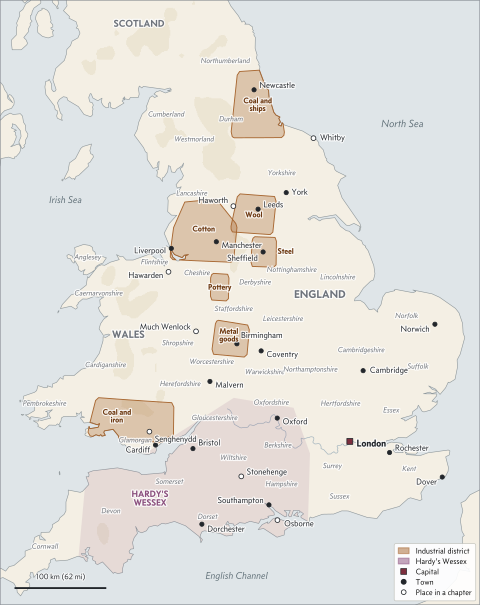
Each nation was divided into counties, also called shires: about forty in England, twelve in Wales, thirty-three in Scotland, and thirty-two in Ireland. A county had a county town, a sheriff, and unpaid magistrates called justices of the peace, usually local landowners, who judged small crimes and ran local affairs. Only in 1889 did elected county councils take over most of that work. Victorians thought of themselves as men of Kent or Yorkshire almost as much as Englishmen, and novelists set their stories in real counties or barely disguised ones. Figure S.2 names the English and Welsh counties that the chapters visit.
The map of wealth followed the map of rock. Coal and iron lay under the north and west of Great Britain: along both sides of the Pennine hills, in the valleys of South Wales, around Newcastle, and across the middle of Scotland. Where the coal was, the factories went. Lancashire (lang-kuh-shur), around Manchester, spun cotton; the West Riding, the western third of Yorkshire, around Leeds and Bradford, wove wool; Sheffield made steel; Birmingham and the towns west of it, called the Black Country for their smoke, made everything of metal from nails to guns. Glasgow and Belfast built ships. The south and east were farmland, ruled by landowners and dominated by London. People spoke of “the North” and “the South” as two countries, and a novel of 1855 by Elizabeth Gaskell was called simply North and South. Between them lay the Midlands, the middle of England from Birmingham and Coventry to Nottingham, a country of market towns and farms as well as workshops. In the far northwest, the mountains and lakes of the Lake District, where Wordsworth had lived, drew poets and tourists.
London was the largest city in the world. In 1851 about 2.4 million people lived in the area that later became the County of London, and by 1911 about 4.5 million, with more than 7 million in the whole built-up area of Greater London. The census of 1851 found that for the first time more people in England and Wales lived in towns than in the countryside. Manchester, Liverpool, Birmingham, and Glasgow each roughly doubled in size. Belfast grew from a town of about 87,000 into a city of 387,000, larger than Dublin, and the coal port of Cardiff grew tenfold.
Figure S.3 shows the London of this volume. Parliament, Buckingham Palace, and the government offices stood in Westminster, beside the Thames. Banks and merchants filled the City, the old square mile to the east, and the theaters, fine shops, and private clubs, where gentlemen dined and read the papers, lay in the West End between them. Beyond the City, the docks and the poorest streets crowded the East End. Newspapers were written and printed in and around Fleet Street. Each railway company built its own terminus, the station at the end of its line, on the edge of the center, because in 1846 a royal commission, a panel the government appoints to study a question, kept the lines from the north out of it. Only from the 1860s were a few, such as Charing Cross, allowed farther in.


What tied the country together was the railway. The first railway between two cities worked entirely by steam, from Liverpool to Manchester, had opened in 1830, and in the “railway mania” of the 1840s investors poured money into hundreds of new lines (Vol. 15, The Age of Revolution). By 1851 trains ran from London to Edinburgh (ed-in-bur-uh), Glasgow, Bristol, Plymouth, Dover, and Holyhead (hol-ee-hed), where the Irish Mail met the steamer for Dublin. Great Britain had about 6,000 miles of railway line in 1850 and about 20,000 by 1911. A journey from London to Edinburgh that had taken about ten days by stagecoach in the 1750s took about twelve hours by the 1850s. The railways even changed the clocks. Every town had kept its own time by the sun, so that Bristol’s noon came about ten minutes after London’s. To run trains to a timetable, the companies set every station clock to London time, Greenwich (gren-itch) Mean Time, and in 1880 Parliament made it the legal time for the whole of Great Britain.
One part of the map belongs to a novelist. In 1874 Thomas Hardy borrowed the name of the old Anglo-Saxon kingdom of Wessex (Vol. 8, The Northern Worlds) for the country of his novels, a half-real version of Dorset and the counties around it. Its towns have invented names that stand for real ones, so that his Casterbridge is Dorchester and his Christminster is Oxford. Readers soon went looking for the real places, and the name stuck to the region. Chapter 19 tells the stories set there.
Crown, Parliament, and prime minister
Three monarchs reigned in these years. Queen Victoria came to the throne in 1837, at eighteen, and reigned for sixty-three years and seven months, longer than any British monarch before her; Chapter 1 tells her story. Her eldest son, Albert Edward, Prince of Wales (the title of the heir to the throne), waited until he was fifty-nine to succeed her as Edward VII. He reigned from 1901 to 1910, and the years of his reign and the few after it are called Edwardian. His son George V reigned from 1910 until 1936.
Britain was a constitutional monarchy: the monarch reigned, but Parliament made the laws and ministers ran the government. The writer Walter Bagehot (baj-ut), in a famous book of 1867, The English Constitution, said the monarch kept three rights: to be consulted, to encourage, and to warn. Victoria used all three, and sometimes more. She could delay, sulk, and threaten, and she could choose between two possible prime ministers when the choice was close. She could not keep a government in office against the votes of the House of Commons.
Parliament met in the new Palace of Westminster (Chapter 1) and had two houses. The House of Lords held the peers, the nobles who sat by right of their titles, most of them inherited, together with the bishops of the Church of England. The House of Commons held between 650 and 670 members elected by the voters of the counties and towns; each was a Member of Parliament, or MP. MPs were paid nothing until 1911, so most of them were rich. The Commons controlled taxes, and so it was the stronger house. A new Parliament had to be elected at least every seven years (every five after 1911), and an election could be called sooner.
| Years | Prime minister | Party |
|---|---|---|
| 1846–1852 | Lord John Russell | Whig |
| 1852 | Earl of Derby | Conservative |
| 1852–1855 | Earl of Aberdeen | Peelite, with Whigs |
| 1855–1858 | Viscount Palmerston | Whig |
| 1858–1859 | Earl of Derby | Conservative |
| 1859–1865 | Viscount Palmerston | Liberal |
| 1865–1866 | Earl Russell | Liberal |
| 1866–1868 | Earl of Derby | Conservative |
| 1868 | Benjamin Disraeli | Conservative |
| 1868–1874 | William Ewart Gladstone | Liberal |
| 1874–1880 | Benjamin Disraeli | Conservative |
| 1880–1885 | William Ewart Gladstone | Liberal |
| 1885–1886 | Marquess of Salisbury | Conservative |
| 1886 | William Ewart Gladstone | Liberal |
| 1886–1892 | Marquess of Salisbury | Conservative |
| 1892–1894 | William Ewart Gladstone | Liberal |
| 1894–1895 | Earl of Rosebery | Liberal |
| 1895–1902 | Marquess of Salisbury | Conservative |
| 1902–1905 | Arthur James Balfour | Conservative |
| 1905–1908 | Sir Henry Campbell-Bannerman | Liberal |
| 1908–1916 | Herbert Henry Asquith | Liberal |
The government was led by the prime minister. The monarch appointed him, but only a man who could win votes in the Commons could last. He chose the other ministers, and the fifteen or so most important of them met as the cabinet, which decided policy together. The senior posts were the Chancellor of the Exchequer, who managed the nation’s money; the Home Secretary, in charge of police and prisons; the Foreign Secretary; the Colonial Secretary; and, after 1858, the Secretary of State for India. The prime minister’s official house was 10 Downing Street, a plain brick house off Whitehall, the street of government offices near Parliament. Table S.1 lists the men who held the office. Several were peers, who sat in the Lords; the others sat in the Commons. The Earl of Derby (dar-bee), who led the Conservatives for twenty years, governed from the Lords. Lord Palmerston (pahm-er-stun) was an odd case: his title was Irish, and the Irish peers chose only twenty-eight of their number to sit in the Lords, so he was free to sit in the Commons, as he did all his life.

Figure S.5 sets the reigns and the governments against the events the chapters tell. Read it as a map of time: find a book in the bottom lanes, then look straight up to see who was prime minister when it appeared and what the newspapers were full of that year. Alice in Wonderland came out in the year Palmerston died. Sherlock Holmes first appeared in the year of Victoria’s Golden Jubilee, the fiftieth year of her reign. The year of the Titanic was also the year of the third bill to give Ireland a parliament of its own.
The cast
Figure S.6 lists the people this volume meets most, in the order of the chapters, with the years of their lives drawn against the years of the volume. Two generations stand out. The first was born within a few years of 1810. The poet Alfred Tennyson, the statesman William Gladstone, the naturalist Charles Darwin, and Edward FitzGerald, who turned Persian verse into English, were all born in 1809, the year of Abraham Lincoln’s birth as well. Dickens, the poet Robert Browning, and the novelist William Makepeace Thackeray (thak-uh-ree) were born within three years of it. They were young when Victoria came to the throne and old, or dead, when she left it. Their first books, like the early Dickens and the first novels of the Brontë (bron-tee) sisters, belong to Vol. 15, The Age of Revolution.

The second generation was born in the 1850s, after the Great Exhibition. Oscar Wilde and Bernard Shaw, two playwrights from Dublin, were born in 1854 and 1856. The novelist Joseph Conrad and the composer Edward Elgar followed in 1857, and in 1859 came Arthur Conan Doyle, who invented Sherlock Holmes, the poet A. E. Housman (howss-mun), and Kenneth Grahame (gray-um), who wrote The Wind in the Willows. They grew up Victorian, did their best-known work around 1900, and most of them lived long after the First World War. Thomas Hardy, born in 1840, stands between the two. He published his first novel in 1871 and his last book of poems, which came out just after his death, in 1928. Writers who worked in Britain but are taught in other volumes are not on the chart: the American novelist Henry James is in Vol. 30, Whitman to Wharton, and the Irish poet W. B. Yeats (yayts) is in Vol. 21, Trenches and Modernists.
Liberals, Conservatives, and the vote
British politics in these years was a contest between two parties. Both had grown out of the older parties of Whigs and Tories (Vol. 12, Crown and Parliament). The Conservatives, still nicknamed Tories, stood for the monarchy, the House of Lords, the Church of England, the landowners, and later the empire. The Liberals grew out of the Whigs and stood for free trade, religious equality, cheaper government, and reform. Their voters were the merchants and manufacturers of the northern towns, the Nonconformists who worshiped outside the Church of England, and the Scots and the Welsh. Gladstone led the Liberals and Benjamin Disraeli (diz-ray-lee) the Conservatives, and the duel between them filled the 1860s and 1870s (Chapter 12).
Parties split and re-formed around great quarrels. In 1846 the Conservative prime minister, Sir Robert Peel, repealed the Corn Laws, the taxes that kept out foreign grain, and broke his party in two. His followers, the Peelites, joined the Whigs and the Radicals, the reformers who wanted the biggest and fastest changes, to form the Liberal Party in 1859. In 1886 Gladstone’s plan to give Ireland its own parliament split the Liberals in turn. The Liberal Unionists, who wanted to keep the union with Ireland whole, went over to the Conservatives, who held power for most of the next twenty years under Lord Salisbury (sawlz-bur-ee) and his nephew Arthur Balfour (bal-fer). Two newer parties joined the contest. Irish members who wanted Home Rule, a parliament of their own in Dublin, sat together from the 1870s and later formed the Irish Parliamentary Party; under Charles Stewart Parnell (par-nul) they won almost every Irish seat outside the Protestant northeast. The Labour Party, founded in 1900 by trade unions and socialists to put working men in Parliament, won twenty-nine seats in 1906, when the Liberals swept back into power.
The spine of political change was the vote. In 1848 most men had none, and no women did. Three Reform Acts changed that in steps, each one passed by Parliament itself (Table S.2). The first, in 1832, gave the vote to men of the middle class who owned or rented property of a certain value; Middlemarch is set in the years just before it (Chapter 10). The second, in 1867, was carried by Disraeli and gave it to most men who were householders in the towns. The third, in 1884, did the same for the countryside. After 1872 votes were cast in secret, on paper ballots, so that no landlord or employer could punish a man for the way he voted. Some men still had no vote, among them sons living at home, servants who lived in, soldiers in barracks, and men who had moved house too recently to be registered. Women had none at all in elections to Parliament.
| Act | Who gained the vote | Men voting |
|---|---|---|
| Before 1832 | Owners of certain property, by old local rules | 1 in 10 |
| First Reform Act, 1832 | Middle-class owners and tenants of property worth £10 a year in the towns | 1 in 5 |
| Second Reform Act, 1867 | Most householders in the towns, and some lodgers | 1 in 3 |
| Third Reform Act, 1884 | Householders in the countryside too | 3 in 5 |
| 1918 | All men at 21; women at 30 | all men |
The last great fight of the period was over the House of Lords. In 1909 the Liberal Chancellor of the Exchequer, David Lloyd George, a Welsh lawyer with a gift for speeches, proposed new taxes on the rich and on land to pay for old-age pensions and warships. It became known as the People’s Budget. The Lords, full of landowners, threw it out. After two elections in 1910 the Liberals passed the Parliament Act of 1911, which took away the Lords’ power to veto laws; from then on they could only delay them. Women were fighting for the vote in the same years, some by petitions and some by smashing windows (Chapter 7, Chapter 28).
Rank, class, and money
Victorian Britain was a society of ranks, and the rank showed in a person’s name. At the top were the peers. There were five ranks of the peerage, and each title passed to the holder’s eldest son (Table S.3). Only the monarch could create a peer, on the advice of the prime minister, and a successful general, banker, or politician might be “raised to the peerage” as a reward. Disraeli became Earl of Beaconsfield (bek-unz-feeld) in 1876, and Tennyson, the poet, became Baron Tennyson in 1884. Gladstone refused the earldom the queen offered him in 1885 and stayed plain Mr. Gladstone.
| Rank | Examples |
|---|---|
| Duke | the Duke of Wellington; the Duke of Devonshire |
| Marquess | the Marquess of Salisbury, prime minister |
| Earl | the Earl of Derby, prime minister; Disraeli, as Earl of Beaconsfield |
| Viscount | Viscount Palmerston, prime minister |
| Baron | Lord Tennyson, poet laureate |
Below the peers the titles grew smaller. The younger son of a duke or a marquess (mar-kwis) was called “Lord” as a courtesy, but he was not a peer and could sit in the Commons. That is how Lord John Russell could be prime minister as an MP; he was made Earl Russell only in 1861. A baronet was called “Sir” and passed the title to his son, as Sir Robert Peel did, but he sat in the Commons. A knight was also “Sir,” but only for his own life: the novelist Arthur Conan Doyle was knighted in 1902 and the composer Edward Elgar in 1904. The wives of all these men were called “Lady.”
The Victorians themselves spoke of three classes. The upper class was the aristocracy and the gentry. The gentry were the untitled country landowners, such as the squire who owned most of a village, and they lived on the rents of their tenant farmers. A few thousand families owned most of the land of the British Isles. The middle class ran from rich bankers and mill owners through clergymen, lawyers, doctors, and officers down to clerks and shopkeepers. Its members prized respectability, hard work, and church on Sunday, and they bought most of the books in this volume. The working class, about three people in four, worked with their hands: farm laborers, miners, factory hands, sailors, and servants. Domestic service was the largest single job for women, and in 1851 there were about a million servants in England and Wales. The poorest, who could not support themselves at all, might end in the workhouse, a grim public institution that gave food and a bed in return for hard work. It was kept harsh on purpose, so that no one would go there who could avoid it. The line that mattered most socially was the one around a gentleman, a man who did not work with his hands. It was the line that the blacksmith’s apprentice Pip in Great Expectations longs to cross (Chapter 9).
Money was counted in pounds, shillings, and pence, written £, s., and d. (from the Latin librae, solidi, and denarii). Twelve pence made a shilling and twenty shillings made a pound, so a pound was 240 pence; a price such as £2 10s. 6d. was read “two pounds, ten shillings, and sixpence.” Gentlemen paid doctors, tailors, and painters in guineas (gin-eez), a guinea being a pound and a shilling. Comparing these sums with today’s money misleads, because prices of food, rent, and books moved in different ways. The best choice is to compare them with wages, as Table S.4 does.
| Coin or sum | What it was, or what it bought |
|---|---|
| farthing, halfpenny, penny | a quarter, a half, and a whole penny; a popular daily paper cost a halfpenny by 1900 |
| twopence | a weekly number of Household Words (1850) |
| sixpence | a monthly number of The Strand Magazine (1891) |
| shilling (12d.) | a monthly part of a Dickens novel |
| half a crown (2s. 6d.) | a silver coin |
| pound or sovereign (20s.) | a gold coin |
| guinea (21s.) | a year’s membership of Mudie’s library |
| £1 11s. 6d. | a new novel in three volumes |
| about 10s. a week | a farm laborer’s wage in the 1850s |
| about 30s. a week | a skilled craftsman’s wage |
| £30 a year, with board | Jane Eyre’s pay as a governess (1847) |
| £150 a year | the income at which income tax began (1842) |
| £5,000 a year | the salary of the First Lord of the Treasury, the prime minister’s usual post |
Church, school, and university
The Church of England was the established church, the official church of the state. The monarch was its Supreme Governor, its bishops sat in the House of Lords, and every English parish had its church and its clergyman, appointed for life. Inside it, the High Church wing, revived by the Oxford Movement of the 1830s (Vol. 15, The Age of Revolution), loved ritual and tradition, while the Low Church or Evangelicals stressed the Bible, conversion, and good works. Outside it stood the Nonconformists, also called Dissenters: Methodists, Baptists, Congregationalists, Quakers, and others, strongest in the industrial towns and in Wales. Scotland had its own Presbyterian church. Ireland was mostly Roman Catholic. In England, Catholics were a small minority, swollen by Irish immigrants, and the pope’s restoration of Catholic bishops in England in 1850 set off a storm of protest. Jews could sit in Parliament only from 1858, when they were allowed to leave the Christian words out of the oath that every member swore.
On one Sunday in March 1851 the government counted everyone at worship in England and Wales. The result shocked the clergy. Millions had stayed at home, and about half of those who went to any service had gone to a church or chapel outside the Church of England. Doubt grew alongside faith. A volume that runs from Tennyson’s In Memoriam through Darwin to Arnold’s “Dover Beach” (Chapter 3, Chapter 7, Chapter 8) is in large part about believers losing their certainty and wondering what would take its place.
There was no national system of schools before 1870. Children learned to read, if at all, in schools run by the churches, in “dame schools” kept by old women for a few pence a week, or in free “ragged schools” for the poorest. The Education Act of 1870 set up elected school boards to build schools wherever there were none (Chapter 12); school became compulsory in 1880 and free in 1891. Many market towns also had an old grammar school, often founded in Tudor times to teach boys Latin. The sons of the rich went to the public schools, which in Britain are private boarding schools, such as Eton, Harrow, and Rugby. Thomas Arnold, the great headmaster of Rugby, was the father of the poet Matthew Arnold. Girls of the middle class were mostly taught at home by a governess, a hired teacher who lived with the family, although some of the first serious schools for girls opened in London in 1850 and at Cheltenham in 1853.
England had two ancient universities, Oxford and Cambridge, each a federation of colleges where students lived and studied under fellows, the college’s resident teachers. Until the 1850s only members of the Church of England could take their degrees, and until 1871 only they could become fellows. The University of London, founded in 1836, admitted students of any faith and in 1878 became the first in Britain to give degrees to women. Scotland had four universities of its own, which were cheaper and more open than Oxford; Arthur Conan Doyle studied medicine at Edinburgh. Women’s colleges opened at Cambridge (Girton, founded at Hitchin in 1869 and moved in 1873, and Newnham in 1871) and at Oxford (1879), but Oxford gave women full degrees only in 1920, and Cambridge only in 1948. After London, Oxford is the place this volume visits most. Carroll, Arnold, Hopkins, Wilde, and Housman all knew it (Chapter 8).
Ireland after the Famine
Vol. 15, The Age of Revolution left Ireland in its worst years. In 1845 a blight from America began to rot the potato crop, the one food of the Irish poor, and it came back year after year. By 1852 about a million people had died of hunger and fever, and more than a million had left the country. Ireland never recovered its numbers. While the population of Great Britain more than doubled between 1841 and 1911, Ireland’s fell by almost half (Figure S.7). In 1841 Ireland held nearly a third of the people of the United Kingdom; by 1911 it held about a tenth.

The leaving went on long after the hunger. Between 1851 and 1911 about four million people left Ireland, most for the United States, many for the cities of Britain, and others for Canada and Australia. At the port of Queenstown, near Cork, families said goodbye at the quay, and in the villages the night before a departure was called an “American wake,” because those who went were not expected to come back. Liverpool, Glasgow, Boston, and New York all gained large Irish quarters. In Ireland itself the land emptied. Small potato plots were joined into larger farms and pastures for cattle, a farm passed to one son, and his brothers and sisters emigrated or never married.

Land was the heart of the Irish question, as the Victorians called the problem of how to govern Ireland. Most of the land belonged to a few thousand landlords, mostly Protestant and often of English or Scottish descent, and many of them lived in England. Most farmers were tenants who rented from year to year and could be turned out at the landlord’s will. Religion deepened the divide. About three Irish people in four were Catholic, but the official church until 1871 was the Protestant Church of Ireland, the church of a small minority. In the northeast, in Ulster, Protestants were the majority, many of them Presbyterians descended from Scottish settlers, and industrial Belfast looked across the sea to Glasgow and Liverpool more than south to Dublin.

Ireland was ruled from Dublin Castle, the seat of British government in the city. The queen’s representative there was the Lord Lieutenant (lef-ten-unt), or viceroy, but the real work was done by the Chief Secretary for Ireland, a minister of the government in London. About a hundred Irish members sat in the House of Commons. The island is divided into four provinces (Figure S.9), Ulster in the north, Leinster (len-ster) in the east, Munster in the south, and Connacht (kon-awt) in the west, and into thirty-two counties. The Irish language, also called Gaelic (gay-lik), was still spoken by about a quarter of the people in 1851 and by about one in eight in 1911.
Over these years Irish discontent took one form after another. First came the Fenians, a secret society founded in 1858 to win independence by force, then the Land League and its war on rents, then Parnell’s campaign for Home Rule (Chapter 12). After Parnell’s fall in 1890 a revival of the Irish language, Irish sport, and Irish theater gathered strength, and in 1905 came a new party, Sinn Féin (shin fayn), “We Ourselves” (Chapter 25). By 1913 a Home Rule bill was passing through Parliament, Ulster’s Protestants were arming to resist it, and Dublin’s workers were locked out of their jobs in the bitterest labor dispute of the age (Chapter 28). The volume ends there, and Vol. 21, Trenches and Modernists takes up the story.
The empire
In 1850 Britain already ruled the largest empire in the world. By 1900 it had grown larger still, until people said that the sun never set on it, because some part of it was always in daylight. Figure S.10 shows both dates. Just before the First World War the empire held nearly a quarter of the world’s people and about a fifth of its land. It rested on the Royal Navy, the largest fleet on earth, and on a chain of ports and coaling stations, from Gibraltar and Malta to Aden, Singapore, and Hong Kong, where steamships could refuel. Telegraph cables laid along the seabed carried messages from London to Bombay in hours instead of weeks.

The empire was not one kind of thing. The self-governing colonies, settled by emigrants from Britain, ran their own affairs through their own parliaments. Canada became a federation in 1867 with the title of a dominion, a self-governing country under the British crown, and the six Australian colonies joined as the Commonwealth of Australia in 1901. The Union of South Africa was formed in 1910, after the Boer (boor) War (Chapter 21). Crown colonies such as Jamaica, Ceylon, and Hong Kong were ruled by governors sent from London. In a protectorate, a local ruler kept his throne but Britain controlled his dealings with other countries.
India was a world of its own. Until 1858 most of it was ruled by the East India Company, a trading company with its own army. After the great rebellion of 1857, called by the British the Indian Mutiny, the Crown took over. The British rule that followed is called the Raj (rahj), from the Hindi word for “rule.” A viceroy governed from Calcutta (from Delhi after 1911), with about a thousand British officials of the Indian Civil Service set over nearly 300 million people, and about two-fifths of the country was left to Indian princes who accepted British control. In 1877 Victoria was proclaimed Empress of India (Chapter 12). Chapter 20 tells the Raj as its most famous writer saw it, and Vol. 39, India tells India’s own history.
The names on Victorian maps are not always the names on ours. This volume uses the names of its own time, as the people in it did, and Table S.5 gives the modern ones.
| Name in this volume | Name today |
|---|---|
| Kingstown | Dún Laoghaire (dun leer-ee), Ireland |
| Queenstown | Cobh (kohv), Ireland |
| Bombay, Calcutta, Madras | Mumbai, Kolkata, Chennai |
| Ceylon | Sri Lanka |
| Burma | Myanmar |
| Gold Coast | Ghana |
| Rhodesia | Zimbabwe and Zambia |
| Bechuanaland | Botswana |
| British Guiana | Guyana |
| Constantinople | Istanbul |
| Peking, Canton | Beijing, Guangzhou |
| Van Diemen’s Land | Tasmania (renamed 1856) |
How books reached readers
Victorian Britain was full of readers, and every year there were more. In 1840 about a third of men and half of women could not sign their names in the marriage register; by 1900 almost everyone could. Taxes on newspapers and paper, which their enemies called the “taxes on knowledge,” were abolished in 1855 and 1861, and print grew cheap. By the 1890s a daily paper cost a halfpenny. But a new novel stayed expensive, and the way a story reached its readers shaped how it was written. A reader could get a novel in five main ways (Figure S.11).

The first was the monthly part. Dickens had made his name with The Pickwick Papers in 1836 and 1837 (Vol. 15, The Age of Revolution), sold in parts of thirty-two pages with two etched pictures, in a paper wrapper, for a shilling each. A whole novel ran to twenty parts, also called numbers, over nineteen months, the last a double number. A reader paid a pound in all, a shilling at a time, and the author wrote each part a few weeks ahead of the printer, watching the sales. Thackeray, Anthony Trollope, and Dickens all published this way (Chapter 2).
The second was the serial in a magazine. A novel ran in weekly or monthly installments alongside articles, poems, and other stories. Dickens edited two weeklies, Household Words (1850 to 1859) and All the Year Round (from 1859), and printed his own A Tale of Two Cities and Great Expectations in the second (Chapter 9). Each installment had to end on a note that brought readers back for the next, and Hardy once ended one with his hero hanging from a cliff (Chapter 19). Table S.6 lists the magazines the chapters meet most.
| Magazine | What it was |
|---|---|
| Blackwood’s (1817) | Edinburgh monthly; first printed George Eliot (1857) and Conrad’s Heart of Darkness (1899) |
| Punch (1841) | London’s comic weekly, with cartoons by John Tenniel |
| Household Words (1850) | Dickens’s twopenny weekly; no pictures |
| All the Year Round (1859) | Dickens’s second weekly |
| The Cornhill (1860) | a shilling monthly, first edited by Thackeray; ran Hardy’s Far from the Madding Crowd |
| The Strand (1891) | sixpenny monthly with a picture on every page; home of Sherlock Holmes |
| The Yellow Book (1894) | quarterly of the aesthetes, drawn by Aubrey Beardsley |
The third was the three-volume novel, or three-decker, the standard form for a new novel. Each volume cost half a guinea, so the set cost a guinea and a half, 31s. 6d., a price few readers would pay. Publishers printed a small first edition, often under a thousand copies, and sold most of them to the fourth way of reading, the circulating library. The greatest was the Select Library of Charles Mudie (myoo-dee) on New Oxford Street in London. For a guinea a year a member could borrow one volume at a time, and the library sent boxes of books by rail to members across the country. Mudie, a strict Nonconformist, called his library “select” because he refused to stock books he thought improper, and his orders could make or break a novel. W. H. Smith, whose bookstalls stood in railway stations from 1848, ran a rival library. In 1894 the two libraries told publishers they would no longer pay the old prices, and within a few years the three-decker was dead, replaced by novels in one volume at six shillings.

The fifth way was the cheap book. Railway bookstalls sold reprints in yellow covers for a shilling or two to read on the train. Boys bought penny dreadfuls, weekly thrillers of highwaymen and murders at a penny an issue, and in the 1880s the shilling shocker, a short thriller in paper covers, made Stevenson’s tale of Dr. Jekyll (jek-ul) and Mr. Hyde a best seller (Chapter 15). A law of 1850 let towns build free public libraries, paid for from local taxes, and by 1913 most large towns had one. Across the Atlantic, American publishers could reprint British books without paying their authors until a copyright law of 1891, which is why Dickens spoke so angrily about piracy on his American tour of 1842.
Pen names
Many Victorian writers published under a pen name, an invented name used in place of the real one, or published with no name at all, as most magazine writers did. Women used men’s names to be judged as writers rather than as women; a mathematics lecturer at Oxford kept his fairy tales apart from his lectures. Table S.7 lists the pen names the chapters use most. The three Brontë sisters kept their own initials in theirs, and the secret did not last long.
| Pen name | Real name |
|---|---|
| Boz | Charles Dickens, in Sketches by Boz (1836) |
| Currer Bell | Charlotte Brontë |
| Ellis Bell | Emily Brontë |
| Acton Bell | Anne Brontë |
| George Eliot | Mary Ann (later Marian) Evans, from 1857 |
| Lewis Carroll | Charles Lutwidge Dodgson, from 1856 |
| Saki | Hector Hugh Munro |
The poet laureate
The poet laureate was a poet appointed by the monarch for life, with a small salary, and expected to write verses for royal births, weddings, deaths, and jubilees. William Wordsworth held the post from 1843 until his death in 1850 (Vol. 15, The Age of Revolution). Alfred Tennyson followed him and held it for forty-two years, the most famous laureate of all (Chapter 3). After Tennyson’s death in 1892 the post stood empty for more than three years, and then went to Alfred Austin, a loyal Conservative journalist whose verses were widely laughed at. In 1913 it passed to Robert Bridges, a doctor turned poet, who was the friend and editor of Gerard (jerr-erd) Manley Hopkins (Chapter 14).
The theater and the music hall
Since the Theatres Act of 1843 any licensed theater in London could stage spoken plays, ending the old monopoly of a few royal theaters. But every new play still needed a license from the Lord Chamberlain, an officer of the royal household, whose Examiner of Plays read each script and could forbid it for indecency or for showing religious or political matters he thought unfit. Wilde and Shaw both had plays refused (Chapter 18, Chapter 25). The theaters of the West End, the wealthy western part of central London, were run by actor-managers, star actors who ran their own companies. Henry Irving ran the Lyceum (ly-see-um) from 1878 and in 1895 became the first actor to be knighted. George Alexander ran the St. James’s, where two of Wilde’s comedies opened, among them The Importance of Being Earnest. The Savoy Theatre, built in 1881 for Gilbert and Sullivan’s comic operas (Chapter 13), was lit throughout by electric light, the first public building to be so.
Most Londoners went instead to the music hall, a hall where people ate and drank at tables while singers, comedians, and acrobats performed one act after another. The halls had grown out of the singing rooms of taverns in the 1850s, and by the 1890s the grandest of them were gilded palaces seating thousands. Their songs were sung in every street, and their language entered politics: the word “jingoism” comes from a music-hall song of 1878 (Chapter 12). Every Christmas families went to the pantomime, a show for children full of fairy tales, slapstick, and songs. Ireland gained a national theater when the Abbey Theatre opened in Dublin in 1904 (Chapter 25).
| Region | In these years | Taught in |
|---|---|---|
| France and the Low Countries | The Second Republic (1848), then the Second Empire of Napoleon III (1852–1870), defeat by Prussia, the Paris Commune (1871), and the Third Republic; Impressionism from 1874; the Dreyfus Affair (1894–1906). Leopold II of Belgium ruled the Congo as his own property (1885–1908). | Vol. 18, Paris, Capital of the Arts |
| Germany, Austria, Italy, and Spain | Bismarck unified Germany in three wars, and the German Empire was proclaimed at Versailles in 1871. Austria became Austria-Hungary in 1867. Cavour (kuh-voor) and Garibaldi made the Kingdom of Italy (1861). Wagner and Verdi ruled the opera houses. | Vol. 19, Wagner and Verdi |
| Russia, Scandinavia, and the East | Alexander II freed the serfs (1861) and was killed by a bomb (1881). Tolstoy, Dostoevsky (dos-tuh-yef-skee), Ibsen, and Tchaikovsky wrote. The Balkan peoples won freedom from the Turks; Russia lost a war to Japan and survived a revolution (1905). | Vol. 20, The North and the East |
| United States and Canada | The Civil War (1861–1865) and Lincoln’s murder; Reconstruction; Canada united as a dominion (1867); railroads, immigration, and the great fortunes of the Gilded Age; war with Spain (1898). Whitman, Twain, and Henry James wrote. | Vol. 29, A House Divided, Vol. 30, Whitman to Wharton |
| Latin America | Benito Juárez (hwar-ess) defeated a French-backed emperor in Mexico (1867); Brazil ended slavery (1888) and became a republic (1889); Paraguay was ruined in war (1864–1870); Porfirio Díaz (dee-ahs) ruled Mexico (1876–1911) until the Mexican Revolution. | Vol. 44, Gold, God, and Glory |
| The Middle East | The Ottoman Empire tried to modernize itself; the Suez Canal opened (1869); Britain occupied Egypt (1882); the Young Turks forced the sultan to restore the constitution (1908). | Vol. 38, The Modern Middle East |
| India | The rebellion of 1857 and the rule of the Crown; the Indian National Congress (1885); Tagore won the Nobel Prize for Literature (1913). | Vol. 39, India |
| China and Japan | China was torn by the Taiping (ty-ping) Rebellion (1850–1864), ruled by the Empress Dowager Cixi (tsuh-shee), shaken by the Boxers (1900), and became a republic (1912). Japan opened to the West (1854), modernized under Emperor Meiji (may-jee), and defeated China (1895) and Russia (1905). | Vol. 40, The Middle Kingdom, Vol. 41, Islands of the Rising Sun |
| Africa | Livingstone crossed the continent (1850s); Europe’s powers divided it in the Scramble (1880s–1900); Ethiopia beat Italy at Adwa (ahd-wah) (1896); the Zulu and Boer wars in the south. | Vol. 43, Africa |
| Australia and New Zealand | Gold rushes from 1851; wars with the Maori (1845–1872); New Zealand became the first nation where women voted for parliament (1893); Australia federated (1901). | Vol. 42, Monsoon and Ocean |
Concert halls and festivals
German visitors liked to sneer that England was “the land without music” (Chapter 26). It was unfair. England had few great composers between Henry Purcell (pur-sul), who died in 1695, and Edward Elgar, but it had an enormous public for music. London heard the great foreign performers every season, and Mendelssohn (men-del-sun) was as much loved in England as in Germany. Charles Hallé (hal-ay), a German pianist living in Manchester, founded the city’s orchestra in 1858. The Crystal Palace was rebuilt in south London after the Great Exhibition, and for half a century its Saturday concerts and its vast festivals of Handel’s music drew huge crowds.

Above all the British sang. Choral societies flourished in every industrial town, and the music festivals of the provinces commissioned new works: Mendelssohn’s Elijah was first heard at the Birmingham Festival in 1846, and Elgar’s greatest choral work there in 1900 (Chapter 26). The oldest, the Three Choirs Festival, rotated among the cathedrals of Gloucester (gloss-ter), Hereford, and Worcester (wuss-ter). Mining and mill towns had brass bands, and a system of teaching singers to read music by syllables, tonic sol-fa, spread through the schools and chapels. The Royal Albert Hall opened in 1871, the Royal College of Music in 1883, and in 1895 the manager Robert Newman began cheap summer promenade concerts, at which part of the audience stood, at the new Queen’s Hall, with the young Henry Wood as conductor. The generation of composers that grew up in this world, led by Hubert Parry, Charles Villiers Stanford, and Elgar, is called the English musical renaissance. Ralph Vaughan Williams, whose first symphonies came just before the war, is taught in Vol. 21, Trenches and Modernists.
Meanwhile elsewhere
Britain’s story ran alongside those of other nations, and the volumes of the Course that teach them are listed in Table S.8. Some of the writers who lived in Britain in these years are taught elsewhere too: Henry James and the American painters Whistler and Sargent in Vol. 30, Whitman to Wharton, and Yeats, Joyce, and the later Shaw in Vol. 21, Trenches and Modernists.
The Early Victorians, 1837-1858
Chapter 1 · 30 clues
The Queen, the Prince, and the Palace of Glass
At six o’clock on the morning of June 20, 1837, a girl of eighteen was woken by her mother at Kensington Palace, a rambling brick house on the western edge of London. Two gentlemen had driven through the night from Windsor Castle, the king’s home twenty miles to the west, and wished to see her. One was the Archbishop of Canterbury, the senior bishop of the Church of England. The other was Lord Conyngham (kun-ing-um), the Lord Chamberlain, who ran the king’s household. The girl went in to them, as she wrote in her diary that evening, “only in my dressing gown” and “alone.” Lord Conyngham knelt and told her that her uncle, King William IV, had died in the night. She was queen.

Her name was Alexandrina Victoria, and she would reign for sixty-three years and seven months, longer than any British monarch before her. Figure 1.1 shows how the Victorians liked to remember that morning: a slight girl in white, and two men on their knees. Of the words in her diary, “alone” mattered most to her. Until that morning she had hardly ever been alone in a room in her life.
The Kensington girl
She was born because of a death. In November 1817 Princess Charlotte, the only child of the future King George IV, died in childbirth at twenty-one. She had been the only legitimate grandchild of old King George III, although he had fifteen children. His sons had mistresses and children born outside marriage, but such children could not inherit the throne. After Charlotte’s death three of the unmarried royal dukes hurried to find German princesses and marry them. Edward, Duke of Kent, the king’s fourth son, was a soldier of fifty with large debts. In 1818 he married Princess Victoria of the small German duchy of Saxe-Coburg-Saalfeld (saks koh-burg sahl-felt), a widow with two children. Their daughter was born at Kensington Palace on May 24, 1819, fifth in line to the throne (Figure 1.2). Eight months later her father died of pneumonia.

Her mother, now the Duchess of Kent, was a German widow far from home and short of money. Her household was run by her comptroller, the officer who managed its money and servants. He was John Conroy, a handsome and pushy army captain born in Wales to Irish parents, who had served the late duke. Many at court believed he was the duchess’s lover. Conroy saw where the little girl might lead. In 1830 Parliament named her mother as the future regent, the person who would rule in the child’s name if the king died before she turned eighteen. Conroy meant to rule through the mother.
To keep the girl in their hands, the duchess and Conroy devised the Kensington System,John Conroy and the Duchess of Kent devised the Kensington System to control this ruler’s upbringing. → Queen Victoria•• named for the palace where they lived. Victoria was never allowed to be apart from her mother or her governesses. She slept in her mother’s bedroom, and she was not allowed to walk down a staircase without someone holding her hand. Her only regular playmates were her half-sister Feodora and Conroy’s own daughter. She was kept away from her father’s family, the royal uncles, who might have given her other advice. The aim was to make her weak, lonely, and dependent. Her one ally was her governess, Louise Lehzen (lay-tsen), a pastor’s daughter from Hanover who loved her fiercely.
The plan failed by twenty-seven days. In 1835, when Victoria lay weak with a severe fever in the seaside town of Ramsgate, her mother and Conroy tried to make her sign a paper naming him her future private secretary. She refused. King William IV, who had come to the throne in 1830, detested the duchess for keeping his niece away from his court. At a dinner in 1836, with the duchess sitting at his table, he said aloud that he hoped to live until his niece turned eighteen, so that there would be no regency. He got his wish. She turned eighteen on May 24, 1837, and the king died on June 20. On her first day as queen she asked for an hour by herself, had her bed carried out of her mother’s room, and barred Conroy from her presence.
One inheritance escaped her. Since 1714, when the ruler of Hanover in northern Germany became King George I of Great Britain, every British king had also ruled Hanover. The two countries kept separate governments and shared one monarch, an arrangement called a personal union. But Hanover followed the Salic (say-lik) law, an old rule of the Franks, the Germanic people who ruled France in the early Middle Ages, that let only men inherit a throne. Hanover’s crown could pass only to a man,This last British monarch of the House of Hanover could not inherit Hanover’s crown because its succession rules favored male heirs. → Queen Victoria•• so it went to Victoria’s uncle Ernest Augustus, Duke of Cumberland, the least liked of the royal brothers, and the union of 123 years ended (Figure 1.3). The British royal family had been called the House of Hanover since 1714. Victoria was its last monarch; her son would take his father’s family name, Saxe-Coburg and Gotha (goh-tuh).

Three weeks after her accession the queen left Kensington for Buckingham Palace, at the western end of St. James’s Park. George IV had paid the architect John Nash to rebuild it, but neither he nor William IV ever lived there. Victoria was the first monarch to make Buckingham Palace a permanent home,This ruler was the first to permanently live in Buckingham Palace. → Queen Victoria• and it has been the monarch’s official home in London ever since. Her mother came too, but was given rooms at the far end of the building.
By 1837 Britain was a constitutional monarchy, a kingdom whose ruler’s powers are limited by law and custom. The queen appointed the prime minister, the head of the government, but she had to choose a man who could win votes in the House of Commons, the elected house of Parliament. The two parties of the day were the Whigs, who later became the Liberals, and the Tories, who became the Conservatives. The prime minister was a Whig, Lord Melbourne. He was fifty-eight, witty and worldly, a widower whose only son had died. He became the young queen’s teacher in politics, and she saw him nearly every day. Her journal is full of “Lord M.”
The young queen’s first years were stormy. In early 1839 Lady Flora Hastings, an unmarried lady-in-waiting, or noble companion, to the duchess and a friend of Conroy’s, developed a swollen stomach. Victoria and Lehzen believed the rumor that she was carrying Conroy’s child. Lady Flora was forced to submit to an examination by the royal doctors, which showed she was not pregnant. In fact she had a tumor on her liver, and she died that July. Her family printed their letters in the newspapers, the Tory press blamed the queen, and the young monarch was hissed in public. The Hastings Affair marred the opening of her reign,The Hastings Affair marred the beginning of this monarch's reign. → Queen Victoria• and Victoria had nightmares about Lady Flora for years.
In May 1839, while the scandal was still raging, Melbourne’s government won a vote in the Commons by only five, a margin so thin that he felt he could no longer govern, and he resigned. The queen had to send for the Tory leader, Sir Robert Peel, the son of a rich cotton-mill owner, who as home secretary, the minister in charge of law and order, had founded London’s police in 1829. Its officers are still called “bobbies” after him, since Bobby is a pet form of Robert. The queen was attended in turns by noblewomen called the Ladies of the Bedchamber, and many of hers were the wives and sisters of Whig ministers. Peel asked her to replace some of them with Tory ladies, as a sign that she trusted his government. She refused Peel’s request, and Peel declined to govern.This ruler’s refusal of Robert Peel’s requests during the Bedchamber Crisis kept her mentor Lord Melbourne in office. → Queen Victoria•• Melbourne came back for two more years, and the quarrel was named the Bedchamber Crisis. When the Tories won the election of 1841, Peel, who had already held the office for a few months in 1834 and 1835, became prime minister again, and this time the queen gave way.
Victoria and Albert
The man who replaced Melbourne in her life was her first cousin. Albert was born on August 26, 1819, three months after her, at a country house near Coburg. He was the second son of her mother’s brother Ernest I, whose duchy had been renamed Saxe-Coburg and Gotha in 1826, when it gained the lands of Gotha. Another brother was Leopold, Princess Charlotte’s widower, who had been king of the Belgians since 1831 and who planned the match. Albert was serious, musical, and hardworking, and interested in science, art, and modern farming. When he came to Windsor in October 1839, Victoria fell in love at once. Because she was the queen, she had to propose to him, and she did so five days later.
The queen married Prince AlbertThis ruler was married to Prince Albert. → Queen Victoria••• on February 10, 1840, in the Chapel Royal of St. James’s Palace in London. She wore white satin. Other brides had worn white before, but after pictures of the queen’s wedding filled the newspapers, white became the fashion. The British public was less charmed by the groom. He was a poor German prince, and Parliament cut his yearly allowance from the usual £50,000 to £30,000.
On June 10, 1840, the couple were driving in an open carriage up Constitution Hill, beside the gardens of Buckingham Palace. The queen was four months pregnant with her first child. A small young man standing by the path raised a pistol in each hand and fired twice. Nobody was hurt; the shots missed, or, as he later claimed, the guns held no bullets. Edward Oxford, the would-be assassin,Edward Oxford attempted to assassinate this ruler. → Queen Victoria• was an eighteen-year-old barman from Birmingham who had lost job after job. A jury found him not guilty by reason of insanity, and he spent twenty-seven years in asylums for the insane. He was released in 1867 on condition that he leave for Australia, where he lived quietly in Melbourne under the name John Freeman. He was the first of seven people who tried to kill the queen between 1840 and 1882. Each attempt made her more popular.
At first Victoria kept her husband out of government. Albert complained that he was “only the husband, not the master in the house,” for the household was still run by Lehzen. After Lehzen went home to Germany in 1842, he took over the royal household and cut its waste. Soon he was reading the state papers, sitting beside the queen when ministers called, and writing many of her letters. He became her private secretary in all but name.
In 1847 the University of Cambridge needed a new chancellor, its honorary head, chosen by a vote of its graduates. Albert’s admirers put his name forward. Against him stood the Earl of Powis (poh-iss), a Tory nobleman with great estates in Wales, put up by his old college, St. John’s, and backed by many Tories. Albert narrowly defeated the Earl of Powis,This prince defeated the Earl of Powis in an election for Chancellor of the University of Cambridge. → Prince Albert•• and he used his new office to press the university to teach the natural sciences and modern history.
The queen wanted her husband to be called king, but her ministers would not hear of it. A king’s wife is a queen consort, but a reigning queen’s husband had no fixed title at all. In 1857 Victoria settled the question herself and named him the Prince Consort, husband of the queen.This person was the prince-consort of Queen Victoria. → Prince Albert•• They had nine children between 1840 and 1857 (Figure 1.2), and the court painter Franz Xaver Winterhalter (vin-ter-hahl-ter) painted the growing family again and again (Figure 1.4). Buckingham Palace grew a new front to hold them all, and the family bought two private homes of its own: Osborne House on the Isle of Wight and Balmoral Castle in the Scottish Highlands.

Their eighth child, Leopold, was born on April 7, 1853. For that birth the queen breathed chloroform, a liquid whose fumes dull pain, from a handkerchief held by the London doctor John Snow (Chapter 2). Her example made painkillers in childbirth respectable. But Leopold had hemophilia, a disease in which the blood does not clot properly, so that a bruise or a small cut can bleed for days. It passes from mothers, who are usually healthy themselves, to their sons. Victoria carried it, though no one in the family before her is known to have had it. Leopold was delicate all his life, and Leopold died of hemophiliaThis monarch's son Leopold died of hemophilia. → Queen Victoria• at Cannes, on the French Riviera, on March 28, 1884, aged thirty, after a fall. His sisters Alice and Beatrice passed the disease into the royal families of Russia and Spain.
The Great Exhibition
By 1850 Britain was called the workshop of the world. Its factories spun more cotton and made more iron than any other country’s, and its railways had grown from nothing to thousands of miles in twenty years. Henry Cole believed its goods were well made and badly designed. Cole was a busy civil servant, a government official, who had helped put the nation’s records in order, produced the first Christmas card ever sold, in 1843, and designed a prize-winning teapot under a pen name. In 1849 he visited an exhibition of French goods in Paris and noticed that it was open only to the French. He came home with a grander idea, and he took it to Albert, the president of the Society of Arts, a club for improving British industry and design.
Albert and Henry Cole organized the Great ExhibitionThis figure organized the Great Exhibition of 1851 with Henry Cole, commissioning Joseph Paxton’s Crystal Palace. → Prince Albert•• of the Works of Industry of All Nations, the first world’s fair. Albert chaired the royal commission that ran it, and in the end that commission chose a gardener’s design for its building, Joseph Paxton’s Crystal Palace. The exhibition was paid for by gifts from supporters and by ticket sales, not by taxes. Many people thought it was folly. Some feared that crowds of foreigners would bring thieves, revolution, or disease into London.
The hardest problem was the building. A competition drew 245 designs in three weeks, and the commission rejected them all. Its own design, a vast brick hall crowned with an iron dome, was mocked in the newspapers, and critics doubted that so much brickwork could be finished in time or cleared from the park afterward. Then Joseph Paxton stepped in. He was a farmer’s son who had become head gardener to the Duke of Devonshire at Chatsworth, the duke’s great house in Derbyshire. There he had built huge glasshouses, including one for a giant water lily from the Amazon named Victoria regia in the queen’s honor. Its floating leaves were so strong that he stood his small daughter Annie on one. On June 11, 1850, during a railway board meeting, Paxton sketched a design on a sheet of pink blotting paper.
Paxton designed a building of cast iron and glass,Joseph Paxton designed this cast-iron-and-glass building for the Great Exhibition of 1851. → the Crystal Palace• enormous and light. Cast iron is iron melted and poured into molds, so thousands of identical columns and girders could be made in factories, carried by rail, and bolted together on the site. The building went up in thirty-nine weeks. The comic weekly magazine Punch called it “a palace of very crystal,” and the name Crystal Palace stuck. Across its middle Paxton added a high, rounded roof called the transept, tall enough to cover several old elm trees in the park, which their defenders would not let anyone cut down (Figure 1.5).


The building stood on the south side of Hyde Park, a royal park of some 350 acres between Kensington and Mayfair. The Great Exhibition opened in LondonThe 1851 Great Exhibition and the Crystal Palace were located in this city. → London• on May 1, 1851, when the queen, the prince, and their two eldest children walked through the transept before a crowd of thousands. Inside were about 100,000 objects sent by some 14,000 exhibitors from Britain, its colonies, and forty-four foreign countries. There were steam hammers and locomotives, an American reaping machine, Colt revolvers, a machine that folded envelopes, and the first public flush toilets. Over 800,000 visitors paid a penny to use them, and the British phrase “spend a penny” is often traced to them.
The exhibition was open for 141 days and drew six million visits, as many as a third of the people of England and Wales. After the first weeks most days cost only a shilling, one-twentieth of a pound and a sum a working man could spare, and the travel agent Thomas Cook brought about 150,000 people by special trains. The queen came again and again. She wrote in her journal that the opening had been one of the greatest and most glorious days of their lives.
The most famous single object was a diamond. The Koh-i-Noor (koh-ih-noor), Persian for “Mountain of Light,” had belonged to the Mughal emperors of India, a Persian conqueror, and Afghan kings before it came to Ranjit Singh, ruler of the Sikh (seek) kingdom of the Punjab (pun-jahb) in northwestern India. In 1849 the British East India Company, the trading company that ruled much of India, conquered the Punjab. Its ruler by then was Ranjit Singh’s youngest son, Duleep Singh, a boy maharaja, or king, of ten, and the peace treaty forced him to surrender the stone. The Koh-i-Noor was presented to the queenThe Koh-i-Noor diamond was presented to this ruler. → Queen Victoria• at Buckingham Palace on July 3, 1850. At the exhibition it sat first in a gilded birdcage and then under gas lamps on black velvet, and the crowds were disappointed: its old Indian cut gave it little sparkle. Punch called it the “Mountain of Darkness.” In 1852 Albert had it recut. The work took thirty-eight days and shrank it from 186 carats to 105.6, or from about 38 grams to 21 grams. It sits today in a crown in the Tower of London, and India, Pakistan, Afghanistan, and Iran have all asked for it back.
The exhibition closed on October 15, 1851, with a profit of £186,000. The commission used it to buy land in South Kensington, where Albert dreamed of a district of museums and colleges. Londoners joked about “Albertopolis,” but it was built: the museums now called the Victoria and Albert, the Science Museum, and the Natural History Museum all stand there. The Crystal Palace itself was taken down and rebuilt, larger, at Sydenham in south London, where it stood until it burned on November 30, 1936. Four years after the exhibition, Paris answered with a world’s fair of its own (Vol. 18, Paris, Capital of the Arts).
The widow in black
Albert worked himself to exhaustion. By 1861 he had suffered stomach pains for two years, and on November 25, already ill, he traveled to Cambridge to scold their eldest son, the Prince of Wales and future King Edward VII, over his affair with a young actress. On December 9 a royal doctor, William Jenner, found that he had typhoid fever, a disease spread by dirty water and food. Albert died at Windsor Castle at 10:50 p.m. on December 14, 1861, aged forty-two, with the queen and five of their children beside him. Yet his two years of stomach pain suggest that a long illness of the gut, such as Crohn’s disease or cancer, may have killed him instead.

Albert’s death plunged the queen into mourningThis person's death caused Queen Victoria to enter a prolonged period of intense mourning. → Prince Albert•• so deep that her ministers feared for her mind. She hid from her people for years, living at Windsor, at Osborne, and at Balmoral, and she rarely came to London. Albert’s rooms were kept as he had left them. People began to call her “the Widow of Windsor.” In March 1864 a joker hung a notice on the railings of Buckingham Palace offering “these commanding premises to be let or sold in consequence of the late occupant’s declining business.” In the early 1870s some politicians asked aloud whether Britain needed a monarch at all. The mood passed when the Prince of Wales nearly died of typhoid in the winter of 1871, and the Conservative prime minister Benjamin Disraeli later coaxed her back into public life (Chapter 12).
She never gave up her mourning dress. She wore black for the rest of her life,After Prince Albert’s death, this ruler wore black mourning clothes for the rest of her life. → Queen Victoria• thirty-nine years in all, with a white widow’s cap, and she is the old woman in black that most people picture today. Only for her own funeral, in 1901, did she ask that the colors be white.
That stern figure has collected a famous sentence. “We are not amused,” using the “royal we” with which monarchs refer to themselves, is supposed to have been her answer to a courtier’s improper joke at dinner. The words are traditionally put in her mouth,“We are not amused” is traditionally attributed to this ruler. → Queen Victoria• but nobody who knew her well recorded them, and the story reached print only in 1919, eighteen years after her death. Her journals and letters show a woman who laughed often and loudly.
The nation built memorials to the prince. In 1867 the queen laid the foundation stone of a great oval concert hall in South Kensington, on land bought with the exhibition’s profits, and named it after her husband. The Royal Albert Hall in LondonThe Royal Albert Hall is located in this city. → London•• opened on March 29, 1871. The queen was too moved to speak, so the Prince of Wales spoke for her. Across the road rose the Albert Memorial, with a gilded statue of the prince holding a catalog of the Great Exhibition.
Since 1941 the hall’s most famous tenant has been the Proms. A promenade concert is one where part of the audience stands, or once strolled about, on cheap tickets in front of the orchestra. The concert manager Robert Newman and the young conductor Henry Wood began an annual series of them in 1895 at the Queen’s Hall. From 1927 they were run by the BBC, the British Broadcasting Corporation, Britain’s public radio service. When German bombs destroyed the Queen’s Hall in May 1941, the concerts moved to the Albert Hall, and since then the BBC Proms have filled this London hallThe BBC Proms take place principally in this city. → London•• every summer. Their Last Night traditionally includes “Land of Hope and Glory” (Chapter 26).
Flowers and mummies
The center of a middle-class Victorian home was the parlor, the best room, kept for guests and Sunday afternoons. Its pastimes tell us what Victorians found charming, and some of them still seem strange. One was a code. Victorians developed a language of flowersVictorian society developed a “language” of these objects to express unspoken feelings. → flowers• in which every flower stood for a feeling, so that a bouquet could say what good manners forbade a young man or woman to say aloud. A red rose meant love, rosemary meant remembrance, as Ophelia (oh-feel-yuh) says in Hamlet (Vol. 11, The Age of Shakespeare), and the pansy, from the French pensée, meant thoughts. The idea had come from Constantinople (now Istanbul), the Turkish capital, where Lady Mary Wortley Montagu, the wife of the British ambassador, described a Turkish custom of sending messages with objects in letters of 1718. A French dictionary of flowers appeared in 1819, and English copies followed by the dozen. The dictionaries did not always agree, so a bouquet could easily be misread.


A message in flowers was usually carried in a tussie-mussie (tuss-ee-muss-ee), a small bouquetTussie-mussies are small bouquets of these objects. → flowers• of tightly packed blooms and herbs, wrapped in a lace paper doily or set in a little silver holder shaped like a cone. Each flower in it was chosen for its meaning. Centuries earlier such posies, also called nosegays, had been carried to keep away bad smells, which many people believed carried disease (Figure 1.7).
The other craze was ancient Egypt. Egypt is the country of the Nile in the northeastern corner of Africa, where pharaohs ruled for nearly three thousand years before Rome conquered it (Vol. 5, In the Beginning). Europeans had been fascinated by it since Napoleon’s army invaded in 1798 and since a Frenchman, Jean-François Champollion (shahm-pohl-yohn), learned to read its picture-writing, the hieroglyphs, in 1822 (Vol. 15, The Age of Revolution). The ancient Egyptians preserved their dead as mummies: the body was dried with salt, filled with spices and resin, and wrapped in hundreds of yards of linen, because they believed the soul needed its body in the life after death. Thousands of mummies were dug up and shipped to Europe.
Thomas Pettigrew was a London surgeon who had once vaccinated the baby Victoria against smallpox. He became so famous for one hobby that he was nicknamed “Mummy” Pettigrew. Pettigrew unwrapped mummies from Egypt before crowds of onlookers,The surgeon Thomas Pettigrew organized parties where bodies from this country were unwrapped for Victorian audiences. → Egypt• first in the anatomy lecture room of Charing Cross Hospital, where he taught, and then at private parties for fashionable London guests. He would unwind the linen slowly for an hour or more, pointing out the charms tucked into the bandages, and then examine the body to learn how the embalmers had worked. He set out what he learned in A History of Egyptian Mummies (1834), and in 1844 he unrolled a mummy for a meeting of archaeologists at Canterbury. Each unrolling destroyed the thing it studied. Scientists today look inside mummies with X-ray scanners and leave the wrappings whole.
The largest city in the world
London was the stage for nearly everything in Victoria’s early reign, and for most of the books of her age. It grew from about one million people in 1800 to 6.7 million in 1900, the largest city in the world and the capital of the largest empire (Figure 1.8). The City, the old square mile around St. Paul’s Cathedral, held the banks and the merchants. Westminster, upriver, held the government. Between and around them stretched the fine squares of the West End, while the docks and the poorest streets lay to the east. In 1863 the world’s first underground railway opened beneath its streets, with a station at Baker Street.

The capital also filled with monuments. Trafalgar Square was laid out in the 1840s by Charles Barry, the architect of the new Houses of Parliament, and named after the Battle of Trafalgar of 1805, where Admiral Horatio Nelson destroyed the French and Spanish fleets and was killed (Vol. 15, The Age of Revolution). Nelson’s Column, finished in 1843, rises 169 feet from the square. In 1858 the government asked Edwin Landseer to make lions for its base. Landseer was the most popular animal painter in Britain, beloved for his dogs and stags, the queen’s favorite painter of her pets, and a knight since 1850. He asked for a dead lion from the London Zoo to work from, and it rotted before he finished. Landseer’s four bronze lions in Trafalgar SquareEdwin Landseer sculpted four lions at the base of a monumental column in this city's Trafalgar Square. → London• were unveiled in 1867, each weighing seven tons, and their paws look rather like a house cat’s.
London was also the city of the novelists. The greatest of them, Charles Dickens, whose first books Vol. 15, The Age of Revolution described, began a new novel in 1859 about the French Revolution. A Tale of Two Cities sets London beside Paris,This city is paired with Paris in Charles Dickens' A Tale of Two Cities. → London•• the two cities of its title (Chapter 9). It opens with the most famous words he ever wrote: “It was the best of times, it was the worst of times.” Its story follows a French doctor, freed after eighteen years in the Bastille prison, and his daughter between Paris and a quiet street in London.
The most famous address in London belongs to someone who never lived. In 1887 the writer Arthur Conan Doyle gave his detective, Sherlock Holmes, rooms with his friend Dr. Watson at 221B Baker Street in London,221B Baker Street, the home of Sherlock Holmes, is located in this city. → London•• near Regent’s Park (Chapter 16). In those years the street’s numbers did not go so high, so the house could not be found. Since the 1930s, letters to Holmes have been delivered to Baker Street all the same.
Barry and Pugin’s palace
On the evening of October 16, 1834, workmen were burning a great pile of tally sticks in two furnaces beneath the House of Lords. These were notched sticks of wood that the government had used for centuries to record payments. The furnaces overheated, the paneling above them caught fire, and by morning most of the old Palace of Westminster was gone. Crowds watched from the bridges, and the painter J. M. W. Turner sketched the blaze (Vol. 15, The Age of Revolution). The great medieval Westminster Hall, built in 1097, was saved, with a handful of smaller old buildings around it.
The palace had been the home of English kings until 1512 and the meeting place of Parliament for centuries after. Parliament has two houses. The House of Lords was made up of peers, the holders of the hereditary titles of duke, marquess, earl, viscount, and baron, together with the bishops. The House of Commons was made up of members elected by voters in the towns and counties, and by the 1830s it was the stronger of the two, because it controlled taxes. The new palace held chambers for the Lords and the Commons,This building contains meeting rooms for the Lords and the Commons. → Palace of Westminster• the Lords’ benches covered in red leather and the Commons’ in green.

The rules of the competition for a new palace demanded the Gothic style, the style of medieval cathedrals with their pointed arches, or the style of Queen Elizabeth I’s time. Charles Barry won it. He was a classical architect, more at home with columns and Italian palaces, so he hired a brilliant young Gothic designer of twenty-three, Augustus Welby Northmore Pugin (pyoo-jin). Pugin was the son of a French draftsman and a convert to the Catholic Church. In his book Contrasts (1836) he set drawings of mean modern buildings beside noble medieval ones, to argue that Gothic was the only truly Christian way to build. The palace was designed by Barry and Pugin.This building was designed by Charles Barry and Augustus Pugin. → Palace of Westminster• Barry made the plan and the long riverfront, in the late English Gothic called Perpendicular for its upright lines. Pugin designed almost every detail inside, from floor tiles and wallpaper to the throne and the inkstands. Work began in 1840. The Lords’ chamber opened in 1847 and the Commons’ in 1852, and the political battles of the next sixty years were fought in them (Chapter 12). In 1852 Pugin suffered a mental breakdown and died, aged forty, and Barry died in 1860, ten years before the building was finished (Figure 1.9).
The tall tower at the north end was Pugin’s last design. It was called the Clock Tower until 2012, when it was renamed the Elizabeth Tower for Queen Elizabeth II’s Diamond Jubilee, the sixtieth anniversary of her reign. The Elizabeth Tower holds the bell Big Ben,This building's Elizabeth Tower contains the bell Big Ben. → Palace of Westminster• whose proper name is the Great Bell. Nobody is sure whom it was nicknamed for: perhaps Sir Benjamin Hall, the minister in charge of public works, or perhaps a heavyweight boxer called Ben Caunt.
The bell had a troubled birth. The first one cracked while it was being tested. The second, cast in 1858 at Whitechapel in London, weighs nearly fourteen metric tons, as much as two elephants. Two months after it first rang, in September 1859, it cracked too. It was silent for three years, then given a lighter hammer and turned an eighth of a turn so that the hammer strikes a sound part. It still rings with the crack. Its deep note has been broadcast on BBC radio since 1923, and it has made Big Ben the best-known sound of London,This city is home to Big Ben. → London•• recognized by people who have never been there.

At the opposite end of the palace, near the square Victoria Tower, is the Robing Room, where the monarch prepares for the State Opening of Parliament, the ceremony that begins each year’s session. There the monarch puts on the royal robes and the Imperial State Crown before walking to the House of Lords. Albert chaired the commission that chose the palace’s paintings, and for this room it hired William Dyce, a Scot who had gone to Italy to study fresco, painting on wet plaster so that the colors bind into the wall as it dries. Dyce chose the legends of King Arthur, retold by the English knight Sir Thomas Malory in the 1400s. Dyce painted frescoes of the virtues in the Robing RoomFrescoes depicting virtues by William Dyce decorate this building's "Robing Room". → Palace of Westminster• between 1848 and 1864, each scene from Arthur’s court standing for a virtue of the knights: Hospitality, Generosity, Courtesy, Mercy, and Religion. Seven were planned, but Dyce died in 1864 with five finished. Portraits of Victoria and Albert by Winterhalter hang beside the throne.
What to remember
- Victoria became queen on June 20, 1837, at eighteen, after a childhood ruled by the Kensington System of her mother and John Conroy. She reigned until 1901.
- Hanover let only men inherit, so its crown went to her uncle and the union with Britain ended. She was the last monarch of the House of Hanover.
- In the Hastings Affair and the Bedchamber Crisis of 1839 the young queen damaged her name and kept her favorite, Lord Melbourne, in office against Robert Peel.
- She married her cousin Albert of Saxe-Coburg and Gotha in 1840 and named him Prince Consort in 1857. Their son Leopold died of hemophilia.
- Albert and Henry Cole organized the Great Exhibition of 1851, held in Joseph Paxton’s iron-and-glass Crystal Palace in Hyde Park.
- After Albert died in 1861, the queen hid from public life and wore black until her death. The Royal Albert Hall is his memorial.
- Charles Barry and Augustus Pugin built the new Palace of Westminster after the fire of 1834. Its Elizabeth Tower holds the bell Big Ben, and Dyce’s Arthurian frescoes decorate its Robing Room.
Chapter 2 · 43 clues
The Novel at Mid-Century: The Brontës, Thackeray, and Dickens I
On a Friday evening in July 1848, two shy young women in plain country dresses walked four miles through a thunderstorm to catch the night train to London. They were Charlotte and Anne Brontë, daughters of a clergyman in the Yorkshire village of Haworth (how-urth). The next morning they walked into the offices of a publishing house at 65 Cornhill, in the City of London, and asked for Mr. George Smith, the young head of Smith, Elder and Company. He came out puzzled. Charlotte handed him a letter, and he saw that it was his own, addressed to “Currer Bell,” the author of the year’s most talked-about novel, Jane Eyre. “Where did you get this from?” he asked. The answer was standing in front of him.

They had come to clear up a lie. The three Brontë sisters had published under the pen names Currer, Ellis, and Acton Bell (Figure 2.1), and Thomas Newby, the dishonest publisher of Emily’s and Anne’s novels, was telling an American firm that all three “brothers” were one man, the author of Jane Eyre. So the sisters proved, in person, that the Bells were at least two people and that they were women. It was a comic scene, and it came at the edge of a tragedy. Within a year, two of the three sisters were dead.
Their story is one strand of this chapter. The others belong to two men who were already famous: William Makepeace Thackeray, whose Vanity Fair had just finished, and Charles Dickens, who was about to write the book closest to his own life. Behind all of them stands the England they described: a London that drank its own sewage, a north of smoking cotton towns, and new machines that made steel and rifles faster than the world had ever seen (Figure 2.2).

Charlotte Brontë after Jane Eyre
Charlotte was born on April 21, 1816, the third of six children of Patrick Brontë, an Irish-born clergyman who served as the parish priest of Haworth for more than forty years. Their mother died in 1821, and the two eldest girls died of tuberculosis after a harsh boarding school, the school that became Lowood in Jane Eyre. The four who lived, Charlotte, Branwell, Emily, and Anne, grew up writing tiny books about imaginary kingdoms. Vol. 15, The Age of Revolution told how the sisters chose the pen names Currer, Ellis, and Acton Bell, names that kept their own initials and hid the fact that they were women, and how Jane Eyre and Wuthering Heights came out in 1847.

Charlotte began her next novel in the spring of 1848, and then her family died around her. Her brother Branwell, a gifted painter ruined by drink and opium, died in September. Emily caught a cold at his funeral, refused to see a doctor until her last morning, and died of tuberculosis on December 19. Anne fell ill with the same disease and died the following May. Charlotte wrote the rest of the book alone in the silent parsonage, where the sisters had once walked around the dining table every evening, talking over their work.
That book was Shirley (1849). It is set in Yorkshire in 1811 and 1812, when the Luddites, workmen who smashed the new machines that were taking their jobs, attacked the mills at night. Its hero is a mill owner, Robert Moore, who waits up with a gun for a shipment of new machinery. Its two heroines are the gentle Caroline Helstone, who has no money and nothing to do, and Shirley Keeldar, a rich young heiress who runs her own estate and jokes that she is “Captain Keeldar.” Charlotte told the novelist Elizabeth Gaskell that Shirley was Emily as she might have been with health and money. Before the novel, Shirley was a boy’s name. After it, English parents began giving it to girls.
Charlotte’s last novel was Villette (vih-let), published in January 1853. Behind it lay the two years she had spent at a girls’ boarding school in Brussels, run by Constantin Héger (ay-zhair) and his wife. She had fallen hopelessly in love with the married professor and written him letters he rarely answered. Villette is narrated by Lucy Snowe,This author's Villette centers on Lucy Snowe. → Charlotte Brontë•• a poor, plain Englishwoman who crosses the Channel alone and becomes the English teacher at Madame Beck’s school in Villette, the capital of an imaginary kingdom very like Belgium. Lucy is the most guarded narrator in Victorian fiction. She hides her feelings from the people around her, and sometimes from the reader too, holding back for chapters the secret that the handsome young Dr. John is a boy she knew in England years before. A ghostly nun, said to have been buried alive for breaking her vows, haunts the school garden and the attic; she turns out to be something far more ordinary, a disguised young man sneaking in to see his sweetheart. Lucy loves Dr. John in vain, then comes to love Paul Emanuel, a fierce, small, kind professor. At the end Paul sails home to her through a great storm, and Lucy will not say whether he survives. She leaves the reader to imagine a happy ending, and tells us plainly that it is our choice.
In June 1854 Charlotte married her father’s curate, his assistant clergyman, Arthur Bell Nicholls, a man she had once refused. She was happy, briefly. She became pregnant and died on March 31, 1855, three weeks before her thirty-ninth birthday. Two years later her friend Elizabeth Gaskell published the Life of Charlotte Brontë, which Vol. 15, The Age of Revolution described, and the sisters became a legend.
Anne Brontë
Anne, the youngest, was born on January 17, 1820, and she is the Brontë most often left in the shade of her sisters. She was quiet, devout, and stubborn. Unlike Emily, who could not bear to be away from home, Anne went out to earn her living for six years as a governess, a woman who lived with a family and taught its children for a small wage. In 1839 she taught the unruly children of the Ingham family at Blake Hall, and was dismissed. From 1840 to 1845 she taught the daughters of the Robinsons at Thorp Green Hall, near York, where Branwell joined her as tutor to the son. Branwell was sent away in disgrace in 1845, after what was most likely an affair with Mrs. Robinson, and he never recovered.

When the sisters chose their pen names, Anne became Acton Bell.This author used the pen name Acton Bell. → Anne Brontë•• Like her sisters, she wanted her books judged as books and not as the work of a clergyman’s daughter, and for two years reviewers argued over whether the Bells were men, women, or one person. Her first novel came straight out of her years as a governess, and its heroine is very nearly Anne herself, a poor clergyman’s daughter who becomes a governess to help her family. In Agnes Grey, Agnes serves the Bloomfield and Murray families,This author's Agnes Grey follows a governess working for the Bloomfield and Murray families. → Anne Brontë•• one after the other. The little Bloomfields are monsters: Tom, the boy, catches nestling birds to torture them, and Agnes kills the birds herself with a stone to spare them, to the horror of the household. The Murray girls are older and colder. Rosalie flirts with every man in the parish and marries a rich, dissolute baronet, a man with an inherited title of “Sir,” for the sake of that title. Agnes, mocked and lonely, marries a kind curate named Edward Weston. The book appeared in December 1847, bound with Emily’s Wuthering Heights, and was mostly ignored beside it.
Six months later came the novel that shocked England. Anne wrote The Tenant of Wildfell HallThis author wrote The Tenant of Wildfell Hall. → Anne Brontë•• in 1847 and 1848, while Branwell drank himself to death in the same house. It is a darker and angrier book than Agnes Grey, and Anne knew it would offend. When critics called it coarse, she answered in a preface to the second edition that she had wished to tell the truth. The story is told in a frame, a story set inside another story. Gilbert Markham writes lettersThis novel is framed by letters from Gilbert Markham. → The Tenant of Wildfell Hall• to a friend, Jack Halford, describing events of twenty years before, when he was a young farmer in a quiet country parish. He is explaining how he came to marry, and the explanation fills a whole novel. It begins one autumn, when the village was buzzing because Helen Graham moved into Wildfell Hall,In this novel, Helen Graham moves into the title mansion while posing as a widow. → The Tenant of Wildfell Hall•• a gloomy, half-ruined old mansion, with her little son. She called herself a widow, earned money by selling her paintings, and kept to herself. The gossips decided she was a “fallen woman,” one with a shameful past, and Gilbert fell in love with her anyway.
The middle of the novel is Helen’s own diary, which she gives Gilbert to read, and it turns the story upside down. “Mrs. Graham” is really Mrs. Helen Huntingdon, and she is not a widow. She married a charming young man, Arthur Huntingdon, believing she could reform him. He became a drunkard who held wild parties, kept a mistress, and taught their small son to drink and swear. So Helen fled with the boy. Readers in 1848 were shocked, because under English law a wife’s property and children belonged to her husband, and in taking her son Helen had broken the law. Wildfell Hall belongs to her brother, and she is hiding there. In the end she goes back to nurse her dying husband, and only after his death does she marry Gilbert. The novel was an instant success, and a second edition followed that August.
Anne’s own end came fast. She asked to see the sea once more, and Charlotte took her to the seaside town of Scarborough. She died there on May 28, 1849, aged twenty-nine, and she is the only Brontë not buried at Haworth. After her death Charlotte decided that The Tenant of Wildfell Hall had been a mistake, and for several years she kept it from being reprinted in England. Only in the twentieth century did readers again call it one of the boldest novels of its age, and one of the first to say that a wife might rightly leave a cruel husband.
Thackeray after Vanity Fair
Early in 1848, Charlotte Brontë dedicated the second edition of Jane Eyre to William Makepeace Thackeray, whom she admired above every living writer. She had no idea that Thackeray’s wife was mentally ill and lived apart from society, like Mr. Rochester’s wife in the attic. London gossips at once decided that “Currer Bell” must be a governess who had worked in Thackeray’s house. Charlotte was mortified when she learned the truth.

Thackeray was born on July 18, 1811, in Calcutta, where his father worked for the East India Company. At five he was shipped to England, and on the way his ship stopped at Saint Helena, where the captive Napoleon was pointed out to him. He hated his London school, Charterhouse, which he called “Slaughterhouse,” and left Cambridge without a degree. Then he lost most of his inheritance by gambling and by backing two newspapers that failed. He wanted to be a painter, and studied art in Paris, but he had to earn a living. So he wrote for magazines under a crowd of comic names. He often signed himself Michael Angelo Titmarsh,This author often used the pseudonym Michael Angelo Titmarsh. → Thackeray• a joke name that put the great Michelangelo’s names in front of a silly surname. It suited a failed painter who drew the pictures for his own books. His wife, Isabella, fell into a deep depression after the birth of their third child in 1840, and she never recovered; she outlived him by thirty years.
Vanity Fair (1847–48), with Becky Sharp and Amelia Sedley, made him famous, as Vol. 15, The Age of Revolution told. He followed it with Pendennis (1848–50), about a young man much like himself. Then, in 1852, he did something different. Thackeray wrote Henry EsmondThis author wrote Henry Esmond. → Thackeray•• as a single book in three volumes, not in monthly parts, so that he could plan it whole. It is a historical novel set about 150 years earlier, mostly in the reign of Queen Anne (1702–1714), and Henry tells his life in the style of a gentleman of that age. He is an orphan raised at Castlewood, the house of his relatives, the Viscounts Castlewood (a viscount is a nobleman ranking just below an earl), and everyone believes he is illegitimate. The kind young Viscountess, Rachel, Lady Castlewood, treats him like a son. When her husband, the Viscount, is killed in a duel, he confesses with his last breath that Henry is the true heir to the title and the estate. Henry burns the confession rather than ruin the family he loves.
Henry fights in Queen Anne’s wars against France and falls helplessly in love with Beatrix, Lady Castlewood’s dazzling and ambitious daughter. Partly to win Beatrix, he joins a plot to make James Francis Edward Stuart king when Queen Anne dies. This prince was the son of the Catholic King James II, who had been driven from the throne in 1688. The plot collapses when the prince slips away to flirt with Beatrix. Disgusted with the prince and with Beatrix, Henry gives up both. Henry marries his foster mother, Lady Castlewood,At the end of this novel, the protagonist marries his foster mother Lady Castlewood. → Henry Esmond• the woman who has loved him quietly for years. She had married very young, so she is not so much older than he is, and through the whole long book she has watched over him, quarreled with him, and forgiven him. England holds nothing more for either of them, and the couple sail away to VirginiaAt the end of this novel, the protagonist moves to Virginia. → Henry Esmond• to begin again as planters. Thackeray later followed their grandsons in a sequel, The Virginians. The novelist George Eliot called Esmond “the most uncomfortable book you can imagine,” because the hero loves the daughter all through the book and marries the mother at the end. The novelist Anthony Trollope thought it Thackeray’s masterpiece.
Thackeray’s next big novel came out in monthly parts from 1853 to 1855. Thackeray wrote The NewcomesThis author wrote The Newcomes. → Thackeray• about a rich banking family and its most honorable member, Colonel Thomas Newcome, home from long service in India. The Colonel is gentle, brave, and simple-hearted. His son Clive, who wants to be a painter, loves his cousin Ethel, but her side of the family means her to marry a lord, for the Newcomes marry for money and rank. The Colonel loses everything when an Indian bank he has trusted collapses, and he ends his days as a poor “brother” at Grey Friars, Thackeray’s name for the Charterhouse, which was a home for old men as well as a school. As the chapel bell rings in the evening, he answers the roll call of his school days with the Latin word Adsum (ad-sum), “I am here,” and dies. It became one of the most famous deathbed scenes of the age.
Readers of the 1850s loved to argue about whether Thackeray or Dickens was the greater novelist. Thackeray was the satirist of the drawing room, cool and ironic about the rich and the social climbers; Dickens was the poet of the street, wild, funny, and furious. The two men were friendly rivals until 1858, when a young journalist, Edmund Yates, printed a mocking sketch of Thackeray. Thackeray had him thrown out of the Garrick Club, a private London club where writers and actors dined, and Dickens took Yates’s side. The two greatest novelists in England did not speak for five years. They shook hands at another club, the Athenaeum (ath-uh-nee-um), shortly before Thackeray’s death.
Thackeray became the first editor of a new monthly, the Cornhill Magazine, in 1860. He died suddenly on Christmas Eve, 1863, aged fifty-two, and some 7,000 people came to his funeral.
Dickens at mid-career
By 1848 Charles Dickens was the most famous writer in the English-speaking world. Vol. 15, The Age of Revolution told how he began as “Boz,” the sketch writer, and rose with The Pickwick Papers, Oliver Twist, and A Christmas Carol. He had been born on February 7, 1812, at Portsmouth, the son of a cheerful navy clerk, John Dickens, who could never live within his income. In 1824 John Dickens was locked up in the Marshalsea, a prison for debtors, and twelve-year-old Charles was sent to work in a warehouse by the Thames, pasting labels on pots of boot polish, called blacking, for six shillings a week. It lasted perhaps a year, but he never got over the shame, and he told almost no one.

By 1848 that boy was a rich man of thirty-six. He lived with his wife, Catherine, and their seven children in a large house near Regent’s Park, and he had just finished Dombey and Son (1846–48), the story of a proud merchant who loves only his firm. He acted in amateur plays, gave speeches, and, with money from the banking heiress Angela Burdett-Coutts, ran a home in west London that trained homeless young women for a new life overseas.
His last Christmas book was about memory. Every December from 1843 to 1848, except one, Dickens published a short Christmas story in a small volume. Dickens wrote The Haunted Man,This author wrote The Haunted Man. → Charles Dickens• the fifth and last, in 1848. Its hero, Redlaw, is a learned chemist who broods over the wrongs and sorrows of his past. A phantom that looks exactly like him offers a bargain: he can forget all his sorrows, and pass the same forgetting on to everyone he meets. Redlaw accepts, and the gift turns out to be a curse. People who lose the memory of their own sorrows lose their kindness too, and become cold and selfish. The phantom shows him a wild street child who has never known love or sorrow, and tells him that this is what a human being becomes with nothing to remember. Redlaw begs to have the gift taken back. The moral is the one Dickens himself was learning: a man is made by what he remembers, including his pain.
In those same years he began writing down the story of the blacking warehouse for his closest friend and later biographer, John Forster, and then stopped. The memories went instead into a novel. Before we follow them there, we need his magazine.
Dickens edited the weekly Household WordsThis author edited the journal Household Words. → Charles Dickens• from its first number on March 30, 1850, until 1859. Its name came from a line in Shakespeare’s Henry V about names “familiar in his mouth as household words.” It came out every Saturday, cost two pence, and had no pictures. A monthly part of a Dickens novel cost a shilling, which was twelve pence, so a reader got a whole week’s magazine for a sixth of the price. Every number carried the words “Conducted by Charles Dickens,” and the articles were unsigned, so Dickens could rewrite anyone. It printed stories, poems, and investigations of slums, schools, and the police, and it serialized Elizabeth Gaskell’s Cranford and North and South. After a quarrel with its publishers over his separation from his wife, Catherine, Dickens closed it in 1859 and replaced it with a new weekly, All the Year Round.
David Copperfield
In May 1849 the first green-covered number of a new Dickens novel appeared, and the parts kept coming every month until November 1850. Its full title was The Personal History, Adventures, Experience, and Observation of David Copperfield the Younger of Blunderstone Rookery (Which He Never Meant to Publish on Any Account). Dickens wrote David CopperfieldThis author wrote David Copperfield. → Charles Dickens•• in the first person, the first of his novels told by its own hero. David writes as a grown man, a successful novelist, looking back. Many years later Dickens wrote that, like many fond parents, he had a favorite child, and his name was David Copperfield.

The reason is plain. David Copperfield is partly autobiographical,This author's David Copperfield is semi-autobiographical. → Charles Dickens• a mixture of Dickens’s own life and invention. The hero’s initials, D. C., are Dickens’s own reversed. David is sent at ten to wash bottles in a London warehouse, as Charles had been sent at twelve to label pots of blacking. He learns shorthand and becomes a reporter of debates in Parliament, as Charles had done. He falls madly in love with a pretty, silly girl, as Charles had loved a banker’s daughter named Maria Beadnell. And David’s great comic friend, Mr. Micawber, is drawn from John Dickens.
Murdstone and the road to Dover
David is born at Blunderstone in Suffolk six months after his father’s death. His great-aunt, Betsey Trotwood, a fierce old lady, arrives on the night of his birth, hoping for a girl. When she hears the baby is a boy, she walks out without a word. David’s young mother, Clara, and their loving servant, Peggotty (peg-uh-tee), raise him happily until his mother marries again. David’s stepfather is Edward Murdstone,This character's stepfather is Edward Murdstone. → David Copperfield• a dark, handsome, cold man who believes in what he calls “firmness.” His sister Jane, just as hard, moves in to run the house. When Murdstone beats the boy over his lessons, David bites his hand, and he is sent away to a cruel school run by Mr. Creakle. There he meets two boys who matter for the rest of his life: the dashing, older James Steerforth, whom he worships, and the good-natured Tommy Traddles, who draws skeletons on his slate.

Even before his mother’s marriage, Peggotty had taken David on a holiday to the seaside town of Yarmouth, to see her brother. Mr. Peggotty is a fisherman, and he lives in an old black barge pulled up on the sand and turned into a house, with a door cut in the side, little windows, and an iron funnel for a chimney. To a small boy it is a palace. It is also full of people Mr. Peggotty has taken in out of kindness. There is his orphaned nephew, Ham, a huge, gentle boatbuilder, and his orphaned niece, Little Em’ly, who becomes David’s first love. And in his boat Mr. Peggotty shelters Mrs. GummidgeIn this novel, one character shelters Mrs. Gummidge in his boathouse. → David Copperfield• (gum-ij), the widow of his old fishing partner. Mrs. Gummidge sits by the fire and complains that she is “a lone lorn creetur,” and that everything goes contrary with her. Mr. Peggotty never once loses patience.
His mother dies while he is away at school, and Murdstone sends the ten-year-old to work in London, rinsing bottles in the cellars of a wine merchant’s firm, Murdstone and Grinby. This is Dickens’s blacking warehouse, and he wrote it almost word for word from his own memory. David lodges with the Micawbers (mih-kaw-burz). Mr. Wilkins Micawber is a shabby, grand, cheerful man who speaks in enormous sentences and is always sure that something will turn up, though nothing ever does. He is soon carried off to prison for debt, and when he comes out he gives David some famous advice about money (see the box).
With the Micawbers gone, David decides to run away to the only relative he has left, his great-aunt Betsey, who lives near Dover. On the first evening a young man with a donkey cart steals his box and his half-guinea, ten shillings and sixpence that were nearly all his money. So he walks. He sells his waistcoat and then his jacket for food, sleeps under haystacks, and is frightened by tramps on the road through Rochester and Chatham, the towns where Dickens himself had been a happy small boy. After about six days, filthy and sunburned, David reaches Dover after escaping his stepfatherThis character goes to Dover after escaping his stepfather. → David Copperfield•• and the warehouse (Figure 2.9).

Aunt Betsey turns out to be the best thing in his life. She lives in a neat cottage outside Dover with a gentle, simple-minded lodger, Mr. Dick, and she rushes out several times a day to chase donkeys off her patch of grass. When the Murdstones arrive to take David back, she tells them exactly what she thinks of them and sends them packing. David goes to live with his aunt Betsey Trotwood,This character goes to live with his aunt Betsey Trotwood. → David Copperfield•• who renames him Trotwood and sends him to a good school in Canterbury, run by the kindly Dr. Strong.
Heep, Dora, and Agnes
In Canterbury David lodges with his aunt’s lawyer, Mr. Wickfield, and his daughter Agnes, a calm, wise girl whom David calls his good angel. In Mr. Wickfield’s office David meets the scheming Uriah HeepThe title character of this author's David Copperfield encounters the scheming Uriah Heep. → Charles Dickens• (yoo-ry-uh), a red-haired clerk with a bony, damp hand who writhes like an eel and keeps calling himself “umble,” dropping the h of humble. Uriah’s humility is a mask. Year by year he worms his way into Mr. Wickfield’s business, feeds the old man’s drinking, makes himself a partner, and announces that he means to marry Agnes.
Grown up, David trains as a lawyer in London in the firm of Mr. Spenlow and falls helplessly in love with his employer’s daughter. David’s first wife is Dora Spenlow,This character's first wife is Dora Spenlow. → David Copperfield•• a pretty, curly-haired girl who plays the guitar, talks to her little dog Jip, and cannot add up a column of figures or run a house. When Aunt Betsey seems to lose her fortune, David works day and night, learns shorthand, reports debates in Parliament, and begins to write stories. He marries Dora, but she asks him to think of her as his “child-wife,” and within two years she falls ill and dies.
Meanwhile Steerforth, David’s old hero, has done something unforgivable. On a visit to Yarmouth with David, he charmed Little Em’ly, and on the eve of her wedding to Ham she ran away with him, leaving a letter. Mr. Peggotty sets off with a stick and a bag to search for her across Europe, and finds her at last in London, abandoned. The Micawbers turn up again, too. Mr. Micawber has taken a job as Uriah Heep’s clerk, and he has been watching. In the novel’s grandest comic scene, in the office at Canterbury, Micawber and Traddles expose Uriah Heep.In this novel, Micawber and Traddles expose Uriah Heep. → David Copperfield•• Micawber reads out a long letter full of his biggest words, listing Heep’s forgeries and frauds, while Traddles, now a lawyer, stands ready with the legal proofs. Heep is beaten. At the end of the book David finds him in prison, as humble as ever.
Then comes the storm. David hurries to Yarmouth during the worst gale anyone remembers, and from the beach he watches a ship break apart. One man is left, clinging to the mast. Ham, a strong swimmer, ties a rope around his waist and plunges into the waves to save him. A great wave smashes the wreck, and Ham drowns trying to rescue James Steerforth,In this novel, Ham drowns trying to rescue James Steerforth. → David Copperfield•• for the man on the mast, as the sea reveals when it washes his body ashore, was Steerforth. David finds him lying on the sand with his head on his arm, as he used to lie asleep at school.
The survivors start again. Mr. Peggotty, Em’ly, Mrs. Gummidge, and the whole Micawber family emigrate to Australia, where Mr. Micawber, to everyone’s astonishment, becomes a respected magistrate. David travels abroad for three years to recover from his grief. He comes home knowing at last what the reader has known for hundreds of pages, and David marries Agnes Wickfield,This character marries Agnes Wickfield. → David Copperfield•• who has loved him since they were children.
Bleak House
In March 1852 Dickens began his next great novel, Bleak House, with a string of sentences that have no main verbs. The first is a single word: “London.” Then he set the scene in the law courts in November, in the mud and the soot, with a joke borrowed from science. The streets are so muddy that a MegalosaurusThis novel opens with streets so muddy a "Megalosaurus" could waddle up them. → Bleak House• (meg-uh-loh-sor-us), he says, would be no surprise, waddling “like an elephantine lizard” up Holborn (hoh-burn) Hill, a busy street near the law courts. The joke was up to date. The Megalosaurus had been named in 1824 by the Oxford geologist William Buckland, from a few bones found in Oxfordshire. It was the first dinosaur ever to get a scientific name, and in 1842 the anatomist Richard Owen invented the word “dinosaur” for it and its giant relatives. At that very moment a sculptor named Benjamin Waterhouse Hawkins was building a life-size Megalosaurus of brick and cement for the park of the rebuilt Crystal Palace (Chapter 1), and he gave it four legs like an elephant. We now know it walked on two.

After the mud, Dickens brings on the fog, which lies everywhere and is thickest at the center of London, in the Court of Chancery. Chancery was a court presided over by the Lord Chancellor, England’s highest judge, that decided cases about wills, trusts, and the property of children whose parents had died. It was famous for slowness, because every step needed written papers, every paper had to be copied by hand, and lawyers were paid by the page for the papers they drew up. Bleak House turns on the case of Jarndyce and Jarndyce,This novel features the case of Jarndyce and Jarndyce. → Bleak House•• a quarrel over a rich man’s several contradictory wills. It has gone on so long that whole generations have been born into it, grown old, and died, and no one alive understands it. People who hope for money from it go mad waiting. When at last it ends, the court discovers that the whole fortune has been spent on lawyers’ fees, and the case simply stops. Dickens wrote in his preface that he had real cases in mind, and Parliament reformed the court over the next twenty years.
The novel has two narrators, which was a bold experiment. One tells the story in the present tense, like a camera sweeping across London from the slums to the great country houses. The other is a young woman writing in the past tense: Bleak House is narrated in part by Esther Summerson,This novel is narrated by Esther Summerson. → Bleak House•• the only woman narrator in all of Dickens. Esther was raised by a grim godmother, Miss Barbary, who told her on her birthday that it would have been better if she had never been born. When Miss Barbary dies, a kind, shy, rich man named John Jarndyce pays for six years of school and then takes Esther to his house, Bleak House, as a companion to two young cousins who are his wards in the case. They are the lovely Ada Clare and the restless Richard Carstone. Richard falls under the spell of Jarndyce and Jarndyce, wastes his life waiting for his share, and dies of it (Figure 2.11).

The other half of the plot is a mystery. Lady Dedlock, the proud, bored wife of an old baronet, Sir Leicester (less-ter) Dedlock, glances at a legal paper and nearly faints at the handwriting. The family lawyer, Mr. Tulkinghorn, notices, and he hunts down the copier. He turns out to be a poor law-writer who called himself Nemo, Latin for “no one,” and who has just died of an overdose of opium in a squalid room. Nemo was once Captain Hawdon, the man Lady Dedlock loved before her marriage. Their baby, who, she had been told, died at birth, was secretly raised by her sister, Miss Barbary. So Lady Dedlock is the mother of Esther.In this novel, Lady Dedlock is the mother of the narrator. → Bleak House• The mother and daughter meet and embrace only once, in secret. Then Tulkinghorn is shot dead in his rooms, and Inspector Bucket, one of the first detectives in English fiction, takes up the case. He proves that the killer was Lady Dedlock’s dismissed French maid, Hortense, but Lady Dedlock, sure that she is suspected and that her secret is out, flees. Esther and Bucket track her through the snow and find her dead at the gate of the paupers’ graveyard where Hawdon lies.
Around this mystery Dickens set a whole society, and most of it is failing the poor. Mrs. Jellyby is so busy with her charity for a far-off African village called Borrioboola-Gha that her own children fall downstairs and go unwashed; Dickens called it “telescopic philanthropy,” kindness that can see only things far away. Jo, a ragged boy who earns pennies sweeping a path through the mud at a street crossing, lives in a rotting slum called Tom-all-Alone’s. The police keep telling him to “move on,” but no one tells him where. Jo catches a fever there and passes it on, through Esther’s young maid, to Esther, who is left scarred. Jo himself dies in a borrowed room. Dickens turned from the story to address the reader directly: “Dead, your Majesty. Dead, my lords and gentlemen.” The fever of Tom-all-Alone’s, he warned, would not stay in the slum.

Nemo’s landlord is the strangest man in the book. Mr. Krook keeps a rag-and-bottle shop near the law courts, where he buys old papers and never sells or throws away a single one. He cannot read. His neighbors call him “the Lord Chancellor” and his junk shop “Chancery.” He lives on gin, and one night a lodger and his friend find his room thick with a greasy smoke, the walls coated with a yellow oil, and on the floor a little heap of charred remains. Mr. Krook spontaneously combusts,In this novel, Mr. Krook spontaneously combusts. → Bleak House•• burning up from inside. Dickens insisted that such deaths really happened, and he defended the idea in his preface when the critic George Henry Lewes (loo-iss) laughed at it. Scientists now agree with Lewes. But the image fits the book perfectly: the false Chancery, like the real one, consumes itself.
Cholera and the Great Stink
The London of Bleak House was a very dirty city, and it was killing its people. By the 1850s some two and a half million lived there. Most households emptied their waste into a cesspit, a brick-lined hole under the house or yard, which men called nightsoil collectors emptied by hand and carted away. As flushing toilets spread after 1840, more and more waste flowed down the old sewers, which had been built to carry rainwater, and straight into the Thames. Several private water companies then pumped their drinking water out of the same river.
Into this city came cholera (kol-er-uh), a disease that had spread from India across Asia and Europe in the 1820s. It reached Britain in 1831. Its victims were seized with violent vomiting and diarrhea that drained the water out of their bodies, so that their skin turned blue and shriveled, and many died within a day. London lost 6,536 people to it in 1831–32, 14,137 in 1848–49, and 10,738 in 1853–54. Almost every doctor believed it was spread by miasma, a poisonous “bad air” rising from filth and rotting matter. Bad smells, they thought, were the disease itself. The great sanitary reformer Edwin Chadwick, who believed exactly this, campaigned to get the filth out of the houses, and his cure made things worse. The waste he flushed out of the cesspits went down the sewers into the Thames, where the water companies drew London’s drinking water.

One doctor disagreed. John Snow was born in York on March 15, 1813, the son of a laborer, and was apprenticed at fourteen to a surgeon in Newcastle. In 1832 he treated cholera victims in a coal-mining village. Moving to London, he became the city’s leading expert on anesthetics, the new gases that put patients to sleep for surgery, and in 1853 he gave chloroform to Queen Victoria herself when she gave birth to Prince Leopold. In 1849 Snow published a pamphlet arguing that cholera was caught by swallowing something in water fouled by the waste of the sick. Few doctors paid any attention.
Then, on August 31, 1854, cholera exploded in Soho, a crowded neighborhood of small workshops a mile from Parliament. Within three days 127 people living on or near Broad Street were dead, and within ten days more than 300. Most of the people who could leave fled. Snow got the list of deaths from the registrar, walked the streets, and knocked on doors, and he traced the 1854 outbreak to the Broad Street pump,An 1854 outbreak of this disease was traced to London’s Broad Street pump. → cholera•• a public pump where the neighborhood drew its water. Workers at the brewery in Broad Street, who were given free beer and never drank the pump water, did not get sick. The workhouse nearby had its own well and lost very few. A widow living miles away in Hampstead died of cholera, and Snow discovered that she liked the taste of the Broad Street water so much that she had a bottle brought to her every day. On the evening of Thursday, September 7, he went before the parish guardians, the local officials, and the next day they took the handle off the pump.
The outbreak was already dying down by then, and Snow said so honestly. What made his case was the evidence he gathered and the way he showed it. Snow mapped the cholera deaths around the pump,This physician mapped cholera deaths around London’s Broad Street pump. → John Snow••• marking each death as a small black bar outside the house where it happened (Figure 2.13). The bars pile up around the pump like iron filings around a magnet and thin out wherever another pump was closer. A clergyman of the parish, Henry Whitehead, set out to prove Snow wrong and ended by proving him right. He found the cause. The pump’s well had been dug three feet from an old cesspit, and into that cesspit the mother of a sick baby had emptied the water she washed its diapers in.
The officials put the pump handle back after the danger passed and went on believing in miasma. Snow died of a stroke on June 16, 1858, at forty-five, with his theory still mostly rejected. He died in the middle of the event that would finally force London to act.

In June 1858 a heat wave struck London, with temperatures of 93 to 97 degrees Fahrenheit in the shade. The Thames sank low, and the sewage that had poured into it for years lay rotting on its banks in the sun. London experienced the “Great Stink”This city experienced the "Great Stink" when hot weather overwhelmed its sanitation system. → London•• that summer, when the hot weather overwhelmed the city’s sanitation and the smell hung over everything. It reached the new Houses of Parliament, which stood right on the river (Chapter 1). The curtains of the riverside windows were soaked in chloride of lime, a bleaching disinfectant, and members fled the committee rooms holding handkerchiefs to their noses. There was talk of moving Parliament to Oxford. On June 15 Benjamin Disraeli, the Conservative leader in the House of Commons and later prime minister (Chapter 12), brought in a bill to clean the river. He called the Thames “a Stygian pool, reeking with ineffable and intolerable horrors,” comparing it to the Styx, the river of the dead in Greek myth. The bill became law on August 2, and it let London borrow £3 million.
The man ready with a plan was Joseph Bazalgette (baz-ul-jet), the chief engineer of the Metropolitan Board of Works, the body set up in 1855 to run London’s drains and streets. His idea was simple and enormous. Instead of letting the old sewers empty into the Thames in the middle of London, he would cut across them with huge new brick tunnels running from west to east, parallel to the river. These intercepting sewers would catch the sewage before it reached the Thames. Sloping gently downhill, and lifted by pumping stations where the ground was low, they would carry it to outfalls, the mouths where the sewers emptied into the river, far to the east, at Beckton on the north bank and Crossness on the south (Figure 2.15).

Work began in 1859 and took until 1875. Joseph Bazalgette expanded London’s sewer systemJoseph Bazalgette expanded London’s system of these structures after the Great Stink of 1858. → sewer systems•• with 82 miles of main intercepting sewers and 1,100 miles of new street sewers, built of 318 million bricks. He made the pipes much wider than the London of his day needed, and that is why they still work for a city three times as big. On the north bank he buried the low-level sewer inside a new river wall and covered it with a broad road and gardens, the Victoria Embankment, which opened in 1870. The pumping stations at Abbey Mills and Crossness were built like churches, with ornate cast ironwork, and Abbey Mills was crowned with a dome. In 1866 cholera struck London one last time, and 5,596 people died, almost all of them in a corner of the East End that was not yet connected. After that it never came back.
Cottonopolis, steel, and Enfield
About 160 miles northwest of London lay the other England, the mill country just over the moors from the Brontës’ Haworth. Its heart was cotton, the soft white fiber that grows around the seeds of the cotton plant and can be spun into thread and woven into cloth. Britain grew none of it. Raw cotton came by ship to Liverpool, most of it from the American South, where it was grown and picked by slaves, and from Liverpool it went by rail and canal into Lancashire. There, in hundreds of steam-powered mills, it was spun and woven, and the finished cloth went out again to clothe the world (Figure 2.16).

Manchester was the capital of this world. It held the cotton exchange where merchants met, the banks, and street after street of huge warehouses built like Italian palaces to show off the cloth. Within a dozen miles of it lay some 280 cotton towns and villages. Manchester acquired the nickname “Cottonopolis”,Manchester acquired the nickname “Cottonopolis” because of its industry processing this commodity. → cotton• a word made like “metropolis” from the Greek polis, a city, because it lived by spinning, weaving, and selling cotton. The mills made fortunes for their owners. For the workers they meant long days in hot, roaring sheds, beside machines that could take off a hand (Figure 2.17). Two writers had already shown readers what the cotton towns were like. Friedrich Engels (eng-ulz), a young German who worked in his family’s Manchester firm, described its slums in The Condition of the Working Class in England (1845), and later wrote The Communist Manifesto with Karl Marx. Elizabeth Gaskell, the wife of a Manchester minister, told the story of a mill worker’s family in her novel Mary Barton (1848).

The whole system hung on one crop from one place, and in 1861 the American Civil War cut it off (Vol. 29, A House Divided). The navy of the Union, the northern states, blockaded the ports of the South, and the price of raw cotton in England rose from six and a half pence a pound in 1861 to twenty-seven and a half pence in 1864, more than four times as much. Mill after mill closed or went on short time. The shortage caused the Lancashire “Cotton Famine”,A shortage of this crop caused the Lancashire “famine” during the American Civil War. → cotton••• which threw a great part of Lancashire’s 440,000 cotton workers out of work and onto charity. Relief committees set up soup kitchens and paid the jobless a small weekly sum if they attended sewing classes or “schools” that taught reading and arithmetic. Yet on December 31, 1862, a meeting of Manchester workers voted to support the Union, whose war was now a war against slavery. Abraham Lincoln wrote back to praise their “sublime Christian heroism.”
Patience, though, had limits. By early 1863 three-quarters of the workers in Stalybridge (stay-lee-bridj), a mill town on the River Tame where Lancashire meets Cheshire (chesh-er), depended on relief. Its committee then decided to pay the relief not in coins but in tickets, to be spent only at certain grocers’ shops. On March 20, 1863, the men refused the tickets and marched out of the relief schools. The cotton shortage led to the Stalybridge Riots:A shortage of this good led to the Stalybridge Riots in Lancashire. → cotton•• crowds stoned an official’s cab, smashed the windows of shops owned by committee members, and broke open the relief stores. Soldiers rode in from Manchester. The Riot Act, a legal warning that ordered a crowd to break up, was read, and eighty men were arrested. The riots spread for a few days to the neighboring towns. Then the committee offered to pay out the tickets in full and to talk, and the crowds went home.

A second revolution began in 1856 with a man who made his living by inventing things. Henry Bessemer, the son of a type-founder, a maker of the metal letters used in printing, had already grown rich from a machine for making bronze powder for gold paint. During the Crimean War, which Britain and France fought against Russia from 1854 to 1856 (Chapter 4), he set out to make a better metal for cannon. Iron came in two kinds then. Pig iron, poured from the blast furnace into a row of molds that looked like piglets feeding at a sow, holds about 4 percent carbon. It is hard but brittle, and it shatters if hammered. Wrought iron, with almost no carbon, is tough but soft and bends. Steel lies between them: usually with less than 1 percent carbon, it is both strong and springy. But steel could be made only a little at a time, in small clay pots at Sheffield, and it cost about £40 a ton, far too much to build with.
Bessemer’s idea sounded mad: blowing cold air through molten pig ironThe Bessemer process makes this material by blowing air through molten pig iron. → steel••• to make it hotter. The oxygen in the air combines with the carbon and silicon in the iron and burns them away, and the burning gives off so much heat that the metal stays liquid with no fuel at all. In a pear-shaped vessel called a converter, a few tons of iron became steel in ten or twenty minutes, a job that used to take at least a day. Bessemer announced the process in August 1856, at a scientific meeting in Cheltenham, in a paper with the bold title “The Manufacture of Malleable Iron and Steel without Fuel.” After some early failures caused by impurities in the iron, problems that other metallurgists helped him solve, the price of steel fell to £6 or £7 a ton. Within a generation steel had replaced iron in railway lines, ships, bridges, and eventually skyscrapers.
The third change was in how things were made. The government’s own gun factory, the Royal Small Arms Factory, stood at Enfield, on the River Lea north of London, where barges could carry its muskets down to the Thames. In the old way, each musket was finished by skilled craftsmen who filed every part to fit that one gun, so that no two were quite the same. At the Great Exhibition of 1851 (Chapter 1), British engineers were startled by Samuel Colt’s revolvers and other American guns made a new way. In the American system of manufacturing, special machines cut each part to exact measurements, checked by metal gauges, so that the parts were interchangeable: any firing lock fitted any wooden stock, and unskilled workers could assemble guns quickly.

When the Crimean War made Britain desperate for rifles like the one in Figure 2.19, a committee went to the United States in 1854 and bought American machines. By 1856 the Royal Small Arms Factory at Enfield produced gunsThe Royal Small Arms Factory at Enfield historically produced these weapons for the British Empire, using the American System of manufacturing. → guns• in a new machine shop run on the American system of manufacturing, powered by steam engines. By 1860 it was turning out an average of 1,744 rifles a week. Its standard weapon, the Pattern 1853 Enfield rifle, served in the Crimea (cry-mee-uh), in India, and on both sides of the American Civil War, and “Enfield” became a name soldiers would carry through both world wars.
Hard Times and Sybil
In early 1854 sales of Household Words were sagging, and Dickens decided to rescue his magazine with a novel of his own in weekly parts. He traveled north to Preston, a cotton town in the middle of a long strike, to see a factory town for himself. Dickens wrote Hard TimesThis author wrote Hard Times. → Charles Dickens•• in a rush, and as it ran in weekly parts from April to August 1854 it more than doubled the magazine’s sales. It is his shortest novel and the only one with no scenes in London. He dedicated it to the Scottish writer Thomas Carlyle, who had called the misery of the industrial towns the “Condition-of-England question” (Vol. 15, The Age of Revolution).
Its setting is Coketown, a mill town of red brick turned black by smoke, with a purple river stinking of dye and a steam engine whose piston worked “like the head of an elephant in a state of melancholy madness.” The novel opens in a schoolroom. “Now, what I want is, Facts,” says Mr. Thomas Gradgrind, a retired merchant who runs a model school on the principle that children should learn nothing but facts and figures, never fancies or feelings. The schoolmaster is Mr. M’Choakumchild, a name that says what he does to children’s imaginations. Gradgrind picks on “girl number twenty,” Sissy Jupe, the daughter of a circus horse-rider. She cannot define a horse, though she has lived among horses all her life. A pale boy named Bitzer can, reciting: “Quadruped. Graminivorous. Forty teeth.” Graminivorous means grass-eating. “Now girl number twenty,” says Gradgrind, “you know what a horse is.”
Then a visiting government officer, a reformer of design, asks the children whether they would cover a floor with a carpet patterned with flowers. Sissy says she would, because she is fond of flowers. He tells her that real people do not walk on real flowers, so a carpet must not pretend to have them. The officer rejects Sissy’s flowered carpetIn this author’s Hard Times, a government officer rejects a girl’s proposed flower-patterned carpet, insisting on "Fact, fact, fact!" → Charles Dickens• with a chant of “Fact, fact, fact!” and Gradgrind repeats it. The scene was a dig at the design reformers around Henry Cole, the organizer of the Great Exhibition (Chapter 1), who taught that patterns should be flat and never copy nature.
Gradgrind’s best friend is Josiah Bounderby, a loud banker and mill owner who never stops telling everyone that he was born in a ditch, abandoned by his mother, and raised himself from nothing. He marries Gradgrind’s daughter Louisa, thirty years younger, who has been taught to have no feelings and so has no reason to refuse. One of his workers is Stephen Blackpool, a weaver at a power loom. Stephen is an honest, worn-out man tied to a drunken wife he cannot afford to divorce, and he loves a gentle millworker named Rachael. Because of a promise to her, he will not join the union, and his fellow workers shun him. Bounderby summons Stephen to tell him what the men are complaining about. Stephen answers honestly that the whole system is “a muddle,” and Bounderby fires Stephen BlackpoolIn this author's Hard Times, mill owner Josiah Bounderby fires Stephen Blackpool. → Charles Dickens• on the spot.
Dickens divided the novel into three books called “Sowing,” “Reaping,” and “Garnering,” after the Bible’s warning that whatever a man sows, that he will also reap. Gradgrind has sown facts, and now he reaps. After Stephen’s firing, things fall apart quickly. Louisa’s spoiled brother, Tom, robs Bounderby’s bank and arranges for Stephen to be suspected. Walking back to Coketown to clear his name, Stephen falls down an abandoned mine shaft, the Old Hell Shaft, and dies soon after he is pulled out. Louisa, tempted by a bored gentleman to run away, comes home instead and collapses at her father’s feet, and Gradgrind sees what his system has done to his children. Bounderby’s mother turns up and reveals that she raised him lovingly and that his famous ditch never existed. Only Sissy and the circus people, with their kindness and their lisping ringmaster, Mr. Sleary, come through whole. “People mutht be amuthed,” Sleary says.
Hard Times has a rival from nine years before. In the 1840s several writers tried to explain the new industrial England in fiction, and the boldest title belonged to a politician. Benjamin Disraeli, the son of a Jewish man of letters who had his children baptized, was a flamboyant novelist and dandy who entered Parliament as a Conservative in 1837 and, much later, became prime minister (Chapter 12). Disraeli wrote the novel Sybil, or the Two NationsThis politician authored the novel Sybil, or the Two Nations. → Disraeli• in 1845. In it a young aristocrat, Charles Egremont, wanders among the poor and falls in love with Sybil, the daughter of a Chartist leader. The Chartists were a working-class movement that demanded the vote for every man and other reforms set out in a People’s Charter of 1838. A stranger tells Egremont that Queen Victoria reigns over “two nations; between whom there is no intercourse and no sympathy,” as ignorant of each other as if they lived on different planets. “You speak of—” Egremont begins, and the stranger answers: “THE RICH AND THE POOR.”
The two books give different answers to the same question. Disraeli hoped that a reformed aristocracy, a Crown and nobility that did their duty, would heal the two nations. Dickens put his faith in no party and no class. Against Gradgrind’s facts he set the circus, imagination, and plain human kindness, and the historian Thomas Babington Macaulay, who had no patience for any of it, dismissed the novel as “sullen socialism.”
What to remember
- Charlotte Brontë followed Jane Eyre with Shirley (1849), set among the Luddites, and Villette (1853), narrated by the guarded teacher Lucy Snowe. She died in 1855.
- Anne Brontë (Acton Bell) wrote Agnes Grey, about a governess, and The Tenant of Wildfell Hall (1848), in which Helen Graham flees a drunken husband and hides at Wildfell Hall as a “widow.”
- Thackeray, who wrote as Michael Angelo Titmarsh, followed Vanity Fair with Henry Esmond (1852), whose hero marries Lady Castlewood and moves to Virginia, and The Newcomes.
- Dickens’s David Copperfield (1849–50) is his most autobiographical novel: Murdstone, the walk to Dover, Aunt Betsey, Micawber, Uriah Heep, Dora, Steerforth’s drowning with Ham, and marriage to Agnes.
- Bleak House (1852–53) attacks the Court of Chancery through the endless case of Jarndyce and Jarndyce. Esther Summerson, one of its two narrators, is Lady Dedlock’s daughter, and Krook dies by spontaneous combustion.
- John Snow traced the 1854 Broad Street cholera outbreak to a water pump and mapped the deaths. The Great Stink of 1858 pushed Parliament to pay for Joseph Bazalgette’s intercepting sewers.
- Manchester, “Cottonopolis,” lived on American cotton; the Civil War caused the Lancashire Cotton Famine and the Stalybridge Riots of 1863.
- Bessemer’s process (1856) made cheap steel by blowing air through molten pig iron, and the Enfield factory made rifles by the American system of interchangeable parts.
- Hard Times (1854), with Gradgrind’s facts and Bounderby’s firing of Stephen Blackpool, had a rival in Disraeli’s earlier Sybil, or the Two Nations (1845).
Chapter 3 · 53 clues
The Laureate
Early in October 1833, a letter came to the rectory at Somersby, a village among the low chalk hills of Lincolnshire, on the east side of England. It was for Alfred Tennyson, a tall, shaggy, nearsighted young man of twenty-four who wrote poems and had little else: no degree, no profession, no money of his own, and a father two years dead. The letter came from the uncle of his closest friend, and it said that Arthur Hallam had died in Vienna. Hallam was twenty-two. He was the most brilliant young man anyone at Cambridge could remember, and he was engaged to marry Tennyson’s sister Emily. On a September evening he had lain down on a sofa in his hotel while his father went out for a walk. When his father came back, Hallam seemed to be asleep. He was dead.
Tennyson carried the news to his sister and caught her as she fainted. Then he did what he always did with whatever hurt him, and wrote. Within three weeks he had finished one of the best-loved poems in the English language. Over the next seventeen years he wrote more than a hundred short poems about his friend, which he showed to almost no one. When he finally printed them, in 1850, they made him the most famous poet in Britain, and before that year was out he was the queen’s own poet. He held the office for forty-two years, longer than anyone before or since, and he died a lord: Alfred, Lord Tennyson.
The early Tennyson
Alfred Tennyson was born at Somersby on August 6, 1809, the fourth of twelve children. His father, George Clayton Tennyson, was the rector of the parish: the Church of England clergyman who led its services, lived in its parish house, and was paid from its farmland and its tithes, the tenth of the harvest that parishioners owed the church. He had never wanted the job. He was the elder son of a rich Lincolnshire lawyer and landowner, and he had expected to inherit. Instead his father made the younger brother, Charles, the heir and pushed George into the church. The rector never forgave it. He drank, he suffered fits that were probably epilepsy, and in his rages he frightened his children. The family later spoke of the “black blood” of the Tennysons, a gloom that ran through the brothers. One of them spent most of his life in an asylum for the insane, and others fought drink or despair. Alfred feared all his life that he had inherited it.

He went to the grammar school at Louth, which he hated, and at eleven came home to be taught by his father, who for all his misery was a learned man with a large library. The Tennyson boys wrote poetry the way other boys played games. Alfred admired Lord Byron, the most famous poet of the age (Vol. 15, The Age of Revolution), above everyone. When the news came in 1824 that Byron had died in Greece, the fourteen-year-old, as he remembered long afterward, went out alone and carved “Byron is dead” into a sandstone rock. In 1827 he and two of his older brothers, Charles and Frederick, published a book of their verses called Poems by Two Brothers, although there were three of them.
That autumn he went up to Trinity College, Cambridge. He was shy and awkward, handsome in a wild way, and when he read his poems aloud in his deep, rumbling voice, rooms went quiet. In 1829 he won the university’s medal for poetry with a poem about the faraway African city of Timbuctoo. That same year he became friends with Arthur Henry Hallam, the son of the historian Henry Hallam. At Eton, the most famous of England’s boarding schools, Hallam’s closest friend had been William Gladstone, later prime minister four times (Chapter 12). At Cambridge both he and Tennyson joined the Apostles, a secret debating club of a dozen clever undergraduates. Hallam was everything Tennyson was not: confident, quick, and sure of his future. He decided that his shy friend was the great poet of their generation and told everyone so. On a visit to Somersby at Christmas 1829 he fell in love with Tennyson’s sister Emily, and the two later became engaged.
In the summer of 1830 the two friends went on a secret errand to the Pyrenees (peer-uh-neez), the mountains between France and Spain, carrying money and letters in invisible ink to Spanish rebels plotting against their king. The plot failed, but the mountain light stayed with Tennyson for the rest of his life. In March 1831 his father died, and Tennyson left Cambridge without a degree to help his mother keep the household together at Somersby. The places of his life, from Lincolnshire to the Isle of Wight, are on the map in Figure 3.3, and its events on the timeline in Figure 3.2.


Tennyson’s first book of his own, Poems, Chiefly Lyrical, had appeared in 1830, and among its poems was a strange little piece that showed what he could do. In the tales of Norwegian sailors, the kraken (krah-ken) was a sea monster so huge that men had mistaken its back for an island and landed on it. Tennyson turned the monster upside down. In Tennyson’s poem “The Kraken”This poet wrote "The Kraken." → Alfred, Lord Tennyson•• the creature never attacks a ship at all. It sleeps an “ancient, dreamless, uninvaded sleep” at the very bottom of the ocean, far below the storms, where only the faintest sunlight flickers about its sides. It has lain there so long that great sponges have grown up above it, sponges “of millennial growth and height.”This poem describes "Huge sponges of millennial growth and height." → "The Kraken"•• A millennium is a thousand years, so these are sponges a thousand years in the growing.

Around the sleeper, in caves and hidden cells, giant polyps (soft sea creatures like anemones) wave their arms in the green water. It feeds without waking. It will lie there, the poem says, “Battening upon huge seaworms in his sleep.”This poem describes a creature who will "lie / Battening upon huge seaworms in his sleep." → "The Kraken"• To batten is to feed greedily and grow fat. It will sleep so until “the latter fire,” the fire that the Bible’s Book of Revelation says will end the world, heats the sea. Then, once, men and angels will see it, as it rises roaring to the surface and dies.
The form is as odd as the monster. A sonnet is a poem of fourteen lines with a fixed pattern of rhymes, the form of Shakespeare’s love poems (Vol. 11, The Age of Shakespeare). “The Kraken” looks like a sonnet and rhymes like one, but it runs to fifteen lines.This poem is a fifteen-line sonnet. → "The Kraken"• The extra line is the last one, and it is longer than the rest, as if the poem itself had to stretch to let the monster heave up out of the deep: “In roaring he shall rise and on the surface die.”
His second book came out in December 1832, though its title page said 1833, as books published late in the year often did. It held two poems that are still in every anthology. One was “The Lady of Shalott” (shuh-lot), told in the next section. The other went back to Homer’s Odyssey, the Greek epic of a sailor’s homecoming (Vol. 6, The Greeks). On his ten-year voyage home from the Trojan War, the hero Odysseus (oh-diss-ee-us) lands on a coast where the people live on the fruit of the lotus. Any sailor who eats it forgets his home and wants only to stay. Odysseus drags the weeping men back to the ships and ties them to the benches.
In Tennyson’s “The Lotos-Eaters”This poet wrote "The Lotos-Eaters." → Alfred, Lord Tennyson• we hear the sailors’ side. The poem opens with the captain’s shout of “Courage!” as a wave carries the ship toward “a land / In which it seemed always afternoon.” Then the mariners sing together in a long, drowsy choric song, a song for a group of voices like the chorus of a Greek play, and their argument is hard to answer. Every leaf and fruit, they say, ripens and falls in peace; why should men alone toil forever? They decide to stay: “we will not wander more.” Tennyson spelled lotus “lotos,” as the Greeks did, and the long, slow vowels of the poem let the reader feel the drug.
Not everyone liked the book. In April 1833 the Quarterly Review, the most feared magazine of the day, printed a long, sneering review by John Wilson Croker, a Tory (Conservative) politician famous for his cutting reviews, who picked out the weakest lines and laughed at them. Tennyson was wounded more deeply than he ever admitted. He went on writing every day, but he published almost nothing for the next nine years. Before that silence was a year old, the letter came from Vienna.
“The Lady of Shalott”
The finest poem in the book of 1832 was Tennyson’s “The Lady of Shalott”.This poet wrote "The Lady of Shalott." → Alfred, Lord Tennyson•• It is set in the world of King Arthur, the legendary king of Britain whose court was at Camelot and whose knights sat at the Round Table (Vol. 8, The Northern Worlds). The greatest of those knights was Sir Lancelot, who loved Arthur’s queen, Guinevere (gwin-uh-veer). Tennyson found the seed of his poem in an old Italian story about a young lady of “Scalot” who died of love for Lancelot. Nearly everything else he invented: the island, the tower, the weaving, the mirror, and the curse. He rewrote the poem for a new edition in 1842, and the later version is the one people read today.
The poem has four parts, and the first is a landscape. A river flows down to Camelot between “long fields of barley and of rye,” and a road runs beside it. In the river lies an island, and on the island stand “Four gray walls, and four gray towers”This poem is set on an island near Camelot, in a tower with "Four gray walls, and four gray towers." → "The Lady of Shalott"•• that look down on a garden of flowers. Barges drift past it and knights ride by on the road, but nobody ever sees the lady who lives inside. Each stanza (a group of lines that forms a unit, like a paragraph of verse) has nine lines. In almost every one the fifth line ends on the word Camelot and the ninth on Shalott, so that the poem keeps swinging between the busy city and the silent island. A word or line repeated like this is called a refrain.
Only one kind of person knows she is there. Early in the morning, as they cut the barley with its long, bristly “beards,” the reapers hear her singing,Reapers hear this character singing and call her a fairy. → Lady of Shalott•• and her song echoes down the river. At night, when the weary reaper piles his sheaves of grain under the moon, he listens and whispers that it is “the fairy / Lady of Shalott.” To the farm people she is not a woman at all but a voice in the tower, something half magical.
The second part goes inside the tower. There the Lady weaves, night and day, “a magic web with colours gay.” A web here is the cloth growing on a loom, and hers is woven with pictures. She has heard a whisper that a curse will fall on herThis character weaves under a curse that forbids her to look directly toward Camelot. → Lady of Shalott• if she stops her work to look down toward Camelot. She does not know what the curse may be. So she never turns to the window. Instead, a mirror hangs in front of her, and in it she watches the reflected world go by on the road: village peasants and market girls, an abbot on a slow horse, a page with long hair, knights riding two by two. The poem calls these reflections “shadows of the world,” and she weaves them into her web (Figure 3.5).

For years this is enough. Then one night, under the moon, two young lovers who have just been married come walking along the road, and something in her gives way. At the end of the second part she says, “I am half sick of shadows.”This character says "I am half sick of shadows." → Lady of Shalott•• Half sick: not yet ready to rebel, but tired, for the first time, of a life lived at second hand.
The third part brings Sir Lancelot. He rides along the road a bowshot from her tower (about as far as an arrow flies), the sun flaming on his brass leg armor and the jewels of his saddle, and the poet piles up images of light. In the sunlight his helmet and plume burn like flame:A knight in this poem is introduced with a "helmet and the helmet-feather" that "Burn'd like one burning flame together." → "The Lady of Shalott"• in Tennyson’s words, “The helmet and the helmet-feather / Burn’d like one burning flame together.” He trails light behind him like a meteor. As he rides he sings, and both his image and his song reach the tower. He flashes into her mirror, and she hears him sing “Tirra lirra”This character hears Lancelot singing "tirra lirra" and looks out her window. → Lady of Shalott•• by the river, a cheerful nonsense refrain like “tra-la-la.” That is too much. She leaves the web and the loom, takes three steps across the room, and looks out of the window. She sees the water lilies blooming and the knight’s helmet and plume, and she looks down to Camelot.
At once the curse falls. The stanza that tells it is the most famous in the poem: “Out flew the web and floated wide; / The mirror crack’d from side to side.” Then she cries “The curse is come upon me.”This character cries "The curse is come upon me" when her mirror cracks "from side to side." → Lady of Shalott•• The poem never says what the curse is. The cracked mirror means only that the safe, shadowy world is over and that she cannot go back to it (Figure 3.6).

The fourth part is autumn. A storm blows from the east, the river runs high, and the Lady comes down from her tower. She finds a boat under a willow tree and writes her name around its prow, the curved front of the boat. Then, dressed in snowy white, she lies down in the boat and lets the stream carry her toward Camelot, singing as she goes. Her song grows fainter as her blood slowly freezes, and before she reaches the first house by the waterside, she dies floating down the river,This character dies while floating downriver. → Lady of Shalott•• still singing.

The boat drifts in among the wharves of Camelot. Knights and townspeople, lords and ladies come out to read the name on its prow, and the music of the royal feast falls silent. They cross themselves for fear. Only Lancelot looks at her for a while. He says that she has a lovely face, and he prays that God in his mercy will give her grace. He never learns that he was the cause of her death. In the first version of 1832 the poem had ended with a note on her breast explaining who she was; in 1842 Tennyson gave the last word instead to the man who did not understand.
Tennyson once explained the poem simply: a new love for someone in the wide world draws her out of the region of shadows into that of realities. Reality kills her. Many readers have also seen her as a picture of the artist, who is safe while he only reflects the world and weaves it into art, and in danger the moment he steps out into it. The poem became a favorite of painters. The young artists of the Pre-Raphaelite (pree-raf-ee-uh-lyte) Brotherhood (Chapter 6) illustrated it for an edition of Tennyson’s poems in 1857, and John William Waterhouse showed the Lady in her boat in 1888 (Chapter 13). In 1962 the crime writer Agatha Christie took a line of it for the title of a mystery, The Mirror Crack’d from Side to Side.
“Ulysses”
Arthur Hallam had left England with his father in August 1833 for a tour of central Europe. In Vienna, the capital of the Austrian Empire, he caught a fever and seemed to recover. On the evening of September 15 he died suddenly of a stroke, when a blood vessel near his brain burst. The news reached Somersby on October 1. On October 20 Tennyson finished a poem he called “Ulysses”This poet wrote "Ulysses." → Alfred, Lord Tennyson•• (yoo-liss-eez). Many years later he said that it expressed his feeling about “the need of going forward,” of braving the struggle of life after his friend’s death. It said so more simply, he thought, than anything in In Memoriam, the long poem of mourning for Hallam that he would publish in 1850.

Ulysses is the Latin form of the name Odysseus, the hero of the lotus coast, so Tennyson’s poem is titled for Odysseus.A poem by Lord Tennyson is titled for this character. → Odysseus•• In Homer’s Odyssey he is the king of Ithaca (ith-uh-kuh), a rocky island off the west coast of Greece. He spends ten years fighting at Troy and ten more wandering home, and at last he gets back to his faithful wife, Penelope (puh-nel-uh-pee), and his grown son, Telemachus (tuh-lem-uh-kus). Most readers leave him there, happy. But in the Odyssey the ghost of a prophet, Tiresias (ty-ree-see-us), has told him that one day he must set out on a last journey (Vol. 4, Classical Myth).
In the early 1300s the Italian poet Dante (dahn-tay) imagined a last journey of his own in the Inferno, the first part of his great poem about a voyage through hell, purgatory, and heaven (Vol. 9, Cathedrals and Crusades). Dante’s Ulysses never goes home at all. Old and restless, he leaves the enchantress Circe (sur-see) and talks his crew into sailing west through the Pillars of Hercules, the Strait of Gibraltar, which the ancients thought was the edge of the world. Men were not made to live like beasts, he tells them, but to follow virtue and knowledge. Their ship goes down in a whirlwind in the empty ocean (Figure 3.9).

Tennyson’s poem begins where Homer leaves off and ends where Dante begins. Ulysses is home, he is old, and he is about to leave. Everything we learn comes from his own mouth, for the poem is a dramatic monologue,This dramatic monologue is spoken by an aging king of Ithaca who wants to sail again. → "Ulysses"•• spoken from first line to last by the aging king of Ithaca as he talks himself into sailing one more time.
It begins in contempt. The “idle king” sits by a “still hearth”This poem opens with an "idle king" beside a "still hearth," "Match'd with an aged wife." → "Ulysses"•• among “barren crags,” “Match’d with an aged wife.” The idle king is Ulysses himself, and the aged wife is Penelope, the wife who waited twenty years for him, and he gives her three words. He measures out and hands out (“mete and dole”) “Unequal laws unto a savage race, / That hoard, and sleep, and feed, and know not me.” His people are not wicked. They are ordinary, and to him that is worse.
He cannot bear it. “I cannot rest from travel,” he says; “I will drink / Life to the lees.”This poem's speaker intends to "drink / Life to the lees." → "Ulysses"•• The lees are the dregs, the gritty sediment at the bottom of a cask of wine. To drink to the lees is to drain the cup completely, the bitter last mouthful along with the rest. He has suffered greatly and enjoyed greatly, he says, with those who loved him and alone, on shore and in storms at sea.
Then he names his fame: “I am become a name.”The speaker of this poem says "I am become a name." → "Ulysses"•• “Am become” is an old way of saying “have become.” Wherever he has sailed, singers tell of him. He has seen cities, peoples, and governments, and “drunk delight of battle with my peers, / Far on the ringing plains of windy Troy.”
He is a part, he says, of everything he has met, and then he gives the poem’s most beautiful image. All experience, he says, is like an arch, “an arch wherethro’ / Gleams that untravell’d world,”The speaker of this poem describes "an arch wherethro' / Gleams that untravelled world." → "Ulysses"• a world whose edge fades “For ever and for ever when I move.” Think of walking toward the horizon: however far you go, there is always more beyond it, glimpsed through the arch of what you have already done. For Ulysses that is not sad but thrilling.
So, he says, “How dull it is to pause, to make an end,”The speaker of this poem laments "How dull it is to pause, to make an end, / To rust unburnish'd, not to shine in use!" → "Ulysses"•• “To rust unburnish’d, not to shine in use!” He pictures himself as a sword left hanging on a wall, going rusty for lack of polish. Merely breathing is not living. Each hour saved from “that eternal silence,” death, might bring something new, and it would be vile to “store and hoard myself” for “some three suns,” a few more years.
What drives him is hunger for knowledge. He calls himself a “gray spirit yearning in desire”This poem's speaker calls himself a "gray spirit yearning" to follow knowledge "like a sinking star / Beyond the utmost bound of human thought." → "Ulysses"• to follow knowledge “like a sinking star, / Beyond the utmost bound of human thought.” A sinking star is one going down below the western horizon. He will follow knowledge as a sailor follows a star, even when it seems to sink out of reach, past the limit of anything men have thought.
In the second of the poem’s three parts he turns, as if to someone standing beside him. “This is my son, mine own Telemachus,” he says, to whom he leaves “the sceptre and the isle.”This poem's speaker gives Telemachus the "sceptre and the isle," saying "He works his work, I mine." → "Ulysses"•• The scepter, the staff a king carries, stands for the right to rule, and the isle is Ithaca. Telemachus is patient and sensible. He will tame a rough people by “slow prudence,” do his duties, and honor the household gods. Ulysses praises him, and the praise is a little cool. “He works his work, I mine,” he says, and turns away. Some readers hear love in those words; others hear a father glad to be rid of the job.
The third part is spoken at the harbor. “There lies the port; the vessel puffs her sail.” He speaks to his old sailors, men who took thunder and sunshine alikeThis poem's speaker praises men who "ever with a frolic welcome took the thunder and the sunshine." → "Ulysses"• “with a frolic welcome,” cheerfully, whether the gods sent storms or fair weather. Frolic means playful. They are old now, he admits, and “Death closes all.” Yet “something ere the end, / Some work of noble note, may yet be done, / Not unbecoming men that strove with Gods.”
Evening is falling as he speaks, and Tennyson slows the verse to match it. “The long day wanes: the slow moon climbs”:This poem's speaker observes "the long day wanes; the slow moon climbs." → "Ulysses"• read the line aloud, and the long vowels and heavy stresses make your voice crawl like the moon itself. The day wanes, or fades, as Ulysses’ own life is fading, and “the deep / Moans round with many voices.” The sea is calling him.
Then he gives the order: “Come, my friends, / ’Tis not too late to seek a newer world.”The speaker of this poem says "Come, my friends, / 'Tis not too late to seek a newer world." → "Ulysses"• The newer world is the unknown, whatever lies past the edge of the map. “Push off,” he says, and tells them to sit in their rows and strike the “sounding furrows” of the sea with their oars. Even at the end of his life, the old man is a captain giving orders. His purpose, he declares, is “To sail beyond the sunset,”In this poem, the speaker decides to "sail beyond the sunset." → "Ulysses"• past the place where the western stars sink into the ocean, and to keep on sailing until he dies.
He does not pretend to know how it will end. Perhaps the gulfs will swallow them. Perhaps they will reach the Happy Isles, the islands of the blessed far out in the western ocean where, in Greek legend, dead heroes live on, and there see “the great Achilles (uh-kil-eez), whom we knew,” his comrade at Troy. Anyone who knows Dante knows which ending is coming.
“Tho’ much is taken, much abides,” he says. They have lost the strength that once “Moved earth and heaven,” but they are still “One equal temper of heroic hearts.” Temper is the hardness given to steel in the forge, and these hearts were all tempered alike. The poem ends with their vow:This poem ends with "Made weak by time and fate, but strong in will / To strive, to seek, to find, and not to yield." → "Ulysses"•••In a poem, this character concludes that he is "strong in will / To strive, to seek, to find, and not to yield." → Odysseus• though “Made weak by time and fate,” they are “strong in will / To strive, to seek, to find, and not to yield.”
Those words have been carved and quoted ever since. In January 1913, the men of Robert Falcon Scott’s expedition raised a wooden cross in Antarctica to Scott and the four others who had died returning from the South Pole, and they cut the last line of “Ulysses” into it (Chapter 28). About a century after it was written, the poet T. S. Eliot called “Ulysses” a perfect poem.
“Tithonus”
In the same autumn of 1833 Tennyson drafted a second monologue, which he later called a companion piece to “Ulysses,” spoken by a man who wants exactly the opposite. In Greek myth, Tithonus (tih-thoh-nus) was a handsome prince of Troy. Eos (ee-oss), the goddess of the dawn, fell in love with him and won him the gift of living forever. But no one asked that he should also stay young. So Tithonus grew older and older and could never die. Tennyson left the poem in a drawer for twenty-six years, then revised it and printed it in 1860 in the Cornhill Magazine, a new monthly edited by the novelist William Makepeace Thackeray (Chapter 2).

Tithonus speaks to the Dawn at “the quiet limit of the world,” the far east where she rises each morning. He envies everything that is allowed to end, and Tennyson’s “Tithonus” begins with that envy.This poet's "Tithonus" begins "the woods decay, the woods decay and fall." → Alfred, Lord Tennyson• “The woods decay, the woods decay and fall,” he says. “The vapours weep their burthen to the ground, / Man comes and tills the field and lies beneath, / And after many a summer dies the swan.” Trees, mists, farmers, and even the long-lived swan all die in their time. “Me only cruel immortality / Consumes,” he says, and he begs her to take her gift back. Where Ulysses wants more life, Tithonus wants to be let go. Tennyson had felt both wishes in the same weeks of grief.
From silence to fame
For nine years after Hallam’s death Tennyson published no new book. He went on writing, and he lived as poor young men of good family did, moving with his mother and his brothers and sisters from Somersby to a house in Epping Forest, near London, in 1837, and drifting between the houses of friends. He fell in love with Emily Sellwood (not to be confused with his sister Emily), a lawyer’s daughter from Lincolnshire whose sister had married his brother Charles, and in the late 1830s they became engaged. About 1840 her father broke the engagement off. The young man had no money, no profession, and, as far as anyone could see, no future.
Then, on May 14, 1842, he published Poems in two volumes. The first held the best of his early work, much revised. The second was almost entirely new, with “Ulysses,” “Locksley Hall,” a fragment on the death of King Arthur called “Morte d’Arthur” (mort dar-thur), and a little lyric, a short poem of personal feeling, sixteen lines long. This time the young readers of England took him up, and even the reviewers came around.
The little lyric was Tennyson’s “Break, Break, Break,”This poet wrote "Break, Break, Break." → Alfred, Lord Tennyson•• probably written in Lincolnshire within two years of Hallam’s death. A man stands on the shore and watches the waves strike the rocks: “Break, break, break, / On thy cold gray stones, O Sea!” The first line has only three words, and all three are stressed, so that it pounds like the surf. He cannot say what he feels. A fisherman’s boy shouts with his sister at play, a sailor sings in his boat on the bay, and the great ships sail on to their harbor under the hill. All he longs for is “the touch of a vanish’d hand, / And the sound of a voice that is still!” The poem never names Hallam. It does not need to.
The longest new poem was Tennyson’s “Locksley Hall,”This poet wrote "Locksley Hall." → Alfred, Lord Tennyson• another dramatic monologue, and it was the one young men learned by heart. Its speaker is a young man who has come back to the house by the sea where he grew up, Locksley Hall. He tells his companions to go on without him: “Comrades, leave me here a little, while as yet ’tis early morn,”This poem opens "Comrades, leave me here a little, while as yet 'tis early morn." → "Locksley Hall"• and “when you want me, sound upon the bugle-horn.” Alone, he remembers his cousin Amy, who loved him until her parents married her off to a richer, duller man.
The meter is unusual. “Ulysses” goes ta-TUM, ta-TUM. “Locksley Hall” goes the other way, TUM-ta: COM-rades, LEAVE me HERE a LIT-tle. A stressed syllable followed by an unstressed one is a trochee (troh-kee), and each long line has eight beats, so the couplets, pairs of lines that rhyme, rock like a ship. In them the angry young man swings from bitterness to hope. He says, in a line everyone still knows, that “In the spring a young man’s fancy lightly turns to thoughts of love.” He looks into the future and sees merchant ships sailing the sky and “the nations’ airy navies grappling in the central blue,” a battle in the air sixty years before the first airplane. After it comes peace, in “the Parliament of man, the Federation of the world.” And he cries, “Let the great world spin for ever down the ringing grooves of change.” Tennyson later admitted that he wrote the line believing that trains ran in grooves. He had ridden on the first train from Liverpool to Manchester in 1830, at night, in such a crowd that he never saw the wheels.
Forty-four years later, in 1886, the old laureate brought the same speaker back, now an old man looking back across sixty years, in “Locksley Hall Sixty Years After.”This poem has a sequel subtitled "Sixty Years After." → "Locksley Hall"• The young man’s hopes have soured. Progress, he grumbles, has brought cities full of misery and crowds that will not listen to reason, and the Parliament of man seems as far away as ever. Gladstone, now the Liberal leader, who believed in progress almost as he believed in God, answered his old friend in a magazine article, defending the age against its own poet.
In the 1840s fame did not yet mean money. In 1843 Tennyson lost nearly all his small inheritance in a scheme for carving wood by machine, dreamed up by Matthew Allen, a doctor who ran an asylum near the family’s house in Epping Forest. The loss threw him into a depression so deep that his friends feared for him. In 1845 the prime minister, Sir Robert Peel, granted him a government pension of £200 a year. He was not rich, but he could live.
His next long poem was a strange mixture, and he knew it: he called it The Princess: A Medley (1847). Its heroine, Princess Ida, refuses the prince she was promised to as a baby and founds a university for women, which no man may enter. The prince and two friends get in disguised as girls, are found out, and fight a battle for her hand. They lose, and Ida falls in love with the wounded prince while she nurses him. The subject was new and real, since no British university then admitted women. The writer W. S. Gilbert and the composer Arthur Sullivan later turned the story into a comic opera, Princess Ida (1884; Chapter 13).
The best things in The Princess are its songs, and “Tears, Idle Tears” is one of them,This poem was part of the larger work The Princess. → "Tears, Idle Tears"• sung at a picnic by one of Ida’s maidens. It is written in blank verse, without rhyme, in four stanzas of five lines, and every stanza ends on the same words, “the days that are no more.” Tennyson said that he wrote it one autumn at Tintern Abbey and that it was about “the passion of the past.” Tintern is a ruined medieval monastery in the Wye valley, on the border of Wales, which William Wordsworth (Vol. 15, The Age of Revolution) had made famous in a poem of 1798.
Tennyson’s “Tears, Idle Tears”This poet wrote "Tears, Idle Tears." → Alfred, Lord Tennyson• begins with tears that seem to come from nowhere. “Tears, idle tears, I know not what they mean,” the singer begins. “Tears from the depth of some divine despair / Rise in the heart, and gather to the eyes, / In looking on the happy autumn-fields, / And thinking of the days that are no more.” Idle tears are useless ones, without a reason the speaker can name. They rise from “the depth of some divine despair,”This poem describes "tears from the depth of some divine despair." → "Tears, Idle Tears"• a sadness so deep that it seems to come from beyond the singer, and they come on a happy day, as she looks at harvest fields in the sun. The past is sad, the poem says, simply because it is past, “Deep as first love, and wild with all regret.”
In Memoriam
All through these years Tennyson had been writing one other thing. Since the autumn of 1833 he had been setting down short poems about Hallam, all in the same small stanza, in a long notebook bound like a shopkeeper’s ledger. He had not planned a book. The poems gathered a few at a time for seventeen years. Once he even left the notebook behind in a cupboard of his London lodgings, and his friend the poet Coventry Patmore had to go back and rescue it. At the end of May 1850 the publisher Edward Moxon printed it, with no author’s name on the title page.
The secret did not last. Within weeks everyone knew that the anonymous In Memoriam was Tennyson’s.This poet wrote "In Memoriam A.H.H." → Alfred, Lord Tennyson•• Its full title was In Memoriam A.H.H. Obiit (oh-bee-it) MDCCCXXXIII. In memoriam is Latin for “in memory of”; A.H.H. are the initials of Arthur Henry Hallam; and obiit means “he died.” The Roman numerals give the year: M is 1,000, D is 500, CCC is 300, XXX is 30, and III is 3, which makes 1833. So the title page itself announced that the poem mourned Arthur Henry Hallam,This poem was written to mourn the death of Arthur Henry Hallam. → "In Memoriam A.H.H."•• dead in 1833.
An elegy is a poem of mourning for someone who has died. Most elegies run a few pages. In Memoriam has 131 numbered sections, with a prologue and an epilogue, nearly three thousand lines in all, and it follows a mind through about three years of grief. Three Christmases come around in it, each calmer than the last, so that time passes within the poem. It begins in numb despair and ends in hope. Its epilogue is a wedding song for another of Tennyson’s sisters, Cecilia, who married one of his Cambridge friends in 1842.

Every section is built from the same four-line stanza (Figure 3.11). Each line has four iambs, ta-TUM ta-TUM ta-TUM ta-TUM, which makes it iambic tetrameter (tetra is Greek for “four”). The rhymes run ABBA: the first line rhymes with the fourth, and the second with the third. The outer rhyme closes around the inner one, so that each stanza seems to fold back on itself, the way a grieving mind keeps returning to the same thought. Tennyson did not invent the stanza, which a few seventeenth-century poets had used, but he used it so completely that it is now called the In Memoriam stanza.
Some sections are as plain as a diary. In section 7 the poet stands before dawn outside the house in Wimpole Street, in London, where Hallam’s family lived, and remembers waiting there for his friend’s hand at the door. “He is not here,” he says, and the London morning comes up gray: “ghastly thro’ the drizzling rain / On the bald street breaks the blank day.” Other sections follow the body home. Hallam’s coffin came by sea from Trieste (tree-est), the Austrian port on the Adriatic, and the poet pictures the “Fair ship” that carries it over “the placid ocean-plains.” On January 3, 1834, Hallam was buried at Clevedon (kleev-dun), in Somerset, in a church above the estuary of the Severn River, the broad mouth where the river meets the sea and the tide comes and goes twice a day (Figure 3.12). “The Danube to the Severn gave / The darken’d heart that beat no more,” Tennyson wrote: the heart that stopped beside the Danube, at Vienna, was laid to rest beside the Severn.

The lines everyone knows come from section 27. The poet says he does not envy the bird born in a cage that never knew the summer woods, or the animal that has no conscience, or the heart that never loved and so never lost. Whatever happens, he says, he holds it true, and feels it most when his sorrow is worst: “’Tis better to have loved and lost”This poem contains "'Tis better to have loved and lost / Than never to have loved at all." → "In Memoriam A.H.H."••• than never to have loved at all. Grief is the price of love, and he would pay it again. The lines have been on greeting cards and in the mouths of jilted lovers ever since, which is a little hard on a poem about a death.
The deepest trouble in the poem is doubt: whether God cares for what he has made, and whether Hallam lives on anywhere at all. Tennyson read the new geology. Charles Lyell (ly-ul), in his Principles of Geology (1830–1833), showed that the earth was immensely old and that its rocks held the fossils of whole kinds of animals that had died out long before any human being lived. If Nature let whole species vanish, what did one young man matter to her? In section 55 Nature seems “So careful of the type,” the kind of creature, “So careless of the single life.” In section 56 he takes back even that comfort. “From scarped cliff and quarried stone,” Nature cries that a thousand types are gone and that all shall go.
Then comes the picture of Nature that has outlived the poem. Man, Tennyson writes, “trusted God was love indeed / And love Creation’s final law,” though Nature, “red in tooth and claw,”This poem describes Nature as "red in tooth and claw." → "In Memoriam A.H.H."•• shrieked against his creed “with ravine.” Ravine here is an old word for robbery and the seizing of prey. Nature’s teeth and claws are red with blood. Every creature lives by killing, and the whole of Nature seems to scream that love is not the law of the world at all. Tennyson’s poem appeared nine years before Charles Darwin published On the Origin of Species in 1859. After Darwin the phrase seemed to sum up natural selection, his picture of a living world in which creatures compete to survive and only some live to breed, and people have quoted it about Darwin ever since.
The poem does not refute the scientists. It answers them with feeling. In section 124, when cold reasoning has frozen him, his heart stands up “like a man in wrath” and answers, “I have felt.” In section 96 he answers someone who has told him that doubt comes from the Devil: there lives, he says, “more faith in honest doubt” than in half the creeds. By the end, grief has turned into a calm love for a friend whom the poet now imagines as a finer kind of man, born ahead of his time. The poem closes with a wedding, a new family, and hope.
In Memoriam sold faster than anything Tennyson had written. Readers who had lost children, husbands, and friends found their own grief in it, and its doubts were theirs too. Prince Albert, the queen’s husband (Chapter 1), admired it. When Albert died in December 1861, the queen read it over and over and wrote in her diary that it soothed her. When she met the poet the next spring at Osborne, her house on the Isle of Wight, she told him that next to the Bible, In Memoriam was her comfort.
The laureate and the Idylls
The year 1850 changed everything at once. On June 13, a few weeks after In Memoriam appeared, Tennyson married Emily Sellwood at last, in the village church at Shiplake, on the Thames. He was forty and she was thirty-six, and they had waited more than ten years. In April the old poet William Wordsworth had died, and the post of Poet Laureate was empty.
The Poet Laureate is a poet appointed by the monarch to the royal household and expected to write verses for great public occasions: a coronation, a royal wedding, a victory, a funeral. The office went back to the poet John Dryden in 1668, and by Victorian times it brought a small salary and a great deal of honor. The queen’s ministers first offered it to Samuel Rogers, a wealthy poet in his late eighties, who said he was too old. In November 1850 it went to Tennyson, very largely because Prince Albert had read In Memoriam. In 1852, as laureate, he mourned the Duke of Wellington, the general who had beaten Napoleon at Waterloo, in an ode, a long and formal poem of praise. Two years later he wrote the most famous war poem in the language, “The Charge of the Light Brigade” (Chapter 4).

In 1853 the Tennysons rented Farringford, a house near the village of Freshwater at the western end of the Isle of Wight, off the south coast of England, and in 1856 they bought it with the money from his poems. Their sons were born in 1852 and 1854: Hallam, named after the friend, and Lionel. The poet walked the chalk downs, the bare, grassy hills above the sea, in a black cloak and a broad hat, and soon tourists came to stare at him over the hedges. In 1869 he built a second house, Aldworth, on a hill in Sussex, to escape them in summer.

One of their neighbors at Freshwater was the British photographer Julia Margaret Cameron,Julia Margaret Cameron is a photographer from this country. → United Kingdom• who was given a camera in her late forties and became one of the first great artists of photography. She photographed the poet in 1865 with his hair wild and his beard uncombed, and he called the picture “The Dirty Monk.” Later she staged and photographed scenes from his poems about King Arthur.
Not everything the laureate wrote was long or public. In 1851 he published a fragment of six lines that has stayed in schoolbooks ever since.
Tennyson’s “The Eagle”This poet wrote "The Eagle." → Alfred, Lord Tennyson•• is one of the shortest poems he ever published: two stanzas of three lines each, and all three lines of each stanza rhyme, hands, lands, stands; crawls, walls, falls. The whole poem is a picture made of sounds. In the first line the bird “clasps the crag with crooked hands,”This poem begins with a creature who "clasps the crag with crooked hands." → "The Eagle"• and the hard k sounds at the start of the words (clasps, crag, crooked) make the grip feel tight. Repeating the first sound of nearby words this way is called alliteration.
Calling the claws “hands” makes the eagle almost a man, an old king alone on his height. Everything is seen from where he stands: “Close to the sun,” ringed by the blue (“azure”) sky, so high that the sea far below looks wrinkled and seems to crawl. Then, in the final line, he moves: “like a thunderbolt he falls,”In this poem, "like a thunderbolt he falls." → "The Eagle"•• diving on his prey. The six lines hold the long moment before the strike, and then the strike.
The laureate’s largest work took him most of his life. As early as 1833 he had drafted the “Morte d’Arthur,” printed in 1842. In 1859 he published four long poems about Arthur’s court, named for four women, Enid, Vivien, Elaine, and Guinevere, and called them Idylls of the King. An idyll (eye-dul) is, in Greek, a “little picture”: a short poem describing a scene. Over the next twenty-six years he added more, turning the book into a cycle, a series of poems that together tell one story, and by 1885 Idylls of the King had twelve poems,This poet's Idylls of the King is a cycle of twelve poems about King Arthur. → Alfred, Lord Tennyson•• telling the whole story of Arthur from his coming to his passing.
Tennyson took his stories mostly from Sir Thomas Malory’s Le Morte d’Arthur, a long English prose romance printed in 1485 (Vol. 8, The Northern Worlds), and he wrote them in blank verse. His Arthur is an ideal king who founds the Round Table to bring order and goodness to a wild land. The kingdom is ruined from within: by the love of his wife Guinevere and his best knight, Lancelot; by the quest for the Holy Grail, which scatters the knights; and at last by the rebellion of his nephew Mordred. The poems follow the seasons, from Arthur’s crowning in spring to his last battle in the mists of winter, after which he is carried away on a barge, dying or perhaps only sleeping. As he goes, he tells his last knight that “The old order changeth, yielding place to new.”

When Albert died, Tennyson added a dedication to his memory, in which he suggested that the prince had perhaps found “some image of himself” in the blameless king. Many Victorians read Arthur as Albert in armor, and the younger poet Algernon Swinburne mocked the whole cycle as the “Morte d’Albert, or Idylls of the Prince Consort.”
One of the idylls, “Lancelot and Elaine,” told again the story behind “The Lady of Shalott,” this time from Malory. Elaine, the “lily maid of Astolat,” falls in love with Lancelot, nurses him when he is wounded, and asks him to marry her. When he refuses, she dies, and her body floats down to Camelot in a barge, a lily in one hand and a letter in the other (Figure 3.15). The two poems are easy to mix up. The Lady of Shalott never speaks to Lancelot at all; Elaine talks to him, cares for him, and is turned down.
Fame brought honors. Twice Tennyson refused a baronetcy, a title that would have made him “Sir Alfred.” In 1883 Gladstone, Hallam’s old school friend and now prime minister, persuaded him to accept something greater. In 1884 the queen made him a peer, Baron Tennyson, with a seat in the House of Lords, which is why he is known as Alfred, Lord Tennyson.
“Crossing the Bar”
In the winter of 1888 to 1889 Tennyson, then seventy-nine, fell so ill that his family thought he would die. He recovered. In October 1889, his son Hallam later wrote, the poet was crossing the Solent (soh-lent), the strait between the mainland and the Isle of Wight, on his way home to Farringford, when the words of a short poem came to him all at once. He wrote down a poem he called “Crossing the Bar”This poet wrote "Crossing the Bar." → Alfred, Lord Tennyson•• and published it that December in a new book of poems.
A bar is a ridge of sand that the currents pile up across the mouth of a harbor or river (Figure 3.16). At low tide the water over it is shallow, and the waves break on it with a roar that sailors called the moaning of the bar. A ship leaving port waits for high tide, when the water is deep enough to float it safely over. To cross the bar is to leave the sheltered harbor for the open sea, and in Tennyson’s poem crossing the bar means dying:In this poem, the title action symbolizes death. → "Crossing the Bar"• leaving this life for whatever lies beyond it.

The first stanza is the departure: sunset, the evening star, and “one clear call for me,” the summons to sail. He asks that there be no moaning of the bar when he puts out to sea, no struggle and no terror. He wants instead a tide so full that it seems asleep as it moves, “Too full for sound and foam,” to lift him quietly over. It is the tide that “drew from out the boundless deep”This poem describes a tide that "drew from out the boundless deep." → "Crossing the Bar"• and now “Turns again home.” The soul came out of the boundless sea of eternity at birth and goes back to it at death, the way the tide flows in from the ocean and then turns and flows back out.
The third stanza repeats the pattern in darker colors. “Twilight and evening bell, / And after that the dark!”This poem laments "Twilight and evening bell / And after that the dark!" → "Crossing the Bar"•• The bell might be a church bell ringing for evening prayer, or a ship’s bell marking the hours of the watch; after it comes the dark of night, which is death. Again he asks that there be “no sadness of farewell, / When I embark.” The stanzas alternate long lines and short ones, like the swell and fall of the tide.
The last stanza carries him out of the world. Though the flood, the outgoing tide, may bear him far “from out our bourne of Time and Place,”This poem describes being carried "from out our bourne of Time and Place." → "Crossing the Bar"• he hopes to meet someone on the other side. A bourne (born) is a boundary. Shakespeare’s Hamlet calls death “The undiscover’d country from whose bourn / No traveller returns” (Vol. 11, The Age of Shakespeare), and Tennyson’s readers would have heard the echo. Time and place are the boundaries of this life, and the soul sails past them.
Then the poem ends: “I hope to see my Pilot face to face”This poem ends "I hope to see my Pilot face to face." → "Crossing the Bar"•• when he has crossed the bar. A pilot is the local seaman who comes aboard to steer a ship through a dangerous harbor and over its bar, and who leaves it at the open sea. Tennyson’s Pilot works the other way. The poet explained that the Pilot had been on board all along, unseen in the dark, and that he meant the divine and unseen power who is always guiding us. Only past the bar, in the open sea of eternity, does the traveler see him face to face.
Shortly before his death, Tennyson told his son to put “Crossing the Bar” at the end of every edition of his poems, and it has stood there ever since. He died at Aldworth on October 6, 1892, at the age of eighty-three, with the moonlight on his bed and a volume of Shakespeare open beside him. On October 12 he was buried in Westminster Abbey, in the corner where England buries its poets, beside Robert Browning (Chapter 5), and “Crossing the Bar” was sung at the funeral. The office of Poet Laureate then stood empty for more than three years, until 1896.
What to remember
- Alfred Tennyson (1809–1892), born at Somersby in Lincolnshire, was Poet Laureate from 1850 until his death, the longest-serving laureate; in 1884 he became Baron Tennyson, so he is called Alfred, Lord Tennyson.
- “The Kraken” (1830) is a fifteen-line sonnet about a sea monster asleep on the ocean floor; “The Lotos-Eaters” (1832) gives the song of Odysseus’s sailors who want to stop wandering.
- In “The Lady of Shalott” a lady under a curse weaves the world she sees in her mirror. When Lancelot rides by singing, she looks out toward Camelot, the mirror cracks, and she dies floating down to Camelot in a boat.
- “Ulysses,” written in 1833 after Hallam’s death, is a dramatic monologue in blank verse: the aging king of Ithaca leaves his kingdom to Telemachus and sets out to “sail beyond the sunset,” ending “To strive, to seek, to find, and not to yield.”
- “Tithonus” is its opposite, an immortal who longs to die. “Break, Break, Break” mourns Hallam by the sea, “Locksley Hall” (1842) has a sequel, “Sixty Years After” (1886), and “Tears, Idle Tears” is a song from The Princess (1847).
- In Memoriam A.H.H. (1850), written over seventeen years for Arthur Henry Hallam, is an elegy in ABBA stanzas of iambic tetrameter. It holds “’Tis better to have loved and lost” and “Nature, red in tooth and claw.”
- “The Eagle” is a six-line fragment; Idylls of the King (1859–1885) is a cycle of twelve poems about King Arthur.
- “Crossing the Bar” (1889) pictures death as a ship crossing a harbor bar to meet its Pilot, and Tennyson asked that it end every edition of his poems.
Chapter 4 · 29 clues
The Crimean War
At about eleven o’clock on the morning of October 25, 1854, a thickset Irishman of thirty-four sat on his horse on a ridge in the Crimea and looked down into a long, bare valley. His name was William Howard Russell, and he wrote for The Times of London, the most powerful newspaper in the world. Below him, some 670 British cavalrymen were forming up in lines. A few minutes later they rode down the valley toward a row of Russian cannon more than a mile away. Russell watched them go, and he watched what came back.
His account took three weeks to reach London. Within six weeks of the charge one of the best-known war poems in English had been written about it. Before the war ended, a nurse, a hotelkeeper from Jamaica, an engineer, and a photographer had all left their mark on it. The Crimean War settled very little, but it left Britain some of its longest-lived stories.
The Sick Man of Europe
The Crimea is a peninsula that hangs from the north shore of the Black Sea, joined to the mainland by a neck of land only a few miles wide. It is about the size of Massachusetts. Russia had annexed it in 1783, and at its southwestern tip the tsars (zarz), as the emperors of Russia were called, had built Sevastopol (sev-ass-tuh-pole), the fortress and harbor of their Black Sea fleet (Figure 4.1). In September 1854 the armies of Britain and France landed on its coast to destroy that harbor. To see why, look south across the sea to Constantinople.
Constantinople was the capital of the Ottoman Empire, the state of the Turkish sultans. At its height it had ruled from Hungary to Arabia, and twice, in 1529 and 1683, its armies had besieged Vienna. By the 1850s it was shrinking: Greece had broken away in the 1820s, and Egypt obeyed the sultan only in name. Tsar Nicholas I of Russia, who had reigned since 1825, was a stiff, pious autocrat, a ruler whose word was law. In January 1853 he told the British ambassador that Turkey was a very sick man who might die on their hands. He proposed that Britain and Russia agree in advance on how to share the estate. The image stuck, and the Ottoman Empire became known as “the sick man of Europe.” Britain refused the offer. If Russia ever held Constantinople, Russian warships could steam out through the narrow straits of the Bosporus (boss-puh-russ) and the Dardanelles (dar-duh-nelz) into the Mediterranean, where Britain’s navy ruled. Britain’s shortest road to India ran that way too, by sea to Egypt and then overland to the Red Sea.
The spark was a quarrel among monks. The sultan ruled the Holy Land, where Jesus had lived, and there two kinds of Christians shared the holy places and fought over them: Catholics, and the Orthodox Christians of Greece, Russia, and the Balkans. They quarreled over such things as who kept the key to the main door of the Church of the Nativity in Bethlehem. The emperor of the French, Napoleon III (Vol. 18, Paris, Capital of the Arts), wanted the support of French Catholics and backed the Catholic monks. Nicholas, who saw himself as the protector of all Orthodox Christians, backed theirs. In 1852 the sultan gave the keys to the Catholics. Nicholas then demanded the right to protect all the sultan’s Orthodox subjects, some 12 million people, which would have made him a second ruler inside the Ottoman Empire. When the sultan refused, Russian troops marched in July 1853 into Moldavia and Wallachia (wah-lay-kee-uh), two self-governing lands under the sultan, north of the Danube, that later joined to form Romania. In October the Ottomans declared war.
A sea battle drew Britain and France in. On November 30, 1853, a Russian squadron caught an Ottoman squadron in the harbor of Sinope (sih-noh-pee), on the Turkish coast of the Black Sea, and destroyed it with explosive shells. Nearly three thousand Ottoman sailors died. The British press called it “the massacre of Sinope,” although it was an ordinary act of war between two countries already fighting. Crowds and newspapers cried for action, and on March 28, 1854, Britain declared war on Russia, a day after France. For Britain it was the first war against a European power since Wellington beat Napoleon at Waterloo, thirty-nine years before (Vol. 15, The Age of Revolution).
The army had not forgotten Waterloo. It had forgotten almost everything else. Its commander, Lord Raglan, was sixty-five. He had lost his right arm at Waterloo as an aide to the Duke of Wellington, and he had never led an army in battle. Many officers had bought their ranks. Under the purchase system, a rich man could pay for a commission, as an officer’s post was called, and then for each promotion, so the cavalry was commanded by great landowners rather than by tested soldiers. There was no proper ambulance service, there were too few doctors, and no one had planned for a winter in the field.
In the summer of 1854 the allied armies camped at Varna, in what is now Bulgaria. There cholera, a disease carried in dirty water that can kill a strong man in a day by draining his body of fluid, swept through the camps and killed hundreds before a shot was fired. By then the Russians had pulled back from the Danube, but the allies decided to strike at Sevastopol anyway. In September 1854 they sailed across the Black Sea, landed on the west coast of the Crimea, and beat a Russian army at the Alma River on September 20. Then they marched around Sevastopol to besiege it from the south, that is, to surround it and batter it into surrender. The British took the small harbor of Balaclava (bal-uh-klah-vuh), about eight miles south of the city, as their base. The siege that followed would last eleven months.

Balaclava, October 25, 1854
On the morning of October 25, a Russian army of 16,000 men or more came down from the east to cut the road between Balaclava and the British camp. The ground was a pair of long valleys divided by a low ridge called the Causeway Heights (Figure 4.2). Along the ridge the British had built a line of small earthwork forts, or redoubts, armed with British naval guns and held by Ottoman soldiers. At dawn the Russians stormed the easternmost redoubt, and after a stubborn fight there the Ottoman defenders abandoned the rest.
Only a single Scottish regiment, the 93rd Highlanders, now stood between the Russian cavalry and the harbor. Their commander, Sir Colin Campbell, did not form them into the usual hollow square, in which soldiers face outward on four sides so that horsemen cannot get behind them. He left them in a line two men deep, and their rifles turned the horsemen back. Russell described them in The Times as a thin red streak tipped with steel, and “the thin red line” passed into the language. Minutes later the Heavy Brigade of British cavalry, about 800 men on big horses, charged uphill into two or three times as many Russian horsemen and drove them off.

From the Sapouné (sah-poo-nay) Heights at the western end of the valleys, Lord Raglan could see the whole field like a map spread on a table. He saw Russians on the Causeway Heights who seemed to be dragging away the captured British guns, and to lose guns in battle was a disgrace. He sent an order down to the cavalry: “Lord Raglan wishes the cavalry to advance rapidly to the front, follow the enemy, and try to prevent the enemy carrying away the guns. Troop horse artillery may accompany. French cavalry is on your left. Immediate.”
The order went down the hill with Captain Louis Nolan, a hot-tempered cavalry officer who had written books on how horsemen should fight and who despised the caution of his generals. It went to Lord Lucan (loo-kun), who commanded the cavalry, and here the trouble began. Lucan was down on the floor of the North Valley, at its western end, and from there he could not see the redoubts or any guns being carried off. The only guns he could see were a Russian battery, a group of cannon, at the far end of the valley, more than a mile away, with more cannon and riflemen on the heights on either side. He asked which guns were meant. By Lucan’s own account, Nolan flung out his arm toward the end of the valley and said, “There, my lord, is your enemy; there are your guns.”
Lucan passed the order to Lord Cardigan, who commanded the Light Brigade, the army’s light cavalry. Its men rode lighter, faster horses and were meant for scouting and pursuit, not for charging cannon. The two lords were brothers-in-law and had hated each other for years. Cardigan pointed out that the valley had guns at its end and along both sides. Lucan replied that Lord Raglan insisted on it, and that they had no choice but to obey. Neither man rode up the hill to ask what Raglan meant.
A little after eleven the Light Brigade moved off down the North Valley at a trot. Almost at once Nolan galloped across the front of the line, shouting and waving his sword. Perhaps he had seen that the brigade was heading the wrong way and was trying to turn it. Nobody knows, because a Russian shell burst beside him and killed him. The brigade rode on into fire from the front and from both sides, and the trot became a gallop. The survivors reached the battery, cut down some of its gunners, fought the Russian cavalry behind it, and rode back the way they had come, under the same guns. A regiment of French cavalry, the Chasseurs d’Afrique (sha-sur daf-reek), charged the guns on the northern heights and so saved many of the returning riders.
The charge lasted about twenty minutes. Of the 673 men who rode down the valley, 118 were killed, 127 wounded, and about sixty taken prisoner. When the brigade formed up again, only 195 men still had horses. Cardigan, who had ridden in front and come through unhurt, went back to his private yacht in Balaclava harbor, where he lived, and ate a champagne dinner. A French general who had watched, Pierre Bosquet (bos-kay), gave the verdict that has followed the charge ever since: “C’est magnifique, mais ce n’est pas la guerre” (“It is magnificent, but it is not war”). The battle itself was a draw. The Russians kept the redoubts, and the British kept Balaclava.
“The Charge of the Light Brigade”
The first reports reached London in mid-November 1854. An editorial in The Times spoke of “some hideous blunder,” and Russell’s own long dispatch, which counted the brigade as 607 sabers, the usual way of counting cavalrymen, appeared on November 14. One of the paper’s readers was Alfred Tennyson (Chapter 3), poet laureate since 1850 and the most famous poet in Britain, at his house on the Isle of Wight. On December 2, in only a few minutes by his son’s account, Tennyson wrote “The Charge of the Light Brigade.”This poet wrote "The Charge of the Light Brigade." → Alfred, Lord Tennyson••• A weekly paper, The Examiner, printed it on December 9, six weeks after the battle.
The poem tells the story of the doomed charge at BalaclavaThis poem describes an ill-fated charge at the Battle of Balaclava during the Crimean War. → "The Charge of the Light Brigade"•• in six stanzas and fifty-five short lines, in the sequence of events: the command, the ride, the guns, the fight at the battery, the ride back, and a closing salute. It names no officer and no regiment, and it does not explain the battle. A reader who knows nothing of the Crimea still understands that brave men were sent to their deaths by a mistake.
It opens on a sound. The first line is “Half a league, half a league,”This poem opens with "Half a league, half a league, half a league onward." → "The Charge of the Light Brigade"••• and the words come three times before the sentence even gets going. Read them aloud and you hear hooves. Most of the short lines fall into two groups of three syllables, a strong beat followed by two light ones: HALF a league, HALF a league. That three-syllable group is called a dactyl, from the Greek word for finger, which has one long joint and two short ones. A gallop has the same rhythm.
The riders have no names. Tennyson calls them simply “the six hundred,”This poem's title group is composed of six hundred. → "The Charge of the Light Brigade"••• rounding down the 607 sabers he had read in The Times; the true number was nearer 670. The phrase is the poem’s refrain, a line that returns at the end of each stanza, and after the first three stanzas it changes as the brigade does. “Then they rode back, but not / Not the six hundred,” says the fourth stanza. The fifth ends “All that was left of them, / Left of six hundred.” The last calls them “Noble six hundred!” A reader can follow the losses in the refrain.
The second stanza asks a question: “Was there a man dismayed?”This poem asks "Was there a man dismayed?" → "The Charge of the Light Brigade"•• To be dismayed is to lose courage in the face of something terrible. The answer is no, and Tennyson makes the answer harder by giving the men every reason to falter. Each of them could see, from the way the brigade was pointed, that the order made no sense. They knew, he says, that “Someone had blundered.”This poem states that "Someone had blundered." → "The Charge of the Light Brigade"•• That line came straight from the “hideous blunder” of The Times. Tennyson never says who the someone was, and the argument over Raglan, Lucan, Cardigan, and Nolan has never ended.
The next three lines are the most quoted in the poem. They describe what a soldier’s duty was in 1854: “Theirs not to reason why,”This poem states "Theirs not to make reply, / Theirs not to reason why, / Theirs but to do and die." → "The Charge of the Light Brigade"••• not to answer back or ask for reasons, only to do as they were told and die. People often misquote them as “Ours not to reason why” or “do or die.” Tennyson wrote “Theirs” and “do and die,” and the difference matters. “Do or die” means win or perish trying; “do and die” means obey and be killed. With “Theirs,” the poet stands back from the riders and honors them for obeying a bad order perfectly; he never asks the reader to admire the order.
Then come the guns, “Cannon to right of them, / Cannon to left of them, / Cannon in front of them.” The valley is called “the valley of Death,” an echo of the Twenty-third Psalm (sahm) in the Bible, “Yea, though I walk through the valley of the shadow of death” (Vol. 5, In the Beginning). The third stanza pushes further, and the riders go from the valley of Death into its jaws:This poem describes riding "into the valley of death" and "into the jaws of Death." → "The Charge of the Light Brigade"••• “Into the jaws of Death, / Into the mouth of hell / Rode the six hundred.” Death has become a beast with a mouth, and the brigade rides straight down its throat.
In the fourth stanza the brigade reaches the guns. A saber is the long, slightly curved sword of the cavalry, and the stanza opens with the moment the blades come out: “Flashed all their sabres bare,”This poem's subjects "flashed all their sabres bare." → "The Charge of the Light Brigade"• flashing again as they turned in the air to cut down the Russian gunners (Figure 4.3). The fight at the battery gets the longest stanza of the poem, twelve lines, and “Cossack and Russian / Reeled from the sabre stroke.” The Cossacks were the horsemen of the Russian frontier, famous for their speed.

The poem ends by turning to the reader. “When can their glory fade?”This poem asks "When can their glory fade?" and repeats "all the world wondered." → "The Charge of the Light Brigade"•• it asks, and repeats the phrase “All the world wondered” from the fourth stanza. To wonder, here, is to stare in amazement. The answer to the question is meant to be “never,” and the poem closes with a command: “Honour the charge they made! / Honour the Light Brigade, / Noble six hundred!”
The soldiers themselves took the poem up. In 1855 Tennyson heard that the troops wanted copies, and he had 1,000 printed on single sheets and sent to them. In 1890 he recited it into one of Thomas Edison’s new phonographs, and the crackling wax cylinder still survives.
The same year brought a sharper answer. Many survivors of the charge had grown old in poverty, and Rudyard Kipling (Chapter 20), a writer of twenty-four just arrived in London from India, wrote a sequel, “The Last of the Light Brigade.”Rudyard Kipling wrote a sequel to this poem titled "The Last of the Light Brigade." → "The Charge of the Light Brigade"•• It begins, “There were thirty million English who talked of England’s might, / There were twenty broken troopers who lacked a bed for the night.” In it, twenty ragged veterans go to see the poet who made them famous and ask him to write about how England treats its old soldiers. Its last stanza turns Tennyson’s own “Honour the charge they made” against a public that left the riders to the streets and the workhouse, the grim public home for the destitute.
The charge lived on in later books too. In Virginia Woolf’s novel To the Lighthouse (1927; Vol. 21, Trenches and Modernists), the philosopher Mr. Ramsay strides about booming lines from the poem,Mr. Ramsay repeats a line from this poem in To the Lighthouse. → "The Charge of the Light Brigade"• “Someone had blundered” among them, while his family and guests try not to notice.
The Lady with the Lamp
The wounded of Balaclava and the far greater numbers of the sick went by ship across the Black Sea to Scutari (skoo-tuh-ree), a town on the Asian shore of the Bosporus facing Constantinople. It is now Üsküdar (oos-kyoo-dar), a district of Istanbul. The voyage covered about 300 miles, and men lay packed on the decks for days. At Scutari the army’s main hospital was a vast Ottoman army barracks lent by the sultan, the Selimiye Barracks (seh-lee-mee-yeh). It was a hollow square with a tower at each corner, and its corridors were said to run four miles. Under the building ran blocked sewers.

In the autumn of 1854 that hospital had too few beds, too little food, no clean linen, and almost no soap. Russell’s dispatches told the public so, and Britain was furious. Sidney Herbert, the government minister in charge of the army’s money, turned to a friend of his, a woman of thirty-four named Florence Nightingale. She had been born on May 12, 1820, in Florence, Italy, and was named after the city. Her father was a rich landowner who taught her Greek, Latin, and mathematics himself. At sixteen she felt that God had called her to his service. For years she did not know what the call meant, and then she knew: she wanted to be a nurse.Florence Nightingale held this profession. → nurses••
Her family was horrified. A nurse in the 1840s was a woman hired to look after the sick, and she was usually poor, untrained, badly paid, and sometimes drunk on duty. Charles Dickens (Chapter 2) made fun of the type in Sairey Gamp, a fat, gin-loving nurse in his novel Martin Chuzzlewit. For a rich man’s daughter to become one was almost as shocking as becoming a barmaid. Nightingale turned down an offer of marriage and trained with Protestant nursing sisters at Kaiserswerth (ky-zurs-vairt) in Germany. In 1853 she took charge of a small hospital on Harley Street in London for sick gentlewomen, many of them governesses who taught the children of rich families. Herbert asked her to take a party of nurses to the East.
Scutari
Nightingale sailed in October with thirty-eight nurses, and on November 4, 1854, ten days after Balaclava, she reached the Selimiye Barracks at Scutari.This nurse worked at the Selimiye Barracks in Scutari during the Crimean War. → Florence Nightingale••• The army doctors resented women sent out over their heads by a minister, and at first she made her nurses wait until they were asked. Then the wounded of Inkerman, a bloody battle fought in fog outside Sevastopol on November 5, came pouring in, and the doctors gave way. All winter the sick arrived faster than they could be treated.
Nightingale was above all a manager. With money from a fund raised by The Times and from her own pocket, she bought what the army’s own officials could not supply: shirts, towels, spoons, scrubbing brushes, and food. She set up a laundry and kitchens for special diets, and she wrote long, furious, precise letters to Herbert about everything that was wrong. In this way she nursed the soldiers of the Crimean WarFlorence Nightingale nursed wounded soldiers during this war. → Crimean War••• as much with a pen and a purse as with her hands. When the doctors had gone to bed, she walked the miles of wards alone at night, carrying a light.
That walk made her famous. In February 1855, a reporter for The Times described how she could be seen “with a little lamp in her hand, making her solitary rounds.” Two years later the American poet Henry Wadsworth Longfellow wrote a poem about her, “Santa Filomena,” which promised that “A Lady with a Lamp shall stand / In the great history of the land.” Ever since, Florence Nightingale has been “the Lady with the Lamp.”This nurse was called the “Lady with the Lamp.” → Florence Nightingale••• The lamp she really carried was a folding Turkish lantern, a candle inside a paper shade. Figure 4.5 shows one of those wards, drawn after it had been cleaned.

The deaths went on rising. In the winter of 1854–55, 4,077 British soldiers died at Scutari, and by one calculation the hospital’s death rate reached 42 percent in February. Most of them died of disease, from typhus, cholera, and dysentery, not of wounds. The anger at home brought down the government. In January 1855 the House of Commons voted to investigate the conduct of the war, Lord Aberdeen resigned as prime minister, and in February Lord Palmerston (Chapter 12) took his place. In March a Sanitary Commission, a team of experts on drains and public health, arrived from London. It flushed the sewers under the barracks, cleaned the water supply, and opened windows and vents. The death rate fell sharply by the summer.
Nightingale drew her own conclusion only after the war, when she worked through the figures. She came to believe that the filth beneath her hospital had killed men faster than any Russian gun, and that cleanliness and fresh air could have saved most of them. That belief drove the rest of her life.
Brunel’s hospital
The government also asked for a new kind of hospital. In February 1855 the War Office turned to the most daring engineer in Britain, Isambard Kingdom Brunel (iz-um-bard king-dum broo-nel). The son of a French engineer, he had built the Great Western Railway from London to Bristol and the steamship Great Britain, the first large iron ship driven by a propeller to cross the Atlantic. He was building an even bigger ship, the Great Eastern. In six days he designed a hospital that could be made in pieces in a factory in England, shipped out, and put together wherever it was needed. Each wooden ward held fifty patients and came with its own drains, toilets, and air vents. Joined together, the wards made a hospital for 1,000 patients, which could be enlarged. A building made this way, in standard parts finished before they reach the site, is called prefabricated.
The parts of Brunel’s prefabricated hospital at RenkioiThis engineer designed the prefabricated Renkioi Hospital for use during the Crimean War. → Isambard Kingdom Brunel•• (ren-kee-oy) were made in Gloucester and carried out on sixteen ships to a site on the Asian shore of the Dardanelles near the ruins of Troy, about 500 miles from the fighting. It took its first patients in the autumn of 1855, after Sevastopol had fallen. Of about 1,300 men treated there, only about fifty died. Nightingale is said to have called the wards “those magnificent huts.”
Mary Seacole
Another woman reached the Crimea by a very different road. Mary Seacole (see-kole) was born Mary Grant in Kingston, Jamaica, in 1805, the daughter of a Scottish army officer and a free Jamaican woman of African descent. Her mother kept a boarding house for sick soldiers and was a “doctress,” a healer who used herbs and local remedies, and Mary learned from her. She took the name Seacole from her husband, who died in 1844. Later she ran stores and hotels in Panama, where she nursed people through a cholera epidemic. In 1854 she came to London and asked the War Office and the organizers of the nursing parties to send her out. They turned her away. In her memoir she wondered whether her color had counted against her.

So she went on her own money, with a business partner, Thomas Day, a relative of her late husband. On the way she stopped at Scutari, where Nightingale gave her a bed for the night. Near Balaclava, at a spot on the supply road to the British camp that she named Spring Hill, she built the British HotelThis woman established the British Hotel near Balaklava. → Mary Seacole•• out of salvaged wood and sheet iron, at a cost of £800. It was finished in July 1855. It was a store, a restaurant, and a bar, where officers could buy a hot meal and almost anything else, from a needle to an anchor. She also rode out with food and medicines to the wounded near the trenches, sometimes under fire, and the soldiers called her “Mother Seacole.”
The war’s end ruined her, because the army left before she could sell her stock, and in 1856 a court declared her bankrupt, unable to pay her debts. Officers she had fed raised money for her, and in 1857 she published Wonderful Adventures of Mrs. Seacole in Many Lands, a lively account of her life. In public, Nightingale treated her kindly and even gave to the fund. But in an 1870 letter to her brother-in-law, Nightingale privately condemned Seacole’s work,This nurse privately criticized Mary Seacole’s work. → Florence Nightingale•• writing that the British Hotel had been little better than a disreputable house that made many soldiers drunk. Seacole was largely forgotten after her death in 1881. In 2016 a statue of her was unveiled at St. Thomas’ Hospital in London.
The coxcombs
Nightingale came home in August 1856 under a false name, “Miss Smith,” to avoid the crowds. She was the most famous woman in Britain after the queen, and she spent the fame on one aim: to stop the army from killing its own soldiers with dirt. She worked with William Farr, a government statistician who studied the numbers of births and deaths. Together they gathered the figures for what the government called the Army in the East, the British force sent against Russia, and she turned them into pictures that a busy minister could not ignore.

The most famous of them, printed in 1858, use polar-area diagrams, which people call coxcombsThis nurse used polar-area diagrams, often called coxcombs, to illustrate causes of mortality in the Army in the East. → Florence Nightingale••• (koks-kohmz). They are “polar” because every wedge is measured outward from one central point, or pole. A coxcomb is an old word for the red crest on a rooster’s head, and the frilled shapes do look a little like one. Each diagram is a circle divided into twelve wedges, one for each month. The area of each wedge shows the death rate that month: how many soldiers were dying for every thousand in the army. The large pale wedges stand for what doctors then called zymotic diseases, from a Greek word for fermenting, meaning infections such as cholera and typhus. The small pink wedges stand for deaths from wounds (Figure 4.7). One glance shows that disease killed far more men than the Russians did.
In 1858 she became the first woman elected to the Statistical Society of London. The money the public had given in her honor, about £45,000 in the Nightingale Fund, paid for a training school at St. Thomas’ HospitalThis nurse founded a training school at St. Thomas’ Hospital in London. → Florence Nightingale•• in London, which opened on July 9, 1860. There, young women learned nursing as a skill, with lessons, examinations, and strict rules of conduct. Her book Notes on Nursing (1859) taught the same lessons to anyone caring for the sick at home. Her graduates went out to run hospitals across Britain and the empire, and schools on her model spread to America and beyond. That is why she is remembered as the British pioneer of modern nursing,This person was a British pioneer of modern nursing. → Florence Nightingale•• the woman who turned it into a respected profession for women.
She spent most of her later life in bed, ill with a fever she had caught on a visit to the Crimea in 1855, and worked from there for decades on the health of the army and of India. In 1907 she became the first woman to receive the Order of Merit, a rare honor given by the monarch for great service, and she died on August 13, 1910, at ninety. The Red Cross, founded in Geneva in 1863 to care for the wounded of every army, honored her two years later. In 1912 it created the Florence Nightingale Medal,Since 1912, the Red Cross has awarded a medal named for this person. → Florence Nightingale•• which it still awards every two years to nurses for exceptional courage and devotion.
Not everyone kept her on a pedestal. In 1918 the critic Lytton Strachey (stray-chee), a member of the Bloomsbury circle of London writers (Vol. 21, Trenches and Modernists), published Eminent Victorians, four short, irreverent lives of Victorian heroes. They were the churchman Cardinal Manning, the headmaster Thomas Arnold, the soldier General Charles Gordon, and Nightingale, the only woman among his four subjects.This person was one of the four subjects of Lytton Strachey's Eminent Victorians. → Florence Nightingale• His Nightingale is no gentle angel. She is a hard, driven woman, possessed by her work as if by a demon, who wore out everyone around her and herself as well. Readers raised on the lamp were shocked, although of Strachey’s four subjects she comes off best.
Fenton’s Camera
The Crimean War was one of the first wars to be photographed. Photography was only about fifteen years old, and the best-known pictures of the war came from a British photographer, Roger Fenton.Roger Fenton is a photographer from this country. → United Kingdom• Born in 1819 to a rich Lancashire family, he had studied both painting and law. In 1853 he helped found the Photographic Society in London, and he had photographed the royal family. Early in 1855, with the backing of the print publisher Thomas Agnew and the encouragement of Prince Albert, he sailed for the Crimea. He landed at Balaclava on March 8, 1855, and stayed until June 22.
His method was slow. A photographer then used the wet collodion (kuh-loh-dee-un) process. He coated a glass plate with a sticky chemical, made it sensitive to light in a bath of silver salts, exposed it in the camera while it was still wet, and developed it within minutes. Fenton therefore carried his darkroom with him, in a horse-drawn van that sometimes drew Russian fire. Each exposure, the time the lens was left open to let light onto the plate, took several seconds, so nothing that moved could be caught. He photographed officers holding still, camps, harbors, and the empty ground. He showed no dead soldiers. His sponsors wanted pictures that would sell, and his royal and official patrons probably hoped for a calmer war than the one Russell described.


His most famous picture shows a ravine on the plateau before Sevastopol, where Russian shot fell so often that British soldiers called it the valley of death. It is not the valley of the charge, which lay several miles away. On April 23, 1855, Fenton photographed it,This photographer took The Valley of the Shadow of Death. → Roger Fenton•• and when Agnew exhibited the print in London that September, he called it The Valley of the Shadow of Death, after the same psalm that Tennyson had echoed. The picture shows no people at all. A rough road winds away between bare slopes, and cannonballs lie scattered across the empty road,Cannonballs lie scattered across a deserted road in this photograph. → The Valley of the Shadow of Death•• as if the battle had just moved on and left its litter behind.
Fenton made two versions from the same spot (Figure 4.8). In one, the round shot, as cannonballs were called, lies only in the ditch beside the road. In the other, it lies across the road as well. In 2007 the American filmmaker Errol Morris compared the positions of small stones in the two pictures and argued that the picture with the clear road was taken first. Somebody, then, moved the balls onto the road before the second exposure. It may have been Fenton, wanting a stronger picture, or soldiers gathering shot for reuse, who tossed balls down the slope onto the road to collect later. No one can prove which, and the photograph has become a famous case in the long argument over staged war pictures.
Fenton came home with more than 350 plates. He showed the prints in London and to the queen, but they sold poorly. In 1862 he gave up photography and went back to the law.
Where Fenton may have moved a few cannonballs, other photographers openly arranged whole scenes, to tell stories as paintings did. The British photographer Henry Peach Robinson,Henry Peach Robinson worked as a photographer in this country. → United Kingdom• who kept a portrait studio in the spa town of Leamington, made Fading Away in 1858, a scene of a dying girl and her grieving family. He did not take it in one exposure; he printed the single picture from five separate negatives, a method called combination printing.
Peace and the Victoria Cross
Sevastopol fell in September 1855, after the French stormed the Malakoff (mal-uh-kof), the stone tower and earthworks on a hill that guarded the city. The Russians blew up their forts and sank their fleet. Nicholas I had died that March, and his son Alexander II (Vol. 20, The North and the East) made peace. By the Treaty of Paris, signed on March 30, 1856, the Black Sea was declared neutral: no navy could keep warships on it, and no power could build naval arsenals, the dockyards that arm and repair warships, on its shores. Russia also gave up its claim to protect the sultan’s Christians. The war had cost Britain about 22,000 dead, most of them from disease, and France about 95,000. Russia lost far more. Fourteen years later, in 1870, Russia tore up the Black Sea clauses, and no one fought to stop it.
The war left one lasting honor behind. Until then Britain had no single award for bravery open to every rank, and its knighthoods and orders went to senior officers. On January 29, 1856, to reward the courage shown in the Crimean War, Queen Victoria created the Victoria Cross, a medal for valor.The Victoria Cross was introduced in the aftermath of this war. → Crimean War• Any soldier or sailor of any rank, from private to general, could win it for a single act of courage in the face of the enemy. It is a small bronze cross bearing a crown, a lion, and the words “For Valour.” It has long been said that the bronze came from Russian cannon captured at Sevastopol. On June 26, 1857, in Hyde Park, the queen pinned the first sixty-two crosses on veterans of the Crimea, and several men of the Light Brigade were among the first to win it. It is still Britain’s highest award for bravery in battle.
What to remember
- The Crimean War (1853–1856) set Britain, France, and the Ottoman Empire against Russia; it began in a quarrel over the holy places and Russia’s claim to protect the sultan’s Orthodox subjects.
- At Balaclava on October 25, 1854, a misread order sent the Light Brigade of about 670 men down a valley lined with Russian guns; nearly half were killed, wounded, or captured.
- Tennyson’s “The Charge of the Light Brigade” (1854) tells the story in galloping dactyls: “Half a league,” “the valley of Death,” “Someone had blundered,” “Theirs not to reason why,” and “the six hundred.” Kipling answered it in 1890 with “The Last of the Light Brigade.”
- Florence Nightingale led nurses at the Selimiye Barracks hospital in Scutari, became “the Lady with the Lamp,” drew the coxcomb diagrams of the army’s deaths, and founded a nursing school at St. Thomas’ Hospital in 1860.
- Mary Seacole of Jamaica, turned away as a nurse, built the British Hotel near Balaclava and cared for soldiers on her own; Nightingale criticized her in private.
- Brunel designed a prefabricated hospital that was shipped in pieces to Renkioi on the Dardanelles.
- Roger Fenton’s photographs, above all The Valley of the Shadow of Death, were the war’s best-known pictures.
- The Victoria Cross, Britain’s highest award for bravery, was created in January 1856 for the soldiers of the Crimean War.
Chapter 5 · 69 clues
The Brownings
On the morning of Saturday, September 12, 1846, a small, dark-haired woman of forty walked out of a tall brick house on Wimpole Street, in London, with her maid beside her. For most of five years she had hardly left one upstairs room. Doctors had treated her as an invalid since she was fifteen, and her family took it for granted that she would never marry, because her father did not allow any of his children to marry. That morning she went to St. Marylebone (mar-lee-bun) Church, a short walk away, where a man of thirty-four was waiting. The wedding took a few minutes. Then she went home, and for a week she lived as Miss Barrett under her father’s roof without anyone guessing.
On September 19 she slipped out again, this time with her maid and her dog, and she never came back. The woman was Elizabeth Barrett, the most admired woman poet in England. The man was Robert Browning, a poet whose books few people bought and fewer understood. In fifteen years together in Italy, each of them wrote the poems by which they are remembered. She wrote the most famous love poems of the century. He perfected a kind of poem in which a murderer, a jealous monk, or a proud duke talks and talks and gives himself away. In 1846 she was the famous one, so her story comes first.
Elizabeth Barrett
Elizabeth Barrett Moulton-Barrett was born on March 6, 1806, in County Durham, in the north of England, the eldest of twelve children. Her family was rich, and the money came from far away. Since the 1600s the Barretts had owned sugar plantations on Jamaica, a British island in the Caribbean, and the cane was planted and cut by slaves. Her father, Edward Moulton-Barrett, chose to raise his family in England while the plantations paid for everything. In 1809 he bought Hope End, an estate of 500 acres near the Malvern Hills in Herefordshire (herr-ih-ferd-sher), in the west of England, and built a mansion there with domes and minarets in the Turkish style, like a palace out of the Arabian Nights.
Elizabeth was the cleverest child in the house, and the oddest. Her family called her Ba, a nickname she kept all her life. She claimed to be reading novels at six. At eight she was reading Homer in English, at ten she began to learn Greek, and at fourteen she wrote an epic of her own, The Battle of Marathon, which her proud father had printed for the family. He called her the poet laureate of Hope End, borrowing the title of England’s official national poet. Then, at fifteen, she fell ill. Pains in her head and spine laid her on a sofa, and no doctor could say what was wrong. She was given laudanum (law-duh-num), opium dissolved in alcohol, which was then the ordinary medicine for pain, and she took it for the rest of her life.

She never forgot the grounds of Hope End. In a poem called “The Deserted Garden,” published in 1838, she remembered running as a childThis poet wrote "The Deserted Garden," in which the speaker reminisces "How often underneath the sun / With childish bounds I used to run / To" the title place. → Elizabeth Barrett Browning• to a corner of the estate where an old garden had gone wild. The beds and paths had vanished under grass. She called the place her wilderness, because no one went there but her, and she found roses growing in it that nobody had tended for years. The poem is about something every child knows: a hiding place that seems to belong to you alone, and that you cannot get back once you have grown up.
She could not get Hope End back either. Her mother died in 1828. Lawsuits over the Jamaican estates, and the coming end of slavery, which Parliament abolished in the British colonies in 1833, cost her father heavily, and in 1832 he sold Hope End. After three years by the sea in Devon, the family moved to London, and in 1838 they settled at 50 Wimpole Street. Then Elizabeth’s lungs began to fail, and her doctors sent her to Torquay, a seaside town in Devon. Her favorite brother, Edward, whom everyone called Bro, stayed to keep her company. In July 1840 he drowned in a sailing accident in the bay. She blamed herself for keeping him there, and for months she could barely speak of it.
In 1841 she came home to Wimpole Street and to one upstairs room, which she seldom left for the next five years. Her companion there was a golden cocker spaniel named Flush, a gift from her friend the writer Mary Russell Mitford. Her father, a pious and devoted man who ruled his household absolutely, came up every evening to pray with her. He had one rule that none of his children dared to test: none of them was to marry. Nearly a century later, Virginia Woolf would tell the story of these years from the dog’s point of view, in Flush (1933; Vol. 21, Trenches and Modernists).
From that room she made herself a working writer. She translated Greek tragedy, wrote essays for magazines, and published poems that were praised for their learning and their passion. In 1842 a royal commission, a group of officials appointed by the government to investigate a problem and report to Parliament, published its findings on children who worked in coal mines. Its pages, and its pictures, horrified the country. Children of five or six sat alone in the dark for twelve hours a day, opening and shutting wooden doors so that coal wagons could pass. Older boys and girls dragged tubs of coal along tunnels too low to stand in. That same year Parliament banned women, and boys under ten, from working underground. A second report, in 1843, described children in factories and workshops. One of the men who gathered its evidence, the writer Richard Hengist Horne, was Elizabeth’s friend and literary partner.

She answered the reports with a poem. Elizabeth Barrett’s “The Cry of the Children”This poet wrote "The Cry of the Children." → Elizabeth Barrett Browning•• appeared in August 1843 in Blackwood’s Magazine, the Edinburgh monthly. It begins, “Do ye hear the children weeping, O my brothers,” and then sets the young of every other creature against them: lambs bleat in the meadows and birds chirp in their nests, while the young children weep (Figure 5.2). The poem is a protest against child laborThis poem protests child labor. → "The Cry of the Children"• in which the children speak for themselves. They work all day in the dark of the mines, or in the factories, where the iron wheels go round and round until the children feel that they are turning too.
The most terrible stanza is about a death. One of the children explains that little Alice died last year,In this poem, a girl named Alice dies and is given a snowball-shaped grave. → "The Cry of the Children"•• and that her grave is shaped like a snowball in the rime, the white frost of winter mornings. Nobody can wake her now to send her back to work. The children do not mourn her. They envy her. It is good when it happens, they say, that a child dies young, because the dead can rest. Reformers quoted the poem as they pressed Parliament to shorten the hours that children worked, which the Factory Act of 1844 and the Ten Hours Act of 1847 began to do.
In 1844 her two-volume Poems made her famous on both sides of the Atlantic. In New York, Edgar Allan Poe admired it so much that he dedicated his next book, The Raven and Other Poems (1845), to her (Vol. 28, The Young Republic). One of the new poems, “Lady Geraldine’s Courtship,” paid a passing compliment to a younger poet. Its hero reads aloud “from Browning some ‘Pomegranate,’ ” which, cut open, shows a heart that is red and veined like a human one. Robert Browning was then publishing his poems in a series of cheap pamphlets called Bells and Pomegranates. He read the compliment and wrote to thank her.
His letter arrived in January 1845. “I love your verses with all my heart, dear Miss Barrett,” it began, and before it ended it said, “and I love you too.” Browning was thirty-two, six years younger than she, the son of a clerk at the Bank of England. He lived with his parents in south London and had written long, difficult poems that almost nobody bought. She wrote back. Over the next twenty months they exchanged some 570 letters, often several a week. On May 20, 1845, her cousin John Kenyon arranged for Browning to call, and after that he came to Wimpole Street again and again, usually in the afternoon, while her father was away at his business in the City, London’s business district. She grew stronger. She began to walk downstairs, and then out of doors. For a long time she refused even to consider marriage. She was six years older than he, she wrote, and an invalid, and he would be giving up his freedom for a sickroom. He would not hear of it. In the last weeks before the wedding, a gang of London dog thieves stole Flush and held him for ransom. Robert told her not to pay, because paying only encouraged the thieves. She went to their part of the city herself, paid, and got her dog back.
They both knew what her father would say, so they told him nothing. Elizabeth Barrett married Robert BrowningThis poet was married to Robert Browning. → Elizabeth Barrett Browning•••This poet was married to Elizabeth Barrett. → Robert Browning•• in secret, with her maid, Elizabeth Wilson, as one of the two witnesses, and a week later they fled. They went by train to Southampton and by steamer across the Channel to Le Havre and on to Paris, where they met the writer on art Anna Jameson, who traveled south with them. They traveled south to Lyon and down the river Rhône (rohn) to Avignon (ah-veen-yohn), and from Marseille they went by sea to Livorno, on the coast of Tuscany. They reached Pisa (pee-zuh) in October and spent the winter there (Figure 5.3). Edward Moulton-Barrett never forgave his daughter. He cut her out of his will and never spoke to her again, and when she wrote to him, he sent her letters back unopened. In 1930 the story became a hit play, The Barretts of Wimpole Street, which made him one of the best-known stage tyrants of the century.

Sonnets from the Portuguese
During the courtship, Elizabeth had been writing poems that she showed to no one, not even Robert. They were sonnets about him, and about her astonishment at being loved at all. The critic Edmund Gosse published a story about them in 1894. According to Gosse, one morning early in 1847 at Pisa she came up behind her husband and pushed a packet of papers into the pocket of his coat. She told him to read them and to tear them up if he did not like them, and she fled upstairs. Robert himself later placed the moment at Bagni di Lucca (bahn-yee dee loo-kah), a spa in the hills where they spent the summer of 1849. Wherever it happened, he read the sonnets and told her they were the finest written in English since Shakespeare’s.
A sonnet, as Chapter 3 explained, is a poem of exactly fourteen lines, usually in iambic pentameter: each line has ten syllables in five pairs, an unstressed syllable followed by a stressed one, da-DUM da-DUM da-DUM da-DUM da-DUM. The form was perfected in the fourteenth century by the Italian poet Petrarch (pee-trark), who wrote more than three hundred sonnets to a woman named Laura. In a Petrarchan sonnet the first eight lines, the octave, rhyme abbaabba (lines marked with the same letter rhyme with each other) and set out a problem or a feeling. The last six lines, the sestet, answer it, often with the rhymes cdcdcd. The change of direction between them is called the volta, Italian for “turn.” Shakespeare’s sonnets, as Vol. 11, The Age of Shakespeare explained, use a different English pattern, ending with a rhyming couplet. Elizabeth chose Petrarch’s form.
Poets had long written a sonnet sequence, a series of sonnets meant to be read in order, like the chapters of a story, about a single love. Petrarch had done it, and so had the Elizabethan courtier Sir Philip Sidney and Shakespeare. In almost all of them a man speaks and the woman he loves says nothing. Elizabeth turned the old form around. In her sequence the beloved woman speaks, and she tells how love found her when she had given up on life.
The sonnets follow the courtship in order. In the early ones she refuses him. They are unlike, she says, he a “princely Heart” and she a sick woman whose life is over, and she begs him to leave her. Slowly she lets herself believe him. In Sonnet 14 she asks him to love her for love’s sake only, and not for her smile or her gentle way of speaking, because such things may change, and a love built on them could change too. By the last sonnets she has stopped arguing, and she writes as a woman sure of being loved.
Elizabeth Barrett Browning published the sequenceThis poet wrote Sonnets from the Portuguese. → Elizabeth Barrett Browning••• in 1850, in a new edition of her Poems, as Sonnets from the Portuguese. The sequence has forty-four sonnets. She was shy of printing anything so personal, and at first she meant to hide the truth by pretending that the poems were translations of someone else’s. She planned to call them translations from the Bosnian.This collection was initially intended to be disguised as translations of Bosnian poetry. → Sonnets from the Portuguese• Bosnia, in the Balkan mountains of southeastern Europe, was then a province of the Turkish Ottoman Empire, and almost no English reader knew a word of its poetry, so nobody could check. Robert suggested a different country.
The title points to Portugal,This collection's title references an Iberian country. → Sonnets from the Portuguese• the country that shares the Iberian Peninsula with Spain, and the point was private. One of Elizabeth’s earlier poems, “Catarina to Camoens,” gives the dying words of Catarina, the woman loved by Luís de Camões (kuh-moinsh), the greatest poet of Portugal. Robert loved that poem, and he took to calling his wife “my little Portuguese.” So the sonnets were “from the Portuguese” in a sense that only two people understood. They were from her. Each sonnet has a number but no title, and readers know the best of them by their first lines.
The sonnet that would open the whole collectionThis collection opens with "I thought once how Theocritus had sung." → Sonnets from the Portuguese••• begins with an ancient poet, and a reader needs to know who he was. Theocritus (thee-ock-rih-tus) was a Greek poet of the third century BC who lived in Sicily and in Alexandria, in Egypt, and wrote short poems called idylls about shepherds singing in the sun. He is the father of the pastoral, poetry about the happy lives of country people (Vol. 6, The Greeks). The speaker remembers how Theocritus sang of the “sweet years,” each arriving with a gift in its hand. “I thought once how Theocritus had sung,” Elizabeth wrote to begin the sonnet,This poet wrote a sonnet beginning "I thought once how Theocritus had sung." → Elizabeth Barrett Browning••• and the word “once” matters, for she had stopped believing in sweet years long ago. Then she thinks of her own years, which brought her only shadows, and she weeps.
At that moment, “a mystic Shape” moves behind her and draws her backward by the hair. Readers of Greek, as she was, would remember the first book of Homer’s Iliad, where the goddess Athena seizes the hero Achilles by the hair from behind to stop him from drawing his sword. “Guess now who holds thee?” a voice demands. “Death,” she answers. The answer comes back, “Not Death, but Love.”In this collection's opening poem, a figure drawing the speaker backward by the hair is "not Death, but Love." → Sonnets from the Portuguese••• The first poem in a book of love poems is spoken by a woman who had been expecting to die, and the surprise of its last line is the surprise of the whole sequence.

In Sonnet 18 she gives Robert a lock of her hair, the first she has ever given a man. Victorian lovers exchanged locks of hair as tokens, often kept in a locket or a ring. The next poem tells the other half of the trade. Elizabeth Barrett wrote Sonnet 19This poet wrote a sonnet beginning "The soul's Rialto hath its merchandise." → Elizabeth Barrett Browning•• around a famous Italian place. The Rialto (ree-al-toh) is the old market district of Venice, around the bridge of the same name, where for centuries merchants traded goods from all over the world (Figure 5.4). In Shakespeare’s The Merchant of Venice, the moneylender Shylock asks, “What news on the Rialto?” The sonnet begins, “The soul’s Rialto hath its merchandise.” Her soul too has a market where lovers trade, she says, and the business done there is bartering curl for curl.In this collection's poem beginning "The soul's Rialto hath its merchandise," the speaker describes "bartering curl for curl." → Sonnets from the Portuguese• She receives a lock of his black hair, a thing worth more to her than “argosies,” the great merchant ships of Venice.
Sonnet 28 is about his letters. She sits at night with a bundle of them and unties the string, and they drop into her lap. She calls them dead paper, mute and white,A poem in this collection describes letters as "dead paper, mute and white" that "seem alive and quivering." → Sonnets from the Portuguese• and yet they seem alive and quivering in her trembling hands. She reads them over and remembers what each one said. This one asked to see her once, as a friend. This one fixed a day in spring to come and touch her hand. This one said, “Dear, I love thee.” The ink of another has faded from lying against her heart, which beat too fast. Any reader who knows that the courtship produced hundreds of real letters can feel how close the sonnet stands to the life.
When she was a child, her family had called her by her pet name, Ba. Some of those voices were now silent. Her mother was dead, and so was her brother Bro. Sonnet 33 begins by begging Robert,A poem in this collection begins "Yes, call me by my pet-name!" → Sonnets from the Portuguese••• “Yes, call me by my pet-name!” She longs to hear again the name she used to run to as a child, leaving her heaps of cowslips in the grass. He must be heir to the voices of the dead. Two lines later comes her request: “Gather the north flowers to complete the south.”A poem in this collection urges "Gather the north flowers to complete the south." → Sonnets from the Portuguese••• She means the flowers of her childhood in cool northern England, gathered up and added to the warm, southern happiness of her new love, so that the old life and the new make one bouquet.
The next line says the same thing in another way. She asks him to “catch the early love up in the late,”A poem in this collection urges the addressee to "catch the early love up in the late." → Sonnets from the Portuguese•• to take the love she knew as a child and carry it on into the love of her later life, as though nothing had been lost in between. The sonnet ends with a promise. If he calls her by that name, she will answer “with the same heart” and not wait.

Few people who can quote the opening line know that Elizabeth Barrett Browning wrote “How Do I Love Thee?”This poet wrote "How Do I Love Thee?" → Elizabeth Barrett Browning••• as one sonnet among forty-four, Sonnet 43. It is the second-to-last poem of the sequence, and it reads like a sum worked out after all the others (Figure 5.5).
In Sonnet 43, “How do I love thee?”This collection includes a poem beginning "How do I love thee? Let me count the ways." → Sonnets from the Portuguese••• the speaker answers her own question by counting, as she promised: “Let me count the ways.” The poem is built like a list, and the words “I love thee” come eight times in its fourteen lines. Each item on the list is a different kind of measure. She begins with space. She loves him to the depth and breadth and heightThis poem measures love "to the depth and breadth and height my soul can reach." → "How Do I Love Thee?"•• that her soul can reach, as though love were a room she could measure in three directions. Then she comes down to the plain needs of every day, “by sun and candle-light,” the love that lasts through ordinary mornings and evenings.
Next she borrows from the moral life. She loves freely, as men strive for Right,This poem describes loving "freely, as men strive for Right" and "purely, as they turn from Praise." → "How Do I Love Thee?"••• the way a good man fights for justice because he chooses to and not because he must. She loves purely, as men “turn from Praise,” the way a good man does a good deed and walks away from the thanks. At the volta, in line 9, she turns from measuring to remembering. She loves him with all the passion she once spent on grief, with the trusting faith she had as a child, and with the love she “seemed to lose” when the people she loved most, her “lost saints,” died.
The last line goes beyond life itself. If God wills it, she says, “I shall but love thee better after death.”This poem states "I shall but love thee better after death." → "How Do I Love Thee?"•• The woman who in the first sonnet thought Death was holding her by the hair ends the sequence’s most famous poem by putting love past death’s reach. When the sonnets appeared in 1850, readers who had known her as a learned poet of Greek themes discovered a love poet. That year William Wordsworth, the poet laureate, died, and the magazine The Athenaeum proposed her as the next poet laureate. The post went to Tennyson (Chapter 3).
Aurora Leigh
In 1847 the Brownings moved from Pisa to Florence, the old city of the Medici (med-ih-chee), the banking family who had ruled it for three centuries. Florence was also the birthplace of the Italian Renaissance, the “rebirth” of art and learning in the fifteenth and sixteenth centuries (Vol. 10, Rebirth). The Brownings rented rooms in an old palace called Casa Guidi (kah-zah gwee-dee). It stood on a small square opposite the church of San Felice, a few steps from the Pitti Palace, where the ruler of Tuscany lived. For the price of a cramped lodging in London they had high rooms, a terrace, and the Italian sun. On March 9, 1849, when Elizabeth was forty-three, she gave birth to a son, Robert Wiedeman Barrett Browning, whom they called Pen. Her health, so fragile in London, held up for more than a decade.

Italy, in those years, was not yet a country. It was a patchwork of states. Austria ruled Lombardy and Venice in the north directly, and in Tuscany the ruler was Grand Duke Leopold II, a prince of the Habsburgs, the family that ruled Austria. The King of Sardinia ruled Piedmont in the northwest, the pope governed the middle of the peninsula from Rome, and a king of the Bourbon family, cousins of the old kings of France, ruled Naples and Sicily in the south (Figure 5.7). Italians who dreamed of one free nation called their movement the Risorgimento (ree-sor-jee-men-toh), the “resurgence,” and its story is told in Vol. 19, Wagner and Verdi. Elizabeth threw her heart into it. In 1847 Leopold granted reforms, and a vast procession of grateful Florentines with banners marched through the streets past Casa Guidi while the Brownings watched from their windows. In 1848 revolution swept Italy. Then it collapsed. Leopold fled in 1849, and when he came back, Austrian soldiers came with him.

She told the whole story in Casa Guidi Windows (1851), a long poem in two parts, the first written in the hopes of 1847 and 1848 and the second in the disappointment that followed. The poem opens with a child singingThis poet's "Casa Guidi Windows" opens with a child singing "O bella libertà, o bella!" → Elizabeth Barrett Browning• in the street at night, under the windows of Casa Guidi, “O bella libertà, O bella!” (“O beautiful liberty, O beautiful!”). The speaker listens and wonders how so small a bird of a song could rise so high. The whole poem asks the same question about Italy: whether a people that sang of freedom so sweetly would ever find the strength to win it. She lived to see much of the answer. In March 1861 most of the peninsula was united as the Kingdom of Italy.
Her most ambitious poem came out in November 1856, after years of work in Florence and on visits to London and Paris. Elizabeth Barrett Browning’s Aurora LeighThis poet wrote the verse novel Aurora Leigh. → Elizabeth Barrett Browning••• is a verse novel, a story as long as a novel and set, like most novels, among people of its own day, but written in verse. Readers of the 1850s were used to the long novels of Dickens and Thackeray, which carried them into London drawing rooms and slums. Elizabeth wanted poetry to do the same. Her heroine argues that a poet’s task is to write about the living world around her, “this live, throbbing age,” and not to hide among knights and castles of long ago. She dedicated it to John Kenyon, the cousin who had brought her and Robert together, as the most mature of her works. It is written in blank verse, unrhymed iambic pentameter, the meter of Shakespeare’s plays and Milton’s Paradise Lost (Chapter 3), and it runs to almost 11,000 lines in nine books,This work is a nine-book verse novel. → Aurora Leigh• the poem’s word for its long chapters. That makes it about as long as Milton’s epic. Readers who opened it expecting gods and heroes found instead a modern woman writing the story of her own life.
Aurora tells her own story, and she begins by saying why. “Of writing many books there is no end,”This verse novel opens with the line "Of writing many books there is no end." → Aurora Leigh•• runs the first line. It echoes the Old Testament book of Ecclesiastes (ek-lee-zee-as-teez), whose author sighs that “of making many books there is no end.” Aurora means that she has written many books for other people and will now write one for herself. She was born in Florence, the daughter of an English father and an Italian mother who died when she was four. When her father died too, she was sent at thirteen to his sister in England, a stiff, proper aunt who taught her needlework and good manners. Aurora secretly read her father’s books in the attic and decided to become a poet.
Her cousin Romney Leigh, the heir to the family estate, is earnest and good, and he wants to cure the misery of the poor with schemes and committees. On her twentieth birthday he asks her to marry him. He also tells her that women can be fine helpers but not great artists, and he wants a wife to help with his work. She refuses. She goes to London and makes a hard living with her pen. It takes her the whole poem to admit that she loves her cousin Romney,In this verse novel, the title character falls in love with her cousin Romney. → Aurora Leigh•• and that she loved him on the day she turned him down.
Romney decides instead to marry Marian Erle, a poor seamstress who has escaped a brutal home, as a sign that rich and poor can be joined. The wedding is set in a fashionable London church, with the rich packed on one side and the poor on the other. Marian never comes. Lady Waldemar, a rich and clever widow,In this verse novel, Lady Waldemar tries to prevent a marriage to Marian Erle. → Aurora Leigh•• wants Romney for herself, and she has worked on Marian until the girl believes that the marriage would ruin him, then sent her abroad with a servant who betrays her. In France Marian is drugged and raped, and she bears a child. Aurora, passing through Paris on her way to Italy, sees Marian’s face in the street, finds her and the baby, and takes them home to Florence. There Romney finds Aurora at last. The villagers he tried to help have burned down his great house, and on the night of the fire he lost his sight. Humbled, he and Aurora confess their love.
Some reviewers were shocked that a woman had written so frankly about a woman’s ruin, but readers bought the book in edition after edition. It argues that a woman can be both an artist and a wife, and that poets should write about their own age.

Near the end of her life, Elizabeth wrote one of her shortest and strangest poems, “A Musical Instrument.” It is about Pan, the Greek god of shepherds, flocks, and wild places, who had the horns and legs of a goat and haunted the hills of Arcadia (Vol. 4, Classical Myth). The Roman poet Ovid tells how Pan chased a nymph named Syrinx (sir-inks), who escaped by turning into reeds at the edge of a river, and how Pan cut the reeds and bound them into the first set of panpipes.
Elizabeth’s poem leaves out the nymph and keeps the knife. It asks what the great god PanElizabeth Barrett Browning's poem A Musical Instrument asks what this figure was doing "down in the reeds by the river." → Pan• was doing “down in the reeds by the river,” and answers: making a ruin, splashing with his goat’s hoofs, breaking the lilies. He tears out a reed, hacks it short, draws out its pith “like the heart of a man,” notches holes in it, and blows. The music is so sweet that the sun forgets to set and the dragonfly comes back to dream. But the last stanza turns. Pan is “half a beast,” because he laughs at the cost of “making a poet out of a man.” The true gods sigh for the reed, which will never grow again with the other reeds in the river. A poet, she suggests, is a creature cut and hollowed out so that music can pass through. “A Musical Instrument” was printed in her Last Poems (1862) after her death.
Her last book of political poems was Poems before Congress (1860), named for a meeting of the European powers that was expected to settle Italy’s future. It took Italy’s side against Austria so fiercely that Blackwood’s, the magazine that had printed “The Cry of the Children,” called her a fanatic. She died in Florence on June 29, 1861, in Robert’s arms. He wrote that her last word was “Beautiful.” She was fifty-five. Count Cavour, the statesman who had done most to unite Italy, had died three weeks earlier, and the news had grieved her deeply. The shops near Casa Guidi closed for her funeral, and she was buried in the English Cemetery in Florence. The city put up a plaque on Casa Guidi with words by the Italian writer Niccolò Tommaseo (nee-koh-loh toh-mah-zay-oh), praising her for making her verse a golden ring between Italy and England. Robert left Florence with their twelve-year-old son and never went back.
Robert Browning’s monologues
Robert Browning was born on May 7, 1812, in Camberwell, then a village on the southern edge of London. His father was a clerk at the Bank of England who spent his wages on books and owned a library of about 6,000 of them. His mother, Sarah Anna Wiedemann (vee-duh-mahn), the daughter of a German shipowner, was a fine pianist and a devout Christian of a Nonconformist church, one outside the Church of England. Robert hated school, so he was taught mostly at home, in his father’s library. By fourteen he could read French, Greek, Italian, and Latin. As a teenager he worshiped the Romantic poet Percy Bysshe Shelley (Vol. 15, The Age of Revolution). He spent one year at the new University College London, left, and announced that he would be a poet. His parents let him live at home on their money until he married at thirty-four. Figure 5.9 sets his career beside his wife’s.


His first books failed. Pauline (1833), a long poem of confession printed at his aunt’s expense, sold no copies at all. The philosopher John Stuart Mill (Chapter 7) read it and wrote that its author seemed possessed by an “intense and morbid self-consciousness.” The remark reached Browning, and it stung. After that he wrote mostly in the voices of other people. Paracelsus (par-uh-sel-sus) (1835), about a sixteenth-century doctor and alchemist, a searcher for the secret of turning ordinary metals into gold, won him friends. His plays, written for the great actor William Macready (muh-kree-dee), failed on the stage. Then came Sordello (sor-del-oh) (1840), a poem about a thirteenth-century Italian poet, so tangled that it became a joke. According to a story that went around London, Tennyson said he understood only its first line and its last, and both were lies. Jane Carlyle, the wife of the historian Thomas Carlyle, said she had read it through without learning whether Sordello was a man, a city, or a book.
To win back readers, Browning brought out his work cheaply, in a series of eight pamphlets printed in double columns and called Bells and Pomegranates (1841–1846). The title comes from the Bible. In the book of Exodus, the robe of the Jewish high priest is hemmed with golden bells and pomegranates, one after the other, and Browning said he meant a mix of music and thought, sound and sense. The first pamphlet, sold for sixpence, held a verse drama set in Asolo (ah-zoh-loh), a hill town north of Venice. In Browning’s Pippa PassesIn this poet's Pippa Passes, a girl sings "God's in His heaven / All's right with the world!" → Robert Browning•• (1841), a girl named Pippa who winds silk in a mill wanders through the town on New Year’s Day, her one holiday of the year, singing. She thinks the town’s great people are all happy. Behind the shutters of one house, a woman and her lover, who have just murdered her husband, hear her song: “The year’s at the spring,” it begins, and it ends, “God’s in His heaven—/ All’s right with the world!” Struck by it, the man is overcome with guilt. The line is often quoted as Browning’s own cheerful faith, but in the play it is sung by a girl who does not know what lies behind the walls she passes.
The third pamphlet, Dramatic Lyrics (1842), held the poems that made his name. They were dramatic monologues, the form Chapter 3 described: poems spoken by one invented character, not by the poet, at a dramatic moment, usually to a listener who never speaks. The speaker means to explain himself, but between his lines he lets slip far more than he intends, and the reader, overhearing, pieces together the truth (Figure 5.11). Browning did not invent the form, but he made it his own. Tennyson’s “Ulysses,” published in the same year, is a dramatic monologue too. The difference is that Ulysses means every word, while Browning’s speakers betray themselves.
Not every poem in the pamphlet was dark. It also held “The Pied Piper of Hamelin,” which Browning wrote to amuse Willie, the small son of the actor Macready, when the boy was ill in bed. It tells the old German legend of the piper who rid the town of Hamelin of its rats with his music, and who, when the mayor refused to pay him, piped away the town’s children. Many children have learned it by heart without ever connecting it to the author of “My Last Duchess.”

Browning’s “Porphyria’s Lover”This poet wrote "Porphyria's Lover." → Robert Browning•• (por-feer-ee-uh) is the shortest and most shocking of these poems. It first appeared in a magazine in 1836 under the title “Porphyria,” and in 1842 Browning printed it beside another poem under the heading “Madhouse Cells,” which tells the reader something about its speaker. The poem opens on a night of rain,This poem opens with "The rain set early in to-night" and depicts "the sullen wind." → "Porphyria's Lover"• with “the sullen wind” tearing down the tops of the elm trees for spite and doing its worst to trouble the lake. The speaker sits alone in a cottage, his heart “fit to break.”
Then Porphyria comes in from the storm. She shuts out the cold, kneels to make the dead fire blaze up, takes off her dripping cloak, and lets down her damp yellow hair. She sits beside him, puts his arm around her waist, lays his cheek against her shoulder, and murmurs that she loves him. She has come from a grand party, and she is “too weak” to give up her proud family and her place in society for him, but tonight her love has brought her through the rain. Looking into her eyes, he sees that she worships him, and he wants to make that moment last forever. “That moment she was mine, mine, fair, / Perfectly pure and good,” he says. So he strangles her with her own hair,In this poem, the speaker strangles a woman with her hair, "one long yellow string." → "Porphyria's Lover"••• winding it “in one long yellow string” three times around her little throat. “No pain felt she,” he says, and then, as if someone had doubted it, “I am quite sure she felt no pain.”
He opens her eyes, which still laugh. He props her dead head on his shoulder, glad that she has got her “darling one wish,” which was to be with him. He has sat beside the body all night, and he is waiting for something. The last line is “And yet God has not said a word!”This poem ends with the couplet "And all night long we have not stirred, / And yet God has not said a word!" → "Porphyria's Lover"•• He may mean that God’s silence proves he did right, or he may be waiting for a punishment that does not come. Either way, the calm and the neat rhymes make the horror worse. A madman, speaking quietly and reasonably, has explained a murder, and the reader is left alone in the room with him.
Another great portrait of a twisted mind in Dramatic Lyrics is a comedy. Browning’s “Soliloquy of the Spanish Cloister”This poet wrote "Soliloquy of the Spanish Cloister." → Robert Browning•• is spoken by a monk in a monastery in Spain. A cloister is the covered walk around a monastery’s inner garden, and the word came to mean the monastery itself. A soliloquy is a speech made alone, to oneself, as Hamlet speaks when he thinks no one can hear. The monk is watching another monk, Brother Lawrence, a mild and kindly man, water his flowers in the garden below. The poem opens with a growl, “Gr-r-r,”This poem opens with "Gr-r-r" directed at Brother Lawrence. → "Soliloquy of the Spanish Cloister"•• aimed at Brother Lawrence, followed by “there go, my heart’s abhorrence!” and a wish that his hatred could kill.
Everything Brother Lawrence does offends the speaker. He trims his myrtle bush and fusses over his roses. At dinner he chats about the weather. He drinks his watered orange juice in one gulp, while the speaker drinks his in three sips, to honor the Holy Trinity, the Christian belief in one God in three persons, and to show how pious he is. So the speaker makes plans. He will hide his own dirty French novel where Lawrence will find it and be led into sin. Better still, he will catch his enemy at the moment of death. In the New Testament, Galatians (guh-lay-shunz) is a letter that St. Paul wrote to the Christians of Galatia, in what is now Turkey, and the monk believes it contains a text with twenty-nine distinct damnations,The speaker of this poem describes "twenty-nine distinct damnations" in a "text in Galatians." → "Soliloquy of the Spanish Cloister"•• twenty-nine ways to be sent to hell. The best-known list of sins in Galatians, in its fifth chapter, actually names seventeen, but the monk is not a careful reader. If he can trip Lawrence on it as he dies, he can send him “off to hell, a Manichee” (man-ih-kee), a believer in an old heresy, a teaching that the Church condemned as false. The poem ends with the monk at prayer, reciting the Latin words of the Hail Mary, when the bell rings for vespers, the evening service, and he breaks off with “Gr-r-r—you swine!”
“My Last Duchess”
The most famous poem in Dramatic Lyrics appeared there under the plain title “Italy.” When Browning later reprinted it as “My Last Duchess,” he gave it a one-word heading, the name of the city of Ferrara (fuh-rar-uh). Ferrara, in northern Italy near the river Po, was ruled from the thirteenth century to the end of the sixteenth by the Este (es-tay) family, a proud and ancient house whose court was full of painters and poets. The dukes lived in a great brick castle in the middle of the city, ringed by a moat (Figure 5.13). Browning’s “My Last Duchess”This poet wrote "My Last Duchess." → Robert Browning••• is spoken by a duke of Ferrara, and Browning seems to have had a real one in mind. In 1558 Alfonso II d’Este, soon to be the fifth Duke of Ferrara, married Lucrezia (loo-kret-see-uh) de’ Medici, the thirteen-year-old daughter of the ruler of Florence. She died three years later, aged sixteen, and people whispered that she had been poisoned. A few years after that, the duke began talks to marry Barbara of Austria, a daughter of the Holy Roman Emperor, the Habsburg ruler of Austria and Germany. Her brother, the Count of Tyrol, the mountain province of the Austrian Alps, sent an envoy from his capital at Innsbruck (inz-brook) to settle the terms.

The poem names none of these people. It needs only three figures: the speaker, his listener, and the Duke of Ferrara’s dead wife,This character was the Duke of Ferrara's deceased wife. → the Duchess in "My Last Duchess"•• whose portrait hangs on the wall. The speaker is the duke himself, a great lord in his own palace, used to being obeyed, to owning beautiful things, and to having his way. He is walking through his rooms with a visitor, and the listener is an emissary.In this poem, the speaker addresses an emissary. → "My Last Duchess"•• An emissary, or envoy, is a man sent by a ruler to carry messages and bargain on his behalf. This one has come from a count to arrange the duke’s marriage to the count’s daughter, and in particular to settle her dowry, the money and property a bride’s family paid to her husband. The emissary never says a word. We know he is there only from the way the duke speaks to him, inviting him to sit, answering questions he has not asked, and calling him “sir.”
In an upstairs room the duke pulls back a curtain to show him a painting. “That’s my last Duchess painted on the wall,” he begins, “looking as if she were alive.”This character's portrait is described as "looking as if she were alive." → the Duchess in "My Last Duchess"•• The words “as if” already tell us that she is not. The painting is so lifelike that a stranger might expect it to speak, and the duke likes it that way, because a painted wife says only what her husband allows. She is the “last Duchess” of Browning’s title.This character is the title figure of a poem by Robert Browning. → the Duchess in "My Last Duchess"•• “Last” here does not mean “final.” It means “most recent,” the way someone speaks of “my last car,” and it tells us that the duke expects to have another.

The duke is proud of his picture, and proud of the painter too. It was painted by Fra (frah) Pandolf,This character had her portrait painted by Fra Pandolf. → the Duchess in "My Last Duchess"••• he says, whose hands “worked busily a day” to make it. “Fra,” short for the Italian frate, means “Brother,” the title of a friar, a member of a religious order such as the Franciscans or the Carmelites. Fra Pandolf never existed. Browning made him up, as he made up the sculptor at the end of the poem. The duke explains that he named the painter “by design,” on purpose, because strangers always want to ask how such a glance got into her face. No one may draw the curtain but the duke himself. Even now, she is allowed to smile only for him.
He goes on to explain the glance. It was not only her husband’s presence, he says, that called that “spot of joy” into her cheek.This character's portrait shows a "spot of joy" and "a faint half-flush that dies along her throat." → the Duchess in "My Last Duchess"•• Perhaps Fra Pandolf told her that her cloak covered her wrist too much, or that no paint could ever copy the “faint / Half-flush that dies along her throat.” The duchess took such compliments for courtesy and blushed with pleasure. The duke cannot bear it. A hired painter, a mere servant in his eyes, could make his wife blush, and the painting has caught that blush forever.
Then he searches, or pretends to search, for the right words. “She had / A heart—how shall I say?—too soon made glad,”This character had "a heart...too soon made glad." → the Duchess in "My Last Duchess"••• he says, “too easily impressed.” She liked whatever she looked at, and her looks went everywhere. The little pause in the middle of the line, where he asks himself how to put it, is a show of reluctance. A man who chooses his words this carefully has known for a long time exactly what he means to say. What follows is the list of her offenses, and every item on it is something she enjoyed.
First on the list is his own “favour at her breast.”This character appreciated a "favour at her breast" no more than other gifts. → the Duchess in "My Last Duchess"• A favor was a love token, such as a brooch, a ribbon, or a jewel, that a man gave a woman to wear. The duke means that she treasured the gift of her husband no more than the other things that pleased her, and that this was an insult to him. In his mind every gift is a measure of rank, and his gift should have come first. The second thing is a sunset, which the duke calls “the dropping of the daylight in the West.”This character valued gifts no more than "the dropping of the daylight in the West." → the Duchess in "My Last Duchess"• She loved a sunset as much as his jewel, and the duke counts that against her too. A wife, in his view, should save her delight for her husband and give the rest of the world a polite nod. This one gave everyone the same warm thanks.
The third thing was a branch of fruit, “the bough of cherries” from “some officious fool,”This character received a "bough of cherries" from an "officious fool." → the Duchess in "My Last Duchess"•• as the duke puts it. “Officious” means pushy and meddling, eager to do favors no one asked for. Some servant or courtier broke a branch of ripe cherries in the orchard and brought it to her, and she thanked him as warmly as she thanked her husband. We can hear the duke’s contempt in the word “fool.”
The last thing is “the white mule” she rodeThis character rode a "white mule." → the Duchess in "My Last Duchess"•• around the terrace of the palace, a gentle animal she was fond of. All of these, the duke says, drew from her the same approving word, “or blush, at least.” A girl who was happy with a sunset, a gift of fruit, and a ride on her mule sounds like a lovely person. That is not how the duke sees it.
What he could not forgive was that she thanked men “as if she ranked / My gift of a nine-hundred-years-old nameThis character valued a "gift of a nine-hundred-years-old name" like any other gift. → the Duchess in "My Last Duchess"••• / With anybody’s gift.” The Este family traced its line back over many centuries, and the duke thinks that by marrying him she received the greatest gift of all, his ancient name. The real Lucrezia came from the Medici, a family of bankers who had become dukes only a generation before, and to a proud Este they were newcomers.
Why did he not simply tell her what displeased him? He explains, with mock modesty, that he lacks the “skill in speech” to do so. This, in the middle of one of the cleverest speeches in English poetry, is a lie. Even if he had told her “Just this or that in you disgusts me,” he says, and even if she had listened, “E’en then would be some stooping; and I choose / Never to stoop.”The speaker of this poem claims he chooses "never to stoop." → "My Last Duchess"•• To stoop is to lower yourself. The duke would rather do anything than bend so far as to explain himself to his wife.
Instead he did something else. She smiled whenever he passed, he admits, but who passed her without getting much the same smile? “This grew; I gave commands; / Then all smiles stopped together.”In this poem, the speaker says he "gave commands" and "all smiles stopped together." → "My Last Duchess"•• That is all he says. Years later a reader asked Browning what the commands were. He answered that he meant the duchess was to be put to death, “or he might have had her shut up in a convent.” In either case the duke has had his wife removed because she smiled at other people, and he tells the story to the man arranging his next marriage.

“Will’t please you rise?” the duke says, and the tour moves on, down the stairs to the company. As they go, he returns to business. He is sure the count will grant any fair dowry he asks, though of course, he adds, it is the daughter herself he wants. On the way he stops once more, to point out Neptune taming a sea-horse, cast in bronzeThis poem ends with a bronze statue of Neptune taming a seahorse, made by Claus of Innsbruck. → "My Last Duchess"••• by Claus of Innsbruck. Neptune was the Roman god of the sea, and a sea horse in this sense is a mythical beast, half horse and half fish. The sculptor is as imaginary as Fra Pandolf. The last word of the poem is “me,” and the last image is a god forcing a wild creature to obey, which is what the duke would like to be (Figure 5.14).
The poem is written in heroic couplets, pairs of rhyming lines of iambic pentameter. But Browning hides them. His sentences run on past the ends of lines, a trick called enjambment, so that the rhymes fall in the middle of the duke’s phrases and the speech sounds like real talk. The rhymes click shut, one after another, like a lock, while the voice stays smooth and easy. Read aloud, the poem sounds like a gentleman showing his pictures, and only on a second hearing do the bars of the cage appear.
History had its own ending for the proud house of Este. The real Alfonso II married three times and had no son. When he died in 1597, the pope claimed Ferrara for the Papal States, and the Este family had to move to their smaller city of Modena. The Este went on ruling Modena for two more centuries, but they never ruled Ferrara again.
Readers have kept arguing with the duke ever since. In 2006 the Canadian novelist Margaret Atwood, best known for The Handmaid’s Tale, published a story called “My Last Duchess” in her collection Moral Disorder. Nell and Bill, two high-school students,In a Margaret Atwood short story, Nell and Bill break up after analyzing this poem. → "My Last Duchess"• study the poem for their final examinations. They argue about what it means, and before long they break up.
Men and Women and after
In Florence and Rome in the early 1850s, Robert wrote a new collection, the two volumes of Men and Women (1855). Its fifty-one poems are mostly monologues again, spoken by painters, lovers, bishops, and a knight. It opens with Browning’s “Love Among the Ruins,”This poet wrote "Love Among the Ruins." → Robert Browning• whose speaker looks over quiet pastures where sheep graze at evening. On this spot, he says, there once stood a city “great and gay,” the capital of a prince who made war and peace far and wide. Its long lines alternate with very short ones. Of all the city’s armies and gold, nothing is left but grass and one ruined turret, where a girl is waiting for him. His thought at the end of the poem is “Love is best.”
Florence, where the Brownings lived, was full of the paintings of the Renaissance. Browning studied them, and he read the Lives of the Artists (1550) by Giorgio Vasari (vah-zar-ee), a painter who wrote the life stories of the great Italian artists, full of gossip. Out of Vasari came two of his finest monologues.
Browning’s “Fra Lippo Lippi”This poet wrote "Fra Lippo Lippi." → Robert Browning•• is spoken by Filippo Lippi, a real painter of Florence who lived from about 1406 to 1469. He was an orphan, taken in by friars at the age of eight, who scribbled faces in the margins of his schoolbooks. In the poem the city watch, the night patrol that kept order in the streets, has caught him at midnight, slipping back from a night of fun, and he talks himself out of trouble by telling them his life. His patron, the banker Cosimo de’ Medici, who ruled Florence and paid for his pictures, keeps him locked in the palace to finish his work, and he has climbed out of the window. His real subject is art. His superiors wanted him to paint souls, not bodies, but Lippi loves the world as it is, with its faces and flesh. If you paint simple beauty and nothing more, he argues, you still have one of the best things God made (Figure 5.15).

Browning’s “Andrea del Sarto”This poet wrote "Andrea del Sarto." → Robert Browning•• (ahn-dray-ah del sar-toh) is quieter and sadder. Its speaker is another real man, and even his name tells a story: del Sarto means “the tailor’s,” because his father was a tailor in the city of Florence. The son, who lived from 1486 to 1530, was a painter of the Italian Renaissance,The title figure of this poem is an Italian Renaissance painter. → "Andrea del Sarto"• so skilled at drawing that people called him “the faultless painter.” Vasari, who had been his pupil, tells how he married a beautiful widow, how he went to France in 1518 to work for King Francis I, and how his wife called him home. The king trusted him with money to buy paintings in Italy, Vasari says, and Andrea spent it on a house instead and could never go back.
The poem is spoken one evening by Andrea to his wife, Lucrezia.This poem is addressed to the narrator's wife Lucrezia. → "Andrea del Sarto"• “But do not let us quarrel any more,” it begins, “No, my Lucrezia.” He begs her to sit with him and hold his hand. He promises to paint more pictures for money tomorrow, partly to pay the debts of a man she calls her “Cousin,” who is really her lover. He knows his drawing is perfect, perfect as no one else’s, and he knows that his pictures have no soul. Raphael (raff-ee-ul), the most famous painter of the age, drew an arm wrong in one picture, and Andrea can see the mistake and could correct it, but Raphael’s picture is alive and his own are not. He says that “less is more,” a phrase that became famous a century later as a motto of modern architecture.

Then he says the poem’s most famous lines: “a man’s reach should exceed his grasp, / Or what’s a heaven for?”In this poem, the narrator claims that "man's reach should exceed his grasp, or what's a heaven for?" → "Andrea del Sarto"• Your reach is how far you stretch; your grasp is what you can actually hold. Andrea means that an artist ought to aim at more than he can achieve, and that the gap between the two is where heaven comes in. His own trouble is that he never reached past his grasp. He painted exactly what he could and stopped. At the end of the poem the cousin whistles outside the window, and Andrea lets Lucrezia go.

Browning wrote one poem of Men and Women in a single day, January 2, 1852, in Paris, and said later that it came to him like a dream and that he did not know what it meant. Browning’s “Childe Roland to the Dark Tower Came”This poet wrote "Childe Roland to the Dark Tower Came." → Robert Browning• is a quest, told by the knight himself. There is no listener this time. Roland seems to be talking to himself, or to us, as he rides toward the end of his long search. A childe (pronounced “child”) was a young man of noble birth who had not yet been made a knight. The strange title is a line from Shakespeare’s King Lear.This poem's title comes from a phrase spoken by Tom O'Bedlam in King Lear. → "Childe Roland to the Dark Tower Came"• In that play Edgar, the good son of the Earl of Gloucester, is hunted by his own father and disguises himself as Tom o’ Bedlam, a mad beggar. (Bedlam was the old London hospital for the insane, and “Tom o’ Bedlam” was the name for the madmen who wandered the roads.) Out in a storm, Edgar babbles scraps of old rhymes: “Child Rowland to the dark tower came,” and then a giant’s chant, “Fie, foh, and fum, / I smell the blood of a British man,” the same chant as the giant’s in “Jack and the Beanstalk.”
“My first thought was, he lied in every word,” Roland begins. He is speaking of a “hoary cripple, with malicious eye,”In this poem, the speaker is guided by a "hoary cripple, with malicious eye." → "Childe Roland to the Dark Tower Came"• the man who showed him the way. “Hoary” means gray with age, and “malicious” means spiteful. The old man grins as he points, glad to have caught one more victim. Roland follows the road anyway, into a wasteland of dead grass, a starved horse, a river he fears is full of corpses, and a field where some dreadful battle seems to have been fought. Knights of his company, “the Band,” have tried the quest before him and failed. At last he sees the tower, squat and round, and around it the faces of his dead comrades in a sheet of flame. He sets his horn to his lips and blows. The poem ends with his words, and what is inside the tower is never told (Figure 5.17). More than a century later, the poem gave the American novelist Stephen King the idea for his Dark Tower novels.
Not all the poems of Men and Women are so dark. Outside Rome lies the Campagna (kahm-pahn-yah), an empty, rolling grassland, and “Two in the Campagna” takes its name from it. Broken aqueducts, the stone channels that once carried water to the ancient city, still cross it among old tombs. The Brownings walked there during the winter they spent in Rome in 1853 and 1854. In the poem a man and the woman he loves sit in the grass on a May morning. For a moment he feels that he is about to understand her completely, to be one with her, and then the thread of the thought blows away like gossamer, the fine thread a spider floats on the wind. In the last lines the speaker discerns only “Infinite passion”In this poet's "Two in the Campagna," the speaker declares "Only I discern / Infinite passion, and the pain / Of finite hearts that yearn." → Robert Browning• and “the pain / Of finite hearts that yearn.” The feeling is infinite, without limit, while the hearts that feel it are finite, and that is the pain.
The collection ends with a poem to Elizabeth, “One Word More,” which begins by handing her the book: “There they are, my fifty men and women.” Painters, he says, have sometimes written a poem, and poets painted a picture, to give the one they loved something made outside their usual art. He has no other art, so he speaks to her once in his own voice. Men and Women sold badly.
After Elizabeth’s death Browning settled in London with Pen. At first he lived quietly, but slowly he became a figure in London society, a cheerful, talkative diner-out whom no one at the table would have taken for the author of “Porphyria’s Lover.” In 1864 he published Dramatis Personae (dram-uh-tis per-soh-nee), Latin for the list of characters printed at the start of a play.
One of its best-known poems is spoken by Abraham ibn Ezra, a Jewish scholar and poet of the twelfth century who was born in Spain and spent his later life wandering from country to country. The title calls him Rabbi Ben Ezra, since ibn in Arabic and ben in Hebrew both mean “son of.” The poem is a hymn to old age as the goal of life. “Rabbi Ben Ezra” begins “Grow old along with me!”This poet's "Rabbi Ben Ezra" begins with the lines "Grow old along with me! / The best is yet to be." → Robert Browning•• and goes on, “The best is yet to be, / The last of life, for which the first was made.” Youth, the rabbi says, is only half the plan, and a man should trust God to show him the whole.
Another poem in the book settled an old quarrel of the marriage. In the 1850s spiritualism was the craze of Europe and America. It was the belief that the dead could speak to the living through a medium, a person who claimed to carry their messages, at a séance (say-ahns), a gathering of people seated in the dark around a table. The most famous medium was Daniel Dunglas Home (hyoom), who held séances for the rich and the royal. In July 1855 the Brownings went to one of his séances outside London, where, in the dark, a “spirit hand” seemed to place a wreath on Elizabeth’s head. She believed. Robert was sure he had watched a cheat, and they argued about it for years. In 1864 he answered with “Mr. Sludge, ‘The Medium,’ ”This poet wrote "Mr. Sludge, ‘The Medium’," mocking a séance organizer. → Robert Browning• the monologue of a fraud caught in the act by the rich American who pays him. Sludge begs, then confesses, then argues that his customers wanted to be fooled, and finally curses his patron once he is safely out of the door.
The work that finally made Browning famous began with a find in a market. In June 1860, at a stall in the Piazza San Lorenzo in Florence, he bought for a lira an old book with yellowed covers, full of the printed papers of a murder trial held in Rome in 1698. He read it through as he walked home. The Ring and the Book (1868–1869) tells the murder trial of Guido FranceschiniThis poet's The Ring and the Book concerns the murder trial of Guido Franceschini. → Robert Browning•• (frahn-cheh-skee-nee), a poor nobleman of Arezzo (ah-ret-soh). He married a girl of thirteen, Pompilia, for the money he thought she would bring. When she fled from his cruelty with the help of a young priest, Giuseppe Caponsacchi (kah-pon-sahk-kee), Guido and four hired men followed her to Rome and stabbed her and her parents. Pompilia lived four days, long enough to tell her story. Guido was condemned. He appealed to Pope Innocent XII, who refused him, and he was beheaded in February 1698.
The poem tells the same story ten times over, in ten monologues by different speakers. Three are gossips, one from each half of Rome and a third who claims to stand between them. The others are the two lawyers, Caponsacchi, the dying Pompilia, the pope, and Guido twice, the second time in his cell on the night before his death. A frame by the poet opens and closes it. Its title comes from the way a goldsmith makes a ring, by mixing pure gold with a harder alloy so that it can be shaped, then washing the alloy away with acid. The facts in the yellow book were the gold, and Browning’s imagination the alloy. At more than 21,000 lines it is longer than Homer’s Iliad, and it sold. At last the critics agreed that he was a great poet, and in 1881 admirers founded the Browning Society to study his work.
Old poems now came back to him. In 1845 he had published “How They Brought the Good News from Ghent to Aix.” It is a ballad in which three riders gallop through the night from Ghent, in Flanders, now part of Belgium, to Aix, the German city of Aachen (ah-kun), with news that will save the town. Only one horse reaches Aix. The meter gallops too, with two quick syllables and then a beat: “I sprang to the stirrup, and Joris, and he.” On April 7, 1889, Browning was at a dinner party in the London home of the painter Rudolf Lehmann. Another guest, George Gouraud (goo-roh), the agent in England of the American inventor Thomas Edison, set up a new machine there, the phonograph, which recorded sound by cutting grooves into a turning cylinder of wax. Browning began to recite the poem. A few lines in, he forgot the words and apologized that he could not remember his own verses. That cylinder is his only recording,This poet's only recording is a failed attempt to recite from memory his poem "How They Brought the Good News from Ghent to Aix." → Robert Browning• a failed attempt that still survives. A year later Tennyson recited “The Charge of the Light Brigade” into the same kind of machine (Chapter 4).
Pen had grown up to be a painter, and in 1887 he married a rich American, Fannie Coddington. Soon afterward they bought a great palace on the Grand Canal in Venice. Browning died in that palace, Ca’ Rezzonico (kah ret-son-ih-koh), on December 12, 1889, eight months after the recording and on the day his last book of poems was published. He was buried in Poets’ Corner, the part of Westminster Abbey in London where England’s great writers lie. A year after his death, his admirers gathered and played the wax cylinder, and they heard, for what they said was the first time, a voice from beyond the grave.
What to remember
- Elizabeth Barrett, the most famous woman poet in England, married Robert Browning in secret on September 12, 1846, and fled with him to Italy. Her father never forgave her.
- Her “The Cry of the Children” (1843) protested child labor in mines and factories, in the voices of the children themselves.
- Sonnets from the Portuguese (1850) is a sequence of forty-four Petrarchan sonnets about their courtship, disguised by its title as a translation. Sonnet 1 begins with Theocritus and ends “Not Death, but Love”; Sonnet 43 is “How do I love thee? Let me count the ways.”
- In Florence the Brownings lived at Casa Guidi. Her Casa Guidi Windows supported the Italian cause, and Aurora Leigh (1856) is a verse novel in nine books about a woman poet and her cousin Romney.
- Robert Browning mastered the dramatic monologue, in which one speaker talks to a silent listener and gives himself away: “Porphyria’s Lover,” “Soliloquy of the Spanish Cloister,” and “My Last Duchess” (1842).
- In “My Last Duchess” the Duke of Ferrara shows an envoy the portrait of the wife he had killed or put away because she smiled at everyone: “I gave commands; / Then all smiles stopped together.”
- Men and Women (1855) holds “Fra Lippo Lippi,” “Andrea del Sarto” (“a man’s reach should exceed his grasp”), and “Childe Roland to the Dark Tower Came.”
- After Elizabeth’s death in 1861, Robert wrote Dramatis Personae (1864) and The Ring and the Book (1868–1869), the story of a Roman murder told ten times over, which finally made him famous.
Chapter 6 · 54 clues
The Brotherhood and the Rossettis
One evening in 1848 three young painters met in a house in Gower Street, in the middle of London, and turned the pages of a book of old engravings. The pictures it copied were wall paintings from the Campo Santo (kahm-poh sahn-toh), the walled cemetery of Pisa, made by Italian artists in the 1300s and 1400s. The figures in them were stiff and crowded. Nobody was posing. Shepherds looked like real shepherds, and the dead in their graves looked like real corpses. The three young men decided that this plain, patient, honest kind of painting was what art had lost, and that they would bring it back.
Their ages were nineteen, twenty, and twenty-one. That spring, revolutions had broken out from Paris to Vienna (Vol. 18, Paris, Capital of the Arts), and in London a vast crowd of working men had gathered on Kennington Common to demand the vote. The painters’ revolution was a smaller one, but it was real. Within two years one of them would be savaged in print by the most famous novelist in England. Within five years their little club would be over, and one of its founders would be on his way to becoming the richest painter in the country. One of the three came from a family of Italian exiles who wrote poems, translated Dante, and argued about God, and the youngest of that family wrote one of the strangest and best-loved poems of the century.
The Pre-Raphaelite Brotherhood
A boy in the 1840s who wanted to be a painter tried to get into the Royal Academy Schools. The Royal Academy of Arts had been founded in 1768, under King George III, as a club of the country’s leading painters, sculptors, and architects. It ran a free art school, and every summer it held a huge exhibition in London where reputations were made and pictures were sold. Students began by drawing plaster casts of ancient Greek and Roman statues, month after month, before they were allowed to draw a living model. They learned to arrange figures in neat pyramids, to put the brightest light in one spot, and to lay down dark brown undercoats that gave a painting the warm, shadowy glow of an old master.

The Academy’s first president, Sir Joshua Reynolds, the leading portrait painter of the 1700s, had set out its ideas in a famous series of lectures (Vol. 12, Crown and Parliament). A painter, Reynolds taught, should not copy nature with all its warts. He should improve it, as the great masters of the Italian Renaissance had done, and the greatest of these was Raphael. Raffaello Sanzio (rahf-fah-el-loh sahn-tsee-oh) of Urbino (1483–1520) had painted gentle Madonnas and calm, perfectly balanced crowds of philosophers on the walls of the Vatican (Vol. 10, Rebirth). He died at thirty-seven, and for 300 years art schools across Europe held him up as the model of how a picture ought to look.
The three young men in Gower Street thought that this was exactly where painting had gone wrong. They did not hate Raphael himself so much as the copies of Raphael that the Academy turned out by the thousand: graceful, smooth, and empty. As students they had picked on his last great picture, the Transfiguration (Figure 6.1), and mocked its apostles for striking poses like actors. In September 1848 the three, Hunt, Millais (mil-ay), and Rossetti (roh-zet-ee), formed a club and named it against him. It was a society rejecting the academic worship of Raphael,Rossetti, Hunt, and Millais founded a Brotherhood rejecting the academic influence of this artist. → Raphael•• and they called it the Pre-Raphaelite Brotherhood, which means the brotherhood of those who come “before Raphael.” They signed their pictures with a secret set of initials, P.R.B.
Their heroes were the painters who had worked before Raphael’s grand manner took over: Giotto (jot-oh), who painted in Florence around 1300, the gentle friar Fra Angelico (frah an-jel-ih-koh), and the unknown masters of the Campo Santo. In their pictures a saint might have dirty feet and a crowd might be a jumble. The Brothers believed that these artists had painted what they saw and what they believed, without tricks. So the movement’s program was simple to state and very hard to carry out. It sought to revive the art before Raphael,This movement sought to revive the art preceding Raphael and the High Renaissance. → Pre-Raphaelite Brotherhood••• the art that came before the High Renaissance, the brief golden age around 1500 when Leonardo da Vinci, Michelangelo, and Raphael were all at work. What the Brothers wanted from the older painters was honest detail and plain sincerity. In practice that meant months of work outdoors, painting a single wall of ivy leaf by leaf, and it meant giving up the warm brown shadows that the Academy taught. The Brothers had a rude name for that soft, smeary style. They called it “slosh,” and they renamed the Academy’s first president “Sir Sloshua.”
The bright color needed a method of its own. Most painters of the day worked over a dark or brownish undercoat. The Pre-Raphaelites primed their canvases pure white, and for their brightest work Hunt and Millais went further: each morning they spread a thin fresh layer of white over the small patch they meant to finish that day. Into this wet white they painted thin, clear colors, so that light passed through the paint, struck the white beneath, and bounced back out. The effect was something like a stained-glass window with the sun behind it. The work was slow and nerve-racking, because a mistake could not simply be scraped off and painted over without spoiling the white. A painter might spend a whole day on a patch no bigger than his palm.

The oldest of the three leaders was William Holman Hunt, born in London in 1827, the son of a warehouse manager. His father wanted him in an office, and he worked as a clerk from the age of twelve, painting in the evenings and on holidays. He was turned down by the Royal Academy Schools more than once before he got in. Hunt was stubborn and devout, and he took the Brotherhood’s rules more seriously than anyone. Holman Hunt was a founder of the Brotherhood,William Holman Hunt was a founder of this movement. → Pre-Raphaelite Brotherhood••• and he was the only one who stayed true to its program for the rest of his long life.
The youngest was John Everett Millais, born in 1829 in Southampton to a well-off family from the island of Jersey, in the English Channel. He was a famous child prodigy. At eleven he became the youngest student the Royal Academy Schools had ever admitted, and he won their medals one after another. He was handsome, cheerful, and fast, and everybody liked him. Millais was a founder of the movement,John Everett Millais was a founder of this movement. → Pre-Raphaelite Brotherhood••• and it was in his parents’ house in Gower Street that the Brothers first met. His technical skill was the best of the three, and his paintings did the most to make the Brotherhood famous.
The third was Dante Gabriel Rossetti, born in London in 1828. His father was an Italian poet who had fled to England, and the boy grew up speaking Italian at home and reading Dante, the great Italian poet of the Middle Ages, almost as soon as he could read at all. He had been christened Gabriel Charles Dante Rossetti, but he moved the name of his hero to the front. Rossetti was as much a poet as a painter. He was impatient, charming, and bad at the slow drudgery of technique, but he had ideas and enthusiasm enough for ten men. Dante Gabriel Rossetti, the third founder,Dante Gabriel Rossetti was a founder of this movement. → Pre-Raphaelite Brotherhood••• supplied much of the movement’s excitement, and probably the word “Brotherhood” as well (Figure 6.3).


Four other young men completed the seven (Figure 6.2). Rossetti brought in his younger brother, William Michael Rossetti, who was a clerk in a government tax office and not a painter at all; he became the club’s secretary and kept a diary of its doings. Rossetti also brought in James Collinson, a quiet painter, and Hunt brought in Frederic George Stephens, a painter who later became an art critic. The seventh was the sculptor Thomas Woolner. The older painter Ford Madox Brown, who had taught Rossetti for a few weeks, was a friend and ally but never joined.
The first pictures with the secret initials appeared in 1849. Rossetti painted The Girlhood of Mary Virgin, using his sister Christina as the model for the young Mary. Millais painted a scene from a poem by John Keats, the young Romantic poet who had died in 1821 (Vol. 15, The Age of Revolution), and Hunt one from a novel about a medieval Roman rebel. Critics found them odd but promising. Nobody yet knew what P.R.B. stood for.
The Brothers took their subjects from books as often as from life. The poet they read most eagerly, after Keats, was Alfred Tennyson, whom Chapter 3 describes and who in 1850 became the poet laureate, Britain’s official national poet. Tennyson’s poetry inspired picture after picture.Tennyson's poetry inspired several works in this movement. → Pre-Raphaelite Brotherhood• In 1851 Millais showed Mariana, from Tennyson’s poem about a lonely woman waiting in a moated house for a lover who never comes; she stands up from her embroidery and stretches her aching back. In 1857 the publisher Edward Moxon brought out an illustrated edition of Tennyson’s poems, and Hunt, Millais, and Rossetti all drew pictures for it. Hunt’s Lady of Shalott, caught in the threads of her own loom, became one of the best-known images of the century.
They also wanted to argue their case in print. In January 1850 they published a journal called The Germ,This movement published a journal called The Germ. → Pre-Raphaelite Brotherhood• with the subtitle Thoughts towards Nature in Poetry, Literature, and Art. William Michael edited it. It printed poems, essays on art, and an etching in every issue. Dante Gabriel’s poem “The Blessed Damozel” (dam-uh-zel) appeared there, and so did poems by his sister Christina, under the made-up name Ellen Alleyne. Hardly anyone bought it. The Germ died after four issues, in the spring of 1850, having lost money on every one. Still, it gave the movement a voice, and it printed early poems by the finest poet the circle would produce.
In the same year the secret leaked. Someone in the Brothers’ circle let slip the meaning of P.R.B., and the critics, who now knew that they were dealing with a conspiracy of young men who thought themselves wiser than Raphael, turned on the Brotherhood with fury. The storm broke over a painting by Millais of the boy Jesus in Joseph’s workshop. For a time the Brothers could hardly sell a picture (Figure 6.4 sets out the years that followed).
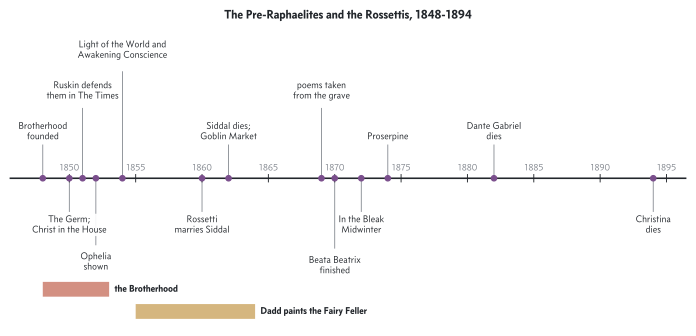
Then help came from the most powerful critic in England. John Ruskin, born in 1819, was the author of Modern Painters, a huge book in defense of the painter J. M. W. Turner (Vol. 15, The Age of Revolution); Chapter 13 tells the rest of his story. In that book Ruskin had told young artists to go to nature, “rejecting nothing, selecting nothing, and scorning nothing.” The Pre-Raphaelites seemed to be doing just that. In May 1851 Ruskin wrote two long letters to The Times, the most important newspaper in Britain, defending them. Their pictures, he said, were truer to nature than anything painted since the old masters. The attacks did not stop, but buyers began to come back.
The Brotherhood did not outlive its success by long. Collinson resigned in 1850. In 1852 Woolner sailed to Australia to dig for gold; he found almost none and was back in England by 1854. In November 1853 Millais was elected an Associate of the Royal Academy, the first step to full membership, which meant he had joined the very institution the Brothers had set out to defy. Rossetti wrote to his sister, quoting Tennyson’s poem about the death of King Arthur, “So now the whole Round Table is dissolved.” Early in 1854 Hunt left for the Holy Land. The seven young men had been a Brotherhood for about five years. Their name would last much longer, because “Pre-Raphaelite” came to stand for a whole look in English art, and a second generation of painters carried it to the end of the century.
Millais and Hunt
The two most gifted painters of the Brotherhood worked side by side for several years. They shared models, painted in the same fields, and read each other’s pictures as closely as scholars read a text. Yet their careers ran in opposite directions. Millais became the most successful painter in England. Hunt became a kind of prophet, painting a few enormous religious pictures and explaining them at length to anyone who would listen.
The carpenter’s shop
In 1850 Millais showed a painting at the Royal Academy that set off the loudest quarrel of the decade. Millais painted Christ in the House of His ParentsThis artist painted Christ in the House of His Parents. → John Everett Millais•• in 1849 and 1850. Its subject came from the Bible, but from a part that the Bible leaves out: the childhood of Jesus in Nazareth, where Joseph, his earthly father, worked as a carpenter. Millais imagined an ordinary afternoon in the workshop, and he worked partly from a real carpenter’s shop so that every tool and plank would be right.

Look at the picture (Figure 6.5). It shows a plain workshop with a heavy bench in the middle and a floor littered with curling wood shavings, and in the center of it the child Jesus shows his wounded handThe child Jesus shows his injured hand to Mary amid carpenters and wood shavings in this painting. → Christ in the House of His Parents•• to his mother. He has cut his palm on a nail sticking out of the door that Joseph is making on the workbench. Mary kneels, offering her cheek for a kiss. Joseph, a bald, sinewy working man, takes hold of the hand to look at the cut. Behind them Mary’s mother, Anne, reaches with pincers to pull out the nail, and an apprentice leans on the bench. On the right, the boy’s young cousin John, who will grow up to be John the Baptist, carries in a bowl of water to wash the wound.
Every detail is a symbol. The wound in the palm, with a drop of blood fallen onto the foot, looks ahead to the nails of the Crucifixion. John’s bowl of water looks ahead to the day he will baptize Jesus in the River Jordan. A white dove, the usual sign of the Holy Spirit, God’s presence in the world in Christian belief, sits on a ladder against the wall. Through the doorway a flock of sheep waits in its fold, as the Christians of the future would be Christ’s flock. Millais had packed a whole sermon into a workshop, and he had painted every shaving and every vein of every foot.
It was the feet that caused the trouble, and the faces. Victorians expected the Holy Family (Jesus, Mary, and Joseph) to look noble, graceful, and clean, as Raphael had painted them. Millais gave them the bony bodies, red hands, and dirty toenails of real working people. The most famous attack came from Charles Dickens, the best-loved novelist in Britain (Chapter 2), in his weekly magazine Household Words on June 15, 1850. Dickens attacked the painting’s Holy FamilyCharles Dickens attacked this painting’s portrayal of the Holy Family as undignified. → Christ in the House of His Parents•• as mean and ugly. He called the boy Jesus a “wry-necked, blubbering, red-headed boy, in a bed-gown,” and he said that Mary was so hideous that she would stand out as a monster even in the lowest gin shop in England. Other critics were nearly as cruel. Queen Victoria, curious about the fuss, had the picture brought to Buckingham Palace so that she could look at it in private.
The scandal did the Brotherhood no lasting harm. Everybody now knew its name, and everybody had an opinion about it. The quarrel also showed what the Pre-Raphaelites had changed. Before 1850 a sacred picture was supposed to lift the viewer above ordinary life. Millais insisted that the sacred had happened in ordinary life, among nails and sawdust.
Ophelia
Millais’s next great picture came from Shakespeare. In Hamlet (Vol. 11, The Age of Shakespeare), Prince Hamlet of Denmark loves a young woman named Ophelia, the daughter of the king’s chief adviser, Polonius. Hamlet turns on her cruelly, and then he kills her father by mistake. Ophelia goes mad with grief. She wanders through the court singing scraps of songs and handing out flowers, and soon afterward she drowns. The audience never sees her death. The queen describes it instead: Ophelia climbed a willow tree over a brook to hang garlands of wildflowers on its branches; a branch broke, and she fell into the water. Her clothes spread out around her, and “mermaid-like awhile they bore her up” while she went on singing, until they grew heavy with water and pulled her under.

Millais painted OpheliaThis artist painted Ophelia. → John Everett Millais••• in two stages. In the summer and autumn of 1851 he set up his easel on the bank of the Hogsmill River, a small stream near Ewell (yoo-ul) in Surrey, about a dozen miles southwest of London. He worked there for up to eleven hours a day, six days a week, for about five months. He complained in letters that the flies of Surrey were more muscular than London flies, that a farmer threatened to take him to court for trampling the hay, and that the wind kept trying to blow him into the river. When the weather turned cold in November, he built himself a little hut of hurdles and straw to paint in. At one point he painted a water vole swimming in the stream; when he showed the unfinished canvas to Hunt’s uncle, the old man guessed it was a hare, then a rabbit, and Millais painted it out.
The finished picture is one of the most famous paintings in Britain (Figure 6.6). A young woman floats on her backA woman floats on her back in a flower-filled stream, illustrating a drowning from Hamlet, in this painting. → Ophelia (Millais)••• in a quiet stream, her mouth open in song and her hands lifted, among the flowers she has dropped. Her embroidered dress spreads out around her on the water, just as Shakespeare’s queen describes. The willow leans over her, and nettles and wild roses crowd the bank. The flowers on the water each carry a meaning in the Victorian “language of flowers”: pansies for love in vain, daisies for innocence, a chain of violets around her neck for faithfulness and early death. The background is so exact that botanists can name almost every plant in it. Because Millais went on adding flowers over many months, some that never bloom at the same time appear side by side, so the picture holds more than one season in a single instant.
The woman in the water was Elizabeth Siddal (sid-ul). She was born in London in 1829, the daughter of a cutler, a maker of knives and tools, and she grew up in Southwark, on the poorer south bank of the Thames. In 1849 she was working in a milliner’s shop, a shop that made and sold women’s hats, near Leicester Square. That year she met a young painter named Walter Deverell (dev-er-ul), a friend of the Brotherhood (the stories of how they met differ), and he asked her to model. She was tall and pale, with heavy copper-red hair, and the Brothers thought she looked as if she had stepped out of a medieval manuscript. When Millais needed a drowning girl, Siddal became Millais’s model for Ophelia,Elizabeth Siddal was the model for John Everett Millais's painting of this character. → Ophelia• the Danish girl of the play.
The posing was an ordeal. In the winter of 1851–52, in his studio in Gower Street, Millais had Siddal lie fully dressed in a bathtub full of water for hours at a time, so that he could see how a floating dress really looked. To keep her warm he set oil lamps under the tub. One day the lamps went out. Millais, lost in his work, did not notice, and Siddal did not complain, and the water turned icy. She fell ill after posing in the bath,Elizabeth Siddal became ill after posing in a bathtub for this painting. → Ophelia (Millais)••• with a bad cold that some accounts call pneumonia. Her father threatened to sue Millais for fifty pounds to cover her doctor’s bills, and in the end Millais paid him a smaller sum. Siddal’s health, never good, seems only to have grown worse in the years that followed.
When Ophelia was shown at the Royal Academy in 1852, The Times jeered that it made one think of “a dairymaid in a frolic.” It did not matter. A dealer had already bought the picture for 300 guineas before it was even finished. (A guinea was a pound and a shilling, the unit in which gentlemen paid for fine things.) Millais’s life changed soon afterward. In the summer of 1853 he traveled to Scotland with Ruskin and Ruskin’s young wife, Effie Gray, and he and Effie fell in love. Her marriage to Ruskin was annulled, that is, declared by a church court never to have been a true marriage, and in 1855 she married Millais. They had eight children. Millais turned to painting popular portraits and sweet scenes of childhood; one picture of his grandson blowing soap bubbles, called Bubbles, was used in advertisements for Pears soap. He became a baronet, a hereditary title just below a lord, and in 1896, a few months before he died, he was elected President of the Royal Academy. The rebel of 1848 ended as the head of the institution he had rebelled against.
Holman Hunt

Hunt worked more slowly than Millais and more painfully. He believed that a painter of the Bible should see the Bible’s lands, and in 1854 he sailed for Palestine, then a province of the Ottoman Empire. On the salt shore of the Dead Sea, in wild country where travelers feared bandits, he painted The Scapegoat, a single goat dying in the desert. In the Book of Leviticus, the priests of ancient Israel laid the sins of the people on a goat once a year and drove it into the wilderness, and Christians saw in it a picture of Christ, who carried the sins of the world. Hunt went back to the Holy Land again and again over the next forty years. He grew a great red beard, quarreled with almost everybody, and in 1905 wrote a two-volume history of the movement that gave himself the leading part. When he died in 1910 his ashes were buried in St. Paul’s Cathedral, the great domed church of London.
His most famous picture was begun in 1851, in the same corner of Surrey where Millais was painting Ophelia. Hunt painted The Light of the WorldThis artist painted The Light of the World. → William Holman Hunt• at night, in an orchard, by the light of the moon and a lantern, so that he could see how moonlight and lamplight really fall on figures and leaves. He took his subject from a verse in the last book of the Bible, the Book of Revelation: “Behold, I stand at the door, and knock.” The verse goes on to say that whoever hears the knock and opens the door will be joined by Christ.

So the picture shows a door (Figure 6.8). Christ carries a lantern and knocksChrist carries a lantern and knocks on an overgrown door with no external handle in this painting. → The Light of the World•• on a little wooden door at night. He wears a crown of thorns, the sign of his suffering, twined with a golden royal crown. The door is overgrown with ivy, nettles, and brambles, and dead leaves have piled up against it. At the lower right lie a few fallen apples, a reminder of the fruit that Adam and Eve ate in Eden. Hunt explained the one detail that most viewers miss: the door has no handle on the outside. It stands for the human soul, which can be opened only from within. Christ can knock, but the person inside must choose to let him in. Hunt used several sitters for the head, and one of them, by his own later account, was Christina Rossetti.
The Light of the World was shown in 1854. At first critics were puzzled, until Ruskin wrote another letter to The Times explaining its symbols. Then it became perhaps the best-loved religious picture of the Victorian age. Cheap prints of it hung in schools, nurseries, and parish halls across the empire. Late in life Hunt painted a larger copy, which toured Canada, Australia, New Zealand, and South Africa between 1905 and 1907 before it was hung in St. Paul’s Cathedral, where it still is.
Hunt showed a second picture beside it in 1854, and he meant the two as a pair. Hunt painted The Awakening ConscienceThis artist painted The Awakening Conscience. → William Holman Hunt•• in 1853, and its setting is the very opposite of the night orchard. It is a gaudy new parlor in a London suburb, crammed with polished furniture, bright carpet, and gilt. A young man in a dark coat lounges at an upright piano, singing. A young woman has been sitting on his knee. Hunt said that the idea had come to him from Dickens’s novel David Copperfield, in which an old fisherman searches London for his niece, who has run off with a rich young man.

The title tells us what is happening (Figure 6.9). The woman is not the man’s wife but his mistress, a woman he pays to live in this rented house as his lover without marrying her. In Victorian Britain such a woman had already lost her good name, and most people believed she was on the road to ruin. In the painting, a mistress rises from her lover’s lap.A mistress rises from her lover’s lap in this painting. → The Awakening Conscience•• The song the man is playing has reminded her of her childhood and the home she has lost, and in that moment her conscience wakes. She stares past him toward the window. In the mirror behind her we see what she sees: a garden full of spring sunlight, the world outside, the chance of a new life.
Hunt filled the room with signs, and Ruskin, in yet another letter to The Times, said that every object in it was tragic once it was read correctly. The woman wears rings on every finger except the one where a wedding ring belongs. A clock ticks away the hours under a glass dome, and a skein of yarn lies tangled on the floor, like the web in which she is caught. A glove the man has dropped lies on the carpet, the way such men drop women when they are tired of them. Beneath the table, a cat plays with a birdA cat plays with a bird beneath a table in this painting. → The Awakening Conscience•• it has caught, toying with it before the kill, just as the man has toyed with the woman. The music on the piano is a song by Thomas Moore, “Oft in the Stilly Night,” about memories of happier days. The first buyer found the woman’s agonized face too painful to live with, and Hunt later repainted it to make it gentler.
Hunt’s third great picture of these years seems at first to be a simple country scene. A young shepherd has left his sheep to flirt with a red-haired farm girl under the willows. He has caught a death’s-head moth, a big moth with a skull-like mark on its back, and he is showing it to her. She looks back at us knowingly, while a lamb on her lap eats green apples that will make it sick. Behind them the sheep are straying toward a field of wheat, where a bellyful of grain can swell their stomachs and kill them. Hunt painted The Hireling ShepherdThis artist painted The Hireling Shepherd. → William Holman Hunt• in 1851 on the same Surrey fields as The Light of the World, and showed it in 1852.

A hireling is a man who works only for his wages. The title comes from a saying of Jesus in the Gospel of John: the good shepherd gives his life for his sheep, but the hired man, who does not own them, runs away when the wolf comes. Hunt later wrote that the shepherd stood for the clergymen of his day, who wasted their time on quarrels about doctrine while their flocks went astray (Figure 6.10). Most viewers in 1852 saw only two red-faced peasants, and one magazine sneered that they had been drinking cider. Like all of Hunt’s work, the picture asks to be read slowly, detail by detail, as a story with a moral.
Dante Gabriel Rossetti
Rossetti never went to the Holy Land, and he hardly ever painted outdoors. His country was the Middle Ages of Dante’s poems. Dante Alighieri (1265–1321), the poet of Florence, wrote the Divine Comedy, a long poem about a journey through Hell, Purgatory, and Paradise (Vol. 9, Cathedrals and Crusades). As a boy of nine, Dante had seen a girl named Beatrice Portinari (bay-ah-tree-chay por-tee-nah-ree) and loved her from afar for the rest of his life. She married another man and died young, in 1290. Dante wrote a little book of poems and prose about his love and her death, the Vita Nuova (vee-tah nwoh-vah), or “New Life,” and in the Divine Comedy Beatrice comes down from Heaven to guide him through Paradise. Rossetti translated the Vita Nuova into English and published it in 1861. He came to see his own life as a version of Dante’s.
His Beatrice was Elizabeth Siddal. By 1852 Rossetti would not let her model for anyone else. He taught her to paint, and Ruskin, who admired her drawings, paid her an allowance of 150 pounds a year for her work. Rossetti drew her over and over, sewing, reading, sleeping, or just sitting in a chair, in hundreds of sketches. His sister Christina, watching all this, wrote a sonnet called “In an Artist’s Studio,” which begins with the line “One face looks out from all his canvases.” Siddal was the woman the Pre-Raphaelites drew most. She had been Deverell’s model first, then Hunt’s and Millais’s, and finally Rossetti’s alone. Siddal was the Brotherhood’s most frequent model,Elizabeth Siddal was a frequent model for works in this movement. → Pre-Raphaelite Brotherhood•• and her long neck and heavy hair became the movement’s idea of beauty.
She was not only a model. Siddal drew and painted pictures of her own, on subjects from Tennyson, the old Scottish ballads, and the legends of King Arthur, in a stiff, haunting style that looks back to medieval manuscripts. She also wrote poems, mostly about love that fails, which were not printed until long after her death. In 1857 she was the only woman whose work hung in a small exhibition of Pre-Raphaelite art in London. Her family name was really spelled Siddall, with two l’s at the end, and it was Rossetti who persuaded her to drop the second one.

Their love affair was long and unhappy. Rossetti’s family thought a hat-shop girl beneath them, and Rossetti himself kept putting off the wedding. Siddal was often ill, and to dull her pain she took laudanum, a medicine made of opium dissolved in alcohol. Any druggist sold it, and Victorians gave it for everything from toothache to sleeplessness, but it was highly addictive, and too much of it could kill. At last, in May 1860, when she seemed to be dying, Rossetti married her at Hastings, on the south coast. In 1861 their daughter was born dead. On the night of February 10, 1862, Siddal swallowed a huge dose of laudanum at their rooms near Blackfriars Bridge, in London, and she died the next morning. The coroner, the official who investigates sudden deaths, called it an accident. There were rumors that she had left a note.
Rossetti, overcome with grief and guilt, placed a notebook holding the only copies of many of his poems in her coffin, beside her face, and she was buried in the family grave at Highgate Cemetery, on a hill in north London. Seven years later he wanted the poems back. In October 1869 his agent, a smooth talker named Charles Augustus Howell, had the coffin dug up at night and the notebook taken out. Rossetti published the poems the next year. Howell told everyone afterward that Siddal’s body was perfectly preserved and that her red-gold hair had gone on growing until it filled the coffin. Hair does not grow after death, and Howell was famous for his tall tales, but the story has been repeated ever since.

In the years after Siddal’s death Rossetti painted Beata Beatrix,This artist painted Beata Beatrix. → Dante Gabriel Rossetti•• a memorial to her, using his old drawings of her face. The Latin title (bay-ah-tah bay-ah-triks) means “Blessed Beatrice.” The painting shows Dante’s Beatrice at the moment of her death, but not as a death scene. Rossetti said he meant it as a trance, a sudden passage of the soul from earth to heaven. A red dove brings a white poppyA red dove brings a white poppy toward a woman in a trance in this painting. → Beata Beatrix•• toward a woman whose eyes are shut and whose face is lifted toward the light. The dove is a messenger of love. The poppy is the flower of sleep and death, and it is also the plant from which opium is made, so the picture quietly remembers how Siddal died. A sundial marks the hour, and the city of Florence glows behind her (Figure 6.12).
Rossetti’s later women were mostly painted from another model, Jane Morris, the dark-haired wife of his friend and business partner William Morris (Chapter 13). Rossetti was in love with her. His best-known picture of her shows a goddess from Roman myth (Vol. 4, Classical Myth). Proserpine (pross-er-pine), whom the Greeks called Persephone (per-sef-uh-nee), was the daughter of Ceres, goddess of the harvest. Pluto, king of the underworld, carried her off to be his queen. Ceres in her grief let the crops wither, and at last the gods agreed that Proserpine could come home, but only if she had eaten nothing in the land of the dead. She had eaten a few seeds of a pomegranate. So she had to spend part of every year below the earth, and while she is gone the world has winter.

Rossetti’s Proserpine holds a bitten pomegranate,This artist’s Proserpine shows a blue-robed woman holding a bitten pomegranate. → Dante Gabriel Rossetti•• the fruit that binds her to the underworld. She walks along a gloomy corridor of Pluto’s palace in a long dark-blue robe, and she glances aside at a patch of light that has fallen on the wall from the world above (Figure 6.13). Beside her an incense burner smokes, the sign of a goddess. Rossetti painted at least eight versions between 1871 and his death, and wrote a sonnet to go with it, in Italian and in English. The picture fits Rossetti’s own situation: Jane Morris, like Proserpine, divided her year between two men.
Rossetti’s last years were sad. He lived in a big old house on Cheyne (chay-nee) Walk, in Chelsea, by the Thames, where he kept a private zoo that included peacocks, an armadillo, and two wombats. He could not sleep without chloral, a powerful sleeping drug, which he washed down with whisky. A critic’s attack on his poems in 1871, which accused him of belonging to a “fleshly school” of poetry, too fond of the body and its pleasures, convinced him that the world was plotting against him. He died in April 1882 at the seaside village of Birchington, in Kent, at the age of fifty-three. His dreamy women with long necks and heavy, flowing hair became, for most people, what “Pre-Raphaelite” means. They are a long way from the sharp-focus truth to nature of 1848.
Richard Dadd and Louis Wain
While the Brothers were quarreling with the critics, the most careful painter in London was locked inside a madhouse. Richard Dadd was born in 1817 at Chatham, in Kent, the son of a druggist. He was a gifted student at the Royal Academy Schools and the most talented member of a group of young painters called “the Clique,” and he made his name with pictures of fairies. Fairies were a Victorian craze. Theaters staged Shakespeare’s fairy plays with flying wires and gauze wings, and painters filled the Royal Academy’s walls with sprites dancing in moonlit glades. Dadd’s Come unto These Yellow Sands (1842), from Shakespeare’s The Tempest, showed a ring of tiny naked spirits dancing on a beach under a towering arch of rock, and the critics praised it warmly. In 1842 a rich traveler, Sir Thomas Phillips, hired him as a draftsman for a long tour through Greece, Turkey, Syria, Palestine, and Egypt. On a boat on the Nile, Dadd began to change. He became violent and suspicious, and he came to believe that he was receiving orders from Osiris (oh-sy-riss), the ancient Egyptian god of the dead.
He came home in the spring of 1843, and his family took him to rest in the village of Cobham, in Kent. In August he became convinced that his father was the Devil in disguise. He killed him with a knife in Cobham Park and fled to France, where he tried to cut the throat of a fellow traveler with a razor and was arrested. He confessed to the murder. Doctors today think he probably had schizophrenia, a serious mental illness that can fill a person’s mind with voices and false beliefs; two of his brothers and sisters had the same illness. He was judged insane, which meant that he would not be tried and punished as a criminal, and in 1844 he was sent to Bethlem (beth-lum) Hospital in London. He never lived outside an asylum again.

Bethlem’s doctors encouraged him to paint, and the steward of the hospital, George Henry Haydon, who managed its daily business, asked him for a fairy picture of his own. Dadd worked on it from 1855 to 1864. It is small, only about 21 inches high and 15 inches wide. Yet it is so dense with detail that a viewer can study it for an hour and still find new faces. Over those nine years Dadd painted The Fairy Feller’s Master-StrokeThis artist painted The Fairy Feller’s Master-Stroke. → Richard Dadd• in thin layers, one on top of another, until the figures seem to stand out from the canvas. A feller is a woodcutter, a man who fells trees, and a master-stroke is a single perfect blow.

The scene is a patch of ground seen at the height of a mouse, among tall stalks of grass and daisies as big as dinner plates (Figure 6.15). Tiny onlookers watch a fairy woodcutterTiny onlookers watch a figure prepare to split a nut with an axe in this painting. → The Fairy Feller’s Master-Stroke• raise his axe to split a hazelnut. A white-bearded old man in a crown signals that the moment has come. Around them crowd dozens of little people: fairy ladies, a soldier, a sailor, a tinker, a tailor, a pair of lovers, and, near the top, the fairy king and queen, Oberon and Titania, from Shakespeare’s A Midsummer Night’s Dream. Dadd later wrote a long poem naming every figure and explaining its part. He thought the painting unfinished, and one corner is still only sketched in. Over a century later it inspired a song of the same name by the rock band Queen.
Bethlem, the hospital where Dadd painted it, had a long history. It was founded in 1247 as the Priory of St. Mary of Bethlehem, a small religious house just outside the walls of the City of London, and by the 1400s it was keeping people who had lost their reason. Londoners shortened “Bethlehem” to “Bethlem” and then to “Bedlam,” and the nickname became an English word for any scene of uproar and confusion. In the 1600s and 1700s the hospital let in paying visitors, who strolled the galleries and stared at the patients as if at a show; the painter William Hogarth set the last scene of his series A Rake’s Progress there (Vol. 12, Crown and Parliament). A rake is a young man who wastes his fortune on pleasure, and Hogarth’s rake ends his story chained and raving in Bedlam.

An asylum first meant simply a place of refuge. By Dadd’s time it meant a hospital where people with mental illness were kept, partly to treat them and partly to keep them away from everybody else. Bedlam was Britain’s oldest and most famous asylum,Bedlam is a British example of these places. → mental asylums• and in 1815 it moved into a grand new building at St. George’s Fields, in Southwark (Figure 6.16). That same year a committee of Parliament heard shocking evidence of patients chained to walls for years. Reformers pushed for better care, and in 1845 two acts of Parliament made every county in England and Wales build a public asylum and set up a national board of inspectors, the Commissioners in Lunacy (“lunacy” was the old legal word for madness).
The reformers’ model was the York Retreat, founded in 1796 by a Quaker merchant named William Tuke, where patients were treated more like guests than prisoners. They worked in the gardens, ate together at a common table, and were calmed by kindness and routine rather than chains. That idea, called moral treatment, shaped the big Victorian county asylums, which were built in the countryside with their own farms, workshops, chapels, and even ballrooms. But they filled up faster than they could be built, and many turned into overcrowded warehouses for the poor. In 1864 Dadd and the other “criminal lunatics” at Bethlem were moved to Broadmoor, a new high-security asylum in Berkshire. He died there in January 1886.
The period’s other painter of madness was famous for cats. Louis Wain was born in London in 1860. In 1884 he married his sisters’ governess, Emily Richardson, and soon afterward she fell ill with cancer. To cheer her up he drew pictures of their black-and-white kitten, Peter. She died in 1887, but by then the cats had made him famous. For the Christmas issue of the Illustrated London News in 1886 he drew A Kitten’s Christmas Party, with 150 cats celebrating, and from then on he drew cats for the rest of his life. His cats walked on their hind legs, wore clothes, played golf, went to school, and threw tea parties, with huge round eyes and cheerful grins. The novelist H. G. Wells, whom Chapter 23 describes, said that Wain had made the cat his own: he invented a cat style, a cat society, and a whole cat world.


Wain was a poor businessman, and he supported his mother and five unmarried sisters, so he never became rich. In 1914 he was badly hurt in a fall from a bus. His behavior grew stranger, and in 1924 his sisters had him certified insane, which meant that doctors signed papers allowing him to be locked up for treatment. He spent his last fifteen years in asylums, including Bethlem, still drawing cats. Some of the cats he drew in these years blaze with jagged, glowing patterns, like a kaleidoscope. In 1939 a psychiatrist named Walter Maclay arranged a set of Wain’s paintings in order, from an ordinary cat to a pattern in which the cat has nearly vanished, and claimed that they showed schizophrenia slowly destroying the painter’s mind (Figure 6.17). For decades Wain’s cats were a textbook caseIt is disputed whether Louis Wain's paintings of these animals depict the onset of schizophrenia. → cats• of the illness in psychology books. Many experts now dispute that reading. The paintings are not dated, Wain went on drawing ordinary cats while he made the patterned ones, and some doctors doubt that he had schizophrenia at all. The kaleidoscope cats may be decorative experiments, not symptoms.
The Rossetti family
The Rossettis were a household of poets. Their father, Gabriele (gah-bree-el-ay) Rossetti, was born in 1783 in the little town of Vasto, in the Kingdom of Naples, in southern Italy. He wrote patriotic poems and supported the revolution of 1820, which forced the king to grant a constitution, a written set of laws limiting his power. In 1821 the king took the constitution back and began arresting its friends. Gabriele escaped to the island of Malta, and in 1824 a British admiral helped him reach London. In 1831 he became Professor of Italian at King’s College London. He spent the rest of his life writing about Dante, arguing that the Divine Comedy hid a secret code aimed at the popes.

In 1826 Gabriele married Frances Polidori (pol-ih-dor-ee), the daughter of an Italian scholar who had settled in London. Her brother, John Polidori, had been the doctor of the poet Lord Byron (Vol. 15, The Age of Revolution) and had written one of the first vampire stories in English. The couple had four children in four years: Maria in 1827, Gabriel in 1828, William in 1829, and Christina in 1830. Their small, crowded house in Charlotte Street, near Regent’s Park, was always full of Italian exiles shouting about politics. The children spoke Italian and English, read Dante, Shakespeare, and the Bible, and wrote their own family magazine. All four became writers, and three of them appear in a photograph taken in 1863 (Figure 6.18). The best known, the second child, Dante Gabriel,This family included Dante Gabriel. → Rossetti•• became a painter as well, but he always said that poetry mattered to him more.
The eldest, Maria Francesca, worked for years as a governess to help pay the bills. In 1871 she published A Shadow of Dante, a guide to the Divine Comedy for ordinary readers, and soon afterward she became a nun in a sisterhood of the Church of England. She died in 1876.
The third child, William Michael,This family included William Michael. → Rossetti• was the family’s steady earner. At fifteen he went to work as a clerk in the Excise Office, which collected taxes on goods, and he stayed in the government’s tax service for nearly fifty years, paying many of the family’s bills. In his spare time he was the Brotherhood’s secretary, the editor of The Germ, and an art critic for newspapers. He edited the poems of Shelley and introduced the American poet Walt Whitman to British readers (Vol. 30, Whitman to Wharton). He married Lucy, the daughter of Ford Madox Brown. Long after the others had died, he edited his brother’s and sister’s works and wrote memoirs of them all. Much of what we know about the Pre-Raphaelites, we know because William Michael kept the papers.
Dante Gabriel’s best-known poem was written when he was about eighteen, and it was printed in The Germ. “The Blessed Damozel” uses an old word for a young unmarried woman. The damozel has died and gone to Heaven, but she cannot be happy there, because her lover is still alive on earth. She leans out over “the gold bar of Heaven,” holding three lilies, with seven stars in her hair, and she imagines the day when he will join her. Then she weeps. Rossetti later painted the scene as well. His later poems were collected in 1870 and 1881, and the best of them are sonnets. He gathered more than 100 into a sequence called The House of Life, about love, loss, and death, and he wrote a sonnet to go with many of his own pictures, sometimes lettering the words onto the frame. A decade later his sister Christina wrote Goblin Market, the great poem of the 1860s, so the circle’s two best-known poems came from one family: the brother and sister Rossetti.The poet who wrote The Blessed Damozel and his sister, the author of Goblin Market, shared this surname. → Rossetti••
Dante Gabriel was also a superb translator. He put Dante and the poets of Dante’s circle into English, and in his Poems of 1870 he included a version of a poem by François Villon (frahn-swah vee-yohn), the most famous French poet of the late Middle Ages. Villon was born in Paris in 1431 and studied at its university, but he lived among thieves. In 1455 he killed a priest in a street fight, and the next year he helped rob a college of its money. He was jailed several times. In January 1463 a sentence of hanging was changed to banishment from Paris, and after that he disappears from history.
His longest work, The Testament, is a mock will in verse, in which a poor and hunted man leaves his few belongings, and his opinions, to his friends and enemies. Inside it is a ballade, a French verse form in which three stanzas and a short closing stanza all end with the same line, the refrain. Villon’s ballade asks where the famous women of the past have gone. It names Héloïse (ay-loh-eez), the brilliant pupil of the philosopher Abelard, and the queens of old France. It names Joan of Arc, the good maid of Lorraine, whom the English burned at Rouen in 1431, the year of Villon’s birth. Each stanza ends with the question “Mais où sont les neiges d’antan?” which means “But where are last year’s snows?”
Rossetti’s version of Villon’s ballad,Dante Gabriel Rossetti's translation of this poet's 'The Ballad of Dead Ladies' contains the line 'But where are the snows of yester-year?' → François Villon• called “The Ballad of Dead Ladies,” gave the refrain a famous English form: “But where are the snows of yester-year?” Rossetti needed a word for Villon’s antan (ahn-tahn), “last year,” with the right weight and sound. He chose yesteryear, a word almost nobody had used before, and his translation made it part of everyday English. The line has been quoted ever since whenever a writer wants to say that everything beautiful melts away.
Christina Rossetti and Goblin Market
The youngest Rossetti was born on December 5, 1830. Christina was Dante Gabriel’s younger sister,This poet was the sister of Pre-Raphaelite writer Dante Gabriel. → Christina Rossetti• and as a small child she was the stormiest of the four: once, scolded by her mother, she cut her own arm with a pair of scissors. At fourteen she suffered a breakdown, and she was ill, on and off, for the rest of her life. In those same years she, her mother, and Maria were drawn into the Anglo-Catholic movement, a group inside the Church of England that wanted to bring back the older, Catholic forms of worship, with candles, confession, and frequent communion. Religion became the center of her life. The quick-tempered girl grew into a quiet, watchful woman who wore plain dark dresses and wrote poems almost every day.
Her grandfather Polidori printed a little book of her poems on his own press in 1847, when she was sixteen. The next year two of her poems appeared in a London magazine, the Athenaeum, and in 1850 more followed in The Germ. She posed for her brother as the Virgin Mary. More than one man asked to marry her, and she never did. She broke off her engagement to James Collinson of the Brotherhood in 1850, when he returned to the Roman Catholic Church. Years later she refused Charles Cayley, a gentle scholar who had translated Dante, because he did not share her faith. From 1859 to 1870 she worked as a volunteer at a penitentiary in Highgate. The word then meant a place for penitents, people sorry for their sins. This one was a home run by the Church of England that took in “fallen women,” women who had been prostitutes or had lost their good name, and helped them start again.
In some ways Christina was the truest Pre-Raphaelite of them all. Her poems have the Brotherhood’s exact detail and clear, bright colors, and its seriousness about faith and death. But she watched her brother’s circle with a cool eye. In her sonnet about Dante Gabriel’s studio, the painter feeds on his model’s face, and every canvas shows her “Not as she is, but as she fills his dream.” She preferred, in her own work, to see things as they were.
In April 1859, just before she began her work at Highgate, she wrote a long poem about two sisters and a band of goblins. Christina Rossetti wrote Goblin MarketThis poet wrote Goblin Market. → Christina Rossetti••• for no particular audience and kept it in a notebook for three years. In 1862 the publisher Macmillan brought it out as the title poem of her first real book, Goblin Market and Other Poems, with two woodcut pictures by Dante Gabriel. She was thirty-one. The book made her name at once, and Tennyson, the poet Algernon Swinburne, and the young Gerard Manley Hopkins (Chapter 14) all admired it.
The poem begins with a sound. At morning and at evening, in the glen, a narrow wooded valley with a brook running through it, the goblins cry, “Come buy, come buy”In this poem, the title creatures cry "Come buy our orchard fruits, / Come buy, come buy." → Goblin Market••• to anyone who will listen. They call out their fruit like street sellers in a London market: apples and quinces, melons and raspberries, peaches and mulberries, nearly thirty kinds. All are ripe at once, though in nature they would ripen in different seasons and different countries. The lines are short and jumpy, two or three beats each, and the rhymes come in bunches. Read aloud, the list sounds like a crowd of voices all shouting at once.
Two sisters, Laura and Lizzie, live alone in a cottage and fetch water from the brook every evening. At twilight they crouch among the rushes and listen. Laura, curious, lifts her golden head and peeps. She tells her sister that they must not look at goblin men or buy their fruits, and then she adds a warning. Nobody knows “upon what soil they fed”In this poem, one character warns that nobody knows "upon what soil they fed their hungry thirsty roots." → Goblin Market• the fruit’s “hungry thirsty roots.” It is Laura who gives the warning, and it is Laura who forgets it. Lizzie puts her fingers in her ears, shuts her eyes, and runs home. Laura stays to watch.
The goblin merchants come trooping down the glen. Each is part animal: one has a cat’s face, one a tail, one walks like a rat, one crawls like a snail, and one prowls like a wombat, a furry burrowing animal from Australia. They set down their baskets and plates of fruit, and they wink at her and coax her. Laura wants the fruit badly, but she has no money: no copper and no silver in her purse. The goblins have an answer. Her hair is golden, they say, so she can pay with that. Laura pays with a “golden curl,”In this poem, one character pays for fruit with a "golden curl" of her hair, having no money. → Goblin Market•• cut from her own head with a tear, and then she eats. She sucks the fruit until her lips are sore, throws away the empty rinds, and walks home in a daze, carrying one stone from the fruit to plant.

Lizzie is waiting for her at the gate, and she is angry. Twilight is no time for girls to linger in the glen, she says. Does Laura not remember Jeanie? Jeanie met the goblins in the moonlight, took their gifts, ate their fruits, and wore their flowers. Afterward she could never find them again. Jeanie “pined and pined away,”In this poem, no grass grows on the grave of Jeanie, who "pined and pined away." → Goblin Market•• grew gray, and died at the time of the first snow. To this day no grass will grow on her grave, and the daisies that Lizzie planted there a year ago have never bloomed. Laura tells her sister to hush, and promises to bring her fruit tomorrow.
That night the sisters sleep together in their curtained bed, and the poem stops to look at them. They lie “like two pigeons in one nest,”In this poem, two characters are described as "like two pigeons in one nest / Folded in each other's wings." → Goblin Market• folded in each other’s wings, like two blossoms on one stem, like two flakes of newly fallen snow. These pictures of closeness are the heart of the poem. Whatever happens to one sister will happen to the other.
The next evening the sisters go down to the brook again. Lizzie hears the goblins crying their wares as usual. Laura listens and hears nothing. Only a girl who has never tasted the fruit can hear the goblin cry, so Laura has lost the one thing she wants. She falls silent and stops eating. Her golden hair grows thin and gray, and she plants the fruit stone she saved, but nothing grows. She stops sweeping and cooking and sits by the fire. At last she seems to be “knocking at Death’s door,” wasting away exactly as Jeanie did.
Lizzie decides to go to the goblins herself and buy fruit to save her sister. She puts a silver penny in her purse and goes down to the brook at dusk, and the goblins come running to meet her, “cat-like and rat-like”The title creatures of this poem are described as "Cat-like and rat-like." → Goblin Market•• as the poem now calls them, hugging and kissing her and holding up their fruit. Lizzie offers her penny and asks to buy fruit to carry home. The goblins refuse. She must sit down and feast with them, they say, and eat the fruit right there. Lizzie will not eat. If they will not sell her any fruit to take home, she tells them, they should give back the penny.
At that the merchants turn ugly. They grunt and snarl and crowd around her, a mob of animals with the manners of men. They call her proud and rude, and they elbow and jostle her. They tear her dress and pull her hair, and they hold her hands and press fruit against her mouth to make her eat. Lizzie lets the goblins beat her,In this poem, Lizzie lets the title creatures beat her to save her sister Laura. → Goblin Market•• scratch her, pinch her black and blue, kick her, and mock her, and she never utters a word, because if she opened her lips they would cram the fruit in. She stands, the poem says, like a lily in a flood, like a rock lashed by the tide, like a beacon fire left alone in a roaring sea.
The narrator comments with an old country proverb. “One may lead a horse to water,”This poem contains the line "One may lead a horse to water,/ Twenty cannot make him drink." → Goblin Market•• the saying goes, but twenty men cannot make him drink. All the goblins together cannot make Lizzie eat. Instead the juice runs down her face and her neck, and she laughs inside to feel it. At last the goblins give up. Worn out by her stubbornness, they fling back her silver penny,In this poem, one character has her penny returned after the merchants refuse to let her take food home. → Goblin Market• as she demanded, kick their fruit about, and vanish, some into the earth and some into the brook.
Lizzie runs home through the dark with her penny jingling in her purse. “Laura,” she calls, “did you miss me? Come and kiss me.” She tells her sister to eat and drink the juice that the goblins squeezed onto her, “Eat me, drink me, love me.” Laura kisses her, but the juice that had tasted like honey is now as bitter as wormwood, a plant famous for its bitterness. It burns through her like poison. She tears her robe and writhes, and she falls senseless through a night of fever. In the morning she wakes as from a dream, laughing in her old innocent way. Her hair is golden again, without a thread of gray.

The poem ends years later (Figure 6.20). Both sisters are now wives with children of their own. Laura gathers the little ones and tells them about the haunted glen, the wicked fruit merchants, and how her sister stood in deadly peril to save her. Then she joins their hands together and teaches them the lesson of the story. “There is no friend like a sister,”This poem ends by telling children "there is no friend like a sister." → Goblin Market•• she tells the children, in calm or stormy weather, to cheer you on the long way, to fetch you if you go astray, and to lift you if you fall.
What is Goblin Market about? Christina said in public that it was a fairy tale for children, and it can be read as one. It can also be read as a Christian story. Laura, like Eve in the Garden of Eden, eats forbidden fruit and falls. Lizzie suffers for her sister’s sake, as Christ suffered for sinners, and her words “Eat me, drink me” echo the words Christians repeat at communion, the service of bread and wine that remembers Jesus’s Last Supper. Read a third way, it recalls the women Christina was helping at Highgate, who had also been tempted and fallen and were trying to come back. The poem fits none of these readings exactly, which is one reason people keep reading it. Ruskin, oddly, disliked its jumpy, irregular meter and wanted her to write more regular verse. She ignored him, and the poem’s racing rhythm, which speeds up when the goblins attack and slows to a lullaby when the sisters sleep, is one of the things readers love most.
The book that held Goblin Market also held many of her best short poems. One of the most joyful is a love poem. Christina Rossetti wrote “A Birthday”This poet wrote "A Birthday." → Christina Rossetti• in 1857, when she was twenty-six, in two stanzas of eight lines each. It may be the happiest poem she ever wrote, and it is built almost entirely out of similes, comparisons that say one thing is like another. In the first stanza her heart is like a “singing bird,”This poem compares the speaker's heart to a "singing bird," an "apple tree," and a "rainbow shell." → "A Birthday"•• she says, whose nest is in a young green branch; like an apple tree whose boughs are bent with fruit; like a “rainbow shell” paddling in a halcyon (hal-see-un) sea, one perfectly calm. Each comparison is something full and overflowing.
Then she says her heart is gladder than all of these, and she gives the reason in the stanza’s last line: “my love is come to me.”The comparisons in this poem celebrate "my love is come to me." → "A Birthday"•• In the second stanza she orders a dais, a raised platform like the one a throne stands on, to be hung with silk and purple and carved with doves, pomegranates, and peacocks, because the birthday of her life has come. The birthday is not the day she was born. It is the day love arrived, as if she had been born a second time. The poem never says who the beloved is, a man or God, and Christina never told.
Another of her most famous short poems goes the other way. Christina Rossetti wrote “Up-Hill”This poet wrote "Up-Hill." → Christina Rossetti• in 1858, and it was printed in 1861 in Macmillan’s Magazine, one of the leading monthlies of the day. It is a conversation between a traveler setting out on a journey and someone who knows the road, though neither is named, and the whole poem is built on one simple pattern. Every line asks or answers a question:This poem consists entirely of one-line questions followed by one-line answers. → "Up-Hill"• the traveler asks a question in one line, and the guide answers it in the next, from the first line to the sixteenth. The questions are anxious and the answers are short and calm.
The road is life, the day is a lifetime, and the inn at the end of the road is death, or the rest that comes after it. Will there be others there? Yes, those who have gone before. Must I knock? No, they will not keep you waiting at the door. The last stanza asks the question every tired person asks. “Shall I find comfort, travel-sore and weak?”This poem asks "Shall I find comfort, travel-sore and weak?" and answers "Of labour you shall find the sum." → "Up-Hill"• the traveler wants to know. The answer is plain and strange: “Of labour you shall find the sum.” The traveler will find the full reward of all the work of the journey. The poem ends with a promise that there will be beds for everyone who comes.
A few years later Christina wrote a dark twin to “Up-Hill.” Her poem “Amor Mundi”This poet wrote "Amor Mundi." → Christina Rossetti• (ah-mor mun-dee) takes its title from Latin words meaning “love of the world.” It is again a dialogue on a road, but this time two lovers are strolling downhill “in glowing August weather.” One of them keeps noticing bad signs along the way: a strange light in the sky, a snake in the flowers, a corpse in a hollow. The other answers that it is too late to turn back. The last line says that the downhill path is easy, but there is no turning back.
Christina had written “Remember” when she was eighteen, in 1849. It is a sonnet, a poem of fourteen lines, and like the sonnets of the Italian poet Petrarch it falls into two parts, eight lines and then six, with a change of direction, the turn, between them. In her sonnet “Remember”This poet wrote "Remember." → Christina Rossetti• a dying speaker asks her beloved to remember her when she has gone “into the silent land,” where he can no longer hold her hand. Then comes the turn: “Yet if you should forget me for a while,” she says, he must not grieve. It would be “better by far you should forget and smile / Than that you should remember and be sad.” The poem begins by asking for memory and ends by giving it up out of love.
Some of her poems speak in another person’s voice. A dramatic monologue, the kind of poem Robert Browning perfected (Chapter 5), is a speech by a character, overheard at a moment of crisis. “The Convent Threshold,” her monologue,This poet wrote "The Convent Threshold." → Christina Rossetti• is spoken by a young woman about to enter a convent, where nuns live apart from the world in prayer. “There’s blood between us, love, my love,” it begins: blood of a father and a brother, from some feud between their families that the poem never explains. She has chosen the stairs that climb to Heaven, and she begs her lover to repent and follow her there, so that they can meet again after death.
Her best-known lines of all are a Christmas poem. In January 1872 the American magazine Scribner’s Monthly printed a poem of hers called “A Christmas Carol.” It sets the birth of Jesus not in the warm hills of Bethlehem but in an English winter, where the frosty wind makes moan, the earth is hard as iron, and snow has fallen, “snow on snow.” It ends with a question a child can answer: what can I give him, poor as I am? A shepherd would bring a lamb, and a wise man would do his part, but the speaker can give only her heart. In 1906 the composer Gustav Holst (Vol. 21, Trenches and Modernists) set it to a simple tune for a new hymnbook, and three years later Harold Darke set it again for choirs. Renamed after its first line, the carol “In the Bleak Midwinter”This poet wrote the Christmas carol "In the Bleak Midwinter." → Christina Rossetti•• is now sung in churches all over the English-speaking world every December.
Christina went on writing for thirty more years. She published a book of nursery rhymes, Sing-Song, in 1872, and several books of religious prose. One of the little poems in Sing-Song is still taught to small children: “Who has seen the wind? / Neither I nor you: / But when the leaves hang trembling, / The wind is passing through.” A gland disease nearly killed her in the early 1870s and changed her looks, and after that she rarely went out. She died of cancer in London on December 29, 1894, and was buried in the family grave at Highgate, which already held her father, her mother, and Elizabeth Siddal. William Michael joined them in 1919. Of the young people who had gathered around the Brotherhood in 1848, the quietest turned out to be the one whose words are spoken most often today.
What to remember
- The Pre-Raphaelite Brotherhood was founded in London in 1848 by Hunt, Millais, and Dante Gabriel Rossetti, with four others; it rejected the Royal Academy’s worship of Raphael and wanted truth to nature, bright color, and serious subjects.
- The Brotherhood’s journal was The Germ (1850); John Ruskin defended the group in 1851; the club broke up by about 1853.
- Millais painted Christ in the House of His Parents, which Dickens attacked, and Ophelia, for which Elizabeth Siddal posed in a bath.
- Hunt painted The Light of the World, The Awakening Conscience, and The Hireling Shepherd, all crowded with symbolic details.
- Rossetti married Siddal, who died of laudanum in 1862; Beata Beatrix is his memorial to her, and Proserpine was painted from Jane Morris.
- Richard Dadd killed his father in 1843 and painted The Fairy Feller’s Master-Stroke in Bethlem (“Bedlam”); Louis Wain’s cats have been read, doubtfully, as a record of mental illness.
- The Rossettis were a family of writers: William Michael was the critic and editor, and Dante Gabriel wrote “The Blessed Damozel” and translated Villon’s ballad with its “snows of yester-year.”
- Christina Rossetti wrote Goblin Market (1862), in which Lizzie saves her sister Laura from the goblins’ fruit, and the short poems “A Birthday,” “Up-Hill,” “Remember,” and “In the Bleak Midwinter.”
The High Victorians, 1859-1892
Chapter 7 · 38 clues
1859: Liberty and Origins
On November 3, 1858, in a hotel room in Avignon, in the south of France, an Englishwoman of fifty-one died of a congestion of the lungs. Her husband was John Stuart Mill, the most famous philosopher in Britain, and he bought a small house within sight of the cemetery where he buried her. For the rest of his life he spent half of every year there. Before the winter was out he sent his London publisher the short book that he and his wife had been writing together for five years. Now that she could no longer approve any change, he said, he would make none. It appeared in February 1859 as On Liberty.
Nine months later, on November 24, 1859, the London publisher John Murray brought out a thicker book by Charles Darwin, a naturalist who lived quietly in a village in Kent. It cost fifteen shillings, more than a farm laborer earned in a week, and booksellers ordered more than the 1,250 copies of the first printing before it was even in the shops. Its title was On the Origin of Species. The first book asked what a society may rightly do to a person. The second asked where people, and every other living thing, had come from (Figure 7.1). The arguments that the two books started ran on through the rest of the queen’s reign and beyond it.


Mill’s logic
John Stuart Mill was born in London on May 20, 1806, and he never went to school. His father, James Mill, was a Scottish writer who had made his name with a History of British India. He was also the closest follower of the philosopher and reformer Jeremy Bentham, whose ideas Vol. 15, The Age of Revolution explained. James Mill decided to raise his son as a demonstration of what education could do. The boy began Greek at three and Latin at eight. By twelve he was studying logic, and at thirteen his father took him through the whole of political economy, as economics was then called, on long morning walks. He had almost no friends of his own age and no holidays, since a holiday might break the habit of work.

At seventeen, in 1823, he became a clerk at India House, the London headquarters of the East India Company. This was the private trading company that then governed most of India, and for thirty-five years Mill wrote its letters of instruction to its officials there, though he never set foot in India himself. Then, in the autumn of 1826, came a breakdown. He asked himself whether he would be happy if every reform he worked for came true at once, and, as he later wrote, “an irrepressible self-consciousness distinctly answered, ‘No!’ ” For months he could feel nothing. He recovered by reading the poems of William Wordsworth, which taught him that feelings needed tending as much as reasoning did. In 1830 he met Harriet Taylor, the wife of a London druggist, and the friendship that began at a dinner party became the center of his life.
Mill’s first great book was about logic. Logic studies which conclusions follow from which starting points, and the step from one to the other is called an inference. Since the Greek philosopher Aristotle (Vol. 6, The Greeks), its showpiece had been the syllogism, an argument in which two starting statements, called premises, force a conclusion. The textbook example is about Socrates, the philosopher of ancient Athens: all men are mortal; Socrates is a man; therefore Socrates is mortal. A syllogism is deductive, which means that if the premises are true, the conclusion cannot be false. The other kind of reasoning is induction, which generalizes from cases you have seen to cases you have not, as when a child who has been burned twice decides that fire always burns. Induction is never certain, because the next case might be different, and for centuries philosophers had treated it as the poor relation of deduction.
In A System of Logic, published in two volumes in 1843, Mill turned the ranking upside down. He took a living example, the Duke of Wellington, the old soldier who had beaten Napoleon at Waterloo: all men are mortal, the duke is a man, so the duke is mortal. How, Mill asked, do we know the first premise? Only because men in the past have died. If we were not already sure that the old duke would die, we could not be sure that all men are mortal, so the syllogism proves nothing we did not know before. The real reasoning runs from the particular deaths we have seen to the duke’s, and the general rule is only a convenient record of it. So Mill grounded every inference in induction,In A System of Logic, this thinker grounded inference in induction rather than treating syllogism as the ultimate basis of knowledge. → John Stuart Mill•• not in the syllogism. He even held that the truths of arithmetic, such as two and two making four, are generalizations from experience, a claim that most philosophers have rejected.
If knowledge comes from experience, the hard question is how to read experience correctly, and above all how to find causes. Mill set out rules for it that students of science still learn, and they are known to this day as Mill’s methods of induction.This philosopher is the namesake of five methods of induction. → John Stuart Mill•• There are five. The method of agreement says that if several cases of an effect have only one circumstance in common, that circumstance is probably the cause. The method of difference says that if a case where the effect happens and a case where it does not differ in only one circumstance, that circumstance is the cause, or part of it. The joint method uses the two together. The method of residues subtracts the parts of an effect already explained by known causes and assigns what is left over to whatever cause remains. The method of concomitant variations says that when one thing rises and falls whenever another does, the two are connected, as the tides rise and fall with the position of the moon.
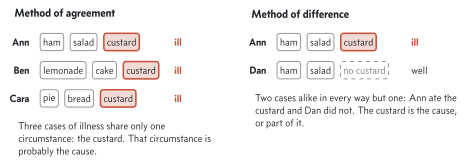
The Logic also opens with a theory of words. Mill noticed that a general word such as “white” does two jobs. It denotes, or picks out, all the white things in the world, and it connotes, or implies, a property they share, which is whiteness. A proper name is different. The town of Dartmouth in Devon got its name because it stands at the mouth of the river Dart. But if an earthquake moved the river, Mill pointed out, the town would still be Dartmouth, because the name was never a description of the place. It was a label stuck on it. So proper names denote without connoting:This thinker held that proper names denote without connoting attributes. → John Stuart Mill• they point at a thing without saying anything about it. Later philosophers, among them the Cambridge logician Bertrand Russell, argued that a name is really a disguised description. In 1970 the American logician Saul Kripke (krip-kee) revived Mill’s view in a famous set of lectures, and philosophers still call it the Millian theory of names.
On Liberty
Mill and Harriet Taylor were the closest of friends for nearly twenty years while her husband, John Taylor, looked on with remarkable patience and London society gossiped. When Taylor died in 1849, the two waited a respectable time and married in 1851. Mill believed she had the finer mind of the two. Many of his friends thought this an exaggeration, but she certainly shaped his thinking. In January 1855, as he later remembered, he was climbing the steps of the Capitol in Rome when he decided that a short essay they had written on liberty should become a book. For the next three years they revised it together, line by line.

The book came out after her death, dedicated to “the inspirer, and in part the author, of all that is best in my writings.” It is short, five chapters in all. Liberty means freedom, the ability to act as you choose without someone else stopping you, and Mill’s essay On LibertyThis thinker authored On Liberty. → John Stuart Mill•••J.S. Mill wrote a work titled On this concept. → liberty•• asks how much of it a society owes its members. His subject, he wrote in the first sentence, was “the nature and limits of the power which can be legitimately exercised by society over the individual.”
In earlier centuries, Mill explained, liberty had meant protection from kings. Once governments were elected, many people assumed that the danger had passed, since a people could hardly need protecting from itself. Mill disagreed. He drew on Alexis de Tocqueville (toke-vil), a French nobleman who had toured the United States in 1831 and written Democracy in America, a book Mill had reviewed with admiration. “The people” who rule, Mill observed, are never quite the same people over whom power is used. In practice the phrase means the majority, and a majority may wish to oppress a minority as much as any king did. So Mill warned against the tyranny of the majority.This work criticizes the tyranny of the majority. → On Liberty• Its worst form, he thought, was not law at all but public opinion. A society that punishes the eccentric with contempt “leaves fewer means of escape” than a tyrant does, “penetrating much more deeply into the details of life, and enslaving the soul itself.”
Against both dangers Mill set what he called “one very simple principle.” Society may use force against a person’s will, whether by law or by the pressure of opinion, only to stop him from harming other people. “His own good, either physical or moral, is not a sufficient warrant.” Philosophers call this rule Mill’s harm principle,This work’s harm principle permits restricting a person’s liberty to prevent harm to others. → On Liberty••• and it divides life into two parts. Acts that concern only yourself are your own business: “Over himself, over his own body and mind, the individual is sovereign.” Others may argue with you, plead with you, and warn you, but they may not compel you. Acts that hurt other people are society’s business. Mill gave an example. If you saw a man about to step onto a bridge that you knew was unsafe, and there was no time to warn him, you could seize him and pull him back, because nobody wants to fall into a river. But if he knew the danger and still wished to cross, the choice was his.
Mill admitted at once that his principle had limits. It was meant only for adults “in the maturity of their faculties,” not for children, who must be protected even from themselves. Then he added a second exception. His principle did not cover “barbarians”,This work controversially exempts peoples its author calls “barbarians” from its liberty principle. → On Liberty• by which he meant whole peoples he judged too backward to govern themselves. “Despotism is a legitimate mode of government in dealing with barbarians,” he wrote, “provided the end be their improvement.” Despotism means rule by a master whom no one can check. He was thinking of India, which he had helped to rule from his desk in London. In 1858, after the great rising of Indian soldiers against British rule the year before, Parliament took India away from the Company and gave it to the Crown; Mill wrote the Company’s defense, lost, and retired. The exception sits awkwardly beside the rest of the book. The champion of individual liberty believed that whole nations might be ruled without their consent for their own good.
The second chapter defends freedom of thought and discussion. It contains the book’s most famous sentence. “If all mankind minus one, were of one opinion, and only one person were of the contrary opinion, mankind would be no more justified in silencing that one person, than he, if he had the power, would be justified in silencing mankind.” Mill counted four grounds for this, which come down to three. The silenced opinion may be true. Even if it is false, it may contain part of the truth. And even a wholly true belief, if no one is ever allowed to challenge it, decays into what he called “dead dogma,” repeated without being understood. The Athenians who put Socrates to death in 399 BC, Mill reminded his readers, had been sure they were right.
The third chapter is a hymn to individuality, and its theme is announced before the book begins. An epigraph is a quotation set at the front of a book to announce its subject, and Mill took his epigraph from Wilhelm von HumboldtThis work takes an epigraph from Wilhelm von Humboldt. → On Liberty• (hum-bolt). Humboldt, a statesman and scholar of Prussia, the great kingdom of northern Germany, founded the University of Berlin in 1810. His younger brother Alexander was the famous explorer. In 1792 he had written a treatise on the limits of what governments should do, which was not printed in full until 1851. Mill’s chosen sentence praised “the absolute and essential importance of human development in its richest diversity.” Human nature, Mill wrote in the same spirit, “is not a machine to be built after a model,” but “a tree, which requires to grow and develop itself on all sides.” He wanted people free to try what he called “experiments of living,” so that everyone could see which ways of life turned out well.
The fourth chapter asks where society’s authority ends, and Mill tested it on a hard case. Muslims, he noted, feel a real and religious disgust at the eating of pork. Suppose a country where the majority banned pork,This work considers the example of a society banning pork to criticize coercion based on moral dislike. → On Liberty• because most of its people were Muslims. Would the ban be legitimate? Mill said no. Those who eat pork harm nobody, and the majority’s disgust, however sincere, is only a dislike of other people’s habits. A moral dislike gives no one the right to coerce. He put the same question about the Sabbath laws that closed amusements on Sundays. He asked it again about the American laws, beginning with Maine’s in 1851, that banned the sale of alcohol; a British society called the Alliance wanted the same laws at home.
The book sold steadily, and in 1865 Mill allowed a cheap edition so that working men could afford it. Not everyone was persuaded. In 1873 the lawyer James Fitzjames Stephen, just back from drafting laws for India, answered it with Liberty, Equality, Fraternity. Every society, he argued, must use law and opinion to make people better, and Mill’s line between harming yourself and harming others could not really be drawn. The same quarrel broke out again in Britain in the 1950s, over whether homosexual acts between consenting adults in private should still be crimes. The judge Patrick Devlin took Stephen’s side, and the Oxford philosopher H.L.A. Hart took Mill’s.
In December 1859 Mill turned the same thinking on relations between nations. Britain’s government, led by Lord Palmerston, was then opposing a canal across the narrow neck of land at Suez, in Egypt, to join the Mediterranean to the Red Sea, which the French engineer Ferdinand de Lesseps (duh less-eps) had begun to dig. Foreigners said Britain was acting from pure selfishness, to keep the short route to India out of French hands, and Mill replied in an article in Fraser’s Magazine called “A Few Words on Non-Intervention.” Intervention means one country interfering by force in the affairs of another. Mill wrote that war for an ideaThis thinker wrote A Few Words on Non-Intervention, declaring that war for an idea is as criminal as war for territory or revenue. → John Stuart Mill•• is as criminal as war for territory or revenue. By war for an idea he meant an aggressive war fought to spread one’s own beliefs or form of government, and he condemned it because forcing ideas on other people is no more justified than forcing them to obey in any other way. He allowed some exceptions. When one foreign power had already marched in to crush a people’s revolt, as Russia had crushed the Hungarians for Austria in 1849, other nations might intervene to restore the balance. But helping a people overthrow its own rulers was usually useless, since liberty given by outsiders would not last: “No people ever was and remained free, but because it was determined to be so.” He kept his exception for “barbarous” nations here too.
Utilitarianism and The Subjection of Women
The philosophy Mill was raised in had been worked out by Jeremy Bentham (1748–1832). Its first rule was that “it is the greatest happiness of the greatest number that is the measure of right and wrong.” Bentham called this the greatest-happiness principle, or the principle of utility. Utility is an old word for usefulness, and Bentham used it to mean a thing’s power to produce pleasure and prevent pain. Pleasure and pain, he thought, could be measured and added up like money, by their strength, how long they last, how certain they are, and so on. In his view a child’s game of pushpin, a simple game played with pins on a table, was worth exactly as much as poetry if it gave the same amount of pleasure.

Mill was a utilitarian from boyhood,John Stuart Mill was a proponent of this school. → Utilitarianism••• a believer in Bentham’s principle of utility. In the winter of 1822, when he was sixteen, he and a few friends formed a small debating club and called it the Utilitarian Society. He said he had taken the word “utilitarian” from a passing phrase in a Scottish novel, John Galt’s Annals of the Parish, and that he was the first to use it as the name of a school. He did not know that Bentham had already used the word in a letter of 1781. Utilitarianism is the doctrine that the right action is the one that produces the greatest total happiness for everyone it affects. Only results count, and everyone’s happiness counts equally: “everybody to count for one, nobody for more than one,” as Mill summed up Bentham’s rule. The name stuck. Utilitarianism is a theory named for utility,A theory named for this concept was advanced by J.S. Mill. → utility• Bentham’s word, and Mill became its most famous champion. He held to it all his life, even after his breakdown taught him that the system left out the feelings.
Bentham’s system had made enemies. The historian Thomas Carlyle (Vol. 15, The Age of Revolution) sneered at it as a “pig philosophy,” since it seemed to rate a full stomach as highly as a noble life. Mill set out to answer such critics in three magazine articles in 1861, reprinted in 1863 as a little book called Utilitarianism.This thinker authored Utilitarianism. → John Stuart Mill••J.S. Mill wrote a book titled for this school. → Utilitarianism•• He wanted to show that the creed he had been raised in could survive its enemies once it was stated properly. Bentham had counted only the amount of pleasure. Mill insisted that pleasures also differ in quality. The pleasures of the mind, the feelings, the imagination, and the moral sense are higher than the pleasures of the body. The proof, he said, is that people who have known both kinds prefer the higher, even at the cost of some discomfort, and only such people are competent judges. In this way Mill developed Bentham’s greatest-happiness principle:This thinker developed Bentham’s greatest-happiness principle. → John Stuart Mill•• he kept its rule that happiness is the test of right and wrong, but he changed what counted as happiness.
In Utilitarianism Mill packed the difference between higher and lower pleasures into one famous sentence: “It is better to be a human being dissatisfied than a pig satisfied; better to be Socrates dissatisfied than a fool satisfied.”This work distinguishes higher and lower pleasures, declaring it better to be “Socrates dissatisfied” than “a fool satisfied.” → Utilitarianism••• If the fool and the pig think otherwise, he added, that is because they know only their own side of the question. Socrates, who spent his life asking awkward questions and was put to death for it, was the natural example of a man who chose an unsettled mind over an easy life.
Mill also tried to prove that happiness is the one thing worth wanting. The only proof that a thing is visible, he wrote, is that people actually see it, and the only proof that something is desirable is that people actually desire it. Everyone desires happiness, so happiness is desirable. Critics pounced on the slip at once. “Visible” means able to be seen, but “desirable” means worth desiring, which is not the same thing as being desired. The objection became famous forty years later at Cambridge, in the hands of G.E. Moore.
Mill’s next great cause was one his wife had made her own: the rights of women. Harriet Taylor had published an essay called “The Enfranchisement of Women” in 1851. In the same year, before their wedding, Mill wrote out a formal protest against the powers that the marriage law was about to give him over her, and he promised never to use them. In 1861 he wrote The Subjection of Women, though he waited until 1869 to publish it, when he thought the public might listen. Subjection means being held under another’s control. In his autobiography Mill credited Harriet Taylor’s influenceThis thinker wrote The Subjection of Women, crediting Harriet Taylor’s influence. → John Stuart Mill••• on the book, and he said that its best ideas were hers and her daughter Helen’s.
To see what Mill was attacking, you need to know the English law of marriage in the 1860s. Under the old rule called coverture, a wife’s legal existence was “covered” by her husband’s. Everything she owned and everything she earned became his. She could not make a contract or bring a lawsuit in her own name. Her children belonged to him in law, and until 1857 a divorce needed a private Act of Parliament, which only the rich could afford. Mill’s opening sentence declared that “the legal subordination of one sex to the other” was “wrong in itself” and should give way to “a principle of perfect equality.” So the book argues for legal equalityThis John Stuart Mill work argues for legal equality between the sexes. → The Subjection of Women•• between men and women, in marriage, in property, and at the ballot box. Nobody could know what women were capable of, Mill added, because they had never been free to find out.
He did not soften the comparison that most shocked his readers. Mill compared a wife’s legal position to slavery.This work compares wives’ legal status to slavery. → The Subjection of Women•• The wife, he wrote, is “the actual bond-servant of her husband,” and in law she was no less so than “slaves commonly so called.” He did not claim that most husbands treated their wives like slaves. His point was that the law allowed them to, and that a good master does not make slavery a just institution. Many reviewers laughed at the book, but it was translated across Europe within a year. Parliament began to take coverture apart with the Married Women’s Property Acts of 1870 and 1882. Mill did not see the second. He died in Avignon on May 7, 1873, and was buried beside Harriet.
The Kensington Society
Mill had tried out his arguments for women’s rights in Parliament before he printed them. In 1865 the voters of Westminster, the London district that contains the Houses of Parliament, elected him to the House of Commons. He had refused to canvass, or go from door to door asking for votes, refused to spend any money, and told the voters plainly that he would work for votes for women. At one meeting a heckler held up a placard quoting a passage in which Mill had written that the English working classes, though ashamed of lying, were generally liars. Asked whether he had written it, Mill answered at once that he had, and the working men in the hall cheered him for his honesty. Earlier that same year, a group of women had begun meeting to argue about their own rights.
In March 1865 they started gathering at the house of Charlotte Manning, a scholar in her sixties, in Kensington, then a leafy western suburb of London, and they called themselves the Kensington Society. Most were young, unmarried, and well educated. Emily Davies, a clergyman’s daughter, was determined to open the universities to women. Elizabeth Garrett became that September the first woman to qualify as a doctor in Britain; the medical schools had refused her, so she found a way in through the Society of Apothecaries, an old guild whose license allowed its members to practice. Barbara Bodichon (boh-dih-shon), a painter, had led the campaign for married women’s property. Helen Taylor, Mill’s stepdaughter, joined them, and so did the headmistresses Frances Buss and Dorothea Beale. Members sent in questions, read papers, and argued: whether girls should study the same subjects as boys, how far daughters owed obedience to their fathers, and whether women should vote. Suffrage means the right to vote, and the Kensington Society championed women’s suffrageThis cause was championed by the Kensington Society. → women's suffrage• before its first year was out.
The timing was good. No woman could vote for Parliament, but neither could most men. The vote went only to men who owned or rented property above a set value, and by the 1860s, as the population grew, only about one adult man in seven in England and Wales had it. The country was arguing over a new Reform Bill to widen the vote for men, and the women saw their chance. On April 28, 1866, Bodichon, Davies, and a third member, Jessie Boucherett, drafted a petition to the House of Commons asking for the vote for “all householders, without distinction of sex.” It asked only for women who met the property test. In practice that meant widows and unmarried women of property, since a married woman’s property belonged to her husband. In a few weeks they gathered 1,499 signatures.

On June 7, 1866, Davies and Garrett carried the roll to Westminster Hall, the great medieval hall beside the House of Commons, to hand it to Mill. According to a story told years afterward, they hid it under the stall of an old woman who sold apples there while they waited for him (Figure 7.6). That afternoon Mill presented it to the House, with Henry Fawcett, the blind Liberal member who was soon to marry Elizabeth Garrett’s sister Millicent. The next year Lord Derby’s Conservative government, with Benjamin Disraeli steering the bill through the Commons, carried the Second Reform Act, which roughly doubled the number of men who could vote. On May 20, 1867, Mill moved to strike the word “man” out of the bill and put “person” in its place. Seventy-three members voted for him and 196 against. It was a defeat, but it was the first time the House of Commons had ever voted on women’s suffrage. A few weeks earlier, Punch had already drawn Mill clearing a path to the polls for a crowd of women, under the title “Mill’s Logic; or, Franchise for Females.”
The petitioners did not go home. In July 1867 the Kensington Society turned itself into the London National Society for Women’s Suffrage, joined to sister societies in Manchester and Edinburgh. In Manchester the secretary, Lydia Becker, an amateur botanist who had corresponded with Darwin, found a loophole. A widow named Lily Maxwell, who kept a small shop, had been put on the list of voters by mistake. In November 1867 Becker went with her to the polling place, and Maxwell cast her vote for the Liberal candidate. The next year the courts ruled that the law did not let women vote, and the loophole closed. Emily Davies and Barbara Bodichon went on to found a college for women in 1869, at Hitchin, halfway between London and Cambridge; in 1873 it moved to the village of Girton, just outside Cambridge, and became Girton College. The campaign took half a century. Women over thirty won the vote in 1918, and women on the same terms as men in 1928. The suffragettes who fought its last rounds, with smashed windows and hunger strikes, come in Chapter 28.
Sidgwick and the methods of ethics
Cambridge, slowly opening its lectures to women, was also where the utilitarian line ran on after Mill. Its next great thinker was Henry Sidgwick, born on May 31, 1838, in Skipton, Yorkshire, the son of a clergyman who ran the local grammar school. Sidgwick went to Rugby School and then to Trinity College, Cambridge, where he won the top prizes in classics and became a fellow in 1859. A fellow is a senior member of a college, paid from the college’s own lands and investments to teach and study. At Oxford and Cambridge every fellow had to declare that he belonged to the Church of England. By the 1860s Sidgwick no longer believed the Church’s doctrines, and in 1869 he resigned his fellowship rather than profess what he did not believe. The college kept him on as a lecturer, and in 1871 Parliament abolished the rule. Figure 7.7 sets his book among the others of this story.
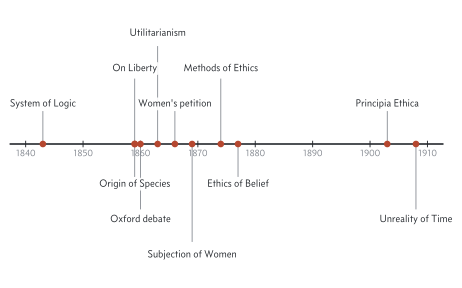

He gave much of his energy to women’s education. In 1871 he rented a house in Cambridge for five women who had come to attend lectures, and he persuaded an experienced schoolmistress from the Lake District to run it. It grew into Newnham College, which he helped found with Millicent Garrett Fawcett, the sister of the pioneering doctor Elizabeth Garrett and a leader of the campaign for women’s votes. In 1876 he married Eleanor Balfour, the sister of the future prime minister Arthur Balfour, and she later became Newnham’s principal. In 1882 Sidgwick helped found the Society for Psychical (sy-kih-kul) Research, which tested reports of telepathy and of messages from the dead by the methods of science. He was its first president, and he hoped, without success, to find good evidence for life after death.
Ethics, or moral philosophy, is the branch of philosophy that asks how we ought to live and act, and what makes an action right or wrong. In 1874 Sidgwick published his book The Methods of Ethics.Henry Sidgwick wrote a work about this field titled for its "Methods." → ethics•• By a method he meant a reasonable procedure that a person might use to decide what he ought to do, and he found three of them at work in ordinary moral thinking. Egoism says to do whatever produces the most happiness for yourself. Intuitionism says that we know certain moral rules directly, by intuition, the way we know that two and two make four: tell the truth, keep your promises, repay kindness. Utilitarianism, Mill’s view, says to do whatever produces the most happiness for everyone.
Sidgwick set the three methods side by sideThis thinker compared egoism, intuitionism, and utilitarianism in The Methods of Ethics. → Henry Sidgwick•• and tested each one with great patience. He took the rules of common-sense morality one at a time and found that when pressed hard they turned vague or contradicted one another. Must you keep a promise to a man who has since died? Must you keep one that would cause great harm? When people settled such hard cases, Sidgwick showed, they usually asked which choice would do the most good. Common sense, he concluded, was “unconsciously utilitarian.” In this way Sidgwick came down on the utilitarian side,Henry Sidgwick was a proponent of this theory. → Utilitarianism•• and many philosophers today regard his book as the most careful statement of classical utilitarianism. Peter Singer, a leading utilitarian of our own time, has called it simply the best book on ethics ever written.
But one gap would not close. Reason, Sidgwick thought, tells each of us to count everyone’s good equally, as it would look from “the point of view of the Universe.” Reason also seems to approve of a man looking after his own happiness. When the two conflict, as when telling the truth will ruin you, nothing in reason says which should win. Sidgwick called this the “dualism of practical reason.” Only a God who made duty and happiness come out the same in the end could resolve it, and he could not prove that such a God existed. The first edition closed on a gloomy note: without that assurance, the long effort to build a perfect system of rational conduct was doomed to fail.
Moore and McTaggart
Sidgwick died in 1900, and by then a new generation at Trinity was ready to throw out most of what the Victorians had taught. Its leader in ethics was an Englishman, George Edward Moore,G.E. Moore was a philosopher from this country. → United Kingdom•• born on November 4, 1873, in a London suburb, who entered Trinity in 1892 to study classics. Two older Trinity men, the philosopher John McTaggart (muk-tag-urt) and the young Bertrand Russell, talked him into switching to philosophy. All three belonged to the Apostles, a secret Cambridge discussion society to which Sidgwick had belonged before them.

Moore became famous among his friends for his complete honesty in argument and for his look of open astonishment when someone said something he thought unclear. In October 1903 he published a book with a Latin title, Principia EthicaG.E. Moore wrote a Latin-titled Principia about this field. → ethics•• (prin-sip-ee-uh eth-ih-kuh), meaning “principles of ethics.” Principia echoed the title of Isaac Newton’s book of 1687 that founded modern physics, and Moore meant his own as a fresh start for ethics. Its first question was simple: what does the word “good” mean?
Moore’s answer was that “good” cannot be defined at all. Some ideas are complex and can be defined by listing their parts, the way a horse can be described by its legs, head, heart, and so on. Simple ideas have no parts. Try explaining yellow to someone born blind. You can say it is the color of lemons, or describe the light waves that cause it, but light waves are not what we see when we see yellow. Goodness, Moore said, is like yellow:This book compares goodness to yellow as a simple, indefinable quality. → Principia Ethica•• a simple quality that we recognize directly and cannot break down into anything else.
It followed that every attempt to define good as something else was a mistake. Philosophers had said that good means “pleasant,” or “what we desire,” or “more evolved.” Moore’s test, now called the open-question argument, went like this. If good simply meant pleasant, then asking “Is pleasure good?” would be like asking “Is pleasure pleasant?” That is a silly question with an obvious answer. The first question is not silly; it is a real, open question. So good and pleasant are different things. Moore called the error of identifying goodness with some natural property the naturalistic fallacy.This book calls attempts to define goodness in terms of other properties a “naturalistic fallacy.” → Principia Ethica••• A fallacy is a mistake in reasoning. One of Moore’s chief exhibits was Mill’s argument that happiness is desirable because people desire it, since “desirable” means what ought to be desired, not what is.
Moore drew a second line, between two ways in which a thing can be valuable. Some things are good in themselves,This work distinguishes what is good in itself from what is good as a means. → Principia Ethica• worth having for their own sake, while others are good only as a means to something else. A dentist’s drill is good as a means; the health it protects comes closer to being good in itself. To tell which is which, Moore proposed a test: imagine the thing existing absolutely alone in the universe, and ask whether its existence would still be good. Money fails the test at once. A friendship might pass.
So Moore kept half of utilitarianism and threw the other half away. Like Bentham and Mill, he judged an action right if it produced the greatest possible amount of good. Unlike them, he did not think pleasure was the only good. The most valuable things we know, he wrote, are “the pleasures of human intercourse and the enjoyment of beautiful objects,” which is to say friendship and the love of beauty. Because it aims at many goods and not pleasure alone, Moore’s version is called ideal utilitarianism.G.E. Moore developed a pluralistic/"ideal" variant of this philosophy oriented towards the good. → Utilitarianism• Young Cambridge men who later gathered in London as the Bloomsbury Group, among them the economist John Maynard Keynes and the writer Leonard Woolf, read the book almost as a gospel (Vol. 21, Trenches and Modernists).

Moore’s old mentor McTaggart had stranger ideas. John McTaggart Ellis McTaggart, born in 1866, spent nearly all his adult life as a fellow of Trinity. He was a follower of Hegel (hay-gul), the German philosopher who taught that reality is a single rational whole (Vol. 16, Romantic Europe). McTaggart drew from Hegel the conclusion that the universe is a community of immortal souls bound together by love, and that space, matter, and time are illusions. He did not believe in God, but he believed firmly in life after death.
In 1908 he published “The Unreality of Time” in the philosophy journal Mind. Events, he pointed out, can be lined up in two ways. The A-series gives each event a position as past, present, or future, and these positions keep changing: next Christmas is future, then present, then past. The B-series arranges events as earlier than or later than one another, and these relations never change: the Battle of Hastings is always earlier than the Battle of Waterloo. McTaggart’s A-series and B-seriesMcTaggart distinguishes A-series and B-series accounts of this concept, using past/present/future and earlier/later respectively. → time••• are still the starting point for every argument about the nature of time (Figure 7.11).

McTaggart then argued that time is unreal. Time requires change. The B-series alone contains no change, because if one event is earlier than another, it always was and always will be. So real time needs the A-series. But the A-series contradicts itself, since every event must be past, present, and future, and these exclude one another. The obvious reply is that an event is not all three at once: it is future, then present, then past. But that “then” brings in time again, so each attempt to explain the A-series needs another A-series behind it, without end. Few philosophers accept his conclusion. Yet they still divide into “A-theorists,” who think the present is truly special, and “B-theorists,” who think that “now” is no more special than “here.”
Darwin and evolution
The other book of 1859 had a longer history. Charles Darwin was born in Shrewsbury on February 12, 1809, the same day as Abraham Lincoln. His grandfather Erasmus Darwin was a doctor and poet who had speculated that living things change over time, and his mother was a daughter of the great potter Josiah Wedgwood. Charles studied medicine at Edinburgh but could not bear to watch operations performed without anesthetics, and his father sent him to Cambridge to train for the Church. He spent his time there collecting beetles. In 1831, at twenty-two, he sailed as naturalist and gentleman companion to Captain Robert FitzRoy aboard the survey ship Beagle, on a voyage that lasted nearly five years and went around the world (Figure 7.12).


On the Galápagos (guh-lah-puh-gohs) Islands in the Pacific he noticed that the mockingbirds and the giant tortoises differed slightly from island to island. The idea that species change over many generations, and descend from common ancestors, is called evolution, and it was not new. What Darwin found was a mechanism. In 1838 he read Thomas Malthus (mal-thus), an English clergyman who had argued in 1798 that population always tends to outrun food. Darwin saw what that meant for nature. Every species produces more young than can survive. The young vary. Those whose variations happen to suit their surroundings live longer and leave more offspring, and pass the variations on. Over immense stretches of time the small differences add up to new species. Darwin called this natural selection, and the biology of it belongs to Vol. 54, Biology: Life's Diversity.
He then spent twenty years gathering evidence, eight of them on barnacles, at Down House, his home in the village of Downe in Kent. He knew the idea would horrify many Christians, and he told his friend the botanist Joseph Hooker in 1844 that admitting species could change was “like confessing a murder.” On June 18, 1858, a letter arrived from Alfred Russel Wallace, a self-taught naturalist who earned his living collecting birds and insects for museums. Wallace was writing from Ternate (ter-nah-tay), an island in the Malay Archipelago, the great chain of islands between Asia and Australia, and his essay set out the same theory, also inspired by Malthus. Darwin’s friends Hooker and the geologist Charles Lyell arranged for both men’s papers to be read together at the Linnean Society, a club of London naturalists, on July 1, 1858. The audience was polite. The society’s president later remarked that the year had not produced any striking discoveries. Darwin then wrote the Origin in thirteen months.
He built the argument the way a lawyer builds a case. The book opens not in a jungle but in the farmyard, with the changes that breeders had made in pigeons, dogs, and cattle by choosing which animals to breed. Darwin kept pigeons himself, and he showed that all the fancy breeds, the pouters, fantails, and tumblers, came from the wild rock pigeon. If people could make such changes in a few centuries, nature, choosing among far more variations over far more time, could do much more. Only then did he turn to the struggle for existence, and after it to the evidence of fossils, of the geography of living things, and of their bodies. Tennyson had already given the Victorians a picture of that struggle in 1850: nature “red in tooth and claw” (Chapter 3). About human beings Darwin said almost nothing, only that light would be thrown on their origin; he took up that subject in The Descent of Man in 1871. The first edition never uses the word “evolution,” but its very last word is “evolved.”
Darwin hated public quarrels, but his new ally loved them. Thomas Henry Huxley, born in 1825, had only two years of school and taught himself German and anatomy. He served as assistant surgeon on HMS Rattlesnake, studied jellyfish in the South Seas, and became one of Britain’s leading anatomists. Years later he recalled that his first thought on grasping the Origin’s central idea was, “How extremely stupid not to have thought of that!” He wrote to Darwin that he was sharpening his claws and beak for the fight. Huxley defended evolution so fiercelyThomas Huxley, known as the "Bulldog," defended this theory. → evolution• that he became known as “Darwin’s Bulldog.” In 1869 he also coined the word agnostic for someone who holds that we cannot know whether God exists. His grandsons included the biologist Julian Huxley and the novelist Aldous Huxley, the author of Brave New World.
The best-remembered round came in June 1860. The British Association for the Advancement of Science, which met each summer in a different city, held its annual meeting that year in Oxford, the university town about fifty miles northwest of London. Its university is the oldest in the English-speaking world, and it was then a stronghold of the Church of England. On Saturday, June 30, in the newly built University Museum, an American professor read a long paper on Darwin’s ideas. Then the bishop of Oxford rose. Samuel Wilberforce was the son of William Wilberforce, who had led the fight against the slave trade, and his smooth manner had earned him the nickname “Soapy Sam.” The Huxley–Wilberforce debate in OxfordThe Huxley-Wilberforce debate took place in this city. → Oxford• followed.
According to the version told later, Wilberforce turned to Huxley and asked whether it was through his grandfather or his grandmother that he claimed descent from an ape. Huxley is said to have replied that he would not be ashamed to have an ape for an ancestor, but he would be ashamed to be connected with a man who used great gifts to obscure the truth. A lady is said to have fainted. Robert FitzRoy, Darwin’s old captain, lifted a large Bible over his head and begged the audience to believe God rather than man. No one wrote down the exact words, and the eyewitness accounts disagree; some who were there thought the bishop had the better of it. The tale of a clean victory for science grew in memoirs written decades later (Figure 7.14).


The man who carried evolution furthest beyond biology was Herbert Spencer, born in Derby in 1820, a former railway engineer who had become a writer and was publishing on social “evolution” before Darwin’s book appeared. Spencer set out to explain everything, from the stars to living things, minds, societies, and morals, as one process of development from the simple to the complex. In his Principles of Biology of 1864, Spencer coined “survival of the fittest”Herbert Spencer coined the phrase "survival of the fittest" in connection with this theory. → evolution• as another name for natural selection, and Darwin borrowed the phrase for the fifth edition of the Origin in 1869. “Fittest” meant best suited to one’s surroundings, not strongest.
Spencer also applied the struggle for existence to human society. He had argued as early as 1851 that the state should not shield the poor and weak from competition, since doing so would only weaken the human race. Applying natural selection to nations, classes, and races came to be called social Darwinism, after Darwinism, the theory named for Darwin. The label was used mostly by critics, and Spencer’s name became tied to social DarwinismHerbert Spencer became associated with a “social” version of the theory named for this thinker. → Charles Darwin• more than anyone’s. The irony is that his social ideas came first and owed little to Darwin’s book. In Principia Ethica, Moore singled Spencer out: to call one way of life better because it is “more evolved” was, he argued, the naturalistic fallacy once again. What comes later in evolution is not for that reason better.
Clifford and the ethics of belief
The quarrel over Darwin raised a harder question, about faith itself. William Kingdon Clifford was born in Exeter on May 4, 1845, and he was one of the most brilliant mathematicians of his generation. He took a high place in the Cambridge mathematics examinations in 1867, and in 1871, still in his twenties, he became professor of mathematics and mechanics at University College London. His work on geometry gave his name to a kind of algebra that physicists still use, and in 1870 he suggested that matter and its motion might be nothing but the bending of space itself, a guess that Einstein’s theory of gravity made real (Vol. 50, Physics: Relativity, Quanta, and the Cosmos). He began as a devout High Churchman, on the wing of the Church of England that kept closest to Catholic ritual, and became a convinced follower of Darwin and an outspoken unbeliever.

In 1869 a group of eminent men founded the Metaphysical Society so that believers and unbelievers could argue face to face. Its members included Tennyson, the statesman William Gladstone, Huxley, Sidgwick, and Cardinal Manning, the head of the Catholic Church in England. Clifford joined it in its later years and read to it an essay called “The Ethics of Belief,”This thinker wrote “The Ethics of Belief.” → W.K. Clifford••W.K. Clifford wrote an essay titled "The Ethics of" this action. → belief•• which was printed in the Contemporary Review in January 1877. To believe something is to take it to be true. Most people think a belief is a private matter that can be mistaken but never wicked. Clifford set out to show the opposite.
He began with a story. A shipowner was about to send to sea an emigrant ship, carrying people who were leaving home to start new lives across the ocean. He knew the ship was old and had not been well built in the first place, and people had warned him that she might not be seaworthy. The doubts made him unhappy, and he thought of having her overhauled at great expense. Then he talked himself out of them. She had come through many voyages, he told himself, and he would trust in Providence, the care of God, to look after the people aboard. He watched her sail with a light heart. She sank in mid-ocean, and he collected the insurance. Clifford’s verdict was that the owner was guilty of the deaths. His belief was sincere, but he “had no right to believe on such evidence as was before him.” He had not earned his confidence by patient investigation. He had got it by stifling his doubts.
Then Clifford changed one fact. Suppose the ship had been sound after all and had made her voyage safely. Would the owner be any less guilty? “Not one jot,” Clifford answered. The shipowner was guilty even if she arrived,This essay argues that a shipowner who neglects doubts about a vessel’s seaworthiness is blameworthy whether or not it sinks. → "The Ethics of Belief"•• because the wrong lay in how he came to believe, not in how things turned out. A lucky result does not make a careless belief right, any more than a driver who races through a red light without hitting anyone has driven well.
From the story Clifford drew his rule: “It is wrong always, everywhere, and for anyone, to believe anything upon insufficient evidence.” Belief is never purely private, he argued. It guides what we do, and it passes into the common stock of what a whole society takes for granted. Every belief accepted without evidence weakens the habit of testing, and a people that has lost that habit can be led into anything. He clearly had religious faith in view, and his readers knew it. Clifford died of tuberculosis on the island of Madeira (muh-deer-uh) on March 3, 1879, at thirty-three. The American philosopher William James answered his essay in 1896 with “The Will to Believe” (Vol. 29, A House Divided), and the poet Matthew Arnold had already described the faith that Clifford attacked as a sea in retreat (Chapter 8).
What to remember
- John Stuart Mill’s System of Logic (1843) grounded all inference in induction, set out five methods for finding causes, and held that proper names denote without connoting.
- On Liberty (1859), written with Harriet Taylor, states the harm principle, warns against the tyranny of the majority, and exempts children and peoples Mill called “barbarians.”
- Mill’s Utilitarianism (1863) defends Bentham’s greatest-happiness principle but ranks higher pleasures above lower ones.
- The Subjection of Women (1869) demands legal equality between the sexes and compares a wife’s legal position to slavery.
- Members of the Kensington Society of 1865 drafted a petition for women’s suffrage, signed by 1,499 people, which Mill presented to Parliament in 1866.
- Henry Sidgwick’s Methods of Ethics (1874) compares egoism, intuitionism, and utilitarianism and sides with utilitarianism.
- G.E. Moore’s Principia Ethica (1903) calls good indefinable, like yellow, and names the naturalistic fallacy; McTaggart split time into an A-series and a B-series.
- Darwin’s Origin of Species (1859) explained evolution by natural selection; Huxley defended it at Oxford in 1860, and Spencer coined “survival of the fittest.”
- W.K. Clifford’s “The Ethics of Belief” (1877) argues that believing on insufficient evidence is always wrong, using the story of a careless shipowner.
Chapter 8 · 41 clues
The Sea of Faith: Matthew Arnold
Early in 1849 a small book of poems appeared in London under the title The Strayed Reveller, and Other Poems. The title page gave the author’s name only as “A.” Few people bought it, and it was soon withdrawn from sale. Among the readers it did find were the poet’s family and friends, and they were puzzled. They knew him as Matt Arnold, the eldest son of the most famous schoolmaster in England: a tall, handsome young man who slept late, laughed at everything, dressed like a Paris dandy, and seemed to take nothing seriously. The poems in the little book were grave and lonely, and many of them asked how a man could live calmly once he no longer knew what to believe.
That gap between the laughing man and the sorrowful poet ran through Arnold’s whole life. He wrote the most famous Victorian poem about the loss of religious faith, and much of it seems to have been written on his honeymoon. Then, in his forties, he nearly stopped writing verse. He spent his last twenty years telling the English, in teasing and graceful prose, what was wrong with them and what might cure it. The poet of the ebbing sea and the critic of English life were the same man, and both grew up in a headmaster’s house in the Midlands.
The headmaster’s son
Matthew Arnold was born on December 24, 1822, at Laleham, a village on the Thames west of London. His father, Thomas Arnold, was a clergyman, a historian of ancient Rome, and a man of fierce moral energy. In 1828 he became headmaster of Rugby School in the English Midlands. In England a public school meant, confusingly, an old private boarding school such as Eton, Harrow, or Rugby, which took the sons of gentlemen at about thirteen and kept them until eighteen. Many such schools were brutal places, ruled by older boys and the cane. Dr. Arnold set out to make his a school for Christian gentlemen. What the school must look for, he said, was first religious and moral principle, second gentlemanly conduct, and only third intellectual ability.

He became a legend. One of his old pupils, Thomas Hughes, put him into Tom Brown’s School Days (1857), a novel about a Rugby boy, and generations of readers met “the Doctor” there as a stern and loving judge. Matthew, his eldest son, grew up under that gaze. He spent his boyhood at Rugby, with holidays at Fox How, a house the family took in 1834 in the Lake District, the mountain country of northwest England. The old poet William Wordsworth (Vol. 15, The Age of Revolution) lived nearby and became a friend. In 1841 Matthew went up to Balliol (bay-lee-ul) College, Oxford, with a scholarship. On June 12, 1842, his father died suddenly of a heart attack, a day before his forty-seventh birthday. Matthew was nineteen.
Oxford, where he now lived, will come back again and again in this volume, so it is worth a careful look. The city stands about 50 miles (80 km) northwest of London, where the little River Cherwell (char-wul) flows into the Thames, which in Oxford is called the Isis. Its university is not a single campus but a federation of colleges, about twenty in Arnold’s day. Each college has its own stone courtyards, called quadrangles, and its own chapel, dining hall, library, and teachers. These teachers, the fellows, lived in college, had to be members of the Church of England, and as a rule had to stay unmarried. The students read mostly Greek and Latin authors, ancient history, philosophy, and theology. Seen from the low hills around the city, the towers and spires of all the colleges and churches rise together above the river meadows, as if they were one great building.
In the 1840s Oxford was also the scene of a religious storm. John Henry Newman, a fellow of Oriel College and vicar of the university church, led the Oxford Movement, which tried to draw the Church of England back toward its Catholic past of saints, ritual, and sacraments, the holy rites such as baptism and communion. In 1845 Newman left the Church of England to become a Roman Catholic, and Oxford felt the shock for years. Arnold went to hear him preach and remembered the voice all his life, but he did not follow him. In 1860 the city would see the great quarrel over Darwin (Chapter 7). Later in this volume it returns as the home of Lewis Carroll (Chapter 11), the university of Oscar Wilde (Chapter 17), and a city whose students all drown for love of Zuleika (zoo-lee-kuh) Dobson in a comic novel (Chapter 27).

Young Arnold did not behave like the Doctor’s son, and he did not work like him either. He won the university’s Newdigate Prize for poetry in 1843 with a poem on Oliver Cromwell, but in 1844 he took only a second-class degree. Oxford graded its degrees in classes, and the best students took a first, so this was a disappointment for a famous father’s son. He made up for it in 1845 by winning a fellowship at Oriel, Newman’s college and the most admired in Oxford. Two years later he became private secretary to Lord Lansdowne, an elderly Liberal nobleman who sat in the cabinet, the small group of senior ministers who run the government. The work was light and left him time to write. When Charlotte Brontë (Chapter 2) met him in the Lake District in 1850, she was put off at first by his “seeming foppery,” the airs of a dandy, though she liked him better once he talked.
His closest friend was a very different young man. Arthur Hugh Clough (kluf), nearly four years older, had spent part of his childhood in Charleston, South Carolina, where his father traded cotton, and had been one of the Doctor’s favorite pupils at Rugby. He was earnest where Arnold was playful, and he worried openly about God and conscience while Arnold pretended not to. The two walked whole days in the hills around Oxford, talking about poetry. In 1848 Clough gave up his own fellowship at Oriel because he could no longer honestly sign the Thirty-Nine Articles, the Church of England’s statement of belief, which every fellow had to accept. It was a brave act and a costly one, since it cost him both his income and his rooms in college.
Marguerite and the estranging sea
In September 1848 Arnold traveled in Switzerland and stopped at Thun (toon), a small town where the River Aare (ah-ruh) flows out of a lake below the snowy Bernese Alps (Figure 8.3). He came back the next September. On one of these visits he told Clough in a letter that he meant to linger a day at his hotel “for the sake of the blue eyes of one of its inmates,” by which he meant one of its guests. In his poems the owner of those eyes is called Marguerite (mar-guh-reet). No one knows for certain who she was. She may have been a young Frenchwoman staying at the hotel, and the poems may have invented much of her. What survives is a group of lyrics, short poems of personal feeling, about a love that cooled, or that Arnold drew back from, and about the loneliness that came after.

In Arnold’s “Isolation. To Marguerite”This poet wrote "Isolation: To Marguerite." → Matthew Arnold•• the speaker has kept faithful through a long separation and learns that she no longer loves him. He orders his heart back to the solitude it came from and gives it a cold motto: “Thou hast been, shalt be, art, alone,” that is, you have always been alone, you always will be, and you are alone now. Happier men, he adds, at least dream that two hearts can melt into one, and so they never notice that they are just as lonely as he is.
Its companion poem, “To Marguerite—Continued,” also Arnold’s,This poet wrote "To Marguerite—Continued." → Matthew Arnold•• takes that private grief and makes it true of everyone. Here is how it begins:
Enisled means “made into an island.” Each person, the poem says, is an island in an ocean without shores, and the narrow straits between the islands only echo. The islands feel the water closing around them and learn exactly where their edges lie. The poet does not say that he and Marguerite are alone, but that “we mortal millions live alone,”This poem says "in the sea of life enisled" and "we mortal millions live alone." → "To Marguerite—Continued"•• every human being on earth. On spring nights, the next stanzas say, the islands hear nightingales singing across the water and feel a longing like despair, as if they had once been parts of a single continent.
Who split them apart? The last stanza answers that a god decreed it, and the poem ends with what he set between their shores, “the unplumb’d, salt, estranging sea.”This poem ends with "the unplumb’d, salt, estranging sea." → "To Marguerite—Continued"• Each of those three adjectives does work. A sea is unplumbed when it is too deep to measure with a plumb line, the weighted rope that sailors dropped over the side to find the bottom. It is salt, so no one can drink it, and estranging, because it turns people into strangers. Keep that sea in mind, because it comes back, larger and darker, in Arnold’s most famous poem.
Marguerite then vanishes from the poems and the letters. In 1850 Arnold fell in love with Frances Lucy Wightman, the daughter of Sir William Wightman, a judge of one of the high courts in London. Her father would not let her marry a man who lived on a secretary’s pay. So in April 1851 Arnold took a steady government post as one of Her Majesty’s Inspectors of Schools, the officials who visited schools that received government money to test the pupils and judge the teaching. In June 1851 he married Frances Lucy Wightman.This poet married Frances Wightman. → Matthew Arnold• For thirty-five years afterward he traveled the new railways of England examining schools, at first mostly those of the Nonconformists, the Protestant churches outside the Church of England, such as the Methodists and Baptists. He called the job drudgery. Yet it showed him the middle classes of small-town England better than almost any other writer of his time knew them, and they would become the targets of his later prose.
A philosopher in a volcano
In 1852 Arnold published a second book, again signed only “A.” The hero of its title poem was Empedocles (em-ped-uh-kleez), a real Greek philosopher of the fifth century BC, and the book was called Empedocles on Etna, and Other Poems. That long opening work, Arnold’s Empedocles on Etna,This author wrote Empedocles on Etna. → Matthew Arnold•• was the most ambitious thing he had yet written. Empedocles lived at Acragas (ak-ruh-gus), a Greek city on the south coast of Sicily, now called Agrigento. He was a poet, a doctor, and something of a wonder-worker in the eyes of his neighbors. He taught that everything in the world is made of four “roots,” earth, air, fire, and water, which two forces, Love and Strife, forever join together and tear apart.
The most famous story about him comes from later Greek writers and survives in a biography written some seven centuries after his death. Empedocles, it said, threw himself into the crater of Mount Etna, the great volcano of Sicily, so that people would believe he had been taken up among the gods. The volcano tossed back one of his bronze sandals and gave the trick away. Nobody knows how Empedocles really died; the story is a legend, and an old one.

Arnold turned the legend into a dramatic poem, a poem laid out like a play, with named speakers and scenes, but meant to be read rather than acted. It has two acts, set on the slopes and then the summit of Etna, and three characters. Pausanias (paw-say-nee-us) is a doctor who hopes to learn the old man’s secrets. Callicles (kal-ih-kleez) is a young harp player who follows him up the mountain and sings old myths to soothe him. Empedocles himself is tired, bitter, and sure that his age has no use for him and he none for it. Alone at the summit, in the second act, the philosopher leaps into the volcano,In this dramatic poem, a Greek philosopher jumps into a volcano. → Empedocles on Etna•• while far below, out of sight, the boy sings of Apollo, the god of music, and the Muses, the goddesses of the arts. Callicles’ songs are bright and orderly, full of gods and heroes, and their calm makes the old man’s despair look all the darker.
The little volume also gathered Arnold’s lyrics of the last few years, and so “To Marguerite—Continued” appeared beside Empedocles.This poem was collected with its author’s dramatic poem Empedocles on Etna. → "To Marguerite—Continued"• It was printed there under a longer title; Arnold gave it its present name years later, when he printed it after “Isolation” as that poem’s sequel. The book sold so badly that it was withdrawn after a few dozen copies.
In 1853 Arnold brought out a selection of his poems under his own name, and he left Empedocles out. He explained why in a preface, his first piece of criticism. The poem was not false, he said; it was the wrong kind of subject. Some situations give a reader no pleasure even when they are drawn truthfully, namely those in which the suffering finds no outlet in action,This dramatic poem was omitted from its author’s 1853 collection because its suffering found no outlet in action. → Empedocles on Etna• in which a mind simply broods in pain and nothing can be done. He described them as having “everything to be endured, nothing to be done.” Poetry, Arnold thought, should give joy, even in tragedy, and the Greeks had shown how, by choosing great actions and shaping them clearly. His own philosopher only suffered. Many readers have suspected that the poem was dropped because it was too close to Arnold’s own mood. In 1867 the poet Robert Browning (Chapter 5) asked him to restore it, and he did.
The Scholar-Gipsy
The 1853 book had new poems in place of Empedocles. One was “Sohrab and Rustum,” a story in verse taken from the Persian epic the Shahnameh, or Book of Kings (Vol. 37, The House of Islam). In it the hero Rustum kills a young champion in single combat and learns too late that he is his own son. The best loved, though, was Arnold’s “The Scholar-Gipsy.”This poet wrote "The Scholar-Gipsy." → Matthew Arnold•• It begins with a book lying on the grass. In 1661 a clergyman and scholar named Joseph Glanvill had published The Vanity of Dogmatizing, an argument that people are far too sure of what they think they know. To show what the human mind might do, he told a story that was going around Oxford. A poor student, unable to make his way at the university, had left it and joined a band of wandering “gipsies.” They were the Roma, a traveling people whose ancestors had left India centuries before. The English called them “gipsies,” usually spelled “gypsies,” because they wrongly believed the Roma had come from Egypt.
The student, Glanvill said, won the Roma’s trust and learned their secrets. Some time later two old college friends met him on the road. He told them that the Roma “had a traditional kind of learning among them, and could do wonders by the power of imagination,” and that once he had learned it all he would leave them and tell the world. Arnold printed this passage at the head of the poem, which is based on a story by Joseph GlanvillThis poem is based on a story by Joseph Glanvill. → "The Scholar-Gipsy"•• and grows from it. Glanvill had told the tale to show the strange powers of the mind. Arnold cared more about the young man who walked away from Oxford and kept on walking.

Arnold’s speaker lies in a field on the hills above Oxford on a summer day, with Glanvill’s book beside him. He reads the old tale again: the clever, poor scholar who one morning left Oxford to join a “wild brotherhood”This poem concerns a man who leaves Oxford to join a "wild brotherhood." → "The Scholar-Gipsy"•• and never came back to his friends. Then the poem imagines that he never died. People still glimpse him, it says, in the fields around Oxford (Figure 8.5): riders at the ferry over the Thames at Bablock Hythe, girls who come to dance around the elm at Fyfield in May, children on the slopes. Two hundred years have passed, but he has not aged, because he had “one aim, one business, one desire.” He is still “waiting for the spark from heaven to fall.”
The rest of us cannot live like that, the poet says. We are “light half-believers of our casual creeds,” who try one belief after another, keep none, and wear ourselves out. He calls our condition “this strange disease of modern life,”This poem laments "this strange disease of modern life." → "The Scholar-Gipsy"• with “its sick hurry, its divided aims.” And so he begs the scholar-gipsy to flee from modern people, as if they carried an infection that would kill him too. The poem ends with a long picture of a merchant from Tyre, the great trading city of the ancient Phoenicians (fuh-nee-shunz) on the coast of what is now Lebanon. He sees a Greek trading ship slip in among the islands of his seas and sails away west, out through the straits at the far end of the Mediterranean, to trade with the shy Iberians of Spain. Like him, the scholar must keep moving to stay free.
Between two worlds
In the autumn of 1851, on the second part of their honeymoon, a tour through France and Switzerland, Arnold and his wife climbed to the Grande Chartreuse (grahnd shar-truhz), in the mountains north of Grenoble in southeastern France. It is the mother house, the chief monastery, of the Carthusians (kar-thoo-zhunz), an order of monks founded by Saint Bruno in 1084 and often called the strictest in the Catholic Church. Each Carthusian lives alone in a little house of his own around a cloister, a covered walk around a courtyard, keeps silence most of the day, and joins his brothers in the church at night to sing the old Latin services.

Arnold, who had lost the faith that built such a place, wrote a poem about the visit, “Stanzas from the Grande Chartreuse,” published in 1855. The speaker blames the “rigorous teachers” of his youth, the stern thinkers who taught him to doubt, for purging away his faith. He does not come to the monks as a believer or as a scoffer. He comes as a Greek, thinking of his own vanished gods, might have stood on some northern shore before a fallen stone carved with runes, the letters of the old Norse peoples. The Greek would feel pity and awe but no belief, because, in Arnold’s words, “both were faiths, and both are gone.” Arnold’s “Stanzas from the Grande Chartreuse”This poet’s "Stanzas from the Grande Chartreuse" describes "wandering between two worlds, one dead, the other powerless to be born." → Matthew Arnold•• then sums up his position in two of the most quoted lines of the century. He is “Wandering between two worlds, one dead, / The other powerless to be born.”
The dead world is the age of faith, which the monks still keep alive in their mountain valley. The world that cannot yet be born is whatever will replace it, a way of living that a doubter could believe in. Arnold stands in the gap, with nowhere yet to rest his head. Many Victorians recognized themselves in those lines.
Thyrsis and the dreaming spires
In 1857 Oxford elected Arnold its Professor of Poetry, a part-time post whose holder gives a few public lectures each year. He held it for ten years and was the first professor to lecture in English instead of Latin. Clough’s life, meanwhile, had gone on away from Oxford. He ran a students’ hall in London, married, and worked without pay for his wife’s cousin Florence Nightingale (Chapter 4). He wrote some of the best poems of the age, though few people read them in his lifetime. In 1861, worn out and ill, he traveled abroad for his health, and on November 13 he died in Florence. He was forty-two.

Arnold took more than four years to answer his friend’s death with a poem. It was finally published in April 1866, and Arnold’s “Thyrsis”This poet wrote "Thyrsis." → Matthew Arnold•• (thur-sis) is often ranked with “Lycidas” and “Adonais” among the great English poems of its kind. That kind is the pastoral elegy. An elegy is a poem of mourning for someone who has died. In a pastoral elegy the poet and his dead friend are imagined as shepherds who used to sing together, and the fields and flocks mourn with the survivor. The form began with the Greek poet Theocritus in Sicily and passed to the Roman poet Virgil. Its most famous English examples are John Milton’s “Lycidas,” for a drowned college friend (Vol. 11, The Age of Shakespeare), and Percy Bysshe Shelley’s “Adonais,” for John Keats (Vol. 15, The Age of Revolution). So “Thyrsis” is an elegy for Arthur Hugh Clough,This poem is an elegy for Arthur Hugh Clough. → "Thyrsis"•• who appears in it under a shepherd’s name.
The name comes from those old poems. In the seventh of Virgil’s Eclogues, his ten short pastoral poems, two shepherds named Corydon (kor-ih-dun) and Thyrsis hold a singing contest, and Thyrsis loses. Arnold turns the story around. His Thyrsis was not beaten by a better singer: “Time, not Corydon, hath conquer’d thee!”This poem states that "Time, not Corydon, hath conquer'd" its addressee. → "Thyrsis"•• In other words, Clough did not fail as a poet; he simply died too soon.
The poem begins with a homecoming. Arnold has walked out of Oxford, for the first time in many years, into the hills where he and Clough used to roam, and the poem’s first line cries out, “How changed is here each spot man makes or fills!”This poem begins "How changed is here each spot man makes or fills." → "Thyrsis"•• In the two Hinkseys, the villages just southwest of the city, nothing has stayed the same. The inn sign no longer bears the name of Sibylla, the landlady they knew, and the twisted chimneys have gone from the roofs. Climbing toward the top of the ridge on a winter evening, he turns and looks back. There below him lies “that sweet city with her dreaming spires,”This poem describes Oxford as the "sweet city with her dreaming spires." → "Thyrsis"••This city is described as having “dreaming spires.” → Oxford• which, he says, does not need June to be beautiful. Ever since, “the city of dreaming spires” has been Oxford’s nickname, and Boars Hill, the ridge southwest of the city, is where people still go to see the view (Figure 8.8).

What Arnold is looking for on the hill is a tree. In their student days he and Clough had picked out another elm, a lonely tree on the ridge, and told each other that while it stood, the Scholar-Gipsy was still alive and wandering. So “Thyrsis” is a sequel to “The Scholar-Gipsy,” written in the same ten-line stanza. At the end, against the sunset, Arnold sees the elm still standing, and he hears Thyrsis’s voice telling him, “Roam on! The light we sought is shining still.” Clough has died, but the search for the spark from heaven did not die with him, and Arnold must keep walking.
“Dover Beach”
A night at Dover
Arnold and his wife spent part of their honeymoon in June 1851 at Dover, the ferry port on the southeast tip of England, where the English Channel is at its narrowest. Across the strait the nearest point of France is only 21 miles (34 km) away, shorter than a marathon race. On a clear night the French lighthouses can be seen flashing on the far shore. Behind the town rise the famous white cliffs of chalk, and the beach below them is not sand but shingle, a bank of smooth, rounded pebbles that the waves roll up and down (Figure 8.9).

Nobody wrote down which night the poem was made, and the evidence about its date is indirect. The oldest surviving draft, in pencil, holds the first twenty-eight lines and the first words of the ending. It is written on the back of a folded sheet of notes on the life of Empedocles that Arnold had gathered for Empedocles on Etna. Because the draft sits on his Empedocles notes,A draft of this poem was written on notes for the author's poem "Empedocles on Etna." → "Dover Beach"•• the two works probably belong to the same years, about 1849 to 1851, and the Dover lines were most likely written at Dover in June 1851. Arnold then kept the poem to himself for sixteen years and printed it at last in New Poems in 1867. Arnold’s “Dover Beach”This poet wrote "Dover Beach." → Matthew Arnold••• has thirty-seven lines in four stanzas of unequal length, with rhymes that come irregularly, so that it sounds close to speech. It is easiest to read one stanza at a time.
The calm sea
The poem starts with five plain words: “The sea is calm tonight.”This poem opens with the line "The sea is calm tonight." → "Dover Beach"••• Nothing could sound more peaceful. The tide is high, the moon is out, and a lighthouse across the strait flashes and goes dark. Each detail is something the speaker can see from where he stands, and every one of them is calm and lovely.
Then he turns toward England. Along the shore “the cliffs of England stand”This poem describes the "cliffs of England." → "Dover Beach"•• pale in the moonlight, “glimmering and vast,” as solid as anything on earth. The reader learns only in the sixth line that the speaker is not alone and not outdoors: he is in a room, talking to someone, and he calls out, “Come to the window, sweet is the night-air!”This poem's speaker tells the addressee "Come to the window, sweet is the night-air!" → "Dover Beach"•• By tradition that someone is his new wife, though the poem never names her.
The word “Only” at the start of the seventh line is the hinge of the stanza. Everything so far has been seen; now something is heard. Where the spray runs along the “moon-blanch’d land,”This poem describes a "moon-blanched land." → "Dover Beach"• the beach turned pale, almost white, by moonlight, the waves are at work on the shingle. “Blanched” means whitened, as almonds are blanched when their skins are taken off. Under the moon the whole shore, chalk cliffs and pebbles alike, has gone white.
The speaker asks his listener to hear “the grating roar / Of pebbles”This poem describes "the grating roar of pebbles." → "Dover Beach"• as each wave drags the stones down the beach and flings them back up again. Read the lines aloud and they imitate the sound: “Begin, and cease, and then again begin,” with a “tremulous cadence,” a trembling rhythm. By the end of the stanza the endless rhythm has stopped being a noise and become a mood, “the eternal note of sadness.”
Sophocles and the Sea of Faith
The next two stanzas leave Dover behind. The first carries the reader back to the Aegean (ih-jee-un) Sea of ancient Greece and the playwright Sophocles (sof-uh-kleez); the second spreads out to cover the whole world.
The second stanza jumps more than two thousand years. Sophocles was the Athenian playwright of the fifth century BC who wrote Antigone (an-tig-uh-nee) and Oedipus (ed-ih-pus) the King (Vol. 6, The Greeks). Arnold loved him above almost all writers and once praised him as the poet “who saw life steadily, and saw it whole.” In one of the songs of the chorus in Antigone, the group of singers who comment on the action, Sophocles compares the troubles of a doomed family to storm waves rolling in from the sea and dragging up dark sand from the depths. Arnold imagines Sophocles, beside the Aegean Sea, hearing the same “eternal note of sadness” and finding in it “the turbid ebb and flow” of human misery.In this poem, Sophocles hears "the eternal note of sadness" and "the turbid ebb and flow of human misery." → "Dover Beach"••• Turbid means muddy and churned up; ebb and flow is the tide going out and coming in. To the Greek tragic poet the sea’s noise meant that suffering comes and goes forever. Arnold, by his “distant northern sea,” finds a different thought in it.
The third stanza names that thought. Religious belief, the speaker says, is a “Sea of Faith” now ebbing away,This poem describes the "melancholy, long, withdrawing roar" of the "Sea of Faith." → "Dover Beach"••• and what he hears is its “melancholy, long, withdrawing roar.” Once that sea was at high tide. Religious belief covered the whole world the way the tide now fills Dover’s bay, and nobody had to wonder whether God existed or life had a meaning.
In the poem’s own image, faith once lay “like the folds of a bright girdle furl’d”This poem describes the sea as having lain "like the folds of a bright girdle furled." → "Dover Beach"•• around the shores of the earth. A girdle is a belt or sash, and furled means folded up neatly, as a sail is furled. The picture is of a shining band of water wrapped around every coast of the world, holding it together.
Now that tide is going out, and the speaker hears only the sound of it leaving. The water slides away “down the vast edges drear / And naked shingles”This poem describes a sound retreating "down the vast edges drear / And naked shingles of the world." → "Dover Beach"•• of the world. Drear is an old word for dreary, and the shingles are the bare pebble beaches left behind when the sea retreats. The roar of the pebbles from the first stanza has become the sound of an entire civilization losing its belief.
The darkling plain
In the last stanza the speaker turns from the window to the person beside him. If faith is gone, he says, only one thing is left to hold on to, and so he pleads, “Ah, love, let us be true”This poem's speaker entreats "Ah, love, let us be true / To one another!" → "Dover Beach"••• to one another. Being “true” here means being faithful and loyal. Since the old faith in God has ebbed, faithfulness between two people is the only kind still within reach.
His reason is a hard one. The world seems as fresh as a dream, “so various, so beautiful, so new,”This poem contrasts a world that seems "so various, so beautiful, so new" with one having "neither joy, nor love, nor light." → "Dover Beach"•• yet it has “neither joy, nor love, nor light.” The two lists balance each other: three bright words for how the world looks and six bleak ones for what it really holds. The last of them, “help for pain,” is the one a frightened person would want most. Certitude, in the middle of the list, means certainty, exactly what the Sea of Faith used to give.
In its last three lines the poem leaves the sea altogether. We are, the speaker says, “as on a darkling plain”This poem ends with "a darkling plain" where "ignorant armies clash by night." → "Dover Beach"••• where “ignorant armies clash by night.” Darkling is an old word meaning “in the dark”; it comes back in Thomas Hardy’s “The Darkling Thrush” (Chapter 24). The armies are ignorant because they cannot see whom they are fighting or why. Arnold most likely took the picture from the Greek historian Thucydides (thoo-sid-ih-deez), whose history of the Peloponnesian War, the long struggle between Athens and Sparta from 431 to 404 BC, his father had edited. Thucydides describes a night attack on the heights above Syracuse in Sicily in 413 BC. In the confusion and the dark, the Athenian soldiers could not tell friend from enemy and killed one another.

So the poem that opened on a calm sea and a lovely night ends on a battlefield in the dark (Figure 8.10). That swing is what makes “Dover Beach” feel like one of the first modern poems: love between two people is offered as the only shelter in a world that has lost its bearings. A century later the poem turned up in a novel about a world that had lost its books. In Ray Bradbury’s Fahrenheit 451 (1953), set in a future America where firemen burn books instead of putting out fires, the fireman Guy Montag has secretly saved some. In a famous scene Montag reads “Dover Beach” aloudIn Fahrenheit 451, Montag reads this poem aloud, making Mrs. Phelps cry. → "Dover Beach"•• to his wife’s friends, and one of them, Mrs. Phelps, bursts into tears (Vol. 34, American Fiction since 1945).
Arnold the critic
After New Poems in 1867 Arnold wrote very little verse. He had already found a second career in his Oxford lectures, first on how to translate Homer into English and then on the work of the critic. In “The Function of Criticism at the Present Time” (1864) he argued that the critic’s task was to see “the object as in itself it really is,” without serving any party or interest. His word for that was disinterested, which means fair and unbiased, not uninterested. The English, he thought, were energetic and practical but suspicious of ideas, and they badly needed critics of this kind.

His chance to apply that idea to the whole country came in the mid-1860s. In July 1866 a crowd demanding the vote for working men was shut out of Hyde Park in London, and it pulled down the park railings. The next year Parliament passed the Second Reform Act, which roughly doubled the number of men who could vote. Arnold, watching the riot and the debate, wrote a series of essays for the Cornhill Magazine in 1867 and 1868 and collected them in 1869 as Arnold’s Culture and Anarchy.This author wrote Culture and Anarchy. → Matthew Arnold•• The “anarchy” of the title was disorder, the danger that each class and each person would insist on “doing as one likes,” which Arnold thought the English treated as their highest right. The cure was “culture.”
By culture Arnold meant not good taste or fancy manners but an effort at self-improvement. In the first chapter he defines it as “a study of perfection”:This essay collection defines its title concept as "the study of perfection." → Culture and Anarchy• the attempt to find out what a fully developed human being, and a fully developed society, would be, and then to grow toward it. The book’s first chapter is titled “Sweetness and Light,” and that phrase is not Arnold’s own.
He borrowed it from Jonathan Swift’s satire The Battle of the Books (1704), in which a spider and a bee quarrel in a library (Vol. 12, Crown and Parliament). The spider spins everything out of its own insides, while the bee gathers from many flowers and fills its hive with honey and wax, “furnishing mankind with the two noblest of things, which are sweetness and light.” Honey is sweet, and wax makes candles. Culture and Anarchy is how Arnold made Swift’s “sweetness and light”This essay collection popularized Jonathan Swift's phrase "sweetness and light." → Culture and Anarchy•• famous: for him it stood for beauty and intelligence together. A cultured person, as he saw it, loves beauty and wants to see things clearly, and wishes to spread both to everyone instead of keeping them for a clique.
How does anyone get culture? In the preface Arnold answers: by reading and getting to know, on every subject that matters, “the best which has been thought and said”This essay collection urges the study of "the best which has been thought and said in the world." → Culture and Anarchy• in the world. Such reading should turn “a stream of fresh and free thought” upon habits that people follow without thinking. Defenders of teaching literature in schools have quoted that sentence ever since.
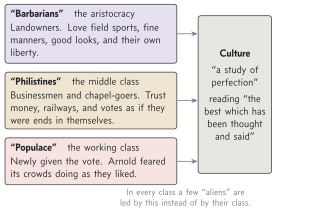
Then, with much mischief, he sorts the English into three classes (Figure 8.12). In his scheme society divides into Barbarians, Philistines, and Populace.This essay collection divides society into the Populace, the Barbarians, and the Philistines. → Culture and Anarchy•• The “Barbarians” are the aristocracy, named after the Germanic warriors who overran the Roman Empire, whose love of hunting, fine bodies, and personal freedom the nobility still shares. The “Philistines” are the middle class, the businessmen and Nonconformist chapel-goers he had met as an inspector, who confuse wealth and “machinery” with greatness. By machinery Arnold meant tools such as money, coal, railways, and even votes, which are useful only for what they help people become. In the Bible the Philistines were the enemies of Israel, and German students had used the word for narrow-minded townspeople. The “Populace” is the working class, newly given the vote, which Arnold feared would start “bawling what it likes, breaking what it likes.” Most of Arnold’s readers belonged to the middle class, and the name “Philistine” stuck to them.
In a later chapter of Culture and Anarchy, Arnold names the two great forces that he thought had shaped Europe. Hebraism, which comes from the Hebrew Bible, is “strictness of conscience”: the drive to obey God’s law and to do right. Hellenism, which comes from the ancient Greeks, is “spontaneity of consciousness”: the drive to see things as they really are. The English, he said, had plenty of the first, above all in their strict Protestant, or Puritan, middle class, and far too little of the second.
Arnold also turned his criticism on religion. In Literature and Dogma (1873), dogma meaning the fixed beliefs a church requires, he argued that the Bible should be read as great literature and moral wisdom, not as a record of miracles, and he defined religion as “morality touched by emotion.” It was his answer to the ebbing Sea of Faith: keep the poetry and the conscience of Christianity, even if belief in its miracles drains away.
Arnold’s most famous late essay on poetry, “The Study of Poetry” (1880), gave critics a practical tool. A touchstone was a smooth black stone that goldsmiths used to test metal. They rubbed a piece of gold across it, and the color of the streak it left showed how pure the gold was. Arnold advised readers to keep in mind a few lines from the very greatest poets, such as Homer, Dante, Shakespeare, and Milton, and to hold any other poem up beside them. Arnold’s “touchstone” methodThis author espoused a comparative "touchstone" method of literary criticism. → Matthew Arnold• of criticism judges a poem by comparison with the masters rather than by rules. The best poetry, he said, shows “high seriousness,” and by that standard he ranked even Chaucer just below the very top.
In 1883 the Liberal prime minister William Gladstone gave Arnold a government pension for his services to literature. That autumn he set off on a lecture tour of the United States. He went back in 1886, the year he retired from inspecting schools. On April 15, 1888, in Liverpool, he ran to catch a tram to meet his daughter, who was arriving by ship from America, and his heart failed. He was sixty-five. He was buried at Laleham, the village on the Thames where he had been born.
What to remember
- Matthew Arnold (1822–1888), son of Thomas Arnold of Rugby, was first a poet and then the leading critic of Victorian England; he was an inspector of schools for thirty-five years.
- The Marguerite poems, set at Thun in Switzerland, picture every person as an island: “we mortal millions live alone,” divided by an “estranging sea.”
- Empedocles on Etna (1852) shows the Greek philosopher leaping into the volcano; Arnold dropped it in 1853 because its suffering led to no action.
- “The Scholar-Gipsy” (1853), from a story by Joseph Glanvill, and “Thyrsis” (1866), the elegy for Clough with its “dreaming spires,” are the two Oxford poems.
- “Stanzas from the Grande Chartreuse” describes a man “wandering between two worlds, one dead, the other powerless to be born.”
- “Dover Beach” moves from a calm sea at Dover, through Sophocles and the ebbing “Sea of Faith,” to the plea “let us be true” and the “darkling plain” where “ignorant armies clash by night.”
- Culture and Anarchy (1869) defines culture as the study of perfection, borrows Swift’s “sweetness and light,” and splits England into Barbarians, Philistines, and Populace.
- Arnold’s touchstone method judges poetry by holding it up against a few great lines of Homer, Dante, Shakespeare, and Milton.
Chapter 9 · 55 clues
Dickens II: Two Cities and Great Expectations
On the evening of January 6, 1857, the schoolroom of Tavistock House, Charles Dickens’s tall home in the Bloomsbury district of London, had been turned into a little theater. The audience sat close together on chairs, facing painted scenery of the frozen North. Near the end of the play, the most famous author in the world burst onto the stage in rags, starved and half out of his mind. The man he played had found his rival in love lying helpless in the snow. He could have left him to die. Instead he had carried him across the ice to safety, and now he gave him back to the woman they both loved, asked her forgiveness, and died at her feet.
Dickens was forty-four that night. The audience wept, and so did he. Acting gave him something that his life at home no longer did. Within two and a half years he had left his wife, quarreled with his publishers, and started a magazine of his own. In its first issue he began a novel that turned the dying man in the snow into a drunken lawyer climbing the scaffold in Paris. He had thirteen years left to live, and he spent them performing his own books aloud to vast crowds on two continents and writing three more great novels, half of a fourth, and a ghost story about a railway.
A Tale of Two Cities
A play about the ice
The play was called The Frozen Deep. Its author was Wilkie Collins, one of Dickens’s closest friends, a novelist twelve years younger than he and the son of a well-known painter. The two men traveled together, and Collins wrote regularly for Household Words, the weekly magazine that Dickens edited (Chapter 2). He would soon write The Woman in White and The Moonstone, two of the most gripping mystery novels of the century. Collins wrote the first draft in 1856, and Dickens heavily rewrote Collins’s play,This author made significant edits to Wilkie Collins' play The Frozen Deep. → Charles Dickens• cutting scenes, sharpening speeches, and building up the leading part, which he meant to act himself.
The subject came from the news. In 1845 Sir John Franklin had sailed from England with two ships and 129 men to find the Northwest Passage, a sea route over the top of North America. None of them came home. In 1854 a Scottish explorer, John Rae, brought back reports from the Inuit that the last survivors had eaten their dead companions. Dickens refused to believe that English sailors could do such a thing, and he said so at length in Household Words. The Frozen Deep was his answer, an Arctic story in which starving men behave nobly.
In the play, Richard Wardour loves Clara Burnham, but Clara loves Frank Aldersley. On the expedition Wardour discovers that his companion is his rival, and he could easily let him perish. Instead he saves him and dies. Dickens played Wardour, and Collins played Frank. Queen Victoria saw a private performance in July 1857, and in August the company took the play to a huge hall in Manchester. For the bigger stage Dickens hired professional actresses, among them a mother and her two daughters named Ternan (tur-nun). The younger daughter, Ellen, was eighteen. Dickens fell in love with her, and in May 1858 he separated from his wife, Catherine, the mother of his ten children. Ellen Ternan remained his secret companion for the rest of his life.
The part stayed in his mind: a man who saves his rival and dies for the woman they both love. In the preface to his next novel, Dickens wrote that it was while he was acting in that play that he “first conceived the main idea of this story.” In that sense the novel grew out of The Frozen Deep.This novel was inspired by the play The Frozen Deep. → A Tale of Two Cities• It kept the sacrifice and moved it from the Arctic ice to the scaffold of the French Revolution.
A new magazine
The breakup of his marriage became public, and it cost Dickens his publishers. He printed a statement about the separation in Household Words. When his publishers, Bradbury and Evans, refused to print it in their comic magazine Punch as well, he broke with them. They owned a share of Household Words, so rather than keep them as partners he closed it down and founded a new weekly of his own. He called it All the Year Round, after a line from Shakespeare’s Othello, and set the price at twopence.

The first issue appeared on Saturday, April 30, 1859. Its front page began a serial, and that was how Dickens’s new novel, A Tale of Two Cities,This author wrote A Tale of Two Cities. → Charles Dickens•• reached its first readers. It ran every Saturday for thirty-one weeks, until November 26. It also came out in monthly parts with pictures by Hablot Knight Browne, who signed himself “Phiz” and had illustrated Dickens’s books since The Pickwick Papers. They were etchings, prints made from copper plates, and this was the last book the two men made together. In the issue that carried the final installment, Collins’s The Woman in White began, and two days earlier Charles Darwin had published On the Origin of Species (Chapter 7).
The two cities of the title are London and Paris, so the novel is named for its settings.This novel is named for its London and Paris settings. → A Tale of Two Cities•• Its characters move between them along a road that Dickens himself had traveled many times. They go from London down the old Dover Road through Kent, cross the Strait of Dover in a packet boat, a small ship that carried the mail and passengers on a regular schedule, and take the coach road from Calais to Paris (Figure 9.2).

The time is the French Revolution, whose story Vol. 15, The Age of Revolution tells in full. In 1789 the people of Paris stormed the Bastille, the royal fortress and prison. In 1792 France became a republic, and in January 1793 it beheaded its king, Louis XVI. Then came the Terror of 1793 and 1794, when revolutionary courts sent thousands of people to the guillotine, a machine that drops a heavy slanting blade between two tall posts. Dickens’s novel is set during the French RevolutionThis Dickens novel is set during the French Revolution. → A Tale of Two Cities•• and the years leading up to it, from 1775 to the Terror. He took his picture of those years mostly from Thomas Carlyle, the Scottish historian, whose The French Revolution (1837) tells the story in blazing, prophetic prose. In his preface Dickens called it “Mr. Carlyle’s wonderful book.”
Few novels are better known by their first words. It begins “It was the best of times,This novel begins "It was the best of times, it was the worst of times." → A Tale of Two Cities••• it was the worst of times,” and the sentence rolls on, pairing wisdom with foolishness and “the spring of hope” with “the winter of despair.” The year is 1775. Dickens’s sly point is that every age believes itself either the best or the worst there ever was, and that the people of 1775 were very like his readers of 1859.
Recalled to life
Book the First is called “Recalled to Life.” On a raw November night in 1775, the Dover mail coach is laboring up a hill outside London when a rider gallops up behind it with a message for one of the passengers. The passenger is Mr. Jarvis Lorry, a careful, kindly man of business from Tellson’s Bank, an old-fashioned London bank with a branch in Paris. The rider is Jerry Cruncher, a runner for Tellson’s.In this novel, Jerry Cruncher works as a runner for Tellson's Bank. → A Tale of Two Cities• Jerry spends his days on a stool outside the bank’s door at Temple Bar, one of the old gateways of the City of London, waiting to run errands and carry messages. Lorry sends him back with an answer that makes no sense to him: “Recalled to life.”
Jerry has a secret. Tellson’s pays him by day, but at night he goes “fishing,” as he tells his son, and comes home with iron rust on his fingers. He is a resurrection man, a body snatcher who digs up fresh corpses and sells them to surgeons, who needed bodies to teach anatomy and could get few of them by law. Parliament ended the trade with the Anatomy Act of 1832, but in 1775 it flourished.
The message concerns a young woman of seventeen, Lucie Manette (ma-net), who has been raised in England as an orphan. Mr. Lorry must tell her that her father is alive. He is Lucie’s father, Dr. Alexandre Manette,In this novel, Dr. Manette is Lucie's father. → A Tale of Two Cities•• a French physician who vanished into the Bastille before she was born. After eighteen years he has just been released, and no one knows why he was ever locked up. Lorry takes Lucie across the Channel to bring him home.
The scene shifts to Paris,This city is a partial setting of Dickens' A Tale of Two Cities. → Paris, France• to the poor district of Saint Antoine (san-tahn-twahn), whose narrow streets crowd up against the walls of the Bastille. A cask of red wine has just smashed on the cobbles outside a wine shop, and the hungry people of the quarter scoop it up with their hands, their caps, and bits of broken pottery. A tall joker dips his finger in the muddy wine and writes one word on a wall: BLOOD. The wine shop belongs to Ernest Defarge (duh-farzh), who was once Dr. Manette’s servant. His wife, Thérèse (tay-rez), sits behind the counter, knitting and noticing everything.

Defarge leads Lorry and Lucie up to a dark garret under the roof. There a white-haired man sits at a low bench, bent over a lady’s shoe. In the Bastille, with nothing to fill year after year, Dr. Manette learned to make shoes,In this novel, Dr. Manette learned to make shoes while in prison. → A Tale of Two Cities•• and the work is now all he knows. When Lorry asks his name, he answers with the number of his cell: “One Hundred and Five, North Tower.” Then Lucie kneels beside him (Figure 9.3). Around his neck he has kept a few golden hairs of his lost wife, wrapped in a rag, and Lucie’s hair is the same color. Slowly he begins to remember.
They take him to London, to a quiet house in Soho, and there he slowly recovers, though in times of strain he goes back to his bench and his shoes. Lucie’s guardian angel is her companion and housekeeper, Miss Pross, a tall, red-haired, fiercely loyal Englishwoman who has looked after her since she was ten and calls her “Ladybird.” Miss Pross distrusts everything foreign. She also adores her brother Solomon, who took all her money and abandoned her.
The jackal and the lion
Book the Second, “The Golden Thread,” opens in 1780 at the Old Bailey, London’s chief criminal court. On trial for treason, the crime of betraying the king, is a young Frenchman named Charles DarnayThis novel's characters include Charles Darnay. → A Tale of Two Cities••• (dar-nay), accused of carrying English military secrets to France. A foreigner in England owed the king loyalty while he stayed there, so even a Frenchman could commit treason. The penalty for treason was hanging, followed by a hideous ritual of cutting up the body, and the crowd has come to enjoy the show. Lucie and her father are in court unwillingly, as witnesses: Darnay had been kind to them on the packet boat from Calais five years before.
A witness swears that he saw the prisoner at a certain place on a certain night. At the defense table, a young lawyer who has seemed to be staring at the ceiling scribbles a note. The senior defense lawyer, Mr. Stryver, then asks the witness to look carefully at his colleague, a lawyer named Sydney Carton.This novel's characters include Sydney Carton. → A Tale of Two Cities••• When Carton takes off his wig, he is the very image of the prisoner. If two men can look so alike, the witness’s certainty means nothing, and Darnay goes free (Figure 9.4).

Carton is brilliant, and he is wasting his life. He drinks too much, cares about nothing, and lets the loud, pushy Stryver take the credit for his work. Night after night he sits up with wet towels wrapped around his head, reading through Stryver’s case papers and picking out the points that will win in court. Dickens calls the chapter about this partnership “The Jackal,” because Carton is the jackal to Stryver’s lion.This lawyer is the "jackal" to Stryver's "lion." → Sydney Carton•• In an old belief, the jackal hunted down prey for the lion, which then ate the kill. Carton knows exactly what he is. “I am a disappointed drudge,” he tells Darnay; he cares for no one, and no one cares for him.
Carton has watched Lucie Manette at the trial, and Carton falls in love with Lucie.This character loves Lucie Manette. → Sydney Carton•• He knows that she will never love him, and that Darnay loves her too. One day he visits her and confesses everything: that he has thrown his life away, that she has stirred in him a last flicker of the man he might have been, and that it is too late. Then he makes her a promise. She should think now and then, he says, that there is a man who would give his life “to keep a life you love beside you.” Those words, “a life you love,”This character tells a woman "a life you love." → Sydney Carton• hang over the rest of the book.
Lucie marries Darnay. On the wedding morning Darnay tells Dr. Manette a secret, and the shock sends the doctor back to his shoemaker’s bench for nine days. While he recovers, Mr. Lorry and Miss Pross chop the bench to pieces and burn it, feeling like a pair of criminals. The reader learns the secret in France.
Monseigneur and the Marquis
Early in Book the Second, before the wedding, Dickens also takes the reader to France to show its nobility. In a palace in Paris lives a great lord whom Dickens calls only Monseigneur (mohn-sen-yur), French for “my lord.” He is so grand that he needs four men for his chocolate.A character in this novel requires four men to help him with his chocolate. → A Tale of Two Cities•• One carries the pot into the room, a second whips the chocolate to a froth with a little wooden tool, a third hands over the napkin, and a fourth pours. Without all four, and the cook, Monseigneur could not take his morning drink. Dickens meant him as a portrait of a whole class of idle lords, living on the rents and taxes of peasants who were going hungry.
Among Monseigneur’s guests is the Marquis St. Evrémonde (ev-ray-mond), a cold, handsome nobleman whose face looks like a fine mask. He leaves in a bad temper and orders his coachman to drive at full speed through the narrow streets, where people on foot must leap out of the way. Near a fountain in Saint Antoine his carriage runs over a child.In this novel, a carriage runs over Gaspard's child. → A Tale of Two Cities•• The child’s father, a tall man named Gaspard (gas-par), throws himself on the little body and howls with grief.
The Marquis is annoyed only by the delay. He looks at the crowd as if it were a nest of rats, takes out his purse, and tosses the father a gold coinIn this novel, the Marquis tosses a coin to compensate for running over a child. → A Tale of Two Cities•• to pay for the harm. As the carriage pulls away, someone flings a coin back in through the window. The Marquis looks toward the spot where it came from and sees only a stout, dark woman, standing there knitting. It is Madame Defarge (Figure 9.5).

That night Gaspard clings to the underside of the Marquis’s carriage, rides it all the way to the family’s château, a great country house, and waits. At dawn the Marquis is found dead in his bed with a knife through his heart and a note on it: “Drive him fast to his tomb. This, from JACQUES.” So Gaspard kills the Marquis St. Evrémonde,In this novel, Gaspard kills the Marquis St. Evrémonde. → A Tale of Two Cities•• and for nearly a year he hides. When the soldiers catch him, they hang him forty feet high above the village fountain and leave him there, poisoning the water. “Jacques” (zhahk), the commonest of French men’s names, is the code name the revolutionaries use. It recalls the Jacquerie, a great revolt of French peasants in 1358.
That same evening the Marquis’s nephew had arrived at the château. The nephew was Charles Darnay. Darnay’s father and the Marquis were twin brothers. Darnay loathes his family’s cruelty, has given up his title and his inheritance, and earns his living in England as a teacher of French, under a name taken from his mother’s. That was the secret he told Dr. Manette on his wedding morning: Lucie’s husband is an Evrémonde.
As Dickens wrote, the Saint Antoine of his novel was vanishing. France’s emperor, Napoleon III, and Baron Haussmann (ohs-mahn), the official who governed Paris for him, were cutting broad boulevards through the old city, partly so that crowds could no longer barricade its streets (Vol. 18, Paris, Capital of the Arts).
The knitting and the storm
Madame Defarge is the most frightening woman in Dickens. She seldom raises her voice. She sits in the wine shop, knitting endlessly, and the revolutionaries of Saint Antoine know what her knitting means. A written list could be found and read by the police, so she knits the names of the doomedA character in this novel uses her knitting to record the names of people to be killed. → A Tale of Two Cities•• into her work, in a code of stitches that only she can read. Every cruel landlord, every spy, and every aristocrat who has harmed the poor is “registered” in her knitting, waiting for the day of reckoning. In the real Terror, the women who sat knitting beside the guillotine while heads fell were called tricoteuses (tree-ko-tuz), “knitters.”
On July 14, 1789, the storm breaks. Defarge leads the crowd of Saint Antoine against the Bastille, and when the fortress falls he makes a jailer take him to One Hundred and Five, North Tower. He searches the empty cell with great care, and Dickens does not yet say what he finds. For three more years the Revolution rolls on. The château of the Evrémondes burns. In London, Darnay and Lucie raise a little daughter, also named Lucie.
In August 1792 a letter reaches Tellson’s from Gabelle (ga-bel), the old servant who had managed the Evrémonde estate for Darnay. He is in prison in Paris and will be killed unless his master comes to speak for him. Darnay cannot refuse. He slips away to France, and he is arrested as an émigré, a noble who had fled the Revolution and come back. He is locked in the prison of La Force. Mr. Lorry, with Jerry Cruncher, has gone to Paris on the bank’s business at the same time, and Lucie, her father, and Miss Pross soon follow.
Dr. Manette, the famous prisoner of the Bastille, is a hero to the revolutionaries, and for more than a year he works to save his son-in-law. At last Darnay is tried and set free. That same evening he is arrested again. At his second trial his accusers are named as the Defarges “and one other.” The other is Dr. Manette himself.
What Defarge found in the Bastille was a paper that the doctor had written in his cell in 1767 and hidden in the chimney. In December 1757, it said, the twin Evrémonde brothers had fetched him at night to treat two dying patients, a young peasant woman and her younger brother. One of the brothers had wanted the woman. Her husband was worked to death in harness like a beast, the brothers carried her off, and when her brother tried to defend her, he was run through with a sword. Manette tried to report the crime, and the brothers had him locked in the Bastille without a trial. His paper ended by condemning the Evrémondes and all their descendants. Darnay is the last of the line. And Madame Defarge, it now comes out, is the dead girl’s younger sister (Figure 9.6). The court sentences Darnay to die within twenty-four hours.

A far, far better thing
Sydney Carton has followed them to Paris, and he alone sees what can be done. He recognizes a spy who works in the prisons, John Barsad, who turns out to be Miss Pross’s lost brother Solomon, and he threatens to expose him unless Barsad helps. Then Carton walks the dark streets all night. As he walks, he repeats “I am the resurrection and the life”,This character repeatedly mutters "I am the resurrection and the life." → Sydney Carton• the words of Jesus in the Gospel of John that open the Church of England’s funeral service. He had heard them read as a young man, at his own father’s grave.
The next afternoon, with Barsad’s help, Carton gets into Darnay’s cell. He makes Darnay change boots and coats with him and write a letter, and then he holds a drug under his nose until he faints. Barsad carries the unconscious Darnay out, passing him off as Carton, who is supposed to have fainted at the sight of his friend’s misery. The family is waiting with a carriage and Carton’s travel papers, and they race for the coast. So Carton takes Darnay’s place at the guillotine.This character takes his lookalike Charles Darnay's place at the guillotine. → Sydney Carton•• He has kept the promise he made to Lucie years before.
Meanwhile Madame Defarge goes to Lucie’s lodgings. She means to accuse Lucie of grieving for an enemy of the Republic, which was a crime, and send her and her child to the guillotine too. She finds only Miss Pross, guarding the door. Neither woman understands a word of the other’s language, and neither will give way. Miss Pross grips her around the waist, Madame Defarge reaches for the pistol hidden in her dress, and in the struggle it goes off and kills her. Defending her “Ladybird,” Miss Pross is left deaf for life.In this novel, a servant goes deaf after a struggle to defend her "Ladybird." → A Tale of Two Cities•• The shot is the last sound she will ever hear.
Carton rides to the scaffold in a tumbril, a rough open cart, beside a young seamstress condemned for a plot she knows nothing about. In the prison she had realized that he was not Darnay, and understood why, and had asked to hold his hand, because it would give her courage. He holds it all the way. At the foot of the scaffold he kisses the little seamstress,This character shares a kiss with a seamstress before his execution. → Sydney Carton• and she goes before him to the blade.
The last page imagines Carton’s thoughts. Dickens says that if Carton had spoken them aloud, and if they had been prophetic, they would have been these. He sees Lucie and Darnay grown old and happy, a son of theirs bearing his own name, and Paris at peace. The book ends with his imagined last words,This novel ends with the imagined words "It is a far, far better thing that I do, than I have ever done." → A Tale of Two Cities•• the most famous farewell in English fiction. “It is a far, far better thing that I do, than I have ever done,” they begin, “it is a far, far better rest that I go to than I have ever known.”
In the end Carton is the novel’s true hero,This character is a protagonist of A Tale of Two Cities. → Sydney Carton•• more than Darnay. Darnay is good and brave, but things happen to him; Carton chooses. The wasted man who said that no one on earth cared for him gives his life for the woman he loved and for the rival whose face he shared. Dickens had played the same sacrifice on the stage as Richard Wardour. In the novel he set it against the Revolution, and readers have never let the book go out of print.
Great Expectations
Christmas Eve on the marshes
Less than a year after A Tale of Two Cities ended, All the Year Round was in trouble. Its new serial, A Day’s Ride by the Irish novelist Charles Lever, was losing readers every week. Dickens had been planning a long novel to be published in monthly parts. Instead he decided to put it on the front page of his magazine, a few chapters a week. Dickens wrote Great ExpectationsThis author wrote Great Expectations. → Charles Dickens•• at the speed of the printing press, and it ran from December 1, 1860, to August 3, 1861. The magazine’s sales recovered.
He wrote it at Gad’s Hill Place, a red-brick house on the road between Gravesend and Rochester in Kent. According to a story Dickens told, he had walked past it as a small boy with his father, who said that if he worked very hard he might one day live in such a house. He bought it in 1856 and made it his only home in 1860. From its windows he looked toward the country of his childhood: the low, flat marshes along the Thames, where the great river widens into the sea (Figure 9.7).

The novel begins in that marsh country. Its hero and narrator, Pip,This character is the protagonist of Charles Dickens' novel Great Expectations. → Pip (or Philip Pirrip)• explains his own name. His father’s family name was Pirrip (pir-ip) and his first name Philip, but his infant tongue could make of both nothing longer than “Pip.” His parents and five little brothers lie in the village churchyard. He is an orphan, raised “by hand” by his grown-up sister, who is married to the village blacksmith, Joe Gargery (gar-juh-ree), and so is called Mrs. Joe. The phrase meant fed from a bottle, but Pip, who knows how hard her hand is, takes it another way. The whole book is the grown-up Pip looking back on his life and judging himself without mercy.
On Christmas Eve, as the light fails, the small boy is standing among the graves when a terrible man rises up from behind a tombstone. He is soaked and shivering, dressed in coarse gray, with a great iron locked on his leg, and he turns Pip upside down to empty his pockets. He is an escaped convict, Abel Magwitch,Abel Magwitch is an escaped convict in this novel. → Great Expectations••• though Pip will not learn his name for years. He has broken out of the hulks, old warships anchored in the river and used as floating prisons. The men in them were waiting for transportation, which meant being shipped to the prison colonies of Australia.

The convict demands a file, to cut off his leg iron, and food, which he calls “wittles,” his way of saying victuals, an old word for food. He warns Pip that a young man is hiding nearby who will tear out his heart and liver if he tells anyone. Terrified, Pip creeps into his sister’s pantry before dawn on Christmas morning and takes bread, cheese, mincemeat, brandy, a meat bone, and a beautiful round pork pie, then steals a file from Joe’s forge. Out on the misty marsh Pip gives the convict his “wittles,”The protagonist gives food ("wittles" / a meat pie) to a convict in this novel. → Great Expectations•• and the starving man wolfs them down like a dog. Pip, without thinking, says he is glad he enjoys it.
Christmas dinner is agony. Mrs. Joe is a tall, bony, furious woman who brings Pip up with slaps and with a cane she calls the Tickler,The protagonist is beaten with a cane called "The Tickler" by his sister in this novel. → Great Expectations• “a wax-ended piece of cane, worn smooth by collision with my tickled frame,” as Pip remembers it. Joe, a huge, gentle, simple man, protects the boy as best he can. At dinner Joe’s pompous uncle, Mr. Pumblechook, a seed merchant from the town, gulps down the brandy, which Pip had topped up from a jug of tar-water, a foul-tasting medicine, and leaps up choking. When Mrs. Joe goes to fetch the pork pie, Pip runs for the door. He runs straight into a party of soldiers holding out a pair of handcuffs.
The soldiers have come to get the handcuffs mended, and to hunt two escaped convicts. Joe and Pip follow the hunt across the marsh in the dark. They find Pip’s convict rolling in a ditch, locked in a furious fight with the other one. When he is taken, Pip’s convict says that he stole the food himself from the blacksmith’s house, to keep the boy out of trouble. Joe answers that they would not have had him starve, “poor miserable fellow-creatur.” The convicts are rowed back to the hulks, and Pip is left with his first great secret.
Satis House
In the nearby town lives a very rich and very strange old lady, Miss Havisham (hav-ih-shum), who has asked for a boy to come and play. Uncle Pumblechook takes Pip there. Her home is a gloomy mansion called Satis House,This novel is partly set at Satis House. → Great Expectations•• its windows barred with rusty iron or bricked up. A proud girl about Pip’s own age lets them in at the gate and explains the name: satis is Latin for “enough,” because whoever owned such a house could want nothing else. The girl is Estella, and she treats Pip like a stray dog.

Inside, every window is shuttered and every room is lit by candles. In a dressing room sits the strangest lady Pip has ever seen, the elderly mistress of Satis House.This character is an elderly inhabitant of Satis House. → Miss Havisham•• She is dressed for a wedding, in white satin and lace that have turned yellow. A bridal veil hangs from her white hair, and she wears only one shoe; the other lies on the table, never put on. Pip notices that her watch has stopped, and so has the clock in the room. Later he learns that every clock stopped at twenty minutes to nine,A house's clocks are stopped at 8:40 in this novel. → Great Expectations••• the minute when, years before, a letter came to say that her bridegroom would not come.
From that moment she stopped all time in her house. The rest of the story comes out later, told to Pip by a friend. Miss Havisham, a brewer’s daughter and a great heiress, had been jilted on her wedding day,Miss Havisham was jilted on her wedding day in this novel. → Great Expectations••• abandoned by the man she was about to marry after he had swindled her out of a great deal of money. She has not seen daylight since. In the next room the wedding feast still stands on a long table under dust and cobwebs. The cake in the middle is black with fungus and full of mice and spiders, and she means to be laid out on that table when she dies.
Miss Havisham has raised her adopted daughter, Estella,The adopted daughter Estella is part of this novel. → Great Expectations••• to take revenge on all men. When Estella sneers at playing cards with a common working boy, Pip overhears the old woman answer, “Well? You can break his heart.” Estella mocks him for calling the knaves in the pack of cards “Jacks,” the name common people used, and for his coarse hands and thick boots. Pip goes home and cries, and from then on he is ashamed of the forge, of Joe, and of himself. He also falls hopelessly in love with Estella.

On one visit Pip wanders into the overgrown garden and meets a pale young gentleman with red eyelids and light hair. “Come and fight,” says the stranger, and he starts dancing about like a boxer. Pip, who has never fought anyone, hits him and knocks him down. The pale young gentleman gets up and is knocked down again, and again, until he admits defeat with perfect good manners. So Pip fights a “pale young gentleman”This novel's protagonist has a fistfight with the "pale young gentleman" as a youth. → Great Expectations• and wins, and Estella, who has been watching, lets him kiss her cheek. The pale young gentleman will return.
Pip’s visits go on for months. Then Miss Havisham pays twenty-five guineas, a guinea being a gold coin worth twenty-one shillings, so that Pip can be bound apprentice to Joe. An apprentice signed a contract to work for a master for several years in return for learning a trade, and Pip’s trade is to be the forge.
Great expectations
Joe has a hired workman named Dolge Orlick, a dark, slouching, resentful man who hates Pip. One afternoon Orlick and Mrs. Joe have a screaming quarrel. That night, while Joe and Pip are out, someone strikes Mrs. Joe a terrible blow on the back of the head and leaves her senseless on the kitchen floor. Beside her lies a convict’s leg iron, filed open. Pip guesses that it is the iron he saw on the marsh, and suffers agonies of guilt. He learns the truth only years later, from Orlick’s own mouth: it was Orlick who attacked Mrs. Joe.Orlick attacks the protagonist's sister, Mrs. Joe, in this novel. → Great Expectations•• She never recovers. Unable to speak clearly, she draws a letter T on a slate, which turns out to mean a hammer, and when Orlick comes to her she is eager to please him.
In the fourth year of Pip’s apprenticeship, a large, dark, bullying lawyer from London named Mr. Jaggers arrives with news. Pip is to come into a handsome property, leave the forge, and be brought up in London as a gentleman, “a young fellow of great expectations.” His benefactor, the person paying for all this, wishes to stay secret, and Pip must never ask who it is. Pip is sure it is Miss Havisham, and that she means him to marry Estella. Jaggers says nothing to correct him.
Jaggers is the most feared criminal lawyer in London, and the dirt of his own trade disgusts him. After seeing a client he goes to a little closet and washes his hands with scented soap,A lawyer obsessively washes his hands to avoid criminal corruption in this novel. → Great Expectations• scrubbing like a surgeon before an operation. After a really bad case he washes his face and gargles as well. Every criminal in London wants him for a lawyer, and he treats them all like dogs.
Pip goes to London and shares rooms in Barnard’s Inn, a dingy set of lodgings, with a cheerful young man named Herbert Pocket, a poor relation of Miss Havisham’s. They recognize each other at once: Herbert is the pale young gentleman from the garden. Herbert decides that “Philip” is too stiff. Pip has been a blacksmith, and the composer George Frideric Handel wrote a well-known piece called “The Harmonious Blacksmith,” so Herbert nicknames Pip “Handel,”The protagonist is nicknamed "Handel" in this novel. → Great Expectations•• and Handel he remains, to Herbert, for the rest of the book.
Mr. Jaggers’s clerk is John Wemmick, a dry little man with a mouth like a mail slot. In the office he collects “portable property,” rings and brooches given to him by clients on their way to the gallows. At home he is another man. In the London suburb of Walworth Wemmick lives in a tiny castleA character in this novel lives in a castle-like house with his father, the Aged Parent. → Great Expectations•• he has built himself, with a pretend battlement, a ditch for a moat, a plank drawbridge, and a little cannon that he fires every night at nine o’clock. He shares it with his father, a very deaf and very cheerful old man whom he calls “the Aged Parent,” or “the Aged P.,” and who nods with delight every time the gun goes off. “The office is one thing, and private life is another,” Wemmick explains.
Pip spends freely, runs into debt, and becomes a snob. When Joe comes to visit him in London, in his Sunday clothes, with a hat that keeps falling off the mantelpiece, Pip is ashamed of him and treats him coldly. Joe sees it, and leaves with perfect dignity. “Pip, dear old chap,” he says, “life is made of ever so many partings welded together.”
The benefactor
Dickens divided the novel into three “stages” of Pip’s expectations, and the third begins on a night of storm. Pip is twenty-three and lives in the Temple, the lawyers’ quarter beside the Thames. Footsteps climb the dark stairs, and a rough, gray-haired man in sea clothes holds out his hands to him with joy. It is the convict from the marsh. He was transported to New South Wales in Australia, became a sheep farmer, grew rich, and sent every penny to make Pip a gentleman. “Yes, Pip, dear boy, I’ve made a gentleman on you!” he cries, and so Pip discovers that Magwitch is his benefactor.This character discovers that Abel Magwitch is his anonymous benefactor. → Pip (or Philip Pirrip)••• He is filled with horror.
His whole world falls in. Miss Havisham never meant him for Estella, and his money is a criminal’s. Worse, Magwitch is in mortal danger, because a convict transported for life who came back to England could be hanged. Pip hides him in his rooms. Magwitch has come home under a false name. He goes by the name “Provis,”A character in this novel uses the pseudonym "Provis." → Great Expectations•• and Pip passes him off to the neighbors as an uncle from the country.
Magwitch tells his story. He was a homeless boy who stole to eat and grew up into a petty criminal. Then he fell in with a man named Compeyson, a smooth swindler who had been to a boarding school and could pass for a gentleman. The two were tried together for passing stolen banknotes. Because Compeyson looked and spoke like a gentleman, he got seven years and Magwitch got fourteen. Compeyson was the other convict in the ditch that Christmas. When Herbert hears the name, he passes Pip a note. Compeyson was the man who courted Miss Havisham and took her money: Compeyson had abandoned Miss HavishamThis character is abandoned on her wedding day by Compeyson. → Miss Havisham•• on her wedding day (Figure 9.11).
Compeyson is in London and hunting for Magwitch, so Herbert finds a safer hiding place, a house by the river at a spot called Mill Pond Bank, where his sweetheart, Clara, lives with her father. There Magwitch lodges under the name “Mr. Campbell.”A character in this novel also uses the pseudonym "Mr Campbell." → Great Expectations• Pip and Herbert and their friend Startop begin to practice rowing on the river, so that when the moment comes they can carry him down the Thames to a foreign steamer without being noticed.

One secret remains. Mr. Jaggers’s housekeeper, Molly, is a silent woman with strangely powerful, scarred wrists. Long ago Jaggers defended her when she was tried for strangling another woman out of jealousy, and won a verdict of not guilty. Pip notices that Estella’s hands and eyes are Molly’s, and from Wemmick and Magwitch he pieces the truth together. Molly had a baby daughter by Magwitch. Jaggers took the child to Miss Havisham, who wanted a little girl to bring up, and so Miss Havisham became Estella’s guardian.This character is the guardian of Estella. → Miss Havisham•• The proud Estella, raised as a lady, is the daughter of a convict and a woman tried for murder. By the time Pip learns it, she has married Bentley Drummle, a brutal, stupid rich young man whom Pip despises.
Fire and water
Pip goes to Satis House and tells Miss Havisham what she has done to him. To his surprise, she is broken. In Pip’s misery she has seen her own, and she begs him to forgive her. She gives him a notebook with her name written in it and asks him to write under it, someday, that he forgives her. As he leaves, he looks back and sees her by the fire. A moment later she runs at him shrieking, wrapped in flames, her old wedding dress ablaze. Pip throws his coat over her and drags the great cloth from the rotting feast to smother the fire, burning his own hands. In the fever that follows, which she does not survive, she asks Pip to write “I forgive her.”As she dies, this character repeats the phrase "Take the pencil and write under my name, 'I forgive her.'" → Miss Havisham• Over and over she repeats it: “Take the pencil and write under my name, ‘I forgive her!’ ”
Pip still has an enemy. An unsigned letter calls him back to the marshes at night with a promise of news about “your Uncle Provis.” In a lonely sluice house, a hut beside the gates of a marsh drain, next to a kiln for burning lime, someone throws a noose over him and ties him to a ladder. It is Orlick, who hates Pip for every piece of luck he has ever had, and who now admits that it was he who struck Pip’s sister. He means to kill Pip and burn his body in the kiln. Orlick tries to murder Pip,Orlick attempts to murder the protagonist of this novel. → Great Expectations• and would have done it if Herbert, Startop, and the town tailor’s boy had not burst in.
On a cold, bright March day, Pip and his friends row Magwitch down the Thames, past Gravesend and out toward the estuary, to meet a steamer bound for Hamburg. As the steamer bears down on them, a police boat cuts across their path. In it sits Compeyson, who has betrayed them. Magwitch lunges at him, and both men go into the water under the steamer’s paddles. Only Magwitch comes up, badly hurt. Compeyson has drowned.
Magwitch is tried and condemned to death, but he is dying of his injuries. Pip, who once shrank from him, visits him every day in the prison hospital and holds his hand, and in those weeks he comes to love him. At the very end he tells Magwitch the one thing that can make him happy. Bending close, Pip tells him his daughter lives:In this novel, the protagonist tells his dying benefactor that his daughter lives and is a beautiful lady. → Great Expectations• “She is living now. She is a lady and very beautiful. And I love her!” Magwitch lifts Pip’s hand to his lips and dies.
Pip falls ill with fever, and Joe comes to nurse him and quietly pays his debts. Joe marries Pip’s old friend Biddy, the village girl who had taught Pip his letters. Pip goes abroad to work in Herbert’s firm in the East and comes home eleven years later. Dickens first ended the book with a short, sad meeting in a London street, where Estella, widowed and married again, shakes Pip’s hand and they part. His friend Edward Bulwer-Lytton, a popular novelist, persuaded him that readers wanted something gentler. In the published ending, Pip and Estella meet in the ruins of Satis House, and in its last words, as Dickens revised them in 1868, he sees “no shadow of another parting from her.” Readers have argued ever since about which ending is truer.
The last Dickens
The reader and the railway
In April 1858, in the middle of the breakup of his marriage, Dickens began to give public readings of his own work for money. He stood alone at a reading desk under gaslight and performed scenes from his books, doing every voice himself. Audiences laughed and sobbed. The readings made him a great deal of money, and they wore him out. In 1867 and 1868 he toured the United States, gave seventy-six readings, and came home with about £19,000. Near the end he added the murder of Nancy from Oliver Twist, which he acted with such violence that his pulse raced dangerously.

On June 9, 1865, Dickens was coming home from France with Ellen Ternan and her mother when their train ran onto a low bridge over a stream at Staplehurst (stay-pul-hurst) in Kent. Workmen repairing the line had taken up a length of rail, misreading the timetable. Most of the carriages plunged off the bridge into the riverbed. Ten passengers were killed and about forty hurt. Dickens’s first-class carriage was left hanging over the edge (Figure 9.12). He climbed out, helped the women down, and spent hours among the dying, carrying water in his hat. Then he climbed back into the hanging carriage to fetch the manuscript of the next part of his novel.
That book was his last finished novel, Our Mutual Friend,This author wrote Our Mutual Friend. → Charles Dickens• which came out in monthly parts from May 1864 to November 1865. It is a book about money and rubbish, and it is set along the Thames. It opens at dusk with a boat on the river, in which a waterside scavenger named Gaffer Hexam and his daughter, Lizzie, are searching the water for drowned bodies, whose pockets they empty. At the center of the plot are the dust heaps of a dead rubbish contractor, huge mounds of ash and household refuse that were worth a fortune because brickmakers bought the cinders. The heir to that fortune, John Harmon, is believed to have drowned.
The book’s most frightening character is Bradley Headstone, a schoolmaster who has worked his way up from poverty and holds himself together by iron self-control. He falls madly in love with Lizzie Hexam, who loves an idle young gentleman named Eugene Wrayburn. Headstone ambushes Wrayburn by the river and leaves him for dead. A waterside villain called Rogue Riderhood, now the deputy keeper of a lock on the upper Thames, knows what he did and begins to blackmail him. A lock is a chamber in a river with gates at each end, where boats are raised or lowered from one water level to another. At last the teacher seizes his tormentor at the lock’s edge and drags Riderhood into the lock.In this author's Our Mutual Friend, a teacher pulls Rogue Riderhood into a river's lock, drowning both of them. → Charles Dickens• The two men drown together, Headstone’s arms still clamped around his enemy.
“The Signal-Man”
The crash stayed with Dickens, and for the rest of his life he was nervous on trains. The following year he turned the railway into a ghost story. Every December his magazine published a special Christmas number of stories by several writers, and the one for 1866 was set around an imaginary railway junction. For it Dickens wrote “The Signal-Man.”This author wrote "The Signal-Man." → Charles Dickens• A signalman worked in a small cabin beside the line, called a signal box, and kept trains apart. He set the signals that told drivers to stop or go, and he passed messages to the next box by telegraph and bell. One mistake could cause a crash.
The narrator, out walking, looks down into a deep railway cutting, a trench dug through a hill for the line, near the mouth of a tunnel and calls to the man standing at the door of his box below: “Halloa! Below there!” Instead of looking up, the signalman turns and stares down the line toward the tunnel, and when the narrator climbs down, the man seems afraid of him. Later he explains why. Once a ghostly figure appeared at the tunnel mouth beside the red danger light, one arm across its face and the other waving wildly, and the specter cried “Below there!”In this story, a spectre cries "Below there!" → "The Signal-Man"• in the narrator’s very words. Hours later came a terrible collision in the tunnel. Months afterward the figure came back, silent, with its hands over its face, and a young woman died in a passing train. Now the specter is back a third time, and the signalman cannot tell what it is warning him about.
The next evening the narrator returns and finds men gathered at the foot of the cutting. The signalman has been killed by a train,In this story, the title character is killed by a train after being haunted by a spectre. → "The Signal-Man"• struck down by an engine as he stood on the line. The driver says that he shouted at him, “Below there! Look out! Look out!” and threw one arm over his eyes so as not to see, and waved the other. They were the very words, and the very gesture, of the ghost. Dickens never explains whether the specter was a warning, a coincidence, or the signalman’s own mind.
June 1870
In March 1870 Dickens gave his last reading in London and told the audience, “From these garish lights I vanish now for evermore.” He was writing a new novel, The Mystery of Edwin Drood, a murder story planned in twelve monthly parts, and he had finished six. On June 8 he worked all day in a little wooden chalet in his garden at Gad’s Hill, and at dinner he collapsed with a stroke. He died the next evening, June 9, 1870, five years to the day after Staplehurst. He was fifty-eight. He had asked to be buried simply, near Rochester, but the nation would not have it, and on June 14 he was laid in Poets’ Corner in Westminster Abbey, where Chaucer and many of England’s great writers lie. For days afterward thousands of people filed past the open grave.

Luke Fildes, the young artist who was illustrating Edwin Drood, went to Gad’s Hill after the death and drew the study as Dickens had left it (Figure 9.13). His readers never left him. In 1934 the English novelist Evelyn Waugh (waw) paid him the strangest tribute of all, in his bitter comic novel A Handful of Dust. Its hero, Tony Last, is a decent country gentleman whose wife leaves him and whose only son is killed in a riding accident. He joins an expedition into the jungles of Brazil, falls ill, and is nursed back to health by a lonely settler named Mr. Todd, who cannot read but owns a complete set of Dickens. Mr. Todd has no intention of letting him go. In the last pages Tony is a prisoner for life, forced to read Dickens aloud,In A Handful of Dust, Tony Last is forced to read this author’s works. → Charles Dickens• round and round, novel after novel, for as long as he lives.
What to remember
- Dickens rewrote and starred in Wilkie Collins’s play The Frozen Deep (1857), which gave him the idea for A Tale of Two Cities.
- A Tale of Two Cities (1859) opened Dickens’s weekly All the Year Round. Set in London and Paris during the French Revolution, it begins “It was the best of times, it was the worst of times.”
- Its people: Dr. Manette, who made shoes in the Bastille; his daughter Lucie; Charles Darnay, nephew of the Marquis St. Evrémonde, whom Gaspard kills; Madame Defarge, who knits the names of the doomed.
- Sydney Carton, Stryver’s “jackal,” loves Lucie, takes his look-alike Darnay’s place at the guillotine, and ends the book with “It is a far, far better thing that I do.”
- Great Expectations (1860–1861) is narrated by Pip, who feeds the convict Magwitch on the marshes, is beaten with the Tickler, and loves Estella, the adopted daughter of the jilted Miss Havisham, whose clocks stopped at twenty minutes to nine.
- Pip’s secret benefactor is Magwitch, alias Provis and Mr. Campbell. Wemmick keeps a castle with the Aged Parent, Herbert calls Pip “Handel,” and Orlick attacks Mrs. Joe.
- After Our Mutual Friend (1864–1865), his last finished novel, and the Staplehurst crash (1865), Dickens wrote “The Signal-Man” (1866). He died on June 9, 1870. In Waugh’s A Handful of Dust, Tony Last must read Dickens aloud forever.
Chapter 10 · 58 clues
George Eliot
On the first Sunday of 1842, a widower named Robert Evans walked to church in Coventry, and his youngest daughter stayed at home. She was twenty-two, plain, shy, and cleverer than anyone she knew, and she had stopped believing what the Church of England taught. Her father was a proud, conservative man who had worked his way up from carpenter to manager of a great estate. He stopped speaking to her and made plans to give up their house. She went to stay with her brother and wrote her father a careful, unhappy letter. Her biographers call the quarrel that followed the “Holy War.” After four months the two made peace: she would go to church with him, and she would think what she liked.
Nobody in that house could have guessed what came of it. Thirty years later this woman was the most admired living novelist in England. The queen read her books, and young writers made pilgrimages to her drawing room. She would live for twenty-four years with a man who was married to someone else, and she wrote every one of her novels under a man’s name, George Eliot (Figure 10.1). The road from that empty pew to the novels runs through German theology, a London magazine, and one of the strangest love stories of the century.

Marian Evans
She was born Mary Ann EvansThis author was born Mary Ann Evans. → George Eliot• on November 22, 1819, at a farmhouse on the Arbury estate near Nuneaton (nun-ee-tun), in Warwickshire (wor-ik-sher), in the middle of England. Her father managed the estate for its owners, the Newdigate family of Arbury Hall, as their land agent: he collected rents, chose tenants, and looked after the farms and woods. He knew timber, land, and building, and his daughter adored him. She worshiped her older brother, Isaac, and followed him everywhere until he went off to school and grew tired of her. That pairing of a clever, hungry girl and a brother who loves her less than she loves him would become the heart of The Mill on the Floss.
She was sent to boarding schools, where an evangelical teacher made her fiercely religious. Evangelicals were Protestants who stressed personal conversion, Bible reading, and strict daily conduct; the teenage Mary Ann gave up reading novels because she thought them dangerous. She also read everything she could reach, including the books in the library at Arbury Hall. When her mother died in 1836, she left school at sixteen to keep house for her father, and she went on studying German, Italian, Latin, and Greek, partly with tutors and partly alone.
In 1841 she and her father moved to Foleshill, on the edge of Coventry. Nearby lived a rich ribbon manufacturer, Charles Bray, and his wife, Cara, and their house was a meeting place for freethinkers, people who questioned religion by reason instead of accepting what the churches taught. Cara’s brother, Charles Hennell, had written a book arguing that the life of Jesus could be explained without miracles. Within months of meeting these people, Mary Ann had lost her faith, and the Holy War with her father followed.
The translator
The Brays’ circle gave her work as well as ideas. A friend of theirs had begun to translate a famous German book and given it up, and in 1844 Mary Ann took it over. Its author was David Friedrich Strauss, a young German theologian, or scholar of religion. In The Life of Jesus (1835) he had gone story by story through the four Gospels, the books of the Bible that tell the life of Jesus, and argued that the miracles were myths. By that he did not mean lies. He meant stories that the first Christians had told to express their faith, which grew up over time and were later written down as history. The book had cost Strauss his teaching career in Germany.
Translating it took her two years. The book filled three thick volumes, full of Greek and Hebrew, and she grew so weary of dissecting the death of Jesus that she called herself “Strauss-sick.” It appeared in 1846, with no translator’s name on it. So her first published book was a translationThis author’s first published book was an English translation of David Strauss’s Life of Jesus. → George Eliot•• of Strauss’s Life of Jesus, and the only payment she received was twenty pounds. The book’s readers in England did not know that the translator was a young woman from the Midlands.

Her father died in 1849. She spent the following winter in Geneva, lodging with the painter whose portrait of her survives, and then, in 1851, she moved to London to live by her pen. She now spelled her name Marian. She boarded in the house of the publisher John Chapman in the Strand, and when Chapman bought the Westminster Review, a serious quarterly magazine of politics and ideas, she became its editor in everything but name. The Review had been launched in 1824 by Jeremy Bentham, the father of utilitarianism (Chapter 7), as the voice of the reformers, and it was the most daring of the great quarterlies. For more than two years she chose the articles, corrected the proofs, and wrote long reviews, while Chapman’s name stood on the cover. She met the leading thinkers of the day, among them the philosopher Herbert Spencer (Chapter 7), with whom she fell in love. He did not love her in return.
Lewes
Then she met George Henry Lewes, the critic who teased Dickens about spontaneous combustion (Chapter 2). He was a small, lively, untidy journalist, an actor, a novelist, and a popular writer on science and philosophy. He was also married. His wife, Agnes, had begun an affair with his friend Thornton Hunt and had borne Hunt’s children, and Lewes had given the first of them his own surname. Under the law of the time, a husband who had forgiven his wife’s adultery in that way could never divorce her for it. Lewes was trapped in a marriage that existed only on paper. He still owed money to Agnes and support to all her children, and for twenty years Marian’s pen helped to pay it. Lewes’s three sons came to call her “Mutter,” the German for mother.

Before she left London with him in 1854, Marian finished a second translation, from the German philosopher Ludwig Feuerbach (foy-er-bahk). She translated Feuerbach’s The Essence of Christianity,This author translated Feuerbach's The Essence of Christianity into English. → George Eliot• a book of 1841. Feuerbach argued that God was humanity’s own best qualities, such as love, wisdom, and justice, imagined as a separate being in heaven. On this view, worshiping God was really honoring what was best in human beings. It was the only book she ever published under the name Marian Evans. It also stated in plain words the faith she kept for the rest of her life: a religion of human love and duty without the supernatural.
In July 1854 she and Lewes sailed together for Germany, to Weimar (vy-mar) and Berlin, where he was writing his life of Goethe (gur-tuh), Germany’s greatest poet. They lived openly as man and wife. In the eyes of respectable England she had become a “fallen woman,” a woman who had lost her good name, and she was not invited into polite houses for years. When she told her brother Isaac, in 1857, that she had a husband, he answered through his lawyer and never wrote to her again until she was sixty. Yet the partnership was the making of her. Lewes believed in her genius before she did, and he guarded her from bad reviews and from her own deep self-doubt. In lodgings at Richmond, outside London, they wrote side by side to earn their living, and it was there, in 1856, that he urged her to try a story.
Silly novels
Meanwhile she went on writing for the Westminster Review. In October 1856 it printed her wickedly funny essay “Silly Novels by Lady Novelists.”This author wrote "Silly Novels by Lady Novelists." → George Eliot•• The silly novels were the romances that filled the lending libraries, written by women who had leisure and little to say. Their heroines were heiresses with perfect features, who spoke several languages, had opinions on philosophy, and won every heart at every ball. Marian sorted these books into kinds, like a naturalist sorting beetles, and the largest kind she named the “mind-and-millinery” species.In "Silly Novels by Lady Novelists," this author argued that "mind and millinery" writing reinforced "the popular prejudice against the more solid education of women." → George Eliot• Millinery means fancy hats and trimmings. In these novels the heroine’s learning was shown off like a new bonnet, and nobody in them ever did any real thinking. The harm, she argued, was that such books strengthened the popular prejudice against giving women a solid education. A reader who met their genius heroines might well conclude that educated women were simply ridiculous.
The early novels
Late in 1856 Lewes mailed her first story to the Edinburgh publisher John Blackwood, saying that it was by a shy friend. Blackwood printed it in his monthly, Blackwood’s Edinburgh Magazine, in January 1857, and asked for more. The author wished to stay hidden, and in February she signed a letter to him with a new name: George Eliot. George, she said later, was Lewes’s first name, and Eliot was “a good mouth-filling, easily pronounced word.” A man’s name did two jobs. It made reviewers judge her as they judged Dickens and Thackeray, not as one more lady novelist, and it kept the scandal of her private life away from the books. Her novels then went out in the usual Victorian form, the three-volume novel. At a guinea and a half for the set, nearly three weeks’ wages for a farm laborer, few people bought one; most borrowed it from a circulating library, which lent books to members for a yearly fee.
Scenes of Clerical Life
There were three long tales in all, and in 1858 they were published together as Scenes of Clerical Life. Each one followed a clergyman of a Midland parish, as his neighbors saw him, in the years before and during her childhood. The best of them, “Mr. Gilfil’s Love-Story,” is set in an earlier generation, at a country house called Cheverel Manor, which she modeled on Arbury Hall. There the household chaplain, the clergyman who serves the family, Mr. Gilfil, loves Tina Sarti,In this author's Scenes of Clerical Life, Mr. Gilfil is in unrequited love with Tina Sarti. → George Eliot•• an orphaned Italian girl whom the family has raised. Tina does not love him. She is in love with the heir of the house, a vain young captain who is engaged to a rich woman and amuses himself with Tina. Her jealousy drives her to take a dagger to meet him, and she finds him already dead of a weak heart.
The other two tales are sadder and plainer. “The Sad Fortunes of the Reverend Amos Barton” follows a dull, poor curate whose gentle wife dies worn out by work and childbearing, and whose parish learns to pity him only when it is too late. “Janet’s Repentance” tells of a woman beaten by her drunken husband; she is rescued from despair, and from drink, by a young evangelical clergyman dying of tuberculosis.
Readers guessed wildly about the author. Most assumed that the stories were by a country clergyman. Charles Dickens (Chapter 2) wrote to “George Eliot” to praise them and said that he suspected the writer was a woman. In Nuneaton, gossip settled on a local man named Joseph Liggins, who did little to deny it.

Adam Bede
In 1839 or 1840, when Mary Ann was about twenty, an aunt by marriage, Elizabeth Evans, told her a story. Elizabeth had been a Methodist preacher, and as a young woman she had sat all night in prison with a girl condemned to hang for killing her own baby, until the girl confessed. Twenty years later, her first full novel, Adam Bede,This author wrote Adam Bede. → George Eliot••• grew from that memory. It came out in three volumes in February 1859. She called it “a country story full of the breath of cows and scent of hay.” It is a historical novel, set sixty years before it was written, in the England of her father’s youth.
The story takes place in 1799 in the village of Hayslope,This novel is set in the fictional town of Hayslope. → Adam Bede•• in a green, rich county she called Loamshire, under the bare hills of “Stonyshire” (Figure 10.4). Adam Bede is a carpenter, upright, strong, and a little hard on people weaker than himself; she drew him partly from her father. Early in the story, the village gathers on the green to hear an outdoor sermon. The preacher is Dinah Morris, a Methodist preacherIn this novel, Dinah Morris is a female preacher. → Adam Bede•• from a mill town in the hills. Methodism was a movement begun in the 1700s by John Wesley, who sent preachers into the open air to bring religion to workers and farm laborers whom the Church of England hardly reached. In its early days a few women, like Dinah, preached too.


The other young woman of Hayslope is Dinah’s cousin Hetty Sorrel (Figure 10.5), a dairymaid of seventeen at her uncle’s farm. She is as pretty as a kitten and about as thoughtful, and she dreams of being a lady. Adam loves her. Hetty, however, has caught the eye of Captain Arthur Donnithorne, the young heir to the estate, who means no harm and does a great deal. In the summer, Arthur’s coming-of-age feastIn this novel, Arthur Donnithorne throws a coming-of-age party for the people of Hayslope. → Adam Bede•• brings the whole parish to dine on the lawns of the Chase, the Donnithornes’ great house, to celebrate his twenty-first birthday. The tenants drink his health, and Adam is honored as the best workman on the estate. That same summer, Arthur has been meeting Hetty secretly in the woods.
The four young people form a love “rectangle.”In this novel, a "love rectangle" involves Hetty, Arthur, Dinah, and the title character. → Adam Bede• Adam loves Hetty, Hetty loves Arthur, and Arthur toys with Hetty. Dinah has refused Adam’s brother, Seth, and in the end she will turn out to love Adam himself. One evening Adam catches Arthur kissing Hetty in the wood. The two men fight, and Arthur agrees to give her up and rejoins his regiment. Hetty, abandoned, agrees to marry Adam. Then she finds that she is pregnant.
Before the disaster comes, the book spends long, happy chapters on the life of the farms. Hetty’s aunt, Mrs. Poyser, who runs the dairy, has a tongue like a carving knife and a saying for every occasion; she remarks that a conceited neighbor is like a rooster who thinks the sun has risen on purpose to hear him crow. In one chapter the story stops, and the narrator explains why she will not make these people prettier than they are. She loves the Dutch painters of the 1600s, who painted an old woman scraping carrots as carefully as other artists painted saints and kings. Readers, she says, must learn to love the plain, faulty neighbors they actually have.
What follows is the darkest stretch in all of George Eliot. Hetty sets off alone to find Arthur, fails, and wanders the roads in terror of the shame that waits at home. She gives birth in a stranger’s house and then leaves her baby in a wood,In this novel, Hetty Sorrel abandons her baby in a wood. → Adam Bede•• half-buried in a hole under a nut tree. She cannot bear its crying and comes back, but the baby is dead. She is tried for murder in the county town of Stoniton and sentenced to hang. Dinah sits with her in the condemned cell, as Elizabeth Evans once did, until Hetty confesses. At the last moment Arthur gallops in with a reprieve. Hetty is sentenced instead to transportation, meaning exile to a prison colony in Australia, and she dies years later on the way home. Adam, grown gentler through suffering, marries Dinah.
Adam Bede was a triumph. The joke about Liggins now turned ugly, because his friends were claiming that he had written it and was being robbed of the profits. That summer Marian let the truth be known. Readers were shocked to learn that the wholesome country novelist was the woman living with Lewes, but they kept buying the books. In 1859 she also wrote a short tale, “The Lifted Veil,” told by a man who can hear other people’s thoughts and who foresees the day of his own death. It is her one venture into the supernatural, and reading other minds only makes its narrator lonelier.
The Mill on the Floss
Her next novel was her most personal. In April 1860 The Mill on the Floss came out,This author wrote The Mill on the Floss. → George Eliot•• and it told, under thin disguise, her own childhood with Isaac. It is set around 1830 at Dorlcote Mill, on the River Floss, near an old town called St. Ogg’s. She modeled the town on Gainsborough, on the River Trent, and the Floss on the Trent itself, a river with a tide that runs far inland.

The miller’s children are the brother and sister Tom and Maggie Tulliver.This author created the siblings Tom and Maggie Tulliver. → George Eliot•• Tom is solid, slow at books, and sure of himself, and he loves rules. Maggie is dark, quick, passionate, and always in trouble. She cuts off her hair in a rage, pushes her pretty cousin Lucy into the mud, and runs away to live with a camp of Roma, who send her home. All she wants is to be loved, above all by Tom, and Tom loves her as long as she obeys. Around them hovers a comic chorus of aunts, the Dodson sisters, who judge every family by its manners, its savings, and the quality of its linen. Her working title was Sister Maggie; Blackwood suggested the one it bears.
Their father, an honest, hot-tempered man, goes to law over the water rights to his mill, the right to use the river to turn his wheel. He loses to a clever lawyer named Wakem, goes bankrupt, and suffers a stroke, and the mill passes into Wakem’s hands. Tom leaves school at sixteen and spends years in a merchant’s office to pay the family’s debts. On the day the last debt is paid, his father meets Wakem in the road and horsewhips him, and that night he dies. Maggie, shut up in a poor and joyless house, is given a bundle of secondhand books by Tom’s boyhood friend Bob Jakin, a peddler. Among them is a little old volume with passages marked by an earlier reader, and she reads Thomas à KempisIn this novel, the protagonist reads Thomas à Kempis's The Imitation of Christ. → The Mill on the Floss•• (ah kem-pis). He was a monk of the 1400s in the Netherlands, and his book The Imitation of Christ teaches that peace comes from giving up one’s own wishes. Maggie tries to live by it, and she nearly succeeds.
Her test is Wakem’s son. Philip Wakem is a hunchback, gentle and artistic, who knew Maggie when he and Tom were at school together. In a wooded hollow called the Red Deeps, Maggie meets Philip Wakem secretlyIn this novel, the protagonist has a relationship with Philip Wakem. → The Mill on the Floss•• for a year. He lends her books and loves her, and she half loves him out of pity. When Tom finds out, he forces her to give Philip up, and he speaks to Philip with a cruelty she never forgets.
Years later, after her father’s death, Maggie visits her cousin Lucy and meets the young man everyone expects Lucy to marry. Stephen Guest falls for Maggie,In this novel, Stephen Guest has a relationship with the central character Maggie Tulliver. → The Mill on the Floss•• and she for him: he is handsome, confident, and the son of the town’s richest family. One afternoon the two of them go out rowing and drift down the river, past the place where they should have turned back. Stephen begs her to marry him at once. Maggie refuses and comes home alone, because she cannot build her happiness on Lucy’s grief and Philip’s. Nobody in St. Ogg’s believes in her innocence. Tom shuts his door on her.
Then the Floss floods. Maggie takes a boat through the night to the mill and rescues Tom, and in the boat, for one moment, he understands her and they are children again. A mass of wreckage comes down the current and overturns them, and Tom and Maggie drown together,In this novel, the Tulliver siblings drown at the end. → The Mill on the Floss•• holding each other. Their tomb carries a verse from the Bible: “In their death they were not divided.”
Silas Marner
She was planning a long novel set in Renaissance Italy when a short English one pushed in front of it. It began, she said, from a childhood memory of a linen weaver with a bag on his back. In April 1861 she published Silas Marner,This author wrote Silas Marner. → George Eliot••• a short novel that schoolchildren were made to read for the next century. Its full title is Silas Marner: The Weaver of Raveloe (rav-uh-loh). On the title page she set three lines from Wordsworth’s poem “Michael” that give away the plot: “A child, more than all other gifts / That earth can offer to declining man, / Brings hope with it, and forward-looking thoughts.”
A hand-loom weaver made cloth at home on a wooden loom, working the treadles and throwing the shuttle by hand for twelve or fourteen hours a day. In the early 1800s such men were often strangers from the towns, and country people distrusted them as pale, odd, and half magical. Silas Marner is the stranger known as the weaver of Raveloe,This character is the "Weaver of Raveloe." → Silas Marner••• a village in the Midlands, in the first years of the nineteenth century. His neighbors know nothing of his past.
His past lies in Lantern Yard, a small chapel of strict Dissenters, Protestants who worshiped outside the Church of England, in a grim northern town. Silas was a trusting young member there. One night, while he sat up with a dying deacon, the church’s money disappeared. His pocketknife was found at the scene, and the empty bag in his room. In fact his friend William Dane framed him,This character is framed by William Dane for stealing church funds at Lantern Yard. → Silas Marner•• borrowing the knife and planting the bag. The congregation settled the question by casting lots, a kind of holy coin toss in which they prayed for God to guide the result, and Silas, who believed it too, waited for heaven to clear him. The lots said he was guilty. So he was cast out of Lantern Yard,This character is expelled from Lantern Yard. → Silas Marner•• his fiancée married William Dane, and Silas lost his faith in God and man together.

In Raveloe he weaves for fifteen years and speaks to almost no one. His only joy is the gold he is paid, which he counts every night and keeps in two leather bags under the floor. The village’s great man is Squire Cass of the Red House, and the squire has two bad sons. Godfrey, the elder, is weak and kind, and he has a secret: he has married a poor, low-born woman in another town. Dunstan, the younger, knows it, and he blackmails his brother for money.
One autumn day Dunstan takes Godfrey’s fine hunting horse, Wildfire, to sell for him. He rides it to a hunt, agrees on a price, and then takes one jump too many and kills the horse on a stake. Now he has neither the horse nor the money his brother needs, and as he walks home through the fog he remembers the village gossip about the weaver’s hoard. So the death of Wildfire sends DunstanIn this novel, the death of the horse Wildfire prompts Dunstan Cass to steal the title character's gold. → Silas Marner•• to Silas’s door. The weaver is out and the door is unlocked, and in a moment the gold is gone and so is Dunstan.
When Silas finds the empty hole, he runs through the dark to the village inn, where the farmers sit by the fire arguing about ghosts. Silas bursts into the Rainbow InnThis character goes to the Rainbow Inn to seek help after a robbery. → Silas Marner• to beg for help, and for the first time in fifteen years the village takes him in. Nobody suspects the squire’s son, who has simply disappeared, as he has done before.
Godfrey’s secret wife is Molly Farren, and she has a child by him, a girl of two. Molly has become a slave to opium. In the form of laudanum, opium dissolved in alcohol, it was sold over the counter by any druggist in Victorian England and given even to babies. Ruined and bitter, Molly has decided on revenge. On New Year’s Eve the squire gives his annual dance at the Red House, and she sets out through the snow with the child, meaning to walk in and announce herself as Godfrey’s wife. But Molly Farren dies on her wayIn this novel, Molly Farren dies on her way to a New Year's party at the Red House. → Silas Marner•• to the party.
Partway along the road she drinks from her bottle of laudanum, as she always does when she is wretched, and the drug pulls her down into sleep. The child slips from her arms. She lies in the snow under the stars, nobody passes, and the opium-addicted wife freezes to deathA character's opium-addicted wife freezes to death in this novel. → Silas Marner••• a few yards from the weaver’s cottage. The child toddles toward the light of Silas’s open door and falls asleep by his fire. Silas, who is very near-sighted, sees gold on his hearth and reaches for it, and his fingers find soft, warm curls.
He refuses to give her up. Silas adopts the child,This character adopts Eppie. → Silas Marner••• names her Hephzibah (hef-zih-bah) after his mother and sister, and calls her Eppie. The village is astonished and then delighted, and the mothers of Raveloe shower him with advice. Godfrey has looked at his dead wife’s face in the weaver’s cottage and said nothing at all, though the child is his own. He is free now, and Godfrey marries Nancy LammeterNancy Lammeter marries a character in this novel. → Silas Marner•• (lam-ih-ter), the proud, neat, truthful young woman he has loved all along. Their only baby dies, and for sixteen years they have no children. Meanwhile Eppie brings Silas back into life. His neighbor Dolly Winthrop, the wheelwright’s wife, helps him raise her. She brings him little cakes stamped with letters that neither of them can read, which she knows are holy, and she coaxes him gently back to church.
Sixteen years later, Godfrey has a stone-pit near the weaver’s cottage drained. At the bottom they find Dunstan’s skeleton,In this novel, Dunstan Cass's skeleton is found in a stone-pit with the stolen gold. → Silas Marner••• with Silas’s gold beside it. Dunstan had stumbled into the water in the fog on the night of the theft. The shock moves Godfrey to confess everything to Nancy, and the two of them go to the cottage to claim Eppie as their daughter and make her a lady. Eppie, now eighteen, refuses. She will not leave the man who raised her, and she marries Dolly’s son, Aaron. When Silas goes back to Lantern Yard to learn whether the truth ever came out, the chapel is gone and a factory stands in its place. The story is built like a pair of scales (Figure 10.8): what the Cass family hides, Silas receives, and what they claim too late, he keeps.

Florence and the Radical
By 1862 she was famous enough to be wooed by rival publishers. George Smith offered her £7,000, a sum a farm laborer could not have earned in two hundred years, to write a novel for his Cornhill Magazine. She took it, and she spent two years in research for Romola (rom-uh-luh), a historical novel set in Florence in the 1490s, in the days of the fiery friar Savonarola (sav-uh-nuh-roh-luh), taught in Vol. 10, Rebirth. It appeared in 1862 and 1863. Its heroine, the daughter of a blind old scholar, marries a charming young Greek named Tito Melema, who betrays his foster father, his wife, and his city one after another. Readers admired its learning and found it heavy, and she said that she began it a young woman and finished it an old one.

Then she came home to the Midlands. In 1866 she published Felix Holt, the Radical,This author wrote Felix Holt, the Radical. → George Eliot•• a novel about an election. It is set in 1832 and 1833, in the market town of Treby Magna. In 1832 Parliament had just passed the First Reform Act, which took seats in Parliament away from tiny, corrupt boroughs, the towns that elected members, gave them to the growing industrial towns, and gave the vote to about one man in five. The country was arguing over who else should vote, and in 1866 it was arguing about that again, which is why the subject was timely.
Felix Holt is the son of a seller of quack medicines. He has studied in Glasgow, refuses to go on selling his father’s useless pills, and mends watches for a living, because he has chosen to remain a working man. He is a Radical, meaning a reformer who wanted Parliament opened to the people, but he believes that workers need education before they need votes. He scorns the rich young candidate, Harold Transome, who calls himself a Radical too and buys support with free beer. On election day the miners, full of Transome’s beer, start a riot. Felix tries to lead the mob away from the town, and in the struggle he knocks down a constable, who dies. Felix is charged with manslaughter,In this author's Felix Holt, a riot during an election leads to the title character being charged with manslaughter for accidentally killing a constable. → George Eliot• the crime of killing someone without meaning to, and convicted. He is pardoned after friends plead for him. The heroine, Esther Lyon, the stepdaughter of a Dissenting minister, turns out to be the true heir to the Transome estate. She gives it up and marries Felix.
The argument over the vote did not wait long. The Second Reform Act of 1867 gave the vote to most working men in the towns, and in January 1868 Blackwood printed an “Address to Working Men, by Felix Holt,” which she wrote in her hero’s voice to urge the new voters to value order and education. In 1867 she also wrote a poem that became a kind of hymn for people who had lost belief in heaven. It begins, “O may I join the choir invisible / Of those immortal dead who live again / In minds made better by their presence.” The only life after death she hoped for was the good that a person leaves in other lives.
Middlemarch
At the end of 1870 she began a story about a serious young woman, “Miss Brooke.” She had already started a different novel, about a young doctor in a provincial town, and early in 1871 she began to weave the two together. That is how she came to write Middlemarch,This author wrote Middlemarch. → George Eliot••• which many readers think the greatest novel in English. It grew too long for the usual three volumes, so Lewes and Blackwood published it in eight parts, at intervals of one or two months, from December 1871 to December 1872. Each part cost five shillings, five times the price of a monthly part of Dickens. Virginia Woolf (Vol. 21, Trenches and Modernists) later called it “one of the few English novels written for grown-up people.”
Its subtitle is “A Study of Provincial Life,”This novel is subtitled "A Study of Provincial Life." → Middlemarch••• and it means it. A provincial town is one far from the capital, and Middlemarch, a ribbon-weaving town in the Midlands, is modeled on Coventry, where Marian had lived. Its people trade, gossip, quarrel over church posts, and resist every new idea. The action runs from 1829 to 1832, so it is set just before the Reform ActThis novel is set in the period preceding the 1832 Reform Act. → Middlemarch• of 1832, while the country argues about the vote and the railway surveyors arrive. Readers of 1872 knew that the reform was coming. The characters do not.
The novel has four main stories, as Figure 10.10 shows. Each tells of someone who hopes for great things and runs into the limits of a small town and of himself or herself. The stories touch through family, money, gossip, and debt, until a scandal in one of them shakes all the others.

Miss Brooke
The book opens with a short Prelude about Teresa of Ávila (ah-vih-lah), a Spanish nun of the 1500s who became a saint, and whom the novel calls St. Theresa. As a little girl she walked out of town, hand in hand with her brother, to seek martyrdom in “the country of the Moors,” the novel’s phrase for the Muslim lands of North Africa. As a woman she reformed a whole religious order, and her passion found a great task. The Prelude contrasts St. TheresaThis novel’s prelude contrasts St. Theresa’s greatness with equally good people denied the chance for fame. → Middlemarch• with women born later who were just as ardent but found no such chance. Their lives, the Prelude says, were spent in small acts and left no famous name; each was a Theresa who became “foundress of nothing.”

One such woman is Dorothea Brooke. The novel centers on Dorothea Brooke,This novel centers on Dorothea Brooke. → Middlemarch•••This character is the protagonist of Middlemarch. → Dorothea Brooke•• an orphan, not yet twenty, who lives with her younger sister, Celia, and their muddled uncle, Mr. Brooke, at Tipton Grange. Dorothea is beautiful, rich, religious, and impatient with small things, and she longs to do something great and good. In the first chapter Celia asks to divide their dead mother’s jewels. Dorothea says that she does not care for ornaments, and then a ray of light catches the emeralds. Dorothea takes only an emerald ringThis character takes only an emerald ring and bracelet from her deceased mother's jewelry collection, allowing her sister Celia to keep the rest. → Dorothea Brooke•• and a bracelet, half ashamed of liking them, and lets Celia keep the rest. Even here she wants to be better than she is.
Sir James Chettam (chet-um), a good-natured young baronet, a man with a hereditary title one step below a lord, wants to marry her. He brings her a little Maltese puppy, and she refuses it. Pets bred only to be petted, she says, are helpless parasites, and a weasel or a mouseThis character says that "a weasel or a mouse that gets its own living is more interesting" than pets, which she describes as "parasitic." → Dorothea Brooke• that earns its own living is more interesting. Sir James is a little hurt but not discouraged, because he has found another way to please her.
Dorothea has drawn plans for better cottages for her uncle’s tenants, the poor families who rent his land and live in damp, tumbledown hovels. She dreams of whole villages rebuilt. When her cottage plans win Chettam’s interestThis character's plans to improve tenant farmers' cottages attract the interest of James Chettam. → Dorothea Brooke•• and he starts to build them on his own estate, she is delighted, and she never guesses that he is courting her rather than the cause.
Casaubon
Instead she falls in love with a mind. Edward Casaubon (kuh-saw-bun) is a dry, pale scholar of over forty-five, and Dorothea is not yet twenty. Her family is appalled, and Celia simply finds him ugly. Casaubon is a clergyman,This character's first husband Edward Casaubon is a clergyman. → Dorothea Brooke•• the rector in charge of the parish of Lowick, with a comfortable income from the Church and a curate, an assistant clergyman, to do most of the work. He has no interest in sermons or sick visits. His whole life is a book that he has never written. For many years he has been gathering notes for The Key to All Mythologies.In this novel, Edward Casaubon is working on The Key to All Mythologies. → Middlemarch••• In it he means to prove that all the myths of the world, Greek, Egyptian, and the rest, are broken pieces of one true revelation from God. Dorothea thinks he is a great mind, and that by serving him she will share in great work.
On their honeymoon in Rome, the truth arrives. Casaubon spends his days in libraries and leaves her alone in a city whose art and ruins overwhelm her. When she offers to copy his notes and asks when he will begin to write, Casaubon coldly rebuffs her help.This character's first husband rebuffs her attempts to help him write The Key to All Mythologies. → Dorothea Brooke• He suspects that his work is worthless, and her eagerness makes him feel it.
In her room on their wedding journey she sits and sobs. The narrator admits that such a young wife’s grief is too common to move us, and then explains why. “If we had a keen vision and feeling of all ordinary human life, it would be like hearing the grass grow and the squirrel’s heart beat, and we should die of that roar which lies on the other side of silence.” The whole novel is an attempt to let us hear a little of that roar.
Casaubon’s young cousin, Will Ladislaw (lad-iss-law), a bright, restless amateur painter who is also in Rome, tells her the cruel fact: the scholars of Germany have long since done this kind of work better, and Casaubon cannot read German. Will has a German friend, the painter Adolf Naumann (now-mahn), who sees Dorothea in the Vatican galleries and wants to paint her. He makes a sketch of Casaubon as the medieval theologian Thomas Aquinas, and Naumann sketches Dorothea as Santa Clara,Adolf Naumann sketches this character in "Quakerish" gray as Santa Clara during her honeymoon in Rome. → Dorothea Brooke•• St. Clare of Assisi, the follower of St. Francis who founded an order of nuns. He pictures her in plain gray clothes that he calls “Quakerish,” after the Quakers, a Protestant group known for dressing simply.
Back in Middlemarch, Will stays near Dorothea. He edits a newspaper for Mr. Brooke, who has decided to stand for Parliament as a reformer. Brooke is the worst landlord in the county and a hopeless speaker. When he gives his speech on parliamentary reform from the balcony of the town’s chief inn, Mr. Brooke is booed at the White Hart,In this novel, a character is vociferously booed at the White Hart for his speech about parliamentary reform. → Middlemarch• while a mocking effigy, a dummy dressed to look like him, echoes his words and someone throws eggs. Soon afterward he withdraws from the election.

Casaubon grows ill and jealous. One night he asks Dorothea to promise to do whatever he wishes after his death. She guesses that he means her to spend her life finishing the Key, and she asks for time. Next morning she goes out to say yes and finds him dead. Then his will is read. It leaves her his property, but a codicil, an addition to the will, takes it all away if she marries Will Ladislaw. The whole town now assumes there was something between them. In the end Dorothea chooses love over money. Dorothea forfeits Casaubon’s fortune by marrying Will Ladislaw,This character forfeits her inheritance from Edward Casaubon by marrying Will Ladislaw. → Dorothea Brooke••• and they go to London, where he becomes a reforming member of Parliament.
Lydgate and Rosamond
The second story belongs to Tertius Lydgate (tur-shus lid-gayt), a young doctor from a good family who has trained in Edinburgh and Paris. Lydgate wants to reform medicine and to make a great discovery about the tissues of the body. He arrives in Middlemarch with new ideas: he listens to the chest with a stethoscope, and he refuses to make money by selling medicines. The town’s older doctors hate him on sight.
He makes his name almost by accident. Fred Vincy, the mayor’s easygoing son, falls ill, and the family doctor, Mr. Wrench, takes it for a passing upset and sends him the usual medicines. Lydgate sees at once that Fred has typhoid fever, a dangerous infection carried in dirty water. Mr. Wrench loses the Vincy familyIn this novel, Mr. Wrench loses his job as a family doctor after failing to recognize typhoid fever. → Middlemarch• as patients, and he becomes Lydgate’s enemy.
Lydgate needs a hospital, and the banker Nicholas Bulstrode (bull-strohd), who controls the town’s new fever hospital, gives him one. The price comes due at once. The hospital needs a chaplain, a clergyman to serve its patients, and the directors must vote. Lydgate likes Camden Farebrother, the clever, poor vicar who plays cards for money because he cannot live on his salary. Bulstrode wants Walter Tyke, an evangelical of his own kind. Lydgate casts the deciding vote, and Tyke is chosen over Farebrother.In this novel, Walter Tyke is chosen over Camden Farebrother to be chaplain of a new hospital. → Middlemarch•• Lydgate knows why he did it, and the town knows too.
Lydgate has what the narrator calls “spots of commonness.” In science he is bold and original, but about women and furniture he thinks exactly what every other young man thinks, and he expects a wife to be pretty, accomplished, and decorative. He means to marry late, but he flirts with Fred’s sister, the town’s prettiest girl, and before he knows it he is engaged. Rosamond Vincy marries LydgateIn this novel, Rosamond Vincy marries Dr. Tertius Lydgate. → Middlemarch••• because a doctor of good family seems a step up in the world. She is graceful, stubborn, and empty, and she cannot imagine any life but her own. When he warns her, early in her pregnancy, not to go riding with his visiting cousin, she goes anyway. The horse is startled and Rosamond loses the baby,In this novel, a doctor's wife defies her husband's warning about horseback riding and suffers a miscarriage. → Middlemarch• and she never admits that she did wrong.
The narrator explains Rosamond with a parable. A polished steel mirror has tiny scratches running every way, but hold a candle to it and the scratches seem to arrange themselves in circles around the flame. Each of us is that candle, and Rosamond more than most: the whole world seems arranged around her wishes. Their spending runs far ahead of his income, the furniture is mortgaged, and Lydgate, desperate, asks Bulstrode for help. The banker refuses.
Featherstone’s will
The third story concerns money that never arrives. Old Peter Featherstone of Stone Court is rich, cunning, and dying, and his relatives gather like crows. Fred Vincy, his nephew by marriage, expects a fortune and runs up debts on the strength of it. The old man’s nurse and housekeeper is Mary Garth, the plain, witty daughter of an honest land agent. She has loved Fred since childhood, but she will not marry him while he is idle. Fred proves her right. He borrows money with Mary’s father as his guarantor, the man who promises to pay if he cannot. Then a bad horse trade leaves him short of the money to repay it, so the Garths must pay instead with savings they had put by to apprentice a son to an engineer, and Mary hands over her own savings. The kind vicar Farebrother, who quietly loves Mary himself, pleads Fred’s cause with her all the same.
On his last night, Featherstone asks Mary to burn one of his two wills. She refuses: she will not touch a will alone, in the dark, where she could be accused of fraud. Mary Garth refuses to destroy the will,In this novel, Mary Garth refuses to destroy Featherstone's will. → Middlemarch••• and before morning he is dead. The box below shows what her refusal cost.
The stranger walks in at the funeral. He is a frog-faced man named Joshua Rigg, the old man’s son born outside marriage, whom nobody knew existed. Featherstone’s money goes to Joshua Rigg,In this novel, Featherstone's money is ultimately left to Joshua Rigg. → Middlemarch•• who promptly sells Stone Court to Bulstrode. Fred, humbled, goes to work for Mary’s father as a land agent, and in time she marries him. Farebrother, the vicar who lost the hospital chaplaincy, is rewarded at last: after Casaubon’s death Dorothea has the right to choose the next rector of Lowick, and she gives the post to him.
Bulstrode’s secret
The fourth story is a crime story. Bulstrode is the most pious man in Middlemarch, an evangelical who lectures his neighbors about sin, and he is married to Mr. Vincy’s sister. One day a seedy, swaggering drunk named John Raffles turns up at Stone Court. He is Rigg’s stepfather, and he has come to beg money from him. Picking up a scrap of paper to wedge his brandy flask, he sees that it is a letter signed by Nicholas Bulstrode, and he remembers the name.
Years before, in London, young Bulstrode had been a clerk in a business that looked respectable and in fact sold stolen goods, under the cover of a pawnbroker’s shop. A pawnbroker lends money against objects left as security. Bulstrode made his fortuneIn this novel, Bulstrode made his fortune by marrying into a family that pawned stolen goods. → Middlemarch•• by marrying his employer’s widow, and with her the profits of that business. She had a runaway daughter who was the rightful heir. Raffles found the daughter and her little son, and Bulstrode paid him to keep quiet, so the money became Bulstrode’s. The runaway daughter was Will Ladislaw’s mother, and the little boy was Will.
So Raffles blackmails Bulstrode,In this novel, John Raffles blackmails the banker Nicholas Bulstrode. → Middlemarch••• coming back again and again for money. Then Raffles falls ill at Stone Court, and Lydgate, called in, orders that he have no alcohol and only small doses of opium. That same evening Bulstrode suddenly lends Lydgate the £1,000 he had refused him. Then he fails to pass on the doctor’s order, and he gives the housekeeper the key to the brandy. Raffles dies. Before his death, though, he had talked, and the story is all over town. At a public meeting the leading men demand that Bulstrode resign, and he collapses. Because Lydgate had taken Bulstrode’s £1,000 just before the death, the town decides that the doctor was bribed. Dorothea is almost alone in believing him innocent.
Lydgate leaves Middlemarch and becomes a fashionable London doctor who treats rich people’s gout, the failure of every hope he had. He once calls Rosamond his “basil plant,” after an old story of basil that flourished on a murdered man’s brains, and he dies at fifty. The novel ends with Dorothea, who also did nothing famous. She raises two children and helps her husband’s causes, and her son inherits Mr. Brooke’s estate. Her goodness, the last sentence says, spread through small acts, “for the growing good of the world is partly dependent on unhistoric acts.” Things are not as bad for us as they might have been, it goes on, half because of the many people “who lived faithfully a hidden life, and rest in unvisited tombs.” The Prelude’s forgotten Theresas get their monument after all.
The book’s fame has only grown. In 2015, when the BBC asked book critics from outside Britain to name the greatest British novel, they chose Middlemarch by a wide margin.
Daniel Deronda
Her last novel was the only one set in her own day, and the most daring. In eight monthly parts, from February to September 1876, she published Daniel DerondaThis author wrote Daniel Deronda. → George Eliot•• (deh-ron-duh). It opens in September 1865 in a German gambling resort called Leubronn (loy-bron), where a beautiful, proud young Englishwoman, Gwendolen Harleth, is winning at roulette. A grave young man in the crowd watches her, and under his eyes her luck turns and she loses everything. He is Daniel Deronda. The next morning a letter tells her that her family is ruined and that she must come home. She pawns her necklace, half meaning to gamble again, and within hours it comes back to her with an unsigned note. The stranger has bought it back for her, and she is furious and ashamed.

The book has two halves joined by its hero. In the first, Deronda befriends Gwendolen HarlethIn this novel, the title character befriends Gwendolen Harleth. → Daniel Deronda• and becomes something like her conscience. Back in England, Gwendolen hopes to earn her living as a singer or an actress, until a great musician named Klesmer tells her kindly that she has no real talent. The only other work for a lady is as a governess, and she cannot bear it. To save her family from poverty she marries a rich, cold aristocrat named Grandcourt, though she has promised his former mistress not to, and the marriage becomes a slow torture. Deronda listens to her, advises her, and refuses to love her as she comes to love him. When Grandcourt is drowned in a boating accident off Genoa, she confesses that she had wished him dead.
The second half begins on the Thames. Deronda, the ward of a rich baronet named Sir Hugo Mallinger, has never known who his parents were, and he has grown up half believing that he is Sir Hugo’s son born outside marriage. Rowing on the river one evening, he sees a girl wetting her cloak in the water to make it heavy, and Deronda saves Mirah LapidothIn this novel, the protagonist saves Mirah Lapidoth from drowning herself in a river. → Daniel Deronda•• (lap-ih-doth) from drowning herself. She is a young Jewish singer who has run away from a wicked father and come to London to find her lost mother and brother. Searching for them, Deronda meets Mordecai (mor-dih-ky), a poor, dying Jewish scholar who dreams of a homeland for the Jewish people. Mordecai turns out to be Mirah’s brother, and he chooses Deronda as his heir in spirit.
At last a letter summons Deronda to Genoa to meet his mother. She is a princess by a later marriage, and long ago she was a great singer. She had hated the strict religious rule of her father’s house and wanted freedom for her art, so when her husband died she gave her baby son to Sir Hugo, who had once loved her, to be raised as an English gentleman. Now, ill and near death, she tells him that he was born a Jew. He marries Mirah, and Deronda sets out for “the East”In this novel, the title character travels to "the East" in pursuit of Mordecai's vision to support Zionism. → Daniel Deronda• to work for Mordecai’s vision of a Jewish nation in Palestine, which was then a province of the Turkish Ottoman Empire. Mordecai dies in their arms before they sail. Within a generation the idea had a name: Zionism, the movement to build a Jewish national home in the land of Israel.
In their final years she and Lewes were welcomed into society. On Sunday afternoons at their house near Regent’s Park, called the Priory, writers, scientists, and statesmen came to pay their respects, and in 1877 she met one of the queen’s daughters. Lewes died on November 30, 1878, and she shut herself away for months, finishing the book he had left incomplete. In May 1880 she married John Walter Cross, a businessman twenty years younger than she was, who had long been the couple’s friend and financial adviser. Her brother Isaac, silent for twenty-three years, wrote at last to congratulate her. Seven months later, on December 22, 1880, she died in London, at sixty-one. Westminster Abbey, the great London church where England’s famous poets lie, refused to bury a woman who had lived with a married man and rejected the Church, so she lies in Highgate Cemetery beside Lewes. A century later, in 1980, the Abbey gave her a stone in Poets’ Corner.
Her reputation sank before it rose. Cross’s biography of her, published in 1885 and built from her letters and journals, made her seem a solemn, saintly sage, and for a generation readers found her heavy and old-fashioned. Virginia Woolf’s essay of 1919 began the revival that has made her, for many critics, the greatest of English novelists.
What to remember
- George Eliot was the pen name of Mary Ann (later Marian) Evans (1819–1880), a land agent’s daughter from Warwickshire.
- Before fiction she was a translator and critic: Strauss’s Life of Jesus (1846), Feuerbach’s Essence of Christianity (1854), and the essay “Silly Novels by Lady Novelists” (1856).
- She lived for twenty-four years with George Henry Lewes, who could not divorce his wife, and her novels were written during their life together.
- Scenes of Clerical Life and Adam Bede (Hayslope; Hetty, Arthur, Dinah, and Adam) made her name; The Mill on the Floss retold her childhood through Tom and Maggie Tulliver, who drown together in a flood.
- Silas Marner is the weaver of Raveloe, robbed of his gold by Dunstan Cass and given a child, Eppie, in its place.
- Felix Holt and Middlemarch both look back to the Reform Act of 1832.
- Middlemarch weaves four stories: Dorothea and Casaubon, Lydgate and Rosamond, Fred and Mary with Featherstone’s wills, and Bulstrode’s buried crime.
- Daniel Deronda, her last novel, joins Gwendolen Harleth’s unhappy marriage to Deronda’s discovery that he is Jewish.
Chapter 11 · 49 clues
Wonderland and Looking-Glass
On the afternoon of July 4, 1862, a rowboat pushed off from Folly Bridge in Oxford and started up the Thames. Two young men sat at the oars. Facing them sat three sisters, aged thirteen, ten, and eight, the daughters of the head of Christ Church, one of the grandest colleges of Oxford University. The plan was a picnic a few miles upstream at Godstow, a hamlet where the ruins of an old nunnery stand by the water.
The middle sister was named Alice, and somewhere along the river she asked for a story. The older oarsman, a shy lecturer in mathematics who spoke with a stammer, began to make one up. A girl named Alice, he said, was sitting on a riverbank when a white rabbit ran past, looking at its watch. She followed it down a hole in the ground, and nothing was ever ordinary again. The story ran on all afternoon. When the party got home at a quarter past eight, Alice asked him to write it down for her. He did, and the result became the most famous children’s book in the English language.
Lewis Carroll
The storyteller was Charles Lutwidge Dodgson (lut-wij dod-sun). He was born on January 27, 1832, in the parsonage of Daresbury (darz-bur-ee), a village in Cheshire in the northwest of England, where his father was the clergyman. Charles was the eldest son among eleven children. When he was eleven, his father took a richer parish at Croft-on-Tees in Yorkshire, and there the boy became the family’s entertainer (Figure 11.1). He built a puppet theater, invented games, and wrote a series of handwritten magazines for his brothers and sisters, full of poems, puzzles, and jokes, with his own drawings.

School was less happy. He spent three years at Rugby, a famous boarding school in the Midlands, and wrote later that nothing on earth would make him live through them again. In January 1851 he went up to Christ Church, Oxford (the city and its university are described in Chapter 8). Oxford University was made up of colleges, each a self-governing community with its own buildings, chapel, dining hall, and teachers, and Christ Church was among the richest. His mother died a few days after he arrived. He stayed on, took first-class honors in mathematics, the top grade in the university’s final examinations, in 1854, and in 1855 became the college’s lecturer in mathematics. He held that post for twenty-six years and lived in Christ Church until he died.

Dodgson was precise, fussy, and shy. He kept a diary for most of his life, and from 1861 he kept a register of the letters he wrote and received, more than ninety-eight thousand of them by the end. He stammered, and he called the trouble his “hesitation.” Teachers at Christ Church, like fellows across Oxford, had to stay unmarried, and they were expected to become clergymen of the Church of England. Dodgson never married. In 1861 he became a deacon, the first step toward the priesthood, but he never took the second step. In 1856 he took up photography, then a new and difficult art that used glass plates coated with chemicals and developed in a dark tent, and he became one of the best amateur photographers of his day.
That same year he needed a second name. He had sent a poem to The Train, a new London magazine, and its editor, Edmund Yates, wanted the author to sign with a pen name, an invented name used in place of the real one. Dodgson sent Yates four choices. Yates picked one made out of the writer’s own first two names. Charles Lutwidge, put into Latin, is Carolus Ludovicus; reversed and turned back into English, it becomes Lewis Carroll. The name let the man keep two lives apart. Dodgson published his textbooks on geometry and algebra under his own name, and Carroll wrote the nonsense.
In 1855, the year Dodgson began to teach, Christ Church got a new dean, the clergyman who heads the college. He was Henry Liddell (lid-ul), a classical scholar who, with Robert Scott, had written the great Greek–English dictionary that students of Greek still use. The dean had three young daughters close in age: Lorina, Alice, and Edith. Dodgson became their friend. He told them stories, taught them games, and photographed them in the deanery garden (Figure 11.3). Alice, born on May 4, 1852, is usually called his favorite, though his diaries for those years are lost.

His partner at the oars on July 4, 1862, was Robinson Duckworth, a young fellow, or teaching member, of Trinity College, Oxford. Duckworth remembered turning around to ask whether Dodgson was making the story up on the spot. Yes, said Dodgson, he was inventing it as they went along. Over the next two years he copied the story out by hand in neat, print-like letters, drew thirty-seven pictures for it himself, and on November 26, 1864, gave the little book to Alice as an early Christmas present. He called it Alice’s Adventures Under Ground. In his memory the day was always golden. Weather records suggest it was in fact cool and showery, though not everyone who has studied them agrees.
Friends who read the manuscript urged him to publish it, and he rewrote it at almost twice the length under a new title, Alice’s Adventures in Wonderland. The new version added the two scenes that are now its most famous, the mad tea party and the grinning cat, which had not been in Alice’s copy. In front of the book Dodgson put a poem, and a poem placed at the start of a book like this is called prefatory, from preface, the opening words of a book. The prefatory poem remembers the golden afternoon:This novel's prefatory poem is titled for the "golden afternoon" that inspired its writing. → Alice's Adventures in Wonderland• its first line is “All in the golden afternoon,” and it shows three girls on a boat demanding a story from a tired oarsman.
Next he needed an artist. He chose John Tenniel (ten-yul), a political cartoonist for Punch, the comic weekly read in middle-class homes all over Britain; by the end of 1864 Tenniel was its chief cartoonist. A fencing foil had wounded Tenniel’s right eye when he was twenty, and he slowly lost its sight, yet he drew with a fine, exact line. Each drawing was cut into a block of boxwood by engravers so that it could be printed on the same page as the type. Tenniel’s drawings of AliceThis character is famously illustrated by John Tenniel. → Alice• gave her the long fair hair, the full skirt, and the pinafore, a sleeveless apron worn over the dress, that every later artist has had to reckon with. His Alice was not Alice Liddell, who had short dark hair cut in straight bangs. She was a new person, the Alice whom Lewis Carroll had createdThis character was created by Lewis Carroll. → Alice•• on a river and Tenniel drew for the world.
Two thousand copies were printed for the London firm of Macmillan in the summer of 1865, at Dodgson’s own expense. Tenniel complained that his pictures had come out badly, so Dodgson withdrew the whole printing and sold the sheets to a publisher in New York. A new printing, dated 1866, went on sale in November 1865. The title page named the author only as Lewis Carroll, and few readers outside Oxford knew who he was. Carroll’s Alice’s Adventures in WonderlandThis author wrote Alice's Adventures in Wonderland. → Lewis Carroll•• sold slowly, then steadily, and then without end. It was in German and in French by 1869. A story soon spread that Queen Victoria had enjoyed the book so much that she asked for the author’s next one, and was sent a dry book on mathematics. Dodgson denied it in print in 1896 as false in every particular.
Wonderland
The book tells of Alice’s adventures in a WonderlandThis character has adventures in Wonderland. → Alice•• beneath the ground, a place where every rule she learned in the nursery turns out to be wrong. It opens on a hot day. Alice sits beside her sister on a bank, bored, because her sister’s book has no pictures or conversations in it. Then a White Rabbit with pink eyes runs past, saying, “Oh dear! Oh dear! I shall be late!” That seems quite natural to her at the time. But when the Rabbit takes a watch out of its waistcoat pocket, looks at it, and hurries on, Alice jumps to her feet. Burning with curiosity, she follows the White RabbitThis character follows a White Rabbit. → Alice• across the field, just in time to see it pop down a large hole under the hedge. In another moment she is down the hole after it, never once stopping to think how she will get out again.

The Rabbit is the first of a crowd of strange creatures, and Carroll’s White RabbitThis author created the White Rabbit. → Lewis Carroll• sets the pattern for most of them. He is an animal with the worries of a nervous Victorian clerk, always late, always afraid of his employers, and rude to anyone below him. Near the end of the book he turns up in the court of the King and Queen of Hearts as their herald, with a trumpet and a scroll.
Alice falls down the rabbit holeThis character falls down a rabbit hole. → Alice•• so slowly that she has time to look around. The sides are lined with cupboards and bookshelves. She takes a jar labeled ORANGE MARMALADE from a shelf, finds it empty, and puts it back into a cupboard rather than drop it on someone’s head. She wonders whether she will come out among the people on the other side of the earth.
She lands on a heap of sticks and dry leaves, in a long hall lined with locked doors. A tiny golden key opens a door only fifteen inches high, and through it she sees the loveliest garden. She is far too big to get through. On a glass table stands a bottle labeled DRINK ME, and after making sure it is not marked “poison,” she drinks it and shrinks to ten inches tall. Now she has left the key on the table, out of reach. Then she finds a little cake marked EAT METhis character eats a cake with the words "EAT ME." → Alice• in currants, eats it, and shoots up to more than nine feet. “Curiouser and curiouser!” she cries, too surprised to speak good English. Being the wrong size is the problem of the whole book. It is also the everyday problem of a child, who is too small to reach the table one year and too big for her clothes the next.
She weeps a pool of tears, shrinks again, and swims in it with a Mouse and a crowd of birds and animals. To get dry they run a “caucus-race,” a race in circles that everyone wins. Carroll slipped the boating party into this scene as birds: Duckworth is the Duck, Lorina the Lory (a kind of parrot), Edith the Eaglet, and Dodgson himself the Dodo.
The White Rabbit comes back, hunting for the gloves and fan he dropped. He mistakes Alice for Mary Ann,This character is mistaken for Mary Ann. → Alice• his housemaid, and sends her home to fetch them. In his tidy little house she drinks from another bottle and grows until she fills the room, with one arm out of the window and one foot up the chimney. The Rabbit and his servants decide to send someone down the chimney to deal with the monster inside. They choose a small lizard named Bill, the most put-upon creature in Wonderland. Alice gives one sharp kick, and Bill shoots out of the chimney like a rocket (Figure 11.5). The animals then throw pebbles through the window, which turn into little cakes. Alice eats one, shrinks, and runs off into a wood.


The Duchess and the Cat
Alice meets a Caterpillar sitting on a mushroom and smoking a long pipe, who asks her coldly, “Who are you?” She hardly knows any more. He tells her that one side of the mushroom will make her grow and the other side shrink, and with a piece of each in her pockets she can at last choose her size.
Even her lessons have gone wrong. Victorian children learned improving poems by heart, and Alice tries to recite them to prove she is still herself. The hymn writer Isaac Watts’s “How doth the little busy bee,” which praises hard work, comes out as a poem about a crocodile who welcomes little fishes in “with gently smiling jaws.” At the Caterpillar’s request she recites the poet Robert Southey’s poem about a wise old man who explains how a sober youth earned him a cheerful old age. In her mouth it becomes “You are old, Father William,” and the old man stands on his head and balances an eel on the end of his nose. Carroll was making fun of poems that preach.
She walks on to a small house where a footman shaped like a fish delivers an invitation to a footman shaped like a frog. It is the home of the Duchess, a cross and very ugly lady. The kitchen is so full of pepper that everyone sneezes. A cook throws saucepans, the Duchess nurses a howling baby, and on the hearth sits a large cat, grinning from ear to ear.
So it is at the Duchess’s house that Alice first meetsThis character is first encountered at the Duchess’s house. → the Cheshire Cat• the Cheshire Cat. She asks why it grins. “It’s a Cheshire cat,” says the Duchess, “and that’s why.” English people had said someone was “grinning like a Cheshire cat” since at least the 1780s, and nobody knows for certain where the saying came from. Carroll had been born in Cheshire, and he turned the old saying into a creature. The Cheshire Cat that Carroll createdThis author created the Cheshire Cat. → Lewis Carroll•• is cleverer than anyone else in Wonderland, and the only one who is always calm.


Alice carries the baby out of the house, and it turns into a pig and trots away into the wood. Then she sees the Cat sitting on the branch of a tree (Figure 11.6). She asks which way she ought to go from here, and it answers that this depends a good deal on where she wants to get to. In one direction, it tells her, lives a Hatter, and in the other a March Hare. Visit either; “they’re both mad.” “We’re all mad here,” it adds. In this way the Cat points Alice toward the mad tea party.This character is directed to a "mad" tea party by the Cheshire Cat. → Alice•• It even proves that it is mad itself, with a neat little argument: a dog growls when it is angry and wags its tail when it is pleased, but the Cat growls when it is pleased and wags its tail when it is angry. Alice calls that purring, not growling. It vanishes and reappears so suddenly that Alice complains it makes her giddy. So this time it fades away slowly, beginning with the end of its tail, until only its grin remains in the tree.This character vanishes from a tree until only its grin remains. → the Cheshire Cat•• Alice has often seen a cat without a grin, she thinks, but never a grin without a cat.
The mad tea party
She chooses the March Hare. In front of his house, under a tree, the March Hare and the Hatter are having tea at a long table, with a Dormouse fast asleep between them, which they use as a cushion. They cry “No room! No room!” though there is plenty, and Alice sits down anyway (Figure 11.7). The Hatter looks at her for a long time and then asks a riddle about a raven and a writing desk:This character is asked "Why is a raven like a writing desk?" → Alice•• why is one like the other? A writing desk in those days was a sloping wooden box with a lid, kept on a table to hold paper, pens, and ink. Alice is pleased, because she likes riddles, and starts to guess. But when she gives up and asks for the answer, the Hatter says he hasn’t the slightest idea, and neither has the March Hare.

Readers pestered Carroll for an answer for thirty years. In an 1896 preface he gave one: a raven, like a writing desk, can produce a few notes, “tho they are very flat,” and it is “nevar” put with the wrong end in front. He spelled the last word so that it reads “raven” backward, and a printer later “corrected” it. Carroll admitted that the riddle, as first invented, had no answer at all.
The party never ends. The Hatter has quarreled with Time, so it is always six o’clock, which is teatime, and the guests simply move around the table to clean cups. Carroll never calls him the Mad Hatter. He did not need to, because two old sayings did the work: “mad as a hatter” and “mad as a March hare.” Hares box and leap wildly in their spring breeding season, and some hat makers of the time, who used mercury to treat felt, suffered from shaking and confusion. Before Alice leaves in disgust, the two hosts are trying to stuff the Dormouse into the teapot.
Croquet and the trial
At last Alice reaches the lovely garden. There three gardeners, who are playing cards with flat bodies and arms and legs at the corners, are painting white roses red, because they planted the wrong color and the Queen of Hearts will have their heads cut off if she finds out. The Queen arrives and shouts “Off with their heads!” at almost everyone. Then she invites Alice to play croquet, a lawn game in which players knock wooden balls through hoops with long-handled mallets. Here the balls are live hedgehogs, the mallets are flamingos, and the hoops are soldiers bent double. The hedgehogs unroll and crawl away, and the soldiers keep getting up and walking off to other parts of the ground.

Suddenly the Cheshire Cat’s head appears in the air. The King dislikes the look of it, and the Queen orders it beheaded. But the executioner cannot behead the Cat,An executioner struggles to behead this character at a croquet game. → the Cheshire Cat• because, he argues, you cannot cut off a head unless there is a body to cut it off from. The King argues that anything that has a head can be beheaded. The Queen says that if something is not done about it in less than no time, she will have everybody executed. Alice suggests that they ask the Duchess, who owns the Cat, but the Duchess is in prison. By the time she is fetched, the Cat has faded away entirely.
The Queen then sends Alice off with a Gryphon, a beast that is half eagle and half lion, to hear the story of the Mock Turtle. Victorian cooks made mock turtle soup, a cheap copy of the costly green turtle soup served at grand dinners, out of a calf’s head, so Tenniel drew the Mock Turtle with a turtle’s shell and a calf’s head and hooves. He weeps without stopping and describes his school at the bottom of the sea, where the lessons grew shorter every day. That, the Gryphon explains, is why they are called lessons: they lessen from day to day.
The book ends in a court of law. The Knave (nayv) of Hearts, the card now usually called the jack, is on trial for stealing the Queen’s tarts. The King is the judge, and the twelve jurors are small animals and birds writing on slates, little framed boards of gray stone that pupils wrote on with a pencil made of slate. One of the jurors is Bill the Lizard, and his pencil squeaks. Alice cannot stand the noise, so she slips around behind him and takes the squeaking pencil from Bill.This character takes a squeaky pencil away from Bill. → Alice• For the rest of the day the poor juror writes with one finger, which leaves no mark. Meanwhile Alice is growing again. Called as a witness, she refuses to be bullied, and when the Queen shouts “Sentence first, verdict afterwards!” she answers, “You’re nothing but a pack of cards!” The cards fly up at her, and she wakes on the bank with her head in her sister’s lap.
Through the Looking-Glass and “Jabberwocky”
Six years later Wonderland was followed by Through the Looking-GlassThis novel was followed by Through the Looking-Glass. → Alice's Adventures in Wonderland••, and What Alice Found There. Tenniel, who had found so exacting an author hard to work for, at first said he was too busy, and agreed to draw again only when Dodgson came back to him after trying other artists. The new book was on sale in time for Christmas 1871, though its title page carries the date 1872. Wonderland was summer and outdoors, built on a pack of cards. Carroll’s second Alice bookThis author wrote Through the Looking-Glass. → Lewis Carroll•• begins indoors, on a winter evening, and is built on a game of chess.
Alice is curled up in an armchair in the drawing room, talking to her black kitten. She tells it about Looking-Glass House, the room she can see in the big mirror over the fireplace, where everything is the same as in her room, only the other way round. “Let’s pretend,” she says, that the glass has gone soft like gauze. She climbs onto the mantelpiece, and the glass begins to melt away like a bright silvery mist. So Alice passes through the looking glassThis character travels through a looking glass. → Alice•• (an old word for a mirror) and jumps lightly down into the room on the other side (Figure 11.9). There the pictures on the wall are alive, the clock has the face of a grinning little old man, and the chessmen walk about in the ashes of the hearth.

Outside, the whole country is laid out like a giant chessboard, its squares divided by little brooks and hedges. The Red Queen explains that Alice can join the game as a pawn, the humblest chess piece, and that a pawn who reaches the far side of the board becomes a queen. So the plot is a journey across the board, one square at a time. At the front of the book Carroll printed the chess problem that the story acts out, in which the White Pawn, Alice, wins in eleven moves. On the way the Red Queen explains the law of the country: here it takes all the running you can do to keep in the same place.
Before Alice leaves the drawing room, she picks up a book lying on the table. She cannot read a word of it, until she understands that the poem is printed backward,This poem is printed backwards, requiring a mirror to read it. → "Jabberwocky"• as in a mirror, because this is a Looking-glass book. She holds it up to the glass, and the words turn the right way round. Carroll had the first stanza printed in reversed type on the page, just as Alice saw it, so that readers could try the trick with a mirror of their own. The poem she reads is “Jabberwocky.” It is quoted, recited, and imitated more than anything else in either Alice book, and the fact that Through the Looking-Glass contains “Jabberwocky”This poem appears in Through the Looking-Glass. → "Jabberwocky"•• would be enough to keep the book alive. Alice reads it through and thinks it very pretty, but rather hard to understand. She does not like to admit, even to herself, that she cannot make it out at all. Somehow, she says, it fills her head with ideas,A character responds to this poem by saying "it seems to fill my head with ideas—only I don't exactly know what they are." → "Jabberwocky"• only she doesn’t exactly know what they are. “However,” she adds, “somebody killed something: that’s clear, at any rate.”
Tweedledum and Tweedledee
In a wood, Alice comes upon two fat little men in schoolboy suits, standing under a tree with their arms around each other’s necks. One has DUM embroidered on his collar and the other DEE, so Alice meets Tweedledum and Tweedledee.This character encounters Tweedle-Dee and Tweedle-Dum. → Alice•• She knows them already from an old nursery rhyme. In it the brothers agree to have a battle because Tweedledum says Tweedledee has spoiled his nice new rattle, but a monstrous crow flies down, as black as a tar barrel, and frightens them so much that they forget their quarrel. The names reached print long before the rhyme did. In 1725 the poet John Byrom (by-rum) used them in a joke about two rival composers in London, the German-born George Frideric Handel and the Italian Giovanni Bononcini (bon-on-chee-nee), whose fans quarreled bitterly. One composer, he wrote, was Tweedle-dum and the other Tweedle-dee, meaning that a listener could not tell them apart.

Carroll’s brothers are as alike as their names. They finish each other’s sentences, and their favorite word is “Contrariwise.” When Alice asks them the way out of the wood, they insist on reciting poetry instead, and Tweedledee recites “The Walrus and the Carpenter”This character is told the story of "The Walrus and the Carpenter." → Alice• to her, all eighteen stanzas of it. The sun is shining on the sea in the middle of the night. A Walrus and a Carpenter walk along the beach, weeping at the quantities of sand, and invite the Oysters to come for a walk with them. The eldest Oyster winks and shakes his heavy head, but four young Oysters hurry up, their shoes clean and neat, which is odd, the poem admits, because they hadn’t any feet. More and more follow.
When they all reach a rock, the Walrus announces that “the time has come” to talk of many things: of shoes and ships and sealing wax (the colored wax used to seal letters), of cabbages and kings. Then he brings out bread, pepper, and vinegar, and the Oysters begin to understand. In Carroll’s poem the Walrus and the Carpenter eat the talking oysters,This author’s "The Walrus and the Carpenter" describes two characters eating talking oysters. → Lewis Carroll•• every one. The Walrus weeps and says he deeply sympathizes, while he sorts out the largest and holds his handkerchief before his streaming eyes (Figure 11.11).

Alice decides that she likes the Walrus best, because he was at least a little sorry for the poor Oysters. Tweedledee points out that he ate more than the Carpenter, and held his handkerchief in front so that the Carpenter couldn’t count how many he took. Then she likes the Carpenter best, until Tweedledum points out that the Carpenter ate as many as he could get. Like the lessons Alice garbled in Wonderland, the poem has the jog-trot rhythm of the moral verses children learned by heart, and no moral at all. Before Alice leaves, the brothers show her the Red King snoring under a tree. He is dreaming about her, they say, and if he woke up she would go out like a candle.
Reading “Jabberwocky”
Nonsense verse is poetry that keeps every rule of grammar and meter while its words or its sense are impossible. Carroll’s “Jabberwocky”This author wrote "Jabberwocky." → Lewis Carroll•• is the most famous nonsense poem in English, and it is worth reading slowly, one stanza at a time. Here it is whole, as Alice read it in the mirror.
The poem opens with “’Twas brillig”,The line "'Twas brillig, and the slithy toves did gyre and gimble in the wabe" opens this poem. → "Jabberwocky"•• and at first the stanza seems to mean nothing. Look at its grammar, though, and you can tell a great deal. “’Twas brillig” must be a time or a kind of weather. “The slithy toves” are creatures of some kind, and “slithy” describes them. “Gyre” and “gimble” are things toves do, and “the wabe” is a place. The grammar is ordinary English, so the mind fills in pictures without being told what they are.
Five chapters later Alice gets help. She meets Humpty Dumpty, the egg from the nursery rhyme, sitting on a high wall. He boasts that when he uses a word, it means just what he chooses it to mean, neither more nor less, and that he can explain all the poems ever invented. So she asks him, and Humpty Dumpty explains the wordsHumpty Dumpty explains words from this poem to Alice. → "Jabberwocky"• of the first stanza one by one. “Brillig” means four o’clock in the afternoon, the time when you begin broiling things for dinner. “Slithy” means “lithe and slimy.” Toves are something like badgers, something like lizards, and something like corkscrews, and they nest under sundials and live on cheese. To “gyre” is to go round and round like a gyroscope, a spinning wheel mounted in a frame, and to “gimble” is to make holes like a gimlet, a small hand tool for boring holes. The “wabe” is the grass around a sundial, because it goes a long way before it and a long way behind it. “Mimsy” is “flimsy and miserable.” A borogove is a thin, shabby bird with its feathers sticking out all round, like a live mop. A “rath” is a sort of green pig, and “outgribing” is something between bellowing and whistling, with a kind of sneeze in the middle (Figure 11.12).

In the second stanza a father speaks to his son, and the story begins. “Beware the Jabberwock, my son!” he says, and he names the creature’s weapons before we see it: the jaws that bite, the claws that catch.This creature has "jaws that bite" and "claws that catch." → the Jabberwock• A boy who hears that has all he needs to be frightened. The line has a rhyme inside it, “jaws” against “claws,” and its two halves match exactly, so the warning snaps shut like the jaws it describes. The father goes on to warn of two other monsters, so the Jabberwock is not alone in its forest. The boy must beware the Jubjub birdThis poem's protagonist is warned to "beware the Jubjub bird." → "Jabberwocky"•• and shun “the frumious Bandersnatch.” Carroll never describes either, and they never appear in this poem again, which makes them more alarming. Each stanza has the swing of an old ballad, three lines of four beats and a short fourth line of three.
The third stanza sends the hero out with his “vorpal sword.” Carroll admitted that he could not explain “vorpal.” For a long time the boy searches for the manxome foe,This creature is called a "manxome foe." → the Jabberwock• the Jabberwock, an enemy described by a word that nobody has ever defined, though it sounds a good deal like “fearsome.” The poem never says where he looks or what he meets on the way. A “long time” passes in three words, as in a fairy tale, where a hero can wander for years in a single sentence. Tired out, “So rested he by the Tumtum tree.”This poem's protagonist rests by the "Tumtum tree." → "Jabberwocky"• The words “rested he” are turned around, as in old ballads and Bible stories, and that backward order makes the poem sound centuries old, which is the joke.

The fourth stanza is the moment of danger. The boy stands lost in uffish thought,This poem's protagonist stands in "uffish thought." → "Jabberwocky"• a state of mind that Carroll later described as one in which the voice is gruffish, the manner roughish, and the temper huffish. He gave that explanation years afterward, in a letter to a girl who had asked, and it is itself a little game of portmanteau words. Then, while the boy stands still and thinks, the monster arrives, as monsters in old stories always do when the hero has stopped to rest. The Jabberwock comes with eyes of flame,This creature has "eyes of flame." → the Jabberwock• one of the few plain English phrases in the poem. Tenniel drew the rest of it from his own imagination and gave it bat’s wings, hooked claws, and a buttoned waistcoat (Figure 11.13), but the poem itself is content with sounds and lets each reader picture his own monster. It came whiffling through the tulgey wood,This creature is described as "whiffling through the tulgey wood." → the Jabberwock• and burbled as it came. “Whiffle” is a real old word for blowing in short puffs and for veering about like a gust of wind. “Tulgey” is pure Carroll, and he confessed he could not explain it either.
The fifth stanza is the fight, and it is over in two lines. The hero strikes in quick time, “One, two! One, two!” and through and through.In this poem, the hero strikes to the rhythm "One, two! One, two! And through and through." → "Jabberwocky"• Carroll counts the strokes the way children count in a game of swords, and the rhyme of “two” with “through” inside the line drives the blade home on the beat. The words are short and hard, like the blows of a sword on a shield. Then, on the last stroke, the vorpal blade went snicker-snack,In this poem, a vorpal blade goes "snicker-snack" to kill the title creature. → "Jabberwocky"••• a word that makes the sound it names. An old English word, “snickersnee,” meant a large knife, and Carroll’s word cuts like one. The hero leaves the Jabberwock dead and goes “galumphing” home with its head, a word that sounds like galloping in triumph and was soon taken into the language.
In the sixth stanza the father greets his son. “And hast thou slain the Jabberwock?” he cries. “Come to my arms, my beamish boy!” Then the father chortled in his joy.In this poem, a father "chortled in his joy" and cries "Come to my arms, my beamish boy!" → "Jabberwocky"•• “Beamish” is an old English word for shining or radiant. “Chortle” was new, a mixture of “chuckle” and “snort,” and it is so useful that most people who say it have no idea where it came from. The seventh stanza repeats the first, word for word. The monster is dead, the boy is a hero, and in the wabe the toves go on gyring and gimbling exactly as before.
Where the poem came from
The first stanza is sixteen years older than the rest. In 1855 Dodgson, then twenty-three and home at Croft for the holidays, was writing the last of his family magazines, a handwritten periodical (a magazine that comes out at intervals) called Mischmasch (mish-mash), from the German for “hodgepodge.” In it he printed the first stanza in MischmaschThe first stanza of this poem was published in the periodical Mischmasch. → "Jabberwocky"• as a “Stanza of Anglo-Saxon Poetry,” in mock-ancient spelling, with solemn notes that pretended to explain each word. When he came to write Through the Looking-Glass, he built a whole ballad onto the old stanza and gave Humpty Dumpty new definitions. Table 11.1 shows how much he changed his mind.
| Word | Mischmasch, 1855 | Humpty Dumpty, 1871 |
|---|---|---|
| brillig | the close of the afternoon, when dinner is broiled | four o’clock, when you begin broiling dinner |
| slithy | smooth and active | lithe and slimy |
| tove | a kind of badger with smooth white hair that lived on cheese | part badger, part lizard, part corkscrew |
| gyre | to scratch like a dog | to go round like a gyroscope |
| wabe | the side of a hill, soaked by rain | the grass around a sundial |
| borogove | an extinct parrot without wings | a shabby bird like a live mop |
| rath | a kind of land turtle | a sort of green pig |
Readers kept writing to ask what the words meant and how to say them. In an 1896 preface Carroll told them to say “slithy” as if it were the two words “sly, thee,” to make the g hard in “gyre” and “gimble,” and to rhyme “rath” with “bath.” When a class at a girls’ school in Boston asked to call its magazine The Jabberwock, he wrote that the name meant the result of much excited chatter, from an Anglo-Saxon word for offspring or fruit. That letter, too, was probably more joke than scholarship.
A poem made of invented words ought to be impossible to translate, yet it has been put into dozens of languages. Douglas Hofstadter (hoff-stat-er), an American scientist who studies how minds work, took up the puzzle. Douglas Hofstadter’s essay on translating “Jabberwocky”A Douglas Hofstadter essay discusses the complications of translating this poem. → "Jabberwocky"•• explains why that is so hard and so interesting. He put the essay into a book named for three men, the logician Kurt Gödel (gur-dul), the artist M. C. Escher (esh-er), and the composer Bach: Gödel, Escher, Bach (1979). It won a Pulitzer Prize. He points out that “slithy” calls up a whole family of English words at once, such as “slimy,” “slither,” “lithe,” and “sly.” A French translator rendered it lubricilleux, which suggests lubrifier, “to lubricate.” Hofstadter asks whether a long, learned-sounding French word can feel the way a short, earthy English one does. A translator of “Jabberwocky” cannot carry over meanings, because there are none. He has to carry over the feelings the sounds give, and to invent new nonsense that does the same work in his own language.
Queen Alice
After Humpty Dumpty, the game moves fast. Alice is rescued from a Red Knight by the White Knight, a gentle, muddled inventor who keeps falling off his horse onto his head. He carries a beehive, a mousetrap, and a box that he keeps upside down so that the rain can’t get in, and before he lets her go he sings her a long song. It is hard not to see in him a portrait of Carroll himself: kind, clumsy, and full of clever, useless ideas. He sees her to the last brook. Alice jumps across into the eighth square, finds a golden crown on her head, and is Queen Alice.
At the banquet that follows, the leg of mutton is introduced to her and bows, the pudding talks back, and the table slides into chaos, until Alice seizes the Red Queen and shakes her. The Red Queen grows shorter, fatter, softer, and rounder, and turns out to be the black kitten. Alice is at home in her armchair. She asks the kitten the question the Tweedles raised: who dreamed it all, she or the Red King? The book does not say. It ends with a poem that begins “A boat beneath a sunny sky.” Read the first letter of each line downward, and they spell ALICE PLEASANCE LIDDELL. A poem whose first letters spell out a name is called an acrostic. Its last line asks, “Life, what is it but a dream?”
The real Alice had long since grown up. The friendship between Dodgson and her family cooled in 1863, for reasons that are not known. In 1880 she married Reginald Hargreaves, a country gentleman, and two of her three sons were killed in the First World War. In 1928, a widow short of money, she sold the manuscript of Alice’s Adventures Under Ground at auction in London for £15,400, and it went to America. Four years later, at eighty, she sailed to New York to receive an honorary degree from Columbia University on the hundredth anniversary of Carroll’s birth. She died in 1934. After the Second World War a group of Americans bought the manuscript, and in 1948 they gave it to the British people, in thanks for Britain’s stand in that war. It is now in the British Library.
The Hunting of the Snark
In July 1874 Dodgson went to Guildford, in Surrey, where his sisters lived, to help nurse a young cousin who was dying of tuberculosis. The next morning, walking alone on a hillside after only a few hours of sleep, he found a single line of verse in his head: “For the Snark was a Boojum, you see.” He had no idea what it meant. Over the next year and a half he wrote a whole poem backward from it, and the line became its last.
The result was Carroll’s The Hunting of the Snark,This author wrote "The Hunting of the Snark." → Lewis Carroll•• published at the end of March 1876 with nine illustrations by the painter Henry Holiday. Its subtitle is An Agony in Eight Fits. A fit is an old word for one section of a long poem, and Carroll enjoyed the other meaning too. The poem tells of a voyage to hunt a creature called a Snark. The crew of ten are named for what they are, and every name begins with B: a Boots (a hotel servant who cleans shoes), a Bonnet-maker, a Barrister, a Broker, a Billiard-marker, a Banker, a Butcher, a Beaver, a Baker, and their captain, the Bellman.

A bellman was a town crier, who rang a bell in the street before shouting out the news. The expedition is led by the Bellman,This poem’s expedition is led by the Bellman. → "The Hunting of the Snark"• who carries a bell and has one rule for proving a fact: “What I tell you three times is true.” He has bought a large map of the ocean without a trace of land on it (Figure 11.14). The crew are pleased, since other maps are full of islands and capes that only confuse them. The Bellman lists the five unmistakable marks of a Snark, including that it gets up late, is slow to see a joke, and is fond of bathing machines. A bathing machine was a wooden hut on wheels that was rolled into the sea, so that a Victorian bather could change inside and step straight into the water unseen.
The strangest crewman is the Baker. He has forgotten his own name, answers to “Hi!” or any loud cry, and left all forty-two of his boxes on the beach, each with his name painted on it. When the Bellman mentions that some Snarks are Boojums, the Baker faints. Long ago his uncle warned him that a Snark is harmless, but if your Snark is a Boojum, you will softly and suddenly vanish away and never be met with again. In the last fit the Baker runs ahead up a crag, shouting that he has found a Snark. His voice is heard crying “It’s a Boo—” and then it stops. He has vanished in the middle of the word, and the Baker vanishes because the Snark was a Boojum,In this poem, the Baker vanishes because the sought creature is a Boojum. → "The Hunting of the Snark"•• as the poem’s last line explains.
The Snark is set in the same country as “Jabberwocky.” The Jubjub bird screams in one fit, and the frumious Bandersnatch attacks the Banker in another. Holiday drew a Boojum, but Carroll turned the picture down, since a thing that makes you vanish ought not to be seen. In his preface he explained “frumious” at last: it is “fuming” and “furious” at once, the word a perfectly balanced mind would say if it could not decide which to say first. People asked him for the rest of his life what the Snark meant. He usually answered that he did not know, and that he had meant nothing but nonsense, though in 1897 he agreed with a reader that it could be read as a tale about the pursuit of happiness.
The Tortoise and Achilles
In his later years Dodgson the mathematician turned more and more to logic. Logic is the study of correct reasoning, of which conclusions really follow from which starting points. He wrote The Game of Logic (1886), played with counters on a board, and Symbolic Logic (1896), full of puzzles in which absurd premises lead to absurd but correct conclusions. One puzzle gives three statements: no ducks waltz; no officers ever decline to waltz; all my poultry are ducks. The reader must work out what follows, which is that none of my poultry are officers. In April 1895 he published a short dialogue in Mind, the leading British journal of philosophy, called “What the Tortoise Said to Achilles.” Its two characters had been running a race for more than two thousand years.
They belong to Zeno (zee-noh) of Elea (el-ee-uh), a Greek philosopher born about 490 BC in Elea, a Greek city on the southwest coast of Italy (the Greek world is the subject of Vol. 6, The Greeks). Zeno was a follower of Parmenides (par-men-ih-deez), who taught that change and motion are illusions. To defend his teacher, Zeno invented paradoxes, arguments that start from things that seem obviously true and arrive at something that seems obviously impossible. The most famous pits the swift hero Achilles against a tortoise that has a head start. By the time Achilles reaches the place where the tortoise started, it has moved on a little. By the time he reaches that new place, it has moved on again. There are always more places to reach, so, Zeno argued, Achilles can never catch it.
In Carroll’s dialogue Achilles has caught the Tortoise after all and is sitting on its back. The Tortoise proposes a different race. It reads out a little argument from Euclid, the Greek mathematician whose Elements was still the geometry textbook of every Victorian school, and whom Dodgson had defended against newer textbooks in a book of 1879. (A) Things that are equal to the same thing are equal to each other. (B) The two sides of this triangle are things that are equal to the same thing. Therefore (Z), the two sides of this triangle are equal to each other. Anyone who accepts A and B, says Achilles, must accept Z. The Tortoise accepts A and B but asks why it must accept Z.
The step Achilles is using has a Latin name, modus ponens (moh-dus poh-nenz), “the way of affirming.” From “if P, then Q” and “P,” you may conclude “Q.” If it is raining, the street is wet; it is raining; so the street is wet. Nearly every argument uses this rule somewhere. So Achilles writes it in his notebook as a new premise, (C): if A and B are true, Z must be true. The Tortoise cheerfully accepts A, B, and C. But why, it asks, must it accept Z now? Achilles writes (D): if A, B, and C are true, Z must be true. The Tortoise accepts that too and asks the same question again (Figure 11.15).

This is an infinite regress, a chain of justifications in which each link needs another link behind it, with no end. So Carroll, borrowing his two runners from Zeno,This philosopher inspired a paper by Lewis Carroll in which an infinite regress results from asking for a justification for the principle of modus ponens. → Zeno of Elea• turned the old race into a puzzle about logic itself. Every time Achilles asks the Tortoise to accept modus ponens, the rule he writes down becomes one more premise that needs modus ponens in order to be used. When the narrator looks in on them months later, the notebook is nearly full and Z is no nearer. The Tortoise suggests that Achilles change his name to Taught-Us, and Achilles answers that the Tortoise should be called A Kill-Ease.
The joke has a serious point, and philosophers still argue about it. A rule of reasoning cannot just be one more fact on the list, because then something else would be needed to apply it. At some point a reasoner must simply use the rule. Hofstadter reprinted the dialogue in Gödel, Escher, Bach and made Achilles and the Tortoise the heroes of dialogues of his own.
The Oxford dictionary
Several of Carroll’s inventions escaped from his books into ordinary English. “Chortle” and “galumph” are in every big dictionary, and so is the use of “portmanteau” for a word that packs two into one. We know exactly when they entered the language, and from where, because of a dictionary that began to appear in the 1880s, in the same city where Carroll lived.
In 1857 the Philological Society of London, a club of scholars who studied language, decided that every existing English dictionary was inadequate, and early in 1858 it resolved to make a new one. It would list every English word used since about 1150, and it would show each word’s history with dated quotations, the earliest first. Readers all over the world volunteered to copy sentences onto slips of paper and mail them in. The first editor, Herbert Coleridge, a young grandson of the poet Samuel Taylor Coleridge, died of tuberculosis in 1861, and for years the project nearly died with him.

It was saved by James Murray, a Scottish schoolmaster, the son of a village clothier, who had left school at fourteen and taught himself a dozen languages. In 1879 the publishing house of Oxford University agreed to take on the dictionary, with Murray as editor. He built an iron shed, first at the school near London where he taught and from 1885 in his garden in Oxford. He called it the Scriptorium (Latin for “writing room”) and filled it with 1,029 pigeonholes for the quotation slips, which arrived at a rate of about a thousand a day. Each slip carried one word, one sentence that used it, and the date, author, and title of the book the sentence came from. The first part, the words from A to Ant, came out on February 1, 1884, in 352 pages. The press had hoped to finish the whole work in ten years. The first part alone took five, the last came out forty-four years after it, and Murray died in 1915 with the end still out of sight.
When the last part appeared in April 1928, it was a dictionary of the entire English language,The University of Oxford publishes a comprehensive one of these works in English. → dictionary• with more than 400,000 words and more than 1.8 million quotations in ten large volumes. People had long called it by the name of the city where it was made, and when the whole work was reissued in 1933, that name became official. It was the Oxford English Dictionary, from the press of Oxford’s university,This city's namesake university's press produces a famous dictionary. → Oxford• which had printed books since the fifteenth century and still publishes the dictionary today. Its entry for “chortle” says the word was coined by the author of Through the Looking-Glass, and its first quotation is the line from “Jabberwocky.” So the words that Carroll made up for the dean’s daughter were recorded, with their dates, by the university press of the city where both men lived.
Black Beauty
The other great children’s book of the decade came from Norfolk, in the east of England, and from a woman who could hardly walk. Anna Sewell (soo-ul) was born on March 30, 1820, at Great Yarmouth, into a family of Quakers, the Christian group also called the Society of Friends, known for plain living, charity, and a hatred of war. Her mother, Mary Wright Sewell, wrote popular moral ballads and books for children. At fourteen, running home from school in the rain, Anna slipped and badly hurt her ankle, and she was lame for the rest of her life. She depended on horses to get about, and she drove a pony carriage herself.

On November 6, 1871, she wrote in her diary that she was writing the life of a horse. By then she was mostly confined to the house and to her sofa, at Old Catton near Norwich (nor-ij). She wrote on slips of paper, or spoke the story aloud, and her mother copied it out. Its special aim, she wrote, was “to induce kindness, sympathy, and an understanding treatment of horses.” Her mother took it to her own publishers, Jarrold and Sons of Norwich, who paid £40 for it, and it came out in November 1877. Anna Sewell wrote Black Beauty,This author wrote Black Beauty. → Anna Sewell•• her only book, in the last six years of her life. She died on April 25, 1878, five months after it appeared (Figure 11.17). She lived long enough to read the first good reviews, but not to learn that her horse would outlive almost every other book of its year.
Black Beauty is a novel narrated by a horse,This Anna Sewell novel is narrated by a horse. → Black Beauty•• and its title page calls it the autobiography of a horse, meaning a life story told by the one who lived it, “translated from the original equine.” Beauty tells his own story from his days as a colt in a meadow. He grows up into a handsome black horse with a white star, and in his first good home, at Birtwick Park, he makes friends with Ginger, a chestnut mare who bites because men have treated her badly, and with Merrylegs, a pony. Then his owners must move abroad, and Beauty is sold.
From then on the book follows him down the ladder of Victorian horse life. At a grand house, Earlshall, the lady of the house insists on the bearing rein, a strap that held a carriage horse’s head high to look fashionable, though it hurt the horse’s neck and made it hard to pull. A drunken groom rides him onto sharp stones, and the fall scars his knees, so he is no longer smart enough for a gentleman. He becomes a London cab horse, first for Jerry Barker, a kind cabman, and later for a cruel master who works him until he collapses in the street. In London he sees a dead chestnut mare carried past in a cart, and he is sure it is Ginger. At last a kind farmer nurses him back to health, and he ends his days with gentle owners in the country, cared for by a groom who had known him in his first good home.
Sewell wrote for the people who owned and drove horses, but children took the book for their own. It has sold tens of millions of copies, and in America it came to be compared with Uncle Tom’s Cabin, the American novel about slavery (Vol. 30, Whitman to Wharton), because it made readers feel the suffering of creatures who could not speak for themselves. Societies for the prevention of cruelty to animals gave it away by the thousands, and it helped turn public opinion against the bearing rein.
What to remember
- Lewis Carroll was the pen name of Charles Dodgson, a mathematics lecturer at Christ Church, Oxford.
- He invented Alice’s Adventures in Wonderland for Alice Liddell on a boat trip on July 4, 1862; it was published in 1865 with John Tenniel’s drawings.
- In Wonderland Alice follows the White Rabbit, meets the Cheshire Cat at the Duchess’s house, attends the Hatter’s tea party, and plays croquet with the Queen of Hearts.
- In Through the Looking-Glass (1871) she climbs through a mirror into a country laid out like a chessboard and meets Tweedledum and Tweedledee and Humpty Dumpty.
- “Jabberwocky” tells how a boy kills the Jabberwock with his vorpal sword; Humpty Dumpty explains its first stanza, which first appeared in Mischmasch in 1855.
- A portmanteau word packs two words into one, such as “slithy” and “chortle.”
- In The Hunting of the Snark (1876) the Bellman leads a crew, and the Baker vanishes because the Snark is a Boojum.
- “What the Tortoise Said to Achilles” (1895) borrows Zeno’s runners to show that a rule like modus ponens cannot be justified by adding it as one more premise.
- The great Oxford dictionary of English began to appear in 1884 and was finished in 1928.
- Anna Sewell’s Black Beauty (1877) is the life story of a horse, told by the horse.
Chapter 12 · 41 clues
Palmerston, Gladstone, Disraeli, and Parnell
On the afternoon of December 1, 1868, a tall, gray-haired man of fifty-eight was cutting down a tree in the park at Hawarden (har-den), a country house in North Wales. He was in his shirtsleeves. Felling trees was the one exercise that William Ewart Gladstone truly loved, and he did so much of it that his enemies joked about the forests he had destroyed. A messenger crossed the lawn with a telegram. The queen’s secretary was on his way from Windsor Castle, and that could mean only one thing: the Liberals had won the election, and Queen Victoria was about to ask Gladstone to form a government. He read it, said “Very significant,” and went back to his tree. A few minutes later, as the young man holding his coat, Evelyn Ashley, told the story years afterward, he stopped, leaned on the handle of his ax, and said, “My mission is to pacify Ireland.”
The mission took the rest of his working life, and it failed. From 1850 to the day in 1894 when Gladstone left office for the last time, at eighty-four, British politics belonged to a handful of men. The first was Lord Palmerston, whose swagger set the tone until he died in 1865. Another was Gladstone himself. A third was Benjamin Disraeli, a novelist of Jewish birth who led the Conservatives and fought Gladstone for thirty years. And the man who finally made the country face the Irish question was a cold, proud Irish landlord named Charles Stewart Parnell.
Palmerston
Henry John Temple, third Viscount Palmerston, was born in 1784, the year after Britain lost its American colonies. He inherited his title at seventeen, and it was an Irish title, which mattered more than it sounds. Parliament had two chambers. In the House of Lords sat the great nobles, called peers, by right of birth; the House of Commons was elected. A peer of Ireland had no automatic seat in the Lords, so Palmerston was free to run for a seat in the Commons, and he sat there for almost fifty-eight years. The country he served was the United Kingdom of Great Britain and Ireland: England, Wales, and Scotland, which share the island of Great Britain, joined since 1801 with Ireland under a single Parliament in London.

For most of the two decades after 1830 Palmerston was foreign secretary, the minister in charge of Britain’s dealings with other countries. He was cheerful, rude, fond of horses and racing, and sure that what was good for Britain was good for the world. His favorite tool was the Royal Navy, then the largest fleet on earth. Sending warships to frighten a weaker country into giving way came to be called gunboat diplomacy, and Palmerston was its master.
In 1839 Britain went to war with China. Chinese officials had seized and destroyed the opium that British merchants were smuggling into the country from India, and the British government demanded payment for it and freer trade with China (Vol. 40, The Middle Kingdom). In January 1841 a British naval officer, Captain Charles Elliot, took a rocky, thinly peopled island at the mouth of the Pearl River, near the trading city of Canton. Palmerston thought Elliot had settled for far too little and recalled him. The island was Hong Kong. China gave it up by treaty in 1842, and in 1860, when Palmerston was running the government, Britain added the peninsula of Kowloon on the mainland opposite. A great port grew there, and the United Kingdom controlled Hong KongThis country controlled Hong Kong. → United Kingdom•• for 156 years, until it handed the colony back to China on July 1, 1997 (Figure 12.2).

The most famous of Palmerston’s quarrels began with a riot in Athens at Easter 1847. The city had an old Easter custom of burning a straw figure of Judas, the disciple who betrayed Jesus. That year the officials banned it, because a member of the Rothschilds (roths-chyldz), the Jewish banking family that lent money to half the governments of Europe, was visiting the city, and they feared he would take offense. An angry crowd attacked and looted the house of another Jew, a merchant named David Pacifico (puh-sif-ih-koh), known in Athens as Don Pacifico. He had been born in Gibraltar, the British fortress at the mouth of the Mediterranean, so he was a British subject. He demanded a large sum from the Greek government, including some very doubtful items, and for three years it went unpaid. In January 1850 Palmerston lost patience and sent the fleet to blockade Piraeus (py-ree-us), the port of Athens, seizing Greek ships until Greece paid.
France and Russia, which shared with Britain the duty of protecting the young Greek kingdom, were furious, and the House of Lords voted to condemn him. On June 25, 1850, Palmerston answered his critics in the Commons in a speech of nearly five hours. In the ancient world, he reminded the House, a Roman could travel anywhere and be safe from insult simply by saying Civis Romanus sum (kee-wiss roh-mah-nus soom), Latin for “I am a Roman citizen.” A British subject, he went on, in whatever land he might be, should likewise feel confident that “the watchful eye and the strong arm of England” would protect him. The Commons backed him by 310 votes to 264, and Palmerston’s “Civis Romanus sum” speechDuring the Don Pacifico Affair, this politician’s “Civis Romanus Sum” speech promised British subjects “the watchful eye and the strong arm of England.” → Lord Palmerston•• made him the most popular politician in the country. Many thought the whole affair was a bully’s victory over a small nation, won on behalf of a dubious claim. The voters loved it all the same.
In February 1855, in the second winter of the Crimean War (Chapter 4), the government fell over the sufferings of the army before Sevastopol, and the queen sent for Palmerston, now seventy, to be prime minister. The prime minister is the head of the government: the monarch appoints the politician who can command a majority in the House of Commons, and he chooses the other ministers, who together form the cabinet. Palmerston finished the war. Three years later he fell over a plot hatched in his own country.
On the evening of January 14, 1858, an Italian revolutionary named Felice Orsini (or-see-nee) and three accomplices threw bombs at the carriage of Napoleon III, the emperor of the French (Vol. 18, Paris, Capital of the Arts), outside the Paris opera. The emperor was unhurt, but eight people died and about a hundred and fifty were wounded. Orsini blamed Napoleon for blocking the unification of Italy. He had planned the attack among exiles in London, and his bombs had been made to his design by a firm in Birmingham. The French were outraged, and some French army officers talked openly of invading the nest of assassins across the Channel.
To calm France, Palmerston proposed to make it a felony, a grave crime punished with long imprisonment, to plot in Britain a murder to be committed abroad. Until then such plotting had been a mere misdemeanor, a lesser offense. The Conspiracy to Murder bill,This politician introduced the "Conspiracy to Murder" bill after Orsini’s attempted assassination of Napoleon III. → Lord Palmerston• as it was called, looked to most Englishmen like a surrender. The man who had sent a fleet to Greece for the sake of one British subject now seemed to be changing British law at the order of a French emperor. On February 19, 1858, the Commons rejected it by 234 votes to 215, and Palmerston resigned.
He was back within sixteen months. On June 6, 1859, more than 250 members of Parliament met at Willis’s Rooms, a London assembly hall, and agreed to work together. They were the old aristocratic Whigs, the free-trading followers of the late Sir Robert Peel, Gladstone among them, and the reforming Radicals. The Liberal Party dates from that meeting. Within days the Conservative government fell, and Palmerston became prime minister again, at seventy-four.
Palmerston was prime minister through the American Civil WarThis politician served as Prime Minister during the American Civil War. → Lord Palmerston•• (Vol. 29, A House Divided), and the war nearly dragged Britain in. The cotton mills of Lancashire ran on cotton grown by slaves in the American South, and many in the British upper classes sympathized with the Confederacy, the Southern states that broke away from the Union in 1860 and 1861. On November 8, 1861, an American warship, the USS San Jacinto, stopped the Trent, a mail steamer, in the Bahama Channel north of Cuba. Its captain, Charles Wilkes, sent armed men aboard and carried off two Confederate envoys, James Mason and John Slidell, who were on their way to plead the South’s cause in London and Paris.

The Trent was a British ship,The ship involved in the Trent Affair belonged to this country. → United Kingdom• carrying the Royal Mail, and seizing passengers from it on the high seas looked like an open insult to the British flag (Figure 12.3). Britain demanded the envoys’ release and an apology, and by the end of December it had shipped 11,000 soldiers to Canada, ready for war. Prince Albert, already sick with the typhoid fever that killed him on December 14 (Chapter 1), softened the government’s message so that the Americans could back down without disgrace. They did. President Abraham Lincoln’s government released Mason and Slidell and disowned Wilkes. The Trent affair was over, and Britain stayed neutral for the rest of the war.
Palmerston died in office on October 18, 1865, two days before his eighty-first birthday. He had no wish to give more working men the vote, and while he lived Parliament would not take up the question seriously. Within two years of his death it had been done. The age of the swaggering aristocrat was over, and the next thirty years belonged to two middle-class men who disliked each other intensely.
Two men
Benjamin Disraeli was born in London on December 21, 1804, into a Jewish family. His father, Isaac D’Israeli, was a gentle scholar who lived among his books and wrote about literature. In 1813 Isaac quarreled with his synagogue, and a few years later he decided that his children should be raised as Christians. On July 31, 1817, Benjamin, aged twelve, was baptized into the Church of England. Nothing in his early life mattered more. Until 1858 a Jew could not take a seat in Parliament, because every new member had to swear an oath “on the true faith of a Christian.” Born Jewish but baptized as a child,This Conservative prime minister was born Jewish but baptized into the Church of England as a child. → Disraeli•• Disraeli could swear it. He never hid where he came from. He spoke proudly of his Jewish ancestors all his life, and his enemies never let him forget them.
He did not look or sound like a statesman. As a young man he wore velvet coats and rings over his gloves, curled his long black hair, lost a fortune gambling on shares in South American mines, and paid some of his debts by writing novels. In 1837 he was elected to the Commons, and his first speech was laughed down; he finished by shouting that the day would come when they would hear him. In 1839 he married Mary Anne Lewis, a rich widow twelve years older than he was. “Dizzy married me for my money,” she said later, “but if he had the chance again, he would marry me for love.” In the 1840s he wrote the political novels Coningsby (kon-ingz-bee), published in 1844, and Sybil, or the Two Nations (1845), whose “two nations” were the rich and the poor of the same country (Chapter 2).
His chance came in 1846. The Conservative prime minister, Sir Robert Peel, decided to repeal the Corn Laws, the taxes on imported grain that kept up the price of bread and the rents of landowners (Vol. 15, The Age of Revolution). Most Conservative members of Parliament were country gentlemen who saw the repeal as a betrayal, and Disraeli became their voice. He attacked Peel in speeches so cruel and so funny that the House roared. Peel carried repeal with Whig votes and fell from office the same week, and his ablest followers, the Peelites, left the party. That left the Conservatives with plenty of squires and almost no one who could speak, except Disraeli. Under Lord Derby, the party’s chief, he led them in the Commons for most of the next twenty years, and Disraeli led the Conservative PartyThis party was led by Benjamin Disraeli. → Conservative Party• as a whole from 1868 until his death in 1881.
In 1867 he pulled off his boldest stroke. Both parties knew that more men would have to be given the vote; the question was which party would get the credit. Disraeli steered the government’s bill through the Commons and kept accepting amendments until the Second Reform Act had nearly doubled the number of voters, giving the vote to most male householders in the towns. Lord Derby called it “a leap in the dark.” In February 1868 Derby’s gout forced him to retire, and Disraeli at last became prime minister. “I have climbed to the top of the greasy pole,” he said. Ten months later the voters he had created threw him out.
The man who replaced him was five years younger. William Ewart Gladstone was born in Liverpool on December 29, 1809, the fourth son of John Gladstone, a Scottish merchant who had grown rich partly from sugar plantations in the West Indies worked by slaves. When Parliament abolished slavery in the empire in 1833, the owners were paid for their slaves, and young William helped his father claim £106,769 for 2,508 of them. He went to Eton and to Christ Church, Oxford, where in 1831 he took a double first, the highest honors, in both classics and mathematics. A year later, at twenty-two, he entered the Commons as a Tory. The historian Thomas Babington Macaulay called him “the rising hope of those stern and unbending Tories.”
Gladstone spent the rest of his life moving away from the Tories. He followed Peel out of the party in 1846 and became a brilliant Chancellor of the Exchequer, the minister in charge of taxes and spending, cutting duties and income tax year after year. In 1859 he joined Palmerston’s new Liberal Party, and in 1867 he became its leader. He was deeply religious. He read theology for pleasure, wrote books about Homer in his spare time, and kept a diary that accounted for nearly every hour of his day. Working men who had seen him cut the taxes on tea, sugar, and paper called him “the People’s William,” and in old age he was “the Grand Old Man,” or “G.O.M.” The Liberal Gladstone was prime minister four times:This Liberal politician served four terms as British prime minister. → William Ewart Gladstone•• from 1868 to 1874, from 1880 to 1885, for a few months in 1886, and from 1892 to 1894. No one else has held the office so often (Figure 12.4).

The two men were opposites in almost everything. Disraeli was witty, theatrical, and amused by the selfishness of men; Gladstone was earnest, solemn in public, and certain that politics was a struggle between right and wrong. Disraeli flattered the queen, and told the poet Matthew Arnold that with royalty “you should lay it on with a trowel.” Gladstone lectured her, and Victoria complained that he spoke to her as if she were a public meeting. Disraeli once described Gladstone as a man “inebriated with the exuberance of his own verbosity,” drunk on his own flood of words; Gladstone thought Disraeli had no principles at all. From 1852, when Gladstone tore apart Disraeli’s first budget in a famous midnight reply, to Disraeli’s death, Gladstone and Disraeli were rivals,This man was a rival of Benjamin Disraeli. → William Ewart Gladstone••This politician was the rival of William Gladstone. → Disraeli•• and the two great parties took their character from the pair. Each thought the other a danger to the country, and neither ever pretended otherwise.


Both men sat for the same painter, and both portraits now hang in the National Portrait Gallery in London. John Everett Millais, an English painter,John Everett Millais was a painter from this country. → United Kingdom• painted Gladstone in 1879 and Disraeli in 1881, shortly before Disraeli died (Figure 12.5). By then Millais was the most successful portrait painter in the country. Thirty years earlier he had been a rebel. In 1848, at nineteen, he had met Dante Gabriel Rossetti and William Holman Hunt in his parents’ house on Gower Street in London. There the Pre-Raphaelite Brotherhood was founded,The Pre-Raphaelite Brotherhood was founded in this country. → United Kingdom• a secret society of young English artists who meant to paint nature exactly as it is (Chapter 6). The portraits keep something of that old rule: no flattering props, and faces studied with fierce attention.
Gladstone’s first ministry
Gladstone’s first government, from 1868 to 1874, was one of the great reforming governments of the century. Ireland came first. In 1869 the government disestablished the Church of Ireland: the Protestant church had been Ireland’s official state church, supported by a church tax on the land of a country that was mostly Catholic, and now it became a private church like any other. In 1870 a Land Act gave Irish tenants some right to compensation when they were evicted. Both were first steps on Gladstone’s “mission,” and neither went far enough.
In England and Wales in 1870 there was no national system of schools. Churches ran most elementary schools, with small grants from the government, and in the new industrial towns whole streets of children had no school to go to. The man who set out to fix this was William Edward Forster, a Yorkshire wool manufacturer brought up as a Quaker. His aim, he told the Commons, was not to replace the church schools but to fill up the gaps between them. Under Forster’s Education Act, passed by Gladstone’s government,This man's government passed Forster's Education Act, which set up school boards. → William Ewart Gladstone• any district without enough school places elected a school board, a local committee chosen by the people who paid local taxes, which built and ran schools paid for out of those taxes. The board schools, solid brick buildings with separate doors for boys and girls, became a familiar sight. Schooling became compulsory in 1880 and free in 1891.

The schools of Wales had their own story. Wales is the hilly country west of England, conquered by English kings in the Middle Ages and joined to England by law in the 1530s. In the nineteenth century most Welsh people, above all in the countryside and the mining valleys, still spoke Welsh, a Celtic language, related to Irish and as different from English as Russian is from Italian. Many teachers, and many parents, believed that children must learn English to get on in the world. In some schools a teacher who heard a child speaking Welsh hung a piece of wood around the offender’s neck, often carved with the letters WN. The wearer could pass it on to the next classmate caught speaking Welsh, and whoever wore it at the end of the day was punished, sometimes with the cane. Children caught speaking Welsh were given the Welsh Not,Children speaking this country's traditional language were given 'not' tokens as punishment. → Wales•• as the token was called. It was never government policy, only a custom of some teachers that began in the late 1700s and was commonest before 1870. The language outlived it: at the 1901 census about half the people of Wales could still speak Welsh.
Until 1872 a British voter cast his vote out loud. He climbed onto a public platform called the hustings and named his candidate, and a clerk wrote his choice in a poll book that anyone could buy afterward. A tenant farmer who voted against his landlord’s man, or a mill hand who voted against his employer’s, could lose his farm or his job. Bribery, free beer, and fistfights were part of every election. Gladstone’s government introduced the secret ballotThis man introduced the secret ballot. → William Ewart Gladstone•• in the Ballot Act of 1872: each voter now marked a printed paper in private and dropped it into a sealed box. It was first used on August 15, 1872, at an election in the Yorkshire town of Pontefract, where the ballot box, sealed in wax with the stamp used to mark the town’s famous licorice cakes, still sits in the local museum.
The army needed reform even more. In 1870 Prussia crushed France in a few weeks (Vol. 19, Wagner and Verdi), while the British army still worked much as it had at Waterloo in 1815. Officers bought their commissions, the documents that made them officers, and paid again to rise in rank, so a rich young man could command men far more experienced than he was. Private soldiers enlisted for ten years or more and could still be flogged with a whip of knotted cords. Edward Cardwell, Gladstone’s secretary of state for war, swept much of this away. Gladstone’s government enacted the Cardwell reforms:This prime minister’s government enacted the Cardwell army reforms, including abolishing peacetime flogging. → William Ewart Gladstone•• they banned flogging in peacetime, cut a soldier’s service to six years in the ranks and six in the reserve, and in 1871 abolished the buying of commissions. When the House of Lords blocked that last change, Gladstone had the queen abolish purchase by royal warrant, an order issued under the crown’s own power. Flogging on active service lasted until 1881.
One side of Gladstone puzzled his colleagues and delighted his enemies. From the 1840s until old age he walked the streets of London at night looking for prostitutes, and talked with them, trying to persuade them to give up their trade. Victorians called such women “fallen women.” Gladstone’s campaign to rescue “fallen women”This man campaigned to rescue "fallen women." → William Ewart Gladstone• was earnest and practical: in 1848 he helped to found a society to help them, and he raised money for a refuge at Clewer (kloo-er), near Windsor, and found many of them work. His friends begged him to stop, because it could so easily be misunderstood. He would not. Late in life he wrote a solemn statement, to be opened after his death, swearing that he had never been unfaithful to his wife, Catherine.
So much reform offended a great many people at once. Churchmen disliked the board schools, army officers hated the end of purchase, and the brewers and innkeepers were enraged by the Licensing Act of 1872, which shortened the hours when pubs could open. In February 1874 the Conservatives won their first clear majority in more than thirty years. “We have been borne down in a torrent of gin and beer,” Gladstone wrote to his brother. Within a year he gave up the leadership of the Liberals and told everyone he was retiring.
Disraeli, Suez, and the Empress of India
Disraeli was sixty-nine, crippled by gout and asthma, and alone; Mary Anne had died in 1872. Power had come, he told a friend, too late. His government still passed a remarkable set of laws in 1875. One gave towns cheap loans to pull down slums, and another rewrote the rules on drains and sewers. A third punished shopkeepers who put chalk in flour or sand in sugar, and a fourth allowed workers on strike to picket peacefully. A trade-union member of Parliament said in 1879 that the Conservatives had done more for the working classes in five years than the Liberals had in fifty. Yet what Disraeli cared for most was the empire, and above all India.
The Suez Canal, about 100 miles long, joins the Mediterranean to the Red Sea across the desert of Egypt. A French company led by Ferdinand de Lesseps dug it, over the objections of Palmerston’s government (Chapter 7), and it opened in November 1869. It cut the voyage from London to Bombay from about 10,700 nautical miles, around the whole of Africa, to about 6,300 (Figure 12.2). By 1875 about four of every five ships that used it were British. Yet Britain owned none of it. A company is owned by its shareholders, and each share is a small slice of the company; French investors held 56 percent of the shares, and the other 44 percent belonged to the khedive (kuh-deev), Ismail Pasha, the ruler of Egypt under the Ottoman sultan. Ismail had spent wildly on palaces, railways, and armies, and he was nearly bankrupt.
In November 1875 the editor of a London newspaper heard from a banker that the khedive meant to sell his shares, probably to a French company. Disraeli moved at once. The khedive asked 100 million francs, about £4 million. Parliament was not sitting, so the government could not vote the money. Disraeli turned to the Rothschilds. Their founder, Mayer Amschel (ahm-shel) Rothschild of Frankfurt, had set up his five sons as bankers in Frankfurt, London, Paris, Vienna, and Naples, and the family now lent to governments all over Europe. The head of the London bank was Lionel de Rothschild, who in 1858 had become the first Jew to take his seat in the House of Commons. According to a story told later in Disraeli’s circle, his secretary went to Rothschild, who asked only what security, or guarantee of repayment, the government could offer, and when told “the British government,” answered, “You shall have it.”
Lionel de Rothschild lent Disraeli the money,Lionel de Rothschild provided this politician with a loan to buy almost half of the Suez Canal Company shares. → Disraeli••Lionel of this family helped finance Disraeli’s purchase of a major British stake in the Suez Canal Company. → Rothschild family• on nothing but the government’s word, and charged a fee for the service. His bank carried a real risk, since Parliament could have refused to approve the purchase. The contract was signed in Cairo on November 25, 1875. “It is settled; you have it, Madam,” Disraeli wrote to the queen. The public loved the daring of it. In the next century the safety of the canal would become one of the fixed points of British foreign policy.

Disraeli also gave the queen something she badly wanted. Since 1858, after the great Indian rebellion of 1857, the British crown had ruled India directly in place of the East India Company (Vol. 39, India). Victoria was a queen, but her eldest daughter was married to the heir of the new German Empire and would one day be an empress, and her son Alfred had married the daughter of the Russian tsar, an emperor. She disliked being outranked by her own children’s families. Disraeli’s Royal Titles Act of 1876This politician bestowed the title of "Empress of India" upon Queen Victoria. → Disraeli••Under Benjamin Disraeli’s government, the Royal Titles Act of 1876 granted this ruler the title Empress of India. → Queen Victoria•• gave her the title she wanted: Empress of India. Liberals mocked it as foreign and vulgar, and Punch drew Disraeli as a conjurer offering her a new crown for an old one. On January 1, 1877, the viceroy of India proclaimed the new title before a great assembly of Indian princes at Delhi. Victoria now signed her name “V.R.I.,” for Victoria Regina et Imperatrix, “Victoria, Queen and Empress.” In August 1876 she made Disraeli Earl of Beaconsfield, and he moved to the House of Lords.
Disraeli’s ministers were easy targets for satire. In 1877 he made W. H. Smith First Lord of the Admiralty, the minister in charge of the navy. Smith had made his fortune selling newspapers and books from stalls at railway stations, and he had never been to sea. On May 25, 1878, a new comic opera called H.M.S. Pinafore opened in London. Its First Lord of the Admiralty, Sir Joseph Porter, sings about how he rose from office boy to ruler of the Queen’s Navy by sticking close to his desk and never going to sea. Audiences, critics, and Disraeli himself all took him for Smith. The words were by W. S. Gilbert and the music by Arthur Sullivan: Gilbert and Sullivan, two EnglishmenGilbert and Sullivan are from this country. → United Kingdom• whose comic operas made the whole kingdom laugh at its own institutions (Chapter 13). Pinafore ran for 571 performances.
Midlothian and Khartoum
The great crisis of Disraeli’s government came from the southeast corner of Europe. The Ottoman Empire, the Turkish empire ruled by a sultan from Constantinople, still held much of the Balkans, including Bulgaria, whose people were mostly Christian. Russia hoped to break the Ottoman Empire up and to win Constantinople and the straits that lead from the Black Sea into the Mediterranean. Diplomats called the problem of who would gain from the empire’s decline the Eastern Question. Britain had fought the Crimean War to stop exactly that, because a Russian fleet loose in the Mediterranean could threaten the road to India (Figure 12.8).

In April 1876 the Bulgarians rose in revolt, in what became known as the April Uprising. The sultan’s government sent irregular troops called bashi-bazouks (bah-shee-buh-zooks), unpaid volunteers who lived by plunder, and they burned villages and slaughtered whole communities. At the town of Batak (bah-tahk), by the commonest estimate, about 5,000 people were killed, many of them inside the church where they had taken refuge. An American diplomat and an American reporter traveled through the district and reckoned the dead at about 15,000 in all. When the first reports reached London that summer, Disraeli treated them as exaggerations, because Britain’s policy was to support the Turks.
Gladstone came out of retirement. Ill in bed in August, he wrote a pamphlet in a few days, and it was published on September 6, 1876. In Gladstone’s pamphlet on the “Bulgarian Horrors,”This politician denounced Ottoman atrocities after the April Uprising in his pamphlet about the “Bulgarian Horrors.” → William Ewart Gladstone•• he called on the Turks to leave the province they had “desolated and profaned,” every official “one and all, bag and baggage.” It sold more than forty thousand copies in its first four days and filled public meetings across the country. Disraeli called it “vindictive and ill-written,” and “of all the Bulgarian horrors perhaps the greatest.”
In April 1877 Russia declared war on the Ottoman Empire, and by the start of 1878 its armies were within a few miles of Constantinople. Britain was divided. Gladstone and most Liberals would not go to war to save the Turks; Disraeli was determined to stop Russia; and the queen, who now hated Russia almost as much as she adored Disraeli, wanted action at once. Between April 1877 and February 1878 Victoria threatened five times to abdicate,This monarch threatened to abdicate five times to coerce Benjamin Disraeli into acting against Russia. → Queen Victoria• to give up her throne, unless her government stood up to Russia. The threats, made in private letters, made little difference to what happened, but they show how hard she pushed. In February 1878 the British fleet steamed through the Dardanelles toward Constantinople. In the music halls, popular theaters of songs and comic acts, crowds roared out a new song: “We don’t want to fight, but by jingo if we do, / We’ve got the ships, we’ve got the men, we’ve got the money too.” It gave English the word jingoism, for loud and warlike patriotism.
There was no war. At the Congress of Berlin, in June and July 1878, the great powers met under the eye of Otto von Bismarck, the German chancellor. In March Russia had forced the sultan to accept a large new Bulgarian state under Russian influence; at Berlin the powers cut it down, and Britain took the island of Cyprus as a base for watching the eastern Mediterranean. Disraeli came home claiming “peace with honour.” It was the summit of his career.
Gladstone set out to destroy it. He chose to run at the next election for Midlothian (mid-loh-thee-un), the county around Edinburgh, a Conservative seat with only 3,620 voters. His campaign manager, the young Scottish Earl of Rosebery, who was married to Hannah de Rothschild, planned something new. In late November 1879 Gladstone traveled north from Liverpool in a luxurious Pullman railway car with a platform at the back, speaking to the crowds at every station. In Scotland he spoke for hours at a time to audiences of thousands, most of whom had no vote, and the newspapers printed every word, so that the whole country became his audience. It was the first modern election campaign in Britain.
Gladstone’s Midlothian campaign attackedThis politician’s Midlothian Campaign attacked the government’s foreign policy. → William Ewart Gladstone•• what he called “Beaconsfieldism,” the foreign policy of the government led by the Earl of Beaconsfield, as Disraeli now was. He condemned its wars in Afghanistan in 1878 and against the Zulu kingdom of southern Africa in 1879, its waste of money, and its swagger. To a hall full of Scots he spoke of the villagers of Afghanistan, insisting that the lives of people in the hill villages there, among the winter snows, were as sacred in the eyes of God as their own. Again and again he came back to Bulgaria. Disraeli’s support of the Ottoman Empire,This politician's continued support of the Ottoman Empire despite the "Bulgarian Horrors" was attacked in the Midlothian campaign. → Disraeli• even after the massacres of 1876, was to him a moral crime that had dishonored the country.
Disraeli called an election in March 1880. The Liberals won a large majority, and Gladstone took Midlothian by 211 votes, 1,579 to 1,368. The queen tried to make someone else prime minister, but the Liberals would follow no one but Gladstone. Disraeli died a year later, on April 19, 1881. Custom kept the queen from his funeral, but she sent a wreath of primroses, his favorite flowers, and for years his admirers wore a primrose on the anniversary of his death.
Gladstone’s second government was swallowed by Africa. In 1882, to protect the canal and the money that European investors had lent the khedive, it sent an army that crushed a nationalist revolt in Egypt and occupied the country (Vol. 38, The Modern Middle East). The man who had denounced Disraeli’s empire-building had added Egypt to the empire in all but name. Egypt also ruled the Sudan, the huge country up the Nile to the south. There a Muslim preacher named Muhammad Ahmad had proclaimed himself the Mahdi (mah-dee), the redeemer many Muslims expected at the end of time, and his followers had destroyed one Egyptian army after another. Gladstone decided to abandon the Sudan.

In January 1884 he sent General Charles Gordon to Khartoum (kar-toom), the Sudanese capital where the Blue Nile and the White Nile meet, to bring out the Egyptian garrisons. Gordon was famous as “Chinese Gordon,” because in the 1860s he had led the “Ever Victorious Army” that helped the Chinese emperor’s government defeat a huge rebellion (Vol. 40, The Middle Kingdom). He was brave, deeply religious, and disobedient. Instead of leaving, he decided to hold Khartoum. In March 1884 the Mahdi’s army surrounded the city. For months Gladstone refused to send soldiers to rescue a general who had ignored his orders. Only in August, under pressure from the queen, the press, and his own cabinet, did Parliament vote money for a relief expedition, which made its way slowly up the Nile.
On January 26, 1885, the Mahdi’s men stormed Khartoum and killed Gordon and the whole garrison. The first British steamers came in sight two days later. The country blamed one man. The queen sent Gladstone a rebuke by telegram without putting it into code, so that every clerk along the line could read it, and Gladstone was blamed for abandoning Gordon at Khartoum.This man was blamed for the abandonment of Charles "Chinese" Gordon at Khartoum. → William Ewart Gladstone•• The G.O.M., the Grand Old Man, became the M.O.G., the Murderer of Gordon. His government fell in June 1885.
Tennis and the penny-farthing
While the politicians argued, ordinary Victorians were discovering free time. The Bank Holidays Act of 1871 gave England, Wales, and Ireland four new public holidays a year, and more clerks and factory hands got Saturday afternoons off. The middle classes, with lawns behind their new suburban houses, wanted something to do on them. In the 1860s the answer had been croquet. In the 1870s it was a new game.
For centuries Europeans had played tennis indoors, in walled courts built for the purpose; the game is now called real tennis, and Henry VIII had a court at Hampton Court Palace. In February 1874 Major Walter Clopton Wingfield, a Welsh-born army officer, patented a version to be played outdoors on grass. It used rubber balls from Germany that bounced on turf, a net across the middle, and a court shaped like an hourglass, narrow at the net and wide at the ends (Figure 12.10). He sold it in a box with rackets, balls, net, poles, and a rule book. Wingfield marketed his lawn tennis as “Sphairistike”Walter Clopton Wingfield marketed an early lawn version of this sport as “Sphairistike.” → tennis• (sfair-iss-tih-kee), a Greek name meaning roughly “the ball game.” Buyers soon shortened the clumsy word to “sticky” and then dropped it for “lawn tennis.”
The All England Croquet Club, founded in 1868, with its ground at Wimbledon, a suburb southwest of London, made room for lawn tennis in 1875. In June 1877, needing money to repair the broken pony-drawn roller that kept its lawns flat, the club decided to hold a tournament. Twenty-two men paid a guinea each to enter (a guinea was one pound and one shilling), and the final, delayed three days by rain, was played on July 19, 1877, before about 200 people who had paid a shilling apiece. Spencer Gore, aged twenty-seven, won. The championship made a profit of £10, and the roller stayed in use. It has been held there nearly every summer since. Wimbledon is the oldest and most famous tennis championship,This sport is the focus of Wimbledon. → tennis• the only one of the four great championships still played on grass. Women first played there in 1884.


The bicycle was changing in the same years. The first pedal bicycles, made in France in the 1860s, had wooden wheels with iron tires and were called boneshakers. In 1870 James Starley of Coventry designed a lighter machine with wire-spoked wheels. Its pedals were fixed straight to the front wheel, as on a child’s tricycle, so one turn of the pedals meant one turn of the wheel. A bigger wheel therefore meant more speed. A front wheel 54 inches across has a rim about 54 × 3.14, or 170 inches, around, so each turn of the pedals carried the rider about 14 feet; a 20-inch wheel would carry him just over 5 feet. Front wheels grew as large as a rider’s legs could reach, up to five feet across, while the back wheel shrank.
Side by side, the two wheels looked like a large penny coin beside a small farthing, the quarter-penny coin. The nickname for this type of bicycle, the penny-farthing,The penny-farthing is a type of these objects. → bicycles• first appeared in print in 1891, when the design was already going out of fashion; its riders had simply called it a bicycle. It was fast and dangerous. The rider sat almost on top of the big wheel, and a stone in the road could throw him headfirst over the handlebars, a fall known as a “header.” In 1885 Starley’s nephew, John Kemp Starley, built the Rover “safety bicycle,” with two wheels of the same size and a chain to the back one. In 1888 John Boyd Dunlop, a Scottish veterinarian living in Belfast, patented the air-filled rubber tire he had made for his son’s tricycle. By the late 1890s the penny-farthing was a curiosity.
The Land War
When Gladstone took office in 1868, Ireland had been part of the United Kingdom for sixty-seven years. The Act of Union of 1801 had abolished Ireland’s own parliament in Dublin, and Irish voters instead sent about a hundred members to Westminster. Most of the land belonged to a small number of landlords, mostly Protestant and many of English or Scottish descent; some lived in England and seldom saw their estates. Most Irish farmers were Catholic tenants who rented small farms from year to year. The landlord could raise the rent when he liked and evict a family that could not pay. If a tenant drained a field or built a better cottage, the improvement belonged to the landlord. The Great Famine of 1845 to 1852 had killed about a million people and driven another million overseas (Vol. 15, The Age of Revolution), and the memory of it was everywhere.

In 1879 came a cold, wet summer. The harvest failed, the potato blight came back, and cheap American grain pulled down the prices that Irish farmers could get. Thousands could not pay their rents, and evictions rose sharply between 1879 and 1880. Michael Davitt (dav-it) knew what eviction meant. He was born in 1846 in the village of Straide in County Mayo, in the far west. He was four when his family was turned out of their home and moved to Lancashire, in the north of England, where he went to work in a cotton mill at nine. At eleven he lost his right arm in its machinery. As a young man he joined the Fenians, the secret society also called the Irish Republican Brotherhood, which meant to win an independent Ireland by force, and in 1870 he was convicted of smuggling guns and spent seven years in prison.

Davitt came out of prison in 1877 convinced that the land, not the gun, was the cause that would rouse Ireland. In 1879 he organized mass meetings of tenants across Mayo, and at Castlebar, the county town, he founded a Land League for the county; in October 1879 it became a national league (Figure 12.12). He needed a leader whom the whole country would follow, and he found one in a landlord.

Charles Stewart Parnell was born in 1846 at Avondale, his family’s estate in County Wicklow, south of Dublin. He was a Protestant landlord, educated in England, and his mother was an American, the daughter of an admiral of the United States Navy. Proud, cold, and hard to know, he had a gift for making others follow him. He entered Parliament in 1875 and soon made himself famous by obstruction: he and a few other Irish members made endless speeches and motions to block the business of the House, sometimes keeping it sitting all night, until it had to pay attention to Ireland. Davitt’s Irish Land League, with Parnell as president,Michael Davitt founded this Irish organization, led by Charles Stewart Parnell, which pursued the “Three Fs” of tenant rights during the Land War. → Irish Land League•• set out to win the Three Fs. The first was fair rent, set by an independent court rather than by the landlord. The second was fixity of tenure: no tenant who paid his rent could be evicted. The third was free sale, the right of a departing tenant to sell his interest in the farm, including everything he had built or improved. Behind them lay a bigger goal: to make the tenants the owners of the land. The struggle of 1879 to 1882 is called the Land War.
Its most famous weapon got its name in 1880. In a speech at Ennis, in County Clare, Parnell asked what the people should do to a man who took over a farm from which a neighbor had been evicted. They should shun him, he said: on the roadside, in the shops, in the market, and even at church, and leave him alone as if he were a leper. That autumn the tenants of Lough Mask in County Mayo did exactly that to Captain Charles Boycott, the agent who ran a nobleman’s estate there. His laborers walked out, the shops would not serve him, and the postman stopped bringing his letters. Fifty Protestant volunteers from Ulster came to bring in his harvest, guarded by more than a thousand soldiers and police; it cost an estimated £10,000 to save about £500 worth of crops. Boycott left Ireland in December 1880, and his name became a word in English, and soon in French and German as well.
Gladstone answered with both hands. With one, in 1881, he passed a Coercion Act that let the government jail suspects without trial; with the other, a Land Act that set up courts to fix fair rents and granted much of the Three Fs. Parnell called the Land Act too little, and in October 1881 he was arrested and locked up in Kilmainham (kil-may-num) Jail in Dublin. Without him the countryside grew more violent. In April 1882, through an Irish member of Parliament named Captain William O’Shea, the two sides made a bargain. Parnell would use his influence to calm the countryside, and the government would help tenants who owed years of back rent. He walked out of Kilmainham on May 2, 1882.
Parnell and Home Rule
Four days later a new chief secretary for Ireland, the minister who ran Ireland’s government on behalf of the cabinet in London, arrived in Dublin. Lord Frederick Cavendish was forty-five, gentle and hardworking, and married to a niece of Gladstone’s wife; Gladstone loved him almost as a son. On the evening of May 6, 1882, he was walking through Phoenix Park, the great park on the west side of Dublin, with Thomas Henry Burke, the under-secretary and the most senior civil servant in Ireland. A band of men from a small secret society called the Invincibles attacked them with long surgical knives. Burke and Cavendish were killed in Dublin’s Phoenix Park.Thomas Burke and Lord Cavendish were killed in this city's Phoenix Park. → Dublin•• Burke had been the target; Cavendish seems to have died because he was with him. Five of the killers were hanged in 1883. Parnell was horrified and offered to give up his seat in Parliament. Gladstone told him to stay.
From then on Parnell put his strength into one cause, Home Rule: a parliament in Dublin to make laws for Ireland’s own affairs, while the Parliament in London kept control of the crown, the army and navy, and dealings with foreign countries. A Protestant lawyer named Isaac Butt had launched the demand in 1870, and Parnell took over its leadership in 1880. Parnell led Ireland’s Home Rule movementCharles Stewart Parnell was a leader of this country's Home Rule movement. → Ireland•• as no Irish leader had led anything before. He forged the Irish Parliamentary Party into a disciplined machine, whose members pledged to vote together as he directed and were paid from funds raised in Ireland and America. Its aim was simple to state. The Home Rulers wanted a parliament in DublinThe Home Rule movement sought this city as a center for a regional parliament. → Dublin• again, as Ireland had had before the Act of Union of 1801.
In 1884 a Third Reform Act gave the vote to most men in the countryside, which tripled the number of voters in Ireland. At the election of late 1885 Parnell’s party won eighty-six seats: every seat in Ireland except those in the Protestant northeast and Dublin University, and one in Liverpool, a city full of Irish immigrants. By a strange chance the Liberals beat the Conservatives by exactly eighty-six seats, so Parnell held the balance between them. Gladstone, at Hawarden, had privately decided that Home Rule was the only answer, but he kept silent, hoping the Conservatives might grant it themselves. In mid-December 1885 his youngest son, Herbert, talked to a London press agency, and on December 17 the newspapers reported that Gladstone had been converted to Home Rule. A politician who leaks a plan to see how people react is said to fly a kite, as you might fly one to see which way the wind blows. Herbert Gladstone’s leak became known as the Hawarden Kite.This man's son Herbert leaked his support for Irish Home Rule to the press, in an event known as the Hawarden Kite. → William Ewart Gladstone• Whether his father had approved it is still unknown. In January 1886 the Irish and the Liberals voted the Conservative government out, and Gladstone formed his third ministry.
On April 8, 1886, Gladstone, now seventy-six, introduced his Home Rule bill in a speech of about three and a half hours. The danger came from Ulster. In the northeast of that province most people were Protestants, many of them descended from Scottish and English settlers of the 1600s, and they dreaded rule by a Catholic parliament in Dublin; their slogan was “Home Rule is Rome Rule.” The Conservative Lord Randolph Churchill decided to “play the Orange card,” appealing to the Orange Order, a Protestant brotherhood named after William of Orange, the king who had defeated the Catholic James II in Ireland in 1690. Inside the Liberal Party, the aristocratic Lord Hartington and the radical Joseph Chamberlain both turned against the bill. On June 8, 1886, it was defeated in the Commons by 341 votes to 311, with ninety-three Liberals voting against it. Those Liberals became the Liberal Unionists and soon allied with the Conservatives, and at the election that followed Lord Salisbury’s Conservatives took power.
Salisbury sent his own nephew, Arthur Balfour, to govern Ireland as chief secretary in 1887. Tall, languid, and apparently lazy, Balfour enforced the law so firmly that Irish nationalists called him “Bloody Balfour,” yet he also spent government money on railways and on loans that helped tenants buy their farms. Arthur Balfour later led the Conservative Party,Arthur Balfour was a leader of this party. → Conservative Party• from 1902 to 1911, and he was prime minister from 1902 to 1905. He was also a philosopher. At Trinity College, Cambridge, he had studied what Cambridge calls the moral sciences under Henry Sidgwick (Chapter 7), who married Balfour’s sister Eleanor, and in 1879 he published a book called A Defence of Philosophic Doubt.
Parnell’s enemies tried to destroy him another way. In 1887 The Times, the most respected newspaper in Britain, ran a series of articles called “Parnellism and Crime,” and on April 18 it printed a letter signed with Parnell’s name and dated a few days after the Phoenix Park murders. In it the writer regretted Cavendish’s death but said that Burke had got no more than he deserved. Parnell called it a forgery. A commission of three judges spent more than a year looking into the charges. In February 1889 the man who had supplied the letters took the witness stand. He was Richard Pigott (pig-ut), a down-at-heel Dublin journalist. Under cross-examination by Parnell’s lawyer, Charles Russell, he was asked to write a few words, among them “hesitancy.” He spelled it “hesitency,” the same mistake that appeared in the letters. Days later he confessed that Pigott had forged the letters accusing Parnell,Richard Pigott forged letters accusing this Irish leader of condoning the Phoenix Park murders. → Charles Stewart Parnell•• fled to Madrid, and on March 1, 1889, shot himself in a hotel room. When Parnell next walked into the House of Commons, the Liberal members rose to their feet and cheered him.
He was at the height of his power, and he had a secret. For about ten years he had been the lover of Katharine O’Shea, the wife of the same Captain O’Shea who had carried his messages from Kilmainham; she and her husband had lived apart for years, and she had borne Parnell three children. On December 24, 1889, Captain O’Shea sued for divorce and named Parnell. At the trial in November 1890 Parnell offered no defense. Hostile newspapers called her “Kitty,” a nickname with an insulting ring, and printed every detail they could find. Gladstone’s Liberals depended on the votes of Methodists, Baptists, and other strict Protestants, and Gladstone let it be known that if Parnell stayed as leader, the Liberals could not carry Home Rule.
The Irish party met in Committee Room 15 at Westminster. After nearly a week of furious argument, on December 6, 1890, forty-four members walked out and twenty-eight stayed loyal to their Chief. Parnell’s affair with Katharine O’Shea splitThis leader’s affair with Katharine “Kitty” O’Shea split the Irish Home Rule movement. → Charles Stewart Parnell• the Home Rule movement in two, and the Catholic bishops of Ireland turned against him. He married Katharine on June 25, 1891, and fought on in Ireland through by-elections, the special elections held when a seat falls empty, speaking in all weathers. He died in her arms at their house in Hove, beside Brighton, on October 6, 1891. He was forty-five.
Gladstone tried once more. He won the election of 1892 at eighty-two, and in 1893 his second Home Rule bill passed the Commons on September 1 by 301 votes to 267, the first time it had ever done so. A week later the House of Lords, full of Conservative and Unionist peers, threw it out by 419 votes to 41. Gladstone, who had worked with Parnell for Home Rule,This prime minister worked with Charles Parnell for Irish Home Rule and introduced two unsuccessful Home Rule Bills. → William Ewart Gladstone•• had now brought in two Home Rule bills, and both had failed. His eyes and ears were failing too. He resigned in March 1894 and died at Hawarden on May 19, 1898. A Home Rule act finally passed in 1914 but never took effect. After a war of independence, twenty-six counties became the Irish Free State in 1922, with a parliament in Dublin (Vol. 21, Trenches and Modernists), while six counties of Ulster stayed in the United Kingdom as Northern Ireland.
Armagh, 1889
Armagh (ar-mah) is a small cathedral city in Ulster, where Saint Patrick is said to have founded his church in the fifth century, and where both the Catholic Church and the Protestant Church of Ireland still have their archbishops. On June 12, 1889, the Methodist Sunday school of Armagh set off on its yearly outing to Warrenpoint, a seaside town about 24 miles away. The special train had fifteen carriages and about 940 passengers, many of them children. The railway company had locked the doors of each compartment after checking the tickets, a common practice, to keep out people who had not paid.
The line climbs steeply out of Armagh. For more than two miles it climbs as steeply as 1 foot for every 75 feet of track, which does not sound like much until you remember that a heavy train cannot grip the rails as a car grips a road. The engine struggled up the slope and stalled about 200 yards short of the top. The officials decided to split the train: the engine would take the front five carriages on to the next station and then come back for the rest. The rear ten carriages were to be held by the handbrake in the guard’s van and by stones wedged under the wheels (Figure 12.14).

When the front portion was uncoupled, it rolled back slightly and bumped the rear portion, which rode over the stones. The ten carriages began to roll backward down the hill, faster and faster, with their passengers locked inside. The line was worked by what was called the time interval system: a station let a train go once a fixed time had passed since the one before, here twenty minutes, without knowing whether the line ahead was clear. So a regular passenger train had already left Armagh and was climbing the same bank. The runaway carriages smashed into it at perhaps 40 miles an hour, and the last carriages were thrown down a steep embankment. Eighty people were killed, many of them children, and 260 were injured. It was the worst railway disaster in the United Kingdom in the nineteenth century, and it is still the worst in Irish history.

Britain’s railway inspectors had long urged the companies to use two safer methods, but no law made them do it. The first was the block system. The line is divided into sections called blocks, each with a signal box at its end, and the signalmen talk to one another by telegraph; no train may enter a block until the signalman ahead reports that the last train has left it. The second was the continuous automatic brake, which runs the length of the train and comes on by itself if the train breaks apart. Before the end of August Parliament had passed the Regulation of Railways Act of 1889. After the Armagh train crash, Parliament required block signalingOne of these events in Armagh, Ireland in 1889 prompted parliamentary regulation requiring block signaling. → train crash• and automatic brakes on every passenger line in the kingdom. It was one of the first times the government told the railway companies how to run their trains instead of politely asking them.
The harp of Ireland
For a thousand years the harp was the noble instrument of Ireland. The old Irish harp, the cláirseach (klar-shukh), was a small harp strung with brass wire and played with the fingernails, and its players were honored servants of the great Gaelic lords. The most famous of the few that survive from the Middle Ages, in Trinity College, Dublin, is called the harp of Brian Boru (bree-un buh-roo), a high king of Ireland who died in 1014, though it was made three or four centuries after him. The harp has been a symbol of Ireland at least since the reign of Henry VIII, when it appeared on Irish coins. When James I became king of England and Ireland as well as Scotland in 1603, a gold harp on a blue ground took its place in the royal coat of arms, where it still is. Irish rebels of the 1790s flew a green flag with a gold harp.

The old harpers did not survive the eighteenth century. In 1792 a festival at Belfast gathered ten of the last of them, and a nineteen-year-old organist named Edward Bunting wrote down their tunes before they were lost. In 1808 the poet Thomas Moore began publishing his Irish Melodies, new words to old airs, among them “The Harp That Once Through Tara’s Halls,” a lament for Ireland’s lost glory. By the Victorian age the harp was less an instrument than an emblem.
It found its most famous home on a beer bottle. In 1862 Benjamin Lee Guinness, head of the great Guinness brewery at St. James’s Gate in Dublin, put a harp modeled on Brian Boru’s on the labels of the company’s stout, a strong black beer, and in 1876 Guinness registered it as a trademark. The Celtic harp, symbol of Ireland, became the Guinness logo;A Celtic version of this instrument symbolizes Ireland and appears in the Guinness logo. → harp•• “Celtic” here means belonging to the old peoples and languages of Ireland, Scotland, Wales, and Brittany. When the new Irish Free State chose the same Trinity College harp for its seal in the 1920s, the two harps faced opposite ways: the brewery’s to the right, the state’s to the left.
Ireland had its harp; the United Kingdom as a whole had, in these years, few composers whom the rest of Europe took seriously. Irish tunes reached the concert hall through a Dublin-born composer, Charles Villiers Stanford, who taught at the new Royal College of Music in London from 1883. The generation that changed the kingdom’s reputation was growing up in the age of Gladstone and Disraeli. Edward Elgar was born near Worcester in 1857, Ethel Smyth (smith) in 1858, and Frederick Delius (dee-lee-us) in Bradford in 1862, and all three made their names after 1890 (Chapter 26).
In Ireland, the years after Parnell’s death turned many minds away from Parliament and toward the Irish nation’s own language, games, and stories. Douglas Hyde founded the Gaelic League in 1893 to revive the Irish language, and in 1899 W. B. Yeats and Lady Gregory began the Irish Literary Theatre, out of which grew the Abbey Theatre in Dublin. Yeats himself later dated the beginning of modern Irish literature to the moment when Parnell fell. The harp, the oldest emblem of Ireland, went with them into the new century (Chapter 25).
What to remember
- Lord Palmerston, foreign secretary and then prime minister (1855 to 1858 and 1859 to 1865), was the master of gunboat diplomacy: he defended Don Pacifico with the “Civis Romanus sum” speech (1850), fell over the Conspiracy to Murder bill after Orsini’s bombs (1858), and led Britain through the Trent affair of the American Civil War.
- Benjamin Disraeli, born Jewish and baptized at twelve, was a novelist before he was a minister; he passed the Second Reform Act (1867) and shaped the modern Conservative Party.
- William Ewart Gladstone, a Tory who became the great Liberal, was prime minister four times between 1868 and 1894; he and Disraeli were rivals for thirty years.
- Gladstone’s first ministry (1868 to 1874) passed Forster’s Education Act with its school boards, the secret ballot (1872), and the Cardwell army reforms.
- Disraeli’s second ministry (1874 to 1880) bought the khedive’s Suez Canal shares with a Rothschild loan (1875) and made Victoria Empress of India by the Royal Titles Act (1876).
- Gladstone’s pamphlet on the Bulgarian Horrors (1876) and his Midlothian campaign (1879 to 1880) brought him back to power; he was then blamed for the death of General Gordon at Khartoum (1885).
- In the Land War (1879 to 1882), Davitt and Parnell’s Land League demanded the Three Fs: fair rent, fixity of tenure, and free sale.
- After the Phoenix Park murders (1882), Parnell led the Home Rule movement for a parliament in Dublin; Gladstone’s two Home Rule bills (1886 and 1893) both failed, and the O’Shea divorce broke Parnell in 1890.
- The 1870s brought lawn tennis (the first Wimbledon, 1877) and the penny-farthing; the Armagh rail disaster of 1889 forced Parliament to require block signaling.
- The Celtic harp, on the royal arms and the Guinness label, was the emblem of Ireland; after Parnell’s fall, an Irish cultural revival began.
Chapter 13 · 21 clues
Art for Art’s Sake
On November 25, 1878, a London jury sat down to decide, in effect, whether a picture of fireworks was a work of art or a fraud. The picture was small and nearly black. Smoke drifted across it, a shower of gold and orange flecks fell through the dark, and near the bottom stood a few ghostly figures. Its painter was James McNeill Whistler, an American who had lived in London for almost twenty years, and he called it Nocturne in Black and Gold: The Falling Rocket. It showed a fireworks display over Cremorne Gardens, a pleasure park on the Thames at Chelsea.

The man being sued was John Ruskin, the most famous art critic in England. He had seen the picture at a new London gallery, and in July 1877, in his monthly pamphlet, he wrote that he had never expected “to hear a coxcomb ask two hundred guineas for flinging a pot of paint in the public’s face.” A coxcomb is a vain fool. A guinea was a pound and a shilling, so two hundred guineas came to 210 pounds, about two years’ wages for a skilled workman. Whistler sued him for libel, the wrong of printing false statements that damage someone’s reputation. Ruskin himself was too ill to come to court. His lawyer got Whistler to admit that he had painted the picture in about two days, and asked whether he really wanted all that money for two days’ work. “No,” Whistler answered, “I ask it for the knowledge I have gained in the work of a lifetime.” The jury found for Whistler and awarded him damages of one farthing, a quarter of a penny, the smallest coin in Britain. Each side had to pay its own lawyers, and by May 1879 Whistler was bankrupt.
What was on trial was an idea. Ruskin believed that a painting should be faithful to nature, carefully finished, and good for the people who looked at it. Whistler believed it had to do none of those things. He named his pictures as if they were music, “nocturnes” and “symphonies” and “arrangements,” because a picture, like a tune, could be beautiful without telling any story at all. His side’s slogan was “art for art’s sake.” Whistler’s own career is told in Vol. 30, Whitman to Wharton. The quarrel itself belongs to Victorian Britain, and it began thirty years before the trial, in the books of the critic who was too ill to attend it (Figure 13.2).

Ruskin and the stones of Venice
John Ruskin was born in London on February 8, 1819, the only child of a rich importer of sherry. His parents taught him at home and expected great things. His mother read the Bible through with him again and again, and his father took him in the family carriage on long tours of English country houses and the Alps. At twenty-four he published the first volume of Modern Painters (1843), a long and fiery defense of the landscape painter J. M. W. Turner (Vol. 15, The Age of Revolution). For Ruskin, art was a matter of right and wrong. A good picture told the truth about God’s creation, and only good men and good societies produced good art. For decades the English middle class took its opinions about pictures from him.
From painting he turned to architecture, the art of designing buildings. England in the 1840s was in the middle of the Gothic Revival, a fashion for building churches, colleges, and even railway stations in the style of the Middle Ages, with pointed arches, tall windows of colored glass, and stone carved into leaves and faces. (The new Palace of Westminster, Chapter 1, was its grandest example.) In May 1849 Ruskin published a book explaining why the style was right, The Seven Lamps of Architecture. In it Ruskin set out architecture’s seven “lamps,”John Ruskin formulated this discipline's "seven lamps." → architecture• seven principles that should light a builder’s way: Sacrifice, Truth, Power, Beauty, Life, Memory, and Obedience. The lamp of Truth forbade painting wood to look like marble, or casting iron ornaments that pretended to be carved by hand. The lamp of Life asked that carving show the free hand of a living workman. The lamp of Memory asked that buildings be made to last, and that old ones be left alone instead of being “restored” into something new.

To show what such buildings looked like, Ruskin went back to Venice. Venice is a city built on more than a hundred small islands in a lagoon at the top of the Adriatic Sea, with canals for streets. For a thousand years it had been an independent republic of merchants, ruled by an elected duke called the Doge (dohj) from a palace beside the great church of St. Mark (Vol. 10, Rebirth). Napoleon ended the republic in 1797, and from 1815 the city belonged to the Austrian Empire. In 1848 the Venetians rebelled, and in the summer of 1849 the Austrians bombarded and starved them into surrender. Ruskin arrived that November with his young wife, Effie. Through the winter he measured arches and copied carvings, and he made a point of drawing the Doge’s Palace and the Ca’ d’Oro (kah dor-oh), because he feared the occupying soldiers would destroy them.
The result was a three-volume study of Venice,John Ruskin wrote a three-volume study of this city's architecture titled for its 'Stones.' → Venice• The Stones of Venice (1851–1853). On the surface it is a guide to the city’s buildings, more than eighty churches among them, from the domes of St. Mark’s, built in the Byzantine style of Constantinople, through the Gothic arches of the palaces, to the Renaissance churches that Ruskin despised. Underneath it is a sermon. Venice, he argued, built nobly while its people were devout and honest, and its buildings declined into pride and show as its faith did. He meant the story as a warning to England.
The chapter that mattered most is in the second volume, “The Nature of Gothic.” Look closely at the carvings on a Gothic church, Ruskin wrote, and you will find them rough, uneven, and full of mistakes. That roughness was their glory, because each was made by a free workman who was allowed to think. The modern factory, which split every job into tiny repeated motions, had turned men into parts of machines, and its products were perfect and dead. A young Oxford student named William Morris read the chapter and later called it “one of the very few necessary and inevitable utterances of the century.” He spent his life acting on it.
Ruskin’s books filled Britain with “Venetian Gothic” banks, warehouses, and schools, with striped arches of red and yellow brick and pointed windows copied from the canals. The most famous was the Oxford University Museum of Natural History (1855–1860), designed with his help, where each column is cut from a different British stone. Ruskin disliked most of the imitations. Still, the critic of 1849 had set the test that the next generation of artists would either pass or reject. A building or a picture, in his view, had to be truthful, and it had to do its viewers good.
Landseer’s dogs and lions
If Ruskin told the Victorians what to think about art, Edwin Landseer showed them what they liked. Born in London in 1802, the son of an engraver, he was a prodigy who showed pictures at the Royal Academy when he was thirteen. The Royal Academy, founded in 1768, was the official body of British art. It ran the leading art school, and its summer exhibition in London was the great event of the year, where a painter’s name was made or ruined. As a boy Landseer sketched the caged beasts of a menagerie, a collection of wild animals shown to paying visitors, which was kept in a building on the Strand, a busy London street. A teacher had him dissect dead animals so that he would learn how their muscles and bones fit together.

Above all, Landseer painted dogs,Edwin Landseer often depicted these animals. → dogs• again and again, and he gave them human feelings. In The Old Shepherd’s Chief Mourner (1837), a collie rests its head on its master’s coffin in a bare cottage in the Scottish Highlands. The human mourners have gone home, and only the dog keeps watch. Ruskin praised it in Modern Painters as one of the most perfect pictures of the age. In Dignity and Impudence (1839) a solemn bloodhound and a cheeky terrier look out of the same kennel, and in Laying Down the Law a poodle presides over a court of dogs as if it were the Lord Chancellor, England’s chief judge.
The royal family adored him. Queen Victoria had him paint her pets and her children as babies, usually with a dog nearby. He even taught her and Prince Albert to etch, that is, to make prints from designs scratched into a waxed copper plate and bitten into the metal with acid. He was knighted in 1850. A black-and-white variety of the Newfoundland dog is still called a Landseer, because he painted it so often. Printed engravings of his pictures hung in thousands of middle-class parlors, and he grew rich on the sales. The Monarch of the Glen (1851), a great stag against the Highland mist, is still one of the most familiar pictures in Britain.

Then the government asked the painter to become a sculptor. In Trafalgar Square (Chapter 1), in the heart of London, a column about 170 feet tall had stood since 1843 with a statue of Admiral Horatio Nelson on top, honoring his victory and death at the Battle of Trafalgar in 1805 (Vol. 15, The Age of Revolution). Four lions were meant to guard its base, and after years of delay the commission went to Landseer in 1858. He worked slowly. He waited until 1860 for plaster casts of a real lion from Turin, sketched the lions at the London Zoo, and was finally given the body of a dead zoo lion, which began to rot before he had finished with it. The Italian-born sculptor Carlo Marochetti (mar-oh-ket-ee) cast the models, and in 1867 four bronze lions by LandseerEdwin Landseer designed four bronze examples of these animals at the base of Nelson’s Column. → lions•• took their places at the base of Nelson’s Column. Children have climbed on them ever since. Their backs dip where a real lion’s would rise, and their paws look more like a house cat’s than a lion’s.
Landseer’s mind gave way in his last years. His family had him declared insane in July 1872, and he died on October 1, 1873. Shops lowered their blinds on the day of his funeral, and his bronze lions were hung with wreaths. No Victorian painter was more loved. For exactly that reason, the young artists of the 1860s and 1870s took him as everything they did not want to be. He told stories, he tugged at the heart, and he was the favorite of both the Academy and the throne.
Morris, Burne-Jones, and the glass of Tristram
In January 1853 two first-year students met at Exeter College, Oxford, and became friends for life. Edward Jones, the future Burne-Jones, came from Birmingham, where his father made picture frames; his mother had died six days after he was born. William Morris came from Walthamstow, just outside London, where his father had made a fortune in finance. Both meant to become clergymen. Instead they read Ruskin aloud to each other, along with Tennyson and Sir Thomas Malory’s Le Morte d’Arthur, the fifteenth-century book of King Arthur’s knights. In the summer of 1855 they toured the Gothic cathedrals of northern France, and before they came home they had decided to be artists.
Their hero was Dante Gabriel Rossetti, the most magnetic of the young painters who in 1848 had founded the Pre-Raphaelite Brotherhood, to paint with the bright color and close truth to nature of the artists before Raphael (Chapter 6). By the mid-1850s the Brotherhood itself had come apart, but Rossetti gathered new followers. Jones left Oxford without a degree to become his pupil, and so Burne-Jones joined the Pre-Raphaelites’ second generation,Edward Burne-Jones was associated with this artistic movement’s later generation. → Pre-Raphaelite Brotherhood• the painters who carried the movement on after its founders went separate ways. (He later joined Burne, one of his two middle names, to his surname, he said, to escape “annihilation” among all the other Joneses.) In 1857 Rossetti led the friends in painting scenes from Malory on the walls of the Oxford Union, the university’s debating hall. None of them knew how to paint on plaster, and the pictures began to peel before they were finished.
Morris had money. In 1859 he married Jane Burden, a stableman’s daughter who posed for Rossetti, and he built a house, the Red House at Bexleyheath in Kent, designed by his friend Philip Webb. When he tried to furnish it, he found nothing in the London shops that he could bear to live with. So in 1861 he and his friends went into business as Morris, Marshall, Faulkner & Co., “Fine Art Workmen,” to make by hand the furniture, tiles, wallpapers, and windows that factories made badly. Ruskin’s chapter on Gothic had become a company.
The firm’s most important early craft was stained glass. Glassmakers color molten glass by stirring in metal compounds, such as cobalt for blue and copper for red. A designer draws the picture full size on a sheet called a cartoon. Craftsmen cut colored pieces to fit it, paint details such as faces and folds in dark glass paint, fire the paint into the glass in a kiln, and join the pieces with grooved strips of lead, like a jigsaw puzzle framed in black lines. Sunlight coming through such a window glows in a way no painting can. The great windows of Chartres and the other medieval cathedrals (Vol. 9, Cathedrals and Crusades) had been made this way, and the Victorians, who were building and restoring churches by the hundred, wanted the craft back.


In 1862 a Bradford textile merchant named Walter Dunlop ordered windows for the music room of his house near Bingley, in Yorkshire, and asked for a story from Malory. The story, told in Vol. 8, The Northern Worlds, was that of Tristram and Isoude, better known as Tristan and Iseult (ih-soolt). The young knight Tristram sails to Ireland to bring back the princess Isoude as a bride for his uncle, King Mark of Cornwall. On the voyage the two drink by mistake a love potion meant for her wedding, and they love each other until they die. Morris wrote out the story for his client and chose the deep reds and olive greens. He planned the lead lines and the lettering so that the thirteen panels would read as one work, and he shared the drawing among six artists, himself included, with Rossetti, Burne-Jones, and Ford Madox Brown among the others. In this way Morris designed stained glass of Tristram and Isoude,William Morris designed works in this medium depicting Tristan and Iseult. → stained glass• drawing several of the panels with his own hand (Figure 13.6). The windows were bought for Bradford’s museums in 1917, and the city still owns them.
The firm became Morris & Co. in 1875 and sold its wallpapers, printed cottons, and carpets far beyond London. Morris’s rule for a home became famous: “Have nothing in your houses that you do not know to be useful, or believe to be beautiful.” In 1891 he founded the Kelmscott Press to print books by hand in the medieval manner, and one of its early books was Ruskin’s “Nature of Gothic.” The designers who followed him called their cause the Arts and Crafts movement.
Burne-Jones and The Golden Stairs
For nearly twenty years Burne-Jones worked mostly out of public view, designing windows for the firm and painting slow, dreamlike pictures of myths and legends. Fame came in May 1877, when the Grosvenor (grove-ner) Gallery opened on New Bond Street in London. A rich amateur painter, Sir Coutts Lindsay, built it as a rival to the Royal Academy and hung the pictures of invited artists in elegant rooms with plenty of space around each one. Burne-Jones sent eight paintings, including The Beguiling of Merlin, and became overnight the star of the new taste. In the same exhibition hung Whistler’s Falling Rocket. Ruskin praised Burne-Jones in the very pamphlet in which he insulted Whistler, and at the trial of 1878 Burne-Jones, unwillingly, appeared as a witness for Ruskin, his old hero.
Yet Burne-Jones’s own pictures had been drifting toward Whistler’s side of the quarrel. By the 1870s the word aesthete (es-theet) meant a person devoted to beauty above everything else. The aesthetic movement was the name for the painters, poets, and decorators who valued a work of art for its beauty and the feelings it stirred, not for any story or lesson inside it.

The Golden Stairs, which Burne-Jones began in 1876 and finished in a rush just before the Grosvenor’s exhibition of 1880, is the purest example. A long file of barefoot young women in pale robes winds down a curving staircase, carrying trumpets, violins, and cymbals, while doves sit on the roof above. Nobody knows where the women are going or why, and that was the point. The critic F. G. Stephens wrote of them that “there is nothing to tell.” The bodies were drawn from professional models, but the faces belonged to young women of the painter’s own circle. The fourth girl from the top, holding a trumpet, is his own daughter Margaret,This artist included his daughter Margaret among the white-clad women descending with instruments in The Golden Stairs. → Edward Burne-Jones• then in her early teens. Farther down, May Morris, William’s daughter, carries a violin, and near the bottom stands Mary Gladstone, daughter of the Liberal prime minister (Chapter 12).
Burne-Jones cared intensely about his materials, and one of them gave him a shock. Painters had long used a rich, see-through brown called mummy brown, sold by colormen, the merchants who ground pigments into paint. Its name was not a figure of speech. It was made from the ground-up flesh of Egyptian mummies, mixed with pitch and myrrh. (Victorian Londoners even gathered at parties to watch mummies unwrapped, Chapter 1.) Burne-Jones had assumed the name merely described the color. Then, in 1881, he heard the truth from Lawrence Alma-Tadema (al-muh tad-uh-muh), a Dutch-born painter of ancient Roman scenes who lived in London. Alma-Tadema had seen a mummy at a colorman’s shop just before it was ground up. Burne-Jones, according to his wife, Georgiana, fetched his only tube and gave his mummy brown a decent burialThis artist reportedly buried a tube of mummy-brown pigment after learning it contained human remains. → Edward Burne-Jones• in the garden there and then.
Burne-Jones was made a baronet in 1894, a title ranked just below the lords, which passes from father to son. He died in 1898, two years after Morris, with his huge last canvas, The Last Sleep of Arthur in Avalon, still unfinished.
Waterhouse and the Lady of Shalott
The last great painter in the Pre-Raphaelite manner was born a few months after the Brotherhood began. John William Waterhouse was baptized in Rome in April 1849, the son of two English painters living in Italy, and he grew up in his father’s studio before entering the Royal Academy Schools in London. For years he painted scenes of ancient Rome and Greece. Then, in the late 1880s, he turned to the subjects the Brotherhood had loved: Shakespeare’s heroines, the poems of Keats and Tennyson, the legends of King Arthur, and above all a woman alone at the moment that decides her fate. Because of these subjects and his bright, closely observed detail, Waterhouse is counted among the Pre-Raphaelites,John William Waterhouse was associated with this movement. → Pre-Raphaelite Brotherhood•• although he joined no brotherhood and did his best work forty years after the first one broke up. By then “Pre-Raphaelite” had come to name a style of painting rather than a club, and the style suited him.
He came back to one poem more often than to any other: Waterhouse painted the Lady of ShalottThis artist painted The Lady of Shalott. → John William Waterhouse•• three times, in 1888, 1894, and 1915. Tennyson’s poem (Chapter 3) tells of a lady under a curse on an island in a river that flows down to Camelot. She may not look at the world directly, so she weaves on her loom the scenes she sees reflected in a mirror. When Sir Lancelot rides by, singing, she turns to the window. The mirror cracks, the curse falls, and she lies down in a boat and drifts toward Camelot, singing her last song, until she dies.
The first and most famous painting, The Lady of Shalott of 1888, shows the end of the story (Figure 13.8). A red-haired woman sits in a boatA red-haired woman sits beside three candles in a boat on a river in this painting. → The Lady of Shalott (Waterhouse)•• on a reedy river at dusk, her white dress glowing against the dark trees. At the prow stand a lantern, a crucifix, and three candles, and two of the three have already blown out, as her life is going out with them. She sits on the tapestry she has woven, holding the chain that tied the boat to the bank, and her lips are parted in song. Henry Tate, a rich sugar merchant, gave the picture to the nation in 1894, and it hangs today in the London gallery that bears his name. The second version, The Lady of Shalott Looking at Lancelot (1894), catches the moment of the curse itself, when she turns from her loom to stare out of the window.


The third came last, though it shows the earliest moment of the poem. Waterhouse was ill with the cancer that killed him in 1917 when he finished I Am Half-Sick of Shadows, Said the Lady of Shalott (1915), whose title quotes the line in which she first grows tired of her prison. Dressed in red, she rests from weaving before a round mirror,A woman rests from weaving before a circular mirror in this artist’s I Am Half-Sick of Shadows, based on Tennyson’s Lady of Shalott. → John William Waterhouse•• leaning back from her loom with her hands behind her head. In the mirror we see what she sees: a bridge, the white towers of Camelot, and two young lovers, the sight that made her “half sick of shadows.” The shuttles hanging from the loom are shaped like little boats, a hint of the journey to come.
Gilbert and Sullivan
In April 1881 the aesthetes were laughed at on the London stage. The show was Patience, and its hero, the poet Reginald Bunthorne, is a fraud who sighs over lilies to win the worship of twenty lovesick maidens. In a song he confesses how easy the pose is: anyone can become a famous aesthete by strolling down Piccadilly, a fashionable London street, with a poppy or a lily in his hand. The actor who first played him wore Whistler’s curl of white hair and his monocle. When the show went to America, its producer sent a young Irish aesthete named Oscar Wilde on a lecture tour of the country in 1882, partly so that Americans would understand the joke (Chapter 17).
The authors of Patience were the most successful partners in the history of the English stage. William Schwenck Gilbert, born in London in 1836, was a lawyer who found few clients and turned instead to comic verse, which he illustrated himself, and to plays. Arthur Sullivan, born in 1842, the son of an army bandmaster, was the most admired young composer in England; he wrote the tune of the hymn “Onward, Christian Soldiers.” Their producer was Richard D’Oyly Carte (doy-lee kart), an impresario, the businessman who raises the money for a show, hires its performers, and runs the theater. Between 1871 and 1896 the pair wrote fourteen comic operas, often called operettas: funny stories told in songs, choruses, and spoken dialogue, with words clever enough that audiences wanted to catch every one. In October 1881 Carte moved Patience into a new theater, the Savoy, the first public building in the world lit entirely by electricity. Their works have been called the Savoy operas ever since.
The Pirates of Penzance
Their fifth opera began with a grievance. After their fourth, H.M.S. Pinafore (1878), became a hit, about 150 American companies staged it without paying the authors anything, because American law did not protect the copyright of foreigners, the legal right of authors to control who copies or performs their work. So Gilbert, Sullivan, and Carte opened their next work themselves in New York, on December 31, 1879, before anyone could steal it. It was The Pirates of Penzance (pen-zanss), and the title was a joke in itself. Penzance, near the southwestern tip of England in Cornwall, was a quiet seaside resort, the last place anyone expected to meet a pirate.

Its hero, Frederic, has spent his boyhood as an apprentice, a youth bound by contract to serve a master for years while learning a trade. His father wanted him apprenticed to a pilot, the expert seaman who guides ships safely into harbor. But Frederic’s nursemaid, Ruth, was hard of hearing, and she bound him to a pirate instead. Now he is twenty-one and free. He is a young man of terrible conscientiousness (the opera’s subtitle calls him “The Slave of Duty”), so he announces that his duty now is to wipe his old shipmates out. The pirates are hopeless at their trade anyway. They are orphans themselves and never rob an orphan, and since word of this has spread, every crew they capture claims to be made up entirely of orphans.
On the shore Frederic meets the many daughters of Major-General Stanley, and Frederic falls in love with Mabel,Frederic falls in love with Mabel in this work. → The Pirates of Penzance• the one sister kind enough to pity him. The pirates promptly capture all the girls, and their father arrives to save them with the most famous song Gilbert ever wrote. It is a patter song, sung so fast that the words tumble over one another. In it the self-described “model of a modern Major-General”A major-general calls himself the "very model of a modern Major-General" and claims knowledge of "vegetable, animal, and mineral" matters in this operetta. → The Pirates of Penzance•• boasts of his information “vegetable, animal, and mineral,” his calculus, and his knowledge of every battle from Marathon to Waterloo. By the end of the song he admits that he knows almost nothing about being a soldier. To rescue his daughters he plays his trump card and tells the soft-hearted pirates that he is an orphan. It is a lie, and they let the whole family go.
The second act turns on the calendar. Ruth and the Pirate King discover a flaw in Frederic’s contract. It binds him until his twenty-first birthday, not the end of his twenty-first year, and Frederic was born on February 29.Frederic’s apprenticeship, caused by a confusion between "pilot" and "pirate," is extended because he was born on February 29 in this operetta. → The Pirates of Penzance•• So the boy whom Ruth’s mistake over “pilot” and “pirate” made a pirate’s apprentice has had only five birthdays, and his apprenticeship is extended for decades. Being the slave of duty, he rejoins the pirates at once, and he feels bound to tell them that the Major-General lied. Mabel promises to wait for him.
That night the pirates creep up on the Major-General’s estate to take their revenge. They sing, at the top of their voices, that they come “with cat-like tread”The title band approaches "with cat-like tread" the home of a man who falsely claimed to be an orphan in this operetta. → The Pirates of Penzance•• to the home of the man who lied to them about being an orphan. The joke is that men bellowing about how quietly they move could hardly be less like cats. A troop of comically timid policemen tries to stop them and is beaten at once. Then the Sergeant of Police has an idea. He orders the pirates to yield in Queen Victoria’s name, and they drop their swords, because they love their queen. Ruth now reveals their secret: the pirates are all “noblemen who have gone wrong,”At the end of this work, the title group are revealed to be aristocrats gone astray. → The Pirates of Penzance• lords who strayed into crime. The Major-General, delighted, lets them marry his daughters. Gilbert was mocking the respect Victorians paid to a title, for the moment the pirates turn out to be lords, their crimes are forgotten.
Fairies and peers
In 1882 Gilbert turned his satire on the House of Lords, the upper house of Parliament, whose members, the peers, sat there by inheritance. In Iolanthe (eye-oh-lan-thee), which opened at the Savoy on November 25, 1882, Iolanthe is a fairy,Gilbert and Sullivan's Iolanthe is titled for one of these beings. → fairies• banished from fairyland for the crime of marrying a mortal man. Her son Strephon (stref-on) is a fairy down to the waist, but his legs are mortal. He wants to marry Phyllis, the Lord Chancellor’s ward, a girl in his legal care, but the Lord Chancellor himself and half the House of Lords want to marry her too. By the last scene the other fairies have all married peers, the same crime as Iolanthe’s, and the Lord Chancellor rescues everyone by changing a single word of fairy law, so that every fairy must marry a mortal. The peers sprout wings and fly off to fairyland. The Savoy’s electric lights let the fairies’ wands sparkle on stage, a trick no gaslit theater could manage.
The Mikado
The Mikado (mih-kah-doh), which opened on March 14, 1885, ran for 672 performances and became the most popular of all their works. Its setting caught a fashion. Japan had shut itself off from the West for more than two hundred years, until American warships forced it open in 1853 and 1854 (Vol. 41, Islands of the Rising Sun). Japanese prints, fans, porcelain, and silks then poured into Europe, and by the 1870s London had a craze for them. Whistler painted women in kimonos, and a new shop on Regent Street, Liberty’s, sold Japanese goods to the aesthetes. So Gilbert set his new opera in Japan,This country is the setting of The Mikado. → Japan•• in an imaginary town called Titipu (tit-ee-poo), and named it for the Mikado, an old Japanese title for the emperor of Japan that Westerners once used.

But Titipu’s Japan is a costume, and underneath it is England. The emperor has made flirting a crime punishable by beheading. The clever town officials therefore appoint as their Lord High Executioner a cheap tailor named Ko-Ko, who is already under sentence of death for flirting, reasoning that he cannot cut off anyone else’s head until he has cut off his own. In his best-known song, Ko-Ko keeps a “little list”Ko-Ko, the Lord High Executioner, sings a "little list" of people who would not be missed in this operetta. → The Mikado•• of society’s pests, people who “never would be missed” if the axe ever did fall, such as those who eat peppermint and puff it in your face. Singers have rewritten the list ever since, filling it with the nuisances of their own day.
In 1890 the partners fell out bitterly over the cost of a new carpet for the Savoy. They made up and wrote two more operas, but nothing again matched The Mikado. Sullivan died in 1900. Gilbert, knighted in 1907, twenty-four years after Sullivan, died in 1911 of a heart attack in the lake at his country house, where he had gone in to help a young woman who was struggling in the water.
Mackintosh in Glasgow
The Japanese fashion that dressed the Savoy’s chorus in kimonos also changed the look of buildings, and nowhere more than in Glasgow. Glasgow, on the River Clyde, was the largest city of Scotland, the northern part of Great Britain, which had shared a parliament with England since 1707 but kept its own laws, church, and schools. Its shipyards built a large share of the world’s ships, and its people called it the Second City of the Empire.
Charles Rennie Mackintosh was born there on June 7, 1868, the son of a police superintendent. He was apprenticed to an architect and took evening classes at the Glasgow School of Art, where the headmaster, Francis Newbery, introduced him to two sisters, Margaret and Frances Macdonald, and to another young draftsman, Herbert MacNair. The four worked so closely together that they became known simply as the Four, and Mackintosh married Margaret in 1900. Their designs combined long, thin, upright lines with a flat, stylized rose that became Mackintosh’s trademark.
In 1896 the school held a competition for a new building on a steep street on Garnethill, and the winning design was Mackintosh’s, drawn when he was not yet thirty. Money ran short, so the building rose in two halves: the eastern half in 1897–1899 and the western half, with its library, in 1907–1909. Today it is called the Mackintosh Building, and it is one of the best-known buildings in ScotlandThe Mackintosh Building at the Glasgow School of Art stands in this country. → Scotland• (Figure 13.11). Its long north front on Renfrew Street is mostly glass. The huge studio windows face north on purpose, because the sun never shines straight in from the north, so the light stays even and cool all day, the light painters prefer.

Mackintosh drew on three very different sources. From old Scottish castles he took thick, plain stone walls and small towers. From Art Nouveau (ahr noo-voh), the “new art” of flowing, plant-like curves then fashionable in Paris and Brussels (Vol. 18, Paris, Capital of the Arts), he took the iron railings and brackets that curl like stems. From Japanese houses he took bare wood, simple lines, and the play of light and shadow instead of heavy ornament. Inside, he designed everything down to the lamps and the tall, straight-backed chairs. The library of 1909, a two-story room of dark timber posts and tall windows hung with clusters of lamps, became the most admired room in the building. Ruskin would have recognized a great deal here: honest materials, the visible work of craftsmen, and ornament drawn from plants. What he would not have found was a sermon, for there are no carved saints or moral inscriptions anywhere on it.
Britain was slow to notice. Mackintosh was admired most in Vienna, where the Four exhibited in 1900, and in Germany. At home he won few commissions, gave up architecture, and died poor in London in 1928. His school outlived him and became famous. Then, on May 23, 2014, a fire started in the basement when a can of expanding foam was used next to a hot projector, and the library was destroyed. The restoration was nearly finished when, on the night of June 15, 2018, a second and far worse fire gutted the whole building. Only the stone shell survived, and the school has pledged to rebuild it as Mackintosh designed it.
What to remember
- In 1878 Whistler sued the critic John Ruskin for libel over The Falling Rocket and won one farthing. The trial made “art for art’s sake” a public question.
- Ruskin set out the principles of good architecture in The Seven Lamps of Architecture (1849) and studied Venice’s buildings in the three-volume Stones of Venice (1851–1853). Its chapter “The Nature of Gothic” inspired William Morris.
- Edwin Landseer, Queen Victoria’s favorite painter, painted dogs with human feelings and designed the four bronze lions at the base of Nelson’s Column in Trafalgar Square (1867).
- Burne-Jones and Morris belonged to the Pre-Raphaelites’ second generation. Morris’s firm made stained glass, including the Tristram and Isoude windows of 1862.
- Burne-Jones painted his daughter Margaret among the women of The Golden Stairs (1880) and buried his tube of mummy brown when he learned it was made from mummies.
- Waterhouse painted Tennyson’s Lady of Shalott three times: in the boat with the candles (1888), looking at Lancelot (1894), and at the loom before the round mirror in I Am Half-Sick of Shadows (1915).
- In The Pirates of Penzance Frederic was apprenticed to pirates instead of a pilot, was born on February 29, and loves Mabel; the Major-General is the “model of a modern Major-General,” and the pirates turn out to be noblemen.
- Iolanthe is about a fairy who married a mortal; The Mikado, set in Japan, has Ko-Ko and his “little list.”
- Charles Rennie Mackintosh built the Glasgow School of Art in Scotland (1897–1909), mixing Scottish castle walls, Art Nouveau curves, and Japanese simplicity.
The Late Victorians, 1875-1895
Chapter 14 · 31 clues
Inscape: Gerard Manley Hopkins
In May 1868 a young Oxford graduate gathered up the poems he had written and burned them. He was twenty-three, small, quick, and brilliant, and he had just decided to become a Jesuit priest. A poet, he had come to feel, works for his own glory, and a priest works for God’s. He did not think he could do both with a whole heart. In his journal he gave the bonfire a grim name from the Gospel story of King Herod, who ordered the baby boys of Bethlehem killed: “Slaughter of the innocents.”
He resolved to write no more poems unless his superiors asked for them, and for seven years he wrote almost none. Then a shipwreck broke the silence, and for the rest of his short life he wrote poems that hardly anyone read. He sent most of them to one friend in letters. When he died in Dublin in 1889, at forty-four, he had published almost nothing. Nearly thirty years later the poems came out at last, and readers took them for the work of a daring modern. His name was Gerard Manley Hopkins.
The convert
Gerard Manley Hopkins was born on July 28, 1844, at Stratford, then a village on the eastern edge of London, not Shakespeare’s Stratford-upon-Avon. He was the eldest of nine children. His father, Manley Hopkins, ran a firm that insured ships and wrote verse in his spare time. The family belonged to the Church of England and took it seriously, and they drew, painted, and made music. Two of Gerard’s brothers became professional artists, and he first wanted to be a painter himself. All his life he sketched trees, waves, and clouds with a patient, exact pencil. That habit of looking hard went straight into his poems.
At Highgate School, a boarding school north of London, he won a prize for poetry. He was also stubborn in strange ways. Once he bet that he could go a week without drinking anything, and he kept it up until his tongue turned black and he collapsed at drill. The boy who would go thirsty to win a bet grew into a man who would give up whatever he loved most if he thought God asked it.
In 1863 he entered Balliol College, Oxford, to study Greek and Latin. He was happy there. One of his tutors was Walter Pater (pay-ter), a quiet young teacher who would soon become famous for arguing that beauty is its own reason for being, the idea behind the aesthetic movement of Chapter 13. Among his friends was Robert Bridges, a student at another college, born the same year. Bridges went on to become a doctor and then a poet, and in 1913 he was made Poet Laureate. He was not religious in Hopkins’s way, and he often did not understand his friend’s poems. But he kept every one Hopkins sent him, and that loyalty is the reason we can read them.

Oxford in the 1860s still remembered the Oxford Movement and its leader, John Henry Newman, who in 1845 had left the Church of England to become a Roman Catholic (Chapter 8). That had been a scandal. Since the Reformation of the sixteenth century, when England broke away from the pope’s church, Catholics in England had been a small and distrusted minority, kept out of Parliament until 1829. Many of Newman’s followers stayed where they were, but a stream of young men followed him over the years. Hopkins was one. After months of private struggle he went to Birmingham, where Newman ran a school and a community of priests. There, on October 21, 1866, Newman received him into the Catholic Church, formally accepting him as a member. His parents were deeply hurt, and his letters home turned painful on both sides.
Two years later he chose the strictest life he could find. The Jesuits, properly the Society of Jesus, are an order of Catholic priests founded by Ignatius of Loyola in 1540. They were famous as teachers and missionaries, and they swore vows of poverty, chastity, and obedience. Obedience meant going wherever a superior sent you and doing whatever work you were given. A Jesuit’s training lasted well over ten years. In September 1868 Hopkins entered the novitiate, the house where new members are tested and trained, at Roehampton, just southwest of London. The bonfire of his poems came in the months before. A few survived only because he had already sent copies to Bridges.
Then came the long, quiet years of training (Figure 14.2). He studied philosophy at Stonyhurst, a Jesuit college in the hills of Lancashire, from 1870 to 1873. In 1874 he was sent to St. Beuno’s (bye-nohz) College in North Wales to study theology. He wrote almost no poems in these years, but he kept a journal, and the journal is where the poet in him went on working.

Inscape and sprung rhythm
Hopkins looked at things the way a naturalist looks at a beetle. His journal is full of clouds, waves breaking, the veins of leaves, the way ice forms on a pond. On May 18, 1870, he wrote that he had never seen anything more beautiful than the bluebell he had been looking at. “I know the beauty of our Lord by it,” he added. For him, looking closely at a flower was already a kind of prayer.
What he was looking for was the pattern that made each thing itself. He did not mean oak leaves in general but the particular way this oak tree throws out its leaves, not waves but the exact curl and crash of this wave. In his notebooks of the late 1860s he called that pattern its “inscape.”This poet denoted the essential set of characteristics that differentiates a thing as its "inscape." → Gerard Manley Hopkins• The inscape of a thing is the set of qualities that makes it distinct from every other thing: its inner design, the “scape” (shape, as in landscape) seen from inside. He also used a second word, instress. Instress is the energy that holds a thing’s inscape together, and also the shock you feel when that inscape strikes you.
In 1872, at Stonyhurst, Hopkins found a thinker who seemed to bless his habit. John Duns Scotus (dunz skoh-tus) was a Scottish friar who taught at Oxford around 1300. Scotus held that each individual thing has its own “thisness,” the quality that makes it this one and no other. Hopkins took this to mean that God made and valued each thing in its own particular self, and he was overjoyed. If God cared about each thing’s thisness, then studying a bluebell was no distraction from God. It was a way of praising him. The young Jesuit no longer had to choose between his eyes and his faith.
He also needed a new way to make poems move. Most English poems since Chaucer had counted syllables. A line by the eighteenth-century poet Thomas Gray, from his famous “Elegy” of 1751, has ten syllables, and the stress, the syllable you say a little louder, falls on every second one: “The curfew tolls the knell of parting day.” Each beat with its light syllable is called a foot, and every foot in such a line is the same size. As Vol. 1, The Toolkit explains, this pattern is called meter. Hopkins called it “running rhythm,” and he thought it made poems too smooth and too predictable.

He heard another rhythm in Old English poetry such as Beowulf, in nursery rhymes, and in ordinary speech. In it only the stresses count. Between two stresses there can be any number of light syllables, or none at all (Figure 14.3). “Ding, dong, bell” has three syllables and three stresses, and “Pussy’s in the well” has five syllables and the same three stresses. Hopkins worked this out into a system for whole poems, marked the stresses with accents in his manuscripts, and called it “sprung rhythm.”This poet pioneered sprung rhythm. → Gerard Manley Hopkins••• “Sprung” meant abrupt: stresses can be sprung against each other, with a jolt. Other poets had used such lines by instinct. Hopkins was the first to build a whole method on them and give it a name.
He packed his lines with more than rhythm. At St. Beuno’s he learned Welsh, and from Welsh poetry he took cynghanedd (kung-han-eth), a set of rules for chiming consonants and rhymes inside a line. He piled up alliteration and invented compound words with hyphens, the way Old English poets built words like “whale-road” for the sea. The result is dense and muscular, and it makes most sense when it is read aloud. Hopkins himself told Bridges to read his poems with the ears, not the eyes.
The Wreck of the Deutschland
On Saturday, December 4, 1875, the steamship Deutschland (doych-lahnt) sailed from Bremerhaven, the seaport of Bremen, bound for New York by way of Southampton. Most of the passengers were German emigrants. Some of them were running from their own government. Since the early 1870s Otto von Bismarck, the chancellor, or chief minister, of the new German Empire (Vol. 19, Wagner and Verdi), had been at war with the Catholic Church. The new church laws of Prussia, the largest state in the empire, were called the Falk Laws after Adalbert Falk, the minister behind them. They closed many convents and drove priests and nuns abroad. Aboard were five Franciscan nuns whom those laws had driven out. They belonged to an order of sisters who followed the rule of Saint Francis, the medieval saint of Assisi who gave away everything he owned, and they were going to nurse the sick among the Germans of St. Louis, Missouri.
The weather turned to snow. The captain lost track of where he was, and at five in the morning on Monday, December 6, the ship ran aground on the Kentish Knock, a sandbank at the mouth of the Thames, out of sight of land. Minutes before, the crew had tried to throw the engines into reverse, and the strain had snapped the propeller. Lifeboats were swamped or swept away. As the tide rose, the passengers climbed into the rigging and clung there through a freezing night. In the dark, survivors told the newspapers, the tallest of the nuns called out over the storm again and again, “O Christ, come quickly!” A tug from Harwich, a port on the Essex coast, reached the wreck the next morning and took off the survivors. Several dozen people had died, the five nuns among them (Figure 14.4).

At St. Beuno’s, Hopkins read about the wreck in the newspapers. His rector, the priest in charge of the college, remarked that he wished someone would write a poem about it. Hopkins took that as the permission he had waited seven years for. He later wrote that he “had long had haunting my ear the echo of a new rhythm which now I realised on paper.” Over that winter and into 1876 Hopkins wrote The Wreck of the Deutschland,This poet wrote "The Wreck of the Deutschland." → Gerard Manley Hopkins•• his first poem in sprung rhythm. It is an ode, a long and serious poem of praise, in thirty-five stanzas of eight lines each. It begins with a cry: “Thou mastering me / God!”

The poem has two parts. The first, ten stanzas long, is not about the ship at all. It is about Hopkins himself, and how God once seized him, terrified him, and drew him in. The second part, twenty-five stanzas, tells the story of the wreck. Hopkins dedicated the whole poem to the memory of the five Franciscan nuns, exiles from Germany,This poem commemorates five Franciscan nuns who drowned while fleeing Germany. → "The Wreck of the Deutschland"•• who drowned that night. He had never been to sea in a storm, but he made the storm feel real. The ship sails from Bremen with “two hundred souls” aboard. It strikes the sand. The people wait in the rigging hour after hour for a rescue that does not come. In one famous pair of lines hope itself grows gray hairsThis poem says "Hope had grown grey hairs, / Hope had mourning on." → "The Wreck of the Deutschland"• and puts on mourning clothes, as if hope had aged and lost someone in a single night.
Then the poem finds its center. The tall nun rises above the panic, “a lioness,” and calls to Christ. Hopkins asks what she meant, and spends stanza after stanza answering. Was she asking to be saved from the sea? He decides she was not. She saw Christ coming to her through the storm, and called him in. Her death, which looks like pure disaster, becomes in the poem a kind of victory, and the poem ends with a prayer that her example will bring England back to the Catholic faith.
Hopkins sent the poem to The Month, a magazine run by the Jesuits in London. The editor accepted it, then decided against printing it. Its rhythm and its accent marks were too strange for the magazine. His first great poem stayed in a drawer. After that he hardly tried to publish again.
The sonnets of 1877
The year 1877 was Hopkins’s last at St. Beuno’s and the happiest of his life as a poet. In a few months he wrote a run of sonnets full of the Welsh countryside. A sonnet, as Chapter 5 showed, is a poem of fourteen lines. Hopkins nearly always used the Italian, or Petrarchan, form. Its first eight lines, the octave, set out a scene or a problem, and its last six, the sestet, answer it. The swing between them is called the turn.
Early that year he wrote “God’s Grandeur,”This poet wrote God's Grandeur. → Gerard Manley Hopkins• a sonnet whose first line sets out his whole faith: “The world is charged with the grandeur of God.” Charged means loaded, as a gun is charged with powder, and also full of energy, like a wire charged with electricity. That grandeur, he says, “will flame out, like shining from shook foil,” the way a sheet of gold foil flashes when you shake it. Yet people have “trod, have trod, have trod” the earth until it is “seared with trade,” bare and dirty. Then comes the turn. For all this, “nature is never spent,” because the Holy Ghost, the Spirit of God, often pictured as a dove, broods over the world like a bird on a nest, “with warm breast and with ah! bright wings.”
The Windhover
On May 30, 1877, Hopkins wrote the poem he later told Bridges was the best thing he ever wrote. A windhover is an old country name for the kestrel, a small falcon. A kestrel hunts by hanging in one spot high in the air, facing into the wind with its wings beating and its tail spread, while it watches the grass for mice. Then it tilts away, slides down the wind, and swoops. The speaker of the poem has just seen one at dawn. Hopkins wrote “The Windhover”This poet wrote "The Windhover." → Gerard Manley Hopkins•• about that sight and dedicated it “To Christ our Lord.”

Read it slowly and aloud, a phrase at a time. It opens, “I caught this morning morning’s minion,”This poem opens "I caught this morning morning's minion." → "The Windhover"•• where “caught” means caught sight of, and a minion (min-yun) is a darling or favorite. The bird is the morning’s pet. The bird’s titles then grow grander. The falcon is the “kingdom of daylight’s dauphin.” The dauphin (doh-fin) was the eldest son of the king of France, the heir to the throne. So the bird is the prince of the daylight, and he is a “dapple-dawn-drawn Falcon,”This poem describes the title bird as a "dapple-dawn-drawn Falcon." → "The Windhover"•• drawn out, or sketched, by a dawn of dappled light and cloud. Notice the chain of d sounds, and the line break in the middle of “king-dom,” which forces you to hang on the edge for a moment, as the bird does.
The next lines are about mastery. The kestrel rides the steady air as a horseman rides, and the poem says it “rung upon the rein”: a trainer “rings” a young horse by sending it round in circles on a long rein. Then it swings off, smooth as a skater’s heel on a curve, and its sweep beats back the gale. The speaker has been watching from somewhere low and sheltered, as still as the bird is busy. “My heart in hiding / Stirred for a bird,”In this poem, the speaker's "heart in hiding stirred" for the title bird. → "The Windhover"•• he says, and the phrase fits a man living a hidden life of rules and prayer, moved almost against his will.
What stirred him was skill. The kestrel is a small bird in a big wind, and it neither fights the gale nor flees from it. It uses the wind, the way a sailor does. So at the end of the octave he praises “the achieve of, the mastery”This poem praises "the achieve of, the mastery of the thing!" → "The Windhover"•• of the bird’s flight. Hopkins turns the verb achieve into a noun, meaning “the achievement,” and the odd grammar makes you stop on the word as he stopped on the bird. All eight lines of the octave end in -ing, and the effect is of one long rush of delight (Figure 14.7).

Then the turn. In the sestet the bird’s beauty, valor, air, and pride “Buckle!” The word means two things at once, and Hopkins wants both: fasten together, as you buckle a belt, and give way, as a beam buckles under weight. When they buckle, a fire “breaks from thee,” and most readers take the “thee” to be Christ, the “chevalier” (shev-uh-leer), or knight, of the dedication. Christ’s glory is greatest where he gives way, on the cross. The poem ends with two plain pictures of the same idea. Plodding work makes the plow blade shine as it is dragged down the sillion (sil-yun), the furrow, because the soil polishes it. And dull coals in a fire, its “blue-bleak embers,”This poem describes "blue-bleak embers" that "gash gold-vermillion." → "The Windhover"•• fall, break open, and “gash gold-vermilion,” showing the red-gold fire inside. Humble things that are broken or worn down blaze with light.
Pied Beauty
That summer Hopkins wrote a poem even shorter than a sonnet. He called its form a curtal sonnet, meaning a sonnet cut short: three-quarters of the usual shape, with six lines in place of the octave and four and a half in place of the sestet. He invented the form himself. Hopkins wrote “Pied Beauty”This poet wrote "Pied Beauty." → Gerard Manley Hopkins••• in it, and it has become one of the best-loved short poems in English. Pied (pide) means marked with patches of two or more colors, like the Pied Piper’s coat or a magpie.
It opens, “Glory be to God for dappled things,”This poem opens with the line "Glory be to God for dappled things." → "Pied Beauty"••• echoing the short Christian prayer that begins “Glory be to the Father.” Dappled means spotted or streaked. Then the poem lists dappled things, one bright example after another. The sky has two colors, like a “brinded,” or streaked, cow. The poem looks into a stream and sees the “rose-moles all in stipple upon trout,”This poem describes "rose-moles all in stipple upon trout that swim." → "Pied Beauty"• the pink spots on a trout’s side, set down as if dabbed on with the tip of a brush, which is what stipple means. A brown trout really is freckled this way, so that it melts into the gravel of a stream bed, and Hopkins, who sketched all his life, uses a painter’s word for it, as if God were the artist.
Next come the “Fresh-firecoal chestnut-falls,”This poem lists "Fresh-firecoal chestnut-falls." → "Pied Beauty"• chestnuts that have dropped from the tree and split their husks. The shiny brown nut shows through the cracked green case like a live coal glowing through ash. After the chestnuts come finches’ wings and the countryside seen from a hill, “plotted and pieced” into fields, some for sheep, some resting, some plowed, like a patchwork quilt.
The second part widens the praise from dappled things to odd things. It praises “All things counter, original, spare, strange,”This poem praises "All things counter, original, spare, strange." → "Pied Beauty"•• where counter means contrary, going against the grain, and spare means rare, unusual. Every freak and contradiction belongs in God’s world: the swift and the slow, the sweet and the sour. This is the idea of inscape again, set to music. God loves each thing in its particular, peculiar self.
The poem ends by turning to the maker of all this variety. “He fathers-forth whose beauty is past change.”This poem states "He fathers-forth whose beauty is past change." → "Pied Beauty"•• God’s own beauty never changes, yet he fathers, or creates, a world that is always changing and full of contrasts. The poem’s last line is only two words long, as if the speaker has run out of breath and can say only “Praise him.”
As Kingfishers Catch Fire
One more sonnet belongs with these, though no one knows exactly when Hopkins wrote it, and he never gave it a title. It is known by its first line. Hopkins wrote “As Kingfishers Catch Fire”This poet wrote "As Kingfishers Catch Fire." → Gerard Manley Hopkins•• as a statement of inscape in fourteen lines. A kingfisher is a small river bird with brilliant blue and orange feathers. It perches on a branch over the water and dives for small fish. When sunlight hits it as it darts over a stream, it seems to burst into flame. The poem’s first line sets kingfishers beside dragonflies that “draw flame”,This poem opens by comparing its title animals to "dragonflies draw[ing] flame." → "As Kingfishers Catch Fire"• since a dragonfly’s wings flash with light in the same way.
Then come sounds. A stone tumbled down a well rings, a plucked string “tells,” a bell “finds tongue to fling out broad its name.” Everything, the poem says, does the one thing that only it can do, and so declares what it is. Each mortal thing cries “What I do is me”,In this poem, "each mortal thing" cries "What I do is me: for that I came." → "As Kingfishers Catch Fire"•• and goes on: “for that I came.” The kingfisher was made to flash, the bell to ring. In the sestet Hopkins turns to people. The just man “justices,” he says, making a verb out of justice: he acts out his goodness, and in doing so shows Christ, because “Christ plays in ten thousand places” in the faces of men.
Felled poplars
On September 23, 1877, Hopkins was ordained a priest. The calm years were over. For the next seven years the Jesuits moved him from post to post: a school near Sheffield, a church in fashionable London, a parish in Oxford, then the crowded slums of Liverpool and Glasgow. He was a gentle, odd, and not very successful parish priest. The poor of Liverpool horrified and moved him, and he wrote few poems there.

In Oxford, in March 1879, he found that a row of tall poplars along the Thames at Binsey, a village just outside the city, had been cut down. “Binsey Poplars” mourns the felled treesThis poet's Binsey Poplars mourns the felling of a row of poplars. → Gerard Manley Hopkins• in lines that sound like a funeral bell: “All felled, felled, are all felled.” The poem goes on to warn that people do not know what they destroy when they cut into nature. “Ten or twelve, only ten or twelve / Strokes of havoc” can “unselve,” or rob of its self, a scene that took a lifetime to grow, and “After-comers cannot guess the beauty been.” It is a poem about inscape destroyed, the special thisness of a place cut down in an afternoon.
The terrible sonnets
In 1884 Hopkins was given the post that broke him. He became professor of Greek and Latin at University College Dublin, the heir of a Catholic university that Newman himself had founded in 1854. The Jesuits now ran it. The college was housed in a pair of grand old houses on St. Stephen’s Green, the main square of Dublin. The honor was real, but the job was mostly grading examinations, hundreds of papers at a time, and Hopkins was too conscientious to grade them quickly. His eyes gave him constant trouble. He felt cut off from his family, from England, and from his friends.

He was also an English patriot in a city that wanted to be free of England. These were the years, just after the Land War, when Parnell’s campaign for Home Rule was at its height (Chapter 12). Hopkins loved England and distrusted the Irish nationalists, and he kept his opinions to himself among colleagues and students who did not share them. In one sonnet he wrote that his lot was “To seem the stranger,” living “among strangers.” He had suffered from fits of gloom all his life. In Dublin the gloom settled in and stayed.
Out of it came a handful of sonnets unlike anything he had written at St. Beuno’s. They were written while he was a professor in Ireland,This sequence was written while its author was a professor in Ireland. → the Terrible Sonnets• mostly in 1885, and he did not intend them for anyone’s eyes. Hopkins sent a few to Bridges, by now a retired doctor living in the country and still the only real reader he had. Some of them, he told his friend, had come to him unbidden and against his will. Since their publication, readers have called them the “terrible sonnets”,This poet wrote the Terrible Sonnets. → Gerard Manley Hopkins• using terrible in its old sense of “full of terror,” not “badly done.” Some prefer the gentler name, the sonnets of desolation. Either way, they are short, packed, and among the most painful poems in the language.
The joy of 1877 is gone from them. They record his depression and a crisis of faith,This sequence expresses its author's depression and crisis of faith. → the Terrible Sonnets•• the feeling that God had turned away and that prayer went nowhere, like letters “sent / To dearest him that lives alas! away.” The bluebell that once showed him the beauty of the Lord is nowhere in them. Instead the mind itself becomes the landscape: “O the mind, mind has mountains; cliffs of fall / Frightful, sheer, no-man-fathomed.” Yet the speaker never quite lets go. In “Patience, hard thing!” he is still praying for patience, and in “My own heart let me more have pity on” he tells himself to be kinder to his own tormented self.
Scholars usually count six sonnets in the group:This sequence consists of six poems. → the Terrible Sonnets• “Carrion Comfort,” “No worst, there is none,” “To seem the stranger lies my lot,” “I wake and feel the fell of dark, not day,” “My own heart let me more have pity on,” and “Patience, hard thing!” They keep the sonnet’s fourteen lines but bend the form almost to the breaking point.
Hopkins wrote “Carrion Comfort”This poet wrote "Carrion Comfort". → Gerard Manley Hopkins•• as a fight against despair. Carrion is rotting flesh, the food of vultures, so “carrion comfort” means the false, foul comfort of giving up. The poem opens with the speaker refusing it: he will not “feast” on Despair, will not “untwist” the last strands of his manhood, will not cry “I can no more.” Editors usually print it first of the six. It is one of the terrible sonnets,This poem is one of its author's Terrible Sonnets. → "Carrion Comfort"• but it answers its own despair, for by its end the worst is over.
In the octave a terrible being has set its foot on the speaker, laid a lion’s limb against him, and stared at him with devouring eyes. In the sestet he looks back on that struggle and asks a frightening question. Whom should he cheer: the hero who flung him down and trod on him, or himself, who fought back? He remembers that “year / Of now done darkness,”In this poem, the speaker describes a "year / Of now done darkness." → "Carrion Comfort"• a year of misery that is now behind him. The last line answers his question with a picture that recalls a story in the Bible. In the Book of Genesis, Jacob wrestles all night with a stranger who turns out to be God or his angel, and comes away blessed. So too the speaker, calling himself a “wretch,” remembers how he lay wrestling with “(my God!) my God”.In this poem, the speaker recounts "wretch lay wrestling with (my god!) my god." → "Carrion Comfort"•• The first “my God!” is a cry of horror; the second is the name of his opponent. The enemy he fought in the dark was God himself.
The darkness lifted only a little. Hopkins wrote a few more poems, including one that asks God, in the words of the prophet Jeremiah, why sinners prosper while he fails, and a last sonnet to Robert Bridges. In the spring of 1889 he caught typhoid fever, which spread in cities with bad drains. He died on June 8, 1889, at forty-four. According to those at his bedside, his last words were “I am so happy, I am so happy.” He was buried in the Jesuit plot at Glasnevin (glaz-nev-in) Cemetery in Dublin.
Published at last
Bridges had the poems. For nearly thirty years he kept the manuscripts in an album and printed only a handful of poems in collections of other people’s verse. He believed the public was not ready for the rest. In 1918, five years after he became Poet Laureate, Bridges brought out Poems of Gerard Manley Hopkins,This poet's poems were published posthumously by Robert Bridges. → Gerard Manley Hopkins•• the first real book of his friend’s verse, twenty-nine years after the poet’s death. The first edition was small, about 750 copies, and it took about ten years to sell. Bridges himself had doubts about the poems. His notes complained of oddities and obscurity, and he warned readers that the Deutschland stood at the front of the book like a great dragon folded in the gate to keep everyone out.

The world had changed by then. The First World War was ending, and young poets were tired of smooth Victorian verse. They found in Hopkins a poet who wrote as if he had been born after them: abrupt, crowded, full of new words and broken lines. A second, larger edition came out in 1930, edited by the critic Charles Williams, and this time it sold. By the middle of the twentieth century, a priest who had burned his poems and hidden the rest was being read in schools across the English-speaking world as one of the great Victorians, and one of the first moderns.
What to remember
- Gerard Manley Hopkins (1844–1889) became a Catholic under Newman in 1866 and a Jesuit priest. He burned his early poems in 1868 and wrote mostly in secret.
- Inscape is his word for the pattern that makes each thing itself; instress is the force that holds it together and strikes the viewer.
- Sprung rhythm counts only the stresses in a line, so a foot can have one syllable or four.
- The Wreck of the Deutschland (1875–76) mourns five Franciscan nuns, exiles from Bismarck’s Germany, drowned off the Thames estuary.
- In 1877, in North Wales, he wrote “God’s Grandeur,” “The Windhover” (the kestrel, “To Christ our Lord”), and “Pied Beauty” (“Glory be to God for dappled things”). “As Kingfishers Catch Fire” says that each thing cries “What I do is me.”
- “Binsey Poplars” (1879) mourns a row of trees cut down outside Oxford.
- The six “terrible sonnets,” written in Dublin in the 1880s, record depression and a crisis of faith. “Carrion Comfort” ends with the speaker wrestling with God.
- Robert Bridges kept the poems and published them in 1918, nearly thirty years after Hopkins died.
Chapter 15 · 45 clues
Treasure, Jekyll, and the Count
In August 1881 a family from Edinburgh took a cottage at Braemar (bray-mar), a village in the Scottish Highlands, for the summer, and it rained almost every day. In the house was a thirteen-year-old American boy named Lloyd Osbourne, who passed the wet afternoons with a box of paints. One afternoon his stepfather, a thin man of thirty with long hair and a bad cough, sat down beside him and drew the map of an island. He colored it with care, gave it hills, bays, and inlets, and named them: Spy-glass Hill, Skeleton Island. In one corner he wrote “Treasure Island,” and here and there he marked a red cross.
The boy was enchanted, and so was the man who had drawn it. Within days he was reading the first chapters of a story about the island aloud to the household after dinner, and his own father, a gruff old engineer, was helping him decide what should lie in the sea chest of a dying pirate. The stepfather was Robert Louis Stevenson. Until that rainy August he had been known, if at all, as a writer of graceful essays and travel books. The map made him famous. In the thirteen years he had left, he wrote three of the best-known stories in the English language, and he died on an island on the far side of the world.
The lighthouse family’s son
Robert Louis Stevenson was born on November 13, 1850, in Edinburgh, the capital of Scotland.Robert Louis Stevenson is from this country. → Scotland• Scotland had been joined to England since 1707 to form the single kingdom of Great Britain, ruled from London, but it kept its own law courts, its own schools, and its own national church, the Presbyterian Church of Scotland. Stevenson was a Scot all his life. Even in the South Seas, the islands of the Pacific where he spent his last years, he wrote about the moors and the gray stone towns of home, and several of his best books are set there.
He came from a family of engineers. His grandfather, Robert Stevenson, had built the Bell Rock Lighthouse on a reef in the North Sea that lay under water at high tide, and his father, Thomas, and two uncles designed lighthouses, harbors, and the lamps that shone in them. The Scottish coast was ringed with Stevenson lights. Everyone expected the only son to join the firm. He was christened Robert Lewis, and at about eighteen he changed the spelling to the French “Louis,” though he went on saying it “Lewis.”

He was a sickly boy with weak lungs, and he spent much of every winter in bed. His nurse, Alison Cunningham, whom he called “Cummy,” sat up with him through the bad nights. She read him the Bible and the stories of the Covenanters, the Scottish Presbyterians who had been hunted down and killed in the 1600s for refusing to let the king put bishops over their church. Her tales gave him nightmares and a lifelong taste for heroes, villains, and dark deeds on lonely hills.
Edinburgh itself was two cities. The Old Town ran down a steep ridge from the castle, a maze of tall stone tenements and dark alleys called “closes,” crowded, poor, and noisy with taverns. Across a valley lay the New Town, built from the 1760s, with wide streets and elegant terraces for lawyers and merchants. The Stevensons lived at 17 Heriot Row (hair-ee-ut), in the New Town. As a student their son spent his evenings in the Old Town, in rough taverns among sailors and thieves. It was the first double life he observed, and it was his own.
In 1867 he entered Edinburgh University to study engineering. He was bored, and in 1871 he told his father that he wanted to be a writer. They compromised on law, and in July 1875 he qualified as an advocate, a lawyer who argues cases in Scotland’s courts. A brass plate with his name went up on the door at Heriot Row. He never took a case. Instead he wrote essays for London magazines and traveled in France, where he hoped the sun would mend his chest.
In September 1876, at an artists’ colony at Grez (gray), in the forest country south of Paris, he met Fanny Osbourne, an American from Indianapolis who was ten years older than he was. She had left an unfaithful husband in California and come to France with her children to study painting. Stevenson fell in love with her. In the summer of 1878 she went home to California, and he was left behind with no idea whether he would ever see her again.

To work off his misery, and to earn some money, he planned a walk through the Cévennes (say-ven), wild, poor mountains in the south of France. On September 22, 1878, he set out from the town of Le Monastier (luh moh-nah-styay) in southern France, with a small, stubborn donkey named Modestine (moh-des-teen), which he had bought for sixty-five francs and a glass of brandy. She carried his luggage and a huge sleeping sack of his own design, one of the first sleeping bags ever made. In twelve days they covered about 120 miles of hills, the man beating and coaxing the donkey all the way, and the result was Travels with a Donkey in the CévennesThis author wrote Travels with a Donkey in the Cévennes. → Robert Louis Stevenson• (1879). Around 1702 the Cévennes had seen a rising of Protestant peasants, the Camisards (kam-ih-zarz), against the Catholic king Louis XIV, and Stevenson, raised among the stories of the Covenanters, walked through their country with a sharp sense of kinship. People in the villages took him for a peddler. At the end he sold Modestine and found, to his own surprise, that he missed her.
In July 1879 a telegram came from Fanny. In August Stevenson sailed for New York, in the cheap second cabin of a ship full of emigrants, and crossed America on a crowded emigrant train. He arrived in Monterey, California, half dead. That winter he lived alone in a cheap room in San Francisco, ill and nearly penniless, but Fanny got her divorce, and they were married there in May 1880. They spent their honeymoon in a deserted silver-mining camp on a mountainside north of the city, with Lloyd, and that August all three sailed for Scotland, where Stevenson’s anxious parents welcomed them (Figure 15.3).

The Suicide Club
Stevenson’s first stories date from these same years. In the summer of 1878 the London Magazine printed a series of them under the title “Latter-Day Arabian Nights.” They were collected in 1882 as New Arabian Nights. The title pointed to the Thousand and One Nights, the old collection of Middle Eastern tales in which Harun al-Rashid (hah-roon al-rah-sheed), the caliph, or ruler of the Muslim empire, walks the streets of Baghdad in disguise, looking for adventures among his subjects. Stevenson moved the caliph to Victorian London.
His hero is Prince Florizel (flor-ih-zel) of Bohemia. Bohemia was an old kingdom in central Europe, now the western part of the Czech Republic. Florizel’s name comes from the young prince of Bohemia in Shakespeare’s The Winter’s Tale (Vol. 11, The Age of Shakespeare). Florizel lives in London, rich and bored, and roams the city at night in disguise with his friend Colonel Geraldine. One wet evening, in an oyster bar, a young man brings in cream tartsIn a story by this author, Prince Florizel of Bohemia meets a young man distributing free cream tarts. → Robert Louis Stevenson• on a tray and offers them free to everyone in the room, eating one himself each time somebody refuses.
The prince asks him to dinner and learns his secret. The young man has spent the last of his money and is giving it a merry funeral. That night he means to join the Suicide Club, a society for men who want to die but lack the nerve to do it themselves. Each night the members draw cards. The one who draws the ace of spades will be killed, and the one who draws the ace of clubs must kill him and make it look like an accident. Out of curiosity, Florizel joins. One night the ace of spades falls to him, Geraldine has to rescue him, and in a later story the prince kills the club’s president in a duel. The tales were stylish, fast, and slightly mad. They showed for the first time what Stevenson could do with a plot.
Treasure Island
The story begun at Braemar was written in a rush that summer and fall. Stevenson called it The Sea Cook. It ran in seventeen weekly parts in Young Folks, a cheap paper for boys, from October 1881 to January 1882, under the name “Captain George North.” Few of the paper’s readers noticed it. But when the firm of Cassell (kuh-sel) brought Stevenson’s Treasure IslandThis author wrote Treasure Island. → Robert Louis Stevenson••• out as a book in November 1883, grown-ups and children alike fell on it, and it became the first real success of his life.
The story is set in the middle of the 1700s, a generation after the great age of the Caribbean pirates, whose survivors are old now, scattered, and still hungry for the gold they once buried. Its teller is also its hero, a boy named Jim Hawkins.This novel's protagonist is Jim Hawkins. → Treasure Island••• He is the protagonist, or main character, and his courage and blunders drive the plot. He writes years later, looking back on adventures he can never forget.
The Admiral Benbow
Jim’s parents keep an inn called the Admiral Benbow, on a lonely stretch of coast in the west of England. It is named for John Benbow, a real admiral who died fighting the French in 1702. One day an old sailor tramps up the road with a sea chest, a saber cut across one cheek, and a song: “Fifteen men on the dead man’s chest—Yo-ho-ho, and a bottle of rum!” He takes a room, calls himself “the captain,” drinks rum, and frightens the other guests. His real name is Billy Bones. He pays Jim a silver fourpenny piece each month to keep watch for “a seafaring man with one leg.”
Jim’s father is ill and failing, so Jim and his mother run the innThis character works at the Admiral Benbow Inn with his mother. → Jim Hawkins•• between them, with the terrifying captain upstairs. A pirate called Black Dog, with two fingers missing, comes looking for Bones, and they fight with cutlasses until Black Dog flees. Bones then has a stroke, a sudden attack in the brain that can paralyze or kill. Dr. Livesey, the local doctor, who is also a magistrate, a judge for small cases, warns him that another drop of rum will kill him. That same evening Jim’s father dies.

On a frosty afternoon a blind beggar named Pew comes tapping up the road with a stick. He grips Jim’s arm with a hand like a vise, makes the boy lead him to the captain, and presses something into Bones’s palm. It is the black spot, the pirates’ warning that sentence has been passed on one of their own: a round of paper blackened on one side, with a message on the other. This one gives Bones until ten o’clock that night. The old man springs up, staggers, and falls on his face. After Blind Pew’s visit, Billy Bones diesIn this novel, Billy Bones dies after a visit from Blind Pew. → Treasure Island••• of a stroke on the spot.
Bones never paid for his room, so Jim and his mother open the sea chest to take what they are owed. They have barely started when they hear Pew’s gang coming. Jim snatches an oilskin packet, and they hide under a bridge while the pirates wreck the inn. Then horses come pounding down the road: officers of the revenue, the tax service that hunted smugglers. The gang scatters, and Pew, abandoned by his friends, runs blindly under the hooves and is killed.
The packet is what the pirates wanted. Bones had been a lodger, a man renting a room in someone else’s house, and among the dead lodger’s belongings,In this novel, a treasure map is found among a dead lodger's belongings. → Treasure Island• inside the packet, lies a map. Dr. Livesey and the local squire open it together. A squire was the leading landowner of an English country parish, a gentleman with money and position. The map shows an island, with notes in the hand of Captain Flint, the most feared pirate of his day, now dead (Figure 15.5). Flint’s buried hoard of treasureThis novel is about a search for Captain Flint's buried hoard. → Treasure Island• is marked by three red crosses. Flint, the pirates say, went ashore to bury it with six men and came back to his ship alone. Nobody has found it since.

The voyage of the Hispaniola
The squire is John Trelawney (trih-law-nee), a big, generous, excitable man who cannot keep a secret. He hurries to Bristol, the great port of the west of England, and buys a schooner, a fast sailing ship with two masts, named the Hispaniola (his-pan-yoh-luh). The squire pays for the whole voyageIn this novel, Squire Trelawney finances the voyage. → Treasure Island•• out of his own pocket. Jim is to sail as cabin boy and Livesey as ship’s doctor. Within days, half the taverns of Bristol know exactly why the Hispaniola is sailing.
Trelawney hires a stiff, honest seaman to take the ship to sea, and Captain Smollett commands the expedition.In this novel, Captain Smollett commands the expedition. → Treasure Island•• Smollett tells his employers from the first day that he does not like the voyage, the crew, or the fact that every sailor seems to know about the treasure but him. He has the guns and powder moved to the stern, where the loyal men sleep. Trelawney thinks him a sour, gloomy fellow. He is the only one aboard who sees clearly.
The man who found most of the crew is a one-legged sailor who keeps a tavern in Bristol, and Trelawney has taken him on as cook. His left leg is gone close to the hip, and Long John Silver swings on a crutch,This character uses a crutch. → Long John Silver•• which he can hang from a cord around his neck when he needs his hands. Even on a rolling deck he moves as fast as a man with two legs. He is tall, clean, clever, and cheerful, he talks to Jim like a friend, and Jim likes him enormously.
In the galley, the ship’s kitchen, hangs a cage. Silver’s parrot is called Cap’n Flint,This character's pet parrot is named Cap'n Flint. → Long John Silver• after the pirate, and it screams “Pieces of eight! pieces of eight!” until it runs out of breath. Pieces of eight were Spanish silver dollars, the coins of the Caribbean and the stuff of pirate treasure. Silver says the bird is two hundred years old and has seen more wickedness than the devil. His old shipmates have a name for Silver too, and they call him “Barbecue,”This character is nicknamed "Barbecue." → Long John Silver• a fitting nickname for a cook who roasts his meat over the fire. For weeks the voyage goes well. The men work cheerfully, Silver is the favorite of the whole crew, and Smollett’s suspicions begin to look like bad temper.


Near the end of the voyage, one evening, Jim climbs into the apple barrel on deckThis character hides in an apple barrel aboard a ship. → Jim Hawkins•• to find the last apple, and drowses there in the dark. The barrel rocks as a heavy man leans against it. It is Silver, talking quietly to a young sailor, and what Jim hears turns him cold. Silver was once Flint’s quartermaster, his second-in-command. Most of the crew sailed with Flint. They will wait until the treasure is aboard, and then they will kill the officers.
So the cook leads the mutiny.This character serves as cook on the Hispaniola and leads its mutiny. → Long John Silver••• A mutiny is a revolt by a ship’s crew against its officers, and this one has been planned since Bristol. Jim tells Smollett, Livesey, and Trelawney at once. When the island rises out of the sea next morning, the loyal party numbers only seven, counting the squire’s three servants and Jim, against nineteen men led by the cleverest villain on board (Figure 15.7). Smollett gives the crew shore leave to calm them, and Jim, against all sense, slips into one of the boats.

On the island
On shore Jim watches Silver murder an honest sailor who refuses to join the plot. Fleeing into the woods, he meets a wild figure in rags of old sailcloth, burned black by the sun. This is Ben Gunn, one of Flint’s old crew, who has been marooned, put ashore and left alone on purpose, for three years. He has lived on goats, berries, and oysters, and he talks like a child. Ben Gunn craves cheese:In this novel, the marooned Ben Gunn craves cheese, longing for a "Christian diet." → Treasure Island••• “Many’s the long night I’ve dreamed of cheese—toasted, mostly.” He begs Jim for a taste of “Christian diet,” by which he means the ordinary food of home. Later Dr. Livesey turns out to carry a piece of Parmesan, a hard Italian cheese, in his snuffbox, the little box meant for powdered tobacco, and it is for Ben.
By then the mutiny on the HispaniolaThis novel features a mutiny on the Hispaniola. → Treasure Island•• has broken out in the open. The pirates hold the ship, and the loyal party has crossed to a stockade, a fort walled with upright logs, that Flint built on the island. There is a siege and a bloody assault on the fort. Then Jim slips away alone at night, cuts the ship’s anchor rope, and drifts out to sea. Aboard he finds one watchman dead and the other wounded and drunk. He is Israel Hands, the coxswain (kok-sun), the petty officer in charge of steering.
Hands, who once served as Flint’s gunner, helps Jim steer the ship into a quiet inlet and then comes at him with a dirk, a long dagger. Jim climbs the rigging, the web of ropes that holds up the mast, and reloads his pistols. “One more step, Mr. Hands,” he says, “and I’ll blow your brains out!” Hands throws the dirk, and it pins Jim’s shoulder to the mast. The shock fires both pistols, and Jim kills Israel Hands,This character kills Israel Hands after being struck by his knife. → Jim Hawkins• who plunges headfirst into the water.
When Jim creeps back to the stockade that night, he walks straight into the pirates. Livesey has struck a bargain with Silver and handed over the fort and the map, for reasons of his own. Silver protects the boy, and his own men turn on him. They give him the black spot, cut from a page of a BibleIn this novel, a page torn from a Bible is used to make a "black spot." → Treasure Island•• that belonged to a young sailor, with the word “Depposed” scrawled on the back. Silver is appalled at the bad luck of cutting up a Bible, and then he talks his way out of trouble by producing the map.
The hunt ends in a joke. Under the tallest tree the pirates find a pit with nothing in it. Ben Gunn had dug up the treasure long before and carried it to his cave. Livesey had learned this from Ben, which is why he gave up the map so easily. The pirates turn on Silver and Jim, and the doctor’s party, with Ben, shoots them down from the bushes. Silver changes sides once more. At the first port they reach in the Spanish colonies of America, he slips away with a bag of coins and is never seen again.
The model for Silver
Silver was drawn from life. In 1875 Leslie Stephen, editor of the Cornhill Magazine, which had printed some of Stevenson’s essays, took Stevenson to the Royal Infirmary in Edinburgh to meet a young poet named William Ernest Henley. Henley had lost his left leg below the knee to tuberculosis of the bone, a slow infection then common. Now his other foot was diseased, and he had come to Edinburgh to be treated by Joseph Lister, the surgeon who first used antiseptics to kill germs in wounds. Lister saved the foot. In the hospital Henley wrote “Invictus,” which ends, “I am the master of my fate: / I am the captain of my soul.”
He was a big, red-bearded, roaring man who seemed bursting with life, and Stevenson loved him (Figure 15.6). In 1883 Stevenson wrote to Henley to confess that Silver was based on Henley.This author based one of his best-known characters on his friend, the poet W.E. Henley. → Robert Louis Stevenson• “It was the sight of your maimed strength and masterfulness,” he told him, “that begot John Silver.” The two men later quarreled bitterly. But Silver has lasted, with his crutch, his parrot, and his charm, and so has almost everything else in the book. The pirate’s map with the cross that marks the spot, the one-legged sea cook, and the parrot that calls “Pieces of eight!” all came to us from Treasure Island.
A Child’s Garden of Verses
For three years after Braemar, Stevenson chased health from place to place. He went back to Davos (dah-vohs), in the Swiss Alps, where he had spent the winter before Braemar, because the cold, dry air was thought to cure the lungs. Then he tried the French Riviera. In 1884 he settled in Bournemouth, a seaside town on the south coast of England, and in 1885 moved into a house he named Skerryvore, after a lighthouse his uncle Alan had built. There he was often in bed for weeks, sometimes forbidden even to speak because his lungs were bleeding.
Lying in bed took him back to his childhood, and in March 1885 Stevenson published A Child’s Garden of Verses,This author wrote the poetry collection A Child's Garden of Verses. → Robert Louis Stevenson• a book of short poems in the voice of a small child. He dedicated it to Cummy. The poems are simple without being silly, and they see the world from three feet off the ground. A child watches his shadow and cannot work out what it is for, rides a swing up over the garden wall, or waits at the window for the lamplighter to come by at dusk with his ladder and light the gas lamps along the street.
Some of the best poems come straight from the sickroom. In “The Land of Counterpane” the sick child sets his toy soldiers marching over the hills of his counterpane, an old word for a bedspread, and sees himself as “the giant great and still / That sits upon the pillow-hill.” For more than a century the book has been one of the best-loved books of verse for small children, and lines from it are still among the first poems many people learn by heart.
Strange Case of Dr. Jekyll and Mr. Hyde
In the fall of 1885 Stevenson needed money and could not find a story. For days, he later wrote, he racked his brains. Then one night Fanny heard him crying out in his sleep, and woke him. “Why did you wake me?” he said angrily. “I was dreaming a fine bogey tale.” A bogey is a goblin, the sort of thing that frightens children in the dark. In the dream he had seen, he said, a few scenes and the central idea of a change that began by choice and ended by force.
He wrote the first draft in about three days. Fanny read it and told him that he had written a mere thriller when the story was really an allegory, a tale in which the characters and events stand for ideas. According to her and Lloyd, Stevenson burned the manuscript so that he could not be tempted to patch it, and wrote the story again from the beginning in another three to six days. No one can prove the burning, but the family always told it that way.

In January 1886 the London firm of Longmans published Stevenson’s Strange Case of Dr. Jekyll and Mr. HydeThis author wrote The Strange Case of Dr. Jekyll and Mr. Hyde. → Robert Louis Stevenson•• as a shilling shocker, a thin paperback thriller sold for a shilling, a twentieth of a pound. It is a novella, a story longer than a short story and shorter than a novel, about 25,000 words. For weeks it hardly sold. Then The Times praised it, and nearly 40,000 copies sold in the next six months. Preachers quoted it in their sermons. Today everyone knows the secret before opening the book. The first readers did not, and Stevenson built the story as a mystery.
The story of the door
The lawyer Gabriel John UttersonThis novella follows the lawyer Gabriel John Utterson. → Dr. Jekyll and Mr. Hyde•• is the man the story follows. He is lean, dry, and dreary, Stevenson says, “and yet somehow lovable,” a man slow to judge his friends and loyal to them when they fall. Every Sunday he takes a walk through London with his cousin Richard Enfield. One Sunday, in a busy side street, they pass a shabby door with no bell and no knocker, and Enfield tells a story about it.
At three o’clock one black winter morning, he says, he saw a small man stumping along one street and a girl of about eight running down another. They collided at the corner. The man trampled calmly over the child and walked on, leaving her screaming on the ground. Enfield ran after him and dragged him back. The girl was more frightened than hurt, but the crowd was ready to tear the man apart, and the family’s doctor turned white with loathing at the sight of him. So they made the man, who gave his name as Hyde, pay the girl’s family 100 pounds.This character tramples a girl and pays her family 100 pounds. → Mr. Hyde••• That was a fortune, more than most working men earned in a year. The man went in at the shabby door and came back with ten pounds in gold and a check for the rest, signed by a famous and respectable name.
Utterson does not need to be told the respectable name. It belongs to his old friend, Dr. Henry Jekyll, and the name Hyde gives him reason to be alarmed. Locked in his safe is Jekyll’s will, the document that says who will receive a person’s property when he dies. It leaves everything to Edward Hyde in case of Jekyll’s death or his “disappearance.” Utterson begins to watch the door. “If he be Mr. Hyde,” he says to himself, “I shall be Mr. Seek.”
When he does meet Hyde, he cannot say what is wrong with him. Hyde is small, pale, and young, with a husky, whispering voice, and yet everyone who sees him feels a deep disgust that has no name. The shabby door turns out to be the back entrance of Jekyll’s own laboratory, an old building behind his fine house in a quiet square. Jekyll, a tall, handsome, well-liked doctor of about fifty, will only say that he can be rid of Mr. Hyde whenever he chooses.
The Carew murder
Nearly a year later, on an October night, a maid sitting at her window sees a handsome old gentleman with white hair stop a small man in the moonlit lane, perhaps to ask the way. He is Sir Danvers Carew (kuh-roo), a member of Parliament and one of Utterson’s clients. The small man flies into a sudden rage. With what Stevenson calls “ape-like fury,” Hyde beats Carew to deathThis character beats Sir Danvers Carew to death with a cane. → Mr. Hyde••• with a heavy walking stick, which snaps in two. The broken stick is one that Utterson himself gave Jekyll years before.
Hyde vanishes. Jekyll, pale and shaken, swears that he is finished with the man, and shows Utterson a letter, signed by Hyde, in which Hyde says he has escaped for good. Utterson takes the letter home. His chief clerk, Mr. Guest, compares the handwritingIn this novella, Mr. Guest compares the handwriting of the two title characters and notes their similarity. → Dr. Jekyll and Mr. Hyde•• with a dinner invitation that Jekyll has just sent. Guest is a student of handwriting, and he points out that the two hands are almost the same, only sloped differently. Utterson draws the obvious conclusion, that Jekyll has forged a letter to shield a murderer. It is the wrong conclusion.
The last night
For two months Jekyll seems himself again. Then he shuts himself away. His old friend Dr. Hastie Lanyon (lan-yun), a hearty doctor who quarreled with Jekyll years ago over what he called his “unscientific balderdash,” suddenly looks like a dying man. “I have had a shock,” he tells Utterson, “and I shall never recover.” He will not explain. Within two weeks he is dead, and he leaves Utterson a sealed letter, not to be opened before the death or disappearance of Henry Jekyll.
On a wild March night Jekyll’s butler, Poole, comes to Utterson’s door. A butler was the head servant of a household, and this one is terrified. His master has been locked in his private room above the laboratory for a week. The voice behind the door is not his master’s. Notes come out ordering a certain chemical from every druggist in London, and each batch is sent back as impure. Poole once glimpsed a small figure in a mask scuttling among the crates.
The two men go back together. Utterson calls through the door and is begged, in Hyde’s voice, for mercy. Then Poole breaks the door with an axe.In this novella, the butler Poole breaks down a laboratory door with an axe and discovers a title character dead. → Dr. Jekyll and Mr. Hyde•• At the fifth blow the lock gives way. On the floor lies the body of Edward Hyde, still twitching, in clothes far too large for him, clothes of Jekyll’s size. He has poisoned himself, and the crushed bottle is still in his hand. Of Henry Jekyll there is no sign, dead or alive.
The room looks quiet and ordinary. The kettle is on the fire, and the tea things are laid out. On the worktable the searchers find saucers of a white salt,In this novella, characters discover saucers of white salt after breaking down a door. → Dr. Jekyll and Mr. Hyde• measured out in little heaps as if for an experiment that was interrupted. They also find a new will, which leaves everything to Utterson, and a thick envelope addressed to him. Utterson goes home to read two documents: Lanyon’s letter and Jekyll’s own confession.
The two documents
Lanyon’s letter tells of a strange request. Jekyll had begged him by letter to fetch a drawer of chemicals from the laboratory and hand it at midnight to a man who would call. A small, hideous man came. He mixed a white salt with a red liquid, and the glass bubbled and turned purple and then green. He drank it, and before Lanyon’s eyes his face melted and swelled, and Henry Jekyll stood there. The sight killed Lanyon.In this novella, Dr. Lanyon dies after witnessing a title character’s transformation. → Dr. Jekyll and Mr. Hyde•• “My life is shaken to its roots,” he wrote, and he did not live long after writing it.
Jekyll’s confession explains the rest. He was born rich and clever, he writes, but with a taste for pleasures that he hid in order to keep his good name. In time he came to believe that “man is not truly one, but truly two,” a good self and an evil one tied together. He set out to untie them. His potion turned him into Edward Hyde,This novella concerns a scientist whose potion transforms him into an evil alter ego. → Dr. Jekyll and Mr. Hyde••• his evil self let loose, an alter ego or second self. Hyde was smaller and younger than Jekyll, because his wicked side had been less used. Being Hyde felt like freedom.
At first he could change back whenever he liked. Then one morning he woke and saw on the bedsheet a hand that was lean, dark, and hairy. It was the hand of Edward Hyde. The change had come in his sleep. After that it came more and more often, and it took larger and larger doses to undo. He swore off the drug for two months, and then, in a burst of craving, he took it again. That night Hyde killed Carew. Later, sitting on a park bench in broad daylight, Jekyll felt himself turn into Hyde, a hunted murderer far from home. That is why he wrote to Lanyon. At last his supply of salt ran low. The new salt did nothing, and Jekyll understood that the first batch must have carried some unknown impurity that made it work. He ends his statement as the last of himself slips away: “I bring the life of that unhappy Henry Jekyll to an end.”
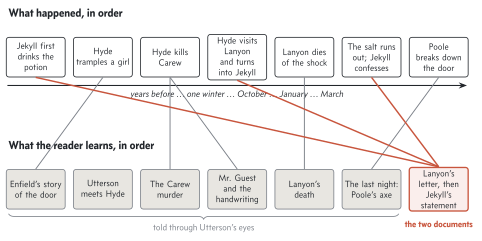
The structure is the secret of the book’s power (Figure 15.9). Stevenson tells nearly all of it from outside, through a dry lawyer who keeps guessing wrong, and holds back the explanation until two dead men speak in their letters. The next year, another Edinburgh man, the young doctor Arthur Conan Doyle, published the first story of a detective who never guesses wrong (Chapter 16).
Deacon Brodie
Stevenson had grown up with a double life among the family furniture. In the family’s house stood a cabinet made by an Edinburgh craftsman named William Brodie, and the boy grew up knowing the man’s story. The life of Deacon BrodieThe life of cabinet-maker Deacon Brodie inspired this novella. → Dr. Jekyll and Mr. Hyde• inspired the novella thirty years later. Brodie, born in 1741, was a cabinetmaker and locksmith, and he was deacon, or elected head, of the city’s guild of carpenters and cabinetmakers, which gave him a seat on the town council.

By night he was a burglar. While fitting locks and furniture in the houses of the rich, he pressed their keys into wax, made copies, and came back after dark. He needed the money for gambling and for two mistresses who did not know about each other. In March 1788 he and his gang raided the government’s tax office. The raid went wrong, one of the gang betrayed the others, and Brodie fled to Amsterdam, where he was caught as he prepared to sail for America. He was hanged in Edinburgh on October 1, 1788, before a crowd of about 40,000. Legend says he died on a gallows he had designed himself, though Brodie had little or nothing to do with it. In 1880 Stevenson and Henley wrote a play about him, Deacon Brodie, or The Double Life. It failed. Six years later Stevenson tried the idea again, set it in a London fog, and it succeeded.
Kidnapped and the South Seas
Stevenson went back to Scotland, in his imagination, for his next book. It came out in the summer of 1886, first in Young Folks and then between covers. Kidnapped follows David Balfour,This author's Kidnapped follows David Balfour. → Robert Louis Stevenson•• a penniless boy of seventeen, through the Scotland of 1751. Five years earlier, the Jacobites (jak-uh-bites), supporters of the exiled Stuart kings, had risen behind Prince Charles Edward Stuart, “Bonnie Prince Charlie,” and been crushed at Culloden in 1746 (Vol. 12, Crown and Parliament). The government had disarmed the Highland clans and seized the lands of the rebel chiefs, and the Highlands were full of resentment and armed men in hiding.
David goes to claim help from his miserly uncle Ebenezer, who sends him up a dark tower stair that stops in midair, and then pays a sea captain to kidnap him and sell him as a servant in the American colonies. At sea the ship runs down a small boat, and the one survivor climbs aboard: Alan Breck Stewart, a vain, brave, hot-tempered Jacobite. David and Alan hold the roundhouse, the officers’ cabin on deck, against the whole crew. The ship is wrecked, and David is cast up on the tiny island of Erraid, off the large island of Mull on the west coast. Stevenson himself had stayed there in 1870, while his father’s firm built a lighthouse nearby. From there David crosses to the mainland. There he witnesses a real crime, the shooting of Colin Campbell of Glenure, the government’s hated agent, in the district of Appin, a killing remembered as the Appin murder. The real shooting happened in May 1752, and Stevenson moved it back a year to fit his story. Accused of the killing, he and Alan flee together across the Highlands, hiding in the heather by day, until David can return to Edinburgh and claim his inheritance (Figure 15.11).

Thomas Stevenson died in May 1887, and his son, freed from the duty of staying near him, decided to try a different climate altogether. He sailed with Fanny, Lloyd, and his widowed mother for America and spent the winter at Saranac Lake, a health resort in the snowy Adirondack Mountains of New York. There he began The Master of BallantraeThis author wrote The Master of Ballantrae. → Robert Louis Stevenson•• (bal-un-tray), published in 1889. In Scotland the Master was the title of the eldest son and heir of a lord. In 1745 the old Lord Durrisdeer, wanting to keep his lands whichever side wins, sends one son to join Prince Charlie and keeps the other at home, loyal to King George II. The brothers toss a coin, and the elder, James, the Master, charming and wicked, rides off with the rebels. The story of their hatred runs for twenty years and ends in the forests of North America with both brothers in one grave.
In June 1888 Stevenson chartered a yacht, the Casco, at San Francisco and sailed into the Pacific. For the next two years he wandered among the islands, to the Marquesas, to Tahiti, and to Hawaii, then an independent kingdom, where he spent five months in 1889 and became a friend of King Kalākaua (kah-lah-kow-ah). In December 1889 he reached Apia in Samoa (suh-moh-uh), a group of islands in the South Pacific, and decided to stay. He bought land at Vailima (vy-lee-muh), on the hills above the town, and built a large wooden house in a clearing in the forest.

The Samoans called him Tusitala (too-see-tah-lah), “the teller of tales.” He worked hard on his land and harder at his desk, because the house was expensive. He also took up the Samoans’ cause. Germany, Britain, and the United States were quarreling over the islands, and Stevenson wrote letters to The Times and a whole book, A Footnote to History (1892), against the foreign officials who ruled them badly. In the warm, damp air of Samoa he was healthier than he had been since boyhood, well enough to ride and to work outdoors.
“The Bottle Imp”
For his new neighbors Stevenson wrote “The Bottle Imp,”This author wrote "The Bottle Imp." → Robert Louis Stevenson•• published in 1891 in a New York newspaper and a London magazine and, the same year, in a Samoan translation in a missionary paper. He said he had written it for a Polynesian audience, the peoples of the Pacific islands. An imp is a small devil. The story’s hero, Keawe (kay-ah-vay), a Hawaiian,In this story, the protagonist Keawe is Hawaiian. → "The Bottle Imp"• is a young sailor from the island of Hawaii, the largest of the Hawaiian Islands. Visiting San Francisco, he meets an old man in a splendid house who offers to sell him the bottle that paid for it.
Inside the bottle, which no hammer can break, lives an imp that grants every wish. There is a catch. If the owner dies with it, he burns in hell forever. He cannot give it away or throw it away, because it always comes back. He can only sell it, for coin, and always at a loss,This story's title object must be resold at a loss. → "The Bottle Imp"•• for less than he himself paid, and he must tell the buyer all of this. So every sale lowers the price, and the price can never climb back up. The bottle has a grand history, as the old man tells it. The devil brought it into the world. Napoleon and Captain CookIn this story, the title wish-granting object was once owned by Napoleon and Captain Cook. → "The Bottle Imp"• each owned it in turn: by it Napoleon rose to be emperor of half of Europe, and Captain James Cook, the English navigator who charted the Pacific, found his way to so many islands. Both sold it, and both fell. Napoleon died a prisoner, and Cook was killed in a fight on a Hawaiian beach in 1779. The price has come down by now to fifty dollars.
Keawe buys it and wishes for a beautiful house. The wish comes true in the worst way: his uncle and his cousin die, and he inherits a fortune. He builds the house, sells the bottle to a friend, and falls in love with a young woman named Kokua (koh-koo-ah). Then he finds the first white patch of leprosy on his skin. Leprosy was an incurable disease, and Hawaii sent its sufferers to a lonely colony on the island of Molokai (moh-loh-ky), which Stevenson himself had visited. Only the imp can cure him. Keawe tracks the bottle from owner to owner and finds it at last in the hands of a man who paid two cents for it. He buys it for one cent, is cured, and marries Kokua, but now nobody can ever buy the bottle from him.
Kokua finds a way out. She takes Keawe to Tahiti, a French colony, where the smallest coin is the centime (sahn-teem), and five centimes make a cent. Kokua secretly gets an old man to buy the bottle for four centimes and then buys it from him for three, taking the curse on herself to save her husband. Keawe discovers what she has done and arranges to do the same for her, through a drunken old boatswain (boh-sun), the officer in charge of a ship’s sails and ropes. But once the boatswain has the bottle, he refuses to sell it back. “I reckon I’m going anyway,” he says, and walks off with it, and Keawe and Kokua are free.
Stevenson’s own luck ran out on December 3, 1894. He had spent the morning on a new novel set in Scotland, Weir of Hermiston, which he thought his best work. That evening, as he was opening a bottle of wine with Fanny, he cried out “What’s that?” and then “Does my face look strange?” and fell to the floor. He died within hours, probably of bleeding in the brain, at forty-four. Samoan chiefs cut a path up Mount Vaea (vah-ay-ah), the steep, wooded hill behind the house, and carried his coffin to the top. On his tomb are lines from his own poem “Requiem”: “Home is the sailor, home from sea, / And the hunter home from the hill.”
Bram Stoker and Dracula
Abraham Stoker, always called Bram, was born on November 8, 1847, at Clontarf (klon-tarf), on the shore just north of Dublin. Like Stevenson he was a sickly child. He was so ill that he could not walk until he was seven. He lay in bed listening to his mother’s stories, among them her memories of the cholera epidemic of 1832 in the west of Ireland, when the dead were buried in haste, and some, it was said, alive. Then he recovered completely and grew into a big, strong young man, an athlete and a debater at Trinity College Dublin.

For ten years he worked as a clerk in the civil service at Dublin Castle, the seat of the British government in Ireland, and wrote theater reviews without pay for a Dublin evening paper. In December 1876 he praised Henry Irving, the greatest English actor of the age, in the part of Hamlet, and Irving asked to meet him. Two years later Stoker married Florence Balcombe, a famous beauty who had once been courted by Oscar Wilde (Chapter 17). He moved to London to become business manager of Irving’s Lyceum Theatre, a post he held for twenty-seven years. He kept the accounts, answered thousands of letters, and organized Irving’s tours of Britain and America. He wrote his own books at night and on holidays.
He began the one that made him immortal in 1890. That summer, in a library at Whitby, a fishing port on the Yorkshire coast, he read an old history of Wallachia and Moldavia, two Romanian lands on the lower Danube. It mentioned a fifteenth-century prince called Dracula, and a footnote said that in the language of the country “Dracula” meant “devil.” Stoker copied it into his notes. His subject was to be the vampire, a creature of eastern European folklore: a dead man who rises from the grave at night to drink the blood of the living. For years he gathered more, from books on folklore, travel, and the geography of the Carpathian Mountains, the long range that curves around Transylvania (tran-sil-vay-nee-uh). He worked on the book during holidays at Cruden Bay, on the coast of Aberdeenshire in Scotland. The typescript was called The Un-Dead until just before it went to press. In May 1897, bound in yellow cloth, Stoker’s Dracula was publishedThis author wrote Dracula. → Bram Stoker•• in London.
Like Jekyll and Hyde, Dracula is told in documents. It is an epistolary (ih-pis-tuh-lehr-ee) novel, a novel made of letters, diaries, newspaper cuttings, a ship’s log, and records spoken into a phonograph, all collected by the characters themselves. It belongs to the Gothic tradition, the kind of story of terror, ancient ruins, and the supernatural that began with Horace Walpole’s The Castle of Otranto in 1764 (Vol. 12, Crown and Parliament). Stoker brought the Gothic up to date. His vampire hunters ride trains, use typewriters, and give blood transfusions.

The book opens with the journal of Jonathan Harker, a young English solicitor, a lawyer who handles contracts and property. In May he travels by train through Vienna and Budapest to Bistritz (bis-trits), a town in Transylvania, then a province of Hungary in the mountains that are now part of Romania. He is going to help a nobleman buy an old house near London. At the inn the peasants cross themselves when they hear where he is going, and a woman hangs a crucifix, a small cross with the figure of Christ on it, around his neck to protect him. A coach carries him up through the Borgo Pass at night, with wolves howling, to meet his client, Count Dracula.

Dracula lives in a castle,One of these structures has served as the home of Count Dracula. → castles• one of the stone fortresses that lords built across Europe in the Middle Ages. His stands half ruined on the edge of a cliff above a sea of forest, and its master opens the great door himself. “Welcome to my house!” says Stoker’s Count Dracula,Bram Stoker wrote about this character. → Dracula• a tall old man dressed in black from head to foot, with a long white mustache, sharp white teeth, and hair on the palms of his hands. He seems a perfect host. But when Harker shaves, the Count, standing just behind him, has no reflection in the mirror. One night Harker looks out and sees him crawl headfirst down the sheer wall of the castle like a lizard. The doors are locked. Harker is a prisoner.
The Count leaves for England with fifty great boxes of his native earth, in which he must sleep. They sail from Varna, a Black Sea port, aboard a Russian schooner, the Demeter (dih-mee-ter). One by one the sailors vanish, and the captain records the disappearances in his log. In August, in a howling storm, the ship drives into the harbor at Whitby with no one aboard alive. Its dead captain is tied to the wheel,In this novel, the captain of the Demeter is found dead and tied to the wheel with a crucifix and rosary beads. → Dracula• his hands bound to it with a crucifix on a string of rosary beads, which Catholics use to count their prayers. As the ship strikes, a huge dog leaps ashore and runs up the cliff to the churchyard at the top of the town’s 199 steps, beside the ruins of Whitby Abbey (Figure 15.14).
In Whitby that summer are Harker’s fiancée, Mina Murray, a schoolmistress, and her friend Lucy Westenra (wes-ten-ruh). Lucy begins to sleepwalk, grows pale, and has two small wounds on her throat. One of her suitors, Dr. John Seward, who runs an asylum for the insane next to the Count’s new house, calls in his old teacher, Abraham Van Helsing of Amsterdam, a doctor and scholar of strange diseases. Van Helsing knows what is happening. Seward, Van Helsing, and Lucy’s other two suitors, Arthur Holmwood and a rich young Texan named Quincey Morris, all give their blood to save her, but she dies, rises again as a vampire, and has to be destroyed with a stake through the heart.
Harker escapes from the castle and turns up, raving with fever, in a hospital in Budapest, where Mina goes to marry him. Back in England, led by Van Helsing, Jonathan HarkerIn this novel, Jonathan Harker and Abraham Van Helsing hunt the title character. → Dracula•• and his friends hunt the Count through London. They find his boxes of earth one by one and make them useless to him with pieces of communion wafer, the bread blessed at the Catholic Mass, which no vampire can bear. Dracula strikes back at the band through Mina. He drinks her blood and forces her to drink his, which links her mind to his. Down to his last box, the Count flees. He sails on the Czarina Catherine,This character boards the Czarina Catherine. → Dracula• a ship bound from London for Varna.
Van Helsing hypnotizes Mina, and in her trance she hears what the Count hears: water lapping and chains creaking. The hunters go overland by train to Varna to meet the ship, but the Count, reading their plans through Mina, has it sail on to Galatz (gah-lahts), a Romanian port on the Danube. His box is carried upriver and then by cart toward the castle, guarded by a band of Roma, whom the English of Stoker’s day called “Gypsies.” The hunters race after it in three parties, following Van Helsing’s plan. At sunset, in sight of the castle, they catch the cart, and in a short, desperate fight Harker and Quincey Morris kill Dracula.Quincey Morris and Jonathan Harker kill this character under the direction of Abraham Van Helsing. → Dracula• Harker’s kukri (koo-kree), the heavy curved knife of the Gurkha (gur-kuh) soldiers of Nepal, cuts through his throat. In the same instant Morris drives his bowie knife, the long hunting knife of the American frontier, into his heart, and the Count crumbles into dust. Morris has been stabbed in the fight, and he dies in the snow. In a note written seven years later, Harker tells us that he and Mina have a son, born on the anniversary of Morris’s death, and that they call him Quincey.
Stoker never had another success like it. He died in London on April 20, 1912. Irving had died in 1905. But the Count went on without them, onto the stage, into the silent film Nosferatu (1922), and into the talking picture of 1931 in which Bela Lugosi gave him a Hungarian accent and an opera cloak. Few characters in any book have been brought back from the dead so often.
What to remember
- Robert Louis Stevenson (1850–1894) was a Scot from Edinburgh, the sickly son of a family of lighthouse engineers, who trained as a lawyer and never practiced.
- His early books include Travels with a Donkey in the Cévennes (1879), a walk through southern France with the donkey Modestine, and New Arabian Nights (1882), with Prince Florizel and the Suicide Club.
- Treasure Island (1883) is told by Jim Hawkins: Billy Bones and the black spot at the Admiral Benbow, Flint’s map, the Hispaniola, Squire Trelawney and Captain Smollett, Ben Gunn, and the one-legged cook Long John Silver, modeled on W. E. Henley.
- A Child’s Garden of Verses (1885) is a book of poems in a small child’s voice.
- Strange Case of Dr. Jekyll and Mr. Hyde (1886) is a mystery told through the lawyer Utterson and solved by two documents, Lanyon’s letter and Jekyll’s confession. Its real-life seed was the double life of Deacon Brodie of Edinburgh.
- Kidnapped (1886) and The Master of Ballantrae (1889) are set in the Scotland of the Jacobite rising of 1745 and the years after it.
- In “The Bottle Imp” (1891), written in Samoa, a wish-granting bottle must always be sold for less than its owner paid.
- Bram Stoker, an Irishman who managed Henry Irving’s Lyceum Theatre, published Dracula in 1897: an epistolary Gothic novel in which Van Helsing, Harker, and their friends hunt the Count from Whitby back to his castle in Transylvania.
Chapter 16 · 40 clues
Baker Street
In the chemical laboratory of St. Bartholomew’s Hospital in London, a tall, thin young man is bent over a test tube. He has just found a chemical that turns water brown and cloudy when it holds even a single drop of blood, and he is so pleased that he shouts it aloud. A medical student named Stamford brings a visitor in: a pale, worn-out army doctor, home from the East and looking for cheap rooms to share. The young chemist grips the doctor’s hand and says, “You have been in Afghanistan, I perceive.” The doctor asks how he could possibly know. The chemist only chuckles.
Neither man ever lived. The scene comes from a short novel written in 1886 by a young doctor in Portsmouth who had more time than patients. Yet within a few years millions of readers knew the tall chemist and his new friend better than they knew their own neighbors. Letters still arrive in London addressed to the chemist, at a house that never existed.
Arthur Conan Doyle
Arthur Conan Doyle was born on May 22, 1859, in Edinburgh, the capital of Scotland, into a family of Irish Catholics who had more talent than money. His father, Charles Doyle, was a gentle, dreamy painter who worked as a government clerk, drank heavily, and spent his last years in asylums. His mother, Mary, held the family together and told her children long stories of knights and heraldry. Conan was really a middle name, taken from a godfather, but Arthur came to use it as part of his surname.

Rich uncles paid for a Jesuit education. The Jesuits, an order of Catholic priests famous as teachers, ran Stonyhurst College in Lancashire, and Arthur boarded there from 1868 to 1875. In some of those same years the poet Gerard Manley Hopkins was studying philosophy at Stonyhurst as a young Jesuit (Chapter 14). The boy found Stonyhurst harsh and its lessons dull, but he discovered there that he could hold a crowd of schoolfellows spellbound with a story. After a final year at a Jesuit school in Austria he came home, and within a few years he had given up the Catholic faith for good.
In 1876 he entered the University of Edinburgh to study medicine, a few years after Robert Louis Stevenson had studied there (Chapter 15). There he met the teacher who would change his life. Joseph Bell was a surgeon at the Royal Infirmary, Edinburgh’s great hospital, and Doyle served as his clerk, the student who brought patients in and wrote down their cases. Bell liked to look a stranger over and announce his trade and history before the man had said a word. Doyle remembered him telling one patient that he had served in a Highland regiment, had recently left the army, and had been stationed in Barbados. Bell read it all from the man’s air of command, his Scottish manner, the hat he kept on as soldiers do, and his illness, a tropical disease of the West Indies, not of Britain. Bell’s lesson was that a careful eye, trained on small details, could reason its way to large conclusions.
Doyle needed money, so he went to sea as a ship’s doctor while still a student. In 1880 he spent seven months on the Arctic whaler Hope, hunting seals and whales off Greenland. After he qualified in 1881, he sailed to West Africa on the steamer Mayumba and fell ill with fever on the voyage. In June 1882 he arrived at Southsea, a seaside district of the naval town of Portsmouth, with less than £10 to his name, and put up a doctor’s brass plate outside a rented house. Patients came slowly. In 1885 he married Louisa Hawkins, the sister of one of them.
While he waited for patients, Doyle wrote stories for magazines. In 1886, in about three weeks, he wrote a short detective novel. He first called it “A Tangled Skein,” and its heroes were to be named Sherrinford Holmes and Ormond Sacker. By the time it was finished and renamed A Study in Scarlet, the doctor had created Sherlock Holmes,This author created Sherlock Holmes. → Arthur Conan Doyle••• a man who solved crimes by reasoning, as Bell diagnosed diseases. The narrator became Dr. Watson, a name Doyle borrowed from a Portsmouth colleague. Publisher after publisher sent the book back. At last Ward, Lock and Company took it, on November 20, 1886, and paid £25 for the whole copyright, so Doyle never earned another penny from it. It appeared a year later, in Beeton’s Christmas Annual for 1887, a paperbound shilling book of stories sold at Christmas.
The novel was noticed, praised a little, and forgotten. Doyle cared more about something else. He meant to become a historical novelist, like Sir Walter Scott (Vol. 15, The Age of Revolution), and in 1889 he published Micah Clarke, a long tale of a seventeenth-century rebellion. Then luck came from America. On August 30, 1889, Joseph Stoddart, the editor of Lippincott’s Monthly Magazine of Philadelphia, invited two promising young writers to dinner at the Langham Hotel in London. One was Doyle. The other was Oscar Wilde (Chapter 17). Both promised Stoddart a short novel, and Wilde’s became The Picture of Dorian Gray. Doyle’s was The Sign of Four, a second Holmes adventure, which appeared in February 1890.
In 1891 Doyle went to Vienna to train as an eye specialist and then opened a consulting room near Harley Street, the doctors’ quarter of London. No patient ever rang the bell. He spent his mornings in the empty waiting room writing Holmes stories for a new magazine. That spring he nearly died of influenza, and when he recovered, he gave up medicine to live by his pen.
Holmes and Watson
The visitor in the laboratory was Dr. John H. Watson. He had taken his medical degree at the University of London in 1878 and trained as an army doctor. Britain ruled India, and between India and the expanding Russian Empire lay the mountains of Afghanistan. In 1878, fearing that Russia would gain a hold there, Britain invaded the country, starting what is called the Second Afghan War (Vol. 38, The Modern Middle East). On July 27, 1880, an Afghan army routed a British brigade at Maiwand (my-wand). In the novel, Watson is there as an army surgeon wounded in Afghanistan:This character served as an army surgeon and was wounded in the Second Afghan War. → Dr. John Watson•• a bullet from a jezail (jeh-zyle), the long Afghan musket, smashes his shoulder. Then he catches typhoid fever. He is shipped home with his health ruined and a pension of eleven shillings and sixpence a day, too little to live on in London.

That is why he needs to share rooms. Stamford, an old hospital acquaintance, knows a man with the same problem, and so Watson’s first appearance, in A Study in Scarlet,This character first appears in A Study in Scarlet. → Dr. John Watson•• is the meeting in the laboratory. Stamford warns Watson beforehand that the young man is a little odd in his ideas. He once beat corpses with a stick in the dissecting room, where students cut up the dead to learn anatomy, to see how far bruises could be produced after death. Holmes himself asks only whether Watson minds tobacco, chemicals, and the violin. The next day the two men take rooms at 221B Baker Street,This character lives at 221B Baker Street. → Sherlock Holmes••• a real street in the Marylebone district north of the West End. They have two bedrooms and a shared sitting room, and their landlady, as later stories name her, is Mrs. Hudson. In Doyle’s day the numbers on Baker Street did not reach 221, so the house was invented. Still, letters addressed to Holmes reached the street for most of the twentieth century and were answered by a building society, a kind of savings bank, whose offices later stood on the spot.
Watson cannot make his new friend out. Holmes is not a medical student, though he works in the hospital laboratory. He goes for days without speaking, plays the violin brilliantly or scrapes at it, and receives strange visitors. Watson makes a list of what Holmes knows, and it is a list of holes (Table 16.1). Holmes’s knowledge of literature, philosophy, and astronomy is, in Watson’s word, “nil,” and he knows next to nothing of politics.According to his assistant, this character knows nothing of "literature, philosophy and politics." → Sherlock Holmes• When Watson mentions that the earth goes around the sun, Holmes says that he will now do his best to forget it. A mind, he explains, is like a little empty attic, and a wise man stocks it only with the tools he can use. For a man of the 1880s, the age of the cramming examination, this was a startling thing to say.
| Subject | Watson’s verdict |
|---|---|
| Literature | Nil |
| Philosophy | Nil |
| Astronomy | Nil |
| Politics | Feeble |
| Botany | Variable; well up in poisons, but nothing of gardening |
| Geology | Practical, but limited; can tell soils apart at a glance |
| Chemistry | Profound |
| Anatomy | Accurate, but unsystematic |
| Sensational literature | Immense; knows every horror of the century |
| Other skills | Plays the violin well; expert at singlestick, boxing, and swordsmanship; good practical knowledge of British law |
At last Holmes tells him the truth: “I’m a consulting detective.” He thinks he may be the only one in the world. A family doctor who meets a baffling case calls in a consulting physician, a specialist who sees only the hardest problems. In the same way, policemen and private detectives who are stuck bring their cases to Holmes, so the man in Baker Street is the world’s only consulting detective.This character is a consulting detective. → Sherlock Holmes• He rarely needs to leave his armchair. When he does, it is because a case has some feature that interests him.
The word detective, for someone whose job is to find out who committed a crime, was itself fairly new. London’s police force, the Metropolitan Police, was founded in 1829 by the home secretary Robert Peel (Chapter 1), and its officers are still called “bobbies” after him. In 1842 it set up a small branch of plain-clothes officers to hunt criminals rather than to patrol the streets, and people began to speak of the “detective police.” Dickens admired them and put one, Inspector Bucket, into Bleak House (Chapter 2). Doyle took the job from the police and handed it to a gentleman of genius, and Holmes, the detective of Baker Street,Sherlock Holmes has this profession. → detective••• became the model for the profession in fiction.
The police headquarters stood in Whitehall Place, with its back door on a street called Great Scotland Yard, so the force’s detectives were known as Scotland Yard. In A Study in Scarlet two of them, Inspectors Gregson and Lestrade (leh-strahd), are rivals who both claim the credit for Holmes’s work. Holmes calls them “the pick of a bad lot.” Lestrade is a small man with sallow, yellowish skin, Watson says, and a face like a rat’s. He is brave and stubborn but has no imagination, and Lestrade keeps returning to Baker Street,This character is often consulted by Inspector Lestrade of Scotland Yard. → Sherlock Holmes• story after story, whenever a case defeats him. Holmes mocks him and also, now and then, admits that he is the best of the professionals.
A Study in Scarlet
A Study in Scarlet, the novel that introduced Holmes,This novel first introduced Sherlock Holmes. → A Study in Scarlet•• is a story in two halves, and the mystery of the first begins with a letter from Gregson. In an empty house on Brixton Road, south of the river, a well-dressed American lies dead on the floor of a bare room. He is Enoch Drebber of Cleveland, Ohio. There is blood about the room but no wound on his body, and on the wall someone has written in blood the word RACHE. Lestrade proudly decides that the writer was interrupted before he could finish the name “Rachel.” Holmes, measuring the room with a tape and a magnifying glass, points out that Rache is German for “revenge.” Then Drebber’s secretary, Joseph Stangerson, is found stabbed in his hotel, with the same word on the wall and a box of two pills beside him.
Holmes tests the pills on the landlady’s old, sick terrier, which she had wanted put out of its misery. The first pill does nothing, and the second kills the dog at once. Then Holmes sends Wiggins, the leader of a gang of street boys he calls the Baker Street Irregulars, to fetch a cab. When the cabman comes upstairs to help with a trunk, Holmes snaps handcuffs on him. Holmes unmasks the cabman Jefferson HopeThis character identifies the cabdriver Jefferson Hope as a killer. → Sherlock Holmes• as the killer of both men, for a cab driver can go anywhere in London without being noticed. Holmes calls the case his study in scarlet. Life, he says, is a colorless skein, a loose coil of yarn, and through it runs “the scarlet thread of murder,” which his business is to unravel. That is how the book got its title.
The Country of the Saints
Then the novel stops and jumps thirty-four years back, and across an ocean. Its second part, called “The Country of the Saints,”This novel's second section, "The Country of the Saints," contains an anti-Mormon narrative. → A Study in Scarlet• is set among the Mormons of Utah, and it paints them as villains. The Mormons, properly the Church of Jesus Christ of Latter-day Saints, were founded by Joseph Smith in New York in 1830. Driven west by angry neighbors, they followed Brigham Young in 1847 to the valley of the Great Salt Lake (Vol. 28, The Young Republic). There they practiced polygamy, the marriage of one man to several wives, until 1890.
In Doyle’s story, Young’s wagon train finds two dying travelers in the desert: a man named John Ferrier and Lucy, a little girl he has saved. They are rescued on one condition, that they join the faith. Years later Lucy falls in love with Jefferson Hope, a young silver miner who is not a Mormon. The church’s elders order her to marry either Drebber or Stangerson, the sons of two of their leaders. Ferrier and Lucy flee with Hope, but Ferrier is shot, and Lucy is dragged back and married to Drebber. She dies within a month. Hope takes her wedding ring from her body and spends twenty years hunting the two men across America and Europe. In London he becomes a cabman, and he finds them at last.
Doyle took his Mormons from sensational books of the day that portrayed the church’s leaders as murderers and kidnappers. The picture is lurid and unjust. Mormon readers protested, and Doyle’s daughter later said that her father would have been the first to admit that the novel was full of errors about the church. Jefferson Hope himself never comes to trial. He has a weak artery near the heart, and it bursts on the night after his arrest. The newspapers give all the credit to Lestrade and Gregson, and Watson, indignant, decides to publish the true story himself. From that moment Watson is Holmes’s companion and biographer,This character is Sherlock Holmes's companion and biographer. → Dr. John Watson•• the friend at his side and the writer of his life. Fifty-six of the sixty Holmes stories are told in Watson’s voice.
The Sign of Four
The second novel opens with Holmes injecting cocaine, a drug that was then legal, in what he calls a seven-per-cent solution. He is bored, and Watson, as a doctor, is alarmed. Then a young woman named Mary Morstan comes to Baker Street. She is a governess, a woman who lives with a well-to-do family and teaches its children, for she has no money of her own. Her father, an army captain, vanished in London in 1878. Since 1882 someone has mailed her one large pearl every year, and now a letter asks her to meet a stranger. The trail leads to a treasure stolen in India, a murder in a locked room, and a chase in steam launches down the Thames at night.
Watson falls in love with Mary on the first evening. At the end of the case the treasure chest turns out to be empty, and Watson is glad, because a poor governess is a woman he can propose to. So Watson marries Mary Morstan,This character marries the governess Mary Morstan. → Dr. John Watson•• and in the stories that follow he lives in his own house and practices medicine again. Holmes congratulates him without enthusiasm. He would never marry himself, he says, “lest I bias my judgment,” and he reaches again for the cocaine. Through every case after this, Holmes’s companion, Dr. John Watson,This character's companion is Dr. John Watson. → Sherlock Holmes••• keeps coming back to Baker Street when he is called, as if he could not stay away.
Jack the Ripper
In the autumn of 1888, a year after Holmes first appeared, London faced a murderer whom no detective could catch, known ever since as Jack the Ripper. The killings took place in Whitechapel, in London’s East End,Jack the Ripper operated in this city's Whitechapel district in the 1880s. → London•• the crowded district east of the City, the old square mile of banks and merchants. Whitechapel was full of dockworkers, sweatshop tailors, and Jewish refugees newly arrived from the Russian Empire. About 8,500 people slept every night in its 233 common lodging houses, where a bed in a crowded room cost fourpence a night. Those who did not have fourpence walked the streets until morning.

Between August 31 and November 9, 1888, five women were murdered there, all with their throats cut, and all but one cut open afterward with a knife (Figure 16.3). Mary Ann Nichols was found in Buck’s Row on August 31, and Annie Chapman in a backyard in Hanbury Street on September 8. On September 30 the killer struck twice in one night. Elizabeth Stride was killed in a yard off Berner Street, and less than an hour later Catherine Eddowes (ed-ohz) was killed in Mitre Square. The last, Mary Jane Kelly, was found in her own room in Miller’s Court on November 9. These five are called the canonical victims, meaning the ones on the accepted list. The police of 1888 came to believe that one man killed them all, and a police report of 1894 set that judgment down.
The police and the newspapers described all five as prostitutes,The five “canonical” victims of Jack the Ripper were traditionally described as members of this profession. → prostitutes• women who sold sex for money; the polite word of the day was “unfortunates.” All five were poor, most of them drank, and most had drifted into Whitechapel after a marriage broke up. Two had been turned away from lodging houses on the night they died because they lacked the fourpence. Some did sell themselves on the streets when they had nothing else. In 2019 the historian Hallie Rubenhold argued, in a book called The Five, that only two of them, Stride and Kelly, are known to have sold sex. For the other three, she wrote, the label was a guess by policemen and reporters who assumed that any poor woman out alone at night was selling herself. What is certain is that they were among the most defenseless people in the largest city in the world.

The newspapers made the murders the sensation of the year. On September 27 a news agency received a letter in red ink, mocking the police and signed “Jack the Ripper.” The police came to believe that a journalist had written it to keep the story going, but the name stuck at once. In October George Lusk, the head of a citizens’ patrol called the Whitechapel Vigilance Committee, received a small box holding half of a human kidney, with a letter headed “From hell.” Eddowes’s left kidney had been cut out. Detectives were sent from Scotland Yard, bloodhounds were tried out, and hundreds of men were questioned. The commissioner, or head, of the Metropolitan Police, Sir Charles Warren, resigned on November 8, after a quarrel with the Home Office over a magazine article he had written about the police.
Nobody was ever charged. More than a hundred suspects have been named since, among them a young barrister, or courtroom lawyer, who drowned himself in the Thames that winter, and a Polish hairdresser later locked in an asylum. Others have named, absurdly, the painter Walter Sickert and Lewis Carroll, the author of Alice (Chapter 11). There is no proof against any of them. The murders did force respectable London to look at its slums, as Tenniel’s cartoon demanded, and in the next twenty years the worst lodging-house streets of Whitechapel were pulled down. They also left a lasting picture in readers’ minds of foggy, gaslit streets where evil walked unseen. That was the London in which, three years later, Sherlock Holmes became a household name.
The Strand stories
On a December day in 1890, Londoners found a new magazine on the bookstalls, dated January 1891. It was The Strand Magazine, named after the busy street between Trafalgar Square and the City where its offices stood. Its owner, George Newnes (nyoonz), had already made a fortune from Tit-Bits, a penny weekly of jokes and odd facts. The Strand cost sixpence and had a picture on nearly every page. It sold almost 300,000 copies of the first number and settled at close to half a million a month.

In the spring of 1891 Doyle sent its editor a short story about Holmes, and the editor asked for more. “A Scandal in Bohemia” appeared in July 1891, five more stories followed month by month, and by the end of the year Holmes was the magazine’s greatest attraction. The illustrator Sidney Paget gave Holmes the face the world remembers: lean, sharp, and hawk-nosed, with a cloak and, in the country, a cloth cap with flaps over the ears, the deerstalker. Doyle never mentioned that cap by name. Paget drew it, and a century of actors has worn it.
“A Scandal in Bohemia”
The first story opens with Watson, now married, dropping in at his old rooms. Holmes looks him over and announces that Watson has been getting very wet lately and has a careless servant girl. Watson’s left shoe, he explains, has six parallel cuts where someone scraped mud off it clumsily. Watson laughs and says that the reasoning always seems simple once it is explained. Then Holmes asks how many steps lead up from the hall. Watson has climbed them hundreds of times and has no idea. There are seventeen. Holmes tells Watson, “You see, but you do not observe,”This character is told "you see, but you do not observe" in "A Scandal in Bohemia." → Dr. John Watson• and the line sums up the whole method: everyone sees, but almost nobody notices what he sees.
A masked visitor arrives who calls himself Count von Kramm. Holmes greets him at once as the King of Bohemia. Bohemia was a real kingdom in central Europe, then ruled from Vienna as part of Austria-Hungary, but its king in the story is Doyle’s invention. The king is about to marry a Scandinavian princess. Five years earlier he had a love affair with Irene Adler, an American-born opera singer, and she has a photograph of the two of them together. She threatens to send it to his bride’s family. His agents have burgled her house twice and found nothing.
Holmes goes to her villa in St. John’s Wood disguised as a mild old clergyman. He arranges a fake street fight at her door, is “wounded,” and is carried into her sitting room. At a signal, Watson tosses a plumber’s smoke rocket, a tube that plumbers lit to find leaks in drains, through the window, and the crowd outside cries “Fire!” Holmes knows that a woman whose house is burning will run to save the thing she values most. Irene Adler rushes to a sliding panel above the bell pull, the cord for ringing a servant, and half draws the picture out. Now Holmes knows where it is. By staging a fire to find the photograph,This character unsuccessfully tries to recover a photograph from Irene Adler, "the woman," by staging a fire. → Sherlock Holmes••• he has won, or thinks he has.
But she has guessed who the clergyman was. That night, dressed as a young man, she walks past Holmes on his own doorstep and calls out, “Good-night, Mister Sherlock Holmes.” The next morning she is gone, with the photograph and her new husband, a lawyer named Godfrey Norton. She leaves a letter promising not to use the picture unless the king harms her, and a portrait of herself. Holmes asks the king for that portrait as his only payment. He used to make fun of the cleverness of women, Watson says, but no longer. To Holmes, Irene Adler is always “the woman.”
“The Red-Headed League”
In August 1891 came Doyle’s “The Red-Headed League,”This author wrote "The Red-Headed League." → Arthur Conan Doyle• which he later ranked second among his favorite Holmes stories. Jabez Wilson is a stout, slow-witted, red-haired pawnbroker, a man who lends money against goods left with him as security, and he has a small shop in Saxe-Coburg Square, near the City. His young assistant, Vincent Spaulding, works for half wages and spends hours in the cellar developing photographs. One day Spaulding shows his master a newspaper advertisement. A league founded by an American millionaire with red hair is offering a well-paid job to a red-headed man.
Wilson gets the job over a crowd of hundreds of red-haired applicants. He is paid four pounds a week, far more than a skilled workman earned, for sitting in an office from ten to two each day. His task is to copy out the Encyclopædia Britannica (en-sy-kluh-pee-dee-uh brih-tan-ih-kuh), the great reference work of many volumes, in alphabetical order. He copies for eight weeks and gets through the articles on abbots, archery, armor, architecture, and Attica, and he hopes to reach the B’s before long. Then one morning he finds a card on the locked door: THE RED-HEADED LEAGUE IS DISSOLVED. Puzzled and annoyed, he brings the card to Holmes.
Holmes calls it “quite a three-pipe problem,” a puzzle worth three pipes of tobacco, and smokes in silence. Then he goes to Saxe-Coburg Square, thumps the pavement with his stick, and knocks at the shop, pretending to ask the way, to look at the assistant’s trouser knees. They are worn and dirty. Now Holmes works out why Wilson was hired:This character helps Jabez Wilson discover why he was hired to copy the Encyclopædia Britannica. → Sherlock Holmes•• the league was invented to get him out of his shop for four hours a day. The assistant is really John Clay, a clever criminal, and he has been digging a tunnel from the cellar to the vault of the bank behind the square, which holds 30,000 French gold coins. That night Holmes, Watson, a Scotland Yard man, and the bank’s chairman wait in the dark vault. A stone in the floor lifts, a white hand appears, and Clay climbs up into the arms of the law.
“The Five Orange Pips”
In November 1891 The Strand printed the darkest of the early stories, Doyle’s “The Five Orange Pips.”This author wrote "The Five Orange Pips." → Arthur Conan Doyle• On a stormy night in September, a young man named John Openshaw comes to Baker Street with a family history of terror. His uncle Elias had emigrated to America, become a planter in Florida, and fought as a colonel for the Confederacy, the Southern states that broke away from the Union in the American Civil War. Around 1870 he came home to an estate near Horsham, in Sussex, and lived as a hermit. In 1883 a letter arrived for him from Pondicherry (pon-dih-chair-ee), a French town in India. Inside were only five dried orange pips, or seeds, and on the flap were the letters K.K.K. Seven weeks later Elias was found drowned in a garden pond. Next came a letter from Dundee, in Scotland, to John’s father, who soon fell to his death in a chalk pit. Now John himself has received five pips, posted in London.
Holmes takes down an American encyclopedia. The letters stand for the Ku Klux Klan, a secret society founded by Confederate veterans in Tennessee after the war, which used terror and murder against freed slaves and those who helped them (Vol. 29, A House Divided). In Doyle’s story, the Klan murders John Openshaw,In this story, the Ku Klux Klan murders John Openshaw. → "The Five Orange Pips"•• along with his father and uncle, to recover the society’s records that Elias had carried to England. Elias, Holmes guesses, fled with the papers when the society broke up in 1869, and its members have hunted his family for them ever since. The encyclopedia also explains the pips. Before striking, the society sent orange pips to mark men for death,In this story, an organization sends the title items to mark opponents for death. → "The Five Orange Pips"• or else oak leaves or melon seeds. A marked man could give up his opposition or flee the country; if he did neither, he died.
Holmes sends Openshaw home with advice for the morning. But the next day’s newspaper reports that John Openshaw has drowned near Waterloo Bridge. “That hurts my pride, Watson,” Holmes says. He works all day through shipping records and notices that the three letters came from three ports visited by one American sailing ship, the Lone Star of Savannah, Georgia. Holmes sends five pips to the Lone Star’s captain,In this story, a detective sends the title objects to the captain of the Lone Star. → "The Five Orange Pips"• in an envelope marked “S. H. for J. O.,” with a telegram to the police of Savannah. The murderers never receive their warning. The Lone Star is lost in an Atlantic gale, and all that is ever found of her is a broken piece of her stern with the letters “L.S.” carved on it. It is one of the very few stories in which a client dies after asking Holmes for help.
“Silver Blaze” and “The Greek Interpreter”
“Silver Blaze” (December 1892) takes Holmes and Watson by train (Figure 16.6) to Dartmoor, a high, bare moorland in Devon in the southwest of England. The racehorse Silver Blaze, favorite for the Wessex Cup, has vanished from his stable, and his trainer, John Straker, has been found on the moor with his skull smashed. A bookmaker, a man who takes bets on races, was seen snooping around the stables and has been arrested. Holmes is not satisfied. The local detective, Inspector Gregory, asks whether anything else needs attention, and Holmes points to the curious incident of the dogThis character calls attention to the "curious incident of the dog in the night-time." → Sherlock Holmes• in the night-time. Gregory answers that the dog did nothing in the night-time. “That was the curious incident,” Holmes replies, and the silence solves the case.

The stable dog would have barked at a stranger, so whoever led the horse out at night was someone it knew. That someone was Straker himself. He had drugged the stable boy’s supper, meaning to nick a tendon in the horse’s leg with a tiny surgeon’s knife so that it would lose the race, for he stood to profit if the favorite lost. Before he could make the cut, the horse sensed that something was wrong, lashed out, and kicked him dead, then ran off into the night. A neighbor hid it and painted over its white markings. Holmes lets it run in the Wessex Cup in disguise, and it wins.
“The Greek Interpreter” (September 1893) introduces Holmes’s brother Mycroft, seven years older, who has even sharper powers and no wish to use them. Mycroft spends his evenings at the Diogenes (dy-oj-ih-neez) Club, where members are forbidden to speak to one another. A neighbor of his, Mr. Melas, earns his living interpreting Greek. Melas tells how two men drove him at night in a carriage with papered windows to a strange house. There they made him question a starving prisoner whose face was crossed with sticking plaster, strips of cloth bandage glued to the skin, with a pad of it over his mouth. The prisoner could answer only in writing. The men knew no Greek, so Melas slipped in questions of his own. In writing, the prisoner told him that his name was Paul Kratides (krah-tee-deez) and that he had been in London for three weeks. His captors were starving him, he wrote, but he would never sign their papers.
The captors were trying to force him to sign over his sister Sophy’s fortune. Sherlock, Mycroft, Watson, and Inspector Gregson race to a house in Beckenham, a suburb south of London, and break in. They find Melas and Kratides locked in a room where charcoal has been burning, so that its fumes would kill them. Watson revives Melas, but Holmes fails to save Paul Kratides,This character fails to rescue Paul Kratides, whose face is covered in plaster. → Sherlock Holmes•• who is already dead. Months later a newspaper reports two Englishmen found stabbed in Budapest, and Holmes suspects that Sophy took her own revenge.
“The Final Problem”
Doyle was growing tired of his creation. He felt that Holmes kept him from better work, meaning his historical novels, and he told his mother he was thinking of killing the detective off. In 1893, on holiday in Switzerland with Louisa, he saw the Reichenbach (ry-ken-bahk) Falls, where a mountain stream plunges hundreds of feet into a gorge above the village of Meiringen (my-ring-en). That, he decided, would be the grave. To make the ending worthy of the hero, Doyle created Professor James MoriartyThis author created the villainous Professor Moriarty. → Arthur Conan Doyle• (mor-ee-ar-tee), a villain as brilliant as Holmes.
Holmes describes him to Watson as a man of good family and enormous mathematical gifts. At twenty-one Moriarty wrote a treatise on the binomial theorem, a famous rule of algebra, and won a chair, or professorship, of mathematics at a small university. So by trade Moriarty is a professor of mathematics,This is the profession of Sherlock Holmes' archenemy James Moriarty. → professor•• and he later wrote a learned book called The Dynamics of an Asteroid. But dark rumors drove him from his university to London, where he became a tutor coaching young men for the army’s entrance examinations and, secretly, “the Napoleon of crime.” Like the emperor Napoleon (Vol. 15, The Age of Revolution), he plans campaigns; his soldiers are burglars, forgers, and killers. He sits like a spider at the center of a web, Holmes says, and feels the faintest tremor of every thread.
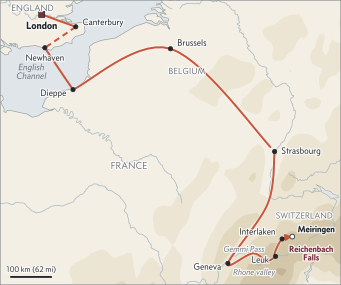
Holmes has gathered evidence against the whole gang, but Moriarty knows it and comes to Baker Street to warn him off. Holmes’s rooms are set on fire, and three attempts are made on his life in one day. He and Watson flee to the Continent, with Moriarty close behind (Figure 16.7). The police in London arrest the gang, but the professor escapes and follows them into Switzerland. On May 4, 1891, at the Reichenbach Falls, a Swiss boy brings Watson a note: an Englishwoman is dying at the hotel and wants an English doctor. Watson hurries back down the path. There is no dying woman.

When Watson returns, he finds Holmes’s alpine walking stick leaning against a rock, and a farewell letter. Two lines of footprints run to the end of the path, and none come back. The ground at the edge is torn up, as if by a struggle. So Holmes dies fighting Moriarty at Reichenbach Falls,This character apparently dies fighting Professor Moriarty at Reichenbach Falls in "The Final Problem." → Sherlock Holmes••• or seems to, and both bodies are lost in the boiling water below (Figure 16.8). Experts who examine the ledge agree that the two men went over together, locked in each other’s arms. Watson ends by calling his friend the best and the wisest man he had ever known.
The Strand printed the story in December 1893, and Doyle titled it “The Final Problem”This author wrote "The Final Problem." → Arthur Conan Doyle•• because he meant exactly that. The public reaction surprised him. About twenty thousand readers canceled their subscriptions to the magazine. Angry letters poured in, and one woman began hers “You brute.” A famous story says that young men in London wore black mourning bands on their hats for Holmes, but nobody has found a report of it earlier than 1949, so it is probably a legend.
The Hound and the return
For eight years Doyle wrote other things. In 1900 he went to South Africa as a volunteer doctor in the Boer War (Chapter 21), Britain’s war against the two Dutch-speaking republics of the region, and worked in a field hospital at Bloemfontein (bloom-fon-tayn) through an epidemic of typhoid. He came home and wrote a short book defending Britain’s conduct of the war. Then, on a golfing holiday in 1901, a journalist friend named Bertram Fletcher Robinson told him a legend of a ghostly dog on Dartmoor. Doyle needed a hero for the tale and borrowed his own. To avoid bringing Holmes back to life, he set the story in 1889, before the falls.

The Hound of the Baskervilles, a new case for Holmes,This character appears in The Hound of the Baskervilles. → Sherlock Holmes•• ran in The Strand from August 1901 to April 1902. A country doctor, Dr. Mortimer, brings Holmes an old family curse. In the seventeenth century the wicked Sir Hugo Baskerville was torn to pieces on Dartmoor by a monstrous hound, and since then the dog has haunted his family. Now Sir Charles Baskerville has been found dead near his house, his face twisted with terror. “Mr. Holmes,” Mortimer says in a whisper, “they were the footprints of a gigantic hound!”
Holmes sends Watson to the moor to guard the heir, Sir Henry, and secretly camps there himself among the prehistoric stone huts. In the end Holmes proves the hound to be a real dog, huge and fierce, its jaws painted with phosphorus so that they glow in the dark. Its master is a quiet naturalist named Stapleton, who is secretly a Baskerville himself and wants the family fortune. On a foggy night the hound runs down Sir Henry on the moor, and Holmes and Watson shoot it just in time, with Lestrade at their side. Stapleton flees into the Grimpen Mire, a deadly bog, and is never seen again.
In October 1902 King Edward VII knighted Doyle, chiefly, Doyle believed, for his book defending the Boer War. So the hero of The Strand was now the creation of Sir Arthur Conan Doyle.This character was created by Sir Arthur Conan Doyle. → Sherlock Holmes•• American magazines then offered him huge sums for new stories, and Doyle, who had spent the 1890s insisting that Holmes was dead, gave in.
In “The Adventure of the Empty House” (published in America in September 1903, and in The Strand that October), it is the spring of 1894. A young nobleman, Ronald Adair, has been shot in the head in a locked room on Park Lane, with no gun to be found. Watson, now a widower, is studying the scene when he bumps into a stooped old book collector. Minutes later, in Watson’s study, the old man straightens up and is Holmes. Watson faints for the first and last time in his life. Holmes explains that he threw Moriarty into the falls by a Japanese wrestling trick, then hid on the cliff and let the world believe him dead. He spent three years abroad, two of them in Tibet, then passed through Persia, looked in at Mecca, visited Khartoum, and worked in a chemical laboratory in the south of France, while Moriarty’s last followers hunted him. In this way Holmes returned in “The Empty House,”This character returned in "The Adventure of the Empty House" after public protest over his apparent death. → Sherlock Holmes•• and the readers who had protested his death in 1893 rejoiced.
There is one dangerous man left. Holmes and Watson creep into an empty house across Baker Street and look up at Holmes’s own window, where a wax bust of the detective sits in profile against the lamplight. Mrs. Hudson has been turning it every quarter of an hour so that it looks alive. At midnight a gaunt old hunter slips into the room beside them, fits together an airgun, a gun fired by compressed air instead of gunpowder and so almost silent, and puts a bullet through the dummy’s head. He is Colonel Sebastian Moran, Moriarty’s chief of staff and a famous tiger hunter of the Indian army, “the second most dangerous man in London.” Holmes had escaped Moran’s silent airgunThis character is menaced by the airgun-wielding Sebastian Moran. → Sherlock Holmes• by a trick, and Lestrade arrests the colonel for the murder of Adair, whom Moran had shot from the street for catching him cheating at cards.
The next spring brought a villain of a different kind, Charles Augustus Milverton, “the king of blackmailers.” Blackmail is the crime of demanding money by threatening to reveal someone’s secrets. He buys compromising letters, the kind that would shame their writers if made public, from servants and sells them back at ruinous prices. Doyle modeled him on Charles Augustus Howell, the art dealer who had had Rossetti’s poems dug up from his wife’s grave (Chapter 6). When a young noblewoman’s foolish old letters fall into his hands on the eve of her wedding, Holmes takes on Milverton for her.This character's adversaries include Charles Augustus Milverton. → Sherlock Holmes• Disguised as a plumber, he even gets engaged to Milverton’s housemaid to learn the plan of the house. Then he and Watson break in at night to burn the letters, and from behind a curtain they watch a veiled lady, whose husband had died of grief over Milverton’s letters, shoot the blackmailer dead. The next morning Lestrade asks Holmes to help catch the two burglars seen at the house. Holmes declines.
Bees, and a priest
Doyle hoped that other books would outlive Holmes. In 1912 The Strand serialized his adventure novel The Lost World. Its hero, Professor George Edward Challenger, is a short, barrel-chested zoologist with a black beard and a roaring temper. He claims to have found living dinosaurs in South America and is laughed at by the learned world, and when a young reporter comes to interview him, the two end up wrestling in the street. So The Lost World follows Challenger’s expeditionThis author's The Lost World follows Professor Challenger's expedition to a South American plateau with prehistoric animals. → Arthur Conan Doyle•• up the Amazon to a high plateau with cliffs too steep to climb. With him go a rival professor, a big-game hunter, and the young reporter who tells the story. On top, cut off for millions of years, live dinosaurs, pterodactyls, and a tribe of ape-men at war with the local people. The book gave its name to a whole family of later adventures, King Kong and Jurassic Park among them.

Holmes, meanwhile, grew old. Watson had told readers as early as 1904 that his friend had retired to a farm on the South Downs, the chalk hills of Sussex near the sea. “His Last Bow” (1917) finds him out of retirement on the eve of the First World War, on August 2, 1914. For two years he has posed as an Irish-American to trap a German spy, and now, at the spy’s house on the east coast, with Watson at the wheel of a motorcar, he springs the trap. The parcel that the spy expects to hold the Royal Navy’s secret signals turns out to contain a book by Holmes himself, a Practical Handbook of Bee Culture. For Holmes retired to keep bees,This character retires and takes up beekeeping in His Last Bow. → Sherlock Holmes• and he watched the little working communities, he said, as he had once watched the criminal world of London. Doyle wrote a few more cases, the last in 1927 (Figure 16.10). He died on July 7, 1930, at his house in Sussex. By then he was a spiritualist, a believer that the living can talk with the spirits of the dead, and he expected to speak with his family from the other side.
Long before that, Holmes had made his trade the most crowded in fiction. Of all his followers, the most unlike him came from G. K. Chesterton, a large, cheerful London journalist and poet who loved to argue in paradoxes, statements that sound absurd but turn out to be true. In 1910 Chesterton published “The Blue Cross,” the first story about Father Brown, a short, round-faced Catholic priest from a village in Essex. He carries a shabby umbrella, keeps losing his parcels, and looks like a dumpling. Yet this priest is also a detective,Father Brown, a priest, has this profession. → detective• and a better one than the police. In his first case he outwits Flambeau (flahm-boh), the greatest thief in Europe, who later reforms and becomes his friend. Holmes reads footprints and tobacco ash. Father Brown reads people. As a priest he hears confession, when sinners tell their sins in private to receive God’s forgiveness, so nothing evil surprises him. Chesterton based him on a real priest from Bradford, John O’Connor, and collected the first twelve stories as The Innocence of Father Brown in 1911.
Jerome K. Jerome
The same London produced, in 1889, one of the funniest books in English. Its author, Jerome K. Jerome, was born in Walsall, in the Midlands, on May 2, 1859, twenty days before Doyle. His father, a preacher whose coal mine had failed, moved the family to the poor streets of East London. The odd middle name came from a Hungarian general named Klapka (klap-kuh), who was staying with the family when the boy was born. After his father died in 1871, the boy left school to work as a railway clerk. He spent three penniless years as a touring actor, then became a solicitor’s clerk who wrote in the evenings. His essays, Idle Thoughts of an Idle Fellow (1886), sold well enough for him to marry in 1888.
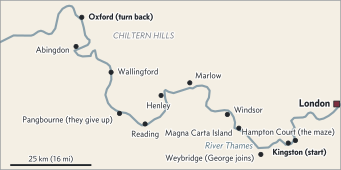
On summer weekends in the 1880s, thousands of London clerks escaped to the upper Thames, west of the city, rowing hired boats and camping on the banks. The new Bank Holidays and Saturday half-days gave them time for it (Chapter 12). Jerome often went with two friends, a bank clerk named George Wingrave and a printer named Carl Hentschel (hent-shul). In 1889 Jerome wrote Three Men in a Boat,This author wrote Three Men in a Boat. → Jerome K. Jerome• subtitled To Say Nothing of the Dog, out of those trips. It is told by “J.,” with George and Harris (Hentschel in disguise). The three young men decide one evening that they are ill. J. has read a medical book and found that he has every disease in it except housemaid’s knee, a swelling that comes from scrubbing floors. Rest is the cure, so they hire a camping skiff, a light rowing boat with a canvas hood to sleep under, and row up the Thames from Kingston to Oxford (Figure 16.11).

A fourth member of the party, Montmorency (mont-muh-ren-see), J.’s fox terrier,The characters in this novel are accompanied by the dog Montmorency. → Three Men in a Boat• nearly steals the book. He looks like a little angel, J. says, but he lives for fights and for chasing cats, and he gets underfoot at every meal. When the friends cook an Irish stew from every scrap left in the hamper, Montmorency brings a dead water rat as his contribution. Harris leads a growing crowd into the hedge maze at Hampton Court Palace, confident that the secret is to keep turning right, and gets them all hopelessly lost. Having forgotten the tin opener, they batter a tin of pineapple out of shape with the mast and throw it into the river.
Critics hated it. They called its slang vulgar and its humor fit only for “’Arry,” the loud clerk of the cartoons who dropped his h’s like a cockney, a working-class Londoner. Punch mocked the author as one himself. Readers loved it for the same reasons, because the three men talked the way young Londoners really talked. By 1909 it had sold more than 200,000 copies in Britain, and American pirated editions, printed without paying the author because American law did not then protect British books, sold perhaps a million more. In 1892 Jerome became joint editor of a new monthly, The Idler, which printed stories by Doyle and Kipling. Holmes’s London was fog, gaslight, and murder; Jerome’s was the same city on its day off, and it went on laughing at its clerks, its tin openers, and its dogs.
What to remember
- Arthur Conan Doyle (1859–1930), an Edinburgh-trained doctor, modeled Sherlock Holmes on his teacher Joseph Bell. Holmes first appeared in A Study in Scarlet (1887).
- Dr. John Watson, an army surgeon wounded in the Second Afghan War, shares 221B Baker Street with Holmes and tells his stories. He marries Mary Morstan in The Sign of Four (1890).
- Holmes is a consulting detective, often consulted by Inspector Lestrade of Scotland Yard.
- A Study in Scarlet ends with the arrest of the cabman Jefferson Hope; its second part, “The Country of the Saints,” is a hostile tale of the Mormons.
- The Strand stories (from 1891) made Holmes famous: “A Scandal in Bohemia,” “The Red-Headed League,” “The Five Orange Pips,” “Silver Blaze,” and “The Greek Interpreter.”
- Holmes goes over the Reichenbach Falls with Professor Moriarty in “The Final Problem” (1893) and returns in “The Empty House” (1903) to catch Colonel Moran.
- The Hound of the Baskervilles (1901–02) is set on Dartmoor. Holmes retires to keep bees; Chesterton’s Father Brown is a priest-detective.
- Jack the Ripper killed five women in Whitechapel, in London’s East End, in 1888 and was never caught.
- Jerome K. Jerome’s Three Men in a Boat (1889) is a comic novel of a Thames boating trip, with the dog Montmorency.
Chapter 17 · 29 clues
Wilde I: The Aesthete
On the evening of August 30, 1889, an American editor named Joseph Marshall Stoddart gave a dinner at the Langham Hotel in London. Stoddart ran Lippincott’s Monthly Magazine of Philadelphia, which printed a complete short novel in every issue, and he had crossed the Atlantic to buy English ones. Among his guests were two writers. The first was a young doctor from Southsea named Arthur Conan Doyle, who had published one detective story so far, without much success (Chapter 16). The second was a large Irishman of thirty-four, with heavy-lidded eyes, a soft and beautiful voice, and a reputation for saying outrageous things so gracefully that people repeated them for weeks.
Doyle later wrote that the Irishman’s talk left a mark on his mind that never faded. Both guests went home with a contract. Doyle’s became The Sign of Four, the second adventure of Sherlock Holmes. The Irishman’s became a story about a young man who stays beautiful while his portrait, hidden in a locked room, grows old and evil in his place. His name was Oscar Wilde. He had been famous for ten years, more for what he said and wore than for anything he had written (Figure 17.1).

Wilde and aestheticism
Oscar Fingal O’Flahertie Wills Wilde was born in Dublin on October 16, 1854. Two of his names came from Irish legend, for Fingal is an old name for the giant hero Finn McCool (muh-kool), and Oscar was Finn’s grandson. His father, Sir William Wilde, was the leading eye and ear surgeon in Ireland, and in his spare hours he collected the folk tales and ancient stones of the Irish countryside. His mother, Jane, had written fiery poems for Irish independence in 1848 under the pen name Speranza (speh-rahn-tsuh), Italian for “hope.” Ireland was then part of the United Kingdom, ruled from London. The Wildes belonged to its Protestant upper class and lived in a tall house on Merrion Square, the finest address in Dublin.
The boy was lazy about everything except books, and those he devoured. At Portora (por-tor-uh) Royal School in Enniskillen (en-iss-kil-en), in the north of Ireland, he entertained his schoolfellows with comic stories of his own invention. In 1871 he won a scholarship to Trinity College, Dublin, to study classics, the language, literature, and history of ancient Greece and Rome. His tutor, John Pentland Mahaffy (muh-haf-ee), taught him to love the Greeks, and Wilde won the college’s highest prize for Greek. In 1874 another scholarship carried him to Magdalen (mawd-lin) College, Oxford (Figure 17.2).

Oxford gave him two teachers, and they pulled in opposite directions. One was John Ruskin, the critic who taught that good art must be truthful and must make people better (Chapter 13). Ruskin wanted his students to learn the dignity of honest labor, so he set them to turn a swampy country lane at North Hinksey, just outside the city, into a proper road. Wilde, who never otherwise rose early or worked with his hands, showed up to push a wheelbarrow. The other was Walter Pater, a quiet tutor whose Studies in the History of the Renaissance (1873) ended with a short “Conclusion” that alarmed the university. Life is brief, Pater wrote, and every moment slips away. The wise man should spend his days gathering the most intense experiences of beauty that life and art can give. “To burn always with this hard, gem-like flame, to maintain this ecstasy, is success in life.” Wilde read the book as a student and later wrote that it had had a strange influence over his life.
He made his rooms a shrine to beauty, with lilies, peacock feathers, and blue-and-white china, and he told his friends, “I find it harder and harder every day to live up to my blue china.” Behind the pose he worked hard. He took a double first, top marks in both halves of the classics degree, and in 1878 he won the Newdigate Prize, Oxford’s prize for a poem in English, with a poem about the Italian city of Ravenna.
In 1879 he settled in London with no profession and very little money, and he set out to become famous for being himself. An aesthete, as Chapter 13 explained, was a person devoted to beauty above everything else, and Wilde played the part in public. He wore a velvet coat, knee breeches, and silk stockings, and carried a lily or a sunflower. Asked whether he had really strolled down Piccadilly holding a lily, he answered that what mattered was not whether he had done it but whether people believed he had. The comic weekly Punch drew him again and again. In 1881 he paid to publish his Poems, which sold out its first printing of 750 copies but pleased few critics.
That April the comic opera Patience mocked the aesthetes in the person of the poet Bunthorne (Chapter 13), and its producer, Richard D’Oyly Carte, saw a chance. He sent Wilde to lecture in America, where Patience was playing too, so that audiences there would know what the joke was about. Wilde’s ship reached New York on January 2, 1882. According to a story first printed many years later, he told a customs officer that he had nothing to declare except his genius. No one at the time recorded it. The tour was planned for four months and lasted almost a year, with well over a hundred lectures, on “The English Renaissance” and “The House Beautiful,” from New York to San Francisco and up into Canada. He said he drank whiskey with silver miners at the bottom of a shaft in Leadville (led-vil), Colorado. Newspapers mocked him, and audiences came anyway.


He came home with money, spent three months of 1883 in Paris, and had his long hair cut short and curled in the manner of a bust of the Roman emperor Nero (Figure 17.3). On May 29, 1884, he married Constance Lloyd, the clever, gentle daughter of a wealthy lawyer. They took a house at 16 Tite Street in Chelsea, decorated in white and pale colors, and had two sons, Cyril in 1885 and Vyvyan (viv-ee-un) in 1886. To pay the bills Wilde wrote reviews and, from 1887 to 1889, edited a monthly called The Woman’s World.
All this while he preached one creed. The French slogan l’art pour l’art, the idea that a work of art needs no excuse beyond its own beauty, had come to London through Pater and through Whistler’s paintings (Chapter 13). Wilde became the aesthetic movement’s loudest preacherThis author promoted the doctrine of "art for art's sake" as part of the Aesthetic movement. → Oscar Wilde• of “art for art’s sake.” Whistler resented the way Wilde took up his ideas and his jokes. When Wilde once said of a witty remark, “I wish I had said that,” Whistler answered, “You will, Oscar, you will.” By 1889 the two old friends were trading insults in the newspapers. By then, though, Wilde had stopped merely talking about art and begun to make it.
The tales and essays
In 1887, at thirty-two, with a wife, two small sons, and debts, Wilde began to write stories for the magazines, which paid well for them. In February and March of that year a London weekly called The Court and Society Review printed, in two parts, Wilde’s first story, “The Canterville Ghost.”This author wrote "The Canterville Ghost." → Oscar Wilde•• It turns the haunted-house tale upside down. Mr. Hiram B. Otis, the American minister in London (the official who represents his country at a foreign court, much like an ambassador), buys an old English country house called Canterville Chase, ghost and all. Lord Canterville warns him. Mr. Otis replies that if there were such a thing as a ghost in Europe, America would soon have it in a museum.

The ghost is Sir Simon de Canterville, who murdered his wife, Lady Eleanore, in 1575 and has haunted the house for three hundred years. A dark red stain on the library floor marks the spot where she died, and the housekeeper says it can never be removed. The family is not impressed. The eldest son, Washington, takes out a little black stick of Pinkerton’s Champion Stain RemoverIn this author's "The Canterville Ghost," an American family uses Pinkerton's Champion Stain Remover to remove ghostly blood stains. → Oscar Wilde• and Paragon Detergent, an American cleaning product with a grand American name, and scrubs the bloodstain away. Every morning it comes back, in stranger colors, once even bright emerald green, because the ghost has been stealing the daughter’s paint box to renew it. When Sir Simon clanks his chains at night, Mr. Otis offers him a bottle of Tammany Rising Sun Lubricator to oil them. The twins pelt him with peashooters and trip him on the stairs with a slide of butter. The poor ghost, a master of terror whose audience will not be frightened, sinks into despair.
Then the story turns tender. Virginia, the fifteen-year-old daughter, pities him. He tells her he has not slept for three hundred years and longs for rest in the Garden of Death, and she weeps and prays for him, as an old prophecy required. He is laid to rest at last, an old almond tree in the garden blossoms, and Virginia goes on to marry a duke. Wilde mocks the Americans’ faith in their products and the English faith in their old horrors, and gives the last word to pity.
Later in 1887 the same weekly printed “Lord Arthur Savile’s Crime,” subtitled “A Study of Duty.” At a party given by Lady Windermere, a palm reader named Mr. Septimus Podgers studies Lord Arthur’s hand and turns pale: he sees murder in it. Lord Arthur, who is engaged to a sweet girl named Sybil Merton, decides like a perfect gentleman that he must commit the murder before the wedding, to have it out of the way. He gives an elderly relative a poisoned capsule, but she dies of natural causes and leaves him her house. Next he sends a bomb disguised as a clockIn this author’s "Lord Arthur Savile’s Crime," a man tries to kill his uncle with an exploding clock. → Oscar Wilde• to his uncle the Dean, the clergyman in charge of the cathedral at Chichester (chich-iss-ter). He has bought it from a German who supplies the anarchists, revolutionaries of the 1880s who wanted to abolish every government and sometimes threw bombs to do it. The clock gives a puff of smoke, the little statue on top falls off, and the Dean’s family keeps it as a toy. At last, walking by the Thames at night, Lord Arthur meets Podgers himself and tips him over the parapet into the river. The official inquiry into his death finds that Podgers killed himself, and Lord Arthur marries Sybil and lives happily ever after.


A year later Wilde turned to fairy tales. Walter Crane, the best-known illustrator of children’s books in England, drew the full-page pictures for The Happy Prince and Other Tales (May 1888), a book of five stories, and a second artist, Jacomb Hood, drew the smaller ones. Wilde told stories to his own small sons, but he wrote that these were meant partly for children and partly for grown-ups who had kept a child’s sense of wonder and joy (Figure 17.5). In the title story, “The Happy Prince,”This author wrote "The Happy Prince." → Oscar Wilde•• a statue of a dead prince stands on a tall column above a city. He is covered with thin leaves of gold, his eyes are two sapphires, and a red ruby glows on the hilt of his sword. In life he lived in a palace called Sans-Souci (sahn soo-see), French for “without care,” where sorrow was not allowed to enter. Now, high above the streets, he sees all the city’s misery, and though his heart is made of lead, he weeps.
A swallow, who stayed behind when his friends flew south to Egypt because he had fallen in love with a reed, stops one night to rest at the statue’s feet. The Prince begs him to be his messenger, and night after night the swallow carries the jewels to the poor.In this author's "The Happy Prince," a swallow distributes the title statue's jewels to the poor. → Oscar Wilde•• The ruby goes to a seamstress whose little boy is sick with fever, one sapphire eye to a young playwright too cold to finish his play, and the other to a little match girl whose matches have fallen in the gutter. Then the Prince, now blind, has the swallow strip off his gold, leaf by leaf, for the hungry children of the city. Winter comes. The swallow will not leave his blind friend, and he dies of cold at the Prince’s feet, and the leaden heart cracks in two. The mayor, finding the statue shabby, has it melted down, but the broken heart will not melt, and it is thrown on a dust heap beside the dead bird. When God asks an angel to bring him the two most precious things in the city, the angel brings the heart and the bird.
The book ends in comedy. In its last tale, “The Remarkable Rocket,”This author wrote "The Remarkable Rocket." → Oscar Wilde• fireworks are to be set off at midnight to celebrate a prince’s wedding. Among them is a Rocket so vain that he boasts of his remarkable parents, lectures his neighbors, and bursts into tears of pity for himself. “I like hearing myself talk,” he explains. “I am so clever that sometimes I don’t understand a single word of what I am saying.” His tears make him damp, so he fails to go off, and next morning he is thrown into a ditch, where he lectures a frog and a duck. Two boys finally put him on their fire to boil a kettle, and fall asleep. He goes off in broad daylight, seen and heard by no one. All that is left of him, his stick, falls on the back of a passing goose, and he goes out certain that he has made a great sensation. Wilde, the most famous talker in London, knew the type from the inside.
In January 1889 Wilde published two essays in the great monthly reviews of ideas. The first was Wilde’s essay “The Decay of Lying,”This author wrote "The Decay of Lying." → Oscar Wilde•• in The Nineteenth Century. It is written as a dialogue, a conversation set down like a play, the form the Greek philosopher Plato used for the arguments of Socrates. Plato’s speakers argue in order to reach the truth; Wilde’s argue mainly to amuse each other, and the truth slips out between the jokes. The speakers are two young men named Cyril and Vivian,This essay is written as a dialogue between Cyril and Vivian. → "The Decay of Lying"•• and Wilde took their names from his own two sons. The scene is the library of a country house in Nottinghamshire on a lovely afternoon. Cyril wants to go out and lie on the grass. Vivian refuses, because Nature is uncomfortable: the grass is hard, lumpy, and damp, and full of dreadful black insects. Instead he reads Cyril the article he is writing, “The Decay of Lying: A Protest.”
By lying Vivian means art: the telling of beautiful untrue things. Its enemy is realism, the kind of novel that copies everyday life as faithfully as a newspaper report, and Vivian finds such books dull. His boldest doctrine turns the usual view around: it is life that copies art,This essay argues that “Life imitates Art far more than Art imitates Life.” → "The Decay of Lying"• far more than art copies life. Londoners see the brown fogs creeping down their streets because poets and painters have taught them to notice fogs. “There may have been fogs for centuries in London,” Vivian says, but no one saw them. The Japan of fans and prints that London loved (Chapter 13) was, he claims, a pure invention of artists. When a lady called him to the window to admire a sunset, he found it “a very second-rate Turner,” a poor imitation of the great painter of skies (Vol. 15, The Age of Revolution). The jokes carry a serious point. We see the world partly through the pictures and books that have taught us how to look.

The second essay, in The Fortnightly Review, was “Pen, Pencil and Poison,” subtitled “A Study in Green.” It is a portrait of the poisoner WainewrightThis author’s "Pen, Pencil and Poison" examines the art critic and suspected poisoner Thomas Griffiths Wainewright. → Oscar Wilde•• (wayn-rite). Thomas Griffiths Wainewright, born in 1794, was a painter and a dandy, a man who made an art of dressing well, who in the 1820s wrote clever art criticism for The London Magazine under joke names such as “Janus Weathercock.” He lived far beyond his means. He forged signatures to draw money from the Bank of England, and in 1830 he insured the life of his sister-in-law, Helen Abercromby, for 16,000 pounds. She died that December with the signs of strychnine poisoning. He was suspected of poisoning his uncle and his mother-in-law too, though none of these deaths was ever proved against him. He was convicted in 1837 only of forgery and transported, shipped as a convict to the island of Van Diemen’s (van dee-menz) Land, now Tasmania, south of Australia, where he painted portraits until his death in 1847. Wilde wrote about him as if his whole life were a work of art and added, with a straight face, “The fact of a man being a poisoner is nothing against his prose.”
Both essays went into Intentions (1891), Wilde’s book of four essays on art. By then he had put their ideas into a story.
The Picture of Dorian Gray
Stoddart received the manuscript in April 1890, seven months after the dinner at the Langham, and printed it in the July issue of Lippincott’s. It was Wilde’s only novel, The Picture of Dorian Gray.This author wrote The Picture of Dorian Gray. → Oscar Wilde••• Stoddart, afraid of shocking his readers, quietly cut about five hundred words before it appeared. It shocked them anyway. The Daily Chronicle called it “a poisonous book,” and W. H. Smith, the bookseller whose stalls stood in every large railway station in Britain, took the July issue off its stalls.

In April 1891 the novel came out as a book, much enlarged. Wilde stretched its thirteen chapters to twenty, added new characters, among them a brother for its heroine, and put a preface at the front. The preface is a string of epigrams, short, polished sayings with a twist in them. “There is no such thing as a moral or an immoral book,” one runs. “Books are well written, or badly written. That is all.” Another borrows a character from Shakespeare’s The Tempest: Caliban (kal-ih-ban), the misshapen servant of the magician Prospero. People who hated realist novels, the preface says, were like Caliban raging at his own reflectionThis novel's preface describes the reaction to realism as "the rage of Caliban seeing his own face in a glass." → The Picture of Dorian Gray•• in a mirror, angry because the book showed them their own ugly faces. People who hated romances, tales of wonder far from everyday life, were Caliban angry at not seeing his face. Either way, Wilde suggests, the fault lies in the reader, not in the book. The last line is the most famous: the preface ends by calling all art useless.This novel's preface ends by stating "All art is quite useless." → The Picture of Dorian Gray•• Wilde meant that art is not a tool. It exists, like a flower, to be enjoyed for itself.
The story begins in the studio of a painter on a summer afternoon, heavy with the smell of roses and lilac. On the easel stands the full-length portrait of an extraordinarily beautiful young man. The painter, Basil Hallward, made the portrait,Basil Hallward created this thing. → the picture of Dorian Gray••• and it is the best thing he has ever done. Basil is gifted, modest, and good, and he worships the young man, who has given him, he says, a whole new way of seeing. He will not exhibit the picture, because he has put too much of himself into it. This is the picture of Dorian Gray, and the portrait gives the novel its titleThis portrait titles an Oscar Wilde novel. → the picture of Dorian Gray• (Figure 17.8).
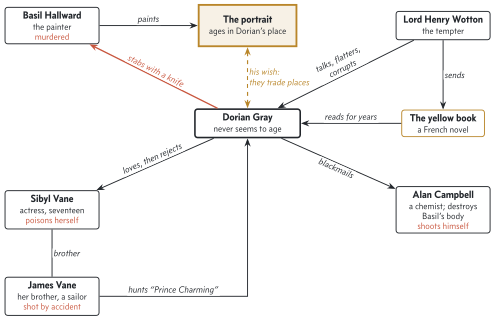
Basil’s visitor is Lord Henry Wotton (wot-un), Harry to his friends, a lazy, rich, and charming aristocrat who says shocking things for the pleasure of watching people’s faces. “There is only one thing in the world worse than being talked about,” he remarks, “and that is not being talked about.” When Dorian arrives to sit for the last touches, Lord Henry talks to him in the garden. Youth, he says, is the only thing worth having, and it does not last. Dorian should live every moment and refuse himself nothing, for “the only way to get rid of a temptation is to yield to it.” He calls his creed a new hedonism (hee-duh-niz-um), the belief that pleasure is the highest good. From that afternoon Lord Henry becomes Dorian’s mentor and corrupter,Lord Henry Wotton corrupts and mentors this novel's protagonist. → The Picture of Dorian Gray•• and Dorian, who is about twenty, drinks in every word.
Then Dorian looks at the finished portrait and sees for the first time how beautiful he is, and that it will not last. “If it were I who was to be always young, and the picture that was to grow old!” he cries, and he says he would give his soul for that. Basil, upset, picks up a palette knife to slash the canvas, and Dorian snatches it from him, crying that it would be murder. Somehow the wish is granted. Wilde never explains how; it is the one piece of magic in the book. From now on the portrait ages and grows hideous,The title painting in this novel ages and becomes disfigured while the protagonist maintains his youth. → The Picture of Dorian Gray•••This object grows hideous while its subject enjoys unchanging youth. → the picture of Dorian Gray• while Dorian keeps the face of a boy. Only the canvas will show what his life is doing to him.
A few weeks later Dorian tells Lord Henry that he is in love. Wandering one night through a maze of grimy streets in a poor part of London, he stepped into a shabby little theater and watched a girl of seventeen play Juliet. Dorian has fallen for Sibyl VaneThis character falls in love with the actress Sibyl Vane. → Dorian Gray• (sib-il), and what has captured him is less the girl than her art. In a tawdry theater with a cracked piano for an orchestra, she makes Shakespeare’s old words sound as if they had just been written, and Dorian has gone back to see her every night since. She plays Shakespeare’s heroinesSibyl Vane is a Shakespearean actress in this novel. → The Picture of Dorian Gray••• in turn: Juliet one night, Rosalind in As You Like It the next, Imogen in Cymbeline the night after. To Dorian she is every great heroine of the stage rolled into one. She does not even know his real name, so Sibyl calls him “Prince Charming,”A lady calls this character “Prince Charming.” → Dorian Gray•• like the hero of a fairy tale. Her brother James, a rough young sailor about to ship out for Australia, distrusts the fine gentleman, and he swears that if the man ever does her wrong, he will kill him.
Dorian brings Basil and Lord Henry to see her Juliet, and she acts dreadfully. Now that she knows real love, she tells him, she can no longer pretend. Dorian loved the artist, not the girl. He tells her coldly that she has killed his love and leaves her sobbing on the floor. At dawn, back at home, he sees that the portrait has changed: there is a touch of cruelty about the mouth. Frightened, he resolves to marry her after all. But later that day Lord Henry brings the news that Sibyl swallowed poison in her dressing room the night before. Lord Henry persuades him to see her death as a beautiful tragedy, like the end of a play, and Dorian lets himself be persuaded. He has the portrait carried up to an old schoolroom at the top of his house and locks the door.
That same day Lord Henry sends him a book bound in yellow paper. French novels were sold in yellow paper covers, so for Victorian readers “a yellow book” meant a daring French novel. This one tells of a young Parisian who spends his life trying to taste every passion and luxury of every age. Behind it stands a real book by the French novelist Joris-Karl Huysmans (zhoh-rees karl wees-mahnss). The yellow book recalls Huysmans’s Against Nature,The "yellow book" in this novel is inspired by Joris-Karl Huysmans' Against Nature. → The Picture of Dorian Gray•• a novel of 1884, called in French À rebours (ah ruh-boor). Its hero, the Duke des Esseintes (day zeh-sant), shuts himself up outside Paris among rare books, perfumes, and jewels. Wilde admitted later that his imaginary book was partly suggested by it. Dorian orders nine copies, bound in different colors to suit his moods, and lives by it for years.
The story now leaps eighteen years. Dorian collects perfumes, music, jewels, and embroideries, and he slips away in disguise to low haunts by the docks. Young men and women whose names are linked with his are ruined. The book never says exactly what he does; it hints and lets the reader imagine. London whispers, but his face stays as innocent as a boy’s, while up in the locked room the portrait grows old and coarse.
On the foggy night of November 9, the eve of Dorian’s thirty-eighth birthday, Basil calls on his way to the midnight train for Paris. He begs Dorian to tell him the rumors are false. Dorian takes him upstairs and pulls the cover off the portrait, and Basil, horrified, tells him to pray. In a sudden fury Dorian stabs Basil to deathThis character murders Basil Hallward. → Dorian Gray•• with a knife that lies in the room. Then, very calmly, he hides Basil’s bag and coat, slips out of the house, and rings at his own front door. That way his sleepy servant will remember letting him in at ten past two in the morning, long after Basil was supposed to have left for Paris. Now the body must vanish. Dorian sends for Alan Campbell, a chemist and a former friend who has dropped him. When Campbell refuses to help, Dorian writes something on a sheet of paper and hands it to him; the reader never learns what it says. The chemist turns pale, and Alan Campbell destroys the bodyAlan Campbell disposes of a body in this novel. → The Picture of Dorian Gray•• with his chemicals. Some time later he shoots himself.
James Vane has come home from the sea and has spent years looking for the man his sister called Prince Charming. One night, in an opium den by the docks, a woman calls Dorian by that name. The sailor follows him out, and in the street James Vane seizes Dorian to avenge Sibyl,James Vane attempts to avenge his sister in this novel. → The Picture of Dorian Gray•• a pistol at his head. Dorian keeps his nerve and asks how long ago she died. “Eighteen years,” says James, and Dorian steps under a lamp. James sees a face of twenty and lets him go, apologizing. Only then does the woman tell him that Prince Charming has been coming to the den for eighteen years.
James does not give up. A week later his face appears at a window of Selby Royal, Dorian’s country house, and Dorian faints with terror. A few days later, during a shooting party, one of the guests fires at a hare and kills a man hidden in a thicket. It is James Vane.
Safe at last, Dorian decides to become good. He spares a village girl he could have ruined and hopes the portrait will show it. Instead he finds a new look of cunning and hypocrisy, and the red stain that appeared on the painted hand after Basil’s murder. The picture is the only evidence against him, so he resolves to destroy it. He takes up the same knife that killed Basil and stabs the portrait with it.This novel's protagonist dies after stabbing the title painting. → The Picture of Dorian Gray••A novel ends with a character stabbing this object with a knife, screaming, and collapsing dead. → the picture of Dorian Gray• The servants hear a horrible cry. When they break in, they find the portrait as Basil painted it, in all its youth and beauty. On the floor lies a dead man in evening dress with a knife in his heart, withered, wrinkled, and loathsome, whom they know only by his rings.
Wilde told his critics that the novel did have a moral: that all excess, and all self-denial too, brings its own punishment. That sat oddly beside a preface calling all art useless, and Wilde enjoyed the contradiction. In a letter of 1894 he described his three main characters this way: “Basil Hallward is what I think I am: Lord Henry what the world thinks me: Dorian what I would like to be.” A year after that letter, lawyers read passages of the novel aloud in a London courtroom as evidence against its author (Chapter 18).
What to remember
- Oscar Wilde was born in Dublin in 1854, studied classics at Trinity College, Dublin, and Magdalen College, Oxford, and learned from Ruskin and Pater.
- In London he made himself famous as an aesthete, lectured across America in 1882, and preached “art for art’s sake.”
- In “The Canterville Ghost” (1887) an American family scrubs away the ghost’s bloodstain; in “Lord Arthur Savile’s Crime” a man sends a bomb disguised as a clock to his uncle.
- In “The Happy Prince” (1888) a swallow gives the statue’s jewels and gold to the poor; “The Remarkable Rocket” mocks a vain firework.
- “The Decay of Lying” (1889), a dialogue between Cyril and Vivian, argues that life copies art; “Pen, Pencil and Poison” studies the artist and poisoner Thomas Griffiths Wainewright.
- The Picture of Dorian Gray (1890, enlarged 1891) is Wilde’s only novel. Basil Hallward paints Dorian’s portrait, Lord Henry Wotton corrupts him, and the portrait ages while Dorian stays young. The preface ends by calling all art useless.
- Dorian rejects the actress Sibyl Vane, who kills herself; he murders Basil, Alan Campbell destroys the body, and Sibyl’s brother James hunts him.
- Dorian dies stabbing the portrait, which returns to its original beauty.
Chapter 18 · 50 clues
Wilde II: The Importance of Being Earnest
On the evening of Thursday, February 14, 1895, London lay in the grip of a great frost, with ice floating in the Thames, and a bitter wind blew through the streets. Even so, the carriages stood nose to tail outside the St. James’s Theatre, just south of Piccadilly, and the people who stepped out of them in furs and evening dress were the cleverest and best-born audience in the city. They had come to see the new comedy by Oscar Wilde. Wilde arrived with a green carnation in his buttonhole. Outside, a line of policemen watched the doors for one particular man.
He was John Sholto Douglas, the ninth Marquess of Queensberry, a Scottish nobleman with a violent temper, who believed that Wilde was leading one of his sons astray. He had bought a seat, meaning to stand up when Wilde came forward to take his bow and hurl a bouquet of rotten vegetables at him. Wilde heard of the plan in time. The theater’s manager canceled the ticket, and the police turned the marquess away. Queensberry had brought a professional boxer with him, and the two prowled around the building for three hours. At last he left his vegetables at the stage door and went off, Wilde wrote to a friend, “chattering like a monstrous ape.”
Inside, the audience laughed from the first line to the last. Allan Aynesworth, who played one of the two heroes, said many years later that in fifty-three years on the stage he could not remember a greater triumph. Wilde was forty. He had two plays running at once in the West End, London’s district of large theaters, and he was the most talked-about writer in the city. Within fifteen weeks he was in prison, and the comedy had closed with his name taken off the playbills. His climb to that first night, and his fall from it, took five years (Figure 18.1).

Lady Windermere’s Fan and Salomé
In the summer of 1891 Oscar Wilde was famous, but fame had not made him rich. The Dublin-born poet and wit had written fairy tales, essays, and The Picture of Dorian Gray, the novel of a portrait that grows old and wicked while its owner stays young (Chapter 17). He had a wife, Constance, two small sons, a house in Tite Street, Chelsea, and debts. His two earlier plays had both failed.
Then a London manager asked him for a comedy. George Alexander was an actor-manager, an actor who leased a theater, chose its plays, hired its company, and usually took the leading part himself. He was thirty-three, handsome, and businesslike, and in 1891 he had just moved into the St. James’s Theatre. He wanted modern plays about fashionable people for a fashionable audience. Wilde began one that summer in the Lake District of northern England, which is why several of its characters are named after northern places: Windermere, Darlington, Berwick, and Carlisle. Alexander liked it so much that he offered 1,000 pounds for it outright. Wilde guessed that he had a hit and took a share of each night’s takings instead. In its first year the play earned him about 7,000 pounds, as much as a skilled workman could earn in seventy years.
It was a society comedy, a comedy set among the rich and titled families of London, in their drawing rooms and ballrooms during the London Season, the months of parties when the aristocracy came up to town. In that world a woman’s good name was everything. A wife who ran away with a lover was shut out of every respectable house for the rest of her life, while the man she ran away with usually kept his place in society.
A play about a good woman
Lady Windermere’s Fan opened at the St. James’s on February 20, 1892. Its heroine is young, rich, and very strict. Brought up by a stern aunt, Lady Windermere believes that people are either good or bad, with nothing in between, and she believes that her mother died when she was a baby. On her twenty-first birthday she shows a visitor her husband’s present, a fan. The visitor is Lord Darlington, a charming idler who pays her far too many compliments. When she scolds him for it, he answers lightly that he “can resist everything except temptation,”This play is the origin of the quote "I can resist everything except temptation." → Lady Windermere's Fan• one of the play’s many upside-down sayings.

Then a gossiping duchess calls with news. Lord Windermere, she says, has been visiting a certain Mrs. Erlynne (er-lin), a woman with a scandal in her past whom no respectable family will invite to its house, and has been giving her large sums of money. Lady Windermere does not believe a word of it. Still, as soon as the duchess has gone she goes to her husband’s desk. A bank book was the little ledger in which a bank recorded the money paid in and out of a customer’s account. She finds one that shows nothing odd, and then a second one, locked. She breaks open her husband’s bank bookThis play's protagonist breaks open her husband's bank book to discover payments to another woman. → Lady Windermere's Fan•• and finds what the duchess described: payment after payment to Mrs. Erlynne.
Lord Windermere admits the payments, swears that he loves only his wife, and will not explain. He insists that Mrs. Erlynne be invited to his wife’s birthday ball that very night. To his wife, and to every guest who has heard the gossip, the meaning seems plain. Lord Windermere must be having an affair,In this play, Lord Windermere is suspected of having an affair with Mrs. Erlynne. → Lady Windermere's Fan••• a secret love outside his marriage, and means to bring the woman into his own house. Lady Windermere vows that if Mrs. Erlynne comes, she will strike her across the face with the fan. Mrs. Erlynne comes, and Lady Windermere lets the fan fall to the floor.
At the ball Lord Darlington declares his love and begs her to leave her husband for him. After the guests have gone, she writes her husband a farewell letter and goes to Darlington’s rooms. It is Mrs. Erlynne who finds the letter, and now the audience learns her secret. Twenty years before, she left her husband and her baby daughter for a lover, who soon abandoned her, and she has lived abroad ever since under a false name. Mrs. Erlynne is Lady Windermere’s mother. Lord Windermere found out, and he has been paying her to keep the secret from his wife. Now the mother sees her daughter about to make her own mistake, and she hurries after her.
In Darlington’s rooms Mrs. Erlynne begs her daughter to go home to her husband and her baby son. Before they can leave, men’s voices are heard on the stairs, and both women hide. Darlington, Lord Windermere, and three friends have come back from their club for a last cigar. One friend, Lord Augustus Lorton, is courting Mrs. Erlynne. The other two, Cecil Graham and a young man named Dumby, are men about town whose whole business is talk, and every line they speak turns a commonplace inside out. Darlington is the only one who means what he says. When Dumby jokes that they are all good men except Lord Augustus, Darlington answers with the most famous line in the play: “We are all in the gutter,”This play includes the line "we are all in the gutter, but some of us are looking at the stars." → Lady Windermere's Fan•• he says, “but some of us are looking at the stars.”
A gutter is the channel at the edge of a street that carries off rainwater and filth. Everyone is flawed, Darlington means, but some people still look up at something better. Dumby only repeats the line back to him and tells him he is very romantic tonight. Cecil Graham guesses that he is in love, and Darlington confesses that he loves a good woman who does not love him back. Dumby congratulates him. “In this world there are only two tragedies,”In this play, a character asserts "In this world there are only two tragedies: One is not getting what one wants, and the other is getting it." → Lady Windermere's Fan• he explains: one is not getting what one wants, and the other is getting it.
A cynic is a person who believes that everybody acts from selfish motives. When Darlington calls his friends cynics, Cecil Graham asks him what a cynic is. “A man who knows the price of everything,”In this play, a cynic is a "man who knows the price of everything and the value of nothing." → Lady Windermere's Fan• Darlington answers, “and the value of nothing.” It pins down a whole kind of person, the clever man who can put a figure on anything and cannot love anything.
Then Cecil Graham notices a woman’s fan lying on the sofa, and Lord Windermere knows it at once as his wife’s. He is about to search the rooms when Mrs. Erlynne steps out from behind a curtain. With every man staring at her, she claims the fan as her own,A woman in this play claims the title object left at Lord Darlington's place as her own. → Lady Windermere's Fan•• saying that she picked it up by mistake when she left the Windermeres’ house that evening. While the men gape, Lady Windermere slips out unseen. In one moment the mother has given up what was left of her reputation to save her daughter’s.
The next morning Mrs. Erlynne calls to return the fan. She is going to live abroad, she says, and she asks for one keepsake. Lady Windermere gives her a photograph of herself and her son,A character in this play receives a photo of the title character and her son as a parting gift. → Lady Windermere's Fan• never guessing that she is giving her mother a picture of her grandson. Lord Windermere begs to be allowed to tell his wife the truth, and Mrs. Erlynne forbids it. So Mrs. Erlynne never tells her daughter the truth.Mrs. Erlynne never reveals that she is the title character's mother in this play. → Lady Windermere's Fan••• She leaves on the arm of Lord Augustus, who has asked her to marry him, and Lady Windermere, still ignorant, tells him that he is marrying “a very good woman.” That is the point of the subtitle, “A Play About a Good Woman.” The “good” woman and the “bad” one have changed places, and the strict young wife has learned that people cannot be sorted into two piles.
When the first-night audience called for the author, Wilde came out in front of the curtain with a cigarette in his hand. He congratulated them on the great success of their performance, as if the audience, and not the actors, had been on the stage. The critics were more shocked by the cigarette than by the joke. The public came anyway, and Wilde’s first comedy, Lady Windermere’s Fan,This author wrote Lady Windermere's Fan. → Oscar Wilde••• made him the most fashionable playwright in London.
Salomé
While Alexander rehearsed the comedy, Wilde wrote something completely different, and in French. In Paris in the last weeks of 1891 he wrote Salomé (sal-oh-may), a one-act tragedy on a story from the Gospels. According to the Gospels of Mark and Matthew, Herod Antipas (hair-ud an-tih-pus), who ruled Galilee, in the north of the Holy Land, under the Romans, imprisoned the prophet John the Baptist for denouncing his marriage to Herodias (heh-roh-dee-us), his brother’s wife. At Herod’s birthday feast, Herodias’s daughter danced so well that he promised her anything she asked. Prompted by her mother, she asked for John’s head on a platter, and Herod kept his oath. The Gospels never name the girl; the name Salome comes from Josephus (joh-see-fus), a Jewish historian of the first century AD (Vol. 5, In the Beginning).
Wilde changed the story. His Salomé falls in love with the prophet’s voice rising from the dry well where Herod keeps him prisoner, and she begs to kiss him. He curses her and turns away. When Herod begs her to dance, she performs what the stage direction calls the Dance of the Seven Veils, a name Wilde seems to have invented. Then she demands the head for herself, not for her mother. When it is brought up on a silver charger, a large flat dish, she kisses its dead lips, and Herod, horrified, orders his soldiers to crush her beneath their shields.
The great French actress Sarah Bernhardt (burn-hart) agreed to play Salomé in London, and rehearsals began in June 1892. Then the play was banned. Every play performed in Britain needed a license from the Lord Chamberlain, a royal official whose Examiner of Plays read every script in advance, and an old rule forbade putting characters from the Bible on the stage. Wilde, furious, threatened to become a French citizen. Instead Wilde published his SaloméThis author wrote the play Salomé. → Oscar Wilde•• as a book, in French, in 1893. It was first acted in Paris in February 1896, while its author was in prison, and not performed in public in Britain until 1931.

An English translation followed in 1894. It was made by Lord Alfred Douglas, a twenty-three-year-old poet and the son of a marquess, and Wilde corrected it so heavily that the two quarreled over it. What made the book famous was its pictures. They were drawn by Aubrey Beardsley (beerdz-lee), a pale, thin young man of twenty-one from Brighton who had worked as a clerk in an insurance office and had had only a few months of evening art classes. He had tuberculosis, the lung disease then called consumption, and he knew that he would die young. He drew in black ink on white paper, with long sweeping curves, fine dotted lines, and great flat areas of solid black, a style he learned partly from Japanese prints. Beardsley’s drawings illustrated the English Salomé,Aubrey Beardsley illustrations accompanied the English version of this author's Salomé. → Oscar Wilde• and they were as strange and wicked-looking as the play. In one of them, “The Woman in the Moon,” the moon has Wilde’s own fleshy face. He died of tuberculosis in 1898, at twenty-five. The German composer Richard Strauss later set Wilde’s play as an opera, first performed in Dresden in 1905 (Vol. 19, Wagner and Verdi).
An Ideal Husband
Wilde’s second comedy, A Woman of No Importance, opened at the Haymarket Theatre, a few streets from the St. James’s, in April 1893. Like the first, it turned on a secret from the past: a mother who had raised alone the son of a careless lord. It did well, and that summer Wilde began a third. He wrote its first act at Goring-on-Thames, a village on the Thames upstream from Reading (red-ing), and named his hero’s best friend Lord Goring after it.
An Ideal Husband opened at the Haymarket on January 3, 1895. Its hero, Sir Robert Chiltern, seems to have everything. He is a member of the House of Commons, the elected half of Parliament, and Under-Secretary for Foreign Affairs, the second minister in the department that handles Britain’s dealings with other countries. People say he will soon sit in the Cabinet, the small group of ministers who run the government. His wife worships him. To Lady Chiltern he is a man who has never done a dishonest thing.

But years earlier, as a poor young secretary to a Cabinet minister, he learned that the British government was about to buy shares in the Suez Canal, the waterway in Egypt that joins the Mediterranean to the Red Sea. In real life Benjamin Disraeli’s government bought those shares in 1875 (Chapter 12). A company’s shares are the pieces of its ownership that people buy and sell. Anyone who knew of the purchase in advance could buy shares cheaply and sell them dear once the news drove the price up. Making money from a secret like this is called insider trading. Chiltern sold the secret to a financier, Baron Arnheim (arn-hime), and Arnheim’s payment became the foundation of Chiltern’s fortune.
Mrs. Cheveley (cheev-lee), a clever and unscrupulous woman who was at school with Lady Chiltern, now has the letter in which Chiltern passed the secret to Arnheim. She has also put her money into a company that claims to be building a canal in Argentina, a swindle that will collapse unless the British government seems to back it. To get something by threatening to reveal a secret is blackmail. In the first act Mrs. Cheveley blackmails Sir RobertIn this play, a minister is blackmailed over insider trading into supporting a fraudulent Argentine canal scheme. → An Ideal Husband• into promising to praise the Argentine canal scheme in the House of Commons, or see his letter in the newspapers.
Lady Chiltern, who knows nothing of the past, makes her husband break his promise, and Mrs. Cheveley tells her everything. Lady Chiltern turns on him: she has loved an ideal, and the ideal was false. The rescue comes from the idlest man in the play. Lord Goring is a dandy, a man whose great work is to dress perfectly and talk brilliantly. At the Chilterns’ party he picks up a diamond brooch that can also be worn as a bracelet, and he recognizes it: years ago he gave it to his cousin, and it was stolen from her. When Mrs. Cheveley comes to claim it, he snaps it onto her wrist by a secret clasp that only he can open. Unless she hands over Chiltern’s letter, he will call the police and charge her with the theft. She hands it over, and he burns it.
Chiltern, who does not yet know that his letter has been burned, denounces the Argentine canal in the House anyway. Goring persuades Lady Chiltern that love is not worship and that a woman who loves a man must love him with his faults. In the last act Lady Chiltern forgives her husbandIn this play, Robert Chiltern’s wife forgives his failure to meet its title’s standard. → An Ideal Husband• for falling short of the ideal she had imagined. Goring, meanwhile, proposes to Chiltern’s sister, Mabel. When Goring’s father warns his son that he had better make Mabel an ideal husband, she says that an ideal husband sounds like “something in the next world.”
The play was a hit, and Wilde’s An Ideal HusbandThis author wrote An Ideal Husband. → Oscar Wilde•• was still filling the Haymarket six weeks later, when his next comedy opened. That one went to the St. James’s because of another writer’s failure. Two days after An Ideal Husband, Guy Domville, a play by the American novelist Henry James, had been booed on its first night there, and George Alexander suddenly needed something to replace it (Vol. 30, Whitman to Wharton).
The Importance of Being Earnest
Wilde had spent the summer of 1894 with his family at Worthing, a seaside town on the Sussex coast, writing a farce. A farce is a comedy built on absurd situations, mistaken identities, and lies that multiply faster than anyone can keep track of them. He wrote it for another actor-manager, Charles Wyndham (win-dum), but when Guy Domville failed, Wyndham let Alexander have it. Alexander made Wilde cut it from four acts to three and took the part of its hero for himself.
Wilde’s The Importance of Being EarnestThis author wrote The Importance of Being Earnest. → Oscar Wilde••• is the last and best of his four comedies. Its title is a pun on the name Ernest, and the last line of the play explains the joke. Wilde subtitled it “A Trivial Comedy for Serious People.”This play is subtitled "A Trivial Comedy for Serious People." → The Importance of Being Earnest•• Something trivial is unimportant, too small to matter. Nothing in the play matters in the least, Wilde meant, and its audience took itself far too seriously.
Two Ernests
The curtain rises on a flat in Half Moon Street, off Piccadilly, where Algernon Moncrieff (mon-kreef) lives on credit and charm. A piano is heard from the next room. Algernon’s manservant, Lane, is laying out tea, and when his master strolls in and asks whether he heard what he was playing, Lane replies that he “didn’t think it polite to listen.”In this play, a character plays piano so badly at the beginning that his servant says he "didn't think it polite to listen." → The Importance of Being Earnest• Algernon is not offended. He does not play accurately, he explains, since anyone can do that, but he plays “with wonderful expression.” Within a minute the audience knows the rules of this world: the servants are as witty as their masters, and nobody says what a normal person would say.
The tea is for Algernon’s aunt, Lady Bracknell, and her daughter Gwendolen Fairfax, and Lane has made a plate of thin cucumber sandwiches for them. In comes Algernon’s friend, whom he knows as Ernest Worthing. He reaches for a sandwich, and Algernon forbids him the cucumber sandwiches,In this play, a character tells his friend not to eat cucumber sandwiches "ordered specially" for his aunt, then eats one himself. → The Importance of Being Earnest••• which were “ordered specially” for Lady Bracknell, his Aunt Augusta. Then Algernon eats one himself, and another, and another. By the time Lady Bracknell arrives the plate will be empty, and Lane will say with a straight face that there were no cucumbers in the market that morning, “not even for ready money,” that is, not even for cash.

“Ernest” has come up to town to propose to Gwendolen. Algernon finds proposals hopelessly unromantic, since the man may be accepted and then all the excitement is over. “The very essence of romance is uncertainty,”In this play, a character declares "The very essence of romance is uncertainty." → The Importance of Being Earnest• he says, and if he ever marries he will certainly try to forget the fact. Before he lets his friend near his cousin, though, he wants an explanation. After a recent dinner his friend left behind a silver cigarette case, and inside it Algernon has read an inscription: “From little Cecily, with her fondest love to her dear Uncle Jack.” His friend’s name is Ernest. Who, then, is Jack, and who is Cecily?

His friend first claims that Cecily is his aunt, a small aunt who lives at Tunbridge Wells. Then he gives up, and the inscription on the cigarette caseIn this play, an inscription on a cigarette case reveals a character's double life. → The Importance of Being Earnest•• forces the play’s first confession. His real name is Jack Worthing. As a baby he was adopted by a rich old gentleman, Mr. Thomas Cardew, who made him guardian of his granddaughter, Cecily Cardew. In the country Jack is a Justice of the Peace, an unpaid local magistrate, and must set a solemn example for his young ward. To escape to London he has invented a wicked younger brother named Ernest, who is always getting into scrapes and must be rescued. In town, Jack simply uses Ernest’s name.
Algernon is delighted, because he has done the same thing the other way around. He has invented an imaginary invalid friend named Bunbury,In this play, a character invents a fictional invalid friend named Bunbury to avoid social obligations. → The Importance of Being Earnest••• who lives in the country and falls dangerously ill whenever Algernon wants to escape a dull dinner, above all a dinner with Aunt Augusta. He calls the practice Bunburying, and he has always suspected his friend of being a Bunburyist too. They are perfectly matched liars. Before the play is over both young men pretend to be Ernest:In this play, both Jack Worthing and Algernon Moncrieff pretend to have the same first name. → The Importance of Being Earnest••• Jack calls himself Ernest in town, and Algernon will call himself Ernest in the country.
Then Lady Bracknell arrives, the greatest comic character Wilde ever created. Everything she says is absurd, and she says it with the confidence of a woman who has never been contradicted. Algernon leads her into the next room so that Jack can propose to Gwendolen, who accepts him at once. She explains that she has always been destined to love a man named Ernest, because there is something in that name that inspires absolute confidence. Jack asks, nervously, whether she could love him if his name were Jack. She could not; there is very little music in the name Jack, if any at all. Gwendolen will marry only an Ernest,In this play, Gwendolen Fairfax will only marry a man with the title name. → The Importance of Being Earnest•• and Jack privately resolves to be christened with that name as soon as possible.
Lady Bracknell finds him on his knees. She sends her daughter out, takes out a notebook and pencil, and examines him like a candidate for a job. Does he smoke? He confesses that he does. She is glad to hear it, because a man should always have an occupation of some kind. What does he know? Nothing, Jack admits. Again she is pleased, since she does not approve of anything that tampers with natural ignorance. So far she is pleased that he smokes and knows nothing,In this play, a woman is pleased to learn that a man smokes and knows nothing. → The Importance of Being Earnest• and his income and his house pass too, although the house is on the unfashionable side of Belgrave Square, one of London’s grandest squares.
Then she asks about his parents. He has lost both of them, Jack says. “To lose one parent, Mr. Worthing, may be regarded as a misfortune,” Lady Bracknell replies; “to lose both looks like carelessness.”In this play, a character says that to lose one parent may be regarded as a misfortune, but "to lose both looks like carelessness." → The Importance of Being Earnest•• The truth is worse than careless. Jack does not know who his parents were. Mr. Cardew found him, and named him Worthing because he happened to have a first-class ticket to that seaside town in his pocket at the time. He found him, Jack admits, in a handbag. “A handbag?”In this play, a character exclaims "A handbag?!" when questioning her prospective son-in-law about his upbringing. → The Importance of Being Earnest• cries Lady Bracknell. Actresses have competed ever since over how to deliver those two words, and Edith Evans, in the film of 1952, made them a long, climbing wail of disbelief.
Where was the handbag? In the cloak-room at Victoria Station, the great London terminus for trains to Brighton and the south coast. A cloak-room was a station’s left-luggage office, where travelers could leave their bags for a small fee, and this bag was handed to Mr. Cardew by mistake for his own. “The Brighton line,” Jack adds helpfully. “The line is immaterial,” says Lady Bracknell. So a baby abandoned in a handbag at Victoria StationIn this play, a character was abandoned as a baby in a handbag at Victoria Station. → The Importance of Being Earnest••• has grown up into the man who wants to marry her daughter. She advises him to acquire some relations as soon as possible. She will not allow her only daughter to marry into a cloak-room and form an alliance with a parcel.
Jack decides that his invented brother has outlived his usefulness and must die. Ernest, he will announce, has been “carried off suddenly, in Paris, by a severe chill.”In this play, a character invents a story that someone was "carried off suddenly, in Paris, by a severe chill." → The Importance of Being Earnest•• That gets rid of him. Algernon is hardly listening. He has heard enough about Jack’s young ward to want to meet her, and as Jack gives Gwendolen his address in the country, Algernon secretly writes it on his shirt cuff.
The garden at Woolton
The second act moves to the garden of Jack’s manor house at Woolton, an imaginary village in Hertfordshire, just north of London. Cecily Cardew is supposed to be doing her lessons with Miss Prism, her governess, a woman who lived with a family and taught its daughters at home. Cecily would rather water the flowers. Miss Prism reminds her that her guardian laid particular stress on her German. Cecily objects that German is not at all a becoming language and that she looks quite plain after her German lesson. In this house the governess assigns her charge German,In this play, a governess assigns her charge the hated subject of German. → The Importance of Being Earnest•• and Cecily hates it.
Miss Prism has a past of her own, though nobody knows it yet. When Cecily makes fun of the three-volume novels that come from the circulating library, Miss Prism tells her not to speak slightingly of them, because she once wrote one herself. In it, she says, the good ended happily and the bad unhappily; that is what fiction means. The manuscript, she adds, was unfortunately abandoned. The audience laughs and forgets the remark. Wilde has just loaded the gun that will go off in the last act.
The rector of the parish, Dr. Chasuble (chaz-yoo-bul), comes into the garden. He is a learned, timid clergyman whose name is the word for the robe a priest wears at Communion, and he is plainly fond of Miss Prism. She is plainly fond of him. She tells him that he ought to marry, since she can understand a man who dislikes mankind, but a man who dislikes women, never. He pleads that the early Church was against marriage. Their courtship goes on in sidelong remarks all afternoon, and Dr. Chasuble romances Miss PrismIn this play, Dr. Chasuble romances Miss Prism. → The Importance of Being Earnest•• until, at the final curtain, he takes her in his arms.
The rector likes to show his learning. On his way out he says that he must not disturb Egeria (ih-jeer-ee-uh) and her pupil any longer. In Roman legend, Egeria was a nymph who met the wise king Numa (noo-muh) in a sacred grove and taught him the laws he gave to Rome (Vol. 7, The Romans). Chasuble is comparing the governess to a wise nymph. Miss Prism has never heard of her and points out that her own name is Laetitia (lee-tish-uh). So Chasuble explains that “Egeria” is “a classical allusion merely,”In this play, a character calls another "Egeria," described as "a classical allusion merely." → The Importance of Being Earnest• “drawn from the Pagan authors,” and bows himself out.
As soon as they are gone, Algernon arrives at the gate and announces himself as Ernest Worthing, Jack’s wicked brother. Cecily has longed to meet a really wicked man, and she has been ahead of him for months. Later in the act she tells the astonished Algernon that they have been engaged since the fourteenth of February. In her diary she has recorded the whole romance: his proposal, her acceptance, a quarrel, and a reconciliation. She bought herself a ring in his name. Above all, she wrote his love letters to herself,In this play, a female character writes letters from her fictional lover to herself. → The Importance of Being Earnest•• three times a week and sometimes more often, and she keeps them in a box tied with blue ribbon. Algernon, who has never seen her before, is enchanted.
In between, Jack comes up the path dressed from head to foot in black. He announces his brother’s death in Paris, of a severe chill, and asks Dr. Chasuble to christen him that afternoon. A christening is the baptism in which a Christian child receives its first name, and Jack, a foundling, is not sure he has ever had one. He means to come away from the font, the stone basin of holy water, as Ernest. His solemn news is ruined at once, because Cecily runs in to say that his brother Ernest is in the dining room. Before the afternoon is out, Algernon has booked a christening of his own.
Gwendolen now arrives from London to visit her fiancé. She and Cecily meet in the garden and agree within a minute that they are going to be great friends. The friendship lasts until Cecily mentions that she is engaged to Mr. Ernest Worthing. Gwendolen is sorry to correct her: Mr. Ernest Worthing proposed to her only yesterday. Each produces her diary as proof, and so Cecily and Gwendolen are engaged to the same imaginary man.In this play, Cecily Cardew and Gwendolen Fairfax become engaged to the same imaginary man. → The Importance of Being Earnest•• There is no such man at all. Each is engaged to a different liar using the same false name.
At this point the butler brings tea, and in front of a servant the young ladies must be polite, so their war goes on through the tea things. Cecily offers sugar. Gwendolen declines, remarking that “sugar is not fashionable”In this play, a character states that "sugar is not fashionable." → The Importance of Being Earnest• anymore, and Cecily drops four lumps into her cup. She offers cake or bread and butter. Gwendolen asks for bread and butter, adding that cake is rarely seen at the best houses nowadays. Cecily cuts an enormous slice of cake and puts it on her plate. Gwendolen’s tea is now syrup, and Cecily has given her cake instead of bread and butterIn this play, a character gives another woman cake instead of bread and butter to anger her. → The Importance of Being Earnest• on purpose. Gwendolen warns her that she may go too far.
The men walk in, and in two minutes both lies collapse. Cecily reveals that Gwendolen’s Ernest is her Uncle Jack, and Gwendolen reveals that Cecily’s Ernest is her cousin Algernon. The two young women put their arms around each other, declare themselves sisters, and sweep into the house. Left in the garden, Algernon sits down to the muffins, and Jack is outraged that he can calmly eat muffinsIn this play, a character is criticized for eating muffins too calmly. → The Importance of Being Earnest•• in such horrible trouble. Algernon explains that he cannot eat muffins in an agitated manner, because the butter would probably get on his cuffs. Muffins must be eaten quite calmly, and the act ends with the two friends squabbling over the plate.
The handbag
In the last act Lady Bracknell arrives at Woolton in pursuit of her daughter. She is horrified to learn that her nephew is engaged to Jack’s ward, until she learns that Cecily has 130,000 pounds in the Funds, the bonds through which people lent money to the British government. Suddenly Lady Bracknell finds distinct social possibilities in Cecily’s profile. Now it is Jack’s turn to refuse. As Cecily’s guardian he will not consent to her marriage unless Lady Bracknell consents to his own, and she will not.
Dr. Chasuble mentions that Miss Prism is waiting for him. At that name Lady Bracknell starts, and when Miss Prism appears, she turns pale. Twenty-eight years earlier, Lady Bracknell explains, Miss Prism was nurse to a baby boy in Lord Bracknell’s house. She went out one day pushing him in a perambulator, a baby carriage, and never came back. Weeks later the perambulator was found in a distant part of London. In it was the manuscript of a three-volume novel “of more than usually revolting sentimentality.” There was no baby.
Miss Prism confesses. That morning she had brought a large handbag in which to carry her manuscript. In a moment of absent-mindedness, Miss Prism switched her novel’s manuscriptIn this play, Miss Prism accidentally switched the manuscript of her novel with a baby. → The Importance of Being Earnest••• with the baby. She put the manuscript in the perambulator and the baby in the handbag, and she left the handbag in the cloak-room at Victoria Station. Jack rushes upstairs. There is a crash of furniture, and he comes back holding a black leather handbag. Miss Prism knows it at once by the damage from an overturned omnibus in her younger days, a stain from an exploding bottle of temperance drink, a drink without alcohol, at the spa town of Leamington, and her initials on the lock.

Jack flings his arms around Miss Prism and calls her mother. She is shocked, and reminds him that she is unmarried. Lady Bracknell supplies the truth (Figure 18.7). The baby was the elder son of her late sister, Mrs. Moncrieff, which makes Jack Algernon’s elder brother. He has found a whole family in one sentence. One question remains, because Gwendolen still cannot love a man who is not called Ernest. What was the baby’s christened name? Lady Bracknell remembers only that the eldest son was named after his father, General Moncrieff, and she has forgotten what the general’s first name was.
Jack pulls down the Army Lists, the yearly books that named every officer in the British army, and runs his finger down the M’s. There it is: Moncrieff, Ernest John. All his life Jack has been telling the truth without knowing it. When Lady Bracknell accuses her new nephew of displaying signs of triviality, he answers, “On the contrary, Aunt Augusta, I’ve now realised for the first time in my life the vital Importance of Being Earnest.”
The Irish playwright and critic George Bernard Shaw (Chapter 25) found the play extremely funny but heartless, because it made him laugh without making him feel anything. Wilde had meant exactly that. Every other comedy of the time had a lesson in it, and his had none. His people treat trivial things, such as cucumber sandwiches, muffins, and the railway line on which a baby was lost, with deadly seriousness, and they treat love, death, and marriage as matters of names and diaries. The first audiences did not mind. The theater was full every night until the scandal broke in April.
Trial and prison
The young man who had translated Salomé was also the man who ruined its author. Lord Alfred Douglas was born in 1870, the third son of the Marquess of Queensberry. His mother called him “Boysie” as a baby, and the name became Bosie (boh-zee). He was handsome, gifted, spoiled, and reckless, a poet of real talent who could never govern his temper or his spending. In the summer of 1891, while he was a student at Magdalen College, Oxford, Wilde’s own old college, a poet friend brought him to call on Wilde in Tite Street.

By 1893 Wilde was infatuated. Wilde’s relationship with Lord Alfred DouglasThis author had a relationship with Lord Alfred Douglas, known as "Bosie." → Oscar Wilde•• was a love affair as well as a friendship, and it was ruinously expensive. Wilde paid for dinners at the Savoy, for hotels, and for Bosie’s gambling debts, and wrote his plays in between. Douglas also led him into a hidden world of young men who could be paid for their company. All of this was dangerous as well as costly. Sexual relations between men were a crime in Britain, and a law of 1885 had widened the crime to any intimacy between men, even in private, punishable by up to two years in prison with hard labor.
Queensberry was not a man to let a rumor rest. A marquess is a nobleman of the second-highest rank, just below a duke. This one was famous for the Queensberry Rules of boxing, published under his name in 1867, which required padded gloves and three-minute rounds and gave a fallen man ten seconds to rise. He was a loud atheist and a bully who had quarreled with his wife and all his sons, and he set out to ruin the man his son loved. Four days after the vegetables were turned away, on February 18, 1895, he left his calling card, a small printed card bearing his name, at Wilde’s club. On it, in a misspelled scrawl, he accused Wilde of posing as a homosexual, which in law was to accuse him of a crime.
Wilde’s friends begged him to tear the card up and leave for France. Bosie, who hated his father, urged him to sue, and Wilde sued for libel, the publishing of a false statement that damages someone’s reputation, the same wrong for which Whistler had once sued John Ruskin (Chapter 13). Queensberry could escape only by proving that his words were true. The trial opened on April 3, 1895, at the Old Bailey, London’s central criminal court. Queensberry’s lawyer was Edward Carson, a Dubliner who had studied at Trinity College, Dublin, with Wilde, and who later led the Protestants of Ulster against Home Rule for Ireland (Chapter 12).
At first Wilde enjoyed himself. Carson read passages from Dorian Gray and asked whether it was an immoral book, and Wilde answered that books were well written or badly written, and that was all. The courtroom laughed. Then Carson turned to the young men. Queensberry’s detectives had found them: grooms, clerks, and servants with whom Wilde had dined in private rooms, and to whom he had given money and silver cigarette cases. On the third day, April 5, Wilde’s lawyer withdrew the case. The jury found Queensberry not guilty, which meant that his accusation stood as true. Wilde had to pay the marquess’s legal costs, and before the year was out he was bankrupt.
His friends found him that afternoon at the Cadogan Hotel and begged him to catch the boat train to France while there was still time. Wilde sat drinking and would not move. “The train has gone,” he said. “It’s too late.” Within a day the police had arrested him for “gross indecency,” the crime created by the law of 1885. Both of his plays went on with his name taken off their playbills. His furniture, pictures, and books were sold at auction for a fraction of their value, and The Importance of Being Earnest closed on May 8.

The cheap papers drew him in the dock for their readers (Figure 18.9). At his first criminal trial, which began on April 26, the prosecutor asked him to explain “the Love that dare not speak its name,” a phrase from one of Douglas’s poems. Wilde answered with a speech about a deep, spiritual affection between an older man and a younger, such as David felt for Jonathan in the Bible and Plato described in his philosophy. The public gallery broke into applause, and the jury could not agree on a verdict. He was tried again in May. On May 25, 1895, Mr. Justice Wills sentenced him to two years’ imprisonment with hard labor, the heaviest sentence the law allowed, and said that it was not enough. “And I?” Wilde asked. “May I say nothing, my Lord?” He was led away.
Hard labor meant hard and useless work. For hours each day a prisoner climbed the treadmill, a great wheel of steps that turned under his feet and went nowhere, or picked oakum, unpicking old tarred ship’s rope with his fingers into loose fibers. He slept on a plank bed, ate little, and was forbidden to speak. Wilde served the first months in two London prisons, Pentonville and Wandsworth (wondz-wurth). He lost weight, fell ill, and collapsed in the chapel, injuring his ear. A Liberal member of Parliament, Richard Haldane (hawl-dayn), got him books and arranged for him to be moved to a smaller prison in the country.
The move was the worst day of his imprisonment. On a November afternoon in 1895 he was taken by train from London to Reading. At Clapham Junction, a busy station in south London, he had to stand on the platform in prison clothes and handcuffs for half an hour while a crowd gathered, recognized him, and jeered. One man spat at him. “For a year after that was done to me,” Wilde wrote later, “I wept every day at the same hour and for the same space of time.”
Reading is the county town of Berkshire, about thirty-five miles west of London. Its prison, built of brick in 1844, looked like a castle. “Gaol” (jayl) is simply the old British spelling of “jail.” Prisoners there were kept alone in single cells, forbidden to speak to one another, and known only by numbers. Wilde’s cell was in Block C, on the third landing, the third door along, so he became C.3.3. In February 1896 Constance came from Italy to tell him herself that his mother had died. The prison’s governor, as the British call a warden, was harsh in that first year, and Wilde was punished again and again for small faults. In July 1896 a kinder man, Major James Nelson, took over. He let Wilde have more books, and at last pen and paper.
Between January and March 1897 Wilde used them to write a letter of about 50,000 words, filling eighty pages of prison paper. It begins “Dear Bosie,” and the letter addressed to “Bosie”This letter was addressed to "Bosie" (Lord Alfred Douglas). → De Profundis•• is a long, bitter reckoning. Its first half accuses Douglas of vanity, idleness, and greed, and blames Wilde himself for weakness. “I am here,” he writes, “for having tried to put your father in prison.” Its second half turns inward, to what suffering had taught him: humility, pity for his fellow prisoners, and a new reverence for Christ, whom he saw as the greatest of individualists and artists.
He was not allowed to send it, but Wilde’s De ProfundisThis author wrote De Profundis. → Oscar Wilde•• (day proh-fun-dis), as the world came to know the letter, left prison with him. On the day of his release the governor handed it over, and Wilde gave it to Robert Ross, a journalist from a Canadian family who had been his most loyal friend since 1886. Ross published it in 1905, five years after Wilde’s death, with every passage about Douglas cut out, under a Latin title meaning “out of the depths.”
The Psalms (sahmz) are the hymns of the Hebrew Bible, and Ross took his title from the first words of Psalm 130This letter was titled after the first words of Psalm 130. → De Profundis• in their Latin form: De profundis clamavi ad te, Domine, “Out of the depths have I cried unto thee, O Lord.” It is a prayer for mercy from someone at the bottom of despair. Ross’s edition did not begin with “Dear Bosie.” It began with a sentence about time in prison: “Suffering is one very long moment.”This letter opens "Suffering is one very long moment. We cannot divide it by seasons." → De Profundis• Outside, Wilde meant, the year turns from spring to winter, but inside every day is the same, so “We cannot divide it by seasons.” The hidden half of the letter was read aloud in a London court in 1913, when Douglas sued a writer for libel, and the whole of it was printed at last in 1962.
“The Ballad of Reading Gaol”
Early on May 19, 1897, Wilde walked out of prison, grayer and thinner, and that night he crossed the Channel from Newhaven to Dieppe (dee-ep). He never set foot in Britain again. He took a new name, Sebastian Melmoth. Saint Sebastian was a Roman soldier martyred with arrows. Melmoth the Wanderer, the hero of a Gothic novel of 1820 by Wilde’s great-uncle Charles Maturin (mat-yoor-in), is a man who sells his soul and wanders the earth forever. Wilde spent the summer at Berneval (bair-nuh-val), a village on the cliffs a few miles from Dieppe (Figure 18.10), and there he began his last important work.

It was about a man he had seen only from a distance. Charles Thomas Wooldridge was a thirty-year-old trooper of the Royal Horse Guards, one of the cavalry regiments that guard the sovereign. On March 29, 1896, at Clewer, near Windsor, he cut the throat of his wife, Laura Ellen, in a jealous rage, then gave himself up to the police. He was brought to Reading to await trial, sentenced to death, and hanged inside the prison on July 7, 1896, the first hanging there in eighteen years. Wilde never spoke to him. He saw him only in the exercise yard, walking in a ring with the other men awaiting trial, in a shabby gray suit and a cricket cap.
A ballad is a poem that tells a story in short stanzas and simple words, like the old songs of the Scottish border. The usual ballad stanza has four lines that alternate four beats and three, with the second and fourth lines rhyming. Wilde kept those lines of four beats and three but stretched the stanza to six of them, with the second, fourth, and sixth lines rhyming, and wrote 109 of these stanzas in six parts. It opens, “He did not wear his scarlet coat”:This poem opens "He did not wear his scarlet coat," describing Charles Thomas Wooldridge. → "The Ballad of Reading Gaol"• the soldier is in prison clothes now, and the red of blood and wine has taken the place of a soldier’s red coat. Wooldridge’s regiment in fact wore blue, and Wilde later admitted the slip, but a blue coat would have spoiled the next line, “For blood and wine are red.” The first stanza tells the whole crime before the story begins.
Then the poem turns from the soldier to everyone else. The killer is not so different from the rest of us, it says, because “each man kills the thing he loves,”This poem contains the line "each man kills the thing he loves." → "The Ballad of Reading Gaol"••• though most of us never hang for it. The line returns several times as a refrain, a repeated line, and Wilde was thinking of himself and Bosie as well as of the trooper and his wife.
The stanza lists the ways it is done, from the most hidden to the most open. Some kill with a bitter look and some with flattery. “The coward does it with a kiss,”This poem states that "The coward does it with a kiss, the brave man with a sword." → "The Ballad of Reading Gaol"•• a betrayal that pretends to be love, while “the brave man” does it “with a sword,” openly, and takes the consequences, as the soldier did. Wilde does not excuse the murder. He says that the man on the gallows only did plainly what other people do in secret.

Most of the poem is about the prison itself, and in it Wilde described his own imprisonment at Reading,This poem describes its author's imprisonment for homosexuality at its title location. → "The Ballad of Reading Gaol"• where he was serving his sentence for his love affairs with men. He describes the narrow cells, the useless labor, and the silence. He tells of the night before the hanging, when every prisoner lay awake, and of the morning when the bell tolled. Afterward the body was buried in quicklime, a white powder that burns flesh, inside the walls, under the yard where the men walked. The prisoners look up at “that little tent of blue / Which prisoners call the sky,” and every prison, the poem says, is built with bricks of shame.
Wilde sent the finished poem to Leonard Smithers, a London publisher who would take risks that respectable firms would not. Smithers brought it out on February 13, 1898, and the name on the title page was not Wilde’s. The poet appeared only under the pseudonym “C.3.3.,”This poem was originally published under the pseudonym "C.3.3," referring to its author’s prison cell. → "The Ballad of Reading Gaol"• the number of his cell. Everyone in literary London knew who C.3.3. was. The first printing of 800 copies sold out within a week, and the poem went through seven printings in less than eighteen months. Only the seventh, in June 1899, added the name “Oscar Wilde” in square brackets.
The poem made Reading Gaol, the prison of its title,Oscar Wilde wrote a poem named for his imprisonment at this place. → Reading Gaol• famous far beyond Berkshire, and it brought Wilde the only steady money he earned after prison. He also wrote two long letters to a London newspaper against the cruelty of prisons, above all to the children locked in them.
The Ballad was the last thing he wrote. He lived with Douglas for a few months near Naples, until their families cut off their money. Constance died in Genoa in April 1898, and Wilde never saw his sons again. He spent his last years in Paris, poor, often drunk, and living on gifts. He died there of meningitis, an inflammation of the lining of the brain, on November 30, 1900, in a cheap hotel on the Left Bank. He was forty-six, and the day before, he had been received into the Catholic Church. His tomb in Paris, carved by Jacob Epstein (Chapter 17), bears a stanza from the poem: “For his mourners will be outcast men, / And outcasts always mourn.”
Wilde’s “Ballad of Reading Gaol”This author wrote "The Ballad of Reading Gaol." → Oscar Wilde••• is still his most famous poem, and his comedies outlived the scandal faster than anyone in 1895 would have guessed. At the bankruptcy sale George Alexander had bought the rights to the two plays he had staged. In 1902, little more than a year after Wilde’s death, he revived The Importance of Being Earnest at the St. James’s, billed only as a play “by the author of Lady Windermere’s Fan.” His second revival, in 1909, ran for 316 performances. When Alexander died in 1918, he left the rights to Wilde’s surviving son, Vyvyan.
What to remember
- Wilde wrote four society comedies for the West End: Lady Windermere’s Fan (1892), A Woman of No Importance (1893), An Ideal Husband (1895), and The Importance of Being Earnest (1895).
- In Lady Windermere’s Fan, Mrs. Erlynne, secretly Lady Windermere’s mother, saves her daughter by claiming the fan left at Lord Darlington’s rooms. Its epigrams include “we are all in the gutter, but some of us are looking at the stars.”
- Salomé, written in French and banned in London, appeared in English in 1894, translated by Lord Alfred Douglas and illustrated by Aubrey Beardsley.
- In An Ideal Husband, Sir Robert Chiltern is blackmailed by Mrs. Cheveley over an old Cabinet secret; Lord Goring saves him, and his wife forgives him.
- In Earnest, Jack Worthing and Algernon Moncrieff both pose as “Ernest,” Algernon invents an invalid called Bunbury, and Jack turns out to be the baby Miss Prism left in a handbag at Victoria Station, christened Ernest after all.
- Lady Bracknell, Gwendolen, Cecily, Miss Prism, and Dr. Chasuble complete the cast; the subtitle is “A Trivial Comedy for Serious People.”
- Queensberry’s card led Wilde to sue for libel in 1895; he lost, was tried twice for gross indecency, and was sentenced to two years’ hard labor.
- In Reading Gaol, as prisoner C.3.3., Wilde wrote De Profundis, a letter to Bosie named from Psalm 130 and published in 1905.
- “The Ballad of Reading Gaol” (1898), published as C.3.3., tells of the hanging of Charles Thomas Wooldridge: “each man kills the thing he loves.”
Chapter 19 · 55 clues
Wessex: Hardy’s Novels
On the morning of August 9, 1856, several thousand people crowded in front of the county jail at Dorchester, the old market town of Dorset, in the southwest of England. A woman named Martha Brown was to be hanged there for killing her husband, a younger man who had beaten her. Close to the scaffold stood a slight, quiet boy of sixteen, an apprentice in an architect’s office in the town. A fine rain was falling. Seventy years later, a famous old man, he still remembered her black silk dress and the way her body turned slowly on the rope in the mist.

The boy was Thomas Hardy. He worked first as an architect and then as a novelist, and in twenty-five years of novels he wrote about one small corner of England: the farms, heaths, market towns, and fairs he had known since childhood. He gave that country an old name, Wessex. His people are milkmaids, shepherds, hay-cutters, and stonemasons. They love, choose badly, and suffer for it, nearly always far more than they deserve. In the greatest of his books, a young woman of the fields is hanged for killing the man who wronged her. He had not forgotten the woman in the rain.
Hardy and Wessex
Thomas Hardy was born on June 2, 1840, in a thatched cottage at Higher Bockhampton, a hamlet three miles east of Dorchester, where the lane runs out onto a wide brown heath. According to the family’s story, the doctor took the newborn baby for dead and set him aside, and only the midwife noticed that he was breathing. His father, also named Thomas, was a stonemason and small builder who played the fiddle at country weddings and in the church band. His mother, Jemima, had worked as a servant and a cook before her marriage. She read every book she could find, and she was determined that her clever, sickly son would rise.

He went to school in Dorchester and learned Latin there. In 1856, at sixteen, he was apprenticed to a Dorchester architect named John Hicks, and so Hardy trained as an architect.This author trained as an architect. → Thomas Hardy•• An architect designs buildings and oversees the builders who put them up. In Victorian England much of that work meant “restoring” old parish churches: medieval stonework was patched or rebuilt, old pews were torn out, and new windows went in. The new work was usually in the pointed-arch Gothic style of the Middle Ages, which the Victorians loved. Young Hardy measured and drew churches all over Dorset. He also rose at five to read Latin and Greek before work, because he hoped to go to Cambridge one day and become a clergyman. The hope faded. His family could not pay for a university, and over the next ten years he lost his religious faith.
In 1862 he went to London as an assistant to Arthur Blomfield, an architect who built and restored churches. He was good at it, and in 1863 he won an essay prize from the Royal Institute of British Architects. The firm also gave him one of its gloomiest jobs. The Midland Railway was laying a line across the old churchyard of St. Pancras, in north London, and Hardy oversaw the digging up of the coffins and their burial elsewhere. In the evenings he wrote poems, which every magazine rejected, and he read the new books of Charles Darwin and John Stuart Mill (Chapter 7). In 1867, worn out and homesick, he went back to Dorset.
Back home he wrote a novel, The Poor Man and the Lady, an angry story that mocked the rich. The novelist George Meredith, who read manuscripts for a publisher, warned him that it would make enemies and advised him to write a story with more plot. Hardy took the advice almost too well. His first published novel, Desperate Remedies (1871), was a sensation novel, the kind of tale of crimes, secrets, and false identities that Wilkie Collins (Chapter 9) had made popular. It came out without his name, and he paid part of the cost himself. The next year brought Under the Greenwood Tree (1872), a gentle comedy about a village church band of fiddlers and singers who are pushed aside by a harmonium, a small organ, played by the pretty new schoolmistress.
The cliff
In March 1870 his employer, a Weymouth architect, sent Hardy to St. Juliot (joo-lee-ut), a remote parish on the cliffs of north Cornwall, to plan the repair of its crumbling church. At the rectory, the house of the parish priest, he met the rector’s sister-in-law, Emma Gifford. She had a mass of fair hair, rode her horse fearlessly along the cliff tops, and believed in his writing. They fell in love, and on September 17, 1874, they married.
His third novel, A Pair of Blue Eyes (1873), turned that courtship into a sad story, and it was the first to carry his name. Its heroine, Elfride Swancourt, is a rector’s blue-eyed daughter on the Cornish coast. She is loved first by Stephen Smith, an architect’s assistant who is a mason’s son, as Hardy was, and then by Stephen’s older friend Henry Knight, a London critic. It was also Hardy’s first serial, a novel printed in parts in a magazine before it appeared as a book. It ran in monthly parts in Tinsleys’ Magazine from September 1872 to July 1873, and every part had to leave readers wanting the next.

One part does exactly that. Knight and Elfride walk out on a high sea cliff, and when the wind snatches his hat, he slides over the edge. In the novel’s most famous scene, Henry Knight hangs from the cliffIn this author's novel A Pair of Blue Eyes, Henry Knight hangs from a cliff. → Thomas Hardy• by a tuft of grass and a lip of rock, with the sea far below. Pressed against the rock, he finds himself staring into the stone eyes of a trilobite, a sea creature dead for millions of years and preserved as a fossil. He thinks how little one man’s life weighs in the long history of the earth. Elfride, out of his sight, takes off her linen underclothes, twists them into a rope, and hauls him up. The scene is often said to be the origin of the word cliffhanger, a story that breaks off at the moment of greatest danger. The word itself appeared only decades later, so that claim is a legend. But the magazine’s readers really did wait a month to learn whether Knight would fall.
Wessex
Far from the Madding Crowd (1874), his fourth novel, was a success, and Hardy gave up architecture for good. In one chapter of it he used an old name for the first time. Wessex had been the kingdom of the West Saxons, one of the kingdoms of Anglo-Saxon England, and in the 800s its king, Alfred the Great, had held it against the Viking Danes (Vol. 8, The Northern Worlds). The kingdom had long since vanished into England. Hardy brought the name back for the countryside of his stories, and from then on his novels were set in Wessex,Many of this author's novels are set in the fictional region of Wessex. → Thomas Hardy••• a region with its own towns, roads, and people, laid over the real southwest of England. He called it “partly real, partly dream-country.”
Real places in Wessex wear new names (Figure 19.4). Dorchester becomes Casterbridge, from the Latin castra, a camp, the word the English used for the old Roman towns, and Dorchester had been one. Puddletown becomes Weatherbury, Weymouth becomes Budmouth, Salisbury becomes Melchester, and Oxford becomes Christminster. As the novels spread outward, Hardy divided his country into parts named for the old counties: Dorset was South Wessex, Wiltshire Mid Wessex, Hampshire Upper Wessex, and so on as far as Cornwall, which he called Off Wessex. By the early 1900s readers were touring the real places with his books in their hands, and guidebooks to the Hardy country were on sale. In 1885 he and Emma moved into Max Gate, a red-brick house on the edge of Dorchester that Hardy designed himself and his brother built. He lived there for the rest of his life.

From A Pair of Blue Eyes on, every one of his novels came out first in a magazine, in monthly or weekly parts, and only then as a book. Late in life Hardy sorted them. In 1912 his publishers began a collected edition, the Wessex Edition, and for it Hardy divided his books into categories.This author divided his books into categories like 'novels of ingenuity' or 'novels of character and environment.' → Thomas Hardy• The first group he called novels of character and environment. In these, what happens to people grows out of what they are and where they live: their tempers and desires, and the farms, heaths, and towns that hem them in. All of his great books are in this group. The second, the romances and fantasies, have stranger premises or a lighter touch, such as Two on a Tower (1882), a love story about a young astronomer. The third he called novels of ingenuity, books that depend on clever, complicated plots, beginning with Desperate Remedies (Figure 19.5).

Far from the Madding Crowd
In 1872 Leslie Stephen read Under the Greenwood Tree and asked its author for a serial. Stephen edited the Cornhill Magazine, the most respected monthly in London; he was a critic, a famous mountaineer, and later the father of the novelist Virginia Woolf (Vol. 21, Trenches and Modernists). Hardy wrote the new story at Bockhampton, among the kind of people it described. When he was out of doors without paper, he said, he jotted lines on dead leaves, wood chips, and pieces of slate. It ran in the Cornhill through 1874, unsigned, with drawings by a young illustrator, Helen Paterson. One reviewer guessed that the author was George Eliot (Chapter 10). That November Hardy published Far from the Madding CrowdThis author wrote Far from the Madding Crowd. → Thomas Hardy•• as a book, and it made his name.
Its title comes from a line of poetry, in the most famous English poem of the eighteenth century. In 1751 Thomas Gray published “Elegy Written in a Country Churchyard,” a poem about the humble dead who lie in a village graveyard (Vol. 11, The Age of Shakespeare), and Hardy took his title from Gray.This novel takes its title from Thomas Gray's "Elegy Written in a Country Churchyard." → Far From the Madding Crowd•• Gray imagines the farm laborers in their graves, who lived “far from the madding crowd’s ignoble strife.” Madding means frenzied or raging. Gray’s point is that the country poor lived quiet, modest lives, far from the struggles of the town. Hardy’s title is a sly joke at Gray’s expense, because his farming village of Weatherbury holds as much passion, folly, and violence as any city.
The shepherd and the mistress
The book opens with Gabriel Oak, a young farmer of twenty-eight, broad, steady, and plain, who has leased a small sheep farm with his savings and a loan. One frosty morning he watches from behind a hedge as a wagon piled with furniture waits on the road. A handsome young woman sitting on top takes a small mirror out of a parcel, looks at herself, and smiles, believing that no one can see her. Gabriel sums her up in a single word, and the book agrees with him: her greatest fault is vanity."Vanity" is said to be this character's greatest fault. → Bathsheba Everdene•• She is Bathsheba Everdene (bath-shee-buh), named for the beautiful woman whom King David saw bathing from his palace roof in the Bible (Vol. 5, In the Beginning).
Bathsheba is proud, quick, and brave, and she does foolish things because she has never had to think about what they do to other people. The novel belongs to Bathsheba Everdene,This novel's protagonist is Bathsheba Everdene. → Far From the Madding Crowd••• and every man in it is measured by how he treats her. Gabriel falls in love with her and proposes plainly, offering a piano, a frame for growing cucumbers, and the promise that whenever she looks up, he will be there. She refuses him. She does not love him, she says, and she is too independent; she would need a man who could tame her, and he never could.
Then disaster strikes. Gabriel has two sheepdogs, old George, who is wise, and George’s son, a young dog still learning the work. One night the young dog, too eager to do his job, drives the whole flock through a hedge and over a cliff into a chalk pit. Some two hundred ewes about to bear lambs lie dead at the bottom. So Gabriel is ruined by his sheepdog,This character is financially ruined after his young sheepdog drives his flock off a cliff. → Gabriel Oak•• because the sheep were not insured and he still owed money on them. He sells everything to pay his debts, and the young dog is shot. Hardy, with dry pity, ranks the dog among the philosophers: it had followed its reasoning to its logical end.
Gabriel sets off to look for work as a shepherd. On the road at night he sees a fire in a farmyard, climbs a burning stack, and saves the ricks, the great stacks of harvested grain still on the stalk. The owner, veiled, comes to thank him, and he asks whether she needs a shepherd. She lifts her veil, and it is Bathsheba. She has inherited her uncle’s farm at Weatherbury and decided to run it herself. She dismisses a thieving bailiff, the manager who ran the farm for its owner, and pays her workers with her own hand. She even walks into the corn market at Casterbridge to bargain among the men, who cannot take their eyes off her. (In England “corn” meant any grain, such as wheat or barley.) Gabriel becomes her shepherd.
Her nearest neighbor is William Boldwood, a serious farmer of about forty who has never courted anyone and is the only man at market who ignores her. One idle Sunday in February she and her maid joke about an old custom: on Valentine’s Day people sent unsigned cards of love. Bathsheba tosses a hymnbook to decide whether to send one to Boldwood or to a little boy of the village, and the book chooses Boldwood. She seals the envelope with red wax, using a seal that happens to read “Marry me,” and so Bathsheba sends Boldwood a valentineThis character sends a valentine marked "marry me" to William Boldwood. → Bathsheba Everdene• as a joke. He takes it seriously. A man who has never been in love finds himself, at forty, in love completely and dangerously, and he proposes. She cannot bring herself to say no.
Gabriel tells her she has behaved badly, and in a rage she dismisses him. A few days later her sheep break into a field of young clover. They gorge themselves until their stomachs swell with gas, a condition called bloat, and they begin to die. Only Gabriel knows the cure: to pierce each sheep’s side with a hollow instrument and let the gas escape. Bathsheba sends for him, and he will not come until she asks properly. Her second note ends with a plea that he not desert her. He comes at once, saves most of the flock, and is rehired at Weatherbury FarmThis character is rehired for his ability to cure bloated sheep at Weatherbury Farm. → Gabriel Oak• as her shepherd, this time for good.
The sergeant
Then a stranger arrives. Sergeant Frank Troy of the cavalry, the soldiers who fought on horseback, is handsome, clever, well spoken, and a practiced liar. One dark evening his spur catches in Bathsheba’s skirt on a path through a fir plantation, and while he untangles it he flatters her. A few days later he meets her in a hollow among tall ferns to show her the sword exercise, the drill a cavalryman did with his saber (Figure 19.6). The blade flashes around her so fast that she seems to stand inside a cage of light. He cuts off a lock of her hair. Then a caterpillar crawls onto her dress, and Troy spears the caterpillar with his swordA character in this novel demonstrates his swordsmanship by impaling a caterpillar. → Far From the Madding Crowd•• without touching her. She is dazzled, frightened, and in love. Hardy meant the scene as a picture of seduction, skillful and dangerous and aimed straight at her heart. Soon afterward she slips away to the city of Bath and marries him.

Troy has a past. Fanny Robin, a young servant of Bathsheba’s, ran away earlier that year to follow his regiment, and he promised to marry her. On the wedding day she went to the wrong church, All Souls instead of All Saints, and he stood waiting at the altar while the congregation tittered. When she found him, he called the wedding off. Fanny was already carrying his child. Months after his marriage to Bathsheba, Fanny drags herself along the road to the workhouse at Casterbridge. A workhouse was a grim public institution that gave the destitute a bed and food in return for labor. She dies there in childbirth, and her baby dies with her.
Mother and child are sent home to Weatherbury in one coffin, and on its lid someone has chalked “Fanny Robin and child.” Gabriel sees the words and guesses who the father was. To spare Bathsheba, Gabriel rubs out “and child”This character erases the words "and child" from a coffin. → Gabriel Oak•• and leaves only the name. It does no good. That night Bathsheba unscrews the lid and sees the baby. Troy comes in, kneels, kisses the dead girl, and tells his wife that Fanny dead is more to him than she, Bathsheba, ever was or could be.
Troy walks out. He swims in the sea at a cove on the coast, is swept out by the current, and is picked up by a boat, and he lets everyone believe that he has drowned. Bathsheba thinks she is a widow. Boldwood begs again, and at last she promises to marry him in six years, when the law would let her treat Troy as dead. At Christmas Boldwood gives a party at his farm, and in the middle of it a stranger in a heavy coat comes in out of the night. It is Troy, who has been wandering as a traveling actor and now wants his wife and her money back. He seizes Bathsheba’s arm, and she screams. Boldwood shoots Troy deadIn this novel, Frank Troy reappears after being presumed drowned and is shot by William Boldwood at a Christmas party. → Far From the Madding Crowd•• with a double-barreled gun and then walks to Casterbridge to give himself up. He is sentenced to hang, but his friends show that his mind has given way, and he is locked away for life instead.
Only Gabriel has stayed. He has watched, worked, and warned, and once he saved her harvest from a thunderstorm while Troy and the farmhands lay drunk in the barn. When he says that he means to emigrate to California, Bathsheba finds that she cannot run the farm, or her life, without him. She goes to his cottage herself. In the last chapter Gabriel Oak marries Bathsheba EverdeneThis character marries Bathsheba Everdene. → Gabriel Oak•••This character marries Gabriel Oak. → Bathsheba Everdene••• quietly, early one morning, and that evening the village band plays outside their door. Theirs is a love built on years of work and trouble shared, between two people who have seen each other at their worst (Figure 19.7).

The Return of the Native and The Mayor of Casterbridge
Egdon Heath
Hardy’s sixth novel came out in monthly parts in 1878, in a magazine called Belgravia. Hardy’s The Return of the NativeThis author wrote The Return of the Native. → Thomas Hardy•• opens with a chapter in which nobody appears at all. It is the portrait of a landscape at dusk in November, open country that, Hardy says, has looked the same since prehistoric times and makes human beings seem small and brief.
A heath is a wide stretch of open, uncultivated land on poor sandy soil, where little grows but heather, bracken, and furze, the prickly shrub also called gorse. Hardy grew up at the edge of one. The novel is set on Egdon Heath,This novel is set in Egdon Heath. → The Return of the Native• which he made by joining together the heaths that run east from his birthplace toward Bournemouth. Its only buildings are a few cottages, a lonely inn, and the prehistoric burial mounds called barrows that stand on its ridges. The story keeps to the heath from the first page to the last, and the heath outlasts everyone in it.

The story begins on the night of November 5, and the novel opens on Guy Fawkes Day.This novel opens on Guy Fawkes Day. → The Return of the Native• It is the anniversary of the Gunpowder Plot of 1605, when Catholic conspirators, Guy Fawkes among them, tried to blow up King James I and his Parliament (Vol. 12, Crown and Parliament). Ever since, English people have lit bonfires on that night. On Egdon the heath folk pile furze on the barrows and set it alight, and Hardy suggests that their fires are older than any plot. They are the fires that country people have always lit against the coming of the winter dark.
Through the dusk a strange figure crosses the heath with a van and two ponies. He is red from head to foot, skin, clothes, and hands. Reddle was a red earth, a kind of ochre, that farmers bought to mark their sheep, and a reddleman traveled the country selling it. The trade dyed him red for good, and mothers frightened naughty children by saying that the reddleman would come for them. In the reddleman, Diggory Venn, the color hides a decent, clever young man. In his van lies Thomasin (tom-uh-sin) Yeobright, a gentle girl whose wedding that morning to the innkeeper Damon Wildeve (wild-eev) fell through because of a mistake in the license. Venn has loved her himself and been refused, yet he works patiently for her happiness. At the end of the book Diggory Venn marries Thomasin,In this novel, the reddleman Diggory Venn, stained red by his trade, marries Thomasin. → The Return of the Native•• after he has given up reddle, turned dairy farmer, and washed white again. Hardy later added a note saying that he had meant Venn to vanish from the heath unmarried, but that the needs of a magazine serial changed his plan.
Wildeve’s old love lives on the heath too. Eustacia Vye (yoo-stay-shuh) is dark, beautiful, proud, and bored to desperation. The daughter of a bandmaster from the Greek island of Corfu, she grew up in the seaside town of Budmouth and now lives with her grandfather, an old sea captain, in a lonely house on a hill. Hardy calls her the “Queen of Night.” She hates Egdon, dreams of Paris, and lights a bonfire outside her grandfather’s house to call Wildeve to her. Then Clym (klim) Yeobright, Thomasin’s cousin, comes home from Paris, where he has been manager to a diamond merchant. He is the native of the title, and he has come back for good, meaning to open a school for the heath people. Eustacia sees in him a road to Paris, and Clym sees in her a goddess. They marry, against the wishes of his mother, Mrs. Yeobright.
Each is wrong about the other. Clym studies so hard that his eyes give out, and to earn a living he becomes a furze-cutter, cutting gorse on the heath to sell as fuel for ovens, the humblest work on Egdon. Eustacia is ashamed of him. One blazing August day his mother walks across the heath to make peace. Eustacia, who has Wildeve in the house, sees her through the window and does not open the door, thinking that Clym, asleep inside, has woken and will open it himself. He has not. Mrs. Yeobright turns back across the heath in the heat, is bitten by an adder, and dies on the way home. When Clym learns of the closed door, he drives his wife out.
A year after the story began, on Guy Fawkes night again, Wildeve, who came into a fortune that summer, offers to take Eustacia away. She has fallen as low as she can imagine: the furze-cutter’s wife asks WildeveIn this novel, a furze-cutter's wife asks Damon Wildeve to help her flee. → The Return of the Native• to help her escape to Paris, though she knows what price he will expect. The next night she sets out through wind and rain to meet his carriage, weeping. She never reaches it. Hardy never says whether she slipped or chose to die, but Eustacia Vye drowns in a weir poolIn this novel, Eustacia Vye drowns. → The Return of the Native•• on the heath, the deep water below a small dam. Wildeve leaps in after her and drowns too, and Venn pulls Clym out half dead. Clym lives on, blaming himself for the deaths of his mother and his wife, and becomes a wandering preacher who speaks to the heath folk from the top of a barrow.
The Trumpet-Major
For his next book, published in 1880, Hardy went back to his grandparents’ time, and The Trumpet-Major is set during the Napoleonic Wars.This author's novel The Trumpet-Major is set during the Napoleonic Wars. → Thomas Hardy• It is his only historical novel. In 1804 and 1805 England expected Napoleon’s army to cross the Channel (Vol. 15, The Age of Revolution). Soldiers camped on the downs, the rolling chalk hills above Budmouth. Beacons, great piles of wood to be lit as a warning if the French landed, stood ready on the heights, and King George III spent his summers in the town. Anne Garland, a widow’s daughter in a nearby village, has three suitors. John Loveday is the trumpet-major, the chief trumpeter of a cavalry regiment, who sounds its calls. His brother Bob is a sailor who fights at the great sea battle of Trafalgar, and the third is a squire’s cowardly nephew. John gives way to his brother, and the last sentence sends him off to blow his trumpet until he is silenced forever on a battlefield in Spain.
The Mayor of Casterbridge
In 1886 Hardy’s The Mayor of CasterbridgeThis author wrote The Mayor of Casterbridge. → Thomas Hardy••• came out week by week in The Graphic, an illustrated newspaper. Its subtitle is “The Life and Death of a Man of Character,” and it opens with one of the most famous scenes in English fiction. One evening of late summer, early in the century, a young hay-trusser, a farm worker who cut hay and tied it into bundles called trusses, walks into a country fair with his wife and baby daughter, looking for work. His name is Michael Henchard, and he is twenty-one.
In a tent at Weydon-Priors fair an old woman is selling furmity (fur-mih-tee), a hot porridge of wheat boiled in milk, and for a little extra she slips rum into the bowl. Henchard drinks bowl after bowl and grows quarrelsome. He complains that marrying young has ruined his chances, and he offers to sell his wife to anyone who will buy her. His wife, Susan, begs him to stop, but the joke turns real. A sailor named Newson offers five guineas and lays the money on the table, five pound notes and five shillings. Henchard sells his wife and daughterIn this novel, a man drunkenly sells his wife and daughter to the sailor Newson for five guineas. → The Mayor of Casterbridge••• to the stranger. Susan flings her wedding ring at her husband and walks out of the tent with the sailor and the baby.

Readers of 1886 knew that such things had really happened. Until 1857 an English marriage could be ended only by a private Act of Parliament, which cost many years of a laborer’s wages. Among the poor a belief survived that a man could end his marriage by selling his wife in public, at a market, with a halter around her neck like a cow, often to a buyer she had already agreed to go with. The law never recognized such sales, but newspapers reported them well into the nineteenth century, and Hardy copied several from old files of a Dorset paper into his notebooks.
The next morning Henchard wakes in the tent, sober, and remembers. He walks into an empty church, rests his head on the great Bible on the altar, and Henchard swears to stop drinkingIn this novel, Henchard swears to stop drinking for twenty-one years. → The Mayor of Casterbridge•• for twenty-one years, a year for every year he has lived. Then he searches for his wife and child and cannot find them. He keeps the oath. Eighteen years later Susan, believing the sailor lost at sea, comes looking for him with her grown daughter, Elizabeth-Jane, and finds him mayor of Casterbridge. A mayor was the head of a town’s council and one of its magistrates, the judges of small cases. Henchard is also the town’s richest dealer in grain, famous for his temper and for never touching drink. He remarries Susan quietly, so that no one will learn the truth.
Then he takes on a manager, Donald Farfrae (far-fray), a young Scot with new scientific ideas about grain, whom everyone likes. Henchard grows jealous, quarrels with him, and sets out to ruin him. Meanwhile Susan dies, leaving a letter that tells him Elizabeth-Jane is not his daughter at all: his own baby died, and this girl is Newson’s. In business, too, Henchard loses to Farfrae. He bets that rain will ruin the harvest and make grain dear, so he buys huge stocks of it. Then the sun shines, prices fall, and he must sell at a loss. And when an old woman is brought before him in court for misbehaving in the street, she turns out to be the furmity-seller of Weydon-Priors, and she tells the whole town about the sale. Soon afterward he goes bankrupt. One by one, Farfrae takes Henchard’s business, his house, and at last the office of mayor.

Farfrae also wins the woman Henchard meant to marry. Lucetta Templeman, from the island of Jersey, had nursed Henchard through an illness in the years when he believed himself a widower, and their affair had ruined her name. Now rich, she comes to Casterbridge to marry him, meets Farfrae, and marries Farfrae instead. Henchard still has her old love letters. When he sends them back to her, the messenger, a former manager of Henchard’s with a grudge, reads them aloud in a low tavern in the poorest street of the town. The people of that street decide on a skimmity-ride, a rough custom of public shaming in the West Country, the southwest of England, also called a skimmington. Figures of a guilty pair were tied back to back on a donkey and paraded through the streets after dark, while the crowd banged pans, tongs, and cleavers (Figure 19.10). From her window Lucetta sees her own likeness riding past with Henchard’s. She falls in a fit, loses the baby she is carrying, and Lucetta dies after the skimmity-rideIn this novel, Lucetta dies after a "skimmity-ride" publicly mocks her past affair. → The Mayor of Casterbridge• before morning.
Henchard’s twenty-one years run out, and he drinks again. When Newson comes back, alive, asking for his daughter, Henchard, who has come to love Elizabeth-Jane as his own and cannot bear to lose her, tells him she is dead, and the sailor sadly goes away. The lie is found out. Henchard leaves Casterbridge as he came, a hay-trusser with a basket of tools, and returns only once, for Elizabeth-Jane’s wedding to Farfrae, with a caged goldfinch as a present. She turns from him coldly, and he walks out onto the heath. The bird is found starved in its cage, and Henchard dies in a hut on Egdon. His will asks that no one mourn for him, that no bell be tolled, and “that no man remember me.”
Tess of the d’Urbervilles
In 1889 Hardy began the story of a dairymaid and sold it to a newspaper syndicate, a firm that supplied serials to many newspapers at once. When the first chapters arrived, the editors were horrified and asked to cancel the contract. Two magazines turned it down. The Graphic took it only after Hardy cut it to pieces. In the version its readers saw in the second half of 1891, the heroine is tricked by a false marriage instead of being seduced, and the chapter in which she baptizes her baby is gone. When the hero carries four dairymaids across a flooded lane, he wheels them in a wheelbarrow, so that no respectable reader need imagine his arms around them. Hardy printed the missing chapters separately in other magazines and put the novel back together, and late in 1891 Hardy published Tess of the d’UrbervillesThis author wrote Tess of the d'Urbervilles. → Thomas Hardy••• as a book in three volumes.
He gave it a defiant subtitle: “A Pure Woman Faithfully Presented.” To most Victorian readers a woman who had borne a child outside marriage could not be called pure, whatever had been done to her, and Hardy meant to make them think again. The heroine is Tess DurbeyfieldThis novel's protagonist is Tess Durbeyfield. → Tess of the d'Urbervilles••• (dur-bee-feeld), a country girl of sixteen, and the whole novel is the story of how the world punishes her for another man’s wrong. Hardy divided it into seven parts that he called phases, like the phases of the moon, and it wanders across the whole of South Wessex (Figure 19.12).
The maiden
On a May evening John Durbeyfield, a haggler, a peddler who carts small goods from village to village, is walking home to Marlott, in the green Vale of Blackmoor. On the road he meets Parson Tringham, an elderly clergyman on a gray mare. The parson is an antiquary, a student of old records and family histories, and he greets the peddler as “Sir John.” Durbeyfield is puzzled, and then Parson Tringham reveals the family’s ancestry.In this novel, Parson Tringham reveals a family's aristocratic ancestry. → Tess of the d'Urbervilles•• Durbeyfield, he explains, is a worn-down form of d’Urberville (dur-ber-vil), the name of a great Norman family, one of the French-speaking houses that conquered England. Its founder, Sir Pagan d’Urberville, came over with William the Conqueror in 1066 (Vol. 8, The Northern Worlds), and the family vaults lie under the church at Kingsbere (kingz-beer). The parson adds that the knowledge is useless, since the family has long since sunk out of sight. John hires a carriage to take him home in state and spends the evening drinking to his ancestors.
That same evening his eldest daughter is dancing on the village green with the other girls of Marlott, all in white, as they did every May. Three young gentlemen on a walking tour stop to watch, and the youngest joins the dance. He does not choose Tess. As he walks away he looks back and sees her standing alone, and he feels that he has made a mistake. His name, which neither learns that day, is Angel Clare.
The next morning John is too drunk to take the family’s beehives to market, so Tess drives the cart herself in the dark before dawn, with her little brother Abraham beside her. Abraham asks about the stars. Tess tells him that they are worlds, most of them splendid and sound, a few of them blighted, like apples on a tree. Which kind do we live on, he asks. A “blighted star,” Tess tells him,This character tells her brother that they live on a "blighted star." → Tess Durbeyfield• and soon afterward, lulled by the creaking of the wagon, both children fall asleep. Down the dark road comes the mail cart, the fast wagon that carried letters, and the pointed shaft at its front drives into the breast of their old horse, Prince. Prince bleeds to death in the road,This character falls asleep while driving a wagon of beehives, causing the crash that kills the horse Prince. → Tess Durbeyfield•• and Tess, who fell asleep at the reins, blames herself.
Without Prince the family has no living. Her mother has heard of a rich Mrs. d’Urberville at Trantridge, near the ancient forest called the Chase, and sends Tess to “claim kin.” These d’Urbervilles are frauds. The late Simon Stoke, a merchant from the north, made his fortune and then picked the old name out of a book of extinct families to sound grander. His son Alec, a swaggering young man with a black mustache, takes one look at Tess and finds her a job keeping his blind mother’s chickens. For months he pursues her, and she fends him off.
One Saturday night in September she walks home from the market town of Chaseborough with the farm workers, most of them drunk. Car Darch, a dark young woman called the Queen of Spades, who has been Alec’s favorite, is carrying a basket on her head, and treacle, a thick syrup, is leaking from it down her back. Everyone laughs, Tess included. Car Darch challenges Tess to fight,This character is challenged to a fight by Car Darch. → Tess Durbeyfield• pulling off her bodice, the close-fitting top of her dress, to do it, and the other women take her side. Just then Alec rides up. Tess, desperate to get away, jumps up behind him on his horse.
He does not take her home. He rides deep into the Chase, one of the oldest woods in England, until they are lost in the fog, then leaves her on a bed of dead leaves while he looks for the road. When he comes back she is asleep, and there Tess is raped while asleep.This character is raped while asleep in the Chase. → Tess Durbeyfield••• Hardy wrote the scene in veiled words, and readers still argue over whether he meant rape or seduction; what follows is not in doubt. “Where was Tess’s guardian angel?” the narrator asks, and he has no comforting answer. Tess stays at Trantridge a few weeks longer and then walks home. She is pregnant.
Sorrow
Her baby is born the next summer, and at harvest time she nurses him at the edge of the field between bouts of binding sheaves. Then he falls ill. Like many country people, Tess believes that a child who dies unbaptized is lost forever, and her father, ashamed of the scandal, will not let the parson into the house. So at night, by candlelight, with her younger brothers and sisters kneeling in their nightgowns, Tess baptizes her dying babyThis character baptizes her dying baby Sorrow herself. → Tess Durbeyfield••• herself and names him Sorrow. The Church allowed any Christian to baptize in an emergency. The children say “Amen,” and to them their sister looks like a saint. The baby dies before morning. The vicar, when she asks him, admits that the baptism counts, but he will not give the child a Christian funeral. Sorrow is buried by lantern light in the neglected corner of the churchyard kept for unbaptized babies, drunkards, and suicides. Tess marks the grave with a little cross and puts flowers on it in a marmalade jar.
Talbothays
More than two years later Tess leaves home again and walks south into the Valley of the Great Dairies, the green, well-watered valley of the River Frome. It is the happiest stretch of the book. Tess works as a milkmaid at Talbothays DairyThis character works as a milkmaid at Talbothays Dairy. → Tess Durbeyfield•• (tal-but-hayz), run by the cheerful Dairyman Crick. She rises before dawn, milks cows that each have a name and a temper, helps to churn the butter, and sleeps in an attic with three other milkmaids, Izz Huett, Marian, and Retty Priddle. All three are in love with the young gentleman who is learning dairy farming there, and he turns out to be Angel Clare (Figure 19.11).

Angel is the youngest son of a strict evangelical clergyman (Chapter 10) at Emminster. His two brothers became clergymen too, but Angel doubted the Church’s teachings and refused to be ordained, that is, made a clergyman, and so his father would not send him to Cambridge. He means instead to farm, in England or in one of the colonies, and he has come to Talbothays to learn. He plays the harp, reads the new philosophers, and believes himself free of old prejudices. He falls in love with Tess, the milkmaid who knows nature as he knows books. One Sunday the lane to church floods, and he carries the four milkmaids across in his arms, one after another, saving Tess for last.
He asks her to marry him. She refuses, and refuses again, because she knows she must first tell him about Alec and the baby. At last she writes everything down in a letter and pushes it under his door. It slides beneath the carpet, and he never sees it. She finds it there on her wedding morning, unopened, and tears it up. Angel Clare marries TessThis character marries Tess Durbeyfield. → Angel Clare••• on New Year’s Eve and takes her to an old farmhouse at Wellbridge that was once a d’Urberville manor, where portraits of grim d’Urberville women hang on the stairs.
The woman pays
That night, by the fire, Angel confesses something of his own: years before, in London, he spent forty-eight hours with a woman he did not know. Tess forgives him at once and gladly. Then she tells her story. He hears her out and cannot forgive. The woman he loved, he tells her, was not this one but another woman in her shape. Within days Angel Clare abandons TessThis character is abandoned by her husband Angel Clare after she confesses her past. → Tess Durbeyfield••• and goes away, leaving her some money and a promise to come to her if she sends for him. Hardy wanted his readers to see that Angel judges his wife by a law he does not apply to himself, for a fault that was not even hers.
On their last night under one roof, Angel walks in his sleep. He comes into Tess’s room murmuring “Dead! dead! dead!” and wraps her in a sheet, then carries her out of the house. The sleepwalking Angel carries TessWhile sleepwalking, this character carries his wife across a river and places her in a coffin. → Angel Clare•• across a swollen river on a narrow footbridge and lays her in the empty stone coffin of an abbot in the ruins of an abbey church. Tess lies still and does not wake him, half hoping that they will both fall into the water. Then he lies down on the grass and sleeps, and she leads him home. In the morning he remembers nothing.
Angel sails for South America. Hardy sends him out with the English farmers and laborers who, in the novel, were being lured to Brazil by the promises of its government. But Angel’s farming venture in Brazil fails.This character goes to Brazil on a farming venture that fails. → Angel Clare•• He falls ill with fever, watches other Englishmen die around him, and slowly begins to think that he judged Tess wrongly.
Meanwhile Tess’s money runs out, and she drifts from farm to farm. On her way to look for winter work, she sleeps a night under a heap of dead leaves in a wood. All night she hears strange flutterings, and at dawn she finds pheasants lying under the trees, wounded by a shooting party the day before and left to die slowly. Tess mercifully kills the wounded pheasants,This character mercifully kills wounded pheasants. → Tess Durbeyfield• wringing their necks one by one, and is ashamed of her self-pity beside their pain. She ends up at Flintcomb-Ash, a starve-acre farm on the bare chalk hills, so poor that it barely feeds the people who work it. There she hacks frozen turnips out of the ground in the rain and feeds sheaves into a steam threshing machine, which beats the grain out of the stalks and never stops.
At Flintcomb-Ash Alec finds her again. He has become a preacher, converted by Angel’s own father, but the sight of Tess undoes his conversion, and he pursues her harder than before. Her father dies, and the family is turned out of its cottage. For one night the Durbeyfields camp under the church wall at Kingsbere, their furniture piled around them, above the vaults of their knightly ancestors. Tess writes to Angel and gets no answer, because he is lying ill in Brazil. Alec offers a house for her mother and the children, and at last she gives in.

Stonehenge
Angel comes home at last, thin and sorry, and follows her trail to Sandbourne, a fashionable seaside town. He finds her in a lodging house, dressed in fine clothes, living with Alec as Mrs. d’Urberville. “It is too late,” she tells him, and he goes away. Downstairs, the landlady hears Tess sobbing and crying out at Alec, who had told her that her husband would never come back. Then there is a quarrel, and then silence. A little later she sees a red spot on the white ceiling, spreading until it looks like the ace of hearts. Tess has stabbed AlecThis character stabs and kills Alec. → Tess Durbeyfield••• to death with a knife from the breakfast table as he lay in bed. She runs after Angel and catches him on the road. When he understands what she has done, he forgives her completely at last.
They walk inland and hide for five days in Bramshurst Court, an empty mansion in the New Forest, the old royal hunting forest of Hampshire. Then they push north across Salisbury Plain in the dark, and near midnight they find themselves among enormous stones. Angel knows the place. They have walked into Stonehenge.
Stonehenge is a ring of standing stones on Salisbury Plain in Wiltshire, about eight miles north of Salisbury. It was built in stages between about 3100 and 1600 BC. Its great outer circle of sarsens, blocks of hard sandstone each about thirteen feet tall and weighing some twenty-five tons, was raised around 2500 BC and capped with lintels, stone beams laid across their tops. Nobody knows for certain what it was for, though it is lined up with the sunrise on midsummer day (Figure 19.13). In the 1600s and 1700s the antiquaries John Aubrey and William Stukeley decided that it was a temple of the Druids, the priests of the ancient Britons whom Julius Caesar described (Vol. 8, The Northern Worlds). They were wrong by about two thousand years, because the stones were old long before any Druid lived. Still, the idea took hold.

The Druids came back anyway. In August 1905, long after Hardy wrote, the Ancient Order of Druids held a ceremonyThe Ancient Order of Druids held a ceremony at this monument in 1905. → Stonehenge• among the stones and took in 259 new members. The Order was a fraternal society, a club of men who met in local lodges with rituals of their own. It had been founded in a London tavern in 1781 and had borrowed the name of the ancient priests. For the occasion they wore white robes and false beards, and the newspapers laughed. The historian Ronald Hutton has pointed out the irony: modern Druids arrived at Stonehenge just as archaeologists were evicting the ancient Druids from it.
In the novel the night wind hums through the stones like a great harp. Tess lies down on a long flat slab that Hardy calls the Stone of Sacrifice. “Did they sacrifice to God here?” she asks, and Angel tells her that it was to the sun. She makes him promise one thing: Tess asks Angel to marry Liza-LuThis character is the sister of Liza-Lu. → Tess Durbeyfield• (lye-zuh-loo), her younger sister, after she is gone. Liza-Lu, she says, has all the best of her without the bad. Then she sleeps. At dawn Angel sees men closing in on every side. He asks them to let her finish her sleep, and when she wakes and sees them, she says only, “I am ready.” So Tess is arrested at Stonehenge,This character is arrested after sleeping on the Stone of Sacrifice at Stonehenge. → Tess Durbeyfield••• on the stone where she has slept.
The last chapter is set at Wintoncester, the old capital of Wessex. On a July morning Angel and Liza-Lu climb the hill above the town and look down at the prison. At eight o’clock a black flag rises slowly up the staff on its tower. Since 1868 English hangings had taken place inside prison walls, and a black flag told the town outside that a sentence of death had been carried out. The black flag signals Tess’s execution.A black flag signals this character's execution. → Tess Durbeyfield••• “‘Justice’ was done,” Hardy wrote, and the President of the Immortals, in a phrase borrowed from the Greek playwright Aeschylus (es-kih-lus), “had ended his sport with Tess.” The President of the Immortals is the chief of the gods; in Greek tragedy the gods play with human lives as if they were toys (Vol. 6, The Greeks). The two watchers bow themselves to the earth, then rise, join hands, and walk on.
Jude the Obscure
Hardy began planning his next novel in 1887, as the story of a young workman who fails to get into Oxford. It ran in Harper’s New Monthly Magazine, an American monthly also sold in London, from December 1894 to November 1895, first as The Simpletons and then as Hearts Insurgent, and once again Hardy cut it for family readers. That November Hardy published Jude the ObscureThis author wrote Jude the Obscure. → Thomas Hardy• complete, as a book. Obscure here means unknown and unnoticed: the hero is a man nobody has heard of, and the book is the story of how he stays that way.
The story begins in Marygreen, a poor village on the chalk downs of North Wessex. Its title character is Jude Fawley,This novel's title character is Jude Fawley. → Jude the Obscure•• an orphan raised there by his great-aunt, who keeps the village bakery. When Jude is eleven, the village schoolmaster, Richard Phillotson (fil-ut-sun), leaves for Christminster, meaning to take a degree and become a clergyman. Jude is paid sixpence a day to scare rooks, big black crows, from a farmer’s field, but he pities the hungry birds and lets them eat, and the farmer beats him. One evening he climbs a ladder against a barn on the ridge and sees, far to the north, the spires and lights of Christminster shining in the sunset. To him the city looks like the heavenly Jerusalem.
Jude dreams of being a scholar at Christminster,This character dreams of being a scholar at Christminster. → Jude Fawley•• which is Hardy’s Oxford. In those years its colleges taught mostly Latin and Greek to the sons of gentlemen, and a poor boy needed years of schooling, money for fees, and someone to speak for him. Jude has none of these, so he teaches himself. He gets hold of old Latin and Greek grammars and is crushed to find that there is no secret rule for turning one language into another; every word must be learned by heart. He studies anyway, propping his books open on the bread cart as he delivers loaves. To earn his way Jude becomes a stonemason,This character is a stonemason. → Jude Fawley•• a craftsman who cuts and carves building stone, partly because the colleges of Christminster, built of soft crumbling stone, always need masons.
At nineteen, walking home along a brook, Jude is hit on the ear by a scrap of raw pig meat. It was thrown by one of three girls washing pigs’ innards in the stream, to catch his eye. She is Arabella Donn, a pig-breeder’s daughter, handsome, coarse, and practical (Figure 19.14). Within weeks she has seduced him, and soon she tells him that she is pregnant. Jude does what an honorable man was expected to do, and Jude marries Arabella Donn,This character marries Arabella Donn after she pretends to be pregnant. → Jude Fawley•• only to learn afterward that there was never any baby. At Christmas they kill their pig. Arabella wants it to bleed slowly, to make better bacon, but Jude cannot bear its screams and kills it quickly. The marriage dies almost as fast, and Arabella sails with her parents to Australia.


Jude goes to Christminster at last and finds work repairing the stone of the colleges. He writes to the heads of several colleges to ask how a working man might study there. Only one answers, advising him to remain in his own sphere and stick to his trade. That night Jude chalks on a college wall a verse from the Book of Job (Vol. 5, In the Beginning): “I have understanding as well as you; I am not inferior to you.” In the city lives his cousin, Sue Bridehead, slight, nervous, quick, and clever. She works in a shop that sells religious ornaments and secretly buys little statues of the ancient gods Venus and Apollo. She has read more than Jude and believes less. Jude falls in love with Sue BrideheadThis character falls in love with Sue Bridehead. → Jude Fawley•• at once, though he is still married to Arabella.
Jude introduces Sue to his old teacher, Richard Phillotson, now a village schoolmaster nearly twenty years older than she, who takes her on as a student teacher. Sue marries him, partly in anger at Jude, who has just admitted that he has a wife, and at once regrets it, because she cannot bear her husband’s touch. One night Phillotson, half asleep, walks into the room where she has taken to sleeping alone, and Sue jumps from the windowIn this novel, a woman jumps from a window when her husband Richard Phillotson enters her room. → Jude the Obscure•• to escape him. She is bruised, not badly hurt. Phillotson is a kind man, and he lets her go to Jude. The town is scandalized, and the school managers dismiss him for it.

Jude and Sue live together, at first as friends and later as husband and wife in all but law. Both of them get divorces, yet when they set out for the registry office, the government office where couples could marry without a church service, they turn back, because Sue fears that a legal bond would kill their love. Then a letter comes from Arabella. Eight months after she left England she had borne Jude’s son in Australia, and now she is sending the boy to his father. The child who arrives on the train is small and grave, with an old man’s face, and he never smiles. They call him Little Father Time. Jude and Sue have two children of their own, and a third is on the way. Respectable people turn their backs on them, Jude loses work, and for years they wander from town to town across Wessex (Figure 19.15).
At last they come back to Christminster during the university’s festival week. No landlady will take in a couple with three children and no wedding ring, and Sue and the boy tramp the streets until a woman gives them a single room. That night Little Father Time asks Sue whether it would be better if the children had never been born. Worn out, she tells him that there are too many children in the family and too little money. In the morning she finds what the boy has done. Little Father Time has killed his half-siblingsIn this novel, Little Father Time kills his half-siblings and himself, leaving the note "Done because we are too menny." → Jude the Obscure••• and then himself. He has hanged the two little ones and himself in a closet, and he has left a note in a child’s hand: “Done because we are too menny.” Sue’s new baby is born dead soon after.
Sue breaks. She decides that God has punished them for living in sin, goes back to Phillotson, and marries him again as a penance. Jude, drunk and desperate, lets Arabella trick him into marrying her a second time. Sick with a cough, he travels through freezing rain to see Sue once more, and she sends him away. He dies, still a young man, in a rented room in Christminster, whispering the words of Job that curse the day he was born, while cheers drift in from the college boat races outside. Arabella goes out to watch the races.
Reviewers were merciless. One newspaper headline called the book “Jude the Obscene,” and the novelist Margaret Oliphant attacked it in Blackwood’s Magazine as an assault on marriage. William Walsham How, the Bishop of Wakefield, told a newspaper that he had thrown his copy into the fire. Hardy remarked years later that the book had been burned by a bishop, “probably in his despair at not being able to burn me.” He had been writing novels for a quarter of a century, and now he stopped. Jude was Hardy’s last completed novel.This novel is the final completed novel by Thomas Hardy. → Jude the Obscure•• One more appeared in 1897, The Well-Beloved, but it was a revision of a magazine story he had written before Jude.
For the last thirty years of his life Hardy wrote poems, which he had always thought his true calling. Wessex Poems appeared in 1898, and his verse about the turn of the century and the wars of his time is taught in Chapter 24, his poem on the sinking of the Titanic in Chapter 28. Emma died in 1912, and in 1914 he married his secretary, Florence Dugdale. When Hardy died at Max Gate on January 11, 1928, his ashes were buried among the poets in Westminster Abbey, and his heart was buried with Emma in the churchyard at Stinsford, a mile from the cottage where he was born.
What to remember
- Thomas Hardy (1840–1928) was born near Dorchester, in Dorset, the son of a stonemason, and trained as an architect before he became a novelist.
- He set his novels in Wessex, his “partly real, partly dream-country” named after the Anglo-Saxon kingdom, with new names for real places: Casterbridge for Dorchester, Christminster for Oxford.
- In 1912 he sorted his books into novels of character and environment, romances and fantasies, and novels of ingenuity.
- Far from the Madding Crowd (1874), titled from Gray’s “Elegy,” follows Bathsheba Everdene and three suitors: Farmer Boldwood, Sergeant Troy, and Gabriel Oak, whom she marries at last.
- The Return of the Native (1878) is set on Egdon Heath, from one Guy Fawkes night to the next. The Mayor of Casterbridge (1886) begins when Michael Henchard sells his wife and child for five guineas.
- Tess of the d’Urbervilles (1891) follows Tess Durbeyfield from Marlott and Talbothays to Stonehenge and the gallows at Wintoncester. She is wronged by Alec d’Urberville and abandoned by her husband, Angel Clare.
- Jude the Obscure (1895), about a stonemason who longs to study at Christminster, was so harshly received that Hardy wrote no more novels and turned to poetry.
Empire and the Edwardians, 1885-1913
Chapter 20 · 52 clues
Kipling’s India
On October 18, 1882, a ship from England docked at Bombay, and a boy of sixteen walked down the gangway into the heat. He had been born in this city and sent away from it at the age of five. For eleven years he had lived in England, first with cruel foster parents and then at a rough school for boys bound for the army. He had grown whiskers to look older, and his mother made him shave them off within an hour of seeing him. On the docks, among the smells and the crowds, something strange happened. Words came out of his mouth in Hindustani (hin-doo-stah-nee), the language his Indian nurse had spoken to him, “sentences whose meaning I knew not,” as he wrote long afterward. India had kept a part of him safe all those years.
His name was Rudyard Kipling. Within eight years he would be the most talked-about young writer in London, and within twelve he would write The Jungle Book. More than anyone else, he made India a place that English readers felt they knew. He was not the first Victorian to carry the East into English books, though. A generation earlier, two very different men had done it: a shy country gentleman who never set foot in the East, and an explorer who went where no Englishman was supposed to go.
FitzGerald’s Rubaiyat
Edward FitzGerald was born on March 31, 1809, in Suffolk, the flat farming county on England’s east coast. His family name was Purcell until 1818, when his father took the name of his wife’s family, the FitzGeralds, along with her fortune, one of the largest in England. At Trinity College, Cambridge, Edward made a lifelong friend of the future novelist William Makepeace Thackeray (Chapter 2), and through his Cambridge friends he later came to know the poet Alfred Tennyson (Chapter 3). He never needed to earn a living, and he never wanted fame. He settled near Woodbridge, a small Suffolk town, and for the rest of his life he read, gardened, played music, sailed his boat on the river, and wrote long, funny letters to his friends.
In 1853 a young scholar named Edward Cowell began to teach him Persian, the language of Iran, which the Victorians called Persia. Cowell later became the first professor of Sanskrit, the ancient language of India, at Cambridge. In 1856 he found in the Bodleian Library at Oxford a manuscript of short Persian poems that carried the name of Omar Khayyam (oh-mar ky-yahm), and he made a copy for FitzGerald. The next year, after he moved to India, he sent his friend a second collection from a library in Calcutta.
Omar Khayyam lived from 1048 to 1131 in Nishapur (nee-shah-poor), a city of eastern Persia. In his own day he was famous as a mathematician and an astronomer. He found ways to solve equations with cubes in them, and he helped to build a calendar more accurate than the one Europe used for five hundred years afterward (Vol. 37, The House of Islam). Later Persians remembered him as a poet as well, and hundreds of short poems gathered under his name, though scholars now doubt that he wrote most of them. Each poem is a rubai (roo-bah-ee), a quatrain, or stanza of four lines, in which the first, second, and fourth lines rhyme and the third does not. The plural is rubaiyat (roo-by-aht), “quatrains.”
FitzGerald loved the voice of these poems, which is skeptical, sad, and merry at once. Life is short, it says, no one knows what comes after it, and a wise man drinks his wine under the trees while he still can. FitzGerald did not translate the quatrains one at a time. He chose some, dropped many, fused others together, and arranged them into one long poem that runs from dawn to nightfall, in English verse of his own. “Better a live Sparrow than a stuffed Eagle,” he told Cowell in April 1859. A free version that lived, he meant, was worth more than a faithful one that was dead.

The poem came out on January 15, 1859, as a thin pamphlet with no translator’s name on it, from Bernard Quaritch (kwor-itch), a London bookseller. It had seventy-five quatrains, and almost nobody bought it. Quaritch moved the unsold copies to a box outside his shop and later boasted that he had sold them for a penny apiece. In 1861 a copy reached Dante Gabriel Rossetti, the painter and poet of the Pre-Raphaelite Brotherhood (Chapter 6). He read it, hurried back to buy more, and pressed them on his friends, among them the poet Algernon Swinburne. Within a few years the anonymous poem was the talk of literary London.
Rossetti gave a copy to Robert Browning,Dante Gabriel Rossetti gave Robert Browning a copy of this work, which influenced "Rabbi Ben Ezra." → The Rubaiyat of Omar Khayyam• and in 1864 Browning published “Rabbi Ben Ezra,” the poem that begins “Grow old along with me!” (Chapter 5). It has often been read as an answer to the Rubaiyat. Both poems use the old picture of God as a potter shaping clay on a wheel. In FitzGerald’s poem the clay pots grumble among themselves and ask whether the Potter’s hand shook when he made them. In Browning’s, the wheel turns for a purpose, and the old rabbi trusts the hand that turns it.
The best-loved quatrain of all is a picnic (Figure 20.2). FitzGerald’s picnic of wine, bread, and “Thou”This man translated the Rubaiyat passage pairing wine with bread and "Thou." → Edward FitzGerald• is his own: he melted two separate quatrains of the Oxford manuscript into one. Thou is the old English word for “you,” once used only to someone close, and here it means the beloved, singing beside the speaker in a wild place.

In the version most people know, the speaker asks the world for only four things: a book of verses, a jug of wine, a loaf of bread,"A Jug of Wine," this substance, and "Thou" appear together in Edward FitzGerald's Rubaiyat of Omar Khayyam. → bread• and the beloved. They are cheap things, and anyone can have them. The speaker does not want a palace, a kingdom, or a long life, only a shady bough, a little food, and the person he loves. A bare patch of desert would be heaven enough, so that the “Wilderness were Paradise enow.”An English translation of this work includes "Wilderness were Paradise enow." → The Rubaiyat of Omar Khayyam••• Enow is an old form of “enough,” and were here means “would be.” There is a hidden Persian joke in the line, since our word paradise comes from an old Persian word for a walled garden.
Compare the two versions in the box, and you can watch FitzGerald at work. In 1859 the speaker sits “Here,” with bread and a flask, and the wilderness simply “is” Paradise. Thirty years later the book of verses has moved to the front, the flask has become a jug, and the flat statement has become a wish with an exclamation mark. FitzGerald could not leave the poem alone. He produced five versions of itEdward FitzGerald produced five versions of this collection in English. → The Rubaiyat of Omar Khayyam••• over thirty years, cutting and adding quatrains and rewriting lines each time (Figure 20.3). The second edition of 1868 grew to 110 quatrains; the third, of 1872, settled at 101. FitzGerald died on June 14, 1883, and the fifth edition, made from the corrections he had left in his own copy, came out in 1889.

Other quatrains were almost as famous. One compares the passing of time to a hand writing on a wall: “The Moving Finger writes; and, having writ, / Moves on.” Nothing, the quatrain goes on, neither prayer nor cleverness nor tears, can make it go back and cancel half a line. Victorian readers who had begun to doubt the old certainties of religion, after the shock of Darwin’s Origin of Species, published in the same year of 1859 (Chapter 7), found their own mood in these lines.
By the 1890s the poem was everywhere. Publishers printed it in hundreds of editions, illustrators competed to decorate it, and in 1892 admirers in London founded an Omar Khayyam Club to dine in its honor. In 1893 the club planted a rose on FitzGerald’s grave at Boulge, in Suffolk, grown from the seed of a rose that grew by Omar’s tomb in Nishapur. The quiet man who had never seen the East had given the English one of their favorite poems, and it was half Persian and half his own.
Richard Burton
FitzGerald met Persia in a library. Richard Francis Burton went to see the East for himself, usually in disguise. He was born on March 19, 1821, at Torquay, a seaside town in Devon, the son of an army officer who dragged his family around France and Italy in search of a climate that suited his asthma. The boy picked up French, Italian, and modern Greek along the way and grew up wild. In 1840 he went to Trinity College, Oxford. Two years later the college expelled him for going to a horse race it had forbidden and then lecturing the dons, the college teachers, who tried to punish him.
He joined the army of the East India Company, the trading company that then ruled much of India (Vol. 39, India), and sailed for Bombay. He had a gift for languages that came close to genius. In seven years in India he passed official examinations in six of them, among them Hindustani, Persian, and Arabic, and he went on learning more until he was said to know twenty-nine. He studied Islam closely and practiced passing as a Persian merchant in the markets of Sind, in what is now Pakistan. His fellow officers called him “Ruffian Dick” for his fierceness as a fighter.


In 1853 he put it all to use (Figure 20.4). The hajj (haj) is the pilgrimage to Mecca, the holiest city of Islam, which every Muslim who can afford the journey is asked to make once in his life (Vol. 37, The House of Islam). Mecca and Medina (meh-dee-nuh), where the Prophet Muhammad is buried, were closed to anyone who was not a Muslim, and a Christian found there might well be killed. Burton grew a long beard and made the hajj in disguise.This person performed hajj to Mecca in disguise. → Richard Francis Burton• He traveled first as a Persian gentleman and then as a Pashtun (push-toon) doctor from Afghanistan, a part he chose because an accent from so far away would explain any oddity in his Arabic. He sailed from Suez down the Red Sea to the port of Yanbu, joined a caravan to Medina, and on September 11, 1853, entered Mecca and walked seven times around the Kaaba (kah-buh), the cube-shaped shrine at the center of the Great Mosque (Figure 20.5). He hid his notes in a case meant for a copy of the Koran.

He was not the first European to make the hajj, but his Personal Narrative of a Pilgrimage to Al-Madinah and Meccah (1855–56) made his the most famous. Then he went on. In 1855 he became the first European to enter Harar (hah-rar), a walled Muslim city in what is now Ethiopia, and a few months later, on the coast of Somalia, a raider’s javelin went through both his cheeks. In 1858 he and John Hanning Speke became the first Europeans to see Lake Tanganyika (tan-gun-yee-kuh), in the heart of Africa, while searching for the source of the Nile. Speke went on alone while Burton lay sick, found the great lake that he named Lake Victoria, and declared it the source of the river. Burton refused to believe him. The two former friends quarreled in public for years, and on the day before they were to debate the question in front of a scientific meeting in 1864, Speke died of a gunshot wound while out hunting.
Burton married Isabel Arundel in 1861 and served as a British consul, a government agent abroad, in West Africa, Brazil, Damascus, and finally Trieste, the port at the head of the Adriatic Sea, where he lived from 1872 until his death. He was knighted in 1886. In Trieste, with little to do, he turned to books that could not be sold in English shops. Under the Obscene Publications Act of 1857, the police could seize and destroy any book a magistrate judged indecent. With Forster Fitzgerald Arbuthnot, a friend from India, Burton founded a private “society” that printed its books only for paying members, which kept them out of the shops and out of the courts. Its first great book was the Kama Sutra (kah-muh soo-truh), written in Sanskrit about seventeen hundred years ago, which treats love, marriage, and the pleasures of the senses as proper parts of a good life (Vol. 39, India). Neither Englishman read Sanskrit well, so Indian scholars made the first draft and the two friends polished it. Burton published the English version in 1883,This person published an 1883 English version of the Kama Sutra. → Richard Francis Burton• and it has never since gone out of print.
Then came the work that made him rich. The Thousand and One Nights, or Arabian Nights, is a great collection of stories gathered in Arabic over many centuries (Chapter 15). Its frame story tells of King Shahryar (shah-ree-ahr), who, betrayed by his wife, marries a new bride every night and has her killed in the morning. Then Scheherazade (shuh-hair-uh-zahd) marries him. Each night she tells a story and breaks off at the most exciting moment, so that the king must let her live to hear the end, and after a thousand and one nights he has forgotten his cruelty. Europeans had read the book since a French version of 1704, and English children knew Sindbad and Aladdin from shortened, cleaned-up editions. In 1885 Burton began to publish his translation of the Arabian Nights,This figure translated the Arabian Nights into English. → Richard Francis Burton•• which he called The Book of the Thousand Nights and a Night. It ran to ten volumes, printed for one thousand subscribers, with more volumes of extra stories after them. He kept everything earlier translators had cut and added long notes on the customs of the East, many on subjects that no Victorian drawing room would mention.
Kipling in India
Joseph Rudyard Kipling was born in Bombay on December 30, 1865. His father, John Lockwood Kipling, was a sculptor and designer who taught at the city’s new school of art. His mother, Alice Macdonald, was one of four lively sisters. One of them married the painter Edward Burne-Jones (Chapter 13), and another became the mother of Stanley Baldwin, who was three times prime minister in the 1920s and 1930s. The parents had courted at Rudyard Lake in Staffordshire and named their son after it. Like most children of British families in India, the boy spoke Hindustani, the common speech of northern India and the ancestor of today’s Hindi and Urdu, with the servants before he spoke much English with his parents.

Then, in October 1871, his parents did what British parents in India were expected to do. They took Rudyard, who was five, and his sister Trix, who was three, to England, to be raised away from the heat and the fevers of India. They left the children with paid foster parents, a Captain and Mrs. Holloway, at Southsea, a suburb of the naval town of Portsmouth. Mrs. Holloway beat the boy and punished him as a liar. He later called the place “the House of Desolation.” He lived there for six years, and the only bright spots were the Christmases he spent with his aunt and Burne-Jones in London. At twelve he went to the United Services College at Westward Ho!, in Devon, a cheap boarding school for boys headed for the army. It was rough, but he made friends, edited the school paper, and read everything in the headmaster’s library. Its boys became the heroes of his Stalky & Co. (1899).
He was not a strong enough scholar to win a scholarship to Oxford, and his parents could not afford to send him otherwise. So his father, now head of the art school at Lahore (luh-hor) and keeper of its museum, found him a job. Lahore was the capital of the Punjab, the province of five rivers in the northwest of India (Figure 20.7). At sixteen Kipling became assistant editor of the Civil and Military Gazette, a daily newspaper that came out six days a week. He worked through the burning summers, when the heat in Lahore often passed 100 degrees, and he wandered the old city at night when he could not sleep. Each year he took a month’s leave at Simla, the cool town in the Himalayan foothills where the government of India moved every summer.

The paper printed his verses, and in 1886 they came out as a little book, Departmental Ditties. One of them was a parody of FitzGerald, “The Rupaiyat of Omar Kal’vin,” which grumbled in Omar’s quatrains about a new tax on incomes proposed by Sir Auckland Colvin, the government’s finance minister. The pun was on the rupee, the coin of India. Then the paper began to print his stories, and in January 1888 a Calcutta publisher collected forty of them as Plain Tales from the Hills. They were short, quick, and knowing, about flirtations at Simla, bored officials, soldiers, and the Indians whom the British rulers did not see. By then he had moved, in November 1887, to the paper’s larger sister, the Pioneer, at Allahabad (al-uh-huh-bahd), and in 1888 he published six more books of stories, cheap paperbacks sold at railway bookstalls for travelers.
In Lahore he had also joined the Freemasons, a brotherhood that had taken its modern form in London in 1717. Its members meet in groups called lodges, help one another, and recognize each other by secret signs and passwords. Kipling’s lodge in Lahore took in Hindus, Muslims, Christians, and Jews, all as brothers, a rare thing in British India, and he loved it. He later recalled that a Hindu had brought him into the lodge, a Muslim had raised him to the second rank, and an Englishman to the third. Freemasonry was to be the key to his best story.
The Man Who Would Be King
Kipling published “The Man Who Would Be King”This author wrote "The Man Who Would Be King". → Rudyard Kipling•• in 1888, in one of the railway paperbacks. Its narrator is a newspaper correspondent much like Kipling himself. On a train in the princely states of western India, kingdoms whose Indian rulers answered to the British, he meets a shabby, boastful drifter. The man asks him, by the secret signs, to carry a message to a friend, and because they are fellow Masons the narrator agrees. The story’s motto, borrowed from the Masons, explains the bond: a brother may be a prince or a beggar, if he is found worthy. Some months later two men walk into his office late at night, and one of them is the drifter from the train. They are Daniel Dravot (drav-ut) and Peachey Carnehan (kar-neh-han), former soldiers who have tried their hands at everything and decided that India is not big enough for them.
They have a plan. North of the Khyber (ky-ber) Pass, high in the Hindu Kush mountains of northeastern Afghanistan, lay Kafiristan (kaf-ih-rih-stan). Its Muslim neighbors called it “the land of the unbelievers,” because its people, whom the British called Kafirs, still worshiped their own old gods. No Englishman had ever lived there. Dravot and Carnehan mean to become kings of Kafiristan.In this story, Daniel Dravot and Peachey Carnehan try to become rulers of Kafiristan. → "The Man Who Would Be King"•• They borrow the narrator’s maps and encyclopedia, and they sign a “Contrack” to stick together, behave with dignity, and touch neither liquor nor women until the job is done. Then Dravot disguises himself as a mad holy man and Carnehan as his servant, and they head north for Peshawar and the Khyber Pass with twenty rifles hidden in their mule-loads.

Two years later a broken, crippled beggar crawls into the narrator’s office. It is Carnehan, and he tells what happened (Figure 20.8). The two men drilled the villagers with their rifles, won battles, and united the valleys. Dravot wore a crown of beaten gold. The priests turned out to know a few of the signs of Freemasonry, and Dravot knew more of them than they did. Alexander the Great, the king of Macedon, had led his army through these mountains in 327 BC on his way into India (Vol. 6, The Greeks), and many hill peoples claimed descent from his soldiers. So the Kafirs hailed both men as Alexander’s descendantsIn this story, two adventurers are proclaimed descendants of Alexander. → "The Man Who Would Be King"• and treated them as gods. Dravot began to dream of an empire. He would build roads, train an army of thousands, and one day kneel before Queen Victoria and offer her his kingdom.
Then Dravot broke the contract. A king, he decided, needed a queen and a son, and he ordered the people to bring him a bride. The girl was terrified of marrying a god. At the wedding the bride bit Dravot,In this story, a girl bites one of the characters at his wedding, drawing blood that reveals his mortality. → "The Man Who Would Be King"• and when the priests saw his blood, they cried that he was “Neither God nor Devil but a man!” The people turned on the two kings. Dravot, still wearing his crown, was marched onto a rope bridge over a gorge, and the ropes were cut. Carnehan was crucified between two pine trees, and because he was still alive the next day, the Kafirs let him go. As proof, he opens his bag and shows the narrator Dravot’s head, with the golden crown on it. A few days later Carnehan dies of sunstroke in an asylum.
The real Kafiristan did not last much longer than Dravot’s kingdom. In 1895 and 1896 the armies of Abdur Rahman, the Amir, or ruler, of Afghanistan, conquered it and converted its people to Islam, and the Amir renamed it Nuristan, “the land of light” (Vol. 38, The Modern Middle East). In 1975 the director John Huston made the story into a film with Sean Connery as Dravot and Michael Caine as Carnehan.
East and West
In March 1889 Kipling left India with the money from his paperbacks. He went the long way round, by sea through Burma, Singapore, Hong Kong, and Japan, then across the United States, where he called uninvited on Mark Twain, and he reached London in October. He was twenty-three, and almost nobody there had heard of him. Within a few months everyone had. His Indian stories were reprinted in London, magazines competed for new ones, and in March 1890 The Times devoted a long article to the young man from Lahore. Even before that, in December 1889, a London magazine had printed a poem about the Afghan frontier, signed with the pen name “Yussuf.” It was “The Ballad of East and West.” A ballad is a poem that tells a story in short, songlike stanzas, the way old folk songs do.
The story is a chase. Kamal, the chief of a band of border raiders, steals the Colonel’s favorite mare from a frontier fort. The Colonel’s son rides after him alone, across the hills, until his own horse falls and he lies at Kamal’s mercy. Neither man flinches, and Kamal, impressed, gives back the mare. The Englishman gives him a pistol in return. Then Kamal sends his own son back with the Colonel’s son to serve in the Guides, the British frontier regiment, and the two young men ride home as sworn brothers. The poem opens and closes with its most famous stanza, in which Kipling wrote that “East is East, and West is West”This author penned the line "East is East and West is West, and never the twain shall meet." → Rudyard Kipling• and that the two would never meet. Twain, an old word for “two,” means East and West.
The first line is usually quoted alone, to mean that East and West can never understand each other. Read the next three lines and they say the opposite. Nations and races may stay apart until the end of the world, but two brave men who meet face to face meet as equals. That is exactly what happens in the ballad, between a Pashtun raider and an English officer’s son.
Barrack-Room Ballads
In London, Kipling took rooms in Villiers Street, near Charing Cross station, across the road from Gatti’s, a music hall, a popular theater where singers and comedians performed songs for working people. He listened. He also found a patron in William Ernest Henley, the poet who had given Stevenson the model for Long John Silver (Chapter 15) and who now edited a weekly paper, the Scots Observer. From February 1890 Henley printed a run of Kipling’s poems in the voice of the British private soldier, nicknamed Tommy Atkins after the sample name printed on army forms. In March 1892 they were collected as Barrack-Room Ballads and Other Verses. A barrack room is where the private soldiers sleep.
One of the ballads, “Tommy,” states the soldier’s complaint outright. In peacetime, the speaker says, a soldier in uniform is turned away from a London pub and sneered at in the street. It’s “Tommy this, an’ Tommy that,” and “Chuck him out, the brute!” But it is “Thank you, Mister Atkins” when the band begins to play and the regiment marches off to war. The public, in other words, wants soldiers to fight for it and does not want to know them. Kipling took the soldier’s side, and the soldiers knew it.
No poet had written about the ordinary soldier like this before. Kipling’s soldiers speak in dialect, the speech of one class or place, mostly the Cockney English of working-class London. They drop their h’s, so that “he” becomes “’e,” and they swear by “Gawd.” They are rough, often drunk, badly paid, and looked down on by the public at home, and they keep India for the queen. About seventy thousand British soldiers served there in Kipling’s day, alongside a much larger Indian army. The ballads swing like music-hall songs, and people sang them.
Danny Deever
Kipling wrote “Danny Deever”This author wrote "Danny Deever". → Rudyard Kipling•• in 1890; it was the second of the ballads Henley printed, on February 22. Henley is said to have danced on his wooden leg when the manuscript arrived. The poem takes place on a single grim morning in an army camp in India. It describes the hanging of Danny Deever,This poem is about the hanging of the title character. → "Danny Deever"•• a soldier who has shot a sleeping comrade. His whole regiment has been paraded at dawn to watch, so that every man learns what happens to a murderer. The men stand in a hollow square: four lines of soldiers facing inward, with the gallows in the empty middle.
The poem is a dialogue between Files-on-Parade and the Colour-Sergeant.This poem is a dialogue between the Colour Sergeant and Files-on-Parade. → "Danny Deever"•• “Files-on-Parade” is not a real name. A file is a line of soldiers standing one behind another, so Files-on-Parade is any young private in the ranks, and he asks the questions. The answers come from a color sergeant, a senior sergeant of long service, whose rank once meant guarding the regiment’s flags, or colors. The older man knows what is coming and tries to steady the younger one.
The first question is “What are the bugles blowin’ for?”This poem asks "What are the bugles blowing for?" → "Danny Deever"• The bugles are calling the men out of the barracks, the sergeant says, “to turn you out,” but he does not say why. Perhaps he cannot bring himself to say it. The young soldier looks at him more closely, sees that his face has gone pale, and asks what makes him look “so white”.This poem asks "What makes you so white, so white?" → "Danny Deever"• “I’m dreadin’ what I’ve got to watch,” the sergeant says. In the chorus the band plays the Dead March, a slow funeral piece from Handel’s Saul, a musical drama of 1739 about the first king of Israel. Danny’s buttons have been cut off his coat and his stripes, the badges of his rank, cut from his sleeve, so that he dies disgraced.
In later stanzas the private asks why the men are breathing hard and why a soldier in the front rank has fainted. It is the cold, the sergeant says, or the sun. Files remembers that he slept next to Danny and drank beer with him a score of times. The trap drops, the private feels Danny’s soul whimpering past overhead, and the band strikes up a quick tune to march the regiment away. The last line is the sergeant’s: the young recruits are shaking, and “they’ll want their beer to-day.” A professor of literature at Edinburgh, David Masson, is said to have waved the paper at his students and cried, “Here’s literature!”
Gunga Din
Kipling wrote “Gunga Din”This author wrote "Gunga Din". → Rudyard Kipling••• (gung-uh deen) in 1890 as well, and the Scots Observer printed it in June. Like “Danny Deever,” it is spoken by a common soldier in his own rough English, and it tells a story of life and death in an Indian regiment. Two years later it appeared in Barrack-Room Ballads,This poem is contained in the collection Barrack-Room Ballads. → "Gunga Din"• where it became one of the best-known poems in the book. Its hero is a bhisti (bish-tee), a water carrier. Every regiment in India hired Indian bhistis to carry water to the men, in barracks and on the march and even under fire, in a mussick, a bag made from a whole goatskin and slung over the shoulder. In the heat of an Indian summer, the man with the water mattered more than the man with the gun.

The speaker is an old soldier talking to young ones. You may talk of gin and beer in England, he tells them, but in India, when it comes to fighting, you will lick the boots of the man who has the water. Then he remembers the best man he ever knew, his regiment’s bhisti, Gunga Din. The poem rhymes “Din” with “been” and “green,” which is how Kipling said it. The soldiers treated him badly. They shouted at him in broken Hindustani, “Water, get it! Panee lao!” (“bring water!”), and they cursed him when he was slow. They called him a “limpin’ lump o’ brick-dust,” and they called him a “squidgy-nosed old idol,”This character is described as "squidgy-nosed." → Gunga Din• sneering at his squashed nose and at his Hindu religion in the same breath.
Then comes the battle. The speaker is shot and lies on the ground with his throat so dry he can only groan. Din finds him under fire, plugs the wound, and gives him a half-pint of green, muddy water, the best drink, the speaker says, that he ever had. Then he carries the wounded man to a stretcher, and as they reach it a bullet “drilled the beggar clean.” Din still puts him safely inside. So the water carrier saves the narrator’s life and is shot dead.This Indian water-bearer character saves the narrator’s life and is then shot and killed. → Gunga Din•• His last words are a polite little joke: “I ’ope you liked your drink.”
The ending turns on a story from the Gospel of Luke (Vol. 5, In the Beginning). Jesus tells of a beggar named Lazarus who lay starving at a rich man’s gate. Both men died. Lazarus was carried to heaven, and the rich man, burning in hell, begged that Lazarus might dip his finger in water and cool his tongue. Kipling’s soldier expects to go to hell, and he imagines Gunga Din there already, squatting on the coals and giving water to the damned. He will get a drink there too, he says, from Din. So he calls him “Lazarushian-leather Gunga Din”,This character is described as "Lazarushian-leather." → Gunga Din•• a joke word that crosses Lazarus with “Russia leather,” a tough, fine leather of the time, and fits Din’s leathery brown skin. The poem ends with the line everyone remembers. “Though I’ve belted you and flayed you,” the soldier says to the dead man, “You’re a better man than I am, Gunga Din!”A narrator calls this character "a better man than I am." → Gunga Din•••
The poem is named for the Indian, not for the soldier, and the Indian is its hero. The British soldiers who bully him are shown as coarse and small, and by the end the speaker knows it. He has nothing left to give the man who saved him but praise and shame. So the whole poem is an English soldier’s lament for a slain water carrier,This poem is about an English soldier in India mourning a slain water-carrier. → "Gunga Din"•• spoken too late to the man it honors. In 1939 Hollywood made a lively adventure film of Gunga Din, with Cary Grant, that kept the title and little else.
Mandalay
The third great ballad is a song of homesickness for a place that is not home. Kipling wrote “Mandalay”This author wrote "Mandalay". → Rudyard Kipling•• (man-duh-lay) in the spring of 1890, and the Scots Observer printed it in June. Its speaker is a soldier who has served his time in Burma, the kingdom east of India across the Bay of Bengal, and is now back in London. It rains. He walks out with housemaids from Chelsea to the Strand, and he is miserable. His mind keeps going back to the East, and to Moulmein (mool-mayn), a port in southern Burma.
In his mind he sees a girl by the old Moulmein Pagoda.In this poem, the speaker imagines a girl by the old Moulmein Pagoda. → "Mandalay"•• A pagoda is a Buddhist shrine, here one of the gilded towers on the ridge above the town (Figure 20.10). Kipling’s own ship had made an unplanned stop there in March 1889, and he admitted that he paid no attention to the pagoda because he was looking at a pretty Burmese girl on its steps. The soldier’s girl had the same name as the last queen of Burma, Supayalat, whose husband, King Thibaw (thee-baw), had ruled from Mandalay.

Mandalay was Thibaw’s capital, far up the Irrawaddy (ir-uh-wah-dee) River in the north of Burma. In 1885 Thibaw quarreled with the British, and in November an army of about nine thousand British and Indian soldiers went up the Irrawaddy from Rangoon in a fleet of river steamers belonging to the Irrawaddy Flotilla Company. A flotilla is a fleet of small ships. The steamers were driven by great paddle wheels that churned the brown water. In two weeks the army took Mandalay, sent Thibaw and Supayalat into exile in India, and added Burma to the British Empire (Vol. 42, Monsoon and Ocean). So the soldier longs for Mandalay, “where the old Flotilla lay”This poem describes a place "where the old Flotilla lay." → "Mandalay"•• at anchor, and he can almost hear the paddles “chunkin’ from Rangoon to Mandalay” (Figure 20.11).

The soldier remembers more than the boats. He remembers the flying fish skipping beside the bows, the palm trees and the temple bells, the heat, and above all the speed of a tropical sunrise. The refrain ends with a magnificent line: “the dawn comes up like thunder outer China ’crost the Bay!”In this poem, "dawn comes up like thunder outer China / 'crost the Bay." → "Mandalay"• In the tropics the sun rises fast, and the sky goes from dark to blazing in minutes, which is the thunder of the line. Readers who knew the map pointed out that it is wrong. China lies to the northeast of Moulmein, beyond the mountains, while the bay is to the west, where the sun sets. The first line had the same trouble, since it set the pagoda “lookin’ eastward to the sea,” and years later Kipling changed it to “lookin’ lazy at the sea.” There is no road to Mandalay from Moulmein, and few flying fish in the river. The soldier does not care. He is remembering a feeling, not reading an atlas.
In the last stanzas he gives his wish a direction. Nearly every steamer from England to the East went through the Suez Canal, opened in 1869 (Chapter 12), so “east of Suez” meant the whole hot, strange world beyond it. “Ship me somewheres east of Suez,”In this poem, the speaker wishes "Ship me somewheres east of Suez." → "Mandalay"• he begs, “where the best is like the worst,” and where there are no Ten Commandments and a man can raise a thirst. He has learned in London what the old soldiers told him: once you have heard the East calling, you never want anything else. In 1907 an American composer, Oley Speaks, set the poem to music as “On the Road to Mandalay,” and it was sung in parlors and concert halls for half a century.
The Jungle Book
In London Kipling became friends with a young American publisher’s agent, Wolcott Balestier. When Balestier died suddenly of typhoid fever in December 1891, Kipling married his sister, Caroline, called Carrie, in London on January 18, 1892. The American novelist Henry James gave the bride away. The couple went to live near the Balestier family at Brattleboro, Vermont. There, in a rented farmhouse they called Bliss Cottage, their first child, Josephine, was born in December 1892. Kipling’s workroom was seven feet by eight, and through the winter the snow lay level with its windowsill. In that small, snowed-in room he began to write about a boy raised by wolves in the forests of India. In 1893 the Kiplings built a long, green-shingled house on a hillside and named it Naulakha (now-lah-kuh).
The stories came out first in magazines, among them St. Nicholas, an American magazine for children, and then as books. Kipling wrote The Jungle Book,This author wrote The Jungle Book. → Rudyard Kipling••• published in 1894, and The Second Jungle Book, which followed in 1895. Each story is followed by a poem or song. Kipling’s father drew some of the pictures, and two American artists drew the rest. Kipling wrote them in New England snow, but most of the stories are set in rural India.This collection contains stories set in rural India. → The Jungle Book• Their scenes are the wooded Seeonee (see-oh-nee) hills of central India, an English family’s bungalow in the north, and the elephant camps of the Garo (gah-roh) hills in the far northeast (Figure 20.7).
Mowgli
The first story, “Mowgli’s Brothers,” opens on a hot evening in the Seeonee hills. Father Wolf and Mother Wolf are waking up in their cave with their four cubs. Below them prowls the villain, Shere KhanThe tiger Shere Khan is a villain in this collection. → The Jungle Book••• (sheer kahn), a tiger, lame in one foot from birth, who breaks the Law of the Jungle by hunting men, which brings trouble on every animal. That night he leaps at a woodcutter’s camp and misses. A naked brown baby, just able to walk, toddles away from the fire and up into the wolves’ cave. Shere Khan follows and thrusts his great head into the cave mouth to claim him (Figure 20.12). Mother Wolf faces him down. The cub is hers now, she says.

She names the baby Mowgli (MOW-glee, rhyming the first syllable with “cow”), “the Frog,” because he has no hair. Mowgli is the “man-cub”,This character is a human boy raised by wolves and called the "man-cub." → Mowgli••• the jungle’s name for a human child, and he grows up as a wolf among wolves. First he must be accepted. By the Law of the Jungle every cub is brought before the Pack Council at the Council Rock, where the wolves look him over. Their leader is Akela (ah-kay-luh), the great gray Lone Wolf, and Akela’s pack takes Mowgli inThis character is taken in by Akela’s pack. → Mowgli• only after two animals who are not his parents speak for him. On the night of the Council the wolves stare at the small brown child playing with pebbles in the moonlight. From the bushes Shere Khan roars that the man-cub is his, and some of the young wolves take up his cry.
The first to speak is Baloo (bah-loo), the sleepy brown bearIn this collection, the bear Baloo teaches a human boy. → The Jungle Book••• who teaches the wolf cubs the Law of the Jungle. He becomes Mowgli’s teacher too, and a strict one. Mowgli learns the Master Words that make him safe with every kind of animal, such as “We be of one blood, ye and I,” and he is cuffed when he forgets them. The second speaker is Bagheera (buh-geer-uh), the black panther,In this collection, the panther Bagheera teaches a human boy. → The Jungle Book•• as cunning as the jackal and as bold as the wild buffalo. Bagheera has no vote at the Council, but he buys the man-cub’s life with a fat bull he has just killed, and afterward he teaches Mowgli everything Baloo does not: how to climb, hunt, and move through the jungle without a sound.

The second Mowgli story is named for Kaa (kah), the huge, ancient rock python. In “Kaa’s Hunting” Mowgli is about seven. Bored with Baloo’s lessons, he makes friends with the Bandar-log (bun-der-lohg), the Monkey People, whom every other animal despises. They have no law and no leader, they chatter about great deeds they never finish, and they forget everything within minutes. The Bandar-log kidnap MowgliThis character is kidnapped by Bandar-log monkeys. → Mowgli•• and carry him off through the treetops to the Cold Lairs, a ruined city in the jungle. Baloo and Bagheera cannot catch the monkeys alone. They ask the help of Kaa, whom the monkeys fear above everything. By moonlight in the ruins Kaa performs his Hunger Dance, and the monkeys, hypnotized, walk helplessly toward his jaws. Baloo and Bagheera begin to step toward him too, and Mowgli has to lead his friends out of the ruins.
Behind all the Mowgli stories stands the Law of the Jungle, a code of rules that Kipling invented and set out in a poem in The Second Jungle Book. It tells wolves when they may hunt and when they must not, how to share a kill, how to treat the cubs, and above all how to stand together. “For the strength of the Pack is the Wolf,” the poem says, “and the strength of the Wolf is the Pack.” The animals that keep the Law live in order; the Bandar-log, who keep none, live in noise and confusion. Every animal in these stories has a fixed part to play (Figure 20.14).
Shere Khan never stops hunting the boy. Ten years after the Council, Akela grows old and misses his kill, and Shere Khan stirs up the young wolves to throw out both the old leader and the man-cub. Mowgli steals fire, the “Red Flower” that all animals fear, from a village. At the Council Rock he beats Shere Khan with a burning branch, saves Akela’s life, and then, crying for the first time, goes down to live among men.

In “Tiger! Tiger!” Mowgli goes to live with MessuaThis character is sent to live with Messua. → Mowgli• (mess-oo-uh), the wife of the richest man in the village. Years before, a tiger carried off her little son, and she half believes that the wild boy is that son come home. Mowgli learns to wear clothes, to use money, and to speak like a man, and he herds the village buffaloes. Meanwhile Grey Brother, a wolf from his old family, brings word that Shere Khan is waiting for him. Mowgli plans an ambush. With the help of Akela and Grey Brother he splits the buffalo herd in two and drives both halves into a narrow ravine from either end, where Shere Khan lies asleep after a meal. The tiger is trampled to death. So Mowgli kills Shere Khan,This character kills Shere Khan. → Mowgli• and he skins him to keep a promise. But Buldeo, the village hunter, tells everyone that the boy is a sorcerer who can turn into a wolf, and the villagers drive Mowgli out with stones. He spreads the tiger’s hide on the Council Rock and goes back to the jungle.
Kipling’s sequel adds more Mowgli stories. In “How Fear Came” a terrible drought shrinks the Waingunga (wayn-gung-guh) River to a trickle, and the animals declare a Water Truce: no one may hunt at the drinking place while the water is low. Shere Khan comes down to drink, boasting that he has killed a man that night, and the others are disgusted. Then Hathi (hah-tee), the old wild elephant, tells a legend about tigers.In this author’s "How Fear Came," Hathi tells a legend about tigers. → Rudyard Kipling• In the beginning, he says, there was no killing in the jungle. The First of the Tigers was its judge, until in a quarrel he killed a buck, and death came into the world. The trees and creepers marked him for his crime, and that is why tigers have stripes. Then Fear came, and Fear was Man. Since then the tiger has one night a year when he is not afraid of men, and that is the night Shere Khan has just used.
In the last story, “The Spring Running,” Mowgli is nearly seventeen, the strongest creature in the jungle, and restless with a sadness he cannot name. He leaves the jungle at last to live among men, and his friends sing him on his way. Kipling’s friend Robert Baden-Powell (bay-den poh-ul) later borrowed the stories for the youngest branch of his Boy Scouts, the Wolf Cubs, whose leaders took the name Akela.
Rikki-Tikki-Tavi
The book’s other stories are not about Mowgli. “Rikki-Tikki-Tavi” is in The Jungle BookThis collection includes the story "Rikki-Tikki-Tavi." → The Jungle Book••• too, and it may be the best-loved of all. A summer flood washes a young animal out of his burrow and leaves him half drowned in a garden path. An English family living in a big bungalow in a cantonment, a British army station, in the north of India finds him and dries him by the fire. Rikki-tikki-tavi is a mongoose,This character is a mongoose. → Rikki-Tikki-Tavi•• a small, long-bodied, furry animal of Asia and Africa, about the size of a cat. A mongoose is so quick, and so hard to poison, that it can fight and kill a cobra. He gets his name from his war cry, “Rikk-tikk-tikki-tikki-tchk!”

The family has a father, a mother, and a small boy named Teddy. In the garden live Darzee (dar-zee), a tailorbird, and his wife, and in the grass lie two cobras, Nag (nahg) and his wife, Nagaina (nah-gy-nuh). They want the house for their eggs. First Rikki kills Karait, a small dusty brown snake whose bite is as deadly as a cobra’s. That night, hiding in the bathroom drain, Nag waits to strike the man in the morning. Rikki leaps on his head in the dark and hangs on while the cobra thrashes, until the father, woken by the noise, shoots Nag with a shotgun (Figure 20.15). Next Rikki smashes Nagaina’s eggs, all but one. She coils at Teddy’s chair at breakfast, ready to strike, and Rikki lures her away with the last egg. She snatches it and races into her hole, and Rikki follows her down into the dark. After a long silence he comes out alone. So the mongoose protects the English family from Nag and Nagaina,This character protects a British family from the cobras Nag and Nagaina. → Rikki-Tikki-Tavi••• and after that no cobra dares to show its head inside the garden walls.
The White Seal and Toomai
The farthest story from India takes place in the Bering Sea, between Alaska and Siberia. Like the Mowgli stories, it is about a young creature who does not fit in with his own kind and goes out into the world to find a safe home. “The White Seal” is in The Jungle BookThis collection includes the story "The White Seal." → The Jungle Book•• as well. On the Pribilof Islands, which the United States had bought from Russia with Alaska in 1867, hundreds of thousands of fur seals came ashore every summer to raise their pups. Every year hunters drove thousands of the young males inland to the killing grounds near the village and clubbed them for their skins. In 1893, the year Kipling wrote the story, an international court in Paris was deciding a quarrel between Britain and the United States over seal hunting in those very waters.

The white seal is named KotickThis story’s title character is named Kotick. → "The White Seal"•• (koh-tik), and he is born on Novastoshnah, a beach on St. Paul Island (Figure 20.16). Every other seal is gray or brown, but Kotick is white all over. As a young seal he follows a herd driven to the killing grounds and sees what the men do there. He swears to find a beach where men never come. For years he swims the oceans, asking walruses, sea lions, and whales, until the shy, slow sea cows lead him through an underwater tunnel to a hidden beach. Then he has to fight the old bulls of his own island before they will follow him there.
In “Toomai of the Elephants,” also in The Jungle Book, Little Toomai is ten, the son of a mahout (muh-howt), an elephant driver, who works for the Indian government’s elephant catchers in the Garo hills of Assam. His family has looked after Kala (kah-lah) Nag, “Black Snake,” a huge elephant that has served the government for forty-seven years. The boy wants to become a hunter, and the white officer in charge laughs that he may do so when he has seen the elephants dance, which no man has ever seen. That night Kala Nag breaks his chain and carries Little Toomai far into the forest, to a clearing where hundreds of wild elephants stamp and sway in the moonlight. At dawn Little Toomai rides back to campIn this collection, Little Toomai returns to camp after seeing elephants dance. → The Jungle Book•• on Kala Nag, and the trampled ground of the clearing proves his story. The hunters give him a new name, Toomai of the Elephants, the name his great-grandfather once had.
Kim
The Kiplings left Vermont in 1896 after a bitter quarrel with Carrie’s brother, and they settled in England. In 1899 Josephine died of pneumonia at the age of six, and her father never got over it. He kept working. His greatest book about India took him years, and he wrote it with help from the man who knew the country best, his father, who had retired from Lahore to England. The two of them talked the book over by the fire. Kipling wrote Kim,This author wrote Kim. → Rudyard Kipling•• which came out first in magazines from December 1900 and as a book in October 1901. He had not lived in India for twelve years.
It opens in Lahore, beside the great bronze gun Zam-Zammah (zum-zum-uh), which stands on a platform in front of the Lahore Museum. Whoever held Zam-Zammah, people said, held the Punjab, and a boy is sitting on it, kicking the other boys off. He is Kimball O’Hara, called Kim, and he is thirteen. Kim is the orphaned son of an Irish soldier,This character is an orphaned son of an Irish soldier. → Kim (Kipling character)• a color sergeant in an Irish regiment called the Mavericks. His mother died of cholera, and his father took to drink and opium and died poor, so Kim grew up on the streets. He is so sunburned and so at home in the city’s languages that almost no one takes him for white. Everyone calls him “Little Friend of all the World.”

Out of the crowd comes a stranger, an old lama in dingy, many-folded robes. A lama is a monk and teacher of Tibetan Buddhism, the faith of the high Himalayan lands north of India. Buddhism began in India with the Buddha, a prince named Siddhartha Gautama (sih-dar-tuh gow-tuh-muh) who lived about 2,500 years ago (Vol. 39, India). Kim makes friends with the lama, Teshoo LamaThis character befriends the Tibetan lama Teshoo Lama. → Kim (Kipling character)• (tesh-oo). Once the abbot of a monastery called Such-zen in the mountains, he has come down to India in search of a holy river. When the young Buddha won a contest of archery, the lama says, his arrow flew out of sight, and where it fell a river gushed up. Whoever bathes in the River of the Arrow is set free from the endless round of births and deaths that the lama calls the Wheel of Things. Inside the museum, its kindly English keeper shows the lama the old Buddhist carvings and gives him a pair of spectacles. The keeper is a portrait of Kipling’s father.
Kim decides at once to follow the old man as his chela (chay-luh), or disciple. Before they leave Lahore, Mahbub Ali (mah-boob ah-lee), an Afghan horse trader who has used Kim for errands, gives him a message to carry to an English officer in Umballa. It looks like the pedigree of a white stallion. In fact it is a secret report, for Mahbub Ali is a spy in the service of the British.
That is how Kim enters the Great Game, the long rivalry between Britain and Russia for power in Central Asia (Vol. 38, The Modern Middle East). Since the 1860s the Russian Empire had been advancing south through the deserts and mountains toward Afghanistan, and the British feared that it meant to reach India. Britain fought two wars in Afghanistan, in 1839–42 and 1878–80, to keep the Russians out. But most of the Game was played by spies, mapmakers, and explorers in disguise, who traveled the passes with hidden compasses and counted their paces with prayer beads. The phrase was old, but Kim made it famous.
Kim and the lama walk the Grand Trunk Road, the great highway of northern India (Figure 20.7). It is crowded with pilgrims, soldiers, holy men, wedding parties, moneylenders, and creaking bullock carts, and Kipling describes it as a river of life, fifteen hundred miles long. The two travelers beg their food, and Kim does the begging, since a holy man’s disciple is expected to. On the way they are taken up by a talkative old lady from the hills, who rides in a covered cart with her servants and adopts them both. By chance they meet the Mavericks on the march, and Kim is caught and recognized from the papers his father left him. The army insists that the son of a white soldier must go to school, and the lama, who loves the boy, pays for him to attend St. Xavier’s, a Catholic school in Lucknow. In the holidays Kim trains as a spy. At Simla a mysterious jeweler, Lurgan Sahib, teaches him to memorize a tray of jewels at a glance and to name every one after it is covered, a lesson that Baden-Powell’s Scouts later played as “Kim’s Game.” At sixteen Kim joins the service of Colonel Creighton, the officer who directs the British spies.
At last Kim plays his part in the Great GameThis character helps British agents in the "Great Game" while traveling across India. → Kim (Kipling character)•• while traveling across India with the lama. They go up into the Himalayas together, the lama still hunting for his river and Kim on a mission. There they meet two foreign agents, one Russian and one French, mapping the passes for the Russians. When the Russian strikes the old lama in the face, Kim knocks him down. In the confusion Kim carries off the agents’ maps and letters, and he brings them safely down to the plains, where he delivers them to his chief and falls ill from exhaustion. The lama, too, is sick and worn out. Then, in the novel’s last chapter, he tells Kim that he has found his river. Lost in meditation, he stumbled into a brook and felt himself freed, and he turned back from freedom only to help his chela. The book ends there, with Kim between the old man’s Way and the Game, and Kipling never says which he will choose.
Kipling never lived in India again. In 1907 he became the first writer in English to win the Nobel Prize in Literature, and at forty-one he is still its youngest winner. By then many readers knew him less as the teller of Indian tales than as the poet of the empire itself, whose verses about the British Empire at its height are the subject of Chapter 21.
What to remember
- Edward FitzGerald’s Rubaiyat of Omar Khayyam (1859) freely turned the Persian quatrains of an eleventh-century astronomer into one English poem. It failed at first, until Rossetti found it in 1861, and FitzGerald produced it in five versions.
- Its best-known quatrain asks for a book of verses, a jug of wine, a loaf of bread, and “Thou,” with which “Wilderness were Paradise enow.”
- Richard Burton made the hajj to Mecca in disguise in 1853, published the Kama Sutra in English in 1883, and from 1885 translated the Arabian Nights, ending with his “Terminal Essay.”
- Rudyard Kipling was born in Bombay in 1865, raised partly in England, and worked as a journalist in Lahore and Allahabad from 1882 to 1889.
- In “The Man Who Would Be King” (1888), Dravot and Carnehan make themselves kings of Kafiristan, until Dravot’s bride bites him and shows that he bleeds like a man.
- Barrack-Room Ballads (1892) speak in the voice of the private soldier: “Danny Deever” (a hanging, told in dialogue), “Gunga Din” (“You’re a better man than I am”), and “Mandalay” (“somewheres east of Suez”).
- The Jungle Book (1894) and its sequel tell of Mowgli the man-cub, raised by wolves and taught by Baloo and Bagheera, who kills Shere Khan; they also include “Rikki-Tikki-Tavi,” “The White Seal,” and “Toomai of the Elephants.”
- Kim (1901) follows an Irish soldier’s orphan who becomes the disciple of a Tibetan lama and a spy in the Great Game between Britain and Russia.
Chapter 21 · 44 clues
Jubilee and Recessional
A little after eleven o’clock on the morning of June 22, 1897, a small old woman in black sat at a table in Buckingham Palace and pressed an electric button. The button worked a telegraph. From the Central Telegraph Office in London her message ran out along the cables to Ottawa and Cape Town, to Calcutta and Sydney, and to army posts and islands that most of her subjects could not have found on a map. It said: “From my heart I thank my beloved people. May God bless them.” Then she went down to an open carriage and drove out into the loudest crowds London had ever heard.
She was Queen Victoria, she was seventy-eight, and she had reigned for sixty years. Her empire held about a fifth of the land on earth and more than a quarter of its people, some 450 million of them. No ruler before her had been able to thank so many people in a single morning. Less than four weeks later the most famous writer in that empire published a poem about the celebrations. It did not cheer. It begged God to keep the British from boasting, and it warned them that all their splendor might one day lie in the dust with the empires of the ancient world.
The screw-maker of Birmingham
The man who turned that morning into a festival of empire had made his fortune in screws. Joseph Chamberlain was born in London on July 8, 1836, the son of a prosperous shoe manufacturer. The Chamberlains were Unitarians, Protestants who did not believe in the Trinity, and like other Protestants outside the Church of England they were kept out of Oxford and Cambridge. Joe left school at sixteen. At eighteen he went to Birmingham, in the English Midlands, to work for his uncle, John Nettlefold, who had bought the English rights to an American machine that cut screws automatically.
Birmingham was a city of small metal trades: guns, buttons, pens, nails, and brass. The firm was called Nettlefold and Chamberlain because his father had put money into it. Young Chamberlain ran its selling side, and he ran it hard. He undercut rivals, bought them up, and by the 1870s the firm was making about two-thirds of all the metal screws made in England. In 1874, at thirty-eight, he sold his share and retired a rich man.
By then he had gone into politics. In November 1873 Birmingham elected him mayor, the head of the town council, and in three years he changed the town. Two private gas companies had been digging up the same streets to lay rival pipes. In 1874 he bought both for the town, and the town’s gas works made a profit of £34,000 in its first year, money that paid for new streets and parks. Early in 1876 the town bought the waterworks too, because dirty water spread disease and Chamberlain thought nobody should grow rich on something people could not live without. He also set out to clear the worst slums in the center and drive a broad new street, Corporation Street, through them. He had promised that the town would be “parked, paved, assized, marketed, gas & watered and improved,” and it was. (To be assized was to have its own court of law.) Admirers and critics alike called this kind of town government “gas-and-water socialism.”
In 1876 Birmingham sent him to the House of Commons as a Liberal, and in 1880 Gladstone (Chapter 12) made him President of the Board of Trade, the minister for commerce and industry. Chamberlain led the Radicals, the wing of the Liberal Party that wanted the biggest changes. In 1884 the Third Reform Act gave the vote to most farm laborers for the first time, and in the election campaign of 1885 he set out to win them with a plan of his own. It offered free schools for every child, heavier taxes on the rich, and land for the poor. Gladstone and the party’s leaders had never approved it, so his critics called it the “Unauthorized Programme.” Its most famous promise, a slogan made popular by his ally Jesse Collings, was “three acres and a cow”This politician’s “Unauthorized Programme” advocated “three acres and a cow” for agricultural laborers. → Joseph Chamberlain•• for every laborer who worked another man’s fields. Three acres is a little more than two football fields. On that much land a family could grow its own food, keep a cow for milk and butter, and stop depending on a farmer’s wages.
A year later he broke with Gladstone over Home Rule, a parliament of Ireland’s own, as Chapter 12 told, and led the Liberal Unionists into alliance with the Conservatives. The Radical who had attacked lords and landlords would spend the rest of his career beside them.
In June 1895 Lord Salisbury, the Conservative leader, became prime minister for the third time, at the head of a government of Conservatives and Liberal Unionists. He offered Chamberlain almost any office he liked, including Chancellor of the Exchequer, the minister in charge of the government’s money. To general surprise Chamberlain asked for the Colonial Office. The colonial secretary was the minister in charge of Britain’s colonies all over the world, from Canada and Australia to Jamaica, the Gold Coast of West Africa, and Hong Kong. India had its own minister. Until then the post had been a quiet one, but Chamberlain made it one of the most powerful in the government. The reforming mayor of Birmingham,This politician was a reforming mayor of Birmingham before becoming colonial secretary. → Joseph Chamberlain•• now colonial secretary, meant to improve the empire as he had improved his town, with railways, harbors, and loans. He called the tropical colonies Britain’s “undeveloped estates.” He also told a London audience that the British were the greatest governing race the world had ever seen.

The new colonial secretary was the easiest politician in Britain to recognize. He dressed with care, always with a fresh orchid from his own hothouses in his buttonhole, and he wore a monocle on a ribbon.This colonial secretary was known for wearing a ribboned monocle. → Joseph Chamberlain• A monocle is a single round lens squeezed into one eye socket; Chamberlain’s hung from a thin ribbon that ran down his cheek, so that it did not fall to the floor when he raised his eyebrow. For thirty years the cartoonists of Punch, the weekly comic magazine, drew him with both the orchid and the eyeglass. And it was Chamberlain who proposed that the queen’s sixty years be celebrated as a festival of the whole empire.
Sixty years a queen
On September 23, 1896, at Balmoral, her castle in the Scottish Highlands, Victoria passed her grandfather George III, who had reigned for fifty-nine years and ninety-six days, as the longest-reigning monarch in British history. People wanted to celebrate at once. She asked them to wait until she had finished sixty years, the next June. A jubilee is a celebration of an anniversary. The word comes from the Hebrew Bible, where every fiftieth year was a year of jubilee, announced with a ram’s-horn trumpet. As with wedding anniversaries, fifty years is golden and sixty is diamond. In June 1887 Britain had held a Golden Jubilee for her, with a service in Westminster Abbey and a banquet for some fifty European kings and princes. Now came the first Diamond Jubilee in British history,The first Diamond Jubilee in British history was held for this monarch. → Queen Victoria•• for no British monarch had ever reigned sixty years. The next would not come until 2012, for Elizabeth II.

The Golden Jubilee had brought a newcomer into the queen’s household. Victoria had been Empress of India since 1876 (Chapter 12), though she never set foot there, and for the Jubilee she asked for two Indian servants to wait at her table. One of them was Mohammed Abdul Karim (ab-dool ka-reem), a young Muslim of twenty-four who had been a clerk at the jail in Agra (ah-gruh). He reached Windsor in June 1887. Within six weeks the queen was learning Hindustani, the everyday language of northern India from which modern Hindi and Urdu grew. In August 1888 she lifted Karim from waiter to teacher and gave him the title of her “munshi”Abdul Karim served this ruler as a “munshi” and taught her Hindustani. → Queen Victoria•• (moon-shee), an Urdu and Persian word for a clerk or a teacher of languages. For thirteen years he taught her Hindustani, which she wrote out in her own notebooks in the Urdu script, and he became her Indian secretary.
Her household loathed him. Courtiers and her own sons resented a servant raised so high, and some called him an upstart or a spy. In the Jubilee spring of 1897 the household threatened to resign in a body if he traveled with her to the south of France. The queen swept everything on her desk onto the floor in fury, blamed what she called “race prejudice,” and took him anyway. When she died, in January 1901 (Chapter 26), her son Edward VII had her letters to Karim burned and sent him home to Agra, where he died in 1909. Long afterward the journalist Shrabani Basu traced his family’s papers and told his story in full in Victoria and Abdul (2010).
Chamberlain had his festival. In place of the crowned heads of Europe who had filled the Golden Jubilee, the guests of honor were the prime ministers of eleven self-governing colonies, among them Wilfrid Laurier (lor-ee-ay) of Canada, and the troops were drawn from every corner of the empire. June 22 was a public holiday in Britain, Ireland, and India. At a quarter past eleven, just after her telegram had gone out, the queen’s carriage left Buckingham Palace, drawn by eight cream-colored horses (Figure 21.3). Ahead of it and behind it rode Canadian horsemen, Indian lancers in turbans, soldiers from Australia, New Zealand, the Cape, Cyprus, Hong Kong, and Borneo, and the Life Guards, the monarch’s own cavalry, in their breastplates.

The route ran six miles through London. At St. Paul’s Cathedral the queen, lame with arthritis, could not climb the steps, so the service of thanksgiving was held outdoors: the clergy and choir sang on the steps while she sat in her carriage below. Then the procession crossed London Bridge into the poorer streets south of the river and came back over Westminster Bridge. That evening she wrote in her journal that no one, she believed, had ever met with such an ovation. At night bonfires burned on hilltops from Cornwall to Scotland.
Four days later, on June 26, the Prince of Wales reviewed the navy at Spithead, the stretch of sea between Portsmouth and the Isle of Wight. More than 160 British warships lay at anchor in two lines, each seven miles long. In the middle of the review a tiny private boat, the Turbinia, raced through the lines at more than thirty knots (thirty-five miles an hour), faster than any ship in the navy. She was driven by the new steam turbine of the engineer Charles Parsons, and within ten years turbines would power the navy’s own battleships. Then the review was over, and the great fleet steamed away to its stations around the world.
Omdurman and the Boer War
The Jubilee showed the empire at peace. In the next five years it fought two wars in Africa, one an easy triumph and the other a long humiliation.
Omdurman, 1898
Since General Gordon’s death at Khartoum in 1885 (Chapter 12), the Sudan had belonged to the Mahdi’s movement. The Mahdi himself died a few months after Gordon, and his successor, the Khalifa (kah-lee-fuh) Abdallahi (ab-dul-lah-hee), ruled the country for thirteen years. Khalifa is Arabic for “successor.” In 1896 Salisbury’s government decided to take it back. The British wanted to avenge Gordon, but they also wanted to keep France out of the upper Nile, because whoever held the Nile’s waters could threaten Egypt, and Egypt guarded the Suez Canal.
The commander was Herbert Kitchener. Born in 1850 in County Kerry, Ireland, the son of an army officer, he had trained as an army engineer and had served in Egypt since 1883. He spoke Arabic, and since 1892 he had been the sirdar (sur-dar), the commander-in-chief of the Egyptian army, which British officers led. He was tall, cold, unmarried, and ambitious, and he was above all a planner. The Nile above Egypt is broken by cataracts, stretches of rapids that boats cannot pass in the dry season. So Kitchener built a railway straight across the Nubian Desert, about 230 miles from Wadi Halfa (wah-dee hal-fuh) to Abu Hamed, cutting off the river’s great bend (Figure 21.4). His soldiers could now cover in a day a journey that had taken weeks.

On April 8, 1898, his army beat a Mahdist force on the Atbara River. Then it moved up the Nile toward Omdurman (om-dur-mahn), the Mahdists’ capital across the river from the ruins of Khartoum. He had about 25,000 men, some 8,000 of them British and the rest Egyptian and Sudanese soldiers, with artillery, gunboats on the river, and Maxim guns. The Maxim was the first true machine gun: it used the kick of each shot to load and fire the next, and it could fire about ten bullets a second.

At dawn on September 2, 1898, as many as 50,000 Mahdist warriors charged across an open plain. None of the attackers reached the British lines. By noon about 12,000 of them were dead and 13,000 wounded, and Kitchener’s army had destroyed the Mahdists at OmdurmanThis British commander defeated Mahdist forces at Omdurman in Sudan. → Kitchener•• for the loss of forty-seven men. A cavalry regiment, the 21st Lancers, made the battle’s famous cavalry charge, and among its riders was a twenty-three-year-old officer named Winston Churchill, who was also writing for a London newspaper. Two days later Kitchener held a memorial service for Gordon in the ruins of the palace where he had died. Then he had the Mahdi’s tomb blown up and his bones thrown into the Nile, which shocked even the queen. He was made Lord Kitchener of Khartoum.
That same year the poet Hilaire Belloc (bel-ok) put the age’s confidence into a mocking couplet: “Whatever happens, we have got / The Maxim gun, and they have not.” The next war would test it against an enemy who had rifles of his own.
The Boer War, 1899 to 1902
Boer is the Dutch word for farmer. The Boers were descended from Dutch, German, and French Protestant settlers who had come to the Cape of Good Hope, at the southern tip of Africa, from 1652. They spoke a form of Dutch that became the Afrikaans (af-rih-kahnz) language. Britain took the Cape in 1806, during the wars against Napoleon. Many Boers hated British rule, and they were angered further when Britain abolished slavery in 1834 and freed the slaves who worked their farms. In the 1830s thousands of them loaded their ox wagons and trekked north, out of British reach, in what became known as the Great Trek. There they founded two republics, the Orange Free State and the South African Republic, usually called the Transvaal (trans-vahl), the land across the Vaal River (Figure 21.6). Britain annexed the Transvaal in 1877, but the Boers rose, beat a British force at Majuba Hill on February 27, 1881, and won their independence back. That was the First Boer War.

In 1886 prospectors found gold on the Witwatersrand (wit-wah-terz-rand), a ridge in the Transvaal, and it proved to be the richest gold field in the world. The mining town of Johannesburg grew in ten years from a camp into a town of more than 100,000 people. Its miners and engineers were mostly foreigners, many of them British, whom the Boers called Uitlanders (ayt-lan-derz), “outlanders.” The Transvaal’s president, Paul Kruger (kroo-ger), was a stern, Bible-reading farmer who had made the Great Trek as a boy. He taxed the newcomers heavily and refused them the vote.
Cecil Rhodes, a diamond and gold millionaire who was prime minister of the Cape Colony and dreamed of British rule from the Cape to Cairo, backed a plot to overthrow Kruger. On December 29, 1895, his friend Dr. Leander Starr Jameson rode into the Transvaal with about 500 armed men, expecting the Uitlanders of Johannesburg to rise and join him. They did not. On January 2, 1896, the Boers surrounded the raiders and made them surrender. Rhodes had to resign, and Jameson went to prison in England. Chamberlain denied that he had known about the raid, and an inquiry by Parliament accepted his word. It never saw the telegrams that might have proved otherwise, because Rhodes kept them back.
The Second Boer War came in 1899, after months in which Chamberlain and the British governor at the Cape, Sir Alfred Milner, pressed Kruger to give the Uitlanders the vote. When Britain moved troops toward his borders, Kruger demanded that they be withdrawn, and on October 11 the two Boer republics went to war. Their men rode out as commandos, bands of mounted farmers who brought their own horses and German Mauser (mow-zer) rifles. They were superb shots, and their rifles fired smokeless powder, so no puff of smoke gave them away on the veld (felt), the open grassland of South Africa. They besieged three towns: Ladysmith, in Natal; Kimberley, where Rhodes himself was trapped; and Mafeking (maf-ih-king), held for 217 days by Colonel Robert Baden-Powell, who later founded the Boy Scouts. In “Black Week,” December 10 to 15, 1899, three British armies were beaten in turn at Stormberg, Magersfontein, and Colenso.
Britain sent out Field Marshal Lord Roberts, with Kitchener as his chief of staff. Roberts was a small, white-haired soldier of sixty-seven who had won fame in India and Afghanistan, and his only surviving son had just been killed at Colenso. In 1900 the British, now far more numerous, relieved Kimberley and Ladysmith, and Roberts took the Boer capitals, Bloemfontein in March and Pretoria on June 5. The relief of Mafeking, on May 17, set off such wild street parties in London that “to maffick” became a word for rowdy rejoicing. The war looked won.
Salisbury’s government called a general election, and the voting ran from September 26 to October 24, 1900. Khaki is the dust-colored cloth that the British army had taken up for fighting in place of its old red coats; the word comes from the Hindustani for “dusty.” Because the voters went to the polls in the middle of the Second Boer War, while the soldiers were still in the field, this was called the “khaki election,” the first election ever given that name.The term "khaki election" was first used to describe a parliamentary election during this war. → Second Boer War• The name has been used ever since for any election held while patriotic feeling from a war is running high, as it was again in Britain at the end of the First World War.
The government had chosen its moment well, while the news from South Africa was all of victories. Chamberlain, who had championed the war,This colonial secretary championed the Second Boer War and campaigned for Lord Salisbury’s government in the 1900 “Khaki Election.” → Joseph Chamberlain•• made it the only issue. He campaigned up and down the country for Salisbury’s government, and its supporters used the slogan “Every seat lost to the government is a seat sold to the Boers.” Liberals who had opposed the war were painted as traitors. The government won a majority of 134 seats, and Winston Churchill, home from the war, entered Parliament for the first time.
The war was not won. The Boer commandos broke up into small bands and fought on for nearly two more years under leaders such as Louis Botha and Jan Smuts. Kitchener, now in command, answered by burning thousands of Boer farms, stringing lines of small forts called blockhouses across the country, and herding Boer women and children into concentration camps. These were guarded camps where the people of a whole countryside were gathered, or concentrated, in one place, and this war made the phrase known across the world. Black Africans were held in camps of their own. In the crowded camps disease killed about 26,000 Boer women and children, most of them children, and at least 14,000 black Africans, perhaps as many as 20,000. An English welfare worker, Emily Hobhouse, exposed the conditions, and the Liberal leader Henry Campbell-Bannerman called them “methods of barbarism.”
Peace came on May 31, 1902. The Boers accepted British rule in return for money to rebuild their farms and a promise of self-government, and in 1910 the four colonies joined as the Union of South Africa. The treaty left the question of votes for black Africans until the Boers governed themselves, which meant that they would not get them. Britain had sent about 450,000 men to defeat two small republics of farmers, and about 22,000 of them had died, most of disease. The queen had not lived to see the end. She died on January 22, 1901, at Osborne, her house on the Isle of Wight.
“Recessional” and “The White Man’s Burden”
In 1897 Rudyard Kipling was thirty-one and the most famous writer in the empire. As Chapter 20 told, he was born in India, worked there as a young journalist, and made his name with its stories and its soldiers’ ballads. After marrying an American, Caroline Balestier, he lived for four years in Vermont, where he wrote The Jungle Book. His only novel set entirely in North America came out of those years too.
In Captains Courageous (1897), Harvey Cheyne, the spoiled fifteen-year-old son of an American railroad millionaire, is sickened by a strong cigar on a liner crossing the Atlantic and falls overboard. The ship is passing over the Grand Banks, the shallow fishing grounds off Newfoundland, and a Portuguese fisherman named ManuelIn this author's Captains Courageous, Harvey Cheyne is rescued by a Portuguese fisherman from the fishing boat We're Here. → Rudyard Kipling• pulls him into his dory, a small flat-bottomed rowboat. Manuel belongs to the We’re Here, a fishing schooner out of Gloucester, Massachusetts. Her captain, Disko Troop, does not believe a word about the boy’s millions and hires him for the season at ten dollars and a half a month. By the time the schooner comes home, hard work and good company have made Harvey a man. The title comes from an old English ballad about “captains courageous, whom death could not daunt.”
Back in England, the family settled in 1897 at Rottingdean, a village by the sea near Brighton. He had not meant to write anything for the Jubilee. But when the celebrations were over and the fleet had sailed away from Spithead, he wrote a hymn. A recessional is the hymn sung at the end of a church service, while the clergy and choir walk out in procession. Kipling’s “Recessional”This author wrote "Recessional". → Rudyard Kipling•• appeared in The Times on July 17, 1897. It looks back to the fall of Nineveh (nin-uh-vuh) and Tyre, two great cities of the ancient world.
The poem has five stanzas of six lines, in the plain meter and rhyme of a church hymn, and it is a prayer. It is spoken to God, the “Lord of our far-flung battle-line”:This poem is addressed to the "Lord of our far-flung battle line." → "Recessional"•• the line of soldiers and ships flung far across the world, from the palms of India to the pines of Canada. The “awful Hand” is the hand that fills men with awe. God of Hosts is an old biblical name for God as commander of armies.
Each of the first four stanzas ends with the same line, the poem’s refrain: “Lest we forget—lest we forget!”This poem repeats the refrain "Lest we forget—lest we forget!" → "Recessional"•• Lest means “for fear that.” The words echo the Book of Deuteronomy (doo-ter-on-uh-mee), where Moses warns the Israelites that when they are rich and settled in the promised land they must beware lest they forget the God who brought them out of Egypt. What the British must not forget, the second stanza says, is the only sacrifice God wants: “An humble and a contrite heart,” that is, a humble and sorry one, words adapted from the Psalms. After the First World War, “Lest we forget” was carved on war memorials across the empire.
The third stanza turns the Jubilee itself into a warning. The ships of the great review have melted away to distant seas, and the bonfires on the dunes and headlands have burned down. Kipling asks the reader to imagine the whole empire gone the same way, so that “all our pomp of yesterday”This poem claims "all our pomp of yesterday / is one with Nineveh and Tyre." → "Recessional"• is “one with Nineveh and Tyre.” Pomp is splendid display. Nineveh was the capital of Assyria, the most feared empire of its day, until its enemies destroyed it in 612 BC. Tyre was the great port of the Phoenicians, whose ships had ruled the trade of the ancient Mediterranean until Alexander the Great took it in 332 BC. Both fell, and their glory passed away. The last stanzas pray for mercy on a people who trust in “reeking tube and iron shard,” meaning guns and shells, instead of in God. They warn against boasting like “lesser breeds without the Law,” a phrase about peoples who do not know God’s law, and one that has been argued over ever since. Coming after weeks of celebration, the poem read like a sermon, and it was soon sung in churches as a hymn.
Two years later Kipling turned to the Americans. In 1898 the United States beat Spain in a short war and took the Philippines, a chain of islands in the western Pacific that Spain had ruled for over three hundred years. Filipinos who had fought Spain for their independence wanted a republic of their own. Kipling knew and admired Theodore Roosevelt, soon to be governor of New York, and in the autumn of 1898 he had urged him to see that America kept all of the islands. In the first days of February 1899, as the United States Senate debated the treaty that would hand them over and as fighting broke out between American and Filipino soldiers, Kipling published “The White Man’s Burden”This author wrote "The White Man's Burden". → Rudyard Kipling•• with the subtitle “The United States and the Philippine Islands.”
A burden is a heavy load carried out of duty. Each of the seven stanzas begins “Take up the White Man’s burden,” and each describes part of the load. The first part is the cost in men. The rulers must “send forth the best ye breed,”This poem commands "send forth the best ye breed." → "The White Man's Burden"•• giving up the finest of their young men to govern lands far away, in heat and fever, for the rest of their working lives. To exile someone is to send him away from home, and the poem tells the rulers to “go bind your sons to exile,” tying them to a lifetime abroad “to serve your captives’ need.”This poem tells the reader to "bind your sons to exile / to serve your captives' need." → "The White Man's Burden"•• The captives are the conquered peoples, whom the rulers are to serve rather than plunder. Yet the poem looks at them with contempt. To wait on them, it says, is to toil “in heavy harness,” like a cart horse, among “fluttered folk and wild,” and they are “new-caught, sullen peoples, / Half-devil and half-child,”This poem derides "new-caught, sullen peoples / Half devil and half child." → "The White Man's Burden"•• half wicked and half too childish to govern themselves. New-caught makes them sound like animals just trapped, and sullen means silently resentful.
The second stanza asks the rulers for patience and self-control. They must hold their tempers and their tongues, and learn “to veil the threat of terror,”This poem asks the reader to "veil the threat of terror / and check the show of pride." → "The White Man's Burden"• keeping the threat of force hidden, “and check the show of pride,” to hold back from swagger, the warning of “Recessional” again. Their reward, the poem says, will be no reward at all, only “the blame of those ye better, / The hate of those ye guard.” Kipling believed in empire as hard and thankless service, and he believed just as firmly that the peoples to be ruled were inferior. Roosevelt passed the poem to his friend Senator Henry Cabot Lodge with the remark that it was poor poetry but good sense. Others found it arrogant. In London the Radical member of Parliament and journalist Henry Labouchère (lah-boo-shair) answered with a parody, “The Brown Man’s Burden.” The American war in the Philippines lasted three years and cost the lives of some 200,000 Filipinos, most of them civilians who died of disease and hunger.
“If—”
Kipling’s poems for the nation were written in a house full of children. Josephine, born in Vermont in December 1892, was followed by Elsie in 1896 and by John on August 17, 1897, two months after the Jubilee. At bedtime Kipling told Josephine stories about how animals got their shapes, and they had to be told “just so,” in exactly the same words each time, or she would correct him. Early in 1899 the family visited New York, where father and daughter both caught pneumonia. Kipling nearly died, and Josephine, as Chapter 20 recorded, did die, on March 6, at the age of six. He never went back to America.

In 1902 he gathered the stories into Just So Stories, a book of pourquoi tales,This author wrote Just So Stories, a collection of pourquoi tales. → Rudyard Kipling• and drew the pictures himself. Pourquoi (poor-kwah) is French for “why,” and a pourquoi tale is a folk tale that explains how something came to be, such as why the leopard has spots. Kipling’s stories tell “How the Camel Got His Hump,” “How the Leopard Got His Spots,” and how the Elephant’s Child, who was full of questions, went to “the great grey-green, greasy Limpopo River” and had his nose pulled into a trunk by the Crocodile. Now and then the teller speaks to a listener he calls “O Best Beloved.”
That same year the family moved to Bateman’s, an old stone house in the Sussex countryside, where Kipling lived for the rest of his life. In 1907 he won the Nobel Prize in Literature. In 1910 he published Rewards and Fairies, a book of stories in which the elf Puck brings people from England’s past to talk with two children, with poems between the stories. Among its poems was “If—.”This author wrote "If--". → Rudyard Kipling•• Kipling later wrote that he had drawn it from the character of Leander Starr Jameson, the leader of the raid of 1895, who had taken his disgrace and his prison sentence without complaint. It is written as a father’s advice, and it was addressed to his son John,This poem was addressed to its author's son, John. → "If"• who turned thirteen the year it came out.
The whole poem is a single sentence of thirty-two lines. It is built of conditions, clauses that begin with if, one after another, thirteen in all, and the main clause that tells what follows from them does not arrive until the last two lines (Figure 21.8). The reader is kept waiting, as the son is, for the reward.

It opens with “If you can keep your head”This poem begins "If you can keep your head when all about you / are losing theirs and blaming it on you." → "If"•• when everyone around you is “losing theirs and blaming it on you.” To keep your head is to stay calm when others panic. The first stanza adds patience, honesty when others lie about you, and freedom from hatred when others hate you, with a warning not to look too good or talk too wise. The second stanza turns to the mind. The son should be able to “dream—and not make dreams your master,”This poem advises the reader to "dream—and not make dreams your master." → "If"•• to have ambitions without letting them rule him, and to think without making thinking an end in itself.
Then come the poem’s most famous lines. He should be able to “meet with Triumph and Disaster / And treat those two impostors just the same.” An impostor is someone who pretends to be what he is not, and Kipling’s point is that triumph and disaster are both impostors:This poem describes "Triumph" and "Disaster" as "two impostors." → "If"•• success is never as complete as it seems, and failure is never as final. These two lines are written over the doorway through which players walk onto the Centre Court at Wimbledon. The son must also bear to hear the truth he has spoken “twisted by knaves to make a trap for fools.”This poem warns that truths can be "twisted by knaves to make a trap for fools." → "If"• A knave is a dishonest rogue, and the picture is of liars bending honest words to fool the gullible.
The third stanza is about nerve. Pitch-and-toss was a gambling game: players pitched coins at a mark, and the one who came closest tossed all the coins and kept those that fell heads up. The son should be able to make one heap of all his winnings and risk it “on one turn of pitch-and-toss,” then lose, and never breathe a wordThis poem describes a man who can lose on "one turn of pitch-and-toss" but "never breathe a word" of it. → "If"• about his loss, but simply start again. He should force his worn-out heart and muscles to hold on when nothing is left in him but the will that tells them, “Hold on!”
The last stanza is about other people. He should talk with crowds and keep his virtue, walk with kings and keep the common touch, and be someone whom neither enemies nor loving friends can hurt. “If all men count with you, but none too much,”This poem includes the line "if all men count with you, but none too much." → "If"• he will care about everyone without leaning on anyone. And he must “fill the unforgiving minute / With sixty seconds’ worth of distance run.” A minute is unforgiving because it will not come back. Kipling’s picture is of a race, and the son should fill every minute like a runnerThis poem challenges the reader to "fill the unforgiving minute / With sixty seconds' worth of distance run." → "If"• who wastes none of its sixty seconds, since a second lost in a race is lost for good. Then, after thirteen conditions and thirty lines, comes the main clause that the whole poem has been waiting for: “Yours is the Earth and everything that’s in it, / And—which is more—you’ll be a Man, my son!”This poem states that, when many criteria are met, "you'll be a Man, my son." → "If"••• The reward for all those conditions is not the earth, which comes first, but manhood, which matters more.
The poem was soon printed on cards for office walls and copied out by schoolboys as punishment, which Kipling said did him no good with the young. In a BBC poll in the mid-1990s it was voted Britain’s favorite poem, with twice as many votes as the runner-up.

The son the poem was written for had little time to become the man it describes. John Kipling’s eyesight was so poor that the army turned him down when the First World War began in 1914. His father asked his friend Lord Roberts to get him a commission, a post as an officer, in the Irish Guards. Second Lieutenant John Kipling was killed at the Battle of Loos (loss), in France, on September 27, 1915, aged eighteen, and his father never learned where his body lay. Among the short epitaphs Kipling wrote after the war is a couplet often read as his own: “If any question why we died, / Tell them, because our fathers lied.”
“The Monkey’s Paw”
The best-known ghost story of these years came from a writer famous for making people laugh. William Wymark Jacobs was born in London on September 8, 1863. His father managed a wharf on the Thames, near the docks of Wapping, and the boy grew up among sailors, dockers, and barges. For twenty years, from 1879 to 1899, he worked as a clerk in the Post Office Savings Bank, writing stories in his spare time. His comic tales of sailors on shore, collected in Many Cargoes (1896) and printed in The Strand Magazine, made him popular enough to leave the bank. In September 1902 the American magazine Harper’s Monthly printed a very different story, and Jacobs’s “The Monkey’s Paw”This author wrote "The Monkey’s Paw." → W.W. Jacobs•••This story was written by W.W. Jacobs. → "The Monkey's Paw"•• has frightened readers ever since. The same year it appeared in his collection The Lady of the Barge. It is told in three short parts.

The first part begins on a cold, wet night in the parlor of the Whites’ small house, which stands on a lonely road outside town. Mrs. White knits by the fire. Mr. White is playing chess with their grown-up son, Herbert, and he has just made a bad move. He sees his mistake too late and, hoping his son will not notice it, says, “Hark at the wind.” Hark is an old word for “listen,” and so he tells his son to listen to the windIn this story, a character tells his son to "listen to the wind" to distract him during a chess game. → "The Monkey's Paw"•• while the game goes on. It does no good; Herbert wins.
A visitor arrives: Sergeant-Major Morris, an old friend of Mr. White’s. A sergeant-major is the senior sergeant of a regiment, a man who has risen from the ranks over many years. Morris has been away for twenty-one years, serving in India, and over whiskey he talks of wars, plagues, and strange peoples. Then he mentions a monkey’s paw. Pressed, he takes from his pocket a little paw, dried to a mummy, that he had brought back from India.In this story, the title object was obtained in India. → "The Monkey's Paw"• Mrs. White draws back from it with a grimace, but Herbert takes it and looks it over curiously.
Morris explains where its power came from. A fakir (fuh-keer) is a Muslim holy man who owns nothing and lives by begging, and the English in India used the word for wandering holy men of any religion. Long ago, Morris says, an old fakir had put a spellA fakir places a spell on this story’s title object. → "The Monkey's Paw"•• on the paw. Morris calls him a very holy man, and the spell was meant to teach a lesson. Fate is the power that decides in advance what will happen to each person, whatever he may want or do. The fakir wanted to show that fate ruled people’s lives,In this story, the spell on the title object is intended to show that people who interfere with fate will be sorry. → "The Monkey's Paw"•• and that those who interfered with it would be sorry. To prove it he did not punish anyone directly. He simply let people have what they asked for, because a wish is the easiest way of meddling with fate, and he made the paw grant three wishes each to three men.The title object in this story grants three wishes. → "The Monkey's Paw"•• The first man had his three wishes, and his third was for death; that was how Morris got the paw. Morris has had his three wishes too, and he turns pale when he is asked about them. He kept the paw, he says, out of fancy, but it has done enough mischief already.
Suddenly Morris throws the paw onto the fire.In this story, Sergeant-Major Morris throws the title object into a fire, but it is retrieved. → "The Monkey's Paw"•• Mr. White snatches it out. Morris begs him to let it burn, but at last shows him how to use it: hold it up in the right hand and wish aloud. After he has gone, Herbert laughs at the whole thing. He tells his father to wish to be an emperor. Mr. White says that he already has all he wants. Herbert reminds him that the house is not quite paid for. A mortgage is a loan for buying a house, paid back a little at a time, and two hundred pounds, Herbert reckons, would just clear theirs. So Mr. White holds up the paw and wishes for two hundred pounds. He cries out and drops it, because as he spoke it twisted in his hand like a snake.The title object in this story twists "like a snake" when a wish is made with it. → "The Monkey's Paw"• No money appears, and Herbert jokes that he never expects to see any.
The second part opens on a bright winter morning, when the paw looks like a harmless curiosity on the sideboard. Herbert goes off to work at the firm of Maw and Meggins. That afternoon a stranger in good clothes hovers at the Whites’ gate. Three times he stops there and walks on again. At last he comes in, and he is a man from Maw and Meggins.In this story, a representative from Maw and Meggins delivers news of a son’s death to his parents. → "The Monkey's Paw"• He has come, he says, with a message he dreads to give. Mrs. White asks if her son is hurt. He answers that Herbert is badly hurt, “but he is not in any pain,” and only slowly do the parents understand what he means. Herbert has been caught in the machineryIn this story, a son dies in a machinery accident at a factory. → "The Monkey's Paw"•• at the factory and killed. The firm, the visitor goes on, admits no responsibility for the accident, which is a way of saying that it will not pay damages in a court of law. But in consideration of their son’s services, it wishes to give his parents a sum of money as compensation. Mrs. White asks how much. “Two hundred pounds,”In this story, a wish for two hundred pounds is fulfilled by compensation for Herbert’s death. → "The Monkey's Paw"•• he says, and the first wish has come true. Mrs. White shrieks, and Mr. White faints to the floor.
The third part begins after Herbert’s funeral, in the big new cemetery two miles away. About a week later Mrs. White wakes in the night, crying, “The paw! The monkey’s paw!” They have had only one wish. She makes her husband go downstairs for it and wish their son alive again.In this story, Mr. White wishes his dead son back to life. → "The Monkey's Paw"• He is afraid. He had to identify the body, and he knew Herbert only by his clothes. Herbert has been dead for ten days. But she insists, and he raises the paw and says, “I wish my son alive again” (Figure 21.11).

Nothing happens. The candle burns out, and they lie awake in the dark. Then comes a knock at the front door, quiet at first, then louder. Mrs. White cries that it is Herbert, that she forgot the cemetery was two miles away, and runs downstairs. She drags the chain back and tugs at the bolt, which is too high for her to reach. Her husband goes down on his hands and knees, groping on the floor for the paw. As the knocking grows louder and his wife pulls a chair to the door to reach the bolt, he finds it, and he makes his third wish.In this story, a father makes his third wish as knocking sounds at the door. → "The Monkey's Paw"•• Jacobs never tells us what it was.
The knocking stops. The chair scrapes back, the door opens, and a cold wind rushes up the stairs. Mrs. White gives a long wail of disappointment and misery. Her husband runs down past her to the gate and looks out. The street lamp flickering opposite shines on “a quiet and deserted road.”At the end of this story, a character opens the door to reveal a "quiet and deserted road." → "The Monkey's Paw"•• We never learn what stood outside the door, and that is why the story frightens.
Tales of a curse carried home from India go back at least to Wilkie Collins’s The Moonstone (1868; Chapter 9), with its diamond stolen from an Indian shrine. In “The Monkey’s Paw” the souvenir is small and shabby, and the harm is done by a family that wanted only a little more than it had. A stage version opened in London in 1903, and the story has been filmed, parodied, and retold ever since. Stephen King built his novel Pet Sematary (1983) on the same terrible idea of a parent who wishes a dead child back.
What to remember
- Joseph Chamberlain, a Birmingham screw maker, was the town’s reforming mayor (1873–1876), promised laborers “three acres and a cow” in his “Unauthorized Programme” of 1885, and became colonial secretary in 1895.
- Victoria’s Diamond Jubilee, on June 22, 1897, was the first in British history and a festival of the whole empire. Her munshi, Abdul Karim, taught her Hindustani.
- Kitchener destroyed the Mahdists at Omdurman on September 2, 1898. The Second Boer War (1899–1902) brought sieges, burned farms, and concentration camps; the “khaki election” of 1900, won with Chamberlain’s help, was the first of that name.
- Kipling’s “Recessional” (1897) warns the empire against pride: its pomp may be “one with Nineveh and Tyre.” “The White Man’s Burden” (1899) urged the United States to rule the Philippines.
- “If—” (1910), one long sentence addressed to Kipling’s son John, ends “you’ll be a Man, my son!” Kipling also wrote Captains Courageous (1897) and Just So Stories (1902).
- In W. W. Jacobs’s “The Monkey’s Paw” (1902), a fakir’s spell grants three wishes; the first brings £200 as compensation for Herbert’s death, and the last leaves only a quiet and deserted road.
Chapter 22 · 56 clues
Heart of Darkness
Some time around 1868, in a town in Austrian-ruled Poland, a boy of about nine was looking at a map of Africa. Its coasts were crowded with names, but the middle of it was almost empty, a white space where no European had yet traced a river or a mountain. The boy put his finger in the center of that whiteness and said to himself, as he remembered it some forty years later, “When I grow up I shall go there.”
Twenty-two years later he did. He went up the Congo River in 1890 on a battered little steamer, as a ship’s officer working for a Belgian trading company, and he came back half dead and changed for good. By then he was a British subject, and in his spare hours he was writing his first novel, slowly, in a language he had begun to learn at twenty. Nine years after the voyage he turned what he had seen into a story of about a hundred pages. More students have studied it than almost any other short novel in English, and they are still arguing about it.
The Polish sailor
He was born Józef (yoo-zef) Teodor Konrad Korzeniowski (kor-zheh-nyof-skee) on December 3, 1857, at Berdychiv (ber-dih-chif), a town in what is now Ukraine. There was no independent Poland in those days. In the late 1700s Russia, Prussia, and Austria had divided the old Polish kingdom among themselves, and Berdychiv lay in the Russian share. The boy’s family belonged to the Polish gentry, the landowning minor nobility, and his father, Apollo Korzeniowski, was a poet who translated Shakespeare and Victor Hugo into Polish. He was also a patriot who plotted against the tsar, the emperor of Russia. In 1861 he was arrested in Warsaw, and the next year the family was sent into exile at Vologda (voh-log-duh), a cold town some 300 miles north of Moscow.
Exile killed his parents. His mother, Ewa, died of tuberculosis in 1865, when he was seven. His father died of the same disease in Kraków (krah-koof) in May 1869, and the boy, now eleven, walked at the head of a huge patriotic funeral. A sensible, generous uncle, Tadeusz Bobrowski (tah-deh-oosh bob-rof-skee), took charge of him. The boy was clever, sickly, and bored by school, and he was good at only one subject, geography. He read sea stories in French translation, and at thirteen he announced that he would be a sailor. His uncle thought it a foolish dream for a Polish gentleman’s son, but in October 1874 he gave way and sent the sixteen-year-old to the French port of Marseille with a monthly allowance.

For four years he sailed in French ships to the West Indies and lived wildly ashore, running up debts his uncle had to pay. In March 1878, desperate and penniless, he shot himself in the chest. He survived, his uncle paid once more, and within weeks he had joined a British steamer. On June 10, 1878, he set foot in England for the first time, at Lowestoft (lohs-toft) on the Suffolk coast, and he knew only a few words of English. He learned the language from the crews of coal ships on the North Sea.
Britain then had the largest merchant navy in the world, the fleet of privately owned ships that carry cargo and passengers for trade rather than for war. For the next sixteen years Conrad worked his way up in it (Figure 22.2), from ordinary seaman to third mate, second mate, and first mate, the officers who stand watch under the captain. In August 1886 he became a British subject, and in November he passed the examination for a master’s certificate, the license to command a ship. So the orphan of a Polish rebel became, in time, a Polish-British writer,This author is Polish-British. → Joseph Conrad••• one of the very few great authors in English who learned the language as a grown man. English was his third language, after Polish and French, and he spoke it with a heavy accent to the end of his life.
His voyages took him around the world, but the place that held him was the Malay Archipelago, the great scatter of islands between Asia and Australia, then divided mostly between the British and the Dutch (Figure 22.10). In 1887 and 1888 he served as mate on the Vidar, a little steamer that traded out of Singapore to small river ports on the island of Borneo. At Tanjung Redeb, far up the Berau River, he met a Dutch trader named William Charles Olmeijer (ole-my-er), a failed man stranded in the jungle with big dreams and no money. Conrad saw him only on a few short visits, but he never forgot him.

Almayer’s Folly
In the autumn of 1889, in a rented room in London between voyages, Conrad began to write a novel about that trader, whom he called Almayer (al-my-er). He carried the manuscript with him for five years, through the Congo and across the oceans. In 1894, at thirty-six, he gave up the sea, partly because of his health and partly because no one would give him a ship. The next year a London publisher brought out his first novel, Almayer’s Folly.Almayer's Folly is this author's debut novel. → Joseph Conrad•• On its title page he used a new name. “Konrad” was the third of his Polish first names, and in English he became Joseph Conrad.
The hero, Kaspar Almayer, is a Dutchman in Sambir, a trading village on a Borneo river modeled on Tanjung Redeb. Years before, a famous sea captain had promised him a fortune if he would marry the captain’s adopted daughter, a Malay girl. Almayer married her for the money, and the fortune never came. He hates his wife and lives on daydreams. His one obsession is that he will find a hidden gold mineIn this novel, the protagonist obsessively looks for a gold mine in Borneo. → Almayer's Folly• up the river, and then he will take his beloved daughter to Amsterdam and live like a rich European. When the British seemed about to take over the river, he built a grand new house to welcome them, but the river went to the Dutch instead. The house stands half-finished, and passing Dutch seamen named it “Almayer’s Folly.” A folly is a costly building that serves no purpose.
Everything he loves slips away. His daughter, Nina, was sent to school in Singapore, where the white families treated her with contempt because her mother was Malay. She comes home proud and silent, and she will not live as a European. Nina falls in love with Dain,In this novel, Nina marries a prince named Dain. → Almayer's Folly• a prince from the island of Bali who has come to trade, and runs away with him to sea to be his wife. Almayer helps them escape and then, sitting on the beach, smooths away his daughter’s footprints in the sand. Alone in his empty home, he burns the house down,In this novel, the protagonist burns down his old house and moves into the lavish one he had built in the jungle. → Almayer's Folly• with all its furniture piled in the middle of the floor. He moves into the Folly, smokes opium to forget, and dies there.
The novel was overwritten and gloomy, and it made little money, but reviewers saw that someone new had arrived. Conrad married an Englishwoman, Jessie George, in March 1896, settled by 1898 in the Kent countryside southeast of London, and set out to earn a living with his pen. He wrote slowly and in agony, often a few hundred words a day, and he was always in debt.
“Youth” and Marlow
He found his way forward by remembering. In 1881 he had signed on as second mate of the Palestine, an old wooden barque, a sailing ship of three masts, bound for Bangkok with a cargo of coal. Everything went wrong. The ship leaked, limped into Falmouth for repairs, and took nine months to get away from England. In March 1883, off the island of Sumatra, the coal in the hold began to smolder. The crew fought the fire for days until the ship blew up and burned. They rowed to land in the open boats, and Conrad, twenty-five years old, came ashore at Muntok on the island of Bangka.
Fifteen years later, in 1898, Conrad wrote “Youth”This author wrote "Youth." → Joseph Conrad•• about that voyage. He called the ship the Judea and gave her the motto “Do or Die.” The story is about the glory of being twenty and believing that you will last forever, longer than the sea, the earth, and all men. Its narrator, now middle-aged, tells it to four old friends around a mahogany table, with a bottle going round, and keeps breaking off to say, “Pass the bottle.”
That narrator was the great invention of Conrad’s career. His name is Charles Marlow, and he is an English sea captain with a taste for long, brooding stories. He is not Conrad, though he has sailed where Conrad sailed. He is someone Conrad could stand behind: an Englishman whose voice let a Pole say what he had seen. In the next fifteen years Marlow came back as narrator again and again,Charles Marlow is a recurring character in this author's works. → Joseph Conrad• in Heart of Darkness (1899), Lord Jim (1900), and the novel Chance (1913).
Heart of Darkness
The memory that Conrad had held back longest was the Congo. He had been there only about six months, and for years he hardly spoke of it. To understand what he saw, one has to know who owned the Congo in 1890, and why.

Leopold II, King of the Belgians from 1865 to 1909, ruled a small country and wanted a big colony. Belgium’s parliament had no wish to pay for one, so Leopold decided to get one for himself. He hired Henry Morton Stanley, the Welsh-born journalist and explorer who had followed the Congo River to the sea in 1874–77, to go back and set up trading stations along it. Then he dressed up his scheme as a charity, a campaign to end the Arab slave trade in Central Africa and to bring Christianity and civilization. In the 1880s the powers of Europe were racing to divide Africa among themselves, a contest the newspapers called the Scramble for Africa. Britain’s own wars in Africa in these years, at Omdurman and against the Boers, are told in Chapter 21. At a conference in Berlin in 1884–85 the powers agreed to recognize Leopold’s “Congo Free State.” It was about seventy-six times the size of Belgium, and it belonged not to Belgium but to the king himself.
The Free State was run for profit. In 1890 the profit was ivory, the tusks of elephants (Figure 22.4), which Europe and America carved into piano keys, billiard balls, combs, and knife handles. Company agents bought it cheap from the villages along the river or took it by force. Within a few years rubber was worth even more, and the Free State’s agents forced whole villages to gather it, taking women hostage and punishing failure with flogging, burning, and the cutting off of hands. Millions of people died in the decades of Leopold’s rule from violence, hunger, and disease.

In 1889, needing work, Conrad went to Brussels and applied to a Belgian company that ran steamers on the upper Congo. His “aunt,” Marguerite Poradowska (por-ah-dof-skah), the widow of a distant cousin and a novelist with friends in high places, spoke for him. In January 1890 one of the company’s captains, a Dane named Johannes Freiesleben (fry-uss-lay-ben), was killed by villagers on the river, and Conrad was hired to replace him. He sailed from Bordeaux (bor-doh) on May 10, 1890.

On the way out his ship passed a French warship anchored off the coast, firing its guns into the forest at an enemy no one could see. On June 12 he landed at Boma, the Free State’s capital, near the mouth of the Congo. At Matadi (muh-tah-dee), the last port below the rapids, he made a friend, an Irishman named Roger Casement who had worked in the Congo for years. Then, because thirty-two cataracts, or steep rapids, block the river above Matadi, he walked 230 miles to Kinshasa (kin-shah-suh), then called Léopoldville (lay-oh-pold-veel), with a caravan of porters (Figure 22.5). It took him from June 28 to August 2. He found the steamer he was to command lying wrecked. So he went upriver as an officer on another, the Roi des Belges (rwah day belzh), “King of the Belgians” (Figure 22.6).
At Stanley Falls, the Free State’s farthest big station, the company’s agent, a young Frenchman named Georges-Antoine Klein (kline), lay desperately ill. He was carried aboard for the voyage down, and on September 21 he died on the steamer. Nine years later Conrad would give a death much like it to the man at the center of his story. Conrad himself fell sick with fever and dysentery, a disease of the gut spread by dirty water. He was back in Europe by the end of January 1891, and his health never fully recovered.

On the Thames
Eight years later, in the winter of 1898, Conrad wrote Heart of DarknessThis author wrote Heart of Darkness. → Joseph Conrad••• in about two months. It came out in three monthly parts, February, March, and April 1899, in Blackwood’s Edinburgh Magazine, the serious monthly of the Edinburgh firm that had first published George Eliot (Chapter 10). The February number was the magazine’s one thousandth. In 1902 the story was reprinted in a book with “Youth.” It is a novella, a story longer than a short story but shorter than a novel.

The story opens at sunset on the River Thames, below London, in a scene that will frame the whole book. Five friends who share a love of the sea sit on the deck of the Nellie, a cruising yawlThis work's frame story takes place aboard the cruising yawl Nellie on the Thames. → Heart of Darkness••• at anchor, a small two-masted sailing boat for pleasure trips, waiting for the tide to turn so that they can go down to the sea. There is the Director of Companies, who owns the boat; a Lawyer; an Accountant with a box of dominoes; the unnamed man who tells us the story; and Marlow. Behind them the sky over London darkens into a gloom. Marlow, who has been silent, suddenly speaks: “And this also has been one of the dark places of the earth.” Nineteen hundred years ago, he says, the Romans came up this very river into a wild country of fog, marsh, and forest, and some of them must have felt the wilderness close in around them.
Then Marlow begins a long story, and the narrator gives it to us in Marlow’s own words, almost without a break, until the end of the book. So the book belongs to Marlow,This work centers on Charles Marlow. → Heart of Darkness••• who talks for nearly all of it, and only now and then does the narrator remind us of the dark deck and the listening men (Figure 22.8).

The sepulchral city
Marlow tells how it began. When he was a little boy, he loved the “blank spaces”This character recalls a childhood fascination with "blank spaces" on maps. → Charles Marlow•• on the map, the places no European had yet charted. He would put his finger on one and say, “When I grow up I will go there.” He did go to some of them, he adds, and he will not talk about that now. By the time he grew up, the biggest blank, the middle of Africa, had been filled in with rivers and lakes and names. But one river still drew him, a mighty river shaped on the map like “an immense snake uncoiled,” with its head in the sea and its tail lost in the depths of the land. Marlow never names it, but it is plainly the Congo, and the story is set along the Congo River.This work is set along the Congo River. → Heart of Darkness•••
A trading company ran steamboats on that river, and Marlow made up his mind to command one of them. He was back from six years in the East and out of work, and he tried the men he knew and got nowhere. So, to his embarrassment, his aunt got him the job:This character's aunt helps him get a job replacing Fresleven. → Charles Marlow•• the place of a Danish captain named Fresleven (fres-lay-ven), who had just been killed. She knew the wife of an important man in the company, and she was a warm, enthusiastic soul who believed the newspapers. She talked about “weaning those ignorant millions from their horrid ways,” and Marlow hinted to her that the company was run for profit.
Fresleven, Marlow learned, had been killed over two black hens.In this work, the Dane Fresleven is killed in a dispute over two black hens. → Heart of Darkness•• He was said to be the gentlest and quietest man alive, but after two years in Africa he decided he had been cheated in a bargain for the hens. He went ashore and beat the village chief with a stick in front of his people, until the chief’s son speared him. The villagers fled into the forest, and no one dared go back for the body. When Marlow at last reached the spot, he found the Dane’s bones lying where he fell, with the grass growing up through his ribs.
To sign his contract Marlow crossed the Channel to the company’s headquarters. He never names that city either, but it is Brussels, and he calls it “a whited sepulchre.”This character describes a city as a "whited sepulchre." → Charles Marlow•• The phrase comes from the Gospel of Matthew, where Jesus says that hypocrites are like whitewashed tombs, “which indeed appear beautiful outward, but are within full of dead men’s bones.” The city is clean, quiet, and respectable. The bones are in Africa.

In the company’s outer office two women sat knitting black wool,This character encounters two women knitting black wool while applying for a job. → Charles Marlow•• one fat and one slim, and they glanced at Marlow with quick, uncaring eyes. They seemed to him to be “guarding the door of Darkness.” Readers of Greek myth think of the three Fates (Vol. 4, Classical Myth), who spin the thread of each life, measure it, and cut it. Marlow later remembered them with a salute that Roman gladiators were said to give the emperor before a fight: Morituri te salutant, “Those who are about to die salute you.” On the wall hung a big shining map of Africa, splashed with the colors of the empires (Figure 22.9). There was plenty of red, which every British schoolboy knew stood for the British Empire, and patches of blue, green, orange, and purple for the others. “I was going into the yellow,” Marlow says. “Dead in the centre.”
Last came the company doctor, an old man who felt his pulse and then, with a pair of calipers, a measuring tool with two hinged legs, measured Marlow’s skullA doctor measures this character's skull. → Charles Marlow• front and back, taking notes. He did this with everyone who went out, he explained, “in the interests of science.” He asked whether there was any madness in Marlow’s family. He never saw the men again when they came back, he said; besides, “the changes take place inside.”
The company’s stations
A French steamer carried Marlow down the coast of Africa. Once it passed a warship firing its guns into the endless forest, exactly as Conrad’s ship had done. At the mouth of the great river he took a smaller boat thirty miles upstream to the company’s first station, which readers call the Outer Station. There the horror began, though at first it looked only stupid. Men were blasting a cliff that stood in nobody’s way, to build a railway. Rusty machinery lay in the grass. A line of black men, iron collars on their necks and chained together, carried baskets of earth up a slope, guarded by a black man in uniform with a rifle.
Marlow stood on the hillside and watched. He had seen, he says, the devil of violence, the devil of greed, and the devil of hot desire, all strong, lusty devils that ruled men. But here, he felt, he would meet a “flabby, pretending, weak-eyed devil”This character describes colonial folly as a "flabby, pretending, weak-eyed devil." → Charles Marlow• of greedy and pitiless folly. He meant that the evil of the Congo was not the grand wickedness of a conqueror. It was the dull, lying, short-sighted cruelty of men who called themselves traders and never looked at what they were doing. A moment later he walked into the shade of some trees and found himself in a grove where sick and starving laborers had crawled away to die.
Then he met a vision. Out of the station building came a white man in a high starched collar, white cuffs, a light alpaca jacket, snowy trousers, a clean necktie, and polished boots. He was the company’s Chief Accountant, and he looked, Marlow says, like a hairdresser’s dummy. Marlow admired the Chief Accountant,This character admires a Chief Accountant who wears immaculate white clothes. → Charles Marlow• all the same, because in the general rot of the place he kept up his appearance. “That’s backbone,” Marlow says. The same man complained that the groans of a sick agent laid in his office disturbed him at his accounts. He had backbone, and no heart.
The Accountant was the first to speak a name that runs through the rest of the book. Up the river, he said, was a Mr. Kurtz, a first-class agent in charge of a very important trading post. Kurtz was an ivory traderThis character is an ivory trader. → Kurtz••• like no other, who sent down as much ivory as all the other agents put together, and the Accountant was sure he would rise high in the company. Marlow hardly noticed; he was thinking about getting out of that place alive. But he would hear the name again and again in the months ahead. Kurtz is the man at the heart of Conrad’s novella,This character appears in Joseph Conrad's Heart of Darkness. → Kurtz• and everything Marlow hears from now on bends toward him.
Marlow set out with a caravan of sixty porters on a walk of two hundred miles to the Central Station, where his steamboat was waiting. There he found that the boat lay at the bottom of the river. The station’s manager, a cold man whose only talent seemed to be that he never fell ill, had taken her out in a hurry, without her captain, and ripped her bottom open on the rocks. Marlow later suspected that the manager had wrecked her on purpose, to keep help from reaching Kurtz. Kurtz was said to be ill, and Marlow’s job was to bring him back.Marlow is sent to retrieve this character. → Kurtz• First, though, the boat had to be raised from the mud, and nobody at the Central Station seemed in a hurry about anything.
The Central Station was a kind of madhouse. White agents loafed about all day in the sun, quarreling and plotting for promotion. Marlow calls these men “pilgrims,”This character calls men with staves "pilgrims." → Charles Marlow•• because they wandered here and there with long staves, or walking staffs, in their hands, like “faithless pilgrims” under a spell. A pilgrim is a traveler to a holy place, and the word “ivory” rang in the air, Marlow says, as if they were praying to it. He uses the name for them for the rest of the book.
It took Marlow weeks to drag the boat out of the river and months to mend her. The iron plates of her hull were fastened with rivets, short metal pins hammered flat at both ends. There were crates of them rotting at the coast, but none came up, and Marlow waited for a shipment of rivetsThis character waits for a shipment of rivets. → Charles Marlow•• that never arrived. “What I really wanted was rivets, by heaven!” he says. It sounds like a joke, but he means it. Plain work done well was the one thing that kept a man sane in that place.
One of the agents tried to pump Marlow for news. He was a young, gentlemanly man with a forked beard and a hooked nose, and he was supposed to make bricks, but after more than a year there was not a single brick in the station, because something he needed had never come. Marlow realized that the brickmaker was a spy for the manager and was afraid that Kurtz would win the promotion he wanted for himself. In the old German legend of Faust (fowst), a scholar sells his soul for knowledge and power to a devil named Mephistopheles (mef-ih-stoff-uh-leez). Marlow calls the brickmaker “a papier-mâché Mephistopheles.”This character calls a brickmaker a "papier-mâché Mephistopheles." → Charles Marlow•• Papier-mâché (pay-per muh-shay) is paper pulp and glue molded into shapes, like a cheap carnival mask. This devil was hollow. If you poked a finger through him, Marlow thought, you would find nothing inside but a little loose dirt.
In the brickmaker’s room Marlow noticed a small oil sketch. It showed a blindfolded woman carrying a lighted torchThis character sees a painting of a blindfolded woman carrying a torch. → Charles Marlow•• against a dark, almost black background. Kurtz had painted it more than a year before, at this very station, while he waited for a boat to take him up to his post. The woman looked stately, but the torchlight on her face was sinister. She looks like the Europe of the speeches, which claimed to carry the light of civilization into Africa. The painting adds what the speeches left out: she cannot see where she is going.
While Marlow waited, a band of white men called the Eldorado Exploring Expedition marched into the station with a string of donkeys loaded with tents and boxes. El Dorado (el doh-rah-doh), “the golden one,” was the land of gold that Spanish adventurers hunted through the South American jungle in the 1500s. The leader was the manager’s uncle, and Marlow says the whole crew talked like “sordid buccaneers”: they wanted to tear treasure out of the land with no more purpose than burglars breaking a safe. They went off into the wilderness. Long afterward, Marlow says, the only news of the expedition was that all the donkeys were dead,The only thing reported about the fate of this work's Eldorado Expedition is that "all the donkeys were dead." → Heart of Darkness• and he knows nothing about the fate of “the less valuable animals,” by which he means the men.
Up the river
At last the boat floated, and Marlow steamed up the river with the manager, three or four “pilgrims,” and a crew of about twenty Africans from downriver whom he calls “cannibals,” men from a people said to eat human flesh. Going up that river, he says, was like traveling back to the beginning of the world, when plants ran riot over the earth and the big trees were kings. He had to watch every moment for snags and sandbanks, and the work, he says, saved him from thinking. The crew were hungry, since their only food, a load of hippopotamus meat, had rotted and been thrown overboard, and Marlow wondered at their self-restraint: hungry as they were, they never turned on the few white men aboard.
Some fifty miles below Kurtz’s station they came upon a hut of reeds with a pile of cut firewood beside it. On a board someone had written a message in faded pencil, and Marlow quotes it: “Wood for you. Hurry up. Approach cautiously.” The note on the woodpileIn this work, a note on a woodpile warns "Hurry up. Approach cautiously." → Heart of Darkness•• was signed, but the name was faded past reading, and it was not Kurtz’s. Someone was warning them, but of what, and against whom? Marlow had the wood loaded and then looked into the hut. Inside lay a battered book with its cover gone, An Inquiry into some Points of Seamanship,This work references a book titled "An Inquiry into Some Points of Seamanship" by "Tower, Towson." → Heart of Darkness•• by a man whose name Marlow half remembers as “Towson—some such name,” a master in the British navy. It was a dull handbook about ships’ chains and tackle, but Marlow handled it like a treasure, because its author cared about the right way to do a job. The margins were filled with notes in what looked like cipher.
Eight miles below the station they anchored for the night, and they woke to a white fog so thick that nothing could be seen. Out of it came a terrible cry, as if from a great crowd, and then silence. The pilgrims ran for their rifles. One of them, a “little fat man”This work features a "little fat man" in "pink pyjamas." → Heart of Darkness• with sandy hair and red whiskers who wore “pink pyjamas tucked into his socks,” stammered, “Good God! What is the meaning—” The fat man in pajamas is Conrad’s sharpest small joke about the pilgrims: a gunman dressed for bed in the middle of a wilderness.
When the fog lifted and they moved on, the attack came. Small sticks began to fly past, and Marlow realized they were arrows. The pilgrims fired their rifles wildly into the bushes. Marlow’s African helmsman, a swaggering young man from the coast, let go of the wheel, threw open the shutter, and fired too, and a long spear came through the opening and struck him in the side. He fell at Marlow’s feet, and Marlow’s shoes filled with his blood. Marlow pulled the cord of the steam whistle, and its scream sent the attackers running into the forest. The helmsman died looking up at him. Afterward Marlow tipped the helmsman’s body overboard.This character throws a dead helmsman overboard. → Charles Marlow• If anyone was going to eat his helmsman, he says grimly, it would be the fishes. Later he learned that the attackers were Kurtz’s own people, who had tried to frighten the steamer away because they did not want Kurtz taken from them.
Kurtz
Soon afterward they reached the Inner Station,This work features travel to the Inner Station. → Heart of Darkness•• Kurtz’s post, a long, decaying house on a hill above the river, with the forest close behind it and a row of posts in front. A strange young white man ran down the bank, waving them in and shouting that everything was all right. He was a Russian who looked like a harlequinIn this work, a Russian called the Harlequin wears multicolored patchwork clothing. → Heart of Darkness•• (har-luh-kwin), dressed in a brown suit covered with patches of blue, red, and yellow. A harlequin is the clown of old Italian comedy, who wears a suit of bright diamond-shaped patches. Conrad never gives the Russian a name, so readers call him the Harlequin. The Russian, the son of a priest, had run away to sea and wandered alone into the heart of Africa. The woodpile and the seamanship book were his, and the “cipher” in its margins was Russian. He worshiped Kurtz. “This man has enlarged my mind,” he said. Through him Marlow learned what Kurtz had become.
Kurtz had gone far beyond trading. With the help of a tribe that worshiped him as a kind of god, he raided the country for ivory and presided over rites that Marlow calls unspeakable. Looking through binoculars, Marlow saw that the round knobs on the fence posts around the house were not carved ornaments. They were human heads, turned to face the house.
Kurtz had once been the company’s great hope. “All Europe contributed to the making of Kurtz,” Marlow says; his mother was half English and his father half French. He was a painter, a musician, a writer, and a speaker who could carry a crowd. He spoke of “my Intended, my ivory, my station, my river,” as if everything belonged to him, even the woman he was to marry. He had written a report for the “International Society for the Suppression of Savage Customs,” a group whose grand name mocks the charities Leopold used as a mask. It ran to seventeen pages of glorious language about the white man’s power for good. Then, at the foot of the last page, scrawled later in an unsteady hand, came a postscript, a single line that ended the report: “Exterminate all the brutes!”This character's report on the "Suppression of Savage Customs" ends with "Exterminate all the brutes!" → Kurtz••• The eloquent idealist and the man of the heads on the stakes were the same man.
Kurtz himself was carried out on a stretcher, a gaunt, bald figure who looked to Marlow like an image of death carved out of old ivory. The manager had him brought aboard. That night Kurtz crept off the boat and crawled through the grass toward the fires of his worshipers. Marlow went after him alone and talked him back, a struggle with a man who, he says, had kicked himself loose of the earth. The next day the steamer started down the river.
On the way down Kurtz grew weaker. He gave Marlow a packet of papers, including his report, and asked him to keep them from the manager. One night, as Marlow sat by him with a candle, a change came over his face, and Kurtz died crying out, “The horror! The horror!”This character dies aboard a steamship saying "The horror! The horror!" → Kurtz••• Marlow never says what Kurtz meant. Perhaps he saw his own life whole at the end and judged it. Marlow chose to believe so, and he called those last words a kind of victory.
A few minutes later, in the mess cabin where the pilgrims were eating, the manager’s boy announced, “Mistah Kurtz—he dead.”The line "Mistah Kurtz—he dead" is spoken by a Manager's boy in this work. → Heart of Darkness• The boy was the African servant who waited on the manager, and he said it, Marlow remembered, in a tone of scathing contempt. The pilgrims rushed out to look. Marlow stayed where he was and went on with his dinner, and the next day the pilgrims buried something in a muddy hole.
Marlow nearly died himself on the voyage back. He came home to the sepulchral city full of contempt for the comfortable people in the streets. Company men called to demand Kurtz’s papers. Before he handed the report to one official in gold-rimmed spectacles, Marlow tore off the postscript,This character tears an "Exterminate all the brutes!" postscript off a report. → Charles Marlow•• the scrawled “Exterminate all the brutes!” The man sniffed at what was left as useless. Marlow had decided to protect Kurtz’s memory, or at least the memory of the man Kurtz might have been.
The Intended
One packet was left: a few letters and a photograph of a girl. More than a year after Kurtz’s death Marlow went to see her. She was his Intended, the old word for a woman engaged to be married. She lived in a tall, grand house, in a drawing room where the piano gleamed like a polished stone coffin, and she was still dressed in black. She was beautiful, and her faith in Kurtz was perfect. “I knew him best,” she said.
At last she asked for his last words. Marlow had said at the start of his tale that he hated lies, that there was “a flavour of mortality” in them. Now he could not bring himself to tell her the truth. Marlow told her that Kurtz’s last word was her name,This character lies to Kurtz's Intended that his last words were her name. → Charles Marlow•• and she cried out in triumph and wept. The truth, he says, would have been too dark, “too dark altogether.” So Marlow, who hated a lie, ends his story by telling one, out of pity, to keep a grieving woman’s faith alive.
That is where his tale ends. In the novella’s last paragraph Marlow sits silent “in the pose of a meditating Buddha.”In the last paragraph of this work, a character sits "in the pose of a meditating Buddha." → Heart of Darkness• The Buddha (Chapter 20) was the Indian teacher who, about 2,500 years ago, sat in meditation until he reached enlightenment, and Marlow has looked like a Buddha from the first page, cross-legged and still. Nobody spoke for a while. Then the Director remarked that they had lost the first of the ebb, the tide they had meant to sail on. The narrator looked up. The Thames, which runs out to the ends of the earth, seemed to him to lead “into the heart of an immense darkness.” The darkness of the title was never only in Africa.
Lord Jim
Even before he finished the Congo story, Conrad had begun a short tale for Blackwood’s about a young officer who abandons a sinking ship. It grew and grew. It ran in the magazine for more than a year, from October 1899 to November 1900, and became a long novel. Conrad’s Lord JimThis author wrote Lord Jim. → Joseph Conrad•• came out as a book in 1900, and many readers think it his greatest.
It began with a real scandal. In July 1880 a British steamer, the Jeddah, left Singapore for Arabia with nearly a thousand Muslim pilgrims aboard, men, women, and children from the Malay lands going to Mecca. Every Muslim who can afford it is expected to make the hajj, the pilgrimage to Mecca, once in a lifetime. In a storm the ship sprang a leak. The captain and his officers, sure she was going down, took to a boat and left the passengers to drown. But the Jeddah did not sink. A passing British steamer, the Antenor, towed her into the port of Aden, and the officers who had reported her lost were disgraced. Conrad heard the story in the ports of the East (Figure 22.10).

Jim, the hero, is a big, fair-haired young Englishman, the son of a country parson. He went to sea after reading adventure books, and he dreams of heroism: of saving people from shipwrecks and being admired for it. But when a real chance comes, on a training ship, he hesitates, and another boy wins the glory. After an injury he takes a job as chief mate of the Patna, a rusty old steamer carrying eight hundred pilgrims across the Indian Ocean toward the Red Sea.
One calm night the Patna strikes something under the water. Jim goes below and sees the iron wall at the bow bulging under the weight of the sea. He is sure it will burst in minutes, and there are far too few boats for eight hundred sleeping passengers. The captain and the engineers are already lowering a boat for themselves. Jim stands apart, despising them. Then, at the last moment, without ever quite deciding, Jim jumps from the PatnaThis character abandons the Patna. → Lord Jim• into their boat. “I had jumped,” he tells Marlow later, and adds, “It seems.” The ship does not sink. A French gunboat finds her and tows her to port with every pilgrim alive.
By the time of the official inquiry the captain has vanished and the two engineers lie in hospital, so only Jim stands up to face the court. He loses his certificate as a ship’s officer. Marlow, watching the trial, sees in Jim a decent young man, “one of us,” as he keeps saying, who failed once and cannot forgive himself. He finds Jim work in one port after another, and each time the story of the Patna catches up and Jim flees. At last Marlow takes him to Stein, a wise old German merchant who collects butterflies. Stein understands Jim at once: a romantic, a man who must live by a dream. He gives his advice in a famous image. A man who falls into a dream, he says, is like a man who falls into the sea, and if he tries to climb out into the air, he drowns. Instead, “to the destructive element submit yourself,” and swim, and let the deep sea hold you up.
So Marlow helps Jim find work in PatusanMarlow helps this character find work in Patusan. → Lord Jim•• (pah-too-sahn), as Stein’s agent at a trading post far up a river. Stein’s old agent there is useless, and the place lies so far from the sea that no steamer ever calls and no gossip from the ports can follow Jim there. The novel’s second half is set in Patusan,This novel is partly set in the remote realm of Patusan. → Lord Jim•• a remote district of a Malay state, ruled by a greedy local rajah, or prince, and terrorized by a bandit chief. Conrad never says on which island it lies. There Jim finds what he has dreamed of. He escapes from the rajah, who has held him prisoner, and wins the trust of Doramin, the old chief of the Bugis (boo-geez), a seafaring people from the island of Celebes, now Sulawesi, who had settled there. He makes a friend of Doramin’s son, Dain Waris, drags cannon up a hill, and drives the bandit away. The people call him Tuan Jim, which means Lord Jim in Malay.
Jim falls in love with Jewel,This character falls in love with Jewel. → Lord Jim• as he calls her, the stepdaughter of the mean, cringing Portuguese who ran Stein’s post before him. She saves his life by warning him of assassins in the night. She fears only one thing, that he will leave her as her own father left her mother. Then a pirate named Gentleman Brown sails up the river with a gang of starving cutthroats. Jim, remembering his own disgrace, lets Brown go in peace. On the way out Brown ambushes Jim’s men and kills Dain Waris. Jim refuses to run or fight. He walks to old Doramin, takes the blame, and Doramin shoots him through the chest. Jim dies, Marlow says, faithful at last to his own idea of honor, and leaves a living woman for it.
“Amy Foster”
Conrad’s foreigners are often lonely, and in 1901 he wrote a story about a foreigner in England. A country doctor on the coast of Kent tells it. A ship carrying emigrants from Central Europe to America sank one night off the shore, and one young man struggled out of the sea. He spoke no English, and the villagers took him for a madman or a tramp. They drove him off, and a farmer had him shut up in a shed. Only a dull, kind servant girl named Amy Foster brought him bread.
His name, as near as English spelling could catch it, was Yanko Goorall, and he came from the Carpathian Mountains. He worked hard, saved a farmer’s grandchild from drowning, and married Amy. But his songs and his prayers in a strange tongue frightened her. When their baby came, and he fell ill with a fever, he raved in his own language. In “Amy Foster,” Yanko dies after begging for waterIn this author's "Amy Foster," Yanko Goorall dies after his pleas for water in his native tongue go unanswered. → Joseph Conrad•• in words his terrified wife could not understand. She fled from the house with the baby, and by the next morning he was dead. Conrad knew the fear behind the story: on his honeymoon in 1896 he had fallen ill with a fever and raved in Polish, which his English wife could not understand.
Nostromo and “The Secret Sharer”
In 1904 Conrad published NostromoThis author wrote Nostromo. → Joseph Conrad•• (noh-stroh-moh), his longest and most ambitious novel. It took him two years of misery. He was sure it was a failure, and it sold poorly, but the American novelist F. Scott Fitzgerald later said, “I’d rather have written Nostromo than any other novel.”

It is set in Costaguana (koh-stuh-gwah-nuh), an imaginary republic on the western coast of South America, a land of generals, revolutions, and foreign money. Conrad never explained the name, but readers hear in it the Spanish costa, “coast,” joined to guano, the seabird droppings that some South American countries dug up and sold as fertilizer. The novel’s center is the port of Sulaco (soo-lah-koh) and the mountain behind it, where Charles Gould owns a silver mine.In this novel, Charles Gould owns a silver mine in Costaguana. → Nostromo•• Gould is an Englishman by blood, born in Costaguana. A corrupt government forced the worthless San Tomé (san toh-may) mine on his father, and the burden of it killed him. Charles brings it back to life with the money of an American financier, and he believes that the mine’s “material interests,” its wages, roads, and taxes, will bring order and justice to a lawless country. The silver makes him the uncrowned king of Sulaco. It also eats up his life and his marriage, and it tempts every general in the country.
When a revolution comes, Gould decides that the latest load of silver must be got out of the rebels’ reach. He trusts it to Nostromo, the Italian foreman of the dockworkers, a magnificent and vain man whom everyone in Sulaco believes incorruptible. In Italian nostromo is a ship’s boatswain, the officer in charge of the deck crew, and it also sounds like nostro uomo, “our man”; that is what the rich men of Sulaco think he is. On a pitch-black night Nostromo takes the silver out across the gulf in a lighter, an open cargo barge, with one companion: Martin Decoud (deh-koo), a clever, skeptical young journalist home from Paris.
A troopship nearly runs them down in the dark, and the damaged lighter barely reaches a deserted island, the Great Isabel. They bury the silver there. Nostromo sinks the lighter and swims back to the mainland, and Decoud is left alone on the island with a little food. Decoud had never believed in anything but his own cleverness. After ten days of silence, with no one to talk to and nothing to do, he stops believing even in himself. Decoud kills himself after being strandedIn this novel, Decoud commits suicide after being stranded on an island with silver he had helped to hide. → Nostromo• on the island: he rows out into the gulf, loads his pockets with four ingots, or cast bars, of silver, and shoots himself, so that his body falls into the sea and sinks.
Everyone believes the silver went down with the lighter. Only Nostromo knows better, and he never tells. He grows rich slowly, sneaking out to the island at night to bring back an ingot at a time, and the secret corrupts him. In the end an old friend mistakes him in the dark for a trespasser and shoots him. The man everyone called incorruptible was the thief; the silver that was to bring order brought ruin to almost everyone who touched it.
“The Secret Sharer”
In January 1888 Conrad got his first command. He took a steamer from Singapore to Bangkok, then the capital of Siam, the kingdom now called Thailand, and found the barque Otago waiting with a crew who did not know him. Twenty years later, at the end of 1909, he wrote a story in a few weeks about a young captain in exactly that position. Conrad’s “The Secret Sharer”This author wrote "The Secret Sharer." → Joseph Conrad•• appeared in Harper’s Magazine in August and September 1910.

The narrator is a young captain who has just been given his first ship. He is new to her and to her crew, “a stranger to the ship” and, he admits, somewhat of a stranger to himself. The ship lies at anchor near the head of the Gulf of Siam, among low islands, waiting for a wind. The Gulf of Siam is the story’s setting,This story is set in the Gulf of Siam. → "The Secret Sharer"• a still, hot sea of fishing stakes and empty islands at the mouth of the river that leads up to Bangkok. On the first night the captain sends his crew to bed and takes the night watch himself.
Looking over the side, he sees a naked man in the black water, holding on to the rope ladder. The swimmer is Leggatt (leg-ut), the chief mate of another ship anchored some miles off, the Sephora (seh-for-uh). In a terrible storm, as Leggatt was setting a sail that saved the ship, an insolent sailor defied him, and in the struggle Leggatt choked him to death. His captain locked him in his cabin to be handed over for trial. He escaped through the porthole and swam for it. The captain shelters Leggatt,In this story, a captain shelters Leggatt after he kills a crewmate aboard the Sephora. → "The Secret Sharer"•• gives him a sleeping suit like his own, and hides him in his own cabin. The cabin is shaped like a capital L, so a man standing in its far corner cannot be seen from the door.
The two young men are alike in age, in training, in looks, and in temper. Again and again the captain calls Leggatt his “double,” his “second self,”In this story, a captain describes a fugitive as his "double" or "second self." → "The Secret Sharer"•• and the “secret sharer” of his cabin and his life. For days he hides him, whispering with him in the cabin, lying to the captain of the Sephora when he comes looking, and growing so strange in his manner that his own officers begin to think him odd. He knows that he might have done what Leggatt did.
Leggatt must get ashore. So the captain takes the ship by night under the dark island of Koh-ring, near enough for Leggatt to slip into the sea and swim to land, and so close that his mate cries out in terror. At the last moment the captain jams his own floppy white hat onto Leggatt’s head, to protect him from the tropical sun. Leggatt lowers himself into the water and is gone.

Now the ship must turn before she runs aground, and in the deep shadow of the land the captain cannot tell whether she is moving at all. Then he sees the hat floating on the black water. Leggatt has lost it. The captain uses the floating white hat to steerThis story ends with the protagonist using his white hat floating in the water to steer out of shallows. → "The Secret Sharer"• out of danger: watching it drift toward the bow, he knows his ship is moving backward, gives the right order, and the ship swings round and fills her sails (Figure 22.13). The hat he gave out of pity saved his ship. As she sails off, he pictures Leggatt as a free man, a proud swimmer heading for a new life. The captain, too, is at last alone with his first command.
Afterlives
Conrad’s fame came late. His first real success with the public was Chance in 1913, a Marlow novel that sold far better than all his masterpieces. In 1924 he politely declined a knighthood. He died of a heart attack at his house in Kent on August 3, 1924, and was buried at Canterbury under his Polish name.
By then the world knew how much of Heart of Darkness was true. In 1904 the British government published a report on the Congo Free State by Conrad’s old acquaintance Roger Casement, by now a British consul, an official who looks after his country’s interests abroad. It confirmed the floggings, the hostages, and the severed hands (Vol. 43, Africa). In 1908 Leopold was forced to hand the Congo over to the Belgian state. The story itself kept traveling. In 1925 T. S. Eliot put “Mistah Kurtz—he dead” at the head of his poem “The Hollow Men,” and in 1979 the film Apocalypse Now carried the story to the Vietnam War, with a renegade American colonel named Kurtz (Vol. 35, Stage, Screen, and Verse).

The fiercest answer came from Africa. Chinua Achebe (chin-wah ah-chay-bay), the Nigerian author of the novel Things Fall Apart (Vol. 43, Africa), gave a lecture at the University of Massachusetts in February 1975 that he later published as “An Image of Africa.” Achebe argued that the novella uses Africa only as a dark backdrop for one European’s crisis of the soul. Its Africans hardly speak; the few lines they get include “Mistah Kurtz—he dead.” In the essay, Achebe called Conrad “a thoroughgoing racist,”Chinua Achebe calls this author a "thoroughgoing racist" in "An Image of Africa." → Joseph Conrad•• and he said that a book that robs a people of their humanity cannot be called a great work of art.
Conrad’s defenders, among them the British scholar Cedric Watts, answered that Achebe confused Marlow with Conrad, and that no book of its time attacked the conquest of Africa more fiercely. The argument has never ended. Still, Achebe’s “An Image of Africa” criticized Heart of DarknessChinua Achebe criticized this work in "An Image of Africa." → Heart of Darkness••• so powerfully that it changed the book’s place in schools and universities, where it is now taught as a book to argue with.
Other writers answered by telling the journey the other way round. In 1966 the Sudanese novelist Tayeb Salih (ty-eb sah-lih) published, in Arabic, Season of Migration to the North. Its narrator comes home from his studies in England to his village on the Nile. There he meets a stranger, Mustafa Sa’eed, who once went north to London as a brilliant student. In England Sa’eed wrecked the lives of the women who loved him, and then he came back to hide in the village. The Palestinian-American critic Edward Said (sah-eed), whose first book, in 1966, was a study of Conrad, described Salih’s novel in Culture and Imperialism (1993) as a reverse of Conrad’s journey.Edward Said calls Season of Migration to the North a "reverse" of this work. → Heart of Darkness•• Kurtz traveled south into the heart of Africa; Mustafa Sa’eed travels north into the heart of Europe, and what he finds there is darkness too.
What to remember
- Joseph Conrad (1857–1924), born Józef Korzeniowski in Russian-ruled Poland, spent twenty years as a sailor, became a British subject in 1886, and wrote great novels in his third language, English.
- His first novel, Almayer’s Folly (1895), follows a Dutch trader in Borneo who dreams of a gold mine and loses his daughter, Nina, to the prince Dain.
- His narrator Charles Marlow first appears in “Youth” (1898) and returns in Heart of Darkness, Lord Jim, and Chance.
- Heart of Darkness (1899) grew from Conrad’s own voyage up the Congo in 1890, in Leopold II’s Congo Free State. It is a frame story, told by Marlow on the yawl Nellie on the Thames.
- Marlow goes up the river to bring back Kurtz, an ivory trader whose eloquent report ends “Exterminate all the brutes!” Kurtz dies crying “The horror! The horror!” and Marlow lies to his Intended that his last word was her name.
- In Lord Jim (1900) a young officer jumps from the pilgrim ship Patna, is disgraced, and finds a second life in remote Patusan.
- Nostromo (1904) is set in the imaginary South American republic of Costaguana, around Charles Gould’s silver mine.
- In “The Secret Sharer” (1910) a young captain in the Gulf of Siam hides Leggatt, his “double,” and is saved by the white hat he gave him.
- Chinua Achebe’s “An Image of Africa” (1975) called Conrad a racist; Tayeb Salih’s Season of Migration to the North tells the journey in reverse.
Chapter 23 · 30 clues
Scientific Romance
In 1895 and 1896 a thin young man with a drooping mustache rode a bicycle around Woking, a railway town in Surrey about twenty-five miles southwest of London. He pedaled past pine woods and sandy heaths, gravel pits and canal bridges, and the rows of new houses where London clerks came home on the evening train. He was taking notes. He was choosing, he wrote later, “suitable places and people for destruction by my Martians.”
The rider was Herbert George Wells, twenty-nine years old, a shop boy turned science teacher who had just become famous. In those two years he published a novel about a man who travels into the far future and another about a surgeon who carves animals into men, and he was at work on an invisible man and an invasion from Mars. Such books were called scientific romances, and they are among the founding works of what we now call science fiction.
H. G. Wells
Wells was born on September 21, 1866, in Bromley, Kent, then a small market town ten miles southeast of London. His father, Joseph, had been a gardener on a country estate. Now he kept a little shop selling china and cricket gear, and he earned more as a professional cricketer for the Kent county team, bowling the ball at batsmen, than he ever did behind the counter. His mother, Sarah, had been a lady’s maid, the servant who helps a rich woman dress. The family cooked and ate in a dark kitchen below the street, and the shop never prospered. “Bertie,” the youngest of four children, broke his leg at seven, and while it healed his father brought him books from the library. He read everything, and he never stopped.

In 1877 his father fell and broke his thigh, which ended his cricket and most of the family’s income. In 1880 Sarah went back to work as a servant, becoming housekeeper at Uppark, a great country house on the South Downs, the chalk hills of Sussex, where the servants worked in rooms and tunnels under the ground while the owners lived above. In its library the boy read Plato’s Republic and Thomas More’s Utopia, two old books that imagine a perfect society. At fourteen he was apprenticed to a draper, a shopkeeper who sold cloth, ribbons, and linens. At Hyde’s Drapery Emporium in Southsea, beside the naval port of Portsmouth, he worked thirteen-hour days and slept in a dormitory with the other apprentices. He hated it so much that he begged to be let go. In 1883 he became a pupil-teacher at Midhurst Grammar School in Sussex: a senior pupil who taught the younger boys while he studied for examinations himself.
He did so well that in 1884, at eighteen, he won a government scholarship to the Normal School of Science in South Kensington, London, a college that trained science teachers. There he studied biology under Thomas Henry Huxley, the scientist called “Darwin’s Bulldog” for his defense of evolution by natural selection (Chapter 7). From Huxley he learned to see man as one animal among others, shaped by natural selection over immense spans of time. He also learned that the shaping need not lead upward. Natural selection fits a creature to its surroundings, and an easy life can strip away powers that are no longer needed, as fish in dark caves lose their eyes.
The scholarship paid a guinea, one pound and one shilling, a week, and he was always hungry. After his first year he lost interest in his other subjects, failed an examination in geology, and in 1887 left without a degree. He taught at a run of small private schools, at one of which a little boy named A. A. Milne, the future author of Winnie-the-Pooh, sat in his class. He took a degree in zoology by examination in 1890 and wrote a textbook of biology. Then in 1893 he coughed blood from his lungs, a sign of serious illness, gave up teaching, and lived by journalism, writing short, funny essays for London papers such as the Pall Mall Gazette. He had married his cousin Isabel in 1891, but he fell in love with a student, Amy Catherine Robbins, whom he called Jane. He left his wife for her, and in May 1895 they moved to Woking.
For seven years he had been turning over one idea, a machine that could travel through time. He first tried it in 1888, in a story for the magazine of his old college. The editor W. E. Henley, the one-legged poet who had been Robert Louis Stevenson’s friend (Chapter 15), printed the finished story as a serial in his monthly New Review from January to May 1895. He paid Wells £100, nearly twice what the scholarship had paid in a year. In May the publisher William Heinemann brought it out as a short book, and Wells’s The Time MachineThis author wrote The Time Machine. → H.G. Wells••• made him famous almost at once.
Wells called such books scientific romances: adventure stories built on one idea from science or invention and followed out with strict logic. (The name “science fiction” was popularized by American magazines in the late 1920s.) He had a rule for them. He allowed himself one impossible thing, such as a time machine or a drug that makes a man invisible, and made everything else as ordinary and exact as a newspaper report: real towns, real trains, real weather, and people who behave as people do. The French novelist Jules Verne (Vol. 18, Paris, Capital of the Arts) had already sent heroes to the center of the earth and under the sea, but Verne’s machines were engineering that might one day be built. Wells cared less how his machines worked than what they revealed about human beings. Joseph Conrad (Chapter 22), who became his friend, hailed him in 1898 as “O Realist of the Fantastic!”
The Time Machine
The book opens at a dinner party in Richmond, a prosperous suburb on the Thames upriver from London. The host is a scientist whom the narrator, one of his guests, never names. He calls him only the Time Traveller, “for so it will be convenient to speak of him,” and we never learn more. Every Thursday the Traveller entertains a group of friends known mostly by their jobs: a Psychologist, a Medical Man, a Provincial Mayor, a Very Young Man, and an argumentative man named Filby. Over the wine he explains that time is a fourth dimension. A real cube, he says, must have length, breadth, and thickness, and it must also last for some time, or it could not exist at all. We move freely in the three dimensions of space but drift through time in one direction only. Then he sets a small model on the table, a glittering frame of metal, ivory, and crystal. The Psychologist presses its tiny lever, and the model whirls, fades, and is gone.
A week later the guests gather again, and the host is missing. He comes in late and limping, his clothes dusty and dirty and his chin cut, and he insists on eating a plate of mutton before he says a word. Then he tells them where he has been. The story is told as a monologue,This work is told primarily as a monologue to a group of dinner guests. → The Time Machine• one man talking across the dinner table to his guests, who interrupt only at the end. A story set inside another story in this way is called a frame story. The frame does real work here: we hear the adventure from a man we have watched come home, so we half believe him, as the guests half do.
He had built a full-sized machine of nickel, ivory, and rock crystal, with a saddle and two small levers, and he had pulled the lever. Night and day flickered past faster and faster until they blurred into a steady gray, and buildings rose around him and melted away like dreams. Afraid to stop, in case he came to rest inside something solid, he at last hauled the lever over too hard, and the machine tipped onto a lawn in a hailstorm. Its dials showed that he had reached AD 802,701.This character travels to A.D. 802,701. → the Time Traveller••

Out of the hail loomed a colossal figure carved in white stone: a sphinx, a creature with a lion’s body and a human head, like the great Sphinx of Egypt (Vol. 5, In the Beginning), but with wings spread wide as if hovering. It sat on a pedestal of bronze gone green with age. Beyond it stood vast, crumbling palaces among the flowering bushes. Then the people came out to meet him. They were about four feet tall, slight and lovely, dressed in soft bright robes, and they laughed and touched him without fear. They were the Eloi (ee-loy). They ate only fruit, slept together in great halls, and seemed to do no work at all. Their attention wandered after a minute or two, like that of small children.
Talking with them was hard. Wanting to explain that he had come through time, he pointed to the sun.This character points to the sun to indicate time, but the locals think he is signaling a storm. → the Time Traveller• One of the little people copied the gesture and then, to his astonishment, imitated the sound of thunder. The Eloi, he realized, thought he had come down from the sun in a thunderstorm. He made his first guess about this world. Mankind, he thought, had at last conquered nature. With no disease, no danger, and no need to work, people had no reason to be strong or clever, and over thousands of generations they had lost both. It looked like a gentle decline into ease. He had seen only half the world.
That evening he came back to the lawn and found his machine gone. He had taken off its levers and put them in his pocket, so it could not have traveled in time; someone had moved it. Narrow footprints in the turf led to the bronze pedestal of the sphinx. Its panels were shut fast, and when he hammered on them he thought he heard a chuckle inside. The machine was locked in the hollow pedestal,In this work, the title object is hidden in a hollow pedestal beneath a sphinx. → The Time Machine•• beneath the sphinx, and he could not get it out.
A few days later he saw some of the Eloi bathing in a shallow stream. One of them was seized with cramp and swept downstream, and none of the others moved to help. He waded in and pulled her out. Her name was Weena, and from then on she followed him everywhere and hung garlands of flowers on him. Weena was one of the Eloi,Weena is a member of the Eloi in this work. → The Time Machine•• and she shared their one strong feeling: she would not go out in the dark.
Fear of the dark was the key to the place. All over the country stood round shafts like wells, from which came a draft of air and the thud of machinery. One day the Traveller saw a pale little creature like a white ape, with large grayish-red eyes, flee from the daylight down one of them, climbing on metal hooks set in its side. These were the Morlocks (mor-loks). He went down a well after them with a few matches for light. At the bottom lay tunnels full of machines and of pale creatures who shrank from his flame, and on a table lay a joint of meat. He scrambled back up with their hands clutching at his feet, and he understood. The Morlocks lived underground and ate the Eloi.In this work, the Morlocks live underground and eat the Eloi. → The Time Machine••• The Eloi were their cattle, kept fat, pretty, and idle in the sunshine and carried off on moonless nights.
His second guess explained everything (Figure 23.3). Even in his own century, he reasoned, the rich were drawing apart from the workers who served them. Railways, workshops, and restaurants were going underground, and the rich were walling themselves into gardens and parks. Carry that on for eight hundred thousand years and two classes would become two species. The idle rich, never challenged, would dwindle into the Eloi. The workers, shut away from the sun, would become the Morlocks, who still kept the machines running but now fed on their old masters. Wells had grown up in a basement kitchen and had visited his mother in the servants’ tunnels under Uppark. He knew which half of the world he came from.

He needed fire and a weapon. From a hilltop he had seen a huge building faced with pale green tiles, and he set out for it with Weena. It was a museum in ruins, which he called the Palace of Green Porcelain. Its galleries held the skeleton of a dinosaur, rusted machines, and a library whose books had rotted into rags. “Clearly we stood among the ruins of some latter-day South Kensington!” he says, naming the London district of the great museums, where Wells had studied under Huxley. In a forgotten case he found matches in the ruined museum,In this work, the Palace of Green Porcelain is a ruined museum where the protagonist finds matches. → The Time Machine•• still dry enough to strike. He took a lump of camphor too, a waxy substance that burns with a bright flame, and broke an iron lever off a machine to use as a club.
They started home late, and night caught them in a forest. The Morlocks came after them through the trees, and the Traveller lit fires of dry sticks to keep them off. Worn out, he fell asleep and woke in darkness with soft hands pulling at him. He fought free with his iron bar. Meanwhile a fire he had left burning behind them had caught the dry undergrowth, and now the whole forest was ablaze. In the glare the Morlocks blundered about, blinded, and some ran into the flames. Weena had vanished. He searched for her and never found her, and he believed that the forest fire he had startedThis character accidentally starts a forest fire that kills his companion. → the Time Traveller•• had killed his only friend in that world.
In the morning he limped back to the sphinx and found its bronze panels standing open, with his machine inside. It was plainly a trap, and he walked into it. The panels slid shut, and the Morlocks closed in. He tried to strike a match, but they were the kind that light only on their own box, and he had no box. In the dark he beat off the clutching hands, fitted his levers, and pulled.
He did not go home. He rode on, millions of years into the future, and stopped on a sloping beach beside a still, salt sea. The earth had stopped turning, so the sun hung huge, red, and motionless near the horizon, and the air was thin and cold. A huge white butterfly flew over. Then something moved on the shore, a monstrous crab as big as a table,This character encounters giant crabs in the distant future. → the Time Traveller•• its long antennae waving like whips as it crawled toward him. He leaped back on the machine. More than thirty million years from his own day he found the last of the world: snow, a vast dim sun, silence, and on a shoal of sand a round black thing with tentacles, flopping about. Physicists of Wells’s day, led by William Thomson, Lord Kelvin, had calculated that the sun must slowly cool and die. Wells showed what that would look like.
He had set out that morning and come back to his laboratory that same evening, which is why he walked in late to his own dinner. When he finishes his story, the guests do not believe him. The only evidence he can give them is two strange white flowers,This character shows dinner guests two white flowers from Weena, whom he saved from drowning. → the Time Traveller••• shriveled and brown now. Weena, the girl he had saved from drowning, had pushed them into his pocket. The Medical Man examines them and cannot name the plant. The next day the narrator finds the Traveller setting off again with a camera and a knapsack, promising to be back soon. Three years later he has still not come home. Whatever became of him, the narrator says, the flowers are a sign that gratitude and tenderness still lived in the human heart when strength and mind had gone.
Doctor Moreau and The Invisible Man
In 1896 Wells published a darker book. Victorian Britain was arguing bitterly about vivisection, experiments on living animals for the sake of science. Campaigners such as Frances Power Cobbe published accounts of dogs and cats cut open in laboratories, and doctors answered that medicine could not advance without such work. Since 1876 the law had required a scientist to hold a license before experimenting on a live animal. Wells, trained in biology, wondered how far the surgeon’s knife might go. The answer was Wells’s The Island of Doctor MoreauThis author wrote The Island of Doctor Moreau. → H.G. Wells•• (moh-roh), which he later called “an exercise in youthful blasphemy,” that is, a young man’s mockery of the idea of a creator.
The story comes from a shipwrecked man. In February 1887 the ship Lady Vain goes down in the Pacific, and after days adrift in a small boat a survivor is picked up by a schooner carrying a puma, a llama, rabbits, and dogs. The narrator is this survivor, Edward Prendick,This novel is narrated by the shipwrecked Edward Prendick. → The Island of Doctor Moreau•• a gentleman who has studied biology. Aboard is a young doctor named Montgomery, who drinks too much, and his servant M’ling, a misshapen man with pointed ears and eyes that shine in the dark. The drunken captain will not keep Prendick and casts him adrift off the island where Montgomery lands, and Montgomery, ashamed, takes him ashore.
The island belongs to Dr. Moreau, a massive white-haired man. Prendick remembers the name. Eleven years before, Moreau had been a famous physiologist, a scientist of how living bodies work, until a journalist got into his London laboratory and published what he saw, and Moreau fled the country. Behind the locked door of the enclosure the puma screams for hours. In the jungle Prendick meets creatures that walk upright and talk, but look like pigs, apes, wolves, and oxen. He thinks Moreau is turning men into beasts. The truth is the reverse. Moreau carves animals into human-like creatures,In this novel, the title scientist creates human-like animal hybrids. → The Island of Doctor Moreau•• cutting, grafting tissue from one body onto another, and reshaping bone and flesh, and he teaches them to speak. He blends species too: M’ling is a bear mixed with dog and ox. Pain means nothing to Moreau; a thinking being, he tells Prendick, should rise above it.

The Beast Folk live in a village of huts and keep a Law that Moreau has given them. A gray creature called the Sayer of the Law chants it in the dark, and the others chant back: “Not to go on all-Fours; that is the Law. Are we not Men?” They must not suck up their drink, eat flesh, or chase other men, and Moreau’s laboratory is “the House of Pain” that awaits those who disobey (Figure 23.4). The Law cannot hold. The Leopard Man tastes blood and is hunted down. The half-made puma breaks loose and kills Moreau, Montgomery gets drunk with the Beast Folk and dies in a brawl, and month by month the creatures sink back onto all fours. Prendick escapes at last in a drifting boat. Back in London he cannot bear crowds, for he sees an animal waiting behind every human face. Wells said such stories belonged with Mary Shelley’s Frankenstein (Vol. 15, The Age of Revolution), another tale of a scientist who makes a creature and then fails it.
The next year brought a comedy that turns into a horror story. Wells’s The Invisible ManThis author wrote The Invisible Man. → H.G. Wells•• ran as a serial in Pearson’s Weekly, a popular magazine, and came out as a book in 1897. It begins in a February snowstorm. A stranger trudges into Iping (eye-ping), a village in Sussex, and takes a room at the Coach and Horses inn. Every inch of him is covered: hat, goggles, a bandaged head, a shiny pink nose, gloves, and a coat with its collar turned up. Crates of bottles arrive for him, and he works with chemicals day and night, swearing. The village has a dozen theories about him. Then the vicar’s house is robbed by a thief no one can see, and when the landlady, Mrs. Hall, demands her rent, the stranger loses his temper. He takes off his nose and unwinds his bandages, and there is nothing inside. The villagers flee. When the village policeman tries to arrest him, he strips off his clothes and vanishes.
Naked, cold, and hunted, he needs help. On the downs he finds a tramp named Thomas Marvel and terrifies him with a voice from nowhere and stones thrown by an unseen hand. He forces Marvel to be his assistant,This character uses Thomas Marvel as an assistant. → Griffin (The Invisible Man)• carrying his three notebooks of research and the money he steals. Marvel tries to escape. He reaches the seaside town of Port Burdock and begs the drinkers at an inn called the Jolly Cricketers to protect him. The invisible man bursts in after him, and someone fires a revolver into the empty air and wounds the unseen attacker.
Bleeding, he takes shelter in the nearest big house. It belongs to Dr. Kemp, a scientist who had studied with him at University College in London, and Kemp knows his voice. At last the stranger has a name: the Invisible Man is named Griffin.This novel's title character is named Griffin. → The Invisible Man• He is an albino, born without the pigment that colors skin, hair, and eyes, and he had left medicine to study light. Through the night he tells Kemp how he did it.
We see a thing because light bounces off it, or bends as it passes through, before it reaches our eyes. Light travels more slowly in water or glass than in air, and wherever it crosses from one into the other it changes direction; that is why a spoon in a glass of water seems to break at the surface. The refractive index of a substance measures how much it slows and bends light (Vol. 49, Physics: Heat, Waves, and Fields). Air’s is 1.0, water’s about 1.33, and ordinary glass’s about 1.5. A pane of glass shows because light bends and partly reflects at its faces, but Griffin points out that glass in water is hard to see, because the two indexes are close (Figure 23.5). Most of a body, he argues, is clear, colorless tissue; only blood and the pigments are colored. So he changed his body’s refractive indexThis character adjusts his body’s refractive index to make himself invisible. → Griffin (The Invisible Man)• until it matched that of air, and light passed through him as through empty space. Real physics has an objection Wells passed over: eyes that let all light through could not see.

Before he dared to try it on himself, Griffin tested his method. He experimented on a cat,This character experiments on a cat to make it invisible. → Griffin (The Invisible Man)•• a white one that belonged to an old woman in his lodging house. Nearly all of it faded away, but the shining layer at the back of its eyes would not go, and it escaped into the night. Short of money, Griffin robbed his own father of money that belonged to other people; unable to repay it, the old man shot himself. Then Griffin made himself invisible and set fire to his lodgings to cover his tracks. He found invisibility a misery. Walking naked through London in winter, he was cold, jostled by crowds, sniffed by dogs, and betrayed by the mud on his feet and the snow that settled on his shoulders. He stole clothes and a false nose from a theatrical costume shop and went to Iping to look for a cure.
He had learned one lesson: an invisible man can kill and never be caught. He asks Kemp to hide him while he rules the country by fear, killing all who disobey him and all who shelter them. He calls the plan a “Reign of Terror,”This character plans a "Reign of Terror" throughout England. → Griffin (The Invisible Man)• after the bloodiest months of the French Revolution, when the government sent thousands of suspected enemies to the guillotine (Vol. 15, The Age of Revolution). Kemp has quietly sent a note to the police. When they arrive Griffin escapes, and next morning a letter announces the first day of the Terror, signed “Invisible Man the First.” Griffin will begin by killing Kemp,This character schemes to kill Dr. Kemp. → Griffin (The Invisible Man)• it says, to show what happens to traitors. He has already beaten a harmless man to death with an iron rod. Now he comes for Kemp, who runs downhill into Port Burdock, shouting, with Griffin at his heels. Townspeople and laborers at work in the street close in around the empty air, seize what they cannot see, and beat him to death with fists and a spade. Slowly a body appears on the ground: an albino young man of about thirty, battered and pitiful. Marvel keeps the notebooks, buys an inn with the stolen money, and in secret pores over Griffin’s notes, written in a code he cannot read.
The War of the Worlds
Wells’s most famous book began with a walk. Strolling through the quiet Surrey countryside with his brother Frank, he heard Frank wonder what would happen if beings from another planet suddenly dropped out of the sky and began laying about them. Perhaps, Wells later wrote, they had been talking about Tasmania, the island south of Australia, whose own people had been destroyed by British settlers within a single lifetime; he could not remember. Wells chose Mars. In 1877 the Italian astronomer Giovanni Schiaparelli (skyah-pah-rel-ee) had mapped dark lines on it and called them canali, “channels,” which English readers took to mean canals. In 1894 Mars passed close to Earth and observers reported strange lights on it. In 1895 the American Percival Lowell argued that the canals were dug by Martians to water a dying planet. Astronomers then thought Mars older than Earth, so life there might be far ahead of ours. Wells’s The War of the WorldsThis author wrote The War of the Worlds. → H.G. Wells••• ran as a serial in Pearson’s Magazine from April to December 1897 and came out as a book in 1898.
Its opening sentence is among the most famous in English fiction. No one would have believed, the narrator begins, in the last years of the nineteenth century, that this world was being watched by minds greater than man’s, “intellects vast and cool and unsympathetic,” which looked on the earth with envious eyes. In this novel Martians invade Earth,In this novel, Martians invade Earth. → The War of the Worlds••• and they land in the most ordinary place Wells knew. The narrator, a writer who lives in Woking, tells the story as a history written some years after the war.
One night he looks at Mars through the telescope of his friend Ogilvy (oh-gul-vee), a well-known astronomer at Ottershaw, near Woking, and sees a jet of flame burst from the planet. Ogilvy laughs at the idea of life there. Some time later a “falling star” streaks over southern England, and at dawn Ogilvy goes looking for the meteorite. On Horsell Common, a sandy heath outside Woking, he finds a huge cylinder half buried in a pit, still hot, and its top is slowly unscrewing from the inside. By afternoon a crowd has gathered. The lid falls off, and something crawls out: a gray, rounded body the size of a bear, glistening like wet leather, with two large dark eyes, a quivering lipless mouth, and bunches of tentacles. It heaves and pants in Earth’s heavier gravity, and the crowd backs away in disgust.

That evening a small party walks toward the pit to show the Martians that men are friendly. Ogilvy goes, with a London journalist named Henderson and with Stent, the Astronomer Royal (Britain’s chief official astronomer). They approach under a white flag,In this novel, the astronomer Ogilvy is among a group killed after approaching with a white flag. → The War of the Worlds• the signal of peace. A hump rises from the pit. There is a flash, then another, and the men of the deputation turn to flame where they stand. Ogilvy is among the first to die, and by nightfall nearly forty people lie dead around the pit. The weapon is the Martians’ terrible Heat-Ray,In this novel, the invaders use terrifying heat rays. → The War of the Worlds• an invisible beam that sets alight whatever it touches. Pine trees burst into flame and houses catch fire. The narrator guesses that the Martians make an intense heat in a closed chamber and throw it in a straight beam with a polished curved mirror, as a lighthouse throws its light.
The next night the Martians come out in machines assembled from the cylinder’s cargo. Each one is a tripod fighting machine,In this novel, the invaders use tripod-like fighting machines. → The War of the Worlds•• a hood of shining metal higher than many houses, carried on three jointed legs that stride across the fields, with metal tentacles swinging beneath it (Figure 23.6). Inside the hood a Martian works the machine as a man works his body. More cylinders land. The fighting machines burn Woking, scatter the army, and pour a poison gas, the Black Smoke, into the valleys. Guns at Shepperton on the Thames bring one down, but nothing else stops them, and London empties in panic. Off the Essex coast a small warship, the Thunder Child, charges the tripods and holds them off long enough for a crowd of refugee steamers to escape, and is destroyed.
The narrator drives his wife to safety at Leatherhead and is caught up in the fighting on his way back (Figure 23.7). He hides with a frantic young curate, a junior clergyman, in a ruined house at the edge of the fifth cylinder’s pit, near Sheen. Through a crack he watches the Martians feed. They do not eat; they draw the blood of living creatures, men included, straight into their own veins. For fifteen days the narrator stays hidden in the dark. The curate breaks down and the Martians take him, and a red weed from Mars spreads over the land and chokes the rivers.

At last the narrator walks into an empty London. A strange howl, “Ulla, ulla, ulla,” sounds over the silent streets, and then stops. On Primrose Hill, north of Regent’s Park, he finds the Martians dead in their machines, with birds already pecking at them. They have been killed by earthly bacteria,In this novel, the invaders are eventually killed by bacteria. → The War of the Worlds•• the one-celled living things too small to see that cause rotting and disease. Mars had no such germs, so the Martians had no defenses against them. Men had paid for their own resistance over countless generations of sickness and death. The invaders were slain, the narrator says, after all man’s weapons had failed, “by the humblest things that God, in his wisdom, has put upon this earth.” Louis Pasteur in France and Robert Koch in Germany had proved only a few decades before that germs cause disease (Vol. 53, Biology: Cells and Genes).
Readers saw what Wells had done. For a century Britain had conquered peoples whose weapons could not match its own. In this book Britain was the conquered country, and its invaders felt no more for the English than the English had felt for the Tasmanians, whom the narrator recalls “swept out of existence in a war of extermination.” The story has been retold ever since. On October 30, 1938, the American actor Orson Welles broadcast it on radio as a series of fake news bulletins about Martians landing in New Jersey (Vol. 32, Jazz, Depression, and War). Newspapers reported a nationwide panic, though the panic was much smaller than the papers claimed. Woking now has a metal tripod twenty-three feet tall near its railway station.
Mr. Polly
After 1900 Wells wrote fewer scientific romances and more comic novels about people like the boy he had been: shop assistants with thin schooling and large hopes. Wells’s The History of Mr. PollyThis author wrote The History of Mr. Polly. → H.G. Wells• (1910) is the best loved. Alfred Polly, apprenticed as a youth to a draper in Port Burdock, marries his cousin Miriam and opens a men’s outfitting shop in the small town of Fishbourne. Years later he hates the shop, the town, his wife, and himself, and he has indigestion besides. He decides to set the shop on fire so that Miriam can collect the insurance, and then to cut his own throat. The fire spreads along the High Street, Polly forgets his razor, carries a deaf old woman to safety, and becomes a hero. Then, seeing that “Fishbourne wasn’t the world,” he walks out of his old life and finds contentment as the handyman of a riverside inn. Wells went on writing for thirty-six more years, including a best-selling Outline of History (1920) and books of prophecy, one of which, in 1914, imagined “atomic bombs” destroying the world’s cities. He died in London on August 13, 1946, a year after real atomic bombs fell on Japan.
Erskine Childers
The War of the Worlds belonged to a kind of story that British readers already knew well. In 1871, months after Prussia and the other German states crushed France in war (Vol. 18, Paris, Capital of the Arts), an army officer named George Chesney published The Battle of Dorking. It imagined a German army landing in England and smashing the volunteers, Britain’s part-time citizen soldiers, in the Surrey hills. It started a fashion for invasion novels, tales of the next war in which Britain is caught unready. Dozens followed. In the 1890s the enemy was usually France or Russia. Then Germany began to build a great battle fleet, and the enemy changed.

The best of these books was written by a clerk of the House of Commons. Robert Erskine Childers was born in London on June 25, 1870, lost both parents as a child, and grew up with his mother’s family at Glendalough (glen-duh-lokh), in the Wicklow Mountains of Ireland. After Haileybury, a school that trained boys for service in the empire, and Trinity College, Cambridge, he became a clerk in the House of Commons in 1895, drafting the wording of bills, the proposed laws that Parliament debates. An injury on a walking holiday had left him slightly lame and shut him out of many sports, so he took up sailing. In August 1897 he sailed his small yacht, the Vixen, along the North Sea coast of Germany and on to the Baltic. In 1900 he went to the Boer War in South Africa (Chapter 21) as a volunteer.
His novel appeared in 1903. In The Riddle of the Sands the narrator, Carruthers, a fashionable young clerk in the Foreign Office, is stuck in London at the end of summer when an old college acquaintance, Arthur Davies, invites him sailing. He expects a fine yacht with a crew and finds the Dulcibella, a cramped little boat that Davies sails alone. Davies takes him to the Frisian Islands, a chain of low, sandy islands off the North Sea coast of Germany and the Netherlands, named for the Frisians (frizh-unz), the people of that shore. Behind them lie the “sands” of the title: wide flats that the sea covers at high tide and leaves bare at low tide, cut by shifting channels that only a skilled small-boat sailor can find.
Davies suspects that something sinister is going on there. A yachtsman named Dollmann, who passes for a German but is really an English traitor, once lured him onto a sandbank in a gale, and Davies has fallen in love with Dollmann’s daughter, Clara. A friendly German naval officer named von Brüning (fon broo-ning) warns them away from the island of Memmert, where Dollmann is supposedly salvaging a sunken treasure, and the two Englishmen creep there through the fog to see for themselves. At last Carruthers solves the riddle. The Germans are rehearsing a secret invasion. Hidden in the Frisian channels, a fleet of tugs (small, powerful boats that tow others) will haul strings of barges (flat-bottomed cargo boats) packed with soldiers across the North Sea to land an army on England’s east coast (Figure 23.9).

Childers called it a story with a purpose: he wanted Britain to wake up to the German navy. Winston Churchill later said the book had pushed the Admiralty, the department that ran the navy, to build bases facing Germany. It has lasted because of how it is told. Every island, channel, and tide in it is real, taken from Childers’s own logbooks, and the book printed charts. Its heroes are not soldiers or detectives but two amateurs on holiday who stumble on a plot, follow it at their own risk, and outwit the professionals. With that formula of exact detail, ordinary heroes, and a foreign conspiracy, Childers’s novel helped found the modern spy story.This author’s The Riddle of the Sands helped establish the modern spy genre. → Erskine Childers• John Buchan, Ian Fleming, and John le Carré (luh kar-ay) all wrote in its line, and the novelist Ken Follett called it “the first modern thriller.”
Childers’s own life turned stranger than his fiction. He came to believe that Ireland should rule itself, and in July 1914 he and his American wife, Molly, sailed their yacht Asgard into Howth (hohth), near Dublin, with 900 rifles for the Irish Volunteers, an armed force of Irish nationalists. He served as an officer in the Royal Navy in the First World War. Then he joined the struggle for Irish independence, opposed the treaty of 1921 that kept Ireland inside the British Empire, took the losing side in the civil war that followed (Vol. 21, Trenches and Modernists), and was shot by a firing squad of the new Irish government on November 24, 1922. He shook hands with the men who were to shoot him.
Moving pictures
In October 1895, months after The Time Machine came out, a London instrument maker named Robert W. Paul, inspired by Wells’s book, applied for a patent on a show that would give an audience the sensation of traveling through time. It was never built, but a new kind of time machine was coming. On December 28, 1895, in a basement room of a Paris café, the brothers Auguste and Louis Lumière (loom-yair) charged admission to a program of motion pictures. These were strips of photographs taken many times a second and projected on a screen so quickly that the eye sees continuous movement (Vol. 18, Paris, Capital of the Arts). In February 1896 their show reached London, and Paul became one of Britain’s first filmmakers.

One of the people who saw the Lumière program in London was George Albert Smith of Brighton, the seaside resort on the south coast. Smith, born in 1864, had been a stage hypnotist and a lecturer with the magic lantern, a projector for painted glass slides. He ran a pleasure garden in neighboring Hove, with balloon ascents and a hermit living in a cave. In 1897 he began to make films there, and with a few other Brighton men he worked out much of the basic grammar of the cinema.
The craze of 1898 and 1899 was the phantom ride. A camera was fixed to the front of a locomotive, and audiences watched the rails rush toward them, the hedges fly past, and the dark mouth of a tunnel swallow the screen, as if they rode an invisible engine. A shot that shows just what someone in the scene would see is called a point-of-view shot (a POV shot for short), and a phantom ride was one long POV shot from the driver’s place. Smith found a way to liven it up. In 1899 he filmed a single scene in a painted mock-up of a railway carriage, in which a gentleman and a lady kiss while their train is in a tunnel, and showmen were told to splice it into a phantom ride. So the film opened with the view from a trainA George Albert Smith film opens with a moving POV shot from one of these vehicles. → trains• plunging into the tunnel; then came the kiss, and then the train ran out into daylight. The Kiss in the Tunnel is very short, but it is one of the first films to cut from one shot to another to tell a story. The next year Smith made some of the first close-ups, and in 1908 he showed Kinemacolor, the first successful process for films in color. Wells had sent his readers through time with words; Smith and his neighbors sent their audiences through space with a strip of film and a pair of scissors.
What to remember
- H. G. Wells (1866–1946), a draper’s apprentice who studied biology under T. H. Huxley, wrote the scientific romances: The Time Machine (1895), The Island of Doctor Moreau (1896), The Invisible Man (1897), and The War of the Worlds (1898).
- In The Time Machine the unnamed Time Traveller tells his dinner guests of AD 802,701, where the childlike Eloi live above ground and the Morlocks live below and eat them.
- He rescues Weena, finds matches in the Palace of Green Porcelain, loses Weena in a forest fire, recovers his machine from the sphinx’s pedestal, sees giant crabs on a dying earth, and brings back two white flowers.
- Edward Prendick narrates Moreau, in which a vivisector carves animals into Beast Folk who chant “Are we not Men?”
- Griffin, the Invisible Man, matches his refractive index to air’s, tests the process on a cat, bullies the tramp Marvel, and plans a “Reign of Terror” beginning with Dr. Kemp.
- In The War of the Worlds Martians land at Woking, burn Ogilvy’s white-flag party with the Heat-Ray, march in tripods, and die of bacteria; Orson Welles broadcast it in 1938.
- Erskine Childers’s The Riddle of the Sands (1903), about a German invasion plot in the Frisian Islands, helped create the spy novel.
- G. A. Smith of Brighton made The Kiss in the Tunnel (1899), a kiss in a railway carriage that showmen spliced into a phantom ride filmed from the front of a train.
Chapter 24 · 56 clues
A Shropshire Lad and the Century’s Corpse
In the summer of 1881 the examiners at Oxford published the results of the final examinations in classics, the study of ancient Greek and Latin. One candidate, a scholarship student of twenty-two from Worcestershire, had been expected to take first-class honors, the top grade. His tutors thought him one of the finest scholars of his year. His name was on no honors list at all. He had failed, and for the next ten years he worked at a clerk’s desk in a government office in London, reading Latin poets late into the night.
Fourteen years later, in the spring of 1895, that clerk had become a professor of Latin, and he was writing poems faster than he had ever written anything. They were short and sad and as plain as songs. They told of young men in the Shropshire (shrop-sher) countryside who fell in love, went off to be soldiers, were hanged, or died young, and they said again and again that life is brief and that nothing comes after it. The little book they made became one of the best-loved books of poems in English. Its author was Alfred Edward Housman.
In the same years the most famous novelist in England gave up novels and went back to the poems he had written as a young man. Thomas Hardy and A. E. Housman were very different men, but each believed that the universe neither knows nor cares what becomes of us. Then, in a poem dated the last day of the nineteenth century, Hardy imagined a bird that sang as if it knew better.
The scholar who failed
Alfred Edward Housman was born on March 26, 1859, at Fockbury, a hamlet on the edge of the market town of Bromsgrove (bromz-grove) in Worcestershire, in the English Midlands. He was the eldest of the seven children of a country lawyer. Two of the others became writers too: his sister Clemence, and his brother Laurence, who outlived him and published his last poems. On Alfred’s twelfth birthday his mother died after a long illness. He later said that he stopped believing in Christianity at thirteen and in God at twenty-one, and nothing in his poems promises a life after death.
From the high ground near home the boy could see, far off to the west, the hills of the next county. That county was Shropshire, which lies along the border of Wales: a county of farms, small market towns, and steep wooded ridges. Housman hardly knew it. Late in life he wrote that he had “a sentimental feeling for Shropshire because its hills were on our western horizon.” Those faraway hills became, for him, a kind of lost country, and in time they gave his book its title (Figure 24.1).

In 1877 Housman won a scholarship to St. John’s College, Oxford, to study classics: the languages, literature, history, and philosophy of ancient Greece and Rome. The Oxford classics degree came in two halves. In the first, called Moderations, students were examined on Greek and Latin literature, and in 1879 Housman took first-class honors in it. The second half, called Greats, was mostly ancient history and philosophy. Those subjects bored him. He wanted only to puzzle over the exact words of the poets.
At St. John’s he made two close friends. One was Alfred Pollard, who became a famous librarian at the British Museum. The other was Moses Jackson, a science student and an athlete, cheerful, practical, and not much interested in poetry. Housman fell in love with him. Jackson liked him and admired his brains, but he could not return that kind of love, and Housman’s love for Moses Jackson went unreturnedThis poet had an unrequited love for Moses Jackson. → A.E. Housman•• for the rest of their lives. In Victorian England love between two men could not be spoken of, and the law punished it harshly, as Oscar Wilde would discover (Chapter 18). Housman told almost no one. The world learned the story only in 1967, from an essay his brother Laurence had written and ordered to be kept sealed for twenty-five years.

In the spring of 1881 Housman sat his final examinations. His answers on the papers in ancient history and philosophy were thin, and he failed outright, with no honors of any class. His biographers still argue about why. He despised the philosophy and trusted his own brilliance too far, and he may also have been distracted by news that his father was gravely ill, or by his feelings for Jackson. Later he went back and took an ordinary pass degree, the plain degree given to students who did not try for honors.
Jackson found him work. In 1882 Housman became a clerk in the Patent Office in London, where Jackson was already employed. A patent is a legal right, granted by the government for a fixed number of years, to be the only person allowed to make and sell an invention, and the office examined the applications and kept the records. Housman shared lodgings in Bayswater, in west London, with Jackson and his younger brother Adalbert. In 1885 he suddenly moved out, probably after Jackson told him plainly that he could not return his feelings. Two years later Jackson went to India to run a college in Karachi (kuh-rah-chee). In 1889 he came home briefly to marry. Housman was not invited, and he heard about the wedding only after the couple had sailed.

For ten years Housman worked at the office by day. In the evenings he went to the great Reading Room of the British Museum, the national library, and studied the poets of Greece and Rome. He was teaching himself a craft called textual criticism. No manuscript in the hand of any Roman poet survives. What we have are copies of copies, written out by monks and scribes in the Middle Ages, often a thousand years after the poet’s death, and every copyist made slips: a line skipped, a word misread, a guess where the page was torn. A textual critic compares the surviving manuscripts, works out which was copied from which, and, where all of them are wrong, tries to work out what the poet really wrote. In a lecture of 1921 Housman said that a textual critic at work is not like Newton studying the planets but “much more like a dog hunting for fleas.”
He published his findings in learned journals, on the Latin poets Horace, Ovid, and Propertius (proh-pur-shus) and on the Greek playwrights. The articles were so good that in 1892 University College London made the failed student its professor of Latin. In 1911 he moved to Cambridge as Kennedy Professor of Latin, one of the grandest posts in his subject, and stayed there for the rest of his life. The professorship was named after Benjamin Hall Kennedy, from whose Latin grammar generations of schoolboys had learned. His great work was an edition of Manilius (muh-nil-ee-us), a Roman poet who wrote a long poem about astrology, published in five volumes between 1903 and 1930. Housman was merciless to scholars he thought lazy or stupid, and his prefaces are still read for their insults. He frightened his students, too.
A Greek tragedy in leather boots
Housman’s learning had a comic side. Greek tragedy was born in Athens, and its first great master was Aeschylus, who wrote in the fifth century BC. His best-known plays tell of the murder of King Agamemnon by his wife and of his son’s revenge (Vol. 6, The Greeks). In a Greek tragedy a few actors play the main parts, while a chorus, a group of citizens who sing and speak together, comments on what happens. The chorus often fears the worst and never manages to prevent it. The killings take place offstage, behind the doors of the palace, so that the audience hears the screams but never sees the blow.
Victorian schoolboys learned Greek by translating such plays word for word, and the result was a stiff, peculiar English full of long compound adjectives and roundabout questions. In 1883, while he was still a clerk, Housman wrote “Fragment of a Greek Tragedy” for The Bromsgrovian, the magazine of his old school. It was a parody of Aeschylus’s tragedies,This poet wrote "Fragment of a Greek Tragedy," a parody of Aeschylean tragedy. → A.E. Housman•• and of the schoolroom English they were translated into. A stranger arrives, and the chorus greets him as “O suitably-attired-in-leather-boots / Head of a traveller,” then fires off a pileup of questions about where he comes from and why. Later a woman is murdered inside the house, and the chorus answers her cries with long, solemn, useless remarks instead of going in to help. Only a man who knew Greek tragedy very well could mock it so exactly, and classical scholars have passed the poem around ever since.
An authoress for the Odyssey
Housman’s kind of scholarship moved one word at a time. In the 1890s the boldest theory about an ancient poem came from an amateur. Samuel Butler (1835–1902), the son and grandson of clergymen, had refused to become a clergyman himself. He raised sheep in New Zealand, studied painting, and wrote Erewhon (err-eh-won), a satire published in 1872 about an imaginary country where illness is punished as a crime and machines have been banned. The country’s name is “nowhere” spelled almost backward. His novel The Way of All Flesh, an attack on the harsh fathers of Victorian families, came out in 1903, after his death.

The Odyssey is the second of the two great epics of ancient Greece, both traditionally credited to Homer (Vol. 6, The Greeks). Its twenty-four books tell how Odysseus (Chapter 3) spent ten years getting home from the Trojan War to his island of Ithaca, while his faithful wife, Penelope, held off the suitors who wanted to marry her and seize his house. In one famous scene the shipwrecked Odysseus, naked and filthy, is found on a beach by Nausicaa (naw-sik-ay-uh), a young princess who has come down to the shore with her maids to wash the family’s clothes.
Butler read the Odyssey again and again in those years, and he later put both Homeric epics into plain English prose, the Iliad in 1898 and the Odyssey in 1900. The more he read the second poem, the more sure he became that no man had written it. In The Authoress of the Odyssey (1897) he argued that a young Sicilian womanSamuel Butler argued that the author of this work was a young woman from Trapani, Sicily. → The Odyssey•• of Trapani (trah-pah-nee), a seaport on the western tip of Sicily, had composed it. He pointed out how much of the poem happens among women and in the running of a household, and how often its women are wise and its men foolish. He also claimed that the coasts and islands around Trapani matched the places Odysseus visits, and that the poet had put herself into the story as Nausicaa. Most scholars laughed. The idea lived on all the same, and in 1955 the poet Robert Graves turned it into a novel, Homer’s Daughter.
A Shropshire Lad
Early in 1895 Housman was living at Byron Cottage in Highgate, on a hill in north London. He was thirty-five, and poetry had been only a sideline. Then, as he wrote years later, he was seized by a “continuous excitement” in “the early months of 1895.” Poems arrived almost unbidden. In a lecture of 1933 he described how it happened. After a pint of beer at lunch he would go for a walk of two or three hours, and lines and even whole stanzas would come into his head with no effort at all. Others he had to finish slowly at his desk, and one stanza took him more than a year.
Those were also the months of Oscar Wilde’s disgrace. Wilde, the most celebrated wit in London (Chapter 17), was tried in April and May 1895 for “gross indecency” with other men, found guilty, and sentenced to two years in prison with hard labor (Chapter 18). Housman, whose own love was the kind that the law punished, wrote a short, angry poem about it. It asks who is that “young sinner” in handcuffs,A poem by this poet asks about a "young sinner" with "handcuffs on his wrists." → A.E. Housman•• and why the crowd groans and shakes its fists at him as he is led away.
The answer is a grim joke. They are taking him to prison, the poem says, for the color of his hair. Nobody chooses the color of his hair, and the point is that the young man is being punished for the way he was born. The law, the poem goes on, calls it the “nameless and abominable” color of his hair,In A.E. Housman's poem about this author, the protagonist is sent to prison for the "nameless and abominable" shade of his hair. → Oscar Wilde• words that echo the old legal phrases for a sin “not to be named among Christians.” Housman never published the poem; his brother printed it in 1937, the year after his death. When Wilde came out of prison in 1897, Housman sent him a copy of his book.
The book held sixty-three poems. Housman first called it Poems of Terence Hearsay, after the young countryman who speaks some of them, but Pollard suggested a better title. One publisher turned it down, so Housman paid part of the cost himself, and early in 1896 the firm of Kegan Paul brought out Housman’s A Shropshire LadThis poet wrote A Shropshire Lad. → A.E. Housman•••This collection was written by A.E. Housman. → A Shropshire Lad•• in an edition of 500 copies. The poems are short, most of them two to six stanzas of four lines, and they rhyme and scan as plainly as hymns or old ballads. Housman named his models himself: Shakespeare’s songs, the old ballads of the Scottish border, and the German poet Heinrich Heine (hine-uh).
The speaker is usually a young man from Shropshire, or a voice talking to one. Lads plow, play football, go to the fair at Ludlow, enlist as soldiers, murder their brothers and are hanged, and lie in the churchyard. The countryside is lovely, love is false, and death ends everything. Housman’s Shropshire is half imaginary. He wrote most of the poems before he had spent much time there, and he later admitted that some of his details of its villages were “quite wrong.”
“1887”
The book opens with a celebration. In June 1887 Queen Victoria had reigned for fifty years, and Britain kept her Golden Jubilee, a fiftieth anniversary, with parades, church services, and a chain of bonfires on hilltops across the country, each within sight of the next. The first poem, called simply “1887,” starts on a Shropshire hill: “From Clee to heaven the beacon burns.”The opening poem of this collection describes a beacon on Clee Hill. → A Shropshire Lad• The Clee Hills are the highest in the county, and their beacon, or signal fire, answers fires on the hills all around, until the whole countryside is lit because it is fifty years “That God has saved the Queen.”
That line borrows the words of the national anthem, and the crowds on the hills are singing it. The poem quotes “God Save the Queen”The opening poem of this collection mentions "God Save the Queen." → A Shropshire Lad• and then asks who really saved her. Not God alone, it answers, but soldiers. Lads from these fields lie buried in Asia and beside the Nile, where Britain’s armies had fought in India, Egypt, and the Sudan. Of them the poem says, “Themselves they could not save.” The line echoes the mockers at the crucifixion of Jesus, who jeered that he had saved others but could not save himself. The living sing the anthem from hill to hill, and the poem calls on the soldiers of “the Fifty-third,” the Shropshire regiment, whose voices ring with the rest.
The last stanza promises that God will indeed save the Queen, on one condition: “Get you the sons your fathers got.”This poet's "1887" instructs the reader to "get you the sons your fathers got." → A.E. Housman•• To get a son, in this old sense, is to father him. Raise sons as your fathers did, the poem tells the young men of Shropshire, so that there will be soldiers to die for the next jubilee. Housman’s youngest brother, Herbert, was a professional soldier, and he was killed in South Africa in 1901, during the Boer War (Chapter 21). Readers have never agreed whether “1887” honors the soldiers or mocks the people who send them.
Spring, and a wise man
The second poem is the best loved in the book, and composers have set it to music more often than any other. Housman wrote “Loveliest of Trees”This poet wrote "Loveliest of Trees, the Cherry Now." → A.E. Housman•• in three stanzas of two rhyming pairs of lines each, and it is easy to learn by heart. It is a spring poem, but it is also a sum.

The speaker sees a wild cherry in full flower beside a path through a wood. In English a ride is a broad track cut through woodland for people on horseback, and the cherry “stands about the woodland ride”In this poem, the cherry "stands about the woodland ride / Wearing white for Eastertide." → "Loveliest of Trees"•• in white blossom, “Wearing white for Eastertide.” Wild cherries flower in April, near Easter, and white is the color of Easter in the church calendar, so the tree seems dressed for church. In the last line the blossom becomes snow.
Then the speaker counts. The Book of Psalms in the Bible gives a man’s life as “threescore years and ten.” A score is twenty, so threescore and ten is seventy. The speaker is twenty, and twenty of his seventy years “will not come again.”This poem states "of my threescore years and ten, / Twenty will not come again." → "Loveliest of Trees"•• Seventy minus twenty leaves fifty. Fifty springs sounds like plenty until you count how long the cherry is actually in flower each year, a week or two at most. Fifty springs of two weeks each come to a hundred weeks, less than two years of blossom in a whole lifetime. So “fifty springs are little room”This poem reflects that "fifty springs are little room." → "Loveliest of Trees"•• for looking at things in bloom, and the young man will go out into the woods now, while he can. The poem never says that death is coming. It lets the arithmetic say it.
A few pages later comes a poem about the same age, in a lighter voice. Housman wrote “When I Was One-and-Twenty”This poet wrote "When I Was One-and-Twenty." → A.E. Housman•• as a song in two stanzas, so plain that it sounds like a folk song. Its speaker remembers what he heard at twenty-one, the age at which an Englishman then came of age in law. A “wise man” told him to give away money, but never his heart.The speaker of this poet's "When I Was One-and-Twenty" is told by a "wise man" to "give crowns and pounds and guineas, but not your heart away." → A.E. Housman••• Spend crowns and pounds and guineas, the old man said, and give away pearls and rubies if you like, but keep your “fancy,” your power to fall in love, free. A crown was a large silver coin worth five shillings, a pound was twenty shillings, and a guinea twenty-one (Chapter 9).
The young man would not listen: “No use to talk to me.” In the second stanza the wise man warns that a heart given away is always paid for “with sighs a plenty / And sold for endless rue,” rue meaning sorrow. Now the speaker is twenty-two, and “oh, ’tis true, ’tis true.” The joke is that a single year has turned a boy into a sad old man. It is the thirteenth of the sixty-three poems in A Shropshire Lad,This collection contains "When I Was One-and-Twenty." → A Shropshire Lad• and only “Loveliest of Trees” has been set to music more often.
To an Athlete Dying Young
Running had become an organized sport in Housman’s England. The Amateur Athletic Association was founded in 1880 to make rules for it, and many towns held a yearly sports day with a big race whose winner was a local hero. Housman wrote “To an Athlete Dying Young”This poet wrote "To an Athlete Dying Young." → A.E. Housman••• as an elegy, a poem of mourning for someone who has died (Vol. 1, The Toolkit). It is a strange elegy, because it congratulates the dead man on dying.
The poem stands nineteenth among the poems of A Shropshire Lad,This collection contains "To an Athlete Dying Young." → A Shropshire Lad•• and it tells its story through two processions. Read the first two stanzas side by side before going on. The first stanza remembers a happy day in a small market town, the day the young man won the big race. “The time you won your town the race,”This poem begins "The time you won your town the race / We chaired you through the market-place." → "To an Athlete Dying Young"••• the townspeople lifted the young runner onto their shoulders and carried him through the market square, cheering. To chair someone is to carry him high in triumph, like a king in a chair.
The second stanza repeats the scene with one change. Again the townsmen carry him “shoulder-high,” but now he lies in a coffin, on “the road all runners come,” the road to the grave. They set him down at his “threshold,” his doorway, and he becomes a “Townsman of a stiller town”:This poem is addressed to a "townsman of a stiller town." → "To an Athlete Dying Young"•• a citizen of the churchyard, where nobody moves or cheers. The two processions use the same words, and the reader feels the second through the memory of the first.
Then comes the strange congratulation. “Smart lad,” says the speaker, to “slip betimes away,” to leave early, from fields where glory does not last. Winners at the games of ancient Greece were crowned with wreaths of leaves. At Delphi, the shrine of the god Apollo, the leaves were laurel, the bay tree, and a laurel wreath has stood for victory ever since. A laurel is an evergreen, and a rose fades in days, yet the laurel “withers quicker than the rose”:This poem notes that "early though the laurel grows / it withers quicker than the rose." → "To an Athlete Dying Young"••• fame dies faster than beauty. The athlete has escaped that by dying first. He will be remembered as he was on the day of his triumph, young and unbeaten, and the town will never see him lose.
Being dead, he will never see his record broken. His eyes, shut by “the shady night,”This poem states "Eyes the shady night has shut / Cannot see the record cut." → "To an Athlete Dying Young"• “Cannot see the record cut,” that is, cannot watch a younger runner beat his time. A record is made to be broken, and an athlete who lives long enough usually stands at the side of the track while someone younger does it. Nor will he miss the applause, for “silence sounds no worse than cheers”This poem states "silence sounds no worse than cheers / After earth has stopped the ears." → "To an Athlete Dying Young"• once earth has “stopped,” or plugged, his ears. Other runners live to see their names forgotten. They are the “lads that wore their honours out,” “Runners whom renown outran,” men whose fame ran faster than they did and left them behind.
The last two stanzas send him into the underworld as a hero. He is to set his “fleet foot,” his swift foot, “on the sill of shade,” the doorstep of the land of shadows, and hold his trophy up to “the low lintel.”This poem tells the title character to "hold to the low lintel up / The still-defended challenge-cup." → "To an Athlete Dying Young"• A lintel is the beam across the top of a doorway, and the door here is the low door of the grave. A challenge cup is a trophy that a champion keeps only until someone beats him. This one is “still-defended,” and no one ever will beat him now.
In the last stanza “the strengthless dead” crowd around to stare at him. Homer’s Odyssey uses almost the same words for the ghosts whom Odysseus meets in the underworld, and Housman the classical scholar knew it. On the young man’s curls the ghosts find a “garland briefer than a girl’s”:This poem mentions a "garland briefer than a girl's." → "To an Athlete Dying Young"• a wreath of victory that would have withered sooner than a girl’s garland of flowers, yet stays fresh forever, because its wearer died before it could fade.
Voices from the grave
Several of the best poems in A Shropshire Lad are spoken from the grave. In the twenty-seventh, a dead man asks, “Is my team ploughing,”This collection contains a poem in which a dead man asks "Is My Team Ploughing?" → A Shropshire Lad• and his living friend answers him. A team here is a pair of horses harnessed together to pull a plow, and the dead man used to drive his across these fields. The poem goes back and forth, a stanza of questions in the dead man’s voice and then a stanza of answers.
Yes, says the friend, the horses still trample and the harness still jingles. The football still flies along the river shore. The dead man’s girl has stopped weeping and “lies down lightly” at night. Every answer tells the dead man the same thing: the world goes on and does not miss him. Then he asks his last question. Is his friend happy, and has he found a better bed to sleep in? The friend says yes, and gives himself away. “I lie easy,” he says, and “I cheer a dead man’s sweetheart,”In this poet's "Is My Team Ploughing?", a man claims to "cheer a dead man's sweetheart, / Never ask me whose." → A.E. Housman•• and then he adds, “Never ask me whose.” He has taken his dead friend’s girl. The reader understands a moment before the poem ends, and the dead man, we hope, never does.
On Wenlock Edge
Wenlock Edge is an escarpment, a ridge with one steep side and one gentle one, that runs about nineteen miles across Shropshire, from near Craven Arms to the little town of Much Wenlock. It is made of limestone, the remains of reefs that grew in a shallow tropical sea more than 420 million years ago, and geologists named a whole age of the earth’s history, the Wenlock, after it. Woods cover its steep side. Housman wrote “On Wenlock Edge”This poet wrote "On Wenlock Edge." → A.E. Housman•• about a gale tearing through those woods. The poem also names the Wrekin (ree-kin), a lone hill to the north, and Uricon (yoor-ih-kon), a Roman city that once stood near it.

The first stanza is all weather (Figure 24.6). The Wrekin, the lone hill north of the Edge, “heaves” its forest like a sheep shaking its fleece. The gale bends the young trees double, and leaves fall as thick as snow on the River Severn. Then the speaker thinks back across the centuries. A holt is a wood, a hanger is a wood on a steep hillside, and the same gale blew through them in Roman times,This poem observes that the same gale blew through a forest in Roman Britain and the present. → "On Wenlock Edge"•• “When Uricon the city stood.”

Uricon is Housman’s name for Viroconium (veer-oh-koh-nee-um), a Roman city that stood about five miles east of Shrewsbury, near the modern village of Wroxeter (rock-sih-ter). The Romans ruled Britain for nearly four hundred years, from their invasion in AD 43 until the early 400s (Vol. 7, The Romans). Viroconium grew to be the fourth-largest town in the province, with baths, a market hall, and perhaps 15,000 people, and it slowly faded after the Romans left. A great wall of its baths, called the Old Work, still stands in a field, and excavations began there in 1859, the year Housman was born.
So the wind on the Edge is “the old wind in the old anger,”This poem describes "the old wind in the old anger." → "On Wenlock Edge"• the poem says, “But then it threshed another wood.” The trees were different trees, but the wind was the same. Long ago a Roman stood where the speaker stands, stared at the same “heaving hill,” and felt the same trouble in his blood. “The tree of man was never quiet,” says the speaker. A person is like a tree in a gale, tossed by passion and pain, in every age: “Then ’twas the Roman, now ’tis I.”
The gale will soon blow itself out, and so will the speaker. The Romans usually burned their dead, and the poem ends with the Roman’s “ashes under Uricon”:This poem ends with the line describing a Roman as "ashes under Uricon." → "On Wenlock Edge"•• whatever he felt, nothing of it is left but ash in the ground. The poem leaves the last step unsaid: one day the speaker, too, will be ashes, and his trouble as forgotten as the Roman’s. In 1909 the composer Ralph Vaughan Williams (Vol. 21, Trenches and Modernists) set six of the book’s poems for tenor, string quartet, and piano, and he named the song cycle after this one.
Housman’s homesickness is clearest in the fortieth poem of A Shropshire Lad, only eight lines long. An “air” blows into the speaker’s heart from a “far country,” and the word means both a breeze and a tune. He sees “blue remembered hills,” blue because distant hills look blue through miles of air, and he calls them “the land of lost content”:The speaker of a poem in this collection calls a remembered landscape "the land of lost content." → A Shropshire Lad• the country where he was once happy and can never go back. The poem never names Shropshire. Housman’s own words about the hills on his boyhood’s “western horizon” tell us where to look. In 1921 the composer John Ireland named a song cycle after its fifth line, The Land of Lost Content.
Terence’s defense
Next to last in A Shropshire LadThis collection contains "Terence, This is Stupid Stuff." → A Shropshire Lad•• comes “Terence, This Is Stupid Stuff,” a poem that answers the book’s critics before any of them could speak. Its speaker is Terence Hearsay himself, the lad of the book’s original title, and the poem opens with a friend who has had enough of his gloom. It is one of the few comic poems in the book, and it is Housman’s defense of everything else in it.
Housman wrote “Terence, This Is Stupid Stuff”This poet wrote "Terence, This Is Stupid Stuff." → A.E. Housman•• as an argument in two voices. The friend’s complaint takes fourteen lines, and Terence answers in sixty-two, so most of the poem is the poet’s own reply. The friend speaks first, in a broad country voice, and his first words give the poem its title. Then, oddly, he compliments Terence’s appetite: “You eat your victuals fast enough,”This poem tells the title character "you eat your victuals fast enough." → "Terence, This Is Stupid Stuff"•• he says, and he drinks his beer quickly too, so there can be nothing much wrong with him. Victuals (vit-ulz) is an old word for food. A man who eats and drinks like that, the friend means, has no business writing such miserable verse.
For the poems are another matter. Terence’s verse “gives a chap the belly-ache,”This poem claims the title character's poetry "gives a chap the belly-ache." → "Terence, This Is Stupid Stuff"•• the friend complains, and its tunes are so mournful that they killed the old cow. Worse, he says, Terence is rhyming his friends “to death before their time.” The friend wants something cheerful. “Come, pipe a tune to dance to, lad,” he says, as if Terence were a village piper at a fair.
If cheer is what you want, Terence replies, try beer. Why were hop fields planted, he asks, and why was the town of Burton upon Trent built? Hops flavor beer, and Burton was the brewing capital of England. Then comes the poem’s most famous couplet, or pair of rhyming lines. In Paradise Lost (1667), John Milton announced that his epic would “justify the ways of God to men” (Vol. 11, The Age of Shakespeare), that is, explain why a good God allows sin and suffering. Terence says that “malt does more than Milton can”This poem asserts "malt does more than Milton can / to justify God's ways to man." → "Terence, This Is Stupid Stuff"••• to do that job. Malt is grain soaked and dried for brewing, and here it stands for beer. A few pints make the world seem fair far faster than a great religious poem can.
But the cure does not last. Terence tells how he once went to Ludlow fair, drank “Pints and quarts of Ludlow beer,” lost his necktie, and lay down happy in the mud, until he woke in the morning, wet through, and found that “the tale was all a lie.” The world was the same old world, and he had to begin again. So he offers his sad poems as training. The world has “Much good, but much less good than ill,” and “Luck’s a chance, but trouble’s sure”:This poem includes the line "Luck's a chance, but trouble's sure." → "Terence, This Is Stupid Stuff"• good luck may come or may not, but trouble certainly will. A wise man should therefore “train for ill and not for good,” and Terence’s bitter verse, taken a little at a time, prepares the reader for the bad day when it comes.
He ends with a story. There was once a king in the East who feared that his enemies would poison him at a feast. So he took a little of every poison, then a little more, until none of them could hurt him. When his enemies put arsenic in his meat and strychnine in his cup, he ate and drank and smiled. The king is Mithridates (mith-rih-day-teez) VI of Pontus (pon-tus), a kingdom on the southern shore of the Black Sea, who fought Rome for much of his long reign and died in 63 BC. Roman writers told the story of his daily doses, and doctors still call building up resistance to a poison this way mithridatism. Terence admits that it is only a tale he heard told, and the poem ends, “Mithridates, he died old.”This poem ends "Mithridates, he died old." → "Terence, This Is Stupid Stuff"••• Sad poems, taken in small doses, may help a reader to survive.
The book and its readers
The 500 copies of 1896 sold slowly, and the first printing ran out only in 1898. Then the young men of England discovered the book. Sales rose during the Boer War of 1899–1902 and far more during the First World War of 1914–1918 (Vol. 21, Trenches and Modernists), when soldiers carried it to the trenches and a book about lads who die young read like a prophecy. Housman refused royalties for years so that the price could stay low. By 1911 the book was selling about 13,500 copies a year, and it has never been out of print. Composers set its poems by the hundred; George Butterworth, who wrote some of the finest settings, was killed at the Battle of the Somme in 1916. Housman published one more book, Last Poems, in 1922, gathered in a hurry so that Moses Jackson, dying in Canada, could read it. Housman himself died in Cambridge on April 30, 1936, at seventy-seven. His ashes were buried at Ludlow, against the wall of St. Laurence’s Church, and a cherry tree was planted near them.

Sixty-one years later the playwright Tom Stoppard put him on the stage. Stoppard (1937–2025), born in Czechoslovakia, came to England as a boy and wrote comedies crammed with ideas, such as Rosencrantz and Guildenstern Are Dead (Vol. 24, After Empire). Housman is the main character of Stoppard’sThis poet is the protagonist of Tom Stoppard's play The Invention of Love. → A.E. Housman•• The Invention of Love (1997). The play opens with him just dead at seventy-seven, standing on the bank of the Styx, the river of the dead in Greek myth, as Charon (kair-un), the ferryman, comes to row him across. While he waits he remembers Oxford and Moses Jackson and talks with his own younger self. Near the end he meets Oscar Wilde, the man who said aloud what Housman never could.
The Wenlock Olympian Games
At the northern end of Wenlock Edge stands Much Wenlock, a small market town of stone and timber houses. There lived a doctor named William Penny Brookes (1809–1895), shown in Figure 24.9. He had studied medicine in London, Paris, and Padua, came home in 1831 to take over his late father’s practice, and spent the next sixty-four years improving his town. He was a magistrate, a botanist, and the founder of a reading society with a lending library open, as he insisted, to “every grade of man.” He believed that working men deserved strong bodies as well as educated minds, and that sport, like books, should not belong only to gentlemen.


His model was ancient Greece. Every four years, from 776 BC according to tradition, Greeks from every city gathered at Olympia, a sanctuary of the god Zeus in the Peloponnese (pel-uh-puh-neez), the southern peninsula of Greece, for the Olympic Games. There were foot races, wrestling, boxing, chariot races, and the five-event contest called the pentathlon, and a victor’s only prize was a wreath of wild olive. The games lasted more than a thousand years, until the Christian emperor Theodosius (thee-oh-doh-shus) I suppressed the old religious festivals in the 390s AD. Nineteenth-century Europeans, who learned Greek at school, admired them as the picture of a healthy, free people.
In 1850 Brookes founded an “Olympian Class” within his reading society, and that October the first Wenlock Olympian Games were held on the town’s racecourse. There were foot races and hurdles, cricket, football, and quoits, a game of tossing iron rings at a peg. There were comic events too: a wheelbarrow race run blindfolded, and, in 1851, a race for old women with a pound of tea as the prize. Critics warned that half-dressed young men performing before ladies would bring drunkenness and riots. Instead the games brought crowds, and competitors began to come from as far as London and Liverpool.

Brookes added events from Greece, such as throwing the javelin, and pageantry from the Middle Ages, such as tilting at the ring, in which a rider at full gallop tried to catch a small hanging ring on the point of his lance. The champion at tilting knelt to be crowned with a wreath by a lady of the town, and Figure 24.10 seems to show such a moment.
Brookes thought on a larger scale than his town. In 1859 he sent a prize of £10 to Athens for the winner of a race at the Olympic games that a rich Greek merchant, Evangelos Zappas, had paid to revive there. In 1866 he helped to stage a National Olympian Games at the Crystal Palace in London (Chapter 1), where more than 10,000 people watched, and the young W. G. Grace, later the most famous cricketer in the world, won the hurdles.

In 1890 a young French nobleman came to see for himself (Figure 24.11). Baron Pierre de Coubertin (koo-ber-tan), then twenty-seven, believed that France had lost its war with Prussia in 1870–71 (Vol. 18, Paris, Capital of the Arts) partly because its young men were soft. He admired the sports of the English public schools, above all those of Rugby School under Thomas Arnold (Chapter 8). In October 1890 he stayed with Brookes for several days, and the town held a special games in his honor. Back in Paris, Coubertin wrote that if the Olympic Games survived anywhere, “it is due, not to a Greek, but to Dr. W. P. Brookes.”
Four years later Coubertin called an international congress at the Sorbonne (sor-bun), the university of Paris. In June 1894 it founded the International Olympic Committee, and in April 1896 the first modern Olympic Games were held in Athens. Brookes, named an honorary member of the congress, was too ill to travel, and he died on December 11, 1895, four months before the Games began. Coubertin later wrote little about Wenlock and much about his own vision, so it remains a matter of argument how far Brookes’s Wenlock games inspired CoubertinWilliam Penny Brookes's "Wenlock" version of these events may have inspired Pierre de Coubertin to create the modern version. → Olympic Games• to create the modern Olympics. The Olympic movement itself has given its answer. In 1994 the president of the International Olympic Committee laid a wreath on Brookes’s grave and called him the man “who really was the founder of the modern Olympic Games.” One of the two mascots of the London Olympics of 2012 was named Wenlock.
Hardy’s poems
Thomas Hardy (Chapter 19) had always thought of himself as a poet. As a young architect’s assistant in London in the 1860s he wrote poems and sent them to magazines, which sent them back. He turned to novels because novels paid, and for twenty-five years they paid very well. Then the reviewers who greeted Jude the Obscure in 1895 as “Jude the Obscene” convinced him that he had written enough novels. He was fifty-five, and he spent the last thirty-two years of his life writing poems (Figure 24.13).

In 1898, at fifty-eight, he published Wessex Poems, illustrated with drawings of his own. Seven more books of poems followed, and his Collected Poems hold nearly a thousand. Many had been written decades earlier and kept in a drawer. The poems are full of the same belief that darkens his novels. The universe, in Hardy’s view, is run by no loving God but by blind chance, or by a blind force that cannot see what it does, and it neither knows nor cares what happens to people.

“Hap” and “Neutral Tones”
Two of the oldest poems in Wessex Poems date from 1866 and 1867, when Hardy was in his middle twenties and losing his Christian faith. Hap is an old word for chance or luck, and we still have it in happen, mishap, and perhaps. “Hap” is a sonnet, a poem of fourteen lines (Chapter 5), and it is an argument with God, or with the lack of one.
The speaker begins by wishing for a cruel god. If “some vengeful god” laughed down at him,In this author's poem 'Hap,' the speaker imagines hearing 'Know that thy sorrow is my ecstasy' called out by 'some vengeful God.' → Thomas Hardy• crying, “Know that thy sorrow is my ecstasy,” then at least his pain would mean something. He could bear it and die, “Steeled,” hardened like steel, by knowing that the god’s anger was “unmerited,” undeserved, and half comforted that a power stronger than himself had chosen to hurt him. “But not so.” His joy is killed and his best hopes fail for no reason at all. “Crass Casualty,” stupid chance, blocks the sun and rain, and “dicing Time” throws dice and hands out a groan instead of gladness. These “purblind Doomsters,” half-blind judges, could just as easily have scattered happiness along his road as pain. The speaker would rather be hated by a god than ignored by an accident, and Hardy kept that view of the universe for the rest of his life.
“Neutral Tones” (1867) is a love poem about the end of love. Hardy wrote “Neutral Tones”This author wrote "Neutral Tones". → Thomas Hardy• in four stanzas and gave it a painter’s title. Neutral tones are grays and dull whites, colors with no brightness in them, and they are the whole color scheme of the poem.

Two lovers stand by a pond on a winter day. The sun is white, “as though chidden of God,” as if God had scolded it, and a few gray ash leaves lie on the “starving sod,” the dead grass. The woman’s eyes rove over him as if he were a boring old riddle, and her smile is “the deadest thing / Alive enough to have strength to die.” Nothing dramatic happens. The love simply ends, there, by the pond.
The last stanza jumps forward in time. Since that day, the speaker says, he has learned “keen lessons that love deceives”:In this poem, the speaker learns "keen lessons that love deceives." → "Neutral Tones"• sharp, painful lessons that love lies, and “wrings with wrong.” He does not say what those lessons were, or whom he loved afterward. He tells us only what his memory does with them. Each time love betrays him, his mind hands him back the same picture, and the poem ends where it began:This poem ends with "Your face, and the God-curst sun, and a tree / And a pond edged with grayish leaves." → "Neutral Tones"• her face, “the God-curst sun, and a tree, / And a pond edged with grayish leaves.” The scene by the pond has become the shape of every later disappointment.
“The Darkling Thrush”
Hardy’s most famous poem marks a date. People in 1899 argued about when their century would end, and many celebrated on January 1, 1900. The calendar says otherwise, and the calendar was on Hardy’s side.
The poem first appeared in the weekly paper The Graphic on December 29, 1900, under the title “By the Century’s Deathbed,” and Hardy later gave it its lasting name and dated it December 31, 1900. Hardy wrote “The Darkling Thrush”This author wrote "The Darkling Thrush". → Thomas Hardy•• in four stanzas of eight lines, and its title needs one old word. Darkling means “in the dark.” John Keats used it in his “Ode to a Nightingale” (Vol. 15, The Age of Revolution), and Matthew Arnold put a “darkling plain” at the end of “Dover Beach” (Chapter 8). A darkling thrush is a thrush singing as night comes on.
The speaker stands alone at dusk on a winter afternoon. He “leant upon a coppice gate,”In this poem, the speaker 'leant upon a coppice gate.' → "The Darkling Thrush"•• the gate into a wood. A coppice (kop-iss) is a wood whose trees are cut down to the stump every few years so that they sprout again as clusters of thin poles, which country people used for fences, tool handles, and firewood. The frost is “spectre-gray,” gray as a ghost. The setting sun is “the weakening eye of day,” and the dregs of winter, like the last muddy drops at the bottom of a cup, make everything desolate. Everyone else has gone indoors to sit by the fire.
Then Hardy begins to turn the landscape into a funeral (Figure 24.15). Bine-stems are the twisting stems of climbing plants, such as hops or honeysuckle, dead now and tangled over the bushes. Against the pale sky the tangled stems look like “strings of broken lyres.”In this poem, 'tangled bine-stems scored the sky / like strings of broken lyres.' → "The Darkling Thrush"•• A lyre (lire) is the small harp of ancient Greece, the old symbol of poetry and song, and a lyre with broken strings can make no music. Even poetry, the picture hints, has nothing left to say.

In the second stanza the picture becomes a body. The land seems “the Century’s corpse outleant,”In this poem, 'the land's sharp features seemed to be the Century's corpse outleant.' → "The Darkling Thrush"•• the dead nineteenth century laid out flat for its funeral, as the dead were laid out at home before burial. The cloudy sky is its crypt, the stone vault under a church where coffins are kept, and the wind is its “death-lament,” its song of mourning. Hardy knew crypts and burials at first hand. He had restored old churches as a young architect, and in London in the 1860s he had overseen the digging up of part of an old churchyard to make way for a railway. The century he is burying is the one he was born in, sixty years before.
Everything that grows seems dead as well. “The ancient pulse of germ and birth,”In this poem, 'The ancient pulse of germ and birth / Was shrunken hard and dry.' → "The Darkling Thrush"• the old heartbeat of seeds sprouting and creatures being born, has “shrunken hard and dry.” Germ here means a seed, as in germinate. The spring that ought to follow the winter, the stanza hints, might never come. Then the speaker turns from the land to the people on it, and to himself: every spirit seemed “fervourless as I.”In this poem, 'every spirit upon earth seemed fervourless as I.' → "The Darkling Thrush"• Fervor is passionate warmth, and the speaker has none left.

Then, “At once,” a voice. In the bare twigs overhead an old thrush begins to sing a “full-hearted evensong,” a song like the evening service in church, “Of joy illimited,” joy without limits. The bird is no beauty. It is “frail, gaunt, and small,”In this poem, a bird described as "frail, gaunt, and small" flings his soul "upon the growing gloom." → "The Darkling Thrush"•• its feathers ruffled by the wind, and it has “chosen,” the poem says, “to fling his soul / Upon the growing gloom.” The bird gives everything it has to the dark.
In the last stanza the speaker looks for a reason for the song and finds none. Nothing written on “terrestrial things,” the things of the earth, near or far, gives cause for such joy. So he could almost think that, trembling through the bird’s “happy good-night air,”In this poem, a bird's "happy good-night air" suggests "some blessed Hope, whereof he knew / And I was unaware." → "The Darkling Thrush"•• there was “Some blessed Hope, whereof he knew / And I was unaware.” The poem never says that the hope is real. It says only that the bird seemed to know something the man did not, and the man does not pretend to know it. That is about as close to faith as Hardy’s poems ever come.
“The Man He Killed” and The Dynasts
When war broke out in South Africa in 1899 (Chapter 21), Hardy wrote poems about it, not about generals and victories but about private soldiers. In 1902 he wrote “The Man He Killed,” spoken by a plain working man home from the war. If he had met his enemy “By some old ancient inn,” he says, they would have sat down and had a drink together. Instead they met as infantry, face to face, and he shot the man dead.
Why? “Because he was my foe,” he says, and then he stumbles over his own answer. The other man probably enlisted just as he did, because he was out of work and had sold his traps, his few belongings. “Yes; quaint and curious war is!” he decides. “You shoot a fellow down,”In this author's poem 'The Man He Killed,' the speaker says 'You shoot a fellow down / You'd treat if met where any bar is.' → Thomas Hardy• he says, one “You’d treat if met where any bar is”: a man you would have treated, or bought a drink, if you had met him in a bar, or lent half a crown. The rhymes are jaunty and the voice is a pub voice, and that makes the killing worse.
Hardy’s largest work went back a century. As a boy in Dorset he heard old people’s stories of the years when Napoleon’s army waited across the Channel to invade England, and he had used them in his novel The Trumpet-Major (Chapter 19). Between 1904 and 1908 he published The Dynasts. The Dynasts shows the Napoleonic WarsThis author's verse-drama The Dynasts depicts the Napoleonic Wars. → Thomas Hardy• from 1805 to the Battle of Waterloo in 1815 (Vol. 15, The Age of Revolution), in three parts, nineteen acts, and, by Hardy’s own count, 130 scenes. A dynast (die-nast) is a ruler who founds or belongs to a ruling family, and the dynasts of the title are Napoleon and the kings he fought. The work is a verse drama, a play written mostly in verse, but Hardy meant it for “mental performance,” to be read rather than staged.
The scenes move like a camera, from the sea battle of Trafalgar in 1805 to the retreat from Moscow and the field of Waterloo. At Trafalgar the dying British admiral, Lord Nelson, says goodbye to his ship’s captain, Thomas Masterman Hardy, a distant relative of the poet. Above the battles hover Spirits who watch and comment: the Spirit of the Years, who sees everything, the Spirit of the Pities, who weeps for the dying, and Spirits Sinister and Ironic, who laugh. Moving everything, emperors and soldiers alike, is what Hardy called the Immanent Will, a vast force that runs through the universe but cannot see or think, like a sleepwalker. It is the blind chance of “Hap” grown into a whole philosophy, and in 1912 Hardy would show the Will sending an iceberg to meet the Titanic (Chapter 28).
Hardy died on January 11, 1928, at eighty-seven, and his ashes were buried in Poets’ Corner in Westminster Abbey (Chapter 19). Among the pallbearers, the men who walked beside the casket through the Abbey, were the prime minister, Stanley Baldwin, and two poets, Rudyard Kipling and A. E. Housman.
What to remember
- A. E. Housman (1859–1936) failed his Oxford finals, worked ten years in the Patent Office, and became one of the greatest Latin scholars of his age, at London and then Cambridge. His love for Moses Jackson was never returned; Tom Stoppard’s The Invention of Love (1997) puts that story on stage.
- A Shropshire Lad (1896) is sixty-three short, plain, sad poems about young men in a half-imaginary Shropshire: “1887” and the Jubilee beacon on Clee, “Loveliest of Trees,” “When I Was One-and-Twenty,” “To an Athlete Dying Young,” “On Wenlock Edge,” the “land of lost content,” “Terence, This Is Stupid Stuff,” and “Is My Team Ploughing?”
- “To an Athlete Dying Young” congratulates a runner who died before his record was broken; “On Wenlock Edge” joins a modern man and a Roman of Uricon in the same gale.
- “Terence” defends sad poetry: “malt does more than Milton can,” but bitter verse, like the poisons Mithridates took, trains a man for trouble.
- Housman also parodied Aeschylus in “Fragment of a Greek Tragedy” and wrote a poem on Oscar Wilde’s imprisonment; Samuel Butler argued that a young woman of Trapani wrote the Odyssey.
- William Penny Brookes’s Wenlock Olympian Games, held from 1850, impressed Pierre de Coubertin in 1890; Coubertin founded the International Olympic Committee in 1894, and the modern Olympics began in Athens in 1896.
- After Jude the Obscure, Thomas Hardy wrote only poetry: “Hap,” “Neutral Tones,” “The Darkling Thrush” (dated December 31, 1900, the last day of the century), “The Man He Killed,” and The Dynasts, a verse drama of the Napoleonic Wars.
Chapter 25 · 38 clues
Shaw, Synge, and the Edwardian Stage
Late on the night of April 21, 1894, the curtain came down on a new comedy at the Avenue Theatre, a small playhouse near Charing Cross in London. The audience had laughed all evening, and now it called for the author. A tall, thin, red-bearded Irishman of thirty-seven stepped onto the stage. Most of the people clapping knew him, if at all, as a music critic and a socialist who made speeches on street corners. In the middle of the cheering, a single man in the gallery booed. The author looked up at him and answered that he quite agreed with him, but what could the two of them do against so many? The house roared.
The author was George Bernard Shaw, and the play was the first of his to make money. Over the next twenty years he became the most talked-about playwright in the English language, a man who put arguments on the stage and made audiences laugh at them. In the same years Dublin built a theater of its own. There, on a winter night in 1907, another audience disagreed with another Irish playwright, and it did not stop at one voice.
The Irishman from Synge Street
George Bernard Shaw was born on July 26, 1856, at 3 Upper Synge (sing) Street in Dublin. By chance the street bore the family name of John Millington Synge, the other great playwright of this chapter. The Shaws were Protestants, members of the small class that had long owned most of Ireland’s land and run its government, but they were its poor relations. His father, George Carr Shaw, was a grain merchant who drank and failed at business. His mother, Lucinda Elizabeth, called Bessie, was a singer with a fine voice. Her teacher, a conductor named George John Vandeleur Lee, filled the house with music, and the boy learned whole operas by ear. He hated all four of his schools. In 1871, at fifteen, he left to work as a clerk for a firm of land agents, the men who collected rents from tenants on behalf of Dublin landlords.
In 1873 Lee moved to London, and Bessie Shaw followed him with her two daughters. Early in 1876 her son followed too. He was nineteen, with no money, no degree, and no prospects, and he did not set foot in Ireland again for twenty-nine years. For almost nine years he earned next to nothing and lived on his mother. He spent his days in the Reading Room of the British Museum, the great library under a domed roof where anyone with a reader’s ticket could study for free, and he wrote five novels. Publishers turned all five down, and the four that later found their way into print, mostly as serials in small socialist magazines, earned him almost nothing. In 1881 he gave up meat, and he never ate it again.

What changed him was a speech. On September 5, 1882, he heard the American economist Henry George argue that the rents paid to landlords were the root of poverty. Shaw went on to read Capital, the German revolutionary Karl Marx’s attack on private ownership, in a French translation, and became a socialist. Socialism is the belief that land, factories, railways, and the other means of producing wealth should belong to the public, or be run for its benefit, instead of belonging to private owners. In 1884 Shaw joined the Fabian Society, a small club of young socialists who meant to change Britain by argument, votes, and new laws rather than by revolution. They took their name from Fabius Maximus (fay-bee-us), the Roman general who wore down the Carthaginian invader Hannibal by patient delay instead of risking a great battle. With his friends Sidney and Beatrice Webb, Shaw wrote pamphlets, edited Fabian Essays in Socialism (1889), and spoke in rented halls and on street corners several times a week, until he was one of the best public speakers in London.
He made his name first as a critic. From 1889 to 1890 he reviewed concerts for an evening paper, The Star, under the joke name “Corno di Bassetto” (kor-noh dee bah-set-oh), the Italian for the basset horn, an old wind instrument. Afterward he signed his reviews “G.B.S.” He disliked the name George; soon after reaching London he had dropped it and called himself Bernard Shaw. In 1895 he became theater critic of the Saturday Review. The London stage of the day lived on melodramas, farces, and polished comedies of high society, and Shaw mocked them week after week. His hero was the Norwegian playwright Henrik Ibsen (ib-sun), whose A Doll’s House (1879) ends with a wife walking out on her husband and slamming the door. In The Quintessence of Ibsenism (1891) Shaw argued that a play should take up the real problems of its own time and fight them out.
Writing such plays was one thing; getting them performed was another. Since 1737 no play could be acted for the paying public in Britain without a license from the Lord Chamberlain, the nobleman who ran the royal household (Chapter 18). His Examiner of Plays read every script and could cut a line or ban a whole play, without giving a reason.
Shaw’s first play to reach the stage, Widowers’ Houses, was given twice in December 1892 by the Independent Theatre, a society that staged serious new plays for its members. It showed a respectable gentleman whose income came from the rents of filthy slums, the trade Shaw had watched as a clerk in Dublin. His third play went much further. Shaw’s Mrs. Warren’s Profession,This author wrote Mrs. Warren's Profession. → George Bernard Shaw•• written in 1893, is about a clever, brisk young woman, Vivie Warren, who has just done brilliantly in mathematics at Cambridge and means to earn her own living. Her mother, Kitty Warren, has paid for everything and kept her own life a secret.
In the second act Mrs. Warren tells her story. She grew up desperately poor. One of her half-sisters worked in a factory making white lead, a paint pigment, and died of lead poisoning. Kitty chose another way out: she became a prostitute, a woman paid by men for sex, and with her savings she went into business. She now owns brothels, houses where such women work, in several cities on the Continent, as the British called mainland Europe. Vivie is shocked to learn about her mother’s brothels,In this author's Mrs. Warren's Profession, Vivie is shocked to learn about her mother's brothels. → George Bernard Shaw• and then, hearing how hard her mother’s choices were, she admires her courage. In the third act she learns that the business is still running and that her mother’s partner, Sir George Crofts, wants to marry her. She refuses her mother’s money for good and goes to work in an office in London. Shaw’s point was that poverty, and wages too low to live on, drove women into the trade. The Lord Chamberlain banned the play. A club called the Stage Society acted it privately in January 1902, and it was not given publicly in London until 1925.
In 1898 Shaw published his first seven plays in two volumes, Plays Unpleasant and Plays Pleasant. He gave them long prefaces and stage directions written to be read like a novel, and many people met his plays first as books. That year he also married Charlotte Payne-Townshend, a rich Irishwoman who shared his politics.
Arms and the Man and Candida
The comedy that opened on April 21, 1894, belonged to a season of new plays at the Avenue Theatre run by the actress Florence Farr. The money behind it came secretly from her friend Annie Horniman, the daughter of a rich London tea merchant. The first play of the season had failed, and Shaw was asked for something to replace it in a hurry. Shaw’s Arms and the ManThis author wrote Arms and the Man. → George Bernard Shaw••• took its title from the opening words of the Aeneid (ih-nee-id), the Roman poet Virgil’s epic about the hero Aeneas (ih-nee-us): “Of arms and the man I sing.” Shaw’s play is about what arms do to men, and it sings no praises.
He set it in a real and recent war (Figure 25.2). Since the Congress of Berlin in 1878 (Chapter 12), Bulgaria had been a principality, a small state ruled by a prince, self-governing but still under the Ottoman sultan. South of it lay Eastern Rumelia (roo-mee-lee-uh), a province of mostly Bulgarian people that the Congress had left to the sultan. On September 18, 1885, rebels at Plovdiv (plov-div), its capital, declared the two lands united. King Milan of Serbia, Bulgaria’s western neighbor, feared a bigger Bulgaria and wanted land in return, and on November 14 he declared war. The Bulgarian army had lost its senior officers, because the Russian tsar, angry at the union, had called home the Russians who commanded it, and captains led its battalions. Yet at Slivnitsa (sleev-nit-suh), on the road to Sofia, the Bulgarians beat the invaders in three days of fighting, November 17 to 19, and chased them back over the border to Pirot. Austria-Hungary, Serbia’s protector, then stopped the war, and the peace signed at Bucharest in March 1886 left the borders where they had been. The play is set during the Serbo-Bulgarian War,This play is set during the Serbo-Bulgarian War. → Arms and the Man•• a war of two weeks that Londoners had followed in their newspapers nine years before.

The first act takes place on the night after Slivnitsa, in a lady’s bedroom in a small Bulgarian town near the Dragoman Pass. Raina Petkoff (rah-ee-nuh pet-koff), a romantic young woman, the daughter of Major Paul Petkoff, has just heard that her fiancé, Major Sergius Saranoff (sur-jee-us sar-uh-noff), led the cavalry charge that won the battle. She is gazing at his photograph when a fugitive climbs up to her balcony and in through the window. He is Captain Bluntschli (bloonch-lee), a Swiss professional soldier serving in the Serbian army: a mercenary, a soldier who fights for pay rather than for his own country. He is filthy, hungry, and so tired he can barely stand, and he carries no cartridges at all; old soldiers, he explains, carry food instead. Raina gives him the last of her chocolate creams, which he gobbles, and she calls him her chocolate-cream soldier,In this play, Captain Bluntschli is nicknamed the "chocolate-cream soldier" by Raina Petkoff. → Arms and the Man•• meaning it as an insult.
Bluntschli is not ashamed. He tells her that her hero’s glorious charge was the act of a fool, and that it succeeded only because the Serbian guns had been sent the wrong ammunition. When Bulgarian soldiers search the house, Raina hides him behind a curtain, and in the morning she and her mother smuggle him out in an old coat of her father’s. Into its pocket she slips her photograph, inscribed to her chocolate-cream soldier.
The war ends, and the men come home. Sergius turns out to be a hero from a cheap novel: he strikes noble poses before Raina, and the moment her back is turned he flirts with Louka (loo-kuh), the Petkoffs’ saucy maid. Raina, too, finds that she has been acting a part. Then Bluntschli comes back to return the coat, and the love triangle of Raina, Bluntschli, and SergiusIn this play, a love triangle involves Raina, Bluntschli, and Sergius. → Arms and the Man• turns into farce. The photograph is still in the pocket, the Major wants to know who the chocolate-cream soldier is, Sergius challenges the Swiss to a duel, and Bluntschli calmly talks his way out of it. In the end Sergius proposes to Louka, and Bluntschli, who has just inherited his father’s hotels in Switzerland, asks for Raina. When her father asks what rank he holds, Bluntschli answers that he is a free citizen.In this play, a character claims his rank is "the highest known in Switzerland: a free citizen." → Arms and the Man• In Switzerland, a republic without kings or nobles, he says, there is no higher rank.
Shaw’s joke is that the posturing hero is a fraud and the practical man is the true romantic. Bluntschli climbed a balcony when a man of sense would have hidden in a cellar, came back in person when he could have sent the coat, and admits at the end to “an incurably romantic disposition.” Some critics accused him of sneering at courage itself. The public disagreed: the play ran from April to July, toured the provinces, and went to New York, and in its first year it earned Shaw £341, enough to let him give up his post as a music critic. In 1908 the Viennese composer Oscar Straus turned it into an operetta, The Chocolate Soldier; Shaw allowed it only on condition that none of his dialogue or his characters’ names were used, and he took no payment.
Shaw finished his next comedy later in 1894. Shaw’s CandidaThis author wrote Candida. → George Bernard Shaw•• (kan-dih-duh) takes place in a parsonage in northeast London. The Reverend James Mavor Morell (muh-rel) is a Christian Socialist, a clergyman who believes that Christianity requires a fairer sharing of wealth. He is a famous preacher, tireless, kind, and very sure of himself. His wife, Candida, runs his household and, without his quite noticing, his life. Into this happy home comes Eugene Marchbanks, a shy, wild poet of eighteen, the nephew of an earl, whom Morell has befriended. Eugene has fallen in love with Candida. He tells Morell to his face that his sermons are mere talk, and that a woman like Candida deserves better than to peel onions and fill lamps for him.
Morell’s confidence cracks, and at last he insists that Candida choose between them. She turns the choice into an auction: what does each man bid? Morell offers his strength for her defense, his honesty, his ability, and his position. Eugene offers his weakness, his desolation, and his heart’s need. She will give herself, she says, to the weaker of the two. Eugene understands at once; Morell, for a terrible moment, does not. Candida calls her husband the weakerIn this play, the title character describes her husband as the "weaker" of her two suitors, saying "I give myself to the weaker of the two." → Candida•• of her two suitors, because the strong, admired preacher could not live without her, while the poet can live alone. Morell, she explains, was the spoiled darling of his mother and sisters. She has built a castle of comfort around him, kept away every care that might distract him, and let him believe that he did it all himself. So Candida chooses her husband over the poet,In this play, the title character chooses her husband Reverend James Morell over the poet Eugene Marchbanks. → Candida•• and Eugene, who has grown up in a single evening, takes his hat.
Before he goes, Candida asks how old he is. As old as the world now, he says; this morning he was eighteen. She gives him a sum to remember: when he is thirty, she will be forty-five. He answers that he has a better secret than that in his heart, and goes out into the night. The play’s last stage directionThis play ends with a stage direction in which a couple embrace but "do not know the secret in the poet's heart." → Candida• says that the couple embrace, but do not know the secret in the poet’s heart. Shaw later explained that the secret was the poet’s discovery that he did not need happiness of the fireside kind at all; he was going out to a larger life. Candida was first acted in 1895 in South Shields, in the northeast of England, and for years it was hardly seen in London. Then, in 1903, an actor named Arnold Daly staged it in New York, and the city caught what one newspaper called “Candidamania.”
Man and Superman
The drama critic A. B. Walkley had suggested that Shaw write a play about Don Juan, and in 1900 Shaw began one. Don Juan is the legendary Spanish nobleman who seduces woman after woman, kills the father of one of them in a duel, and is dragged down to hell by the dead man’s statue. His story was first put on the stage in Spain in the 1600s and is best known from Mozart’s opera Don Giovanni (1787). Shaw turned the legend upside down: in his version the man runs and the woman hunts. The result, finished in 1902 and published in 1903, was Shaw’s Man and Superman,This author wrote Man and Superman. → George Bernard Shaw••• which he called “A Comedy and a Philosophy.”
The title comes from the German philosopher Friedrich Nietzsche (nee-chuh), who had written of the Übermensch (oo-ber-mensh), the “overman” or superman, a higher kind of human being whom mankind should strive to produce. Shaw joined this idea to his own faith in the Life Force, a will he believed was at work in all living things, driving life to become ever more intelligent and capable. Its chief agent, he thought, is woman, who chooses the father of the next generation and does not let him escape.

The man who tries to escape is John Tanner, called Jack, a rich young gentleman and a loud revolutionary. He has written a book called The Revolutionist’s Handbook; Shaw printed it at the end of the play, with its “Maxims for Revolutionists,” among them “He who can, does. He who cannot, teaches.” Tanner is a modern Don Juan, and even his name is the Spanish hero’s, Juan Tenorio, in English dress. As the play opens, the will of the late Mr. Whitefield has named Tanner and a stuffy old reformer, Roebuck Ramsden, joint guardians of his daughter Ann. A guardian is a person appointed to look after a young person’s welfare and property in place of a parent. Ann Whitefield is charming, demure in manner, and utterly determined. Ann schemes to marry Tanner,In this play, Ann Whitefield schemes to marry Jack Tanner by making him her guardian. → Man and Superman••• and the guardianship is part of the plan. Tanner wants nothing to do with the duty, and Ramsden distrusts him, but Ann happily accepts him as her guardian: it keeps him close to her. Everyone can see that she is hunting Tanner except Tanner.
When his chauffeur, Henry Straker, finally tells him, Tanner flees in his motorcar across France and Spain. In the Sierra Nevada, the mountains above Granada in southern Spain, Tanner and Straker are captured by brigands,In this play, Jack Tanner is captured by brigands. → Man and Superman••• robbers of the mountain roads. Their chief is Mendoza, who left England for the hills when the woman he loved, Straker’s sister Louisa, refused him. His band argues about politics around the campfire, and Mendoza is an anarchistIn this play, Mendoza is described as an anarchist. → Man and Superman•• as well as a robber. An anarchist believes that all government is tyranny and should be swept away. Mendoza introduces himself: “I am a brigand: I live by robbing the rich.” Tanner replies: “I am a gentleman: I live by robbing the poor.”
That night, by the fire, Tanner falls asleep and dreams. The dream, “Don Juan in Hell,” is the third act."Don Juan in Hell" is the third act of this play. → Man and Superman••• Tanner becomes his ancestor Don Juan; Mendoza becomes the Devil; Ann becomes Doña Ana (dohn-yuh ah-nuh); and Ramsden becomes the Statue of Ana’s father, the man Don Juan killed. Shaw’s hell is a place of endless pleasure, romance, and music, where no one ever has to think, and heaven is for those who want to understand the universe and help the Life Force along. For more than an hour the four of them debate love, war, marriage, and the purpose of life. Don Juan, bored by pleasure, leaves for heaven, and Ana sets off to find a father for the superman.
No company could stage all of this in one evening without exhausting its audience. When the play opened at the Court Theatre in London on May 21, 1905, the dream was left out, as it usually still is, and “Don Juan in Hell” was first acted by itself at the same theater on June 4, 1907. In the fourth act, back in the waking world in a garden in Granada, Tanner gives in and agrees to marry Ann, protesting all the while. When he launches into one more speech, Ann tells him to go on talking, and the curtain falls on everyone else’s laughter.
Major Barbara
From 1904 to 1907 a young actor and director, Harley Granville Barker, and a business manager, J. E. Vedrenne (veh-dren), ran the Court Theatre in Sloane Square, in the west of London, as a home for serious new plays. Shaw’s comedies became its mainstay. The first new play of his they put on was John Bull’s Other Island (1904), about an Englishman in Ireland. King Edward VII saw it and laughed so hard that he broke his chair. Man and Superman followed in May 1905, and in November came Shaw’s Major Barbara.This author wrote Major Barbara. → George Bernard Shaw•••

Barbara Undershaft is a major in the Salvation Army. William Booth, a Methodist preacher, had begun a mission in the slums of East London in 1865, and in 1878 he renamed it the Salvation Army and organized it like one. It had generals and captains, uniforms and flags, and brass bands that played hymns in the street, and its members sold a newspaper called the War Cry. It preached against drink and ran shelters and soup kitchens for the poorest people in the country. Barbara is the granddaughter of an earl, and she has thrown herself into this work with joy.
Her father, Andrew Undershaft, left the family when she was a child. He has made millions from munitions, the weapons and ammunition of war. Undershaft is a wealthy arms manufacturerIn this play, Andrew Undershaft is a wealthy arms and munitions manufacturer. → Major Barbara••• whose works turn out cannons, torpedoes, and submarines for any government that will pay. By a rule of the firm, the business never passes to a son. Each owner adopts a foundling, a baby abandoned by unknown parents and found by strangers, and trains him as heir. Undershaft was a foundling himself, and so Barbara’s dull, proper brother Stephen cannot inherit.
Father and daughter strike a bargain: he will visit her shelter in West Ham, on the eastern edge of London, if she will visit his factory. At the shelter he watches her handle drunks and bullies, and he resolves to buy the Salvation Army. The Army needs money for the winter. Lord Saxmundham, a whisky distiller, has offered £5,000 if others will give as much, and Undershaft writes a check for the other £5,000. Mrs. Baines, the Army’s commissioner, weeps with gratitude. To Barbara, money from whisky and cannons is the devil’s money, and the Army has sold itself. Barbara quits the Salvation Army after it acceptsThis play’s title character quits the Salvation Army after it accepts a donation. → Major Barbara•• the gift. She unpins her badge, pins it on her father, and goes, repeating the cry of Christ on the cross, “My God: why hast thou forsaken me?” while the band plays outside.
The last act takes place at Undershaft’s works, and it is not the hell Barbara expected. Perivale St. Andrews is a clean model town with good houses, schools, libraries, and churches, where the workers are well paid and well fed. Undershaft argues that poverty, not gunpowder, is the worst of crimes, because it ruins body and soul, and that a wage does more good than a bowl of soup. Barbara’s fiancé, Adolphus Cusins (kuz-inz), a professor of Greek who joined the Army to be near her and plays its big drum, is tempted by the power. But he is no foundling, or so everyone thinks, until he reveals that his mother was the sister of his father’s dead first wife. His parents had married in Australia, where such a marriage was legal; in England it was not. Cusins is a foundling under English law,In this play, Adolphus Cusins reveals his status as a "foundling" under English law in order to inherit the business. → Major Barbara•• the son of no lawful father, and so he may inherit. Barbara agrees to marry him and to save the souls of the well-fed workers, whose conversion will be real because no one is bribing them with bread.
Doctors, a lion, and an alphabet
In 1906 Shaw turned to medicine. Shaw’s The Doctor’s DilemmaThis author wrote The Doctor's Dilemma. → George Bernard Shaw• begins on the day Sir Colenso Ridgeon is knighted for a new treatment for tuberculosis, the lung disease then called consumption, which had killed Shaw’s sister Agnes thirty years before. Ridgeon can treat only ten patients at a time, and he must choose who gets the one place he can still find. One candidate is Dr. Blenkinsop, a poor, decent, dull doctor. The other is Louis Dubedat (doo-buh-dah), a brilliant young painter who borrows money, never repays it, and lies to everybody. Ridgeon is in love with Dubedat’s wife, Jennifer. He takes Blenkinsop and hands the painter to a fashionable colleague whose treatment kills him. In his preface Shaw attacked doctors who are paid by the illnesses they treat.
The Roman writer Aulus Gellius (gel-ee-us) told an old fable of a runaway slave named Androcles (an-druh-kleez) who pulled a thorn from a lion’s paw in Africa. Years later, thrown to the beasts in the arena at Rome, the slave was spared because the lion remembered him. In Androcles and the Lion (written in 1912 and staged in London in September 1913), Shaw made Androcles a meek Christian tailor who loves animals and who is marched to Rome with other Christians to die in the Colosseum. The lion knows him, dances with him, and terrifies the emperor. It is a comedy about why people die for their beliefs. Pygmalion, first acted in London in April 1914, is taught in Vol. 21, Trenches and Modernists.
Shaw spent his life complaining about English spelling. The language has about forty distinct sounds and only twenty-six letters, so the same sound is spelled many ways, and the same letters stand for many sounds. He wrote his own plays in shorthand, which records words by their sounds, and in his will he left money for a new alphabet of at least forty letters, one for each sound. He died on November 2, 1950, at ninety-four. His will was fought over in court, and most of the money went to the other heirs it named, among them the British Museum, but in 1958 a competition was held. Four entrants shared the prize, and one of them, a sign-painter named Kingsley Read, drew up the final design (Figure 25.5), a phonetic alphabet with a separate letter for every sound. Shaw’s money paid for this phonetic alphabet,This author funded the creation of a phonetic English alphabet named after him. → George Bernard Shaw•• and it was named after him: the Shaw alphabet, or Shavian (shay-vee-un). It has forty-eight letters, none of them borrowed from the Roman alphabet. The trust that managed what was left could afford to print just one book in it. Only Androcles and the LionOnly this author's Androcles and the Lion has been published in his phonetic alphabet. → George Bernard Shaw• was published in Shaw’s alphabet with his money, in 1962, by Penguin Books, with the ordinary spelling on the facing page; the few other books printed in it since have been the work of enthusiasts.

Barrie
Shaw’s great rival for the laughter of Edwardian London was a small, shy, pipe-smoking Scot. James Matthew Barrie was born on May 9, 1860, in Kirriemuir (kir-ee-myoor), a town of handloom weavers in the county of Forfar. Barrie came from Scotland,J.M. Barrie was from this country. → Scotland• which had been joined to England since 1707 but kept its own laws, schools, and church (Chapter 15). He was the ninth of ten children of a weaver. When he was six, his older brother David, his mother’s favorite, was killed in a skating accident at thirteen. His mother, Margaret Ogilvy, never got over it, and the little boy tried to comfort her by becoming David, even dressing in his clothes. She took comfort, Barrie wrote later, in the thought that David would always stay a boy.

Barrie studied at Edinburgh University, worked on a newspaper in Nottingham, and in 1885 moved to London. His sketches of a weaving town he called Thrums, which was his own Kirriemuir, made his name, and the stage made his fortune. Quality Street and The Admirable Crichton (kry-tun) both reached London in 1902. On December 27, 1904, at the Duke of York’s Theatre, came Peter Pan, the play about the boy who would not grow up. In 1913 the king made him a baronet.
Barrie’s The Admirable CrichtonThis author wrote The Admirable Crichton. → J.M. Barrie• opened at the Duke of York’s on November 4, 1902. Its title borrows the nickname of James Crichton, a Scottish prodigy of the 1500s who was said to argue in a dozen languages and fence like a master, and who was killed in a street fight in Italy at twenty-one. Barrie’s Crichton is a butler. His master, the Earl of Loam, believes that all men are equal, and once a month he makes his family entertain the servants at tea in the drawing room, as their equals, to the misery of everyone, Crichton most of all. Crichton believes that the classes are natural and that every house must have a master.
Then the Earl’s yacht is wrecked, and the family, a young cousin, a clergyman, and two of the servants are cast away on a desert island in the tropics. The lords and ladies cannot light a fire or catch a fish; Crichton can do everything. So the servant becomes ruler of the Loam familyIn this play, a servant becomes ruler of the Loam family after they are stranded on a desert island. → The Admirable Crichton• on the island (Figure 25.7). By the third act, two years later, he is called “the Guv.,” the Earl does odd jobs, the ladies have become strong, sunburned hunters, and Lady Mary, the Earl’s proud eldest daughter, is about to marry him. At that moment a ship’s gun sounds. Crichton could keep silent and remain king; instead he lights the signal. Back in London he is a butler again, the family pretends that nothing happened, and Crichton quietly leaves their service.

Barrie said the idea came from his friend Arthur Conan Doyle, the creator of Sherlock Holmes (Chapter 16), who had once remarked that if a king and a sailor were wrecked together on a desert island, the sailor would end as king. Audiences laughed, and by the final curtain the old order was back in place. Shaw’s plays sent people home arguing; Barrie’s sent them home happy, and just a little uneasy.
Sinn Féin
In Ireland the years after Parnell’s death in 1891 (Chapter 12) were a time of waiting. The Irish Parliamentary Party, which had split over him in 1890, reunited only in 1900, under John Redmond. Home Rule, a parliament in Dublin for Ireland’s own affairs inside the United Kingdom, had been thrown out by the House of Lords in 1893, and from 1895 to 1905 the Conservatives governed in London and would not hear of it. They tried instead to “kill Home Rule with kindness.” A Land Act of 1903 lent tenants the money to buy their farms from their landlords, and within a generation most Irish farmers owned the land they worked.
Many young nationalists lost faith in Westminster altogether and looked for Ireland in its own language, sports, and legends. The Gaelic Athletic Association, founded in 1884, revived hurling, an ancient Irish game played with sticks and a ball, and Gaelic football; the Gaelic League, founded in 1893, taught the Irish language in evening classes across the country. At their meetings the old green flag with its gold harp (Chapter 12) flew over the platform.

Arthur Griffith gave them a program. Born in Dublin on March 31, 1871, the son of a printer, he set type for a living, spent two years in South Africa, and in 1899 came home to edit a small weekly paper, the United Irishman. In 1904 he published a pamphlet called The Resurrection of Hungary. Hungary, he pointed out, had been ruled from Vienna by the Austrian emperor. Its leaders had refused to sit in the empire’s parliament, and in 1867 Austria gave way: Hungary got its own parliament in Budapest, and the emperor was crowned its king, so that two equal states shared one monarch. That arrangement is called a dual monarchy. Ireland’s members, Griffith argued, should walk out of Westminster in the same way, meet in Dublin as a national council, and govern Ireland themselves under the shared crown, protecting Irish industry with taxes on imported goods.
On November 28, 1905, at a convention in Dublin, Griffith laid out what he called the Sinn Féin policy. The words are Irish for “we ourselves,” often mistranslated as “ourselves alone”; the Irish, he meant, should rely on no one but themselves. Sinn Féin was founded to win Ireland’s independenceSinn Féin was founded to fight for this country's independence. → Ireland• from the Parliament at Westminster, and to win it peacefully. Griffith’s weapon was passive resistance, a refusal to cooperate with British rule, and his goal was a free Irish parliament under the king, not a republic. Some of the young men who joined him wanted more. They belonged to the Fenian brotherhood (Chapter 12), sworn to win a republic by force.
At first Sinn Féin did poorly. In 1908 it fought its first election to Parliament, in North Leitrim (lee-trim). It was a by-election, held to fill a single seat that had fallen vacant, and Sinn Féin won 27 percent of the vote. Members drifted away. Then the old road opened again. From 1910 the Liberal government depended on Redmond’s votes in the Commons; in 1911 the Parliament Act took away the House of Lords’ power to block a bill forever; and in 1912 a third Home Rule bill began its passage. In Ulster nearly half a million Protestant men and women signed a covenant or a matching declaration, most of them on September 28, 1912, pledging to resist Home Rule by any means. How Sinn Féin, after the Easter Rising of 1916, grew into the party that won Irish independence is told in Vol. 21, Trenches and Modernists.
Synge and the Aran Islands
In December 1896, in a cheap student hotel in Paris, the poet William Butler Yeats met a quiet, dark young Irishman who was trying to become a critic of French literature. According to Yeats’s own later account, he told him to give it up: go to the Aran (arr-un) Islands, live there as one of the people, and write about a life that had never been put into books. The young man was John Millington Synge, and ten years later his play The Playboy of the Western World would set a Dublin theater rioting.
Like Shaw, Synge came from IrelandJ.M. Synge, who wrote The Playboy of the Western World, was from this country. → Ireland•• and from its Protestant upper class, but from a richer branch of it. He was born on April 16, 1871, at Rathfarnham, a village on the southern edge of Dublin, the youngest of eight children; his father, a lawyer, died of smallpox before the baby’s first birthday. His mother was a strict evangelical Protestant. Synge was a sickly boy, taught mostly at home, who spent his days watching birds along a river near Dublin. At Trinity College, Dublin, he studied Irish and Hebrew, and at the Royal Irish Academy of Music he learned the violin. In 1893 he went to Germany to become a musician, found that he was too shy to play in public, and turned to literature, in Paris.

He took Yeats’s advice. In May 1898 he crossed to the Aran Islands, three bare limestone islands across the mouth of Galway Bay, some thirty miles by sea from the town of Galway (Figure 25.10). He stayed longest on Inishmaan (in-ish-mahn), the middle island, where almost everyone spoke Irish. There was hardly any soil (Figure 25.11). The islanders made their fields by carrying sand and seaweed up from the shore and spreading it on the rock, and walled them with the stones they cleared. The men fished from the currach (kur-ukh), a light boat of tarred canvas stretched over a frame of thin wooden strips, and many of them drowned, for few could swim. Synge came back every summer for five years, learned their Irish, played his fiddle at their dances, and listened. The Aran Islands were Synge’s inspiration:This author visited the Aran Islands and drew inspiration from them. → John Millington Synge•• they gave him his book The Aran Islands (1907), illustrated by Yeats’s brother Jack, and the stories and the speech of his plays.

The English his characters speak is Hiberno-English, the English of the Irish countryside, spoken by people whose parents or grandparents had spoken Irish and who kept Irish turns of phrase. A countryman of the west says “I’m after eating my dinner” where an Englishman says “I have just eaten my dinner,” because Irish builds that tense the same way. Synge heard poetry in such speech, and he wrote his plays in a heightened form of it.

Meanwhile Yeats and Lady Gregory, a widowed landowner who collected folktales around her house at Coole Park in County Galway, had founded the Irish Literary Theatre in 1899 to stage Irish plays in Dublin. In 1903 they joined with two brothers, Frank and William Fay, who trained Irish amateur actors to speak simply and stand still, to form the Irish National Theatre Society. Annie Horniman, the tea merchant’s daughter who had paid for the London season of Arms and the Man, now bought them a playhouse in Abbey Street, Dublin. The Abbey Theatre opened on December 27, 1904, the same night that Peter Pan opened in London, and Synge became one of its three directors, with Yeats and Lady Gregory.
The first of his plays from Aran, the one-act Riders to the Sea, had been acted in Dublin on February 25, 1904. It is set on Inishmaan. Maurya (mor-yuh), an old woman, has lost her husband, her husband’s father, and five of her sons to the sea. As the play begins, her daughters examine a bundle of clothes taken from a drowned man washed ashore far to the north, in Donegal, and know them, by the stitches of a stocking, for their brother Michael’s. The last son, Bartley, insists on sailing to a horse fair on the mainland with a red mare and a gray pony. Maurya cannot give him her blessing. Then she sees a vision of the dead Michael riding the gray pony behind him. Soon the neighbors carry Bartley in: the gray pony knocked him into the sea. Bartley is the last of Maurya’s six sonsIn this author's Riders to the Sea, Bartley is the last of Maurya's six sons to drown. → John Millington Synge•• to drown. At the end her grief is calm. They are all gone now, she says, and there is nothing more the sea can do to her; no man can live forever, and we must be satisfied. In 1937 the composer Ralph Vaughan Williams set the play, almost word for word, as a short opera (Vol. 21, Trenches and Modernists).
The Playboy of the Western World
Synge wrote The Playboy of the Western WorldThis author wrote The Playboy of the Western World. → John Millington Synge•• in 1905 and 1906, and the Abbey first staged it on Saturday, January 26, 1907. In the Irish English of the play a playboy is not a rich idler but a showman, a hero of tall tales, and the “Western World” is the west of Ireland, the poor, half Irish-speaking country along the Atlantic. The play is set in Ireland,The Playboy of the Western World is set in this country. → Ireland•• in a shebeen (shuh-been), a little country public house, on a wild coast of County Mayo.
The shebeen belongs to Michael James Flaherty, and it is run by his daughter Margaret, called Pegeen Mike (peg-een), a fierce, quick-tongued young woman. She is engaged to her timid cousin Shawn Keogh (kee-oh), who will do nothing without the priest’s leave. One evening a frightened, dirty young stranger slips in. His name is Christy Mahon (mah-hun), and little by little he lets out his secret. Christy claims to have killed his father:This character claims to have killed his father. → Christy Mahon•• he struck him on the head with a loy, a narrow spade for digging turf and potatoes, because the old man was forcing him to marry the Widow Casey, a woman of forty-five.
The villagers do not recoil. They are thrilled. A man who has killed his own father must be a man of daring, and they listen to him as if he were a hero of the old sagas. Michael James hires him to serve in the bar and to protect the house while Pegeen is alone; the village girls bring him presents of eggs and butter; and Pegeen, who has never met a man with fire in him, falls in love. So does the Widow Quin, a sharp-witted widow of about thirty, who is said to have killed her own husband. Each time Christy tells his story it grows bigger, and he grows with it, from a cowed lad into the bold, silver-tongued young man he is pretending to be.
In the second act Christy’s father, Old Mahon, turns up at the shebeen with a bandage around his head, alive and furious and hunting for his son, and the Widow Quin sends him off on a false trail. In the third act the village holds its races and sports on the sands, and Christy wins everything, but the audience never sees the races. Christy wins the mule race,This character wins a mule race narrated by Widow Quin. → Christy Mahon• and it is the Widow Quin, looking out of the shebeen’s window, who calls the race to the others as it happens, while the crowd outside roars. Old Mahon has come back, and from the same window he recognizes the winner of the race as his son.
When the crowd learns that the murdered man is walking about, its hero is only a liar. Pegeen loses her admiration for ChristyPegeen Mike loses her admiration for this character when his supposedly murdered father turns up alive. → Christy Mahon•• the moment his father turns up alive, and the villagers jeer. Desperate, Christy snatches up a loy and strikes his father down again, this time in front of them all. Now they are horrified. A gallant tale of a deed done far away, Pegeen says, is a very different thing from a dirty deed in your own backyard. The men tie Christy with a rope to hand him over to the police, and Pegeen burns his leg with a lighted sod of turf. Then Old Mahon crawls in once more, alive a second time. Father and son walk off together, but now Christy is the master. Pegeen boxes Shawn’s ears and wails that she has lost the only playboy of the Western World.
The premiere at the Abbey set off riots.This play caused riots at its premiere at the Abbey Theatre. → The Playboy of the Western World•• The first two acts went quietly. In the third, Christy declares that he wants no woman but Pegeen, not if he were offered “a drift of chosen females, standing in their shifts.” A shift was a woman’s plain undergarment, a slip, and in 1907 no respectable person named it in public. The pit, the cheap seats on the ground floor, erupted into hissing and shouting, and the actors finished the act almost unheard. Lady Gregory sent a telegram to Yeats, who was lecturing in Scotland, that the audience had broken up in disorder at the word “shift.” For the rest of the week young men packed the pit, stamped, sang patriotic songs, and blew tin trumpets, so that hardly a word could be heard. Yeats called in the police, and there were arrests in the theater and fights in the streets.
Why such fury? For years Irish nationalists had answered English cartoons of drunken, brawling Irish peasants by insisting that the country people of the west were pure, pious, and noble, the true Irish nation. Synge showed a western village that cheered a man for killing his father, girls who ran after him, and a heroine who tortured him. Griffith’s paper, now called Sinn Féin, called the play “a vile and inhuman story.” The Freeman’s Journal, Dublin’s leading nationalist newspaper, called it a libel on Irish peasant men and, worse still, on Irish peasant girlhood. A riot in Dublin’s Abbey TheatreThe premiere of The Playboy of the Western World caused a riot at the Abbey Theater in this country. → Ireland• showed how much a play could now matter in Ireland, and Yeats stood by Synge. When the company toured the United States in 1911, hecklers in New York pelted the actors, and in Philadelphia the whole cast was arrested for staging an immoral play, though the charges were dismissed.
Synge did not live long to enjoy his fame. Since 1897 he had suffered from Hodgkin’s disease, a cancer of the lymph glands. He was engaged to Molly Allgood, a young actress at the Abbey who acted under the name Maire O’Neill and who had played Pegeen. For her he was writing the part of Deirdre (deer-druh), the heroine of an old Irish tale. She is a girl of great beauty raised to marry the old king of Ulster. She runs away to Scotland with the young warrior Naoise (nee-shuh), is lured home by a false promise, and dies when Naoise is killed. Synge died in a Dublin nursing home on March 24, 1909, at thirty-seven, and Deirdre of the Sorrows was left unfinished.This author's Deirdre of the Sorrows was unfinished. → John Millington Synge• Yeats and Molly Allgood put his drafts together, and the Abbey acted it on January 13, 1910, with Allgood as Deirdre.
What to remember
- George Bernard Shaw (1856–1950), born in Dublin, came to London in 1876 and was a Fabian socialist and a critic before he was a playwright; he wanted plays that argued about real problems.
- Mrs. Warren’s Profession (1893), in which Vivie learns that her mother’s money comes from brothels, was banned by the Lord Chamberlain’s censor.
- Arms and the Man (1894) is set in the Serbo-Bulgarian War of 1885: Raina prefers Bluntschli, the practical Swiss “chocolate-cream soldier,” to the posturing hero Sergius.
- In Candida the heroine chooses her husband, the Reverend Morell, as “the weaker of the two,” over the poet Marchbanks.
- In Man and Superman (1903) Ann Whitefield hunts Jack Tanner; the third act, a dream called “Don Juan in Hell,” is usually staged apart.
- In Major Barbara (1905) Barbara leaves the Salvation Army when it takes money from her father, the arms maker Undershaft, whose firm passes to the “foundling” Cusins.
- Shaw also wrote The Doctor’s Dilemma (1906) and Androcles and the Lion (1912); his will paid for the Shaw alphabet, and the one book his money printed in it was Androcles.
- The Scot J. M. Barrie wrote The Admirable Crichton (1902), in which a butler rules his master’s family on a desert island, and Peter Pan (1904).
- Arthur Griffith founded Sinn Féin in 1905 to win Ireland’s independence from Westminster by passive resistance.
- J. M. Synge found his material on the Aran Islands; his Riders to the Sea (1904) and The Playboy of the Western World (1907), whose premiere caused riots at the Abbey Theatre, made him Ireland’s great playwright before his early death in 1909.
Chapter 26 · 35 clues
Land of Hope and Glory: Elgar
On the evening of October 21, 1898, a tired music teacher came home to his rented house in Malvern, a spa town on the slopes of a long ridge of hills in the west of England, where visitors came to drink the spring water for their health. He was forty-one. He had spent the day giving violin lessons to the daughters of local families, work he did for the money and had come to hate. After supper he lit a cigar, sat down at the piano, and let his fingers wander. A slow, rather sad melody came out of them. His wife looked up and asked him what it was.
As he told the story later, he played it again, and then he began to play games with it. He played the tune as one friend might have played it, and then as another would, and his wife guessed each time whom he had in mind. Within eight months the game had become a work for full orchestra. Within ten years the man at the piano, Edward Elgar, was the most famous composer in the British Empire, and one of his tunes was being sung as if it were a second national anthem.
A piano tuner’s son
For two centuries England had been better at buying music than at writing it. Its last composer of European fame, Henry Purcell, had died in 1695 (Vol. 12, Crown and Parliament). Much of the music the Victorians loved best came from Germans: George Frideric Handel, who settled in London in 1712, and Felix Mendelssohn, whose Elijah, a great choral work on the story of the prophet, was first heard at Birmingham in 1846. In 1914 a German writer, Oscar Schmitz, called his book about the English The Land without Music, and many Germans had long thought so. By then the jibe was already out of date. German audiences had cheered the music of Edward Elgar, a British composerEdward Elgar is a composer from this country. → United Kingdom•• from the heart of England, who had never been to a music school in Germany or anywhere else.

Critics of the 1880s and 1890s spoke hopefully of an English musical renaissance, a rebirth of English music. They gave the credit to the professors of the new Royal College of Music in London, opened in 1883: Hubert Parry, a Gloucestershire squire’s son, and the Dublin-born Charles Villiers Stanford, who returns near the end of this chapter. Elgar owed them almost nothing. He was born on June 2, 1857, in a cottage at Broadheath, a village three miles from the cathedral city of Worcester, and grew up over his father’s music shop on Worcester’s High Street. His father, William Elgar, tuned the pianos of the great country houses and played the organ at St. George’s, the Catholic church of Worcester. His mother, Ann, a farm laborer’s daughter, had become a Roman Catholic just before Edward was born, and the boy was raised in her faith. In Protestant England that made him an outsider, as a shopkeeper’s son was an outsider among gentlemen.
His father could not afford to send him to the conservatory, or college of music, at Leipzig, in Germany, where ambitious British musicians studied. Elgar left school at fifteen, worked a few months as a clerk in a lawyer’s office, and then made his living teaching the violin and the piano. He taught himself to compose from the books and scores in his father’s shop and in the cathedral library, and from playing in orchestras. From 1879 to 1884 he led the staff band at the county lunatic asylum at Powick, and for seven years he played the violin in a Birmingham orchestra, where, he said, he “learned all the music I know.”
In 1886 he took on a new pupil, Caroline Alice Roberts. She was the daughter of the late Major General Sir Henry Roberts, who had served in India, and she had published poems and a novel. She was also eight years older than Elgar. Her family was horrified that she meant to marry a Catholic music teacher who helped in a shop, and some of her relations cut her off. In the summer of 1888 Elgar wrote a little piece for violin and piano and gave it to her as an engagement present for Alice.This composer wrote the violin piece Salut d'Amour as an engagement present for his wife. → Edward Elgar• He called it Liebesgruss (lee-bes-groos), German for “Love’s Greeting,” because she spoke German well, and he dedicated it “à Carice,” a name made out of Caroline Alice. When their only child was born in 1890, she was named Carice. The publisher, Schott, sold few copies until it gave the piece a French title, Salut d’Amour (sa-loo da-moor), which means the same thing. Then it sold all over Europe.
They married on May 8, 1889, at the Brompton Oratory, the great Catholic church in London. Alice believed her husband was a genius and gave her life to proving it. She managed his money and his engagements, coaxed him through his black moods, and judged his music shrewdly. Two years in London brought them nothing, and in 1891 they settled in Malvern, where Elgar went back to teaching.
For their third wedding anniversary, in May 1892, he gave her the Serenade for Strings in E minor. “E minor” names its key, the home note and the scale built on it, to which the music keeps returning; music in a minor key tends to sound darker than music in a major key. The serenade is written for a string orchestra: violins, violas, cellos, and double basses, with no wind instruments or drums. The viola is the violin’s slightly larger cousin, with a darker, lower voice. Written music is divided into short, equal units called bars. The serenade is in 6/8 time, which means that each bar holds six short beats grouped in two sets of three, the swaying ONE-two-three-FOUR-five-six of a lullaby or a rowing song. In the first bars the violas play a dotted figure,This composer's E minor Serenade for Strings opens with violas playing a dotted rhythm in 6/8 time. → Edward Elgar• a skipping long-short rhythm that rocks under the whole opening piece. It is called dotted because a dot written after a note makes that note half as long again. Elgar was proud of the serenade. “I like ’em,” he wrote of its three movements, the separate pieces that make up the work, calling them “the first thing I ever did.”

Victorian England’s music lived in its festivals, a week of concerts held each year or every three years. The oldest was the Three Choirs Festival, at which the cathedral choirs of Worcester, Hereford, and Gloucester had met in turn since the early 1700s. The industrial towns had grander ones, at Birmingham, Leeds, Sheffield, and Norwich, with choruses of hundreds of amateur singers drawn from the mills and offices (Figure 26.2). For them Elgar wrote cantatas, works for chorus, solo singers, and orchestra that tell a story in music, such as King Olaf (1896) and Caractacus (1898). They were praised politely and forgotten. In 1898 he was still poor and wrote that he was “very sick at heart over music.” His best friend in the trade was August Jaeger (yay-gur), a German who had come to London at eighteen and worked as an editor at Novello, the leading publisher of music for choirs. Jaeger told Elgar that his time would come. Figure 26.3 shows how suddenly it did.

The Enigma Variations
The tune that Elgar played on that October evening became the theme of a set of variations. In a theme and variations, a composer first plays a tune, the theme, and then repeats it again and again, changed each time: faster or slower, louder or softer, in other instruments, or with the melody broken up or hidden in the bass. Each repeat is a variation. Bach, Mozart, and Beethoven had all written sets of variations. Elgar’s idea was new. Each variation would be a portrait of a friend, the music he imagined that friend would have written, as he told Jaeger, “if they were asses enough to compose.”
He finished the score in February 1899, and it was first played on June 19 at St. James’s Hall, London’s main concert hall, under Hans Richter (rikh-ter). Richter, born in the Austrian Empire in 1843, had conducted the first complete performance of the four-opera Ring cycle by Richard Wagner (vahg-ner) in 1876 (Vol. 19, Wagner and Verdi), and he was the most admired conductor in England. Officially the work is Variations on an Original Theme, Op. 36. Op. stands for opus, Latin for “work,” and is the number a composer gives each published piece. Over the theme stands one word, “Enigma,” which means a riddle, and so the world knows it as Elgar’s Enigma Variations.This composer wrote the Enigma Variations. → Edward Elgar••• The audience called him to the platform twice, and the critics praised its charm and its brilliant writing for the orchestra. At forty-two, the provincial violin teacher was the leading composer in Britain.
On the first page Elgar printed a dedication, “To my friends pictured within.” There are fourteen variations, and every one but the thirteenth is headed with initials or a nicknameDedicated to "my friends pictured within," this work labels most variations with initials or nicknames. → Enigma Variations•• instead of a title, a little riddle in itself (Table 26.1). Elgar’s circle knew at once whom each one meant, and many years later he explained them all in short notes of his own.
| Heading | The friend | What the music shows | |
|---|---|---|---|
| Theme | “Enigma” | a lonely, searching tune in G minor | |
| I | C.A.E. | Caroline Alice Elgar, his wife | tenderness; Elgar called her a “romantic and delicate inspiration” |
| II | H.D.S-P. | Hew David Steuart-Powell, amateur pianist | his habit of running over the keys before he began to play |
| III | R.B.T. | Richard Baxter Townshend, Oxford scholar | his comic voice as an old man in home theatricals |
| IV | W.M.B. | William Meath Baker, country squire | a host bustling out of the room and banging the door |
| V | R.P.A. | Richard Penrose Arnold, son of Matthew Arnold | serious talk broken by jokes |
| VI | Ysobel | Isabel Fitton, a viola pupil | a beginner’s exercise in crossing the strings |
| VII | Troyte | Arthur Troyte Griffith, Malvern architect | his hopeless attempts at the piano |
| VIII | W.N. | Winifred Norbury | an old house and a little laugh |
| IX | Nimrod | August Jaeger, music editor | a talk about Beethoven’s slow movements |
| X | Dorabella | Dora Penny, a young friend | her light, stammering speech |
| XI | G.R.S. | George Robertson Sinclair, cathedral organist | his bulldog Dan falling into the river Wye |
| XII | B.G.N. | Basil Nevinson, amateur cellist | a solo cello for a dear friend |
| XIII | * * * | Lady Mary Lygon, then on a voyage | a ship’s engines throbbing, and a quotation from Mendelssohn’s overture Calm Sea and Prosperous Voyage |
| XIV | E.D.U. | Elgar himself (“Edu” was Alice’s pet name for him) | a bold, triumphant finale |
The first portrait belongs to the person who had been in the room that evening. The first variation, “C.A.E.,” is Alice,"C.A.E." portrays the composer’s wife Alice in this work. → Enigma Variations•• Caroline Alice Elgar, and it is less a portrait than a continuation of the theme itself, made warmer and more tender. Long after her death Elgar wrote that those who knew her would understand it as a tribute to one “whose life was a romantic and delicate inspiration.”
The second variation is a joke between musicians. Hew David Steuart-Powell was an amateur pianist who played chamber music, music for a handful of players with one to a part, with Elgar on the violin and Basil Nevinson on the cello. Before he began to play he always ran his fingers up and down the keyboard to loosen them. In Elgar’s music the second variation mocks a pianist warming up,An amateur pianist warming up is depicted in the second section of this piece. → Enigma Variations• with rapid runs of short notes skittering through the orchestra. Elgar said they were more chromatic than Steuart-Powell would have liked, full of the in-between notes from outside the scale, like the black keys that lie between a piano’s white ones. The next six variations sketch the rest of the circle, among them Richard Arnold, the son of the poet Matthew Arnold (Chapter 8), and a squire who slams the door as he leaves the room.
Then the music slows almost to a stop. The ninth variation is a slow, hymn-like piece that grows from a hush to a great climax and fades again. “Nimrod” is the portrait of August Jaeger,"Nimrod" portrays Augustus Jaeger in this orchestral work. → Enigma Variations•••"Nimrod" is one of the musical portraits in this orchestral work. → Enigma Variations• Elgar’s editor and friend, whose first name is sometimes given in its English form, Augustus. The title is a pun. Jäger is German for “hunter,” and Nimrod is the “mighty hunter before the Lord” in the Book of Genesis (Vol. 5, In the Beginning). Elgar said the music recalled a summer evening when he had been ready to give up composing. Jaeger reminded him that Beethoven too had suffered and had written more and more beautiful music, and he sang him the slow movement of Beethoven’s “Pathétique” (pa-tay-teek) piano sonata. The opening bars of “Nimrod” hint at it. Today “Nimrod” is played at funerals and at the memorial service held in Whitehall in London each November for the dead of Britain’s wars.
After the hymn comes a dance. The tenth variation is light and quick, with a skittering, stop-and-start figure in the woodwinds and a melody for solo viola. “Dorabella” is Dora Penny,"Dorabella" portrays Dora Penny and her stutter in this work. → Enigma Variations••"Dorabella" portrays Dora Penny in this orchestral work. → Enigma Variations• a cheerful young woman in her twenties who visited the Elgars often and spoke with a slight stutter. The woodwinds stutter for her, gently. Elgar took the nickname from Dorabella, one of the two sisters in Così fan tutte (koh-zee fahn too-tay), a comic opera by Mozart (Vol. 14, From Luther to Mozart). Dora later married and, as Mrs. Richard Powell, wrote a book about the Elgars called Memories of a Variation.
The last four variations bring an organist’s bulldog paddling out of the river Wye at Hereford, a cello solo for Basil Nevinson, a lady at sea, and at the end Elgar himself, as “E.D.U.,” marching in to a finale of blazing brass. Jaeger thought the finale ended too soon and talked the reluctant composer into adding ninety-six bars. The longer version was first played at the Three Choirs Festival at Worcester in September 1899, and it is the one orchestras play today.
What, then, was the enigma? In the program for the first performance Elgar wrote that “through and over the whole set another and larger theme ‘goes’, but is not played.” Most listeners took him to mean a famous tune that would fit with his theme, sounding along with it, though it is never heard. He never told anyone what it was. He dismissed “Auld Lang Syne” (“won’t do,” he said) and “God Save the Queen,” and he died with the secret in 1934. The guessing has never stopped. In 1975 the Dutch writer Theodore van Houten proposed “Rule, Britannia!,” the patriotic songIts composer said an unplayed larger theme runs through this work; proposed solutions include "Rule, Britannia!" → Enigma Variations•• of 1740 whose chorus begins “Rule, Britannia! Britannia, rule the waves.” Others have argued for a hymn by Martin Luther, an aria by Mozart, or even “Pop Goes the Weasel,” and some think the larger theme was never a tune at all, but an idea, such as friendship. None of the answers has convinced everyone, and perhaps Elgar meant it so.
Sea Pictures and Gerontius
The Norwich Festival had already asked Elgar for something new, and he turned at once to songs. A song cycle is a set of songs meant to be sung together, in order, like the chapters of a short book. The result, Elgar’s song cycle Sea Pictures,This composer wrote Sea Pictures. → Edward Elgar•• is for a contralto, the lowest female voice, and full orchestra. Every song in it is about the sea. It was first sung at Norwich on October 5, 1899, with Elgar conducting. His soloist was Clara Butt, a contralto of twenty-seven who stood six feet two inches tall and had a voice to match, and she dressed for the occasion as a mermaid. Two days later she sang it in London, and soon afterward another contralto sang it for Queen Victoria at Balmoral.
Elgar chose five poems by five different poets.This Elgar cycle sets five poems, including "In Haven" by the composer’s wife. → Sea Pictures•• “Sea Slumber-Song,” by Roden Noel, is a lullaby sung by the sea itself. The second song, “In Haven (Capri),” was by Alice Elgar, who rewrote an earlier poem of hers for the cycle: three short verses in which love outlasts the storm. “Sabbath Morning at Sea” is by Elizabeth Barrett Browning (Chapter 5). “Where Corals Lie” is by Richard Garnett, a librarian of the British Museum, and “The Swimmer,” a storm of a song, is by the Australian poet Adam Lindsay Gordon. Critics have often sneered at the verses. Elgar did not mind. Second-rate poems, he said, were better for setting to music, “for the most immortal verse is music already.”
After Elgar’s death his music went out of fashion, and Sea Pictures almost dropped out of concerts. It was brought back by a famous record. In 1965 the English mezzo-soprano Janet Baker, a Yorkshire-born singer then in her early thirties, recorded it with the London Symphony Orchestra under John Barbirolli (bar-bih-rol-ee). A mezzo-soprano has a voice between the high soprano and the low contralto. Barbirolli, born in London in 1899 to an Italian father and a French mother, began as a cellist and became the conductor of the Hallé Orchestra of Manchester, which he led for twenty-seven years. He was a lifelong champion of Elgar’s music. The Baker and Barbirolli recordingJanet Baker and John Barbirolli made a famous recording of this Elgar song cycle. → Sea Pictures• is still the one most listeners know. “You can almost feel the pull of the tide,” Barbirolli said of the songs.

For the Birmingham Festival of 1900 Elgar wanted something much larger, a work about the subject that mattered most to him, his Catholic faith and the fear of death. He chose a poem by Cardinal Newman,This choral work sets a poem by Cardinal Newman. → The Dream of Gerontius•• a poem he had loved for fifteen years. John Henry Newman (1801–1890) was the Oxford clergyman who had led the Oxford Movement and then, in 1845, left the Church of England to become a Roman Catholic (Chapter 8). In 1879 the pope made him a cardinal, one of the senior churchmen who advise the pope and elect his successors. Newman wrote The Dream of Gerontius (juh-ron-shus) in a few weeks in 1865. The name comes from the Greek geron, “old man,” and Gerontius is meant to stand for any faithful man facing death. At their wedding in 1889 the Elgars were given a copy of the poem with the markings that General Gordon, the hero of Khartoum, had made in his own copy before his death there in 1885 (Chapter 12).
The poem follows a soul from his deathbed to Purgatory.This work follows a soul from its deathbed to Purgatory. → The Dream of Gerontius•• In Catholic teaching, Purgatory is a state after death in which souls who are saved, but not yet pure, are cleansed of their sins before they enter heaven. Dante had imagined it as a great mountain in the second part of his Divine Comedy (Vol. 9, Cathedrals and Crusades). Protestants had rejected the idea since the Reformation. In the first part Gerontius lies dying, by turns afraid and trusting, while his friends pray beside him, and a priest sends him on his way: “Go forth upon thy journey, Christian soul!” In the second part he wakes as a soul, in a place without space or time. His Guardian Angel leads him past a crowd of jeering demons and through choirs of angels singing “Praise to the Holiest in the height.” For one moment he sees God and is judged. Then the Angel lowers him gently into the cleansing waters of Purgatory, with the promise that he will wake again in glory.
Elgar’s The Dream of GerontiusThis composer wrote The Dream of Gerontius. → Edward Elgar••• calls for three soloists, a large chorus, and a large orchestra, and it lasts about an hour and a half. It is usually called an oratorio, a long work for singers and orchestra on a religious subject, performed in concert without costumes or scenery, like Handel’s Messiah. Elgar disliked the word, because the music flows on like an opera without stopping. The first performance, in Birmingham Town Hall on October 3, 1900, under Richter, was nearly a disaster. The chorus master had died suddenly that summer, his elderly replacement did not understand the music, and the amateur choir could not sing it. Elgar was bitterly hurt. Then a German conductor, Julius Buths, translated the words and performed the work at Düsseldorf (doo-sel-dorf) in December 1901 and again in May 1902. After the second performance the composer Richard Strauss, then the most talked-about musician in Europe, raised his glass to “the first English progressive musician, Meister Elgar.” Meister is German for “master.” At the end of his score Elgar had copied a sentence of John Ruskin’s: “This is the best of me.”
The queen’s death and the new king
Queen Victoria spent Christmas 1900, as she had spent every Christmas since her husband’s death, at Osborne House, her home on the Isle of Wight. She was eighty-one, nearly blind, and failing. The war against the Boers in South Africa was dragging into its second year (Chapter 21). In the middle of January 1901 she grew weak and confused. Her children and grandchildren hurried to Osborne, among them her eldest grandson, Kaiser (ky-zer) Wilhelm II, the German emperor. She died at half past six in the evening of January 22, 1901, with her eldest son and the Kaiser at her bed. Most of her subjects had never known another monarch.
She had reigned for sixty-three years and seven months. No British monarch had reigned so long,This ruler was the longest-reigning British monarch until Elizabeth II surpassed her. → Queen Victoria• and none did again until her great-great-granddaughter Elizabeth II passed her on September 9, 2015.

The new king had waited longer than any heir before him. Victoria’s son became King Edward VIIThis ruler was succeeded by her son Edward VII. → Queen Victoria•• at the age of fifty-nine. Albert Edward, born on November 9, 1841, and called “Bertie” by his family, had been Prince of Wales, the heir to the throne, for almost sixty years. His mother thought him idle and blamed his escapades for his father’s death (Chapter 1). She shut him out of the business of government, and he filled his days with horse racing, shooting, cards, the theater, long visits to Paris, and a succession of mistresses. He married a Danish princess, Alexandra, in 1863. He chose to reign as Edward rather than as Albert, saying that his father’s name should “stand alone.”
His coronation was set for June 26, 1902. Two days before it, the king fell ill with appendicitis, an inflamed appendix that could burst and kill him, and surgeons operated on him in Buckingham Palace, a dangerous thing in 1902. He recovered, and he was crowned in Westminster Abbey on August 9, 1902. His short reign gave its name to the Edwardian era, the years from 1901 to his death in 1910, which people later remembered, not quite truthfully, as one long summer afternoon before the storm of 1914. The king proved better at the job than his mother had feared. He was related to nearly every royal family in Europe, and people called him “the uncle of Europe.” In May 1903 he visited Paris, where crowds who had jeered the British during the Boer War ended by cheering him. The visit helped prepare the Entente Cordiale (ahn-tahnt kor-dyahl) of 1904, the “friendly understanding” in which Britain and France settled their old quarrels over colonies.
On May 6, 1910, he died of heart failure after a bout of bronchitis, at the age of sixty-eight. His funeral, on May 20, was the greatest gathering of royalty the world had ever seen. Behind the coffin, as it was drawn through the London streets, rode nine kings. They were his son, now George V; his nephew the Kaiser; his son-in-law Haakon (haw-kon) VII of Norway; the kings of Spain, Portugal, Denmark, Greece, and Belgium; and the tsar of Bulgaria (Figure 26.6). Among the princes who followed was Archduke Franz Ferdinand, the heir to the throne of Austria-Hungary, and the former American president Theodore Roosevelt came to represent the United States. The king’s terrier, Caesar, walked in the procession, and Big Ben tolled sixty-eight times, once for every year of his life.

Half a century later an American historian made that procession the most famous opening scene in modern history writing. Barbara Tuchman (tuk-mun), born in New York in 1912, was writing a history of August 1914, the first month of the First World War. Tuchman opened The Guns of AugustBarbara Tuchman’s The Guns of August opens with this ruler’s funeral. → Edward VII• (1962) with the funeral, when, as her first sentence puts it, “nine kings rode in the funeral” of Edward VII. She meant the scene as a farewell to the old Europe of crowns and dynasties, and she had chosen it well. Manuel II lost his throne in a revolution in October 1910. George I of Greece was shot dead in 1913. Franz Ferdinand was murdered at Sarajevo on June 28, 1914, and the war that followed swept away the thrones of the Kaiser and of Franz Ferdinand’s own family and cost Ferdinand of Bulgaria his crown (Vol. 23, Revolution and Ruin). The book won the Pulitzer Prize, America’s best-known prize for books and journalism, and President John F. Kennedy gave copies to his advisers. In October 1962 the United States and the Soviet Union came close to nuclear war over Soviet missiles in Cuba, and during that Cuban Missile Crisis Kennedy told his advisers he would not stumble into war as the leaders of 1914 had (Vol. 33, The American Century).
Pomp and Circumstance
In 1901 Elgar began a set of military marches for orchestra. He took their title from William Shakespeare’s Othello (Vol. 11, The Age of Shakespeare), in which the hero, believing his wife false, says farewell to the soldier’s life, to the “Pride, pomp, and circumstance of glorious war!” Here circumstance means ceremony and display. Elgar wrote five Pomp and Circumstance marchesThis composer wrote the Pomp and Circumstance marches. → Edward Elgar••• between 1901 and 1930, and the first is by far the most famous.
A march is music for marching, with a steady beat of LEFT-right. Like the minuet, an old court dance, a march usually has a contrasting middle section called the trio. The name goes back to the 1600s, when this middle part was often played by only three instruments. A trio is normally quieter and smoother than the march around it, and in a different key. When the trio of Elgar’s March No. 1 came into his head, he told Dora Penny, the “Dorabella” of the variations, “I’ve got a tune that will knock ’em — will knock ’em flat.” Figure 26.7 shows where that tune comes in the march.

Elgar wrote the march for a friend. Alfred Rodewald was a Liverpool merchant and amateur musician. In 1890 he had refounded the people’s orchestra he conducted as the Liverpool Orchestral Society, and he built it into a large semi-professional orchestra, one of the best in the north. The two men were close, and when Rodewald died suddenly in 1903 Elgar was heartbroken. The march was dedicated to RodewaldLiverpool Orchestral Society founder Alfred Rodewald was the dedicatee of this march. → Pomp and Circumstance March No. 1• and his players, and they gave its first performance in Liverpool on October 19, 1901, with Elgar conducting. A few days later it was played in London at the Proms, the season of cheap promenade concerts that Henry Wood conducted at the Queen’s Hall (Chapter 1). The audience rose and shouted for it again, and then again. It was, Wood recalled, the only time in the history of the Proms that an orchestral piece was given a double encore.
The new king, by one story, heard the tune and told Elgar that it ought to have words. By another account it was Clara Butt who persuaded him. Either way, Elgar was asked to write a Coronation Ode for a gala concert to celebrate the crowning, with words by A. C. Benson, a schoolmaster at Eton, the most famous of the English boarding schools, and the son of an Archbishop of Canterbury. For its finale Benson fitted words to the trio, and the trio’s melody became “Land of Hope and Glory.”The trio of this march supplies the melody of "Land of Hope and Glory." → Pomp and Circumstance March No. 1•• Elgar’s publishers saw what they had and asked for a separate song, which Clara Butt sang in London in June 1902, and it caught on at once.
The words belong to the empire at its height, the year the Boer War ended, and the “bounds” to be set “wider still and wider” are the borders of the British Empire. The king’s illness postponed both the coronation and the gala, so the Ode that set the march’s trio to words for the coronation of Edward VIIThis march’s trio was adapted into "Land of Hope and Glory" for the coronation of Edward VII. → Pomp and Circumstance March No. 1••• was first heard at the Sheffield Festival in October 1902. In July 1904 the king knighted the composer, who became Sir Edward Elgar. Elgar himself grew uneasy about the boastful words, and during the First World War he wished in vain that the tune could be sung to gentler ones.
The tune would not let go. Since 1947 it has been played on the Last Night of the Proms,This march is regularly played on the last night of the BBC Proms. → Pomp and Circumstance March No. 1• the riotous final concert of the BBC’s summer season, when thousands of standing Promenaders wave flags and join in the chorus. English teams have used it as their anthem at sporting events.
That last use began with Elgar himself. In June 1905 he crossed the Atlantic to receive an honorary doctorate of music, a degree given as an honor rather than earned by study, from Yale University, at the invitation of its professor of music, Samuel Sanford. At Yale’s commencement, as American colleges call their graduation day, on June 28, 1905, his march was played at the ceremony in his honor. Other colleges and high schools copied Yale, and within a generation the trio was the tune of American graduations. It is still played at graduation ceremoniesThis march is commonly played at graduations. → Pomp and Circumstance March No. 1•••This march is commonly played at graduation ceremonies. → Pomp and Circumstance March No. 1• across the United States and Canada, so that many Americans know Elgar’s melody without ever having heard his name.
Elgar’s symphony and concertos
Sanford was already a friend. Elgar had dedicated to him the work he wrote early in 1905 for the new London Symphony Orchestra. Jaeger had suggested a piece to show off its string players. He remembered a performance he and Elgar had heard in Germany of Bach’s third Brandenburg Concerto, written for strings alone nearly two centuries earlier (Vol. 14, From Luther to Mozart). Bach’s age loved the concerto grosso, “big concerto,” in which a small group of soloists plays against a full orchestra, now alone, now together. Elgar revived it. He wrote an Introduction and Allegro for string quartetThis composer wrote an Introduction and Allegro for string quartet and string orchestra. → Edward Elgar•• and string orchestra. A string quartet is four players, two violins, a viola, and a cello, and here the four sit at the front and answer the massed strings behind them. An allegro is a fast piece, from the Italian for “cheerful.” On a holiday on the coast of Cardiganshire, in west Wales, in 1901, Elgar had heard singing far off, and a falling phrase from the song became the “Welsh tune” that runs through the work. In the middle, where composers usually worked their themes over in new combinations, he put what he called “a devil of a fugue,” a fugue being a piece in which one tune enters in one part after another, each chasing the last. He conducted the first performance in the Queen’s Hall in London on March 8, 1905.
A symphony is a long work for orchestra in several movements, usually four, which are separate pieces with pauses between them. Since Haydn, Mozart, and Beethoven it had been the summit of instrumental music, and no English composer had yet written one that Europe cared about. Elgar thought about writing a symphony for ten years. For a time he planned one about General Gordon, as Beethoven’s Third Symphony, the Eroica, had begun as a tribute to Napoleon, and then he dropped the idea in favor of pure music. He finished it at fifty-one, in 1908.
It begins in a very unusual way. Elgar’s First Symphony is in A-flat major, a rare key for a symphony. Over a soft drum roll, violas and woodwinds play a slow, grave, march-like melody marked nobilmente (noh-beel-men-tay), Italian for “nobly,” Elgar’s favorite marking. Then the full orchestra repeats it loudly, and it dies away. Abruptly a stormy fast section begins in D minor, about as far from A-flat as a key can be. The noble tune reappears in pieces through the four movements, like a hope that keeps flickering out. At the end of the last movement the nobilmente theme returns in triumph,This composer’s A-flat-major First Symphony returns to its opening "nobilmente" theme at the end. → Edward Elgar•• played in full by the whole orchestra, and the symphony ends in a blaze of brass.
Hans Richter conducted the first performance, with the Hallé Orchestra, in the Free Trade Hall at Manchester on December 3, 1908. At a rehearsal for the London performance four days later, he told the London Symphony Orchestra that they were about to rehearse “the greatest symphony of modern times.” Within just over a year it had been played about a hundred times, in New York, Vienna, St. Petersburg, Leipzig, and fifteen British cities. A New York critic doubted that any symphony since the last one by the Russian Tchaikovsky (chy-koff-skee) had caused such excitement.
The Austrian violinist Fritz Kreisler (kryse-ler), born in Vienna in 1875 and the most famous violinist of the day, had said that Elgar was the greatest living composer and asked him for a concerto. A concerto is a work in which one soloist plays with, and against, a full orchestra. Elgar, a violinist himself, wrote his Violin Concerto in B minor in the summer of 1910. It is huge for a concerto, nearly fifty minutes long, and fiercely hard. Kreisler gave the first performance in London on November 10, 1910, with Elgar conducting, and it was a triumph. On the score Elgar wrote a sentence in Spanish, borrowed from Gil Blas, an old French novel set in Spain. In English it reads “Here is enshrined the soul of .....” Five dots stand for a name he never revealed. The likeliest soul is Alice Stuart-Wortley, the daughter of the painter John Everett Millais (Chapter 6). Elgar called her “Windflower,” the country name for the wood anemone, a small white flower that trembles in the wind. In his letters to her he called several of its themes his “Windflower” themes.This composer’s B-minor Violin Concerto includes a "windflower" theme. → Edward Elgar•• Twenty-two years later Elgar recorded the concerto with a sixteen-year-old American prodigy, Yehudi Menuhin, and the record has never gone out of print.
The concerto was Elgar’s last great public success. His Second Symphony of 1911 ends quietly, and its first audience was puzzled. His finest late work, the Cello Concerto of 1919, belongs to a sadder England, after the war (Vol. 21, Trenches and Modernists). Alice died in 1920, and he wrote little afterward. He died on February 23, 1934.
Stanford

Charles Villiers Stanford was born in Dublin on September 30, 1852, the son of a prosperous lawyer who sang and played the cello. While still an undergraduate at Cambridge he became the organist of Trinity College, and he studied composition in Leipzig and Berlin. When the Royal College of Music opened in 1883, Stanford, just thirty, was its professor of composition, and he taught there for the rest of his life. From 1887 he was also professor of music at Cambridge. He was strict, impatient, and witty, and he based his teaching on the German composer Johannes Brahms and the old masters. His pupils became the next generation of English composers, among them Gustav Holst and Ralph Vaughan Williams (Vol. 21, Trenches and Modernists).
He wrote seven symphonies, nine operas, and a great deal of music for the Church of England that cathedral choirs still sing every day. Unlike Elgar, he loved folk song, and especially the tunes of his own country. His Third Symphony of 1887, called the “Irish,” is built on Irish melodies. A rhapsody is a free orchestral piece in one movement that strings together tunes, often folk tunes, with sudden changes of mood, as in the Hungarian Rhapsodies of Franz Liszt (list). Between 1901 and 1922 Stanford wrote six Irish RhapsodiesCharles Villiers Stanford wrote six rhapsodies based on this country's music. → Ireland• on the music of Ireland. The first, in D minor, uses the old air that is now sung as “Danny Boy.” The fourth has the longest title: “The Fisherman of Lough Neagh and What He Saw.” Lough Neagh is the largest lake in Ireland. Two of them give a solo part to a single instrument, the third to a cello and the sixth to a violin.
He was generous to Elgar in the 1890s, conducting his music and proposing him for an honorary degree at Cambridge. Elgar’s sudden fame changed that. Stanford, a firm Protestant, is said to have complained that Gerontius “stinks of incense,” and in his first lecture as professor at Birmingham, in 1905, Elgar mocked composers of rhapsodies, which everyone took as a thrust at Stanford. The two men did not speak for years. Stanford died in 1924. The music scholar Robert Anderson later summed up the rivalry in the language of cricket, where a batsman’s turn at the wicket is his innings and a good bowler can end it: Stanford had had his innings, and then Elgar bowled him out.
Delius
The third composer of the renaissance belonged to no school at all. Frederick Delius was born in Bradford in 1862, the son of a German wool merchant (Chapter 12). He went to Florida in 1884 to grow oranges at Solano Grove, on the St. Johns River, and neglected the oranges for music. Across the water he heard the songs of the black workers on the riverboats, and their harmonies stayed in his music all his life. In 1886 he went to study at the conservatory in Leipzig, where he met the Norwegian composer Edvard Grieg (greeg), famous for his Peer Gynt music (Vol. 20, The North and the East). In 1888 Grieg persuaded Delius’s father to let his son be a composer.

Delius spent the rest of his life in France. In 1897 he met a German painter, Jelka Rosen, who had bought a house with a long garden running down to the river Loing at Grez-sur-Loing, a village of artists forty miles south of Paris where Robert Louis Stevenson had met his wife (Chapter 15). He moved in with her, married her in 1903, and stayed until his death. His first successes came in Germany. In England his champion was Thomas Beecham, a rich young conductor whose family fortune came from Beecham’s Pills, a cheap and heavily advertised medicine. Delius was German by blood and French by home, but by birth and passport he was a British composer,Frederick Delius is a composer from this country. → United Kingdom•• and his music, played most often in England, came to sound to many listeners like the English countryside itself.
His best-known opera, A Village Romeo and Juliet, comes from a story by the Swiss writer Gottfried Keller (kel-er), who had been struck by a newspaper report of two young lovers who killed themselves. Two farmers, Manz and Marti, quarrel over a strip of wild land between their fields and ruin each other in lawsuits. Their children, Sali (sah-lee) and Vreli (vray-lee), have played together on that land since they were small, and they fall in love. They cannot marry, for the feud and their poverty stand in the way. After one happy day at a country fair they walk to an inn called the Paradise Garden, where a vagabond musician, the Dark Fiddler, invites them to join his wandering life. They refuse. Sali and Vreli decide to die together,This composer wrote A Village Romeo and Juliet, in which Sali and Vreli decide to die together. → Frederick Delius• drifting down the river on a barge loaded with hay, which Sali lets sink beneath them. The opera was first staged in Berlin in 1907 and in London, by Beecham, in 1910. Its orchestral interlude, “The Walk to the Paradise Garden,” is often played alone.
Delius was at his best in short pieces about nature. A tone poem is a piece for orchestra that paints a scene or tells a story without words. In 1911 and 1912 he wrote two short tone poems, known together as Two Pieces for Small Orchestra: “Summer Night on the River” and “On Hearing the First Cuckoo in Spring.”This composer’s Two Pieces for Small Orchestra includes "On Hearing the First Cuckoo in Spring." → Frederick Delius• The cuckoo is a gray bird whose two-note call, falling from a high note to a lower one, is the first sound of spring in an English wood. In Delius’s piece the cuckoo’s call passes softly between the oboe, the strings, and the clarinet, and a Norwegian folk song, “In Ola Valley,” which the Australian composer Percy Grainger had shown him, floats through the middle. The two pieces were first played in Leipzig in October 1913, under the great Hungarian conductor Arthur Nikisch (nik-ish). Beecham called the cuckoo piece the best known of everything Delius wrote.
By 1928 illness had left Delius blind and paralyzed. A young Yorkshire musician, Eric Fenby, came to Grez and for five years took down his music note by note as the old man dictated it. In 1933 Elgar, who had flown to Paris to conduct, drove out to Grez to visit him. The two had never been close, but they took to each other and wrote warm letters for the few months left to them. Elgar died in February 1934, Holst in May, and Delius on June 10. Within four months England had lost three of its finest composers.
What to remember
- Edward Elgar (1857–1934), a self-taught Catholic from Worcester, was the first English composer in two centuries to win fame across Europe. Early pieces: Salut d’Amour, an engagement present for his wife Alice (1888), and the Serenade for Strings (1892).
- The Enigma Variations (1899) are fourteen portraits of “my friends pictured within,” headed by initials and nicknames: C.A.E. (Alice), “Nimrod” (August Jaeger), “Dorabella” (Dora Penny). A larger hidden theme was never revealed.
- Sea Pictures (1899) sets five sea poems, one of them by Alice; The Dream of Gerontius (1900) sets Cardinal Newman’s poem of a soul’s journey from death to Purgatory.
- Queen Victoria died on January 22, 1901, after the longest British reign until Elizabeth II’s. Her son Edward VII reigned until 1910; the nine kings at his funeral open Barbara Tuchman’s The Guns of August.
- The trio of Pomp and Circumstance March No. 1 (1901, dedicated to Alfred Rodewald) became “Land of Hope and Glory” for Edward VII’s coronation; it is sung at the Last Night of the Proms and played at American graduations.
- Elgar’s later triumphs were the Introduction and Allegro for string quartet and string orchestra (1905), the First Symphony in A-flat with its nobilmente theme (1908), and the Violin Concerto with its “Windflower” themes (1910).
- Charles Villiers Stanford of Dublin taught a generation of English composers and wrote six Irish Rhapsodies.
- Frederick Delius, born in Bradford and settled in France, wrote A Village Romeo and Juliet and “On Hearing the First Cuckoo in Spring.”
Chapter 27 · 47 clues
Saki and the Edwardian Tale
Before dawn on November 14, 1916, a British sergeant lay with his men in a shell hole outside the ruined village of Beaumont-Hamel (boh-mohn ah-mel), in northern France. The Battle of the Somme, the great British and French attack on the German trenches, which had begun in July and had already killed or wounded more than a million men on both sides, was grinding through its last days in sleet and mud. The sergeant was forty-five, far older than the soldiers around him. He had been too old to be made to fight, had joined up anyway, and had refused to become an officer. When a man near him lit a cigarette, he told him angrily to put it out, because a glowing tip in the dark could show a German marksman where they lay. According to the men who were there, those were his last words. A moment later a sniper’s bullet killed him.
The sergeant was Hector Hugh Munro, and his body was never found. Before the First World War his readers had known him as Saki (sah-kee), the author of the cleverest and most heartless short stories in English. In them a sickly boy’s pet ferret kills the guardian he hates, and a cat that has been taught to talk tells a house party what each guest has said about the others. A girl of fifteen frightens a visitor out of the house with a ghost story invented on the spot. Most of the stories were written in the Edwardian years, the reign of Edward VII from 1901 to 1910 (Chapter 26) and the short peace after it, about a world of country houses, aunts, and long afternoons that the war swept away.
He was not the only writer of those last years of peace whose stories are still read. In the same decade a Cambridge scholar read ghost stories aloud to his friends at Christmas, and a caricaturist drowned every student at Oxford for love of one young woman. A banker wrote down the bedtime stories he had told his son about a mole and a water rat. A Hungarian baroness invented a hero with a secret identity, and a poet who had run away from the sea wrote the best-loved sea poem in the language.
Saki
Hector Hugh Munro was born on December 18, 1870, at Akyab, a port on the Bay of Bengal in Burma. The town is now called Sittwe (sit-way), in the country of Myanmar. Britain had taken the coast of Burma earlier in the century and governed it as part of its empire in India, and Hector’s father, Charles Augustus Munro, was an officer of its police who rose to be inspector general, the chief of the force. His mother, Mary Frances, was the daughter of an admiral. In 1872, on a visit home to England, she was charged by a cow. The shock brought on a miscarriage, and she never recovered. She died that year, when Hector was too young to remember her.
His father could not raise three small children in Burma alone, so he sent Ethel, Charles, and Hector home to England. They grew up at Broadgate Villa, in the village of Pilton, just outside the market town of Barnstaple (barn-stuh-pul) in north Devon. Their grandmother and two unmarried aunts, Charlotte and Augusta, brought them up in a strict and puritanical house, one in which pleasure was suspect and rules were many. Augusta was the one Hector feared and hated. Years later Ethel said that the aunt in one of her brother’s stories was an almost perfect portrait of her. A child who grows up in such a house learns to watch adults closely, to see through what they say, and to keep his real life to himself. Munro never forgot any of it.

The children were taught at home by governesses until Hector, at twelve, went to a small school at Exmouth and then to Bedford School, a boarding school about 50 miles north of London. In 1887 his father retired from Burma and took his children on long journeys through Europe. In 1893, at twenty-two, Hector followed him into the police in Burma. He lasted fifteen months. One bout of fever after another wore him down, and he was sent home to recover. In 1896 he moved to London to make his living with his pen.
His first book, The Rise of the Russian Empire (1900), was a serious history, published under his own name. Few people read it. That same year he found the voice and the name that made him famous, signing a series of comic pieces for a London newspaper with the name “Saki”.
The name came from a poem. As Chapter 20 told, Edward FitzGerald’s Rubaiyat of Omar Khayyam (1859) turned the Persian quatrains of a medieval astronomer into one long English poem about wine, roses, and the shortness of life. At the poem’s feast the wine is poured by the saki, the Persian word for a cupbearer, the servant who fills the guests’ cups. In the last stanza of FitzGerald’s final version the poet speaks to the cupbearer and asks that when he is dead, and the saki makes the rounds among the guests on the grass, an empty glass be turned down in his place. Munro took the cupbearer’s Persian nameThis author took his pen name from the Rubaiyat's Persian word for "cupbearer." → Saki•• for his own, as his sister and his friend and editor Rothay Reynolds both confirmed. It suited him. A cupbearer stands at the edge of the party, silent and watchful, and pours.
Soon the same newspaper began to print short sketches about a young man named Reginald. He is a man about town, the phrase for a fashionable idler who goes to every party, and he is beautifully dressed, lazy, and vain. He says outrageous things in perfect sentences to the aunts, duchesses, and clergymen who bore him. The sketches were collected as Reginald (1904) and Reginald in Russia (1910). Later stories have a bolder hero, Clovis Sangrail (san-grayl), who acts as well as talks, inventing lies and arranging disasters to punish people he finds dull. Saki’s recurring young men, Reginald and Clovis,This author created the recurring characters Reginald and Clovis. → Saki• carry his own point of view through the books: cool, amused, and on the side of anyone who breaks the rules. Readers heard in them an echo of the witty young men of Oscar Wilde’s plays (Chapter 18).
In 1902 Munro went abroad as a foreign correspondent, a reporter who lives in other countries and sends home the news, for The Morning Post, a Conservative daily. He reported first from the Balkans, where the Ottoman Turks were losing their grip on their last provinces in Europe, then from Russia, where he was in St. Petersburg for the revolution of 1905 (Vol. 20, The North and the East), and then from Paris (Figure 27.2). In 1908 he came home to a flat at 97 Mortimer Street in London, where he wrote his stories, played the card game bridge at his club, and lived simply. He never married. He was homosexual at a time when love between men was a crime in Britain, and after the trial of Oscar Wilde in 1895 he kept that side of his life secret.

The Westminster Alice
The paper that gave Saki his start was The Westminster Gazette, a London evening paper founded in 1893 to support the Liberal Party. It was printed on green paper, which was meant to be easier to read under the dim lamps of trains and buses on the way home, and its admirers called it the “pea-green incorruptible.” Its editor, J. A. Spender, wanted wit as well as news. Its cartoonist was Francis Carruthers Gould, who signed his drawings “FCG,” and who by chance had been born in Barnstaple, the town where Munro grew up.
In 1900 the Liberals were out of power. The Conservatives had governed since 1895 under the prime minister, Lord Salisbury, with his nephew Arthur Balfour (Chapter 12) as their leader in the House of Commons and Joseph Chamberlain as Colonial Secretary, the minister in charge of the colonies. In October 1899 Britain had gone to war with the two Boer republics of South Africa (Chapter 21), expecting an easy victory. Instead, in “Black Week” that December, three British armies were beaten in turn, and the war dragged on until 1902. To a Liberal paper the government looked lazy, muddled, and pleased with itself all at once, and Spender wanted a way to say so that would make readers laugh.
Gould and Munro found it in Alice. Thirty-five years after Alice’s Adventures in Wonderland (Chapter 11), every reader of the paper knew Carroll’s creatures and Tenniel’s pictures of them by heart. So Munro sent Alice to Westminster, the district of London where Parliament and the government offices stand, and let her wander through it as she had wandered through Wonderland, meeting politicians in the shapes of Carroll’s characters. A parody is a comic imitation of a famous work that borrows its manner to make fun of something else. Munro’s parody, The Westminster Alice, turned Carroll’s Alice into political satire,This work adapts Alice in Wonderland into political satires. → The Westminster Alice• writing that uses mockery to attack folly in public life.
The episodes ran in the paper between 1900 and 1902, with Gould’s drawings in Tenniel’s manner, and in 1902 they were collected as a sixpenny book (Figure 27.3). Its cover gave the author as “Hector H. Munro (‘Saki’).” So Saki wrote The Westminster Alice,This author wrote The Westminster Alice. → Saki•• and it was the work that first made his pen name known. The first episode, “Alice in Downing Street,” takes its name from the short street where the prime minister has his official house.

The book opens with a line of dialogue that sets the tone for all that follows: “Have you ever seen an Ineptitude?”This work begins "Have you ever seen an Ineptitude?" → The Westminster Alice• Ineptitude means clumsy incompetence, the quality of a person who cannot do his job. In Saki’s hands it becomes a strange animal on show, like a creature in a zoo, with the face of Arthur Balfour. The joke works twice over. Carroll’s Wonderland is so full of odd creatures that one more seems natural, and a Liberal reader, angry at the blunders in South Africa, enjoyed seeing the government’s incompetence caught and put on show.
Gould gave every figure a politician’s face. Chamberlain, the most forceful man in the cabinet, appears as the Queen of Hearts, who wants everyone’s head cut off, and as the bossy Red Queen and the Mad Hatter. Balfour is the White Queen and the March Hare, and old Lord Salisbury is the King of Hearts and the sleepy Dormouse. The Archbishop of Canterbury, Frederick Temple, the head of the Church of England, is the Duchess. Best of all, General Sir Redvers Buller, who had commanded in South Africa until his defeat at Colenso in Black Week cost him the supreme command, is Humpty Dumpty, the egg who has a great fall. No reader needed the joke explained.
The parody depended on readers knowing Alice almost as well as they knew the Bible, and they did. It also taught Saki his method. He had learned to set an absurd creature loose in a respectable place and to report what followed with a perfectly straight face. In the stories of the next twelve years he did the same thing with real animals.
“Sredni Vashtar” and the early stories
A short story is a piece of fiction short enough to read at a sitting, built around a single situation. As Chapter 16 told, the new illustrated magazines of the 1890s had made the form popular, and newspapers printed short stories too. Saki wrote for both. Most of his stories are only a few pages long, and nearly all of them first appeared in papers such as the Westminster Gazette and The Morning Post. The best of them were gathered into three collections: The Chronicles of Clovis (1911), Beasts and Super-Beasts (1914), and, after his death, The Toys of Peace (1919). Figure 27.4 sets them beside the other books of this chapter.

The most famous of the stories in The Chronicles of Clovis is also the darkest. In Saki’s “Sredni Vashtar”This author wrote "Sredni Vashtar." → Saki••• (sred-nee vash-tar), a boy named Conradin (kon-ruh-din) is ten years old, sickly, and, in the opinion of the doctor, unlikely to live five more years. He lives with his cousin and guardian, Mrs. De Ropp (duh rop). She thwarts him constantly “for his good,” and Saki adds that she would never have admitted, even to herself, that she disliked him. Conradin hates her with a cold, steady hatred that he keeps perfectly hidden, and in his own mind he calls her simply “the Woman.” To him she stands for everything that is sensible, dull, and grown-up.
At the bottom of the garden stands a disused toolshed that the grown-ups have forgotten, and it is Conradin’s refuge. In it he keeps two animals. One is a ragged Houdan (hoo-dan) hen, from a French breed with a puffy crest of feathers on its head, and on her he lavishes all the love he has. The other lives in a hutch in the darkest corner: a large polecat-ferret. A ferret is a tame cousin of the wild polecat, a long, thin, fierce animal kept in Britain for hunting rabbits, and a polecat-ferret is one with the dark fur of its wild ancestors (Figure 27.5). A friendly butcher’s boy had smuggled it in, cage and all, in exchange for Conradin’s hoard of small silver coins. Conradin is terrified of it. So, being ten and lonely, he makes it a god. He names it Sredni Vashtar, and Conradin worships the polecat-ferretThis character worships a polecat-ferret. → Conradin••• in secret, with red flowers in summer and scarlet berries in winter.


Sredni Vashtar is a god of the fierce, impatient side of things, unlike the Woman’s religion, which seems to Conradin to go to great lengths in the opposite direction, toward meekness and patience. On great festivals Conradin scatters powdered nutmeg before the hutch, and the nutmeg has to be stolen. Once Mrs. De Ropp had a toothache for three days, and Conradin kept up the festival the whole time, until he half believed the god had sent her toothacheThis character attributes his guardian's toothache to an offering of powdered nutmeg. → Conradin•• in return for his offerings of nutmeg. The hen takes no part in any of this.
Conradin has long ago decided that the hen is an Anabaptist (an-uh-bap-tist). The Anabaptists were Protestants of the 1500s who rejected the baptism of babies and baptized believers again as adults, and both Catholics and other Protestants persecuted them for it (Vol. 46, Faiths and Ideas). Conradin has no idea what an Anabaptist is, but he hopes they are “dashing and not very respectable,”This character calls his Houdan hen an Anabaptist, believing them "dashing and not very respectable." → Conradin• and that is enough. Since Mrs. De Ropp stands for everything respectable, the less respectable the hen’s religion, the better he likes it.
Then Mrs. De Ropp finds the hen and sells it. She tells Conradin, expecting tears, and he says nothing. But in the shed his worship changes. He asks his god for one thing only: “Do one thing for me, Sredni Vashtar.” He never says what. When she notices that he still goes to the shed, she searches his room for the key to the hutch and marches down the garden to see what he keeps there, ordering him to stay indoors. Conradin watches from the window. As the minutes pass, he begins to chant a hymn of his own making, and in it the god has “red thoughts” and white teeth.In this short story, a boy describes an animal as having "red thoughts" and white teeth. → "Sredni Vashtar"• Its thoughts are of blood, and its teeth are for killing.
The Woman does not come back. Instead, out of the shed door slips a long, low, yellow-and-brown beast, blinking at the fading daylight, with dark wet stains around the fur of its jaws and throat. It goes down to the little brook at the foot of the garden, drinks, and disappears into the bushes. Saki never describes what happened inside the shed, and he does not need to. The polecat-ferret has killed Mrs. De Ropp,In this short story, a polecat-ferret kills Mrs. De Ropp. → "Sredni Vashtar"•• just as Conradin prayed.
A sour-faced maid comes in to lay the tea and asks where her mistress is. Conradin tells her that she went down to the shed some time ago. While the maid goes to look, he takes the toasting fork, toasts himself a slice of bread, butters it generously, and eats it slowly. A scream comes from the garden, then shouts, running feet, and the sound of something heavy being carried into the house. In the kitchen the servants argue about who will break the dreadful news to the poor child. Meanwhile, in the last line, Conradin makes himself another piece of toast. So the story ends with buttered toast,This story ends with a boy making buttered toast after his guardian is killed. → "Sredni Vashtar"•• eaten calmly by a boy whose guardian lies dead.
The ending is funny and horrible at once, and Saki gives no hint which he means. He is plainly on the side of the child. It is hard not to read the story as Munro’s revenge on the house at Pilton, written forty years late.
Tobermory
The animals in Saki’s other early stories are funnier, though hardly kinder. “Tobermory” (toh-ber-mor-ee) first appeared in the Westminster Gazette in 1909 and was revised for The Chronicles of Clovis. It takes place at a house party, a long weekend at which a rich family entertained guests in its country house with shooting, cards, and gossip. Sir Wilfrid and Lady Blemley’s party is dull until a quiet guest, Cornelius Appin, announces that he has found a way to teach animals human speech. His one perfect pupil is the house cat. In “Tobermory,” Cornelius Appin teaches a catIn this author's 'Tobermory,' Cornelius Appin teaches a cat to speak. → Saki•• to speak, and the guests laugh at him until the cat strolls in and answers their questions in perfect English.
Tobermory has been everywhere, as cats are, and has heard everything, as cats do, and he has no tact at all. One guest, Mavis Pellington, asks him what he thinks of human intelligence, and of hers in particular. He tells her what he overheard when her name came up for the guest list. Sir Wilfrid called her the most brainless woman he knew, and Lady Blemley answered that brainlessness was just what they needed. They wanted someone idiotic enough to buy their old car, and Mavis Pellington was the only candidate.In a story by this author, Mavis Pellington is considered the only person idiotic enough to buy a car nicknamed "The Envy of Sisyphus." → Saki• The car was nicknamed “The Envy of Sisyphus” (sis-ih-fus), because it went quite nicely uphill if you pushed it. In Greek myth Sisyphus was a king condemned forever to push a boulder up a hill in the underworld, only to see it roll down again (Vol. 4, Classical Myth). He would envy a load that at least goes up when it is pushed.
The guests panic. Every one of them has said things in private that the cat might repeat, and they remember with horror that Tobermory likes to stroll along the ledge outside the bedroom windows. While he is out, they prepare a plate of poisoned fish scraps. He never comes back for it. Next morning he is found dead, killed in a fight with the big yellow tomcat from a neighboring house. A few weeks later the newspapers report that an Englishman named Appin has been killed by an elephant in the zoo at Dresden, in Germany. Clovis, who was at the party, has the last word: “If he was trying German irregular verbs on the poor beast he deserved all he got.” German irregular verbs, which change their forms by no rule, were the terror of every English schoolboy who learned the language.
The Unrest-Cure
Clovis himself causes the trouble in “The Unrest-Cure.” On a train he overhears a respectable middle-aged man named J. P. Huddle complaining to a friend that he and his sister have fallen into a rut. They do the same things at the same hours every day, and the smallest change upsets them. The friend suggests, half joking, that Huddle needs the opposite of a rest cure, the weeks of quiet in bed that Edwardian doctors prescribed for frayed nerves: an “unrest-cure,” a dose of excitement at home. Clovis takes the treatment on himself. He turns up at the Huddles’ house with a story made up for the purpose. The local bishop, he tells them, means to carry out a massacre of the Jews of the neighborhood, and the Huddles must help. So in “The Unrest-Cure,” a fake massacre planIn this author's 'The Unrest-Cure,' a fake plan to massacre Jews disrupts J.P. Huddle's routine. → Saki•• smashes J. P. Huddle’s routine. Nothing of the kind happens, but for one dreadful evening the Huddles believe it.
The joke has worn badly. A massacre of Jews was called a pogrom, a Russian word. In Saki’s own time it described real attacks on Jewish communities in the Russian Empire, the worst of them in 1903 and 1905, the very years when Munro was reporting from the Balkans and Russia. To make such a thing the punch line of a joke about a fussy man’s habits shows the casual contempt for Jews that ran through the clubs and newspapers of Edwardian London, and through some of Saki’s own work. The story is clever, and its central joke is ugly.
Esmé
In Saki’s “Esmé”This author wrote "Esmé." → Saki•• (ez-may), the teller is not Clovis but a baroness, who tells him a story about a day’s fox hunting. In a fox hunt, a sport of the English gentry, riders on horseback followed a pack of hounds across country until the hounds caught a fox. The Baroness and her friend Constance Broddle lost touch with the hunt, she says, and found themselves in a lonely spot with a hyena. A hyena is a large, doglike scavenger of Africa and Asia, and this one had escaped from a private collection of wild animals nearby. It was perfectly friendly, and it followed them.
On the way home they came upon a small Roma child, and the hyena took it. Saki tells this in a few brisk lines, and the Baroness treats it as an awkward incident rather than a tragedy. The escaped hyena has eaten a child,In this story, an escaped hyena eats a child. → "Esmé"• and the two ladies ride on. A little farther along, a passing motorcar runs the hyena down.
The Baroness thinks fast. She claims the body as her own beloved dog, Esmé. The motorist, horrified at having killed a lady’s pet, apologizes again and again and has his chauffeur bury the animal. Afterward, by post, the remorseful motorist sends her a brooch,In this story, the narrator receives a diamond brooch from a remorseful motorist. → "Esmé"• set with diamonds, to make up for her loss. The cruelty in the story is real, and so is the comedy, and Saki tells them in exactly the same tone. Readers either love it or cannot bear it.
“The Open Window”
The Saki story that readers have liked best for a century is only a few pages long, and most of it is talk. Saki’s “The Open Window”This author wrote "The Open Window." → Saki••• was collected in Beasts and Super-Beasts in 1914. Its hero is a nervous young man named Framton Nuttel, who has come to stay in a country village for a “nerve cure,” a rest for his overstrained nerves.
Framton knows nobody in the neighborhood, so he carries letters of introduction.In this story, the protagonist carries letters of introduction. → "The Open Window"• His sister had stayed there four years before, and she is sure that if he is left alone he will mope and make his nerves worse, so she has written to the people she met. A letter of introduction was the polite way for a stranger to enter a new neighborhood: a short note from a friend in common, presenting the bearer, which he delivered in person when he called. The story opens as Framton presents one of his at the house of a Mrs. Sappleton.
Mrs. Sappleton will be down in a moment, and meanwhile he is entertained by her niece, VeraThis character is Mrs. Sappleton's niece. → Vera (The Open Window)• (veer-uh), “a very self-possessed young lady of fifteen.” A self-possessed person is calm and sure of herself, and Vera is very calm indeed. She asks whether Framton knows many people around here. Hardly anyone, he says. Then, she says, he knows nothing of her aunt’s great tragedy.
She points to a tall French window, a pair of glass doors that open onto the lawn, standing wide open on an October afternoon. Three years ago to the day, she tells him, her aunt’s husband and her aunt’s two young brothers went out through that window for a day’s shooting. They crossed the moor to their favorite ground for shooting snipe, a small bird of marshes and wet fields, and all three were swallowed by a treacherous bog. Their bodies were never found. So Vera claims the three hunters drowned,This character falsely claims that three hunters drowned in a bog. → Vera (The Open Window)••• and her poor aunt keeps the window open every evening until dusk, in case they come back.
Vera adds the details that make the scene unforgettable. Her aunt, she says, often describes how they went out: her husband with his white waterproof, or raincoat, over his arm, and Ronnie, the youngest brother, singing a line of comic nonsense to tease her, because it got on her nerves. Ronnie sang “Bertie, why do you bound?”In this story, a character says or sings "Bertie, why do you bound?" → "The Open Window"•• as he went. Sometimes on still, quiet evenings like this one, Vera adds with a little shudder, she has a creepy feeling that they will all walk in through that window.
At that moment Mrs. Sappleton bustles in, apologizing for being late. She hopes Framton does not mind the open window, she says cheerfully. Her husband and brothers will be home from shooting directly, and they always come in this way. Framton is appalled. To him she is a poor madwoman chattering about the dead as if they were alive. He tries desperately to talk about his own health instead, describing his doctors’ orders for complete rest and no excitement. Mrs. Sappleton barely listens. Her eyes keep straying past him to the window and the lawn.
“Here they are at last!” she cries. Framton turns to Vera with a look of sympathy and sees the girl staring past him through the window with dazed horror in her eyes. He swings around in his chair. In the deepening twilight three figures are walking across the lawn toward the window, carrying guns, and one of them has a white coat hung over his shoulders. A tired brown spaniel keeps closeIn this story, a brown spaniel accompanies a group of three men. → "The Open Window"•• at their heels. Then a hoarse young voice chants out of the dusk: “I said, Bertie, why do you bound?”
Framton grabs his stick and hat and runs: through the hall door, down the gravel drive, out of the front gate, where a cyclist has to swerve into the hedge to miss him. Framton Nuttel flees Mrs. Sappleton’s houseIn this story, Framton Nuttel visits Mrs. Sappleton and flees when her hunting party returns. → "The Open Window"••• in the very moment her hunting party comes home. The man with the white coat steps in through the window and asks who it was that bolted out as they came up. A most extraordinary man, says Mrs. Sappleton, a Mr. Nuttel, who could talk only about his illnesses and then dashed off without a word of goodbye, as if he had seen a ghost.
Vera explains calmly that it must have been the spaniel. Mr. Nuttel, she says, had told her he had a horror of dogs. Pariah dogs are the half-wild dogs that roam the villages of India, and once, she says, pariah dogs had hunted him into a grave.This character invents a story about a man frightened by pariah dogs near a grave on the Ganges. → Vera (The Open Window)•• A pack of them chased him into a cemetery on the banks of the Ganges (gan-jeez), India’s great sacred river. He had to spend the night in a newly dug grave, with the creatures snarling and foaming above him. Enough, she says, to make anyone lose his nerve.
All of it was invented: the drowning in the bog, the window kept open for the dead, the dogs, and the grave (Figure 27.6). The window, the white coat, the spaniel, and the song were real; Vera had only told Framton in advance what they would mean. There never was a tragedy. Framton’s terror was the one thing she set out to produce, for fun, out of whatever lay at hand. Saki ends with his verdict on her, in seven words: “Romance at short notice was her speciality.”This story ends with the line "Romance at short notice was her specialty." → "The Open Window"••• Here romance means not love but a wildly made-up tale, and at short notice means with no time to prepare. Vera could invent a romance in a minute and make a stranger believe it.

The title points at the hinge of the whole trick. An aperture is any opening through which light or people can pass; the hole in a camera that lets in the light is called its aperture. The title’s open windowThis story's title refers to an aperture. → "The Open Window"• is that kind of aperture. In Vera’s story it is the gap through which the dead are expected to return. In fact three muddy men and a dog walk in through it. Framton sees ghosts there because Vera has told him to, and most first-time readers are fooled with him, which is one reason the story has stayed in school anthologies for a hundred years.
The later stories
“The Open Window” came out in a book whose title was itself a joke. The title of Saki’s Beasts and Super-BeastsThis author wrote the collection Beasts and Super-Beasts. → Saki•• puns on Bernard Shaw’s play Man and Superman (Chapter 25), whose “superman” was the higher human being that the German philosopher Friedrich Nietzsche had dreamed of. Saki’s super-beasts are a she-wolf, a boar-pig, a hen, and above all children cleverer and crueler than the adults in charge of them.
The Lumber Room
Among them is Saki’s “The Lumber Room,”This author wrote "The Lumber Room." → Saki• the story that Ethel said drew Aunt Augusta to the life. A boy named Nicholas is in disgrace. At breakfast he refused to eat his bread-and-milk because, he said, there was a frog in it. The grown-ups told him that could not possibly be, but there was, because he had put it there himself. Saki relishes the moment: the older, wiser people had been proved completely wrong about something they were completely sure of. As punishment, Nicholas is left at home while his cousins are taken for a treat to the beach at Jagborough. The woman in charge is not even his aunt but his cousins’ aunt, who insists on being called his aunt too.
To spite him further, she forbids him the gooseberry garden. Nicholas makes a great show of trying to get into it, so that she spends the whole afternoon on guard among the bushes. Meanwhile he takes down the key of the lumber room, a locked storeroom for old furniture and things no longer in use. In British English lumber means unwanted household junk, not sawn timber. The room is forbidden, which makes it the most interesting place in the house.
Inside, among the dust, Nicholas finds treasures: candlesticks shaped like snakes, a teapot made like a china duck that pours tea out of its beak, a carved sandalwood box, and a big book of colored pictures of birds. Best of all is the faded hanging on the wall. It shows a huntsman who has shot a stagIn this story, a boy finds a tapestry showing a man shooting a stag. → "The Lumber Room"• with an arrow, at such close range that it can hardly have been a difficult shot. A tapestry is a heavy cloth with a picture woven into it, and this one tells a story. Through the trees four wolves are galloping toward the huntsman and his two dogs. Nicholas sits for a long while, wondering whether the man and his dogs will get away.
Then he hears his aunt shouting. She has slipped into the rainwater tank in the gooseberry garden while hunting for him, and she cannot climb out. She orders him to fetch the ladder. Nicholas, standing safely outside, points out that he has been forbidden to go into the gooseberry garden. Besides, her voice may sound like his aunt’s, but she may be the Evil One, the Devil, tempting him to be disobedient. His aunt often tells him that the Evil One tempts him and that he always gives in, and this time he will not. So Nicholas refuses to rescue herIn this story, a boy refuses to rescue a woman from a rainwater tank, claiming she might be the Devil. → "The Lumber Room"•• and walks away. A kitchen maid pulls her out at last. Tea is eaten in frozen silence, and Nicholas thinks contentedly about the huntsman and the wolves.
The Schartz-Metterklume Method
A grown-up plays the trickster in Saki’s “The Schartz-Metterklume Method”This author wrote "The Schartz-Metterklume Method." → Saki•• (sharts met-er-kloom). Lady Carlotta, a woman of independent mind, is left behind at a country station when her train goes on without her. A bossy woman, Mrs. Quabarl, sweeps up to her, mistakes her for the new governess she is expecting, a Miss Hope, and carries her off home. Lady Carlotta does not correct her. She announces that she teaches history by the Schartz-Metterklume method, which makes children understand the past by acting it out. Her first lesson is the carrying-off of the Sabine (say-byne) women, an old Roman legend in which the first Romans seized wives from a neighboring people. The local washerwoman’s two small daughters are cast as the Sabines. After two days of chaos she leaves, explaining that her luggage, still on its way, will include a leopard cub.
The Interlopers
One story stands apart, with no jokes in it at all, and it is among the stories most often read in American schools. Saki’s “The Interlopers”This author wrote "The Interlopers." → Saki•• was collected after his death in The Toys of Peace. An interloper is someone who pushes in where he has no right to be. The story opens on a winter night in a forest “somewhere on the eastern spurs of the Carpathians,” and that one phrase sets it far from Saki’s drawing rooms. The story is set in the Carpathians,This short story is set in the Carpathians. → "The Interlopers"•• the great arc of mountains, about 900 miles (1,500 km) long, that curves through central and eastern Europe. In 1914 most of it lay inside Austria-Hungary, and its eastern end wraps around Transylvania, where Bram Stoker set Dracula’s castle (Chapter 15; Figure 27.7).

Ulrich von Gradwitz (ool-rikh fon grahd-vits) owns the forest, and he patrols it with his foresters, rifle in hand, hunting not deer but a man. In his grandfather’s day a lawsuit had taken a narrow strip of woodland from a neighboring family of small landowners. The losers never accepted the court’s judgment. For three generations the two families have feuded, and now the quarrel has passed to Ulrich and to Georg Znaeym (znay-um), who poaches in the disputed strip to show it is still his. Each man thinks the other is the interloper. On this night of storm, they meet face to face among the trees. Each has wished for years to kill the other, but a man brought up to a code of honor does not shoot a neighbor in cold blood without a word, and both hesitate.
In that moment the storm brings a huge beech tree crashing down on them. Both are pinned to the ground by its branches, bruised and bleeding and unable to move. At first they trade threats: whichever man’s foresters come first, they say, will finish off the other. Then Ulrich manages to work his wine flask out of his coat, drinks, and offers it to Georg, who will not drink with an enemy. After a long silence Ulrich proposes that they end the feud. Georg thinks it over and agrees. So Georg Znaeym and Ulrich von Gradwitz reconcileIn this story, Georg Znaeym and Ulrich von Gradwitz reconcile while trapped under a fallen tree. → "The Interlopers"•• under the fallen tree, and they imagine how the neighbors will stare when the old enemies are seen together as friends.
They shout together for help. After a while Ulrich, who can see a little farther, makes out figures running toward them down the hill. He counts nine or ten, and Georg asks whether they are Ulrich’s men. Ulrich laughs the senseless laugh of a man broken by fear and says they are not. Asked who they are, he answers with a single word. The story ends: “Wolves.”This short story ends with wolves arriving, concluded by the one-word sentence "Wolves." → "The Interlopers"•• The two men had spent their lives fighting over who owned the forest. The true owners were the animals, and the interlopers were both of them.
The Toys of Peace
After The Unbearable Bassington (1912), Saki’s second and last novel, When William Came (1913), imagines Britain conquered by Germany and ruled by its emperor, William II, while most Londoners settle down comfortably under the new order. It was a warning to a country he thought had grown soft. The war he had foretold came the next year. In August 1914 Munro was forty-three, over the age limit, but he enlisted as an ordinary trooper and later moved to the Royal Fusiliers, refusing a commission as an officer. More than once he returned to the front while he was officially too sick to fight.
One of the stories collected after his death treats war and children with a lighter touch. In Saki’s “The Toys of Peace”This author wrote "The Toys of Peace." → Saki• a mother named Eleanor wants her small sons to stop playing with toy soldiers. She asks her brother Harvey to give the boys “peace toys” for Easter instead. Their delight at a fort turns to bafflement when their uncle explains that it is a model of a municipal dustbin, or town garbage dump. There are also models of a school of art and a public library, and little figures of improving Victorians: the philosopher John Stuart Mill (Chapter 7), the poet Felicia Hemans, and the astronomer Sir John Herschel (hur-shul). The boys, fresh from a history lesson about Louis XIV of France, soon turn the whole set into a violent game of invasion and siege. “We have begun too late,” Harvey reports sadly.
After Munro was killed at Beaumont-Hamel, his sister Ethel destroyed most of his papers. His name is carved on the Thiepval (tee-ep-vahl) Memorial, which lists the missing of the Somme. The Toys of Peace (1919) and The Square Egg (1924) gathered the stories he had left behind.
M. R. James
In December 1903 a group of friends gathered at King’s College, Cambridge, as they did each Christmas, to hear a new ghost story read aloud by its author. He was a man of forty-one, with round spectacles and an actor’s gift for voices, and he was one of the most learned scholars in England. His name was Montague Rhodes James, and he always signed it with the initials M. R., for Montague Rhodes.This ghost-story writer has the initials M.R. → M.R. James• His friends called him Monty.

James was born on August 1, 1862, the son of a clergyman, and grew up in the rectory of Great Livermere, a village in Suffolk. He went to Eton and to King’s College, Cambridge, and never really left either. He became an expert on medieval manuscripts, the handwritten and painted books of the Middle Ages, and spent years describing the manuscripts in the libraries of the Cambridge colleges, one by one. He directed the Fitzwilliam Museum in Cambridge from 1893 to 1908, became provost, or head, of King’s in 1905, and ended his life as provost of Eton, from 1918 until his death in 1936.
His ghost stories began as a Christmas entertainment for his friends, and in 1904 he published the first eight as Ghost Stories of an Antiquary. An antiquary is a scholar of old things: manuscripts, churches, coins, and inscriptions. James’s heroes are usually quiet scholars like himself, bachelors on holiday or at work in old libraries, who find some old object and wake something that should have been left asleep. He writes in a dry, exact, slightly comic voice, so that the horror, when it comes, seems to break into the real world.
The best known is “Oh, Whistle, and I’ll Come to You, My Lad.” Its hero, Parkins, is a young professor at Cambridge, a fussy man who prides himself on not believing in anything supernatural. He goes for a golfing holiday to Burnstow, a lonely town on the east coast, and a colleague asks him to look at the ruins of a house of the Knights Templar, an order of medieval fighting monks (Vol. 9, Cathedrals and Crusades), that stand near his inn. Poking in the rubble, Parkins finds a small metal tube. That night he cleans it by candlelight and sees that the bronze whistle is engraved “FLA FUR BIS FLE”In this author's "Oh, Whistle, and I'll Come to You, My Lad," a Cambridge professor finds a bronze object engraved with "FLA FUR BIS FLE." → M.R. James•• on one side. On the other side is a Latin sentence, Quis est iste qui venit: “Who is this who is coming?” He blows it.
The whistle gives a soft note that seems to come from far away, and a gust of wind beats on the window. In his mind’s eye Parkins sees a dark, empty shore with a lonely figure on it. Next morning the maid finds the spare bed in his room tumbled about, as if someone had slept in it, and the following night something rises out of it: a figure made of the bedclothes themselves, with what James calls “a face of crumpled linen.” It gropes about the room and corners Parkins, half out of the window, until a fellow guest, a retired colonel, bursts in (Figure 27.9). The figure collapses into a heap of sheets, and next day the colonel throws the whistle into the sea. James took the title from a song by the Scottish poet Robert Burns, in which a girl tells her sweetheart to whistle and she will come to him. In James’s story something does come.

In the same years, W. W. Jacobs’s “The Monkey’s Paw” (Chapter 21) was frightening readers with another cursed object brought home by an unwary man. James’s stories were more scholarly and more restrained, and they founded a whole school of English ghost stories. Since the 1970s British television has filmed them as Christmas ghost stories.
Zuleika Dobson
The funniest novel of these years killed off a whole university. Henry Maximilian Beerbohm (beer-bohm), always called Max, was born in London on August 24, 1872. His half brother, twenty years older, was Herbert Beerbohm Tree, one of the great actor-managers of the London stage, actors who ran their own theaters. Max went to Charterhouse School and in 1890 to Merton College, Oxford, where he met Oscar Wilde and his circle. While still a student he made his name as a writer of graceful, mocking essays and as a caricaturist, an artist who draws people with their features comically exaggerated. He signed his drawings simply “Max.”

He was a slim, perfectly dressed dandy who made a point of doing very little. In 1898 he followed Bernard Shaw as drama critic of the Saturday Review, a London weekly, and Shaw, handing over the post, called him “the incomparable Max.” The name stuck. In 1910 he married an American actress, Florence Kahn, and moved to Rapallo, on the Italian coast near Genoa, where, apart from the years of the two world wars, he lived quietly, drew, and received admirers until his death in 1956.
Beerbohm’s only novel, Zuleika Dobson,This author wrote Zuleika Dobson. → Max Beerbohm•• came out on October 26, 1911. He had started it in 1898, and its full title is Zuleika Dobson, or An Oxford Love Story. He said it was not really a novel but the work of an essayist at leisure, amusing himself with a story. Its setting is Edwardian Oxford,This city is the setting of Max Beerbohm's Zuleika Dobson. → Oxford•• the city of colleges, towers, and river meadows that Matthew Arnold had praised (Chapter 8). In 1911 its students, the undergraduates, were young men. Women could attend lectures from their own halls, but they could not take Oxford degrees until 1920.
Zuleika is a conjurer, a performer of stage magic, who once worked as a governess. She is not strictly beautiful, Beerbohm says, but no man can resist her. She comes to Oxford to stay with her grandfather, the Warden, or head, of Judas College, an imaginary college modeled on Beerbohm’s own Merton. As her carriage passes the Sheldonian Theatre, the university’s great ceremonial hall, built by Christopher Wren in the 1660s, the stone heads that stand on pillars outside it break into a sweat at the sight of her. Within a day every undergraduate in Oxford has fallen in love with her at first sight.

Zuleika has one peculiarity. She can love only a man who does not love her. Then she meets the Duke of Dorset, the grandest undergraduate of all: rich, handsome, and bored by everyone. He is even a Knight of the Garter, a member of the oldest and highest order of English knighthood. For a few hours he seems immune, and she adores him. When he falls in love with her too and proposes, her love vanishes. Wounded, he announces that he will die for her, and he means it. The idea spreads through the university, and soon every undergraduate has vowed to drown himself for Zuleika.
The Duke then has second thoughts. If he lives, perhaps the others will follow his example. But his family has an old omen. On the night before a Duke of Dorset dies, two black owls come and perch on the battlements of Tankerton Hall, the family’s great house, hoot all night, and fly away at dawn. Now a telegram arrives from his butler at Tankerton: the two black owls had come.In this novel, a character receives a telegram that two black owls have returned to Tankerton Hall, prompting his suicide. → Zuleika Dobson•• The Duke takes it as a sentence from the gods. He will die after all, he tells Zuleika, but no longer for her. She asks only that he shout her name as he goes, so that everyone will think he died for love of her.
The great event of the Oxford summer was Eights Week, when each college’s eight-oared boat raced along the river trying to bump the boat ahead. That evening a thunderstorm breaks over the boat races. Wearing the robes of a Knight of the Garter, the Duke of Dorset drowns himselfIn this novel, the Duke of Dorset drowns himself in a river. → Zuleika Dobson• in the Isis, Oxford’s name for the Thames, crying “Zuleika!” Nearly every other undergraduate in Oxford leaps in after him. Next day the university is almost empty of students, and the professors hardly notice. Zuleika, unmoved, looks up the trains and orders a special one for the morning. It goes to Cambridge.
The book mocks everything at once: the vanity of young men, the romance of dying for love, the snobbery of dukes, and Oxford itself. Its most quoted line is a dry “Death cancels all engagements.” Three years after it appeared, Oxford really did empty. When war came in 1914 its undergraduates volunteered by the thousand, and by 1918 only about one student in eight was still in residence.
The Wind in the Willows
The gentlest book of the decade was written by a banker. Kenneth Grahame was born in Edinburgh on March 8, 1859. When he was five his mother died of scarlet fever, and like the Munro children he was sent to be raised by his grandmother, in a big house at Cookham (kuk-um) Dean, in the English county of Berkshire, near the Thames. An uncle took the children boating on the river, and Grahame loved it all his life. He hoped to go to Oxford, but the uncle who paid for his education refused, and at nineteen he became a clerk at the Bank of England. He rose to be its Secretary, one of its three highest officers, at thirty-nine.

In his spare hours he wrote. The Golden Age (1895) is a book about a family of children brought up by aunts and uncles whom they call “the Olympians,” after the remote and unreasonable gods of Greek myth, and it made him famous. In 1899 he married, and in 1900 his only son, Alastair, was born, blind in one eye and often ill. The boy was nicknamed “Mouse.” When Alastair was about four, his father began to tell him bedtime stories about a mole and a water rat, and in 1907, when the boy was away at the seaside, Grahame sent him the adventures of a toad in letters. In 1908, at forty-nine, Grahame retired from the Bank, and that October he published the stories, much enlarged, as The Wind in the Willows.
Its heroes are animals who live along an English river. Mole, tired of spring cleaning, flings down his broom and comes up into the sunshine, where he meets the Water Rat, who takes him boating and explains that there is nothing half so much worth doing as simply messing about in boats. Through Rat he meets the gruff, wise Badger, who lives deep in the Wild Wood, and the rich, boastful Mr. Toad of Toad Hall. Toad takes up one craze after another and drops each in turn. Then he discovers the motorcar. He crashes car after car, steals one, and is sent to prison for twenty years. He escapes disguised as a washerwoman and comes home to find that the weasels and stoats of the Wild Wood have seized Toad Hall. Badger, Rat, Mole, and Toad creep in through a secret tunnel and win it back.
Between Toad’s adventures come quieter chapters, and the strangest of them is Chapter 7. Otter’s little son, Portly, has been missing for days. On a short summer night Rat and Mole row upriver to search for him. Just before dawn Rat hears music, a piping so beautiful that he can hardly bear it, and they follow it to a small island just above a weir, a low dam built across a river. There, in the half light, they see the Friend and Helper of all wild creatures: curved horns, a stern hooked nose, kindly eyes, shaggy limbs, and the pipes still in his hand. Between his hooves the baby otter lies asleep.
Grahame never writes the god’s name. He does not need to. Pan, the Greek god of wild places and shepherds, half man and half goat, who made the first reed pipes, was already familiar to the reader of Elizabeth Barrett Browning’s “A Musical Instrument” (Chapter 5). In Grahame’s chapter Pan appears as “The Piper at the Gates of Dawn,”In The Wind in the Willows, this figure appears as "The Piper at the Gates of Dawn." → Pan• the chapter’s own title, and Rat and Mole bow in awe (Figure 27.13). Then the sun rises, the vision fades, and the god gives them a last kindness: forgetfulness, so that the memory of what they have seen will not haunt them. They row Portly home, puzzled and happy, without quite knowing why.

The first reviewers did not know what to make of the book; one complained that grown-ups would find it baffling and children would want more fun. Readers decided otherwise. The book has never been out of print, and it is still read aloud at bedtime.
Orczy and Masefield
Two more works of these years, an adventure and a poem, have outlived almost everything else written around them. The first was the work of a Hungarian. Emma Orczy (or-tsee) was born on September 23, 1865, at Tarnaörs (tor-naw-ursh), her family’s estate in Hungary. Her father was a baron, and she was always known as Baroness Orczy. When she was a small child her parents left the estate, fearing a peasant uprising, and the family moved through Budapest, Brussels, and Paris before settling in London in 1880, when she was fourteen. She studied art there, and at art school she met an English illustrator, Montagu Barstow, whom she married in 1894. They had little money, and she began to write.


In 1903 Orczy and her husband wrote a play about an Englishman who rescues French nobles from the guillotine, and she turned it into a novel. Twelve publishers turned the novel down. The play opened in Nottingham in 1903 and reached London on January 5, 1905. Audiences were small at first, but it became one of the most popular plays of the London stage, and with its revivals it was played more than 2,000 times (Figure 27.14). In 1905 Orczy published The Scarlet PimpernelThis author wrote The Scarlet Pimpernel. → Baroness Orczy• as a book, and it sold enormously. She went on to write more than a dozen sequels.
The story takes place in 1792, as the French Revolution turned toward the Reign of Terror (Chapter 9), when revolutionary courts sent nobles to the guillotine by the hundred. A secret band of twenty English gentlemen is smuggling French aristocrats out of Paris in daring disguises. Their leader signs his messages with a little red wayside flower, the scarlet pimpernel, and nobody knows who he is. All London is talking about him, including Sir Percy Blakeney, a rich baronet and a fop, a man vain about his clothes and silly in his talk. At a ball Sir Percy makes up a rhyme about the hero that ends “That demmed, elusive Pimpernel,” with demmed as his drawling fop’s way of saying “damned.” His clever French wife, Marguerite, despises him. A French agent blackmails her into helping him unmask the Pimpernel, and only then does she discover that the Pimpernel is her own foolish husband. Orczy had invented the hero who hides behind a silly public face, and Zorro, the Shadow, and Batman would all follow.
The poem was the first success of a young man who had been to sea. John Masefield (mays-feeld) was born on June 1, 1878, at Ledbury, in Herefordshire, a county on the border of Wales. His mother died when he was six and his father soon afterward, and he was brought up by an aunt who disapproved of his habit of reading. In 1891, at thirteen, she sent him to train as an officer of the merchant navy, the fleet of cargo and passenger ships, aboard the Conway, an old wooden warship moored in the river Mersey near Liverpool. In 1894 he sailed in a big sailing ship around Cape Horn to Chile, where he was so ill with sunstroke that he was sent home. The next year he sailed again, to New York, and there he jumped ship, deserting the crew without leave. He drifted, working at odd jobs and then in a carpet factory in Yonkers, and he read everything he could buy. He came home in 1897 determined to be a writer.

His first book, Salt-Water Ballads, came out in 1902, and it held his best-loved poem, “Sea-Fever.” In it a sailor on land longs for the sea the way a sick man longs for health. Masefield wrote “I must go down to the seas again”This poet wrote "I must go down to the seas again" in "Sea-Fever." → John Masefield• as its opening, in the form most people know: in the first printing the line read “I must down to the seas again,” a sailor’s way of speaking, and the go was added later. The speaker asks for nothing but the lonely sea and the sky, the wind, the gray dawn, and “a tall ship and a star to steer her by.” The lines are long and rocking, with six or seven strong beats each, like the swell under a ship. Masefield became poet laureate in 1930 and held the post until 1967.
The poem ends with a wish for “quiet sleep and a sweet dream when the long trick’s over.” A trick, in a sailor’s speech, is a turn of duty at the ship’s wheel, and the long trick is life itself. Masefield wrote the line as a young man in his early twenties who had already known the sea at its hardest. The composer John Ireland set the poem to music, and English singers still perform his song.
What to remember
- Saki was the pen name of H. H. Munro (1870–1916), born in Burma and raised by strict aunts in Devon. He took it from the cupbearer in FitzGerald’s Rubaiyat, and he was killed at Beaumont-Hamel in 1916.
- The Westminster Alice (1900–1902), illustrated by F. Carruthers Gould, turned Carroll’s Alice into a satire on Salisbury’s government and the Boer War. It opens with “Have you ever seen an Ineptitude?”
- Saki’s recurring young men are Reginald and Clovis. His collections are The Chronicles of Clovis (1911), Beasts and Super-Beasts (1914), and The Toys of Peace (1919).
- In “Sredni Vashtar,” Conradin worships a polecat-ferret that kills his guardian, Mrs. De Ropp; the story ends with buttered toast. In “Tobermory,” a cat taught to speak by Cornelius Appin reveals the guests’ secrets.
- In “The Open Window,” Vera, Mrs. Sappleton’s niece, convinces Framton Nuttel that three hunters drowned in a bog, so that he flees when they return; “Romance at short notice was her speciality.”
- In “The Lumber Room,” Nicholas studies a hunting tapestry and leaves his aunt in a rainwater tank. In “The Interlopers,” set in the Carpathians, two feuding landowners trapped under a tree make peace just before the wolves come.
- M. R. James wrote Ghost Stories of an Antiquary (1904), including “Oh, Whistle, and I’ll Come to You, My Lad,” with its whistle inscribed FLA FUR BIS FLE.
- Max Beerbohm’s Zuleika Dobson (1911) is set in Oxford, where the Duke of Dorset and all the undergraduates drown themselves for love of Zuleika.
- Kenneth Grahame’s The Wind in the Willows (1908) follows Mole, Rat, Badger, and Toad, and its chapter “The Piper at the Gates of Dawn” shows the god Pan.
- Baroness Orczy wrote The Scarlet Pimpernel (1905), and John Masefield wrote “Sea-Fever” (1902).
Chapter 28 · 30 clues
Votes, Ice, and the Unsinkable
On the afternoon of June 4, 1913, King George V and Queen Mary watched the Derby from the royal box at Epsom, on the chalk downs south of London. The Derby was the most famous horse race in England, and people of every class had come out by train, carriage, and motorcar to see it. As the horses swept around Tattenham Corner, the last bend before the straight, a woman ducked under the rail and stepped onto the course. She reached up toward the king’s own horse, Anmer, which struck her at full gallop. Horse and jockey went down and survived. She never woke, and she died four days later.
Her name was Emily Wilding Davison, a former teacher of forty, and two flags in purple, white, and green were found pinned inside her coat. Those were the colors of the women who had been fighting, for ten years and by every means they could think of, for the right to vote. Whether she meant to die, nobody knows. She had bought a return ticket for the train home.
Later generations remembered the years after 1901 as one long, calm afternoon, the Edwardian era, named for King Edward VII (Chapter 26). The people who lived through them remembered something louder. Women smashed windows and starved themselves in prison for the vote. Explorers died on the ice in a race to the South Pole. The largest ship in the world sank on its first voyage. And in 1913, the last full year before the First World War, a Welsh coal pit exploded and tens of thousands of workers in Dublin were locked out of their jobs.
The suffragettes
Women had been asking politely for the vote for nearly forty years. Suffrage is the right to vote, and since the petition of the Kensington Society in 1866 (Chapter 7) respectable women had gathered signatures, held meetings, and written letters to the newspapers. Every few years a friendly member of Parliament brought in a bill to give women the vote, and every time it was voted down or talked to death, its enemies making speeches until the time set aside for it ran out. Meanwhile the Reform Acts of 1867 and 1884 gave the vote to most men. By 1900 a farm laborer who could not read could vote for Parliament, and Florence Nightingale (Chapter 4) could not.

Emmeline Pankhurst (em-uh-leen) lost patience first. She was born Emmeline Goulden in Manchester in 1858, the daughter of a cotton manufacturer who supported radical causes, and at fourteen she went with her mother to her first suffrage meeting. At twenty-one she married Richard Pankhurst, a lawyer twenty-four years older than she, who had drafted one of the first bills to give women the vote. They had five children. When Richard died in 1898 he left little money, and Emmeline supported the family as a registrar of births and deaths, the official who recorded every birth and death in a poor district of Manchester. Young mothers, some of them barely more than children, came to her office to register their babies, and she came away convinced that women would never be protected until they could vote for the men who made the laws.
On October 10, 1903, she gathered a handful of women in the parlor of her house at 62 Nelson Street, Manchester, and launched a new society for women only. Emmeline Pankhurst founded the Women’s Social and Political Union,This suffragette founded the Women's Social and Political Union. → Emmeline Pankhurst••• or WSPU, and gave it a motto: “Deeds, not words.” She was finished with asking. The union would make itself impossible to ignore.
It was a family enterprise. The eldest daughter, Christabel (kris-tuh-bel), born in 1880, was cool, clever, and her mother’s favorite; she earned a first-class law degree at Manchester in 1906 but, as a woman, was not allowed to work as a lawyer. She became the union’s strategist. Her sister Sylvia, two years younger, was an artist trained at the Royal College of Art in London, who designed the union’s banners and badges and cared most about poor working women. People soon spoke of the Pankhurst family: Emmeline and her daughtersEmmeline and her daughters Christabel and Sylvia were suffragettes from this family. → Pankhurst•• Christabel and Sylvia, as if the three of them were the whole movement, and for a time they nearly were. A third daughter, Adela, campaigned with them too.
The first deed came on October 13, 1905, at the Free Trade Hall in Manchester. The Liberal Party, which was expected to win the coming election, held a rally there. Christabel and a young mill worker named Annie Kenney stood up and asked the speaker, Sir Edward Grey, a leading Liberal who was soon to be foreign secretary, whether a Liberal government would give votes to women. They got no answer. They unfurled a banner reading “Votes for Women” and were dragged out. In the street Christabel spat at a policeman, so that she would be arrested. Both women chose prison rather than pay their fines, and the story was in every newspaper in the country. In January 1906 the Daily Mail, a popular London paper, sneered at the union’s members as “suffragettes,” adding the French ending -ette that makes things small, as in kitchenette. The women took up the name with pride.
The suffragists answered the militants with a show of numbers. Their national union was led by Millicent Garrett Fawcett, one of the founders of Newnham College at Cambridge (Chapter 7). On Saturday, February 9, 1907, timed for the opening of Parliament, more than three thousand women gathered at Hyde Park Corner, at the southeastern tip of London’s great park, and walked through Piccadilly to Exeter Hall, a large meeting hall on the Strand. It rained all day, and the streets ran with mud. Titled ladies in long skirts squelched along beside working women from the textile towns, and the press named the procession the Mud March for women’s suffrage.The Mud March from Hyde Park to Exeter Hall supported this cause. → women's suffrage•• It was the largest demonstration for the cause that London had ever seen. A suffrage bill came before the House of Commons a month later and was talked out without a vote, but great peaceful marches became a regular part of the campaign.
The Liberals had won a landslide in January 1906, and from 1908 their prime minister was H. H. Asquith, a Yorkshire-born lawyer who opposed votes for women. The WSPU’s deeds grew sharper. Its members heckled ministers, chained themselves to railings, and marched on Parliament, where the police threw them to the ground. Hundreds went to prison, and in prison they found a new weapon.
Marion Wallace Dunlop was a Scottish artist and illustrator of children’s books, forty-four years old. In late June 1909 she stenciled a sentence in ink onto a stone wall inside the House of Commons: “It is the right of the subject to petition the King.” The words came from the Bill of Rights of 1689, the law that limited the power of the crown after the revolution of 1688 (Vol. 12, Crown and Parliament). She was sent for a month to Holloway, the women’s prison in north London. There she demanded to be treated as a political prisoner, with the right to wear her own clothes and have books, and not as a common criminal. When she was refused, she stopped eating on July 5. Dunlop’s hunger strike was the firstMarion Wallace Dunlop carried out the first instance of this action in the British suffragette campaign. → hunger strikes• of the suffragette campaign, and the idea was entirely her own. After she had gone ninety-one hours without food, the government set her free rather than let her die in its hands.
Dozens of women copied her, and the government found an answer. From the autumn of 1909 prison warders held a hunger striker down while a doctor pushed a rubber tube up her nose or between her clenched teeth and poured liquid food into her stomach. Force-feeding was painful and dangerous, and the women described it in terms that shocked the public. It made martyrs. By 1912 the WSPU had moved on to smashing, with hammers, the plate-glass windows of the West End, London’s grandest shopping streets. In 1913 its members set fire to empty houses, churches, and a railway station, poured acid into mailboxes, and planted bombs. One bomb wrecked a house being built for David Lloyd George, the Welsh Liberal who was Chancellor of the Exchequer, the minister in charge of the nation’s money. Christabel directed the campaign from Paris, where she had fled to escape arrest. In April 1913 Emmeline Pankhurst was sentenced to three years in prison for inciting the bombing.
The campaign had its own anthem. Ethel Smyth, an English composerEthel Smyth was a composer from this country. → United Kingdom•• and the best-known woman composer in the United Kingdom (Chapter 12), had trained in Germany and seen her opera The Wreckers staged in 1906. In 1910 she joined the WSPU and gave up music for two years. Her “The March of the Women” (1911), with words by the actress Cicely Hamilton, became the union’s battle song. In March 1912 Smyth threw a stone through a window of the house of Lewis Harcourt, the colonial secretary, and spent two months in Holloway. The conductor Thomas Beecham, coming to visit her, found the prisoners marching around the yard singing her march, while Smyth leaned out of her cell window and beat time with a toothbrush.
By 1913 the hunger strike had trapped the government. If it let starving prisoners go, they went free; if it force-fed them, it looked like a torturer; if it let one die, it made a martyr. So in April 1913 the home secretary, Reginald McKenna, the minister in charge of police and prisons, rushed a new law through Parliament in answer to the hunger strikes.The Cat and Mouse Act was passed in response to this action. → hunger strikes•• Officially it was an act for the temporary discharge of prisoners for ill health. Under it the prison stopped force-feeding. A woman on hunger strike was kept in her cell until she grew dangerously weak. Then she was let out on a license, a written permission with conditions, for a few days or weeks, and then arrested again to serve the rest of her sentence. The time outside did not count. A cat that catches a mouse often lets it run a little way and then pounces again, and the suffragettes knew at once what to call the law. The Cat and Mouse Act let hunger strikers recoverThis act allowed hunger-striking suffragettes to recover outside prison before being rearrested. → Cat and Mouse Act••• at home, only to be rearrested.

Emmeline Pankhurst herself was let out and taken back to prison again and again, and her supporters hid her and fought off the police to keep her free. The law did not stop the militants, and it made the government look cruel. Then the family split under the strain. Sylvia, who wanted to work with the labor movement among the poor of the East End of London, was expelled from the union in early 1914, and Adela was sent off to Australia. In August 1914 war came, and Emmeline and Christabel called off the campaign to support the war. In 1918 Parliament gave the vote to most women over thirty, and in 1928 to women on the same terms as men. Emmeline Pankhurst died on June 14, 1928, a few weeks before that last law was passed.
Crowley and Thelema
The suffragettes fought for a place in the old order. A few Edwardians wanted a new religion altogether, and the strangest of them was Aleister Crowley (al-ist-er kroh-lee). He was born in 1875 at Leamington Spa, in Warwickshire, the son of a rich brewer who preached for the Plymouth Brethren, a strict Protestant sect that read the Bible word for word. Crowley rebelled against all of it. His mother, he said, called him “the Beast,” after the monster of the Book of Revelation, the last book of the Bible (Vol. 5, In the Beginning), and he took the name as a compliment. He went to Cambridge, inherited a fortune, climbed mountains in Mexico and the Himalayas, and joined the Hermetic Order of the Golden Dawn, a London society that studied magic and ancient mysteries; the Irish poet W. B. Yeats was another member (Vol. 21, Trenches and Modernists).
In 1903 Crowley married Rose Kelly, and their long honeymoon brought them to Cairo, the capital of Egypt, in the spring of 1904. There, as he later told it, Rose fell into a kind of trance and said that the god Horus (hor-us) was waiting for him. Horus was one of the oldest gods of Egypt, a sky god with the head of a falcon, the son of Isis and Osiris, who in the myth avenged his father’s murder by his uncle Set (Vol. 5, In the Beginning). Crowley took Rose to the city’s museum of antiquities and asked her to find the god. According to his story, she walked past several images of Horus and stopped before a painted wooden tablet from a priest’s tomb, about 2,700 years old, showing a falcon-headed form of Horus on his throne (Figure 28.3). Its museum number was 666, the number of the Beast in Revelation.


On April 8, 9, and 10, 1904, Crowley sat at a desk for one hour from noon each day and wrote down, he said, words spoken by an unseen voice behind him. The result was a short, strange prose poem in three chapters, The Book of the Law. Its central command was “Do what thou wilt shall be the whole of the Law.” Crowley named his religion Thelema (theh-lee-muh), the Greek word for “will.” Both the word and the command came from the French comic writer Rabelais (rab-uh-lay), whose giant Gargantua founds an abbey called Thélème (tay-lem), where the only rule is “Do what you will” (Vol. 13, Valois, Bourbon, and Orange).
Crowley taught that history moves through great ages, which he called aeons (ee-onz). In the first, the Aeon of Isis, mankind worshiped a mother goddess. In the second, the Aeon of Osiris, it worshiped a father god who dies and rises again, and Crowley counted Christianity as the last religion of that age. The third aeon began, he said, with his book in 1904, and his followers believe that the world lives in it now. Thelema calls it the Aeon of Horus.Thelema places the world in this figure’s Aeon. → Horus• It is the age of the child, when men and women would throw off the old commandments and each follow a true will of his or her own.
Few people took him seriously. Crowley spent the rest of his life founding magical orders, quarreling with his followers, writing, and running through his money, and in the 1920s a London newspaper called him “the wickedest man in the world.” Thelema survives as a small religion, and its followers still number their years from 1904.
Scott in the Antarctic
By 1900 almost every coast on earth had been charted, but the two ends of the earth were still blank. Antarctica, the frozen continent around the South Pole, is about one and a half times the size of the United States and lies under ice that averages more than a mile thick. It has no native people at all. Its coast had first been sighted in 1820, and its interior was unknown. To stand at the South Pole, the point on the earth’s axis where every direction is north, became the last great prize of exploration, and Britain thought of it as a British prize.
Robert Falcon Scott was born near Plymouth in 1868 and joined the Royal Navy at thirteen. He was a serious, ambitious officer with no experience of snow and ice when he was chosen in 1900 to lead a national expedition to the Antarctic in the ship Discovery. In 1902 he marched south with two companions, Dr. Edward Wilson and Ernest Shackleton, to within about 530 miles of the Pole, before scurvy, a disease caused by a lack of fresh food, and exhaustion turned them back. In 1909 Shackleton, leading his own expedition, came within 112 miles and turned back only to save his men’s lives.

Scott set out to finish the job. His British Antarctic Expedition was paid for by public gifts and a government grant, and Scott’s expedition sailed in the Terra Nova,This explorer’s Antarctic expedition used the ship Terra Nova. → Robert Falcon Scott•• an old whaling ship built in Scotland in 1884 for hunting seals and whales among the Arctic ice. Her name is Latin for “new land.” She left Cardiff, in Wales, on June 15, 1910. When Scott reached Melbourne, in Australia, a telegram was waiting for him from the Norwegian explorer Roald Amundsen (ah-mun-sun): “Beg leave to inform you Fram proceeding Antarctic.” It was the first Scott knew that he was in a race.
Amundsen was the most skillful polar traveler alive. Between 1903 and 1906 he had been the first to sail through the Northwest Passage, the icy sea route across the top of Canada, and he had learned from the Inuit how to dress in furs and drive dogs. He had planned to go to the North Pole, but in 1909 two Americans, Frederick Cook and Robert Peary, each claimed to have reached it first, so he turned his ship, the Fram, south in secret. He built his base, Framheim (frahm-hime), on the Bay of Whales, at the eastern end of the Ross Ice Shelf, a floating sheet of ice about the size of France. It was nearly seventy miles nearer the Pole than Scott’s hut at Cape Evans (Figure 28.5).

Scott mixed every method of travel: motor sledges, ponies from Siberia, dog teams, and, at the end, men hauling the sledges on foot, which many in the Royal Navy admired as the most honorable way. The motors broke down within days, and the ponies floundered in soft snow; as planned, they were shot one by one for food, the last of them at the foot of the glacier that led up to the plateau. They were in the care of Lawrence Oates, a cavalry officer who had fought in the Boer War and had paid a large sum of his own money to join, and he despaired of them from the start. The polar party set out on November 1, 1911. Supporting teams turned back in stages. On January 4, 1912, the last of them left five men to go on alone: Scott; Wilson, the expedition’s doctor and artist; Henry Bowers, a short, tough naval officer nicknamed “Birdie”; Edgar Evans, a big petty officer, or senior sailor; and Oates. They hauled their sledge across the polar plateau at nearly two miles above the sea.
On January 16 Bowers spotted a black flag tied to a sledge runner, and around it the tracks of skis and dogs. They reached the Pole the next day, January 17, 1912, and on the 18th they found a small Norwegian tent with a flag flying above it. Inside lay a note for Scott and a letter for King Haakon of Norway, which Amundsen asked him to deliver. Amundsen and four companions had stood there on December 14, 1911, thirty-four days before. Scott reached the Pole five weeks after Amundsen.This explorer reached the South Pole about five weeks after Amundsen, finding a Norwegian tent and flag. → Robert Falcon Scott•• “Great God! this is an awful place,” he wrote in his diary.


They had 862 miles to walk home. Evans weakened first, after several falls, and died at the foot of the Beardmore Glacier on February 17. The temperature fell to forty below zero, and the depots they had laid on the way out held less fuel than they expected. Oates’s feet were frostbitten and the flesh was dying, and he knew he was slowing the others. One morning in mid-March, Scott recorded, Oates said, “I am just going outside and may be some time,”During Scott’s Antarctic expedition, this man said “I am just going outside and may be some time” before walking to his death. → Lawrence Oates•• and walked out of the tent into a blizzard (Figure 28.6). He was never seen again. Scott had lost track of the date and wrote it as March 16 or 17; the seventeenth was Oates’s thirty-second birthday. Scott called it “the act of a brave man and an English gentleman.”
Scott, Wilson, and Bowers struggled on for two more days and made camp on March 19, about eleven miles from One Ton Depot, a store of food and fuel. Then a blizzard pinned them in their tent. Scott’s last diary entry is dated March 29, 1912, and ends, “For God’s sake look after our people.” Scott and all four companions had diedThis explorer and his four companions died returning from the South Pole in 1912. → Robert Falcon Scott• on the way back from the Pole. A search party found the tent on November 12, 1912, with the frozen bodies of the three men, Scott’s diaries, and some thirty-five pounds of fossil rocks they had dragged all the way from the Beardmore Glacier. In January 1913 their comrades raised a wooden cross on a hill above their old base, carved with the last line of Tennyson’s “Ulysses”: “To strive, to seek, to find, and not to yield” (Chapter 3). When the news reached Britain in February 1913, Scott became a national hero, and his last “Message to the Public” was read aloud in schools. Later writers, above all Roland Huntford in 1979, blamed his planning, his ponies, and his trust in man-hauling. Amundsen’s dogs had carried all of his men to the Pole and back without a death.
The Titanic
The race across the Atlantic
The fastest way from Europe to America in 1907 was a steamship, and the busiest sea lane in the world ran from Britain and Ireland to New York. The shipping lines that worked it competed for two kinds of passengers. The rich wanted speed and luxury. The emigrants, hundreds of thousands of poor Europeans who left every year for a new life in America, wanted cheap fares, and they filled the lower decks. A great liner was a grand hotel on top and an emigrant ship underneath.
For ten years German liners had been the fastest on the Atlantic, which wounded British pride. The liner with the fastest average speed across the ocean held an honor later called the Blue Riband (rib-und), a name borrowed from horse racing; there was no actual ribbon. To win it back, the government lent the Cunard Line, the great British shipping company, £2.6 million to build two giant express ships, on condition that the navy could use them in wartime.
The first, the Lusitania (loo-sih-tay-nee-uh), named for the Roman province that covered most of what is now Portugal, was launched on the River Clyde in Scotland in 1906. She was briefly the largest ship in the world, carried about 2,200 passengers, and was driven by the steam turbines of Charles Parsons (Chapter 21). On her second voyage she left Queenstown, the port of Cork in southern Ireland, now called Cobh (kohv), and on October 11, 1907, she passed Sandy Hook, the spit of sand on the New Jersey shore at the mouth of New York harbor. She had been at sea 4 days, 19 hours, and 53 minutes, the first westward crossing in under five days, and so the Lusitania won the Blue RibandThis liner won the Blue Riband in October 1907 by crossing to New Jersey in under five days. → RMS Lusitania• for Britain. Her sister, the Mauretania, took the record in 1909 and held it for twenty years. The Lusitania herself had a darker fate: on May 7, 1915, a German submarine sank her off the coast of Ireland, and nearly 1,200 people drowned (Vol. 21, Trenches and Modernists).
Cunard’s rival, the White Star Line, chose size and comfort over speed. Its chairman, J. Bruce Ismay (iz-may), the son of the line’s founder, ordered three sister ships from the Belfast shipbuilders Harland and Wolff, each half again as large as the Lusitania: the Olympic, the Titanic, and later the Britannic. The Titanic was 882 feet long, nearly three football fields, and her first-class passengers had a swimming pool, a gymnasium, Turkish baths, and a squash court. The best suites cost more than $4,000 for a single crossing, at a time when most American workmen earned well under $1,000 in a year.
“Practically unsinkable”
The new ships were built to survive accidents. Fifteen walls of steel called bulkheads divided the Titanic’s hull into sixteen watertight compartments, and the doors between the lower compartments could be closed by a switch on the bridge, the raised deck from which the ship was steered. She could float with any two compartments full of water, or with the first four. In 1911 a trade magazine, The Shipbuilder, described the sister ships as “practically unsinkable,”The ship involved in this event was purportedly "unsinkable." → sinking of the RMS Titanic•• and in public talk the “practically” soon dropped away.
She carried twenty lifeboats: fourteen wooden boats, two smaller emergency boats called cutters, and four collapsible boats with canvas sides, with room for 1,178 people in all. On her first voyage she had about 2,200 people aboard, and when full she could carry more than 3,300. So there were lifeboats for barely half the people aboard.The death toll of this disaster was increased by a shortage of lifeboats. → sinking of the RMS Titanic•• This was perfectly legal. The rules of the Board of Trade, the government department in charge of British shipping, had been written in 1894, when the largest ships were a quarter of her size. They required sixteen boats for any ship over 10,000 tons, and the Titanic carried four more than the law asked.
The night of April 14

The Titanic left Southampton on her maiden voyage, her first, at noon on April 10, 1912 (Figure 28.7). Her captain, Edward Smith, was White Star’s senior commander, sixty-two years old. She called at Cherbourg (shair-boorg) in France and at Queenstown, and then headed west for New York (Figure 28.8). Ismay was aboard, and so was Thomas Andrews, the Harland and Wolff designer who had planned her.

Spring was a bad season for ice. Icebergs break off the glaciers of Greenland and drift south on a cold current into the shipping lanes off Newfoundland. On Sunday, April 14, the Titanic’s two wireless operators took in several warnings of ice from other ships. They were young men employed by the company of the Italian radio pioneer Guglielmo Marconi to send and receive messages by radio in Morse code, a code of short and long signals. The last came that evening from the Californian, a small cargo steamer that had stopped for the night because ice surrounded her. Her operator, Cyril Evans, tapped out, “We are stopped and surrounded by ice.” Jack Phillips, the Titanic’s senior operator, was busy sending passengers’ private telegrams to the wireless station at Cape Race, in Newfoundland, and he told Evans to stop interrupting. The Californian’s warning of iceThe Californian sent ice warnings before this disaster. → sinking of the RMS Titanic•• never reached the bridge. At about 11:30 p.m. Evans switched off his set and went to bed.
Ten minutes later the lookout, Frederick Fleet, saw a dark shape ahead and rang the warning bell three times: “Iceberg, right ahead!” The ship was making about twenty-two knots. The officer on watch ordered a hard turn, and for a moment it seemed she would miss. Then, at 11:40 p.m., she struck the icebergThis disaster followed an iceberg collision in the North Atlantic in April 1912. → sinking of the RMS Titanic•• a glancing blow along her right side, in the open North Atlantic about 370 miles south of Newfoundland. The ice sprang rivets and buckled plates along some three hundred feet of the hull and opened six compartments to the sea. Andrews went below, looked, and told the captain that the ship would sink within two hours.
Captain Smith ordered the boats uncovered and the women and children put in first. At first few people believed the great ship was sinking, and many would not leave her warm, bright decks for a little boat swinging sixty feet above the black water. The first boat lowered, No. 7, carried fewer than thirty people in a boat built for sixty-five. The richest man aboard, worth some $87 million, was John Jacob Astor IV, a New York property millionaire and great-grandson of the fur trader who had founded the family fortune. He helped his young wife, Madeleine, who was expecting a baby, into boat No. 4 and asked to go with her. The officer in charge refused, since only women and children were being taken on that side. Astor went down with the ship,John Jacob Astor died in this event. → sinking of the RMS Titanic• and his body was recovered from the sea a week later.
The operators tapped out the old distress call, CQD, and the new one, SOS, and the crew fired white rockets into the sky. The nearest ship to answer was the Cunard liner Carpathia (kar-pay-thee-uh), fifty-eight miles away, bound from New York for the Mediterranean. Her captain, Arthur Rostron, turned her around at once, cut off the heat to the cabins so that every bit of steam went to her engines, and drove her through the ice faster than she had ever gone. The Californian was much closer, perhaps ten or twenty miles off. Her officers saw the rockets but did not understand them, no one woke her wireless operator, and she did not move until morning. The American and British inquiries into the disaster later blamed her captain, Stanley Lord.
As the bow went under and the stern rose, the last boats left. At about two in the morning Ismay stepped into one of the collapsible boats as it was being lowered from a part of the deck where, he said, no one else was waiting. He lived. Ismay was savaged for survivingWhite Star Line chairman J. Bruce Ismay was criticized for surviving this disaster. → sinking of the RMS Titanic•• when so many women and children of the third class had died; American newspapers called him “J. Brute Ismay,” and cartoons showed him scrambling into the boat. The British inquiry cleared him, finding that there had been room and no one else at hand, but he resigned as head of the White Star Line in 1913 and kept out of public life for the rest of his days.
On deck the ship’s eight musicians, led by the violinist Wallace Hartley, played on to keep the passengers calm, and all eight died. Some survivors said that their last tune was the hymn “Nearer, My God, to Thee,”A band allegedly played the song "Nearer, My God, to Thee" during this event. → sinking of the RMS Titanic•• written by Sarah Flower Adams in 1841, and it was sung at memorial services across Britain and America. That is the story everyone knows. Harold Bride, the junior wireless operator, who survived, remembered the band playing ragtime and then a tune he called “Autumn,” probably a popular waltz, and nobody can now say who was right.
At 2:20 a.m. on April 15, 1912, the Titanic broke in two and sank. About 1,500 people were left in water a little below freezing, where most died within minutes. Few of the boats went back for them, for fear of being swamped. At about four in the morning the Carpathia arrived. Over the next four hours the Carpathia picked up the survivors,Survivors of this event were rescued by the RMS Carpathia. → sinking of the RMS Titanic••• about 710 of them, from the scattered lifeboats, and on the rainy night of April 18 she landed them in New York, where tens of thousands of people waited at the pier. Both ships carried the mail, so each was officially a Royal Mail Ship, and their full names were RMS Titanic and RMS Carpathia.
Who lived

Who lived depended on sex and on class (Figure 28.9). The rule of “women and children first” was largely obeyed: about three women in four survived, but only about one man in five. Class mattered too. Almost every first-class woman was saved, but fewer than half of the women in third class, whose cabins lay deep in the ship, far from the boat deck, and who were never clearly told what was happening. Of the crew, about three in four died, among them all thirty-five of the ship’s engineers and electricians, who kept the lights burning to the end.
Men who survived were judged as women were not. Masabumi Hosono (mah-sah-boo-mee hoh-soh-noh) was a Japanese railway official, the only Japanese passenger, coming home from a study of the Russian railways. He got into lifeboat No. 10 as it was lowered. Back in Tokyo, Hosono was branded a cowardMasabumi Hosono was publicly shamed for surviving this event. → sinking of the RMS Titanic•• by the newspapers for saving himself when others had died, and he lost his post in the railway ministry, though he was soon taken back. His family kept the account he had written aboard the Carpathia on the Titanic’s own notepaper, and in the late 1990s they gave it to the press to clear his name.
The two inquiries also led to new rules. Ships had to carry lifeboats for everyone aboard and keep a wireless operator on watch at all hours, and an International Ice Patrol began to track icebergs in the shipping lanes. In 1914 these rules went into the first international treaty for the Safety of Life at Sea. The wreck itself lay lost for seventy-three years, nearly two and a half miles down. In the summer of 1985 a joint French and American team went looking for it. Jean-Louis Michel (zhahn-lwee mee-shel) of France’s national institute for ocean research swept the seabed with sonar, which maps the bottom with echoes of sound. The American oceanographer Robert Ballard, of the Woods Hole Oceanographic Institution in Massachusetts, towed a sled of cameras called Argo close above the bottom. At 12:48 a.m. on September 1, 1985, a boiler appeared on the screens: Ballard and Michel had found the wreck,An expedition led by Robert Ballard and Jean-Louis Michel found this disaster’s wreck in 1985. → sinking of the RMS Titanic•• lying in two pieces some two thousand feet apart. Ballard’s search had a secret partner. The United States Navy had paid for his cameras on condition that he first map the wrecks of two lost American nuclear submarines, and he used the days left over to find the Titanic.
“The Convergence of the Twain”
Within days of the sinking, poets were writing about it, and most of their poems were sentimental. Thomas Hardy’s was not. Hardy (Chapter 19) was seventy-one, the most admired living English writer, who had stopped writing novels after Jude the Obscure in 1895 and spent his later years on verse (Chapter 24). He was asked for a poem to be printed in the program of a charity performance at the Royal Opera House, Covent Garden, on May 14, 1912, to raise money for the families of the drowned. Hardy wrote “The Convergence of the Twain”This author wrote "The Convergence of the Twain". → Thomas Hardy•• for it. The poem then appeared in the London magazine the Fortnightly Review in June and later in his book Satires of Circumstance (1914).
Convergence means coming together from different directions, and twain is an old word for “two.” The title means “the meeting of the two,” and the subtitle, “Lines on the loss of the Titanic,”This poem is subtitled "Lines on the loss of the Titanic." → "The Convergence of the Twain"••• tells the reader who the two are: the ship and the iceberg. The poem has eleven numbered stanzas, each of three lines that all rhyme (Figure 28.10). Two short lines are followed by a long one, so that every stanza looks on the page like a hull riding low in the water, or an iceberg with most of its bulk hidden below.

The first five stanzas look at the wreck as it lies now, on the floor of the ocean, far from “human vanity” and “the Pride of Life that planned her.” Cold currents run through the steel rooms where her boilers once roared. Everything made for luxury is now absurd:
To glass here means to reflect, and the opulent are the rich. Where the rich once admired themselves, a sea-worm crawls over the mirrors,This poem describes a 'sea-worm' crawling over mirrors. → "The Convergence of the Twain"• a slimy creature that neither knows nor cares what a mirror is for. The fish ask what all this vaingloriousness, this showy pride, is doing at the bottom of the sea.
Then the poem turns back in time. “Well,” stanza VI begins: while the ship was being built, a power was preparing her “sinister mate,” a “Shape of Ice.” Hardy calls that power the Immanent Will that stirs and urges everything.This poem describes 'the Immanent Will that stirs and urges everything.' → "The Convergence of the Twain"•• Immanent means living inside things rather than standing outside them, as a craftsman stands outside his work. Hardy’s Will is no loving God. It is a vast, blind force that drives the whole universe without knowing or caring what it does. Hardy took the idea partly from Arthur Schopenhauer (shoh-pen-how-er), a German philosopher of the early nineteenth century (Vol. 16, Romantic Europe), and he had already worked it out in The Dynasts, his long poem about the Napoleonic Wars (Chapter 24). As the “smart ship grew / In stature, grace, and hue,” the poem says, “In shadowy silent distance grew the Iceberg too.”
The two were “twin halves of one august event” (august here means grand and solemn), though no one could see it, until the last stanza:
The Spinner of the Years is fate, pictured like the Fates of Greek myth, who spin the thread of every life and cut it (Vol. 4, Classical Myth). Consummation means completion, and it is also the old word for the completion of a marriage; Hardy has called the iceberg the ship’s “mate,” and now the wedding takes place. The “two hemispheres” are the halves of the globe, the Old World and the New, both shaken by the news. So the poem ends at the moment of collision: “consummation comes, and jars two hemispheres.”This poem describes 'consummation comes, and jars two hemispheres.' → "The Convergence of the Twain"•
The poem says almost nothing about the 1,500 dead, and some readers have found it cold. Hardy’s point was that the universe does not care. The people who planned the ship imagined themselves its masters, while the Will was building the iceberg all along. Seven months later Hardy’s first wife, Emma, died, and the poems of grief he wrote for her in the following months are as tender as this one is stern.
Senghenydd
Coal ran Edwardian Britain. It drove the factories and the railways, lit the gas lamps of the cities, heated the kitchen ranges of the houses, and fired the boilers of every ship, the Titanic’s included. In 1913 Britain dug 287 million tons of it, more than in any year before or since, and over a million men worked in its mines. The best coal for ships came from South Wales. Welsh steam coal burned hot and with little smoke, which mattered to a warship trying not to give away its position, and the Royal Navy and the liners bought it by the shipload through the docks of Cardiff.
Mining was the most dangerous work in the kingdom. Coal seams give off a gas that miners called firedamp, mostly methane, which explodes when it meets a flame or a spark. A small explosion of firedamp can lift the fine coal dust that lies everywhere in a mine into the air, and the dust explodes too, sending a wave of fire through miles of tunnels. Behind the fire comes afterdamp, the poisonous mixture of gases an explosion leaves behind, whose carbon monoxide suffocates the men the blast has spared. The pits of South Wales were especially gassy. Between 1880 and 1900 they employed under a fifth of Britain’s miners and saw nearly half of all its mining deaths.
Senghenydd (seng-hen-ith) was a mining village at the head of the Aber Valley in Glamorgan, four miles from the town of Caerphilly (kair-fil-ee) and eleven from Cardiff. In 1890 it was a farming hamlet of about a hundred people. Then a company sank two shafts there, each nearly two thousand feet deep, for the Universal Colliery; a colliery is a coal mine with its buildings and machinery. A village of miners’ houses grew up around the pit. In 1901 an explosion at the Universal killed eighty-one men. A new law, the Coal Mines Act of 1911, required every mine to fit, by January 1, 1913, ventilation fans that could reverse the flow of air underground and drive smoke and gas away after an explosion. The Universal had not fitted them.

On the morning of Tuesday, October 14, 1913, about 950 men went down the shafts. Just after eight o’clock an explosion tore through the western part of the mine, probably set off by a spark from the electric signal bells, and the coal dust carried it on. The blast shot up one shaft and killed the man at the top who worked the winding engine, which raised and lowered the cages, the iron lifts in which the men rode. The men in the eastern workings were brought out safely. In the west, almost no one survived. Rescue teams came from all the neighboring valleys and fought the fires in shifts of twenty minutes, and one of them was killed. In all, 440 men died in the coal mine:About 440 people died at a facility in Senghenydd in this industry in October 1913. → coal• 439 miners and one rescuer. It was, and still is, the worst mining disaster in British history (Figure 28.11).
The dead included eight boys of fourteen. They left 205 widows and 542 children without fathers, and in a dozen homes a father and a son had both been killed. The inquiry found that the company had broken the safety rules on testing for gas, on clearing away coal dust, and on the fans. The manager, Edward Shaw, was fined £24, and the company £10. A pound was twenty shillings, and a shilling twelve pence, so Shaw’s fine came to 24 × 20 × 12 = 5,760 pence. Divided among 440 dead men, that is about 13 pence each, or one shilling and one penny. The newspapers did the same sum and printed it.
Dublin, 1913
Dublin, the capital of Ireland (Chapter 12), had grand squares built in the Georgian age, the time of the four King Georges, as well as some of the worst slums in Europe. The tall houses built for the rich in the eighteenth century had been cut up into tenements, buildings in which whole families lived in a single room and shared one water tap and one toilet in the yard. On Henrietta Street, once the grandest street in the city, more than 830 people lived in fifteen houses. Among the poor, about one baby in seven died before its first birthday. On September 2, 1913, two tenement houses on Church Street fell down, killing seven people.

Most Dublin workingmen were unskilled laborers, dockers and carters and messengers, hired by the day and paid little. James Larkin set out to organize them. He was born in Liverpool in 1874 to Irish parents, worked on the Liverpool docks, and became an organizer for a union of dock workers. A trade union is an association of workers that bargains with employers for all its members at once and backs its demands with a strike, a refusal to work. In January 1909 Larkin founded the Irish Transport and General Workers’ Union, the ITGWU, to take in every kind of worker, skilled or unskilled. By 1913 it had about 10,000 members. His ally was James Connolly, a socialist born in Edinburgh to Irish parents, a writer and speaker who wanted both a workers’ republic and an independent Ireland.
Against them stood William Martin Murphy, the most powerful businessman in Ireland. He was a former member of Parliament for the Home Rule party who owned the city’s tram company, the popular newspaper the Irish Independent, a department store, and the Imperial Hotel. Murphy did not object to unions of skilled craftsmen, but he thought Larkin a dangerous revolutionary and meant to destroy the ITGWU. In August 1913 he dismissed hundreds of his workers, at the newspaper and on the trams, whom he suspected of joining it.
Larkin struck back on August 26, 1913, the opening day of the Dublin Horse Show, when the city was full of visitors. In mid-morning the tram drivers and conductors stopped their cars where they stood and walked away. Murphy answered with a lockout, the employers’ weapon, a strike in reverse: the employer shuts his workers out until they accept his terms. About three hundred employers joined him and locked out every worker who would not sign a pledge to leave the ITGWU or never to join it. The union’s favorite weapon was the sympathetic strike, in which workers who had no quarrel of their own refused to handle goods coming from or going to a firm in dispute. The ITGWU called sympathetic strikesThe ITGWU organized sympathetic strikes during this city’s 1913 lockout. → Dublin•• on the docks and railways, and the struggle spread across Dublin until some 20,000 workers were out. With their families, that was perhaps a third of the city.

The police had banned a meeting that Larkin called for Sunday, August 31, on Sackville Street, now O’Connell Street. Larkin turned up anyway, in a false beard, on a balcony of the Imperial Hotel, Murphy’s own hotel, spoke a few words, and was arrested. Then the police charged the crowd with their batons (Figure 28.13). Hundreds were hurt, two workers died of police beatings in the rioting of that weekend, and the day is remembered as Dublin’s first Bloody Sunday. British unions sent ships full of food and £150,000 in money. A plan to send hungry children to stay with union families in England was stopped by Catholic priests, who feared the children would lose their faith in Protestant homes. In November Connolly and Larkin formed a small workers’ army, the Irish Citizen Army, to guard their meetings from the police.
But the British unions would not call sympathetic strikes of their own, and through the winter the starving workers drifted back, many of them signing Murphy’s pledge. By February 1914 the lockout was over, and Murphy had won. The defeat had a long afterlife. The Irish Citizen Army fought in the Easter Rising of 1916, an armed rebellion against British rule, and Connolly, one of its leaders, was executed by a firing squad. In June 1914 a young Dubliner living abroad, James Joyce, published Dubliners, fifteen stories of the city’s frozen, airless lives. Two months later Europe went to war. That war, the Rising, and Joyce’s city belong to Vol. 21, Trenches and Modernists.
What to remember
- Emmeline Pankhurst founded the Women’s Social and Political Union in Manchester in 1903; with her daughters Christabel and Sylvia she led the militant “suffragettes,” whose motto was “Deeds, not words.”
- The law-abiding suffragists under Millicent Fawcett held the Mud March from Hyde Park Corner to Exeter Hall in February 1907.
- Marion Wallace Dunlop began the first suffragette hunger strike in 1909; the government replied with force-feeding and then, in 1913, with the Cat and Mouse Act, which released starving prisoners and rearrested them once they recovered. The composer Ethel Smyth wrote “The March of the Women.”
- In Cairo in 1904 Aleister Crowley wrote The Book of the Law and founded Thelema, which holds that the world has entered the Aeon of Horus.
- Robert Falcon Scott’s Terra Nova expedition reached the South Pole on January 17, 1912, five weeks after Roald Amundsen; all five men of the polar party died on the way back, Oates walking out into a blizzard to save the others.
- The Lusitania won the Blue Riband in October 1907. The Titanic, called “practically unsinkable,” struck an iceberg on April 14, 1912, and sank with about 1,500 people, partly because she had lifeboats for only half of those aboard; the Carpathia rescued about 710.
- Thomas Hardy’s “The Convergence of the Twain” presents the sinking as a fated meeting of ship and iceberg, arranged by the blind “Immanent Will.”
- In October 1913 an explosion at the Universal Colliery in Senghenydd killed 440 men, the worst mining disaster in British history; that autumn James Larkin’s ITGWU fought the Dublin lockout with sympathetic strikes and lost.
Back matter
Answers by Type
Every quiz bowl question asks for one kind of thing, and its first clue usually says which: “this novel,” “this poet,” “this painting,” “this prime minister.” That kind of thing is the answer’s type. This section takes the 299 answers of the volume out of their stories and sorts them into twenty groups by type: novels, characters, poems, plays, short prose, writers, thinkers, painters, composers, statesmen, events, places, and things. Each group opens with a table for comparing its answers at a glance, followed by a short entry for each answer. The entries reprint only the clues that tell an answer from its look-alikes, and boxes at the end of a group take apart the pairs players confuse most.
Novels from Dickens to Hardy
These sixteen novels are long, serious stories of English life, and nearly all of them first came out in parts, a few chapters a month or a week, before they appeared as books (Table A.1). Clues for them seldom describe a book as a whole. They name a character, a place, or one scene, so the fastest way to tell the books apart is to know who lives in each and where. George Eliot and Thomas Hardy each give every novel its own village or town, and the place name alone often settles the question. Dickens’s people are so famous that a clue about one of them may want the person rather than the book; a question that says “this character” wants the character, who may have an entry of his own among the characters. Figure A.1 sets all thirty-three novels of the volume in order of year.
| Novel | Author | Year | Setting | The story in a phrase | People to know | Ch. |
|---|---|---|---|---|---|---|
| The Tenant of Wildfell Hall | Anne Brontë | 1848 | A ruined mansion near a village | A wife flees her drunken husband and hides as a “widow” | Helen Graham, Gilbert Markham | 2 |
| David Copperfield | Dickens | 1849–50 | Suffolk, Yarmouth, Dover, London | An orphan grows up, the most autobiographical Dickens | Murdstone, Aunt Betsey, Micawber, Uriah Heep, Agnes | 2 |
| Henry Esmond | Thackeray | 1852 | England under Queen Anne | A supposed bastard proves the true heir and burns the proof | Lady Castlewood, Beatrix | 2 |
| Bleak House | Dickens | 1852–53 | London and the Court of Chancery | An endless lawsuit over a dead man’s wills | Esther Summerson, Lady Dedlock, Krook | 2 |
| Adam Bede | George Eliot | 1859 | Hayslope, a Midland village, in 1799 | A carpenter, a seduced dairymaid, and a woman preacher | Hetty Sorrel, Arthur Donnithorne, Dinah Morris | 10 |
| A Tale of Two Cities | Dickens | 1859 | London and Paris in the French Revolution | A wasted lawyer dies on the guillotine for his double | Sydney Carton, Charles Darnay, Lucie Manette, Madame Defarge | 9 |
| The Mill on the Floss | George Eliot | 1860 | St. Ogg’s, on the River Floss | A clever girl and her stern brother, drowned in a flood | Maggie and Tom Tulliver, Philip Wakem, Stephen Guest | 10 |
| Great Expectations | Dickens | 1860–61 | The Kent marshes and London | A boy’s secret benefactor is the convict he once fed | Pip, Magwitch, Miss Havisham, Estella, Joe | 9 |
| Silas Marner | George Eliot | 1861 | Raveloe, a Midland village | A miser loses his gold and finds a child in its place | Eppie, Godfrey and Dunstan Cass | 10 |
| Middlemarch | George Eliot | 1871–72 | A Midland town before 1832 | Four marriages and careers woven into one town’s life | Dorothea, Casaubon, Lydgate, Rosamond, Bulstrode | 10 |
| Far from the Madding Crowd | Hardy | 1874 | Weatherbury, in Wessex | A woman farmer and her three suitors | Bathsheba, Gabriel Oak, Troy, Boldwood | 19 |
| Daniel Deronda | George Eliot | 1876 | England and Europe, in her own day | A young man learns that he is Jewish | Gwendolen Harleth, Mirah, Mordecai | 10 |
| The Return of the Native | Hardy | 1878 | Egdon Heath | A restless woman longs to escape the heath | Eustacia Vye, Clym Yeobright, Wildeve, Diggory Venn | 19 |
| The Mayor of Casterbridge | Hardy | 1886 | Casterbridge (Dorchester) | A man who sold his wife rises to be mayor and falls | Michael Henchard, Farfrae, Lucetta | 19 |
| Tess of the d’Urbervilles | Hardy | 1891 | Marlott, Talbothays, Stonehenge | A milkmaid is wronged, abandoned, and hanged | Tess, Alec d’Urberville, Angel Clare | 19 |
| Jude the Obscure | Hardy | 1895 | Christminster (Oxford) | A stonemason’s dream of learning ends in ruin | Jude, Sue Bridehead, Arabella, Little Father Time | 19 |
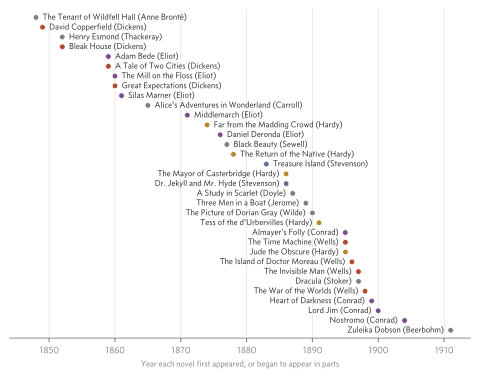
The Tenant of Wildfell Hall. Anne Brontë’s second novel, published in 1848 under her pen name, Acton Bell. In it Helen Graham hides at Wildfell Hall,In this novel, Helen Graham moves into the title mansion while posing as a widow. → The Tenant of Wildfell Hall•• a gloomy half-ruined mansion, pretending to be a widow, because she has fled a drunken husband. The book is a story inside a story: Gilbert Markham writes lettersThis novel is framed by letters from Gilbert Markham. → The Tenant of Wildfell Hall• to a friend telling how he fell in love with her. After Anne’s death her sister Charlotte kept the book out of print in England for years. Taught in Chapter 2.
David Copperfield. Dickens’s most autobiographical novel (1849–50), told by its hero from his birth to his second marriage. Its great scenes include the storm at Yarmouth, where Ham drowns trying to rescue Steerforth,In this novel, Ham drowns trying to rescue James Steerforth. → David Copperfield•• the friend who ruined Ham’s cousin. Near the end, with the help of the lawyer Traddles, Micawber exposes the scheming Uriah Heep,In this novel, Micawber and Traddles expose Uriah Heep. → David Copperfield•• his own employer. The hero himself has an entry among the characters. Taught in Chapter 2.
Henry Esmond. Thackeray’s historical novel of 1852, written as a whole book rather than in monthly parts and set in the reign of Queen Anne. Its hero loves the dazzling Beatrix through the whole story, but in the end Henry marries his foster mother, Lady Castlewood.At the end of this novel, the protagonist marries his foster mother Lady Castlewood. → Henry Esmond• England holds nothing more for them, so the couple sail away to VirginiaAt the end of this novel, the protagonist moves to Virginia. → Henry Esmond• to start again as planters. Taught in Chapter 2.
Bleak House. Dickens’s attack on the Court of Chancery (1852–53), which turns on the endless case of Jarndyce and JarndyceThis novel features the case of Jarndyce and Jarndyce. → Bleak House•• over a rich man’s contradictory wills. Half of it is told by Esther Summerson, who turns out to be Lady Dedlock’s daughter. Its strangest death comes when the rag dealer Krook spontaneously combustsIn this novel, Mr. Krook spontaneously combusts. → Bleak House•• in his shop. Taught in Chapter 2.
Adam Bede. George Eliot’s first full novel (1859), set in 1799 in the village of Hayslope.This novel is set in the fictional town of Hayslope. → Adam Bede•• Adam, an upright carpenter, loves the pretty dairymaid Hetty Sorrel, who is seduced by the young squire, Arthur Donnithorne. In despair Hetty abandons her baby in a wood,In this novel, Hetty Sorrel abandons her baby in a wood. → Adam Bede•• and her cousin Dinah Morris, a Methodist preacher, stays with her in prison. Taught in Chapter 10.
A Tale of Two Cities. Dickens’s novel of the French Revolution (1859), which opened his weekly magazine All the Year Round. The two cities are London and Paris, so the novel is named for its settings,This novel is named for its London and Paris settings. → A Tale of Two Cities•• and few books are better known by their first words: “It was the best of times.”This novel begins "It was the best of times, it was the worst of times." → A Tale of Two Cities••• In Paris, Madame Defarge keeps a secret register of enemies of the Revolution: she knits the names of the doomed.A character in this novel uses her knitting to record the names of people to be killed. → A Tale of Two Cities•• It ends with Sydney Carton on the guillotine. Taught in Chapter 9.
The Mill on the Floss. George Eliot’s third book (1860), the story of her own childhood under a thin disguise. Maggie Tulliver is clever and passionate, her brother Tom stern. Grown up, she drifts down the river with her cousin’s suitor when Stephen Guest falls for Maggie,In this novel, Stephen Guest has a relationship with the central character Maggie Tulliver. → The Mill on the Floss•• and nobody in St. Ogg’s believes her innocent. In the flood at the end Tom and Maggie drown together.In this novel, the Tulliver siblings drown at the end. → The Mill on the Floss•• Taught in Chapter 10.
Great Expectations. Dickens’s second great first-person novel (1860–61), told by Pip, a blacksmith’s boy who is secretly made a gentleman. On the marshes he feeds an escaped convict, Abel Magwitch,Abel Magwitch is an escaped convict in this novel. → Great Expectations••• who turns out to be his benefactor. At Satis House, Miss Havisham sits in her wedding dress, and every clock stopped at twenty minutes to nine.A house's clocks are stopped at 8:40 in this novel. → Great Expectations••• Pip falls in love there with her adopted daughter, Estella,The adopted daughter Estella is part of this novel. → Great Expectations••• who has been raised to break his heart. Taught in Chapter 9.
Silas Marner. George Eliot’s short novel of 1861, subtitled The Weaver of Raveloe. The squire’s son Dunstan Cass steals Silas’s hoard when the death of Wildfire sends DunstanIn this novel, the death of the horse Wildfire prompts Dunstan Cass to steal the title character's gold. → Silas Marner•• out on foot past the weaver’s cottage. On New Year’s Eve, on her way to shame Godfrey Cass at his father’s dance, his opium-addicted wife freezes to deathA character's opium-addicted wife freezes to death in this novel. → Silas Marner••• in the snow, and her golden-haired child toddles in to Silas’s fire. The weaver himself has an entry among the characters. Taught in Chapter 10.
Middlemarch. George Eliot’s masterpiece (1871–72), published in eight parts. Its subtitle is “A Study of Provincial Life,”This novel is subtitled "A Study of Provincial Life." → Middlemarch••• and it weaves four stories through one Midland town before the Reform Act of 1832. Dorothea marries Casaubon, who is forever gathering notes for The Key to All Mythologies;In this novel, Edward Casaubon is working on The Key to All Mythologies. → Middlemarch••• the doctor Lydgate marries Rosamond, Fred Vincy courts Mary Garth, and a banker’s past returns when Raffles blackmails Bulstrode.In this novel, John Raffles blackmails the banker Nicholas Bulstrode. → Middlemarch••• Taught in Chapter 10.
Daniel Deronda. George Eliot’s last novel (1876) and the only one set in her own day. It has two halves joined by its hero. In one, Deronda befriends Gwendolen Harleth,In this novel, the title character befriends Gwendolen Harleth. → Daniel Deronda• who has made a cruel marriage for money. In the other, Deronda saves Mirah LapidothIn this novel, the protagonist saves Mirah Lapidoth from drowning herself in a river. → Daniel Deronda•• from drowning herself. Through her brother Mordecai he is drawn to the Jewish people, and at last his mother tells him that he was born a Jew. Taught in Chapter 10.
Far from the Madding Crowd. Hardy’s first success (1874) and the first book to use the name Wessex. Hardy took his title from GrayThis novel takes its title from Thomas Gray's "Elegy Written in a Country Churchyard." → Far From the Madding Crowd••’s “Elegy,” a sly joke, because his farming village holds as much passion as any city. Bathsheba Everdene chooses among three suitors, and at a Christmas party Boldwood shoots Troy deadIn this novel, Frank Troy reappears after being presumed drowned and is shot by William Boldwood at a Christmas party. → Far From the Madding Crowd•• when her lost husband returns. Taught in Chapter 19.
The Return of the Native. Hardy’s novel of 1878, which runs from one Guy Fawkes night to the next and is set on Egdon Heath.This novel is set in Egdon Heath. → The Return of the Native• The “native” is Clym Yeobright, home from Paris; Eustacia Vye marries him in hope of escape and drowns. The novel’s guardian angel is the reddleman Diggory Venn,In this novel, the reddleman Diggory Venn, stained red by his trade, marries Thomasin. → The Return of the Native•• dyed red by the stuff he sells for marking sheep. Taught in Chapter 19.
The Mayor of Casterbridge. Hardy’s novel of 1886 begins with its most famous scene, when Michael Henchard, drunk at a country fair, sells his wife and daughterIn this novel, a man drunkenly sells his wife and daughter to the sailor Newson for five guineas. → The Mayor of Casterbridge••• to a sailor for five guineas. Sober, he rises to be mayor of Casterbridge, and then he loses everything to the young Scot Farfrae. Later Lucetta dies after a “skimmity-ride”In this novel, Lucetta dies after a "skimmity-ride" publicly mocks her past affair. → The Mayor of Casterbridge• mocks her past, a noisy parade of the town’s scandal. Taught in Chapter 19.
Tess of the d’Urbervilles. Hardy’s novel of 1891, about a milkmaid wronged by Alec and abandoned by Angel Clare. Everything begins when Parson Tringham tells her fatherIn this novel, Parson Tringham reveals a family's aristocratic ancestry. → Tess of the d'Urbervilles•• that the poor Durbeyfields descend from the noble d’Urbervilles. The heroine has her own entry among the characters, and most clues for this story ask for her. Taught in Chapter 19.
Jude the Obscure. Hardy’s last completed novelThis novel is the final completed novel by Thomas Hardy. → Jude the Obscure•• (1895), about a stonemason who longs to study at Christminster, his name for Oxford. In its darkest scene Little Father Time kills his half-siblingsIn this novel, Little Father Time kills his half-siblings and himself, leaving the note "Done because we are too menny." → Jude the Obscure••• and himself and leaves the note “Done because we are too menny.” Critics were so harsh that Hardy wrote no more novels. Taught in Chapter 19.
Novels from Carroll to Conrad
The second group of novels is shorter, stranger, and more exciting than the first (Table A.2). It holds a children’s fantasy, a horse’s life story, a pirate tale, a horror story told in letters and diaries, the first Sherlock Holmes book, Wells’s four “scientific romances,” and Conrad’s tales of ships and far-off trading posts. Several of these books are famous mainly for one creature or one idea: the invisible man, the vampire, the portrait that ages. That makes it easy to name the right author and the wrong book, and Wells and Conrad each have four answers here. One rule settles most of them: learn each book’s setting and its narrator.
| Novel | Author | Year | Kind of book | Setting | What to know | Ch. |
|---|---|---|---|---|---|---|
| Alice’s Adventures in Wonderland | Carroll | 1865 | Children’s fantasy | Down a rabbit hole | White Rabbit, Cheshire Cat, Mad Tea Party; sequel Through the Looking-Glass | 11 |
| Black Beauty | Anna Sewell | 1877 | A horse’s life story | English stables and London cabs | Told by the horse itself | 11 |
| Treasure Island | Stevenson | 1883 | Pirate adventure | The Hispaniola and Flint’s island | Jim Hawkins, Long John Silver, Ben Gunn, the black spot | 15 |
| Dr. Jekyll and Mr. Hyde | Stevenson | 1886 | Horror mystery | London | The lawyer Utterson investigates; Lanyon’s letter and Jekyll’s confession explain | 15 |
| A Study in Scarlet | Doyle | 1887 | Detective novel | London, then Utah | First Holmes story; the cabman Jefferson Hope; “The Country of the Saints” | 16 |
| Three Men in a Boat | Jerome | 1889 | Comic novel | A boating trip up the Thames | Three friends and the dog Montmorency | 16 |
| The Picture of Dorian Gray | Wilde | 1890 | Gothic novel of art | London | Basil Hallward, Lord Henry Wotton, Sibyl Vane; the portrait ages instead of Dorian | 17 |
| Almayer’s Folly | Conrad | 1895 | Conrad’s first novel | A river in Borneo | A Dutch trader dreams of gold; his daughter Nina runs off with Dain | 22 |
| The Time Machine | Wells | 1895 | Scientific romance | Year 802,701 | Eloi and Morlocks; the sphinx; Weena | 23 |
| The Island of Doctor Moreau | Wells | 1896 | Scientific romance | A Pacific island | Prendick narrates; Beast Folk carved from animals | 23 |
| The Invisible Man | Wells | 1897 | Scientific romance | A Sussex village | Griffin, Marvel, Dr. Kemp | 23 |
| Dracula | Stoker | 1897 | Gothic horror in letters and diaries | Transylvania, Whitby, London | Harker, Mina, Lucy, Van Helsing, the ship Demeter | 15 |
| The War of the Worlds | Wells | 1898 | Scientific romance | Woking and London | Martian tripods and the Heat-Ray; killed by bacteria | 23 |
| Heart of Darkness | Conrad | 1899 | Frame tale | The Congo, told on the Thames | Marlow, Kurtz, the Intended, the Harlequin | 22 |
| Lord Jim | Conrad | 1900 | Novel of conscience | The Patna, then Patusan | Jim, Marlow, Jewel, Stein | 22 |
| Nostromo | Conrad | 1904 | Political novel | Costaguana, in South America | Charles Gould’s silver mine, Decoud, Nostromo | 22 |
| Zuleika Dobson | Beerbohm | 1911 | Comic fantasy | Oxford | The Duke of Dorset and every undergraduate drown for love | 27 |
Alice’s Adventures in Wonderland. Lewis Carroll’s fantasy, first told aloud to Alice Liddell on a river trip in 1862 and published in 1865 with John Tenniel’s drawings. The prefatory poem remembers the golden afternoonThis novel's prefatory poem is titled for the "golden afternoon" that inspired its writing. → Alice's Adventures in Wonderland• of that boat trip, when three little girls begged for a story. Six years later Wonderland was followed by Through the Looking-Glass,This novel was followed by Through the Looking-Glass. → Alice's Adventures in Wonderland•• so a clue about the chessboard country, the Tweedles, or Humpty Dumpty points to the sequel. Taught in Chapter 11.
Black Beauty. Anna Sewell’s only book (1877), written to make people treat horses kindly. It is a novel narrated by a horse,This Anna Sewell novel is narrated by a horse. → Black Beauty•• the story of one gentle black horse sold from a good home to a series of worse ones and at last to the London cabs. Taught in Chapter 11.
Treasure Island. Stevenson’s pirate story (1883), told by the boy Jim Hawkins, who finds Captain Flint’s map in a dead seaman’s chest. The voyage goes wrong when the cook’s men mutiny, and the mutiny on the HispaniolaThis novel features a mutiny on the Hispaniola. → Treasure Island•• splits the crew in two. On the island Ben Gunn craves cheeseIn this novel, the marooned Ben Gunn craves cheese, longing for a "Christian diet." → Treasure Island••• after three years of living on goats and berries. When the pirates turn against Silver, they give him the black spot, cut from a page of a Bible.In this novel, a page torn from a Bible is used to make a "black spot." → Treasure Island•• Taught in Chapter 15.
Dr. Jekyll and Mr. Hyde. Stevenson’s short novel of 1886, built as a mystery for readers who did not yet know the secret. The lawyer Gabriel John UttersonThis novella follows the lawyer Gabriel John Utterson. → Dr. Jekyll and Mr. Hyde•• follows the clues, and the answer comes in two letters. Dr. Lanyon watches Hyde drink the potion and turn into Jekyll, and the sight killed Lanyon.In this novella, Dr. Lanyon dies after witnessing a title character’s transformation. → Dr. Jekyll and Mr. Hyde•• Stevenson grew up hearing of an Edinburgh cabinetmaker who led a double life as a burglar: the life of Deacon BrodieThe life of cabinet-maker Deacon Brodie inspired this novella. → Dr. Jekyll and Mr. Hyde• inspired the book. Taught in Chapter 15.
A Study in Scarlet. The novel that introduced HolmesThis novel first introduced Sherlock Holmes. → A Study in Scarlet•• (1887), in which Dr. Watson meets him and moves into 221B Baker Street. Holmes catches a murderer, and then the book jumps back thirty-four years to its second part, “The Country of the Saints,”This novel's second section, "The Country of the Saints," contains an anti-Mormon narrative. → A Study in Scarlet• a hostile tale of the Mormons of Utah. Taught in Chapter 16.
Three Men in a Boat. Jerome K. Jerome’s comic novel of 1889 about three idle young men rowing up the Thames. The fourth member of the party, Montmorency, J.’s fox terrier,The characters in this novel are accompanied by the dog Montmorency. → Three Men in a Boat• spends the trip fighting other dogs and stealing food. Taught in Chapter 16.
The Picture of Dorian Gray. Wilde’s only novel (1890, enlarged 1891). Basil Hallward paints the beautiful young Dorian, and from that day Lord Henry becomes Dorian’s mentor and corrupter.Lord Henry Wotton corrupts and mentors this novel's protagonist. → The Picture of Dorian Gray•• The portrait ages while Dorian stays young, and he lives by a poisonous “yellow book”; the yellow book recalls Huysmans’s Against Nature,The "yellow book" in this novel is inspired by Joris-Karl Huysmans' Against Nature. → The Picture of Dorian Gray•• a French novel of 1884. Its famous preface of epigrams ends by calling all art useless.This novel's preface ends by stating "All art is quite useless." → The Picture of Dorian Gray•• Taught in Chapter 17.
Almayer’s Folly. Conrad’s first novel (1895), set on a river in Borneo. Almayer, a Dutch trader, believes that he will find a hidden gold mineIn this novel, the protagonist obsessively looks for a gold mine in Borneo. → Almayer's Folly• up the river and grow rich. He loses everything when Nina falls in love with Dain,In this novel, Nina marries a prince named Dain. → Almayer's Folly• a Balinese prince, and sails away with him. Taught in Chapter 22.
The Time Machine. Wells’s first scientific romance (1895), told by an unnamed Time Traveller to his dinner guests. In the year 802,701 he finds that the Morlocks lived underground and ate the Eloi.In this work, the Morlocks live underground and eat the Eloi. → The Time Machine••• Soon after he arrives, the machine was locked in the hollow pedestalIn this work, the title object is hidden in a hollow pedestal beneath a sphinx. → The Time Machine•• of a great white sphinx. Taught in Chapter 23.
The Island of Doctor Moreau. Wells’s grimmest romance (1896). The narrator is a shipwrecked survivor, Edward Prendick,This novel is narrated by the shipwrecked Edward Prendick. → The Island of Doctor Moreau•• who lands on a Pacific island where Moreau carves animals into human-like creatures,In this novel, the title scientist creates human-like animal hybrids. → The Island of Doctor Moreau•• the Beast Folk, and teaches them a Law that they chant. Taught in Chapter 23.
The Invisible Man. Wells’s romance of 1897 about a scientist who makes himself invisible and cannot undo it. The bandaged stranger at a village inn is unmasked late in the book, when the Invisible Man is named Griffin.This novel's title character is named Griffin. → The Invisible Man• Griffin himself has an entry among the characters. Taught in Chapter 23.
Dracula. Bram Stoker’s Gothic novel of 1897, told entirely in letters, diaries, and newspaper cuttings. A Russian ship drives into Whitby harbor with no one alive aboard, and its dead captain is tied to the wheel.In this novel, the captain of the Demeter is found dead and tied to the wheel with a crucifix and rosary beads. → Dracula• Back in England, led by Van Helsing, Jonathan HarkerIn this novel, Jonathan Harker and Abraham Van Helsing hunt the title character. → Dracula•• and his friends hunt the Count. Taught in Chapter 15.
The War of the Worlds. Wells’s invasion story (1898), set among real towns in Surrey and in London. The Martians stride across the country in tripod fighting machinesIn this novel, the invaders use tripod-like fighting machines. → The War of the Worlds•• and burn everything with a Heat-Ray, but in the end they are killed by earthly bacteria,In this novel, the invaders are eventually killed by bacteria. → The War of the Worlds•• against which Mars gave them no defense. Taught in Chapter 23.
Heart of Darkness. Conrad’s short novel of 1899, drawn from his own voyage up the Congo in 1890. It is a frame tale: Marlow tells it at sunset on the Nellie, a cruising yawlThis work's frame story takes place aboard the cruising yawl Nellie on the Thames. → Heart of Darkness••• on the Thames. In 1975 Achebe’s “An Image of Africa” criticizedChinua Achebe criticized this work in "An Image of Africa." → Heart of Darkness••• the book as racist, and the quarrel has never ended. Kurtz’s death reaches the others in a single line, when the manager’s boy announced, “Mistah Kurtz—he dead.”The line "Mistah Kurtz—he dead" is spoken by a Manager's boy in this work. → Heart of Darkness• Taught in Chapter 22.
Lord Jim. Conrad’s novel of 1900, also narrated by Marlow. A young officer jumps from the pilgrim ship Patna and is disgraced, and the novel’s second half is set in Patusan,This novel is partly set in the remote realm of Patusan. → Lord Jim•• a remote Malay district where he finds a second life. The hero has an entry among the characters. Taught in Chapter 22.
Nostromo. Conrad’s great political novel (1904), set in the invented South American republic of Costaguana, where Charles Gould owns a silver mine.In this novel, Charles Gould owns a silver mine in Costaguana. → Nostromo•• Nostromo, the title character, is the Italian foreman of the dockworkers, trusted by everyone, who secretly keeps a boatload of the silver. His companion on that night, the journalist Decoud, is left alone on an island with it, and Decoud kills himself after being stranded.In this novel, Decoud commits suicide after being stranded on an island with silver he had helped to hide. → Nostromo• Taught in Chapter 22.
Zuleika Dobson. Max Beerbohm’s comic fantasy of 1911, set in Oxford. Zuleika, a conjurer whom no man can resist, comes to stay with her grandfather, the head of an Oxford college. Every undergraduate falls in love with her, and the Duke of Dorset drowns himselfIn this novel, the Duke of Dorset drowns himself in a river. → Zuleika Dobson• in the river during the boat races, followed by nearly all the rest. He has already had his warning, a telegram from home that the two black owls had come,In this novel, a character receives a telegram that two black owls have returned to Tankerton Hall, prompting his suicide. → Zuleika Dobson•• which in his family meant that its head must die. Taught in Chapter 27.
Characters from Dickens to Hardy
A character clue begins “this character” and then tells you whom the person loves, fears, marries, or loses. The eleven people here all come from the novels in the first group, and Table A.3 pairs each with a book. Two of them share their names with their novels, David Copperfield and Silas Marner, and a clue’s opening word decides which is wanted: “this novel” or “this character.” Marriages are the most useful facts to learn, because clues love them and because no two characters here marry the same way. Hardy’s people are the hardest to keep apart, since they share one countryside and one cruel fate (Figure A.2).
| Character | Novel | Who he or she is | Loves or marries | What happens | Ch. |
|---|---|---|---|---|---|
| David Copperfield | David Copperfield | An orphan who becomes a novelist | Dora Spenlow, then Agnes Wickfield | Runs from Murdstone to Aunt Betsey at Dover | 2 |
| Sydney Carton | A Tale of Two Cities | A brilliant, drunken London lawyer | Lucie Manette, who marries Darnay | Dies on the guillotine in Darnay’s place | 9 |
| Pip | Great Expectations | A blacksmith’s boy made a gentleman | Estella | Learns his benefactor is the convict Magwitch | 9 |
| Miss Havisham | Great Expectations | A rich old woman in a rotting wedding dress | Jilted by Compeyson | Raises Estella to break men’s hearts; burns | 9 |
| Silas Marner | Silas Marner | The weaver of Raveloe, a miser | Adopts Eppie | Robbed of his gold, finds a child | 10 |
| Dorothea Brooke | Middlemarch | An earnest young idealist | Casaubon, then Will Ladislaw | Gives up a fortune to marry Will | 10 |
| Bathsheba Everdene | Far from the Madding Crowd | A proud young woman farmer | Troy, then Gabriel Oak | Her joke valentine drives Boldwood mad | 19 |
| Gabriel Oak | Far from the Madding Crowd | A patient shepherd | Bathsheba, at last | Ruined by his dog, rises to manage her farm | 19 |
| Tess Durbeyfield | Tess of the d’Urbervilles | A milkmaid of an ancient family | Angel Clare; wronged by Alec | Kills Alec, is taken at Stonehenge, hanged | 19 |
| Angel Clare | Tess of the d’Urbervilles | A parson’s son learning to farm | Tess | Deserts her, goes to Brazil, returns too late | 19 |
| Jude Fawley | Jude the Obscure | A stonemason who longs to be a scholar | Arabella; his cousin Sue Bridehead | Never reaches Christminster’s colleges | 19 |
David Copperfield (the character). The hero and narrator of Dickens’s most autobiographical novel. Sent to work in a warehouse by his cruel stepfather, Murdstone, he runs away, and David reaches Dover after escaping his stepfatherThis character goes to Dover after escaping his stepfather. → David Copperfield•• to find his aunt, Betsey Trotwood. His first wife, the childish Dora Spenlow, dies young, and at the end David marries Agnes Wickfield.This character marries Agnes Wickfield. → David Copperfield•• Taught in Chapter 2.
Sydney Carton. The gifted, drunken lawyer of A Tale of Two Cities, who does the hard thinking for a pompous colleague and so is the jackal to Stryver’s lion.This lawyer is the "jackal" to Stryver's "lion." → Sydney Carton•• Watching her at a London trial, Carton falls in love with Lucie,This character loves Lucie Manette. → Sydney Carton•• knowing she will never love him; he looks almost exactly like the man she marries. At the end Carton takes Darnay’s place at the guillotine:This character takes his lookalike Charles Darnay's place at the guillotine. → Sydney Carton•• “It is a far, far better thing that I do.” Taught in Chapter 9.
Pip. Philip Pirrip, the orphan narrator of Great Expectations, raised by his sister and her husband, the blacksmith Joe Gargery. He believes Miss Havisham is making him a gentleman, until the night the convict comes back and Pip discovers that Magwitch is his benefactor.This character discovers that Abel Magwitch is his anonymous benefactor. → Pip (or Philip Pirrip)••• Taught in Chapter 9.
Miss Havisham. The rich, half-mad old woman of Satis House in Great Expectations. Years before, Compeyson had abandoned Miss HavishamThis character is abandoned on her wedding day by Compeyson. → Miss Havisham•• on her wedding day, and she still wears the dress and keeps the rotting cake. She raises Estella to take revenge on men. Badly burned in a fire, she asks Pip to write “I forgive her.”As she dies, this character repeats the phrase "Take the pencil and write under my name, 'I forgive her.'" → Miss Havisham• Taught in Chapter 9.
Silas Marner (the character). The title character of George Eliot’s novel, a weaver driven out of the chapel at Lantern Yard after his friend William Dane framed himThis character is framed by William Dane for stealing church funds at Lantern Yard. → Silas Marner•• for theft. In Raveloe he lives for his gold until it is stolen. Then a stranger’s little girl wanders in, and Silas adopts the childThis character adopts Eppie. → Silas Marner••• and names her Eppie. Taught in Chapter 10.
Dorothea Brooke. The heroine of Middlemarch, an earnest young woman who wants to do great good. At the start, sharing out her dead mother’s jewels with her sister, Dorothea takes only an emerald ringThis character takes only an emerald ring and bracelet from her deceased mother's jewelry collection, allowing her sister Celia to keep the rest. → Dorothea Brooke•• and a bracelet. She dreams of rebuilding the tenants’ hovels, and her cottage plans win Chettam’s interest,This character's plans to improve tenant farmers' cottages attract the interest of James Chettam. → Dorothea Brooke•• though she hardly notices that he is courting her. She marries the dry scholar Casaubon, and after his death Dorothea forfeits Casaubon’s fortune by marrying Will Ladislaw.This character forfeits her inheritance from Edward Casaubon by marrying Will Ladislaw. → Dorothea Brooke••• Taught in Chapter 10.
Bathsheba Everdene. The proud young farmer of Far from the Madding Crowd, whose greatest fault is vanity. On an idle Sunday Bathsheba sends Boldwood a valentineThis character sends a valentine marked "marry me" to William Boldwood. → Bathsheba Everdene• sealed “Marry me,” and the joke ruins him. She marries the dashing Sergeant Troy, and after Troy’s death Bathsheba marries Gabriel Oak,This character marries Gabriel Oak. → Bathsheba Everdene••• the shepherd who loved her first. Taught in Chapter 19.
Gabriel Oak. The steady shepherd of Far from the Madding Crowd. Early on Gabriel is ruined by his sheepdog,This character is financially ruined after his young sheepdog drives his flock off a cliff. → Gabriel Oak•• which drives his whole flock over a cliff, and he becomes Bathsheba’s hired man. When Fanny Robin’s coffin comes home, Gabriel rubs out “and child”This character erases the words "and child" from a coffin. → Gabriel Oak•• from its lid to spare his mistress. Taught in Chapter 19.
Tess Durbeyfield. Hardy’s “pure woman,” the milkmaid heroine of Tess of the d’Urbervilles. Her troubles begin when she falls asleep driving the family’s cart and Prince bleeds to death in the road.This character falls asleep while driving a wagon of beehives, causing the crash that kills the horse Prince. → Tess Durbeyfield•• After killing Alec d’Urberville she flees with Angel, and Tess is arrested at Stonehenge,This character is arrested after sleeping on the Stone of Sacrifice at Stonehenge. → Tess Durbeyfield••• sleeping on the altar stone. At the end Angel and her sister watch from a hill above Wintoncester as the black flag signals Tess’s execution.A black flag signals this character's execution. → Tess Durbeyfield••• Taught in Chapter 19.
Angel Clare. The parson’s son who marries Tess and then deserts her on their wedding night, when she confesses her past. In a strange scene the sleepwalking Angel carries TessWhile sleepwalking, this character carries his wife across a river and places her in a coffin. → Angel Clare•• across a river and lays her in a stone coffin. Later Angel’s farming venture in Brazil fails,This character goes to Brazil on a farming venture that fails. → Angel Clare•• and he comes home sorry, too late. Taught in Chapter 19.
Jude Fawley. The hero of Jude the Obscure, a stonemason who teaches himself Latin and Greek and dreams of Christminster. Tricked by a false pregnancy, Jude marries Arabella Donn;This character marries Arabella Donn after she pretends to be pregnant. → Jude Fawley•• later Jude falls in love with Sue Bridehead,This character falls in love with Sue Bridehead. → Jude Fawley•• his clever cousin, and lives with her unmarried. Taught in Chapter 19.
Characters from Carroll to Conrad
The sixteen characters of the later novels are among the best-known people in English fiction, and several are so famous that their names have become ordinary words, as in a Jekyll-and-Hyde personality or a would-be Sherlock. Table A.4 gives each one’s book and author. The commonest trap is the one between a book and its title character, because Dracula, Lord Jim, and The Picture of Dorian Gray are all answers twice over, once as a book and once as a person or a thing. Another is the narrator: in Treasure Island the boy who tells the story is the hero, while in Conrad and Doyle the teller stands beside a more famous man. Read the clue’s first words with care, and then look for the one name that belongs to only one story.
| Character | Book | Author | Who or what | Remember | Ch. |
|---|---|---|---|---|---|
| Alice | Wonderland and Looking-Glass | Carroll | A Victorian girl of about seven | Rabbit hole, mirror, Tenniel’s drawings | 11 |
| The Cheshire Cat | Alice’s Adventures in Wonderland | Carroll | The grinning cat of the Duchess’s house | Fades away until only the grin is left | 11 |
| Jim Hawkins | Treasure Island | Stevenson | The boy narrator, son of an innkeeper | The Admiral Benbow; the apple barrel | 15 |
| Long John Silver | Treasure Island | Stevenson | The one-legged ship’s cook who leads the pirates | Crutch, parrot Cap’n Flint, “Barbecue” | 15 |
| Mr. Hyde | Dr. Jekyll and Mr. Hyde | Stevenson | Jekyll’s evil self, released by a potion | Tramples a child; kills Carew | 15 |
| Dracula | Dracula | Stoker | A vampire count from Transylvania | Hunted by Van Helsing; killed in sight of his castle | 15 |
| Sherlock Holmes | A Study in Scarlet and later stories | Doyle | A consulting detective at 221B Baker Street | Moriarty, Reichenbach Falls, Irene Adler | 16 |
| Dr. John Watson | The Holmes stories | Doyle | Holmes’s friend and biographer | Wounded in Afghanistan; marries Mary Morstan | 16 |
| Dorian Gray | The Picture of Dorian Gray | Wilde | A beautiful young man who never ages | Sibyl Vane; murders Basil | 17 |
| The picture of Dorian Gray | The Picture of Dorian Gray | Wilde | The portrait that ages in his place | Painted by Basil Hallward; stabbed at the end | 17 |
| Kim | Kim | Kipling | An Irish soldier’s orphan in Lahore | The lama; spying in the Great Game | 20 |
| Charles Marlow | Heart of Darkness, Lord Jim | Conrad | A sailor who tells stories | Lies to Kurtz’s Intended | 22 |
| Kurtz | Heart of Darkness | Conrad | The ivory trader at the Inner Station | “The horror! The horror!” | 22 |
| Lord Jim | Lord Jim | Conrad | A young officer who failed once | Jumps from the Patna; loves Jewel | 22 |
| The Time Traveller | The Time Machine | Wells | An unnamed inventor | AD 802,701; Weena; two white flowers | 23 |
| Griffin | The Invisible Man | Wells | A scientist who makes himself invisible | A cat, Marvel, Dr. Kemp | 23 |
Alice. The heroine of both of Carroll’s books, a polite, curious, sensible girl in a world of mad logic. In the first book Alice falls down the rabbit holeThis character falls down a rabbit hole. → Alice•• after the White Rabbit; in the second Alice passes through the looking glassThis character travels through a looking glass. → Alice•• into a land laid out like a chessboard. At the Mad Tea Party the Hatter puzzles her with a riddle about a raven and a writing deskThis character is asked "Why is a raven like a writing desk?" → Alice•• that has no answer. Taught in Chapter 11.
The Cheshire Cat. The cat Alice first meets grinning on the hearth in the Duchess’s kitchen, who later directs her to the Mad Tea Party. It can vanish at will, and once it fades slowly from tail to head until only its grin remains in the tree.This character vanishes from a tree until only its grin remains. → the Cheshire Cat•• At the Queen’s croquet game it shows only its head, and the executioner cannot behead the Cat,An executioner struggles to behead this character at a croquet game. → the Cheshire Cat• since there is no body to cut it from. Taught in Chapter 11.
Jim Hawkins. The boy who tells Treasure Island. After his father’s death Jim and his mother run the inn,This character works at the Admiral Benbow Inn with his mother. → Jim Hawkins•• the Admiral Benbow, where the old pirate Billy Bones lodges. At sea, hidden in the apple barrel on deck,This character hides in an apple barrel aboard a ship. → Jim Hawkins•• he overhears Silver plotting mutiny. Taught in Chapter 15.
Long John Silver. The one-legged cook of the Hispaniola, charming and murderous, whom Stevenson modeled on his friend W. E. Henley. Silver’s parrot is called Cap’n Flint,This character's pet parrot is named Cap'n Flint. → Long John Silver• after the pirate whose treasure they seek, and in the end the cook leads the mutiny.This character serves as cook on the Hispaniola and leads its mutiny. → Long John Silver••• Taught in Chapter 15.
Mr. Hyde. The small, brutal double of Dr. Jekyll, released by Jekyll’s potion. In the first chapter he tramples a little girl and must pay the girl’s family 100 pounds;This character tramples a girl and pays her family 100 pounds. → Mr. Hyde••• later, in a sudden rage, Hyde beats Carew to deathThis character beats Sir Danvers Carew to death with a cane. → Mr. Hyde••• with a heavy stick. Taught in Chapter 15.
Dracula (the Count). Stoker’s vampire count, who lives in a castle in Transylvania and sails to England to feed. Driven out of London, he sails on the Czarina CatherineThis character boards the Czarina Catherine. → Dracula• for the Black Sea. At the end, chased home across Europe, he is caught in a cart at sunset, and Harker and Quincey Morris kill DraculaQuincey Morris and Jonathan Harker kill this character under the direction of Abraham Van Helsing. → Dracula• with their knives. Taught in Chapter 15.
Sherlock Holmes. Doyle’s consulting detective, who reasons from the smallest details. With Dr. Watson he agrees in the first book to take rooms at 221B Baker Street,This character lives at 221B Baker Street. → Sherlock Holmes••• the most famous address in fiction. In “The Final Problem” he seems to die fighting Moriarty at Reichenbach Falls,This character apparently dies fighting Professor Moriarty at Reichenbach Falls in "The Final Problem." → Sherlock Holmes••• and Doyle brought him back ten years later, in 1903. In “A Scandal in Bohemia” he is outwitted by Irene Adler, who sees through his trick of staging a fire to find the photograph.This character unsuccessfully tries to recover a photograph from Irene Adler, "the woman," by staging a fire. → Sherlock Holmes••• Taught in Chapter 16.
Dr. John Watson. Holmes’s friend, roommate, and biographer, who tells nearly all the stories. He met Holmes after coming home as an army surgeon wounded in Afghanistan,This character served as an army surgeon and was wounded in the Second Afghan War. → Dr. John Watson•• and at the end of The Sign of Four Watson marries Mary Morstan,This character marries the governess Mary Morstan. → Dr. John Watson•• the governess who brought them the case. Taught in Chapter 16.
Dorian Gray. Wilde’s beautiful young man, corrupted by Lord Henry. Dorian has fallen for Sibyl Vane,This character falls in love with the actress Sibyl Vane. → Dorian Gray• an actress, but drops her cruelly, and she kills herself. Years later, when the painter sees what has become of the portrait, Dorian stabs Basil to death.This character murders Basil Hallward. → Dorian Gray•• Taught in Chapter 17.
The picture of Dorian Gray. The portrait itself, the novel’s one piece of magic. It takes on every sin and every year, so that the portrait ages and grows hideousThis object grows hideous while its subject enjoys unchanging youth. → the picture of Dorian Gray• while its subject stays young. The painter, Basil Hallward, made the portrait,Basil Hallward created this thing. → the picture of Dorian Gray••• and Dorian hides it in an attic. When he stabs it at the end, he dies, and it becomes beautiful again. Taught in Chapter 17.
Kim. Kimball O’Hara, the hero of Kipling’s novel of 1901, an Irish soldier’s orphan who runs wild in Lahore. He becomes the disciple of an old Tibetan holy man, Teshoo Lama,This character befriends the Tibetan lama Teshoo Lama. → Kim (Kipling character)• and with him on the road Kim plays his part in the Great Game,This character helps British agents in the "Great Game" while traveling across India. → Kim (Kipling character)•• the spying contest between Britain and Russia. Taught in Chapter 20.
Charles Marlow. Conrad’s storyteller, who narrates Heart of Darkness and Lord Jim. His journey up the Congo began in childhood: when he was a little boy, he loved the “blank spaces”This character recalls a childhood fascination with "blank spaces" on maps. → Charles Marlow•• on the map. To get a steamboat on the Congo, his aunt got him the job.This character's aunt helps him get a job replacing Fresleven. → Charles Marlow•• Back in Europe he visits Kurtz’s fiancée, and Marlow told her that Kurtz’s last word was her name,This character lies to Kurtz's Intended that his last words were her name. → Charles Marlow•• the one lie he tells. Taught in Chapter 22.
Kurtz. The agent at the Inner Station whom Marlow is sent to bring back. Kurtz was an ivory traderThis character is an ivory trader. → Kurtz••• who sent down more ivory than all the others together, and who ruled the people around him like a god. On the steamer Kurtz died crying out, “The horror! The horror!”This character dies aboard a steamship saying "The horror! The horror!" → Kurtz••• Taught in Chapter 22.
Lord Jim (the character). The hero of Conrad’s novel, a young officer who dreams of heroism. When the pilgrim ship seems about to sink, Jim jumps from the PatnaThis character abandons the Patna. → Lord Jim• with the other officers, and he spends his life atoning. In Patusan the people call him Lord Jim, and Jim falls in love with Jewel.This character falls in love with Jewel. → Lord Jim• Taught in Chapter 22.
The Time Traveller. The unnamed inventor of The Time Machine. Its dials showed that he had reached AD 802,701,This character travels to A.D. 802,701. → the Time Traveller•• where he rescues the little Eloi girl Weena. When he returns, his only proof is two strange white flowersThis character shows dinner guests two white flowers from Weena, whom he saved from drowning. → the Time Traveller••• that she gave him. Taught in Chapter 23.
Griffin. Wells’s Invisible Man, an albino student of physics. He changed his body’s refractive indexThis character adjusts his body’s refractive index to make himself invisible. → Griffin (The Invisible Man)• to match that of air. Before he dared to try it on himself, he experimented on a cat,This character experiments on a cat to make it invisible. → Griffin (The Invisible Man)•• and later he plans a “Reign of Terror” that begins with his old friend Dr. Kemp. Taught in Chapter 23.
Characters of poems, plays, and stories
Not every character lives in a novel. This group gathers the people and creatures of shorter works: a ballad, a monologue, a play, and children’s stories. With them are five figures far older than the Victorians, whom Victorian writers and painters borrowed: Odysseus, Ophelia, Eve, the god Pan, and the Egyptian god Horus (Table A.5). For the borrowed figures, the clue nearly always names the Victorian work, so the trick is to recognize whom that work is about. For the others, a single name in the clue usually gives the story away: Lancelot means Shalott, a ferret means Conradin, a bog means Vera.
| Character | Work | Author | Who or what | Ch. |
|---|---|---|---|---|
| The Lady of Shalott | “The Lady of Shalott” (1832) | Tennyson | A lady under a curse, weaving the world she sees in a mirror | 3 |
| Odysseus | “Ulysses” (1842) | Tennyson | Homer’s hero, old and restless, as the speaker of the poem | 3 |
| The Duchess | “My Last Duchess” (1842) | Robert Browning | The Duke of Ferrara’s dead wife, seen in her portrait | 5 |
| Pan | “A Musical Instrument”; The Wind in the Willows | Elizabeth Barrett Browning; Grahame | The Greek god of wild places, half goat, maker of reed pipes | 5, 27 |
| Eve | Shirley (1849) | Charlotte Brontë | Milton’s first woman, whom Shirley calls his cook in disguise | 2 |
| Ophelia | Millais’s Ophelia | Shakespeare; painted by Millais | Hamlet’s drowned love, modeled by Elizabeth Siddal | 6 |
| The Jabberwock | “Jabberwocky” | Carroll | The monster slain by the boy with the vorpal sword | 11 |
| Gunga Din | “Gunga Din” (1890) | Kipling | An Indian water carrier who saves a soldier and dies | 20 |
| Mowgli | The Jungle Book (1894) | Kipling | The “man-cub” raised by wolves | 20 |
| Rikki-Tikki-Tavi | The Jungle Book | Kipling | A mongoose who fights two cobras | 20 |
| Christy Mahon | The Playboy of the Western World (1907) | Synge | A young man who boasts that he killed his father | 25 |
| Conradin | “Sredni Vashtar” | Saki | A sickly boy who worships a ferret | 27 |
| Vera | “The Open Window” | Saki | A girl who tells a ghost story to a nervous visitor | 27 |
| Horus | Crowley’s Thelema (1904) | Aleister Crowley | The Egyptian god whose “Aeon” Crowley proclaimed | 28 |
The Lady of Shalott (the character). Tennyson’s lady in the tower on an island near Camelot, who may see the world only in her mirror. Growing weary of it, she says, “I am half sick of shadows.”This character says "I am half sick of shadows." → Lady of Shalott•• When Lancelot rides by and she hears him sing “Tirra lirra”This character hears Lancelot singing "tirra lirra" and looks out her window. → Lady of Shalott•• by the river, she turns to the window, the mirror cracks, and she cries “The curse is come upon me.”This character cries "The curse is come upon me" when her mirror cracks "from side to side." → Lady of Shalott•• She dies floating down to Camelot in a boat. Taught in Chapter 3.
Odysseus. The Greek hero of Homer’s Odyssey, king of Ithaca. Ulysses is the Latin form of his name, so Tennyson’s poem is titled for Odysseus,A poem by Lord Tennyson is titled for this character. → Odysseus•• whom it shows as an old man leaving his kingdom to his son to sail once more “beyond the sunset.” Taught in Chapter 3.
The Duchess. The silent subject of Browning’s “My Last Duchess,” the Duke of Ferrara’s dead wife.This character was the Duke of Ferrara's deceased wife. → the Duchess in "My Last Duchess"•• Her portrait hangs behind a curtain, and the duke, showing it to an envoy, notes that it was painted by Fra Pandolf.This character had her portrait painted by Fra Pandolf. → the Duchess in "My Last Duchess"••• She smiled at everyone alike, he complains, and thanked the gardener for “the bough of cherries” from “some officious fool,”This character received a "bough of cherries" from an "officious fool." → the Duchess in "My Last Duchess"•• just as she thanked her husband for his ancient name. So he “gave commands.” Taught in Chapter 5.
Pan. The Greek god of shepherds and wild places, half man and half goat, who cut the first reed pipes. In Elizabeth Barrett Browning’s “A Musical Instrument” it asks what the great god PanElizabeth Barrett Browning's poem A Musical Instrument asks what this figure was doing "down in the reeds by the river." → Pan• was doing in the reeds. In Kenneth Grahame’s The Wind in the Willows Pan appears as “The Piper at the Gates of Dawn”In The Wind in the Willows, this figure appears as "The Piper at the Gates of Dawn." → Pan• to Rat and Mole. Taught in Chapter 5 and Chapter 27.
Eve. The first woman of the Bible, and of Milton’s Paradise Lost. In Charlotte Brontë’s Shirley, the heroine says that Milton never saw the real Eve: he saw his cook, or Mrs. Gill,Shirley Keeldar's comparison of this character to the custard-making Mrs. Gill is examined in a chapter about her as a "bogey." → Eve• making custards in a dairy. Taught in Chapter 2.
Ophelia. Hamlet’s love in Shakespeare’s play, who drowns among flowers. The Pre-Raphaelites loved her, and Siddal became Millais’s model for Ophelia,Elizabeth Siddal was the model for John Everett Millais's painting of this character. → Ophelia• lying for hours in a bath of water. The painting has its own entry among the paintings. Taught in Chapter 6.
The Jabberwock. The monster of Carroll’s “Jabberwocky,” which has eyes of flame and comes whiffling through the tulgey woodThis creature is described as "whiffling through the tulgey wood." → the Jabberwock• as the hero waits in uffish thought. The father warns his son of the jaws that bite, the claws that catch,This creature has "jaws that bite" and "claws that catch." → the Jabberwock• and the boy kills it with his “vorpal blade.” Taught in Chapter 11.
Gunga Din (the character). The regiment’s Indian water carrier in Kipling’s poem, cursed and beaten by the soldiers. In battle the water carrier saves the narrator’s life and is shot dead,This Indian water-bearer character saves the narrator’s life and is then shot and killed. → Gunga Din•• and the soldier who speaks the poem ends by admitting, “You’re a better man than I am, Gunga Din!”A narrator calls this character "a better man than I am." → Gunga Din••• Taught in Chapter 20.
Mowgli. The hero of the jungle stories in The Jungle Book. Mowgli is the “man-cub”This character is a human boy raised by wolves and called the "man-cub." → Mowgli••• adopted by a wolf family and taught by Baloo the bear and Bagheera the panther. Grown older, he drives a herd of buffalo over the tiger, and so Mowgli kills Shere Khan.This character kills Shere Khan. → Mowgli• Taught in Chapter 20.
Rikki-Tikki-Tavi. The young mongoose of a story in The Jungle Book, adopted by an English family in India. In a garden fight, then in the dark of a snake’s hole, the mongoose protects the English family from Nag and Nagaina,This character protects a British family from the cobras Nag and Nagaina. → Rikki-Tikki-Tavi••• a pair of cobras. Taught in Chapter 20.
Christy Mahon. The hero of Synge’s The Playboy of the Western World, who wanders into a pub on the coast of Mayo. Christy claims to have killed his father,This character claims to have killed his father. → Christy Mahon•• and the villagers make him a hero. Then the father walks in, and Pegeen loses her admiration for Christy.Pegeen Mike loses her admiration for this character when his supposedly murdered father turns up alive. → Christy Mahon•• Taught in Chapter 25.
Conradin. The sickly ten-year-old of Saki’s “Sredni Vashtar,” who hates his cousin and guardian, Mrs. De Ropp. In a shed Conradin worships the polecat-ferretThis character worships a polecat-ferret. → Conradin••• as a god. When his guardian suffers a bad toothache, he half believed the god had sent her toothacheThis character attributes his guardian's toothache to an offering of powdered nutmeg. → Conradin•• in return for his nutmeg offerings. In the end his god kills her. Taught in Chapter 27.
Vera. The fifteen-year-old niece in Saki’s “The Open Window,” who tells a nervous visitor a ghost story. Vera claims the three hunters drownedThis character falsely claims that three hunters drowned in a bog. → Vera (The Open Window)••• in a bog, so when they come home across the lawn, Framton Nuttel runs for his life. She invents a second story at once, to explain why the visitor fled: pariah dogs had hunted him into a graveThis character invents a story about a man frightened by pariah dogs near a grave on the Ganges. → Vera (The Open Window)•• in India. “Romance at short notice was her speciality.” Taught in Chapter 27.
Horus. The falcon-headed sky god of ancient Egypt. In Cairo in 1904 the English occultist Aleister Crowley wrote The Book of the Law and founded a religion of his own, Thelema, and Thelema calls it the Aeon of Horus,Thelema places the world in this figure’s Aeon. → Horus• the age that it says began that year. Taught in Chapter 28.
Poems of Tennyson and the Brownings
Tennyson and Robert Browning were the two great poets of the early and middle reign, and they wrote in opposite ways. Tennyson is the master of sound and mood: the lady in her tower, the sea monster asleep, the sailor crossing the bar. Browning is the master of the dramatic monologue, a poem spoken by one character to a silent listener, in which the speaker gives himself away. Tennyson wrote monologues too, so the form alone will not decide a clue, but the speaker will: Tennyson’s are heroes and dreamers, Browning’s are painters, monks, and murderers. Elizabeth Barrett Browning’s answers are a protest poem, a sonnet sequence with its most famous sonnet, and a novel in verse (Table A.6 and Figure A.3). Homer’s Odyssey, the ancient source of Tennyson’s “Ulysses,” joins them here.
| Poem | Poet | Year | Form | Subject | A line to know it by | Ch. |
|---|---|---|---|---|---|---|
| The Odyssey | Homer | ancient | Greek epic in 24 books | Odysseus’s ten-year journey home to Ithaca | Butler: its author was a young woman | 24 |
| “The Kraken” | T | 1830 | A sonnet of fifteen lines | A sea monster asleep on the ocean floor | “Huge sponges of millennial growth” | 3 |
| “The Lady of Shalott” | T | 1832 | Ballad in four parts | A cursed lady, her mirror, and Lancelot | “The mirror crack’d from side to side” | 3 |
| “Porphyria’s Lover” | RB | 1836 | Dramatic monologue | A man strangles his lover with her hair | “And yet God has not said a word!” | 5 |
| “Ulysses” | T | 1842 | Dramatic monologue in blank verse | Old Odysseus sets out to sea again | “To strive, to seek, to find, and not to yield” | 3 |
| “Locksley Hall” | T | 1842 | Dramatic monologue in long couplets | A jilted young man at his boyhood home | “Comrades, leave me here a little” | 3 |
| “Soliloquy of the Spanish Cloister” | RB | 1842 | Dramatic monologue | A monk’s hatred of Brother Lawrence | “Gr-r-r” | 5 |
| “My Last Duchess” | RB | 1842 | Dramatic monologue in rhymed couplets | The Duke of Ferrara shows his late wife’s portrait | “Then all smiles stopped together” | 5 |
| “The Cry of the Children” | EBB | 1843 | Protest poem | Children in mines and factories | The children speak for themselves | 5 |
| “Tears, Idle Tears” | T | 1847 | Song in blank verse, from The Princess | Grief for the past | “some divine despair” | 3 |
| In Memoriam A.H.H. | T | 1850 | Elegy in ABBA stanzas | Mourning for Arthur Hallam | “’Tis better to have loved and lost” | 3 |
| Sonnets from the Portuguese | EBB | 1850 | Forty-four Petrarchan sonnets | Her courtship by Robert Browning | “Not Death, but Love” | 5 |
| “How Do I Love Thee?” | EBB | 1850 | Sonnet 43 of the Sonnets | Counting the ways of love | “Let me count the ways” | 5 |
| “The Eagle” | T | 1851 | A six-line fragment | An eagle on a crag | “like a thunderbolt he falls” | 3 |
| “The Charge of the Light Brigade” | T | 1854 | Galloping dactyls | The charge at Balaclava | “Theirs not to reason why” | 4 |
| “Andrea del Sarto” | RB | 1855 | Dramatic monologue | A “faultless” painter talks to his wife | “a man’s reach should exceed his grasp” | 5 |
| “Childe Roland to the Dark Tower Came” | RB | 1855 | A knight’s monologue | A quest through a dead wasteland | Title from King Lear | 5 |
| Aurora Leigh | EBB | 1856 | Novel in verse, nine books | A woman poet and her cousin Romney | “Of writing many books there is no end” | 5 |
| “Crossing the Bar” | T | 1889 | Four-stanza lyric | Death as a voyage out to sea | “I hope to see my Pilot face to face” | 3 |

Ulysses. Tennyson’s monologue, written in 1833 after Arthur Hallam’s death and printed in 1842. The poem is a dramatic monologueThis dramatic monologue is spoken by an aging king of Ithaca who wants to sail again. → "Ulysses"•• spoken by the aging king of Ithaca. He names as his heir his son Telemachus, to whom he leaves “the sceptre and the isle,”This poem's speaker gives Telemachus the "sceptre and the isle," saying "He works his work, I mine." → "Ulysses"•• and sails west with his old shipmates. The poem ends with their vowThis poem ends with "Made weak by time and fate, but strong in will / To strive, to seek, to find, and not to yield." → "Ulysses"••• to go on, “strong in will / To strive, to seek, to find, and not to yield.” Do not confuse it with James Joyce’s novel Ulysses (Vol. 21, Trenches and Modernists). Taught in Chapter 3.
The Odyssey. The second great epic of ancient Greece, credited to Homer, which tells how Odysseus spent ten years getting home from the Trojan War to Ithaca. Samuel Butler read it so often that, in The Authoress of the Odyssey (1897), he argued that a young Sicilian womanSamuel Butler argued that the author of this work was a young woman from Trapani, Sicily. → The Odyssey•• of Trapani had composed it. Taught in Chapter 24.
Crossing the Bar. Tennyson’s short poem of 1889 about his own death, pictured as a ship crossing the sandbar at a harbor mouth and putting out to sea. Its third stanza darkens the picture, “Twilight and evening bell, / And after that the dark!”This poem laments "Twilight and evening bell / And after that the dark!" → "Crossing the Bar"•• It ends with the hope of meeting his guide on the far side, “I hope to see my Pilot face to face.”This poem ends "I hope to see my Pilot face to face." → "Crossing the Bar"•• He asked that it close every edition of his poems. Taught in Chapter 3.
In Memoriam A.H.H. Tennyson’s long elegy of 1850, written over seventeen years; the initials on the title page meant that the poem mourned Arthur Henry Hallam,This poem was written to mourn the death of Arthur Henry Hallam. → "In Memoriam A.H.H."•• his closest friend. Its doubts about a loving God, faced with Nature, “red in tooth and claw,”This poem describes Nature as "red in tooth and claw." → "In Memoriam A.H.H."•• made it the great poem of Victorian faith and fear. Taught in Chapter 3.
Locksley Hall. Tennyson’s monologue of 1842, spoken by a young man who has come back to the house where he grew up, and whose cousin Amy was married off to a richer man. It opens “Comrades, leave me here a little”This poem opens "Comrades, leave me here a little, while as yet 'tis early morn." → "Locksley Hall"• and turns into a vision of the future. Forty-four years later Tennyson wrote a sour sequel, “Locksley Hall Sixty Years After.”This poem has a sequel subtitled "Sixty Years After." → "Locksley Hall"• Taught in Chapter 3.
Tears, Idle Tears. An unrhymed song from Tennyson’s long poem The Princess (1847), about a sorrow that comes without a cause. The tears rise from “the depth of some divine despair”This poem describes "tears from the depth of some divine despair." → "Tears, Idle Tears"• at the thought of “the days that are no more.” The best things in that book are its songs, and “Tears, Idle Tears” is one of them.This poem was part of the larger work The Princess. → "Tears, Idle Tears"• Taught in Chapter 3.
The Charge of the Light Brigade. Tennyson’s poem of 1854 on the doomed charge at Balaclava,This poem describes an ill-fated charge at the Battle of Balaclava during the Crimean War. → "The Charge of the Light Brigade"•• printed six weeks after the battle. Its riders know “Someone had blundered,”This poem states that "Someone had blundered." → "The Charge of the Light Brigade"•• and still they ride “into the valley of Death.” Tennyson rounded the brigade’s number down and called them simply “the six hundred.”This poem's title group is composed of six hundred. → "The Charge of the Light Brigade"••• Kipling later answered the poem with “The Last of the Light Brigade.” Taught in Chapter 4.
The Eagle. A poem by Tennyson of only six lines, two stanzas of three, each on one rhyme. In the first line the bird “clasps the crag with crooked hands.”This poem begins with a creature who "clasps the crag with crooked hands." → "The Eagle"• Below it the wrinkled sea seems to crawl, and in the last line the bird dives on its prey, “like a thunderbolt he falls.”In this poem, "like a thunderbolt he falls." → "The Eagle"•• Taught in Chapter 3.
The Kraken. An early Tennyson poem (1830) about the giant sea monster of Norwegian legend, sleeping on the ocean floor until the end of the world. It will lie there, the poem says, “Battening upon huge seaworms in his sleep.”This poem describes a creature who will "lie / Battening upon huge seaworms in his sleep." → "The Kraken"• It looks like a sonnet, but it runs to fifteen lines.This poem is a fifteen-line sonnet. → "The Kraken"• Taught in Chapter 3.
The Lady of Shalott. Tennyson’s Arthurian ballad of 1832, in four parts. Its first part is a landscape of barley fields and a river running down to Camelot, with an island where stand “Four gray walls, and four gray towers.”This poem is set on an island near Camelot, in a tower with "Four gray walls, and four gray towers." → "The Lady of Shalott"•• Then Lancelot rides by, and in the sunlight his helmet and plume burn like flame.A knight in this poem is introduced with a "helmet and the helmet-feather" that "Burn'd like one burning flame together." → "The Lady of Shalott"• The lady herself and Waterhouse’s painting of her are separate answers. Taught in Chapter 3.
Andrea del Sarto. Robert Browning’s monologue (1855) spoken by the Florentine painter called “the faultless painter,” whose pictures are perfect and lifeless. He talks one evening to his wife, Lucrezia,This poem is addressed to the narrator's wife Lucrezia. → "Andrea del Sarto"• who cares nothing for his art, and says “a man’s reach should exceed his grasp.”In this poem, the narrator claims that "man's reach should exceed his grasp, or what's a heaven for?" → "Andrea del Sarto"• Taught in Chapter 5.
Childe Roland to the Dark Tower Came. Browning’s nightmare quest of 1855, told by the knight himself as he crosses a dead, poisoned country toward the Dark Tower. His road was shown him by a “hoary cripple, with malicious eye,”In this poem, the speaker is guided by a "hoary cripple, with malicious eye." → "Childe Roland to the Dark Tower Came"• whom he is sure lied. The strange title is a line from Shakespeare’s King Lear,This poem's title comes from a phrase spoken by Tom O'Bedlam in King Lear. → "Childe Roland to the Dark Tower Came"• babbled by Edgar while he pretends to be a mad beggar. Taught in Chapter 5.
My Last Duchess. Browning’s most famous monologue (1842). The Duke of Ferrara shows an envoy the portrait of his late wife, who smiled at everyone; of her end he says only “I gave commands; / Then all smiles stopped together.”In this poem, the speaker says he "gave commands" and "all smiles stopped together." → "My Last Duchess"•• On the stairs he points out Neptune taming a sea-horse, cast in bronze.This poem ends with a bronze statue of Neptune taming a seahorse, made by Claus of Innsbruck. → "My Last Duchess"••• Taught in Chapter 5.
Porphyria’s Lover. Browning’s first great monologue (1836), spoken by a man sitting alone in a cottage on a stormy night, which Browning later printed under the heading “Madhouse Cells.” When Porphyria comes to him through the rain, he strangles her with her own hairIn this poem, the speaker strangles a woman with her hair, "one long yellow string." → "Porphyria's Lover"••• to keep the moment forever, and the last line is “And yet God has not said a word!”This poem ends with the couplet "And all night long we have not stirred, / And yet God has not said a word!" → "Porphyria's Lover"•• Taught in Chapter 5.
Soliloquy of the Spanish Cloister. Browning’s comic monologue (1842) spoken by a monk who hates his gentle neighbor. The poem opens with a growl, “Gr-r-r,”This poem opens with "Gr-r-r" directed at Brother Lawrence. → "Soliloquy of the Spanish Cloister"•• aimed at Brother Lawrence as he waters his flowers, and the speaker plots to trap him into damnation. He even hopes to use a passage of Galatians, a text with twenty-nine distinct damnations.The speaker of this poem describes "twenty-nine distinct damnations" in a "text in Galatians." → "Soliloquy of the Spanish Cloister"•• Taught in Chapter 5.
The Cry of the Children. Elizabeth Barrett Browning’s poem of 1843, written after a government report on children in mines and factories. It is a protest against child laborThis poem protests child labor. → "The Cry of the Children"• in which the children themselves speak of the endless turning wheels. One of them says that little Alice died last year,In this poem, a girl named Alice dies and is given a snowball-shaped grave. → "The Cry of the Children"•• and that her grave is shaped like a snowball. Taught in Chapter 5.
Sonnets from the Portuguese. Elizabeth Barrett Browning’s sequence of forty-four sonnets (1850) about her courtship by Robert. The sonnet chosen to open the whole collectionThis collection opens with "I thought once how Theocritus had sung." → Sonnets from the Portuguese••• begins with the Greek poet Theocritus and ends “Not Death, but Love.” The title points to Portugal,This collection's title references an Iberian country. → Sonnets from the Portuguese• as if the poems were translations, but it was a private joke. At first, too shy to print anything so personal, she planned to call them translations from the Bosnian.This collection was initially intended to be disguised as translations of Bosnian poetry. → Sonnets from the Portuguese• Taught in Chapter 5.
How Do I Love Thee?. Sonnet 43 of the Sonnets from the Portuguese, and one of the best-known love poems in English. It measures her love first in space, to the depth and breadth and heightThis poem measures love "to the depth and breadth and height my soul can reach." → "How Do I Love Thee?"•• her soul can reach, and it ends beyond life itself: “I shall but love thee better after death.”This poem states "I shall but love thee better after death." → "How Do I Love Thee?"•• Taught in Chapter 5.
Aurora Leigh. Elizabeth Barrett Browning’s novel in verse (1856), nine books long, told by a woman who becomes a poet. Its first line is “Of writing many books there is no end,”This verse novel opens with the line "Of writing many books there is no end." → Aurora Leigh•• and its last books admit that she loves her cousin Romney,In this verse novel, the title character falls in love with her cousin Romney. → Aurora Leigh•• whose proposal she refused. Taught in Chapter 5.
Poems from the Rossettis to Hopkins
The seventeen poems of this group come from five poets of the middle reign, and each poet has a sound that a clue’s quotation gives away (Table A.7). Christina Rossetti writes in short, clear, ringing lines. Arnold writes slow, sad, beautiful verse about lost faith and lost friends, much of it set near Oxford. Carroll writes nonsense with a straight face. Hopkins packs his lines with heavy stresses, hyphened compounds, and strings of sounds such as “dapple-dawn-drawn,” and nearly all his poems were written in the 1870s and 1880s but printed only in 1918. FitzGerald’s Rubaiyat, a free English version of Persian quatrains, stands apart. Figure A.4 lines them up by year.
| Poem | Poet | Year | Form | Subject | A line to know it by | Ch. |
|---|---|---|---|---|---|---|
| “To Marguerite—Continued” | Arnold | 1852 | Lyric in six-line stanzas | Every person an island | “We mortal millions live alone” | 8 |
| Empedocles on Etna | Arnold | 1852 | Dramatic poem | A Greek philosopher leaps into a volcano | Dropped by Arnold in 1853 | 8 |
| “The Scholar-Gipsy” | Arnold | 1853 | Pastoral in ten-line stanzas | An Oxford student who left to roam with the Roma | “this strange disease of modern life” | 8 |
| “A Birthday” | C. Rossetti | 1857 | Two eight-line stanzas | Joy that “my love is come to me” | “My heart is like a singing bird” | 6 |
| The Rubaiyat of Omar Khayyam | FitzGerald | 1859 | Quatrains from the Persian | Drink and love today, for life is short | “A Jug of Wine, a Loaf of Bread—and Thou” | 20 |
| “Up-Hill” | C. Rossetti | 1861 | Questions and answers | Life as a journey to an inn at nightfall | “Does the road wind up-hill all the way?” | 6 |
| Goblin Market | C. Rossetti | 1862 | Long poem in short rhyming lines | Two sisters and the goblins’ fruit | “Come buy, come buy” | 6 |
| “Thyrsis” | Arnold | 1866 | Pastoral elegy | The death of his friend Clough | “that sweet city with her dreaming spires” | 8 |
| “Dover Beach” | Arnold | 1867 | Lyric in four uneven stanzas | The ebbing “Sea of Faith” | “where ignorant armies clash by night” | 8 |
| “Jabberwocky” | Carroll | 1871 | Nonsense ballad | A boy slays a monster | “’Twas brillig, and the slithy toves” | 11 |
| “The Wreck of the Deutschland” | Hopkins | 1875–76 | Long ode | Five nuns drowned in a shipwreck | “Hope had grown grey hairs” | 14 |
| “The Hunting of the Snark” | Carroll | 1876 | Long nonsense poem | A crew hunts a creature that cannot be found | “the Snark was a Boojum” | 11 |
| “The Windhover” | Hopkins | 1877 | Sonnet | A kestrel hanging on the wind, “To Christ our Lord” | “I caught this morning morning’s minion” | 14 |
| “Pied Beauty” | Hopkins | 1877 | Curtal sonnet (a short one) | Praise of everything spotted and streaked | “Glory be to God for dappled things” | 14 |
| “As Kingfishers Catch Fire” | Hopkins | 1877 | Sonnet | Each thing declares what it is | “What I do is me: for that I came” | 14 |
| The terrible sonnets | Hopkins | 1885 | Six sonnets | Despair and doubt in Dublin | “No worst, there is none” | 14 |
| “Carrion Comfort” | Hopkins | 1885 | One of the terrible sonnets | Refusing despair, wrestling with God | “(my God!) my God” | 14 |

A Birthday. Christina Rossetti’s joyful poem, written in 1857 in two stanzas of eight lines. In the first stanza her heart is like a “singing bird,”This poem compares the speaker's heart to a "singing bird," an "apple tree," and a "rainbow shell." → "A Birthday"•• an apple tree, and a rainbow shell. She gives the reason for all this gladness in the stanza’s last line: “my love is come to me.”The comparisons in this poem celebrate "my love is come to me." → "A Birthday"•• Taught in Chapter 6.
Up-Hill. Christina Rossetti’s short poem of 1861, a dialogue between a traveler and a guide about a road that climbs all day to an inn at night, which stands for life and death. Every line asks or answers a question.This poem consists entirely of one-line questions followed by one-line answers. → "Up-Hill"• In the last stanza the tired traveler asks, “Shall I find comfort, travel-sore and weak?”This poem asks "Shall I find comfort, travel-sore and weak?" and answers "Of labour you shall find the sum." → "Up-Hill"• and is told that he will find the sum of all his labor. Taught in Chapter 6.
Goblin Market. Christina Rossetti’s long poem of 1862. Each evening in the glen the goblins cry, “Come buy, come buy,”In this poem, the title creatures cry "Come buy our orchard fruits, / Come buy, come buy." → Goblin Market••• and Laura buys their fruit with a lock of her hair and begins to waste away. To save her sister, Lizzie lets the goblins beat herIn this poem, Lizzie lets the title creatures beat her to save her sister Laura. → Goblin Market•• and smear her face with juice, and Laura is cured by kissing it off. Years later, as mothers, Laura tells the children the lesson of the story: “There is no friend like a sister.”This poem ends by telling children "there is no friend like a sister." → Goblin Market•• Taught in Chapter 6.
Dover Beach. Matthew Arnold’s most famous poem, probably drafted on his honeymoon in 1851 and printed in 1867. “The sea is calm tonight,”This poem opens with the line "The sea is calm tonight." → "Dover Beach"••• it begins, as a man at a window in Dover calls his love to listen. The ebbing tide becomes a “Sea of Faith” now ebbing away,This poem describes the "melancholy, long, withdrawing roar" of the "Sea of Faith." → "Dover Beach"••• and the poem ends with the lovers “as on a darkling plain”This poem ends with "a darkling plain" where "ignorant armies clash by night." → "Dover Beach"••• where armies fight in the dark. Taught in Chapter 8.
The Scholar-Gipsy. Arnold’s long Oxford poem of 1853, based on a story by Joseph GlanvillThis poem is based on a story by Joseph Glanvill. → "The Scholar-Gipsy"•• about a poor Oxford student who left the university to wander with the Roma and learn their secrets. Arnold imagines him still haunting the hills around the city, safe from what the poem calls “this strange disease of modern life,”This poem laments "this strange disease of modern life." → "The Scholar-Gipsy"• with its hurry and divided aims. Taught in Chapter 8.
Thyrsis. Arnold’s second Oxford poem (1866), a pastoral elegy in the shepherd style of the Greek poets. “Thyrsis” is an elegy for Arthur Hugh Clough,This poem is an elegy for Arthur Hugh Clough. → "Thyrsis"•• his friend from Rugby and Oxford, and from a ridge outside the city it gives Oxford its famous name, “that sweet city with her dreaming spires.”This poem describes Oxford as the "sweet city with her dreaming spires." → "Thyrsis"•• Taught in Chapter 8.
To Marguerite—Continued. One of Arnold’s love poems set at Thun in Switzerland, printed in 1852. It pictures people as islands: “we mortal millions live alone,”This poem says "in the sea of life enisled" and "we mortal millions live alone." → "To Marguerite—Continued"•• longing for one another across the water. It ends on “the unplumb’d, salt, estranging sea.”This poem ends with "the unplumb’d, salt, estranging sea." → "To Marguerite—Continued"• Taught in Chapter 8.
Empedocles on Etna. Arnold’s dramatic poem of 1852 about the Greek philosopher who, tired of life, climbs the volcano in Sicily; at the summit the philosopher leaps into the volcano.In this dramatic poem, a Greek philosopher jumps into a volcano. → Empedocles on Etna•• In 1853 Arnold left it out of his poems because the suffering finds no outlet in action.This dramatic poem was omitted from its author’s 1853 collection because its suffering found no outlet in action. → Empedocles on Etna• Taught in Chapter 8.
The Rubaiyat of Omar Khayyam. Edward FitzGerald’s free English version (1859) of the quatrains of a Persian astronomer of the eleventh century. Its best-known stanza wants only verses, wine, bread, and the beloved, with which the “Wilderness were Paradise enow.”An English translation of this work includes "Wilderness were Paradise enow." → The Rubaiyat of Omar Khayyam••• He produced five versions of itEdward FitzGerald produced five versions of this collection in English. → The Rubaiyat of Omar Khayyam••• over thirty years. Taught in Chapter 20.
Jabberwocky. Carroll’s nonsense ballad, the most famous poem in English built from invented words. Through the Looking-Glass contains “Jabberwocky,”This poem appears in Through the Looking-Glass. → "Jabberwocky"•• printed backward, so that Alice must read it in a mirror. The poem opens with “’Twas brillig,”The line "'Twas brillig, and the slithy toves did gyre and gimble in the wabe" opens this poem. → "Jabberwocky"•• a stanza that seems to mean nothing at all. Later in the book Alice asks for help, and Humpty Dumpty explains the wordsHumpty Dumpty explains words from this poem to Alice. → "Jabberwocky"• one by one. Taught in Chapter 11.
The Hunting of the Snark. Carroll’s long nonsense poem of 1876, in which the expedition is led by the Bellman,This poem’s expedition is led by the Bellman. → "The Hunting of the Snark"• who steers by a map of the ocean with no land on it. At the end the Baker finds the Snark, and the Baker vanishes because the Snark was a Boojum.In this poem, the Baker vanishes because the sought creature is a Boojum. → "The Hunting of the Snark"•• Taught in Chapter 11.
As Kingfishers Catch Fire. Hopkins’s sonnet about his idea of inscape, the inner pattern that makes each thing itself. Its first line sets the bright birds beside dragonflies that “draw flame”This poem opens by comparing its title animals to "dragonflies draw[ing] flame." → "As Kingfishers Catch Fire"• in the sun. A stone rings, a bell swings, and each mortal thing cries “What I do is me,”In this poem, "each mortal thing" cries "What I do is me: for that I came." → "As Kingfishers Catch Fire"•• for that is what it came for. Taught in Chapter 14.
Carrion Comfort. The first of Hopkins’s terrible sonnets in most editions, written in Dublin about 1885. The speaker refuses to “feast” on despair, and he remembers how he lay wrestling with “(my God!) my God.”In this poem, the speaker recounts "wretch lay wrestling with (my god!) my god." → "Carrion Comfort"•• Looking back, he calls it that “year / Of now done darkness,”In this poem, the speaker describes a "year / Of now done darkness." → "Carrion Comfort"• a year of misery now behind him. Taught in Chapter 14.
Pied Beauty. Hopkins’s short hymn of 1877, a curtal sonnet, cut down to ten and a half lines. It opens, “Glory be to God for dappled things,”This poem opens with the line "Glory be to God for dappled things." → "Pied Beauty"••• and lists everything spotted, streaked, and mixed: brinded cows, trout, finches’ wings, the patchwork of fields. Then it widens its praise to odd and unusual things: it praises “All things counter, original, spare, strange.”This poem praises "All things counter, original, spare, strange." → "Pied Beauty"•• Taught in Chapter 14.
The Windhover. The sonnet Hopkins thought his best, written on May 30, 1877, and dedicated “To Christ our Lord.” It opens, “I caught this morning morning’s minion,”This poem opens "I caught this morning morning's minion." → "The Windhover"•• a kestrel hanging on the wind; he is a “dapple-dawn-drawn Falcon,”This poem describes the title bird as a "dapple-dawn-drawn Falcon." → "The Windhover"•• prince of the morning. The poem praises “the achieve of, the mastery of the thing!” Taught in Chapter 14.
The Wreck of the Deutschland. Hopkins’s long ode of 1875–76, written after years of silence. The ship ran aground in a storm off the mouth of the Thames, and he dedicated the poem to the five Franciscan nuns, exiles from Germany,This poem commemorates five Franciscan nuns who drowned while fleeing Germany. → "The Wreck of the Deutschland"•• who drowned. As the passengers wait through the night for rescue, hope itself grows gray hairsThis poem says "Hope had grown grey hairs, / Hope had mourning on." → "The Wreck of the Deutschland"• and puts on mourning. Taught in Chapter 14.
The terrible sonnets. The group of sonnets of despair that Hopkins wrote in Dublin. They were written while he was a professor in Ireland,This sequence was written while its author was a professor in Ireland. → the Terrible Sonnets• mostly in 1885, and scholars usually count six sonnets in the group,This sequence consists of six poems. → the Terrible Sonnets• beginning with “Carrion Comfort.” Taught in Chapter 14.
Poems of Kipling, Housman, Hardy, and Wilde
The fifteen poems of the last years of the century are plainer in language than Tennyson’s and darker in mood (Table A.8). Kipling writes in the voice of the common soldier, with dropped h’s and barrack slang, and in his later poems he lectures the empire. Housman writes short, simple, bitter lyrics about young men who die. Hardy writes about the death of faith, a dying century, and a sinking ship. Wilde’s one great poem comes from prison. The most useful facts here are the book each poem belongs to and the year it marks, since three of Kipling’s appeared in 1890 and four of Housman’s in a single book of 1896 (Figure A.5).
| Poem | Poet | Year | Subject | A line to know it by | Ch. |
|---|---|---|---|---|---|
| “Danny Deever” | Kipling | 1890 | A soldier hanged for murder, before his regiment | “What are the bugles blowin’ for?” | 20 |
| “Gunga Din” | Kipling | 1890 | A soldier mourns an Indian water carrier | “You’re a better man than I am, Gunga Din!” | 20 |
| “Mandalay” | Kipling | 1890 | A soldier in London longs for Burma | “Ship me somewheres east of Suez” | 20 |
| A Shropshire Lad | Housman | 1896 | Sixty-three short poems of country youth and death | “the land of lost content” | 24 |
| “Loveliest of Trees” | Housman | 1896 | A young man counts his remaining springs | “Wearing white for Eastertide” | 24 |
| “To an Athlete Dying Young” | Housman | 1896 | A champion runner who died before his record fell | “Townsman of a stiller town” | 24 |
| “On Wenlock Edge” | Housman | 1896 | A gale that blew in Roman times and blows now | “ashes under Uricon” | 24 |
| “Terence, This Is Stupid Stuff” | Housman | 1896 | A defense of sad poetry | “malt does more than Milton can” | 24 |
| “Recessional” | Kipling | 1897 | A warning to the empire at the Diamond Jubilee | “Lest we forget—lest we forget!” | 21 |
| “Neutral Tones” | Hardy | 1898 | The end of a love, by a winter pond (written 1867) | “keen lessons that love deceives” | 24 |
| “The Ballad of Reading Gaol” | Wilde | 1898 | The hanging of a soldier, seen from prison | “each man kills the thing he loves” | 18 |
| “The White Man’s Burden” | Kipling | 1899 | Urging the United States to rule the Philippines | “Half-devil and half-child” | 21 |
| “The Darkling Thrush” | Hardy | 1900 | A thrush sings on the last day of the century | “the Century’s corpse outleant” | 24 |
| “If” | Kipling | 1910 | A father’s advice to his son | “you’ll be a Man, my son!” | 21 |
| “The Convergence of the Twain” | Hardy | 1912 | The Titanic and the iceberg as fated mates | “the Immanent Will” | 28 |

Danny Deever. The grimmest of Kipling’s soldier ballads (1890). It describes the hanging of Danny Deever,This poem is about the hanging of the title character. → "Danny Deever"•• a soldier who shot a sleeping comrade, in front of his whole regiment at dawn. The poem is a dialogue between Files-on-Parade and the Colour-Sergeant,This poem is a dialogue between the Colour Sergeant and Files-on-Parade. → "Danny Deever"•• the nervous young soldier asking and the old one answering. Taught in Chapter 20.
Gunga Din. Kipling’s ballad of 1890, which is an English soldier’s lament for a slain water carrier,This poem is about an English soldier in India mourning a slain water-carrier. → "Gunga Din"•• the man who saved his life and was shot. It was first printed in a magazine in 1890, and two years later it appeared in Barrack-Room Ballads.This poem is contained in the collection Barrack-Room Ballads. → "Gunga Din"• The water carrier himself is a separate answer, among the characters. Taught in Chapter 20.
Mandalay. Kipling’s ballad of a soldier who has served his time and is back in rainy London, dreaming of Burma and of a girl by the old Moulmein Pagoda.In this poem, the speaker imagines a girl by the old Moulmein Pagoda. → "Mandalay"•• Its refrain is the road to Mandalay, and its most famous wish is “Ship me somewheres east of Suez.”In this poem, the speaker wishes "Ship me somewheres east of Suez." → "Mandalay"• Taught in Chapter 20.
A Shropshire Lad. A. E. Housman’s book of sixty-three short poems (1896), about young men in a half-imaginary Shropshire. The first poem begins “From Clee to heaven the beacon burns”The opening poem of this collection describes a beacon on Clee Hill. → A Shropshire Lad• for Queen Victoria’s Jubilee of 1887, and in a later poem, looking back on blue hills, the speaker calls them “the land of lost content.”The speaker of a poem in this collection calls a remembered landscape "the land of lost content." → A Shropshire Lad• Some of its poems are spoken from the grave: in one a dead man asks, “Is my team ploughing,”This collection contains a poem in which a dead man asks "Is My Team Ploughing?" → A Shropshire Lad• and his living friend answers him. Taught in Chapter 24.
Loveliest of Trees. A poem of A Shropshire Lad in which a young man of twenty sees the cherry “stands about the woodland ride”In this poem, the cherry "stands about the woodland ride / Wearing white for Eastertide." → "Loveliest of Trees"•• in Easter blossom. Of his threescore years and ten, twenty of his seventy years “will not come again,”This poem states "of my threescore years and ten, / Twenty will not come again." → "Loveliest of Trees"•• so he must hurry out to see it. Taught in Chapter 24.
To an Athlete Dying Young. Housman’s poem to a runner who died young. It opens on his greatest day, “The time you won your town the race,”This poem begins "The time you won your town the race / We chaired you through the market-place." → "To an Athlete Dying Young"••• and congratulates him on dying before his record was broken, because the laurel “withers quicker than the rose.”This poem notes that "early though the laurel grows / it withers quicker than the rose." → "To an Athlete Dying Young"••• Now his neighbors carry him to the churchyard, and he becomes a “Townsman of a stiller town.”This poem is addressed to a "townsman of a stiller town." → "To an Athlete Dying Young"•• Taught in Chapter 24.
On Wenlock Edge. Housman’s poem about a gale in the woods of a Shropshire ridge. The same gale blew through the woods in Roman times,This poem observes that the same gale blew through a forest in Roman Britain and the present. → "On Wenlock Edge"•• when Uricon, a Roman city, stood nearby. The modern man’s trouble will pass as the Roman’s did, and the poem ends with the Roman’s “ashes under Uricon.”This poem ends with the line describing a Roman as "ashes under Uricon." → "On Wenlock Edge"•• Taught in Chapter 24.
Terence, This Is Stupid Stuff. The next-to-last poem of A Shropshire Lad, in which a friend complains of Terence’s gloomy verses. Terence answers that beer will cheer you, since “malt does more than Milton can,”This poem asserts "malt does more than Milton can / to justify God's ways to man." → "Terence, This Is Stupid Stuff"••• but sad poetry trains you for real trouble, like the poisons a king swallowed, and the poem ends, “Mithridates, he died old.”This poem ends "Mithridates, he died old." → "Terence, This Is Stupid Stuff"••• Taught in Chapter 24.
Recessional. Kipling’s hymn for Queen Victoria’s Diamond Jubilee of 1897, a warning against pride at the height of empire. Each of its first four stanzas ends “Lest we forget—lest we forget!”This poem repeats the refrain "Lest we forget—lest we forget!" → "Recessional"•• It imagines “all our pomp of yesterday”This poem claims "all our pomp of yesterday / is one with Nineveh and Tyre." → "Recessional"• gone the way of ancient Nineveh and Tyre. Taught in Chapter 21.
Neutral Tones. One of Hardy’s earliest poems, written in 1867 and printed in 1898. A man remembers a winter morning by a pond when a love died, and since then he has learned “keen lessons that love deceives.”In this poem, the speaker learns "keen lessons that love deceives." → "Neutral Tones"• Whenever love betrays him again, the poem ends where it began,This poem ends with "Your face, and the God-curst sun, and a tree / And a pond edged with grayish leaves." → "Neutral Tones"• with her face, the sun, a tree, and the gray-leaved pond. Taught in Chapter 24.
The Ballad of Reading Gaol. Wilde’s poem of 1898 about a soldier hanged while Wilde was in prison, published under the number of his cell, the pseudonym “C.3.3.”This poem was originally published under the pseudonym "C.3.3," referring to its author’s prison cell. → "The Ballad of Reading Gaol"• Its refrain says that “each man kills the thing he loves,”This poem contains the line "each man kills the thing he loves." → "The Ballad of Reading Gaol"••• the coward with a kiss, the brave man with a sword. Taught in Chapter 18.
The White Man’s Burden. Kipling’s poem of 1899, which urged the United States to take up the rule of the Philippines. Its opening lines order the rulers to “send forth the best ye breed,”This poem commands "send forth the best ye breed." → "The White Man's Burden"•• and it calls the ruled “new-caught, sullen peoples, / Half-devil and half-child.”This poem derides "new-caught, sullen peoples / Half devil and half child." → "The White Man's Burden"•• Taught in Chapter 21.
The Darkling Thrush. Hardy’s poem dated December 31, 1900, the last day of the nineteenth century. At dusk he “leant upon a coppice gate,”In this poem, the speaker 'leant upon a coppice gate.' → "The Darkling Thrush"•• the gate into a wood, and looked out over a frozen, empty landscape. To him the land seems “the Century’s corpse outleant,”In this poem, 'the land's sharp features seemed to be the Century's corpse outleant.' → "The Darkling Thrush"•• the dead century laid out for burial. Then an aged thrush, “frail, gaunt, and small,”In this poem, a bird described as "frail, gaunt, and small" flings his soul "upon the growing gloom." → "The Darkling Thrush"•• bursts into a song of hope the speaker cannot share. Taught in Chapter 24.
If. Kipling’s poem of 1910, one long sentence of advice addressed to his son John,This poem was addressed to its author's son, John. → "If"• who was then twelve. It opens with “If you can keep your head”This poem begins "If you can keep your head when all about you / are losing theirs and blaming it on you." → "If"•• when everyone else is losing theirs. It tells him to keep his head and to meet success and failure alike, because triumph and disaster are both impostors,This poem describes "Triumph" and "Disaster" as "two impostors." → "If"•• and ends “you’ll be a Man, my son!” Taught in Chapter 21.
The Convergence of the Twain. Hardy’s poem of 1912, written for a charity performance soon after the sinking; the subtitle, “Lines on the loss of the Titanic,”This poem is subtitled "Lines on the loss of the Titanic." → "The Convergence of the Twain"••• names its subject. Ship and iceberg are mates, brought together by the Immanent Will that stirs and urges everything.This poem describes 'the Immanent Will that stirs and urges everything.' → "The Convergence of the Twain"•• Taught in Chapter 28.
Plays and playwrights
The London stage woke up in the 1890s, and its two great playwrights were both Irishmen born in Dublin (Figure A.6). Oscar Wilde wrote comedies of fashionable society that sparkle with epigrams, short witty sayings that turn a common idea upside down. George Bernard Shaw wrote comedies that argue: about war, marriage, poverty, and money, with long prefaces explaining what he meant. The other two dramatists here are the Scot J. M. Barrie and the Irishman J. M. Synge (Tables A.9 and A.10). Every one of these plays is a comedy of some kind, so clues usually name a character or quote a line, and a witty quotation is far more likely to be Wilde than anyone else.
| Play | Author | Year | The plot in a phrase | People to know | Ch. |
|---|---|---|---|---|---|
| Lady Windermere’s Fan | Wilde | 1892 | A young wife’s secret mother saves her from scandal | Mrs. Erlynne, Lord Darlington | 18 |
| Arms and the Man | Shaw | 1894 | A practical Swiss soldier beats a romantic hero to the girl | Raina, Bluntschli, Sergius | 25 |
| Candida | Shaw | written 1894 | A wife chooses between her husband and a young poet | Morell, Eugene Marchbanks | 25 |
| An Ideal Husband | Wilde | 1895 | A minister is blackmailed over an old Cabinet secret | Sir Robert Chiltern, Mrs. Cheveley, Lord Goring | 18 |
| The Importance of Being Earnest | Wilde | 1895 | Two young men both pretend to be named Ernest | Jack, Algernon, Lady Bracknell, Miss Prism | 18 |
| The Admirable Crichton | Barrie | 1902 | A butler rules his master’s family on a desert island | Crichton, Lord Loam | 25 |
| Man and Superman | Shaw | 1903 | A woman hunts down the man who means to stay single | Jack Tanner, Ann Whitefield, Mendoza | 25 |
| Major Barbara | Shaw | 1905 | A Salvation Army officer and her arms-maker father | Barbara, Undershaft, Cusins | 25 |
| The Playboy of the Western World | Synge | 1907 | A young man boasts that he killed his father | Christy Mahon, Pegeen Mike | 25 |
| Playwright | Lived | Born in | Other works to know | Ch. |
|---|---|---|---|---|
| Oscar Wilde | 1854–1900 | Dublin | Dorian Gray, fairy tales, Salomé, “The Ballad of Reading Gaol” | 17, 18 |
| George Bernard Shaw | 1856–1950 | Dublin | Mrs. Warren’s Profession, The Doctor’s Dilemma, the Shaw alphabet | 25 |
| J. M. Barrie | 1860–1937 | Scotland | Peter Pan | 25 |
| J. M. Synge | 1871–1909 | Dublin | Riders to the Sea, The Aran Islands | 25 |
Lady Windermere’s Fan. Wilde’s first society comedy (1892). A young wife suspects her husband of an affair with the notorious Mrs. Erlynne, who is secretly her own mother and saves her from ruin by claiming the fan left in Lord Darlington’s rooms. To the end Mrs. Erlynne never reveals who she is.Mrs. Erlynne never reveals that she is the title character's mother in this play. → Lady Windermere's Fan••• The play’s most famous line is “We are all in the gutter,”This play includes the line "we are all in the gutter, but some of us are looking at the stars." → Lady Windermere's Fan•• but some of us are looking at the stars. Asked to define a cynic, Lord Darlington answers, “A man who knows the price of everything”In this play, a cynic is a "man who knows the price of everything and the value of nothing." → Lady Windermere's Fan• and the value of nothing. Taught in Chapter 18.
An Ideal Husband. Wilde’s comedy of 1895 about a rising politician with a secret: years ago he sold a Cabinet secret to a financier. In the first act Mrs. Cheveley blackmails Sir RobertIn this play, a minister is blackmailed over insider trading into supporting a fraudulent Argentine canal scheme. → An Ideal Husband• over it, to make him praise a fraudulent canal scheme in Argentina. Lord Goring saves him, and in the last act Lady Chiltern forgives her husbandIn this play, Robert Chiltern’s wife forgives his failure to meet its title’s standard. → An Ideal Husband• for falling short of the ideal she had made of him. Taught in Chapter 18.
The Importance of Being Earnest. Wilde’s last and greatest comedy (1895), subtitled “A Trivial Comedy for Serious People.”This play is subtitled "A Trivial Comedy for Serious People." → The Importance of Being Earnest•• Jack Worthing and Algernon Moncrieff both pretend to be named Ernest, and the plot turns on a baby abandoned in a handbag at Victoria Station,In this play, a character was abandoned as a baby in a handbag at Victoria Station. → The Importance of Being Earnest••• who grew up to be Jack. Algernon escapes dull duties by visiting an imaginary invalid friend named Bunbury,In this play, a character invents a fictional invalid friend named Bunbury to avoid social obligations. → The Importance of Being Earnest••• and Lady Bracknell rules over everyone. Taught in Chapter 18.
Arms and the Man. Shaw’s first success (1894), a comedy that mocks romantic ideas of war. The play is set during the Serbo-Bulgarian WarThis play is set during the Serbo-Bulgarian War. → Arms and the Man•• of 1885. A hungry Swiss soldier on the run hides in Raina Petkoff’s bedroom and gobbles her chocolate creams, and she calls him her chocolate-cream soldier.In this play, Captain Bluntschli is nicknamed the "chocolate-cream soldier" by Raina Petkoff. → Arms and the Man•• Taught in Chapter 25.
Candida. Shaw’s comedy of 1894, set in a parsonage in London. A young poet, Eugene Marchbanks, tells the Reverend Morell that his wife deserves better, and she must choose between them. Candida chooses her husband over the poet,In this play, the title character chooses her husband Reverend James Morell over the poet Eugene Marchbanks. → Candida•• and she explains the choice with a twist. Candida calls her husband the weakerIn this play, the title character describes her husband as the "weaker" of her two suitors, saying "I give myself to the weaker of the two." → Candida•• of the two, because the admired preacher could not live without her. Taught in Chapter 25.
Man and Superman. Shaw’s comedy of 1903 about Jack Tanner, a revolutionary who means to stay single, and the woman who has other plans; Ann schemes to marry Tanner.In this play, Ann Whitefield schemes to marry Jack Tanner by making him her guardian. → Man and Superman••• In the mountains of Spain he is captured by brigands and falls asleep, and the dream, “Don Juan in Hell,” is the third act."Don Juan in Hell" is the third act of this play. → Man and Superman••• Taught in Chapter 25.
Major Barbara. Shaw’s comedy of 1905. Barbara Undershaft is an officer of the Salvation Army, and her father Undershaft is a wealthy arms manufacturer.In this play, Andrew Undershaft is a wealthy arms and munitions manufacturer. → Major Barbara••• When the Army takes his money, Barbara quits the Salvation Army after it acceptsThis play’s title character quits the Salvation Army after it accepts a donation. → Major Barbara•• it, and her fiancé, Cusins, inherits the business. Taught in Chapter 25.
The Admirable Crichton. J. M. Barrie’s comedy of 1902 about an earl’s family shipwrecked on a desert island. On the island the servant becomes ruler of the Loam family,In this play, a servant becomes ruler of the Loam family after they are stranded on a desert island. → The Admirable Crichton• because he alone can do anything useful; back in London he is a butler again. Taught in Chapter 25.
The Playboy of the Western World. Synge’s comedy of 1907, set in a pub on the wild coast of Mayo, where a young stranger becomes a hero by boasting that he killed his father. The premiere at the Abbey set off riots,This play caused riots at its premiere at the Abbey Theatre. → The Playboy of the Western World•• when the pit erupted at Christy’s mention of women standing in their “shifts,” a word no respectable person said in public. Taught in Chapter 25.
Oscar Wilde. The Irish wit, aesthete, and playwright (1854–1900), who preached “art for art’s sake” and dressed the part. Besides his comedies and his only novel he wrote fairy tales, among them “The Happy Prince,” in which the swallow carries the jewels to the poorIn this author's "The Happy Prince," a swallow distributes the title statue's jewels to the poor. → Oscar Wilde•• until the gilded statue is stripped bare. His play about the biblical princess who demands a prophet’s head was banned from the London stage, so Wilde published his SaloméThis author wrote the play Salomé. → Oscar Wilde•• as a book, in French, in 1893. Two years later Wilde’s relationship with Lord Alfred DouglasThis author had a relationship with Lord Alfred Douglas, known as "Bosie." → Oscar Wilde•• brought him to trial, and he was sent to prison for two years. Taught in Chapter 17 and Chapter 18.
George Bernard Shaw. The Dublin-born critic, socialist, and playwright (1856–1950), whose plays argue about the problems of society. His third play, Shaw’s Mrs. Warren’s Profession,This author wrote Mrs. Warren's Profession. → George Bernard Shaw•• was banned because its heroine’s mother ran brothels. He left money in his will for a new spelling of English, and Shaw’s money paid for this phonetic alphabet.This author funded the creation of a phonetic English alphabet named after him. → George Bernard Shaw•• Most of his money went to other heirs, and only Androcles and the LionOnly this author's Androcles and the Lion has been published in his phonetic alphabet. → George Bernard Shaw• was printed in it with what was left. Taught in Chapter 25.
J. M. Barrie. The Scottish playwright and novelist (1860–1937), most famous for Peter Pan (1904), the boy who would not grow up. Two years before it, Barrie’s The Admirable CrichtonThis author wrote The Admirable Crichton. → J.M. Barrie• opened in London. Taught in Chapter 25.
J. M. Synge. The Irish playwright (1871–1909) of the Abbey Theatre, who died young. The Aran Islands were Synge’s inspiration:This author visited the Aran Islands and drew inspiration from them. → John Millington Synge•• he spent summers there learning Irish and listening to the islanders’ talk. In his tragedy Riders to the Sea, Bartley is the last of Maurya’s six sonsIn this author's Riders to the Sea, Bartley is the last of Maurya's six sons to drown. → John Millington Synge•• to drown. Taught in Chapter 25.
Short stories, essays, and a letter
The short story came into its own in the 1880s and 1890s, when new magazines such as The Strand wanted a complete tale in every issue. The stories here are a ghost story, two tales of wish-granting objects, a detective case, two adventures from the edge of the empire, two animal stories, and five sharp, cruel comedies by Saki (Table A.11). Saki’s stories are the easiest to confuse, because most of them punish a grown-up through a clever or vengeful child. With them are three pieces of prose that are not stories at all: Saki’s satire on politics, Wilde’s dialogue on art, and Wilde’s long letter from prison.
| Work | Author | Year | The story in a phrase | Ch. |
|---|---|---|---|---|
| “The Signal-Man” | Dickens | 1866 | A railway signalman is haunted by a specter that warns of death | 9 |
| “The Man Who Would Be King” | Kipling | 1888 | Two English rogues make themselves kings of Kafiristan | 20 |
| “The Decay of Lying” | Wilde | 1889 | A dialogue arguing that life imitates art | 17 |
| “The Bottle Imp” | Stevenson | 1891 | A wish-granting bottle must always be sold at a loss | 15 |
| “The Five Orange Pips” | Doyle | 1891 | Holmes fails to save a client from the Ku Klux Klan | 16 |
| The Jungle Book | Kipling | 1894 | Stories of Mowgli, Rikki-Tikki-Tavi, and the white seal | 20 |
| “The White Seal” | Kipling | 1894 | A white seal searches for a beach safe from hunters | 20 |
| The Westminster Alice | Saki | 1900–02 | Alice turned into satire on Salisbury’s government | 27 |
| “The Monkey’s Paw” | W. W. Jacobs | 1902 | A mummified paw grants three wishes, each one a curse | 21 |
| De Profundis | Wilde | 1905 | A long letter to Lord Alfred Douglas, written in prison | 18 |
| “The Secret Sharer” | Conrad | 1910 | A young captain hides a fugitive who seems his double | 22 |
| “Sredni Vashtar” | Saki | 1911 | A boy’s ferret god kills his guardian | 27 |
| “Esmé” | Saki | 1911 | A baroness passes off a dead hyena as her pet | 27 |
| “The Open Window” | Saki | 1914 | A girl’s ghost story frightens a nervous visitor | 27 |
| “The Lumber Room” | Saki | 1914 | A punished boy explores a forbidden room | 27 |
| “The Interlopers” | Saki | 1919 | Two feuding landowners make peace before the wolves come | 27 |
The Signal-Man. Dickens’s ghost story of 1866, written after he survived the Staplehurst rail crash. A lonely signalman in a deep railway cutting is warned of disasters by a specter, and the specter cried “Below there!”In this story, a spectre cries "Below there!" → "The Signal-Man"• in the very words the narrator used at his first visit. At the end the signalman has been killed by a train.In this story, the title character is killed by a train after being haunted by a spectre. → "The Signal-Man"• Taught in Chapter 9.
The Man Who Would Be King. Kipling’s story of 1888 about a pair of English adventurers, Daniel Dravot and his partner Peachey Carnehan. Dravot and Carnehan mean to become kings of Kafiristan,In this story, Daniel Dravot and Peachey Carnehan try to become rulers of Kafiristan. → "The Man Who Would Be King"•• and the tribes take Dravot for a god, until at the wedding the bride bit DravotIn this story, a girl bites one of the characters at his wedding, drawing blood that reveals his mortality. → "The Man Who Would Be King"• and his blood shows that he is only a man. Taught in Chapter 20.
The Decay of Lying. Wilde’s essay of 1889, written as a conversation between two young men named Cyril and Vivian,This essay is written as a dialogue between Cyril and Vivian. → "The Decay of Lying"•• named after his own sons. It turns the usual view of art upside down: it is life that copies art,This essay argues that “Life imitates Art far more than Art imitates Life.” → "The Decay of Lying"• so that London’s fogs exist because painters taught us to see them. Taught in Chapter 17.
The Bottle Imp. Stevenson’s story of 1891, written in Samoa, about a bottle with a devil inside that grants any wish. Whoever dies owning it goes to hell, and it can be passed on only by selling it for coin and always at a loss.This story's title object must be resold at a loss. → "The Bottle Imp"•• Its hero is Keawe, a Hawaiian,In this story, the protagonist Keawe is Hawaiian. → "The Bottle Imp"• who buys it twice. Taught in Chapter 15.
The Five Orange Pips. A Sherlock Holmes story of 1891, the darkest of the early cases, in which Holmes’s client dies. A secret society sent orange pips to mark men for death,In this story, an organization sends the title items to mark opponents for death. → "The Five Orange Pips"• and the Klan murders John OpenshawIn this story, the Ku Klux Klan murders John Openshaw. → "The Five Orange Pips"•• after he has asked Holmes for help. Taught in Chapter 16.
The Jungle Book. Kipling’s book of stories of 1894, half of them about Mowgli, the boy raised by wolves; in the first, Baloo, the sleepy brown bear,In this collection, the bear Baloo teaches a human boy. → The Jungle Book••• speaks for him at the wolves’ council. “Rikki-Tikki-Tavi” is in The Jungle BookThis collection includes the story "Rikki-Tikki-Tavi." → The Jungle Book••• too, as is “The White Seal.” In “Toomai of the Elephants,” a boy sees the wild elephants dance in a forest clearing, and at dawn Little Toomai rides back to camp.In this collection, Little Toomai returns to camp after seeing elephants dance. → The Jungle Book•• Taught in Chapter 20.
The White Seal. A story in The Jungle Book about a seal born white on an island in the Bering Sea. The white seal is named Kotick,This story’s title character is named Kotick. → "The White Seal"•• and he swims the oceans to find a beach where men will never come to club the seals. Taught in Chapter 20.
The Westminster Alice. A satire by Saki (1900–02), with drawings by F. Carruthers Gould. It turned Carroll’s Alice into political satireThis work adapts Alice in Wonderland into political satires. → The Westminster Alice• against Lord Salisbury’s government and its conduct of the Boer War. It opens “Have you ever seen an Ineptitude?”This work begins "Have you ever seen an Ineptitude?" → The Westminster Alice• Taught in Chapter 27.
The Monkey’s Paw. W. W. Jacobs’s horror story of 1902. A fakir put a spell on a mummified paw so that it would grant three wishes each to three men,The title object in this story grants three wishes. → "The Monkey's Paw"•• to show that meddling with fate brings sorrow. The Whites wish for “Two hundred pounds,”In this story, a wish for two hundred pounds is fulfilled by compensation for Herbert’s death. → "The Monkey's Paw"•• and the money comes as compensation for their son’s death in a factory. The last wish sends something away from the door, and the lamp shines on “a quiet and deserted road.”At the end of this story, a character opens the door to reveal a "quiet and deserted road." → "The Monkey's Paw"•• Taught in Chapter 21.
De Profundis. The long letter Wilde wrote in Reading Gaol to Lord Alfred Douglas, published in 1905. It begins “Dear Bosie,” and the letter addressed to “Bosie”This letter was addressed to "Bosie" (Lord Alfred Douglas). → De Profundis•• is a bitter reckoning with their friendship. Its title comes from the first words of Psalm 130This letter was titled after the first words of Psalm 130. → De Profundis• in Latin, “Out of the depths.” Taught in Chapter 18.
The Secret Sharer. Conrad’s story of 1910, set in the Gulf of Siam. A young captain on his first command finds a naked man in the sea at night, and the captain shelters Leggatt,In this story, a captain shelters Leggatt after he kills a crewmate aboard the Sephora. → "The Secret Sharer"•• a mate who killed a man on another ship. Again and again the captain calls Leggatt his “double.”In this story, a captain describes a fugitive as his "double" or "second self." → "The Secret Sharer"•• Taught in Chapter 22.
Sredni Vashtar. Saki’s darkest story (1911). A sickly boy, Conradin, keeps a polecat-ferret in a shed and prays to it, and the polecat-ferret has killed Mrs. De Ropp,In this short story, a polecat-ferret kills Mrs. De Ropp. → "Sredni Vashtar"•• his guardian. While the house is in an uproar, the story ends with buttered toast.This story ends with a boy making buttered toast after his guardian is killed. → "Sredni Vashtar"•• Taught in Chapter 27.
Esmé. A Saki story of 1911, told to Clovis by a baroness. Out fox hunting, she and a friend meet a hyena escaped from a private collection of wild animals; the escaped hyena has eaten a child,In this story, an escaped hyena eats a child. → "Esmé"• and later, when a car runs it over, she claims it as her pet dog, Esmé. Taught in Chapter 27.
The Open Window. Saki’s most famous story (1914). A nervous visitor, Framton Nuttel, waits for his hostess while her niece Vera tells him that her aunt’s husband and brothers drowned in a bog three years ago and that the window is left open for their return. Vera adds that her aunt’s young brother Ronnie always teased her as he came home, and Ronnie sang “Bertie, why do you bound?”In this story, a character says or sings "Bertie, why do you bound?" → "The Open Window"•• When the hunters walk in across the lawn at dusk, just as Vera said they would, Framton Nuttel flees Mrs. Sappleton’s houseIn this story, Framton Nuttel visits Mrs. Sappleton and flees when her hunting party returns. → "The Open Window"••• in terror. Vera calmly explains his flight with a second invented tale, and Saki’s last line sums her up: “Romance at short notice was her speciality.”This story ends with the line "Romance at short notice was her specialty." → "The Open Window"••• Taught in Chapter 27.
The Lumber Room. Saki’s story of 1914 about a boy named Nicholas, left at home as a punishment, who explores the forbidden lumber room and loves the faded hanging on its wall, which shows a huntsman who has shot a stag.In this story, a boy finds a tapestry showing a man shooting a stag. → "The Lumber Room"• When his aunt falls into the rain-water tank, Nicholas refuses to rescue her,In this story, a boy refuses to rescue a woman from a rainwater tank, claiming she might be the Devil. → "The Lumber Room"•• saying she might be the Evil One. Taught in Chapter 27.
The Interlopers. Saki’s story set in the Carpathian forest, collected after his death. Two landowners at feud are pinned under the same fallen beech, and Georg Znaeym and Ulrich von Gradwitz reconcile.In this story, Georg Znaeym and Ulrich von Gradwitz reconcile while trapped under a fallen tree. → "The Interlopers"•• They shout for their men, but the story ends: “Wolves.”This short story ends with wolves arriving, concluded by the one-word sentence "Wolves." → "The Interlopers"•• Taught in Chapter 27.
Poets
A clue that says “this poet” or “this author” usually names a work, so the poets are best learned through their poems, which have groups of their own. This section adds what the poems alone will not tell you: when each poet lived, and the other works and facts that clues like to name (Table A.12). Two families need care. The two Brownings were husband and wife, and the Rossettis were a whole household of writers and painters, so the family itself is an answer. Kipling and Carroll wrote famous prose as well as verse, and Thomas Hardy, who wrote both, has his entry among the novelists.
| Poet | Lived | Who | Answers in this volume | Ch. |
|---|---|---|---|---|
| François Villon | born 1431 | A French poet and thief | Translated by Dante Gabriel Rossetti | 6 |
| Elizabeth Barrett Browning | 1806–1861 | The most famous woman poet of her day | Sonnets from the Portuguese, Aurora Leigh, “The Cry of the Children” | 5 |
| Alfred, Lord Tennyson | 1809–1892 | Poet Laureate, 1850–1892 | “Ulysses,” “The Lady of Shalott,” In Memoriam, “The Charge of the Light Brigade” | 3, 4 |
| Edward FitzGerald | 1809–1883 | A Suffolk gentleman and translator | The Rubaiyat of Omar Khayyam | 20 |
| Robert Browning | 1812–1889 | Master of the dramatic monologue | “My Last Duchess,” “Porphyria’s Lover,” “Andrea del Sarto” | 5 |
| Matthew Arnold | 1822–1888 | Poet, critic, and inspector of schools | “Dover Beach,” “Thyrsis,” Culture and Anarchy | 8 |
| The Rossetti family | Italian exiles in London and their four children | Dante Gabriel, Christina, William Michael | 6 | |
| Christina Rossetti | 1830–1894 | The youngest Rossetti | Goblin Market, “A Birthday,” “Up-Hill” | 6 |
| Lewis Carroll | 1832–1898 | An Oxford mathematics lecturer, Charles Dodgson | The two Alice books, “Jabberwocky,” The Hunting of the Snark | 11 |
| Gerard Manley Hopkins | 1844–1889 | A Jesuit priest who published almost nothing | “The Windhover,” “Pied Beauty,” the terrible sonnets | 14 |
| A. E. Housman | 1859–1936 | A great Latin scholar | A Shropshire Lad | 24 |
| Rudyard Kipling | 1865–1936 | Born in Bombay; poet of the British soldier | The Jungle Book, Kim, “Gunga Din,” “If” | 20, 21 |
| John Masefield | 1878–1967 | A former sailor, later Poet Laureate | “Sea-Fever” | 27 |
Alfred, Lord Tennyson. The Poet Laureate from 1850 until his death in 1892, the longest-serving of all, made a baron in 1884. Besides the poems that have entries of their own, he wrote a short lyric of grief for Hallam beside the sea, Tennyson’s “Break, Break, Break.”This poet wrote "Break, Break, Break." → Alfred, Lord Tennyson•• His great Arthurian work grew for decades, and by 1885 Idylls of the King had twelve poems.This poet's Idylls of the King is a cycle of twelve poems about King Arthur. → Alfred, Lord Tennyson•• From Homer he also took the sailors who beg to stop wandering, in Tennyson’s “The Lotos-Eaters,”This poet wrote "The Lotos-Eaters." → Alfred, Lord Tennyson• the drowsy song of Odysseus’s crew. Taught in Chapter 3.
Robert Browning. The poet of the dramatic monologue (1812–1889), long less popular than his wife. In Browning’s Pippa PassesIn this poet's Pippa Passes, a girl sings "God's in His heaven / All's right with the world!" → Robert Browning•• a silk-winding girl sings “God’s in His heaven, / All’s right with the world!” His longest work, The Ring and the Book, retells the murder trial of Guido FranceschiniThis poet's The Ring and the Book concerns the murder trial of Guido Franceschini. → Robert Browning•• ten times over. One of his most quoted poems is a hymn to old age, and “Rabbi Ben Ezra” begins “Grow old along with me!”This poet's "Rabbi Ben Ezra" begins with the lines "Grow old along with me! / The best is yet to be." → Robert Browning•• Taught in Chapter 5.
Elizabeth Barrett Browning. The most famous woman poet in England when, in 1846, Elizabeth Barrett married Robert BrowningThis poet was married to Robert Browning. → Elizabeth Barrett Browning••• in secret and fled with him to Italy. In Florence she wrote Casa Guidi Windows for the Italian cause; the poem opens with a child singingThis poet's "Casa Guidi Windows" opens with a child singing "O bella libertà, o bella!" → Elizabeth Barrett Browning• of liberty in the street. Taught in Chapter 5.
Christina Rossetti. The youngest of the four Rossetti children: Christina was Dante Gabriel’s younger sister.This poet was the sister of Pre-Raphaelite writer Dante Gabriel. → Christina Rossetti• Besides Goblin Market and her short lyrics she wrote a Christmas poem that, set to music, became the carol “In the Bleak Midwinter.”This poet wrote the Christmas carol "In the Bleak Midwinter." → Christina Rossetti•• Taught in Chapter 6.
Rossetti. The family of an Italian exile in London, all four of whose children wrote. The third child, William Michael,This family included William Michael. → Rossetti• became the family’s critic and editor, and the circle’s two best-known poems, “The Blessed Damozel” and Goblin Market, came from the brother and sister Rossetti.The poet who wrote The Blessed Damozel and his sister, the author of Goblin Market, shared this surname. → Rossetti•• Taught in Chapter 6.
Matthew Arnold. The poet and critic (1822–1888), son of the headmaster of Rugby, who spent thirty-five years inspecting schools. As a critic he judged poems by comparing them with a few great lines, and Arnold’s “touchstone” methodThis author espoused a comparative "touchstone" method of literary criticism. → Matthew Arnold• became famous. Arnold’s “Stanzas from the Grande Chartreuse”This poet’s "Stanzas from the Grande Chartreuse" describes "wandering between two worlds, one dead, the other powerless to be born." → Matthew Arnold•• describes a man “wandering between two worlds.” Taught in Chapter 8.
Edward FitzGerald. The shy Suffolk translator of the Rubaiyat. Its most famous quatrain, a book of verses, a jug of wine, a loaf of bread, and “Thou,” is partly his own invention: scholars trace FitzGerald’s picnic of wine, bread, and “Thou”This man translated the Rubaiyat passage pairing wine with bread and "Thou." → Edward FitzGerald• to two separate quatrains of the Persian. Taught in Chapter 20.
Lewis Carroll. The pen name of Charles Dodgson, a mathematics lecturer at Christ Church, Oxford. Besides the Alice books he wrote the nonsense poems inside them, and in Carroll’s poem the Walrus and the Carpenter eat the talking oysters.This author’s "The Walrus and the Carpenter" describes two characters eating talking oysters. → Lewis Carroll•• Taught in Chapter 11.
Gerard Manley Hopkins. The Jesuit priest (1844–1889) whose poems were unknown in his lifetime. He believed that each thing has its own pattern of qualities, and he called that pattern its “inscape.”This poet denoted the essential set of characteristics that differentiates a thing as its "inscape." → Gerard Manley Hopkins• In his verse he counted only the stressed syllables in a line and called it “sprung rhythm.”This poet pioneered sprung rhythm. → Gerard Manley Hopkins••• In 1918 his friend Robert Bridges brought out Poems of Gerard Manley Hopkins,This poet's poems were published posthumously by Robert Bridges. → Gerard Manley Hopkins•• nearly thirty years after his death. Taught in Chapter 14.
Rudyard Kipling. The poet and storyteller of British India (1865–1936), born in Bombay. Besides his works that are answers, he wrote Captains Courageous, in which a rich American boy is saved by a Portuguese fisherman named Manuel,In this author's Captains Courageous, Harvey Cheyne is rescued by a Portuguese fisherman from the fishing boat We're Here. → Rudyard Kipling• and in 1902 Just So Stories, a book of pourquoi tales,This author wrote Just So Stories, a collection of pourquoi tales. → Rudyard Kipling• which explain how animals got their shapes. His most quoted line, from “The Ballad of East and West,” is the one where Kipling wrote that “East is East, and West is West.”This author penned the line "East is East and West is West, and never the twain shall meet." → Rudyard Kipling• Taught in Chapter 20 and Chapter 21.
A. E. Housman. The poet of A Shropshire Lad (1859–1936), who failed his Oxford finals and became a great Latin scholar. Housman’s love for Moses Jackson went unreturnedThis poet had an unrequited love for Moses Jackson. → A.E. Housman•• all his life. In 1997, a century after his book, Housman is the main character of Stoppard’sThis poet is the protagonist of Tom Stoppard's play The Invention of Love. → A.E. Housman•• play The Invention of Love. He also wrote “Fragment of a Greek Tragedy”; it was a parody of Aeschylus’s tragedies.This poet wrote "Fragment of a Greek Tragedy," a parody of Aeschylean tragedy. → A.E. Housman•• Taught in Chapter 24.
John Masefield. A poet who had known the hard life of a sailor as a young man, and who later became Poet Laureate. His best-loved poem is “Sea-Fever” (1902), and Masefield wrote “I must go down to the seas again”This poet wrote "I must go down to the seas again" in "Sea-Fever." → John Masefield• as its opening. Taught in Chapter 27.
François Villon. The French poet and thief of the 1400s, whose ballad asks where the ladies of the past have gone. Rossetti’s version of Villon’s ballad,Dante Gabriel Rossetti's translation of this poet's 'The Ballad of Dead Ladies' contains the line 'But where are the snows of yester-year?' → François Villon• “The Ballad of Dead Ladies,” gave English its phrase “the snows of yester-year.” Taught in Chapter 6.
Novelists and storytellers
Nineteen writers of fiction are answers, from the Brontë sisters of the 1840s to the Edwardian masters of the short story (Table A.13). An author clue usually names a book, so most of them are settled by knowing who wrote what. The harder clues name a work that is not an answer, such as Hard Times, Kidnapped, or The Lost World, or give a fact from the writer’s life, such as a pen name. Pen names matter in this group: the two Brontës and George Eliot were women who published under men’s names, and Saki was a man who took his name from a Persian poem.
| Writer | Lived | Background | Works to know | Ch. |
|---|---|---|---|---|
| Thackeray | 1811–1863 | Born in Calcutta; signed “Titmarsh” | Vanity Fair, Henry Esmond, The Newcomes | 2 |
| Charles Dickens | 1812–1870 | A clerk’s son who worked in a blacking warehouse as a boy | David Copperfield, Bleak House, Hard Times, A Tale of Two Cities, Great Expectations | 2, 9 |
| Charlotte Brontë | 1816–1855 | A clergyman’s daughter; wrote as Currer Bell | Jane Eyre, Shirley, Villette | 2 |
| George Eliot | 1819–1880 | Mary Ann Evans, a land agent’s daughter | Adam Bede, The Mill on the Floss, Silas Marner, Middlemarch, Daniel Deronda | 10 |
| Anne Brontë | 1820–1849 | The youngest sister; wrote as Acton Bell | Agnes Grey, The Tenant of Wildfell Hall | 2 |
| Anna Sewell | 1820–1878 | A Quaker invalid of Norfolk | Black Beauty, her only book | 11 |
| Thomas Hardy | 1840–1928 | A stonemason’s son, trained as an architect | The Wessex novels; then poems and The Dynasts | 19, 24 |
| Bram Stoker | 1847–1912 | A Dubliner who managed the Lyceum Theatre | Dracula | 15 |
| Robert Louis Stevenson | 1850–1894 | An Edinburgh lighthouse engineer’s son | Treasure Island, Jekyll and Hyde, Kidnapped | 15 |
| Joseph Conrad | 1857–1924 | A Polish sailor who wrote in English | Heart of Darkness, Lord Jim, Nostromo | 22 |
| Arthur Conan Doyle | 1859–1930 | An Edinburgh doctor | Sherlock Holmes; The Lost World | 16 |
| Jerome K. Jerome | 1859–1927 | A Midlands-born journalist | Three Men in a Boat | 16 |
| M. R. James | 1862–1936 | A Cambridge scholar of old manuscripts | Ghost Stories of an Antiquary | 27 |
| W. W. Jacobs | 1863–1943 | A London clerk who wrote about sailors | “The Monkey’s Paw” | 21 |
| Baroness Orczy | 1865–1947 | Born in Hungary | The Scarlet Pimpernel | 27 |
| H. G. Wells | 1866–1946 | A draper’s apprentice who studied biology | The four scientific romances; Mr. Polly | 23 |
| Erskine Childers | 1870–1922 | Raised in Ireland | The Riddle of the Sands | 23 |
| Saki | 1870–1916 | H. H. Munro, born in Burma | “The Open Window,” “Sredni Vashtar” | 27 |
| Max Beerbohm | 1872–1956 | A London wit and caricaturist | Zuleika Dobson | 27 |
Charlotte Brontë. The eldest surviving Brontë sister, author of Jane Eyre (1847). After her sisters’ deaths she finished Shirley, set among the Luddite machine-breakers, and her last novel, in which Villette is narrated by Lucy Snowe,This author's Villette centers on Lucy Snowe. → Charlotte Brontë•• an Englishwoman teaching in a school in a country very like Belgium. Taught in Chapter 2.
Anne Brontë. The youngest Brontë sister, who died in 1849. When the sisters chose their pen names, Anne became Acton Bell.This author used the pen name Acton Bell. → Anne Brontë•• Her first novel drew on her own years as a governess: in Agnes Grey, Agnes serves the Bloomfield and Murray families,This author's Agnes Grey follows a governess working for the Bloomfield and Murray families. → Anne Brontë•• who treat her badly. Taught in Chapter 2.
Thackeray. William Makepeace Thackeray, the author of Vanity Fair and Dickens’s great rival. As a young journalist writing under comic names, he often signed himself Michael Angelo Titmarsh.This author often used the pseudonym Michael Angelo Titmarsh. → Thackeray• After Henry Esmond, Thackeray wrote The Newcomes,This author wrote The Newcomes. → Thackeray• the story of a rich banking family, in monthly parts. Taught in Chapter 2.
Charles Dickens. The most popular novelist of the age (1812–1870). He ran magazines as well as writing novels, and Dickens edited the weekly Household WordsThis author edited the journal Household Words. → Charles Dickens• from 1850. Its pages carried his Hard Times, in which a weaver tells the mill owner that the whole system is “a muddle,” and Bounderby fires Stephen BlackpoolIn this author's Hard Times, mill owner Josiah Bounderby fires Stephen Blackpool. → Charles Dickens• on the spot. His fame outlived him, sometimes as a joke: at the end of Evelyn Waugh’s A Handful of Dust, a prisoner in the jungle is forced to read Dickens aloud.In A Handful of Dust, Tony Last is forced to read this author’s works. → Charles Dickens• Taught in Chapter 2 and Chapter 9.
George Eliot. The pen name of Marian Evans (1819–1880), born Mary Ann EvansThis author was born Mary Ann Evans. → George Eliot• on a Warwickshire farm. Before she wrote fiction she was a translator and critic, and her first published book was a translationThis author’s first published book was an English translation of David Strauss’s Life of Jesus. → George Eliot•• of Strauss’s Life of Jesus. She mocked the fashionable romances of her day in her essay “Silly Novels by Lady Novelists.”This author wrote "Silly Novels by Lady Novelists." → George Eliot•• She lived for twenty-four years with George Henry Lewes, who could not divorce his wife. Taught in Chapter 10.
Anna Sewell. A Quaker woman of Norfolk, lame from girlhood, who loved horses. Anna Sewell wrote Black Beauty,This author wrote Black Beauty. → Anna Sewell•• her only book, in the last six years of her life. Taught in Chapter 11.
Thomas Hardy. The novelist and poet of Wessex (1840–1928), a stonemason’s son from Dorset. As a young man Hardy trained as an architectThis author trained as an architect. → Thomas Hardy•• and restored churches. In 1912, for a collected edition, Hardy divided his books into categories,This author divided his books into categories like 'novels of ingenuity' or 'novels of character and environment.' → Thomas Hardy• among them the novels of character and environment. After Jude the Obscure he gave up novels for poetry; his longest work, a verse drama, is The Dynasts, showing the Napoleonic Wars.This author's verse-drama The Dynasts depicts the Napoleonic Wars. → Thomas Hardy• Taught in Chapter 19 and Chapter 24.
Bram Stoker. The Dublin-born manager of Henry Irving’s Lyceum Theatre in London, who wrote novels in his spare time. In May 1897 Stoker’s Dracula was published,This author wrote Dracula. → Bram Stoker•• the only one of his books still widely read. Taught in Chapter 15.
Robert Louis Stevenson. The Edinburgh writer (1850–1894) who died in Samoa. One of his early books tells of a walking tour through the hills of southern France with a stubborn donkey, Travels with a Donkey in the Cévennes.This author wrote Travels with a Donkey in the Cévennes. → Robert Louis Stevenson• Besides his two great books of the 1880s, Kidnapped follows David BalfourThis author's Kidnapped follows David Balfour. → Robert Louis Stevenson•• across the Scottish Highlands after the Jacobite rising, and in 1885 Stevenson published A Child’s Garden of Verses.This author wrote the poetry collection A Child's Garden of Verses. → Robert Louis Stevenson• Taught in Chapter 15.
Joseph Conrad. The Polish-born seaman (1857–1924) who became one of the great novelists in English, his third language: a Polish-British writer.This author is Polish-British. → Joseph Conrad••• Marlow first appears as narrator when Conrad wrote “Youth”This author wrote "Youth." → Joseph Conrad•• in 1898, about a voyage of his own on a burning ship. His stories often show a foreigner alone among strangers: in “Amy Foster,” Yanko dies after begging for waterIn this author's "Amy Foster," Yanko Goorall dies after his pleas for water in his native tongue go unanswered. → Joseph Conrad•• in a language no one understands. Taught in Chapter 22.
Arthur Conan Doyle. The Edinburgh doctor (1859–1930) who created Sherlock Holmes and grew tired of him. To end the series with a worthy enemy, Doyle created Professor James Moriarty,This author created the villainous Professor Moriarty. → Arthur Conan Doyle• a criminal genius. He wrote other adventures too: The Lost World follows Challenger’s expeditionThis author's The Lost World follows Professor Challenger's expedition to a South American plateau with prehistoric animals. → Arthur Conan Doyle•• up the Amazon to a plateau where dinosaurs survive. Taught in Chapter 16.
Jerome K. Jerome. A London journalist and humorist. In 1889 Jerome wrote Three Men in a Boat,This author wrote Three Men in a Boat. → Jerome K. Jerome• subtitled To Say Nothing of the Dog. Taught in Chapter 16.
M. R. James. Montague Rhodes James, a Cambridge scholar of medieval manuscripts and the master of the English ghost story. In “Oh, Whistle, and I’ll Come to You, My Lad,” a professor finds a buried whistle and sees that the bronze whistle is engraved “FLA FUR BIS FLE”;In this author's "Oh, Whistle, and I'll Come to You, My Lad," a Cambridge professor finds a bronze object engraved with "FLA FUR BIS FLE." → M.R. James•• blowing it calls up something terrible. Taught in Chapter 27.
W. W. Jacobs. A London writer of comic tales about sailors and dockside life, remembered for one horror story: Jacobs’s “The Monkey’s Paw”This author wrote "The Monkey’s Paw." → W.W. Jacobs••• (1902). Taught in Chapter 21.
Baroness Orczy. Emma Orczy, a Hungarian-born writer in London. Her play about an English nobleman who rescues French aristocrats from the guillotine was a hit, and in 1905 Orczy published The Scarlet PimpernelThis author wrote The Scarlet Pimpernel. → Baroness Orczy• as a novel. Taught in Chapter 27.
H. G. Wells. The writer of scientific romances (1866–1946), once a draper’s apprentice, who studied biology under T. H. Huxley. Later he wrote comic novels of shop assistants’ lives, of which Wells’s The History of Mr. PollyThis author wrote The History of Mr. Polly. → H.G. Wells• (1910) is the best loved. Taught in Chapter 23.
Erskine Childers. A London-born writer raised in Ireland, who took up sailing small boats after an injury. His The Riddle of the Sands (1903), about a German invasion plot, is the book with which Childers’s novel helped found the modern spy story.This author’s The Riddle of the Sands helped establish the modern spy genre. → Erskine Childers• Taught in Chapter 23.
Saki. The pen name of H. H. Munro (1870–1916), who was killed in the First World War. He took the cupbearer’s Persian nameThis author took his pen name from the Rubaiyat's Persian word for "cupbearer." → Saki•• from FitzGerald’s Rubaiyat. In his story “Tobermory,” Cornelius Appin teaches a catIn this author's 'Tobermory,' Cornelius Appin teaches a cat to speak. → Saki•• to talk, and it tells the guests’ secrets. His second collection, Saki’s Beasts and Super-Beasts,This author wrote the collection Beasts and Super-Beasts. → Saki•• puns on Shaw’s Man and Superman. Taught in Chapter 27.
Max Beerbohm. The London essayist and caricaturist, called “the incomparable Max.” Beerbohm’s only novel, Zuleika Dobson,This author wrote Zuleika Dobson. → Max Beerbohm•• appeared in 1911. Taught in Chapter 27.
Thinkers, their books, and their ideas
The philosophy of this volume grows from one man, John Stuart Mill, and one year, 1859, when his On Liberty and, nine months later, Darwin’s Origin of Species appeared (Figure A.10). Its answers are of three kinds: the thinkers, their books, and the ideas the books are about, such as liberty, utility, belief, and time (Table A.14). The three kinds trip players, because a clue about On Liberty and a clue about liberty may read almost alike. Read the clue’s opening: “this work” wants the book, “this concept” or “this field” wants the idea, and “this school” or “this theory” wants a movement such as utilitarianism. Arnold’s Culture and Anarchy, a book about society and education, belongs here too.
| Answer | Kind | Who and when | In a phrase | Ch. |
|---|---|---|---|---|
| John Stuart Mill | Thinker | 1806–1873 | Logic, liberty, utilitarianism, the rights of women | 7 |
| Charles Darwin | Thinker | Origin of Species, 1859 | Evolution by natural selection | 7 |
| Henry Sidgwick | Thinker | The Methods of Ethics, 1874 | Weighed three methods and chose utilitarianism | 7 |
| W. K. Clifford | Thinker | “The Ethics of Belief,” 1877 | A Cambridge mathematician against believing without evidence | 7 |
| Zeno of Elea | Thinker | Greek, fifth century BC | His paradox of Achilles and the tortoise, borrowed by Carroll | 11 |
| On Liberty | Book | Mill, 1859 | The harm principle; the tyranny of the majority | 7 |
| Utilitarianism | Book | Mill, 1863 | Higher and lower pleasures | 7 |
| Culture and Anarchy | Book | Arnold, 1869 | Culture as the study of perfection; Barbarians, Philistines, Populace | 8 |
| The Subjection of Women | Book | Mill, 1869 | Legal equality of the sexes | 7 |
| “The Ethics of Belief” | Essay | Clifford, 1877 | A careless shipowner is guilty whether or not his ship sinks | 7 |
| Principia Ethica | Book | G. E. Moore, 1903 | Good cannot be defined; the naturalistic fallacy | 7 |
| Utilitarianism | School | Bentham, Mill, Sidgwick, Moore | Do whatever brings the greatest happiness | 7 |
| Utility | Concept | Bentham’s term | Usefulness for happiness, the root of utilitarianism | 7 |
| Liberty | Concept | Mill’s subject | Freedom to act as one chooses | 7 |
| Ethics | Field | Sidgwick, Moore | The study of right and wrong | 7 |
| Belief | Act | Clifford’s subject | Holding something true | 7 |
| Evolution | Theory | Darwin, Huxley, Spencer | Living things change over generations | 7 |
| Time | Concept | McTaggart, 1908 | The A-series and the B-series | 7 |
John Stuart Mill. The leading English philosopher of the century (1806–1873), raised by his father on Greek at three. His System of Logic set out rules for finding causes, still called Mill’s methods of induction,This philosopher is the namesake of five methods of induction. → John Stuart Mill•• and argued that proper names denote without connoting:This thinker held that proper names denote without connoting attributes. → John Stuart Mill• a name points at a thing without describing it. On foreign policy Mill wrote that war for an ideaThis thinker wrote A Few Words on Non-Intervention, declaring that war for an idea is as criminal as war for territory or revenue. → John Stuart Mill•• is as criminal as war for territory or revenue. Taught in Chapter 7.
Charles Darwin. The naturalist whose Origin of Species (1859) explained evolution by natural selection. Others stretched his theory to human society, and Spencer’s name became tied to social Darwinism,Herbert Spencer became associated with a “social” version of the theory named for this thinker. → Charles Darwin• the claim that the strong deserve to win. Taught in Chapter 7.
Henry Sidgwick. A Cambridge philosopher whose Methods of Ethics (1874) compared egoism, intuitionism, and utilitarianism; Sidgwick set the three methods side by sideThis thinker compared egoism, intuitionism, and utilitarianism in The Methods of Ethics. → Henry Sidgwick•• and weighed each with great patience. Taught in Chapter 7.
W. K. Clifford. A brilliant young Cambridge mathematician who died at thirty-three. To the Metaphysical Society, a London club where believers and unbelievers argued, he read an essay called “The Ethics of Belief,”This thinker wrote “The Ethics of Belief.” → W.K. Clifford•• which holds that it is always wrong to believe anything on insufficient evidence. Taught in Chapter 7.
Zeno of Elea. A Greek philosopher who lived in the fifth century BC, whose paradoxes “prove” that swift Achilles can never catch a slow tortoise. In “What the Tortoise Said to Achilles,” Carroll, borrowing his two runners from Zeno,This philosopher inspired a paper by Lewis Carroll in which an infinite regress results from asking for a justification for the principle of modus ponens. → Zeno of Elea• made the old puzzle a puzzle about logic. Taught in Chapter 11.
On Liberty. Mill’s essay of 1859, written with Harriet Taylor. It holds that society may restrain a person only to prevent harm to others, a rule known as Mill’s harm principle.This work’s harm principle permits restricting a person’s liberty to prevent harm to others. → On Liberty••• Fearing the pressure of public opinion, Mill warned against the tyranny of the majority.This work criticizes the tyranny of the majority. → On Liberty• Taught in Chapter 7.
Utilitarianism. Mill’s book of 1863 (a separate answer from the school it defends). It answers the charge that pleasure is a pig’s philosophy by ranking the pleasures of the mind above those of the body: better to be Socrates dissatisfied than a fool satisfied.This work distinguishes higher and lower pleasures, declaring it better to be “Socrates dissatisfied” than “a fool satisfied.” → Utilitarianism••• Taught in Chapter 7.
The Subjection of Women. Mill’s book of 1869, which credits Harriet Taylor’s influence. In it the book argues for legal equalityThis John Stuart Mill work argues for legal equality between the sexes. → The Subjection of Women•• between men and women, in marriage, in property, and in public life. In its most shocking passage Mill compared a wife’s legal position to slavery.This work compares wives’ legal status to slavery. → The Subjection of Women•• Taught in Chapter 7.
Culture and Anarchy. Matthew Arnold’s book of essays (1869) on what England lacked. Arnold made Swift’s “sweetness and light”This essay collection popularized Jonathan Swift's phrase "sweetness and light." → Culture and Anarchy•• the motto of culture, and in his scheme society divides into Barbarians, Philistines, and Populace:This essay collection divides society into the Populace, the Barbarians, and the Philistines. → Culture and Anarchy•• aristocracy, middle class, and working people. Taught in Chapter 8.
The Ethics of Belief. W. K. Clifford’s essay of 1877. A shipowner stifles his doubts and sends an old emigrant ship to sea; Clifford asks whether he is any less guilty if it happens to arrive safely. The shipowner was guilty even if she arrived,This essay argues that a shipowner who neglects doubts about a vessel’s seaworthiness is blameworthy whether or not it sinks. → "The Ethics of Belief"•• because he had no right to his belief. Taught in Chapter 7.
Principia Ethica. G. E. Moore’s book of 1903, which argues that goodness cannot be defined. Goodness, Moore said, is like yellow:This book compares goodness to yellow as a simple, indefinable quality. → Principia Ethica•• a simple quality that we recognize at once. To define it by anything else commits the naturalistic fallacy.This book calls attempts to define goodness in terms of other properties a “naturalistic fallacy.” → Principia Ethica••• Taught in Chapter 7.
Utilitarianism (the school). The theory that the right act is the one that brings the greatest happiness to the greatest number, founded by Jeremy Bentham and defended by Mill. After weighing it against its rivals in The Methods of Ethics, Sidgwick came down on the utilitarian side.Henry Sidgwick was a proponent of this theory. → Utilitarianism•• In 1903 G. E. Moore changed it, and Moore’s version is called ideal utilitarianism,G.E. Moore developed a pluralistic/"ideal" variant of this philosophy oriented towards the good. → Utilitarianism• because it aims at goods such as friendship and beauty and not at pleasure alone. Taught in Chapter 7.
Utility. An old word for usefulness, which Bentham used for a thing’s power to produce happiness. Utilitarianism is a theory named for utility,A theory named for this concept was advanced by J.S. Mill. → utility• and Mill became its most famous champion. Taught in Chapter 7.
Liberty. Freedom to act as one chooses without someone else stopping you, the subject of Mill’s essay On Liberty.J.S. Mill wrote a work titled On this concept. → liberty•• Taught in Chapter 7.
Ethics. The branch of philosophy that studies right and wrong. In 1903 G. E. Moore wrote a book with a Latin title, Principia Ethica,G.E. Moore wrote a Latin-titled Principia about this field. → ethics•• meaning “principles of ethics,” and Sidgwick’s great book was The Methods of Ethics. Taught in Chapter 7.
Belief. Holding something to be true. Clifford’s essay asks when we have the right to do it, and the act is named in its title: an essay called “The Ethics of Belief.”W.K. Clifford wrote an essay titled "The Ethics of" this action. → belief•• Taught in Chapter 7.
Evolution. The theory that living things change over many generations, which Darwin explained by natural selection. In 1864 Spencer coined “survival of the fittest”Herbert Spencer coined the phrase "survival of the fittest" in connection with this theory. → evolution• for it, and Huxley defended evolution so fiercelyThomas Huxley, known as the "Bulldog," defended this theory. → evolution• that he was called “Darwin’s Bulldog.” Taught in Chapter 7.
Time. The subject of an essay of 1908 by the Cambridge philosopher John McTaggart, which argued that time is unreal. The A-series orders events as past, present, and future; the B-series as earlier and later. McTaggart’s A-series and B-seriesMcTaggart distinguishes A-series and B-series accounts of this concept, using past/present/future and earlier/later respectively. → time••• still start every argument about time. Taught in Chapter 7.
Painters, paintings, and a photograph
Most of the art in this volume belongs to one movement, the Pre-Raphaelite Brotherhood, founded in 1848 by three young students of the Royal Academy who thought its endless copying of Raphael had made English painting stale. Their pictures are bright, crowded with sharp detail, and full of symbols, and many illustrate Shakespeare, Tennyson, or the Bible (Tables A.15 and A.16). A painting clue nearly always describes what the picture shows, so learn each one by its scene. The other answers here are an old master, a war photographer, a painter driven mad, the mediums and subjects of Victorian art, and two pictures of doomed women on the water that players mix up constantly (Figure A.11).
| Answer | Lived | Works and facts to know | Ch. |
|---|---|---|---|
| Raphael | 1483–1520 | The Renaissance master the Brotherhood rebelled against | 6 |
| Richard Dadd | 1817–1886 | Killed his father; painted The Fairy Feller’s Master-Stroke in Bedlam | 6 |
| Roger Fenton | 1819–1869 | Photographer of the Crimean War; The Valley of the Shadow of Death | 4 |
| William Holman Hunt | 1827–1910 | Founder; The Light of the World, The Awakening Conscience, The Hireling Shepherd | 6 |
| Dante Gabriel Rossetti | 1828–1882 | Founder; poet; Beata Beatrix, Proserpine | 6 |
| John Everett Millais | 1829–1896 | Founder; Christ in the House of His Parents, Ophelia | 6 |
| Edward Burne-Jones | 1833–1898 | The second generation; The Golden Stairs; friend of William Morris | 13 |
| John William Waterhouse | 1849–1917 | A late follower; three pictures of the Lady of Shalott | 13 |
| Pre-Raphaelite Brotherhood | 1848–about 1853 | Hunt, Millais, Rossetti, and four others; journal The Germ | 6 |
| Answer | Artist | Year | What it shows | Ch. |
|---|---|---|---|---|
| Christ in the House of His Parents | Millais | 1849–50 | The boy Jesus with a cut hand in Joseph’s carpenter’s shop | 6 |
| Ophelia | Millais | 1851–52 | Hamlet’s love drowning in a flowery stream | 6 |
| The Light of the World | Hunt | 1851–54 | Christ with a lantern, knocking at a door with no handle | 6 |
| The Awakening Conscience | Hunt | 1853 | A kept woman rising from her lover’s lap | 6 |
| The Valley of the Shadow of Death | Fenton | 1855 | Cannonballs on an empty road in the Crimea; a photograph | 4 |
| The Fairy Feller’s Master-Stroke | Dadd | 1855–64 | Tiny fairies watch a woodcutter split a hazelnut | 6 |
| Beata Beatrix | Rossetti | about 1864–70 | His dead wife as Dante’s Beatrice, in a trance | 6 |
| The Lady of Shalott | Waterhouse | 1888 | The Lady in her boat, with candles, drifting to her death | 13 |
| Architecture | Ruskin | 1849 | The Seven Lamps of Architecture | 13 |
| Stained glass | Morris | 1862 | The windows of Tristram and Isoude | 13 |
| Dogs | Landseer | Painted with human feelings | 13 | |
| Lions | Landseer | 1867 | Four bronze lions at the foot of Nelson’s Column | 13 |
| Cats | Louis Wain | Cats read, doubtfully, as signs of mental illness | 6 |
Pre-Raphaelite Brotherhood. The secret society of young painters founded in London in 1848 by Hunt, Millais, and Rossetti. It sought to revive the art before Raphael,This movement sought to revive the art preceding Raphael and the High Renaissance. → Pre-Raphaelite Brotherhood••• with truth to nature and bright color, and in 1850 they published a journal called The Germ.This movement published a journal called The Germ. → Pre-Raphaelite Brotherhood• The red-haired Elizabeth Siddal sat for all three founders, and Siddal was the Brotherhood’s most frequent model.Elizabeth Siddal was a frequent model for works in this movement. → Pre-Raphaelite Brotherhood•• The group broke up within a few years, but its style lived on. Taught in Chapter 6.
Raphael. The Italian Renaissance painter of perfect Madonnas, held up by the Royal Academy as the model for every student. The Brotherhood was a society rejecting the academic worship of Raphael,Rossetti, Hunt, and Millais founded a Brotherhood rejecting the academic influence of this artist. → Raphael•• and it named itself for the painters who came before him. Taught in Chapter 6.
Dante Gabriel Rossetti. The poet-painter of the Brotherhood, son of an Italian exile, who married his model Elizabeth Siddal. Besides Beata Beatrix he painted Jane Morris as the queen of the underworld: Rossetti’s Proserpine holds a bitten pomegranate.This artist’s Proserpine shows a blue-robed woman holding a bitten pomegranate. → Dante Gabriel Rossetti•• Taught in Chapter 6.
John Everett Millais. The most gifted painter of the Brotherhood, a prodigy who entered the Royal Academy schools at eleven. Millais painted Christ in the House of His ParentsThis artist painted Christ in the House of His Parents. → John Everett Millais•• in 1849 and 1850, and the next year he painted Ophelia. Taught in Chapter 6.
William Holman Hunt. The founder who kept longest to the Brotherhood’s rules, crowding his pictures with symbolic details. Besides his religious pictures, Hunt painted The Hireling ShepherdThis artist painted The Hireling Shepherd. → William Holman Hunt• in 1851, in which a shepherd flirts with a girl while his sheep stray into the corn. Taught in Chapter 6.
Edward Burne-Jones. A painter of the Pre-Raphaelites’ second generation, friend of William Morris. When he learned that the paint called mummy brown was made from Egyptian mummies, he gave his mummy brown a decent burial.This artist reportedly buried a tube of mummy-brown pigment after learning it contained human remains. → Edward Burne-Jones• In The Golden Stairs one of the girls is his own daughter Margaret.This artist included his daughter Margaret among the white-clad women descending with instruments in The Golden Stairs. → Edward Burne-Jones• Taught in Chapter 13.
John William Waterhouse. A late painter in the Pre-Raphaelite manner, who painted Tennyson’s Lady of Shalott three times. In I Am Half-Sick of Shadows (1915), she rests from weaving before a round mirror.A woman rests from weaving before a circular mirror in this artist’s I Am Half-Sick of Shadows, based on Tennyson’s Lady of Shalott. → John William Waterhouse•• Taught in Chapter 13.
Richard Dadd. A young painter who went mad in 1843 and killed his father, and spent the rest of his life in asylums. Over nine years Dadd painted The Fairy Feller’s Master-StrokeThis artist painted The Fairy Feller’s Master-Stroke. → Richard Dadd• in Bethlem Hospital. Taught in Chapter 6.
Roger Fenton. The British photographer whose pictures were the best known of the Crimean War. British soldiers called one ravine before Sevastopol, swept by Russian shot, the valley of death, and on April 23, 1855, Fenton photographed it,This photographer took The Valley of the Shadow of Death. → Roger Fenton•• empty except for cannonballs. Taught in Chapter 4.
Christ in the House of His Parents. Millais’s picture of the boy Jesus in Joseph’s workshop: the child Jesus shows his wounded hand,The child Jesus shows his injured hand to Mary amid carpenters and wood shavings in this painting. → Christ in the House of His Parents•• cut on a nail, a sign of the crucifixion to come. In Household Words Dickens attacked the painting’s Holy FamilyCharles Dickens attacked this painting’s portrayal of the Holy Family as undignified. → Christ in the House of His Parents•• as mean and ugly. Taught in Chapter 6.
Ophelia (Millais). Millais’s painting (1851–52) of Shakespeare’s drowning girl: a young woman floats on her backA woman floats on her back in a flower-filled stream, illustrating a drowning from Hamlet, in this painting. → Ophelia (Millais)••• in a quiet stream among flowers, singing as she drowns. He painted the river outdoors and the woman in his studio, where Elizabeth Siddal lay for hours in a bath of water until she fell ill after posing in the bath.Elizabeth Siddal became ill after posing in a bathtub for this painting. → Ophelia (Millais)••• Taught in Chapter 6.
The Light of the World. Hunt’s religious painting of 1851–54, in which Christ carries a lantern and knocksChrist carries a lantern and knocks on an overgrown door with no external handle in this painting. → The Light of the World•• at an overgrown door. The door has no handle on the outside, because it is the door of the soul and can be opened only from within. Taught in Chapter 6.
The Awakening Conscience. Hunt’s picture of 1853 of a kept woman in a rich man’s house. As he plays a song at the piano, a mistress rises from her lover’s lap,A mistress rises from her lover’s lap in this painting. → The Awakening Conscience•• suddenly seeing her life as it is, and under the table a cat plays with a birdA cat plays with a bird beneath a table in this painting. → The Awakening Conscience•• it has caught. Taught in Chapter 6.
The Valley of the Shadow of Death. Roger Fenton’s photograph of 1855 from the Crimean War, named for the Twenty-third Psalm. It shows no soldiers: cannonballs lie scattered across the empty road.Cannonballs lie scattered across a deserted road in this photograph. → The Valley of the Shadow of Death•• Taught in Chapter 4.
The Fairy Feller’s Master-Stroke. Richard Dadd’s small, crowded painting, worked on for nine years in Bethlem. Among the grass stalks tiny onlookers watch a fairy woodcutterTiny onlookers watch a figure prepare to split a nut with an axe in this painting. → The Fairy Feller’s Master-Stroke• raise his axe to split a hazelnut. Taught in Chapter 6.
Beata Beatrix. Rossetti’s memorial to his wife, Elizabeth Siddal, who died of an overdose of laudanum in 1862. She is painted as Dante’s Beatrice in a trance as a red dove brings a white poppy,A red dove brings a white poppy toward a woman in a trance in this painting. → Beata Beatrix•• the flower of sleep and death. Taught in Chapter 6.
The Lady of Shalott (Waterhouse). Waterhouse’s painting of 1888, the first of his three. A red-haired woman sits in a boatA red-haired woman sits beside three candles in a boat on a river in this painting. → The Lady of Shalott (Waterhouse)•• at dusk with three candles at the prow, two already out, drifting down to Camelot to die. Taught in Chapter 13.
Architecture. The art of designing buildings. John Ruskin wrote a book on it in 1849, in which Ruskin set out architecture’s seven “lamps,”John Ruskin formulated this discipline's "seven lamps." → architecture• the principles of good building, from Sacrifice and Truth to Obedience. Taught in Chapter 13.
Stained glass. Colored glass set in lead to make pictures in windows. William Morris’s firm made it for churches and houses, and in 1862 Morris designed stained glass of Tristram and Isoude,William Morris designed works in this medium depicting Tristan and Iseult. → stained glass• the doomed lovers of Arthurian legend. Taught in Chapter 13.
Dogs. The favorite subject of Edwin Landseer, Queen Victoria’s best-loved painter. Landseer painted dogsEdwin Landseer often depicted these animals. → dogs• again and again, and he gave them human feelings, grief, pride, and loyalty. Taught in Chapter 13.
Lions. The animals that guard Nelson’s Column in Trafalgar Square. In 1867 four bronze lions by LandseerEdwin Landseer designed four bronze examples of these animals at the base of Nelson’s Column. → lions•• took their places at its base. Taught in Chapter 13.
Cats. The subject of Louis Wain, who drew them all his working life. After he went into an asylum, his ever more patterned cats were said to record his illness, and Wain’s cats were a textbook caseIt is disputed whether Louis Wain's paintings of these animals depict the onset of schizophrenia. → cats• in psychology books, though many experts now doubt it. Taught in Chapter 6.
Composers and music
England had a reputation in Europe as “the land without music,” and two kinds of music in this volume changed that. One was the comic opera of W. S. Gilbert, who wrote the words, and Arthur Sullivan, who wrote the tunes; their operettas mocked every English institution and filled the Savoy Theatre for years. The other was Edward Elgar, a self-taught Catholic from Worcester who became the first English composer in two centuries to be famous across Europe (Table A.17). Elgar’s four answers all date from 1899 to 1901, so the clue that settles them is the kind of piece: variations for orchestra, songs, an oratorio for chorus, or a march.
| Answer | Kind | Composer | Year | Remember | Ch. |
|---|---|---|---|---|---|
| The Pirates of Penzance | Comic opera | Gilbert and Sullivan | 1879 | Frederic, born on February 29; the Major-General | 13 |
| Fairies | Characters | Gilbert and Sullivan | 1882 | Iolanthe, a fairy who married a mortal | 13 |
| The Mikado | Comic opera | Gilbert and Sullivan | 1885 | Set in Japan; Ko-Ko’s “little list” | 13 |
| Enigma Variations | Variations for orchestra | Elgar | 1899 | Fourteen portraits of friends; “Nimrod” | 26 |
| Sea Pictures | Song cycle | Elgar | 1899 | Five sea poems, one by his wife | 26 |
| The Dream of Gerontius | Oratorio | Elgar | 1900 | Newman’s poem of a soul’s journey to Purgatory | 26 |
| Pomp and Circumstance March No. 1 | March | Elgar | 1901 | Its trio became “Land of Hope and Glory” | 26 |
| Edward Elgar | Composer | 1857–1934 | Worcester; also the symphonies and Violin Concerto | 26 | |
| Frederick Delius | Composer | 1862–1934 | Born in Bradford, settled in France | 26 |
Edward Elgar. The self-taught composer (1857–1934) from Worcester. His first success was a little violin piece, Salut d’Amour, written as an engagement present for Alice,This composer wrote the violin piece Salut d'Amour as an engagement present for his wife. → Edward Elgar• his future wife. His First Symphony of 1908 opens with a slow, noble tune, and at the end the nobilmente theme returns in triumph.This composer’s A-flat-major First Symphony returns to its opening "nobilmente" theme at the end. → Edward Elgar•• He nicknamed his friend Alice Stuart-Wortley “Windflower,” after the wood anemone, and in letters to her he called several tunes of his Violin Concerto in B minor the concerto’s “Windflower” themes.This composer’s B-minor Violin Concerto includes a "windflower" theme. → Edward Elgar•• Taught in Chapter 26.
Frederick Delius. An English composer born in Bradford, the son of a German wool merchant, who spent most of his life in France. In his opera A Village Romeo and Juliet, two young lovers kept apart by their fathers’ feud decide to die togetherThis composer wrote A Village Romeo and Juliet, in which Sali and Vreli decide to die together. → Frederick Delius• on a sinking barge. His best-known short piece is “On Hearing the First Cuckoo in Spring.”This composer’s Two Pieces for Small Orchestra includes "On Hearing the First Cuckoo in Spring." → Frederick Delius• Taught in Chapter 26.
Enigma Variations. Elgar’s orchestral work of 1899, dedicated “To my friends pictured within.” It has fourteen variations, and all but one are headed with initials or a nicknameDedicated to "my friends pictured within," this work labels most variations with initials or nicknames. → Enigma Variations•• that hides the friend portrayed. The most famous variation, a slow and noble one, is “Nimrod,” the portrait of August Jaeger,"Nimrod" portrays Augustus Jaeger in this orchestral work. → Enigma Variations••• his publisher’s editor. Elgar said that a larger, unheard theme ran through the whole work, and guesses at it range from “Auld Lang Syne” to “Rule, Britannia!,” the patriotic song.Its composer said an unplayed larger theme runs through this work; proposed solutions include "Rule, Britannia!" → Enigma Variations•• Taught in Chapter 26.
Sea Pictures. Elgar’s cycle of songs for a low woman’s voice and orchestra (1899). For it he chose five poems by five different poets,This Elgar cycle sets five poems, including "In Haven" by the composer’s wife. → Sea Pictures•• one of them, “In Haven,” by his wife. Its most famous recording was made in 1965, and the Baker and Barbirolli recordingJanet Baker and John Barbirolli made a famous recording of this Elgar song cycle. → Sea Pictures• is still the one most listeners know. Taught in Chapter 26.
The Dream of Gerontius. Elgar’s oratorio of 1900, a long work for soloists, chorus, and orchestra. He set a poem by Cardinal Newman,This choral work sets a poem by Cardinal Newman. → The Dream of Gerontius•• which follows a soul from his deathbed to Purgatory.This work follows a soul from its deathbed to Purgatory. → The Dream of Gerontius•• Taught in Chapter 26.
Pomp and Circumstance March No. 1. Elgar’s march of 1901, the first of a set. Its broad middle section, the trio, was fitted with words for Edward VII’s coronation, and the trio’s melody became “Land of Hope and Glory.”The trio of this march supplies the melody of "Land of Hope and Glory." → Pomp and Circumstance March No. 1•• In America it is played at graduation ceremonies,This march is commonly played at graduations. → Pomp and Circumstance March No. 1••• so that millions of students cross a stage to a coronation tune. In Britain, since 1947, it has been played on the Last Night of the Proms.This march is regularly played on the last night of the BBC Proms. → Pomp and Circumstance March No. 1• Taught in Chapter 26.
The Pirates of Penzance. Gilbert and Sullivan’s operetta, first staged in New York on December 31, 1879. Its hero is apprenticed to pirates until his twenty-first birthday, but Frederic was born on February 29.Frederic’s apprenticeship, caused by a confusion between "pilot" and "pirate," is extended because he was born on February 29 in this operetta. → The Pirates of Penzance•• Its patter song is sung by the self-described “model of a modern Major-General.”A major-general calls himself the "very model of a modern Major-General" and claims knowledge of "vegetable, animal, and mineral" matters in this operetta. → The Pirates of Penzance•• Taught in Chapter 13.
The Mikado. Gilbert and Sullivan’s most popular operetta (1885), set in an imaginary Japan that is really England in costume. Ko-Ko, a cheap tailor made Lord High Executioner, has never executed anyone, and in his best-known song Ko-Ko keeps a “little list”Ko-Ko, the Lord High Executioner, sings a "little list" of people who would not be missed in this operetta. → The Mikado•• of people who would not be missed. Taught in Chapter 13.
Fairies. The tiny magical beings of folklore, popular in Victorian paintings, books, and plays. In Gilbert and Sullivan’s Iolanthe (1882) Iolanthe is a fairyGilbert and Sullivan's Iolanthe is titled for one of these beings. → fairies• banished for marrying a mortal, and her son is a fairy only down to the waist. Taught in Chapter 13.
Monarchs, statesmen, and parties
Queen Victoria reigned for sixty-three years, from 1837 to 1901, but she did not rule. Real power lay with the prime minister, the leader of whichever party held a majority in the House of Commons, and from 1868 to 1880 that office passed back and forth between Gladstone and Disraeli, who disliked each other intensely (Figure A.13). The other answers here are the queen’s husband and son and Palmerston, who led the government for most of the ten years before them. With them come the leaders of Ireland’s struggle for land and home rule, two figures of empire, a political party, and the banking family that helped buy the Suez Canal (Table A.18).
| Answer | Dates | Role | Known for | Ch. |
|---|---|---|---|---|
| Queen Victoria | reigned 1837–1901 | Queen; Empress of India by an act of 1876 | Bedchamber Crisis, long mourning, two Jubilees | 1 |
| Prince Albert | 1819–1861 | Her husband, the Prince Consort | The Great Exhibition of 1851 | 1 |
| Edward VII | reigned 1901–1910 | Her son | “Land of Hope and Glory” for his coronation; nine kings at his funeral | 26 |
| Lord Palmerston | 1784–1865 | Prime minister 1855–58 and 1859–65 | Gunboat diplomacy; “Civis Romanus sum” | 12 |
| Benjamin Disraeli | 1804–1881 | Conservative prime minister 1868, 1874–80 | Novelist; Suez shares; Empress of India | 12 |
| William Ewart Gladstone | 1809–1898 | Liberal prime minister four times | Bulgarian Horrors, Midlothian, Home Rule bills | 12 |
| Charles Stewart Parnell | 1846–1891 | Leader of the Irish Home Rule party | The Land League; the Pigott forgeries; Kitty O’Shea | 12 |
| Joseph Chamberlain | 1836–1914 | Mayor of Birmingham, then colonial secretary | “Three acres and a cow”; the Boer War | 21 |
| Kitchener | 1850–1916 | General | Omdurman, 1898 | 21 |
| Conservative Party | The party of Disraeli, Salisbury, and Balfour | The “Tories” | 12 | |
| Irish Land League | founded 1879 | Michael Davitt’s tenants’ league | The Three Fs | 12 |
| Rothschild family | Bankers | Lionel’s loan for the Suez Canal shares, 1875 | 12 |
Queen Victoria. Queen from 1837 to 1901, the last monarch of the House of Hanover. As she grew up, her mother, the Duchess of Kent, and the household’s comptroller, John Conroy, meant to rule through her, and the duchess and Conroy devised the Kensington SystemJohn Conroy and the Duchess of Kent devised the Kensington System to control this ruler’s upbringing. → Queen Victoria•• of rules to keep her in their hands. In 1839 the Tory leader Robert Peel asked the young queen to replace some of her Ladies of the Bedchamber, many of them wives and sisters of Whig ministers. In this Bedchamber Crisis she refused Peel’s request, and Peel declined to govern,This ruler’s refusal of Robert Peel’s requests during the Bedchamber Crisis kept her mentor Lord Melbourne in office. → Queen Victoria•• so her favorite, Melbourne, stayed in office. In 1897 came the first Diamond Jubilee in British history.The first Diamond Jubilee in British history was held for this monarch. → Queen Victoria•• Taught in Chapter 1 and Chapter 21.
Prince Albert. Victoria’s German cousin and husband, from Saxe-Coburg and Gotha, made Prince Consort in 1857. Albert and Henry Cole organized the Great ExhibitionThis figure organized the Great Exhibition of 1851 with Henry Cole, commissioning Joseph Paxton’s Crystal Palace. → Prince Albert•• of 1851 in the Crystal Palace. He died of typhoid fever in December 1861, and Albert’s death plunged the queen into mourningThis person's death caused Queen Victoria to enter a prolonged period of intense mourning. → Prince Albert•• for the rest of her life. Taught in Chapter 1.
Edward VII. Victoria’s eldest son, heir to the throne for almost sixty years, who reigned from 1901 to 1910. Nine kings rode in his funeral procession, and Tuchman opened The Guns of AugustBarbara Tuchman’s The Guns of August opens with this ruler’s funeral. → Edward VII• with that scene, the last great gathering of the old royal Europe. Taught in Chapter 26.
Lord Palmerston. The foreign secretary and prime minister famous for sending gunboats. In 1850 he defended a British subject in Athens, Don Pacifico, and Palmerston’s “Civis Romanus sum” speechDuring the Don Pacifico Affair, this politician’s “Civis Romanus Sum” speech promised British subjects “the watchful eye and the strong arm of England.” → Lord Palmerston•• made him a hero. In his last years Palmerston was prime minister through the American Civil War.This politician served as Prime Minister during the American Civil War. → Lord Palmerston•• Taught in Chapter 12.
Disraeli. Benjamin Disraeli, a flamboyant novelist before he was a statesman. Born Jewish but baptized as a child,This Conservative prime minister was born Jewish but baptized into the Church of England as a child. → Disraeli•• at twelve, he could take the Christian oath that Parliament then required. In 1845 Disraeli wrote the novel Sybil, or the Two Nations,This politician authored the novel Sybil, or the Two Nations. → Disraeli• about the rich and the poor. As prime minister he bought the Suez Canal shares, and Disraeli’s Royal Titles Act of 1876This politician bestowed the title of "Empress of India" upon Queen Victoria. → Disraeli•• made Victoria Empress of India. Taught in Chapter 12.
William Ewart Gladstone. The great Liberal (1809–1898), prime minister four times. In his first ministry Gladstone’s government introduced the secret ballot,This man introduced the secret ballot. → William Ewart Gladstone•• so that no landlord or employer could see how a man voted. In 1876 Gladstone’s pamphlet on the “Bulgarian Horrors,”This politician denounced Ottoman atrocities after the April Uprising in his pamphlet about the “Bulgarian Horrors.” → William Ewart Gladstone•• the Ottoman massacres in Bulgaria, roused the country against Disraeli’s policy. Late in life Gladstone, who had worked with Parnell for Home Rule,This prime minister worked with Charles Parnell for Irish Home Rule and introduced two unsuccessful Home Rule Bills. → William Ewart Gladstone•• brought in two Home Rule bills, and both failed. Taught in Chapter 12.
Charles Stewart Parnell. A cold, proud Irish landlord who led Ireland’s Home Rule party in the 1880s. The Times printed letters linking him to the Phoenix Park murders, until a commission of judges found that Pigott had forged the letters accusing Parnell.Richard Pigott forged letters accusing this Irish leader of condoning the Phoenix Park murders. → Charles Stewart Parnell•• Then Parnell’s affair with Katharine O’Shea splitThis leader’s affair with Katharine “Kitty” O’Shea split the Irish Home Rule movement. → Charles Stewart Parnell• his party, and he died in 1891. Taught in Chapter 12.
Joseph Chamberlain. A Birmingham screw manufacturer who became the reforming mayor of BirminghamThis politician was a reforming mayor of Birmingham before becoming colonial secretary. → Joseph Chamberlain•• and then colonial secretary in 1895. As a radical in 1885 he promised farm laborers “three acres and a cow.”This politician’s “Unauthorized Programme” advocated “three acres and a cow” for agricultural laborers. → Joseph Chamberlain•• Taught in Chapter 21.
Kitchener. Herbert Kitchener, the stern general who reconquered the Sudan. On September 2, 1898, Kitchener’s army had destroyed the Mahdists at OmdurmanThis British commander defeated Mahdist forces at Omdurman in Sudan. → Kitchener•• with Maxim guns, for the loss of forty-seven men. Taught in Chapter 21.
Conservative Party. The party of the landowners and the Church, nicknamed the Tories. Disraeli led the Conservative PartyThis party was led by Benjamin Disraeli. → Conservative Party• from 1868 until his death and rebuilt it into a modern party. After Lord Salisbury, Arthur Balfour later led the Conservative Party,Arthur Balfour was a leader of this party. → Conservative Party• from 1902 to 1911. Taught in Chapter 12.
Irish Land League. The tenant farmers’ movement of the Land War, founded in 1879. Davitt’s Irish Land League, with Parnell as president,Michael Davitt founded this Irish organization, led by Charles Stewart Parnell, which pursued the “Three Fs” of tenant rights during the Land War. → Irish Land League•• demanded the Three Fs: fair rent, fixity of tenure, and free sale. Taught in Chapter 12.
Rothschild family. The Jewish banking family with houses in London, Paris, and other capitals. In 1875, when the khedive of Egypt had to sell his shares in the Suez Canal, Lionel de Rothschild lent Disraeli the moneyLionel of this family helped finance Disraeli’s purchase of a major British stake in the Suez Canal Company. → Rothschild family• on nothing but the government’s word. Taught in Chapter 12.
Nurses, doctors, explorers, and suffragettes
The nine people of this group were not rulers or writers but doers. Two women nursed the soldiers of the Crimea, and an engineer built them a hospital. A doctor found how cholera spreads, a daring explorer went to Mecca in disguise, two men died on the way back from the South Pole, and one family led the fight for women’s votes (Table A.19). Clues for them usually describe a single famous deed, so learn each person by that deed. The pairs to watch are the two Crimean women, Nightingale and Seacole, and the two Antarctic men, Scott and Oates.
| Person | Lived | Role | Known for | Ch. |
|---|---|---|---|---|
| Mary Seacole | 1805–1881 | Jamaican nurse and hotelkeeper | The British Hotel near Balaclava | 4 |
| Isambard Kingdom Brunel | 1806–1859 | Engineer | A prefabricated hospital shipped to Renkioi | 4 |
| John Snow | 1813–1858 | Physician | Mapped the cholera deaths around the Broad Street pump, 1854 | 2 |
| Florence Nightingale | 1820–1910 | Nurse | Scutari; the Lady with the Lamp; coxcomb diagrams | 4 |
| Richard Francis Burton | 1821–1890 | Explorer and translator | The hajj in disguise; the Arabian Nights | 20 |
| Emmeline Pankhurst | 1858–1928 | Suffragette leader | Founded the Women’s Social and Political Union, 1903 | 28 |
| Pankhurst family | Emmeline, Christabel, and Sylvia | The militant suffragettes | 28 | |
| Robert Falcon Scott | 1868–1912 | Naval officer and explorer | The Terra Nova; reached the Pole after Amundsen | 28 |
| Lawrence Oates | 1880–1912 | Cavalry officer on Scott’s expedition | “I am just going outside and may be some time” | 28 |
Florence Nightingale. The nurse who led a party of nurses to the army hospital at Scutari in the Crimean War and became “the Lady with the Lamp.” To prove that disease killed more soldiers than battle, she drew polar-area diagrams, which people call coxcombs.This nurse used polar-area diagrams, often called coxcombs, to illustrate causes of mortality in the Army in the East. → Florence Nightingale••• The public’s gifts in her honor paid for a training school at St. Thomas’ Hospital,This nurse founded a training school at St. Thomas’ Hospital in London. → Florence Nightingale•• which opened in 1860 and trained nurses for the world. She did not admire every nurse of the war, and in a letter of 1870 Nightingale privately condemned Seacole’s work.This nurse privately criticized Mary Seacole’s work. → Florence Nightingale•• Taught in Chapter 4.
Mary Seacole. A Jamaican nurse and businesswoman who went to the Crimea at her own expense after the army refused her. On the supply road near Balaclava she built the British Hotel,This woman established the British Hotel near Balaklava. → Mary Seacole•• where she sold food and cared for soldiers. Taught in Chapter 4.
Isambard Kingdom Brunel. The great engineer of railways, bridges, and steamships. For the Crimean War he designed Brunel’s prefabricated hospital at Renkioi,This engineer designed the prefabricated Renkioi Hospital for use during the Crimean War. → Isambard Kingdom Brunel•• made in England and shipped in pieces to the Dardanelles. Taught in Chapter 4.
John Snow. The London doctor who showed that cholera spreads through dirty water. In the Soho outbreak of 1854 Snow mapped the cholera deaths around the pumpThis physician mapped cholera deaths around London’s Broad Street pump. → John Snow••• on Broad Street, and his map showed them crowded close to it. Taught in Chapter 2.
Richard Francis Burton. The soldier, explorer, and linguist who made the hajj in disguise,This person performed hajj to Mecca in disguise. → Richard Francis Burton• the pilgrimage to Mecca forbidden to non-Muslims, in 1853. In 1885 Burton began to publish his translation of the Arabian Nights,This figure translated the Arabian Nights into English. → Richard Francis Burton•• complete and unexpurgated. Taught in Chapter 20.
Emmeline Pankhurst. The leader of the militant campaign for women’s votes. In Manchester in 1903 Emmeline Pankhurst founded the Women’s Social and Political Union,This suffragette founded the Women's Social and Political Union. → Emmeline Pankhurst••• whose motto was “Deeds, not words.” Taught in Chapter 28.
Pankhurst. The family that led the suffragettes. People spoke of the Pankhurst family: Emmeline and her daughtersEmmeline and her daughters Christabel and Sylvia were suffragettes from this family. → Pankhurst•• Christabel and Sylvia, as if the three of them were the whole movement. Taught in Chapter 28.
Robert Falcon Scott. The naval officer who led the British race for the South Pole. Scott’s expedition sailed in the Terra NovaThis explorer’s Antarctic expedition used the ship Terra Nova. → Robert Falcon Scott•• in 1910, and on January 17, 1912, Scott reached the Pole five weeks after Amundsen,This explorer reached the South Pole about five weeks after Amundsen, finding a Norwegian tent and flag. → Robert Falcon Scott•• to find the Norwegian flag already there. All five of the polar party died on the way back. Taught in Chapter 28.
Lawrence Oates. The cavalry officer of Scott’s polar party, crippled by frostbite. Knowing he was slowing the others, he said “I am just going outside and may be some time,”During Scott’s Antarctic expedition, this man said “I am just going outside and may be some time” before walking to his death. → Lawrence Oates•• and walked out into a blizzard to his death. Taught in Chapter 28.
Wars, disasters, and causes
The events in this group run from the Crimean War of the 1850s to the sinking of the Titanic in 1912, and from the first petition for women’s votes to the hunger strikes of the suffragettes (Table A.20). An event clue usually names a person who took part or a thing that came out of it: a medal, a nickname, a law, a rescue ship. The great liners need care, since two of them are answers and both sailed for Britain on the same Atlantic route. The struggle for the vote has three answers here, the cause itself, the suffragettes’ weapon, and the government’s reply, so a clue’s verb tells you which: who championed it, who carried it out, what law answered it.
| Answer | When | Where | What to know | Ch. |
|---|---|---|---|---|
| Crimean War | 1853–1856 | The Crimea, on the Black Sea | Britain, France, and the Ottoman Empire against Russia; Balaclava | 4 |
| Women’s suffrage | petition of 1866 | Britain | The Kensington Society; Mill; the Mud March of 1907 | 7, 28 |
| Train crash | 1889 | Armagh, in Ireland | Led to block signaling and automatic brakes by law | 12 |
| Olympic Games | 1896 | Athens | Inspired partly by the Wenlock Olympian Games | 24 |
| Second Boer War | 1899–1902 | South Africa | Britain against the Boer republics; the khaki election | 21 |
| RMS Lusitania | 1907 | The Atlantic | Won the Blue Riband for the fastest crossing | 28 |
| Hunger strikes | from 1909 | British prisons | Begun by Marion Wallace Dunlop; met by force-feeding | 28 |
| Sinking of the RMS Titanic | April 14–15, 1912 | The North Atlantic | An iceberg; too few lifeboats; about 1,500 dead | 28 |
| Cat and Mouse Act | 1913 | Britain | Released hunger strikers, then rearrested them | 28 |
Crimean War. The war of 1853 to 1856 in which Britain, France, and the Ottoman Empire fought Russia, mostly around the Russian naval base of Sevastopol. It is remembered for the Charge of the Light Brigade and for one woman who nursed the soldiers of the Crimean War,Florence Nightingale nursed wounded soldiers during this war. → Crimean War••• Florence Nightingale. In 1856 Queen Victoria created the Victoria Cross, a medal for valor,The Victoria Cross was introduced in the aftermath of this war. → Crimean War• for its soldiers. Taught in Chapter 4.
Second Boer War. The war of 1899 to 1902 between Britain and the two Boer republics of South Africa, with long sieges, burned farms, and concentration camps. The general election of 1900, held while the soldiers were in the field, was the “khaki election,” the first election ever given that name.The term "khaki election" was first used to describe a parliamentary election during this war. → Second Boer War• Taught in Chapter 21.
Sinking of the RMS Titanic. The disaster of April 14–15, 1912, when the largest ship afloat struck an iceberg on her first voyage and sank with about 1,500 people. There were lifeboats for barely half the people aboard,The death toll of this disaster was increased by a shortage of lifeboats. → sinking of the RMS Titanic•• and before dawn the Carpathia picked up the survivors,Survivors of this event were rescued by the RMS Carpathia. → sinking of the RMS Titanic••• about 710 of them. The White Star Line’s chairman, J. Bruce Ismay, took a place in a lifeboat, and Ismay was savaged for survivingWhite Star Line chairman J. Bruce Ismay was criticized for surviving this disaster. → sinking of the RMS Titanic•• when so many women and children died. Taught in Chapter 28.
RMS Lusitania. The Cunard liner that, with her sister the Mauretania, took back the speed record of the Atlantic. In October 1907 the Lusitania won the Blue RibandThis liner won the Blue Riband in October 1907 by crossing to New Jersey in under five days. → RMS Lusitania• for Britain with the first westward crossing in under five days. Taught in Chapter 28.
Train crash. The Armagh rail disaster of June 12, 1889, in Ireland, when ten carriages of a crowded train broke loose on a steep bank and rolled back into the train behind, killing eighty people, many of them children. After the Armagh train crash, Parliament required block signalingOne of these events in Armagh, Ireland in 1889 prompted parliamentary regulation requiring block signaling. → train crash• on every passenger line. Taught in Chapter 12.
Olympic Games. The ancient Greek athletic festival, revived in Athens in 1896 by the Frenchman Pierre de Coubertin. In 1890 he had visited the Wenlock Olympian Games, held in Shropshire for forty years by the doctor William Penny Brookes, and it is still argued how far Brookes’s Wenlock games inspired Coubertin.William Penny Brookes's "Wenlock" version of these events may have inspired Pierre de Coubertin to create the modern version. → Olympic Games• Taught in Chapter 24.
Women’s suffrage. The right of women to vote in elections, which Parliament gave to most British women over thirty in 1918 and to all women, on the same terms as men, in 1928. In 1865 the Kensington Society championed women’s suffrageThis cause was championed by the Kensington Society. → women's suffrage• and drafted the first great petition, which Mill presented in 1866. In February 1907 the law-abiding suffragists held the Mud March for women’s suffrageThe Mud March from Hyde Park to Exeter Hall supported this cause. → women's suffrage•• through London. Taught in Chapter 7 and Chapter 28.
Hunger strikes. Refusing food as a protest, the suffragettes’ weapon in prison. In July 1909 Marion Wallace Dunlop stopped eating, and Dunlop’s hunger strike was the firstMarion Wallace Dunlop carried out the first instance of this action in the British suffragette campaign. → hunger strikes• of the suffragette campaign. The government answered with force-feeding, and in 1913 it passed a new law in answer to the hunger strikes,The Cat and Mouse Act was passed in response to this action. → hunger strikes•• the Cat and Mouse Act. Taught in Chapter 28.
Cat and Mouse Act. The law of 1913 that freed starving suffragettes and caught them again, as a cat plays with a mouse. The Cat and Mouse Act let hunger strikers recoverThis act allowed hunger-striking suffragettes to recover outside prison before being rearrested. → Cat and Mouse Act••• at home, only to be rearrested. Taught in Chapter 28.
Places
The places in this volume are mostly the countries and cities of the British Isles, as they stood when the whole of Ireland was still part of the United Kingdom (Figure A.16). A place clue usually mentions something that happened there or someone who came from there, so the trick is to remember where each story of the volume is set. Three things need extra care. The United Kingdom is the whole state, while Scotland, Wales, and Ireland are its parts. The Palace of Westminster and the Crystal Palace are both great London buildings of the middle of the century. And two answers are not single places at all but kinds of building: castles, and asylums for the mentally ill (Table A.21).
| Place | Kind | What happened there, or who came from there | Ch. |
|---|---|---|---|
| United Kingdom | Country | The state of Great Britain and Ireland; Hong Kong; the Trent | 12 |
| Scotland | Country | Stevenson and Barrie; Mackintosh’s Glasgow School of Art | 13 |
| Wales | Country | The “Welsh Not”; Senghenydd’s mine | 12 |
| Ireland | Country | Home Rule; Synge and The Playboy; Sinn Féin | 12, 25 |
| London | City | Westminster, the Crystal Palace, the Great Stink, Jack the Ripper | 1 |
| Palace of Westminster | Building | The Houses of Parliament, by Barry and Pugin; Big Ben | 1 |
| The Crystal Palace | Building | Paxton’s iron-and-glass hall for the Great Exhibition, 1851 | 1 |
| Oxford | City | The Huxley–Wilberforce debate; “dreaming spires”; Zuleika Dobson | 7 |
| Reading Gaol | Prison | Wilde’s prison, 1895–97 | 18 |
| Stonehenge | Monument | Tess’s arrest; the Druids of 1905 | 19 |
| Dublin | City | The Phoenix Park murders; the lockout of 1913 | 12 |
| Paris | City | Half of A Tale of Two Cities | 9 |
| Venice | City | Ruskin’s Stones of Venice | 13 |
| Egypt | Country | Mummies unwrapped in London parlors | 1 |
| Japan | Country | The setting of The Mikado | 13 |
| Castles | Kind of building | Dracula’s home in Transylvania | 15 |
| Mental asylums | Kind of building | Bethlem, or “Bedlam,” where Dadd painted | 6 |
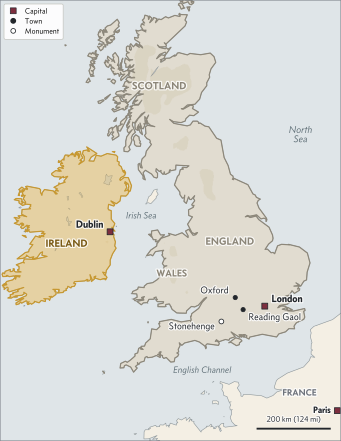
London. The capital, the largest city in the world in Victoria’s reign. In the hot summer of 1858 London experienced the “Great Stink”This city experienced the "Great Stink" when hot weather overwhelmed its sanitation system. → London•• from the sewage in the Thames, and thirty years later Jack the Ripper killed five women in Whitechapel, in London’s East End.Jack the Ripper operated in this city's Whitechapel district in the 1880s. → London•• The queen’s memorial to her husband, paid for partly by the Great Exhibition’s profits, was the Royal Albert Hall in London,The Royal Albert Hall is located in this city. → London•• opened in 1871. Taught in Chapter 1, Chapter 2, and Chapter 16.
Palace of Westminster. The Houses of Parliament, rebuilt in the Gothic style after the fire of 1834. The palace was designed by Barry and Pugin,This building was designed by Charles Barry and Augustus Pugin. → Palace of Westminster• and at its north end the Elizabeth Tower holds the bell Big Ben.This building's Elizabeth Tower contains the bell Big Ben. → Palace of Westminster• Taught in Chapter 1.
The Crystal Palace. The vast hall of the Great Exhibition of 1851 in Hyde Park. A gardener who built greenhouses, Joseph Paxton, sketched it on blotting paper: Paxton designed a building of cast iron and glass,Joseph Paxton designed this cast-iron-and-glass building for the Great Exhibition of 1851. → the Crystal Palace• put together from standard parts in a few months. Taught in Chapter 1.
Oxford. The university city on the Thames. In 1860 the Huxley–Wilberforce debate in OxfordThe Huxley-Wilberforce debate took place in this city. → Oxford• set Darwin’s defender against a bishop. Beerbohm’s comic novel is set there too: its setting is Edwardian Oxford.This city is the setting of Max Beerbohm's Zuleika Dobson. → Oxford•• Taught in Chapter 7 and Chapter 27.
Paris. The capital of France and the second of Dickens’s two cities. In A Tale of Two Cities, when the story crosses the Channel, the scene shifts to Paris,This city is a partial setting of Dickens' A Tale of Two Cities. → Paris, France• to the wine shop of the Defarges in the poor district of Saint Antoine. Taught in Chapter 9.
Dublin. The capital of Ireland. In 1882 Burke and Cavendish were killed in Dublin’s Phoenix ParkThomas Burke and Lord Cavendish were killed in this city's Phoenix Park. → Dublin•• by a secret society, and in the great lockout of 1913 James Larkin’s Irish Transport and General Workers’ Union fought back: the ITGWU called sympathetic strikes,The ITGWU organized sympathetic strikes during this city’s 1913 lockout. → Dublin•• in which workers refused to handle the locked-out firms’ goods. Taught in Chapter 12 and Chapter 28.
Ireland. The island west of Britain, ruled from Westminster throughout this volume. From 1880 Parnell led Ireland’s Home Rule movement,Charles Stewart Parnell was a leader of this country's Home Rule movement. → Ireland•• which asked for a parliament in Dublin. In 1905 Arthur Griffith’s Sinn Féin was founded to win Ireland’s independence.Sinn Féin was founded to fight for this country's independence. → Ireland• The Dublin-born composer Charles Villiers Stanford wrote six Irish RhapsodiesCharles Villiers Stanford wrote six rhapsodies based on this country's music. → Ireland• on its music. Taught in Chapter 12, Chapter 25, and Chapter 26.
Scotland. The northern kingdom of Great Britain, home of Stevenson and Barrie. In Glasgow, Charles Rennie Mackintosh’s School of Art is one of the best-known buildings in Scotland.The Mackintosh Building at the Glasgow School of Art stands in this country. → Scotland• Taught in Chapter 13.
Wales. The western country of Great Britain, with its own language. In some Welsh schools children caught speaking Welsh were given the Welsh Not,Children speaking this country's traditional language were given 'not' tokens as punishment. → Wales•• a wooden token, and punished. Taught in Chapter 12.
United Kingdom. The state of Great Britain and Ireland, created in 1801. During the American Civil War a Northern warship stopped a mail steamer, and because the Trent was a British ship,The ship involved in the Trent Affair belonged to this country. → United Kingdom• the two countries came close to war. Far to the east, after a war with China, the United Kingdom controlled Hong KongThis country controlled Hong Kong. → United Kingdom•• for 156 years. Taught in Chapter 12.
Venice. The Italian city of canals and palaces that John Ruskin studied stone by stone. The result was a three-volume study of Venice,John Ruskin wrote a three-volume study of this city's architecture titled for its 'Stones.' → Venice• The Stones of Venice, which taught Victorians to love Gothic building. Taught in Chapter 13.
Egypt. The land of the pyramids, whose ancient dead fascinated the Victorians. The London surgeon Thomas Pettigrew unwrapped mummies from Egypt before crowds of onlookers,The surgeon Thomas Pettigrew organized parties where bodies from this country were unwrapped for Victorian audiences. → Egypt• at lectures and at private parties. Taught in Chapter 1.
Japan. The island empire that opened to the West in the 1850s and set off a London craze for its prints and fans. Gilbert set his new opera in Japan,This country is the setting of The Mikado. → Japan•• in the imaginary town of Titipu. Taught in Chapter 13.
Stonehenge. The ring of great standing stones on Salisbury Plain, where Tess sleeps before her arrest. In August 1905 the Ancient Order of Druids held a ceremonyThe Ancient Order of Druids held a ceremony at this monument in 1905. → Stonehenge• among the stones. Taught in Chapter 19.
Reading Gaol. The prison in Reading, west of London, where Wilde served most of his sentence. His poem made Reading Gaol, the prison of its title,Oscar Wilde wrote a poem named for his imprisonment at this place. → Reading Gaol• famous. Taught in Chapter 18.
Castles. Stone fortresses with walls and towers, built by lords across medieval Europe. Dracula lives in a castle,One of these structures has served as the home of Count Dracula. → castles• half ruined, on the edge of a cliff above the forests of Transylvania. Taught in Chapter 15.
Mental asylums. Hospitals where people with mental illness were kept, partly for treatment and partly apart from everyone else. Bedlam was Britain’s oldest and most famous asylum,Bedlam is a British example of these places. → mental asylums• and Richard Dadd spent twenty years there. Taught in Chapter 6.
Things, trades, and pastimes
The last group is the most varied: professions, substances, machines, sports, and customs (Table A.22). Each of them is an answer because something in the Victorian story turns on it. Cotton built Manchester. Steel and guns came from new ways of making things, while cholera and the sewers belong to the story of public health. A clue for one of these usually names a person and a deed, Bessemer and his air blast or Bazalgette and his tunnels, so the way in is to remember whose story each thing belongs to.
| Answer | Kind | Its place in the Victorian story | Ch. |
|---|---|---|---|
| Cotton | Raw material | Lancashire’s mills; the Cotton Famine of the 1860s | 2 |
| Steel | Material | Bessemer’s process of 1856 | 2 |
| Guns | Weapons | Rifles made by the American system at Enfield | 2 |
| Cholera | Disease | The Broad Street outbreak of 1854 | 2 |
| Sewer systems | Structures | Bazalgette’s tunnels after the Great Stink | 2 |
| Coal | Fuel | Senghenydd, the worst British mining disaster, 1913 | 28 |
| Trains | Vehicles | An early film shot from the front of a train | 23 |
| Bicycles | Machines | The penny-farthing | 12 |
| Tennis | Sport | Lawn tennis, “Sphairistike,” and Wimbledon | 12 |
| Flowers | Custom | The Victorian “language of flowers” | 1 |
| Bread | Food | A loaf of bread in the Rubaiyat | 20 |
| Harp | Instrument | The emblem of Ireland, and of Guinness | 12 |
| Dictionary | Book | The great Oxford dictionary of English | 11 |
| Nurses | Profession | Florence Nightingale’s calling | 4 |
| Detective | Profession | Sherlock Holmes and Father Brown | 16 |
| Professor | Profession | Moriarty’s job | 16 |
| Prostitutes | Profession | The victims of Jack the Ripper | 16 |
Cotton. The plant fiber spun and woven in Lancashire’s mills, most of it grown by slaves in the American South. When the Civil War cut off the supply, the shortage caused the Lancashire “Cotton Famine.”A shortage of this crop caused the Lancashire “famine” during the American Civil War. → cotton••• At the center of it all, Manchester acquired the nickname “Cottonopolis.”Manchester acquired the nickname “Cottonopolis” because of its industry processing this commodity. → cotton• Taught in Chapter 2.
Steel. Iron with a little carbon, far stronger than iron and once very costly. In 1856 Henry Bessemer found a cheap way to make it, by blowing cold air through molten pig iron,The Bessemer process makes this material by blowing air through molten pig iron. → steel••• which burns out the impurities. Taught in Chapter 2.
Guns. Weapons that the Crimean War made Britain short of. By 1856 the Royal Small Arms Factory at Enfield produced gunsThe Royal Small Arms Factory at Enfield historically produced these weapons for the British Empire, using the American System of manufacturing. → guns• with American machines, each part made exactly alike. Taught in Chapter 2.
Cholera. A disease of the gut, spread by dirty water, that killed tens of thousands in Victorian cities. John Snow traced the 1854 outbreak to the Broad Street pumpAn 1854 outbreak of this disease was traced to London’s Broad Street pump. → cholera•• in Soho. Taught in Chapter 2.
Sewer systems. Underground channels that carry waste away. After the Great Stink of 1858, Joseph Bazalgette expanded London’s sewer systemJoseph Bazalgette expanded London’s system of these structures after the Great Stink of 1858. → sewer systems•• with 82 miles of great brick tunnels. Taught in Chapter 2.
Coal. The fuel of the Industrial Revolution, dug by more than a million British miners by 1913. That October an explosion tore through the pit at Senghenydd in South Wales, and in all, 440 men died in the coal mine.About 440 people died at a facility in Senghenydd in this industry in October 1913. → coal• Taught in Chapter 28.
Trains. The railways that carried Victorian Britain. Early filmmakers loved them, and in G. A. Smith’s The Kiss in the Tunnel the film opened with the view from a trainA George Albert Smith film opens with a moving POV shot from one of these vehicles. → trains• entering a tunnel. Taught in Chapter 23.
Bicycles. Two-wheeled machines that became a craze in the 1870s. The high early model, with a huge front wheel and a tiny back one, was named for a big coin and a small one: this bicycle was called the penny-farthing.The penny-farthing is a type of these objects. → bicycles• Taught in Chapter 12.
Tennis. The racket game whose lawn version spread in the 1870s. Major Walter Wingfield sold sets in a box, and Wingfield marketed his lawn tennis as “Sphairistike.”Walter Clopton Wingfield marketed an early lawn version of this sport as “Sphairistike.” → tennis• The first championship at Wimbledon was played in 1877, and Wimbledon is the oldest and most famous tennis championship.This sport is the focus of Wimbledon. → tennis• Taught in Chapter 12.
Flowers. Blooms that Victorians used as a code: Victorians developed a language of flowersVictorian society developed a “language” of these objects to express unspoken feelings. → flowers• in which a red rose meant love and rosemary remembrance. The message was carried in a tussie-mussie, a small bouquetTussie-mussies are small bouquets of these objects. → flowers• of tightly packed blooms. Taught in Chapter 1.
Bread. The plainest food, one of the four things the speaker of the Rubaiyat asks for: a book of verses, a jug of wine, a loaf of bread,"A Jug of Wine," this substance, and "Thou" appear together in Edward FitzGerald's Rubaiyat of Omar Khayyam. → bread• and “Thou.” Taught in Chapter 20.
Harp. The old instrument of the Irish bards, which became the national emblem. The Celtic harp, symbol of Ireland, became the Guinness logoA Celtic version of this instrument symbolizes Ireland and appears in the Guinness logo. → harp•• in 1876. Taught in Chapter 12.
Dictionary. A book that lists and explains the words of a language. The great dictionary planned in Oxford took forty-four years to publish, and when its last part appeared in 1928, it was a dictionary of the entire English language.The University of Oxford publishes a comprehensive one of these works in English. → dictionary• Taught in Chapter 11.
Nurses. The people who care for the sick, a calling that Florence Nightingale made respectable. Florence Nightingale was a nurse herself,Florence Nightingale held this profession. → nurses•• and her school at St. Thomas’ Hospital trained nurses for the world. Taught in Chapter 4.
Detective. A person who solves crimes. Sherlock Holmes is a “consulting detective,” and G. K. Chesterton’s Father Brown is a shabby little Catholic priest who is also a detective.Father Brown, a priest, has this profession. → detective• Taught in Chapter 16.
Professor. A senior university teacher. Holmes’s great enemy won a chair of mathematics at a small university, so Moriarty is a professor of mathematics.This is the profession of Sherlock Holmes' archenemy James Moriarty. → professor•• Taught in Chapter 16.
Prostitutes. Women who sold sex for money, the “unfortunates” of the Victorian streets. Jack the Ripper killed five poor women in 1888, and the police and the newspapers described all five as prostitutes.The five “canonical” victims of Jack the Ripper were traditionally described as members of this profession. → prostitutes• Taught in Chapter 16.