A Complete Course in Quiz Bowl · Volume 1
The Toolkit
How poems, paintings, music, arguments, and quiz bowl questions work
22 chapters · 151 answers · 624 clues · 250 pages in print
Contents
Words
The Elements of Music
The Orchestra
Musical Forms
Pictures and Buildings
Arguments
Back matter
The Stage: How Quiz Bowl Works
A moderator stands between two tables. Four players sit at each, and in front of every player lies a small button on a cord, wired to a box that lights up and beeps when the button is pressed. The moderator begins to read a paragraph about a kind of music, one sentence at a time. After the first sentence nobody moves. After the second, a boy at one table frowns and leans forward. Halfway through the fourth, a girl at the other table presses her button, the box beeps, and the moderator stops in the middle of a word. “String quartet,” she says. She is right, her team scores fifteen points, and nobody in the room ever hears the end of the paragraph.
That paragraph was a quiz bowl question, and every one of the fifty-nine volumes of this Course is built from the facts that such questions use. This stage comes before the first chapter and teaches two things that the rest of the series takes for granted. Its first half shows how a question works: how it is built, how it names its answer, and how an answer is judged. Its second half shows how to read the maps, timelines, and names of periods that every later volume prints without stopping to explain them.
The game
Quiz bowl is a game of questions played by two teams of four, with buzzers. A moderator reads the questions aloud from a packet, the set of questions written for one game, while a scorekeeper keeps count. A packet holds two kinds of question, usually twenty or twenty-four of each. The first kind is the tossup, a paragraph of facts that any player on either team may answer, alone and without help, by pressing a buzzer. The team that answers a tossup correctly earns the second kind, a bonus: three short questions for that team alone, which its four players may talk over together before one of them answers. Figure S.1 follows one tossup and its bonus from start to finish.
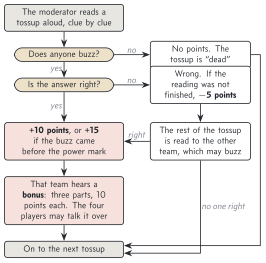
A correct answer to a tossup is worth ten points. Many tournaments, though not all, mark a place partway through each tossup called the power mark, and a correct answer given before the moderator reaches it earns fifteen points instead. That is why the girl in the opening scene scored fifteen. A wrong answer given before the moderator has finished reading costs five points, a penalty that players call a neg, short for “negative,” and the moderator then reads the rest of the question to the other team. A wrong answer after the reading is over costs nothing. If nobody answers correctly, the tossup is dead, and no bonus is read. Each part of a bonus is worth ten points, so a team that answers all three parts wins thirty. A team that takes fifteen points on a tossup and thirty on its bonus gains forty-five in about a minute.
The questions range over everything a school teaches and a good deal that it does not. Each packet follows a recipe called its distribution, which fixes how many questions go to each subject. Literature, history, and science take the largest shares, half the packet or more between them, and the fine arts, religion, mythology, philosophy, geography, social science, and current events share most of the rest. A team therefore wants players who know different things, and many teams divide the subjects among their four members. The Course is laid out to match. Its volumes run from geography, myth, and scripture through the history and arts of every region of the world to the sciences, so that every subject a packet asks about has a home in one of them.
The game grew out of a radio and television contest. College Bowl, a match between teams from two American colleges, began on radio in 1953 and moved to television in 1959, and Britain’s University Challenge, built on the same plan, followed in 1962. Today the game lives mainly in schools and colleges, at tournaments where anywhere from a handful of teams to a few hundred meet, most often on a Saturday. Since the 1990s its leading question writers, among them the company National Academic Quiz Tournaments and the college organization called the Academic Competition Federation, have built their tossups in one particular way, as a pyramid. The surest way to see what that means is to take one apart.
A tossup, taken apart
Here is the tossup from the opening scene, as a moderator’s packet would print it. It was written for this book, on the answer that has more clues in this volume than any other. It names five composers: Mozart, Haydn (hy-dn), Beethoven, Schubert, and Karlheinz Stockhausen (shtok-how-zen), a German composer of electronic music who died in 2007. The small gray numbers are not part of a real tossup. They are here so that its seven sentences can be discussed one at a time.
Each sentence of a tossup is a clue, a single fact that points to the answer. The first clue is the hardest, and each one after it is easier, until the last gives the answer away. That order, from hardest to easiest, is the pyramid. Read the seven in order and you can watch the paragraph open up.
Sentence 1 is for experts. It describes one quartet out of the six that Mozart dedicated to Haydn, and only a player who knows Mozart’s quartets well could answer here. Even so, the first sentence already points to one answer and only one, because no other kind of work by Mozart is nicknamed the “Dissonance.” That is a rule of good question writing: every clue must be true of the answer and of nothing else. The sentence also contains the two most useful words in the tossup, “this genre.” A genre (zhahn-ruh) is a kind of work, such as the sonnet or the symphony. The phrase is the tossup’s answer type, and it tells a player what sort of answer to give before he or she knows what the answer is. Here it rules out “Mozart,” who is a composer, and “the Dissonance,” which is one particular work.
Sentences 2 and 3 are still hard, but more players know them. Both speak of movements, the separate parts, each with its own speed and mood, that make up a long piece of music, and a finale is the last movement. The giant fugue (fyoog) of sentence 2, a piece in which one short tune enters again and again in one part after another, is the subject of a story told in Chapter 10, and the joke of sentence 3 is told in Chapter 13. A player who knows either story can buzz, and a player who knows both can be sure. Sentence 4 is a famous oddity of modern music, and many players remember Stockhausen’s helicopters even if they have never heard the piece.
The sign after sentence 4, an asterisk in parentheses, is the power mark. In a packet everything before it is printed in bold, so the moderator can see at a glance where fifteen points turn into ten. Writers usually place it where a player who really knows the subject should already have buzzed. Sentences 5 and 6 are the middle of the pyramid, facts that a reader of this volume would know. Sentence 6 shows what a writer does with a fact that is too broad to stand alone. “Four movements” could not make a clue by itself, because symphonies, and many sonatas, have four movements too, so the writer pairs it with a fact that belongs to the string quartet alone, that Haydn is called its father.
Sentence 7 is the giveaway. It begins with the formula “For 10 points,” which tells everyone that the end has come. It restates the answer type in full, “this chamber genre” (chamber music is music for a small group with one player on each part), and adds a fact that nearly anyone who has heard the term would know. A tossup whose giveaway nobody can answer is a badly written tossup. Figure S.2 draws the seven sentences as the shape that gives the method its name.

Why build a question this way? A tossup is a race, and the pyramid makes it a fair one. If the easiest fact came first, every player who knew the term would buzz at the same instant, and the point would go to the quickest thumb. When the hardest fact comes first, the point goes to the player who knows the most, and each later clue gives a chance to the next player in line. In the opening scene, the boy who frowned after sentence 2 may have half-remembered the fugue, but the girl knew Stockhausen’s helicopter piece, buzzed soon after she heard his name, and got there first.
Buzzing has rules of its own. You may buzz at any moment, even in the middle of a word, and the moderator stops reading at once. You must then answer right away, without help: a teammate who whispers turns the answer into a wrong one. If you buzz before the end and are wrong, your team loses five points and the other team hears the rest. So a buzz is a bet. A player who is nearly sure after sentence 3 must weigh fifteen points against the chance of losing five, and against the risk that someone at the other table is about to buzz first.
A bonus, taken apart
A bonus is gentler. It begins with a lead-in, a sentence or two that sets the subject and earns no points, and then come three parts, each a short question worth ten points. The team that won the tossup may talk over each part for a few seconds before its captain, or a player the captain names, gives the answer. Here is a sample bonus, again written for this book, on a symphony that Chapter 5 and Chapter 12 both visit.
The lead-in gives no answer, but it tells the team what all three parts are about. The three parts are written at three levels, usually one easy, one middling, and one hard, though not always in that order. Here the first part is easy for anyone who has read Chapter 12, which explains that the symphonies of Haydn’s and Beethoven’s day usually had four movements. The second asks about an instrument that Chapter 7 describes, and its clue, the sliding tube, would identify the trombone even for a player who had never heard of Beethoven. The third is the hardest, because it asks for a key, which Chapter 4 explains.
The three parts also show that one bonus can ask for three different answer types. The first says “this many,” and its answer is a bare number. The second says “these brass instruments,” and its answer is an instrument, given in the plural or the singular. The third says “this minor key,” and a key needs both a note and the word major or minor. A player who says only “C” has named a note, not a key, so the moderator asks for more, in the way that every answer line spells out.
Answer lines
Under every question in a packet stands its answer line, which tells the moderator what to accept. It begins with the word ANSWER and gives the answer as a writer would most expect to hear it. One part of the answer is printed in bold and underlined. That is the required part, the words the moderator must hear for the answer to count. In the answer line “French horn,” a player who says “horn” is right, and a player who says only “French” is not. In “double bass,” the word “bass” is enough, and in “Alfred Tarski,” a logician whom Chapter 22 introduces, the surname is enough, as it is for most people in most questions. The notes in this book end with the same kind of answer line, after an arrow, with the required part marked in the same way.
What follows the answer in square brackets lists the other answers the moderator may take. After the word “accept” or “or” come other right answers: another name for the same thing, a translation, or another spelling. In the sample tossup, Streichquartett (shtrykh-kvar-tet), German for “string quartet,” is accepted because it means exactly the same thing. After the words “do not accept” come answers that sound close but are wrong, such as “C major” for the bonus part on Beethoven’s Fifth.
A prompt is the moderator’s way of saying “not wrong, but not enough.” When a player gives an answer that the answer line marks “prompt on,” the moderator says “Prompt” or asks the player to be more specific, and the player gets one more try. “Quartet” alone could mean a string quartet, a piano quartet, or a quartet of singers, so it earns a prompt, and a player who then says “string quartet” scores. “C” earns a prompt in the bonus for the same reason. A prompt is never a hint. The player must supply the missing part without more help from the moderator, and an answer that is still incomplete is ruled wrong.
Answer types
Every clue names its answer with a phrase that begins “this” or “these”: this poet, this battle, this key. That phrase is the answer type, and an experienced player listens for it before anything else in the sentence, because it rules out most wrong answers before the player knows the right one. A clue that says “this composer” wants a person; a clue that says “this opera” wants one work. The plural matters too. “These poems are fourteen lines long” names a kind of poem, the sonnet, and so does “this poetic form.” Table S.1 lists the answer types this series uses most, with an example of each from this volume.
| The clue says | The answer is | An example from this volume |
|---|---|---|
| this genre, this form, these poems | a kind of work | the sonnet (Chapter 1); the string quartet (Chapter 13) |
| this work, this symphony | one named work | Schubert’s “Death and the Maiden” Quartet (Chapter 13), asked for by its own name in the volume on its composer |
| this instrument | an instrument or a family of them | the oboe (Chapter 7); the cello (Chapter 6) |
| this key | a note with “major” or “minor” | C major, never just the note C (Chapter 4) |
| this interval, this scale degree | the distance between two notes, or a note’s number in its scale | the perfect fifth (Chapter 3); four, the subdominant (Chapter 5) |
| this medium, this technique | what a work is made of, or how | mosaic (Chapter 19); collage (Chapter 20); perspective (Chapter 17) |
| this concept | an idea | truth (Chapter 22) |
| this figure, this man | a person, a god, or a character | Alfred Tarski (Chapter 22) |
| this place, this country | a place | Poland, home of two famous dances (Chapter 15) |
| this many | a number | four, the players of a string quartet (Chapter 13) |
A few of these types catch new players. A form and a work are different things: the sonnet is a form, a recipe for a poem of fourteen lines, while a single sonnet by Shakespeare is a work. This volume’s answers are almost all forms, kinds, and tools; the later volumes ask for works by name. Watch the word after “this.” A tossup that ends “name this chamber genre” wants “string quartet,” but one that ends “name this string quartet” wants a single work, such as “Death and the Maiden”: the words after “this” give the kind, and the answer is one thing of that kind. A key is not a note. The note C is one pitch, while the key of C major is a whole family of notes built around C, and this volume has clues for both answers. An interval is the distance between two notes, so “this interval” wants a name like “perfect fifth,” the distance from C up to the G above it. A scale degree is a note’s number in its scale, so “this scale degree” wants a number: the subdominant, for example, is degree four. A medium is what a work is made of, such as the colored stones of a mosaic, and a technique is how it is made, such as perspective, which makes a flat picture look deep.
“This figure” is the widest type of all. It can mean a real person, a god, or a character in a story, and the clue’s other words usually say which. “This man” and “this woman” mean a real person. The answers to “this many” are bare numbers, and they are slippery, because the same number can count very different things. The answer “four” is the number of players in a string quartet, the number of movements in most symphonies of Haydn’s day, and the number of symphonies Brahms wrote. The answer-type section at the back of this volume sets the clues for each number side by side.
Where and when
Every chapter of the Course after this volume opens with a locator, a small picture that answers two questions before the story begins: where, and when. The full art of reading maps, with latitude and longitude, scale, the projections that flatten a round earth onto a flat page, and the names of landforms, is taught at the start of Vol. 2, Geography: The Americas and Oceania, the first of the geography volumes. Only two habits are needed now.
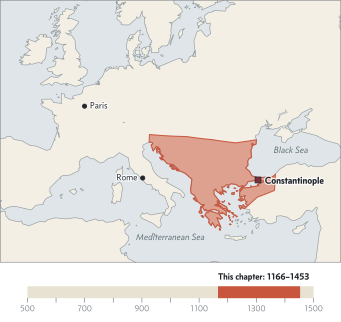
The first habit is to read the locator. Its upper part is a small map of a large region with the chapter’s own area shaded, so a reader can see at once which corner of the world the story is set in. Its lower part is a bar of centuries, a strip of time with the chapter’s years marked in color. Figure S.3 is the locator of the last chapter of Vol. 9, Cathedrals and Crusades.
The second habit is to read the date of every map. A history chapter’s maps are dated maps: each shows one year, which its caption names, and it draws the borders of that year, not today’s. Borders move. The Balkans, the peninsula at the southeastern corner of Europe, held no Greece, no Bulgaria, and no Turkey in the modern sense in 1451 (Figure S.4). They held the state of the Ottoman (ot-uh-mun) Turks, ruled by sultans; the shrunken remains of the Byzantine (biz-un-teen) Empire, the eastern half of the old Roman Empire; and a string of ports and islands that belonged to Venice. A dated map also uses the names of its year, with today’s name added where it helps. The great city on the strait between Europe and Asia is labeled Constantinople, now Istanbul, and the Ottoman capital is Adrianople (ay-dree-uh-noh-pul), now Edirne (eh-deer-neh). Where a border of that year is too uncertain to draw, the map names the state and leaves its edge out, as this one does for Serbia, Hungary, and Wallachia (wah-lay-kee-uh).
The text follows the same rule as the maps. A chapter calls a place by the name it had in the years the chapter describes and gives today’s name once, the first time. The city that Peter the Great of Russia founded on the Baltic in 1703 is St. Petersburg in a chapter on the 1700s, Petrograd in one on the revolution of 1917, and Leningrad in one on the Second World War. It was renamed in 1914 and again in 1924, and it took back its first name only in 1991. Norway’s capital is Christiania (kris-tee-ah-nee-uh), later spelled Kristiania, until 1925, when it took back its old name of Oslo. A reader who meets an unfamiliar name in an old setting should suspect a renamed place before a new one.

Counting the years
The Course counts years the way most of the world does, from the birth of Jesus. The count was worked out in Rome by a monk named Dionysius Exiguus (dy-uh-nish-ee-us eg-zig-yoo-us), in the year that he himself numbered 525. He called his years anno Domini, Latin for “in the year of the Lord,” and the English historian Bede used them in 731 in his history of the English church, which helped spread the system across Europe. A year after the birth is marked AD, short for anno Domini, and written before the number: AD 800. A year before it is marked BC, “before Christ,” written after the number: 44 BC. Many books now write “BCE” and “CE,” for “before the Common Era” and “Common Era,” and they mean exactly the same years. This series writes BC and AD. In later centuries AD the letters are dropped, since nobody could mistake 1066 for a year before Christ. Dionysius himself was probably a few years off. In the Gospel of Matthew, King Herod tried to kill the infant Jesus, so Jesus was born before Herod died, and most historians date Herod’s death to 4 BC. By Dionysius’s own count, then, Jesus was born in 4 BC or earlier, some years “before Christ.”
There is no year zero. The count was made long before Europeans used the number zero, so 1 BC is followed directly by AD 1. Years BC run backward, like a countdown to the turn of the eras: 44 BC came before 43 BC, and from 70 BC to 19 BC is fifty-one years, found by subtracting as usual. Across the turn the missing zero matters. A man born in 10 BC who died on the same day of the year in AD 10 lived nineteen years, not twenty, because ten years after his birth brought him only to AD 1. Figure S.5 draws the count on both sides of the turn.

A century is a hundred years, and centuries are named one ahead of their digits. The first century AD ran from AD 1 to 100, so the second began in 101, and the nineteenth century is loosely the 1800s and strictly the years 1801 to 1900. The strict count starts at 1 because there was no year zero. Centuries BC run backward too: the fifth century BC ran from 500 down to 401 BC, the age of the Athenian playwrights and of the Parthenon. A decade is ten years named by its first year, so “the 1920s” are 1920 through 1929.
Dates in history are often uncertain, and the series says so in plain words. Where other books write c. 1400, from the Latin circa (sur-kuh), “around,” this series writes “about 1400.” Where other books write fl., from floruit (flor-oo-it), “he or she flourished,” to give the years when a person is known to have been at work, this series writes “active.” The composer Pérotin (pay-roh-tan) wrote music for the cathedral of Notre-Dame in Paris, but no record gives his birth or his death, so he appears as “active about 1200.” Lifespans and reigns are written as spans of years. Johann Sebastian Bach (bahkh) lived from 1685 to 1750, written (1685–1750), and Queen Victoria of Britain is “Victoria, reigned 1837–1901,” because the dates of a reign are not the dates of a life.
The names of periods
Historians and critics divide the past into periods, stretches of years with a name, and the later volumes use those names without stopping to date them. So do this volume’s music chapters, which speak of Baroque (buh-rohk) fugues, Classical symphonies, and Romantic piano pieces. Figure S.6 sets the names on one band of dates. Every boundary on it is approximate, because no age began on a single day, and books disagree about most of them by a decade or more.
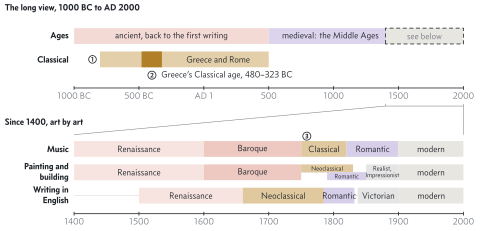
The ancient world runs from the first writing, about 3200 BC, to about AD 500, when the Roman Empire in the West had fallen. The medieval period, or Middle Ages, runs from about 500 to about 1450. Its name comes from the Latin for “the middle age,” and the idea behind it came from scholars of the 1400s, who saw their own time as a rebirth of the ancient world after a long gap in between. The Italian poet Petrarch (pee-trark), who lived in the 1300s, had already spoken of the centuries before his own as an age of darkness, which gave later writers the label “Dark Ages.” Later historians objected that learning, art, and law had flourished in those centuries, and many no longer use the label. The rebirth those scholars saw is the Renaissance (ren-uh-sahns), French for “rebirth,” which began in Italy about 1400 and spread north in the 1500s.
The Baroque came next, about 1600 to 1750 in music, the age of Bach and Handel. Its name may come from a Portuguese word for a misshapen pearl, and critics first used it as an insult for art they found overloaded. In music the Classical period runs from about 1750 to 1820, the age of Haydn, Mozart, and the young Beethoven, and the Romantic from about 1820 to 1900, when composers prized feeling, color, and the individual hero. In history books modern usually means the years since about 1500. In the arts it usually means the twentieth century and its break with the old rules.
The word “classical” has three senses, and the series uses all of them. First, it means the world of ancient Greece and Rome, whose languages are called the classical languages and whose columns and temples are classical architecture. Second, it names Greece’s Classical age, the fifth and fourth centuries BC, from the defeat of the Persian invasion in 480 BC to the death of Alexander the Great in 323 BC. Third, it names the music of Haydn, Mozart, and Beethoven. In everyday speech “classical music” means any concert music, from Bach’s fugues to the music of the twentieth century, but in this series the Classical period in music means only the years from about 1750 to 1820.
The same name can cover different years in different arts. Romantic poetry in English began in the 1790s and was over by the 1830s, before Romantic music reached its peak. The Renaissance came to Italian painting about 1400 but to English writing only in the 1500s, the century of the poet Edmund Spenser and the young Shakespeare. “Gothic” names a style of cathedral that began in France in the 1140s and also a kind of novel, full of ruined castles and ghosts, that began in England in 1764. So when a later volume says “Baroque” or “Romantic,” look at which art it is talking about before you supply the dates.
Reading a locator and a timeline
The last chapter of Vol. 9, Cathedrals and Crusades tells how the Ottoman Turks conquered the Balkans and, in 1453, took Constantinople. Its locator is Figure S.3, its dated map is Figure S.4, and Figure S.7 is its timeline. The worked example that follows reads all three aloud before reading a word of the chapter.
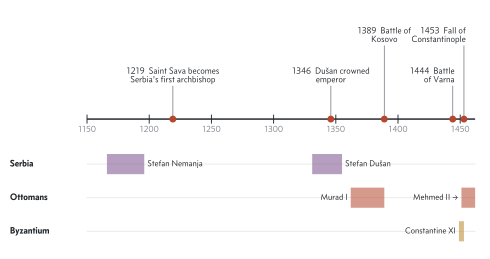
Every locator and timeline in the Course can be read in the same way and in the same few seconds, before the first scene of the chapter begins.
Words
Chapter 1 · 45 clues
Meter, Rhyme, and the Forms of Verse
In the spring of 1686, in a small hut on the edge of Edo (ed-oh), the city now called Tokyo, a Japanese poet wrote a poem, seventeen short sounds long, about a frog. In English they say only this: an old pond; a frog jumps in; the sound of water. Some twenty-four centuries earlier, singers in Greece had been performing a poem about the war at Troy that runs to nearly 15,700 lines. Read aloud at a steady twelve lines a minute, it would take more than twenty hours.
The frog poem and that Greek poem, the Iliad (il-ee-ud), have almost nothing in common. One is a glance at a pond, the other a war. Yet both are poems, and nobody hearing either would mistake it for a shopping list or a letter. What they share is pattern. A poem is language arranged so that a listener can feel a design in its sound: in how the words are cut into lines, in which syllables fall loud and which soft, in which words chime with one another. The design may be as strict as a sonnet’s or as light as the frog poem’s three short lines, but it is always there.
The tools for hearing that design come first: the beat, the line, and the rhyme. After them come the shapes that poets have built with those tools, from the sonnet to the epic. Each shape was invented once, in one language, and then borrowed by poets in others. A form that a Sicilian court poet devised around the year 1230 turns up, nearly eight hundred years later, in a book of poems about America.
Meter and rhyme
Stress and the foot
Say the word banana aloud. It has three syllables, but you do not give them equal weight. The middle one is louder and a little longer: ba-NA-na. That extra push of the voice is called stress. Every English word of more than one syllable carries its stress in a fixed place, which is why we say GAR-den and never gar-DEN, a-BOUT and never A-bout. Short words take stress or lose it in a sentence. In “the cat sat on the mat,” the words cat, sat, and mat ring out, while the and on almost vanish.
Verse is language set out in lines whose sounds follow a pattern, and poetry is the art of writing it. In English the pattern is usually built from stresses. A poet arranges loud and soft syllables so that they repeat, and the repeating pattern is called meter, from the Greek word for “measure.” Its unit is the foot, a small group of syllables, usually one stressed syllable with one or two unstressed ones beside it. Five kinds of foot are common enough in English to have names, and Figure 1.1 draws each one.

The commonest is the iamb (eye-am): an unstressed syllable, then a stressed one, da-DUM, as in today or believe. Turn it around and you have the trochee (troh-kee), DUM-da, as in garden or tiger. The dactyl (dak-til) is a stress followed by two soft syllables, DUM-da-da, as in merrily. Its mirror image, da-da-DUM, is the anapest (an-uh-pest), as in understand. The rarest is the spondee (spon-dee), two stresses side by side, as in heartbreak. The names are Greek because the Greeks first described feet. Greek and Latin verse, though, measured syllables by how long they took to say, not by how loud they were, and when English poets borrowed the names they let stress stand in for length.
Each foot has its own gait. Iambs walk, with the steady rhythm of a heartbeat. Anapests gallop, as in “A Visit from St. Nicholas,” the Christmas poem first printed in 1823: “’Twas the night before Christmas, and all through the house.” Trochees chant, as in the English poet William Blake’s “Tyger Tyger, burning bright” of 1794 (Vol. 15, The Age of Revolution). Dactyls rock and charge, as in Alfred Tennyson’s “The Charge of the Light Brigade,” his poem of 1854 about a cavalry attack in the Crimean War: “Half a league, half a league, / Half a league onward” (Vol. 17, The Victorians). You can tap each of these on a table and feel the difference without knowing a single name.
Counting the feet
A line of verse is measured by how many feet it holds. The names join a Greek number to meter (tetra, penta, and hexa are Greek for four, five, and six): a line of four feet is tetrameter, a line of five is pentameter, and a line of six is hexameter. Lines of two and three feet, called dimeter and trimeter, are rarer. Put the kind of foot and the number together and you have the full name of a meter. Blake’s “Tyger Tyger, burning bright” is trochaic tetrameter: four trochees, TY-ger TY-ger BURN-ing BRIGHT, with the last soft syllable dropped, as English poets often drop it at the end of a line.
The most important meter in English is iambic pentameter, a line of five iambs with ten syllables in all. It is close to the rhythm of careful speech, slowed down and made regular, which is one reason Shakespeare wrote most of his plays in it. Marking the stresses of a line to find its meter is called scansion, and the worked example shows how it is done.
Rhyme and the stanza
Two words rhyme when they sound alike from their last stressed vowel to the end: day and May, better and letter. To describe how the line endings of a poem rhyme, readers use letters. The sound at the end of the first line is a, and any later line ending with that sound is also a; the next new sound is b, and so on. The result is the poem’s rhyme scheme. A poem whose four lines end in day, night, May, and light rhymes abab.
Lines are grouped into stanzas, the paragraphs of a poem, set off from one another by a space. Stanzas are named by their number of lines. Two lines make a couplet, and in English the two usually rhyme, aa. Three lines make a tercet. The medieval Italian poet Dante wrote his Divine Comedy, a journey through hell, purgatory, and heaven, in tercets linked into a chain, aba bcb cdc, a pattern called terza rima (Vol. 9, Cathedrals and Crusades). Four lines make a quatrain, the commonest stanza in English, used for hymns, ballads, and most of the poems children learn first.
Not all verse rhymes. Blank verse is unrhymed iambic pentameter: the beat stays and the rhymes go. Most of Shakespeare’s plays are in blank verse, and so is Paradise Lost, the long religious poem by the English poet John Milton. Free verse goes further and drops a fixed meter as well, so that the poet chooses the length and rhythm of each line one by one. The American poet Walt Whitman made it famous in English with Leaves of Grass in 1855 (Vol. 30, Whitman to Wharton).
Fixed forms
A fixed form is a recipe for a whole poem: so many lines, rhymed in this order, often in this meter. The villanelle is one such form of poetry,Villanelles are a type of this literary form. → poetry•• and one of the strictest. It has nineteen lines, arranged as five tercets and a closing quatrain, built on only two rhymes. Two lines of the first stanza come back again and again as refrains, lines repeated through a poem, until they meet as its last two lines. The best-known villanelle in English is the Welsh poet Dylan Thomas’s “Do not go gentle into that good night,” first published in 1951 and addressed in its last stanza to his own aging father (Vol. 24, After Empire). Its two refrains, the title and “Rage, rage against the dying of the light,” return four times each, so that the poem keeps circling back like a son repeating the same plea. The most famous fixed form of all, the sonnet, is shorter than the villanelle by five lines and has a section of its own.
Metaphor, simile, and allegory
In Shakespeare’s Romeo and Juliet, Romeo stands in a dark garden, sees a light in a window above, and says, “It is the east, and Juliet is the sun.” He does not think the girl is a ball of burning gas. He means that she is bright and warm, that his day begins when she appears, and that everything else turns around her. A figure of speech is any use of words that departs from their plain meaning in order to say something more vividly, and Romeo’s is the most important kind. A metaphor names one thing as another,This figure of speech compares two things without using "like" or "as," unlike a simile. → metaphor• with no “like” or “as” to soften the comparison.
A simile makes the same kind of comparison openly. When the Scottish poet Robert Burns wrote in 1794, “O my Luve’s like a red, red rose,” he used a simile: his love is like a rose, not a rose. The two figures differ only by that small word, but the difference is real. A simile asks you to compare two things that stay separate, while a metaphor fuses them for a moment.
When a metaphor grows into a whole story, the result is an allegory: a narrative whose characters, places, and events stand for ideas. The English preacher John Bunyan began The Pilgrim’s Progress (1678) while he was in prison for his beliefs. In it, a man named Christian leaves the City of Destruction, falls into a bog called the Slough of Despond, passes through a town called Vanity Fair, and at last crosses a river to reach the Celestial City. Every name says what it means, and the whole journey stands for one soul’s road to heaven (Vol. 12, Crown and Parliament). A modern example is the English writer George Orwell’s Animal Farm (1945), in which farm animals drive out their farmer only to be ruled by pigs. The story works as a fable, but its leading animals also stand for figures of the Russian Revolution of 1917 and of the rule of the dictator Joseph Stalin that followed it (Vol. 21, Trenches and Modernists).
The sonnet
In 1609 a London publisher named Thomas Thorpe brought out a slim book called Shake-speares Sonnets. Its author was the actor and playwright William Shakespeare, then in his mid-forties and famous for the plays he wrote for the Globe Theatre (Vol. 11, The Age of Shakespeare). The book gathered 154 short poems that Shakespeare had written in one formWilliam Shakespeare wrote many poems in this form. → sonnets•• over many years. The first seventeen urge a handsome young man to marry, later ones speak to a dark-haired woman who torments the poet, and nearly all of them have exactly the same shape.

That shape is the sonnet, from the Italian sonetto, “little sound” or “little song.” The sonnet is a short poemSonnets are a type of this literary form. → poetry•• built to fixed rules, and it is the most widely used fixed form in the poetry of Europe and the Americas. Poets have written sonnets in Italian, English, Spanish, French, German, and Russian for centuries, and the form’s first rule has never changed: a sonnet is fourteen lines long.These poems are fourteen lines long. → sonnets••• In English the lines are almost always iambic pentameter, so a whole sonnet runs to about 140 syllables, or roughly a hundred words. That is short enough to learn by heart in an evening and long enough to hold an argument.
What makes fourteen lines more than a list is a change of direction. Somewhere in the poem, most often after the eighth line, the thought turns: a question gets its answer, a complaint its comfort, a picture its meaning. Italian poets called this turn the volta (vohl-tuh), which means “turn,” and every sonnet worth the name has one. When you read a sonnet for the first time, look for the volta, the shift in thought,Poems in this form contain a "volta" which marks a shift in tone or theme. → sonnets•• because the whole poem is built to lead up to it and away from it.
The Italian sonnet
The sonnet was born around 1230 in Sicily, at the court of the emperor Frederick II, who ruled Germany and southern Italy. There a notary, an official who drew up legal papers, named Giacomo da Lentini (jah-koh-moh dah len-tee-nee) seems to have invented it. It became famous through Francesco Petrarca, called in English Petrarch (1304–1374), an Italian scholar who lived for many years in Avignon (ah-veen-yohn), in the south of France, where the popes then had their court. By his own account, on April 6, 1327, he saw a young woman in a church in Avignon and fell in love for life. He called her Laura. She was probably married to another man. She died in 1348, most likely of the Black Death, the plague that swept across Europe that year, but Petrarch wrote sonnets about LauraPetrarch wrote poems in this form about Laura. → sonnets•• for decades, before her death and after it. Nobody knows for certain who she was, and even in his lifetime a friend teased him that she was only a pretty name for his poems.

He gathered these poems into a book. He gave it a Latin title, but Italians call it Il Canzoniere (kahn-tsoh-nyeh-reh), “the songbook.” Of its 366 poems, 317 are sonnets and the rest are songs and other short forms, so the Canzoniere is above all a book of sonnets.Petrarch's poems in this form are collected in Il Canzoniere. → sonnets•• They taught all of Europe how to write about love, with the lady as bright and distant as a star and the lover burning and freezing at once (Vol. 9, Cathedrals and Crusades).
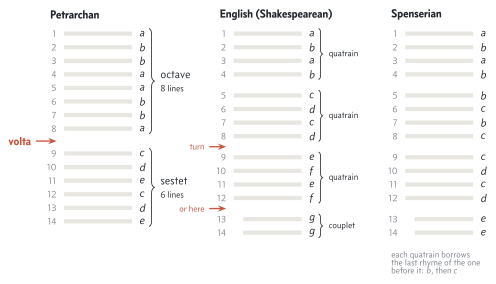
Petrarch’s sonnets, like the Italian sonnets before and after him, fall into two unequal parts (Figure 1.4). The first eight lines form the octave, rhymed abbaabba: two quatrains that share the same two rhymes. The last six form the sestet (ses-tet), usually rhymed cdecde or cdcdcd. So the Petrarchan sonnet is an octave followed by a sestet,The Petrarchan form of this poem type is structured as an octave followed by a sestet. → sonnets•• and the volta falls in the gap between them. The octave sets out a situation or a problem; the sestet answers it, or looks at it from a new side. Italian is rich in rhymes, because most Italian words end in a vowel, so finding four words to share each rhyme of the octave was not hard.
The English sonnet
The sonnet crossed to England with a diplomat. Sir Thomas Wyatt (1503–1542) served King Henry VIII on missions abroad and visited Italy in 1527. He came home with Petrarch in his head, and Wyatt translated Petrarch’s sonnets into English,Sir Thomas Wyatt translated into English works in this form by Petrarch. → sonnets• or rewrote them so freely that they became his own. In one, Petrarch’s vision of a white deer becomes a hunt for a woman whom the hunter may not touch, because she belongs to a far more powerful man. Many readers think she is Anne Boleyn, whom Henry married in 1533, though the poem never names her.
Wyatt’s poems were not printed under his name in his lifetime. They passed around the royal court in handwritten copies, and in 1557, fifteen years after his death, a London printer named Richard Tottel published them in a popular anthology, a book of poems by several hands. In this way Wyatt brought the sonnet to England.This form was popularized in England by Sir Thomas Wyatt. → sonnets• English, though, has far fewer rhymes than Italian, and the English soon changed the form to suit their language.
Wyatt kept Petrarch’s octave but closed his sonnets with a rhymed couplet. A younger courtier, Henry Howard, Earl of Surrey (about 1517–1547), went further. Surrey used seven rhyme sounds instead of four or five, so that each sound had to serve only two lines, and arranged them in three quatrains and a couplet: abab cdcd efef gg. This pattern flowered after both men were dead, in the reign of Queen Elizabeth I (1558–1603), when young courtiers of the 1590s competed in writing whole sequences of sonnets to a lovely and unkind lady. It is called the English sonnet, or the Shakespearean sonnet after its most famous user, or the Elizabethan sonnet after the queen in whose reign it flourished. Under any of these names, it is three quatrains and a couplet.The Elizabethan version of this poetic form is composed of three quatrains and a couplet. → sonnets•• Shakespeare’s Sonnet 18, in modern spelling, shows how it works.
Each quatrain takes one step. The first says that a summer’s day is too rough and too short to match the person addressed. The second says that even the sun has bad days, and every beautiful thing fades. The third turns at line 9, “But thy eternal summer shall not fade,” and makes a promise. Then comes the couplet, and the English sonnet ends with a rhyming coupletThe English variety of this form typically ends with a rhyming couplet. → sonnets• that snaps the argument shut: this person will live as long as people read the poem, because the poem itself keeps that summer alive.
Edmund Spenser (about 1552–1599), the poet of the long allegory The Faerie Queene (fair-ee kween), tried a third pattern in Amoretti (1595), a sequence of eighty-nine sonnets written while he courted Elizabeth Boyle, who became his wife. His quatrains interlock, each borrowing the last rhyme of the one before: abab bcbc cdcd ee. That makes three main kinds, and readers still sort sonnets as Petrarchan, Shakespearean, or Spenserian,This poetic form can be classified as Petrarchan, Shakespearean, or Spenserian. → sonnets•• though poets have tried many other patterns since.
The sonnet was made for love, but it could hold other things. John Donne (1572–1631) wrote witty love poems as a young man, then became a priest and in the end dean of St. Paul’s Cathedral in London (Vol. 11, The Age of Shakespeare). In Donne’s Holy SonnetsJohn Donne wrote a "Holy" collection of poems in this form. → sonnets•• the lover’s pleading is turned on God. “Batter my heart, three-personed God,” one begins, asking God to break into him as an army breaks into a town. Another speaks straight to Death, tells it not to be proud, and ends with the promise that after the short sleep of death the soul wakes forever: “Death, thou shalt die.” Modern editions count nineteen of these religious sonnets,John Donne's "Holy" collection contains 19 poems in this form. → sonnets• gathered after his death from print and from handwritten copies. In shape they mix the two traditions, with an Italian octave and an English couplet to finish.
The sonnet travels
In the twentieth century the sonnet crossed the Atlantic and kept changing. In Chile, a country schoolteacher named Lucila Godoy, who wrote under the name Gabriela Mistral (mees-trahl) (1889–1957), won a national poetry prize in 1914 with three “Sonnets of Death”.Gabriela Mistral wrote three poems in this form titled "of Death." → sonnets•• They were long said to mourn a young railway worker she had loved, who killed himself in 1909, though her family denied the romance. In 1945 she became the first Latin American writer to win the Nobel Prize in Literature (Vol. 45, Magic and Revolution).
Her younger countryman Pablo Neruda (neh-roo-dah) (1904–1973), who won the same prize in 1971, wrote love poems all his life. In 1959 he published a book of one hundred love sonnets,Pablo Neruda wrote a collection of one hundred love poems in this form. → sonnets•• Cien sonetos de amor, arranged like the hours of one day, from morning to night. They are fourteen-line poems, as the form requires, but Neruda wrote them in long, loose lines and let the strict Italian rhymes go. The woman they praise is Matilde Urrutia (oo-roo-tyah), whom he met in 1946 and married in 1966 as his third wife, and he dedicated the book to herPablo Neruda's collection of poems in this form was dedicated to his third wife Matilde Urrutia. → sonnets• (Vol. 45, Magic and Revolution).
In Los Angeles, the poet Wanda Coleman (1946–2013), known as “the L.A. Blueswoman,” spent years writing poems she called “American Sonnets,” short, loose sonnets that move with the rhythms of the blues and jazz. After the presidential election of 2016, another American poet, Terrance Hayes (born 1971), began writing sonnets of his own, more than seventy of them. Coleman’s “American Sonnets” inspired Hayes’s collectionWanda Coleman’s “American” poems in this form inspired Terrance Hayes’s collection. → sonnets• and gave it its title, American Sonnets for My Past and Future Assassin (2018). Nearly eight hundred years after a Sicilian notary counted out his fourteen lines, poets were still finding new uses for them.
The ode
In the summer of 476 BC, a racehorse named Pherenikos (feh-ren-ih-kos), “Victory-Bringer,” won the horse race at the Olympic Games. Its owner was Hieron (hy-er-on), ruler of the rich Greek city of Syracuse in Sicily, and to celebrate he paid the most famous poet in Greece for a poem. It opens with the words “Best is water,” then praises gold, then praises the Olympic Games above every other contest, and so climbs step by step to Hieron himself. That poem is an ode: a poem written in praiseThis poetic form is written in praise of someone or something. → odes•• of someone or something, addressed to its subject and pitched in a lofty style.
Its author, Pindar (pin-dar) (about 518–438 BC), came from Thebes, in central Greece. He worked for kings and for rich families from all over the Greek world, from Sicily in the west to Cyrene in Africa, and they paid him well to celebrate their victories. Pindar wrote victory odes for athletesPindar wrote "victory" types of these poems for athletes. → odes•• who had won at the four great games of the Greek world: at Olympia, at Delphi (del-fy), the shrine of the god Apollo, at Nemea, and at the Isthmus of Corinth. Four books of them survive, one named for each of the games. A chorus of young men sang and danced the ode, often in the winner’s home city when he came back wearing his crown of leaves (Vol. 6, The Greeks).

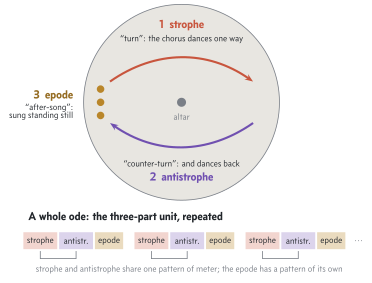
Pindar built his odes from groups of three stanzas (Figure 1.6). First comes the strophe (stroh-fee), which means “turn.” Then comes the antistrophe (an-tis-truh-fee), the “counter-turn,” which repeats the strophe’s pattern of meter exactly. Last comes the epode (ep-ohd), the “after-song,” in a pattern of its own. Ancient writers explained the names by the dance. The chorus moved one way across the floor as it sang the strophe, came back during the antistrophe, and stood still for the epode. The set of three then repeats as often as the poem needs. So strophe, antistrophe, and epodePoems of this type are classically divided into strophe, antistrophe, and epode sections. → odes•• became the classical parts of an ode, and for two thousand years poets who wanted to sound grand imitated them.
The Roman poet Horace (65–8 BC) wrote odes of a quieter kind, for one voice instead of a chorus, in short stanzas meant to be read. Many of them give advice to a friend. In one, he tells a young woman named Leuconoë (loo-kon-oh-ee) to stop asking fortune-tellers how many years the gods will give her, and to strain the wine and enjoy today instead. His last line begins with two words that have lasted. The phrase carpe diemThe phrase "carpe diem" originated in one of these poems by Horace. → odes•• (kar-peh dee-em) comes from that ode, and it is usually translated “seize the day.” The Latin carpe really means “pluck,” as you pluck a fruit while it is ripe (Vol. 7, The Romans).
English poets used the ode to speak to things that cannot answer back. In the spring of 1819 the English poet John Keats wrote “Ode to a Nightingale,” to a bird singing somewhere in the dark, and “Ode on a Grecian Urn,” to an ancient vase painted with figures who will never grow old (Vol. 15, The Age of Revolution). The Chilean poet Pablo Neruda, who wrote the hundred love sonnets, turned the ode upside down in the 1950s. Instead of kings and athletes he praised ordinary things, in lines often only two or three words long that run down the page in a thin stream. Neruda wrote odes to an artichoke,Pablo Neruda wrote poems of this type about an artichoke, socks, and a large tuna. → odes•• to a pair of socks knitted for him, and to a large tuna lying on a fish-market counter, and he treated each one with the old high seriousness. He called them Odas elementales, “elemental odes,” odes to the basic things of life.
The elegy
In the 50s BC, the Roman poet Catullus (kuh-tul-us) (about 84–54 BC) traveled to the far northwest corner of what is now Turkey, near the ruins of Troy, to stand at his brother’s grave. His brother had died far from home, and Catullus could bring only the offerings of a Roman funeral and a short poem. It has ten lines. He says he has come through many peoples and over many seas to speak in vain to silent ashes. The poem to his brother endsA Catullus poem in this form addressed to the poet's brother ends "hail and farewell" or "ave atque vale." → elegy•• with three Latin words that have been repeated at graves ever since: ave atque vale (ah-weh aht-kweh wah-leh), “hail and farewell” (Vol. 7, The Romans).
An elegy is a poem of mourning. In English the word now means any serious poem about loss, and above all a lament for the dead.These are poems often written as laments for the dead. → elegy•• For the Greeks and Romans, though, an elegy was first of all a poem in one particular meter, whatever its subject, and Catullus wrote his farewell in that meter.
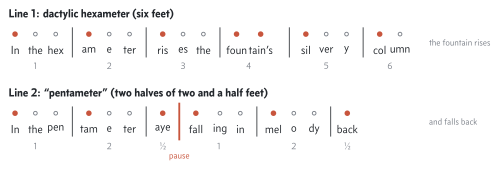
The meter is the elegiac couplet. Its first line is a dactylic hexameter: six feet, mostly dactyls, the line in which the Iliad is written. Its second line is shorter and is called a “pentameter,” though it is really two halves of two and a half dactyls each, with a pause between them. So each couplet pairs a hexameter with a pentameter,This genre's characteristic couplets pair one line of dactylic hexameter with one line of dactylic pentameter. → elegy• and the pair repeats through the poem. The English poet Samuel Taylor Coleridge (kohl-rij), adapting the German poet Friedrich Schiller, wrote a couplet that describes the meter and imitates it at the same time (Figure 1.7). Aye in it is an old word for “always.”
The meter lived on in German. Friedrich Hölderlin (hurl-der-leen) (1770–1843) was a German poet who loved ancient Greece, and he spent the second half of his life, ill in mind, in a carpenter’s tower in the town of Tübingen (too-bing-en). Around 1800 he wrote the elegy “Bread and Wine”Friedrich Hölderlin's poem "Bread and Wine" is in this form. → elegy• in nine stanzas of elegiac couplets. It mourns the gods of Greece, who have gone from the world, and asks what poets are for in so lean and empty a time.
In English the elegy shook off its meter and kept its grief. The English poet Thomas Gray’s “Elegy Written in a Country Churchyard” (1751) mourns the poor and forgotten villagers buried around a church (Vol. 11, The Age of Shakespeare). The longest and most famous English elegy came from Alfred Tennyson (1809–1892). In 1833 his closest friend, Arthur Henry Hallam, died suddenly in Vienna at twenty-two. For seventeen years Tennyson wrote short poems about his grief, his doubts about God and nature, and his slow return to hope. In 1850 he published them as one elegy, In Memoriam A.H.H.,"In Memoriam A.H.H." by Tennyson is in this poetic form. → elegy• “in memory of A.H.H.,” 131 sections with a prologue and an epilogue (Vol. 17, The Victorians). It holds the lines “’Tis better to have loved and lost / Than never to have loved at all.” Every stanza is a quatrain of iambic tetrameter rhymed abba, so that the outer lines fold around the inner pair.
Elegies went on being written through the twentieth century, for wars as well as for friends. The Nigerian poet Christopher Okigbo (oh-kig-boh) (1932–1967) joined the army of Biafra (bee-ah-fruh), the southeastern region that tried to break away from Nigeria in 1967, and was killed in the fighting that year. One of the last poems he finished is “Elegy for Alto”,A Christopher Okigbo poem in this genre is titled for Alto. → elegy• named like a piece of music for the alto, the lower of the two women’s voices in a choir. It belongs to a group of poems in which he foresaw the coming war (Vol. 43, Africa). Another Nigerian, the novelist Ben Okri (born 1959), won the Booker Prize, Britain’s best-known award for a novel, in 1991 with The Famished Road. The next year he published a book of poems called An African Elegy,This genre partly titles an "African" work by Ben Okri. → elegy• whose title poem grieves over the suffering of Africa and still finds wonder there.
The haiku
The frog poem of 1686 is probably the best-known poem in the Japanese language, and it belongs to the shortest of the great forms of verse. That form is the haiku (hy-koo), and it was born in Japan,This poetic form originated in Japan. → haiku••• out of poems that Japanese poets wrote together. From the fourteenth century on, poets often met to compose renga (ren-guh), “linked verse.” Sitting in one room, they took turns adding stanzas to a single long poem. A stanza of three short phrases alternated with a stanza of two, and each new stanza had to link to the one before it and lead somewhere new, so a renga wandered like a conversation.
The opening stanza, the hokku (hohk-koo), had a special job. It set the scene and the season for everything that followed, so it had to make sense on its own. Poets began to write hokku with no renga after them, and in this way the first stanza of a rengaThis poetic form originated as the first stanza of the collaborative renga. → haiku•• grew into an independent poem. In the 1890s the poet and critic Masaoka Shiki (shee-kee) gave it the name we use, haiku.
Japanese poets do not count syllables the way English speakers do. They count morae (mor-ee) (singular mora), beats of sound that each take about the same time to say. A short syllable such as ka is one mora, while a long vowel or a syllable ending in n counts as two. A haiku has seventeen morae,These poems traditionally consist of 17 morae. → haiku• in three groups of five, seven, and five. Figure 1.8 counts them in the frog poem. Say its first line aloud, fu-ru-i-ke-ya, and you can count the five beats on your fingers.

When poets began writing haiku in English, they turned the morae into syllables, and schoolchildren are taught that an English haiku has three linesThese poems are often written in English as three lines following a 5-7-5 syllable pattern. → haiku••• of five, seven, and five syllables. The rule is useful but rough. An English syllable such as strength holds far more sound than a Japanese mora, so seventeen English syllables say much more than seventeen morae, and many poets write English haiku of ten or twelve syllables to keep the original lightness.
Two other rules matter more than the count. A traditional haiku contains a season word, or kigoPoems in this form traditionally contain a seasonal reference, or kigo. → haiku••• (kee-goh), that tells the reader the time of year: cherry blossoms for spring, the little cuckoo for summer, the bright moon for autumn, snow for winter. Poets kept lists of these words, thousands of them, and a single one can bring a whole season’s weather into the poem. In the frog poem the season word is the frog itself, which Japanese poets heard calling in spring.
A haiku also traditionally contains a cutting word, or kirejiPoems in this form traditionally contain a 'cutting word,' or kireji. → haiku••• (kee-reh-jee), a small word that works like spoken punctuation. It cuts the poem into two parts and makes the reader pause and feel the gap between them. In the frog poem the cutting word is ya at the end of the first line. The old pond lies still; then, after the cut, come the frog and the splash. The poem lives in the jump between the two pictures, and English translators often mark the cut with a colon or a dash.
The three masters
The poet who wrote the frog poem took his name from a plant. Matsuo Bashō (bah-shoh) (1644–1694) is the first great master of the haiku,Matsuo Bashō is considered a master of this poetic form. → haiku••• the poet who made the hokku serious enough to hold loneliness and wonder in a single breath. As a young man he served in the household of a local lord, whose son shared his love of poetry. Later he moved to Edo to teach, and in 1681 a student planted a banana tree, a bashō, beside his hut; the poet took its name as his own. In 1689 he walked about 1,500 miles through northern Japan with one companion and wrote a travel book of prose and poems, The Narrow Road to the Deep North (Vol. 41, Islands of the Rising Sun).
His students gathered his haiku and their own. In 1691 they published an anthology called The Monkey’s Straw Raincoat.The Monkey’s Straw Raincoat is an anthology of poems in this form. → haiku• It takes its title from Bashō’s poem about a monkey shivering in the first cold rain of winter, which seems to want a little straw raincoat like the ones travelers wore.


Two later poets complete the usual trio of masters. Yosa Buson (boo-sohn) (1716–1784) earned his living as a painter, and he admired Bashō so much that he painted his portrait and illustrated his travel book (Figure 1.9). Buson is known for paintings paired with haiku,Yosa Buson is known for paintings accompanying poems of this type. → haiku• a form called haiga (hy-gah), in which a few brushstrokes and a poem share one sheet of paper and each finishes what the other leaves unsaid.
Kobayashi Issa (ee-sah) (1763–1828) had a hard life. His mother died when he was small, he quarreled for years with his stepmother over his father’s farm, and his children died one after another. His pen name means “a cup of tea.” Issa is the third great master,Kobayashi Issa was a master of this poetic form. → haiku•• and the warmest of the three. He wrote about the smallest creatures with sympathy and humor: a snail told to climb Mount Fuji, but slowly, slowly; a fly that wrings its hands and feet, begging not to be swatted. After his baby daughter died, he wrote that this world is a world of dew, “and yet, and yet” (Vol. 41, Islands of the Rising Sun).
Haiku in English
Haiku reached Europe and America at the end of the nineteenth century, in translation. In Paris, in about 1912, the young American poet Ezra Pound came out of a train at a crowded station of the underground railway, the Métro, and saw one beautiful face after another. He spent a year trying to put the moment into words. By his own account he first wrote thirty lines and threw them away, then a poem half as long, and at last what he called a “hokku-like sentence” (Vol. 31, The Lost Generation). So “In a Station of the Metro,” printed in April 1913, was inspired by the haiku,Ezra Pound's 'In a Station of the Metro' was inspired by this poetic form. → haiku•• which Pound still knew by its older name. Here it is, whole, as Pound later reprinted it.
Like a haiku, it sets two pictures side by side, with the semicolon as its cutting word, and lets the reader feel what joins them. It has fourteen words and no verb. Nearly half a century later, the American novelist Richard Wright (1908–1960), author of Native Son (Vol. 31, The Lost Generation), discovered the form for himself. Living in Paris and often ill, in the last eighteen months of his life Wright wrote more than four thousand haiku.Richard Wright wrote over 4,000 poems in this form. → haiku•• He chose 817 of them for a book, which was published only in 1998, as Haiku: This Other World.
The ballad
For centuries before most people could read, stories in Britain traveled in song. A ballad is a story told in short stanzas, made to be sung or recited. The oldest ballads have no known author: they passed from singer to singer and changed a little with every voice. Many of the finest are the Scottish border ballads, sung in the hill country along the border of England and Scotland, where for three hundred years raiding families stole one another’s cattle and settled their feuds with swords. In 1802 and 1803 the young Walter Scott (Vol. 15, The Age of Revolution), later famous for his novels, gathered them into a book called Minstrelsy of the Scottish Border. From 1882 to 1898 the American scholar Francis James Child printed 305 ballads with every version of each that he could find.
A ballad plunges into its story with no introduction, tells it mostly through action and dialogue, and leaves out explanations. It often has a refrain: a line or phrase repeated in every stanza, which listeners could join in singing. In “Lord Randal,” a young man comes home and answers his mother’s questions, stanza by stanza, until it comes out that his sweetheart has poisoned him. Every stanza ends with the same plea that his mother make his bed, because he is weary and wants to lie down.
Most ballads use one stanza, now called the ballad stanza: a quatrain whose lines alternate four beats and three beats, with only the second and fourth lines rhymed, abcb (Figure 1.10). The same beat pattern runs through many hymns, where hymn books call it common meter. “Amazing Grace,” a hymn first published in 1779 by John Newton, a former captain of slave ships who became a clergyman, is in common meter, and the American poet Emily Dickinson wrote most of her poems in it (Vol. 30, Whitman to Wharton).


In the eighteenth century, educated poets began to imitate the old ballads. The most famous imitation opens Lyrical Ballads (1798), a book of poems by Coleridge and his friend William Wordsworth. In The Rime of the Ancient Mariner, an old sailor with a glittering eye stops a guest on his way to a wedding and makes him hear a terrible story. The Mariner shot an albatross that had led his ship out of the Antarctic ice, his shipmates died one by one under the curse that followed, and he was saved only when he learned to bless the living creatures of the sea (Vol. 15, The Age of Revolution). Coleridge spelled the title the old way, Rime, to make the poem sound as if it came from long ago.
The epic
The Iliad, the twenty-hour poem about the war at Troy, belongs to the largest of the forms of verse, the epic: a long narrative poem about a hero whose deeds matter to a whole people. The hero may be half divine, his enemies may be monsters or gods, and the story usually decides the fate of a nation or of mankind. Epics are the longest poems most readers ever meet. The Iliad runs to about 15,700 lines, and John Milton’s Paradise Lost to more than 10,000.
Over three thousand years, epic poets built up a set of habits, and a reader who knows them can recognize an epic from its first page. An epic opens with an invocation of the Muse, in which the poet calls on the goddess of poetry to sing through him. “Sing, goddess, the anger of Achilles” is how the Iliad begins, naming its hero, the greatest Greek warrior at Troy, and Milton, in the sixth line of Paradise Lost, calls on the “Heav’nly Muse.” An epic also starts in medias res (in may-dee-ahs rays), Latin for “into the middle of things.” The Iliad opens in the tenth year of the Trojan War, and the years before are told only in glimpses. Horace, the Roman poet of the odes, coined the phrase to praise Homer for doing this.
| Poem | Language | Date | Hero |
|---|---|---|---|
| Gilgamesh | Akkadian | standard version about 1200 BC | Gilgamesh, king of Uruk (Vol. 5, In the Beginning) |
| Iliad | Greek | about 750–700 BC | Achilles (Vol. 6, The Greeks) |
| Aeneid | Latin | 29–19 BC | Aeneas (Vol. 7, The Romans) |
| Beowulf | Old English | manuscript about AD 1000 | Beowulf (Vol. 8, The Northern Worlds) |
| Paradise Lost | English | 1667 | Adam, Eve, and Satan (Vol. 11, The Age of Shakespeare) |
Inside the poem, heroes and gods carry a fixed epithet, a describing phrase that comes back nearly every time they are named: “swift-footed Achilles,” “gray-eyed Athena,” “rosy-fingered Dawn.” Epic poets love the epic simile, a comparison that runs on for several lines, as when Milton compares the fallen angels lying stunned on the burning lake of hell to autumn leaves lying thick on the streams of an Italian valley. And epics stop for a catalog, a long list of warriors, ships, or places. In Book 2 of the Iliad, the poet names every company of Greeks that sailed to Troy, with its leaders and the number of its ships.

The first epics were not written down at all. Homer, the poet of the Iliad and the Odyssey, is thought to have lived around 750 BC and to have belonged to a tradition of singers who made up their poems as they performed. They built each line from a store of ready-made phrases that fit the meter, such as “rosy-fingered Dawn.” In the 1930s the American scholar Milman Parry showed how this works by recording singers in Yugoslavia who could still perform poems thousands of lines long, composed on the spot from the same kind of stock phrases (Vol. 6, The Greeks). An epic made in this way is an oral epic.
Seven centuries after Homer, the Roman poet Virgil (vur-jil) spent the last ten years of his life writing the Aeneid (ih-nee-id) with a pen. It tells how the Trojan prince Aeneas (ih-nee-us) escaped burning Troy and led his people to Italy, where their descendants would found Rome, and it imitates Homer on purpose, scene after scene (Vol. 7, The Romans). Ancient biographers say that when Virgil was dying, in 19 BC, he asked for the unfinished poem to be burned, and that the emperor Augustus refused. A poem composed in writing by one author who knows the older epics is a literary epic.
Table 1.1 lists five epics that later volumes return to again and again. The oldest, Gilgamesh (gil-guh-mesh), comes from Mesopotamia and survives on clay tablets in Akkadian, the language of ancient Babylon and Assyria; its hero, a king of the city of Uruk, sets out to escape death after his friend Enkidu dies. Beowulf (bay-uh-wulf), in Old English, follows a hero who kills the monster Grendel, then Grendel’s mother, and in old age a dragon. Paradise Lost (1667), which Milton dictated after he went blind, tells of Satan’s rebellion against God and of how Adam and Eve were tempted and lost the Garden of Eden, all in blank verse.
What to remember
- Meter is a repeating pattern of stressed and unstressed syllables. Its unit is the foot: the iamb (da-DUM), trochee (DUM-da), dactyl (DUM-da-da), anapest (da-da-DUM), and spondee (DUM-DUM).
- A line is named by its number of feet: tetrameter has four, pentameter five, and hexameter six. Iambic pentameter is the main line of English verse; blank verse is unrhymed iambic pentameter, and free verse has no fixed meter or rhyme.
- A rhyme scheme labels line endings with letters. A couplet has two lines, a tercet three, and a quatrain four.
- A metaphor says one thing is another; a simile says it is like another. An allegory is a whole story whose people and events stand for ideas.
- A sonnet has fourteen lines and a turn, the volta. The Petrarchan sonnet is an octave and a sestet; the English or Shakespearean sonnet is three quatrains and a couplet; the Spenserian links its quatrains by rhyme. Wyatt brought the form to England from Petrarch.
- An ode is a poem of praise. Pindar’s victory odes are built of strophe, antistrophe, and epode; Horace gave us carpe diem; Neruda wrote odes to everyday things.
- An elegy is a lament for the dead. The classical elegiac couplet pairs a dactylic hexameter with a pentameter, and Tennyson’s In Memoriam A.H.H. is the great English elegy.
- A haiku is a Japanese poem of seventeen morae in groups of five, seven, and five, with a season word and a cutting word. It began as the opening stanza of a renga, and its masters are Bashō, Buson, and Issa.
- A ballad tells a story in quatrains of four and three beats rhymed abcb, often with a refrain. An epic is a long poem about a hero, with an invocation of the Muse, a start in the middle of things, fixed epithets, epic similes, and catalogs; Homer’s epics are oral, and Virgil’s Aeneid is literary.
Chapter 2 · 18 clues
Tale, Tragedy, and the True Story
Here are the first lines of four stories. “Once upon a time, at the edge of a great forest, there lived a poor woodcutter with his wife and his two children.” “My dear Mother, I have so much to tell you that I hardly know where to begin.” “Enter the King, in great distress.” “I was born in a small town by a river, the youngest of three children.”
You have read one sentence of each, and already you know a great deal. In the first, a witch will probably appear, and the children will probably win. In the second, the whole story will reach you in letters, through the eyes of whoever holds the pen. The third is a play, and its king is not going to have a good night. The fourth promises that everything in the book really happened, to the person telling it. Each of these is a different genre, a French word meaning simply “kind.” A genre is a kind of work known by its shape and its habits, and it works like a promise between the teller and the audience about what is coming. The forms of poetry were sorted by meter and rhyme in Chapter 1. Stories are sorted by what they promise.
The fairy tale
In 1813 a tailor’s widow named Dorothea Viehmann (fee-mahn), nearly sixty years old, began calling at a house in Kassel, a small city in the German region of Hesse. She sold vegetables from her garden at the town market to feed her family. She had grown up in her father’s tavern, where travelers told stories by the fire, and she knew dozens of them by heart. In the house lived two brothers who wrote down every word she said. One of them marveled that she could tell a story again and again without changing a word. Over the next two years she gave them more than forty tales, among them “The Goose Girl.”

The brothers were Jacob Grimm, born in 1785, and Wilhelm, born a year later. They were not writers for children. They were librarians and scholars of the German language and its oldest poems. Germany was then not one country but dozens of small states, and in 1807 the French emperor Napoleon had made Kassel the capital of a kingdom for his youngest brother, so the brothers now lived under a French king. They believed that the old stories told by nurses, servants, and farm wives held the voice of the German people, older than any of those states, and that the stories would die out as country life changed. So the Brothers Grimm collected these fairy talesThe Brothers Grimm collected stories in this genre. → fairy tales•• and printed them. They took them from Viehmann, from the daughters of their friends, and from old books. Several of their best sources came from families of French Protestant refugees, so a few of the “German” tales had crossed the Rhine from France.
The Grimms used a homely old word for these stories, and their German name is still MärchenIn German, works in this genre are called Märchen. → fairy tales• (mair-khen), “little tales,” from Mär, a piece of news. The brothers’ first volume appeared on December 20, 1812, with eighty-six tales, and a second, with most of Viehmann’s tales, followed in 1815. Its title, Kinder- und Hausmärchen, means Children’s and Household Tales. The English name, fairy tale, is a translation of the French conte de fées, “tale of fairies,” which a French noblewoman, Madame d’Aulnoy (dohl-nwah), used for her own stories in 1697. It is not an exact name, because many of the best-known stories have no fairies in them at all. A folktale is any traditional story passed on by word of mouth. A fairy tale is the kind of folktale full of wonders: a short story set in no particular place or time, in which magic surprises nobody and the humble hero or heroine wins in the end.
Fairy tales have habits as fixed as the rules of a sonnet. They begin “Once upon a time,” or in German Es war einmal, and they name no real town and no year. Their people are types more than persons: the youngest son, the wicked stepmother, the king with three daughters. Things happen in threes, and the third try succeeds. A frog speaks, and the princess answers it as if nothing were odd.
Many of these habits are in the Grimms’ fairy tale “Hansel and Gretel,”"Hansel and Gretel" is an example of this genre. → fairy tales•• number 15 in their book. A woodcutter is so poor that his wife persuades him to lead their two children deep into the forest and leave them there. Hansel drops white pebbles along the path and follows them home by moonlight. The second time he has only crumbs of bread, and the birds eat them. Lost, the children come to a house built of bread, with a roof of cake and windows of clear sugar. It belongs to a witch who eats children. She shuts Hansel in a cage to fatten him and makes Gretel her servant. When the witch orders Gretel to crawl into the oven to see whether it is hot, Gretel pretends not to understand, and when the witch leans in to show her, Gretel pushes her in and bolts the door. The children walk home with the witch’s pearls, and the woman who sent them away is dead. In the first edition of 1812 she was their own mother. From the fourth edition, in 1840, the Grimms made her a stepmother, which shows that they polished the tales as well as recording them.
Fairy tales belong to every country. “Jack and the Beanstalk” is an English fairy tale,"Jack and the Beanstalk" is an example of this genre. → fairy tales• first printed in 1734. In it a poor widow’s son trades the family cow for a handful of beans, and his angry mother throws them out of the window. By morning a beanstalk has grown into the sky. Jack climbs it to the house of a giant, who roars, “Fee-fi-fo-fum, I smell the blood of an Englishman.” Jack steals the giant’s gold, a hen that lays golden eggs, and a golden harp, and then chops down the beanstalk, so that the giant falls to his death.
Some fairy tales do have an author. Robert Southey (sow-thee) was an English poet (Vol. 15, The Age of Revolution), and from 1813 he was Poet Laureate, the poet appointed to write verse for the British crown. In 1837 Southey published his “Story of the Three Bears”Robert Southey published a work in this genre with his "Story of the Three Bears." → fairy tales• in a rambling book called The Doctor. His intruder is not a little girl but a nasty old woman. She eats the porridge of three bachelor bears, breaks one of their chairs, falls asleep in the smallest bed, and leaps out of the window when they find her. Later tellers made her a little girl, first called Silver-Hair and by the early 1900s Goldilocks, and made the bears a father, a mother, and a baby. A story written by a known author in the manner of a folktale is called a literary fairy tale. The great master of the kind was the Dane Hans Christian Andersen, who wrote “The Little Mermaid” (Vol. 16, Romantic Europe).
Look again at the two tales. In each, a poor child meets a man-eating enemy, outwits it, and comes home with its treasure. The same plots turn up in countries that never met. A Chinese book of about AD 850 tells of Ye Xian (yeh shee-en), a girl mistreated by her stepmother, who loses a golden shoe that a king then uses to find her. That is Cinderella, written down nearly eight hundred years before the best-known European versions, in Italy and France. To keep track of such stories, folklorists number them. The Finnish scholar Antti Aarne (ar-neh) published a catalog of tale types in 1910, and the American Stith Thompson enlarged it in 1928 and 1961. Ever since, fairy tales have been classified by the Aarne–Thompson system,Works in this genre are typically classified by the Aarne-Thompson system. → fairy tales•• revised in 2004 by the German Hans-Jörg Uther (hahns-yurg oo-ter), so that scholars now call it the ATU index. Every version of Cinderella, from China to France, is type 510A. “Hansel and Gretel” is type 327A, and Jack’s tale is type 328, its next-door neighbor (Figure 2.2). In 2016 two researchers, Sara Graça da Silva (grah-sah) and Jamshid Tehrani, compared tale types across the languages of Europe and Asia and argued that Jack’s type may be some five thousand years old.

Old tales invite new tellers. The English novelist Angela Carter (1940–1992) was a feminist, a believer that women should have the same rights and freedoms as men, and in 1979 she published The Bloody Chamber, ten stories that rebuild old fairy tales from the heroine’s side. Its title story retells “Bluebeard,” in which a young bride finds the locked room where her rich husband keeps the bodies of his earlier wives. In the French version that Charles Perrault (peh-roh) published in 1697, in the same little book as his “Cinderella” (Vol. 13, Valois, Bourbon, and Orange), her brothers ride in to save her. In Carter’s, her mother gallops to the castle and shoots the husband herself. Other stories in the book are Carter’s feminist retellings of fairy talesAngela Carter's The Bloody Chamber collects feminist adaptations of works in this genre. → fairy tales•• like “Beauty and the Beast” and “Little Red Riding Hood,” in which the heroines choose and act instead of waiting to be rescued. Between Viehmann’s visits and Carter’s book, the fairy tale went from a story told aloud to one printed, numbered, and rewritten.
The romance
A knight crawls across a dark river on a bridge made of a single sword. He has taken the armor off his hands and feet so that he can grip the blade, and it cuts them as he goes. On the far bank two lions seem to wait for him, but when he gets there they are gone, for they were only an enchantment. The knight is Lancelot, and he is on his way to rescue Guinevere (gwin-uh-veer), the wife of King Arthur, from the prince who has carried her off. The scene comes from The Knight of the Cart, written about 1180 by Chrétien de Troyes (kray-tyan duh trwah), a French poet at the court of the Countess of Champagne, in northeastern France (Vol. 8, The Northern Worlds).

Chrétien wrote in French, and that is where the name of his genre comes from. In the Middle Ages, educated Europeans wrote serious books in Latin, the language of ancient Rome and of the Church. Ordinary people spoke languages that had grown out of the everyday Latin of the Roman Empire: early forms of French, Spanish, Italian, and their cousins. These were called the “Roman” tongues, in Old French romanz, and to put a story into romanz was to tell it in the people’s speech instead of in Latin. French, Spanish, Italian, Portuguese, and Romanian are still called the Romance languages. A story told in the new tongue came to be called a romance: a long tale, in verse or prose, of knights, love, and wonders. Its usual shape is the quest, a long journey to find something or to do a great deed, such as the search for the Holy Grail, the cup of the Last Supper.
The romances of King Arthur spread across Europe for three hundred years. In England, Thomas Malory gathered them into one great prose book, Le Morte d’Arthur (“The Death of Arthur”), printed in 1485. By 1600 romances of chivalry had gone out of fashion, and the Spanish writer Miguel de Cervantes (sur-van-teez) mocked them in Don Quixote (kee-hoh-tee) (1605). Its hero is a country gentleman who has read so many romances that he puts on old armor and rides out as a knight, and attacks windmills because he believes they are giants (Vol. 10, Rebirth).
Don Quixote is often called the first modern novel. A novel is a long story in prose about invented people, and its name comes from the Italian novella, “a little new thing.” The English novels of the 1700s and 1800s prided themselves on being believable. They told of ordinary people in real towns, worrying about money, family, and whom to marry. This aim of showing life as it really is, without marvels, is called realism. French kept one word for both kinds of book, roman, and so did German. English kept two, and writers began to use them as opposites.
Nathaniel Hawthorne, the New England author of The Scarlet Letter (Vol. 30, Whitman to Wharton), drew the line in the preface to The House of the Seven Gables, which he published in 1851 with the subtitle A Romance. A novelist, he wrote, must stay faithful to the ordinary, probable course of life. A writer of romance may claim “a certain latitude.” He must still tell the truth about the human heart, but he may set it in circumstances of his own choosing. His own book has a curse laid on a family that lasts for generations. In this sense, a romance is not a love story. It is a novel that allows itself the strange.
The Gothic and the epistolary novel
In June 1764, an Englishman named Horace Walpole woke from a dream. He had been in an ancient castle, and on the top banister of a great staircase he had seen a gigantic hand in armor. That evening he sat down and began to write, with no plan at all, and in about two months he had finished a short novel. Walpole was the youngest son of Robert Walpole, who had led the British government for twenty-one years. He was a member of Parliament himself, a collector of antiques, and a tireless writer of letters. He had also spent years rebuilding his house at Strawberry Hill, near London, to look like a little medieval castle.

The word for all this was “Gothic,” and it had traveled a long way. The Goths were a Germanic people who sacked Rome in AD 410. Italian writers of the Renaissance, who admired the buildings of Greece and Rome, called the pointed-arched churches of the Middle Ages “Gothic,” meaning barbarous, as if the Goths had built them. (The pointed arch itself is taught in Chapter 18.) By Walpole’s day the word meant medieval, and with it old, gloomy, and a little frightening.
Walpole called his book The Castle of Otranto (oh-tran-toh), and it is counted as the first Gothic novel.This genre includes The Castle of Otranto. → Gothic fiction•• It came out at Christmas 1764. On the morning of his wedding, the son of Manfred, prince of Otranto, is crushed to death by a gigantic helmet that crashes down into the castle courtyard. Manfred, desperate for an heir, decides to marry his dead son’s bride, Isabella, himself. She flees through the dark passages under the castle, a portrait of Manfred’s grandfather sighs and steps out of its frame, and a peasant youth, Theodore, turns out to be the true prince. Walpole first pretended that the book was a translation of an Italian story printed in Naples in 1529. When it sold, he admitted that he had written it and gave the second edition the subtitle A Gothic Story. From it grew Gothic fiction: tales of terror and mystery, usually set in a gloomy old building with secret passages, in which a tyrant persecutes a young woman and the supernatural seems to be at work.
The writer who made the Gothic novel the rage of the 1790s was Ann Radcliffe (1764–1823). Her publishers paid her £500, an enormous sum, for her Gothic novel The Mysteries of UdolphoThis genre includes Ann Radcliffe's The Mysteries of Udolpho. → Gothic fiction• (yoo-dol-foh), which appeared in four volumes in 1794 with the subtitle A Romance. Its heroine, Emily St. Aubert, is orphaned and carried off by her aunt’s sinister husband, Montoni (mon-toh-nee), to his castle of Udolpho in the mountains of Italy. There she lifts a black veil, sees what is behind it, and faints. Radcliffe makes her readers wait hundreds of pages to learn that it was a wax figure of a rotting corpse. That was her method, called the explained supernatural: every ghostly event turns out at last to have a natural cause. Jane Austen (Vol. 15, The Age of Revolution) made fun of the craze in Northanger Abbey, whose young heroine has read Udolpho so eagerly that she expects every old house to hide a crime.
Some novels are told entirely in letters. Such a book is an epistolary novel (ih-pis-tuh-lair-ee), from the Latin epistola, “letter.” The model was Pamela (1740), by the London printer Samuel Richardson (Vol. 12, Crown and Parliament). Pamela is a fifteen-year-old servant whose master, a rich young squire known only as Mr. B., pursues her and even locks her up in his country house. She resists, and in the end he reforms and marries her. We learn all this from her letters home to her parents, written while things are still happening, so that she does not know how her story will end, and neither do we. Richardson called this “writing to the moment.” In an epistolary novel letters provide the whole structure,This type of communication provides the structure of epistolary novels. → letters•• and there is no narrator who knows everything. The reader sees only what each writer saw and chose to tell, and must piece the truth together.
That makes the form good for horror too. Mary Shelley’s Frankenstein (1818) opens with an explorer’s letters to his sister (Vol. 15, The Age of Revolution). Bram Stoker’s Dracula (1897) is built from letters, diaries, and newspaper cuttings, so that the reader, like the characters, assembles the horror from scraps (Vol. 17, The Victorians). It is both a Gothic novel and an epistolary one.
Tragedy, comedy, and satire
Every spring the city of Athens held a festival for Dionysus (dy-uh-ny-sus), the god of wine and of the theater. In an open-air theater on the slope below the Acropolis, the hill of temples at the city’s heart, thousands of citizens sat from early morning to watch plays. Three tragic poets each presented a set of plays, and several comic poets a play apiece. The actors were all men and all masked, a chorus sang and danced, and at the end judges awarded a prize. Out of these contests, in the sixth and fifth centuries BC, came the two great genres of drama.

The first is tragedy, which in Greek means “goat song,” perhaps because a goat was once the prize. A tragedy is a serious drama in which suffering is the center of the story.This dramatic genre centers on suffering and is traditionally contrasted with comedy. → tragedy•• A great person falls from good fortune into ruin, usually death, and the audience watches it happen. Ever since the Greeks, tragedy has been paired with its opposite, comedy, the play that begins in trouble and ends in happiness.
The most famous of all Greek tragedies tells the story of Oedipus (ed-ih-pus), king of Thebes. He is much loved, because he once saved the city by answering the riddle of a monster called the Sphinx. Now a plague is killing Thebes, and the god Apollo has said it will end only when the murderer of the old king, Laius (lay-us), is found and driven out. Oedipus swears to find him. With every witness he calls, he comes closer to the truth: he is the man. Years before, he killed Laius in a quarrel on the road, not knowing that the stranger was his father. Then he married the widowed queen, Jocasta (joh-kas-tuh), not knowing that she was his mother. When the truth comes out, Jocasta hangs herself, and Oedipus blinds himself with the gold pins from her dress and begs to be driven out of Thebes. The play is Oedipus Rex, by SophoclesOedipus Rex by Sophocles is a play in this genre. → tragedy• (sof-uh-kleez), first staged in Athens about 429 BC, and its title is Latin for “Oedipus the King.” It told a myth the audience already knew (Vol. 4, Classical Myth), and although Sophocles took first prize more often than any other tragic poet of Athens, this play won only second.
A century later the philosopher Aristotle (Vol. 6, The Greeks) made Oedipus his chief example in the Poetics, the first book about how stories work. A tragedy, he said, should stir pity and fear. Its hero should be neither a saint nor a villain but a good man brought down by hamartia (hah-mar-tee-uh), an error or mistake; later critics called it a “tragic flaw,” though Aristotle meant a wrong step more than a bad character. The best plots turn on a reversal, when an action brings about the opposite of what was meant, and a recognition, when someone passes from ignorance to knowledge. In Oedipus, a messenger who comes to cheer the king brings the news that destroys him, and both happen at once (Figure 2.6).

The word comedy comes from the Greek komos, a band of merrymakers. A comedy deals with ordinary people, and its heroes end better off than they began. The Athenian poet Menander (meh-nan-der), about 300 BC, gave it the plot that lasted: young lovers, an angry father or a lack of money in their way, a muddle of mistaken identities, and at the end a wedding. Roman playwrights copied him, and Shakespeare learned from the Romans (Vol. 11, The Age of Shakespeare). In A Midsummer Night’s Dream, two pairs of young Athenians run into a forest at night, where a fairy’s magic makes both young men desert one girl for the other. When the spell is set right, the play ends with three weddings. That is the rule: comedies end in marriages, tragedies in deaths.These events traditionally occur at the end of comedies. → marriage• In this old sense a comedy need not even be funny. The Italian poet Dante called his great poem about a journey from Hell to Paradise a Comedy because it ends in joy (Vol. 9, Cathedrals and Crusades).
A third kind of writing laughs in order to wound. Satire mocks people, customs, or ideas to show them up and, in the satirist’s hope, to correct them, and it can be written in verse, in prose, or for the stage. In Athens, the comic poet Aristophanes (ar-ih-stof-uh-neez) put the philosopher Socrates on stage in The Clouds (423 BC), hanging in a basket so that he could study the heavens more closely (Vol. 6, The Greeks). About AD 100 the Roman poet Juvenal (joo-vuh-nul) wrote sixteen satires in verse against the greed and corruption of his city. Looking at Rome, he wrote, it was hard not to write satire. He sneered that the Roman people, who had once given out armies and high offices, now wanted only two things, “bread and circuses” (Vol. 7, The Romans).
The masterpiece of satire in prose is A Modest Proposal (1729), by Jonathan Swift, the Irish clergyman who wrote Gulliver’s Travels (Vol. 12, Crown and Parliament). Ireland was desperately poor. In the calm voice of a sensible planner, Swift’s essay proposes that poor Irish parents sell their babies as food for the rich, since a healthy child of one year makes excellent eating, “whether stewed, roasted, baked, or boiled.” The planner adds that landlords, who have already devoured most of the parents, have the best claim to the children. Swift wanted no one eaten. He meant that Ireland’s landlords were already eating the poor alive, and near the end he slips in the real remedies he wanted, such as taxing absent landlords and buying Irish goods. Saying the opposite of what you mean and trusting the reader to see it is irony, and it is satire’s sharpest tool.
Biography and autobiography
In May 1918, while the First World War was still being fought, an English writer named Lytton Strachey (stray-chee) published a book that made him famous almost overnight. Its title was Eminent Victorians. The Victorians were the people of Queen Victoria’s long reign, from 1837 to 1901, and Strachey had grown up being taught to revere its great men and women as moral giants. He thought them less heroic than advertised. A biography is the story of a person’s life written by someone else, and Strachey’s book is four short biographies of famous Victorians.Eminent Victorians consists of four works in this genre. → biography• Two were clergymen: Cardinal Manning, who left the Church of England to lead England’s Catholics, and Thomas Arnold, the headmaster who reformed Rugby School. The others were Florence Nightingale, the nurse of the Crimean War, and General Charles Gordon, killed at Khartoum (kar-toom), in the Sudan, in 1885. Only Nightingale comes off well, and even she appears as a fierce, driven woman, not the gentle “Lady with the Lamp” of legend.
The word comes from the Greek bios, “life,” and graphein, “to write,” and the form is ancient. About AD 100 the Greek writer Plutarch (ploo-tark) paired the lives of famous Greeks and Romans to compare their characters, and in 1791 James Boswell published his huge Life of Samuel Johnson, built from twenty years of notes on his friend’s talk (Vol. 12, Crown and Parliament). By Strachey’s day, a famous man’s life was usually told in “two fat volumes” (his phrase) of respectful praise, written by a friend or relative. Strachey wrote short, sharp portraits instead. He chose the telling detail and let irony do the judging, and biographers have written differently ever since.
When the life is the writer’s own, the book is an autobiography, a genre in which authors tell the story of their own lives.In this genre, authors write about their own lives. → autobiography• The word adds the Greek autos, “self.” In his Confessions, written about AD 400, Saint Augustine, a bishop in Roman North Africa, tells how he came to the Christian faith as a clever, restless young man. It is often called the first true autobiography (Vol. 7, The Romans). A memoir, from the French for “memory,” is a close relation. It may cover only part of a life, and it cares more for scenes and feelings than for a full record. The line between the two is blurry, and the same book is often called both.
Vladimir Nabokov (nuh-boh-kof) (1899–1977) was born into a rich and cultivated family in Saint Petersburg, the capital of Russia. The Russian Revolution of 1917 drove the family into exile. In 1922 his father, a liberal politician, was shot dead in Berlin while shielding another man from two gunmen. Nabokov wrote novels in Russian in Berlin and Paris, fled to America from the Nazis in 1940, and became famous there for novels in English (Vol. 34, American Fiction since 1945). He told his early life in the autobiography Speak, Memory,Vladimir Nabokov's Speak, Memory is a work in this genre. → autobiography•• which came out in 1951 and in a revised version in 1966. It recalls the country house of his boyhood, his governesses, first love, the butterflies he chased all his life, and the world the revolution destroyed. It opens with the words “The cradle rocks above an abyss.” The title is a command to his own memory, the way Homer opens the Iliad with an invocation of the Muse (Chapter 1). Nabokov wanted to call it Speak, Mnemosyne (nih-mos-ih-nee), after the Greek goddess of memory, but his publisher feared that readers would not buy a book whose title they could not pronounce.

Maya Angelou (an-juh-loh) (1928–2014) was an American poet who had been a dancer, a singer, an actress, and a newspaper writer in Africa before she wrote a book. In Angelou’s I Know Why the Caged Bird SingsMaya Angelou's I Know Why the Caged Bird Sings is a work in this genre. → autobiography•• (1969), the first book of her autobiography, she tells of her childhood. At three she and her older brother, Bailey, were sent by train to live with their grandmother, who kept a store in the little town of Stamps, Arkansas, where black and white people lived apart by law. At eight, while living with her mother in St. Louis, she was raped by her mother’s boyfriend. She told the court what he had done, and soon afterward he was found beaten to death. Believing that her words had killed him, the girl stopped speaking to almost everyone for about five years. A neighbor in Stamps, Mrs. Bertha Flowers, gave her books and asked her to read them aloud, and poetry brought her voice back. The book ends when Maya, at sixteen, gives birth to her son. Its title comes from a line of the poem “Sympathy” by Paul Laurence Dunbar, about a caged bird that sings not for joy but to be free (Vol. 30, Whitman to Wharton).
That book was only the start. Over the next forty-four years Angelou carried the story of her life through her travels, her work for Martin Luther King Jr., and her years in Ghana. She wrote seven volumes of autobiography in all,Maya Angelou wrote seven works in this genre. → autobiography• and the last, Mom & Me & Mom, appeared in 2013, a few days before her eighty-fifth birthday.
What to remember
- A genre is a kind of work, known by its shape and habits. Each genre is a promise about what is coming.
- The Brothers Grimm collected German fairy tales, or Märchen, in their Children’s and Household Tales (1812–1815), among them “Hansel and Gretel.” “Jack and the Beanstalk” is English, and Robert Southey published “The Story of the Three Bears” in 1837.
- Folklorists number tale types in the Aarne–Thompson (now ATU) index: Cinderella is 510A, “Hansel and Gretel” 327A, and Jack 328. Angela Carter’s The Bloody Chamber (1979) retells fairy tales from the heroine’s side.
- “Romance” first meant a medieval tale of knights, quests, and wonders, told in the Romance languages instead of Latin. Hawthorne used it for a novel that allows the strange. Only today does it usually mean a love story.
- Gothic fiction began with Walpole’s The Castle of Otranto (1764) and peaked with Radcliffe’s The Mysteries of Udolpho (1794). An epistolary novel is told in letters, like Richardson’s Pamela and Stoker’s Dracula.
- Tragedy centers on suffering and ends in ruin, like Sophocles’ Oedipus Rex; comedy ends in happiness, traditionally in marriage. Satire, like Juvenal’s poems and Swift’s A Modest Proposal, mocks in order to correct.
- A biography is a life written by someone else, like the four in Strachey’s Eminent Victorians. An autobiography is the writer’s own, like Nabokov’s Speak, Memory and Maya Angelou’s seven volumes, beginning with I Know Why the Caged Bird Sings.
The Elements of Music
Chapter 3 · 20 clues
Notes on a Staff
Around 1025 a Benedictine monk named Guido (gwee-doh) took charge of the choirboys at the cathedral of Arezzo (ah-ret-so), a hill town in Tuscany. His boys had to sing hundreds of chants, the sung prayers of the church’s year, and nearly all of them had to be learned by ear and carried in the memory. The chant books gave the words, with small hooks and squiggles above them that showed roughly where a tune rose or fell, but never exactly how far. Training a good singer took about ten years.
Scribes had tried a line or two before him, but Guido drew a full set of lines across the page. Each line, and each gap between two lines, stood for one fixed note, so that a mark placed on it could mean nothing else. With his lines, Guido said, a boy could learn in a year or two what had taken ten. Pope John XIX heard about the method and called him to Rome to explain it.
A page of music today is Guido’s page grown up. It still answers his question, which note to sing, and three more besides: how long each note lasts, how fast the music goes, and how far each note lies from the next.
The staff and clefs
Stretch a rubber band between two fingers and pluck it. It hums. Pull it tighter and the hum climbs. The band is vibrating, swinging back and forth too fast to see, and the number of swings each second decides how high or low the sound seems. Musicians call that highness or lowness pitch. Scientists measure it as frequency, the number of vibrations per second. The A that an orchestra tunes to before a concert vibrates 440 times a second. The lowest key on a piano manages 27.5, and a dog whistle goes past 20,000, higher than human ears can follow.
Music in Europe and the Americas uses only some of those pitches, and it names them with the first seven letters of the alphabet: A, B, C, D, E, F, and G. After G the letters begin again at A, because something curious happens there. The next A sounds like a higher copy of the first one. When men and women sing a tune together, the women usually sing it that distance above the men, and the two parts sound so alike that they seem to be the same notes. The distance from one note to the next note with the same letter is an octave, from the Latin word for “eighth.” Count the letters from one C up to the next, C, D, E, F, G, A, B, and C, and the new C is the eighth.
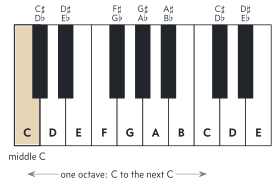
A piano keyboard lays all of this out where you can see it (Figure 3.1). The white keys are the seven letters, over and over. The black keys sit in alternating groups of two and three, and they are the map: every C is the white key just to the left of a pair of black keys. The C nearest the center of the piano is middle C, the landmark from which a page of music measures everything else.
The black keys are the notes in between, and each borrows its name from a white neighbor. The black key just above C is C-sharp, written C♯, because a sharp raises a note to the very next key up. The same key lies just below D, so it is equally D-flat, written D♭, because a flat lowers a note to the very next key down. A natural sign, ♮, cancels either one. Together these three signs are called accidentals. Count every key from one C up to the next, leaving out the second C, and you find twelve: seven white and five black. Those twelve notes, repeated octave after octave up the keyboard, are the raw material of nearly all the music in the later volumes of this series.
Guido’s staff had four lines, and books of chant still use it. In the thirteenth century, Italian scribes began adding a fifth, and by about 1600 five had become the rule. A modern staff is five horizontal lines and the four spaces between them,This is the total number of spaces between the lines of a standard music staff. → four• numbered from the bottom up. A note sits either on a line, with the line running through its middle, or in a space. Each step up, from a line to the space just above it or from a space to the next line, is one letter up. So the nine positions of the staff hold nine notes in alphabetical order. Notes beyond them get short extra lines of their own, called ledger lines (Figure 3.2).
Which line is which letter? The lines themselves cannot say. That is the job of the clef, from the French word for “key,” a sign at the left end of every staff. A clef pins one letter to one line, and every other line and space follows by counting. The first clefs were simply letters written at the start of a line, usually F or C and sometimes G, and over the centuries scribes curled and stretched them into the shapes used now.
The treble clef is a decorated G. Its inner curl wraps around the second line from the bottom, which makes that line the G just above middle C, and so it is also called the G clef. High voices and instruments read it: sopranos (the highest women’s voices), violins, flutes, trumpets, and a pianist’s right hand. The bass clef is an F whose two dots sit on either side of the fourth line, which makes that line the F just below middle C. Low instruments read it, such as the cello (chel-oh), the tuba, and a pianist’s left hand. Middle C falls between the two clefs, on a ledger line just below the treble staff or just above the bass staff. Join a treble staff and a bass staff with a brace, a tall curly bracket, and you have the grand staff on which piano music is written.
The third letter, C, makes the C clef, a clef that moves. Its two curves meet at a point, and whichever line that point marks becomes middle C. Centered on the middle line, it is the alto clef, read today mostly by the viola, the violin’s slightly larger and deeper cousin (Chapter 6). Moved up to the fourth line, it becomes the tenor clef (Figure 3.3).
Three instruments use the tenor clef most. The cello is the big string instrument that a seated player holds between the knees. The bassoon is the deepest of the common woodwinds, a long wooden tube folded back on itself. The trombone is the brass instrument with a sliding tube (Chapter 7). All three normally read the bass clef, but all three can climb high, and high notes in the bass clef perch on a ladder of ledger lines that is slow to read. So for their upper passages cellos, bassoons, and trombones switch to tenor clef,This C clef places middle C on the fourth staff line and is used for upper passages on cello, bassoon, and trombone. → tenor clef• which puts middle C on the fourth line and brings the same notes back onto the five lines.
For the very highest notes there is a shortcut. Over a passage a composer writes 8va, short for the Italian ottava alta (oh-tah-vah ahl-tah), “octave high,” followed by a dashed line, and everything under the line is played an octave higher than writtenAn "8va" or "8vb" marking directs a performer to transpose by this interval. → octave• (Figure 3.4). The sign 8vb, for ottava bassa, means the reverse: play an octave lower. Either way the notes are transposed, shifted up or down as a block, by exactly an octave, the one distance that leaves every letter name the same. The player has nothing to work out but the jump.
Rhythm and meter
Tap your foot to almost any song and you find a steady pulse underneath it, as regular as a heartbeat. That pulse is the beat. The position of a note on the staff tells a player which note to play; the shape of the note tells how many beats to hold it.

The longest note in everyday use is the whole note, an open oval with no stem. Add a stem and it becomes a half note, worth half as much. Fill the oval in black and you have a quarter note, which lasts half as long as a half note, and a small flag on the stem makes an eighth note, which halves it once more. Eighth notes that come in a group are usually joined by a thick line called a beam instead of separate flags. Each value is exactly half of the one before it, so the arithmetic is the arithmetic of fractions: a whole note lasts four quarter notes,This is the number of quarter notes in a whole note. → four• or two halves, or eight eighths (Figure 3.5). British musicians use older names for the same notes: semibreve, minim, crotchet, and quaver.
Silence is written too. Every note value has a matching rest, a sign for a silence of the same length, so a quarter rest fills one beat with nothing. A dot after a note adds half of the note’s own length: a dotted half note lasts three beats where a plain half lasts two. A tie, a small curve joining two notes of the same pitch, adds them into a single longer sound, so a whole note tied to a quarter note lasts five beats.
A page of music is cut into equal boxes called measures, or bars, separated by vertical bar lines, and a tie can carry a note across a bar line into the next measure. Every measure of a piece usually holds the same number of beats, and the first beat of each, the downbeat, gets the strongest stress. The repeating pattern of strong and weak beats is the music’s meter. It is announced at the very start by the time signature, two numbers stacked like a fraction without the line. The top number says how many beats each measure holds. The bottom number says which kind of note gets one beat, with 4 standing for the quarter note. So 3/4 means three quarter-note beats to a measure, and 2/4 means two, the plain left-right of marching feet.
The commonest meter of all is 4/4, so common that it is called common time and is often written as a large C in place of the numbers. Common time has four beatsThere are this many beats in a measure of common time. → four•• in every measure, counted ONE-two-three-four, with the heaviest stress on one and a lighter stress on three. Hymns, many marches, and most rock and pop songs move in it. The C, though, does not stand for “common.” Musicians of the fourteenth and fifteenth centuries marked with a full circle any music whose long notes divided into three shorter ones, and they called that rhythm “perfect.” Music that divided into two got a broken circle and was called “imperfect.” The broken circle survived, and it looks like a C. The same C with a vertical stroke through it is cut time, two half-note beats to the measure, the usual meter of a quick march.
Take one beat away and the music changes character. In triple meter, written 3/4, each measure has three beats, ONE-two-three, ONE-two-three: one strong beat and two light ones, like a wheel turning over. It is the meter of couples turning on a dance floor, and the waltz, the minuet, and the mazurkaThis is the number of beats in a measure for dances like mazurkas, minuets, and waltzes. → three•• (muh-zur-kuh) all have three beats to a measure. The waltz was the whirling couple dance of nineteenth-century Vienna. The minuet, a dance of small, precise steps, was the height of fashion at the French court of King Louis XIV in the late 1600s. The mazurka is a Polish country dance that likes to stamp on the second or third beat instead of the first. The waltz and the mazurka return in Chapter 15, and the minuet in Chapter 12.
In some meters each beat divides into three instead of two. A time signature of 6/8 means six eighth notes to a measure, but the ear hears them as two big beats of three each, ONE-two-three FOUR-five-six. That is the lilting swing of an Irish jig or of “Row, Row, Row Your Boat.” Musicians call such meters compound and the ones whose beats divide in two simple. A few pieces count their beats in fives or sevens. “Take Five,” recorded by the Dave Brubeck Quartet in 1959, has five quarter-note beats in every measure, and its uneven lope made it one of the best-selling jazz records ever (Vol. 36, Bebop to Pop Art).
Not every tune begins on a downbeat. Sing “Happy Birthday” and listen for the stress: it falls on BIRTH, not on HAP. The song is in 3/4, and its first two syllables are a pickup, or upbeat, notes that lead into the first full measure from the last beat of an imagined measure before it (Figure 3.6). A conductor shows the same thing with a baton, lifting the hand on the upbeat and dropping it on the downbeat, which is where both words come from.
Tempo
Sing “Happy Birthday” as slowly as a funeral march, then as fast as a cheer. The notes are the same and so are the rhythms. What has changed is the tempo, the speed of the beat. Tempo is measured in beats per minute. At 60 beats per minute, one beat falls each second, like the tick of a clock. At 120, two fall each second, the pace of a brisk march.

For centuries composers had no exact way to write that number down. In 1815 Johann Maelzel (melt-sel), a German inventor living in Vienna, patented the metronome, a clockwork pendulum that ticks at whatever speed its owner sets by sliding a weight along its swinging rod. Maelzel knew Ludwig van Beethoven, the most admired composer of the day (Vol. 16, Romantic Europe), and Beethoven became the first famous composer to print metronome numbers in his music. A marking such as “M.M. = 120” still means 120 beats a minute by Maelzel’s Metronome.
Before the metronome, and beside it ever since, composers have described tempo in words, and the words are Italian. In the seventeenth and eighteenth centuries Italy led European music. Opera had been invented in Florence and Mantua (man-choo-uh) around 1600, Italian singers and violinists held posts at courts from London to Vienna, and Venice had been the first great center of music printing. So the working words of the trade became Italian, just as the working words of ballet are French. A composer who heads a fast piece allegro (uh-leg-roh) is borrowing an ordinary word of Italian:The musical term allegro comes from this language. → Italian• it means “cheerful,” and the marking still carries a hint of brightness along with its speed. Presto, “quick,” is faster still, and it asks only for speed, with no particular mood attached.
Slower than allegro is andante (ahn-dahn-tay), the tempo of an unhurried stroll. The word comes from the Italian verb andare,The musical term andante comes from this language. → Italian• “to go,” and it means “going” or “walking”: neither slow nor fast. Symphonies, the big pieces for a full orchestra (Chapter 12), often have a gently paced middle section marked andante, such as the famous one in Joseph Haydn’s “Surprise” Symphony (Vol. 14, From Luther to Mozart).
Below andante come the slow tempos. Adagio (uh-dah-jee-oh) is ad agio, “at ease,” and asks for a slow, relaxed pace. Largo, “broad,” is slower still, the stately crawl of a funeral procession. So adagio sits between largo and andante,This tempo marking typically designates a speed faster than largo but slower than andante. → Adagio• faster than the first and slower than the second (Table 3.1).
| Marking | Italian meaning | Beats per minute |
|---|---|---|
| largo | broad | about 40 to 60 |
| adagio | at ease | about 66 to 76 |
| andante | walking | about 76 to 108 |
| moderato | moderate | about 108 to 120 |
| allegro | cheerful | about 120 to 168 |
| presto | quick | about 168 to 200 |
A long piece such as a symphony is often built from several separate parts called movements, each with its own tempo, and musicians name the movements by their markings. “The Adagio” of a symphony is simply its slow movement, and “the Allegro” is usually the fast one that opens it. Italian also gave music its words for loudness: forte, “strong,” for loud, and piano for soft. The piano itself was first called the pianoforte, “soft-loud,” because unlike the harpsichord, the plucked keyboard instrument before it, it could play both (Chapter 8).
Composers mark changes of speed and loudness with more Italian, and people singing “Happy Birthday” around a cake obey two of the markings without knowing their names. They usually slow down into the last line, which a composer would mark ritardando (rih-tar-dahn-doh), “slowing down.” Then they hold the final “you” for as long as feels right, which is what a fermata, an eye-shaped sign over a note, asks of a player. The opposite of ritardando is accelerando (ahk-cheh-leh-rahn-doh), gradually speeding up, and a tempo, “in time,” means a return to the speed before. Crescendo (kreh-shen-doh) asks the music to grow louder and diminuendo to grow softer, while doubled letters push loudness to its limits: pp for pianissimo, very soft, and ff for fortissimo, very loud. Romantic pianists made much of tempo rubato, “stolen time,” pulling the beat a little faster here and a little slower there, as a singer does, while the music as a whole keeps moving.
Intervals
Hum the first two notes of “Here Comes the Bride.” The tune starts low, jumps up, and then stays put. That jump has a size, and musicians have names for every size.
The distance between two pitches is an interval. Musicians measure it by counting letter names, and they count both ends. From C up to E is a third, because C, D, and E make three letters. From C up to G is a fifth: C, D, E, F, G. A note and itself make a unison, the interval of “one,” as when two violins play the same note together. Figure 3.8 sets out the whole family above middle C.
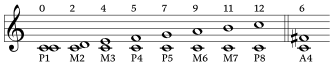
Letter-counting is quick but rough, because the letters are not evenly spaced. The precise unit is the semitone, or half step: the distance from any key on a keyboard to the very next one, white or black. Two semitones make a whole tone, or whole step. Look back at the keyboard in Figure 3.1. Most white keys have a black key between them, so they are a whole tone apart. But there is no black key between E and F, or between B and C, so those white neighbors are only a semitone apart. That is why C up to E is four semitones while E up to G is only three, though both are thirds. Two familiar tunes give the sound of each. The shark’s theme in the film Jaws (1975) is two notes a semitone apart, growling back and forth, and “Happy Birthday” climbs a whole tone from “-py” to “birth-.” Seven notes that use each letter once, as the white keys do, are called diatonic notes. All twelve notes, played one semitone after another, make the chromatic scale, from the Greek word for “color.”
So musicians give every interval a number and a quality. Seconds, thirds, sixths, and sevenths come in two sizes: a larger major one and a minor one a semitone smaller. C up to E, four semitones, is a major third; C up to E-flat, three semitones, is a minor third. Unisons, fourths, fifths, and octaves come in one standard size, and that size is called perfect.
Turn an interval upside down, by moving its lower note up an octave, and you get its inversion. C up to F is a fourth; F up to the next C is a fifth. The two numbers always add up to nine, because the shared note is counted twice, and the two semitone counts always add up to twelve. Perfect intervals invert into perfect ones, and major ones turn minor: C up to A, a major sixth, flips into A up to C, a minor third. Chapter 5 uses the same trick to turn whole chords upside down.
Why “perfect”? Partly because these intervals sound so smooth, as if their two notes melted into one. And partly because of an old discovery about numbers. Around AD 100 a Greek writer on mathematics named Nicomachus (nih-kom-uh-kus) told a story about the philosopher Pythagoras (pih-thag-uh-rus) (Vol. 6, The Greeks), who had lived some six hundred years earlier and taught that numbers lay behind everything in the world. Pythagoras, he said, walked past a blacksmith’s shop and heard its hammers ringing in harmony. He went in, weighed the hammers, and found that their weights stood in simple ratios: 12, 9, 8, and 6 pounds. Guido of Arezzo retold the story in his handbook for singers. It is a legend, and a false one, because a hammer’s note does not depend on its weight in that way. Put the same numbers on a string, though, and they come true (Figure 3.9).
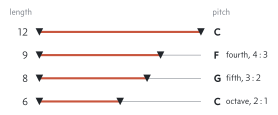

Stop a string at half its length, pressing it down there so that only half of it can vibrate, and it sounds exactly an octave higher, because the shorter string vibrates twice as fast. The octave spans eight letter names,This perfect interval spans eight diatonic note names and corresponds to a 2:1 frequency ratio. → octave•• from C up to C, and its two notes vibrate in the ratio 2:1. The A an orchestra tunes to vibrates 440 times a second, the A an octave below it 220, and the A an octave above 880. Two-thirds of the string sounds a fifth higher, the ratio 3:2, and three-quarters sounds a fourth higher, 4:3.
These are the simplest ratios there are, and that is the deepest reason the perfect intervals sound so smooth: the vibrations of their two notes keep falling back into step. The fourth is the smallest perfect interval apart from the unison,Apart from the unison, this is the smallest perfect interval. → perfect fourth• which is simply a note sounding against itself in the ratio 1:1. Tuning that keeps every interval at an exact whole-number ratio like these, with nothing rounded off, is called just intonation. Singers and string players can tune this way by ear. In just intonation the fourth is tuned to the exact ratio 4:3:In just intonation, this interval is produced by the ratio of 4:3. → perfect fourth• its upper note vibrates four times for every three vibrations of the lower one. Modern pianos bend these ratios very slightly, for reasons that Chapter 4 explains.
On the keyboard, a perfect fourth rises from C to F:This interval's perfect variety is exemplified by the ascending notes C and F. → perfect fourth•• four letters, C, D, E, and F, and five semitones. It is an interval of beginnings, because so many tunes open by leaping up a fourth from a light upbeat onto a strong downbeat. “Amazing Grace” does it, rising from “A-” to “MA-” in its first two notes. So does “Here Comes the Bride.” That tune is the “Bridal Chorus” from Lohengrin (loh-en-grin), an opera of 1850 by the German composer Richard Wagner (vahg-ner) about a mysterious knight who arrives in a boat drawn by a swan (Vol. 19, Wagner and Verdi). In the opera the wedding guests sing it as they lead the bride, Elsa, to her room, and the “Bridal Chorus” opens with a rising fourthThis interval is formed by the opening of the "Bridal Chorus" from Lohengrin. → perfect fourth• (Figure 3.10). It was played at the wedding of Queen Victoria’s eldest daughter in 1858, and brides across the English-speaking world have walked down the aisle to it ever since.
Add two more semitones to a fourth and you reach the next perfect interval: C up to G makes a perfect fifth,This perfect interval separates C from the G above it. → perfect fifth• five letters and seven semitones. It is the leap between the two “twinkles” of “Twinkle, Twinkle, Little Star.” Start on C and climb a fifth to G. From G climb another, to D, then to A, E, B, F-sharp, and onward. After twelve fifths you arrive back at a C, seven octaves above where you began, and on the way you have landed on every one of the twelve notes exactly once. Twelve fifths of seven semitones make 84 semitones, which is exactly seven octaves of twelve. So a circle of fifths links all twelve notesA circle of these perfect intervals links the twelve notes of the chromatic scale. → perfect fifth•• of the chromatic scale (Figure 3.11), and Chapter 4 uses that circle to keep track of keys. The circle also hides a small catch: twelve fifths tuned to a perfect 3:2 overshoot seven octaves by a hair, a gap that tuners have argued over for two thousand years.
Sixths are wider. From C up to the A aboveThis major interval separates C from the A above it. → major sixth•• it is a major sixth: six letters and nine semitones. It is the big, warm leap that opens the old folk song “My Bonnie Lies over the Ocean,” from “My” up to “Bon-” in its first two notes. Lower the A to A-flat and you have a minor sixth, one semitone narrower.
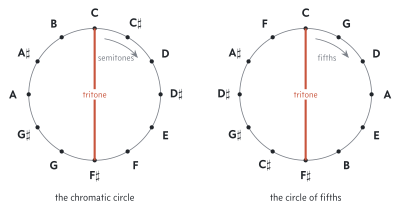
Between the perfect fourth, five semitones, and the perfect fifth, seven, lies an interval of six semitones. Stretch the fourth C–F by a semitone to C–F-sharp and you have an augmented fourth; “augmented” means one semitone wider than perfect or major. Squeeze the fifth C–G down to C–G-flat and you get a diminished fifth (“diminished” means one semitone narrower than perfect or minor). F-sharp and G-flat are the same key on a piano, so the two intervals are the same six semitones. Musicians give this in-between interval a name of its own: the augmented fourth is the tritone.An augmented form of this interval is known as a tritone. → perfect fourth•• You can find one on a keyboard by counting six keys up from any key, black keys included.
The name means “three tones,” and the reason is simple arithmetic: going up from C by whole tones, to D, to E, and to F-sharp, the tritone spans three whole tones.This interval spans three whole tones and was called "the devil in music." → tritone•• Six semitones are exactly half of an octave’s twelve, so the tritone splits the octave down the middle, and no other interval does. It also sounds restless, as if it badly wants to move somewhere else. Medieval and Renaissance teachers warned singers away from it. In 1702 the German organist Andreas Werckmeister (verk-my-ster) wrote that the old authorities had called such clashes diabolus in musica (dee-ah-boh-loos in moo-zee-kah), “the devil in music.” Later composers used its unease on purpose. In Danse macabre (dahns mah-kah-bruh) (1874), the French composer Camille Saint-Saëns (san-sahns) has Death tune his fiddle to a tritone at midnight before the skeletons dance (Vol. 18, Paris, Capital of the Arts). The American composer Leonard Bernstein (burn-stine) opened the love song “Maria,” from West Side Story (1957), with one (Vol. 35, Stage, Screen, and Verse).
Set the twelve notes around a clock face, with C at twelve o’clock and each hour one semitone higher: C-sharp at one, D at two, and so on round to B at eleven. This arrangement is the chromatic circle. Every interval is now a turn of the hands, and the tritone, six semitones, is a half turn. C sits directly across from F-sharp,This note is directly across from F-sharp in the chromatic circle, forming a tritone interval. → C• at six o’clock, just as every note sits across from the note a tritone away. Rearrange the clock in fifths, as on the right of Figure 3.11, and C and F-sharp still face each other, six fifths apart.
What to remember
- Pitch is how high a sound is, measured as vibrations per second. Notes are named A to G, and the twelve keys of each octave (seven white, five black) are the raw material of Western music.
- A staff has five lines and four spaces. A clef names them: treble (G), bass (F), and the movable C clefs, alto (middle C on the middle line) and tenor (middle C on the fourth line, for high cello, bassoon, and trombone). 8va means play an octave higher.
- Note values halve: one whole note equals two halves, four quarters, or eight eighths.
- The time signature gives beats per measure (top) and the note that gets a beat (bottom). Common time, 4/4 or C, has four beats; triple meter, 3/4, has three, as in the waltz, minuet, and mazurka.
- Tempo words are Italian: largo (broad), adagio (at ease), andante (walking), allegro (cheerful), presto (quick).
- Intervals are counted by letter names, both ends included; semitones measure them exactly.
- The perfect intervals are the unison, fourth (C–F, 4:3), fifth (C–G, 3:2), and octave (2:1). C to A is a major sixth.
- Twelve fifths visit all twelve notes and return home: the circle of fifths.
- The tritone, the augmented fourth of three whole tones, splits the octave in half; C and F-sharp face each other on the chromatic circle. It was called “the devil in music.”
Chapter 4 · 27 clues
Scales, Keys, and Tuning
Sit down at a piano and look at the black keys. They come in groups, two and then three, all the way up the keyboard. Put a finger on the white key just to the left of any pair of black keys. That key is the note C, and it will be your starting point. Now play the white keys to its right, one at a time, until you reach the next C, eight keys in all. Anyone who grew up hearing Western music recognizes this climb by the fourth note, and nearly everyone feels that the eighth key ends something, as if a walk had come home.
Nothing in the physics of sound forces those eight notes on us. The span from one C to the next holds twelve different keys, white and black, and musicians in other places choose other sets. This chapter follows that one row of white keys. It shows how the row is built and named, and how it turns into seven different scales when you start it in a new place. Then it moves the row up and down the keyboard to make keys, and asks why it took more than two thousand years to agree on how its notes should be tuned.
Scale degrees and solfège
A scale is a set of notes arranged by pitch, climbing step by step from a starting note to the same note an octave higher. Chapter 3 laid out the piano’s twelve keys to the octave, each a semitone, or half step, above its neighbor, with two semitones making a whole step. It also pointed out the two places where white keys touch with no black key between them, E to F and B to C, and those two half steps give the row of white keys its shape.

Walk up the white keys from C and name each step (Figure 4.1). C to D is a whole step, D to E a whole step, and E to F a half step. Then come three whole steps, F to G, G to A, and A to B, and a last half step from B up to C, which completes the octave. The order is whole, whole, half, whole, whole, whole, half. That pattern, wherever it starts, is the major scale, and its sound is the one most listeners call bright and settled.
Musicians number the notes of a scale from the bottom. A note’s number is its scale degree: the first note is the first degree, the next is the second, and so on up to the seventh. The first degree is the tonic, the home note. It gives the scale its name, and most melodies built on the scale come to rest on it at the end. In the scale of C major, C is the tonic and D the second degree. E is the third degree,This scale degree is E in the key of C major. → three• two whole steps above C, while G is the fifth and B the seventh (Figure 4.2). The next step up brings back C, an octave above the first. That is why scale degrees count only to seven before the climb starts over.

The tonic sounds like home partly from habit, since we have heard thousands of tunes end there. It also sounds like home because of the half step at the top of the major scale. The seventh degree, B in C major, sits only a semitone below the tonic and seems to lean into it, so a tune that stops on B sounds as if it has stopped in a doorway. Chapter 5 gives the seventh degree its own name and shows how chords use its pull.
Singers were naming these steps long before anyone numbered them. Guido of Arezzo, the monk who drew a full set of staff lines for his choirboys about 1025 (Chapter 3), also gave the steps names. For this he used a hymn to Saint John the Baptist, “Ut queant laxis.” Its tune has a curious property: each of its first six half-lines, marked by the bold syllables below, begins one step higher than the one before.
The first syllables of those half-lines, ut, re, mi, fa, sol, and la, became names for six steps of the scale. A boy who knew the hymn could find any step by remembering the half-line that began on it. In the 1600s, Italian singers replaced ut, which is hard to hold on a long note, with do. A seventh syllable, si, was added for the seventh degree. In the 1800s the English music teacher Sarah Glover changed it to ti, so that no two syllables would begin with the same letter. Singing the notes of a scale to these syllables is called solfège (sol-fezh).

There are two ways to use the syllables. In fixed do, the custom in France, Italy, and Spain, do always means the note C, and re always means the note D, whatever the music. In movable do, the custom in most American and British schools, do means the tonic of whatever scale is being sung, re its second degree, and so on up. A singer who moves to the major scale on G calls G do. The syllables then name scale degrees rather than pitches, and mi always means the third degree,The movable-do solfège syllable "mi" represents the scale degree of this number. → three• the note that gives a major scale its bright color. A choir trained this way can sing a tune in any key without learning new names.
Modes
Go back to the white keys, but this time start on D and climb eight keys to the D an octave up. You are playing the same seven notes as before, yet the climb sounds older and darker, a little like a sea shanty or the chant of medieval monks. The reason is the two half steps. They have not moved on the keyboard, where they still lie between E and F and between B and C, but they now fall in different places in the climb: between the second and third notes, and between the sixth and seventh. Change where the half steps fall, and you change the sound of the scale.
A scale defined by its own order of whole and half steps is called a mode. Starting on each white key in turn gives seven of them (Figure 4.4). Medieval scholars named them after peoples known to the ancient Greeks, because Greek writers on music had used those names, although the Greek scales were quite different. Four white-key modes, those on D, E, F, and G, were the scales of the chant sung in medieval churches. Two more, on C and A, were named only in 1547, by the Swiss scholar Heinrich Glarean. The seventh, the Locrian (loh-kree-un), starts on B and was named but almost never used. Its fifth note, F, lies a tritone above B instead of a perfect fifth, so the mode has no firm footing.

The Ionian (eye-oh-nee-un) mode, starting on C, is simply the major scale. The Dorian, from D, is the one you just played, and the English folk song “Scarborough Fair” is sung in it. The Phrygian (frij-ee-un) mode begins on E, the third degreeA Phrygian mode scale has no sharps or flats in its key signature if it begins on this scale degree of C. → three• of C, and runs up the white keys to the E an octave higher. Its key signature, the row of sharps or flats printed at the start of every line of music, is empty, like C major’s. Apart from the little-used Locrian, the Phrygian is the only mode whose second note lies just a half step above its first. That crowded first step gives it a dark, sighing color, which Spanish flamenco guitarists still use.
The Lydian mode runs up the white keys from F to the F above. Set it beside F major, the major scale that starts on the same note. To keep the major pattern of whole, whole, half at its start, F major needs one black key, B-flat, because the step from A to B-flat is the half step it requires. The Lydian mode keeps the white B instead, a whole step above A (Figure 4.5). In other words, the Lydian raises the major scale’s fourth degreeTo turn a major scale into the corresponding Lydian mode, the scale degree of this number is raised by a semitone. → four• by a semitone, and its fourth note seems to float upward instead of settling. Ludwig van Beethoven, the German composer (Vol. 16, Romantic Europe), wrote one of his last string quartets, pieces for four string players, after a dangerous illness in 1825. He headed its slow movement as a hymn of thanks “in the Lydian mode.”

Start on G and you get the Mixolydian (mix-oh-lid-ee-un) mode, the white keys from G to G.A scale played using only white keys is in the Mixolydian mode if it begins on this note. → G• It is a major scale with one note changed. Its seventh degree, F, is a semitone lower than the F-sharp that the major scale on G would use, so it lacks the half step that leans into the tonic, and its endings sound relaxed rather than final. Folk fiddlers, Scottish bagpipers, and rock guitarists all use it.
The mode on A matters most of all. The Aeolian (ee-oh-lee-un) mode begins on A, the sixth degreeThe Aeolian mode begins on this scale degree of the major scale. → six•• of C major, and its steps run whole, half, whole, whole, half, whole, whole. It is also called the natural minor scale, and it is the parent of the minor scale, which shared European music with the major scale from about 1650 to 1900. The difference you hear first lies in the third degree. In C major, the third degree, E, lies a major third above the tonic, four semitones. In A minor, the third degree, C, lies only a minor third above A, three semitones (Chapter 3). That one missing semitone is what makes minor sound darker.
Composers writing in minor usually raise its seventh degree by a semitone, to G-sharp in A minor. This borrows the major scale’s leaning half step into the tonic, and the altered form is called the harmonic minor scale, because it suits the chords that composers built on it (Chapter 5). During the 1600s, the major and minor scales crowded the other modes out of European concert music. The old modes returned in the late 1800s, when composers went looking for sounds older than their own. Folk singers had never given them up.
Scales from other traditions
Play only the black keys, in any order, and it is hard to make an ugly sound. The five black keys form a pentatonic scale, a scale of five notes to the octave (the Greek pente means “five”). It has no half steps at all, so no two of its notes rub against each other. The white keys hold one too: C, D, E, G, and A, which is the major scale with its fourth and seventh degrees taken out, the two notes that make its half steps (Figure 4.6). Pentatonic tunes turn up all over the world, in Scotland and China, West Africa and the Andes. “Amazing Grace” and “Auld Lang Syne” are two that English speakers know by heart.

Frédéric Chopin (fray-day-reek shoh-pan), the Polish pianist and composer (Vol. 16, Romantic Europe), built a whole piece on the black keys. It is an étude (ay-tood), French for “study”: a piece written to train one skill of a player’s hands, which a great composer can turn into music worth hearing for its own sake. In this étude of 1830, in G-flat major, the right hand races up and down in quick groups of three notes on the black keys, touching a white key only once in the whole piece. Pianists call it the “Black Key” Étude, and its right hand runs on the pentatonic scale,Chopin’s "Black Key" Étude uses this type of scale, which has five notes per octave. → pentatonic scale•• while the left hand supplies the harmony below.
Some scales have more than seven notes. In St. Petersburg about 1900, the composer Nikolai Rimsky-Korsakov (rim-skee kor-suh-kof) and his pupils used one scale so often that they called it by his name. It has eight notes to the octave and is now called the octatonic scale, from the Greek okto, “eight.” Its steps alternate whole and halfThis eight-note scale alternates whole and half steps. → octatonic scale• all the way up, without a break (Figure 4.7). Because the pattern repeats every three semitones, a whole step plus a half step, the scale moved up three semitones lands on exactly the same notes. Moved up one semitone or two, it gives a new set of notes, so only three different octatonic scales exist. Rimsky-Korsakov’s pupil Igor Stravinsky (struh-vin-skee) built much of the music of his ballets Petrushka (1911) and The Rite of Spring (1913) from it (Vol. 20, The North and the East).

A close cousin uses whole steps only. The whole-tone scale has six notes to the octave, each a whole step above the last: C, D, E, F-sharp, G-sharp, A-sharp, and C again. With no half steps to lean on, no note in it sounds like home, and music built on it seems to hang in the air. The French composer Claude Debussy (deb-yoo-see) (Vol. 18, Paris, Capital of the Arts) wrote most of his piano prelude “Voiles” on it, a title that can mean either “sails” or “veils.”
Pentatonic, octatonic, and whole-tone scales all still use the piano’s twelve semitones. Two great traditions outside Europe divide and name the octave in their own ways. In India, musicians name the steps of a scale with syllables, much as Guido’s singers did. The system is called sargam (sur-gum), from its first four syllables, and its seven notes are sa, ri, ga,Musicians in this country use a solfège-like system with the notes sa, ri, ga, ma, pa, dha, ni. → India•• ma, pa, dha, and ni. In the north of India, ri is usually sung re. Each syllable is the start of a name in Sanskrit, the ancient learned language of India: sa is short for shadja, and pa for panchama, “the fifth.”
As in movable do, sa is the tonic, and a singer may set it at whatever pitch suits his voice. Sa and pa, a perfect fifth above it, never change. The other five can each be moved a semitone, ri, ga, dha, and ni down and ma up. Behind the whole performance, a drone instrument called the tanpura (tahn-poo-rah) sounds sa and pa softly and without a break. A scale is only the raw material of a raga (rah-guh). A raga also decides which notes are used going up and which coming down, which phrases are typical, which note is leaned on, and often the time of day the music is meant for. Raga Yaman, a favorite for the early evening, raises ma, the fourth note, so its scale has the same pattern as the Lydian mode. India’s great players of the sitar, a long-necked plucked instrument, are taught in Vol. 39, India.
Arabic music organizes its melodies by maqam (mah-kahm), a system of modes. The word is Arabic for “station,”The name of the maqam modal system comes from this language’s word for "station." → Arabic• the place where a traveler stops, and each maqam is a kind of station for a melody: a set of notes with a starting note, a few typical phrases, and a mood of its own. Many maqams use notes that fall between the keys of a piano. Maqam Rast, which starts on C, has an E and a B that are each about a quarter tone (half a semitone) lower than the piano’s, so its third degree sits between a minor third and a major third. The oud (ood), a plucked string instrument of the Arab world with a round back (Vol. 37, The House of Islam), has no frets, the raised bars across a guitar’s neck that fix its notes. Its player can press a string down anywhere and find these notes, which a piano cannot play. A performance often opens with a taqsim (tuck-seem), an improvised solo that walks through the maqam and shows the listener its notes before the song begins.
Keys and key signatures
A singer finds a song too high, and the pianist plays it lower. Every note changes, yet everyone still hears the same song, because its steps survive: the tune goes up and down by the same distances from a new starting point. Moving a whole melody up or down so that every step keeps its size is called transposing. Musicians name the result by its tonic and its scale. A piece built on the major scale that starts on C is in the key of C major, and the same piece moved up to start on G is in G major. A key, then, is a home: a tonic together with the scale built on it.
Rather than write a sharp before every F in a piece in G major, composers print it once, on the F line, at the start of every line of music, just after the clef. The sharps or flats placed there are the piece’s key signature, and they apply to every note of that letter name, in every octave, until the signature changes (Figure 4.8). One key needs none at all. C major has no sharps or flats,This key has no sharps or flats. → C major••• since its scale uses the white keys alone, which is why so many pieces for beginners are written in it.

Build the major scale on D and you need two sharps, F-sharp and C-sharp; build it on A and you need three. The keys line up in a chain. G is a perfect fifth above C, D is a fifth above G, and A a fifth above D, and each step along the chain adds one sharp. The new sharp is always the new key’s seventh degree, a half step below its tonic. Following the chain further, E major has four sharps and B major five. At the sixth step of the chain, F-sharp major has six sharps,The key of F-sharp major contains this many sharps. → six• so that every note but B is raised.
Go around the other way and each key is a fifth below the last and adds a flat. F major has one flat, B-flat, as the comparison with the Lydian mode showed, and B-flat major has two, B-flat and E-flat. The new flat is always the new key’s fourth degree, and the next key down the chain starts on that very note. So each flat key is named by the flat that the key before it added, which is the second-to-last flat in its own signature. E-flat major has three flats:This major key has three flats. → E-flat major•• B-flat, E-flat, and A-flat. Its second-to-last flat, E-flat, names the key, just as the rule says.
The flats always arrive in the same order: B-flat, E-flat, A-flat, D-flat, G-flat, C-flat, and F-flat. Many students remember the letters as the made-up word BEAD, followed by G, C, and F at the end. Take one more fifth down from E-flat, and A-flat major has four flats,This is the number of flats in the key of A-flat major. → four• adding D-flat to the three that E-flat major already had. Its second-to-last flat is A-flat, and that names it. Each new key keeps all the flats of the key before it, so the list only grows. A fifth below A-flat lies D-flat, whose scale needs G-flat as well. D-flat major has five flats,This is the number of flats in D-flat major. → five•• the first five of the list, running from B-flat through G-flat.
At the bottom of the chain the two sides meet. F-sharp major, with six sharps, uses exactly the same piano keys as G-flat major, with six flats; they are one key spelled two ways. Since twelve fifths visit every note of the octave once and come home (Chapter 3), the chain of keys closes too, into the circle of fifths (Figure 4.9). Each step clockwise adds a sharp or takes away a flat, and each step counterclockwise does the reverse.

Every major key shares its signature with a minor key. Play the white keys from A up to the next A, the Aeolian mode, and you are playing the natural minor scale on A, built from exactly the notes of C major (Figure 4.10). A minor and C major therefore share a key signature with no sharps or flats. The relative minor of a major key is the minor key with the same notes, and the major key is its relative major, so C major’s relative minor is A minor.This key's relative minor is A minor. → C major•• The two sound different because they have different homes, so the same seven notes pull toward different tonics. A tune on the white keys that comes to rest on C sounds major, and one that comes to rest on A sounds minor.

A sits on the sixth degree of C major, and the rule holds for every major key: the sixth degree is the relative minor’s tonic.For a major key, the note of this scale degree is the tonic of the relative minor. → six•• To find the relative minor of G major, count up its scale, G, A, B, C, D, E, to the sixth degree, and E minor is your answer. Both keys share G major’s single sharp. Counting the other way is quicker. From the minor tonic up to the major one, A up to C, is three semitones, counted A to B-flat, B-flat to B, and B to C, and that distance is the minor third that gives minor its darker color. So a major tonic lies a minor third aboveA major key’s tonic lies this interval above the tonic of its relative minor. → minor third• the tonic of its relative minor, in every pair of relative keys. On the circle of fifths, each relative minor sits just inside its major key, so the circle names both members of every pair at once (Figure 4.9).
The rule works on any pair. Climb a minor third from C, through C-sharp and D, and you reach E-flat. So E-flat major is the relative major of C minor,This key is the relative major of C minor. → E-flat major•• and the two keys share E-flat major’s signature. C minor was the key of some of Beethoven’s stormiest music, including his Fifth Symphony. A pianist who opens one of those pieces sees three flats at the start of every line of music, one on the staff’s B line and two in its E and A spaces. That is C minor’s key signature of three flats,This minor key has a key signature of three flats. → C minor•• borrowed from its relative major.
The same arithmetic pairs every minor key with a major one. Count a minor third up from G, through G-sharp and A, and you reach B-flat. The major key three semitones above G is therefore B-flat major, with its two flats, B-flat and E-flat, and so G minor is the relative minor of B-flat major.This minor key is the relative minor of B-flat major. → G minor• Wolfgang Amadeus Mozart, the Austrian composer (Vol. 14, From Luther to Mozart), wrote two of his most anguished symphonies, No. 25 and No. 40, in G minor.
Most long pieces do not stay in one key. Moving from one key to another partway through a piece is called modulation, and the easiest moves are to the nearest neighbors on the circle of fifths, or between relative keys, because those keys share all or all but one of their notes. A piece usually wanders and then comes home, ending in the key it began in, and that return gives a long work its sense of a journey completed.
A key gives a piece its home, and composers chose homes with care. Instruments have favorite keys. A violin’s four strings are tuned to G, D, A, and E, and music in D major or G major lets those strings ring open, with no finger pressing them. The trumpets of the early 1700s had no valves and could play only the notes of one key, often D major. That is one reason why George Frideric Handel, a German composer working in London, set the “Hallelujah” chorus of his Messiah (Vol. 12, Crown and Parliament), a sacred work for choir and orchestra, in D major, where its trumpets could blaze.
When Beethoven wrote his Third Symphony, he opened it with two hammer blows of the E-flat major chord, its first, third, and fifth degrees struck together by the whole orchestra. He had meant to name the symphony after Napoleon. His pupil Ferdinand Ries later told how, when Napoleon made himself emperor in 1804, Beethoven tore the title page in half in a rage. When the symphony was printed in 1806, it was called Eroica (eh-roh-ih-kuh), Italian for “heroic.” Beethoven’s Third Symphony is in E-flat major,Beethoven's Symphony No. 3, the "Eroica," is in this key. → E-flat major•• and that key, with its three flats, became for many later composers the key of grandeur.
Maurice Ravel (rah-vel), a French composer (Vol. 22, The Lost Peace), did the opposite of modulating in Boléro (boh-lair-oh), written in 1928 as music for a dancer. For about fifteen minutes the same two tunes repeat over the same snare-drum rhythm, passed from instrument to instrument and growing steadily louder, and Boléro stays in C majorRavel's Bolero is in this key. → C major•• almost the whole time. Only a few bars before the end does the music lurch up into E major, and eight bars later it falls back into C. After so long in one key, that brief change is a shock, and the piece crashes to its close.
Felix Mendelssohn (men-dl-sun), a German composer (Vol. 16, Romantic Europe), wrote incidental music, music to be played during a performance of a play, for Shakespeare’s comedy A Midsummer Night’s Dream in 1842. Its most famous number accompanies the weddings near the end of the play. Mendelssohn’s “Wedding March” is in C major,Mendelssohn's "Wedding March" from incidental music for A Midsummer Night's Dream is in this key. → C major• and it opens with a fanfare of trumpets. It was played at the same royal wedding of 1858 as Wagner’s Bridal Chorus (Chapter 3), and couples have walked back down the aisle to it ever since.
How a work is named
A concert program in any city might list “Beethoven: Symphony No. 5 in C minor, Op. 67.” Every part of that name means something. “Symphony” is the genre, the kind of piece. “No. 5” says it is the fifth symphony Beethoven numbered; he finished nine. “In C minor” names its key, the home of its first movement and of the whole work, though its last movement turns to C major and ends in triumph there. “Op. 67” is its opus number. Opus (oh-pus) is Latin for “work,” and an opus number counts the works a composer published, in roughly the order they appeared.
An opus may hold several pieces, numbered within it. Chopin published his first twelve études together as Op. 10, so the “Black Key” is the Étude in G-flat major, Op. 10, No. 5, the fifth of the set. Many works also carry a name in words. A title the composer gave is printed in italics in this series, like the Eroica, while a nickname that others attached goes in quotation marks. Beethoven’s “Moonlight” Sonata, a piece for piano, got its name from a critic who compared its first movement to moonlight on a lake (Chapter 12).
Opus numbers sound tidy, and often they are not. They usually record when a work was printed, not when it was written. Before about 1800 they were handed out by publishers, who grouped pieces in sets of six or twelve and numbered them as they pleased. The Czech composer Antonín Dvořák (an-toh-neen dvor-zhahk) (Vol. 20, The North and the East) suffered worst. One publisher gave his early works high numbers, to make him look established, and one number, Op. 12, was given in turn to five different pieces. His Symphony From the New World, written in 1893, was first published as No. 5 and is now called No. 9, because scholars later put his symphonies in the order he wrote them.
Many composers left most of their music unpublished, so most of it has no opus number at all. For four of the most important, scholars have built complete catalogs that number every work, and the catalog number has replaced the opus number in concert programs (Table 4.1).
| Letters | Composer | Compiled by | Year | Example |
|---|---|---|---|---|
| BWV | J. S. Bach | Wolfgang Schmieder | 1950 | Toccata and Fugue in D minor, BWV 565 |
| Hob. | Joseph Haydn | Anthony van Hoboken | 1957 | “Surprise” Symphony, Hob. I:94 |
| K. | W. A. Mozart | Ludwig von Köchel | 1862 | Eine kleine Nachtmusik, K. 525 |
| D. | Franz Schubert | Otto Erich Deutsch | 1951 | “Unfinished” Symphony, D. 759 |
The works of the German composer Johann Sebastian Bach (Vol. 14, From Luther to Mozart) carry BWV numbers, from the German Bach-Werke-Verzeichnis (bahkh vehr-kuh fehr-tsykh-nis), “catalog of Bach’s works,” which Wolfgang Schmieder published in 1950. It is arranged by kind of piece, beginning with his cantatas, pieces for singers and instruments written for church services, so a BWV number says nothing about date. BWV 1 is a cantata of 1725, while BWV 992, a keyboard piece, is an early work written many years before it. The Austrian composer Joseph Haydn (Vol. 14, From Luther to Mozart) has Hob. numbers, after the Dutch collector Anthony van Hoboken (hoh-boh-ken), whose catalog came out between 1957 and 1978. A Roman numeral gives the kind of piece and a second number its place, so Hob. I, the symphonies, includes Hob. I:94, the “Surprise.”
Mozart’s music is numbered by K., for Ludwig von Köchel (kur-khul), an Austrian botanist who loved Mozart’s music. In 1862 Köchel put all of it in the order he believed it was written, from a short keyboard piece of Mozart’s early childhood to K. 626, the Requiem (rek-wee-em), or Mass for the dead, that he left unfinished at his death in 1791. Eine kleine Nachtmusik (eye-nuh kly-nuh nahkht-moo-zeek), “a little night music,” is K. 525. The Viennese composer Franz Schubert (Vol. 16, Romantic Europe) has D. numbers, from the catalog Otto Erich Deutsch (doych) published in 1951, also in order of composition. Schubert’s “Unfinished” Symphony is D. 759.
Tuning systems
A piano tuner at work strikes two keys a fifth apart and listens. If the fifth is pure, tuned to the exact ratio of 3:2, the sound is smooth and still. If it is a little off, the sound wavers, swelling and fading a few times a second, and musicians call this wavering beating. A good tuner sets every fifth on the piano so that it beats slowly, about once a second in the middle of the keyboard. He puts all twelve fifths slightly out of tune, on purpose. The reason takes more than two thousand years to tell.
Tuning is the job of setting every note of an instrument at its exact pitch, and a tuning system is the rule that decides those pitches. The oldest in European music starts from the ratios of Pythagoras’s legendary hammers (Chapter 3): 2:1 for the octave and 3:2 for the fifth. Start on C and tune a pure fifth up to G, then from G tune a pure fifth to D, from D to A, and so on, dropping each new note by an octave whenever it climbs too high. This is Pythagorean tuning, built by stacking pure 3:2 fifths,This tuning system constructs pitches by stacking pure 3:2 fifths. → Pythagorean tuning• and medieval musicians tuned organs and harps this way. Its fifths and fourths are flawless, which suited chant and the early harmony built on those intervals.
A keyboard instrument, such as an organ or a harpsichord, has one fixed key for each note, so its tuner must decide where the comma goes. In Pythagorean tuning the usual choice was to tune eleven fifths pure and let the twelfth, often the one between G-sharp and E-flat, take the whole comma. That fifth comes out nearly a quarter of a semitone too narrow and beats so harshly that musicians called it the wolf, for its howl. Wherever the tuner hides it, the comma in the tuning makes a wolf,Commas that arise when performing this task often lead to an undesirable "wolf" effect. → tuning• and any piece that needs that interval sounds sour.
Pythagorean tuning had a second flaw. Its major thirds, built from four pure fifths, come out noticeably wide and sound harsh. From the 1500s, keyboard players turned to meantone tuning, which narrowed eleven of the twelve fifths slightly so that the major thirds would ring pure. Music in keys near C sounded sweeter than ever, but the twelfth fifth, the wolf, grew fiercer, and keys with many sharps or flats could hardly be played at all.
The way out was to share the comma equally. Narrow each of the twelve fifths by one-twelfth of the comma, about a fiftieth of a semitone, and the circle closes exactly. Every semitone becomes the same size: each note’s frequency is the one below it multiplied by about 1.0595, the number that, multiplied by itself twelve times, makes exactly two. Adjusting pure intervals so that they fit together is called temperament, and this even sharing is equal temperament. In it, no interval but the octave is pure, yet none is badly out of tune, and every key sounds like every other. Mathematicians in China and in the Netherlands worked out its numbers around 1600, and by the late 1800s it was the normal tuning of pianos.

Johann Sebastian Bach showed what a good temperament could do. In 1722 he finished the first book of The Well-Tempered Clavier (clavier is German for a keyboard instrument), twenty-four pairs of pieces, one pair in every major and every minor key, from C major up to B minor. Each pair is a prelude, a free opening piece, followed by a fugue, a piece in which several voices enter one after another with the same tune (Chapter 10). “Well-tempered” meant tuned so that all twenty-four keys could be played. Scholars still argue over whether Bach meant equal temperament or one of the slightly unequal tunings of his day, which gave each key a faintly different color.
String players face a different problem. A violinist can put a finger anywhere on a string and adjust every note by ear, so what a violinist tunes is the four open strings, normally G, D, A, and E, each a fifth above the last. Scordatura (skor-dah-too-rah), Italian for “mistuning,” is a deliberately different way of tuningScordatura denotes an alternative method for this task. → tuning• those strings. Composers use it to make new chords easy to play, to change the instrument’s color, or to startle the listener.
About 1676 the violinist Heinrich Biber (bee-ber), who worked in Salzburg (Vol. 14, From Luther to Mozart), wrote fifteen sonatas for violin on the mysteries of the Rosary, the events in the lives of Jesus and Mary that Catholics meditate on in prayer. They ask for a new tuning in almost every piece. In the one for the Resurrection, the two middle strings even trade places, crossing over each other on the instrument. The composer and conductor Gustav Mahler (mah-ler) (Vol. 19, Wagner and Verdi) has the solo violinist in the second movement of his Fourth Symphony tune every string a whole step higher, so that it sounds like a shrill country fiddle played by Death. And when Death tunes his fiddle to a tritone in Saint-Saëns’s Danse macabre (Chapter 3), the trick is scordatura: the soloist’s highest string is lowered from E to E-flat, so the open A and E-flat strings sound the tritone together.
What to remember
- A scale climbs from its tonic to the octave above. Its notes are numbered as scale degrees one to seven, and the major scale’s steps run whole, whole, half, whole, whole, whole, half.
- Solfège names the degrees do, re, mi, fa, sol, la, ti. Guido of Arezzo took the first six from a hymn to Saint John. In movable do, mi is always the third degree.
- The seven white-key modes run from Ionian on C (the major scale) to Locrian on B; Phrygian begins on E, Lydian on F raises the major scale’s fourth degree, Mixolydian begins on G, and Aeolian on A is the natural minor scale.
- A pentatonic scale has five notes to the octave, like the black keys of Chopin’s “Black Key” Étude. An octatonic scale has eight, alternating whole and half steps, and a whole-tone scale has six. India names its notes sa, re (or ri), ga, ma, pa, dha, ni; Arabic music uses the maqam, the “station.”
- A key signature lists a key’s sharps or flats. C major has none; each fifth up adds a sharp and each fifth down a flat, so E-flat, A-flat, and D-flat major have three, four, and five flats, and F-sharp major six sharps.
- A relative minor starts on the sixth degree of its major key, a minor third below its tonic: A minor and C major, C minor and E-flat major, G minor and B-flat major.
- A work’s full name gives its genre, number, key, and opus number. BWV numbers Bach’s works, Hob. Haydn’s, K. Mozart’s, and D. Schubert’s.
- Twelve pure fifths overshoot seven octaves by the Pythagorean comma, which makes a wolf. Equal temperament shares the comma among all twelve fifths, and scordatura retunes a string instrument on purpose.
Chapter 5 · 32 clues
Chords and Cadences
On the evening of June 10, 1865, the royal opera house in Munich was full for the first performance of Tristan und Isolde (tris-tahn oont ih-zohl-duh), an opera about two doomed lovers from medieval legend. Its composer was Richard Wagner, a German who wrote both the words and the music of his enormous operas. The premiere had already been put off for a month while the soprano singing Isolde got over a hoarse throat. When the conductor at last raised his baton, the cellos began alone, very softly. They rose by a wide leap and then sank back two small steps. On the second of those steps the woodwinds came in, and four notes sounded together in a combination that was tense and sweet at once, like a question with no answer. It slid into a second sound that was also waiting for something. Then the whole orchestra stopped, and the hall was silent.
The phrase began again a little higher, and stopped again. It came a third time, higher still. Wagner was teasing his audience with a sound that would not settle, and the four notes at its heart are now called the Tristan chord. Musicians have argued about them for more than 150 years. The argument only makes sense to someone who knows what chords normally do: how they are built, what they are called, and how a piece of music uses them to leave home and come back. All of that can be heard, and most of it can be tried on any piano.
The triad
Press three white keys of a piano at the same moment: middle C, the E two white keys above it, and the G two white keys above that. You do not hear three separate notes. You hear one sound, bright and settled, the sound that ends countless hymns, marches, and pop songs. Notes sounding together in this way make a chord. A chord usually has three or more notes,These harmonic combinations usually consist of three or more notes sounding together. → chords•• since two notes sounding together are simply an interval, the distance between two pitches that Chapter 3 measured. The art of building chords and moving from one to the next is called harmony. If a melody is the line of notes you can hum, running forward in time, harmony is what stands beneath each moment of it.
Most people first meet harmony as accompaniment, the music that supports a singer or a solo player. A pianist at a choir rehearsal plays chords under the voices, and so does a guitarist strumming while friends sing around a campfire. Guitarists and pianists accompany singers with chordsGuitarists and pianists often play these musical entities as accompaniment for vocalists. → chords• for a simple reason: their instruments can sound several notes at once, which a voice, a flute, or a trumpet cannot. The singer carries the tune, and the chords tell the ear what each note of the tune means, the way stage lighting can make the same scene cheerful or grim.
The commonest chord is built by skipping. Start on C and take every other white key, skipping one each time: C, then E, then G at the top. Each step of this stack spans three letter names (C, D, E), so it is a third (Chapter 3), and a chord of three notes stacked in thirds is a triad, the basic building block of Western harmony. A triad is built from a root, a third, and a fifth.These chords consist of three notes built from a root, a third, and a fifth. → triads• The root is the bottom note of the stack, and the chord is named after it. The note a third above the root is called, simply, the third, and the note a fifth above it, five letter names up (C, D, E, F, G), is called the fifth. The triad on C is C, E, and G; on F it is F, A, and C; on G it is G, B, and D, with B in the middle. The word comes from the Greek for “a group of three,” and a triad holds three different notes.This is the number of notes in a triad. → three•• A pianist may double one of them in a higher octave, but the chord stays a triad, because the doubled note adds no new letter.
Thirds come in two sizes, as Chapter 3 explained, and that is where a triad gets its color. Count half steps, or semitones, the distance from one key to the very next, black or white. From C up to E is four half steps: C-sharp, D, D-sharp, E. That is a major third. From E up to G is three half steps, a minor third. A major third with a minor third on top makes a major triad, the bright sound of C–E–G. Now lower the middle note one half step, to the black key E-flat. The stack becomes a minor third with a major third on top, C–E-flat–G, a minor triad, which most listeners hear as darker and sadder (Figure 5.1). The root and the fifth have not moved, so only the third separates major from minor.Major and minor triads are differentiated solely by the scale degree of this number. → three•• A pianist turns C major into C minor by moving one finger one key.
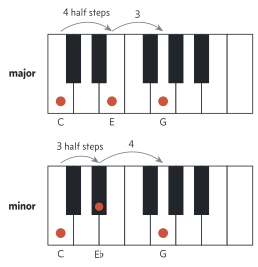
Two more triads complete the family. Lower the top note as well as the middle one, to C–E-flat–G-flat, and you have two minor thirds stacked: a diminished triad, tense and pinched. Go back to the middle E and raise the top note instead, to C–E–G-sharp, two major thirds, and you have an augmented triad, which sounds hazy, as if it had come loose from the ground. These four kinds are a chord’s quality, and chords come in major, minor, diminished, and augmentedTypes of these musical entities include major, minor, diminished, and augmented. → chords• forms. A chord is named by its root and its quality together: C major, A minor, B diminished (Figure 5.2). The words are the same as for major and minor keys (Chapter 4), and for a good reason. The triad on the first note of a major scale is major, and the triad on the first note of a minor scale is minor.
A chord keeps its name when its notes are rearranged. Take C–E–G and move the C up an octave to get E–G–C. The notes are the same, so it is still a C-major chord, but E is now at the bottom. The lowest note of a chord is its bass, and the bass changes how the chord feels. With the root in the bass, the chord is in root position, and it sounds solid and final. With a note other than the root in the bass,These harmonic combinations are inverted when a note other than the root is placed in the bass. → chords• the chord is inverted, by the same trick that turns an interval upside down (Chapter 3). With the third in the bass (E–G–C) it is in first inversion, and with the fifth in the bass (G–C–E) it is in second inversion (Figure 5.3). A first-inversion chord sounds lighter and less final, so composers use it in the middle of a phrase and save root position for the ends.

Musicians of the Baroque period, about 1600 to 1750, wrote inversions in a shorthand that is still taught. In those years almost every piece for a group of players rested on a basso continuo (bah-soh kun-tin-yoo-oh), a “continuous bass” played by a cello together with a keyboard instrument such as the organ or the harpsichord, whose strings are plucked. The composer wrote out only the bass line. Over or under its notes he wrote small numbers, and the keyboard player made up the chords from them on the spot. This system is called figured bass, and each number, or figure, names an interval above the bass note. A root-position triad has a third and a fifth above its bass, so its figures would be 5 over 3, but it was so common that composers left it blank.
A first-inversion triad such as E–G–C has a third (G) and a sixth (C) above its bass E. The third could again be taken for granted, so a lone figure 6 means first inversion.In figured bass, this number denotes a triad in first inversion. → six•• A second-inversion triad, G–C–E, has a sixth and a fourth above G and is marked 6 over 4. Musicians still call these a “six chord” and a “six-four chord.” According to his son Carl Philipp Emanuel, Johann Sebastian Bach, the German organist and composer whose music crowns the Baroque (Vol. 14, From Luther to Mozart), started his composition pupils on figured bass played in four parts, with four notes in every chord. A player who can read it can harmonize any bass line at sight.
A chord does not have to be struck all at once. A harpist or a pianist can play its notes one after another, upward or downward, and the ear still hears a single harmony, because each note lingers in the memory while the next arrives. A broken chord is called an arpeggioBroken examples of these musical elements are known as arpeggios. → chords• (ar-pej-ee-oh), from the Italian arpeggiare, “to play on the harp” (Figure 5.4). Arpeggios keep an accompaniment moving while the harmony stands still, and they are the left-hand pattern of thousands of piano pieces.

Scale degrees and Roman numerals
Sing “Twinkle, Twinkle, Little Star” and stop one note before the end: “How I wonder what you…” Almost everyone feels the tug of the missing note. The tune wants to land on “are,” which is the note it began on. In the key of C major that note is C, and the whole song is organized around it.
Every key has such a home note, and the other notes of its scale stand around it, each with its own job. Chapter 4 numbered the seven notes of the scale from 1 to 7. They also have names, and the names make sense once you set the scale out around its home note (Figure 5.5). The first note, the tonic, is home, and it gives the key its name. Next in importance is the fifth note of the scale, G in C major, a fifth above the tonic. It is called the dominant because it rules a piece’s harmony almost as much as the tonic does, and the fifth scale degree is the dominant.This scale degree is known as the dominant. → five• Now go a fifth down from C instead, counting five letter names downward: C, B, A, G, and F at the bottom. That F has the same letter as the fourth note above C, so it is also the scale’s fourth note. It is called the subdominant, “the lower dominant,” the dominant’s twin on the far side of the tonic, and the subdominant is scale degree four.This is the scale degree of the subdominant. → four•• Together the tonic, the dominant, and the subdominant are the three pillars of a key, the notes on which its main chords stand.
Halfway from the tonic up to the dominant lies E, the third note. Its name, the mediant, comes from the Latin for “middle,” and the mediant is scale degree three.The mediant is the scale degree of this number. → three•• E is also the middle note of the tonic triad, C–E–G, and it decides whether the key is major or minor, since in C minor the mediant drops to E-flat. The same logic works downward. Halfway from the tonic down to the subdominant lies A, the submediant, or “lower mediant.” It sits below the tonic in the figure, but counting upward from C it is the sixth note, so the submediant is scale degree six.This scale degree is called the submediant. → six•• In C major it is the note on which the relative minor key, A minor, begins (Chapter 4).
The tonic’s two next-door neighbors get the last two names. D, one step above, is the supertonic, from the Latin super, “above,” and the supertonic is scale degree two.The scale degree of this number is known as the supertonic. → two•• B, a half step below, is the leading tone, because it seems to lead the ear upward into the tonic. Sing a C-major scale, stop on B, and you will feel it pull toward C.
Now build a triad on every note of the C-major scale, using only white keys (Figure 5.6). Count the half steps and you find that three of the triads are major (on C, F, and G), three are minor (on D, E, and A), and one, B–D–F, is diminished. Musicians label each chord with a Roman numeral for the scale degree of its root. A major chord gets a capital numeral (I, IV, V), a minor chord a small one (ii, iii, vi), and the diminished chord a small one with a little circle (vii°). The numerals belong to the key, not to particular notes. In G major, I is G–B–D and V is D–F-sharp–A. A guitarist who knows a song as “I, IV, V, I” can therefore play it in any key. Labeling chords this way is called Roman-numeral analysis.
A chain of chords is a chord progression, and the study of chord progressions"Progressions" of these objects are studied in harmony. → chords• is the core of harmony as music schools teach it. A progression is to harmony what a sentence is to grammar: the chords mean something only in order. Thousands of songs, from hymns to rock ballads, use only the three pillars, I, IV, and V, which are also the three major chords of a major key. Some progressions sound natural and others aimless, and over the centuries one rose above all the rest.
The V chord leads to the I chordOne of these musical entities denoted by the Roman numeral "V" often leads to one labeled "I." → chords• so strongly that nearly every piece written between about 1650 and 1900 ends with that motion. Look at the notes to see why. The V chord of C major, G–B–D, contains B, the leading tone, a half step under the tonic and straining toward it. Its root, G, lies a fifth above C, and a bass that falls a fifth, or rises a fourth, sounds like a door swinging shut. Ludwig van Beethoven, the German composer who carried music from the Classical period into the Romantic (Vol. 16, Romantic Europe), ended his Fifth Symphony in 1808 by hammering V and I against each other. Then he struck the I chord over and over, as if nailing the door closed.
Composers made the pull stronger still by adding one more third on top. A four-note chord of three stacked thirds is a seventh chord, named for the interval of a seventh between its root and its top note. Built on G, it is G–B–D–F, the dominant seventh, written V7. Its F clashes with the G at the bottom and wants to slip down a half step to E, while B wants to rise to C. Both pulls point the same way, into the C-major chord.
Jazz and pop musicians write chords with letters instead of numerals, on lead sheets that give a tune and its chords and nothing else: C for C major, Am for A minor, G7 for the dominant seventh on G, and so on. Small signs raised above the line, called superscripts, mark the rarer kinds, such as a little circle for diminished and a plus sign for augmented. For seventh chords, a triangle or a slashed circle marks the quality.These objects' "quality" may be indicated with superscript symbols like a triangle or slashed circle. → chords• C with a triangle (C△7) means C–E–G–B, a major triad with a major seventh on top. B with a slashed circle (Bø7) means B–D–F–A, a diminished triad with a seventh added a whole step below the octave, and it is called a half-diminished seventh. That last chord is the key to the Tristan chord.
From about 1650 to 1900, through the Baroque, Classical, and Romantic periods, composers shared one system of harmony so completely that musicians call those years the common-practice period. Within it, chords took on three roles. The tonic chord, I, is rest. The dominant chord, V or V7, is tension that wants to go home. A third group, mostly IV and ii, comes before the dominant and prepares it; these are the predominant chords. The usual path runs tonic, predominant, dominant, tonic, as in I–IV–V–I. In 1893 the German music theorist Hugo Riemann (ree-mahn) named these three roles functions and labeled them with letters: T, S, and D, for tonic, subdominant, and dominant. The functional analysis of chordsA functional analysis of these objects developed during the common practice period. → chords• grew out of the common-practice period’s music, and it asks of each chord what job it does in its key.
Cadences
Speech has punctuation, and so does music. A melody moves in phrases, units about as long as a line of a song, and each phrase ends with a small moment of arrival. Musicians call the chords at the end of a phrase a cadence, from the Latin for “a falling,” because so many melodies fall to their last note. Some cadences close like a period, some pause like a comma, and one ends like a sentence that breaks off in surprise. Four kinds are worth knowing (Figure 5.7).
The strongest is the authentic cadence, V to I, the most important progression of all, placed at the end of a phrase. In Britain it is called a perfect cadence. A dominant chord resolving to the tonicChords built on this scale degree resolve to the tonic in an authentic (or perfect) cadence. → five• is how almost every common-practice piece ends, and composers often make it stronger still by putting the tonic note on top of the last chord, so that the melody and the harmony arrive home together. A phrase that stops on the dominant instead, as if holding its breath, ends with a half cadence, which might run from I or IV to V and stop there. It sounds like a comma, or a question waiting for an answer, and the next phrase usually answers it with an authentic cadence.

The plagal cadence, IV to I, is gentler. It is often called the “Amen cadence,” because hymnbooks set the word “Amen” to it at the end of a hymn: the subdominant chord F–A–C settles onto C–E–G, with the C held in common. Composers like to add it after an authentic cadence, as a quiet blessing on an ending already made. The most famous plagal cadence in the concert hall ends the “Hallelujah” chorus of Messiah, a large work for choir, soloists, and orchestra that George Frideric Handel, a German composer living in London, wrote in 1741 (Vol. 12, Crown and Parliament).
The fourth cadence plays a trick. The music arrives on V, the ear leans toward I, and the composer swerves. A deceptive cadence moves from V to vi,A deceptive cadence usually moves from the five chord to the chord of this scale degree. → six•• the chord on the submediant: in C major, from G–B–D to A–C–E where the ear expected C–E–G, the tonic chord. The trick works because vi shares two of its three notes, C and E, with I, so the arrival sounds close to home and yet wrong, like opening your front door onto a room you have never seen. In Britain this is called an interrupted cadence. Since it refuses to close, it keeps the music going, and composers use it to stretch a phrase and save the true ending for later.
One cadence carries the name of a country, England, now the largest part of the United Kingdom. English composers of the sixteenth and seventeenth centuries, from Thomas Tallis in the reign of Elizabeth I to Henry Purcell (pur-sul) at the court of King Charles II (both in Vol. 12, Crown and Parliament), liked to sharpen an authentic cadence with a deliberate clash. In C major, the dominant chord before the final tonic holds B, its third and the key’s leading tone, rising to the tonic. But at nearly the same moment another voice comes down through B-flat, the seventh degree lowered a half step. A clash between the plain and the altered form of the same letter, sounding in two voices at once or one right after the other, is a false relation, also called a cross relation. The English cadence sets the flattened seventhA cadence named for this country is distinguished by a false relation between the key's flattened 7th and the third of its dominant chord. → United Kingdom• against the third of the dominant chord, B-flat against B. To modern ears the rub sounds bittersweet and a little old-fashioned. The name is modern, given in the twentieth century to a habit that English composers had dropped long before.
Dissonance and suspension
Press C and the D right next to it together, and the sound buzzes and rubs. Press C and E, and it blends. Musicians call a restful combination of notes a consonance and a clashing one a dissonance. In the common-practice period the consonances were the octave, the perfect fifth, and the thirds and sixths. The seconds, the sevenths, and the tritone were dissonances. So was a perfect fourth standing directly above the bass, which sounds unsteady there, though the same fourth higher up in a chord is fine. Major and minor triads are built entirely from consonances, unless they stand in second inversion. The diminished and augmented triads each hold a dissonance, and every seventh chord holds one by definition.
Dissonance is not a mistake. A piece made only of consonances would be like a story in which nothing goes wrong. For centuries what mattered to composers was how a dissonance arrived and how it went away. A note that does not belong to the chord sounding beneath it is a non-chord tone. Most non-chord tones pass quickly: a melody running from C to E through D, over a C-major chord, touches the D for an instant on the way.
The most expressive non-chord tone moves in three slow steps (Figure 5.8). First comes the preparation: a note sounds as a perfectly good member of one chord, such as the C at the top of a C-major chord. Then the harmony changes beneath it, here to G major, but the C does not move. It hangs on, held over from the old chord into the new one, where it clashes. This held note is the suspension. Last comes the resolution, when the suspended note steps down to a note of the new chord, here from C down to B, a note of the G-major chord. A suspension, then, is a prepared note held into the next harmonyThis prepared non-chord tone is held over from one harmony into the next and normally resolves downward by step. → suspensions• that resolves downward by step, and its effect is an ache followed by relief.

Suspensions are named by two intervals above the bass: the clashing one and the one it resolves to. In the example, the held C lies a fourth above the bass G (counting G, A, B, C), and it falls to B, a third above G, so it is a 4–3 suspension. When a D is held over a bass C, it lies a ninth above it, an octave plus a step, and it falls to C, an octave above the bass: a 9–8 suspension. The 4–3 and the 9–84-3 and 9-8 are common varieties of this device. → suspensions• are the commonest kinds, along with the 7–6. Composers chained suspensions together, each resolution becoming the preparation for the next, to make music that seems to sigh again and again.
The suspension was taught for centuries through counterpoint, the art of combining two or more independent melodies so that they sound well together; Chapter 10 follows it into the fugue. The most famous counterpoint textbook appeared in Vienna in 1725. Its author, Johann Joseph Fux (fooks), was the chief musician at the court of the emperor Charles VI, ruler of Austria and much of central Europe. He wrote it in Latin as a conversation between a master, Aloysius, who stands for the Renaissance composer Palestrina (pal-uh-stree-nuh), and an eager pupil, Josephus, who stands for Fux himself. Its title, Gradus ad Parnassum (grah-doos ahd par-nas-us), means “Steps to Parnassus,” the Greek mountain where the Muses, the goddesses of the arts, were said to live.
Fux led his pupil upward in five stages, which he called species. In the first species the pupil writes one note against each note of a given melody; in the second, two notes; in the third, four. The fourth species is built on suspensions.Fourth-species counterpoint is based on this device. → suspensions• Each of the pupil’s notes is tied across the bar line, so that it is held into the next harmony, where it often rubs against the new note and then steps down. The fifth species mixes all the others. The Austrian composer Joseph Haydn largely taught himself counterpoint from the book and later urged it on the young Beethoven, and teachers still use its method today.
Chromatic chords
Every chord built from the notes of the C-major scale uses only white keys. But from the 1600s on, composers reached outside the key for notes that would darken or brighten a moment, the way a painter adds a color found nowhere else in the picture. A note from outside the key is chromatic, from the Greek chroma, “color,” the same word as in the chromatic scale of all twelve notes (Chapter 3). Three chromatic chords turn up again and again in the music of the eighteenth and nineteenth centuries, and each has its own name and its own way of moving.
The first lives mostly in minor keys. In C minor, take the second degree, D, lower it a half step to D-flat, and build a major triad on it: D-flat–F–A-flat. Composers nearly always set this chord in first inversion, with F in the bass, and a first-inversion chord is a “six chord” in the language of figured bass. So the major chord on the lowered supertonicA chord of this number built on a lowered supertonic is called the Neapolitan chord. → six• is called the Neapolitan sixth (nee-uh-pol-ih-tun). It is named for the opera composers of Naples, such as Alessandro Scarlatti (skar-lah-tee), who used it often in the early 1700s, though it was already in use by the late 1600s, in the music of Henry Purcell among others.
The Neapolitan does the job of a predominant. Like IV and ii, it comes just before the dominant and sets it up (Figure 5.9). In minor keys composers raise the seventh degree a half step, here from B-flat to B-natural, so that the dominant chord G–B–D has a leading tone, just as in major. The Neapolitan’s D-flat drops to that B-natural by a jump that sounds like a sudden shadow, and its A-flat slips down to G, the root of the dominant. The Neapolitan chord serves as a predominantOne of these musical entities named for the city of Naples can serve as a predominant. → chords• in countless minor-key works, often just before the final cadence, where its dark color makes the return of the dominant sound inevitable.

The second family of chromatic predominants is built around one wide interval. In C minor, put A-flat, the sixth degree, in the bass, and above it put F-sharp, the fourth degree raised a half step. Counting letter names from A up to F gives six, so this is a kind of sixth. But it is a half step wider than the major sixth from A-flat to F, so it is an augmented sixth, from the Latin for “increased.” Its two notes stand a half step on either side of G, the dominant, and they resolve by spreading apart: A-flat sinks to G and F-sharp rises to the G above. Fill in the space between them and you have an augmented sixth chord. With C added it is the Italian sixth; with C and D, the French sixth; with C and E-flat, the German sixth (Figure 5.10). Italian, French, and German sixths resolve outwardThe Italian, French, and German varieties of these chords contain a namesake interval that usually resolves outward to an octave. → augmented sixth chords• to an octave on the dominant. Their national names are old classroom labels of uncertain origin, and nobody has shown that the composers of those countries favored their namesakes.
The third chromatic chord is the most dramatic. In C minor, with the raised leading tone B-natural, build a seventh chord on B: B–D–F–A-flat. Count the half steps: three from B to D, three from D to F, three from F to A-flat. A four-note chord of three stacked minor thirdsThis four-note chord stacks three minor thirds. → diminished seventh chord•• is a diminished seventh chord, so named because the seventh from its root to its top note, B up to A-flat, is a half step narrower than an ordinary minor seventh. Go up three more half steps from A-flat and you arrive at B again, an octave above where you began. Four steps of three half steps fill the octave’s twelve exactly (Figure 5.11), so the chord is perfectly symmetrical. It sounds the same whichever of its notes is on the bottom, and the twelve notes, taken four at a time, make only three different diminished seventh chords in all of music.
That symmetry makes the chord a hinge. Any of its four notes can act as a leading tone, so the same sound can lead into four different keys, depending on how it is spelled and where it goes next. Composers used it to change key in an instant, and they used its tense, unresolved sound for moments of terror. By about 1900 it had been used so often that it was a cliché, and pianists accompanying silent films reached for it whenever the heroine was in danger.
The four notes the woodwinds sounded in Munich in 1865 are now known as the Tristan chord, the most famous chordThe Tristan chord is one of these harmonic combinations of notes. → chords• in opera. From the bottom up they are F, B, D-sharp, and G-sharp (Figure 5.12). On a keyboard they make an odd, lopsided shape, with wide and narrow gaps. Between F and B lies an augmented fourth, the tritone (Chapter 3), and between B and D-sharp lies a major third. The top two notes form a perfect fourth,The top two notes in the "Tristan" chord form this interval. → perfect fourth• D-sharp up to G-sharp, five half steps. As piano keys, these four are the same keys as F–A-flat–C-flat–E-flat, a half-diminished seventh, the chord a jazz pianist would mark with a slashed circle. The sound itself was not new, since Mozart and Beethoven had used it in passing. What was new was the way Wagner spelled it, lingered on it, and refused to let it settle.

Spelled with D-sharp and G-sharp, the chord points toward the key of A minor. One way to hear it is as a French sixth on F (F, B, D-sharp, A) whose A has not yet arrived: the G-sharp leans on it from below, a note that wants to rise. Like any augmented sixth chord, it moves next to the dominant, here an E dominant seventh, E–G-sharp–B–D, the dominant chord of A minor. And then nothing happens. The A-minor chord that every trained listener of 1865 expected never comes, the orchestra falls silent, and the phrase begins again. Analysts have read the chord in a dozen other ways since, and none has ended the argument. Wagner had written a chord whose sound mattered more than its job. Not until the last bars of the opera, nearly four hours of music later, does the harmony at last come to rest, in a quiet B major as Isolde dies (Vol. 19, Wagner and Verdi).

What to remember
- A chord is three or more notes sounding together. A triad stacks a root, a third, and a fifth, and comes in four qualities: major, minor, diminished, and augmented.
- Major and minor triads differ only in the third: four half steps up from the root for major, three for minor.
- A chord is inverted when a note other than the root is in the bass. In figured bass, 6 means first inversion and 6 over 4 second inversion. A broken chord is an arpeggio.
- The scale degrees are the tonic (1), supertonic (2), mediant (3), subdominant (4), dominant (5), submediant (6), and leading tone (7).
- Roman numerals name chords by the degree of their root. The dominant chord, V or V7, leading to the tonic chord, I, drives the harmony of the common-practice period, about 1650 to 1900.
- Cadences end phrases: authentic (V–I), plagal (IV–I), half (ending on V), and deceptive (V–vi). The English cadence clashes the flattened seventh against the leading tone.
- Consonances (the octave, the perfect fifth, and the thirds and sixths) sound at rest; dissonances (the seconds, the sevenths, and the tritone) clash and want to move. Every seventh chord holds a dissonance.
- A suspension is prepared, held over into the next chord as a dissonance, and resolved down by step, as in the 4–3 and 9–8. Fux’s fourth species of counterpoint is built on it.
- The chromatic predominants are the Neapolitan sixth, a major chord on the lowered supertonic in first inversion, and the Italian, French, and German augmented sixths. The diminished seventh stacks three minor thirds.
- The Tristan chord, F–B–D-sharp–G-sharp, opens Wagner’s Tristan und Isolde; its top two notes form a perfect fourth, and the same four piano keys make a half-diminished seventh.
The Orchestra
Chapter 6 · 41 clues
Strings and Bows
Stretch a rubber band between your thumb and finger and pluck it. It buzzes, faintly. Pull it tighter and the note rises; let it go slack and the note sinks. Pinch it so that a shorter piece is free to move, and the note rises again. Swap it for a fat band, stretched just as tight, and the note comes out lower. Without a single lesson you have found the rules that govern every string instrument ever built. A string sounds higher when it is tighter, shorter, or lighter, and lower when it is looser, longer, or heavier.
What the rubber band lacks is volume. A thin string moves very little air, so every instrument in this chapter fastens its strings over a hollow wooden box that picks up the trembling and makes it loud. There are also two ways to start a string moving. You can pluck it, as you did the rubber band, and let it ring until it dies away. Or you can stroke it with something that grips, and keep it sounding for as long as the stroke lasts. Most of an orchestra does the second. Of the hundred or so players in a large modern orchestra, about sixty play bowed strings: sixteen first violins, fourteen second violins, twelve violas, ten cellos, and eight double basses. This chapter meets them from the highest to the lowest, then the bow that plays them, and then the two plucked instruments most likely to join them on a stage, the harp and the guitar.
The violin family
In the middle of the 1500s, in Cremona (kreh-moh-nah), a small city on the plains of northern Italy, a craftsman named Andrea Amati (ah-mah-tee) was making bowed instruments of a new shape, with a rounded body pinched in at the waist and four strings. His sons, his grandson, and his great-grandson kept the workshop going after him, four generations of Amatis in all. Two later Cremona makers, Antonio Stradivari (strad-ih-var-ee) (about 1644–1737) and Giuseppe Guarneri (gwar-nair-ee), built the instruments that soloists still prize above all others, and a fine Stradivari violin now sells for millions of dollars. The design came in a set of sizes, each a roughly scaled-up copy of the one before: the violin, the viola, and the cello, with the double bass as a large and rather odd cousin. Together they are called the violin family.
All of them work the same way, and the violin shows how (Figure 6.1). Four strings run from the pegs, which turn to tighten or loosen them, down over a long black fingerboard, then over the bridge, a thin arch of maple standing on the top of the body, to the tailpiece, where they are tied. When a string vibrates, it rocks the bridge, the bridge shakes the thin wooden top, and the top makes the air inside the hollow body vibrate. The sound escapes through two holes cut in the top, called f-holes from their shape. Inside, a small post of spruce wedged between top and back, the soundpost, carries the vibration through the whole body. Its name in French and in Italian means “soul.”

A player changes the note the way you changed the rubber band’s: by changing the length of string that is free to vibrate. A finger of the left hand presses the string down against the fingerboard, and only the part between that finger and the bridge sounds. Move the finger toward the bridge and the note rises. A string played with no finger on it at all is an open string. The fingerboard is smooth, with no ridges to mark where each note lies, so the player must find every note by ear and by long practice. A few millimeters too far and the note is out of tune.
The four strings of the violin, the viola, and the cello are tuned a perfect fifth apart: five letter names and seven semitones, the leap that opens “Twinkle, Twinkle, Little Star” (Chapter 3). That spacing fits the hand. With the strings a fifth apart, the four fingers can reach every note between one open string and the next without the hand moving at all, and then the player simply crosses to the next string and starts again. Figure 6.2 shows the open strings of the three main members of the family.

The violin
Of the four members of the family the violin is the smallest, about 59 centimeters (23 inches) long from scroll to chinrest, so it has the shortest strings and sounds the highest. It is the orchestra’s highest-pitched bowed string instrument.This is an orchestra’s highest-pitched standard bowed string instrument. → violin••• The player holds it under the chin, resting on the left shoulder, so that the left hand is free to run up and down the neck and the right arm can draw the bow. Its lowest string is a G, a little below middle C, and above it come the D and A strings. The highest and thinnest string is the E.This instrument's highest string is an E. → violin• It is a single strand of steel, bright and piercing, and it carries most of the soaring tunes that people think of as the sound of the violin. Some music goes to the other end on purpose. In 1871 the German violinist August Wilhelmj (vil-hel-mee) rearranged a slow movement by Bach so that it could be played on the lowest string alone, and it has been called the “Air on the G String” ever since (Vol. 14, From Luther to Mozart).
An orchestra divides its violins into two sections, the first violins and the second violins. They play the same instrument, and the players are equally skilled; the difference is the part. The firsts usually carry the melody, high up, while the seconds play a lower line beside them that fills in the harmony. They sit in pairs, two players to a music stand, the firsts nearest the audience on the conductor’s left. The player in the first chair of the first violins is the concertmaster, called the leader in Britain. The concertmaster plays the violinThe concertmaster of an orchestra plays this instrument. → violin•• like everyone else in the section, but has duties no one else has. In American and British orchestras the concertmaster walks on stage last, just before the conductor, and stands to have the oboe sound the A to which the whole orchestra tunes (Chapter 7 explains why the oboe). The concertmaster plays any violin solos in the music, decides how the section will bow each passage, and shakes the conductor’s hand at the end on behalf of everyone.
The violin is also one of the commonest solo instruments, and many of the best young American violinists have trained at one small school, the Curtis Institute of Music in Philadelphia, which charges its students no tuition. The American violinist Hilary Hahn,Hilary Hahn performs on this instrument. → violin• born in Lexington, Virginia, in 1979, was admitted to Curtis in 1990 at the age of ten. Her first album, made at seventeen, was of Bach’s music for violin alone, and she has since won three Grammy Awards and had concertos (kun-chair-tohz), pieces for a soloist and orchestra, written for her by living composers (Vol. 36, Bebop to Pop Art). Curtis also trained a player from the other side of the world. The violinist Ray ChenRay Chen performs on this instrument. → violin• was born in Taiwan in 1989 and grew up in Brisbane, Australia. He won two of the hardest contests a young violinist can enter, the Yehudi Menuhin Competition in 2008 and the Queen Elisabeth Competition in Brussels in 2009, and he has played a series of Stradivari violins lent to him by a Japanese foundation. His cheerful videos online have brought the violin to millions of people who have never been to a concert.
Violins are also the backbone of chamber music, music for a small group with one player on each part (Chapter 13). Its most important group, the string quartet, is made of four players, and two of the four are violinists,In a string quartet, there are two of this instrument. → violin• called the first and second violin, just as in the orchestra; the other two play viola and cello (Figure 6.3). A century before the string quartet was invented, the favorite chamber form was the trio sonata. It was written in three lines of music: two high melodies that chase and answer each other, over a bass line. The two upper lines were usually written for a pair of violins,Two of these instruments are found in the standard instrumentation for a trio sonata. → violin• and the bass was played by a cello and a harpsichord together, so a “trio” sonata generally needed four players. Arcangelo Corelli (koh-rel-ee), a violinist in Rome, published four books of them between 1681 and 1694, and they were copied and played all over Europe (Vol. 10, Rebirth).

The viola
Put a viola beside a violin and from the back of a concert hall most people could not tell them apart. Up close the viola is larger, with a body about 38 to 46 centimeters (15 to 18 inches) long against the violin’s 35 or 36. Unlike the violin it has no single standard size, and each player chooses one to fit the length of the arms. It is sized and pitched between violin and cello,This instrument is sized and pitched between a violin and a cello. → viola••• the middle voice of the family. Its sound is darker and more veiled than the violin’s, a little husky, like a low voice singing softly. Part of the reason is size. A viola built in the violin’s exact proportions for its lower notes would need a body more than 50 centimeters long, far too big to hold under the chin, so every viola is a compromise, a little small for its own strings.
The viola’s strings are tuned to C, G, D, and A,This instrument has strings tuned to C, G, D, and A, a fifth below the violin's. → viola•• exactly a fifth lower than the violin’s. Three of them, the G, D, and A, are notes the violin has too. The viola gives up the violin’s bright E and gains a low C instead, the C an octave below middle C. That string makes the viola the highest string instrument with a C stringThis is the highest-pitched standard orchestral string instrument with a C string. → viola• in the orchestra. The violin has no C string at all, and the cello’s C string lies a whole octave lower than the viola’s.
Because its notes cluster around middle C, the viola needs a clef of its own. Written in the treble clef, its low notes would hang far below the staff on a ladder of ledger lines; written in the bass clef, its high notes would climb far above it. So the viola reads its music in the alto clef,This instrument generally reads music written in alto clef. → viola••• one of the movable C clefs that Chapter 3 introduced. The clef’s two curves point at the middle line of the staff and announce that this line is middle C, so the viola’s range fits neatly on the five lines. Violists switch to the treble clef only for their highest passages, and the viola is the only instrument of the orchestra that reads the alto clef every day.
In the string quartet the viola plays the inner line, below the two violins and above the cello, and so the viola completes the string quartet.This instrument completes a string quartet alongside two violins and a cello. → viola• Its part is seldom the tune and seldom the bass. It is the harmony in the middle that makes a chord sound full, and violists like to say that from the middle you hear everything. Mozart, who played both violin and viola, liked to take the viola part when he played quartets with friends. The Irish tenor Michael Kelly, who sang in the first performance of Mozart’s The Marriage of Figaro, described one such evening in memoirs published about forty years later. In Vienna in the 1780s, he wrote, a quartet sat down with Haydn on first violin and Mozart on viola.
The cello
The cello’s full name is violoncello (vy-uh-lun-chel-oh), Italian for “little violone,” the violone (vee-oh-loh-neh) being the big bass instrument of the 1500s and 1600s. Almost everyone shortens it to cello. Larger than a viola but smaller than a double bass,This instrument is larger than a viola but smaller than a double bass. → cello••• the cello stands about 120 centimeters (4 feet) high, and its body is about twice as long as a violin’s.

A cello is far too big to tuck under the chin. The player sits on the front edge of a chair and holds the cello between the knees,This instrument is held between the knees. → cello• with its neck rising past the left shoulder and its weight resting on the floor. For two hundred years cellists held the body up by gripping it with their calves, which was tiring and made the instrument hard to keep still. Then, in the middle of the 1800s, a simple fix came into use, and by the early 1900s nearly every cellist had taken it up. The endpin, a metal spike,This instrument uses an endpin. → cello•• slides out of the bottom of the cello, locks at the right length with a screw, and rests on the floor, often in a small strap or cup so that it does not skid. The Belgian cellist Adrien-François (ah-dree-an frahn-swah) Servais (sair-vay), whose Stradivari cello was unusually large and hard to grip, is often credited with making it popular.
The cello’s strings are tuned C, G, D, and A, like the viola’s but an octave lower. Its lowest note, two octaves below middle C, is one of the deepest sounds in the orchestra, and its top string can sing as high as a violin’s middle range. Most cello music is written in the bass clef, with the tenor clef (Chapter 3) and the treble clef for higher passages.
Those high notes are hard to reach on a big instrument. A violinist simply slides the hand up the neck toward the body, but the cello’s neck ends long before its highest notes, so the left hand must go out over the body itself. There the cellist uses thumb position. The thumb, which normally rests behind the neck, comes around to the front and lies flat across two strings, pressing them down like a movable end of the fingerboard, while the fingers play the notes above it. The double bass uses thumb position too. The violin and viola never need it, because they are small enough that the hand can reach their highest notes without bringing the thumb around to the front. That makes the cello the smaller of two thumb-position instrumentsThis instrument is the smaller of two instruments in its family that uses thumb position. → cello•• in the family, if the double bass is counted as a member of it, which is a question the next section takes up. Thumb position feels strange to a beginner, but a good cellist moves in and out of it so smoothly that a listener never notices.
In the string quartet the cello is the quartet’s lowest-pitched instrument,This is the lowest-pitched instrument in a standard string quartet, joining two violins and a viola. → cello•• playing the bass line on which the other three build their harmony. It is also a great solo instrument, often compared to a human voice because its range matches a man’s singing voice from bass to tenor. Its most famous player of our time is the cellist Yo-Yo Ma.Yo-Yo Ma plays this instrument. → cello••• Ma was born in Paris in 1955 to Chinese parents, began the cello at four, and moved with his family to the United States as a small boy. At seven he played for President John F. Kennedy. He studied at the Juilliard School in New York and at Harvard University, has won about twenty Grammy Awards, and plays a cello that Stradivari made in 1712. He has recorded Bach’s six suites for cello alone three times, and those recordings are among the best-loved cello records ever made (Vol. 36, Bebop to Pop Art).
The double bass
The double bass is the giant of the string section: about 180 centimeters (6 feet) from scroll to endpin, taller than many of the people who play it. It is the lowest-pitched standard string instrumentThis is the lowest-pitched standard orchestral string instrument; players stand or use a tall stool. → double bass••• of the orchestra, and it is so tall that its players stand to play it, or perch on a tall stool, leaning the instrument against the body. It goes by many names: double bass, contrabass, string bass, upright bass, or just bass. Its lowest open string sounds an E nearly three octaves below middle C. Notes that low would need so many ledger lines that bass music is written an octave higher than it sounds. When a bassist reads the E on the first ledger line below the bass staff, the note that comes out is the E an octave beneath it.
Look at a double bass beside a cello and you see differences. Its shoulders slope down from the neck instead of meeting it at a square corner, its back is often flat rather than rounded, and its strings are tuned differently. All of these come from an older family. Before the violin family took over in the 1600s and 1700s, the main bowed instruments of Europe were the viols. They had six strings, sloping shoulders, and strings tuned mostly a fourth apart, and they were held upright on or between the legs. Like a guitar, they had frets, ridges across the neck that mark where each note lies. The biggest, the violone, was the double bass’s ancestor.
So, unlike the violin family’s other members,Unlike the violin family’s other standard members, this instrument is tuned in fourths. → double bass•• the bass is tuned in fourths instead of fifths, and musicians still argue about whether it belongs to the violin family at all. Most musicians count it as the family’s fourth member all the same, since it plays beside the others and is built much like them. From the bottom, its strings are E, A, D, and G, the same letters as the four lowest strings of a guitar, an octave lower (Figure 6.5). Each step from one string to the next is a perfect fourth between neighboring strings:This interval gives the standard tuning between adjacent strings of a double bass. → perfect fourth• five semitones, the leap that opens the “Bridal Chorus” from Lohengrin, “Here Comes the Bride” (Chapter 3).
Even the low E is not always low enough. Composers often wanted the basses to play the cello part an octave lower, and the cello goes down to C. An octave below that C is a note four semitones under the bass’s E string. The solution is the C-extension, which reaches lower notes.A "C-extension" is often added to this instrument to extend its range downward. → double bass• The E string is made longer, running up past the scroll along an extra piece of fingerboard fixed to the head of the bass. A metal catch, or on some basses a row of levers, stops the string at E for ordinary playing. Opening it lets the whole string sound, down to the low C. Most professional orchestral bassists play instruments fitted with one, and some prefer a five-string bass, with an extra string below the E, instead.
Why should the basses copy the cellos at all? Because for most of the history of the orchestra, that was their job. In the music of Haydn and Mozart and the composers before them, the bass line was usually written once, on a single staff, and played by the cellos and basses together. Since the bass sounds an octave lower than it reads, the basses doubled the cellos an octave lower,Prior to the 19th century, this instrument usually doubled the cellos an octave lower in orchestral music. → double bass• playing the same line and adding depth and weight beneath it. The name “double bass” probably comes from this habit. Only in the 1800s did composers, Beethoven among the first, begin regularly to give the two instruments separate parts.

In 1946 the photographer William Gottlieb caught the bassist Oscar Pettiford at work in a New York club. Pettiford was one of the first bassists to play bebop, a fast, difficult new style of jazz, and he is not holding a bow. Jazz bassists usually pluck the strings.This instrument is often plucked rather than bowed by jazz musicians. → double bass•• The player pulls each string sideways with the side of the first or second finger of the right hand and lets it go, which gives a round, thumping note that starts with a click and fades away. A plucked note marks the beat sharply, and marking the beat is the first thing a jazz band wants from its bass.
In a jazz band the bass belongs to the rhythm section, the players (usually piano, bass, and drums) who keep the beat and the chords going behind the soloists (Chapter 16). Its most common pattern is the walking bass. In a walking line, the jazz bassistThis instrument commonly plays a walking line in jazz. → double bass•• plucks one note on every beat, four to a bar, and the notes move steadily up and down like a person walking (Figure 6.7). The first beat of each bar usually lands on the root of the chord, the note the chord is named after (Chapter 5), and the notes between step toward the next chord’s root. Listeners feel the beat in the bass before they notice anything else, and they hear each change of harmony as the line arrives on its new root.
The bow
A violin bow is about 75 centimeters (29.5 inches) long and weighs about 60 grams, a little over two ounces. A fine old one can cost as much as a house. Violinists play with a bow,These devices are used to play instruments like the violin. → bows• and so do violists, cellists, and bassists. It is a stick of springy wood with a ribbon of hair stretched along it from end to end. The player draws the hair across the strings between the bridge and the end of the fingerboard, and the string sounds for as long as the bow keeps moving.
The hair is real hair. A bow is strung with horsehair,These devices are usually strung with horsehair. → bows•• about 150 to 200 strands from the tail of a horse, usually white hair from horses raised in cold countries such as Mongolia, where it grows thick and strong. On its own, though, a new bow makes almost no sound: the smooth hair just slides over the string. So before playing, the player rubs the hair with rosin (roz-in), a hard, amber-colored cake of dried pine sap. The rosin leaves a fine sticky dust on the hair, and the rosin increases the frictionRosin is used to increase the friction of these objects. → bows•• between hair and string, so that the bow grips.
Here is what the grip does. As the bow moves, the hair catches the string and drags it sideways until the string’s own tightness wins. The string snaps back, slipping under the hair, and the hair catches it again. That catch and slip happens once for every vibration of the string, which on the violin’s A string means 440 times a second. The white dust that gathers on a violin’s top after a concert is rosin shaken off by millions of those tiny catches.
A modern bow has three parts. The stick is a curved rod of pernambuco (pur-num-boo-koh), a heavy, springy wood from Brazil. At the far end is the tip, or head, and at the end in the player’s hand is the frog, a block of ebony that holds the hair. Turning a screw at the end of the stick pulls the frog back and tightens the hair. Players loosen it after every performance, so that the stick does not lose its curve.

Bows did not always look like this. Those of the 1600s curved outward, away from the hair, like an archer’s bow, and they were light and thin at the tip (Figure 6.8). The design every bow maker now follows was worked out in Paris in the 1780s by François Tourte (toort), who standardized the modern bow.François Tourte standardized the modern form of these objects. → bows• Tourte (1747–1835) spent eight years as a watchmaker’s apprentice before he joined his father’s workshop. He worked with the Italian violinist Giovanni Battista Viotti (vee-ot-ee), then the star of the concert stage in Paris. Tourte chose pernambuco for the stick and bent it inward, toward the hair, by heating it instead of carving the curve. He made the head taller and the frog heavier so that the bow balanced in the hand, settled its length, and fitted a small metal band at the frog that spreads the hair into a flat ribbon. The result was louder and more even from tip to frog, and bow makers have copied it ever since. He is often called “the Stradivari of the bow.”
Violinists, violists, and cellists all hold the bow the same way, overhand, with the fingers draped over the stick. Bassists have a choice, because a bass bow can be held with a French or German grip.For some users, these devices can be held with either a "French" or a "German" grip. → bows• The French bow is shaped like a cello bow and held overhand in the same way. The German bow has a taller frog and is held underhand, with the palm angled upward, the way you would hold a saw. The German bow is the older design; its grip comes down from the viols, which were always bowed palm up. The French bow spread after the Italian virtuoso Giovanni Bottesini (boh-teh-zee-nee), called “the Paganini of the double bass” after the most dazzling violinist of the age, made it famous in the 1800s (Vol. 19, Wagner and Verdi). Today players of both kinds often sit side by side in the same orchestra.
Not every note is bowed. A string player can tuck the bow into the palm and pluck the string with a finger of the right hand. Composers ask for this with the Italian word pizzicato (pit-sih-kah-toh), “pinched,” written pizz. in the music, and so pizzicato means playing without the bow.Pizzicato is a way of playing without these devices. → bows•• The sound is short and dry, a pluck that dies away almost at once, like a raindrop on a roof. A whole section playing pizzicato together makes a soft, ticking patter quite unlike its usual singing tone. To tell the players to take up the bow again, the composer writes arco (ar-koh), the Italian for “bow,” over the next note, and passages marked arco are bowedThese objects are used in passages of music marked arco. → bows• (Figure 6.9).
String players have other ways to change the color of a note, and composers write them into the music in Italian. In a bowed tremolo, the bow moves back and forth on one note as fast as it can, making a trembling, excited sound that film composers still use for storms and suspense. Playing col legno (kohl len-yoh), “with the wood,” the player turns the bow over and taps the strings with the stick, a dry rattle like bones, which Berlioz used for a witches’ dance (Vol. 15, The Age of Revolution). Touching a string lightly instead of pressing it down gives a harmonic, a high, pure note like a whistle. Bowing two strings at once is a double stop, and it lets a single violin play harmony. Finally, a small clip of rubber or wood called a mute can be pushed onto the bridge to soften the whole instrument; the score, the written music with every player’s part, asks for it with con sordino (kohn sor-dee-noh), “with the mute.”
Harp and guitar
The bow belongs to the violin family. Two other string instruments of the concert hall have no bow at all and are always plucked: the harp, which has a string for every note, and the guitar, which has six strings and makes its notes with frets. Both play chords as easily as tunes, and each has its own markings that tell the player where and how to pluck.
The harp
Off to one side of most orchestras stands an instrument as tall as a double bass. The concert harp is about 1.8 meters (6 feet) high, its strings fanning out from a long, sloping soundboard up to a curved neck. The harpist sits with the instrument tilted back against the right shoulder and plucks with the thumb and first three fingers of each hand. The little fingers are never used.

The concert harp has forty-seven strings,The concert variety of this instrument has 47 strings. → harp••• one for each note of a scale and none for the notes in between, like the white keys of a piano with no black keys. There are no frets and no fingerboard: each string plays a single note, which only the pedals described below can change. The highest strings are nylon, the middle ones gut, and the lowest are wound with metal wire, which makes them heavy enough to sound deep. Every C string is dyed red and every F string black or dark blue, so that a glance finds the right place among dozens of strings that otherwise look alike. From the lowest C of a piano almost to its top, they cover a range of six and a half octaves,The concert variety of this instrument spans six and a half octaves. → harp•• wider than any instrument of the orchestra except the piano and the organ.
Seven notes to an octave raise a problem: how does a harpist play a sharp or a flat? The answer is with the feet. At the base of the harp are seven pedals, one for each letter name. The D pedal changes every D string on the instrument at once, from the lowest to the highest, and the same goes for the C, B, E, F, G, and A pedals. The left foot works D, C, and B, and the right foot E, F, G, and A. Each pedal moves in a slot with three notches. Pushed down to the middle notch, it turns a small brass disc at the top of every string of its letter, and two pins on the disc grip the string and shorten it, raising it a semitone. Pushed down to the bottom notch, it turns a second row of discs that shorten the strings again, another semitone higher. Since each pedal can act twice, the harp has seven double-action pedals with three positions.The concert version of this instrument has seven double-action pedals, each with three positions. → harp••• The French instrument maker Sébastien Érard (say-bas-tyan ay-rar) perfected the mechanism in 1810; earlier harps had single-action pedals, which could raise each string only once.
What do the strings play with every pedal at the top? The strings themselves are tuned to the flat of every note, so with every pedal up, a C-flat major scaleWith all its pedals raised, this instrument’s strings form a C-flat major scale. → harp•• rings out: C-flat, D-flat, E-flat, F-flat, G-flat, A-flat, B-flat (Figure 6.11). C-flat major is the key with seven flats (Chapter 4). On a piano, C-flat and B are played on the same key. Move all seven pedals to the middle notch and the harp plays C major; push all seven to the bottom and it plays C-sharp major. Every other key is a mixture, and the harpist changes pedals during the music, often while the hands keep playing.

The harp’s best-known sound is the glissando, a sweep of one finger across many strings that sounds every note in a rush, like water pouring. Because the pedals decide what each string plays, a glissando follows whatever scale the harpist has set. Some notes even have two names, as C-flat and B do, so a clever setting can make two neighboring strings sound the same pitch and leave some notes out altogether. A sweep across such a setting sounds a single shimmering chord instead of a scale.
Harpists also have special ways of plucking, and the harp has its own kind of tremolo, the quick, trembling repetition that string players make with the bow. The harpist’s softest tremolo is the bisbigliando, Italian for “whispering”The Italian word for "whispering" names the technique for playing tremolos on this instrument, bisbigliando. → harp• (bees-beel-yahn-doh). The two hands take turns repeating the same small chord very fast and very quietly, so that the sound seems to shimmer. The sound also changes with where a string is plucked. A harpist normally plucks near the middle of each string, where it sounds round and full. The soundboard is the thin wooden top of the harp’s body, into which the strings run at their lower ends, and plucking right beside it gives a dry, twanging sound, almost like a guitar. Composers ask for it in French, with the words près de la table, “near the soundboard”When this instrument is played près de la table, a musician's hands are close to its soundboard. → harp• (preh duh lah tah-bluh), which tell the harpist to bring the hands down close to the wood.
The guitar
When the Spanish guitarist Andrés Segovia (ahn-dres seh-goh-vee-uh) gave a celebrated concert in Paris in 1924, many in his audience thought of the guitar as something for cafés and folk songs, not for a concert hall. He spent the next sixty years proving otherwise (Vol. 22, The Lost Peace). Like the harp, the guitar is plucked. Unlike the harp or the violin family, it has frets: thin metal ridges set across the fingerboard, one for every semitone. When the player presses a string down just behind a fret, the fret becomes the end of the vibrating string, so each note comes out in tune without being found by ear.
A standard guitar has six strings, tuned E, A, D, G, B, E,This is the number of strings on a standard guitar. → six•• from the lowest up. Most neighboring strings are a perfect fourth apart, like the double bass’s, and the four lowest have the same letters as the bass’s four strings, an octave higher. Between G and B, though, the gap is four semitones instead of five, and that one narrower step lets the left hand finger common chords comfortably. Guitar music is written in the treble clef an octave higher than it sounds, as bass music is.
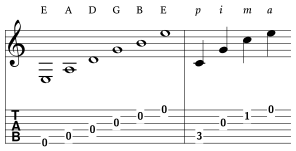
Guitarists also have a second way of writing music down. Tablature, or tab for short, does not show which note to play but where to put the fingers. It has six lines, one for each string, with the highest string on top, and a number on a line tells the player which fret to press on that string: 0 means the open string, 3 the third fret (Figure 6.12). In the 1500s, players of the lute, a pear-shaped plucked instrument with frets, wrote their music in tablature. Today guitar music is often arranged in tab,Tab notation is often used to arrange music for this instrument. → guitar•• especially in songbooks and online, because a player can follow it without reading a staff. What tab usually leaves out is rhythm, which the player must already know or read from notes printed above it.
Classical guitarists pluck with the fingertips and nails of the right hand. They name those fingers with letters from Spanish, the language of the guitar’s great tradition. They are p for pulgar (pool-gar), the thumb; i for índice (een-dee-seh), the index finger; m for medio (meh-dyoh), the middle finger; and a for anular (ah-noo-lar), the ring finger. Printed above the notes, the p-i-m-a letters tell the guitaristPlayers of this instrument use p-i-m-a notation. → guitar• which finger plucks which string. The fingers of the left hand, which press the strings, are numbered 1 to 4 instead. In the pattern in Figure 6.12, the thumb takes the lowest note and the three fingers take the three highest strings in turn, the most common way to play a broken chord, or arpeggio (Chapter 5). Steel-strung and electric guitars are usually played with a pick, a small flat piece of plastic, but they have the same six strings and use the same tab.
What to remember
- A string sounds higher when it is shorter, tighter, or lighter. String players change the note by pressing the string against the fingerboard to shorten it.
- The violin family is tuned in fifths: violin G, D, A, E; viola C, G, D, A; cello C, G, D, A an octave lower than the viola.
- The violin is the highest bowed string, with a top string of E. The concertmaster leads the first violins, and a string quartet has two violins, a viola, and a cello.
- The viola reads the alto clef. The cello is held between the knees on an endpin and uses thumb position for its highest notes.
- The double bass, the lowest string, comes partly from the viols and is tuned in fourths: E, A, D, G. A C-extension takes it lower, it once doubled the cellos an octave below, and jazz players pluck it in walking lines.
- A bow is strung with horsehair and gripped to the string by rosin. François Tourte fixed its modern form in the 1780s. Bass bows come in French and German forms. Pizz. means pluck, and arco means bow again.
- The concert harp has forty-seven strings over six and a half octaves and seven double-action pedals, each with three positions. With every pedal up it plays C-flat major.
- The guitar has six strings tuned E, A, D, G, B, E, and frets that mark the semitones. Its music is often written in tab, and classical players mark the plucking fingers p, i, m, a.
Chapter 7 · 30 clues
Woodwinds and Brass
On May 2, 1936, a children’s concert in the main hall of the Moscow Conservatory, the city’s great school of music, gave the first performance of a new piece by Sergei Prokofiev. Prokofiev, a Russian composer, had been asked to write something that would teach young listeners the sounds of an orchestra. He called it Peter and the Wolf. A narrator tells the story, and every character has a tune and an instrument of its own. Peter, a boy who lives with his grandfather at the edge of a forest, is played by the violins and the rest of the strings. A little bird is a flute, a duck is an oboe, and a cat is a clarinet creeping along in its lowest notes. The grumbling grandfather is a bassoon, and the wolf is three horns. When the hunters come out of the forest at the end, their guns go off on the drums. (The whole tale is told in Vol. 23, Revolution and Ruin.)
Hear it once and you will never mix up the bird and the duck again. Yet the five instruments that play the animals and the grandfather are all, at bottom, the same thing: a tube of air that a player’s breath sets vibrating. Why should one chirp and another quack? The answer lies in the different ways each one sets its air shaking. The first half of this chapter takes the woodwinds, from the flute down to the bassoon, and the second half the brass, the family of the wolf’s horns.
How winds sound
Blow across the top of an empty bottle and it hoots. Pour in some water and blow again, and the note is higher, because the air left inside the bottle is shorter. That is the whole secret of the wind instruments. In every one of them a column of air inside a tube vibrates, and wind instrument is the name for any instrument whose sound comes from air set vibrating by the player’s breath. As with strings (Chapter 6), length decides pitch: a long column of air sounds low, and a short one sounds high. A big tuba’s tube is about 18 feet long, and a piccolo’s is about 1 foot.
A player cannot saw a tube shorter in the middle of a tune, so the woodwinds drill holes in the side instead. When every hole is covered, the air vibrates down the whole length of the tube and the instrument plays its lowest note. Lift the finger from the hole nearest the bottom, and the air escapes there, so the vibrating column now ends at that hole and the note rises a step. Lift the fingers one after another, working upward, and you climb a scale. Holes too far apart or too wide for a finger are closed by keys, metal levers with padded cups, which is why a modern clarinet looks like a black stick covered in silver machinery.
Something must also keep the air moving in rhythm, hundreds of times a second, the way a child on a swing needs a push at the top of every swing. Wind instruments do this in four ways, drawn in Figure 7.1. In the flute the player blows a thin stream of air across a hole so that it strikes the hole’s sharp far edge, and the stream flips back and forth, now into the tube and now over it. In the clarinet and saxophone the player blows past a reed, a thin blade of cane (the stem of a tall grass), which is clamped to a mouthpiece and beats against it, opening and closing the gap. That is a single reed. The oboe and bassoon use a double reed, two blades of cane tied together that beat against each other. Of the two double-reed instruments every orchestra keeps, the oboe is the higher-pitched,This is the higher-pitched of the two standard orchestral double-reed woodwinds. → oboe• playing the treble while the bassoon plays the bass. Last, in the brass the player presses the lips into a small metal cup and buzzes them, and the lips themselves are the reed.
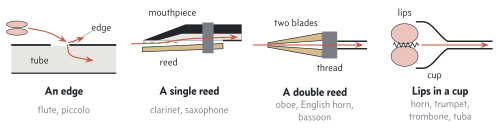
The family names come from what these instruments were once made of, the woodwinds of wood and the brass of brass. Today the dividing line is the way the sound starts. A woodwind is any wind instrument sounded by an edge or a reed; a brass instrument is one sounded by the player’s buzzing lips. So the silver flute is a woodwind, and so is the saxophone, which is made of brass, because no lips buzz in either of them.
The tube has a second secret. Every column of air can vibrate in more than one way. It can swing as one whole, which gives its lowest note. It can also divide itself into two halves that each vibrate twice as fast, which gives the note an octave higher, since an octave, as Chapter 3 explained, means twice as many vibrations a second. It can divide into three parts, each three times as fast, into four, and so on. The notes these patterns make are the tube’s natural notes, and the whole ladder of them, shown in Figure 7.2, is called the harmonic series. The steps are wide at the bottom and close together at the top.
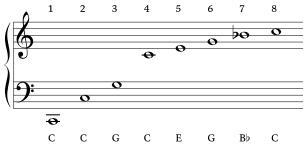
Blowing harder to make a tube jump to a higher natural note is called overblowing, and it is how a woodwind gets its upper notes without needing a tube full of holes. Finger the lowest note on a flute or an oboe, blow harder, and the note leaps up an octave, from the first step of the series to the second. The player can then run up the same fingerings a second time, an octave higher. One woodwind does something different. The clarinet’s tube is a straight cylinder, closed at the top by the reed, and a tube like that can only make the odd-numbered steps of the series. The oboe’s reed closes its tube too, but that tube widens steadily from top to bottom, like a long, thin cone, and a cone can make every step. The cylinder’s second step is missing, so the clarinet overblows at the twelfth,This instrument overblows at the twelfth. → clarinet• leaping straight from the first step to the third. A twelfth is an octave plus a fifth: count the letter names from a low C up to the G above the next C, counting both ends, and you get twelve. This one quirk explains most of what makes the clarinet different from the other woodwinds.
The brass have no holes at all. Their players change notes by buzzing the lips faster or slower, which picks out one natural note or another. A bugle sounding a military call is doing exactly this and nothing else, which is why every bugle call is made of a handful of natural notes like those in Figure 7.2. The brass instruments that can play every note do so by changing the length of their tubes, with valves on the horn and trumpet and with a slide on the trombone.
Flute and oboe
In Peter and the Wolf, the bird is played by the only woodwind held sideways. The modern flute is a metal tube about 26 inches (66 centimeters) long, closed at the end near the player’s left ear and held out to the right. The player does not put it in the mouth at all. Resting the instrument against the chin, the flutist blows across the embouchure (ahm-buh-shoor) hole,Players of this instrument blow across its embouchure hole to produce sound. → flute•• an oval hole in a raised plate, the way you blew across the bottle. Embouchure is the word players use for the shape of the lips and the muscles around them, and the flute’s hole is named for it. A breathy, airy tone, clear at the top and soft and dark at the bottom, is what makes the flute sound like a bird.

A flute comes apart into three pieces, shown in Figure 7.3: the headjoint with the embouchure hole, the long body, and the short foot joint with the keys for the lowest notes. A standard foot joint goes down to middle C. A longer one, the B foot, adds the B just below it, and many B feet carry an extra little lever that players call the gizmo key. Its job is at the other end of the range. The gizmo key helps the flutist play high C,The gizmo key on this instrument's foot joint assists the playing of high C. → flute•• the top C of the flute, three octaves above middle C, by closing a single key on the foot joint that steadies the note. The keywork on every modern flute comes from Theobald Boehm (burm), a flutist and goldsmith in Munich who wanted an instrument that played in tune in every key. In 1847 he patented a metal flute with big holes placed where the sound needed them, and a set of keys to close them.
The flute has a little sister. The piccolo, Italian for “small,” is a flute half as long, so it sounds an octave higher; it is the highest instrument in the orchestra, with a whistling top that can cut through a full band. The flute is the piccolo’s larger, lower-pitchedThis instrument is a larger, lower-pitched relative of the piccolo. → flute••• relative, and most flutists play both. You can hear the piccolo shrieking above everyone in the march The Stars and Stripes Forever (Chapter 16).
“Flute” also has a wider meaning. Scholars who sort instruments use it for every instrument sounded by blowing against an edge: the recorder of school music class, the panpipes, and the flutes of the whole world. The most unusual are the vessel flutes, in which the air vibrates inside a hollow body, like the air inside the bottle, rather than inside a tube. The ocarina (ok-uh-ree-nuh) is the best-known vessel flute,The 'vessel' type of this instrument is exemplified by the ocarina. → flute• a round clay body with a mouthpiece and finger holes. Its modern form was made in 1853 by Giuseppe Donati, a seventeen-year-old from a town near Bologna in northern Italy, and its name means “little goose” in the local dialect. In a vessel flute it does not matter which holes are open, only how much open hole there is in all.
The duck is played by the oboe, a black wooden tube about 2 feet long that widens slowly toward a small bell. At its top is a double reed, which oboists make by hand from cane, scraping it with a knife until it vibrates the way they like. The sound is reedy and a little nasal, and it carries a long way. The instrument appeared in France in the middle of the 1600s, probably among the musicians of the royal court, and was called hautbois (oh-bwah), “high wood,” meaning loud wood. The English wrote that word down as “hautboy,” and in about 1770 they borrowed the Italian spelling, “oboe.”
Nearly every orchestra concert begins with the oboe, although most of the audience is still talking. When the players have taken their seats, the principal oboist plays a single long note, the A above middle C, and the whole orchestra joins in on the same pitch, one section after another. That A, as Chapter 3 told, vibrates 440 times a second, a standard that delegates from five European countries agreed on in London in May 1939, and it is called concert A. Orchestras tune to the oboe’s concert AOrchestras tune to the concert A played by this instrument. → oboe••• for two reasons. Its sound is piercing enough for every player on the stage to hear. And an oboe is hard to retune, since it has no slide to pull, no barrel to twist, and no peg to turn; nothing on it moves, and the player can bend a note only a little, with the lips on the reed. So the oboe plays its A, and everyone else adjusts to it.
Tuning, as Chapter 4 explained, is the job of setting every note at its right height, and an orchestra must do it again at every concert, because strings stretch and air warms up during a performance. Before the second half begins, the musicians do it once more, which is why the oboe sounds its A to help the orchestra tuneAn oboe typically plays an A to aid the orchestra in performing this task. → tuning• twice in a single evening.


The oboe also has larger relatives (Figure 7.4). The English horn is an alto oboe about one and a half times as long, with a bent metal tube at the top to hold the reed and a bell shaped like a bulb, which gives it a darker, sadder voice. Because its tube is longer, the English horn sounds a fifth lowerThe English horn is pitched a fifth lower than this instrument. → oboe•• than the oboe. It is neither English nor a horn. One theory is that German speakers called its curved early form an “angelic horn,” after the horns angels blow in old paintings. In old German one word, engellisch, meant both “angelic” and “English,” and the second meaning stuck.
Here is a puzzle. An oboist who picks up the English horn uses the same fingerings, but every note comes out a fifth lower. If the music were written at the true pitch, the player would have to learn a second set of fingerings. So it is not: the part is written a fifth higher than it sounds, and the player simply reads it as oboe music. An instrument whose music is written at a different pitch from the one you hear is called a transposing instrument (Figure 7.5). The oboe is not one. When it plays A, you hear A, and the music for it is written at the pitch you hear, which is called concert pitch.

In the Baroque period, the century and a half up to about 1750, the oboe had still more relatives, and Johann Sebastian Bach, the German organist and composer (Vol. 14, From Luther to Mozart), wrote for both of the best known. The oboe d’amore (dah-mor-ay), “oboe of love,” sounds a minor third below the oboe and has a soft, sweet tone. The oboe da caccia (dah kaht-chah), “hunting oboe,” sounds a fifth below the oboe, like the English horn; it was curved like a hunting horn and sometimes ended in a flaring brass bell. So the oboe’s Baroque relatives, d’amore and da caccia,This instrument has Baroque relatives called "da caccia" and the lower-pitched "d’amore." → oboe•• are both lower than the oboe itself, the da caccia lowest. Both went out of use in the second half of the 1700s and are made again today for playing Bach. One more cousin sits lower still. The heckelphone (hek-ul-fohn) is a baritone oboe introduced in 1904 by the German firm of Wilhelm Heckel, and the German composer Richard Strauss first used it in his opera Salome in 1905 (Vol. 19, Wagner and Verdi). The oboe sounds an octave higherThis instrument is pitched an octave higher than a Heckelphone. → oboe• than the heckelphone, just as the piccolo sounds an octave above the flute.
Clarinet, bassoon, and saxophone
The cat in Prokofiev’s Peter and the Wolf is a clarinet, and from across a concert hall it can look like a twin of the oboe. Both are black wooden tubes about 2 feet long, covered in silver keys. Look closer and the difference is at the top. The clarinet has a single reed held against a beak-shaped mouthpiece by a metal band called the ligature. Below the mouthpiece come a short barrel, two long joints with the holes and keys, and a flaring bell. The wood is usually African blackwood, also called grenadilla, so the clarinet’s straight black bodyThis single-reed woodwind usually has a straight black body. → clarinet•• is its usual look; cheap ones for beginners are made of black plastic to match.
The clarinet grew out of an older single-reed instrument called the chalumeau (shal-oo-moh), which had a fine low register and almost nothing above it. In about 1700, by the usual account, Johann Christoph Denner, an instrument maker in Nuremberg, Germany, added a key that opened a small hole near the top, and the new instrument could overblow into a second, brighter range. That key, now called the register key, makes the cylinder jump from the first step of the harmonic series to the third, a twelfth higher.

The clarinet’s ranges are named after its history. The low notes, from the E below middle C up a little more than an octave, are the chalumeau register, after the old instrument. The upper range, reached with the register key, is the clarion register, named after the clarion, a high trumpet of the time, because its bright notes reminded listeners of one; the clarinet’s own name means “little clarion.” Between the two lies the awkward gap that players call the break, where the fingering changes from almost nothing pressed to almost everything pressed. A beginner learning to cross the break into the clarion registerPlayers of this instrument can "cross the break" to reach the second "clarion" register. → clarinet• must go from the B-flat in the middle of the treble staff to the B just above it, and is likely to squeak on the way.
Clarinetists in an orchestra bring two instruments to every rehearsal (Figure 7.6). The usual one is a B-flat clarinet, a transposing instrument on which a written C comes out as the B-flat a whole step lower; B-flat is the note a semitone below B (Chapter 3). The other is an A clarinet, slightly longer, on which a written C comes out as the A below it. Orchestral clarinetists keep both B-flat and AOrchestral players of this instrument commonly use both B-flat and A models. → clarinet••• models so that the written part always has as few sharps or flats as possible, which makes it easier to read and to finger, as the worked example shows.
The clarinet was the last of the four main woodwinds to join the orchestra. Wolfgang Amadeus Mozart, the Austrian composer, loved its warm low notes, and in 1791, the last year of his life, he wrote a famous Clarinet Concerto for his friend Anton Stadler (Vol. 14, From Luther to Mozart). By Beethoven’s day the orchestra of the Classical period, about 1750 to 1820, had settled on pairs of flutes, oboes, clarinets, and bassoons. The clarinet was its only single-reed woodwind,This instrument is the Classical symphony orchestra's only standard single-reed woodwind. → clarinet• and among the standard instruments of the orchestra it still is, since the saxophone, a later invention, is only an occasional guest.

The grandfather is the bassoon, the bass of the woodwinds. It is a double-reed instrument like the oboe, but its tube is about 8 feet 4 inches (2.54 meters) long. To make that manageable, the tube runs down to the bottom of the instrument, turns back on itself through a U-shaped joint, and runs up again, so the bassoon stands about 4 feet 5 inches tall. The reed sits on a curved metal tube that brings it to the player’s mouth (Figure 7.7). Its lowest note is the B-flat just over two octaves below middle C, and its music is written in bass clef, with tenor clef (Chapter 3) for its high notes. Composers love its range of characters. It plays a grandfather’s grumble in Peter and the Wolf and the clumsy marching broom in the French composer Paul Dukas’s The Sorcerer’s Apprentice (Vol. 18, Paris, Capital of the Arts). It also plays an eerie, strained melody high in its range at the start of the Russian composer Igor Stravinsky’s ballet The Rite of Spring (Vol. 20, The North and the East).
The bassoon’s long folded tube has a history. In the 1500s and 1600s, players used the dulcian, a bass instrument carved from a single block of maple, with the bore drilled down and back up inside it so that one piece of wood held a doubled tube. The dulcian was the bassoon’s ancestor.The dulcian was an ancestor of this instrument. → bassoon• In the second half of the 1600s, French makers built a new bass instrument in four separate joints, as they were rebuilding the oboe at the same time, and during the 1700s this bassoon gradually took the dulcian’s place.
Below the bassoon stands a deeper instrument still, the contrabassoon, whose tube is about twice as long and is folded back on itself several times. The bassoon’s larger cousin, the contrabassoon,This instrument has a larger "contra" cousin. → bassoon•• plays an octave lower, and its bottom note, B-flat, is just one semitone above the lowest key of a piano. Beethoven was the first to give it a part of its own in a symphony, in the finale of his Fifth, in 1808.
The saxophone was invented on purpose by one man. Adolphe Sax (ah-dolf), a Belgian instrument maker, moved to Paris in 1842 and spent the next years building a new family of instruments for military bands, loud enough to play outdoors and smooth enough to blend. He patented the family on June 28, 1846. The saxophone has a clarinet’s single reed and mouthpiece on a cone-shaped brass body, and because its tube is a cone and not a cylinder, it overblows at the octave like the oboe. It is a woodwind, despite its metal, because a reed makes its sound. His patent covered fourteen models, from tiny to huge, and four survive in common use (Figure 7.8). French army bands soon took it up (Vol. 15, The Age of Revolution), but symphony orchestras used it only now and then, as in the French composer Maurice Ravel’s Boléro (Vol. 22, The Lost Peace).

The saxophone found its real home in jazz, the American music born in New Orleans around 1900 (Chapter 16). Jazz players mostly use the alto and tenor saxophones,The common jazz varieties of this instrument are alto in E-flat and tenor in B-flat. → saxophone•• and like the clarinet both are transposing instruments. The alto is “in E-flat”: a written C sounds the E-flat a sixth below (Figure 7.5). The tenor is “in B-flat”: a written C sounds the B-flat an octave and a whole step below. Charlie Parker was the great player of the alto, and Coleman Hawkins and John Coltrane of the tenor (Vol. 32, Jazz, Depression, and War; Vol. 36, Bebop to Pop Art).
The flute, oboe, clarinet, and bassoon, joined by one horn, make the wind quintet, a group of five players and the standard chamber ensemble for winds (Chapter 13). The horn is a brass instrument, but its round, soft tone blends with the woodwinds, and that is why it was invited. The quintet is a hard test of the section. A string quartet is four instruments of one family, while a wind quintet is five different sounds that must still sound like one group. The repertory owes most to Anton Reicha (ry-khah), a Bohemian-born composer and teacher in Paris, who published twenty-four quintets between 1817 and 1820. The five players spread from top to bottom across the range (Figure 7.9). The flute is the quintet’s highest-pitched member,This instrument is the highest-pitched member of a standard wind quintet. → flute• and it often floats the tune above the others, though composers like to pass the melody around so that every player has a turn. The four animals and the grandfather of Peter and the Wolf are, in fact, a wind quintet with two more horns.
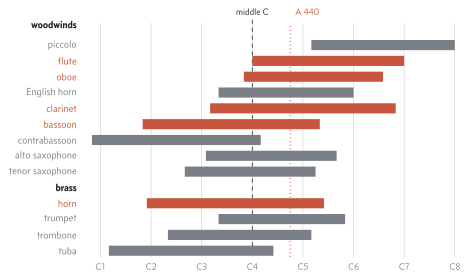
At the other end of the chart the order is less obvious, because the horn reaches nearly as low. Still, the bassoon is the lowest-pitched memberThis is the lowest-pitched member of the standard wind quintet. → bassoon•• of the quintet. It reaches down just past the horn, whose lowest notes are rarely played anyway, and in most quintets the bassoon carries the bass line almost all the time.
The horn and the hunt
A hunt on horseback in seventeenth-century France made a great deal of noise. The huntsmen carried long brass tubes bent into a big hoop, so that a rider could wear one over his shoulder and under his arm, and they blew calls on them to tell the riders where the hounds were and when the stag was found. French makers led the world in building these hunting horns, and when the English bought them in the late 1600s they called them “French horns.” The coiled horn’s English nameThis coiled brass instrument has an English name referring to France. → French horn••• has stuck ever since, although the modern instrument was largely developed in Germany and most other languages simply call it the horn. Players usually do the same.
The hunting horn had no valves, so it could play only the natural notes of its tube, the harmonic series of Figure 7.2. Its tube was long, so the player worked high up the series, where the steps are close together and a tune is possible. Even there, notes are missing. In the middle of the 1700s a horn player at the court of Dresden, Anton Joseph Hampel, is usually credited with finding a way to fill the gaps. The horn’s bell points backward, toward the player’s right side, and he rested his right hand inside it. Moving the hand in the bell changes the pitch:Players change the pitch of this brass instrument by placing a hand in its bell, a technique called hand-stopping. → French horn••• pushing it deeper bends a natural note by as much as a semitone, and closing the bell almost shut makes a buzzy, veiled sound. The technique is called hand-stopping, and with it a skilled player could play a whole scale. Mozart wrote his four horn concertos for this hand horn, for his friend Joseph Leutgeb (loyt-gep) (Vol. 14, From Luther to Mozart).
In 1818 two German instrument makers patented valves for the horn. A valve is a switch that sends the air through an extra loop of tubing when it is pressed, making the tube longer and the note lower. With three valves the horn could play every note without the hand, though players still keep the hand in the bell to shade the tone. The modern horn coils about 12 feet (3.7 meters) of tubing into a circle about the size of a dinner plate, with a funnel-shaped mouthpiece and a wide bell (Figure 7.10). It is called a horn in F, after the low F on which its harmonic series is built. On a tube that long, the notes high in the series lie very close together, so it is easy for a horn player to land on the wrong one. A shorter tube, a horn in B-flat, is safer up high but sounds thinner down low. The answer, first built in 1897 by the Kruspe family of instrument makers in Erfurt, Germany, was the double horn: both lengths of tubing built into one instrument, with a fourth valve to choose between them. The double horn’s thumb valve switchesA thumb valve switches the double version of this instrument between F and B-flat tubing. → French horn•• the air between the F tubing and the B-flat tubing in a moment, and it is the horn most professional players use today.

Because the horn grew out of the hunt, composers never forgot where it came from. For three hundred years, the horn has stood for huntingThis instrument is often used to represent the activity of hunting. → French horn• in music. A hunting piece usually moves in a lilting rhythm of six quick beats to the bar, like a galloping horse, and uses tunes made of the natural notes, so that even a horn with valves sounds like an old hunting horn. Joseph Haydn, the Austrian composer who served a family of Hungarian princes for nearly thirty years, gave his Symphony No. 73 a finale built on hunting calls. It is nicknamed “La chasse,” French for “The Hunt.” Antonio Vivaldi, the Venetian violinist and composer, painted a hunt in the last movement of “Autumn” in The Four Seasons (Chapter 10). Some went further. Wolfgang’s father, Leopold Mozart, wrote a Hunting Symphony for four horns and strings in which the score asks for real shotguns to be fired. Prokofiev fired his guns with the orchestra alone. In Peter and the Wolf, when the hunters burst out of the forest, their gunshots are beats on the drums:This activity in classical music is commonly invoked by horn calls and drumbeats representing gunshots. → hunting• the kettledrums, or timpani, and the bass drum fire together. So the hunt is painted with its two usual signs, horn calls and gunshots beaten on the drums.
Trumpet and trombone
For most of history the trumpet was an instrument of kings and armies. It was a straight or looped tube with no holes and no valves, so it could play only the natural notes, and trumpeters guarded the secret of playing very high in the series, where the steps are close enough for melodies. Bach and George Frideric Handel, the German-born composer of Messiah who made his career in London (Vol. 12, Crown and Parliament), wrote brilliant, high trumpet parts for players like these. To give the trumpet every note, makers tried keys first. In 1796 Haydn wrote a Trumpet Concerto for Anton Weidinger (vy-ding-er), a Viennese trumpeter who had invented a trumpet with keys that could play every note (Vol. 14, From Luther to Mozart). Valves, invented for the horn in the 1810s, soon followed, and over the next decades the trumpet became the instrument it is today.
The modern trumpet is the highest of the regular brass. Nearly 5 feet of tubing, mostly the same width all the way, are folded into a compact loop that ends in a flaring bell. The trumpet has three piston valves,This instrument is a high-pitched brass device with three valves. → trumpet•• pushed down with the fingers of the right hand, and each one adds a loop of tubing. The second valve lowers the note a semitone, the first lowers it a whole tone, and the third a tone and a half. Counting the open tube, with no valve pressed, the three valves alone or together make seven different lengths of tube, each a semitone lower than the last, and each length has its own harmonic series. Between them, the seven series cover every note in the trumpet’s range. Most trumpets are in B-flat, and like the B-flat clarinet they are transposing instruments: a written C comes out as B-flat.

The trumpet’s relatives include the cornet,The cornet, flugelhorn, and bugle are relatives of this instrument. → trumpet•• the flugelhorn, and the bugle, shown with it in Figure 7.11. The cornet is a compact, tightly wound relative whose tube widens gradually, which gives it a softer, rounder voice; it led the brass bands of the 1800s, and Louis Armstrong began on it in New Orleans before he switched to the trumpet. The flugelhorn, from the German for “wing horn,” has a much wider tube and a dark, velvety tone, and jazz players love it for slow ballads. The bugle has no valves at all. It plays only natural notes, which is why it serves for military calls such as “Reveille” at dawn and “Taps” at day’s end.
The trombone has no valves either, and needs none. It has a slide: a long U-shaped tube that fits over two fixed inner tubes, so that the player, holding the instrument with the left hand, can push it out with the right to make the tube longer and the note lower. The slide has seven positions, from all the way in to nearly at arm’s length, and each one lowers the note by a semitone, the same seven steps that the trumpet’s valves make (Figure 7.12). Because a slide moves smoothly rather than in clicks, the trombone can also do what no other wind instrument does as easily. Moving the slide changes the trombone’s pitchMoving a slide changes this brass instrument’s pitch and permits smooth glissandi. → trombone••• without a break, so it can slide through every pitch between two notes. That smear is also called a glissando, like the harp’s sweep in Chapter 6; the word comes from the French glisser, “to slide.” Early New Orleans jazz bands made a specialty of it, with the trombonist sitting on the open tailgate of the band’s wagon so the slide had room to move.
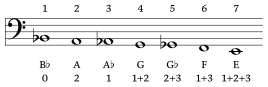
The slide is much older than the valve. It appeared in the 1400s, at the very end of the Middle Ages, on an instrument called the sackbut. Its name probably comes from old French words meaning “pull” and “push.” The trombone descended from the sackbut,This instrument descended from the medieval sackbut. → trombone•• which had a narrower tube and a smaller bell and played softly enough to blend with singers. In the 1590s Giovanni Gabrieli, the organist of St. Mark’s Basilica in Venice, wrote grand pieces for groups of sackbuts and cornetts placed across the church (Vol. 10, Rebirth). A cornett, not to be confused with the cornet, was a curved wooden horn with finger holes and a small cup for the lips. The Italians called the instrument trombone, “big trumpet,” and that name won. For two centuries trombones played mostly in churches and in opera scenes of the supernatural. Then composers began writing them into symphonies, most famously Beethoven, who brought three of them, with a piccolo and a contrabassoon, into the finale of his Fifth Symphony in 1808 (Vol. 16, Romantic Europe).

The ordinary tenor trombone is pitched in B-flat, with about 9 feet of tubing, and on it there is a gap. Its lowest note with the slide fully out is the E of Figure 7.12, and below that, nothing comes out until a very deep B-flat. Many trombones fill the gap with an extra coil of tubing and a valve worked by the left thumb (Figure 7.13). The F-attachment adds tubing to the trombone,An F-attachment adds tubing to this instrument, extending its low register and providing alternate slide positions. → trombone• turning it into a longer instrument in F, so it can play the missing low notes. It also gives the player shortcuts, since a C that would need the slide far out in sixth position can be played with the slide all the way in and the thumb pressed down.
Below the trombones sits the tuba, the bass of the brass, patented in Berlin in 1835 by Wilhelm Wieprecht, a bandmaster, and Johann Moritz, an instrument maker, who needed a deep, strong bass for military bands. An orchestra usually has just one, and marching bands carry its wraparound cousin, the sousaphone (Chapter 16). With the tuba, the wind section of the orchestra is complete: from the piccolo’s top note to the contrabassoon’s and tuba’s bottom ones it spans more than seven octaves, nearly the whole width of a piano keyboard.
What to remember
- In every wind instrument a column of air vibrates; a longer column plays lower. Woodwinds are sounded by an edge (flute) or a reed (single for clarinet and saxophone, double for oboe and bassoon); brass by the player’s buzzing lips.
- A tube’s natural notes form the harmonic series. Overblowing jumps to a higher one: the flute and oboe jump an octave, the clarinet a twelfth.
- The flute is played by blowing across its embouchure hole; the piccolo is a half-size flute an octave higher; the ocarina is a vessel flute.
- Orchestras tune to the oboe’s A, 440 vibrations a second. The English horn is an alto oboe a fifth lower; the oboe d’amore and da caccia are its Baroque relatives.
- Clarinetists carry B-flat and A clarinets, and must cross the break from the low chalumeau register to the clarion register.
- The bassoon, descended from the dulcian, is the bass of the woodwinds; the contrabassoon plays an octave lower. The saxophone, patented by Adolphe Sax in 1846, is a woodwind whose alto and tenor sizes rule in jazz.
- The wind quintet is flute, oboe, clarinet, bassoon, and horn, with the flute on top and the bassoon at the bottom.
- The French horn came from the hunting horn; players shade its pitch by hand-stopping, and the double horn switches between F and B-flat tubing with a thumb valve.
- The trumpet has three valves; its relatives are the cornet, flugelhorn, and bugle. The trombone, descended from the sackbut, changes pitch with a slide of seven positions and can play glissandos.
Chapter 8 · 37 clues
Percussion, Keyboards, and the Conductor
On the evening of March 23, 1792, a crowd packed the Hanover Square Rooms in London to hear a new symphony by Joseph Haydn, the most famous composer in Europe. Haydn sat at a keyboard in the middle of the orchestra. The second movement, an andante at the strolling pace of Chapter 3, began with a little tune, as simple as a nursery rhyme, played softly by the strings. Then it came again, even softer. Just as the listeners leaned in, the whole orchestra slammed out one loud chord, and the man at the kettledrums struck his drum as hard as he could. The audience loved it and demanded the movement again.
A story told later said that Haydn wanted to wake the ladies who dozed at concerts. Haydn himself told his biographer Georg August Griesinger something plainer: he had wanted to surprise the public with something new. The English have called the work the “Surprise” Symphony ever since, and the Germans call it the symphony “with the drumstroke.” Look again at the scene, though. The orchestra had one drummer with two drums. The man who wrote the music led it from a keyboard, not with a stick. This chapter follows those three things, the drums, the keyboards, and the leader, from Haydn’s night to the orchestra of today.
Percussion
Struck, shaken, and scraped
Every instrument makes sound by making something vibrate, or shake back and forth very fast. In the strings that thing is a string (Chapter 6); in the winds it is a column of air inside a tube (Chapter 7). The percussion instruments are the ones you play by hitting or handling the instrument itself. A drum is struck with a stick. A pair of maracas, gourds full of seeds, is shaken. A guiro (gwee-roh), a hollow gourd cut with ridges, is scraped with a stick, like a fingernail along a comb. Percussion instruments sound when they are struck, shaken, or scraped,These instruments typically produce sound when struck, shaken, or scraped and include idiophones and membranophones. → percussion•• and nearly all of them belong to one of two groups. In an idiophone (id-ee-uh-fohn) the body of the instrument itself vibrates: the wooden bar of a xylophone, the brass plate of a cymbal. In a membranophone (mem-bray-nuh-fohn) a thin sheet, called a membrane or head, is stretched tight over a frame and vibrates when struck, as on every drum.
These two names come from a scheme published in 1914 by two scholars in Berlin, Erich von Hornbostel and Curt Sachs (zahks), who wanted one system that could sort every instrument on earth by what vibrates. Besides the idiophones and membranophones they named the chordophones, which sound by strings, and the aerophones, which sound by air. The Greek roots help: idios means “one’s own,” and chordē means “string.” Scholars of instruments still sort them by this Hornbostel–Sachs system today.
Percussion instruments also split another way. A pitched instrument plays definite notes, the kind you could sing back and write on a staff (Chapter 3). An unpitched instrument makes a sound with no definite note, a crack or a rattle or a crash. One family can hold both. The crotales (kroh-tah-leez) are small discs of bronze, each about four inches across and each tuned to one note; the French composer Claude Debussy used them for a few faint, bell-like notes in his Prelude to the Afternoon of a Faun (Vol. 18, Paris, Capital of the Arts). Castanets are two cupped shells of hard wood, clicked together in the palm, whose name comes from the Spanish for “chestnut” because each shell looks like half of one. So percussion runs from the pitched crotales to the unpitched castanets,This instrument family includes pitched examples such as crotales and unpitched examples such as castanets. → percussion• and Figure 8.1 sorts the common instruments both ways at once.

The kettledrums
The oldest drums in the orchestra are the timpani, an Italian plural (one drum is a timpano). Each is a large bowl, traditionally of copper, with a head stretched across its top, so it looks like a huge kettle; in English they are also called kettledrums. They came into the orchestra from the army, where kettledrums on horseback rode beside the trumpets, and by the late 1700s they were a regular part of the orchestra. The bowl makes the head ring with a clear note instead of a thud. That is the timpani’s gift: they are large, tunable kettledrums,Timpani are large, tunable "kettle" examples of this instrument. → drums•• the only drums in the orchestra that play definite notes.

How do you tune a drum? Tighten the head and the note rises; loosen it and the note falls, just as a guitar string sounds higher when it is wound tighter. In Haydn’s day the head was tightened by turning a ring of screws around the rim, one at a time, so a player could not change notes quickly. Composers wrote for two drums and tuned them to the two most important notes of the piece’s key. As Chapter 5 explained, those are the tonic, the home note of the key, and the dominant, the fifth note of its scale. The low, large drum took the dominant and the small drum the tonic, a perfect fourth higher, as Figure 8.3 shows for the key of C major.

Retuning by hand took time, so composers had to plan rests for the player. In the 1870s drum makers in Dresden, in Germany, built timpani in which a single foot pedal pulled on all the screws at once. Today nearly all timpani can be tuned with a foot pedal,The "kettle" type of these instruments can be tuned with a foot pedal. → drums• and a timpanist can change notes in the middle of a passage, or even slide from one note to another in a long swoop. An orchestra now usually has four or five of them, of different sizes, played by one player who stands or sits in a curve of copper.
Timpanists play with two sticks whose round heads are covered in felt, soft ones for a warm boom and hard ones for a sharp crack. To hold a long note, they play a roll, rapid, even strokes from alternating hands, so fast that the separate taps melt into one rumble. During their rests they bend down with an ear close to a drum and tap the head very gently, checking that it is still in tune, because a hot stage or a damp evening can let the head slip.
Snare drum, bass drum, and the drum kit
Most other drums play no definite note. The two the orchestra uses most are the bass drum and the snare drum. The bass drum is the biggest, often three feet across, set on its side and struck with a soft, padded beater; it gives a deep boom that you feel in your chest as much as hear. The snare drum is small and has two heads, one on top and one on the bottom. Across the bottom head lies a set of tight wires, the snares, which rattle against it whenever the top head is hit, so the drum gives a sharp, crisp buzz instead of a thump. Of the drums with no definite note, the bass drum and the snare drumThis instrument has "bass" and "snare" types. → drums•• are the two you hear in every marching band.
The snare drum was the soldier’s drum. For centuries drummers marched in front of armies, beating out signals and keeping the step. A marching drummer carried his drum on a sling from one shoulder, so it hung tilted against his left hip. To reach it, his left hand had to hold its stick from below, palm up, with the stick resting between the fingers almost like a chopstick, while his right hand held its stick from above. That way of holding the sticks is still called the traditional grip. In the matched grip both hands hold their sticks the same way, palm down, which is easier on a drum set flat. Every snare drummer must choose traditional grip or matched grip,Performers of this instrument often choose between a traditional or a matched grip. → drums• and jazz drummers and orchestral players can be found using both.
Military drummers also left behind a set of exercises. A pianist practices scales; a drummer practices rudiments, short patterns of strokes that are the building blocks of all drumming. The Percussive Arts Society, the drummers’ professional association, lists forty of them. In a flam, one stick plays a very soft note a split second before the other stick plays a loud one, so the two blur into one thick stroke, “fl-AM.” A paradiddle moves the hands in the order right, left, right, right, then left, right, left, left; say “pa-ra-did-dle” quickly and you can hear the pattern. Young drummers drill flams and paradiddlesPlayers of these instruments practice rudiments such as flams and paradiddles using traditional or matched grip. → drums• for years, with whichever grip they have chosen, until their hands play them without thinking.
Writing music for a drum with no notes calls for a simpler staff. You do not need five lines when there is only one sound to place. As Figure 8.4 shows, a part for a single drum is often written on a single line instead of five.Unpitched parts for this instrument family may use cross-shaped noteheads and a one-line staff or a clef of two vertical bars. → percussion• The clef, the sign at the start of a staff that tells you which line is which note (Chapter 3), is replaced by two short, thick vertical bars, a sign that means “no pitch here.” When one player has several instruments, a five-line staff comes back, but each line or space now stands for an instrument rather than a note. Cymbals are usually written with a cross, an X, in place of the round notehead, so a reader can tell metal from drum at a glance.

That second staff is written for the drum kit, the set of drums and cymbals that one person plays at once, seated, with both hands and both feet. It was born in the early 1900s, in the bands of New Orleans and in the small orchestras of theaters, where there was money for one drummer but music for three. The drummer worked the bass drum with a foot pedal. In 1909 William F. Ludwig, a circus and theater drummer, and his brother Theobald opened a drum shop in Chicago to make a pedal that worked well, and theirs became the first to sell widely. Small extras such as cowbells and whistles sat on a tray called a “contraption,” and from that word comes the kit’s old name, the trap set.

Look at the kit in Figure 8.5, drawn from the audience’s side. In front of the drummer sits the snare. Low tom-toms, drums without snares, stand around it. On the drummer’s left, the right side of the picture, is the hi-hat, a pair of cymbals face to face on a stand, clapped together by a pedal under the left foot and also struck with a stick; such stands were sold from about 1926. On the drummer’s right, the left of the picture, hangs the crash cymbal, for loud accents, and most kits add a larger ride cymbal near it, which the drummer taps in a steady pattern. Any drummer can name the hi-hat, the snare, and the ride cymbalA kit of these instruments includes a hi-hat, snare, and ride cymbal. → drums•• as the heart of the kit. The beat in Figure 8.4 shows how the parts work together. The hi-hat ticks on every beat, the bass drum thumps on beats one and three, and the snare cracks on beats two and four. That snare on the weak beats, the backbeat, is the pulse of most rock and pop songs. For soft music, a ballad or a quiet jazz number, a drummer may put down the sticks and pick up a pair of wire brushes,Players of this instrument sometimes use brushes. → drums•• fans of thin steel wires on handles, and sweep them across the snare for a soft swish.
By 1980 machines had learned to drum. A drum machine is an electronic box that plays drum patterns by itself, so that a songwriter without a drummer can still have a beat. The Roland Corporation of Japan sold the Roland TR-808 drum machineThis instrument was imitated by the Roland TR-808. → drums• from 1980 to 1983. It was built to imitate a drummer, making each drum’s sound with electric circuits, and a musician could program it to play any pattern. It sounded nothing like real drums, and it sold so badly that only about 12,000 were built. Then cheap used ones reached young musicians, who loved its booming bass drum. It drove early hip-hop and dance hits such as “Planet Rock” and the soul singer Marvin Gaye’s “Sexual Healing,” both of 1982, and “808” became slang for that deep electronic boom.
Bars, bells, cymbals, and gongs
The xylophone takes its name from Greek words meaning “wood” and “sound.” It is a row of wooden bars of different lengths, laid out in the same order as the keys of a piano, and each bar plays one note: the longer the bar, the lower the note. It is an idiophone with wooden bars struck with mallets,This percussion instrument has wooden bars that are struck with mallets. → xylophone•• sticks with hard round heads. The sound is dry and bright, with a hint of clatter. Camille Saint-Saëns was one of the first composers to write for it in the orchestra, and he made it famous. In 1874 he used it in Danse macabre (Chapter 3), a graveyard scene in which Death plays the fiddle at midnight while skeletons dance; the xylophone is the sound of their rattling bones (Vol. 18, Paris, Capital of the Arts).
The marimba (muh-rim-buh) is the xylophone’s bigger, lower-pitched cousin. Under each of its wider bars hangs a long tube, a resonator, which catches the sound and makes it round and warm. A concert xylophone has shorter tubes, and its bars are tuned to ring more brightly, so a marimba seems to hum where a xylophone clicks. Instruments of this kind, with gourds for resonators, were played in Africa and most likely came from there to Central America, where by the late 1600s the Maya of Guatemala were playing them. A player who knows one can play the other, and orchestras treat the marimba as the lower-pitched relative of the xylophone.The marimba is a lower-pitched relative of this instrument. → xylophone••
Make the bars of metal instead of wood and you get the glockenspiel (glok-en-shpeel), German for “bell play,” which sounds like tiny bells. Hang long brass tubes in a frame and strike them with a mallet and you get tubular bells, or chimes, which sound like church bells. Hide metal bars inside a cabinet with a piano keyboard, so that the keys work little hammers, and you get the celesta (chuh-les-tuh), whose shimmer the Russian composer Pyotr Ilyich Tchaikovsky made famous in the “Dance of the Sugar Plum Fairy” from The Nutcracker (Vol. 20, The North and the East). Put these keyboards of wood and metal together with the drums and cymbals and you have the main part of the family: xylophones, marimbas, cymbals, drums, and bells.Xylophones, marimbas, cymbals, drums, and bells belong to this instrument family. → percussion••
Cymbals are thin plates of bronze, slightly domed. A pair of crash cymbals clapped together makes one of the loudest sounds in the orchestra, and a single cymbal hung on a stand can be struck with a stick or rolled on with soft mallets until it roars. The orchestra took them up, along with the bass drum, from the military bands of the Ottoman Turks, whose elite soldiers, the Janissaries (jan-ih-ser-eez), marched to drums, cymbals, and shawms, the loud ancestors of the oboe. To copy their jangle, composers added the triangle, a much older European instrument that the Turkish bands did not use. In the 1700s European composers grew fond of this “Turkish music”: Mozart used it in his opera The Abduction from the Seraglio (seh-rahl-yoh), set in a Turkish palace, and Haydn in his “Military” Symphony (Vol. 14, From Luther to Mozart).
Those Turkish cymbals came from one family. In Constantinople, the Ottoman capital, an Armenian metalworker named Avedis made cymbals for the sultan’s court out of a secret blend of metals. The sultan gave him the family name Zildjian (zil-jun), built from the Turkish zil, “cymbal,” with endings meaning “maker” and “son of,” and in 1623 let him open his own workshop. His heirs kept the recipe for three hundred years, and in 1929 the family set up the Avedis Zildjian Company near Boston, in Massachusetts. It is now the largest cymbal maker in the world, and the Zildjian company makes the cymbalsZildjian makes equipment used by players in this orchestral section. → percussion• played by percussionists in many orchestras and by drummers from jazz to rock.
The gong came to Europe from East and Southeast Asia, and the word itself comes from Java, in what is now Indonesia. It is a large disc of bronze. In the suspended kind, gongs hang upright from cordsThese instruments are hung vertically by strings in their suspended variety. → gong• threaded through holes near the rim, inside a frame, so the disc can swing free and ring when it is struck with a heavy padded beater. A gong with a raised knob in its center sounds a definite note. The flat orchestral gong, the tam-tam, has no definite note: struck softly it shivers, and struck hard it swells into a long metallic roar.
A percussionist often plays several of these instruments in one piece: a triangle, then a tambourine, then woodblocks, then castanets. These small extra instruments, which players call auxiliary percussion, wait with their sticks on a padded trap table,Players in this orchestral section often arrange auxiliary instruments on a trap table. → percussion•• a table beside the player covered with thick cloth, so that each can be picked up and laid down without a sound. Its name comes from the same “contraption” as the drummer’s trap set.
Composers keep adding to the family. Iannis Xenakis (zeh-nah-kis), a Greek composer, born in Romania, who lived in France and had trained as an engineer, wrote Pléïades (play-yahd) in 1979 for six percussionists (Vol. 25, Europe Remade). For one of its four movements, “Métaux” (may-toh) (“Metals”), he had an instrument called the sixxenThe sixxen belongs to this instrument family. → percussion• built, its name formed from “six,” for the players, and from his own name. Each sixxen is a row of nineteen metal bars laid out like a keyboard and struck with metal hammers. Its notes are deliberately tuned a little off the piano’s, so it is pitched, but it plays notes that no piano has.
Piano and harpsichord
A keyboard is a row of levers, called keys, one for each note, pressed by the fingers. On every keyboard you will meet in this book, the white keys play the notes of the C-major scale, C, D, E, F, G, A, and B, over and over. The black keys, set back in groups of two and three, play the sharps and flats between them (Chapter 4). The keyboard is a clever way to put dozens of notes under ten fingers. What happens when a key goes down is a different question, and two famous instruments answer it in opposite ways.

The harpsichord was the great keyboard of the 1500s, 1600s, and 1700s. Inside its wing-shaped case, strings run away from the player, as in a harp laid on its side. When a key goes down, its far end lifts a jack, a thin strip of wood standing on the key. Near the top of the jack sticks out a tiny point called a plectrum, once cut from a bird’s feather quill and now usually made of plastic, which catches the string on the way up and plucks it. So the harpsichord plucks its strings,This instrument produces sound by plucking strings. → harpsichord•• as a guitarist’s pick does, while the jack falls back past the string without plucking it twice (Figure 8.7).
A pluck is a pluck. Musicians call the louds and softs of music its dynamics, and a pianist can change them from one note to the next by touch alone. However hard you press a harpsichord’s key, though, the plectrum flicks the string the same way, so on a harpsichord pressing a key harder changes nothing.Pressing a key harder on this plucked-string keyboard instrument does not produce the piano’s touch-sensitive dynamics. → harpsichord•• Harpsichord makers fought back with machinery. Large harpsichords have two keyboards, called manuals (from the Latin for “hand”), and handles called stops that add or remove a second set of strings, so a player can step from soft to loud between sections of a piece, though not from note to note.


Through the Baroque the harpsichord had a regular job in almost every kind of music. While a cello or a bassoon played the bass line, the harpsichordist built chords on it from the figured bass of Chapter 5, filling in the details on the spot. In a Baroque orchestra or opera house, the harpsichord was traditionally part of the basso continuo,This instrument traditionally serves as part of the basso continuo. → harpsichord• that partnership of bass instrument and keyboard, and its player often led everyone else from the keyboard.
The new idea came from Florence, in Italy. Bartolomeo Cristofori (kris-tof-uh-ree) looked after the musical instruments of Prince Ferdinando de’ Medici (med-ih-chee), son of the ruler of Tuscany. By 1700 he had built a harpsichord in which each key threw a small hammer up against the string instead of plucking it (Vol. 10, Rebirth). Strike gently and the note was soft; strike hard and it was loud. People called it a harpsichord “with soft and loud,” in Italian piano e forte, and the name shrank to pianoforte and at last to piano. In a modern piano, felt-covered hammers strike the strings,This instrument creates sound when felt-covered hammers strike its strings. → piano•• and a clever catch called the escapement lets each hammer fly free and drop back at once, so the string can ring.
Inside a grand piano are about 230 strings. Most notes use two or three strings tuned to exactly the same pitch, which gives a fuller sound, and the lowest notes use single thick strings wound with copper wire. Pulled tight, all those strings tug on the case with a force of about twenty tons, as heavy as a dozen cars, so since the 1800s pianos have been built around a frame of cast iron.
Each string also has a damper, a pad of felt resting on it. When you press a key, its damper lifts; when you let go, the damper drops back and the note stops. At your feet are pedals. On most pianos the one on the left makes the sound softer, and the one on the right lifts every damper at once. With the right-foot damper pedalThis instrument's right-foot damper pedal causes notes to be sustained longer. → piano•• held down, notes go on ringing after the fingers leave the keys, and they blend into one another like colors running together in a watercolor. Pianists call it the sustain pedal, and they use it in almost every piece.
The keyboard grew with the piano. Mozart’s pianos had about five octaves; by 1820 the biggest had seven. Today nearly every piano has eighty-eight black and white keys,This instrument has 88 black and white keys. → piano••• fifty-two white and thirty-six black, running from the A a little more than three octaves below middle C up to the C four octaves above it (Figure 8.8). The lowest note sounds a deep growl; the highest is a glassy ping.

For two centuries the white keys were covered with thin slices of ivory from elephants’ tusks, and the black keys were made of ebony, a dark tropical wood. Elephants are now protected by law, and piano makers use plastic instead, but the old words stay. To play the piano, especially in a lively, easy way, is still called “tickling the ivories.”Playing this instrument is sometimes nicknamed "tickling the ivories." → piano•
So what kind of instrument is the piano, a string instrument or a percussion instrument? The question is less silly than it sounds, because the two ways of sorting instruments in this chapter give different answers. By the Hornbostel–Sachs scheme its strings make the sound, so it is a chordophone. But it sounds because hammers strike those strings, so many musicians count the piano as percussion.Because hammers strike its strings, the piano can be classified in this instrument family. → percussion• Composers of the 1900s often treated it that way, using its hard attack like a set of tuned drums. The Russian composer Igor Stravinsky wrote Les Noces (lay noss) (1923), a ballet about a peasant wedding, which puts four pianos in the band with the percussion and no other instruments but voices. In an orchestra today, the piano usually sits near the percussion section, and its player often plays the celesta too.
The organ
The organ in Boardwalk Hall, in Atlantic City, New Jersey, has an official count of 33,112 pipes, more than any other instrument in the world. It was built between 1929 and 1932 to fill what was then the largest open indoor space in the world, without electric amplification, and its console has seven keyboards. Another giant, the Wanamaker Organ in the old Wanamaker department store building in Philadelphia, is the largest one in full working order. Big church and concert-hall organs, too, fill a whole wall and the rooms behind it, so organs are among the largest musical instrumentsLarge installations of this pipe-and-keyboard instrument are among the largest musical instruments. → pipe organ• ever built, bigger than some houses.
Yet the idea is as simple as blowing across a bottle. An organ is a set of whistles with a keyboard. A fan, which in older days was a set of bellows pumped by hand or foot, blows air into a sealed box called the wind chest, where it waits under pressure. Pipes stand in rows on top of the box. When the player presses a key, a valve opens beneath a pipe, the air rushes in, and the pipe sounds until the key is let go. Most pipes work like a recorder, with air striking a sharp edge; others have a thin brass tongue inside that vibrates like a reed. Either way, the organ produces sound by moving air through pipes,This instrument produces sound by moving air through pipes. → pipe organ••• so it is an aerophone, a wind instrument, even though it is played from a keyboard.
Each pipe plays only one note in only one kind of sound. A long pipe sounds low and a short pipe high. The lowest C on an ordinary organ keyboard comes from an open pipe about eight feet long, and large organs have pipes of thirty-two feet, which sound two octaves lower, a note felt more than heard. To play a full keyboard of notes in one tone color, the organ needs a whole row of pipes, one for each key, from long to short. Such a row is called a rank. A small organ has a few ranks; a cathedral organ may have a hundred, some sounding like flutes, some like trumpets, some like nothing else.
The player chooses among them with stops, which are knobs or tabs set beside the keyboards. Pull out a stop and wind can reach its rank; push it in and that rank falls silent. Stops select which ranks of pipesStops select ranks of pipes on this instrument. → pipe organ•• will sound, so one key can play a single soft flute pipe or a dozen ranks at once. Pulling them all out gives the loudest sound the organ can make, which is where the saying “to pull out all the stops” comes from. On larger organs some ranks stand inside a wooden box with shutters on one side, the swell box. A pedal opens and closes the shutters, so those pipes can grow louder or softer while they sound, something a single pipe cannot do by itself.

Large organs divide their ranks into groups, each played from its own keyboard. The keyboards for the hands are called manuals, as on a large harpsichord, and they stand in steps one above another, as in Figure 8.9. Under the bench lies a pedalboard, a keyboard of long wooden bars played with the feet, usually heel and toe, which plays the deepest bass. A good organist plays with both hands and both feet at once, and organ music needs room for all of it. With multiple manuals and a pedalboard,Multiple keyboard manuals and a pedalboard control this instrument; its music is often written on three staves. → pipe organ••• organ music is usually printed on three staves: two for the hands, joined by a brace like piano music, and a third, below, for the feet (Figure 8.10).

The organ is much older than the piano. Ctesibius (teh-sib-ee-us), a Greek engineer in Alexandria in the 200s BC, built a hydraulis (hy-draw-lis), an organ whose air was kept under pressure by the weight of water, and the Romans played organs in their arenas. In the Middle Ages the instrument moved indoors, into the churches of Western Europe, where only an organ could fill a stone building with sound and hold a chord as long as the singers needed. Its ranks of pipes installed in churchesThis keyboard instrument’s ranks of pipes are often installed in churches. → pipe organ••• became the sound of Christian worship from Germany to England, and most organists today still play for church services. Johann Sebastian Bach held his first posts as a church organist.
The orchestra and the band
Go back to Haydn’s orchestra in 1792. The “Surprise” Symphony asks for strings and, besides them, pairs of flutes, oboes, bassoons, horns, and trumpets, with one timpanist. Within a few years clarinets joined the pairs. When Ludwig van Beethoven wrote his First Symphony in 1800, the standard orchestra was this: first and second violins, violas, cellos, and double basses; two each of flutes, oboes, clarinets, and bassoons; two horns, two trumpets, and timpani. There were perhaps forty players in all.
Then it grew. In the last movement of his Fifth Symphony (1808), Beethoven brought in a piccolo, a contrabassoon, and three trombones (Vol. 16, Romantic Europe). In 1830 the French composer Hector Berlioz wrote his Symphonie fantastique for an orchestra with four bassoons, two harps, church bells, and four timpanists who roll distant thunder together at the end of the slow movement (Vol. 15, The Age of Revolution). In 1910 the Austrian composer Gustav Mahler took more than a hundred players onto the stage in Munich, with two large choruses, a children’s choir, and eight solo singers besides, for a symphony the concert’s promoter advertised as the “Symphony of a Thousand” (Vol. 19, Wagner and Verdi). Mahler disliked the nickname. A full symphony orchestra today has about a hundred players, some sixty of them string players (Chapter 6), so that the strings, each section playing as one, can balance the brass.
However large it gets, an orchestra is built from the same four main sections:Brass, woodwinds, strings, and this family form the four main orchestral instrument sections. → percussion• strings, woodwinds, brass, and percussion. The strings are the largest and play most of the time; the woodwinds and brass usually play one to a part; the percussion is the smallest section and the one with the most different instruments. Where they sit follows a rule of thumb: soft in front, loud behind, so the brass and drums do not drown out the violins and the conductor can see everyone (Figure 8.11).
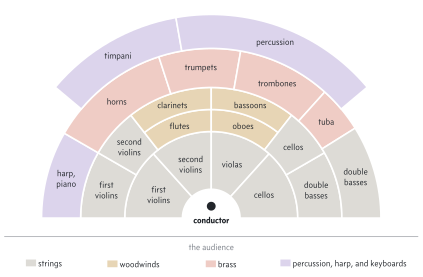
The strings fan out in front of the conductor. Most orchestras place the first and second violins together on his left and the violas and cellos on his right, a plan credited to Leopold Stokowski (stuh-koff-skee), who led the Philadelphia Orchestra for more than twenty-five years from 1912. The double basses stand behind the cellos. The woodwinds sit in the middle in two rows, with the flutes and oboes in front and the clarinets and bassoons behind them. That is the order in which Chapter 7 met them, and the order in which they are printed at the top of the conductor’s score, the book that shows every instrument’s part stacked on one page. Behind the woodwinds are the horns, trumpets, trombones, and tuba, the biggest and lowest brass instrument. Percussion players are situated at the back of the orchestra,Players in this orchestral section are typically situated at the back of the orchestra. → percussion•• the timpani placed where the timpanist has a clear view of the conductor, with the other drums, the xylophone, and the trap table spread out beside them. The harp and the piano usually go off to one side.
Leave out the strings, and you have a band. A concert band is an ensemble of woodwinds, brass, and percussion alone,This ensemble consists primarily of woodwinds, brass, and percussion, without an orchestral string section. → concert band•• with no string section; at most a double bass or two may be added at the bottom. Without violins, the clarinets take their place, a whole row of them playing the high melodies. Saxophones, which the orchestra rarely uses, are regular members, and there are more tubas than in an orchestra, along with the euphonium, a small tuba with a mellow voice. Bands grew out of military bands, which had to play outdoors and on the march, where strings are no use. By the late 1800s great touring bands, such as the one led by John Philip Sousa (soo-zuh), the American “March King,” played concerts as popular as any orchestra’s (Vol. 30, Whitman to Wharton).
Composers began to write serious music for the band itself. The English composer Gustav Holst’s First Suite in E-flat for Military Band (1909) is one of the first and best-loved such works (Vol. 21, Trenches and Modernists). In 1952 the conductor Frederick Fennell founded the Eastman Wind Ensemble in Rochester, New York, with one player to a part, so a composer could choose instruments the way he chose them in an orchestra. Thousands of American high schools and colleges have a concert band, and many have a marching band besides, which plays the same kind of music while marching.
The conductor
Someone has to hold a hundred players together. For most of history that someone was a player. In the Baroque, an ensemble was led by the harpsichordist from the continuo, nodding and playing chords, or by the concertmaster, the leading violinist,The concertmaster of an orchestra plays this instrument. → violin•• who led with his bow and his body from the first desk of the violins (Chapter 6). In Haydn’s London concerts of 1792, Haydn sat at the keyboard while the violinist Johann Peter Salomon, the impresario, or concert promoter, who had brought him to London, led the orchestra from his chair.
Some leaders beat time instead. In France in the 1600s the custom was to pound out the beat on the floor with a long, heavy cane. Jean-Baptiste Lully (loo-lee), the Italian-born composer who ran the music at the court of King Louis XIV (Vol. 13, Valois, Bourbon, and Orange), was beating time this way in January 1687, at a performance of his Te Deum, a hymn of thanksgiving, for the king’s recovery from an operation. He struck his own foot. The wound turned to gangrene, he refused to let the surgeons amputate, and he died that March.

As orchestras grew in the early 1800s and their music grew more complicated, the leader stopped playing and stood in front, facing everyone, as the conductor. He needed something the back rows could see, and the answer was a short, light stick of wood called a baton. The German composer Felix Mendelssohn, who led the Gewandhaus (geh-vahnt-hows) Orchestra of Leipzig (lype-sig), in Germany, from 1835, was one of the first to conduct with one regularly. Since then conductors have used a batonPeople in this profession use a baton to lead an orchestra or musical ensemble. → conductor•• to lead orchestras, choirs, and bands, though a few great ones, Stokowski among them, preferred their bare hands.

The baton’s first job is to show the beat. As Chapter 3 explained, music is divided into measures of two, three, or four beats. The first beat of every measure, the strongest, is always shown with a stroke straight down, which is why it is called the downbeat. The last beat is always shown with a stroke upward, which is why the beat that leads into a measure is called the upbeat; the stroke also lifts the hand into place for the next downbeat. The beats in between go sideways, and each meter has its own pattern, drawn in the air with the right hand (Figure 8.13). Two beats go down, up. Three go down, out to the right, and up.
In common time, 4/4, with four beats to the measure, the hand goes down, in, out, up.People in this profession use a “down, in, out, up” pattern for 4/4 time. → conductor• “In” means across the front of the body toward the left, and “out” means away to the right. A player who loses his place can find it again from the shape of the gesture alone: a hand swinging out to the right means beat three. Before the first note of a piece, the conductor gives one silent beat in the tempo he wants, the preparatory beat, so that the players can breathe in and come in together on the stroke that follows.
Keeping time is the easy part. The conductor studies the score, woodwinds at the top, then brass, percussion, and strings at the bottom. With the left hand he cues players to come in, asks for more or less sound, and shapes a phrase. Most of his work happens in rehearsal, where he decides how fast, how loud, and how the music should feel, and then makes a hundred people agree.
What to remember
- Percussion instruments sound when struck, shaken, or scraped. Most are idiophones, in which the body itself vibrates, or membranophones, in which a stretched head vibrates; some are pitched and some unpitched.
- Timpani, or kettledrums, are the orchestra’s tuned drums. Classical composers tuned two of them to the tonic and dominant; modern timpani are tuned with a foot pedal.
- The snare drum rattles because of wires stretched under its bottom head. Drummers practice rudiments such as the flam and the paradiddle, with a traditional or a matched grip.
- The drum kit puts bass drum, snare, tom-toms, hi-hat, ride, and crash cymbals under one player’s hands and feet. The Roland TR-808 was a drum machine of the early 1980s.
- The xylophone has wooden bars struck with mallets; the marimba is its lower relative. The orchestra took its cymbals from the Ottoman Turks’ military bands, and Zildjian has made cymbals since 1623.
- The harpsichord plucks its strings and cannot play louder by touch. In the Baroque it played in the basso continuo.
- The piano, invented by Cristofori about 1700, strikes its strings with felt-covered hammers, has eighty-eight keys, and holds its notes with the right-foot damper pedal.
- The pipe organ blows air through ranks of pipes, chosen with stops, and is played from manuals and a pedalboard; its music is written on three staves.
- The orchestra has four sections: strings, woodwinds, brass, and percussion, with the loud instruments at the back. A concert band has no string section.
- A conductor leads with a baton. Four beats go down, in, out, up.
Musical Forms
Chapter 9 · 34 clues
Mass, Requiem, and Cantata
Eight notes, moving by small steps around a single pitch, are enough to frighten an audience. Monks in the 1200s sang them to the Latin words Dies irae, “day of wrath,” the opening of a poem about the end of the world. In 1830 Hector Berlioz put the same eight notes into a symphony to stand for a witches’ party (Vol. 15, The Age of Revolution), and in 1980 they opened the horror film The Shining.
The tune comes from the oldest of the musical forms in this part of the book: music written for church. For about a thousand years most of the best-trained musicians in Europe sang and composed for Christian worship. The Mass, the Requiem, and the cantata, three of the forms they built, still fill concert halls. Again and again they rest on one simple trick: an old tune is borrowed and held, and new music grows around it.
Plainchant
At about two o’clock in the morning, the monks of a medieval monastery left their beds and walked through the dark to their church to sing. A monk’s day was built around eight services of prayer, from that night service to the last one at bedtime, and nearly all of them were sung. The Rule of Saint Benedict, written in Italy about 530 to govern the lives of monks, required them to get through all 150 Psalms, the sacred songs of the Old Testament, every single week.
What they sang is called plainchant, or plainsong: a single line of melody sung in Latin, with no instruments and no harmony. Every voice sings the same note at the same moment. Music made of one line is called monophony, from the Greek for “one sound.” Chant has no time signature and no steady beat of the kind Chapter 3 described. Its notes follow the rhythm of the words, lingering where the words lean and hurrying where they run.
The chant of the Western church is usually called Gregorian chant, after Pope Gregory I, who led the church from 590 to 604. Medieval pictures show a dove, standing for the Holy Spirit, whispering the melodies into his ear. In fact most of the tunes took their lasting form some two hundred years after Gregory, in the kingdom of the Franks, when the Frankish kings Pepin and his son Charlemagne had Roman chant taught across their lands (Vol. 9, Cathedrals and Crusades).
Chant moves mostly by step, seldom leaps, and stays within the range of an ordinary voice. It uses the modes of Chapter 4, such as the Dorian, rather than major and minor keys. Some chants give each syllable of the words one note; that is a syllabic setting. Others stretch a single syllable over many notes, sometimes dozens. A run of many notes sung on one syllable is a melisma (meh-liz-mah). The most famous melismas come at the end of “Alleluia,” Hebrew for “praise the Lord,” where the singers float on the last vowel in a long, joyful wave.

The earliest chant books did not write melodies down exactly. Over the words, scribes drew small hooks and strokes called neumes (noomz), which showed the shape of the tune, rising or falling, but not its exact notes (Figure 9.1). A singer had to know the melody already, and the neumes only jogged his memory. Lines for exact pitches came in the eleventh century, and chant books still print their square notes on a staff of four lines.
Figure 9.2 shows the eight notes from the start of this chapter, the opening of the Dies irae (dee-ays ee-ray), in modern notes. The setting is syllabic, one note to each syllable. The tune circles D, the home note of its Dorian mode, steps a little above and below it, and comes back to rest there at the end. The words belong to a poem of the 1200s about the Last Judgment, the day when, Christians believe, God will judge the living and the dead.

For centuries this single line was the whole of the church’s music. Then singers began to add a second voice.
The choir
The earliest description of singing in parts comes from a handbook of music written in the Frankish lands about 900. It tells singers to double the chant a fourth or a fifth below, the perfect intervals of Chapter 3, so that two lines move together like the rails of a track. This doubled chant was called organum (or-guh-num). Over the next three hundred years the added voices broke free and began to move in their own directions and their own rhythms. Music in which several independent melodies sound at once is called polyphony, “many sounds,” the opposite of monophony.
At the cathedral of Notre-Dame, “Our Lady,” in Paris, about 1200, singers found a way to build long pieces out of short chants. One voice sang the chant very slowly, holding each note for a long time, while one, two, or three voices above it sang quick, dancing lines. The voice that held the chant was called the tenor, from the Latin tenere, “to hold.” Figure 9.3 shows the idea in miniature: the opening of the Dies irae, stretched to one note a bar, with a new melody moving above it.

By the 1400s composers wrote for four voices, and the new ones were named from the tenor. Highest of all sang the superius, “the upper part,” which Italians later called the soprano, from sopra, “above.” Between it and the tenor sang the contratenor altus, the “high voice against the tenor,” shortened to alto. Below everything sang the contratenor bassus, the “low voice against the tenor,” or bass. These are still the four parts of a choir, named from the top down: soprano, alto, tenor, and bass, or SATB for short.
Each part covers about an octave and a half. Women or boys sing the two upper parts: the soprano from about middle C to the A more than an octave above it, the alto a few notes lower. Men sing the two lower parts, the tenor about an octave below the soprano and the bass about an octave below the alto. The tenor is the highest partThis is the highest usual adult male voice part in an SATB choir. → tenor• that a grown man usually sings in a choir, from about the C an octave below middle C up to the G on the second line of the treble staff. A man whose voice lies between the two is a baritone, and the solo voices of opera have more names still (Chapter 11).
When a choir sings from a hymnbook, the four parts are printed on two staves, as in Figure 9.4. The soprano and alto share the treble staff, and the tenor and bass share the bass staff. When the tenor part has a staff of its own, it is usually written in the treble clef with a small 8 under the clef, meaning “sing an octave lower than written.” Older music put it in the tenor clef that Chapter 3 described.

For most of the church’s history women were not allowed to sing in church choirs, except as nuns in their own convents, because Saint Paul had told women to “keep silence in the churches.” So in cathedral choirs boys sang the high parts. A boy soprano is called a treble, and many English cathedral choirs still put boys on the top line. A choir that sings with no instruments at all is singing a cappella (ah kuh-pel-uh), Italian for “in the manner of the chapel.”
The chant had become one voice among four. In the hands of the next generations, the borrowed tune in the tenor became the foundation of the largest musical form of the Middle Ages and the Renaissance.
The Mass
Every day, in thousands of churches, a priest stood at an altar and repeated what Jesus had done at his last supper, on the night before he was crucified. According to the Gospels, Jesus took bread, gave thanks, broke it, and said to his followers, “This is my body”; then he passed them a cup of wine and said, “This is my blood.” The service built on that meal is the Mass. Catholics believe that at its center the bread and wine become the body and blood of Christ, which the faithful then receive in Communion. The rite itself is called the Eucharist (yoo-kuh-rist), from the Greek for “thanksgiving” (Vol. 46, Faiths and Ideas).
The fixed words and actions of a public service are its liturgy. A musical Mass is a piece that sets the liturgy of the EucharistThis genre of composition sets the liturgy of the Catholic Eucharist to music. → mass••• to music. The name itself comes from the priest’s last words to the people in Latin, Ite, missa est, “Go, you are dismissed.”
Not every word of the service is sung, and not all the sung words are the same every day. Some change with the calendar: the opening chant on Christmas is different from the one at Easter. These changing texts are the Proper, because each belongs properly to its own day. Five texts never change, and they make up the Ordinary, from the Latin for “usual” (Figure 9.5). A composer who wanted his music sung on many days set the Ordinary, so the five texts of the OrdinaryThe ordinary of this liturgical work normally sets the Kyrie, Gloria, Credo, Sanctus, and Agnus Dei. → mass•• became the five movements of nearly every Mass:
- the Kyrie (keer-ee-ay), Kyrie eleison (eh-lay-ee-sohn): “Lord, have mercy; Christ, have mercy; Lord, have mercy,” each line sung three times. These are the only Greek words in the Latin Mass.
- the Gloria: “Glory to God in the highest,” the song of the angels on the night Jesus was born, in the Gospel of Luke.
- the Credo (kray-doh): “I believe in one God,” the longest text, a statement of Christian belief from the creation of the world to its end.
- the Sanctus (sahnk-toos): “Holy, holy, holy,” with its shouts of “Hosanna” and the Benedictus, “Blessed is he who comes in the name of the Lord.”
- the Agnus Dei (ahn-yoos day-ee): “Lamb of God, who takes away the sins of the world, have mercy on us,” ending with “grant us peace.”

The first polyphonic Masses
For centuries the Ordinary was sung in chant. When composers began to write polyphony for it, they set one movement at a time, and a church chose a Kyrie from here and a Gloria from there, like dishes from a menu. The earliest known set copied as a single whole Mass is in a manuscript, a handwritten book, from the cathedral of Tournai (toor-nay), a city in present-day Belgium. The polyphonic Mass from Tournai,An early complete polyphonic example of this liturgical genre survives in a manuscript from Tournai. → mass•• copied in the 1300s, sets the Ordinary for three voices. Its movements differ so much in style that scholars think several unknown composers wrote them over fifty years or more, and a scribe later gathered them together.
The first composer known to have set the whole Ordinary himself, as one work, was Guillaume de Machaut (mah-shoh) (about 1300–1377). Machaut was the most admired French poet of his century as well as its finest composer, and he spent his last decades as a canon, a clergyman attached to the cathedral of Reims (reemz), where French kings were crowned. Before 1365 he wrote his Messe de Nostre DameA work of this type by Machaut is titled Messe de Nostre Dame. → mass• (mess duh noh-truh dahm), the “Mass of Our Lady,” in honor of the Virgin Mary. It is written for four voices. In several of its movements the tenor holds an old chant of the Ordinary in long notes, just as the singers of Notre-Dame in Paris had done. Machaut planned all of it as one work, and it is the earliest complete OrdinaryMachaut’s Messe de Nostre Dame is the earliest surviving complete polyphonic Ordinary in this genre attributed to one composer. → mass•• known to come from a single composer (Vol. 9, Cathedrals and Crusades).
Borrowed tunes
In the 1400s composers began to build an entire Mass on one borrowed melody, held in the tenor of all five movements, so that the movements sounded like members of one family. The borrowed melody is called a cantus firmus (kahn-toos feer-moos), Latin for “fixed song,” and a Mass built on one is a cantus firmus Mass. The tune gave the composer a skeleton, and everything else he wrote around it.
One of the earliest and most copied was an English Mass of the 1440s whose composer is unknown. Its tenor comes from a long melisma near the end of a chant sung on the Thursday before Easter, during a ceremony of foot washing that recalls Jesus washing his followers’ feet. The melisma falls on the word caput (kah-poot), “head,” and so the Mass is named Caput.An anonymous work of this type is named for a melisma on the word "caput." → mass• It was also among the first large pieces to give the choir a separate bass part below the tenor, the arrangement that every later choir inherited.
Composers did not borrow only from the church. The favorite cantus firmus of the age was a French song, “L’homme armé” (lum ar-may), or “The Armed Man,” which warns that the armed man is to be feared and calls on everyone to put on a coat of iron mail. No one knows who wrote it, and it first appears in the middle of the 1400s. More than forty surviving Masses take its name, because “L’homme armé” served as their cantus firmus.The song "L'homme armé" was used as a cantus firmus for many works of this type. → mass••• No other tune was borrowed so often.
One of the earliest of these was by Guillaume Dufay (doo-fye) (about 1397–1474), who trained as a choirboy at Cambrai, a city now in northern France, worked for popes and dukes in Italy, and became the most famous composer of his day. Dufay’s Missa L’homme arméGuillaume Dufay composed a work of this type based on "L'homme armé." → mass• (missa is Latin for “Mass”), probably from the 1450s or 1460s, holds the song in its tenor in long notes, as a chant would be held.
The greatest master of the next generation, Josquin des Prez (zhos-kan day pray) (about 1450–1521), worked in Milan, Rome, and Ferrara and was admired in his lifetime as no composer had been before. Josquin wrote two “L’homme armé” Masses.Josquin des Prez composed two works of this type based on "L'homme armé." → mass•• In one of them, the tune starts one step higher in each movement, climbing through ut, re, mi, fa, sol, and la, the six singing syllables of his day, much like our do, re, mi (Chapter 4). A Swiss scholar wrote in 1547 that Josquin composed the pair to show off his skill (Vol. 13, Valois, Bourbon, and Orange).
Late in life Josquin tried another way of borrowing. Instead of locking the old tune in long notes in one voice, he let it flow through all the voices, decorated and broken into phrases that each voice takes up in turn. This is a paraphrase Mass. His source was a hymn, a song of praise in several verses, each sung to the same tune. It was Pange lingua (pahn-jay ling-gwah), “Sing, my tongue,” written in the 1200s by the Italian theologian Thomas Aquinas for the feast that honors the bread of the Eucharist. About 1515 Josquin made a Mass based on the hymn Pange lingua,Josquin des Prez composed one of these works based on the hymn Pange Lingua. → mass•• probably his last.
Not every Mass borrowed. Some were freely composed, and for others the source has never been found. A Mass whose music comes from no known tune is labeled sine nomine (see-nay noh-mee-nay), Latin for “without a name,” because no borrowed source gives it one.Works in this liturgical genre may be labeled "sine nomine" when no borrowed source is identified. → mass•• The label says as much about what scholars know as about the music.
The most famous Mass of the Renaissance borrowed nothing. Giovanni Pierluigi da Palestrina (about 1525–1594), named for his hometown near Rome, spent his life directing choirs in Rome’s great churches, St. Peter’s among them, and wrote more than a hundred Masses. One honors Marcellus II, a pope who reigned for only twenty-two days in 1555. Palestrina’s Pope Marcellus MassPalestrina’s Pope Marcellus is a work in this musical genre. → mass••• is for six voices a cappella, and though it carries a pope’s name, it is built on no borrowed tune.
It became famous because of a crisis. In 1517 Martin Luther, a German monk and professor, attacked the sale of indulgences, certificates that promised to shorten the punishment of sins after death. Within a few years he had broken with the pope, and the Protestant churches that followed him spread across northern Europe. From 1545 to 1563 Catholic bishops met at the Council of Trent, in northern Italy, to answer them and reform their own church. Some complained that in polyphony, with every voice singing different words at different moments, no one could follow the text. A legend, already in print by 1607, says that the council was ready to ban polyphony from church until Palestrina’s Mass, whose voices often move together in chords so that every word is clear, changed the minds of the cardinals, the pope’s highest advisers. The council’s decrees never mention such a ban. But Palestrina did write in a clear, smooth style, and for centuries afterward his music was taught as the model of perfect church polyphony (Vol. 10, Rebirth).
The Mass with orchestra
After 1600 the orchestra came into church. Strings, trumpets, and drums joined the choir and its organ, and solo singers took turns with it, so that a Mass could sound as splendid as an opera. Composers in Catholic Austria and Germany sorted their Masses by size, and a missa brevis and a missa solemnisWorks of this type come in "brevis" (short) and "solemnis" (full) varieties. → mass•• answered different needs. The missa brevis (miss-ah breh-vis), “short Mass,” served an ordinary Sunday. It might last fifteen minutes, with the long Gloria and Credo hurried through, sometimes by giving different voices different lines at the same moment. The missa solemnis (soh-lem-nis), “solemn Mass,” was a full-scale setting for a great feast, with every line given its own music.
The greatest Mass of the 1700s came from an unexpected quarter. Johann Sebastian Bach (1685–1750) was a Lutheran, a member of the Protestant church that grew from Luther’s teaching. Lutherans kept parts of the Latin Mass but usually sang only its Kyrie and Gloria. In 1733 Bach presented such a pair to the new ruler of Saxony, the German state where he lived, who was a Catholic, hoping for a title at his court. In his last years he added the Credo, Sanctus, and Agnus Dei, partly by reworking music written decades before. The result, finished in 1749, is a complete Catholic Ordinary about two hours long that no church he served would ever sing whole. Bach’s Mass in B minorJ.S. Bach's most famous work of this type is in B minor. → mass••• was probably never performed complete in his lifetime, and the first known full performance came in 1859 (Vol. 14, From Luther to Mozart).
Wolfgang Amadeus Mozart (1756–1791) grew up writing short Masses for the archbishop of Salzburg, but he wrote his largest on his own account. He began it in Vienna in 1782, soon after marrying the singer Constanze Weber, and told his father he had vowed to write it before the wedding. On October 26, 1783, it was sung in a church in Salzburg, with soprano solos written to show off Constanze’s voice. He never finished it: the Credo stops partway, and the Agnus Dei was never written. Its size and splendor earned it the name of the “Great” Mass in C minor.Mozart composed a "Great" work of this type in C minor. → mass••
Joseph Haydn (1732–1809), Mozart’s friend, spent much of his working life as music director to the Esterházy (es-ter-hah-zee) princes of Hungary, and in old age he wrote them a Mass each year. In the summer of 1798, after Napoleon’s French armies had beaten Austria again and again, he called his new Mass in D minor “Mass for troubled times.” The prince had just dismissed his wind players, so Haydn scored it for strings, organ, trumpets, and timpani, which give it a dark, warlike sound. Around its first performance that September came news that a British fleet under Admiral Horatio Nelson had destroyed Napoleon’s ships at the Battle of the Nile, off the coast of Egypt. Nelson himself visited the Esterházy palace in 1800, and the Mass became known by his name: it is Haydn’s “Lord Nelson” Mass.Joseph Haydn wrote one of these works nicknamed for Lord Nelson. → mass••
The same family turned next to Ludwig van Beethoven (1770–1827), the fiery pianist and composer from Bonn who had once taken lessons from Haydn in Vienna. In 1807 the prince ordered a Mass for a yearly family feast, as he had from Haydn, and Beethoven’s Mass in C majorBeethoven composed a work of this type in C major. → mass• was sung that September at Eisenstadt, the prince’s seat near Vienna. The prince disliked it. According to a story told later, he asked the composer what on earth he had done this time, and Beethoven left in a fury. Twelve years later Beethoven began a far larger Mass for his pupil and patron Archduke Rudolph, an Austrian prince who was to be made an archbishop in March 1820. Beethoven missed the ceremony by three years. His Missa solemnis in D major,Beethoven composed a "solemnis" work of this type in D major. → mass•• finished in 1823, is a solemn Mass on the grandest scale. On the copy he gave Rudolph he wrote, “From the heart, may it return to the heart!” (Vol. 16, Romantic Europe).
The Requiem
When a Catholic died, his family asked the church to say a Mass for his soul. This Mass had texts of its own, and it opened with a chant whose first words are Requiem aeternam dona eis, Domine, “Grant them eternal rest, Lord.” From its first word the Mass for the dead is called a Requiem.This type of work is called a requiem when written for the dead. → mass••
A Requiem leaves out the joyful Gloria and the Credo. It keeps the Kyrie, the Sanctus, and the Agnus Dei, whose last prayer changes from “grant us peace” to “grant them rest,” and it adds texts of its own (Table 9.1). The longest is a sequence, a chanted poem sung before the Gospel reading. In the Requiem the sequence is the Dies irae of Figure 9.2, written in the 1200s and often credited to Thomas of Celano (cheh-lah-noh), an early follower of Saint Francis. It pictures the Last Judgment: a trumpet sounds through the graves of every land, a book is opened in which every deed is written, and the sinner begs for mercy.
| Part | First words | Meaning |
|---|---|---|
| Introit | Requiem aeternam | “Grant them eternal rest” |
| Kyrie | Kyrie eleison | “Lord, have mercy” |
| Sequence | Dies irae | “Day of wrath”: the Last Judgment |
| Offertory | Domine Jesu Christe | “Lord Jesus Christ, King of glory” |
| Sanctus | Sanctus | “Holy, holy, holy” |
| Agnus Dei | Agnus Dei | “Lamb of God … grant them rest” |
| Communion | Lux aeterna | “May eternal light shine on them” |
| Burial | Libera me | “Deliver me, Lord” |
| Burial | In paradisum | “May the angels lead you into paradise” |
Composers have loved the poem for its terrors, and a Dies irae movementThese works typically feature a Dies Irae movement. → requiem•• became the heart of most Requiems. They often break it into sections named for the first words of a stanza: the Tuba mirum (too-bah mee-room), “the wondrous trumpet”; the Lacrimosa (lah-krih-moh-sah), “tearful”; and the last couplet, a prayer that begins Pie Jesu (pee-ay yay-zoo), “Merciful Lord Jesus.”
Mozart’s unfinished Requiem
The most famous Requiem is wrapped in legend. In the summer of 1791 a messenger brought Mozart an order for a Requiem, paid half the fee in advance, and would not say who had sent him. Mozart was finishing two operas at the time, and in November he fell ill. He died with the Requiem unfinishedMozart died while composing his work of this type. → requiem••• on December 5, 1791. Only the opening movement was complete. For most of the rest he had written out the voices and the bass line with a few hints for the orchestra, and the Lacrimosa breaks off after eight bars (Figure 9.6).

His widow, Constanze, needed the rest of the fee. She gave the score first to the composer Joseph Eybler, who gave up, and then to Franz Xaver Süssmayr (zooss-my-er) (1766–1803), a young composer who had helped Mozart copy his music. Süssmayr completed the Requiem:Franz Sussmayr completed Mozart's unfinished work of this type. → requiem••• he filled in the orchestra, finished the Lacrimosa, and wrote the Sanctus, Benedictus, and Agnus Dei himself. The secret patron turned out to be Count Franz von Walsegg, who wanted to pass the music off as his own in memory of his young wife. The tales that Mozart thought he was writing his own Requiem, or that a jealous rival poisoned him, grew up after his death and have no good evidence behind them (Vol. 14, From Luther to Mozart).
Requiems for the concert hall
On December 5, 1837, forty-six years to the day after Mozart died, the French government held a memorial service at Les Invalides (lay zan-vah-leed), the domed soldiers’ church in Paris, for a general killed while France was conquering Algeria. The music was a new Requiem by Hector Berlioz (1803–1869), a composer who thought in enormous sounds. Berlioz’s Requiem adds four brass bandsHector Berlioz's work of this type features four brass bands. → requiem•• to a huge orchestra and chorus, and they wait in silence until the Tuba mirum. There, as the poem’s trumpet calls the dead from every land, the bands blaze out in turn and then together, joined by sixteen timpani.
Berlioz placed the bands at the four corners of the main body of performers. In his score he named each band after one of the cardinal directions, the four main points of the compass, so that the bands stand for north, east, south, and westThe four brass bands in Berlioz's work of this type represent the cardinal directions. → requiem•• (Figure 9.7). The call to judgment comes from every side of the earth at once (Vol. 15, The Age of Revolution).

Giuseppe Verdi (1813–1901), the great Italian composer of operas, admired one writer above all: Alessandro Manzoni (mahnd-zoh-nee) (1785–1873), whose novel The Betrothed (1827) became the book every Italian read as Italy struggled to become one country. Manzoni died on May 22, 1873. A year later to the day, in the church of San Marco in Milan, Verdi conducted a Requiem in memory of Manzoni.Giuseppe Verdi's work of this type was composed in memory of Alessandro Manzoni. → requiem•• He had begun it years before, with a Libera me written for a Requiem in honor of the composer Gioachino Rossini (roh-see-nee), a joint work by thirteen composers that was abandoned before its first performance. Verdi’s Dies irae opens with hammering chords and blows on the bass drum that seem to shake the building. In its Tuba mirum, trumpets in the orchestra call out and trumpets placed offstage answer them,Verdi's work of this type features offstage trumpets in its "Tuba Mirum" section. → requiem•• out of sight of the audience, so that the summons seems to come from far away. Critics complained that the Requiem sounded like an opera, and it is sung far more often in concert halls than in church (Vol. 19, Wagner and Verdi).
Johannes Brahms (1833–1897), a German Protestant, wrote a Requiem that is not a Mass at all. After his mother died in 1865, he chose his own words from the Bible and left out the prayers for the dead and the terrors of judgment. His German Requiem sets the Luther Bible,Brahms’s "German" work in this genre uses texts from the Luther Bible. → requiem•• the German translation that Martin Luther had finished in 1534 and that Germans had read ever since. It speaks to the living. It begins “Blessed are they that mourn, for they shall be comforted,” and in that first movement the violins do not play at all, leaving the darker violas and cellos. Brahms said he would gladly have called it a “human” Requiem (Vol. 19, Wagner and Verdi).
Gabriel Fauré (foh-ray) (1845–1924) was choirmaster at the Madeleine, a great church in Paris, and had accompanied more funerals on its organ than he could count. He wanted to write something different. His Requiem in D minorFauré's work of this type is in D minor. → requiem•• was first sung at a funeral at the Madeleine in January 1888, and he went on revising it until 1900. It is quiet and consoling, and it leaves out almost all of the Dies irae. Only that poem’s last, gentle couplet remains: in the Pie Jesu, a solo soprano singsGabriel Fauré's work of this type features a solo soprano singing the Pie Jesu. → requiem•• alone, “Merciful Lord Jesus, grant them rest.” At the Madeleine the soloist was a boy, since women could not sing there.
Fauré also added two prayers from the burial service that follows the Mass, which most Requiems leave out, and his Requiem ends with “In Paradisum”Fauré's work of this type ends with the movement "In Paradisum." → requiem•• (in pah-rah-dee-soom), sung as the coffin is carried from the church: “May the angels lead you into paradise.” When someone called his Requiem a lullaby of death, Fauré answered that this was how he saw death: as a happy deliverance rather than a painful passage (Vol. 18, Paris, Capital of the Arts).
Requiems for wars

On the night of November 14, 1940, German bombers destroyed the medieval cathedral of Coventry, in the English Midlands. After the war a new cathedral rose beside the ruined shell (Figure 9.8), and for its consecration in May 1962 Benjamin Britten (1913–1976), England’s leading composer and a lifelong pacifist, wrote his War Requiem.Benjamin Britten wrote a "War" work of this type. → requiem•• It sets the whole Latin Requiem for a soprano, a chorus, and a full orchestra, with a choir of boys and an organ heard from a distance.
Woven between the Latin sections are English poems, sung by a tenor and a baritone to a small orchestra. They are nine poems by Wilfred OwenBritten's "War" work of this type sets poems by Wilfred Owen to music. → requiem•• (1893–1918), an English officer whose poems about the trenches of the First World War are among the most famous ever written about war. Owen was killed in France on November 4, 1918, one week before the fighting ended. Britten printed Owen’s words on the title page: “My subject is War, and the pity of War. The Poetry is in the pity.” He meant his soloists to come from nations that had fought each other, a Russian soprano, an English tenor, and a German baritone, though the Soviet government kept the Russian from the first performance (Vol. 21, Trenches and Modernists, Vol. 24, After Empire).
The form is still alive. Between 1980 and 1984 the Polish composer Krzysztof Penderecki (kshish-tof pen-deh-ret-skee) (1933–2020) built his Polish RequiemPenderecki's work of this type is called the "Polish" one. → requiem• piece by piece, dedicating many of its movements to people and events in his country’s history. It began with a Lacrimosa written in 1980 for a monument at the shipyard in Gdańsk (guh-dahnsk) to workers shot during strikes in 1970. Later movements remember the Warsaw Uprising of 1944 and a priest who gave his life for another prisoner at Auschwitz (owsh-vits) (Vol. 26, Behind the Curtain).
The cantata
On a Sunday morning in Leipzig in the 1720s, the main service at St. Thomas Church began at seven and lasted three hours or more, with a sermon of about an hour at its center. Its music came from the city’s cantor, the director of music for its main churches and a teacher at the school beside St. Thomas (Figure 9.9). From 1723 until his death in 1750 the cantor was Bach. On most Sundays and feast days, outside the quiet weeks of Advent and Lent, his choir and orchestra performed a cantata before the sermon.

A cantata is a piece in several movements for voices and instruments. The name is Italian for “a thing sung,” from cantare, “to sing,” and it was the opposite of the sonata, “a thing sounded,” which was played on instruments (Chapter 12). The first cantatas, in Italy in the 1600s, were love songs for one voice. In the Lutheran churches of Germany the cantata became a sermon in music, about twenty to thirty minutes long, on the Bible readings of the day.
Lutheran church music rested on the chorale, a sturdy hymn tune that the whole congregation sang in German. Luther wanted ordinary people to sing in church in their own language, and he wrote chorales himself, among them “A Mighty Fortress Is Our God.” A typical Bach cantata opens with a large chorus. Solo songs follow, recitatives that tell and arias that reflect (both explained in Chapter 11), and the cantata closes with a chorale set plainly in four parts, SATB, so that everyone in church knew the tune.
In his first years at Leipzig, Bach wrote a new cantata almost every week. About two hundred of his church cantatas survive, and perhaps a hundred more are lost. One of the best loved is Wachet auf (vahkh-et owf) (“Sleepers, wake”), BWV 140, first performed on November 25, 1731. It is built on a chorale of 1599 about the parable of the wise and foolish bridesmaids, waiting through the night for the bridegroom. In its opening chorus the sopranos sing the chorale in long notes while the other voices and the orchestra weave around them. In its fourth movement the tenors sing it, phrase by phrase, against a flowing melody in the strings. The trick of the Notre-Dame singers, a borrowed tune held while new music grows around it, had passed from the chant to the Lutheran hymn (Vol. 14, From Luther to Mozart).
What to remember
- Plainchant, or Gregorian chant, is a single line of melody in Latin with no harmony and no steady beat. A melisma is many notes sung on one syllable.
- Polyphony grew from adding voices to a chant. The tenor “held” the chant, and the choir’s four parts are soprano, alto, tenor, and bass (SATB). The tenor is the highest part a man usually sings.
- A musical Mass sets the five texts of the Ordinary: Kyrie, Gloria, Credo, Sanctus, and Agnus Dei. The Tournai Mass is an early gathered set; Machaut’s Messe de Nostre Dame is the earliest complete Ordinary by one composer.
- A cantus firmus Mass holds a borrowed tune in the tenor, such as “L’homme armé” (Dufay, Josquin) or the Caput melisma. Josquin’s Missa Pange lingua paraphrases a hymn. A sine nomine Mass has no known source, and Palestrina’s Pope Marcellus Mass borrows no tune.
- A missa brevis is short and a missa solemnis full-scale. Famous Masses with orchestra: Bach’s in B minor, Mozart’s “Great” Mass in C minor, Haydn’s “Lord Nelson” Mass, and Beethoven’s Mass in C major and Missa solemnis in D major.
- A Requiem is the Mass for the dead, usually with a Dies irae. Mozart died writing his, and Süssmayr finished it. Berlioz used four brass bands at the compass points; Verdi wrote his for Manzoni, with offstage trumpets.
- Brahms’s German Requiem sets the Luther Bible. Fauré’s, in D minor, has a soprano Pie Jesu and ends “In Paradisum.” Britten’s War Requiem sets Wilfred Owen’s poems, and Penderecki wrote a Polish Requiem.
- A cantata is a sung work in several movements. About two hundred of Bach’s church cantatas survive, most of them written for Leipzig. Most end with a Lutheran chorale.
Chapter 10 · 40 clues
Fugue, Suite, and Concerto
Among the papers that Johann Sebastian Bach left when he died, in Leipzig on July 28, 1750, was a fugue that stops in the middle of a line (Figure 10.1). Beside the last notes his son Carl Philipp Emanuel wrote a sentence in German: at this fugue, where the name B-A-C-H was brought into the music, the composer died. Bach had spelled his own name in notes. In German the letter B stands for B-flat and the letter H for B-natural, so B-A-C-H is a real tune of four notes, and Bach had just begun to weave it into the fugue as a new theme. It makes a moving story. Most scholars now think it is too neat, because the handwriting suggests that the page was written a year or more before Bach died, and he may have finished the fugue on a sheet that is now lost.

A fugue has no words and tells no story. Neither, as a rule, does a dance suite or a concerto. Yet the composers of the Baroque, the period from about 1600 to 1750 in music, made pieces like these hold a listener for ten minutes or for an hour. They had four main ways of doing it. One voice could imitate another. One tune could be repeated and changed. A string of dances could be set side by side. And a single player could be set against a crowd. Each of these ways became a form, and composers have used all four ever since.
Counterpoint and the fugue
If you have ever sung “Row, Row, Row Your Boat” with friends, you have performed counterpoint. One singer starts alone. When she reaches “gently down the stream,” a second singer begins at the beginning, and later a third. Now three people are singing three different parts of the same tune at the same moment, and the result is not a muddle. It is harmony, built out of melodies.
Counterpoint, as Chapter 5 explained, is the art of combining two or more melodies at once, each of which makes sense on its own. The name comes from the Latin punctus contra punctum, “note against note,” because the old teachers wrote one new note against each note of a given tune. Music built this way is called contrapuntal (kon-truh-pun-tul). Each of its melodies is called a voice, even when it is played on a violin or by one hand at a keyboard. Most songs you know work differently: a tune sits on top and chords sit underneath. In counterpoint every line is a tune.
The simplest way to make voices fit together is imitation: one voice plays a phrase, and another repeats it a moment later. When the second voice copies the first one note for note, all the way through, at a fixed distance in time, the piece is a canon, from a Greek word meaning “rule.” The copying voice may sing at the same pitch, or always a fixed interval higher or lower. A round is a canon at the same pitch that loops. Each voice goes back to the start when it reaches the end, so the singing could go on forever. “Row, Row, Row Your Boat” is a round, and so is “Frère Jacques” (frair zhahk) (Figure 10.2).

The most famous canon of the Baroque was written by Johann Pachelbel (pah-kul-bel) (1653–1706), a German church organist. In his Canon in D, three violins play one long tune, each starting two bars after the one before, while a bass underneath repeats the same short pattern over and over.
A canon copies everything, which is a strict rule. A fugue copies only the beginning. The word comes from the Latin for “flight,” as if the voices were running from one another or chasing one another. In a fugue successive voices imitate an opening subject.In this contrapuntal form, successive voices imitate an opening subject, typically answering it in the dominant key. → fugue•• A short, memorable tune called the subject is played by one voice alone and then taken up by each of the other voices in turn. Most fugues have three or four voices. The second voice to come in plays the answer: the subject moved up a fifth, so that it sounds in the dominant key. As Chapter 5 showed, the dominant is the fifth note of the scale, and the dominant key is the key built on that note. If a subject is in C major, its answer is in G major (Figure 10.3).

The rest of a fugue grows from this beginning (Figure 10.4). The voices enter one at a time, subject, answer, subject, until all of them are playing, and this opening is the exposition. A voice that has finished its entry does not stop. It goes on with a new line that fits against the next entry, and if that line comes back each time the subject does, it is called the countersubject. After the exposition comes an episode, a passage in which no voice has the whole subject. Scraps of it are tossed from voice to voice while the music travels to a new key. There the subject returns, in a middle entry, and more episodes and entries follow. Near the end, many fugues tighten into a stretto (stret-oh), Italian for “narrow.” In a stretto each voice starts the subject before the last one has finished, so the entries overlap like people interrupting one another. Then the subject sounds once more in the home key, and the fugue closes.

The greatest master of the fugue was Bach himself (1685–1750), an organist and choirmaster whom Vol. 14, From Luther to Mozart follows through three chapters. Chapter 4 met his book The Well-Tempered Clavier (1722) as a lesson in tuning, proof that a keyboard could be tuned to play in every key. It is just as much a lesson in the fugue. In it Bach wrote preludes and fugues in all twenty-four keys,J.S. Bach's The Well-Tempered Clavier pairs pieces in this genre with fugues in every major and minor key. → preludes•• one pair for each major and minor key. The pairs climb the keyboard a semitone at a time: C major, C minor, C-sharp major, C-sharp minor, and so on up to B minor. About twenty years later he finished a second book of twenty-four more pairs, in the same order.
In both books every prelude is followed by its fugue.In Bach’s Well-Tempered Clavier, each prelude is paired with a piece in this contrapuntal form. → fugue•• A prelude is a piece that comes before something else; the word comes from the Latin for “to play beforehand.” Organists played preludes before church services to set the key, and Bach’s preludes warm up the hands and ears for the fugue that follows. They are freer than fugues, and many keep one pattern of notes running from start to finish. Later composers, such as Chopin, wrote preludes that stand alone, as Chapter 14 explains.
The first prelude of Book I, in C major, is a single pattern of broken chords, each chord played one note at a time from the bottom up. More than a century after Bach it found a second life. In 1853 the French composer Charles Gounod (goo-noh), later famous for his opera Faust (Vol. 18, Paris, Capital of the Arts), laid a new melody over Bach’s prelude,Charles Gounod's Ave Maria consists of an original melody superimposed over a piece in this genre by Bach. → preludes•• leaving Bach’s notes almost untouched. In 1859 his tune was published with the words of the Latin prayer “Ave Maria” (“Hail Mary”), and it became one of the best-loved songs of the century. It is still sung at weddings.
Bach was also the most famous organist in Germany, and his organ fugues are among the largest ever written. The organ, as Chapter 8 explained, has pipes, several keyboards, and a keyboard for the feet, so it can hold a note as long as the player likes and give each voice its own color. Bach often paired an organ fugue with a freer piece that came first. The best-known pair is the Toccata and Fugue in D minor.J.S. Bach paired this form with a toccata in D minor for organ. → fugue••• A toccata (tuh-kah-tuh), from the Italian for “touched,” is a showpiece for keyboard, full of runs and sudden chords, meant to show off the player’s fingers. This one opens with a famous flourish and a crashing chord, and after the toccata comes a fugue in four voices. Walt Disney’s film Fantasia (1940) begins with an orchestral version of it. No copy in Bach’s own hand survives, so a few scholars doubt that he wrote it, but most still accept it as his.
Two other organ fugues are told apart by nicknames that early editors gave them: the “Little” and “Great” fugues in G minor.Bach’s "Little" and "Great" G-minor organ works are examples of this contrapuntal form. → fugue•• The “Little” Fugue, BWV 578, is a short piece that Bach wrote at about twenty, when he was organist in the small town of Arnstadt (arn-shtaht). (BWV is the catalog of Bach’s works, as Chapter 4 explained.) The “Great” is a longer and harder Fantasia and Fugue in G minor, BWV 542, written later. Its fugue is preceded by a fantasia, a free piece that sounds as if it were being made up on the spot.
In his last decade Bach worked on The Art of Fugue, a set of pieces that all grow from one subject in D minor. He named the fugues with the Latin word for counterpoint, Contrapunctus (kon-truh-punk-tus), plural Contrapuncti, and the edition that his family printed in 1751, a year after his death, has fourteen fugues called Contrapunctus and four canons.Bach’s collection of fourteen "Contrapuncti" and four canons bears a title naming this contrapuntal form. → fugue••• In some of them the subject is turned upside down, so that every step up becomes a step down. In others it moves in notes twice as long, or half as long, and two of the fugues are each written out twice, the second time as an exact mirror image of the first. The last fugue is the one that breaks off, just after the tune B-A-C-H has entered. The printed edition sold only a few copies.
Fugues at the end
A fugue is hard to write and asks a lot of the listener, and after Bach’s death it went out of fashion as a piece on its own. But composers kept using it to end a large work, because a fugue’s growing crowd of voices makes a powerful finish.
Ludwig van Beethoven (1770–1827), whom Vol. 16, Romantic Europe follows through four chapters, did this most famously in two works of the last ten years of his life. A sonata, in his day, was a large work for one or two players made of several movements, the separate parts described in Chapter 3, each with its own speed and its own ending. Chapter 12 explains the form. Beethoven’s Piano Sonata No. 29 in B-flat major, Op. 106, finished in 1818, is called the Hammerklavier (hah-mer-klah-veer), German for “hammer keyboard,” which was Beethoven’s word for the piano. It lasts about forty-five minutes, and the Hammerklavier ends with a fugueBeethoven's Hammerklavier sonata ends with a movement in this form. → fugue•• so long and fierce that pianists still treat it as a test of strength.
Beethoven’s other great closing fugue was written for strings. A string quartet is a piece for two violins, a viola, and a cello, the instruments of Chapter 6; Chapter 13 teaches the form. Beethoven first ended his thirteenth string quartet,Beethoven originally ended his thirteenth string quartet with a piece in this form. → fugue••• in B-flat major, Op. 130, with an enormous fugue, the Grosse Fuge (groh-suh foo-guh), or “Great Fugue.” At the first performance in Vienna, on March 21, 1826, the audience asked to hear two of the short movements again but was baffled by the fugue. According to his secretary, Karl Holz, Beethoven growled at the news: “Cattle! Asses!” His publisher still asked for an easier ending. Beethoven wrote a new last movement, the last piece he ever completed, and the fugue was printed separately as Op. 133.
The habit lasted into the twentieth century. In 1945 the English composer Benjamin Britten (1913–1976; Vol. 24, After Empire) wrote The Young Person’s Guide to the Orchestra for a film that introduced schoolchildren to the instruments. Its theme is a tune by Henry Purcell, the greatest English composer of the 1690s (Vol. 12, Crown and Parliament). Each family of instruments plays the tune in turn, then each single instrument gets a version of its own, and at last the Guide ends with a fugue.Benjamin Britten's The Young Person's Guide to the Orchestra ends with a piece in this form. → fugue•• The instruments enter one after another, starting with the tiny piccolo, until the whole orchestra is running at once. Then the brass blare out Purcell’s tune in long notes over the top, so that the theme and the fugue sound together.
Variations
In 1781 or 1782, in Vienna, Wolfgang Amadeus Mozart (1756–1791) wrote twelve piano pieces on a French nursery song, “Ah, vous dirai-je, maman” (“Oh, shall I tell you, Mama”). English-speaking children know the tune as “Twinkle, Twinkle, Little Star.” Mozart, the Austrian prodigy whom Vol. 14, From Luther to Mozart follows from Salzburg to Vienna, plays the song once, plainly. Then he plays it twelve more times, and each time it comes out different: wrapped in fast runs, set over a busy left hand, turned to the minor, slowed into something tender. Yet you can always hear the nursery tune somewhere inside.
This is the form called theme and variations, or simply variations. In it a theme is played, then reshaped repeatedly.In this genre, a theme is presented and then repeatedly reinterpreted. → variations• The theme is the tune the set begins with, usually short and plain. Each variation keeps something of the theme, so that the listener can follow it, and changes something else (Figure 10.5). A composer can decorate the tune with extra notes, change its rhythm, move it from major to minor (Chapter 4), speed it up or slow it down, or hand it to another instrument. Sometimes the tune itself disappears, and only the bass line and the chords stay the same. Britten’s Young Person’s Guide is a theme and variations too, with a fugue at the end to bring the whole orchestra together.
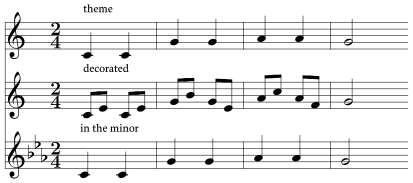
Bach’s largest set of variations was printed in 1741. It begins with an aria (ah-ree-uh), here a slow, songlike piece for keyboard, and follows it with thirty variations before the aria returns at the end. Bach’s variations keep the aria’s bass line and chords but hardly ever its melody, the way a house can keep its frame while every room is redecorated. Every third variation is a canon, and the distance between the two copying voices grows by one step each time. The first canon is at the same pitch, the next a second apart, the next a third, and so on up to a ninth.
The set is known as the variations nicknamed “Goldberg”,A work of this type by J.S. Bach is nicknamed "Goldberg." → variations•• after a story first printed in 1802 by Bach’s first biographer, Johann Nikolaus Forkel. According to Forkel, a Russian diplomat, Count Keyserlingk (ky-zer-link), suffered from sleepless nights and asked Bach for music that his young harpsichordist, Johann Gottlieb Goldberg, could play to him in the dark. The count is supposed to have paid with a gold cup filled with a hundred gold coins. But Forkel wrote sixty years after the event. Goldberg was only fourteen in 1741, and the printed music carries no dedication to the count, so the story may be no more than a legend.
Variations can also paint people. In 1899 the English composer Edward Elgar (1857–1934; Vol. 17, The Victorians) finished his Variations on an Original Theme, nicknamed Enigma.Edward Elgar's "Enigma" is a work of this type. → variations• Each of its fourteen variations is a musical portrait of one of Elgar’s friends, or of his wife, or of himself, and nearly every one is headed with initials or a nickname. The most famous, “Nimrod,” portrays August Jaeger (yay-ger), who worked for Elgar’s music publisher. Jäger is German for “hunter,” and Nimrod is the “mighty hunter” of the Book of Genesis. The enigma, or riddle, is that Elgar said another, larger theme “goes” through the whole set without ever being played. He never said what it was. Listeners have guessed “Auld Lang Syne,” “Rule, Britannia!,” and dozens of other tunes, and no guess has been proved.
The suite
Around 1890 a thirteen-year-old cellist named Pablo Casals (kuh-sahlz) was looking through a secondhand music shop in Barcelona when he found an old printed copy of six suites for cello by Bach. Almost nobody played them. Cellists who knew them at all treated them as exercises. Casals practiced them for years before he dared to play one in public, and from 1936, when he was nearly sixty, he recorded all six. Those recordings turned the suites into some of the best-loved music ever written for one instrument, and today nearly every serious cellist learns them.
A suite (French for “a sequence”) is a set of instrumental pieces in the same key, most of them dances, played one after another. Each dance is a separate movement. The dances of a Baroque suite were stylized: they kept the rhythm and the mood of a real dance, but they were written to be listened to, not danced to. In the same way, a poem written in the form of a lullaby is not really meant to send anyone to sleep.
By about 1700 a suite was built around four dances from four countries, allemande (al-uh-mand), courante (koo-rahnt), sarabande (sair-uh-band), and gigue (zheeg)In the Baroque dance form of this instrumental collection, an allemande, courante, sarabande, and gigue form the usual core. → suite•• (Figure 10.6). The allemande, whose name is French for “German,” is moderate and flowing, with four beats to the bar. The courante, French for “running,” is livelier and in three. The sarabande is slow and grave, in three, with its weight on the second beat of the bar instead of the first. It began as a wild dance in Spain and its American colonies, so wild that Spain banned it in 1583, but by Bach’s time it had become the most solemn piece in the suite. The gigue comes from the English and Irish jig. It is fast, with a skipping long-short rhythm, and many gigues begin like a fugue, one voice entering after another. The four make a satisfying journey: moderate, quick, slow, and fast.

The order had to be settled by someone, and much of the credit goes to Johann Jakob Froberger (froh-bair-gur) (1616–1667), a German keyboard player who served as organist to the emperor in Vienna. He studied in Rome with Girolamo Frescobaldi (fres-koh-bahl-dee), the most famous organist in Italy, and then traveled across Europe, to Dresden, Brussels, Paris, and London. He was robbed on the way to England and wrote a lament about it for the harpsichord. His keyboard suites made the allemande, courante, and sarabande a fixed group, and he added the gigue. He often put it second, but after his death a publisher in Amsterdam printed his suites with the gigue placed last, and Froberger’s suites became the standard modelJohann Jakob Froberger developed the standard version of this musical form. → suite• for the next half century.

Bach wrote suites for harpsichord, for orchestra, and for single instruments. He wrote his most famous set around 1720, while he was director of music at the court of Cöthen (kur-ten) in Germany, and it is the set that Casals found in Barcelona: six suites for cello alone.Bach wrote six of these pieces for solo cello. → suite• Each opens with a prelude, goes on through the core four, and slips a pair of lighter, newer dances in before the gigue: two minuets in the first two suites, two bourrées (boo-ray) in the next two, and two gavottes (guh-vot) in the last two. A cello can hold only one or two notes at a time, so it cannot sustain full chords the way a keyboard can. Bach gets around this by spreading his chords out into running notes, and the listener’s ear fills in the harmony.
The suite went out of fashion after Bach, but composers kept coming back to it. Between 1914 and 1917 the French composer Maurice Ravel (1875–1937; Vol. 22, The Lost Peace) wrote a piano suite called Le Tombeau de Couperin (luh tom-boh duh koo-pran). A tombeau, French for “tomb,” was a Baroque piece written in memory of someone. Ravel’s honors François Couperin, harpsichordist at the court of King Louis XIV of France, and through him the old French suite. Each of its six movements is also dedicated to a friend of Ravel’s killed in the First World War. The movements borrow the old dances and forms, and the suite has a fugue as its second movement,This form appears as the second movement of Ravel's Le tombeau de Couperin, between the Prélude and the Forlane. → fugue• between the opening Prélude and a Forlane (for-lahn), a quick dance from northern Italy. In 1919 Ravel arranged four of the movements for orchestra and left the fugue out.
The concerto grosso
In Rome around 1700, the most admired violinist in Europe was Arcangelo Corelli (1653–1713). He led the orchestras in the palaces of cardinals, and he liked to split his players into two groups: a few soloists in front and a larger band behind them, the two answering each other like two choirs on opposite sides of a church. His twelve concertos built this way were printed in Amsterdam in 1714, the year after he died, and copied and imitated all over Europe (Vol. 10, Rebirth).
A concerto is a piece that sets one or more soloists against an orchestra.This genre typically contrasts one or more soloists with an orchestra. → concerto• A soloist is a player with a part of his own, more prominent and usually harder than the rest. In Corelli’s kind of concerto, the concerto grosso (groh-soh) or “big concerto,” the soloists are a small group called the concertino (kon-cher-tee-noh), “the little concerto.” Against them plays the full band, the ripieno (rip-yay-noh), “filled up,” also called the tutti (too-tee), “all.” Underneath both, a harpsichord or organ and a cello play without stopping. Their part is the basso continuo, the “continuous bass” of Chapter 5: the cello plays the bass line, and the keyboard player fills in chords from the figures written under it (Figure 10.8).

Corelli’s concertos have four or more short movements. The composers of Venice, above all the violinist Antonio Vivaldi, settled on three movements, fast, slow, fast,This is the traditional number of movements in a concerto. → three• and nearly every composer of concertos since has kept that plan. The first movement is quick and vigorous and shows what the players can do. The second is slow and songlike, often in a different key. The third is quick again and often lighter, like a dance. The Italian tempo words of Chapter 3 usually head them: allegro for the first, adagio or largo for the second, allegro or presto for the third.

From 1717 to 1723 Bach was director of music at Cöthen, a small German court whose prince loved instrumental music. In 1719 he went to Berlin to collect a new harpsichord for the court, and there, most likely, he played for Christian Ludwig, Margrave of Brandenburg. A margrave was a German prince; the title first meant the governor of a “mark,” a border province. Christian Ludwig belonged to the ruling family of Brandenburg-Prussia and kept a band of his own, and he asked Bach to send him some music. On March 24, 1721, Bach sent him a handsome copy of six concertos dedicated to the margrave,J.S. Bach wrote six pieces in this genre dedicated to Christian Ludwig, the margrave of Brandenburg. → concerto• with a title page in French, the language of Europe’s courts (Figure 10.9). Perhaps he hoped for a job. No reply survives, and no one knows whether the concertos were played in Berlin. The manuscript was found in a Berlin library in 1849 and printed the next year, a century after Bach’s death, and the six have come to be called the “Brandenburg” Concertos.
Each of the six uses a different group of instruments. The second has a concertino of trumpet, recorder, oboe, and violin, and its trumpet part, written for an instrument without valves and pitched very high, is one of the hardest in all music. The third has no concertino at all: three violins, three violas, and three cellos trade phrases as equals, and its slow movement is just two chords, around which a player was probably expected to improvise. In the fifth the harpsichord, which normally sits in the continuo filling in chords, steps forward as a soloist beside a flute and a violin, and near the end of the first movement it plays a long solo of its own.
The concerto grosso spread north. In England, where Corelli’s concertos were especially loved, Charles Avison (ay-vih-sun) (1709–1770), the church organist at Newcastle upon Tyne, turned Scarlatti’s keyboard sonatas into concertos.Charles Avison adapted Scarlatti keyboard sonatas into twelve orchestral works in this genre. → concerto• Domenico Scarlatti (1685–1757) was an Italian harpsichordist who spent most of his life at the royal courts of Portugal and Spain. He wrote more than five hundred short harpsichord pieces that he called sonatas, each a single movement. In 1744 Avison rearranged a selection of them for strings as twelve concerti grossi (the Italian plural), each with a concertino and a full band.
The solo concerto: violin
In 1715 a German architect named Johann Friedrich von Uffenbach went to hear the most famous violinist in Venice. Near the end of the evening the violinist played a solo, and when it was over he went on alone, making it up as he went, with his fingers so close to the bridge that there was hardly room left for the bow. Uffenbach wrote in his diary that it absolutely astounded him. The violinist was Antonio Vivaldi (1678–1741), and what Uffenbach heard was an early cadenza (kuh-den-zuh), the soloist’s moment alone that concertos have kept ever since.

Vivaldi was a priest, nicknamed il Prete Rosso, “the Red Priest,” for his red hair. For much of his career he taught at the Ospedale della Pietà (oss-peh-dah-leh del-lah pyeh-tah), a Venetian home for abandoned children, whose orchestra of girls and young women drew visitors from all over Europe. He wrote some five hundred concertos, more than two hundred of them for the violin (Vol. 10, Rebirth). Most are solo concertos, with a single soloist against the orchestra. A violin concerto is a solo concerto for violin, and it became the commonest kind.
In a Vivaldi fast movement, the orchestra opens with a strong passage called the ritornello (rit-or-nel-oh), Italian for “little return,” because it keeps coming back. Between its returns the soloist plays passages of his own, faster and more brilliant, and each time the ritornello comes back it may be in a new key or cut short. It works like the chorus of a song between the verses, except that this chorus wanders from key to key before it comes home.
In 1725 a publisher in Amsterdam printed twelve of Vivaldi’s concertos as his Opus 8, under the title Il cimento dell’armonia e dell’inventione (chee-men-toh), or The Contest Between Harmony and Invention.Vivaldi’s The Contest Between Harmony and Invention, including The Four Seasons, is a set of works in this genre. → concerto• The Italian cimento means a trial of strength. “Harmony” meant the rules of composition and “invention” the composer’s imagination, and the concertos set the two against each other. Few people now know the title, but almost everyone has heard its first four pieces. They are four violin concertos, The Four Seasons,Vivaldi's The Four Seasons is a set of works of this type. → violin concerto•• one each for spring, summer, autumn, and winter. Each was printed with a sonnet, the fourteen-line poem of Chapter 1, perhaps written by Vivaldi himself, and lines from the poems are printed in the score at the places the music paints. Birds sing in “Spring,” and in its slow movement a goatherd sleeps while his dog barks, a rough, repeated figure in the violas. “Summer” brings a thunderstorm, “Autumn” a harvest party with drunken villagers, and “Winter” chattering teeth and slippery ice. Each concerto has three movements, fast, slow, fast, and each sonnet is divided into three parts to match. Music like this, which tells a story or paints a scene, is called program music, and Chapter 12 returns to it.
As concertos grew grander, the soloist’s improvised moment became a fixed part of the form. A cadenza is a passage, usually near the end of the first movement, where the orchestra stops and the soloist plays alone, in free time, showing off both skill and imagination. The word is Italian for “cadence,” because the cadenza comes just before the movement’s last cadence, the closing chords of Chapter 5. In the usual plan the orchestra halts on a held chord marked with a fermata, the pause sign of Chapter 3. The soloist plays alone. A long trill, two neighboring notes alternating very fast, warns the orchestra to get ready, and the orchestra comes back to finish the movement (Figure 10.11). For most of the eighteenth century, soloists made up their cadenzas on the spot. Later, composers often wrote them out, and violinists still play cadenzas written by famous players of the past.

In the nineteenth century the violin concerto became the great showpiece of the concert hall, and three of the most famous are in the same key. Beethoven’s dates from 1806, and Brahms’s and Tchaikovsky’s both from 1878. They are each man’s only violin concerto, in D major.Beethoven, Brahms, and Tchaikovsky each composed their only works of this type in D major. → violin concerto•• The key suits the instrument. A violin’s four open strings, as Chapter 6 explained, are tuned to G, D, A, and E, from low to high. In D major the open D and A are the key’s home note and its dominant, so they ring freely and give the whole piece a bright, resonant sound.
Beethoven’s concerto failed at its first performance and was almost forgotten until 1844, when a twelve-year-old Hungarian prodigy, Joseph Joachim (yoh-ah-kim), played it in London with the composer Felix Mendelssohn conducting. Joachim grew up to be the leading violinist in Germany and a close friend of Johannes Brahms (1833–1897; Vol. 19, Wagner and Verdi), who wrote his concerto for him. Joachim’s cadenza for it is still the one most violinists play. Pyotr Ilyich Tchaikovsky (1840–1893; Vol. 20, The North and the East) wrote his concerto in about a month, in Switzerland. The violinist he dedicated it to, Leopold Auer, refused to perform it. When it was finally played in Vienna in 1881, Eduard Hanslick, the most feared music critic in the city, wrote that it was music that stank to the ear. It is now one of the most often played concertos of all.
In Finland, Jean Sibelius (sih-bay-lee-us) (1865–1957; Vol. 20, The North and the East) had dreamed as a young man of becoming a violin virtuoso. His Violin Concerto, first heard in 1904 and revised the next year, is his only concerto, in D minor.Sibelius's piece of this type is in D minor. → violin concerto•• Its great cadenza does not wait for the end of the first movement. It stands in the middle and carries the music’s argument forward, instead of only showing off.
A concerto’s title can mislead. In 1874 the French composer Édouard Lalo (ay-dwar lah-loh) (1823–1892; Vol. 18, Paris, Capital of the Arts) wrote a work full of Spanish dance rhythms for the Spanish violinist Pablo de Sarasate (sah-rah-sah-tay) and called it Symphonie espagnole (san-foh-nee es-pahn-yol), “Spanish Symphony.” It is a violin concerto despite its title,Édouard Lalo's Symphonie Espagnole is actually a piece of this type despite its title. → violin concerto• with one soloist against the orchestra, though it has five movements instead of three. Tchaikovsky heard it in 1878 and admired it so much that he began his own concerto soon afterward.
The violin concerto is still alive. Sofia Gubaidulina (goo-bye-doo-lih-nuh) (1931–2025; Vol. 26, Behind the Curtain) was a composer in the Soviet Union whose religious music displeased the authorities. In 1980 she finished her violin concerto, Offertorium,Sofia Gubaidulina's piece of this type is called Offertorium. → violin concerto• for the Latvian violinist Gidon Kremer, who played it around the world and made her famous. Its title is Latin for the Offertory, the part of the Mass when bread and wine are offered at the altar (Chapter 9). Its theme is the one that King Frederick the Great of Prussia gave Bach to improvise on in 1747, which Bach used in his Musical Offering. In a series of variations the theme loses a note from each end, one step at a time, until almost nothing is left. Near the end it is rebuilt, running backward.
In the United States, Jennifer Higdon (born 1962; Vol. 36, Bebop to Pop Art) wrote a violin concerto for Hilary Hahn,Jennifer Higdon wrote a piece of this type for Hilary Hahn. → violin concerto• one of the leading American violinists. Hahn gave the first performance in Indianapolis in February 2009, and the next year the concerto won the Pulitzer Prize for Music.
The solo concerto: piano
In the spring of 1784, Mozart played in more than twenty concerts in about six weeks in Vienna, most of them in noblemen’s houses and three in a series of his own, with tickets sold to subscribers in advance. In those months he wrote four new piano concertos. A concerto was the perfect piece for the job, because it showed off the composer and the pianist at once, and in Mozart’s case they were the same man.
Mozart wrote piano concertos numbered from 1 to 27.Mozart wrote 27 pieces in this genre. → piano concerto•• The first four, made when he was eleven, are arrangements of other composers’ music, and two later ones are for two and three pianos, but the rest are the heart of the whole form. He played most of them himself. His first great one is No. 9 in E-flat major, K. 271, written in Salzburg in 1777, when he was twenty-one. (K. stands for the catalog of Mozart’s works made by Ludwig von Köchel, as Chapter 4 explained.) In concertos of the time the orchestra played a long opening by itself before the soloist was heard. In this one the piano interrupts in the second bar,A formally innovative early Mozart piece in this genre was nicknamed "Jeunehomme." → concerto• answering the orchestra’s first call at once. The concerto is nicknamed “Jeunehomme” (zhun-om), French for “young man,” because early scholars garbled the name of the pianist it was written for. In 2004 the musicologist Michael Lorenz showed that she was Victoire Jenamy (zhen-ah-mee), a fine pianist and the daughter of a famous French ballet master.
Two other Mozart concertos are known by nicknames he never gave them, the “Coronation” and the “Elvira Madigan”.Mozart's pieces in this genre include ones nicknamed Coronation, Jeunehomme, and Elvira Madigan. → piano concerto•• No. 26 in D major became the “Coronation” because Mozart played it in Frankfurt in October 1790, during the celebrations for the crowning of Emperor Leopold II. No. 21 in C major picked up its name almost two hundred years later, when a Swedish film of 1967, Elvira Madigan, used its slow movement for a doomed love story.
Mozart wrote concertos for other instruments too: for flute, oboe, bassoon, clarinet, and horn. He wrote four horn concertos for Joseph Leutgeb,Mozart wrote four pieces in this genre for Joseph Leutgeb. → concerto• the horn player he had known since childhood in Salzburg, for the valveless hand horn of Chapter 7. Mozart teased his friend in the manuscripts and wrote one of them out in inks of four colors.
Beethoven arrived in Vienna in 1792 as a young pianist, and like Mozart he made his name playing his own concertos. In all, Beethoven wrote five piano concertos,Beethoven wrote five pieces in this genre. → piano concerto• the first in the 1790s and the last in 1809. He was the soloist at the first performances of the first four, and the concertos grew grander as he went, with the orchestra taking a larger and larger share of the argument. His fifth and last, the “Emperor”,Beethoven's fifth piece in this genre is nicknamed the "Emperor." → piano concerto•••Beethoven's last work for piano in this genre has been nicknamed "Emperor." → concerto• in E-flat major, Op. 73, was written in 1809, the year Napoleon’s army besieged and shelled Vienna. Beethoven, whose deafness was growing worse, is said to have hidden in his brother’s cellar with pillows over his ears to protect what hearing he had left. The nickname is not his. It was probably given by an English publisher, and the concerto has nothing to do with any emperor. It begins in a new way, with three huge chords from the orchestra, each answered by a flourish from the piano. Where a cadenza would normally go, Beethoven wrote in the score that the pianist should not add one but go straight on, because he had already written the solo passage out himself. By the first performance, in 1811, he could no longer hear well enough to play it, and another pianist took his place.
Robert Schumann (shoo-mahn) (1810–1856; Vol. 16, Romantic Europe) was a German composer and music critic, and his wife, Clara Schumann, was one of the greatest pianists of the century. In 1841 he wrote a Fantasy in one movement for piano and orchestra for her to play. Four years later he added two more movements, making his only piano concerto, in A minor,Robert Schumann's only work in this genre is in A minor. → piano concerto•• and Clara was the soloist at its first performance, in Dresden on December 4, 1845. Its key, like the keys of the other concertos in Table 10.1, is part of its name.
| Composer | Concerto | Key | Year |
|---|---|---|---|
| Mozart | Piano Concerto No. 9, “Jeunehomme” | E-flat major | 1777 |
| Mozart | Piano Concerto No. 21, “Elvira Madigan” | C major | 1785 |
| Mozart | Piano Concerto No. 26, “Coronation” | D major | 1788 |
| Beethoven | Violin Concerto | D major | 1806 |
| Beethoven | Piano Concerto No. 5, “Emperor” | E-flat major | 1809 |
| Schumann | Piano Concerto | A minor | 1845 |
| Grieg | Piano Concerto | A minor | 1868 |
| Lalo | Symphonie espagnole (violin) | D minor | 1874 |
| Brahms | Violin Concerto | D major | 1878 |
| Tchaikovsky | Violin Concerto | D major | 1878 |
| Rachmaninoff | Piano Concerto No. 2 | C minor | 1901 |
| Sibelius | Violin Concerto | D minor | 1904 |
The concerto made a deep impression on a young Norwegian, Edvard Grieg (greeg) (1843–1907; Vol. 20, The North and the East), who heard Clara Schumann play it while he was a student in Leipzig. In 1868, at twenty-four, he wrote his own Piano Concerto in A minor,Grieg's work in this genre is in A minor. → piano concerto•• in the same key as Schumann’s and on much the same plan. It opens with a roll on the timpani and a crash from the piano that tumbles down the keyboard, and its tunes borrow the rhythms of Norwegian folk dances. Grieg lived almost forty more years and began a second concerto, but he never completed it, so the A minor is the only concerto Grieg ever finished.Edvard Grieg wrote only one work in this genre. → piano concerto••
Sergei Rachmaninoff (rahk-mah-nih-noff) (1873–1943; Vol. 20, The North and the East) was one of the great pianists of his age and wrote his concertos for his own enormous hands. The failure of his First Symphony in 1897 threw him into a depression so deep that he could hardly compose. A doctor named Nikolai Dahl saw him every day for three months, using hypnosis and encouragement, and the work that came next, the Piano Concerto No. 2 in C minor (1901), is dedicated to Dahl. In all, Rachmaninoff wrote four piano concertos.Sergei Rachmaninoff composed four pieces in this genre. → piano concerto•• Late in life he added the Rhapsody on a Theme of Paganini (1934) for piano and orchestra, which is really a set of twenty-four variations on a tune by the Italian violinist Paganini. Its eighteenth variation, a slow and sweeping tune, is the most famous.
His countryman Sergei Prokofiev (1891–1953; Vol. 23, Revolution and Ruin) was also a brilliant pianist, and Prokofiev wrote five piano concertos,Prokofiev wrote five pieces in this genre. → piano concerto• the first while he was still a student. The Fourth is for the left hand alone. It was ordered by Paul Wittgenstein (vit-gen-shtine), an Austrian pianist who had lost his right arm in the First World War. Wittgenstein wrote back that he did not understand a single note and would not play it, and the concerto was first performed only in 1956, three years after Prokofiev’s death.
What to remember
- A canon copies a whole line at a fixed distance; a round is a canon that loops back to its start.
- In a fugue the voices enter one by one with the subject. The answer is the subject a fifth higher, in the dominant key. Episodes, middle entries, and often a stretto follow.
- Bach’s Well-Tempered Clavier pairs a prelude with a fugue in each of the twenty-four major and minor keys. His Art of Fugue builds every piece from one subject.
- Fugues end Beethoven’s Hammerklavier sonata and Britten’s Young Person’s Guide; the Grosse Fuge first ended Beethoven’s thirteenth string quartet.
- In variations a theme is stated and then reshaped again and again, as in Bach’s “Goldberg” and Elgar’s Enigma.
- The Baroque suite is a set of dances in one key built on the allemande, courante, sarabande, and gigue. Froberger set the pattern; Bach wrote six suites for cello alone.
- A concerto sets one or more soloists against an orchestra, usually in three movements, fast, slow, fast. In a concerto grosso a small concertino plays against the full ripieno, as in Bach’s six “Brandenburg” Concertos.
- A cadenza is the soloist’s passage alone, usually near the end of the first movement.
- Vivaldi’s Four Seasons are four violin concertos. Beethoven, Brahms, and Tchaikovsky each wrote one violin concerto, all in D major; Sibelius wrote his in D minor.
- Mozart wrote twenty-seven numbered piano concertos; Beethoven wrote five, ending with the “Emperor”; Schumann and Grieg each wrote one, both in A minor; Rachmaninoff wrote four and Prokofiev five.
Chapter 11 · 6 clues
Opera and Oratorio
On February 24, 1607, the court of Mantua, a small, rich state in northern Italy, was keeping Carnival, the weeks of feasts and masked balls before the fasting season of Lent. That evening a club of young noblemen crowded into a room of the palace of the Gonzaga (gon-zah-gah) family, the dukes who ruled the city, to see a new kind of play. A court official had written the day before that it “should be most unusual, as all the actors are to sing their parts.” Trumpets played a short fanfare three times over. Then a singer dressed as Music herself stepped forward and sang the prologue. Everyone after her sang too: shepherds, a messenger, the boatman of the dead, and Orpheus (or-fee-us), the singer of Greek myth whose songs could charm wild beasts and who went down to the land of the dead to bring back his wife, Eurydice (yoo-rid-ih-see).
The play was L’Orfeo (lor-fay-oh), by Claudio Monteverdi (mon-teh-vair-dee), the duke’s music director (Vol. 10, Rebirth). A few Florentine gentlemen had tried the experiment a little earlier, because they believed the ancient Greeks had sung their tragedies from start to finish. L’Orfeo is the oldest such work that opera houses still regularly put on the stage. The Italians came to call the new form opera, which simply means “a work.” An opera is a drama told mostly or wholly in song. In four hundred years the form has grown huge, but its parts are few, and once you know them you can follow any opera ever written.
The voice
An opera singer is an instrument without a plug. With no microphone, one human voice has to carry over an orchestra of fifty or more players and reach the back row of a hall that may hold two thousand people. Singers train for years to do it, and each learns to live inside one voice type, a range of notes and a kind of sound. Composers write every part for a particular type, so a cast list tells you at once who sings high and who sings low.
The types grow out of the four parts of a choir (Chapter 9): soprano, alto, tenor, and bass. Opera divides them more finely. Each is defined first by its range, the span from its lowest comfortable note to its highest. Figure 11.1 shows the usual ranges, from the bass, whose lowest note sits below the bass staff, up to the soprano, who climbs two octaves above middle C. The ranges overlap a great deal. What really tells one type from another is where the voice sounds best and how heavy or light it is.

The soprano is the highest voice, and opera sorts sopranos by weight. A coloratura (kol-uh-ruh-toor-uh) soprano, from the Italian for “coloring,” has a light, agile voice built for quick runs, trills (rapid shakes between two neighboring notes), and leaps to the very top. The best-known coloratura role is the Queen of the Night in The Magic Flute (1791), by the Austrian composer Wolfgang Amadeus Mozart (Vol. 14, From Luther to Mozart). She hurls her rage at her daughter in the aria, or solo song, “Der Hölle Rache” (dair hur-leh rah-kheh) (“Hell’s vengeance”), whose staccato notes, short and detached, climb to a high F, above the top of the chart. A lyric soprano has a warm, smooth voice for long, tender melodies, the voice of most young heroines. A dramatic soprano has a big, dark voice that can ride over a full orchestra, like Brünnhilde (broon-hil-duh), the warrior maiden in the German composer Richard Wagner’s cycle of four operas called The Ring of the Nibelung (nee-buh-loong) (Vol. 19, Wagner and Verdi).
Below the soprano sits the mezzo-soprano (met-soh suh-pran-oh), from the Italian for “half soprano,” a woman’s voice with a richer, darker middle. Lowest of all women’s voices is the contralto (kun-tral-toh), the solo voice that sings a choir’s alto part. True contraltos are rare, and opera often gives them old women, witches, and goddesses, such as Erda, the earth goddess of Wagner’s Ring.
Men divide the same way. The tenor, the highest normal man’s voice, is usually the young hero or lover. The baritone lies between tenor and bass and plays fathers, rivals, villains, and clever servants. As a rough rule, the tenor loves the soprano, and the baritone stands in their way. The bass is the deepest voice, and it plays kings, priests, old men, and devils. Two kinds of bass have their own Italian names. The basso buffo (bah-soh boo-foh), or “comic bass,” plays the foolish old guardian or the pompous doctor, and must rattle off words at astonishing speed. The basso profondo (proh-fon-doh), or “deep bass,” has the darkest voice of all; Sarastro, the wise high priest of The Magic Flute, sings arias that sink to the bottom of the bass range.
Two kinds of singer need a word of their own. In the 1600s and 1700s the greatest stars of Italian opera were men who sang as high as women. A castrato (kas-trah-toh) (plural castrati) was a singer who had been castrated as a boy, an operation that kept his voice from breaking, or deepening, at puberty. It was a cruel operation, done mostly to the sons of poor families, and only a few of the boys ever became famous. Those few kept a boy’s high voice in a grown man’s chest, and their power, breath, and agility astonished audiences. The composers of the Baroque wrote heroes and kings for them.

The most famous castrato was Carlo Broschi (bros-kee), known as Farinelli (fah-rih-nel-ee) (1705–1782). He sang in the opera houses of Italy, Vienna, and London. In 1737 he went to Madrid, where the queen of Spain hoped his voice would lift the dark moods of her husband, King Philip V. For nine years, until the king died, Farinelli sang to him every night. By the 1800s the practice was dying out. Alessandro Moreschi (moh-res-kee), often called the last castrato, sang in the pope’s choir at the Sistine Chapel and made recordings in 1902 and 1904, the only solo recordings of a castrato that exist.
The castrati’s parts did not die with them. Today they are sung by women, usually mezzo-sopranos, or by a countertenor, a man who sings with a trained falsetto, the light, high voice that most men can make above their ordinary range. Opera also plays the same trick on purpose. A trouser role is a young man written for a woman, usually a mezzo-soprano, because a boy whose voice has not yet broken sounds more like a woman than like a man. She sings it in a man’s trousers, hence the name. Cherubino (keh-roo-bee-noh), the teenage page in Mozart’s The Marriage of Figaro (1786), who falls in love with every woman he meets, is a trouser role. So is Octavian, the seventeen-year-old count in Der Rosenkavalier (roh-zen-kah-vah-leer), or The Knight of the Rose (1911), by the German composer Richard Strauss (Vol. 19, Wagner and Verdi).
Libretto and overture
Before a composer writes a note of an opera, someone must write the words. The text of an opera is its libretto (lih-bret-oh), Italian for “little book,” and the writer is the librettist. The name is literal. For two centuries the libretto was printed as a small booklet and sold at the door, and the audience followed the words by candlelight, since the hall was not darkened during a performance (Figure 11.3).
A librettist rarely invents a story. He usually adapts a play, a novel, a myth, or a chapter of history, and then cuts it hard, because sung words go slowly and a three-hour opera holds far fewer words than a three-hour play. He decides where the action happens and where it pauses for a song, and writes the lines for each kind of music. The best librettists were poets and playwrights in their own right. Lorenzo Da Ponte (dah pon-teh) (1749–1838), born in a Jewish family in the Venetian Republic, became a Catholic priest, was banished from Venice for scandal, and found his way to Vienna. There he wrote the words for three of Mozart’s operas, beginning with The Marriage of Figaro, adapted from a French comedy. He ended his long life in New York as the first professor of Italian at Columbia College.

The music begins before anyone sings. An opera opens with an overture,Operas are introduced by pieces in this genre. → overture•• an instrumental piece for the orchestra alone; the word is French for “opening.” An overture has two jobs. It settles a noisy audience, and it sets the mood of the drama to come. Monteverdi’s L’Orfeo began with a trumpet fanfare played three times. A century later the Italian opera overture had a pattern of three short sections, fast, slow, and fast, and that pattern later grew into the symphony (Chapter 12). By the 1800s many composers built their overtures out of the opera’s best tunes, so that the audience heard a preview of what was coming. Others wrote whatever they liked. The overture to The Barber of Seville (1816), by the Italian composer Gioachino Rossini (Vol. 16, Romantic Europe), had already opened two of his earlier operas.
Recitative and aria
An opera runs at two speeds. In some stretches things happen: a letter arrives, a plot is hatched, a lover is caught in a closet. In others time stands still while a character feels something, rage or longing or joy, and lets it out at length. Opera has a different kind of singing for each speed.
Recitative (res-ih-tuh-teev), from the Italian for “to recite,” is singing that imitates speech. It follows the rhythm of the words as an actor would say them, fast and uneven, often on one repeated note, with little melody and little repetition. Recitative carries the plot: conversations, news, quarrels, and plans. In Baroque and Classical opera, the commonest kind was secco (sek-oh) recitative, from the Italian for “dry,” accompanied only by the basso continuo (Chapter 5), a harpsichord playing chords and a cello playing the bass line beneath them. The singer moves freely, and the harpsichord simply marks each change of chord. At the end of a speech the continuo closes it with two quick chords, a cadence (Chapter 5) that says “done” (Figure 11.4).
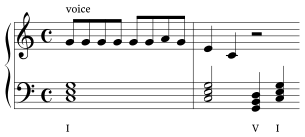
For the great moments (a ghost, a vow, the edge of madness), composers called in the whole orchestra. This is accompanied recitative, in Italian accompagnato (ah-kom-pahn-yah-toh). The words still follow speech, but the strings surge, shudder, and hold long chords behind them, and the scene grows tense.
When the action stops, the aria begins. An aria, Italian for “air,” is a song for one voice and orchestra that holds a single feeling and explores it. Its words are few and are repeated again and again; its melody is the point. In an aria a single syllable may stretch over a long run of notes, and here the coloratura soprano shows what she can do. Eighteenth-century audiences chatted, ate, and played cards through the recitatives and fell silent for the arias of the stars.
Most Baroque arias followed one plan, the da capo aria (dah kah-poh), from the Italian for “from the head.” The first section, A, sets the first lines of words in the home key. The second section, B, sets new lines, in a new key and often a new mood. At the end of B the composer wrote only “da capo,” and the singer went back to the beginning and sang A again (Figure 11.5). The shape A–B–A, a return after a contrast, is called ternary form, “form in three parts,” and you will meet it again in the minuet and trio of the Classical symphony (Chapter 12). The composer did not write out the second A, and that was deliberate. A great singer was expected to decorate it with new runs and trills of his or her own, so the return was the same music and also a display.

Number opera and music drama
Open the score of an opera by Mozart, the book that prints every part, and you will find its pieces numbered: No. 1, No. 2, No. 3, with recitatives between them. Such an opera is a number opera, built of separate pieces, or numbers, each with a clear beginning and end. The audience may applaud after each one, and in the 1700s a star who was cheered loudly enough might sing an aria twice.
Arias are only some of the numbers. A duet is a number for two singers, most often the hero and heroine falling in love or the villain tempting the innocent. With three singers it is a trio, with four a quartet. Any number for several soloists is an ensemble, and an ensemble can do something a spoken play cannot. If four actors talk at once, the audience hears noise; if four singers sing at once, the audience hears each of them, and harmony besides. The last act of Rigoletto (1851), by the Italian composer Giuseppe Verdi (Vol. 19, Wagner and Verdi), shows how. Inside an inn a duke flirts with a young woman, who laughs at his flattery; outside in the dark, the girl he has betrayed weeps, and her father, the court jester Rigoletto, swears revenge. Four people pour out four different feelings in one quartet.
The grandest ensemble comes at the end of an act. In an ensemble finale, the characters crowd onto the stage one by one, the music never stops, and the confusion builds to a climax. In Act 2 of The Marriage of Figaro, the finale begins as a duet for the Count and Countess and grows, as one character after another bursts in, to seven singers at once, without a break for recitative. Around the soloists stands the chorus, the opera’s crowd, which sings as soldiers, priests, villagers, or prisoners. It uses the same four voice parts as a church choir.
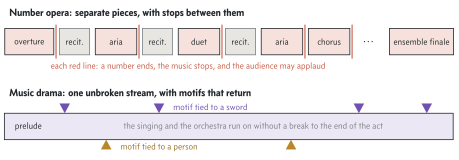
In the middle of the 1800s Richard Wagner rejected the whole system. In his later operas there are no numbers and no stops. The music runs unbroken from the beginning of an act to its end, the orchestra carries much of the story, and the voices move in a long line that is neither recitative nor aria. Music written straight through, with no sections repeated or set apart, is called through-composed, and Wagner’s later operas are usually called music dramas, to set them apart from number opera (Figure 11.6). To hold so long a stream together, Wagner used the leitmotif (lite-moh-teef), German for “leading motive”: a short musical idea tied to a person, an object, or an idea, which returns whenever that thing appears or comes to mind. In the Ring, four operas that take about fifteen hours to perform, a bright trumpet call stands for the sword that the hero Siegmund pulls from a tree. It sounds whenever the sword matters, long before and long after. Vol. 19, Wagner and Verdi teaches the leitmotif in full.
The kinds of opera
On February 20, 1724, in the King’s Theatre in London, the castrato Senesino (seh-neh-zee-noh) walked on stage as Julius Caesar, the Roman general, newly landed in Egypt. The opera was Giulio Cesare (joo-lyoh cheh-zah-reh) by George Frideric Handel, a German composer who had settled in London (Vol. 12, Crown and Parliament), and its Cleopatra was the soprano Francesca Cuzzoni (koot-soh-nee). It was sung in Italian to an English audience, and it was a perfect example of opera seria (seh-ree-ah), “serious opera,” the noble form that ruled the 1700s. Its heroes are kings and generals from ancient history or myth, torn between love and duty. Its music is a long chain of recitatives and da capo arias, with few ensembles and almost no chorus, written to show off its star singers, many of them castrati.
Comedy took a different road. Opera buffa (boo-fah), “comic opera,” told stories of ordinary people, servants, doctors, guardians, and young lovers, in everyday settings, and it gave the basso buffo his chance. It loved the ensemble finale, because comedy thrives on confusion. Mozart’s The Marriage of Figaro, first performed in Vienna on May 1, 1786, is its masterpiece: the servant Figaro and his bride, Susanna, outwit their master, a count who wants Susanna for himself (Vol. 14, From Luther to Mozart). Rossini wrote the other favorite, The Barber of Seville, with the same barber in an earlier story. The French playwright Beaumarchais (boh-mar-shay) had written The Barber first and Figaro as its sequel, so Rossini set the first play thirty years after Mozart set the second.
Germans had a comic form of their own. A Singspiel (zing-shpeel), “sing-play,” is a German opera with spoken dialogue in place of recitative, so that the actors talk between the songs. The Magic Flute is one, written for a popular theater in a suburb of Vienna whose manager, the actor Emanuel Schikaneder (shik-ah-nay-der), wrote the libretto and played the bird-catcher Papageno (pah-pah-gay-noh) himself.
In Paris around 1830 a new form arose to fill the enormous stage of the Paris Opéra, the city’s state opera house. Grand opera was opera on the largest scale: usually five acts, a story from history, crowds of chorus singers, spectacular scenery, and, by the custom of the house, a ballet, a dance performed on the stage (Chapter 15). Giacomo Meyerbeer (my-er-bair), born to a rich Jewish family near Berlin in 1791, became its master. His Les Huguenots (lay hyoo-guh-nots) (1836) ends with the Massacre of St. Bartholomew’s Day, August 24, 1572, when Catholic mobs in Paris killed thousands of Protestants, who were called Huguenots.
In the same years Italian opera was perfecting bel canto (bel kahn-toh), “beautiful singing.” The phrase names the style of Rossini, Vincenzo Bellini (beh-lee-nee), and Gaetano (gah-eh-tah-noh) Donizetti (doh-nee-dzet-tee) in the early 1800s: long, smooth, graceful melodies, decorated with runs and trills, written to display a perfectly trained voice. Bellini, a Sicilian who died at thirty-three, wrote its most famous aria in Norma (1831). Norma is a priestess of the Druids, the priests of the Celtic peoples of Gaul, the land that is now France, in the years when Rome ruled it. She has secretly borne two children to the Roman governor. In “Casta diva” (“Chaste goddess”) she prays to the moon for peace in a melody that seems never to end.
| Kind | Where and when | Example |
|---|---|---|
| opera seria | Italy and London, 1700s | Handel, Giulio Cesare (1724) |
| opera buffa | Italy and Vienna, 1700s to 1840s | Mozart, The Marriage of Figaro (1786); Rossini, The Barber of Seville (1816) |
| Singspiel | German lands, 1700s | Mozart, The Magic Flute (1791) |
| grand opera | Paris, 1830s to 1860s | Meyerbeer, Les Huguenots (1836) |
| bel canto | Italy, early 1800s | Bellini, Norma (1831) |
| music drama | Germany, from the 1850s | Wagner, The Ring of the Nibelung (1876) |
| operetta | Paris, Vienna, London, from the 1850s | Johann Strauss II, Die Fledermaus (1874) |
| verismo | Italy, 1890s | Mascagni, Cavalleria rusticana (1890) |
Two more kinds, and one more voice, need only a sentence or two here. An operetta, “little opera,” is a light, comic opera with spoken dialogue, catchy tunes, and dances, often poking fun at the society that watched it. The most famous Viennese operetta is Die Fledermaus (dee flay-der-mows), or The Bat (1874), by Johann Strauss II, the “Waltz King” (Vol. 19, Wagner and Verdi), who was no relation to Richard Strauss. In it a man takes revenge for an old practical joke at a masked ball awash in champagne. In London, the librettist W. S. Gilbert and the composer Arthur Sullivan wrote operettas in English (Vol. 17, The Victorians). At the other extreme stands verismo (veh-riz-moh), or “realism,” the Italian opera of the 1890s about poor people in the grip of violent passions, told in short, brutal acts. Its first triumph was Pietro Mascagni’s (mahs-kahn-yee) Cavalleria rusticana (kah-vah-leh-ree-ah roos-tih-kah-nah) (“Rustic Chivalry”), first performed in Rome on May 17, 1890, in which a jealous carter kills his wife’s lover in a knife fight on Easter Sunday in a Sicilian village. Giacomo Puccini (poo-chee-nee) took the style into the 1900s (Vol. 19, Wagner and Verdi).
Wagner’s music dramas demanded a voice of their own. His orchestra was so large and his roles so long that an ordinary tenor could not survive them. A Heldentenor (hel-den-teh-nor), German for “hero tenor,” is a tenor with a baritone’s dark power and a marathon runner’s stamina, built for heroes like Siegfried and Tristan, who must sing over an orchestra of about a hundred players for hours.
The oratorio
In 1575 a Florentine priest in Rome named Philip Neri (neh-ree) founded a community of priests who met with the people of Rome in an oratory, a hall for prayer, beside the church of Santa Maria in Vallicella. Neri, a cheerful man who was later made a saint, wanted the gatherings to be lively, so between the sermons and readings his people sang religious songs. Out of that singing grew a form named after the hall. An oratorio is a large musical setting of a sacred story for solo singers, chorus, and orchestra. It uses the same parts as an opera (recitatives, arias, duets, and choruses), but it is performed as a concert, in a hall or a church, without scenery, costumes, or acting, and it is not part of any church service. In Rome and other Catholic cities the theaters closed during Lent, the forty days of fasting before Easter, and oratorios filled the empty evenings with music that was dramatic but devout.
The oratorio’s beginnings are tangled with opera’s, because both were born in the same few years. In February 1600, in Neri’s own hall, the composer Emilio de’ Cavalieri (kah-vah-lyeh-ree), a Roman nobleman who had managed the court entertainments of the Medici rulers of Florence, presented a sacred drama. Its characters are not people but ideas: the Soul, the Body, Time, Pleasure, and the World, all arguing over how a person should live. Apart from a brief prologue that was spoken, it was sung, in recitatives, songs, and choruses, and unlike a later oratorio it was acted in costume, with dancing. Scholars still argue whether it was really an opera, yet Cavalieri’s Rappresentatione di Anima et di CorpoCavalieri’s Rappresentatione di Anima et di Corpo is often cited as an early example of this genre. → oratorios•• (rah-preh-zen-tah-tsyoh-neh), “The Representation of the Soul and the Body,” is often named as an early oratorio, perhaps the first.
The oratorio’s most famous home turned out to be London. For a quarter of a century George Frideric Handel, the German-born composer of Giulio Cesare, had written Italian operas for London’s rich, and by the late 1730s the business was failing. A rival company split the small audience and even hired Farinelli, star castrati cost a fortune, and the English were tiring of drama in a language most of them did not understand. Handel turned to oratorios in English on stories from the Bible. They needed no scenery and no castrati, and they gave the chorus, which opera seria had almost ignored, the leading part. To draw a crowd he added an attraction of his own. Handel was famous as an organist, and in the pauses between the acts of an oratorioHandel performed organ concertos between sections of works in this vocal genre. → oratorios• he played an organ concerto, a work for solo organ and orchestra (Chapter 10), improvising passages at the keyboard as he went. He published six of them in 1738.

Handel’s best librettist for these works was a wealthy country gentleman, Charles Jennens (1700–1773), who lived at Gopsall Hall in Leicestershire, in the middle of England. Jennens loved Handel’s music, collected it, and spent years preparing his own editions of Shakespeare’s plays. He was also vain and touchy, and he never thought Handel took enough trouble with his texts. Yet Jennens wrote the librettos for Handel’s oratoriosCharles Jennens often wrote librettos for works in this genre. → oratorios•• Saul (1739) and Belshazzar (1745), and, most famously, for one more.
That one was Messiah, on the life of Jesus, whom Christians call the Messiah, the savior foretold by the Hebrew prophets. Jennens did not write it as a play. He gathered verses on the prophecies, the birth, the death, and the resurrection from the King James Bible, the English translation of 1611, and from the Psalms in the prayer book of the Church of England, and arranged them in three parts. Handel set them in twenty-four days, from August 22 to September 14, 1741. The first performance was in Dublin, on April 13, 1742, in a hall so crowded that gentlemen were asked to leave their swords at home and ladies to come without the hoops that held out their skirts. Seven hundred people squeezed in. Messiah, Handel’s most famous oratorio,Handel’s Messiah is a work in this genre. → oratorios•• uses every part of the opera machine except the stage. Its first song is an accompanied recitative for tenor, “Comfort ye my people,” which leads straight into an aria, “Ev’ry valley.” But its glory is the chorus, above all the “Hallelujah” that closes the second part. Jennens grumbled in a letter that Handel had made “a fine Entertainment” of it, though not nearly so good as he ought to have done. Few listeners since have agreed with him.
Handel’s oratorios never stopped being sung in England, and half a century later they changed the life of an Austrian composer. Joseph Haydn (1732–1809), the most famous composer in Europe in the 1790s (Vol. 14, From Luther to Mozart), heard Handel’s oratorios sung by enormous choirs on his visits to London and went home to Vienna determined to write one. Haydn’s The Creation, an oratorioHaydn's Creation is a work in this genre. → oratorios• on the first chapter of Genesis, the first book of the Bible, with lines drawn from the English poet John Milton’s Paradise Lost, was first performed in 1798. It opens with a slow, wandering orchestral piece, “The Representation of Chaos,” in which the music keeps refusing to arrive anywhere. A bass soloist begins the story in the words of Genesis. Then the chorus sings, softly, “And God said: Let there be light, and there was,” and on the next word, “light,” the full chorus and orchestra burst out in a blazing C-major chord.
What to remember
- An opera is a drama told mostly or wholly in song; Monteverdi’s L’Orfeo (1607) is the oldest one still regularly staged.
- Voices from high to low: soprano (coloratura, lyric, dramatic), mezzo-soprano, contralto; tenor, baritone, bass (comic basso buffo, deep basso profondo). Countertenors and mezzo-sopranos now sing castrato roles; a trouser role is a young man sung by a woman (Cherubino, Octavian).
- The libretto is the opera’s text, written by a librettist; the overture is the orchestral piece that opens the opera.
- Recitative imitates speech and carries the plot: secco with continuo (harpsichord and cello), accompagnato with the orchestra. The aria stops the action for a feeling; the Baroque da capo aria is A–B–A, ternary form.
- A number opera is built of separate numbers (arias, duets, ensembles, choruses, finales); Wagner’s music dramas are through-composed and use leitmotifs, short musical ideas tied to a person, object, or idea.
- The kinds: opera seria (Giulio Cesare), opera buffa (Figaro, The Barber of Seville), Singspiel (The Magic Flute), grand opera with its ballet (Les Huguenots), bel canto (Norma), operetta (Die Fledermaus), verismo (Cavalleria rusticana); the Heldentenor sings Wagner’s heroes.
- An oratorio sets a sacred story with arias, recitatives, and choruses but no staging: Cavalieri’s acted Rappresentatione (1600) is an early one, Handel’s Messiah (1742, words by Charles Jennens) and Haydn’s The Creation (1798) the most famous.
Chapter 12 · 42 clues
Sonata and Symphony
Play the opening of Mozart’s Eine kleine Nachtmusik, “A Little Night Music,” and you will probably recognize it even if you have never heard its name. It is a bold rising call, played by all the strings together, that sounds like someone throwing open a door. Mozart finished it in Vienna on August 10, 1787, as a serenade, a piece of light music for an evening party. Listen to the whole first movement, about six minutes long, and something curious happens. After half a minute a new and gentler tune arrives, and the music seems to have moved to a different place, the way a story moves from one room to another. Later the music wanders, restless, through several such places. Then the opening call comes back, and with it a feeling that any listener can name without knowing a note of music: we are home.
There are no words in this music, no singer, and no story printed in a program. Yet listeners who have never studied music feel the same journey out and back. This chapter is about how composers built that journey on purpose, and about the works they built with it: the sonata, the symphony, and the overture from which the symphony grew. Their shared plan is called sonata form, and for about a century and a half, from Haydn to Mahler, it was the most important idea in instrumental music.
Sonata form
Long music without words has a problem. A song has its poem and an opera has its plot, and both tell the listener where he is. A piece for instruments alone has nothing to hold onto but the sounds themselves. The composers of the Baroque solved the problem in two ways. A fugue keeps one short subject going from the first bar to the last, and a dance in a suite lasts only two or three minutes (Chapter 10). The composers of the Classical period in music, about 1750 to 1820, wanted something larger: movements that could last ten minutes or more and felt like a drama, with a conflict, a crisis, and a resolution. They found their drama in keys.
A key, as Chapter 4 explained, is a home note, the tonic, with a scale built on it. Music in C major keeps returning to C and to the C-major chord, and it sounds finished only when it gets there. A composer can also lead the music out of one key and into another in the middle of a piece, so that a new note starts to feel like home. That move is called modulation (Chapter 4). The nearest and commonest move is to the dominant, the key built on the fifth degree of the scale (Chapter 5): from C major to G major, from G major to D major. To a trained listener, and in a vaguer way to everyone, modulating to the dominant feels like setting out on a journey, and returning to the tonic feels like coming home.
Sonata form is a plan for one movement of music built on that journey. It takes its name from the sonata, a work for one or two instruments, because it was most often the plan of a sonata’s first movement. Its three main sections, the exposition, development, and recapitulation,Exposition, development, and recapitulation are the principal sections of this musical form. → sonata form•• each do a different job, and their names say what the jobs are. Figure 12.1 draws the whole plan as a line that leaves home and comes back.

The exposition
The exposition sets out, or exposes, the movement’s material. A theme, as in the variations of Chapter 10, is a tune or a short musical idea that a movement is built from. The exposition begins with the first theme in the home key, often bold and forceful, though some symphonies put a slow introduction before it. Then comes a bridge, a passage of running notes or busy chords whose job is to modulate. (It has nothing to do with the bridge of a violin.) The second theme follows in the new key, and it usually has a different character, gentler or more songlike, as if a second person had walked into the story. A short closing passage repeats the cadences of the new key (Chapter 5) until there is no doubt where the music has arrived. A repeat sign then sends the players back to the beginning, and the whole exposition is played twice, so that the listener learns the themes well enough to recognize them later.
In a movement in a major key, the second theme goes to the dominant. A movement in a minor key does something different. Its second theme usually goes to the relative major (Chapter 4), the key built on the third degreeThe key corresponding to this numbered scale degree is traditionally used for the second theme in a minor-key sonata movement. → three• of the minor scale. The scale of G minor runs G, A, B-flat, and so on, and the second theme of a movement in G minor will usually be in B-flat major, the key of its third note, the mediant (Chapter 5). In Roman numerals that key is III. The change from minor to major gives the second theme its brighter color.
The development
The development is the drama’s crisis. The composer takes the themes apart and works on them, which is what “develop” means here. He breaks them into fragments, hands the fragments from one instrument to another, stacks them on top of each other, and drives them through key after key, often into minor and distant keys that the exposition never touched. Nothing settles. The ear has lost its home and does not know where it will land.
The pieces a composer works with are often motifs. A motif is the smallest fragment of a theme that still keeps its identity, sometimes only three or four notes. The most famous motif in music opens Beethoven’s Symphony No. 5 in C minor, first played in Vienna in 1808: three quick notes and a long one, repeated a step lower (Figure 12.2). Almost the whole first movement is made of that cell. In the development it is tossed between the strings and the winds, piled up into towers of chords, and finally whittled down to single chords passed back and forth, softer and softer, until the full orchestra bursts back in.

Near the end of the development the music usually comes to rest on the dominant chord of the home key and stays there. The dominant chord is the one that most strongly pulls toward the tonic (Chapter 5), so holding it feels like standing at the front door with the key in your hand.
The recapitulation and coda
In the recapitulation the first theme returns in the home key, and the listener feels the relief of coming home. Then the composer does the one thing that makes sonata form more than a simple repeat. He rewrites the bridge so that it no longer modulates, and the second theme comes back in the home key too. The stranger from the exposition now speaks the language of home. The conflict between the two keys, which the exposition set up and the development made worse, is resolved. Many movements end with a coda, Italian for “tail,” a closing passage that hammers home the tonic.
The sonata and the rondo
In the early 1600s, when opera was being invented in Italy (Chapter 11), musicians used two plain words to say how a piece was performed. The sonata, from sonare, “to sound,” was played on instruments, and so it was named as the opposite of the cantata,This genre was originally named to contrast with the cantata. → sonata• the piece that was sung, which Chapter 9 met in Bach’s church music. A sonata, in the widest sense, is simply a piece for instruments. As the form settled, the name came to mean a work in several movements for one or two instruments.
The Baroque sonata took many shapes. The best-loved keyboard sonatas of the age came from Domenico Scarlatti, born in Naples in 1685, the same year as Bach and Handel. He became music master to a Portuguese princess, Maria Barbara, and followed her to Spain when she married the heir to the Spanish throne. For her he wrote 555 sonatas for the keyboard,Domenico Scarlatti wrote 555 pieces in this genre. → sonata•• most of them single movements a few minutes long, full of hand-crossings and echoes of strummed Spanish guitars. Each is in two halves, and each half is repeated, a plan called binary form. A scholar named Ralph Kirkpatrick numbered all 555 in 1953, so they are cited by “K.” numbers, which must not be confused with the “K.” of Mozart’s catalog (Chapter 4). Scarlatti and his world are taught in Vol. 10, Rebirth.
The piano sonata
By the 1770s the piano was driving the harpsichord out of the drawing rooms of Europe (Chapter 8), and the sonata moved with it. A piano sonata of the Classical period is a work in several movements for a solo piano,Works in this genre are usually multi-movement compositions for solo piano. → piano sonata• usually three. The first is fast and in sonata form. The second is slow and songlike, often in a related key. The third is fast again, light, and usually a rondo, a form built on a returning tune. Composers wrote such sonatas for their own concerts, for their pupils, and above all for the thousands of amateurs who now owned pianos and wanted something to play at home.
Mozart, who lived from 1756 to 1791 and is taught in Vol. 14, From Luther to Mozart, wrote eighteen of them. He kept a catalog of his own works, and on June 26, 1788, he entered a C-major sonata as a little sonata “for beginners.”Mozart's K. 545 is a C major piece in this genre labeled "for beginners." → piano sonata• It is the Sonata in C major, K. 545, and the K. is the number in the catalog of Mozart’s works that Ludwig von Köchel made in 1862 (Chapter 4). Thousands of piano students learn it, because it shows every part of the Classical plan in miniature, and its first theme opens with nothing more than the notes of the C-major chord (Figure 12.3).

The rondo
A rondo is a form in which one main tune keeps coming back. The tune is the refrain, and between its returns come contrasting sections called episodes. If each section is given a letter, a simple rondo reads A–B–A–C–A, and longer ones run A–B–A–C–A–B–A (Figure 12.4). The name comes from the French rondeau, an old song and poem with a refrain. A rondo is easy to follow and pleasant to come home to, so it became the usual last movement of Classical sonatas and concertos: something quick and witty to send the audience home smiling. Its simpler cousin has only one contrast: statement, contrast, and return, A–B–A, the ternary form that Chapter 11 met in the da capo aria.

The most famous rondo finale belongs to Mozart’s Piano Sonata No. 11 in A major, K. 331, written about 1783, which ends with a “Rondo alla Turca.”Mozart wrote a piece in this genre that concludes with a "Rondo alla Turca." → piano sonata•• Alla turca means “in the Turkish style.” A century earlier, in 1683, an Ottoman army had besieged Vienna. By Mozart’s day the Turks were no longer a threat but a fashion, and Vienna loved the noisy bands of the Janissaries, the sultan’s soldiers (Chapter 8). Mozart’s rondo imitates their band, with a stamping march in A major that returns between the other sections, and the left hand pounds out chords like a bass drum.
Beethoven’s thirty-two
Ludwig van Beethoven was born in Bonn, in western Germany, in 1770, and moved to Vienna at twenty-one to study with Haydn. He made his name first as a pianist of thrilling power, and he poured more of himself into the piano sonata than into any other form. Between 1795 and 1822 he wrote thirty-two piano sonatas,Beethoven wrote a set of 32 pieces in this genre. → piano sonata• from witty early works to the vast, strange late ones he wrote when he could no longer hear a note. The conductor Hans von Bülow (boo-loh) later called Bach’s preludes and fugues the Old Testament of piano music and Beethoven’s sonatas the New. Beethoven’s life is taught in Vol. 16, Romantic Europe.

Most of Beethoven’s sonatas are known by number and key. A few carry nicknames, and most listeners know them by those names, so it is worth knowing where each came from (Table 12.1). Very few were Beethoven’s own. The earliest name was printed, with his approval, on the title page of Sonata No. 8 in C minor of 1798: the Pathétique SonataBeethoven's "Pathétique" is a piece in this genre. → piano sonata•• (pa-tay-teek). The French word means “full of feeling,” not “pathetic” in the English sense of pitiful. It opens with a slow introduction of heavy, crashing chords before a storm of fast music breaks out.
| Sonata | Year | Nickname | Where the name came from |
|---|---|---|---|
| No. 8 in C minor, Op. 13 | 1798 | Pathétique | on the first edition, with his approval |
| No. 14 in C-sharp minor, Op. 27 No. 2 | 1801 | “Moonlight” | a story by the critic Ludwig Rellstab, 1824 |
| No. 17 in D minor, Op. 31 No. 2 | 1802 | “Tempest” | a doubtful story told by his secretary |
| No. 21 in C major, Op. 53 | 1804 | “Waldstein” | its dedication to Count Waldstein |
| No. 23 in F minor, Op. 57 | 1805 | “Appassionata” | a publisher, in 1838 |
| No. 26 in E-flat major, Op. 81a | 1810 | Les Adieux | Beethoven’s own title, put into French |
| No. 29 in B-flat major, Op. 106 | 1818 | Hammerklavier | the German word for piano on its title page |
In 1801 Beethoven wrote a sonata in C-sharp minor that he called Sonata quasi una fantasia, “a sonata almost like a fantasy,” because it broke the rules. It begins with its slow movement, a hushed, rocking pattern of three-note groups under a sad tune, and saves its storm for the end. He dedicated it to a young countess who was his pupil. In 1824 the poet and critic Ludwig Rellstab (rel-shtahp) published a story in which the first movement calls up a lake shimmering in the moonlight. A later writer placed the lake in Switzerland, as Lake Lucerne, and by the late 1830s the name had stuck. Today almost everyone knows it as the “Moonlight” Sonata,Beethoven composed the "Moonlight" work in this genre. → piano sonata•••Beethoven's Moonlight is an example of this genre. → sonata• the most famous piano sonata ever written.
The next name rests on a weaker story. Anton Schindler, who worked as Beethoven’s secretary in his last years and later wrote his biography, claimed that he once asked what the stormy Sonata in D minor of 1802 meant, and that Beethoven answered, “Read Shakespeare’s Tempest.” Schindler is known to have invented and forged other stories, so the anecdote is doubtful, but the sonata has been called the “Tempest” SonataBeethoven's "Tempest" is a piece in this genre. → piano sonata• ever since. The music earns the name. It opens with a slow, rising broken chord that is suddenly swept aside by agitated fast music, and the two keep alternating like a storm gathering and breaking.
Two years later Beethoven was famous, and he paid an old debt. The brilliant C-major sonata of 1804 was named for Count Ferdinand von WaldsteinBeethoven's "Waldstein" is a piece in this genre. → piano sonata• (valt-shtine), who had helped the teenage Beethoven in Bonn. When Beethoven left for Vienna in 1792, Waldstein wrote in his farewell album that he would receive Mozart’s spirit from Haydn’s hands.
The F-minor sonata of 1805, with its wild, crashing finale, became the “Appassionata” SonataBeethoven's "Appassionata" is a piece in this genre. → piano sonata•• (ah-pah-syoh-nah-tah), “the passionate one,” only in 1838, when a publisher put the word on an arrangement of it. By contrast, the sonata of 1809 and 1810 tells a story Beethoven chose. In May 1809 Napoleon’s army marched on Vienna, and Beethoven’s pupil and patron, the Archduke Rudolph, fled the city with the imperial family. Beethoven wrote three movements called “The Farewell,” “The Absence,” and “The Return,” and over the first three notes he wrote the three syllables of the German word Lebewohl, “farewell.” His publisher printed the title in French, and the sonata is known as Les Adieux, “The Farewells”Beethoven's "Les Adieux" is a piece in this genre. → piano sonata• (lay-zah-dyuh).
In his last years Beethoven preferred German words to the Italian ones musicians used. On the title page of his Sonata No. 29 in B-flat major, finished in 1818, he called the instrument a Hammerklavier, “hammer keyboard,” meaning the piano, and so the work became the Hammerklavier Sonata.Beethoven's "Hammerklavier" is a piece in this genre. → piano sonata• It is the longest and hardest of the thirty-two, and Chapter 10 met the enormous fugue that ends it.
After Beethoven
The Romantic composers who came after Beethoven felt his sonatas as a challenge and wrote fewer of their own. Frédéric Chopin, a Polish pianist who lived in Paris from 1831 and is taught in Vol. 16, Romantic Europe, wrote three. His Piano Sonata No. 2 in B-flat minor, finished in 1839, has a funeral march for its third movement,Chopin's second piece in this genre contains a funeral march. → piano sonata•• a slow procession that tolls like a bell, with a gentle, dreaming song in its middle. Chopin had written the march two years before the rest of the sonata. It became the most famous funeral music in the world and was played at Chopin’s own funeral in Paris in 1849.
A century later, war produced three more famous sonatas. Sergei Prokofiev, a Russian composer who had lived abroad for years and returned to the Soviet Union in 1936, wrote his Piano Sonatas Nos. 6, 7, and 8 between 1939 and 1944. They are called the three “War Sonatas”Prokofiev composed three "War" pieces in this genre during World War II. → piano sonata• because they were written during the Second World War, and they sound it: hard, hammering, and grim. The Seventh ends with a breathless movement marked Precipitato, “headlong,” in seven beats to the bar. Prokofiev is taught in Vol. 23, Revolution and Ruin.
The violin sonata
A violin sonata is a sonata in which the violin leads. In the Baroque period the violin played its tune over the basso continuo of Chapter 5, or continuo for short: a bass line that a harpsichord and a cello played together, with the harpsichordist filling in chords. In the Classical period the partner became a piano, and by Beethoven’s day the two were equals. A few composers, Bach above all, wrote sonatas for the violin with no partner at all. So works of this kind come with piano, with continuo, or alone,Works in this genre pair a violin with piano or continuo, or feature the violin alone. → violin sonata•• and the name covers all three.

The strangest story in the violin’s history belongs to Giuseppe Tartini (tar-tee-nee), born in 1692, who spent most of his life as a violinist and teacher at the great church of Saint Anthony in Padua. Late in life he told the French astronomer Jérôme Lalande (zhay-rohm lah-lahnd) that he had once dreamed he sold his soul to the devil. He handed the devil his violin, and the devil played a sonata more beautiful than anything he had ever imagined. Tartini woke and tried to write it down, but what he wrote, he said, was far worse than what he had heard. The result is Tartini’s “Devil’s Trill” Sonata,Giuseppe Tartini's "Devil's Trill" is a piece in this genre. → violin sonata•• in G minor. A trill is the rapid alternation of a note with its neighbor, and in the last movement the violinist must play long trills with one finger while other fingers play a melody beneath them. Tartini is taught in Vol. 10, Rebirth.
Beethoven wrote ten sonatas for violin and piano, and the two best known are the “Spring” and the “Kreutzer.”Beethoven wrote pieces in this genre nicknamed "Spring" and "Kreutzer." → violin sonata•• The “Spring” Sonata in F major of 1801 opens with a sunny violin tune, and the nickname was added after his death. The “Kreutzer” of 1803 is a fierce work in A major with a story behind it. Beethoven wrote it for George Bridgetower, a brilliant young violinist of African descent, and the two played it in Vienna on May 24, 1803, with Bridgetower sight-reading music he had never seen, since there had been no time to rehearse. Then they quarreled over a woman, and Beethoven dedicated the sonata instead to Rodolphe Kreutzer (kroyt-ser), the leading French violinist of the day. Kreutzer thought it unintelligible and never played it. The Russian writer Leo Tolstoy later named a short novel after it, The Kreutzer Sonata (Vol. 20, The North and the East).
The best-loved violin sonata of the next generation was a wedding present. César Franck (say-zar frahnk), born in Belgium in 1822, was a church organist and teacher in Paris. In 1886 he sent his Violin Sonata in A majorCésar Franck's piece in this genre is in A major. → violin sonata• to the Belgian violinist Eugène Ysaÿe (uh-zhen ee-zy-ee), who married on September 26 and played it for his wedding guests that very day. Its themes return from movement to movement, so that the whole work seems to grow from a few seeds. In its finale the piano and violin play the same tune one after the other, as in a round. Franck is taught in Vol. 18, Paris, Capital of the Arts.
The overture
Almost every Fourth of July since 1974, the Boston Pops Orchestra has played, at its outdoor concert on the bank of the Charles River, a piece by a Russian composer about a Russian war. As the music reaches its end, real cannons fire, church bells ring, and fireworks go up over the river. The piece is an overture, and it was never meant to introduce anything.
Chapter 11 met the overture as the instrumental piece played before the curtain of an opera rises. Around 1700, in the opera houses of Naples, the overture to an Italian opera took a fixed shape. It was called a sinfonia (sin-foh-nee-ah), Italian for “sounding together,” and it had three short parts: fast, slow, fast. In France the overture had another shape, a slow and stately opening followed by a fast one. The Italian kind proved the more fertile. In the 1720s and 1730s concert organizers in Italy began to play opera sinfonias on their own, without the operas, and composers began writing them for concerts. So the Italian overture grew into the symphony,Three-movement Italian works in this genre called "Sinfonia" developed into the symphony. → overture• and its three short parts became three separate movements (Figure 12.7).

Opera overtures themselves went a different way. By Mozart’s time they were single movements, usually in sonata form, and the best of them were so popular that orchestras played them in concerts without the operas. In the 1820s composers began writing overtures for the concert hall alone. A concert overture is a one-movement orchestral piece in the style of an opera overture that introduces nothing at all. The first famous one is the overture to Shakespeare’s A Midsummer Night’s Dream that the German composer Felix Mendelssohn wrote in 1826, at seventeen, years before he wrote any music for the play itself.
Johannes Brahms, a German composer who lived from 1833 to 1897 and settled in Vienna, wrote two concert overtures in 1880 as a pair. The first, the Academic Festival Overture, thanked the University of Breslau, a German city that is now Wrocław (vrots-wahf) in Poland, for an honorary degree and was stitched together from student drinking songs. The second was a Tragic Overture,Brahms composed a "Tragic" piece in this genre. → overture• grave and stormy. It tells of no particular tragedy; Brahms simply wanted a serious twin for the comic one, and he remarked that one of the pair weeps while the other laughs. Brahms is taught in Vol. 19, Wagner and Verdi.
The overture heard every Fourth of July has a title that tells its story. Pyotr Ilyich Tchaikovsky, the most famous Russian composer of his century, wrote it in six weeks in 1880 for a great exhibition in Moscow, and called it The Year 1812, a “solemn overture.”Pyotr Ilyich Tchaikovsky wrote a piece in this genre titled The Year 1812. → overture•• It tells of Napoleon’s invasion of Russia in 1812 and its defeat. It opens with a Russian Orthodox hymn, “O Lord, Save Thy People,” played by a handful of cellos and violas. The French national anthem, “La Marseillaise” (mar-say-ez), stands for the invaders, and it seems to be winning. Then the Russian imperial anthem, “God Save the Tsar,” drowns it out, with the pealing of bells and eleven cannon shots, which follow five fired earlier in the battle music. The 1812 Overture was first played in a tent in Moscow on August 20, 1882. Tchaikovsky himself told his patron that it was very loud and noisy and that he had written it without love. It became one of the most popular pieces he ever wrote. Tchaikovsky is taught in Vol. 20, The North and the East.
The symphony
In the autumn of 1772 the orchestra of Prince Nikolaus Esterházy, one of the richest noblemen in Hungary, was homesick. The prince spent more and more of each year at Eszterháza (es-ter-hah-zah), a new palace he had built on marshy ground in Hungary, far from Vienna. Most of his musicians were not allowed to bring their wives, and that year the prince stayed on and on. His music director decided to drop a hint in music. In the last movement of his new symphony, the players stopped one by one, snuffed out the candle on their music stands, and walked out, until only two violins were left playing, the music director’s and his concertmaster’s. The prince understood. According to the story the composer told in old age, the court went home the next day to Eisenstadt, the family’s older palace, where the musicians’ wives were waiting. The piece is the “Farewell” Symphony,Haydn wrote a piece of this type called Farewell. → symphony•• No. 45 in F-sharp minor, and its composer was Joseph Haydn.
A symphony is a large work for orchestra (Chapter 8), usually in several movements. The word comes from the same Greek root as sinfonia, “sounding together.” The first concert symphonies grew out of the opera sinfonia in the 1730s, in three short movements for strings with a few winds. Among the earliest composers of them was Giovanni Battista Sammartini of MilanGiovanni Battista Sammartini was an early composer of this orchestral genre in Milan. → symphony• (sahm-mar-tee-nee), a church musician and teacher who wrote dozens of symphonies for the concerts of that city and taught the opera composer Gluck. A little later, in the 1740s and 1750s, the court orchestra at Mannheim, capital of a German state called the Palatinate, became famous for its discipline, its long, thrilling crescendos, and its symphonies.

Haydn did not invent the symphony, but he gave it the shape that lasted. He was born in 1732 in Rohrau, a village in Austria, the son of a wheelwright, and sang as a choirboy at Saint Stephen’s Cathedral in Vienna. In 1761 he entered the service of the Esterházy family as assistant music director, soon rose to be music director, and stayed for nearly thirty years. Far from Vienna, with a fine orchestra at his command, he could experiment as he liked. He said in old age that he was cut off from the world, so he had to become original. He wrote 104 numbered symphonies, and in them he worked out the form that Mozart and Beethoven inherited. That is why he is called the “father of the symphony.”Joseph Haydn is called the "father" of this type of musical work. → symphony•• Haydn’s life is taught in Vol. 14, From Luther to Mozart.
Four movements
Open the score of almost any symphony written between about 1770 and 1900 and you will find the same outline, as regular as the five acts of a play by Shakespeare or the four quarters of a football game. The Classical symphony that Haydn fixed has four movements, ending with a fast finale.A Classical example of this orchestral genre typically has four movements, ending with a fast finale. → symphony••Classical symphonies typically have this many movements. → four•• Each movement has its own speed, mood, and usual form, laid out in Table 12.2. The plan was so strong that composers kept to it for more than a century, and a listener who knows it can find his way through almost any symphony from Haydn’s to Brahms’s. The string quartet of Chapter 13 uses the same four-movement plan.
| Movement | Speed | Usual form and character |
|---|---|---|
| First | fast (allegro) | sonata form, sometimes after a slow introduction; the weightiest movement |
| Second | slow (andante or adagio) | songlike, in a related key; ternary form, variations, or sonata form |
| Third | moderate (allegretto) | minuet and trio, later the faster scherzo; a dance in triple time |
| Fourth | fast (allegro or presto) | sonata form or rondo; the lightest and often the fastest |
The third movement was a dance. The minuet was a court dance from France, made fashionable by King Louis XIV at Versailles in the late 1600s: a graceful, moderate dance of small, precise steps, in triple meter, three beats to the bar with the stress on the first (Chapter 3). The Baroque suites of Chapter 10 already contained minuets, and in the Classical symphony the minuet became the third movement (Figure 12.9). The movement usually came as a minuet paired with a trio.This dance form appeared in symphonic third movements of the Classical period, usually paired with a trio. → minuet•• The trio is a second, contrasting minuet, usually lighter and more rustic. Its name goes back to the Baroque habit of scoring this middle section for just three instruments, often two oboes and a bassoon, and the name stuck when composers gave it to the whole orchestra. After the trio, the first minuet is played again. The result is ternary form, A–B–A, the plan of the da capo aria and of Figure 12.4.

The minuet ruled the third movement until the scherzo (skairt-soh) pushed it out.This triple-meter court dance commonly occupied Classical symphonies’ third movements before the scherzo displaced it. → minuet•• Scherzo is Italian for “joke.” Beethoven, who could not resist speeding a minuet up until no courtier could have danced to it, made the scherzo his usual third movement. It kept the minuet’s triple meter and its A–B–A plan with a trio, but it was fast, rough, and often comic, full of sudden loud chords and surprising silences.
Haydn had his own taste for surprises. In 1791 a German violinist and concert promoter named Johann Peter Salomon brought him to London, and over two visits there he wrote twelve symphonies for the London public. The second of them, No. 94 in G major, is the one whose quiet slow movement is broken by a sudden crash of the whole orchestra, first heard in London in 1792 (Chapter 8), and the work has been called the “Surprise” SymphonyThis type of work nicknamed Surprise was written by Joseph Haydn. → symphony•• ever since. The joke works only because the symphony’s plan is so regular: a listener who knows what a slow movement usually does is the one most surprised when it breaks the rule.
Mozart and Haydn were friends who admired each other’s music, and in 1785 Haydn told Mozart’s father that his son was the greatest composer he knew. Mozart wrote forty-one numbered symphonies, the last three in about six weeks in the summer of 1788. The last of all is his No. 41, the “Jupiter,”Mozart's last one of these works is his No. 41, known as Jupiter. → symphony• in C major. It was named after the king of the Roman gods, probably by Salomon, for its grandeur and its blazing trumpets and drums. Its finale combines five different themes at once in counterpoint (Chapter 5), a feat of skill that seems effortless.
After Haydn and Mozart
Beethoven took the symphony and made it enormous. His nine symphonies, written between 1800 and 1824, made it the most serious form a composer could attempt. The Third, the Eroica or “Heroic” Symphony of 1804, ran nearly twice as long as most symphonies before it. The Ninth, finished in 1824, broke the last rule by bringing in singers: its finale sets the German poet Friedrich Schiller’s “Ode to Joy” for soloists, chorus, and orchestra. After him every composer who wrote a symphony felt Beethoven standing behind him.
Brahms felt it most of all. He told a friend that no one could know how it felt to hear the footsteps of a giant like Beethoven behind him. He worked on his First Symphony, on and off, for about twenty years before he let it be played in 1876. He was forty-three. Bülow called it “Beethoven’s Tenth.” Then, freed, Brahms wrote three more in nine years, four symphonies in all.This is the total number of symphonies written by Johannes Brahms. → four•• It was Bülow, too, who popularized the slogan of “the three B’s”: Bach, Beethoven, and Brahms. A composer named Peter Cornelius had coined the phrase in 1854 with Berlioz as the third B, and Bülow swapped in Brahms. Ever since, the three composers have been called the “three B’s” of music.This many composers make up the "B's" of classical music. → three•
Antonín Dvořák, the son of a Czech village butcher, rose to be one of the most famous composers in Europe. In 1892 he went to New York to direct the National Conservatory of Music, and there he wrote his Symphony No. 9 in E minor and called it From the New World.Dvořák’s ninth work in this orchestral genre is called From the New World. → symphony•• He had been moved by the spirituals, the religious songs of black slaves in the American South, that one of his students, Harry Burleigh, sang for him, and its slow movement has a long, homesick tune for the English horn. The symphony was first played at Carnegie Hall on December 16, 1893, and it was a triumph. Dvořák is taught in Vol. 20, The North and the East.

Gustav Mahler, who lived from 1860 to 1911, was for ten years the director of the Vienna Court Opera and wrote his symphonies in the summers. He believed that a symphony should be like the world and take in everything, and his grew to match. His Symphony No. 8 in E-flat major, whose choirs and soloists Chapter 8 counted, has two parts instead of four movements. The first sets a medieval Latin hymn, “Come, Creator Spirit,” and the second the last scene of Faust, the great verse drama by the German poet Goethe (gur-tuh). At its first performance, in Munich on September 12, 1910, Mahler conducted over a thousand performers (Figure 12.10). The concert’s promoter advertised it as the “Symphony of a Thousand,”Gustav Mahler wrote a piece in this genre nicknamed "of a Thousand." → symphony•• a name Mahler disliked and could not shake. Mahler is taught in Vol. 19, Wagner and Verdi.
According to his wife, Alma, Mahler was also superstitious about the number nine. Beethoven had died after his Ninth Symphony, and so, as musicians liked to point out, had others: the last finished symphony of the Viennese composer Franz Schubert is usually numbered nine, and the Austrian Anton Bruckner died in 1896 with his Ninth unfinished. Musicians began to speak of the “curse of the ninth”A supposed "curse" affected composers who wrote at least nine of these pieces. → symphony• that struck any composer who reached that number. After his Eighth, Mahler wrote a symphony for two singers and orchestra and called it The Song of the Earth instead of giving it a number. Then he wrote his Ninth anyway, and he died in 1911 with his Tenth unfinished. The curse is a coincidence, of course, but Mahler’s fate made it famous.
The symphony crossed the Atlantic. William Grant Still, born in Mississippi in 1895 and raised in Little Rock, Arkansas, worked as an arranger for dance bands and the blues composer W. C. Handy before he turned to the concert hall. The blues was a black American song form of the early twentieth century, with its own chord pattern and its own bent, sorrowful notes. In 1930 Still put the blues inside a Classical frame in his Afro-American Symphony,William Grant Still wrote an "Afro-American" piece of this type. → symphony• which the Rochester Philharmonic played in 1931. It was the first symphony by a black American composer to be performed by a major American orchestra. Still is taught in Vol. 32, Jazz, Depression, and War.
Program music
On December 5, 1830, the audience in the hall of the Paris Conservatoire, the city’s college of music, was handed a leaflet before the music began. It told the story of a young musician, sick with hopeless love, who poisons himself with opium. The dose is too weak to kill him, and he falls into a sleep full of strange visions, in which his beloved always appears as a melody. The leaflet asked the audience to read it before listening, as they would read the words of an opera.
Most sonatas and symphonies tell no story. A sonata or a Classical symphony is about its own themes and keys, and its titles are numbers. Music like this is called absolute music. Program music is instrumental music that tells a story, paints a scene, or follows a poem, and the program is the text the composer supplies to say what. The idea was old. Vivaldi’s Four Seasons came with sonnets (Chapter 10). Beethoven’s Sixth Symphony, the Pastoral of 1808, paints the countryside in five movements with titles. In its scene by a brook a flute, an oboe, and clarinets imitate a nightingale, a quail, and a cuckoo, and a later movement is a thunderstorm. But Beethoven warned that it was “more the expression of feeling than painting.”

The young man of the leaflet was the composer himself. Hector Berlioz, a French doctor’s son who had given up medicine for music, saw an Irish actress, Harriet Smithson, play Ophelia in Hamlet in Paris in 1827 and fell hopelessly in love with a woman he had never met. His answer was his Symphonie fantastiqueHector Berlioz wrote a piece in this genre called fantastique. → symphony•• (san-foh-nee fahn-tah-steek), “Fantastic Symphony,” in five movements. The beloved is a melody that Berlioz called the idée fixe (ee-day feeks), the “fixed idea” or obsession, and it returns in every movement, changed each time. It glides through a waltz at a ball and drifts over a scene in the fields. In the fourth movement the young man dreams that he has killed her and is marched to the guillotine; the idée fixe sounds for an instant and is cut off by the blade. In the fifth it comes back cheapened, as a shrill dance at a witches’ sabbath, a midnight revel of witches, where bells toll and the tubas growl the old chant for the dead, the Dies irae of Chapter 9. Berlioz married Harriet Smithson in 1833, unhappily. A symphony of this kind, several movements telling one story, is a program symphony. Berlioz is taught in Vol. 15, The Age of Revolution.
The idée fixe did more than tell a story. It tied a five-movement work together by bringing one theme back in new disguises, and Wagner’s leitmotif (Chapter 11) grew from the same idea. Franz Liszt (list), the most celebrated pianist of the age, went a step further. In the 1850s, as music director of the court at Weimar (vy-mar) in Germany, he wrote orchestral pieces in a single movement, each following a poem, a painting, or a legend, and he gave them a new name, symphonische Dichtung, “symphonic poem.” A symphonic poem is a one-movement orchestral work that tells a story or paints a scene. It is the descendant of the concert overture, freed from sonata form to follow its story wherever it led. The German composer Richard Strauss preferred the term tone poem for his own: Don Juan of 1888, the prankster’s tale Till Eulenspiegel (oy-len-shpee-gel), and Also sprach Zarathustra, “Thus Spoke Zarathustra,” whose blazing sunrise opens the film 2001: A Space Odyssey. Liszt and Strauss are taught in Vol. 19, Wagner and Verdi.

The most famous symphonic poem follows a river. Bedřich Smetana (bed-rzhikh smet-uh-nuh), the first great Czech composer, wrote a cycle of six symphonic poems between 1874 and 1879 called Má vlast (mah vlahst), “My Country,” and the second is “Vltava” (vul-tuh-vuh), named after the river that flows through Prague. It is better known in English by its German name, “The Moldau.” The music follows the river from its source in the forests of Bohemia, the western part of today’s Czech Republic, where two little springs, played by two flutes, run together. It flows past a hunt with horns, a village wedding dance, and water nymphs dancing by moonlight, then through the rapids and on past the castle rock of Vyšehrad (vee-sheh-hrahd) at Prague (Figure 12.12). Smetana wrote it in 1874, the year he went completely deaf. Smetana is taught in Vol. 20, The North and the East.
The word “symphony” grew so grand that the other arts borrowed it. The American painter James McNeill Whistler gave his paintings musical titles, and called a portrait of a girl in white a Symphony in White (Vol. 30, Whitman to Wharton). In 1927 the German filmmaker Walter Ruttmann (root-mahn) made a silent film of one day in Germany’s capital, from the empty streets at dawn to the nightclubs at midnight, cut to the rhythm of its accompanying music. He divided it into five acts, like the movements of a symphony, and called it Berlin: Symphony of a Metropolis.Walter Ruttmann titled his five-act film about Berlin after this type of orchestral work. → symphony•
What to remember
- Sonata form is the plan of one movement: an exposition with two themes in two keys, a development that breaks them up and wanders through many keys, and a recapitulation that brings both themes home to the tonic.
- In a major key the second theme goes to the dominant (V); in a minor key it goes to the relative major, built on the third degree (III).
- A sonata, first named as the “sounded” opposite of the “sung” cantata, is a work in several movements for one or two instruments; a Classical piano sonata usually has three.
- A rondo brings back one refrain between contrasting episodes (A–B–A–C–A) and was the usual last movement; ternary form is A–B–A.
- Most of Beethoven’s thirty-two piano sonatas are known by number; the nicknames (“Moonlight,” “Appassionata,” “Waldstein”) were mostly given by others.
- The Italian opera sinfonia, fast, slow, fast, grew into the symphony; the concert overture is a one-movement overture that introduces nothing.
- The Classical symphony, fixed by Haydn, has four movements: fast, slow, a minuet and trio (later a scherzo), and a fast finale.
- Program music tells a story or paints a scene; Berlioz’s Symphonie fantastique is a program symphony, and Liszt’s symphonic poem tells its story in one movement.
Chapter 13 · 33 clues
Chamber Music
In 1829 the poet Goethe, then eighty years old, wrote to his friend Carl Friedrich Zelter (tsel-ter), a composer who ran a famous singing society in Berlin, about hearing string quartets. When a quartet played, he said, it was like listening to four intelligent people talking among themselves. You felt you were learning something from their conversation, and getting to know the character of each instrument as it took its turn to speak.
A conversation needs a room, not a stadium. Long before there were public concert halls, most music for instruments was played in the rooms of palaces and private houses, by players who were often friends, for listeners close enough to see their faces. Italian musicians called it musica da camera (kah-meh-rah), “music for the room,” and English turned the phrase into chamber music, a chamber being an old word for a room. Its groups are small, every player has a part of his own, and nobody stands in front to beat time. The players must listen to one another and agree.
Ensembles by number
The difference between chamber music and the orchestra is a matter of counting. A large orchestra, as Chapter 6 explained, has sixteen first violins, all playing the same line of music, and if one of them stops for a bar, nobody notices. Chamber music is music for a small group with one player to a part: each line of the music belongs to one person. If the second violinist of a string quartet stops, a quarter of the music vanishes. So chamber players need no conductor (Chapter 8). They lead one another with a glance, a nod, or a lifted bow, and the first violinist usually gives the signal to begin.
Chamber groups are named by counting their players, in words borrowed from Latin and Italian numbers. Two players make a duo, like the violinist and pianist of a violin sonata (Chapter 12). Three make a trio, so a trio has three players,This is the number of performers in a trio. → three•• whatever instruments they hold. The trio of a minuet in Chapter 12 got its name the same way, from the three instruments that once played that middle section. Four players make a quartet, five a quintet, six a sextet, seven a septet, eight an octet, and nine a nonet. Each word names both the group and the piece it plays, so Mozart’s “Hunt” is a quartet, and so are the four people who play it.
The number says how many; a word in front says what kind. A string trio is a violin, a viola, and a cello. A piano quintet is a piano with a string quartet, and a clarinet quintet is a clarinet with a string quartet. The wind quintet of Chapter 7 is five wind players with a horn among them. Figure 13.1 lines up the commonest groups, from two players to eight.

Johannes Brahms (Chapter 12) took his time over the string quartet, the form that Haydn, Mozart, and Beethoven had made their own, and he published none until he was forty. Before that he tried a larger group, and in 1860 and 1865 he wrote two string sextets. A sextet has six players,This is the number of players in a sextet. → six•• and in Brahms’s they come in pairs: two violins, two violas, and two cellos. The doubled violas and cellos give the music a warm, dark middle, as if the quartet had been given extra room to breathe.
An octet doubles the quartet. In the autumn of 1825, in Berlin, a sixteen-year-old named Felix Mendelssohn, Zelter’s star pupil, wrote a piece for twice the quartet’s forces as a birthday present for his violin teacher, Eduard Rietz (reets). His Octet in E-flat major is for eight players, four violins, two violas, two cellos.This is the number of performers in an octet. → eight• He did not mean two quartets answering each other across a stage. On the score he wrote that all eight should play in the style of a symphony orchestra, and the result sounds far bigger than eight people. Mendelssohn’s life is taught in Vol. 16, Romantic Europe.
The trio sonata
In 1681 a young violinist in Rome dedicated his first printed book of music to Christina, the former queen of Sweden. She had given up her throne, become a Catholic, and settled in Rome, where she kept a palace full of books, paintings, and musicians. The violinist was Arcangelo Corelli (Chapter 6), then in his late twenties, and his book held twelve trio sonatas. Over the next thirteen years he published three more books of twelve, and they were copied, printed, and imitated from London to Naples (Vol. 10, Rebirth).
A trio sonata, as Chapter 6 told, is a Baroque piece in several movements for two melody instruments over basso continuo,Two melody instruments, often violins, play over basso continuo in this Baroque chamber genre. → trio sonata• the cello-and-keyboard bass of Chapter 5. It is written in three lines of music, which makes it a trio, but since two players share the bass line it usually takes four. The two upper parts were most often violins, though flutes, oboes, or recorders could take them.

What makes the trio sonata sound the way it does is that its two upper parts are equals (Figure 13.2). Neither is the tune and neither the accompaniment. They chase each other, one imitating what the other has just played, and they cross, so that the “second” violin often climbs above the first. The bass walks steadily beneath them. Corelli’s four books alternate two kinds. A church sonata, sonata da chiesa (dah kyay-zah), was solemn enough to be played during a church service, and its four movements usually run slow, fast, slow, fast. A chamber sonata, sonata da camera, was a string of dances like the suites of Chapter 10.
Every composer of the age wrote trio sonatas. In London, Henry Purcell published his Sonnata’s of III Parts in 1683, and Handel, Vivaldi, and Bach all wrote them. The most famous came out of a royal visit. In May 1747 Bach called on Frederick the Great, king of Prussia, at his palace near Berlin, and the King, who played the flute almost every evening with his court musicians, gave him a theme on which to improvise a fugue (Chapter 10). Back in Leipzig, Bach built a whole collection on the King’s theme, the Musical Offering, and among its pieces he included a trio sonata for flute, violin, and continuo, whose flute part the King could play himself.
After about 1750 the continuo faded. Composers now wanted one singing tune over simple chords, and they began to write out every note of the accompaniment, so the keyboard player’s improvised chords were no longer needed. The trio sonata went with it. The group that replaced it in the music rooms of Europe had four players and no keyboard at all.
The string quartet
In the 1750s a young Viennese musician named Joseph Haydn, scraping a living as a teacher and a hired violinist, was invited now and then to the castle of Weinzierl (vine-tseerl), in the country west of Vienna. Its owner, Baron Karl Joseph von Fürnberg (furn-berg), loved music and had players at hand: his parish priest, his estate manager, Haydn himself, and a cellist named Albrechtsberger (ahl-brekhts-bair-ger). He asked Haydn to write something the four of them could play together. That, according to the story Haydn told his first biographer in old age, is how his first string quartets came to be written.
Haydn went on writing quartets for more than forty years, about sixty-eight of them, and in them he turned a pleasant pastime for amateurs into the most searching form in instrumental music. Just as he is the father of the symphony (Chapter 12), he is called the “father” of the string quartet.Joseph Haydn is called the "father" of this genre. → string quartet••• His last complete set, Op. 76, of 1797, includes the “Emperor,” whose slow movement is a set of variations on a hymn he had just written for the Austrian emperor. The tune is sung today as the national anthem of Germany. Haydn’s life is taught in Vol. 14, From Luther to Mozart.
Four players, four movements
A string quartet, the group and the piece, is two violins, a viola, and a cello,This genre is scored for two violins, a viola, and a cello. → string quartet••• the instruments that Chapter 6 described. The player of the first violin usually has the tune, high up, and leads the group. The second violinist plays exactly the same instrument, but a lower part that fills in the harmony. The viola plays the middle, and the cello plays the bass on which the other three build. The four parts match the four voices of a choir, soprano, alto, tenor, and bass (Chapter 9).
That is why four players are enough. With one on each line, the quartet’s four performersThis is the number of performers in a string quartet. → four•• can sound every note of a full chord and still move as four separate melodies, each of which can be heard (Figure 13.3). Two violins, rather than a second viola or cello, put the weight of the group at the top, where the tunes are, and so a standard quartet has two violinsThis is the number of violins in a standard string quartet. → two•• to one of each lower instrument. A composer writing for this group has nowhere to hide: there are no drums to cover a weak idea and no extra players to thicken a thin chord.

Haydn also settled the quartet’s shape. Like the symphonies he was writing in the same years, a quartet usually has four movements:Like symphonies, works in this genre usually contain four movements. → string quartet• a fast first movement in sonata form, a slow movement, a minuet, and a quick finale, the plan that Chapter 12 laid out for the symphony. The plan proved so strong that most quartets for the next century and a half kept it, even when everything else about them changed.
Haydn and Mozart
In 1781 Haydn finished a set of six quartets that he told possible buyers were written in “an entirely new and special way.” The four instruments now shared the themes, instead of three of them accompanying the first violin: a tune begun by the violin might be finished by the cello. He dedicated the set to Grand Duke Paul, the heir to the Russian throne, who was visiting Vienna with his wife, and several were first played in the Grand Duchess’s rooms on Christmas Day 1781, so they are called the “Russian” Quartets, Op. 33.
The second of them, in E-flat major, has a finale that teases its listeners. It is a quick rondo (Chapter 12), and at the very end its cheerful refrain falls apart. After a long silence and a few slow bars, the first violin plays the tune in two-bar scraps, separated by pauses that sound like false endings,The "Joke" in Haydn’s Russian set of works in this genre uses pauses to create false endings. → string quartet•• until nobody can tell when to clap. The final scrap is the tune’s opening, played softly, and then nothing. The quartet has been called the “Joke” ever since.
Mozart moved to Vienna in 1781, the year of the “Russian” Quartets. Over the next three years he wrote six quartets of his own, and he admitted later that they had cost him long and laborious work. In 1785 he published them with a letter to Haydn, written in Italian, that called them his six children and asked Haydn to be their father, guide, and friend. So Mozart dedicated all six to Haydn,Mozart dedicated six works in this genre, including the "Hunt," "Spring," and "Dissonance," to Haydn. → string quartet••• and they are known as the “Haydn” Quartets. Three carry nicknames that later players gave them: the “Spring,” in G major; the “Hunt”; and the “Dissonance,” in C major, whose slow introduction grinds note against note before the sunny Allegro breaks out.
Haydn heard them played at Mozart’s home in January and February 1785. Mozart’s father, Leopold, who had trained his son from early childhood, was visiting from Salzburg. Haydn said to him: “Before God, and as an honest man, I tell you that your son is the greatest composer known to me either in person or by name.” Leopold proudly copied the words into a letter to his daughter.
The “Hunt,” in B-flat major, earns its nickname in its first bar (Figure 13.4). It is in 6/8 time, two beats to the bar with three eighth notes in each (Chapter 3), the rocking meter of the hunting songs of the day. The first violin’s tune falls through F, D, and B-flat,A B-flat-major piece in this genre begins in 6/8 time with descending eighth notes F, F-D-D, D-B-flat-B-flat, B-flat. → string quartet• the notes of the B-flat major chord, in quick eighth notes, while the second violin follows a few notes below. Hunting horns of the 1700s had no valves and could play only the natural notes of their tubes (Chapter 7), and their calls were built mostly from the notes of one chord, so a tune made of nothing else sounded like a horn call.

Mozart also sold music to publishers, and some of it carries their names. Franz Anton Hoffmeister (hoff-my-ster), a composer who had started publishing music in Vienna, brought out Mozart’s Quartet in D major, K. 499, in 1786, and it is called the “Hoffmeister” after its publisher.Two compositions in this genre by Johann Vanhal and Mozart are nicknamed for publisher Franz Anton Hoffmeister. → string quartet• A string quartet in E-flat major by Johann Baptist Vanhal (van-hahl), written about 1785 and dedicated to Hoffmeister, is known by his name too. Vanhal was a Czech born in 1739 as a serf, a peasant bound to his lord’s land, and he became one of the first composers in Vienna to live without a noble patron.
Mozart’s last quartets went north. In the spring of 1789 he traveled to Berlin and Potsdam, where the king of Prussia, Frederick William II, nephew of Frederick the Great, kept a fine court orchestra. Like his flute-playing uncle, the King was a serious amateur, and he played the cello. Mozart planned six quartets for him and finished three, the “Prussian” Quartets, and he gave the cello long melodiesMozart prominently featured the cello in three pieces in this genre written for the King of Prussia. → string quartet• high in its range, so that a royal cellist could shine.
Vienna after Mozart
Until about 1800 quartets were mostly played by friends at home, whether amateurs or professionals, who met to read through new music for pleasure. The man who changed that was Ignaz Schuppanzigh (shoop-ahn-tsikh), a Viennese violinist born in 1776 who gave Beethoven violin lessons and became his lifelong friend. In 1808 the Russian ambassador in Vienna, Count Andrey Razumovsky (rah-zoo-mof-skee), hired Schuppanzigh to lead a quartet kept on salary to play together all year. Schuppanzigh also gave quartet concerts that the public paid to hear, so his group is often called the first professional string quartet.Ignaz Schuppanzigh led a pioneering ensemble of this type. → string quartet••
It needed to be professional. Beethoven’s quartets, from the three he dedicated to Razumovsky to the late ones of the 1820s that include the Grosse Fuge (Chapter 10), were too hard to play at sight; they had to be rehearsed like a play. Schuppanzigh grew stout, and Beethoven teased him as “Milord Falstaff,” after Shakespeare’s fat knight. When the violinist complained about a difficult passage, Beethoven is said to have asked whether he thought a composer worried about a wretched fiddle when the muse was upon him.
Beethoven’s old friend from his years in Bonn, Anton Reicha (Chapter 7), took the quartet in another direction, toward the classroom. Reicha loved musical experiments and puzzles, and he later taught counterpoint and the fugue at the Paris Conservatoire. A fugue, as Chapter 10 explained, is a piece in which a short subject enters in one voice after another, each imitating the last. Reicha wrote a Quatuor scientifique (kwah-twor syahn-tee-feek), or “scientific quartet,” in twelve movements, with eight fugues,Anton Reicha’s twelve-movement “scientifique” work in this genre contains eight fugues. → string quartet• a display of how much learned counterpoint four strings could hold.
Franz Schubert, born in Vienna in 1797, played the viola as a boy in his family’s own string quartet, with his brothers on violin and his father on cello. In 1824, ill and poor, he wrote two quartets that rank among the greatest ever composed. The first, in A minor, was played by Schuppanzigh’s quartet on March 14, 1824, and dedicated to him. Its slow second movement borrows a gentle tune from Schubert’s music for Rosamunde (roh-zah-moon-duh), a play that had closed after two nights the December before. Such music, written to be played between the acts and under the scenes of a play, is called incidental music (Chapter 4), and the borrowed theme gives the work its name, the “Rosamunde” Quartet.Schubert’s "Rosamunde" work in this genre takes its nickname from a theme borrowed from his incidental music. → string quartet•
The second is darker. In 1817 Schubert had set to music a short poem by the German poet Matthias Claudius in which a frightened girl begs Death to pass her by, and Death answers softly that he is a friend, come not to punish but to bring her rest. The song, for voice and piano, is called “Death and the Maiden,” and the German song is taught in Chapter 14. In his D-minor quartet of 1824 Schubert took the slow, solemn chords of Death’s answer as the theme of the second movement. He then wrote a set of variations on it (Chapter 10): the theme returns again and again, each time in new dress. So the whole work is known as Schubert’s “Death and the Maiden” Quartet.Schubert's Death and the Maiden is a work in this genre. → string quartet••• It was never played in public in his lifetime; he died in 1828, at thirty-one. Schubert is taught in Vol. 16, Romantic Europe.
Quartets that tell a story
A quartet is a private kind of music, and in the nineteenth century some composers used it to tell their own stories. Bedřich Smetana, the Czech composer of “Vltava” (Chapter 12), went completely deaf in 1874, at fifty. Two years later he told his own life in a string quartet called From My Life.Smetana’s From My Life is a work in this chamber-music genre. → string quartet• Its first movement is his restless youth, the second a polka, the Czech dance of his childhood, and the third his love for his first wife. The finale is bright and quick, full of his joy at finding a Czech kind of music, until it suddenly stops. Then the first violin holds one very high E, thin and piercing, the whistling he had heard in his head as his hearing died, and the quartet ends quietly. Smetana is taught in Vol. 20, The North and the East.
Alexander Borodin (bor-uh-din), the son of a Georgian nobleman, was a professor of chemistry in Saint Petersburg who composed in his spare time. In 1881 he wrote his Second String Quartet, in D major, and dedicated it to his wife, Ekaterina. Its third movement, the “Notturno,” or “night piece”The second piece in this genre by Alexander Borodin has a well-known Notturno third movement. → string quartet•• (noh-toor-noh), is one of the best-loved melodies in chamber music. The cello sings it first, high and tender, and then the first violin takes it up while the cello answers. In 1953 the Broadway musical Kismet, built from Borodin’s tunes, turned it into the love song “And This Is My Beloved.” Borodin is taught in Vol. 20, The North and the East.
Chapter 12 told how Beethoven’s “Kreutzer” Sonata for violin and piano gave its name to a short novel by Leo Tolstoy, The Kreutzer Sonata, in which a jealous husband kills his wife after she plays that sonata with a violinist. Leoš Janáček (leh-osh yah-nah-chek), a Czech composer from Moravia, the eastern part of today’s Czech Republic, who found fame only in his sixties, read the novel and could not forget it. In October 1923, at sixty-nine, he wrote his First String Quartet in about two weeks, inspired by Tolstoy’s Kreutzer Sonata,Janáček’s first work in this genre was inspired by Tolstoy’s The Kreutzer Sonata. → string quartet• and wrote to a friend that he had been imagining the poor, tormented woman of the story. Janáček is taught in Vol. 23, Revolution and Ruin.
The twentieth century
Béla Bartók (bay-lah bar-tok), born in Hungary in 1881, was a brilliant pianist who spent his summers in the villages of Hungary, Slovakia, and Romania with a phonograph, an early machine for recording sound, collecting the songs of peasants (Figure 13.5). He wrote down thousands of them, and their rhythms and scales ran through his own music. Bartók’s six string quartetsBéla Bartók wrote six pieces in this genre. → string quartet•• span his whole working life, from 1909 to 1939, and many count them the greatest since Beethoven’s. Bartók is taught in Vol. 23, Revolution and Ruin.

In them he asked the four instruments for sounds few composers had written down before. Pizzicato, plucking a string instead of bowing it, was old (Chapter 6). In his Fourth Quartet, of 1928, Bartók wrote a whole movement to be plucked, and in it he asked for a harder kind. The player pulls the string straight up and lets go, so that it slaps against the wood with a crack like a whip. This is the snap pizzicato, and after the Fourth Quartet it is also called the Bartók pizzicato.Bartók's fourth work in this genre introduced his distinctive namesake "snap" pizzicato. → string quartet•• Its sign is a circle with a stroke through its top (Figure 13.6).
In Vienna, meanwhile, Arnold Schoenberg (shurn-berg) and his pupils were rebuilding music from its foundations. Schoenberg had given up keys altogether, and in the early 1920s he found a new rule to take their place. Take all twelve notes of the octave (Chapter 3) and put them in an order of your choosing, called the tone row. Then build the whole piece from that order, played forward, backward, upside down, or starting on another note. This is the twelve-tone method. Schoenberg’s pupil Alban Berg used it in a string quartet called the Lyric Suite,Alban Berg's Lyric Suite is in this genre. → string quartet•• written in 1925 and 1926 in six movements. Berg dedicated it to a friend, but it hid a second dedication. In 1977, more than forty years after Berg’s death, a scholar made public a score that Berg had marked for a married woman in Prague he loved in secret, Hanna Fuchs. It showed that the music told the story of their love, spelled their initials in notes, and quoted the opening of Wagner’s Tristan und Isolde, the most famous love music ever written (Chapter 5). Berg is taught in Vol. 23, Revolution and Ruin.
Berg’s fellow pupil Anton Webern (vay-bern) made the method stricter and his pieces tiny. The letters of Bach’s name can be played as notes, B-flat, A, C, B-natural (Figure 13.7), as Bach himself did in the unfinished fugue at the end of The Art of Fugue (Chapter 10). Webern’s String Quartet, written between 1936 and 1938 for the American music patron Elizabeth Sprague Coolidge, is his Opus 28,Webern's Opus 28 is a piece in this genre. → string quartet• the twenty-eighth work to which he gave an opus number, and its twelve-tone row begins with those four notes.

Dmitri Shostakovich (shos-tuh-koh-vich), the leading composer of the Soviet Union, spent his career under the eye of the Communist Party, which could make or destroy him. He wrote fifteen string quartets,Shostakovich composed 15 pieces in this genre. → string quartet• as many as his symphonies, between 1938 and 1974, and in the quartets he said his most private things. In July 1960, while working in Dresden, the German city flattened by bombs in 1945, he wrote his Eighth Quartet in three days, and he built it on his own signature in notes. In German spelling his initials are D. Sch., and D, S (the German “Es,” which is E-flat), C, and H give the four notes D, E-flat, C, B-natural. Shostakovich is taught in Vol. 26, Behind the Curtain.
Across the Atlantic, the American Elliott Carter, born in New York in 1908, made his name with quartets. In 1950 he went to live for a year in the Sonoran Desert (suh-nor-un), near Tucson, Arizona. There he wrote his First Quartet, inspired by the desert;Elliott Carter’s First Quartet was inspired by the Sonoran Desert and belongs to this genre. → string quartet• he later said it unfolded like the horizons he saw there every day. Its four instruments often play at different speeds at once, like four people talking past each other. He wrote four more, the last in 1995, and the Second and Third each won a Pulitzer Prize. Carter lived to 103 and composed almost to the end, but his five string quartetsFive works in this genre are the best-known pieces by Elliott Carter. → string quartet• remain the works he is best known for.
The strangest quartet of all began as a dream. Karlheinz Stockhausen, a German composer of electronic music, dreamed that he was flying above four helicopters, each carrying a member of a string quartet. In his Helicopter String Quartet each player rides in a separate helicopter, playing against the roar and beat of the rotor blades. Microphones and cameras send the sound and pictures down to an audience in a hall, where the four are mixed again. It was first performed in Amsterdam on June 26, 1995, by the Arditti Quartet, in four helicopters of the Dutch air force. Stockhausen made it a scene in a cycle of seven operas called Licht (“Light”), one for each day of the week; the helicopters fly in Mittwoch aus LichtStockhausen wrote a work in this genre for four performers in helicopters as part of Mittwoch aus Licht. → string quartet•• (mit-vokh ows likht), “Wednesday from Light.” Stockhausen is taught in Vol. 26, Behind the Curtain.
The players
Since Schuppanzigh, the best quartets have been permanent teams that play together for decades under one name. Two of the most famous in America show how far the repertory has spread, and the Emerson and the Kronos quartetsThe Emerson and Kronos ensembles perform this chamber-music genre. → string quartet•• could hardly be more different. The Emerson String Quartet was formed by students at the Juilliard School in New York in 1976 and named after the poet Ralph Waldo Emerson. Its two violinists took turns playing first violin, which few quartets had done, and it won nine Grammy Awards playing Haydn, Beethoven, Bartók, and Shostakovich before its farewell concert in New York on October 22, 2023. The Kronos Quartet, founded by the violinist David Harrington in Seattle in 1973, plays mostly new music. More than a thousand works have been written for it, among them the American Steve Reich’s Different Trains (Vol. 36, Bebop to Pop Art), and it has played rock songs such as Jimi Hendrix’s “Purple Haze.”
The piano trio
When the piano drove out the harpsichord in the late 1700s (Chapter 8), it took a partner or two. A piano trio is a piece for piano, violin, and cello,Pieces in this genre are usually written for violin, cello, and a namesake keyboard instrument. → piano trio••• and the name also means the three players. In the many trios Haydn wrote, the piano did most of the work. The violin often doubled the piano’s tune, and the cello doubled its bass notes, which on the pianos of the 1780s were thin and faded quickly.
The young Beethoven changed the balance. He had come to Vienna in 1792 to study with Haydn (Chapter 12), and in 1795 he chose three piano trios to be his Opus 1,Three pieces in this genre comprise Beethoven's Opus 1. → piano trio•• the first work to which he gave an opus number (Chapter 4). He gave each of them four movements, like a symphony, with real parts for the violin and cello. They were first played in the palace of his patron, Prince Karl Lichnowsky (likh-nof-skee), to whom he dedicated them. According to Beethoven’s pupil Ferdinand Ries, Haydn advised him not to publish the third, in C minor, perhaps fearing the public would not understand it. Beethoven, who thought it the best, suspected envy.

Clara Wieck (veek), born in Leipzig in 1819, was trained by her father to be a concert pianist from early childhood and was famous across Europe in her teens. In 1840, after taking her father to court for permission, she married the composer Robert Schumann (Chapter 10). They had eight children, and while she raised them she went on touring, teaching, and composing. At twenty she had written in her diary that a woman must not wish to compose, since none had ever been able to; yet in 1846, in Dresden, she wrote her Piano Trio in G minor,Clara Schumann wrote a G minor piece in this genre. → piano trio•• in four movements. She played the piano part at its first performance, in Vienna on January 15, 1847, and it is often called her finest work. Clara Schumann is taught in Vol. 19, Wagner and Verdi.
The piano trio went on to be one of the main forms of chamber music. Beethoven’s grand “Archduke” Trio of 1811 was written for his pupil the Archduke Rudolph, whose flight from Vienna in 1809 Beethoven had marked with the piano sonata Les Adieux (Chapter 12). Schubert wrote two trios, Mendelssohn two, Brahms three, and Tchaikovsky wrote one in memory of his friend the pianist Nikolai Rubinstein (Vol. 20, The North and the East).
What to remember
- Chamber music is for a small group with one player to a part and no conductor. Groups and their pieces are named by number: a trio has three players, a quartet four, a quintet five, a sextet six, and an octet eight.
- Mendelssohn’s Octet (1825) is for four violins, two violas, and two cellos, played like a small orchestra; Brahms’s sextets have two violins, two violas, and two cellos.
- The Baroque trio sonata has two melody instruments, usually violins, over a basso continuo of cello and keyboard: three lines, four players. Corelli was its master.
- The string quartet is two violins, a viola, and a cello, usually in four movements like a symphony. Haydn is its father; his “Joke” is in the “Russian” set, Op. 33.
- Mozart dedicated six quartets to Haydn, including the “Spring,” the “Hunt,” and the “Dissonance,” and wrote three “Prussian” quartets with prominent cello parts for a cello-playing king.
- Schuppanzigh led what is often called the first professional quartet. Schubert’s quartets include the “Rosamunde” and “Death and the Maiden”; Smetana’s From My Life has a high, whistling E in its finale.
- Twentieth-century quartets: Bartók’s six (the snap pizzicato in No. 4), Berg’s Lyric Suite, Webern’s Op. 28, Shostakovich’s fifteen (DSCH), Carter’s five, and Stockhausen’s helicopters.
- The piano trio is piano, violin, and cello; Beethoven’s Opus 1 is three of them, and Clara Schumann wrote one in G minor.
Chapter 14 · 30 clues
Piano Pieces and Songs
On June 9, 1840, in the Hanover Square Rooms in London, Franz Liszt, a twenty-eight-year-old Hungarian pianist, gave a concert with no orchestra, no singer, and no other player. Until then a concert was a mixed evening: an overture, an aria, a concerto, a song or two. Liszt sat alone at a grand piano and played from memory, as he usually did. He is credited with being the first pianist to set the piano side-on to the audience, so that they could watch his face and hands. The advertisements called these concerts “recitals,” and the word stuck. In the winter of 1841 and 1842, Berlin went mad for him. Women fought over his gloves and handkerchiefs, and one lady of the court is said to have kept a cigar stump he threw away in a locket set with diamonds. The poet Heinrich Heine (hy-nuh) gave the craze its name: Lisztomania.
Much of what Liszt and his friend Frédéric Chopin, a Polish pianist living in Paris, played was not the long sonata of Chapter 12. It was short: a piece of two or five or eight minutes, with one mood, written for one pianist and often for a drawing room of thirty listeners rather than a hall of a thousand. The nineteenth century after Beethoven, the Romantic age in music, filled the shelves of every household that owned a piano with these miniatures, and it gave each kind a name. The names are a small vocabulary: a study, a night piece, a piece played before, a story, an improvisation, a fancy. The chapter ends with the art song, in which the piano, taught by the nocturne to sing, plays beside a real singer.
The étude
Hands are not built for the piano. The fourth finger is weak and tied to its neighbor by a tendon. The thumb must slide under the palm to keep a scale running, and the two hands must often play different rhythms at once. A fast passage has to sound even, every note the same weight, at ten or more notes a second. A pianist builds these skills by practice, the way a swimmer builds stamina, and composers wrote music for the purpose. The plainest kind is the exercise, a single pattern repeated up and down the keyboard, with about as much music in it as a push-up. Above it stands the étude, the kind of piece that Chapter 4 met in Chopin’s “Black Key.” Its name is French for “study.”This genre's name is the French word for "study." → études•
The word is meant the way an artist means it. Before he paints a portrait, a painter may fill a page with drawings of hands. Such a study is practice, made to master something hard, and the best of them hang in museums as finished pictures. An étude is written for practicing and improving technique,These pieces are intended for practicing and improving musical technique. → études•• which here means the physical skill of playing: speed, strength, evenness, and control. Each étude takes one difficulty, such as fast runs in thirds, leaping octaves, or a left hand that never stops, and builds a whole piece out of it. By the time a pianist can play the piece, he has learned the skill.
The teachers’ études
The first great writer of études was Muzio Clementi (kleh-men-tee), born in Rome in 1752. When he was fourteen, a rich English traveler named Peter Beckford heard him play and took him to England, paying for seven years of study. Clementi grew into one of the finest keyboard players in Europe. On December 24, 1781, the Emperor Joseph II set him against Mozart in a friendly contest at the court in Vienna, and the emperor called it a draw. Mozart was less polite in a letter to his father, sneering that the Italian played like a machine, without feeling. Clementi settled in London and grew rich as a teacher, a publisher of music, and a maker of pianos.
In old age Clementi gathered a hundred pieces into one great course, his Gradus ad Parnassum,Muzio Clementi composed a collection of pieces in this genre titled Gradus Ad Parnassum. → études• published in three volumes between 1817 and 1826. The title, “Steps to Parnassus,” is the same one that the Viennese court musician Johann Joseph Fux had given his textbook of counterpoint (Chapter 5). Parnassus was the Greek mountain of the Muses, and each study is one more step up toward perfect playing. The pieces were so dutiful that they became a joke. In 1908 the French composer Claude Debussy opened his suite Children’s Corner with “Doctor Gradus ad Parnassum,” which pictures a child plodding through such a study, growing bored, and racing to the end.
Clementi’s most tireless follower lived in Vienna. Carl Czerny (chair-nee) (1791–1857) had been a pupil of Beethoven at the age of ten and later became the teacher of the young Liszt. He taught from morning to night for decades and wrote music in every spare hour, and by his death his works numbered more than a thousand. Czerny wrote études by the hundred,Hundreds of pieces in this genre were written by Carl Czerny. → études•• in whole books with plain titles such as The School of Velocity, Op. 299, and The Art of Finger Dexterity, Op. 740. Each book is a ladder of short pieces, one skill to a rung. They are tidy, cheerful, and seldom deep, and piano students have practiced them, and grumbled about them, ever since.
Chopin’s études
Frédéric Chopin, born near Warsaw in 1810, turned the étude into concert music. Between the ages of nineteen and twenty-five he wrote twenty-four of them, in two sets of twelve: Op. 10, published in 1833 and dedicated to his friend Liszt, and Op. 25, published in 1837. Three more, written in 1839 for a piano course, have no opus number. Each one drills a single skill, yet each is a piece that people buy tickets to hear. Chopin gave them numbers and nothing else, and the nicknames by which most of them are known were added by others.
Not every étude is fast. The third of Op. 10, in E major, is a slow, tender melody, known in France as “Tristesse,” “sadness.” Its difficulty is hidden. The right hand must make the tune sing with its outer fingers while its inner fingers play soft harmony notes underneath, so that one hand sounds like two players. Chopin’s pupil Adolf Gutmann remembered him saying that he had never written a lovelier melody.
Poland in those years had been divided among Russia, the German kingdom of Prussia, and Austria for a generation, and the largest share, with Warsaw, belonged to the tsar, the emperor of Russia. In November 1830, weeks after Chopin left home, the Poles rose in revolt. In September 1831, on his way to Paris, Chopin was in Stuttgart when he heard that the Russian army had taken Warsaw. His journal from those days is full of rage and grief. A story grew up that he poured them into his C-minor étude, Op. 10 No. 12, and it is called the “Revolutionary” Étude.Frédéric Chopin composed a piece in this genre nicknamed "Revolutionary." → études•• The dates fit, but nothing proves the story. The étude trains the left hand, which storms up and down the keyboard in unbroken runs of fast notes from the first bar to the last, while the right hand hammers out a defiant tune in octaves.
The same set holds Op. 10 No. 5, in G-flat major, whose right hand runs almost entirely over the five black keys. Chapter 4 explained how those five keys form a scale of their own. Here the point is the touch: black keys are narrower than white ones and set farther back, and the hand must skim across them lightly and evenly. The piece is the “Black Key” Étude,Frédéric Chopin composed a piece in this genre nicknamed "Black Key." → études•• and it is over in less than two minutes.
The second set has its own storm. Op. 25 No. 11, in A minor, opens with four slow bars of a plain tune, as quiet as a hymn; Chopin added them just before the set was printed, on a friend’s advice. Then the right hand breaks loose in cascades of fast notes, swirling down and up the keyboard like snow in a gale, while the left hand marches the tune along below. Pianists count it among the hardest pieces Chopin wrote, and they know it as the “Winter Wind” Étude.Frédéric Chopin composed a piece in this genre nicknamed "Winter Wind." → études••
Another étude in the same set plays a joke on the listener. In Op. 25 No. 5, in E minor, the right hand keeps pairing a note of the tune with its next-door neighbor, a half step away. The two neighbors clash, and at first it sounds as though the pianist keeps missing. So it is called the “Wrong Note” Étude.Frédéric Chopin composed a piece in this genre nicknamed "Wrong Note." → études• The skill it trains is precision: the clashing notes must be crisp, light, and perfectly placed, or they really do sound like mistakes.
Liszt and Paganini
Liszt was born in 1811 in a Hungarian village, and he was a famous child prodigy before he was twelve. In April 1832, in Paris, he heard the Italian violinist Niccolò Paganini. Paganini played with such impossible speed and fire that people whispered he had sold his soul to the devil. Liszt went home determined to do on the piano what Paganini did on the violin, and for a time he practiced up to fourteen hours a day.

One result was Liszt’s Grand Paganini Études,Liszt composed a "Grand Paganini" set in this genre. → études•• six pieces that turn Paganini’s violin showpieces into piano music. They first appeared in 1838 and were revised in 1851. The third, “La Campanella” (kahm-pah-nel-lah), “The Little Bell,” makes the right hand leap again and again to a high ringing note, far up the keyboard, while it plays a tune in between. Danhauser’s painting in Figure 14.1 shows Liszt at the height of this fame, surrounded by the artists of his day.
The other great set had a longer life. Liszt wrote twelve exercises in 1826, at fifteen. In 1837 he rewrote them into music so hard that hardly anyone else could play it, and in 1852 he published the final version, dedicated to his old teacher Czerny. These are Liszt’s twelve Transcendental Études.Franz Liszt composed a set of "Transcendental" pieces in this genre. → études•• “Transcendental” means going beyond, and the studies go beyond the limits of ordinary playing. Some have titles. “Mazeppa” follows a poem by the French writer Victor Hugo about a young page lashed to a wild horse that gallops across the steppe, the endless grasslands of eastern Europe; he survives and becomes a leader of the Cossacks, the warrior horsemen of the steppe. The pianist’s hands pound out the gallop in chords.
The nocturne
In 1802 a twenty-year-old Irish pianist arrived in St. Petersburg, then the capital of Russia, as a salesman. John Field was born in Dublin in 1782. As a boy he was apprenticed to Clementi in London, and he spent his teens in Clementi’s showroom playing the pianos for customers. Clementi took him on a selling tour to Paris, Vienna, and Russia, and when Clementi went home, Field stayed. He became the most fashionable piano teacher in Russia, made his home in St. Petersburg and later Moscow, and died in Moscow in 1837.
In 1812 Field published three short pieces that he called nocturnes. The word comes from the Latin nox, “night,” and means “of the night.” A nocturne is meant to evoke the night:These are musical pieces intended to evoke the night. → nocturnes•• lamplight, moonlight, a quiet room, a dreaming mood. Music for the evening was nothing new. Mozart’s Eine kleine Nachtmusik (Chapter 12) is “a little night music,” and eighteenth-century composers also wrote light pieces under the Italian name notturno, to be played at evening parties. Field’s were different. They were for one pianist, alone, and each was a song without words. So Field established the Romantic piano nocturne,John Field is credited with establishing the Romantic piano form of these night-evoking pieces. → nocturnes•• and he wrote eighteen of them.

A nocturne has two layers. The right hand plays a slow, cantabile (kahn-tah-bee-leh) melody; the Italian word means “singing.” Its long notes are decorated with turns and runs the way a singer would decorate them, in the bel canto style of Bellini’s operas (Chapter 11). The left hand plays the harmony as arpeggios, chords broken into single notes (Chapter 5), spread wide from a low bass note up through the chord and down again. The damper pedal (Chapter 8) holds the notes so that they blend into a soft wash of sound. So a nocturne sets a cantabile melody over arpeggios,These Romantic piano miniatures often place a cantabile melody over arpeggios to evoke a night-time mood. → nocturnes• and Figure 14.2 shows the two layers in a few bars.

Chopin knew Field’s nocturnes from his student days in Warsaw, and he took the form much further. His melodies are more richly decorated, his harmonies more surprising, and his moods darker. In all, Chopin wrote twenty-one nocturnes,Chopin wrote 21 of these works for piano. → nocturnes•• between 1827 and 1846. Eighteen came out in his lifetime in sets of two or three, each set under one opus number (Chapter 4), and three more were found among his papers and printed after his death. His first three sets were published as his Opus 9, 15, and 27.Pieces in this genre were published as Frédéric Chopin's opuses 15, 27, and 9. → nocturnes•• Op. 9 No. 2, in E-flat major, may be the most famous piece he ever wrote. Chopin kept Field’s two layers but gave many nocturnes a stormy middle section between two calm ones, the A–B–A plan of ternary form (Chapter 12). Pianists play the melody with rubato, stealing a little time here and giving it back there (Chapter 3).
Night is slow, and so are most nocturnes. Chopin had three favorite tempo words for them. One is andante, “walking,” which Chapter 3 listed among the tempo words. Lento means “slow,” and larghetto (lar-get-oh), “a little broad,” is a shade quicker than the stately largo. Most of his nocturnes open Lento, Larghetto, or Andante,Most of Chopin’s works in this genre begin with markings such as Lento, Larghetto, or Andante. → nocturnes• and only the middle sections speed up. The second nocturne of Op. 27, in D-flat major, is marked Lento sostenuto, “slow and sustained,” and its melody unfolds in long arching phrases over a left hand that hardly changes.
Liszt also wrote nocturnes. In the 1830s he traveled through Switzerland and Italy with Marie d’Agoult (dah-goo), a countess who had left her husband for him, and he turned what he saw into piano pieces. He later gathered them into books called Années de pèlerinage (ah-nay duh pel-ree-nahzh), “Years of Pilgrimage.” The first book, on Switzerland, published in 1855, ends with “The Bells of Geneva,” a nocturne,Liszt’s “The Bells of Geneva,” ending the Swiss volume of Années de pèlerinage, is in this genre. → nocturnes• in which slow chimes ring under a gentle song.
The name traveled to other instruments, and then to other arts. Chapter 13 met the Second String Quartet that Alexander Borodin, the Russian chemist who composed in his spare hours, wrote in 1881 for his wife. Its third movement, marked Andante, is a nocturne,The andante third movement of Alexander Borodin's String Quartet No. 2 is a piece in this genre. → nocturnes• and Borodin gave it the Italian name, Notturno. Four string players have no damper pedal, but they can still make the nocturne’s two layers. The cello sings the long melody high in its range, while the second violin and viola rock gently beneath it.

The word even crossed into painting. James McNeill Whistler (1834–1903) was an American painter who lived in London, and Chapter 12 met his habit of giving pictures musical titles. In 1872 he thanked his patron, Frederick Leyland, a shipowner and amateur pianist devoted to Chopin, for suggesting “nocturne” for his paintings of the river Thames at dusk and after dark. In music and in paint alike, the time a nocturne depicts is night.This time period is depicted in a nocturne. → night• In 1877 the critic John Ruskin wrote that Whistler’s Falling Rocket was “flinging a pot of paint in the public’s face.” Whistler sued him for libel and won, but the jury awarded him one farthing, a quarter of a penny (Vol. 30, Whitman to Wharton). Debussy, who admired Whistler, borrowed the word back for music. His Nocturnes of 1899, for orchestra, are three pictures in sound, with no piano at all: “Clouds,” “Festivals,” and “Sirens,” in which a wordless choir of women’s voices sings like the sea (Vol. 18, Paris, Capital of the Arts).
The prelude
Chapter 10 met the prelude in Bach’s Well-Tempered Clavier, where each fugue has one in front of it. The word comes from the Latin prae, “before,” and ludere, “to play,” so a prelude is played before something else.This genre's name suggests that pieces in it introduce or precede another piece of music. → preludes•• Lute players, too, used them to test their tuning before a song. A prelude was a doorway into another piece.
In the 1830s Chopin took the doorway away and kept the room. Between 1835 and 1839 he wrote a set of short pieces, and he finished them in the winter of 1838 and 1839 on Majorca, a Spanish island in the Mediterranean. He had gone there with George Sand, the pen name of the French novelist Aurore Dupin, who was his companion from 1838 to 1847, and with her two children. They hoped the sun would cure his cough. Instead it rained for weeks, and they lodged in the empty cells of an old monastery at Valldemossa (vahl-deh-moh-sah), in the hills. Chopin was ill, probably with the lung disease tuberculosis, and his own piano was held up in customs for weeks. He had brought along a copy of Bach’s Well-Tempered Clavier.
Like Bach, Chopin wrote one piece in every key. His set is twenty-four preludes, Opus 28,Frédéric Chopin wrote a set of 24 pieces in this genre in all major and minor keys as his Opus 28. → preludes•• one in each of the twelve major and twelve minor keys. Bach had climbed the keyboard one half step at a time: C major, C minor, C-sharp major, and so on. Chopin went around the circle of fifths (Chapter 4) instead, pairing each major key with its relative minor, the minor key with the same sharps or flats, as Figure 14.5 shows. His preludes come before nothing. Some are tiny: No. 7, in A major, is sixteen bars long and lasts under a minute. Robert Schumann, the German composer and critic, called them sketches, the beginnings of études, ruins. Most listeners have found them complete.

The longest, No. 15 in D-flat major, lasts five to seven minutes. Through almost all of it one note, A-flat, repeats in soft, steady eighth notes, like water dripping from a roof. In the dark middle section the key changes to C-sharp minor. The same piano key, now written G-sharp, tolls louder and louder under a heavy chant in the left hand. Years later Sand wrote in her memoirs that she and her son came home through a rainstorm one night to find Chopin at the piano, distraught. He had dreamed, he said, that he was drowned in a lake, with icy drops falling on his chest. When she pointed to the rain dripping on the roof, he denied hearing it, and he was angry at the idea that music copies sounds. Sand never said which prelude he played. Listeners decided it was No. 15, now the “Raindrop” Prelude.Frédéric Chopin's Opus 28, No. 15, a piece in this genre, is nicknamed "Raindrop." → preludes••
Chopin’s plan outlived him. The Russian pianist and composer Alexander Scriabin (skree-ah-bin) (1872–1915) wrote twenty-four preludes, Op. 11, in the same order around the circle of fifths. Sergei Rachmaninoff, whom Chapter 10 met as a writer of concertos, wrote a Prelude in C-sharp minor in 1892, at nineteen. It opens with three loud, bell-like notes deep in the bass, A, G-sharp, and C-sharp, and it made him famous. Audiences demanded it at the end of every recital until he dreaded it. Over the next eighteen years he wrote twenty-three more, one in each of the other keys.
Seventy years after Chopin, another composer wrote twenty-four preludes for the piano. Claude Debussy (1862–1918) was the most original French composer of his time, and he is taught in Vol. 18, Paris, Capital of the Arts. He published twenty-four preludes in two booksClaude Debussy wrote 24 of these pieces in two books for solo piano. → preludes• of twelve, in 1910 and 1913. They follow no plan of keys. Each is a picture in sound, and Debussy printed its title at the end, in parentheses, after three dots, so that the pianist plays the music before learning what it is meant to show. Book I includes “The Girl with the Flaxen Hair,” a tender, simple tune, and Book II ends with “Fireworks.”
The most famous prelude of Book I is its tenth. On the coast of Brittany, in the far west of France, sailors told of the city of Ys (ees), drowned by the sea long ago. On clear mornings, the legend says, its cathedral rises from the waves with its bells ringing and its priests chanting, and then it sinks again. Debussy’s prelude begins with quiet chords built of bare fifths, with no third to make them major or minor, like bells heard across the water. Slowly the cathedral emerges, and the organ blazes out in huge, loud chords. Then it sinks, and the bells sound again from under the sea. This is “The Sunken Cathedral.”The Sunken Cathedral is among Claude Debussy's pieces in this genre. → preludes••
Debussy’s best-known orchestral piece is also a prelude. Chapter 7 met its opening, a slow and sliding flute solo. It is based on a poem by the French poet Stéphane Mallarmé (mah-lar-may), in which a faun, a woodland creature of ancient myth, half man and half goat, dozes on a hot afternoon and dreams of nymphs. Debussy planned three pieces on the poem (a prelude, interludes, and a closing paraphrase), but he wrote only the first. So the Prelude to the Afternoon of a FaunClaude Debussy composed a piece in this genre titled "to the Afternoon of a Faun." → preludes•• of 1894 leads into nothing at all.
Ballade and fantasy
Chapter 1 taught the ballad, a story told in short stanzas, like the sung folk ballad “Lord Randal” or Coleridge’s imitation of one, The Rime of the Ancient Mariner. A ballad needs words, but Chopin wanted to tell a story without them, and he borrowed the French spelling, ballade (bah-lahd), for a new kind of piano piece. Chopin wrote four ballades,Chopin wrote four piano works in this genre, whose name comes from narrative poetry. → ballade• between 1831 and 1842. Each is a single movement of seven to twelve minutes, rocking in a meter of six beats, and each moves like a story told aloud: a quiet beginning, two contrasting themes that change as they return, and a wild ending. Robert Schumann recalled that Chopin told him some poems by Adam Mickiewicz (mits-kyeh-vich), Poland’s national poet, then also an exile in Paris, had inspired them. Chopin never said which poem goes with which ballade, so each listener supplies the story. The first, in G minor, opens with a few slow notes in bare octaves, like a storyteller clearing his throat, and ends in a furious rush. In the film The Pianist (2002), set in Warsaw during the Second World War, a starving Polish pianist plays it for a German officer in a ruined house.
Two other names promise music that sounds unplanned. The word impromptu (im-promp-too) is French for something done on the spur of the moment, and an impromptu sounds as if the pianist were making it up as he went. Franz Schubert wrote eight of them in 1827, and Chopin four. Schubert’s Impromptu in G-flat major, Op. 90 No. 3, is a nocturne in all but name: one long, calm melody floats over a ripple of broken chords that never stops. The fantasy, called fantasia in Italian and Fantasie in German, is older. Chapter 10 met Bach’s organ fantasias, free pieces that run before a fugue. A fantasy is a free-form workThis kind of piece is a free-form work whose name suggests imagination. → fantasy• whose name comes from the Greek word for imagination. It follows no set plan and moves from mood to mood as fancy leads it. When Beethoven called his “Moonlight” Sonata quasi una fantasia (Chapter 12), he was warning that it would break the usual rules.
Chopin wrote an impromptu in C-sharp minor in 1834 and never published it. After his death in 1849, his friend Julian Fontana, a Polish pianist, published it in 1855 under a double title, and the impromptu is also labeled a fantasy:A C-sharp minor impromptu by Chopin is also labeled as one of these pieces. → fantasy• it is the Fantaisie-Impromptu (fahn-tay-zee). Its outer sections race. The right hand plays four notes to every beat while the left hand plays three, so the two hands strike together only at the start of each beat (Figure 14.6). In the middle the music slows to a broad singing tune in a major key. Near the end of the First World War, Broadway turned that tune into the popular song “I’m Always Chasing Rainbows.”

Schubert was the master of the fantasy for four hands. Franz Schubert (1797–1828) spent his short life in Vienna and is taught in Vol. 16, Romantic Europe. Music for piano four hands is played by two pianists side by side at one keyboard: one takes the upper half, the other the lower. Before records and radio, it was how families met the great symphonies, arranged for the parlor piano. In 1828, the last year of his life, Schubert wrote a Fantasia in F minor for four hands.Schubert wrote one of these pieces in F minor for piano four-hands. → fantasy• A sad, lilting tune opens it over a soft, trembling accompaniment. Then come a stern slow section, a dancing one, and the opening tune again, which grows into a fugue, all played without a break. At the end the tune returns once more and breaks off in grief. The first edition, printed after his death, was dedicated to his former pupil, Countess Karoline Esterházy.
The lied

In the 1820s Schubert’s friends in Vienna held evenings in their homes where the music was all his. They called them Schubertiades. Schubert played the piano, and the baritone Johann Michael Vogl (foh-gul), a retired star of the court opera, sang his songs (Figure 14.7). Schubert wrote more than six hundred songs, and in them a new kind of music came of age.
The German word Lied (leed) simply means “song,” and its plural is Lieder (lee-der). In English, lied names one particular kind: the German art song. An art song takes a poem by a real poet and sets it for one voice and piano, and it is meant to be heard as a work of art, like a sonata, not sung around a fire. The piano is a partner, not a strummed background. It paints the scene, the brook or the wind or the galloping horse, and it often says what the singer cannot. French composers wrote art songs too and called them mélodies.
The most famous lied began as a ballad. In 1782 Germany’s greatest poet, Johann Wolfgang von Goethe, wrote “Erlkönig” (airl-kur-nikh), “The Erl-King.” A father rides home through a stormy night with his sick son in his arms. The Erl-King, the king of the elves and a spirit of the forest, whispers to the boy and promises him games and his daughters’ dances. The father says it is only a wisp of fog, the wind in the dry leaves, and the old gray willows. When they reach home, the child is dead. Schubert set the poem in 1815, at eighteen. The piano pounds out fast repeated octaves, the galloping of the horse, from the first bar almost to the last, and one singer must be four people: the narrator, the frightened boy, the soothing father, and the sweet-voiced Erl-King. At the end the galloping stops, and the last line falls into silence over a few bare chords. In 1821 Vogl sang it at a public concert in Vienna, and it was printed the same year as Schubert’s Opus 1.
Some songs repeat the same music for every stanza, like a hymn. Such a song is strophic, from strophe, the Greek “turn” that came to mean a stanza (Chapter 1). “Erlkönig” is through-composed (Chapter 11): the music changes with each stanza as the story moves, from the gallop to the Erl-King’s coaxing to the boy’s screams.
Composers soon joined songs into larger works. A song cycle is a set of songs meant to be sung together, in order, telling one story or circling one theme. Beethoven’s To the Distant Beloved, published in 1816, is usually called the first. Schubert wrote two cycles on poems by Wilhelm Müller (mew-ler), a young German poet. In the first, The Fair Maid of the Mill (1823), a young miller falls in love and drowns himself in the brook. The second, and greater, is Winterreise (vin-ter-ry-zeh), “Winter Journey,” a cycle of twenty-four lieder,Winterreise is a cycle of pieces in this genre. → lieder• written in two parts of twelve in February and October 1827.
A young man has been rejected by the girl he loves. In the first song, “Good Night,” he leaves her town in the dark and the snow, and for twenty-three more songs he wanders. He passes a linden tree whose leaves once whispered to him of rest, sees a crow following him, and finds his own frozen tears. In the last song he meets the hurdy-gurdy man, an old beggar barefoot on the ice. He cranks his instrument, a box of strings with a wheel and a constant drone, while no one listens and his little plate stays empty. The wanderer asks to go with him. The cycle ends there, with no answer.
Joseph von Spaun, a close friend, remembered the day Schubert first sang the whole cycle to his circle. Schubert had promised them “a cycle of terrifying songs.” They sat stunned by its gloom, and another, Franz von Schober, said that he liked only one song, “The Linden Tree.” Schubert answered that he liked these songs more than all the rest and that his friends would come to like them too. He was still correcting the proofs of Part Two in his last days. He died on November 19, 1828, at thirty-one, and the second part of Winterreise was published a few weeks later.
Others carried the lied on. In 1840, the year he at last married the pianist Clara Wieck after a long court battle with her father, Robert Schumann wrote more than a hundred songs. Among them is Dichterliebe (dikh-ter-lee-beh), “A Poet’s Love,” a cycle of sixteen songs on poems by Heinrich Heine, the poet who named Lisztomania. Its piano often goes on playing after the singer stops, finishing the thought alone (Vol. 16, Romantic Europe). Brahms, Mahler, and Richard Strauss (Chapter 12) kept the German art song alive.
| Name | Meaning | What to expect | Famous example |
|---|---|---|---|
| étude | French, “study” | one skill, worked into a whole piece | Chopin, “Revolutionary” |
| nocturne | “of the night” | a singing tune over arpeggios | Chopin, Op. 9 No. 2 |
| prelude | “played before” | short; often leads nowhere | Chopin, “Raindrop” |
| ballade | French, “ballad” | a story without words | Chopin, No. 1 in G minor |
| impromptu | “on the spur of the moment” | sounds made up as it goes | Schubert, Op. 90 |
| fantasy | “imagination” | free, from mood to mood | Schubert, F minor, four hands |
| lied | German, “song” | a poem for voice and piano | Schubert, Winterreise |
What to remember
- The Romantic piano miniature is a short piece for one pianist with one mood, and its names say what to expect.
- An étude is a study that trains one skill: Clementi’s Gradus ad Parnassum and Czerny’s hundreds for students; Chopin’s twenty-four (“Revolutionary,” “Black Key,” “Winter Wind,” “Wrong Note”) and Liszt’s Transcendental and Grand Paganini Études for the concert hall.
- A nocturne evokes the night with a singing melody over arpeggios. John Field established it in 1812; Chopin wrote twenty-one; Borodin’s Second String Quartet has a Notturno, and Whistler borrowed the word for his night paintings of the Thames.
- A prelude was once played before another piece. Chopin’s twenty-four preludes, Op. 28, go through every key, and No. 15 is the “Raindrop.” Debussy wrote twenty-four in two books, including “The Sunken Cathedral,” and an orchestral Prelude to the Afternoon of a Faun.
- A ballade is a piano piece named after the sung ballad; Chopin wrote four. A fantasy is free in form; an impromptu sounds improvised. Chopin’s Fantaisie-Impromptu is both, and Schubert wrote a Fantasia in F minor for piano four hands.
- A lied is a German art song for voice and piano. A song cycle, like Schubert’s twenty-four-song Winterreise, joins songs into one story.
Chapter 15 · 31 clues
Dances and Ballet
In 1813 a new dance reached the ballrooms of London, and it scandalized them. In the dances the English knew, partners stood in long lines facing each other, touched hands for a moment, turned, and let go. In the new one a man put his arm around a woman’s waist, she rested her hand on his shoulder, and the two spun around the room together, face to face, for minutes at a time. Lord Byron, the most famous poet of the day and no prude, published a poem mocking it. The dance was the waltz, and within a generation all Europe was dancing it.
This chapter is about music made for dancing and about dancing made into an art. Most of its dances began in villages, climbed into palace ballrooms, and ended in concert halls, where people listened to them sitting perfectly still. Ballet traveled the other way. It began as the pastime of a king and became a profession, with its own schools, its own French vocabulary, and a set of works that companies still perform every year.
The waltz
Every waltz rests on one count. Its music is in triple meter, three beats to a measure with the stress on the first, ONE-two-three, as Chapter 3 explained. The dancers take the close hold, also called the closed position: face to face, the man’s right hand on the woman’s back, her left hand on his shoulder, and their other two hands clasped and held out to the side. Then the couples turn together in close holdThis ballroom dance has couples rotate in a close hold, usually in triple time. → waltz••• as they travel around the floor, making half a turn in every measure and a full turn every two. The name says as much, for the German verb walzen means “to roll” or “to turn around.”
The waltz began as a country dance. In the villages of Austria and southern Germany people danced the Ländler (lend-ler), a slower, heavier dance in the same meter, named for the Austrian countryside. Couples hopped and stamped, turned under each other’s arms, and sometimes yodeled as they danced. Late in the 1700s town dancers smoothed the hops into gliding steps and sped the whole thing up, and so the waltz developed out of the Ländler.This dance developed out of the Ländler. → waltz•• By the 1780s Vienna was dancing it, and from Vienna it spread across Europe.
Waltz music is built for turning feet. In a dance band, or in a pianist’s left hand, the bass plays a single low note on beat one, and a short chord answers it on beats two and three: oom-pah-pah, oom-pah-pah (Figure 15.1). The low note marks the step that begins each half turn, and the two light chords carry the dancers around. Above this pattern the tune is free to hold long notes.

The Waltz King
Vienna, the capital of the Austrian Empire, was full of dance halls in the 1830s, and the most popular band in them belonged to Johann Strauss I, a violinist who led his players with his bow and wrote new waltzes for them every season. He wanted his eldest son, also named Johann, to become a banker. The boy studied the violin in secret, and in October 1844, at eighteen, he led his own orchestra at a dance restaurant outside the city. His father was furious and never played there again.

When the father died in 1849, the son took over his orchestra too, and in 1863 the emperor, Franz Joseph, made him music director of the court balls (Figure 15.3), the post his father had held. Johann Strauss II (1825–1899) wrote more than five hundred waltzes, polkas, marches, and other dances. Vienna and then the world called him the “King” of the waltz.Johann Strauss II was dubbed the "King" of this genre. → waltz••• His life and his operettas are taught in Vol. 19, Wagner and Verdi.
A Strauss waltz is not one tune but a garland of them. A slow introduction sets a scene. Then come waltzes in a row, usually five, each with two tunes of its own, and a closing coda (Chapter 12) that brings back the best of them and ends with a crash. The whole lasts eight to ten minutes.
The most famous began as a disappointment. In 1866 Austria lost a short war against Prussia, the strongest of the German states, and Vienna was gloomy. That winter a men’s choir asked Strauss for a waltz to sing, and he wrote On the Beautiful Blue Danube,Johann Strauss II wrote "On the Beautiful Blue Danube" in this genre. → waltz••• which nearly everyone now calls The Blue Danube, after the great river that flows past Vienna. The choir sang it on February 15, 1867, and the audience liked it only moderately. That summer Strauss played a version for orchestra alone at the World’s Fair in Paris, and it was a sensation. In 1872 Strauss crossed the Atlantic and conducted it in Boston with more than a thousand performers. In a story told in biographies of both men, a lady of Strauss’s household asked Johannes Brahms, the most respected composer in Vienna, to sign her fan; he wrote out the waltz’s opening bars and added, “Unfortunately not by Johannes Brahms.” In 1968 the director Stanley Kubrick set a spacecraft’s slow docking at a space station to it in his film 2001: A Space Odyssey (Vol. 35, Stage, Screen, and Verse).
Strauss gave his waltzes titles that flattered his listeners and their city. In 1868 came Tales from the Vienna Woods,Johann Strauss II wrote "Tales from the Vienna Woods" in this genre. → waltz••• named for the wooded hills on the city’s western edge, where Viennese families walked on Sundays. Its introduction has a solo for the zither, a flat wooden box strung with many strings, laid on a table and plucked, the instrument of Alpine country inns. With it the waltz seems to remember its village past.
For a ball on April 22, 1873, in honor of the wedding of the emperor’s daughter, Strauss wrote a new waltz. For the first time the city’s leading orchestra, the Vienna Philharmonic, which had looked down on dance music, played under the Waltz King, and what it played was the waltz Wiener Blut, “Viennese Blood”Johann Strauss II wrote "Wiener Blut" ("Viennese Blood") in this genre. → waltz• (vee-ner bloot). The title means something like “the Viennese spirit,” the city’s taste for music, wine, and good company.
Strauss also wrote operettas, light comic operas with spoken dialogue (Chapter 11), and he reused their best tunes in waltzes. His waltz Roses from the SouthJohann Strauss II wrote "Roses from the South" in this genre. → waltz• of 1880 strings together melodies from his operetta The Queen’s Lace Handkerchief, and he dedicated it to King Umberto I of Italy. Two years later he wrote a waltz in which a soprano sings the praises of spring above the orchestra. It is Voices of Spring,Johann Strauss II wrote "Voices of Spring" (Frühlingsstimmen) in this genre. → waltz• in German Frühlingsstimmen (frew-lings-shtim-en), and today it is played without the singer as often as with her.
The grandest of all honored an alliance. In August 1889 Franz Joseph visited the German emperor, Wilhelm II, in Berlin, and Strauss wrote a waltz for the friendship of their two empires. He first called it “Hand in Hand.” His publisher suggested Kaiser-Walzer instead, since either emperor (in German, Kaiser) could take it as his own, and as the Emperor WaltzJohann Strauss II wrote the "Emperor" piece in this genre. → waltz•• it was first played in Berlin on October 21, 1889. It opens with a quiet march, which slowly gives way to the turning dance.

Beyond Vienna
Paris had a waltz king of its own. Émile Waldteufel (ay-meel vahlt-toy-fel) was born in 1837 in Strasbourg, in Alsace, the French borderland on the Rhine, into a family of dance musicians who played under the name Waldteufel, German for “forest devil.” At twenty-seven he became pianist to the Empress Eugénie (oo-zhay-nee), wife of the French emperor Napoleon III, and he directed the music at the balls of their court. The best known of all his music is the waltz The Skaters,Émile Waldteufel’s best-known composition, "The Skaters," is in this dance genre. → waltz•• Les Patineurs, of 1882, whose long, curving melodies seem to glide like skaters on a frozen pond.
The waltz crossed the Atlantic too. Juventino Rosas (hoo-ven-tee-noh roh-sahs), born in 1868 in a small town in central Mexico, began as a boy by playing the violin with street bands in Mexico City. In 1888 he published a waltz called Sobre las olasJuventino Rosas’s “Over the Waves” (“Sobre las Olas”) is in this genre. → waltz•• (soh-breh lahs oh-lahs), Spanish for Over the Waves. Its rocking tune went around the world and became the music of merry-go-rounds and circus acts. Rosas died on a tour of Cuba in 1894, at twenty-six (Vol. 45, Magic and Revolution).
Waltzes for listening
Not every waltz was meant for dancing feet. Franz Schubert, the Viennese song composer of the Schubertiades (Chapter 14), played waltzes at the piano by the hour while his friends danced, and he wrote hundreds of short dances, many of them waltzes. Two sets were printed as Valses sentimentales and Valses nobles,Franz Schubert also composed sets of "noble" and "sentimental" works in this genre. → waltz•• valse being French for “waltz.” The thirty-four “sentimental” waltzes are tender and wistful, and the twelve “noble” ones grander.
Chopin, the Polish pianist who settled in Paris (Chapter 14), wrote about twenty waltzes for the salon, the drawing room of a wealthy family where guests gathered to hear music and talk. They hurry and hesitate too freely to dance to. The best known is his Waltz in D-flat major, Op. 64 No. 1, of 1847, which English speakers call the “Minute” Waltz.Chopin wrote a "Minute" piece in this genre. → waltz••• The nickname uses “minute” (my-noot) in the sense of “tiny,” because the piece is short; Chopin never meant it to be played in sixty seconds. The French call it the “Waltz of the Little Dog,” after a story, told by his biographers, that Chopin wrote it while watching a little dog chase its tail. The right hand does circle round and round a few notes, like a dog after its tail.
In the twentieth century the waltz became a memory of a vanished world. The French composer Maurice Ravel (Vol. 22, The Lost Peace) borrowed Schubert’s titles for a set of seven waltzes and an epilogue for piano in 1911, later arranged for orchestra, and called them Valses nobles et sentimentalesMaurice Ravel wrote a set of "noble and sentimental" pieces in this genre. → waltz•• (vahls noh-bluh ay sahn-tee-mahn-tahl), “noble and sentimental waltzes.” The waltzes are Ravel’s own, short dances in Schubert’s manner filled with the sharp, surprising harmonies of a new century.
After the First World War, which ended the empire ruled from Vienna, Ravel wrote La Valse (lah vahls), “The Waltz,” first played in Paris in December 1920. He called it a “choreographic poem for orchestra”:Ravel wrote a 1920 "choreographic poem for orchestra" titled for this genre (La Valse). → waltz•• music meant to be danced, telling a story as a poem does. A note in the score sets the scene: through whirling clouds, waltzing couples are glimpsed in an immense ballroom at an imperial court about 1855. The music begins as a murmur in the double basses, assembles a Viennese waltz out of fragments, and then spins it faster and louder until it shatters. Ravel had written it for Sergei Diaghilev (dee-ag-il-ef), the Russian who ran the most famous ballet company of the age. Diaghilev called it a masterpiece but said it was not a ballet, only a portrait of one, and Ravel never forgave him.
Polish dances
About a hundred days before their final exams, Polish high-school students put on their best clothes for a ball called the studniówka (stood-nyoof-kah), “the hundred days.” By long custom it opens with the dance that opened balls in their great-great-grandparents’ time: couples walking slowly, two by two, in a procession around the hall, to music in three beats. Two of Poland’s national dances, the polonaise (pol-uh-nayz) and the mazurka, became concert music all over Europe.
They meant more than most dances, because Poland did not exist as an independent country for most of the nineteenth century. Between 1772 and 1795 Russia, Prussia, and Austria divided it among themselves, and it was not independent again until 1918. A Polish dance was one of the few things the Poles still owned. When Chopin left Warsaw in 1830, never to return, and settled in Paris the next year (Chapter 14), he took the dances with him and wrote them for the rest of his life.
The mazurka is a lively country dance of Poland,The mazurka is a dance from this country. → Poland•• named for the Mazurs, the people of Mazovia (muh-zoh-vee-uh), the flat farmland around Warsaw. Like the waltz it is in triple meter, but where the waltz leans on beat one, the mazurka stamps on beat two or beat three, often after a quick dotted rhythm on beat one (Figure 15.4). Dancers click their heels and stamp on the accent, and the music seems to skip. Chopin wrote nearly sixty mazurkas, more than in any other form. He kept the village fiddlers’ stamping accents, their old modes (Chapter 4), and their drones, long low notes held under the tune like the hum of a bagpipe, and he filled them with longing. The German composer Robert Schumann wrote that if the Russian tsar knew what danger lurked in Chopin’s mazurkas, he would ban them, for Chopin’s works were “cannon buried in flowers.”
The polonaise takes its name from Poland itself:The polonaise is a dance in 3/4 time named for this country. → Poland•• the word is French for “Polish,” short for “Polish dance.” It is a stately procession in 3/4 at a walking pace, in which the couples follow the leading pair around the hall, bowing, turning, and parting into lines. It is the dance that opens the studniówka. Polish noblemen in sashes and long coats opened their balls with it, and the courts of Europe took it up in the 1700s. Its music has a rhythm anyone can learn to spot. A sixteenth note is half an eighth note, drawn with two beams instead of one, and the polonaise opens its measure with one eighth note and two quick sixteenths, then four even eighths, like a proud stride (Figure 15.4).
Chopin’s first composition to be printed, when he was seven, was a polonaise. In Paris he made the dance into a hymn of Polish pride. His Polonaise in A major of 1838, called the “Military,” marches in thick chords from its first bar to its last. When Germany invaded Poland in September 1939, Polish Radio broadcast it every day as a call to resist, and its opening is still the station’s signal. His “Heroic” Polonaise in A-flat major of 1842 is grander still.
Ballet technique
On February 23, 1653, the court of France sat in a hall in Paris through a performance that lasted thirteen hours, all through the night. It was the Ballet de la Nuit (bah-lay duh lah nwee), the “Ballet of the Night,” a pageant of verses, songs, and dances about the hours from sunset to dawn. At its end the fourteen-year-old King Louis XIV appeared as the rising sun, dressed as Apollo, the Greek god of the sun, in a costume of golden rays. He was called the Sun King for the rest of his life (Vol. 13, Valois, Bourbon, and Orange).
Today a ballet is a work of theater in which a story or a mood is told entirely by dancers moving to music, without words. The word also names the art itself and the strict technique its dancers learn. Ballet was born in the courts of Renaissance Italy, where balletto meant “little dance,” but it was Louis’s France that gave it rules. In 1661 the king founded the Royal Academy of Dance to set standards for dancers and their teachers. That is why the working words of ballet are French, as those of music are Italian (Chapter 3).
Louis’s own dancing teacher, for more than twenty years, was Pierre Beauchamp (boh-shahn) (1631–1705), the leading dancer of the court and its leading choreographer, the person who invents the steps of a dance. Beauchamp made dances for the comedies of the playwright Molière (mohl-yair) and the operas of Lully (Chapter 8). To codify is to set something down as fixed rules, and Beauchamp is credited with codifying the five positionsPierre Beauchamp is traditionally credited with codifying this art form’s five basic foot positions. → ballet• of the feet on which all ballet rests. The dancing master Pierre Rameau (rah-moh) gave him that credit in a book of 1725, and it has stuck.
Every position starts from turnout. The dancer rotates each leg outward from the hip, so that the feet point to the sides instead of straight ahead. Turnout lets a dancer move sideways as easily as forward, lift a leg high to the side, and show the audience the whole line of the leg. With the legs turned out, the feet take one of five places (Figure 15.5). In first position the heels touch. In second the feet stand about a foot’s length apart along the same line. In third one foot is in front of the other, its heel against the middle of the back foot. In fourth the feet are about a foot’s length apart, one in front of the other, and in fifth they are crossed tight, heel against toe. Nearly every step in ballet begins in one of these positions and ends in another.

The steps have French names that say what the body does. A plié (plee-ay), “bent,” is a bending of the knees. A jeté (zhuh-tay), “thrown,” is a jump from one foot to the other, as if the leg were thrown into the air. Its largest form is the grand jeté, the “big throw”.A grand jeté in this art form is a leap with legs extended. → ballet• The dancer runs, brushes the front leg high, pushes off from the back one, and hangs for an instant in a split, both legs stretched straight out in front and behind, before landing on the front foot (Figure 15.6).

In the 1830s ballet rose onto its toes. On March 12, 1832, at the Paris Opéra, the ballerina Marie Taglioni (tahl-yoh-nee) danced La Sylphide (lah seel-feed), the story of a sylph, a spirit of the air, who lures a young Scotsman away from his own wedding. To seem weightless she rose again and again onto the tips of her toes in soft satin slippers, dancing on pointe (pwant), “on the point.” She wore a bell-shaped skirt of white gauze that floated to below her knees.

That skirt, much changed, is the tutu, and ballerinas have danced in a tutu ever since.This art form is often performed in a tutu. → ballet• The soft, bell-shaped kind is now called the Romantic tutu. Late in the nineteenth century, to show off the legs and fast footwork of a new generation of Italian ballerinas, the skirt was cut short and stiffened with many layers of net until it stood straight out from the hips like a plate. That is the classical tutu. Nobody knows where the word comes from; it was first written down in 1881.
No one watched ballet dancers more closely than the French painter Edgar Degas (duh-gah) (1834–1917; Vol. 18, Paris, Capital of the Arts). More than half of all his works show dancers, and he cared less for the moment of performance than for the hours of work behind it. He drew them stretching, resting, and waiting their turn, and he painted dancers at practiceEdgar Degas often depicted dancers practicing this art form. → ballet•• far more often than on the stage. In The Ballet Class, finished in 1876, the old ballet master Jules Perrot (peh-roh), once a star dancer himself, leans on his stick and watches one girl dance while the others fidget and wait (Figure 15.8). In 1881 Degas even showed a wax statue of a fourteen-year-old pupil of the Opéra’s school dressed in a real cloth tutu.

A ballet dancer trains every day from childhood. Each class begins at the barre, a wooden rail along the wall of the studio, which the dancers hold for balance through slow exercises, and then moves to the open floor for turns and jumps. Great teachers fixed their own orders of exercises, and most dancers today are trained in the system of one of them. A ballet method is such a complete system of training: which exercises, in what order, at what age, and in what style.
Three methods are named for the teachers who made them. The oldest is the Bournonville methodThe Bournonville method is a variation of this art form. → ballet• (boor-nawn-veel), from Denmark. August Bournonville (1805–1879), the son of a French dancer who had settled in Copenhagen, studied in Paris and came home in 1830 to lead the Royal Danish Ballet, where he made more than fifty ballets. His dancers are light and quick, with crisp footwork, high bouncing jumps, arms held low and calm, and no sign of effort. Teachers of his method like to say that the legs are the rhythm and the arms the melody. The Danes have kept his ballets and his classes almost unchanged.
Enrico Cecchetti (cheh-ket-tee) (1850–1928) was born to two dancers in the costume room of a theater in Rome. He became the most dazzling virtuoso of his day, and in St. Petersburg, then the Russian capital, in 1890 he was the first to dance two roles in Tchaikovsky’s The Sleeping Beauty: the high-leaping Bluebird and the wicked fairy Carabosse. Then he turned to teaching, and his pupils included Anna Pavlova and Vaslav Nijinsky (nih-zhin-skee), the greatest dancers of the next generation. The Cecchetti methodThe Cecchetti method is a training method for this art form. → ballet•• sets a fixed group of exercises for each day from Monday to Saturday, each day with its own emphasis, so that over six days a dancer works through the whole technique in turn. In 1922 a London writer and one of his pupils set it down in a manual, and a society founded in London that year has taught it ever since.
The third method came out of Russia’s revolution. Agrippina Vaganova (ah-gree-pee-nah vah-gah-noh-vah) (1879–1951) danced in the Imperial Ballet of St. Petersburg. After the revolution of 1917 many dancers fled abroad, and ballet, the old entertainment of the tsars, seemed in danger. Vaganova stayed, and in 1921 she began to teach at the city’s ballet school. She blended the grace of the French school, the strength and speed of the Italian, and the expressive arms of Russian dancers into one system, which she published in 1934. The Vaganova methodThe Vaganova method is a variation of this art form. → ballet• trains the whole body at once, back and arms as carefully as legs, and lays out exactly what a student should learn in each year. The school where she taught now bears her name.
The ballet repertory
On March 4, 1877, the Bolshoi (bohl-shoy) Theater in Moscow gave the first performance of a ballet by Pyotr Ilyich Tchaikovsky, and it failed. Most critics found the music too noisy and too symphonic for ballet and the dances dull. The ballet soon dropped out of sight. Eighteen years later, a little over a year after the composer’s death, it was staged again in St. Petersburg, and it became the most famous ballet in the world. Nearly every company has it in its repertory, the set of works a company keeps ready to perform.
By the 1870s the capital of ballet had moved from Paris to St. Petersburg, where the tsar’s Imperial Theaters paid for a great company and the school that fed it. Its chief choreographer from 1871 to 1903 was a Frenchman, Marius Petipa (peh-tee-pah) (1818–1910). Tchaikovsky, the most famous Russian composer of his century (Chapter 12), wrote three ballets, and all three are still danced every year. His life and ballets are taught in Vol. 20, The North and the East.
The work that failed in Moscow was Swan Lake, a balletSwan Lake is a work in this genre. → ballet• in four acts. A sorcerer has turned the princess Odette (oh-det) and her companions into swans, who become women again only at night. Prince Siegfried meets her by the lake and swears to love her, which will break the spell. At a ball the sorcerer brings his daughter Odile (oh-deel), made to look like Odette; Siegfried is fooled and swears his love to her instead, and in the end the lovers die together. One ballerina dances both the gentle white swan and the glittering black one, and Odile’s thirty-two fouettés (fweh-tayz), whipping turns on one leg without a pause, are the most famous feat in ballet. Most companies today dance versions of the one Petipa and his assistant, Lev Ivanov, made in 1895.
The director of the Imperial Theaters next asked Tchaikovsky for a lavish spectacle drawn from a fairy tale by Charles Perrault (Chapter 2). His second ballet, The Sleeping Beauty,The Sleeping Beauty is a work in this genre. → ballet• opened at the Mariinsky (mah-ree-in-skee) Theater in St. Petersburg on January 15, 1890, with choreography by Petipa. The wicked fairy Carabosse, furious at being left off the guest list for the christening of Princess Aurora, curses the baby to prick her finger and die. The Lilac Fairy softens the curse into a sleep of a hundred years, which a prince’s kiss ends. In its most famous dance, the “Rose Adagio,” Aurora balances on the point of one foot while four princes, her suitors, court her in turn, each offering her a rose.
The Nutcracker, Tchaikovsky’s last ballet,The Nutcracker is a work in this genre. → ballet•• opened at the same theater on December 18, 1892. Its story comes from a tale by the German writer E. T. A. Hoffmann. On Christmas Eve a girl named Clara is given a nutcracker carved like a soldier. At midnight it comes to life, leads the toy soldiers against an army of mice, and turns into a prince, who takes her through a snowy pine forest to the Land of Sweets. Tchaikovsky gave each of those two worlds a waltz of its own. At the end of the first act snowflakes whirl around the travelers in the “Waltz of the Snowflakes”,Tchaikovsky's The Nutcracker contains pieces in this genre "of the Snowflakes" and "of the Flowers." → waltz• while a choir of high voices sings without words. In the Land of Sweets dancers dressed as flowers weave a garland in the “Waltz of the Flowers,” and the Sugar Plum Fairy dances to the celesta (Chapter 8). The ballet became a Christmas habit in the United States after 1944, and today major American ballet companies earn about two-fifths of their yearly ticket money from it.
The next revolution in ballet was made by a man who could not dance a step. Sergei Diaghilev (1872–1929) studied law in St. Petersburg, then became an art critic and an organizer of exhibitions. In 1909 he brought the best dancers of the Imperial Ballet to Paris for a season, and Paris went wild. The company became the Ballets Russes (bah-lay rooss), the “Russian Ballets,” and for twenty years it toured Europe and the Americas without ever dancing in Russia. An impresario, from the Italian for “undertaking,” is the person who brings a show into being: he chooses the subjects, hires the artists, finds the money, and takes the risks. Diaghilev was the impresario of these ballets,Sergei Diaghilev was an impresario for these works. → ballet• and he commissioned music from Stravinsky, Debussy, Ravel, and Prokofiev and scenery from the painters Pablo Picasso and Henri Matisse. He is said to have given the young poet Jean Cocteau (kok-toh) a single instruction: “Astonish me.”
His first great discovery was a composer of twenty-seven, Igor Stravinsky, a pupil of Rimsky-Korsakov (Chapter 4). For the season of 1910 Stravinsky wrote The Firebird, a balletThe Firebird is a work in this genre. → ballet• drawn from Russian fairy tales, which opened at the Paris Opéra on June 25, 1910. Prince Ivan catches a magical bird of fire and lets her go in return for one of her feathers. When he is captured by the immortal sorcerer Koschei (kosh-chay), the feather summons her, and she shows him the egg in which the sorcerer keeps his soul. Ivan smashes the egg, and Koschei’s kingdom vanishes. Stravinsky was famous overnight.
Three years later Stravinsky and Vaslav Nijinsky, Diaghilev’s star dancer, made a ballet that broke every rule. Subtitled “Pictures of Pagan Russia,” it shows a prehistoric tribe that celebrates the coming of spring, chooses a young girl as a sacrifice, and watches her dance herself to death. Nijinsky threw out turnout and lightness: his dancers turned their toes in, bent their heads, and stamped heavily on the ground (Figure 15.9). Stravinsky’s music matched them, with the high, strained bassoon of its opening (Chapter 7), clashing chords hammered out with accents in unexpected places, and meters that change from measure to measure.

When the ballet The Rite of SpringThe Rite of Spring is a work in this genre. → ballet• opened at the Théâtre des Champs-Élysées (tay-ah-truh day shahn-zay-lee-zay) in Paris on May 29, 1913, part of the audience laughed and jeered almost from the first bars. Others shouted back, and the noise grew so loud that the dancers could barely hear the orchestra. Nijinsky stood in the wings calling out the counts to them, and Stravinsky, who had left his seat in disgust, stood beside him. Later writers called it a riot. Within a year the music was played in a concert hall without dancers and cheered, and Stravinsky was carried out on the shoulders of the crowd. The Ballets Russes lasted until Diaghilev died in 1929, and companies everywhere still balance the two kinds of ballet he left behind: the Russian classics of Petipa and Tchaikovsky, and the bold new works he commissioned.
What to remember
- The waltz is a couple dance in triple meter, turned in a close hold to an oom-pah-pah bass; it grew out of the Austrian Ländler.
- Johann Strauss II, the Waltz King, wrote The Blue Danube, Tales from the Vienna Woods, Wiener Blut, Roses from the South, Voices of Spring, and the Emperor Waltz. Waldteufel wrote The Skaters, and Rosas Over the Waves.
- Waltzes for listening: Schubert’s Valses nobles and Valses sentimentales, Chopin’s “Minute” Waltz, and Ravel’s Valses nobles et sentimentales and La Valse.
- The mazurka and the polonaise are Polish dances in 3/4. The mazurka stamps on beat two or three; the polonaise, named for Poland, is a stately procession.
- Ballet took its rules and French words from the court of Louis XIV. Pierre Beauchamp is credited with the five positions of the feet, all built on turnout.
- The grand jeté is a leap with the legs stretched in a split; the tutu is the ballerina’s skirt. Degas painted dancers at practice. Bournonville, Cecchetti, and Vaganova gave their names to methods of training.
- Tchaikovsky wrote Swan Lake, The Sleeping Beauty, and The Nutcracker. Diaghilev, the impresario of the Ballets Russes, commissioned Stravinsky’s The Firebird and The Rite of Spring.
Chapter 16 · 38 clues
Marches, Work Songs, Blues, and Jazz
In New Orleans around 1900, a funeral could be heard several streets before it came into sight. A brass band walked ahead of the hearse: cornets, clarinets, trombones, a tuba, a snare drum, and a bass drum. On the way to the cemetery it played hymns such as “Nearer, My God, to Thee” so slowly that each step seemed to need a decision. The family walked behind in black. At the graveside the mourners said goodbye, or in the city’s phrase, they “cut the body loose.”
Then the drummer rattled off a roll, the cornet called out a new tune, and the band went home at twice the speed, playing “Oh, Didn’t He Ramble.” Neighbors and strangers fell in behind it, dancing and waving handkerchiefs and umbrellas. New Orleans called them the “second line,” because they followed the band and the family.
Nearly everything in this chapter was in that afternoon. The band and its steady beat came from armies, and the slow walk to the grave had its own form in the concert hall. The way the cornet called and the crowd answered had been heard for a century on the decks of sailing ships and in the fields of the American South. And the music the band played on the way home was turning, in those very years and streets, into the blues and jazz. All of it was made for use: for walking, for working, and for grief.
The march
Two beats for two feet
Long before anyone wrote marches down, soldiers learned that a column of men goes farther, and keeps its shape, when every man steps at the same moment. A drummer beat the step, and the men’s feet followed. A march is music made for that job: music to walk to in step, with a beat as steady as a clock.
Two legs make two steps, so the march counts in twos. A meter with two beats in every bar is called duple meter. In 2/4 time the two beats are quarter notes, LEFT on the first beat and right on the second, and in cut time they are half notes (Chapter 3). Many marches use 6/8 instead. There each of the two beats divides into three eighth notes, LEFT-and-a, right-and-a, which gives a lilting, skipping gait, but the feet still land twice in every bar. Meters like this are called compound duple. Either way, a march keeps a duple or compound-duple beat,These pieces use a regular duple or compound-duple beat to accompany soldiers’ steps. → marches••• so that a soldier’s foot falls on every beat (Figure 16.1).

The speed was set by armies too. Napoleon’s French armies carried little food and lived off the countryside they crossed, so they could move fast, and they marched at about 120 steps a minute, two steps every second. American bands kept that pace, while British marches move a little slower, at about 116. Because armies marched outdoors, their bands left out the violins, whose thin voices vanish in the open air. They used woodwinds, brass, and drums, the instruments of the concert band that grew out of them (Chapter 8).
A march is built from short tunes, each usually sixteen bars long, which band players call strains. After a few bars of introduction comes the first strain, played twice, and then a second strain, also played twice. Next comes a contrasting section called the trio, a name borrowed from the gentle middle section of the minuet (Chapter 12). The trio is usually softer and more singing, and it is in a new key, the subdominant, built on the fourth note of the old key’s scale (Chapter 5), so a march in C moves to F and adds one flat to its key signature. After the trio many marches have a loud, rough passage called the break strain. Band players call it the “dogfight,” because the low brass and the high woodwinds take turns barking short phrases at each other, as if they were quarreling. So a soft trio and a snarling dogfightA contrasting trio and a loud break strain or "dogfight" are common sections of these pieces. → marches•• sit near the end of most marches, before the trio tune returns with the whole band at full strength (Figure 16.2).

The March King
The greatest writer of marches was an American bandleader. John Philip Sousa was born in Washington, D.C., on November 6, 1854. His father played the trombone in the United States Marine Band, the band that plays for the president. When the boy was thirteen, according to the family story, he tried to run off and join a circus band. His father enlisted him in the Marine Band as an apprentice instead, and he stayed until he was twenty-one. He learned the violin, led theater orchestras, and in 1880 came back to lead the Marine Band itself. He led it for twelve years, under five presidents.

For the Marine Band he wrote Semper Fidelis"Semper Fidelis" is a piece in this genre by John Philip Sousa. → marches•• (sem-per fih-day-liss) in 1888. The title is Latin for “always faithful,” the motto of the Marine Corps, and the piece became the Corps’ official march. In 1889 the owners of a Washington newspaper asked Sousa for a march to play at a prize-giving for a children’s essay contest. On June 15, before a huge crowd on the grounds of the Smithsonian, the Marine Band played Sousa’s The Washington Post,"The Washington Post" is a piece in this genre by John Philip Sousa. → marches•• named for the paper. It is in 6/8, and it had a bouncing step that suited a new dance of the day, the two-step. Dancers on both sides of the Atlantic took it up so eagerly that in some places the dance itself was called “the Washington Post.” A British journalist, struck by its success in Britain, named Sousa “the March King”,John Philip Sousa is the "king" of this genre. → marches••• and the title stuck for good.
In 1892 Sousa left the Marines and founded his own band, the Sousa Band, which toured for nearly forty years, across America, through Europe, and in 1910 and 1911 around the world. Everywhere it went, crowds came to hear him conduct his own marches, and he wrote more than 130 of them. The Liberty Bell of 1893 got its name when Sousa watched a stage show in Chicago called America, in which a painted backdrop of the Liberty Bell was lowered onto the stage. Television viewers know the tune for another reason. In 1969 the British comedy team Monty Python chose Sousa’s march The Liberty Bell"The Liberty Bell" is a piece in this genre by John Philip Sousa. → marches•• as the theme of their television show, Monty Python’s Flying Circus.
Sousa’s most famous march began with bad news. In December 1896 he was sailing home from a holiday in Europe aboard the liner Teutonic when he learned that the manager of his band, David Blakely, had died. On Christmas Day, pacing the deck, he composed a march in his head, and he wrote it down when he landed. It was first played in Philadelphia on May 14, 1897, and it was a hit at once. In 1987 an act of Congress made Sousa’s The Stars and Stripes Forever"The Stars and Stripes Forever" is a piece in this genre by John Philip Sousa. → marches••• the National March of the United States. In its last trio three tunes sound at once. The band plays a broad melody, the piccolos whirl above it in a part they may not leave out, called an obbligato (ob-lih-gah-toh), and the trombones push a bold countermelody below. Sousa told reporters that the three tunes stood for the North, the South, and the West, joined into one Union.

Sousa’s band also gave its name to an instrument. An orchestra’s tuba (Chapter 7) is played sitting down, held upright on the lap, and it is awkward to carry on the march. Bandmakers had already coiled the tuba into a circle that the player could wear, called a helicon, but its sound stayed down among the players. Sousa wanted his bass to rise over the heads of the band. About 1893 the Philadelphia maker J. W. Pepper built one with a huge bell that pointed straight up. Later models turned the bell forward, toward the audience. Named for the bandleader, the sousaphone became the marching band’s tuba,Sousaphones, named for John Philip Sousa, are used by bands playing these pieces. → marches•• and it still is (Figure 16.4). It wraps around the player’s body, rests on the left shoulder, and lets him march, play, and turn corners at once.
Marches for kings and concert halls
A march can walk without soldiers. In Britain, where there were coronations, royal weddings, and state processions to accompany, composers wrote the ceremonial march. It is grander and slower than a quick march, and its trio is a broad, singing tune meant to fill a cathedral or a concert hall.
The English composer Edward Elgar, whose Enigma Variations appeared in Chapter 10, wrote five Pomp and Circumstance marchesEdward Elgar's Pomp and Circumstance pieces are works in this genre. → marches•• between 1901 and 1930. He took their title from Shakespeare’s Othello, where the hero, saying farewell to war, mourns its “pomp and circumstance,” its splendor and ceremony (Vol. 11, The Age of Shakespeare). The first, in D major, was played for the first time in Liverpool on October 19, 1901. Two days later, in London, the audience rose and shouted until the orchestra played it twice more. Its trio was soon sung with words as “Land of Hope and Glory.” On June 28, 1905, Yale University gave Elgar an honorary degree, and the march was played at the ceremony in his honor. American schools have marched their graduates to it ever since (Vol. 17, The Victorians).
Elgar’s successor in this line was William Walton, an English composer of the next generation. For the coronation of King George VI in Westminster Abbey in 1937, Walton wrote the march Crown ImperialWilliam Walton’s “Crown Imperial” is a piece in this genre. → marches• in under two weeks, with a brisk opening and a broad tune in the middle. He took its title from Shakespeare’s Henry V, in which the king lists the trappings of royalty down to “the crown imperial.” The march has been played in the Abbey again at the coronations of Queen Elizabeth II in 1953 and King Charles III in 2023.
Marches could also be played at home. In the days before records, families played music for themselves, and a favorite way was piano four hands, two players sharing one keyboard. Franz Schubert, the Viennese master of the four-hand fantasy (Chapter 14), wrote three Marches militaires for four hands,Franz Schubert composed three pieces in this genre for piano four-hands. → marches• “military marches” for the parlor. The first, in D major, opens with a bugle-like call and is one of the best-known pieces he wrote (Vol. 16, Romantic Europe).
In 1897 a Czech military bandmaster, Julius Fučík (foo-cheek), wrote a march full of chromatic scales, the scales that climb by every semitone (Chapter 3). He first called it Grand Chromatic March. Then he read Quo Vadis (kwoh vah-dis), a novel by the Polish writer Henryk Sienkiewicz (shen-kyeh-vich) about Christians in the Rome of the emperor Nero, and renamed his piece Entry of the Gladiators, after the armed fighters who marched into the Roman arena to fight. Fučík’s gladiator march became much the best knownCzech composer Julius Fučík is best known for a piece of this type that depicts gladiators. → marches• of his four hundred pieces. Circuses took it up, played it much faster, and made it the tune for clowns tumbling into the ring (Vol. 20, The North and the East).
The English composer Ralph Vaughan Williams (Vol. 21, Trenches and Modernists) spent years before the First World War traveling the countryside to write down folk songs, songs that ordinary people had passed on by ear for generations without anyone knowing who made them. In 1923 he wrote a suite for military band built on nine of them. It was first played on July 4, 1923, at Kneller Hall, the British Army’s school of music near London. It opens with a march built on “Seventeen Come Sunday”,The folk song "Seventeen Come Sunday" inspires a movement of this genre that opens Vaughan Williams's English Folk Song Suite. → marches• a country song, and when the suite was arranged for orchestra the next year it took the name English Folk Song Suite.
The funeral march
A parade marches at 120 steps a minute. A procession to a grave walks at about half that speed, sixty steps a minute, one step a second. The coffin rides on the shoulders of six or eight pallbearers, who must keep in step or stumble, and behind them come the mourners. So the funeral march is slow and somber,These are slow, somber pieces depicting processions of mourners or pallbearers. → funeral march• music for a procession of mourners. It is nearly always in a minor key. Its beat is heavy, like a muffled drum, and its tune often seems stuck, moving only a little before it falls back. Many funeral marches have a trio in the major key, a gentler middle section that sounds like a memory of the person who has died, before the procession takes up its heavy step again.
The great model came from Ludwig van Beethoven. His Third Symphony, of 1804, is called the Eroica, or “heroic,” and Chapter 4 told how, by his pupil’s account, he tore up its title page when Napoleon, its first hero, made himself emperor. Its second movement is a funeral marchThe second movement of Beethoven's Eroica is of this form. → funeral march•• for the symphony’s unnamed hero, headed Marcia funebre (mar-chah foo-neh-breh), Italian for “funeral march,” and marked Adagio assai, “very slow.” Like any march it goes in duple time. In C minor, the violins play a hushed, halting theme while the double basses growl beneath them like muffled drums. In the middle the music turns to C major, and Beethoven marked the change Maggiore (mah-joh-reh), “major.” Beethoven had already written a funeral march for the piano, as the third movement of his Piano Sonata No. 12 of 1801, headed “Funeral march on the death of a hero.”
That sonata is said to have been the favorite Beethoven sonata of Frédéric Chopin, the Polish pianist of Chapter 14, and he copied its plan. His Piano Sonata No. 2 in B-flat minor, finished in 1839, has the same order: a fast scherzo, the quick, joking movement that replaced the minuet (Chapter 12), and then a slow third movement, marked Lento,The Lento third movement of Chopin's Piano Sonata No. 2 is of this genre. → funeral march•• which is a funeral march. Lento means “slow.” The left hand rocks back and forth between two chords, a hollow B-flat chord with no third and a G-flat major chord, like a bell tolling. Above it the melody repeats a single note, B-flat, for almost three bars before it finds the strength to move. In the middle is a trio in D-flat major, a quiet, floating song like one of his nocturnes, and then the tolling returns.
The march was older than the rest of the sonata (Chapter 12). When he corrected the first edition, he crossed out the word funèbre, and Chopin himself simply called it a march.Chopin's second piano sonata includes a funeral piece of this type. → marches• Nobody else did. It became the most famous funeral music in the world. It was played at Chopin’s own funeral in Paris in 1849, and at the state funerals of President John F. Kennedy, Winston Churchill, and Queen Elizabeth II. It is so famous that the whole sonata took its nicknameChopin’s Second Piano Sonata is nicknamed for its third movement in this mournful genre. → funeral march• from it, the “Funeral March” Sonata.
A funeral march can also be a joke. Charles Gounod, the French composer of the opera Faust whom Chapter 10 met, wrote a short piano piece in London in 1872 and arranged it for orchestra in 1879. It tells a story, written into the score. A marionette, a puppet worked from above by strings, has been broken in a duel. The other puppets murmur their regrets, and the procession sets off in D minor, in a tiptoeing 6/8. Halfway through, in D major, the mourners stop for refreshments, and then they trudge home. So Gounod’s Funeral March of a MarionetteCharles Gounod wrote one of these pieces "for a marionette." → funeral march• mourns a doll. In 1955 the film director Alfred Hitchcock, the master of suspense (Vol. 35, Stage, Screen, and Verse), chose it as the theme for his television series, Alfred Hitchcock Presents, and millions who never knew Gounod’s name learned the tune.
The sea shanty
A sailing ship ready to leave port had to raise its anchor, a great iron hook on a heavy cable that might weigh several tons. On deck stood the capstan, a wooden drum the height of a man’s waist, set upright on a spindle. The crew slotted long wooden bars into holes around its top and pushed, walking round and round it, and with every turn the capstan wound in a few more feet of cable. Twenty or thirty men had to push together, at the same speed, sometimes for an hour or more.
What kept them together was a song. A work song is a song whose rhythm times a job, so that many people heave, pull, or hammer at the same instant. On the merchant sailing ships of the 1800s these songs were called shanties, also spelled chanteys, probably from the French chanter, “to sing,” and landsmen later named them sea shanties. One sailor, the shantyman, sang the solo lines, which he often made up as he went, about the ship, the captain, the food, or the girls in port. The whole crew roared back the chorus. A solo answered by a chorus is called call and response, and it is the shape of nearly every shanty. Shanties were sung without instruments:These traditionally unaccompanied sailors’ work songs coordinate tasks aboard ships. → sea shanty• every hand was on a rope or a bar, and the song had to time the work. Warships were different. The Royal Navy forbade singing at work, because the noise might drown an officer’s orders, so on its ships a fiddler, or a fifer playing the small, shrill flute called a fife, kept the men in step (Figure 16.5).


Each job had its own kind of song. Turning the capstan was steady and continuous, so capstan shanties had long verses and a big chorus, such as “Shenandoah” and “Rio Grande.” Hoisting a sail meant hauling on a halyard, the rope that raises a yard, the long wooden spar from which a sail hangs. A heavy yard came up in a long series of pulls, and halyard shanties gave two pulls to every chorus, as in “Blow the Man Down.” For a few short, mighty heaves, as when sailors swung a sail around to catch the wind, they sang a short-drag shanty, with one great pull on the last word of each chorus, as in “Haul Away, Joe”: “Way, haul away, we’ll haul away, Joe!” Sailors named capstan, halyard, and short-drag shantiesCapstan, halyard, and short-drag are task-based varieties of these maritime work songs. → sea shanty• for the jobs they timed.
The short-drag songs were short in every way, with a quick call, a quick answer, and one pull. The crew needed only a few, and many have come down to us in just a verse or two. One of them is “Billy Riley,” a short-drag shanty:"Billy Riley" is an example of the "short drag" type of this genre. → sea shanty• the shantyman sings a line, the crew sings its answer, and on the answer’s last word every man throws his whole weight back on the rope.
Big warships had so many hands that they could haul a rope another way. Dozens of men grabbed the rope and simply marched away with it down the deck, stamping, and then ran back to the start and grabbed it again. This was called “stamp and go,” and its most famous song is “Drunken Sailor,” a stamp-and-go shanty."Drunken Sailor" is a song in this genre. → sea shanty• An English sailor who had gone to sea in the 1860s wrote years later that, for all the Navy’s rule against singing, it was one of only two shanties ever sung on its ships. It was first described in an account of a whaling voyage of 1839 that sailed from New London, Connecticut, to the Pacific. Its tune is in the Dorian mode, the white keys from D to D (Chapter 4), and the stamps fall on the strong beats (Figure 16.6).

One shanty belonged to the very end of a voyage. Sailors sang the shanty “Leave Her, Johnny”"Leave Her Johnny" is a song in this genre. → sea shanty• on the last day, when the ship lay tied up in port and the crew pumped her dry one last time before going ashore. It was the one time the crew could say aloud what they thought of the ship, the captain, and the food, and they did: their complaints are its verses, and its chorus bids the ship farewell.
Steam ended all this. By the 1880s steam winches raised anchors and steam pumps emptied the water from the bottom of the hull, and singing could not keep time to a machine. A few square-rigged ships, with their tall masts crossed by yards, sailed on into the twentieth century. On the last voyage of the Garthpool, the last British merchant sailing ship, which was wrecked off the Cape Verde Islands in November 1929, the shantyman was a young Englishman named Stan Hugill (hyoo-gil). He became known as “the last working shantyman.” He spent the rest of his long life singing and teaching shanties, and Stan Hugill gathered the shantiesStan Hugill compiled songs in this genre. → sea shanty• he had learned from old sailors into a great book, Shanties from the Seven Seas, in 1961.
On land, people kept singing them for fun, in clubs and at folk festivals. Then, in the winter of 2020–21, when the COVID-19 pandemic shut people indoors, the shanty came back on a phone. Nathan Evans, a Scottish postman from Airdrie (air-dree), near Glasgow, posted videos of himself singing shanties on TikTok, an app for sharing short videos. His first, in July 2020, was “Leave Her, Johnny.” In December he posted “Wellerman,” a New Zealand whaling song, and thousands of other users joined in with harmonies of their own, among them the composer Andrew Lloyd Webber. The Longest Johns, a folk group from Bristol, England, had recorded “Wellerman” in 2018, and their version spread through the app as well. Early in 2021 Evans’s recording reached number one in Britain. Nathan Evans and The Longest JohnsNathan Evans’s TikTok performances and recordings by The Longest Johns helped revive this maritime singing tradition. → sea shanty• brought the sailors’ songs back to millions who had never seen a capstan.
Bagpipes and banjo
On June 6, 1944, the first morning of the Allied landings in Normandy, a twenty-one-year-old piper named Bill Millin walked up and down Sword Beach under fire, playing the bagpipes. His commander, Lord Lovat, had ordered him to pipe the commandos ashore. Millin played “Highland Laddie” and “The Road to the Isles” as men fell around him. Millin said later that captured German snipers had told him they did not shoot at him because they thought he was mad. The bagpipe is Scotland’s traditional wind instrument,This instrument is a traditional Scottish wind instrument. → Bagpipes• and for two centuries its piercing sound led the regiments of the Highlands, the mountainous north and west of Scotland, into battle. It is first recorded in Scotland around 1400. Bagpipes of other kinds are played from Ireland and Spain to Bulgaria and India, but the Scottish one is by far the best known.

Its full name is the Great Highland bagpipe (Figure 16.7). The piper blows through a blowpipe into a bag, made of sheepskin in the old days, held under the left arm. While he takes a breath, he squeezes the bag with his arm, so the air never stops. The air leaves through several pipes, each with a reed inside. One is the chanter, a pipe with finger holes and a double reed like an oboe’s (Chapter 7), which plays the tune. The others are drones, pipes with no finger holes, each of which sounds one unchanging note for as long as the bag holds air. A drone is a long note held beneath a tune, like the village fiddlers’ drones in Chopin’s mazurkas (Chapter 15) or the tanpura’s hum behind an Indian raga (Chapter 4). The Highland pipe has two tenor drones and one bass drone.The Great Highland variety of this instrument has two tenor drones and one bass drone. → Bagpipes• The tenor drones sound the chanter’s home note, A, an octave below the chanter. The bass drone sounds the A an octave lower still.
The steady air gives the pipes their power and also their limits. The chanter has only nine notes, from a low G up to a high A, and its scale has the sound of the Mixolydian mode, a major scale with its seventh note lowered (Chapter 4). The piper cannot play louder or softer, and he cannot stop the sound between notes. To separate two notes of the same pitch, he flicks another finger for an instant, making a tiny extra note called a grace note. Strings of grace notes, played at lightning speed, are the pipes’ ornaments, and good piping is judged by them.
Scottish music has a rhythm of its own. A dot adds half a note’s length (Chapter 3), so when a quarter note is the beat, a dotted eighth note lasts three-quarters of a beat. A sixteenth note, with two beams, is half an eighth (Chapter 15), so a dotted eighth and a sixteenth fill one beat between them. Played in that order, long then short, they make the jaunty dotted rhythm of a march. Scottish fiddlers and singers love the reverse. In what musicians call the Scotch snap, using an old word for Scottish, a short, accented note snaps before a long one:The rhythm of an accented sixteenth note followed by an unaccented dotted eighth is sometimes called this country's "snap." → Scotland•• a sixteenth on the beat, stressed, then a dotted eighth (Figure 16.8). It fills the strathspey (strath-spay), a stately Scottish dance, slower than the reel, named after the valley of the river Spey, and it runs through many of the old Scottish tunes to which Robert Burns, Scotland’s national poet, set his songs (Vol. 15, The Age of Revolution). In Baroque music the same figure is called the Lombard rhythm, and rappers use it today.
The banjo, the folk instrument of the American South, has a body like a drum. A wooden or metal hoop is covered on one side with a thin skin, once goat or calf hide and now usually plastic, pulled tight as a drumhead. A skin stretched like this is called a membrane. The bridge stands on the membrane, and the strings, stretched over the round drumhead,This plucked instrument has strings stretched over a round membrane-covered body. → banjo•• press it down. When a string is plucked, the whole head shakes like a struck drum, so the banjo sounds bright and loud and dies away quickly, unlike a guitar, whose strings pass over a wooden soundboard (Chapter 6).
The instrument came from Africa. West Africans brought as slaves to the Caribbean and North America made plucked lutes from half a gourd covered with skin, with a stick for a neck, as their homelands had long done. Writers of the 1700s and early 1800s called them banza, bangie, or banjar. Thomas Jefferson, later the third president, wrote in 1781 that the instrument proper to the slaves of Virginia was the “banjar,” which they had brought from Africa (Vol. 27, New Worlds). In the 1840s white entertainers in minstrel shows, who blackened their faces with burnt cork and mocked black Americans in song and comedy, carried the banjo onto stages across America and Britain (Vol. 30, Whitman to Wharton). By then makers had replaced the gourd with a wooden hoop.


Most banjos have four strings or five,This instrument typically has four or five strings. → banjo•• and the difference matters (Figure 16.9). The five-string banjo has a short fifth string, which starts at a peg partway up the neck and is tuned high. The player’s thumb plucks it again and again between the other notes, so it rings above the tune like a drone. It is the banjo of country music and of bluegrass, country’s fast, all-acoustic offshoot. There, in the 1940s, Earl Scruggs’s rapid three-finger rolls, patterns picked over and over by the thumb and two fingers, made it a lead instrument (Vol. 36, Bebop to Pop Art). The four-string tenor banjo is tuned in fifths, like a viola, and is strummed for chords. In the 1920s it sat in the rhythm section of many jazz bands, because its sharp sound cut through the horns and recorded well.
The blues
In 1903 W. C. Handy was waiting at the railroad station in Tutwiler, Mississippi, for a train that was hours late. Handy, born in Florence, Alabama, in 1873, was the son of a minister who called musical instruments sinful. He had become a cornet player, the bandmaster of a touring minstrel troupe of black performers, and leader of a black band in the Mississippi Delta, the flat cotton country along the Mississippi River. Dozing on the platform, he woke to the sound of a ragged black man playing a guitar. The man pressed a knife against the strings and slid it up and down, so that the notes whined like a voice. He sang one line over and over, about going “where the Southern cross the Dog,” the junction where two railroads crossed at Moorhead. Handy later wrote that it was the weirdest music he had ever heard.
What he heard was the blues, the song of black Americans in the Deep South, which had grown up in the 1890s and 1900s from the work songs, the long solo cries of field workers called hollers, and the religious songs called spirituals. Most blues songs share one plan, twelve bars long. The words come in three lines, and each line gets four bars. The first line states a complaint, the second repeats it, and the third answers it with a rhyme. Under them run the three main chords of the key, I, IV, and V (Chapter 5), nearly always in the same order (Figure 16.10). The voice usually sings for about two bars of each line and leaves two bars for a guitar, piano, or horn to answer. This is the call and response of the work song again: a solo, and an answer. The chord pattern is so common that the twelve-bar blues progressionMany songs in this genre follow a namesake 12-bar chord progression. → blues•• carries the music’s name. When a performer plays it again and again, singing new words each time, each pass through the twelve bars is called a chorus: here the word means the whole round, not a refrain sung back by a crowd.

The blues also has its own notes. Blues singers bend certain notes of the major scale downward. In C, the third note, E, is often sung somewhere between E and E-flat, a pitch that falls between two keys of the piano and cannot be played on it at all. Guitarists bend their strings to reach such pitches, and trumpeters squeeze them with their lips. Notes like these are called blue notes, after the music, and blue notes sit slightly off standard pitch,Notes named for this color are played at a slightly different pitch from the standard. → blue• a little below the notes of the scale written on the page.
A piano cannot bend a note, so pianists come as close as they can. They play the lowered note, or crush it against the plain one. When musicians write the blue notes down, they usually write them as three flattened scale degrees: the lowered third, fifth, and seventh,The lowered third, fifth, and seventh scale degrees are called this genre's namesake notes. → blues• E-flat, G-flat, and B-flat in the key of C (Figure 16.11). Sung over the major chords of a blues, they give the music its sound of being happy and sad at once.

Handy did more than listen. He wrote the blues down, arranged them for his band, and sold the sheet music. “The Memphis Blues” came out in 1912. In September 1914 he published his “St. Louis Blues”.W.C. Handy wrote a song in this genre named for St. Louis. → blues• Its singer hates to watch the evening sun go down, because her man has left town, pulled away by a St. Louis woman with diamond rings. Handy wrote the verses as twelve-bar blues and added a middle section in the rhythm of the tango, the dance craze of 1914. It became one of the most recorded songs of the age, and Handy called his autobiography Father of the Blues.
The greatest blues singer of the 1920s was Bessie Smith, from Chattanooga, Tennessee, who began her career singing on street corners for coins. From 1923 she made records for Columbia, and they sold so well that the newspapers hailed her as “the Empress of the Blues.” She died after a car crash in Mississippi in 1937 (Vol. 32, Jazz, Depression, and War). The poet Robert Hayden, who grew up in Detroit and in 1976 became the first black American to serve as the poetry consultant of the Library of Congress, wrote “Homage to the Empress of the Blues”Robert Hayden wrote "Homage to the Empress of" this genre. → blues• about her. In his poem, the poverty and danger of her listeners’ lives stand on one side, and on the other she steps onto the stage, glittering in pearls, and sings.
The blues gave its name to poems as well as songs. In 1925 Langston Hughes, a young poet of Harlem, the black neighborhood of New York City, won a magazine prize for a poem about a pianist he heard one night on Lenox Avenue (Vol. 31, The Lost Generation). It begins with the pianist “Droning a drowsy syncopated tune,” a tune whose accents land off the beat, and it breaks off to quote the verses the man sings. Hughes made it the title poem of his first book, and its title, “The Weary Blues,”Langston Hughes wrote a poem about the "Weary" sort of this genre. → blues•• names the mood as well as the music.
By the 1940s black musicians in Chicago, Memphis, and New Orleans were playing a louder, faster blues, with electric guitars, saxophones, and a heavy beat for dancing. The record business had long called records made for black listeners “race records.” In June 1949 Billboard, the magazine of the music trade, gave its chart for them a new name suggested by one of its writers, Jerry Wexler: “rhythm and blues.” Ever since, R&B has stood for rhythm and blues,The "B" in "R&B" stands for this genre. → blues•• the blues with a beat. Rock and roll grew out of it in the 1950s (Vol. 36, Bebop to Pop Art).
Jazz
The players in a New Orleans brass band around 1900 worked hard for their living. By day they marched in parades and funerals, playing marches and hymns. At night they played for dances, and the dancers wanted the blues and ragtime. Ragtime was a piano music of the 1890s, written down and sold as sheet music, whose melody kept landing between the beats while the left hand marched steadily below. Putting accents where the beat does not lead the ear to expect them is called syncopation. Scott Joplin’s Maple Leaf Rag of 1899, the most famous rag, is built like a march, with its own strains and a trio in the subdominant key (Vol. 30, Whitman to Wharton).
Out of the march band, ragtime’s syncopation, and the blues, New Orleans musicians made a new music in the first years of the 1900s. It was soon called jazz. A white New Orleans group, the Original Dixieland Jazz Band, made the first jazz record in New York in 1917, and in the 1920s the music swept the country.
A jazz band divides into two teams. The horns in front play melodies: in early jazz, a cornet or trumpet leading, a clarinet weaving above it, and a trombone sliding below. Behind them is the rhythm section, which keeps the beat and the chords going (Chapter 6). In the early bands it was a piano, a banjo strumming chords, a tuba or sousaphone playing the bass line, and drums. By the 1930s the string bass had replaced the tuba and the guitar the banjo, and the usual rhythm section was piano, bass, and drums. The pianist plays the chords, the bassist plucks a walking line with a note on every beat, and the drummer keeps time on the cymbals of the drum kit (Chapter 8).
The beat itself feels different from a march. In jazz, two eighth notes written as equals are played unevenly, the first long and the second short, in a ratio of about two to one. That lopsided lope, with an extra push on the second and fourth beats of the bar, is called swing (Figure 16.12). It cannot be written down exactly, and players learn it by ear. Duke Ellington, the great bandleader and composer, named a song for it in 1931: “It Don’t Mean a Thing (If It Ain’t Got That Swing)” (Vol. 32, Jazz, Depression, and War).


The heart of jazz is improvisation, making up music while playing it. A jazz musician does not invent from nothing. The rhythm section plays the chord progression of a tune over and over, and each time through is a chorus, as in the blues: twelve bars for a blues, often thirty-two for a popular song. A soloist plays a new melody over those chords, choosing notes that fit them, the way a good speaker knows his subject but not his exact words in advance. The tune itself, as written, is called the head. So a jazz performance usually has a simple shape: the band plays the head, then the players take turns improvising choruses over its chords, and then the band plays the head again, or one last loud chorus together.

The musician who did most to make the solo the center of jazz was Louis Armstrong, born in New Orleans in 1901. As a boy he was sent to a home for black youths in trouble, after firing a pistol into the air on New Year’s Eve, and there he learned the cornet. In 1922 he joined the band of his hero, the cornetist King Oliver, in Chicago (Vol. 32, Jazz, Depression, and War). Three years later the OKeh record company in Chicago gave him a band of his own for recording, which first met in the studio on November 12, 1925. It was called Louis Armstrong and His Hot Five: Armstrong on cornet, his wife Lil Hardin Armstrong on piano, Johnny Dodds on clarinet, Kid Ory on trombone, and Johnny St. Cyr on banjo. It had no bass and no drums. At first the three horns improvised together in the old New Orleans way, but record by record Armstrong stepped out alone, and his solos showed every later player what a solo could do.
In 1928 Armstrong recorded with a new Hot Five, with Earl Hines at the piano and, this time, a drummer. On June 28 they made “West End Blues,” a twelve-bar blues by King Oliver, and it shows the whole shape of a jazz performance in three minutes (Figure 16.13). Armstrong opens alone, in free time, with a brilliant run of notes like a cadenza, the unaccompanied showpiece of Chapter 10. Then he plays the tune over the band. Three solos follow, each one chorus long, each over the same twelve chords: the trombone, then the clarinet answered by Armstrong singing scat, wordless syllables in place of lyrics, then the piano. In the last chorus Armstrong holds one high note for four whole bars, about twelve seconds, while the band moves beneath him, and a short piano coda ends with a click of the drummer’s cymbals.
What to remember
- A march is music to walk to in step, in duple time (2/4 or cut time) or compound duple (6/8), at about 120 steps a minute. Its strains are followed by a softer trio in the subdominant key, a loud break strain or “dogfight,” and the trio again.
- John Philip Sousa, “the March King,” led the Marine Band and his own touring band; his marches include Semper Fidelis, The Washington Post, The Liberty Bell, and The Stars and Stripes Forever. The sousaphone is named for him.
- Ceremonial and concert marches: Elgar’s Pomp and Circumstance, Walton’s Crown Imperial, Schubert’s three Marches militaires for four hands, Fučík’s Entry of the Gladiators, and the “Seventeen Come Sunday” march of Vaughan Williams’s English Folk Song Suite.
- A funeral march is slow and somber, for a procession of mourners: the second movement of Beethoven’s Eroica, the Lento third movement of Chopin’s “Funeral March” Sonata, and Gounod’s comic Funeral March of a Marionette.
- Sea shanties are unaccompanied work songs, led by a shantyman in call and response: capstan, halyard, and short-drag shanties, “Drunken Sailor,” and “Leave Her, Johnny.” Stan Hugill collected them; Nathan Evans and The Longest Johns revived them in 2021.
- The Great Highland bagpipe of Scotland has a chanter, two tenor drones, and a bass drone. The Scotch snap is a short accented note before a long one. The banjo has four or five strings over a round membrane head.
- The blues follows a twelve-bar progression of I, IV, and V, with blue notes (the lowered third, fifth, and seventh). Handy wrote “St. Louis Blues”; Hughes wrote “The Weary Blues”; Hayden honored Bessie Smith, the “Empress of the Blues”; R&B is rhythm and blues.
- Jazz grew from the march band, ragtime, and the blues. Its rhythm section is piano, bass, and drums; it swings; and its players improvise choruses over a tune’s chords between statements of the head, as in Armstrong’s “West End Blues.”
Pictures and Buildings
Chapter 17 · 13 clues
Space, Color, and the Kinds of Picture
Some time between 1415 and 1420, a Florentine goldsmith named Filippo Brunelleschi (fih-lee-poh broo-nuh-less-kee) stood just inside the main door of Florence Cathedral with a small wooden panel in his hands. On it he had painted the building across the square, the eight-sided Baptistery of San Giovanni, where the city’s babies were baptized, exactly as it looked from where he stood. Through the panel, at the spot straight in front of his eye, he had drilled a little hole. He had each visitor turn the painted side away, put an eye to the hole from the back, and look at a mirror held at arm’s length. The mirror showed the painting. When the mirror was lowered, the visitor saw the real Baptistery through the hole, from the same spot and at the same size, and the two matched. For the sky Brunelleschi had laid on polished silver, so that the real sky, with its drifting clouds, was reflected in his picture. The panel is lost. We know of it from a life of Brunelleschi written late in the 1400s by Antonio Manetti, who had held it in his own hands.
Brunelleschi, who later built the great dome of that cathedral (Vol. 10, Rebirth), had worked out how a flat picture can show a deep world, and within a century every serious painter in Italy had learned his rule. Painters also had to learn how colors mix, and which subjects were thought grand and which humble. Space, color, and the kind of picture are the painter’s first tools, and every painting in the later volumes is built with them.
Perspective
Hold your thumb up at arm’s length, and it will hide a whole house across the street. The house has not shrunk. It is simply farther away, and the farther away a thing is, the smaller it looks. A painter turns the fact around: he paints a thing small to make it look far away. A panel or a wall is flat, but the painter wants it to show a room you could walk into, or a road running off into the hills. The art of creating an illusion of depth on a flat surface,This technique creates the illusion of depth on a flat surface by representing spatial relationships. → perspective•• by showing how near or far things are and how they stand in relation to one another, is called perspective, from a Latin word meaning “to see through.”
Painters had always had some tricks. A figure that overlaps another seems to stand in front of it, and things placed higher on the page seem farther off. But many medieval painters drew people at the size of their importance, so that a saint might tower over the kneeling man who had paid for the picture. Brunelleschi turned these hints into a rule that could be checked with a ruler.
You have seen the rule at work if you have looked along a straight railroad track. The two rails never get closer together, yet they seem to meet at a single point far away. Lines that run straight away from you, at right angles to the surface of the picture, are called orthogonals (or-thog-uh-nulz), from the Greek for “right-angled.” In a picture they all slant toward one spot. In the system called linear perspective, the orthogonals meet at a vanishing point,Orthogonal lines converge at a vanishing point in the linear form of this technique. → perspective•• the place where the rails seem to touch and disappear. That point lies on the horizon line, the line where the ground or the sea meets the sky. The horizon is always at the height of the viewer’s eye: crouch down, and it drops; climb a ladder, and it rises with you.
The scholar and architect Leon Battista Alberti (al-bair-tee) wrote the rule down in a book called On Painting, in Latin in 1435 and in Italian the next year, with a dedication to Brunelleschi. He told painters to treat the edge of a picture as “an open window” through which the scene is seen. A window does not bend the world. It only frames it, so whatever lies beyond the glass must be drawn as it would look from one fixed eye. A tiled floor, the example Alberti himself used, is still the best way to learn the rule (Figure 17.1).
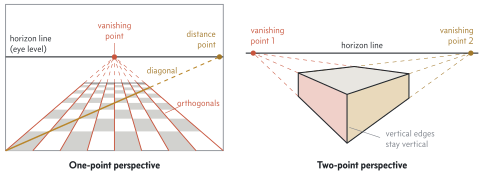
Not every object faces the viewer squarely. Stand at the corner of a building, and its two walls run away from you to the left and to the right. The top and bottom edges of each wall form a set of parallel lines, and each set has its own vanishing point, one far off to the left and one far off to the right. This is two-point perspective, and the building’s upright edges stay upright. The vanishing point of any set of parallel horizontal lines that run away from the viewer, at whatever angle, lies somewhere on the horizon line.In perspective drawings, vanishing points of parallel horizontal lines lie on this line. → horizons• Only lines that slope, like a roof or a staircase, vanish above or below it.
One of the first great paintings built on Brunelleschi’s rule was The Holy Trinity by the young Florentine painter Masaccio (muh-zah-chee-oh), painted on a wall of the church of Santa Maria Novella in Florence about 1427. Its painted arch and curved ceiling seem to open a real chapel into the flat wall (Vol. 10, Rebirth). Seventy years later, in Milan, Leonardo da Vinci painted The Last Supper on the wall of a monastery’s dining hall. It shows the moment when Christ tells his twelve disciples that one of them will betray him (Figure 17.2). Every orthogonal in the painted room, from the beams of the ceiling to the edges of the hangings on the walls, runs to a single vanishing point at Christ’s head. A viewer’s eye, sliding along any line in the room, ends where Leonardo wanted it to.

A body can be drawn in perspective too. When an arm, a leg, or a whole figure points toward the viewer, it looks much shorter than it is. Hold a pencil level and point it at your eye, and it shrinks to a dot. Drawing a thing shortened in this way is called foreshortening. The most famous example is the Lamentation over the Dead Christ by Andrea Mantegna (man-tayn-yuh), a painter at the court of Mantua in northern Italy (Vol. 10, Rebirth). Christ’s body lies on a stone slab with the soles of his feet toward us, so that a full-grown man fits into a picture little more than two feet high.
Leonardo noticed a second kind of perspective that has nothing to do with lines. Distant mountains look paler and bluer than near ones, and their edges are softer, because a great depth of air lies between them and the eye. Painting far things paler, bluer, and less sharp is called aerial perspective, or atmospheric perspective. You can see it in the hills through the windows behind Leonardo’s Christ.
For about 450 years European painters built their pictures on Brunelleschi’s rule. In the late 1800s the French painter Paul Cézanne (say-zan) began to tilt his tabletops and bend his edges on purpose, and the painters who followed him took apart the idea of a single fixed viewpoint (Vol. 18, Paris, Capital of the Arts).
Color
In 1766 an English engraver named Moses Harris, who also collected and drew butterflies and moths, published a slim book called The Natural System of Colours. In it was a printed wheel of eighteen colors, each shaded from strong to pale. At its center sat three overlapping triangles: red, yellow, and blue. From these three, Harris claimed, mixed and lightened and darkened, a painter could make 660 different colors.

Try it with paints. Red and yellow make orange, yellow and blue make green, and blue and red make violet. But no mixture of the other paints in an ordinary paintbox will make a clean red, yellow, or blue. The colors that cannot be mixed from others are called primary colors, and for painters the primaries are red, yellow, and blue.This color is a primary color along with blue and yellow. → red•• Orange, green, and violet, each mixed from two primaries, are the secondary colors. A primary mixed with a neighboring secondary gives a tertiary color, such as red-orange or blue-green. From their initials, color books call this set of primaries RYB.
Each color can be described in three ways. Its hue is its place on the wheel, the thing we name when we say “red” or “blue-green.” Its saturation is its strength or purity. A fire engine is a highly saturated red, while brick and rust are nearly the same hue made duller, as though a little gray had been stirred in. Its value is how light or dark it is, so that pink is a light red and maroon a dark one. Hue, saturation, and valueThese things have properties including saturation and hue. → colors• are the three properties of every color, and a painter can change any one of them while leaving the other two alone.
Colors that sit opposite each other on the wheel are complementary colors: red and green, yellow and violet, blue and orange. Each primary’s complement is the secondary mixed from the other two. Mixed together, complements cancel into a muddy gray-brown. Set side by side, they make each other look stronger. The Dutch painter Vincent van Gogh (van goh) wrote in 1888 that he had tried to show “the terrible passions of humanity” with red and green in The Night Café, a painting of a café that stayed open all night (Vol. 18, Paris, Capital of the Arts). Painters also speak of warm colors, the reds, oranges, and yellows of fire, and cool colors, the blues and greens of water and shade. Warm colors seem to come forward and cool ones to sink back, which is one reason the blue hills of aerial perspective look so far away.
Red is the color of blood,This is the color of blood. → red•• and of fire, and it was one of the first colors people painted with. Red ochre (oh-ker), an earth colored by iron rust, marks cave walls painted many thousands of years ago. Because it is the color of blood, Christian painters gave red to martyrs, to love, and to Christ’s sacrifice. Look again at Leonardo’s Christ, in a red robe under a blue cloak. The brightest red of the Renaissance, vermilion, was made by heating mercury with sulfur.
Blue, the third RYB primary alongside red and yellow,This is one of the traditional RYB paint primaries, alongside red and yellow. → blue• was for centuries the hardest of the three to buy. The finest blue, ultramarine, was ground from lapis lazuli (lap-is laz-yoo-lee), a stone mined in the mountains of Afghanistan and brought to Europe through Venice. The name ultramarine means “from beyond the sea.” At times it cost as much as gold. Contracts for church paintings sometimes named the price per ounce of the ultramarine the painter must use, and painters saved it for the robe of the Virgin Mary. Only in the 1820s did chemists learn to make it cheaply in a factory.
The genres of painting
In a preface to the lectures given in 1667 at the Royal Academy of Painting and Sculpture in Paris, the French writer André Félibien (ahn-dray fay-lee-byan), official historian of King Louis XIV’s buildings, ranked the kinds of painting. A painter of landscapes, he wrote, stands above one who paints only fruit, flowers, or shells. A painter of living animals stands above those who paint dead and motionless things. Highest of all is the painter of human figures, because man is “the most perfect work of God on earth.” Among those, the painter who tells a story with many figures stands above the one who paints a single face.
An academy, in this sense, was a society of artists under a king’s protection that trained students, held exhibitions, and gave prizes. Louis XIV’s academy had been founded in 1648, and London’s Royal Academy followed in 1768 (Vol. 12, Crown and Parliament). For two hundred years the academies taught a ranking like Félibien’s, which is called the hierarchy of genres. Here genre keeps its plain French meaning of “kind” (Chapter 2).
History painting stood at the top because it was the hardest. Its painter had to invent a scene no one had witnessed, know the Bible and the Latin poets, draw the human body in every kind of action, and teach a lesson. The French painter Jacques-Louis David (zhahk loo-ee dah-veed) painted The Oath of the Horatii (hoh-ray-shee-eye) in 1784 on a canvas nearly fourteen feet wide. In it three Roman brothers swear to fight for their city while the women of their family weep (Vol. 15, The Age of Revolution). Portraits came next, because they copied one real face instead of inventing many. Below them came genre painting. Confusingly, that name belongs to just one of the genres, the scene of ordinary life, such as the Dutch painter Johannes Vermeer’s The Milkmaid (about 1658), in which a kitchen maid pours milk from a jug beside a window (Vol. 13, Valois, Bourbon, and Orange).

At the bottom stood the still life, a painting of things that cannot move. The French call it nature morte, “dead nature,” and English took its name from the Dutch stilleven, “motionless life.” A still life could carry a sermon. In the Dutch university town of Leiden in the 1600s, painters filled their tables with skulls, hourglasses, guttering candles, books, musical instruments, and shells. Such a picture is a vanitas (van-ih-tahs), named from the Latin words of the Book of Ecclesiastes (ih-klee-zee-as-teez), vanitas vanitatum: “Vanity of vanities; all is vanity.” Here vanity means emptiness, not pride in one’s looks. The things the painter shows so lovingly, the picture says, will all be taken away, and so will the person looking at them.
The ranking made an odd fit with the Dutch Republic, the independent northern Netherlands, a Protestant country whose plain churches bought no religious pictures. Its merchants and shopkeepers wanted small paintings for their houses, and they bought landscapes, still lifes, and scenes of daily life by the thousands. Yet Samuel van Hoogstraten (hohkh-strah-tun), a pupil of the great Amsterdam painter Rembrandt, still called landscape painters “the common footmen in the army of art.” In the 1800s painters began to defy the hierarchy outright. The French painter Gustave Courbet (koor-bay) painted A Burial at Ornans, a village funeral in his hometown, on a canvas more than twenty feet wide, the size of a history painting (Vol. 18, Paris, Capital of the Arts).
Landscape and self-portrait
The lower ranks of the hierarchy were where much of the best painting of the next three centuries was done. A landscape is a painting of natural scenery,Paintings of this genre depict natural scenery such as forests, valleys, and other wide views. → landscape painting•• of forests, valleys, rivers, and wide views, in which any people are small. English borrowed the word from the Dutch landschap, “a stretch of country,” about 1600. For most of the Middle Ages, scenery was what lay behind a saint, a strip of hills glimpsed past his shoulder.
The painter who brought the background to the front was Joachim Patinir (yoh-ah-kim pat-ih-neer). He was born about 1480 and worked in Antwerp, in what is now Belgium, from 1515 until his death in 1524. In his pictures the saint or the scene from myth shrinks to a few small figures, and the land takes over. We look down from a great height over mountains, rivers, forests, towns, and sea, all the way to a horizon high in the picture, as if the whole world could be seen at once. Patinir pioneered this “world landscape,”Joachim Patinir pioneered the "world" variety of this genre. → landscape painting• and he made it readable with color: brown and green in front, and pale blue in the far distance, the same aerial perspective that Leonardo described. When the German painter Albrecht Dürer (dyoor-er) (Vol. 14, From Luther to Mozart) visited Antwerp in 1521, he called Patinir “the good landscape painter,” coining a new German word for a new kind of painter.

In Greek myth, Charon (kair-un) ferried the souls of the dead across the river Styx into the underworld (Vol. 4, Classical Myth). In Patinir’s Landscape with Charon Crossing the Styx (Figure 17.5), the river has become a wide sea between two shores. On the left, angels walk in a green paradise. On the right stands the dark tower of hell, with fires burning behind it and the three-headed dog Cerberus (sur-ber-us) at its gate. The tiny naked soul in Charon’s boat is turned toward hell.
John Constable (1776–1837) was the son of a prosperous miller in Suffolk, in eastern England, and he painted the countryside of his boyhood all his life. “I should paint my own places best,” he wrote to a friend in 1821. His father owned Flatford Mill on the River Stour (stow-er), which divides Suffolk from Essex, and in 1821 Constable painted a scene a short walk from the mill on a canvas six feet wide. The Hay Wain, “wain” being an old word for a farm wagon, shows an empty hay cart splashing through the shallow river past a neighbor’s cottage at noon on a summer day, under heaped white clouds (Figure 17.6). There is no saint and no myth, only a working day in the fields, which makes The Hay Wain a pure landscape.John Constable's The Hay Wain is a painting of this genre. → landscape painting• In London it found no buyer. In Paris in 1824 it won a gold medal from King Charles X, and young French painters such as Eugène Delacroix (oo-zhen duh-lah-krwah) came away eager to paint skies and greens like Constable’s (Vol. 15, The Age of Revolution).


Higher up the academies’ ladder, the portrait has a branch with a story of its own. A self-portrait is a picture of the artist by the artist, nearly always painted by looking into a mirror. The model is free and always on time, and a painter can study his own face in any mood. The mirror sets one trap: it swaps left and right, so a self-portrait usually shows the painter as only a mirror sees him. Rembrandt painted himself about forty times, from a curly-haired young man to a heavy, sagging old one (Vol. 13, Valois, Bourbon, and Orange).
In 1592 a young painter from Milan, Michelangelo Merisi, called Caravaggio (kar-uh-vah-joh) after his family’s town, arrived in Rome poor and unknown (Vol. 10, Rebirth). His early biographers say that he fell gravely ill there and spent months in a hospital. About 1593 he painted himself, using a mirror, as Bacchus (bak-us), the Roman name for Dionysus, the god of wine (Chapter 2). The god is crowned with ivy and holds a bunch of pale grapes, but his lips are gray and his skin has the yellow tinge of jaundice, a sign of a sick liver. Young Sick Bacchus is a self-portraitA painting in this genre titled Young Sick Bacchus depicts a jaundiced god holding grapes. → self-portrait• of a painter who knew what illness looked like from the inside.
Vincent van Gogh (1853–1890) painted more than thirty-five self-portraits, partly because he could seldom afford to pay a model. In 1888 he moved to Arles (arl), in the south of France, and persuaded the painter Paul Gauguin (goh-gan) to come and share his house. On the night of December 23, 1888, after a quarrel with Gauguin, Van Gogh cut off his own left ear with a razor. He spent two weeks in the hospital. In January 1889, wearing a fur cap to hold his bandage in place and keep out the winter cold, he painted a self-portrait with his bandaged earVan Gogh painted his bandaged ear in a work of this genre. → self-portrait•• (Figure 17.7). In the picture the bandage covers his right ear. He was painting what he saw in the mirror.
What to remember
- Perspective makes a flat surface look deep. In linear perspective, found by Brunelleschi about 1415–1420 and written down by Alberti in 1435, the orthogonals meet at a vanishing point on the horizon line, at the viewer’s eye level.
- The vanishing point of any set of horizontal lines running away from the viewer lies on the horizon. A box seen corner-on has two of them.
- Foreshortening shortens a body that points at the viewer. Aerial perspective paints far things paler and bluer.
- A color has a hue, a saturation, and a value. The painter’s primaries are red, yellow, and blue (RYB), while screens mix red, green, and blue light.
- Complementary colors, such as red and green, sit opposite each other on the wheel. Ultramarine blue once cost as much as gold.
- The academies ranked history painting first, then portrait, genre painting, landscape, and still life. A vanitas is a still life about death.
- Patinir pioneered the world landscape, and Constable’s The Hay Wain (1821) is a pure landscape, with no saint and no myth.
- A self-portrait is painted from a mirror, so it usually shows the painter reversed, as in Van Gogh’s Self-Portrait with Bandaged Ear (1889).
Chapter 18
Columns, Arches, and Domes
On a rainy day in Rome, visitors to the Pantheon (pan-thee-on) can watch the rain come in through the roof. At the top of its great dome is a round hole nearly 30 feet across, open to the sky, and the drops fall 142 feet to a marble floor that slopes gently toward drains. The dome is a single shell of concrete with no steel inside it and no column under it. It was finished about AD 126, and it is still standing.
Every building has to solve the problem the Pantheon solved: how to roof over a space and bring the weight of the roof safely to the ground. There are only a handful of answers. The oldest is a beam laid across two posts. Then came the arch, and from the arch the vault and the dome; then the Gothic cathedral’s skeleton of stone; and at last the frame of steel. Each answer brought its own shapes and its own words, and later volumes use those words without stopping to explain them.
Post and lintel: the orders
Stand two books upright on a table, a hand’s width apart, and lay a ruler across their tops. The uprights are posts, the beam across them is a lintel, and every doorway in your house is built this way. So is Stonehenge, the ring of giant stones raised in southern England about 2500 BC, where stone beams weighing several tons rest on pairs of upright stones (Vol. 7, The Romans).
A lintel has one weakness. Under a load it sags a little in the middle. The top of the beam is squeezed, which builders call compression, and the bottom is stretched, which they call tension. Stone is enormously strong when squeezed and weak when stretched, so a long stone lintel cracks along its underside and falls. A builder in stone must keep his posts close together, and that one fact shaped the most admired buildings of the ancient world.
The Greeks built their temples as houses for the statues of their gods. Worshipers did not gather inside, since sacrifices were made at an altar in the open air, and the temple was a stately box around one dim room for the statue. Around that room ran a colonnade, a row of columns holding up the roof. The most famous of these temples is the Parthenon, built of white marble between 447 and 432 BC on the Acropolis, the rocky hill at the center of Athens, for the city’s goddess, Athena (Vol. 6, The Greeks). Its west end, in Figure 18.1, is post and lintel on a grand scale: eight columns, each about 34 feet tall, under a heavy band of stone beams.

The temple stands on three steps, and the top step, the floor the columns stand on, is the stylobate (sty-luh-bayt). A column has up to three parts: a base, a tall shaft, and on top a wider block called the capital, from the Latin caput, “head,” which gathers the weight of the beams onto the shaft. The shaft is cut with shallow upright grooves called flutes.
Everything resting on the columns is the entablature (en-tab-luh-chur), in three layers. The architrave (ar-kih-trayv) is the lintel itself, laid from column to column. Above it runs the frieze (freez), a band often carved with figures. On top, the cornice sticks out like the brim of a hat and throws rainwater clear of the wall. At the front and back, the two slopes of the roof leave a low triangle. This is the pediment, and the Greeks filled it with statues; the Parthenon’s east pediment showed Athena being born from the head of her father, Zeus.
The orders
The Greeks built in a few fixed styles, each with its own column, its own entablature, and its own rules of proportion, so that a builder who knew the width of a column could work out nearly everything else. Such a style is called an order. The Roman architect Vitruvius (vih-troo-vee-us), whose Ten Books on Architecture is the only book on the subject to survive from the ancient world, described the orders, and later builders learned them from him (Vol. 7, The Romans). The quickest way to tell them apart is to look at the capital, as Figure 18.2 shows.

The Doric order is the plainest and the sturdiest. Its column has no base: the fluted shaft stands right on the stylobate, and its capital is a plain round cushion under a square slab. The Doric frieze alternates square panels called metopes (met-uh-peez), often carved with figures, with narrow upright blocks called triglyphs (try-glifs), Greek for “three grooves,” each cut into three vertical bars. Vitruvius explained the triglyphs as stone copies of the beam ends of older wooden temples. The Parthenon is Doric, and its ninety-two metopes showed gods fighting giants; Greeks fighting the half-horse centaurs and the Amazons, a legendary nation of women warriors; and the fall of Troy.
The Ionic (eye-on-ik) order came from the Greek cities of Ionia, on the coast of what is now Turkey. Its column is slimmer, about nine times as tall as it is wide, and stands on a base of rounded rings. Its capital carries a pair of spiral scrolls, called volutes (vuh-loots), that curl down on either side like the horns of a ram. The Ionic frieze is one continuous band of carving, with no triglyphs to break it up. Beside the Parthenon stands a smaller Ionic temple, the Erechtheion (eh-rek-thee-on), finished about 406 BC.
The Corinthian order, named for the Greek city of Corinth, is the slimmest and the most ornate. Its capital is a tall bell wrapped in two rows of carved acanthus (uh-kan-thus) leaves, copied from a Mediterranean plant with deep-cut leaves. Vitruvius told how a sculptor named Callimachus (kuh-lim-uh-kus) saw a basket left on a girl’s grave in Corinth, with an acanthus plant growing up around it, and turned what he saw into stone; nobody knows whether it happened. The Greeks used the Corinthian order seldom, but the Romans loved it, and the sixteen columns of the Pantheon’s porch are Corinthian.
The Romans added two orders of their own. The Tuscan, named for the Etruscans of Tuscany, who ruled much of Italy before Rome did, is a simpler Doric with a base and a smooth shaft. The Composite stacks the scrolls of the Ionic on top of the leaves of the Corinthian; an early example is the Arch of Titus in Rome, built about AD 81. In 1537 the Italian architect Sebastiano Serlio printed all five side by side, and builders have copied them ever since, on banks, courthouses, and museums.
Arch, vault, and dome
The Romans built their greatest works on a different idea. An arch is a curve of wedge-shaped stones spanning an opening. Each wedge is a voussoir (voo-swahr), and the wedge at the very top, set last, is the keystone. A half-built arch cannot stand, so masons first build a wooden frame in its shape, the centering, lay the voussoirs on it, and drop in the keystone. Then they knock the centering away, and the arch holds itself up (Figure 18.3).
Press down on the top of an arch and every wedge is pushed tighter against its neighbors. The weight becomes compression all the way around the curve, and stone is strongest when squeezed, so an arch can span a far wider opening than a stone lintel. But it has a price. An arch pushes outward at its feet as well as down, as if trying to do the splits.
One way is to set arches in a row. In an arcade, a line of arches on columns or on piers, thick pillars of masonry, each arch leans against the next, their thrusts cancel, and only the two ends need a heavy wall. Roman aqueducts carried water across valleys on arcades; at the Pont du Gard, in southern France, they are stacked three high (Vol. 7, The Romans). The outer wall of the Colosseum in Rome, finished in AD 80, has three stories of arches, with half-columns set between the arches: a Doric kind on the ground floor, Ionic on the second, and Corinthian on the third. The arches hold the building up; the half-columns hold up nothing. The orders had become decoration, a way of saying “classical.”

Stretch an arch out into a tunnel and you have a barrel vault, a ceiling shaped like half a barrel lying on its side. It is strong but heavy, and it pushes outward along the whole length of both its walls, so the walls must be thick and their windows small. Let two barrel vaults cross at right angles, and you get a groin vault; the creases where the two curved surfaces meet, running from corner to corner, are its groins. A groin vault gathers its weight onto the four corners of its square, so the sides between can be opened up. The Romans roofed the great halls of their public baths this way, in concrete, a mix of lime (burned limestone), volcanic ash, water, and broken stone that hardened into artificial rock.
Spin an arch around its center, the way a potter turns clay on a wheel, and it sweeps out a dome. The Pantheon, rebuilt under the emperor Hadrian, is a round hall 142 feet across and 142 feet from the floor to the top of the dome, so a ball 142 feet wide would fit inside it exactly (Vol. 7, The Romans). The dome rests on a round wall about 20 feet thick, which resists its thrust all the way around. The builders made the concrete lighter toward the top and cut its underside into sunken square panels, called coffers, to save weight. At the very top they left an opening, the oculus (ok-yuh-lus), Latin for “eye,” which saves more weight and, with the great door, lets in all the room’s daylight (Figure 18.4). It is still the largest dome in the world of unreinforced concrete, concrete with no steel inside.


A round wall makes a fine base for a dome, because the dome’s round rim rests on it all the way around. A square does not: a circle set on a square touches it at only four points and leaves the corners empty. Yet builders wanted domes over squares, like the square where the arms of a cross-shaped church meet. Roman builders had tried the answer on a small scale, but it was worked out in full in Constantinople, now Istanbul, capital of the eastern half of the Roman Empire, which outlived the western half by nearly a thousand years. Historians call it the Byzantine Empire, after Byzantium, the city’s old Greek name. In 532 the emperor Justinian (juh-stin-ee-un) ordered a new cathedral, the chief church of the city’s bishop. It was Hagia Sophia (hah-yah soh-fee-ah), “Holy Wisdom,” and two masters of geometry, Anthemius of Tralles and Isidore of Miletus, finished it in 537 (Vol. 9, Cathedrals and Crusades).
Its dome, more than 100 feet across, stands over a square. Four huge piers mark the corners, and four arches spring from pier to pier along the sides. The tops of the arches touch a circle, but between each pair of arches a corner is left open. Each corner is filled with a curved triangle of masonry, wide at the top and narrowing to a point on the pier below. This triangle is a pendentive (pen-den-tiv), from the Latin for “hanging,” and the four pendentives turn the square into a ring on which the dome can sit. Forty windows pierce the base of the dome, so that it appears to float on light; Justinian’s historian Procopius (proh-koh-pee-us) wrote that it seemed to hang from heaven. After the Ottoman Turks took the city in 1453, Hagia Sophia became a mosque (Vol. 37, The House of Islam).
Nine centuries later a dome defeated everyone in Florence. The city’s cathedral had been built with an eight-sided hole about 140 feet across in its roof, over the place where its arms met, waiting for a dome nobody knew how to raise, since no wooden centering could be made big enough. From 1420 to 1436 Filippo Brunelleschi, the goldsmith whose experiment with perspective opens Chapter 17, raised one with no centering at all, in two shells of brick, one inside the other (Vol. 10, Rebirth). It stands on a drum, a high ring of wall that lifts a dome above the roofs around it, and is crowned by a lantern, a small tower with windows. St. Peter’s in Rome and St. Paul’s in London later followed the same pattern.
The church plan
When the emperor Constantine made Christianity legal in 313, Christians needed buildings that could hold a whole congregation. A temple, one dark room for a statue, was no use. Instead they borrowed the basilica, the long hall that every Roman town used for law courts and business. Down its middle ran a tall space, the nave, from the Latin navis, “ship.” On either side, divided from the nave by a row of columns, ran a lower aisle. Because the nave was taller, its walls rose above the aisle roofs, and windows in that upper wall, the clerestory (kleer-stor-ee) or “clear story,” lit the middle of the hall. At the far end was a half-round recess under a half-dome, the apse (aps), where the Roman judge had sat; in a church the altar stood before it.
Most medieval churches put the altar at the east end, toward the sunrise, and the main door at the west, often behind an entrance hall called the narthex. Larger churches added a transept, a cross hall near the east end sticking out on both sides. Seen from above, the plan then makes a cross with a long foot, a Latin cross; a cross with four equal arms, like a plus sign, is a Greek cross. The square where nave and transept meet is the crossing, often crowned with a tower or a dome, and beyond it, toward the apse, lies the choir, where the clergy sang the daily services (Figure 18.5).

A central plan instead arranges a building around one point, shaping it as a circle, an octagon, or a Greek cross, usually with a dome over the middle. San Vitale (sahn vee-tah-lay) in Ravenna (ruh-ven-uh), on the Adriatic coast of Italy, dedicated in 547 while Justinian’s armies held the city, is an octagon. Eight piers carry its dome, and around them runs a two-story walkway, the ambulatory. On the east side the apse breaks through the outer wall, and on its walls glitter mosaics of Justinian and his empress, Theodora (Chapter 19, Vol. 9, Cathedrals and Crusades).
The Greek-speaking churches of the East, which became the Orthodox Church, came to prefer domes and central plans, while the Latin West kept to the long basilica. An Orthodox church also has the iconostasis (eye-kuh-noss-tuh-sis), a screen covered with icons, painted pictures of Christ and the saints (Chapter 19), that stands between the nave and the sanctuary around the altar. Its central pair of doors, the Holy or Royal Doors, open at the most solemn moments of the service. By the early 1400s, in Russia above all, it had grown from a low screen into a wall of icons several rows high.
Gothic
On June 11, 1144, Abbot Suger (soo-zhair) showed off the new east end of his church at Saint-Denis (san-duh-nee), the monastery just north of Paris where the kings of France were buried. Suger believed that light lifted the mind toward God, and his builders gave him a ring of chapels whose walls were nearly all colored glass (Vol. 9, Cathedrals and Crusades). It was the first building in a style that spread across Europe for the next three hundred years. Italian writers later called it “Gothic,” as Chapter 2 explains, but it was French.


The churches of the 1000s were built in a style now called Romanesque (roh-muh-nesk), “in the Roman manner.” They had round arches, stone vaults, thick walls, and small windows, since every opening weakened a wall that had to hold a vault up. Gothic builders escaped those thick walls by combining three inventions.
A long church is divided into bays, the equal sections from one pair of piers to the next, and each bay gets its own vault. The first invention was the pointed arch, made of two curves that meet at a point. Builders in the Islamic world had used it for centuries. A round arch is always half as tall as it is wide, but a pointed arch can be made as tall as the builder likes over any width, and, being steeper, it pushes outward less.
The second invention was the rib vault. A Gothic builder first built a skeleton of stone ribs, arches running across each bay and diagonally along the line of its groins, and then filled the spaces between them with thin stone panels. The ribs carried the weight to the corners of the bay, so the vault could be far thinner and lighter than a Roman one.
The third, and the most daring, was the flying buttress. A buttress is a mass of masonry built against a wall to brace it, the way you might set your shoulder against a door. In a church the high vault pushes outward at the top of the nave walls, above the aisle roofs, where no ordinary buttress can reach. So the builders raised tall buttress piers outside the aisles and threw half-arches from them, over the aisle roofs, to the upper walls of the nave. Each half-arch flies through the air, catches the thrust of the vault where it pushes, and passes it down the pier to the ground (Figure 18.7). A small spire, the pinnacle, often crowns the pier and steadies it with its weight. Stone spouts carved as monsters, the gargoyles, throw rainwater clear of the walls.

With the thrust carried outside, the walls between the piers held up almost nothing, and the builders filled them with glass. Inside, a Gothic nave wall usually rises in three stories: the arcade opening into the aisles; the triforium (try-for-ee-um), a narrow passage in the thickness of the wall; and the clerestory, now grown into windows taller than houses. The cathedral of Chartres (shar-truh), southwest of Paris, rebuilt within about a generation after a fire in 1194, still keeps most of its thirteenth-century glass (Figure 18.6, Vol. 9, Cathedrals and Crusades). At the west end and the ends of the transept, builders set a rose window, a great round window divided by stone bars, called tracery, that spread from the center like the petals of a rose. Its colored glass belongs to Chapter 19.
Gothic became a race for height. The nave vault at Chartres stands about 120 feet above the floor, and the vault at Amiens, in northern France, about 139 feet. The choir of Beauvais (boh-vay), at about 159 feet, is the tallest Gothic vault ever built, and in 1284, about twelve years after it was finished, part of it fell. The builders put it back with extra piers, but the church never got its nave. Beauvais marked the limit of what stone alone could do.
Iron, steel, and concrete
For thousands of years great buildings were piles of stone and brick, held up by compression alone. From the late 1700s factories made iron cheaply, and from the 1850s steel, which is strong in tension as well as compression: a steel beam bends where a stone lintel would snap. In 1851 Joseph Paxton, a gardener who had built greenhouses, designed the Crystal Palace in London for the Great Exhibition, the first world’s fair, a hall more than a third of a mile long made of mass-produced iron and glass (Vol. 17, The Victorians). The Eiffel Tower of 1889, 984 feet of iron, was the tallest structure in the world for more than forty years (Vol. 18, Paris, Capital of the Arts).
Then came the skyscraper. In a steel frame, a skeleton of steel columns and beams carries the whole weight of the building, floor by floor, and the outer wall, a curtain wall, hangs on the frame and holds up only itself. The ten-story Home Insurance Building in Chicago, finished in 1885 to a design by William Le Baron Jenney, is often called the first skyscraper (Vol. 30, Whitman to Wharton). The frame is post and lintel again, with posts and beams that no longer crack. Reinforced concrete did the same for concrete: steel bars buried in it take the stretching while the concrete takes the squeeze. A French gardener, Joseph Monier (moh-nyay), patented reinforced concrete tubs for plants in 1867, and by the 1920s the architect Le Corbusier (luh kor-boo-zyay) was raising white houses on thin concrete stilts (Vol. 22, The Lost Peace).
Plan, elevation, and section
A photograph shows how a building looks, but you cannot measure from it, because things far away look smaller, as Chapter 17 explains. Architects, and the books that describe buildings, use three other drawings instead. Each is drawn to scale: one inch on the paper stands for a fixed number of feet in the building, everywhere on the sheet.
A plan shows the building from above. Imagine slicing it through horizontally about four feet above the floor, lifting off the top, and looking straight down. The cut walls show as thick black lines, the columns as dots, and the doorways as gaps, as in the church plans of Figure 18.5. A plan is a map of the building.
An elevation shows one outside face, seen straight on as if from very far away, so that nothing shrinks with distance and every window keeps its true size. Elevations are named for the side they show: the west elevation of a cathedral is a drawing of its front.
A section shows the building sliced from top to bottom, the way you might cut a cake to see its layers, and seen from the side. It shows how high the rooms are, how thick the walls are, and how the vaults and roofs are built; Figure 18.7 is a section. Figure 18.8 shows all three drawings of one small Greek temple, laid out as an architect would lay them, with the elevation above the plan so that each column lines up with its own dot.

What to remember
- Post and lintel lays a beam on two posts. Stone resists squeezing (compression) but not stretching (tension), so stone lintels must be short.
- A column has a base, shaft, and capital; the entablature has an architrave, frieze, and cornice; the pediment is the triangle at the roof’s end.
- The orders differ in their capitals: a plain cushion (Doric, with no base), volutes (Ionic), acanthus leaves (Corinthian). Rome added Tuscan and Composite.
- An arch locks under its keystone and pushes outward with its thrust. An arcade is a row of arches, a barrel vault a tunnel, a groin vault two crossing tunnels.
- The Pantheon’s dome has an oculus, Hagia Sophia’s sits on pendentives, and Brunelleschi’s stands on a drum.
- The long church plan comes from the basilica: nave, aisles, clerestory, apse, and a transept making a Latin cross. San Vitale has a central plan; Orthodox churches have an iconostasis.
- Gothic joined the pointed arch, the rib vault, and the flying buttress, so its walls could become windows.
- Steel frames and reinforced concrete use tension too. Buildings are drawn in plan, elevation, and section.
Chapter 19 · 36 clues
Fresco, Mosaic, Icon, and Scroll
Around 1510, 66 feet above the floor of a chapel in Rome, a sculptor of thirty-five stood on a wooden platform with his head bent back and his brush raised over his face. He was Michelangelo Buonarroti (my-kuh-lan-juh-loh bwon-ar-roh-tee), and he had not wanted the job (Vol. 10, Rebirth). In a comic poem to a friend he complained that his beard pointed at heaven and his neck was folded back onto his spine. His body, he wrote, was bent like a bow, and the paint dripping from his brush had turned his face into a colored floor. The poem ends with a shrug: he is not in a good place, it says, and he is no painter.
Four years of that work made one of the most famous pictures on earth, and it can never be taken down, framed, sold, or carried home. It is part of the building. Until the 1500s, when painting on canvas stretched over a wooden frame became common (Chapter 20), most pictures were like that. They lived on walls and ceilings, on floors, in windows, inside books, on long rolls of silk, and underfoot. Each surface asked for its own craft and was met in its own way: looked up at, walked on, kissed, opened on feast days, seen against the sky, read in the hand, unrolled a little at a time, and knelt upon. The oldest of them, and the place to begin, is the wall.
Fresco
A picture painted on a wall is the oldest kind of picture there is. About 17,000 years ago, hunters in the cave of Lascaux (lahs-koh), in southwestern France, painted bulls, horses, and deer on the rock by the light of lamps that burned animal fat. Egyptian painters covered the walls of tombs with scenes of farming and feasting, and Roman families had the walls of their dining rooms painted with gardens and false windows. A picture of this kind is called a mural (myoor-ul), from murus, the Latin word for “wall.” A mural is not hung on a wall like a poster; it is painted straight onto the wallThese artworks are painted directly onto walls or permanent surfaces. → murals••• itself, or onto some other fixed surface such as a ceiling or a pillar, and it lasts exactly as long as the surface does.
That is the mural’s weakness. Most paint is colored powder stirred into some kind of glue, and on a bare wall that glue is all that holds the color in place. Damp, smoke, and time loosen it. Italian painters from the 1200s to the 1700s trusted one method above all others to make a mural last, and it is named for its secret: fresco (fres-koh), Italian for “fresh,” because the color goes onto fresh, wet plaster.
The secret is chemistry. Burn limestone in a kiln, a very hot oven, and it becomes quicklime; soak quicklime in water and it becomes a smooth white paste, slaked lime. Mix the paste with sand and you have lime plaster. As wet lime plaster dries, it takes in carbon dioxide from the air and slowly turns back into limestone, the rock it came from. The fresco painter grinds his colors, which are powdered earths and minerals, in plain water, with no glue at all. He brushes them onto the plaster while it is still wet. The color soaks in. As the plaster hardens, a thin skin of new stone forms around every grain of color and locks it in place, so that the picture is no longer on the wall but part of it. This is buon fresco (bwon fres-koh), “true fresco.”
The method sets the painter a race against the clock. A wall is first given a rough coat of plaster, the arriccio (ah-ree-choh), on which the whole design may be sketched. Then, each morning, a plasterer spreads a thin, smooth coat, the intonaco (in-toh-nah-koh), over only as much wall as the painter can finish before it sets, which is a matter of hours. That patch is a giornata (jor-nah-tah), Italian for “a day’s work.” Whatever is left unpainted at night is cut away, and fresh plaster is laid against the edge the next day. Painters worked from the top of a wall downward, so that drips would not fall on finished work, and they hid the seams along the outlines of figures. Restorers can still count the day-patches on a fresco and so tell how many days it took.
To get a design onto a wall at full size, the painter drew it first on large sheets of paper glued together, a cartoon, from the Italian cartone, “big paper.” He pricked small holes along every line, held the cartoon against the wet plaster, and dabbed it with a bag of charcoal dust, which left a dotted outline to paint over. Or he pressed along the lines with a pointed stick, leaving grooves in the soft plaster that still show when a lamp is held low beside the wall.
Some colors could not survive wet lime, and some details were too fine to finish in a day. Those were added later, on the dry wall, with paint mixed with a binder such as egg or glue. That is secco, Italian for “dry,” the same word that names the plain, quick recitative of Chapter 11. Secco paint sits on top of the plaster instead of becoming part of it, and over the centuries it flakes. Figure 19.1 shows the difference in a slice through the wall.

The masters of fresco show both sides of the bargain. Giotto (jot-oh) was a painter from Florence whom later Italians honored as the father of their painting. In about 1305 he covered the walls of a small chapel in Padua, in northern Italy, with scenes from the lives of Mary and Christ, and they are still bright after seven hundred years (Vol. 9, Cathedrals and Crusades). Leonardo da Vinci, painter, engineer, and inventor, liked to work slowly and change his mind, and he would not be rushed by wet plaster. When he painted The Last Supper of Chapter 17 on the end wall of a monastery dining hall in Milan, finishing it in 1498, he used a paint of his own on a dry, sealed wall (Vol. 10, Rebirth). It was beginning to flake by 1517, while Leonardo was still alive, and within sixty years it was a ruin of blots. Only a fraction of Leonardo’s own paint survives today, and restorers have toned in the gaps.
Painting on walls and ceilings
The chapel where Michelangelo stood on his platform is the Sistine Chapel, the pope’s own chapel in the Vatican in Rome, named for Pope Sixtus IV, who built it in the 1470s. Its ceiling is a long, flattened barrel vault (Chapter 18) about 131 feet long and 43 feet wide. In 1508 Pope Julius II ordered Michelangelo, who thought of himself as a sculptor, to paint it. He painted it in true fresco, adding only a few touches on the dry plaster, and the finished ceiling was shown on October 31, 1512.
Down the middle of the vault run nine scenes from the Book of Genesis, the first book of the Bible, from God dividing light from darkness to the drunkenness of Noah. Around them, on painted thrones, sit prophets of Israel and sibyls, the prophetesses of Greek and Roman legend, and more than three hundred figures fill the vault in all. A picture made as part of a building’s design, on its vault or ceiling, is a ceiling painting. The most famous ceiling painting in the worldMichelangelo’s Creation of Adam belongs to this type of architectural painting. → ceiling paintings•• is the fourth scene from the altar end, Michelangelo’s Creation of Adam. Adam lies on the ground, lazy and beautiful, and lifts a limp hand. God rushes toward him through the air, wrapped in a red cloak full of angels, and stretches out a finger. The two fingers do not quite touch. Life is about to pass between them (Figure 19.2).

A ceiling is hard to paint because it is seen from far below. Michelangelo began at the entrance end and worked toward the altar. When part of the scaffolding came down and he could at last see his work from the floor, he found that the crowds of small figures in the Noah scenes were too small to read from 66 feet away. In the later scenes he painted fewer, larger, bolder figures. The last scene, God separating light from darkness, he painted in a single day.
A ceiling painter has a choice. He can paint each scene as if it were an ordinary picture hung flat overhead, as Michelangelo mostly did, or he can pretend that the ceiling is not there at all, and that we are looking up through it into the sky. The second choice needs a new way of drawing. The chapter on space in pictures (Chapter 17) explained foreshortening: a form that points toward us looks shorter than it is, so a painter draws it short. A figure floating straight above our heads is foreshortened in the most extreme way, and we see the soles of its feet, the underside of its chin, and the bottom of its clouds. Painting figures as they would look from directly beneath is called di sotto in sùDi sotto in sù is a technique used for these paintings. → ceiling paintings• (dee sot-oh een soo), Italian for “from below, upward.”
Its first great display is in Mantua, in northern Italy, where Andrea Mantegna, whose foreshortened dead Christ appeared in Chapter 17, decorated a room in the palace of the Gonzaga family, the lords of the city, between 1465 and 1474 (Vol. 10, Rebirth). In the center of the ceiling he painted a round opening, an oculus like the one at the top of the Pantheon’s dome (Chapter 18). Through it we see blue sky. Ladies of the court lean over a stone railing to look down at us, winged babies perch on the edge, and a heavy pot of plants balances on a pole, as if it might fall on our heads. None of it is there. The ceiling is solid plaster.
Painters of the 1600s, the age called Baroque, joined that trick to another. Quadratura (kwah-drah-too-rah) is a second technique of ceiling painting,Quadratura is a technique used for these paintings. → ceiling paintings• the painting of false architecture on a ceiling or wall: columns, arches, balconies, and cornices drawn in strict linear perspective so that they seem to rise straight up out of the real walls. Its masterpiece is in Rome, in the church of Sant’Ignazio (sahn-teen-yaht-syoh), named for Saint Ignatius, who founded the Jesuits, an order of Catholic priests and brothers. About 1690 one of the order’s own brothers, the painter Andrea Pozzo (poht-soh), turned the barrel vault over the nave, the long main hall of the church, into a tower of painted columns and arches. They climb into an open heaven, where Ignatius rises among clouds and angels (Figure 19.3).

In the twentieth century the mural became political. The Mexican Revolution of 1910 to 1920 overthrew a dictator and tore the country apart. When it was over, the new government’s minister of education, José (hoh-say) Vasconcelos (vahs-kohn-say-lohs), decided in 1921 to teach Mexico its own history in pictures, for millions of people who could not read. He gave painters the walls of public buildings. Three men dominated the movement, which is called Mexican muralism: Diego Rivera (ree-vair-uh), José Clemente Orozco (oh-rohs-koh), and David Alfaro Siqueiros (see-kay-rohs). They are still called the “Big Three” of Mexican muralism,José Clemente Orozco, David Alfaro Siqueiros, and Diego Rivera dominated a Mexican art movement centered on this type of artwork. → murals•• and their subjects were the Aztec past, the Spanish conquest, the Revolution, and the factory worker (Vol. 45, Magic and Revolution).

Rivera, a huge, cheerful man, covered the stairway of the National Palace in Mexico City with the history of his country, and in 1932 and 1933 he painted twenty-seven fresco panels of Detroit’s car factories and other industries for the Detroit Institute of Arts. Orozco, darker and angrier, had lost his left hand as a young man in an accident with gunpowder. His greatest work fills the chapel dome of an old orphanage in Guadalajara (gwah-dah-lah-hah-rah): a man made of flames, seen di sotto in sù as he rises toward the opening at the top.
Siqueiros was the restless one. He fought in the Revolution as a young man and was later a fierce communist. In 1940 he led an armed raid on the house of the exiled Russian revolutionary Leon Trotsky, which failed. As an artist he wanted murals made with modern tools. Working in Los Angeles in 1932, he and his helpers painted with spray guns and traced their designs onto walls with an electric projector. Later he used industrial paints made for cars and buildings, which stood up to weather that would ruin a fresco. Over a long life Siqueiros painted huge muralsDavid Alfaro Siqueiros created works in this medium. → murals•• in Mexico, the United States, Argentina, and Chile. His last, The March of Humanity, completed in 1971, covers the walls and ceiling of a twelve-sided building in Mexico City made to hold it.
Mosaic
Painted plaster can fade and flake, and a floor that people walk on every day needs something much tougher. The Greeks and Romans found it. Cut stone, glass, or baked clay into little cubes, press them one by one into a bed of wet mortar, the paste that holds bricks together, and fit them so closely that together they make a picture. Such a picture is a mosaic. Each little cube is a tessera (tes-er-uh), a Latin word for a die or cube, which comes from the Greek for “four,” for its four corners. A mosaic is built from tesserae (tes-uh-ree), its little cubes,The components of these artworks are called tesserae. → mosaics••• as a wall is built from bricks.
Each tessera is a single dot of one color, like a pixel on a screen. Up close you see squares; from across the room you see a face. Roman mosaic makers laid most of a floor in opus tessellatum (oh-pus tes-uh-lay-tum), “tessellated work,” straight rows of cubes about a centimeter across, good for borders and plain backgrounds. For the figures they used far smaller pieces, set in curving lines that follow the outline of a face or an arm the way a worm’s track follows the ground. Mosaic makers call it opus vermiculatum, “worm-like work”In this medium, opus vermiculatum uses small pieces to follow figures’ contours; its name means “worm-like.” → mosaics•• (vur-mik-yoo-lay-tum), and it lets a mosaic shade a cheek almost as smoothly as paint.


In 1960 a water-company engineer digging a trench for a new pipe at Fishbourne, near the town of Chichester on the south coast of England, struck the foundations of a Roman palace, the largest Roman house yet found in Britain. Its rooms were floored with black-and-white mosaic, and in about AD 160 a later owner laid new colored floors in the north wing. The best of them has a circle at its center showing Cupid riding on a dolphin.One of these artworks at Fishbourne, England shows Cupid riding a dolphin. → mosaics• Cupid was the Roman god of love, pictured as a winged boy. Other sea creatures, fit for a house near the water, swim in the circles around him (Figure 19.5).
A grander floor lies in central Sicily, at the Villa Romana del Casale (kah-sah-lay), near the town of Piazza Armerina (ar-meh-ree-nah). It was a vast country house built early in the 300s AD for some very rich Roman, and a landslide buried it in the twelfth century, which kept its floors safe until archaeologists dug them out in the twentieth. Room after room is paved with hunting scenes, sea monsters, and myths. In one small room, young women in two-piece outfits lift weights, throw a discus, run races, and play ball, and one is crowned as the winner. Uncovered in 1959 and 1960, the athletes were soon nicknamed the “bikini girls,”Scantily clad figures nicknamed "bikini girls" playing sport are depicted in works of this medium at the Villa Romana del Casale. → mosaics•• after a swimsuit that had been given its name only thirteen years before.
The Christians of the eastern Roman world took mosaic off the floor and put it on the walls. That eastern half, ruled from Constantinople, is the Byzantine Empire of Chapter 18, which outlived the western half by nearly a thousand years. Its builders covered the walls, vaults, and domes of churches with mosaics made of glass, which comes in far brighter colors than stone. For gold, a thin leaf of real gold was sealed between two layers of glass. The cubes were pressed in at slight angles, so that in candlelight the walls glitter.
The best-kept of these churches stands in Ravenna, on the northeast coast of Italy, which Byzantine armies took in 540. It is San Vitale, finished in 547, a domed building of the eight-sided central plan (Chapter 18). Its official title is the Basilica of San Vitale, but here “basilica” is a title of honor that the pope gives to important churches, not a description of its shape. On either side of its apse, the rounded end behind the altar, two mosaic panels show the emperor Justinian and his empress, Theodora,Justinian and Theodora are depicted in this medium at Ravenna’s Basilica of San Vitale. → mosaics••• each standing with a court and bringing gifts for the Mass (Figure 19.6; Vol. 9, Cathedrals and Crusades). Justinian carries a golden bowl for the bread; Theodora, in a robe embroidered with the three Wise Men, carries a jeweled cup for the wine. Neither of them ever set foot in Ravenna. The mosaics stood in for them, as a portrait of a ruler on a coin does.

Justinian’s own great church in Constantinople, Hagia Sophia, “Holy Wisdom,” finished in 537, had its vaults and dome lined with gold mosaic (Chapter 18). Over the following centuries emperors added figures of Christ, the Virgin Mary, saints, and themselves. After the Ottoman Turks took the city in 1453, the church became a mosque. From the 1500s on, the figures were gradually covered with whitewash and plaster, since Islam does not allow pictures of people in a mosque. The plaster saved them. Restorers uncovered the mosaics of Hagia SophiaWorks in this medium decorate the Hagia Sophia. → mosaics•• in the 1930s, when the building was turned into a museum.
Muslim artists made mosaics too, but because their religious buildings kept out pictures of living things, they built them from pattern and writing. In the Alhambra (al-ham-bruh), the hilltop palace that the Muslim kings of Granada in southern Spain built in the 1300s, the lower walls of the halls are covered with small pieces of colored, glazed clay, each cut to its own shape. The pieces are fitted into ribbons that weave over and under one another and knot into stars. These Islamic mosaics of the AlhambraIslamic examples of this art form decorate the Alhambra. → mosaics• have no beginning and no end; the eye can follow a single band around a whole room (Vol. 9, Cathedrals and Crusades).
The mosaic is still alive. Since the late 1990s a French street artist who calls himself Invader, and keeps his real name secret, has cemented small mosaics of square bathroom tiles to walls in about eighty cities around the world, beginning with Paris. Each shows a character from the blocky video games of around 1980: the aliens of the arcade game Space Invaders (1978), or the ghosts that chase Pac-Man,Video-game-inspired works in this medium, including Pacman ghosts, are created by the French street artist Invader. → mosaics• the round yellow hero of a maze game of 1980. An old video-game character was already drawn in square dots of color on a screen, so it turns into tiles one for one. Invader has even put his work up in Ravenna.
Icons
Walk into an Orthodox church in Athens or Moscow and you will see people stop in front of painted wooden panels, cross themselves, bow, light a thin candle, and kiss the glass over the painted face. In 1054 the Christians of western Europe, led by the pope in Rome, and those of the east, led by the patriarch, or chief bishop, of Constantinople, formally split (Vol. 9, Cathedrals and Crusades). The eastern church, which is the church of Greece, Russia, Serbia, and their neighbors, is the Eastern Orthodox Church. Its holy pictures are called icons, from the Greek eikōn (eye-kohn), “image.”
An icon is usually painted on a wooden panel coated with white chalk and glue, in egg tempera (tem-per-uh), colors ground into egg yolk (Chapter 20), often on a background of gold leaf that stands for the light of heaven. Icons hang on the walls of churches and homes, and many cover the iconostasis, the screen of Chapter 18 that separates the altar from the congregation. Orthodox Christians venerate icons,These artworks are religious paintings often venerated in the Eastern Orthodox Church. → icons• which means that they honor them and pray before them, but do not worship them. Orthodox teaching holds that the honor paid to an icon passes through the painted board to the holy person it shows, much as a soldier who salutes a flag is honoring his country and not a piece of cloth.
Because an icon is a window onto a holy person rather than a picture of a moment, its painters follow fixed patterns, handed down from master to pupil. Faces look straight out. Bodies are long and still. Instead of the linear perspective of Chapter 17, where lines meet at a vanishing point far behind the picture, a table or a building in an icon often widens as it goes back, as though its lines met in front of the picture, in the viewer. The commonest image of all shows Christ as the PantocratorThese artworks often depicted Christ in a pose called "Pantocrator." → icons• (pan-tok-ruh-tor), Greek for “ruler of all.” He is seen from the chest up, facing us, holding the book of the Gospels in his left hand and blessing with his right (Figure 19.7).


The oldest Pantocrator that survives was painted in the 500s and kept at Saint Catherine’s Monastery, at the foot of Mount Sinai in Egypt. It survived because the monastery lay far from Constantinople and beyond the emperor’s reach. In Constantinople, two centuries later, icons were smashed by order of the emperor. The Ten Commandments forbid “graven images,” carved figures made to be worshipped, and some Christians feared that kissing and praying before icons had become the worship of idols. In 726, according to the usual account, the emperor Leo III turned against them. Those who destroyed images were called iconoclasts, Greek for “image breakers,” and the struggle is called iconoclasm. It came in two periods of Byzantine iconoclasm,The use of these artworks was opposed during two namesake periods in Byzantine history. → icons• which historians call the First and the Second Iconoclasm. The first lasted until 787, when a church council, a meeting of bishops held at Nicaea (ny-see-uh) and called by the empress Irene, restored the icons. The second began in 815 and ended in 843, when another empress, also named Theodora, restored them for good. Orthodox churches still celebrate that victory every year as the “Triumph of Orthodoxy.”
Russia took its Christianity from Constantinople, when Prince Vladimir of Kiev (kee-ef) (now spelled Kyiv) was baptized in 988, and with it the icon. Russia’s greatest icon painter was a monk named Andrei Rublev (roo-blyoff), who worked in and around Moscow in the years about 1400 and painted icons and frescoesAndrei Rublev painted many of these artworks. → icons• for its churches and monasteries. His most famous icon, The Trinity, illustrates a story from Genesis in which three angels visited Abraham and his wife Sarah and were given a meal. Christians read the three as a picture of the Trinity, God as Father, Son, and Holy Spirit. Rublev left out Abraham and Sarah and kept only the angels, seated around a table with one cup between them, their heads bowed toward one another in a gentle circle. The Russian church later declared him a saint (Vol. 9, Cathedrals and Crusades).
Altarpieces and stained glass
In the Catholic churches of western Europe the most important picture in the building had its own fixed place: the altar, the table at which the priest says Mass (Chapter 9). An altarpiece is a painting, a carved panel, or a set of panels that stands on or behind the altar,These works are placed on or behind the altar of a church. → altarpieces•• where every worshipper faces it. Many altarpieces were made of hinged panels that could fold shut like a cupboard. One with two panels is a diptych (dip-tik), one with three a triptych (trip-tik), and one with more a polyptych (pol-ip-tik), from the Greek for “two-fold,” “three-fold,” and “many-fold.” The side panels, or wings, are painted on both faces. On ordinary days they stayed closed, showing quiet pictures, often in gray; on feast days they swung open, and the whole altar burst into color.
The most famous altarpiece of all stands in the cathedral of Saint Bavo in Ghent (gent), a rich cloth-making city in Flanders, now part of Belgium. It is the Ghent Altarpiece, also called The Adoration of the Mystic Lamb, a polyptych of twelve panels when open. A merchant, Joos Vijd (yohs vayt), and his wife, Lysbette Borluut (bor-loot), paid for it, and they kneel in prayer on the outside of the wings. A Latin verse on its frame recorded that it was begun by Hubert van Eyck (van ike), “than whom none was greater,” and finished by his brother Jan, “second in the art,” in 1432 (Vol. 13, Valois, Bourbon, and Orange). Scholars still argue over which brother painted what, since Hubert died in 1426 and almost nothing else by him survives. The work is credited to Hubert and Jan van EyckJan and Hubert van Eyck created the Ghent example of these church furnishings. → altarpieces•• together. Its oil paint, laid on in thin, glowing layers, made every jewel and blade of grass look real.

Open the wings (Figure 19.8) and you see God enthroned in red, between the Virgin Mary and John the Baptist. Below him, crowds of saints, prophets, popes, knights, and hermits come from every side across a flowering meadow to worship a lamb standing on an altar. The lamb is a symbol of Christ, whom the Gospel of John calls “the Lamb of God.” The altarpiece has been carried off to Paris by the armies of revolutionary France, sold off in pieces, and hidden by the Nazis in an Austrian salt mine. In 1934 thieves stole one of its lower panels, The Just Judges, and it has never been found; a copy hangs in its place.
Half a century after the Ghent panels were finished, another Flemish altarpiece crossed the Alps. Tommaso Portinari (por-tee-nah-ree), a Florentine, ran the bank of the Medici, the family of bankers who ruled his city, in Bruges, the great trading city of Flanders. About 1475 he ordered a large triptych from Hugo van der Goes (hyoo-goh van der goos), a painter of Ghent. Its center shows shepherds kneeling before the newborn Christ, and on the wings Portinari, his wife, and their children kneel with their patron saints. When the Portinari TriptychHugo van der Goes’s Portinari Triptych is one of these church furnishings. → altarpieces• arrived in Florence in 1483 for a hospital church, Italian painters came to stare at its shepherds, rough, weathered men painted so truly that they seem to smell of sheep.
Above the altar, in a Gothic church, there was another kind of picture, made of light. The flying buttresses described in Chapter 18 carried the weight of the vault outside the building, so the walls between the piers could be opened into enormous windows. Stained glass is colored glass cut into pieces and fitted together into a picture or a pattern. Glassmakers colored the glass while it was melted, by adding powdered metals: cobalt made a deep blue, and copper made green or a ruby red. The pieces were cut to shape, and faces, hands, and the folds of robes were painted on them in a dark paint made of powdered glass, then baked in a kiln until the paint fused to the surface. Strips of soft lead with a groove on each side held the pieces together, and iron bars held up the whole window (Figure 19.9).


That is why stained glass is above all the art of church and cathedral windows.This medium is often found in the windows of churches and cathedrals. → stained glass•• A cathedral, the chief church of a bishop (Chapter 18), takes its name from his throne, the cathedra. Medieval churchmen thought of light as an image of God, and in a Gothic cathedral the windows turned sunlight into the stories of the Bible, the lives of saints, and the trades of the townsmen who paid for them. At Chartres, southwest of Paris, more than 150 windows still hold their medieval glass, famous for a deep blue that later glassmakers struggled to match (Vol. 9, Cathedrals and Crusades). In Paris, King Louis IX built the Sainte-Chapelle (sant shah-pel) to hold what he believed was Christ’s crown of thorns. When it was consecrated in 1248, its upper chapel was less a room with windows than a box of glass.
Illuminated manuscripts and calligraphy
Before Johannes Gutenberg began printing books with movable type, single metal letters set in rows and used again and again, in Mainz, in Germany, in the 1450s, every book in Europe was copied by hand, letter by letter. A book written by hand is a manuscript, from the Latin for “written by hand.” Most were made by scribes, professional copyists who, until the 1200s, were usually monks working in a monastery’s writing room. They wrote with goose-feather pens on parchment, the skin of a calf, sheep, or goat, soaked, scraped, stretched, and dried into a thin, tough sheet. A large Bible could use the skins of more than a hundred animals and a year or more of a scribe’s life.
The finest manuscripts were illuminated, from the Latin for “lit up,” because their pages carried gold leaf polished until it shone like a lamp. Their scribes and painters decorated these handwritten booksMedieval scribes decorated these handwritten books with miniature paintings, ornate initials, and rubricated headings. → illuminated manuscripts•• in three main ways. A miniature is a small painting on the page; the word comes from minium, the Latin name for a red lead paint that decorators of books once used, and only later came to mean “tiny.” An ornate initial is a large, decorated first letter at the start of a book or a prayer, sometimes with a whole scene painted inside it. And a rubric is a heading or instruction written in red ink, from the Latin ruber, “red”; a page with red headings is rubricated. In a prayer book the rubrics told the reader what to say and when, which is why a set of instructions is still called a “rubric.”


Two books show how far the art could go. The Book of Kells, a Latin copy of the four Gospels made about 800 by monks in Ireland or Scotland, is now kept at Trinity College in Dublin. On its greatest page, the first two Greek letters of Christ’s name swell into a maze of spirals, knots, angels, and animals (Figure 19.10). The Très Riches Heures (tray reesh ur) (“very rich hours”) is a book of hours, a prayer book for someone who was not a priest or monk, with prayers to be said at set hours of the day. Three brothers from the Netherlands, the Limbourgs, painted it about 1412 to 1416 for the Duke of Berry, the son of one king of France and the brother of another (Vol. 9, Cathedrals and Crusades). The brothers and the duke all died in 1416 with the book unfinished, and another painter, Jean Colombe, completed it in the 1480s. Its calendar pages show each month of the year at the duke’s castles, with peasants plowing and nobles feasting.
In such books the writing was an art in itself. Calligraphy is the art of fine handwriting, and its name comes from Greek:This art form's name comes from the Greek for "beautiful writing." → calligraphy• kallos, “beauty,” and graphein, “to write,” so “beautiful writing.” In China, where characters were written with a soft brush and black ink, calligraphy was honored above painting, and a scholar’s handwriting was thought to show his character (Vol. 40, The Middle Kingdom). In the Islamic world, where religious buildings had no pictures of living things, the words of the Quran, the holy book of Islam, became the chief ornament of mosques, palaces, bowls, and carpets (Vol. 37, The House of Islam). The oldest grand style of Arabic writing is Kufic (koo-fik), named after Kufa, a city in Iraq: a stately, angular script of straight strokes and square corners, used for the earliest great copies of the Quran. In the 1800s eight giant round panels, painted with the name of God, the Prophet Muhammad, his first four successors, and his two grandsons, were hung high on the walls of Hagia Sophia, and they hang there still.
Scrolls
In China and Japan a painting could be read like a book, one scene at a time. A handscroll is a painting on a long strip of silk or paper,These artworks are made on long pieces of silk or paper. → scrolls• often many feet long but only about a foot high, mounted on a wooden roller and kept rolled up in a box. A handscroll is not hung on a wall. The viewer lays it on a table and opens it with the left hand while the right hand rolls up the part already seen, so that only a stretch of about 2 feet shows at once. It is an object meant to be unrolled and looked at,These objects are designed to be unrolled for viewing. → scrolls•• an arm’s length at a time. Because Chinese and Japanese were written in columns that run from right to left, a handscroll is unrolled from right to left too, and its story moves the same way. The viewer’s hands decide how fast it goes, like turning pages, or like a film running in slow motion. A hanging scroll, by contrast, is a tall picture mounted to hang on a wall. Owners stamped their seals in red ink on a scroll’s margins and wrote poems about it on paper added at the end. An old scroll carries the history of everyone who ever owned it.

The most famous handscroll in China is Along the River During the Qingming FestivalZhang Zeduan's Along the River During the Qingming Festival is an example of these works. → scrolls•• (ching-ming), painted early in the 1100s by Zhang Zeduan (jahng zuh-dwahn), a court painter of the Song dynasty, the family of emperors who ruled China from 960 (Vol. 40, The Middle Kingdom). It is about 10 inches high and 17 feet long, and it holds 814 people, twenty-eight boats, and sixty animals. Qingming is the spring festival on which Chinese families sweep their ancestors’ graves, and the scroll shows the capital, Kaifeng (ky-fung), on a spring day (Figure 19.11). Unroll it from the right and you walk out of quiet farmland into a river busy with cargo boats, past a great wooden bridge arched like a rainbow, and through a city gate into streets of shops, inns, and fortune tellers. At the bridge, a large boat is about to hit it; its sailors struggle to lower the mast while a crowd on the bridge leans over the rail and shouts advice (Figure 19.12).

The handscroll is far older than that. One of the earliest that survives, Admonitions of the Court Instructress,Admonitions of the Court Instructress is an example of these artworks. → scrolls•• illustrates a poem written in 292 by an official named Zhang Hua. In it the court instructress, the woman who taught the ladies of the emperor’s palace, gives them admonitions, or warnings, about how to behave. In its most famous scene, a bear escapes at a palace show and Lady Feng steps calmly between the animal and the emperor while guards rush in with spears. The scroll has long been credited to the painter Gu Kaizhi (goo ky-jur), who lived about 345 to 406, but it was probably painted, or copied from his work, sometime between the 400s and the 700s. Since 1903 it has been in the British Museum in London.
Japan learned the handscroll from China and made it its own. A Japanese picture scroll is called an emakimono, or emakiJapanese examples of these works are called emakimono. → scrolls•• (eh-mah-kee-moh-noh), from the words for “picture” and “roll.” The most precious tells The Tale of Genji (gen-jee), a very long story of love at the emperor’s court written about 1000 by Murasaki Shikibu (moo-rah-sah-kee shee-kee-boo), a lady-in-waiting there, and often called the world’s first novel (Vol. 41, Islands of the Rising Sun). Its hero is Genji, the “shining prince.” In the twelfth century, between about 1120 and 1140, painters made emakimono of the tale,Twelfth-century emakimono depicting The Tale of Genji are examples of these artworks. → scrolls•• in which passages of the story written in flowing calligraphy alternate with paintings.

The Genji painters had their own tricks for a story set mostly indoors. They left off the roofs and ceilings and showed rooms from above, at a slant, as though the wind had blown the roof away (Figure 19.13); the Japanese call this fukinuki yatai (foo-kee-noo-kee yah-tie), “blown-off roof.” They drew the courtiers’ faces almost alike, with a thin line for each eye and a little hook for the nose, and let the color, the tilt of a screen, or the angle of a beam show what each person felt. Only nineteen of the paintings survive. They are kept, cut apart for safety, in two museums in Japan, and shown for only a few days a year.
Carpets
On the floor of a mosque, or of a palace in Persia, now Iran, lay the last of our surfaces. A textile is any cloth woven from threads, and a carpet is a heavy textile made to lie on the floor. Spread across a floor for beauty,These are decorative textiles placed on floors. → carpets•• a carpet also keeps the cold out of the feet and the dust off the clothes. The finest are pile carpets, which have a thick, soft surface of yarn ends standing up like the bristles of a brush.
A pile carpet is made on a loom, a frame that holds rows of tight lengthwise threads called the warp. The weaver ties a short piece of colored wool around a pair of warp threads, leaves the two ends sticking out toward her, cuts them, and moves on to the next pair. When a whole row of knots is done, she passes a crosswise thread, the weft, over and under the warps, and beats it down hard with a heavy comb. Then the next row of knots begins. The cut ends of all the knots make the pile, and every knot is one dot of color, as every tessera is in a mosaic. There are two ways of tying the knot, shown in Figure 19.14. In the symmetrical knot, often called the Turkish knot, both ends come up between the same two warps. In the asymmetrical knot, called the Persian or Senneh knotThe asymmetrical Senneh knot was used in Persian examples of these artworks. → carpets• (sen-eh), the yarn wraps around one warp and only passes behind the other, so its ends come up on either side of a warp. Most Persian weavers tied this knot, because it packs tightly enough for fine, curving designs. It is named after Senneh, a town in western Iran, although, by one of history’s jokes, the weavers of Senneh tie the symmetrical knot.

The carpet has a special place in Islam. A Muslim prays five times a day, facing toward Mecca, the holy city in Arabia, and must pray in a clean place, kneeling and touching his forehead to the ground. A prayer rug gives him that clean place anywhere. Wherever he unrolls it, at home, at work, or on a journey, the rug becomes his place of prayer.Muslims pray on these textiles. → carpets• Many prayer rugs are woven with the shape of an arched niche at one end, a picture of the mihrab (mee-rahb), the niche in a mosque’s wall that shows the direction of Mecca. The worshipper lays the rug with the arch pointing toward Mecca (Vol. 37, The House of Islam).
Under the Safavid (sah-fah-vid) shahs, the kings who ruled Persia from 1501, carpets became an art of the royal court. Painters drew the designs and court workshops wove them in wool and silk. The Persian carpet’s world is a garden, the Muslim picture of paradise, and its field is crowded with blossoms, vines, and leaves, often around a great medallion at the center. Around the edges run borders. On the older Persian carpets of the 1400s, known mostly from paintings in Persian books, the border often carried Kufic writing,Persian examples of these objects often feature flowers in their fields and, in the 1400s, Kufic Arabic calligraphy in their borders. → carpets• or a pattern built from its angular letters, until Safavid weavers replaced it with curling vines. The Ardabil Carpet itself carries a verse of poetry and the name of the man who made it.

Europe bought its carpets from Anatolia (an-uh-toh-lee-uh), the Asian part of modern Turkey, through the merchants of Venice. They were far too precious for the floor, so Europeans draped them over tables and chests, and painters copied them, pattern by pattern, into portraits and altarpieces. Since many paintings are dated, while the carpets themselves usually are not, scholars name kinds of Turkish carpet after the painters who showed them, and use the paintings to date the designs. In 1533 the German painter Hans Holbein (hohl-bine) the Younger, so called because his father, also Hans, was a painter too, was working in London. There he painted The Ambassadors, a portrait of two French envoys beside a table whose upper shelf is covered with a carpet of red, black, and gold octagons (Vol. 14, From Luther to Mozart). Carpets with that kind of geometric pattern are called Holbein carpets,A geometric type of these textiles is named for Holbein, who depicted one on the upper shelf in The Ambassadors. → carpets•• though other painters had shown them for decades before him.
Another kind is named after Lorenzo Lotto (lot-oh), a Venetian painter of the early 1500s who put it on the table in several of his paintings. A Lotto carpet has a lacy yellow design on a red field,The Lotto style of these items features a lacy yellow motif on a red ground. → carpets• a lattice of curling leaves and stems that the eye can follow across the whole field, as it can follow a single band of tile around a room of the Alhambra. Lotto carpets were woven on the western coast of Anatolia for nearly two centuries, and so many were shipped to Europe that weavers in Spain and England copied them.
What to remember
- A mural is any picture painted directly on a wall or other fixed surface. A fresco is made by brushing colors into wet lime plaster (buon fresco), one day-patch, or giornata, at a time; secco is paint on dry plaster, which flakes.
- Ceiling painters made pictures that work from below: Michelangelo’s Sistine ceiling (1508–1512), with the Creation of Adam; di sotto in sù, figures foreshortened as seen from directly beneath; and quadratura, painted architecture that seems to rise out of the real walls.
- After the Mexican Revolution, Rivera, Orozco, and Siqueiros, the “Big Three,” painted Mexico’s history on public walls; Siqueiros used spray guns and industrial paints.
- A mosaic is a picture made of small cubes called tesserae. Roman floors (Fishbourne, the Villa Romana del Casale) used stone; Byzantine walls (San Vitale in Ravenna, Hagia Sophia) used glass and gold. Opus vermiculatum lays tiny pieces along a figure’s outline.
- An icon is a holy picture, usually egg tempera on wood, venerated in the Eastern Orthodox Church. The Pantocrator shows Christ as ruler of all. Byzantine emperors destroyed icons in two periods of iconoclasm (726–787 and 815–843). Andrei Rublev painted The Trinity.
- An altarpiece stands on or behind an altar; diptychs, triptychs, and polyptychs have hinged wings. The Ghent Altarpiece (1432) is by Hubert and Jan van Eyck; the Portinari Triptych by Hugo van der Goes.
- Stained glass is colored glass held in lead, filling the great windows of Gothic churches and cathedrals. Chartres keeps more than 150 medieval windows, and the Sainte-Chapelle in Paris (1248) is almost a box of glass.
- Illuminated manuscripts are handwritten books decorated with miniatures, ornate initials, and red rubrics. The Book of Kells and the Limbourg brothers’ Très Riches Heures are the most famous. Calligraphy is Greek for “beautiful writing”; Kufic is an angular Arabic script.
- A handscroll of silk or paper is unrolled from right to left: Along the River During the Qingming Festival, Admonitions of the Court Instructress, and the Japanese emakimono of The Tale of Genji.
- A pile carpet is knotted on a loom with the symmetrical (Turkish) or asymmetrical (Persian, Senneh) knot. Muslims pray on prayer rugs; Holbein and Lotto carpets are Turkish types named for the painters who showed them. The Ardabil Carpet (1539–1540), now in London, holds about 26 million knots.
Chapter 20 · 27 clues
Paint, Print, Clay, Bronze, and the Camera
On May 20, 1515, after a voyage of 120 days from India, a ship unloaded a rhinoceros at Lisbon, the capital of Portugal. No living rhinoceros had been seen in Europe for about twelve hundred years, since the beast fights of ancient Rome. King Manuel I kept it in his menagerie, a private zoo, and staged a fight with a young elephant, which fled before a blow was struck. Then he shipped the rhinoceros to Rome as a present for the pope. Off the coast of Italy a storm sank the ship, and the animal, chained to the deck, drowned.
Albrecht Dürer, already the most famous artist in Germany, never saw it. He lived in the German city of Nuremberg, more than a thousand miles away, and all that reached him was a letter from Lisbon with a rough sketch. From these he drew a rhinoceros of his own, covered in plates like a suit of armor, with a small extra horn twisting up from its shoulders. Then he turned the drawing into a woodcut, a picture cut into a block of wood that could print the same image again and again (Figure 20.1). The real animal lived in Europe for about eight months. The block was still being printed nearly a hundred years after Dürer died, and for more than two centuries most Europeans pictured a rhinoceros the way he had cut it.

A painting exists once. A woodcut can exist a thousand times. What a work of art is made of decides how it looks, how long it lasts, and how many people can own it. This chapter is about those materials: paint, clay, bronze, wool, paper, ink, and at last light itself, caught by a camera.
Paint
Pick up a lump of yellow-brown earth, let it dry, and grind it to powder between two stones. You now have a color, but you cannot paint with it. Brush the powder onto a wall and it blows away; rub it on with a wet finger and the next rain washes it off. Every painter who ever lived has had to solve that problem first.
A pigment is a colored powder: a ground-up earth, mineral, or plant, or soot. The yellow and red earths called ochres (oh-kerz), colored by rust, are the oldest, and cave painters were using them more than thirty thousand years ago. The most precious pigment of the Middle Ages was ultramarine, the blue ground from lapis lazuli that at times cost as much as gold (Chapter 17). A pigment becomes paint only when it is mixed with a binder, a liquid that dries and holds the grains of color in place, the way glue holds the grit on a sheet of sandpaper. The fresco painter of Chapter 19 used the wet plaster of the wall as his binder. Painters of pictures that could be carried from room to room used four others, and Table 20.1 sets them side by side.
The material an artist works in, oil paint or bronze or clay, is called the artist’s medium (plural media). A museum label that reads “oil on canvas” names the medium and then the surface it was put on.
Tempera and oil
For most of the Middle Ages the favorite binder of European painters was egg yolk. The painter cracked an egg, slipped the yolk out of its skin, and stirred it with a little water into his ground pigment. This is tempera, or egg tempera. It was laid on a panel, a board of poplar or another wood, which had first been coated with gesso (jes-oh), a smooth white layer of chalk or plaster mixed with glue. Tempera dries in minutes, so a painter cannot smear one color softly into the next. He builds his shadows instead out of thousands of fine strokes laid side by side and crossing each other, like the lines of a pencil drawing. The finished picture has clear, bright colors and a soft surface without shine. A Tuscan painter trained in Florence, Cennino Cennini (cheh-nee-noh cheh-nee-nee) wrote the whole method down in his Book of the Art around 1400, from boiling the glue to laying on gold leaf. Most of the gold-backed altarpieces of medieval Italy, and the icons of Chapter 19, are tempera on panel.
In the 1430s Jan van Eyck, who finished the Ghent Altarpiece of Chapter 19, was working in Bruges, a rich trading city in what is now Belgium. He made another binder famous: linseed oil, pressed from the seeds of the flax plant. Oil paint does not dry the way tempera does, by losing water. It hardens slowly by taking in oxygen from the air, which takes days. Those days are the painter’s gift. He can blend one color into another, soften an edge, or lay thin, see-through layers called glazes one over another, so that light passes down through them and bounces back from the white gesso beneath, and the colors glow like stained glass. The Italian painter and writer Giorgio Vasari (vuh-sah-ree) later said that van Eyck had invented oil painting. He had not, for a German monk wrote down recipes for oil paint about three hundred years earlier, but van Eyck and his neighbors were the first to make it the normal way to paint a picture (Vol. 13, Valois, Bourbon, and Orange).
A wooden panel is heavy, it can crack, and it can be made only so large. Venice was a city of ships, and its sailmakers wove a strong cloth that a painter could stretch tight over a wooden frame. By the 1500s Venetian painters such as Titian (tish-un) were working in oil on canvas, which was light, cheap, and could be rolled up and shipped (Vol. 10, Rebirth). By about 1600 oil on canvas was the usual recipe for a European painting, and it is still what most people picture when they hear the word.
| Paint | Binder | Usual surface | Dries | How it looks |
|---|---|---|---|---|
| tempera | egg yolk | wooden panel coated with gesso | in minutes | bright, without shine; shading built from fine strokes |
| oil | linseed oil | wooden panel, then canvas | in days | blended edges, deep color, glowing glazes |
| encaustic | melted beeswax | wooden panel | in seconds, as the wax cools | glossy; lasts for centuries |
| watercolor | gum arabic | paper | in minutes | transparent; the white paper shines through |
| fresco | the wall’s wet plaster | plaster wall | as the plaster sets | see Chapter 19 |
Wax and water
Long before oil, the Greeks and Romans painted with wax. In encaustic (en-kaw-stik) painting, from a Greek word meaning “burned in,” the painter heats his pigments in melted beeswax.Encaustic painting involves heating pigments set in this material. → wax•• He lays the hot, colored wax on a wooden board with a brush or a warm metal tool, then passes heat over the surface to fuse the strokes together. Wax shuts out damp and never turns yellow, and the best encaustic paintings that survive show how well it lasts. These are the Fayum portraits (fy-yoom), painted in Egypt during the first three centuries AD, when Egypt was ruled by Rome. Some were painted in tempera instead, but the wax ones are usually the finer.

A Fayum portrait, like the one beside this paragraph, was painted on a thin board and bound into the linen wrappings of a mummy, over the dead person’s face. Hundreds have been found, most in the region of the Fayum oasis, southwest of Cairo. The faces still look out with clear eyes and fresh color after nearly two thousand years. In the 1950s the American painter Jasper Johns brought encaustic back for his pictures of the American flag (Vol. 36, Bebop to Pop Art).
The lightest paint of all is watercolor. Its binder is gum arabic, the dried sap of the acacia tree, which dissolves in water. The painter wets a cake of color with a brush and lays it on paper in thin, transparent washes. Because the paint is see-through, the white of the paper shines up through it, and a watercolor painter makes his whites by leaving the paper bare. A mistake is hard to hide, so the medium rewards speed and a sure hand. Dürer painted his famous Young Hare in watercolor in 1502 (Vol. 14, From Luther to Mozart), and in England the landscape painter J. M. W. Turner made it a medium for great art (Vol. 15, The Age of Revolution). Watercolor thickened with white chalk, so that the paper no longer shows through, is called gouache (gwahsh). Since the 1950s painters have also used acrylic paint, whose binder is a plastic that is thinned with water and dries in minutes.
Pottery
Clay is the mud that sticks to your boots after rain: earth made of grains so fine that, when wet, they slide over one another and can be pressed into any shape. Let a clay pot dry in the sun and it holds its shape. Pour water into it and it slumps back into mud. Put it into a fire hot enough to make it glow, though, and something happens that cannot be undone. At about 600 degrees Celsius (about 1,100 degrees Fahrenheit) the water locked inside the clay’s crystals is driven out for good, and hotter still the grains begin to fuse together. The pot comes out of the fire as ceramic, a new, stony material that water can never soften again. Pottery is the art of making vessels and other objects of fired clay. It is one of the oldest crafts of mankind: the oldest pots yet found, in a cave in the province of Jiangxi (jyahng-shee), in southern China, were made about twenty thousand years ago, long before anyone farmed.
The first potters had no machines, only hands. The simplest way to build a tall pot is coiling. The potter rolls clay between the palms into long ropes, the way a child rolls a clay snake, and lays them one on another in rings or in a rising spiral. Each coil is pinched to the one below, and the joins are smoothed inside and out until no seam shows. Potters of many peoples built their pots by coiling,Some cultures used "coiling" to produce this product. → pottery• and some never used any other method. The Pueblo peoples of New Mexico and Arizona, named for their old villages of sun-dried brick (pueblo is Spanish for “town”), are one example. Maria Martinez of San Ildefonso Pueblo, whose black pots polished with smooth stones became famous in the twentieth century, raised every one of them by hand from coils (Vol. 32, Jazz, Depression, and War).
The potter’s wheel made the work faster and the shapes rounder. It is a heavy round tabletop, the wheel head, that spins on an upright shaft, turned at first by hand or by kicking a heavy wheel underneath and now by an electric motor. Potters in the Near East were using it more than five thousand years ago. The potter slaps a ball of wet clay down onto the center of the wheel head, and the whole job is called throwing, from an Old English word meaning “to twist or turn.” With wet hands he presses on the spinning lump until it runs perfectly true, which is called centering. He pushes his thumbs down into it to open a hollow. Then he squeezes the wall between the fingers of both hands and draws them slowly upward, and the clay climbs into a cylinder that he can swell into a jar or flare into a bowl. Throwing shapes clay by hand on a spinning wheel,The term "throwing" refers to the shaping of these works by hand on a rapidly spinning wheel. → pottery• and a skilled thrower can raise a tall vase from a shapeless lump in a few minutes. Because the clay turns under the hands, every thrown pot is round: slice it across at any height and the slice is a circle.

Whether coiled or thrown, a pot is left to dry slowly for days. Then it goes into a kiln, the kind of very hot oven that burns limestone into lime for the fresco painter (Chapter 19). A kitchen oven reaches about 500 degrees Fahrenheit; a kiln for everyday pottery runs at about 1,000 degrees Celsius, more than 1,800 degrees Fahrenheit, and the pots inside glow orange (Figure 20.3). The first potters fired their pots in an open bonfire, which heated them unevenly and cracked many. A kiln is a closed chamber of brick, so it keeps the heat in and lets the potter control it, and kilns fire the potter’s workKilns are used to fire works in this art form. → pottery•• everywhere today.
The heat of the kiln sorts pottery into three great kinds. Earthenware, fired at about 1,000 degrees Celsius, stays slightly porous, so water seeps through it slowly; a red flowerpot is earthenware. Stoneware, fired near 1,250 degrees, is denser and holds water. Porcelain is made from a fine white clay called kaolin (kay-uh-lin), named after a village in China, and is fired hotter still, until it turns white, hard, and so thin that light glows through it. Chinese potters made it for centuries before Europeans learned the secret, which is why English speakers still call good dishes “china” (Vol. 40, The Middle Kingdom). To make a pot waterproof and shiny, potters coat it with a different kind of glaze from the painter’s: a powder of glassy minerals mixed with water, which melts in the kiln into a thin skin of glass.
Bronze and wax
In April 1881 visitors to an exhibition of new art in Paris stopped in front of a glass case and did not know what to think. Inside stood a girl about two-thirds life size, a student at the ballet school of the Paris Opera, with her hands clasped behind her back and her chin raised. She was modeled in wax tinted like skin, and she wore a real bodice, a real tutu, real ballet slippers, a satin ribbon, and a wig of real hair. Some critics called her ugly and vulgar. The novelist Joris-Karl Huysmans (wees-mahns) called her “the first truly modern attempt at sculpture I know.” Her maker was Edgar Degas, the painter of ballet classes in Chapter 15, and he kept her in his studio until he died in 1917 (Vol. 18, Paris, Capital of the Arts). Today at least twenty-eight bronze copies of her stand in museums and collections around the world.
There are three ways to make a statue. You can carve it, cutting stone or wood away until the figure is left. You can model it, building it up out of something soft such as clay or wax, which is quick and easy to change but fragile. Or you can cast it: pour molten metal into a hollow mold, so that the metal takes the mold’s shape and keeps it. The metal sculptors have cast most is bronze, an alloy, or mixture of metals melted together, of about nine parts copper to one part tin. Bronze is harder than copper, it melts at a lower heat, and when molten it runs like water into the finest crack of a mold. Left outdoors, its surface darkens and turns green under a thin crust called a patina (pat-in-uh).
The oldest way to cast a statue is the lost-wax process, in French cire perdue (seer pair-doo). Figure 20.4 shows its six steps. First the sculptor models the figure in wax. For anything larger than a hand, the wax is only a skin, a fraction of an inch thick, laid over a rough core of clay and sand, so that the finished statue will be hollow, lighter, and less likely to crack as it cools. Second, he attaches rods of wax that will become channels: one for metal to flow in, others to let air out. Third, the whole figure is buried in a mold of fireproof clay or plaster, coat after coat, with metal pins driven through to hold the core in place. Fourth, the mold is heated, and the wax melts and runs out through the channels, leaving an empty space exactly the shape of the wax figure. The wax is lost, and that gives the process its name. Fifth, molten bronze is poured in, and metal fills the space the wax left.The "lost-[this substance]" process involves covering a model of it with a mould, melting it, and replacing it with molten metal. → wax•• Sixth, when the metal has cooled, the mold is broken away, the metal channels are sawed off, and the surface is filed, polished, and colored.

The method is more than six thousand years old: gold beads in graves at Varna, in Bulgaria, were cast this way around 4500 BC. For statues, bronze has been its usual metal,This is the most common material for sculptures made with the lost-wax process. → bronze• though goldsmiths still cast rings in gold and silver the same way. Lost wax also made the great metal heads and plaques of the kingdom of Benin, in West Africa (Vol. 43, Africa). In Florence around 1550 the goldsmith and sculptor Benvenuto Cellini (cheh-lee-nee) cast his larger-than-life bronze Perseus (pur-see-us) in a single pour. In his own life story he tells how the metal began to thicken in the furnace and he saved the statue by throwing in all the pewter plates and bowls of his household (Vol. 10, Rebirth).

Degas’s Little Dancer Aged Fourteen, as she is called, shows the most useful trick of the method. After his death his heirs hired a Paris foundry, a workshop for casting metal. Beginning in 1920 its workers made a mold of the original wax figure, poured fresh wax into it to make copies, and cast each copy in bronze. The original wax survived and is now in the National Gallery of Art in Washington. A single model can therefore become many bronzes, and each of the dancer’s casts wears a real net tutu and a real satin ribbon, like the one in the picture.
Tapestry
Picture a castle hall in winter around the year 1400: bare stone walls, cold drafts, and smoke. A rich lord’s answer was to cover the walls with pictures made of wool. Kings moved from castle to castle with their households and took these hangings with them, rolled up in carts, so that a bare hall became a royal one in an afternoon. They cost more than paintings, because they took far longer to make, and silk or gold thread could multiply the price many times over.
A tapestry is a picture woven into cloth on a loom, the frame of tight warp threads that the carpet weavers of Chapter 19 used. The weaver passes the weft over one warp and under the next and beats each row down hard against the last. In plain cloth one weft thread runs all the way across. A tapestry weaver works differently. He holds dozens of small bobbins of colored wool and silk, and carries each color across only the patch where the picture needs it. The picture is built into the cloth row by row from the bottom up, and the weft covers the warp completely. Tapestries are woven on a loomWorks in this medium are woven on a loom. → tapestry•• with the picture as part of the cloth, not painted on it or stitched on afterward. The work is slow. One weaver could finish about a square yard of good tapestry in a month, so a hanging the size of a wall could keep a workshop busy for years.
The weaver copied; the design came from a painter. On sheets of paper he drew and colored a full-size design called a cartoon,Full-size designs for works in this medium are called cartoons. → tapestry• just as the fresco painter of Chapter 19 did. The weavers traced its outlines onto the warp threads and matched it color by color as they worked. The most famous cartoons ever made were painted in Rome in 1515 and 1516 by Raphael (raf-ee-el), who was also decorating the pope’s own rooms in the Vatican. Pope Leo X, the same pope for whom Manuel’s rhinoceros was meant, ordered ten tapestries of the lives of Saint Peter and Saint Paul to hang in the Sistine Chapel, below the ceiling that Michelangelo had finished a few years before (Chapter 19). Raphael was paid 1,000 gold ducats for his designs. The weaving, done in Brussels in the workshop of Pieter van Aelst (ahlst), whose weavers were the best in Europe, cost 15,000.


The weavers cut the cartoons into strips and laid them under their looms, and they worked on the back of the cloth. Every tapestry therefore came out as a mirror image of its cartoon, as Figure 20.6 shows. The cartoons stayed in Brussels, and weavers used them again and again: four more sets, each missing only the smallest piece, were woven there, and more were made later in England. Seven of the ten cartoons survive, and they have hung in the Victoria and Albert Museum in London since 1865.
Three hundred years later the word took a new turn. In 1843 the new Houses of Parliament in London were to be decorated with grand painted scenes, and the artists competing for the work showed their cartoons to the public. The comic magazine Punch printed a mocking drawing of its own and called it a “cartoon.” Since then a cartoon has also meant a funny drawing.
Paper and collage
Most materials so far have been costly: ultramarine and gold leaf, bronze, wool and silk. Paper made art cheap. According to Chinese records, a court official named Cai Lun (tsy lwun) presented a method to the emperor in AD 105 (Vol. 40, The Middle Kingdom). Bark, hemp, old rags, and fishing nets were beaten into a pulp in water; a thin layer of the pulp was lifted out on a fine screen; and the tangled fibers dried into a sheet. Papermaking spread to the Muslim world in the 700s and reached Spain by the 1100s. By the time of Dürer’s rhinoceros, mills along the rivers of Italy and Germany were turning rags into the cheap sheets that prints and books needed.
Paper can also make solid things. In papier-mâché (pay-per muh-shay), French for “chewed paper,” strips of paper are dipped in a paste and laid over a shape, a balloon or a lump of clay, layer upon layer. When the paste dries the layers harden into a light, tough shell. Strips soaked in flour-and-water paste3D objects are often made of this material by layering strips of it soaked in a flour-water mixture. → paper• build the masks of carnivals, the giant heads of parades, and the piñatas (peen-yah-tuhz) of Mexican birthday parties, which blindfolded children break open with a stick.
Découpage (day-koo-pahzh), French for “cutting out,” decorates a surface with paper. In eighteenth-century Venice, cabinetmakers wanted the look of the costly lacquered furniture that came from China and Japan. They cut printed pictures out of paper, glued the paper cutouts onto furniture,Items cut out of this material are glued on a surface in découpage artworks. → paper• and brushed coat after coat of varnish over them, as many as thirty or forty, until the edges vanished and the pictures seemed painted.
Glue paper onto a picture and leave the edges showing, and you have made a collage (kuh-lahzh). A collage is a picture made by gluing pieces of paper, cloth, photographs, tickets, or other flat things onto a surface. The French verb coller (koh-lay) means “to glue,” and the art is named for that French verb.This technique is named for the French word for "to glue." → collage• Collage became part of serious painting in 1912, when the Paris painters Pablo Picasso and Georges Braque (brahk) began gluing scraps of printed oilcloth, wallpaper, and newspaper into their pictures (Vol. 18, Paris, Capital of the Arts). Beside these, the craft of the Venetian cabinetmakers looks like an older, quieter cousin: découpage is a kind of collage,Découpage is a version of this general technique. → collage• one that hides its cut edges under varnish, while the collages of Picasso and Braque show theirs openly.
Four years later, in the middle of the First World War, a group of young artists who had escaped to neutral Switzerland began to meet at a nightclub in Zurich, the Cabaret Voltaire. To them the reason and order Europe was so proud of had produced nothing but the slaughter in the trenches. They answered with nonsense poems, noise music, and deliberately absurd pictures, and they called their movement Dada (dah-dah), a childlike word that means “hobbyhorse” in French (Vol. 23, Revolution and Ruin). One of them was Jean Arp, a sculptor and poet from Alsace, on the border of France and Germany. Around 1916 and 1917 he made a collage of torn paper squares that he titled Collage with Squares Arranged according to the Laws of Chance. According to a story his friend Hans Richter told, Arp tore up a drawing he disliked, watched the scraps flutter to the floor, saw that their pattern was better than anything he had planned, and glued them down where they fell. Arp let chance arrange the squares of his collage,This technique was used to create a composition of squares arranged according to the laws of chance by Jean Arp. → collage• and with that the artist gave up part of his control to accident.

In 1918 Dada spread to Berlin, where its artists turned scissors on the newspapers. Hannah Höch (hurkh) earned her living designing embroidery and lace patterns for a Berlin magazine publisher. She cut photographs of generals and politicians, dancers and crowds, wheels and gears out of illustrated magazines and glued them into crowded, comic, angry pictures. Collage made from cut photographs is called photomontage (foh-toh-mon-tahzh). Her most famous has a title as jumbled as the picture, Cut with the Kitchen Knife Dada through the Last Weimar Beer-Belly Cultural Epoch of Germany (1919–20). It hung at the First International Dada Fair in Berlin in 1920, and the kitchen knife of the title is her own pair of scissors. Dada artists such as Höch used photomontageDada artists such as Hannah Höch used photomontage, a form of this technique. → collage•• to cut the powerful men of Germany’s new Weimar Republic down to size. Her friend the artist Kurt Schwitters (shvit-erz), of Hanover, made his collages out of the litter of the street, as in the one beside this paragraph. He called his art “Merz” (mairts), a word he had cut from the middle of a bank’s name, Commerz- und Privatbank.
Prints
Look again at Dürer’s rhinoceros (Figure 20.1). Every copy of it in every museum was pressed from one block of wood, and each is as much an original as the others. A print is a picture made by inking a prepared surface and pressing paper against it, so that the same picture can be made many times. The prepared block, plate, or stone is called the matrix. Each sheet pressed from it is an impression, and all the impressions made at one time form an edition. Artists today usually sign each impression in pencil and number it: 12/50 means the twelfth sheet of an edition of fifty. Printmakers sort their methods by one question: where does the ink sit? There are four answers, and Figure 20.8 shows them all.
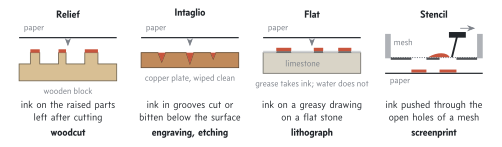
Relief
In a relief print the ink sits on the raised parts of the block, as on a rubber stamp. To make a woodcut, the artist draws on a smooth plank. Then the cutter takes knives and gouges and cuts away everything that should stay white, leaving the lines of the drawing standing up like little walls. A roller spreads ink across their tops, paper is pressed down, and the lines print black. Every print comes out as the mirror image of its block, so letters must be cut backward. Dürer drew his rhinoceros facing left and printed it facing right. Woodcut lines are bold and a little stiff, because a knife cannot easily curl. Since the type of the early printing presses, the small metal letters set in rows, was also relief, a woodcut could be locked into the press beside the letters, which is why the first printed books were illustrated with woodcuts (Vol. 14, From Luther to Mozart).
Japanese artists carried the woodcut furthest. To print in color, they cut a separate block for each color and printed them one after another on the same sheet, lining them up by small notches carved at one corner and along one edge of every block. These are the ukiyo-e (oo-kee-yoh-ay) prints, “pictures of the floating world,” and the most famous is Katsushika Hokusai’s (hoh-koo-sy) The Great Wave off Kanagawa, printed around 1831 (Vol. 41, Islands of the Rising Sun).
Intaglio
Intaglio, Italian for “carving,” works the other way around. The ink sits in grooves cut below the surface of a metal plate. In an engraving, the engraver pushes a burin, a short steel bar with a diamond-shaped point, across a polished copper plate. It plows up a curl of metal and leaves a groove shaped like a V. To print, the plate is smeared all over with stiff ink and then wiped clean, so that ink stays only in the grooves. Damp paper is laid on top, and plate and paper are cranked together through a roller press under great pressure, which squeezes the paper down into the grooves to pull the ink out. Engraved lines are crisp and swell and taper like the strokes of a pen, and shadows are made by crossing lines over lines. Dürer’s Knight, Death, and the Devil (1513) is an engraving (Vol. 14, From Luther to Mozart), and so is the portrait on a dollar bill.
In an etching, the artist covers the copper plate with a thin, waxy coat called a ground, which acid cannot eat. With a steel needle he draws through the ground as easily as with a pencil, laying the copper bare wherever he draws. Then the plate goes into a bath of acid, which bites into the bare lines and leaves the covered parts alone. The longer the bath, the deeper the groove and the darker the printed line. The ground is cleaned off and the plate is inked and printed like an engraving. Rembrandt drew with the etching needle as freely as with a pen (Vol. 13, Valois, Bourbon, and Orange), and the Spanish painter Francisco Goya etched his fierce, mocking Caprichos in 1799 (Vol. 16, Romantic Europe).
Lithograph and screenprint
The third method was invented in 1796 by Alois Senefelder (zay-nuh-fel-der), an actor and playwright in Munich, in Bavaria, who was looking for a cheap way to print his plays. He found that a smooth slab of limestone would hold a drawing made in greasy crayon, and he named the method from the Greek lithos, “stone.” The secret of the lithograph is that oil and water do not mix. The printer wets the stone, and water clings to the bare stone but runs off the greasy drawing. Then he rolls on an oily ink, which sticks to the drawing and is pushed away by the wet stone. Paper pressed against the stone picks up the drawing and nothing else. The surface is perfectly flat, so the artist does not cut anything; he simply draws. With one stone for each color, lithography printed the bright posters of Paris in the 1890s, among them the painter Henri de Toulouse-Lautrec’s (too-looz loh-trek) posters for the Moulin Rouge dance hall (Vol. 18, Paris, Capital of the Arts).
The fourth method pushes ink through holes. A screenprint, or silkscreen, uses a fine mesh of silk, now usually nylon or polyester, stretched tight on a frame like a window screen. Parts of the mesh are blocked with a stencil, a cut-out mask that holds the ink back, and a rubber blade called a squeegee (skwee-jee) drags ink across it, so that ink passes through the open mesh onto the paper beneath. In the 1960s the American artist Andy Warhol made it famous as fine art, printing the same photograph of Marilyn Monroe again and again in rows (Vol. 36, Bebop to Pop Art).
Graffiti
In AD 79 the volcano Vesuvius (vuh-soo-vee-us) buried the Roman town of Pompeii (pom-pay) under ash (Vol. 7, The Romans). With the town it preserved thousands of messages scratched and painted on its walls: notices urging votes for candidates in the local elections, lovers’ notes, insults, cheers for favorite gladiators, and plain boasts that someone had been there. Archaeologists needed a word for them and borrowed an Italian one, graffiti (gruh-fee-tee), “scratchings,” from graffiare, “to scratch.” (A single one is a graffito.) Today the word means any writing or picture put on a wall or another public surface, usually without the owner’s permission.
Modern graffiti began in New York City and Philadelphia around 1970. Teenagers wrote their tags, each a nickname with a number, in marker on walls, lampposts, and subway stations. The most famous was TAKI 183, a Greek-American teenager named Demetrios who lived on 183rd Street and worked as a messenger, so his tag appeared all over Manhattan. In 1971 the New York Times ran a story about him, and hundreds of others began to copy him. They moved on to the subway trains, which carried their names through every part of the city, and they switched to spray paint. Spray paint had been invented in 1949 by Edward Seymour, of Illinois, to show off an aluminum paint for radiators. A can covers a wall quickly, sticks to almost anything, and fits in a pocket, and graffiti writers took up spray paintThis art form often uses spray paint. → graffiti••• for good. By the late 1970s whole subway cars rolled through New York covered with huge, many-colored letters that the writers called pieces, short for masterpieces.
Painting someone else’s property without permission is a crime in nearly every country, and New York treated it as one. The word for such damage, vandalism, comes from the Vandals, a Germanic people who sacked Rome in AD 455. A French bishop named Henri Grégoire (greh-gwahr) coined it in 1794 to condemn the mobs who were smashing statues and paintings during the French Revolution. Owners who scrub paint off their walls and trains see graffiti as vandalism, not as art.This art form is often considered vandalism. → graffiti•• From 1984 New York’s transit authority cleaned or replaced every subway car, and in 1989 the last train covered in graffiti left service. A few of the writers moved into galleries instead. Jean-Michel Basquiat (bahs-kee-ah) and Keith Haring both began on the walls and subways of New York, and their paintings now sell for millions (Vol. 36, Bebop to Pop Art).

Not all graffiti is drawn by hand. A stencil is a sheet of card or plastic with a shape cut out of it. Hold it against a wall, spray over it, and paint passes only through the holes, leaving a sharp copy of the shape. Stencils are among the oldest pictures of all. In caves on several continents, people blew pigment around their own hands pressed to the rock, leaving outlines of hands tens of thousands of years old. For a graffiti artist the stencil’s gift is speed, which matters when the work is illegal: it can be cut at home in an hour and sprayed on the street in seconds. In the early 1980s a Paris artist who called himself Blek le Rat began spraying stenciled rats on the walls of Paris. From the 1990s an English artist known only as Banksy, who has never revealed his name, made graffiti sprayed through stencilsStencils are used to create works in this medium. → graffiti•• famous in Bristol, London, and far beyond (Vol. 24, After Empire). A stencil is the screenprint’s ancestor: both push color through holes.
Photography
Sit in a dark room on a sunny day, with a single small hole in the window shutter, and the scene outside appears on the opposite wall, upside down and in full color. This is a camera obscura, Latin for “dark room.” The Greek philosopher Aristotle noticed the effect, and the Arab scientist Ibn al-Haytham (ib-un al-hy-tum) explained it around 1020. By the 1600s artists were using portable boxes with a lens at the front and a sheet of paper or glass at the back to trace views (Vol. 13, Valois, Bourbon, and Orange). The image was perfect, but it vanished when the light moved. Making the picture stay was a problem for chemists, and its answer was silver: some compounds of silver darken when light falls on them.
In the 1820s a French inventor, Nicéphore Niépce (nee-say-for nyeps), made the first lasting photograph of a view from his upstairs window. Its exposure, the time that light had to fall on the plate to make a picture, lasted hours. His partner Louis Daguerre (duh-gair), a painter of theater scenery, found a much faster method. He coated a copper plate with polished silver, made it sensitive to light with fumes of iodine, exposed it in a camera for several minutes, and brought out the picture with fumes of mercury. Anything that moved during those minutes left no mark (Figure 20.10). He announced the daguerreotype (duh-gair-oh-type) in 1839. Each was unique, a single plate that could not be copied, and like a woodcut it showed the scene reversed, as in a mirror. In England, William Henry Fox Talbot found a way to make a negative, a picture on paper with light and dark reversed, from which any number of positive prints could be made, and that method won (Vol. 15, The Age of Revolution).

Photography is the art of using a camera to capture images.This art form involves using cameras to capture images. → photography•• Its name, from the Greek for “writing with light,” was made popular in 1839 by the English scientist John Herschel. A camera is a camera obscura made small: a light-tight box, a lens that focuses the scene, and a shutter that opens for a fraction of a second. For more than a century the back of the box held film, a strip of clear plastic coated with tiny crystals of silver compounds. Light striking a crystal changes it, though nothing can be seen yet.
The picture appears in a darkroom, a room sealed from daylight. There the film is unwound in complete darkness and shut in a light-tight tank. The photographer pours in a developer, a chemical that turns every crystal struck by light into a speck of black silver. Then comes a fixer, which washes away the crystals that were not struck, so that the film will no longer react to light. The result is a negative: a bright sky comes out black and dark hair comes out clear. To make a print, the photographer shines light through the negative onto paper coated with the same kind of crystals, and develops it in open trays under a dim red lamp, since printing paper does not react to red light. Dark and light swap back again, and the print is a positive. For most of the twentieth century, photographers developed their film in a darkroom.Artists who create work in this medium may utilize a darkroom to develop film. → photography• Since the early 2000s most cameras have used a digital sensor instead, a chip covered with millions of tiny cells that measure light, and many photographers have never seen a darkroom.
Photographs reached their largest audience in print, in newspapers and magazines and on record sleeves. Records were once sold in plain paper sleeves, and by about 1910 stores sold empty sleeves bound together like a photograph album to keep them in, which is why a collection of songs is still called an album. In 1938 Columbia Records hired a young designer named Alex Steinweiss as its first art director, and he began putting pictures on the covers; other record companies soon followed. In 1948 Columbia introduced the long-playing record, twelve inches across, and its square cardboard sleeve, a foot wide, became a canvas for designers and photographers. On the morning of August 8, 1969, the photographer Iain Macmillan stood on a stepladder in the middle of Abbey Road, the London street that gave the album its name, while a policeman held up the traffic. He had ten minutes to photograph the four Beatles walking in single file across the zebra crossing outside their recording studio. The picture became the album cover of Abbey Road,These artworks accompany musical collections like the Beatles' Abbey Road. → album covers• one of the most copied images in popular music. Its front carries neither the band’s name nor the album’s title (Vol. 24, After Empire).
How a film is made
A film is photography made to move. A strip of motion-picture film holds a long row of still photographs, called frames, each a little different from the one before. A projector shines light through them one after another, each for a fraction of a second, with a flick of darkness between. Shown fast enough, the separate pictures melt into one moving picture. Silent films ran at anywhere from about sixteen to twenty-four frames a second; since sound arrived, the standard has been twenty-four. The brothers Auguste and Louis Lumière (loom-yair) gave the first show for a paying audience in Paris on December 28, 1895, with short films of workers leaving a factory and a baby being fed (Vol. 18, Paris, Capital of the Arts).
Film has a grammar of its own, and its first word is the shot. A shot is one unbroken run of the camera, from the moment it starts to the moment it stops. A cut is the join where one shot ends and the next begins, and the work of choosing shots and putting them in order is editing. Shots are named by how much they show. A long shot shows people from head to foot in their surroundings. A medium shot shows them from the waist up. A close-up fills the screen with one face, one hand, or one object, a view no theater audience could ever have. The camera can move, too: it can turn from side to side, a pan, or roll along beside the action on rails, a tracking shot. Soviet filmmakers of the 1920s argued that a film’s meaning lies in its cuts. The director Lev Kuleshov said that he had shown audiences the same blank face of an actor cut beside different shots, and that viewers praised the actor for showing hunger, grief, or longing, though his face never changed. Building meaning out of cuts is called montage (mon-tahzh), French for “assembly,” and the director Sergei Eisenstein made it famous in Battleship Potemkin (1925; Vol. 23, Revolution and Ruin).
Silent films were never silent. A pianist, an organist, or in a big city a whole orchestra played along in the theater, and the words appeared on intertitles, cards of printed text filmed between shots. On October 6, 1927, Warner Bros. released The Jazz Singer, in which the star Al Jolson sings and speaks a few lines that the audience could hear in time with his lips. The sound came from a large disc record played in step with the projector. Audiences were thrilled, and within about three years nearly every new Hollywood film was a talkie (Vol. 32, Jazz, Depression, and War).
Documentary and animation
Most films tell made-up stories, acted by actors. A documentary is a film about real people, places, and events. The word was first used for films in 1926 by a young Scottish critic, John Grierson, who wrote that a film about life in Samoa had “documentary value.” The man who had made that film was Robert Flaherty, an American explorer and prospector who had spent years in the far north of Canada. His first feature film, Nanook of the North (1922), had followed an Inuit hunter and his family on the eastern shore of Hudson Bay as they traveled by kayak, fished, hunted walrus, and built an igloo. It was the first long documentary to make money.

Flaherty arranged a good deal of his film. The hunter, whose real name was Allakariallak (al-lah-kah-ree-ahl-lak), normally hunted with a rifle, but Flaherty asked him to use a harpoon, as his grandfather would have. The igloo had half of its dome cut away so that there was enough light to film inside, and the two women shown as his wives were not his wives. So the documentary Nanook of the NorthNanook of the North is a film in this genre. → documentary• raised, at the very beginning, the question every documentary since has faced: how much may a filmmaker arrange and still call the result real?
The Soviet filmmaker Dziga Vertov (jee-guh vair-tof) gave the opposite answer. Born David Kaufman, he chose a pen name that means something like “spinning top,” and he wanted to film “life caught unawares,” with no actors, no scripts, and no story. Vertov’s Man with a Movie CameraDziga Vertov’s Man with a Movie Camera is a film in this genre. → documentary• (1929) shows a single day in the cities of Moscow, Kiev, and Odessa, from dawn to night, with people waking, working, marrying, and swimming. The cameraman himself, Vertov’s brother Mikhail (mee-kah-eel), climbs over bridges and chimneys to film them. Vertov used every trick the camera knew, from split screens and slow motion to sudden freezes, with no intertitles at all. In 2014 a poll of critics for the British magazine Sight and Sound named it the greatest documentary ever made (Vol. 23, Revolution and Ruin).
Later documentaries argue their case openly. Michael Moore grew up just outside Flint, Michigan, where his father worked on a General Motors assembly line. In the 1980s General Motors closed factories in Flint, and tens of thousands of people lost their jobs. In the documentary Roger & MeRoger & Me is a film in this genre. → documentary• (1989), Moore, in a baseball cap, spends the film trying to get an interview with Roger Smith, the chairman of General Motors, and never quite does. Moore puts himself on camera, makes jokes, and states his opinions plainly. He made many more films in the same style, among them Bowling for Columbine (2002), which won an Academy Award, and Fahrenheit 9/11 (2004), which earned more at American theaters than any documentary before it. Michael Moore makes documentaries that argue openly,Michael Moore creates films in this genre. → documentary• and they have divided audiences ever since.
Ken Burns makes documentaries about American history at great length for PBS, the public television network of the United States. His most famous, The Civil War (1990), runs eleven hours. Almost no moving pictures exist of the 1860s, so Burns filmed old photographs instead, moving the camera slowly across each one and closing in on a face, while actors read aloud from letters and diaries. That slow glide across a still photograph is now called the “Ken Burns effect,” the name Apple gave it in its video software. Ken Burns creates documentariesKen Burns creates films in this genre. → documentary• on subjects from baseball to jazz to the Vietnam War, and many other filmmakers have copied his method.
Animation makes things that cannot move appear to move, one frame at a time. Drawn animation photographs thousands of drawings, each slightly different from the last; Walt Disney’s Steamboat Willie (1928) was made that way (Vol. 32, Jazz, Depression, and War). Stop motion uses real objects instead. The animator sets a puppet in front of the camera: a doll with a jointed metal skeleton inside, a figure of soft modeling clay, or a toy. He takes a single frame, moves the puppet very slightly, takes another frame, and so on. Played back at twenty-four frames a second, the many frames of objects moved bit by bitThis technique entails assembling shots of incrementally adjusted physical objects to create the appearance of movement. → stop motion•• blend into smooth movement. A second of film can mean twenty-four separate adjustments, and a careful animator may finish only a few seconds of film in a day. Stop motion gave the giant ape his life in King Kong (1933), and it made the clay inventor and his dog in the English animator Nick Park’s Wallace and Gromit films (Vol. 24, After Empire) and the puppets of Coraline (2009; Vol. 35, Stage, Screen, and Verse).

The hardest part is remembering where things were. If a puppet’s hand moved a tenth of an inch between the last two frames, it must move about the same amount in the next, or the movement will jerk. Animators who drew by hand once worked on thin, see-through paper, called onionskin, laid over the previous drawing on a table lit from below, so that they could trace how far a line had moved. Stop-motion animators borrowed the name. Their computer software shows the last photograph as a faint ghost on top of the live view from the camera, an onion skin, so that the animator can overlay the previous frame as a guideAnimators using this technique can overlay the previous frame as an "onion skin" to guide the next physical adjustment. → stop motion• before nudging the puppet again (Figure 20.12).
What to remember
- Paint is pigment plus binder, and the binder names it: egg yolk makes tempera, linseed oil makes oil paint, beeswax makes encaustic, gum arabic makes watercolor.
- Tempera was painted on wooden panels and dries in minutes; oil dries slowly, can be blended and glazed, and moved from panels to canvas in Venice in the 1500s.
- Pottery is fired clay. Pots are built by coiling ropes of clay or thrown on a spinning wheel, then fired in a kiln; earthenware, stoneware, and porcelain are fired at rising heats.
- In the lost-wax process a wax model is covered in a mold, the wax is melted out, and molten metal, usually bronze, fills the space.
- A tapestry is a picture woven on a loom from a full-size design called a cartoon, and it comes out reversed. The Bayeux Tapestry is really an embroidery.
- Collage is named for the French coller, “to glue”; découpage is a varnished kind of collage, and photomontage is collage made of photographs.
- Prints come in four families: relief (woodcut), intaglio (engraving and etching), the flat lithograph, and the stencil (screenprint).
- Graffiti is writing or painting on walls without permission, now usually in spray paint, often stenciled, and often treated as vandalism.
- A photograph is made with a camera; film is developed in a darkroom into a negative and printed as a positive.
- A film is a row of frames; its grammar is the shot, the cut, and the close-up. Documentaries film real life, and stop motion moves real objects one frame at a time.
Arguments
Chapter 21 · 18 clues
Persuasion and the Syllogism
In 399 BC a seventy-year-old Athenian named Socrates stood before a jury of about five hundred of his fellow citizens. He was charged with failing to honor the city’s gods and with corrupting its young men, who liked to follow him around the marketplace while he asked people awkward questions. Athens had no professional lawyers. A man on trial spoke for himself, and the usual way to save your life was to weep, to remind the jurors of your services to the city, and to bring your small children into court to cry beside you. Socrates refused. According to his pupil Plato, who was in the courtroom, he told the jury that he had three sons, one nearly grown and two still small, and that he would not parade them. He would only argue. The jury convicted him by about sixty votes, and a month later he drank the cup of poison hemlock that the court had ordered (Figure 21.1).

Two ways of winning an argument met in that courtroom, and they have been rivals ever since. One is persuasion: moving a particular audience, on a particular day, to believe something and to act on it. The other is proof: showing that a conclusion follows from starting points that everyone already accepts, so that whoever grants the start must grant the end. Socrates trusted only proof, and he lost to persuasion. The first great book on each was written by the same man, the philosopher Aristotle (Vol. 6, The Greeks), who studied for twenty years under Plato.
Rhetoric
Any citizen of Athens could be hauled into court by a neighbor, and any citizen could stand up in the Assembly, the open-air meeting where the city decided by a show of hands on war or peace. Teachers called Sophists traveled from city to city selling the skill for high fees, and their critics accused them of teaching how to make the weaker argument look the stronger (Vol. 6, The Greeks). The Greek name for the skill meant “the art of the public speaker,” and English calls it rhetoric: the art of persuading an audience with words.
Aristotle came to Athens from northern Greece at seventeen and later opened a school of his own, the Lyceum (ly-see-um), in 335 BC. His Rhetoric defines its subject as an ability: “the faculty of observing in any given case the available means of persuasion.” Some audiences must decide what to do, some must judge what was done, and some have gathered only to hear a speech. So Aristotle divided rhetoric into three branchesAristotle divides this discipline into deliberative, forensic, and epideictic branches. → rhetoric• (Figure 21.2). A deliberative speech is made to an assembly choosing a course of action, so it looks to the future and argues that a plan will help or hurt the city: should Athens go to war? A forensic speech, named from the Latin for the forum, the main square of Rome, where courts met, is made in a court of law. It looks to the past and argues that a deed was just or unjust: did the accused do it? An epideictic (ep-ih-dyke-tik) speech, from the Greek for “display,” is made at a ceremony. It looks to the present and offers praise or blame. Abraham Lincoln’s address at Gettysburg, Pennsylvania, on November 19, 1863, was epideictic. At the opening of a cemetery for the soldiers killed in the battle there, he praised the dead and asked the living to be worthy of them (Vol. 29, A House Divided).

Aristotle then asked where the persuading actually happens, and he found three modes of persuasion,Ethos, logos, and pathos are modes of persuasion in this discipline. → rhetoric•• which teachers still call by their Greek names. The first is ethos (ee-thos), “character.” We believe speakers who seem honest, sensible, and well disposed toward us, so a speech must show its speaker to be such a man. The second is pathos (pay-thos), “feeling,” which means putting the audience into the right frame of mind, angry or afraid or full of pity, because people judge differently when they feel differently. The third is logos (loh-gos), “word” or “reason,” which is the argument itself, with whatever proof the speech contains. Socrates gave his jury logos and refused them pathos, and his ethos did him harm. Athenian law let a convicted man propose a penalty of his own, and Socrates suggested that the city feed him free for the rest of his life, an honor the city gave to its benefactors and to winners at the Olympic Games.

Rome rewarded speakers as Athens had. Its greatest orator, Marcus Tullius Cicero (sis-uh-roh), was born in 106 BC, the son of a landowner from a small hill town, and he talked his way to the consulship, Rome’s highest office. As consul in 63 BC he rose in the Senate to expose a plot by the nobleman Catiline (kat-ih-line) to seize power, opening with the words “How long, Catiline, will you abuse our patience?” (Figure 21.3; Vol. 7, The Romans). Roman teachers, from Cicero in a handbook of his youth called On Invention to the schoolmaster Quintilian (kwin-til-yun) in his twelve-book Education of the Orator (about AD 95), divided the making of a speech into five tasks. These are the five canons of rhetoric,The five "canons" of this subject included inventio (invention) and dispositio (arrangement). → rhetoric•• a canon being a rule or a standard list. The first, inventio (in-ven-tee-oh), or invention, is finding what to say. The second, dispositio (dis-poh-zit-ee-oh), or arrangement, puts it in order, and elocutio (el-oh-koo-tee-oh), or style, chooses the words. Last come memoria, learning the speech by heart, and pronuntiatio (proh-nun-tee-ah-tee-oh), the delivery, with its voice and gestures.
The canon of memory had a founding legend. Cicero told the story of the Greek poet Simonides (sy-mon-ih-deez), who stepped out of a banquet moments before the roof fell in, and who then named every crushed guest by remembering where each had sat. From that story, Cicero said, orators learned to remember a speech by placing each point in a room of an imagined building and walking through them as they spoke.
After Rome fell, rhetoric lived on in the schools. With grammar and logic it formed the trivium, Latin for “where three roads meet,” the three subjects every medieval student took first. In modern times the word slid downhill, and “mere rhetoric” came to mean fine words with nothing behind them. In 1936 the English literary critic I. A. Richards (1893–1979), who taught at Cambridge and later at Harvard, tried to rescue the art in lectures published as The Philosophy of Rhetoric. The old rhetoric, he complained, had been a manual for winning quarrels. He wanted it to become a study of misunderstanding and its remedies,I.A. Richards called this discipline “a study of misunderstanding and its remedies.” → rhetoric• an inquiry into how words carry meaning from one mind to another, how they fail, and how the failures can be mended (Vol. 21, Trenches and Modernists).
A second rescue came from Brussels. The Belgian philosopher of law Chaïm Perelman (khah-eem pehr-ul-mun) began from a puzzle about justice. Judges, politicians, and parents argue all day about values, and almost none of their arguments are proofs, yet some are plainly better than others. With his colleague Lucie Olbrechts-Tyteca (ol-brekhts tee-tek-ah) he collected arguments from courtrooms, newspapers, and philosophy books, and in 1958 the two published their findings as The New Rhetoric, a treatise on argument.Chaïm Perelman wrote a book on the "new" practice of this discipline. → rhetoric• Reasoning that wins an audience’s agreement instead of forcing it, they argued, has rules of its own, and the art Aristotle described is the logic of everyday life.
The essay
On February 28, 1571, his thirty-eighth birthday, a French nobleman named Michel de Montaigne (mon-tayn), who had lately given up his seat as a judge in the court at Bordeaux (bor-doh), shut himself into a round tower on his family estate. Among some 1,500 books, he wrote short prose pieces about whatever was on his mind: friendship, cannibals, sleep, the education of children, and later the kidney stones that tormented him. He called them Essais (eh-say) (1580), “attempts” or “trials,” because each one tried out his judgment on a subject without promising to settle it (Vol. 13, Valois, Bourbon, and Orange). His motto was a question: “What do I know?” In 1597 the Englishman Francis Bacon, later Lord Chancellor, the head of the country’s courts, borrowed the word for his own Essays, shorter and sharper than Montaigne’s (Vol. 12, Crown and Parliament). Ever since, an essay has meant a short piece of prose in which a writer works out his thinking on one subject.

The essay a student writes at school is a stricter cousin, and its ancestor is rhetoric. Its center is the thesis, from the Greek for “a setting down”: the single claim that the whole essay exists to support. American schools often teach a standard plan in which students write the essay in five paragraphsStudents often write this form of prose in five paragraphs, presenting a thesis and supporting arguments. → essay• (Figure 21.4). The first paragraph introduces the subject and ends with the thesis. Each of the next three gives one argument for it, opening with a topic sentence that states the argument and going on to the evidence. The last paragraph, the conclusion, restates the thesis in the light of what the middle has shown. This is the Roman canon of arrangement in miniature. Cicero taught that a speech in court should win the listeners’ goodwill, tell the facts, set out the points to be proved, prove them, answer the other side, and close with a summing-up that stirs the feelings. The school essay keeps the opening, the proof, and the close. Montaigne, whose essays wander wherever his mind went, would not have recognized it, but it trains a beginner to know his claim and to make each paragraph serve it.
Deduction and induction
In the novel A Study in Scarlet (1887), the detective Sherlock Holmes shakes hands with a stranger, Dr. John Watson, and says at once, “You have been in Afghanistan, I perceive.” Later he explains how he knew. The man had the air of a soldier and the manner of a doctor, so he was an army doctor. His face was tanned but his wrists were pale, so he had lately come from a hot country. He looked worn and thin, so he had been ill, and he held his left arm stiffly, so he had been wounded. Where had a British army doctor lately suffered all that? In Afghanistan, where Britain had just fought a war. The author, Arthur Conan Doyle, titled the chapter “The Science of Deduction” (Vol. 17, The Victorians).
A logician would call Holmes’s method by another name, and to see why, we need some words. An argument is a set of statements in which some, the premises, are offered as reasons for another, the conclusion. In deduction the premises are meant to guarantee the conclusion, so that if they are true, it must be true. “Every planet circles the sun; Mars is a planet; so Mars circles the sun.” An argument whose conclusion really does follow, so that true premises could never lead to a false conclusion, is valid. A valid deduction tells you nothing that was not already packed inside its premises, but it unpacks it with certainty. The branch of philosophy that studies deductive reasoningThis field of philosophy studies deductive reasoning. → logic• and asks which arguments are valid is logic, named from logos, the same Greek word that named Aristotle’s appeal to reason.
The other great kind of reasoning draws general conclusions from particular observations,This form of reasoning draws general conclusions from particular observations. → induction•• and it is called induction. Its conclusions reach beyond the evidence, which is both their use and their danger. For centuries every swan that any European had seen was white, and the Roman satirist Juvenal used a black swan as his picture of a thing that hardly exists. Then, in January 1697, a Dutch captain named Willem de Vlamingh (vlah-ming) sailed up a river in western Australia and found black swans on it, and he named it the Swan River. Thousands of white swans had not proved that all swans are white, and one black swan was enough to disprove it.
Science lives by induction, reasoning from experiments to laws of nature. Aristotle’s books on logic had long been bound together as the Organon (or-guh-non), Greek for “tool,” and in 1620 Francis Bacon called his attack on the old learning the Novum Organum, “the new tool.” Science, he argued, should climb from careful observation to general laws one step at a time (Vol. 12, Crown and Parliament). In 1739 the Scottish philosopher David Hume asked what justifies induction at all (Vol. 12, Crown and Parliament). No deduction can prove that the future will resemble the past, and to argue that induction has always worked before is to use induction to defend itself. The English philosopher Bertrand Russell put the problem as a fable in 1912 (Vol. 21, Trenches and Modernists). A chicken fed every morning of its life expects breakfast whenever the farmer appears, until the morning he wrings its neck.
The syllogism
About 350 BC Aristotle wrote the first book that studied the shape of arguments apart from what they are about. Its subject was a kind of argument called the syllogism (sil-uh-jiz-um), from the Greek for “reckoning together,” and the book that introduced it was Aristotle’s Prior Analytics,These constructs were introduced in Aristotle's Prior Analytics. → syllogisms•• the first of his two books on analysis. A syllogism has two premises and a conclusion, and it links exactly three terms, the words for the classes of things it talks about. Aristotle’s great discovery was that validity does not depend on what the terms mean. He wrote his syllogisms with letters in place of words: “if A belongs to every B, and B to every C, then A belongs to every C.” In plain words: if every C is a B, and every B is an A, then every C is an A. The argument holds whatever the letters stand for, much as algebra would later use letters for any number.

The example that teachers have used for centuries makes Socrates its subject: “All men are mortal; Socrates is a man; therefore Socrates is mortal.” Aristotle never used it himself, and hemlock had settled the question fifty years before he wrote. Look first at the conclusion. Its subject, “Socrates,” is the minor term, and its predicate, “mortal,” is the major term. Every syllogism draws its conclusion from a major and a minor premise.These arguments derive a conclusion from a major and a minor premise, as in “All men are mortal; Socrates is a man; therefore Socrates is mortal.” → syllogisms•• The major premise is the one that contains the major term (“All men are mortal”), and the minor premise contains the minor term (“Socrates is a man”). The third term, “man,” appears in both premises and never in the conclusion. It is the middle term, the link that joins the other two and then drops out, like a friend who introduces two strangers and leaves them talking.
Logicians call each statement in a syllogism a proposition, and in Aristotle’s system every proposition is one of four kinds. “All swans are white” is universal and affirmative: it says something about every member of a class. “No swans are white” is universal and negative. “Some swans are white” is particular and affirmative, and “Some swans are not white” is particular and negative. Medieval teachers, who wrote in Latin, took the first two vowels of affirmo, “I affirm,” for the affirmative kinds and the vowels of nego, “I deny,” for the negative ones. In each pair the universal kind took the first vowel. So the propositions of a syllogism are named by the four letters A, E, I, and OPropositions in these arguments are classified as A, E, I, and O. → syllogisms•• (Figure 21.6). An A statement and the O statement with the same terms are contradictories: exactly one of them is true. To refute “All swans are white,” one needs only an O statement, “Some swans are not white,” and that is what the Swan River supplied.

List the letters of a syllogism’s three statements in order, major premise first, and you have its mood. The mood is not the whole story, because the middle term can stand in different places in the premises, and each arrangement is called a figure. Each of the three statements can be any of four kinds, which makes 4 × 4 × 4 = 64 moods, and there are four figures, so there are 256 possible forms. Medieval logicians counted nineteen valid ones, and they gave the valid forms mnemonic names such as Barbara and CelarentTraditional valid forms of these arguments have mnemonic names such as Barbara and Celarent. → syllogisms• (sel-uh-rent), memory aids that students chanted in a Latin verse. The vowels of each name spell its mood. Barbara is AAA, three universal affirmatives, as in the argument about Socrates, where traditional logic treats “Socrates” as a class with a single member. Celarent is EAE: “No reptiles have fur; all snakes are reptiles; so no snakes have fur” (Figure 21.7). The consonants were coded instructions for turning the other valid forms into the four valid forms of the first figure, which Aristotle called perfect because their validity needs no further proof.
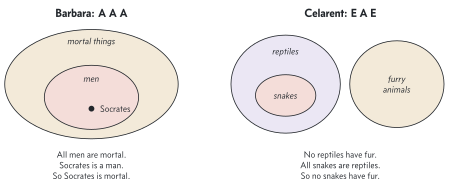
Causes and dialectic
On the night of August 31, 1854, cholera, a disease of the gut that can kill within a day, broke out in Soho, a crowded district of central London, and within three days 127 people living near Broad Street were dead. Most doctors blamed a poisonous “miasma,” or bad air, rising from filth. John Snow, a London physician who had given Queen Victoria chloroform, a liquid whose vapor dulls pain, at the birth of her eighth child the year before, suspected the water. He went from house to house and asked where each victim had drawn water. Nearly all the deaths lay within a short walk of the public pump on Broad Street, and several of the dead who lived nearer other pumps had sent to Broad Street because they liked its water better. Close by stood a brewery whose workers were given a daily allowance of beer and drank no pump water, and not one of them caught cholera. On September 7, Snow laid his evidence before the parish board, and the next day the handle was taken off the pump. Afterward he marked every death on a street map with a short black bar, and the bars piled up around the pump (Figure 21.8; Vol. 17, The Victorians).

Snow was reasoning the way the English philosopher John Stuart Mill had described eleven years before. Mill (1806–1873) had been raised by his father as an experiment in education, starting Greek at the age of three. In A System of Logic (1843) he set out rules for discovering causation, the relation between a cause and its effect. By the method of agreement, if every case of an effect shares one circumstance and only one, that circumstance is the cause: Snow’s victims had many habits but one source of water. By the method of difference, if two cases are alike in everything but one circumstance, and the effect appears in one and not the other, that circumstance is the cause. The brewers lived and worked beside the pump like their dying neighbors, but they drank beer. By the method of concomitant variations, if one thing rises and falls with another, the two are connected, and Snow found the deaths most numerous near the pump and fewer as the walk to it grew longer.
A fourth rule, the method of residues, subtracts every part of an effect already explained by known causes and gives what is left to the cause that remains. By the 1840s astronomers knew that the planet Uranus wandered from its predicted path by more than the pull of the known planets could explain. From that leftover wobble the French mathematician Urbain Le Verrier (luh veh-ree-ay) worked out where an unseen planet must be, and on September 23, 1846, astronomers in Berlin found Neptune within about a degree of the spot. Together with a fifth rule that joins agreement and difference into one test, these are Mill’s methods for establishing causation.Mill’s methods of agreement, difference, residue, and concomitant variations can establish this relation. → causation•
The word dialectic (dy-uh-lek-tik) is much older than any of this. In Greek it meant the art of conversation: two people reasoning by question and answer, each testing the other’s claims, as Socrates did with anyone in the marketplace. Aristotle opened the Rhetoric by calling rhetoric the “counterpart” of dialectic, since the orator argues before a crowd what the dialectician argues with a single partner.
In the nineteenth century the word took on a new meaning. Georg Wilhelm Friedrich Hegel (hay-gul), a German professor born in 1770, held that ideas, and history itself, move by conflict (Vol. 16, Romantic Europe). A position pushed to its limit turns into its opposite, and the clash is settled at a higher level that keeps what was true in both. His own example opens his Science of Logic (1812). Pure being, with nothing said about it, turns out to be as empty as nothing. The way out is becoming, which holds both at once: a thing coming into being is not yet, and is already on its way. Popular books reduced Hegel’s dialectic to thesis, antithesis, and synthesis:A familiar schematic account of this process uses thesis, antithesis, and synthesis. → dialectic• a claim, its denial, and a resolution that combines them. Hegel himself rarely used those words, which come from an older German philosopher, Johann Gottlieb Fichte (fikh-tuh).
Logic as a discipline
In 1787 the German philosopher Immanuel Kant (kahnt) wrote that since Aristotle logic had not been able to take a single step forward, and that it seemed to be finished (Vol. 14, From Luther to Mozart). He exaggerated, but not wildly. In the Middle Ages teachers at Paris and Oxford spent three centuries refining Aristotle’s syllogism. The sharpest of them was William of Ockham (ok-um), born about 1287 in the village of Ockham, south of London. He was a friar, a member of the Franciscans, an order of wandering preachers sworn to poverty (Vol. 8, The Northern Worlds). Around 1323 he wrote a great textbook, the Summa Logicae (soo-muh loh-jih-see), or “Sum of Logic,” and in its pages laid out his nominalism.William of Ockham laid out his nominalism in his Summa of this subject. → logic• Ask what the word “man” stands for, and many philosophers of his day answered that it names something real, a human nature that every man shares. Ockham answered that only individual men exist. “Man” is a name, in Latin nomen, which the mind uses for many individuals at once, and nominalism is the view that general words name nothing beyond the particular things they gather together.
By then logic had a second branch, begun by the Greek philosophers called Stoics in the century after Aristotle. Instead of terms like “man” and “mortal,” it puts a sign in place of a whole statement: the Stoics wrote “the first” and “the second,” where logicians now write letters. Let p stand for “it is raining” and q for “the street is wet.” From “if p then q” and from p, the conclusion q must follow. From “if p then q” and from q, the conclusion p does not follow, because the street may be wet from a burst pipe. Logic evaluates the validity of such argumentsThis field evaluates the validity of arguments like "if p then q." → logic• one form at a time, whatever the letters mean, and statements of the form “if p then q” are the subject of Chapter 22.
Two rules sit beneath all of this. The law of non-contradiction says that no statement is both true and false at once. The law of the excluded middleIn the classical form of this discipline, statements must satisfy the law of the excluded middle. → logic• says that of any statement and its denial, one or the other is true, with no third possibility in the middle: for any p, either p or not-p. Logic that keeps both laws, as Aristotle’s and the Stoics’ did, is called classical logic. Aristotle himself worried about one case. “There will be a sea battle tomorrow” seems to be neither true nor false today, since tomorrow has not yet happened. Twentieth-century logicians built logics that give such statements a third value. Logics that break or extend the classical rules are called non-classical.

The best known of them add words that classical logic lacks. A triangle has three sides, and it could not have been otherwise. Abraham Lincoln was shot at a theater in 1865, but he might have stayed home that night. The first statement is necessary, and the second is true but might have been false. Modal logic, from the Latin modus, “manner,” is the logic of necessity and possibility, the manners in which a statement can be true. Its central picture is old. In 1710 the German philosopher and mathematician Leibniz (libe-nits) imagined God surveying every possible world before creating the best of them (Vol. 14, From Luther to Mozart). In 1959 a teenager from Omaha, Nebraska, named Saul Kripke (krip-kee) published a paper on modal logic that he had written at seventeen, and over the next few years he worked out possible-world semantics for modal logicSaul Kripke developed possible-world semantics for the modal form of this discipline. → logic• (Vol. 33, The American Century). Semantics is the part of logic that says what makes a statement true. In Kripke’s semantics, “necessarily p” is true when p holds in every possible world that can be reached from ours, and “possibly p” is true when p holds in at least one (Figure 21.9). Logicians have since built logics of knowledge, belief, and time on the same plan.
What to remember
- Rhetoric is the art of persuasion. Aristotle divided it into deliberative (future), forensic (past), and epideictic (present) branches, and named three modes of persuasion: ethos, pathos, and logos.
- Roman teachers such as Cicero and Quintilian divided the making of a speech into five canons: invention, arrangement, style, memory, and delivery.
- Montaigne named the essay (“attempt”) in 1580. A school essay supports one thesis, often in five paragraphs.
- In a valid deduction, true premises guarantee the conclusion; logic studies such reasoning. Induction draws general conclusions from particular observations, and one black swan can overturn them.
- Aristotle’s Prior Analytics introduced the syllogism: a major and a minor premise and a conclusion, linked by a middle term. Its statements are A, E, I, or O, and its valid forms have names such as Barbara (AAA) and Celarent (EAE).
- Mill’s methods of agreement, difference, residues, and concomitant variations are rules for finding causes, as John Snow found the Broad Street pump.
- Dialectic began as reasoning by question and answer. Hegel’s dialectic moves through opposition, a pattern popularly summed up as thesis, antithesis, and synthesis.
- Ockham laid out nominalism in his Summa Logicae. Classical logic keeps the law of the excluded middle; modal logic studies necessity and possibility, and Kripke gave it possible-world semantics.
Chapter 22 · 27 clues
If, Then, and True
Four cards lie on a table. Each has a letter on one side and a number on the other, and you can see E, K, 4, and 7. Someone tells you a rule about them: if a card has a vowel on one side, then it has an even number on the other. Which cards must you turn over to find out whether the rule has been broken? Decide before you read on.
The English psychologist Peter Wason first set this puzzle in 1966, and it has since been tried on thousands upon thousands of people, many of them university students. Most turn over the E and the 4. Only a small minority choose correctly. The trouble lies in one small word, “if.”
The syllogism of Chapter 21, the logic that Aristotle worked out in the fourth century BC, sorts things into classes with “all” and “some”: all men are mortal, some Greeks are poets. Modern logic, built between the 1870s and the 1930s by mathematicians in Germany, Britain, and Poland, looks instead, as the Stoics had, at whole sentences and the small words that join them: “not,” “and,” “or,” and “if.” Following “if” leads to the meaning of “true,” and then to the puzzles where both seem to break.
The conditional
In Alexandria, in the third century BC, the poet Callimachus is said to have joked that even the crows on the rooftops were cawing about which “if” sentences are true. The joke survives because Sextus Empiricus (em-peer-ih-kus), a Greek doctor and philosopher who lived about AD 200, repeated it. The quarrel the crows had overheard was between two philosophers, Diodorus Cronus (dy-uh-dor-us kroh-nus) and his pupil Philo. They were arguing over a question that sounds simple: when is a sentence that begins with “if” true?
To answer it, logicians start with statements, also called propositions: sentences that are either true or false. “It is raining” is a statement. “Shut the door!” is not, because an order is neither true nor false. Whether a statement is true or false is its truth value. Logicians let a letter stand for a whole statement, P for one and Q for another (some write them small, p and q), so that they can study the shape of an argument without caring what it is about. Small words such as “not,” “and,” and “or,” which build new statements out of old ones, are called connectives. The most interesting connective joins two statements into a statement of the form “if P, then Q,”These statements take the form "if P, then Q" or "P implies Q." → conditional•• which can also be said “P implies Q.” Such a statement is a conditional, because it states the condition under which something holds.
A conditional has two parts. The “if” part is the antecedent, from the Latin for “what goes before,” and the “then” part is the consequent, “what follows.” In “If it is raining, then the street is wet,” the antecedent is “it is raining” and the consequent is “the street is wet.” The same conditional can be worded in other ways. “The street is wet if it is raining” puts the consequent first, and “It is raining only if the street is wet” says the same thing again: it cannot be raining unless the street is wet.
In symbols, the conditional is written with an arrow,This connective is usually symbolized with a rightward-pointing arrow. → conditional•• P →Q, pointing from the antecedent to the consequent as if truth flowed along it. Older books use a sideways horseshoe, P ⊃Q. The other connectives have signs of their own: ¬P for “not P,” P ∧Q for “P and Q,” and P ∨Q for “P or Q.”
Now return to the question that Diodorus and Philo argued over: when is a conditional true? For “not,” “and,” and “or,” the answer is easy. Whether “P and Q” is true depends only on the truth values of P and of Q: it is true when both are true, and false otherwise. Two statements can be true or false in four combinations, so the whole meaning of “and” fits in a grid of four rows. Such a grid is called a truth table (Figure 22.1). “Or” is true when at least one part is true, and logicians count the case where both are.
Philo gave the conditional a table of its own. A conditional, he said, is false in one case only: when its antecedent is true and its consequent false. In every other row it is true. Logicians now call this the material conditional, because it looks only at the truth values of its parts, the “matter,” and not at any link of meaning between them. It was revived in 1879 by Gottlob Frege (fray-guh), a German professor of mathematics who founded modern logic, and it is the conditional of almost every logic book today.

The rows with a false antecedent are the strange ones. Suppose a father tells his daughter, “If you get an A in math, I’ll take you to the zoo.” If she gets the A and he takes her, he has kept his word. If she gets the A and he does not, he has broken it: that is the false row. But if she does not get the A, nothing he does can break the promise. He may take her anyway or stay home, and either way he has not lied. So a false antecedent makes the material conditional true.A material statement of this kind is vacuously true when its antecedent is false. → conditional• Logicians say it is vacuously true, from the Latin vacuus, “empty”: true because its condition was never put to the test. “Every dragon in this room is purple” is vacuously true in the same way, since there is no dragon in the room to be any other color.
The rule has odd results. As a material conditional, “If the moon is made of cheese, then Paris is in Brazil” is true, because its antecedent is false. Diodorus already objected to Philo’s view, and philosophers still argue over whether the “if” of ordinary speech means anything so bare. Mathematicians keep it because it makes their general laws come out right. “If a whole number can be divided by 4, it is even” should hold for every number, including 7, and with a false antecedent it does.
Such grids had been drawn before, but Wittgenstein’s tables of truth valuesWittgenstein used tables named for this concept in the Tractatus. → truth•• made them famous. Ludwig Wittgenstein, the brother of the one-armed pianist Paul of Chapter 10, was an Austrian who had studied logic at Cambridge before the First World War. He finished a short book of numbered sentences in 1918, on leave from the Austrian army. It was published in German in 1921, and in English the next year under a Latin title, Tractatus Logico-Philosophicus (trak-tay-tus). In it he used truth tables to show that every statement built with connectives is true or false according to the truth values of its parts alone (Vol. 21, Trenches and Modernists).
Conditionals do their real work in arguments. Chapter 21 called an argument valid when true premises can never lead to a false conclusion, and the simplest valid argument with a conditional runs like this: “If it is raining, the street is wet. It is raining. So the street is wet.” This form is called modus ponens (moh-dus poh-nenz), Latin for “the mode that affirms,” because it affirms the antecedent. Granted a conditional and its antecedent, the consequent follows by modus ponens.In a modus ponens argument, these statements' consequent follows given their antecedent. → conditional• In symbols: from P →Q and P, conclude Q.
Two other arguments look like it. “If it is raining, the street is wet. The street is wet. So it is raining” is invalid, because a street-cleaning truck may just have gone by. This mistake is called affirming the consequent. But “If it is raining, the street is wet. The street is not wet. So it is not raining” is valid. If it were raining the street would be wet, and it is dry, so it cannot be raining. This form is modus tollens (tol-enz), “the mode that denies.”
Hidden inside modus tollens is a second conditional. Swap the two parts of “If it is raining, the street is wet” and deny both, and you get “If the street is not wet, it is not raining.” This is the contrapositive. Two statements are logically equivalent when they are true in exactly the same situations, and a material conditional is equivalent to its contrapositive.Material forms of these statements are logically equivalent to their contrapositives. → conditional• Their truth tables match row for row, since each is false in just one case, rain falling on a dry street. Merely swapping the parts gives the converse, “If the street is wet, it is raining,” which is a different claim. The street cleaner makes the converse false while the original stays true.
Now the four cards can be settled (Figure 22.2). The rule is “if a vowel, then an even number.” The E is a vowel, so by modus ponens an even number must be on its back: turn it. The K is a consonant, and the rule says nothing about consonants. The 4 is tempting, but the rule never says that an even card must have a vowel; that would be its converse. The 7 is the card almost everyone misses. The rule’s contrapositive is “if an odd number, then not a vowel,” and a vowel behind the 7 would break it. So the answer is the E and the 7. Later experimenters found that people do far better when the same logic is dressed as a familiar social rule, such as “if someone is drinking beer, he must be of legal age.”

Long statements need parentheses. (P →Q) →R and P →(Q →R) have the same letters and arrows in the same order, but they are different statements. Try P and R both false. The first is false, because its antecedent, P →Q, is vacuously true and its consequent R is false. The second is vacuously true, because its antecedent P is false.
In 1924 the Polish logician Jan Łukasiewicz (woo-kah-sheh-vich) (1878–1956), a professor at the University of Warsaw and a leader of its school of logicians (Vol. 23, Revolution and Ruin), found a way to write logic with no parentheses at all. He put each connective in front of the statements it joins: C for the conditional, N for “not,” K for “and,” and A for “or.” So P →Q becomes Cpq, and each C takes the next two complete statements after it. Mathematicians call a sign such as + or → an operator, and the things it works on its operands. Writing the operator first is prefix notation, called Polish notation after Łukasiewicz’s country.This country names prefix notation, with operators before operands, and a “reverse” postfix variant. → Poland• Its mirror image puts the operator last, so that 3 4 + means 3+4. This reverse Polish notation, or postfix notation, suits computers. They hold numbers in a stack, a pile in which the last number put down is the first taken up, until an operator arrives to use them, and several Hewlett-Packard pocket calculators of the 1970s worked this way (Vol. 57, Computing and Engineering).
Theories of truth
When Jesus stood on trial before Pontius Pilate, the Roman governor of Judea, he said that he had come into the world to bear witness to the truth. Pilate answered, “What is truth?” In 1625 the English statesman Francis Bacon opened his essay “Of Truth” with the scene: “What is truth? said jesting Pilate, and would not stay for an answer.” Philosophers have been staying for it ever since.
Truth tables assume that every statement has exactly one of two truth values. In this two-valued logic truth is the opposite of falsehood:This property is the opposite of falsehood. → truth••• a statement has one value or the other, and putting “not” in front of it turns either into its opposite. Aristotle put the idea plainly in his Metaphysics. “To say of what is that it is not, or of what is not that it is, is false,” he wrote, “while to say of what is that it is, and of what is not that it is not, is true.” That tells us what a true statement does, but not what makes it true. Philosophers have given five main answers.
The oldest answer, and the one most people hold without thinking about it, is the correspondence theory. It defines truth as agreement with reality, with the facts:Correspondence theories define this property as agreement between propositions and reality or facts. → truth••• “The cat is on the mat” is true because the cat is on the mat. A true statement is like a correct map, whose roads lie where the real roads lie. The difficulty is to say exactly what a fact is, and what it means for a sentence, which is made of words, to agree with the world, which is made of things. A map at least looks like the land it shows, but a sentence does not look like a cat.
A second answer begins from how we actually check what we believe. We can never step outside our own beliefs to compare them with the bare world; we can only test each belief against the others. The coherence theory of truthThe coherence theory is one way of defining this concept alongside the correspondence theory. → truth• therefore says that a statement is true when it fits consistently into a whole system of beliefs, each supporting the rest. A detective works this way. No one saw the murder, but one account of it fits every scrap of evidence at once, while every other account clashes with something. The view was held by philosophers who thought reality itself a single whole of experience, such as the Oxford philosopher F. H. Bradley (1846–1924). Its critics answer that a well-made novel is perfectly coherent and entirely untrue.
A third answer came from America. Charles Sanders Peirce (purss) (1839–1914) worked on and off for some thirty years for the United States Coast Survey, much of that time measuring the pull of gravity with swinging pendulums. He was also a philosopher, who founded the school called pragmatism, which judges an idea by the practical difference it makes (Vol. 29, A House Divided). Peirce defined truth by where investigation ends. In 1877 he argued that what drives inquiry is the discomfort of doubt, and that what it seeks is settled belief, true or not. But only one way of settling belief, the method of science, would bring every honest investigator to the same answer in the long run. For Peirce, then, truth is the end of inquiry:Charles Sanders Peirce argued that this concept is where inquiry would finally end: the opinion all investigators are fated to agree on. → truth•• not what each inquirer sets out wanting, but the one place where all inquiry would finally come to rest. “The opinion which is fated to be ultimately agreed to by all who investigate,” he wrote in 1878, “is what we mean by the truth.” Careful experimenters may argue for a while over the boiling point of water, but enough experiments will bring all of them to the same number, and that number is the truth.
A fourth answer says that the others are looking for something that is not there. In 1927 the young Cambridge philosopher Frank Ramsey, who died three years later at twenty-six, pointed out that “It is true that Caesar was murdered” says no more than “Caesar was murdered.” Theories built on this observation are called deflationary, because they let the air out of truth: on these theories, saying that p is true just states p.Deflationary accounts of this property suppose that stating a proposition p has it is equivalent to simply stating p. → truth• Truth is not a deep property that true statements share, as heat is shared by hot things. The word “true” is a handy tool for agreeing with statements we cannot or do not wish to repeat, as in “Everything the witness said is true.”
The most influential answer came from Warsaw. Alfred Tarski (tar-skee) (1901–1983) was born Alfred Teitelbaum, worked as Łukasiewicz’s assistant, and became the youngest person ever to earn a doctorate at the University of Warsaw. In August 1939 he sailed for the United States to speak at a congress at Harvard University, on the last ship to leave Poland for America before the German invasion. He never lived in Poland again, and from 1942 he taught at the University of California at Berkeley.

In 1933 Tarski published, in Polish, a long paper on the concept of truth in the languages of logic and mathematics. He wanted a definition of truth exact enough for mathematicians and safe from contradiction. His answer is called the semantic theory of truth,Tarski used “Snow is white” to illustrate a semantic theory of this property. → truth••• from semantics, which Chapter 21 described as the part of logic that says what makes a statement true. In a paper of 1944, written in English for philosophers, he illustrated it with a sentence that has been quoted ever since: “Snow is white” is true if and only if snow is white.
It sounds too obvious to be worth saying, but look closely. On the left, inside quotation marks, is the name of a sentence: we are talking about three words. On the right is the sentence itself, used to talk about snow. “If and only if” means that the conditional runs both ways: if snow is white, the sentence is true, and if the sentence is true, snow is white. Tarski laid down that any acceptable definition of truth must yield one such sentence for every sentence of the language: “Grass is green” is true if and only if grass is green, and so on without end. This requirement is Tarski’s Convention T,This logician proposed Convention T, exemplified by “Snow is white” being true if and only if snow is white. → Alfred Tarski•• T for truth.
Tarski also showed that a language rich enough to talk about its own sentences cannot safely define truth for itself. The definition must be given in a second, larger language. A French grammar written in English works this way. French is the object language, the one being described, and English is the metalanguage, the one doing the describing. The reason for the rule is a sentence that Greek philosophers were already arguing about in the fourth century BC: the liar. Every later theory of truth has had to pass Tarski’s test, and the deflationists hold that passing it is all there is to truth.
Logics of belief and time
The logic of truth tables treats a statement as simply true or simply false, once and for all. Ordinary speech does more with a sentence. We say that a thing is necessarily so, or possibly so; that someone believes it; that it was so, or will be. Chapter 21 showed how modal logic handles “necessarily” and “possibly,” and how Saul Kripke read them through possible worlds. The same trick works for the other words: put a new operator in front of a statement and work out the rules it obeys. Each logic built this way counts as a branch of modal logic.
Christopher Columbus, who reached the Caribbean in 1492, believed for years afterward that the lands he had found were part of Asia. Write his belief as Bp, where p is the statement “these lands are part of Asia” and B is the operator “Columbus believes that.” The logic of belief is called doxastic logicThe branch of modal logic modeling this concept is called doxastic logic. → belief• (dok-sas-tik), from the Greek doxa, “opinion.” Its first full treatment came from the Finnish philosopher Jaakko Hintikka (yah-koh hin-tih-kah) (1929–2015), whose book Knowledge and Belief (1962) also laid out epistemic logic, the logic of knowledge, from the Greek epistēmē (ep-ih-stay-may), “knowledge.” The two logics differ in one telling rule. If someone knows that p, then p is true, because no one can know a falsehood. If someone believes that p, nothing follows about p at all, as Columbus shows.
Arthur Prior (1914–1969) was a logician from New Zealand who taught in Christchurch and later at Manchester and Oxford. He came to the logic of time partly through theology, because he wanted to know whether God’s knowledge of the future left any room for free will. Later, in a 1959 paper called “Thank Goodness That’s Over,” he gave a homelier reason: when something painful ends, a visit to the dentist, say, you are glad that it is past. You are not glad of a dateless fact, such as that the pain ended at a quarter past three on a certain Thursday, which was just as true a week before. A logic of timeless statements cannot say what you are glad about.

In Time and Modality (1957) Prior founded tense logic, which treats time as modal logic treats possibility. Prior’s operators F, G, H, and PArthur Prior founded a logic for this concept that uses the operators F, G, H, and P. → time• are placed in front of a present-tense statement such as “it is raining” (Figure 22.4). P means “it has at some time been the case that,” and F means “it will at some time be the case that.” H, “it has always been the case that,” and G, “it is always going to be the case that,” are their stronger partners. They are linked the way “all” and “some” are linked: to say that it will always be dry is to say that it is never going to rain. Since 1977, when the Israeli computer scientist Amir Pnueli (pnoo-eh-lee) adapted it, tense logic has been used to prove that computer programs and chips behave as they should.
Sense and reference
Before dawn, for months at a time, a brilliant light rises in the east just ahead of the Sun. In other months a light just as bright hangs in the west after sunset. The Greeks gave the two lights two names: Phosphorus (fos-fuh-rus), “light-bringer,” the morning star, and Hesperus (hes-puh-rus), the evening star. Ancient astronomers learned that both were the same body, the planet Venus, which always stays near the Sun in the sky and so is seen only around dawn or dusk.

Gottlob Frege (1848–1925) taught mathematics at the University of Jena, in Germany, for more than forty years. In 1879 he published Begriffsschrift (beh-grifs-shrift), “concept-script,” a little book that set out a symbolic language for the whole of logic, “all” and “some” as well as the connectives. He hoped to show that arithmetic could be built from logic alone. Few people read him while he lived, and among the few were the young English philosopher Bertrand Russell and Wittgenstein.
In 1892, in an essay called “On Sense and Reference,” Frege used the planet to set a puzzle. “The morning star is the morning star” tells you nothing, since it is true by its form alone. “The morning star is the evening star” records a discovery of astronomy. Yet if the meaning of a name were simply the thing it names, the two sentences would mean exactly the same, because both names name Venus. Frege’s answer was that a name has both a sense and a reference.Frege distinguished the senses and references of these expressions, using the morning star and evening star as an example. → names•• Its reference, in German Bedeutung (beh-doy-toong), is the object it picks out. Its sense, in German Sinn (zin), is the way the name presents that object, the route by which the mind reaches it. The two names have one reference and two senses (Figure 22.6).

Frege compared looking at the Moon through a telescope. The Moon itself is like the reference. The image inside the telescope is like the sense: the same for everyone who looks, but showing the Moon from one side only. The image on each viewer’s own retina, which no one else can share, is like the picture a word calls up in one mind, which Frege said was no part of meaning at all.
Senses also explain a puzzle about belief. An ancient Greek could believe that the morning star rises in the east without believing that the evening star does, though both are Venus, because what he believed depended on the sense of the name he used. Frege carried the idea to whole sentences. The sense of a sentence is the thought it expresses, and its reference is its truth value, which he called “the True” or “the False.” Later philosophers, above all Saul Kripke in the 1970s, argued over whether ordinary names have senses at all (Vol. 33, The American Century).
Paradoxes
On June 16, 1902, a young Englishman wrote to Frege. Frege was finishing the second volume of his Basic Laws of Arithmetic, the book that was to build arithmetic from logic. The letter was friendly and admiring, and in a few lines it showed that one of Frege’s basic laws led to a contradiction. Frege answered within a week. To see how one letter could shake a life’s work, it helps to begin with older puzzles.
A paradox is an argument that starts from premises that seem true, moves by steps that seem valid, and ends in a conclusion that seems false or contradicts itself. Put shortly, a paradox reaches an unacceptable conclusion from acceptable premises.These arguments or statements lead to apparently contradictory or unacceptable conclusions despite apparently acceptable premises or reasoning. → paradoxes•• The word comes from the Greek para, “against,” and doxa, “opinion,” the same doxa as in doxastic logic. A paradox always forces a choice: give up a premise, find the bad step, or accept the conclusion after all.
The oldest and most stubborn is the liar. Eubulides (yoo-byoo-lih-deez), a Greek philosopher of the fourth century BC, asked about a man who says that he is lying: is what he says true or false? The modern form is shorter: “This sentence is false.”The phrase "this sentence is false" is an example of these statements. → paradoxes•• Suppose the sentence is true. Then what it says is so, and it is false. Suppose instead that it is false. Then what it says, that it is false, is so, and it is true. Each answer turns into the other. The liar is a paradox about a sentence that denies its own truth,The liar paradox concerns a sentence asserting its own lack of this property. → truth•• and changing the words does not make it go away: “This sentence is not true” works just as well.
An older version is weaker than it looks. Epimenides (ep-ih-men-ih-deez), a Cretan of about 600 BC, is supposed to have said that all Cretans are liars, and the New Testament quotes the line in the Letter to Titus. But if his statement is false, nothing strange follows: some Cretan, at some time, told the truth. A real paradox leaves no such exit.
The liar is why Tarski kept the word “true” out of the object language. Put the liar into Convention T and you get: “This sentence is false” is true if and only if this sentence is false. A statement that is true exactly when it is false is a contradiction. Tarski’s escape was to forbid any such language from containing its own word “true,” so that the truth of French sentences is spoken of in English, never in French. Many philosophers found the price high, since English plainly does contain its own word “true.”
Eubulides is also credited with a quieter puzzle that has no sentence talking about itself. A heap of sand has a million grains. Take away one grain, and you still have a heap, since no single grain can turn a heap into a non-heap. Take away another, and another. After 999,999 steps the same reasoning says that one grain is a heap, and one step more makes nothing at all a heap. This is the sorites, the paradox of the heapThe sorites one of these statements concerns removing single grains of sand from a heap. → paradoxes• (soh-ry-teez), from the Greek sōros (soh-ros), “heap.” It works on every vague word: tall, bald, old, red. Some philosophers answer that there really is a last grain that makes a heap, though no one can know which. Others say that “heap” can be true by degrees, more true of a million grains than of a hundred.
The next paradox turns the contrapositive against common sense. Carl Gustav Hempel (1905–1997) was a German philosopher of science who left Nazi Germany in 1934 and taught for most of his life in the United States. In the 1940s he asked how an observation supports a law of nature. “All ravens are black” is a conditional: if something is a raven, then it is black. Each black raven we see seems to support it a little. Its contrapositive, “if something is not black, then it is not a raven,” is logically equivalent. So a green apple, which is neither black nor a raven, supports the contrapositive, and therefore the law about ravens.

Hempel’s paradox of the ravensCarl Gustav Hempel proposed one of these statements regarding attempts to prove the statement "all ravens are black." → paradoxes• seems to let a scientist study birds without leaving his kitchen (Figure 22.7). Hempel accepted the conclusion: the apple really is evidence, and our feeling that it is not comes from everything else we know. Later writers added that it is evidence of a vanishingly small kind, since things that are not black vastly outnumber ravens (Vol. 33, The American Century).
Time travel brings a paradox of its own. A man builds a time machine, goes back to a year before his father was born, and kills his own grandfather. Then his father is never born, and neither is he, so no one travels back to do the killing, so the grandfather lives, and the traveler is born after all. This is the grandfather paradox of time travel,The "grandfather" one of these statements involves a time traveler killing his own ancestor. → paradoxes• and it can be told with any ancestor. Some philosophers conclude that travel into the past is impossible. Others, such as the American philosopher David Lewis in 1976, have argued that a traveler could visit the past but never change it. Whatever he tries, the gun jams or he shoots the wrong man, because the past already contains whatever he did there (Vol. 46, Faiths and Ideas).

The letter to Frege came from Bertrand Russell (1872–1970), grandson of a British prime minister, who had been elected a fellow of Trinity College, Cambridge, in 1895. His paradox is about sets. A set is a collection of things thought of as one object, and the things in it are its members, which the set is said to contain: the set of all cats contains every cat. Frege’s laws allowed any description to define a set, the set of everything that fits it. Most sets are not members of themselves, since the set of all cats is not a cat. A few are: the set of all things that are not cats is not a cat, so it belongs to itself.
Now take the set of all sets that do not contain themselves.This paradox concerns the set of all sets that do not contain themselves. → Russell’s paradox••• Call it R, and ask whether R is a member of itself. If it is, then it fails the description that defines R, so it is not. If it is not, then it fits the description exactly, so it is. Each answer forces the other, as with the liar. This is Russell’s paradox. Russell had found it in 1901, and his letter showed that Frege’s system proved a contradiction. Frege added an appendix to his second volume, which appeared in 1903. In it he wrote, in effect, that hardly anything worse can happen to a scientist than to see a foundation of his work give way just as it is finished.
The paradox is often told as a story. A village barber shaves every man in the village who does not shave himself, and no one else. Does the barber shave himself? If he does, he is shaving a man who shaves himself, which he never does; if he does not, he is one of the men he must shave. Russell said that someone once suggested this barber as a version of his paradox,A barber who shaves all and only those who do not shave themselves illustrates this paradox. → Russell’s paradox• and that he thought it a poor one, since the plain answer is that no such barber can exist. Sets were harder to dismiss, because the whole point of Frege’s system was that every description defines a set. In 1908 Russell proposed a theory of types, which arranges sets in levels so that a set may contain only things from lower levels. In the same year the German mathematician Ernst Zermelo (tsair-may-loh) laid down rules that let only certain sets be formed. His rules, enlarged in the 1920s, are still the foundation on which most mathematicians build (Vol. 47, Mathematics).
What to remember
- A conditional, “if P, then Q,” is written P →Q, with antecedent P and consequent Q. Modus ponens concludes Q from P →Q and P.
- A conditional is equivalent to its contrapositive (“if not Q, then not P”), not to its converse (“if Q, then P”).
- The material conditional is false only when its antecedent is true and its consequent false; with a false antecedent it is vacuously true. Wittgenstein’s Tractatus made truth tables famous.
- Polish notation (Łukasiewicz, 1924) puts the operator before its operands, as in Cpq; reverse Polish puts it after.
- Truth is agreement with the facts for the correspondence theory and fit within a system of beliefs for the coherence theory. Peirce made it the end of inquiry; deflationary theories, Grover’s among them, say “p is true” says no more than p.
- Tarski’s semantic theory of truth rests on Convention T: “Snow is white” is true if and only if snow is white. Kripke’s fixed-point theory lets a language contain its own word “true.”
- Doxastic logic is the logic of belief. Arthur Prior’s tense logic uses the operators P, F, H, and G.
- Frege split the meaning of a name into sense and reference: “the morning star” and “the evening star” differ in sense and share one reference, Venus.
- A paradox reaches an unacceptable conclusion from acceptable premises: the liar (“This sentence is false”), the sorites heap, Hempel’s ravens, the grandfather, and Russell’s set of all sets that do not contain themselves, told as the barber.
Back matter
Answers by Type
Every question asks for one kind of thing, and its first line usually says which: “this poetic form,” “this instrument,” “this key,” “this many.” That kind of thing is the question’s answer type. This section takes the volume’s 151 answers out of the chapters that taught them and sorts them into twenty-two groups by type, from forms of verse to the words of logic. Each group opens with a table for comparing its answers at a glance and then gives a short entry for each answer. The entries reprint only the clues that tell an answer from its look-alikes, and boxes at the end of a group take apart the pairs that players confuse most.
Forms of verse
Six answers name a form of poetry or a figure of speech (Table A.1). A clue for a form says “this poetic form” or “these poems” and then gives a shape to count, a master to name, or a famous example. The sonnet, the ode, and the elegy are the three that players mix up, because all three are serious poems with long histories. The quickest test is to ask what the poem is for. A sonnet is built to a count of lines, an ode praises, and an elegy mourns. Pablo Neruda wrote both sonnets and odes, so his name alone never settles the question.
| Answer | Began in | Shape | What it does | Masters and examples | Ch. |
|---|---|---|---|---|---|
| Sonnet | Italy | Fourteen lines with a turn, the volta: a Petrarchan octave and sestet, or an English three quatrains and a couplet | Pleads, first in love and then in faith | Petrarch, Wyatt, Shakespeare, Donne, Mistral, Neruda, Coleman, Hayes | 1 |
| Ode | Greece | Pindar’s strophe, antistrophe, and epode; Horace’s short stanzas | Praises someone or something | Pindar, Horace, Keats, Neruda | 1 |
| Elegy | Greece and Rome | The elegiac couplet, a dactylic hexameter paired with a pentameter | Mourns, above all for the dead | Catullus, Hölderlin, Tennyson, Okigbo, Okri | 1 |
| Haiku | Japan | Seventeen morae in groups of five, seven, and five, with a season word and a cutting word | Catches a moment of nature | Bashō, Buson, Issa; Pound and Richard Wright in English | 1 |
| Poetry | Verse in any form, fixed (sonnet, villanelle) or free | The general answer | 1 | ||
| Metaphor | Names one thing as another, with no “like” or “as” | A figure of speech | Jakobson set it opposite metonymy | 1 |
Sonnets. The most widely used fixed form in the poetry of Europe and the Americas, named from the Italian sonetto, “little song.” In every language a sonnet runs to fourteen lines,These poems are fourteen lines long. → sonnets••• and somewhere it turns at the volta, the shift in thought. Petrarch’s kind is an octave and a sestet, which Wyatt brought to England, while the English or Shakespearean sonnet is three quatrains closed by a couplet.The Elizabethan version of this poetic form is composed of three quatrains and a couplet. → sonnets•• Neruda belongs here as well as among the odes, since in 1959 he published one hundred love sonnetsPablo Neruda wrote a collection of one hundred love poems in this form. → sonnets•• for Matilde Urrutia. Taught in Chapter 1.
Odes. A poem of praise, addressed to its subject in a lofty style. Pindar’s victory odes for Greek athletes were sung and danced by a chorus, and so strophe, antistrophe, and epodePoems of this type are classically divided into strophe, antistrophe, and epode sections. → odes•• became the classical parts of an ode. Horace’s quieter odes gave us carpe diem. In the 1950s Neruda turned the form toward ordinary things and praised an artichoke and a pair of socks.Pablo Neruda wrote poems of this type about an artichoke, socks, and a large tuna. → odes•• Taught in Chapter 1.
Elegy. A poem of mourning, which in English means any serious poem about loss, and above all a lament for the dead,These are poems often written as laments for the dead. → elegy•• like Tennyson’s In Memoriam A.H.H. (1850). For the Greeks and Romans it was first of all a meter, the elegiac couplet, in which a hexameter is paired with a pentameter.This genre's characteristic couplets pair one line of dactylic hexameter with one line of dactylic pentameter. → elegy• Catullus’s “hail and farewell” to his brother and Hölderlin’s “Bread and Wine” are written in it. Taught in Chapter 1.
Haiku. A Japanese form of seventeen morae, with a season word and a cutting word, whose masters are Bashō, Buson, and Issa. It began as the opening stanza of a renga,This poetic form originated as the first stanza of the collaborative renga. → haiku•• a chain of verses that several poets wrote together. When poets took it into English, the morae became syllables, and an English haiku has three lines of five, seven, and five syllables.These poems are often written in English as three lines following a 5-7-5 syllable pattern. → haiku••• Taught in Chapter 1.
Poetry. The general answer, for a clue that names a kind of verse and asks what it belongs to. The sonnet is one fixed form of poetry, and the villanelle is another,Villanelles are a type of this literary form. → poetry•• one of the strictest. Taught in Chapter 1.
Metaphor. The most important figure of speech, as when Romeo calls Juliet the sun. A metaphor names one thing as another,This figure of speech compares two things without using "like" or "as," unlike a simile. → metaphor• while a simile keeps the “like” or “as,” as in Burns’s “O my Luve’s like a red, red rose.” Taught in Chapter 1.
Kinds of story and drama
Eight answers name a kind of story, play, or prose, or the thing that defines one (Table A.2). Clues for them usually give an example and ask for the genre, so the work is to know which famous books sit in which genre. Two pairs are easy to confuse. A biography and an autobiography are both true lives, and the difference is who wrote the book. A tragedy and a comedy are both plays, and the difference is how they end, in a death or in a wedding.
| Answer | What it is | Examples to know | Ch. |
|---|---|---|---|
| Fairy tales | Folk tales of magic and wonder; in German, Märchen | The Grimms (1812–1815) and “Hansel and Gretel”; “Jack and the Beanstalk” (1734); Southey’s “Three Bears” (1837); Carter’s The Bloody Chamber (1979) | 2 |
| Gothic fiction | Novels of gloom and terror, set in old castles | Walpole’s The Castle of Otranto (1764); Radcliffe’s The Mysteries of Udolpho (1794) | 2 |
| Letters | What an epistolary novel is made of | Richardson’s Pamela (1740); Stoker’s Dracula | 2 |
| Tragedy | A drama of suffering that ends in ruin | Sophocles’ Oedipus Rex (about 429 BC) | 2 |
| Marriage | The traditional ending of a comedy | Shakespeare’s A Midsummer Night’s Dream, with three weddings | 2 |
| Biography | A life written by someone else | Strachey’s Eminent Victorians (1918), four lives | 2 |
| Autobiography | A life written by the one who lived it | Nabokov’s Speak, Memory (1951); Angelou’s seven volumes, from I Know Why the Caged Bird Sings (1969) | 2 |
| Essay | A short prose “attempt” at one subject | Montaigne’s Essays (1580); the five-paragraph school essay | 21 |
Fairy tales. Folk tales of magic and wonder, told aloud for centuries before anyone printed them. The Brothers Grimm collected German talesThe Brothers Grimm collected stories in this genre. → fairy tales•• and published them from 1812, among them “Hansel and Gretel,” and in German such stories are still Märchen, “little tales.” Folklorists sort them by plot, and the Aarne–Thompson index numbers each type:Works in this genre are typically classified by the Aarne-Thompson system. → fairy tales•• Cinderella is 510A. Taught in Chapter 2.
Gothic fiction. Novels of terror, mystery, and gloomy old buildings, named for the “Gothic,” or medieval, settings that they loved. Horace Walpole’s tale of a haunted castle, published at Christmas 1764, is counted as the first Gothic novel, The Castle of Otranto.This genre includes The Castle of Otranto. → Gothic fiction•• Thirty years later the form reached its height in Ann Radcliffe’s The Mysteries of Udolpho.This genre includes Ann Radcliffe's The Mysteries of Udolpho. → Gothic fiction• Taught in Chapter 2.
Letters. The building blocks of the epistolary novel, from the Latin epistola, “letter.” Samuel Richardson’s Pamela (1740) was the model, and in such a book the letters themselves make up the story,This type of communication provides the structure of epistolary novels. → letters•• with no narrator who knows everything. Stoker’s Dracula later did the same with letters and diaries. Taught in Chapter 2.
Tragedy. A serious drama with suffering at the center of the story,This dramatic genre centers on suffering and is traditionally contrasted with comedy. → tragedy•• ending in ruin or death. Its model for two thousand years has been Oedipus Rex, by Sophocles,Oedipus Rex by Sophocles is a play in this genre. → tragedy• the play of the king of Thebes who learns that he has killed his father and married his mother. Taught in Chapter 2.
Marriage. The event that closes a comedy, as death closes a tragedy. A Midsummer Night’s Dream ends with three weddings, and that is the old rule: comedies end in marriages.These events traditionally occur at the end of comedies. → marriage• In this sense a comedy need not even be funny. Taught in Chapter 2.
Biography. A life written by someone else, as in the book that Lytton Strachey published in May 1918, Eminent Victorians: four short lives of famous Victorians,Eminent Victorians consists of four works in this genre. → biography• written to show them less heroic than they had been painted. Taught in Chapter 2.
Autobiography. A life written by the one who lived it, as when Vladimir Nabokov told his childhood in the autobiography Speak, MemoryVladimir Nabokov's Speak, Memory is a work in this genre. → autobiography•• (1951, revised 1966). Maya Angelou began with I Know Why the Caged Bird Sings in 1969 and went on to seven volumes of autobiography in all.Maya Angelou wrote seven works in this genre. → autobiography• Taught in Chapter 2.
Essay. A short piece of prose on one subject. Montaigne named the form in 1580: his Essays were “attempts.” American schools teach a plan in which the essay takes five paragraphs,Students often write this form of prose in five paragraphs, presenting a thesis and supporting arguments. → essay• an introduction ending in the thesis, three arguments, and a conclusion. Taught in Chapter 21.
Notes, intervals, clefs, and tempo
Ten answers name a note, the distance between two notes, a clef, or a speed (Table A.3). An interval clue usually names two notes, such as “C up to the A above it,” and the way to answer is to count: letter names for the interval’s number, semitones for its exact size. Three intervals sit close together and are easy to confuse: the perfect fourth of five semitones, the tritone of six, and the perfect fifth of seven (Figure A.1). A note answer comes with a position, on the chromatic circle or in a mode.
| Answer | Kind | Size or place | What to know | Ch. |
|---|---|---|---|---|
| Minor third | Interval | 3 letters, 3 semitones | A major key’s tonic lies a minor third above its relative minor’s | 4 |
| Perfect fourth | Interval | 4 letters, 5 semitones (C–F); ratio 4:3 | Opens the “Bridal Chorus”; tunes the double bass; tops the Tristan chord | 3 |
| Tritone | Interval | 6 semitones (C–F-sharp), three whole tones | The augmented fourth, “the devil in music” | 3 |
| Perfect fifth | Interval | 5 letters, 7 semitones (C–G); ratio 3:2 | Twelve fifths make the circle of fifths | 3 |
| Major sixth | Interval | 6 letters, 9 semitones (C–A) | Counted, like every interval, with both ends included | 3 |
| Octave | Interval | 8 letters, 12 semitones (C–C); ratio 2:1 | 8va means play an octave higher | 3 |
| C | Note | On the chromatic circle, across from F-sharp | The tonic of the key with no sharps or flats | 3 |
| G | Note | The white keys from G to G | Make the Mixolydian mode | 4 |
| Tenor clef | Clef | Middle C on the fourth line | For high passages on cello, bassoon, and trombone | 3 |
| Adagio | Tempo | “At ease” | Slower than andante, faster than largo | 3 |
Minor third. The interval of three semitones, as from A up to C. It links every pair of relative keys, since a major tonic lies a minor third aboveA major key’s tonic lies this interval above the tonic of its relative minor. → minor third• the tonic of its relative minor: C major starts three semitones above A minor. Taught in Chapter 4.
Perfect fourth. Four letters and five semitones: C up to F is a perfect fourth.This interval's perfect variety is exemplified by the ascending notes C and F. → perfect fourth•• It is the leap that opens Wagner’s “Bridal Chorus” and the step between neighboring strings of the double bass. In just intonation its two notes vibrate in the exact ratio 4:3,In just intonation, this interval is produced by the ratio of 4:3. → perfect fourth• against the fifth’s 3:2. Widen it by one semitone and it is perfect no longer: the augmented fourth is the tritone.An augmented form of this interval is known as a tritone. → perfect fourth•• Taught in Chapter 3.
Tritone. Six semitones, or half an octave: going up from C by whole tones, to D, to E, and to F-sharp, the tritone spans three whole tones,This interval spans three whole tones and was called "the devil in music." → tritone•• which is what its name means. Its harsh sound earned it the name “the devil in music.” Taught in Chapter 3.
C. A note answer found by its position. Set the twelve notes around a clock face, the chromatic circle, and every note faces the note a tritone away, so C sits directly across from F-sharp.This note is directly across from F-sharp in the chromatic circle, forming a tritone interval. → C• Taught in Chapter 3.
Perfect fifth. Five letters and seven semitones, the distance from C up to G,This perfect interval separates C from the G above it. → perfect fifth• with its notes in the ratio 3:2. Twelve fifths stacked one on another visit all twelve notes and come home, so a circle of fifths linksA circle of these perfect intervals links the twelve notes of the chromatic scale. → perfect fifth•• the whole chromatic scale, and keys are counted around it. Taught in Chapter 3.
Major sixth. Six letters and nine semitones, counting both ends as musicians do: C up to the A above it.This major interval separates C from the A above it. → major sixth•• Taught in Chapter 3.
Octave. The interval of eight letter names, C up to C, whose two notes vibrate in the ratio 2:1,This perfect interval spans eight diatonic note names and corresponds to a 2:1 frequency ratio. → octave•• so that both ends carry the same letter name. Over a passage the marking 8va means an octave higher,An "8va" or "8vb" marking directs a performer to transpose by this interval. → octave• and 8vb an octave lower. Taught in Chapter 3.
G. A note answer found through a mode. Played on the white keys alone, a scale from G to G is Mixolydian,A scale played using only white keys is in the Mixolydian mode if it begins on this note. → G• just as one from E to E is Phrygian and one from A to A is Aeolian. Taught in Chapter 4.
Tenor clef. One of the movable C clefs, whose center marks middle C. The tenor clef puts middle C on the fourth line,This C clef places middle C on the fourth staff line and is used for upper passages on cello, bassoon, and trombone. → tenor clef• and cellos, bassoons, and trombones switch to it for high passages, to keep the notes on the staff. The viola’s alto clef puts middle C on the middle line. Taught in Chapter 3.
Adagio. An Italian tempo word meaning “at ease.” Adagio sits between largo and andante:This tempo marking typically designates a speed faster than largo but slower than andante. → Adagio• faster than the broad largo, slower than the walking andante. Taught in Chapter 3.
Scales, keys, and tuning
Eight answers name a key, a kind of scale, or a way of tuning (Table A.4). A key clue gives a key signature, a relative key, or a famous piece written in that key, and the signature is the surest of the three. The pair to watch is C minor and E-flat major, which share a signature of three flats because each is the other’s relative key, so the answer type, “this minor key” or “this major key,” decides between them. Scale clues count the notes in an octave, five for the pentatonic and eight for the octatonic, and tuning clues speak of pure fifths, commas, and wolves.
| Answer | Kind | Signature or notes | Relative key, or how it is built | Pieces and facts to know | Ch. |
|---|---|---|---|---|---|
| C major | Key | No sharps or flats | Relative minor: A minor | Ravel’s Boléro; Mendelssohn’s “Wedding March” | 4 |
| C minor | Key | Three flats | Relative major: E-flat major | Beethoven’s Pathétique Sonata; Mozart’s “Great” Mass | 4 |
| E-flat major | Key | Three flats: B-flat, E-flat, A-flat | Relative minor: C minor | Beethoven’s Eroica; the “Emperor” Concerto | 4 |
| G minor | Key | Two flats | Relative major: B-flat major | Tartini’s “Devil’s Trill”; Bach’s “Little” and “Great” fugues | 4 |
| Pentatonic scale | Scale | Five notes to the octave | No half steps, as on the black keys | Chopin’s “Black Key” Étude | 4 |
| Octatonic scale | Scale | Eight notes to the octave | Whole and half steps in turn | Rimsky-Korsakov and his pupils | 4 |
| Pythagorean tuning | System | Every fifth pure, 3:2 | Twelve fifths overshoot seven octaves by a comma | Medieval organs and harps | 4 |
| Tuning | Task | The comma makes a wolf; scordatura retunes on purpose | Orchestras tune to the oboe’s A | 4 |
C major. The key with no sharps or flats at all,This key has no sharps or flats. → C major••• since its scale uses only the white keys, and the key of countless pieces for beginners; its relative minor is A minor. Its most famous long stay is Ravel’s Boléro, which repeats two tunes over one snare-drum rhythm for a quarter of an hour and stays in C major almost the whole time.Ravel's Bolero is in this key. → C major•• Taught in Chapter 4.
C minor. A minor key whose signature, borrowed from its relative major, is a key signature of three flats.This minor key has a key signature of three flats. → C minor•• Beethoven’s Pathétique Sonata and Mozart’s “Great” Mass are both in C minor. Taught in Chapter 4.
E-flat major. The major key with the same three flats, B-flat, E-flat, and A-flat, because E-flat major is the relative major of C minor.This key is the relative major of C minor. → E-flat major•• Beethoven’s Third Symphony made it the key of grandeur for many later composers, since the heroic Eroica is in E-flat major,Beethoven's Symphony No. 3, the "Eroica," is in this key. → E-flat major•• and so is his “Emperor” Concerto. Taught in Chapter 4.
G minor. The minor key of two flats, B-flat and E-flat. B-flat lies three semitones above G, and so G minor is the relative minor of B-flat major.This minor key is the relative minor of B-flat major. → G minor• Tartini’s “Devil’s Trill” Sonata and Bach’s “Little” and “Great” organ fugues are in G minor. Taught in Chapter 4.
Pentatonic scale. A scale of five notes to the octave, with no half step anywhere; the five black keys of the piano make one. In Chopin’s “Black Key” Étude the right hand runs on the pentatonic scale,Chopin’s "Black Key" Étude uses this type of scale, which has five notes per octave. → pentatonic scale•• almost entirely on the black keys. Taught in Chapter 4.
Octatonic scale. A scale of eight notes to the octave, from the Greek okto, “eight,” which Rimsky-Korsakov and his pupils used so often that they named it after him. Its steps alternate whole and halfThis eight-note scale alternates whole and half steps. → octatonic scale• all the way up, without a break. Taught in Chapter 4.
Pythagorean tuning. The oldest tuning system of the West, built by stacking pure 3:2 fifths,This tuning system constructs pitches by stacking pure 3:2 fifths. → Pythagorean tuning• and the way medieval musicians tuned their organs and harps. Twelve pure fifths overshoot seven octaves by a small interval, the Pythagorean comma, so one fifth must be left sour. Taught in Chapter 4.
Tuning. The task of setting every string or pipe to its pitch, and the problem behind every tuning system. When a tuner keeps eleven fifths pure and puts the whole comma into the twelfth, the comma makes a wolf,Commas that arise when performing this task often lead to an undesirable "wolf" effect. → tuning• a fifth so out of tune that it howls. String players sometimes retune on purpose, and scordatura is a deliberate mistuning,Scordatura denotes an alternative method for this task. → tuning• Italian for exactly that. Taught in Chapter 4.
Chords
Five answers name a chord, a kind of chord, or a way of making a chord clash (Table A.5). Chord clues count notes and name intervals: three notes built from a root, a third, and a fifth make a triad, and four notes in stacked minor thirds make a diminished seventh. The general answer, chords, comes with clues about qualities, inversions, and Roman numerals. A suspension is not a chord at all but a single held note that clashes with the chord around it, and it is the answer when a clue names numbers like 4–3 or 9–8.
| Answer | Notes | How it is built | What to know | Ch. |
|---|---|---|---|---|
| Chords | Three or more | Any notes sounding together | Major, minor, diminished, augmented; inverted when the root leaves the bass; broken into arpeggios | 5 |
| Triads | Three | A root, a third, and a fifth | The basic chord; mapped on the Tonnetz | 5 |
| Diminished seventh chord | Four | Three minor thirds stacked | Its seventh is a half step narrower than a minor seventh | 5 |
| Augmented sixth chords | Three or four | An augmented sixth with other notes; Italian, French, and German kinds | The sixth resolves outward to an octave on the dominant | 5 |
| Suspensions | One held note | Prepared, held into the next chord, resolved down by step | 4–3, 9–8, and 7–6; the basis of fourth-species counterpoint | 5 |
Chords. The general answer for notes sounding together. Two notes make only an interval, so a chord usually has three or more notes,These harmonic combinations usually consist of three or more notes sounding together. → chords•• and its quality is major, minor, diminished, or augmented. When a note other than the root stands in the bass, the chord is inverted,These harmonic combinations are inverted when a note other than the root is placed in the bass. → chords• and when its notes are played one after another, it becomes an arpeggio. Taught in Chapter 5.
Triads. The commonest chords, each built as a root, a third, and a fifth,These chords consist of three notes built from a root, a third, and a fifth. → triads• so that a triad holds exactly three notes. Every triad is a chord, but the four-note chords are not triads. Taught in Chapter 5.
Diminished seventh chord. The most dramatic of the chromatic chords. Three minor thirds stacked on one anotherThis four-note chord stacks three minor thirds. → diminished seventh chord•• make its four notes, as in B–D–F–A-flat, and the seventh from bottom to top is a half step narrower than an ordinary minor seventh. Taught in Chapter 5.
Augmented sixth chords. A family of chromatic chords that lead into the dominant. The Italian, French, and German sixthsThe Italian, French, and German varieties of these chords contain a namesake interval that usually resolves outward to an octave. → augmented sixth chords• all contain an augmented sixth, whose two notes move outward by step to an octave. Taught in Chapter 5.
Suspensions. A dissonance made by holding a note too long. A suspension is prepared, held, and resolvedThis prepared non-chord tone is held over from one harmony into the next and normally resolves downward by step. → suspensions• downward by step, so that its effect is an ache followed by relief. The figures name the clash and its resolution, and the 4–3 and the 9–84-3 and 9-8 are common varieties of this device. → suspensions• are the commonest kinds. Taught in Chapter 5.
Numbers
Six answers are bare numbers, and together they make this section’s best lesson in reading a clue. The same number can count the beats in a measure, the players in a group, the flats in a key signature, or the symphonies of one composer, and it can also name a scale degree (Table A.6). The clue always says which: “this many beats,” “the number of performers,” “the scale degree of this number.” Scale degrees are the commonest use, so it pays to know the seven names by heart (Figure A.2). The next commonest is the size of a chamber group, where the Latin name gives the number away (Figure A.3).
| Number | As a scale degree | Players | Beats, notes, strings | Sharps or flats | Movements and works | Ch. |
|---|---|---|---|---|---|---|
| Two | Supertonic | Violins in a string quartet | 5, 13 | |||
| Three | Mediant (E in C); mi; Phrygian starts here; the only note that tells a major triad from a minor; the second key of a minor-key sonata | Trio | Beats in a waltz, minuet, or mazurka; notes in a triad | Movements in a concerto; the “three B’s” | 3, 4, 5, 10, 12, 13 | |
| Four | Subdominant (F in C); raised in the Lydian mode | String quartet | Beats in common time; quarters in a whole note; spaces in a staff | Flats in A-flat major | Movements in a Classical symphony; Brahms’s symphonies | 3, 4, 5, 12, 13 |
| Five | Dominant (G in C); V–I is the authentic cadence | Flats in D-flat major | 4, 5 | |||
| Six | Submediant (A in C); the relative minor’s tonic; Aeolian starts here; V–vi is deceptive. A figured 6 is first inversion, as in the Neapolitan sixth | Sextet | Strings on a guitar | Sharps in F-sharp major | 4, 5, 6, 13 | |
| Eight | Octet | 13 |
Two. As a scale degree, two is the note just above the tonic, D in C major, and the supertonic is scale degree two.The scale degree of this number is known as the supertonic. → two•• As a count, two is the number of violinists in a string quartet, because a standard quartet has two violinsThis is the number of violins in a standard string quartet. → two•• to one viola and one cello. Taught in Chapter 5 and Chapter 13.
Three. The busiest number in the volume, with eleven clues in six chapters. As a scale degree it is E in C major, and the mediant is scale degree three,The mediant is the scale degree of this number. → three•• sung as mi in movable-do solfège. As a count it gives the beats of a measure in the triple-time dances, since the waltz, the minuet, and the mazurkaThis is the number of beats in a measure for dances like mazurkas, minuets, and waltzes. → three•• all have three. It also gives the players of a trio, the movements of a concerto, and the composers in a famous slogan: Bach, Beethoven, and Brahms, the “three B’s”.This many composers make up the "B's" of classical music. → three• Taught mainly in Chapter 4 and Chapter 5.
Four. Four counts more kinds of thing than any other number here. In notation, common time has four beatsThere are this many beats in a measure of common time. → four•• in every measure, and a whole note lasts four quarter notes. In chamber music, a string quartet has four performers,This is the number of performers in a string quartet. → four•• while a Classical symphony has four movements. As a scale degree, four is the subdominant,This is the scale degree of the subdominant. → four•• F in C major. And Brahms, who was slow to start, wrote four symphonies in all.This is the total number of symphonies written by Johannes Brahms. → four•• Taught in Chapter 3, Chapter 4, Chapter 5, Chapter 12, and Chapter 13.
Five. As a scale degree, five is the dominant,This scale degree is known as the dominant. → five• G in C major, and its chord resolving to the tonic, V to I, makes the authentic cadence that ends almost every common-practice piece. As a count, five is the number of flats in one key, because D-flat major has five flats.This is the number of flats in D-flat major. → five•• Taught in Chapter 5 and Chapter 4.
Six. Six names both a scale degree and a chord, and the two are easy to confuse. As a degree, six is the submediant,This scale degree is called the submediant. → six•• A in C major, and the tonic of the relative minor. In figured bass, though, a lone 6 means first inversion,In figured bass, this number denotes a triad in first inversion. → six•• so the Neapolitan sixth is named for its inversion, not for a degree. As a count, six is the number of players in a sextet,This is the number of players in a sextet. → six•• such as Brahms’s two sextets for strings in pairs. A guitar, too, has six strings,This is the number of strings on a standard guitar. → six•• tuned E, A, D, G, B, E. Taught in Chapter 5, Chapter 4, Chapter 13, and Chapter 6.
Eight. The size of the largest common chamber group: an octet has eight players,This is the number of performers in an octet. → eight• like Mendelssohn’s Octet for four violins, two violas, and two cellos. Eight also hides inside two answers of their own, the octave of eight letter names and the octatonic scale of eight notes. Taught in Chapter 13.
Strings and the bow
Eight answers are string instruments or the bow that plays them (Table A.7). Their clues give a tuning, a size, a clef, a way of holding the instrument, or a famous player, and the members of the violin family are told apart mainly by size and tuning. The viola and the cello are the hardest pair, because both have strings tuned C, G, D, and A, the cello an octave lower. The double bass is the odd member, tuned in fourths instead of fifths. The harp, the guitar, and the banjo need no bow at all, since they are plucked.
| Answer | Strings and tuning | Size and playing | What to know | Ch. |
|---|---|---|---|---|
| Violin | Four, in fifths: G, D, A, E | Smallest and highest bowed string | The concertmaster plays it; two in a string quartet; Hilary Hahn, Ray Chen | 6 |
| Viola | Four, in fifths: C, G, D, A | Between the violin and the cello | Reads the alto clef; the inner line of a quartet | 6 |
| Cello | C, G, D, A, an octave below the viola | Between the viola and the bass; held between the knees on an endpin | Thumb position; Yo-Yo Ma; the quartet’s bass line | 6 |
| Double bass | Four, in fourths: E, A, D, G | The lowest; played standing or on a tall stool | C-extension; walking lines in jazz; once doubled the cellos | 6 |
| Harp | Forty-seven, over six and a half octaves | Plucked; seven double-action pedals | C-flat major with every pedal up; bisbigliando | 6 |
| Guitar | Six: E, A, D, G, B, E | Plucked, with frets | Written in tab; fingers marked p, i, m, a | 6 |
| Banjo | Four or five | Plucked; strings cross a drumhead | Came from Africa | 16 |
| Bows | Horsehair, made to grip by rosin | Arco means bow; pizz. means pluck | Tourte fixed the modern bow in the 1780s; French and German grips | 6 |
Violin. The smallest and highest member of its family. It is the orchestra’s highest-pitched bowed string,This is an orchestra’s highest-pitched standard bowed string instrument. → violin••• and the concertmaster who leads the orchestra plays it, as do the first and second violinists of a string quartet. Its four strings are tuned in fifths, G, D, A, and E, and the E is its highest and thinnest string.This instrument's highest string is an E. → violin• Taught in Chapter 6.
Viola. The violin’s slightly larger and deeper cousin, sized and pitched between violin and cello,This instrument is sized and pitched between a violin and a cello. → viola••• with strings tuned C, G, D, and A, a fifth below the violin’s. Its notes fit best on a C clef, and so the viola reads the alto clef.This instrument generally reads music written in alto clef. → viola••• In a string quartet it plays the inner line. Taught in Chapter 6.
Cello. Larger than a viola, smaller than the bass,This instrument is larger than a viola but smaller than a double bass. → cello••• the cello is tuned C, G, D, A, an octave below the viola. Its player sits and holds it between the knees, and to bear its weight a metal endpin rests on the floor.This instrument uses an endpin. → cello•• Yo-Yo Ma is its most famous player of our time. Taught in Chapter 6.
Double bass. The lowest string instrument of the orchestra, so tall that its players stand or perch on a stool. Unlike the violin family, it is tuned in fourths,Unlike the violin family’s other standard members, this instrument is tuned in fourths. → double bass•• E, A, D, G, and musicians still argue whether it belongs to that family at all. Jazz bassists pluck it, and in a walking lineThis instrument commonly plays a walking line in jazz. → double bass•• they play one note on every beat. Taught in Chapter 6.
Harp. The concert harp has forty-seven strings, one for each noteThe concert variety of this instrument has 47 strings. → harp••• of a scale and none for the notes between, over six and a half octaves. The missing notes come from seven double-action pedals,The concert version of this instrument has seven double-action pedals, each with three positions. → harp••• each with three positions, which raise every string of one letter name by one semitone or two; with every pedal up, the strings play C-flat major. Taught in Chapter 6.
Guitar. A plucked instrument with six strings and frets that mark the semitones. Because a player can follow it without reading a staff, guitar music is often written in tab,Tab notation is often used to arrange music for this instrument. → guitar•• a chart of strings and frets. In classical music the letters p, i, m, and aPlayers of this instrument use p-i-m-a notation. → guitar• tell the player which finger plucks each string. Taught in Chapter 6.
Banjo. A plucked instrument that came from Africa, made first from half a gourd covered with skin. On a modern banjo the strings cross a round drumhead,This plucked instrument has strings stretched over a round membrane-covered body. → banjo•• so the whole head shakes when a string is plucked, and the sound is bright and loud and dies away fast. It has four strings or five,This instrument typically has four or five strings. → banjo•• where a guitar has six. Taught in Chapter 16.
Bows. The stick and hair that set a string vibrating. A bow is strung with horsehair,These devices are usually strung with horsehair. → bows•• and rosin rubbed on the hair makes it grip the string. François Tourte gave the bow its modern form in Paris in the 1780s. Composers write pizz. when the players should pluck and arco when they should bow again.These objects are used in passages of music marked arco. → bows• Taught in Chapter 6.
Woodwinds and brass
Ten answers belong to the wind section, or to what winds are famous for (Table A.8). Woodwinds are told apart by what sets the air vibrating: an edge for the flute, a single reed for the clarinet and the saxophone, and a double reed for the oboe and the bassoon. Brass instruments all buzz the player’s lips, so they are told apart by how they change notes, with valves on the trumpet and the horn and a slide on the trombone. Wind clues love rankings, so remember which instrument is highest and which lowest in the wind quintet (Figure A.4).
| Answer | Family | Sounded by | Range and relatives | What to know | Ch. |
|---|---|---|---|---|---|
| Flute | Woodwind | Blowing across an edge | Highest of the wind quintet; the piccolo is an octave higher | Embouchure hole; gizmo key; the ocarina is a vessel flute | 7 |
| Oboe | Woodwind | Double reed | Higher of the two double reeds; the English horn is a fifth lower | Gives the orchestra its A; d’amore and da caccia | 7 |
| Clarinet | Woodwind | Single reed | Overblows at the twelfth; B-flat and A models | The break into the clarion register | 7 |
| Bassoon | Woodwind | Double reed | Lowest of the wind quintet; the contrabassoon is an octave lower | Descended from the dulcian | 7 |
| Saxophone | Woodwind | Single reed on a brass body | Alto in E-flat and tenor in B-flat | Patented by Adolphe Sax in 1846; jazz | 7 |
| French horn | Brass | Lips; valves | Double horn in F and B-flat | Hand-stopping; the sound of the hunt | 7 |
| Trumpet | Brass | Lips; three valves | Cornet, flugelhorn, and bugle | The high brass | 7 |
| Trombone | Brass | Lips; a slide | An F-attachment for low notes | Glissando; descended from the sackbut | 7 |
| Bagpipes | Reed pipes | Air from a bag | A chanter, two tenor drones, one bass drone | Scotland’s traditional instrument | 16 |
| Hunting | Activity | Called up by horn calls and drumbeat gunshots | 7 |
Flute. The woodwind with no reed: the flutist blows across the embouchure hole,Players of this instrument blow across its embouchure hole to produce sound. → flute•• as across the mouth of a bottle. The piccolo is its half-size cousin an octave higher, but in the wind quintet the flute is the highest-pitched member,This instrument is the highest-pitched member of a standard wind quintet. → flute• often floating the tune above the rest. Taught in Chapter 7.
Oboe. The higher of the orchestra’s two double-reed instruments, since the oboe plays the trebleThis is the higher-pitched of the two standard orchestral double-reed woodwinds. → oboe• while the bassoon plays the bass. Its clear, steady A is what everyone else matches, and orchestras tune to the oboe’s concert A.Orchestras tune to the concert A played by this instrument. → oboe••• Its lower relatives include the English horn, a fifth below, and the Baroque oboe d’amore and oboe da caccia. Taught in Chapter 7.
Clarinet. The single-reed woodwind with a straight black body, kept by orchestral players in B-flat and A. Its tube is a cylinder, which skips a step of the harmonic series, so the clarinet overblows at the twelfthThis instrument overblows at the twelfth. → clarinet• instead of the octave. In the Classical orchestra it was the only single-reed woodwind,This instrument is the Classical symphony orchestra's only standard single-reed woodwind. → clarinet• and it still is, since the saxophone is only a guest. Taught in Chapter 7.
Bassoon. The bass of the woodwinds and the oboe’s partner among the double reeds. It is the wind quintet’s lowest member,This is the lowest-pitched member of the standard wind quintet. → bassoon•• with the flute at the other end. Below even the bassoon plays its larger cousin, the contrabassoon,This instrument has a larger "contra" cousin. → bassoon•• an octave lower. Its ancestor was the dulcian. Taught in Chapter 7.
Saxophone. A woodwind with a brass body, patented by Adolphe Sax in 1846, which puts a clarinet’s single reed and mouthpiece on a cone-shaped tube. It found its home in jazz, where players mostly use the alto and tenor saxophones,The common jazz varieties of this instrument are alto in E-flat and tenor in B-flat. → saxophone•• pitched in E-flat and B-flat. Taught in Chapter 7.
French horn. The coiled brass instrument that grew out of the hunting horn, named by the English for the French makers they bought from. A hand in the bell changes the pitch,Players change the pitch of this brass instrument by placing a hand in its bell, a technique called hand-stopping. → French horn••• a technique called hand-stopping, and the double horn switches between F and B-flat tubing with a thumb valve. For three hundred years the horn has stood for huntingThis instrument is often used to represent the activity of hunting. → French horn• in music. Taught in Chapter 7.
Trumpet. The high brass instrument with three piston valves,This instrument is a high-pitched brass device with three valves. → trumpet•• each of which adds a loop of tubing and lowers the pitch. Its relatives include the cornet,The cornet, flugelhorn, and bugle are relatives of this instrument. → trumpet•• a compact, tightly wound cousin with a softer voice, as well as the flugelhorn and the bugle. Taught in Chapter 7.
Trombone. The brass instrument that changes pitch with a slide instead of valves. Moving the slide changes the pitchMoving a slide changes this brass instrument’s pitch and permits smooth glissandi. → trombone••• without a break, so the trombone can glide from note to note in a glissando. It descended from the sackbutThis instrument descended from the medieval sackbut. → trombone•• of the 1400s, which played softly enough to blend with singers. Taught in Chapter 7.
Bagpipes. Reed pipes fed from a bag of air, and Scotland’s traditional wind instrument, which led Highland regiments into battle for two centuries. The Great Highland pipe has a chanter for the tune and two tenor drones and one bass droneThe Great Highland variety of this instrument has two tenor drones and one bass drone. → Bagpipes• sounding steadily beneath it. Taught in Chapter 16.
Hunting. An activity, not an instrument, though music calls it up with instruments: horn calls first of all, and drums for the guns. In Prokofiev’s Peter and the Wolf, when the hunters burst out of the forest, their gunshots are drumbeatsThis activity in classical music is commonly invoked by horn calls and drumbeats representing gunshots. → hunting• on the timpani and bass drum. Taught in Chapter 7.
Percussion, keyboards, and the conductor
Nine answers are percussion instruments, keyboard instruments, or the people and groups that use them (Table A.9). Percussion clues ask what is struck and how, and keyboard clues ask what happens inside when a key goes down. The three keyboards are best told apart that way: the piano’s hammers strike its strings, the harpsichord’s plectrums pluck them, and the organ blows air through pipes. The piano is so much a striking machine that many musicians count it as percussion, which makes “this family” and “this instrument” worth listening for.
| Answer | Kind | How it sounds | What to know | Ch. |
|---|---|---|---|---|
| Percussion | Family | Struck, shaken, or scraped | At the back of the orchestra; one of its four sections; pitched and unpitched kinds | 8 |
| Drums | Membranophones | A stretched head, struck | Bass and snare; timpani, the tunable kettledrums; the drum kit; brushes | 8 |
| Xylophone | Pitched idiophone | Wooden bars struck with mallets | The marimba is its lower relative | 8 |
| Gong | Idiophone | A metal disc struck with a padded beater | Hung upright in a frame in the suspended kind | 8 |
| Piano | Keyboard | Felt-covered hammers strike strings | Cristofori, about 1700; eighty-eight keys; the right-foot damper pedal | 8 |
| Harpsichord | Keyboard | A plectrum plucks each string | Equally loud however hard the key is pressed; the Baroque continuo | 8 |
| Pipe organ | Keyboard and wind | Air blown through pipes | Stops choose ranks of pipes; manuals and a pedalboard; three staves | 8 |
| Conductor | Person | Leads with a baton; in 4/4 the hand goes down, in, out, up | 8 | |
| Concert band | Ensemble | Woodwinds, brass, and percussion, with no string section | 8 |
Percussion. The family of instruments that sound when struck, shaken, or scraped,These instruments typically produce sound when struck, shaken, or scraped and include idiophones and membranophones. → percussion•• from drums and cymbals to xylophones and bells. It is one of the orchestra’s four sections and sits at the very back. Because hammers strike its strings, the piano can be counted as percussion,Because hammers strike its strings, the piano can be classified in this instrument family. → percussion• though it is usually grouped with the keyboards. Taught in Chapter 8.
Drums. Instruments whose sound comes from a stretched head, of which the bass drum and the snare drumThis instrument has "bass" and "snare" types. → drums•• are the two heard in every marching band. A drum kit puts them under one player’s hands and feet, beside the cymbals. The only drums in the orchestra with definite notes are the timpani, large tunable kettledrums,Timpani are large, tunable "kettle" examples of this instrument. → drums•• now tuned with a foot pedal. Taught in Chapter 8.
Xylophone. A pitched percussion instrument with wooden bars struck with mallets,This percussion instrument has wooden bars that are struck with mallets. → xylophone•• sticks with hard round heads. It has a near twin in the orchestra, since the marimba is its lower-pitched relative,The marimba is a lower-pitched relative of this instrument. → xylophone•• and a player of one can play the other. Taught in Chapter 8.
Gong. A large metal disc struck with a heavy padded beater. In the suspended kind gongs hang upright from cordsThese instruments are hung vertically by strings in their suspended variety. → gong• inside a frame, so that the disc can swing free and ring. Taught in Chapter 8.
Piano. The keyboard instrument that Cristofori invented in Florence about 1700, whose felt-covered hammers strike the strings,This instrument creates sound when felt-covered hammers strike its strings. → piano•• so that pressing a key harder plays louder. Nearly every piano has eighty-eight black and white keys,This instrument has 88 black and white keys. → piano••• and its right-foot damper pedal keeps the notes ringing. Taught in Chapter 8.
Harpsichord. The older keyboard instrument that plucks its stringsThis instrument produces sound by plucking strings. → harpsichord•• with a small plectrum instead of striking them. A pluck is a pluck, so pressing a key harder changes nothing,Pressing a key harder on this plucked-string keyboard instrument does not produce the piano’s touch-sensitive dynamics. → harpsichord•• and the harpsichord cannot swell and fade by touch as a piano can. In the Baroque it played in the basso continuo. Taught in Chapter 8.
Pipe organ. A keyboard instrument that is really a wind instrument, since it produces sound by moving air through pipes.This instrument produces sound by moving air through pipes. → pipe organ••• It is played from several manuals and a pedalboard, and stops select which ranks of pipes sound,Stops select ranks of pipes on this instrument. → pipe organ•• so that one key can play a single soft pipe or a dozen ranks at once. Taught in Chapter 8.
Conductor. The person who leads an orchestra, choir, or band. Since Mendelssohn’s day in Leipzig conductors have used a baton,People in this profession use a baton to lead an orchestra or musical ensemble. → conductor•• and each meter has its own pattern in the air: in 4/4 time the hand goes down, in, out, up.People in this profession use a “down, in, out, up” pattern for 4/4 time. → conductor• Taught in Chapter 8.
Concert band. A band for the concert hall, made of woodwinds, brass, and percussion alone,This ensemble consists primarily of woodwinds, brass, and percussion, without an orchestral string section. → concert band•• with no string section; at most a double bass or two is added at the bottom. Taught in Chapter 8.
Music for voices
Five answers belong to music for singers: two kinds of church service, a sacred work for the concert hall, a kind of song, and a voice part (Table A.10). The Mass and the Requiem are the pair to watch, because a Requiem is itself a Mass, the Mass for the dead. Their clues name composers, and the composers overlap: Mozart wrote both a “Great” Mass in C minor and a Requiem, so his name alone settles nothing. Words such as Kyrie, Credo, and cantus firmus point to the Mass, while a Dies irae, a funeral, or a war points to the Requiem. An oratorio tells a sacred story with soloists, chorus, and orchestra, as an opera does, but without staging.
| Answer | What it is | Its parts | Famous examples | Ch. |
|---|---|---|---|---|
| Mass | Music for the Catholic Eucharist | The five texts of the Ordinary: Kyrie, Gloria, Credo, Sanctus, Agnus Dei | Machaut’s Messe de Nostre Dame; Dufay and Josquin on “L’homme armé”; Palestrina’s Pope Marcellus Mass; Bach’s in B minor; Mozart’s “Great”; Haydn’s “Lord Nelson”; Beethoven’s Missa solemnis | 9 |
| Requiem | The Mass for the dead | Opens “Requiem aeternam”; a Dies irae at its heart | Mozart’s, finished by Süssmayr; Berlioz’s with four brass bands; Verdi’s for Manzoni; Brahms’s German Requiem; Fauré’s; Britten’s War Requiem; Penderecki’s Polish Requiem | 9 |
| Oratorios | A sacred story sung in concert, without staging | Arias, recitatives, and choruses | Cavalieri’s Rappresentatione (1600); Handel’s Messiah (1742), words by Jennens; Haydn’s The Creation (1798) | 11 |
| Lieder | German art songs for voice and piano | Joined into song cycles | Schubert’s Winterreise (1827), twenty-four songs | 14 |
| Tenor | The highest usual man’s part | One of four: soprano, alto, tenor, bass | Once the voice that “held” the chant | 9 |
Mass. Music for the Catholic Eucharist. A composer who wanted his music sung on many days set the Ordinary, and so the five texts of the Ordinary,The ordinary of this liturgical work normally sets the Kyrie, Gloria, Credo, Sanctus, and Agnus Dei. → mass•• Kyrie, Gloria, Credo, Sanctus, and Agnus Dei, became the five movements of nearly every Mass. Composers of the 1400s and 1500s built Masses on borrowed tunes, and more than forty took “L’homme armé” as their cantus firmus.The song "L'homme armé" was used as a cantus firmus for many works of this type. → mass••• The Mass for the dead has a name of its own, since it is called a Requiem.This type of work is called a requiem when written for the dead. → mass•• Taught in Chapter 9.
Requiem. The Mass for the dead, named for the first word of its opening chant, Requiem aeternam, “eternal rest.” Composers loved one of its poems for its terrors, and a Dies irae became the heart of most Requiems.These works typically feature a Dies Irae movement. → requiem•• The most famous of all was left unfinished: Mozart died with the Requiem unfinishedMozart died while composing his work of this type. → requiem••• on December 5, 1791, and Süssmayr completed it. Brahms set no Latin at all, and instead his German Requiem sets the Luther Bible.Brahms’s "German" work in this genre uses texts from the Luther Bible. → requiem•• Taught in Chapter 9.
Oratorios. A sacred story told in music for the concert hall, with arias, recitatives, and choruses like an opera’s but no scenery or acting. Handel’s MessiahHandel’s Messiah is a work in this genre. → oratorios•• (1742), with words chosen by Charles Jennens, is the most famous, and Haydn’s The CreationHaydn's Creation is a work in this genre. → oratorios• (1798) sets the first chapter of Genesis. Taught in Chapter 11.
Lieder. German art songs for voice and piano; Lied is the German for “song.” Schubert’s Winterreise, “Winter Journey,” is a cycle of twenty-four lieder,Winterreise is a cycle of pieces in this genre. → lieder• written in 1827, that tells one story from song to song. Taught in Chapter 14.
Tenor. A voice part, not an instrument: in a choir of soprano, alto, tenor, and bass, the tenor is the highest part a man usually sings.This is the highest usual adult male voice part in an SATB choir. → tenor• Its name recalls the early polyphony in which the tenor “held” the chant while other voices moved around it. Taught in Chapter 9.
Fugue, suite, variations, and concerto
Six answers are the great instrumental forms of the Baroque and their descendants (Table A.11). The fugue, the suite, and variations are told apart by how a piece is built: voices imitating one subject, a chain of dances, or one theme reshaped again and again. The three concerto answers are harder, because they overlap. “Concerto” is the general answer, while “piano concerto” and “violin concerto” name the soloist, and when a clue counts one composer’s concertos for one instrument, the narrower answer is the one wanted. Clues love those counts, so learn how many each composer wrote.
| Answer | How it is built | Famous examples | Ch. |
|---|---|---|---|
| Fugue | Voices enter one by one with a subject, answered in the dominant | Bach’s Toccata and Fugue in D minor, Well-Tempered Clavier, and The Art of Fugue; Beethoven’s Grosse Fuge and Hammerklavier; Britten’s Young Person’s Guide | 10 |
| Suite | Dances in one key: allemande, courante, sarabande, gigue | Froberger’s, the model; Bach’s six for cello alone; Ravel’s Le Tombeau de Couperin | 10 |
| Variations | A theme, then reshaped again and again | Bach’s “Goldberg”; Elgar’s Enigma | 10 |
| Concerto | Soloists against an orchestra, usually fast, slow, fast | Bach’s six Brandenburg Concertos; Vivaldi’s The Four Seasons; Mozart’s four horn concertos | 10 |
| Piano concerto | A pianist against an orchestra | Mozart 27; Beethoven 5, the last the “Emperor”; Schumann 1 and Grieg 1, both in A minor; Rachmaninoff 4; Prokofiev 5 | 10 |
| Violin concerto | A violinist against an orchestra | The Four Seasons; Beethoven, Brahms, and Tchaikovsky, one each in D major; Sibelius in D minor; Lalo’s Symphonie espagnole | 10 |
Fugue. The great contrapuntal form, in which successive voices imitate an opening subject,In this contrapuntal form, successive voices imitate an opening subject, typically answering it in the dominant key. → fugue•• the second voice answering it in the dominant key. Bach is its master, and in The Well-Tempered Clavier every prelude is followed by its fugue,In Bach’s Well-Tempered Clavier, each prelude is paired with a piece in this contrapuntal form. → fugue•• in all twenty-four keys, and The Art of Fugue builds every piece from one subject. Fugues end Beethoven’s Hammerklavier Sonata and Britten’s Young Person’s Guide. Taught in Chapter 10.
Suite. A set of dances in one key. By about 1700 its core was four dances from four countries, allemande, courante, sarabande, and gigue,In the Baroque dance form of this instrumental collection, an allemande, courante, sarabande, and gigue form the usual core. → suite•• in the order that Froberger’s published suites made standard. Bach’s most famous set is six suites for cello alone,Bach wrote six of these pieces for solo cello. → suite• which Pablo Casals found in Barcelona and made famous. Taught in Chapter 10.
Variations. A form in which a theme is stated and then reshaped again and again. Bach’s great set for harpsichord is nicknamed “Goldberg”A work of this type by J.S. Bach is nicknamed "Goldberg." → variations•• after a story first printed in 1802. In 1899 Elgar finished the variations nicknamed Enigma,Edward Elgar's "Enigma" is a work of this type. → variations• each a musical portrait of a friend, his wife, or himself. Taught in Chapter 10.
Concerto. The general answer for a piece that sets one or more soloists against an orchestra,This genre typically contrasts one or more soloists with an orchestra. → concerto• usually in three movements, fast, slow, fast. In the Baroque concerto grosso a small group of soloists plays against the full band, as in Bach’s six concertos for the margrave of Brandenburg.J.S. Bach wrote six pieces in this genre dedicated to Christian Ludwig, the margrave of Brandenburg. → concerto• Taught in Chapter 10.
Piano concerto. A concerto with a pianist as soloist. Mozart’s are numbered up to twenty-seven, Beethoven wrote five, and Beethoven’s fifth is the “Emperor”,Beethoven's fifth piece in this genre is nicknamed the "Emperor." → piano concerto••• in E-flat major. Two Romantics each finished only one, and both are in A minor. The first was Schumann’s only piano concerto,Robert Schumann's only work in this genre is in A minor. → piano concerto•• which Clara played in 1845. The young Norwegian Edvard Grieg heard her play it in Leipzig, and in 1868 he wrote his own Piano Concerto in A minorGrieg's work in this genre is in A minor. → piano concerto•• on much the same plan. Taught in Chapter 10.
Violin concerto. A concerto with a violinist as soloist. Vivaldi’s The Four Seasons are four violin concertos,Vivaldi's The Four Seasons is a set of works of this type. → violin concerto•• one for each season, printed in Amsterdam in 1725. Eight decades and more later, Beethoven, Brahms, and Tchaikovsky each wrote one violin concerto, all in D major.Beethoven, Brahms, and Tchaikovsky each composed their only works of this type in D major. → violin concerto•• The exception in a minor key belongs to a composer who also wrote only one, since Sibelius’s concerto is in D minor.Sibelius's piece of this type is in D minor. → violin concerto•• Taught in Chapter 10.
Sonatas, symphonies, and chamber music
Ten answers are the forms of Classical instrumental music and the chamber groups that grew up beside them (Table A.12). The word “sonata” appears in five of them, in four different senses. A sonata is a whole work for one or two players, a piano sonata or a violin sonata names its instrument, sonata form is the plan of a single movement, and a trio sonata is a Baroque piece in three lines of music. The symphony and the string quartet share a father, Haydn, and a plan of four movements, so the clue that tells them apart is usually the scoring or the work’s nickname.
| Answer | Scored for | Plan | Famous examples | Ch. |
|---|---|---|---|---|
| Sonata | One or two instruments | Several movements; named against the sung cantata | Scarlatti’s 555 for keyboard; the “Moonlight” | 12 |
| Piano sonata | Piano alone | Usually three movements | Beethoven’s thirty-two (“Moonlight,” Pathétique, “Appassionata,” “Waldstein,” Hammerklavier); Mozart’s K. 331 and K. 545; Chopin’s No. 2; Prokofiev’s “War Sonatas” | 12 |
| Violin sonata | Violin with piano, with continuo, or alone | Several movements | Beethoven’s “Spring” and “Kreutzer”; Tartini’s “Devil’s Trill”; Franck’s in A major | 12 |
| Sonata form | One movement | Exposition, development, recapitulation | The first movements of sonatas, symphonies, and quartets | 12 |
| Symphony | Orchestra | Four movements in the Classical plan | Haydn’s “Surprise” and “Farewell”; Mozart’s “Jupiter”; Berlioz’s Symphonie fantastique; Dvořák’s From the New World; Mahler’s “Symphony of a Thousand” | 12 |
| Minuet | A movement | Triple-time court dance with a trio | The third movement of a Classical symphony, until the scherzo | 12 |
| Overture | Orchestra | One movement; the Italian kind fast, slow, fast | Before an opera; Tchaikovsky’s The Year 1812; Brahms’s Tragic Overture | 12 |
| String quartet | Two violins, viola, cello | Usually four movements | Haydn’s “Joke”; Mozart’s “Haydn” Quartets; Schubert’s “Death and the Maiden”; Bartók’s six; Shostakovich’s fifteen | 13 |
| Piano trio | Piano, violin, cello | Several movements | Beethoven’s Op. 1; Clara Schumann’s in G minor | 13 |
| Trio sonata | Two melody instruments over continuo | Three lines, usually four players | Corelli, its master | 13 |
Sonata. A whole instrumental work in several movements for one or two players. A piece played on instruments was a sonata, from sonare, “to sound,” and one that was sung was a cantata, so the sonata was named against the cantata.This genre was originally named to contrast with the cantata. → sonata• Domenico Scarlatti wrote 555 sonatas for the keyboard,Domenico Scarlatti wrote 555 pieces in this genre. → sonata•• most of them single movements a few minutes long. Taught in Chapter 12.
Piano sonata. A sonata for piano alone, in the Classical period usually in three movements. Between 1795 and 1822 Beethoven wrote thirty-two piano sonatas,Beethoven wrote a set of 32 pieces in this genre. → piano sonata• most known by number and a few by nicknames that others gave them, such as the “Moonlight” and the “Appassionata.” Mozart’s Sonata in A major, K. 331, ends with a “Rondo alla Turca”,Mozart wrote a piece in this genre that concludes with a "Rondo alla Turca." → piano sonata•• in the Turkish style. Taught in Chapter 12.
Violin sonata. A sonata for the violin, with piano, with continuo, or alone. Beethoven wrote ten for violin and piano, and the best known are the “Spring” and the “Kreutzer”.Beethoven wrote pieces in this genre nicknamed "Spring" and "Kreutzer." → violin sonata•• Tartini said that the devil once played him a sonata in a dream, and the music he wrote on waking is Tartini’s “Devil’s Trill” Sonata,Giuseppe Tartini's "Devil's Trill" is a piece in this genre. → violin sonata•• in G minor. Taught in Chapter 12.
Sonata form. The plan of a single movement, not of a whole work, in three sections: exposition, development, and recapitulation.Exposition, development, and recapitulation are the principal sections of this musical form. → sonata form•• The exposition sets out two themes in two keys, the development breaks them up, and the recapitulation brings both home to the tonic. Taught in Chapter 12.
Symphony. A large work for orchestra, grown out of the Italian opera overture. Haydn fixed its Classical plan of four movements, and so Haydn is called the “father of the symphony”.Joseph Haydn is called the "father" of this type of musical work. → symphony•• Most of its famous names are nicknames, such as Haydn’s “Surprise,” Mozart’s “Jupiter,” and Mahler’s “Symphony of a Thousand.” Dvořák wrote his Ninth in New York and called it From the New World.Dvořák’s ninth work in this orchestral genre is called From the New World. → symphony•• Taught in Chapter 12.
Minuet. A triple-time court dance that became a movement of the symphony. Paired with a contrasting trio, the minuet ruled the third movementThis triple-meter court dance commonly occupied Classical symphonies’ third movements before the scherzo displaced it. → minuet•• of the Classical symphony until the quicker scherzo pushed it out. Taught in Chapter 12.
Overture. The orchestral piece that opens a stage work, from the French for “opening”: an opera opens with an overture.Operas are introduced by pieces in this genre. → overture•• The Italian overture of three short parts, fast, slow, fast, grew into the symphony,Three-movement Italian works in this genre called "Sinfonia" developed into the symphony. → overture• and later composers wrote concert overtures that introduce nothing, such as Tchaikovsky’s The Year 1812. Taught in Chapter 12 and Chapter 11.
String quartet. Both the group and the piece: two violins, a viola, and a cello.This genre is scored for two violins, a viola, and a cello. → string quartet••• Haydn shaped it in the same years as the symphony, and so Haydn is the “father” of the string quartetJoseph Haydn is called the "father" of this genre. → string quartet••• as well. Its famous works include Mozart’s six “Haydn” Quartets, Schubert’s “Death and the Maiden,” and Bartók’s six, and like a symphony a quartet usually has four movements.Like symphonies, works in this genre usually contain four movements. → string quartet• Taught in Chapter 13.
Piano trio. A chamber group of three players, and the music they play, for a piano, a violin, and a cello.Pieces in this genre are usually written for violin, cello, and a namesake keyboard instrument. → piano trio••• In 1795, three years after settling in Vienna, Beethoven chose three piano trios as his Opus 1,Three pieces in this genre comprise Beethoven's Opus 1. → piano trio•• and in 1846 Clara Schumann wrote one in G minor. Taught in Chapter 13.
Trio sonata. A Baroque piece in several movements for two melody instruments over basso continuo.Two melody instruments, often violins, play over basso continuo in this Baroque chamber genre. → trio sonata• That makes three lines of music but usually four players, since a cello and a harpsichord share the bass, and Corelli was its master. Taught in Chapter 13.
Piano pieces
Six answers belong to the Romantic piano miniature, a short piece for one pianist in one mood, whose name says what to expect (Table A.13). An étude is a study, a nocturne a night piece, a prelude a piece played before something else, a ballade a story without words, and a fantasy a free flight. Chopin wrote all five kinds, so his name never settles a question. His nicknames do, because each famous nickname belongs to one kind of piece.
| Answer | The name means | What it does | Masters and famous pieces | Ch. |
|---|---|---|---|---|
| Études | “Study,” in French | Trains one skill | Clementi’s Gradus ad Parnassum; Czerny; Chopin’s “Revolutionary,” “Black Key,” “Winter Wind,” “Wrong Note”; Liszt’s Transcendental and Grand Paganini Études | 14 |
| Nocturnes | “Of the night” | A singing melody over arpeggios | John Field, who established it; Chopin’s twenty-one (Op. 9, 15, 27); Borodin’s Notturno; Liszt’s “The Bells of Geneva” | 14 |
| Preludes | “Played before” | Once led into another piece | Bach’s Well-Tempered Clavier; Chopin’s twenty-four, Op. 28, with the “Raindrop”; Debussy’s twenty-four, with “The Sunken Cathedral”; Prelude to the Afternoon of a Faun | 14 |
| Ballade | After the sung ballad | Tells a story without words | Chopin’s four | 14 |
| Fantasy | “Imagination,” in Greek | Free in form | Chopin’s Fantaisie-Impromptu; Schubert’s Fantasia in F minor for four hands | 14 |
| Night | What a nocturne paints | Whistler’s nocturnes of the Thames | 14 |
Études. Pieces written for practicing and improving technique,These pieces are intended for practicing and improving musical technique. → études•• from the French for “study.” Clementi and Czerny wrote them by the hundred for students, and Chopin and Liszt made them concert music. Four of Chopin’s nicknamed pieces are études: the “Revolutionary”,Frédéric Chopin composed a piece in this genre nicknamed "Revolutionary." → études•• the “Black Key,” the “Winter Wind,” and the “Wrong Note.” Taught in Chapter 14.
Nocturnes. Night pieces, in which a nocturne is meant to evoke the nightThese are musical pieces intended to evoke the night. → nocturnes•• with a singing melody over arpeggios. Its first master was the Irish pianist John Field: Field established the Romantic piano nocturneJohn Field is credited with establishing the Romantic piano form of these night-evoking pieces. → nocturnes•• in 1812, and Chopin, who wrote twenty-one, made it famous. Taught in Chapter 14.
Preludes. Pieces whose name means “played before.” In Bach’s Well-Tempered Clavier each prelude is paired with a fugue,J.S. Bach's The Well-Tempered Clavier pairs pieces in this genre with fugues in every major and minor key. → preludes•• one pair in every major and minor key. Chopin’s twenty-four preludes, Op. 28, lead into nothing, and the best known is No. 15, the “Raindrop”;Frédéric Chopin's Opus 28, No. 15, a piece in this genre, is nicknamed "Raindrop." → preludes•• Debussy’s twenty-four include “The Sunken Cathedral.” Taught in Chapter 14 and Chapter 10.
Ballade. A piano piece named after the sung ballad, which tells a story in short stanzas. Chopin wanted to tell a story without words, borrowed the French spelling, and wrote four balladesChopin wrote four piano works in this genre, whose name comes from narrative poetry. → ballade• between 1831 and 1842. Taught in Chapter 14.
Fantasy. A free-form piece whose name comes from the Greek for imagination. Chopin’s best-known impromptu is also labeled a fantasy,A C-sharp minor impromptu by Chopin is also labeled as one of these pieces. → fantasy• the Fantaisie-Impromptu, published after his death, and Schubert wrote a Fantasia in F minor for piano four hands in 1828. Taught in Chapter 14.
Night. The time a nocturne depicts, in music and in paint alike: a nocturne is a picture of night.This time period is depicted in a nocturne. → night• Whistler borrowed the word for his paintings of the Thames after dark. Taught in Chapter 14.
Dances, marches, and work songs
Six answers are kinds of music made for the body: to dance to, to march to, to work to, or to mourn by (Table A.14). Their clues name famous pieces and the people who wrote or played them, so the work is to sort the titles. The march and the funeral march share their beat and differ in speed and mood. The waltz is easy to confuse with the minuet, its older cousin in three beats (the minuet has an entry with the symphony). One piece, the third movement of Chopin’s Second Piano Sonata, turns up under three different answers.
| Answer | Beat | What it is for | Masters and famous pieces | Ch. |
|---|---|---|---|---|
| Waltz | Triple, oom-pah-pah | Couples turning in close hold | Johann Strauss II, the “King”: The Blue Danube, Tales from the Vienna Woods, Emperor Waltz; Waldteufel’s The Skaters; Chopin’s “Minute”; Ravel’s La Valse | 15 |
| Ballet | Theatrical dance, with rules from Louis XIV’s court | Beauchamp’s five positions; Tchaikovsky’s Swan Lake, The Sleeping Beauty, The Nutcracker; Stravinsky’s The Firebird and The Rite of Spring; Diaghilev; Degas | 15 | |
| Marches | Duple or compound duple | Walking in step | Sousa, “the March King”; Elgar’s Pomp and Circumstance; Walton’s Crown Imperial; Fučík’s Entry of the Gladiators | 16 |
| Funeral march | Slow duple | A procession of mourners | Beethoven’s Eroica; Chopin’s Sonata No. 2; Gounod’s Funeral March of a Marionette | 16 |
| Sea shanty | Set by the task | Sailors’ work, sung without instruments | Capstan, halyard, and short-drag shanties; “Drunken Sailor”; Stan Hugill; Nathan Evans | 16 |
| Blues | Twelve bars of I, IV, and V | Songs with blue notes | Handy’s “St. Louis Blues”; Hughes’s “The Weary Blues”; R&B | 16 |
Waltz. A couple dance in triple time, turned in a close hold to an oom-pah-pah bass, which developed out of the Ländler,This dance developed out of the Ländler. → waltz•• a slower country dance of Austria. Vienna made it its own, and Johann Strauss II was its “King”,Johann Strauss II was dubbed the "King" of this genre. → waltz••• the composer of The Blue Danube, Tales from the Vienna Woods, and the Emperor Waltz. Taught in Chapter 15.
Ballet. Theatrical dance, which took its rules and its French words from the court of Louis XIV, where Beauchamp is credited with the five positionsPierre Beauchamp is traditionally credited with codifying this art form’s five basic foot positions. → ballet• of the feet. Tchaikovsky wrote Swan Lake, The Sleeping Beauty, and The Nutcracker, his last ballet,The Nutcracker is a work in this genre. → ballet•• and Diaghilev’s Ballets Russes brought out Stravinsky’s The Firebird and The Rite of Spring. Taught in Chapter 15.
Marches. Music to walk to in step, in which a duple beat matches the soldiers’ feet.These pieces use a regular duple or compound-duple beat to accompany soldiers’ steps. → marches••• A march usually ends with a soft trio, a loud break strain nicknamed the “dogfight,” and the trio again. John Philip Sousa, who led the Marine Band, was named “the March King”John Philip Sousa is the "king" of this genre. → marches••• by a British journalist, and his The Stars and Stripes Forever is the National March of the United States. Taught in Chapter 16.
Funeral march. A slow, somber march for a procession of mourners. Beethoven made the Eroica’s second movement a funeral marchThe second movement of Beethoven's Eroica is of this form. → funeral march•• for the symphony’s unnamed hero, and Chopin put one in his Second Piano Sonata. Gounod turned the form into a joke in his Funeral March of a Marionette,Charles Gounod wrote one of these pieces "for a marionette." → funeral march• which mourns a doll. Taught in Chapter 16.
Sea shanty. The work song of sailing ships, sung without instruments because every hand was on a rope or a bar. Each job had its kind, and capstan, halyard, and short-drag shantiesCapstan, halyard, and short-drag are task-based varieties of these maritime work songs. → sea shanty• were named for the work they timed. “Drunken Sailor” is one of the best known, and in 2021 Nathan Evans and The Longest JohnsNathan Evans’s TikTok performances and recordings by The Longest Johns helped revive this maritime singing tradition. → sea shanty• brought the songs back to millions. Taught in Chapter 16.
Blues. A song form whose pieces mostly follow the twelve-bar blues progression,Many songs in this genre follow a namesake 12-bar chord progression. → blues•• built on the I, IV, and V chords, with blue notes sung or played a little below the written pitch. W. C. Handy published “St. Louis Blues” in 1914, and in the record trade’s term R&B, the B stands for blues.The "B" in "R&B" stands for this genre. → blues•• Taught in Chapter 16.
Countries and languages
Six answers are countries or languages, though every one of their clues is about music, except one about logic (Table A.15). The clue names something called after a place, such as a dance, a rhythm, a cadence, a set of note names, or a musical word, and asks where it comes from. The answer type gives the game away: “this country” or “this language.” Poland has the most clues, because two famous dances and a system of logical notation carry its name.
| Answer | What the clue names | Ch. |
|---|---|---|
| India | The sargam: sa, ri, ga, ma, pa, dha, ni | 4 |
| Arabic | Maqam, “station,” a melodic mode | 4 |
| Italian | Tempo words such as allegro and andante | 3 |
| Poland | The mazurka and the polonaise; Polish notation in logic | 15, 22 |
| Scotland | The Scotch snap; the Highland bagpipe | 16 |
| United Kingdom | The English cadence | 5 |
India. Indian classical music names the seven notes of its scale with syllables, as solfège does, in the sargam: sa, ri, ga, ma,Musicians in this country use a solfège-like system with the notes sa, ri, ga, ma, pa, dha, ni. → India•• pa, dha, and ni. Taught in Chapter 4.
Arabic. The language that names the melodic modes of Arabic music: maqam is Arabic for “station,”The name of the maqam modal system comes from this language’s word for "station." → Arabic• the place a traveler stops, and each maqam is a set of notes with its own phrases and mood. Taught in Chapter 4.
Italian. The language of musical directions. Allegro is an ordinary Italian wordThe musical term allegro comes from this language. → Italian• meaning “cheerful,” andante comes from the verb andare, “to go,” and largo, adagio, and presto are Italian too. Taught in Chapter 3.
Poland. Two dances in triple time come from Poland: the lively mazurka, named for the Mazurs, and the stately polonaise, whose name is French for “Polish”.The polonaise is a dance in 3/4 time named for this country. → Poland•• In logic, Łukasiewicz’s way of writing each operator before its operands is called Polish notation after his country.This country names prefix notation, with operators before operands, and a “reverse” postfix variant. → Poland• Taught in Chapter 15 and Chapter 22.
Scotland. The country of the Highland bagpipe, and of a rhythm: in the Scotch snap,The rhythm of an accented sixteenth note followed by an unaccented dotted eighth is sometimes called this country's "snap." → Scotland•• a short, accented sixteenth note on the beat snaps before a long dotted eighth. Taught in Chapter 16.
United Kingdom. The country of the English cadence, named for England, its largest part. In this closing progression the flattened seventh clashes with the leading tone,A cadence named for this country is distinguished by a false relation between the key's flattened 7th and the third of its dominant chord. → United Kingdom• B-flat against B in C major. Taught in Chapter 5.
Perspective, color, and two kinds of picture
Seven answers are tools for looking at a picture: a technique, a line, the properties of color, two of the painter’s primary colors, and two kinds of painting (Table A.16). Their clues are short and exact, and most turn on one technical word, such as orthogonal, vanishing point, saturation, or hue. Red and blue are hard to tell apart from their clues as primaries, since each of those clues names the other. The distinguishing clue is the one that says nothing about primaries: blood for red, and blue notes for blue. The landscape and the self-portrait are told apart by their famous examples.
| Answer | What it is | Words to know | Examples | Ch. |
|---|---|---|---|---|
| Perspective | The illusion of depth on a flat surface | Orthogonals, vanishing point; linear and aerial | Brunelleschi, about 1415–1420; Alberti, 1435 | 17 |
| Horizons | The line at the viewer’s eye level | Every vanishing point of horizontal lines lies on it | A box seen corner-on has two vanishing points | 17 |
| Colors | What every painted surface has | Hue, saturation, and value | Complementary colors face each other on the wheel | 17 |
| Red | A painter’s primary, with yellow and blue | RYB | The color of blood and fire | 17 |
| Blue | A painter’s primary, with red and yellow | RYB | Ultramarine, once as costly as gold; the blues’ blue notes | 16, 17 |
| Landscape painting | A genre of natural scenery | Fourth of the academies’ five genres | Patinir’s “world landscapes”; Constable’s The Hay Wain (1821) | 17 |
| Self-portrait | A picture of the painter, made from a mirror | Usually reversed | Caravaggio’s Young Sick Bacchus; Van Gogh with his bandaged ear (1889) | 17 |
Perspective. The art of making a flat surface look deep. In linear perspective, which Brunelleschi found in Florence about 1415 to 1420 and Alberti wrote down in 1435, the orthogonals meet at a vanishing point,Orthogonal lines converge at a vanishing point in the linear form of this technique. → perspective•• where the two rails of a straight railroad track seem to touch. The word covers every such trick, since an illusion of depth on a flat surfaceThis technique creates the illusion of depth on a flat surface by representing spatial relationships. → perspective•• is perspective whether it is made with lines or with paler, bluer distances. Taught in Chapter 17.
Horizons. The horizon line runs across a picture at the viewer’s eye level, and vanishing points of horizontal lines lie on it,In perspective drawings, vanishing points of parallel horizontal lines lie on this line. → horizons• at whatever angle those lines run away. Taught in Chapter 17.
Colors. Every color, whether a painter mixes it or a screen glows with it, has three properties, and hue, saturation, and valueThese things have properties including saturation and hue. → colors• can each be changed while the other two stay put. Taught in Chapter 17.
Red. One of the painter’s three primaries, with yellow and blue, the colors that cannot be mixed from others. Red is the color of bloodThis is the color of blood. → red•• and of fire, and one of the first colors people painted with. Taught in Chapter 17.
Blue. The third of the painter’s RYB primaries, and for centuries the hardest to buy, since ultramarine, ground from the stone lapis lazuli, cost as much as gold. In music the color names a pitch, and blue notes sit slightly off standard pitchNotes named for this color are played at a slightly different pitch from the standard. → blue• in the blues, a little below the written note. Taught in Chapter 17 and Chapter 16.
Landscape painting. A painting of natural scenery, in which any people are small. Joachim Patinir pioneered the “world landscape,”Joachim Patinir pioneered the "world" variety of this genre. → landscape painting• a view from a great height over mountains and sea, fading to pale blue. Three centuries later, a working day in the fields with no saint and no myth made Constable’s The Hay Wain a pure landscape.John Constable's The Hay Wain is a painting of this genre. → landscape painting• Taught in Chapter 17.
Self-portrait. A painter’s picture of himself, usually made from a mirror and so reversed. In January 1889 Van Gogh painted himself with his bandaged ear,Van Gogh painted his bandaged ear in a work of this genre. → self-portrait•• wearing a fur cap. About 1593 Caravaggio, who knew illness from the inside, painted himself as a sallow, sickly god of wine in Young Sick Bacchus.A painting in this genre titled Young Sick Bacchus depicts a jaundiced god holding grapes. → self-portrait• Taught in Chapter 17.
Pictures for walls, ceilings, and churches
Six answers name pictures that belong to a building: painted on its walls or ceiling, set into its floor or vault, glazed into its windows, or made for its altar (Table A.17). Their clues give a material, a technique, or a famous example, so it pays to know what each is made of. A mosaic is cubes of stone or glass, a mural is paint on the wall itself, and stained glass is colored glass held in lead, which light shines through (Figure A.5). Altarpieces and icons are both holy pictures, usually painted on wood, and the clue that separates them is usually a name: the van Eycks for the altarpiece, Rublev for the icon.
| Answer | Made of | Where | Famous examples | Ch. |
|---|---|---|---|---|
| Murals | Paint on the wall itself; true fresco is brushed into wet plaster | Any wall or fixed surface | Mexico’s “Big Three”: Rivera, Orozco, and Siqueiros | 19 |
| Ceiling paintings | Paint on a ceiling, drawn to be seen from below | Chapels, churches, palaces | Michelangelo’s Sistine ceiling and Creation of Adam; di sotto in sù; quadratura | 19 |
| Mosaics | Tesserae of stone, glass, or gold | Roman floors, Byzantine walls | Fishbourne; the “bikini girls” of the Villa Romana del Casale; Justinian and Theodora at San Vitale; Hagia Sophia; the Alhambra; Invader | 19 |
| Stained glass | Colored glass held in lead | Church windows | The Sainte-Chapelle; Chartres | 19 |
| Altarpieces | A painting or carving on or behind an altar, often hinged | Churches | The Ghent Altarpiece of the van Eycks (1432); Hugo van der Goes’s Portinari Triptych | 19 |
| Icons | Egg tempera on wood | Orthodox churches | Christ Pantocrator; Rublev’s Trinity; two periods of iconoclasm | 19 |
Murals. A picture painted straight onto the wall itself,These artworks are painted directly onto walls or permanent surfaces. → murals••• or onto another fixed surface, from the Latin murus, “wall.” After the Mexican Revolution three painters covered public walls with their country’s history, and the “Big Three” of Mexican muralism,José Clemente Orozco, David Alfaro Siqueiros, and Diego Rivera dominated a Mexican art movement centered on this type of artwork. → murals•• Rivera, Orozco, and Siqueiros, still give the word its strongest meaning. Taught in Chapter 19.
Ceiling paintings. Pictures made to be seen from below. The most famous ceiling paintingMichelangelo’s Creation of Adam belongs to this type of architectural painting. → ceiling paintings•• in the world is Michelangelo’s Creation of Adam, on the Sistine Chapel ceiling of 1508 to 1512. Later painters foreshortened their figures di sotto in sù, “from below, upward,”Di sotto in sù is a technique used for these paintings. → ceiling paintings• as they would look from directly beneath, and painted false architecture in quadratura. Taught in Chapter 19.
Mosaics. Pictures made of small cubes, which mosaic makers call tesserae, so that tesserae are to a mosaicThe components of these artworks are called tesserae. → mosaics••• what bricks are to a wall. Roman floors used stone, as at Fishbourne and the Villa Romana del Casale, and Byzantine walls used glass and gold, as at San Vitale in Ravenna, where Justinian and Theodora stand with their courts.Justinian and Theodora are depicted in this medium at Ravenna’s Basilica of San Vitale. → mosaics••• Taught in Chapter 19.
Stained glass. Colored glass cut to shape and held together with strips of lead, so that light passes through the picture. Church and cathedral windowsThis medium is often found in the windows of churches and cathedrals. → stained glass•• are its great home, above all in Gothic buildings such as the Sainte-Chapelle and Chartres. Taught in Chapter 19.
Altarpieces. A painting, a carving, or a set of panels that stands on or behind the altar,These works are placed on or behind the altar of a church. → altarpieces•• where every worshipper faces it, often with hinged wings. The most famous is the Ghent Altarpiece, finished in 1432 and credited to Hubert and Jan van EyckJan and Hubert van Eyck created the Ghent example of these church furnishings. → altarpieces•• together. Taught in Chapter 19.
Icons. Holy pictures, usually painted in egg tempera on wood, that Orthodox Christians venerate:These artworks are religious paintings often venerated in the Eastern Orthodox Church. → icons• they honor them and pray before them but do not worship them. Byzantium turned against them twice, in two periods of iconoclasm,The use of these artworks was opposed during two namesake periods in Byzantine history. → icons• from 726 to 787 and from 815 to 843. The commonest shows Christ Pantocrator, “ruler of all,” and Russia’s greatest icon painter was Andrei Rublev. Taught in Chapter 19.
Cloth, paper, and the page
Seven answers are arts of thread, paper, and ink (Table A.18). Two pairs are easy to confuse. Carpets and tapestries both come off a loom, but a carpet is knotted pile for a floor, while a tapestry is a picture for a wall, woven from a full-size design called a cartoon. Scrolls and illuminated manuscripts both join pictures to writing, but a scroll of China or Japan unrolls sideways, while a manuscript is a bound book of handwritten pages. Paper is the material behind collage, and its clues usually name something made from it.
| Answer | Made how | Kinds and examples | Ch. |
|---|---|---|---|
| Carpets | Pile knotted on a loom, with the Turkish (symmetrical) or the Persian (Senneh) knot | Holbein and Lotto carpets; Persian carpets with Kufic borders; prayer rugs | 19 |
| Tapestry | A picture woven on a loom from a full-size cartoon | Raphael’s cartoons of 1515–1516; the Bayeux “Tapestry” is really an embroidery | 20 |
| Scrolls | Ink and color on long strips of silk or paper, unrolled from right to left | Along the River During the Qingming Festival; Admonitions of the Court Instructress; the emakimono of The Tale of Genji | 19 |
| Illuminated manuscripts | Handwritten books with miniatures, ornate initials, and red rubrics | The Book of Kells; the Très Riches Heures | 19 |
| Calligraphy | Fine handwriting; “beautiful writing” in Greek | Chinese brush writing; Kufic, an angular Arabic script | 19 |
| Paper | A material | Papier-mâché; the cutouts of découpage | 20 |
| Collage | Pieces glued to a surface, from coller, “to glue” | Picasso and Braque; Höch’s photomontage; Arp’s squares arranged by chance; découpage | 20 |
Carpets. Floor coverings of knotted pile, made on a loom. Persian weavers used the asymmetrical Persian or Senneh knot,The asymmetrical Senneh knot was used in Persian examples of these artworks. → carpets• and Turkish weavers a symmetrical one. Some carpet patterns are named for the painters who showed them, and so a geometric type is called a Holbein carpet,A geometric type of these textiles is named for Holbein, who depicted one on the upper shelf in The Ambassadors. → carpets•• after the one on the table in The Ambassadors (1533). Taught in Chapter 19.
Tapestry. A picture woven on a loom,Works in this medium are woven on a loom. → tapestry•• with the picture part of the cloth itself, not painted or stitched on afterward. Weavers worked from a painter’s design at full size, and the full-size design is a cartoon;Full-size designs for works in this medium are called cartoons. → tapestry• Raphael painted the most famous cartoons in Rome in 1515 and 1516. Taught in Chapter 20.
Scrolls. Paintings on long strips of silk or paper, kept rolled up and looked at an arm’s length at a time. China’s most famous is Zhang Zeduan’s Qingming Festival scroll,Zhang Zeduan's Along the River During the Qingming Festival is an example of these works. → scrolls•• painted early in the 1100s, and in Japan a picture scroll is an emakimono,Japanese examples of these works are called emakimono. → scrolls•• like the twelfth-century scrolls of The Tale of Genji. Taught in Chapter 19.
Illuminated manuscripts. Handwritten books of the Middle Ages, whose scribes and painters decorated them with miniatures and initials,Medieval scribes decorated these handwritten books with miniature paintings, ornate initials, and rubricated headings. → illuminated manuscripts•• and with headings in red called rubrics. The Book of Kells, from about 800, is the most famous. Taught in Chapter 19.
Calligraphy. The art of fine handwriting, whose name is Greek for “beautiful writing”.This art form's name comes from the Greek for "beautiful writing." → calligraphy• In China a scholar’s brushwork was honored above painting, and in the Islamic world the angular Kufic script ran along the borders of Persian carpets. Taught in Chapter 19.
Paper. A material, and its clues usually name something made from it. Strips soaked in flour-and-water paste3D objects are often made of this material by layering strips of it soaked in a flour-water mixture. → paper• build papier-mâché masks and piñatas, and printed paper cutouts, glued down and varnished, make découpage. Taught in Chapter 20.
Collage. Art made by gluing pieces onto a surface, named for the French coller, “to glue.”This technique is named for the French word for "to glue." → collage• Picasso and Braque glued paper into their pictures, and the Dada artists, such as Hannah Höch, cut up photographs for photomontage,Dada artists such as Hannah Höch used photomontage, a form of this technique. → collage•• a collage made of photographs. Taught in Chapter 20.
Clay, metal, wax, paint, and the camera
Six answers are materials and media, where a clue describes how a work is made and asks what it is made of or with (Table A.19). The lost-wax process belongs to two answers at once, bronze and wax, so the answer type decides: “this material” for the metal of the statue, “this substance” for what is melted away. Graffiti and murals are both paintings on walls, and graffiti is the kind made without permission, usually in spray paint. Photographs and album covers overlap, too, since the cover of Abbey Road is a photograph.
| Answer | What it is | How it is made | What to know | Ch. |
|---|---|---|---|---|
| Pottery | Fired clay | Coiled or thrown on a wheel, then fired in a kiln | Earthenware, stoneware, and porcelain fire at rising heats | 20 |
| Bronze | A metal | Cast by the lost-wax process | The usual metal of cast statues | 20 |
| Wax | A material that melts easily | Modeled and melted out of a mold; or heated with pigments | Lost-wax casting; encaustic painting | 20 |
| Graffiti | Writing or painting on walls without permission | Spray paint, often through stencils | Often treated as vandalism; Banksy | 20 |
| Photography | Pictures made with a camera | Film developed in a darkroom | A negative printed as a positive | 20 |
| Album covers | The pictures sold with records | Often photographs | Abbey Road, taken by Iain Macmillan in 1969 | 20 |
Pottery. Fired clay, shaped in one of two ways: potters of many peoples built their pots by coiling ropes of clay, and others shaped them on a wheel, since throwing shapes clay on a spinning wheel.The term "throwing" refers to the shaping of these works by hand on a rapidly spinning wheel. → pottery• Either way the pot must be fired, and today kilns fire the potter’s workKilns are used to fire works in this art form. → pottery•• almost everywhere. Taught in Chapter 20.
Bronze. The metal of most cast statues: in lost-wax casting a wax model is covered in a mold and melted out, and bronze is the usual metalThis is the most common material for sculptures made with the lost-wax process. → bronze• poured in to take its place. Taught in Chapter 20.
Wax. A material that melts at a low heat, which is the secret of two arts. In lost-wax casting molten metal fills the space the wax left,The "lost-[this substance]" process involves covering a model of it with a mould, melting it, and replacing it with molten metal. → wax•• and in encaustic painting the pigments are set in hot beeswax,Encaustic painting involves heating pigments set in this material. → wax•• as in the Fayum portraits of Roman Egypt. Taught in Chapter 20.
Graffiti. Writing or painting on walls without permission. Once spray cans appeared, graffiti writers took up spray paintThis art form often uses spray paint. → graffiti••• for good, and owners who scrub their walls see graffiti as vandalism, not as art.This art form is often considered vandalism. → graffiti•• From the 1990s Banksy made stenciled graffiti famous. Taught in Chapter 20.
Photography. The art of using a camera to capture images.This art form involves using cameras to capture images. → photography•• For most of the twentieth century, photographers developed their film in a darkroom,Artists who create work in this medium may utilize a darkroom to develop film. → photography• turning the negative into a printed positive. Taught in Chapter 20.
Album covers. The pictures packaged with records, often photographs. On August 8, 1969, Iain Macmillan stood on a stepladder in a London street and photographed the four Beatles crossing it, and the picture became the album cover of Abbey Road.These artworks accompany musical collections like the Beatles' Abbey Road. → album covers• Taught in Chapter 20.
Film
Two answers come from the cinema, which this series files with music (Table A.20). A documentary films real life, and stop motion makes real objects seem to move by photographing them one frame at a time. Their clues name films, filmmakers, and tricks of the trade, so the question to ask is whether the people on the screen are real or the movement is made by hand.
| Answer | What it is | Examples | Ch. |
|---|---|---|---|
| Documentary | A film of real life | Nanook of the North; Vertov; Moore; Burns | 20 |
| Stop motion | Objects moved frame by frame | Onion skins guide the animator | 20 |
Documentary. A film of real life, and from the start a question of how much a filmmaker may arrange. Robert Flaherty’s Nanook of the NorthNanook of the North is a film in this genre. → documentary• (1922) followed an Inuit hunter, and Dziga Vertov’s Man with a Movie CameraDziga Vertov’s Man with a Movie Camera is a film in this genre. → documentary• (1929) followed one day in three Soviet cities. Michael Moore and Ken Burns make documentaries today. Taught in Chapter 20.
Stop motion. Animation of real objects, which are moved bit by bit between framesThis technique entails assembling shots of incrementally adjusted physical objects to create the appearance of movement. → stop motion•• and seem to move smoothly when the frames run at twenty-four a second. Animators now overlay the previous frame as an onion skinAnimators using this technique can overlay the previous frame as an "onion skin" to guide the next physical adjustment. → stop motion• to guide each new nudge of the puppet. Taught in Chapter 20.
Rhetoric and the old logic
Six answers are arts of argument that the ancient world founded and the schools taught for two thousand years (Table A.21). Rhetoric asks how to persuade, logic asks whether an argument is valid, and the syllogism is logic’s oldest tool. Their clues name founders, books, and lists of technical words in Greek and Latin, and those lists are the surest guide: ethos, pathos, and logos belong to rhetoric, while A, E, I, and O, Barbara, and Celarent belong to the syllogism. Induction is the one kind of reasoning here that moves from particular cases to a general rule.
| Answer | What it is | Founders and books | Words to know | Ch. |
|---|---|---|---|---|
| Rhetoric | The art of persuasion | Aristotle; Cicero and Quintilian; Perelman and Olbrechts-Tyteca’s The New Rhetoric; I. A. Richards | Ethos, pathos, logos; deliberative, forensic, epideictic; the five canons | 21 |
| Logic | The study of valid reasoning | Aristotle; Ockham’s Summa Logicae; Kripke | The law of the excluded middle; modal logic; possible worlds | 21 |
| Syllogisms | Two premises and a conclusion | Aristotle’s Prior Analytics | Major and minor premise; A, E, I, O; Barbara, Celarent | 21 |
| Induction | From particular cases to a general rule | One black swan overturns “all swans are white” | 21 | |
| Dialectic | Reasoning by question and answer; Hegel’s movement through opposites | Socrates; Hegel; Fichte | Thesis, antithesis, synthesis | 21 |
| Causation | The relation of cause and effect | John Stuart Mill | Agreement, difference, residues, concomitant variations | 21 |
Rhetoric. The art of persuasion, which Aristotle made a subject of study. He found three modes of persuasion,Ethos, logos, and pathos are modes of persuasion in this discipline. → rhetoric•• ethos, pathos, and logos, which rest on the speaker’s character, the hearers’ feelings, and the argument itself. He also divided rhetoric into three branches,Aristotle divides this discipline into deliberative, forensic, and epideictic branches. → rhetoric• deliberative, forensic, and epideictic, and Roman teachers later divided the making of a speech into five canons. Taught in Chapter 21.
Logic. The branch of philosophy that studies deductive reasoningThis field of philosophy studies deductive reasoning. → logic• and asks which arguments are valid, named from the Greek logos. Its long history runs from Aristotle through William of Ockham, who around 1323 laid out his nominalism in the Summa Logicae,William of Ockham laid out his nominalism in his Summa of this subject. → logic• to modern modal logic. Taught in Chapter 21.
Syllogisms. Aristotle’s form of argument, introduced in his Prior Analytics, which draws its conclusion from a major premise and a minor premise:These arguments derive a conclusion from a major and a minor premise, as in “All men are mortal; Socrates is a man; therefore Socrates is mortal.” → syllogisms•• all men are mortal, Socrates is a man, so Socrates is mortal. Its statements come in four kinds, named by the four letters A, E, I, and O.Propositions in these arguments are classified as A, E, I, and O. → syllogisms•• Taught in Chapter 21.
Induction. The kind of reasoning that draws general conclusions from particular observations,This form of reasoning draws general conclusions from particular observations. → induction•• as from many white swans to “all swans are white.” Unlike a valid deduction, it can be overturned by one new case, a single black swan. Taught in Chapter 21.
Dialectic. Reasoning by question and answer, as Socrates practiced it in the marketplace, and later Hegel’s name for thought moving through opposites. Popular books boiled Hegel’s version down to thesis, antithesis, and synthesis,A familiar schematic account of this process uses thesis, antithesis, and synthesis. → dialectic• words that come from Fichte. Taught in Chapter 21.
Causation. The relation of cause and effect. John Stuart Mill set out rules for finding causes, and Mill’s methods for establishing causation,Mill’s methods of agreement, difference, residue, and concomitant variations can establish this relation. → causation• agreement, difference, residues, and concomitant variations, describe how John Snow traced cholera to the Broad Street pump. Taught in Chapter 21.
Modern logic
Eight answers come from modern logic, which writes arguments in symbols and asks exactly when a statement is true (Table A.22). Its clues are precise and name their philosophers, so the work is to match each name to its idea: Frege to sense and reference, Tarski to Convention T, Prior to tense, and Hintikka to belief. Two overlaps catch players. Tarski is an answer and also the author of a theory of truth, so his “Snow is white” appears under both. And Russell’s paradox is one particular paradox, while “paradoxes” is the answer for the whole family.
| Answer | Kind | Who | Key idea | Ch. |
|---|---|---|---|---|
| Conditional | Connective | “If P, then Q,” written P →Q; equivalent to its contrapositive; vacuously true when P is false | 22 | |
| Truth | Property | Peirce, Wittgenstein, Tarski, Ramsey, Grover, Kripke | Correspondence, coherence, semantic, deflationary, and prosentential theories | 22 |
| Paradoxes | Statements | Eubulides, Hempel | An unacceptable conclusion from acceptable premises: the liar, the heap, the ravens, the grandfather | 22 |
| Russell’s paradox | One paradox | Russell | The set of all sets that do not contain themselves; the barber | 22 |
| Names | Expressions | Frege | Sense and reference: the morning star and the evening star | 22 |
| Belief | Concept | Hintikka | Doxastic logic | 22 |
| Time | Concept | Arthur Prior | Tense logic, with the operators P, F, H, and G | 22 |
| Alfred Tarski | Logician | Convention T: “Snow is white” is true if and only if snow is white | 22 |
Conditional. A statement of the form “if P, then Q”,These statements take the form "if P, then Q" or "P implies Q." → conditional•• written with an arrow, P →Q, from the antecedent to the consequent. A material conditional is false only when P is true and Q is false, so a false antecedent makes it true,A material statement of this kind is vacuously true when its antecedent is false. → conditional• vacuously. It is equivalent to its contrapositive, “if not Q, then not P,” but not to its converse. Taught in Chapter 22.
Truth. The property that a true statement has and a false one lacks, which rival theories try to pin down. For the correspondence theory truth is agreement with the facts,Correspondence theories define this property as agreement between propositions and reality or facts. → truth••• and for the coherence theory it is fitting into a whole system of beliefs. Wittgenstein’s Tractatus made famous the tables of truth valuesWittgenstein used tables named for this concept in the Tractatus. → truth•• that logic students still draw. Taught in Chapter 22.
Paradoxes. Arguments that reach an unacceptable conclusion from acceptable premises. The oldest is the liar, “This sentence is false”,The phrase "this sentence is false" is an example of these statements. → paradoxes•• which is false if it is true and true if it is false. The sorites, the paradox of the heap,The sorites one of these statements concerns removing single grains of sand from a heap. → paradoxes• asks which single grain of sand, taken away, turns a heap into no heap. Hempel’s ravens and the grandfather paradox of time travel belong to the family too. Taught in Chapter 22.
Russell’s paradox. Bertrand Russell’s paradox of sets. Take the set of all sets that do not contain themselves:This paradox concerns the set of all sets that do not contain themselves. → Russell’s paradox••• if it contains itself, it does not, and if it does not, it does. Someone offered Russell a version about a barber who shaves all and only the men who do not shave themselves, and Russell thought the barber a poor version,A barber who shaves all and only those who do not shave themselves illustrates this paradox. → Russell’s paradox• since no such barber can exist. Taught in Chapter 22.
Names. Expressions that pick out a thing. Frege noticed that “the morning star” and “the evening star” both name Venus yet mean different things, and he concluded that a name has a sense and a reference.Frege distinguished the senses and references of these expressions, using the morning star and evening star as an example. → names•• Taught in Chapter 22.
Belief. A concept with a logic of its own, since the logic of belief is doxastic logic,The branch of modal logic modeling this concept is called doxastic logic. → belief• from the Greek doxa, “opinion,” and the Finnish philosopher Jaakko Hintikka gave it its first full treatment in 1962. Taught in Chapter 22.
Time. Another concept with its own logic. Arthur Prior’s tense logic puts an operator in front of a present-tense statement such as “it is raining,” and Prior’s operators F, G, H, and PArthur Prior founded a logic for this concept that uses the operators F, G, H, and P. → time• say that it will be true, will always be true, has always been true, or was once true. Taught in Chapter 22.
Alfred Tarski. The Warsaw-born logician who defined truth for a formal language and later taught at Berkeley. Any definition of truth, he laid down, must yield sentences such as “Snow is white” is true if and only if snow is white, and this requirement is Tarski’s Convention T.This logician proposed Convention T, exemplified by “Snow is white” being true if and only if snow is white. → Alfred Tarski•• Taught in Chapter 22.