A Complete Course in Quiz Bowl · Volume 9
Cathedrals and Crusades
Continental Europe and Byzantium, 500-1452
27 chapters · 242 answers · 835 clues · 352 pages in print
Contents
The Heirs of Rome, 481-1025
New Peoples, New Empire, 862-1194
Crusade and Cathedral, 1063-1415
- 8The First Crusade and the Military Orders
- 9Barbarossa and Stupor Mundi
- 10Eleanor and the Capetian Kings
- 11Roland, the Troubadours, and the Rose
- 12Schools and Cathedrals
- 13Venice, Genoa, Pisa, and the Fourth Crusade
- 14Francis, Anthony, and the Cathars
- 15Aquinas and Maimonides
- 16Mongols, Novgorod, and Moscow
- 17The Reconquista
Florence, 1265-1450
The Long Fourteenth Century, 1158-1456
Back matter
The Stage: Rome’s Heirs, 476 to 1453
In 476 a Germanic general named Odoacer (oh-doh-ay-sur) deposed the last emperor of the western Roman Empire, a boy, and made himself king of Italy. He did not take the title of emperor. Instead he sent the purple robes and the diadem, the regalia of the western emperor, east to Zeno (zee-noh), the emperor who reigned in Constantinople (kon-stan-tih-noh-pul). With them went a message which, as the Greek historian Malchus (mal-kus) reports it, said that the Roman world now needed only one emperor. The city that received the regalia was the New Rome that the emperor Constantine had founded on the straits between Europe and Asia a century and a half before (Vol. 7, The Romans). Its people called themselves Romans, and they went on doing so for almost a thousand years. Their last emperor, Constantine XI, died on May 29, 1453, when the Ottoman Turks took the city (Chapter 27).
This volume covers those thousand years in continental Europe and in the eastern empire. In the east, the emperors at Constantinople ruled a Greek-speaking Christian state that historians call Byzantium (bih-zan-tee-um), or the Byzantine (biz-un-teen) Empire. In the west, Germanic kings divided the old provinces among them. The Franks built the greatest of their kingdoms, and on Christmas Day 800 the pope crowned the Frankish king Charlemagne (shar-luh-mayn) emperor in Rome, so that two rulers now called themselves Roman emperors. Then come popes and emperors at war with each other, knights riding east on crusade, and the cathedrals of France. The poets of Florence follow, then the plague of 1348, the long war between France and England, and at last the Turks before Constantinople.
Earlier volumes laid some of the ground. The first (Vol. 1, The Toolkit) taught how to read the series’ maps and timelines, how BC and AD work, the building terms of Romanesque (roh-muh-nesk) and Gothic churches, and mosaic, fresco, stained glass, and chant. The third (Vol. 3, Geography: Europe, Asia, and Africa) drew the places of Europe as they are today. The seventh (Vol. 7, The Romans) told the founding of Constantinople and the end of the western empire, and left Italy with the Gothic king Theodoric (thee-od-uh-rik) and his grandson Athalaric (uh-thal-uh-rik), where the story of the emperor Justinian (juh-stin-ee-un) begins. The eighth (Vol. 8, The Northern Worlds) told the Vikings, the Normans in England, Richard the Lionheart, and the Hundred Years’ War from the English side. Before the first chapter come three maps, a timeline, the institutions that every chapter takes for granted, a guide to names and words, and a dated list of the writers whose books preserve these stories.
Europe and the Mediterranean in three maps
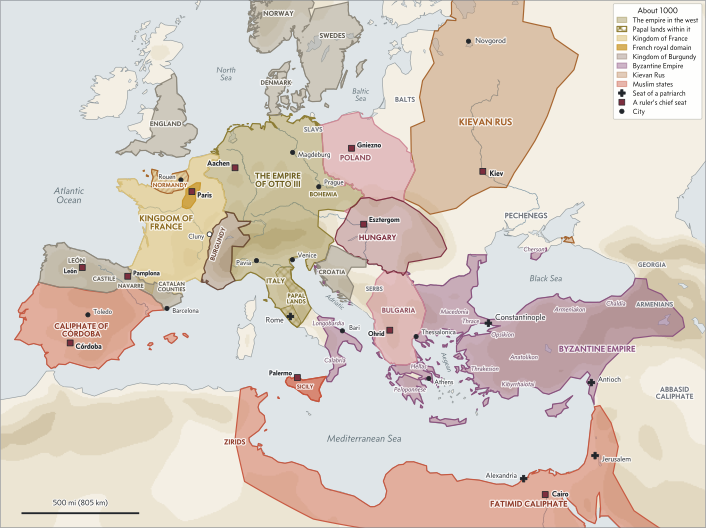
The stories of this volume range from Lisbon to Moscow and from Bergen in Norway to Cairo. The three maps that follow (Figures S.1, S.2, and S.3) show that whole stage at three moments, about 560, about 1000, and about 1400. They are drawn on the same frame so that they can be laid side by side. Each shades the states of its date and names the peoples who had no state yet. The borders are sketches, since few of them were surveyed lines, and the coasts are today’s.
About 560
The first map shows the Mediterranean at the height of the conquests of the emperor Justinian, who reigned from 527 to 565 (Chapter 1). The eastern half of the old empire was still whole: the Balkans, Asia Minor, Syria, Palestine, and Egypt. Justinian’s generals had won back North Africa from the Vandals, Italy from the Ostrogoths, and a strip of southern Spain, the province of Spania, from the Visigoths, so that the empire once more ringed the sea. Its old rival in the east was the Persian kingdom of the Sasanian (suh-say-nee-un) kings, whose border ran through the deserts of Mesopotamia.
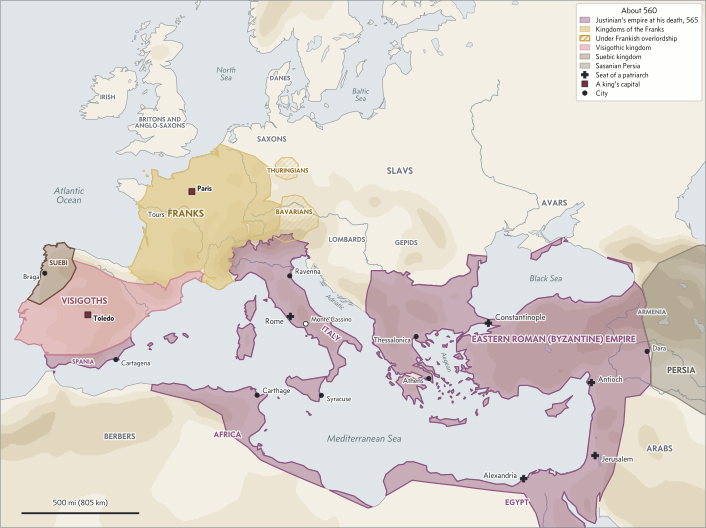
The west belonged to Germanic kings. The Franks held almost all of Gaul, the land that would become France, and their kings were the heirs of Clovis (kloh-vis), the king who had united them (Chapter 2). The Visigoths ruled Spain from Toledo, and the Suebi (sway-bee), another Germanic people, held its northwest corner. Britain was being divided between the Britons and the Anglo-Saxons (Vol. 8, The Northern Worlds). Along the middle Danube lived the Lombards and the Gepids (jep-idz), and north of the river the Slavs. Out on the steppe, the grasslands north of the Black Sea, the Avars (av-arz), a nomad people from Asia, had just arrived. In 568 the Lombards moved into Italy, and the empire’s hold on the peninsula began to slip. The crosses on the map mark the five cities whose bishops, called patriarchs, ranked above all others in the Church.
About 1000
By 1000 the map had been redrawn. In the west the Frankish empire of Charlemagne (Chapter 4) had broken up, and two great kingdoms had come out of it. The eastern one, ruled by kings from Saxony, had become an empire again when Otto I was crowned in Rome in 962 (Chapter 5). Historians call his family the Ottonians (oh-toh-nee-unz), and in 1000 his grandson Otto III held Germany and northern and central Italy. The western kingdom was France. Its kings, of the new Capetian (kuh-pee-shun) family, ruled directly only a narrow domain around Paris and Orléans (or-lay-ahn), while great lords such as the dukes of Normandy and Aquitaine (ak-wih-tayn) governed the rest. Between the two lay a kingdom of Burgundy, which joined the empire in 1032.
Most of Spain was ruled by Muslims. The Caliphate of Córdoba (kor-doh-buh), the state of Muslim rulers who had taken the title of caliph (kay-lif) in 929, was at the height of its power. A caliph was the “successor” of Muhammad (moo-ham-ud), the prophet of Islam, as ruler of all Muslims, and in 1000 three rulers claimed the title, at Córdoba, at Cairo, and at Baghdad. Small Christian kingdoms and counties held the north (Chapter 2, Chapter 17). Sicily was ruled by Muslim princes called emirs, and Egypt and Syria by the Fatimid (fat-ih-mid) caliphs of Cairo. In the east, the Byzantine emperor Basil II was in the middle of his long war to conquer Bulgaria, which he finished in 1018 (Chapter 3). His empire was governed in themes, provinces whose governor was also the general of the soldiers settled in it. On the map their names stand in gray. To the north, Swedish warriors and traders called the Rus (roos) had founded a state along the rivers from Novgorod (nov-guh-rod) to Kiev (kee-ev), now spelled Kyiv. Historians call it Kievan Rus, and its prince Vladimir (vlad-ih-meer) was baptized, by tradition in 988 (Chapter 6). Hungary had just become a Christian kingdom (Chapter 5), and Poland, Christian since 966, would have its first crowned king in 1025 (Chapter 26).
About 1400
The third map shows Europe in the last century of this volume. France was ruled by the Valois (val-wah) kings, and the English still held Calais (kal-ay) and the coast around Bordeaux (bor-doh) (Chapter 24). The dukes of Burgundy, a younger branch of the French royal family, had gathered lands on both sides of the French border, from Dijon (dee-zhohn) to Flanders (Chapter 25). The empire, now called the Holy Roman Empire, had become a patchwork of princes, bishops, and free cities under an elected emperor (Chapter 23). Along the Baltic and the North Sea, German merchant towns had banded together in the Hanseatic League (han-see-at-ik), the Hanse (han-suh), with trading posts, called kontors, in London, Bruges (broozh), Bergen, and Novgorod (Chapter 26).
Italy had no single ruler. Its north was divided among city-states, cities that governed themselves and the countryside around them. Among them were Venice and Genoa, rich from the sea (Chapter 13); Milan, ruled by the Visconti (vis-kon-tee) family; and Florence, the city of Dante (dahn-tay) (Chapter 18). The pope ruled the Papal States across the middle of the peninsula, and a king at Naples ruled the south. In the Iberian peninsula the Christian kingdoms of Castile (kas-teel), Aragon, Portugal, and Navarre (nuh-var) held everything but Granada, the last Muslim kingdom (Chapter 17). In the east, Poland and the Grand Duchy of Lithuania had shared one ruler since 1386, and the Teutonic Order, a brotherhood of German knights who lived under monks’ vows, ruled Prussia and Livonia (lih-voh-nee-uh) on the Baltic (Chapter 26). Moscow’s princes were rising under the overlordship of the Golden Horde, the Mongol state of the steppe (Chapter 16). Across the Aegean (ih-jee-un) Sea, the Ottoman Turks had crossed from Asia into Europe and held most of the Balkans, and the Byzantine emperor ruled little more than Constantinople and a few scraps of Greece. The battle marks show Kosovo (koss-uh-voh) (1389) and Nicopolis (nih-kop-uh-lis) (1396), both Ottoman victories, and Ankara (1402), where Timur (tih-moor), a conqueror from Central Asia, routed the Ottomans and captured their ruler (Chapter 27).

Dynasties, popes, and crusades
A dynasty is a family that holds a throne for generation after generation, and historians name the dynasties of this volume after a founder, a family seat, or a place. The timeline (Figure S.4) sets them side by side. Time runs down the page from 480 to 1460, and the scale changes at each dashed line, so that the crowded centuries after 1050 get more room. The three bands on the left give the rulers of Byzantium, of the Franks and then France, and of the German kingdom. Then come the popes and the two schisms, the crusades, the main events, and on the far right the years each Part of this book covers. Near the top of the events lane stands Muhammad’s hijra (hij-ruh) of 622, his move from Mecca to Medina (meh-dee-nuh), from which Muslims count their years (Chapter 2).
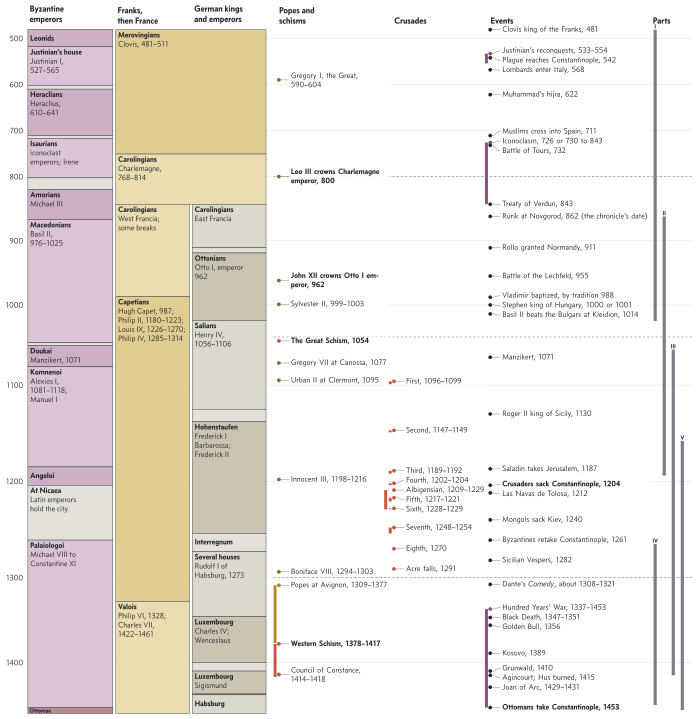
In the east, the emperors came in a run of families: the house of Justinian (518 to 602); the Heraclians (hair-uh-kly-unz) (610 to 711); the Isaurians (eye-sor-ee-unz) (717 to 802); the Amorians (uh-mor-ee-unz) (820 to 867); and the Macedonians (867 to 1056). Under the Isaurians began the quarrel over icons, the holy pictures of Christ and the saints (Chapter 3). The Komnenoi (kom-nee-noy) restored the empire from 1081, after Turkish invaders had overrun much of Asia Minor (Chapter 8). In 1204 crusaders seized Constantinople itself, and the Palaiologoi (pa-lay-ol-uh-goy) ruled from 1261, when the Byzantines won their capital back, until its fall in 1453. In the west, the Merovingians (mair-oh-vin-jee-unz), named after Merovech (mair-oh-vek), a half-legendary ancestor of Clovis, were kings of the Franks from 481 to 751. The Carolingians (kair-oh-lin-jee-unz), named after Charles (Carolus in Latin), Charlemagne’s name and his grandfather’s, followed them. In France they gave way in 987 to the Capetians, the descendants of Hugh Capet (kay-pit), and in 1328 to the Valois, a branch of the Capetian family. In Germany the Carolingians were followed by the Ottonians (919 to 1024), the Salians (say-lee-unz) (1024 to 1125), and the Hohenstaufen (hoh-un-shtow-fun) (1138 to 1254), named after their castle in Swabia (sway-bee-uh). After an interregnum, a gap with no king accepted by all, the crown passed among several families. The house of Luxembourg held it for most of the years between 1308 and 1437, and three of its kings were crowned emperor; and from 1438 the Habsburgs (haps-burgz) held it almost without a break until 1806.
Two of the volume’s events are called schisms, splits in the Church over who held authority. In 1054 the churches of Rome and Constantinople broke with each other, and the break has never been fully healed (Chapter 5). From 1378 to 1417 the west itself had two popes and then three at once (Chapter 23). English books call either split the Great Schism, and the eighth volume used that name for the split of 1378 (Vol. 8, The Northern Worlds). In this volume the Great Schism is the break of 1054, and the split of 1378 is the Western Schism.
The crusades are the wars that western Christians fought, from 1096, to win and hold Jerusalem, the city of Jesus’s death, and the lands around it, and later against other enemies of the Church. The numbers by which they are known were given by later historians, not by the crusaders themselves. A table in Chapter 8 dates each one, and the timeline marks them in red.
Why “medieval”
No one in this volume knew that he lived in the Middle Ages. The idea of a middle time came from Italian scholars of the fifteenth century, who admired the writers of ancient Rome and wanted to revive their Latin and their learning. To them the centuries between Rome’s fall and their own day were a middle time, an interval between two ages of learning. The Latin phrase media tempestas, “the middle time,” is first found in 1469, and medium aevum, “the middle age,” in 1604. From the second came the English word medieval. In 1685 the German scholar Christoph Cellarius (seh-lair-ee-us) published a world history divided into ancient, medieval, and modern periods, and the division stuck. The Middle Ages are usually reckoned from about 500 to about 1500, the span of this volume and a little more. An older and harsher label for the earlier part of these centuries began with the poet Petrarch (pee-trark), and its story belongs to his chapter (Chapter 20).
The Church
Nearly everyone in this volume’s Europe was a Christian, and the Church was its largest institution. It had its own law, its own courts, its own lands and taxes, and its own language, Latin in the west and Greek in the east. Jews lived in many of its cities under the protection, and often the persecution, of Christian rulers, and Muslims ruled much of Spain, for a time Sicily, and the lands east and south of the Mediterranean. Islam itself is told in its own volume (Vol. 37, The House of Islam).
Pope and patriarchs
Christians held that Jesus had founded one Church, governed by bishops who succeeded his apostles. By the time of Justinian five bishops ranked above all the rest, in the five greatest cities of the old empire: Rome, Constantinople, Alexandria, Antioch (an-tee-ok), and Jerusalem. The five were called patriarchs, from a Greek word for the head of a family, and their rule together is called the Pentarchy (pen-tar-kee), “the rule of five.” The bishop of Rome came first in rank. He was called the pope, from a Latin word for “father,” and Catholics hold that he is the heir of Saint Peter, the leader of Jesus’s apostles, whom tradition makes the first bishop of Rome. The patriarch of Constantinople, the bishop of the emperor’s city, came second. After the Arab conquests of the seventh century, Alexandria, Antioch, and Jerusalem lay under Muslim rule, and the rivalry that mattered was between Rome and Constantinople. The eastern churches came to be called Orthodox, from the Greek for “right belief,” and the western one Catholic, from the Greek for “universal,” though each claimed both words.
Bishops and their cathedrals
Below the patriarchs, the Church was a network of bishops. A bishop, from the Greek for “overseer,” governed the Church in a diocese, a district usually named after its chief city. His church was his cathedral, from the Latin cathedra, the bishop’s chair, which stood in it. An archbishop was the bishop of the chief city of a province, with authority over the bishops around him. Priests served the parishes, and canons were the priests who served a cathedral. From 1059 the pope was elected by the cardinals, the senior clergy of Rome, and he sent legates, envoys who spoke with his authority, to kings and councils. A council or synod (sin-ud) was a meeting of bishops to settle belief or law, and an ecumenical (ek-yoo-men-ih-kul) council claimed to speak for the whole Church. The rules that councils and popes laid down were called canons too, from the Greek for a measuring rod, and together they made canon law. A pope’s formal letter was a bull, from the Latin bulla, the lead seal that hung from it, and an emperor’s or king’s document sealed in gold was a Golden Bull.
The Church’s punishments were spiritual, but they had force. Excommunication cut a person off from the sacraments, the holy rites of the Church, and from the company of Christians. An anathema (uh-nath-uh-muh) was a solemn curse, the gravest form of it. An interdict closed the churches of a whole town or kingdom, so that its people could not be married or buried with the rites of the Church. A heresy was a belief the Church had condemned, and its holders were heretics. A schism was a split over authority rather than belief, though the two often went together. A Christian whom the Church declared a saint after death was said to be canonized, and a saint’s relics, the body or belongings, drew pilgrims, travelers who journeyed to a holy place to pray.
Monks and friars
A monk was a man who left the world to live under a rule of prayer, and a nun a woman who did the same. Their house was a monastery, or an abbey when it was ruled by an abbot (ab-ut), the “father” of the community, or an abbess. In the west most monks followed the Rule that Saint Benedict of Nursia (nur-shuh) wrote about 530 for his monastery of Monte Cassino (mon-tay kuh-see-noh), between Rome and Naples (Chapter 2). Benedict’s monks promised to stay in one house for life and to obey their abbot, and they gathered to pray eight times a day and night, working and reading between the services. Later reformers founded houses that followed the Rule more strictly, among them Cluny (kloo-nee) in Burgundy (910) and Cîteaux (see-toh) (1098), the mother house of the Cistercians (sis-tur-shunz), who took their name from it.
The friars, from the Latin frater, “brother,” were something new in the thirteenth century. Instead of shutting themselves away, they lived in the towns, preached, and begged for their food, owning nothing, so that they were also called the mendicant, or begging, orders. The two greatest were the Franciscans, or Friars Minor, whose way of life Pope Innocent III approved by word of mouth in 1209 or 1210 (Chapter 14), and the Dominicans, the Order of Preachers, approved in 1216 (Chapter 14, Chapter 15). In England they were known by the colors of their habits, or robes, as the Grey Friars and the Black Friars.
Emperors, kings, and lords
The emperor in the west
In the west, “emperor” was a title rather than a country. Charlemagne received it from Pope Leo III in 800, and Otto I from Pope John XII in 962. After Otto the German princes elected a king, who was called king of the Romans and became emperor only when the pope crowned him in Rome. So every emperor needed a pope, and every pope needed an emperor’s protection, and the two quarreled for centuries over which of them stood higher (Chapter 5, Chapter 9). The chancery, or writing office, of the emperor Frederick Barbarossa (bar-buh-ros-uh) called the empire “holy” from 1157, and the full name, the Holy Roman Empire, is found from 1254. From 1356 the king who would be emperor was chosen by seven electors, three archbishops and four princes (Chapter 23). The last emperor crowned in Rome was Frederick III, in 1452.
The emperor in Constantinople was a different kind of ruler. In Greek he was the basileus (bas-ih-lyoos), “king,” a title the emperors used from the 620s, and he was crowned by the patriarch in Hagia Sophia (hah-yuh soh-fee-uh), the great church of the city. No law fixed who should succeed him, and many emperors were overthrown by generals or by their own families. A child born to a reigning emperor was called porphyrogenitus (por-fih-roh-jen-ih-tus), “born in the purple,” after the purple-walled room of the palace where empresses gave birth. Such children were thought to have the best claim of all.
Lords, vassals, and knights
Most kings of this volume could not pay an army or govern their lands through paid officials. Instead they granted land to men who promised to serve them. The man who gave the land was the lord; the man who received it was his vassal; and the land itself was a fief (feef), in Latin feudum. In the ceremony of homage, from the Latin for “man,” the vassal knelt, put his hands between his lord’s hands, and became his man, and he swore an oath of fealty (fee-ul-tee), or faithfulness. He owed his lord military service and advice; the lord owed him protection. Great vassals had vassals of their own, so that a king’s power depended on a ladder of promises. The word feudalism for this whole system was made centuries later by lawyers and historians, from feudum.
Titles told a lord’s rank. A duke, from the Latin dux, “leader,” ruled a large province or a whole people. A count governed a county for the king. A margrave, in German a “count of the march,” held a march, a frontier province. In Venice and Genoa the elected head of the republic was the doge (dohj), another word from dux. In the empire the princes met in assemblies called diets.
A knight was a warrior who fought on horseback in armor. The French called him a chevalier (sheh-vahl-yay), a horseman, and from that word comes chivalry, the code of conduct that knights were expected to follow. A boy of good family served as a page and then as a squire before he was dubbed a knight. From the tenth century on, lords built castles, private fortresses from which a few armed men could hold a whole district, first of earth and timber and then of stone. Below the knights lived the great majority, the peasants who farmed the land, many of them serfs, bound to the land and owing labor to their lord.
Towns and guilds
From the eleventh century the towns grew. In northern Italy and Flanders the citizens of a town swore an oath to one another and formed a commune, which won the right to govern itself, sometimes from its bishop or count and sometimes against them. Its merchants and craftsmen organized themselves in guilds, associations of the men of one trade that fixed prices and standards and trained apprentices. A citizen of a town was a burgher or burgess, and many of the volume’s richest men were burghers, not lords.
Universities and Latin
The first universities grew out of the schools of cathedrals and of famous teachers. A university, from the Latin universitas, “a whole body,” was at first simply a guild of students or of masters, organized like the guilds of a town. Bologna (buh-lohn-yuh) was famous for law from about 1088, and its university was a guild of students who hired their teachers (Chapter 9). Paris was famous for theology, the study of God and of Christian teaching, and King Philip II granted its masters and students their privileges in 1200 (Chapter 12). Oxford, Salamanca, Padua, and Naples followed, and later Prague (1348) and Kraków (krak-ow) (1364).
A student began in the faculty of arts with the seven liberal arts: grammar, rhetoric, and logic, and then arithmetic, geometry, music, and astronomy. A master of arts might go on to one of the higher faculties of theology, law, or medicine. A master taught by reading a book aloud and explaining it, which is why a class is still called a lecture, from the Latin for “reading.” He also taught by disputation, a formal debate in which a question was argued on both sides. The method of the schools, which set the sayings of honored authorities, from the Bible to Aristotle, against each other and settled their disagreements by logic, is called scholasticism (Chapter 12, Chapter 15).
All of this was done in Latin. It was the language of the western Church, of the law, and of every university from Lisbon to Kraków, so that a scholar could study in Paris and teach in Prague. Hardly anyone spoke it at home. The everyday languages, called the vernaculars, among them French, Italian, Occitan (ok-sih-tun) (the language of southern France), German, and Castilian, were slowly becoming languages of books. This volume follows French poetry from the Song of Roland (Chapter 11) and Italian from Dante (Chapter 18). In the east the language of church and state was Greek, and the Slavs who took their faith from Constantinople prayed in Slavonic (sluh-von-ik), written in an alphabet of its own (Chapter 3).
How to read the names
The names of this volume come from a dozen languages, and a reader who knows a few rules can find his way among them.
Numbers and nicknames. A ruler’s number counts only the rulers of the same title in the same realm. So the emperor Henry V, who made peace with the pope at Worms (vorms) in 1122 (Chapter 5), is not Henry V of England, who won at Agincourt (aj-in-kort) in 1415 (Chapter 25). A pope chose a new name when he was elected, so the churchman Hildebrand became Pope Gregory VII. Popes and emperors also share names, and Leo III the pope, who crowned Charlemagne, is not Leo III the emperor in Constantinople. Many rulers are known by nicknames, some of them given long after their deaths: Charles the Bald, Charles the Simple, Henry the Fowler, Philip the Fair, Louis the Pious, and Frederick Barbarossa, Italian for “Red Beard.”
“Of” instead of a surname. Most people of this volume had no family name. A churchman or a writer was known by his town, so that Gregory of Tours was the bishop of Tours. The word for “of” is de in French and Spanish, von in German, and da or di in Italian. Italians are often known by their first names, Dante for the poet Dante Alighieri (ah-lee-gyair-ee) and Giotto (jot-oh) for the painter Giotto di Bondone (bon-doh-neh), “son of Bondone”; Petrarch is the English form of Francesco Petrarca (peh-trar-kah). In Arabic names, ibn means “son of” and al- means “the.”
Greek names. The Byzantines called themselves Romans, and western writers called them Greeks. The name Byzantine came into use among scholars in the sixteenth century, from Byzantium, the old Greek town on whose site Constantine built his city; the German scholar Hieronymus (hy-uh-ron-ih-mus) Wolf did most to spread it. This volume spells Byzantine names close to the Greek, with k for c and -os for -us: Komnenos (kom-nee-nos), not Comnenus, and Palaiologos (pa-lay-ol-uh-gos), not Palaeologus. A woman’s name ends in -e, as Anna Komnene (kom-nee-nee), and the plural of a family name ends in -oi, as the Komnenoi.
Other letters. The names of eastern Europe and of Italy use letters and spellings that English does not, and Table S.1 shows how to sound the commonest of them. Russian names come from the Cyrillic (sih-ril-ik) alphabet, so their English spellings vary from book to book.
| Language | Letters and their sounds | Examples |
|---|---|---|
| Polish | ł = w; w = v; sz = sh; cz = ch | Bolesław (boh-les-wahf) |
| Czech | č = ch; š = sh; ř = rzh; c = ts | Václav (vahts-lahf), in English Wenceslaus |
| Hungarian | s = sh; sz = s; cs = ch; gy = dy | Árpád (ar-pahd); Győr (dyur) |
| Serbian | č and ć = ch; š = sh; j = y | Nemanjić (neh-mahn-yich) |
| Italian | c and g before e or i = ch and j; ch = k; z = ts | Boccaccio (boh-kah-choh); Cimabue (chee-mah-boo-ay) |
| Russian | names come from the Cyrillic letters; -ovich and -ich mean “son of” | Yaroslav (yah-ruh-slahf); Sviatoslav (svyah-tuh-slahf) |
Old names of places. This volume calls places by the names they had at the time (Table S.2). The same name can also mean two places. Iberia is the peninsula of Spain and Portugal, but in Justinian’s wars it is also the old name of a kingdom in what is now Georgia, in the Caucasus Mountains (Chapter 1).
| In this volume | Today | In this volume | Today |
|---|---|---|---|
| Constantinople | Istanbul, Turkey | Pressburg | Bratislava, Slovakia |
| Adrianople | Edirne, Turkey | Danzig | Gdańsk (guh-dahnsk), Poland |
| Nicaea | İznik, Turkey | Marienburg | Malbork, Poland |
| Trebizond | Trabzon, Turkey | Reval | Tallinn, Estonia |
| Thessalonica | Thessaloniki, Greece | Kiev | Kyiv, Ukraine |
| Negroponte | Euboea, Greece | Caffa | Feodosiya, Crimea |
| Ragusa | Dubrovnik, Croatia | Dyrrhachium | Durrës, Albania |
| Zara | Zadar, Croatia | Tarnovo | Veliko Tarnovo, Bulgaria |
Words the sources use
The writers of the time had their own words for one another, and the chapters keep them where they quote. To the Byzantines and to the Arabs, every western European was a Frank, whatever his country. Western writers called the Catholics of the west Latins, after the language of their Church. Western chronicles call Muslims “Saracens,” a word that first meant a people of the deserts beyond Roman Syria, and Spanish Muslims “Moors”; in its own voice this book says Muslims, Arabs, Berbers, or Turks. The crusaders’ states in Syria and Palestine were Outremer (oo-truh-mair), French for “beyond the sea.”
A man who vowed to go on crusade “took the cross,” sewing a cloth cross on his clothes, and the Latin name for crusaders meant “those signed with the cross.” The Church promised him an indulgence, a release from the penance he owed for his sins. A chronicle was a history told year by year, and a Life was the story of a saint or a king, often written to praise him. A manuscript was a book written by hand, usually on parchment made from animal skin, and an illuminated manuscript was one decorated with painting and gold.
Money was counted in pounds, shillings, and pence in most of the west, twelve pence to the shilling and twenty shillings to the pound, a system that goes back to Charlemagne. For a long time the only coin was the silver penny, and larger sums were counted in marks, a weight of silver. The Byzantine gold coin, the nomisma, was known in the west as the bezant (bez-unt). In 1252 Florence began to strike the gold florin and in 1284 Venice the gold ducat (duk-ut), coins that merchants trusted across Europe (Chapter 13, Chapter 18).
Who wrote it down
Most of what this volume tells was written down by a single witness with reasons of his own, often long after the event. So the chapters name the writer each time a story’s source matters, and when the writers disagree they say whose version they follow. The lists below give the writers the chapters rely on, grouped by where they wrote, and for each one what he wrote, when, and what it preserves. Where a writer’s story was first told centuries later, or cannot be shown to have happened, the chapters tell it as his.
Byzantine writers
- Procopius (proh-koh-pee-us) of Caesarea (see-zuh-ree-uh) (about 500 to 565) was the secretary of Justinian’s general Belisarius (bel-ih-sair-ee-us). His Wars (550s) narrate the reconquest of Africa and Italy and the plague that struck Constantinople in 542, and his Buildings (about 554) praises Justinian’s churches and walls. His Secret History (about 550), unpublished in his lifetime and first printed in 1623, damns the same emperor and his empress Theodora (Chapter 1).
- Cosmas the Priest (tenth century) wrote a Sermon Against the Heretics, the chief source on the Bogomils (bog-uh-milz), a sect of Bulgaria that, he says, held the material world to be the devil’s work (Chapter 3).
- John Skylitzes (sky-lit-seez), an official born in the 1040s, wrote late in the eleventh century a Synopsis of Histories covering 811 to 1057. It tells of the 15,000 Bulgarian prisoners blinded after the battle of Kleidion (kly-dee-on), a number many historians doubt (Chapter 3). An illustrated copy made in the twelfth century is now in Madrid.
- Anna Komnene (1083 to about 1153), the daughter of the emperor Alexios (uh-lek-see-os) I, wrote the Alexiad (uh-lek-see-ad) (about 1148), the history of her father’s reign, with the Norman invasion of Robert Guiscard (geess-kar) and the First Crusade (Chapter 7, Chapter 8).
- Niketas Choniates (nih-kee-tus koh-nee-ah-teez) (about 1155 to 1217), a high official, wrote a History finished after 1204 that tells the sack of Constantinople from inside the city. It also names a crusading lady of the Second Crusade “Golden Foot” for her gold-embroidered robes (Chapter 10, Chapter 13).
The Latin west to about 1000
- Gregory of Tours (538 to 594), bishop of Tours, finished his ten-book History of the Franks about 591. It is nearly all that is known of Clovis, and it records the great wave that swept Lake Geneva in 563 (Chapter 2).
- Isidore (iz-ih-dor) of Seville (about 560 to 636), archbishop of Seville, compiled the Etymologies (about 625), an encyclopedia arranged by subjects that explains each thing by the supposed origin of its name. It carried ancient learning into the Middle Ages, and with it the T-and-O map, which drew the world as a circle of ocean split into three continents by a T of waters (Chapter 2, Chapter 7).
- Willibald, an English priest, wrote the Life of Saint Boniface (about 765), which tells how the missionary felled a sacred oak in Germany (Chapter 2; Vol. 8, The Northern Worlds).
- The Mozarabic Chronicle (moh-zar-uh-bik) (754), written in Latin by a Christian living under Muslim rule in Spain, is the fullest early account of the battle of Tours (Chapter 2).
- Paul the Deacon (about 720 to 799), a Lombard monk who spent years at Charlemagne’s court, wrote the History of the Lombards (about 790) at Monte Cassino (Chapter 4).
- Einhard (yn-hart) (about 775 to 840), a scholar of the court, wrote the Life of Charlemagne (about 817 to 830), modeled on the lives of the Caesars by the Roman writer Suetonius (swee-toh-nee-us). It preserves the emperor’s habits and claims that he did not know he was to be crowned in 800 (Chapter 4).
- Liutprand (lyoot-prahnd) of Cremona (kreh-moh-nuh) (about 920 to 972), bishop and Otto I’s envoy to Constantinople, wrote the Antapodosis (an-tuh-pod-uh-sis), “Retribution” (about 958 to 962). It is the source of the scandals of Theodora (no kin of Justinian’s empress) and her daughter Marozia (muh-roh-zee-uh), noblewomen whose family chose the popes of Rome (Chapter 5).
- Dudo (doo-doh) of Saint-Quentin (san-kahn-tan) (about 965 to 1043) wrote the History of the Normans (about 1015), which tells how the Viking leader Rollo received Normandy from the French king and how one of his men tipped the king over backward (Chapter 5).
The new peoples of the east
- The Schechter Letter (shek-tur), written in Hebrew in the 940s by a Jew of the Khazar (kuh-zar) kingdom on the lower Volga, was found among the old papers of the Cairo Geniza (geh-nee-zuh), a synagogue’s storeroom, and published by Solomon Schechter in 1912. It tells, from the Khazar side, of a Rus ruler’s wars against the Khazars and against Constantinople (Chapter 6).
- The Primary Chronicle (about 1113), compiled at the Caves Monastery of Kiev and traditionally ascribed to the monk Nestor, tells how the Viking Rurik (roor-ik) was called to rule at Novgorod, how Princess Olga avenged her murdered husband, and how Vladimir chose a faith (Chapter 6).
- Hartvik (hart-vik), bishop of Győr (dyur), wrote a Life of Saint Stephen (about 1100), the first text to say that Pope Sylvester II sent Hungary’s first king his crown (Chapter 5).
- The Anonymus (uh-non-ih-mus), an unnamed notary of a King Béla (bay-law), wrote the Deeds of the Hungarians (about 1200), which tells of the blood oath sworn by the chieftains of the Magyars (mag-yarz), as the Hungarians call themselves. The tale of the white horse for which the Magyars bought their land is not his: it is first found later, in a Hungarian chronicle of the 1280s (Chapter 5).
Crusaders, courts, and friars
- The Gesta Francorum (jes-tuh fran-kor-um), “Deeds of the Franks” (about 1100), was written by an anonymous knight in the army of the Norman lord Bohemond (boh-heh-mond) on the First Crusade (Chapter 8).
- Hugo Falcandus (fal-kan-dus) is the name given to the unknown author of a Latin history of Norman Sicily under William I and William II, written about 1190 (Chapter 7).
- Andreas Capellanus (an-dray-us kap-uh-lay-nus) was a chaplain, probably at the court of Marie de Champagne (sham-payn), the daughter of Eleanor of Aquitaine, queen first of France and then of England. He wrote De Amore, “On Love” (about 1185), with its judgments of love by noble ladies (Chapter 11).
- Geoffrey of Villehardouin (veel-ar-dwan) (about 1150 to 1213), marshal of Champagne and a leader of the Fourth Crusade, wrote The Conquest of Constantinople (about 1209), the crusade told from the crusaders’ side (Chapter 13).
- Caesarius (see-zair-ee-us) of Heisterbach (hy-stur-bahk) (about 1180 to 1240), a Cistercian monk, wrote the Dialogue on Miracles (about 1223), the first text to put the order “Kill them,” retold in English as “Kill them all,” into the mouth of a papal legate at Béziers (bay-zyay) (Chapter 14).
- Thomas of Celano (cheh-lah-noh) (about 1185 to after 1260), a Franciscan friar, wrote the first Life of Saint Francis (1228 to 1229), and the Dies irae (dee-ays eer-ay), a Latin hymn of the Last Judgment, is attributed to him (Chapter 14).
- Jean de Joinville (zhwan-veel) (about 1224 to 1317), the companion of King Louis IX of France on the Seventh Crusade, wrote the Life of Saint Louis (1309), which tells the king’s capture in Egypt (Chapter 10).
- Rustichello da Pisa (roos-tee-kel-oh) wrote down the travels of Marco Polo while both men were prisoners in Genoa, in 1298 and 1299 (Chapter 16).
The fourteenth and fifteenth centuries
- The three Florentines are the volume’s subjects as well as its witnesses. Dante (1265 to 1321) wrote the Vita Nuova (vee-tuh nwoh-vuh), “The New Life” (about 1294), and the Divine Comedy (about 1308 to 1321). Petrarch (1304 to 1374) finished his Canzoniere (kahn-tsoh-nyeh-reh), “Songbook,” in 1374, and Giovanni Boccaccio (boh-kah-choh) (1313 to 1375) wrote the Decameron (dih-kam-uh-ron) about 1349 to 1353 (from Chapter 18 to Chapter 22).
- Gabriele de’ Mussi (day moo-see), a notary of Piacenza (pyah-chen-tsah) in northern Italy, wrote an account of the plague (about 1348). It is the only source for the story of corpses thrown into the besieged city of Caffa, though he was not there (Chapter 21).
- Jean Froissart (frwah-sar) (about 1337 to about 1405) wrote Chronicles, from about 1370, that tell the Hundred Years’ War through its knights, among them the battle of Crécy (kray-see) and the six burghers of Calais (Chapter 24).
- The record of Joan of Arc’s trial (1431) keeps her own testimony about her voices, and the record of her retrial (1455 and 1456) the memories of those who knew her (Chapter 25).
Later writers
- Giorgio Vasari (jor-joh vuh-sar-ee) (1511 to 1574), a painter and architect, wrote the Lives of the Artists (1550, enlarged in 1568). It is the best-known source of the stories of Giotto as the shepherd boy whom the painter Cimabue (chee-mah-boo-ay) found drawing, and of the perfect circle he drew without a compass (Chapter 18).
- Edward Gibbon, an English historian, wrote The History of the Decline and Fall of the Roman Empire (1776 to 1788), and the chapters quote his verdict on Tours (Chapter 2).
- Henri Pirenne (pee-ren), a Belgian historian, argued in Mohammed and Charlemagne (1937) that the Arab conquests, not the fall of Rome, ended the ancient world (Chapter 4).
Other writers appear where their stories come. An anonymous Greek account of the building of Hagia Sophia, the Narratio, was written about three centuries after the church. The Little Flowers of Saint Francis were collected in the fourteenth century, a hundred years after his death. A fourteenth-century chronicle in French, written in London, first told the legend that Queen Eleanor killed her husband’s mistress; the cup of poison came into the story centuries later.
Many of the volume’s pictures come from illustrated chronicles made long after the events they show, and the captions date them.
Meanwhile elsewhere
While Justinian rebuilt Hagia Sophia, Muhammad had not yet been born, and while the Ottomans besieged Constantinople, the Ming emperors of China had already sent their fleets to Africa and called them home. Table S.3 sets this volume’s thousand years beside the rest of the world and names the volumes of the Course that teach it.
| Region | In these years | Taught in |
|---|---|---|
| Britain, Ireland, and Scandinavia | The Anglo-Saxon kingdoms; the Vikings, from 793; the Norman Conquest (1066); the Plantagenet kings; the English side of the Hundred Years’ War (1337–1453). | Vol. 8, The Northern Worlds |
| The Islamic world | Muhammad (died 632) and the Arab conquests; the Umayyad caliphs of Damascus and the Abbasids of Baghdad; Saladin takes Jerusalem (1187); the Mongols sack Baghdad (1258); the Ottomans rise from 1299. | Vol. 37, The House of Islam |
| Italy after 1400 | Brunelleschi’s dome for Florence Cathedral (from 1420); the Medici bank; the first painters and sculptors of the Renaissance. | Vol. 10, Rebirth |
| India | The end of the Gupta age; the Chola kings of the south; the Delhi Sultanate (from 1206). | Vol. 39, India |
| China | The Tang (618–907) and Song (960–1279) dynasties; Kublai Khan’s Yuan; the Ming from 1368. | Vol. 40, The Middle Kingdom |
| Japan and Korea | Lady Murasaki’s Tale of Genji (about 1010); the first shogunate (from 1185); Korea’s Goryeo (gor-yoh) kingdom (918–1392). | Vol. 41, Islands of the Rising Sun |
| Southeast Asia | The Khmer (kuh-mair) Empire and the temple of Angkor Wat (twelfth century). | Vol. 42, Monsoon and Ocean |
| Africa | The empires of Ghana and Mali; Mansa Musa’s pilgrimage to Mecca (1324); Great Zimbabwe. | Vol. 43, Africa |
| The Americas | The Maya cities; the Aztecs found Tenochtitlan (teh-nohch-teet-lahn) (1325); the Inca rise in Peru. | Vol. 44, Gold, God, and Glory |
The Heirs of Rome, 481-1025
Chapter 1 · 54 clues
Justinian and Theodora
On the morning of Sunday, January 18, 532, the emperor of the Romans sat in his palace in Constantinople and thought about running away. For five days his capital had been burning. Crowds held the streets, the great church beside the palace was a shell of smoking walls, and the palace guards would not say whose side they were on. That morning the mob had proclaimed a new emperor, crowned him with a gold necklace for want of a diadem, and set him on the imperial throne in the racecourse next door. Boats waited at the palace steps. The emperor, Justinian, listened as his ministers argued over whether to sail.
Then his wife spoke. Theodora had grown up among the bear-keepers and dancers of that same racecourse, and she said she would rather die an empress than live as a refugee. Justinian stayed. By evening his soldiers had killed some thirty thousand people. Within ten years he had raised the greatest church in the world on the ruins, rewritten the whole of Roman law, and sent his armies to win back Africa and Italy, provinces that Rome had lost in the century before. We know the scene in the palace because a man who served one of his generals wrote it down. He also wrote, in a book he dared not publish, that the emperor was a demon.
Procopius
Procopius was born about 500 in Caesarea, a busy port on the coast of Palestine. His family had money, and he received the education of a well-off Greek-speaking provincial: the classical poets and historians, the art of speaking well, and law. In 527, the year Justinian became sole emperor, Procopius was made legal adviser and secretary to a young general named Belisarius. For the next thirteen years he went where Belisarius went: to the Persian frontier, to Constantinople during the riot of 532, to Africa in 533, and to Sicily and Italy until 540. He saw battles, sieges, mutinies, and a plague. Few historians have stood so close to the events they described.
He wrote three books, and they disagree with one another. The first and longest is the History of the Wars, in eight books. Two tell the wars with Persia, two the war against the Vandals in Africa, and three the war against the Goths in Italy, and an eighth carries the story on to about 553. It is written in an old-fashioned literary Greek, on the model of Thucydides (thoo-sid-ih-deez), whose history of the war between Athens and Sparta every educated Greek had read. Like Thucydides, Procopius gives his characters speeches, which he composed himself, and he writes as a cool observer of power. Most of what is known about Justinian’s wars, and about the plague that struck in the middle of them, comes from the Wars.
The second book is the Buildings, known by its Latin title as De Aedificiis (day ay-dih-fish-ee-is). It was written in the 550s, probably at the emperor’s wish, and it is a panegyric, a speech or book of formal praise. In Buildings, Procopius described Justinian’s construction projectsThis historian described Justinian’s construction projects in Buildings, or De Aedificiis. → Procopius• province by province: churches, monasteries, fortresses, bridges, aqueducts, and city walls, from the Danube to the Euphrates and from Africa to Armenia. It opens with the great church in the capital, and it is the main written source for how that church looked when it was new. Archaeologists still test its claims against the ruins, and they find that Procopius sometimes credits Justinian with forts that his predecessors built.
The third book is the Secret History. Procopius wrote it at about the same time as the last books of the Wars, kept it hidden, and never published it. In it he says that everything he had praised was a lie, that the emperor and empress were monsters, and that Belisarius was a fool ruled by his wife. Its story belongs at the end of Justinian’s, after the wars and buildings it attacks.
The city and the factions
The city Procopius knew was two centuries old. The emperor Constantine had founded it in 330 on the site of Byzantium, an old Greek town, and named it after himself (Vol. 7, The Romans). It stood on a hilly, roughly triangular peninsula. The Sea of Marmara lay to the south, a long sheltered harbor called the Golden Horn to the north, and to the east the Bosporus, the narrow strait where Europe faces Asia (Figure 1.1). Grain ships came from Egypt, timber and furs from the Black Sea. By Justinian’s day perhaps half a million people lived inside its walls, more than in any other city of Europe or the Mediterranean.

In 395 the emperor Theodosius I (thee-oh-doh-shus) had divided the Roman Empire between his two sons, and Constantinople became the capital of the eastern half (Vol. 7, The Romans). The western half fell apart in the fifth century, and after 476 the emperor in Constantinople was the only Roman emperor left. Its people never called themselves anything but Romans, Rhomaioi (roh-may-oy) in Greek, though most of them spoke Greek and few had seen Rome. The name “Byzantine” was given by scholars a thousand years later, from the old name of the capital (the Stage). For eleven centuries Constantinople was the capital of the Byzantine Empire,This city was the capital of the Byzantine Empire. → Constantinople•••This empire had its capital at Constantinople. → Byzantine Empire••• from Constantine’s day until 1453 (Chapter 27). Historians use the name to mark the change from a Latin empire ruled from Rome to a Greek and Christian one ruled from the Bosporus, and it is a useful label as long as one remembers that nobody at the time used it. In law and in its own eyes, the Byzantine Empire was the Roman Empire continuedThis empire was an eastern continuation or successor of the Roman Empire. → Byzantine Empire•• in the east, with the same laws, the same title of emperor, and an unbroken line of rulers going back to Augustus.

The city’s first defense was on the land side. Constantine’s wall had been outgrown within a century, and in 413, under the emperor Theodosius II, a new line was finished about a mile farther west. The work was directed by the prefect who governed for the boy emperor. In 447 an earthquake threw down fifty-seven of its towers just as Attila’s Huns were raiding the Balkans (Vol. 7, The Romans). The citizens, organized by the city’s racing clubs, rebuilt it in sixty days, and the outer wall and moat were probably added then. The result, the Theodosian Walls, ran about 3.5 miles (5.7 kilometers) from the Sea of Marmara to the Golden Horn. An attacker met first a moat about 65 feet wide, then a battlemented breastwork, then an outer wall, and last an inner wall 40 feet high and up to 20 feet thick, with ninety-six towers (Figure 1.2). Constantinople was protected by the Theodosian WallsThis city was protected by the Theodosian Walls. → Constantinople•• for more than a thousand years. No army broke through them until the Ottoman Turks brought cannon in 1453 (Chapter 27); the crusaders who took the city in 1204 came in from the harbor (Chapter 13).
Inside the walls, the main street, the Mese (meh-see) or “Middle Street,” ran east from the Golden Gate through a chain of forums to the oldest part of town. There, on the last hill above the sea, stood the three buildings that made Constantinople a capital: the Great Palace, the church of Hagia Sophia, and the racecourse.

The racecourse was the Hippodrome, Greek for “horse course.” Constantine had enlarged it to about 1,500 feet long and 430 feet wide, with seats for perhaps a hundred thousand people, so that perhaps a fifth of the whole city could watch a race at once. Down its middle ran a low wall, the spina (spy-nuh), crowded with trophies brought from all over the empire: an Egyptian obelisk on a carved marble base (Figure 1.3), a bronze column of twisted snakes from Delphi, and statues of famous charioteers. Halfway along the eastern side, a private passage led from the palace straight into the emperor’s box, the kathisma (kuh-thiz-muh). There the emperor sat in public, and there the crowd could see him, cheer him, and shout its complaints at him. The Hippodrome of ConstantinopleThis city contained the Hippodrome. → Constantinople•• was the one place where the ruler of the empire and its people met face to face.
They met for the races. A Byzantine race was run by four chariots, each pulled by four horses abreast, seven times around the spina. The danger was at the turns, where wheels locked and chariots overturned. The best drivers were the stars of the age: one of them, Porphyrius, had seven statues raised to him on the spina in his own lifetime. Each chariot raced for a faction, a club named for the color its drivers wore. In old Rome there had been four, the Reds, Whites, Greens, and Blues (Vol. 7, The Romans). By Justinian’s day the Blues and the Greens had swallowed the other two, and the city was divided between them. A faction owned the horses, stables, and chariots, hired the drivers, grooms, dancers, and animal trainers, and held a block of seats in the stands. At ceremonies it led the chants that greeted the emperor, and in a crisis its members could be armed to guard the walls.
The most passionate partisans were young men who made their faction their life. In the Secret History, Procopius describes the Blue toughs of the 520s. They shaved their hair at the front and grew it long at the back in the style, he says, of the Huns, wore their beards long like the Persians, and cut their sleeves wide. At night, he says, they carried knives and robbed and murdered with no fear of the law. Emperors took sides: Justinian favored the Blues. In the Wars, in H. B. Dewing’s translation of 1914, Procopius says of the factions’ feuds: “I, for my part, am unable to call this anything except a disease of the soul.” In January 532 that disease nearly cost Justinian his throne.
The Nika riots
Justinian had not been born to rule. His uncle Justin was a peasant from a village in the Balkans who had walked to Constantinople as a young man and joined the army. He rose to command the Excubitors (ek-skyoo-bih-terz), the guard of the palace. When the old emperor Anastasius (an-uh-stay-shus) I died without a son in 518, the guard and the senate chose Justin, then about sixty-eight. Justin had brought his sister’s son to the capital and educated him. The boy had been born about 482 at Tauresium (taw-ree-zee-um), near the modern city of Skopje (skop-yeh) and, Procopius says, near Justin’s own village, with the name Petrus Sabbatius; he took the name Justinian from his uncle. He became Justin’s right hand, then his heir. On April 1, 527, Justin made him co-emperor, and when Justin died on August 1, Justinian ruled alone at about forty-five (Figure 1.4).

He was one of the last emperors of the East whose first language was Latin. A chronicler who lived in his reign, John Malalas (mal-uh-lus), describes him as short, round-faced, curly-haired, and good-looking, going gray. He worked late into the night, read theology for pleasure, and ate so little that his enemies thought it unnatural. Justinian I ruled the Byzantine EmpireJustinian I ruled this empire. → Byzantine Empire••• for thirty-eight years, from 527 to 565, and for most of that time he ruled it from his desk, through ministers and generals, rarely leaving the capital.
His wife came from the Hippodrome. Theodora was born about 495, the daughter of Acacius (uh-kay-shus), the bear-keeper of the Greens. In the Secret History, Procopius tells how Acacius died while she was small, and how her mother brought her three little daughters into the Hippodrome, garlanded like suppliants, to beg the Greens to give the bear-keeper’s job to her new husband. The Greens refused. The Blues took pity and gave him a post, and Theodora was a Blue for life. As a girl she went on the stage, which in Constantinople meant comic mime, dancing, and burlesque, the lowest work a free woman could do. After some years, Procopius says, as the companion of a governor in Libya and a time in Alexandria, she came back to the capital and met Justinian, who was about thirteen years older.
Roman law, since Constantine, forbade a man of senatorial rank to marry an actress, and Justin’s wife, the empress Euphemia, would not hear of the match. After Euphemia died, about 524, Justin issued a law that let a former actress who had left the stage marry a man of the highest rank. About 525 Justinian married Theodora.This ruler was married to Theodora. → Justinian I••• The old families were scandalized, and in the Secret History Procopius complains that not one senator or priest dared to object. Theodora was about thirty. Friends and enemies alike describe her as clever, quick, loyal to her friends, and unforgiving to her enemies. When Justinian was crowned in April 527, she was crowned with him, and from then on Theodora was empress of the Byzantine EmpireTheodora was an empress of this empire. → Byzantine Empire•• in fact as well as in name. Officials swore oaths of loyalty to both of them, she received ambassadors, and she had her own household, her own money, and her own friends among the ministers. The two did not always agree, but for twenty-one years they ruled together.
The trouble of 532 began with an execution. That January Eudaemon (yoo-dee-mun), the prefect of the city, who ran the capital’s police and courts, had several rioters from both factions condemned for murder. On January 10 they were put to death in public, and for two of the men being hanged, one Blue and one Green, the scaffold broke. Monks carried the two men to sanctuary in a nearby church, and the prefect’s soldiers surrounded it. Three days later, on January 13, Justinian presided over the races. All day the factions shouted to him from the stands to pardon the two men. He did not answer.
Then something new happened. The Blues and the Greens stopped cheering their own drivers and began to chant a single word together, Nika (nee-kah), which means “Win!” or “Conquer!” and was the cry that fans shouted to their charioteers. This time the Blue and Green chariot-racing factions rose togetherThe Blue and Green chariot-racing factions joined these riots against Justinian in Constantinople’s Hippodrome. → Nika riots•••Fans of races using these horse-drawn vehicles formed the Blue and Green factions involved in the Nika riots. → chariots•The Blue and Green factions associated with this sport helped launch the Nika riots against Justinian. → chariot racing••The Blue and Green chariot-racing factions revolted against this ruler in the Nika riots. → Justinian I••• against the emperor. That night they broke open the prefect’s prison, freed the prisoners, killed the guards, and set fire to the city. The blaze took the bronze-roofed entrance hall of the palace, called the Chalke (kal-kee) Gate, the senate house, the Baths of Zeuxippus (zook-sip-us), and the city’s cathedral, Hagia Sophia. The riot has been called the Nika riots ever since, after the watchword the people passed to one another.
The crowd demanded the dismissal of three hated ministers: Eudaemon; John the Cappadocian (kap-uh-doh-shun), who squeezed the empire for taxes; and Tribonian (trih-boh-nee-un), who was rewriting its laws. Justinian dismissed all three at once. It did no good. For four more days the city burned and the fighting went on in the streets. On the fifth day Justinian sent home two men who had been staying in the palace, Hypatius (hy-pay-shee-us) and Pompeius, nephews of the old emperor Anastasius. Hypatius had commanded armies against Persia; he had a claim to the throne and every reason to fear one.
On the morning of Sunday, January 18, Justinian appeared in the imperial box holding a copy of the Gospels, swore to pardon everyone, and was jeered. The crowd went to Hypatius’s house. His wife, Mary, clung to him and cried that they were leading him to his death, but they carried him off to the Forum of Constantine. Having no diadem, they set a gold necklace on his head, and Hypatius was proclaimed emperor during the Nika riots.Hypatius was proclaimed emperor during these riots. → Nika riots•• Then they led him to the Hippodrome and seated him in the kathisma, the emperor’s own place.
In the palace, Justinian and his council debated flight. Procopius gives Theodora a speech, and since he composed speeches as Thucydides did, the words are his, though the decision was hers. “May I never be separated from this purple,” she says in Dewing’s translation, “and may I not live that day on which those who meet me shall not address me as mistress.” If the emperor wished to save himself, there was money, there was the sea, and there were the boats. “For as for myself, I approve a certain ancient saying that royalty is a good burial-shroud.” In its older form the saying was spoken to Dionysius, a tyrant of Syracuse in Sicily, and its word was “tyranny,” not “royalty.”
Justinian chose to fight. His chamberlain was Narses (nar-seez), a eunuch, a man castrated in boyhood, as many palace servants were. John Malalas, the chronicler who lived through these years, says that Narses slipped out secretly with money and won over some of the Blues, the emperor’s old favorites, so that the two factions were no longer one. Procopius does not mention it. He tells instead of two generals who happened to be in the city with their own troops. One was Belisarius, about thirty, just recalled from the Persian front with a following of hardened household cavalry. The other was Mundus (mun-dus), a prince of the Gepids, a Germanic people of the middle Danube, who now commanded the emperor’s armies in the Balkans. He had brought with him a band of Heruls (hair-ulz), warriors of another Germanic people who served the empire for pay.
Belisarius first tried to reach Hypatius through the palace’s own passage to the kathisma, but the guards there pretended not to hear him. He went round instead, over the smoking ruins of the Chalke, and entered the Hippodrome by the colonnade beside the emperor’s box. Then he drew his sword and charged into the packed, unarmed crowd. Mundus broke in from another side, through the gate the Byzantines called the Gate of Death. Trapped between the two forces in an arena built to hold a hundred thousand, the people were cut down. Procopius says that more than thirty thousand died that day. Belisarius and Mundus suppressed the Nika riotsThis general and Mundus helped suppress the Nika Riots. → Belisarius••• in a single afternoon, with a massacre.
Two of Justinian’s young kinsmen dragged Hypatius down from the throne and brought him and Pompeius to the emperor. The next day soldiers killed them both and threw their bodies into the sea. The senators who had sided with them lost their property, though Justinian later gave most of it back to their children. Within a year John the Cappadocian was back in office, and Tribonian soon followed. Justinian had learned that he could survive the city’s anger, and he was never again seriously threatened by the Hippodrome. Five weeks after the massacre, workmen began clearing the ruins of the burned church.
Hagia Sophia
Hagia Sophia means “Holy Wisdom,” one of the names Christians gave to Jesus, whom they also called Christ, Greek for “the anointed one.” The church that burned in 532 was the second of the name: the first, dedicated in 360, had burned in a riot in 404, and its replacement, dedicated in 415, burned in the Nika riots. On February 23, 532, Justinian began a third. He chose two designers, and neither was a builder by trade. Anthemius (an-thee-mee-us) of Tralles (tral-eez), a city in western Asia Minor, was a mathematician who wrote on curved mirrors that focus sunlight. Isidore of Miletus (my-lee-tus), from another Greek city on the same coast, was a geometer who taught in the capital and edited the works of Archimedes. The Greeks called such men mechanikoi (meh-khah-nee-koy), experts in the mathematics of weights and forces. The emperor commissioned the new church, but Anthemius and Isidore designed Hagia Sophia:This ruler commissioned Hagia Sophia after the Nika riots, employing Isidore of Miletus as an architect. → Justinian I•••Isidore of Miletus and Anthemius of Tralles designed this domed Byzantine church. → Hagia Sophia• Justinian wanted a building no one had attempted before, and he hired the men who could calculate it.

They had about ten thousand workmen and nearly unlimited money, and they finished in five years and ten months. On December 27, 537, Justinian and the patriarch of Constantinople dedicated the new church. It was the largest enclosed space in the world, and for centuries no church in Christendom came near it. Hagia Sophia was built under the Byzantine EmpireThe Hagia Sophia was built under this empire. → Byzantine Empire• at its height, and it became that empire’s heart: the patriarch’s cathedral, the place where emperors were crowned, and the church every later Byzantine church looked back to.
From outside, Justinian’s church is a mountain of brick and plaster (Figure 1.5). Inside, everything is arranged to make the visitor look up. He passes through a colonnaded courtyard and two long entrance halls, called the narthex and outer narthex, and goes through the tall central door, the Imperial Door, which only the emperor used. In front of him the nave, the main hall of a church, opens to a length of about 250 feet (76 meters) with no column in its central space. Over its middle, 180 feet (55 meters) above the floor, floats a dome more than 100 feet across (Figure 1.6). The dome rests on four great arches (Vol. 1, The Toolkit), and the four curved triangles of masonry between them, the pendentives, turn the square of the arches into the circle on which the dome sits. To the east and west, two half-domes, or semidomes, as wide as the dome itself, lean against the great arches and prolong the space. Smaller half-domes open off them in turn, so that the eye climbs from small curves to larger ones and up to the largest.

The forty windows around the dome’s base let in so much light that the dome seems to rest on nothing. In Buildings, Procopius says it seemed not to stand on masonry at all but to hang from heaven on a golden chain. The walls were covered with slabs of colored marble, green from Thessaly, white from the islands of the Sea of Marmara, purple porphyry (por-fuh-ree) from Egypt, and the vaults with gold mosaic. Justinian’s mosaics were mostly crosses and patterns; most of the pictures of Christ, the Virgin Mary, and emperors were added in later centuries (Figure 1.7).

The most famous words spoken at the dedication were probably never spoken. They come from an anonymous Greek account of the building, the Narratio, written about three centuries later and full of legends about angels and miracles. It tells that Justinian walked into the finished church, ran from the door to the pulpit, raised his hands, and cried out, “Solomon, I have outdone thee!”On completing Hagia Sophia, this ruler reportedly exclaimed, “Solomon, I have outdone thee.” → Justinian I• Solomon was the king of Israel who, the Bible says, built the first Temple in Jerusalem (Vol. 5, In the Beginning). The story has been repeated ever since because it fits the building so well.
The first dome was too shallow. Earthquakes cracked it, and on May 7, 558, much of it fell, smashing the altar and the pulpit beneath. The elder Isidore’s nephew, Isidore the Younger, rebuilt the dome about 20 feet higher, with forty ribs between the windows, and the church was dedicated a second time on December 24, 562. For that day the court poet Paul the Silentiary, named for his post as one of the officials who kept order and silence in the palace, wrote a long poem describing it, lamp by lamp.
For nine centuries Hagia Sophia was the cathedral of the patriarch of Constantinople. In 1453 the Ottoman Turks took the city, and Sultan Mehmed II (meh-med) made the church a mosque (Chapter 27); minarets went up at its corners, and over the following centuries the mosaics were plastered over. The Ottomans called the city Konstantiniyye (kon-stan-tee-nee-yeh) in their documents, but its people had long called it Istanbul, a name probably taken from the Greek phrase eis tin polin, “into the City,” and in 1930 the Turkish Republic made Istanbul the only official name. In 1935 the building became a museum, and in 2020 a mosque again. Hagia Sophia still stands in Istanbul,This city contains the Hagia Sophia. → Istanbul••The Hagia Sophia is located in this city. → Constantinople• the city that was Constantinople, beside the ruins of the palace and the racecourse where the riot began.
Justinian’s laws and ministers
Rome’s law was its proudest creation and, by 527, its greatest mess. It lay scattered through a thousand years of statutes, decrees of the senate, letters of emperors answering questions, and the opinions of famous lawyers, many of whom contradicted one another. A judge could not own all of it, and a clever advocate could always find a text on his side. In February 528, half a year into his reign, Justinian named a commission to sort it out.

Its most brilliant member was Tribonian, a lawyer from Side on the south coast of Asia Minor, who became Justinian’s quaestor (kwes-ter), the minister who drafted the emperor’s laws. Procopius calls him the most learned man of his time and also the greediest, a man who would sell a verdict. On April 7, 529, the commission issued the Code, a collection of all the emperors’ laws still in force. Next it tackled the lawyers: the Digest, also called the Pandects, boiled down more than 1,500 books of legal opinions into fifty books, each extract labeled with its author (Figure 1.8). It was finished in December 533. A short textbook for law students, the Institutes, appeared the same year, and a revised Code in 534. Tribonian oversaw the whole compilation,Tribonian oversaw the compilation of this Roman-law collection under Justinian. → Corpus Juris Civilis•• the collection of Roman law that we call by a later name, the Corpus Juris Civilis (kor-pus joor-is sih-vee-lis), the “Body of Civil Law.”
The fourth part came afterward. Justinian went on issuing laws for the rest of his reign, most of them in Greek, the language his subjects spoke, and these Novels, or “new laws,” were later added to the rest. Justinian had ordered the compilationThis ruler ordered the compilation of the Corpus Juris Civilis. → Justinian I••• because he believed, as he said in its prefaces, that an emperor must be armed with laws as well as weapons. It was the most lasting thing he did. In the west it was nearly forgotten for five hundred years, until about 1070 a complete copy of the Digest came to light in Italy. Teachers at Bologna began to lecture on it, students came from all over Europe to hear them, and Justinian’s law became the foundation of the legal systems of most of continental Europe, and through them of Latin America and of Louisiana.

Laws cost little; wars and churches cost gold. The empire’s money was the solidus (sol-ih-dus), a coin of nearly pure gold that Constantine had introduced, struck at seventy-two to the Roman pound (Figure 1.9). Justinian needed millions of them, and he found them through two ministers whom Procopius hated.
The first was John the Cappadocian, a man from Cappadocia in central Asia Minor who had risen from a clerk’s desk. From 531 he was praetorian prefect of the East, the chief minister of the eastern provinces, who collected their taxes and ran their courts, roads, and grain supply. John the Cappadocian managed Justinian’s financesThis ruler's finances were managed by John the Cappadocian. → Justinian I• for ten years with ruthless efficiency. He cut costs, tightened the collection of taxes, and had debtors imprisoned and beaten. In the Wars Procopius admits that he was the most capable man of the age at seeing what had to be done, and says he was also the basest, a glutton and a drunkard who plundered every morning and caroused every afternoon. The crowd of 532 demanded his head; Justinian dismissed him and brought him back within a year.
Theodora hated him, and in 541 she ruined him. Procopius tells that Antonina (an-toh-nee-nuh), the wife of Belisarius and Theodora’s closest friend, made friends with John’s young daughter and confided that Belisarius was ready to turn against the emperor. John took the bait and agreed to meet Antonina secretly at night in a suburb of the capital. Narses and a captain of the guard were hiding nearby to hear him talk treason. John escaped to a church, but he lost his office and his fortune, was made a priest against his will, and was sent into exile.
His place in the treasury was taken by Peter Barsymes (bar-sy-meez), a Syrian banker who had made his way up through the prefect’s office. Peter Barsymes took over Justinian’s financesPeter Barsymes managed this ruler's finances. → Justinian I•• from about 540 as count of the sacred largesses, the minister of the treasury, and later served twice as praetorian prefect. He was Theodora’s protégé, and Procopius accuses him of everything: of cheating the soldiers of their pay, of trimming the weight of the gold coins, of selling rotten grain to the provinces at the price of good, and of dabbling in sorcery.
One of Justinian’s early reforms struck at an old abuse. Under the late Roman emperors, a man who wanted to govern a province paid a large sum to officials at court, and once in office he squeezed the provincials until he had his money back with interest. The payments were called suffragia (suh-fray-jee-uh). In 535 Justinian banned the buying and selling of governorshipsThis ruler banned the practice of buying and selling provincial governorships, known as suffragia. → Justinian I• in one of his new laws: a governor was to pay only small fixed fees and to swear an oath that he had given nothing and would take nothing. Procopius says the law had not been in force a year before Justinian himself was selling offices again, openly, and that Peter Barsymes later sold them more freely than ever.
Procopius also counted the new charges the treasury invented. In the Secret History he accuses Justinian of levying an “air-tax”,Procopius accused this ruler of levying an “air-tax,” also translated as a “sky-tax.” → Justinian I• the aerikon, as translators render its Greek name; others call it the “sky-tax.” He gives it no clear basis in the old tax lists and seems to mean that the money was drawn out of thin air. Later Byzantine tax records show that a charge of that name really existed, though what it was first levied on is still argued.
The most valuable thing the treasury handled was silk. Silk was woven from the thread spun by the caterpillars of a moth, which feed on mulberry leaves, and the Chinese had kept the secret of raising them for centuries; by Justinian’s day it had spread westward only as far as Central Asia. Raw silk came west along the caravan routes, and it passed through the hands of Persian merchants, who set the price. Purple silk was the cloth of emperors, and the Byzantine court could not do without it. In the 540s Justinian set a ceiling on the price of silk, and Procopius says the result was a state monopoly run by Peter Barsymes. Then, about 552, according to Procopius, some monks who had lived in a land beyond Persia that he calls Serinda told Justinian that they had learned how silkworms were raised. At his urging the monks went back and smuggled silkworm eggsAccording to tradition, monks brought silkworm eggs to this ruler’s realm concealed in hollow canes. → Justinian I•According to Procopius, monks brought eggs of the insects producing this commodity into Justinian’s empire. → silk•• to Constantinople, where they were hatched and fed on mulberry leaves. A slightly later historian, Theophanes (thee-off-uh-neez) of Byzantium, whose book survives only in a later summary, tells the story with a Persian as the smuggler and has him carry the eggs hidden in a hollow cane. In the eighteenth century the English historian Edward Gibbon joined the two versions, and the story is usually told his way: monks carrying the eggs out of the East in hollow canes. Within a few generations Byzantine silk was made at home, in workshops that kept the secret for centuries (Chapter 3).
Belisarius and the reconquest
Belisarius was born about 500 in a fortified town in the hills of Thrace, in what is now western Bulgaria. He began as one of Justinian’s bodyguards, and Justinian gave him an army while he was still in his twenties. He raised his own regiment of household cavalry, men who swore loyalty to him personally and whom he paid himself, armored riders who fought with lance and bow; by the 540s it numbered seven thousand. Belisarius was Justinian’s generalBelisarius was this ruler's general. → Justinian I••• for thirty years, and he was used, distrusted, recalled, and sent out again more often than any general of the age.
Persia
The empire’s oldest enemy lay to the east. The Sasanian (or Sassanid) kings of Persia had ruled Iran and Iraq since 224 from their capital at Ctesiphon (tes-ih-fon) on the Tigris, and they followed the Zoroastrian religion, which taught that a good god and an evil spirit were at war in the world. Rome and Persia had fought on and off for three centuries over the fortress cities of Mesopotamia and the small kingdoms of the Caucasus, the mountain range between the Black Sea and the Caspian.
One of those kingdoms started Justinian’s first war. Iberia, the eastern half of what is now Georgia, was a Christian kingdom under Persian overlordship. About 524 the Persian king Kavadh (kuh-vahd) I tried to force the Iberians to follow Persian customs, among them leaving their dead out for birds and dogs instead of burying them. Their king, Gourgenes (goor-gay-neez), appealed to Constantinople, and when a Persian army came, he and his nobles fled into Roman territory. So Justinian fought the Iberian War over GeorgiaThis ruler fought the Iberian War for control of Georgia. → Justinian I• from his first year, a war of raids and sieges along the whole eastern frontier that lasted from 526 to 532.
In the summer of 530 a Persian army of forty thousand marched on Dara (dar-uh), a fortress city that the emperor Anastasius had built a few miles from the frontier, facing the Persian stronghold of Nisibis (nis-ih-bis). Belisarius, newly made commander of the East, had about twenty-five thousand men. The Persian general sent him word, Procopius says, to make ready the bath, for he meant to bathe in Dara the next day. Belisarius had a ditch dug in front of the city in a stepped line, with its center held back and its wings pushed forward and gaps left for counterattacks (Figure 1.10). He put his infantry behind the center and his cavalry on the wings, with six hundred Hunnic horsemen, mounted archers hired from the nomads of the steppe, in each angle. A further three hundred Herul riders, led by their chief Pharas (far-us), hid behind a hill on the left.

The Persians, Procopius says, waited until past noon to attack, because they ate in the late afternoon and the Romans ate before noon, and they hoped to catch their enemy hungry. Their right wing drove back the Roman left, until Pharas’s Heruls came over the hill behind it and the Huns charged its flank. Then the Persian left, with the king’s elite guard called the Immortals, broke the Roman right. Belisarius had already moved the Huns of the left angle across to the right one, and again the Huns struck from the angle and cut the attackers in two. One of their captains, Sunicas (soo-nih-kus), killed the Persian commander of that wing, and the Persian army fled. About five thousand Persians died on that wing, and three thousand on the other. Belisarius defeated the Sasanian forces at Dara,This general defeated Sassanid forces at Dara. → Belisarius•• the first great Roman victory over Persia in generations, and Procopius, who was there, described it in detail.
The next spring the Persians tried another way. A Persian army with its Arab allies swept up the Euphrates toward Antioch, the greatest city of Syria, and Belisarius followed to drive it back. On April 19, 531, the day before Easter, his soldiers had been fasting, and Belisarius wanted to let the Persians retreat. His men insisted on fighting and called him a coward. Near Callinicum (kal-ih-ny-kum), a town on the river, Belisarius lost the battle of Callinicum:This general lost the battle of Callinicum. → Belisarius•• his Arab allies broke, and the Romans were pressed back against the river until a stand by the infantry let the survivors escape across it. The Persians lost so many men that their general was disgraced at home, but Belisarius was recalled. That is why he was in Constantinople, with his household troops, the following January.
That autumn Kavadh died, and his son Khosrau (khoss-roh) I came to the throne. Khosrau was perhaps the ablest of all the Sasanian kings, a reformer of taxes and the army whom later Persians remembered as the model of a just ruler, and he wanted his hands free at home. In 532 his envoys and Justinian’s agreed on what both sides called an “endless peace,” known in English as the Eternal Peace. Rome gave back two forts in Armenia, Persia gave back two in Lazica (laz-ih-kuh), a kingdom on the Black Sea coast west of Iberia, and the Iberian refugees were free to stay or go home. Above all, under the Eternal Peace, Justinian paid Khosrau eleven thousand pounds of gold,This ruler agreed to pay Khosrau I eleven thousand pounds of gold under the Eternal Peace. → Justinian I•• in return, Procopius says, for Persia’s dropping its demands over Dara and over the guard of the Caucasus passes.
The peace was meant to be endless. It lasted eight years. In 540, with Belisarius in Italy, Khosrau broke it, sacked Antioch, and carried its people off to a new town he built for them near Ctesiphon. The war with Persia went on, with truces, for the rest of Justinian’s life, and for most of those years he paid Khosrau gold.
Africa
Justinian’s real ambition lay in the west. The Vandals, a Germanic people, had crossed from Spain into Africa in 429, taken Carthage, the capital of Roman Africa, in 439, and sacked Rome in 455 (Vol. 7, The Romans). Their kingdom held the richest farmland of the old western empire, in what is now Tunisia and eastern Algeria. Its kings were Arian Christians, who denied that Jesus, the Son, was equal to God the Father, and they had persecuted the Catholic bishops of Africa. In 530 the Vandal king Hilderic (hil-der-ik), a friend of Justinian who had made peace with the Catholics, was overthrown by his cousin Gelimer (gel-ih-mer). Justinian demanded that Hilderic be restored. Gelimer answered, in effect, that it was no business of his.
The emperor’s council was against a war. Procopius says that John the Cappadocian warned of the distance, the cost, and the risk. But in June 533, the year after the Eternal Peace, a fleet of five hundred transports and ninety-two warships sailed from Constantinople with about ten thousand infantry and five thousand cavalry, and Belisarius in command. Antonina, his wife, sailed with him, and so did Procopius. The army was small for its task, and everything depended on surprise. It stopped in Sicily, where the Ostrogoths of Italy let it buy supplies, and in early September it landed at Caput Vada, on the African coast about 130 miles south of Carthage (Figure 1.11). Then it marched north along the coast road, with the fleet keeping pace offshore.

Gelimer meant to destroy the invaders in a trap. The place he chose was called Ad Decimum (ad dess-ih-mum), Latin for “at the tenth,” because it lay at the tenth milestone on the road to Carthage. His brother Ammatas (am-uh-tus) was to come out of the city and block the road in front, his nephew Gibamund (gib-uh-mund) was to strike from the side, and Gelimer himself was to fall on the Roman rear. On September 13, 533, the plan fell apart. Ammatas arrived too early with too few men and was killed. Gibamund’s two thousand were cut to pieces by Belisarius’s Huns. Gelimer did drive back the Roman cavalry he met, but then he found his brother’s body, and instead of pressing on he stopped to mourn and bury him. Belisarius rallied his men and routed him. Belisarius defeated Gelimer’s Vandals at Ad Decimum,This general defeated Gelimer’s Vandals at Ad Decimum. → Belisarius••Belisarius defeated these people’s last king Gelimer at Ad Decimum. → Vandals••Belisarius defeated the Vandals at Ad Decimum, ten miles south of this city. → Carthage•• 10 miles south of Carthage, and Gelimer, the last king the Vandals would ever have, fled west into Numidia.
Two days later Belisarius marched into Carthage. He forbade his men to plunder, and they bought their dinners in the market. Belisarius himself sat down in the royal palace, in the hall where Gelimer entertained his nobles, and Procopius was at the table. “And it happened that the lunch made for Gelimer on the preceding day was in readiness,” he writes. “And we feasted on that very food and the domestics of Gelimer served it and poured the wine.”
Gelimer gathered a second army, with his other brother, Tzazon (tsah-zon), who had hurried back from Sardinia. On December 15, 533, the Romans found them at Tricamarum (try-kam-uh-rum), about 17 miles west of Carthage. Three Roman cavalry charges broke the Vandal center, and Tzazon was killed. Belisarius won at Tricamarum,This general won at Tricamarum. → Belisarius•• and Gelimer fled again, this time into the mountains, where he took refuge among the Berber tribes, whom Procopius calls “Moors,” on a peak called Papua. Besieged there through the winter, he sent a letter to the Herul commander Pharas. “Send me a lyre and one loaf of bread and a sponge, I pray you,” he wrote. Procopius explains: he had not seen a baked loaf in months, the sponge was for an infected eye, and he was a skilled harpist who had composed a song about his misfortune and wished to sing it. Pharas sent all three and kept up the siege. In March 534 Gelimer surrendered.
That summer Belisarius was given a triumph in Constantinople, an honor that for centuries no one but an emperor had received. He walked, rather than rode, through the city to the Hippodrome with the Vandal treasure, which included the vessels of the Temple of Jerusalem that the Roman general Titus had taken in AD 70 and the Vandals had carried from Rome to Carthage. Gelimer walked in a purple cloak among the captives. When he saw the emperor high on his throne, Procopius says, he neither wept nor cried out, but kept repeating the words of the biblical book of Ecclesiastes: “Vanity of vanities, all is vanity.” Then he was stripped of the cloak and made to lie flat on the ground before Justinian, and Belisarius lay down beside him as the emperor’s humble servant. Gelimer was given estates in central Asia Minor and lived there quietly with his family. The Vandals as a people vanished from history within a generation.
Africa was harder to keep than to take. Berber tribes raided it and Roman soldiers mutinied, and it was fifteen years before the province was at peace. It was governed from Carthage, which became a Roman city again. Later in the century, the emperor Maurice, who reigned from 582 to 602, gave its governor both civil and military power with the title of exarch (ek-sark), a viceroy, and Carthage became the exarch’s seat.This city served as the seat of the Byzantine Exarchate of Africa. → Carthage• The Exarchate of Africa, as his province was called, lasted until the Arabs took Carthage in 698.
Italy
Italy came next. The Ostrogoths had ruled it from Ravenna (ruh-ven-uh) since Theodoric (Vol. 7, The Romans). When Theodoric died in 526, his grandson Athalaric became king at ten, with his mother, Amalasuntha (am-uh-luh-sun-thuh), Theodoric’s daughter, as regent. Athalaric died in 534. Amalasuntha shared the throne with her cousin Theodahad (thee-od-uh-had), who imprisoned her on an island in a lake and let her enemies kill her there in 535. She had been under Justinian’s protection, and her murder gave him his pretext.
In 535 Belisarius took Sicily with only seventy-five hundred men. In 536 he crossed to the mainland and took Naples after a siege, when his soldiers crawled into the city through a broken aqueduct. On December 9, 536, Rome opened its gates. The Goths deposed Theodahad and chose a soldier, Witiges (wit-ih-geez), as king, and for a year and nine days, from February 537 to March 538, Witiges besieged Belisarius in Rome. The Romans held the city’s long walls with far fewer men than the Goths, while Antonina organized supplies and reinforcements from Naples. The Goths finally gave up.
In 538 Justinian sent a second army to Italy under Narses, the eunuch chamberlain who had helped crush the Nika riots. Narses was an Armenian, about sixty, a keeper of the emperor’s purse rather than a soldier, and he and Belisarius could not work together. The officers split into two camps, each waiting on its own commander. Narses was Belisarius’s rival,Narses was this general's rival. → Belisarius• and their quarrel had a terrible cost: in 539 the Goths took Milan, which had come over to the Romans, while the two armies failed to relieve it, and killed its men and enslaved its women. Justinian recalled Narses.
Belisarius then besieged Witiges in Ravenna, the Gothic capital behind its marshes. The starving Goths made a strange offer: they would surrender if Belisarius would become emperor of the West himself. He pretended to agree, entered Ravenna in May 540, and took Witiges, his queen, and the Gothic treasure to Constantinople as the emperor’s prisoners. In seven years Belisarius had reconquered Africa and Italy for Justinian,This general reconquered former Western Roman territory, including Italy, for Justinian. → Belisarius••• the two richest provinces the western empire had lost. Justinian, uneasy that the Goths had offered his general a crown, gave him no triumph this time and sent him east against Khosrau.
The plague
In 541 a new disease appeared at Pelusium (peh-loo-zee-um), a port at the eastern edge of the Nile delta. It spread to Alexandria and Palestine, and in the spring of 542 it reached Constantinople, probably with the grain ships from Egypt. Procopius described the devastating plagueProcopius described the devastating plague that struck during this ruler’s reign. → Justinian I• as an eyewitness in the second book of the Wars. Its victims ran a fever, and then a swelling, a bubo (byoo-boh), rose in the groin or the armpit; some fell into a coma, others into delirium, and many died within days. In the capital it raged for four months, “and afterwards the tale of dead reached five thousand each day, and again it even came to ten thousand and still more than that.” When the graves were full, men climbed the towers of the walls across the Golden Horn at Sycae (sy-see), tore off their roofs, and filled them with bodies. Work stopped and food ran short. The emperor himself fell sick with the swelling and recovered. Modern estimates of the dead in the capital run from about a fifth of its people upward.
In 2013 scientists found the DNA of Yersinia pestis, the bacterium of bubonic plague, in the teeth of sixth-century skeletons. The plague of Justinian was the same disease as the Black Death of the 1340s (Chapter 21), and like it, it came back again and again, for two hundred years.
The long war
The plague and the Persian war left Italy short of men, and the Goths found a brilliant new king, Totila (tot-ih-luh). Within a few years he retook nearly all of Italy. Belisarius was sent back in 544 with too few troops and too little money, and in 548 he was recalled for good. At last Justinian gave Narses what he had never given Belisarius: a large army and the gold to pay it. In 552 Narses destroyed the Goths at Busta Gallorum, in the Apennines, and Totila was killed. By 554 Italy was Roman again. In 552 another army had landed in southern Spain, where it took a strip of coast from Cartagena nearly to Cádiz (kuh-diz). Justinian’s empire, at his death, ran from the Strait of Gibraltar to the Euphrates (Figure 1.12).

The victory had cost twenty years of war. Rome itself had been taken five times, by one side or the other, between 536 and 552, and much of Italy was in ruins. Three years after Justinian’s death, the Lombards, a Germanic people from beyond the Danube, invaded Italy and took most of it from his successors.

Belisarius’s own last years were mixed. In 559, when the Kutrigur (koo-trih-goor) Huns rode to within a few miles of the capital, the old general came out of retirement and drove them off with a few hundred veterans. In 562 he was accused of joining a plot against Justinian and held under house arrest for some months, then restored to favor. He died in March 565, a few months before the emperor. Many centuries later a story spread that Justinian had blinded him and that he ended his life begging at a gate of Rome. It is not true, but it made him a hero of eighteenth-century novels and paintings, the loyal servant ruined by an ungrateful master (Figure 1.13).
The Three Chapters
Justinian ruled a Christian empire, and he believed that God would judge him by its faith. But his Christians were divided over a question that had split the Church for a century: how Jesus could be both God and man. In 451 a council of bishops at Chalcedon (kal-sih-don), across the Bosporus from Constantinople, had given the answer that the popes and the emperors accepted. Christ, it said, was one person in two natures, fully divine and fully human, joined “without confusion” and “without division.” Christians who held to that definition are called Chalcedonians.
Many Christians in Egypt and Syria rejected it. To them, “two natures” seemed to split Christ in two, and they taught that the divine and the human were joined in one nature, as the great bishop Cyril of Alexandria had said. Modern scholars call them Miaphysites (my-af-ih-sites), from Greek for “one nature”; their opponents called them Monophysites (muh-nof-ih-syts). They were strongest in the very provinces that fed and paid for the empire, and they had a protector in the palace: Theodora, who sheltered their monks and bishops in a palace of her own in the capital.
Justinian, a Chalcedonian, wanted the Miaphysites back without giving up Chalcedon. A bishop from Cappadocia persuaded him to try a roundabout path. The Miaphysites hated three dead theologians of the century before, whom they accused of the opposite error, the teaching of Nestorius, a patriarch of Constantinople condemned in 431 for dividing Christ into two persons. In an edict of 543 or 544 Justinian condemned all three: the person and writings of Theodore of Mopsuestia (mop-swes-tee-uh), certain writings of Theodoret (thee-od-uh-ret) of Cyrus, and a letter of Ibas (eye-bus) of Edessa (ih-des-uh). These were the Three Chapters, from the Greek word for the headings of the edict. The trouble was that the Council of Chalcedon had accepted Theodoret and Ibas as orthodox. To condemn them now looked, to bishops in the west, like an attack on Chalcedon itself, and a cruel one, against men who had died at peace with the Church. The bishops of the east signed, some under pressure. The bishops of Africa and Italy refused, and they looked to the pope.
The pope was Vigilius (vih-jil-ee-us), a Roman aristocrat who owed his office to Theodora. He had served as the pope’s envoy in Constantinople, and the empress, say writers hostile to him, promised him the papacy for his help. In 537, during the siege of Rome, Belisarius deposed Pope Silverius on a charge of plotting to open the city to the Goths, and Vigilius was made pope in his place; Procopius says that Antonina arranged it. Now Vigilius refused to sign Justinian’s condemnation.This ruler’s condemnation of the Three Chapters brought him into conflict with Pope Vigilius, whom he detained in Constantinople. → Justinian I•• In November 545, by the account of the papal chronicle, imperial officers seized him in a church in Rome during the feast of Saint Cecilia, before he had finished the Mass, the Church’s central service, and put him on a ship while the crowd threw stones. He reached Constantinople at the start of 547 and was not allowed to leave for eight years.
Vigilius bent, then broke away, then bent again. In 548 he issued a judgment condemning the Three Chapters while upholding Chalcedon, and the bishops of the west were so angry that the bishops of Africa excommunicated him. He withdrew it. In 551, fearing arrest, he fled into a church, and, by his own account, soldiers tried to drag him from the altar by his feet and his beard until the altar’s columns gave way. He escaped across the water to Chalcedon. In 553 Justinian called the Second Council of Constantinople, which Catholic and Orthodox Christians count as the fifth ecumenical council, a council of the whole Church. Vigilius refused to attend, and the council condemned the Three Chapters without him and struck his name from the prayers. Within months he accepted its decision. Vigilius was finally allowed to go home in 555, and he died at Syracuse, in Sicily, on the way.
Nothing was gained. The Miaphysites did not come back, and their churches, the Coptic Church of Egypt and the Syriac Orthodox Church, still exist. In northern Italy several bishops broke with Rome for a century and more rather than accept the council. And every pope after Vigilius knew how far an emperor in Constantinople could reach.
Ravenna and the Barberini ivory
Ravenna, near the Adriatic coast of Italy, had been the capital of the last western emperors and then of Theodoric, safe behind marshes and a harbor (Vol. 7, The Romans). Belisarius took it in 540, and it became the capital of Roman Italy. When the Lombards overran most of the peninsula after 568, the emperor gave his governor there full civil and military power. From about 584 Byzantine exarchs governed Ravenna,Byzantine exarchs governed this Italian city, previously the capital of Theodoric the Great. → Ravenna• the city that had been Theodoric’s capital, and ruled from it what remained of Roman Italy until the Lombards took it in 751.
The finest thing Justinian’s age left there is the church of San Vitale (sahn vee-tah-lay), dedicated to Vitalis, a saint of Ravenna. It was begun in 526, while the Goths still ruled, by the city’s bishop Ecclesius (eh-klee-zee-us), and paid for by a local banker, Julius Argentarius (ar-jen-tair-ee-us), who spent 26,000 solidi on it. It was consecrated in 547 by Archbishop Maximian (mak-sim-ee-un), Justinian’s man. The building is an octagon with a dome, built on a central plan (Vol. 1, The Toolkit). Its apse, the rounded east end behind the altar, is lined with mosaic on gold: pictures made of thousands of small cubes of colored glass and stone set into wet plaster. In the half-dome a beardless Christ sits on a blue globe, offering a crown to Saint Vitalis; Bishop Ecclesius, on the other side, offers him a model of the church.

Below them, on the two side walls of the apse, are the two most famous mosaics of the age. On the left wall, Justinian carries a golden bowl holding the bread of the Mass, with Maximian, priests, officials, and soldiers around him (Vol. 1, The Toolkit printed it). On the right wall, Theodora carries a jeweled cup for the wine (Figure 1.14). Walk along her panel from left to right. A court official lifts a patterned curtain from a doorway, beside a fountain splashing in a basin; the empress is about to pass through, as if into the church. She stands under a shell-shaped niche, larger than anyone else, with a halo, a crown hung with strings of pearls, and a broad collar of jewels across her shoulders. On the hem of her purple cloak are embroidered the three Wise Men bringing their gifts to the infant Christ, as she brings hers. At her left stand two women in rich robes, by tradition Antonina and her daughter, and then a row of ladies in silks of every pattern, each face turned straight to the viewer.
Justinian and Theodora appear with their courtsJustinian and Theodora appear with their attendants in mosaics in this Ravenna church. → Basilica of San Vitale•••This ruler is depicted in mosaics in the Basilica di San Vitale in Ravenna. → Justinian I••The mosaics of San Vitale exemplify the art of this empire. → Byzantine Empire• in the mosaics of San Vitale, the finest surviving mosaics of the Byzantine Empire in Justinian’s age. Their flat, frontal figures, gold grounds, and solemn stillness are what Byzantine art meant for centuries afterward. Neither the emperor nor the empress ever set foot in Ravenna. The pictures, finished a year before Theodora’s death, stood in for them, permanently present at every Mass.
Justinian’s image traveled in other forms. One of the most splendid objects of his age is a carving now in the Louvre (loo-vruh) in Paris. It is made of ivory, the hard, creamy material of elephants’ tusks, which came to the Mediterranean from Africa and India and could be carved in fine detail. The Barberini (bar-beh-ree-nee) Diptych was carved from elephant ivory,The Barberini Diptych was carved from this material. → ivory•• in five panels, four of them fitted around a larger central one, about 13 inches high in all. A diptych (dip-tik) (Vol. 1, The Toolkit) has two hinged leaves; in late Roman times consuls and emperors gave carved ivory diptychs as gifts on great occasions. This is one leaf of such a work, though whether it ever had a partner is unknown.

Walk around it from the center out (Figure 1.15). An emperor in armor rides a rearing horse, his lance planted beside him. Behind the lance stands a defeated foreigner in trousers, raising a hand in surrender. Beneath the hooves a woman, the Earth, holds the emperor’s foot and offers fruit from her lap, and a small Victory standing on a globe reaches out to crown him. In the left panel an officer offers him a statuette of Victory; the matching right panel is lost, replaced by a plain board. Above, two angels hold up a medallion with a young, beardless Christ blessing the scene, so that the emperor rules on earth under Christ in heaven. Below, the peoples of the world bring tribute: from the west, men in trousers, and from the east, men carrying elephant tusks, leading a tiger and a small elephant.
Who is the emperor? The carving has no name. Most scholars identify him as Justinian, partly because a bronze statue of Justinian on horseback stood in the square outside Hagia Sophia, and the ivory seems to copy it. Some argue for Anastasius I, who reigned from 491 to 518, or for Zeno before him. On the back, someone in the seventh century wrote a list of names, among them kings of the Franks, which shows that the ivory had already traveled to Gaul. In 1625 the French scholar Nicolas-Claude Fabri de Peiresc (peh-resk) gave it to Cardinal Francesco Barberini, a nephew of Pope Urban VIII, and it has borne his family’s name ever since. The Louvre bought it in 1899.
The Secret History
About the year 550, while he was finishing the Wars, Procopius wrote a third book and told no one. Its preface says that he could not write the truth while the men he wrote about were alive, because spies were everywhere and his death would be cruel, and that he was writing it now so that the truth would not be lost. Procopius wrote the Secret HistoryThis Byzantine historian wrote the Secret History. → Procopius•••This ruler was the subject of The Secret History by Procopius. → Justinian I••• about Justinian and Theodora, about Belisarius and Antonina, and about the government of the empire, and he never published it. A Byzantine encyclopedia of the tenth century, the Suda (soo-duh), knew it as the Anecdota, “the unpublished things.” For centuries it was read only by a few scholars. In 1623 Niccolò Alemanni (nee-koh-loh ah-leh-mahn-nee), a librarian of the Vatican, printed it from manuscripts in the Vatican Library, with a Latin translation and the worst passages left out. It caused a sensation.
The book has three parts. The first is about Belisarius and his wife. Antonina, Procopius says, came of a family of charioteers and a mother who worked in the theater. She was older than her husband and had children by an earlier marriage, among them a son named Photius (foh-shus). Before the African expedition, Belisarius had stood sponsor at the baptism of a young Thracian named Theodosius and taken him into his household as an adopted son. Procopius alleges that Antonina had an affair with Theodosius,Procopius’s Secret History alleges that this general’s wife Antonina had an affair with their adopted son Theodosius. → Belisarius•• their adopted son, and that it went on for years, through Africa and Sicily and Italy, while Belisarius refused to believe what everyone else could see. When at last he moved against her in 541, Theodora protected her friend, had Photius tortured, forced Belisarius to take Antonina back, and gave Theodosius back to her as a present. Procopius’s Belisarius is a great soldier and a weak man, ruled by his wife as Justinian was by his.
The second part turns on the emperor and empress. Procopius goes back to Theodora’s girlhood in the Hippodrome and the theater. Procopius makes Theodora a former performer and prostitute,This work depicts Empress Theodora as a former performer and prostitute. → Secret History•• and he describes her stage acts in obscene detail, which most translations of the next three centuries left in Latin or left out. Historians accept that Theodora had been an actress, which by itself was enough to make her disreputable in Roman eyes; a Syrian bishop who admired her, John of Ephesus (ef-ih-sus), wrote plainly that she had come from the brothel. But Procopius’s chapters on her follow the old rules of invective, the art of attack, in which a writer accused his target of every vice he could name, and they cannot be read as a record.
Justinian, in Procopius’s telling, is not a man at all. His mother, Procopius says, told her friends that he was fathered by a demon. Courtiers who stayed with the emperor late at night told how he would rise from his throne and pace the room, and his head would suddenly disappearThis work portrays Justinian as a demon whose head could disappear. → Secret History••• while the rest of his body went on walking; after a while the head came back. Another said that his face turned into a shapeless lump of flesh. A monk who came to the palace with a petition fled from the throne room, saying he had seen the Lord of the Demons sitting there. Justinian’s sleepless nights and his small appetite, which a friendly writer would have praised as signs of devotion, become in the Secret History proof that he was not human.
As a demon, he destroyed men. Procopius blames him for the riots, the wars, the plague, the floods, and the earthquakes of his reign, and he tries to count the dead. In Africa alone, he says, five million died. For the whole empire he gives up counting: it would be easier, he says, to number the grains of sand. In the end his book blames Justinian for a trillion deaths,This work hyperbolically claims that Justinian caused a trillion deaths. → Secret History•• a number so huge that no reader could take it as a count. His Greek says, word for word, a myriad myriads of myriads, and a myriad is ten thousand.
The last third of the book attacks the government: the new taxes, the ministers, the soldiers cheated of their pay, and the emperor and empress who made the senators kiss their feet and call them master and mistress. Some of these charges can be checked against Justinian’s own laws, and some of them turn out to be true.

Why would the same man write the Wars, the Buildings, and the Secret History? Perhaps he hated the regime all along and praised it to survive. Perhaps he wrote the attack at a low point and the praise later, to win favor. Historians still argue. What is certain is that the Secret History made Theodora famous. Edward Gibbon told her early life with relish in his Decline and Fall of the Roman Empire in 1788, and in 1884 the French playwright Victorien Sardou (sar-doo) wrote Théodora for the great actress Sarah Bernhardt (Figure 1.16).
Justinian outlived his wife by seventeen years. Theodora died on June 28, 548, probably of cancer. Justinian died on November 14, 565, about eighty-three years old and childless, and was buried beside her in the Church of the Holy Apostles. His nephew Justin II, the son of his sister, succeeded him; Justin’s wife, Sophia, was Theodora’s niece. Within a few years the Lombards were in Italy and the Avars and Slavs on the Danube, and within a century the Arabs had taken Syria and Egypt (Chapter 3). The church, the law books, and the mosaics lasted longer than the conquests. So did Procopius’s three books, each still telling its own story of the same reign.
What to remember
- Procopius of Caesarea, adviser to Belisarius, wrote the Wars (the Persian, Vandal, and Gothic wars, and the plague of 542), Buildings (De Aedificiis, a panegyric), and the Secret History, unpublished until 1623.
- Constantinople, capital of the Byzantine Empire (the eastern Roman Empire continued), was guarded by the Theodosian Walls (413). Its Hippodrome hosted chariot races between the Blue and Green factions.
- Justinian I (ruled 527–565), nephew of Justin I, married the former actress Theodora about 525.
- In the Nika riots of January 532 the Blues and Greens rose together and proclaimed Hypatius emperor; Theodora refused to flee, and Belisarius and Mundus massacred the crowd in the Hippodrome.
- Anthemius of Tralles and Isidore of Miletus built Hagia Sophia (532–537), a dome on pendentives; the line “Solomon, I have outdone thee” comes from the Narratio, three centuries later. It stands in Istanbul.
- Tribonian compiled the Corpus Juris Civilis: the Code (529, 534), Digest, Institutes (533), and Novels. John the Cappadocian and Peter Barsymes ran the finances.
- Belisarius won at Dara (530), lost at Callinicum (531), beat the Vandal king Gelimer at Ad Decimum and Tricamarum (533), and took Italy to Ravenna (540); Narses was his rival. Justinian bought the Eternal Peace (532) from Khosrau I for 11,000 pounds of gold.
- Justinian’s condemnation of the Three Chapters set him against Pope Vigilius, whom he held in Constantinople until the Second Council of Constantinople (553).
- San Vitale in Ravenna has the mosaics of Justinian and Theodora with their courts (547); the ivory Barberini Diptych shows an emperor, usually identified as Justinian, in triumph.
Chapter 2 · 31 clues
Franks, Monks, and the Muslim Conquest of Spain
In 486 a young king won a battle near Soissons (swah-sawn), in northern Gaul, and his warriors heaped up the plunder to share it out by lot, as their custom was. A bishop sent word asking for one piece back: a great and beautiful vase taken from his church. The king asked his men to give it to him over and above his share, and all agreed but one. That man swung his axe, smashed the vase, and shouted that the king would get nothing but what the lot gave him. The king said nothing. A year later, inspecting his army, he stopped in front of the same warrior, told him his weapons were a disgrace, and knocked his axe to the ground. As the man bent to pick it up, the king split his head with his own axe and reminded him of the vase.
The story was written down a century later by Gregory, bishop of Tours, and nearly everything known about that king comes from him. The king was Clovis. Between his reign and the year 756, the western lands of the old Roman Empire were remade by three new forces. Germanic kings became Catholic Christians and ruled with the help of bishops. Monks built houses governed by a written rule and kept learning alive in them. And the armies of a new faith, Islam, crossed from Africa into Spain in 711 and were stopped in the middle of Gaul in 732.
Clovis
The Franks were a Germanic people from the lower Rhine. For two centuries they had raided the Roman Empire and served in its armies, and by the 400s groups of them were living inside it, in what is now Belgium and along the Rhine near Cologne. One group, the Salian Franks, had its center at Tournai (toor-nay). Its king about 460 was Childeric (kil-der-ik), a Roman ally. When his grave was found at Tournai in 1653, it held his seal ring, his sword, and about three hundred little golden bees, which Napoleon later took as the emblem of his empire. The family is called Merovingian (the Stage) after Childeric’s father, Merovech, a half-legendary figure, and its kings wore their hair long as the mark of their royal blood.
Childeric’s son Clovis became king in 481, when he was about fifteen. His name, Chlodovech (kloh-doh-vek), later became Louis, the name of many French kings. In 486 he attacked Syagrius (sy-ag-ree-us), a Roman general’s son who still ruled the last Roman territory in northern Gaul from Soissons. Syagrius lost the battle and fled to the Visigoths, the Goths who ruled southwestern Gaul and Spain (Vol. 7, The Romans). They handed him back, and Clovis had him killed. His kingdom now reached the Loire (Figure 2.1).
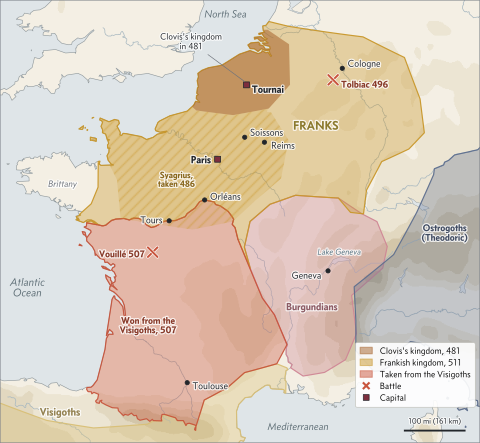
About 493 Clovis married Clotilde (kloh-tild), a princess of the Burgundians, the Germanic people of the Rhône (rohn) valley. Most Germanic kings of the time were Christians of the Arian kind (Vol. 7, The Romans), who held that Christ the Son was created by God the Father and so was less than he. The Romans of Gaul, and their bishops, were Catholics, who held, with the Council of Nicaea (ny-see-uh) of 325, that Father and Son are equally God. Clotilde was a Catholic, and Clovis still worshipped the old gods of the Franks. Gregory of Tours says that she pleaded with him for years. When their first son died just after his baptism, Clovis blamed her God.

The change came in a battle. About 496 the Alemanni, a Germanic people of the upper Rhine, invaded, and Clovis met them, by tradition near Tolbiac (tol-bee-ak), west of Cologne. As his army began to give way, Gregory says, he raised his eyes to heaven and prayed to Jesus Christ, whom Clotilde called the son of the living God, and promised to be baptized if he won. The king of the Alemanni was killed and his men surrendered (Figure 2.2). The story is very like the tale of Constantine’s vision before the battle of the Milvian Bridge (Vol. 7, The Romans), and Gregory, who calls Clovis a new Constantine, may have shaped it to match.
The king’s teacher in the faith was Remigius (reh-mij-ee-us), bishop of Reims (reemz), and on a Christmas Day Saint Remigius baptized the Frankish kingSaint Remigius baptized this Frankish king. → Clovis I• at Reims. Tradition puts it in 496, and historians suggest dates as late as 508. As Clovis came to the font, Gregory says, Remigius greeted him with the words Mitis depone colla, Sicamber; adora quod incendisti, incende quod adorasti: “Bow your neck humbly, Sicamber; worship what you have burned, and burn what you have worshipped.” The Sicambri were an ancient German people whom Roman writers counted among the Franks’ ancestors. More than three thousand of the king’s warriors were baptized with him. More than three centuries later Hincmar, archbishop of Reims, added that a dove had brought down from heaven a little flask of holy oil for the ceremony. For most of the next thousand years, French kings were anointed at Reims with oil said to come from that flask.
Clovis soon turned his new faith into a cause for war. In 507, Gregory says, he told his warriors that it grieved him that Arians held part of Gaul. He marched south and met the Visigothic king, Alaric (al-uh-rik) II, at Vouillé (voo-yay), near Poitiers (pwah-tyay). Alaric was killed, by Clovis’s own hand in Gregory’s account, and the Visigoths lost nearly all their lands north of the Pyrenees. They kept Spain, which they would rule from Toledo. On his way home, at Tours, Clovis received a letter from the emperor in Constantinople, Anastasius, granting him the honors of a Roman consul. He put on a purple tunic and a diadem in the church of Saint Martin and rode through the streets throwing gold and silver coins to the crowd.
Then he dealt with the other Frankish kings, his own kinsmen, and Gregory tells it without embarrassment. Clovis persuaded the son of Sigebert, king of the Franks at Cologne, to murder his father, and then had the son killed. He took another king captive with his son and had their long hair shaved off like churchmen’s, which cost them their royal mark, and later had them put to death. A third he killed with his own axe. One by one the little kingdoms fell to him, until Clovis united the Franks, in what is now France,This Merovingian king unified the Franks. → Clovis I••Clovis I united much of the Frankish realm in the territory of this modern country. → France• under a single king. He made Paris, the old Roman town on its island in the Seine, his capital. Gregory, writing as a bishop, saw God’s hand in all of it, since the king fought heretics and honored the saints.
Late in his reign, between 507 and 511, Clovis issued the Salic Law,This ruler issued the Salic Law. → Clovis I• the written law of the Salian Franks. Until then their law had been carried in the memories of elders. The new code was in Latin, with Frankish legal words mixed in, and it set a price in money for nearly every crime. The price of a man’s life was called the wergild (wur-gild), the “man-price,” paid to the dead man’s family to end a feud. Killing a free Frank cost 200 solidi, the Roman gold coins (Vol. 7, The Romans), and killing a Roman landowner half as much. One clause said that a daughter could not inherit “Salic land,” the family’s land. In 1358 a monk of Saint-Denis (san-duh-nee) revived it, and royal lawyers after him used it, to justify a rule already applied in 1328, that no woman could inherit the crown of France or pass it to her son. That rule had shut out King Edward III of England (Vol. 8, The Northern Worlds).
Clovis died in Paris in 511, aged about forty-five, and was buried in the church of the Holy Apostles, which he and Clotilde had built. His kingdom was divided among his four sons as if it were a farm, and for two centuries their descendants fought one another for the pieces. Their quarrels fill Gregory’s history.
Gregory of Tours
Gregory was born in 538 or 539 at Clermont (klair-mohn), in the Auvergne (oh-vairn), the mountainous middle of Gaul. His family were Gallo-Romans of senatorial rank, Roman nobles who had kept their lands under Frankish kings, and they had filled bishoprics for generations. He claimed to be related to thirteen of the eighteen bishops of Tours before him. As a young man he fell gravely ill, made a pilgrimage to the tomb of Saint Martin at Tours, and recovered. In 573, at about thirty-four, he became bishop of Tours himself, and he held the post until his death in 594.
Tours was one of the great places of Gaul. It lay on the Loire, where the roads from the Frankish north met the roads to Aquitaine and Spain. In its basilica lay Martin, the Roman soldier who had cut his cloak in two for a beggar and died as the city’s bishop in 397 (Vol. 7, The Romans). Pilgrims came from everywhere, and the church was a sanctuary where even fleeing princes could not be touched. The kings who ruled Tours in Gregory’s time were Clovis’s grandsons and great-grandsons, and they were dangerous men. In 580 King Chilperic (kil-per-ik) had Gregory tried before a council of bishops on the charge that he had said the queen, Fredegund (fred-eh-goond), had committed adultery with a bishop. Fredegund had risen from servant to queen, and Gregory blames her for a string of murders. He swore to his innocence at the altar and was cleared.
Gregory wrote books of the miracles of the saints, above all of Martin, but his great work was a history. The bishop of Tours wrote it in ten books,This bishop of Tours wrote the ten-book Historia Francorum. → Gregory of Tours• which run from the Creation of the world to the year 591. He called it simply Ten Books of Histories; later readers named it Historia Francorum, the History of the Franks. The first book races from Adam to the death of Saint Martin. The second tells the story of Clovis, and the last six tell Gregory’s own times, in which he knew most of the people he describes. He apologizes for his rough Latin, and he complains at the start that learning was dying in the cities of Gaul. In fact his Latin is lively and plain, and his stories of poisonings, betrayals, and miracles read like the chronicle of a family feud. They are told by a bishop with a lesson in mind: kings who honor God and the saints prosper, and those who rob churches come to bad ends. His dates for Clovis fall too neatly into steps of five years, and historians treat them as guesses.
Gregory also recorded omens and disasters, because he believed they were signs from God. One of them was a real natural disaster. In 563, he says, a strange bellowing was heard for more than sixty days at Tauredunum (tor-eh-doo-num), a fortress above the river Rhône near where it flows into Lake Geneva. Then the mountainside split off and fell into the river, carrying men, churches, and houses with it. The river was dammed, then burst through, and the flood swept away everything along its banks down the lake. Gregory heard from many people that the wave went over Geneva’s walls,Gregory of Tours wrote about a tsunami that destroyed this city in the sixth century. → Geneva• into the city at the far end of the lake where the Rhône flows out. He was describing a tsunami, a great wave raised by a sudden shove of earth or rock into water. Another bishop of the time, Marius of Avenches (ah-vahnsh), wrote that the flood swept away Geneva’s bridge, its mills, and the men at them, and took lives inside the city. In 2012 scientists from the University of Geneva who studied the mud on the lake bed found that a huge underwater landslide had followed the rockfall. They calculated that the wave, as much as 16 meters (52 feet) high in places, reached Geneva about seventy minutes later.
Boethius in prison
The last great writer of Roman Italy had died fourteen years before Gregory was born. Boethius (boh-ee-thee-us) was a Roman senator, a philosopher who had translated Aristotle into Latin, and the chief minister of Theodoric, the Ostrogothic king of Italy. In 523 he was accused of treason, and in 524 he was put to death (Vol. 7, The Romans). Between his arrest and his execution he was held in a prison at PaviaBoethius wrote The Consolation of Philosophy in one of these places. → prisons• (pah-vee-uh), one of Theodoric’s royal cities in northern Italy, and there he wrote the book that made him famous, The Consolation of Philosophy. Medieval readers knew exactly where it was written. A drawing in a Latin copy of about 1200 labels the building in which Boethius sits “the prison in the city of Pavia” (Figure 2.3).

The Consolation is a dialogue in five books, in which passages of prose alternate with poems. It opens with the prisoner writing sad verses while the Muses, the goddesses of poetry, help him weep. Then a woman appears above his head. In H. R. James’s translation of 1897, she is “a woman of a countenance exceeding venerable,” whose height kept changing: at one moment ordinary, at another “her forehead seemed to strike the sky.” On her robe are woven the Greek letters pi and theta, joined by steps like a staircase, for the practical life and the life of thought. She is Philosophy, his old teacher. She drives the Muses out and sets about curing him.
Her medicine is argument. Boethius complains that Fortune has betrayed him. Philosophy answers that Fortune was always fickle and that her gifts of wealth, office, and fame never belonged to him. Fortune turns a wheel, raising men and throwing them down, and in James’s words, “if it takes to standing still, it ceases to be the wheel of Fortune.” True happiness, Philosophy goes on, is the highest good, which is God, and no one can lose it against his will. The wicked who seem to prosper are punished by their own wickedness. At the end the prisoner asks how God can know the future if men are free to choose. Philosophy replies that God sees all of time at once, as a single present, so that his knowing a choice does not force it. Boethius was a Christian, but the book never mentions Christ, and it argues from reason alone.
The Consolation became one of the most read books of the Middle Ages. An Old English version was long credited to King Alfred (Vol. 8, The Northern Worlds); Chaucer put it into Middle English, and Queen Elizabeth I into the English of her day. The American scholar E. K. Rand called Boethius “the last of the Roman philosophers and the first of the scholastic theologians.” The scholastics were the teachers of the medieval schools and universities (Chapter 12), and the logic Boethius translated from Aristotle was the logic they learned first. His bones lie in the church of San Pietro in Ciel d’Oro (chel dor-oh), “Saint Peter in the Golden Sky,” at Pavia, where he is honored as a saint. Dante, the Florentine poet of Chapter 18, set him among the wise in Paradise. In Longfellow’s translation the poem says that the saint’s body lies “Down in Cieldauro, and from martyrdom / And banishment it came unto this peace.”
Monks and Gregory the Great
Christian monks began in the deserts of Egypt, with hermits such as Anthony, who left the world to live alone in prayer (Vol. 5, In the Beginning). Others soon lived together under a written rule. By Boethius’s time there were monasteries all over the Christian world, each a little world of its own. Monasteries, as the Stage explained, are houses where monks live together,These are institutions where monks live. → monasteries•• praying, working, and obeying an abbot, the “father” of the community. At first each house made its own rules. Then one man wrote a rule that nearly all the West came to follow.
Benedict was born about 480 at Nursia, in the mountains of central Italy. Nearly everything known about him comes from Pope Gregory the Great, who wrote his life in the second book of his Dialogues about 593, half a century later, from the memories of Benedict’s disciples. Gregory says that Benedict went to Rome to study, was disgusted by the vice of the city, and fled to a cave at Subiaco (soo-byah-koh), east of Rome, where he lived alone for three years. A community of monks asked him to be their abbot, found him too strict, and tried to poison his wine; when he blessed the cup, Gregory says, it shattered. About 529 he moved south to the mountain of Monte Cassino, between Rome and Naples. There, Gregory tells, people still worshipped Apollo, and Benedict smashed the idol and built chapels to Saint Martin and Saint John the Baptist.

At Monte Cassino Benedict wrote his Rule. It has seventy-three short chapters and begins Ausculta, o fili, praecepta magistri, “Listen, my son, to the precepts of the master.” He called a monastery dominici schola servitii, “a school for the Lord’s service.” Its monks elect an abbot and obey him as Christ’s representative. They promise to stay in that one house for life, to obey, and to live as monks, owning nothing of their own. Eight times a day and night they gather in church to sing the services, the Opus Dei, the “Work of God,” and they get through all 150 Psalms each week. Between services they work with their hands and read. Otiositas inimica est animae, the Rule says: “Idleness is the enemy of the soul.” They eat two cooked dishes a day, a pound of bread, and a little wine, and only the sick may eat the meat of four-footed animals.
What made the Rule last was its moderation, for Benedict asked nothing that an ordinary man could not do. Over the next three centuries kings and bishops pressed it on house after house, and in 817 Charlemagne’s son, the emperor Louis the Pious, ordered every monastery of his empire to follow it. For centuries monastic life was governed by Benedict’s Rule,Life at these places was usually governed by the Benedictine Rule. → monasteries•• and monks who follow it are called Benedictines.
Benedict had a sister, Scholastica (skuh-las-tih-kuh), whom a tradition first recorded three centuries later calls his twin. She too had given her life to God, and she lived near Monte Cassino. Gregory tells that brother and sister met once a year at a house near his monastery. At their last meeting she begged him to stay the night and talk, and he refused, since a monk must not spend the night away from his house. She bowed her head in prayer, and a storm broke so violent that he could not leave. Three days later, Gregory says, Benedict saw from his cell her soul rise to heaven as a dove, and he buried her in the tomb he had made for himself. He died about 547 and was laid beside her. Her feast falls on February 10, the day of the Oxford tavern riot of 1355 (Vol. 8, The Northern Worlds). Monte Cassino was destroyed by the Lombards, by Arab raiders, by an earthquake, and by Allied bombers in 1944, and it was rebuilt every time.

What a Benedictine monastery was meant to be can be seen in a single drawing. Saint Gall was an Irish monk who settled in the mountains south of Lake Constance about 612, and a great abbey grew up on the site of his hermitage. Its abbot from 816, Gozbert (gots-bert), was planning a new church. About 820 or 830 someone at the abbey of Reichenau (ry-khuh-now), on an island in Lake Constance, drew him a complete monastery on five sewn sheets of parchment. A note in the corner begins, in Latin, Haec tibi dulcissime fili Cozberte… direxi: “I have sent you this, sweetest son Gozbert.” The writer says he drew it so that Gozbert might exercise his own ingenuity on it. It is the only large architectural drawing to survive from the seven centuries after the fall of Rome. The Plan of St. Gall, dedicated to Gozbert,The Plan of St. Gall, dedicated to Abbot Gozbert, is an idealized design for one of these institutions. → monasteries•• is an ideal design for a monastery, and it was never built exactly as drawn (Figure 2.5).

Its 333 or so Latin labels let us walk around it (Figure 2.6). A visitor came in from the west, up a road to a curved porch between two round towers, and into the church, which fills the middle of the plan. South of the church lay the cloister, a square garden surrounded by covered walks, the heart of the monks’ enclosure. Around it stood the dormitory, built over a heated room where the monks could warm themselves, the refectory, or dining hall, and the cellar for wine and food. North of the church stood the abbot’s house, a school for boys who would not become monks, and a guest house for nobles. To the east lay the infirmary for sick monks and the house for novices, who were learning the monks’ life. Beyond them were a physician’s house, a house for letting blood, drawing it from the body to prevent or cure illness, a garden of healing herbs, and a cemetery planted as an orchard, its trees standing between the graves. To the south and west were the bakeries and breweries, the mills, the workshops of shoemakers, saddlers, and smiths, the barns, and sheds for sheep, goats, pigs, cattle, and horses. Working from its labels, scholars reckon that it was meant to house about 110 monks, 115 visitors, and 150 workmen and servants, a small town that could feed and clothe itself. The parchment survived because someone in the twelfth century folded it into a book and copied the Life of Saint Martin on its back. Since 2013 builders at Meßkirch (mess-keerkh), in southern Germany, have been raising the Plan’s buildings with the tools and methods of the ninth century.
The pope who wrote Benedict’s life, Gregory the Great, was a monk himself. He was no relation of Gregory of Tours, who was writing his history in Gaul in the same years. Gregory was born about 540 into one of the old senatorial families of Rome, and about 573, still young, he held the city’s highest office, prefect of Rome. After his father’s death he gave away his wealth and turned the family house on the Caelian (see-lee-un) Hill into a monastery dedicated to Saint Andrew, where he lived as a monk. The pope sent him to Constantinople as his envoy from 579 to about 585. In 590 plague killed Pope Pelagius II (peh-lay-jee-us), and the people of Rome chose Gregory, against his will, to succeed him. He reigned as Pope Gregory I until his death in 604.

As pope, the bishop of Rome and head of the western Church (the Stage), Gregory ruled a city half in ruins, with plague in its streets and the Lombards, the newest Germanic invaders of Italy, at its gates. He shipped grain from the Church’s estates in Sicily to feed the poor, bargained with the Lombard dukes, and wrote hundreds of letters that survive. He called himself “the servant of the servants of God,” a title popes have used ever since. His Pastoral Care, a handbook for bishops, was translated by King Alfred (Vol. 8, The Northern Worlds), and in 596 he sent about forty monks from his own monastery to convert the English (Vol. 8, The Northern Worlds). The music of the western Church bears his name too, for Gregorian chant is named for Pope Gregory I.Gregory I held this position and had a form of monophonic chant named for him. → Pope• It is plainchant, a single line of melody sung in Latin, the kind of music called monophonic, “one sound” (Vol. 1, The Toolkit). John the Deacon, who wrote a life of Gregory about 873, said only that he had compiled a book of the Church’s chants. An older story told of a dove, the Holy Spirit, that whispered to the pope as he dictated his writings (Figure 2.7), and later artists drew it singing the melodies into his ear. In fact most of the tunes took their lasting form two centuries after him, in the kingdom of the Franks (Chapter 4). The Church counts him with Ambrose, Jerome, and Augustine (Vol. 7, The Romans) as one of its four great Latin Doctors, or teachers.
Gregory’s monks had gone to England, and a century later an English monk brought the Rule to Germany. Boniface (bon-ih-fays) was born in Wessex about 675 and spent his life converting the Germans east of the Rhine. His biographer Willibald, an English priest, wrote about 765 that at Geismar (gys-mar), in Hesse, Boniface took an axe to a huge sacred oak while its worshippers stood by cursing him, and built a chapel from its timber. Willibald’s Latin calls it the oak of Jupiter, but it is usually known as Donar’s Oak: Boniface felled a great oak dedicated to Donar,Saint Boniface cut down a large one of these things dedicated to Donar. → trees•• the German name of the thunder god the Norse called Thor (Vol. 8, The Northern Worlds). Boniface founded the abbey of Fulda under Benedict’s Rule and in 754 was killed in Frisia by a band of men who still worshipped the old gods.
Isidore of Seville
After Vouillé the Visigoths held on to Spain, and by the 560s they ruled it from Toledo. Like the other Goths they were Arians, ruling Catholic Spaniards whose families had been Roman for six hundred years. In 587 their king, Reccared (rek-uh-red), became a Catholic, and at the Third Council of Toledo in 589 his nobles and bishops followed him. Reccared’s teacher in the faith was Leander, the bishop of Seville. Leander’s younger brother Isidore, born about 560, was brought up by him and succeeded him as bishop of Seville about 600. He held the post until his death in 636. In 633 he presided over a council of the kingdom’s bishops that ordered every bishop to open a school at his cathedral.

Isidore’s friend Braulio (brow-lee-oh), bishop of Zaragoza (zair-uh-goh-zuh), kept begging him to finish the great work he had been compiling for years. It was an encyclopedia, a book that tries to set out all knowledge. Its twenty books cover grammar, rhetoric, arithmetic, music, astronomy, medicine, law, the Church and its heresies, languages and peoples, human beings and monsters, animals, the earth, cities and buildings, stones and metals, farming, war, ships, clothing, food, and tools. Isidore collected it from older books, among them the Roman Pliny the Elder’s Natural History (Vol. 7, The Romans).
His method gave the book its title. Isidore explained each thing through the origin of its name, because he believed a word’s origin revealed the nature of the thing. Man, homo in Latin, is so called because he was made from the earth, humus, as Genesis says. The study of where words come from is called etymology, from the Greek etymon, “the true sense” of a word, and Isidore called his book the Etymologies.This subfield titles the magnum opus of Isidore of Seville, a medieval dictionary. → etymology• Because it explains words, it is sometimes called a dictionary, but it is an encyclopedia, arranged by subjects. Many of its derivations are wrong and some are fanciful, but the facts it gathered were what the Middle Ages knew.
Nearly a thousand manuscript copies survive, and in 1472, at Augsburg (owgz-boorg), it became one of the first books ever printed. Braulio said it held quaecunque fere sciri debentur, “nearly everything that ought to be known.” Many of the older books Isidore summarized were lost because readers copied his summary instead. In the nineteenth century the French historian Montalembert (mon-tuh-lahn-bair) called him the last scholar of the ancient world. Dante put him in Paradise, among the same wise spirits as Boethius. In Longfellow’s translation Dante is told to “See farther onward flame the burning breath / Of Isidore, of Beda, and of Richard,” Beda being Bede, the English historian (Vol. 8, The Northern Worlds). Isidore’s little round map of the world, the T-and-O map, comes back in Chapter 7.
Islam and the Umayyads
Isidore died in 636. In that same year, far to the east, an Arab army destroyed the Byzantine army of Syria on the river Yarmuk (yar-mook), and a new power entered the Mediterranean world. To understand how it reached Spain, we have to go back to Arabia.
Mecca was a trading town in western Arabia, with a shrine, the Kaaba (kah-buh), that drew pilgrims from all over the peninsula. Muhammad was born there about 570, was orphaned young, and became a merchant. From about 610, Muslims believe, the angel Gabriel brought him the words of God, which were later collected as the Quran (kur-ahn). He preached that there is one God, Allah in Arabic, and that men must submit to him. Islam means “submission,” and a Muslim is “one who submits.” The leaders of Mecca turned against him, and in 622 he and his followers moved to the town of Medina, about two hundred miles to the north. This move, the hijra, or “emigration,” begins the first year of the Muslim calendar. By his death in 632 most of Arabia had accepted his rule and his faith (Figure 2.9).

Muhammad’s successors were called caliphs, from the Arabic khalifa, “successor.” Under the first four, Arab armies took Syria and Jerusalem from the Byzantines, then Egypt, and then the whole Persian empire, in less than thirty years. A quarrel over the fourth caliph, Ali, Muhammad’s cousin and son-in-law, split the Muslims into the two branches later called Sunni and Shia (shee-uh) (Vol. 37, The House of Islam). In 661 the governor of Syria, Mu’awiya (moo-ah-wee-yuh), made himself caliph and founded the first hereditary dynasty of caliphs, the Umayyads (oo-my-adz), named after his ancestor Umayya. They ruled from Damascus.
The conquest of North Africa took longer. Its native peoples, whom English calls the Berbers, probably from a Greek and Arabic word for “barbarians,” fought hard in their mountains. The Arabs founded Kairouan (kair-wahn), in what is now Tunisia, about 670 as their base, and took Carthage from the Byzantines in 698. In the end many Berbers became Muslims and joined the Arab armies, and by about 709 the Arab governor of North Africa, Musa ibn Nusayr (moo-sah ib-un noo-sayr), held the coast as far as Tangier. Across the strait lay Spain.
The Muslim conquest of Spain
The Visigothic kingdom was divided when the attack came. King Wittiza (wih-tee-zuh) died about 710, and Roderic (rod-er-ik), a nobleman, seized the throne. The Mozarabic Chronicle, written in Spain in 754 (the Stage), says he took it tumultuose, “in an uproar.” A rival king held the northeast, and Roderic was away fighting the Basques, the mountain people of the western Pyrenees. Later writers, Arab and Spanish, added a romance: Count Julian, governor of Ceuta (say-oo-tuh) on the African shore, helped the invaders to avenge his daughter, whom Roderic had dishonored. Nothing written at the time mentions her.
The commander Musa sent across was Tariq ibn Ziyad (tah-rik ib-un zee-yahd), a Berber who had been Musa’s slave and then his freedman, and was now governor of Tangier. In the spring of 711 he crossed the strait with about seven thousand men, most of them Berbers, and landed at the great rock that still bears his name: Jabal Tariq, “Tariq’s mountain,” or Gibraltar (Vol. 3, Geography: Europe, Asia, and Africa). A story first written down four centuries later says that he burned his ships so that his men could not retreat. In July 711 he met Roderic’s army near the river Guadalete (gwah-dah-lay-tay), in the far south. The Mozarabic chronicler says that rivals in Roderic’s own army had marched with him in bad faith, out of ambition for the throne, and that they fled. Tariq defeated King Roderic at Guadalete,This commander defeated the Visigothic king Roderic at Guadalete during the Muslim conquest of Spain. → Tariq ibn Ziyad•• and the last Visigothic king to rule from Toledo died in the battle or the rout (Figure 2.10).
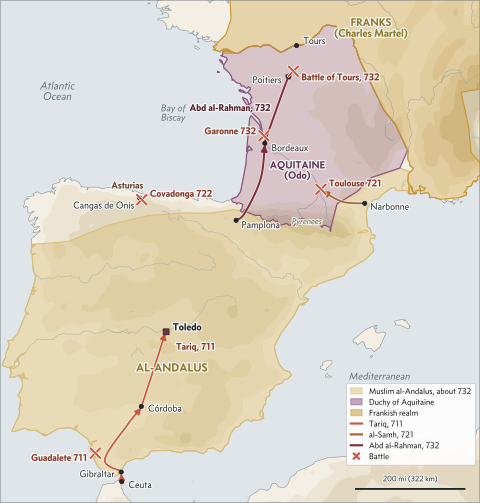
Tariq marched north and took Toledo, the Visigothic capital. Musa followed in 712 with an army of Arabs, and within a few years nearly the whole peninsula was theirs. In 714 the caliph in Damascus recalled both men, and they never came back. The Muslims called their new province al-Andalus (al-an-duh-loos). Christians and Jews there kept their faiths and paid a special tax. The Christians who lived under Muslim rule came to be called Mozarabs (moh-zar-ubz), from an Arabic word meaning “Arabized,” since many of them took up Arabic speech and dress.
The mountains of the north were never conquered. Pelagius, called Pelayo (peh-ly-oh) in Spanish, was a Visigothic nobleman who took refuge among the people of Asturias (uh-stoor-ee-us), on the rainy northern coast, behind the high Cantabrian Mountains. About 718 they chose him as their leader, and he refused to pay tribute. A Muslim force under a commander named Alqama (al-kuh-muh) came to crush him. Pelagius, say Asturian chronicles written about 880, drew it into the narrow valley of Covadonga (koh-vah-dong-gah), beneath the peaks called the Picos de Europa, where his men waited in a cave and on the slopes above. They fell on the invaders with arrows and stones, and Alqama was killed. The same chronicles add miracles: the Muslims’ stones turned back in the air against them, and a mountainside fell on the survivors as they fled. The battle is dated by tradition to 722, and by some historians to 718.
Covadonga was a small fight, but it became a founding legend. The Reconquista (ray-kon-kees-tuh), Spanish for “reconquest,” is the name later given to the long advance of the Christian kingdoms southward across Spain, which ended only in 1492 (Chapter 17). Pelagius’s victory at Covadonga is traditionally its beginning,This ruler defeated Muslim forces at Covadonga, traditionally the opening victory of the Reconquista. → Pelagius of Asturias••Pelagius’s victory at Covadonga is traditionally treated as the beginning of this process in Iberian history. → Reconquista•• the first time a Christian ruler in Spain beat the Muslims in battle. The cave where his men hid became a shrine to the Virgin Mary, and the kings of Spain, a thousand years later, still counted Pelagius as the first of their line.
Pelagius founded the Kingdom of Asturias,This ruler founded the Kingdom of Asturias. → Pelagius of Asturias•• the first of the Christian kingdoms of Spain, and ruled it from Cangas de Onís (kahn-gahs day oh-nees), a village in the mountains, until his death in 737. His son, the chronicles say, was killed by a bear while hunting two years later, and the throne passed to Pelagius’s son-in-law, Alfonso I, who pushed the frontier west and south. Alfonso’s heirs moved the capital to Oviedo (oh-vyay-doh), and in time their kingdom grew into the kingdoms of León (lay-ohn) and Castile.

Two centuries later the kings of Asturias honored the battle with a treasure (Figure 2.11). In 908 Alfonso III gave the cathedral of Oviedo a cross of gold and jewels, the Victory Cross. Its core is oak, and the legend that grew around it says that it is the very cross Pelagius carried into battle.
The Battle of Tours
Two centuries after Clovis, his family still sat on the Frankish throne, but the kings no longer ruled. Real power belonged to the mayor of the palace, the chief officer of the royal household, who commanded the army and gave out the king’s lands. The kingdom had split into an eastern part, Austrasia (aw-stray-zhuh), and a western part, Neustria (noo-stree-uh), each with its own mayor. In 687 Pepin of Herstal (hair-stahl), mayor of Austrasia, defeated the Neustrians and became master of all the Franks. When he died in 714, his widow, who wanted the power for her own grandson, locked up Charles, Pepin’s son by another woman, in Cologne. Charles was about twenty-six. He escaped, gathered warriors, and in four years of civil war beat every rival. From about 718 until his death, Charles, later called Martel (mar-tel), ruled the Franks,These people were ruled by Charles Martel. → Franks• setting puppet kings on the throne and, after 737, leaving it empty. It was under his protection that Boniface worked in Germany.
South of the Loire, the great duchy of Aquitaine (the Stage) was ruled by Duke Odo (oh-doh) almost as an independent king. After 711 the Muslims crossed the Pyrenees, and in 719 they took Narbonne (nar-bon), on the Mediterranean coast. In 721 the governor of al-Andalus, al-Samh (al-sahm), laid siege to Toulouse, the chief city of Aquitaine. Odo had gone to gather help. He came back after three months, caught the besiegers off guard, and attacked them on June 9. Odo won a great victory at Toulouse,Odo of Aquitaine achieved a victory at the Battle of Toulouse prior to this battle. → Battle of Tours•• eleven years before the Battle of Tours. It was the first great defeat of a Muslim army in western Europe, and al-Samh died of his wounds. A life of the pope of the day, Gregory II, written in Rome, says he had sent Odo blessed bread the year before, and that no soldier who ate it was killed or wounded.
In 732 a new governor came north. Abd al-Rahman al-Ghafiqi (ahb-dur-rah-mahn al-gah-fee-kee) crossed the western Pyrenees by Pamplona with a large army, much of it horsemen, and stormed Bordeaux. Odo met him on the river Garonne (gah-ron) and was routed. Now he did what he had never done before. Beaten on the Garonne, Odo turned to Charles,After defeat at the Garonne, Odo of Aquitaine sought Charles Martel’s aid and joined the victorious side at this battle. → Battle of Tours•• his old rival, who had raided Aquitaine only the year before. Charles agreed to help only after Odo accepted him as his overlord. When the armies met near Tours that fall, the duke and his Aquitanians fought on the Frankish side.
Abd al-Rahman’s goal was Tours. The Mozarabic chronicler says that he meant to destroy its palaces and burn its churches, and a Frankish chronicle written for Charles’s family says the same. The richest prize in Gaul lay there: the abbey of Saint Martin, with the gifts that pilgrims had left at his tomb for three centuries. The Italian historian Alessandro Barbero is one of many who think the riches of Saint Martin’s abbey drew him,Some historians believe this battle was motivated by the riches of the Abbey of St. Martin. → Battle of Tours• and that the campaign was a great raid for plunder rather than an attempt to conquer the Franks.

In October 732 Charles met the invaders between Tours and Poitiers, probably near where the river Clain flows into the Vienne (vee-en). For about a week the two armies watched each other and skirmished. Charles had taken high ground with trees in front of it, where horsemen could not charge freely. His Franks were mostly foot soldiers, veterans who had fought under him for years. At last Abd al-Rahman attacked, and the Frankish infantry held a tight squareFrankish infantry held a tight defensive formation against cavalry at this battle. → Battle of Tours•• against charge after charge of cavalry. In the English historian Edward Creasy’s translation of 1851, the Mozarabic chronicler says that the men of the north stood “firm as a wall, and impenetrable as a zone of ice.” Arab writers later said that their horsemen broke into the square several times, but the Franks never scattered. Late in the day, in confused fighting, Abd al-Rahman himself was killed.Abd al-Rahman was killed during this battle. → Battle of Tours•• That night his army slipped away, leaving its tents full of booty (Figure 2.12). The Franks stood in their ranks all night, expecting another attack at dawn, and in the morning their scouts found the camp empty. Charles did not pursue, and the beaten army fell back toward Spain.
This was the Battle of Tours of 732,Charles Martel defeated an Umayyad army at this 732 battle in modern-day France. → Battle of Tours•••This French city names a 732 victory for Charles Martel. → Tours• in which Charles Martel defeated an Umayyad army in what is now France. It is named for the city on the Loire toward which Abd al-Rahman was marching, though the fighting was nearer Poitiers, and it ended the last great Muslim raid into the heart of Gaul. Arab writers remembered the field as the Pavement of the Martyrs. The fullest account of the battle is the Mozarabic Chronicle of 754,The Mozarabic Chronicle is the most detailed source describing this battle. → Battle of Tours•• written in Latin by a Christian living under Muslim rule in Spain. It calls the victors Europenses, “Europeans,” the first time that word is known to have been used for a people.
Later tradition tied Charles’s nickname to this victory. Charles was nicknamed “the Hammer”,This Frankish leader was nicknamed “the Hammer.” → Charles Martel•• Martellus in the Latin of chroniclers after his time and Charles Martel in French, for the way he crushed his enemies. A thousand years later the English historian Edward Gibbon (Vol. 7, The Romans), in the volume of his Decline and Fall of the Roman Empire published in 1788, made Tours one of the turning points of history. Had the Arabs won, he imagined, they might have marched as far again, to Poland and the Highlands of Scotland. “Perhaps the interpretation of the Koran would now be taught in the schools of Oxford,” he wrote, and he praised Charles as Christendom’s savior,Edward Gibbon praised this leader as a “savior of Christendom.” → Charles Martel• the one man who had delivered it. Generations of historians followed him. Others, such as the Slovene historian Tomaž Mastnak (toh-mahzh mahst-nahk), call his verdict a modern myth, since the Umayyads held Narbonne until 759 and Charles spent years fighting them in Provence. What Tours certainly did was make Charles the unchallenged master of Gaul.
He died in 741 and divided the realm between his sons. One of them, Pepin the Short, made himself king in 751, and the last of Clovis’s line was shut in a monastery. Pepin’s son, Charles Martel’s grandson, was Charlemagne, who would rule the Franks from 768 to 814Charlemagne was a ruler of these people. → Franks• and be crowned emperor in Rome (Chapter 4).
Córdoba
In 750 the Umayyads fell. A rival family, the Abbasids (uh-bas-idz), descended from Muhammad’s uncle Abbas, overthrew them, moved the capital to Iraq, where they founded Baghdad in 762, and hunted down the Umayyad princes. One escaped: another Abd al-Rahman, a grandson of a caliph, then about nineteen. The later chronicles of al-Andalus tell how, with Abbasid horsemen closing in, he swam the Euphrates while his brother turned back at their promise of mercy and was killed. He made his way through Palestine and Egypt to North Africa, where his mother’s Berber people sheltered him, and in 755 he crossed to Spain. Syrian soldiers of his family’s old armies rallied to him, and in May 756 he took Córdoba and made himself emir, “commander,” of al-Andalus. He ruled until 788, and his family held Córdoba for nearly three centuries. The Abbasid caliph himself, the chroniclers say, called him the Falcon of the Quraysh (koo-raysh), the tribe of Muhammad and of the Umayyads.
In 785 Abd al-Rahman began a great mosque on a site where, tradition says, the Visigoths’ church of Saint Vincent had stood. It was built in about a year, much of it from the columns of Roman and Visigothic buildings. A mosque, where Muslims gather for prayer, needs a large hall whose far wall faces Mecca. Abd al-Rahman’s builders made it a hypostyle (hy-puh-style) hall, from the Greek for “under pillars,” a hall whose flat roof rests on rows of columns. The old columns were too short to raise the roof high enough, so the builders set a second row of arches on top of the first. The lower ones are horseshoe arches, whose curve runs on past a half circle and narrows at the bottom. The upper ones are round, and both are built of voussoirs, the wedges of an arch (Vol. 1, The Toolkit), of red brick and pale stone laid turn about. Walking through the hall is like walking through a forest of striped trunks, with new aisles opening in every direction (Figure 2.13).

Later rulers enlarged the prayer hall three times, until it held some 850 columns. In the 960s the caliph al-Hakam (al-hak-um) II gave it a new mihrab (mee-rahb), the niche that marks the direction of Mecca, covered in gold mosaics; a later Arab historian says the Byzantine emperor sent a master craftsman from Constantinople to make them. When King Ferdinand III of Castile took Córdoba in 1236, the mosque was consecrated as a church. Today the former mosque is Córdoba’s cathedral,This former mosque, now a cathedral, has a hypostyle hall with red-and-white arches. → Great Mosque of Córdoba•• and its hypostyle hall of red-and-white arches still stands around the tall church that its bishops built in the middle of it from 1523. The emperor Charles V, who was also king of Castile and Aragon, allowed that work and later, it is said, regretted it, complaining that they had destroyed something unique in the world.

In 929 Abd al-Rahman III, the founder’s descendant, took the title of caliph, claiming to lead all Muslims, and outside Córdoba he built a palace city, Madinat al-Zahra (mah-dee-nat az-zah-ruh). Its workshops carved elephant ivory from Africa into boxes for the court. A pyxis (pik-sis), from the Greek word for a box of boxwood, is a small round box, or casket, with a lid. The most famous of them was made for al-Mughira (al-moo-ghee-ruh), the youngest son of Abd al-Rahman III, and is called the Pyxis of al-Mughira. Its inscription dates it to the Muslim year 357, our 968, when the prince was about eighteen. Around its sides, inside four lobed medallions, are carved two seated princes with an attendant, lions bringing down bulls, horsemen picking dates from a palm, and men taking eggs from falcons’ nestsMen taking eggs from a falcon’s nest appear on this carved ivory casket. → Pyxis of al-Mughira• while dogs bite at their legs. The falcon may stand for the Umayyads themselves, the dynasty of the Falcon of the Quraysh, and the scene may warn anyone who reaches for their power. If it was a warning, it came true for its owner. In 976, when his brother the caliph al-Hakam II died, al-Mughira was strangled in his own house so that his young nephew could take the throne (Figure 2.14).
By the time the pyxis was carved, the old Roman world had three heirs. Byzantium held the empire’s eastern half (Chapter 3), and the heirs of the Franks ruled the north. Córdoba, the largest city in western Europe, faced them across the Pyrenees.
What to remember
- Clovis, king of the Franks from 481, beat Syagrius at Soissons (486), was baptized a Catholic by Saint Remigius at Reims, beat the Visigoths at Vouillé (507), united the Franks, and issued the Salic Law. His family, the Merovingians, ruled until 751.
- Gregory of Tours (538 to 594) wrote the ten-book History of the Franks, the source for Clovis, and recorded the tsunami of 563 that struck Geneva.
- Boethius wrote The Consolation of Philosophy in prison at Pavia before his execution in 524. Philosophy teaches him that Fortune’s wheel always turns and that true happiness is God.
- Benedict of Nursia wrote his Rule at Monte Cassino, and most western monasteries came to follow it. His sister was Scholastica. The Plan of St. Gall, drawn about 820 for Abbot Gozbert, is an ideal plan of a monastery.
- Pope Gregory I (590 to 604) gave his name to Gregorian chant. Boniface felled Donar’s Oak in Hesse. Isidore of Seville compiled the Etymologies, an encyclopedia.
- Muhammad’s hijra (622) begins the Muslim calendar. The Umayyad caliphs ruled from Damascus from 661 and conquered North Africa with Berber help.
- Tariq ibn Ziyad defeated King Roderic at Guadalete (711). Pelagius won at Covadonga, the traditional start of the Reconquista, and founded the Kingdom of Asturias.
- Odo of Aquitaine won at Toulouse (721), lost on the Garonne (732), and joined Charles Martel, “the Hammer,” who defeated Abd al-Rahman at Tours in 732. The Mozarabic Chronicle is the fullest source, and Gibbon made Charles the savior of Christendom.
- Abd al-Rahman I founded the emirate of Córdoba (756) and began its Great Mosque (785), with its red-and-white arches; the ivory Pyxis of al-Mughira dates from 968.
Chapter 3 · 29 clues
Icons, Bulgars, and the Bulgar-Slayer
In 1018 the emperor Basil II rode south from the conquered cities of Bulgaria to Athens. There, John Skylitzes tells in his chronicle, written some seventy years later, he climbed the Acropolis and gave thanks to the Virgin Mary in the Parthenon, the old temple of Athena, which had been a church for centuries. He had reason to give thanks. For the first time in four hundred years, the frontier of his empire ran along the whole lower Danube River again, as it had when Justinian died in 565.
The empire Basil ruled was not the one Justinian had left. In the centuries between, it lost Syria, Egypt, Africa, and most of Italy, and the Balkans filled with Slavs and with a new people from the steppe, the Bulgars. It stopped speaking Latin and spoke Greek. For more than a hundred years its Christians quarreled over whether they might pray before holy pictures, and the quarrel set emperor against monk and empress against her own dead husband. Its people still called themselves Romans. Historians call it the Byzantine Empire (the Stage).
After Justinian
For six hundred years the Romans had treated one river as the edge of the world they ruled. Along its lower course, from Belgrade to the Black Sea, the Danube formed the empire’s northern frontier,This river formed the northern frontier of the Eastern Roman, or Byzantine, Empire. → Danube River• with forts along its southern bank and fleets of patrol boats on the water (Vol. 3, Geography: Europe, Asia, and Africa). North of it lived the peoples Roman writers called barbarians; south of it lay the roads and walled cities of the Balkans. Justinian’s armies had held the line. Within a generation of his death it broke.
The first to break it were the Avars, horsemen from the Asian steppe who made the plain of Hungary their home in the 560s and led the Slavs, the farming peoples of eastern Europe (Vol. 8, The Northern Worlds), on raids across the river. In 602 the Danube army, ordered to spend the winter on the enemy’s bank, mutinied, marched on Constantinople under an officer named Phokas (foh-kas), and put the emperor Maurice to death. In the years of chaos that followed, Slavs settled across the Balkans as far as the Peloponnese (pel-uh-puh-neez), the southern tip of Greece. Then the Persians took Syria, Egypt, and Jerusalem. Heraclius (hair-uh-kly-us), the son of the governor of Africa, had sailed to Constantinople in 610 and beheaded Phokas, and as emperor (610 to 641) he beat the Persians in six years of desperate war. In 630 he brought back to Jerusalem the cross on which, Christians believed, Jesus had died, which the Persians had carried off. Four years later the Arab armies of a new faith, Islam (Chapter 2), came out of Arabia, and within a dozen years they had taken Syria, Palestine, and Egypt for good.
What was left of the empire was mainly Asia Minor, the Balkan coasts, Rome, Ravenna, Sicily, southern Italy, and the coast of Africa around Carthage, which fell to the Arabs in 698 (Figure 3.1). Latin had been the language of the law and the army; under Heraclius and his heirs Greek replaced it, and the emperor took the old Greek title basileus, “king.” Heraclius’s family ruled for a century. Historians call it the Heraclian dynasty, and its emperors had little peace.

Heraclius’s grandson Constans II (kon-stanz) became emperor at eleven, in 641, and spent his reign fighting Arab fleets. In 660 he had his own brother killed, and the people of Constantinople hated him for it. So he left. He sailed west, and in 663 he spent twelve days in Rome, the first emperor to set foot there in almost two hundred years. He stripped the bronze tiles from the roof of the Pantheon, the great domed temple the old Romans had built for all their gods, to carry away. Then Constans II established his court at Syracuse,Constans II established his imperial residence at Syracuse on this island. → Sicily• the great port on the east coast of Sicily. From there he could defend Sicily and Africa against the Arabs, and he seems to have meant to stay. In 668 a servant killed him in his bath, striking him with a bucket, or, in other accounts, stabbing him. His son Constantine IV, who had stayed behind in Constantinople, held the city against Arab fleets in the 670s, using a new weapon, Greek fire, a burning liquid pumped from tubes onto enemy ships. Its recipe was a state secret and is still unknown. In 680 Constantine IV met a new enemy on the Danube, the Bulgars.
Constantine IV’s son Justinian II took the throne in 685, at sixteen. He was named for Justinian I (Chapter 1) and wanted to be him: he built, fought, and meddled in the church on the same grand scale. In 692 he called the bishops of the East to the domed hall of his palace for a council. The church counted the great councils of bishops from the whole empire in order, and the fifth and sixth, held in 553 and 680, had settled questions of belief but made no rules for daily life. This council finished their work and took the name Quinisext (kwin-ih-sekst), “Fifth-Sixth.” Its 102 canons, or rules, reached into everyday life. The Quinisext Council condemned customs of the old gods,This ruler convoked the Quinisext Council, which condemned several pagan practices. → Justinian II• which the church called “pagan,” though many Christians still enjoyed them: the Kalends, the old Roman New Year, and the Brumalia (broo-may-lee-uh), a winter festival of Dionysus, the wine god, whom the Romans called Bacchus. In Henry Percival’s translation of 1900, no man was to “assume comic, satyric, or tragic masks,” nor “invoke the name of the execrable Bacchus” while treading grapes in the wine press. Nobody was to leap over the fires lit at the new moon in front of shops and houses. Married men could be priests and keep their wives, against the custom of Rome, and Christ was not to be painted as a lamb.
Several of these rules condemned customs of the Roman church. Pope Sergius I (sur-jee-us), a pope of Syrian family who had been raised in Sicily, refused to sign them. In answer Justinian II ordered Sergius’s arrestThis ruler ordered the arrest of Pope Sergius I after the pope rejected the Quinisext Council’s canons. → Justinian II• and sent his officer Zacharias to bring the pope to Constantinople. The soldiers of Ravenna and the nearby coast marched on Rome to protect him. The pope’s biography in the Book of the Popes, a collection of papal lives kept in Rome, says that Zacharias, terrified, hid under the pope’s bed until Sergius himself came out and calmed the crowd. Sergius had his own answer to the council’s ban on showing Christ as a lamb. He added to the Latin Mass the chant Agnus Dei, “Lamb of God,” and Catholics have sung it ever since.

Justinian II was the first emperor to put the face of Christ on his gold coins, and he made himself “servant of Christ” on the other side. The Arab caliph Abd al-Malik, who had copied Byzantine coins, now struck coins that carried only words, verses from the Quran (Chapter 2), and no picture at all. Each ruler was making a statement about images. Justinian’s statement did not save him. In 695 a general named Leontius overthrew him and had his nose slit, since a man without a whole face could not rule, and sent him into exile at Cherson (ker-son), a Byzantine town in the Crimea. Ever after, the Greeks called him Rhinotmetos (ree-not-meh-tos), “the Slit-Nosed.”
He did not stay put. He escaped to the Khazars, a Turkic-speaking people whose khagan (kah-gahn), or great king, ruled the steppe between the Black Sea and the Caspian, and married the khagan’s sister, whom he renamed Theodora after Justinian I’s empress. When the khagan took a bribe to have him killed, Theodora warned him; he killed the two assassins and sailed west across the Black Sea. Then he turned to the Bulgars, who since 680 had held the land south of the lower Danube. Their khan, or ruler, Tervel (ter-vel), lent him 15,000 horsemen in return for gold and a bride. In 705 Justinian and a few companions crawled into Constantinople through an unused water channel under the walls and took the city by night. He paid his debt in honors: Justinian II made Tervel a caesar,Justinian II made this people’s ruler Tervel the first foreign recipient of the title caesar. → Bulgars• a title second only to the emperor’s, and no foreigner had ever held it. In the Hippodrome he set his feet on the necks of the two men who had reigned in his absence, and then had them beheaded.
His second reign was a reign of revenge, and it lasted six years. In 711 the army rebelled, and its new emperor, Philippikos, had Justinian killed and his head shown in Rome and Ravenna. Justinian’s mother had taken his six-year-old son and co-emperor, Tiberius, into a church for sanctuary, but soldiers dragged the boy from the altar and killed him outside the door. So Justinian II was the last Heraclian,This ruler was the last ruler of the Heraclian dynasty. → Justinian II• and the dynasty ended where it had begun, in murder.
Six years and three more emperors later, an officer from the borderlands of Syria seized the throne as Leo III. Within months, in the summer of 717, the largest Arab army yet came to besiege Constantinople by land and sea. Greek fire burned its ships, the winter brought a hundred days of snow, and Tervel’s Bulgars fell on the besiegers’ camp. In August 718 the Arabs gave up. The city that Constans II had abandoned had survived, and Leo III founded a dynasty that would make war on pictures.
The quarrel over icons
Every Byzantine church and many homes held icons, painted pictures of Christ, his mother Mary, and the saints, which Orthodox Christians honor and pray before (Vol. 1, The Toolkit). People kissed them, lit candles before them, and carried them into battle. Some Christians had always worried about this. The Ten Commandments forbid “graven images,” carved figures made to be worshiped, and a believer could wonder whether a kiss for a painted board was honor for a saint or worship of an idol.
In the summer of 726 a volcano erupted under the sea between Thera (theer-uh) and its neighboring island in the Aegean, covering the sea with floating pumice. The monk Theophanes the Confessor, who wrote a chronicle about 813 (not the earlier Theophanes of Byzantium of Chapter 1), says that Leo III took it as a sign of God’s anger, and decided that the sin was the honor paid to images. The struggle that followed is called iconoclasm (eye-kon-uh-klaz-um), from the Greek for “image breaking.” Its champions were the iconoclasts; their opponents, who defended the pictures, called themselves iconophiles, “image lovers.”
Over the main gate of the emperor’s palace in Constantinople, the Chalke or Bronze Gate (Chapter 1), hung a famous image of Christ. Theophanes says that Leo had it taken down and that the people of the city killed some of the men who did it. The Life of a monk, Stephen the Younger, written about 809, tells it more vividly: an officer climbed a ladder to take the image down, and a crowd of women shook the ladder until he fell to his death. The sources date it to 726 or 730. Leo set a plain cross in its place. Later iconophile writers made Leo III’s removal of the Chalke iconLater accounts associate Leo III’s removal of a Christ image at the Chalke gate with the beginning of this Byzantine practice. → iconoclasm• the first blow of the war on images. Every account of it, though, comes from the winning side, written two or more generations later. Letters of Germanos, the patriarch, or chief bishop, of Constantinople, written in the 720s, call Leo a friend of images, and the French historian Marie-France Auzépy (oh-zay-pee) has argued that the Chalke story was invented. What is certain is that in 730 Germanos was forced out, and the iconophile writers say that Leo then forbade the honoring of icons by decree.
Leo’s son Constantine V (reigned 741 to 775) was a soldier who beat the Arabs and the Bulgars and a theologian who wrote against icons himself. In 754 he gathered 338 bishops at his palace of Hieria (hy-eer-ee-uh), across the Bosporus from the capital, and they declared that a painting of Christ was a lie. Christ was God as well as man, they argued, and no painter could paint God; the only true image of Christ was the bread and wine of the Eucharist, the meal by which Christians remember his last supper. The iconophiles, who wrote nearly all the histories, say that Constantine whitewashed pictures in churches, burned monasteries, and made monks parade through the Hippodrome, each holding a woman by the hand. The best answer to the iconoclasts had already come from a monk who lived beyond the emperors’ reach. John of Damascus, a former official of the Muslim caliph, wrote from a monastery in Palestine, in the years after Leo’s ban, that because God had become a man in Jesus, God could now be seen, and what can be seen can be painted. He died about 749, and Constantine’s council cursed him by name.

A few iconoclast churches still show what the emperors wanted instead. Hagia Irene (eye-ree-nee), the church of “Holy Peace” beside Hagia Sophia, was badly shaken by an earthquake in 740, and Constantine V had it rebuilt. In its apse, the curved end behind the altar, where most churches would show Christ or his mother, his mosaic workers set a single cross on a gold ground, and it is still there.
Constantine V’s son Leo IV married a young woman from Athens named Irene. When Leo died in 780, Irene became regent, ruling for their nine-year-old son, Constantine VI, and she was a friend of icons. She found a patriarch who agreed with her and called the bishops to an ecumenical council (Chapter 1), a council of the whole church in East and West alike, like the one at Nicaea in 325 (Vol. 7, The Romans). In 786 iconoclast soldiers burst into the first meeting in Constantinople and broke it up. Irene sent those regiments to the eastern frontier, filled the capital with troops she trusted, and called the council again, this time at Nicaea itself. At the Second Council of Nicaea, in 787, with the pope’s legates present, Irene ended iconoclasm at Nicaea,Irene of Athens temporarily ended this Byzantine practice at the Second Council of Nicaea. → iconoclasm• and the bishops restored the icons.
Irene was a ruthless woman as well as a pious one. In 797 she had her son seized and blinded, in the same purple room of the palace where he had been born, Theophanes says, and he probably died soon after. She ruled alone for five years, and in at least two legal documents she signed herself basileus, “emperor,” not empress. In Rome, Pope Leo III, a different Leo from the iconoclast emperor, could argue that a woman’s rule left the Roman throne empty, and on Christmas Day, 800, he crowned the Frankish king Charlemagne emperor in her place (Chapter 4). In 802 her treasurer, Nikephoros (nih-kef-or-os), overthrew her, and she died in exile on the island of Lesbos.
Icons had peace for a generation. Then Krum (kroom), the khan of the Bulgars, killed one emperor in battle in 811 and drove another off his throne two years later. In 813, Theophanes says, soldiers broke into the tomb of Constantine V and begged the dead emperor to rise and save them. The new emperor, Leo V the Armenian, drew the same lesson: the emperors who had smashed images had won their wars, and those who honored them were losing. In 815 he brought back iconoclasm, again took down the Christ over the Chalke Gate, and again set up a cross. The second iconoclasm was milder than the first, and it ended with its last emperor, Theophilos (thee-off-ih-los) (reigned 829 to 842), a lover of learning whose old tutor, John the Grammarian, became patriarch in 837.

The iconophiles had their revenge in pictures. Within a few years of their victory, artists made a book of the Psalms with paintings in its wide margins, now called the Chludov (khloo-dof) Psalter after a nineteenth-century Russian owner (Figure 3.4). Next to the verse in which the psalmist complains that “in my thirst they gave me vinegar to drink,” the painter showed the soldier at the crucifixion holding up a sponge of vinegar to Christ. Beneath him two iconoclasts whitewash Christ’s image with a sponge on a pole, as if crucifying him again. The one in front, his hair sticking out like a brush, is taken to be John the Grammarian.

Theophilos died in January 842, leaving his widow, Theodora, as regent for their two-year-old son, Michael III. Like Irene before her, Theodora restored the icons, but with one condition: no council was to curse her dead husband as a heretic. On the first Sunday of Lent, March 11, 843, a procession carried icons back into Hagia Sophia. Orthodox churches still keep that Sunday every year as the Triumph of Orthodoxy, and with it the quarrel over icons came to an end.
Kassia and the Suda
About 830, three later chroniclers say, the young emperor Theophilos chose a wife in the custom of the time, at a bride show. His stepmother gathered the loveliest girls of good family in the palace, and he walked along the line holding a golden apple, to give to the one he chose. He stopped before a clever girl named Kassia (kah-see-uh) and said, in effect, that through a woman had come the worse things, meaning Eve, whose disobedience in the Garden of Eden, Christians taught, brought sin into the world. Kassia answered that through a woman had come the better things too, meaning Mary, the mother of Jesus. Theophilos did not like a girl who answered back. He gave the apple to Theodora. Nobody can say whether the scene took place, but the chroniclers thought it worth telling, and Kassia’s quick tongue is part of every story about her.
Kassia was born in Constantinople about 810 to a rich family and was well taught in the old Greek poets. She was an iconophile in the reign of an iconoclast, and she was beaten with a lash for her loyalty to the icons. By the 840s she had founded a convent in the west of the city and become its first abbess. There Kassia composed hymns in Greek,A hymn in this language was composed by Kassia. → Greek• both the words and the melodies, for the services of the church. About fifty survive under her name, though scholars doubt some of them, and she is the only woman known to have written music for the services of the Byzantine church. The most famous is sung each year in Holy Week, the week before Easter, at the service for Holy Wednesday, usually held on Tuesday evening. In it the sinful woman of Luke’s Gospel, who washed Jesus’s feet with her tears, speaks for herself. A late legend says that Theophilos, still in love, came to the convent, found the hymn unfinished on her table, and added a line of his own.
Kassia also wrote hundreds of short, sharp verses about friends, fools, beauty, and wealth. Their language, and the language of her hymns, was the Greek of the Byzantine Empire. It had changed since Homer, as English has changed since Chaucer, but the Byzantines were proud that they could still read Homer and Plato. Most of the ancient Greek literature that survives was copied by Byzantine scribes.
In the tenth century, under the emperors of the Macedonian dynasty, the family of Basil I, who seized the throne in 867, scholars set out to gather the old learning into great collections. The largest that survives is the Suda, a vast encyclopedia compiled in ByzantiumThe Suda was a massive encyclopedia compiled in this empire. → Byzantine Empire• late in the tenth century. It has some 30,000 entries, in Greek and in alphabetical order, on words, people, places, and books. Its compilers copied freely from older works that are now lost: lives of writers, notes on Homer and the comic poet Aristophanes, and chronicles of Roman and Byzantine history. Much of what is known about many ancient writers is known only because the Suda copied it. Even its name is a puzzle. Later readers took it for its author’s name, “Suidas,” but there was no such man, and the word may be a Byzantine word for a fortress.
Silk
The most precious thing a Byzantine workshop made was silk cloth. For centuries all silk had come from the East, from China and Central Asia, until, Procopius says, monks smuggled silkworm eggs into the empire for Justinian I (Chapter 1). By the tenth century the emperors kept their own workshops in the palace, and the finest silks, dyed purple with dye from sea snails, were reserved for the emperor and his court. In 968 customs officers in Constantinople seized the purple silks that Liutprand, an Italian bishop sent as envoy by the German emperor Otto I (Chapter 5), was trying to take home. Emperors gave silks as diplomatic gifts to kings and caliphs, and churches across Europe wrapped their saints’ bones in them.

Not all silk was made in the capital. In the tenth and eleventh centuries the cities of Greece grew rich, and two of them became famous for silk weaving. Corinth and Thebes produced silkCorinth and Thebes produced this material in the Byzantine Empire. → silk• for the markets of the empire and beyond. The Jewish traveler Benjamin of Tudela (too-day-lah), who passed through in the 1160s, found some two thousand Jews in Thebes and called them the best makers of silk and purple cloth in Greece. Their skill made them a prize of war. In 1147 King Roger II of Sicily (Chapter 7) sent a fleet to raid Greece, and his men plundered Corinth and Thebes and carried off the silk weavers themselves to Palermo, to work in the royal workshops of the Norman kings.
Silk weaving spread north into Italy. In the twelfth century, Lucca (loo-kah) became Italy’s center of silk.Lucca became the Italian center for this commodity in the 12th Century. → silk• Lucca was a Tuscan city on the road from France to Rome, and its weavers learned to make heavy silks shot with gold and silver thread, which merchants sold across Europe. Later Venice, Florence, and Genoa wove silk as well. The Byzantine secret of Justinian’s day had become an Italian trade.
The Harbaville Triptych
The quarrel over icons ended in 843 with a burst of new pictures, in paint, in mosaic, and in ivory. Ivory is the hard, creamy material of elephants’ tusks, brought to Constantinople from Africa and India. Carvers cut it into plaques a few inches high and carved figures on them so finely that every fold of a robe shows.


The finest of all is the Harbaville (ar-bah-veel) Triptych, a masterpiece of Byzantine ivory carvingThe ivory Harbaville Triptych is an example of this empire’s art. → Byzantine Empire•• from the middle of the tenth century, made by a workshop that probably served the emperor’s court (Figure 3.7). A triptych (trip-tik) is a picture in three panels hinged together, so that the two narrow wings fold over the wider center, and it could stand on an altar or be closed and carried. It is named for its first known owner, Louis-François Harbaville, a collector of Arras in northern France, and the Louvre bought it from his heirs in 1891.
Open it and look at the top of the center panel. Christ sits on a high-backed throne with a book in his hand. On either side stand his mother and John the Baptist, turning toward him with their hands raised, asking mercy for mankind. This group is called the Deesis (dee-ee-sis), Greek for “prayer,” and in Byzantine churches it was the center of the screen before the altar. Below stand five apostles, among them Peter and Paul. On the wings are soldier saints in armor, with spears, among them George and the two Theodores, and martyrs holding crosses below. Each figure has its name carved beside it, for an image was meant to lead the worshiper to the person it showed. On the back the carver made the iconoclasts’ symbol, the cross, the center of a garden of paradise.
The Bulgars
The Bulgars were horsemen who spoke a Turkic language, related to the language of the later Turks, and came, like the Avars before them, out of the steppe, the grasslands north of the Black Sea. In the 630s a khan named Kubrat (koo-braht) united them in a realm the Byzantines called Old Great Bulgaria. After his death his sons went their separate ways. One of them, Asparukh (as-pah-rookh), led his people west to the marshes of the Danube’s mouth, a place called Ongal.
In 680 Constantine IV came north against them by land and sea. The Bulgars shut themselves in behind their earthworks in the marshes, and the Byzantine army waited outside. Then, says the Patriarch Nikephoros, a churchman, not the emperor of the same name, who wrote a short history about a century later, the emperor was seized by gout, a painful swelling of the feet, and sailed off for treatment. His soldiers heard that he had fled and ran, with nobody chasing them, until the Bulgars rode out and cut them down. Asparukh defeated Constantine IV at OngalThis ruler founded the First Bulgarian Empire after defeating Constantine IV at the Battle of Ongal. → Asparukh••Asparukh established these people’s empire north of Byzantium. → Bulgars•• and crossed the Danube. In 681 the emperor made peace and agreed to pay the Bulgars a yearly tribute, and Asparukh’s people settled between the river and the Balkan Mountains, ruling the Slavs already there. This was the First Bulgarian Empire. Its capital, Pliska (plees-kah), lay barely two hundred miles north of Constantinople.
The Bulgars remembered their rulers in a list. Called the Nominalia (nom-ih-nay-lee-uh) of the Bulgarian Khans, it survives only in three Russian copies of the fifteenth and sixteenth centuries, found by the Russian scholar Andrey Popov in 1861. Each line names a ruler, his clan, the years he reigned, and his year of accession in a Bulgar calendar of animal years, like the Chinese one. The Nominalia lists mythical ancestorsThe Nominalia lists mythical ancestors of these people's ruling clan. → Bulgars• at its head. Avitohol (ah-vee-toh-hol), it says, lived 300 years, and Irnik 150, and both belonged to the Dulo clan, from which Asparukh came too. Avitohol may be a memory of Attila the Hun, and Irnik is probably Ernak, Attila’s youngest son (Vol. 7, The Romans), so the khans seem to have claimed Attila as an ancestor.

A century after Asparukh came the most frightening of the khans (Figure 3.8). Krum (reigned about 803 to 814) destroyed what was left of the Avars and doubled the size of his realm. In 811 the emperor Nikephoros I, the treasurer who had overthrown Irene, marched into Bulgaria with a great army, sacked Pliska, and refused Krum’s offers of peace. As the Byzantines marched home, the Bulgars blocked a narrow mountain pass, probably the Varbitsa (vur-bit-sah) Pass, with walls of felled trees. On July 26, 811, they fell on the trapped army at dawn and destroyed it, and Nikephoros was killed. Theophanes, who was writing within a few years, tells what came next. Krum had the emperor’s head set on a stake for several days. Then Krum lined Nikephoros’s skull with silverThis Bulgarian ruler reportedly had Nikephoros I’s skull lined with silver and used it as a drinking cup. → Krum•• and made the chiefs of the Slavs drink from it, boasting (Figure 3.9). No Roman emperor had died in battle since 378. In 813 Krum camped outside the walls of Constantinople and sacrificed men and animals before them, and he was preparing siege engines when he died in April 814.

Krum’s people kept their old gods for another half century, while the emperors who fought them changed. Theophilos’s son Michael III grew up to rule for himself. He loved chariot racing and drove in the races himself. In 867, after a night of drinking, he was murdered in his bedroom by his favorite, a former groom named Basil, who took his throne. Basil I’s family had come from the Byzantine province of Macedonia, which then lay in Thrace, around Adrianople, so historians call his descendants the Macedonian dynasty. The histories written for that dynasty say his family had been among the thousands of captives Krum carried off from Adrianople in 813. The historians who wrote for Basil’s grandson, the emperor Constantine VII, needed to justify a murder, so they made the victim contemptible: Michael III was called “the Drunkard”A Byzantine emperor with this name was called "the Drunkard" by his Macedonian successors. → Michael• by his Macedonian successors, and the name stuck. Modern historians are kinder, since his reign also saw the empire’s armies win in the East, its schools reopen, and its missionaries go out to the Slavs.

The first of those missionaries were two brothers from Thessalonica (thess-uh-luh-ny-kuh) (Figure 3.10), the empire’s second city, where many people spoke Slavic as well as Greek. In 863 Michael III sent Constantine, called Cyril when he became a monk, and his brother Methodius (meh-thoh-dee-us) to Great Moravia, a Slavic realm in what is now the eastern Czech Republic and Slovakia. For the mission Cyril invented an alphabet for the Slavic language, now called Glagolitic (glag-uh-lit-ik), and the brothers translated the Gospels and the services into it. Their mission in Moravia failed. Frankish priests, who held services only in Latin, fought them, and after Methodius died in 885 his followers were jailed and expelled.
By then the Bulgars had a Christian ruler. Boris I, khan from 852, was surrounded by Christian neighbors, and in 864, after a Byzantine army invaded during a famine, he was baptized. Michael III was his godfather, and Boris took the Christian name Michael. When some of his boyars (boh-yarz), the great nobles, rose against the new faith, he had fifty-two of them killed with their families. He then played Rome against Constantinople, writing to Pope Nicholas I with more than a hundred questions about how Christians should live, until in 870 the Bulgarian church was placed under Constantinople with an archbishop of its own. When Cyril’s disciples Clement and Naum (nah-oom) reached Bulgaria from Moravia, Boris welcomed them, and Boris supported their Slavic learning.These people adopted Christianity under Boris I, whose support for Slavic learning helped prepare the development of the Cyrillic script. → Bulgars•• He sent Clement to Ohrid (oh-krid), in the southwest, where in seven years Clement taught some 3,500 pupils, his biographer says, to read and pray in Slavic. At Preslav (press-lahv), which became the capital in 893, scholars made a simpler alphabet from Greek capital letters, with Glagolitic letters added for sounds Greek lacked. It was later named Cyrillic in honor of Cyril, and Bulgarians, Serbs, Russians, and Ukrainians write in it today. In 889 Boris retired to a monastery. When his eldest son tried to bring back the old gods, Boris came out, had him blinded, and put his third son, Simeon, on the throne in 893.
Simeon had spent ten years of his youth in Constantinople, studying to be a churchman. Liutprand, the envoy whose silks were seized in 968, says the Greeks called him “half-Greek,” because he had learned the speeches of Demosthenes and the logic of Aristotle there. He built churches in his new capital, Preslav, and made Slavic the language of church and state. Simeon I’s reign was Bulgaria’s Golden Age,These people experienced a "Golden Age" during Simeon I's reign. → Bulgars• when its scholars translated the books of the Greek church into Slavic and wrote their own, among them a monk named Hrabar (hrah-bar), who defended the Slavic alphabet in a little book called On the Letters. Simeon wanted more than Byzantine books; he wanted the Byzantine throne. In 913 he marched to the walls of Constantinople, and the patriarch came out and set some kind of crown on his head, though what title it gave him is still argued. On August 20, 917, at the river Achelous (ak-eh-loh-us), near the Black Sea coast, he destroyed a Byzantine army so completely that, the historian Leo the Deacon wrote seventy-five years later, its bones still covered the field. He called himself tsar, the Slavic form of “caesar,” the title Tervel had received from Justinian II, and by the time he died in 927 his realm stretched from the Black Sea nearly to the Adriatic.
Simeon’s son Peter I made peace and married a Byzantine princess, and the Bulgarian church was given its own patriarch, the first new one since the earliest centuries of the church. But his long reign (927 to 969) was a time of hunger and discontent. In 968 the prince of Kiev, Sviatoslav (svyah-tuh-slahf), invaded Bulgaria at Byzantium’s invitation and then refused to leave (Chapter 6). The emperor John I Tzimiskes (tsih-mis-keez) drove him out in 971, took Preslav, and led the Bulgarian tsar captive through Constantinople. Eastern Bulgaria became a Byzantine province. The west was not conquered, and it found a new ruler.
The Bogomils
In the reign of Peter I, a Bulgarian village priest named Bogomil, whose name means “dear to God,” began to preach a new teaching. His followers were called Bogomils. Almost everything known about them was written by their enemies, since nearly all their own books were destroyed.
The Bogomils were dualists: they believed that two powers, one good and one evil, stand behind the world. Ideas like this were old in the empire. The Paulicians (paw-lish-unz), an Armenian sect, taught that an evil power made the physical world. In the eighth century, Constantine V moved whole communities of them to the Bulgarian frontier around Philippopolis (fil-ih-pop-uh-lis), now Plovdiv (plov-div), as a garrison against the Bulgars, and John Tzimiskes moved many more. Bogomil may have learned from them. The Bogomils held that Satan createdThese Bulgarian dualists, possibly influenced by the Paulicians, held that Satan created the material world and rejected veneration of the cross. → Bogomils•• the material world, the earth, the body, and everything that could be touched, while God had made only the soul. So the Bogomils rejected everything the church did with matter. They refused baptism with water and the bread and wine of the Eucharist. They despised icons and relics, and they would not honor the cross.
Cosmas the Priest attacked the BogomilsCosmas the Priest attacked this dualistic sect in his Sermon Against the Heretics. → Bogomils• in his Sermon Against the Heretics, written in Slavic, probably late in the tenth century. Cosmas was a Bulgarian churchman, and he hated the heresy, but he was honest enough to blame his own church’s greedy abbots and idle bishops for its spread. He reports how the Bogomils explained their hatred of the cross. If someone killed a king’s son with a piece of wood, they asked, how could that wood be dear to the king? The cross, on which Jesus was killed, was hateful to God in the same way. They prayed only the Lord’s Prayer, Cosmas says, and they went about meek as lambs and pale from fasting, so that ordinary people thought them holy.
The teaching spread through the Balkans and into Constantinople itself. Early in the twelfth century the emperor Alexios I invited a Bogomil leader named Basil to his palace, pretending to want instruction, while a secretary behind a curtain wrote down everything he said. His daughter, the historian Anna Komnene, tells the story, and Basil was burned alive in the Hippodrome. Bogomil teachers carried their ideas west to Italy and southern France, where similar dualists, the Cathars (kath-arz), faced a crusade of their own (Chapter 14).
Basil the Bulgar-Slayer
Basil II was born in 958 in the purple-walled chamber of the palace, so he was porphyrogenitus, “born in the purple” (the Stage). He was crowned beside his father at two, but his father died young, and two great generals, Nikephoros II Phokas and John Tzimiskes, ruled in turn while Basil grew up. He became senior emperor at about eighteen, in 976, and faced rebellions by two generals in turn, Bardas Skleros (sklair-os) from 976 and Bardas Phokas from 987, both from the great landowning families of Asia Minor. To beat them he made a bargain with Vladimir, prince of Kiev, who sent him 6,000 warriors in 988 in return for the hand of Basil’s sister Anna (Chapter 6). Those northerners became the core of the emperors’ famous bodyguard, the Varangian (vuh-ran-jee-un) Guard (Vol. 8, The Northern Worlds).
Michael Psellos (sel-os), a courtier who was a child when Basil died, describes him as short and sturdy, a fine horseman, with light blue eyes and bushy whiskers that he rolled between his fingers when he was angry. He never married. He dressed plainly, despised scholars and ceremony, and lived in the saddle, campaigning summer after summer. His great enemy was Samuel, one of four brothers who had led the resistance in western Bulgaria after 971. Samuel ruled from Ohrid and from an island palace in Lake Prespa, took the title of tsar in 997, and raided as far south as Corinth. In 986 he trapped Basil’s army in a mountain pass, the Gates of Trajan, and the emperor barely escaped.
From 1000 Basil returned every year, taking fortresses one by one. In 1014 Samuel tried to stop him for good at Kleidion, a narrow valley in the mountains north of Thessalonica, which he blocked with a wall and towers. Basil’s assaults failed until his general Nikephoros Xiphias (zif-ee-us) led a force over the mountain by a steep path and, on July 29, 1014, fell on the Bulgarians from behind. Samuel escaped on his son’s horse. Skylitzes tells what Basil did with the prisoners. He divided them into groups of a hundred and blinded ninety-nine in each group,After defeating Samuel at Kleidion, this ruler reportedly blinded his Bulgarian prisoners, leaving one man in each hundred a single eye to guide the others. → Basil II•• leaving the hundredth man one eye to lead the others home to their tsar. When Samuel saw them come in, Skylitzes says, he collapsed, and he died two days later, on October 6, 1014 (Figure 3.11).

Samuel’s son was murdered by a cousin, who fought on until he fell besieging Dyrrhachium (dih-ray-kee-um), a port on the Adriatic, and in 1018 the last Bulgarian leaders surrendered. The First Bulgarian Empire was over. Basil treated the defeated nobles generously, giving them titles and commands, and let the Bulgarians go on paying their taxes in grain and wine instead of coin. Then he rode to Athens to give thanks. Bulgaria stayed Byzantine until 1185, when two brothers led a revolt that founded a Second Bulgarian Empire with its capital at Tarnovo (tur-noh-voh) (Chapter 27).

Basil died in December 1025, after almost fifty years as senior emperor, the longest reign of any Roman emperor. He left an empire that reached from southern Italy to the mountains of Armenia, with its frontier on the Danube again, and a treasury so full, Psellos says, that new storerooms had to be dug for it. On his tomb, outside the walls of Constantinople, an inscription boasted that no one had ever seen his spear lie idle. His most famous name came later. Basil II was called “the Bulgar-Slayer”,This Byzantine emperor was known as the “Bulgar-Slayer.” → Basil II••This empire's ruler Basil II was given the epithet "Bulgar-Slayer." → Byzantine Empire•• in Greek Boulgaroktonos (bool-gar-ok-toh-nos), but no writer of his own time used the name. It first appears more than a century and a half after his death, when Bulgarians were once again fighting for their freedom and Byzantine writers looked back to the emperor who had crushed them.
The Orthodox Church
The church that Basil’s empire left to the Bulgarians, the Serbs, and the Rus is the Eastern Orthodox Church, whose name means “right belief.” It is not one church with a single head, as the Catholic Church has the pope. It is a communion of autocephalous churches,This communion consists of autocephalous churches governed by bishops and synods. → Eastern Orthodox Church•• a family of churches that share one faith and take communion together. Autocephalous (aw-toh-sef-uh-lus) means “self-headed”: each church chooses its own chief bishop and runs its own affairs, governed by its bishops meeting together in a synod, a council (the Stage). The Bulgarian church, which gained its own patriarch in 927, was one of the first. Today there are about fifteen, among them the churches of Greece, Russia, Serbia, Romania, Bulgaria, and Georgia.
Among them one bishop has a special place. The great sees of the early church, as the Stage explained, were Rome, Constantinople, Alexandria, Antioch, and Jerusalem. The Patriarch of Constantinople is “first among equals”:The Patriarch of Constantinople is “first among equals” in this communion. → Eastern Orthodox Church•• he presides when the Orthodox bishops meet and is called the Ecumenical Patriarch, from the Greek word for the whole inhabited world, but he does not rule the other churches. The bishops of Rome claimed far more, the right to command, and that difference lay underneath the quarrel that split Rome from Constantinople in 1054 (Chapter 5).
The victory of the icons shaped every Orthodox church. In the West a low rail or screen divided the altar from the people; in the East it grew into a wall of pictures. Orthodox churches screen the altar with an iconostasisThis denomination uses an iconostasis to screen its altars. → Eastern Orthodox Church• (eye-kuh-noss-tuh-sis), a screen covered with icons (Vol. 1, The Toolkit), with Christ and Mary on either side of the central Royal Doors and the Deesis, like the Harbaville Triptych’s, often above. The priest passes through the doors at the holiest moments of the service, and the people see the sanctuary only when they open.

The Orthodox world also kept a holy mountain. Athos (ath-os) is the easternmost of three fingers of land that reach into the Aegean from northern Greece, a ridge 30 miles long that ends in a peak 6,670 feet high. Hermits lived there by the ninth century, and in 963 a monk named Athanasius founded its first great monastery, the Great Lavra (lav-ruh), with gifts from his friend, the emperor Nikephoros II Phokas. Today some twenty monasteries stand there, and by an ancient rule no woman may set foot on the peninsula. In the fourteenth century, Mount Athos was the center of Hesychast prayer.Mount Athos is a center of Hesychast prayer in this denomination. → Eastern Orthodox Church• The Hesychasts (hess-ih-kasts) took their name from the Greek hesychia, “stillness.” They sat with bowed heads and repeated the Jesus Prayer, “Lord Jesus Christ, Son of God, have mercy on me,” in time with their breathing. In the end, they said, they saw the same divine light that, the Gospels tell, three disciples saw shining from Jesus on a mountaintop, an event called the Transfiguration. A learned monk from Calabria, Barlaam (bar-lah-um), mocked them as men who looked for their souls in their navels. The Athonite monk Gregory Palamas (pal-uh-mas) defended them, and church councils at Constantinople upheld him in 1341 and 1351.
What to remember
- After Justinian the empire lost the Danube frontier, the East to the Arabs, and Latin; Constans II moved his court to Syracuse, and Justinian II called the Quinisext Council (692), tried to arrest Pope Sergius I, made the Bulgar khan Tervel a caesar, and died the last Heraclian (711).
- Iconoclasm came in two periods: Leo III’s removal of the Chalke icon, told by later iconophile writers, began the first (726 or 730); Irene ended it at the Second Council of Nicaea (787); the second ran from 815 to 843, when Theodora restored the icons.
- Kassia wrote hymns in Greek; the Suda is a tenth-century Byzantine encyclopedia of some 30,000 entries.
- Corinth and Thebes wove Byzantine silk; Lucca became Italy’s silk center in the twelfth century. The ivory Harbaville Triptych shows the Deesis.
- Asparukh beat Constantine IV at Ongal (680) and founded the First Bulgarian Empire; Krum, Theophanes says, made Nikephoros I’s skull a cup (811); Boris I was baptized (864) and welcomed Cyril and Methodius’s disciples, who prepared the Cyrillic script; Simeon I’s reign was the Golden Age.
- Michael III was called “the Drunkard” by the Macedonian historians who served his murderer’s family.
- The Bogomils were Bulgarian dualists who said Satan made the material world and rejected the cross; Cosmas the Priest wrote against them.
- Basil II, the Bulgar-Slayer, beat Samuel at Kleidion (1014), blinded the prisoners, Skylitzes says, and ended the First Bulgarian Empire (1018).
- The Orthodox Church is a communion of autocephalous churches with the Patriarch of Constantinople as first among equals; its churches have an iconostasis, and Mount Athos is the home of Hesychast prayer.
Chapter 4 · 36 clues
Charlemagne
Some years after the emperor died in 814, a small, clever man named Einhard sat down to write the life of the master he had served for more than twenty years. He began with an admission. He would say nothing about Charles’s birth or boyhood, he wrote, because nothing had ever been written about them and no one still alive could tell him. Nobody had thought the boy worth watching.

What Einhard could describe was the grown man. Charles was tall and strongly built, with large, lively eyes, a rather long nose, and a voice clear but thinner than his size led people to expect. He loved riding, hunting, and above all swimming in hot springs. He spoke Latin as easily as his own Frankish tongue. He also kept writing tablets under his pillow, Einhard says, so that he could practice forming letters in his spare moments; but he had begun too late in life, and he never learned to write well.
This was the king who went to war almost every summer for more than forty years. He inherited half a kingdom in 768. When he died, he ruled from Barcelona to the Elbe River and from the North Sea to Rome, more of western Europe than anyone had held since the Roman emperors. And on Christmas Day in the year 800, in Rome, the pope set a crown on his head.
The king of the Franks
The Franks were the Germanic people who had taken over Roman Gaul under their king Clovis (Chapter 2). By about 700 the kings of Clovis’s line still sat on the throne, but power belonged to their chief officer, the mayor of the palace. From about 718 the mayor was Charles Martel, “the Hammer,” who turned back a Muslim army near Tours in 732 (Chapter 2). Charles Martel’s grandson,This ruler was the grandson of Charles Martel. → Charlemagne•• the subject of this chapter, was named Charles after him.
Charles Martel never called himself king. His son Pepin the Short did. Pepin sent envoys to Pope Zacharias, the Frankish court annals say, to ask whether it was good that the kings of the Franks had no royal power. The pope answered that it was better to call the man who had the power king. In 751 the last king of Clovis’s line had his long hair, the sign of his royal blood, shorn off and was shut in a monastery, and the Frankish nobles raised Pepin to the throne.
Pepin’s new crown came with a debt to Rome. The Lombards, a Germanic people who had ruled northern Italy since 568, had taken Ravenna in 751 and were pressing on Rome itself. Late in 753 Pope Stephen II crossed the Alps to ask the Franks for help, the first pope ever to do so. At the abbey of Saint-Denis, near Paris, he anointed Pepin as king, pouring holy oil on his head as the Bible says the prophet Samuel did for King David. At the same ceremony he anointed Pepin’s small sons Charles and Carloman. Pepin then twice led his army over the Alps and beat the Lombard king Aistulf (eye-stulf). In 756 he handed the towns he had won from the Lombards, around Ravenna and along the Adriatic coast, not back to the Byzantine emperor, who had ruled them, but to the pope. This gift is called the Donation of Pepin. It made the bishop of Rome the ruler of a belt of central Italy, the beginning of the Papal States, which popes governed until 1870.
Charles was born about 747 or 748, the elder son of Pepin the ShortThis ruler was the son of Pepin the Short. → Charlemagne••• and his wife, Bertrada (ber-trah-dah). He was one of the two small boys anointed beside their father at Saint-Denis in 754, so his family’s bond with the popes was older than anything he could remember. Of the rest of his childhood nothing is known. Writers of the century after his death called him Carolus Magnus, Latin for “Charles the Great,”This ruler's name means "Charles the Great." → Charlemagne•• and the French form of those two words is Charlemagne. His family is called Carolingian (kair-uh-lin-jee-un), from Carolus, “Charles.”

Pepin died in September 768, and the Franks did with his kingdom what they had always done with a dead king’s land: they shared it among his sons like a family farm. On October 9, 768, Charles was crowned at Noyon (nwah-yohn) and his younger brother Carloman at Soissons, about 25 miles away. The brothers disliked each other at once. Their mother tried to make peace, or perhaps to give Charles the upper hand. In 770 Bertrada traveled to Italy herself, and she brought back a bride: Charles married a daughter of DesideriusThis ruler married a daughter of Desiderius, the Lombard king. → Charlemagne•• (dez-ih-deer-ee-us), the Lombard king. With a Lombard father-in-law, Charles now had allies on the far side of his brother’s lands.
In Rome the pope, now Stephen III, was horrified. The Franks were supposed to protect Rome against the Lombards, not marry them, and he wrote to both brothers that the noble Franks must not be polluted by the Lombards, a people he called faithless and foul-smelling. He need not have worried. About a year later Charles sent the princess home to her father, and Einhard admits that no one knew why. It was an insult that turned an ally into an enemy. In 771 or early 772 Charles married Hildegard instead, a girl of about thirteen from a noble family of Alemannia, on the upper Rhine.
On December 4, 771, Carloman fell ill and died, at about twenty years old. Charles rode at once into his brother’s lands, their nobles swore loyalty to him, and he became sole king of the Franks.This ruler became sole king of the Franks after his brother Carloman died. → Charlemagne• No source accuses him of murder, but few kings have had such convenient luck. Carloman’s widow, Gerberga, fled over the Alps with her two small sons, who had a claim to their father’s share. She went to the one king who now hated Charles: Desiderius.
Wars of conquest
Charles would fight in Italy, Saxony, Spain, Bavaria, and the plains of the Danube, and against the Bretons, the Slavs, and the Danes. Some years his armies marched on two or three fronts at once. Figure 4.3 shows what the forty-six years of war won.

Italy
Desiderius now held two boys with a claim to half the Frankish kingdom, and according to the popes’ own records he pressed the new pope, Hadrian I, to anoint them as kings. Hadrian refused, the Lombards seized papal towns, and the pope sent a messenger by sea to beg Charles for help. In 773 Charles crossed the Alps with two armies. The Lombards fled from the walls that blocked the mountain valleys, and Desiderius shut himself up in his capital, Pavia, on the Ticino River south of Milan. Charles settled down to starve him out.
The siege lasted nine months. At Easter 774, in the middle of it, Charles did something no Frankish king had done: he left his army and rode to Rome. He climbed the steps of Saint Peter’s Basilica on foot, kissing each one, and the pope met him at the top. A few days later, says the Liber Pontificalis, the book of the popes’ lives kept by the pope’s own clerks, Charles renewed his father’s donation to the popeThis ruler reaffirmed his father Pepin’s donation of Italian territories to the papacy. → Charlemagne•The Donation of Pepin granted territory to a holder of this title. → Pope•• and laid a signed copy on Saint Peter’s tomb. The book’s list of the lands he promised covers most of Italy. Hadrian’s later letters keep begging for towns Charles never handed over, so the list was probably the pope’s hope rather than the king’s promise. What the popes really held after 774 was the land around Ravenna and Rome.
In June 774, with hunger and sickness inside the walls, Pavia surrendered. Charles took Pavia and the Lombard crown,This ruler defeated Desiderius at Pavia and became king of the Lombards. → Charlemagne•• and Desiderius ended his days as a monk at Corbie, in northern France. Charles did not fold Italy into his Frankish lands. He simply added a title, “king of the Franks and of the Lombards,” and Italy kept its Lombard law. In 781 he had his small son Carloman renamed Pepin and crowned king of Italy by the pope.
Saxony
Italy took two summers. Saxony took more than thirty years. The Saxons lived between the lower Rhine and the Elbe, in what is now northern Germany; their cousins had sailed to Britain three centuries earlier. They still worshiped the old gods of the Germanic peoples, and they had no king. Each district had its own chiefs, so that beating one chief bound nobody else.
The first campaign came in 772. Charles took the Saxon fort of Eresburg and marched to a holy place nearby, where he destroyed the Saxons’ sacred IrminsulThis ruler destroyed the Saxons’ sacred Irminsul. → Charlemagne•• (ir-min-sool). Almost nothing is known of it. Rudolf of Fulda, a monk writing about ninety years later, says it was a great wooden pillar standing in the open air, and that its name meant a pillar holding up the universe. The Franks pulled it down and carried off the gold and silver gathered around it. Fifty years before, Boniface had felled a sacred oak in Hesse to show that the old gods could not strike back (Chapter 2). Charles did the same with an army behind him, and the Saxons never forgave it.
Then a pattern repeated for a decade. The Franks marched in each summer, burned villages, took forts, and accepted hostages and oaths, and Saxon leaders were baptized. The Franks went home, and the next summer the Saxons threw off the oaths and burned the forts. One noble from Westphalia, Widukind (vee-doo-kint), never came in. He fled to the Danes, across the northern border, and whenever Charles was far away he returned and the country rose behind him.
In 782 a Saxon rising destroyed a Frankish army in the hills near the Weser River. Charles came north at once, and the frightened Saxon nobles met him where the Aller River joins the Weser. They blamed Widukind, who had fled again, and handed over the men who had followed him. The court’s own annals, written by men on Charles’s side, report without shame that he had 4,500 Saxons put to deathThis ruler ordered the execution of thousands of Saxons at the Massacre of Verden. → Charlemagne••• there, at Verden (fair-den). This was the Massacre of Verden. A revised version of the annals, written a generation later, adds that the men were beheaded in a single day. They were killed after they had surrendered, as oath-breakers. Around this time Charles also issued laws for Saxony that punished refusing baptism with death.
The killing did not end the war; it made it fiercer. In 783 Charles won two pitched battles, and in the winter of 784 he kept his army in Saxony, burning stores and giving the country no rest. At last he sent Widukind a promise of safety. In 785, at the royal estate of Attigny (ah-tee-nyee) in northern France, Widukind came in and accepted baptism,Widukind resisted this ruler’s conquest and Christianization of the Saxons before accepting baptism. → Charlemagne•• with Charles himself as his godfather. Then he vanishes from history. The Saxons rose again in the 790s, and Charles answered by deporting thousands of families into Frankish lands. Einhard counts the war at thirty-three years, from 772 to 804.
Spain
In 777, at a great assembly at Paderborn in Saxony, envoys arrived from Spain. They came from Sulayman al-Arabi (soo-lay-mahn al-ah-rah-bee), the wali, or Muslim governor, of Barcelona and Girona. Since 756 most of Spain had been ruled from Córdoba by an emir of the Umayyad family (Chapter 2), and Sulayman would not obey him. He offered Charles his own cities and the great city of Zaragoza if the Franks would come south. So the Christian king allied with Sulayman al-Arabi,This ruler allied with the wali Sulayman al-Arabi. → Charlemagne• a Muslim ally against a Muslim enemy.
In 778 two Frankish armies crossed the Pyrenees and met outside Zaragoza, and its gates stayed shut: its ruler, Husayn (hoo-sayn), had changed his mind. After a month Charles gave up. He took Sulayman, whose promise of Zaragoza had come to nothing, with him as a hostage. On the way home he pulled down the walls of Pamplona, the chief town of the Basques, a mountain people whose language is related to no other in Europe. The road north climbed to the pass of Roncevaux (ron-suh-voh), in Spanish Roncesvalles (ron-thes-vah-yes), in the western Pyrenees (Vol. 3, Geography: Europe, Asia, and Africa). There, on August 15, 778, Basques ambushed Charles’s rearguardThis ruler’s army was ambushed by Basques at Roncevaux Pass. → Charlemagne••Members of this ethnicity ambushed Charlemagne's rearguard at the Battle of Roncevaux Pass. → Basques•• in revenge for Pamplona. In A. J. Grant’s 1905 translation of Einhard, who calls them “Gascons,” they rushed down from the wooded heights onto the baggage train, and “the Gascons slew their opponents to the last man.” Ibn al-Athir (ib-un al-ah-theer), an Arab historian writing more than four centuries later, adds that Sulayman’s sons joined the ambush and freed their father.
Einhard names three of the dead. One was Hruodland (hrood-lahnt), commander of the frontier with Brittany. That single line is all history knows of Roland, whose death the Song of Roland would retell three hundred years later (Chapter 11). Charles never led an army into Spain again. His men came back instead along the eastern coast, where Sulayman’s towns had been: Girona gave itself up in 785, and Charles’s son Louis took Barcelona in 801. A march was a frontier district whose count had extra military power. Out of these towns Charles built the Spanish March as a bufferThis ruler created the Spanish March as a buffer zone against the Umayyads. → Charlemagne•• against the Umayyads of Córdoba, and in later centuries its counties became Catalonia.
Bavaria, the Avars, and the Danes
Charles’s cousin Tassilo (tah-see-loh) III had ruled the duchy of Bavaria almost as a king, and he too had married a daughter of Desiderius. In 788 Charles summoned him to an assembly, where Tassilo was accused of plotting with the Avars and condemned to death. Charles spared his life and shut him in a monastery, and Bavaria became a Frankish province. Now the Frankish frontier touched the plain of the middle Danube.
On that plain lived the Avars, horse nomads who had ridden in from the steppes of Asia about 560. In their great days they had squeezed tribute in gold out of the emperors in Constantinople, and much of it still lay heaped in their great fortified camp, the Ring. Charles’s own campaign of 791 found almost no one to fight, and a disease killed nearly all his horses. Then the Avars fell into civil war. In 795 a small raiding party from Italy broke into the Ring, and the next year his son Pepin captured the Ring.One of this ruler's sons captured the Ring of the Avars. → Charlemagne• This was the Pepin who had been crowned king of Italy, now about nineteen. Einhard says that no war ever brought the Franks such riches, and that until then they had seemed almost poor. Charles gave much of the gold to the pope and to the churches.
In the north, the last Saxon lands made the Franks neighbors of the Danes. Their king, Godfred, raided the Slav allies of the Franks, and in 810 his fleet of two hundred ships plundered Frisia, on the North Sea coast. Godfred was murdered by one of his own men, and his nephew Hemming, who needed peace to deal with rivals at home, offered it. In 811, by the Treaty of Heiligen (hy-lih-gen), Charles made peace with the Danish king Hemming.This ruler signed the Treaty of Heiligen with Danish King Hemming. → Charlemagne• Twelve Frankish and twelve Danish nobles met at Heiligen, on the Eider River, and swore to it, each side by its own religion. Hemming died the next year, but the danger from the sea had only begun (Vol. 8, The Northern Worlds).
Christmas Day, 800
On April 25, 799, Pope Leo III was riding in a procession through Rome when armed men, kinsmen of the late Pope Hadrian, dragged him from his horse. They tried to put out his eyes and cut out his tongue, since a maimed man could not serve as pope. He survived and escaped north to Charles’s camp at Paderborn, while his enemies sent their charges after him. Church lawyers held that no one on earth could judge a pope, so the matter waited for Charles to settle it some other way.
There was also a problem in Constantinople. The Roman Empire had lived on in the east, with Constantinople as its capital, and its ruler was the only man Christians called emperor. But in 797 the empress Irene had her own son, the emperor Constantine VI, blinded and ruled in her own name (Chapter 3). To many in the west a woman could not hold the title, and so the imperial throne could be called empty.

Charles came to Rome in late November 800. On December 23 Leo swore a solemn oath that he was innocent, and the Franks sent his attackers into exile. Two days later Charles went to Christmas Mass at Saint Peter’s. As he rose from prayer at the apostle’s tomb, Pope Leo III crowned him emperorPope Leo III crowned this ruler emperor in Rome on Christmas Day, 800. → Charlemagne••• (Figure 4.4). Then the Romans cried out, as the court annals record it, Karolo augusto, a Deo coronato magno et pacifico imperatori Romanorum, vita et victoria: “To Charles, Augustus, crowned by God, great and peace-giving emperor of the Romans, life and victory!” No emperor had ruled in Italy since 476, when Odoacer deposed a boy emperor (Vol. 7, The Romans).
Einhard tells it differently. Charles disliked the title so much at first, he says, that “he would not have entered the church on that day—though it was the chief festival of the church—if he could have foreseen the design of the Pope.” This is Einhard’s story, written a generation later for readers at the court of Charles’s son. It is hard to believe that a king who had spent a month in Rome, at a Mass full of Romans ready with their cheer, was taken by surprise. What Charles may have disliked was the way it was done. If a pope could give the crown, a pope might claim the right to take it away. Thirteen years later Charles passed the title to his son himself, at his own palace, with no pope present. Constantinople was insulted, and only in 812 did Byzantine envoys greet Charles as emperor, and even then not as emperor “of the Romans.”
Governing the empire
For twenty-five years Charles had no fixed home. Like every Frankish king he moved from one royal estate to the next, eating its harvest and hearing its quarrels. From about 794 he spent more and more of each winter at one place, and he made Aachen his capitalThis ruler established Aachen as his capital. → Charlemagne••• (ah-ken), as near to one as the Franks ever had. Aachen lay in the old Frankish heartland between the Meuse and the Rhine, close to the road to Saxony. It also had hot springs, used since Roman soldiers built baths there. Einhard says Charles invited his sons, his nobles, his friends, and even his bodyguards to swim with him, sometimes a hundred men or more.

Beside his palace he built a chapel, the Palatine Chapel (“palatine” means “of the palace”), which is still the heart of Aachen’s cathedral (Figure 4.5). It is an octagon under a dome, with a gallery around it, and its model was San Vitale in Ravenna, the eight-sided church of Justinian’s day (Chapter 1). Charles had the pope’s leave to carry off ancient columns and marble from Ravenna and Rome. North of the Alps, where almost every building was wood and thatch, nothing stood so tall. Charles watched Mass from a plain stone throne in the gallery.
Running an empire about as large as France, Germany, and Italy together today was harder than building it. There were no taxes worth the name, no police, and no post. The king governed through a few hundred counts, nobles who each ran a district in his name, judged its courts, and led its men to war. A count far from the palace could easily act like a little king, so Charles sent out the missi dominiciThis ruler developed the missi dominici system of administrators. → Charlemagne•• (miss-ee doh-min-ih-chee), Latin for “the lord’s envoys.” They rode in pairs, usually a bishop or abbot with a count, and each pair inspected a region, read out the king’s orders, and heard complaints against the counts. Each man could also watch the other.
The orders themselves came as capitularies, royal decrees divided into short chapters, or capitula in Latin. One of them, known as the Capitulary for the Jews, has a harsh tone. It forbade Jews to keep a moneychanger’s tableA “Capitulary for the Jews” traditionally attributed to this ruler restricted Jewish moneychanging and the taking of pledges. → Charlemagne•• at home, where coins were exchanged for a fee, and to take church treasures from Christians as pledges, goods left as security for a loan. Tradition credits it to Charlemagne, but scholars disagree. Amnon Linder, an Israeli historian who gathered the early medieval laws about Jews, judged it probably not genuine, since it clashes with what the Carolingians actually did: Charles’s son took named Jewish merchants under his own protection.
Charles also had the old unwritten laws of his peoples written down in Latin, so that a count could judge each man by his own people’s law. The Frisians lived on the islands and mud flats of the North Sea coast, the great sea traders of the north. About 802 their law, the Lex Frisionum (leks free-zee-oh-num), was written down at Charles’s order.This ruler issued a law code for the Frisians, the Lex Frisionum. → Charlemagne• Like most such codes it is largely a price list, with a fine for every injury and a wergild, the “man-price” of the Salic Law (Chapter 2), for every killing.
Charles’s fame reached far beyond his own lands. In Baghdad ruled Harun al-Rashid (hah-roon al-rah-sheed), the Abbasid caliph from 786 to 809. His family had overthrown the Umayyads in the east in 750, and he ruled the largest Muslim state of the age (Vol. 37, The House of Islam). He and Charles shared rivals, the emperors in Constantinople and the Umayyads of Córdoba. In 797 Charles sent two Frankish nobles and a Jewish merchant named Isaac to Baghdad. Only Isaac came back, and in October 801 he landed in Italy with the caliph’s gift. Harun al-Rashid sent an elephant,Harun al-Rashid sent this ruler an elephant named Abul-Abbas and a water clock. → Charlemagne••• named Abul-Abbas (ah-bool ah-bahs), the first anyone in the north had seen. It wintered at Vercelli (vair-chel-ee), crossed the Alps in the spring, and reached Aachen on July 20, 802, a date the court annals thought worth writing down. In 807 another embassy from Harun brought a water clock of brass, which struck the hours by dropping little brass balls onto a cymbal while twelve tiny horsemen rode out of twelve windows. No Arabic source mentions any of it.
Not every danger came from abroad. Charles’s eldest son, Pippin, was the child of Himiltrude, a woman he had put aside, and Einhard calls him “handsome, indeed, but deformed”: he had a hunched back. In 781 his half brother Carloman had been renamed Pepin, perhaps a sign that Pippin the Hunchback was no longer an heir who counted. In 792, while Charles wintered at Regensburg (ray-genz-burk), Pippin joined a group of nobles in a plot to kill his father and seize the throne. A Lombard named Fardulf discovered the plot and told the king. The nobles were executed or lost their lands, and Charles had Pippin tonsured and shut in PrümThis ruler exiled Pippin the Hunchback to the monastery of Prüm after a plot against him. → Charlemagne• (proom). The tonsure, the shaved crown of a monk’s head, barred a man from the throne, and Pippin died in that monastery in the Eifel hills in 811.
The next year Charles tried to join two great rivers. Near the town of Weissenburg, in what is now Bavaria, a stream that runs to the Rhine and a stream that runs to the Danube flow little more than a mile apart. In 793 he set men digging a canal between them, the Fossa Carolina, or “Charles’s Ditch.” Boats could then have passed from the North Sea to the Black Sea (Vol. 3, Geography: Europe, Asia, and Africa). The revised court annals say that autumn rain made the banks slide back as fast as they were dug, and that the work was abandoned. The writers of the time disagree about whether it was ever finished.
The Carolingian Renaissance
Charles could barely write, yet he cared about schools with real passion. The reason was religion. The language of the Church was Latin, which was turning into the early forms of French and Italian as people spoke it, and many priests no longer understood the words they said. A pope’s letter to Boniface, the English missionary to the Germans, tells of a Bavarian priest who baptized in nomine patria et filia, “in the name of the fatherland and the daughter,” a garble of the Latin words for Father and Son. To Charles, God badly served was a danger to his kingdom. In 789 he ordered every monastery and cathedral to keep a school.
Historians call what followed the Carolingian Renaissance,This ruler presided over the Carolingian Renaissance, a period of cultural and educational revival. → Charlemagne••• a revival of learning named after the far more famous Italian Renaissance seven centuries later (Vol. 10, Rebirth). It touched only a small educated class, above all monks and clerks, and its goal was correct texts and correct worship rather than new ideas. But its scale is striking. Fewer than 2,000 Latin manuscripts survive from all the centuries before 800, and more than 7,000 from the ninth century alone. Copyists who began with the Bible went on to the Roman poets and historians, and for many classical authors the oldest copy we have was made by a Carolingian scribe.
Charles collected scholars as he collected kingdoms, and he looked abroad because the Franks had few. His greatest catch was Alcuin (al-kwin), a deacon from Northumbria in England, born about 735 and trained at the cathedral school of York. The two men met at Parma, in northern Italy, in 781, and Charles brought Alcuin of York to leadThis ruler brought Alcuin of York to lead his palace school. → Charlemagne••• his palace school. It taught the sons of nobles and the king himself, who studied astronomy and asked endless questions. Its members took nicknames: Charles was David, the warrior-king of the Bible, and Alcuin was Flaccus, from the full name of the Roman poet Horace, Quintus Horatius Flaccus. Alcuin was the scholar who wrote home in horror at the raid on Lindisfarne in 793 (Vol. 8, The Northern Worlds). In 796 he became abbot of Saint Martin’s at Tours, where he died in 804.
The revival reached music too. Pepin and Charles had Roman chant taught across their kingdom, and Gregorian chant took its lasting form in Frankish churches (Vol. 1, The Toolkit). The revival also went to war, on parchment. In 787 the Second Council of Nicaea, called by the empress Irene, had ruled that icons, holy pictures of Christ and the saints, should be honored (Chapter 3). No one had invited the Franks. When a Latin copy of its decrees reached the court, Charles commissioned the Libri CaroliniThis ruler commissioned the Libri Carolini. → Charlemagne•• (lib-ree kair-oh-lee-nee), “the Caroline Books,” a long answer written chiefly by Theodulf, a poet of Spanish birth who became bishop of Orléans. Pictures, it argued, should be neither smashed nor bowed to. A council at Frankfurt in 794, with Charles presiding, rejected what it took Nicaea to have said. But Pope Hadrian had approved the council, and the finished book was never sent.
Einhard himself was a product of the schools. He was born about 775 in the valley of the Main, schooled at the monastery of Fulda, and sent to the palace in the 790s, where he became a favorite. Some years after 814, Einhard wrote his life,This ruler's biography was written by Einhard. → Charlemagne••• the Life of Charlemagne. Nothing like it had been written in Latin for centuries. Einhard modeled it on the Lives of the Twelve Caesars by the Roman biographer Suetonius (Vol. 7, The Romans), down to phrases borrowed from the life of Augustus, so when his Charles resembles Augustus we cannot always tell which man we are seeing.
Another scholar came to court as a petitioner. Paul the Deacon was a Lombard noble who had become a monk at Monte Cassino, the abbey of Saint Benedict between Rome and Naples. In 782 he traveled to Charles to plead for his brother, a prisoner since a Lombard revolt, and he stayed at court as a teacher until 787. Back at Monte Cassino, still in the king’s favor, Paul wrote the History of the Lombards,Paul the Deacon authored the Historia Langobardorum under this ruler's patronage. → Charlemagne• in Latin the Historia Langobardorum (lang-goh-bar-dor-um). It runs from his people’s legendary beginnings, with the tale of how they came to be called the Long-Beards (Vol. 8, The Northern Worlds), down to 744, and there it stops, thirty years before Pavia fell.
Minuscule and the westwork
The Romans wrote books mostly in capital letters. After the empire fell, each region developed its own quicker hand, and many were cramped and tangled, with letters run together, hard to read for anyone from somewhere else (Figure 4.6). For a king who wanted one correct Bible and one correct law, that was a real problem. In the 770s and 780s, at the abbey of Corbie and at the court, scribes developed Carolingian minuscule.Scholars under this ruler developed a namesake minuscule script. → Charlemagne•• Minuscule means small letters, as opposed to majuscule, or capitals. Its letters are round, even, and separate, with tall strokes rising above the line and tails falling below it, so the eye can recognize a word by its shape. Within two generations a book written on the Loire could be read on the Danube.


The script had a strange second life. After about 1100 it gave way to the dense, angular letters called Gothic. About 1400, Italian scholars hunting for ancient texts found that the oldest, clearest copies were in Carolingian minuscule, took it for the handwriting of ancient Rome, and imitated it. When printing reached Italy, printers cut their type to match. The capitals of this page come from Roman inscriptions, and its small letters from Charlemagne’s scribes.

The art and building of Charlemagne’s age are called Carolingian, after him. Its builders copied Rome, but they also invented. A church was laid out with its altar at the east end and its door at the west. Carolingian architecture introduced the westwork,An art style named for this ruler introduced the use of "westworks." → Charlemagne• a massive block across that west end, several stories high, with towers, a low entrance hall, and an upper chapel opening onto the church. From outside it made a church look like a fortress. Inside, the upper chapel could hold choirs, extra altars, or a visiting emperor, as the gallery at Aachen held Charles. The finest survivor is at Corvey (kor-vy), a monastery founded in Saxony in 822, in the reign of Charles’s son (Figure 4.7).
Louis the Pious and Verdun
In 806 Charles planned to divide his lands among his three sons by Hildegard, in the old Frankish way. But Pepin of Italy died in 810 and his namesake, the younger Charles, in 811, and only one of Hildegard’s sons was left: Louis, born in 778 while his father was in Spain, and king of Aquitaine since he was three years old. In September 813 Charles called a great assembly at Aachen and had Louis crowned co-emperor, with no pope present. On January 28, 814, after a week of fever, Charlemagne died at Aachen, about sixty-five years old, and was buried in his chapel that day. His son, Louis the Pious, succeeded himThis ruler was the father of Louis the Pious. → Charlemagne••This son of Charlemagne was his successor as emperor. → Louis the Pious• as emperor.
Louis was devout from his youth and close to monastic reformers such as Benedict of Aniane (an-yahn), and his name, Louis the Pious, was meant as praise. He wanted one Church, one law, and one empire. In 817 he named his eldest son, Lothair (loh-thair), co-emperor and heir, with smaller kingdoms under him for his younger sons, Pepin and Louis. Then his first wife died, and in 819 he married Judith, a young noblewoman of great ambition. In 823 she bore him a fourth son, Charles. To find land for the boy, Louis tore up his plan, and the older sons had a grievance. Twice they rebelled. In 833, near Colmar in Alsace, the emperor’s own men deserted him for his sons, and the place was named the Field of Lies. His sons forced him to confess his sins in public, but within a year he was back on his throne, and he ruled until his death in June 840.
Pepin of Aquitaine had died in 838, so three brothers were left. Lothair held the title of emperor and expected to rule the rest. Louis, later called Louis the German, held the lands east of the Rhine, and Judith’s son, Charles the Bald, still only seventeen, held what he could of the west. The two younger brothers joined against the eldest, and on June 25, 841, at Fontenoy (fon-tuh-nwah) near Auxerre (oh-sair), Franks killed Franks in a great battle. Lothair lost.

Beaten, Lothair agreed to talk. Commissioners listed the empire’s estates, abbeys, and bishoprics so that each brother would get a fair share of rich land, and in August 843 the brothers met at Verdun, on the Meuse. By the Treaty of Verdun the three grandsons divided the empire,This treaty divided Charlemagne’s empire among his grandsons Lothair, Louis the German, and Charles the Bald. → Treaty of Verdun••This ruler received West Francia in the Treaty of Verdun. → Charles the Bald• and Charles the Bald received West Francia, from the Scheldt (skelt) and the Meuse to the Atlantic and south to Spain. Louis the German received East Francia. Lothair kept the title of emperor and the long middle strip, from Frisia through Aachen, Burgundy, and Provence to Rome (Figure 4.8). Nobody at Verdun was thinking of France or Germany. They were dividing a family estate. But the lines they drew were the first sketch of both countries, and the borderlands of the middle strip, among them Lorraine, named after Lothair’s son, were fought over for the next thousand years.
Pirenne
Why did the new empire of the west grow up in the far north, around the Rhine and the Meuse, and not on the Mediterranean, where Rome’s power had always lived? The most famous answer came from Henri Pirenne (1862–1935), a Belgian historian. During the First World War the Germans occupying Belgium held him prisoner in Germany for more than two years, without his books, and there he began to think about European history in very large shapes. His book Mahomet et Charlemagne, in English Mohammed and Charlemagne, came out in 1937, two years after his death, printed from the draft he left.
Pirenne argued that the Germanic invasions had not ended the Roman world. Goths and Franks had kept it running, and ships still brought papyrus and spices from Egypt and Syria to Marseille. What broke the old world, he said, was the Arab conquest of the eastern and southern shores of the Mediterranean in the seventh century (Vol. 37, The House of Islam). The sea became a frontier, trade withered, and western Europe was thrown back on its farms, with its center moved north to the Franks. In the book’s best-known sentence he wrote that without Islam the Frankish empire would probably never have existed, and that without Muhammad, Charlemagne would be inconceivable.Henri Pirenne wrote that this ruler "would be inconceivable" without Muhammad. → Charlemagne•
Later evidence has been hard on his timing. Archaeologists found that pottery from North Africa was already growing scarce in the west before the Arabs came, and that Arab silver coins reached the lands around the Baltic in great numbers. In 1983 two British archaeologists, Richard Hodges and David Whitehouse, used such finds to argue that the old Mediterranean trade had decayed on its own. An elephant from Baghdad, plodding over the Alps to Aachen, is evidence against a closed sea. Yet Pirenne’s question, why Europe’s center moved north, is still where the argument starts.
What to remember
- Charlemagne (Carolus Magnus, “Charles the Great”) was the son of Pepin the Short and the grandson of Charles Martel. He shared the Frankish kingdom with his brother Carloman from 768 and ruled alone after Carloman died in 771.
- He married a daughter of the Lombard king Desiderius and sent her home; in 774 he took Pavia, became king of the Lombards, and renewed the Donation of Pepin, his father’s gift of Italian lands to the pope.
- The Saxon wars lasted from 772 to 804: the Irminsul destroyed, 4,500 Saxons killed at Verden in 782, and Widukind baptized in 785.
- In 778 he allied with Sulayman al-Arabi and marched on Zaragoza; on the way home Basques destroyed his rearguard at Roncevaux. The Spanish March became his buffer against the Umayyads.
- His son Pepin took the Ring of the Avars in 796; the Treaty of Heiligen with the Danish king Hemming followed in 811.
- Pope Leo III crowned him emperor in Rome on Christmas Day, 800; Einhard claims he did not know it was coming.
- He ruled from Aachen through counts, the paired missi dominici, and capitularies; he had the Frisians’ law written down, received Harun al-Rashid’s elephant, and shut his rebel son Pippin the Hunchback in Prüm.
- The Carolingian Renaissance brought Alcuin of York to the palace school and produced the Libri Carolini, Einhard’s Life, Paul the Deacon’s History of the Lombards, Carolingian minuscule, and the westwork.
- Louis the Pious succeeded him; in 843 the Treaty of Verdun divided the empire among Lothair, Louis the German, and Charles the Bald, who received West Francia.
- Henri Pirenne’s Mohammed and Charlemagne (1937) argued that without Muhammad, Charlemagne would be inconceivable.
New Peoples, New Empire, 862-1194
Chapter 5 · 44 clues
Northmen, Magyars, Emperors, and Popes
In January 897 a council of churchmen met in the Lateran, the pope’s palace and cathedral in Rome, to try a man who had been dead for nine months. His body had been dug out of its tomb, dressed in a pope’s robes, and propped on a throne. A deacon, a clergyman ranking below a priest, stood beside it to answer the charges, since the accused could not. Facing the corpse sat the judge, Pope Stephen VI, who had ordered all of this. The dead man was Formosus (for-moh-sus), and a year before he had been pope himself.
The papacy had never sunk so low. For the next sixty years a few Roman families would hand it about among their relatives. Meanwhile Vikings rowed up the rivers of France, horsemen from the steppes burned towns from Bremen to Otranto (oh-trahn-toh), and Muslim raiders held a fort in Provence and most of Sicily. The empire of Charlemagne, split among his grandsons at Verdun in 843 (Chapter 4), could stop none of them. Yet within a century and a half, two of the raiding peoples had settled down as Christian lords, in Normandy and in Hungary, and a Saxon king had revived the empire of the west. And the popes, so helpless in 897, grew strong enough to break with Constantinople and to make a German king stand barefoot at their gate.
The Cadaver Synod and the Pornocracy
The pope, as the Stage explained, was the bishop of Rome, the first of the five patriarchs, whom Catholics hold to be the heir of Saint Peter. In the ninth century he was also a prince. He ruled the city and the lands around it that Pepin and Charlemagne had given to Saint Peter, and since Christmas Day 800 he had been the man who crowned the emperor of the west (Chapter 4). Whoever controlled the pope controlled a crown. When Charlemagne’s empire fell apart, rival claimants in Italy fought for that crown, among them the dukes of Spoleto (spoh-lay-toh), in the hills northeast of Rome, and the popes were caught between them.
Formosus was one of the ablest churchmen of his day. He had been bishop of Porto, a small see on the coast beside Rome, and a missionary so successful among the Bulgars that their ruler asked for him as their archbishop. He was elected pope in 891, already an old man. In 892, under pressure, he crowned Lambert of Spoleto co-emperor beside his father, Guy, whom the pope before Formosus had crowned in 891. Then he invited a Carolingian, Arnulf, king of East Francia, to come and free him, and in February 896 he crowned Arnulf emperor in Rome. Arnulf fell ill and went home, and Formosus died that April. His successor lived two weeks. The next pope, Stephen VI (some lists number him Stephen VII), owed his election to the Spoletan party and hated Formosus, and Lambert and his mother entered Rome at about the time he took office.

Early in 897 Stephen had his predecessor dug up and brought before a synod, a council of bishops. The meeting has been known ever since as the Cadaver Synod, the trial of a corpse.The corpse of Pope Formosus was exhumed and tried during this synod. → the Cadaver Synod•• Formosus was charged with breaking his oaths and with leaving his see of Porto for Rome, which church law forbade, since a bishop was held to be married to his church. Liutprand of Cremona, the Lombard bishop and historian (the Stage), reports the question put to the dead man: why, when he was bishop of Porto, had he seized the see of Rome in such a spirit of ambition? Liutprand wrote half a century later and gave the trial to the wrong pope, Sergius III, but the question fits the charge. The corpse was found guilty. It was stripped of its robes, and the three fingers of the right hand that a pope raised in blessing were cut off. Everything Formosus had done as pope was declared void. His body was buried in a strangers’ graveyard and then dug up again and thrown into the Tiber.
Why put a corpse on trial? Because the verdict mattered to the living. If Formosus had never truly been pope, then the bishops and priests he ordained were not truly ordained, and the crown he had given Arnulf meant nothing. The verdict also rescued Stephen himself. Formosus had made him bishop of Anagni (ah-nahn-yee), so Stephen too had left one see for Rome; with that consecration declared void, no one could accuse him of the very fault he charged the dead man with. The spectacle sickened Rome. The body washed ashore, rumor said that it worked miracles, and a riot overthrew Stephen, who was strangled in prison that summer. Later in 897 Pope Theodore II reburied Formosus in Saint Peter’s in his robes, and in 898 a synod under John IX forbade any trial of a dead man ever again.
For most of those sixty years the papacy belonged to one Roman family. Its head was Theophylact (thee-off-ih-lakt), a noble who commanded the city’s militia and kept the pope’s treasury, with his wife Theodora. Their daughter Marozia married in turn a duke of Spoleto, a margrave of Tuscany, and a king of Italy. With her second husband she seized Pope John X, who died in her prison in 928, perhaps smothered, and in 931 she made her own son pope as John XI. Her other son, Alberic (al-buh-rik), overthrew her in 932, locked her up, and ruled Rome himself until 954, choosing popes as he pleased. Before he died he made the Roman nobles swear to elect his son Octavian. In 955 the young man, perhaps eighteen, became Pope John XII, the pope who would crown Otto the Great.
Most of what is remembered about these women comes from one enemy. Liutprand wrote his Antapodosis, “Retribution,” between about 958 and 962 to pay back everyone who had wronged him, and in it Theodora is a shameless harlot who ruled the Romans like a man. Marozia, he says, was the mistress of Pope Sergius III and bore him the son who became John XI. Flodoard of Reims, a careful annalist who lived through these years, calls John the brother of Alberic, which suggests that his father was Marozia’s first husband, and says nothing of Sergius. Liutprand’s tale stuck all the same. In the nineteenth century, Protestant German theologians named the age the Pornocracy, Greek for “the rule of harlots,” and the papacy under the control of noblesThis position was subject to increased noble control during a period known as the Pornocracy. → Pope• is still known by that ugly word. Catholic historians, following Cardinal Baronius in about 1600, call it the saeculum obscurum (say-koo-lum ob-skoo-rum), the “dark age” of the papacy.
Whatever the truth of Liutprand’s gossip, the fact behind it is plain. For two generations the bishop of Rome was chosen by whichever family held the city, and a pope could be made, jailed, or killed by his neighbors. It would take a king from beyond the Alps to break their grip, and another century before the popes broke free of kings as well.
Rollo and Normandy
The Roman nobles were not the worst trouble of Charlemagne’s heirs. Around 900 their lands were raided from three sides at once (Figure 5.2). From the north came the Northmen, as the Franks called the Vikings (Vol. 8, The Northern Worlds), by sea and up the rivers. From the south came Muslim raiders, the chroniclers’ “Saracens,” some from Sicily, which Arab emirs had been conquering since 827 (Chapter 7), and some from Fraxinetum (frak-sih-nay-tum), a hilltop fort near Saint-Tropez in Provence that adventurers from Spain seized about 887 and held until 972. From there they raided up the Rhône and into the Alpine passes, taking captives to sell as slaves. And from the east, from 899 on, came the Magyars, mounted archers from the steppes.

The Vikings had been sailing up the rivers of France for half a century. Their longships could cross the sea and then float in a few feet of water, so a fleet could reach Paris, Tours, or Orléans and be gone before an army gathered. In November 885 a great fleet came up the Seine and besieged Paris, then a town on an island in the river. Odo, the count of Paris, held it for a year. A monk named Abbo, who was inside the walls, wrote a Latin poem about the siege. When the emperor Charles the Fat, a great-grandson of Charlemagne who had briefly reunited his empire, finally arrived in 886, he did not fight. He paid the Northmen 700 pounds of silver and let them sail on to plunder Burgundy, and the Franks never forgave him. Within two years he was deposed, and they made Odo their king.
Among the Vikings who stayed was a chief named Rollo, in Old Norse Hrólfr (hrohlv). Where he came from is still argued. Dudo of Saint-Quentin, the Norman historian (the Stage), says Denmark. The sagas of Norway and Iceland call him Hrólf (hrohlf) the Walker, the son of a Norwegian jarl, or earl. The Icelandic historian Snorri Sturluson (snor-ee stur-luh-sun), writing about 1230, explains the name: he was so big that no horse could carry him. By about 900 Rollo led the Northmen settled along the lower Seine around Rouen (roo-ahn). In 911 his army attacked Chartres (shart-ruh) and was beaten by two Frankish counts.
The king of West Francia was Charles the Simple, a great-great-grandson of Charlemagne. His nickname, from the Latin simplex, meant “straightforward” rather than “stupid,” though his enemies used it both ways. He did what Alfred the Great had done with the Dane Guthrum in England (Vol. 8, The Northern Worlds): make the enemy a Christian with lands of his own. In 911, at the village of Saint-Clair-sur-Epte (san-clair-sur-ept), on the little river Epte, Charles the Simple granted Rollo landCharles the Simple granted this Viking leader lands that became Normandy. → Rollo••Charles the Simple granted this region to Rollo through the Treaty of Saint-Clair-sur-Epte. → Normandy•• from the Epte to the sea, with Rouen. That gift was the seed of Normandy, “the land of the Northmen,” and the agreement is called the Treaty of Saint-Clair-sur-Epte. No text of it survives. The earliest record is a charter of 918, in which Charles mentions land he had given to the Normans of the Seine, that is, to Rollo and his companions, to defend the kingdom. Rollo was baptized and took the Christian name Robert. In 924 and 933 the kings added more land to the west, and the duchy reached roughly the shape it kept.
The best-known story of the grant comes from Dudo. He was a canon from Saint-Quentin, in Picardy, whom Rollo’s grandson Richard I hired to write the history of the dukes, and he finished it about 1015, a century after the event. Dudo says that the bishops told Rollo that whoever received such a gift must kiss the king’s foot. Rollo answered that he would never bend his knee to any man or kiss any man’s foot, and he ordered one of his warriors to do it for him. The warrior seized the king’s foot and, instead of kneeling, raised it to his mouth while he stood upright, so that the king toppled over backward.One of this ruler’s followers legendarily toppled Charles the Simple while trying to kiss the king’s foot. → Rollo•According to legend, Rollo’s follower toppled Charles the Simple while trying to kiss the king’s foot after the grant of this region. → Normandy• The onlookers roared with laughter. No source independent of Dudo tells the story, and it may be only a tale the dukes liked to hear: that their founder bowed to no one, even when he became a king’s man.
Rollo died about 930. Within a few generations his Northmen had become Normans, French in speech, Christian, and famous as horsemen. Rollo’s great-granddaughter Emma, the daughter of Duke Richard I, crossed the Channel in 1002 to marry Æthelred (ath-ul-red) the Unready, king of England. After Æthelred’s death she married the Danish conqueror of England, Cnut (kuh-noot), also spelled Canute, in 1017. Emma of Normandy married both kings,A queen from this region named Emma married both Æthelred the Unready and Canute the Great. → Normandy• and through her, her great-nephew came to claim the English throne (Vol. 8, The Northern Worlds).
That great-nephew was the son of Duke Robert I and of Herleva, a townsman’s daughter whom the duke never married, so that his enemies called the boy William the Bastard. William was born in Normandy,William the Conqueror was born in this region. → Normandy•• at Falaise (fah-lez), about 1028. As William the Conqueror he took England in 1066 (Vol. 8, The Northern Worlds), while other Normans rode south to win southern Italy and Sicily (Chapter 7). Within two centuries of Rollo’s grant, the heirs of his raiders ruled England and southern Italy.
The Magyars
In 862, Archbishop Hincmar of Reims, who was then keeping a year-by-year chronicle of the West Frankish court, noted that enemies hitherto unknown, qui Ungri vocantur, “who are called Ungri,” were ravaging the kingdom of Louis the German. It is the first mention of the Hungarians in western Europe. They called themselves Magyars. They were horse herders from the steppe north of the Black Sea, and their language belonged to the Uralic family, distantly related to Finnish and Estonian and to nothing spoken around them. They fought as mounted archers, shooting short, powerful bows built of wood, horn, and sinew, and they could ride far faster than any western army could march.
Their neighbors called them by another name. Latin writers wrote Ungri or Ungari, and Greek writers Oungroi, the source of the English word Hungarian, and the name is usually traced to OnogurThe name of these people is often traced to the Turkic Onogur, meaning “ten arrows.” → Hungarians•• (on-oh-goor), a Turkic word meaning “ten arrows.” Among the steppe peoples an arrow could stand for a tribe, so the name meant something like “the ten tribes,” a league of peoples to which the Magyars had once belonged. The H came later, from writers who believed the Hungarians were descended from Attila’s Huns (Vol. 7, The Romans).
Before they came west, the Magyars were a league of seven tribes. Their own tradition was written down about 1200 by the Anonymus, the nameless notary of a King Béla (the Stage), in his Deeds of the Hungarians. He tells how the seven chieftains chose a leader, Álmos (ahl-mosh). Then, he says, following the custom of their old religion, the seven chieftains mingled their bloodAccording to tradition, these people’s seven chieftains sealed a pact by mingling their blood. → Hungarians• in a vessel and swore an oath. Leadership would always stay in Álmos’s family; whatever they won they would share; and their descendants would always sit in the ruler’s council. The Anonymus was writing three centuries after the event, in a kingdom where nobles were demanding written rights from their kings, a struggle that produced the Golden Bull of 1222 (Chapter 16). Historians such as István (isht-vahn) Nemeskürty (nem-esh-kur-tee) have argued that his blood oath tells as much about the nobles of his own day as about the ninth century.
In 894 the Byzantine emperor Leo VI hired the Magyars to attack his enemies the Bulgars, whose ruler Simeon held the lower Danube (Chapter 3). Simeon struck back by paying another steppe people, the Pechenegs (pech-eh-negz), to fall on the Magyar camps while the warriors were away. The Byzantine emperor Constantine VII, who wrote a handbook on the empire’s neighbors about 950, says the Magyar men came home to find their families killed or driven off. The whole people moved west over the Carpathian (kar-pay-thee-un) Mountains. In 895 and 896, led by Álmos’s son Árpád (ar-pahd), the Magyars settled the Carpathian Basin,The Magyars settled this country in the Carpathian Basin. → Hungary••• the broad plain ringed by mountains where the Danube and the Tisza (tee-sah) flow, which has been Hungary ever since (Vol. 3, Geography: Europe, Asia, and Africa).
The Hungarian chronicles tell a gentler story of how the land was won. It is first found in the chronicle that Simon of Kéza (kay-zah), a cleric at the Hungarian court, wrote in the 1280s and is best known from a later and more beautiful book. The Magyars, it says, sent an envoy named Kusid to the ruler of the land, Svatopluk (svah-toh-plook), the Slav prince of Moravia, who took them for peasants come to till his land and welcomed the envoy. Then they sent Svatopluk a white horseAccording to legend, these people obtained land from Svatopluk in exchange for a white horse with a golden saddle. → Hungarians• with a golden saddle and a golden bridle, and asked in return only for some earth, grass, and water. Svatopluk laughed and told them to take as much as they liked. Then a third message came from Árpád, saying that the bargain was done: with the horse the Magyars had bought his earth, with the bridle his grass, and with the saddle his water, and he must go. In fact Svatopluk had died in 894. Hungarian historians such as György Györffy (dyurj dyur-fee) have argued that the tale remembers a real pact with Svatopluk, sealed by a rite of the old steppe religion. Either way, it was the Magyars’ own account of how their country became theirs.

The book that made the white horse famous is the Chronicon Pictum, an illuminated historyThese people are the subject of an illuminated history known as the Chronicon Pictum. → Hungarians•• (kron-ih-kon pik-tum) of the Hungarians. Its name is Latin for “the Painted Chronicle.” It was begun in 1358 for King Louis the Great of Hungary, and its 147 pictures, in gold and bright colors, show the Hungarians’ story from their legendary descent from Attila to the early fourteenth century (Figure 5.3). It is now kept in the National Széchényi (say-chay-nyee) Library in Budapest.
From their new plain the Magyars raided almost every year. In 907 the Bavarians tried to destroy them. Luitpold (loo-it-pold), the margrave who held Bavaria’s eastern march for Louis the Child, the boy king of East Francia, led a great army down the Danube. At a place the annals call Brezalauspurc, probably Pressburg (press-boorg), now Bratislava, the capital of Slovakia, the Magyars caught it in three days of fighting, July 4 to 6, 907. In the Battle of Pressburg the Magyars destroyed Luitpold and his army,These people defeated Luitpold at the Battle of Pressburg. → Hungarians• and with him fell the archbishop of Salzburg. For a generation afterward they raided almost at will.
They burned Bremen in 915 and Pavia in 924, rode through Burgundy to Nîmes (neem), and reached Orléans and Otranto. When they came to the abbey of Saint Gall, in what is now Switzerland, in 926, a recluse named Wiborada (vee-boh-rah-dah), walled up in a cell beside a church, had warned the monks in time to carry off their books. She refused to leave and was killed with an axe, and she is now the patron saint of libraries. Kings paid the raiders yearly tribute, and Italian princes hired them against one another.
Otto the Great and the Lechfeld
East Francia, Louis the German’s share at Verdun, had no Carolingian king after 911, when Louis the Child died at seventeen. Its great dukes, of Saxony, Franconia, Swabia, and Bavaria, chose one of themselves, Conrad of Franconia, and after his death they elected Henry, the duke of Saxony, in 919. A later legend says the messengers found him setting nets to catch birds, and so he is remembered as Henry the Fowler. Henry bought a truce from the Magyars with yearly tribute, used it to build walled refuges and train armored horsemen, and then, in 932, refused to pay. When the Magyars came the next spring, he beat them at Riade.

Henry died in 936 and left the whole kingdom to his eldest son by his wife Matilda, rather than dividing it among his sons as the Franks had always done (Figure 5.4). Otto, Henry the Fowler’s son,This ruler was the son of Henry the Fowler. → Otto the Great•• was twenty-three and had grander ideas than his father. He was crowned at Aachen, Charlemagne’s old capital. Widukind, a monk of Corvey in Saxony, wrote a history of the Saxons about 967. He says that Otto was led up a spiral stair to a throne between marble columns in the gallery of Charlemagne’s church, where all could see him. At the feast, the four dukes served him as his chamberlain, steward, cupbearer, and marshal. The dukes did not stay so humble. For his first years Otto fought rebellions by his brothers and his dukes, and won.
His first wife was an English princess, Edith, a granddaughter of Alfred the Great (Vol. 8, The Northern Worlds), who bore him a son, Liudolf (lyoo-dolf), and a daughter, Liutgard (lyoot-gart), and died in 946. His second marriage brought him a kingdom. Adelaide was the twenty-year-old widow of the king of Italy. The man who seized her husband’s throne, Berengar of Ivrea (ee-vray-uh), wanted her for his son and, when she refused, locked her in a castle on Lake Garda. She escaped to the fortress of Canossa (kuh-noss-uh) in the Apennines, where Berengar besieged her, and she sent to Otto for help. In 951 Otto crossed the Alps, took Pavia, the old Lombard capital, and called himself king of the Lombards. That autumn Otto married AdelaideThis ruler was the husband of Adelaide. → Otto the Great• at Pavia.
The marriage frightened Otto’s son. Liudolf, now about twenty-one, was duke of Swabia and his father’s named heir. He had ridden into Italy ahead of his father that summer, hoping for glory of his own, and had been pushed aside. When Adelaide bore a son, rumor said that Otto would prefer the new baby. In 953 Liudolf rose in rebellion against Otto,This ruler faced a rebellion from his son Liudolf. → Otto the Great• joined by Otto’s son-in-law Conrad the Red, the duke of Lotharingia (loh-thuh-rin-jee-uh), or Lorraine, and by the archbishop of Mainz (mynts). The civil war lasted more than a year. In 954 the Magyars took advantage of it and rode deep into Germany, and when Liudolf feasted their chiefs at Worms and gave them gold, his uncle Henry, Otto’s younger brother and duke of Bavaria, accused him of treating with the enemy. By the end of the year the rebels had given up. Otto forgave them but took away their duchies.

The Magyars came back the next summer in greater force than ever and laid siege to Augsburg, on the river Lech in Swabia. Its bishop, Ulrich, held the walls. Otto marched south with eight divisions drawn from the German duchies and from Bohemia, and Conrad the Red, eager to win back his honor, joined him with the Franconians. On August 10, 955, the feast of Saint Lawrence, the armies met on the Lechfeld (lekh-felt), the flat plain of gravel along the Lech south of the city. The Magyar commanders were Bulcsú (bool-choo), Lél (layl), and Súr (shoor). Widukind says Otto rode into battle carrying the Holy Lance, a relic of the Ottonian kings believed to hold a nail from Christ’s cross.
The Magyars opened well. Their horse archers circled behind Otto’s army, routed the Bohemians guarding the baggage, and stopped to plunder it. Conrad’s Franconians fell on them while they were busy and scattered them. Then Otto led his armored horsemen straight at the main Magyar army, and at close quarters, where bows were no help, the heavier men won. The Magyars fell back in good order, but over the next two days heavy rain swelled the rivers, and the garrisons Otto had posted at the fords cut down the fleeing bands. Between August 10 and 12, 955, Otto crushed the Magyars at the Lechfeld.This ruler defeated the Magyars at the Battle of Lechfeld. → Otto the Great••Otto the Great defeated these people at Lechfeld in 955, curbing their raids into western Europe. → Hungarians•••Otto I defeated Magyar forces led by Bulcsú, Lél and Súr at this 955 battle, ending their major raids into Germany. → Battle of Lechfeld•• Bulcsú, Lél, and Súr were captured and hanged at Regensburg, and the Magyar raids into Germany and the rest of western Europe ended for good. Otto had vowed to Saint Lawrence that he would found a bishopric if he won, and he kept the vow at Merseburg (mair-zeh-boorg).
Victory had a price. Widukind says that Conrad the Red fell on the Lechfeld,This ruler’s ally Conrad the Red died at Lechfeld. → Otto the Great•• killed on the day of his triumph. The day was hot, and when he loosened the laces of his mail shirt to breathe, an arrow struck him in the throat. He was buried at Worms. The Hungarians remembered the battle differently. In their chronicles the captured Lél, called Lehel (leh-hel), asks for his war horn before he dies, and kills the German ruler with a blow of it (Figure 5.6). Widukind, for his part, says the victorious army hailed Otto as emperor on the field.

Five years later the pope himself called Otto to Rome. John XII, Alberic’s son, was being squeezed by Berengar, who was again ruling northern Italy, and he begged Otto for help. Otto crossed the Alps in 961, and on February 2, 962, in Old Saint Peter’s, the basilica that stood where today’s church stands, John XII crowned Otto emperor,Pope John XII crowned this ruler emperor in 962, a date often treated as the beginning of the Holy Roman Empire. → Otto the Great•• 162 years after Charlemagne had been crowned in the same church. Historians often treat 962 as the beginning of the Holy Roman Empire, the empire that German kings would claim until 1806, though others start it with Charlemagne in 800. Its name came later, as the Stage explained, and in 1756 the French writer Voltaire mocked it as ni saint, ni romain, ni empire, “neither holy, nor Roman, nor an empire.”
The partnership did not last a year. As soon as Otto left Rome, John began to plot with Berengar’s son, and with the Magyars and the Byzantines too. Otto came back in 963 and held a synod in Saint Peter’s that deposed the pope. Liutprand, now bishop of Cremona and Otto’s spokesman, wrote the fullest account of it, with the charges: John had ordained a deacon in a horse stable, made a ten-year-old boy a bishop, and turned the Lateran into a brothel. John fled, returned when Otto left, and died in May 964. Liutprand says he died in bed with another man’s wife, struck down by the devil.
Otto now wanted what his new empire lacked, the recognition of the old one. In Constantinople the emperors called themselves emperors of the Romans and thought a crowned Saxon an upstart. In 968 Otto sent Liutprand to ask the emperor Nikephoros II for a princess for his son. The embassy was a disaster, and Liutprand’s report of it is one of the liveliest pieces of writing of the century. He mocks the emperor’s looks, his food, and his wine. When customs officers seized the purple silk he had bought, he told them that at home only harlots and conjurers wore purple. He came home with no bride.
The next emperor, John I Tzimiskes, who had murdered Nikephoros in 969, was more willing. On April 14, 972, in Saint Peter’s, Otto married his son to TheophanuThis ruler arranged a marriage between his son and the Byzantine princess Theophanu. → Otto the Great•• (tay-oh-fah-noo), a Byzantine noblewoman and the new emperor’s niece, and the pope crowned her empress. The groom, Otto II, was sixteen. Thietmar (teet-mar), bishop of Merseburg, who wrote a chronicle of the Saxon kings a generation later, says the court had hoped for a princess born in the purple, a reigning emperor’s daughter, and that some advised Otto to send her home. He kept her. Theophanu proved a forceful ruler, and after her husband’s death she governed the empire for her small son from 983 to 991. The princess the Ottonians had first wanted, Anna, the daughter of Romanos II and sister of the young Basil II, was promised in 988 to Vladimir of Kiev (Chapter 6).

Otto died at Memleben in May 973 and was buried beside Edith in the cathedral of Magdeburg, the archbishopric he had founded in 968 to convert the Slavs beyond the Elbe (Figure 5.7). His son Otto II died in Rome in 983 at twenty-eight. His grandson Otto III was three years old when he became king. He grew up under his mother and his grandmother Adelaide, dreamed of ruling a renewed Roman Empire from Rome, and died in 1002 at twenty-one, without children. The crown passed to a cousin, Henry II, a grandson of Otto’s brother Henry, and when he died in 1024 the Ottonian line ended.
The Lothair Cross
In the treasury of Aachen Cathedral, the church that Charlemagne built, stands a gold processional cross about 50 centimeters (20 inches) tall. It was made about the year 1000, probably at Cologne and possibly for Otto III, and it seems to have been given to the church as soon as it was finished. It is a crux gemmata, a jeweled cross: an oak core sheathed in gold and gilded silver, set with more than a hundred gems and thirty-five pearls among curls of gold wire. It is still used. On great feasts it is carried into the cathedral at the head of a procession and set beside the altar, on a Gothic foot that was added in the fourteenth century.


Walk up to its jeweled face (Figure 5.8). Where its arms cross, at the place where a crucifix shows the head of Christ, there is a Roman cameo of the emperor Augustus.A cameo of Augustus occupies the center of this Ottonian jeweled cross. → Lothair Cross•• A cameo is a gem carved in relief, so that a pale upper layer of stone stands out against a darker one beneath. This one, cut in the first century AD, shows the first Roman emperor (Vol. 7, The Romans) in profile, crowned with laurel, holding an eagle-topped scepter. Did the goldsmiths know whom they had set at the center of their cross? Coins of the age had shown Charlemagne and his heirs in laurel wreaths like Roman emperors, so they may well have. If so, the message was bold: an emperor, God’s representative on earth, sat at the heart of the cross, and the Ottonian emperor was the heir of Augustus.
Lower down the shaft is a second, greenish stone, a rock-crystal seal engraved with a portrait and the words +xpe adivva hlotarivm reg, “O Christ, help King Lothair.” It belonged to Lothair II, a son of the emperor Lothair (Chapter 4) and the Carolingian king of Lotharingia who died in 869 and gave his name to that land, and it gives the cross its name. Set below Augustus, it tied the Saxon emperors to Charlemagne’s family as well as to Rome’s.
Turn the cross around and everything changes. The back is a plain sheet of gold, engraved with Christ dead on the cross, his head slumped on his shoulder. Above him a hand reaches down from heaven holding a wreath that contains a dove, the sign of the Holy Spirit. The sun and moon mourn at the ends of the arms, and a serpent coils at the foot. The cross may have been carried with this side forward, toward the people, and the jeweled face toward the emperor walking behind it: earthly glory on one side, sacrifice on the other. Its dead Christ, sagging in an S-shaped curve, belongs with the life-size wooden Gero Cross that an archbishop of Cologne had given his cathedral a few decades earlier. Ottonian goldsmiths made other such crosses, and one of them was ordered by a Bavarian princess named Gisela, who had become queen of Hungary, for her mother’s tomb at Regensburg about 1006.
Saint Stephen’s Hungary
The Lechfeld ended the Magyars’ raids into the west, and it forced them to choose a future. The grand prince who chose was Géza (gay-zah), a great-grandson of Árpád, who ruled from about 972. He made peace with the empire and in 973 sent envoys to Otto’s Easter court at Quedlinburg (kved-lin-boork). He invited missionaries from Germany and was baptized, and so Géza became the first Christian rulerGrand Prince Geza was the first Christian ruler of this kingdom. → Hungary• of the Hungarians, though he ruled as grand prince, a chief over chiefs, and never as a king. Thietmar of Merseburg says that he went on sacrificing to the old gods as well as to God. When a priest scolded him for it, Géza answered that the practice had made him rich and powerful.
His son was born about 975 at Esztergom (es-ter-gom), the prince’s seat on a bluff above the Danube, and given the Turkic name Vajk (voyk). At his baptism he became Stephen, after the first Christian martyr. About 996 Géza married him to Gisela, a Bavarian princess, the daughter of Duke Henry the Quarrelsome of Bavaria and the sister of the future emperor Henry II (Figure 5.4). When Géza died in 997, a kinsman named Koppány (kope-pahn), who held to the old gods, claimed both the throne and Géza’s widow, as old Magyar custom allowed. Stephen beat him near Veszprém (ves-praym) with the help of German knights and, the later Hungarian chronicles say, had the body cut in four and displayed the pieces at the gates of four castles.
Then Stephen did what his father had not. On Christmas Day 1000, or on New Year’s Day 1001, he was anointed and crowned, and Stephen became Hungary’s first king.Saint Stephen, who promoted Christianity, was this country’s first king. → Hungary•••According to tradition, Pope Sylvester II sent this first Hungarian king his crown. → Saint Stephen of Hungary•• Where the crown came from is told two ways. Bishop Hartvik’s Life of Stephen, written about 1100, says Pope Sylvester II sent it, and adds a legend: the pope had a crown ready for the duke of Poland, but an angel told him in a dream to give it to the Hungarian envoy instead. Thietmar, writing nearly a century earlier, says only that Stephen received it with the favor of the emperor Otto III. The pope and the emperor were close allies, and both stories may be partly true. Sylvester was himself remarkable. Born Gerbert (zhair-bair), and educated at the abbey of Aurillac (oh-ree-yahk) in France, he was the finest scholar of his age, a master of mathematics and astronomy who had studied in Catalonia, near the learning of Muslim Spain. He had taught Otto III, and in 999 Otto made him the first French pope.
Stephen spent the rest of his life making Hungary a Christian kingdom. He founded an archbishopric at Esztergom, bishoprics, and monasteries, and so gave Hungary a church of its own, independent of the German archbishops. He divided the land into counties, each governed by a royal officer from a castle, and his laws punished those who worked on Sundays or skipped church. In a little book of advice for his son Emeric, he wrote that a kingdom of only one language and one set of customs is weak, and that foreign guests make it strong. Emeric was killed in a hunting accident in 1031. Stephen died on August 15, 1038, and was buried at Székesfehérvár (say-kesh-feh-hair-vahr), in the basilica he had built.
In 1083, under King Ladislaus I, Stephen’s tomb was opened and he was declared a saint, with Emeric beside him. Hartvik says the body had crumbled to dust except the right hand, which was whole, and he explains why: the hand that had given so much to the poor had been spared from decay. That relic is the Holy Dexter, Stephen’s mummified right hand;The Holy Dexter is this Hungarian king’s mummified right hand. → Saint Stephen of Hungary• dexter is Latin for “right.” A cleric named Mercurius stole it, and it was found again in 1084 in eastern Hungary. Today it lies in a glass-sided reliquary in Saint Stephen’s Basilica in Budapest, and every August 20, Hungary’s national day, it is carried through the streets.

The crown that Hungarians call Stephen’s survives as well, and they call it the Holy Crown. For centuries Hungary’s kings wore the Crown of Saint StephenRulers of this country wore the Crown of St. Stephen. → Hungary• at their crowning, and a king who had not worn it was hardly thought a lawful king. A crown that sacred has had adventures. In 1945, at the end of the Second World War, Hungarian guards carried it west to keep it from the Soviet army and handed it to the United States Army in Austria. It spent most of the Cold War in the gold vault at Fort Knox, Kentucky, and was returned to Budapest on January 6, 1978. Since 2000 it has been displayed in the Hungarian Parliament.

Stephen outlived his children, but his kinsmen kept the throne, though they fought one another for it for decades. The Árpád dynasty ruled Hungary,The Árpád dynasty ruled this kingdom. → Hungary••• named for the chieftain of the conquest, until its last king, Andrew III, died in 1301. No royal family gave the Church more saints: Stephen and Emeric were followed by King Ladislaus I and, in the thirteenth century, by the princesses Elizabeth and Margaret. One of the most interesting of its kings was Géza I’s son. Coloman the Book-Lover ruled HungaryColoman the Book-Lover ruled this kingdom. → Hungary• from 1095 to 1116. In Hungarian he is Könyves Kálmán (kuhn-vesh kahl-mahn), “bookish Coloman,” because, the chronicles say, of the books he owned. Later chroniclers, who served his enemies’ descendants, describe him as half-blind and humpbacked, but a Polish chronicler of his own day called him the most learned king of his time. He had been trained for the church. As king he handled the unruly bands of the First Crusade who crossed Hungary in 1096 (Chapter 8), and in 1102 he was crowned king of Croatia, beginning a union of the two crowns that lasted until 1918. One of his laws dismissed the fear of strigae, night-witches believed to feed on the living, because they non sunt, “do not exist.” It was in Coloman’s reign that Hartvik wrote his Life of Stephen.
The Great Schism of 1054
Stephen’s Hungary took its Christianity from Rome. Its Bulgarian and Rus neighbors took theirs from Constantinople (Chapter 3, Chapter 6). In the year 1000 these were still one Church. A pilgrim from Esztergom could receive communion in Kiev or in Constantinople. But the two halves had grown apart. The west prayed in Latin, the east in Greek and Slavonic, and few churchmen could read the other side’s books. Each side had customs that the other found strange, and each was sure that its own came from the apostles.
Under every quarrel lay the question of who ruled the Church. In theory five patriarchs governed it together, in the arrangement called the Pentarchy, the “rule of five” (the Stage). Rome took first place among them; but what did first place mean? Popes held that, as Peter’s heir, the bishop of Rome had authority over every other bishop, the patriarchs included. The Greeks answered that he was first among equals, honored but not obeyed, as the patriarch of Constantinople is among the Orthodox (Chapter 3), and that the great questions of the faith belonged to councils of the whole Church. This quarrel over the Pentarchy’s meaningDisputes over the Pentarchy contributed to this event. → Great Schism•• ran under every other dispute between Rome and Constantinople, and it helped bring on their split.
The deepest dispute was over one word in the Creed. The Nicene Creed, the statement of belief that most churches recite, was enlarged at a council in 381 to say that the Holy Spirit, the third person of the Trinity, “proceeds from the Father” (Vol. 5, In the Beginning). In 589, at the Third Council of Toledo in Visigothic Spain, a Latin word was added: filioque (fil-ee-oh-kway), “and from the Son.” The Spanish bishops wanted to insist, against the Arian Christians, who held that the Son was created by the Father and not his equal (Vol. 7, The Romans), that the Son was equal to the Father in every way. The longer creed spread to the Franks and was sung in Charlemagne’s chapel. Pope Leo III, who had crowned Charlemagne, agreed with the teaching but not with changing the creed, and in 810 he had the original text engraved in Greek and Latin on two silver plaques in Saint Peter’s. But in 1014, at the coronation of the emperor Henry II, Rome too began to sing the creed with the added word. The filioque controversy asks whether the SpiritThis denomination rejects the Filioque clause. → Eastern Orthodox Church•The Filioque clause contributed to this event. → Great Schism••The filioque controversy concerns whether this figure proceeds from the Father alone or also from the Son. → Holy Spirit• proceeds from the Father alone, as the Orthodox teach, or from the Father and the Son, as Catholics hold. The Orthodox reject the clause still, both as wrong and as an addition that no council of the whole Church ever approved.
The quarrel that broke into the open, though, was about bread. The Eucharist is the service in which Christians share bread and wine that they hold to be the body and blood of Christ (Vol. 5, In the Beginning). For it western churches used thin, flat wafers made without yeast, recalling the unleavened bread of Passover, the feast at which the Gospels of Matthew, Mark, and Luke set the Last Supper. Greek churches used ordinary leavened bread, and they called the Latin wafers azyma (az-ih-muh), Greek for “unleavened.” In 1053 Leo, archbishop of Ohrid and head of the church of the Bulgarians, wrote a letter to a bishop in southern Italy, meant for all the Latin clergy and the pope himself. In it Leo of Ohrid condemned the Latins’ azymaLeo of Ohrid’s criticism of azyma, or unleavened Eucharistic bread, helped provoke this split. → Great Schism•• as a Jewish custom and attacked their habit of fasting on Saturdays. At the same time the patriarch of Constantinople, Michael Cerularius (ser-oo-lair-ee-us), closed the city’s Latin churches.
Pope Leo IX, a German reformer who was then the prisoner of the Normans after their victory at Civitate (chee-vee-tah-teh) (Chapter 7), sent three legates to Constantinople. Their leader was Cardinal Humbert of Silva Candida, a monk from Lorraine and the most uncompromising man in Rome. Cerularius refused to deal with them. Pope Leo died in April 1054, which meant, strictly, that his legates’ authority had died with him, but they stayed on. On Saturday, July 16, 1054, as the clergy prepared for the liturgy, the three walked into Hagia Sophia, Justinian’s great church (Chapter 1). There Humbert laid an excommunication on the altar.During this split, Humbert of Silva Candida placed an excommunication of Michael Cerularius in Hagia Sophia, and the patriarch’s synod condemned the legates. → Great Schism•• It was a papal bull, and it cut off Cerularius and his followers from the Church. Then the legates walked out, shaking the dust from their feet. Four days later Cerularius’s synod condemned the legates in turn.
At the time few people thought the Church had split forever. The sentences named a patriarch and three legates, not two churches, and popes and emperors went on trading letters and embassies. But later writers fixed on the date, and so the Eastern Orthodox and Catholic Churches split,This split between Latin and Greek Christianity is traditionally dated to 1054. → Great Schism••This denomination split from the Catholic Church in the Great Schism of 1054. → Eastern Orthodox Church•• by tradition, in 1054, in what this volume calls the Great Schism (the Stage). From then on the Eastern Orthodox Church (Chapter 3) and the Catholic Church in communion with the pope count as two churches. The break that ordinary Greeks felt came in 1204, when western crusaders sacked Constantinople and set up a Latin patriarch in Hagia Sophia (Chapter 13).

Twice the churches tried to mend the break, both times when a Byzantine emperor needed western help (Figure 5.11). The first time was in 1274, at the Second Council of Lyon,The Second Council of Lyon attempted to resolve this event. → Great Schism• on the Rhône. Michael VIII Palaiologos, who had won Constantinople back from the Latins in 1261 (Chapter 27), feared an invasion by Charles of Anjou, the French king of Sicily (Chapter 9), and he needed the pope to forbid it. His envoys accepted the filioque and the pope’s authority. The theologian Thomas Aquinas (uh-kwy-nus) died on his way to the council (Chapter 15). At home almost no one accepted the union, and it was abandoned after Michael died in 1282.
The second time, the Ottoman Turks were closing on Constantinople. In 1438 the emperor John VIII Palaiologos came to Italy himself, with the patriarch and dozens of bishops, for a council that opened at Ferrara and moved to Florence. After more than a year of debate, at the Council of Florence the churches reunitedThe Council of Florence attempted to resolve this event. → Great Schism• on paper. On July 6, 1439, the decree of union, Laetentur caeli (lay-ten-toor chay-lee), “Let the heavens rejoice,” was read out in Latin and Greek in the cathedral of Florence. Only one Greek bishop, Mark of Ephesus, refused to sign. In Constantinople the union was hated, and it was proclaimed in Hagia Sophia only in December 1452, five months before the city fell (Chapter 27).
Five centuries passed. In January 1964 Pope Paul VI and the Ecumenical Patriarch Athenagoras I (ath-en-ag-or-us) met in Jerusalem, the first meeting of a pope and a patriarch of Constantinople since Florence. On December 7, 1965, in a joint declaration read at the same hour in Rome and in Istanbul, Paul VI and Athenagoras lifted the anathemasPatriarch Athenagoras I and Pope Paul VI lifted the anathemas caused by this event. → Great Schism•• of 1054, the sentences of excommunication, and said they regretted them and wished them removed from the Church’s memory. They did not reunite the churches. Catholics and Orthodox still do not share communion, and the filioque and the pope’s authority still divide them.
Canossa and Worms
Otto the Great had governed through bishops. A duke could leave his duchy to a son and become a rival dynasty; a bishop, who could not marry, could not. So the Ottonian kings, and the Salian kings who followed them from 1024, gave bishops whole counties, forests, and tolls, and chose the bishops themselves. When a new bishop was named, the king invested him: he handed him a ring, the sign of the bishop’s marriage to his church, and a staff shaped like a shepherd’s crook, the sign of his flock. To the king this was ordinary government. To a growing party of churchmen it was a scandal, for a layman was handing out the symbols of a holy office.
Those churchmen wanted to reform the Church from the top down. Their models were monasteries such as Cluny, in Burgundy, founded in 910 and answerable only to the pope (the Stage). They attacked simony, the buying of church offices, named for Simon Magus, who in the Acts of the Apostles offers the apostles money for the power of the Holy Spirit (Vol. 5, In the Beginning), and they insisted that priests must not marry. At first an emperor helped them. In 1046 Henry III, the second Salian, came to Rome, removed three rival popes, and installed a series of German reformers, among them Leo IX, the pope of 1054. In 1059 a council ruled that popes would be elected by the cardinals, with no word from the emperor. And in 1073 the Roman crowd, at a pope’s funeral, demanded a Tuscan monk of humble birth, Hildebrand, who had served the reforming popes for a quarter of a century. He took the name Gregory VII.
Gregory set down his ideas in twenty-seven short statements, the Dictatus papae, found in the register of his letters for 1075. In Ernest Henderson’s translation of 1892 they include “That it may be permitted to him to depose emperors” and “That of the pope alone all princes shall kiss the feet.” Rollo’s warrior would have laughed.
His opponent was Henry IV, who had become king at six in 1056, when his father Henry III died, and who at eleven had been kidnapped by the archbishop of Cologne and governed by others until he came of age. In 1075 Henry named his own archbishop of Milan, and Gregory threatened him. On January 24, 1076, at Worms, two archbishops and twenty-six German bishops renounced their obedience to the pope. Henry sent Gregory a letter that, in Henderson’s translation, begins: “Henry, king not through usurpation but through the holy ordination of God, to Hildebrand, at present not pope but false monk.” It ends, “Descend, descend, to be damned throughout the ages.” In Lent, the season of fasting before Easter, Gregory answered. He excommunicated Henry, cutting him off from the Church and its sacraments, and released all his subjects from their oaths to him. Many German princes, who had their own grudges against their king, were delighted. In October they agreed that if Henry was not absolved within a year, they would choose another king.
Henry decided to go to the pope before the pope could come to Germany. In December 1076 he set out with his wife and his small son and crossed the Alps in midwinter by the Mont Cenis (mohn suh-nee) pass. Lampert of Hersfeld, a German monk who wrote soon afterward, says the queen and her women were dragged down the icy slopes on the hides of oxen. Gregory, on his way north, heard that Henry was coming and took refuge at Canossa, a castle on a crag in the Apennines. It belonged to his strongest ally, Matilda, countess of Tuscany, a kinswoman of Henry’s, and it was the same fortress where Adelaide had sheltered from Berengar in 951.

Henry arrived on January 25, 1077. Gregory described what followed in a letter to the German princes. In Henderson’s translation, the king came “having laid aside all the belongings of royalty, wretchedly, with bare feet and clad in wool,” and “he continued for three days to stand before the gate of the castle,” weeping and begging for mercy. Matilda and Abbot Hugh of Cluny pleaded for him. Historians call the whole struggle the Investiture Controversy, and this is its most famous scene: Henry IV sought absolution from Gregory VII,Henry IV sought absolution from this pope at Canossa during the Investiture Controversy. → Pope Gregory VII•• the pardon that would lift his excommunication, at the gate of Canossa. On January 28 the pope, moved by the people around him as much as by the king, lifted the excommunication and gave him communion.
Who won at Canossa? The king had humbled himself before the whole world, and the image of a king barefoot at a pope’s gate was never forgotten. But Henry rode away absolved and free to act, and the pope had lost his excuse to judge him before the German princes. The princes elected a rival king anyway, Rudolf of Rheinfelden, the duke of Swabia, and civil war followed. In 1080 Gregory excommunicated Henry again; this time Henry’s bishops declared the pope deposed and elected a rival pope, Clement III. In 1084 Henry took Rome and Clement crowned him emperor. Gregory’s Norman allies under Robert Guiscard drove Henry off and then sacked the city (Chapter 7), and the pope, hated by the Romans for it, withdrew with the Normans to Salerno. He died there on May 25, 1085. The words on his tomb, which begin with a line of the Psalms, are Dilexi iustitiam et odivi iniquitatem, propterea morior in exilio: “I have loved justice and hated iniquity; therefore I die in exile.”
Eight centuries later the name still stung. In 1872, in his struggle with the Catholic Church, the German chancellor Otto von Bismarck assured the Reichstag, the German parliament, that Germany would not “go to Canossa” (Vol. 19, Wagner and Verdi). Going to Canossa still means submitting and begging pardon.
The war outlived both men. In 1104 Henry IV’s son, another Henry, rebelled against him, and at the end of 1105 he forced his father to give up the crown. The old emperor died at Liège (lee-ezh) in 1106, still excommunicated, and his coffin waited five years in an unconsecrated chapel at Speyer (shpy-ur) before he could be buried in the cathedral. The son, Henry V, was no friendlier to popes than his father. He married another Matilda, the daughter of Henry I of England, who as his widow would claim the English crown (Vol. 8, The Northern Worlds). In 1111 he took Pope Paschal II (pas-kul) prisoner and forced him to crown him emperor. But the princes of Germany were tired of war. In 1119 the cardinals elected Calixtus II (kuh-liks-tus), a son of the count of Burgundy and archbishop of Vienne, and his legates and Henry’s princes worked out a compromise.
It was sealed outside Worms on September 23, 1122, when Henry V made the Concordat of WormsThis ruler concluded the Concordat of Worms with Pope Calixtus II. → Henry V, Holy Roman Emperor• with Calixtus II. A concordat is an agreement between a pope and a ruler. In Henderson’s translation of the emperor’s half, Henry gave up “all investiture through ring and staff,” the symbols of the bishop’s spiritual office, and promised that churches would freely elect their bishops. In return the pope allowed that in Germany elections would take place in the emperor’s presence, and that the emperor would invest the new bishop with his lands and powers by touching him with a scepter before he was consecrated. In Italy and Burgundy the emperor’s investiture would come afterward. The First Lateran Council confirmed the agreement in 1123, and for the moment both sides could claim to have won. Henry V died in 1125 without children, the last of the Salians. The princes chose another Lothair, the duke of Saxony, and after him, in 1138, a family from Swabia, the Hohenstaufen, and the quarrel of popes and emperors flared again (Chapter 9).
What to remember
- In 897 Pope Stephen VI put the corpse of Pope Formosus on trial at the Cadaver Synod. For sixty years afterward Roman nobles controlled the papacy, an age Liutprand’s scandals about Theodora and Marozia made known as the Pornocracy.
- In 911 Charles the Simple granted Rollo the land around Rouen by the Treaty of Saint-Clair-sur-Epte, the start of Normandy. Dudo tells of the follower who toppled the king. Rollo’s descendants included Emma of Normandy and William the Conqueror.
- The Magyars, whose foreign name comes from the Turkic Onogur, “ten arrows,” settled the Carpathian Basin in 895 and 896 under Árpád, beat the Bavarians at Pressburg in 907, and raided the west for half a century. The blood oath and the white horse are later Hungarian traditions, and the white horse is painted in the Chronicon Pictum.
- Otto the Great, son of Henry the Fowler, married Adelaide, put down Liudolf’s rebellion, crushed the Magyars at the Lechfeld in 955, where Conrad the Red fell, and was crowned emperor by John XII in 962. His son married the Byzantine Theophanu.
- The Lothair Cross in Aachen, about 1000, sets a Roman cameo of Augustus at its center and King Lothair’s seal below it.
- Géza was the first Christian ruler of the Hungarians; his son Stephen was crowned their first king in 1000 or 1001, by tradition with a crown from Sylvester II. Stephen’s right hand is the Holy Dexter, and the Árpád dynasty, including Coloman the Book-Lover, ruled until 1301.
- The Great Schism of 1054 grew from disputes over the pope’s authority, the filioque, and unleavened bread. Humbert laid a bull on the altar of Hagia Sophia, and Cerularius’s synod condemned the legates. Lyon (1274) and Florence (1439) failed to heal it; Paul VI and Athenagoras I lifted the anathemas in 1965.
- In the Investiture Controversy, Henry IV stood barefoot at Canossa in 1077 to win absolution from Gregory VII. Henry V and Calixtus II settled the quarrel in the Concordat of Worms in 1122.
Chapter 6 · 23 clues
Kievan Rus
About the year 1113, in a monastery dug into the bluffs above the Dnieper (nee-per) River, a monk set out to answer a question. His book opens by asking where the land of the Rus came from, who first ruled in Kiev, and how that land began. The answer he and the monks before him assembled is the Primary Chronicle, and almost everything in this chapter that happened before about 950 is known from it alone.
He wrote some 250 years after the first events he told, for princes who claimed descent from his heroes, so his book is at once the first history of the eastern Slavs and the story a ruling family told about itself. This chapter follows it in its own order and says, each time, what historians make of it.
The Varangians
Eastern Europe is one enormous plain. A traveler from the Baltic to the Black Sea crosses no mountains, only forest in the north, where pine and birch stand among lakes and bogs, and grassland in the south. That grassland, the steppe, runs on into Asia and belonged to horse-riding nomads. Across the plain flow great rivers. The Dnieper runs south to the Black Sea and the Volga to the Caspian, and their upper waters rise close to streams that flow north to the Baltic. Where two rivers come near each other, boatmen could drag or carry their boats overland from one to the next. Such a crossing is a portage.
The men who first worked these rivers for profit came from Scandinavia, most of them from Sweden. They were the eastern cousins of the Vikings who raided the coasts of the west (Vol. 8, The Northern Worlds), and from about 750 they rowed up the Gulf of Finland into the forests of the Slav and Finnish tribes for furs, wax, honey, and captives to sell. The Slavs and the Greeks called them Varangians, probably from a Norse word for men bound together by an oath, and also Rus, a name most scholars trace to a Norse word for rowing; Finnish still calls Sweden Ruotsi. Their buyers were Muslim merchants who paid in silver coins minted anywhere from Baghdad to Central Asia, and tens of thousands of those coins have been dug up in Sweden.
Their best road had a name of its own, the road “from the Varangians to the Greeks” (Figure 6.1). From the Baltic it ran up the Neva (nyeh-vah) River into Lake Ladoga (lah-duh-guh), up the Volkhov (vol-kof) past the trading post at Ladoga and the town of Novgorod into Lake Ilmen, and up the Lovat (loh-vaht) to the portages. Beyond them lay the Dnieper near Smolensk (smoh-lensk). From there the current carried a boat south past Kiev, through a stretch of dangerous rapids, and out into the Black Sea, whose western shore led to Constantinople (Chapter 1). A second road ran east to the Volga and down it to the Caspian Sea and the silver of the Muslim world.

The story of how these traders became rulers is the Primary Chronicle’s. Like every chronicle, it is a history arranged year by year, and it calls itself The Tale of Bygone Years. It was compiled about 1113 at the Caves Monastery outside Kiev, which the last section of this chapter describes, and built on older notes kept in the city. The chronicle records the history of Kiev’s state,The Primary Chronicle describes a state centered on this city. → Kiev••This polity’s history is recorded in the Primary Chronicle, traditionally attributed to Nestor. → Kievan Rus• Kievan Rus, from its legendary beginnings to the early 1100s. A later tradition names its author as one of the monastery’s monks, Nestor, though most scholars now think several hands shaped it. No early copy survives: the oldest, the Laurentian manuscript, was made in 1377.
Under the year 862, the chronicle says, the Slav and Finnish tribes of the north drove out the Varangians who had been taking tribute from them, and then fell to fighting among themselves. So they sent across the sea to the Varangians called Rus with an invitation. Their land was great and rich, they said, but there was no order in it, and the Rus should come and rule over them. Three brothers came with their kin. Two died within a few years, and the eldest, Rurik, settled at Novgorod and founded a dynasty.According to tradition, this Varangian leader established himself at Novgorod and founded the dynasty that ruled Kievan Rus’. → Rurik•• His descendants, the Rurikids, ruled the Rus and then Moscow until 1598.
Historians treat the calling of Rurik as a dynastic legend. A people politely asking foreigners to rule them is just the story a foreign ruling family would want told, since it turns a conquest into an invitation, and the monk had no record from 862 to work from. Yet something lies behind it. At a hill fort just south of Novgorod, now called Rurik’s Fort, archaeologists have found Scandinavian brooches, weapons, and amulets of the ninth century. Norse chiefs were on the Volkhov at about the right time, whatever their names were.
Rurik died in 879, the chronicle goes on, leaving a small son, Igor (ee-gor), in the care of a kinsman named Oleg (oh-leg), whose name is the Slavic form of the Norse Helgi. In 882 Oleg led an army of Varangians, Slavs, and Finns down the river road and took Smolensk. At Kiev two other Varangians, Askold and Dir, were collecting tribute from the local Slavs. Oleg hid his warriors in the boats, lured the pair down to the bank by posing as a merchant, held up the boy Igor as Rurik’s son and their rightful lord, and had them killed. Declaring that Kiev would be the mother of the cities of the Rus, Oleg moved his capital from Novgorod to Kiev.Oleg made this city the capital of his Rus state after moving from Novgorod. → Kiev•• The map shows why. Kiev stood on high bluffs over the Dnieper, at the edge of the last good farmland before the steppe, and every boat bound for the Black Sea passed beneath it.
For the next two and a half centuries Kiev was the capital of the RusThis city was the capital of the Rus. → Kiev••• (Figure 6.2). Novgorod remained the great town of the north, but tribute flowed south to the prince at Kiev, and his sons and kinsmen held the other towns for him. Historians call his state Kievan Rus, a land of forests and river towns centered on Kiev, today the capital of Ukraine,This polity was centered on Kiev, the capital of modern-day Ukraine. → Kievan Rus•• where the city’s name is now spelled Kyiv. Its own people simply called it the land of the Rus. It was less a country with borders and offices than an armed trading company that governed. About 950 the Byzantine emperor Constantine VII wrote a handbook for his son on dealing with foreigners, and it describes the Rus year. Each November the prince and his men left Kiev to make the rounds of the Slav tribes, living off them and collecting tribute. In June the boats set off down the Dnieper together for Constantinople.

Olga
The chronicle makes Igor, Rurik’s son, prince of Kiev when Oleg died, in 912. In 941 he led a fleet against Constantinople, and the Greeks burned it with Greek fire (Chapter 3). In 945 he made the rounds of the Drevlians (drev-lee-unz), a Slav tribe of the forests west of Kiev whose name means “forest people.” He collected his tribute, started home, and decided it was not enough. He went back for more with only a few men, and the Drevlians killed him.
His widow was Olga, who, the chronicle says, came from Pskov (puh-skof) in the north. Their son Sviatoslav was about three years old. Olga took power and ruled as regent for her son,This ruler of Kiev served as regent for her son Sviatoslav. → Olga of Kiev• a regent being someone who governs for a ruler too young to rule. She was the first woman to rule in Kiev, and she held power for about fifteen years, until Sviatoslav was grown.
The chronicle gives her a revenge in four acts, each one a trap. The Drevlians, pleased with themselves, sent twenty envoys by boat to propose that she marry their prince, Mal. Olga told them to come back the next day and ask, as an honor, to be carried to her in their boat. They did, and her people carried them into her courtyard and dropped them, boat and all, into a trench dug the night before, where they were buried alive. Next she asked for the Drevlians’ best men as a grander embassy, and had them burned in a bathhouse while they washed. Then she went to her husband’s grave to hold a funeral feast, got the Drevlians drunk, and had five thousand of them killed, the chronicle says.
The last act came in 946, at Iskorosten (is-kuh-ros-ten), the Drevlians’ chief town, which Olga had besieged for a year without taking it. She offered peace for a tiny tribute: three pigeons and three sparrows from every house. The townspeople gladly sent them. At dusk her soldiers tied to each bird a piece of sulfur wrapped in cloth, lit it, and let the birds go. They flew home to their nests under the eaves, and in this way, the chronicle says, the birds set the Drevlian town ablaze,According to the Primary Chronicle, this ruler avenged her husband’s murder by burning the Drevlian capital with incendiaries tied to birds. → Olga of Kiev•• every house at once. Olga’s men killed or enslaved the people who fled and laid a heavy tribute on the rest.

An illustrated copy of the chronicle made in the late fifteenth century, the Radziwiłł Chronicle (rah-jih-vill), gives the revenges a picture each. Historians read them as folklore told long after the event, and some notice that each trap mirrors a part of a funeral in the old Slavic religion: the boat, the washing of the body, the feast, and the burning. The solid part of the story comes next. The chronicle says that Olga went through the Drevlian land setting the amounts of tribute and the places where it was to be paid. Historians read it as a reform meant to keep any prince from dying again in a quarrel over what was owed.
About 957 Olga sailed to Constantinople, where the emperor Constantine VII received her; his book of court ceremonies describes the banquets he gave her. The chronicle says she was baptized there, taking the Christian name Helena, and the Greek historian John Skylitzes agrees. Back in Kiev she urged her son to follow her into the faith. He refused, because his men, he said, would laugh at him.
The Khazars and Sviatoslav
To the southeast of the Rus lay an older and greater power. The Khazars were a Turkic people of the steppe who, from the seventh century, ruled the lands between the Black Sea and the Caspian under their khagan, or great king (Chapter 3). Their capital, Itil (ih-teel), stood in the delta of the Volga, and they grew rich by taxing the trade that passed along it. Sometime in the eighth or ninth century their rulers did something no other steppe people did: they adopted Judaism. The Khazars also took tribute from several Slav tribes, and the chronicle admits that Kiev’s own tribe had once paid it.
One document tells part of this story from the Khazar side. In the 940s a Jew of the Khazar kingdom wrote a letter in Hebrew, perhaps to a Jewish courtier in Spain. Part of it ended up in the geniza of a synagogue in Old Cairo, a storeroom where worn-out writings were put away rather than thrown out, since they might contain the name of God. The Cambridge scholar Solomon Schechter brought a great mass of the storeroom’s papers to England in 1897, and in 1912 he published this one, now called the Schechter Letter.
The letter tells how the Byzantine emperor Romanos I persuaded the king of the Rus to attack a Khazar town near the Strait of Kerch, off the eastern tip of the Crimea. The Khazar general Pesakh (peh-sahk) beat him and made him turn his army against Constantinople instead, and after the Greeks defeated him there with fire, he fled to Persia and died. Hebrew is written mostly without vowels, and the letter calls this Rus ruler HLGW:The Schechter Letter uses the name "HLGW" to describe a ruler of this polity. → Kievan Rus• Helgu, the Norse Helgi, which in Slavic is Oleg. The attack on Constantinople fits the Rus raid of 941. But the chronicle says Oleg died in 912, and it makes Igor the prince who attacked in 941. Either there was a second Oleg, or the chronicle’s early dates are wrong, and historians still argue over which.
Sviatoslav, who came of age about 960, was the first prince of his family with a Slavic name, but he lived like the last of the Vikings. The chronicle says he moved as lightly as a leopard, carried no wagons or cooking pots, slept with his saddle for a pillow, and sent his enemies word that he was coming. The Greek historian Leo the Deacon, writing about twenty years later, describes a man of middle height and great strength. His head was shaved but for one long lock, a gold earring with two pearls and a red jewel hung from one ear, and his plain white tunic was cleaner than his men’s.
In 965 Sviatoslav turned on the Khazars. He forced the Vyatichi (vyah-tih-chee), a Slav tribe that paid them tribute, to pay him instead, and his wars took him down the Volga and the Don. He took Sarkel (sar-kel), the brick fortress on the Don that Byzantine engineers had built for the Khazars in the 830s, and the Rus called it the White Tower, a translation of its Khazar name. He also sacked Itil, and farther south the Khazar town of Samandar (sah-mahn-dar), famous for its vineyards. There, the Arab geographer Ibn Hawqal (ib-un how-kul) wrote soon afterward, the Rus left not a grape or a raisin. The order of the blows is disputed, but by about 969 the Rus had destroyed the Khazar stateThis polity conquered the Khazar Empire. → Kievan Rus• (Figure 6.4). With the Khazars gone, the steppe belonged to the Pechenegs, Turkic nomads who had roamed the grasslands north of the Black Sea since the 890s and knew every place on the Dnieper where a boat crew had to climb out.

His next war was paid for by the Greeks. The emperor Nikephoros II sent gold to hire him against Bulgaria, Byzantium’s neighbor on the Danube (Chapter 3). Sviatoslav conquered the Bulgarians’ lands north of the mountains and liked them so well that he moved his court to Pereyaslavets (peh-reh-yah-slah-vets), near the mouth of the Danube. There, the chronicle has him say, all good things flowed together: gold, silks, and wine from the Greeks; silver and horses from the west; and furs, wax, honey, and slaves from the Rus. Olga, who had held Kiev against the Pechenegs while he was away, died in 969.
Two years later a new emperor, John Tzimiskes, besieged Sviatoslav in the Danube fortress of Dorostolon (doh-ros-toh-lon) for sixty-five days and made him promise to go home. Early in 972, on the way up the Dnieper, the Pechenegs ambushed him at the rapids and killed him. Their chief, the chronicle says, made his skull into a drinking cup, the same trophy that, Theophanes says, the Bulgar khan Krum had made of an emperor’s skull (Chapter 3).
Vladimir and the baptism
Sviatoslav left three sons. Yaropolk (yar-uh-polk) held Kiev, a younger Oleg the Drevlian land, and the youngest, Vladimir, Novgorod. Vladimir’s mother, Malusha (mah-loo-shah), had been a housekeeper of Olga’s, and his rivals never let him forget that she was a servant. In 977 a war between Yaropolk and Oleg left Oleg dead, and Vladimir, fearing he would be next, fled overseas to Scandinavia. He came back with an army of Varangians, took Polotsk (pol-otsk) on his way south, and in 978 lured Yaropolk to a meeting and had him killed. He was now sole ruler of the Rus, the prince history calls Vladimir the Great.
At first Vladimir held fast to the old gods. He set up wooden idols on a hill outside his hall at Kiev, chief among them Perun (peh-roon), the god of thunder (Vol. 8, The Northern Worlds). Yet the rulers around him were choosing new faiths: the duke of Poland had been baptized in 966, the king of Denmark about 965, and the Volga Bulgars upriver had become Muslims in the 920s.
The chronicle turns Vladimir’s decision into a contest. Under the year 986, it says, missionaries came to Kiev. The Volga Bulgars spoke for Islam, and Vladimir liked what he heard of paradise, until they told him that Muslims must be circumcised and give up pork and wine. He refused with a line usually rendered in English as “Drinking is the joy of the Rus,”According to the Primary Chronicle, this ruler rejected Islam because "drinking is the joy of the Rus." → Vladimir the Great•• adding that they could not live without that pleasure. Germans sent by the pope were dismissed because his forefathers had not accepted their faith. Jews from the Khazars said that their land was Jerusalem, but that God, angry with their fathers, had scattered them among the nations; Vladimir asked why he should take up a faith whose God had done that. Last came a Greek scholar, who told him the whole story of the Bible, and Vladimir was moved, but he said he would wait.
In 987, the chronicle goes on, he sent ten good men to see each faith at worship. They found the Muslims’ prayers joyless and the Germans’ services without beauty. At Constantinople they were taken into Hagia Sophia, the great church of the emperors (Chapter 1), during the Orthodox service. They told Vladimir afterward that they had not known whether they were in heaven or on earth, for there was no such splendor anywhere, and God dwelt there among men. His nobles added that if the Greek faith were evil, his grandmother Olga, the wisest of all people, would never have taken it.
What decided Vladimir was a war inside the Byzantine Empire. In 987 the young emperor Basil II, later the Bulgar-Slayer (Chapter 3), faced a rebellion by his general Bardas Phokas, who had himself proclaimed emperor and led his army to the Asian shore of the Bosporus, in sight of the palace. Basil needed soldiers he could trust, and quickly, and he turned to the prince of the Rus.
Vladimir named a price no foreign ruler had ever been paid. He would send an army, and in return Vladimir would marry Basil’s sister Anna.This ruler married Anna Porphyrogenita, the sister of Byzantine emperor Basil II. → Vladimir the Great•• Like her brother she had been born in the palace’s purple-walled chamber to a reigning emperor, and so she is called Anna Porphyrogenita, “born in the purple.” Such princesses were not married to foreigners. When the German emperor Otto the Great had asked for one as a bride for his son, he had been given Theophanu, the niece of an emperor, instead (Chapter 5). Basil agreed on one condition: the groom must be baptized.
About six thousand Rus warriors came south in 988. With them Basil II crossed the Bosporus and fell on the rebels’ camp at Chrysopolis (krih-sop-uh-lis), across the strait from the capital. In April 989, at Abydos (uh-by-dus) on the Dardanelles, Bardas Phokas rode out against Basil’s lines and dropped dead from his horse. The rebellion collapsed, and the northerners stayed. Vladimir’s warriors formed the Varangian Guard’s core:This ruler sent warriors to Basil II who formed the nucleus of the Byzantine Varangian Guard. → Vladimir the Great••This elite bodyguard of Byzantine emperors recruited Norse and other northern European warriors. → Varangian Guard•• it became the emperors’ elite bodyguard, recruited from then on among Norse and other northern warriors. The Greeks called them the axe-bearers, after the long axes they carried on their shoulders. A foreigner had no family or estates in the empire and could never become emperor himself, so he had every reason to keep the man who paid him alive. Harald Hardrada of Norway served in it from 1034 into the early 1040s (Vol. 8, The Northern Worlds).

The bride was slow to come. In 989 Vladimir attacked and took Cherson, the empire’s port in the Crimea, perhaps to remind Basil of his promise. Anna sailed to him there, weeping, the chronicle says, that she was going into captivity and would rather die at home. At Cherson, the chronicle goes on, Vladimir was baptized, taking the Christian name Basil after his brother-in-law, and married Anna, and he gave the city back to the emperor as a wedding gift. The chronicler admits that others placed the baptism at Kiev or elsewhere.
Vladimir came home with his Greek wife, Greek priests, and relics, holy objects such as the bones of saints, and set about undoing his own hill of idols. The idols were cut down or burned, and Perun was dragged to the river and thrown in (Vol. 8, The Northern Worlds). Then the prince sent word through Kiev that anyone, rich or poor, beggar or slave, who did not come to the river the next day would be his enemy. The people came, and the chronicle describes a mass baptism in the Dnieper:Vladimir the Great converted this city to Christianity, ordering a mass baptism in the Dnieper River. → Kiev••Vladimir the Great converted this polity to Christianity, ordering a mass baptism in the Dnieper River. → Kievan Rus•• crowds standing in the water, some up to the neck and some to the chest, the young near the bank, men holding babies, while the priests on the shore read the prayers. The chronicle puts the whole story under 988, the date tradition keeps for this Baptism of Rus, though if Cherson fell in 989 the river baptism came a year or so later (Figure 6.6). Baptism is the washing with water by which a person becomes a Christian (Vol. 5, In the Beginning). Clovis had shared his with more than three thousand warriors (Chapter 2); here a whole city went through it in a morning.

Vladimir then built churches where the idols had stood, the chronicle says, beginning with one of Saint Basil on Perun’s hill. Kiev’s greatest church, built of stone by Greek masons between 989 and 996, was dedicated to the Virgin Mary. Tradition holds that it rose on the site of a former temple,The Church of the Tithes was built in this city on the site of a former pagan temple. → Kiev• where the old gods had been worshiped. The chronicle instead sets it where a mob had killed a Christian Varangian and his son in 983, when the father refused to give the boy up as a sacrifice to the gods. Vladimir gave a tenth of his income to keep it, and so it became the Church of the Tithes, a tithe being a tenth. Anna was buried there in 1011 and Vladimir in 1015. It stood until 1240, when it collapsed under the Mongol attack (Chapter 16).
The choice outlasted any building. With Greek Christianity came services in Slavonic, the Slavs’ own language as the church wrote it, set down in the Cyrillic letters that the disciples of Cyril and Methodius had made for the Bulgarians (Chapter 3). With them came icons, domes, and the learning of monks. When the Greek and Latin churches broke apart in 1054 (Chapter 5), the Rus stood on the Greek side. The Orthodox Church made Vladimir a saint and gave him the title “equal to the apostles.”
Yaroslav’s Kiev
Vladimir’s death in 1015 set his sons against one another. Sviatopolk (svyah-toh-polk), who seized Kiev, had three of his brothers killed, among them the young princes Boris and Gleb. The chronicle tells how each refused to raise his hand against an elder brother and waited for the murderers, and Boris and Gleb became the first saints of the Rus. History remembers Sviatopolk as “the Accursed.” The brother who fought back was Yaroslav (yah-ruh-slahf), prince of Novgorod, who hired Varangians and, with them and the men of Novgorod, took Kiev in 1016.
Sviatopolk fled to his father-in-law, Bolesław (boh-les-wahf) the Brave, duke of Poland, who would be crowned its first king in 1025. In 1018 Bolesław invaded, routed Yaroslav on the Bug River, and in August rode into Kiev with Sviatopolk. Bishop Thietmar of Merseburg, a German who heard about it from men who had been there, wrote that the city had more than four hundred churches and eight markets, numbers that show what a westerner thought of the place. A Polish chronicle written some three centuries later adds a story: that as he entered the city Bolesław struck his sword on the Golden GateWhile intervening in this city's succession crisis, Bolesław the Brave legendarily struck his sword on its Golden Gate, supposedly chipping it. → Kiev• of Kiev and chipped the blade. That sword, it says, was the Szczerbiec (shcher-byets), whose name comes from the Polish for a notch, and with which the kings of Poland were later crowned.
Bolesław’s stay went sour. The people of Kiev turned on his soldiers, and he went home with treasure and captives, among them Yaroslav’s sisters, leaving Sviatopolk to his fate. In 1019 Yaroslav came back and drove Sviatopolk out for good, and from then until his death Yaroslav the Wise ruled from Kiev.Yaroslav the Wise ruled from this city. → Kiev••This polity was ruled by Yaroslav the Wise. → Kievan Rus•• He is called the Wise for what he built, read, and wrote down.

He rebuilt Kiev in imitation of Constantinople. Under the year 1037 the chronicle records that he laid out a great new city with walls and a gate named, like the emperors’ own, the Golden Gate, and founded a cathedral named after the greatest church of the Greeks, Saint Sophia, “Holy Wisdom.” Some historians date its founding as early as 1011. It was crowned with thirteen domes, and inside, Greek craftsmen covered the central apse with gold mosaic. There the Virgin stands, some three times life size, with her hands raised in prayer, a pose called the Orans, Latin for “praying” (Figure 6.8). Yaroslav was buried in the cathedral in a marble tomb.

Yaroslav also gave the Rus their first written law, the Russkaya Pravda (roo-skuh-yuh prahv-duh), “Rus Justice.” It still let a dead man’s kin avenge him, but where no avenger came forward it set fines instead, and pulling out a man’s beard cost twelve grivnas, or bars of silver, four times the fine for cutting off his finger. He had Greek books translated into Slavonic, and in 1051 he made a Rus priest, Hilarion, head of the church of the Rus, the first native to hold the office. His children married across Europe: his daughter Anna married King Henry I of France, Elisiv married Harald Hardrada, and Anastasia married King Andrew I of Hungary.
When Yaroslav died on February 20, 1054, the Rurikids ruled the Rus from Kiev,This city was the seat of the Rurikid dynasty. → Kiev••This polity was ruled by the Rurikid dynasty. → Kievan Rus•• and its prince was the senior member of a large and quarrelsome family. Yaroslav tried to keep the peace by placing his sons on a ladder of towns, the eldest at Kiev, the next at Chernigov (cher-nee-gof), and so on down. Each, as historians reconstruct the plan, was to move up a rung when an elder brother died. It did not work. Within twenty years his sons were at war, and within a century the land had split into rival principalities, each ruled by its own branch of the family. Kiev remained the holiest city of the Rus until the Mongols took it in 1240 (Chapter 16).
The Caves Monastery
The chronicle that tells all this was compiled in a monastery that began as a hole in a hill. Before Hilarion became head of the church, the chronicle says, he used to walk from the prince’s village of Berestovo to a wooded hill above the Dnieper, where he dug a small cave to pray in. In 1051 a monk named Anthony, who had taken his vows on Mount Athos, the Greek mountain of monasteries (Chapter 3), came home and settled in that cave. Others joined him, and they dug more caves and passages into the soft hillside, with cells and a chapel underground. The Slavic word for cave, pechera, gave the place its name: the Monastery of the Caves, or the Pechersk (peh-chersk) monastery.
Anthony loved solitude more than command, and the man who made the caves a great community was Theodosius, abbot from about 1062 until his death in 1074. He brought the monks above ground into wooden buildings and gave them the rule of the Stoudios (stoo-dee-os) monastery in Constantinople, which set out how monks should pray, eat, and work together. The monastery became the chief house of learning in Kiev: one of its monks, Nestor, wrote the life of Theodosius, and in its cells the Primary Chronicle was compiled. Sylvester, abbot of another monastery near Kiev, revised it in 1116, and the Laurentian copy preserves his version.
A century later the monks’ own stories were gathered into a book. In the 1220s Simon, a former monk of the Caves who had become bishop of the northeastern towns of Vladimir and Suzdal (sooz-dul), wrote letters to a younger monk, Polycarp, telling him the lives of the holy men of the house. Polycarp wrote down more for his abbot, Akindin. Their letters, with later additions, became the Paterikon of the Caves MonasteryThe Paterikon of the Caves Monastery collects stories of monks in this polity. → Kievan Rus• (pah-teh-rih-kon), from the Greek for a book of the fathers. Its stories of the monks of Kievan Rus are miracles as their brothers remembered them. In a year of famine, it says, the monk Prokhor (proh-khor) made bread from goosefoot, a common weed, and salt from ashes. Alimpius, the first icon painter of the Rus whose name is known, was said to have been helped by an angel who finished an icon while he lay sick. Agapetus healed the sick and would take no payment. The bodies of Anthony’s monks still lie in niches along the narrow passages, where pilgrims file past them by candlelight.
What to remember
- Scandinavians called Varangians or Rus came down the rivers of eastern Europe from about 750, by the road “from the Varangians to the Greeks” to Constantinople.
- The Primary Chronicle (about 1113), credited by tradition to Nestor, tells of Rurik’s calling to Novgorod (862), a dynastic legend, and Oleg’s move to Kiev (882).
- Kievan Rus was the Rurikids’ state centered on Kiev, the capital of Ukraine.
- Olga ruled as regent for Sviatoslav after the Drevlians killed Igor in 945; in the chronicle her revenge ends with birds that set their town on fire.
- The Schechter Letter of the 940s calls a Rus ruler HLGW, probably Oleg. Sviatoslav destroyed the Khazar state (965–969).
- The chronicle has Vladimir the Great reject Islam because “drinking is the joy of the Rus.” He sent Basil II the warriors who became the Varangian Guard, married Basil’s sister Anna, and had Kiev baptized in the Dnieper (by tradition, 988).
- Yaroslav the Wise (1019–1054) built the Golden Gate about 1037, so Bolesław’s sword chipped on it in 1018 is a legend.
- The Caves Monastery, begun in 1051, produced the chronicle; its Paterikon collects the stories of its monks.
Chapter 7 · 24 clues
The Normans: Bayeux and Sicily
On Christmas Day 1066, in Westminster Abbey, a duke of Normandy was crowned king of England (Vol. 8, The Northern Worlds). On Christmas Day 1130, in the cathedral of Palermo, more than a thousand miles to the south, another Norman was crowned king of Sicily. Neither man had been born to a crown. The first was William the Conqueror, the illegitimate son of a duke. The second, Roger II, was the grandson of a minor knight from the Cotentin (koh-tahn-tan), the peninsula at the western edge of Normandy. Their duchy itself was young: a French king had granted it to the Viking chief Rollo in 911 (Chapter 5).
The northern conquest left behind the most famous picture of the Middle Ages, a strip of embroidered linen. The southern one made a kingdom whose court spoke Latin, Greek, and Arabic, and whose king paid a Muslim scholar to map the world. And a Byzantine princess, watching the Normans from Constantinople, wrote the best account of their wars.
The Bayeux Tapestry
The story of 1066, and of the hanging that tells it, belongs to another volume (Vol. 8, The Northern Worlds), which follows the cloth from Harold’s voyage to his death. It is enough to recall here that the Bayeux (bah-yuh) Tapestry shows the Norman ConquestThis embroidered narrative depicts the Norman Conquest of England. → Bayeux Tapestry••• of England. It begins with the English earl Harold Godwinson taking leave of King Edward the Confessor and crossing to France, probably in 1064, and it breaks off at the Battle of Hastings on October 14, 1066, where Harold, by then king, was killed and Duke William won his kingdom. Seen from Normandy, it is something else: a work of art made to hang in a Norman church.
Its name is wrong twice over. A tapestry is woven, its picture made by colored threads as the cloth grows on the loom. The Bayeux Tapestry is really an embroideryThis work is actually a work of embroidery rather than a tapestry. → Bayeux Tapestry•• (Vol. 8, The Northern Worlds): its pictures were stitched afterward, in wool of ten colors, onto plain linen that had already been woven. Nor was it made in Bayeux. Its drawing is like that of manuscripts painted at Canterbury, and English needlewomen were famous across Europe, so it was very probably sewn in England in the 1070s.
The man who paid for it was most likely a Norman. Bishop Odo probably commissioned the hanging.Bishop Odo probably commissioned this embroidered narrative. → Bayeux Tapestry•• Odo was William’s half-brother, bishop of Bayeux since 1049, when he was still a teenager, and after 1066 earl of Kent, one of the richest men in England. He dedicated a new cathedral at Bayeux in 1077, and the embroidery was first recorded there, in an inventory of 1476, as a hanging put up around the nave of the cathedral every summer, for a church feast and the week that followed it. So it is English embroidery made for a Norman bishop, to show his own church how his brother had won a kingdom.
The hanging runs about 70 metersThis work is approximately 230 feet (70 metres) long. → Bayeux Tapestry• (about 230 feet), as long as six school buses parked end to end, and only about half a meter, or 20 inches, high. Nine linen panels of different lengths were embroidered and then sewn together. Its end is lost.

Above and below the main story run two narrow borders. Most of the time they hold beasts in pairs, divided by slanting bars: lions, griffins, and birds with twisted necks. But in the early scenes the borders also tell fables, short animal stories with a moral, of the kind collected under the name of Aesop, a Greek storyteller of the sixth century BC. The wolf eats the lamb; the crane pulls a bone from the wolf’s throat and gets nothing for it. The fox flatters the crow into singing, and the crow opens its beak and drops its cheese (Figure 7.1). That fable appears three times. Whether the fables comment on the story above is still argued. A crow that loses its prize through vanity could stand for Harold, who in the Tapestry swears an oath on holy relics (to be William’s man, the Normans said), then takes the crown and loses everything. Or the designer may have stitched the fables only because everyone knew them.

Further along, under a scene in which Duke William’s messengers ride to free Harold from a count who has seized him, the lower border turns to farming (Figure 7.2). A man plows with a long-eared beast, a mule or a donkey, and another sows seed from a bag slung at his side. Then a horse drags a harrow, a heavy frame set with spikes, which breaks up the clods behind the plow and covers the seed. It is the earliest known picture of a harrow.This work contains the earliest known depiction of a harrow. → Bayeux Tapestry• Behind it a man whirls a sling to drive the birds off the seed. Nothing in the main story needed these men, and the designer put them in all the same.
The strangest scene comes soon after Harold reaches William’s court. In a doorway framed by two carved posts, a clergyman reaches out and touches the face of a woman. The caption says only ubi unus clericus et Ælfgyva, “where a certain cleric and Ælfgyva.” Ælfgyva (alf-yiv-uh) is the Latin spelling of Ælfgifu, “elf-gift,” a common Old English woman’s name. No one knows who she was, and nobody can say whether he is blessing or slapping her.In this work, a squatting nude man appears below a clergyman who is either blessing or slapping a woman. → Bayeux Tapestry• In the border beneath, a naked man squats, copying the cleric’s pose. The designer was probably pointing at a scandal that everyone in 1070 understood and that is now forgotten.
Three of the most famous scenes were printed in another volume (Vol. 8, The Northern Worlds) and are only recalled here. In the spring of 1066, soon after Harold is crowned, Halley’s comet blazes over alarmed onlookers,Halley’s Comet appears above alarmed onlookers in this embroidered narrative. → Bayeux Tapestry••• who point up at it under the words “These men marvel at the star.” The comet, which returns about every seventy-six years, was seen all over Europe that April. The designer set it beside the new king like a warning, and in the border beneath it float the outlines of empty ships, the fleet that was coming.
At Hastings the bishop who paid for the hanging gets a hero’s moment. Odo rides among the knights in a patterned coat, holding a club, the baton of a commander. The caption says that he confortat pueros: word for word, he is “giving strength to the boys,”This work includes a description of a figure "giving strength to the boys." → Bayeux Tapestry• which another volume (Vol. 8, The Northern Worlds) translated “encourages the young men,” since pueri, “boys,” was also the word for young fighting men. He seems to be rallying them in a moment of panic, when a rumor ran through the army that the duke was dead. Near the end, under the words “Here King Harold is killed,” a figure is struck in the eyeA figure often identified as Harold is struck in the eye by an arrow in this embroidered narrative. → Bayeux Tapestry•• by an arrow. That figure is often identified as Harold, though the written sources disagree about how he died (Vol. 8, The Northern Worlds).

After Harold falls, the English run, and Norman horsemen chase them across the field. Above them stands the last caption on the cloth, the words Et fuga verterunt Angli,This work contains the caption "Et fuga verterunt Angli." → Bayeux Tapestry• “and the English turned in flight” (Figure 7.3). Even these words are probably not medieval. The end of the hanging was so worn that it was almost wholly re-stitched in the nineteenth century, and the caption seems to have been added by restorers shortly before 1814. The original went on further, perhaps to William’s coronation at Westminster.
Arab Sicily
Sicily is the largest island in the Mediterranean, a rough triangle about the size of Vermont. Its northeastern corner lies 2 miles from the toe of Italy across the Strait of Messina; its western tip lies about 90 miles from Africa. Whoever held it could watch every ship passing between the eastern and western halves of the sea. Justinian’s general Belisarius had won it back for the Roman Empire in 535 (Chapter 1), and for three centuries it was a Byzantine province, Greek in speech and church.

Then it was invaded from Africa (Figure 7.4). After the Arab conquests of the seventh century (Chapter 2), the lands of present-day Tunisia were called Ifriqiya (if-ree-kee-yuh), from the Roman province of Africa. From 800 they were governed by the Aghlabids (ag-luh-bidz), a family of Arab emirs, Muslim governors and princes (Chapter 2). They ruled in the name of the Abbasid caliphs of Baghdad, the dynasty that had replaced the Umayyads in 750 (Chapter 2), and in practice for themselves. In 827 a rebel Byzantine commander invited them over, and their army landed at Mazara, on Sicily’s southwestern coast. The conquest took three generations. Palermo fell in 831 and became the Muslim capital; Syracuse, the old Greek capital, fell in 878 after a long siege. In 902 the Aghlabids took TaorminaThe Aghlabids captured Taormina on this island in 902, although Byzantine strongholds survived afterward. → Sicily• (tah-or-mee-nah), the last great Byzantine town, perched on a cliff above the eastern sea. Even that was not quite the end, for Byzantine strongholds survived in the mountains of the northeast, and Rometta held out until 965.
By then Sicily had new masters. In 909 the Aghlabids were overthrown by the Fatimids, Shia caliphs who traced their descent to Muhammad’s daughter Fatima. (The Shia were the Muslims who held that the leadership of Islam belonged to the descendants of Muhammad’s cousin and son-in-law Ali.) In 948 the Fatimids made a soldier of the Kalbid family governor of the island, and when they moved to their new city of Cairo in 973, the Kalbids stayed on as hereditary emirs. Under them Palermo grew into one of the great cities of the Mediterranean, with its palace, its walled old town, and hundreds of mosques. The countryside was changed too. Arab engineers dug channels and underground tunnels to carry water to the fields, and under the Kalbids Sicily grew citrus,Under Arab rule, including the Kalbids, this island cultivated crops such as citrus fruits, sugar cane and dates. → Sicily• sugar cane, and date palms, crops the Arabs brought from the east, along with cotton and the mulberry trees on which silkworms feed.
The emirate’s weakness was its quarrels. In 1038 a Byzantine general, George Maniakes (mah-nee-ah-kees), landed to win the island back. His army included men of the emperor’s Norse bodyguard, Harald Hardrada, later king of Norway, among them (Vol. 8, The Northern Worlds), and a band of hired Norman knights. One of them, William of Hauteville (oht-veel), killed the emir of Syracuse in single combat and was called Iron Arm ever after. Maniakes took Messina and Syracuse, quarreled with his allies, and was recalled, and the Muslims soon won back what he had taken. By the 1040s Sicily had broken into rival emirates. The Normans remembered how rich it was.
Robert Guiscard
From about the year 1000, Norman knights began coming south to Italy, some as pilgrims and many to fight for pay. Southern Italy was a patchwork. The Byzantines held Apulia (uh-pool-yuh), the heel of the peninsula, and Calabria, its toe. Lombard princes, heirs of the Germanic people who had conquered much of Italy in the sixth century, ruled Salerno, Capua, and Benevento (beh-neh-ven-toh). A knight with a horse and a sword could sell himself to any of them, and change sides when the pay stopped.
No family did better at it than the sons of Tancred of Hauteville, a small landholder in the Cotentin. Tancred had twelve sons, and his lands could not feed them all. Two of his elder sons, William Iron Arm and Drogo, reached Italy in the 1030s and fought for whoever paid best, including Maniakes in Sicily. In 1042 the Normans of Apulia chose William as their count, with his seat at the hill town of Melfi.
The sixth son, Robert, born about 1015, came south about 1047 with a handful of followers and for some years was little better than a bandit in the hills of Calabria, living by raiding cattle. He was nicknamed Guiscard, an Old French word meaning “the cunning,” or “the weasel.” Anna Komnene, the Byzantine princess whose history tells his wars, describes him in Elizabeth Dawes’s translation of 1928 as “in temper tyrannical, in mind most cunning, brave in action.” She also says that he was taller than the tallest, with flaxen hair, a ruddy face, and eyes that “all but emitted sparks of fire,” and that his war cry was said to have put thousands to flight. He married twice. His first wife, Alberada, gave him a son, Bohemond. His second, the Lombard princess Sikelgaita (see-kel-gy-tuh) of Salerno, rode to war at his side.

The popes at first tried to drive the Normans out. In 1053 Pope Leo IX led an army against them, and at Civitate, in northern Apulia, the Normans destroyed it and took the pope prisoner. Within six years the papacy had changed its mind, for it needed soldiers against its enemies in Rome and, soon, against the German kings (Chapter 5). In 1059, at Melfi, Pope Nicholas II made Robert duke of Apulia and Calabria and, if God and Saint Peter helped him take it, future lord of Sicily. Since the island belonged to neither the pope nor Robert, the title was a license to conquer.
Robert’s partner was his youngest brother, Roger, born about 1031, who had come south to join him. In May 1061 Robert and his brother Roger began the conquest of Sicily.Robert Guiscard and Roger led the Norman conquest of this island. → Sicily••This Norman leader and his brother Roger began the conquest of Sicily. → Robert Guiscard•• They crossed the strait from Reggio and took Messina by surprise, and they entered the island as allies of one of its emirs, Ibn al-Thumna of Syracuse, against his rivals. Muslim soldiers fought in the Norman armies from the start. The war took thirty years. Palermo surrendered to the brothers on January 10, 1072, after a siege of five months, and Robert gave Roger the title of Count of Sicily. Roger fought on alone. Syracuse fell in 1086, and Noto, the last Muslim town, in 1091. Meanwhile, in 1071, Robert had taken Bari, the Byzantine capital in Italy, after a siege of nearly three years, and ended five centuries of Byzantine rule in southern Italy. In the same year a Byzantine emperor was captured by the Turks at Manzikert (man-zih-kurt), in Anatolia (an-uh-toh-lee-uh) (Chapter 8). The empire was being squeezed from both ends.
Robert turned on it next. His daughter Helena had been promised to Constantine Doukas, the son of the emperor Michael VII. When Michael was overthrown in 1078, the match was broken, and Robert had his excuse. In the spring of 1081 he sent Bohemond ahead across the Adriatic, sailed from Brindisi with an army that Anna puts at 30,000 men, and laid siege to Dyrrhachium, the empire’s great port on the Adriatic, today’s Durrës (door-us) in Albania (Figure 7.5). The new emperor, Alexios Komnenos, a general who had seized the throne only that April, won over the Venetians with promises of trade, and their fleet beat Robert’s ships at sea. Then Alexios marched to relieve the town.
They fought on October 18, 1081. In front of the Byzantine line marched the Varangian Guard, the emperor’s axe-carrying bodyguard of northerners (Chapter 6). By now many of them were Englishmen who had left their country after Hastings, and they had old scores with Normans. Their charge broke the Norman right wing, which ran for the sea. Anna, passing on what rumor said, tells that Sikelgaita, “a second Pallas, if not an Athene,” shouted after the runaways in her own language words like Homer’s, “How far will ye flee? Stand, and quit you like men!” and rode at them with a spear until they turned. The Varangians had charged too far ahead of their own army, and the Normans cut them down; the last of them took refuge in a chapel of Saint Michael, and the Normans burned it with them inside. Then Robert’s knights struck the Byzantine center. Robert Guiscard defeated Alexios Komnenos at Dyrrhachium,This Norman leader defeated Alexios Komnenos at Dyrrhachium in 1081. → Robert Guiscard• and the emperor, wounded in the forehead, fled into the mountains. The town surrendered in February 1082.
Robert never reached Constantinople. In 1083 Pope Gregory VII, who had humbled Henry IV at Canossa (Chapter 5), was besieged in Rome by that same Henry, king of Germany, who had come for the imperial crown, and the pope called on his Norman vassal. Robert marched north in 1084, drove Henry off, and freed the pope, and when the Romans rose against his troops, his army sacked the city for three days. Meanwhile Alexios beat Bohemond in Greece. Robert went back across the Adriatic, and on July 17, 1085, he died of a fever on the island of Cephalonia (sef-uh-loh-nee-uh). He was about seventy. His tomb at Venosa, in the hills of southern Italy, called him in Latin terror mundi, “the terror of the world.”
Anna Komnene and the Alexiad
On December 1, 1083, two years after Dyrrhachium, the empress Irene Doukaina (doo-kye-nuh) gave birth to her first child in the Porphyra, the purple-walled chamber of the palace at Constantinople where emperors’ children were born. A child born there was called “born in the purple,” and the girl never let anyone forget it. “I, Anna, the daughter of two royal personages, Alexius and Irene, born and bred in the purple,” she would write, in Dawes’s translation. Anna was betrothed as a baby to Constantine Doukas, the same boy once promised to Robert Guiscard’s daughter, and for a few years the two were heirs to the throne. Then, in 1087, her brother John was born, and he became the heir instead. Constantine died young, and in 1097 she married Nikephoros Bryennios (bree-en-ee-os), a soldier and scholar of a noble family. She read Plato and Aristotle, studied medicine, and was proud, as she says, of carrying her Greek “to the highest pitch.”

When Alexios died in 1118, John II became emperor (Figure 7.6). A later historian, Niketas Choniates, writing after 1204, tells that Anna plotted to have her brother killed and her husband crowned, and that when Nikephoros would not act, she complained that nature had made a mistake, giving him the woman’s part and her the man’s. No earlier writer tells the story, and it may be gossip. Either way, Anna spent her last decades in the Kecharitomene (keh-khah-ree-toh-meh-nee), a convent her mother had founded in the capital.
Her husband had begun a history of her father’s rise and died, about 1137, before he reached the reign itself. Anna took up the work. Anna Komnene wrote the Alexiad,This Byzantine princess wrote the Alexiad. → Anna Komnene•••Anna Komnene wrote this history about her father, Emperor Alexios I. → Alexiad••• a history of her father, the emperor Alexios I, in fifteen books, finished about 1148, when her nephew Manuel I was on the throne. The title is a boast: as the Iliad is the poem of Ilium, this is the epic of Alexios. She wrote in Attic, the Greek of ancient Athens and of Thucydides, centuries out of date, and filled her pages with lines of Homer. She was not yet born, or was a small child, during the wars she tells first, so she gathered them, she says, from old soldiers who had become monks, from plain written accounts, and from what she had often heard from her father and her uncles.
For two great invasions from the west the Alexiad is the chief Byzantine source: it tells Guiscard’s invasion and the First Crusade.This history describes Robert Guiscard’s Norman invasion and the First Crusade, including Bohemond of Taranto. → Alexiad•• Robert’s war runs through its first six books, and Anna, who knew he had nearly destroyed her father, gives him his due as a villain of genius. The second invasion was the First Crusade, the great expedition of western knights to win Jerusalem from the Muslims, which reached Constantinople in 1096 (Chapter 8). In her Greek the crusaders are often Keltoi, “Kelts,” the name ancient Greek writers gave to the peoples of the far north and west, and she says that swarms of locusts went before their armies as a sign. Her most famous portrait joins the two invasions: Robert Guiscard’s son Bohemond, who had fought her father in 1081 and came back fifteen years later as a crusader, to make himself prince of Antioch. He is known as Bohemond of Taranto, after the port in Apulia that he ruled from 1089. Bohemond, she writes, “was so tall in stature that he overtopped the tallest by nearly one cubit,” a cubit being about a foot and a half; “a certain charm hung about this man,” and yet “even his laughter sounded to others like snorting.” She was thirteen when he reached Constantinople in 1097.
The Norman kingdom
Roger, the Great Count, ruled Sicily until his death in 1101. His heir was a boy, Simon, who died in 1105 and left the county to his younger brother, also named Roger, born in 1095. The second Roger grew up under the regency of his mother, Adelaide, among Greek and Arab officials. When Robert Guiscard’s grandson, the duke of Apulia, died without children in 1127, Roger II claimed all his family’s lands on the mainland and fought the Apulian barons until they accepted him. He wanted a crown to match. In 1130 two rival popes were each claiming to be the true one. Roger backed Anacletus II (an-uh-klee-tus), whom the Church later counted as an antipope, a man who claimed the papacy against the lawful pope, and Anacletus made him a king. On Christmas Day 1130 Roger II was crowned the first kingRoger II was the first king of this island’s Norman kingdom. → Sicily• of Sicily in the cathedral of Palermo. The other pope, Innocent II, invaded the kingdom in 1139, was ambushed and taken prisoner, and three days later confirmed Roger as king.
Roger ruled the strangest kingdom in Europe. Its people were Latin Christians from Normandy and Italy, Greek Christians in Calabria and the northeast of the island, and Muslims in the west of Sicily, who kept their mosques and their own judges. Norman rule blended Latin, Greek, and Arab ways.Norman rule blended Latin Christian, Greek and Arab traditions on this island. → Sicily• The king’s charters were written in Latin, Greek, or Arabic, as the reader needed. His chief minister was George of Antioch, a Greek-speaking Christian from Syria who had served a Muslim prince in Africa, and George’s title was “emir of emirs,” from the Arabic word for a commander, which reached English as “admiral.” Roger’s red silk coronation mantle, now in Vienna, was embroidered in the palace workshops with lions attacking camels and a border in Arabic wishing the king good fortune, dated by the Muslim calendar to 1133–1134.

The blend can still be seen in Palermo. In his palace Roger built a royal chapel, the Cappella Palatina (kah-pel-lah pah-lah-tee-nah), begun in 1132 and dedicated to Saint Peter (Figure 7.7). Walk in and its shape is that of a Latin church, a long nave with aisles on either side, divided by arches resting on columns taken from ancient buildings. Look up and the walls are Byzantine, covered in gold mosaic. Christ the ruler of all fills the dome, with angels around him, the work of Greek craftsmen with Greek inscriptions; the Bible’s stories along the nave were added after Roger’s death and labeled in Latin. Above the nave, the ceiling is neither. It is a honeycomb of carved wooden cells, a form called muqarnas (moo-kar-nas), painted by Muslim artists with dancers, musicians, and drinkers, the pleasures of an Islamic court.

George of Antioch built a church of his own nearby, Saint Mary of the Admiral, now called the Martorana (mar-toh-rah-nuh) after a convent later joined to it. In one of its mosaics Christ himself places the crown on Roger’s head (Figure 7.8). Roger stands in the jeweled robes of a Byzantine emperor, and the words beside him, in Greek letters, spell Rogerios Rex: a Latin title written in the Greek alphabet. The picture makes a claim. Roger had his crown from God, not from any pope.
Roger died in 1154. Of the kings who followed him, three were named William:Three kings of Sicily had this name. → William• his son, his grandson, and at the very end a small boy. Roger’s son William I ruled from 1154 to 1166. He left the government to a powerful minister, Maio (my-oh) of Bari, whom the barons hated, and in 1160 a nobleman murdered Maio in a street of Palermo. Rebels then stormed the palace, held the king prisoner, and plundered his treasures; in the fighting the king’s young son was killed. William won back control and ruled five more years.
He is remembered as “the Bad” largely because of one book. Hugo Falcandus wrote the history of William I’s reignHugo Falcandus chronicled this kingdom’s William “the Bad.” → Sicily• and of his son’s first years, in brilliant and bitter Latin, late in the twelfth century. Nobody knows who Falcandus was; the name first appears on a printed edition of 1550. He thought almost everyone at the court was a schemer and a coward, and he made the king a lazy and cruel tyrant. His book is still the fullest account of the court at Palermo, and it is read with its spite discounted.
William II, called “the Good,” was twelve when he became king in 1166. He built the cathedral of Monreale (mon-ray-ah-lay) above Palermo, whose mosaics are printed elsewhere (Vol. 5, In the Beginning), and married Joan, a daughter of Henry II of England. When he died in 1189 with no children, his cousin Tancred, an illegitimate grandson of Roger II, seized the crown, as the story of Richard the Lionheart at Messina told (Vol. 8, The Northern Worlds). But the lawful heir was Roger II’s daughter Constance, born after her father’s death, who had married the German emperor’s son, soon the emperor Henry VI. Tancred died early in 1194, leaving a small son, William III. That year Henry VI took the kingdom, as Chapter 9 will tell, and was crowned at Palermo on Christmas Day. The boy king was sent to Germany and died there a few years later. The Norman kingdom had lasted sixty-four years.
Al-Idrisi’s map
Ask a Latin Christian scholar of 1100 to draw the world, and he might well draw a circle with a T inside it. The circle stood for the Ocean, which was thought to surround all the land. The T was the water that divides the three parts of the known world: its upright the Mediterranean Sea, its crossbar the River Don, which the ancients called the Tanais (tan-ay-is), on one side and the Nile on the other. Such maps are called “T and O” maps.These objects include a type called "T and O." → maps•• East, where the sun rises and where Christians placed the Garden of Eden, was at the top, so Asia filled the upper half, Europe the lower left, and Africa the lower right. Many labeled each part with the son of Noah whose descendants, according to a tradition built on Genesis, had settled it: Shem in Asia, Japheth in Europe, Ham in Africa.


The T and O was not a picture of the earth’s shape. Educated people knew the earth was a sphere; the diagram showed only the inhabited lands of its northern half, as a reminder of how they were divided. It became widespread through Isidore of Seville’s Etymologies (Chapter 2), and it was useless for finding a road (Figure 7.9).
Roger II wanted something better. About 1138 he invited to Palermo a Muslim scholar, Muhammad al-Idrisi (al-ih-dree-see). Al-Idrisi was born in 1100 at Ceuta, on the African shore of the Strait of Gibraltar, into a family that traced its descent to Muhammad, the prophet of Islam. He had studied at Córdoba and traveled in Spain, North Africa, and, at sixteen, Asia Minor. For about fifteen years he and the king collected knowledge. They read the Greek geographer Ptolemy and the Arab geographers, questioned merchants, pilgrims, and sailors who passed through Palermo, and kept, al-Idrisi says, only what the travelers agreed on. The finished work divided the known world into seven bands from south to north, called climates, and each band into ten sections, for seventy maps in all, each followed by a description of its lands, towns, roads, and trade. Like most Arab maps, they had south at the top.
Al-Idrisi finished the map for Roger IIMuhammad al-Idrisi prepared this world map for Roger II of Sicily. → the Tabula Rogeriana•• in the winter of 1153–1154, a few weeks before the king died. Its Arabic title means “the pleasure of him who longs to cross the horizons”; Europeans call it by a Latin name, the Tabula Rogeriana (tab-yoo-luh roh-jeer-ee-ah-nuh), “Roger’s map,” and it is also known as the Book of Roger. Roger also had the whole world engraved on a great disc of silver. That disc is said to have been destroyed in the rising against William I, when the rebels plundered the palace. The book survived in copies, ten of them today, the oldest made about 1325. The seventy maps, set side by side, make one long map of the Old World, from Spain and the Atlantic coast of Africa to China and Korea, its Mediterranean coasts and islands drawn in recognizable shapes. Western scholars did not read it, though; al-Idrisi wrote in Arabic, and his work was not printed in Latin until 1619.
What to remember
- The Bayeux Tapestry is an English embroidery, about 70 meters (about 230 feet) long, probably made for Bishop Odo of Bayeux in the 1070s; its borders hold beasts, Aesop’s fables, and the earliest known picture of a harrow.
- Its puzzling Ælfgyva scene has never been explained, and its last caption, “Et fuga verterunt Angli,” belongs to a nineteenth-century restoration.
- Arab Sicily was conquered by the Aghlabids from 827 to 902, when Taormina fell; under the Kalbid emirs it grew citrus, sugar cane, and dates.
- The Hauteville brothers Robert Guiscard and Roger conquered Sicily from 1061 to 1091; Guiscard beat Alexios I Komnenos at Dyrrhachium in 1081.
- Anna Komnene, Alexios’s daughter, wrote the Alexiad (about 1148), the history of his reign, which tells Guiscard’s invasion and the First Crusade, with Bohemond of Taranto.
- Roger II became the first king of Sicily in 1130 and ruled a kingdom of Latins, Greeks, and Arabs, as his Cappella Palatina and the Martorana mosaic show.
- Three Williams followed: William I “the Bad,” painted by Hugo Falcandus; William II “the Good”; and the boy William III, deposed by Henry VI in 1194.
- T-and-O maps showed the world as a circle split by a T; al-Idrisi’s Tabula Rogeriana (1154), made for Roger II, mapped it with south at the top.
Crusade and Cathedral, 1063-1415
Chapter 8 · 26 clues
The First Crusade and the Military Orders
In the summer of 1096 the people of Constantinople watched strange crowds come down the old military road from the Danube. A few were knights in mail. Many more were peasants on foot, with their wives and children. The emperor’s daughter, Anna Komnene (Chapter 7), was twelve that summer, and half a century later she remembered them in her history of her father. In Elizabeth Dawes’s translation of 1928, the knights came with “an unarmed host more numerous than the sand or the stars, carrying palms and crosses on their shoulders; women and children, too, came away from their countries.”
They called themselves pilgrims. Later writers named their wars crusades, from the cloth crosses, crux in Latin, sewn on their clothes. Within three years the survivors had taken Jerusalem, and to guard it they invented something new: monks who fought as knights.
The Seljuks and Manzikert
The crusade began with a battle in Armenia that few in the West heard of. Its winners were the Seljuks (sel-jooks), a clan of Turks, horse-riding nomads from the steppes of Central Asia who had become Muslims and were superb mounted archers. In 1055 their leader, Tughril Beg (too-gril beg), rode into Baghdad, where the caliph, the successor of Muhammad (Chapter 2), still reigned but no longer ruled. The caliph named him sultan, Arabic for “power”: the caliph kept the dignity, and the sultan took the armies and the taxes.
Seljuk raiders rode on into Anatolia, the great peninsula that is now Turkey, then the heartland of the Byzantine Empire. In 1071 the emperor Romanos IV Diogenes (roh-mah-nos dy-oj-uh-neez), a general who had married the widowed empress, marched east to end the raids. On August 26 he met the sultan Alp Arslan (alp ar-slahn), Tughril’s nephew, near the fortress of Manzikert, north of Lake Van (Figure 8.11). The Turks fell back, shot, and fell back again. At evening Romanos turned for his camp, part of his army took the turn for a retreat, and the rear guard marched off the field. Its commander belonged to the Doukas family, kin of the previous emperor and Romanos’s rivals for power. Romanos fought on until he was wounded and taken.

No Roman emperor had been taken alive by an enemy since the Persians captured Valerian near Edessa in 260 (Vol. 7, The Romans). Alp Arslan set his foot on his captive’s neck, the gesture of a victor, then raised him and treated him with honor, and after a week freed him for a ransom and a treaty. At home, though, the Doukas family had already made a new emperor. Romanos fought to win back his throne but was defeated, blinded, and sent to an island monastery, where he died of his wounds in 1072.
Manzikert did not destroy the Byzantine army, most of which escaped. What lost Anatolia was the decade after, as generals fought for the throne and hired Turkish bands to help them, and the Turks stayed. By about 1081 a Seljuk prince ruled from Nicaea, 60 miles from Constantinople, as sultan of Rum (room), “Rome,” since the Turks called the Byzantines Romans, as the Byzantines called themselves. In 1073 Turkish soldiers had taken Jerusalem from the Fatimids of Egypt (Chapter 7), and pilgrims came home with stories of tolls, beatings, and robbery.
In 1081 the general Alexios Komnenos seized the throne as Alexios I (Chapter 7). He beat back Robert Guiscard’s Normans and the nomads from across the Danube largely with mercenaries, soldiers hired for pay, because the old army of peasant soldiers was gone. By 1095 he was ready to win back Anatolia, and he needed more men.
Clermont
He asked the pope. Urban II had been born Odo, about 1035, into a noble family of Champagne. He had been a monk and then prior, second in command, of the reforming abbey of Cluny, and an ally of Gregory VII, the pope who humbled the German king Henry IV at Canossa (Chapter 5). When Urban was elected in 1088, an antipope, a rival pope set up by Henry, held Rome. A call for help from the East was a chance to show that the pope, not the emperor, led western Christendom.
In March 1095 Urban held a council at Piacenza, in northern Italy, and envoys from Constantinople came before it. Alexios asked for soldiers against the Seljuks.Alexios I Komnenos’s request for aid against the Seljuks helped prompt this conflict. → First Crusade•• He meant a few thousand knights to serve under his generals, as Norman and English mercenaries already did. He got something else.

Urban crossed the Alps to his homeland, and in November he held a larger council at Clermont, in the mountains of Auvergne. For more than a week the bishops and abbots dealt with the business of Church reform. Then, on November 27, 1095, Urban called for an armed expedition east,This conflict was called at the Council of Clermont. → First Crusade•••This pope called for the First Crusade at the Council of Clermont. → Pope Urban II• speaking in the open air to a crowd too large for any church. Five versions of his sermon survive, all written after Jerusalem fell, when the writers knew how the story ended. The surest is by Fulcher of Chartres, a priest who was there and went on the crusade himself.
In every version Urban told of eastern Christians attacked by the Turks and pilgrims robbed, and he urged western knights to stop fighting one another and fight for God. Then he made an offer. Catholics believed that a forgiven sin still left a debt of punishment, paid off by penance: prayers, fasts, alms, or a pilgrimage, set by a priest. The council decreed that anyone who went to free the Church of God at Jerusalem, out of devotion alone and not for honor or money, could count the journey in place of all penance. Such a release is an indulgence (the Stage). Knights who lived by violence were offered salvation for doing what they did best.
Robert the Monk, who may have been in the crowd, wrote about twelve years later that the listeners answered with one cry: Deus vult!, “God wills it!” Adhemar (ah-day-mar), bishop of Le Puy, knelt at once to take the cross, and Urban made him his legate on the expedition. Count Raymond of Toulouse, the richest lord of southern France, sent word that he would go too. The armies were to leave on August 15, 1096, after the harvest. What Urban launched, the First Crusade, was the first of a long seriesThis conflict was the earliest of a series of European attempts to conquer the Holy Land. → First Crusade• of attempts from western Europe to conquer and hold the Holy Land, where Jesus had lived and died, which Muslims had ruled since 637.
The march and the massacres
The first to go were the poor. Peter the Hermit, a priest from Amiens (ah-myan), small, barefoot, and riding a mule, preached the crusade through France and Germany. Guibert (gee-bair) of Nogent (noh-zhahn), an abbot who wrote a history of the crusade about ten years later, says people pulled hairs from his mule to keep as relics. Anna Komnene calls him “Cucupeter.” By April 1096 tens of thousands had gathered around him at Cologne, and they would not wait for August.
Peter the Hermit led a band of peasants,Peter the Hermit led a band of peasants during this conflict. → First Crusade•• townsmen, and poor knights down the Danube and through the Balkans, quarreling over food all the way, and at Niš (neesh) the Byzantine garrison killed thousands of them. They reached Constantinople on August 1. Alexios, appalled by an army that could not fight, shipped them across the Bosporus, the strait between Europe and Asia, to a camp at Civetot (see-vuh-toh). While Peter was in the capital asking for help, his followers marched out toward Nicaea, and on October 21, 1096, the Turks of Kilij Arslan (kih-lij ar-slahn), the young sultan of Rum, ambushed them and killed nearly all of them.
Other bands never got near the Turks. Count Emicho (em-ih-koh), a lord of the Rhineland, claimed, a Hebrew chronicle reports, that a messenger from heaven had marked his flesh with a sign. He turned his followers on the Jews of the Rhine valley, among the oldest Jewish communities in northern Europe. Their bishops tried to shelter them, as the emperor Henry IV had ordered. At Speyer on May 3 the bishop saved most of them, though about a dozen were killed; at Worms, from May 18, some eight hundred died, many in the bishop’s palace where they had fled. On May 27 Emicho’s followers massacred the JewsCount Emicho’s followers massacred Jews during this conflict. → First Crusade•• of Mainz, offering baptism or death, and other bands did the same as far as Prague. More than a thousand died in Mainz. Hebrew chronicles of the next generation, among them Solomon bar Samson’s, tell how many chose to die by their own hands rather than be baptized by force. The attackers’ excuse, the chronicles report, was that it made no sense to march against God’s enemies in the East while sparing the Jews at home, whom they blamed for the death of Jesus; greed for the Jews’ money did the rest. Emicho’s army never reached the East. King Coloman of Hungary refused it passage, and when it besieged his fortress of Wieselburg (vee-zel-boorg), the Hungarians routed it.

The real armies left that autumn. No king went: Philip I of France and the emperor Henry IV were both excommunicated, and William Rufus of England stayed home, lending his brother Robert the money for the journey (Vol. 8, The Northern Worlds). Instead came great lords, each with his own army and road (Figure 8.3). Godfrey of Bouillon (boo-yon), duke of Lower Lorraine, in what is now Belgium, took his brothers Eustace and Baldwin along the Danube. Raymond of Toulouse commanded the southern French.Raymond of Toulouse was a commander during this conflict. → First Crusade•• About fifty-five years old, he was the oldest and richest of the leaders, and he had fought the Muslims in Spain. Bohemond of Taranto, Robert Guiscard’s son, who had fought Alexios fifteen years before (Chapter 7), crossed from southern Italy with his nephew Tancred. Robert, duke of Normandy, the Conqueror’s son who had borrowed from Rufus, came with Stephen of Blois (blwah) and Robert of Flanders. At Constantinople Alexios made the leaders swear to hand back any city they took that had once been his. Raymond would promise only to respect the emperor’s life and honor. The crusaders thought of Alexios as an ally who should lead them; Alexios thought of them as hired soldiers who would return his lands.
Antioch and Jerusalem
In May 1097 the armies crossed into Asia and besieged Nicaea, the capital of the sultan of Rum. In June it surrendered, not to the crusaders but to Alexios’s officers, who slipped in by the lake behind it, and the crusaders, robbed of their plunder, never forgave him. On July 1 at Dorylaeum (dor-ih-lee-um) Kilij Arslan’s horse archers caught the vanguard in the open, and the crusaders held out around their baggage until the second army came up and routed the Turks. Then came the march across Anatolia in summer heat, through country the Turks had stripped, where horses died by the hundred.
Not everyone went on to Antioch. Godfrey’s brother Baldwin of Boulogne (boo-lohn), landless and ambitious, turned east with eighty or a hundred knights to Edessa, an old Christian city of Armenians beyond the Euphrates. Its Armenian lord, Thoros, adopted Baldwin as his son and heir, and within three weeks the townspeople killed Thoros in a riot. In March 1098 Baldwin made himself count, and the County of Edessa was established,The County of Edessa was established during this conflict. → First Crusade• the first state the crusaders made in the East (Figure 8.4).
The main army reached Antioch in October 1097. It was one of the great cities of the Roman East, with walls that climbed the mountain behind it and some four hundred towers, and the crusaders could neither surround it nor storm it. Through the winter they starved. Bohemond found a way in: an Armenian named Firouz (fee-rooz), who commanded one of the towers, agreed to sell it, and Bohemond made the other leaders promise him the city if he took it. On the night of June 2, 1098, Bohemond’s men climbed a ladder into Firouz’s tower and opened the gates. Two days later Kerbogha (ker-boh-gah), the Turkish governor of Mosul on the Tigris, arrived with a great army, and the besiegers were besieged in a city already stripped of food.

Then a poor man came forward. Peter Bartholomew, a servant in Raymond of Toulouse’s army, said that Saint Andrew the apostle had shown him in visions where the lance that pierced the side of Jesus lay buried (Vol. 5, In the Beginning). It was under the floor of Antioch’s cathedral. On June 14 men dug there all day and found nothing, until Peter Bartholomew jumped into the pit and brought up what he called the Holy Lance,Peter Bartholomew claimed to have found the Holy Lance during this conflict. → First Crusade•• a point of iron, to the joy of the army. The fullest account is by Raymond of Aguilers (ah-gee-lair), Count Raymond’s chaplain, who was in the pit and believed. The legate Adhemar thought Peter had brought the iron with him.
The army took heart. On June 28 it marched out and attacked, Kerbogha’s allies deserted him, and his army broke. Raymond insisted that by their oath the city belonged to Alexios, but Bohemond answered that the emperor had broken faith by never coming to help, and Bohemond made Antioch his principality,The Principality of Antioch was established during this conflict. → First Crusade• the second crusader state. Peter Bartholomew’s story ended badly. Doubted by the leaders, he offered to prove his visions by an ordeal, a test in which God was believed to show the truth. In April 1099 he walked between two blazing heaps of olive branches, came out terribly burned, and died twelve days later.
After months of quarrels the army marched south along the coast, and in June 1099 perhaps twelve to fourteen thousand crusaders came in sight of Jerusalem. The Fatimids had taken it back from the Turks the year before. On July 8, after a priest reported a vision of Adhemar, who had died of a sickness in August 1098, the army walked barefoot around the walls while the defenders jeered. Sailors from the Italian port of Genoa, who had landed at Jaffa, brought timber for siege towers, and on July 15 Godfrey’s tower reached the north wall and the city fell. The crusaders killed most of the Muslims they found, including crowds who had fled to the Temple Mount, the hill where the Jewish Temple had stood (Vol. 5, In the Beginning). The Gesta Francorum says that they waded up to their ankles in blood. Ibn al-Qalanisi (kah-lah-nee-see), a chronicler of Damascus, records that they burned the Jews in their synagogue. Modern estimates of the dead run from three to ten thousand. Then the victors went to the Church of the Holy Sepulchre, the shrine of Jesus’s tomb, to give thanks.
Raymond refused the rule of the city, and Godfrey took it without the title of king, calling himself Advocate, or defender, of the Holy Sepulchre. In August the vizier al-Afdal (al-af-dal), who ruled Egypt for its Fatimid caliph, came up the coast with a relief army. On August 12, 1099, near Ascalon (as-kuh-lon), Godfrey routed the Egyptians at dawn,Godfrey of Bouillon won at Ascalon in what is often considered this conflict’s final battle. → First Crusade••• in what is often counted the last battle of the First Crusade. Most crusaders, their vows fulfilled, sailed home. Urban II died in Rome on July 29, 1099, two weeks after Jerusalem fell, before the news could reach him. Godfrey died within a year, and his brother Baldwin, the count of Edessa, became the first king of Jerusalem. Raymond died in 1105 besieging Tripoli, which fell to his heirs in 1109 and became the fourth crusader state, the County of Tripoli.
The best account of these years by a crusader is also the shortest. Its author was probably a knight from southern Italy who rode with Bohemond to Antioch and then went on to Jerusalem, and he finished by about 1101. The anonymous Gesta Francorum,The Gesta Francorum is an anonymous chronicle of this war. → First Crusade•• the “Deeds of the Franks,” is written in plain Latin and short sentences, by a man who saw the siege of Antioch from inside the camp. Within a decade three French monks, Robert the Monk among them, rewrote it in grander Latin, and almost every later history of the crusade rests on it.
Edessa and the Second Crusade
The four crusader states were a strip of coast and hills some five hundred miles long, where a few thousand western knights ruled over Muslims, Jews, and eastern Christians: Outremer, as westerners called them (the Stage). They survived at first because the Turkish rulers of Aleppo, Damascus, and Mosul feared one another as much as they feared the Franks. That changed with Zengi (zeng-ee), the Turkish governor of Mosul, who took Aleppo in 1128 and, on December 24, 1144, Edessa. Pope Eugenius III (yoo-jee-nee-us) called a new crusade.
Its preacher was the most famous churchman alive. Bernard of Clairvaux (klair-voh), born in 1090 to a noble family of Burgundy, had joined the strict new abbey of Cîteaux in 1113 and two years later founded its daughter house at Clairvaux. He made the Cistercians famous across Europe, and Eugenius had been one of his monks. On March 31, 1146, on the hillside at Vézelay (vay-zuh-lay), in Burgundy, he preached the crusade before King Louis VII and Queen Eleanor of Aquitaine (Chapter 10). So many took the cross, says Louis’s chaplain Odo of Deuil (duh-ee), that Bernard tore up his own robe to make more crosses. He went on to Germany, where he silenced a monk preaching death to the Jews, and at Christmas 1146 he moved King Conrad III, the first Hohenstaufen king (Chapter 9), to take the cross.
Both kings marched by land, and both armies were wrecked in Anatolia: Conrad’s near Dorylaeum in October 1147, and Louis’s at Mount Cadmus, in the mountains of southwestern Anatolia, in January 1148, a disaster Chapter 10 tells. In July 1148 the kings and the barons of Jerusalem made the strangest choice of the crusade. Zengi had been murdered in 1146, and his son Nur ad-Din (noor ad-deen) now held Aleppo. Instead of attacking him, they besieged Damascus, the one Muslim city that had been the kingdom’s ally, and gave up after four days. Six years later Damascus fell to Nur ad-Din, and Muslim Syria was united against the Franks. The crusade’s one success came almost by accident. A fleet of English, Flemish, and German crusaders, sailing round Spain toward the Holy Land, stopped to help the first king of Portugal, Afonso Henriques (uh-fon-soo en-ree-kesh), besiege Lisbon, which surrendered on October 25, 1147 (Chapter 17).
The numbered crusades
Nur ad-Din’s heir in the end was one of his officers, Saladin (sal-uh-din), a Kurd, from a people of the mountains east of Anatolia. Sent to Egypt with his uncle’s army, Saladin made himself its master in 1169, ended the Fatimid caliphate, and then took Damascus and Aleppo, so that the crusader states faced a single ruler from the Nile to the Euphrates. On July 4, 1187, at the Horns of Hattin (hah-teen), above the Sea of Galilee, he destroyed the army of the Kingdom of Jerusalem, which had spent the night on dry hills without water. He captured its king and the True Cross, a relic held to be part of the cross of Jesus. The king was Guy of Lusignan (loo-zin-yon), a knight from Poitou (pwah-too) in France who reigned as the husband of Queen Sibylla. Jerusalem surrendered on October 2. Saladin let most of its Christians buy their freedom, and those who could not pay were enslaved.
Hattin set off a century of new crusades. Historians later numbered the largest expeditions to the East, though medieval people did not (Table 8.1 and Figure 8.5). The crusade was turned on other enemies too: on the unbaptized peoples of the Baltic (Chapter 26), on heretics in southern France in the Albigensian Crusade of 1209 to 1229 (Chapter 14), and on the Christian city of Constantinople (Chapter 13). The last great Frankish stronghold on the mainland, Acre (ay-ker), fell on May 18, 1291, to the Mamluks (mam-looks), the slave-soldiers who had overthrown Saladin’s family in Egypt.
| Crusade | Dates | Leaders | What happened | Told in |
|---|---|---|---|---|
| First | 1096–1099 | Godfrey, Raymond, Bohemond | Jerusalem taken; four crusader states founded | this chapter |
| Second | 1147–1149 | Louis VII, Conrad III | Armies beaten in Anatolia; Damascus fails; Lisbon taken | this chapter |
| Third | 1189–1192 | Frederick Barbarossa, Philip II Augustus, Richard I | Barbarossa drowns; Acre retaken, but not Jerusalem | Chapter 9; Vol. 8, The Northern Worlds |
| Fourth | 1202–1204 | Boniface of Montferrat, Venice | Zara and Constantinople sacked | Chapter 13 |
| Fifth | 1217–1221 | Andrew II of Hungary; the legate Pelagius | Damietta in Egypt taken, then lost | no chapter |
| Sixth | 1228–1229 | Emperor Frederick II | Jerusalem regained by treaty | Chapter 9 |
| Seventh | 1248–1254 | Louis IX | Louis captured in Egypt | Chapter 10 |
| Eighth | 1270 | Louis IX | Louis dies before Tunis | Chapter 10 |

The Templars
Jerusalem had been won, but the roads to it had not. Pilgrims landing at Jaffa still walked some 35 miles inland through hills where raiders waited, and many went on to bathe in the river Jordan, where the Gospels say Jesus was baptized. About 1120 a knight of Champagne, Hugues de Payens (pah-yahn), sometimes spelled Hughes, and a few companions made a new kind of vow. They would live like monks, in poverty, chastity, and obedience, and they would also fight. King Baldwin II of Jerusalem, who had followed his kinsman Baldwin I on the throne, lodged them in his palace on the Temple Mount, the converted al-Aqsa (al-ahk-sah) Mosque, which the crusaders believed to be the Temple of King Solomon. The knights of the order founded by Hugues de PayensThis organization was founded by Hughes de Payens. → Knights Templar• took their name from it: the Poor Fellow-Soldiers of Christ and of the Temple of Solomon, the Knights Templar. They were the first military order, a religious order whose members took a monk’s vows and fought as knights.
At first, says William of Tyre, there were only nine of them. William (about 1130–1186), archbishop of Tyre and chancellor of the kingdom, wrote the chief history of the crusader states in the 1170s and 1180s, half a century after the founding, and he disliked the rich and proud order the Templars later became. For their first years the Templars protected pilgrimsThis Christian military order protected pilgrims travelling to Jerusalem. → Knights Templar•• on the roads to Jerusalem and the Jordan.

To grow, the order needed recruits, money, and a written rule. In January 1129, at a church council at Troyes (trwah), in Champagne, the Templars received a rule of seventy-two short articles, modeled on the life of the Cistercians. Bernard of Clairvaux helped write the rule,Saint Bernard of Clairvaux helped establish this organization's structure. → Knights Templar• and one of the founding knights was his uncle. The brothers were to eat in silence, keep their hair short, own nothing, and wear white, like Cistercian monks. Bernard also wrote them a treatise, In Praise of the New Knighthood: a knight who killed a wrongdoer for Christ, he argued, killed not a man but evil, and was a malicida, a “killer of evil.” Their seal showed two knights riding one horse, a sign, perhaps, of their first poverty (Figure 8.6). Gifts of land poured in from all over Europe, and the order became a bank as well as an army.
Their most famous victory came under a boy king. Baldwin IV became king of Jerusalem in 1174 at thirteen, and he had leprosy. William of Tyre, his tutor, noticed the first sign when the prince was nine: playing roughly with other boys, Baldwin never cried out when they pinched his right arm, because he could not feel it. In November 1177 Saladin invaded from Egypt with an army that William puts at 26,000, and the sixteen-year-old king rode out with a few hundred knights, while the Templars’ grand master, Odo of Saint-Amand, brought some eighty brothers from Gaza. On November 25, at Montgisard (mohn-zhee-zar), near Ramla, the Templars helped Baldwin IV rout Saladin,This order helped Baldwin IV win the Battle of Montgisard. → Knights Templar•• who fled back to Egypt with a fraction of his army. After Hattin, ten years later, Saladin had some two hundred captured knights of the military orders beheaded, because he knew them as his most dangerous enemies.
For a few months the order also ruled an island. Richard I of England conquered Cyprus, the large island off the coasts of Anatolia and Syria, in 1191 from Isaac Komnenos, a Greek noble who had broken away from Constantinople, and sold it to the Templars for 100,000 bezants (Vol. 8, The Northern Worlds). They paid 40,000 down and sent a small garrison, which ruled the Greek islanders harshly, and at Easter 1192 the people of Nicosia (nik-oh-see-uh), the capital, rose against them. The Templars crushed the rising but decided that the island was not worth holding, and with Richard’s approval the Templars sold Cyprus to Guy of LusignanThe Knights Templar sold this country to Guy of Lusignan in 1192. → Cyprus• later in 1192. Guy had lost his kingdom at Hattin, and that spring the barons had given its crown to Conrad of Montferrat (mont-feh-raht); now he had an island instead, and his family ruled Cyprus until 1489. The Templars’ own end, between 1307 and 1314, came at the hands of King Philip IV of France (Chapter 10).
The Hospitallers
The second military order began as a hospital. Before the crusade, merchants from Amalfi (ah-mahl-fee), a trading town south of Naples, had founded a hostel in Jerusalem for poor and sick pilgrims, dedicated to Saint John the Baptist. The Hospitallers began by caring for sick pilgrimsThis group was originally founded to care for sick and injured pilgrims to the Holy Land. → Knights Hospitaller• there, under a brother named Gerard, and after the conquest gifts poured in. In 1113 the pope recognized them as the Order of the Hospital of Saint John of Jerusalem. Under Raymond du Puy (dew pwee), master from 1120, the order added knights to its nurses, and by the 1130s it held castles. The hospital, uncovered by archaeologists in the 2000s, could hold up to two thousand patients. The Hospitallers wore black with a white cross, the Templars white with a red one.

Their greatest castle guarded the County of Tripoli. In 1142 Count Raymond II of Tripoli, the great-grandson of Raymond of Toulouse, gave the order a fort on a hill commanding the Homs Gap, the pass between the coast and inland Syria. Its Arabic name was Hisn al-Akrad, “Fort of the Kurds”; the crusaders made it Crac, and the nineteenth century named it Krak des Chevaliers (krak day shuh-vahl-yay), “Castle of the Knights.” The Hospitallers held Krak des ChevaliersThis group controlled the fortress of Krak des Chevaliers. → Knights Hospitaller• for 129 years and rebuilt it twice (Figures 8.7 and 8.8). Their castle is concentric: an outer wall with round towers surrounds a higher inner ward, so that archers on the inner wall could shoot over the outer one. On the south and west the inner wall rises from a glacis, a steep slope of stone that kept siege engines and miners at a distance, and the way in was a vaulted ramp 450 feet long with a hairpin turn. At its height the castle held about two thousand soldiers. It fell in April 1271 to the Mamluk sultan Baibars (by-bars), who mined a tower of the outer wall and then, the story goes, sent the defenders a forged letter from their grand master ordering them to surrender.

After Acre fell in 1291 the Hospitallers moved to Cyprus, and in 1310 they conquered the Byzantine island of Rhodes, which they held until the Ottoman Turks drove them out in 1522 (Vol. 37, The House of Islam); from 1530 they ruled Malta. On Rhodes the brothers, gathered from all over Europe, were organized by language. In 1319 the order divided itself into seven langues (lahngz), French for “tongues”: Provence, Auvergne, France, Italy, Aragon, England, and Germany, with Castile added in 1462. Each langue had its own hall, an auberge (oh-bairzh), French for “inn,” where its knights ate and lodged together, and the auberge was the langue’s headquarters on Rhodes.This order divided members into regional langues, each with an auberge headquarters on Rhodes. → Knights Hospitaller• Several still stand on the Street of the Knights in the old city.
The Order of Saint Lazarus
Leprosy, a slow disease of the skin and nerves caused by a bacterium (Vol. 5, In the Beginning), could not be cured, and the Church required lepers to live apart. Outside the north wall of Jerusalem stood a leper house dedicated to Lazarus, the beggar “full of sores” in Jesus’s parable (Vol. 5, In the Beginning), whom medieval Christians took as the patron of lepers; from his name a leper hospital was called a lazar house, or a lazaretto. Out of this house grew the Order of Saint Lazarus in the 1130s, a brotherhood that nursed lepers, named for the patron of lepers.This condition is associated with the naming of the Order of Saint Lazarus. → leprosy• Its brothers took up arms only later, by the thirteenth century, making it a military order too, and many of its knights were lepers themselves. A Templar or Hospitaller who caught leprosy had to leave his order, and the Templars’ rule sent such a brother to the brothers of Saint Lazarus, where he could still serve and fight. Knights of Saint Lazarus fell in the disastrous Battle of La Forbie, near Gaza, in 1244. The most famous leper of Outremer never joined them: Baldwin IV kept his crown, and led his armies in a litter when he could no longer ride, until his death in 1185.
The Teutonic Order
The last of the great orders was born in a siege. From 1189 to 1191 a crusader army besieged Acre, which Saladin had taken after Hattin, until Richard I arrived to finish the work (Vol. 8, The Northern Worlds). Disease killed more men in the camps than battle did. In 1190 merchants from the German ports of Bremen and Lübeck (loo-bek) set up a field hospital for the German sick, by one early account in a tent made from a ship’s sail. In 1198 the brothers became a military order on the Templars’ model, with white mantles and a black cross. Their full name was the Order of the Brothers of the German House of Saint Mary in Jerusalem. In Latin the Germans were Teutonici, a name borrowed from the Teutones (too-tuh-neez), a northern people the Roman general Marius destroyed in 102 BC (Vol. 7, The Romans), and Teutonic was the learned word for German.This order's name derives from a common term for the German people. → Teutonic Order• The Teutonic Knights’ future lay in the north: in Prussia, which the emperor Frederick II granted them (Chapter 9), at Lake Peipus (py-pus) (Chapter 16), and on the Baltic (Chapter 26).
Georgia under David and Tamar
The Seljuks had another Christian enemy, in the mountains between the Black Sea and the Caspian. Georgia had been Christian since the fourth century, and its church was Orthodox, like that of Constantinople; its eastern kingdom was the Iberia of Justinian’s war with Persia (Chapter 1). Its kings were the Bagrationi (bah-grah-tee-oh-nee), who claimed descent from King David of Israel and ruled, in one branch or another, until Russia annexed the kingdom in 1801. In the 1080s Seljuk armies overran the country, burned its towns, and grazed their herds on its fields (Figure 8.11).
David IV became king in 1089, at sixteen, and Georgians call him David the Builder, for what he rebuilt. In 1099, while the crusade drew the Turks south, he stopped paying them tribute. He needed soldiers, and he found them among the Kipchaks (kip-chaks), called Cumans (kyoo-munz) in the West, Turkish nomads of the steppes north of the Caucasus. David married the daughter of their khan, and in 1118 David settled Kipchak warriors in Georgia,David the Builder, who settled Kipchak warriors in this kingdom, defeated a Turkish-led army at Didgori. → Georgia•• tens of thousands of them with their families, each family owing the king a horseman. On August 12, 1121, at Didgori (did-gor-ee), west of Tbilisi, his army met a Turkish-led coalition under Ilghazi (il-gah-zee), the emir, or Muslim prince, who two years before had destroyed the army of Antioch at the battle the Franks called the Field of Blood. The Georgians caught the invaders in a narrow valley and routed them, and Walter the Chancellor, a Frank of Antioch, says that two hundred Franks fought on David’s side. In 1122 David took Tbilisi, which Muslim emirs had held for four centuries, and made it his capital.


David spent his peace on learning. In 1106 he founded the monastery of Gelati (geh-lah-tee), near his old capital of Kutaisi (koo-tah-ee-see), and made it a school. People of the time called it “a new Hellas,” from the Greeks’ own name for Greece, and “a second Athos,” after the Holy Mountain of monasteries there (Figure 8.10). The philosopher Johannes Petrizi (peh-treet-see), in Georgian Ioane Petritsi, had studied in Constantinople. Petrizi taught at Gelati,Scholars such as Johannes Petrizi and Arsen Ikaltoeli worked at this country's Gelati Monastery. → Georgia• and he put into Georgian the Elements of Theology of Proclus, the last great head of Plato’s school at Athens (Vol. 6, The Greeks), with a long commentary of his own. Beside him worked the monk Arsen Ikaltoeli (ee-kahl-toh-eh-lee), who gathered the church’s teaching into one great book, the Dogmatikon. David was buried at Gelati, and a stone in the floor of its gateway, where every visitor treads on it, is shown as his grave; tradition says he chose the spot so that he might be humbled even in death.
David’s great-granddaughter Tamar (tah-mar), remembered as Tamar the Great, brought the kingdom to its height (Figure 8.9). Her father, George III, had no son and crowned her co-ruler in 1178, and from 1184 to 1213 she reigned alone. Tamar was a queen of the BagrationiTamar the Great was a queen of this country's Bagrationi dynasty. → Georgia•• line, but her charters and poets called her mepe (meh-peh), “king.” Her second husband, David Soslan, a prince of the Alans of the northern Caucasus, led her armies to victories over the Turks at Shamkor in 1195 and over the sultan of Rum at Basian about 1202. In 1204, as the Fourth Crusade took Constantinople, Georgian troops helped two young Byzantine princes, her kinsmen, found an empire of their own at Trebizond (treb-ih-zond) on the Black Sea.

The greatest work of the age was a poem. The Knight in the Panther’s Skin, by Shota Rustaveli (shoh-tah roos-tah-vel-ee), who, tradition says, served at Tamar’s court, was written in Georgia’s golden age,The epic The Knight in the Panther's Skin was written during this kingdom's golden age. → Georgia• about 1200, in more than sixteen hundred four-line stanzas. Its opening praises Tamar, in Marjory Wardrop’s translation of 1912: “By shedding tears of blood we praise King T’hamara.” The story is set far away. Rostevan (ros-teh-vahn), king of Arabia, has crowned his only child, his daughter Tinatin (tee-nah-teen). Out hunting, the king and his general Avtandil (av-tahn-deel) see a stranger in a panther’s skin weeping by a stream, who rides off when they try to seize him. Tinatin sends Avtandil to find him and promises to marry him if he does. After nearly three years Avtandil finds the stranger, Tariel (tah-ree-el), an Indian prince grieving for his lost love, Nestan-Darejan (nes-tahn dah-reh-jahn), and the two swear friendship and rescue her from a fortress of sorcerers. In the end both knights win their brides. Tamar died in 1213, and within ten years Mongol armies rode into Georgia (Chapter 16).
What to remember
- The Seljuk Turks captured the emperor Romanos IV at Manzikert in 1071 and overran Anatolia. In 1095 Alexios I Komnenos asked the West for soldiers, and Urban II called the First Crusade at the Council of Clermont.
- Peter the Hermit’s peasants were destroyed at Civetot in 1096; Count Emicho’s followers and other bands massacred the Jews of the Rhineland.
- Godfrey of Bouillon, Raymond of Toulouse, and Bohemond took Antioch in 1098, where Peter Bartholomew claimed to find the Holy Lance, and Jerusalem on July 15, 1099; Godfrey won at Ascalon. The anonymous Gesta Francorum tells the story.
- The crusader states were Edessa, Antioch, Tripoli, and Jerusalem. Zengi took Edessa in 1144; Bernard of Clairvaux preached the Second Crusade, which failed at Damascus. Saladin won at Hattin in 1187, and Acre fell in 1291.
- The Templars, founded by Hugues de Payens with a rule Bernard helped write, guarded pilgrims, won at Montgisard with Baldwin IV, and sold Cyprus to Guy of Lusignan in 1192.
- The Hospitallers began as nurses, held Krak des Chevaliers, and on Rhodes grouped their knights into langues with auberges. The Order of Saint Lazarus took leper knights; the Teutonic Order’s name means German.
- David the Builder settled Kipchaks, won at Didgori, and founded Gelati; Tamar of the Bagrationi ruled Georgia’s golden age, when Rustaveli wrote The Knight in the Panther’s Skin.
Chapter 9 · 25 clues
Barbarossa and Stupor Mundi
In the cathedral of Palermo, the capital of Sicily, two side chapels hold four great coffins of porphyry, the dark purple stone that the emperors of ancient Rome kept for themselves. Two of the dead were Normans. Roger II, the first king of Sicily, lies under a canopy of mosaic beside his daughter Constance. Next to them lie two Germans: Constance’s husband, the emperor Henry VI, and their son, the emperor Frederick II, whose coffin rests on the backs of four stone lions. How German emperors came to lie among Norman kings is a story of four generations and a long war with the popes.
They belonged to the family that historians call the Hohenstaufen, after its castle on a hill of that name in Swabia, in southwestern Germany. From 1138 to 1254 its men were kings of Germany, and three of them were crowned emperor. They wanted what Charlemagne had held (Chapter 4): Germany and Italy under one crown. Between their German north and their Italian south lay the lands of the popes, who had every reason to fear being squeezed between them.
Barbarossa
In March 1152 the German princes met at Frankfurt to choose a king, for in Germany the great princes elected the king, and the pope later crowned him emperor in Rome (the Stage). They chose Frederick, duke of Swabia, about thirty years old, a nephew of the dead king Conrad III, who had led the Germans on the Second Crusade (Chapter 8). Frederick’s father was a Hohenstaufen, but his mother, Judith, was a Welf (velf), from the family that had held Bavaria and Saxony and had fought the Hohenstaufen for a generation. That feud would one day name the two parties that divided the cities of Italy (Chapter 13). The pope’s party took its name from the Welfs, and the emperor’s from the Hohenstaufen battle cry, which, the story went, was the name of their castle of Waiblingen (vy-bling-en). Frederick’s uncle and biographer, Bishop Otto of Freising (fry-zing), wrote that the princes chose him because he could join the two feuding houses like a cornerstone.

Otto died in 1158, and his chaplain Rahewin (rah-heh-veen) finished the book. Rahewin describes the king as a little shorter than very tall men, with golden hair curling over his forehead and a beard he calls subrufa, “reddish.” Italians later gave him his nickname, Barbarossa, and the name means “red beard”This ruler’s nickname refers to his red beard. → Frederick Barbarossa••• in Italian. The Germans came to call him Kaiser Rotbart, “Emperor Redbeard” (Figure 9.2).

His first marriage, which was childless, was dissolved. In June 1156, at Würzburg (vurts-burk), he married a girl of about thirteen who had inherited the County of Burgundy, the hilly country around Besançon (buh-zahn-sawn) on the empire’s border with France. His bride was Beatrice of Burgundy,This ruler's wife was Beatrice of Burgundy. → Frederick Barbarossa• and the marriage made her lands his. She bore him the future Henry VI among many other children.
A year before that wedding he had fought his first campaign, for his crown. In June 1155 Frederick reached Rome to be crowned by Pope Adrian IV, born Nicholas Breakspear, the only Englishman ever to be pope. Adrian could not live safely in his own city. Rome had made itself a commune (the Stage), a city governed by its own citizens through elected councils, and its leading voice was Arnold of Brescia (bresh-ah), a priest from Lombardy (lom-bar-dee) who had studied in Paris under the philosopher Peter Abelard (ab-uh-lard) (Chapter 12). Arnold preached that the clergy should own no property and that the pope had no business ruling the city. When Adrian banned all church services in Rome until the Romans drove Arnold out, Arnold fled, but Frederick’s soldiers captured Arnold of BresciaThis ruler’s forces captured Arnold of Brescia and delivered him to Pope Adrian IV for execution. → Frederick Barbarossa•• and handed him over to Pope Adrian, whose court condemned him as a rebel. He was hanged, his body was burned, and his ashes were thrown into the Tiber, so that no grave could become a martyr’s shrine. On June 18, 1155, in Saint Peter’s Basilica, Adrian crowned Frederick emperor.
Two years later emperor and pope quarreled openly. In October 1157 two papal legates, the pope’s envoys, brought Frederick a letter at Besançon that called the imperial crown one of the pope’s beneficia. The word could mean “favors,” or it could mean “fiefs,” lands held from a lord in return for service. Frederick’s chancellor, the head of the clerks who wrote his letters, translated it aloud in the second sense. He was Rainald of Dassel (ry-nahlt of dahs-el), a learned Saxon nobleman and churchman. The princes were furious, and Rahewin says that one of them threatened a legate with his sword. That legate is usually said to have been Roland of Siena. Roland escaped, and two years later he was pope. For the next ten years Rainald was Frederick’s closest adviser,Rainald of Dassel advised this ruler. → Frederick Barbarossa• and he pushed his master into every quarrel with the papacy.
Bologna and the lawyers
The empire’s quarrel with the cities of northern Italy was about money and law. Lombardy, the plain of the river Po below the Alps, was the richest region of western Europe, and its cities, Milan above all, had grown used to governing themselves. They elected their own officials, called consuls, and collected the tolls, taxes, and fines that by law belonged to the king of Italy, who was also the German king. Frederick meant to take them back. In November 1158 he summoned the bishops, lords, and cities of Italy to a diet, an assembly of the empire (the Stage), in the meadows of Roncaglia (ron-kahl-yah), near Piacenza on the Po, to decide what his rights were.
To decide it he called on Bologna, a city of northern Italy. There, from about 1088, teachers had begun to explain the Corpus Juris Civilis, the “Body of Civil Law” that the emperor Justinian had gathered in Constantinople six centuries before (Chapter 1). Their founder, Irnerius (ir-neer-ee-us), wrote his explanations between the lines and in the margins of the text. Such notes are called glosses, and the men who wrote them glossators. Students crossed the Alps to hear them and banded together into guilds, which is how Bologna came to have the first university (the Stage). A master who taught law there was called a doctor, Latin for “teacher.” At Roncaglia the Four Doctors of Bologna,The Four Doctors of Bologna used Roman law to define this ruler’s royal rights at the Diet of Roncaglia. → Frederick Barbarossa••Bulgarus and Martinus Gosia were among this city’s “Four Doctors,” glossators of the Corpus Juris Civilis. → Bologna• the glossators Bulgarus (bul-guh-rus), Martinus Gosia (mar-tee-nus goh-zee-ah), Jacobus, and Hugo, used Roman law to define the king’s rights. They listed the regalia, a word that can also mean a ruler’s crown and robes (the Stage) but here meant the rights that belonged to the ruler alone: to appoint magistrates, to mint coins, to collect tolls on roads, rivers, and harbors, and more. For a Roman lawyer, the ruler was the emperor. So the law of Justinian became the weapon of a German king.
A century later the commune of Bologna made a famous law of its own. A serf (the Stage) could not leave his lord’s land, and he owed his lord labor and payments. In August 1256 Bologna announced that it would buy the freedom of every serf in its countryside, paying the lords ten Bolognese lire for each adult and eight for each child. In 1257 four notaries copied the names of the 5,855 people freed into a register that opens by recalling that in the beginning God planted a paradise and gave man perfectissimam et perpetuam libertatem, “most perfect and perpetual freedom.” From its first word, Paradisum, the register is called the Liber Paradisus, the “Book of Paradise,” and the law it records abolished serfdomThis city's Liber Paradisus abolished serfdom. → Bologna• in Bologna’s lands. The commune had practical reasons too, for freed peasants paid the city’s taxes.
Bologna’s law school kept its fame, and its legends. In the early fourteenth century one of its teachers of church law was Giovanni d’Andrea, who taught his daughter, Novella d’Andrea (noh-vel-lah dahn-dray-ah), the law himself. The French writer Christine de Pizan (pee-zahn) told her story in The Book of the City of Ladies (1405), a book Chapter 25 returns to. Christine says that Novella lectured in her father’s place when he was busy, and that she taught from behind a curtainAccording to legend, Novella d’Andrea taught law in this city from behind a curtain so students would not be distracted by her beauty. → Bologna• so that her beauty would not distract the students. The story is first found in Christine’s book, written decades after Novella’s death.
The Magi of Cologne
The rulings of Roncaglia led to war. Milan refused the officials Frederick sent, and in January 1159 its people nearly killed Rainald when he came as envoy. Frederick wore the city down by siege and blockade. In March 1162 Milan surrendered, its people were turned out, and the emperor had much of it pulled down.
Milan’s churches held a famous relic. Medieval Christians traveled hundreds of miles to pray beside relics (the Stage), the bodies of saints or things they had touched. In the church of Sant’Eustorgio (sahnt ay-oo-stor-joh) lay bones that the Milanese venerated as those of the Magi, the wise men from the east who, Matthew’s Gospel says, followed a star to the infant Jesus and brought him gold, frankincense, and myrrh (Vol. 5, In the Beginning). Matthew gives neither their number nor their rank, but Christians came to count three, one for each gift, and to call them kings. Milanese tradition said that a bishop of Milan, Eustorgius, had brought them from Constantinople on an oxcart. Frederick gave them to Rainald, who had been made archbishop of Cologne, and in 1164 Rainald carried them over the Alps to his city. Whether gift or loot, they made Cologne one of the great pilgrim cities of Europe, and its coat of arms still bears three crowns for the three kings.

About 1180 the goldsmith Nicholas of Verdun, from the valley of the Meuse, began a reliquary, a precious case for relics, to hold the bones, and it was finished about 1225 (Figure 9.3). It is shaped like a church, two coffins side by side with a third resting on their roofs, about 7 feet long and 5 feet high. On the front the three kings bring their gifts to Mary and the child, and behind them walks a fourth king labeled “Otto Rex,” the German king Otto IV, who gave the Magi three golden crowns about 1199. On the back, Rainald himself looks out from a small bust, and a panel on the front can be lifted to show three skulls wearing crowns. This gilded reliquary is the Shrine of the Three Kings, and in Cologne Cathedral it holds the bones believed to be the Magi’s.These people's bones are allegedly housed in a gilded reliquary in Cologne Cathedral. → Magi• The cathedral was begun in 1248 as a Gothic church grand enough for them (Chapter 12), and it was finished only in 1880. No one can say whose bones lie in the shrine.
Legnano
The war with the cities had become a war with the pope. When Adrian IV died in 1159, the cardinals split. Most of them elected Roland of Siena, who took the name Alexander III, while a few friends of the emperor elected the Roman cardinal Octavian, who called himself Victor IV. A rival elected against the lawful pope is called an antipope (Chapter 7), and Victor is counted as one. In 1160 a council that Frederick summoned at Pavia recognized Victor, and Alexander answered by excommunicating the emperor, shutting him out of the sacraments and the company of the faithful. For eighteen years western Christendom had two popes, for when Victor died, Frederick’s side elected another.
In 1167 the cities of Lombardy swore to defend one another. Their alliance, the Lombard League, helped the Milanese rebuild their city. That summer Frederick’s army took Rome, but in August an epidemic, probably of malaria, swept through his camp and killed thousands, Rainald among them. In 1168 the League built a new fortress city in Piedmont and named it Alessandria (ah-les-sahn-dree-ah), for Pope Alexander.
When Frederick returned to Italy in 1174, he needed the knights of Henry the Lion, duke of Saxony and Bavaria, the strongest prince in Germany and the head of the Welfs. Henry was Frederick’s first cousin, the son of his mother’s brother, and the husband of Matilda, a sister of Richard the Lionheart. For more than twenty years the cousins had been allies, and Henry had founded Munich (Vol. 3, Geography: Europe, Asia, and Africa) and refounded Lübeck (Chapter 26). Early in 1176, according to chroniclers who wrote a generation later, the emperor met him at Chiavenna (kyah-ven-nah), below the Alps, and asked for help. Henry would come only if he were given Goslar, an imperial town with rich silver mines, and Frederick would not pay that price.
On May 29, 1176, near the village of Legnano (len-yah-noh), northwest of Milan, about 3,000 of Frederick’s armored horsemen met the much larger army of the League (Figure 9.1). Its foot soldiers, mostly men of Milan, stood in a tight ring around their carroccio (kar-roh-choh), a great ox-drawn wagon that carried the city’s banner and an altar into battle. The German knights scattered the League’s cavalry but could not break the ring of spears. When the League’s horsemen rallied and came back, the imperial army was attacked from several sides and lost its standard. Frederick was unhorsed and vanished, and for some days he was believed dead.
Defeat taught him to bargain. In July 1177 he came to Venice to make peace with the pope he had fought for seventeen years. Romuald, archbishop of Salerno, was there as an envoy of the king of Sicily and wrote down what he saw. At the door of Saint Mark’s the emperor laid aside his cloak, lay down before Alexander, and kissed his feet, and the pope who had excommunicated himPope Alexander III excommunicated this ruler for supporting antipope Victor IV, but later reconciled with him. → Frederick Barbarossa•• for backing Victor IV raised him and gave him the kiss of peace. The schism was over.
Then Frederick turned on his cousin. Henry the Lion had many enemies among the princes he had bullied, and they brought charges against him in the emperor’s court. When he would not come to answer them, the court declared him an outlaw. In 1180 Frederick deposed his cousin Henry the Lion:This ruler deposed his cousin Henry the Lion. → Frederick Barbarossa•• Bavaria went to the family of Wittelsbach (vit-elz-bahk), which kept it until 1918, and Saxony was broken up. Henry submitted in 1181 and went into exile at the court of his father-in-law, King Henry II of England (Vol. 8, The Northern Worlds).
Last came the cities. On June 25, 1183, the emperor beaten at Legnano made the Peace of Constance,Defeated by the Lombard League at Legnano, this ruler later recognized its cities’ rights in the Peace of Constance. → Frederick Barbarossa••• a grant to the cities of the League. They kept their league, their walls, and the right to elect their own consuls, and in return they recognized him as their lord. The rights that the doctors of Bologna had given the emperor at Roncaglia now belonged, in practice, to the cities.
His last stroke in Italy was a marriage. In January 1186, in Milan, the city he had once destroyed, his son Henry married Constance, the daughter of King Roger II of Sicily and the aunt of its reigning king, William II (Chapter 7). She was thirty-one, eleven years older than her husband. William had no children, and if he died without one, Constance would inherit the Norman kingdom of Sicily. The popes could see what that would mean.
The emperor in the river
In July 1187 Saladin, the sultan of Egypt and Syria, destroyed the army of the crusaders’ kingdom of Jerusalem at Hattin, and in October he took Jerusalem itself (Chapter 8). At Mainz in March 1188 the old emperor, now about sixty-five, took the cross, the vow of a crusader. In May 1189 he set out down the Danube from Regensburg with perhaps 12,000 to 15,000 men, the best-organized army of the Third Crusade. Its other leaders, Philip II of France and Richard I of England, went by sea (Vol. 8, The Northern Worlds).

Frederick went by land, the way the First Crusade had gone (Figure 9.4). He marched through Hungary and the Balkans, crossed the straits at Gallipoli in March 1190, and entered Anatolia, the Turkish lands of Asia Minor. On May 18 he beat the Seljuk Turks and took their capital, Iconium (eye-koh-nee-um), now Konya (kon-yuh). Then his army came down through the Taurus Mountains into Cilicia (sih-lish-ee-uh), an Armenian principality on the southeastern coast of Asia Minor.
On June 10, 1190, the army reached the river Saleph (sal-ef), now the Göksu (gurk-soo), near the town of Seleucia (sih-loo-shuh). The sources disagree about what happened next. One account says that the emperor, against everyone’s advice, tried to swim across and was swept away. Another says that he was thrown from his horse and pulled under by his armor. A churchman who was with the army wrote that he went in to bathe and cool himself after weeks of marching in the heat. The Arab historian Ibn al-Athir heard that he drowned where the water was not even up to his waist. Every account agrees that Barbarossa drowned in the Saleph River,This ruler drowned in the Saleph River during the Third Crusade. → Frederick Barbarossa••• on the Third Crusade, before he ever reached the Holy Land.
His army fell apart. Many went home, disease struck the rest at Antioch, and perhaps 5,000 reached the siege of Acre, where Duke Leopold of Austria later took command of the Germans (Vol. 8, The Northern Worlds). His son Frederick, duke of Swabia, who now led what was left, tried to carry his body to Jerusalem in vinegar and failed, and it was buried in pieces at Antioch, Tyre, and Tarsus.
Many Germans refused to believe that their emperor was dead. A legend first told of his grandson Frederick II, whose death was also doubted, passed to Barbarossa. It says that he sits asleep under the KyffhäuserLegend says this ruler sleeps in the Kyffhäuser mountains. → Frederick Barbarossa•• (kiff-hoy-zer), a range of low wooded hills in Thuringia (thoo-rin-jee-uh), in central Germany, at a stone table through which his red beard has grown. Now and then he wakes and sends a boy to see whether the ravens still circle the mountain, and when they stop, he will come out and restore Germany’s greatness. The story is first recorded in the late seventeenth century, and in the early nineteenth the Brothers Grimm made it famous. Hitler called his invasion of the Soviet Union in 1941 Operation Barbarossa (Vol. 23, Revolution and Ruin).
Henry VI
Henry VI was twenty-four when his father drowned: cold, clever, trained in Latin and law, and a poet besides. His Sicilian inheritance came through his wife (Figure 9.5). William II of Sicily had died in November 1189 without children, and the Sicilian barons, who wanted no German king, crowned Tancred of Lecce (lech-ay), an illegitimate grandson of Roger II (Chapter 7). Henry was crowned emperor in Rome at Easter 1191 and marched south, but at the siege of Naples an epidemic ruined his army, and the people of Salerno handed Constance to Tancred as a prisoner.

Money gave him a second chance. In December 1192 Duke Leopold of Austria had captured Richard I of England, known as Richard the Lionheart, on his way home from the crusade, and in 1193 he handed him over to Henry, who held him until England paid a ransom of 150,000 marks (Vol. 8, The Northern Worlds). Leopold’s share was 50,000 marks, nearly 12 metric tons of silver. He used it to set up a mint at Vienna, his capital, and, as the city has told it ever since, the ransom paid for Vienna’s walls,The ransom of Richard the Lionheart legendarily paid for this city's walls. → Vienna• built around the year 1200. The emperor’s share paid for the army that conquered Sicily.
Tancred died in February 1194, leaving a small son, William III. That summer Henry swept through the south almost unopposed, entered Palermo in November, and was crowned king of Sicily on Christmas Day. On the next day, in the small town of Jesi (yay-zee), near Ancona, Constance, who was forty, gave birth to their only son, later christened Frederick Roger after his two grandfathers. Because many doubted that a woman of her age could bear a child, a later story says that she gave birth in a tent in the town square, where anyone could come and see.
Days later Henry accused Tancred’s family and many barons of a plot. Some, the chroniclers say, were burned alive, and the boy king William III died in a German castle. In Sicily the emperor was long remembered for his cruelty. In September 1197, near Messina, he died of a fever, probably malaria, at thirty-one. Constance died the next year, and their son, crowned king of Sicily at three, became the ward of the most powerful of medieval popes, Innocent III.
Frederick II
Frederick grew up in Palermo, a city of Latin Christians, Greek Christians, Muslims, and Jews, and by fourteen he spoke Latin, Greek, Arabic, Sicilian, and the Provençal (proh-vahn-sahl) of southern France. In Germany his uncle Philip of Swabia and Henry the Lion’s son, Otto IV, fought a civil war for the crown. In 1212, at seventeen, Frederick crossed the Alps with a handful of followers to claim it, and in 1220 Pope Honorius III crowned him emperor in Rome. Now two Hohenstaufen emperors were named Frederick,Two Hohenstaufen Holy Roman Emperors shared this name. → Frederick• and it was to tell the grandfather from the grandson that Italians later fixed the name Barbarossa on the elder; its earliest known use comes from Florence in 1298.
His own age could not decide what he was. The English monk Matthew Paris, who admired him, called him at his death the greatest of the princes of the earth, stupor mundi, “the wonder of the world”This ruler was called “stupor mundi,” or “wonder of the world.” → Frederick II•• (stoo-por moon-dee), and immutator mirabilis, “the marvelous transformer.” Pope Innocent IV called him the forerunner of the Antichrist, the false Christ whom Christians expected at the end of the world. He was excommunicated four times.
He ruled Sicily as no king of the time ruled anywhere. In 1224 he founded a university at Naples to train his officials, where the future philosopher Thomas Aquinas would study (Chapter 15). On September 1, 1231, at Melfi, the hill town from which the Normans had begun their conquest of the south two centuries before, Frederick issued the Constitutions of Melfi.This ruler promulgated the Constitutions of Melfi for Sicily. → Frederick II•• This code of law for the kingdom of Sicily, also called the Liber Augustalis, “the emperor’s book,” had 253 clauses, written in Latin and translated into Greek. It applied to Latins, Greeks, Muslims, and Jews alike. Paid judges appointed by the king tried cases instead of barons. It abolished trial by ordeal (Chapter 8), the old custom of judging guilt by whether a man’s burns healed or whether he sank in water, and it mocked the belief that cold water would refuse to receive a guilty man. It remained the law of southern Italy until 1809.

His court was the most brilliant in Europe. Scholars came to it from Scotland and from the Muslim world, and there a notary, Giacomo da Lentini (jah-koh-moh dah len-tee-nee), seems to have invented the sonnet (Vol. 1, The Toolkit). Frederick’s own passion was hunting with hawks and falcons. In the 1240s he wrote a treatise on falconry,This ruler wrote a treatise on falconry. → Frederick II•• De arte venandi cum avibus, “On the Art of Hunting with Birds,” in six books on birds, their training, and their hunting. Its preface promises to show que sunt, sicut sunt, “the things that are, as they are,” and the emperor kept that promise. Where his own eyes disagreed with the Greek philosopher Aristotle (Vol. 6, The Greeks), he said so. The finest copy, made for his son Manfred, has nearly 900 pictures of birds (Figure 9.6).

His strangest castle is Castel del Monte, on a hilltop in Apulia, the heel of Italy, built in the 1240s (Figure 9.7). It is an octagon with an octagonal tower at each of its eight corners, eight rooms on each of its two floors, and an eight-sided courtyard in the middle. No one knows for certain what it was for.
The crusade was the great quarrel of his reign. Frederick had vowed in 1215 to go, and kept putting it off. In 1225 he married Isabella, the young heiress of the kingdom of Jerusalem, and claimed its crown. In August 1227 he sailed from Brindisi but turned back when sickness broke out in his fleet. The new pope, Gregory IX, a kinsman of Innocent III, would not believe the sickness was real and excommunicated him. Frederick sailed anyway in June 1228, and Gregory excommunicated him again. On this, the Sixth Crusade, he hardly fought. He bargained through envoys with the sultan of Egypt, al-Kamil (al-kah-mil), Saladin’s nephew, who had wars of his own with his relatives and wanted peace. By the treaty of February 18, 1229, the excommunicated emperor regained Jerusalem,Despite excommunication by Gregory IX, this emperor negotiated the return of Jerusalem during the Sixth Crusade. → Frederick II•• with Bethlehem and Nazareth, for a truce of ten years, while the Muslims kept their holy places on the Temple Mount. The Fourth Crusade, which Chapter 13 tells, had already turned a crusade against a Christian city, sacking Constantinople in 1204. Now a crusader under the Church’s ban won Jerusalem without a battle, and Christians and Muslims alike denounced the bargain. On March 18, in the Church of the Holy Sepulchre, he put a crown on his own head.
Before he sailed, Frederick had made a grant that outlasted all his others. The Teutonic Order, the German military order founded at Acre in 1190 (Chapter 8), was led by his friend Hermann von Salza (hair-mahn fon zahl-tsah). In 1226 a Polish duke, Konrad of Masovia (mah-zoh-vee-ah), asked the knights to help him fight the Prussians, a Baltic people on his northern border who still worshiped their old gods. Hermann asked the emperor’s leave first. In a decree dated at Rimini (ree-mee-nee) in March 1226 and sealed with a seal of gold, the Golden Bull of Rimini, Frederick granted the Teutonic Order Prussia,Frederick II’s Golden Bull of Rimini recognized this order’s rights to conquer and rule lands in Prussia. → Teutonic Order• with the right to conquer it and rule it as its own. From it grew the Order’s state on the Baltic (Chapter 26).
Frederick’s last twenty years were a war with the popes and the Lombard cities. Gregory IX excommunicated him again in 1239, and in 1245 Innocent IV, at a council in Lyon, declared him deposed. On December 13, 1250, he died of dysentery in Apulia and was carried to the cathedral of Palermo. When Dante Alighieri, the Florentine poet, filled his Divine Comedy with the dead of his age (Chapter 19), he placed Frederick in Hell among the heretics who believed that the soul dies with the body. One of them tells Dante, in Longfellow’s translation, “Within here is the second Frederick.”
Manfred and Conradin
Frederick left his crowns to Conrad IV, his son by Isabella of Jerusalem. Conrad came south to claim Sicily and died there of a fever in 1254, at twenty-six. He left a two-year-old son in Bavaria, also named Conrad, whom the Italians called Corradino (kor-rah-dee-noh) and English calls Conradin (kon-ruh-din). In Italy the real power passed to Manfred, Frederick’s son by Bianca Lancia (bee-ahn-kah lahn-chah), a noblewoman of Piedmont. Manfred governed the kingdom for his nephew, and in 1258, on a false rumor that Conradin had died, he had himself crowned king at Palermo.
The popes wanted no more Hohenstaufen. Claiming Sicily as a fief of the Church, they offered it to any prince who would conquer it, and in 1263 Charles of Anjou accepted. Charles was the youngest brother of King Louis IX of France (Chapter 10), count of Anjou and, through his wife, of Provence: pious, ambitious, and hard. He was crowned king of Sicily in Rome in January 1266. On February 26 the two armies met at Benevento, northeast of Naples (Figure 9.8). Manfred’s army broke, and he refused to flee. He rode into the enemy and was killed.
Dante, born the year before Benevento, met Manfred in Purgatory and described him, in Longfellow’s translation: “Blond was he, beautiful, and of noble aspect, / But one of his eyebrows had a blow divided.” Manfred tells Dante that he was buried by the bridge at Benevento “under the safeguard of the heavy cairn,” and that a bishop sent by the pope dug up his bones and cast them out of the kingdom.

In the autumn of 1267 Conradin, now fifteen, crossed the Alps with an army of Germans, Italians, and Spaniards to win back his grandfather’s kingdom. On August 23, 1268, at Tagliacozzo (tahl-yah-koht-soh), in the hills east of Rome, his knights broke Charles’s army and scattered to plunder its camp. Then Charles’s reserve of veteran French knights, hidden behind a hill, charged and destroyed them. Conradin fled toward the coast, was betrayed, and was handed to Charles. After a trial for treason he was beheaded in the market square of Naples on October 29, 1268, with his friend Frederick of Baden. With him the Hohenstaufen line of kings and emperors came to an end.
The Sicilian Vespers
Charles of Anjou ruled the old Norman kingdom from Naples, through French knights and officials. He taxed the island heavily to pay for his great plan, the conquest of Constantinople, which a Greek emperor, Michael VIII Palaiologos, had won back from its crusader rulers in 1261 (Chapter 27). By the spring of 1282 Charles’s fleet was gathering in the harbor of Messina.
On Easter Monday, March 30, 1282, the people of Palermo were celebrating outside the church of the Holy Spirit, just beyond the city walls, when the bells began to ring for Vespers, the Church’s evening prayer. The oldest accounts disagree on the details, but they agree that a French soldier insulted a Sicilian woman and that her husband or her friends killed him (Figure 9.9). The crowd fell on the other Frenchmen, and that night the city rose and killed every French man, woman, and child it could find. Because the rising against Charles of Anjou’s French began in Palermo at the hour of the evening prayer, it is called the Sicilian Vespers.A rebellion on this island is known as its namesake "Vespers." → Sicily•••This 1282 uprising began in Palermo on Easter Monday with massacres of French residents under Charles of Anjou’s rule. → the Sicilian Vespers•• Within six weeks the whole island had risen, about 13,000 French had been killed or driven out, and Messina had burned Charles’s fleet.

The Sicilians first hoped to govern themselves as free communes under the pope’s protection, but Pope Martin IV, a Frenchman and Charles’s ally, refused them. So they turned to Aragon, the Spanish kingdom whose king, Peter III, was married to Manfred’s daughter Constance. Charles had kept her half-brothers in chains in Castel del Monte since they were small boys, so she was the last free heir of the Hohenstaufen. Peter landed at Trapani (trah-pah-nee) in August 1282 and was proclaimed king of Sicily in Palermo. The pope struck back: since Peter had taken Sicily, Martin IV proclaimed a crusade against AragonPeter III of Aragon took control of Sicily after this uprising. → the Sicilian Vespers•Pope Martin IV called a crusade against this kingdom after Peter III intervened against Charles of Anjou in the Sicilian Vespers. → Aragon•• and gave its crown to a French prince, Charles of Valois, a younger son of King Philip III of France. In 1285 Philip led the crusade over the Pyrenees into Catalonia, Peter’s county around Barcelona. During the campaign a cardinal crowned Charles of Valois with his own hat, for want of a real crown, and people called him “the king of the hat.” Then the Aragonese fleet won the sea, dysentery struck the French, and they retreated. Charles of Anjou, Martin IV, Philip III, and Peter III all died that same year.
The war of the Vespers dragged on until 1302. When it ended, the island was ruled by a son of Peter and the mainland by the heirs of Charles, and both called themselves kings of Sicily; historians call the mainland kingdom the Kingdom of Naples. Dante’s Manfred asks to be remembered to “my daughter beautiful, the mother / Of Sicily’s honor and of Aragon’s.” The Italian composer Giuseppe Verdi (Vol. 19, Wagner and Verdi) made the rising into an opera, Les vêpres siciliennes (1855), better known in Italian as I vespri siciliani.
What to remember
- The Hohenstaufen were German kings from 1138 to 1254. Frederick I Barbarossa (“red beard”), his son Henry VI, and his grandson Frederick II were emperors who tried to rule Germany and Italy together.
- Barbarossa married Beatrice of Burgundy and had Arnold of Brescia captured for Pope Adrian IV. His chancellor Rainald of Dassel carried the Magi’s bones from Milan to Cologne in 1164, where they lie in the Shrine of the Three Kings.
- At the Diet of Roncaglia (1158) the Four Doctors of Bologna, glossators of Justinian’s Corpus Juris Civilis, used Roman law to define the emperor’s rights. Bologna later freed its serfs in the Liber Paradisus (1256–1257).
- Excommunicated by Alexander III for backing the antipope Victor IV, Barbarossa lost to the Lombard League at Legnano (1176), made peace with the pope at Venice (1177), deposed Henry the Lion (1180), and granted the cities their rights in the Peace of Constance (1183).
- Barbarossa drowned in the Saleph on the Third Crusade (1190); legend says he sleeps in the Kyffhäuser. Henry VI used Richard I’s ransom to conquer Sicily (1194), and Leopold’s share, by tradition, built Vienna’s walls.
- Frederick II, stupor mundi, issued the Constitutions of Melfi (1231), wrote a book on falconry, built Castel del Monte, granted Prussia to the Teutonic Order by the Golden Bull of Rimini (1226), and, excommunicated by Gregory IX, regained Jerusalem by treaty in the Sixth Crusade (1229).
- Charles of Anjou killed Manfred at Benevento (1266) and beheaded Conradin at Naples (1268). The Sicilian Vespers (Easter Monday, 1282) drove the French from Sicily, Peter III of Aragon took the island, and Martin IV preached a crusade against Aragon.
Chapter 10 · 33 clues
Eleanor and the Capetian Kings
On July 25, 1137, in the cathedral of Bordeaux, a girl of about thirteen married the heir to the throne of France. Her name was Eleanor, and since her father’s death that spring she had been the greatest heiress in Europe, the ruler in her own right of more of France than the French king himself. The bridegroom, Louis, was seventeen. Among her gifts to him was a vase of rock crystal, which her grandfather had received from a Muslim prince in Spain. A week later the boy’s father died, and the bride and groom were king and queen of France.
The vase survives, in the Louvre in Paris. The puzzle of that wedding survives too. In 1137 the king of France ruled with his own officers only a narrow strip of land around Paris and Orléans, smaller than the duchy his son had just married. By 1314, when the last king of this chapter died, the king’s own lands covered most of his kingdom. This chapter follows the six generations between: a marriage that failed, a king who took his rivals’ lands, a king who became a saint, and a king who destroyed the richest order of knights in Christendom.
Eleanor of Aquitaine
Eleanor was born about 1124, the eldest child of William X, duke of Aquitaine. Her grandfather, William IX, was a crusader, twice excommunicated, and the first troubadour whose songs survive, a poet of love in Occitan, the language of southern France (Chapter 11). In April 1137 her father died on pilgrimage to the shrine of Saint James at Compostela (kom-poh-stel-uh), in Spain, and his daughter inherited the duchy of Aquitaine, in southwestern France.This woman was Duchess of a region in southwestern France. → Eleanor of Aquitaine•• It ran from the Loire River south to the Pyrenees and from the Atlantic coast deep into the hills of the interior, with Poitiers and Bordeaux as its chief cities (Vol. 3, Geography: Europe, Asia, and Africa).
Her father had named the king of France as her guardian, and the king saw his chance. Louis VI, called the Fat, belonged to the Capetian family, named for Hugh Capet, whom the great lords of the kingdom had elected king in 987; his descendants had held the crown, father to son, ever since. But the title meant less than it sounded. Every duke and count in the kingdom was the king’s vassal, holding his land from the king and kneeling to him for it (the Stage). Yet each of these great fiefs, the largest of the lands held from the king, among them Normandy, Flanders, Champagne, Toulouse, and Aquitaine itself, was ruled by its own lord, with his own knights, courts, and taxes. The land the king governed himself, his royal domain, was a strip along the Seine and the Loire around Paris and Orléans (Figure 10.4). Aquitaine was several times its size, and Louis VI married the heiress to his son.

The bridegroom had been raised to be a churchman, until his elder brother was killed in a fall from his horse in 1131, and he stayed devout, gentle, and unsure of himself all his life. Louis later gave Eleanor’s crystal vase (Figure 10.1) to Suger (soo-zhair), abbot of Saint-Denis near Paris, the royal adviser who was rebuilding his abbey church in the new Gothic style (Vol. 1, The Toolkit; Chapter 12). On August 1, 1137, before the couple reached Paris, Louis VI died, and they became King Louis VII and Queen Eleanor of France. Louis had been crowned in his father’s lifetime, in 1131, and Eleanor was crowned at Bourges (boorzh) that Christmas.
Ten years later they went on crusade together. In 1144 a Muslim army had taken Edessa, the oldest of the states the crusaders had founded in the East, and at Easter 1146, at Vézelay in Burgundy, the abbot Bernard of Clairvaux preached the Second Crusade before the king (Chapter 8 tells it). Louis took the cross, and so did his queen. In June 1147 Eleanor went east with her husband,This woman accompanied her husband Louis VII on the Second Crusade. → Eleanor of Aquitaine• bringing ladies of her court and a long train of baggage, as great ladies on pilgrimage often did. Some churchmen grumbled that women had no place in a holy war, and her presence gave her enemies stories they never let go. One tale, which appears only in writers long after her time, says that she rode with ladies dressed as Amazons,This woman legendarily rode with a retinue of ladies dressed as Amazons during the Second Crusade. → Eleanor of Aquitaine• the warrior women of Greek legend, armored and on horseback; no one who saw the army march says so.
The Byzantine Greeks, through whose empire the crusaders passed on their way to Asia, did notice women among them. Niketas Choniates, an official of Constantinople who was born after the crusade and wrote the history of his own times after 1204 (Chapter 13), describes women riding astride like men, armed like knights. One, more splendid than the rest, the Greeks called Chrysopus (kry-soh-pus), “Golden Foot,”This figure is sometimes identified with the crusading woman whom Niketas Choniates called Chrysopus, or “Golden Foot,” for her gold-embroidered robes. → Eleanor of Aquitaine• for the gold embroidery on the hem of her gown. Niketas gives her no name, and some later writers have taken her for Eleanor.
Then the crusade began to go wrong. In early January 1148 the French army was crossing the mountains of Asia Minor, the peninsula that is now Turkey, where the Seljuk Turks (Chapter 8) shadowed the column. Near Mount Cadmus, Louis took the rear, with the baggage and the unarmed pilgrims, and sent the vanguard ahead under Geoffrey de Rancon (rahn-kohn), a lord of Aquitaine and Eleanor’s vassal, with orders to camp on the heights. Geoffrey pushed on over the pass instead. The Turks fell on the strung-out column between them, and horses, men, and packs were driven over the cliffs; Louis, cut off, fought from a rock until dark. Someone had to be blamed. William of Tyre, a churchman of the crusader kingdom who wrote its history more than twenty years later, blamed the heavy baggage train;This woman’s baggage train was blamed for the defeat at Mount Cadmus during the Second Crusade. → Eleanor of Aquitaine•• much of it, people said, belonged to the queen and her ladies. Others blamed Geoffrey, and through him his duchess.
At Antioch in March 1148 Eleanor’s uncle Raymond, the prince of Antioch, begged Louis to help him attack Aleppo, the nearest Muslim city. Louis wanted only to reach Jerusalem as a pilgrim. Eleanor took her uncle’s side, and John of Salisbury, an English scholar then at the pope’s court, reports that she asked to end the marriage because she and Louis were too closely related. Louis made her leave Antioch with him. Chroniclers hinted that there had been worse between uncle and niece, though none could prove it. The crusade failed before Damascus that summer, and in 1149 the king and queen sailed home on separate ships.
Eleanor bore two daughters, Marie in 1145 and Alix in 1150, and no son, and a king needed a son. Suger, who had defended the marriage, died in January 1151. On March 21, 1152, at Beaugency (boh-zhahn-see) on the Loire, four archbishops annulled the marriage, declaring that it had never been valid because the couple were cousins within the degrees the Church forbade. Louis kept the girls. Eleanor kept her duchy and rode south for Poitiers, and twice on the road lords tried to seize her and marry her by force, as heiresses were seized. She escaped both. Then she sent for the husband she had chosen: Henry, duke of Normandy and count of Anjou, nineteen years old and about ten years her junior. On May 18, 1152, eight weeks after the annulment, Eleanor married Henry at Poitiers.This queen of both France and England married Henry II after her marriage to Louis VII was annulled. → Eleanor of Aquitaine••• Two years later he became King Henry II of England (Vol. 8, The Northern Worlds), and the former queen of France was queen of England. Louis had lost his wife, and with her a quarter of his kingdom, to the most dangerous of his vassals.

Henry and Eleanor had eight children in thirteen years (Figure 10.2). The eldest surviving son, Henry, was crowned in his father’s lifetime and is called the Young King. The next, Richard, born at Oxford in 1157, was raised to rule his mother’s Aquitaine and was always her favorite; as Eleanor’s son Richard the LionheartThis woman was the mother of Richard the Lionheart. → Eleanor of Aquitaine•• he became the most famous knight of his age. Their daughters married into the ruling houses of Saxony, Castile, and Sicily. The youngest child, born in 1166, had no lands set aside for him and was teased as John Lackland, but he outlived all his brothers, and Eleanor was also the mother of King John,This woman was the mother of King John. → Eleanor of Aquitaine• who reigned after Richard.
By then the marriage had soured, and Eleanor spent her time at Poitiers, ruling Aquitaine with Richard. In 1173 the Young King, eighteen and angry that his father gave him a crown but no lands or money, fled to the court of Louis VII, whose daughter he had married, and his brothers Richard and Geoffrey joined him. Their mother backed them. Henry’s men caught her on the road to Paris, one chronicler says, dressed as a man (Vol. 8, The Northern Worlds). Henry crushed the revolt by the autumn of 1174 and forgave his sons, but he kept Eleanor a prisonerThis woman was imprisoned by her husband for about sixteen years after supporting Henry the Young King’s rebellion. → Eleanor of Aquitaine•• for the rest of his life, about sixteen years, in castles in England, let out only for a great feast or a family meeting.

King Henry’s most famous mistress was Rosamund Clifford, the daughter of a lord on the Welsh border, whom he acknowledged openly by about 1174. She retired to Godstow, a nunnery near Oxford, and died there about 1176, and Henry paid for a splendid tomb. Eleanor was a prisoner at the time, but legend made her Rosamund’s murderer. The first story that the queen killed her appears in the French Chronicle of London, written in the fourteenth century, more than 150 years after Rosamund’s death, and later tellers kept adding to it. In the version that ballads made famous about 1600, Henry hid Rosamund in a bower inside a maze, or labyrinth, at his hunting palace of Woodstock, and the queen found her way in by following a thread and made her rival drink poison. Later tellers added a choice: the queen forced Rosamund to choose dagger or poison,In legend, this woman penetrated a labyrinth and forced Rosamund Clifford to choose between a dagger or a bowl of poison. → Eleanor of Aquitaine• and watched her drink (Figure 10.3).
Henry II died in July 1189, and Richard’s first act as king was to set his mother free. In her middle sixties, she governed for him while he went on the Third Crusade (Vol. 8, The Northern Worlds). On his way home in 1192, Richard was captured by Duke Leopold of Austria, whose banner his men had thrown into a ditch at Acre, and handed over to the German emperor, Henry VI. Eleanor raised the ransomThis woman raised money to ransom her son Richard the Lionheart after his capture by Leopold of Austria. → Eleanor of Aquitaine•• of 150,000 marks of silver, taxing every free man and every church in England (Vol. 8, The Northern Worlds); part of it, by tradition, paid for new walls at Vienna (Chapter 9). She crossed into Germany in the winter to bring the money, and on February 4, 1194, her son was released.
Richard spent his last five years at war with the French king, Philip II, Louis VII’s son by a later marriage. In March 1199 he was besieging the little castle of Châlus-Chabrol (shah-loo shah-broll), in the Limousin (lee-moo-zan), when a crossbowman on the wall shot him,One of these weapons was used to kill Richard the Lionheart. → crossbows• and eleven days later he died, with his mother beside him (Vol. 8, The Northern Worlds). A crossbow is a short, stiff bow fixed crosswise on a wooden stock. The shooter hauls back the string with a hook or a crank until a catch holds it, lays a short, heavy arrow called a bolt in a groove, and looses it with a trigger. It was slow to load, but it took far less strength and training than a longbow, and its bolt could pierce mail. In 1139 a great council of the Church at the Lateran, the pope’s palace in Rome, had forbidden Christians to use crossbows and bows against other Christians, a ban no army obeyed.
Eleanor buried Richard at Fontevraud (fon-tuh-vroh), an abbey in Anjou where Henry already lay, and spent her last strength on John. In the winter of 1200, at about seventy-six, she crossed the Pyrenees to the court of her daughter, the queen of Castile, to fetch a bride for Philip’s son and heir, Louis, under a peace between John and Philip. She chose her granddaughter Blanche, aged twelve, and brought her north. Eleanor died at Fontevraud in 1204, at about eighty, and her painted stone figure still lies there beside Henry’s, near Richard’s (Vol. 8, The Northern Worlds). The legends had only begun; the most lasting of them, her “court of love” at Poitiers, belongs with the poets (Chapter 11).
Philip Augustus
Louis VII married twice more after Eleanor and waited twenty-eight years for a son. When his third wife, Adela of Champagne, bore one in August 1165, the boy was called Dieudonné (dyuh-daw-nay), “God-given.” He became king in 1180 as Philip II, at fifteen, and he was everything his father was not: patient, cunning, cold, and very hard to beat. He spent most of his reign taking land from Eleanor’s husband and sons. A monk of Saint-Denis named Rigord (ree-gor), who wrote the history of the reign, called him Augustus, the title of the Roman emperors, because, Rigord explained, he had enlarged (in Latin, augere) the kingdom.
His first great act was cruel. Jews had lived in the towns of northern France for centuries, many of them moneylenders, since the Church forbade Christians to lend at interest, and kings had long protected them for the taxes they paid. In 1180 the young king had the Jews of his domain seized, Rigord says, in their synagogues on a Sabbath, and released only for a ransom of 15,000 marks. In April 1182 he expelled them from the royal domain and took their houses, fields, and vineyards, and the houses of the Jews of Paris were pulled down to make room for a market hall. It was persecution for profit, and in 1198, wanting the taxes again, Philip let Jewish families return.
His real work was against the Angevins, as Henry II and his sons are called after their county of Anjou (Vol. 8, The Northern Worlds). Philip went on the Third Crusade with Richard in 1190, quarreled with him, and sailed for home soon after they took Acre in 1191; while Richard was a prisoner, he invaded Normandy. After Richard’s death he took up the cause of John’s young nephew, Arthur of Brittany, and between 1202 and 1205 he took Normandy, Maine, Anjou, and Touraine (too-ren) from John. In 1214, at Bouvines (boo-veen) in Flanders, his knights routed John’s allies, among them the German emperor, Otto IV. Of all the lands Eleanor had brought to Henry II, the English king kept only Gascony, around Bordeaux, and part of Poitou.


Philip also made Paris a capital. He paved its main streets, ringed the city with a stone wall, guarded the river road from Normandy with a new fortress at the Louvre, and in 1200 granted the masters and students of Paris their first royal charter (Chapter 12). From about 1190 his clerks began calling him rex Franciae (reks fran-kee-eye), “king of France,” rather than king of the Franks: the ruler of a land, not only of a people. When he died in 1223, at fifty-seven, the royal domain was several times the size he had inherited, and the king of France was at last the strongest lord in his own kingdom (Figure 10.4).
Saint Louis
Philip’s son reigned only three years. As a prince, Louis VIII had invaded England in 1216 at the invitation of John’s rebel barons and been proclaimed king in London, though never crowned (Vol. 8, The Northern Worlds). His boldness in war earned him the name Louis the Lion. As king from 1223 he took Poitou from the English, and in 1226 he led an army south against the Cathars, a Christian sect of Languedoc (lahng-dok) that the Church condemned as heretics (Chapter 14). On the way home that November he died of dysentery. His wife was Blanche of Castile, the granddaughter Eleanor had fetched across the Pyrenees, and their eldest surviving son was twelve. Blanche had the boy crowned within the month, and Blanche ruled as regent for their son,A king of this name nicknamed "the Lion" fathered another king of it with Blanche of Castile. → Louis•This monarch's mother Blanche of Castile served as his regent. → Louis IX• Louis IX, until he came of age in 1234. Barons who had hoped to rule a child found instead a woman of thirty-eight who raised armies against them, and when rebels tried to seize the young king on the road south of Paris, the Parisians came out in arms to escort him home.
Louis grew up tall, fair, and devout. He heard mass every day, fasted often, and fed the poor at his own table. In 1239 he bought what Christians held to be Jesus’s crown of thorns from the Latin emperor of Constantinople and built the Sainte-Chapelle (sant shah-pel) in Paris to hold it (Vol. 1, The Toolkit). The Latin emperors were western princes who had ruled Constantinople since crusaders seized it (Chapter 13). Louis was also a stern judge of his own officials. Jean de Joinville, a young knight of Champagne who became his friend, remembered him sitting after mass at the foot of an oak in the wood of Vincennes (van-sen), just east of Paris. There the king heard anyone who had a complaint, with no usher to keep the people away. In old age Joinville wrote a Life of Saint Louis at the request of the queen of Louis’s grandson Philip IV, and he finished it in 1309. Most of what follows comes from him.
At the end of 1244 Louis fell so ill that he was thought to be dead, and when he recovered he took the cross. That year Jerusalem, regained by treaty in 1229 (Chapter 9), had been sacked by Khwarazmian (kwah-raz-mee-un) horsemen from Central Asia, allies of the sultan of Egypt. Crusading had changed since Bernard preached it, and in 1204 a crusade had even sacked Christian Constantinople (Chapter 13). Louis meant his crusade, the Seventh, to be a holy war of the old kind, aimed at the heart of the Muslim power. His plan was to take Egypt, the richest land of the Ayyubid (eye-yoo-bid) sultans, the family of Saladin (Chapter 8), and trade it for Jerusalem.

He built a port for the expedition, Aigues-Mortes (ayg-mort), in the salt marshes of the Mediterranean coast, since the royal domain had no harbor of its own on that sea. He sailed in August 1248 with his queen, Margaret of Provence, and two of his brothers, wintered on Cyprus, and in June 1249 landed in Egypt. Damietta (dam-ee-et-uh), the port at the mouth of the eastern branch of the Nile, fell at once (Figure 10.5). The Nile’s yearly flood then held the army there until November, when it marched south along the river toward Cairo (Figure 10.6). At Mansurah (man-soo-rah) a canal barred the road. Joinville describes the Egyptians’ Greek fire, a burning liquid hurled by engines, coming over at night as big as a barrel, with a tail of flame as long as a lance and a roar like thunder, like a dragon flying through the air. On February 8, 1250, the crusaders found a ford, and the king’s brother Robert of Artois (ar-twah), leading the vanguard across, would not wait for the main army. He charged into the town’s narrow streets and was killed there with most of his knights.


The army held its camp beside the canal, but disease spread through it, and the Egyptians carried boats overland by camel to cut off its food from Damietta. In April the king ordered a retreat. He was sick himself and refused to leave his men. On April 6, 1250, the Egyptians surrounded the army near Fariskur (fah-ris-koor), about 10 miles short of Damietta, and the king was taken prisoner at FariskurThis French king was captured at Fariskur during the Seventh Crusade. → Louis IX•• with nearly all his men. Joinville, captured on a boat on the river, saved himself by claiming to be a cousin of the king. The prisoners who were sick were killed, and the king bargained for the rest: Damietta for his own freedom, and 800,000 bezants, gold coins, for his army’s. Joinville tells how, when the king came up short for the first payment, Joinville himself urged him to borrow from the Templars, whose galley held treasure that others had deposited with the order. Their commander refused to hand over money that was not his to lend. So Joinville went aboard the galley, picked up an axe to break open a chest, and the Templars’ marshal, seeing he meant it, had the keys given to him.
News of the king’s capture stunned France. In the spring of 1251 an old man called the Master of Hungary, said to be a Hungarian monk, began preaching in the towns of the north. The Virgin Mary, he said, had appeared to him and told him to lead the shepherds of France to free their king, since the knights and the clergy had failed him. Young herdsmen and peasants, men, women, and children, followed him by the thousands. The Shepherds’ Crusade, sworn to free the king,The first Shepherds’ Crusade, led by the “Master of Hungary,” claimed to seek this French king’s liberation. → Louis IX•• the first of two by that name (another rose in 1320), marched on Paris, where Blanche, regent again, received the Master. The English chronicler Matthew Paris, a monk of Saint Albans, thought him an impostor. Then the movement turned violent. At Rouen and Orléans the shepherds attacked priests and students, and at Bourges they attacked the Jews. Blanche had them excommunicated and dispersed, and the Master was killed in a fight near Bourges.
Louis, freed in May 1250, stayed four more years in the Holy Land, rebuilding the walls of Acre and the coastal towns and ransoming prisoners. Only the news that his mother had died, in November 1252, brought him home in 1254.
He never gave up the cross, and the king who had led the Seventh CrusadeThis king led the Seventh and Eighth Crusades. → Louis IX•• lived to lead the Eighth. In 1270, at fifty-six and so frail that he could hardly ride, he sailed again from Aigues-Mortes with three of his sons. Joinville refused to go and wrote that those who urged the king on had sinned gravely. This time Louis made for Tunis, in North Africa, whose ruler, his confessor Geoffrey of Beaulieu (bohl-yuh) says, Louis hoped to see baptized; Tunis would also serve as a base against Egypt. The army landed at Carthage, beside the ruins of the ancient city, on July 18, and dysentery broke out in the summer heat. On August 25, 1270, Louis died before Tunis,This king died outside Tunis during the Eighth Crusade. → Louis IX• lying, the accounts say, on a bed of ashes; Geoffrey, who gave him the last rites, reports that he died commending his spirit to God. His brother Charles of Anjou, the king of Sicily (Chapter 9), arrived with his fleet that same day and made a truce with the ruler of Tunis. Louis’s son, now Philip III, brought his father’s bones home to Saint-Denis, the burial church of the French kings. It was the last crusade against Islam that a king of France would lead.
Witnesses, Joinville among them, testified to his holiness before a long papal inquiry, and in 1297 Pope Boniface VIII declared him a saint. To this day Louis IX is France’s only canonized king.This king is the only canonized king of France. → Louis IX•• Every later king of France descended from him, and in 1764 French fur traders gave his name to the city of St. Louis, on the Mississippi.
His name became the favorite of the French royal house. Nine more Louises were numbered after him, the last reigning until 1824, so that the royal numbering for Louis reached XVIII.French royal numbering for this name reached XVIII. → Louis•• One number belonged to a boy who never reigned: Louis XVII, the son of the guillotined Louis XVI, who died in a revolutionary prison in 1795, aged ten.
Philip the Fair and the Templars
Philip III, called the Bold, reigned fifteen years and died of dysentery at Perpignan (pair-peen-yahn) in 1285, after a failed war against Aragon, which had taken Sicily from his uncle Charles (Chapter 9). His son, Philip IV, was seventeen. He was tall and very handsome, and he was called Philip the Fair,French kings with this name included ones nicknamed "Augustus" and "the Fair." → Philip• just as his great-great-grandfather had been called Philip Augustus. He was also cold, silent, and unbending. A bishop he later had arrested, Bernard Saisset (seh-say) of Pamiers (pah-myay), was reported to have said that the king was neither man nor beast but a statue, who stared at people without speaking. Philip ruled through lawyers trained in the universities, and through marriage he gained Champagne, whose heiress, Joan of Navarre, he had married in 1284.
His wars cost more than his domain could pay. From 1294 he fought Edward I of England for Gascony, and he fought Flanders, the county of rich cloth-making towns on the North Sea, whose count he had imprisoned. In 1300 French troops occupied the county. At dawn on May 18, 1302, the weavers and craftsmen of Bruges rose and killed every Frenchman they could find. Philip sent an army of about 2,500 mounted knights and squires and more than twice as many foot soldiers under Count Robert II of Artois, a nephew of Saint Louis and the son of the Robert killed at Mansurah. On July 11, 1302, outside the town of Courtrai (koor-tray), in Dutch Kortrijk (kort-ryke), the Flemish town militias, nearly all on foot, waited behind streams and ditches. They carried pikes and the goedendag (goo-den-dahkh), a heavy club tipped with an iron spike. The French knights charged across the soft ground, lost their order, and were pulled from their horses and killed, Robert of Artois with them. The Flemish hung some 500 pairs of spurs from the dead in the church of Our Lady at Courtrai, and the defeat of Philip’s army under Robert of ArtoisThis king’s forces under Robert II of Artois lost the Battle of the Golden Spurs. → Philip IV of France• has been called the Battle of the Golden Spurs ever since. Philip won the war two years later, but the day is still a holiday in Flanders.
He fought the pope as well. When Philip taxed the French clergy, Pope Boniface VIII forbade it, and in 1302 Boniface declared that every human being must be subject to the pope to be saved. In September 1303 Philip’s minister Guillaume de Nogaret (noh-gah-ray), with Italian enemies of the pope, burst into Boniface’s palace at Anagni and held him prisoner for several days; the old man died a month later. In 1305 the cardinals elected a Frenchman, Clement V, who never went to Rome and in 1309 settled at Avignon (Chapter 23).
Philip still needed silver. On July 22, 1306, his officers arrested the Jews of France in a single day, seized their goods, and expelled them from the kingdom, and the crown collected the debts that had been owed to them. The two Philips who expelled the Jews,French kings who expelled Jews in 1182 and 1306 shared this first name. → Philip• Augustus in 1182 and the Fair in 1306, made the same cruel bargain a century apart. Philip’s next creditors were the richest of all.
The Knights Templar were the first of the military orders, knights who took the vows of monks to defend the crusaders’ kingdom (Chapter 8). Two centuries of gifts had made them landlords across Europe, and their fortified houses, guarded by armed brothers, had made them bankers. A pilgrim could leave money at the Temple in Paris and draw it in Acre, and Louis IX’s ransom had come partly from their treasure. The kings of France kept their own treasury at the Paris Temple, with Templars as its keepers, and Philip was deeply in debt to the Templars.Philip IV was deeply in debt to this organization. → Knights Templar• In December 1306, when Parisians rioted over his changes to the coinage, he took refuge in the Temple itself. But the Holy Land had been lost since the fall of Acre in 1291, and many people asked what the knights were now for.

The order’s last grand master, Jacques de Molay (moh-lay), was a knight from Burgundy, born in the 1240s, who had led it since about 1292 from its new base on Cyprus. In 1307 he came to France to meet Clement V, who wanted to merge the Templars with the Hospitallers. At dawn on Friday, October 13, 1307, acting on sealed orders sent a month before, Philip’s officers arrested every Templar they could findThis French king suppressed the Knights Templar. → Philip IV of France• in France, Molay among them. The king’s charges were that new brothers were made to deny Christ and spit on the cross, that they exchanged obscene kisses, and that they worshipped an idol. The prisoners were questioned under torture, and of the 138 questioned in Paris that autumn almost all confessed something. Molay confessed that new members had denied Christ and trampled on the cross. Brought before two cardinals that December, he took his confession back.
Clement was angry that a king had seized men who answered only to the pope, but he was weak, and he depended on the French king. In August 1308 three cardinals sent by Clement questioned Molay and four other leaders of the order in the castle of Chinon (shee-nohn) on the Vienne, near the Loire, where Henry II had died. The leaders confessed and asked forgiveness, and the cardinals, in the pope’s name, granted them absolution, the Church’s formal pardon for sin, and received them back into the Church. Their record, the Chinon Parchment, recording the leaders’ absolution,The Chinon Parchment records absolution granted to this order’s leaders during proceedings against them. → Knights Templar• lay forgotten in the Vatican’s archives until an Italian scholar, Barbara Frale, found it in 2001. Absolution saved no one. In May 1310 fifty-four Templars who had taken back their confessions were burned outside Paris as relapsed heretics: by their judges’ reckoning, taking back a confession meant falling back into heresy.
At a council of the Church at Vienne, on the Rhône, Clement abolished the order without finding it guilty. A papal bull (the Stage) is known by its first words. In the bull Vox in excelso, “A voice on high,” on March 22, 1312, Clement dissolved the Templars by his own authority. Six weeks later, in the bull Ad providam, he granted the Templars’ property to the Hospitallers,The papal bull Ad providam granted this group numerous properties and assets from a rival group. → Knights Hospitaller• the rival order that had grown from a pilgrims’ hospital in Jerusalem (Chapter 8) and had just won the island of Rhodes. The Spanish kingdoms and Portugal were left out of the grant, and there much of the land went to new orders, such as the Order of Christ in Portugal; in France the king’s men kept large sums as costs.
Molay and three other leaders waited in prison for nearly seven years. In March 1314 they were brought onto a platform before the cathedral of Notre-Dame to hear their sentence, prison for life. Then Molay and Geoffroi de Charney (zhoh-frwah duh shar-nay), the master of Normandy, stood up before the crowd and declared that the order was innocent, and that their only crime had been to lie about it to save their lives. The cardinals handed them to the king’s officers, and that evening, on a small island in the Seine beside the royal palace, Philip had Molay burned at the stakePhilip IV ordered this last Grand Master of the Knights Templar burned at the stake. → Jacques de Molay•• with Charney (Figure 10.7). A witness wrote that Molay died calmly, saying that God would avenge them. Within the year the pope and the king were both dead: Clement V on April 20, 1314, and Philip IV on November 29, after a stroke while hunting. Later tellers turned Molay’s words into a curse that summoned both men to God’s judgment.
Philip left three sons and a daughter. The sons reigned in turn, Louis X, Philip V, and Charles IV, and all three died within fourteen years of their father without a surviving son, ending the direct Capetian line in 1328. The daughter, Isabella, had married Edward II of England in 1308, and through her their son, Edward III, would claim the crown of France and begin the Hundred Years’ War (Chapter 24).
Castles
The kings in this chapter lived in castles and fought their wars around them. A castle was a fortified home,These fortified structures were used in medieval Europe to house royals and nobles. → castles• built to house a king or a lord, his family, and his household, and strong enough to hold off an army while help came. Many early castles were raised quickly in earth and timber, a mound with a tower on top (Vol. 8, The Northern Worlds); by 1200 the great castles were stone. Their parts had names, and Figure 10.8 shows the most important.

An attacker met water first. A moat, a wide ditch filled with water,These defensive fortifications are often surrounded by moats, or wide ditches filled with water. → castles• ran around the walls, so that siege towers could not be rolled against them and miners could not easily tunnel beneath. The only way across was a drawbridge, which the defenders could haul up on chains. Beyond it the road ran into the gatehouse, a pair of towers guarding the gate, the weakest point of any wall and so the most heavily built. Inside the arch, sliding down in grooves cut in the stone, hung a portcullis, a heavy vertical sliding gatePortcullises are vertically sliding metal gates that guard entrances to these structures. → castles• of oak or iron bars with spiked feet, which a single guard could drop in a moment. Some gatehouses had two, to trap attackers between them.
From the gatehouse the curtain wall ran around the castle, topped by battlements, a parapet of solid blocks with gaps between them, so that a defender could shoot through a gap and step behind a block to reload. Lower down, the walls were pierced by arrow slits, tall and narrow on the outside and wide on the inside, so that an archer or a crossbowman could aim along the ground while giving his enemies almost nothing to hit. Inside the wall lay the bailey, the courtyard, with the hall, the stables, the kitchens, and the chapel.
In the middle stood the strongest tower of all. The great central tower was called the keep,Fortified towers found in the center of these structures are called their "keep." → castles• in French the donjon, from the Latin for “lordship,” and it held the lord’s own rooms, a well, and stores for a long siege; if the walls fell, the garrison retreated into it. Its door was a full story above the ground, reached by a wooden stair or a ladder that could be pulled away. Philip Augustus built one of the first great round keeps, the Grosse Tour (grohs toor) of his Louvre, about 1200: 30 meters (100 feet) high, with walls more than 4 meters (13 feet) thick at the base, ringed by its own ditch. Round towers had no corners for miners to undermine or for siege stones to break. The foundations of Philip’s Louvre can still be seen under the modern museum.

A castle had to be lived in, and its people needed somewhere to relieve themselves. Toilets in castles were called garderobes,Small holes or rooms called garderobes were used as toilets in these structures. → castles•• a French word that also meant a wardrobe, a room for keeping clothes. Most were small rooms built into the thickness of the wall or jutting out from it on stone brackets, with a seat over a shaft that dropped straight into the moat or a pit below. Saint Louis’s oak stood in the royal wood of Vincennes, and there in the fourteenth century the kings of France built the tallest keep in Europe, finished about 1370 (Figure 10.9). A tower built onto one corner held garderobes for all five of its main floors. By then the castle’s long reign was almost over: within another century, cannon could knock down in days walls built to stand a siege of months, and kings came to prefer palaces.
What to remember
- Eleanor of Aquitaine inherited the duchy of Aquitaine in southwestern France in 1137. She married Louis VII of France, went with him on the Second Crusade, and was blamed for the baggage at Mount Cadmus; the story of her Amazons is a later tale, and the lady Niketas Choniates called “Golden Foot” is only sometimes taken to be her.
- After the annulment of 1152 she married Henry II and became queen of England. She was the mother of Richard the Lionheart and King John, was imprisoned for about sixteen years after the Young King’s revolt of 1173, and raised Richard’s ransom. The legend that she forced Rosamund Clifford to drink poison was first written down long after.
- The Capetian kings grew strong by enlarging their royal domain. Philip II Augustus (1180–1223) took Normandy and Anjou from King John and expelled the Jews from his domain in 1182.
- Louis VIII the Lion and Blanche of Castile were the parents of Louis IX, for whom Blanche ruled as regent. Louis IX led the Seventh Crusade, was captured at Fariskur in 1250, and died before Tunis on the Eighth in 1270; the Shepherds’ Crusade of 1251 claimed to set him free. He is the only canonized king of France. Joinville wrote his life.
- Philip IV the Fair lost the Battle of the Golden Spurs at Courtrai in 1302, expelled the Jews in 1306, and, deep in debt to the Templars, had them arrested in 1307.
- The Chinon Parchment records the papal absolution of the Templar leaders in 1308. Clement V dissolved the order in 1312 and gave its property to the Hospitallers in the bull Ad providam. Jacques de Molay, the last grand master, was burned in Paris in 1314.
- A castle was a fortified home: a moat, a drawbridge, a gatehouse with its portcullis, curtain walls with battlements, the bailey, and the central keep, with garderobes for toilets. Richard the Lionheart was killed by a crossbow bolt.
Chapter 11 · 30 clues
Roland, the Troubadours, and the Rose
On the morning of October 14, 1066, the army of Duke William of Normandy climbed toward King Harold’s line on the hill near Hastings (Vol. 8, The Northern Worlds). A minstrel named Taillefer (tah-yuh-fair), “Iron-cutter,” rode out in front of it. Accounts written closer to the battle say that he tossed his sword in the air and caught it as he rode. The Norman poet Wace (wahss), telling the battle in French verse about 1170, adds that Taillefer sang of Charlemagne and Roland, of Oliver, and of the vassals who died at Roncevaux. Then he spurred his horse at the English and was killed.
Wace wrote a century after Hastings, and nobody knows whether Taillefer sang at all, or what words he used. But Wace took it for granted that his listeners knew the song. Between about 1100 and 1280 the people of France made a literature of their own, in their own languages: war songs of Charlemagne’s knights, love songs of the south, the comic adventures of a fox, and a long dream about a rose. Before long, poets all over Europe were copying it (Figure 11.1).

The chanson de geste
In Taillefer’s day an educated man wrote in Latin, the language of the Church and the schools. But nobody spoke Latin at home anymore. The everyday Latin of Roman Gaul had slowly turned into new languages, the Romance languages (Vol. 1, The Toolkit), and in northern France it had become French. The oldest French sentences that survive are oaths sworn at Strasbourg in 842 by two of Charlemagne’s grandsons, so that each could be understood by the other’s soldiers. Scholars call the language of the next five hundred years Old French. After 1066 the Normans carried it to England, where it grew into a dialect of its own called Anglo-Norman, the French of the English court.
The first great work of French literature is a war poem. The Song of Roland was written in French,The Song of Roland was written in this language. → French•• about 1100, by a poet whose name we can only guess. It tells how Charlemagne’s nephew Roland died fighting in the mountains between France and Spain. Like Homer’s Iliad, it is an epic, a long poem about a hero whose deeds matter to a whole people (Vol. 1, The Toolkit). Its French title, La Chanson de Roland, means the song of Roland,This character is featured in a medieval French poem called his "song." → Roland (or Orlando)•• a poem named for its hero. The old manuscript gives it no title at all; its first editors named it in the 1830s, when they hailed it as a national epic.

The French called such poems chansons de geste (shahn-sawn duh zhest), “songs of deeds,” from the Latin gesta, “things done.” The chansons de geste were French poemsThis language is that of chansons de geste. → French• about the wars of Charlemagne and his family against the Muslims of Spain and against rebellious lords at home. More than one hundred survive, on average about four thousand lines long. They were made to be heard. A jongleur (zhawn-glur), a traveling entertainer, sang them in castle halls and town squares, sometimes playing a vielle (vee-el), a fiddle with a bow. In some copies the singer breaks off to promise more tomorrow or to ask the crowd for money.
The verse was built to be remembered. A laisse (less) is a stanza of a chanson de geste, any length from five lines to thirty or more. Each line has ten syllables, with a pause after the fourth. The lines of a laisse do not rhyme, as “day” rhymes with “play.” Instead every line ends on the same vowel sound, as “fate,” “shame,” and “Spain” do, a looser echo called assonance. The Song of Roland is the oldest chanson de gesteThis character's namesake poem is a chanson de geste. → Roland (or Orlando)• known in full, and its 291 laisses run to 4,002 lines. Some lines end with three mysterious letters, AOI, which no one has explained: perhaps a cry, perhaps a sign to the singer.
The poem survives complete in one old copy, written in England in Anglo-Norman French in the twelfth century (Figure 11.2). It is called Digby 23, after the English courtier Sir Kenelm Digby, who gave it with his other books to the Bodleian Library at Oxford in 1634. Its last line reads Ci falt la geste que Turoldus declinet, “Here ends the story that Turoldus (too-rol-dus) tells.” The verb could mean “composed,” “copied,” or “recited,” and so the poem is sometimes attributed to Turold,This work is sometimes attributed to Turold. → The Song of Roland• the name without its Latin ending, though he may have been only its scribe or its singer. The manuscript lay almost unread for two centuries, until a young French scholar, Francisque Michel, printed it in 1837.
The Song of Roland
The real battle was small and had nothing to do with religion. As Chapter 4 told, Basques ambushed the rearguard of Charlemagne’s army in the pass of Roncevaux on August 15, 778, as it marched home from Spain. Einhard names among the dead a commander of the frontier with Brittany called Hruodland, and that one line is all that history knows of Roland.
Three centuries later the poem turned the skirmish into a holy war. Charlemagne has fought in Spain for seven years, and only Saragossa holds out, the city on the river Ebro now called Zaragoza. Its king is Marsila, whom the poet imagines, wrongly, as an idol-worshiper who prays to “Mahumet” and Apollo. The poet calls all the enemies of the Franks “pagans” or “Saracens,” the usual medieval words for Muslims, and he knew almost nothing of what Muslims believed. His Charlemagne is a white-bearded emperor who rules half the world from Aix (eks), the French name for Aachen. Beside him stands his nephew Roland, the greatest of his paladins,This ruler is served by the title hero of The Song of Roland. → Charlemagne•••This character is Charlemagne’s nephew and paladin. → Roland (or Orlando)•• the twelve lords of his court who fight at his side. Roland’s dearest friend is Oliver, whose sister Aude (ohd) Roland is to marry. Roland’s stepfather, his mother’s second husband, is a great lord named Ganelon (gan-uh-lon), and the two hate each other.
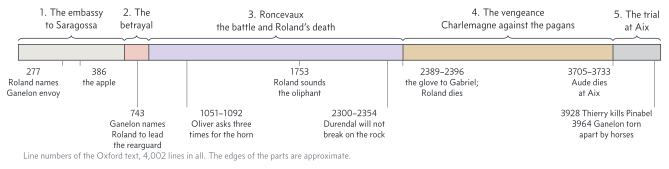
The embassy and the betrayal
The story moves through five parts (Figure 11.3). It opens with a trick. Marsila sends envoys promising that if the Franks go home, he will follow them to Aix and become a Christian. He means to break the promise. Charlemagne’s lords debate whether to trust him, and someone must carry the emperor’s answer to Saragossa. The last two Frankish envoys sent there were beheaded. Roland proposes his stepfather, Ganelon, and Ganelon, sure he is being sent to die, swears revenge on Roland, on Oliver, and on all the twelve.
On the road Ganelon falls in with Marsila’s crafty adviser, Blancandrin (blahn-kahn-dran), and tells him a story to show how proud Roland is. Once, he says, as Charlemagne sat in the shade, Roland came to his uncle holding a red apple, and offered it as the crowns of all earth’s kings.This character presents an apple to a king as the "crown of every earthly king." → Roland (or Orlando)•• In C. K. Scott-Moncrieff’s translation of 1919, Roland says, “Of all earth’s kings I bring you here the crowns.” Such pride, Ganelon says, will be the death of Roland, and when he is dead there will be peace.
At Saragossa Ganelon makes his bargain and betrays his stepson Roland to King Marsila.This character’s stepfather Ganelon betrays him to King Marsila of Saragossa. → Roland (or Orlando)••• Charlemagne will leave a rearguard to hold the mountain passes while his army crosses into France, and Ganelon will see that Roland commands it. Marsila’s whole army can fall on the rearguard and destroy it, and with Roland dead, Ganelon promises, Charlemagne will have lost his right arm. Ganelon rides home laden with Marsila’s gifts of gold and furs and tells Charlemagne that the peace is made. When the emperor asks who should lead the rearguard, Ganelon names his stepson, Roland. Roland cannot refuse without seeming a coward, and he takes the post proudly, with Oliver, the other ten of the twelve, and twenty thousand men.
Roncevaux
The main army winds north through the passes, and Charlemagne weeps: a dream has shown him Ganelon breaking his spear, and he fears for Roland. Behind it, Roland rides into the ambush at Roncevaux that will kill him.This character dies in an ambush at Roncevaux Pass. → Roland (or Orlando)••• The Spanish call the pass Roncesvalles, and there the road climbs between dark rocks and deep, shadowy valleys. He stands in the pass with his twenty thousand men, and they hear the trumpets of an army they cannot yet see. Oliver, Roland’s friend and comrade in arms,This character is a friend of Oliver. → Roland (or Orlando)• climbs a hill to look. From the hilltop he sees the enemy filling the valleys, four hundred thousand men by the poem’s count, and he knows that Ganelon has betrayed them. The two friends do not agree on what to do.
Roland carries an oliphant (ol-ih-fant), a hunting horn carved from an elephant’s tusk, and its call could bring Charlemagne back. Three times Oliver begs him to sound it. Three times Roland refuses. To call for help would shame his family and dulce France, “sweet France,” as the poet always calls it. “Shall it be said by any living man,” he cries in Scott-Moncrieff’s version, “That for pagans I took my horn in hand!” The poet sums up the quarrel in one line, Rollant est proz e Oliver est sage: “Roland is brave, and Oliver is wise.” Both are right, and the poem does not choose between them. The poet tells the quarrel in three laisses in a row, each repeating the same plea and the same refusal in slightly different words, like a scene filmed three times from three angles, and the repetition makes the listener feel the minutes slipping away.
The battle goes well for the Franks at first, and terribly after that. The archbishop of Reims, Turpin, fights in armor beside the knights. Before the battle he blesses the Franks and promises that any who die will be martyrs in Paradise, and he kills the enemy with his own sword. Wave after wave comes down the valley until only sixty Franks are left alive. Now Roland wants to blow the horn, and now Oliver turns on him: it is too late, and it would be a disgrace. Turpin rides between them and ends the quarrel. Archbishop Turpin advises Roland to soundArchbishop Turpin advises this character to sound the oliphant. → Roland (or Orlando)• it anyway, not to save their lives but so that Charlemagne will come back, avenge them, and bury them, and no dogs or wolves will eat their bones.

Roland puts the horn to his lips and blows with all his strength (Figure 11.4). Blood leaps from his mouth, and the temples of his head burstThis character dies after blowing his oliphant horn so hard that his temples burst. → Roland (or Orlando)••• with the effort. Thirty leagues away Charlemagne hears it and knows that his men are fighting. Ganelon answers that Roland is only out hunting, and would blow his horn all day for a single hare. But the horn sounds again, and the emperor arrests Ganelon and hands him over to the army’s cooks, who shave his beard, beat him, and chain him like a bear. Then Charlemagne turns his army back toward the pass.
He is too late. Oliver, blinded by his own blood, strikes Roland on the helmet by mistake, asks his forgiveness, and dies. Turpin is dying too. When Roland faints, the old archbishop takes the oliphant and staggers off to fetch him water from a stream, and falls dead before he has crossed an acre of ground. Roland is alone and dying of the wound he gave himself with the horn. Above all he fears that his sword will fall into the hands of his enemies. It is the sword Durendal (dur-en-dal), whose golden hilt holds relics:Durendal is one of these weapons. → swords••This figure’s sword Durendal contains relics including St. Peter’s tooth and St. Basil’s blood. → Roland (or Orlando)• a tooth of Saint Peter and the blood of Saint Basil, a Greek bishop of the fourth century, with hairs of Saint Denis and a scrap of the Virgin Mary’s robe. An angel gave it to Charlemagne, and Charlemagne gave it to Roland.
Roland lifts Durendal and strikes a boulder ten times to break it. The steel rings but does not break. He strikes a second rock, and a third, and the rock shatters instead of the sword:This character tries to break his sword Durendal against rocks, but shatters the rocks instead. → Roland (or Orlando)•• “more of it breaks off than I can speak,” in Scott-Moncrieff’s words. A gap in the high Pyrenees is still called the Brèche (bresh) de Roland, “Roland’s Breach,” and a later legend says he cut it with this blow.
Then Roland lies down under a pine tree, with the sword and the horn beneath him and his face toward Spain, so that Charlemagne will know he died as a conqueror. He confesses his sins and holds up his right glove to God, as a vassal hands his glove to his lord to show that he owes him his service. The archangel Gabriel takes Roland’s right gloveThis character gives his right glove to the archangel Gabriel upon his death. → Roland (or Orlando)• from his hand, and angels carry his soul to Paradise. Painters of later centuries showed him lying dead with his horn and his sword (Figure 11.5).

The vengeance and the trial
Charlemagne arrives to find the valley full of dead. He prays, and God holds the sun still in the sky so that he can chase the fleeing army before dark, and they drown by thousands in the Ebro. Then a second enemy comes. Baligant (bal-ih-gant), the emir of “Babylon,” which probably means Cairo, brings all the armies of the east to Marsila’s aid. Charlemagne kills him in single combat, and Saragossa falls. Marsila, whose right hand Roland cut off in the battle, dies of grief and his wound, and his widow, Queen Bramimonde (bram-ih-mond), is taken to France as a captive.
At Aix a lady comes to meet the emperor. It is Aude, Oliver’s sister, and she asks where Roland is, who swore to marry her. Weeping, Charlemagne tells her that Roland is dead and offers her his own son Louis instead. She answers that she will not outlive Roland. Aude falls dead of griefThis character's betrothed Aude dies of grief after learning of his death. → Roland (or Orlando)•• at the emperor’s feet, and he has her buried in a convent with honor.
Then comes the trial. Ganelon argues that he took his revenge on Roland in the open, after declaring it, and that revenge is not treason. The barons who are to judge him are afraid of his friend Pinabel (pin-uh-bel), a huge, strong knight who stands ready to fight anyone who calls Ganelon a traitor. One by one they advise the emperor to let him go. Only Thierry (tyeh-ree), a slight, dark knight, speaks against him. Whatever Roland had done, he says, Roland was serving the emperor, and to destroy the emperor’s man is to betray the emperor.
The case is settled by trial by combat, a duel in which God was believed to give victory to the side that was in the right. Thierry defeats Pinabel in a duelIn this poem, Thierry defeats Pinabel in a duel. → The Song of Roland• that everyone expects him to lose, splitting the big man’s helmet and skull, and the Franks cry that God has shown the truth. The barons now give their verdict, and the punishment is terrible. Thirty of Ganelon’s kinsmen, who had stood as pledges for Pinabel, staking their own lives on his cause, are hanged. Ganelon is torn apart by four horses,In this poem, Ganelon is executed by being torn apart by horses. → The Song of Roland•• one tied to each arm and leg, and driven toward a stream. Bramimonde is baptized and takes the name Juliana. That night the angel Gabriel appears to Charlemagne in a dream and calls him to a new war, to help a Christian king besieged in his city. The old emperor weeps and tears his white beard. In Scott-Moncrieff’s version, “God!” said the King: “My life is hard indeed!” The poem ends there.
The Matter of France
Roland’s song was one of many. About 1200 the poet Jean Bodel (boh-del), of Arras in northern France, said that a storyteller had only three subjects to choose from. There was the Matter of Rome, the stories of Troy, Alexander, and Caesar; the Matter of Britain, the tales of King Arthur and his knights (Vol. 8, The Northern Worlds); and the Matter of France. The Matter of France is the legends of Charlemagne and his Twelve Peers,Legends about this ruler and his Twelve Peers comprise the Matter of France. → Charlemagne• the douze pairs, the lords of his court who fought beside him. The Peers were also called paladins, from the Latin palatinus, “a man of the palace,” and they played the part that the Round Table played for Arthur.
The names of the twelve change from poem to poem, but Roland and Oliver are always among them, and Archbishop Turpin and Ogier (oh-zhee-ay) the Dane are often added. In The Song of Roland Ogier leads a division of Charlemagne’s army against Baligant. About 1220 he got a poem of his own, the Chevalerie Ogier, in which Charlemagne’s son Charlot kills Ogier’s son over a game of chess. Ogier turns rebel and fights the emperor for years, until Charlemagne needs him against a Muslim invasion. Later romances carried Ogier to Avalon (Vol. 8, The Northern Worlds), and the Danes made him a hero who sleeps under Kronborg Castle until Denmark needs him.
Other families of songs gathered around other heroes. One cycle followed William of Orange, a fierce warrior with a short nose who fights the Muslims in the south of France and ends his days as a monk. Behind him stands a real man, William of Gellone (zheh-lon), a cousin of Charlemagne who ruled Toulouse for him, founded a monastery in 804, and was later made a saint. Another cycle told of rebels. In The Four Sons of Aymon (eh-mohn), the knight Renaud de Montauban (reh-noh duh mohn-toh-bahn) and his three brothers defy Charlemagne for years, riding all four at once on their magic horse, Bayard. In these later poems the emperor is often unjust or foolish, and the hero’s quarrel is with his own lord.
The strangest of the Charlemagne poems is comic. In The Pilgrimage of Charlemagne, written about 1140, the emperor puts on his crown and asks his queen whether she has ever seen a king who wore a crown so well. She answers that she knows one who wears it better, and Charlemagne makes a pilgrimage after his wife praises Hugo the Strong,This ruler undertakes a pilgrimage after his wife claims Hugo the Strong wears a crown better than him. → Charlemagne• the emperor of Constantinople. In a rage, Charlemagne sets out with the twelve Peers, ostensibly for Jerusalem, where the patriarch gives them holy relics. Then they ride on to Constantinople to see this Hugo for themselves.
Hugo the Strong is an invented emperor, and the poet gives him a fairy-tale city. He is found plowing his field with a golden plow, and his palace turns round like a wheel when the wind blows. That night the Franks drink too much and make wild boasts. Archbishop Turpin brags that he can juggle apples while standing on the backs of galloping horses. Hugo has hidden a spy in their room, and in the morning he demands that they make good their boasts or pay for them. The Franks pray before their relics, and with God’s help the boasts Hugo chooses to test come true. Hugo becomes Charlemagne’s vassal, and when Charlemagne goes home, he forgives his wife. The poem survived in a single manuscript in the British Museum, and that manuscript was lost in 1879, so every modern edition rests on a printed copy made before then.
The Matter of France crossed every border. A German priest put the Roland into German about 1170, and Norwegians retold the Charlemagne stories in a prose saga. In the late Middle Ages German cities set up stone statues of Roland in their marketplaces as signs of their freedom, the most famous at Bremen in 1404. Italian poets called him Orlando, and as Orlando he went mad for love in Ludovico Ariosto’s (loo-doh-vee-koh ah-ree-os-toh) Orlando Furioso of 1516 (Vol. 10, Rebirth).
Troubadours and the court of love
In the southern half of France, people spoke a different language. The Florentine poet Dante, whose life Chapter 18 will tell, later sorted the Romance languages by the word each used for “yes.” Italians said sì. In the north of France they said oïl, the ancestor of modern oui. In the south they said oc, and so the southern tongue was called the langue d’oc (lahng dok) and the northern the langue d’oïl (lahng doh-eel). The southern language is now called Occitan, and older books call it Provençal, after Provence. It is still spoken by old people in the villages of southern France (Figure 11.6).
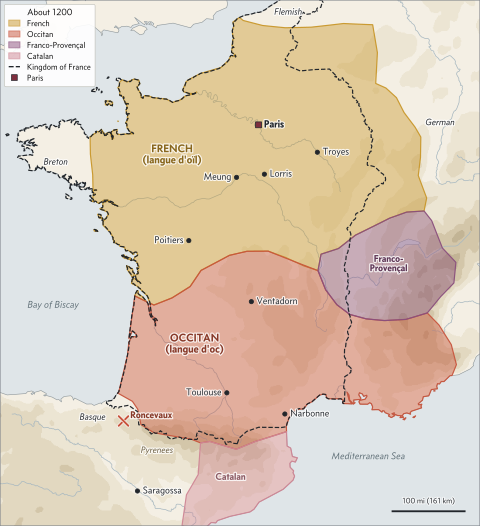
From the late eleventh century the castles of the south were full of song. A troubadour, from the Occitan verb trobar, “to find” or “to invent,” was a poet who composed songs in Occitan, words and melody together. The troubadours sang in Old Occitan,Medieval troubadours sang songs in an earlier form of this language. → Occitan• and many of them sang their own songs, while others had jongleurs perform them. About 450 troubadours are known by name, and about 2,500 of their poems survive, but only about one in ten survives with its music. The commonest song was the canso, a love song in five or six stanzas. A sirventes attacked a rival lord or praised a war, a tenso was a debate between two poets, and in an alba, a dawn song, a friend on watch warns two lovers that the sun is rising. Women composed songs too, and they are called trobairitz (troh-by-reets). Only one of their melodies survives, a song of a woman wronged by her lover, by the poet known as the Countess of Die.
The first troubadour whose songs survive was a duke. William IX of Aquitaine (1071–1126), count of Poitou, led an army on the crusade of 1101 and lost nearly all of it to the Turks in Anatolia. Eleven of his songs survive, some coarse and boastful, some grave, and one of them is a sad farewell to the pleasures of the world. His granddaughter was Eleanor of Aquitaine (Chapter 10), and troubadours found patrons at her courts in France and England.

The greatest troubadour was said to be the son of a servant. According to a short life written in the next century, Bernart de Ventadorn (ven-tah-dorn) was the son of the baker at the castle of Ventadorn, in the hills of the Limousin. He fell in love with the lady of the castle, wife of his lord, and had to leave. His own songs suggest he then went to Eleanor’s court and followed her to England. Forty-five of his songs survive, eighteen with their melodies, more than for any other troubadour of his time. In the most famous, Can vei la lauzeta mover, “When I see the lark beat its wings,” a lark flies up into the sunlight for joy and falls. The singer wishes he could be so happy, and he cannot, because the lady he loves does not love him.
Bernart’s life story is one of the vidas, short lives of the troubadours written in Occitan in the thirteenth century, often a hundred years after their subjects died. Many were spun out of the songs themselves. The vida of Jaufre Rudel (zhoh-freh roo-del), lord of Blaye (bly) on the Gironde, says that he fell in love with the Countess of Tripoli, in the crusader states, from what pilgrims told of her, though he had never seen her. He took the cross to reach her, fell ill on the voyage, and was carried ashore at Tripoli dying, and the countess came down from her castle so that he died in her arms. The story grew from Jaufre’s own songs of amor de lonh, “love from afar,” and from his death on the Second Crusade in 1147 or soon after. There is no sign that he ever met her.
The troubadours sang of fin’amor, “refined love,” which the French scholar Gaston Paris named amour courtois, courtly love, in 1883. The singer is a knight or a poet of lower rank, and the lady he loves is usually married and above him. He serves her as a vassal serves his lord, waits for a word or a look, and is made better by his longing. The idea spread north to the trouvères, the poets of northern France, and to the German Minnesingers, the “love singers.” The poet Chrétien (kray-tyan) de Troyes built his romance of Lancelot and Guinevere, The Knight of the Cart, around it at the court of Eleanor’s daughter, Marie, Countess of Champagne (Vol. 8, The Northern Worlds). These chivalric romances, long tales in verse of adventure and love, soon became more popular than the old war songs. Chivalric comes from chevalier, the French for “knight,” and the heroes of these romances were knights,These people are the subjects of chivalric romances. → knights• armed horsemen who ride out alone on quests for the sake of their ladies.
About 1185 a chaplain, probably at Marie’s court in Troyes, wrote the rulebook. Andreas Capellanus, “Andrew the Chaplain,” wrote a Latin treatise called De Amore (day ah-mor-ay), “On Love,” in the form of lessons to a young friend named Walter. It defines love, gives sample speeches for wooing ladies of every rank, and lists thirty-one rules, of which the first says that marriage is no excuse for not loving. It also reports twenty-one “judgments of love” given by great ladies. Among the judges are Marie herself, the Viscountess Ermengarde (er-men-gard) of Narbonne, and Queen Eleanor. In one case Marie rules, in a letter Andreas dates to 1174, that true love cannot exist between a husband and wife. The book ends by telling Walter to give love up altogether.
From these pages grew a legend. Eleanor lived at Poitiers from 1168 to 1173, ruling Aquitaine for her husband, Henry II of England. Later writers pictured her and Marie presiding there over a “court of love,” where knights and ladies brought their quarrels to be judged. Andreas’s De Amore inspired the legend of Eleanor’s courtAndreas Capellanus’s De Amore helped inspire the legend of this woman’s “Court of Love” at Poitiers. → Eleanor of Aquitaine•• of love at Poitiers, and nineteenth-century historians took such courts as fact. But the American historian John F. Benton pointed out that none of the many letters, chronicles, and songs of the time mentions one. Andreas may have been joking; his book reads as much like a satire as a manual. Nothing shows that Eleanor ever sat in judgment on a lover.
Reynard
While knights and ladies sighed over courtly love, another kind of story mocked them. A beast epic is a long comic tale whose characters are animals who talk, scheme, and hold court like barons. The first great one was a Latin poem of 6,574 lines written in or near Ghent, in Flanders, in 1148 or 1149. It is called the Ysengrimus (ee-zen-gree-mus) after its wolf, a greedy monk whom the fox tricks again and again, and it was the first book to give the two animals the names they kept. About 1170 a French poet, Pierre de Saint-Cloud, began a cycle in French, the Roman de Renart, the “Romance of Renart,” and other poets added “branches” to it for eighty years.
Reynard the trickster is a fox,The medieval trickster Reynard is one of these animals. → fox• Renart (ruh-nar) in French, who lives by his wits in his castle of Maupertuis and lies his way out of every trap. His great enemy is his uncle, Isengrim (ee-zen-grim) the wolf, who is strong and stupid. Their king is Noble the lion, who holds court like a French king, with Bruin the bear and Tibert the cat among his barons. In one branch Isengrim brings Reynard to trial for his crimes, and the court sends Bruin to fetch him. Reynard leads the bear to a split log, tells him there is honey inside, and pulls out the wedges, so that the log snaps shut on Bruin’s head. In another, Reynard persuades Isengrim to fish through a hole in a frozen pond with his tail, and when the ice freezes around the tail, a huntsman’s sword cuts it off as the wolf struggles to escape.

The stories parody the chansons de geste and the romances. Reynard’s trial copies Ganelon’s, and the animals talk of honor and vassalage while they cheat and eat each other. The fox was so popular that his name changed the French language. The old word for fox was goupil (goo-peel), from the Latin vulpecula, “little fox,” but people came to call every fox a renard, and renard is still the French word for fox. The tales spread to the Low Countries and Germany. In England, Chaucer’s Nun’s Priest borrowed one of them for his tale of the rooster Chanticleer and the fox (Vol. 8, The Northern Worlds), and England’s first printer, William Caxton, printed an English History of Reynard the Fox in 1481.
The marginal snails
The comedy of the fox spilled onto the pages of books. In the Gothic manuscripts of the late thirteenth and fourteenth centuries, the margins around the text and the miniatures, the small paintings in the page (Vol. 1, The Toolkit), filled up with jokes. Painters drew monkeys dressed as bishops, rabbits hunting hunters, foxes preaching to geese, and creatures half man and half fish. These marginal pictures are called drolleries, from the French drôlerie (droh-luh-ree), “a joke.” They often appear beside the holiest words in the book, in psalters and prayer books.
One joke appears again and again. A knight in full armor, sometimes on horseback with his lance lowered, attacks a snail, or kneels to it, or runs from it. Dozens of examples survive, most of them in manuscripts made about 1290 to 1310 in northern France and Flanders, the region art historians call Franco-Flemish. Nobody wrote down what the joke meant, and modern scholars have offered many guesses. Perhaps the snail’s shell looked like armor, so that the knight was fighting his own likeness. Perhaps the snail, coming out of its shell, stood for the Resurrection, when, Christians believe, Jesus rose from the tomb. Or perhaps the bravest men were simply being shown afraid of the slowest animal alive.

In 1962 the American art historian Lilian Randall offered the best-known answer. The Lombards, the people of northern Italy who gave their name to Lombardy (Chapter 4), had by then given their name to something else. In France and Flanders a “Lombard” was any Italian merchant, banker, or pawnbroker, and Lombards were resented as greedy moneylenders. Randall pointed out that writers of the time also mocked them as cowards, and she suggested that the snails stood for the Lombards.Lilian Randall suggested these animals, fought by knights in medieval Franco-Flemish manuscript margins, represented the Lombards. → snails• On her reading, the joke was a sneer at Lombard cowardice. Not every scholar agrees, but her article made the snails famous.
Le Roman de la Rose
About 1230 a young man from Lorris, a small town near Orléans, began a poem in French about a dream. We know almost nothing of Guillaume de Lorris (gee-yohm duh lor-ees), not even his dates, except what the poem tells us and what its second author said of him. His poem is a dream vision, a poem in which the poet falls asleep and dreams of a garden or a journey (Vol. 8, The Northern Worlds). It is also an allegory (Vol. 1, The Toolkit): its characters are not people but ideas, Idleness, Reason, and Shame, who walk and talk like people. The title is Le Roman de la Rose (roh-mahn duh lah rohz), The Romance of the Rose. The poet says that the whole art of love is enclosed in it.
“’Twas in my twentieth year of age,” the poet begins, in F. S. Ellis’s translation of 1900, “When Love doth all young hearts engage.” He dreams that it is May. He rises, washes, and walks out of town along a river, and he comes to a walled garden in his dream.This poem describes a dream vision in a walled garden. → Le Roman de la Rose•• On the outside of the wall are painted figures of the things shut out of the garden, among them Hate, Avarice, Envy, Sorrow, Old Age, Hypocrisy, and Poverty. He walks all the way around before he finds a small door. He knocks, and a beautiful lady named Idleness opens it (Figure 11.10).

Inside, Mirth and his company are singing and dancing. The God of Love follows the dreamer with his bow and arrows. At the fountain where Narcissus died for love of his own reflection (Vol. 4, Classical Myth), the dreamer looks into the water. In two crystals at the bottom he sees the whole garden reflected, and among the reflections a bed of roses. He picks out a single bud and loves it at once. At that moment Love shoots him, and the dreamer, now the Lover, kneels and swears himself Love’s vassal. Love locks his heart with a little golden key and gives him his commandments: to avoid coarse words and slander, to honor all women, to dress well and keep clean, and to be cheerful and generous. For comfort in his pains Love leaves him Hope and three gifts, which Ellis calls Sweet-Thought, Soft-Speech, and Sweet-Looks.
The Rose stands for the lady he loves. A gentle youth named Fair Welcome lets him come near it, but Danger, Shame, and Fear drive him off, and Reason tells him to give up. When he steals a kiss, Jealousy builds a castle around the roses and shuts Fair Welcome in a tower. Guillaume de Lorris began the Roman de la Rose,This author began Le Roman de la Rose. → Guillaume de Lorris•• but after 4,058 lines he stopped, with the Lover weeping outside the castle wall. Perhaps he died young.
About forty-five years later, around 1275, another poet took it up. Jean de Meun (zhahn duh muhn) was born Jean Clopinel at Meung-sur-Loire, on the Loire west of Orléans, about 40 miles from Lorris, and lived in Paris, in a house with a tower and a garden in the Rue Saint-Jacques. He was learned, sharp-tongued, and the opposite of Guillaume in temper. Jean de Meun continued the Roman de la RoseThis author continued Le Roman de la Rose. → Jean de Meun•• for 17,724 more lines, more than four times as long as the first part. Halfway through, the God of Love himself foretells the book’s two authors: Guillaume will begin it, and Jean will finish it some forty years after Guillaume’s death. That passage is nearly all we know of Guillaume.
Jean kept the story and filled it with arguments. Reason gives a long lecture on love, fortune, and justice. False Seeming, a hypocrite dressed as a friar, mocks the friars of Paris. An Old Woman tells Fair Welcome how to cheat men, and Nature and her priest Genius lecture on how the world goes on. Jean poured in science, classical myth, and attacks on women and on marriage. At last Love’s army storms the castle, and the Lover reaches the Rose and plucks it. Then the dreamer wakes.
Jean also translated Boethius’s Consolation of Philosophy (Chapter 2) into French, and the letters of the Paris teacher Peter Abelard and his pupil Héloïse (ay-loh-eez), whose story Chapter 12 will tell. The Rose became one of the most widely read books in Europe. About three hundred manuscripts survive, one of the largest numbers for any book of the Middle Ages that is not a religious work.
What to remember
- The Song of Roland, composed about 1100 and kept in the Oxford manuscript Digby 23, is the oldest and greatest chanson de geste, a French “song of deeds” in assonanced laisses. Its last line names Turoldus.
- Roland, Charlemagne’s nephew and the chief of his twelve paladins, leads the rearguard after his stepfather Ganelon betrays it to King Marsila of Saragossa. Ganelon had told how Roland offered his uncle an apple as the crowns of all kings.
- At Roncevaux Roland refuses Oliver’s pleas to blow his oliphant, then sounds it on Turpin’s advice until his temples burst. Durendal, with its relics, shatters rock but will not break; Gabriel takes Roland’s glove.
- Aude dies of grief; Thierry defeats Pinabel in trial by combat; Ganelon is torn apart by horses.
- The Matter of France is the legends of Charlemagne and his Twelve Peers. In The Pilgrimage of Charlemagne he goes east because his queen says Hugo the Strong wears a crown better.
- The troubadours sang in Occitan, the langue d’oc. William IX of Aquitaine is the first whose songs survive, and Bernart de Ventadorn the most famous.
- Andreas Capellanus’s De Amore (about 1185) gave rise to the legend of Eleanor’s court of love at Poitiers, which no record supports.
- Reynard the fox mocks the court of King Noble the lion; renard became the French word for fox.
- Knights fighting snails fill the margins of Franco-Flemish manuscripts; Lilian Randall argued in 1962 that the snails meant the Lombards.
- Guillaume de Lorris began the Roman de la Rose, a dream allegory of a walled garden, about 1230; Jean de Meun finished it about 1275.
Chapter 12 · 25 clues
Schools and Cathedrals
About the year 1122 a monk in disgrace built himself a little chapel of reeds and stalks in a field near Nogent-sur-Seine, some 60 miles southeast of Paris. He was Peter Abelard, until lately the most famous teacher in Europe, and he had come to the wilderness to be left alone. He was not left alone for long. “No sooner had scholars learned of my retreat,” he wrote ten years later, in Henry Adams Bellows’s translation, “than they began to flock thither from all sides, leaving their towns and castles to dwell in the wilderness. In place of their spacious houses they built themselves huts.” Young men slept on straw and ate coarse bread to hear him argue.
That hunger for argument was new, and so was the place that fed it. Between the 1070s and the 1250s the schools of northern France, above all those of Paris, taught Europe to reason its way through questions of faith, while builders a few miles away taught stone to stand on thin pillars between walls of colored glass. The two stories ran side by side and sometimes crossed. The abbot who began the first Gothic church was the man who had let Abelard go to his field, and the bishop who began the cathedral of Notre-Dame in Paris had made his name as a teacher in the Paris schools.
Anselm and the ontological argument
The first of the great arguers was as gentle as Abelard was fierce. Anselm was born about 1033 at Aosta (ah-oss-tah), a town in the Alps below the Great Saint Bernard Pass, the son of a Lombard nobleman. At twenty-three, after his mother’s death and years of quarrels with his father, he left home with a single companion and crossed the mountains. In 1059 he reached the abbey of Bec (bek) in Normandy, drawn by its famous teacher, Lanfranc, another Italian, who later became William the Conqueror’s archbishop of Canterbury. He became a monk there the next year, its prior, the abbot’s deputy, in 1063, and its abbot in 1078. Under him Bec became the most admired school in Europe. Anselm summed up his method in three Latin words, fides quaerens intellectum (fee-dess kwy-renz in-tel-lek-tum), “faith seeking understanding.” He already believed in God. He wanted to understand by reason what he held by faith.

His life shows why one shared language mattered. Anselm grew up in the Alps, spent thirty-four years among the French-speaking monks of Normandy, and died in England. Yet Anselm wrote in Latin,Anselm wrote in this language. → Latin• every book and almost all of his nearly five hundred surviving letters. Latin had been the language of the Roman Empire, and the western Church kept it alive as its own, as the Stage explained. Hardly anyone spoke it at home, but the Bible, the Mass, and every book of learning were in it. A monk in Normandy could therefore write for readers in Italy, Germany, or England, and every thinker in this chapter did the same.
His friend and secretary, an English monk named Eadmer, wrote Anselm’s life soon after his death, and he tells how Anselm’s most famous argument was born. Anselm had already written one book of proofs about God, the Monologion (mon-uh-loh-jee-on), a long chain of reasoning in which each step leaned on the last. He wanted instead a single argument that needed nothing but itself. The search so possessed him that he could hardly eat or sleep, and he began to fear it was a temptation of the devil. Then one night, during the monks’ service before dawn, the whole argument came to him at once. Eadmer adds that the wax tablets on which Anselm first wrote it out went missing, and that a second set was found smashed on the floor, so he had the work copied onto parchment. The little book, written in 1077 and 1078, is called the Proslogion (pross-loh-ghee-on), Greek for “an address,” because it is spoken to God as a prayer.
Anselm took his opponent from the Psalms: “The fool hath said in his heart, There is no God” (Psalm 14, in the King James Version). Can the fool say it and make sense? Anselm began from a definition. God, in the words of Sidney Norton Deane’s translation of 1903, is “a being than which nothing greater can be conceived”: nothing greater can even be thought of. Philosophers now call the proof that starts from this definition the ontological argument,Anselm’s version of this argument starts from a being than which nothing greater can be conceived. → ontological argument••• from the Greek on, “being,” because it reasons from what God is and never looks at the world at all. The German philosopher Immanuel Kant gave it that name in 1781 (Vol. 14, From Luther to Mozart). The steps are short enough to follow one at a time.
The first reply came from another monk, Gaunilo (gaw-nih-loh) of Marmoutier (mar-moo-tyay), an abbey near Tours on the Loire. Almost nothing else is known about him. In a short book called On Behalf of the Fool, he ran Anselm’s steps on something absurd. People say, Gaunilo wrote, that somewhere in the ocean lies an island richer than any other, called the Lost Island because no one can find it. Define it as the greatest island that can be conceived. You understand the words, so it exists in your mind, and an island that exists in reality would be greater, so by Anselm’s steps it must exist. Gaunilo said that he would not know whether to think the man who offered him such a proof was joking, or which of the two of them was the bigger fool. Gaunilo’s “lost island”Gaunilo’s “lost island” analogy objects to this argument. → ontological argument•• became the classic objection to the ontological argument: an argument that can prove a perfect island into being must have a faulty step somewhere, even before anyone can say which one (Figure 12.2).

Anselm answered that an island is a bad comparison. An island is the kind of thing that can come to be and pass away, so it can always be thought of as not existing; his argument, he said, works for one being only, the one that cannot even be thought not to exist. Then he did something generous. He asked that Gaunilo’s attack and his own answer be copied with every copy of the Proslogion, so that readers could judge for themselves. They have been judging ever since. Thomas Aquinas would reject the argument (Chapter 15), and Kant would object that existing adds nothing to the idea of a thing: a hundred real coins contain not one coin more than a hundred imagined ones.
Anselm’s quiet years ended in 1093. William Rufus, the son of William the Conqueror (Vol. 8, The Northern Worlds), had kept the archbishopric of Canterbury, the highest office in the English Church, empty for four years so that its income came to him. When he fell gravely ill and feared to die with that on his conscience, he named Anselm, who happened to be in England. The churchmen at court forced the archbishop’s staff, the crozier, into his fist and carried him into a church while he protested. He was right to dread the office. He quarreled with Rufus and then with Rufus’s younger brother, King Henry I, over the rights of the Church, spent two long exiles abroad, and died at Canterbury on April 21, 1109. He was later canonized, and in 1720 the pope named him a Doctor of the Church, one of the teachers whose writings the Catholic Church honors above all others.
Abelard and Héloïse
Peter Abelard was born in 1079 at Le Pallet (luh pah-lay), a village in Brittany near Nantes, the eldest son of a knight named Berengar. He should have become a soldier. Instead, as he wrote, “I fled utterly from the court of Mars that I might win learning in the bosom of Minerva”: he left the god of war for the goddess of wisdom, and his inheritance to his younger brothers. His weapon was dialectic, the art of logical argument, which students learned from Aristotle’s books on logic in the Latin of Boethius (Chapter 2). “To the prizes of victory in war I preferred the battle of minds in disputation,” he said, and he wandered from school to school looking for fights.
In Paris he studied under William of Champeaux (shahn-poh), the most admired master of the cathedral school, and soon humiliated him. Their quarrel was over the problem of universals. When we call both Socrates and Plato “human,” does the word name one real thing that the two men share, or only a likeness between two separate men? William said one real thing. Abelard showed that one thing would then stand in two places at once, and William had to change his view. Abelard opened rival schools at Melun (muh-luhn) and Corbeil, outside Paris, and then on the hill of Sainte-Geneviève (zhuhn-vyev) on the Left Bank, the south side of the Seine. In 1113 he went to Laon (lahn) to study the Bible under its aged master, Anselm of Laon, a different man from Anselm of Canterbury. Abelard decided that when this teacher “kindled a fire, he filled his house with smoke and illumined it not at all,” and began lecturing against him. By about 1115 he was master of the cathedral school of Notre-Dame in Paris, the most famous teacher in Europe.
Within the cathedral’s cloister, the walled close where its clergy had their houses, lived Héloïse, the niece of one of its canons (the Stage), a priest named Fulbert. She was young and already famous for her learning, in an age when few women outside a convent read Latin at all, and Abelard called her “the most worthy of renown in the entire kingdom.” He tells us, without excusing himself, that he set out to win her. He persuaded Fulbert to take him into his house as a lodger and as her tutor, and became her lover. His lectures grew careless, and he wrote love songs that, he says, “have been sung in many lands.” When Héloïse found that she was pregnant, he carried her off to his sister in Brittany, where she bore a son and named him Astrolabe, after the instrument astronomers used to measure the height of the stars.
To calm the furious Fulbert, Abelard offered to marry her, on one condition: the marriage must stay secret, since a wife would end his hopes of rising in the Church. Héloïse argued against marrying at all. What concord could there be, she asked in Bellows’s translation, “between authors and cradles”? Love alone should hold him to her, she said, not the chain of marriage. She gave way, and their love affair became a marriage: about 1117, before a few witnesses in Paris, Abelard secretly married Héloïse.This philosopher had a love affair with and secretly married Héloïse. → Peter Abelard•• Fulbert’s household soon spread the news, and when Héloïse denied it, her uncle beat her. Abelard moved her to the convent at Argenteuil (ar-zhahn-toy), northwest of Paris, where she had been brought up. Fulbert concluded that Abelard meant to be rid of her. One night his kinsmen bribed a servant, broke into Abelard’s room, and castrated him. Two of the attackers were caught and punished with blinding and the same mutilation. In his shame Abelard became a monk at the royal abbey of Saint-Denis, and at his bidding Héloïse took a nun’s vows at Argenteuil.

About 1132 Abelard told the whole story in a long letter addressed to an unnamed friend in trouble, to show him a man worse off than he was. Its title is Historia Calamitatum (his-tor-ee-uh kal-uh-mih-tah-tum), “The Story of My Misfortunes,” and in it Abelard recounted his love for HéloïseThis philosopher recounted his relationship with Héloïse in the autobiographical letter Historia Calamitatum. → Peter Abelard•• with a frankness about his own pride and lust that hardly any medieval writer allowed himself. It is one of the very few true autobiographies written between Augustine’s Confessions (Vol. 7, The Romans) and the Renaissance. A copy reached Héloïse, and her answer began an exchange of letters that are now as famous as the story itself. She refused to repent of her love, and told him plainly that she had become a nun at his command, not God’s.
Abelard’s troubles did not end in the cloister. In 1121 a council of bishops at Soissons condemned his book on the Trinity, the Christian teaching that God is one God in three persons, and made him throw it into the fire with his own hand. Back at Saint-Denis he infuriated the monks by citing a passage of the English historian Bede that cast doubt on the abbey’s proudest claim, that its patron, Saint Denis of Paris, was the Dionysius whom Saint Paul had converted at Athens. He fled. After the old abbot died in 1122, the new one, Suger, let him live wherever he liked, provided he joined no other abbey. So he came to the field near Nogent and the chapel he named the Paraclete (pair-uh-kleet), a Greek name for the Holy Spirit as comforter. Other churchmen attacked him for teaching worldly subjects while he was a monk. About 1127 he left to become abbot of Saint-Gildas, a remote monastery on the coast of Brittany whose unruly monks, he says, tried to poison him. When Suger seized the convent of Argenteuil for his own abbey in 1129 and turned its nuns out, Abelard gave the Paraclete to Héloïse and her sisters, and she ruled it as abbess for the rest of her life.
Meanwhile he wrote the book that taught the schools a method. Sic et Non (sik et nohn), “Yes and No,” begun about 1121 and revised for years, poses 158 questions of Christian belief, from whether faith must be completed by reason to whether God is a single being. Under each question Abelard set passages from the Church Fathers, the great Christian writers of the early centuries such as Augustine and Jerome (Vol. 7, The Romans), whose word stood second only to the Bible’s. He chose the passages so that they clashed: in Abelard’s Sic et Non, the Fathers contradict one anotherThis philosopher wrote Sic et Non. → Peter Abelard••This work sets contradictory statements by Church Fathers against one another on theological questions. → Sic et Non•• on every question. He left the quarrels unsettled, but his prologue gave rules for settling them. Ask whether a text is genuine or a copyist’s mistake, whether one word is being used in two senses, and whether the author changed his mind or was only reporting another man’s opinion. Only when all that fails should one authority be weighed against another. The rest was homework for the students, and the book’s lesson fits in one sentence of its prologue.
The method spread. About 1140 Gratian (gray-shun), a teacher at Bologna, gathered church laws that disagreed and reconciled them in a book that became the textbook of church law. In the 1150s Peter Lombard, a master at Notre-Dame, arranged the Fathers’ opinions on every question of theology in his Sentences. A question, the case for, the case against, and a solution became the shape of teaching in the schools, the method that the Stage called scholasticism, and Thomas Aquinas would carry it to its height (Chapter 15).
Late in life, before 1140, Abelard wrote his Ethics,This philosopher wrote Ethics, or Know Thyself. → Peter Abelard• which he also called Scito te ipsum (skee-toh tay ip-sum), Know Thyself, after the old Greek motto carved at Apollo’s shrine at Delphi. Its argument is that sin lives in the mind. Wanting a forbidden thing is not yet a sin, since no one can help what he desires, and the outward deed adds nothing either. Sin is the inner consent to what one knows is wrong, which Abelard called contempt of God. So the same act can be just or wicked. A judge who sends a murderer to his death out of love of justice does well, and the same sentence passed out of private hatred is a sin. Many readers were shocked that he weighed a man’s intention above his deeds.
His enemies had not forgotten him. Bernard of Clairvaux, the Cistercian abbot who preached the Second Crusade in 1146 (Chapter 8), believed that Abelard was turning the mysteries of faith into puzzles of logic. At a council at Sens (sahnss) in June 1141 Bernard read out a list of his errors. Abelard refused to answer and appealed to Rome, but Pope Innocent II condemned him to perpetual silence. Peter the Venerable, the abbot of Cluny, took him in and reconciled him with Bernard. Abelard died on April 21, 1142, at Saint-Marcel, a small priory of Cluny in Burgundy, and Peter had his body carried secretly to Héloïse at the Paraclete. When she died, more than twenty years later, she was buried beside him. In the 1270s the poet Jean de Meun retold their story in the Romance of the Rose (Chapter 11), and since 1817 a tomb in the cemetery of Père-Lachaise (pair lah-shez) in Paris has claimed their bones.
Saint-Denis and the first Gothic
Suger, the abbot who let Abelard go, was born about 1081 to a family of no great rank and was given to the abbey of Saint-Denis as a boy of about ten. There he was schooled alongside a royal pupil, the future King Louis VI. Elected abbot in 1122, he became the chief adviser of Louis VI and then of his son Louis VII, and while Louis VII was away on the Second Crusade (Chapter 10), from 1147 to 1149, Suger governed France as regent, ruling in the king’s name. His abbey, 6 miles north of Paris, was the most honored in the kingdom. It kept the relics of Saint Denis, the first bishop of Paris, who by tradition was beheaded for his faith in the third century and was venerated as the patron saint of France, and the kings of France were buried there.
Suger complained that the old church was far too small. On feast days, he wrote, the crowds pressed so hard that pilgrims could not move, and some women, trodden underfoot, were lifted up by the men and walked forward over their heads as if on a pavement. He rebuilt the west front first, with three portals, and dedicated it on June 9, 1140. Then he turned to the east end, the choir, where the monks sang their services and the altar stood above the saint’s tomb. His builders wrapped it in a double ambulatory, a curved walkway around the apse along which pilgrims could circle the relics, with a ring of shallow chapels opening off its outer edge. Earlier churches had divided such chapels with walls. Here slender columns did the work, the chapels ran into one another, and each was lit by tall windows, so that a single band of colored light circled the end of the church. Over each section of the walkway rose a rib vault, an arched stone ceiling held up by crossing ribs of stone, built on pointed arches (Vol. 1, The Toolkit). Suger wrote that the whole sanctuary would shine with a continuous light from its windows.


The style was new. The great churches of the 1000s had been built in the style now called Romanesque, with round arches, thick walls, and small windows (Vol. 1, The Toolkit). The style that succeeded the RomanesqueThis style succeeded the Romanesque. → Gothic architecture•• got its later name, Gothic, from Italian writers of the Renaissance who thought it barbarous, as if the Goths had built it. In the Middle Ages it was sometimes called opus Francigenum, “French work.” Its builders combined three devices, and pointed arches, rib vaults, and flying buttressesFlying buttresses, pointed arches, and ribbed vaults characterize this architectural style. → Gothic architecture•• together mark a Gothic church. A pointed arch could rise to any height over any width, and stone ribs carried the weight of each vault down to the columns at its corners. A flying buttress, a half-arch springing from a pier, a massive pillar of masonry outside the church, caught the outward push of a high vault and carried it to the ground. Suger’s choir had the first two but not the third. Its vaults were low enough to be held by heavy buttresses set against the chapel walls, and the flying buttress arrived a generation later, at Notre-Dame in Paris and its neighbors.
On June 11, 1144, King Louis VII and Queen Eleanor of Aquitaine (Chapter 10) came with a crowd of archbishops and bishops to see the new choir consecrated (Figure 12.4). The bishops went home and began to build the same way. That is why Saint-Denis counts as the first Gothic building: the style was pioneered at Saint-Denis by Abbot Suger,This style was pioneered at Saint Denis by Abbot Suger. → Gothic architecture•• though the name of the master mason who actually designed it is lost. Suger chose its look, raised its money, and wrote two books about it, so his name, not the mason’s, is the one attached to it.
Why did Suger want so much light? Part of the answer, the art historian Erwin Panofsky argued in 1946, lay in a mistake that Abelard had dared to question. Suger’s monks believed that their Denis was the same man as Dionysius the Areopagite (air-ee-op-uh-jite), a member of the council of Athens whom Saint Paul converted, and that he had written certain Greek books about God. Those books are now known to be the work of an unknown writer of about AD 500, called the Pseudo-Dionysius, and they describe God as a light that pours down through all creation and draws the mind back up to its source. Some later historians doubt how closely Suger had read those books, but he had verses cast on the gilded bronze doors of his west front that say the same thing of his church.
Not everyone agreed. Bernard of Clairvaux attacked abbots who covered their churches in gold while the poor went hungry, and his Cistercians built plain. Suger answered that nothing was too fine for the service of God. The bishops followed Suger. Within twenty years the cathedrals of the towns around Paris were rising in the new manner: Sens, begun at about the same time as Suger’s choir, then Noyon, Senlis (sahn-lees), and Laon, and in 1163 Paris itself. From that small region, the lands that the French king ruled directly, the “French work” spread over the next century to England, Germany, Spain, and Italy.
Notre-Dame de Paris
Paris began as a town on an island in the Seine, which the Romans called Lutetia (Vol. 3, Geography: Europe, Asia, and Africa). By the 1100s the Capetian kings had made it their chief city (Chapter 10). The island, the Île de la Cité (eel duh lah see-tay), held both halves of its power. The king’s palace stood at its western end and the bishop’s church at its eastern end, where the cathedral of Notre-Dame still stands on the Île de la Cité.This cathedral is located on the Île de la Cité. → Notre-Dame de Paris•• Two bridges joined the island to the banks, the Grand Pont to the Right Bank, where the merchants traded, and the Petit Pont to the Left Bank, where the schools were. Masters taught in the cloister of the cathedral, in the abbey of Saint-Victor, and on the hill of Sainte-Geneviève, and their students crowded the lodgings below (Figure 12.5). In 1200 King Philip II granted the masters and students of Paris their privileges, and their guild became the University of Paris (the Stage).
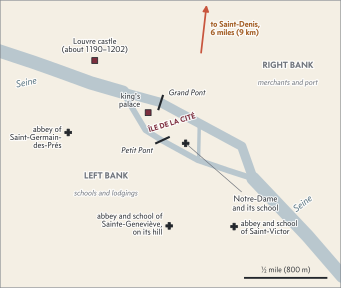
A city may have hundreds of churches but only one cathedral, the church that holds its bishop’s chair (the Stage), and Notre-Dame is the cathedral of Paris.This cathedral is located in Paris. → Notre-Dame de Paris••This city is home to Notre Dame cathedral. → Paris, France•• Like Chartres and many other French cathedrals, it is dedicated to Mary, the mother of Jesus, whom Catholics honor as “Our Lady.” A famous thirteenth-century statue of her stands between the doors at the north end of its transept, the arm that crosses the length of the church. In French “Our Lady” is Notre-Dame, so the building’s full name is Notre-Dame de Paris, and its name means “Our Lady of Paris.”This cathedral's name means "Our Lady of Paris." → Notre-Dame de Paris•
The old cathedral was too small for such a city. In 1160 the bishopric went to Maurice de Sully (soo-lee), the son, tradition says, of poor parents from Sully on the Loire. He had made his name as a teacher and preacher in the Paris schools, and his sermons in plain French were copied for generations. He pulled the old church down, reused its stones, and in the spring of 1163 began a new one. A chronicler of the abbey of Saint-Victor, writing in the 1300s, says that Pope Alexander III, an exile in France during his quarrel with Barbarossa (Chapter 9), laid its first stone in the presence of King Louis VII. It was Bishop Maurice de Sully who oversawBishop Maurice de Sully oversaw the construction of this cathedral. → Notre-Dame de Paris• the work for its first thirty-three years, until his death in 1196, and his successor, Odo of Sully, no relation, carried it on.
The builders began, as cathedral builders usually did, at the east end, so that the clergy would have a choir to sing in as soon as possible, and its high altar was consecrated on May 19, 1182. They built in the new manner of Saint-Denis, on a far larger scale: Notre-Dame was GothicThis style was used at Notre Dame in Paris. → Gothic architecture•• from its first stone. The nave followed, then the west front with its three portals, and last the two towers, 226 feet (69 meters) high, finished about 1250. Figure 12.6 shows the plan. A long nave runs between two aisles on each side instead of one, the transept barely reaches beyond them, and the choir is wrapped in a double ambulatory like Suger’s, at first without his ring of chapels.

Notre-Dame rose higher than any church yet built in France. Its vault stands about 108 feet (33 meters) above the floor, as high as a ten-story building, and to let in light its builders made the upper walls thin and filled them with windows. A thin wall that high could not hold back the outward push of a stone vault by its own weight. So, about 1180, the builders braced the high walls from outside with some of the first flying buttressesThis cathedral was the first to include flying buttresses due to its thin, extremely high walls. → Notre-Dame de Paris• on any great church, and Notre-Dame is often called the first to have them. Laser scans made in the 2010s by the art historian Andrew Tallon showed that the upper walls have hardly moved in eight hundred years, which suggests that the flyers were part of the plan from the start. Most of the flyers seen today are later and larger. In the 1300s the master mason Jean Ravy gave the choir flyers that leap about 50 feet (15 meters) in a single bound (Figure 12.7).


Inside, the cathedral’s glory is its glass. A rose window (Vol. 1, The Toolkit) is a great round window divided by stone tracery into petals, and Notre-Dame has three rose windows.This cathedral has three rose windows. → Notre-Dame de Paris• The west rose, over the main doors, was finished about 1225 and is about 31 feet (9.6 meters) across. In the 1250s and 1260s the masons Jean de Chelles and Pierre de Montreuil (mohn-troy) rebuilt the two ends of the transept. They gave each a rose about 42 feet (12.9 meters) across, so large that the end walls became little more than stone frames around them. The north rose still holds much of its thirteenth-century glass, with the Virgin and Child at its center among the kings and prophets of the Old Testament.
The west front tells its story in stone. Its left portal belongs to the Virgin, the right to her mother, Saint Anne, and the center shows the Last Judgment, the judging of all souls that Christians expect at the end of time. Above the doors stands a row of twenty-eight kings of Judah, Jesus’s ancestors in the Gospel of Matthew. In 1793, during the French Revolution, revolutionaries took them for kings of France and pulled them down, and many of their heads turned up in 1977, buried in the courtyard of a Paris bank.
The cathedral’s voice hangs in the south tower. Notre-Dame’s great bell, Emmanuel,This cathedral is home to the Emmanuel bell. → Notre-Dame de Paris• was cast in 1686 from an older bell given in 1400, melted down and enlarged to twice its weight, and it bears the names of its godparents, King Louis XIV and his queen, Maria Theresa. It took eight men to set it swinging. During the Revolution, when its sister bells were melted down for cannon and coins, Emmanuel was the only large bell spared, and in August 1944 its ringing told Paris that the city was being freed from German occupation.
Victor Hugo’s novel The Hunchback of Notre-Dame (1831), whose hero, Quasimodo, is the cathedral’s bell-ringer, was written partly to save the neglected building, which Paris had thought of pulling down (Vol. 15, The Age of Revolution). In 1844 the architects Jean-Baptiste Lassus and Eugène Viollet-le-Duc (vee-oh-lay luh dook) were put in charge of restoring it. On April 15, 2019, fire destroyed its timber roof and its spire. The stone vaults held, as they had been built to do, except where the falling spire broke through them, and the cathedral reopened on December 7, 2024.
Chartres and its glass
About 50 miles southwest of Paris, on a hill above the river Eure, stands the cathedral of Chartres, also dedicated to Our Lady. It was famous long before it was Gothic. Its school had been renowned since the early 1000s, when its bishop, Fulbert, a different man from Héloïse’s uncle, taught there. John of Salisbury, an English scholar who studied in France, reports a saying of Bernard of Chartres, a master there early in the 1100s. We are dwarfs standing on the shoulders of giants, Bernard told his pupils: we see farther than the ancients only because they lift us up. Above all the cathedral was famous for a relic, a tunic said to have been worn by the Virgin Mary, which Charlemagne’s grandson Charles the Bald (Chapter 4) had given it in 876.
On the night of June 10, 1194, fire swept through the town and the cathedral, sparing only the crypt, the two west towers, and the carved west front between them. A book of the Virgin’s miracles at Chartres, written soon afterward, tells that the relic was found unharmed in the crypt with the priests who had sheltered beside it, and that the townspeople took this as a sign that Mary wanted a finer church. They built one fast. Chartres was rebuilt in the Gothic styleThis style was used to design Chartres Cathedral. → Gothic architecture•• within about twenty-five years: the roof was on by 1220, and the new cathedral was consecrated in 1260 in the presence of King Louis IX. Its builders planned flying buttresses from the start, and their nave wall, with its tall clerestory, the upper row of windows, became the model for most later French cathedrals (Vol. 1, The Toolkit).
Today Chartres is best known for its windows. Glass is sand melted at a great heat with something that lowers its melting point. Medieval glassmakers north of the Alps used the ash of burned wood, and a German writer, probably a monk, who called himself Theophilus, writing about 1120, gives a recipe of beechwood ash and sand. They blew the hot glass into a long bubble, cut it open, and flattened it into small sheets. Metals stirred into the melt colored it, cobalt for blue and copper for red. To make a window of stained glass, the window maker cut the colored sheets to shape, painted faces and folds on them, fired them, and set them in strips of lead (Vol. 1, The Toolkit). At Chartres, as at Notre-Dame, stained glass fills the great rose windows,The stained form of this material is used in cathedral rose windows. → glass••• three of them, over the west front and at the ends of the transept. Chartres keeps its glass as no other cathedral does: of its 176 windows, about 152 still hold medieval glass.

The most famous stained-glass window at Chartres is a survivor of the fire. It shows Mary enthroned and crowned, holding the child Jesus on her lap, and it is called Notre-Dame de la Belle Verrière (bel veh-ryair), “Our Lady of the Beautiful Window,” or simply the Blue Virgin. The central figures were made about 1180 for the old cathedral. When the new choir was glazed, about 1225, glaziers set them in a new window, framed them with angels, and added scenes from Christ’s life below. The window glows with blue, from the Virgin’s pale robe to the deep field around the angels, and the Blue Virgin’s blue comes from cobaltThe "Blue Virgin" at Chartres Cathedral uses cobalt-colored blue in this medium. → stained glass•• stirred into the molten glass. Later glass at Chartres used darker, more purple blues, and the clear “Chartres blue” of the 1100s has been admired and imitated ever since.
Windows were costly, and their givers liked to be remembered. The north rose is thought to be the gift of Queen Blanche of Castile, the mother of Louis IX, since its glass is scattered with the golden lilies of France and the castles of Castile. Along the bottoms of other windows appear kings and counts in armor, and townsmen at their trades, bakers, butchers, and wine merchants among them. It was long said that their guilds paid for those windows, but a window cost about as much as a great house, and those trade guilds had not yet been founded when the glass was made. In Paris Louis IX carried the idea to its end with the Sainte-Chapelle, the chapel for the crown of thorns that he finished in 1248 (Chapter 10); it is almost all glass (Vol. 1, The Toolkit). Within a century of Suger’s choir, the wall of a great church had become a frame for colored light.
Léonin and Pérotin
While the masons worked on Notre-Dame, the singers in its choir made the boldest music in Europe. By about 900 singers had learned to add a second voice to the plain chant of the Church, a practice called organum (or-guh-num), and music in which several independent melodies sound at once is called polyphony (Vol. 1, The Toolkit). At Notre-Dame, between about 1160 and 1230, a group of composers turned organum into long, carefully measured works for the great feasts of the year.
Almost everything known about their leaders comes from one source written long afterward. In the 1270s or 1280s an English student, probably in Paris, wrote a treatise on music whose author’s name is lost; historians call him Anonymous IV, because a nineteenth-century editor printed his work fourth in a collection of nameless writers. He says that a Master Léonin (lay-oh-nan) was optimus organista, “the best composer of organum,” and that he made a Magnus liber organi (mag-nus lee-ber or-gah-nee), a “great book of organum,” for the services of the whole church year. A Master Pérotin (pay-roh-tan), optimus discantor, “the best composer of discant,” the style in which the voices move together in measured rhythm, revised Léonin’s book, shortened its longest passages, and wrote new pieces for three and even four voices. Léonin and Pérotin are the leaders of what historians call the Notre-Dame school of polyphony,Léonin and Pérotin were members of a school of polyphony named for this cathedral. → Notre-Dame de Paris•A school of polyphonic music from this country was led by Pérotin and Léonin. → France•• named after the cathedral where they sang, in the royal capital of France. They are among the first composers of polyphony whose names are known.

In a Notre-Dame organum the lowest voice, the tenor, from the Latin tenere, “to hold,” sings the old chant so slowly that a single note may last as long as a deep breath or several (Vol. 1, The Toolkit). Above it one, two, or three voices sing quick, dancing lines in repeating patterns of long and short notes, like the feet of a poem. These patterns, the rhythmic modes, were the first way Europeans found to write rhythm down. In 1198 and 1199 Bishop Odo of Sully, Maurice’s successor, ordered that on the feasts after Christmas the chant might be sung in organum of three or four voices. Pérotin’s two great four-voice works, Viderunt omnes (vih-day-runt om-nays) and Sederunt principes (seh-day-runt prin-chih-pays), may have been written to meet those orders, which would make them the earliest music for four voices that can be dated.
The Notre-Dame music survives only in copies made in the 1200s, none of them the cathedral’s own book. The largest is now in Florence, and two are in the German town of Wolfenbüttel (vol-fen-bew-tul), one of them copied for the cathedral of St. Andrews in Scotland. Singers soon fitted new words to the upper voices of these pieces, and the result, the motet, from the French mot, “word,” became the favorite form of the next hundred years. A century and a half later Guillaume de Machaut (mah-shoh), whose Mass Chapter 24 will describe (Vol. 1, The Toolkit), still built his music on a chant held in long notes in the manner of the Paris singers.
What to remember
- Anselm of Canterbury, abbot of Bec and later archbishop of Canterbury, wrote in Latin. His Proslogion (1077–1078) argued that God, “a being than which nothing greater can be conceived,” must exist in reality: the ontological argument, named by Kant.
- Gaunilo’s “lost island” answered that the same steps would prove a perfect island exists.
- Peter Abelard, the great logician of Paris, became the lover of Héloïse and married her secretly; her uncle’s men castrated him, and he told the story in the Historia Calamitatum (about 1132).
- Abelard’s Sic et Non set contradictory sayings of the Church Fathers against one another; his Ethics, or Know Thyself, placed sin in consent, not in the deed.
- Gothic, which succeeded the Romanesque, joined pointed arches, rib vaults, and flying buttresses. Abbot Suger pioneered it in the choir of Saint-Denis, consecrated in 1144.
- Notre-Dame de Paris, “Our Lady of Paris,” on the Île de la Cité, was begun in 1163 under Bishop Maurice de Sully. Its flying buttresses of about 1180 were among the first; it has three rose windows and the great bell Emmanuel.
- Chartres was rebuilt in the Gothic style after the fire of 1194 and keeps most of its stained glass, including the cobalt-blue Blue Virgin.
- Léonin and Pérotin led the Notre-Dame school of polyphony in France, about 1160 to 1230, known to us from Anonymous IV.
Chapter 13 · 33 clues
Venice, Genoa, Pisa, and the Fourth Crusade
In the last week of June 1203, a fleet of more than two hundred ships came up the Sea of Marmara and anchored within sight of Constantinople. On board were knights and foot soldiers from France, Flanders, and northern Italy who had sworn to fight for Jerusalem. One of their leaders, Geoffrey of Villehardouin, the marshal of Champagne, a county in northeastern France, later described the moment. The men who had never seen the city, he says, could not take their eyes off its high walls and towers, its palaces and its churches. They could not believe that so rich a city existed anywhere in the world, and not one of them was so bold that his flesh did not tremble.
They had reason to tremble. The crusade had set out to attack Egypt and win back Jerusalem, and it had come instead to the greatest Christian city on earth. Within ten months it would storm and plunder that city. The ships that carried it belonged to Venice, and the man who had brought it there was Venice’s ruler, Enrico Dandolo (dan-doh-loh), who was very old, probably past ninety, and completely blind. A city of merchants had steered a holy war. The story of how it did so begins with the merchants themselves, and with the three Italian cities that ruled the Mediterranean in the years of the crusades: Pisa, Venice, and Genoa.
Pisa
Pisa stands in Tuscany, in west-central Italy, on the Arno (ar-noh), the river that flows west past Florence to the Ligurian Sea. Pisa lies near the Arno’s mouth,This city is near the mouth of the Arno River. → Pisa• about 6 miles inland today. In the Middle Ages the sea was closer still, before the river’s mud built the shore out to the west, and ships sailed up the Arno to the city’s quays or anchored at its harbor, Porto Pisano, a few miles down the coast. Like the other towns of northern Italy, Pisa was a city-state that governed itself (the Stage). Its citizens chose officers called consuls, after the magistrates of ancient Rome, to run the city for a year at a time. Pisa, Genoa, Venice, and Amalfi in the south are the best known of the maritime republics: city-states that lived by the sea, by shipping, trade, and naval war (Figure 13.1).

Pisa’s first great victory came with Genoa’s help. Early in the eleventh century, Mujahid (moo-jah-hid) al-Amiri, the Muslim ruler of Denia (day-nee-ah), a port on the east coast of Spain, raided the coasts of Italy and seized part of Sardinia, the big island west of Rome. Italian chroniclers called him and his men “Saracens,” their word for any Muslim enemy (the Stage). In 1016 the fleets of Pisa and Genoa sailed against him together, and Pisa and Genoa drove Mujahid from Sardinia.With Genoan assistance, troops from this city expelled the Saracens from Sardinia. → Pisa• For three centuries afterward, Pisan and Genoese families held lands on the island and quarreled over it.
Pisa’s ships went on to strike Muslim ports across the sea. In 1063 they broke into the harbor of Palermo, in Muslim Sicily (Chapter 7), seized the ships they found there, and carried home rich plunder, though they could not take the city itself. The Pisans spent it on a new cathedral, begun in 1064. Their merchants kept warehouses and consuls of their own in Palermo, Naples, and Tunis, and a quarter in Constantinople, and a Pisan fleet sailed to the Holy Land in the last year of the First Crusade (Chapter 8).
A city of sailors needed laws for the sea. Who paid when a cargo was thrown overboard to save a ship in a storm? What did a shipowner owe his crew? In 1077 Pope Gregory VII, the pope of Canossa (Chapter 5), recognized the “laws and customs of the sea” that the Pisans had made for themselves. Quarrels among Pisan sailors and merchants went before special magistrates, the consuls of the sea. In Pisa a breve (breh-veh) was a short book of the rules that the holders of an office swore to keep. The rulebook of these magistrates was the Breve Consulum Maris (kon-soo-loom mah-ris), the “brief of the consuls of the sea,” and it codified the rules of the seaThe Breve Consulum Maris codified maritime rules for this city’s magistrates. → Pisa• that they enforced.
The Balearic Islands, Majorca (muh-yor-kuh), Minorca, and Ibiza (ih-bee-zuh), lie off the east coast of Spain. In the early 1100s they were a small Muslim kingdom whose ships raided Christian coasts and carried off captives to sell. In September 1113 Pisa made a treaty with Ramon Berenguer III (rah-mohn beh-ren-gair), count of Barcelona and the strongest Christian lord in Catalonia. Pope Paschal II blessed the expedition as a crusade, a holy war that earned its fighters the same spiritual reward as the march to Jerusalem (Chapter 8). Pisa’s archbishop, Peter, led the crusadeAn archbishop from this city led a crusade against the Balearic Islands with allies from Barcelona. → Pisa• with the count’s Catalans and lords from southern France beside him. In 1114 they took Ibiza. In April 1115, after a siege of eight months, the city of Majorca, today’s Palma, surrendered, and the Christian captives held there were freed. The conquest lasted only a few months. The Almoravids (al-mor-uh-vidz), the Berber dynasty that then ruled Muslim Spain (Chapter 17), soon took the islands back. A Latin poem written at Pisa, the Liber Maiolichinus (my-oh-lih-kee-noos), the “Book of Majorca,” finished by 1125, tells the whole story. A few years earlier, in 1108 or 1109, King Sigurd of Norway had attacked the islands on his way to Jerusalem, but that raid was his own.
Pisa’s quarrels on land were bound up with the struggle between popes and emperors (Chapter 5, Chapter 9). Italians called the pope’s party the Guelphs (gwelfs), after the Welfs, the German family of Henry the Lion, and the emperor’s party the Ghibellines (gib-uh-leenz), after Waiblingen, a castle of the Hohenstaufen (Chapter 18 will tell how the names spread). A city usually took the side opposite its nearest rival. Florence and Lucca, Pisa’s neighbors, were mostly Guelph, and Pisa stayed staunchly GhibellineThis city was a staunch supporter of the Ghibellines. → Pisa• for two centuries, because the emperors protected its trade and its lands.
Pisa’s deadliest rival was at sea. Genoa, about 90 miles up the coast, wanted the same islands and the same eastern trade, and in the 1280s the two cities fought over Corsica. On August 6, 1284, off the rock of Meloria (meh-lor-ee-ah), a few miles from Porto Pisano, the Genoese admiral Oberto Doria (dor-ee-ah) met the whole Pisan fleet, which carried most of the city’s leading men. A second Genoese squadron, held back until the fighting began, fell on the Pisans’ flank, and the Pisan fleet was destroyed. Thousands of Pisans were carried off to Genoese prisons, and many stayed there for years. Meloria ended Pisa’s power at sea.Genoa's victory over this city at the Battle of Meloria marked the end of its maritime dominance. → Pisa• Genoa later took Porto Pisano and blocked its harbor. One of the Pisan commanders, Count Ugolino (oo-goh-lee-noh) della Gherardesca (geh-rar-des-kah), came home to rule the beaten city, until his enemies shut him in a tower in 1288 and left him to starve there the next spring (Chapter 19 will tell where Dante put him).
On land Pisa fought on. In 1313 it took as its lord a Ghibelline soldier, Uguccione della Faggiuola (oo-goo-choh-neh del-lah fahd-joh-lah), who soon seized Lucca as well. On August 29, 1315, at Montecatini (mon-teh-kah-tee-nee), in the hills between Lucca and Florence, Uguccione’s Pisans won the Battle of MontecatiniThis city's forces won the Battle of Montecatini. → Pisa• against the Florentines and the army of the king of Naples, led by the king’s brother, Philip of Taranto. Philip escaped, but his son and his brother died on the field. Victories on land could not bring back the sea, however. In 1399 Pisa passed to the Visconti lords of Milan, and in 1405 one of them sold it to Florence for 200,000 florins (the Stage). The Pisans would not be sold. Florence besieged the city, and on October 9, 1406, the starving Pisans opened their gates. Florence had conquered its old rival,Florence conquered this rival Tuscan city in 1406. → Pisa• and with Pisa it won what it had always lacked, a port on the sea.
The Leaning Tower
Pisa spent its fortune on one great square, and the world knows that square by the building that went wrong. The Piazza del Duomo (pyaht-sah del dwoh-moh), which the Italian poet Gabriele D’Annunzio (dahn-noon-tsee-oh) called a “meadow of miracles” in a novel of 1910, holds four buildings of white marble on a green lawn. They are the cathedral, the round baptistery where babies were baptized, the walled cemetery called the Camposanto, the “holy field,” and, behind the cathedral’s east end, its bell tower (Figure 13.2). The builders worked in the Romanesque style of round arches and thick walls (Vol. 1, The Toolkit). They dressed the buildings in bands of white and gray stone and in rows of slender columns and little arches that run around the outside like lace.

In Italy a bell tower usually stands apart from its church, and it is called a campanile (kam-puh-nee-lee), from campana, “bell.” Pisa’s was begun in August 1173. It is a hollow cylinder of white marble about 56 meters (183 feet) high, with walls 2.4 meters (8 feet) thick at the base, and a staircase of nearly three hundred steps winds up inside the walls. Six stories of open arcades stand on the ground floor, and a smaller bell chamber sits on top.
It began to lean almost at once. Its foundation was only 3 meters (10 feet) deep, set in soft clay and sand, and by 1178, when only the lowest floors stood, it had begun to sink. Then wars with Genoa, Lucca, and Florence stopped the work for almost a century. In that time the soil packed down under the weight, and the pause probably saved the tower. When building began again in 1272, the builders tried to correct the lean by making the upper stories taller on the low side, so the tower is not straight but bent slightly, like a banana. The seventh story was finished in 1319, and the bell chamber was added in 1372, two hundred years after the first stone.
The fault made the tower famous as the Leaning Tower of Pisa. Today Pisa’s bell tower leans about 4 degrees,This Italian city is famous for its leaning cathedral bell tower. → Pisa•This cathedral bell tower is famous for its roughly four-degree tilt. → the Leaning Tower of Pisa• and it draws more than five million visitors a year. Galileo, the scientist, was born in Pisa in 1564 and taught at its university (Vol. 10, Rebirth). His pupil and biographer Vincenzo Viviani (vee-vyah-nee) wrote that Galileo dropped balls of different weights from the tower to show that they fell together. Galileo’s own writings never describe it, and the story may be a legend.
The lean kept growing, and engineers feared the tower would fall. On January 7, 1990, it was closed. The bells were taken down, and steel cables were tied around the third story and anchored far away. In 1993 engineers began stacking lead counterweightsEngineers used lead counterweights and soil removal to stabilize this Italian bell tower. → the Leaning Tower of Pisa• on the north side, the high side, until 870 metric tons of lead pressed it down and straightened the tower slightly. Then they drilled out about 38 cubic meters of soil from under the north side, a little at a time, so that the high side settled gently. The top came back about 45 centimeters (18 inches), to where it had stood in 1838, and the tower reopened in December 2001. In 2008 the engineers announced that it had stopped moving for the first time in its history.
Venice
The greatest of the sea republics was Venice. Tradition says its first people were refugees from Attila’s Huns (Vol. 7, The Romans), and more fled from the Lombards a century later to the islands of a lagoon at the head of the Adriatic (Vol. 3, Geography: Europe, Asia, and Africa). For centuries the lagoon towns were a distant province of the Byzantine Empire, and their leader was at first a Byzantine officer. Venice’s ruler was called the doge,This city's rulers were called doges. → Venice••• the Venetian form of the Latin dux, “leader” (the Stage). The first doge whom historians can trust, Orso, came to power about 726; later chroniclers gave him two predecessors and put the first doge in 697. The doge was elected for life, but over the centuries the great families boxed him in with councils, so that no doge could make himself a king. From 1268 the election ran through ten rounds of drawing lots and voting. Thirty members of the Great Council, the republic’s chief assembly, were drawn by lot, cut to nine by lot, and the nine named forty, until at last forty-one electors chose the doge, so that no family could rig the result.
Venetians called their state La Serenissima (lah seh-reh-nee-see-mah), and Venice was the “Most Serene Republic,”This city was known as the "Most Serene Republic." → Venice••• a title that boasted of its calm and its order. It lasted more than a thousand years, until Napoleon ended it in 1797 (Vol. 16, Romantic Europe).
Every great city wanted a great saint, and Venice stole one. Mark was one of the four evangelists, the writers of the Gospels: church tradition credits him with the second Gospel and with founding the church of Alexandria, in Egypt. Christian art gave each evangelist one of the four winged creatures that the prophet Ezekiel and the Book of Revelation describe around the throne of God, and Mark’s was the lion. In 828 two Venetian merchants had taken the body believed to be Saint Mark’s from Alexandria, and his winged lion became the emblem of the republic (Vol. 5, In the Beginning). The Venetian story of the theft names them as Buono of Malamocco (mah-lah-mok-koh) and Rustico of Torcello (tor-chel-loh), two towns of the lagoon. It says that they smuggled Mark’s body from AlexandriaThe relics of Saint Mark were brought to this city from Alexandria. → Venice•• in a basket under layers of pork, which the Muslim customs officers would not touch. Venice took Mark as its patron in place of Saint Theodore, a soldier saint of the Greeks. The doges built a church for the relics beside their palace, and from about 1063 they rebuilt it as the Basilica of San Marco, or St. Mark’s, with five domes on the plan of a cross, modeled on the Church of the Holy Apostles in Constantinople.
Venice grew rich between two worlds. Its ships carried the wares of the west to Constantinople and brought back silk and spices from the east. In 1082 the emperor Alexios I Komnenos, who needed Venice’s fleet against the Norman Robert Guiscard (Chapter 7), granted the Venetians the right to trade anywhere in his empire free of tax, with a quarter of their own beside the Golden Horn, the harbor of Constantinople. They grew so rich and so arrogant that in 1171 the emperor Manuel I arrested thousands of Venetians across the empire and seized their goods. Venice never forgot it.
One of the envoys Venice sent to Constantinople in that crisis was a nobleman named Enrico Dandolo. No one recorded his birth; the usual date, about 1107, comes from a Venetian chronicler writing three hundred years later, who says Dandolo was eighty-five when he became doge. He went back in 1183 and 1184 and won the Venetians’ quarter back. On June 1, 1192, when he was already old and blind, the electors made him doge. Villehardouin, who knew him well, says that his eyes looked whole but that he could not see at all, having lost his sight from a wound to the head. A chronicle written at Novgorod, the northern city of the Rus (Chapter 6), says instead that the emperor Manuel had him blinded with glass in 1172. Villehardouin knew Dandolo; the chronicler of Novgorod did not.

Dandolo also reformed Venice’s money. Until then Venice, like the rest of the west, minted only small silver pennies, and these had been so debased that only about a quarter of each coin was silver. Large sums had to be counted in marks, weights of silver (the Stage). In the 1190s, or at the latest by 1202, Dandolo ordered a new coin worth twenty-six of the old pennies and made of nearly pure silver. Venice’s mint struck the silver grossoThis city's mints produced a silver coin called the grosso. → Venice•• (groh-soh), the “big one,” the first coin of nearly pure silver and high value made in western Europe in five hundred years (Figure 13.3). On one side the doge stands beside Saint Mark, who hands him a banner, and on the other Christ sits enthroned, as on the gold coins of Constantinople. Merchants trusted it all around the Mediterranean, and in 1284 Venice added the gold ducat (the Stage).
The Fourth Crusade
In January 1198 the cardinals elected a pope of thirty-seven, Innocent III, a trained lawyer who held that the pope stood above every king (Chapter 14). Saladin had taken Jerusalem in 1187, and the Third Crusade of the kings had failed to win it back (Chapter 8, Vol. 8, The Northern Worlds). Innocent called for a new crusade. The kings ignored him. But in November 1199, at a tournament at Écry (ay-kree), Count Thibaut (tee-boh) of Champagne, his cousin Count Louis of Blois, and their knights took the cross: they vowed to go, and sewed crosses of cloth on their clothes. Count Baldwin of Flanders followed early in 1200. Among them was Geoffrey of Villehardouin, the marshal of Champagne, the officer who commanded his count’s knights. His Conquest of Constantinople (the Stage), written about 1209, is the fullest account of what followed (Figure 13.4).

The barons decided to strike first at Egypt, whose sultan held Jerusalem, and to go by sea. Only Venice had the ships. In 1201 six envoys, Villehardouin among them, came to the doge. Villehardouin tells how they knelt weeping in St. Mark’s before the people of Venice and begged for help, and how the crowd raised their hands and shouted that they granted it. The contract was hard business. Venice would build a fleet to carry 4,500 knights with their horses, 9,000 squires, and 20,000 foot soldiers, and feed them, for 85,000 marks of silver. Venice would also send fifty war galleys of its own, in return for half of everything the crusade conquered.
The army was to gather at Venice in the summer of 1202. Thibaut had died in 1201, and the barons chose Boniface, marquis of Montferrat, a great lord of Piedmont in northwestern Italy, to lead them. Many crusaders never came to Venice at all; they sailed from Marseille, from Flanders, or from the ports of southern Italy. Instead of 33,500 men, about 12,000 camped on the Lido (lee-doh), the long sandbar between the lagoon and the sea. Venice had built the whole fleet. When every man had paid what he could, Villehardouin says, they were still 34,000 marks short.
Dandolo offered a bargain. Zara, now Zadar in Croatia, a port on the Dalmatian coast across the Adriatic, had rebelled against Venice about 1180 and put itself under the kings of Hungary; in 1202 the king was Emeric (Figure 13.5). If the crusaders helped Venice take Zara back, the debt could wait. Zara was a Christian city, and King Emeric had taken the cross himself. Many crusaders were horrified, and the pope forbade any attack on Christians. In September 1202 Dandolo asked the Venetians in St. Mark’s for leave to go with the army, and he took the cross himself. Villehardouin says he had it sewn on the front of his great cotton cap, so that everyone could see it.

The fleet sailed in October and reached Zara on November 10, 1202. Its citizens hung crosses from their walls to show that they were Christians. Some crusaders, among them Simon de Montfort, who would later lead the crusade against the Cathars (Chapter 14) and whose son of the same name led the English barons against Henry III (Vol. 8, The Northern Worlds), refused to fight. But Zara surrendered on November 24, and the crusaders, who could not pay their fare, helped Venice sack Zara.Unable to pay this city for transport, crusaders helped it sack Zara during the Fourth Crusade. → Venice•• When Innocent heard, he excommunicated the whole army, cutting it off from the Church; in February 1203 he forgave the French crusaders, but not the Venetians.
At Zara a better offer arrived. In 1195 the emperor Isaac II Angelos (an-jeh-los) had been overthrown, blinded, and imprisoned by his own brother, who reigned as Alexios III. Isaac’s son, also named Alexios, had escaped to the west. In January 1203 his envoys made the crusaders an offer. If they put him on his father’s throne, he would pay them 200,000 marks, send 10,000 Greek soldiers with them to Egypt, keep 500 knights in the Holy Land for the rest of his life, and bring the Greek Church under the pope. Dandolo and Boniface agreed. Many others did not, and some sailed for Syria on their own. At Corfu, in May 1203, a large part of the army wanted to leave, and Villehardouin says the leaders fell at their feet, weeping, until they agreed to stay.
When the fleet reached Constantinople at the end of June, the city did not rise for young Alexios, as he had promised it would. On July 17, 1203, the crusaders attacked the land walls while the Venetian ships attacked the sea walls along the Golden Horn. There Villehardouin saw something he never forgot. The doge, an old man who could not see, stood fully armed in the prow of his galley with the banner of Saint Mark before him, and ordered his men to put him ashore or he would punish them. The galley ran aground under the wall, the banner went ashore, and the Venetians, shamed into following, took twenty-five towers (Figure 13.6). That night Alexios III fled with his treasure. The officials brought blind Isaac out of prison, and on August 1 his son was crowned beside him as Alexios IV.

Alexios IV could not pay. He melted down the silver of the churches and raised half the money, and his people hated him for it and for his foreign friends. In August a fire set by crusaders burned through the middle of the city; among the houses lost was that of Niketas Choniates, one of the highest officials of the empire (the Stage). In January 1204 the people rose. A courtier, Alexios Doukas, nicknamed Mourtzouphlos (moor-tsoof-los), perhaps for his bushy eyebrows, seized the throne as Alexios V and had Alexios IV strangled. Now no one owed the crusaders anything. In March they agreed to take the city for themselves: six Venetians and six crusaders would elect an emperor, and Venice would have three-eighths of the empire.
The first assault, on April 9, failed. On April 12, 1204, a north wind drove the ships against the sea walls, and knights forced their way into a tower and then through a gate. Alexios V fled in the night. The blind doge who had brought the crusade there was with his fleet again, and on April 13, when the last defenders gave up, Enrico Dandolo’s Venetians and the crusaders sacked ConstantinopleEnrico Dandolo was a doge of this city. → Venice•••This blind doge led Venice during the Fourth Crusade’s sack of Constantinople. → Enrico Dandolo•••This city led the sack of Constantinople during the Fourth Crusade. → Venice•••Crusaders sacked this city and established the Latin Empire during the Fourth Crusade. → Constantinople•• for three days. Then they made it the capital of their own state. On May 16, in Hagia Sophia, they crowned Count Baldwin of Flanders emperor, after Dandolo refused the crown. Baldwin was the first ruler of what historians call the Latin Empire, the state of western Catholics that ruled Constantinople until 1261.
Niketas Choniates saw the sack from inside. His History, finished in exile, tells it as its victims saw it. He describes soldiers smashing the silver altar screen of Hagia Sophia, the great church (Chapter 1), and leading mules into the church to carry off its treasure; some slipped on the polished floor, fell, and were stabbed where they lay. A woman of the camp sat on the patriarch’s throne and sang a lewd song. The Muslims who took Jerusalem in 1187, he wrote bitterly, had spared its Christians, while these men who wore the cross on their shoulders spared nothing. Niketas hid his family in the house of a Venetian friend, who pretended to guard them as his prisoners. On April 17 they walked out through the Golden Gate, his pregnant wife beside him and his baby son in his arms, and he ended his life at Nicaea. In 2000 the Italian novelist Umberto Eco made Niketas the listener to whom the hero of Baudolino (bow-doh-lee-noh) tells his life during the sack (Vol. 25, Europe Remade).
The crusaders paid their debt to Venice from the loot. Ships carried marble, columns, statues, and relics to the west. The Venetians took the Tetrarchs, four Roman emperors carved in purple porphyry, to St. Mark’s (Vol. 7, The Romans), and a crusader brought a skull said to be John the Baptist’s to Amiens in 1206 (Vol. 5, In the Beginning). When Innocent III heard what his crusaders had done, he wrote that the Greeks now had good reason to hate the Latins. The split between the Churches of Rome and Constantinople, opened in 1054 (Chapter 5), had become a wound. In 2001, nearly eight hundred years later, Pope John Paul II expressed his sorrow for the sack, and in 2004 the patriarch of Constantinople, Bartholomew I, accepted the apology.
The empire was divided like the loot. Boniface, passed over for emperor, took a kingdom based at Thessalonica. Venice took its three-eighths, and its doges took the title of lords of a quarter and half a quarter of the whole empire of Romania, as westerners called the Byzantine Empire. A Venetian became the first Latin patriarch of Constantinople. But much of the empire was never conquered, and Greek princes set up three states of their own. Theodore Laskaris (las-kuh-ris) ruled the Empire of Nicaea in western Asia Minor. Another prince held the mountains of western Greece, the state later called the Despotate of Epirus (ih-py-rus), and a third ruled the Empire of Trebizond on the Black Sea. To the north, the Bulgarians, free of Byzantium since 1185 (Chapter 27), saw the Latins as a new enemy. On April 14, 1205, at Adrianople, their tsar, or emperor, Kaloyan (kah-loh-yahn), ambushed the Latin army and captured Emperor Baldwin, who died in his prison. Dandolo, by then perhaps ninety-eight, led the survivors back to Constantinople and died there a few weeks later. He was buried in Hagia Sophia. The Latin Empire, poor and quarrelsome, lasted until 1261, when the Greeks of Nicaea took Constantinople back (Chapter 27).
The horses and lion of Saint Mark’s
The most famous loot of 1204 still stands in Venice. In the Hippodrome, Constantinople’s great racecourse (Chapter 1), stood four horses of gilded metal, the team of a quadriga (kwah-dree-guh), a four-horse chariot of the kind that raced there and that carried Roman generals in triumph. No one knows who made them or when. Many scholars date them to the second or third century AD; others think them Greek work of the fourth century BC. They are usually called bronze, but they are nearly pure copper, cast and then gilded, and traces of the gold still shine on their bodies. Dandolo shipped them to Venice. To move them the Venetians cut off their heads, and the collars the horses now wear hide the cuts. By the 1250s the four horses stood on the façadeFour bronze horses were installed on this city's main basilica after being looted from Constantinople. → Venice••Four bronze statues of these animals once stood on the façade of St. Mark’s Basilica. → horses• of St. Mark’s Basilica, on the terrace over its main door, as a trophy of Venice’s victory over Constantinople.

Petrarch, the poet (Chapter 20), admired them there in the next century. In 1797 Napoleon, who had just conquered Venice, carried them to Paris and set them on a triumphal arch beside the Louvre. After his fall in 1815 they came home. Air pollution was eating the metal, and since the 1980s the originals have stood inside the basilica, while copies stand outside (Figure 13.7).
Saint Mark’s lion (Vol. 5, In the Beginning) is everywhere in Venice: on the flag of the republic, over the gates of its fortresses from Dalmatia to Crete, and on a column in the Piazzetta (pyaht-set-tah), the little square that opens from St. Mark’s Square to the water. Two granite columns stand there, probably raised in the 1170s. On one stands Saint Theodore, Venice’s first patron, with a dragon at his feet, and on the other stands a winged bronze lionWinged versions of these animals can be found in St. Mark's Square in Venice. → lions• (Figure 13.8). In Venetian carvings the lion usually rests a paw on an open book, which bears the Latin words Pax tibi, Marce, evangelista meus, “Peace to you, Mark, my evangelist.” A Venetian legend says an angel spoke them to Mark when his boat stopped in the lagoon long before Venice existed.

The bronze lion is a puzzle. It is put together from pieces of different ages, and it is first mentioned in 1293, when it was repaired after long neglect. Scientists who analyzed its metal in 2024 concluded that its oldest parts were probably cast in China, under the Tang dynasty, between the seventh and tenth centuries, as a guardian beast for a tomb. They suggested, although no document says so, that it came home with Niccolò and Maffeo (mahf-fay-oh) Polo, two Venetian merchants who reached the court of the Mongol emperor Kublai (koo-bly) Khan in the 1260s (Chapter 16). Napoleon took the lion to Paris too. In 1815, as workmen lowered it to send it home, a rope broke and it smashed into about twenty pieces, and it was mended and set back on its column in 1816.
Greece and Crete
The Latin emperors never ruled all of Greece, but other westerners did. Greeks called every western European a Frank (the Stage), and the lands the crusaders took are known as Frankish Greece. Boniface of Montferrat marched south from Thessalonica in 1204, handing out lordships as he went. In 1205 two of his knights, William of Champlitte (shahn-pleet) and Geoffrey of Villehardouin, the chronicler’s nephew, conquered the Peloponnese, which the westerners called the Morea (moh-ree-uh), with about a hundred knights and five hundred foot soldiers. Their state, the Principality of Achaea (uh-kee-uh), was divided into twelve baronies, most of them centered on a new castle. Its princes spoke French, held tournaments, and ruled a Greek, Orthodox people from castles above them. North of it, a Burgundian knight, Othon de la Roche, became lord of Athens and Thebes. In the Aegean, Dandolo’s nephew Marco Sanudo (sah-noo-doh) seized Naxos (nak-sos) and the islands around it, probably about 1207, and founded the Duchy of the Archipelago, or of Naxos. Achaea, Naxos, and the other crusader states of Frankish GreeceCrusader states like the Principality of Achaea and Duchy of Naxos were founded in this country after the Fourth Crusade. → Greece• long outlived the Latin Empire: Achaea lasted until 1432, and Naxos until the Ottomans took it in 1579.
Venice did not want broad lands; it wanted harbors. It took Modon and Coron, two ports at the southwestern tip of the Morea that every galley sailing east had to pass, and the Venetians called them the eyes of the republic. It took the town of Negroponte (neh-groh-pon-teh) on the island of Euboea (yoo-bee-uh), and it took Crete. Boniface had a claim to Crete, and in 1204 Venice bought it from him for 1,000 marks of silver. Genoese adventurers got there first, and Venice needed seven years of fighting to take the island. From 1211 it ruled Crete as the Kingdom of Candia (kan-dee-uh), named for its capital, today’s Heraklion (heh-rak-lee-on). Venetian colonists of every rank received estates on condition that they paid taxes, kept horses and arms, and served in the republic’s fleet, and Greek Cretans worked the land. Venice held Crete for more than four hundred years, until the Ottoman Turks took Candia in 1669.
The sharpest revolt against Venice on Crete came from its own colonists. By the 1360s the first Venetian families had lived on the island for a century and a half, and many of their descendants felt more Cretan than Venetian. On August 8, 1363, they learned that the Senate in Venice had laid a new tax on them to repair the harbor of Candia, which would profit the merchants of Venice more than the landholders of Crete. About seventy of them met in the church of Saint Titus, the island’s patron, a companion of Saint Paul whom tradition calls the first bishop of Crete. The next day they stormed the palace and arrested the Venetian governor, the duke of Candia. They declared Crete a republic under the protection of Saint Titus, and to win over the Greeks they admitted Greek nobles to their councils and lifted Venice’s limits on Orthodox priests. For nine months the Revolt of Saint Titus defied Venice’s governmentThe Revolt of Saint Titus resisted a colonial administration on this island. → Crete• of its colony. In May 1364 a Venetian army landed and retook Candia within days, and the rebel leaders were executed. In Venice the poet Petrarch, who lived there then, described the jousts and races held in St. Mark’s Square to celebrate (Chapter 20). In the mountains, Greek families led by the Kallergis (kah-ler-gis) fought on for their Orthodox faith until 1368, and the pope called the war against them a crusade.
Genoa
Genoa stands on a narrow strip of coast under the mountains of Liguria, in the northwest of Italy (Vol. 3, Geography: Europe, Asia, and Africa). It had fought beside Pisa in 1016 and against it at Meloria, and its sailors had helped the First Crusade take Jerusalem (Chapter 8). But Genoa’s great rival at sea was Venice.This city was a major maritime rival of Venice. → Genoa•• Both wanted the trade of Constantinople, the Black Sea, Syria, and Egypt, and they fought four wars over it in 125 years (Figure 13.9). The first, the War of Saint Sabas, began in 1256 in Acre, the crusaders’ chief port, in a quarrel over the monastery of Saint Sabas, which stood between the Venetian and Genoese quarters of the town. In March 1261 Genoa allied with the Greek emperor of Nicaea, Michael VIII Palaiologos, who that July took back Constantinople from the Latins (Chapter 27). In return Genoa received the trading rights Venice had enjoyed, and in 1267 Pera, or Galata (gal-uh-tuh), the suburb across the Golden Horn. From Pera Genoese ships sailed into the Black Sea, where Genoa made Caffa, in the Crimea, a great market for grain, furs, and slaves from the steppe. From 1304 a Genoese family held the island of Chios (kee-os).

The second war with Venice reached its climax off Curzola (koor-tsoh-lah), now Korčula (kor-choo-lah), an island off the Dalmatian coast, on September 9, 1298. The Genoese admiral Lamba Doria destroyed most of the Venetian fleet, and thousands of Venetians went to Genoa as prisoners. Already in the prisons of Genoa that year, probably captured two years before, was a Venetian merchant who had spent twenty-four years in Asia. Marco Polo was born in VeniceMarco Polo was born in this city. → Venice• about 1254, the son of Niccolò Polo, who had reached Kublai’s court with his brother Maffeo. In prison he met Rustichello da Pisa, a writer who had probably been taken prisoner at Meloria, and Rustichello wrote down his travels (Chapter 16). One Genoese prison thus held a Pisan and a Venetian together, and out of it came the most famous travel book of the Middle Ages.
Nearer home, Genoa ruled the island of Corsica,This city controlled the island of Corsica to its south. → Genoa•• south of its gulf. Pisa gave up its claim after Meloria, and Genoa held the island through endless revolts until it sold the island to France in May 1768. Fifteen months later, in August 1769, Napoleon Bonaparte was born at Ajaccio (ah-yaht-choh), the island’s chief town, a subject of the king of France (Vol. 15, The Age of Revolution).
Genoa’s politics were stormier than Venice’s. Great families, the Doria, the Spinola (spee-noh-lah), the Fieschi (fyes-kee), and the Grimaldi, fought over the city and drove each other into exile. In 1339 the people of Genoa chose Simone Boccanegra (bok-kah-neh-grah) to rule them for life and gave him the Venetian title. Like Venice, Genoa was led by a dogeLike Venice, this city was led by a doge. → Genoa• from then until 1797. Boccanegra himself was driven out, came back in 1356, and died in office in 1363.
Genoa’s other export was soldiers. Its men were masters of the crossbow, the stiff bow on a wooden stock that had killed Richard the Lionheart (Chapter 10), slow to load but needing far less strength and training than the longbow. Genoa drilled its crossbowmen in teams: one man shot, a second spanned a spare bow, and a third held up a tall shield, the pavise (pav-is), to cover them while they reloaded. Genoese crossbowmen were hired as mercenariesThis city's crossbowmen were popular mercenaries in medieval European wars. → Genoa• by Italian cities and by princes all over Europe, above all the kings of France, and several thousand of them fought for the French king at Crécy in 1346 (Chapter 24 will tell how they fared).
A third war followed in the 1350s, and the last and most dangerous came eighty years after Curzola. In 1378 Genoa, allied with the king of Hungary and the lord of Padua, went to war with Venice over the island of Tenedos, at the mouth of the Dardanelles. On May 7, 1379, off Pola in Istria, the Genoese admiral Luciano Doria destroyed the Venetian fleet, though he was killed in the battle, and Venice threw its own admiral, Vettor Pisani (pee-zah-nee), into prison for losing. Then another Doria, Pietro, sailed into the lagoon, and on August 16, 1379, he took Chioggia (kyoj-jah), the fishing town at its southern end, 15 miles from Venice. With the Paduans and Hungarians on the mainland, Venice was surrounded. When the Venetians asked for terms, the Genoese answered, as the Venetians remembered it, that there would be no peace until they had put a bridle on the horses of Saint Mark.
Venice fought back with everything it had. The people demanded Pisani’s release, and he came out of prison to command. On the night of December 22, 1379, the old doge, Andrea Contarini (kon-tah-ree-nee), went out with the fleet himself, and the Venetians sank ships loaded with stones in the channels around Chioggia, shutting the Genoese fleet inside the lagoon. On January 1, 1380, Carlo Zeno came home with a second Venetian fleet that had been raiding Genoese shipping as far east as Beirut. Now the besiegers were besieged, and the Venetians fired cannon from their ships, one of the first times guns were used at sea. On June 24, 1380, the starving Genoese in Chioggia surrendered, and Venice had won the Battle of Chioggia. Genoa had lost the War of ChioggiaThis city won the Battle of Chioggia over a rival led by the Dorias. → Venice•This city lost the War of Chioggia to Venice. → Genoa• to Venice, and the Peace of Turin in August 1381 ended it without great gains for either side. But the Dorias’ fleet was gone, and Genoese ships were not seen in the Adriatic again.
War cost money, and Genoa paid for its wars by borrowing from its own citizens. Each loan was backed by a particular tax, which the lenders collected for themselves, and by 1400 the city’s public debt was a tangle. On April 23, 1407, Saint George’s day, Genoa founded the Bank of Saint GeorgeThis city founded the Bank of Saint George to consolidate its public debt. → Genoa•• to gather all the loans into one. The old lenders received shares, called luoghi (lwoh-gee), “places,” and the bank collected the taxes that paid them. It was like rolling a pile of separate debts into a single loan run by one office. The bank grew so strong that in 1453 the republic handed it the government of Corsica and of Caffa. Christopher Columbus, a Genoese, kept an account there (Vol. 10, Rebirth), and the bank lasted until 1805, when Napoleon closed it.
In 1407 the age of the three sea republics was ending. Pisa had become a Florentine town, and Genoa was turning into a city of bankers. Venice, the last of the three still strong at sea, would soon meet a new enemy in the Aegean, the Ottoman Turks (Chapter 27).
What to remember
- Pisa, near the mouth of the Arno, drove the Muslim ruler Mujahid from Sardinia with Genoa in 1016, sent its archbishop on the Balearic crusade of 1113 to 1115 with the count of Barcelona, kept its sea law in the Breve Consulum Maris, and was Ghibelline.
- Genoa crushed Pisa’s fleet at Meloria in 1284. Pisa won on land at Montecatini in 1315, but Florence conquered it in 1406.
- Pisa’s cathedral bell tower, begun in 1173, leans about 4 degrees; lead counterweights and soil removal stabilized it between 1993 and 2001.
- Venice, the Most Serene Republic, was ruled by elected doges. It stole the body believed to be Saint Mark’s from Alexandria in 828, and Enrico Dandolo’s mint struck the silver grosso.
- In the Fourth Crusade, crusaders who could not pay Venice for their fleet helped it sack Zara in 1202; then the blind doge Dandolo led them to Constantinople, which they sacked in April 1204, founding the Latin Empire (1204 to 1261).
- Niketas Choniates told the sack from inside the city, and Villehardouin from the crusaders’ side.
- Four bronze horses from the Hippodrome stood on St. Mark’s façade; a winged bronze lion stands on a column in the Piazzetta.
- Crusader states such as the Principality of Achaea and the Duchy of Naxos ruled parts of Greece; Venice ruled Crete, where its own colonists rose in the Revolt of Saint Titus (1363 to 1364).
- Genoa, Venice’s great rival, ruled Corsica, had doges from 1339, hired out its crossbowmen, lost the War of Chioggia (1378 to 1381), and founded the Bank of Saint George in 1407.
- Marco Polo, born in Venice, told his travels to Rustichello da Pisa in a Genoese prison.
Chapter 14 · 22 clues
Francis, Anthony, and the Cathars
One day around 1206, a crowd gathered outside the bishop’s palace in Assisi (uh-see-zee), a hill town in central Italy, to watch a father take his son to court. Pietro di Bernardone (bair-nar-doh-nay), a rich cloth merchant, wanted back the money his son had been giving away. The young man handed over the coins. Then, as his first biographer, Thomas of Celano, tells it, he stripped off his clothes, laid them at his father’s feet, and said that from now on he would call no one father but his Father in heaven. The bishop wrapped him in his own cloak.
The son was Francis, and within fifteen years thousands of men were living as he did, owning nothing. In the same years an army marched into the south of France against other Christians who also preached poverty, the people their enemies called Cathars. Both movements began with the same complaint, that a Church founded by a penniless preacher, Jesus of Nazareth, had grown rich. One pope, Innocent III, blessed the first and launched a war against the second.
Saint Francis
Francis was born in Assisi in 1181 or 1182. He was baptized Giovanni, or John, but his father, back from a business journey to France, called him Francesco, “the Frenchman,” and the name stuck. He grew up fond of fine clothes, feasts, and the love songs of the troubadours, the poet-singers of southern France (Chapter 11), and he meant to be a knight. In 1202 he rode out with the men of Assisi against the neighboring city of Perugia (peh-roo-jah), was taken prisoner, and spent about a year in jail. He came home ill and restless.

His later biographers say that around 1205 he was praying in San Damiano (sahn dah-mee-ah-noh), a half-ruined chapel below the town walls, when the figure of Christ on the painted crucifix over the altar spoke to him (Figure 14.1). It told him to go and repair his house, which, as Francis could see, was falling into ruin. Later readers took the house to be the whole Church, but Francis took the command literally. He sold a load of his father’s cloth to pay for the work, which led to the scene before the bishop. Then he begged through the streets of Assisi, not for money but for stones, carried them down the hill, and rebuilt San Damiano with his own hands.This man took God's command literally and reconstructed the chapel at San Damiano. → Saint Francis of Assisi• He went on to repair a tiny chapel of Saint Mary in the plain, the Porziuncola (por-tsee-oon-koh-lah), “the little portion,” which became the center of his life.
In 1208, at Mass in the Porziuncola, Francis heard the Gospel in which Jesus sends his followers out with no gold, no bag, no second coat, and no shoes. He threw away his shoes, put on a peasant’s coarse tunic tied with a rope, and began to preach in the villages, though no bishop had given him leave. A collection of tales written down a century later tells how Bernard of Quintavalle, his first companionBernard of Quintavalle was this man's first companion. → Saint Francis of Assisi• (kwin-tah-vahl-lay), a rich man of Assisi, invited Francis to spend the night, pretended to sleep, and lay watching him pray until dawn. In the morning a priest opened the Gospels for them three times. Each passage told them to give up everything, and Bernard gave all he had to the poor.
By 1209 there were twelve of them, the number of Jesus’s apostles, and unlicensed preachers worried the Church. A generation earlier a merchant of Lyon named Valdes, later called Peter Waldo, had given away his fortune and preached poverty. He would not stop preaching when told to, and in 1184 his followers were condemned as heretics (the Stage). So Francis took his brothers to Rome. The pope was Innocent III, the lawyer who held that the pope stood above every king and who had already called the Fourth Crusade (Chapter 13). Innocent thought the brothers’ life too hard to keep, but in 1209 or 1210 he approved it by word of mouth. The price was obedience: Francis promised to obey the pope, as Valdes had refused to do, and his brothers had the crowns of their heads shaved like clergy.
Francis’s men were friars, the brothers who preached in the towns and begged their bread instead of living on a monastery’s lands (the Stage). In Assisi the great families were the maiores, “the greater,” and the common people the minores. Francis placed his men among the lesser and named his order the Friars Minor, the “lesser brothers.”This man founded the Friars Minor, an order also nicknamed the greyfriars. → Saint Francis of Assisi• The first friars landed in England in 1224, and the English called them the Greyfriars, after their habits of undyed gray wool. No order had ever grown so fast: at a meeting at the Porziuncola in 1221, a friar who was there counted about 3,000 brothers.
Women wanted the same life. Clare, born in 1194 to a noble family of Assisi, heard Francis preach, and on the night of Palm Sunday, 1212, she slipped away to the Porziuncola, where Francis cut off her hair and gave her a rough habit. When her family came with armed men to the nunnery where Francis had lodged her, she clung to its altar and showed them her shorn head. Francis settled her and the women who joined her at San Damiano, and there she lived for forty-one years. In this way Francis inspired the order of the Poor Clares,This man inspired the Order of Poor Clares. → Saint Francis of Assisi•• as her sisters came to be called. They lived enclosed, owning nothing, under a Rule that Clare wrote herself.
Francis called every creature his brother or sister. Thomas of Celano tells how, near Bevagna (beh-vahn-yah), about 10 miles south of Assisi, Francis saw a great flock of birds by the road and found that they did not fly away. So he preached a sermon to the birds.This man is often depicted preaching to birds. → Saint Francis of Assisi•• They should praise their Creator, he told them, who had given them feathers to wear, wings to fly, and the clean air to live in. Celano says they stretched out their necks, spread their wings, and opened their beaks, and that Francis walked among them, brushing them with his tunic, before he blessed them and let them go (Figure 14.2).

The stories kept growing after his death. Early in the fourteenth century a friar of the March of Ancona, on the Adriatic coast, gathered tales of Francis and his companions in a Latin book. Late in the century an unknown Tuscan put most of it into Italian as the Fioretti, or “Little Flowers”The Fioretti, or "Little Flowers," describe the works of this man. → Saint Francis of Assisi•• (fyoh-ret-tee). Its fifty-three short chapters became the best-loved book about him, though they were written long after anyone who knew him had died. The most famous is set at Gubbio (goob-yoh), a town in the mountains north of Assisi, where a wolf was eating sheep and people. Francis walked out alone, made the sign of the cross, and tamed the wolf of GubbioThis saint legendarily tamed the wolf of Gubbio. → Saint Francis of Assisi•• by calling it Brother Wolf and offering a bargain. The town would feed it, and it would never again harm man or beast. The wolf laid its paw in his hand to seal the pact, and it went from door to door to be fed until it died of old age, two years later.
In 1213 a nobleman had given Francis a wooded mountain in the Apennines, La Verna (lah vair-nah), as a place to pray. There, during a fast in September 1224, he is said to have received the stigmata from a seraph.This man is said to have received the stigmata from a seraph at La Verna. → Saint Francis of Assisi•• Thomas of Celano wrote, in the Life he finished in 1229, that Francis saw above him a figure like a seraph, one of the six-winged angels of the prophet Isaiah’s vision, with hands stretched out and feet together, fastened to a cross. As the vision faded, marks like nails appeared in his hands and feet, and a wound opened in his side. These were the stigmata, Greek for “marks”: the wounds of the crucified Jesus. Francis was the first person widely reported to bear them, and Catholics honor them as a miracle.

By then he was nearly blind. Lying ill in a hut beside San Damiano, where Clare’s sisters cared for him, he composed the Canticle of the SunThis man wrote the Canticle of the Sun, praising “Brother Fire” and “Sister Water.” → Saint Francis of Assisi•• in 1225. He made it in the Italian of Umbria, his home region, not in Latin, and it is often called the first poem in Italian by an author whose name we know. Stanza after stanza begins Laudato si’, mi’ Signore, “Praised be you, my Lord,” and gives thanks for Brother Sun, Sister Moon, Brother Wind, Sister Water, Brother Fire, and Mother Earth; near his death he added Sister Death. In Paschal Robinson’s English of 1906, the water and the fire are praised like this:
Francis died at the Porziuncola on October 3, 1226, at about forty-four, laid on the bare ground at his own wish. On July 16, 1228, Pope Gregory IX (Chapter 9), who as a cardinal had protected the order, declared him a saint. The next day the pope laid the first stone of the Basilica of San Francesco at Assisi, two churches one above the other, whose walls the Florentine Cimabue and other great painters covered (Figure 14.3).
Catholics honor saints as patrons, protectors in heaven of a place, a trade, or a cause. Because he called the creatures his brothers and sisters, Francis is the patron saint of animals.This man is the patron saint of animals. → Saint Francis of Assisi• On his feast day, October 4, many churches still bless the dogs, cats, and horses brought to their doors, and in 1979 Pope John Paul II made him the patron of ecology as well. Forty years before that, in 1939, Pope Pius XII had named him one of the two patron saints of Italy,This saint shares patronage of Italy with Catherine of Siena. → Saint Francis of Assisi•• with Catherine of Siena. Catherine (1347–1380), a dyer’s daughter of Siena, joined a sisterhood of laywomen attached to the Dominican friars. She dictated hundreds of letters to popes and princes, and she urged Pope Gregory XI to bring the papacy home to Rome from Avignon, in southern France, as Chapter 23 will tell.
Millions know the so-called Prayer of Saint Francis,A modern prayer popularly named for this saint begins “Make me an instrument of your peace.” → Saint Francis of Assisi• which begins “Lord, make me an instrument of your peace,” but nothing like it is in his writings. It was first printed in 1912, in French and with no author’s name, in La Clochette, “The Little Bell,” a Catholic magazine in Paris. About 1918 a Franciscan printed it on the back of a holy card with Francis’s picture, and by 1927 it was circulating in English under his name.
Dominic and the Order of Preachers
Dominic de Guzmán (gooth-mahn), born about 1170 at Caleruega (kah-leh-rway-gah) in Castile, was a canon, one of the priests who served the cathedral of Osma. In 1206, at Montpellier (mon-pel-yay), he and his bishop met three Cistercian monks whom Pope Innocent III had sent as his legates (the Stage) to preach against the Cathars. These were Christians of the south whom the Church judged heretics, because they taught that the visible world was the work of an evil power. The legates rode with horses and servants and convinced almost no one, so Dominic and his bishop urged them to go on foot and preach as poor as the Cathars. Near Fanjeaux (fahn-zhoh) Dominic founded a house for women who had left the Cathars.
Ten years of argument taught him that preachers needed training. In December 1216 Pope Honorius III, Innocent’s successor, approved his Order of Preachers, friars who begged like Francis’s but were trained by study to preach, and Dominic sent his men to the universities of Paris and Bologna. In white habits and black cloaks, they were England’s Blackfriars, and their name in Latin, Dominicani, made a pun they gladly accepted: Domini canes, “the hounds of the Lord.” Dominic died at Bologna in 1221. From 1231 Pope Gregory IX appointed inquisitors, judges sent by the pope to seek out heresy, and most of them were Dominicans, chosen for their training in argument. The order also produced two of the greatest thinkers of the Middle Ages, Albertus Magnus (al-bur-tus mag-nus) and his student Thomas Aquinas, whose work Chapter 15 will explain.
Saint Anthony
The friar who carried Francis’s movement into the argument with the heretics was born Fernando, probably in 1195, to a well-off family of Lisbon, in Portugal. As a young man he joined a community of canons, priests living together under a rule, and moved to their great house at Coimbra (kweem-brah). In 1220 the bodies of five Franciscan friars, beheaded in Morocco for preaching there, were brought to Coimbra for burial. Fernando joined the friars, hoping to die as they had, took the name Anthony, and sailed for Morocco. There he fell ill, and on the voyage home a storm drove his ship to Sicily.
He drifted into Italy, where nobody knew his learning, until in 1222, at a ceremony at Forlì (for-lee), no one had prepared a sermon and the quiet Portuguese brother was ordered to say whatever came to him. He astonished his hearers. Francis distrusted learning, which could make friars proud, but he wrote Anthony a short letter, which survives, letting him teach theology to the brothers. Anthony became the most famous preacher of his day. He was sent through northern Italy and southern France to argue with Cathars and other heretics, and he earned the name the “Hammer of Heretics,”This saint was nicknamed the “Hammer of Heretics.” → Saint Anthony of Padua• in Latin malleus haereticorum.

The Fioretti tells how, at Rimini on the Adriatic coast, the heretics of the town would not listen to him. So this Portuguese friar walked down to where the river meets the sea, and since men would not hear the word of God, he preached to the fish.This Portuguese saint preached to fish at Rimini. → Saint Anthony of Padua• They came in crowds, the small ones nearest the bank and the large ones farther out, and held their heads above the water until he blessed them, while the townspeople ran to watch (Figure 14.4). Anthony died near Padua on June 13, 1231, at thirty-five, and was made a saint within a year, one of the fastest canonizations ever. He is “of Padua” because he is buried there.
Dies irae
Thomas of Celano, Francis’s first biographer, was born about 1185 at Celano, in the mountains east of Rome. He joined the friars about 1215 and wrote the first Life at Pope Gregory IX’s request in 1228 and 1229. One of the most famous poems of the Middle Ages, the Latin hymn Dies irae, is credited by tradition to Thomas of Celano.This hymn is a Latin sequence hymn attributed to Thomas of Celano. → Dies irae• It was sung as a sequence, a chanted poem that comes before the Gospel reading at Mass, and its circling chant became the heart of the Requiem, the Mass for the dead (Vol. 1, The Toolkit). The attribution is uncertain, but the oldest known copy, in a Franciscan missal, or Mass book, of about 1253–1255, shows that the poem is at least that old.
The poem describes the Last Judgment, the “day of wrath,”This hymn describes the Last Judgment as a "day of wrath." → Dies irae• when, Christians believe, Christ will return to judge the living and the dead. Its first words come from the Latin Bible’s prophecy of Zephaniah, which calls the coming of the Lord a day of wrath. Nearly every stanza has three rhyming lines with a heavy falling beat, DUM-da DUM-da. The first calls two witnesses to the end of the world, King David, the singer of the Psalms, and the Sibyl, a prophetess of the ancient Greeks and Romans whom medieval Christians counted among the prophets:
Then a trumpet sounds through the tombs of every land and calls the dead before the throne. A book is brought out in which everything is written, and the singer, trembling, asks what a wretch like him will say when even the just are hardly safe. He begs the Rex tremendae maiestatis, the “King of fearful majesty,” to save him, and the poem ends in a quiet prayer for rest. From 1570 it was sung at every Catholic Requiem, until the reformed Mass for the dead dropped it in 1970.
The Cathars
The Cathars were the heretics Dominic and Anthony had gone to argue with. Their name probably comes from the Greek katharoi, “the pure ones,” and it was their enemies’ word; they called themselves Good Men, Good Women, and Good Christians. Groups like them appeared at Cologne in the 1140s and in the cities of northern Italy, but the movement was strongest in Languedoc, in southern France.This heresy was centered in Languedoc in Southern France. → Cathars•• Languedoc means “the language of oc,” the word for “yes” in Occitan, the tongue of the troubadours (Chapter 11). It was a rich land of self-governing towns, ruled by the count of Toulouse and lesser lords, far from the king of France. The Cathars were also called Albigensians (al-bih-jen-see-unz), after Albi (al-bee), one of their towns.
Almost everything we know of their beliefs comes from the Catholics who set out to destroy them, though a few Cathar writings survive, among them the Book of the Two Principles. According to these sources, the Cathars held that two opposing principles, good and evil,Adherents of this medieval religious movement held dualistic beliefs in opposing good and evil principles. → Cathars• made the universe. A good God made the spirits, and an evil power made the visible world and the human body. This belief is called dualism. Human souls, in this teaching, were angels fallen into flesh and reborn again and again until they escaped. So, for the Cathars, the bread of the Mass and the water of baptism were mere matter, the cross was an instrument of torture, Jesus had only seemed to have a body, and having children trapped another soul. The Bogomils of Bulgaria (Chapter 3) taught much the same, and according to a document known only from a later copy, a Bogomil bishop from Constantinople named Nicetas presided over a Cathar council near Toulouse in 1167.
Few people could live by such a creed, so the Cathars had two ranks. Ordinary believers married, ate meat, and went about their lives. The perfect, as the inquisitors called them, had received the only Cathar sacrament, the consolamentum (kon-soh-lah-men-tum), “consolation,” in which the Gospels were laid on the head. After it they ate no meat, eggs, or cheese, had no sex, swore no oaths, and killed nothing. They traveled in pairs and worked with their hands, and women as well as men could be perfect. Many believers received the consolamentum only on their deathbeds. A villager could compare these thin, fasting preachers with bishops who lived on rents; Pope Innocent III himself accused the archbishop of Narbonne of never visiting his diocese in ten years.
The Albigensian Crusade
The great lord of Languedoc was Raymond VI, count of Toulouse from 1194, a great-grandson of the Raymond of Toulouse who had led an army on the First Crusade (Chapter 8) and a first cousin of King Philip II of France. He was no Cathar, but he would not hunt down his own subjects. In 1207 the pope’s legate Pierre de Castelnau (kas-tel-noh) excommunicated him, cutting him off from the sacraments of the Church. In January 1208, after a stormy meeting with the count at Saint-Gilles (san-zheel), near the mouth of the Rhône, the legate was speared to death as he prepared to cross the river, by one of the count’s men, it was said. Pope Innocent III held Raymond responsible, and that March he called on the knights of northern France to march against the heretics and all who protected them.
The war that followed was the Albigensian Crusade,These people were targeted by the Albigensian Crusade. → Cathars•• the first full-scale crusade against heretics inside Christian Europe, and its target was the Cathars. A knight who served for forty days earned the same forgiveness of sins as one who went to Jerusalem (Chapter 8), and the lands of heretics and their protectors could be taken by whoever conquered them. Raymond VI tried to step out of the way. On June 18, 1209, at Saint-Gilles, he was stripped to the waist and whipped through the church doors by a legate, swore to obey, and joined the crusade himself, which put his own lands beyond its reach. So the army, gathered at Lyon that June, came down the Rhône and turned on his nephew, Raymond-Roger Trencavel (trahn-kah-vel), the twenty-four-year-old viscount, or lord, of Béziers and Carcassonne (kar-kah-son) (Figure 14.5).
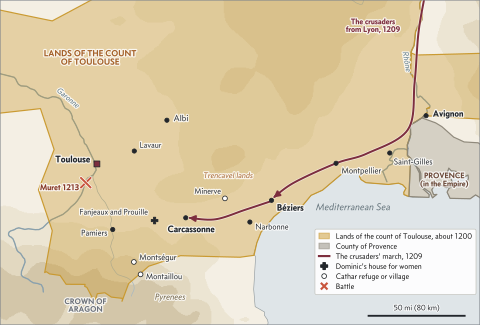
The army reached Béziers on July 21, 1209. Its commander was the legate Arnaud Amalric (ar-noh ah-mahl-reek), abbot of Cîteaux and head of the Cistercian monks. The bishop of Béziers brought the town its terms: hand over the heretics, and the rest will be spared. The citizens, Catholic and Cathar alike, refused. Next morning a party of townsmen rushed out to attack the camp, the army’s servants chased them back through the open gate, and within two or three hours the city had fallen. People who fled into the churches were killed there, priests among them, and the town was burned. Arnaud wrote to the pope that the crusaders had put almost twenty thousand people to the sword, sparing no one for rank, sex, or age. The historian Joseph Strayer judged that number too high, but no one doubts the slaughter.
Between 1219 and 1223, Caesarius of Heisterbach, a Cistercian monk in Germany, told the story of Béziers in his Dialogue on Miracles, a book of tales for young monks. When the crusaders asked how they could tell Catholics from heretics, Arnaud Amalric is said to have answered:Arnaud Amalric reportedly ordered “Kill them all; God will know his own” during the massacre of these people at Béziers. → Cathars•• Caedite eos. Novit enim Dominus qui sunt eius, “Kill them. For the Lord knows those who are his.” The second sentence comes from Saint Paul’s Second Letter to Timothy. English retellings often make the whole “Kill them all; God will know his own.”
Carcassonne, crowded with refugees, came next. The crusaders cut off its water, and when young Trencavel came out to negotiate under a promise of safety, they held him prisoner. The city surrendered on August 15, 1209, its people were driven out with nothing but their shirts and breeches, and Trencavel died in his own dungeon that November. His lands went to Simon de Montfort, a lord from near Paris who had refused to attack fellow Christians at Zara on the Fourth Crusade (Chapter 13). His son of the same name would later lead the English barons against King Henry III (Vol. 8, The Northern Worlds). A French chronicle of the next century pictured the whole war as a pope’s curse followed by a cavalry charge (Figure 14.6).

Raymond VI’s whipping bought him less than three months of peace. He was soon accused of breaking his oath to drive the heretics out of his lands, and later in 1209 a council at Avignon excommunicated RaymondA council held in this city in 1209 excommunicated Raymond VI, Count of Toulouse. → Avignon• again, with the people of Toulouse, for failing to expel the Cathars. Avignon, a busy town on the Rhône, would become the home of the popes themselves a century later.
The crusade became a war for land. Simon used terror, because most crusaders went home after their forty days: at Minerve (mee-nairv) in 1210 some 140 perfect who would not give up their faith were burned, and at Lavaur (lah-vor) in 1211 several hundred more. King Peter II of Aragon had been a hero of the Christian victory of 1212 at Las Navas de Tolosa (lahs nah-vahs deh toh-loh-sah) over the Almohads (al-moh-hadz), the Berber dynasty that ruled Morocco and Muslim Spain, as Chapter 17 will tell. In 1213 he crossed the Pyrenees to protect his vassals. He was killed fighting Simon at Muret (moo-ray), near Toulouse, on September 12, 1213. Simon took Toulouse in 1215, but the city rose against him, and on June 25, 1218, a stone from a siege engine killed him beneath its walls. The Song of the Albigensian Crusade, a poem in Occitan, says the women and girls of the city worked the machine. Raymond VI died in 1222. After King Louis VIII brought a royal army south in 1226 (Chapter 10), Raymond VI’s son, Raymond VII, gave up the eastern part of his lands, which reached the Mediterranean, to the crown by the Treaty of Paris of 1229. He also married his only daughter, Joan, to Alphonse, a brother of the boy king Louis IX. When the couple died childless in 1271, the rest of the county passed to the crown.
The inquisitors, most of them Dominicans, finished what the soldiers began. In 1242 men from Montségur (mawn-say-goor), a castle on a crag in the Pyrenean foothills, murdered two inquisitors. A royal army besieged it for ten months, and on March 16, 1244, more than two hundred perfect who would not recant were burned at the foot of the rock. The faith lingered in the mountain villages. From 1318 to 1325 Jacques Fournier (foor-nyay), bishop of Pamiers and a future pope, ran his own inquisition there, and Fournier’s clerks recorded the interrogationsJacques Fournier, the future Pope Benedict XII, recorded interrogations of these people. → Cathars• of Cathar believers almost word for word. In his register the shepherds and farm women of Montaillou (mawn-tie-yoo), a village of about 250 people, talk about sheep, quarrels, love affairs, and the fate of the soul. In 1334 Fournier was elected pope as Benedict XII, the third pope to reign at Avignon. His register survives in the Vatican Library, and in 1975 the French historian Emmanuel Le Roy Ladurie (luh rwah lah-doo-ree) made it into Montaillou, a portrait of one medieval village that became a bestseller.
What to remember
- Francis of Assisi (1181 or 1182–1226), a cloth merchant’s son, rebuilt San Damiano by hand and founded the Friars Minor, the Greyfriars, with Innocent III’s approval about 1209; Bernard of Quintavalle was his first companion.
- Clare founded the Poor Clares at San Damiano, inspired by Francis.
- The sermon to the birds and the stigmata, received from a seraph at La Verna in 1224, are told by Thomas of Celano; the wolf of Gubbio by the fourteenth-century Fioretti.
- Francis wrote the Canticle of the Sun in Italian. He is the patron of animals and, with Catherine of Siena, of Italy; the “Prayer of Saint Francis” was first printed in 1912.
- Dominic’s Order of Preachers (1216) answered the Cathars with trained preachers; Dominicans became the chief inquisitors and the order of Albertus Magnus and Aquinas.
- Anthony of Padua, a Portuguese Franciscan, was the “Hammer of Heretics” and, the Fioretti says, preached to the fish at Rimini.
- The Dies irae, a Latin sequence on the Last Judgment credited to Thomas of Celano, was sung in the Requiem from 1570 to 1970.
- The Cathars of Languedoc were dualists. The Albigensian Crusade (1209–1229) began with the massacre at Béziers, where Caesarius of Heisterbach later put “Kill them” in Arnaud Amalric’s mouth, and ended by bringing the south under the French crown; Jacques Fournier, later Benedict XII, recorded the last Cathars’ interrogations at Montaillou.
Chapter 15 · 31 clues
Aquinas and Maimonides
In 1199 a doctor in Egypt wrote a letter explaining why he had no time for visitors. He lived at Fustat (foo-staht), the old city on the Nile that is now part of Cairo, and every morning he rode to the sultan’s palace in Cairo. If anyone in the royal household was ill, he stayed there most of the day. He came home in the afternoon, he wrote, nearly dying of hunger, to find his rooms already crowded with people waiting for him: Jews and non-Jews, nobles and common people, judges and officials, friends and enemies. He ate the one meal of his day, saw patients until nightfall and often long after, and spoke to the last of them lying down, too tired to sit up.
The letter went to Samuel ibn Tibbon (tib-bohn), who was translating the doctor’s greatest book from Arabic into Hebrew. Its author, Moses son of Maimon, was the most famous Jewish scholar alive. Two generations later an Italian friar teaching in Paris would quote him as “Rabbi Moses.” The two men spent their lives on the same problem. Aristotle (Vol. 6, The Greeks) had reached Jewish, Muslim, and Christian scholars in translation, and his books seemed to prove things about God and the world that Scripture denied. Could a believer accept Aristotle’s reasons and keep his faith?
Maimonides
Moses ben Maimon was born in Córdoba, the great city of Muslim Spain, in 1138, though some sources give 1135. His father, Maimon, was a judge of the Jewish courts and taught him the Torah, the five books of Moses that open the Hebrew Bible. Later scholars made his name into a Greek form, Maimonides (my-mon-ih-deez), “son of Maimon,” and Jews call him by the initials of “Rabbi Moses ben Maimon”: Rambam (rahm-bahm). In 1148, when he was ten, Córdoba fell to the Almohads, a dynasty of Berbers, the native people of North Africa (Chapter 2), who came from the mountains of Morocco and preached a strict reform of Islam (Chapter 17 will tell their wars in Spain). Earlier Muslim rulers had let Jews and Christians keep their faith in return for a special tax. The Almohads ended that protection, and the choice became conversion, exile, or death.
The family chose exile. For about ten years they moved through southern Spain and North Africa, and at last they settled at Fez, in Morocco. In 1165 they sailed east, and on May 16 they landed at Acre, the chief port of the crusader Kingdom of Jerusalem (Chapter 8). That October Moses went up to Jerusalem to pray on the Temple Mount and visited the tombs of the patriarchs at Hebron. By 1168 the family had reached Egypt, where it settled at Fustat (Figure 15.1). Sometime between 1169 and 1177 his younger brother David, a merchant who carried the family’s money on trading voyages, drowned in the Indian Ocean with all of it. Moses wrote years later that the news kept him in bed for about a year. To earn a living, he became a doctor, and he rose to serve at the court of Saladin, the sultan who took Jerusalem from the crusaders in 1187 (Chapter 8), and later Saladin’s sons. He was also the leader of Egypt’s Jews. He died at Fustat on December 12, 1204, and tradition says that he was buried at Tiberias (ty-beer-ee-us), beside the Sea of Galilee.
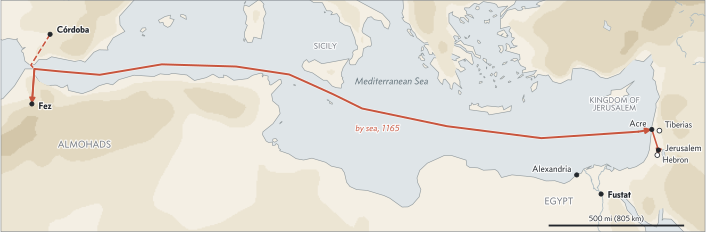
The Jews of his day lived by the Mishnah, the first written collection of Jewish oral law, made about AD 200, and by the Talmud, which sets each passage of the Mishnah beside an enormous commentary (Vol. 5, In the Beginning). A reader looking for a single rule might have to follow an argument across many pages, with opinions for and against, in several places at once. Maimonides set out to gather every binding rule into one book, written in clear Hebrew, arranged by subject, and stripped of the arguments. He worked for about ten years and finished about 1180. He called the book the Mishneh Torah (mish-neh toh-rah), “the Repetition of the Torah,” and divided it into fourteen books, from the laws of belief and study to the laws of kings and their wars. To codify law is to collect it and set it in order as a code, a single body of rules arranged for use, and he codified Jewish law in the Mishneh TorahThis thinker codified Jewish law in the Mishneh Torah. → Maimonides•• more completely than anyone before him. Critics complained that he named no sources, so that a judge could not check his reasoning. A rabbi of Provence, Abraham ben David, wrote sharp notes against it, and they are still printed beside the text. Yet the great codes of later centuries drew on it heavily, often word for word.

One part of the code sets out the laws of “gifts to the poor.” The Hebrew word for charity is tzedakah (tseh-dah-kah), “righteousness,” because giving to the poor is a duty owed to justice rather than a favor (Vol. 5, In the Beginning). Maimonides ranked the ways of giving in eight levels. At the bottom is the man who gives grudgingly; above him, the one who gives too little but gladly; then the one who gives enough, but only when asked; then the one who gives before he is asked. Higher still are gifts in which the giver does not know who receives, or the poor man does not know who gave, and then gifts in which neither knows the other. The highest gift ends the need for gifts: a loan, a partnership, or a job that lets a poor man stand on his own. This ranking is called “Rambam’s Ladder,” eight levels of charityMaimonides arranged eight levels of this practice in a hierarchy known as “Rambam’s Ladder.” → charity•• (Figure 15.2).
The code was for every Jew. His other great book was for a few. About 1190 he finished the Guide for the Perplexed, written in Arabic but in Hebrew letters, and dedicated it to a former pupil named Joseph ben Judah, who had studied logic and astronomy with him and then moved away. In its introduction, in Michael Friedländer’s (freed-len-der) translation of 1904, Maimonides describes his reader: a religious man, faithful to the Law, who “has been successful in his philosophical studies.” Reason pulls him one way and the plain words of Scripture another, and “hence he is lost in perplexity and anxiety.” The cause was Aristotle, whose books Maimonides read in Arabic translations. The Bible speaks of God’s hand, his anger, and his throne, while Aristotle had argued that the first cause of the world has no body and no passions. The Guide was written to reconcileThis thinker wrote The Guide for the Perplexed to reconcile Judaism and Aristotelian philosophy. → Maimonides•• the Torah with Aristotle’s philosophy. Where the two seemed to clash, Maimonides showed either that Scripture was speaking in figures or that Aristotle had not really proved his point.
The first clash was over God himself. Maimonides held that we can know that God exists but never what he is, his essence, and that every positive word we use of him, such as “wise” or “powerful,” quietly makes him like one of his creatures. It is safer, he argued, to say what he is not. To call God living means only that he is not dead; to call him one means only that there is no plurality in him. This is negative theology, the teaching that God’s essence can be described onlyThis philosopher argued that God's essence can only be described in terms of what it is not. → Maimonides•• by what it is not. Maimonides explained it with a ship. One man knows only that something called a ship exists. A second learns that it is not a quality of something else, a third that it is not a mineral, and a fourth that it is not a plant. So it goes, one denial after another, until the tenth man, in Friedländer’s words, “has almost arrived at the correct notion of a ‘ship’ ” without being told a single thing it is. Each denial proved about God, Maimonides wrote, brings a mind “one step nearer to the knowledge of God.” The best praise, he concluded, quoting a psalm, is silence: “Silence is praise to Thee.”
The second clash was over the beginning of the world. Genesis tells that God created it. Jews, Christians, and Muslims understood the story as creation ex nihilo (eks nee-hih-loh), Latin for “out of nothing”: God made the world from nothing at all, not from some stuff that was already there, and so the world had a first moment. Muslim theologians had long defended it by argument. Their school was called the Kalam (kah-lahm), Arabic for “speech,” and its masters taught that the world is made of tiny atoms that God creates anew at every instant. Jewish scholars in the East had borrowed their methods. Maimonides set out the seven arguments of the KalamThis thinker disputed the seven arguments for creation ex nihilo used by the Kalam school. → Maimonides•• for creation one by one, and he judged that none of them proved it, since each bent its account of nature to reach the answer it wanted. The seventh argued that if the world had always existed, an infinite number of people would have died, and so an infinite number of immortal souls would exist now, which is impossible. Maimonides replied that this explained one puzzle by a greater one, since no one understood what an immortal soul was. He quoted an Aramaic proverb, in Friedländer’s version: “Your guarantee wants himself a guarantee.”
Yet he would not side with Aristotle either. Aristotle had argued that the world never began (Vol. 6, The Greeks), and his later followers took his arguments for proof. Maimonides answered that Aristotle himself knew he had no proof. He had defended an eternal world by citing the opinions of earlier thinkers and by mocking his opponents, and no one does that who holds a real proof. Maimonides rejected Aristotle’s eternal universeThis thinker rejected Aristotle's principle that the universe is eternal. → Maimonides• as unproved. With neither side able to prove its case, he chose by the consequences. A world that had always run by fixed necessity would leave no room for a God who chooses, works miracles, and gives a law; if Aristotle had really proved it, “the whole teaching of Scripture would be rejected.” So, in Friedländer’s version, “we take the text of the Bible literally, and say that it teaches us a truth which we cannot prove.” Thomas Aquinas, the Italian friar who would quote him, reached almost the same place: reason, he held, can prove neither that the world began nor that it did not, and faith teaches that it began. “By faith alone do we hold,” he wrote, in the English Dominican Fathers’ translation, “and by no demonstration can it be proved, that the world did not always exist.”
Aquinas’s life and works
Thomas Aquinas was born about 1225 at Roccasecca (rok-kah-sek-kah), his family’s castle in the hills between Rome and Naples. “Aquinas” means “of Aquino (ah-kwee-noh),” the nearby town that gave the family its name. Roccasecca lay just inside the Kingdom of Sicily, which took in southern Italy as well as the island and then belonged to the emperor Frederick II (Chapter 9). His father, Landulf, was a knight in Frederick’s service. Thomas was the youngest of nine children, and his family planned a churchman’s career for him. At five he was given to Monte Cassino, the abbey founded by Saint Benedict (Chapter 2), whose abbot was his uncle, in the hope that he would be its abbot one day. In 1239 the war between Frederick and Pope Gregory IX reached the abbey, and Thomas was sent to the university that Frederick had founded at Naples. There he probably first read Aristotle’s books on nature, and there he met the Dominicans.
The Dominicans, or Order of Preachers, were friars, brothers who owned nothing, begged for their bread, and preached in the towns (Chapter 14). In 1244, at nineteen, Thomas joined them. To his noble family a son in a beggar’s robe was a disgrace. On his mother’s orders his brothers, who were soldiers of the emperor, seized him on the road north and held him for about a year in the family’s castles. According to testimony gathered after his death, when the Church was deciding whether to declare him a saint, they even sent a woman to tempt him, and he drove her from the room with a burning stick snatched from the fire. In the end his family gave up, and the order sent him north, to Paris and to Cologne (Figure 15.3).
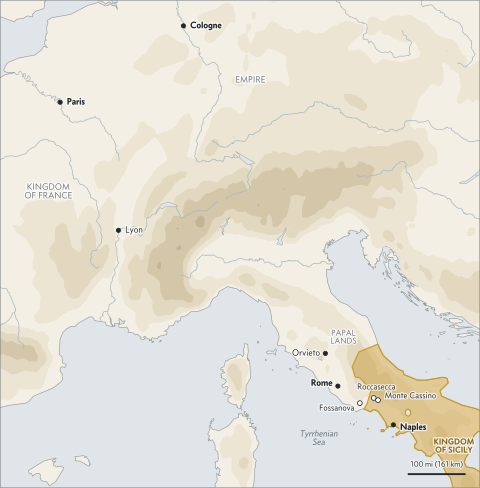

At Paris and then at Cologne, from about 1245 to 1252, Thomas studied under Albertus Magnus,This philosopher was a student of Albertus Magnus (Albert the Great). → Thomas Aquinas•• “Albert the Great,” a German Dominican about twenty-five years older. Albert had set out to explain every book of Aristotle to Latin readers, and he wrote on plants, animals, and stones from his own observation as well as from books, so that his own age called him the Universal Doctor, the teacher of everything. Thomas was large, slow-moving, and silent, and his fellow students nicknamed him “the dumb ox.” A story told by William of Tocco, a Dominican who knew Thomas in his last years and later wrote his life, says that Albert answered them: one day this ox would bellow so loudly that the whole world would hear it. Albert became bishop of Regensburg in 1260, gave it up two years later, and outlived his pupil, dying at Cologne in 1280.
In 1256 Thomas became a master of theology at Paris, the highest rank in the university’s highest faculty. Over the next years he wrote a long book for readers who did not share his faith. A summa (soo-muh), Latin for “the sum” or “the whole,” was a book that set out an entire subject in order, and between 1259 and 1265 Thomas wrote the Summa Contra GentilesThis philosopher wrote Summa Contra Gentiles. → Thomas Aquinas•• (kon-trah jen-tee-leez), “against the Gentiles,” meaning the unbelievers. Muslims, and the people he called “pagans,” accept none of the Christian Scriptures, he explained, so they must be met with reason, which all men share. The first three of its four books therefore argue from reason rather than from the Bible: that God exists, what he is like, and how he made and governs the world. Only the fourth turns to what can be known from revelation alone, such as the Trinity, the Christian belief that God is three persons in one.
In 1268 the order sent Thomas back to Paris, into a quarrel. In the faculty of arts, where every student began (the Stage), young masters were reading Aristotle as Averroes (uh-ver-oh-eez) had read him. Averroes, whose Arabic name was Ibn Rushd (ib-un roosht), had been a judge and doctor of Córdoba, twelve years older than Maimonides, and he died in 1198. He had written commentaries on nearly every book of Aristotle, and in Latin they traveled with Aristotle’s own text. On one point his followers at Paris, the Averroists, led by Siger of Brabant (see-zhay), a master from the Low Countries, alarmed the theologians. The intellect is the power by which we understand, as when we grasp what a triangle is or why two and two make four. Averroes held that the intellect is not a part of each person’s soul: there is one intellect for all mankind, which each man shares while he lives. This is the unity of the intellect. If it were true, no single person’s soul would survive death to be rewarded or punished.

Thomas argued against the unity of the intellectThis philosopher argued against the "unity of the intellect" proposed by Averroes. → Thomas Aquinas•• in a short book of 1270, On the Unity of the Intellect, against the Averroists, and again in the greater Summa he was then writing. If one intellect thought for all men, he wrote, in the English Dominican Fathers’ translation, then Socrates and Plato would be no more than “one understanding man.” The difference between them would be no greater than “that of one man with a tunic and another with a cloak; which is quite absurd.” That December the bishop of Paris condemned thirteen teachings drawn from Aristotle and Averroes, the unity of the intellect first among them. Two centuries later the Florentine painter Benozzo Gozzoli (beh-not-soh got-soh-lee) painted the victory as the Church remembered it, with Averroes lying beaten at Thomas’s feet (Figure 15.5). Thomas himself had treated Averroes with more respect than that.
Behind his answer lay a rule about how anyone knows anything. Thomas held, with Aristotle’s followers, that all knowledge begins in the senses.This philosopher adopted the Aristotelian maxim that nothing is in the intellect that was not first in the senses. → Thomas Aquinas• He took up a Latin maxim of Aristotle’s school, Nihil est in intellectu quod non sit prius in sensu, “nothing is in the intellect that was not first in the senses.” A child sees and touches many dogs before it understands what a dog is, and the intellect draws the idea “dog” out of the pictures the senses have stored. Since each man’s senses are his own, each man’s understanding is his own act. When Socrates thinks, it is Socrates who thinks, and no one else.
The Summa Theologica
In 1265 Thomas was sent to Rome to set up a school for young Dominicans at Santa Sabina, a house of friars on one of the city’s hills, and there he began the book that filled the rest of his life. He wrote the Summa TheologicaThis philosopher wrote Summa Theologica. → Thomas Aquinas••• (thee-oh-loj-ih-kuh), “the whole of theology,” also called the Summa Theologiae (thee-oh-loh-jee-ee). Its prologue says whom it was for. In the Dominican Fathers’ translation it begins: “Because the doctor of catholic truth ought not only to teach the proficient, but also to instruct beginners,” Thomas would explain “whatever belongs to the Christian religion” as briefly and clearly as the matter allowed. A doctor, here, is a teacher. Like every serious book of the schools, the Summa was written in Latin,The Summa Theologica was written in this language. → Latin• the shared language of scholars from Scotland to Sicily (the Stage). Thomas’s Latin is plain and exact, with none of the flourishes of the older Latin writers.
The plan is a circle, out from God through all his creatures and back to him again, and every part has its place in it. The Summa has three parts.This work is organized into three parts and treats hundreds of questions through objections and replies. → Summa Theologica•• The First Part treats God, the creation of the world, the angels, and man. The Second Part, so large that it is split in two, treats man’s journey back to God: happiness, virtue and vice, law, and grace. The Third Part treats Christ, “Who as man, is our way to God,” and the sacraments. Each part is divided into questions, and each question into short debates called articles, each argued through objections and replies. Thomas wrote 512 questions holding 2,669 articles.
Every article has the same shape, borrowed from the disputation, the formal debate of the universities in which a question was argued on both sides (the Stage). It opens with a question, such as “Whether God exists?” Then come two or more objections, each beginning “It seems that” and arguing for the answer Thomas will reject. Next comes a single short argument introduced by the words sed contraArticles in this work introduce a counterargument to objections with “sed contra.” → Summa Theologica••• (sed kon-trah), “on the contrary,” which usually quotes an authority: the Bible, a Church Father, or Aristotle. Then Thomas gives his own answer, beginning “I answer that,” in Latin respondeo (reh-spon-deh-oh). Last, he replies to each objection in turn, granting what is true in it and showing where it goes wrong (Figure 15.6). A reader always meets the strongest case against Thomas’s view before Thomas states it. Peter Abelard had set the authorities against each other in Sic et Non and left them there (Chapter 12); the Summa settles each quarrel and says why. It is scholasticism, the method of the schools, at its most complete.
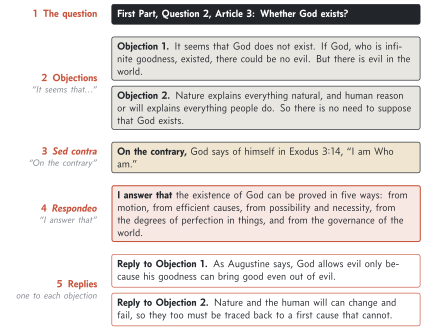
The authorities have nicknames. Saint Paul is “the Apostle,” and Peter Lombard, whose Sentences every student of theology had to master, is “the Master.” Aristotle is simply “the Philosopher”This work refers to Aristotle as 'The Philosopher.' → Summa Theologica•• (Vol. 6, The Greeks). Thomas quotes him on nearly every page, and builds on Aristotle’s ideas of cause, nature, and the soul even where he corrects them. Muslim and Jewish writers stand among the authorities too, for Thomas took truth where he found it. Avicenna (av-ih-sen-uh), a Persian philosopher and doctor who died in 1037, appears often, and Maimonides is quoted as “Rabbi Moses.” Averroes is “the Commentator,”This work refers to Averroes as 'The Commentator.' → Summa Theologica••• because no one had explained Aristotle’s text more closely, though Thomas fought him over the intellect.
Thomas never reached the end. In 1272 his order sent him to Naples to found a new school, and there he worked on the Third Part. The Summa was left unfinished:This work was left unfinished by Thomas Aquinas. → Summa Theologica•• it breaks off in the Third Part at Question 90, in the middle of a discussion of penance, the sacrament in which a sinner confesses and makes amends. After his death his secretary and companion, Reginald of Piperno (pee-pair-noh), probably completed it with a Supplement drawn from Thomas’s early commentary on the Sentences. Why Thomas stopped was told by Bartholomew of Capua, a lawyer of Naples who gave evidence in 1319 for Thomas’s canonization and repeated what Reginald had told him. On December 6, 1273, while saying Mass, Thomas had an experience he never fully described, and afterward he would not write or dictate again. When Reginald begged him to go on, he answered that all he had written seemed like strawThis philosopher stopped writing after a mystical experience that led him to compare his work to straw. → Thomas Aquinas• beside what he had seen.
Early in 1274 Pope Gregory X summoned Thomas to a council at Lyon, meant to reunite the Latin and Greek churches, which had been divided since 1054 (Chapter 5). On the road Thomas struck his head on the branch of a fallen tree and fell ill. He got as far as Fossanova (fos-sah-noh-vah), an abbey of Cistercian monks south of Rome, where he died on March 7, 1274, at about forty-nine.
The Five Ways
Question 2 of the First Part asks whether God exists, in three articles. The first asks whether God’s existence is self-evident, true the moment its words are understood, as “every whole is greater than its part” is. Its second objection is the ontological argument of Anselm of Canterbury (Chapter 12). By the word “God,” the objection runs, we mean “that thing than which nothing greater can be conceived”; what exists in reality is greater than what exists only in the mind; so whoever understands the word must grant that God really exists. Thomas rejected Anselm’s ontological argument.Thomas Aquinas rejected Anselm's ontological argument for this idea. → existence of God• A man may understand perfectly well what the word means, he replied, and still not grant that such a being “exists actually, but only that it exists mentally.” God’s existence, Thomas held, is self-evident in itself, since in God what he is and that he is are the same; but we do not know what God is, so to us it is not self-evident and must be shown “by effects.”
The second article asks whether God’s existence can be proved at all. Thomas answers that it can, not from its causes, since nothing comes before God, but from its effects, as smoke proves that there is a fire. Then the third article asks the plain question, “Whether God exists?” After two objections and a sed contra from Exodus, Thomas’s answer begins: “The existence of God can be proved in five ways.” These five short arguments, about a thousand words in English, fill one article out of more than two and a half thousand, and they are the most famous page of medieval philosophy (Table 15.1).
| Way | What we observe | Where it ends |
|---|---|---|
| 1. Motion | Things change, and whatever changes is changed by another. | A first mover, moved by nothing. |
| 2. Efficient cause | Things are brought about by causes, and nothing causes itself. | A first cause. |
| 3. Contingency | Things come to be and pass away, so they need not have existed. | A being that exists necessarily, of itself. |
| 4. Degrees | Things are more and less good, true, and noble. | A highest being, the cause of all goodness. |
| 5. Governance | Things without minds act toward goals, like an arrow in flight. | A mind that directs all of nature. |
In order, the Five Ways argue for GodThis work’s Five Ways argue for God from motion, efficient causation, contingency, degrees of perfection, and the governance of nature. → Summa Theologica•••Aquinas offered Five Ways to establish this proposition. → existence of God•• from motion, from efficient causation, from contingency, from degrees of perfection, and from the governance of nature. The First Way, which Thomas calls the “more manifest,” is Aristotle’s unmoved mover (Vol. 6, The Greeks). Motion, for Aristotle and Thomas, means any change from what a thing could be to what it is, from potentiality to actuality, as wood that could be hot becomes hot in a fire. Nothing gives itself what it does not have, so whatever is moved is moved by something else, and that by something else again. The chain cannot run on forever, or there would be no first mover and so no motion at all, “as the staff moves only because it is put in motion by the hand.” So, Thomas concluded, there is a first mover, moved by nothing, “and this everyone understands to be God.” The Second Way runs the same argument for efficient causes, the causes that bring things about, as a sculptor brings about a statue (Vol. 6, The Greeks). The Third begins from contingency. A thing is contingent if it might not have existed: a tree, a cat, or a person comes into being and passes away. If everything were contingent, Thomas argued, there would once have been nothing, and then nothing could ever have begun. So something must exist necessarily, of itself. The Fourth Way begins from the degrees of goodness and truth in things, which point to a highest, and the Fifth from things without minds that act for ends, “as the arrow is shot to its mark by the archer.”
The chains in the Five Ways do not run backward in time to a first day. Thomas had said that reason cannot prove the world had a beginning. His chains are chains of causes working now, all at once, like the hand moving the staff that moves the stone at this very moment. Even a world without a beginning, he held, would need a first cause to keep it in being.
Having argued that God exists, Thomas turned to what God is, and here he sounds like Maimonides. “Because we cannot know what God is, but rather what He is not,” Question 3 begins, the Summa must consider “how He is not.” But Thomas did not go all the way. In Question 13 he reports that “Rabbi Moses” taught that every name of God really denies something, so that “God lives” means only that God is not lifeless. Thomas disagreed: when we call God good, we say something true about him, though in a way we cannot fully grasp.
The same pages take up goodness itself. Thomas argued that goodness and being are really the sameThis philosopher argued that "goodness" and "being" are not different in any practical aspect. → Thomas Aquinas• and, in the Dominican Fathers’ translation, “differ only in idea.” His reasoning runs in steps. The good is what all things desire. A thing is desirable as far as it is complete, complete as far as it is actual, and actual as far as it exists. So whatever exists is, just so far, good, and evil is not a thing at all but a lack of something that ought to be there, as blindness is a lack of sight. Augustine had taught the same (Vol. 7, The Romans), and so had Maimonides.
Question 10 treats eternity. God’s eternity, Thomas explained, is not a very long time but no time at all, a life “simultaneously whole,” with no before or after. Time is the measure of things that change, and everything on earth changes and decays. Between the two Thomas, like other masters of the schools before him, placed a third measure, for the angels and for the heavens. In Aristotle’s astronomy the heavens are nested spheres that carry the planets and stars around the earth and never decay (Vol. 6, The Greeks). Their being never changes, yet change belongs to them all the same: an angel’s thoughts and choices follow one another, and the heavenly spheres move from place to place. Such beings, Thomas wrote, “have change annexed to them,” and he called their measure aeviternityThis philosopher proposed the concept of "aeviternity" to describe beings who only partially transcend time and do not themselves change but have change "annexed to them." → Thomas Aquinas• (ee-vih-tur-nih-tee), from the Latin aevum, “age,” “the mean between” eternity and time.
Law and war
The Second Part of the Summa contains a treatise on law, and it begins by asking what a law is. In four articles Thomas asks whether law belongs to reason or to will, what its aim is, who may make it, and whether it must be announced. Then the Summa defines law in one sentence:This work defines law as 'an ordinance of reason for the common good.' → Summa Theologica•• law “is nothing else than an ordinance of reason for the common good, made by him who has care of the community, and promulgated.” An ordinance is an order or rule. Each phrase rules something out. A law is not a mere wish of the ruler but a command of reason. It serves the good of everyone, not of the ruler alone. Only the one responsible for the community may make it. And it binds only once it has been promulgated, made known to those who must obey it.
Thomas tested the definition against Roman law. Ulpian (ul-pee-un), a jurist, or expert in law, who died in 223 or 228, had written so much that his opinions fill about a third of the Digest, the great collection of Roman law made for Justinian (Chapter 1). Thomas called Ulpian “the Jurist”This philosopher referred to Ulpian as "the Jurist." → Thomas Aquinas• and let him speak for the other side. Law seems to belong to the will, one objection in the first article on law runs, “according to the words of the Jurist,” since “Whatsoever pleaseth the sovereign, has force of law.” Thomas did not deny the maxim. He tamed it: the sovereign’s will has the force of law only when it follows some rule of reason, “otherwise the sovereign’s will would savor of lawlessness rather than of law.”

Then Thomas distinguished four kinds of lawThis philosopher distinguished four kinds of law: eternal, natural, human, and divine. → Thomas Aquinas• (Figure 15.7). Eternal law is God’s reason governing the whole universe. Natural law is the eternal law as it is imprinted on human reason, “the rational creature’s participation of the eternal law,” and its first rule is that “good is to be done and pursued, and evil is to be avoided.” Human law is what rulers make, working out the general rules in particular. Natural law says that a wrongdoer should be punished; human law decides how. Divine law is the law revealed in Scripture, the Old Law of Moses and the New Law of the Gospel. God gave it, Thomas explained, because reason alone cannot lead man to eternal happiness, judges uncertainly, and cannot see or punish the evil hidden in the heart.
War, too, has its law. Augustine had taught that a war can be just, if it is waged to right a wrong and for the sake of peace (Vol. 7, The Romans). In the second half of the Second Part, Thomas asked “Whether it is always sinful to wage war?” and answered: “In order for a war to be just, three things are necessary.” The first is the authority of the sovereign, since a private man can take his quarrel to a court instead. The second is a just cause: the enemy must have done some wrong. The third is a right intention, to advance good or avoid evil, not to win plunder or power. These are Thomas’s three conditions for a just war,This philosopher required proper authority, just cause, and right intention for a just war. → Thomas Aquinas••Refining Augustine’s theory, Thomas Aquinas required legitimate authority, rightful cause, and good intention to justify this activity. → war•• and he supported each with a quotation from Augustine, turning a scatter of sayings into a list that later lawyers of war would build on.
Later in the same half of the Second Part, Thomas asked whether a man may kill another in self-defense. His answer began with a principle: “Nothing hinders one act from having two effects, only one of which is intended, while the other is beside the intention.” A man attacked on the road defends himself. His act saves his own life, which he intends, and kills the attacker, which he does not. Since an act takes its character from what is intended, the defense is lawful, but only if it is in proportion: a man who “uses more than necessary violence” does wrong. Later moral philosophers turned the Summa’s discussion of self-defenseThis work’s discussion of self-defense is an early formulation of double effect. → Summa Theologica••• into a general rule, the doctrine of double effect. An act that has a bad side effect may be allowed if the act itself is good, if the bad effect is foreseen but not intended, either as a goal or as a means, and if the good outweighs the harm. Moralists, soldiers, and doctors still argue with it.
After Aquinas
Thomas’s victory did not come at once. In 1277, three years after his death, the same bishop of Paris, Étienne Tempier (ay-tyen tahn-pyay), condemned 219 statements taught in the schools, and some of Thomas’s own ideas were among them. But his order defended him, and the tide turned. On July 18, 1323, Pope John XXII, then living at Avignon in southern France for reasons Chapter 23 will tell, declared him a saint. He came to be called the Angelic Doctor, and his teaching, Thomism, became the Dominicans’ own (Figure 15.8).

The next great master at Paris was not a theologian at all. Jean Buridan (byoo-ree-dahn), born about 1301, taught in the faculty of arts for his whole career, never studied theology, and never joined an order. He wrote commentaries in the form of questions on nearly all of Aristotle, and his most famous idea answered a puzzle in Aristotle’s account of motion (Vol. 6, The Greeks). Why does a thrown stone keep moving after it leaves the hand? Aristotle had said that the air behind it goes on pushing. Buridan pointed to things the air cannot push. A smith’s grindstone keeps turning after it is let go, though it stays in one place. A spear sharpened at its back end gives the air nothing to push against, yet it flies as well as one with a blunt back. He proposed instead that the thrower puts into the stone an impetus,Jean Buridan's most famous theory, the concept of impetus, expanded Aristotle's account of this phenomenon. → motion•• a moving power that stays in it. The more matter and the more speed, the more impetus, and it would last forever if the resistance of the air and the stone’s own weight did not wear it down.
The idea reached the heavens too. Perhaps, Buridan suggested, God gave the heavenly spheres their impetus at the creation, and since nothing resists them, they turn forever with no angels needed to push them. Impetus kept Aristotle’s mover but put it inside the moving thing, and it was a long step toward the modern idea of inertia, the tendency of a moving thing to keep moving until something stops it, which Galileo would work out three centuries later (Vol. 48, Physics: Motion and Matter). Nicole Oresme (oh-rem), a younger master at Paris, took up the same questions. Buridan’s name also survives in “Buridan’s ass,” a donkey that starves between two equal piles of hay because it has no reason to choose either. The example appears nowhere in his writings, and it was probably his critics’ joke. He is last mentioned in 1359 and was probably dead by 1362, when one of his church incomes went to another man.
The same age wrote for kings. The Latin for mirror, speculum, was a favorite title for a medieval book that showed its reader the image of what he ought to be, and the genre called “mirrors for princes”A medieval genre of educational treatises is called "mirrors for" these people. → princes• held up that image for young rulers. Such books taught what a good king believes, how he chooses his counselors, how he keeps justice, and how he rules himself. An early one is the Policraticus (pol-ih-krat-ih-kus), finished in 1159 by John of Salisbury, an English scholar who served two archbishops of Canterbury, Thomas Becket among them (Vol. 8, The Northern Worlds). Thomas Aquinas began one himself, On Kingship, for a king of Cyprus, and left it unfinished. The most widely read was On the Rule of Princes, written about 1280 by Giles of Rome, a friar of the order named for Saint Augustine, for the boy who became Philip IV the Fair of France (Chapter 10). It was copied in hundreds of manuscripts and translated into French, Italian, and English, and the English poet Thomas Hoccleve (hok-leev) drew on it for his Regiment of Princes (Vol. 8, The Northern Worlds). The most famous mirror of all, Machiavelli’s The Prince of 1513, would turn the old advice upside down (Vol. 10, Rebirth).
When Maimonides was born, Aristotle’s books on nature, the soul, and God were only beginning to reach Latin Europe. By the time Buridan died, they were the textbooks of every university from Oxford to Prague, read with the help of Averroes’s commentaries, and Maimonides’s Guide was read in Latin as well as in Hebrew.
What to remember
- Maimonides (Moses ben Maimon, Rambam, 1138–1204) was born in Córdoba, fled the Almohads, and settled at Fustat in Egypt as a doctor at Saladin’s court and leader of Egypt’s Jews.
- His Mishneh Torah (about 1180) codified all of Jewish law in fourteen books; in it he ranked charity, tzedakah, in eight levels, “Rambam’s Ladder,” the highest being help that makes the poor self-reliant.
- His Guide for the Perplexed (about 1190) reconciled the Torah with Aristotle. It taught negative theology, that God can be described only by what he is not; it rejected the Kalam’s seven arguments for creation and also Aristotle’s eternal world, since neither side had a proof.
- Thomas Aquinas (about 1225–1274), born at Roccasecca, became a Dominican friar against his family’s will and studied under Albertus Magnus at Paris and Cologne.
- He wrote the Summa Contra Gentiles (1259–1265) for unbelievers, and On the Unity of the Intellect (1270) against Averroes and Siger of Brabant.
- The Summa Theologica, in Latin and in three parts, is built of articles: objections, sed contra, “I answer that,” and replies. It calls Aristotle “the Philosopher,” Averroes “the Commentator,” and Ulpian “the Jurist.” It was left unfinished after December 6, 1273, when Thomas said his work seemed like straw.
- The Five Ways argue for God from motion, efficient causes, contingency, degrees of perfection, and the governance of nature; Thomas rejected Anselm’s ontological argument. He held that goodness and being are the same in reality and described aeviternity, the measure of angels.
- Law is “an ordinance of reason for the common good”; it comes in four kinds, eternal, natural, human, and divine. A just war needs lawful authority, a just cause, and a right intention, and his account of self-defense became the doctrine of double effect.
- After him, Jean Buridan explained motion by impetus, and writers such as Giles of Rome wrote “mirrors for princes” to teach young kings.
Chapter 16 · 28 clues
Mongols, Novgorod, and Moscow
In 1224 a churchman in Novgorod, a city far in the north of the lands of the Rus, sat down to bring his city’s chronicle up to date. His chronicle was a year-by-year record of the city’s events. The news from the south defeated him. For the sins of the Christians, he wrote, unknown peoples had come, and nobody knew who they were, where they came from, what language they spoke, or what they believed. They had destroyed the army of the princes of the Rus beside a little river near the Sea of Azov. Then they had turned and vanished into the east, and only God knew where they had gone.
They came back. Within twenty years the strangers had burned Kiev, killed a duke in Poland, and wrecked the army of Hungary, and the princes of the Rus were riding to a camp on the Volga to kneel before their khan. A Venetian merchant’s son would spend seventeen years in the service of their emperor in China. And a small town called Moscow would grow great by collecting their taxes, until one of its princes turned on them and won.
Genghis Khan and the khanates
North of China lies the eastern end of the steppe, the belt of treeless grassland (Chapter 6) that runs from Manchuria to Hungary. That end is today’s Mongolia. In the twelfth century it was home to many quarreling tribes of herders who lived in felt tents, moved with the seasons, and learned to ride and shoot almost as soon as they could walk. One of them, a chief’s son named Temüjin (tem-oo-jin), was born about 1162. When he was a boy his father was poisoned, and the tribe abandoned the widow and her children to fend for themselves. We know this from the Secret History of the Mongols, written for his family by an unknown author not long after his death.
By 1206 Temüjin had beaten every rival on the steppe. That year an assembly of chiefs, a kurultai (koo-rool-ty), proclaimed him Genghis Khan (jeng-giss). A khan is a ruler; nobody is sure what “Genghis” meant. He broke up the old tribes and sorted his men into units of ten, a hundred, a thousand, and ten thousand, so that a rider’s loyalty ran up the chain to the khan and not to his uncle. Every man was a mounted archer with several ponies to change between, so a Mongol army could cover distances no other army of the time could match. In 1215 it took the capital of northern China, on the site of Beijing. In 1218 a governor of Khwarazm (kwuh-raz-um), a Muslim empire in Central Asia, put a caravan of merchants under Genghis’s protection to death, and his master, the shah, killed one of the envoys Genghis sent to complain. To the Mongols an envoy’s life was sacred. Within three years Bukhara (boo-kah-ruh), Samarkand, and the other great cities of Khwarazm had been taken, and many of their people killed.
Genghis died in 1227, and his empire passed to his sons and grandsons like a family estate (Figure 16.1). His eldest son, Jochi (joh-chee), had died about 1225, so Jochi’s sons took the western grasslands. Chagatai (chag-uh-ty) got Central Asia. Ögedei (og-uh-day), the third son, was chosen Great Khan in 1229 and built a capital at Karakorum (kar-uh-kor-um) in Mongolia. The youngest, Tolui (toh-loo-ee), kept the homeland, and his sons did best of all. Hülegü (hoo-leh-goo) sacked Baghdad in 1258 and founded the Ilkhanate (il-kah-nate) in Persia. Kublai was proclaimed Great Khan in 1260 and fought his own younger brother for four years to keep the title. In 1271 he gave his state a Chinese dynastic name, the Yuan (yoo-ahn), and by 1279 he had conquered the whole of China.
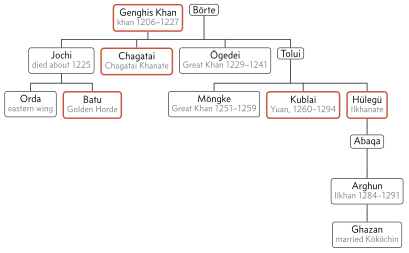
So by about 1290 one empire had become four khanates, states ruled by khans of Genghis’s blood (Figure 16.4). They were the Golden Horde in the west, the Chagatai Khanate in Central Asia, the Ilkhanate in Persia, and the Yuan in China and Mongolia, whose ruler still called himself Great Khan over all the rest. They often fought one another, but a merchant with a khan’s pass could still ride from the Black Sea to the Pacific. Europeans called them all Tartars, from the name of the Tatars, one of the steppe peoples Genghis had conquered, with an added r that made it sound like Tartarus, the deepest pit of the Greek underworld (Vol. 4, Classical Myth). Genghis’s life is told in full elsewhere (Vol. 37, The House of Islam), and so is Kublai’s China (Vol. 40, The Middle Kingdom).
The Kalka and the fall of Kiev
The Mongols’ first visit to Europe was a detour. In 1220 Genghis sent two generals to hunt down the shah of Khwarazm. Jebe (jeh-beh) had once fought against Genghis and, the story goes, shot the horse from under him in battle; when he owned up to it, Genghis liked his honesty and named him “Arrow.” Subutai (soo-boo-ty), said to be a blacksmith’s son, became perhaps the greatest general of his century. The shah died on an island in the Caspian Sea. The two generals, with perhaps 20,000 riders, kept going: they rode around the Caspian, beat the Christian kingdom of Georgia, and crossed the Caucasus Mountains in winter. On the far side they fell on the Cumans, Turkic nomads of the steppe north of the Black Sea, whom the Rus called Polovtsians (poh-lovt-see-unz).
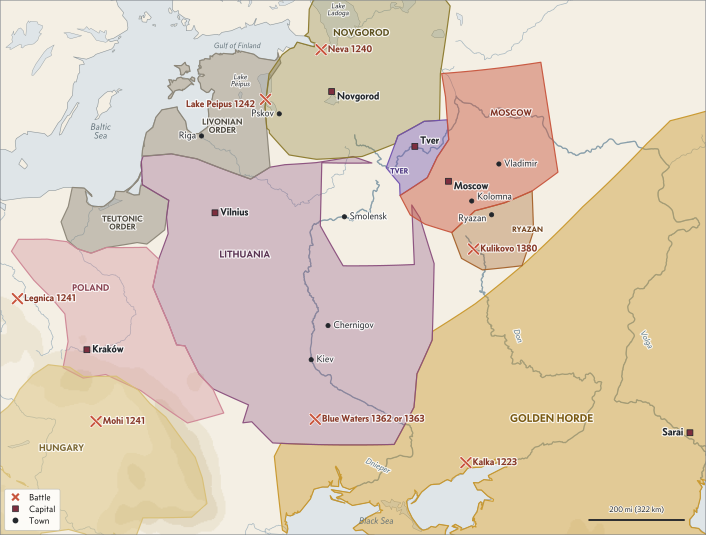
The Cuman khan Köten (kur-ten) fled to his son-in-law, Mstislav (mstee-slahf) the Bold, prince of Galich (gah-leech) in the far west of the Rus lands. Today the strangers have taken our land, Köten warned him, as the chronicle tells it; tomorrow they will take yours. By now the name Rus meant the eastern Slavs and their princes, the descendants of Rurik, whose state had been centered on Kiev (Chapter 6). By 1223 it had broken into a dozen principalities ruled by quarreling cousins. Several of them met at Kiev under its grand prince, Mstislav III, called the Old, a cousin of Mstislav the Bold. When ten Mongol envoys arrived to say that their quarrel was only with the Cumans, the princes had them killed.
The princes’ army crossed the Dnieper and wiped out a Mongol rear guard of about a thousand men. Then it chased the main army east for nine days, and as it chased it strung out into columns miles apart. That chase was the feigned retreat of Jebe and Subutai,Jebe and Subutai used a feigned retreat to defeat Rus forces at this battle. → Battle of the Kalka River•• and it worked as they meant it to. On May 31, 1223, beside a stream called the Kalka (kahl-kuh), near the Sea of Azov, the Mongols turned. Mstislav the Bold and the Cumans charged without waiting for the others, broke, and fled back through the Rus columns that were still coming up. The whole army dissolved. The Novgorod chronicle says that only one man in ten came home.
Mstislav III had stayed on a hill with his own men behind a stockade, a fence of sharpened stakes, and he held out for three days. Then a go-between kissed the cross and swore that the princes would be spared if they surrendered, and they surrendered. According to the Novgorod chronicle, the Mongols laid the prince and two of his sons-in-law on the ground, set planks over them, and sat down on the planks to their victory feast, so that Mstislav III was crushed beneath the boardsAfter this battle, Mongols reportedly crushed Mstislav III of Kiev beneath boards on which they feasted. → Battle of the Kalka River•• while his enemies ate. The chronicler saw only cruelty. Mongol custom forbade spilling a prince’s blood, so to the victors this was a death fit for a noble, and a punishment for the murdered envoys.
Then the Mongols rode home, and the Rus went back to fighting one another. Thirteen years later the Mongols returned in force. Genghis had promised the west to Jochi’s family, and in 1236 Jochi’s son Batu (bah-too), Genghis’s grandson, with Subutai to plan for him, set out with an army whose size nobody knows; modern guesses run from 40,000 to more than 100,000. In December 1237 they did what no one expected and invaded in midwinter, when every river had frozen into a road that led to a city’s gate. Ryazan (ree-uh-zahn) fell within a week. Vladimir, the richest city of the northeast, fell in February 1238. By spring they were within about 60 miles of Novgorod, and then they turned back, probably because the thaw was turning the land to swamp.
In late November 1240 Batu’s army reached Kiev. For more than three centuries it had been the mother of the cities of the Rus, and the Mongols set up their catapults beside one of its gates. On December 6 the wall was breached, and the last defenders fell back to the oldest part of the city, around the Church of the Tithes that Vladimir the Great had built after his baptism (Chapter 6). People crowded into the church with their children and their goods and climbed onto its galleries. Then the Church of the Tithes collapsedBatu Khan sacked this city in 1240; people sheltering in its Church of the Tithes died when it collapsed. → Kiev•• under the weight and the assault, and those sheltering inside died in the ruins. Kiev never recovered its old place among the cities of the Rus.
Mohi and Legnica
The next victims lay beyond the Carpathian Mountains, and the excuse was Köten again. When Batu crushed the Cumans on the steppe, Köten led some 40,000 households of his people west and asked for shelter in Hungary, the kingdom the Magyars had founded in the plain of the middle Danube (Chapter 5). Its king, Béla IV, took them in and had them baptized, hoping to use their horsemen. Batu wrote to him that the Cumans were his runaway slaves and must be handed over. Béla refused.
His kingdom was divided against him. Béla’s father, Andrew II, had given away so much royal land to his followers that the nobles forced him to grant them a charter of rights. In 1222 Andrew II sealed the Golden Bull,This kingdom's ruler Andrew II signed the Golden Bull of 1222, granting special rights to nobility. → Hungary• freeing the nobles from taxes, sparing them from fighting abroad at their own cost, and even granting them the right to resist a king who broke it. Like the Golden Bull of Rimini that Frederick II gave the Teutonic Order four years later (Chapter 9), it was a charter sealed in gold. Hungary’s came seven years after England’s Magna Carta (Vol. 8, The Northern Worlds). Béla spent his reign trying to take the royal land back, and the nobles hated him for it. They hated the Cumans too, whose herds trampled their fields.
Subutai’s plan for 1241 sent three armies across a front hundreds of miles wide (Figure 16.2). A northern force struck Poland to keep its dukes from helping Hungary. Poland was then divided among the dukes of one family, the Piasts (pyasts) (Chapter 26), and the strongest of them was Henry II the Pious, duke of Silesia (sy-lee-zhuh), son of the duchess Hedwig, whom the Church later made a saint. Near the town of Legnica Henry the Pious gathered a coalition,This country's Henry the Pious led a coalition of Christian orders that was defeated at the Battle of Legnica. → Poland• an alliance of separate forces: Silesian and Polish knights, Moravians, miners from a nearby gold town, and a few brothers of the military orders, the monk-knights of Chapter 8. King Wenceslaus I of Bohemia was marching to join him with a larger army, and the Mongols meant to strike before the two could meet.

Henry and the Mongols met on April 9, 1241, on a field outside the town. The Polish horsemen charged, the Mongol front gave way and fled, and the knights rode after it and left their foot soldiers behind. Then riders closed in from both sides. Henry was cut down, and the Mongols carried his head on a spear to the walls of Legnica. Wenceslaus was a day’s march away. He turned back, and the northern army turned south to join Batu.
Two days later and about 300 miles to the southeast came the main battle. Béla had called his army to Pest on the Danube, and there a mob, convinced that the Cumans were Mongol spies, murdered Köten. The Cumans rode off in fury, and Hungary lost its best light horsemen to its own hatred. Béla followed the Mongols to the Sajó (shah-yoh) River and camped near the village of Mohi (moh-hee), inside a ring of wagons chained together. On the night of April 10 the Mongols tried to cross by the river’s bridge, and Béla’s brother Coloman drove them back. At dawn their catapults cleared the bridge, while other columns forded upstream and bridged the river downstream, and the Hungarians found themselves surrounded in their own wagon fort. The Mongols rained arrows and fire into it, then left a gap open on one side. The soldiers poured out through it, and riders cut them down along two days of road. On April 11, 1241, Batu destroyed the Hungarian army at Mohi,Forces in this country lost the Battle of Mohi to Batu Khan. → Hungary•• killing two archbishops and much of the nobility. Béla escaped and fled at last to an island fortress off the Dalmatian coast.
In the spring of 1242 the Mongols left. On December 11, 1241, the Great Khan Ögedei had died in Mongolia, and Giovanni da Pian del Carpine (kar-pee-neh), a friar whom the pope sent to the Mongols a few years later, wrote that this was why they went home. Other reasons may have weighed as much: the losses at Mohi, the stone castles the Mongols could not take, and the small size of the Hungarian plain as pasture for their horses. Batu never went back to Mongolia. He stopped on the Volga, and stayed there.
The Golden Horde
On the lower Volga, not far from the Caspian Sea, Batu built a capital, first of tents and then of brick, called Sarai (sah-ry), a word meaning “palace.” With Sarai as its capital, Batu founded the stateThis state was founded by Batu Khan. → Golden Horde• that ruled the western steppe for more than two hundred years, from the mouth of the Danube to Siberia, and held the princes of the Rus as its subjects. Writers of its own time called it the Ulus of Jochi, “Jochi’s people.” Our word horde comes from the Turkic and Mongol ordu, a camp, the moving court of a khan. The name “Golden Horde” first appears in a Russian history written in 1565, long after the state had begun to break up, and nobody knows for certain why it was golden. Perhaps the name came from its tents,This state's name may derive from the color of its tents. → Golden Horde•• the gold-colored tents in which the khans held court; perhaps it came from the khans’ wealth.
Like a Mongol army, the Horde had two wings. Batu’s people held the west, around Sarai, and those of his elder brother Orda held the east, beyond the Ural River. The Mongols named the directions by colors, and so the Horde had Blue and White branches.This state had "Blue" and "White" branches. → Golden Horde•• Which was which depends on whom you read. Russian chronicles call Orda’s eastern wing the Blue Horde, but Persian historians who wrote for the conqueror Timur, or Tamerlane, more than a century later call it the White Horde, and most Western books follow them. None of the three color names, golden, blue, or white, appears in any source from the Mongols’ own time.
The Horde ruled the Rus from a distance. Its khans did not settle in the forests of the Rus or try to change the faith of the Rus. They counted the people, collected tax, and demanded soldiers, and each prince had to ride to Sarai, kneel, and receive a yarlyk (yar-lik), the khan’s written license to rule. The regular payment a subject made was tribute, and officials called baskaks oversaw its collection. The Church was left alone and freed from the tax, for the Mongols respected the holy men of every faith. Most of the Horde’s people were Turkic-speaking nomads, and the Rus called them all Tatars; later Russians called these centuries “the Tatar yoke.” In 1313 Khan Uzbek (ooz-bek) made Islam the faith of the state. A generation later his son Janibeg besieged the Genoese port of Caffa in the Crimea, the siege with which the story of the Black Death in Europe begins (Chapter 21).
Marco Polo
Merchants went wherever the khans’ peace reached. In the 1260s the Venetian brothers Niccolò and Maffeo Polo traded their way from the Crimea to the Golden Horde and on, by chance, to the court of Kublai himself. Kublai sent them home with a letter asking the pope for a hundred learned men and for oil from the lamp that burned at Christ’s tomb in Jerusalem, and they reached Venice in 1269. In 1271 they set out again, and they took Niccolò’s son Marco, who was seventeen. His birth in Venice, the trading republic of the lagoon, is told in Chapter 13.
Marco’s road to China was the Silk Road,This Venetian merchant traveled along the Silk Road to China. → Marco Polo•• the chain of caravan routes across Asia between China and the Mediterranean, named much later for the Chinese silk carried west along it. In Marco’s telling they sailed to Acre, rode across Anatolia to Tabriz, and went south to Hormuz on the Persian Gulf, meaning to take ship for India (Figure 16.4). The ships looked unseaworthy, so they turned back north across Persia, climbed over the Pamir Mountains, passed the oasis towns of Kashgar and Khotan (koh-tahn) at the edge of the Taklamakan Desert, and crossed the Gobi. About 1275, some three and a half years after leaving home, they reached Kublai at Shangdu (shahng-doo), his summer palace, the Xanadu (zan-uh-doo) of Coleridge’s poem “Kubla Khan” (Vol. 15, The Age of Revolution). Marco stayed seventeen years. Kublai’s winter capital was Khanbaliq (kahn-bah-leek), “the Khan’s city,” on the site of Beijing. Marco says the emperor liked him and sent him on errands across the empire.
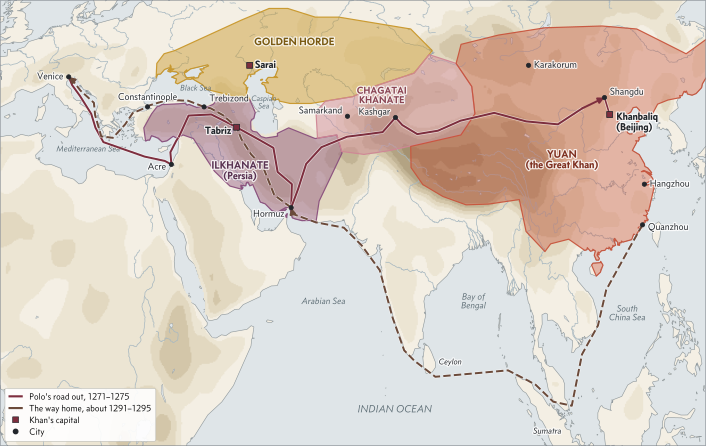
Of all the wonders he described, one amazed his readers most: the Great Khan made his money from trees (Figure 16.5). Workers took the bark of mulberry trees, the trees whose leaves feed silkworms, and peeled off the thin inner layer between the bark and the wood. They pounded it into something like paper, cut it into pieces of different sizes, and had officials sign and stamp each one with the khan’s red seal. Every subject had to accept it on pain of death, and a counterfeiter was executed. When Marco Polo described paper money made from mulberry bark,This person described paper money made from mulberry trees. → Marco Polo• Europe was more than 360 years from printing its first banknotes, in Sweden in 1661. Chinese governments had used paper money since the eleventh century, and Kublai’s officials printed it from plates in enormous numbers (Figure 16.6).


The way home came through a wedding. In Persia the Ilkhan Arghun (ar-goon), Kublai’s grandnephew, had lost his favorite wife, who asked as she died that only a woman of her own tribe should take her place. Kublai chose a girl of seventeen named Kököchin (kur-kur-chin). Her name may come from the Mongol word for sky blue, which is why English books call her the “Blue Princess.” War between the khanates blocked the road west, so she would go by sea, and the Polos, who knew ships, would go with her. Fourteen great ships sailed from the port of Quanzhou (chwahn-joh) in about 1291. They waited five months on Sumatra for the winds to change, lost most of the company on the way, and reached Persia about 1293, to find that Arghun had died. Kököchin married his son Ghazan (gah-zahn) instead. In his book, then, Marco escorted Kököchin to Persia,In his account, this traveler accompanied the “Blue Princess” Kököchin to Persia. → Marco Polo•• and the Persian historian Rashid al-Din (rah-sheed al-deen), who served at Ghazan’s court, confirms the marriage. The Polos reached Venice in 1295, after twenty-four years away.
Venice was then at war with its great rival, Genoa (Chapter 13). Giovanni Battista Ramusio (rah-moo-zee-oh), a Venetian editor of the sixteenth century, wrote that Marco commanded a galley at the sea battle of Curzola in 1298 and was captured there. More probably he was taken in a skirmish off the coast of Anatolia in 1296. Either way, he ended up in a prison in Genoa, and there he met Rustichello da Pisa, a writer who had already composed a romance of King Arthur. In 1298 and 1299 Rustichello wrote down Marco’s stories,Rustichello da Pisa recorded this traveler’s stories in a Genoese prison in the book Il Milione. → Marco Polo•• in a mixture of French and Italian that north Italian readers liked for tales of adventure. The book’s title was The Description of the World, but Italians called it Il Milione (eel mee-lyoh-neh), “The Million,” perhaps from a family nickname, perhaps because Marco’s numbers sounded inflated. It was copied by hand all over Europe. Marco was released in 1299 and died in Venice in 1324.
Novgorod
One great city of the Rus escaped Batu. When his army turned back in the spring of 1238, Novgorod was spared, and it went on as it had for a century, the strangest state in the Russian lands. Its name means “New Town,” and to tell it from the other towns of that name it was called Veliky (vuh-lee-kee) Novgorod; the word Veliky means “great.”This city includes the word "Veliky," meaning "great," in its name. → Veliky Novgorod• Its people called their city-state “Lord Novgorod the Great.” This was the city where, the Primary Chronicle says, Rurik had been invited to rule (Chapter 6).
Novgorod lived by trade. Its lands stretched north and east through forests to the White Sea and the Urals, and from them came furs, wax, and honey, which its merchants sold to Germans and Swedes for cloth, silver, and salt. German merchants of the Hanseatic League kept a walled trading yard in the city (Chapter 26). Novgorod was a merchant republic in the northThis city was a medieval merchant republic in northern Rus'. → Veliky Novgorod•• of the Rus, run by its rich merchants and landowners rather than by a prince. In 1136 its townsmen threw out their prince, and from then on they chose and dismissed their own. A prince of Novgorod was more like a hired general than a king: he lived outside the walls, swore to a written contract, and could be sent away.

Power lay with the veche (vyeh-cheh), the town assembly, which a bell summoned to an open yard across the river from the cathedral. There the townsmen shouted their decisions, and there the veche chose the posadniki,This city’s veche assembly chose officials called posadniki. → Veliky Novgorod•• the mayors who ran the city, and even the archbishop. A posadnik (puh-sahd-nik) had once been a prince’s deputy, but in Novgorod he became the city’s own elected chief; the plural is posadniki. In practice the boyars, as the great nobles of the Rus were called, controlled the assembly and filled its offices.
We know Novgorod’s ordinary people unusually well because of its soil. The ground is wet clay that keeps out the air, and in it lie letters scratched with a pointed stylus on strips of birch bark. The first was found on July 26, 1951, and more than 1,100 have turned up since: bills, IOUs, pleas from wives, and school exercises. Among the finds of 1956 were the birch-bark exercises and drawings of a boy named OnfimBirch-bark documents excavated in this city include drawings by a boy named Onfim. → Veliky Novgorod•• (on-feem), who was six or seven in the middle of the thirteenth century. He practiced his alphabet and copied bits of the Psalms, and when he grew bored he drew knights on horseback, arrows, and people with too many fingers. One drawing shows a horseman spearing an enemy on the ground, with Onfim’s own name written beside the rider.
Alexander Nevsky
Novgorod’s most famous prince came from outside, as all its princes did. Alexander, born in 1221, was the son of Yaroslav, a prince of the family that ruled Vladimir in the northeast. Yaroslav left him in Novgorod as its prince in 1236, at fifteen. With the veche’s consent, and with some angry interruptions, Alexander ruled Novgorod as its princeThis city was ruled by Alexander Nevsky. → Veliky Novgorod•• on and off for more than twenty years. He was lucky in his timing: the year after he came, the Mongols ruined his father’s lands, and they missed his.
Novgorod’s other enemies lay to the west. Swedes were pushing east across Finland toward the furs Novgorod claimed. In July 1240 a Swedish force landed where the little Izhora (ee-zhuh-ruh) River meets the Neva, the short river that joins Lake Ladoga to the Gulf of Finland and was Novgorod’s road to the Baltic. Alexander did not wait for help. On July 15 he attacked their camp, and the young prince beat the Swedish force on the Neva.This prince defeated a Swedish force at the Battle of the Neva. → Alexander Nevsky• The Novgorod chronicle counts about twenty of the city’s dead, and no Swedish source mentions the fight at all, so it may have been a raid rather than an invasion. The nickname Nevsky (nyef-skee), “of the Neva,” first appears about two centuries later. Novgorod’s gratitude was brief: within months the city quarreled with its nineteen-year-old hero and sent him home.
It soon called him back. In the lands of today’s Latvia and Estonia, German crusaders had been conquering the peoples of the eastern Baltic, who still worshiped their old gods, since about 1200. Their knights now formed the Livonian branch of the Teutonic Order, the German military order founded at Acre (Chapter 8). In 1240 they and the bishop of Dorpat took Pskov, Novgorod’s smaller neighbor. Alexander retook Pskov and marched into the bishop’s lands. On April 5, 1242, at the narrows of Lake Peipus, the long lake that now divides Estonia from Russia, Alexander defeated the Teutonic Order’s knightsThis prince defeated the Teutonic Order at the Battle on the Ice on Lake Peipus. → Alexander Nevsky••Alexander Nevsky defeated this organization at the Battle on the Ice in 1242. → Teutonic Order•• in the Battle on the Ice. The Novgorod chronicle says that the Germans drove into the Russian line in the shape of a wedge, that a great slaughter followed, and that the Russians chased the survivors seven versts, about four and a half miles, over the frozen lake.
The chronicle claims four hundred Germans killed and fifty taken. A German poem written in the 1290s, the Livonian Rhymed Chronicle, says the Order lost twenty brothers killed and six captured. A brother was a full knight of the Order, and each rode with squires and hired soldiers who were not counted, so both figures may be honest. No medieval source says that the ice broke. The knights crashing through it and drowning in their armor come from Sergei Eisenstein’s film Alexander Nevsky of 1938, made when the Soviet Union feared a new German invasion (Vol. 23, Revolution and Ruin).
Alexander’s hardest choices had nothing to do with knights. He rode to Batu at Sarai and then all the way to Karakorum to submit. In 1252, after his brother Andrei had defied the Horde and been crushed by a Tatar army, the khan made Alexander grand prince of Vladimir, the senior title in the northeast. In 1259 he brought Mongol officials into Novgorod and forced his old city to accept a census for tribute. He died in 1263 on his way home from Sarai, and in 1547 the Russian Church declared him a saint.
Moscow and Kulikovo
Alexander’s youngest son, Daniel, was about two when his father died, and he inherited the smallest of places, Moscow. The town first appears in a chronicle in 1147, as a small border settlement on the Moskva River, and Batu had burned it in 1238. The obvious leader of the northeast was Tver (tvair), a larger town on the upper Volga about a hundred miles to the northwest, whose princes were Daniel’s cousins. For most of the next century Moscow vied with its rival TverThis city often vied for power with its northern rival Tver. → Moscow• for the title of grand prince, and the judge was the khan at Sarai. Both houses paid for the title in blood. Mikhail (mee-kah-eel) of Tver was tried and executed at the Horde in 1318, and Yuri of Moscow, Daniel’s son, was killed there in 1325 by Mikhail’s son, whom the khan then executed too.
The turn came in 1327. A cousin of Khan Uzbek arrived in Tver with a large following that behaved like conquerors, and the townspeople rose and killed them all. Yuri’s younger brother, now prince of Moscow, rode straight to the Horde and came back with a Tatar army, which he led against his fellow Russians. Tver’s lands were burned. The grateful khan gave him half the grand principality in 1328 and the rest in 1331. This was Ivan I, nicknamed Kalita, “Moneybags”A ruler with this name received the nickname Kalita or "Moneybags" thanks to his wealth. → Ivan•Ivan I, nicknamed Kalita or “Moneybags,” was a prince of this city. → Moscow• (kuh-lee-tah). A kalita was a purse worn on the belt. A monk of the next century said Ivan always carried one full of silver for the poor, but the name stuck because he was rich.
He earned it. As grand prince, Ivan collected the tribute of the other principalities and delivered it to the khan, which let him lean on all their finances. He bought towns and land, ransomed captives from the Horde and settled them on his estates, and won over the Church. Peter, the metropolitan, the archbishop at the head of the Russian Church, chose to live in Moscow. In 1326 he was buried in the stone Cathedral of the Dormition that Ivan had just begun there, named for the Dormition, or “falling asleep,” the Orthodox name for the death of Mary. In 1339 Ivan had the great bell of Tver’s cathedral carried off to Moscow. A chronicler later wrote that when Ivan took the title, a great peace of forty years began and the Tatars stopped raiding the land. His heirs went on to gather the Russian lands around their city (Vol. 14, From Luther to Mozart).
In 1359 the Horde fell into twenty years of civil war, in which khans murdered one another while its neighbors took what they could. Algirdas (al-geer-dus), grand duke of Lithuania, the Baltic state whose rulers still kept their old gods (Chapter 26), marched south in 1362 or 1363. On the Syniukha (sih-nyoo-khah), a tributary of the Southern Bug that the chronicles call the Blue Waters, Algirdas beat the Golden Horde’s army,This polity lost the Battle of Blue Waters. → Golden Horde• led by three Tatar princes, and Kiev, which had still paid tribute to the Horde, passed wholly to Lithuania.

Ivan’s grandson Dmitri (dmee-tree) became prince of Moscow in 1359, at nine. In 1367 Moscow’s oak walls were rebuilt in white stone. The strongest man in the western Horde was now a general named Mamai (mah-my), who was not descended from Genghis and so could rule only through puppet khans. Around 1374 Dmitri stopped paying what Mamai demanded, and in 1378 he beat one of Mamai’s armies. In the summer of 1380 Mamai came himself, with Jogaila (yoh-gy-lah), Algirdas’s son and heir, marching to join him. Dmitri moved fast to fight before they met, and crossed the Don. On September 8, on an open stretch called Kulikovo (koo-lee-koh-vuh), “Snipe Field,” Dmitri routed the Golden Horde’s armyDmitri Donskoi defeated forces of this state at the Battle of Kulikovo. → Golden Horde•• under Mamai, and ever after he was Dmitri Donskoi (don-skoy), “of the Don.” Nearly everything we know of the fighting comes from the Tale of the Battle with Mamai, written in the fifteenth century or later. It tells of a duel between the monk Peresvet (peh-res-vyet) and a Tatar champion in which both died, the Russian left wing giving way, and a regiment hidden in an oak wood charging into the Tatars’ flank. The Tale says that after the battle Dmitri was found lying under a felled tree, alive, his armor battered, though an older chronicle account has him fighting to the end unhurt.
A poem made the victory famous. The Zadonshchina (zah-dohn-shchee-nuh), “Beyond the Don,” was probably written within about a decade of the battle, and two of its copies name its author as Sofony of Ryazan. The Zadonshchina tells this defeat of the Golden HordeThe Zadonshchina recounts a defeat of this polity. → Golden Horde• as a triumph of the whole Russian land: the princes gather, the wives of the fallen weep, and the Tatars flee across the steppe. It shares many images with the Tale of Igor’s Campaign, a poem about a Russian prince’s defeat by the Cumans in 1185.
The victory changed less than the poem claimed. Two years later Tokhtamysh (tokh-tuh-mish), a true descendant of Genghis who had overthrown Mamai and joined the Horde’s two wings together again, burned Moscow, and Dmitri paid tribute for the rest of his life. But a Moscow prince had led the men of many towns against the Horde and won. In his will of 1389 Dmitri left the grand principality to his son as if it were family property, without asking the khan. The tribute ended only in 1480, under Ivan III (Vol. 14, From Luther to Mozart).
Andrei Rublev
While Moscow fought, its painters were learning from Constantinople. About 1378 a Greek master known as Theophanes the Greek painted the walls of a church in Novgorod, and by the 1390s he was working in Moscow. In 1405, a chronicle records, he painted the Cathedral of the Annunciation in the Moscow Kremlin with two other painters. The last name on the list, the junior in rank and probably in age, was a monk called Andrei Rublev (roo-blyoff).

Almost everything else about him is lost. He was born about 1360, probably lived as a monk at the Trinity monastery that Saint Sergius of Radonezh (rah-duh-nesh) had founded in the forest north of Moscow, painted the Dormition Cathedral at Vladimir in 1408 with his friend Daniel Chorny, and died about 1430. Yet Rublev is Russia’s most famous icon painter.Andrei Rublev was an icon painter from this country. → Russia• An icon, as Chapter 3 explained, is a holy image painted on a wooden panel, which Orthodox Christians venerate as a window onto the person it shows. His Trinity, three angels seated in a circle around a single cup, is the best known of all icons (Vol. 1, The Toolkit; Vol. 5, In the Beginning).
The Savior of Zvenigorod (zveh-nee-guh-rut) shows his manner just as well (Figure 16.9). It was the center of a Deesis, the row on an iconostasis in which Mary, John the Baptist, angels, and apostles turn in prayer toward Christ (Chapter 3). It was found in 1918 in a woodshed at Zvenigorod, a town west of Moscow. What survives is the face: long and calm, the head turned a little to one side while the eyes look straight out. Beside the stern Christs of Byzantine painting it is gentle, and Russian painters copied Rublev’s way of painting for generations. In 1551 a council of the Russian Church told icon painters to paint as Rublev had painted, and in 1988 the Church declared him a saint. Andrei Tarkovsky’s film Andrei Rublev (1966) imagined his life (Vol. 26, Behind the Curtain).
What to remember
- Genghis Khan was proclaimed in 1206. By about 1290 his heirs ruled four khanates: the Golden Horde, the Chagatai Khanate, the Ilkhanate in Persia, and Kublai’s Yuan in China.
- At the Kalka in 1223 Jebe and Subutai beat the Rus with a feigned retreat; the Novgorod chronicle says Mstislav III of Kiev was crushed under the boards of the victors’ feast.
- Batu sacked Kiev in December 1240, when the Church of the Tithes collapsed on those sheltering inside. In April 1241 the Mongols killed Henry the Pious at Legnica and destroyed Béla IV’s army at Mohi; Andrew II’s Golden Bull of 1222 had granted Hungary’s nobles their rights.
- Batu founded the Golden Horde, with its capital at Sarai; its name may come from the color of its tents, and it had two wings, called the Blue Horde and the White Horde.
- Marco Polo traveled the Silk Road to Kublai’s court (about 1275), described his paper money of mulberry bark, escorted the “Blue Princess” Kököchin to Persia, and dictated Il Milione to Rustichello da Pisa in a Genoese prison.
- Veliky Novgorod was a merchant republic whose veche chose its posadniki; its birch-bark letters include the drawings of the boy Onfim.
- Alexander Nevsky, prince of Novgorod, beat the Swedes on the Neva (1240) and the Teutonic Order’s Livonian knights on Lake Peipus (1242); the breaking ice comes from Eisenstein’s film.
- Moscow rose against its rival Tver under Ivan I Kalita, “Moneybags.” Lithuania beat the Horde at Blue Waters (1362 or 1363), and Dmitri Donskoi beat Mamai at Kulikovo (1380), the victory the Zadonshchina celebrates.
- Andrei Rublev, Russia’s great icon painter, painted the Trinity and the Savior of Zvenigorod.
Chapter 17 · 29 clues
The Reconquista
On a ridge above the city of Granada, in the far south of Spain, a line of reddish walls and square towers runs along the hilltop, with the snows of the Sierra Nevada behind it. In the 1300s it was the palace of the last Muslim kings in western Europe. Their kingdom was a strip of mountains and coast, hemmed in by Castile on every landward side. In the year 1000, Muslim rulers had held most of the peninsula of Spain and Portugal.
The story began in 711, when Tariq ibn Ziyad led an army of Berbers across the strait from Africa and destroyed the kingdom of the Visigoths. A few Christian lords held out in the mountains of the far north, and by tradition their little kingdom of Asturias began when a Visigothic noble named Pelagius beat a Muslim force at Covadonga in 718 or 722 (Chapter 2). For three centuries the frontier crept south only slowly. Then, in the eleventh century, the Christian kingdoms of the north began to push hard: first against a divided enemy, then against two waves of reformers from Africa, and at last against a single small kingdom that held on at Granada. This chapter follows that push from a pope’s war in 1063 to the summer of 1415, when the Portuguese carried it across the sea into Africa.
From Barbastro to Las Navas
In the year 1000 the Muslim south was the richest and strongest state in western Europe. Muslims called their part of the peninsula al-Andalus, and since 929 its Umayyad ruler at Córdoba had called himself caliph, the “successor” of Muhammad and head of all Muslims (Chapter 2). Then, between 1009 and 1031, the caliphate tore itself apart in civil war and broke into some two dozen small kingdoms. Each was called a taifa (ty-fuh), from an Arabic word for a faction or party. The taifa kings were rich but weak, and the Christian kings of the north soon learned to sell them peace. A taifa paid gold every year, called parias (pah-ree-ahs), and in return the Christians left it alone, or attacked its rivals for it.
Across the north ran a row of small Christian states. In the west lay León, with Galicia and Asturias. Next came Castile, at first a county of León on the high plateau around Burgos, named for its many castles, and a kingdom from the middle of the eleventh century. Then came Navarre in the western Pyrenees, Aragon in the valleys south of the mountains, and in the northeast the counts of Barcelona, in the land later called Catalonia. These rulers fought one another nearly as often as they fought the Muslims, and they married into one another’s families, so that their crowns were joined and split again and again (Figure 17.1).
Historians give the name Reconquista, Spanish and Portuguese for “reconquest” (Chapter 2), to the centuries-long spread of Christian ruleThis centuries-long process expanded Christian rule over Muslim-ruled parts of the Iberian Peninsula. → Reconquista•• over the Muslim-ruled parts of the Iberian Peninsula, from Covadonga to the fall of Granada in 1492. The word became standard only in the nineteenth century, when Spanish historians told the story as one long war to win back the lands of the Visigoths. The idea itself is medieval: about 883 a chronicle written at the court of Asturias already promised that the Muslims would soon be driven out. Most of the time, though, the frontier was a wide belt of raided farmland where people traded, made truces, and changed sides, and whole lifetimes passed in which it hardly moved.

The first war in Spain that looks like a crusade came in 1064, thirty-one years before Pope Urban II preached the First Crusade. A crusade was a holy war called by a pope, whose soldiers earned an indulgence, a release from the penance owed for their sins (Chapter 8). In 1063 Pope Alexander II blessed the warPope Alexander II sanctioned a crusade against Barbastro as part of this conflict. → Reconquista• against the Muslims of Spain, and the next spring an army of French, Burgundian, and Norman knights crossed the Pyrenees to join the Catalans and Aragonese. Its largest contingent followed William VIII, Duke of Aquitaine, whose son would be the first troubadour whose songs survive (Chapter 10). They besieged Barbastro (bar-bahs-troh), a rich town of the taifa of Lleida (lyay-duh) in the foothills, for forty days, until it surrendered on the promise that its people would be spared. The promise was broken. The garrison was killed as it marched out, and women and children were carried off as slaves. Muslim writers spoke of fifty thousand killed or captured, far more than the town can have held, and in April 1065 a Muslim army took Barbastro back. The Spanish scholar Ramón Menéndez Pidal (meh-nen-deth pee-dahl) called it “a crusade before the crusades,” but other historians doubt that the pope’s letters had anything to do with this campaign. Two years later the same pope, who led the Church from 1061 to 1073, blessed Duke William of Normandy’s invasion of England (Vol. 8, The Northern Worlds).
The Christians soon took a far greater prize. On May 25, 1085, King Alfonso VI, who had gathered León and Castile under his rule, entered Toledo, the old capital of the Visigoths, on the Tagus River in the middle of the peninsula. The terrified taifa kings turned for help to Africa, where a movement of Berber warriors from the Sahara, the Almoravids, had built an empire with its capital at Marrakesh. Their leader, Yusuf ibn Tashfin (tahsh-feen), crossed the strait, and on October 23, 1086, he crushed Alfonso’s army at Sagrajas (sah-grah-hahs), near Badajoz (bah-dah-hoth). Then he turned on the taifa kings who had invited him, and by 1094 he had taken most of their kingdoms for himself.
Rodrigo Díaz de Vivar (dee-ahth day vee-var), remembered as El Cid (sid), was the most famous warrior of the Reconquista,El Cid fought during this conflict. → Reconquista•• and he fought in these wars on more than one side. Born about 1043 at Vivar, a village near Burgos in Castile, he rose as the chief soldier of Alfonso’s brother, King Sancho II of Castile, until Sancho was murdered in 1072. He quarreled with Alfonso, and in 1081 the king exiled him. Rodrigo then served the Muslim king of Zaragoza for about five years and beat Christian armies on his behalf. Men called him the Campeador (kahm-pay-ah-dor), “the champion,” and in time El Cid, from the Arabic sayyid, “lord.” His last conquest he made for himself. In June 1094 he took the rich port of Valencia after a long siege, beat an Almoravid army outside its walls that autumn, and ruled the city as an independent prince until he died on July 10, 1099. His widow, Jimena (hee-may-nah), held it until 1102. About a century later an unknown poet made him the hero of the oldest surviving epic in Castilian Spanish, the Cantar de mio Cid (kahn-tar day mee-oh sid), “The Song of My Cid.” It survives in a single fourteenth-century manuscript, whose closing lines, copied from an older book now lost, name a Per Abbat and the year 1207. The poem shows the Cid as the perfect loyal knight wronged by his king, and it leaves out his years in Zaragoza.
By the 1140s the Almoravids were themselves losing their African lands to a stricter movement, the Almohads, whose name comes from an Arabic word for “those who proclaim the oneness of God.” Their founder, Ibn Tumart (too-mart), a Berber preacher of the Atlas Mountains in Morocco, had declared himself the Mahdi (mah-dee), the divinely guided leader whom many Muslims expected near the end of time. His successor, who called himself caliph, took Marrakesh in 1147, and by about 1172 the Almohads ruled all of Muslim Spain. They pressed hard on Jews and Christians, and one Jewish family that left Córdoba after the Almohads took it in 1148 was that of the boy Maimonides (Chapter 15).
The Almohads nearly undid the Christian advance. On July 18, 1195, at Alarcos, about 60 miles south of Toledo, the Almohad caliph Abu Yusuf Yaqub (yah-koob) al-Mansur routed King Alfonso VIII of Castile, who fled to Toledo while the Almohads retook towns along the Tagus. For the side that would win in the end, the defeat at Alarcos was a setbackThe Battle of Alarcos was a setback for the eventual victors during this conflict. → Reconquista• that lasted seventeen years, and Alfonso spent them preparing his revenge.
In 1211 al-Mansur’s son and successor, Muhammad al-Nasir (al-nah-sir), crossed from Africa with a great army. Pope Innocent III, who had launched the Fourth Crusade a decade before (Chapter 13), proclaimed a crusade in Spain, and knights gathered at Toledo in the spring of 1212. Many of the foreigners went home in the summer heat, but three Spanish kings marched on: Alfonso VIII of Castile, Peter II of Aragon, and Sancho VII of Navarre, called the Strong. The caliph held the passes of the Sierra Morena, the hills that wall off the valley of the Guadalquivir (gwah-dul-kee-veer). A later story says that a local shepherd showed the Christians a hidden path over the mountains. On July 16, 1212, on the high plain below the pass, the Christian kings broke the AlmohadsChristian armies defeated the Almohads at this major battle of the Reconquista. → Battle of Las Navas de Tolosa•• at Las Navas de Tolosa, the battle that Muslim writers call al-Uqab (al-oo-kahb). Sancho’s knights cut through the wall of guards around the caliph’s tent. A later tradition says that the guards were chained together, probably from a misreading of a word meaning only that they stood close-packed. Al-Nasir escaped to Marrakesh and died the next year, and his empire in Spain fell apart.
After Las Navas the frontier moved faster than ever before. Ferdinand III, the king who joined Castile and León for good in 1230, took Córdoba in 1236 and Seville in 1248. James I of Aragon took Majorca from 1229 and Valencia in 1238, and Portugal reached the southern coast in 1249. Soon only one Muslim state was left, in the mountains around Granada, and it survived by paying tribute to Castile.
Portugal
Portugal began as a county around the mouth of the River Douro (doh-roo), where the Romans had a harbor called Portus Cale (Vol. 3, Geography: Europe, Asia, and Africa). Alfonso VI gave the county to a French knight, Henry of Burgundy, who married his daughter Teresa. Their son, Afonso Henriques (Afonso is the Portuguese form of Alfonso), was born about 1109. His widowed mother ruled the county with the help of a powerful Galician count, and the Portuguese nobles, who resented the Galician, rallied to her son. Afonso beat his mother’s army in 1128 and took the county for himself. On July 25, 1139, the feast of Saint James, he defeated a larger Muslim army at Ourique (oh-ree-kuh), somewhere in the far south. Later chronicles say that on the field his soldiers hailed him Portugal’s first king,This country's first king was recognised after victory at the Battle of Ourique. → Portugal• and from 1140 his charters call him rex, “king.” His cousin Alfonso VII of León accepted the title in 1143, and the pope only in 1179. Legend added a miracle: Jesus on the cross appeared to Afonso the night before the battle, and the five small shields on Portugal’s arms were said to stand for five Muslim kings he beat that day. The oldest accounts of the battle say nothing of it, but the story was well known by the fourteenth century, and it appears in a Portuguese chronicle of 1419.
In 1147 Afonso found help from the sea. A fleet of English, Flemish, German, and Frisian crusaders, perhaps 160 to 200 ships, was sailing for the Holy Land on the Second Crusade, which Pope Eugenius III had called after the fall of Edessa in 1144 (Chapter 8). Storms drove it into Porto in June, and Afonso persuaded its captains to help him take Lisbon, the great Muslim port at the mouth of the Tagus, in return for its plunder. The siege lasted from July 1 to late October. Hunger and a siege tower against the walls forced the city to surrender, and the crusaders broke the terms of surrender and sacked it anyway. A priest in the fleet, probably named Raol, wrote an eyewitness account in Latin, The Conquest of Lisbon, which blames the men of Cologne and Flanders for the worst of the plundering. The great armies of the crusade were beaten in Asia Minor and failed before Damascus in 1148, so the taking of Lisbon was the Second Crusade’s one real success.The capture of this city was one of the only successful military actions of the Second Crusade. → Lisbon• Many of the crusaders settled in the city, an Englishman became its bishop, and Lisbon became Portugal’s capital in the next century.
The kingdom’s next gains came from a freebooter. Gerald the Fearless, in Portuguese Geraldo Sem Pavor (zheh-rahl-doo sayn puh-vor), gathered a private army of raiders about 1162 and took Muslim towns by surprise. The fullest account of his methods comes from an enemy, the Arabic chronicler Ibn Sahib al-Sala, who calls him “the dog.” Gerald marched on the darkest, stormiest winter nights and set ladders taller than the walls against a tower. His men seized the sentry and made him call out as usual, so that no one inside would suspect, and then they opened the gates. In this way he took Trujillo (troo-hee-yoh) and Cáceres (kah-theh-res), and in 1165 Gerald the Fearless captured ÉvoraGerald the Fearless captured Évora during this process of expanding Christian rule in Iberia. → Reconquista• (eh-voo-ruh), which he handed to Afonso. Unlike most of his conquests, Évora was never lost again. Gerald himself came to a bad end. In 1169 he was captured at Badajoz by the men of King Ferdinand II of León, a Christian who wanted the city for himself. He later took service with the Almohads in Morocco, and about 1173 he was put to death there when his secret letters to Afonso were discovered.
In 1249 Afonso III took the Algarve (al-gar-vuh), the southern coast, and Portugal reached nearly its present borders, the first of the Christian kingdoms to finish its share of the Reconquista. Its next king turned to peace. Denis, called the “Farmer King,”Denis, the “Farmer King,” ruled this country. → Portugal• in Portuguese Dinis (dee-neesh), ruled Portugal from 1279 to 1325. He earned the name by encouraging farming and fairs and by planting a great pine forest near Leiria (lay-ree-uh) to hold back the coastal sands; its timber later built ships. He founded Portugal’s first university in 1290, made Portuguese instead of Latin the language of the law courts, and wrote love songs in it himself. In 1297 he fixed with Castile a border that has hardly changed since. When the pope suppressed the Knights Templar (Chapter 10), Denis gave their Portuguese lands in 1319 to a new order of knights, the Order of Christ. His queen, Elizabeth, a princess of Aragon, was later made a saint.
The next danger came from fellow Christians. In 1383 King Ferdinand I died leaving only a daughter, Beatrice, who was married to King John I of Castile, and Portugal seemed about to be swallowed by its neighbor. The merchants of Lisbon would not have it. In 1385 an assembly at Coimbra chose as king Ferdinand’s half brother John, the master of the military order of Aviz (uh-veesh), so that the two kings now at war were both named John I, one of Portugal and one of Castile. Castile invaded with a far larger army and a band of French knights. On August 14, 1385, John’s young constable, the commander of his army, Nuno Álvares Pereira (noo-noo ahl-vuh-resh peh-ray-ruh), held a hilltop near the village of Aljubarrota (al-joo-buh-roh-tuh), between Leiria and Alcobaça (al-koo-bah-suh). He dismounted his men-at-arms, the knights and squires in full armor, behind ditches and pits, as the English did in France, with archers on the wings, among them a few hundred Englishmen. The French charged ahead of everyone into the arrows, the Castilians followed and were crushed, and their king fled. Aljubarrota kept Portugal independent of CastilePortugal defended its independence from Castile at this battle. → Battle of Aljubarrota•• for almost two centuries. John built a great Gothic monastery near the field at Batalha (buh-tahl-yuh), a name that means “battle,” and his family, the house of Aviz, ruled Portugal until 1580. In 1387 he married Philippa of Lancaster, the daughter of the English prince John of Gaunt (Vol. 8, The Northern Worlds).

Thirty years later John I took the war across the sea. Ceuta, a Muslim port on the African shore of the Strait of Gibraltar, faced the Rock across the water and belonged to the Marinid sultans of Morocco. The royal chronicler Gomes Eanes de Zurara (goh-mesh yah-nesh duh zoo-rah-ruh) told the story about 1450, in his Chronicle of the Capture of Ceuta. He says that the king’s sons longed to be knighted, and that a seasoned knight persuaded them to win their knighthood in a real war at Ceuta rather than at the tournaments their father had planned. Queen Philippa died of plague just before the fleet sailed. On August 21, 1415, after years of secret preparation, John I’s forces took CeutaThis country's forces took the port of Ceuta in 1415 under King John I. → Portugal• in a single day. That same day its great mosque was made a church, and in it the king knighted his three eldest surviving sons, Duarte (dwar-teh), Pedro, and Henry. Ceuta was the first piece of what became Portugal’s empire overseas, and it stayed Portuguese until 1668, when it passed to Spain, which still holds it.
The youngest of the three new knights, the prince known today as Henry the Navigator, was twenty-one. Henry was born on March 4, 1394, probably at Porto, and he never married. In 1420 he became governor of the Order of Christ, whose wealth helped pay for his ships. From the Algarve, the southern coast he governed, where he later lived near Sagres (sah-gresh) (Vol. 3, Geography: Europe, Asia, and Africa), Henry, the Aviz prince, sent Portuguese captainsPrince Henry the Navigator was from this country. → Portugal•••This Aviz prince sponsored Portuguese voyages of exploration, including voyages to the Azores. → Henry the Navigator•• out into the Atlantic. They claimed the empty, wooded island of Madeira about 1419, reached the Azores, nine islands about 870 miles west of Lisbon, by 1427, and settled them from the 1430s. Sailors had long turned back at Cape Bojador (boh-zhuh-dor), on the coast of Africa south of the Canary Islands, believing no ship could return from beyond it. In 1434 one of Henry’s captains, Gil Eanes, rounded it. From 1441 Henry’s ships also brought back African captives, and Zurara describes with pity a great sale of them at Lagos in 1444, the beginning of Portugal’s Atlantic slave trade. When Henry died in 1460, his ships had passed Cape Verde, the westernmost point of Africa. He himself sailed no farther than Morocco, and the name “the Navigator” was given to him by historians of the nineteenth century.

Henry’s captains needed a new kind of ship. The caravel (kair-uh-vel) grew out of the fishing boats of the coasts of Portugal and Galicia. It was small and light, usually 40 to 60 feet long, with two or three masts carrying lateen (luh-teen) sails, large triangles hung from long slanting poles. A square sail drives a ship well when the wind is behind it, but a lateen sail lets it sail much closer to the wind, zigzagging against it. That mattered off Africa, where the winds blow mostly from the north. Going south was easy, but coming home meant sailing into the wind, so the captains learned to swing far out into the ocean toward the Azores to find westerly winds. Portugal’s shipwrights developed the caravelThis country developed the caravel. → Portugal•• into the explorer’s ship of the century, and Columbus sailed two of them in 1492 (Vol. 10, Rebirth).
Aragon and the sea
In the northeast of the peninsula a different power grew up, one that looked to the sea. Aragon began as a small county in a Pyrenean valley, named for the river Aragón, and became a kingdom in 1035. In 1118 King Alfonso I, called the Battler, took Zaragoza on the Ebro. Then a marriage changed its future. In 1137 Petronilla, the baby heiress of Aragon, was promised to Ramon Berenguer IV, Count of Barcelona, and their son ruled both lands. Historians call the union the Crown of Aragon, because Aragon inland and Catalonia on the coast kept their own laws and parliaments under one king. On the map (Figure 17.1) Castile lay to Aragon’s west,Castile was located to the west of this kingdom. → Aragon• filling the center of the peninsula, with Navarre to the northwest and France beyond the Pyrenees, so Aragon’s way to grow was south down the coast and east across the water. Its merchants were the Catalans of Barcelona, who spoke Catalan, a language close to the speech of southern France.
The king who made Aragon a sea power was James I, called the Conqueror, who came to the throne as a boy of five in 1213, after his father, Peter II, one of the victors of Las Navas, was killed in battle in southern France (Chapter 14). In 1229 James sailed with a fleet to Majorca, the largest of the Balearic Islands, and took its capital on the last day of the year. In 1238 he took Valencia. He told these campaigns himself in his Book of Deeds, in Catalan the Llibre dels Fets (lyee-bruh dels fets), one of the first autobiographies written by a medieval king. In old age he dreamed of Jerusalem. The Mongols (Chapter 16) now ruled Persia as the Ilkhanate, and its ruler from 1265 to 1282, Hülegü’s son Abaqa (ah-bah-kah), was at war with the Mamluk sultans of Egypt, the same enemy the crusaders faced in Syria. Abaqa’s envoys reached James early in 1267, and that year James sent an envoy to Abaqa,A ruler of this kingdom sent an embassy to Abaqa Khan of the Ilkhanate. → Aragon• Jayme Alaric of Perpignan, to plan an attack from two sides. Alaric came back in 1269 with Mongol ambassadors. That September James sailed for Acre, but a storm drove his fleet home, and the two of his sons who reached the Holy Land achieved little.

James’s son Peter III carried Aragon’s power to Italy. After the Sicilian Vespers of 1282, the Sicilians took him as their king (Chapter 9), and from then on princes of the house of Aragon ruled Sicily; later kings added Sardinia (Figure 17.4). Wherever Catalan ships traded, merchants needed rules. So the kings set up in each great port a Consulate of the Sea, a court of merchants and shipmasters who judged quarrels about cargoes, freight, shipwrecks, and seamen’s wages by the customs of the sea. One of the first, at Valencia in 1283, was told to judge by the customs of Barcelona. Those customs were gathered into the Book of the Consulate of the Sea,A book of maritime trade laws from this kingdom is named after the Consulate of the Sea. → Aragon• compiled in Catalan in the fourteenth and fifteenth centuries and printed at Barcelona in 1494. Translated into Italian, French, and Spanish in the next century, it was read and followed as sea law far beyond Aragon’s own ports.
Aragon’s wars also bred the most feared soldiers of the age. The almogavars (al-mog-uh-varz) were lightly armed foot soldiers from the frontier wars against the Muslims, who fought with javelins and short swords and lived on plunder. When the long war for Sicily ended in 1302, thousands of them were out of work. Roger de Flor, the son of a German falconer of Brindisi and once a Templar, gathered them into the Catalan Company and hired it to the Byzantine emperor Andronikos II, who needed soldiers against the Turks in Asia Minor. The Company reached Constantinople in 1303 and won battles against the Turks, but it plundered the emperor’s own subjects, and in 1305 the emperor’s son had Roger murdered at a banquet at Adrianople. The Catalans took their revenge on Thrace for two years from their base at Gallipoli, then marched west into Greece. One of their captains, Ramon Muntaner (moon-tuh-nay), later wrote it all down in his Catalan Chronicle, which is still the main source.
In 1310 Walter of Brienne (bree-en), the French Duke of Athens, hired the Company against his Greek neighbors and then refused to pay it. His duchy was one of the lordships set up in Greece after the Fourth Crusade (Chapter 13). On March 15, 1311, near Halmyros (ahl-mee-ros) in Thessaly, the Catalans waited behind a marsh, which, the chroniclers say, they flooded further with water from a river. Walter charged with the knights of Frankish Greece; their horses sank in the mud, and the foot soldiers killed the riders where they floundered. Muntaner says that of some seven hundred knights only two survived. Walter was among the dead, and the Company took his duchy for itself. In 1312 it accepted as its overlord King Frederick III of Sicily, the brother of James II of Aragon, who made his own son Manfred Duke of Athens. The duchy won at Halmyros stayed with Aragonese princesThe Catalan Company’s victory at Halmyros brought the Duchy of Athens under princes from this kingdom. → Aragon• until 1388.

The Crown’s islands had a learning of their own. Majorca was ruled from 1276 to 1344 by a branch of the house of Aragon as a separate kingdom, and its capital, Palma, was a crowded port with a large Jewish quarter. Its craftsmen drew portolan charts (por-tuh-lan), sailing charts on sheepskin that showed coasts and harbors in careful detail, crossed by straight lines running out from points of the compass. The chartmakers of Majorca,Abraham Cresques is associated with the Majorcan cartographic tradition on islands in this sea. → Mediterranean Sea• an island in the western Mediterranean, were the most famous of the fourteenth century. The greatest of them was a Jewish master of maps and compasses, Cresques Abraham (kres-kes), usually called Abraham Cresques in English. With his son Jehuda he made the Catalan Atlas, six leaves of vellum, four of them a map of the whole known world, with Marco Polo’s China at one end and the Atlantic islands at the other (Figure 17.5). By 1380 it was in the library of King Charles V of France, and it is still in Paris.
Navarre and the Basques
Navarre lay in the western Pyrenees around its capital, Pamplona, and many of its people were Basques, the people who had ambushed Charlemagne’s rear guard at Roncevaux in 778 (Chapter 4). Under Sancho III the Great, king from 1004 to 1035, Navarre was the strongest Christian state in Spain. After him it shrank, and by 1200 Castile had cut it off from the sea. Its king Sancho VII fought at Las Navas, and by the fifteenth century the Navarrese told that the gold chains on their coat of arms were the chains he broke around the caliph’s tent, though the design is older. After 1234 the crown passed to French families: the counts of Champagne, then for a time the kings of France themselves, and in 1328 the counts of Évreux (ay-vruh) in Normandy.
Charles II, called the Bad,Charles the Bad was a ruler of this kingdom. → Navarre•• became king of Navarre in 1349 at the age of seventeen. His mother, Queen Joan II, was the only daughter of King Louis X of France, and his father was a cousin of the French king, so Charles liked to say that he was royal on both sides. Had the French let a crown pass through a woman, he might have been king of France himself (Chapter 24). He spent most of his life in France, scheming for land and power from his estates in Normandy. In 1354 his men murdered the constable of France, a favorite of King John II of France, and in 1356 the king arrested him. Freed by his friends in 1357, he joined the rebels of Paris, then in 1358 led the nobles who crushed the peasant rising called the Jacquerie (zhak-ree), which Chapter 24 will tell. He changed sides between England and France again and again, until the French general Bertrand du Guesclin (doo gay-klan) beat his army at Cocherel in 1364. He died on January 1, 1387. The chronicler Jean Froissart tells that his doctors had him wrapped in linen soaked in brandy to warm his old body, and that the sheets caught fire.
West of Navarre, in the Basque provinces of Biscay, Gipuzkoa (gee-pooth-koh-ah), and Álava (ah-lah-vah), which belonged to Castile, the great families fought one another for more than a century. They were organized in two rival bandos, “bands” or factions, named for two leading houses, the Oñacinos (oh-nyah-thee-nohs) of the house of Oñaz (oh-nyath) and the Gamboínos (gahm-boh-ee-nohs) of the house of Gamboa. These blood feuds among the BasquesA series of blood feuds among these people was called the War of the Bands. → Basques•• are called the War of the Bands, in Spanish the Guerra de los Bandos. Each family built a stone tower house and burned its enemies’ towers, and one feud in Bilbao began over the rights to a salmon. About 1420 the Gamboínos set fire to the Oñaz manor at Christmas, killing the head of the house and nine others. The chief source is a Biscayan lord who fought in the feuds himself, Lope García de Salazar (loh-peh gar-thee-ah day sah-lah-thar), who wrote his history of them about 1471. The towns ended the worst of it. Armed with the king’s authority, their sworn brotherhoods drove the faction chiefs out of Gipuzkoa in 1457, and Ferdinand and Isabella finished the work (Vol. 10, Rebirth).
The Mesta
The great conquests of the thirteenth century gave Castile wide, dry, half-empty plains in the south, and it filled them with sheep. Every autumn huge flocks from the mountains of León and Old Castile walked south to spend the winter on the warmer plains of Extremadura and Andalusia, and every spring they walked back. Moving herds between summer and winter pastures like this is called transhumance (tranz-hyoo-muns). The longest journeys ran 340 to 470 miles along broad sheepwalks called cañadas (kah-nyah-thahs), and the sheep were sheared on the way home. Their wool, especially the fine wool of the merino breed, was sold to the weavers of Flanders and Italy.
Shepherds on the march quarreled endlessly with the farmers and towns they passed, who wanted to charge tolls and fence the land. The king who stepped in was Alfonso X of Castile, who reigned from 1252 to 1284 and was called the Wise for the scholars he gathered, the law code he ordered, and the songs he wrote to the Virgin Mary. In 1273 Alfonso X chartered the MestaAlfonso X of Castile created the Mesta, a monopolistic guild for workers who produce this good. → wool• (mes-tuh), the Honorable Council of the Mesta, an association of the owners of the migrating sheep, whose wool later became Castile’s richest export. It worked much like a guild. His charter took the flocks under royal protection. Their sheepwalks could not be plowed or fenced, and local lords could charge them only the set tolls, while the king took a tax on the flocks for himself. Later kings added privilege after privilege. From 1501 a member who had once leased a southern pasture could keep it for good at the old rent, and the towns and landowners of the south fought that privilege in the courts. By the 1500s some two and a half million sheep made the journey each year. The Mesta lasted until 1836, and now and then shepherds still drive a flock through the streets of Madrid to keep the old sheepwalks open.
The Alhambra
When Córdoba fell in 1236, one Muslim leader saw that he could survive only by bending. Muhammad I ibn al-Ahmar (ib-un al-ah-mar), founder of the Nasrid (nas-rid) family, took Granada in 1238 and made it his capital. In 1246 he became the vassal of Ferdinand III of Castile, paying tribute and even sending horsemen to help besiege his fellow Muslims in Seville. That bargain bought his family two and a half centuries. Their emirate held the mountains of the southeast and the ports of Málaga (mal-uh-guh) and Almería (al-meh-ree-uh), and the Nasrids (naz-ridz) ruled it until 1492. In his first year Muhammad climbed the hill above the city and began to build. The Nasrid kings built the AlhambraThis complex was originally built by the Nasrid Dynasty. → the Alhambra•• (al-ham-bruh) over the next hundred and fifty years: a walled palace-city with its own mosque, baths, workshops, and houses, and a canal that brought water down from the mountains. It covers about 35 acres on a narrow ridge above the river Darro.

Its name comes from the Arabic al-qal’a al-hamra, “the red fortress.” It was named for the reddish colorThis palace complex’s name is associated with its reddish walls. → the Alhambra• of its walls, built of rammed earth, damp earth pounded hard between wooden boards, whose local clay is rich in iron oxide, the compound that makes rust red (Figure 17.6). Europeans called the Muslims of Spain and North Africa “Moors,” from the Latin name for the people of North Africa. The style of their buildings is still called “Moorish”: rooms around courtyards open to the sky, water at the center, slender columns, and walls of carved plaster above tiles (Vol. 1, The Toolkit). The palace of Granada’s Muslim kingsThis complex is a Moorish palace in Granada, Spain. → the Alhambra•• is the finest “Moorish” palace that survives, and one of the best preserved of all the palaces of the medieval Islamic world, though plaster and wood rarely last. Most of what visitors see was built by two emirs, Yusuf I, who ruled from 1333 to 1354, and his son Muhammad V, who ruled until 1391.

A visitor came first into the Mexuar (meh-shwar), the hall where the emir heard petitions, and then into the Comares (koh-mah-res) Palace, the palace of state (Figure 17.7). Its heart is the Court of the Myrtles, an open court 120 feet long and 75 feet wide. Myrtle is a dark, sweet-smelling evergreen shrub, and down the middle of the court runs a long pool between myrtle hedges,This complex contains a rectangular reflecting pool surrounded by myrtle trees in its Court of the Myrtles. → the Alhambra•• 112 feet long and 23 feet wide. The water lies so still that it doubles the arcades and the tower in its surface. At the north end rises the Comares Tower, and inside it is the throne room, the Hall of the Ambassadors, 37 feet square and 60 feet high. Its wooden dome, made of 8,017 pieces, stands for the seven heavens of Islamic belief, with the emir’s throne beneath. Poems by the court poet and chief minister Ibn Zamrak (zahm-rahk) are carved on the walls, and many of them speak in the first person, as if the room itself were talking.

East of it, after 1362, Muhammad V built a private palace around a second court, the Court of the Lions, 94 feet long and 51 feet wide. More than a hundred slender marble columns hold up the arcades around it, with a small pavilion jutting into the court at each end. Four channels run from the center toward the halls on the four sides, dividing the court like a garden in four parts. Where they meet stands a basin resting on twelve marble lions,This complex contains a fountain resting on twelve marble lions in its Court of the Lions. → the Alhambra•• with water spouting from their mouths. Islamic religious art avoids pictures of animals, but a palace garden was not a mosque. Ibn Zamrak’s poem around the rim praises the lions and even explains how the water works.

On the north side of the court is the Hall of the Two Sisters, named in later centuries for two great slabs of marble in its floor; its Arabic name meant “the Great Dome.” Look up. Its dome is built of muqarnas, the honeycomb of small carved cells that Muslim craftsmen also made for the Norman kings in Palermo (Chapter 7). Each row of little niches juts out a little over the one below, like the stalactites of a cave, and Islamic builders used such rows to turn the square of a room into the round of a dome. In this hall the dome is a mass of muqarnas:Stalactite-like muqarnas form the dome of the Hall of the Two Sisters in this palace. → the Alhambra• at least five thousand pieces of plaster, unfolding from the summit into sixteen small domes over the windows. As the sun moves, light from the windows slides across them all day.
Outside the walls to the east, up the hillside across a ravine, the Nasrid kings kept a country estate, a summer palace with orchards and gardens. It was probably built about 1300 by Muhammad II or Muhammad III, and its name is often explained as Arabic for “the garden of the architect,” though scholars are unsure. A path climbs to it from the Alhambra, and the gardens of the GeneralifeThis complex is connected to the gardens of the Generalife. → the Alhambra• (heh-neh-rah-lee-feh) share the palace’s water. One royal canal, drawn from the river Darro about 4 miles upstream, watered them both, and in the Generalife’s long court, the Court of the Water Channel, a channel runs down the middle between the flower beds.
The Nasrids kept Granada until January 1492, when Ferdinand and Isabella, the rulers of Castile and Aragon, took it after a ten-year war (Vol. 10, Rebirth). In 1526 their grandson, the emperor Charles V, ordered a Renaissance palace built in the middle of the old buildings, and in 1832 the American writer Washington Irving made the half-ruined palace famous with his Tales of the Alhambra.
What to remember
- The Reconquista was the slow southward spread of Christian rule over Muslim Iberia, from Covadonga (722 by tradition, 718 by some historians) to Granada (1492). It moved in bursts, when the Muslim side was divided.
- Pope Alexander II blessed the war on Barbastro (1064). Toledo fell in 1085; El Cid served Christian and Muslim lords and ruled Valencia from 1094 to 1099.
- Two Berber movements from Africa ruled Muslim Spain: the Almoravids, then the Almohads, who won at Alarcos (1195) and lost at Las Navas de Tolosa (1212). Córdoba fell in 1236 and Seville in 1248.
- Portugal: Afonso Henriques was hailed king after Ourique (1139) and took Lisbon (1147) with the Second Crusade; Gerald the Fearless took Évora; Denis was the Farmer King; Aljubarrota (1385) kept Portugal free of Castile; John I took Ceuta (1415).
- Henry the Navigator, a prince of the house of Aviz, sent caravels to Madeira, the Azores, and down the coast of Africa.
- The Crown of Aragon, east of Castile, joined Aragon and Catalonia and grew by sea: Majorca, Valencia, Sicily, Sardinia, and, through the Catalan Company’s victory at Halmyros (1311), the Duchy of Athens. Its sea law was the Book of the Consulate of the Sea, and its Majorcan mapmakers made the Catalan Atlas.
- Navarre’s Charles the Bad schemed in France; Basque noble families fought the War of the Bands; Alfonso X chartered the Mesta of Castile’s sheep-owners in 1273.
- The Nasrids of Granada built the Alhambra, the “red fortress”: the Court of the Myrtles with its pool, the Court of the Lions with its fountain, the muqarnas dome of the Hall of the Two Sisters, and the Generalife’s gardens.
Florence, 1265-1450
Chapter 18 · 31 clues
Dante and the Florence of Giotto
On March 10, 1302, a judge in Florence passed sentence on a group of men who had fled the city or been shut out of it. If any of them ever fell into the city’s hands, the sentence said, he was to be burned alive. One of the names was that of a poet of thirty-six, Dante Alighieri. Two summers before, he had been one of the handful of men who governed Florence. Now his house and goods were seized, and he never saw his city again.
He lived nineteen more years as a guest in other men’s houses. In those years he wrote a poem in which he walked down through Hell, climbed the mountain of Purgatory, where, in Catholic teaching, the souls of the saved are made clean before they enter heaven, and rose through the heavens to God. On the way he met the dead of his own city: its heroes, its traitors, and the men who had ruined him. In the same years another Florentine, the painter Giotto, was teaching Italian painting to show people who had weight, who wept real tears, and who stood on solid ground. Both men learned their trades in the same rich and quarrelsome city.
Guelphs and Ghibellines
Florence lies in Tuscany, in central Italy, where the hills open into a broad valley. The city stands on the Arno,This city is on the Arno river. → Florence• a river that rises in the Apennine mountains and runs about 150 miles west, past Florence and Pisa, to the sea. Around 1300 Florence was one of the largest and richest cities in Europe. Giovanni Villani (vil-lah-nee), a merchant who wrote the city’s chronicle and loved to count things, reckoned in 1338 that thirty thousand Florentines worked in the cloth trade and that the city had eighty banks. Its workshops finished and dyed fine woolen cloth, and its bankers lent money to popes and kings. In 1252 the city had begun to strike the gold florin, a coin of about 3.5 grams of pure gold, with the lily of Florence on one side and its patron saint, John the Baptist, on the other. Merchants from London to Constantinople trusted it.
Florence had no king and no duke. It was a commune (the Stage), a city that governed itself through councils. Real power lay with the guilds, the sworn associations of each trade, from the great guilds of wool merchants, bankers, and judges down to those of butchers and blacksmiths. From 1282 the city was run by six priors chosen from the guilds. They served for only two months, and in office they lived and ate together in one house, so that none of them could plot alone. The old noble families still lived in fortified stone towers and thought that war and honor were their business. Merchants and nobles alike took sides in a quarrel that divided all of northern and central Italy.
The two sides had German names, from the old feud of the Welf dukes of Bavaria and the Hohenstaufen emperors (Chapter 9): in Italian mouths the Welfs became the Guelphs, and Waiblingen, a Hohenstaufen castle, became the Ghibellines (Chapter 13). By Dante’s time a Guelph was someone who took the pope’s side, and a Ghibelline someone who took the side of the Holy Roman Emperor, the German king who claimed to rule northern Italy. In practice the names covered every kind of feud. A city often chose the opposite side from its nearest rival, so Guelph Florence faced Ghibelline Pisa and, for a time, Ghibelline Siena (Figure 18.1). Inside each city, families chose sides too.

Twice in the years around Dante’s birth the wheel turned. On September 4, 1260, the Guelph army of Florence marched against Siena, about 30 miles to the south. At Montaperti (mon-tah-pair-tee) it met the Sienese, the German knights of Manfred, the king of Sicily and a son of the emperor Frederick II, and Florence’s own Ghibelline exiles. The Florentines were slaughtered in what was probably the bloodiest battle of medieval Italy, and the Ghibellines took over the city. Then the pope invited a French prince, Charles of Anjou, a brother of King Louis IX, to take Manfred’s kingdom, and in 1266 Charles killed Manfred at Benevento (Chapter 9). Without Manfred’s soldiers the Ghibellines of Florence could not hold on. In 1267 they left the city for good.
With no Ghibellines left to fight, the Guelphs of Florence turned on each other. In 1293 the guildsmen passed the Ordinances of Justice, laws that barred the great noble families, the “magnates,” from serving as priors. After that the quarrel ran along family lines. On one side stood the Cerchi (chair-kee), immensely rich bankers newly arrived from the countryside. On the other stood the Donati (doh-nah-tee), an old, proud, and not very rich clan led by Corso Donati, a brave and violent knight. The two sides borrowed their names from a family feud in nearby Pistoia (pee-stoy-ah), and the Guelphs split into Blacks and Whites.Infighting among Guelphs in this city led to a split into Black and White factions. → Florence• The Donati and their friends became the Blacks, and the Cerchi and their friends became the Whites. On May Day 1300, young men of the two parties brawled in a Florentine square, and one of the Cerchi had his nose cut off.
The Blacks looked to Rome for help. Pope Boniface VIII, a nobleman from Anagni, near Rome, who had been pope since 1294, held that the pope stood above every king, and he wanted Tuscany under his hand. His bankers were Florentine Blacks. In 1301 he sent Charles of Valois, a brother of King Philip IV of France (Chapter 10), to make peace in Florence. Charles rode in on November 1, 1301. A few days later Corso Donati broke into the city with his followers, and for six days the Blacks robbed, burned, and killed while the French looked on. Then the Blacks ran the courts, and in the months that followed they condemned hundreds of Whites to fines and exile. Dante was one of them.
The fighting went on. In June 1304 a Black partisan set fire to the houses and shops of his enemies in the middle of the city, and the chronicles say that some 1,700 buildings burned. Among them was the grain market of Orsanmichele (or-sahn-mee-kay-lay), the “garden of Saint Michael,” named for an old church that had once stood in an orchard there. The market was an open hall of brick arches, finished in 1290, and a picture of the Virgin Mary on one of its pillars was said to work miracles. From 1337 the city rebuilt the hall in stone, with a granary above, and later it became a church of the guilds, each guild filling a niche outside with a statue of its patron saint (Vol. 10, Rebirth). Orsanmichele still stands in Florence,The Orsanmichele is in this city. → Florence• halfway between the cathedral and the city hall.
Dante’s life
Dante was born in Florence about May 1265, in the Ghibelline years, into a family of Guelphs too unimportant to be worth exiling. His name was probably Durante, of which Dante is the short form. His father, Alighiero, lived by lending money and renting out land, and his mother, Bella, died when he was a small child. Dante liked to remember older glories. In his great poem he meets his great-great-grandfather Cacciaguida (kah-chah-gwee-dah), who, the poem says, was knighted by an emperor and died on crusade. When Dante was twelve, his father arranged his marriage to Gemma Donati, a daughter of the same clan as Corso. They married some years later and had at least three children, but Dante never once names his wife in anything he wrote.
The great event of his boyhood, as he told it, came when he was nine. Giovanni Boccaccio, the Florentine storyteller who wrote the first life of Dante a generation after his death (Chapter 22), says it happened at a May Day feast in 1274 given by a rich neighbor, Folco Portinari (por-tee-nah-ree). There Dante saw Folco’s daughter Bice (bee-chay), short for Beatrice (bay-ah-tree-chay), a girl of eight in a crimson dress. Nine years later, Dante says, she passed him in the street dressed in white and greeted him, and he went home dizzy with joy. That was nearly all that ever passed between them. Beatrice married a banker, Simone de’ Bardi, and died on June 8, 1290, aged twenty-four. Her father’s will names a daughter Bice, wife of Simone, so most scholars accept that a real woman stood behind Dante’s poems. In his writing she became something more: a guide sent from heaven.
The older man whom Dante honored as his teacher was Brunetto Latini (broo-net-toh lah-tee-nee), a notary and statesman who had spent the Ghibelline years in exile in France and had written an encyclopedia there, in French. Dante later thanked him in his poem, in the American poet Henry Wadsworth Longfellow’s translation of 1867: “You taught me how a man becomes eternal.” He meant by writing. After Beatrice died, Dante looked for comfort in books. He read Boethius’s Consolation of Philosophy (Chapter 2) and Cicero’s essay on friendship, and he went to hear the friars lecture on philosophy at the two great new churches of Florence, the Dominicans’ Santa Maria Novella and the Franciscans’ Santa Croce.
He was a soldier too. On June 11, 1289, the Guelphs of Florence met the Ghibellines of Arezzo (ah-ret-soh) at Campaldino (kahm-pahl-dee-noh), in the upper valley of the Arno. Dante, aged twenty-four, rode in the front rank of the cavalry, the men chosen to take the first shock of the enemy’s charge. More than a century later, the Florentine scholar Leonardo Bruni quoted a letter of Dante’s, now lost, in which he said he had felt great fear at the start of the battle and great joy at the end. Florence won.
The Ordinances of Justice let only guildsmen hold office, so about 1295 Dante joined the guild of physicians and apothecaries, which also took in booksellers and men of learning. He spoke in the councils, and from June 15 to August 15, 1300, he served as one of the six priors. It was the worst possible time. After a riot the priors banished leaders of both the Blacks and the Whites, among them Dante’s closest friend, the poet Guido Cavalcanti (gwee-doh kah-vahl-kahn-tee). Guido caught malaria in his place of exile, the marshy town of Sarzana (sar-tsah-nah), and was dead before the summer was over. In a letter that Bruni quotes, Dante said that all his misfortunes began with his time as prior.
In the autumn of 1301 the Whites sent Dante and two others to Rome to plead with Pope Boniface, and Dante was still away when Charles of Valois rode into Florence. On January 27, 1302, the Blacks’ new chief judge found him guilty of taking bribes in office, a charge for which no one has ever found evidence. The sentence was a heavy fine, two years’ banishment, and a lifetime ban from office. Dante did not come home to answer it, and in March came the sentence of burning.
For a while he joined the other exiles, Ghibellines as well as Whites, in their attempts to fight their way home. Then he quit them in disgust. Years later, in the Paradiso, the last part of his great poem, he had Cacciaguida foretell it all and tell him that it would be well for him “A party to have made thee by thyself” (Chapter 19). Dante lived as the guest of lords who valued a famous poet and a writer of fine Latin letters: the della Scala family of Verona, the Malaspina family in the mountains north of Pisa, and others. In 1310 the German king Henry VII of Luxembourg crossed the Alps to be crowned emperor and restore the empire’s rule in Italy, and Dante, a Guelph by birth, hailed him as a savior. In a Latin treatise, Monarchia, he argued that the world needed one emperor, whose power came straight from God and not through the pope. Henry besieged Florence in 1312 and failed, and he died of fever near Siena in August 1313. In 1315 Florence offered to pardon its exiles if they paid a fine and did public penance. Dante refused, and Florence renewed his death sentence and extended it to his sons.
His last home was Ravenna, on the Adriatic coast, where Guido Novello da Polenta (poh-len-tah), the lord of the city, took him in about 1318. In the summer of 1321 Dante went to Venice on an embassy for Guido, caught malaria on the way back, and died in Ravenna on September 14, 1321, aged about fifty-six. He is buried there still. Florence built a tomb for him in Santa Croce in 1829, and it is empty. In 2008 the city council of Florence voted to cancel his sentence.
La Vita Nuova and the sweet new style
Dante learned to write love poems in a tradition more than a century old. The troubadours of southern France had sung of a lover who served a noble lady as a knight served his lord (Chapter 11). In the 1230s and 1240s, officials at the court of the emperor Frederick II in Sicily began writing such poems in their own Sicilian dialect. One of them, the notary Giacomo da Lentini, is credited with inventing the sonnet, the fourteen-line poem (Vol. 1, The Toolkit; Chapter 9). Then the fashion moved north to Tuscany. In Bologna a judge named Guido Guinizzelli (gwee-nee-tsel-lee), who died in 1276, wrote that love lives only in a noble heart, and that a noble heart is made by goodness, not by birth. His lady was less a mistress to be served than an angel whose presence made her lover better.
In Florence the best of the young poets was Guido Cavalcanti, about ten years older than Dante, a proud and wealthy noble with a taste for philosophy, whom some suspected of not believing in God. When Dante was eighteen, as he tells it in his book the Vita Nuova, he dreamed that Love appeared holding Beatrice asleep in his arms, woke her, and made her eat Dante’s burning heart. Dante wrote a sonnet about the dream and sent it to the famous poets of the day, asking them to explain it. Several answered with sonnets of their own, as poets then did for one another. In the English poet Dante Gabriel Rossetti’s translation of the book (1861), Dante says that one reply began their friendship,In this work, an exchange of sonnets leads its author to call Guido Cavalcanti "the first of my friends." → La Vita Nuova• the one “sent by him whom I now call the first among my friends.” Dante does not give the name, but every reader in Florence knew it was Guido Cavalcanti.
About 1294 Dante gathered thirty-one of his poems about Beatrice, most of them sonnets, and set them inside a story told in prose. Dante wrote La Vita Nuova,This poet wrote La Vita Nuova. → Dante Alighieri••• “The New Life,” meaning the life that began when he first saw her. It opens as if he were copying from a book inside his own head. “In that part of the book of my memory before the which is little that can be read,” he writes, “there is a rubric, saying, Incipit Vita Nova.” A rubric was a heading written in red ink, and the Latin means “Here begins the new life.” For each poem the prose tells when and why it was written; then comes the poem; then Dante explains its parts, as a teacher explains a classic. The book mixes prose and verse,This work incorporates both prose and verse sections. → La Vita Nuova•• a form called the prosimetrum, whose most famous example was Boethius’s Consolation.
Almost nothing happens in the story, except inside Dante. He hides his love by pretending to court other ladies, and gossip reaches Beatrice, so that she refuses to greet him. Heartbroken, he decides to ask nothing more of her and simply to write her praise. He dreams that she will die, and she does. Dante makes her a nine, the square of three, the number of the Trinity. He first saw her near the end of his ninth year, and she greeted him nine years later at the ninth hour of the day, about three in the afternoon. He even finds a nine in the date of her death by counting it three different ways. A young lady at a window looks on him with pity, and for a time he is tempted to love her, until a vision of Beatrice brings him back. The book ends with a vision he cannot yet describe and a promise. If he lives a few more years, he says, “it is my hope that I shall yet write concerning her what hath not before been written of any woman.”
In the first years of exile Dante began a different kind of book. In the Convivio (kon-vee-vee-oh), “The Banquet,” written about 1304 to 1307, he set out to serve a feast of knowledge to people who had no Latin. The meat of the meal was to be fourteen of his long poems, and the bread his prose explanations of them, but he finished only four of the fifteen books he planned. He also gave the lady at the window a new meaning. She was, he now said, Philosophy herself, the daughter of God, the same lady who in Boethius’s book had come to comfort the prisoner in his cell. The Convivio praises Lady PhilosophyThis author praises "Lady Philosophy" in Convivio (The Banquet). → Dante Alighieri• as the most beautiful and noble of all ladies, and calls the love of wisdom the food of the soul.
At the same time Dante wrote, in Latin, a book in defense of the language he spoke. A vernacular (the Stage) is the everyday speech of a place, learned from one’s mother or nurse without any rules, as Italian, French, and English then were. Latin, the language of the Church and the universities, had to be learned at school from grammar books. About 1303 Dante wrote De Vulgari EloquentiaThis author wrote De Vulgari Eloquentia (On Eloquence in the Vernacular). → Dante Alighieri• (day vool-gah-ree el-oh-kwen-tee-ah), “On Eloquence in the Vernacular,” and in it he argued that the vernacular was the nobler of the two, because it was natural. He counted fourteen dialects in Italy, found every one of them too coarse, and went hunting for an “illustrious” Italian that could be found only in the best poets. He wrote the book in Latin because it was meant for scholars, and he broke it off in the middle of its second part.
Years later, in the Purgatorio, the second part of his great poem, Dante gave the poets of his youth their name. Climbing the mountain of Purgatory, he meets the soul of Bonagiunta (boh-nah-joon-tah) of Lucca, a poet of the older generation who had once mocked Guinizzelli’s learned verses. Bonagiunta asks whether this is the man who wrote the poem “Ladies, that have intelligence of love,” from the Vita Nuova. Dante answers, in Longfellow’s version, that he simply writes down what Love tells him: “One am I, who, whenever / Love doth inspire me, note, and in that measure / Which he within me dictates, singing go.” Now Bonagiunta understands what held back “me, the Notary, and Guittone,” meaning Giacomo da Lentini and Guittone of Arezzo (gwee-toh-nay), the leading Tuscan poet before Dante. They fell “Short of the sweet new style that now I hear.” With that line Dante coined the Italian phrase dolce stil novoThis poet coined the term "sweet new style." → Dante Alighieri••The dolce stil novo, or “sweet new style,” developed in this language. → Italian• (dohl-chay steel noh-voh), the “sweet new style.” Historians still use his phrase for the love poems written in Italian by Guinizzelli, Cavalcanti, Cino of Pistoia, and Dante himself.
The Divine Comedy
Dante began his great poem in exile, perhaps about 1307 or 1308. By 1317 clerks in Bologna were copying lines of its first part into the margins of their records, and he finished the last part shortly before he died. Dante wrote the Divine ComedyThis poet wrote the Divine Comedy. → Dante Alighieri•••This epic poem was written by Dante Alighieri. → The Divine Comedy••• as an epic (Chapter 11), a long poem that tells a great story, but he called it simply the Commedia (kom-may-dee-ah), the Comedy. Boccaccio called it divine, and a Venetian edition of 1555 was the first to print Divina in the title. It is a comedy in the old sense (Vol. 1, The Toolkit): it begins in sorrow and ends in joy.
The hero is Dante himself. The poem is set at Easter of 1300, beginning on the night before Good Friday, when he was thirty-five, half of the seventy years the Bible allots to a man. In Longfellow’s translation it begins: “Midway upon the journey of our life / I found myself within a forest dark, / For the straightforward pathway had been lost.” Near this dark wood Dante meets the ghost of Virgil, the Roman poet of the Aeneid (ih-nee-id) (Vol. 7, The Romans), whom Beatrice has sent from heaven to rescue him. Virgil leads him down through Hell and up the mountain of Purgatory, and at the top Beatrice herself takes him on through the heavens. The whole poem tells a journey through Hell, Purgatory, and Heaven,This work depicts a journey through Hell, Purgatory, and Heaven. → The Divine Comedy•• made in about a week, in which Dante speaks with hundreds of the dead (Chapter 19). Some of them are famous, from Ulysses to Thomas Aquinas, and many are Florentines whom Dante’s first readers had passed in the street.
Dante built his poem as carefully as a cathedral. The poem has three parts, or canticles:This work is divided into three sections called Inferno, Purgatorio, and Paradiso. → The Divine Comedy••• the Inferno, which is Hell; the Purgatorio (poor-gah-tor-ee-oh), Purgatory; and the Paradiso (pah-rah-dee-zoh), Paradise. Each canticle is divided into cantos, a word that means “songs,” and Dante built the whole on the number three, the number of the Trinity.
Those three-line stanzas are tercets, and they are linked in a chain. Dante wrote the poem in terza rimaThis work is written in terza rima. → The Divine Comedy•• (tair-tsah ree-mah), a rhyme scheme already taught (Vol. 1, The Toolkit). The middle line of each tercet rhymes with the outer lines of the next, aba bcb cdc, so that every tercet hands a new rhyme on to the one after it. The scheme seems to be Dante’s invention, and it suits a journey, because it never lets the reader stop. Each line has eleven syllables. Dante gave the form no name. Later Italian writers on poetry called it terza rima, Italian for “third rhyme,”The term terza rima, meaning “third rhyme,” comes from this language. → Italian• and English poets kept the Italian name.
Every word of these lines is in the Florentine speech of Dante’s day. Dante wrote the Comedy in Italian,Dante wrote in this language. → Italian••The Divine Comedy was written in this language. → Italian•• not in Latin, so that anyone who could read, or could listen to someone reading aloud, could follow it. He filled it with the words of the street and the shop as well as the words of the schools. That speech, the Tuscan of Florence, became the model for written Italian, and for that reason Italians call Dante the father of their language. An Italian child today can read most of these lines without help.
Dante’s three kingdoms fit together into one universe, the one that educated Europeans had learned from Aristotle and from Ptolemy, the Greek astronomer of Roman Egypt (Figure 18.2). At the center hangs the earth, which does not move. Its northern half holds all the land people knew, with Jerusalem at its middle, and its southern half is open ocean. Hell is a funnel beneath Jerusalem, narrowing in nine circles to the earth’s center. When Satan fell from heaven, the poem says, he plunged into the southern hemisphere, the land fled from him in horror, and he stuck fast at the center, where he is frozen still. The earth that rushed away from his fall rose up on the far side of the globe as the mountain of Purgatory, the only land in the southern ocean.

Dante made Purgatory a mountain to climb. Above a lower slope where souls who repented late in life wait, seven terraces ring the mountain,This work involves progressing up a seven-terraced mountain. → The Divine Comedy• one for each of the seven deadly sins, from pride on the lowest to lust on the highest, and on each terrace the souls work off their sin. On the summit lies the Earthly Paradise, the garden of Eden, where Beatrice meets Dante.
Around the earth turn nine heavens, nested like the layers of an onion. Each is a clear sphere, and the first eight carry the Moon, Mercury, Venus, the Sun, Mars, Jupiter, Saturn, and the fixed stars. The ninth is the Primum Mobile (pry-mum moh-bih-lee), the “first moved,” the outermost sphere, which carries no star of its own and turns all the rest. Beyond them, outside space and time, is the Empyrean (em-pir-ee-un), the heaven of pure light where God dwells with the angels and the saved. Dante rises with Beatrice from sphere to sphere until he stands there and sees God.
Each canticle ends on the word “stars,”Each section of this work ends with the word "stars." → The Divine Comedy• stelle in Italian. At the end of the Inferno the poets climb out of the dark and see the night sky again. At the end of the Purgatorio Dante, washed clean, is ready to rise to the stars, and at the end of the Paradiso he feels his will turned by the love that turns them.
Florence wanted its poet back long after it had thrown him out. In 1465, two hundred years after his birth, the city hung a painting of him in its own cathedral (Figure 18.3). Dante holds his book open, and its light falls on the city, while behind him lie the three kingdoms of his poem.

Giotto
Dante put a living painter into his poem. On the terrace of pride in Purgatory he meets Oderisi of Gubbio, a famous illuminator of manuscripts, who warns him how fast glory fades. “In painting Cimabue thought that he / Should hold the field,” Oderisi says, “now Giotto has the cry, / So that the other’s fame is growing dim.” Cimabue, born about 1240, was the leading painter of Florence in Dante’s youth. Giotto di Bondone was the younger man who had overtaken him. He was born about 1267, the son of a man named Bondone, who may have been a blacksmith in Florence. By 1301 Giotto owned a house in the city. He married, had eight children, ran a large workshop, and grew rich.
The best-known stories about him come from Giorgio Vasari, a painter who published his Lives of the Italian artists in 1550, more than two hundred years after Giotto died. Vasari says that Cimabue, on a journey to the village of Vespignano (ves-peen-yah-noh) in the hills north of Florence, found a ten-year-old shepherd boy drawing one of his sheep on a flat rock with a pointed stone. Amazed, he asked the boy’s father to let him take him to Florence, and Cimabue took the boy as his pupil.This artist was supposedly discovered and taught by Cimabue. → Giotto di Bondone•• The pupil soon outdid the master. Once, Vasari says, he painted a fly on the nose of a face in one of Cimabue’s pictures, so real that Cimabue tried to brush it off. Vasari liked a good story. He took the shepherd boy from the Florentine sculptor Lorenzo Ghiberti (gih-bair-tee), who had told it about a century earlier. The fly echoes an ancient tale about a Greek painter, and no record from Giotto’s own time says who trained him.
Vasari tells another story. Pope Benedict XI, who reigned in 1303 and 1304, wanted painters for Saint Peter’s in Rome and sent a courtier around Tuscany to collect drawings from the masters. When the courtier asked Giotto for one, the painter dipped a brush in red paint. Then, in Mrs. Jonathan Foster’s translation of 1850, “resting his elbow on his side, to form a sort of compass, with one turn of the hand he drew a circle, so perfect and exact that it was a marvel to behold.” The courtier thought he was being mocked, but the circle drawn without a compassThis artist allegedly drew a perfect circle for Pope Benedict XI without the aid of a compass. → Giotto di Bondone• won Giotto an invitation to Rome. Vasari’s text calls the pope Benedict IX, a slip for the eleventh Benedict. In Tuscany “rounder than Giotto’s O” became a joke about a slow-witted man, because tondo means both “round” and “dim.”
Saint Francis of Assisi, the founder of the Franciscan friars, was said to have received the stigmata, the wounds of the crucified Jesus, on the mountain of La Verna in 1224 (Chapter 14). They came, his first biographer, Thomas of Celano, wrote, from a seraph, a six-winged angel, seen in the shape of a man on a cross. About 1295 to 1300 Giotto painted Saint Francis Receiving the StigmataThis artist painted Saint Francis Receiving the Stigmata. → Giotto di Bondone•• for the church of San Francesco in Pisa. He signed it in Latin, “the work of Giotto the Florentine.” Thin gold lines run from the seraph’s wounds to the saint’s hands, feet, and side, and Francis drops to one knee and twists toward the vision, a solid man on a rocky hillside. Three small scenes run below, among them Francis preaching to the birds. Napoleon’s agents carried the panel off to Paris in 1813, and it is in the Louvre.
The Arena Chapel
Padua, a university city about 25 miles west of Venice, was home to Enrico Scrovegni (en-ree-koh skroh-vayn-yee), one of its richest men. His money came from lending at interest, which the Church called usury and condemned as a sin, and his father, Reginaldo, had been notorious for it. In the Inferno a usurer sits in the burning sand with a white moneybag hung round his neck, and on it, in Longfellow’s words, is painted “an azure sow and gravid,” a pregnant blue sow. Dante does not name him, but the early commentators say he is Reginaldo, since the sow was the Scrovegni arms. In 1300 Enrico bought land beside the ruins of Padua’s Roman arena and built a palace there, with a chapel for his family’s worship and tombs. Enrico Scrovegni hired Giotto to paint it,Enrico Scrovegni commissioned this artist’s frescoes in Padua’s Arena Chapel. → Giotto di Bondone•• and from about 1303 to 1305 Giotto and his workshop covered its walls in fresco, painting on wet plaster (Vol. 1, The Toolkit). It was consecrated on March 25, 1305, the feast of the Annunciation, the angel Gabriel’s message to Mary. After the ruins it stands beside, it is called the Arena Chapel, and after its builder, the Scrovegni Chapel.
From outside it is a plain brick box, about 69 feet long. Inside, the vault is painted deep blue and set with gold stars, and three rows of scenes run around the side walls, the stories of Mary’s parents, of Mary herself, of Jesus’s childhood and life, and of his death (Figure 18.4). On each wall the scenes read from left to right as you face it, and the story winds around the room from the arch over the altar to the door and back. Over the door is the Last Judgment, and in it Enrico kneels to offer a little model of his chapel to the Virgin. Six of the scenes are shown in another volume (Vol. 5, In the Beginning).

The Lamentation, in the bottom row of the north wall, shows the moment after Jesus’s body has been taken down from the cross (Figure 18.5). His mother holds him across her lap and stares into his face. Mary Magdalene, a follower of Jesus dressed in red, holds his feet, and John, the young disciple, bends forward with his arms flung back. Two women sit in the front with their backs to us, so close that we seem to sit on the ground beside them. A bare ridge of rock runs down from a dead tree to the two faces at the lower left and carries the eye there. Above the scene, ten angels cry out in the sky:Angels cry out above the scene in this artist's Lamentation. → Giotto di Bondone•• one presses its hands to its cheeks, one flings its arms wide, one hides its face, and they swoop like birds, their bodies trailing away into nothing.

On the opposite wall, in the same row, is the Kiss of Judas (Vol. 5, In the Beginning prints it). Judas, the disciple who has taken thirty pieces of silver to betray his master, wraps Jesus in his yellow cloak, and the two faces meet in profile, the traitor’s low and coarse, Jesus’s calm. Peter lunges in with a knife at a servant’s ear, and a hooded man, seen from behind, grabs at a fleeing disciple. Over their heads, against the night sky, torches and clubs rise in the crowd,This artist depicted people with torches and clubs in his Kiss of Judas. → Giotto di Bondone• with spears and a horn among them, so that the mob seems far larger than the people we can see.
Below all the scenes runs a band painted to look like marble. In it Giotto set fourteen figures, each in a niche like a statue, painted in grisaille (grih-zy), shades of gray alone, so that they look carved in stone. A picture in a single color is called monochrome. The monochrome virtues and vicesThis artist painted monochrome virtues and vices beneath the narrative frescoes in the Arena Chapel. → Giotto di Bondone•• face each other across the chapel: seven virtues on the south wall, from Prudence to Hope, and seven vices on the north, from Folly to Despair. Each virtue faces its opposite, and the pair at the exact middle of the room is Justice and Injustice (Figure 18.6). The virtues lead toward the saved in the Last Judgment over the door; the vices lead toward the damned.


Florence
Back in Florence, about 1310, Giotto painted a great altarpiece for the church of Ognissanti (oh-nyee-sahn-tee), “All Saints,” which belonged to a small religious order called the Humiliati. An altarpiece is a painting set on or behind an altar. Giotto’s Ognissanti MadonnaThis artist painted the Ognissanti Madonna. → Giotto di Bondone• is nearly 11 feet tall and shows Mary enthroned in majesty with her court of saints and angels (Figure 18.7). The new thing is her body. Her knees push forward under her dark blue robe, her white dress shows the shape of her chest, and she sits in her throne, a Gothic shrine whose open sides let saints peer through. In front, two angels kneel and offer vases of lilies and roses. The panel now hangs in the Uffizi (oo-feet-see) gallery in Florence, beside great Madonnas by Cimabue and Duccio, and the difference is plain from across the room.

In 1334 the city named Giotto, by then nearly seventy and the most famous painter in Italy, master of the works of its new cathedral, Santa Maria del Fiore. A campanile, like Pisa’s (Chapter 13), is an Italian bell tower built to stand apart from its church. In July 1334 the builders began work on the campanile Giotto designed,This artist designed the Florence Cathedral's campanile. → Giotto di Bondone•• a square tower faced with white, green, and pink marble (Figure 18.8). Giotto died on January 8, 1337, when only its lowest story had been built. The sculptor Andrea Pisano carried it on, and the architect Francesco Talenti finished it in 1359, about 278 feet high, without the tall spire that, Vasari says, Giotto had planned for its top.

Florentines call their cathedral the Duomo, from the Latin domus, “house,” the house of God. Giotto was given a great man’s grave. He was buried in the Duomo,This artist is allegedly buried in Florence's Duomo, whose campanile he designed, according to Vasari. → Giotto di Bondone• Vasari says, the cathedral whose bell tower he had begun, with an inscription in white marble on the wall to the left of the entrance. In the 1970s, digging under the cathedral floor near that spot, archaeologists found the bones of a short man of about seventy. The Italian anthropologist Francesco Mallegni, who studied them in 2000, was convinced they were Giotto’s, though other scholars doubt it, and the bones were reburied with honor.
Duccio
Siena, about 30 miles south of Florence, was its old enemy and its rival in art. The Sienese believed that the Virgin Mary had saved them at Montaperti, for on the eve of the battle the city had solemnly given itself to her, and from then on they honored her as the city’s protector. Their great painter was Duccio di Buoninsegna (doo-choh dee bwon-in-sayn-yah), born about 1255. The city’s records are full of his debts and his fines, and he seems to have been as careless with money as he was careful with a brush. In 1308 the city ordered from him a new altarpiece for the high altar of its cathedral, and he spent about three years painting it.
It was a Maestà (my-eh-stah), Italian for “majesty,” a picture of Mary enthroned among the court of heaven. On June 9, 1311, the finished panels were carried from Duccio’s workshop to the cathedral. A Sienese chronicler wrote that every shop was shut and the bells were rung. The bishop, the priests, the city’s officers, and the people walked with the altarpiece around the great square and into the cathedral, the citizens carrying lighted candles. They prayed to the Virgin to keep Siena from misfortune, traitors, and enemies.

Mary sits at the center, a head taller than anyone, her blue robe edged with a thin line of gold, and the Child sits on her knee in a robe of pale rose (Figure 18.9). Angels and saints crowd around her in rows, and in front kneel the four patron saints of Siena, pleading for their city. Along the step of the throne, a Latin inscription asks the Holy Mother of God to give peace to Siena and life to Duccio, because he painted her thus. Behind them, as on his other altarpieces, Duccio laid a background of burnished gold.Duccio used this material for the backgrounds of altarpieces including the Maestà. → gold•• The panel, painted in tempera, colors mixed with egg yolk (Vol. 1, The Toolkit), was first coated with white gesso. Where the gold was to go, the painter brushed on a layer of red clay, laid on gold leaf, gold beaten thinner than any paper, and rubbed it with a smooth stone until it shone like metal. Halos were pressed into the soft gold with punches. In candlelight the whole background would have glowed, and it meant what the gold of icons meant: this scene is in heaven, not in any place on earth.
The back of the altarpiece, which faced the clergy, told the life and death of Jesus in dozens of small scenes, and there Duccio is a storyteller of rooms, crowds, and stairways, nearly as lively as Giotto. Two of those panels are shown elsewhere (Vol. 5, In the Beginning). The altarpiece stood whole for 460 years. In 1771 it was taken down and sawn apart so that its pieces could be shared between two altars. Giotto’s blue sky over Padua and Duccio’s gold in Siena show the two roads open to painting in Dante’s lifetime: a picture as a window onto the world, or a picture as a glimpse of heaven.
What to remember
- Florence, on the Arno, grew rich on wool and banking and governed itself through guilds and short-serving priors; its gold florin was struck from 1252.
- Guelphs took the pope’s side and Ghibellines the emperor’s. After Benevento (1266) Florence was Guelph for good, and its Guelphs split into Blacks (the Donati) and Whites (the Cerchi). With Pope Boniface VIII and Charles of Valois behind them, the Blacks took the city in 1301.
- Dante (1265–1321), a White, served as prior in 1300 and was exiled in 1302 under sentence of death. He died at Ravenna.
- La Vita Nuova (about 1294) mixes prose and verse to tell his love for Beatrice; in it he calls Guido Cavalcanti the first of his friends. In the Purgatorio he named the dolce stil novo, the “sweet new style.”
- In exile he wrote the Convivio, in praise of Lady Philosophy, and, in Latin, De Vulgari Eloquentia, in defense of writing in the vernacular.
- The Divine Comedy, in Italian and in terza rima, tells a journey through Hell, Purgatory, and Paradise at Easter 1300, with Virgil and then Beatrice as guides. Its three canticles have 100 cantos, and each ends on “stars.”
- Dante’s Hell is a funnel under Jerusalem, his Purgatory a mountain of seven terraces in the southern ocean, and his heaven nine spheres with the Empyrean beyond.
- Giotto painted the Arena Chapel at Padua for Enrico Scrovegni (about 1303–1305): the Lamentation, the Kiss of Judas, and the gray virtues and vices. He also painted Saint Francis Receiving the Stigmata and the Ognissanti Madonna and designed Florence’s campanile. The stories of Cimabue’s discovery and of the perfect circle are best known from Vasari.
- Duccio’s Maestà for Siena Cathedral (1308–1311) set its holy figures against a background of gold.
Chapter 19 · 47 clues
The Divine Comedy: Hell, Purgatory, and Paradise
A man is lost in a forest at night. He cannot say how he came there, because he was half asleep when he wandered off the road. He is thirty-five years old, a citizen of Florence, and in the next week he will walk through the whole world of the dead, from the frozen pit at the center of the earth to the presence of God. He tells the story himself, in the first person, in a poem of one hundred cantos.
The poet was Dante Alighieri, whose life, exile, and love for Beatrice Chapter 18 told. He began the poem in exile, probably about 1308, and finished the last canto shortly before he died at Ravenna in September 1321. But he set the journey earlier, in the spring of 1300, when he was still at home in Florence and his troubles lay ahead. That choice let the dead he meets foretell, with terrible accuracy, everything that would go wrong for him afterward (Figure 19.1).

The dark wood and Virgil
The Divine Comedy has three parts, which Dante called canticles. The Inferno, or Hell, comes first;This poem is the first part of the Divine Comedy, preceding Purgatorio and Paradiso. → Inferno••• the Purgatorio and the Paradiso follow it. Chapter 18 counted its hundred cantos and explained why Dante called it a comedy. The first canticle’s story is simple to state: a journey down through Hell,This poem describes a journey through Hell. → Inferno••• from the gate to the bottom of the universe. Every line is in terza rima, the chain of linked three-line stanzas that Chapter 18 described.
The poem’s first line is the most famous in Italian, Nel mezzo del cammin di nostra vita. The poem opens in a dark wood,This poem opens in a dark wood, "midway upon the journey" of the narrator's life. → Inferno••• midway through life, at thirty-five, half the seventy years that the Bible’s Psalm 90 gives a man (Chapter 18 quoted its first lines in Longfellow’s English). Dante was born in 1265, so the year is 1300, a year Pope Boniface VIII had proclaimed a Jubilee, when pilgrims crowded into Rome for forgiveness of their sins.
The poem also fixes the season and the day. Dante spends the night lost in the wood, and by the usual reckoning that night is the eve of Good Friday, the Friday before Easter on which Christians remember the crucifixion of Jesus. At dawn he sees a hill with the sun on its shoulders, and he takes heart, because the sun is rising in spring, the season in which, he says, God first set the stars in motion. So the climb begins on Good FridayThis poem begins on Good Friday. → Inferno• morning, and the whole journey ends on the Wednesday after Easter.

Three beasts block the way up the hill. First comes a light, swift, spotted creature, which Dante calls a lonza; it is usually translated “leopard,” though Longfellow made it a panther. Then a lion comes on with its head raised, so hungry that the air seems afraid of it. Last comes a she-wolf, starved and thin and full of every craving, and she drives him back down into the dark. Fleeing a leopard, a lion, and a she-wolf,This poem's narrator encounters a leopard, a lion, and a she-wolf. → Inferno•••A traveler encounters this character after fleeing a leopard, a lion, and a she-wolf. → Virgil•• Dante sees a figure who seems hoarse from long silence, and the figure is Virgil. Readers since the fourteenth century have taken the beasts as sins; the most common reading makes the leopard lust, the lion pride, and the she-wolf greed.
Virgil was the Roman poet of the Aeneid, who died in 19 BC (Vol. 7, The Romans). He introduces himself in Longfellow’s lines: “Not man; man once I was, / And both my parents were of Lombardy, / And Mantuans by country both of them.” Dante greets him as “my master, and my author thou,” the poet from whom he learned his style. In the second canto Dante loses his nerve and protests, “I not Æneas am, I am not Paul,” naming Aeneas (ih-nee-us) and Saint Paul, the two men who were said to have visited the other world alive. Virgil answers by telling why he has come. Beatrice, who died in 1290, came down from heaven to his place in Hell and begged him to rescue the man who had loved her, and the Virgin Mary and Saint Lucy, an early Christian martyr, had sent her. Dante takes heart, and Virgil becomes his guide through Hell,The poet Virgil guides the narrator of this poem. → Inferno•••This person guides Dante through the Inferno. → Virgil••In this poem, Virgil guides the narrator through Hell. → The Divine Comedy•• and later up the mountain of Purgatory.
Dante had reasons for choosing a Roman who was not a Christian. Medieval Christians honored Virgil as the wisest of the poets, and many believed that his fourth Eclogue, one of ten short early poems, which foretells the birth of a wonderful child, had prophesied Christ without knowing it. In the sixth book of the Aeneid he had sent Aeneas down to the underworld, so he knew the road. But he was born before Christ and died unbaptized. Such good men and women are called “virtuous pagans,” and Dante gives them the first circle of Hell, where they suffer no torment but live forever without hope of seeing God. Virgil is a “virtuous pagan”,This character is described as a "virtuous pagan." → Virgil• and the one thing he cannot do is take Dante into heaven.

By Dante’s day Virgil had also become a figure of legend. Long before, Greeks and Romans had picked a line of Homer at random, by lot, and read it as an answer to a question, a form of divination, or fortune-telling, called the Sortes Homericae (sor-teez hoh-mer-ih-see), the “Homeric lots.” The Sortes Vergilianae (vur-jil-ee-ah-nee) (Vol. 7, The Romans) did the same thing with the Aeneid: open Virgil at randomIn the Middle Ages, a method of divination based on the Sortes Homericae involved selecting random passages from this author's work. → Virgil• and take his line as a prophecy. Since so many believed that Virgil had foreseen the coming of Christ, it seemed only sensible that his verses might foresee smaller things as well. A popular tale made the wise poet a fool for love instead. In one common version an emperor’s daughter trapped him in a basket:In a medieval legend, an emperor’s daughter traps this person in a basket. → Virgil• she let it down from her window by night, hauled him halfway up her tower, and left him dangling there for all Rome to laugh at in the morning. Preachers and artists paired the story with one in which a woman rode the philosopher Aristotle like a horse: love could make a fool of the wisest man.
In Naples, where Virgil was buried, people turned him into a wizard who guarded their city with charms. The strangest was an egg. The Castel dell’Ovo (kah-stel del-loh-voh), the “Castle of the Egg,” stands on a small island in the bay, now joined to the shore by a causeway, and the legend said that Virgil buried an egg in its foundationsAccording to legend, this author supported the foundation of the Castel dell'Ovo by burying an egg under its wall. → Virgil• to hold the walls up. If the egg ever broke, the castle would fall, and disaster would follow for Naples. None of these stories is in Dante, whose Virgil is grave, learned, and kind, the voice of human reason at its best.
Upper Hell
At dusk on Good Friday the two poets reach the gate of Hell. Above it are written nine lines, in which the gate itself speaks. Longfellow’s version begins “Through me the way is to the city dolent” (dolent means “sorrowful”) and ends “All hope abandon, ye who enter in!” The Italian last line is Lasciate ogni speranza, voi ch’entrate, and modern translations usually put it as “Abandon all hope, ye who enter here” or “Abandon hope, all ye who enter here.” Dante finds the words hard, and Virgil explains the gate’s inscription:A gate in this poem is inscribed with "Abandon all hope, ye who enter here." → Inferno•••The gate to this place is inscribed "Abandon all hope, ye who enter here." → hell••This character explains the inscription "Abandon hope, all ye who enter here." → Virgil•• it is Dante who must leave something behind here, all fear and all cowardice. Then Virgil takes Dante’s hand and leads him in (Figure 19.4).

Just inside, in a kind of entrance hall called the vestibule, run the souls who in life never took a side, chasing a blank banner while wasps and hornets sting them. Heaven did not want them, and Hell would not take them. Then comes the river Acheron (ak-uh-ron), where the old ferryman Charon carries the dead across, and where Dante faints in an earthquake and wakes on the far bank. Here the real Hell begins.
Dante’s Hell has nine circles,This poem's Hell has nine circles. → Inferno•••Nine circles make up this place. → hell•• ledges running around a vast funnel that narrows down to the center of the earth (Figure 19.5). The lower the circle, the worse the sin. In the eleventh canto Virgil explains the plan. The upper circles, from the second to the fifth, hold sins of incontinence, a failure to control one’s appetites. Below them lie the violent, and lowest of all the fraudulent and the traitors, because fraud uses reason, the gift that makes us human, to do harm. Each punishment fits its sin, and one sinner in the eighth circle gives the rule a name. Longfellow translates it “Thus is observed in me the counterpoise”; the Italian word is contrapasso (kon-trah-pah-soh), “suffering in return.”
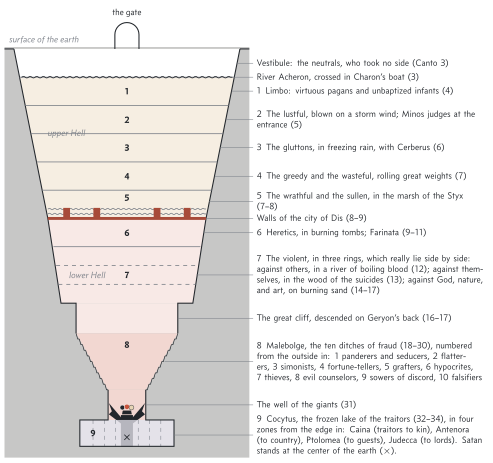
The first circle is Limbo, the home of the unbaptized and the virtuous non-Christians. There, in a noble castle on a green meadow, Dante meets Homer and the Roman poets Horace, Ovid, and Lucan, and they welcome him as the sixth poet of their company, after Virgil. Aristotle, whom Dante calls the master of those who know, sits among the philosophers. No one in Limbo is tortured, but everyone sighs.
At the entrance to the second circle sits Minos (my-nos), the old king of Crete who judged the dead in Greek myth (Vol. 4, Classical Myth). Here each soul confesses everything, and Minos wraps his tail around himself as many times as the number of the circle it must go down to. Below him a storm wind that never rests whirls the lustful through the dark air like flocks of starlings: Semiramis (seh-mir-uh-mis), a legendary queen of Assyria, and Dido, the queen of Carthage who loved Aeneas, with Cleopatra, Helen, Paris, and Tristan. Two souls fly together, and Dante calls them over. They are Francesca (fran-ches-kah) da Polenta, a noblewoman of Ravenna, and Paolo Malatesta, her husband’s younger brother. Francesca had been married to Giovanni Malatesta, a son of the lord of Rimini, and about 1285 he caught the two lovers together and killed them both. In Dante, Paolo and Francesca are blown aboutIn this poem, Paolo and Francesca are blown about by winds as punishment for adultery. → Inferno••• side by side forever, punished for their adultery, still together and still in pain.
Francesca tells Dante what happened. “There is no greater sorrow / Than to be mindful of the happy time / In misery,” she begins, in Longfellow’s words. One day she and Paolo were reading together, for pleasure, the romance of Lancelot, the knight who loved Queen Guinevere (Chapter 11; Vol. 8, The Northern Worlds). When they read of Lancelot’s first kiss, Paolo kissed her, “all palpitating,” and “that day no farther did we read therein.” The book, she says, was their go-between, as a knight had been for Lancelot. Dante is so moved with pity that he faints and falls “even as a dead body falls.”
In the third circle the gluttons lie in a filthy, freezing rain of hail and snow, and Cerberus (sur-bur-us), the three-headed watchdog of the underworld, barks over them and tears at them with his claws. When Aeneas passed Cerberus, the Sibyl threw the dog a drugged honey cake (Vol. 4, Classical Myth). Virgil has no cake. Instead Virgil throws fistfuls of earthIn this poem, characters get past Cerberus by filling its mouths with mud. → Inferno•This character throws dirt or mud into a creature’s gullets. → Virgil• into the monster’s three throats, earth that in that rain is mud. In Longfellow’s lines, “with his fists well filled, / He threw it into those rapacious gullets,” and the beast falls silent as a dog does over a bone.
In the fourth circle the greedy and the wasteful roll great weights at each other and crash them together forever, each crowd shouting at the other. The fifth circle is the black marsh of the Styx, where the angry fight one another in the mud and the sullen lie under it, gurgling. A ferryman named Phlegyas (flej-ee-us) rows the poets across in his boat, the crossing that the French painter Eugène Delacroix (del-uh-krwah) painted in 1822 (Vol. 15, The Age of Revolution). As they near the far side, Dante sees the towers of a city glowing red.
This is the city of Dis, which walls in all of lower Hell. Dante calls its towers meschite, “mosques,” the word a Christian of his time used for the buildings of an unbelievers’ city, and Longfellow kept it: “Its mosques already, Master, clearly / Within there in the valley I discern / Vermilion, as if issuing from the fire.” Virgil explains that the eternal fire inside them makes them glow. These are the fiery mosques of Dis,This poem features the fiery mosques of the city of Dis. → Inferno••A fiery citadel forming the city of Dis appears in this place. → hell•• a burning citadel at the halfway point of the descent. Fallen angels slam the gate in Virgil’s face, and the poets can go no farther until a messenger from heaven crosses the Styx dry-shod and opens it with a touch of his wand.

Inside the walls is the sixth circle, a plain of open tombs heated red-hot, where the heretics burn. From one of them a proud man stands up, chest and head above the rim, “as if Hell he had in great despite.” He is Farinata (fah-ree-nah-tah) degli Uberti, who died in 1264, the year before Dante was born. In life he was the leader of the Ghibellines,In this poem, the narrator encounters the Ghibelline leader Farinata. → Inferno• the party in Florence that sided with the emperor against the pope’s party, the Guelphs (Chapter 18). In 1260 he led the Ghibelline exiles to a great victory over Florence at Montaperti, near Siena. Afterward, when his allies proposed to destroy the city completely, he alone stood up and refused. He lies here among the followers of the Greek philosopher Epicurus, who taught that the soul dies with the body, and in 1283 his bones were dug up and tried for heresy. Dante’s family were Guelphs, Farinata’s enemies, and the old man’s first question is “Who were thine ancestors?” They spar over which party was driven out more often. Then Farinata foretells that before many months pass Dante will learn for himself how hard it is to come home from exile. In the same tomb the father of Dante’s friend Guido Cavalcanti, the poet of Chapter 18, rises and asks whether his son is still alive.
The seventh circle punishes violence, in three rings. Those who were violent against others boil in Phlegethon, a river of blood, where centaurs shoot any soul that rises too far out of it. Those who were violent against themselves, the suicides, have become thorny trees in a dark wood, and bleed and speak when a twig is snapped. When Dante breaks off a branch, the tree is Pier della Vigna (veen-yah), the chief minister of the Emperor Frederick II (Chapter 9), who was accused of treason, blinded, and killed himself in prison in 1249. “Never broke I faith / Unto my lord,” he swears. Those who were violent against God, against nature, and against “art” lie, run, or crouch on a plain of burning sand under a slow rain of fire. By “art” Dante means human work, and its sinners are the moneylenders.
On the sand Virgil explains where Hell’s rivers come from. In Mount Ida on Crete, he says, stands a huge old man of metal, with his back to Damietta in Egypt and his face toward Rome. His head is gold, his arms and chest silver, his body brass, and his legs iron, and his right foot, the one he leans on, is clay. The figure comes from a dream of Nebuchadnezzar, king of Babylon, in the Bible’s Book of Daniel, and it stands for the ages of mankind, each worse than the last. Every part but the gold is cracked, and the Old Man of Crete’s tearsIn this poem, the Old Man of Crete's tears create rivers. → Inferno• drip through the cracks and down into the earth. They form Acheron, Styx, and Phlegethon, and at the bottom they freeze into Cocytus (koh-sy-tus).
Geryon and Malebolge
The burning plain ends at a cliff so high that no one could climb down it. Virgil takes the cord that Dante wears around his waist and throws it out into the dark, a signal. Up out of the abyss, swimming through the air, comes a monster. In Greek myth Geryon (jeer-ee-on) was a three-bodied giant whose cattle Heracles stole (Vol. 4, Classical Myth), but Dante made him something new.
Dante’s Geryon is fraud, with an honest man’s face,In this poem, Geryon, an embodiment of fraud with an honest man's face and a scorpion's tail, carries two travelers. → Inferno••In the Inferno, Dante and Virgil descend to Malebolge by riding on this creature's back. → Geryon•In the Inferno, this creature has the face of an honest man. → Geryon•In the Inferno, this creature represents fraud. → Geryon• and he carries the poets on his back down the cliff to Malebolge (mah-lay-bohl-jay), the eighth circle. Longfellow’s lines describe him: “The face was as the face of a just man, / Its semblance outwardly was so benign, / And of a serpent all the trunk beside.” He has two hairy paws, a back painted with knots and circles brighter than any Turkish carpet, and a tail that ends “in the guise of scorpion,” with a poisoned fork at the tip. That is what a fraud looks like: kind in the face, deadly in the tail. Dante climbs on in front, with Virgil behind him to keep the tail away. Geryon swims down in wide, slow circles, “as falcon who has long been on the wing,” until he sets them on the rock below and shoots away like an arrow (Figure 19.7).

“There is a place in Hell called Malebolge,” the eighteenth canto begins, “Wholly of stone and of an iron color.” The name Malebolge means “evil pouches.” It is the eighth circle, a great slope of rock cut by ten ditches in rings, one inside another, like the moats around a castle, with bridges of rock running across them like spokes. Each ditch holds one kind of fraud. Flatterers wallow in filth; men who sold church offices for money, the sin of simony (Chapter 5), are stuck head-down in holes with fire burning on the soles of their feet. One of them, Pope Nicholas III, hears Dante’s voice above him and cries out, “Dost thou stand there already, Boniface?” He has mistaken Dante for Pope Boniface VIII, who was still alive in 1300 and whom Dante blamed for his exile; Nicholas expects him to arrive and push him deeper into the hole. So the poem finds a place in Hell for a living pope without breaking its own date.
In the fourth ditch Dante looks down and sees a slow procession of weeping souls. Each one’s head has been twisted round on its neck, so that the face looks back over the shoulders and the tears run down the spine. These are fortune-tellers, with heads facing backward:In this poem, fortune tellers have backward-facing heads. → Inferno• men and women who tried to see too far ahead, and now can only look behind them and walk backward. Among them are Tiresias (ty-ree-see-us), the blind prophet of Thebes, and Manto, the prophetess for whom Virgil’s home city of Mantua was named. Dante weeps at the sight, and Virgil scolds him sharply. “Here pity lives when it is wholly dead,” he says in Longfellow’s line, meaning that in Hell the only true pity is to agree with God’s justice.
In the fifth ditch, grafters who took bribes in public office are sunk in boiling pitch, and devils with long hooks, called the Malebranche (mah-lay-brahn-keh), “Evil Claws,” stab any who come up for air. Their leader, Malacoda (mah-lah-koh-dah), “Evil Tail,” tells Virgil that the bridge over the next ditch has fallen in, but that another one farther along is still standing. He sends ten devils to escort them. When the devils turn on them, the poets escape only by sliding down into the sixth ditch, where hypocrites trudge in cloaks gilded outside and made of heavy lead within. There a friar tells them that no bridge crosses that ditch at all; every one was broken. The devil had told them a lieIn this poem, the protagonists are told a lie about a bridge. → Inferno•• about the bridge, and Virgil walks off in anger as the friar remarks that he once heard in Bologna that the Devil is “a liar and the father of lies.” Beyond, in the seventh ditch, thieves are bitten by snakes and turn into snakes themselves.
Ulysses

In the twenty-sixth canto, from the bridge over the eighth ditch, Dante sees the valley full of moving flames, as many as the fireflies a farmer sees on a summer evening. Each flame hides a soul. These are the evil counselors, who used their cleverness to deceive. One flame is split at the top into two horns, and Virgil explains that inside it, burning together, are Ulysses and DiomedesIn Canto 26 of Dante's Inferno, this character shares a flame with Diomedes. → Odysseus• (dy-uh-mee-deez), the two Greek heroes of the Trojan War who went together on its most cunning night raids. Ulysses was the Latin name for Odysseus (oh-dis-ee-us). The two of them suffer here for the trick of the wooden horse, for luring Achilles away to the war, and for stealing the Palladium, Troy’s sacred statue of Athena.
Dante could not read Greek and never read Homer, so his Ulysses owes nothing to the Odyssey’s homecoming. Virgil speaks to the flame, since the Greeks might scorn Dante’s speech, and asks how Ulysses died. The larger horn answers. After he left the enchantress Circe, Ulysses says, neither love for his son, nor duty to his old father, nor the love he owed Penelope could overcome his longing “to be experienced of the world.” He set out on the open sea with one ship and the few old companions still with him. They sailed west past Sardinia and the coasts of Spain and Morocco until they reached the narrow strait where Hercules had set up his pillars as a sign that no one should go farther. That is the Strait of Gibraltar.
There Ulysses made his crew a short speech, in Longfellow’s lines: “Consider ye the seed from which ye sprang; / Ye were not made to live like unto brutes, / But for pursuit of virtue and of knowledge.” They rowed on into the empty ocean, turning south until the stars of the other pole came up, and sailed for five months. At last they saw a mountain, dim with distance and higher than any they had ever seen. Then a whirlwind rose from it, spun the ship three times, and on the fourth lifted the stern and drove the prow under, “until the sea above us closed again.” Ulysses dies after sailing beyond the PillarsIn a poem, this character dies after sailing beyond the Pillars of Hercules. → Odysseus• of Hercules, within sight of a mountain that, as the reader learns later, was Mount Purgatory. Another volume tells Homer’s Odysseus and names this voyage (Vol. 4, Classical Myth), and Tennyson’s “Ulysses” gave the old hero another departure (Vol. 17, The Victorians).
In the next flame burns Guido da Montefeltro (mon-teh-fel-troh), lord of Urbino a century and a half before his kinsman Duke Federico. A Ghibelline war captain, he became a Franciscan friar in old age, then gave Pope Boniface VIII a piece of treacherous advice. He tells his story only because he believes that no one ever returns from Hell to repeat it: “If I believed that my reply were made / To one who to the world would e’er return,” he begins in Longfellow’s version. Six centuries later T. S. Eliot put those words of Guido’s, in Dante’s Italian, at the head of “The Love Song of J. Alfred Prufrock” (Vol. 21, Trenches and Modernists).
Cocytus and Satan
Below Malebolge a ring of giants stands around a deep well, their bodies hidden to the waist like towers. One of them, Antaeus (an-tee-us), picks up the two poets in his hand and sets them down at the bottom. Dante finds himself on the frozen lake of Cocytus,In this poem, a frozen lake known as Cocytus can be found. → Inferno••The frozen lake Cocytus is at the lowest point of this place. → hell• at the lowest point of Hell, ice so thick and clear that it looks like glass. The Greeks had named Cocytus as the underworld’s river of wailing (Vol. 4, Classical Myth); Dante froze it solid.
Here are the traitors, frozen in four zones from the edge inward. Caina (kah-ee-nah), named for Cain, who killed his brother Abel, holds traitors to their families. Antenora (an-teh-nor-ah), named for a Trojan who was said to have betrayed Troy, holds traitors to their country or party. Ptolomea (tol-oh-may-ah) holds traitors to their guests, and Judecca (joo-dek-uh), named for Judas, holds traitors to their lords and benefactors.
In Antenora two heads stick up out of one hole in the ice, one above the other, and the upper one is eating the lower. He lifts his mouth from his “grim repast” and wipes it on his victim’s hair. He is Count Ugolino della Gherardesca, once the most powerful man in Pisa, and the head belongs to Ruggieri (rood-jeh-ree) degli Ubaldini, archbishop of Pisa. Ugolino is among the traitors because he was accused of handing Pisan castles to the city’s enemies, Florence and Lucca; the archbishop is here because he betrayed Ugolino. In 1288 the archbishop turned the city against Ugolino and had him locked in a tower with two of his sons and two grandsons, and in March 1289 the doors were shut on them and they were left to starve. Ugolino tells how the boys offered him their own flesh to eat, how the first of them died on the fourth day, and how the other three fell one by one between the fifth day and the sixth. Then he ends with an ambiguous line, “Then hunger did what sorrow could not do.” It may mean that hunger killed him, or something far worse. Now, for all eternity, Ugolino gnaws the archbishop’s headIn this poem, Count Ugolino gnaws on the head of the archbishop Ruggieri. → Inferno• with teeth “as a dog’s, upon the bone,” and Dante bursts out in a curse on Pisa.
In Judecca the souls are covered completely by the ice, “like unto straws in glass.” Ahead Dante makes out something like a windmill in fog. It is Satan, the angel once called Lucifer, “light-bearer,” who in Christian belief rebelled against God and fell from heaven. Virgil calls him by the old Roman name for the king of the dead, the same name as his city: “Behold Dis.” Dante cannot say how afraid he felt: “I did not die, and I alive remained not.”
The “Emperor of the kingdom dolorous” is a giant so huge that one of his arms is bigger than any of the giants in the well. He is trapped in the iceThis character is trapped in ice at the bottom of Dante’s Inferno. → Satan• from the middle of his chest down, fixed at the very center of the earth. For Dante it is the place farthest from God in all creation, and its cold is the cold of a will that has refused all love. Satan has three faces:This character has three faces in Dante’s Inferno. → Satan• the front one red, the right one between white and yellow, the left one black. Many readers have seen in them an evil mockery of the Trinity, the Christian teaching that God is three persons in one. Under each face a pair of featherless wings, like a bat’s, beats forever, and the three winds they make freeze Cocytus. He weeps from six eyes, and tears and bloody slobber drip down three chins.
In each of his three mouths Satan chews a traitor.In this poem, Satan is depicted devouring Brutus, Cassius, and Judas. → Inferno•• In the front mouth is Judas Iscariot, the disciple who betrayed Jesus, head inside and legs kicking, his back flayed by Satan’s claws. In the other two mouths, head down, are Brutus and Cassius, the leaders of the plot that killed Julius Caesar in 44 BC (Vol. 7, The Romans). Brutus “writhes himself, and speaks no word.” To Dante the three were the worst of all sinners, because Judas betrayed the founder of the Church and Brutus and Cassius betrayed the founder of the Empire, the two powers God set over the world.
Then the poets leave. Dante holds Virgil around the neck, and Virgil climbs down Satan’s shaggy side, gripping his fur between the hair and the ice. At Satan’s hip, the exact center of the earth, Virgil turns himself upside down and begins to climb, and Dante thinks they are going back into Hell. They are not. They have passed the center, so “down” now points the other way, and Satan’s legs stick up past them. Virgil explains that Satan fell from heaven on this side of the earth; the land here fled from him under the sea, and the rock that rushed up away from him made the mountain Ulysses saw. The poets follow a little stream up a long, dark passage. The canticle ends when, through a round opening, Dante sees “some of those beauteous things which Heaven doth bear,” and “thence we came forth to rebehold the stars.”This poem ends with the narrator coming forth to rebehold the stars. → Inferno•• Each of the three canticles ends on that word, “stars” (Chapter 18).
The Inferno after Dante
No part of the Comedy has been illustrated more often than the Inferno, from manuscript painters of the fourteenth century to the more than 130 engravings that the French illustrator Gustave Doré (dor-ay) published for the whole poem in 1861 and 1868. Two of the most famous works of art it inspired show the bodies of the damned, and neither is printed in this book.
In 1880 the French government asked the sculptor Auguste Rodin (roh-dan) for a pair of bronze doors for a new museum of decorative arts in Paris. He was free to choose his subject, and he chose Dante’s Inferno.Rodin's The Gates of Hell was inspired by this author. → Dante Alighieri•• He called the doors The Gates of Hell, and he worked on them for thirty-seven years, until his death in 1917, crowding them with about 180 writhing figures. The museum was never built, and the gates were not cast in bronze until after he died. Several of their figures became famous on their own: the man seated above the doors, chin on fist, began as Dante looking down on his poem and is known today as The Thinker, and The Kiss began as Paolo and Francesca. Rodin is taught elsewhere (Vol. 18, Paris, Capital of the Arts).
The other is a painting of 1850 by the French painter William Bouguereau (boo-guh-roh), Dante and Virgil, now in the Musée d’Orsay in Paris. It shows a scene from the thirtieth canto, in the last ditch of Malebolge, where the falsifiers run mad. There Gianni Schicchi (skee-kee), a Florentine who had impersonated a dead man in order to dictate a false will, bites another sinner’s neck.A painting by William Bouguereau inspired by this author depicts a nude man biting another man's throat. → Dante Alighieri• The victim is Capocchio (kah-pok-kee-oh), an alchemist who had forged metals. Bouguereau painted the two damned men naked and locked together, the biter’s teeth in his victim’s throat, while Dante and Virgil watch in horror from behind.
The Purgatorio
Purgatory, where in Catholic teaching the saved are made clean before they enter heaven, is for Dante the mountain in the southern ocean, exactly opposite Jerusalem, that Chapter 18 drew. The second canticle opens on its shore at dawn on Easter Sunday, with Longfellow’s “To run o’er better waters hoists its sail / The little vessel of my genius now.” Dante looks up and sees four bright stars that no living person had seen since Adam and Eve.
The guardian of the shore is a surprise. He is Cato the Younger, the Roman who killed himself at Utica, in North Africa, in 46 BC rather than live under Julius Caesar (Vol. 7, The Romans), a man who was not a Christian and who had taken his own life, a grave sin in Christian teaching. Dante never says outright why Cato is saved, but Virgil, asking him to let Dante pass, says, in Longfellow’s lines, “He seeketh Liberty, which is so dear, / As knoweth he who life for her refuses.” Cato stands for freedom, and the souls who climb the mountain are seeking freedom from sin. Cato tells Virgil to wash the grime of Hell from Dante’s face with dew and to tie a reed around his waist, the plant of humility.

On the lower slopes, called Ante-Purgatory, wait the souls who put off repenting until the end of their lives; they must wait before they may begin to climb (Figure 19.9). Among them is Manfred, King of Sicily, the son of Frederick II, whom Chapter 9 already met here; he died excommunicated, fighting the pope’s champion at Benevento in 1266. He repented with two mortal wounds in him, and he tells Dante, “Horrible my iniquities had been; / But Infinite Goodness hath such ample arms, / That it receives whatever turns to it.” The pope’s curse could not shut him out of salvation, only delay him. Above them is a gate with three steps, where an angel cuts seven P’s on Dante’s forehead with the point of his sword, one for each peccatum, Latin for “sin.” Above the gate rise seven terraces, each a ledge around the mountain, and each terrace cleanses one of the seven deadly sins: pride, envy, wrath, sloth, avarice, gluttony, and lust. The proud walk bent double under heavy stones, the envious sit with their eyelids sewn shut with wire, and the angry stumble through black smoke. On each terrace an angel brushes one P from Dante’s forehead with a wing, and each time the climbing grows easier.
Unlike the damned, the souls here are glad. They sing hymns, they ask for the prayers of the living, and when one of them finishes its penance the whole mountain shakes. On the fifth terrace, where the avaricious lie face down in the dust, the mountain shakes for Statius (stay-shus), the Roman poet of the Thebaid, an epic of the war of the Seven against Thebes (Vol. 4, Classical Myth). He has lain on this terrace for more than five hundred years and is now free to rise, and he walks on with them. He tells Virgil, not knowing who he is, that the Aeneid had been his mother and nurse in poetry. When he learns whom he is speaking to, he bends to embrace Virgil’s feet, and Virgil gently reminds him that they are both only shades. As they climb on, Statius tells him that Virgil’s own fourth Eclogue had led him to become a Christian, in secret, for fear of persecution. From there to the summit the two Roman poets climb together, with Dante behind them.
On the seventh terrace the lustful walk inside a wall of fire. There Dante meets the Bolognese poet Guido Guinizzelli, whom he honors as the father of the sweet new style (Chapter 18). Guido points to another soul in the flames, who “Was of the mother tongue a better smith,” in Longfellow’s words; the phrase is more often quoted as “the better craftsman.” He is Arnaut Daniel (ar-nowt), a troubadour of the twelfth century who wrote in Occitan, the language of southern France (Chapter 11), and who invented the sestina, a poem of six stanzas that reuse the same six end words in a shifting order. Every other soul in the poem speaks Italian, or now and then Latin, but Arnaut answers in his own language, in eight lines of Occitan: “Jeu sui Arnaut, que plor e vai chantan,” which Longfellow translates “I am Arnaut, who weep and singing go.” Then he hides himself again in the fire.

Dante must pass through the same wall of fire, and he is afraid until Virgil tells him that only the fire stands between him and Beatrice. On the summit lies the Earthly Paradise, the Garden of Eden, a sunlit forest beside a stream. There a great procession comes through the trees, with a chariot drawn by a griffin, a beast half eagle and half lion, and on the chariot, veiled and crowned with olive, Beatrice appears. Dante turns to tell Virgil that he knows “the traces of the ancient flame,” a line Virgil himself had written for Dido. But Virgil is gone, back to Limbo, and Dante weeps. Beatrice speaks his name, “Dante,” the only time it appears in the poem, and rebukes him for having strayed from her memory after her death into a wasted life. He confesses, and he is drawn through the river Lethe (lee-thee), whose water, as in Greek myth, makes the drinker forget: here it takes away the memory of sin. Then he drinks from a second river, Eunoe (yoo-noh-ee), “good mind,” which restores the memory of every good deed. He comes out “Pure and disposed to mount unto the stars.”
The Paradiso
The last canticle is the hardest and, for many readers, the most beautiful. In the Paradiso, Beatrice guides Dante through Paradise;Beatrice guides the narrator through Heaven in this poem. → Paradiso••In this poem, Beatrice guides the narrator through Paradise. → The Divine Comedy••Beatrice, whom this poet loved, guides him through Paradise. → Dante Alighieri••• she is the Florentine girl he had loved since he first saw her at nine. She looks up into the sun; he looks at her; and without feeling it he rises with her through the sky. When he cannot follow her thought, she explains, patiently and sometimes with a smile, everything from the spots on the Moon to the order of the angels.
Dante’s heaven is the universe of Ptolemy that Chapter 18 drew: nine nested spheres around a motionless earth, the last of them the Primum Mobile, and beyond them the Empyrean, the heaven of pure light where God dwells. All the blessed live in the Empyrean, but they come down to meet Dante in the spheres, to show him their different ranks of glory. The nine spheres are joined to virtuesThis poem depicts nine celestial spheres associated with different virtues. → Paradiso•• (Table 19.1). The first three, which the earth’s shadow touches, hold souls whose virtue was flawed, and the next four hold the four cardinal virtues: prudence (practical wisdom), fortitude (courage), justice, and temperance (self-control). The eighth holds the three that Christians call the theological virtues, faith, hope, and love, and the ninth is the home of the angels.
| Sphere | Souls | Virtue | Dante meets |
|---|---|---|---|
| 1 Moon | those who broke their vows | fortitude, flawed by inconstancy | Piccarda Donati |
| 2 Mercury | those who did good for fame | justice, flawed by ambition | the emperor Justinian |
| 3 Venus | the lovers | temperance, flawed by passion | the troubadour Folquet |
| 4 Sun | the wise | prudence | Thomas Aquinas, Bonaventure |
| 5 Mars | the warriors of the faith | fortitude | his ancestor Cacciaguida |
| 6 Jupiter | the just rulers | justice | an eagle made of souls |
| 7 Saturn | the contemplatives | temperance | Peter Damian, Benedict |
| 8 Fixed stars | Christ’s triumph | faith, hope, and love | Peter, James, and John |
| 9 Primum Mobile | the nine orders of angels | a point of light | |
| Empyrean | all the blessed, in a rose | Saint Bernard; God |
In the sphere of the Moon, the slowest and lowest, Dante meets Piccarda (pee-kar-dah) Donati. She was the sister of his friend Forese (foh-ray-zeh) and of Corso Donati, the leader of the Black Guelphs who drove Dante into exile. As a girl she became a nun of the Poor Clares, the order Saint Clare founded beside Francis (Chapter 14), but Corso dragged her from the convent and married her to a political ally, so her vows were broken. Dante asks whether she does not long for a higher place in heaven. She answers, smiling, that the blessed want only what God wills for them, and Longfellow’s line has her say, “And his will is our peace.” In Italian it is In la sua volontade è nostra pace, as Matthew Arnold quoted it among the touchstones he used to test all poetry (Vol. 17, The Victorians).
Higher up, the souls become pure light. In Mercury the emperor Justinian (Chapter 1) introduces himself with “Caesar I was, and am Justinian,” a ruler’s title left behind on earth, and tells the story of the Roman eagle from Aeneas to Dante’s own day. In the Sun, the Dominican Thomas Aquinas (Chapter 15) praises Saint Francis, and the Franciscan theologian Bonaventure praises Saint Dominic, each honoring the other’s founder. In Mars, Dante’s great-great-grandfather Cacciaguida, who, he tells Dante, died on the Second Crusade (Chapter 8), foretells his exile: “Thou shalt have proof how savoureth of salt / The bread of others, and how hard a road / The going down and up another’s stairs.” In the eighth sphere Saint Peter, Saint James, and Saint John examine Dante on faith, hope, and love, like professors at a university, and he passes.

At last Dante passes beyond space altogether, into the Empyrean. He sees a river of light, and then all the saved, in white robes, seated in rising tiers like the petals of an enormous white rose, with angels flying among them like bees. Beatrice goes to take her own seat in the rose. In her place stands an old man, and Dante meets Saint Bernard in the Empyrean,In this poem, the narrator meets St. Bernard in the Empyrean. → Paradiso•• his third and last guide. Bernard was the twelfth-century abbot of Clairvaux in Champagne, famous for his preaching and his love of the Virgin Mary (Chapter 8). He prays to Mary that Dante may see God, beginning “Thou Virgin Mother, daughter of thy Son.”
Dante looks up into the light, and the poem’s last canto tries to say what he saw. He sees three circles of three colors and one size, the three persons of the Trinity, and in one of them the image of a man, since Christians believe that God the Son became man in Jesus. Like a geometer who tries to square the circle, a problem no one could solve, he strains to understand how the human image fits the circle, and he cannot. Then, in a flash, his wish is granted, and the vision ends where words fail. His will and desire, he says, were turning now like an evenly moving wheel, moved by “The Love which moves the sun and the other stars.”
What to remember
- The Divine Comedy (written about 1308 to 1321) has three canticles, the Inferno, Purgatorio, and Paradiso, of thirty-four, thirty-three, and thirty-three cantos, in terza rima; Longfellow translated it in 1867.
- The Inferno opens in a dark wood “midway upon the journey” of life, in 1300, on the night before Good Friday. A leopard, a lion, and a she-wolf drive Dante back, and Virgil, a virtuous non-Christian from Limbo sent by Beatrice, becomes his guide.
- The gate says “All hope abandon, ye who enter in.” Hell has nine circles in a funnel: Paolo and Francesca in the storm of the lustful, Cerberus quieted with earth, the fiery mosques of Dis, and Farinata in his burning tomb.
- Geryon, fraud with an honest man’s face and a scorpion’s tail, carries the poets down to Malebolge, the ten ditches of fraud, where fortune-tellers’ heads face backward and a devil lies about a bridge.
- Ulysses and Diomedes share a flame; Ulysses drowns after sailing beyond the Pillars of Hercules.
- At the bottom is the frozen lake of Cocytus. Ugolino gnaws Archbishop Ruggieri’s head, and three-faced Satan, frozen to the chest, chews Judas, Brutus, and Cassius. The poets climb out “to rebehold the stars.”
- Mount Purgatory has seven terraces for the seven deadly sins. Cato guards the shore, Statius joins the poets, Arnaut Daniel answers in Occitan, and at the summit Beatrice replaces Virgil.
- In the Paradiso Beatrice guides Dante through nine spheres joined to virtues; Piccarda says “his will is our peace,” and Saint Bernard leads him to the final vision of God in the Empyrean.
Chapter 20 · 43 clues
Petrarch and Laura
Early on the morning of May 19, 1348, a letter reached the poet Francesco Petrarca at Parma, in northern Italy. It came from Avignon, in the south of France, where the plague later called the Black Death was killing people faster than they could be buried. It was written by his closest friend, a Flemish monk and musician whom he called Socrates, and it said that Laura was dead. She had died on April 6, at the first hour of the day, about sunrise. The poet did something that tells us a good deal about him. He took down the book he valued most, a large handwritten Virgil whose first page the Sienese painter Simone Martini (see-moh-neh mar-tee-nee) had painted for him (Vol. 7, The Romans), and on a blank leaf he wrote a note in Latin. Laura, he wrote, had first appeared to his eyes in the church of Saint Clare at Avignon, at the first hour of April 6, 1327. In the same city, in the same month, on the same day, and at the same hour of 1348, that light had been taken from this light. He put the note in that book, he explained, because it came often before his eyes, and he wanted to remember that nothing in this life should please him any longer.
She was another man’s wife, it seems, and she never returned his love. Yet he had already been writing poems to her in Italian for twenty-one years, and he went on for twenty-six more, until he had made a book that taught all of Europe how to write about love. The same man was the greatest scholar of his age, who taught Europe to read the ancient Romans again. He never stopped arguing with himself about whether either was worth his soul.
Petrarch’s life
An exile’s son
Petrarch was born at Arezzo, a hill town in Tuscany about 40 miles southeast of Florence, on Monday, July 20, 1304, “at dawn,” as he told posterity, the readers of later ages, in a letter addressed to them that James Harvey Robinson translated in 1898. He was, in the same words, “born in exile.” His father, Ser Petracco (peh-trahk-koh) (Ser was a notary’s title), was a Florentine notary, a lawyer who drew up contracts and wills, and a friend of Dante. In 1302 the same party quarrel that drove Dante out of Florence had sent Petracco into exile too (Chapter 18). The boy was named Francesco di Petracco, “Francesco, son of Petracco.” As a young man he polished the name into Petrarca, which English shortens to Petrarch.

The exiles drifted. In 1312 the family moved to Avignon, on the Rhône River in southern France, where the popes had lived since 1309 (Chapter 10); why they stayed there for most of a century, Chapter 23 will tell. A papal court meant work for lawyers. Avignon was crowded and expensive, so Petrarch went to school at Carpentras (kar-pahn-trah), a small town 15 miles to the northeast, and learned his Latin there. His father wanted another lawyer in the family and sent him with his younger brother, Gherardo (geh-rar-doh), to the law schools of Montpellier and then Bologna. Petrarch spent seven years at them and called the years wasted. In a letter of his old age he told how his father found him reading poets instead of law and threw his books on the fire. When the boy wept, his father pulled two of them out half burned: a Virgil and a book on the art of speaking by Cicero, the great Roman orator.

Petrarch grew up in Provence and spent most of his first fifty years there, but his homeland was Italy,This country is the homeland of Petrarch. → Italy•• and he never let himself forget it (Figure 20.2). In his letters Avignon is a place of exile, “that disgusting city,” and in his poems it is a new Babylon, the city where the Hebrews wept in captivity. In the 1340s he wrote a long Italian poem, “Italia mia” (“My Italy”), that begged the lords of a land that was not yet one country to stop hiring German soldiers to kill one another. Nearly two centuries later Machiavelli ended The Prince with four of its lines (Vol. 10, Rebirth).
When their father died in 1326, the brothers came back to Avignon to find his money gone, stolen, Petrarch believed, by the men who were supposed to guard it. He needed a living, so he became a cleric, a member of the clergy. His rank in the Church let him hold church posts and live on their income, though it did not allow him to marry. He found patrons in the Colonna (koh-lohn-nah), a great Roman family at the papal court: Giacomo Colonna, a bishop, and his brother, Cardinal Giovanni Colonna, in whose household he lived for years. He never married, but he had two children, a son, Giovanni, born in 1337, and a daughter, Francesca, born in 1343, by a mother, or perhaps two, whose name he never wrote down. And on April 6, 1327, a year after he came home, he saw Laura.
The ascent of Mont Ventoux
From Carpentras the boy could see a bald mountain 14 miles to the northeast. Mont Ventoux (mawn vahn-too), the “windy mountain,” rises 6,270 feet, the highest ground for a long way around, and its limestone top is so bare that from far off it looks white even in summer (Figure 20.3). On April 26, 1336, when he was thirty-one, Petrarch climbed it, by his own account, with Gherardo and two servants. He had read in the Roman historian Livy that King Philip V of Macedon once climbed a mountain to see two seas at once, and he wanted, he said, nothing more than to see what so great a height had to offer.

He told the story in a long letter to Dionigi (dee-oh-nee-jee) da Borgo San Sepolcro, a friar and teacher of theology who had given him a pocket copy of Augustine’s Confessions. The brothers slept at Malaucène (mah-loh-sen), at the mountain’s northern foot, and started before dawn. An old shepherd tried to stop them: fifty years before, he had climbed to the top himself and gained nothing by it but fatigue and torn clothes. Gherardo went straight up the ridge. Petrarch kept looking for an easier way around, which always led him down into the valleys, and he had to climb back again three times or more, while his brother laughed. Sitting in a valley, he turned his mistake into a sermon to himself: the blessed life, too, lies on a high peak, and, in Robinson’s translation, “no human ingenuity can alter the nature of things, or cause anything to reach a height by going down.”

At the top, clouds lay beneath his feet. He looked east toward Italy, “whither my heart most inclined,” at the snowy Alps that the Carthaginian general Hannibal had crossed to invade Italy. Later, as the sun sank, he looked west, with the mountains around Lyon on his right, the bay of Marseille on his left, and the Rhône below. Then, he says, he took out the little book. Augustine, the North African bishop of about AD 400, had told in the Confessions how a child’s chant of “take up and read” made him open Saint Paul’s letters at random and change his life (Vol. 7, The Romans). At the summit of Mont Ventoux, Petrarch opened Augustine’s Confessions at randomThis poet described climbing Mont Ventoux and reading Augustine's Confessions at the summit. → Petrarch••• in the same way, while Gherardo waited to hear what it said. His eyes fell on a sentence from Book 10. “And men go about to wonder at the heights of the mountains, and the mighty waves of the sea, and the wide sweep of rivers, and the circuit of the ocean, and the revolution of the stars, but themselves they consider not.” He shut the book, angry with himself for admiring earthly things, and did not speak again until they reached the bottom. He wrote the letter, it says, that night at the inn.
It is almost too neat. The day is exactly ten years after he left Bologna, the brothers act out the straight path and the crooked one, and the book falls open at the perfect page. Petrarch put the letter into his collected letters many years later and probably wrote or rewrote it then. The Italian scholar Giuseppe Billanovich argued in the 1960s that it was composed some fifteen years after the climb, when the friar it is addressed to had been dead for nearly a decade. He and others think the climb itself a literary fiction, a parable dressed as a diary. Others think he did climb the mountain and later shaped the story. Either way, it is often called the first account of climbing a mountain for the view, though Petrarch’s own shepherd shows that he was not the first up this one.
The laurel crown
In 1337 Petrarch saw Rome for the first time and walked among its ruins with the Colonna as his guides. Rome, he wrote to Cardinal Colonna, was greater than he had imagined, and so were its ruins. That summer he settled in a small house at Fontaine-de-Vaucluse (fawn-ten duh voh-klooz), a narrow valley about 15 miles east of Avignon, where the river Sorgue (sorg) rises from a deep pool at the foot of a cliff. There, he told posterity, almost everything he wrote was “either accomplished or begun, or at least conceived.” His Latin poems began to circulate, and he wanted fame and did not pretend otherwise. On a single day in 1340, by his own account, two letters reached him. One came from the Senate of Rome, the governing body of the medieval city, and one from the University of Paris, and each invited him to come and be crowned as a poet.
The crown was laurel. In Ovid’s story the nymph Daphne, fleeing the god Apollo, was turned into a laurel tree, and Apollo made the laurel his own plant (Vol. 4, Classical Myth). The Greeks and Romans crowned victors and poets with its leaves, and a poet so crowned was a laureate, from the Latin laureatus, “crowned with laurel.” On Cardinal Colonna’s advice, Petrarch chose Rome. First he went to Naples to be examined by its king, Robert of Anjou, called the Wise, a grandson of the Charles of Anjou who had conquered southern Italy (Chapter 9). For three days the king questioned him about poetry and history, pronounced him worthy, and asked to have his unfinished Latin epic dedicated to him.
On Easter Sunday, April 8, 1341, Petrarch stood on the Capitol, the hill at the heart of ancient Rome where the temple of Jupiter had stood, and there, before he was crowned, he delivered his Coronation Oration.This poet delivered a "Coronation Oration" when crowned laureate in Rome. → Petrarch•• He built it like a sermon, on a text, but the text came from Virgil’s Georgics, his poem on farming, not from the Bible. It was Sed me Parnasi deserta per ardua dulcis raptat amor, “But a sweet longing sweeps me up the lonely slopes of Parnassus,” the Muses’ mountain (Vol. 4, Classical Myth). Poetry, he argued, is hard work, and its reward is glory, which the evergreen laurel stands for. Then, before a cheering crowd, a Roman senator set the laurel on his head. Petrarch believed that no poet had been crowned there since ancient times. The Senate gave him a diploma that made him a citizen of Rome and licensed him to teach poetry and history. After the ceremony he went to Saint Peter’s and laid his wreath on the altar.
Rome, plague, and the cities of the north
Six years later Petrarch thought he saw ancient Rome reborn. In May 1347 Cola di Rienzo (koh-lah dee ryen-tsoh), an innkeeper’s son who had become a notary, seized the government of Rome and promised to restore the ancient republic. He called himself tribune of the Roman people, after the ancient officers who had defended the common people against the nobles. Petrarch wrote to cheer him on and broke with his friends the Colonna, whom Cola was fighting. Cola fell within the year, and the German composer Richard Wagner later made him the hero of his opera Rienzi (Vol. 19, Wagner and Verdi). Then came 1348. The Black Death, which Chapter 21 will tell, killed Cardinal Colonna in July and many of Petrarch’s friends, and it was most likely the plague that had killed Laura in April.
In October 1350, on his way to Rome for the Jubilee of that year, a holy year in which the Church promised pilgrims to Rome the pardon of their sins, Petrarch passed through Florence. A Florentine writer nine years younger than he, Giovanni Boccaccio, who was then writing the Decameron (Chapter 22), welcomed him into his house, and they were friends for the rest of their lives. Boccaccio worshiped Dante and later sent Petrarch a copy of the Divine Comedy; Petrarch answered with a careful letter insisting that he did not envy Dante, and claiming, not quite believably, that he had never read it. In 1353 Petrarch left Provence for good (Figure 20.5). He spent eight years in Milan as the guest of its lords, the Visconti, and his friends were scandalized that the lover of Roman liberty lived on a tyrant’s bounty. Then he moved to Venice and Padua, fleeing the plague when it came back. There he quarreled with four Venetians who thought Aristotle had said everything worth knowing, and who called him a good man but an ignorant one; he answered with a pamphlet, On His Own Ignorance and That of Many Others.


About 1370 he settled in a small house at Arquà (ar-kwah) in the Euganean (yoo-gay-nee-un) Hills south of Padua, where his daughter and her family came to live with him. His eyes were failing; he had had to take to spectacles after sixty, he told posterity, “to my great annoyance.” He still worked all day with secretaries copying his books. On the night of July 18 to 19, 1374, a day or two before his seventieth birthday, he died among his books, and his household found him there in the morning. He was buried at Arquà in a marble tomb that still stands in front of the church.
Cicero and the humanists
Before printing, every book was a manuscript, copied by hand, and an ancient book survived only where some monastery or cathedral had kept a copy and recopied it before the last one rotted. Hundreds of Greek and Roman works had been lost this way, and many that survived lay unread in church libraries, known only by their titles. Petrarch spent his life hunting for them. He traveled north in 1333 out of curiosity, an unusual reason to travel in his day, through Paris, Ghent, Liège, and Cologne. At Liège he found a speech of Cicero’s that no one in Italy knew, the Pro Archia, “For Archias,” in which Cicero defends a Greek poet and praises literature as the comfort of every age of life.
Marcus Tullius Cicero, the Roman orator and statesman murdered in 43 BC (Vol. 7, The Romans), had been Petrarch’s model since the day his father pulled a half-burned Cicero from the fire. In 1345, in the cathedral library of Verona, Petrarch found a manuscript of Cicero’s private letters, those to his friend Atticus, with others to his brother Quintus and to Brutus, which no one had read for centuries, and he made himself a copy. Petrarch’s rediscovery of Cicero’s lettersPetrarch’s rediscovery of this man’s letters helped inspire Renaissance humanism. → Cicero• is often called the spark of Renaissance humanism, the revival of ancient learning that grew into the Renaissance, the flowering of art and learning that began in Italy (Vol. 10, Rebirth). The letters mattered because they showed scholars the ancients as living people; they were full of fear, gossip, money, and changes of mind. Petrarch was shocked to meet a Cicero so anxious and so changeable, and he answered with a letter to the dead man (Vol. 7, The Romans), scolding him for meddling in politics when he should have stayed with philosophy.
Cicero’s letters gave Petrarch an idea. He had been writing to friends for twenty-five years, and from about 1350 he gathered his letters into books, revising and polishing them as he went, so that a reader could follow a whole life through them. The first and largest collection is the Epistolae FamiliaresThis poet wrote Epistolae Familiares. → Petrarch•• (eh-pis-toh-lye fah-mee-lee-ah-rays), the “Letters on Familiar Matters”: 350 letters in twenty-four books, dedicated to his friend Socrates, the monk whose letter had told him of Laura’s death. The letter about Mont Ventoux is in it, and so is a last book made up mostly of letters to the great dead, among them Cicero, Seneca, Livy, Virgil, and Homer.
After 1361 he began a second collection, the Seniles (seh-nee-lays), the “Letters of Old Age.” He meant it to end with his “Letter to Posterity,”This poet's "Letter to Posterity" is included in his collection Seniles. → Petrarch•• the account of his life written for later ages, which he left unfinished at his death. In it he describes himself: his clear complexion and lively eyes, his contempt for money, and his love of the past. “Among the many subjects which interested me,” he wrote in Robinson’s translation, “I dwelt especially upon antiquity, for our own age has always repelled me.” He would rather, he said, have been born in any other age than his own.
Africa and the Secretum
Africa
Petrarch wanted to be the Virgil of his age, and Virgil had written an epic about Rome. One Good Friday, he told posterity, while he was wandering in the mountains near Vaucluse, “the strong desire seized me to write an epic in an heroic strain,” about a hero who had been dear to him since childhood. The result was his epic poem Africa,This poet wrote the epic poem Africa. → Petrarch••• begun about 1338. Its hero is Publius Cornelius Scipio (skip-ee-oh), called Africanus (af-rih-kay-nus), and its subject is the Second Punic War between Rome and Carthage. That is the war in which Hannibal crossed the Alps with his elephants in 218 BC and made war on the Romans for fifteen years in their own country. Scipio ended it by carrying the war to Africa and beating Hannibal at Zama in 202 BC (Vol. 7, The Romans).
The poem is written in Latin hexameters,This epic poem is written in Latin hexameters. → Africa• the six-beat line of Homer and Virgil (Vol. 1, The Toolkit). Petrarch thought only Latin worthy of so great a subject, and he meant his poem to stand on the shelf beside Virgil’s Aeneid. His chief source was Livy. As a young man Petrarch had gathered Livy’s surviving books on early Rome and on the wars with Carthage and Macedon, which were then copied separately, into a single volume.
The Africa tells the story of Hannibal’s invasion of ItalyThis epic poem describes Hannibal's invasion of Italy during the Second Punic War. → Africa•• from the Roman side. It takes up the story late in the war, when Scipio is carrying the fight to Africa while Hannibal is still loose in Italy. In the first two books Scipio sleeps, and his dead father, killed fighting the Carthaginians in Spain, appears to him with his uncle. The two old soldiers lift him into the heavens, show him the tiny Earth, and foretell Rome’s glories and troubles to come. Scipio’s dream fills those books.This epic poem centers on Scipio, whose dream it describes. → Africa••• Petrarch took the idea from Cicero’s “Dream of Scipio” (Vol. 7, The Romans) and turned it around: in Cicero, Africanus appears in his grandson’s dream, and in Petrarch, Africanus is the dreamer.
Later books tell the tragic love of the prince Masinissa (mas-ih-nis-uh) of Numidia, the kingdom west of Carthage, for Sophonisba (sof-oh-niz-buh), a Carthaginian noblewoman who drinks poison rather than walk as a captive in a Roman triumph, a general’s victory parade through Rome. Then come Hannibal’s recall from Italy to defend Carthage, the battle of Zama, and Scipio’s triumph in Rome, with Ennius (en-ee-us), the first great poet of Rome, at his side.
Petrarch knew the war well, because he had been studying its heroes for years. Since about 1337 he had been writing On Illustrious Men, a set of Latin biographies of the great men of ancient Rome, from Romulus onward, with a long life of Scipio at its heart. The Greek writer Plutarch had done something similar about AD 100 in his Parallel Lives, which paired famous Greeks with famous Romans (Vol. 7, The Romans). Petrarch knew Plutarch only by reputation, for he could not read Greek, but his unfinished book is a set of lives like Plutarch’s.This poet's unfinished On Illustrious Men was inspired by Plutarch's Parallel Lives. → Petrarch•• Like Plutarch, he wrote to make his readers better. The proper work of a historian, he said in his preface, is to set out what readers ought to follow and what they ought to flee, and he promised to leave out whatever served neither end. The two works grew together, with Scipio at the center of both. The Africa was built on research for On Illustrious Men,This epic poem was based on research done for its author's On Illustrious Men. → Africa• so that the history Petrarch gathered as a biographer he retold as a poet.

He never finished either one. He revised the Africa for more than thirty years, refused to let more than a few lines of it out of his hands, and left it in nine books with gaps; it was not made public until 1397, twenty-three years after his death. Readers have mostly found it dull. But its last book holds a passage that changed how Europe thought about its own history. Petrarch tells his poem that it may outlive him into a better time. He himself lives among storms; but this sleep of forgetfulness will not last forever, and when the darkness is driven off, later generations may walk back into the pure light of the ancients.
Christian writers had long called the centuries before Christ dark and their own Christian times light. Petrarch turned the picture over. The light, for him, was ancient Rome and its learning, and the darkness was everything since Rome fell, his own age included. For this reason he is credited with inventing the idea of the “Dark Ages”,This poet coined the term 'Dark Ages.' → Petrarch•• though the phrase itself came later. In 1602 the Italian cardinal Caesar Baronius called the tenth century a dark age for its lack of writers (Chapter 5), and English writers spoke of “darker ages” by the 1670s. Later historians objected that the medieval centuries were full of learning, art, and law. In 1927 the American historian Charles Homer Haskins answered with a book called The Renaissance of the Twelfth Century, and most historians now avoid the term.
The Secretum
The other side of Petrarch, the side that read Augustine on mountaintops, wrote the strangest of his books. He wrote the SecretumThis poet wrote the Secretum (also called 'My Secret Book'). → Petrarch• (seh-kray-toom) in the 1340s and revised it as late as 1353, but he never published it. He called it Secretum meum, “My Secret,” and also De secreto conflictu curarum mearum, “On the Secret Conflict of My Cares”; in English it is often called My Secret Book. It was meant for himself alone.
It begins with a vision. As Petrarch lies thinking about how he came into this life and how he will leave it, a lady of unspeakable beauty appears to him, and she is Truth. With her comes an old man whom he knows at once to be Saint Augustine. Truth asks the saint to speak to him, and the book is a dialogue between Petrarch and Augustine,This dialogue takes place between its author and St. Augustine. → Secretum• held over three days and divided into three books. The speakers are called simply Franciscus and Augustinus. Augustine plays the stern confessor, who knows the patient’s illness because he once had it himself, and Petrarch plays the patient who will not take his medicine. Lady Truth listens in silenceThis dialogue is mediated by Lady Truth. → Secretum• throughout, as a judge before whom no one can lie; she hardly speaks after the first page, but her presence means that neither man may pretend. In the first book Augustine argues that Petrarch is unhappy because he does not truly want to change: to wish is not enough. In the second he examines him for the seven deadly sins of Christian teaching, such as pride, greed, and lust, and finds, above all, a gloomy restlessness of mind.
In the third book Augustine names what holds him back. Two chains of adamant hold his will,In this dialogue, a character says his will is held by 'adamantine chains.' → Secretum• he says, one on each side. Adamant, whose adjective is adamantine, was the legendary unbreakable metal or stone of ancient poetry; the word comes from a Greek word meaning “untamable,” and it later gave English “diamond.” The first chain is Laura, and much of the third book is an argument about her.This person is discussed in a dialogue with St. Augustine called Secretum Meum. → Laura de Noves• Augustine says she has turned his mind from the Creator to the creature, and that he even sought the poet’s laurel because the plant shared her name. Petrarch defends her as a virtuous woman who taught him virtue. The second chain is his love of glory: his Africa and his On Illustrious Men, the books he hoped would make him immortal. In the end he admits that Augustine is right, but he asks to finish his books first. The saint gives way and prays God to go with him, and the dialogue ends with nothing settled.
Laura
What Petrarch tells of Laura’s appearance is not much more than golden hair, lovely eyes, and a modest, dignified bearing. What he tells of the moment he met her is exact. In the third poem of his book he described first seeing Laura on Good Friday,A poet described first encountering this person at a church service on Good Friday. → Laura de Noves••This poet described first seeing Laura on Good Friday in Avignon. → Petrarch•••In a sonnet in this collection, love catches the speaker "weaponless" on Good Friday. → Il Canzoniere•A poem in this collection describes being bound by "lovely eyes" on a day "when the sun's ray was darkened in pity for its Maker." → Il Canzoniere••• and his note in the Virgil puts the meeting at the morning service in the church of Saint Clare at Avignon. Good Friday is the day Christians mourn the death of Jesus on the cross, when, the Gospels say, darkness covered the land, and Petrarch begins his sonnet with that darkness. In William Dudley Foulke’s translation of 1915, “It was the day when the sun’s heavy rays / Grew pale in pity of his suffering Lord.” On that day, he says, he was caught and bound by his lady’s lovely eyes. He had kept no guard against love on a day of mourning. “Love found me all disarmed,” with the way open through his eyes to his heart; it was no honor to Love, the sonnet ends, to wound a weaponless man and not even show his bow to her, who was armed.

Laura became the muse of his Italian poems.This collection focuses on the poet's love for Laura. → Il Canzoniere•••Il Canzoniere is dedicated to this person. → Laura de Noves••This person is the muse of Petrarch. → Laura de Noves•• He gathered them into the book now called Il Canzoniere, and it is hers from the first page to the last: dedicated to her, written to her and about her, and focused on his love for her, which she never returned. Her name runs all through it in disguise. In Italian, l’aura (low-rah) means “the breeze,” lauro (low-roh) is the laurel, and l’auro is an old poetic word for gold. Petrarch plays on all three, so that a breeze, a laurel, or a gleam of gold in a poem may each be Laura. Her name is a pun on l’aura,This person's name is used as a pun on the Italian word for wind, "l'aura." → Laura de Noves• the breeze that blows through his poems and through her hair. The laurel joins her to Apollo’s Daphne, the girl who fled from the god and became the tree, and to the crown Petrarch won on the Capitol.
The puns were so many that his friend Giacomo Colonna teased him that Laura did not exist: she was only a pretty name for the laurel crown he wanted. Petrarch answered that his pains were real. Who she was, no one knows. The usual answer, Laura de Noves (nohv), comes from the eighteenth century. In the 1760s the Abbé (ah-bay) de Sade, a French churchman whose family claimed descent from her, published a life of Petrarch that named her. She was, he said, the daughter of a knight, Audibert de Noves, and in 1325 she married Hugues de Sade (oog duh sahd) of Avignon, bore him eleven children, and died in 1348. The documents he said he had copied cannot now be found, and the identification is unproven. The poems suggest that Laura was a married woman, which fits his story, but nothing Petrarch wrote gives her family name.
Il Canzoniere
For more than forty years, in Vaucluse, in Milan, and at Arquà, Petrarch wrote Il Canzoniere,This poet wrote Il Canzoniere. → Petrarch••• the book that made his name last. It began as single poems written for no book at all, sent to friends, and a few of them set to music, and only slowly did he arrange them into a story. Petrarch wrote nearly everything else in Latin: his epic, his biographies, his letters, and his dialogue with Augustine. His love poems he wrote in Italian,Petrarch wrote in this language. → Italian••• in the Tuscan speech of his parents, as Dante had chosen to write the Divine Comedy (Chapter 18). He pretended they were trifles. He gave the book a modest Latin title, Rerum vulgarium fragmenta (ray-room vool-gah-ree-oom frahg-men-tah), “Fragments of Things in the Common Tongue.” But he revised it until a few months before his death, and the copy he made, partly in his own hand, survives in the Vatican Library. Italians call it Il Canzoniere, “the songbook,” and in English it is the Song Book or the Scattered Rhymes,This collection is also called The Song Book or Scattered Rhymes. → Il Canzoniere•• the second name taken from the words rime sparse in its first line. The poems are not in the order he wrote them. He arranged them like the chapters of a story, setting some early poems late and some late poems early.
The book holds 366 poems,This collection contains 366 poems. → Il Canzoniere••• one for each day of a year with one to spare, as readers have noticed. Few poets before him had arranged short poems into one book that told a story; Dante’s Vita Nuova had strung thirty-one poems on a thread of prose (Chapter 18). Most of them are sonnets:This collection consists mostly of sonnets. → Il Canzoniere• 317 of the 366 (Vol. 1, The Toolkit). The rest are longer or more songlike. There are twenty-nine canzoni (kahn-tsoh-nee), long poems of several matching stanzas, and nine sestine (ses-tee-neh), poems of six stanzas that repeat the same six end-words in a shifting order. There are also seven ballate (bahl-lah-teh), dance songs with a refrain, and four madrigals, short pastoral songs (Figure 20.9).
In Petrarch’s manuscript several blank pages follow poem 263, and poem 264 begins a second part. Three poems later, Laura is dead. Later editors named the halves “In vita di Madonna Laura” and “In morte di Madonna Laura,” and so the book is divided into “In Life” and “In Death.”This collection is divided into sections titled "In Life" and "In Death." → Il Canzoniere••

Petrarch wrote the first poem years after most of the others, as a preface, when he was old enough to be embarrassed by them. It speaks to its readers (Figure 20.10): those who hear, in scattered rhymes, the sound of the sighs on which he fed his heartThis collection opens "You who hear the sound in scattered rhymes." → Il Canzoniere•••This collection's first poem discusses "the heavy sighs which fed my heart." → Il Canzoniere•• in the first error of his youth, when he was partly another man. He hopes that anyone who knows love from experience will give him pity as well as pardon. Those eight lines are the octave. They make one long sentence, and it never quite lets the reader forget how fine the poems are that it apologizes for.
Then comes the turn. The Petrarchan sonnet bears his nameThis poet's namesake sonnet form consists of an octave followed by a sestet. → Petrarch••• (Vol. 1, The Toolkit): an octave of eight lines rhymed abbaabba, then a sestet of six, with the volta, the turn of thought, between them. Here the sestet turns from the reader to the poet. Now he sees well how for a long time he was a tale told by all the people, so that he often blushes at himself. He has become an old story, gossip in the mouths of others. And shame is the fruit of his vanity:In this collection, the speaker writes that he has 'become an old tale' such that 'shame is the fruit of [his] vanities.' → Il Canzoniere•• the poems that won him fame have harvested only embarrassment and the wish that he had done otherwise.
The last line is the one that all of Europe remembered and quoted for centuries. His repentance has taught him, he says, the clear knowledge that whatever pleases in the world is a brief dream.A poem in this collection describes 'the clearest knowledge / of how the world's delight is a brief dream.' → Il Canzoniere•• So the book begins with its own judgment on itself. Everything that follows, the praise of Laura’s eyes and hair, the burning and freezing, the hope and despair, is offered by a man who no longer believes in it and cannot stop loving it.

The poems in between are full of Laura’s hair, and poem 90 is the most famous of them. It opens: Erano i capei d’oro a l’aura sparsi / che ’n mille dolci nodi gli avolgea, “Her golden hair was loosed to the breeze, which wound it in a thousand sweet knots.” Petrarch remembers how, when he first knew her, Laura let her golden hair scatter in the breeze.The subject of one poem in this collection 'let gold hair scatter in the breeze / That twined it in a thousand sweet knots.' → Il Canzoniere• Her eyes shone beyond measure then, though they shine less now; perhaps, he admits, she is less beautiful than she was. It does not matter. Her walk was not a mortal thing but an angel’s, and a wound, the sonnet ends, does not heal because the bow is unstrung. The breeze in the first line is l’aura, and so it is Laura herself who plays with her own hair.
Other poems turn love into a string of contradictions. Poem 134 begins Pace non trovo, et non ò da far guerra; / e temo, et spero; et ardo, et son un ghiaccio: “I find no peace, and have no arms for war; I fear and hope, I burn and I am ice.” The English poet Sir Thomas Wyatt made it into a sonnet of his own, “I find no peace.” The lover who freezes and burns at once became the trademark of Petrarchism, the fashion of writing love poems in Petrarch’s manner that swept Europe in the sixteenth century. In poem 126, “Clear, fresh, sweet waters,” he remembers Laura resting beside a stream, usually taken to be the Sorgue at Vaucluse, under a shower of blossoms, and wonders whether she will one day weep at his grave.
After Laura’s death the poems change. Poem 267 begins with a cry, Oimè il bel viso (oy-meh), “Alas, the lovely face.” Laura becomes a soul in heaven who comes to comfort him in dreams and sits on the edge of his bed to talk, and the poet turns more and more to his own death and his sins. The book ends with a poem to the Virgin Mary,This collection ends with a poem addressed to the Virgin Mary. → Il Canzoniere• the mother of Jesus, a long canzone that begins Vergine bella, che di sol vestita, “Lovely Virgin, who, clothed with the sun,” after the woman “clothed with the sun” in the Book of Revelation. Petrarch asks her to accept his last tears and to bring him at the end to peace. The book that began with the vanity of youth ends in prayer.
The Canzoniere became the model for love poetry in every country of Europe for two hundred years. Italian poets of the sixteenth century wrote Italian by its rules, and Wyatt carried its sonnets into English (Vol. 1, The Toolkit). Its title outlived its fashions. In the twentieth century the Italian poet Umberto Saba (sah-bah), a bookseller of Trieste (tree-est), called his own collected poems Il Canzoniere,This collection lends its name to a work by Triestine poet Umberto Saba. → Il Canzoniere• first published in 1921: a whole life in verse under Petrarch’s name for a songbook.
The Triumphs
In the second half of his life Petrarch wrote the Triumphs,This poet wrote Triumphs (or Trionfi). → Petrarch•• in Italian, I Trionfi (tree-ohn-fee). He began them about 1351 and was still revising the last one on February 12, 1374, five months before he died. The poem is written in terza rima, the chain of three-line stanzas that Dante used for the Divine Comedy (Chapter 18), and it is a dream in six parts. Each part is a triumph, the parade in which a victorious Roman general rode through Rome in a chariot with his captives and spoils behind him. In Petrarch’s dream each conqueror is beaten in turn by the next. Love triumphs over all mankind, even the gods; Chastity, in the person of Laura, triumphs over Love; Death triumphs over Chastity; Fame over Death; Time over Fame; and Eternity, God’s own, over Time (Figure 20.11).
The dream begins in spring at Vaucluse, where the poet falls asleep and sees Love ride past in a fiery chariot drawn by four white horses. Behind it march Love’s prisoners, the famous lovers of history and story: Caesar with Cleopatra, the knights Lancelot and Tristan, and the pair from Rimini, Dante’s Paolo and Francesca (Chapter 19). Then the poet sees Laura, and he too is taken prisoner and joins the march.

The Triumph of Death is the heart of the poem. Laura and her ladies, coming home from their victory over Love, meet a woman in black, who is Death, beside a field heaped with the bodies of the great of every age, among them popes and emperors. Death does not strike Laura down. Death plucks a golden hairIn this series, Death plucks a golden hair from Laura's head. → Triumphs• from Laura’s head, gently, and Laura dies like a flame that goes out of itself, not one put out by force, while her ladies weep around her. “Death seemed beautiful in her beautiful face,” Petrarch writes, in a line Italians know by heart: Morte bella parea nel suo bel viso. In the next part Laura comes back to him in a dream, and she tells him what she never told him in life, that she loved him, and that she hid it to keep them both good.
Fame then triumphs over Death, with the heroes of every age in her train, among them Scipio and Caesar; but Time, the racing sun, makes even fame fade into a second death. The last Triumph, Eternity, looks past the end of time to a world where nothing changes and nothing is lost. There, the poem says, the blessed will rise in their bodies, and the poet hopes to see her again in heaven.The final poem in this series anticipates reunion with the beloved in heaven. → Triumphs• If it was a joy to see Laura on earth, he asks in the closing lines, what will it be to see her there? Painters and weavers loved the Triumphs, and for two centuries the processions of Love, Chastity, and Death appeared on painted wedding chests, in illuminated books, and on great tapestries.
What to remember
- Petrarch (1304–1374) was born at Arezzo to a Florentine exile, grew up at Avignon, where the popes then lived, and called Italy his homeland. He died at Arquà, near Padua.
- He said he first saw Laura in the church of Saint Clare at Avignon on April 6, 1327, a day he made Good Friday in his third poem. She died on April 6, 1348, most likely of the Black Death. Who she was is unknown; the identification with Laura de Noves is an unproven one of the eighteenth century.
- In a letter he described climbing Mont Ventoux in 1336 and opening Augustine’s Confessions at the summit. The letter may have been written years later, and the climb may be a literary fiction.
- On Easter Sunday 1341 he was crowned with laurel on the Capitol in Rome and gave his Coronation Oration.
- In 1345 he found Cicero’s letters to Atticus at Verona, a find often called the spark of Renaissance humanism. He collected his own letters as the Familiares and the Seniles, which were to end with the “Letter to Posterity.”
- In Latin he wrote the epic Africa on Scipio and the Second Punic War, On Illustrious Men, and the Secretum, his dialogue with Augustine before Lady Truth. He framed the idea of a dark age after Rome.
- The Canzoniere, in Italian, holds 366 poems, 317 of them sonnets, in two parts, “In Life” and “In Death,” and ends with a prayer to the Virgin. Its first sonnet ends: whatever pleases in the world is a brief dream.
- In the Triumphs, Love, Chastity, Death, Fame, Time, and Eternity each defeat the one before; Death plucks a golden hair from Laura’s head.
Chapter 21 · 29 clues
The Black Death, Florence, and Milan
For decades Giovanni Villani kept the chronicle of Florence. He was the merchant who loved to count things (Chapter 18), and year by year he set down the floods of the Arno, the price of grain, the number of the city’s banks, and the deaths of popes and kings. In the spring of 1348 a new disease reached his city, and Villani set out to describe it. He began a sentence saying that the pestilence lasted until a certain day, and he left a blank where the date should go, to fill in when the sickness was over.
He never filled it in. Villani died of the plague that year, and his brother Matteo took up the chronicle where it broke off. In the five years after 1347 the same disease emptied towns from Sicily to Norway. It began at a siege on the shore of the Black Sea, and it turned Christians against their Jewish neighbors. In the decades that followed, the survivors of Florence fought over who should rule their city, while in Milan a single family made itself master and then lost its line.
The plague arrives
On the southeastern coast of the Crimea, the peninsula that hangs from the steppe into the Black Sea, stood Caffa, the town now called Feodosiya (fee-uh-doh-see-uh). It was a colony of Genoa (Chapter 13). Genoese merchants had bought the site in 1266 from the Golden Horde, the Mongol khanate of the western steppe (Chapter 16), and had walled it. Through its harbor passed grain and furs from the steppe, silk and spices that had come by caravan from farther east, and slaves for the markets of Egypt. The khan was still the town’s overlord, and relations were never easy. In 1343 the khan, Janibeg, also written Jani Beg, a son of Khan Uzbek (Chapter 16), besieged Caffa after a brawl between Italians and Muslims at Tana, another Italian trading post at the mouth of the Don. Italian reinforcements broke the siege early in 1344. In 1345 the khan came back.
This time his army fell sick. What happened next is told by one writer only, Gabriele de’ Mussi, who worked in Piacenza, in northern Italy, as a notary, a clerk licensed to draw up contracts and wills. He wrote a short history of the plague about 1348 (the Stage). The khan’s Tatars, he says, were dying in heaps and had lost hope. So they loaded their dead onto their siege engines, and Janibeg’s army catapulted corpses into Caffa.According to an often-debated account, Janibeg’s forces spread this pandemic by catapulting corpses into Caffa. → Black Death•••According to Gabriele de’ Mussi, plague-infected corpses were catapulted into this city’s colony of Caffa before refugees carried the disease westward. → Genoa•• The defenders threw the bodies into the sea as fast as they could, but the sickness was already inside the walls. Some of the Genoese escaped by ship, de’ Mussi goes on, and the refugees carried the disease westward to Italy.
De’ Mussi was not there. Documents he drew up as a notary show that he stayed in Piacenza through those years, and he wrote after the plague had reached Genoa, from what sailors and merchants told. His story has been debated ever since. Bodies thrown over a wall may have spread terror more than infection, and the disease could as easily have reached the town with rats crossing the siege lines, or with ships in the harbor.
Whatever the way into Caffa, the way out is clear enough. Genoese galleys sailing from the CrimeaThis event was brought to Europe by Genoese ships from the Crimean city of Caffa. → Black Death•• took the disease with them (Figure 21.1). It reached Constantinople in the summer of 1347 and Alexandria, in Egypt, that autumn. In October 1347, says Michele (mee-keh-leh) da Piazza, a Franciscan friar of Sicily, twelve Genoese galleys put in at Messina. Within days the townspeople were dying; they drove the Genoese out, but too late, and the sickness spread across the island. By one account Genoa drove some of its own infected galleys away, and one of them brought the plague to Marseille in November 1347. By January 1348 it was in Genoa and Venice all the same, and from Pisa it went up the valley of the Arno to Florence by March.

The great dying began in 1347,This pandemic devastated Europe in the mid-fourteenth century, beginning in 1347. → Black Death•• and through the middle years of the fourteenth century it devastated Europe. People at the time called it the pestilence or the great mortality; the name Black Death came centuries later (Vol. 8, The Northern Worlds). From Marseille it went up the Rhône and across France, and by June 1348 it had reached the villages outside Paris and the ports of southern England. In 1349 a ship carried it to Bergen, in Norway, and in 1353 it reached Moscow, where it killed the grand prince, Simeon the Proud.
What killed so many was a germ, though no one alive could have known it. The disease was caused by Yersinia pestisThis event was caused by the bacterium Yersinia pestis. → Black Death•• (yer-sin-ee-uh pes-tis), a bacterium named for Alexandre Yersin (yer-san), a Swiss-born doctor trained at the Pasteur Institute in Paris, who found it in Hong Kong in 1894, during a later outbreak. It was the same germ that had killed Justinian’s subjects eight hundred years before (Chapter 1). Proof from the fourteenth century itself came in 2010, when scientists found the bacterium’s DNA in teeth from plague graves across Europe, and in 2011 they read its whole genome from Londoners buried in 1348 and 1349 in a plague pit at East Smithfield, beside the Tower of London. The disease took two main forms. In bubonic plague the germ settled in the glands of the groin, armpit, or neck and swelled them into painful lumps, the buboes (Chapter 1), and perhaps half of the sick died within a week. In pneumonic plague it attacked the lungs, passed from person to person in the droplets of a cough, and killed nearly everyone it touched.
How did it reach people in the first place? In the traditional account, fleas carried by rats spread the plague.Fleas carried by rats are traditionally associated with the spread of this pandemic. → Black Death••• A French doctor, Paul-Louis Simond, showed in India in 1898 that rat fleas carried the germ, and in 1914 the English scientists Arthur Bacot and Charles Martin found out how. A flea that drinks the blood of an infected black rat has its gut blocked by the bacteria. Starving, it bites again and again, and with each bite it throws bacteria into the wound. When the rats of a town die, their fleas leave the cooling bodies for the nearest warm ones, which are often people’s. Black rats lived in the holds of ships and in the thatch and granaries of medieval towns. In 2018 a team of researchers questioned whether rats did most of the work in 1348, since the disease moved faster than a plague among rats usually moves, and argued that human fleas and body lice carried it from person to person.

No one counted the dead, but tax records and the lists kept by monasteries let scholars estimate them. It killed a third to a halfThis pandemic killed roughly one-third to one-half of Europe’s population. → Black Death•• of the people of Europe, and in some towns more. Florence had held about 110,000 to 120,000 people in 1338; by 1351 it had about 50,000. If Europe held about 75 million people before the plague, as many estimates have it, then between 25 and 37 million died in five years. At Tournai, on the border of Flanders, the old abbot of the monastery of Saint Martin, Gilles li Muisis (zheel lee mwee-zee), watched his town carry its dead to the cemeteries in 1349. A copy of his chronicle made soon afterward shows the scene (Figure 21.2). Jean Froissart, the chronicler of the Hundred Years’ War (Chapter 24), wrote that a third of the world died. The plague came back in 1361 and then every ten or fifteen years for three centuries.
Kings died too. Alfonso XI had been king of Castile (Chapter 17) since he was one year old, and as a man he made it the strongest kingdom in Spain. In 1340, at the Río Salado (ree-oh sah-lah-doh) near Tarifa, he crushed an invading army of the Marinid sultan of Morocco and the king of Granada, and in 1344 he took the port of Algeciras (al-jeh-seer-us). That left one Muslim fortress on the northern shore of the strait, the Rock of Gibraltar (Vol. 3, Geography: Europe, Asia, and Africa), which the Marinids had taken from Castile in 1333. In August 1349 Alfonso laid siege to it with about 20,000 men. Early in 1350 the plague broke out in his camp. He would not abandon the siege, and in the last days of March Alfonso XI died of the plagueAlfonso XI of Castile died of this pandemic while besieging Gibraltar. → Black Death•• before Gibraltar, at thirty-eight. His army lifted the siege and carried his body home, and some of the defenders came out of the fortress to watch it go.
Plague and society
Nobody knew what caused the plague, and the most learned answer came from the University of Paris. King Philip VI of France, the first king of the house of Valois (Chapter 24), asked its faculty of medicine for an explanation, and in October 1348 the professors sent him a written opinion. The distant cause, they said, lay in the sky. In March 1345 Saturn, Jupiter, and Mars met in Aquarius,Paris professors linked this event to a conjunction of Saturn, Jupiter, and Mars in Aquarius. → Black Death• in a conjunction, a moment when two or more planets appear close together. Aquarius, the water carrier, is one of the twelve signs of the zodiac, the band of stars through which the sun, the moon, and the planets seem to move. Warm, moist Jupiter, the professors taught, drew evil vapors up from the earth and the waters, and hot, dry Mars set them alight. The poisoned air was the near cause: breathed in, it corrupted the body. So their advice was to avoid foul air, hot baths, and rich food.
Governments did what they could. Milan was ruled by two brothers, Luchino Visconti (loo-kee-noh), the city’s lord, and Giovanni Visconti, its archbishop (Figure 21.9). When the plague appeared in the city in 1348, by the account usually given, the Visconti brothers had houses sealed upThe Visconti brothers ordered houses to be sealed up during this event. → Black Death•• with everyone inside, the sick and the well together, and left them to die. Milan seems to have suffered less than Florence or Siena that year, though no one can say whether the walled-up doors were the reason.
Other cities tried something more lasting: keeping the sick out. In 1348 Venice appointed three citizens to guard the public health, among the first health officials in Europe. Across the Adriatic the merchant republic of Ragusa, now Dubrovnik (doo-brov-nik) in Croatia (Vol. 3, Geography: Europe, Asia, and Africa), went further in 1377. Its council ordered that anyone arriving from a place with plague should wait thirty days on a nearby island before entering the city, long enough for any hidden sickness to show itself. The thirty days were called the trentino. Venice later lengthened the wait, and ships from infected ports waited forty daysShips arriving in Venice from ports affected by this disease had to wait forty days, giving rise to the word "quarantine." → plague• in its lagoon, where from 1403 the city kept a plague hospital on an island, the first lazaretto. In Venetian speech the forty days were the quaranta giorni (kwah-rahn-tah jor-nee), and the time of waiting was the quarantena, which gave English the word quarantine. Forty was a number with weight in the Bible: Christians kept the forty days of Lent in memory of the forty days that, the Gospels say, Jesus fasted in the desert.
Many Christians believed that the plague was God’s punishment for sin, and in 1349 thousands of them set out to win forgiveness with their own blood. They were the flagellants, from the Latin flagellum, “whip.” In Germany and the Low Countries they marched from town to town in bands of a few dozen to a few hundred, under a master, for thirty-three and a half days, one day for each year that, by tradition, Jesus lived on earth. Twice a day, in a town square or a field, they stripped to the waist and whipped their own backs with scourges tipped with iron points until the blood ran, while the townspeople watched. As they marched and as they whipped, the flagellants sang hymns called GeisslerliederThis pandemic encouraged flagellants who sang penitential songs called Geisslerlieder. → Black Death•• (gyse-ler-lee-der), German for “flagellants’ songs.” A leader sang a verse and the whole band answered with a refrain, in simple tunes that anyone could learn. A priest of Reutlingen (royt-ling-en), in Swabia, named Hugo wrote down their words and music in 1349, so some of the songs can still be sung.

Gilles li Muisis saw them come. On the feast of the Assumption, August 15, 1349, he wrote, about two hundred men arrived at Tournai from Bruges, and the people of the town were moved to pity and to penance (Figure 21.3). The Church was alarmed. The flagellants were accused of doubting the need for the sacraments, defying the bishops, and claiming to work miracles. The pope, Clement VI, a French Benedictine, reigned at Avignon, on the Rhône, where the popes had lived since 1309 (Chapter 23). On October 20, 1349, he condemned the flagellants, and within a year the great processions were over.
A generation later a stranger frenzy broke out. On June 24, 1374, at Aachen, Charlemagne’s old capital (Chapter 4), crowds of men and women began to dance in the streets and churches and could not stop. They leaped and shrieked for hours, some until they collapsed. The mania spread to Cologne, Metz, and Strasbourg and into Flanders. Later physicians called such outbreaks choreomania (kor-ee-oh-may-nee-uh), from the Greek words for “dance” and “madness.” The dancers sought help at the chapels of Saint Vitus (vy-tus), a boy martyr from Sicily who, by tradition, was put to death under the Roman emperor Diocletian (dy-uh-klee-shun) in 303. The Germans honored his feast with dancing, and so the dancing mania was named for Saint Vitus.A variety of choreomania involving this activity was named for St. Vitus. → dance• The same saint gave his name to Prague’s cathedral (Chapter 23). Another outbreak, in 1518, kept dozens of people dancing in the streets of Strasbourg for weeks. No one knows the cause. John Waller, who wrote a book about the outbreak of 1518, has argued for a panic of the mind that spread from person to person among frightened and hungry people.
The persecution of the Jews
Fear wanted someone to blame, and in many towns it chose the Jews. Jewish communities had lived in the towns of the Rhineland, France, and Spain for centuries. The Church forbade Christians to lend money at interest, the sin of usury (Chapter 18), so many Jews lived by lending, under the protection of kings, bishops, and towns that taxed them heavily in return. Their neighbors’ debts made them useful and resented at once. Violence against them was old. Crusaders had massacred the Jews of the Rhineland in 1096 (Chapter 8), and the blood libel, the false charge that Jews murdered Christian children in secret rites, had been told since its first known case, at Norwich in England in 1144 (Vol. 8, The Northern Worlds).
In the spring of 1348 a new rumor ran through Provence: that strangers were poisoning the wells. In April, at Toulon (too-lohn), a mob broke into the Jewish quarter and killed about forty people. That autumn, in Savoy, Jews were arrested and tortured in the castle of Chillon (shee-yohn), on Lake Geneva, until they “confessed” that they had been sent poison to throw into wells. Copies of the confessions were passed from town to town, and soon, from Provence to the Rhine, Jews were accused of poisoning wellsJews were accused of causing this event by poisoning wells. → Black Death•These people were accused of poisoning wells during the Black Death. → Jews•• to spread the plague. The charge was false. Jews caught the plague and died of it like their neighbors, and in many towns they were killed before the plague had even arrived.
The pope tried to stop it. In July and September 1348 Clement VI issued two bulls, solemn papal letters. Those who blamed the Jews, he wrote, had been led astray by the Devil, for the plague was killing Jews too, and it raged in lands where no Jews lived at all. He ordered the clergy to protect them and took the Jews of Avignon under his own protection. Outside the lands he ruled, few listened.
In Strasbourg, on the Rhine, the city council at first protected its Jews, who paid it heavy taxes. Its leader, Peter Schwarber (shvar-ber), warned that if the Jews’ enemies won this fight, they would not stop there. On February 9, 1349, the guildsmen of the city gathered before the cathedral and forced Schwarber and the other magistrates out of office. The new council gave the crowd what it wanted. On Saturday, February 14, 1349, Saint Valentine’s Day, about 2,000 Jews were burned at Strasbourg,During this pandemic, roughly 2,000 Jews were burned in Strasbourg in a Valentine’s Day massacre. → Black Death•• in a wooden house built for the purpose on their own cemetery. Those who accepted baptism were spared, and some children were taken from the fire and baptized. The plague had not yet reached Strasbourg; it came that summer. The debts owed to the Jews were canceled, and their money was divided among the guildsmen. Jacob Twinger (tving-er) of Königshofen (kur-nigs-hoh-fen), a Strasbourg priest who was a small child that winter, wrote the city’s chronicle at the end of the century, and his verdict was that their money had been the poison that killed them.

The same thing happened up and down the Rhine and across Germany (Figure 21.5). Basel burned its Jews in January 1349, Worms and Erfurt killed theirs in March, and Mainz and Cologne followed in August. Flagellants marching into a town were sometimes the spark. By 1351 sixty large Jewish communities and about 150 small ones had been destroyed. The abbot of Tournai recorded the burnings in his chronicle too (Figure 21.4).

Many of the survivors went east. Poland was ruled by Casimir III, called the Great, the last king of the Piast family (Chapter 26), who reigned from 1333 to 1370 and rebuilt his country’s towns and castles in stone and brick. In 1334 he had confirmed the charter of rights that a Polish duke had granted the Jews at Kalisz (kah-leesh) in 1264. It protected their lives, their cemeteries, and their synagogues, and Casimir later extended it across his kingdom. He wanted townsmen and trade, and he treated the Jews as people under the king’s own protection. Many Jews fled to Casimir’s PolandDuring this event, many Jews fled to Casimir the Great's Poland. → Black Death• in the plague years, and Jews from Germany kept coming for two centuries. Poland, which the plague touched more lightly than the west, in time became the home of the largest Jewish population in the world.
They brought their language with them. In medieval Hebrew, Germany was called Ashkenaz, and the Jews of Germany and their descendants are the Ashkenazim (ahsh-kuh-nah-zim) (Vol. 5, In the Beginning). Their everyday speech was the German of their Rhineland towns, written in Hebrew letters and mixed with Hebrew and Aramaic words for religion, law, and learning. The oldest dated sentence in it is a blessing written into a Hebrew prayer book at Worms in 1272. In Poland and Lithuania it took in Slavic words, and Yiddish grew into the Ashkenazim’s language.Yiddish developed as a language of this people’s Ashkenazi communities. → Jews• Before the Second World War between eleven and thirteen million people spoke it.
Florence after the plague
Florence had been in trouble before the plague came. In 1338 Giovanni Villani counted eighty banks in the city (Chapter 18). The greatest of them, the companies of the Bardi, the Peruzzi (peh-root-see), and the Acciaiuoli (ah-chah-ywoh-lee), were among the richest firms in Europe, with branches from London to Cyprus, and they lent huge sums to kings. Edward III of England borrowed from the Bardi and the Peruzzi to fight his war with France (Vol. 8, The Northern Worlds), and in the 1340s he stopped paying. The Peruzzi failed in 1343, the Acciaiuoli in 1345, and the Bardi in 1346, and thousands of Florentines who had deposited money with them lost it. Two years later the plague killed perhaps half the city.
A banker of Florence faced a problem no modern banker has. The Church called lending at interest the sin of usury, and church courts and city laws punished it, so bankers had to earn interest on deals that were not, on paper, loans. Their usual tool was the bill of exchange. A merchant handed florins to a bank in Florence and received a letter ordering the bank’s branch in Bruges to pay him, three months later, a sum in Flemish money. The rate of exchange was set so that the bank came out ahead, and because money crossed between two countries and two currencies, theologians called the deal trade, not lending. Lawyers devised other ways around the rule. The best known was the triple contract, the contractus trinus (kon-trak-tus try-nus), also written contractum trinius. It joined three agreements that were each lawful alone. In a partnership an investor put money into a merchant’s business. In an insurance agreement the merchant guaranteed the investor’s money against loss. In a sale the investor sold back his uncertain share of the profit for a small fixed sum each year. Together the three made a loan at a fixed rate of interest, and with them banks could get around the usury rules.The contractum trinius could be used to circumvent restrictions on this industry. → banks•• The German bankers called the Fuggers (foog-erz) (Vol. 14, From Luther to Mozart) relied on it, and in 1586 Pope Sixtus V condemned it.
Florence’s government changed hands every two months, and luck chose its members. By now the city was ruled by the Signoria (seen-yoh-ree-ah), nine men: eight priors drawn from the guilds (Chapter 18) and their chairman, the gonfaloniere of justice (gon-fah-loh-nyair-ay), the “standard-bearer” who kept the city’s banner of justice. To choose them, a committee first examined the citizens and approved those fit for office. Each approved name was written on a slip, and the slips went into leather bags called the borseOfficials in this city were elected by having names drawn randomly from leather bags known as the borse. → Florence• (bor-say), “purses,” which were kept in the church of Santa Croce. Every two months the bags were opened and names were drawn at random. A man who was in debt to the city, or who had held office too recently, or whose close relative had just been drawn, was passed over. The lot kept any one family from holding power for long. It also meant that whoever decided which names went into the bags decided who governed Florence.

For their two months the nine lived and ate together in their palace on the city’s main square. The commune had begun building it in 1299, to a design traditionally credited to Arnolfo di Cambio (ar-nol-foh dee kahm-byoh), the architect of Florence’s cathedral (Figure 21.6). It was built like a fortress, with walls of rough stone, battlements, and a tower 308 feet (94 meters) high. It was called the Palace of the Priors or of the Signoria. Since the sixteenth century it has been the Palazzo Vecchio (pah-laht-soh vek-yoh), the “Old Palace,” and it is still Florence’s city hall.
In the 1370s Florence went to war with the pope. The popes, still at Avignon, meant to come home to Rome, and to a strong state. The pope’s legates, cardinals sent to govern in his name, had won back the cities of the Papal States, the band of central Italy that the pope ruled as a prince, and Florence feared it would be surrounded. Gregory XI, a Frenchman elected in 1370 and a nephew of Clement VI, was the pope who meant to make the move. In 1375 Florence made an alliance with Milan and sent agents into more than forty papal towns to stir them to revolt. Its chancellor, the scholar Coluccio Salutati (koh-loo-choh sah-loo-tah-tee), wrote public letters calling them to liberty. Florence ran the war through committees of eight citizens. One taxed the clergy to pay for it, and another, the Eight of War, directed the fighting and the diplomacy. Florentine historians later called the war committee the Eight Saints. In their telling the Eight Saints directed the warThis city’s “Eight Saints” directed a war against Pope Gregory XI. → Florence•• against Pope Gregory XI, and so it is remembered as the War of the Eight Saints.
Gregory answered with the Church’s heaviest weapons. On March 31, 1376, he excommunicated the government of Florence and laid the city under an interdict: no Mass might be said there, and no marriage or burial blessed by a priest. He also declared that Florentine merchants and their goods could be seized anywhere in Christendom, which struck at the city’s trade from London to Avignon. Florence defied him. It made its clergy hold services anyway and sold church lands to pay for the war. Hired soldiers did the fighting on both sides, and in February 1377 the pope’s Breton mercenaries, under his legate Cardinal Robert of Geneva, massacred thousands of people in the papal town of Cesena (cheh-zay-nah), which had risen against them. Gregory himself reached Rome in January 1377, urged on by Catherine of Siena (Chapter 14), and died there in March 1378. Florence made peace with his successor, Urban VI, at Tivoli in July 1378 and paid him 200,000 florins. Within months the cardinals who had elected Urban chose a second pope, Robert of Geneva, and the Western Schism began (Chapter 23).
The Ciompi
Florence’s wealth was woven. The city had twenty-one guilds: seven major guilds of merchants, bankers, and lawyers, and fourteen minor guilds of shopkeepers and craftsmen. Its wool guild, the Arte della Lana (ar-teh del-lah lah-nah), was the greatest of them, and its masters owned workshops through which wool, much of it from England, passed on its way to becoming fine cloth. Between fleece and finished bolt lay dozens of tasks. Men washed and beat the wool and carded and combed it to untangle the fibers and lay them straight, and women in the countryside spun it. Weavers wove it, fullers thickened it, dyers colored it, and shearers trimmed it smooth. The lowest of these workers, the washers, beaters, carders, and combers, were called the Ciompi (chom-pee), a nickname of uncertain origin. They worked for wages, and they were forbidden to form a guild of their own. Since only guildsmen could sit among the priors, they had no voice in the government, and the wool guild’s own officer could fine and punish them.
In the summer of 1378 the wool workers of Florence rose in revolt,The Ciompi Revolt of wool workers occurred in this city. → Florence•••Workers of this material revolted in the Ciompi Revolt in Florence in 1378. → wool••Wool workers excluded from Florence’s major guilds rose in this revolt, during which Michele di Lando became gonfaloniere of justice. → the Ciompi Revolt••• the rising remembered as the revolt of the Ciompi. Shut out of the major guilds, they took over the city, and one of them, Michele di Lando (dee lahn-doh), sat in the palace as gonfaloniere of justice.
It began among their betters. In June 1378 the gonfaloniere, Salvestro de’ Medici (med-ih-chee), a distant cousin of the later banking family, proposed laws against the Guelph Party, the club of old families that had long kept rivals out of office by accusing them of being Ghibellines (Chapter 18). The minor guilds backed him, and on June 22 crowds burned the houses of the party’s leaders. The poorest workers had joined that riot, and now they wanted something for themselves. Through July they met in secret and swore to stand together.
On July 21 they rose. Thousands of armed wool workers filled the streets, burned the houses of men they hated, and surrounded the priors in their palace. The next day the priors gave up and went home, and the workers seized the Palazzo Vecchio.Workers seized Florence’s Palazzo Vecchio and briefly gained new guild representation during this wool-workers’ revolt. → the Ciompi Revolt•• Michele di Lando, a wool comber whose mother had been a washerwoman, went in at their head carrying the banner of justice, barefoot, the chroniclers say, and the crowd made him gonfaloniere. The new government created three new guilds: one for the dyers, one for the doublet makers, who sewed men’s padded jackets, and one for the Ciompi themselves. With about 13,000 members between them, the new guilds won seats among the priors, and almost every working man in Florence now belonged to a guild.
The victory lasted six weeks. The radicals among the Ciompi wanted more than Michele would give. Late in August they gathered at the church of Santa Maria Novella and set up their own council, which they too called the Eight Saints. On August 31 Michele di Lando rode out of the palace with the banner against them, and the older guilds, led by the butchers, cut the Ciompi down in the square. The next day the Ciompi’s guild was abolished. The dyers and the doublet makers kept theirs until January 1382, when the great families took back the government and abolished them too. Michele di Lando, who had saved the rich from his own followers, was sent into exile.

The families who ruled after 1382 were few and rich, and the Albizzi rose to lead them.The Albizzi family rose to power in this city. → Florence•• They were wool merchants, members of the very guild whose workers had rebelled, and their head, Maso degli Albizzi (mah-zoh del-yee ahl-beet-see), led the ruling circle from 1382 until his death in 1417. That circle governed through the bags, by deciding whose names went into the borse. Under it Florence fought off Milan and in 1406 conquered Pisa (Chapter 13). Maso’s son Rinaldo carried on until 1433, when he had his rival Cosimo (koh-zee-moh) de’ Medici, the head of a new banking house, sent into exile (Figure 21.7). A year later Cosimo came back, and the Albizzi went into exile instead. That story, and the bank behind it, belong to the next volume (Vol. 10, Rebirth).
Milan
Milan, the city that Florence had to fight off, had gone another way. It stood in the middle of the Lombard plain, where the roads from the Alpine passes met, and it was older and larger than Florence. It had been the Roman Mediolanum and the city of Saint Ambrose (Vol. 7, The Romans), and it had led the Lombard League that beat the emperor Frederick Barbarossa at Legnano in 1176 (Chapter 9). Like Florence it was a commune, and like Florence it was torn by factions. But where Florence kept its councils and its bags of names, Milan fell to one family, which made itself the city’s lord, its signore.
In the 1260s the Della Torre (del-lah tor-reh) family, leaders of the people’s party, governed Milan. Their enemies were the Visconti, a family of the old nobility. In 1262 Pope Urban IV made Ottone Visconti (oht-toh-neh) archbishop of Milan, and the Della Torre kept him out of his own city for fifteen years. Ottone gathered the exiles and waited. In January 1277 the Della Torre sent troops to Desio (deh-zee-oh), a town about a dozen miles north of Milan, and at dawn on January 21 Ottone’s men took them by surprise. Francesco della Torre was killed, and his brother Napo, the lord of Milan, was captured and died in prison the next year. The Della Torre lost Milan at Desio,The Della Torre family lost control of this city at the Battle of Desio. → Milan•• and the archbishop rode into the city as its master.

The Visconti held Milan, with one interruption, for 170 years (Figure 21.8). Ottone’s great-nephew Matteo I made the rule hereditary, and his sons and grandsons spread it across Lombardy (Figure 21.9). Their badge was the biscione (bee-shoh-neh), the “big snake,” a serpent with a child in its jaws. The Milanese writer Bonvesin da la Riva already named it as the Visconti arms by about 1300, and it may have come from a bronze serpent that an archbishop of Milan brought from Constantinople about the year 1000. Luchino and Giovanni, the brothers who sealed up the plague houses, were Matteo’s sons.

In 1385 their great-nephew, Gian Galeazzo (jahn gah-leh-aht-soh), seized his uncle Bernabò (ber-nah-boh), who had shared the lordship of Milan with him, and took all the Visconti lands for himself. In 1395 he paid Wenceslaus, king of the Germans, 100,000 florins for the title of duke, and Milan became a duchy. He took Pisa, Siena, Perugia, and Bologna, and in the summer of 1402 he seemed about to take Florence too. Then, on September 3, 1402, he died of a fever at Melegnano (meh-len-yah-noh), and his state fell apart among his sons and captains.

His younger son, Filippo Maria (fee-leep-poh mah-ree-ah), gathered the pieces again. He became duke in 1412 and reigned for thirty-five years, a suspicious man who seldom left his castles and never quite trusted the captains who fought for him. He had no legitimate son. His only child was a daughter, Bianca Maria, born to his mistress, and in 1441 he married her to the best soldier in Italy, Francesco Sforza (sfort-sah) (Figure 21.10). On August 13, 1447, Filippo Maria died, and the Visconti line ended with him. Several princes claimed Milan, and Francesco claimed it through his wife. The Milanese wanted none of them. The next day a group of citizens proclaimed the Golden Ambrosian RepublicThe Golden Ambrosian Republic was established in this city after the death of Filippo Maria Visconti, who left no legitimate heir. → Milan• in Milan. It was named for Saint Ambrose, the city’s patron, and governed by elected Captains and Defenders of Liberty. Its founders, lawyers of the city’s college of jurists among them, looked back on the free commune of the old days as a golden age.
The republic needed an army, and there was one general to hire. Francesco Sforza, born in 1401, was a condottiere (kon-doh-tyair-eh), a captain who contracted with a state to supply soldiers for pay; the name comes from the condotta, the contract. His father, Muzio Attendolo (moot-syoh aht-ten-doh-loh), had been a condottiere too, and Sforza was the father’s nickname, which the son took as his surname. The republic made Francesco its captain-general, and in September 1448 he destroyed a Venetian army at Caravaggio (kah-rah-vahd-joh). A month later, mistrusted by the republic’s leaders, he changed sides, made a treaty with Venice, and turned his army against the city that had hired him. He took Milan’s towns one by one and starved the city. In February 1450 the hungry Milanese rose against their own government and opened the gates to him, and in March Francesco Sforza became duke of Milan.Francesco Sforza overthrew the Golden Ambrosian Republic and became duke of this city. → Milan•• He had overthrown the Golden Ambrosian Republic after two and a half years. He ruled until 1466, and his son Ludovico would bring Leonardo da Vinci to the court of Milan (Vol. 10, Rebirth).
What to remember
- The Black Death reached Europe in 1347. Gabriele de’ Mussi, who was not there, says that Janibeg’s army catapulted corpses into Genoa’s colony of Caffa; Genoese galleys carried the disease west.
- Its cause was the bacterium Yersinia pestis, spread in the traditional account by the fleas of rats. It killed a third to a half of Europe’s people from 1347 to 1351, and reached Moscow in 1353; Alfonso XI of Castile died of it before Gibraltar in 1350.
- Paris professors blamed a conjunction of Saturn, Jupiter, and Mars in Aquarius. Milan’s Visconti sealed up houses. Ragusa’s thirty days (1377) and Venice’s forty, the quaranta giorni, gave us “quarantine.”
- Flagellants marched and whipped themselves in 1349, singing Geisslerlieder. The dancing mania of 1374 was called Saint Vitus’s dance.
- Jews were falsely accused of poisoning wells; about 2,000 were burned at Strasbourg on February 14, 1349. Many fled to Casimir the Great’s Poland, where Yiddish became the Ashkenazim’s language.
- Florence’s great banks failed in the 1340s; bankers got around the usury rules with bills of exchange and the triple contract. Officials were drawn by lot from the borse. The Eight Saints ran the war against Pope Gregory XI (1375–1378).
- In 1378 the Ciompi, the wool workers, seized the Palazzo Vecchio and made Michele di Lando gonfaloniere of justice. From 1382 the Albizzi led the oligarchy that ruled Florence until 1434.
- The Visconti took Milan from the Della Torre at Desio (1277) and became dukes in 1395. When Filippo Maria died without a son in 1447, Milan proclaimed the Golden Ambrosian Republic; Francesco Sforza overthrew it and became duke in 1450.
Chapter 22 · 29 clues
Boccaccio and the Decameron
In the spring of 1348 the rags of a poor man who had died of the plague lay thrown out in a street of Florence. Two pigs came along and, as pigs will, nosed the rags and tossed them about in their teeth. Within moments, in J. M. Rigg’s translation of 1903, the pigs “gave a few turns, and fell down dead, as if by poison, upon the rags which in an evil hour they had disturbed.” The man who tells the story says that he saw it with his own eyes.
He was Giovanni Boccaccio, and the scene comes from the opening pages of the Decameron, the book he began the next year. Whether he was really in the city that spring nobody knows, since he had spent 1347 looking for patrons in Ravenna and Forlì, towns of the Romagna (roh-mahn-yah) to the northeast. But his account of the plague is the most famous ever written. He made it the doorway to one of the merriest books of the Middle Ages: a hundred stories told by ten young Florentines who ran away from death to a garden in the hills.
Fiammetta and On Famous Women
Boccaccio was born in 1313, the son of a Florentine merchant and of a woman whose name is not known; his parents were not married. The family came from Certaldo (cher-tahl-doh), a small hill town about 20 miles southwest of Florence, and he was born either there or in the city. His father worked for the Bardi, one of the great Florentine banking companies, which lent money to kings and popes and failed in the 1340s (Chapter 21). In the late 1320s the company sent him to Naples, and the boy, about fourteen, went along to learn the trade. He hated the counting house, and six years of canon law, the law of the Church, at the university there pleased him no better. What he loved was poetry.
Naples was the capital of a kingdom that covered the southern half of Italy. Its king, Robert the Wise, was a grandson of the French prince Charles of Anjou, who had conquered it in 1266 (Chapter 9), and his court was French in its manners and fond of books. The banker’s son found his way into it. There he wrote his first works in Italian, among them Il Filostrato (eel fee-loh-strah-toh), a poem about the Trojan prince Troilus, and the Teseida (teh-zeh-ee-dah), an epic about Theseus (thee-see-us). Geoffrey Chaucer later made them into Troilus and Criseyde (krih-say-duh) and the Knight’s Tale (Vol. 8, The Northern Worlds).

In these books a lady appears again and again under the name Fiammetta (fyahm-met-tah), “little flame.” Boccaccio wrote that he first saw her in the church of San Lorenzo in Naples on the day before Easter. Dante, too, had told of first seeing his Beatrice, when he was nine (Chapter 18), and Petrarch said he first saw Laura in church on Good Friday (Chapter 20). Boccaccio hinted that Fiammetta was an illegitimate daughter of King Robert. No record outside his own books shows that such a woman existed, and the English translator G. H. McWilliam thought her an invention, the high-born lady beyond the lover’s reach that the rules of courtly love required (Chapter 11). Real or not, Boccaccio made his beloved into “Fiammetta”,This author fictionalized his muse as "Fiammetta." → Giovanni Boccaccio• a character he could put into book after book. In the Elegy of Lady Fiammetta (1343–1344) she tells her own story in prose. Her lover, a young Florentine named Panfilo (pahn-fee-loh), has gone home and left her in Naples, and she traces her hope, jealousy, and despair from the inside, month by month.
Boccaccio himself went home to Florence early in 1341; his father, back in Florence since 1338, had gone bankrupt there. Then came the plague. His stepmother died in the epidemic, and in 1349 his father died too, leaving him the head of the family. Between about 1349 and 1353 Boccaccio wrote the Decameron.This author wrote The Decameron. → Giovanni Boccaccio•• It was his masterpiece and one of the last books he wrote in Italian. About 1370, in his late fifties, he copied out the whole of it again in his own hand, and that copy survives in Berlin.
In October 1350 the city chose Boccaccio to welcome Petrarch, the most famous poet alive (Chapter 20), who was passing through Florence on his way to Rome for the Jubilee of 1350, a holy year of pilgrimage (Chapter 19). The two became lifelong friends, and Boccaccio called the older man his master. Under Petrarch’s influence he turned from Italian stories to Latin scholarship. He wrote a life of Dante, copied the Comedy by hand, and called it “divine” (Chapter 18). In 1373 Florence paid him to lecture on the poem in public, the first lectures of their kind.
His Latin books were collections of lives. Artists of his day pictured Fortune as a goddess turning a great wheel that lifted men to the top and threw them down. On the Fates of Famous Men told how the great had fallen from the top of that wheel, from Adam to men of Boccaccio’s own century. Its French translations were richly painted, and the pictures of Manzikert and of the last Templar grand master at the stake come from copies of them (Chapter 8; Chapter 10). About 1361 he began a companion, On Famous Women, in Latin De mulieribus claris (day moo-lee-air-ih-bus klah-ris). It is a collection of 106 lives of women,This author wrote On Famous Women, a collection of biographies of women. → Giovanni Boccaccio• from Eve to Joanna, the queen who ruled Naples in Boccaccio’s own day. Most of them come from Greek and Roman story and history, among them Medea, Penelope, Cleopatra, and the poet Sappho. Boccaccio praised his women for courage and learning and blamed them for cruelty and lust, and the book was the first in Europe since ancient times given entirely to the lives of women. The French writer Christine de Pizan would borrow many of them for her Book of the City of Ladies (1405), her reply to the writers who scorned women (Chapter 25).
Boccaccio spent his last years at Certaldo, grown heavy and often ill. He died there on December 21, 1375, seventeen months after Petrarch, and was buried in the town’s church.
The frame
The Decameron is a frame story, a collection of tales held together by an outer story about the people who tell them, the form that Chaucer would use for The Canterbury Tales (Vol. 8, The Northern Worlds). Here the tellers are ten young Florentines, a company of friends that Boccaccio calls a brigata (bree-gah-tah). The name Decameron is made of two Greek words and means “ten days.” Boccaccio called each tale a novella, “a piece of news,” the Italian word that gave English its “novel.” He wrote the book in Italian,The Decameron was written in this language. → Italian••• in the prose of Florence, the Tuscan that Dante had used for the Comedy (Chapter 18), and not in Latin, the language of scholars. He addressed it to ladies in love. A lovesick man, his preface explains, “may hawk, hunt, fish, ride, play or traffic,” that is, trade, while a woman sits shut up at home by her father, mother, brothers, or husband with nothing to take her mind off her pain. The book’s second title, Prince Galehaut, names the knight who brought Lancelot and Guinevere together, the go-between to whom Francesca compares the book that ruined her in Dante’s Inferno (Chapter 19).
The book itself opens in a city of the dead. “The years of the beatific incarnation of the Son of God had reached the tale of one thousand three hundred and forty-eight,” Boccaccio begins, when the plague later called the Black Death came to Florence. It showed first as swellings in the groin or the armpit, “some of which grew as large as a common apple, others as an egg,” and, he says, nearly everyone who caught it died within three days. The churchyards filled, and the dead were laid in trenches by the hundred, “as merchandise is stowed in the hold of a ship, tier upon tier.” He believed that more than a hundred thousand people died inside the walls between March and July, more, he admitted, than anyone had thought the city held, and far more than modern estimates allow (Chapter 21). Chapter 21 tells the plague itself. For Boccaccio it was the dark beginning that the rest of his book climbs out of, “a steep and rugged mountain” before “a plain most fair and delectable.”

Then, “on a Tuesday morning after Divine Service,” seven young women met in Santa Maria Novella,This work's brigata gathers at the Basilica of Santa Maria Novella. → The Decameron• the great church of the Dominican friars (Chapter 14), which was almost empty. They were friends, neighbors, or kin, all of good family, all in mourning, and none younger than eighteen or older than twenty-eight (Figure 22.2). Boccaccio refuses to give their real names, to protect their reputations, and instead gives each a name to suit her character: Pampinea (pahm-pee-nay-ah), Fiammetta, Filomena, Emilia, Lauretta, Neifile (nay-ee-fee-lay), and Elissa.
Pampinea, the eldest, spoke first.This work's storytellers include Pampinea. → The Decameron•• Natural reason, she said, gives everyone the right to defend his own life. The city was full of corpses and of the dying, and of criminals who had come back from exile because the officers of the law were dead. Each of them had a house in the country, so let them go there and live cheerfully, in good order and without shame. Filomena objected that women needed men to guide them, and at that moment three young men walked into the church: Panfilo, Filostrato, and Dioneo (dee-oh-nay-oh), none younger than twenty-five, each in love with one of the women. Neifile blushed to her neck at the thought of the gossip. The others overruled her, and the next morning, a Wednesday, at daybreak, the ten set out with seven servants and fled the Black Death for a country villaThis work's storytellers flee the Black Death in Florence for a countryside villa. → The Decameron•••Giovanni Boccaccio's Decameron is set during this outbreak of disease. → Black Death• on a little hill “two short miles” outside the walls.
To keep their pleasures in order the brigata gave itself a government. Filomena wove a wreath of laurel and crowned Pampinea queen for the first day. After that each day a new king or queenIn this work, members of the brigata take turns being King and Queen to decide each day's theme. → The Decameron•• would rule, giving orders to the servants and choosing the subject of that day’s stories (Figure 22.3). In the heat of the afternoon, sitting in a circle on the grass, Pampinea proposed storytelling instead of dice or chess, since in a game the loser is vexed and no one is much the better. Each of the ten would tell one tale a day, so that ten days of storytelling made a hundred tales from ten tellers.This work contains one hundred stories told over ten days by seven women and three men. → The Decameron•••
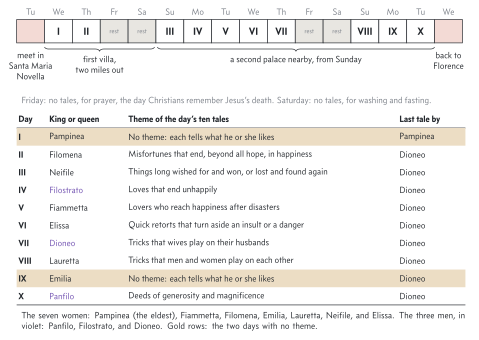
For the first day, Pampinea ruled, they should be “free to discourse of such matters as most commend themselves to each in turn.” Each later ruler announced the next day’s theme the evening before, so that the tellers had a night to think of their stories. Every later ruler set one except Emilia, the queen of the ninth day, so the first and ninth days have no theme.This work's first and ninth days have no theme. → The Decameron• At the end of the first day Dioneo, the merriest of the three men, asked a favor: “that I be not bound by the assigned theme if I am not so minded.” So that no one would think he was short of stories, he added, “I am henceforth content that mine be always the last.” The queen guessed that he wanted the chance to cheer the company with a funny story when it grew tired, and granted it. So from the second day on, Dioneo told the last taleIn this work, Dioneo tells the last tale on most days and is exempt from the chosen theme. → The Decameron••• each day and kept to the theme only when he pleased.
The days fell into a rhythm. The company walked in the gardens in the cool of the morning, ate in the shade, and slept through the worst of the heat. The tales came in the afternoon (Figure 22.4), and after supper there was dancing, and one of the ten sang a song. The queen of the third day, Neifile, ruled that no tales be told on Fridays, out of reverence for the day on which Christians believe Jesus died. Nor were there tales on Saturdays, when ladies washed their hair and fasted in honor of the Virgin Mary. She also moved the company to a second palace nearby, so that no visitors would find them.
On the evening of the fourth day the king, Filostrato, crowned Fiammetta, a storyteller named for Boccaccio’s muse.This work's storytellers include Fiammetta. → The Decameron•• Boccaccio gives her golden hair falling over white shoulders and, in Rigg’s words, “two eyes in her head that matched those of a peregrine falcon,” and it is she who tells the book’s most famous story about a falcon. After fifteen days away, Panfilo, the king of the last day, led the company home, and the young men left the women at Santa Maria Novella, where they had met. Boccaccio never says whether the plague had ended.

The tales
Boccaccio invented few of his plots. He took them from French comic tales in verse, from Latin collections of stories for sermons, from older Italian story books, and from tales that had traveled west from India and Persia. He set most of them in the Italy and France of his own century, among merchants, friars, nuns, and lords, and he made his people talk the way people talk. A few of the hundred have been retold ever since, and they follow here in the order the brigata told them.

Panfilo told the first story. Ser Cepparello (chep-pah-rel-loh) of Prato was a notary, a lawyer who drew up contracts and wills, which is why he was called Ser. He was perhaps the worst man alive: he forged documents for pleasure, swore false oaths, stirred up quarrels, and had a hand in murders. In France, where the people misunderstood his name, he was called Ciappelletto (chahp-pel-let-toh). A Florentine merchant sent him to Burgundy to squeeze money out of debtors, and there he fell mortally ill in the house of two Florentine moneylenders, who feared that if he died unconfessed the townspeople would turn on them. So Ciappelletto sent for the holiest friar in the town and confessed a life of invented innocence. He had once spat in church. As a little boy he had once cursed his mother, and he wept to remember it. The friar preached his virtues at the funeral, the crowd tore at his grave clothes for relics, scraps of a saint to keep and pray over, and Ciappelletto was revered as a saint,This work's first story concerns Ser Ciappelletto, revered as a saint after lying in his deathbed confession. → The Decameron••• with candles and prayers at his tomb. Panfilo draws the lesson carefully: God hears the faithful even when they pray through a man who is very likely in hell.
Neifile answered with a story about Rome. A Christian cloth merchant of Paris begged his friend Abraham, a rich and honest Jewish merchant, to become a Christian. At last Abraham agreed to decide, but only after he had traveled to RomeIn this work, a Jew named Abraham travels to Rome to decide whether to convert to Christianity. → The Decameron• to see how the pope and the cardinals lived. He found lechery, greed, and gluttony everywhere, came home, and to his friend’s astonishment asked to be baptized. The pope and his court, he reasoned, seemed to work with all their might to destroy the Christian religion, and still it grew, so it must be upheld by the Holy Spirit. He was baptized in Notre-Dame and named Jean.
Filomena went on with another Jew, and with Saladin, the sultan of Egypt and Syria who had taken Jerusalem from the crusaders in 1187 (Chapter 8). Saladin needed money and wanted a pretext to take it from Melchizedek (mel-kiz-uh-dek), a rich moneylender of Alexandria, so he asked him which of the three laws was the true one, the Jewish, the Muslim, or the Christian. All three look back to Abraham as their forefather, and today they are called the Abrahamic religions. Any answer would give offense. Melchizedek told a story instead. A rich man owned a precious ring and ordered that whichever son received it should be his heir, and the ring passed down for generations until it came to a father who loved his three sons equally. He had two copies made, so perfect that the maker himself could hardly tell them apart, and gave each son a ring. So it is with the three faiths, Melchizedek said: each people believes it holds the true inheritance, and the question, “like that of the rings, remains pendent.” Saladin admired the answer, confessed his need, and got his loan freely, and the two became friends. In 1779 the German writer Gotthold Ephraim Lessing built Nathan the Wise, a play set in Jerusalem during the Third Crusade, around Melchizedek’s parable of the three ringsIn this work, Melchizedek tells Saladin a parable comparing three identical rings to the Abrahamic religions. → The Decameron•••A story in this collection inspired Lessing's Nathan the Wise. → The Decameron•• (Vol. 14, From Luther to Mozart).
On the third day, under Queen Neifile, the theme was getting what one longs for by one’s own effort, and many of that day’s tales were love stories with a trick in them. Dioneo ended the day with the bawdiest tale in the book. In it the hermit Rustico seduces AlibechRustico teaches Alibech about “putting the devil back in hell” in this work. → The Decameron•• (al-ih-bek), a girl who has come into the desert to learn how to serve God, by teaching her that the act is a holy work, the way to send the devil back to hell. It is the most notorious of the hundred.
When Neifile handed on the laurel that evening, the fourth day went to Filostrato, the brigata’s gloomiest member,This work's brigata includes Filostrato. → The Decameron•• who had always loved without luck and chose loves that end unhappily. Pampinea told of Berto della Massa, a swindler of Imola (ee-moh-lah) so notorious that he moved to Venice, became Friar Alberto, a Franciscan, and soon had a name for holiness. A vain and silly young wife named Lisetta came to him to confess. He told her that the archangel Gabriel, the angel who in Luke’s Gospel tells Mary that she will bear Jesus, had fallen in love with her and wished to visit her by night. Then the friar came himself, disguised as Gabriel,In this work, a character pretends to be the archangel Gabriel to seduce women. → The Decameron•• with wings. Lisetta boasted of her angel, her brothers-in-law lay in wait, and Alberto leaped from her window into the Grand Canal. The poor man who hid him led him next day into the square of Saint Mark as a “wild man,” smeared with honey and covered with feathers, where he was recognized and taken back to his friary’s prison. There, Pampinea says, he is believed to have died.
Filomena told the saddest tale of that day. In Messina, in Sicily, three merchant brothers had a manager from Pisa named Lorenzo, and their sister Lisabetta (lee-zah-bet-tah) fell in love with him. The brothers took him out of the city and murdered him. He appeared to her in a dream, “wan and in utter disarray,” and showed her where he lay. She dug up the body, cut off the head, took it home, and buried it in a large pot, in which she planted “the goodliest basil of Salerno” and watered it with her tears. When the brothers took the pot away and found what was in it, they fled to Naples, and she wept for the pot until she died. In 1818 the young English poet John Keats retold Lisabetta and her pot of basilIn this work, Lisabetta buries her murdered lover Lorenzo's head in a pot of basil. → The Decameron••A story in this work was adapted into a poem by John Keats. → The Decameron• as “Isabella, or the Pot of Basil” (Vol. 15, The Age of Revolution). In 1849 John Everett Millais painted the poem’s dinner table, where the brothers first notice the lovers (Figure 22.6).

Fiammetta, queen of the fifth day, asked for lovers who reach happiness after disasters, and she told the falcon story herself. Federigo degli Alberighi (feh-deh-ree-goh del-yee ahl-beh-ree-gee), a Florentine gentleman, spent his whole fortune on jousts and feasts to win Monna Giovanna, a married lady who ignored him. He was left with a little farm and the best falcon in the world. When Giovanna was widowed, her small son fell ill and begged for Federigo’s falcon, and she went to ask for it. Federigo had nothing in the house to serve her, so he served her his falcon,In this work, Federigo serves his guest the falcon she had come to request for her sick son. → The Decameron••• roasted. When she made her request, he could only weep and show her the feathers and the beak. The boy died, but Giovanna, pressed by her brothers to marry again, chose Federigo. “I had rather have a man without wealth than wealth without a man,” she told them.
On the sixth day Elissa asked for quick retorts that turn aside an insult or a danger. Emilia told of a man named Fresco whose niece Cesca was so vain that she came home complaining of all the ugly, unpleasant people she had to look at in the streets. Her uncle answered that she should never look in a mirrorIn this work, a character is told not to look in a mirror because it grieves her to see ugly people. → The Decameron• if the sight of ugly people grieved her so. Cesca, Emilia adds, was too foolish to understand him.
The ninth day was free again. Pampinea told of a man named Talano who dreamed that a wolf tore his wife’s throat and face, and begged her to stay out of the woods that day. Sure that he wanted her out of the way for a meeting with another woman, she went to the woods to spy on him, and the wolf attacked her.In this work, a woman ignores her husband's warning and is attacked by a wolf. → The Decameron• Shepherds saved her life, but her face was ruined. Two tales later Emilia, the queen, told a brutal joke, and told it with approval. Two young men asked the wise King Solomon for advice, one how to be loved and the other how to handle a stubborn wife. Solomon told the first to love, and the second to go to the Bridge of Geese. At the bridge they saw a mule beaten until it crossed,In this work, a man learns how to deal with his wife by seeing a mule beaten at the Bridge of Geese. → The Decameron•• and the husband understood. He went home, beat his wife, and found her obedient ever after.
Panfilo, king of the tenth day, asked for deeds of generosity and magnificence, and Dioneo closed the book with what he called an example not of magnificence but of mad cruelty. Gualtieri (gwahl-tyair-ee), the marquis, or ruling lord, of Saluzzo (sah-loot-soh) in the foothills of the Alps, married Griselda (grih-zel-dah), a poor peasant’s daughter, on her promise always to obey him. Then he tested her. He took away their baby daughter and let her believe the child would be killed, and years later did the same with their son, though in fact he sent both to be raised by kin in Bologna. He told her that the pope had let him leave her and take another wife, and sent her home to her father in her shift, the plain linen dress worn under clothes. Then he called her back to make his house ready for his new bride. The bride was their daughter, now twelve. Through it all Griselda never complained, and at last Gualtieri revealed the truth and restored her. Petrarch was so moved by the tale that he put it into Latin in 1373. In Chaucer’s Canterbury Tales (Vol. 8, The Northern Worlds) the Clerk’s Tale retells Griselda’s testing,This work ends with Gualtieri testing his wife Griselda by pretending to kill their children. → The Decameron•••Chaucer's "Clerk's Tale" draws on a story from this work. → The Decameron•• and its teller, a student of Oxford, says he learned the story from “Fraunceys Petrark, the laureat poete.”
The book ends with Boccaccio’s own defense. To those who find some tales too free, he answers that no one is forced to read them; to those who find them too long, that ladies with time on their hands have time to read them. Two centuries later Marguerite de Navarre (mar-guh-reet), the sister of King Francis I of France and queen of the little kingdom of Navarre, set out to write a French Decameron.This work inspired Marguerite de Navarre to write her own stories. → The Decameron• In her Heptaméron (hep-tam-uh-ron) ten travelers cut off by floods in the Pyrenees pass the time telling stories, and only true ones. She meant to write a hundred, but she had finished seventy-two when she died in 1549, and the book was printed in 1558.
What to remember
- Giovanni Boccaccio (1313–1375), a Florentine banker’s son, grew up in Naples, where he wrote poems later used by Chaucer and made his beloved, real or invented, into “Fiammetta.”
- In Latin he wrote On Famous Women (106 lives, from Eve to Queen Joanna of Naples) and On the Fates of Famous Men; he was Petrarch’s friend and Dante’s first public lecturer.
- The Decameron (about 1349–1353), in Italian prose, opens with the Black Death in Florence in 1348: seven young women and three young men meet in Santa Maria Novella and flee to a villa in the hills.
- The storytellers are Pampinea, Fiammetta, Filomena, Emilia, Lauretta, Neifile, and Elissa, with Panfilo, Filostrato, and Dioneo. Each tells one tale a day for ten days, making a hundred.
- Each day a king or queen sets the theme; the first and ninth days are free, and Dioneo tells the last tale of every day after the first, free of the theme.
- Famous tales: Ser Ciappelletto’s false confession; Abraham’s journey to Rome; Melchizedek’s three rings, told to Saladin (Lessing’s Nathan the Wise); Friar Alberto as the angel Gabriel; Lisabetta’s pot of basil (Keats’s “Isabella”); Federigo’s falcon; Fresco’s niece and the mirror; the Bridge of Geese.
- The last tale is patient Griselda, tested by Gualtieri; Petrarch put it into Latin and Chaucer’s Clerk retold it. Marguerite de Navarre’s Heptaméron imitated the whole frame.
The Long Fourteenth Century, 1158-1456
Chapter 23 · 24 clues
Avignon, Prague, and the Hussites
In the summer of 1415 the little city of Constance, where the Rhine flows out of the lake that bears the city’s name, was more crowded than it had ever been. Cardinals, bishops, abbots, and doctors of law had come from every corner of Latin Christendom, with princes, bankers, cooks, and servants behind them. A citizen named Ulrich of Richental (rikh-en-tahl) wrote a chronicle of the gathering and tried to count every visitor. They had come because the Church had three popes, and each of the three called the other two impostors.
The man who had brought them together was not a pope but Sigismund (sij-is-mund), king of Hungary and of Germany, who hoped one day to be crowned emperor. One of the three popes had already fled the city in disguise. In a prison nearby, a priest from Prague waited to be judged. How the popes had come to be three, and how a preacher from Bohemia came to stand before their council, is a story that begins a century earlier, when the popes left Rome.
The popes at Avignon
The pope was the bishop of Rome, the city where, by tradition, the apostles Peter and Paul were buried, and for a thousand years the popes had lived there. But by 1300 Rome was a dangerous place to live. Its great families fought each other in the streets, and the lands the pope ruled in central Italy were full of rebels. Then came the quarrel with King Philip IV the Fair of France. In 1303 the king’s men seized Pope Boniface VIII at Anagni, and the old man died a month later (Chapter 10). In 1305 the cardinals, the clergy who elect a pope, chose a Frenchman, the archbishop of Bordeaux, as Clement V.
Clement never went to Rome. He was crowned at Lyon, moved from town to town in southern France, and in 1309 settled his court at Avignon. The town stood on the Rhône, on the edge of France but not inside it. It belonged to the count of Provence, who was also king of Naples and a vassal of the pope, and it was ringed by the Comtat Venaissin (kohn-tah veh-neh-san), a little county the popes had ruled since 1274. A pope there was close to the French king without being his subject. In 1348 a later pope, Clement VI, bought Avignon outright from its owner, Queen Joanna I of Naples, for 80,000 florins.
Seven popes in a row lived at Avignon, and all seven were French. The third of them, Benedict XII, was the Jacques Fournier who had questioned the last Cathars of Montaillou (Chapter 14). An austere man, he tore down the old bishop’s palace on the rock above the river and began, in 1335, a fortress-palace around a cloister, with high towers and walls thick enough to stand a siege. His successor, Clement VI, who loved splendor as much as Benedict disliked it, built a new palace beside the old one, with a great chapel and audience hall. Together they make the largest Gothic palace in Europe (Figure 23.1). The Italian painter Matteo Giovannetti (mah-tay-oh joh-vahn-net-tee) covered its rooms with frescoes, and its library, with more than two thousand books, had no equal in Europe.

The palace held a government. The curia, the pope’s court and offices, grew at Avignon to several hundred clerks, besides a crowd of lay officials and servants. The Avignon popes ran the Church the way the kings of the age ran their kingdoms, through lawyers, account books, and taxes. They named bishops across Europe themselves, and a new bishop owed the pope his first year’s income, or a large share of it, for the appointment. The money paid for the palace and for wars in Italy, and many Christians thought it a scandal. The Franciscans, sworn to own nothing, quarreled with Benedict’s predecessor, Pope John XXII, and a few of them fled to his enemy, the emperor Louis IV of Bavaria (Vol. 8, The Northern Worlds).
The poet Petrarch, who grew up at Avignon, called it a new Babylon (Chapter 20). In the Hebrew Bible the people of Judah were carried off to Babylon (Vol. 5, In the Beginning), and the Book of Jeremiah says that their exile would last seventy years. From 1309 to 1377 the popes lived at AvignonThis city housed the papacy during the “Babylonian Captivity” of 1309–1377. → Avignon•Holders of this office resided in Avignon during the fourteenth-century “Babylonian Captivity.” → Pope•• for sixty-eight years, close enough to seventy that later writers called those years the Babylonian Captivity of the papacy. The name was an insult, not a description. No one held the popes captive, and several of them were strong and able men.
Two popes tried to go home. Urban V lived in Rome from 1367 to 1370, but unrest in Italy and the pleas of the French cardinals drew him back to Avignon. Gregory XI, a nephew of Clement VI, was pressed by a war with Florence over the papal lands (Chapter 21) and by the letters of Catherine of Siena, who begged him to return (Chapter 14). He left Avignon in September 1376 and entered Rome on January 17, 1377.
Rome without the popes
The Rome he found was a shrunken town among enormous ruins. Its people lived mostly in the bend of the Tiber, and much of the ground inside the ancient walls had become vineyards and fields. Without a pope, the city was ruled, as far as anyone ruled it, by its barons, families of nobles who owned estates in the countryside and fortified houses in the city. The Colonna, whom Petrarch served, and the Orsini (or-see-nee) were the greatest of them in the 1300s, and they fought each other for two centuries.
The barons built their strongholds in the ancient ruins, because the Romans had built so well. Towers rose on top of tombs, and theaters became fortresses. The emperor Vespasian’s amphitheater, which Romans by then called the Colosseum (Vol. 7, The Romans), was the greatest ruin of all. By about 1200 the Frangipani (fran-jih-pah-nee), then one of the strongest families in the city, turned the Colosseum into their fortress.The Frangipani family fortified this structure before a 1349 earthquake. → the Colosseum• They walled it, and from it they could command the roads to the Lateran Palace, where the popes lived before Avignon. In the middle of the 1200s another family, the Annibaldi (ahn-nee-bahl-dee), first shared it with them and then took it over.
Then, on September 9, 1349, an earthquake struck the Apennine Mountains of central Italy, and the next day a second one followed. The south side of the Colosseum stood on softer ground than the north, and its outer wall came down in a great heap of travertine, a kind of limestone. Romans came to call that heap the “thigh”Rubble from this structure’s collapse in the 1349 earthquake was known as its “Thigh” and quarried for building material. → the Colosseum• of the Colosseum, and they used it as a quarry. The stone was easy to cart away, already cut and squared, and builders took it for palaces and churches for four hundred years, until Pope Benedict XIV forbade it in the 1700s. That is why the Colosseum today has its whole outer wall on the north side and only the inner rings on the south.
Habsburgs and Swiss
North of the Alps, the Holy Roman Empire had troubles of its own. In the west “emperor” was a title: the German princes elected a king, and he became emperor when the pope crowned him (the Stage). After the Hohenstaufen emperor Frederick II died in 1250 (Chapter 9) and his son Conrad IV in 1254, the princes could not agree. Some chose Richard of Cornwall, the brother of King Henry III of England, and others the king of Castile, Alfonso X, who never even came to Germany. Neither ruled. Historians call the years with no king obeyed by all the Great Interregnum, from the Latin for “between reigns.”
The princes wanted a king again, but not a strong one. On October 1, 1273, the electors, the princes who chose the king, met at Frankfurt and chose Rudolf, count of Habsburg, a lord of fifty-five whose lands lay along the upper Rhine, in what is now northern Switzerland and Alsace. The family took its name from its castle, the Habsburg, a name that may mean “hawk’s castle.” Rudolf’s election ended the Great Interregnum,Rudolf I’s election in 1273 ended this empire’s Great Interregnum. → Holy Roman Empire•• and he was crowned at Aachen three weeks later. He was never crowned emperor, but he ruled.
The strongest prince in the empire had not voted. Ottokar II (ot-oh-kar), king of Bohemia, had taken Austria when its old line of dukes died out, and he refused to give it up to the new king. On August 26, 1278, on the Marchfeld (markh-felt), a plain northeast of Vienna, Rudolf’s army beat Ottokar’s, and Ottokar was killed in the rout. In 1282 Rudolf gave Austria and Styria, the duchy to its south, to his sons. The counts from the upper Rhine became dukes of Austria, and Vienna was their home for the next six centuries (Vol. 3, Geography: Europe, Asia, and Africa).
The family’s old lands were less obedient. South of them, around Lake Lucerne, lay three valleys of herdsmen and farmers: Uri (oo-ree), Schwyz (shveets), and Unterwalden (oon-ter-vahl-den). Through Uri ran the road to the Gotthard Pass, the shortest way from the Rhine to Italy, and the Habsburgs wanted it. The valleys held charters that put them directly under the emperor, with no lord between, and they meant to keep them. Rudolf died on July 15, 1291, and early in August the three valleys swore an alliance to defend one another, the oath with which the Swiss date the beginning of their union (Vol. 3, Geography: Europe, Asia, and Africa).

The valleys called themselves Eidgenossen (eyet-geh-noss-en), “oath comrades,” and other communities swore themselves into their league: the town of Lucerne in 1332, Zurich in 1351, Glarus and Zug in 1352, and the city of Bern in 1353. Each member was a canton, a small state that kept its own laws, courts, and army. The league of eight was the Old Swiss Confederacy, an alliance of cantons,This country's Old Confederation was formed between its cantons. → Switzerland• and it is the beginning of Switzerland.
Twice the Habsburgs tried to break the league, once when it was still three valleys and once when it was eight. In 1314 the princes elected two rival kings, Louis of Bavaria and the Habsburg Frederick the Fair, and the Swiss took Louis’s side. Frederick’s brother, Duke Leopold I of Austria, a grandson of Rudolf, marched against Schwyz with an army of armored knights. The men of Schwyz waited where the road ran between Lake Ägeri (eh-geh-ree) and a steep slope, near a place called Morgarten (mor-gar-ten). On November 15, 1315, they blocked the road, and from the slope above they hurled rocksThis country's forces defeated Leopold I of Austria at the 1315 Battle of Morgarten by hurling rocks from above. → Switzerland• down on the column, so that the horses panicked. Then they charged with halberds, an axe blade and a spike on a pole taller than a man. Knights pressed between the slope and the water could neither turn nor form up (Figure 23.2). John of Winterthur, a friar who wrote about twenty-five years later, says some 1,500 were killed, not counting those who drowned in the lake. Leopold escaped, and a month later the cantons renewed their oath.
Seventy years later another Leopold, Duke Leopold III, the nephew of Leopold I, tried again. At Sempach (zem-pahkh), near Lucerne, on July 9, 1386, his knights got off their horses and met the Swiss with a hedge of lances. Leopold and hundreds of his nobles were killed. A story first written down in a chronicle compiled at Zurich in the 1480s says that a “faithful man” among the Swiss gathered an armful of the enemy’s lance points against his own chest and so opened a gap for his comrades. In the 1530s the chronicler Aegidius (ee-jid-ee-us) Tschudi (choo-dee) made him a man of the Winkelried (ving-kel-reet) family of Unterwalden, and in later versions he is Arnold Winkelried. In Swiss songs and schoolbooks Winkelried’s sacrifice at SempachArnold Winkelried legendarily sacrificed himself at Sempach to help this country’s forces. → Switzerland• saved his country, and he became its national hero. Whether he lived is still argued. That the Habsburgs lost is not, and after Sempach they turned east, to Austria.
The Golden Bull of 1356
The kings who followed Rudolf came from several families, chief among them the Habsburgs, the Wittelsbachs (vit-els-bahks) of Bavaria, and the house of Luxembourg, named for a county between France and the Rhine. The electors switched among them to keep any one from growing too strong. Henry VII of Luxembourg, the emperor who, Dante hoped, would save Italy, died there in 1313 (Chapter 18). His son John had married Elisabeth, the heiress of the old royal family of Bohemia, and so became its king. John went blind in middle age and still fought, and he died charging at Crécy in 1346 (Chapter 24).
John’s son Charles was born in Prague on May 14, 1316, and baptized Wenceslaus. At seven he was sent to the court of France, where he spent seven years and took the name Charles at his confirmation, after the French king. He learned Czech, German, French, Italian, and Latin, and he became the most learned ruler of his age. In July 1346, with Pope Clement VI’s backing, five of the electors chose him king against the Wittelsbach emperor, Louis IV. On Easter Sunday, April 5, 1355, he was crowned emperor in Rome as Charles IV. The pope was at Avignon, so a cardinal crowned him. Petrarch had begged him to stay and make Rome his capital again. Charles went home to Prague.

He wanted to end the double elections, which had twice in forty years split Germany into civil war. So in 1356, at meetings of the princes at Nuremberg in January and at Metz at Christmas, he issued a law for the empire. It was sealed in gold, and so it is called the Golden Bull (Figure 23.4). The Golden Bull named seven electorsThe Golden Bull of 1356 designated seven prince-electors in this empire. → Holy Roman Empire•• who alone would choose the king (Figure 23.3). Three were archbishops, of Mainz, Cologne, and Trier. Four were lay princes: the king of Bohemia, the count palatine of the Rhine, the duke of Saxony, and the margrave of Brandenburg. They were to meet at Frankfurt, and four votes out of seven were enough to elect. If they had not chosen within thirty days, they were to live on bread and water until they did. The lay electors’ lands could never be divided, and each passed whole to the eldest son, so that a vote could not be split among heirs. The Bull said nothing of any need for the pope’s approval. With a few changes it governed the empire until the empire ended in 1806.


Seven princes gained a great deal, and the Habsburgs, left out, gained nothing. Charles’s son-in-law, Duke Rudolf IV of Austria, a great-grandson of King Rudolf, was nineteen and fiercely ambitious. In the winter of 1358 to 1359 his clerks produced five charters that claimed to record the privileges of earlier rulers, among them supposed letters of Julius Caesar and Nero. The chief one is called the Privilegium Maius (priv-ih-leg-ee-um my-us), the “greater privilege.” It made the dukes of Austria “palatine archdukes,” equal in rank to the electors, and freed them from many of their duties to the emperor. The Habsburg Rudolf IV forged the Privilegium Maius,Rudolf IV of this dynasty forged the Privilegium Maius, invoking supposed ancient privileges to elevate Austria’s status. → Habsburg• and Charles IV refused to accept it. Petrarch, asked for his opinion of the Caesar and Nero letters, declared them fakes. But a century later, in 1453, the Habsburg emperor Frederick III confirmed the whole bundle, and every Habsburg prince after him was styled an archduke.
Charles IV’s Prague
Charles chose Prague as his capital, and it already had a long history. It stands on the Vltava (vul-tuh-vuh), in the middle of the basin of Bohemia (Vol. 3, Geography: Europe, Asia, and Africa), with a castle on the ridge of the west bank. A Czech family, the Přemyslids (pshem-ih-slidz), had ruled from that castle since the late 800s. Cosmas of Prague, a priest who wrote the Chronicle of the Czechs early in the 1100s, tells how they began. A wise princess, Libuše (lib-oo-sheh), foretold the founding of the city, and her envoys found her a husband, Přemysl (pshem-ih-sul), behind his plow. Legend or not, Prague was the Přemyslids’ seat of powerThis city was the seat of power for the Přemyslid dynasty. → Prague• for four centuries, first as dukes and from 1198 as kings.
The most famous Přemyslid was a duke. Wenceslaus, in Czech Václav (vahts-lahf), was a Christian prince who ruled Bohemia in the 920s and 930s and built the first church of St. Vitus at the castle. In September 935 his brother Boleslaus (bol-es-lows) invited him to a feast at his own town, and there Boleslaus and his men killed him. Bohemia soon honored him as a martyr, and he became its patron saint. Nine centuries later, in 1853, the English clergyman John Mason Neale wrote a carol about him to the tune of a medieval spring song, spelling the name Wenceslas. In it Good King Wenceslas, ruler of Bohemia,Good King Wenceslaus ruled this region. → Bohemia• tramps through the snow on the Feast of Stephen, the day after Christmas, to bring meat, wine, and pine logs to a poor man, and his page keeps warm by treading in his footprints. The real Wenceslaus never wore a crown; he ruled as a duke.
A royal daughter left a different mark. Agnes, born in 1211, was the daughter of Ottokar I, the first hereditary king of Bohemia. She was promised as a child to the son of the emperor Frederick II, but that match was broken off, and later the emperor wanted to marry her himself. She refused him and chose the life of the Poor Clares, the nuns who followed Francis of Assisi’s friend Clare (Chapter 14), and she wrote to Clare for twenty years. About 1233 she founded a hospital in Prague for the poor and the sick. Its lay brothers became the Knights of the Cross with the Red Star,This region's Knights of the Cross with the Red Star was founded by Agnes. → Bohemia• an order of nursing brothers that Pope Gregory IX approved in 1237. It is the only order of men ever founded by a woman, and it still exists. Agnes was made a saint on November 12, 1989, five days before the protests that ended communist rule in Czechoslovakia began (Vol. 26, Behind the Curtain).
Agnes’s nephew was the Ottokar II whom Rudolf of Habsburg defeated. The last Přemyslid king, Wenceslaus III, was murdered at sixteen in 1306, and four years later Bohemia passed, through his sister Elisabeth, to John of Luxembourg.
Their son Charles rebuilt the city. In 1344 Pope Clement VI made Prague an archbishopric, so that Bohemia no longer had to answer to the German archbishop of Mainz. On November 21 that year work began on a cathedral on the castle hill, on the site of Wenceslaus’s church. Its first architect, Matthias of Arras, came from the papal court at Avignon. In 1356, four years after his death, a builder of twenty-three, Peter Parler (par-ler), took over, and his vaults, crossed by a net of ribs, were among the boldest of the age. St. Vitus’s Cathedral rose above PragueThis city is home to St. Vitus's Cathedral. → Prague•• slowly, and it was finished only in 1929.
Charles wanted Prague to be a city of learning as well as of kings. On April 7, 1348, he signed the charter of a university, the first in central Europe, modeled on Paris, where he had grown up. Its masters and students were divided into four nations, Bohemian, Bavarian, Saxon, and Polish, each with its own vote in the university’s affairs. Today it is called Charles University, because Charles IV founded it in Prague.Charles IV founded Charles University in this city. → Prague•• The same year he laid out a whole New Town beside the Old, with broad streets and great market squares.

In 1342 a flood had wrecked the old stone bridge over the Vltava, and in 1357 Charles began a new one, 1,693 feet (516 m) long on sixteen arches (Figure 23.5). According to a popular story, Charles had its first stone laidAccording to a popular story, Charles IV laid a bridge’s cornerstone in this city at a time represented by the palindrome “135797531.” → Prague• at 5:31 in the morning of July 9, 1357, because the year, day, month, hour, and minute written in a row, 1357 9 7 5 31, read the same in both directions, a palindrome. It was the only bridge across the river at Prague until 1841, and since 1870 it has been called Charles Bridge (Vol. 3, Geography: Europe, Asia, and Africa; Figure 23.6).

The bridge saw one of the cruelest acts of Charles’s son. Wenceslaus IV, king of Bohemia from 1378, was clever, lazy, and violent, and he is remembered as Wenceslaus the Idle. In 1393 he quarreled with the archbishop of Prague, Jan of Jenštejn (yen-shtayn), over the riches of an abbey that the king wanted for a new bishopric. The king’s men seized the archbishop’s deputy, a priest named John of Nepomuk (nep-oh-mook), and tortured him. On the night of March 20, 1393, John of Nepomuk was thrown from the bridgeJohn of Nepomuk was killed in this city by being thrown off a bridge. → Prague•• into the Vltava and drowned. Later writers, beginning in 1459, gave a different reason: that the priest had heard the queen’s confession and would not tell the king her secrets. That story made him a saint of the seal of confession. He was canonized in 1729, and his bronze statue, set up on the bridge in 1683, is the oldest of the thirty there.
The Western Schism and Constance
Gregory XI had been back in Rome only fourteen months when he died, on March 27, 1378. The Roman crowd surrounded the cardinals as they met to elect his successor and shouted for a Roman pope, or at least an Italian. Most of the cardinals were French, but they gave way. On April 8 they chose an Italian who was not one of them, Bartolomeo Prignano (preen-yah-noh), the archbishop of Bari, who took the name Urban VI. Urban turned out to be harsh and suspicious, and he insulted the cardinals to their faces. That summer most of them slipped away from Rome to Anagni, and on August 9 they declared Urban’s election void, since it had been made in fear of the mob. On September 20, 1378, at Fondi, south of Rome, thirteen of them chose one of their own, Robert of Geneva, as Clement VII. The next year Clement took his court to Avignon.
The Western Schism had begun. Neither pope would yield, and the kingdoms of Europe chose sides by their politics. France, Scotland, and Naples, and later Castile and Aragon, obeyed Avignon; England, most of the empire, and most of Italy obeyed Rome. The Roman line went on through Boniface IX (1389), Innocent VII (1404), and Gregory XII (1406). When Clement died in 1394, his cardinals chose an Aragonese, Pedro de Luna, as Benedict XIII (Figure 23.7).

By 1408 the cardinals of both sides had lost patience with their masters. They called a general council, an assembly of the bishops of the whole Church, to meet at Pisa in Tuscany. On June 5, 1409, the council declared both popes deposed. Three weeks later it chose a new one, Peter of Candia, who took the name Alexander V. He was a Greek born on Crete who had become a Franciscan friar and archbishop of Milan. But neither Gregory nor Benedict would step down, so when the Council of Pisa elected Alexander V,A 1409 council in this city elected Alexander V, creating a third papal claimant. → Pisa• it only made the popes three. Alexander died within a year, and his cardinals chose Baldassare Cossa (bahl-dahs-sah-reh kos-sah), a Neapolitan nobleman who had governed Bologna for the pope, as John XXIII. The Church does not count him among the popes, so a pope elected in 1958 took the same name and number.
Sigismund, Charles IV’s younger son, set out to end it. He was king of Hungary by his marriage to its queen, and in 1396 he had led the crusade that the Ottoman Turks destroyed at Nicopolis (Chapter 27). In 1410 the electors chose him king of the Romans, and a king of the Romans was supposed to protect the Church. He pressed John XXIII to summon a council to Constance, a city of the empire, and in November 1414 it opened. Its members voted not one by one but by nations, as the masters of a university did, so that the many Italian bishops John had brought could not outvote everyone else.
John had come hoping to be confirmed. When he saw that the council meant to depose him, he slipped out of the city in disguise on March 20, 1415, and fled to the lands of his friend Duke Frederick of Austria, a Habsburg. The council did not dissolve. On April 6 it declared, in the decree Haec sancta (hike sank-tah), that a general council held its power directly from Christ, and that even a pope must obey it in matters of faith and of ending the schism. John was brought back and deposed on May 29. Gregory XII, the Roman pope, agreed to resign with dignity, and his envoy resigned for him on July 4. Benedict XIII refused to the end. He was deposed in 1417 and held out in his castle at Peñíscola (pen-yees-koh-lah), on the coast of Spain, until his death in 1423, still calling himself pope.
On November 11, 1417, the feast of St. Martin, the council elected Oddone (ohd-doh-neh) Colonna, a cardinal of the great Roman family, and he took the name Martin V. The whole Church accepted him, and in 1420 he came home to Rome. The schism was over. It had been ended by a council and a king, and for a generation men argued that councils stood above popes. The popes won that argument in the end, but not before the council had done its other business, the trial of Jan Hus (hoos).
Jan Hus
Jan Hus was born about 1370 at Husinec (hoo-sih-nets), a village in southern Bohemia, to a poor family, and took his name from it; hus is Czech for “goose.” He studied at Charles’s university, became a master in 1396 and a priest in 1400, and was soon one of the leading masters of the university’s Bohemian nation.
In 1402 he became the preacher of the Bethlehem Chapel, in Prague’s Old Town. Two citizens had founded it in 1391 for one purpose, sermons in Czech, in a city where many of the clergy and the richest burghers were German. It could hold three thousand people, and they came. Hus preached in PragueJan Hus preached in this city. → Prague•• against priests who bought their posts, against clergy who kept mistresses, and against the riches of bishops, and the crowds loved him for it.
Much of what he preached came from an Englishman. John Wyclif (wik-lif) (about 1330 to 1384), a theologian at Oxford, had taught that the Bible was the only sure authority for Christians, that a sinful pope or priest had no true authority at all, and that the Church should give up its lands. His books came to Prague after Charles IV’s daughter Anne married King Richard II of England in 1382 (Vol. 8, The Northern Worlds), and Czech students went to Oxford and brought copies home. Hus did not accept all of Wyclif, but he read him with admiration.
The schism dragged Prague into it. In 1409 King Wenceslaus IV asked the university to stay neutral between the two popes. The Bavarian, Saxon, and Polish nations, loyal to Rome’s Gregory XII, refused, so at Kutná Hora (koot-nah hor-ah) he changed its rules, giving the Bohemian nation three votes and the other three nations together only one. The German masters and students, about a thousand of them, walked out and founded a new university at Leipzig. Hus became rector of a university that was now Czech. But the archbishop of Prague burned Wyclif’s books, and in 1410 Hus was excommunicated under a bull of Alexander V, the Pisan pope. In 1412 Hus attacked the indulgences, pardons that the Church taught would lift the punishment due for sin, which John XXIII was selling to pay for a war against the king of Naples. Prague was put under interdict, its churches closed, and Hus left the city and preached in the countryside, writing in Czech for people who had no Latin.

Sigismund wanted Bohemia quiet, since he expected to inherit it from his childless brother. He invited Hus to Constance to explain himself and gave him a letter of safe-conduct, a promise of protection on the journey. Hus arrived on November 3, 1414. Within four weeks his enemies had him arrested, and he spent the winter in prisons, chained and ill. Sigismund was angry, but the bishops told him that a promise to a heretic need not be kept, and he gave way. At his trial, in June 1415, Hus said again and again that he would recant if anyone could show him his errors from the Bible, and he would not confess to teachings he said he had never held.
On July 6, 1415, in the cathedral of Constance, the council condemned him. He was stripped of his priest’s robes, and a tall paper hat marked “heresiarch,” chief of heretics, was put on his head. Outside the city walls Hus was burned at the stake,This Bohemian reformer was condemned and burned at the Council of Constance. → Jan Hus•• praying aloud, and his ashes were thrown into the Rhine so that no one could keep them as relics (Figure 23.8). The next year his friend Jerome of Prague was burned on the same spot. A century later Martin Luther liked to tell how Hus had foretold that they might roast a goose, but a swan would come after him, and Luther saw himself as the swan (Vol. 14, From Luther to Mozart).
The Hussite wars
The burning made Hus a martyr. Within two months the nobles of Bohemia and Moravia sent the council a protest, hung with their seals, that called him a good and faithful Christian. His followers, now called Hussites, took up one teaching above all. At Mass the Church gave ordinary believers only the consecrated bread, the host, while the priest alone drank the consecrated wine from the cup, the chalice. In 1414 a master of the university, Jacob of Mies (mees), began to give the cup to his parishioners too, as the Gospels show Jesus giving it to all his disciples. Receiving both bread and wine was called communion in both kinds, in Latin sub utraque specie (sub oo-trah-kweh speh-kee-eh), “under both kinds,” and its followers were called Utraquists (yoo-truh-kwists). The chalice became the Hussite badge, painted on banners and carved over church doors.
King Wenceslaus tried to stop the movement and put Catholics on the city councils of Prague. On July 30, 1419, a radical priest, Jan Želivský (zheh-lif-skee), led a procession through the New Town to its town hall to demand the release of Hussite prisoners. Someone threw a stone from a window, and the crowd stormed the building and threw the burgomaster, or mayor, a judge, and several councilors out of the window to their deaths. To defenestrate is to throw someone out of a window, from the Latin fenestra, “window.” The defenestration of 1419 in PragueThe 1419 defenestration in this city helped trigger the Hussite Wars. → Prague•• was the first of three in the city’s history, and it began the Hussite Wars. Less than three weeks later Wenceslaus died, and his heir was Sigismund, the man who had let Hus burn.
Bohemia would not have him. The Hussites were united against him and against Rome, but divided among themselves. The moderates, the Utraquists, were the masters of the university, the burghers of Prague’s Old Town, and many nobles, who wanted the chalice and a reformed Church but no revolution. The radicals built a new town on a hill in southern Bohemia in 1420 and named it Tábor (tah-bor), after the mountain where, by Christian tradition, Jesus was transfigured, his face shining like the sun, before his disciples. They shared their goods, rejected much of the Catholic worship, and expected the end of the world. These Taborites (tay-buh-ryts) made war under a one-eyed knight of the lesser nobility, Jan Žižka (zhizh-kuh). Together, Taborites and Utraquists fought the Hussite WarsThe Taborites and Utraquists fought the Hussite Wars in this region. → Bohemia• in Bohemia against crusade after crusade.
On March 1, 1420, Pope Martin V proclaimed a crusade against the heretics of Bohemia, and in June Sigismund brought an army of German, Hungarian, and Austrian knights to the walls of Prague. East of the city rose Vítkov (veet-kof) Hill, planted with vines by Charles IV, which overlooked the road by which the city could be supplied. The Hussites had dug a ditch and raised a wall of earth and timber on its crest, and later tradition says that twenty-six men and three women held it. On July 14, 1420, the crusader cavalry rode up the narrow ridge to take it. The defenders held them with guns and with flails, farm tools for threshing grain, until men from the city came out through the vineyards and fell on their flank, and the knights were driven back over the cliff. The Hussites repelled Sigismund’s crusaders at Vítkov,These Bohemian reformers repelled Sigismund’s forces at Vítkov Hill. → Hussites• and his army soon broke up. The hill was renamed Žižkov (zhizh-kof) after their general, and though it is called Vítkov again today, the district of Prague at its foot still bears his name.
That summer the Hussite parties agreed on a program, drawn up chiefly, it is thought, by Jacob of Mies. In the Four Articles of PragueThese Bohemian reformers issued the Four Articles of Prague, including communion in both kinds. → Hussites• the Hussites demanded four things. The word of God must be preached freely. Communion in both kinds must be given to all believers. The clergy must give up their worldly riches and power. And mortal sins must be publicly punished, in priests as in laymen. Their armies marched to battle singing a Czech hymn, “Ye Who Are Warriors of God,” whose tune the Czech composer Bedřich (bed-rzhikh) Smetana would weave into his music more than four centuries later (Vol. 20, The North and the East).
The Hussites beat five crusades between 1420 and 1431. Žižka never lost a battle. He fought from wagon forts, rings of farm wagons chained together and armed with small cannon and handguns, against which the charging knights broke. He died of a sudden illness in 1424, while besieging a castle on the Moravian border, still undefeated. In the end the Hussites defeated themselves. On May 30, 1434, at Lipany (lip-ah-nee), the Utraquist nobles and the men of Prague, with Catholic lords beside them, crushed the Taborite army. The Church, meeting in council at Basel, granted the Utraquists their chalice, and on July 5, 1436, at Jihlava (yih-hlah-vah) in Moravia, Sigismund signed the agreement and was accepted at last as king of Bohemia. He died the next year, the last man of the house of Luxembourg, and his crowns passed to his son-in-law, a Habsburg. For two centuries Bohemia kept its chalice and its own church, one that had defied Rome a hundred years before Luther.
What to remember
- From 1309 to 1377 the popes, all French, lived at Avignon, the “Babylonian Captivity,” where Benedict XII and Clement VI built the Palace of the Popes.
- In Rome the Frangipani made the Colosseum a fortress; after the earthquake of 1349 its fallen south side became a quarry.
- Rudolf of Habsburg’s election in 1273 ended the Great Interregnum, and his family won Austria from Ottokar II in 1278. The Swiss cantons formed a confederacy against the Habsburgs and beat them at Morgarten (1315) and Sempach (1386), where legend places Arnold Winkelried.
- Charles IV’s Golden Bull of 1356 named the seven electors: the archbishops of Mainz, Cologne, and Trier, the king of Bohemia, the count palatine, the duke of Saxony, and the margrave of Brandenburg. The Habsburg Rudolf IV answered with the forged Privilegium Maius.
- Prague, the seat of the Přemyslids (whose Duke Wenceslaus became “Good King Wenceslas”), became Charles IV’s capital, with its university (1348), St. Vitus’s Cathedral, and Charles Bridge; John of Nepomuk was thrown from the bridge in 1393.
- The Western Schism (1378–1417) set popes at Rome and Avignon against each other; the Council of Pisa (1409) added a third, and the Council of Constance, called at Sigismund’s urging, ended it by electing Martin V in 1417.
- Jan Hus, preacher at Prague’s Bethlehem Chapel, was condemned and burned at Constance on July 6, 1415.
- The defenestration of 1419 began the Hussite Wars, in which Utraquists and Taborites beat Sigismund at Vítkov Hill (1420) and fought for the Four Articles of Prague, among them communion in both kinds.
Chapter 24 · 22 clues
The Hundred Years’ War: Crécy to the Jacquerie
In 1361 a young clerk from the county of Hainault (ay-noh), just beyond the northern border of France, crossed the Channel with a book in his baggage. Jean Froissart was about twenty-four. The book was his first try at a history of the war between the kings of England and France, and he presented it to Edward III’s queen, Philippa, who came from Hainault herself and took him into her household. He spent the next forty years riding from court to court, from Scotland to the Pyrenees, asking knights and heralds what they had seen and writing their answers down in French prose.
His Chronicles are the reason the battles of this chapter are remembered as scenes: a blind king led into a charge, six citizens with ropes around their necks, a count washing his hands after a hunt. Froissart loved courage and rank, and he was careless with numbers; his armies grow from one version of his book to the next. Yet he is often the only witness. Another volume told these years from the English side (Vol. 8, The Northern Worlds). This chapter tells them from France, where the war was fought, from the death of the last Capetian king in 1328 to the peace of 1360, and then the arts that the princes paid for while it went on.
Why the war began
Philip IV the Fair, the king who destroyed the Templars, died in 1314 and left three grown sons (Chapter 10). Each became king in turn, and each died young without a son. Louis X died in 1316 and left a small daughter, Joan, and a pregnant queen, whose baby boy lived only five days. Louis’s brother then took the crown as Philip V, and an assembly of lords declared that a woman could not succeed to the throne of France. Philip V left only daughters, and the youngest brother, Charles IV, died on February 1, 1328. His widow, too, was pregnant, and on April 1 she bore a girl.
Who was the next king? The nearest male relative of the dead king was his sister’s son, Edward III of England, who was fifteen. The next was a cousin of thirty-four, Philip of Valois, whose father, Charles of Valois, had been Philip IV’s brother and had ridden into Dante’s Florence in 1301 (Chapter 18). The French lords chose Philip. A claim that passed through a woman, they held, was no claim at all, and they wanted no English king. From 1358 a monk of Saint-Denis, and royal lawyers after him, would justify the rule from the Salic Law of the Frankish king Clovis (Chapter 2). Philip VI, the first of the Valois kings, was crowned at Reims on May 29, 1328 (Figure 24.1). At its root the long war that followed, the Hundred Years’ War, was a quarrel over who should inherit the crownThis war concerned succession rights to the French throne. → Hundred Years' War• of France.

Edward’s claim came through his mother. Isabella of France, born about 1295, was Philip IV’s only surviving daughter. At twelve she was married to Edward II of England, at Boulogne in January 1308, and she spent her youth beside a king who gave his trust and his lands to favorites, young men he raised above the great lords. In 1314 she accused her brothers’ wives of adultery, a scandal that put two of the young women in prison and left whispers about whether Louis X’s daughter was his. In 1325 Isabella went to France to make peace with her brother Charles IV, and there she took as her ally, and many believed her lover, an English baron in exile, Roger Mortimer. In September 1326 the pair landed in England with a small army, and the king’s men deserted him. Edward II was made to give up the crown in January 1327 and died at Berkeley Castle that September, probably murdered (Vol. 8, The Northern Worlds). For three years Isabella and Mortimer governed England in her young son’s name, until he seized power in 1330.
She lived until 1358, rich and honored, and her name stayed dark. In 1757 the English poet Thomas Gray (Vol. 11, The Age of Shakespeare) wrote “The Bard,” in which the last of the Welsh bards curses the line of Edward I, the English king who conquered Wales, and foresees the shrieks of Edward II’s death at Berkeley. Isabella is the “She-wolf of France, with unrelenting fangs.” Shakespeare had once hurled the same insult at another French queen of England, Margaret of Anjou, but Gray named Isabella the “She-Wolf of France”,This ruler was nicknamed the "She-Wolf of France." → Isabella of France• the name history books still give her.
There was a second quarrel beneath the first. Since Eleanor of Aquitaine’s marriage to Henry II, the kings of England had been dukes of Aquitaine, and they still held Gascony, the coast around Bordeaux (Chapter 10). For it they were vassals of the king of France: they knelt and did homage to him, and his court could hear appeals against their judgments. In 1329 Edward did homage to Philip VI at Amiens. But a king who might have to obey another king’s court could never feel safe. In May 1337 Philip declared Aquitaine forfeit, as a lord might take back the fief of a disloyal vassal. Edward answered by calling himself the rightful king of France, and from that quarrel came a war between England and FranceThis war was fought between England and France. → Hundred Years' War•••This country fought the Hundred Years' War with England. → France• that outlived everyone who began it, and nearly all of it would be fought on French soil.

No one who fought in it called it the Hundred Years’ War; that round name was given by historians long afterward, and it is not even accurate. Despite the name, it lasted 116 years, from 1337 to 1453,Despite its name, this conflict lasted 116 years, from 1337 to 1453. → Hundred Years' War•• though it was really three wars broken by truces, as Figure 24.2 shows. The first, from 1337 to 1360, is called the Edwardian War, after Edward III. The second, from 1369 to 1389, is the Caroline War, after the French king Charles V, Carolus in Latin, and the third, from 1415 to 1453, the Lancastrian War, after the English kings of the house of Lancaster (Chapter 25).
Flanders and wool
The war’s first allies were weavers. Flanders, the county on the North Sea coast across the narrow sea from England, was a fief of France, and its count, Louis, was Philip VI’s loyal vassal. But its great towns, Bruges, Ghent, and Ypres (ee-pruh), lived by weaving cloth, and their best raw wool came from English sheep (Vol. 8, The Northern Worlds). In 1336 Edward III stopped all shipments of wool to Flanders. Within months the looms of Ghent stood idle and its weavers were hungry.
They found a leader in Jacob van Artevelde (ar-tuh-vel-duh), a rich citizen of Ghent who had made his fortune in the cloth trade and was later remembered as the Brewer of Ghent, by tradition because he had enrolled in the brewers’ guild. In January 1338 the city made him its captain, and in 1339 the count fled to France. Artevelde first kept Flanders neutral, which was enough to bring the wool back. His power over Ghent rested on one hard fact: the city’s textile industry needed English wool,Jacob van Artevelde’s political influence in Ghent was tied to this industry’s dependence on English wool. → textiles• and only the king of England could send it. Flemings could not lawfully make war on their overlord, the king of France, but they could fight for a man who claimed to be the true one. So in January 1340 Artevelde led the towns of Flanders to recognize Edward as king of France, and in Ghent Edward took the title and put the golden lilies of France on his shield beside the lions of England. His son John, born in Ghent that March, was known all his life as John of Gaunt, the English form of the city’s name. Artevelde ruled Ghent like a prince for seven years, until rumors spread that he meant to make Edward’s eldest son count of Flanders, and in July 1345 a mob of his own townsmen killed him.
North of Flanders, where the Scheldt, the Meuse, and the Rhine reach the sea, lay the counties of Holland and Zeeland, now part of the Netherlands. They belonged to the Empire, not to France, and much of their land lay at or below the level of high tide. Their people built dikes against the sea and drained the marshes behind them into fields called polders. A dike protects every farm behind it, and a single neglected stretch can drown them all. So the landowners of each district joined in water boards to manage drainage and floods,Water boards have managed drainage and flood protection in this country since the Middle Ages. → the Netherlands• councils that taxed every owner for the dikes, the ditches, and the sluices, gates that let the water out at low tide. In 1255 Count William II of Holland gave the boards along the Old Rhine a single council, the Rijnland (rine-lahnt) board, and it still meets today. The water boards of the Netherlands are among the oldest elected bodies in the country.

Sluys and Crécy
Philip VI meant to carry the war to England. In 1338 his galleys burned Southampton, and at Arnemuiden (ar-nuh-moy-den), off Zeeland, his sailors captured five great English ships and killed their crews. In June 1340 more than two hundred French ships lay at anchor in the Zwin, the inlet that led from the sea to Bruges, off the port of Sluys (sloys) (Figure 24.3). The inlet has long since silted up into dry land. The fleet’s commanders were the admiral of France, Hugues Quiéret (kyay-ray), and Nicolas Béhuchet (bay-oo-shay), a royal financier turned sea captain. Their ships were floating barracks, packed with soldiers, and to keep the English from breaking through they chained them together in three lines, a wall across the inlet.

Edward sailed from the Orwell estuary in Suffolk on June 22. On June 24, 1340, he waited for the wind and the tide, then attacked. The French ships, chained in place and drifting into each other, could not move to help one another. The English took them group by group, archers shooting from the wooden towers, called castles, at bow and stern before the men-at-arms, soldiers in full armor, boarded. By evening most of the French fleet was captured or sunk, and perhaps 16,000 to 20,000 of its men had been killed or drowned. Quiéret was beheaded, and Béhuchet was hanged from his own mast,Nicolas Béhuchet was killed at this early naval victory for England in the Hundred Years’ War. → Battle of Sluys•• in revenge for Arnemuiden. Sluys gave England command of the Channel, and the war would be fought in France, not in England.
Crécy
Six years later Edward invaded. On July 12, 1346, he landed at La Hougue (lah oog), on the coast of Normandy, with between 7,000 and 15,000 men, as modern historians reckon it. With him was his eldest son, Edward of Woodstock, sixteen, whom later centuries called the Black Prince (Vol. 8, The Northern Worlds). The army marched on a chevauchée (sheh-voh-shay), a “ride”: a raid that burned villages and looted towns to ruin the enemy king’s land and shame him before his subjects. It stormed Caen (kahn) on July 26, marched up the Seine to within a day of Paris, crossed the river at Poissy (pwah-see), and turned north toward Flanders. Philip VI followed with an army far larger than Edward’s and held the bridges of the Somme against him. On August 24 the English forced their way across a tidal ford near the river’s mouth, Blanchetaque (blahnsh-tahk), and the next day Edward chose his ground.
It was a slope between the village of Crécy and the hamlet of Wadicourt (wah-dee-koor), in Ponthieu (pohn-tyuh), facing southeast toward a shallow valley (Figure 24.5). Edward made every man fight on foot. He drew up his knights and men-at-arms in divisions, one under the prince, with archers on their wings, and dug pits in front to break a charge. The baggage wagons were drawn up in a ring behind the army as a pen for the horses, and Froissart says the king watched the battle from a windmill. The English had ribauldequins (rih-bohl-duh-kinz), early volley guns,Ribauldequins, early volley guns, were used during this conflict. → Hundred Years' War• carts carrying several small iron barrels fired together, as well as small cannon. They are among the first guns known on a European battlefield, and their noise probably frightened more horses than their shot killed.

The French came up from Abbeville (ab-veel) in the late afternoon, tired from the march. In front went several thousand crossbowmen from Genoa, the professional soldiers whom princes all over Europe hired (Chapter 13). A crossbow shot hard, but it took a long time to wind, and a crossbowman shot about twice a minute while an English longbowman shot five times as often. So each Genoese fought behind a pavise, the tall shield described in Chapter 13, held up by a comrade while he reloaded. That day the pavises were far behind with the baggage. Then a sudden storm broke over the field, and a writer of the time says that the rain slackened the crossbow strings. Wet and unprotected, the Genoese advanced without their pavises,At this battle, Genoese crossbowmen advanced without their protective pavises after rain had hampered their weapons. → Battle of Crécy•• shot, and saw their bolts fall short. The English arrows came back at them in sheets, and they turned and ran (Figure 24.6).
Behind them waited the French knights, under Philip’s brother the count of Alençon (ah-lahn-sohn). Froissart tells that Philip, seeing the Genoese run, cried out to kill the rabble who blocked the road, and the knights rode down their own crossbowmen to reach the enemy. They charged uphill through the mud, the pits, and the arrows, and each charge broke against the English line and fell back over its own dead horses. Fresh lords led new charges until dark. At one point the prince’s division was so hard pressed that its commanders sent to the king for help. Froissart says Edward asked only whether his son was dead or wounded, and hearing that he was not, sent none: the day, he said, should be the boy’s.


Among the French was a king. John of Luxembourg, born in 1296, was the son of the emperor Henry VII, and at fourteen he had married the heiress of Bohemia and become its king (Chapter 23). He had been raised at the court of Paris, and he loved France, tournaments, and adventure; he fought in Italy, in Silesia, and on crusade against the Lithuanians, who were not yet Christian, and at about forty he went blind. His son Charles, the future emperor Charles IV, fought at Crécy too and escaped wounded, and his daughter Bonne was married to Philip VI’s son. Froissart tells what the old king did as the battle turned. He asked where his son was, and when no one could tell him, he asked his knights to lead him forward so that he could strike one blow with his sword. They tied their horses’ bridles to his and rode into the fight together. The next morning the blind king was found dead at CrécyThis blind king of Bohemia died fighting at Crécy. → John of Bohemia•• among his knights, their horses still tied together. He was fifty, the most famous of the French dead.
The English heralds counted the bodies of 1,542 French lords and knights. With them died the count of Alençon and Count Louis of Flanders. English losses were light. Philip VI fled through the night, and Froissart has him knock at the gate of a castle in the dark and give the keeper a bitter answer about the fortune of France. Edward III won the Battle of CrécyThis battle was won by Edward III. → Battle of Crécy• with a smaller army, and it made England’s name as a military power.

The Black Prince had been made Prince of Wales, the title of the English king’s heir, in 1343, and later Princes of Wales took up his badge of three ostrich feathers with the German motto Ich dien, “I serve.” His tomb in Canterbury Cathedral, made to the design he laid down in his will of 1376, shows his black shield of three feathers, each with a scroll reading ich diene. A famous story explains them. After the battle, it says, the prince went to the body of the king of Bohemia and took the three feathers and Ich dienAt this battle, Edward the Black Prince legendarily adopted a crest of three feathers and the motto "Ich dien" from the fallen King John of Bohemia. → Battle of Crécy• from the dead man’s helmet, to honor his courage. No chronicler of the battle tells it; the story first appears in writing about thirty years later, near the time of the prince’s death, and John’s own crest was a pair of vulture’s wings. The feathers more likely came from the prince’s mother, Philippa of Hainault, for they first appear in the English royal family at her wedding.
From Crécy Edward marched north to Calais and besieged it for eleven months. Hunger forced the town to yield in August 1347. Froissart says that six of its leading burghers came out barefoot with ropes around their necks to die for the rest, and that Queen Philippa knelt to beg their lives from her husband. Auguste Rodin made them a statue, The Burghers of Calais, in 1889 (Vol. 18, Paris, Capital of the Arts). Calais stayed English for two centuries. That November the Black Death reached Marseille, in the south of France (Chapter 21), and for a while the plague did more killing than the armies.
Poitiers and the Jacquerie
Philip VI died in August 1350, and his son John II became king at thirty-one. Contemporaries called him John the Good, meaning brave and open-handed rather than wise. He was proud, quick to anger, and devoted to the ideal of the knight; he founded an order of chivalry, the Order of the Star, to rival Edward’s Order of the Garter. His wife, Bonne of Luxembourg, the blind king’s daughter, had died of the plague in 1349.
In 1355 Edward sent the Black Prince to Bordeaux, and from there the prince led chevauchées across the south. In August 1356 he struck north from Bergerac toward the Loire with about 6,000 English and Gascon soldiers, and John came after him with a larger army. On September 19, 1356, the king caught him on a wooded hillside a few miles south of Poitiers (Figure 24.9). A cardinal sent by the pope had spent the day before riding between the camps in search of a truce, and the English had used it to dig in.
The prince’s men stood on foot behind a thick hedge with one gap, with archers in ditches beside it. John sent most of his men forward on foot, but first two small bodies of mounted knights, led by the two marshals of France, charged for the gap. The prince’s hidden archers ambushed the charging horsemen,The Black Prince ambushed charging French cavalry at this 1356 battle. → Battle of Poitiers• shooting the horses from the hedges, and the charge died before it reached the English line. The division of the king’s eldest son and heir, Charles, came next, on foot, and fought hard and long before it fell back. Then the prince sent a Gascon lord, the Captal de Buch (kap-tahl duh boosh), with a small troop of horsemen around a hill to strike the French from behind, and as they appeared the prince’s men mounted and charged down the slope.
John fought on foot with a battle-axe, and his youngest son, Philip, fourteen, stood beside him. The story goes that the boy called out “Father, guard yourself on the right! Father, guard yourself on the left!” as the blows came in, and he was called Philip the Bold ever after. The king was surrounded and handed over his gauntlet, his armored glove, in surrender. The Black Prince had captured John II,Edward the Black Prince captured John II of France at this battle in 1356. → Battle of Poitiers•• with his son and two or three thousand lords and knights, and Froissart says that the prince served the captive king at supper that night with his own hands. In the spring the prince took John to London. This was not the Battle of Tours of 732, which is also called Poitiers (Chapter 2).
A war by proxy
Brittany, the great peninsula in the west, had already been at war for fifteen years. Its duke, John III, died childless in April 1341. One claimant was his half-brother, John of Montfort; the other was his niece, Joan of Penthièvre (pahn-tyev-ruh), who was married to Charles of Blois, Philip VI’s nephew. The king of France backed the niece, and the king of England backed the brother, so each king supported in Brittany the very rule he denied at home. Neither sent his whole army. They fought instead through Breton allies, with money, captains, and a few hundred men at a time, and so the War of the Breton Succession was a proxy warThe War of the Breton Succession was a proxy war during this conflict. → Hundred Years' War• inside the larger one. When Montfort was captured in 1341, his wife, Joan of Flanders, held the fortress of Hennebont (en-bohn) against Charles until English ships arrived. The fighting ended on September 29, 1364, at Auray (oh-ray), where Charles of Blois was killed. Montfort’s son became Duke John IV, and then did homage to the king of France.
The Jacquerie
With the king a prisoner, France fell apart. His eldest son, Charles, eighteen, ruled as regent. He was the first heir to bear the title dauphin (doh-fan), from the Dauphiné (doh-fee-nay), a province east of the Rhône that his grandfather had bought in 1349, and every heir to the throne took the title after him. In Paris the leader of the merchants, Étienne Marcel (ay-tyen mar-sel), defied him, and Charles the Bad, king of Navarre (Chapter 17), whom John II had jailed in 1356 for his plots, escaped in November 1357 and plotted to take the crown himself. Soldiers left unpaid after Poitiers formed free companies that roamed the countryside, robbing villages and holding castles for ransom. And the king had to be bought back. The English asked millions of gold crowns for him, and the peasants, already plundered, knew who would pay.
They also blamed the nobles, who had fled or surrendered at Poitiers and now squeezed their peasants for the money to ransom themselves and their king. On May 28, 1358, at a village on the Oise (wahz) north of Paris, peasants attacked the knights of their district and killed them with their families, and the rising spread across the country around Beauvais (boh-vay) in days. Nobles mocked any peasant as “Jacques Bonhomme” (zhahk baw-num), roughly “Jack Goodfellow,” and so the revolt was called the Jacquerie, born of defeat and the king’s ransom.The Jacquerie erupted amid military defeats and the burden of John II’s ransom during this war. → Hundred Years' War• Its captain was a peasant named Guillaume Cale (gee-yohm kahl). Jean le Bel, a chronicler of Liège whom Froissart copied, tells of castles burned and families murdered, and of horrors he dared not write; both men wrote for nobles. The regent’s later letter of pardon describes peasants meeting in their villages to resist the English and suddenly turning on their lords.

The end came within a month. At Meaux (moh), east of Paris, the dauphin’s wife and many noble ladies had taken refuge in the town’s fortified market. On June 9 a crowd of Jacques and armed Parisians sent by Étienne Marcel attacked it. Inside were two lords just back from crusading with the Teutonic Knights in Prussia: the count of Foix (fwah) and his cousin the Captal de Buch, who had fought for the English at Poitiers. They charged out of the gate with their men and drove the attackers off the bridge into the river. The next day, near Mello (meh-loh), Charles the Bad invited Guillaume Cale to talk under a truce, seized him, and had him killed, and his knights rode down the leaderless peasants. For weeks the nobles took their revenge, hanging and burning across the countryside. On July 31 Marcel was killed in Paris by townsmen who feared he would open the gates to Charles the Bad’s soldiers, and two days later the dauphin rode back into the city. Five centuries later the revolutionaries of Charles Dickens’s A Tale of Two Cities call one another “Jacques” (Vol. 17, The Victorians).
The Treaty of Brétigny
Edward III tried once more to take the crown by force. In the winter of 1359 he besieged Reims, where French kings were crowned, but the city held out. At Brétigny (bray-teen-yee), near Chartres, on May 8, 1360, the two sides made peace. Edward gave up his claim to the French throne. In return he received Calais, Ponthieu, and an Aquitaine far larger than Gascony, stretching from Poitou to the Pyrenees, to hold in full sovereignty, owing homage to no one (Figure 24.9). John’s ransom was set at three million gold crowns. He went home that autumn, leaving his son Louis of Anjou among the hostages for the rest. When Louis broke his word and escaped in 1363, John went back to London of his own accord, as a knight should, and died there on April 8, 1364.

The peace did not last. John’s son Charles V, called the Wise, was a sickly man who as king never led an army in person, but he rebuilt the kingdom’s taxes and gave its armies to a hard Breton captain, Bertrand du Guesclin. When the war began again in 1369, they refused the great battles that the English wanted and took back the land castle by castle. By Charles’s death in 1380 the English held little more than Calais and the coast from Bordeaux to Bayonne.
Machaut
The blind king of Bohemia had kept a poet. Guillaume de Machaut was born about 1300 in Champagne, and his name probably comes from the village of Machault (mah-shoh) near Reims, and he was trained as a clerk in the Church. About 1323 he became secretary to John of Bohemia, and for some twenty years he followed the king across Europe, to Prague, to Silesia, and on crusade in Lithuania. John rewarded him with places as a canon (the Stage), a priest who served a cathedral and drew an income from it, and from 1337 Machaut was a canon of Reims. After Crécy he served the king’s daughter Bonne, and after her death Charles the Bad and two of Bonne’s sons, Charles V and John, duke of Berry. In 1357, while Charles the Bad lay in a French prison, Machaut wrote him a long poem of comfort.
No writer in fourteenth-century France was more admired. Machaut was France’s greatest poetThis country is the home of Guillaume de Machaut. → France•• as well as its finest composer, and the two crafts were one for him. He wrote about four hundred short poems in fixed forms, among them the ballade, the rondeau (ron-doh), and the virelai (veer-uh-lay), each with a set pattern of lines and a refrain, and he set many of them to music. One rondeau, “Ma fin est mon commencement,” “My end is my beginning,” is a musical puzzle: one voice sings the other’s melody backward. His long poems are love stories told in the first person. In the Judgment of the King of Bohemia a lady whose lover has died and a knight whose lady has betrayed him argue over which of them is more unhappy, and the poet takes their case to King John, who decides for the knight. Late in life Machaut oversaw handsome manuscripts of his complete works, arranged as he wished, and that is why so much of his music survives.

His Mass shows the same care. The Ordinary of the Mass, its unchanging prayers, had been set in pieces by many hands (Vol. 1, The Toolkit), and singers chose a Kyrie from one source and a Gloria from another. Before 1365 Machaut composed his own Messe de Nostre DameThis composer wrote Messe de Nostre Dame. → Guillaume de Machaut• (mess duh noh-truh dahm), the “Mass of Our Lady,” as one work for four voices. Under the voices of several movements the tenor holds an old chant in long notes, as the singers of Notre-Dame had done (Chapter 12). It was probably sung at the Saturday Mass of the Virgin in Reims Cathedral, and after the deaths of Machaut and his brother, also a canon there, it seems to have been sung for their souls. Machaut died in Reims in 1377.
The Angers Apocalypse
The hostage who broke his word was also a patron. Louis, duke of Anjou, John II’s second son, was ambitious, extravagant, and fond of splendid things, and about 1373 he ordered one of the largest sets of hangings ever woven. Its subject was the Apocalypse, the Book of Revelation, the last book of the New Testament, in which a seer named John on the island of Patmos sees angels, beasts, plagues, and the end of the world (Vol. 5, In the Beginning). Louis’s brother Charles V lent him an illustrated Apocalypse from the royal library as a model. The king’s own painter, Jean Bondol (bon-dohl) of Bruges, drew the designs, and a Paris merchant, Nicolas Bataille (bah-ty), managed the weaving in the workshop of Robert Poinçon (pwan-sohn). It was finished by about 1382 and cost 6,000 francs.


A tapestry is a picture woven into the cloth on a loom, colored thread by colored thread (Vol. 1, The Toolkit), so it is not the same thing as the embroidered hanging at Bayeux, which was stitched onto plain linen (Chapter 7). The weavers made six pieces, each about 20 feet high and 78 feet long, with ninety scenes in all; laid end to end they ran about 460 feet, longer than a football field. Each piece opens with a tall figure of a reader seated under a canopy, and then the scenes follow in two rows, their backgrounds alternately red and blue. In scene after scene the seer John stands at the edge in a little building, watching what he will write down. The beasts are the stars: a dragon with seven heads fights the archangel Michael, and the four horsemen ride out with bow, sword, scales, and Death (Figure 24.11).
In 1480 René (ruh-nay) of Anjou, the last duke of the line, left it to the cathedral of Angers (ahn-zhay). In the French Revolution it was cut up and thrown out, and its pieces were used as floor mats, as covers to protect orange trees from frost, and to keep the drafts out of stables. From 1848 what could be found was bought back and restored, and since 1954 it has hung in its own gallery in the castle. Seventy-one scenes survive, about 330 feet in all, and the Apocalypse tapestry at AngersA 14th-century work in this medium depicts the Apocalypse and is located in Angers. → tapestry• is the largest set of tapestries left from the Middle Ages.


The hunt
One of the two lords who charged out of Meaux in 1358 was the greatest hunter of his age. Gaston III, count of Foix and lord of Béarn (bay-arn), was born in 1331 and ruled a string of lands along the Pyrenees from his castles at Orthez (or-tez) and Foix. He played the kings of France and England against each other and declared that he held Béarn from God alone and from no man in the world. On his crusade in Prussia he began to call himself Fébus (fay-boos), after Phoebus (fee-bus), the Greek sun god; historians write the name Gaston Phoebus. In 1388 Froissart rode to Orthez to gather stories for his Chronicles, and much of what is known of Gaston comes from him, including a dark one: in 1380 Gaston’s only legitimate son, accused of trying to poison him, died in his father’s prison.
Between 1387 and 1389 Gaston wrote a handbook on hunting,Count Gaston III of Foix-Béarn wrote a popular medieval handbook on this activity. → hunting• the Livre de chasse (lee-vruh duh shahs), or Book of the Hunt, and dedicated it to Philip the Bold, the boy of Poitiers, now duke of Burgundy (Chapter 25). It has four parts: the wild animals, from the stag and the boar to the bear and the wolf; the hounds and how to keep them; how to hunt with hounds; and how to take game with traps, snares, and the crossbow. Gaston taught that last part unwillingly, since he thought a beast should be taken only nobly. More than forty manuscripts survive, and King Henry IV’s cousin Edward, duke of York, turned it into English as The Master of Game.
The noblest hunt, the hunt par force (par forss), “by strength,” ran a single stag until it could run no more, and it followed a fixed order of eight stages. In the quest, a huntsman with a quiet tracking hound found where the stag lay. At the assembly, the lords breakfasted and judged the stag from the signs he brought (Figure 24.12). Fresh hounds waited in relays along the stag’s likely path, the stag was moved from its lair, and the chase began. It ended in three rituals: the baying, the unmaking, and the curéeThis activity ended with the baying, unmaking, and curee. → hunting• (kyoo-ray). When the exhausted stag turned to face the pack, it stood “at bay,” and the highest-ranking hunter killed it with sword or spear. Then the huntsmen “unmade” it, cutting it up in a fixed order with names for every part. Last, in the curée, the hounds were given their share, laid out on the stag’s hide, so that they would link the long run with the reward.
Froissart also tells how Gaston died. On August 1, 1391, after a morning’s hunting, he sat down to dinner at a roadside hospice near Orthez, stood up to wash his hands, and fell dead as the cold water ran over his fingers.
What to remember
- The Hundred Years’ War between England and France lasted 116 years, from 1337 to 1453, in three phases broken by truces. It began as a quarrel over the French crown, which passed in 1328 to Philip VI of Valois rather than to Edward III, the son of Philip IV’s daughter Isabella, and over Aquitaine, which Philip seized in 1337.
- Isabella of France helped depose her husband, Edward II, in 1327; Thomas Gray’s “The Bard” (1757) called her the “She-Wolf of France.”
- Jacob van Artevelde led Ghent to Edward’s side because its weavers needed English wool. In the Low Countries water boards have managed dikes and drainage since the Middle Ages.
- At Sluys (1340) the English destroyed the French fleet, and Nicolas Béhuchet was hanged. At Crécy (1346) Edward III’s archers beat the French; the Genoese crossbowmen fought without their pavises, the English had ribauldequins, and the blind John of Bohemia died in the charge.
- The story that the Black Prince took the feathers and “Ich dien” from John of Bohemia is a legend. Calais fell in 1347.
- At Poitiers (1356) the Black Prince’s archers ambushed the French cavalry, and he captured King John II. The War of the Breton Succession (1341–1364) was a proxy war. The Jacquerie (1358) rose from defeat and the ransom, and was crushed at Meaux and Mello.
- Guillaume de Machaut, John of Bohemia’s secretary and a canon of Reims, wrote the Messe de Nostre Dame. Louis of Anjou’s Apocalypse tapestry hangs at Angers.
- Gaston Phoebus, count of Foix, wrote the Livre de chasse; the par force hunt ended with the baying, the unmaking, and the curée.
Chapter 25 · 40 clues
Agincourt, Joan, and the Arts of Burgundy
On Tuesday, May 10, 1429, in Paris, a lawyer named Clément de Fauquembergue (klay-mahn duh fohk-ahm-berg) wrote some news into his register. He was the clerk of the Parliament of Paris, which was not an assembly that made laws but the king’s highest court, and he wrote down its business day by day. The news that day came from the Loire. The soldiers of the Dauphin, the son of the late French king, had stormed the English forts around the city of Orléans, and a maiden with a banner, people said, had been among the fighting. In the margin the clerk drew her as he imagined her, a girl with long hair, holding a banner in one hand and a sword in the other. He had never seen her.
The clerk was serving an English government. Paris had been in the hands of England and its allies for years, and by treaty a little boy, Henry VI of England, was king of France as well. The kingdom had come to this through a king who lost his mind, two branches of the royal family who murdered each other’s leaders, and a battle fought in a muddy field in 1415. In those same years the princes who were tearing France apart paid for some of the loveliest books and sculpture of the Middle Ages.
The mad king
Charles VI was eleven when his father, Charles V, died in 1380 (Chapter 24). Four royal uncles governed for the boy, among them Philip the Bold, duke of Burgundy, the most powerful, and John, duke of Berry, and they governed largely for themselves. In 1388, at nineteen, Charles thanked them and sent them home. He was handsome, generous, and fond of tournaments and dancing, and his people called him le Bien-Aimé (luh byan-em-ay), “the Beloved.”

In the summer of 1392 the king went mad. A man had tried to murder his friend Olivier de Clisson, the constable of France, the commander of the royal army, and had fled to Brittany, and Charles rode west with an army to punish him. The chroniclers, Jean Froissart among them, tell what happened on a hot August day in the forest near Le Mans. A ragged man ran out of the trees, seized the king’s bridle, and cried that he was betrayed. Later, as the column came out of the forest at noon, a drowsy page let a lance clatter against a helmet. Charles drew his sword, shouted that traitors meant to hand him to his enemies, and attacked his own escort (Figure 25.1). He killed several men before his chamberlain dragged him from the saddle.
He recovered, but not for long. In January 1393 his queen, Isabeau (ee-zah-boh), a princess from Bavaria, gave a ball in Paris at which the king and five young lords danced as wild men of the woods, in linen costumes covered with resin and shaggy flax. The king’s brother, Louis, duke of Orléans, came too near with a torch, and the costumes caught fire. Four of the dancers burned to death. The king lived because his young aunt, the duchess of Berry, threw her skirt over him, and one lord saved himself by jumping into a tub of wine. It came to be called the Ball of the Burning Men.
For the remaining thirty years of his life Charles was sane for weeks or months and then mad again. In 1393 he forgot his own name. In another attack he did not know his wife and asked who the woman was, and in 1405 he refused for five months to wash or change his clothes. Pope Pius II, an Italian born in 1405 who wrote his memoirs, the Commentaries, as pope in the 1460s, says that at times Charles believed he was made of glass,This ruler reportedly suffered from a “glass delusion,” believing his body was made of glass. → Charles VI of France• and that he protected himself in various ways so that he would not break. Later tellers add that he had iron rods sewn into his clothes. The fear is now called the glass delusion, and it was reported in other people over the next two centuries.
A king who could not rule was a prize. Whoever controlled him controlled his seal, his council, and his treasury, and so governed France in his name. From 1393 Queen Isabeau presided over a council of regency, and the royal princes began to fight over the king.
Burgundy and the Armagnacs
The strongest of the princes was the king’s uncle Philip the Bold. He was the youngest son of King John II, and at fourteen he had fought beside his father at Poitiers in 1356, where both were taken prisoner by the English (Chapter 24); by tradition, his courage that day gave him his name. In 1363 his father gave him the duchy of Burgundy, around Dijon in eastern France, as an apanage, land granted to a king’s younger son to rule as his own, which would go back to the crown if his line died out. In 1369 Philip married Margaret, the heiress of the count of Flanders. When her father died in 1384 she brought him Flanders, with its cloth towns of Bruges and Ghent, together with Artois and the Free County of Burgundy, which lay across the border in the Holy Roman Empire. From then on the dukes of Burgundy ruled two blocks of land, one in eastern France and one in the Low Countries, roughly today’s Belgium and the Netherlands. The wool and cloth trade of Flanders made them among the richest princes in Europe (Figure 25.2).

His rival was the king’s younger brother, Louis, duke of Orléans, clever, charming, and extravagant. Louis’s wife, Valentina Visconti, was a daughter of Gian Galeazzo Visconti, who would become the first duke of Milan (Chapter 21). Uncle and nephew quarreled over the mad king’s council and his money, and when Philip died in 1404 the quarrel passed to his son. John, the new duke of Burgundy, was called the Fearless for the way he had fought in 1396 at Nicopolis, on the Danube, where an army of crusaders was destroyed by the Ottoman Turks (Chapter 27); he was taken prisoner there and ransomed for a fortune. He was rash and ruthless, and he wanted the government of France.
On the evening of November 23, 1407, Louis of Orléans was riding home through the streets of Paris when a band of armed men fell on him and hacked him to death. Three days earlier he and John had sworn to be friends. John soon admitted that he had ordered the killing, and in March 1408 a theologian of the University of Paris, Jean Petit, defended it before the court as the lawful killing of a tyrant. The house of Orléans never forgave it. Louis’s son Charles, the new duke, was twelve, and in 1410 he married the daughter of Bernard, count of Armagnac (ar-mun-yak), a hard lord of the south who became the leader of the Orléans party. His followers were called the Armagnacs (ar-mahn-yaks) after him, and their enemies the Burgundians (Figure 25.3).

For twelve years the two parties fought for Paris and for the king. The Burgundians were popular in the capital, among its butchers and at its university, while the Armagnacs held much of the south and the west. In May 1418 a traitor let a Burgundian force into Paris by night, and in June a mob broke into the prisons and murdered the count of Armagnac with many of his followers. The king’s son and heir escaped. He was Charles, fifteen years old, the Dauphin, the title borne by the heir to the French throne since 1349 (Chapter 24). His elder brothers had died, and the Armagnacs made him their figurehead.
By 1419 Henry V of England was conquering Normandy, and the two French parties agreed to talk. On September 10 the Dauphin and John the Fearless met on the bridge at Montereau (mon-tuh-roh), southeast of Paris, inside a wooden enclosure built for the meeting. There the Dauphin’s men struck John down with axes. Whether Charles ordered the murder no one knows, but it was done in front of him, and it was used against him for the rest of the war. John’s son Philip, twenty-three, later called Philip the Good, took the English side to avenge his father. Sixteen years later, at a great peace conference at Arras in 1435, he made peace with Charles, who disowned the murder and promised to punish the killers. Philip ruled until 1467, from Dijon, Bruges, and Brussels, and his court, where Jan van Eyck (yahn vahn eyek) painted (Vol. 13, Valois, Bourbon, and Orange), was the most splendid in Europe.
Agincourt
Henry V had been king of England since 1413 (Vol. 8, The Northern Worlds), and he meant to win the crown of France that his great-grandfather Edward III had claimed (Chapter 24). In August 1415 he landed at the mouth of the Seine with about 11,000 men. The Hundred Years’ War had begun again, and Henry besieged the port of HarfleurThe victors at this battle had earlier besieged Harfleur. → Battle of Agincourt••The port of Harfleur was besieged during this war. → Hundred Years' War• (ar-flur) for five weeks until it surrendered on September 22. Dysentery, a disease of the bowels spread by foul water, killed or disabled well over a thousand of his men. Instead of sailing home, he set out on October 8 with about 8,500, four in five of them archers, to march to Calais,The victors at this battle were marching to Calais when it took place. → Battle of Agincourt• the English port about 150 miles up the coast. He wanted to show that he could cross what he called his own duchy of Normandy unopposed.
The French had been slow to gather, but they had a plan. The king was mad, and his eldest surviving son, the Dauphin Louis, was kept away, since no one wanted another king captured as John II had been at Poitiers. The command fell to the Armagnac lord Charles d’Albret (dal-bray), the constable of France,Charles d'Albret commanded the losing side at this battle. → Battle of Agincourt•• and to Jean Le Maingre, called Boucicaut (boo-see-koh), one of the two marshals who were the constable’s chief officers. Boucicaut was a famous jouster who had been captured with John the Fearless at Nicopolis. John himself kept his army away, but his younger brothers, Anthony, duke of Brabant, and Philip, count of Nevers (nuh-vair), came to fight. A copy of the captains’ battle plan survives, drawn up in the days before the battle, probably while they shadowed the English along the Somme. It put archers and crossbowmen in front. Behind them stood the men-at-arms, the knights and squires in full armor (Chapter 24), who were to fight on foot in two great divisions, or battles as the age called them: a vanguard and a main battle. A picked force of horsemen on the wings was to ride down the English archers, and a smaller company was to circle round and attack the English from behind, where their baggage was.
On October 24 the English found the French army across their road to Calais near the village of Agincourt, in French Azincourt (ah-zan-koor). It rained all night. The next morning, Friday, October 25, 1415, was the feast of Saint Crispin,This battle was fought on St. Crispin’s Day in 1415. → Battle of Agincourt••• and of his brother Saint Crispinian, two shoemakers who, by tradition, had been martyred for their faith under the Roman emperor Diocletian. The French host, perhaps 14,000 men by some modern estimates, formed up to the north, and the English, about 8,500, hungry and sick, faced them from the south.

Between them lay a narrow field between two woods,The battlefield at this battle was narrowly confined between two woods. → Battle of Agincourt• the wood of Agincourt to the west and the wood of Tramecourt (tram-koor) to the east, about 750 yards across where the English stood and wider where the French stood (Figure 25.4). To the French it looked like a trap for the English, who could neither go around nor slip away. But the woods squeezed the French as well. Every great lord claimed a place in the front line, where the glory and the ransoms would be, so some 4,800 men-at-arms crowded into the vanguard in ranks about sixteen deep. The archers and crossbowmen whom the plan had put in front were pushed to the back, where they could not shoot. The cavalry on the wings was short of men. Gilles le Bouvier, a herald, an officer who carried messages and recorded deeds of arms, later wrote the official chronicle of Charles VII’s reign, and he says that some riders had wandered off to warm themselves or to feed their horses.
For three hours nobody moved. The French could wait; the English could not. So Henry advanced his whole line to within long bowshot of the enemy, about 300 yards, and the archers drove sharpened stakesThe victors at this battle planted sharpened wooden stakes in the ground to neutralize enemy cavalry charges. → Battle of Agincourt•• into the ground in front of them, pointed toward the French, so that horsemen charging them would be impaled or turned aside. They had cut and carried the stakes on the march, on Henry’s orders. Then they began to shoot. The English longbow was a bow of yew as tall as a man, which took years of practice to draw, and a trained archer could shoot about ten arrows a minute (Chapter 24).
The French horsemen charged at last, too few and too late. The woods kept them from riding around the archers, and the stakes kept them from riding through. Arrows struck the horses, armored only on their heads, and the wounded animals bolted back into the French vanguard as it began its advance. In the next hour the English longbowmen won the battleEnglish longbowmen were critical to the victors' success at this battle. → Battle of Agincourt••• as much as the men-at-arms did. Their arrows did not always pierce good plate armor, but they killed horses, wounded men in the face and the joints, and drove the advancing French away from the flanks and into a mass in the center.
Now the ground fought for the English too. The field had been freshly plowed for winter wheat, and the night’s rain had turned it to deep mud, which the charge and the flight of the horses churned further. The monk of Saint-Denis, who wrote the official chronicle of the French kings, says that the French men-at-arms sank to their knees. The mud wore out the armored FrenchThe muddy terrain at this battle hindered the losing side's heavily armored forces. → Battle of Agincourt••• before they reached the enemy, and the ranks behind pushed the front ranks on, so that men were crushed together too tightly to lift their weapons. A man who fell in full plate could not get up again and was trampled or smothered. The archers dropped their bows and went in among them with hatchets, swords, and the mallets they had used on their stakes.
The fighting lasted about three hours. Henry fought on foot in the front rank, and when his youngest brother, Humphrey, was wounded, he stood over him until Humphrey was carried away. An axe blow knocked a piece from the gold crown around the king’s helmet. By the early afternoon Henry V had won the battle,Henry V won this battle. → Battle of Agincourt••• and the French vanguard and main battle were dead, captured, or fleeing.
Meanwhile horsemen and peasants had fallen on the English camp at the village of Maisoncelle (may-zon-sel), behind the lines. They were led by the local lord, Ysembart d’Azincourt, with a few men-at-arms and about 600 peasants, and in the raid on the English baggageRaiders attacked the English baggage train and stole Henry V’s crown at this battle. → Battle of Agincourt•• they carried off treasures of the king’s, among them one of his crowns. Whether the raid was the mounted company of the French plan or just a local hunt for plunder, the sources do not make clear. The English chaplain who wrote the Deeds of Henry the Fifth was among the baggage himself; he says he sat on a horse at the rear, praying, while the battle was fought.

Then came the worst hour of the day. The English held hundreds of prisoners, perhaps more, most of them still in their armor (Figure 25.5), and behind the wreck of the French vanguard the French rearguard, still mounted and fresh, seemed to be forming for another attack. Henry feared that the prisoners would pick up the weapons lying everywhere and turn on their captors. He ordered the prisoners killed,Henry V ordered prisoners killed at this battle. → Battle of Agincourt•• except the greatest lords, who were worth large ransoms. According to the chroniclers his knights would not do it, since killing a man who had surrendered was dishonorable and threw away his ransom, and archers did it instead. The killing stopped when the French rearguard broke up and rode away. No chronicler of the time, English or French, blamed Henry for the order.
Among the dead was a man who arrived after the battle had begun. Anthony, duke of Brabant, John the Fearless’s younger brother, had ridden so hard to reach the field that he left his men and his baggage behind. He arrived late, in borrowed armor,The Duke of Brabant arrived late in improvised armor and was killed at this battle. → Battle of Agincourt•• taken from his chamberlain, and for a coat of arms he wore a trumpeter’s banner with a hole cut for his head. He charged into the fighting and was struck down, and by some accounts he was taken prisoner and killed with the others. Wearing no arms of his own, he may not have been recognized as a duke worth ransoming.
About 6,000 Frenchmen died. Among them were the constable d’Albret, the dukes of Alençon, Bar, and Brabant, and Brabant’s brother Philip of Nevers, while the English lost a few hundred. After the battle, the chroniclers say, Henry asked the chief herald of the French king the name of the nearest castle, and when he heard “Azincourt,” he named the battle after it.
The prisoners Henry kept included Marshal Boucicaut, the duke of Bourbon, and Charles, duke of Orléans,The Duke of Orléans was taken prisoner at this battle. → Battle of Agincourt•• son of the murdered Louis, twenty years old and the head of the Armagnac party. He was too valuable to free. He was a prince of the royal blood, close to the throne, and he spent the next twenty-five years in English castles, from the Tower of London to Pontefract in Yorkshire, where Richard II had died. He filled the years with poems, ballades and rondeaux in French, the fixed forms of Machaut (Chapter 24), and more in English, and he is remembered as one of the finest French poets of his century. He came home in 1440 through the efforts of Philip the Good of Burgundy, the son of his father’s murderer, and in 1498 his son became King Louis XII.
The Treaty of Troyes
Agincourt did not give Henry France, but it opened the door. In 1417 he came back and conquered Normandy town by town, and its capital, Rouen, fell in January 1419 after a six-month siege (Vol. 8, The Northern Worlds). The murder at Montereau then handed him the rest. Philip the Good joined him to avenge his father, and Queen Isabeau joined Philip. At Troyes, in Champagne, on May 21, 1420, the mad king sealed the Treaty of Troyes with Henry.Negotiated after Agincourt, this treaty arranged Henry V’s marriage to Catherine of Valois and recognized him as heir to Charles VI of France. → Treaty of Troyes•• Charles VI would stay king for life, but Henry was to marry his daughter, Catherine of Valois, to govern France at once as regent, and to succeed Charles as its king. One man would then wear the crowns of England and France. The Dauphin, guilty of Montereau, was disinherited. Henry and Catherine were married at Troyes on June 2, 1420.
Both kings died two years later, Henry at Vincennes on August 31, 1422, and Charles in Paris on October 21. The treaty’s heir was a baby, Henry VI, not yet a year old, and his uncle John, duke of Bedford, governed English France as regent. South of the Loire the Dauphin called himself Charles VII. But he had not been crowned, he kept his court at Bourges and in the castles of the Loire, and his enemies called him “the king of Bourges.” France was cut in three (Figure 25.6). The English held the north with Normandy, Paris, and Champagne, and the coast around Bordeaux in the southwest. Philip the Good held Burgundy and the Low Countries, and the Dauphin held the center and the south.

The siege of Orléans
Orléans stands on the north bank of the Loire, where the river comes nearest to Paris, and a long stone bridge carried the road across it to the south. It was the chief city of the captive Charles of Orléans and the last great town north of the river that held for the Dauphin. If it fell, the English could cross the Loire into the heart of his lands. On October 12, 1428, the earl of Salisbury, the best English commander of the day, laid siege to it. Within two weeks the English had taken the Tourelles (too-rel), the fortified gatehouse at the bridge’s southern end. Salisbury went into it to look over the city, a cannonball from the walls struck near him, and the flying debris tore his face. He died about a week later.
The earl of Suffolk and Lord Talbot, the English captain the French would come to fear most, took over. They ringed the city with wooden forts, too far apart to close it, and waited to starve it. The defense was led by Jean, called the Bastard of Orléans, a son of the murdered Louis born outside his marriage, and so the half-brother of the captive duke. For a prince’s son the word was a title, not an insult, and he later became count of Dunois (doo-nwah).
In February 1429 an English supply train left Paris for the camp at Orléans, escorted by Sir John Fastolf. It was Lent, the forty days before Easter when Christians ate no meat, and the carts were loaded with barrels of salt herring for the besiegers’ meals. On February 12, near the village of Rouvray (roo-vray), north of Orléans, a force of French and Scots under Charles of Bourbon, count of Clermont, caught the convoy. Fastolf drew his carts into a ring, a wagon fort like those of the Hussites in Bohemia (Chapter 23), and lined it with archers. The French guns began to batter it, but the Scots attacked on foot before the order was given, the French horsemen held back, and the English charged out and routed them both. The fight was named for the herrings,A skirmish during this siege was named for a shipment of herrings within one side's supply train. → Siege of Orléans• the Battle, or the Day, of the Herrings, and Fastolf brought his fish into the camp three days later.
The defeat at Rouvray seemed the end. The French captains blamed one another, Clermont went home, and the city offered to surrender to Philip the Good rather than to the English, which Bedford refused. Advisers urged the Dauphin to retreat to the Dauphiné, or even to take refuge in Scotland. And at Vaucouleurs (voh-koo-lur), a little town far to the east that held for him, a peasant girl was asking its captain, for the third time, to send her to the Dauphin.
Joan of Arc
Joan was born about 1412 at Domrémy (dom-ray-mee), a village on the Meuse River near the eastern border of France. Her father, Jacques d’Arc, farmed about 50 acres and served as a village official, and her mother, Isabelle Romée (roh-may), taught her her prayers. She never learned to read. She spun, sewed, and looked after the animals, and she was known for her piety. Domrémy was loyal to the Dauphin, though Burgundian lands lay all around it, and in 1425 raiders drove off the village’s cattle.

Almost everything known of her inner life comes from her own words, taken down by her judges at her trial in 1431. She told them that when she was about thirteen, at noon one summer day in her father’s garden, she heard a voice from the direction of the church, accompanied by a light. She said it was the archangel Michael, whom Christians honored as the captain of the armies of heaven. Soon afterward, she said, she saw and heard Saint Catherine and Saint Margaret,This person claimed to have visions of Saints Michael, Catherine, and Margaret. → Joan of Arc•• two virgin martyrs of the early Church, as tradition told, whose images stood in the churches of her region. The saints came often, especially when the church bells rang, and they told her that she must go into France, help the Dauphin, raise the siege of Orléans, and lead him to be crowned. Her judges would ask whether these voices came from God or from devils, and their whole case turned on the answer. This book cannot say what she saw or heard; modern writers have suggested illnesses to explain it, and none can be proved.
In May 1428 she went to Vaucouleurs and asked its captain, Robert de Baudricourt (boh-dree-koor), to send her to the Dauphin, and he told the kinsman who had brought her to take her home. She came back in the winter, and the townspeople began to believe in her. In February 1429 Baudricourt gave in. A story written down years later says that she told him of a great French defeat near Orléans on the very day of Rouvray, before any news could have come, but not every historian believes it. She cut her hair short, put on men’s clothes given her by her escort and the people of the town, and on February 23 rode west with six men, mostly by night, through country held by her enemies. Eleven days later she reached Chinon, on the Vienne near the Loire, where the Dauphin was staying (Chapter 10).
He was twenty-six, poor, and unsure of himself, and his enemies whispered that he was not even the mad king’s son. A famous story says that he hid among his courtiers and that she picked him out at once, but historians cannot be sure it happened. What is certain is that they talked alone and that he came away impressed. Her confessor, Jean Pasquerel (pahs-kuh-rel), testified years later that she had told the Dauphin that he was the true heir of France and the king’s son. Charles had her questioned for three weeks at Poitiers by churchmen, who found no fault in her. Women of the court examined her too and confirmed that she was a virgin, as she said. Then he gave her armor, a horse, and a household. She had a banner painted, and she sent for an old sword that was found buried behind the altar of a church at Sainte-Catherine-de-Fierbois.
At the end of April she rode with a supply convoy to Orléans, and on April 29 she entered the city. The captains, among them the Bastard of Orléans, held the command, and at first they kept their plans from her, but she would not stay behind. On May 4 she rode out with her banner to an attack on an English fort and rallied the soldiers when they were falling back. On May 7, in the assault on the Tourelles, an arrow struck her between the neck and the shoulder. She had it pulled out and came back to the fight, and that evening the Tourelles fell. Its commander, William Glasdale, drowned when a drawbridge broke under him. The next morning, Sunday, May 8, the English drew up in battle order north of the city, stood for an hour, and marched away. Nine days after her arrival, Joan had lifted the siege of Orléans.Joan of Arc lifted this siege. → Siege of Orléans•••This person helped lift the English siege of Orléans. → Joan of Arc••• Orléans still celebrates the deliverance every year on May 8 with a festival in which a young woman rides through the streets in armor.
The English never again threatened the Dauphin’s lands south of the Loire, and from that spring the French were the ones advancing, so historians count the siege of Orléans the turning point of the war.This siege was a turning point of the Hundred Years' War. → Siege of Orléans•• In June the French army, with Joan riding beside the young duke of Alençon, whose father had died at Agincourt, took the English-held towns along the Loire one after another, and on June 18, at Patay (pah-tay), it destroyed an English army and captured Lord Talbot. She held no rank and her name was on no commission, and the captains still gave the orders. But the soldiers followed her banner, the captains listened to her in council, and a young woman was leading French soldiersThis person was a female commander during the Hundred Years' War. → Joan of Arc••• into battle. She called herself Jehanne la Pucelle, “Joan the Maid,” using an old French word for a young unmarried girl that stressed her virginity, and because of what she did at Orléans she has been known for centuries as the Maid of Orléans.This person was known as the "Maid of Orléans." → Joan of Arc••
The captains wanted to strike next at Normandy, but Joan insisted on Reims, the city in Champagne where the kings of France were anointed and crowned with oil said to have come down from heaven for the baptism of Clovis (Chapter 2). She persuaded the Dauphin to marchThis person persuaded the Dauphin Charles VII to campaign toward Reims, where he was crowned. → Joan of Arc••• there, more than a hundred miles through country held by the English and the Burgundians. The army left Gien on June 29. Auxerre came to terms after three days of talks, and Troyes resisted until Joan had the soldiers fill its moat with bundles of wood for an assault, and then opened its gates. Châlons (shah-lohn) and Reims surrendered without a fight. On Sunday, July 17, 1429, in the cathedral of Reims, the Dauphin was anointed and crowned as Charles VII. Joan stood near the altar with her banner. When her judges later asked why her banner had been there and not the other captains’, she answered that it had shared the labor, so it was right that it should share the honor.

After the coronation, the war slowed. On September 8, 1429, an attack on Paris failed and Joan was wounded in the thigh by a crossbow bolt. Charles made a truce with Burgundy, sent his army home, and in December raised Joan’s family to the nobility. She grew restless. Letters went out in her name, and one, dated March 23, 1430, was a letter to the HussitesThis person wrote a letter to the Hussites condemning their heresy. → Joan of Arc• of Bohemia, the followers of Jan Hus, who had been burned as a heretic at Constance in 1415 (Chapter 23). Every crusade sent against them had failed. The letter threatened that unless they gave up their heresy and returned to the Catholic faith, she would come against them with an army.
In the spring of 1430 Philip the Good besieged Compiègne (kom-pyen-yuh), a town north of Paris that had gone over to Charles VII, and Joan rode to help it with a few hundred volunteers. On May 23 she led a sortie, a sudden attack out of a besieged town, across the river against a Burgundian camp. It was driven back, the town’s gate was shut before she could get inside, and an archer pulled her from her horse. The Burgundians captured her at Compiègne:Burgundians captured this person at Compiègne. → Joan of Arc•• she surrendered to a knight serving John of Luxembourg, a lord of Philip the Good’s party.
Luxembourg held her in his castle of Beaurevoir (bor-vwar) while the English bargained for her. Hearing that she was to be handed over to them, she leaped from the towerThis person attempted to escape Beaurevoir Castle by leaping from its tower. → Joan of Arc•• of Beaurevoir into the dry moat below. She was knocked senseless and hurt, but she lived. At her trial she said that she had jumped against the advice of her voices, because she would rather die than fall into the hands of the English. In November the English paid a huge sum for her, 10,000 livres, or French pounds, and by Christmas she was a prisoner in the castle of Rouen.
The English did not want her merely dead. If she was a heretic and a witch, then the king she had crowned owed his crown to the devil, so they gave her case to the Church. Pierre Cauchon (koh-shohn), bishop of Beauvais,Pierre Cauchon led the trial of this person. → Joan of Arc•• presided as judge, beside a deputy of the inquisitor of France (Chapter 14). Cauchon was a churchman of the Burgundian party, paid by the English, and he claimed the case because Compiègne lay in his diocese. The trial opened on February 21, 1431, before more than a hundred churchmen, nearly all of them French. Joan, nineteen and alone, answered them for weeks. She was kept in chains in a cell guarded by English soldiers, though the Church’s own rules required a church prison with women to guard her. Once they asked whether she was in God’s grace. It was a trap, since the Church taught that no one could be sure of it. She answered that if she was not, she prayed God would put her there, and if she was, she prayed God would keep her there.
The charges were gathered into seventy articles and then cut to twelve. Her voices were judged false or devilish, her refusal to submit them to the Church’s judgment was called rebellion, and her wearing of men’s clothesThis person was charged with crossdressing. → Joan of Arc•• was held a sin against the law of God. The law they meant was a verse of Deuteronomy, which says, in the words of the King James Version, “The woman shall not wear that which pertaineth unto a man.” She answered that she wore them at God’s command and would put on a dress when her mission was done. Witnesses at her later retrial said that she also kept them on in prison to protect herself from her guards.
On May 24 she was taken to the cemetery of the abbey of Saint-Ouen in Rouen for her sentence. As it was being read, she gave way and signed an abjuration, a formal renunciation of her errors, promising never again to bear arms or wear men’s clothes, and she was sentenced to prison for life. A few days later she was found in men’s clothes again, and she told her judges that her voices had reproached her for giving in. To the court this was a relapse, a return to heresy after abjuring it, and the penalty was death. On May 30, 1431, in the Old Market square of Rouen, she was burned at the stake. A cross was held up before her eyes as she died, and her ashes were thrown into the Seine.
In 1449 Charles VII took back Rouen, and early the next year he ordered an inquiry into the trial. Joan’s mother and her two brothers petitioned the pope, and in 1455 Pope Callixtus III authorized a new trial;Pope Callixtus III authorized a posthumous retrial that overturned this person’s conviction. → Joan of Arc•• he was the first pope of the Borgia family (Vol. 10, Rebirth). Its judges heard about 115 witnesses, among them soldiers who had fought beside her and churchmen who had sat at her trial, and on July 7, 1456, in Rouen, they declared the first trial null and void and its sentence overturned. The Catholic Church declared her a saint in 1920. She is a patron saint of France, honored as the peasant girl who defended France against the English.Joan of Arc defended this country during the Hundred Years’ War. → France•
Castillon
Joan’s death did not change the course of the war. In 1435 Philip the Good made peace with Charles at Arras, and in 1436 Paris opened its gates to the French. Charles VII, whom his subjects came to call the Victorious, rebuilt his army. In 1445 he created permanent companies of paid cavalry, the first standing army in France, and the brothers Jean and Gaspard Bureau (bew-roh), his masters of artillery, gave him the best guns in Europe. When the war began again in 1449, the French cannon broke the English castles of Normandy in days. After a French victory at Formigny (for-meen-yee) in April 1450 the duchy was French again, and Gascony, the land around Bordeaux, fell the next year. Then the merchants of Bordeaux, whose wine trade ran to England, invited the English back, and in 1452 John Talbot, now earl of Shrewsbury, the old soldier who had been captured at Patay and later ransomed, retook the city.
In July 1453 a French army besieged Castillon (kas-tee-yohn), a town on the Dordogne east of Bordeaux. Jean Bureau dug a fortified camp near it, with a ditch and a wall of earth and timber, and filled it with guns, perhaps 300 of them. On July 17 Talbot, told that the French were leaving, attacked the camp without waiting for his foot soldiers, and the guns cut his men down. A cannonball killed his horse, which pinned him to the ground, and a French archer killed him with an axe. Bordeaux surrendered in October. The war ended at CastillonThis war essentially ended at the Battle of Castillon. → Hundred Years' War• in all but name, though no treaty closed it. England kept only Calais, which it held until 1558, and English and British monarchs went on calling themselves kings of France until 1801. The loss is told from the English side elsewhere (Vol. 8, The Northern Worlds).
The Très Riches Heures
John, duke of Berry, was the third son of King John II, the brother of Charles V and Philip the Bold, and the uncle of the mad king. He governed his lands badly and spent on a grand scale, on castles, jewels, reliquaries, tapestries, and above all books. A book of hours (Vol. 1, The Toolkit) was a prayer book for a layman or laywoman, with prayers to be said at set hours of the day. To illuminate a manuscript was to paint it with pictures, initials, and borders in color and gold.


By 1411 Paul, Herman, and Johan Limbourg (lim-burg), three brothers from Nijmegen (nay-may-gen) in the Netherlands, were members of the duke’s household. They were nephews of Jean Malouel (mah-loo-el), the painter of the duke of Burgundy, and had worked for Philip the Bold until his death in 1404. From about 1412 the Limbourg brothers illuminated a book of hoursThe Limbourg Brothers illuminated this luxurious book of hours for the Duc de Berry. → Les Très Riches Heures du duc de Berry•• for the duke of Berry, the most splendid of all, which the list of his goods made after his death called his “very rich hours,” the Très Riches Heures (tray reesh ur). In 1416 the duke died, and so did all three brothers, perhaps of plague, leaving the book unfinished.
A book of hours began with a calendar of the Church’s feasts, a page for each month. The Limbourgs gave every month a full-page picture, larger than any calendar pictures before them, and most show one of the duke’s castles behind the work or the pleasures of the season (Figure 25.9). January shows the duke himself at the feast of the New Year, when gifts were given. He sits at the right in a blue robe and a fur cap, his back to the fire, with a round screen of woven wicker behind his head like a halo. His guests crowd in to greet him, a tapestry with knights fighting on horseback hangs on the wall behind them, and small dogs eat from the plates on his table.
Not every month is theirs. Some pages were painted or finished decades after the brothers died, by an artist whom art historians call the Master of the Shadows, because the figures he painted cast shadows on the ground, which earlier illuminators rarely bothered to paint. October is usually given to him. A man on horseback drags a harrow (Chapter 7), a frame of spikes that breaks up the soil, weighted with a stone to cover the seed. A sower casts grain from a bag at his waist, magpies hop behind him, and a scarecrow dressed as an archer stands in the furrows. Across the Seine rises the Louvre, the fortress Philip Augustus had built to guard Paris (Chapter 10), which Charles V had made into a palace, and people walking on the bank are reflected in the water. Many scholars identify the master as the painter Barthélemy d’EyckThe illuminator called the “Master of the Shadows,” associated with this manuscript, has been identified as Barthélemy d’Eyck. → Les Très Riches Heures du duc de Berry• (bar-tayl-mee dike), who worked in the 1440s for René of Anjou, the brother-in-law of Charles VII, though others doubt it. In the 1480s another painter, Jean Colombe, completed the book for the duke of Savoy. Since the nineteenth century it has been at the château of Chantilly, north of Paris.
Christine de Pizan
Christine de Pizan was born in Venice in 1364. Her father, Tommaso da Pizzano, a physician and astrologer from near Bologna, was called in 1368 to the court of Charles V, and the family moved to Paris. There he taught his clever daughter far more than most girls learned. At fifteen she married Étienne du Castel, one of the king’s secretaries. Charles V died in 1380 and her father’s pay dried up, her father died a few years later, and in 1389 her husband died of the plague. At twenty-five she was a widow with three children, her mother, and a niece to support, and lawsuits over her husband’s estate dragged on for years.
She decided to write for a living. She began with ballades on a widow’s grief and found patrons among the princes of this chapter: Louis of Orléans, John the Fearless, Queen Isabeau, and Philip the Bold, who asked her for a life of Charles V, his brother. She wrote poems, histories, and books of advice for princes and princesses, more than forty works in all, and she oversaw the copying and painting of her books herself. She is often called the first woman in Europe to earn her living as a writer.

Her first fame came from a quarrel. The Romance of the Rose, the dream poem begun by Guillaume de Lorris and finished by Jean de Meun about 1275, was the most popular French poem of the age (Chapter 11). Jean de Meun’s half is full of speakers who mock women as greedy, faithless, and deceitful. In 1401 and 1402 Christine attacked the poem in letters, for slandering women and for its coarse language. Jean de Montreuil, a royal secretary and a lover of the Latin classics, defended it, and so did two brothers, Gontier and Pierre Col, while Jean Gerson (zhair-sohn), the chancellor of the University of Paris, took her side. She gathered the letters and sent them to the queen. It was one of the first public literary quarrels in French, and a woman had started it.
In 1405 Christine wrote The Book of the City of Ladies,This author wrote The Book of the City of Ladies. → Christine de Pizan• her full answer. It opens with Christine in her study, reading the Lamentations of Matheolus (mat-ay-oh-lus), a thirteenth-century Latin poem against marriage that blames women for the miseries of men’s lives. She cannot think of a book by a learned man that does not insult women, and she begins to despise her own sex. Then three crowned ladies appear to her. Each is a personification, an idea given the shape of a person: Reason, Rectitude, and Justice. Rectitude means uprightness, doing what is right, and in the book’s pictures she carries a ruler, while Reason holds a mirror and Justice a cup (Figure 25.11). They have come to help her build a city where women of good fame can live safe from slander.

In the book’s three parts Reason, Rectitude, and Justice help her buildIn this book, personifications of Reason, Rectitude, and Justice help the narrator build a city. → The Book of the City of Ladies• the city. Reason helps her dig the foundations and raise the walls, Rectitude builds the houses and fills them with citizens, and Justice adds the roofs and towers and brings the Virgin Mary to be the city’s queen. Every stone is the life of a woman, told in a short chapter: queens who ruled and fought, such as Zenobia of Palmyra and the Amazons, scholars and inventors, prophetesses, faithful wives, and saints. Among them is Novella d’Andrea of Bologna, who, Christine says, lectured on law behind a curtain (Chapter 9).
Her letters had answered one poem, but the City answered the misogyny of the Rose,This work attacks the misogyny of The Romance of the Rose. → The Book of the City of Ladies• its contempt for women, and the same contempt in every learned author who wrote as Jean de Meun had. Christine set the lives of real and legendary women against the slanders, so that the examples themselves made the argument. In the same year she wrote a companion book, The Treasure of the City of Ladies, of practical advice for women of every rank, from princesses to the wives of laborers.
She lived long enough to see a woman do what her book said women could. During the civil war she retired to the convent of Poissy, near Paris, where her daughter was a nun, and for more than ten years she wrote almost nothing. Then, two weeks after the coronation at Reims, she finished the Ditié de Jehanne d’Arc (dee-tee-ay), “The Tale of Joan of Arc,” a poem that hails the Maid as the glory of her sex and the savior of France. It was one of the very few works written about Joan in her lifetime. Christine died about 1430, probably before Joan’s trial.
Claus Sluter
Philip the Bold meant to lie among monks who would pray for him forever. In 1383 he founded a charterhouse, a monastery of the Carthusian order, on the edge of Dijon at a place called Champmol (shahn-mohl), to be the burial church of his dynasty. Saint Bruno, a German scholar who had taught at Reims, had founded the order in 1084 at the Grande Chartreuse (shar-trooz), in the Alps. Its monks lived almost as hermits, each alone in his own small house around a great cloister, meeting only for services and on feast days, and their strictness made their prayers seem the most valuable a prince could buy. Philip filled the Chartreuse de Champmol with the best art that his money could pay for.


His sculptor was a Dutchman, Claus Sluter (sloo-ter), born at Haarlem in the 1340s, whose name appears in the register of the stonemasons of Brussels about 1380. He came to Dijon in 1385 as assistant to the duke’s sculptor and took his place in 1389. For the door of the monastery church he carved the duke and duchess kneeling, as large as life, with their patron saints, before the Virgin and Child. He also took over from his master the work on Philip’s tomb, with its procession of small hooded mourners, and his nephew Claus de Werve finished it after Sluter died in 1405 or 1406.
His greatest work stood in the middle of the main cloister at Champmol, rising out of the monastery’s well. Between 1395 and 1403 Sluter and his workshop made a Calvary, a sculpture of Christ on the cross, raised on a six-sided pier in the water. Around the pier, which is known today as the Well of Moses, Claus Sluter carved six prophetsClaus Sluter made this hexagonal monument with six prophets for the Chartreuse de Champmol. → The Well of Moses••This sculptor created The Well of Moses. → Claus Sluter•• of the Old Testament, whom Christians read as having foretold the death of Christ: Moses, David, Jeremiah, Zechariah, Daniel, and Isaiah. Each stands nearly life size, holding a scroll or a book inscribed with his prophecy, while six angels at the corners above them weep and hide their faces (Figure 25.12). Jean Malouel, the Limbourgs’ uncle, painted and gilded everything, and traces of his blue and gold remain.
The cross and its figure of Christ were destroyed in the eighteenth century, and only pieces of Christ’s head and body survive, in a museum in Dijon. The pier with its prophets still stands where Sluter set it, and since the nineteenth century it has been called the Well of Moses, after its first prophet.Claus Sluter’s Well is named for this biblical prophet. → Moses•• In the Book of Exodus, Moses is the lawgiver who leads Israel out of Egypt and receives the Ten Commandments on Mount Sinai (Vol. 5, In the Beginning). Sluter’s Moses is the most famous of the six, an old man whose beard falls to his waist in heavy curls, with the tablets under his arm. On his forehead are two short horns, because the Latin Bible says his face was “horned” when he came down from the mountain, where the Hebrew is usually read as saying that it shone.
These prophets are not the slender, swaying saints of earlier Gothic sculpture. They are heavy men wrapped in thick cloth, with the lined faces of particular people, and art historians have suggested that Jeremiah has Philip the Bold’s features. Sluter made northern sculpture realistic a generation before the painters of Flanders did the same in oil (Vol. 13, Valois, Bourbon, and Orange). The monks of Champmol were driven out in the French Revolution and their church was pulled down, but the prophets survived, on the grounds of what is now a hospital.
What to remember
- Charles VI of France (king 1380 to 1422) went mad in 1392; Pope Pius II wrote that at times he believed he was made of glass.
- The dukes of Burgundy began with Philip the Bold, given Burgundy in 1363, who married the heiress of Flanders. His son John the Fearless had Louis of Orléans murdered in 1407, starting the civil war of the Armagnacs and Burgundians, and was himself killed at Montereau in 1419. Philip the Good joined the English and left them at Arras in 1435.
- At Agincourt, on Saint Crispin’s Day, October 25, 1415, Henry V, marching to Calais after taking Harfleur, beat a French army under the constable Charles d’Albret on a muddy field between two woods, with longbowmen behind sharpened stakes. Raiders took the king’s crown from the English baggage, Henry had prisoners killed, the late-arriving duke of Brabant died, and Charles of Orléans spent twenty-five years as a prisoner.
- The Treaty of Troyes (1420) made Henry V heir to Charles VI and married him to Catherine of Valois.
- The siege of Orléans (1428 to 1429) was the war’s turning point; the Battle of the Herrings was fought over an English supply convoy.
- Joan of Arc heard Saints Michael, Catherine, and Margaret, lifted the siege of Orléans, and led Charles VII to his crowning at Reims. She wrote to the Hussites, was captured by the Burgundians at Compiègne, leaped from Beaurevoir’s tower, and was tried by Pierre Cauchon, charged partly for wearing men’s clothes, and burned at Rouen in 1431. Pope Callixtus III authorized the retrial that overturned the verdict in 1456.
- The war ended at Castillon in 1453.
- The Limbourg brothers painted the Très Riches Heures for the duke of Berry; its Master of the Shadows may be Barthélemy d’Eyck. Christine de Pizan’s Book of the City of Ladies (1405) has Reason, Rectitude, and Justice help her build a city of famous women, and answered the misogyny of the Romance of the Rose. Claus Sluter’s Well of Moses, a six-sided pier with six prophets, stands at the Chartreuse de Champmol.
Chapter 26 · 30 clues
The Hanse, the Teutonic Knights, and Poland-Lithuania
On the morning of July 15, 1410, two armies faced each other across rolling fields in Prussia, some 60 miles south of the Baltic Sea. On one side waited the knights of the Teutonic Order, German monks who were also soldiers, in white mantles marked with black crosses. On the other stood the army of a king of Poland who had been raised in the old religion of Lithuania, and of his cousin, who ruled Lithuania for him. The day was hot, and the king took his time over Mass. According to Jan Długosz (dwoo-gosh), a priest of Kraków who wrote the story down about sixty years later, two heralds rode across from the knights’ lines carrying two naked swords. Their master sent them, the heralds said, to help the king and his cousin find the courage to fight. Długosz’s own father fought that day, and his story says that the king took the swords and gave the order to attack.
How did monks come to rule a country on the Baltic, and a prince raised among Lithuania’s old gods come to be crowned in Kraków? The answer begins two and a half centuries earlier, with a German merchant town at the far western corner of the same sea.
The Baltic
The Baltic Sea is northern Europe’s inland sea. It reaches from Denmark nearly to the Arctic Circle, and it is almost shut in by land. Its only way out to the ocean runs between the Danish islands, through straits whose narrowest, the Sound, is about 2.5 miles (4 km) wide between Denmark and Sweden. Great rivers pour fresh water into it, the Oder, the Vistula, the Neman, and the Western Dvina (dvee-nah) among them, so that it is far less salty than the ocean and freezes in hard winters. The rivers were roads. A merchant could sail up any of them into the forests and plains of eastern Europe, and that is what made the sea rich.
Its first famous export washed up on its beaches. Amber is the fossil resin of pine forests that grew there some forty million years ago, golden and warm to the touch, and storms still throw lumps of it onto the shore of old Prussia. Southern peoples prized it as a gem from very early times. In the days of the Roman Empire traders carried it south across the plains and over the Danube at Carnuntum to Aquileia (ah-kwee-lay-yah), at the head of the Adriatic Sea (Vol. 7, The Romans). Pliny the Elder, a Roman writer who died in AD 79, tells of a knight sent north in the reign of Nero who brought back so much amber that the nets protecting the crowd from the beasts in the arena were knotted with it. The traders’ way south was called the Amber Road, and the Amber Road began on the Baltic.This sea was the starting point of a medieval trade route known as the Amber Road. → Baltic Sea• It was far older than Rome, and it outlived Rome: amber kept leaving the Baltic all through the Middle Ages, when the Teutonic Order, which ruled the amber coast of Prussia, held a monopoly on selling it abroad.

By the twelfth century many peoples lived around this sea. Danes held both shores of the Sound, and Swedes the sea’s western shore farther north. The southern shore, from Holstein to the Vistula, belonged to Slav peoples whom the Germans called Wends and to the Pomeranians. Beyond the Vistula lived the Balts, the Prussians, Lithuanians, and Latvians, whose languages are related to one another and, more distantly, to the Slavic languages of their neighbors. Beyond them lived the Estonians and the Finns. Most of the Wends and nearly all the Balts and Estonians still worshiped their old gods, a century and a half after the Danes and the Poles had been baptized. The richest traders on the sea were the farmers of Gotland, a large island in its middle. Their merchants, whose chief town was Visby (veez-bee), kept a trading yard in Novgorod, the merchant city of the Rus at the eastern end of the trade (Chapter 16), by about 1100.
Then the Germans came. They came as merchants, as settlers who cleared the forests, and as crusaders, and within two centuries they had taken over the sea’s trade and conquered most of its southeastern shore.
The Hanseatic League
In 1143 a German lord, Count Adolf II of Holstein, built a town on an island between two rivers about 12 miles up from the Baltic. The place was called Lübeck. It burned in 1157, and its rebuilder was Henry the Lion, duke of Saxony and Bavaria, the strongest prince in Germany (Chapter 9). Henry forced the count to hand the site over, rebuilt the town in 1159, and moved a bishop there the next year. Helmold, a German priest who lived nearby and wrote a Chronicle of the Slavs about 1170, says the duke sent messengers to the northern kingdoms and to Russia offering their merchants peace and free access to his town. Lübeck lay at the southwestern corner of the Baltic, closer than any other port to the markets of Germany and Flanders, and it grew fast. Its law, written down for its own citizens, was copied by more than a hundred new towns around the Baltic, from Wismar to Reval in Estonia.
German merchants who traveled abroad banded together for safety in companies called hanses, from an old German word for a band or troop. At first a hanse was a group of traders from one town, or traders from many towns who met in one foreign port. Gradually the towns themselves joined forces. In 1241 Lübeck made an alliance with Hamburg,This league grew around Lübeck and its alliance with Hamburg. → Hanseatic League•• about 40 miles to the southwest on the Elbe, the river that runs to the North Sea, and the league of trading towns that became the Hanse grew around the two of them. They promised to guard the road between them together. A cargo could now cross the narrow neck of land at the base of the Danish peninsula by wagon in a few days, instead of sailing hundreds of miles around its stormy northern tip. Lübeck’s salt came overland too, from the brine springs of Lüneburg (loo-neh-boork), to the south. The partnership drew in other towns, until it became the greatest trading network of the north.
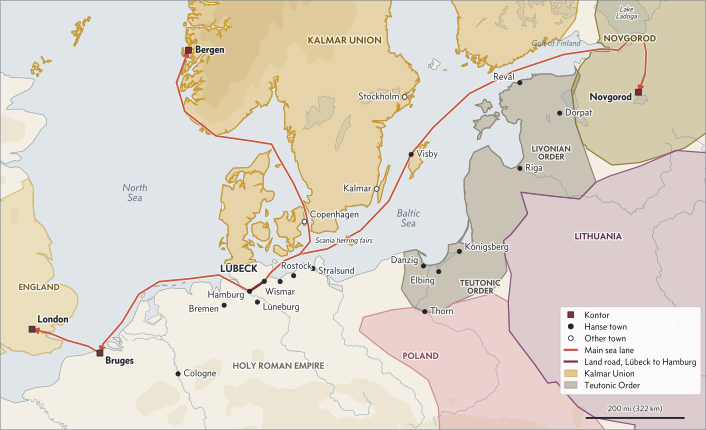
By the 1350s the members were calling themselves “the towns of the German Hanse.” Historians call it the Hanseatic League, or simply the Hanse. It was a trade confederation of Baltic and North Sea towns:This organization was a medieval trade confederation along the Baltic and North seas. → Hanseatic League•• a confederation is a union of members that keep their own governments and join only for common purposes. Nearly two hundred towns belonged at one time or another, from the Zuiderzee (zy-der-zay) in the Netherlands to Estonia, and inland as far as Cologne and Kraków (Figure 26.2). The towns of Prussia belonged, and so did their ruler, the Teutonic Order, the only member that was a state rather than a town.
The Hanse had no king, no treasury, no fleet of its own, and no permanent council. When something had to be decided, Lübeck invited the towns to send envoys to an assembly on a set day. The meeting was called a Tagfahrt (tahk-fahrt), literally a “day journey,” the trip to the appointed day; historians also call it the Hanseatic Diet. One of the first general meetings was held in Lübeck in 1356. The Tagfahrt worked by consensus:This organization met in Tagfahrts to achieve consensus. → Hanseatic League•• a proposal was written down as binding if no envoy spoke against it, and a town whose envoy had stayed away could say it was not bound. That made the League slow to act and hard to command, but also hard to break.
What held it together was trade. By 1300 the Hanse dominated trade on the Baltic,The Hanseatic League dominated trade on this sea, whose ports included Lübeck and Danzig. → Baltic Sea•• and in time its busiest ports there were Lübeck and Danzig. Hanseatic merchants carried furs, wax, and honey from the Russian forests; grain and timber from Prussia and Poland; dried cod from Norway; iron and copper from Sweden; wool cloth from Flanders and England; wine from the Rhine; and salt. The great catch was herring. Every summer and autumn the herring crowded into the waters off Scania (skay-nee-uh), the southern tip of today’s Sweden, which then belonged to Denmark, and at fairs on its beaches thousands of workers gutted them and packed them into barrels with salt from Lüneburg. Salted herring kept for months, and Christians ate fish instead of meat on more than a hundred fast days of the year. The cargo ship of the Hanse was the cog, a broad, high-sided ship with one mast and one square sail, built for capacity rather than speed (Figure 26.1). Grain and timber came down the Vistula to Danzig, which in time became the biggest town of the League.
Abroad the League kept four great trading posts. Each was called a kontor, from the French comptoir, the counting table where a merchant reckoned his money, and so his office. The Hanse’s outposts abroad were kontors,This organization created outposts called kontors. → Hanseatic League•• self-governing colonies of German merchants who lived under their own law and elected their own aldermen. Three of the four were walled compounds, with warehouses, a weighing house, a chapel, and strict rules. In Bergen, in Norway, the Germans bought dried cod on the wharf now called Bryggen (brig-en) (Vol. 3, Geography: Europe, Asia, and Africa). In Bruges, in Flanders, where the Germans lodged among the townspeople, they bought cloth and sold the goods of the east. In London their yard on the Thames was the Steelyard, from the German Stalhof, probably a “sample yard” where samples of wool were inspected and sealed. The fourth and farthest east was the Peterhof, “Saint Peter’s Court,” at Novgorod, named for its Catholic church, where young Germans learned Russian and bought the furs of the north. Its gate was locked at night, and no Russian man was allowed inside after dark.
The Hanse could make war when its trade was threatened, as a king learned. Valdemar IV (val-deh-mar), king of Denmark from 1340, had spent twenty years winning back a kingdom that his father’s generation had pawned away to German nobles. In 1360 he took back Scania and its herring fairs from Sweden. In July 1361 he landed on Gotland. On July 27 his soldiers, many of them hired Germans in good armor, slaughtered about 1,800 Gotland farmers outside the walls of Visby. The townsmen, long at odds with the farmers, took no part in the battle. Visby, a town of the Hanse, surrendered, and a famous story says that it paid him a fortune to spare the town. Archaeologists who dug the farmers’ mass graves after 1905 found many of the dead still in their mail shirts, buried in the summer heat as they fell.
A Hanseatic fleet attacked Denmark in 1362 and was beaten at Helsingborg, and the towns accepted a hard truce. Five years later they tried again. In November 1367 their envoys met at Cologne and formed an alliance with the Dutch towns, each member promising a set number of ships and men and paying a tax on trade to fund the war. In 1368 this Confederation of Cologne fought Valdemar IV’s Denmark:This league’s Confederation of Cologne fought Valdemar IV’s Denmark and gained commercial privileges in the Treaty of Stralsund. → Hanseatic League•• its fleets sacked Copenhagen and seized the castles of Scania, and Valdemar fled abroad. On May 24, 1370, his council made peace at Stralsund (shtrahl-zoont), a Hanse town on the Baltic coast of Pomerania. In the Treaty of Stralsund the towns won free trade throughout the Baltic, relief from Danish tolls at the Scanian fairs, the castles of the Scanian coast for fifteen years with most of their revenue, and a voice in choosing the next king of Denmark. No league of merchants had ever dictated terms to a kingdom so completely. It was the height of the Hanse’s power.
The Victual Brothers
The next threat came from pirates. Valdemar IV’s daughter, Margaret, ruled Denmark and Norway after 1387, and she wanted Sweden as well, whose nobles hated their German-born king, Albert of Mecklenburg. In 1389 her army took Albert prisoner, and her forces besieged Stockholm, which was full of German burghers loyal to him. In 1392 Albert’s kinsmen, the dukes of Mecklenburg, answered by hiring sea captains to run food through the blockade to the starving city. They gave the captains letters that let them attack Danish ships and keep what they took. A privateer is a private captain licensed in this way by a ruler at war. These were called the Victual Brothers, from the Latin victualia, “provisions,” because their first task was to carry food. Most Hanse towns quietly welcomed them, since none wanted Margaret to control the Sound. Lübeck, which sided with her, was their chief enemy.
The privateers soon stopped asking whose ships they took. They plundered Bergen in 1393 and Malmö (mahl-mur) in 1394, and that same year they seized Gotland and made Visby their base. Merchant shipping on the Baltic nearly stopped, and the herring trade suffered. The men whom most Hanse towns had cheered on turned from privateers into pirates,The Victual Brothers engaged in piracy against this organization. → Hanseatic League•The Victual Brothers, a group of these people, terrorized the Hanseatic League. → pirates•These Baltic privateers turned pirates were followed by the Likedeelers, or “equal sharers.” → Victual Brothers•• and Hanse ships were their richest prey. In 1398 the Teutonic Order, which needed the sea open for its grain and amber, sent an army to Gotland under its grand master, Konrad von Jungingen (yoong-ing-en), and drove them out of Visby. The survivors moved west to the North Sea and the coast of Frisia, where they called themselves the Likedeelers (lee-keh-day-lerz), “equal sharers,” because they divided their plunder equally.
Their most famous captain was Klaus Störtebeker (shtur-teh-bay-ker), whose nickname means something like “empty the mug in one gulp.” A Hamburg fleet caught him near the island of Heligoland, and he was beheaded in Hamburg with dozens of his men in 1400 or 1401. Later legend turned him into a Robin Hood of the sea. It said that he asked for as many of his men to be spared as he could walk past after his head was cut off, and that his headless body walked past several of them before it fell. No record of the time says so. The Likedeelers lived on without him and plundered Bergen again in 1429.
The Hanse after 1400
Margaret won Sweden in the end. In 1397, at Kalmar on the Swedish coast, her great-nephew Eric of Pomerania was crowned king of Denmark, Norway, and Sweden together, in the union told in another volume (Vol. 8, The Northern Worlds). The nobles of the north hoped that one king of all Scandinavia could break the Germans’ hold on their trade, and for a century the Hanse rivaled the Kalmar UnionThis organization rivaled the Kalmar Union. → Hanseatic League• for the sea. Eric opened the Baltic to Dutch ships, and in 1426 six Hanse towns led by Lübeck declared war on him, blockaded Scandinavia’s harbors, and hired Likedeelers of their own. In 1429 Eric began to charge every ship passing through the Sound a toll, the Sound Dues. In 1435 he made peace at Vordingborg and let the Hanse towns pass the Sound free. The Danish kings collected the Sound Dues from everyone else for the next four centuries.
The fifteenth century was a long, slow afternoon. The herring moved away from Scania, Dutch ships carried more of the Baltic grain, and the princes of Germany, Poland, and Russia reined in their towns. The kontors kept the old privileges for as long as they could. Late in the 1460s England and the Hanse fought a war at sea, mostly by seizing each other’s ships. In 1474 the Treaty of Utrecht ended it on the League’s terms: Edward IV of England confirmed its privileges, and the Hanse gained ownership of the Steelyard,This organization’s London kontor was called the Steelyard, on the later site of Cannon Street Station. → Hanseatic League••This organization gained ownership of the London Steelyard through the 1474 Treaty of Utrecht. → Hanseatic League• its London kontor, which it bought outright in 1475. It held the site, through fire and royal hostility, until 1852, and Cannon Street Station, one of London’s railway terminals, was built on the ground in the 1860s. The German painter Hans Holbein the Younger (hohl-byne), then working in London, painted several of the Steelyard’s merchants in the 1530s (Figure 26.3).

The farthest kontor had a harsher end. Ivan III, grand prince of Moscow, conquered Novgorod in 1478 and carried off the bell that had called its assembly together (Vol. 14, From Luther to Mozart). He wanted Russia’s trade in Russian hands. In 1494 Ivan III closed the Hanse’s easternmost kontor,This city was home to the easternmost kontor of the Hanseatic League. → Veliky Novgorod••In 1494, Ivan III closed this organization's Kontor at Novgorod. → Hanseatic League•• the Peterhof at Novgorod, seized its goods, and carried its merchants off to Moscow. It reopened in 1514, but its great days were over. The Bergen kontor lasted longest of all, until 1754.
The League still had money and pride. During a war with Sweden in the 1560s, Lübeck built the warshipA member of this trading league built the warship Adler von Lübeck. → Hanseatic League•• Adler von Lübeck, the “Eagle of Lübeck,” one of the largest ships of the age. Launched in 1566, she was about 257 feet (78 meters) long overall, nearly as long as a football field. She never fought, because peace talks had begun before she was ready, and she ended her days carrying freight to Spain and Portugal. The last Tagfahrt met in Lübeck in 1669, with only a handful of towns present. Lübeck, Hamburg, and Bremen still call themselves Hanseatic cities.
The Teutonic Order
The Teutonic Order was born in a field hospital that merchants from Bremen and Lübeck set up during the siege of Acre in 1190, and it became a military order in 1198 (Chapter 8). Like the Templars, its brothers took a monk’s vows of poverty, chastity, and obedience and also fought. They wore a white mantle with a black cross. In 1226 the emperor Frederick II, by the Golden Bull of Rimini, granted it Prussia, the land east of the lower Vistula, whose people still worshiped their old gods, if its knights could conquer it (Chapter 9). A Polish duke, Konrad of Masovia, had asked for their help against Prussian raiders on his border.
That grant made the Order part of a long war. The Northern Crusades were the wars that Catholic kings, bishops, and military orders fought from the twelfth century to the fifteenth to conquer and baptize the peoples around the Baltic who still kept their old gods. The popes promised those who fought in them the same spiritual rewards as crusaders bound for Jerusalem. The Teutonic Order fought the Northern CrusadesThis group fought the Northern Crusades. → Teutonic Order• for nearly two centuries, first from Prussia and then from Livonia too. Saxon princes had attacked the Wends in 1147, during the Second Crusade (Chapter 8). In 1171 Pope Alexander III blessed war against the Estonians. From 1201 a German bishop built his city of Riga at the mouth of the Western Dvina, and he founded his own order of knights, the Sword Brothers, to conquer Livonia, the land of today’s Latvia and southern Estonia. When Lithuanian warriors crushed the Sword Brothers at Saule (sow-leh) in 1236, the survivors joined the Teutonic Knights and became their Livonian branch. That branch is the one that Alexander Nevsky beat on the ice of Lake Peipus in 1242 (Chapter 16).
The conquest of Prussia took fifty-three years, from 1230 to 1283. The knights advanced down the Vistula and along the coast, building a castle of brick at each step and planting a German town beside it: Thorn in 1231, Kulm, Elbing, and in 1255 Königsberg (kur-nigs-bairk), named in honor of the king of Bohemia, a crusader. The Prussians rose in 1260 and fought for fourteen years before they were crushed. German and Polish settlers took up land, and the Prussian language had died out by about 1700. Most of what we know of the war comes from Peter of Dusburg, a priest of the Order, whose Chronicle of the Prussian Land, finished in 1326, tells it as a holy war of God’s knights against idolaters.
In 1308 the Order turned on a Christian neighbor. Władysław (vwah-dih-swahf), a short, stubborn Polish duke who was fighting to reunite Poland, asked the knights to help his men hold Danzig against the margraves of Brandenburg, the German princes to the west. They took the town on November 13, 1308, killed many of its people, and kept it, and with it all of Pomerelia (pom-eh-ree-lee-uh), the land along the lower Vistula, whose loss cut Poland off from the sea. The next year the grand master moved from Venice, where he had lived since the fall of Acre in 1291, to Marienburg, “Mary’s Castle,” on the Nogat, a branch of the Vistula. Today the town is Malbork, in Poland. Its castle grew into the largest brick fortress in the world, built over more than a century (Figure 26.4), and from it the grand masters ruled a state that stretched from the Vistula to the Gulf of Finland.

The Order’s state was unlike any other in Europe. Its rulers were a few hundred knight-brothers, nearly all born in Germany, who could not marry or leave land to sons, and who elected their grand master for life. Beneath them lived Prussians, German settlers, Hanse towns, and landholding knights who were not brothers and had no share in the government. The Order traded too, in grain and amber. Every winter and summer it led raids into Lithuania, the last country in Europe whose rulers were not Christians, and knights from all over the west came to join them as a sort of armed pilgrimage. King John of Bohemia, who would die blind at Crécy, and Gaston Phoebus, count of Foix in the Pyrenees, rode with the Order (Chapter 24). Henry Bolingbroke, the future Henry IV of England, joined it to besiege Vilnius (vil-nee-us) in 1390, and Chaucer gave the Knight of the Canterbury Tales campaigns in Prussia and Lithuania (Vol. 8, The Northern Worlds).
Those who lived under the Order grew tired of it. In 1397 four knights of the Kulm land, the district around the town of Kulm, now Chełmno (khewm-noh), on the Order’s border with Poland, swore a league together and took a lizard as their badge. They said their league was to fight lawlessness, but the Lizard Union opposed the Order’s ruleThe Lizard Union opposed this order’s rule in Prussia. → Teutonic Order• in Prussia, and its members looked to the Polish king for a better master. One of its founders would carry a banner for the Order in 1410.
Poland of the Piasts
Poland, the Order’s southern neighbor, had been a Christian country since 966, more than two centuries before the Order was founded. Poland’s first ruling family was the Piasts,This country's first ruling family was the Piast dynasty. → Poland•• who ruled it as dukes and kings for four hundred years (Figure 26.5). The earliest Polish chronicle was written about 1115 by a foreign monk whom historians call Gallus Anonymus. It traces the family to Piast, a poor farmer who welcomed two strangers to his son’s feast when the prince of the land had turned them away, and whose son became prince in the prince’s place. The story is a legend, and the name “Piast dynasty” was coined by historians only in the seventeenth century.
The first whose deeds are certain was Mieszko I (myesh-koh), who ruled the lands around Gniezno (gnyez-noh) and Poznań (poz-nahn). In 966 he was baptized, probably at the urging of his Christian wife, a Bohemian princess. His son, Bolesław the Brave, built Poland into a power. In the year 1000 the young emperor Otto III came to Gniezno to pray at the tomb of a martyred missionary bishop, Adalbert, and agreed that Poland should have its own archbishop there, answerable to no German church. Bolesław conquered lands as far as Bohemia, and in 1018 he rode into Kiev with a son-in-law he meant to make its prince (Chapter 6). When the German king Henry II died in 1024, he seized his chance, and at Easter 1025 Bolesław the Brave was crowned Poland’s first king.Bolesław the Brave became this country’s first crowned king. → Poland•• He died in June. His son lost most of what he had won, and in the 1030s a Bohemian army sacked Gniezno and carried off Adalbert’s bones to Prague.
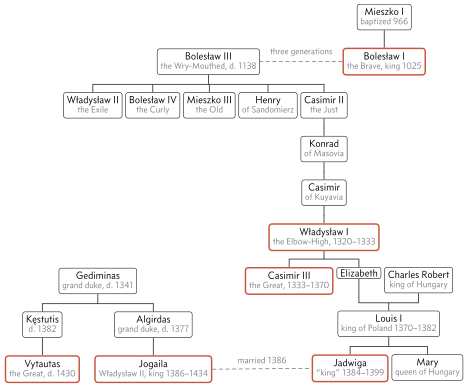
Poland’s capital moved south. About 1040 Bolesław’s grandson made Kraków his seat, on a limestone hill called the Wawel above the Vistula, and Kraków became Poland’s capital and coronation cityKraków was this country’s medieval capital and coronation city. → Poland•• for most of the next five centuries. Its cathedral on the Wawel hill held the crowning of almost every king from 1320 to 1734, and kings were buried there too (Figure 26.6).
The kingdom nearly fell apart. No Polish ruler had worn a crown since a king was driven out in 1079, so Bolesław III, who ruled all Poland from 1107, was only a duke. He was called the Wry-Mouthed. The nickname is first written down a century after his death, and Długosz explains that a sore in his youth had left his mouth bent a little to one side. Before he died in 1138 he wrote a will that divided Poland among his sons,The will of a ruler of this kingdom called 'the Wry-Mouthed' fragmented it by dividing it between his sons. → Poland•• hoping to keep them from fighting. Each of the four eldest got a province of his own, and the eldest of the whole family at any time was to hold Kraków as senior duke, with power over the rest. The plan failed within eight years. The brothers fought, their sons fought, and for nearly two centuries Poland was a patchwork of duchies held by rival Piast princes. It was in this weakness that one of them, Konrad of Masovia, invited the Teutonic Knights in 1226, and that the Mongols cut down Henry the Pious at Legnica in 1241 (Chapter 16).

The man who put Poland back together was that short duke, Władysław I, a great-grandson of Bolesław’s youngest son. He was so small that he was called the Elbow-High. He fought for forty years for duchy after duchy, was driven into exile, and came back. He took Kraków in 1306, lost Pomerelia and Danzig to the Teutonic Knights he had called in to help him, and won Greater Poland around Gniezno. The pope finally let him be crowned, and on January 20, 1320, in Kraków’s cathedral, the Elbow-High reunited Poland as its king.A king called 'the Elbow-High' reunited this kingdom in the early 14th century. → Poland•• He was the first king crowned at Kraków, with the sword called the Szczerbiec (Chapter 6). He spent his last years at war with the Order, whose armies ravaged his lands.
His son Casimir III preferred building to fighting, and Poles call him Casimir the Great. He made peace with the Order at Kalisz in 1343, giving up Pomerelia, and pushed southeast instead into Ruthenia (roo-thee-nee-uh), the lands of the Rus around Lwów (lvoof). He gathered Poland’s laws into written codes, founded a university at Kraków in 1364, and built so many walled towns and stone castles that a Polish saying holds that he found Poland made of wood and left it made of brick. When Jews fled the massacres in German towns during the Black Death, his kingdom took them in (Chapter 21).
Much of his money came from under the ground. About 8 miles (13 km) southeast of Kraków, at Wieliczka (vyeh-leech-kah), lay a great bed of rock salt. Brine had been boiled there for salt since the Stone Age, and from the thirteenth century on, miners dug shafts and cut the salt from the rock in blocks. Salt was needed to preserve meat and fish and to feed livestock, and the mines of Wieliczka produced saltA famous location that produced this substance in medieval times is located in Wieliczka, Poland. → salt• for the kings of Poland, who owned them. Casimir gave the miners a charter and a hospital. Saint Kinga (keen-gah), a daughter of the king of Hungary, married a duke of Kraków in the thirteenth century. A later legend says that she threw her engagement ring into a salt mine in Hungary before she left home, and that the miners of Wieliczka found it in the first lump of salt they dug. Miners later carved a whole chapel to her out of the salt (Figure 26.7).

Casimir had daughters but no son, and he was the last Piast king. When he died in 1370 the crown passed, by an arrangement made long before, to his sister Elizabeth’s son, Louis, king of Hungary. Louis cared little for Poland and wanted it for one of his daughters. He died in 1382, and the Polish lords chose his youngest daughter, Jadwiga (yahd-vee-gah), then a girl of eight or nine, on condition that she come to live in Kraków.
Lithuania
North and east of Poland lay a country of dark forests, lakes, and marshes, which the crusaders’ roads did not penetrate. Its people were Balts, and its rulers kept the old religion of their ancestors, with its sacred groves and fires and its thunder god, Perkūnas (per-koo-nahs) (Vol. 8, The Northern Worlds). One of their chiefs, Mindaugas (min-dow-gus), united them in the thirteenth century, accepted baptism to win the Order’s alliance, and was crowned the first and only king of Lithuania in 1253. He was murdered ten years later, and his successors went back to the old gods. For another century and more the Lithuanians fought the Teutonic Knights almost every year.
The greatest of these unbaptized rulers was Gediminas (geh-dim-ih-nus), grand duke from about 1316 to 1341. He was a shrewd diplomat as well as a warrior. In 1323 he sent letters to the pope and to the Hanse towns of Lübeck, Rostock, Stralsund, and others, inviting merchants, craftsmen, farmers, and monks to settle in his land with full rights, and hinting that he might be baptized. The letters were sent from his “royal city” of Vilnius, and they are the first record of its name. Lithuanians honor him as the city’s founder, and the legend of its founding was written down in the Lithuanian chronicles of the sixteenth century, two hundred years after his death. Gediminas, it says, went hunting and slept near the meeting of two rivers. He dreamed of an iron wolf standing on a hill above them and howling with the voice of a hundred wolves. The high priest of the old gods, Lizdeika (liz-day-kah), explained the dream: a city should be built there whose fame would echo through the world as the wolf’s voice did, and Gediminas founded Vilnius on that spot.Gediminas founded this city. → Vilnius•According to legend, Vilnius was founded after Duke Gediminas dreamt of an iron one of these animals. → wolf• A brick tower of the castle on the hill, rebuilt a century later, is still called Gediminas’s Tower, and Vilnius is Lithuania’s capital today (Vol. 3, Geography: Europe, Asia, and Africa).
Gediminas’s sons divided the work. Algirdas ruled in Vilnius and pushed east and south into the lands of the Rus, taking Kiev from the Golden Horde after the Blue Waters (Chapter 16). His brother Kęstutis (kess-too-tis) ruled the west from his castle at Trakai (trah-ky) and fought the Teutonic Knights. By 1400 their state stretched from the Baltic nearly to the Black Sea, the largest in Europe, though most of its people were Orthodox Christians of the Rus, under grand dukes who were not Christians (Figure 26.9).
When Algirdas died in 1377, his son Jogaila took his place and soon fell out with his uncle. Jogaila made a secret treaty with the Teutonic Order. When Kęstutis learned of it in 1381, he seized Vilnius, but Jogaila won it back, and in 1382 he lured his uncle and his cousin Vytautas, Kęstutis’s son, into his camp and sent them as prisoners to the castle of Krewo. Within a week Kęstutis was dead, and whether he was murdered nobody can now say. With his wife’s help Vytautas escaped, the later stories say in the clothes of one of her maids, and fled to the Teutonic Knights.
Krewo and Grunwald
Two rulers in trouble needed each other. Jadwiga had been crowned in Kraków’s cathedral on October 16, 1384, as “king” of Poland, a word the lords chose to show that she ruled in her own right. She was ten or eleven. Since early childhood she had been promised to William, a duke of Austria, and the lords did not want him, because he would bring Poland under the Habsburgs. Jogaila knew that his people would have to become Christians sooner or later. He wanted baptism from a friend rather than from the Order, which would take his lands with it, and he wanted allies against the knights. The Polish lords offered him their queen. Długosz says that William came to Kraków in 1385 to claim his bride and was driven out of the castle. Jadwiga tried to follow him and found the gate locked, he says, and she called for an axe to break it open until a nobleman talked her out of it.

At Krewo, on August 14, 1385, Jogaila set his seal to a short list of promises. He would be baptized a Catholic, with all his family and every Lithuanian not yet baptized. He would pay William 200,000 gold florins to give up the engagement. He would win back the lands Poland had lost, free Polish prisoners, and join his Lithuanian and Rus lands to the crown of Poland forever, in a Latin word, applicare, whose meaning historians still argue about. This agreement is the Union of Krewo. In February 1386 Jogaila was baptized in Kraków’s cathedral, taking the name Władysław. A few days later, after the Union of Krewo, Jadwiga married Jogaila.This Polish queen married Lithuania’s Grand Duke Jogaila following the Union of Krewo. → Jadwiga•• No one recorded the year of his birth, so he was somewhere between twenty-two and thirty-five; she was twelve. On March 4 he was crowned king of Poland. The next year he went home to Vilnius, and the Lithuanians were baptized in crowds, each, a later chronicle says, receiving a woolen shirt.
The bargain did not bring peace at once. Jogaila left a brother to govern Lithuania, and Lithuanians resented him. In 1389 Vytautas rose against him, and in 1390 he went back to the Teutonic Knights and besieged Vilnius with them and their English guests. A civil war of three years followed. Then Jogaila made his cousin an offer. In August 1392, at Ostrów (oss-troof), he agreed that Vytautas would rule Lithuania for him for life, and Vytautas ended the civil war by making peace with Jogaila.This country's national hero Vytautas the Great ended a civil war by making peace with Jogaila. → Lithuania• Vytautas was the abler soldier of the two, and he ruled Lithuania until his death in 1430, raiding as far as the Crimea and governing the Rus lands to the east. Lithuanians call him Vytautas the Great and honor him as their national hero.
Jadwiga died in 1399, a few weeks after giving birth to a daughter who did not live. She left her jewels to the university of Kraków, which was refounded in 1400, and in 1997 the Catholic Church declared her a saint. Jogaila stayed king, and married three times more. The Teutonic Knights still claimed that his conversion was a sham and that the Lithuanians still worshiped idols and could still be crusaded against. They wanted Samogitia (sam-oh-jish-ee-uh), the Lithuanian lowland that lay between their Prussian and Livonian lands, and Vytautas had more than once signed it over to them. In 1409 the Samogitians (sam-uh-jish-unz) rose against the knights with Vytautas’s help, and Ulrich von Jungingen, the grand master and the younger brother of Konrad, declared war on Poland.

Early in July 1410, Jogaila’s Polish army and Vytautas’s Lithuanians, with Rus troops, Tatar horsemen, and mercenaries from Bohemia, joined forces and marched north into Prussia toward Marienburg. Ulrich blocked them near the villages of Grunwald and Tannenberg. Historians disagree about the numbers, but the allies probably had more men, and the Order better armor and training. On July 15, after the episode of the swords, the Lithuanian cavalry on the right charged the Order’s left. After more than an hour of fighting the Lithuanians fled, and some of the knights broke ranks to chase them. Whether the flight was a trick or a true rout, historians still argue. In the center the Poles fought on, lost the great banner of Kraków for a moment, and took it back. Ulrich led his reserve, about a third of his army, against the Polish flank, and Jogaila sent in his last line. The returning Lithuanians closed in, and Ulrich was killed in the press. Jan Matejko (mah-tay-koh), the great Polish painter of history, imagined that moment nearly five centuries later (Figure 26.10). By evening Jogaila’s Polish-Lithuanian army had crushed the Teutonic OrderAt this battle, Jogaila’s Polish–Lithuanian forces defeated the Teutonic Order under Ulrich von Jungingen. → Battle of Grunwald••This organization lost much of its power following its defeat at the 1410 Battle of Grunwald. → Teutonic Order•• at the Battle of Grunwald, and the Order never recovered its strength.

The victors marched on to Marienburg, but they had no heavy guns. Heinrich von Plauen (plow-en), a commander who had not been at the battle, held the castle through a siege of eight weeks, and Jogaila went home. In the Peace of Thorn of 1411 the Order gave up Samogitia for the lifetimes of Jogaila and Vytautas and paid a heavy ransom for its prisoners, but kept almost all its land. Nicholas von Renys (reh-nis), a founder of the Lizard Union, had carried the banner of the Kulm land at Grunwald. The Order claimed that he had lowered it in the battle as a signal of surrender and beheaded him for treason, and the Lizard Union was dissolved.
The cost of the war ruined the Order. To pay the ransom it raised taxes on its towns and knights, who had no voice in its government, and Danzig and Thorn resisted until they were forced to pay. In 1440 the landed knights and the great towns of Prussia, the heirs of the Lizard Union, formed the Prussian Confederation. In February 1454, the year after the fall of Constantinople (Chapter 27), they renounced the Order and asked Jogaila’s son, King Casimir IV of Poland, to take Prussia under his crown. He agreed, and their envoys swore allegiance to him in Kraków on March 6. The war that followed lasted thirteen years and ended in 1466 with the western half of Prussia, including Danzig and Marienburg, in Polish hands. The rest of the Order’s state lasted until 1525, when its last grand master in Prussia became a Lutheran and made it a duchy under the Polish king (Vol. 14, From Luther to Mozart).
What to remember
- The Baltic is an almost landlocked sea whose amber traveled south on the Roman Amber Road. Its southeastern peoples, the Prussians and Lithuanians, were the last Europeans to keep their old gods.
- The Hanseatic League, a confederation of nearly two hundred German trading towns on the Baltic and North Sea, grew from Lübeck, rebuilt by Henry the Lion in 1159, and its alliance with Hamburg of 1241. Its towns met in assemblies called Tagfahrts and decided by consensus.
- The Hanse’s four great kontors were the Steelyard in London (won outright by the Treaty of Utrecht, 1474; now the site of Cannon Street Station), Bruges, Bergen, and the Peterhof at Novgorod, which Ivan III closed in 1494. Lübeck built the warship Adler von Lübeck in 1566.
- The Confederation of Cologne (1367) beat Valdemar IV of Denmark, and the Treaty of Stralsund (1370) marked the League’s height. Later it rivaled Margaret’s Kalmar Union over the Sound Dues.
- The Victual Brothers, privateers hired in 1392 to feed besieged Stockholm, turned pirate against the Hanse; after the Teutonic Order expelled them from Visby in 1398 they called themselves the Likedeelers, “equal sharers.”
- The Teutonic Order fought the Northern Crusades, conquered Prussia from 1230 to 1283, ruled from Marienburg (Malbork) from 1309, and was opposed from within by the Lizard Union of 1397.
- The Piasts were Poland’s first dynasty: Mieszko I was baptized in 966, Bolesław the Brave was crowned the first king in 1025, Bolesław the Wry-Mouthed’s will of 1138 divided the country, and Władysław the Elbow-High reunited it and was crowned at Kraków in 1320. Casimir the Great was the last Piast king; the salt mines of Wieliczka enriched the crown.
- Gediminas made Vilnius Lithuania’s capital, and legend says he founded it after dreaming of an iron wolf. By the Union of Krewo (1385) Jogaila was baptized and married Jadwiga, Poland’s “king.” Vytautas, Lithuania’s national hero, ended a civil war by making peace with him in 1392.
- At Grunwald, or Tannenberg, on July 15, 1410, Jogaila and Vytautas destroyed the army of the Teutonic Order and killed its grand master, Ulrich von Jungingen; the Order never recovered.
Chapter 27 · 17 clues
Kosovo and the Fall of Constantinople
In the spring of 1452 an army of masons, lime burners, and laborers went to work on a steep hillside above the Bosporus, about 6 miles north of Constantinople, where the strait between Europe and Asia is narrowest. On the Asian shore opposite stood a small fort that an earlier sultan had built almost sixty years before. The new castle rose in about four and a half months, with three great towers joined by walls that climbed the slope. The Turks called it Boğazkesen (boh-ahz-keh-sen), “Cutter of the Strait,” and since boğaz also means “throat,” nobody in the city missed the second meaning. That November a Venetian ship that would not stop to be searched was sunk by a single stone ball, and its captain was impaled on a stake as a warning to the next.
The builder was Mehmed II, the sultan of the Ottoman Turks, who was twenty years old. The emperor in Constantinople, Constantine XI, ruled little more than the city behind his walls, and he could only watch. A century and a half earlier the Ottomans had been one clan of horsemen among many on a forgotten frontier in Asia Minor. On their way to the Bosporus they had met, and swallowed, the Christian kingdoms of the Balkans: the Bulgarians, who had rebuilt their empire, and the Serbs, whose kings had once hoped to rule Constantinople themselves.
The Palaiologoi and the Ottomans
When the Fourth Crusade took Constantinople in 1204, the Byzantine Empire broke into pieces, and Greek princes set up states of their own (Chapter 13). The strongest was the Empire of Nicaea, in western Asia Minor. In 1259 a general named Michael Palaiologos made himself its co-emperor, Michael VIII, as guardian of the boy emperor John IV Laskaris. Two years later, in July 1261, Michael sent his general Alexios Strategopoulos (strat-eh-gop-oo-los) toward Constantinople with about eight hundred men to scout. Local farmers told Strategopoulos that the city’s Latin garrison and the Venetian fleet had sailed off on a raid. That night his men slipped in through a secret passage, opened a gate from inside, and took the city almost without a fight, while the Latin emperor, Baldwin II, fled by ship. On August 15, 1261, Michael VIII walked into Constantinople behind an icon of the Virgin and was crowned in Hagia Sophia.
He had no intention of sharing the throne. In December he had John IV, then eleven, blinded so that he could never reign, and the patriarch excommunicated him for it. Michael’s family, the Palaiologoi (the Stage), held the throne for the next 192 years, longer than any other dynasty in Byzantine history (Figure 27.1). They ruled a poor and shrinking state. While Michael watched the west, where Charles of Anjou was preparing to retake the city (Chapter 9), Turkish raiders took the Byzantine lands in Asia Minor town by town. Then the family fought itself. In 1328 Michael’s son Andronikos II was overthrown by his own grandson, Andronikos III. When Andronikos III died in 1341, his son John V was nine. From then until 1347 the boy’s regents, his mother Anna of Savoy with the patriarch beside her, fought a civil war against his father’s chief minister, John Kantakouzenos (kan-tuh-koo-zee-nos), who made himself co-emperor as John VI. Both sides hired Turks to fight for them.
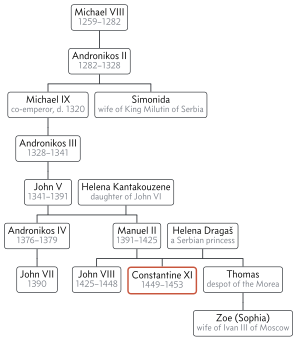
Among the Turkish lords of Asia Minor was Osman (oz-mahn), whose small state lay in Bithynia (bih-thin-ee-uh), the corner of Asia Minor nearest Constantinople. Such a state was a beylik (bay-lik), the land of a bey, or lord, and its fighters called themselves ghazis, warriors of the faith. Only one writer of his own day, a Byzantine historian, mentions him, and only in a few lines. The Ottoman chroniclers who told his story wrote a century and more after his death, and their tales of him are told elsewhere (Vol. 37, The House of Islam). About 1299, by their reckoning, his beylik became independent of the Seljuk sultans who had ruled most of Asia Minor (Chapter 8), and in 1302 he beat a Byzantine army at Bapheus (baf-ee-us), near Nicomedia. His name gave Europeans the word “Ottoman.” Osman died in 1323 or 1324, and in 1326 his son Orhan (or-hahn) took the city of Bursa, which became the Ottomans’ first capital. Nicaea itself fell in 1331.
John Kantakouzenos needed soldiers. In 1346 he married his daughter Theodora to Orhan and brought Ottoman troops over into Europe to fight his rivals. On March 2, 1354, an earthquake shook down the walls of Gallipoli, the town that guards the European shore of the Dardanelles, the strait between the Aegean and the Sea of Marmara. Its people fled. Orhan’s son Süleyman (soo-lay-mahn) marched in, settled Turks from Asia Minor in the ruins, and refused to leave, though the emperor offered to buy the town back. That year Kantakouzenos lost his throne and became a monk. Gallipoli became the Ottomans’ first great base in Europe. A crusade won it back for the emperor in 1366, but ten years later it was theirs again.
Orhan’s son Murad I (moo-rahd) (reigned 1362 to 1389) carried the war inland. In the 1360s he took Adrianople, the chief city of Thrace, about 140 miles west of Constantinople, and under its Turkish name, Edirne (eh-deer-neh), it became his capital. He also began to raise the janissaries, from the Turkish for “new soldiers,” an infantry corps of captured Christian boys brought up as Muslims and as the sultan’s own men (Vol. 37, The House of Islam). By the 1370s Constantinople was an island in Ottoman land, and the emperor John V had become the sultan’s vassal (the Stage), paying him tribute and sending troops when called.
The Second Bulgarian Empire
The Bulgarians had been Byzantine subjects since Basil II, the Bulgar-Slayer, destroyed their first empire in 1018 (Chapter 3). In 1185 two brothers named Theodore and Asen (ah-sen), lords in the Balkan Mountains, came to the emperor Isaac II to ask for land in return for service in his army. Isaac refused, and according to Niketas Choniates, the court official whose History tells the story, Asen was struck across the face. The brothers went home and rebelled. Many of their people hesitated, and so the brothers built a church in honor of Saint Demetrius, the soldier saint of Thessalonica, and told them that the saint had abandoned the Greeks and come over to their side. The rising began on October 26, 1185, his feast day. Theodore took the name Peter and was crowned tsar, the Slavic title of an emperor (Chapter 3).
The emperor’s armies could not take the mountain strongholds, and by 1187 he had to accept the new state. Historians call it the Second Bulgarian Empire, and its capital was Tarnovo,Tarnovo was the capital of an empire named for this country. → Bulgaria• a town of steep hills inside the loops of the Yantra River. On the hill of Tsarevets (tsar-eh-vets), ringed by walls, stood the tsars’ palace and the church of the patriarch, and its writers called their city a new Constantinople. Their youngest brother, Kaloyan, captured the first Latin emperor at Adrianople in 1205 (Chapter 13). Under Asen’s son Ivan Asen II (reigned 1218 to 1241) Bulgaria stretched from the Black Sea to the Adriatic.
After him came Mongol raids from the steppe, short reigns, and civil war, and by the 1360s the empire had split between two half-brothers, one ruling at Tarnovo and one at Vidin on the Danube. Murad I made the tsar at Tarnovo his vassal in the 1370s. In 1393 Murad’s son Bayezid (by-uh-zid), now sultan, sent an army under his own son to besiege Tarnovo, and after three months it fell on July 17. The last patriarch of Tarnovo, the scholar and monk Euthymius (yoo-thim-ee-us), was sent into exile, and his pupils carried Bulgarian books to Serbia, to the Rus, and to Wallachia (wah-lay-kee-uh), the principality across the lower Danube in what is now southern Romania. Vidin fell three years later, after a crusade from the west was destroyed at Nicopolis, and Bulgaria did not rule itself again for almost five hundred years (Vol. 20, The North and the East).
Saint Sava
The Serbs are a Slavic people who settled in the western Balkans in the seventh century, in the valleys between the Adriatic coast and the Morava River. For five hundred years they were ruled by local princes under Byzantine or Bulgarian overlords. In 1166 one of these princes, Stefan Nemanja (neh-mahn-yah), became grand prince of Raška (rahsh-kah), the hill country around the fortress of Ras. For thirty years he fought the Byzantines when they were weak and served them when they were strong, united most of the Serbian lands, and built monasteries, the greatest of them Studenica (stoo-deh-nee-tsah). His family, the Nemanjić (neh-mahn-yich), ruled the Serbs for two centuries.
His youngest son, Rastko, was born about 1174 and given a province to govern while still a boy. About 1192 he ran away to Mount Athos, the holy mountain of the Orthodox monks in northern Greece (Chapter 3), and became a monk there under the name Sava (sah-vah). His father sent men to bring him home, but Sava had taken his vows before they could. The story comes from his two biographers, Domentijan (doh-men-tee-yahn) and Teodosije (teh-oh-doh-see-yeh), monks of Hilandar (hil-un-dar) who wrote in the thirteenth century and the early fourteenth. In 1196 Nemanja gave his throne to his middle son, Stefan, took vows himself as the monk Simeon, and joined Sava on the mountain.

Father and son asked the Byzantine emperor, Alexios III, for an abandoned monastery on the north side of Athos, and in 1198 he granted it to them as a home for Serbian monks. On that site Sava and his father founded Hilandar,This Serbian saint helped found the Hilandar Monastery. → Saint Sava• with its first church and its towers, and Sava wrote its rule. Simeon died there a year or two later, and the Serbian Church honors him as a saint. Hilandar has been the Serbian monastery on the mountain ever since, ranked fourth among Athos’s twenty houses. Its library is one of the great collections of medieval Slavic manuscripts.
Sava returned to Serbia, where his brother Stefan reigned, and set out to give the Serbs a church of their own. In 1219 he traveled to Nicaea, where the patriarch of Constantinople lived in exile after 1204, and was consecrated the first archbishop of the Serbs. His church was autocephalous, self-headed (Chapter 3): it chose its own archbishop. About the same time Sava compiled the ZakonopraviloThis Serbian saint compiled the Zakonopravilo, a nomocanon combining ecclesiastical and secular law. → Saint Sava• (zah-koh-noh-prah-vee-loh), “Law and Canon,” in seventy chapters. It was a nomocanon, a book that put together ecclesiastical, or church, law and the secular law of the state. It joined the canons, the rules made by church councils, to the laws of the Byzantine emperors that touched the church and daily life, translated from Greek collections into Slavonic. The Serbs had no written law code, and this was their first. Sava died in 1235 at Tarnovo, the guest of the Bulgarian tsar Ivan Asen II, on his way home from Jerusalem. In 1594 the Ottomans burned his body in Belgrade, after Serbian rebels had carried his icon as a banner, and the great Church of Saint Sava stands near the spot today.
The Nemanjić Serbs
In 1217 Sava’s brother Stefan was crowned with a crown sent by Pope Honorius III, and he is remembered as Stefan the First-Crowned; from then on Serbia was a kingdom. His grandson Milutin (mee-loo-tin) (reigned 1282 to 1321) pushed south into Byzantine Macedonia. In 1299, to buy peace, the emperor Andronikos II gave him his daughter Simonida (see-moh-nee-dah) as a wife. The bride was about five years old, and the churchmen of Constantinople protested in vain. She brought a crowd of Greek courtiers with her, and the Serbian court began to copy Byzantine titles, dress, and ceremony.


Milutin built churches across his kingdom. The last and finest was the monastery church of Gračanica (grah-chah-nee-tsah), finished in 1321 on the edge of the plain of Kosovo, with five domes rising in steps above walls of brick and stone (Figure 27.3). Inside, painters covered every surface. On its walls they painted the king with a model of his church, the young queen beside him, and the first painted family tree of the Nemanjić, a vine that grows from Stefan Nemanja and ends in Milutin.
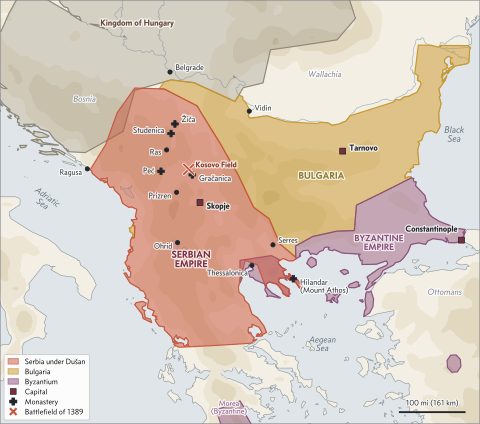
Milutin’s grandson Stefan Dušan (doo-shahn), Stephen in English, became king in 1331. While Byzantium tore itself apart in the civil war of the 1340s, he took Macedonia, Albania, Epirus, and Thessaly. At Easter, April 16, 1346, at Skopje, he raised the Serbian archbishop to the rank of patriarch, with his seat at Peć (pech), and had himself crowned emperor of the Serbs and Greeks. In 1349 he issued a law code for his empire, Dušan’s Code. The Serbian kingdom reached its height under Dušan:This kingdom was ruled at its height by Stephen Dušan. → Serbia• it ran from the Danube to the Gulf of Corinth (Figure 27.4), and Dušan may have dreamed of taking Constantinople and ruling the whole Byzantine world. He died suddenly on December 20, 1355, still in his forties.
His only son, Uroš V (oo-rosh), was nineteen. Serbian tradition calls him Uroš the Weak, for his mildness, and the great lords took his provinces for themselves. The strongest was Vukašin (voo-kah-shin), who was crowned king beside him. On September 26, 1371, Vukašin and his brother attacked the Ottomans on the Maritsa (mah-reet-sah) River, near Adrianople, and both died with most of their army. Uroš died childless that December, and so the Nemanjić line of the Serbs endedThis people's Nemanjić dynasty came to an end due to the reign of Uroš the Weak. → Serbs• with Uroš the Weak, after two centuries. Serbia broke into lordships, and the strongest lords became the sultan’s vassals.
The Battle of Kosovo, 1389
The most powerful lord left in northern Serbia was Lazar Hrebeljanović (hreb-el-yah-noh-vich), who had served at Dušan’s court. He ruled from Kruševac (kroo-sheh-vats), on the Morava, and called himself prince, never king or emperor. In 1386 and 1388 Serbian and Bosnian armies beat Ottoman raiders, and in 1389 Murad I came himself with his sons Bayezid and Yakub.
On June 15, 1389, Saint Vitus’s Day, Lazar led the Serbs onto Kosovo Field,Prince Lazar led Serbian forces against the Ottomans on the Field of Blackbirds at this 1389 battle. → Battle of Kosovo•• a plain near today’s Pristina (prish-tih-nah). Its name means “Field of Blackbirds,” from the Serbian kos, “blackbird.” Beside Lazar fought his son-in-law Vuk Branković (brahn-koh-vich) and Bosnian knights sent by King Tvrtko (tvurt-koh) of Bosnia. Nobody counted the armies; the usual modern estimate is fifteen to twenty thousand Christians against perhaps thirty thousand Ottomans. Of the battle itself almost nothing certain is known, except how it ended. Both armies were nearly destroyed, and both rulers died. Lazar was captured and beheaded. Murad I is the only Ottoman sultan ever killed in battle.
How the sultan died, the sources tell in different ways. That October the government of Florence, writing to King Tvrtko, praised twelve loyal lords who cut their way through a ring of chained camels to the sultan’s tent, and the one among them who stabbed him in the throat and belly. Early Ottoman writers say that a Christian lying among the dead rose up and stabbed him. About 1431 Constantine the Philosopher, a Bulgarian scholar who had fled Tarnovo for the Serbian court, wrote a life of Lazar’s son. In it he told of a nobleman falsely accused of disloyalty who left the battle line pretending to desert and stabbed the sultan when he was brought before him. By the end of that century the knight had a name, Miloš (mee-losh), and eighteenth-century writers gave him the surname Obilić (oh-bee-lich). According to Serbian tradition, Miloš Obilić killed Murad IThe Ottoman sultan Murad I was killed at this battle. → Battle of Kosovo••According to Serbian tradition, this knight pretended to defect before killing Murad I at Kosovo. → Miloš Obilić• after riding into the Ottoman camp as a pretended deserter, and the sultan’s guards cut him down.
Bayezid had his brother Yakub strangled on the battlefield, so that no rival was left, and took the throne. Kosovo was closer to a draw than a rout, but it was a draw Serbia could not afford, since it had no second army and the sultan had Asia Minor behind him. Lazar’s widow made peace, his son Stefan Lazarević (lah-zar-eh-vich) became the sultan’s vassal, and his daughter Olivera was sent to Bayezid as a wife. The Serbian Church made Lazar a martyr and a saint. Centuries of epic songs, in which Lazar chooses a kingdom in heaven over a kingdom on earth and Vuk Branković betrays him, made the lost battle the central story of the Serbs (Vol. 20, The North and the East). The day is still kept, as Vidovdan (vee-dov-dahn), on June 28 in our calendar, which runs thirteen days ahead of the old Julian calendar that the Serbian Church still follows.
Nicopolis and Ankara
Bayezid I (reigned 1389 to 1402; Figure 27.5) earned the nickname Yıldırım (yul-duh-rum), “the Thunderbolt,” for the speed of his campaigns. His army took Tarnovo in 1393, and from 1394 he blockaded Constantinople by land, building the fort on the Asian shore of the Bosporus. Its emperor was now Manuel II, John V’s son, who had been living at the sultan’s court as a hostage when his father died in 1391. Manuel begged the Christians of the west for help, and King Sigismund of Hungary, whose lands bordered the Ottomans’ along the Danube, answered (Chapter 23).
In 1396 a crusade gathered in Hungary. French knights came under John of Nevers, the twenty-five-year-old son of the duke of Burgundy, with Germans, Knights Hospitaller, and Venetian ships on the Danube. In September they besieged Nicopolis, a Bulgarian fortress on a cliff above the river that the Ottomans had taken from the tsar a few years before. Bayezid came to relieve it, and on September 25 the armies met. Sigismund asked the French to wait while his foot soldiers went first, but they would not let others lead the charge. They broke through the Ottoman front lines and the rows of sharpened stakes behind them, struggled on uphill, and were surrounded at the top by the sultan’s horsemen. Sigismund’s crusade was destroyed. He escaped by boat to the Venetian ships on the Danube and went home the long way, by sea through Constantinople. The next morning Bayezid had hundreds, perhaps thousands, of prisoners killed before his eyes. He spared the rich for ransom, and John of Nevers was freed the next year, for 200,000 gold florins, to come home as John the Fearless (Chapter 25). Those under twenty were kept as slaves. One of them, a Bavarian squire of sixteen named Johann Schiltberger (shilt-bair-ger), lived thirty years as a captive in the east and came home to write down what he had seen.
Manuel then went west himself. From 1399 to 1403 he traveled through Venice, Milan, and Paris, and at Christmas 1400 he was in London, the guest of England’s King Henry IV, the only Byzantine emperor ever to visit the country. He was still in the west when help came from an unexpected direction. Timur, called Tamerlane in Europe, was a Turkic conqueror who ruled from Samarkand, set out to restore the empire of Genghis Khan (Chapter 16), and had already sacked Delhi and Baghdad. When Bayezid demanded tribute from a lord loyal to Timur, Timur took it as a personal insult. In July 1402, on the plain of Çubuk (choo-book) near Ankara, his army met Bayezid’s. Many of Bayezid’s troops from Asia Minor went over to Timur. His Serbian vassals, led by Lazar’s son Stefan, fought on, but Bayezid was taken prisoner, and he died in captivity the next March. Later European writers said that Timur carried him about in an iron cage, a story Christopher Marlowe put on the London stage nearly two centuries later (Vol. 11, The Age of Shakespeare). The historians of Timur’s own court say he was treated well.
Ankara gave Constantinople half a century more. Bayezid’s sons fought one another for eleven years, until Mehmed I won in 1413, and the Byzantines regained Thessalonica and part of their coast. When Mehmed I died in 1421, Manuel and his son John VIII backed a rival against the new sultan, Murad II: Murad’s uncle Mustafa, a son of Bayezid who had been Timur’s prisoner. Mustafa lost, and Murad had him hanged as an impostor, though he was very likely the real prince. Because Manuel had meddled in the succession, Murad II laid siege to ConstantinopleManuel II attempted to interfere with the succession of Murad II, leading to a siege of this city. → Constantinople• in June 1422, with cannon for the first time. An eyewitness, John Kananos, wrote that the defenders saw the Virgin herself on the walls. In September Murad had to march away, because his younger brother, a boy also named Mustafa, had risen against him in Asia Minor, with Byzantine money behind him, according to the Greek historian Doukas. Murad took Thessalonica, which the Byzantines had handed over to Venice, in 1430.
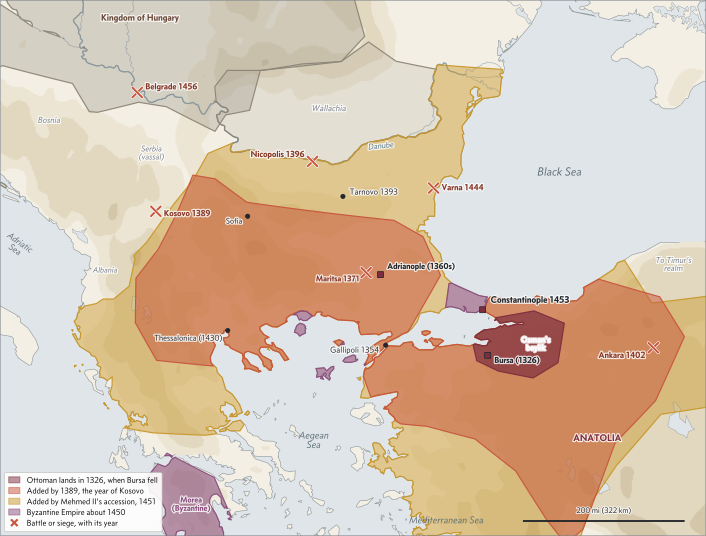
John Hunyadi
The Christian champion of the next generation was a Hungarian soldier. John Hunyadi (hoon-yah-dee), Hunyadi János (yah-nohsh) in Hungarian, was born about 1406 into a family of Wallachian origin with lands in Transylvania, the hill country in the east of the kingdom of Hungary. He learned war in Sigismund’s service, and in 1441 he was made governor of Transylvania and captain of Belgrade, Hungary’s fortress where the Sava River meets the Danube. He hired professional soldiers, many of them veterans of the Hussite wars in Bohemia, and used their wagon forts (Chapter 23). In 1442 he destroyed two Ottoman armies that had invaded Transylvania and Wallachia.
Hungary’s king was then a Pole, Władysław III, who was also king of Poland and the son of Jogaila (Chapter 26). In the autumn of 1443 the king and Hunyadi crossed the Danube with about 25,000 men. With them came Đurađ Branković (joo-rahj), the son of Vuk Branković and grandson of Prince Lazar, now the despot of Serbia, a Byzantine title meaning “lord,” who wanted his lands back from the sultan. Hunyadi led the Long Campaign,This Hungarian commander led the “Long Campaign” into the Balkans. → John Hunyadi• as it was called, deep into the Balkans. He commanded the vanguard, beat four Ottoman forces one at a time before they could join, and took Niš and Sofia. In December snow and Ottoman barricades in the passes of the Balkan Mountains stopped the army at Zlatitsa (zlah-teet-sah), and it fought its way home, reaching Buda in February 1444.
Murad II offered peace. In June 1444 his envoys agreed to a ten-year truce and gave Serbia back to Branković, and Murad, worn out by war and grieving for a son who had just died, gave up his throne to his twelve-year-old son Mehmed and retired. But the pope’s envoy, Cardinal Julian Cesarini (cheh-zah-ree-nee), persuaded the young king that an oath sworn to an unbeliever did not bind him, and in the autumn the crusaders marched again. Murad came back from retirement to lead his army. On November 10, 1444, the two armies met at Varna, a port on the Black Sea, where the crusaders were trapped between the sea, a lake, and the hills. Władysław charged the janissaries around the sultan with his household knights and was killed. His body was never found, and Poles remember him as Władysław of Varna. Cesarini died in the rout. Hunyadi escaped from VarnaThis Hungarian commander escaped after the crusader defeat at Varna in 1444. → John Hunyadi• with what was left of the army, only to be seized on his way home by the prince of Wallachia, Vlad (vlahd) II Dracul (drah-kool), who let him go when Hungarian lords threatened war. Vlad was the father of the prince called Dracula, whose name Bram Stoker borrowed (Vol. 17, The Victorians). In 1446 the Hungarians chose Hunyadi to govern the kingdom for their boy king, Ladislaus V, Sigismund’s six-year-old grandson.
The fall of Constantinople
Constantine XI had been emperor for two years when Mehmed came to the throne. He was the fourth son of Manuel II and the Serbian princess Helena Dragaš (drah-gahsh), and he had ruled the Morea, the Byzantine province in southern Greece, from the hill town of Mistra (mis-trah). When his brother John VIII died childless in 1448, he was proclaimed emperor at Mistra in January 1449, at the age of forty-four. To win help from the west, he accepted the union of the churches agreed at Florence in 1439 (Chapter 5). It was proclaimed in Hagia Sophia on December 12, 1452, and much of the city hated it. The Greek historian Doukas says that the emperor’s chief minister, Loukas Notaras (noh-tah-ras), declared that he would rather see the Turkish turban in the city than the Latin bishop’s miter.

Mehmed II had been born at Adrianople in 1432. He had reigned once as a boy, from 1444 until 1446, when his father’s ministers called his father back and set him aside. When Murad II died in February 1451, Mehmed became sultan for good, at eighteen. He meant to have Constantinople, and he prepared for it carefully. In the spring of 1452 he built the castle on the Bosporus now called Rumeli Hisarı (roo-meh-lee hih-sah-ruh), the “Castle of Rumelia,” the Turks’ name for their lands in Europe (Figure 27.7). Its guns closed the strait to any ship bringing grain or soldiers to the city from the Black Sea.

The help Constantine received was small. A Genoese captain, Giovanni Giustiniani (joo-stee-nyah-nee), brought seven hundred men from Genoa and Chios, and the emperor gave him command of the land walls. The Venetians in the city stayed and fought, while the Genoese colony of Galata, across the harbor, stayed neutral. A fleet that Venice promised came too late.
Mehmed had found a better ally. In 1452 a caster of cannon named Orban (or-bahn), a subject of the king of Hungary, probably from Brassó (brahsh-shoh) in Transylvania, offered his skills to Constantine, who could not pay what he asked. He went to the sultan, who could. Within about three months at Adrianople Orban cast Mehmed’s great cannon,The engineer Orban constructed cannons used by Mehmed II against this city. → Constantinople•• a bronze gun some 27 feet long that hurled stone balls weighing hundreds of pounds. Sixty oxen dragged it the 140 miles to Constantinople. It could fire only about seven times a day and, some witnesses say, soon cracked, but with the other guns it battered the land walls for seven weeks. The Ottoman army, perhaps 50,000 to 80,000 men by modern estimates, camped before the walls at the beginning of April 1453, and on April 6 the siege began.
The city’s harbor was shut by a chain across the Golden Horn,A defensive chain was placed across this city's Golden Horn. → Constantinople•• the long inlet north of the city (Vol. 3, Geography: Europe, Asia, and Africa), stretched on floating logs from a tower near the city’s tip to a tower in Galata (Figure 27.8). The Ottoman fleet could not break it. On April 20 four Christian ships fought their way through the whole Ottoman fleet into the Horn while the sultan watched from the shore. So Mehmed went around it. On April 22 he had about seventy ships dragged on greased logs from the Bosporus over the hill behind Galata and launched into the Horn behind the chain. Now the defenders had to guard the harbor walls as well.
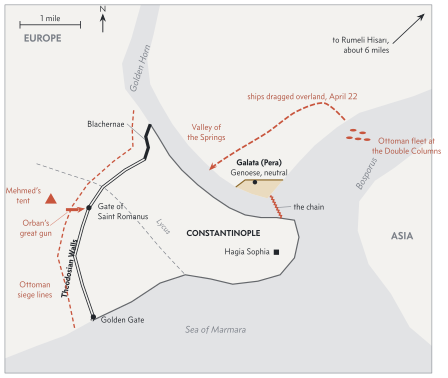
Day after day the guns opened breaches, and night after night the defenders filled them with earth, timber, and barrels. A Venetian ship’s doctor, Nicolò Barbaro (nee-koh-loh bar-bah-roh), kept a diary of it all. On the evening of May 28 Greeks and Latins together crowded into Hagia Sophia for a last service. Soon after midnight the final assault began, wave after wave, against the stretch of wall in the valley of the Lycus stream near the Gate of Saint Romanus. Toward dawn Giustiniani was badly wounded and carried to his ship, and when his men saw him go they broke. The janissaries came over the wall.
No reliable witness saw how Constantine died. The story most often told is that he threw off his imperial insignia and plunged into the fighting at the breach; other Christian and Ottoman writers told it differently, and his body was never certainly identified. On May 29, 1453, Mehmed II took Constantinople and Constantine XI died,This empire ended when Mehmed II captured Constantinople in 1453. → Byzantine Empire••Mehmed II captured this city in 1453, ending the Byzantine Empire. → Constantinople••This last Byzantine emperor was killed when Mehmed II captured Constantinople in 1453. → Constantine XI• and with him ended the Byzantine Empire, the Roman Empire of the east, 1,123 years after Constantine the Great had dedicated his city (Vol. 7, The Romans). The soldiers had been promised the city’s plunder, and they killed, looted, and carried off thousands of people to be sold as slaves. That day Mehmed rode to Hagia Sophia and had it made a mosque (Chapter 1). He made the city his capital, and his reign is told from the Ottoman side elsewhere (Vol. 37, The House of Islam). Greek songs later told that an angel had turned the last emperor to marble and hidden him beneath the city’s Golden Gate, to wake one day and take his city back.
Belgrade, 1456
Three years later Mehmed turned north, to Belgrade, the southern gate of the kingdom of Hungary. In July 1456 the sultan besieged it with a great army, some three hundred cannon, and a fleet of river boats that cut it off from the north. Its garrison, under Hunyadi’s brother-in-law Michael Szilágyi (see-lah-dyee), held out. Hunyadi, now about fifty, gathered boats upriver, and on July 14 he smashed through the Ottoman flotilla and brought fresh men into the fortress. With him came thousands of peasant crusaders raised by a Franciscan friar of seventy, John of Capistrano (kah-pee-strah-noh), who had preached the crusade across Hungary.
On July 21 the Ottomans stormed the walls and were thrown back. The next day the peasant crusaders poured out of the fortress without orders and began to fight in the Ottoman lines. Capistrano led them across the Sava, Hunyadi charged out to take the Ottoman guns, and the sultan, wounded, retreated in the night. Far away in Rome the pope, Callixtus III (also spelled Calixtus), an old Spaniard of the Borgia family (Vol. 10, Rebirth), had ordered on June 29 that every church ring its bell at noon to call Christians to pray for the defenders. While Hunyadi defended Belgrade, the noon bells rangThis Hungarian commander defended Belgrade against the Ottomans while Pope Calixtus III called for noon bells to summon prayers for its defenders. → John Hunyadi•• in the towns the order reached in time. In many countries the news of the victory arrived before the pope’s order, and the noon bell became a thanksgiving for it.
Hunyadi did not live to see the bells become a custom. Plague broke out in the crusaders’ camp, and he died on August 11, 1456. Belgrade held for sixty-five more years, until 1521, and his son Matthias became king of Hungary in 1458 (Vol. 14, From Luther to Mozart). In the Balkans the frontier now ran along the Danube and the Sava. To its south the Bulgarian tsars, the Serbian kings, and the Roman emperors of Constantinople were gone, and a sultan prayed on Fridays under the dome that Justinian had raised nine centuries before.
What to remember
- Michael VIII Palaiologos took Constantinople back from the Latins in 1261; his family, the Palaiologoi, ruled until 1453. The Ottomans, named after Osman, crossed into Europe at Gallipoli in 1354 and made Adrianople their capital.
- The Second Bulgarian Empire (1185 to 1396), founded by the brothers Peter and Asen, had its capital at Tarnovo, which Bayezid I’s army took in 1393.
- Saint Sava, son of Stefan Nemanja, founded the Hilandar Monastery on Mount Athos with his father, became the first archbishop of the Serbs in 1219, and compiled the Zakonopravilo.
- Serbia reached its height under Stephen Dušan, crowned emperor in 1346; the Nemanjić dynasty ended with Uroš the Weak in 1371.
- At Kosovo, the Field of Blackbirds, on June 15, 1389, Prince Lazar’s Serbs fought Murad I; both rulers died, and Serbian tradition says Miloš Obilić killed the sultan after pretending to desert.
- Bayezid I destroyed Sigismund’s crusade at Nicopolis (1396) and was captured by Timur at Ankara (1402). Manuel II’s meddling in Murad II’s succession led to the siege of Constantinople in 1422.
- John Hunyadi led the Long Campaign (1443 to 1444) and escaped from the defeat at Varna (1444), where King Władysław III died.
- Mehmed II took Constantinople on May 29, 1453, after Orban’s cannon broke the walls and his ships were dragged overland past the chain across the Golden Horn; Constantine XI, the last Byzantine emperor, died in the fighting.
- Hunyadi defended Belgrade in 1456 while Pope Callixtus III ordered noon bells rung for prayer.
Back matter
Answers by Type
Every question asks for one kind of thing, and its first words usually say which: “this emperor,” “this pope,” “this battle,” “this poem,” “this city.” That kind of thing is the question’s answer type. The chapters of this volume told the story of a thousand years in order, from Justinian’s crowning in 527 to the morning in 1453 when the Turks broke into Constantinople. This section takes the volume’s 242 answers out of that story and sorts them by type into twenty-one groups. The rulers come first, east and then west, with the historians who told their story. Then come the crusades, the battles, the wars, and the trade; the Church, the philosophers, and the poets; the builders, the artists, and the musicians; and last the cities and countries.
Each group opens with a table for comparing its answers at a glance and then gives a short entry for each answer, with the chapter that teaches it. The entries reprint only the clues that tell an answer from its look-alikes. The Middle Ages reused names without mercy: there are two Justinians, eight Charleses, five Gregorys, seven Henrys, and three Golden Bulls in these pages, and Tours and Poitiers name each other’s battles. Boxes at the end of a group take apart the ones that players confuse most.
The Byzantine Empire
Thirteen answers come from the eastern Roman Empire (Table A.1). They are the empire itself, four of its emperors and one emperor’s name, Justinian’s great general and the Vandals he conquered, and the riot that nearly toppled Justinian, with the sport and the vehicles behind it. The last two are the silk the empire learned to weave and the emperor’s northern bodyguard. An emperor clue usually names a wife, a general, a law, a council, or a war, and the date settles the rest, since the empire lasted from Constantine to 1453. The name Justinian belongs to two emperors whose reigns lay more than a century apart, and the name Michael to an emperor and a patriarch. Three answers share a single event, the Nika riots, and the clue’s own words (“this sport,” “these vehicles,” “these riots”) decide which is meant.
| Answer | When | What | Known for | Ch. |
|---|---|---|---|---|
| Byzantine Empire | 330–1453 | The Roman Empire in the east | Ruled from Constantinople; Justinian, Theodora, Basil II; ended when Mehmed II took the city | 1, 3, 27 |
| Justinian I | Ruled 527–565 | Emperor | Married Theodora; Belisarius; Hagia Sophia; the Corpus Juris Civilis; the Eternal Peace; San Vitale | 1 |
| Belisarius | Fought 530–559 | Justinian’s general | Dara; the Nika riots; Ad Decimum and Tricamarum; Italy; lost at Callinicum; his rival Narses | 1 |
| Nika riots | January 532 | A riot | The Blues and Greens rose together; Hypatius proclaimed emperor | 1 |
| chariot racing | A sport | Its Blue and Green factions began the Nika riots | 1 | |
| chariots | Vehicles | Their races made the Blue and Green factions | 1 | |
| Vandals | To 533 | A Germanic people | Lost Africa when Belisarius beat their last king, Gelimer, at Ad Decimum | 1 |
| silk | 550s onward | A cloth | Monks smuggled silkworm eggs to Justinian; Corinth and Thebes; Lucca | 1, 3 |
| Justinian II | Ruled 685–695, 705–711 | Emperor | The Quinisext Council; tried to arrest Pope Sergius I; made Tervel a caesar; last Heraclian | 3 |
| Michael | Ruled 842–867 | A name | Michael III, “the Drunkard” | 3 |
| Basil II | Ruled 976–1025 | Emperor | “The Bulgar-Slayer”; Kleidion and the blinded prisoners | 3 |
| Varangian Guard | From 988 | A bodyguard | Formed from the Rus warriors Vladimir sent Basil II | 6 |
| Constantine XI | Ruled 1449–1453 | Emperor | The last emperor, killed when Mehmed II took Constantinople | 27 |
Byzantine Empire. The Roman Empire as it went on in the east, ruled from Constantinople, with the same laws and the same title of emperor; “Byzantine” is a name scholars gave it a thousand years later. A clue that calls it the Roman Empire continued in the eastThis empire was an eastern continuation or successor of the Roman Empire. → Byzantine Empire•• wants this answer, not the Holy Roman Empire of the west. Its art is a frequent clue: the Harbaville Triptych, a tenth-century Byzantine ivory carving,The ivory Harbaville Triptych is an example of this empire’s art. → Byzantine Empire•• makes the empire the answer and not the material. Taught in Chapter 1, Chapter 3, and Chapter 27.
Justinian I. Emperor from 527 to 565, a peasant’s nephew who married the former actress Theodora and ruled from his desk. His lawyers under Tribonian produced the Corpus Juris Civilis, which he ordered,This ruler ordered the compilation of the Corpus Juris Civilis. → Justinian I••• the body of Roman law that Europe studied for centuries. His general Belisarius won back Africa and Italy, and in 532 he bought peace from KhosrauThis ruler agreed to pay Khosrau I eleven thousand pounds of gold under the Eternal Peace. → Justinian I•• with eleven thousand pounds of gold. He quarreled with a pope too: his condemnation of the Three ChaptersThis ruler’s condemnation of the Three Chapters brought him into conflict with Pope Vigilius, whom he detained in Constantinople. → Justinian I•• set him against Vigilius, whom he held in Constantinople. Taught in Chapter 1.
Belisarius. Justinian’s general for thirty years, who beat the Persians at Dara in 530, lost at Callinicum in 531, and helped crush the Nika riots in 532. In 533 Belisarius won at TricamarumThis general won at Tricamarum. → Belisarius•• over the Vandals, and in 540 he took Ravenna. His fellow commander was no friend: the eunuch Narses was his rival,Narses was this general's rival. → Belisarius• and their quarrel cost the Romans Milan. Taught in Chapter 1.
Vandals. The Germanic people who had ruled Africa from Carthage for a century. Belisarius beat Gelimer, the Vandals’ last king,Belisarius defeated these people’s last king Gelimer at Ad Decimum. → Vandals•• at Ad Decimum in 533; a clue that names the battle and asks for a city wants Carthage instead. Taught in Chapter 1.
Nika riots. The rising of January 532, named for the fans’ cry “Nika!” (“Win!”), when the Blue and Green factions of the Hippodrome joined against Justinian and burned much of the city. The rioters crowned a reluctant nephew of an earlier emperor, so that Hypatius was proclaimed emperor,Hypatius was proclaimed emperor during these riots. → Nika riots•• before Belisarius and Mundus massacred the crowd. Taught in Chapter 1.
chariot racing. The great sport of Constantinople’s Hippodrome, where four-horse teams raced in the colors of rival clubs. A clue that asks for the sport of the Blue and Green factionsThe Blue and Green factions associated with this sport helped launch the Nika riots against Justinian. → chariot racing•• wants this answer. Taught in Chapter 1.
chariots. The racing cars of the Hippodrome, each pulled by four horses abreast, four to a race. The answer is the vehicle when a clue asks for the horse-drawn vehicles whose racesFans of races using these horse-drawn vehicles formed the Blue and Green factions involved in the Nika riots. → chariots• gave the factions their name. Taught in Chapter 1.
silk. The costliest cloth of the Middle Ages, which only China made until, Procopius says, monks smuggled silkworm eggs to Justinian.According to Procopius, monks brought eggs of the insects producing this commodity into Justinian’s empire. → silk•• By the tenth century the Greek cities of Corinth and Thebes wove it, and in the twelfth Lucca became Italy’s silk center.Lucca became the Italian center for this commodity in the 12th Century. → silk• Taught in Chapter 1 and Chapter 3.
Justinian II. Emperor from 685 to 695 and again from 705 to 711, after his enemies slit his nose and exiled him. He tried to rule like his namesake: in 692 he called the Quinisext Council,This ruler convoked the Quinisext Council, which condemned several pagan practices. → Justinian II• whose canons banned the festivals of the old gods, and he tried to arrest Pope Sergius I. Killed in 711, he was the last Heraclian emperor.This ruler was the last ruler of the Heraclian dynasty. → Justinian II• Taught in Chapter 3.
Michael. A name, not a person. The clue that wants it describes Michael III, emperor from 842 to 867, whom the Macedonian historians called “the Drunkard”A Byzantine emperor with this name was called "the Drunkard" by his Macedonian successors. → Michael• to excuse his murder by Basil I, their dynasty’s founder. Taught in Chapter 3.
Basil II. Emperor from 976 to 1025, born in the purple chamber in 958, a plain soldier who never married. Later writers named him Basil the “Bulgar-Slayer”,This Byzantine emperor was known as the “Bulgar-Slayer.” → Basil II•• Boulgaroktonos. After his victory at Kleidion in 1014, Skylitzes says, he blinded ninety-nine in each hundredAfter defeating Samuel at Kleidion, this ruler reportedly blinded his Bulgarian prisoners, leaving one man in each hundred a single eye to guide the others. → Basil II•• prisoners and sent them home to their tsar; many historians doubt the number. Taught in Chapter 3.
Varangian Guard. The emperors’ foreign bodyguard of axe-bearing northerners. It began in 988, when Vladimir of Kiev sent six thousand Rus warriors to save Basil II from a rebel, and the northerners stayed as his guard.This elite bodyguard of Byzantine emperors recruited Norse and other northern European warriors. → Varangian Guard•• The Varangians themselves were the Scandinavian Rus, whose rulers and cities have a group of their own. Taught in Chapter 6.
Constantine XI. The last Byzantine emperor, from 1449, who ruled little more than the city behind its walls. When Mehmed II took Constantinople, Constantine XI diedThis last Byzantine emperor was killed when Mehmed II captured Constantinople in 1453. → Constantine XI• in the fighting, on May 29, 1453. The empire began and ended with a Constantine. Taught in Chapter 27.
Historians, books, and maps
Eleven answers are the writers who told this volume’s history and the books they wrote, with the old Roman law, two kinds of map, and the prison where two famous books began (Table A.2). Most of what we know of Justinian comes from Procopius, of Clovis from Gregory of Tours, and of Alexios I from his daughter Anna, so their names turn up in clues about other answers too. The question to ask is whether the clue wants the writer (“this historian,” “this princess”), the book (“this work,” “this history”), or the thing the book is about. Two Annas, a writer and a bride, are easy to cross.
| Answer | When | Who or what | Known for | Ch. |
|---|---|---|---|---|
| Procopius | About 500–after 565 | Belisarius’s adviser, a historian | The Wars, Buildings, and the Secret History | 1 |
| prisons | 524; 1298 | Where books were written | Boethius’s Consolation of Philosophy, at Pavia; Marco Polo’s travels, in Genoa | 2 |
| Corpus Juris Civilis | From 529 | Justinian’s Roman law | Compiled under Tribonian: the Code, the Digest, the Institutes, and the Novels | 1 |
| Gregory of Tours | 538–594 | Bishop of Tours | The ten-book History of the Franks; Clovis; the Geneva tsunami | 2 |
| Secret History | About 550; printed 1623 | Procopius’s attack on Justinian | The emperor as a demon whose head vanished; Theodora’s past; a trillion deaths | 1 |
| etymology | About 625 | The study of word origins | The title of Isidore of Seville’s encyclopedia, the Etymologies | 2 |
| maps | Pictures of the world | The T-and-O map; al-Idrisi’s map for Roger II | 7 | |
| Anna Komnene | 1083–about 1153 | Byzantine princess | Alexios I’s daughter; wrote the Alexiad | 7 |
| Alexiad | About 1148 | Anna’s history of her father | Robert Guiscard’s invasion; the First Crusade; Bohemond | 7 |
| the Tabula Rogeriana | 1154 | Al-Idrisi’s world map | Made for Roger II of Sicily, with south at the top | 7 |
| Marco Polo | About 1254–1324 | Venetian traveler | Kublai’s court; the Silk Road; Il Milione, told to Rustichello in prison | 16 |
prisons. Two famous books were born in jail. The Roman statesman Boethius, condemned by Theodoric, wrote The Consolation of Philosophy in a prison at Pavia before his execution in 524, and Marco Polo told his travels to a fellow prisoner in Genoa in 1298. Taught in Chapter 2.
Procopius. Procopius of Caesarea, Belisarius’s adviser on campaign, who wrote nearly everything we know of Justinian’s reign. His Wars tell the campaigns and the plague of 542, while in his panegyric Buildings Procopius described Justinian’s building works,This historian described Justinian’s construction projects in Buildings, or De Aedificiis. → Procopius• church by church and wall by wall. Then, secretly, Procopius wrote the Secret History,This Byzantine historian wrote the Secret History. → Procopius••• which damns the same reign. Taught in Chapter 1.
Secret History. Procopius’s private attack on Justinian, Theodora, Belisarius, and Antonina, written about 550 and printed only in 1623. Its wildest charge is that the emperor’s head would vanishThis work portrays Justinian as a demon whose head could disappear. → Secret History••• as he paced the palace at night, like a demon’s, and it makes Theodora a former performer and prostitute.This work depicts Empress Theodora as a former performer and prostitute. → Secret History•• A clue about Procopius’s praise of the churches wants Buildings instead. Taught in Chapter 1.
Corpus Juris Civilis. The “Body of Civil Law,” the name later scholars gave to Justinian’s compilation of Roman law: the Code, the Digest, the Institutes, and the Novels. The emperor ordered it, but Tribonian oversaw the compilation.Tribonian oversaw the compilation of this Roman-law collection under Justinian. → Corpus Juris Civilis•• The Four Doctors of Bologna later wrote glosses on it. Taught in Chapter 1.
Gregory of Tours. The bishop of Tours from 573 to 594, nearly our only source for Clovis and the early Franks. He wrote his history in ten books,This bishop of Tours wrote the ten-book Historia Francorum. → Gregory of Tours• running from the Creation to 591; in it he records the tsunami of 563 on Lake Geneva. He is not his contemporary Pope Gregory I. Taught in Chapter 2.
etymology. The study of where words come from. Isidore of Seville, who believed that a word’s origin showed the nature of the thing, called his great encyclopedia of about 625 the Etymologies, so a clue that asks what Isidore’s great book is named forThis subfield titles the magnum opus of Isidore of Seville, a medieval dictionary. → etymology• wants this answer. Taught in Chapter 2.
maps. Medieval maps were diagrams of belief as much as pictures of the earth. The simplest, spread by Isidore’s Etymologies, were the “T and O” maps:These objects include a type called "T and O." → maps•• a circle of ocean split by a T of waters into Asia, Europe, and Africa. Taught in Chapter 7.
Anna Komnene. The daughter of the emperor Alexios I, born in the purple in 1083, who spent her last decades in a convent her mother had founded. There the princess wrote the Alexiad,This Byzantine princess wrote the Alexiad. → Anna Komnene••• finished about 1148. She is not Anna Porphyrogenita, who married Vladimir of Kiev. Taught in Chapter 7.
Alexiad. Anna Komnene’s history of her father’s reign, in fifteen books, finished about 1148. It is the chief Byzantine source for two invasions from the west: it tells Guiscard’s invasion and the First Crusade,This history describes Robert Guiscard’s Norman invasion and the First Crusade, including Bohemond of Taranto. → Alexiad•• with a famous portrait of Bohemond. Taught in Chapter 7.
Tabula Rogeriana. “Roger’s map,” the world map and geography that the Muslim scholar al-Idrisi made at Palermo. Al-Idrisi finished it for Roger IIMuhammad al-Idrisi prepared this world map for Roger II of Sicily. → the Tabula Rogeriana•• in the winter of 1153 to 1154, with south at the top, as Arab mapmakers drew it. Taught in Chapter 7.
Marco Polo. The Venetian merchant, born about 1254, who went with his father and uncle to Kublai Khan’s court about 1275 and came home by sea about 1295. Captured by the Genoese, he told his stories to RustichelloRustichello da Pisa recorded this traveler’s stories in a Genoese prison in the book Il Milione. → Marco Polo•• in prison, and the book, Il Milione, described paper money of mulberry bark.This person described paper money made from mulberry trees. → Marco Polo• Taught in Chapter 16.
Bulgars, Rus, and Mongols
Fifteen answers come from the peoples to Byzantium’s north: the Bulgars and their khans, the Rus of Kiev and Novgorod and their princes, the Mongols’ Golden Horde, and the Moscow that outlasted it (Table A.3). The commonest trap is the clue that could fit a city or a state. Kiev was the capital of Kievan Rus, so a mass baptism in the Dnieper or the rule of Yaroslav the Wise belongs to both, and only the clue’s “this city” or “this polity” settles it. The Bulgars likewise had two empires, and the answer Bulgaria belongs to the second. Most of the early stories here come from the Primary Chronicle of about 1113, compiled at Kiev long after the events.
| Answer | When | Who or what | Known for | Ch. |
|---|---|---|---|---|
| Asparukh | Won at Ongal, 680 | Bulgar khan | Beat Constantine IV; founded the First Bulgarian Empire | 3 |
| Bulgars | 680–1018 | A people from the steppe | Tervel made a caesar; Boris I baptized; Simeon’s Golden Age; the Nominalia | 3 |
| Krum | About 803–814 | Bulgar khan | Made Nikephoros I’s skull a cup (811) | 3 |
| Rurik | Called 862, died 879 | Varangian leader | Settled at Novgorod; founded the Rurikid dynasty | 6 |
| Kievan Rus | 882–1240 | The Rurikids’ state | Centered on Kiev; destroyed the Khazars; Yaroslav the Wise; HLGW | 6 |
| Kiev | Capital from 882 | City on the Dnieper | Oleg’s capital; the Church of the Tithes; the Golden Gate; sacked by Batu, 1240 | 6, 16 |
| Olga of Kiev | Regent from 945 | Princess of Kiev | Avenged Igor on the Drevlians with burning birds; regent for Sviatoslav | 6 |
| Vladimir the Great | Ruled 978–1015 | Prince of Kiev | “Drinking is the joy of the Rus”; married Anna; the Varangian Guard; baptized Kiev | 6 |
| Bulgaria | 1185–1396 | A country | The Second Bulgarian Empire, with its capital at Tarnovo | 27 |
| Alexander Nevsky | 1221–1263 | Prince of Novgorod | Beat the Swedes on the Neva (1240) and the Teutonic knights on Lake Peipus (1242) | 16 |
| Golden Horde | From about 1242 | Batu’s khanate | Capital Sarai; Blue and White branches; lost at Blue Waters and Kulikovo | 16 |
| Ivan | Grand prince from 1328 | A name | Ivan I Kalita, “Moneybags” | 16 |
| Veliky Novgorod | “Novgorod the Great” | Merchant republic; the veche and posadniki; Onfim’s birch bark; the Hanse’s kontor | 16, 26 | |
| Moscow | City of the northeast | Rival of Tver; Ivan Kalita; Dmitri Donskoi | 16 | |
| Russia | A country | Andrei Rublev’s icons | 16 |
Asparukh. The Bulgar khan who led his people across the Danube. In 680 Asparukh beat Constantine IV at Ongal,This ruler founded the First Bulgarian Empire after defeating Constantine IV at the Battle of Ongal. → Asparukh•• in the marshes of the Danube delta, and the land he took became the First Bulgarian Empire. Taught in Chapter 3.
Bulgars. A Turkic-speaking people from the steppe who settled south of the Danube in 680 and ruled the Slavs there. Their khan Tervel won a rare honor when Justinian II made Tervel a caesar,Justinian II made this people’s ruler Tervel the first foreign recipient of the title caesar. → Bulgars• and under Boris I they became Christians. Their First Empire peaked when Simeon I’s reign was their Golden AgeThese people experienced a "Golden Age" during Simeon I's reign. → Bulgars• of Slavic letters, and fell to Basil II in 1018. Taught in Chapter 3.
Krum. The Bulgar khan from about 803 to 814, who doubled his realm and killed the emperor Nikephoros I in battle in 811. The chronicler Theophanes says that Krum lined the emperor’s skull with silverThis Bulgarian ruler reportedly had Nikephoros I’s skull lined with silver and used it as a drinking cup. → Krum•• and made the Slav chiefs drink from it. Taught in Chapter 3.
Rurik. The Varangian whom, the Primary Chronicle says, the quarreling tribes of the north invited to rule them in 862. He settled at Novgorod and founded the dynastyAccording to tradition, this Varangian leader established himself at Novgorod and founded the dynasty that ruled Kievan Rus’. → Rurik•• of the Rurikids, who ruled the Rus and then Moscow until 1598. The story is the dynasty’s legend, not proven history. Taught in Chapter 6.
Olga of Kiev. The widow of Prince Igor, whom the Drevlians killed in 945. The chronicle tells her revenge in stages, and at the last she took sparrows and pigeons from the town and the birds set the Drevlian town ablaze.According to the Primary Chronicle, this ruler avenged her husband’s murder by burning the Drevlian capital with incendiaries tied to birds. → Olga of Kiev•• She ruled as regent for her son Sviatoslav and was later baptized. Taught in Chapter 6.
Vladimir the Great. Olga’s grandson, prince of Kiev from 978 to 1015, who made the Rus Christian. In the chronicle’s tale of the faiths he rejects Islam with “Drinking is the joy of the Rus.”According to the Primary Chronicle, this ruler rejected Islam because "drinking is the joy of the Rus." → Vladimir the Great•• He sent Basil II the warriors who became the Varangian Guard, and in return Vladimir married Basil’s sister Anna.This ruler married Anna Porphyrogenita, the sister of Byzantine emperor Basil II. → Vladimir the Great•• Taught in Chapter 6.
Kievan Rus. The name historians give the state the Rurikid princes ruled from Kiev, from Oleg’s move there in 882 to the Mongol sack of 1240. A clue that asks for “this polity” wants it rather than the city, as when the Rus destroyed the Khazar stateThis polity conquered the Khazar Empire. → Kievan Rus• about 969, or when the Hebrew Schechter Letter calls a Rus ruler HLGW,The Schechter Letter uses the name "HLGW" to describe a ruler of this polity. → Kievan Rus• probably Oleg. Taught in Chapter 6.
Kiev. The city on the Dnieper, spelled Kyiv today, the capital of the Rus. In 882 Oleg moved his capital from Novgorod to Kiev.Oleg made this city the capital of his Rus state after moving from Novgorod. → Kiev•• A Polish chronicle says that Bolesław the Brave struck his sword on the Golden Gate,While intervening in this city's succession crisis, Bolesław the Brave legendarily struck his sword on its Golden Gate, supposedly chipping it. → Kiev• though the gate was built about 1037, nineteen years later. In December 1240, when Batu’s Mongols stormed it, the Church of the Tithes collapsedBatu Khan sacked this city in 1240; people sheltering in its Church of the Tithes died when it collapsed. → Kiev•• on those sheltering inside. Taught in Chapter 6 and Chapter 16.
Golden Horde. The western khanate of the Mongols, which Batu founded with its capital at Sarai on the lower Volga, and which held the Rus princes as subjects for two centuries. Its name may come from the gold-colored tents of its khans.This state's name may derive from the color of its tents. → Golden Horde•• Lithuania beat it at Blue Waters in 1362 or 1363, and on Snipe Field in 1380 Dmitri routed the Horde’s army at Kulikovo.Dmitri Donskoi defeated forces of this state at the Battle of Kulikovo. → Golden Horde•• Taught in Chapter 16.
Alexander Nevsky. Prince of Novgorod, born in 1221, whose later nickname, Nevsky, “of the Neva,” recalls the river where he beat the Swedes in 1240.This prince defeated a Swedish force at the Battle of the Neva. → Alexander Nevsky• On April 5, 1242, Alexander defeated the Teutonic knightsThis prince defeated the Teutonic Order at the Battle on the Ice on Lake Peipus. → Alexander Nevsky•• on Lake Peipus; the knights breaking through the ice come from Eisenstein’s film of 1938. He died in 1263 and is a saint. Taught in Chapter 16.
Veliky Novgorod. “Novgorod the Great,” the northern city where Rurik was said to have settled, which by the twelfth century was a merchant republic in the north,This city was a medieval merchant republic in northern Rus'. → Veliky Novgorod•• whose assembly, the veche, chose its mayors. Its wet soil kept letters written on birch bark, among them the drawings of the boy Onfim.Birch-bark documents excavated in this city include drawings by a boy named Onfim. → Veliky Novgorod•• Taught in Chapter 16 and Chapter 26.
Moscow. A small town of the northeast that rose under the Mongols by serving them. Through most of the 1300s Moscow vied with its rival TverThis city often vied for power with its northern rival Tver. → Moscow• for the title of grand prince, and Ivan Kalita won it. Taught in Chapter 16.
Ivan. A name. The clue that wants it describes Ivan I of Moscow, grand prince from 1328, who was nicknamed Kalita, “Moneybags”A ruler with this name received the nickname Kalita or "Moneybags" thanks to his wealth. → Ivan• for his wealth. Taught in Chapter 16.
Russia. The country a clue asks for when it names the icon painter Andrei Rublev, who painted the Trinity: Rublev is Russia’s most famous icon painter.Andrei Rublev was an icon painter from this country. → Russia• Russia as a country grew from Moscow’s lands, not from Kiev’s. Taught in Chapter 16.
Bulgaria. The country a clue asks for when it names the Second Bulgarian Empire, founded in 1185 by the brothers Peter and Asen, since its capital was Tarnovo.Tarnovo was the capital of an empire named for this country. → Bulgaria• The Ottomans took Tarnovo in 1393. Taught in Chapter 27.
Franks and German emperors
Fifteen answers come from the Franks and from the German kings who took up the title of emperor after them (Table A.4). They belong to four houses in turn: the Merovingians of Clovis, the Carolingians of Charles Martel and Charlemagne, the Ottonians of Otto the Great, and the Hohenstaufen of the two Fredericks, with one Salian and the Habsburgs at the edges. Figure A.1 sets nearly every ruler who is an answer in this volume on one line of time. The house is the first thing to fix, because the names repeat within it: Charles Martel, his grandson Charlemagne, and Charlemagne’s grandson Charles the Bald were all Charles, and two Hohenstaufen emperors were Frederick. A crowning date often settles the rest, Charlemagne’s in 800 and Otto’s in 962.
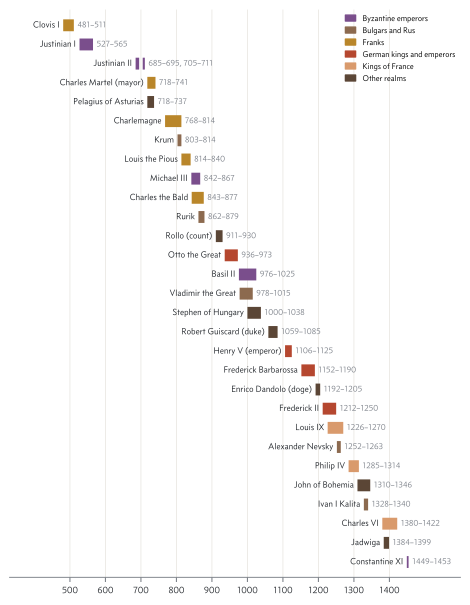
| Answer | House | Reign | Known for | Ch. |
|---|---|---|---|---|
| Franks | A people | Ruled by Clovis, Charles Martel, and Charlemagne | 2 | |
| Clovis I | Merovingian | 481–511 | Baptized by Remigius at Reims; united the Franks; the Salic Law | 2 |
| Charles Martel | Carolingian | Mayor, about 718–741 | “The Hammer”; beat Abd al-Rahman at Tours, 732 | 2 |
| Charlemagne | Carolingian | 768–814; emperor 800 | Pepin the Short’s son; crowned by Leo III; Alcuin; Aachen; Roncevaux | 4, 11 |
| Basques | A people | 778 | Destroyed Charlemagne’s rearguard at Roncevaux; the War of the Bands | 4, 17 |
| Louis the Pious | Carolingian | 814–840 | Charlemagne’s son and successor as emperor | 4 |
| Treaty of Verdun | 843 | Divided the empire among Lothair, Louis the German, and Charles the Bald | 4 | |
| Charles the Bald | Carolingian | 843–877 | Received West Francia at Verdun | 4 |
| Otto the Great | Ottonian | 936–973; emperor 962 | Henry the Fowler’s son; the Lechfeld; crowned by John XII; Adelaide; Theophanu | 5 |
| Holy Roman Empire | From 962 | The Great Interregnum ended in 1273; the Golden Bull of 1356 | 23 | |
| Henry V, Holy Roman Emperor | Salian | 1106–1125 | The Concordat of Worms with Calixtus II, 1122 | 5 |
| Frederick Barbarossa | Hohenstaufen | 1152–1190 | “Red beard”; Legnano; the Peace of Constance; drowned in the Saleph | 9 |
| Frederick II | Hohenstaufen | 1212–1250; emperor 1220 | Stupor mundi; the Constitutions of Melfi; falconry; the Sixth Crusade | 9 |
| Frederick | A name | Two Hohenstaufen emperors | 9 | |
| Habsburg | A dynasty | From 1273 | Rudolf I; Rudolf IV’s forged Privilegium Maius | 23 |
Franks. The Germanic people who conquered Gaul and gave France its name. From about 718 Charles Martel ruled the Franks,These people were ruled by Charles Martel. → Franks• though not as king, and his grandson Charlemagne ruled them from 768 to 814. Taught in Chapter 2.
Clovis I. King of the Franks from 481 to 511, of the Merovingian house. On a Christmas Day, Saint Remigius baptized the Frankish kingSaint Remigius baptized this Frankish king. → Clovis I• at Reims, and late in his reign Clovis issued the Salic Law,This ruler issued the Salic Law. → Clovis I• the written law of the Salian Franks. Gregory of Tours is nearly all we know of him. Taught in Chapter 2.
Charles Martel. The mayor of the palace who ruled the Franks from about 718 until his death in 741, while puppet kings sat on the throne. Later chroniclers explained his nickname, “the Hammer”,This Frankish leader was nicknamed “the Hammer.” → Charles Martel•• by the way he crushed his enemies, above all Abd al-Rahman at Tours in 732, and Edward Gibbon praised him as Christendom’s savior.Edward Gibbon praised this leader as a “savior of Christendom.” → Charles Martel• He was Charlemagne’s grandfather. Taught in Chapter 2.
Charlemagne. King of the Franks from 768 and emperor from 800 to his death in 814, whose name means “Charles the Great”.This ruler's name means "Charles the Great." → Charlemagne•• He was the son of Pepin the Short, and so the grandson of Charles Martel. He conquered the Saxons and the Lombards, ruled from Aachen, and gathered Alcuin’s scholars at his court. In 778, on the way home from Spain, his rearguard was ambushed at Roncevaux.This ruler’s army was ambushed by Basques at Roncevaux Pass. → Charlemagne•• On Christmas Day, 800, Leo III crowned him emperorPope Leo III crowned this ruler emperor in Rome on Christmas Day, 800. → Charlemagne••• in Rome, Einhard claims to his surprise. Taught in Chapter 4 and Chapter 11.
Basques. The people of the western Pyrenees, whose language is related to no other in Europe. On August 15, 778, Basques ambushed Charlemagne’s rearguardMembers of this ethnicity ambushed Charlemagne's rearguard at the Battle of Roncevaux Pass. → Basques•• at Roncevaux; the Song of Roland turned them into Muslims. Their noble families later fought the blood feuds called the War of the Bands. Taught in Chapter 4 and Chapter 17.
Louis the Pious. The son who inherited everything because two of his brothers died before their father. When Charlemagne died at Aachen in January 814, his son, Louis the Pious, succeeded himThis son of Charlemagne was his successor as emperor. → Louis the Pious• as emperor, and he ruled until 840. His three sons divided the empire. Taught in Chapter 4.
Treaty of Verdun. The treaty of 843 by which Charlemagne’s three grandsons divided the empire:This treaty divided Charlemagne’s empire among his grandsons Lothair, Louis the German, and Charles the Bald. → Treaty of Verdun•• Lothair kept the title of emperor and the long middle strip from Frisia to Rome, Louis the German the east, and Charles the Bald the west. Taught in Chapter 4.
Charles the Bald. Louis the Pious’s youngest son, king from 843 to 877. At Verdun Charles the Bald received West Francia,This ruler received West Francia in the Treaty of Verdun. → Charles the Bald• from the Scheldt to the Atlantic, the land that became France. Taught in Chapter 4.
Otto the Great. Otto I, king of the Germans from 936 to 973 and the son of Henry the Fowler.This ruler was the son of Henry the Fowler. → Otto the Great•• He crushed the Magyars on the Lechfeld in 955, and on February 2, 962, John XII crowned Otto emperor,Pope John XII crowned this ruler emperor in 962, a date often treated as the beginning of the Holy Roman Empire. → Otto the Great•• 162 years after Charlemagne; the date is often taken as the start of the Holy Roman Empire. Taught in Chapter 5.
Henry V, Holy Roman Emperor. The last Salian king and emperor, from 1106 to 1125. He ended the Investiture Controversy on September 23, 1122, when Henry V made the Concordat of WormsThis ruler concluded the Concordat of Worms with Pope Calixtus II. → Henry V, Holy Roman Emperor• with Pope Calixtus II. He is not the English Henry V of Agincourt. Taught in Chapter 5.
Frederick Barbarossa. Frederick I, German king from 1152 and emperor until 1190; “Barbarossa” means “red beard”This ruler’s nickname refers to his red beard. → Frederick Barbarossa••• in Italian. The Lombard League beat him at Legnano in 1176, and in 1183 he made the Peace of ConstanceDefeated by the Lombard League at Legnano, this ruler later recognized its cities’ rights in the Peace of Constance. → Frederick Barbarossa••• with its cities. In 1180 he deposed his cousin Henry the Lion,This ruler deposed his cousin Henry the Lion. → Frederick Barbarossa•• and he drowned in the Saleph on the Third Crusade; legend says he sleeps in the Kyffhäuser. Taught in Chapter 9.
Frederick II. Barbarossa’s grandson, raised in Palermo, German king from 1212 to 1250, whom Matthew Paris called stupor mundi, “the wonder of the world”.This ruler was called “stupor mundi,” or “wonder of the world.” → Frederick II•• He issued the Constitutions of Melfi and wrote a book on falconry, and in 1229 the excommunicated emperor regained JerusalemDespite excommunication by Gregory IX, this emperor negotiated the return of Jerusalem during the Sixth Crusade. → Frederick II•• by treaty. Taught in Chapter 9.
Frederick. A name. A clue that asks for the name shared by two Hohenstaufen emperors named FrederickTwo Hohenstaufen Holy Roman Emperors shared this name. → Frederick• wants this answer; Italians fixed the name Barbarossa on the grandfather to tell him from the grandson. Taught in Chapter 9.
Holy Roman Empire. The empire of the German kings, which historians date from Otto’s crowning in 962. After the last Hohenstaufen kings died it had no king obeyed by all, until Rudolf’s election in 1273 ended the Great Interregnum.Rudolf I’s election in 1273 ended this empire’s Great Interregnum. → Holy Roman Empire•• In 1356 the Golden Bull named seven electorsThe Golden Bull of 1356 designated seven prince-electors in this empire. → Holy Roman Empire•• who alone would choose the king. Taught in Chapter 23.
Habsburg. The family named for its castle, the Habsburg, with lands along the upper Rhine, which won Austria after Rudolf I’s election as king in 1273. When Charles IV’s Golden Bull left Austria out, the Habsburg Rudolf IV forged the Privilegium MaiusRudolf IV of this dynasty forged the Privilegium Maius, invoking supposed ancient privileges to elevate Austria’s status. → Habsburg• to raise his dukes to the electors’ rank. Taught in Chapter 23.
Kings, queens, and the Maid of France
Nine answers come from the kingdom of France after the Franks: two Capetian kings and the two names they shared, two French-born queens of England, the mad Valois king, the girl who saved his son’s crown, and France itself (Table A.5). The Capetians reused Louis and Philip again and again, and a clue that wants a single king always adds a number, a nickname, a mother, or a crusade (Figure A.2). A clue that gives two kings of one name and asks what they shared wants the name. The kingdom itself is an answer for clues about its music, its poet, and its war with England.
| Answer | Who | When | Known for | Ch. |
|---|---|---|---|---|
| Eleanor of Aquitaine | Duchess; queen of France, then of England | About 1124–1204 | Married Louis VII and Henry II; the Second Crusade; mother of Richard and John; imprisoned sixteen years | 10, 11 |
| Louis IX | Capetian king | 1226–1270 | Saint Louis; Blanche of Castile’s son; captured at Fariskur; died before Tunis | 10 |
| Louis | A name | Louis VIII “the Lion”; the numbering reached XVIII | 10 | |
| Philip IV of France | Capetian king | 1285–1314 | “The Fair”; the Golden Spurs; destroyed the Templars | 10 |
| Philip | A name | Philip Augustus and Philip the Fair; the expulsions of 1182 and 1306 | 10 | |
| Isabella of France | Philip IV’s daughter; queen of England | Born about 1295 | Helped depose Edward II in 1327; “the She-Wolf of France” | 24 |
| Charles VI of France | Valois king | 1380–1422 | Mad from 1392; believed he was made of glass | 25 |
| Joan of Arc | The Maid | Died 1431 | Lifted the siege of Orléans; Charles VII crowned at Reims; captured at Compiègne; tried by Cauchon | 25 |
| France | A kingdom, then a country | Clovis; the Notre-Dame school; Machaut; the Hundred Years’ War; Joan | 2, 12, 24, 25 |
Eleanor of Aquitaine. Heiress in 1137 of the duchy of Aquitaine, in southwestern France, and queen first of Louis VII of France. She went with him on the Second Crusade, where, William of Tyre later wrote, her heavy baggage was blamedThis woman’s baggage train was blamed for the defeat at Mount Cadmus during the Second Crusade. → Eleanor of Aquitaine•• for the defeat at Mount Cadmus. Eight weeks after their marriage was annulled in 1152, she married Henry of Anjou,This queen of both France and England married Henry II after her marriage to Louis VII was annulled. → Eleanor of Aquitaine••• soon Henry II of England, and bore him Richard the Lionheart and John. After backing her sons’ revolt of 1173, she was kept a prisoner about sixteen years.This woman was imprisoned by her husband for about sixteen years after supporting Henry the Young King’s rebellion. → Eleanor of Aquitaine•• Taught in Chapter 10 and Chapter 11.
Louis IX. King from 1226 to 1270, for whom his mother, Blanche of Castile, ruled as regent. He led the Seventh Crusade and was taken prisoner at FariskurThis French king was captured at Fariskur during the Seventh Crusade. → Louis IX•• in 1250, then died before Tunis on the Eighth in 1270. He built the Sainte-Chapelle, and he is France’s only canonized king.This king is the only canonized king of France. → Louis IX•• Taught in Chapter 10.
Louis. A name, the commonest of the French kings, whose royal numbering reached XVIII;French royal numbering for this name reached XVIII. → Louis•• the last of them reigned until 1824. A clue that asks for the name of Louis VIII “the Lion” and of his son with Blanche of Castile wants it too. Taught in Chapter 10.
Philip IV of France. Philip the Fair, king from 1285 to 1314, Saint Louis’s grandson. In 1302 the Flemish townsmen beat Philip’s army under Robert of ArtoisThis king’s forces under Robert II of Artois lost the Battle of the Golden Spurs. → Philip IV of France• at Courtrai, the Battle of the Golden Spurs. Deep in debt to the Templars, on October 13, 1307, his officers arrested every TemplarThis French king suppressed the Knights Templar. → Philip IV of France• in France. Taught in Chapter 10.
Philip. A name. A clue wants it when it names two kings at once, as Philip Augustus and Philip the Fair,French kings with this name included ones nicknamed "Augustus" and "the Fair." → Philip• or the kings who expelled the Jews in 1182 and 1306,French kings who expelled Jews in 1182 and 1306 shared this first name. → Philip• who were those same two Philips. Taught in Chapter 10.
Isabella of France. Philip IV’s daughter, born about 1295, who married Edward II of England, helped depose him in 1327, and with Roger Mortimer governed for her young son Edward III; her blood was his claim to the French crown. Four centuries later Thomas Gray called her the “She-Wolf of France”This ruler was nicknamed the "She-Wolf of France." → Isabella of France• in his poem “The Bard” (1757). Taught in Chapter 24.
Charles VI of France. The Valois king from 1380 to 1422, who went mad in 1392, so that his uncles and cousins fought over the realm while Henry V of England beat its army at Agincourt. Pope Pius II says that at times Charles believed he was made of glass.This ruler reportedly suffered from a “glass delusion,” believing his body was made of glass. → Charles VI of France• By the Treaty of Troyes he made Henry V his heir. Taught in Chapter 25.
Joan of Arc. The Maid of Orléans,This person was known as the "Maid of Orléans." → Joan of Arc•• a peasant girl from Domrémy who heard the voices of Saints Michael, Catherine, and Margaret and lifted the siege of Orléans in nine days in 1429. Then she persuaded the Dauphin to march to Reims,This person persuaded the Dauphin Charles VII to campaign toward Reims, where he was crowned. → Joan of Arc••• more than a hundred miles through country held by his enemies, and there he was crowned Charles VII. In 1430 the Burgundians captured her at Compiègne,Burgundians captured this person at Compiègne. → Joan of Arc•• and she was burned at Rouen in 1431. Taught in Chapter 25.
France. The kingdom of the Capetians and Valois, and the modern country. A clue wants France when Clovis united the Franks in what is now France,Clovis I united much of the Frankish realm in the territory of this modern country. → France• when it names the Notre-Dame school of polyphonyA school of polyphonic music from this country was led by Pérotin and Léonin. → France•• of Léonin and Pérotin, or when it asks who fought the Hundred Years’ War against England. Taught in Chapter 2, Chapter 12, Chapter 24, and Chapter 25.
Other rulers and commanders
Twelve answers are rulers and captains from the edges of Latin Europe (Table A.6). They include the Muslim conqueror of Spain and the Christian who first stood against him, two Normans and the name of their Sicilian kings, and a Venetian doge. The rest are the first king of Hungary, a blind king of Bohemia, a queen of Poland, a Serbian knight, a Portuguese prince, and the Hungarian general who held off the Turks. They have little in common but their type, so the place in the clue usually settles the answer: Guadalete or Covadonga, Rouen or Dyrrhachium, Krewo or Belgrade. The traps are in the names: two of these answers are Johns, the box below adds two more, and Henry the Navigator is one of seven Henrys.
| Answer | Who | When | Known for | Ch. |
|---|---|---|---|---|
| Tariq ibn Ziyad | Umayyad commander | 711 | Crossed at Gibraltar; beat King Roderic at Guadalete | 2 |
| Pelagius of Asturias | First king of Asturias | Died 737 | Covadonga, the traditional start of the Reconquista | 2 |
| Rollo | Viking leader; count of Rouen | 911–about 930 | Granted Normandy by Charles the Simple; the toppled king | 5 |
| Saint Stephen of Hungary | First king of Hungary | 1000 or 1001–1038 | Crown said to come from Sylvester II; the Holy Dexter | 5 |
| Robert Guiscard | Norman duke | Sicily from 1061 | With his brother Roger began the conquest of Sicily; beat Alexios at Dyrrhachium, 1081 | 7 |
| William | A name | 1154–1194 | Three Norman kings of Sicily | 7 |
| Enrico Dandolo | Doge of Venice | In 1204 | The blind doge of the Fourth Crusade | 13 |
| John of Bohemia | King of Bohemia | Died 1346 | Blind; killed at Crécy | 24 |
| Jadwiga | “King” of Poland | 1384–1399 | Married Jogaila after the Union of Krewo | 26 |
| Miloš Obilić | Serbian knight | 1389 | In tradition, killed Murad I at Kosovo after feigning to desert | 27 |
| Henry the Navigator | Prince of Portugal | 1394–1460 | Sent caravels to Madeira, the Azores, and Africa | 17 |
| John Hunyadi | Hungarian general | 1443–1456 | The Long Campaign; escaped from Varna; defended Belgrade | 27 |
Tariq ibn Ziyad. The Berber commander who crossed into Spain in 711 with about seven thousand men and gave his name to Gibraltar, “Tariq’s mountain.” That year Tariq defeated King Roderic at Guadalete,This commander defeated the Visigothic king Roderic at Guadalete during the Muslim conquest of Spain. → Tariq ibn Ziyad•• and the Visigothic kingdom fell. Taught in Chapter 2.
Pelagius of Asturias. A Visigothic noble who took refuge in the mountains of Asturias and beat a Muslim force at Covadonga, in 722 by the traditional date (or 718 by another), the victory remembered as the start of the Reconquista. Pelagius founded the Kingdom of AsturiasThis ruler founded the Kingdom of Asturias. → Pelagius of Asturias•• and ruled it until 737. Taught in Chapter 2.
Rollo. The Viking leader to whom Charles the Simple granted the land around Rouen in 911, the start of Normandy. Dudo of Saint-Quentin tells that when Rollo’s man was told to kiss the king’s foot, he lifted it to his mouth and the king toppled over backward.One of this ruler’s followers legendarily toppled Charles the Simple while trying to kiss the king’s foot. → Rollo• Among his descendants were Emma of Normandy and William the Conqueror. Taught in Chapter 5.
Saint Stephen of Hungary. Géza’s son, crowned on Christmas Day 1000 or New Year’s Day 1001 as the first king of Hungary. Bishop Hartvik’s Life of about 1100 says that Sylvester II sent Stephen his crown.According to tradition, Pope Sylvester II sent this first Hungarian king his crown. → Saint Stephen of Hungary•• His right hand, kept as a relic, is the Holy Dexter, Stephen’s mummified hand.The Holy Dexter is this Hungarian king’s mummified right hand. → Saint Stephen of Hungary• Taught in Chapter 5.
Robert Guiscard. “The Cunning,” a younger son of the Norman house of Hauteville who made himself duke in southern Italy. In 1061 Robert and his brother Roger began the conquest of Sicily,This Norman leader and his brother Roger began the conquest of Sicily. → Robert Guiscard•• and in 1081 he defeated Alexios at Dyrrhachium,This Norman leader defeated Alexios Komnenos at Dyrrhachium in 1081. → Robert Guiscard• as Anna Komnene tells. Taught in Chapter 7.
William. A name. After Roger II, three Norman kings of Sicily were named William:Three kings of Sicily had this name. → William• William I “the Bad,” William II “the Good,” and the boy William III, deposed in 1194. None of them is William the Conqueror. Taught in Chapter 7.
Enrico Dandolo. The doge of Venice, probably past ninety and completely blind, who led the Fourth Crusade to Zara and then to Constantinople. In April 1204 Dandolo’s Venetians and the crusaders sacked Constantinople.This blind doge led Venice during the Fourth Crusade’s sack of Constantinople. → Enrico Dandolo••• Taught in Chapter 13.
John of Bohemia. John the Blind, king of Bohemia and Charles IV’s father, who fought for France in the Hundred Years’ War. At Crécy in 1346 his knights tied their bridles to his and led him into the charge, and the blind king was found deadThis blind king of Bohemia died fighting at Crécy. → John of Bohemia•• among them the next morning. Machaut had been his secretary. Taught in Chapter 24.
Jadwiga. The youngest daughter of Louis, king of Hungary and Poland, crowned at Kraków in 1384 as “king” of Poland to show that she ruled in her own right. In 1386, after the Union of Krewo, Jadwiga married Jogaila,This Polish queen married Lithuania’s Grand Duke Jogaila following the Union of Krewo. → Jadwiga•• the grand duke of Lithuania, who was baptized. She died in 1399. Taught in Chapter 26.
Miloš Obilić. The Serbian knight who, in Serbian tradition, rode into the Ottoman camp at Kosovo in 1389 as a pretended deserter and killed Murad I before the guards cut him down.According to Serbian tradition, this knight pretended to defect before killing Murad I at Kosovo. → Miloš Obilić• Taught in Chapter 27.
Henry the Navigator. A son of King John I of Portugal, of the house of Aviz, born in 1394. From the Algarve the Aviz prince sent Portuguese captainsThis Aviz prince sponsored Portuguese voyages of exploration, including voyages to the Azores. → Henry the Navigator•• into the Atlantic, to Madeira and the Azores and down the coast of Africa. When he died in 1460 they had passed Cape Verde. Taught in Chapter 17.
John Hunyadi. The Hungarian general who led the Long Campaign of 1443 to 1444 and escaped from the rout at Varna,This Hungarian commander escaped after the crusader defeat at Varna in 1444. → John Hunyadi• where King Władysław III died. In 1456 he defended Belgrade while noon bells rang,This Hungarian commander defended Belgrade against the Ottomans while Pope Calixtus III called for noon bells to summon prayers for its defenders. → John Hunyadi•• by order of Pope Callixtus III. Taught in Chapter 27.
Crusades and military orders
Seven answers come from the holy wars: the First Crusade, the long Reconquista of Spain and Portugal, three military orders, the disease of a fourth order named for the patron of lepers, and the last grand master of the Templars (Table A.7). Only the First Crusade among the numbered expeditions is an answer, but clues for many other answers name the later ones, so Table A.8 sets out all eight with the other wars the Church called crusades. A clue about a crusade usually names a leader, a siege, or the place where it was preached, and that is enough to number it. The military orders are the harder trap, because all of them began by guarding or nursing pilgrims and the sick, and all of them fought.
| Answer | When | What | Known for | Ch. |
|---|---|---|---|---|
| Reconquista | 718 or 722–1492 | The Christian advance in Iberia | From Covadonga to Granada; Barbastro; El Cid; Alarcos; Évora | 2, 17 |
| First Crusade | 1096–1099 | A war | Preached at Clermont; Peter the Hermit; Emicho; the Holy Lance; Jerusalem; Ascalon | 8 |
| Knights Hospitaller | Recognized 1113 | A military order | Nursed sick pilgrims; Krak des Chevaliers; the langues of Rhodes; got the Templars’ lands | 8, 10 |
| Knights Templar | About 1120–1312 | A military order | Founded by Hugues de Payens; Bernard’s rule; Montgisard; Philip IV’s debt; the Chinon Parchment | 8, 10 |
| leprosy | 1130s | A disease | The Order of Saint Lazarus, named for the patron of lepers; many of its knights had it | 8 |
| Teutonic Order | From 1190 | A military order | “Teutonic” means German; the Golden Bull of Rimini; Prussia; Lake Peipus; Grunwald | 8, 9, 16, 26 |
| Jacques de Molay | Burned 1314 | Last grand master of the Templars | Burned in Paris on Philip IV’s order | 10 |
| Crusade | Dates | Leaders | What happened | Ch. |
|---|---|---|---|---|
| First | 1096–1099 | Godfrey, Raymond, Bohemond | Jerusalem taken; four crusader states | 8 |
| Second | 1147–1149 | Louis VII, Conrad III | Beaten in Anatolia; Damascus fails; Lisbon taken | 8, 10, 17 |
| Third | 1189–1192 | Barbarossa, Philip Augustus, Richard I | Barbarossa drowns; Acre retaken, not Jerusalem | 9 |
| Fourth | 1202–1204 | Boniface of Montferrat, Dandolo | Zara and Constantinople sacked | 13 |
| Fifth | 1217–1221 | Andrew II of Hungary | Damietta taken, then lost | |
| Sixth | 1228–1229 | Frederick II | Jerusalem regained by treaty | 9 |
| Seventh | 1248–1254 | Louis IX | Louis captured at Fariskur | 10 |
| Eighth | 1270 | Louis IX | Louis dies before Tunis | 10 |
| Barbastro | 1064 | French and Norman knights | Blessed by Alexander II, before Clermont | 17 |
| Balearic | 1113–1115 | The archbishop of Pisa | With the count of Barcelona | 13 |
| Albigensian | 1209–1229 | Arnaud Amalric, Simon de Montfort | Béziers; the south brought under the French crown | 14 |
| Northern | 1100s–1400s | The Teutonic Order | Prussia and Livonia conquered | 26 |
| Nicopolis | 1396 | Sigismund | Destroyed by Bayezid I | 27 |
| Varna | 1444 | Władysław III, Hunyadi | Destroyed by Murad II | 27 |
Reconquista. Spanish for “reconquest,” the name later given to the slow spread of Christian rule over Muslim Iberia. Pelagius’s victory at CovadongaPelagius’s victory at Covadonga is traditionally treated as the beginning of this process in Iberian history. → Reconquista•• is traditionally its start, and Granada’s fall in 1492 its end. It moved in bursts, and the popes made parts of it crusades, as when Alexander II blessed the war on BarbastroPope Alexander II sanctioned a crusade against Barbastro as part of this conflict. → Reconquista• in 1063. Taught in Chapter 2 and Chapter 17.
First Crusade. The expedition of 1096 to 1099 that took Jerusalem. Alexios I asked for soldiers, and at Clermont on November 27, 1095, Urban II called for an armed expeditionThis conflict was called at the Council of Clermont. → First Crusade••• east. At Antioch in 1098 Peter Bartholomew brought up what he called the Holy Lance,Peter Bartholomew claimed to have found the Holy Lance during this conflict. → First Crusade•• and on July 15, 1099, the crusaders stormed Jerusalem. Taught in Chapter 8.
Knights Hospitaller. The Order of Saint John, which grew from an Amalfitan hostel in Jerusalem: the Hospitallers began by nursing sick pilgrims,This group was originally founded to care for sick and injured pilgrims to the Holy Land. → Knights Hospitaller• and after the pope recognized them in 1113, they added knights. In Syria they held Krak des ChevaliersThis group controlled the fortress of Krak des Chevaliers. → Knights Hospitaller• for 129 years. On Rhodes they grouped their knights in langues. In 1312 Clement V granted the Templars’ property to the HospitallersThe papal bull Ad providam granted this group numerous properties and assets from a rival group. → Knights Hospitaller• by the bull Ad providam. Taught in Chapter 8 and Chapter 10.
Knights Templar. The Poor Fellow-Soldiers of Christ and of the Temple of Solomon, the order founded by Hugues de PayensThis organization was founded by Hughes de Payens. → Knights Templar• about 1120 to guard pilgrims, with a rule Bernard of Clairvaux helped write. They became the bankers of kings, and Philip IV was deeply in debt to them;Philip IV was deeply in debt to this organization. → Knights Templar• he had them arrested in 1307, and Clement V dissolved the order in 1312. Taught in Chapter 8 and Chapter 10.
leprosy. The disease of the knights of the Order of Saint Lazarus, a brotherhood of the 1130s that nursed lepers and was named for the patron of lepers,This condition is associated with the naming of the Order of Saint Lazarus. → leprosy• the beggar Lazarus of Jesus’s parable. Taught in Chapter 8.
Teutonic Order. The German order founded as a field hospital at Acre in 1190; “Teutonic” was the learned word for German.This order's name derives from a common term for the German people. → Teutonic Order• In 1226 Frederick II granted the order PrussiaFrederick II’s Golden Bull of Rimini recognized this order’s rights to conquer and rule lands in Prussia. → Teutonic Order• by the Golden Bull of Rimini, and it fought the Northern Crusades. Its Livonian knights lost to Alexander Nevsky in 1242, and the whole order to Poland and Lithuania at Grunwald in 1410. Taught in Chapter 8, Chapter 9, Chapter 16, and Chapter 26.
Jacques de Molay. The last grand master of the Templars, arrested with his knights in 1307. In March 1314, before Notre-Dame, he declared the order innocent, and that evening Philip had Molay burned at the stakePhilip IV ordered this last Grand Master of the Knights Templar burned at the stake. → Jacques de Molay•• on an island in the Seine. Taught in Chapter 10.
Battles and sieges
Twelve answers are battles and sieges, from Charles Martel’s stand in 732 to the siege of Orléans, and one is the weapon of the Genoese at Crécy (Table A.9). A battle clue names a commander, a loser who died or was captured, a trick of ground or weapons, or the chronicle that tells it, and any one of these is usually enough. The danger is in the names. Tours is also called Poitiers, and a second Battle of Poitiers came six centuries later a few miles away. Lechfeld, Legnano, and Legnica sound alike, as do Kosovo and Kulikovo, and three English victories in France turn on archers (Figure A.3).
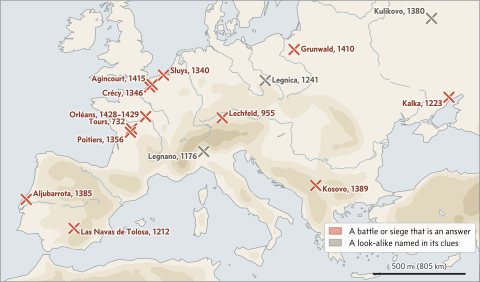
| Answer | Date | Who beat whom | Remembered for | Ch. |
|---|---|---|---|---|
| Battle of Tours | October 732 | Charles Martel beat Abd al-Rahman | The Franks’ square; Abd al-Rahman killed; the Mozarabic Chronicle | 2 |
| Battle of Lechfeld | August 10–12, 955 | Otto I beat the Magyars | Bulcsú, Lél, and Súr; Conrad the Red killed | 5 |
| Battle of Las Navas de Tolosa | July 16, 1212 | The Christian kings beat the Almohads | Revenge for Alarcos | 17 |
| Battle of the Kalka River | May 31, 1223 | Jebe and Subutai beat the Rus | The feigned retreat; Mstislav III crushed under boards | 16 |
| Battle of Sluys | June 1340 | Edward III’s fleet beat the French | Béhuchet hanged from his mast | 24 |
| Battle of Crécy | August 26, 1346 | Edward III beat Philip VI | Genoese crossbowmen without pavises; John of Bohemia killed | 24 |
| Battle of Poitiers | September 19, 1356 | The Black Prince beat John II | Archers’ ambush from the hedges; John II captured | 24 |
| Battle of Aljubarrota | August 14, 1385 | John I of Portugal beat Castile | Kept Portugal independent | 17 |
| Battle of Kosovo | June 15, 1389 | Murad I against Prince Lazar | The Field of Blackbirds; both rulers died | 27 |
| Battle of Grunwald | July 15, 1410 | Jogaila and Vytautas beat the Teutonic Order | Ulrich von Jungingen killed | 26 |
| Battle of Agincourt | October 25, 1415 | Henry V beat Charles d’Albret | Saint Crispin’s Day; stakes and longbows; mud; the prisoners killed | 25 |
| Siege of Orléans | 1428–1429 | Joan of Arc lifted it | The turning point; the Battle of the Herrings | 25 |
| crossbows | A weapon | Killed Richard I; the Genoese crossbowmen | 10 |
Battle of Tours. The battle of October 732 between Tours and Poitiers, in which Charles Martel defeated an Umayyad armyCharles Martel defeated an Umayyad army at this 732 battle in modern-day France. → Battle of Tours••• raiding north from Spain, probably for the riches of Saint Martin’s abbey. The Frankish infantry held a tight square against the cavalry, and late in the day Abd al-Rahman himself was killed.Abd al-Rahman was killed during this battle. → Battle of Tours•• The fullest account is the Mozarabic Chronicle of 754. Taught in Chapter 2.
Battle of Lechfeld. The battle by the river Lech, near Augsburg, where between August 10 and 12, 955, Otto crushed the Magyars.Otto I defeated Magyar forces led by Bulcsú, Lél and Súr at this 955 battle, ending their major raids into Germany. → Battle of Lechfeld•• Their leaders, Bulcsú, Lél, and Súr, were hanged, and the raids into Germany ended. Taught in Chapter 5.
Battle of the Kalka River. The Mongols’ battle with the princes of the Rus on May 31, 1223, near the Sea of Azov, won by the feigned retreat of Jebe and Subutai.Jebe and Subutai used a feigned retreat to defeat Rus forces at this battle. → Battle of the Kalka River•• The Novgorod chronicle says that Mstislav III was crushed beneath the boardsAfter this battle, Mongols reportedly crushed Mstislav III of Kiev beneath boards on which they feasted. → Battle of the Kalka River•• on which the victors feasted. Taught in Chapter 16.
Battle of Las Navas de Tolosa. The great Christian victory of the Reconquista, on July 16, 1212, when the Christian kings broke the AlmohadsChristian armies defeated the Almohads at this major battle of the Reconquista. → Battle of Las Navas de Tolosa•• below the passes of the Sierra Morena, seventeen years after the Almohads had beaten Castile at Alarcos. Taught in Chapter 17.
Battle of Sluys. The sea battle of June 1340 off the coast of Flanders, England’s first great victory of the Hundred Years’ War, in which the French fleet was destroyed and Béhuchet was hanged from his own mast.Nicolas Béhuchet was killed at this early naval victory for England in the Hundred Years’ War. → Battle of Sluys•• Taught in Chapter 24.
Battle of Crécy. The battle of August 26, 1346, in Ponthieu, where Edward III won the Battle of CrécyThis battle was won by Edward III. → Battle of Crécy• against Philip VI with a smaller army. Rain had wet the Genoese crossbows, and the Genoese advanced without their pavises,At this battle, Genoese crossbowmen advanced without their protective pavises after rain had hampered their weapons. → Battle of Crécy•• the big shields they sheltered behind. The blind John of Bohemia died in the charge. Taught in Chapter 24.
Battle of Poitiers. The battle of September 19, 1356, a few miles south of Poitiers, where the prince’s hidden archers ambushed the horsemenThe Black Prince ambushed charging French cavalry at this 1356 battle. → Battle of Poitiers• from the hedges and the Black Prince captured John II,Edward the Black Prince captured John II of France at this battle in 1356. → Battle of Poitiers•• whose ransom helped set off the Jacquerie. Taught in Chapter 24.
Battle of Aljubarrota. The battle of August 14, 1385, in which John I of Portugal’s army, under his young constable, held a hilltop against the Castilians and their French allies, so that Aljubarrota kept Portugal independent of Castile.Portugal defended its independence from Castile at this battle. → Battle of Aljubarrota•• Taught in Chapter 17.
Battle of Kosovo. The battle of June 15, 1389, Saint Vitus’s Day, when Lazar led the Serbs onto Kosovo Field,Prince Lazar led Serbian forces against the Ottomans on the Field of Blackbirds at this 1389 battle. → Battle of Kosovo•• the Field of Blackbirds, against Murad I. Both rulers died that day; Serbian tradition says that Murad I was killedThe Ottoman sultan Murad I was killed at this battle. → Battle of Kosovo•• by Miloš Obilić. Taught in Chapter 27.
Battle of Grunwald. The battle of July 15, 1410, called Tannenberg by the Germans and Žalgiris by the Lithuanians, where Jogaila’s Polish-Lithuanian army crushed the Teutonic OrderAt this battle, Jogaila’s Polish–Lithuanian forces defeated the Teutonic Order under Ulrich von Jungingen. → Battle of Grunwald•• and killed its grand master, Ulrich von Jungingen. The Order never recovered. Taught in Chapter 26.
Battle of Agincourt. The battle of Friday, October 25, 1415, the feast of Saint Crispin,This battle was fought on St. Crispin’s Day in 1415. → Battle of Agincourt••• fought on a muddy field between two woods. Marching to Calais after taking Harfleur, Henry V of England won the battleHenry V won this battle. → Battle of Agincourt••• against the constable Charles d’Albret’s much larger army. His longbowmen stood behind sharpened stakes driven into the ground.The victors at this battle planted sharpened wooden stakes in the ground to neutralize enemy cavalry charges. → Battle of Agincourt•• Taught in Chapter 25.
Siege of Orléans. The English siege of 1428 to 1429 on the Loire, which Joan of Arc broke within nine days of her arrival; historians count it the turning point of the war. In an earlier fight over an English supply train, the Battle of the Herrings,A skirmish during this siege was named for a shipment of herrings within one side's supply train. → Siege of Orléans• the French were routed. Taught in Chapter 25.
crossbows. Short, stiff bows fixed crosswise on a wooden stock, drawn with a hook, a lever, or a winch and loosed with a trigger. In March 1199 at Châlus, a crossbowman on the wall shot RichardOne of these weapons was used to kill Richard the Lionheart. → crossbows• the Lionheart, who died eleven days later. Genoa hired out its crossbowmen across Europe. Taught in Chapter 10.
Wars, revolts, and the plague
Eight answers are long wars, risings, and the plague, with the people and customs they touched (Table A.10). They are the Hundred Years’ War and the treaty that nearly ended it, two risings, the Black Death and the disease behind it, the Jews persecuted in the plague years, and the dancing mania of 1374. The plague answers are the easiest to cross, because a clue about the Black Death, the disease, or the Jews may tell the same terrible story. The clue’s own word decides it: “this pandemic” or “this event” wants the Black Death, “this disease” plague, “these people” the Jews.
| Answer | When | What | Known for | Ch. |
|---|---|---|---|---|
| the Sicilian Vespers | Easter Monday, 1282 | A rising | Palermo’s massacre of Charles of Anjou’s French; Peter III of Aragon took Sicily | 9 |
| Hundred Years’ War | 1337–1453 | A war | England against France over the French crown; 116 years; the Breton proxy war; the Jacquerie; Castillon | 24, 25 |
| Black Death | 1347–1353 | A pandemic | Yersinia pestis; Caffa and the Genoese galleys; flagellants; a third to a half of Europe dead | 21, 22 |
| Jews | A people | Falsely accused of poisoning wells; Strasbourg, 1349; fled to Poland; Yiddish | 21 | |
| plague | A disease | Venice’s forty days, which gave “quarantine” | 21 | |
| dance | 1374 | An activity | The dancing mania called Saint Vitus’s dance | 21 |
| the Ciompi Revolt | 1378 | A rising | Florence’s wool workers seized the Palazzo Vecchio; Michele di Lando | 21 |
| Treaty of Troyes | May 21, 1420 | A treaty | Made Henry V heir to Charles VI and married him to Catherine of Valois | 25 |
the Sicilian Vespers. The rising that began in Palermo on Easter Monday, 1282, at the hour of the evening prayer, with the massacre of the French who ruled Sicily for Charles of Anjou, so it is called the Sicilian Vespers.This 1282 uprising began in Palermo on Easter Monday with massacres of French residents under Charles of Anjou’s rule. → the Sicilian Vespers•• After it Peter III of Aragon took Sicily,Peter III of Aragon took control of Sicily after this uprising. → the Sicilian Vespers• and Pope Martin IV preached a crusade against Aragon. Taught in Chapter 9.
Hundred Years’ War. The war between England and France, at root a quarrel over who should inherit the crownThis war concerned succession rights to the French throne. → Hundred Years' War• of France after 1328. Despite its name it lasted 116 years, from 1337 to 1453,Despite its name, this conflict lasted 116 years, from 1337 to 1453. → Hundred Years' War•• in three phases broken by truces, from Sluys and Crécy to Agincourt, Orléans, and Castillon. Taught in Chapter 24 and Chapter 25.
Black Death. The pandemic that reached Europe from the Crimea in 1347. The disease was caused by Yersinia pestis,This event was caused by the bacterium Yersinia pestis. → Black Death•• spread in the traditional account by the fleas of rats, and it killed a third to a halfThis pandemic killed roughly one-third to one-half of Europe’s population. → Black Death•• of Europe’s people by 1353. Gabriele de’ Mussi, who was not there, told how Janibeg’s army catapulted corpses into Caffa,According to an often-debated account, Janibeg’s forces spread this pandemic by catapulting corpses into Caffa. → Black Death••• the Genoese colony in the Crimea. Boccaccio’s storytellers flee it in the Decameron. Taught in Chapter 21 and Chapter 22.
Jews. The people whom Christians blamed for the Black Death: from Provence to the Rhine, Jews were accused of poisoning wells,These people were accused of poisoning wells during the Black Death. → Jews•• and about 2,000 were burned at Strasbourg on February 14, 1349. Many fled to Casimir the Great’s Poland, where Yiddish grew into the Ashkenazim’s language.Yiddish developed as a language of this people’s Ashkenazi communities. → Jews• Taught in Chapter 21.
plague. The disease itself, which struck in Justinian’s day as well as in 1347. To keep it out, Ragusa made ships wait thirty days in 1377, and later ships from infected ports waited forty daysShips arriving in Venice from ports affected by this disease had to wait forty days, giving rise to the word "quarantine." → plague• at Venice; the Italian quaranta giorni gave us “quarantine.” Taught in Chapter 21.
dance. The activity of the dancing mania that began at Aachen on June 24, 1374, when crowds danced in the streets and churches and could not stop. The Germans honored Saint Vitus with dancing, so the mania was named for Saint Vitus.A variety of choreomania involving this activity was named for St. Vitus. → dance• Taught in Chapter 21.
the Ciompi Revolt. The rising of Florence’s wool workers, the Ciompi, who had no guild of their own. In the summer of 1378 they seized the Palazzo Vecchio, and Michele di Lando became gonfaloniere of justice,Wool workers excluded from Florence’s major guilds rose in this revolt, during which Michele di Lando became gonfaloniere of justice. → the Ciompi Revolt••• the chairman of the city’s ruling council. Taught in Chapter 21.
Treaty of Troyes. The treaty sealed at Troyes on May 21, 1420, by which the mad Charles VI made Henry V of England his heir and gave him his daughter Catherine of Valois. By the treaty with Henry,Negotiated after Agincourt, this treaty arranged Henry V’s marriage to Catherine of Valois and recognized him as heir to Charles VI of France. → Treaty of Troyes•• Charles VI’s own son, the Dauphin, was shut out. Taught in Chapter 25.
Trade, money, and the hunt
Eight answers come from the business of the Middle Ages: the Hanseatic League and the pirates who preyed on it, salt, wool, and the cloth trade, the bankers’ tricks, and the hunt that filled a lord’s days (Table A.11). Several are plain common nouns, and a clue that wants one usually names a single famous place or document: a mine, a guild, a contract, a handbook. The traps are two pairs. A clue about the Victual Brothers may want the gang or what they were, and a clue about cloth may want the raw wool or the whole textile trade.
| Answer | When | What | Known for | Ch. |
|---|---|---|---|---|
| Hanseatic League | From 1241 | A league of trading towns | Lübeck and Hamburg; kontors (the Steelyard, the Peterhof); Tagfahrts; beat Valdemar IV | 26 |
| Victual Brothers | 1392–1398 | Privateers turned pirates | Fed besieged Stockholm; preyed on the Hanse; became the Likedeelers | 26 |
| pirates | What the Victual Brothers became | Terrorized the Hanseatic League | 26 | |
| salt | A mineral | The royal mines of Wieliczka, Poland | 26 | |
| wool | A fiber | The Mesta of Castile; Florence’s Ciompi | 17, 21 | |
| textiles | An industry | Ghent’s weavers needed English wool; Jacob van Artevelde | 24 | |
| banks | An industry | The triple contract that got around the usury rules | 21 | |
| hunting | 1387–1389 | A pastime | Gaston Phoebus’s Livre de chasse; the baying, the unmaking, and the curée | 24 |
Hanseatic League. The Hanse, a confederation of nearly two hundred German trading towns on the Baltic and North Sea. It grew after Lübeck made an alliance with HamburgThis league grew around Lübeck and its alliance with Hamburg. → Hanseatic League•• in 1241, and its outposts abroad were kontors,This organization created outposts called kontors. → Hanseatic League•• the four greatest at London, Bruges, Bergen, and Novgorod. In 1370 the Treaty of Stralsund marked its height. Taught in Chapter 26.
Victual Brothers. Sailors hired in 1392 to carry food into besieged Stockholm, who turned from privateers into piratesThese Baltic privateers turned pirates were followed by the Likedeelers, or “equal sharers.” → Victual Brothers•• and made Hanse ships their prey. After the Teutonic Order drove them from Gotland in 1398 they called themselves the Likedeelers, “equal sharers.” Taught in Chapter 26.
pirates. What the Victual Brothers became. A clue that asks what kind of men the Victual Brothers wereThe Victual Brothers, a group of these people, terrorized the Hanseatic League. → pirates• wants this answer, not their name. Taught in Chapter 26.
salt. The mineral that kept meat and fish through the winter. In Poland the mines of Wieliczka produced saltA famous location that produced this substance in medieval times is located in Wieliczka, Poland. → salt• for the kings who owned them. Taught in Chapter 26.
wool. The fiber of the medieval cloth trade. In 1273 Alfonso X chartered the Mesta,Alfonso X of Castile created the Mesta, a monopolistic guild for workers who produce this good. → wool• the council of Castile’s sheep-owners, and in 1378 Florence’s wool workers rose in revoltWorkers of this material revolted in the Ciompi Revolt in Florence in 1378. → wool•• as the Ciompi. Taught in Chapter 17 and Chapter 21.
textiles. The cloth industry as a whole. Jacob van Artevelde led Ghent to Edward III’s side in 1340 because the city’s textile industry needed English wool,Jacob van Artevelde’s political influence in Ghent was tied to this industry’s dependence on English wool. → textiles• which only the king of England could send. Taught in Chapter 24.
banks. The Church forbade usury, lending at interest, so Florentine and other bankers found ways around it: with bills of exchange and the triple contract, banks could get around the usury rules.The contractum trinius could be used to circumvent restrictions on this industry. → banks•• Florence’s great banks failed in the 1340s. Taught in Chapter 21.
hunting. The great pastime of medieval lords. Gaston Phoebus, count of Foix, wrote its most famous handbook, the Livre de chasse, between 1387 and 1389, and the hunt with hounds ended in the baying, the unmaking, and the curée.This activity ended with the baying, unmaking, and curee. → hunting• Taught in Chapter 24.
Popes, schisms, and heresies
Twelve answers come from the government and the quarrels of the Church (Table A.12). They are the papacy itself and two of its popes, a synod that tried a corpse, and the split between Rome and Constantinople, with the Orthodox Church and the doctrine behind it. The rest are the war on icons, two dualist heresies, and a Czech reformer with his followers. Clues here mix words that look alike: a schism is a split inside the Church, a heresy a belief the Church condemned, a synod or council a meeting of bishops. Two splits went by the name “Great Schism,” and the Bogomils and the Cathars taught nearly the same thing two centuries and a thousand miles apart (Figure A.4).
| Answer | When | What | Known for | Ch. |
|---|---|---|---|---|
| Pope | An office | Gregory I’s chant; the Donation of Pepin; the Pornocracy; Avignon | 2, 4, 5, 23 | |
| iconoclasm | 726 or 730–843 | A Byzantine policy | Leo III and the Chalke icon; Irene’s Council of Nicaea, 787 | 3 |
| the Cadaver Synod | 897 | A trial | Stephen VI tried the corpse of Pope Formosus | 5 |
| Bogomils | From the 900s | A Bulgarian heresy | Satan made the material world; Cosmas the Priest | 3 |
| Great Schism | 1054 | A split | Rome against Constantinople; Humbert and Cerularius; the filioque; lifted 1965 | 5 |
| Holy Spirit | The third person of the Trinity | The filioque controversy | 5 | |
| Eastern Orthodox Church | A communion | Autocephalous churches; the patriarch “first among equals”; the iconostasis; Athos | 3, 5 | |
| Pope Gregory VII | 1073–1085 | Pope | Henry IV at Canossa, 1077 | 5 |
| Pope Urban II | 1088–1099 | Pope | Called the First Crusade at Clermont, 1095 | 8 |
| Cathars | 1100s–1300s | A heresy of Languedoc | Two principles, good and evil; the Albigensian Crusade; Béziers | 14 |
| Jan Hus | Burned 1415 | Czech reformer | Preached at the Bethlehem Chapel; burned at Constance | 23 |
| Hussites | From 1419 | His followers | The Four Articles of Prague; beat Sigismund at Vítkov | 23 |
Pope. The office of the bishop of Rome, which a clue wants when it gives a holder’s deeds and asks for “this title” or “this position.” Pepin the Short gave lands in Italy to the holder, and Charlemagne renewed his father’s donation to the pope.The Donation of Pepin granted territory to a holder of this title. → Pope•• In the sixty years after 897 that nineteenth-century German theologians named the “Pornocracy,” Roman nobles controlled the papacy.This position was subject to increased noble control during a period known as the Pornocracy. → Pope• Taught in Chapter 2, Chapter 4, Chapter 5, and Chapter 23.
iconoclasm. “Image-breaking,” the Byzantine emperors’ war on icons, in two periods. Later iconophile writers made Leo III’s removal of the Chalke iconLater accounts associate Leo III’s removal of a Christ image at the Chalke gate with the beginning of this Byzantine practice. → iconoclasm• the first blow, in 726 or 730. In 787 Irene ended iconoclasm at Nicaea;Irene of Athens temporarily ended this Byzantine practice at the Second Council of Nicaea. → iconoclasm• it came back in 815 and ended for good in 843. Taught in Chapter 3.
the Cadaver Synod. The meeting of January 897 at which Pope Stephen VI had the body of his predecessor, Formosus, dug up, dressed in his robes, and put on trial, so it is remembered as the Cadaver Synod, the trial of a corpse.The corpse of Pope Formosus was exhumed and tried during this synod. → the Cadaver Synod•• Taught in Chapter 5.
Bogomils. The followers of Bogomil, a Bulgarian village priest of the tenth century. The Bogomils held that Satan createdThese Bulgarian dualists, possibly influenced by the Paulicians, held that Satan created the material world and rejected veneration of the cross. → Bogomils•• the material world, while God made only the soul, and they rejected the cross. Most of what is known of them comes from their enemies: Cosmas the Priest attacked the BogomilsCosmas the Priest attacked this dualistic sect in his Sermon Against the Heretics. → Bogomils• in his Sermon Against the Heretics. Taught in Chapter 3.
Great Schism. The split between the Latin and Greek Churches, dated by tradition to 1054, when in Hagia Sophia Humbert laid an excommunication on the altarDuring this split, Humbert of Silva Candida placed an excommunication of Michael Cerularius in Hagia Sophia, and the patriarch’s synod condemned the legates. → Great Schism•• against the patriarch Michael Cerularius. It grew from quarrels over the pope’s authority, the filioque, and unleavened bread. Councils at Lyon and Florence failed to heal it, and in 1965 Paul VI and Athenagoras lifted the anathemas.Patriarch Athenagoras I and Pope Paul VI lifted the anathemas caused by this event. → Great Schism•• Taught in Chapter 5.
Holy Spirit. The third person of the Christian Trinity, with the Father and the Son. The filioque, “and the Son,” was the word the Latin Church added to the creed, and the controversy asks whether the Spirit proceedsThe filioque controversy concerns whether this figure proceeds from the Father alone or also from the Son. → Holy Spirit• from the Father alone, as the Orthodox teach, or from the Father and the Son, as Catholics hold. Taught in Chapter 5.
Eastern Orthodox Church. The family of churches that took the Greek side in 1054. It has no single head: the Patriarch of Constantinople is “first among equals”.The Patriarch of Constantinople is “first among equals” in this communion. → Eastern Orthodox Church•• In its churches an iconostasis screens the altar,This denomination uses an iconostasis to screen its altars. → Eastern Orthodox Church• a wall of icons, and Mount Athos is the home of its Hesychast prayer. Taught in Chapter 3 and Chapter 5.
Pope Gregory VII. The reforming pope who quarreled with the emperor Henry IV over who should invest bishops. In 1077, standing barefoot at the gate of Canossa, Henry IV sought absolution from Gregory VII.Henry IV sought absolution from this pope at Canossa during the Investiture Controversy. → Pope Gregory VII•• Taught in Chapter 5.
Pope Urban II. The French pope who answered Alexios I’s request for soldiers. At the Council of Clermont, on November 27, 1095, Urban called for an armed expeditionThis pope called for the First Crusade at the Council of Clermont. → Pope Urban II• to the east, and the First Crusade began. Taught in Chapter 8.
Cathars. The dualists of Languedoc, who held that two opposing principles, good and evil,Adherents of this medieval religious movement held dualistic beliefs in opposing good and evil principles. → Cathars• made the universe. The Albigensian Crusade of 1209 to 1229 began with the massacre at Béziers, where, Caesarius of Heisterbach wrote years later, Arnaud Amalric is said to have answered,Arnaud Amalric reportedly ordered “Kill them all; God will know his own” during the massacre of these people at Béziers. → Cathars•• “Kill them. For the Lord knows those who are his,” which English retellings make “Kill them all; God will know his own.” Taught in Chapter 14.
Jan Hus. The Czech priest who from 1402 preached at Prague’s Bethlehem Chapel against the sins of the clergy and the sale of indulgences. Summoned to the Council of Constance under a safe-conduct, he was condemned, and on July 6, 1415, Hus was burned at the stake.This Bohemian reformer was condemned and burned at the Council of Constance. → Jan Hus•• Taught in Chapter 23.
Hussites. The followers of Jan Hus, who rose after the defenestration of Prague in 1419. They demanded communion in both kinds and three other things in the Four Articles of Prague,These Bohemian reformers issued the Four Articles of Prague, including communion in both kinds. → Hussites• and in 1420 they repelled Sigismund’s crusaders at VítkovThese Bohemian reformers repelled Sigismund’s forces at Vítkov Hill. → Hussites• Hill, outside Prague. Taught in Chapter 23.
Saints, monks, and friars
Six answers come from the Church’s holy men and their houses: the monastery, the oak that a missionary cut down, three saints of the thirteenth century, and the Magi whose bones came to Cologne (Table A.13). A saint’s clue usually tells a miracle or a legend from his Life, and the chapters tell each one as the Life tells it, not as proven fact. Two friars of the same order are easily crossed, since each preached to creatures who could not answer.
| Answer | When | Who or what | Known for | Ch. |
|---|---|---|---|---|
| monasteries | From the 500s | Houses of monks | Benedict’s Rule; the Plan of St. Gall | 2 |
| trees | 700s | What Boniface felled | Donar’s Oak in Hesse | 2 |
| Magi | Bones moved 1164 | The wise men of the Nativity | The Shrine of the Three Kings in Cologne Cathedral | 9 |
| Saint Francis of Assisi | 1181 or 1182–1226 | Founder of the Friars Minor | San Damiano; the birds; the stigmata; the wolf of Gubbio; the Canticle of the Sun | 14 |
| Saint Sava | First archbishop of the Serbs, 1219 | Serbian monk | Founded Hilandar on Athos with his father; the Zakonopravilo | 27 |
| Saint Anthony of Padua | Died 1231 | Portuguese Franciscan | Preached to the fish at Rimini; “Hammer of Heretics” | 14 |
monasteries. Houses where monks live together, praying, working, and obeying an abbot. Most in the west came to follow the Rule that Benedict of Nursia wrote at Monte Cassino, and the Plan of St. Gall,The Plan of St. Gall, dedicated to Abbot Gozbert, is an idealized design for one of these institutions. → monasteries•• drawn about 820 for Abbot Gozbert, shows an ideal one. Taught in Chapter 2.
trees. The answer when a clue asks what Saint Boniface, an Englishman from Wessex, cut down in Hesse: a great oak dedicated to Donar,Saint Boniface cut down a large one of these things dedicated to Donar. → trees•• the German thunder god. Willibald’s Life calls it the oak of Jupiter. Taught in Chapter 2.
Magi. The wise men from the east of Matthew’s Gospel. In 1164 Barbarossa’s chancellor, Rainald of Dassel, carried bones believed to be theirs from Milan to Cologne, where in the Shrine of the Three Kings the cathedral holds the Magi’s bones.These people's bones are allegedly housed in a gilded reliquary in Cologne Cathedral. → Magi• Taught in Chapter 9.
Saint Francis of Assisi. A cloth merchant’s son who gave up everything, rebuilt San Damiano with his own hands, and founded the Friars Minor, the Greyfriars. Thomas of Celano tells how he preached a sermon to the birds,This man is often depicted preaching to birds. → Saint Francis of Assisi•• and how at La Verna in 1224 he received the stigmata from a seraph.This man is said to have received the stigmata from a seraph at La Verna. → Saint Francis of Assisi•• The Fioretti add the wolf of Gubbio. He wrote the Canticle of the Sun and died in 1226. Taught in Chapter 14.
Saint Sava. The son of Stefan Nemanja, grand prince of the Serbian land of Raška, who ran away about 1192 to become a monk on Mount Athos, where Sava and his father founded Hilandar.This Serbian saint helped found the Hilandar Monastery. → Saint Sava• In 1219 he became the first archbishop of the Serbs and compiled the Zakonopravilo, a book of church and civil law. Taught in Chapter 27.
Saint Anthony of Padua. A Portuguese Franciscan, sent to argue with the Cathars, who earned the name the “Hammer of Heretics”.This saint was nicknamed the “Hammer of Heretics.” → Saint Anthony of Padua• The Fioretti tells that at Rimini, when men would not hear him, he preached to the fishThis Portuguese saint preached to fish at Rimini. → Saint Anthony of Padua• where the river meets the sea. He died near Padua in 1231. Taught in Chapter 14.
Philosophers and their arguments
Eleven answers come from the schools: three philosophers, two of their books, and six subjects they argued about, from the existence of God to charity and war (Table A.14). Many clues here describe a single argument and ask for a different piece of it each time. Aquinas’s three conditions for a just war, for example, make Aquinas the answer when the clue says “this philosopher” and war when it says “this activity.” In the same way, the Five Ways can point to Aquinas, to the Summa Theologica, or to the existence of God, and Anselm’s proof can point to the ontological argument or, again, to the existence of God.
| Answer | When | What | Known for | Ch. |
|---|---|---|---|---|
| ontological argument | 1077–1078 | Anselm’s proof of God | “A being than which nothing greater can be conceived”; Gaunilo’s lost island | 12 |
| Peter Abelard | 1079–1142 | Logician of Paris | Héloïse; the Historia Calamitatum; Sic et Non; the Ethics | 12 |
| Sic et Non | Begun about 1121 | Abelard’s book | Sayings of the Church Fathers set against each other | 12 |
| Maimonides | 1138–1204 | Jewish philosopher | The Mishneh Torah; the Guide for the Perplexed; negative theology; the Kalam | 15 |
| charity | About 1180 | A practice | “Rambam’s Ladder,” its eight levels | 15 |
| Thomas Aquinas | About 1225–1274 | Dominican theologian | Albertus Magnus’s pupil; the two Summas; against Averroes; four kinds of law; straw | 15 |
| Summa Theologica | 1265–1273 | Aquinas’s great book | Three parts; sed contra; the Five Ways; “the Philosopher”; unfinished | 15 |
| existence of God | A proposition | Aquinas’s Five Ways; he rejected Anselm’s argument | 15 | |
| war | An activity | Aquinas’s three conditions for a just war | 15 | |
| princes | About 1280 | People | “Mirrors for princes,” such as Giles of Rome’s | 15 |
| motion | About 1301–1360 | A phenomenon | Buridan’s impetus | 15 |
ontological argument. Anselm’s proof, written in his Proslogion in 1077 and 1078, that God, “a being than which nothing greater can be conceived,” must exist in reality. The first reply came from the monk Gaunilo, with his “lost island” objection:Gaunilo’s “lost island” analogy objects to this argument. → ontological argument•• the same steps would prove that a perfect island exists. Kant gave the argument its name. Taught in Chapter 12.
Peter Abelard. The brilliant logician of Paris, born in Brittany in 1079. About 1117 Abelard secretly married Héloïse,This philosopher had a love affair with and secretly married Héloïse. → Peter Abelard•• the niece of a canon of Notre-Dame. Her uncle’s men then castrated him, and in the Historia Calamitatum he told the whole story. He died in 1142. Taught in Chapter 12.
Sic et Non. “Yes and No,” Abelard’s collection, begun about 1121, of sayings of the Church Fathers on 158 questions, chosen so that in it the Fathers contradict one another,This work sets contradictory statements by Church Fathers against one another on theological questions. → Sic et Non•• to teach students to reason their way to an answer. Taught in Chapter 12.
Maimonides. Moses ben Maimon, the Rambam, born at Córdoba in 1138, who fled the Almohads and became a doctor at Saladin’s court in Egypt. He codified Jewish law in the Mishneh Torah,This thinker codified Jewish law in the Mishneh Torah. → Maimonides•• and his Guide for the Perplexed reconciled the Torah with Aristotle; in it he held that God’s essence can be described onlyThis philosopher argued that God's essence can only be described in terms of what it is not. → Maimonides•• by what God is not. Taught in Chapter 15.
charity. In Hebrew tzedakah, the practice that Maimonides ranked in his Mishneh Torah as “Rambam’s Ladder,” eight levels of charity,Maimonides arranged eight levels of this practice in a hierarchy known as “Rambam’s Ladder.” → charity•• the highest being help that makes a poor man able to support himself. Taught in Chapter 15.
Thomas Aquinas. The Dominican friar from Roccasecca, born about 1225, who joined the order against his family’s will. From about 1245 to 1252 Thomas studied under Albertus MagnusThis philosopher was a student of Albertus Magnus (Albert the Great). → Thomas Aquinas•• at Paris and Cologne. He wrote the two Summas and fought Averroes over the intellect, and in December 1273, after a vision, all he had written seemed like straw.This philosopher stopped writing after a mystical experience that led him to compare his work to straw. → Thomas Aquinas• Taught in Chapter 15.
Summa Theologica. Aquinas’s “whole of theology,” begun in Rome in 1265 and written in Latin in three parts, not the earlier Summa Contra Gentiles, written for unbelievers. Each article runs from objections to the words sed contra,Articles in this work introduce a counterargument to objections with “sed contra.” → Summa Theologica••• “on the contrary,” then the answer and the replies. In its first part the Five Ways argue for God,This work’s Five Ways argue for God from motion, efficient causation, contingency, degrees of perfection, and the governance of nature. → Summa Theologica••• and the Summa was left unfinishedThis work was left unfinished by Thomas Aquinas. → Summa Theologica•• in the third. Taught in Chapter 15.
existence of God. The proposition that both Anselm and Aquinas set out to prove. Aquinas argued for it in the Five Ways, from motion to the governance of nature, but he rejected Anselm’s ontological argument:Thomas Aquinas rejected Anselm's ontological argument for this idea. → existence of God• since we do not know what God is, his existence must be shown from his effects. Taught in Chapter 15.
war. The activity for which Aquinas, refining Augustine, gave three conditions for a just war:Refining Augustine’s theory, Thomas Aquinas required legitimate authority, rightful cause, and good intention to justify this activity. → war•• lawful authority, a just cause, and a right intention. Taught in Chapter 15.
princes. The young rulers for whom medieval writers wrote books of advice, so that the genre is called “mirrors for princes”.A medieval genre of educational treatises is called "mirrors for" these people. → princes• Giles of Rome wrote the most widely read about 1280 for the boy who became Philip IV. Taught in Chapter 15.
motion. The phenomenon that Jean Buridan, a Paris master born about 1301, explained anew. Aristotle had said the air pushes a thrown stone along; Buridan answered that the thrower puts an impetus into the stone,Jean Buridan's most famous theory, the concept of impetus, expanded Aristotle's account of this phenomenon. → motion•• a moving power that stays in it. Taught in Chapter 15.
Roland, the Rose, and the languages of Europe
Fourteen answers come from the literature of France and from the languages of the volume (Table A.15). The Song of Roland gives three answers, the poem, its hero, and his sword, and a clue that tells a scene from the poem usually says whether it wants “this poem,” “this character,” or “these weapons.” The Roman de la Rose gives three more, the poem and its two authors, and Christine de Pizan answered it with a book of her own. Last come four languages, which a clue asks for by naming a famous work written in one: the scholar’s Latin, the Byzantine Greek, the northern French of the epics, and the southern Occitan of the troubadours. Italian, the language of Dante, belongs with his group.
| Answer | When | Who or what | Known for | Ch. |
|---|---|---|---|---|
| The Song of Roland | About 1100 | A chanson de geste | Turold; Ganelon torn apart by horses; Thierry beats Pinabel | 11 |
| Roland (or Orlando) | Its hero | Charlemagne’s nephew; Ganelon’s stepson; the oliphant; Durendal; Aude; Gabriel takes his glove | 11 | |
| swords | Weapons | Roland’s Durendal, with relics in its hilt | 11 | |
| knights | Armed horsemen | The heroes of chivalric romances | 11 | |
| fox | From about 1170 | An animal | Reynard the trickster | 11 |
| Le Roman de la Rose | About 1230–1275 | A dream allegory | The walled garden; the Lover and the rose | 11 |
| Guillaume de Lorris | About 1230 | Poet | Began the Rose, and stopped after 4,058 lines | 11 |
| Jean de Meun | About 1275 | Poet | Finished the Rose, with 17,724 more lines | 11 |
| Christine de Pizan | 1364–about 1430 | Poet and writer | The Book of the City of Ladies | 25 |
| The Book of the City of Ladies | 1405 | Christine’s book | Reason, Rectitude, and Justice; an answer to the Rose | 25 |
| Latin | A language | Anselm; the Summa Theologica | 12, 15 | |
| Greek | A language | Kassia’s hymns | 3 | |
| French | A language | The Song of Roland; the chansons de geste | 11 | |
| Occitan | A language | The troubadours | 11 |
The Song of Roland. The oldest and greatest chanson de geste, a French “song of deeds” of about 1100, kept in an Oxford manuscript. Its last line names a Turoldus, so the poem is sometimes attributed to Turold,This work is sometimes attributed to Turold. → The Song of Roland• who may have been only its scribe or singer. At the end, after Thierry beats Pinabel in a trial by combat, Ganelon is torn apart by four horses.In this poem, Ganelon is executed by being torn apart by horses. → The Song of Roland•• Taught in Chapter 11.
Roland (or Orlando). Charlemagne’s nephew and the greatest of his paladins,This character is Charlemagne’s nephew and paladin. → Roland (or Orlando)•• betrayed by his stepfather, Ganelon, to King Marsila of Saragossa. At Roncevaux he refuses to sound his horn until too late, then blows it until the temples of his head burst.This character dies after blowing his oliphant horn so hard that his temples burst. → Roland (or Orlando)••• Dying, he tries to break Durendal on the stones, but the rock shatters instead of the sword.This character tries to break his sword Durendal against rocks, but shatters the rocks instead. → Roland (or Orlando)•• Italians called him Orlando. Taught in Chapter 11.
swords. The answer when a clue asks what kind of thing Durendal is: the sword Durendal, whose golden hilt holds relics,Durendal is one of these weapons. → swords•• a tooth of Saint Peter and the blood of Saint Basil among them. Taught in Chapter 11.
knights. Armed horsemen. Since chevalier is French for “knight,” the romances called chivalric are the ones where the heroes are knightsThese people are the subjects of chivalric romances. → knights• who ride out alone on quests for their ladies. Taught in Chapter 11.
fox. The animal of the trickster of the French beast tales, since Reynard the trickster is a fox,The medieval trickster Reynard is one of these animals. → fox• who mocks the court of King Noble the lion; his name, renard, became the French word for fox. Taught in Chapter 11.
Le Roman de la Rose. The Romance of the Rose, a dream allegory of love in which the Lover comes to a walled garden in his dreamThis poem describes a dream vision in a walled garden. → Le Roman de la Rose•• and longs for a rosebud. Two poets wrote it, nearly half a century apart. Taught in Chapter 11.
Guillaume de Lorris. The poet who began the Roman de la RoseThis author began Le Roman de la Rose. → Guillaume de Lorris•• about 1230 and stopped after 4,058 lines, with the Lover weeping outside the castle wall. Taught in Chapter 11.
Jean de Meun. The learned, sharp-tongued poet who about 1275 continued the Roman de la RoseThis author continued Le Roman de la Rose. → Jean de Meun•• for 17,724 more lines, full of speakers who mock women as greedy and faithless. Taught in Chapter 11.
Christine de Pizan. Born in Venice in 1364 and raised at the French court, she was widowed at twenty-five and wrote to support her family. In 1405 Christine wrote The Book of the City of Ladies,This author wrote The Book of the City of Ladies. → Christine de Pizan• her answer to the men who despised women. Taught in Chapter 25.
The Book of the City of Ladies. Christine de Pizan’s book of 1405, in which Reason, Rectitude, and Justice help her buildIn this book, personifications of Reason, Rectitude, and Justice help the narrator build a city. → The Book of the City of Ladies• a city of famous women. Her letters of 1401 and 1402 had attacked the Rose directly; the City answered all the learned men who wrote as Jean de Meun had. Taught in Chapter 25.
Latin. The language of the Church and the schools, from Scotland to Sicily. A clue wants it when it names a scholar’s book, as when the Summa was written in Latin,The Summa Theologica was written in this language. → Latin• or when it says that Anselm wrote in it. Taught in Chapter 12 and Chapter 15.
Greek. The language of Byzantium. A clue wants it when it names the abbess in Constantinople whose hymns survive: Kassia composed hymns in Greek,A hymn in this language was composed by Kassia. → Greek• writing both the words and the music. Taught in Chapter 3.
French. The language of northern France. A clue wants it for the epics: the Song of Roland was written in French,The Song of Roland was written in this language. → French•• and so were all the chansons de geste. Taught in Chapter 11.
Occitan. The langue d’oc of southern France. A clue wants it for the love songs of the south, since the troubadours sang in Old Occitan,Medieval troubadours sang songs in an earlier form of this language. → Occitan• from William IX of Aquitaine to Bernart de Ventadorn. Taught in Chapter 11.
Dante and the Divine Comedy
Eleven answers come from Dante: the poet, his two great books, two of the Comedy’s three canticles, the place his first canticle describes, four of the figures he meets there, and the language he wrote in (Table A.16). The Comedy is one poem in three parts, and most of its clues could be asked of the whole or of a part. The clue’s own words decide: “this work” with three sections wants the Divine Comedy, “this poem” that opens in a dark wood or ends in ice wants the Inferno, and “this place” with nine circles wants hell. Table A.17 and Figure A.5 set out who is where in Dante’s Hell.
| Answer | When | What | Known for | Ch. |
|---|---|---|---|---|
| Dante Alighieri | 1265–1321 | Florentine poet | Beatrice; exiled 1302; the “sweet new style”; De Vulgari Eloquentia; the Convivio | 18, 19 |
| La Vita Nuova | About 1294 | His first book | Prose and verse; Beatrice; Cavalcanti “the first of my friends” | 18 |
| The Divine Comedy | About 1308–1321 | His great poem | Three canticles in terza rima; each ends on “stars”; Virgil, then Beatrice | 18, 19 |
| Inferno | Set in 1300 | The first canticle | The dark wood; three beasts; nine circles; Paolo and Francesca; Satan; “to rebehold the stars” | 19 |
| Paradiso | The third canticle | Nine spheres; Beatrice; Saint Bernard in the Empyrean | 19 | |
| hell | A place | Its gate; nine circles; Dis; Cocytus at the bottom | 19 | |
| Virgil | Died 19 BC | Roman poet; Dante’s guide | A virtuous non-Christian from Limbo; medieval legends of a magician | 19 |
| Geryon | A monster | Fraud, with an honest man’s face; carries the poets down | 19 | |
| Odysseus | A Greek hero | Shares a flame with Diomedes; drowned past the Pillars of Hercules | 19 | |
| Satan | The fallen angel | Three faces; frozen in Cocytus; chews Judas, Brutus, and Cassius | 19 | |
| Italian | A language | Dante, Petrarch, and Boccaccio; terza rima and the dolce stil novo | 18, 20, 22 |
| Place | Cantos | Sinners, guardians, and scenes |
|---|---|---|
| The gate and the vestibule | 3 | “All hope abandon, ye who enter in” (Longfellow); the neutrals; Charon’s boat |
| 1. Limbo | 4 | Virgil and the virtuous non-Christians, with unbaptized infants |
| 2. The lustful | 5 | Minos judges; Paolo and Francesca blown on the storm |
| 3. The gluttons | 6 | Cerberus, quieted when Virgil throws earth into his mouths |
| 4–5. Greedy, wasteful, wrathful | 7–8 | Great weights; the marsh of the Styx |
| The walls of Dis | 8–9 | The city’s fiery mosques; lower Hell begins |
| 6. The heretics | 9–11 | Burning tombs; Farinata, the Ghibelline leader |
| 7. The violent | 12–17 | Three rings; on the burning sand Virgil tells of the Old Man of Crete |
| The great cliff | 16–17 | Geryon carries the poets down |
| 8. Malebolge, the ten ditches of fraud | 18–30 | Fortune-tellers with heads turned back (fourth ditch); Malacoda’s lie about a bridge (fifth); Ulysses and Diomedes in one flame (eighth) |
| 9. Cocytus, the frozen lake | 32–34 | Ugolino gnawing Archbishop Ruggieri; Satan chewing Judas, Brutus, and Cassius |
Dante Alighieri. The Florentine poet, born in 1265, who served as one of the city’s priors in 1300 and was exiled in 1302 under sentence of death; he died at Ravenna in 1321. In the Purgatorio he named the “sweet new style”This poet coined the term "sweet new style." → Dante Alighieri•• of his youth. In exile he wrote the Convivio and, about 1303, in Latin, De Vulgari Eloquentia,This author wrote De Vulgari Eloquentia (On Eloquence in the Vernacular). → Dante Alighieri• a defense of writing in the vernacular. In the Comedy Virgil guides him through Hell, but Beatrice, whom he had loved, guides himBeatrice, whom this poet loved, guides him through Paradise. → Dante Alighieri••• through Paradise. Taught in Chapter 18 and Chapter 19.
La Vita Nuova. “The New Life,” Dante’s first book, of about 1294, which tells his love for Beatrice and mixes prose and verse:This work incorporates both prose and verse sections. → La Vita Nuova•• thirty-one poems, most of them sonnets, set inside a story told in prose. In it an exchange of sonnets made Guido Cavalcanti “the first of my friends”.In this work, an exchange of sonnets leads its author to call Guido Cavalcanti "the first of my friends." → La Vita Nuova• Taught in Chapter 18.
The Divine Comedy. Dante’s poem of a journey through Hell, Purgatory, and Paradise at Easter 1300, written in Italian and in terza rima. Its three canticles are the Inferno, Purgatorio, and Paradiso,This work is divided into three sections called Inferno, Purgatorio, and Paradiso. → The Divine Comedy••• a hundred cantos in all, and each canticle ends on the word “stars”.Each section of this work ends with the word "stars." → The Divine Comedy• Virgil guides Dante through the first two, up to the top of a mountain of seven terraces, and Beatrice through the third. Taught in Chapter 18 and Chapter 19.
Inferno. The journey down through Hell’s nine circles, which opens in a dark wood on the night before Good Friday, 1300, as the first part of the Comedy.This poem is the first part of the Divine Comedy, preceding Purgatorio and Paradiso. → Inferno••• In the second circle Paolo and Francesca are blown on the storm,In this poem, Paolo and Francesca are blown about by winds as punishment for adultery. → Inferno••• and at the bottom Satan is frozen in Cocytus. It ends as the poets climb out “to rebehold the stars.”This poem ends with the narrator coming forth to rebehold the stars. → Inferno•• Taught in Chapter 19.
Paradiso. The third canticle, in which Beatrice guides Dante up through nine spheres joined to virtues,This poem depicts nine celestial spheres associated with different virtues. → Paradiso•• from the Moon to the Primum Mobile. In the Empyrean beyond them Dante meets Saint Bernard,In this poem, the narrator meets St. Bernard in the Empyrean. → Paradiso•• his last guide, who leads him to the vision of God. Taught in Chapter 19.
hell. The place itself, which Dante drew as a funnel of nine circles under Jerusalem. A clue that names the city within its walls wants this answer when it asks for “this place”: the fiery citadel of DisA fiery citadel forming the city of Dis appears in this place. → hell•• marks where lower Hell begins. At its lowest point, at the center of the earth, lies the frozen lake of Cocytus.The frozen lake Cocytus is at the lowest point of this place. → hell• Taught in Chapter 19.
Virgil. The Roman poet of the Aeneid, whom Beatrice sends to guide Dante through Hell and Purgatory. He is a “virtuous pagan,”This character is described as a "virtuous pagan." → Virgil• a good man who lived before Christ and dwells in Limbo. The Middle Ages also made him a magician: in one legend an emperor’s daughter trapped him in a basket.In a medieval legend, an emperor’s daughter traps this person in a basket. → Virgil• Taught in Chapter 19.
Geryon. In the Inferno, the flying monster of fraud, with the face of an honest man,In the Inferno, this creature has the face of an honest man. → Geryon• a serpent’s body, and a scorpion’s tail, who carries Dante and Virgil down the great cliff to Malebolge. Dante took only the name from the three-bodied giant of Greek myth. Taught in Chapter 19.
Odysseus. Ulysses, as Dante calls him, who burns in the eighth ditch of fraud, where he shares a flame with DiomedesIn Canto 26 of Dante's Inferno, this character shares a flame with Diomedes. → Odysseus• for the trick of the wooden horse. In Canto 26 he tells how he sailed beyond the Pillars of HerculesIn a poem, this character dies after sailing beyond the Pillars of Hercules. → Odysseus• and drowned within sight of a mountain. Vol. 4, Classical Myth told the Greek hero. Taught in Chapter 19.
Satan. The fallen angel, frozen to the chest in the iceThis character is trapped in ice at the bottom of Dante’s Inferno. → Satan• of Cocytus at the center of the earth. Dante gives him three faces,This character has three faces in Dante’s Inferno. → Satan• red, pale yellow, and black, and in each mouth he chews a traitor: Judas, Brutus, and Cassius. Taught in Chapter 19.
Italian. The language of Dante, Petrarch’s Canzoniere, and the Decameron, which Dante defended as fit for great poetry. Even the name of his stanza is Italian: terza rima means “third rhyme”.The term terza rima, meaning “third rhyme,” comes from this language. → Italian• Taught in Chapter 18, Chapter 20, and Chapter 22.
Petrarch and Boccaccio
Nine answers come from the two writers who followed Dante: Petrarch, four of his books, the woman he wrote them for, and the Roman whose letters he found, with Boccaccio and his Decameron (Table A.18). Laura runs through three of Petrarch’s books, so a clue that names her usually adds a form, a language, or a scene that settles which: 366 poems in Italian, a parade of allegorical triumphs, or a Latin dialogue with Augustine. Petrarch’s Latin epic Africa is about Rome’s war with Carthage, and a clue that names Scipio or Hannibal and says “this epic poem” wants the poem, not the city.
| Answer | When | What | Known for | Ch. |
|---|---|---|---|---|
| Petrarch | 1304–1374 | Poet and scholar | Laura; Mont Ventoux; crowned at Rome, 1341; the sonnet form; the father of humanism | 20 |
| Il Canzoniere | Finished 1374 | His book of poems, in Italian | 366 poems, mostly sonnets; “In Life” and “In Death”; ends with the Virgin | 20 |
| Laura de Noves | Died 1348 | His beloved | First seen on Good Friday, 1327, at Avignon; l’aura, “the breeze” | 20 |
| Triumphs | An allegory, in Italian | Love, Chastity, Death, Fame, Time, and Eternity; Death plucks Laura’s golden hair | 20 | |
| Africa | An epic, in Latin | Scipio; Hannibal’s invasion of Italy; Latin hexameters | 20 | |
| Secretum | A dialogue, in Latin | Petrarch and Augustine before Lady Truth; “adamantine chains” | 20 | |
| Cicero | Letters found 1345 | Roman orator | His letters to Atticus, found by Petrarch at Verona | 20 |
| Giovanni Boccaccio | 1313–1375 | Florentine writer | “Fiammetta”; On Famous Women; Petrarch’s friend | 22 |
| The Decameron | About 1349–1353 | A hundred tales, in Italian | Ten storytellers flee the plague; Ciappelletto to Griselda | 22 |
Petrarch. Francesco Petrarca, born at Arezzo in 1304 to a Florentine exile and raised at Avignon, where he said he first saw Laura on Good Friday. In a letter he described climbing Mont VentouxThis poet described climbing Mont Ventoux and reading Augustine's Confessions at the summit. → Petrarch••• in 1336 and opening Augustine’s Confessions at the top. He was crowned with laurel in Rome in 1341, found Cicero’s letters, and wrote mostly in Latin, but he is best known for the Italian sonnets that made the Petrarchan octave and sestetThis poet's namesake sonnet form consists of an octave followed by a sestet. → Petrarch••• famous. Taught in Chapter 20.
Il Canzoniere. “The Song Book,” also called the “Scattered Rhymes,” Petrarch’s poems to Laura in Italian, which he wrote and arranged for more than forty years. It contains 366 poems,This collection contains 366 poems. → Il Canzoniere••• 317 of them sonnets, and its two parts, before and after Laura’s death in 1348, are titled “In Life” and “In Death”.This collection is divided into sections titled "In Life" and "In Death." → Il Canzoniere•• It ends with a prayer to the Virgin. Taught in Chapter 20.
Laura de Noves. The woman Petrarch said he first saw in the church of Saint Clare at Avignon on April 6, 1327, a day he made Good Friday in his poems. Who she was is unknown; the name de Noves is an eighteenth-century guess. Her name puns on l’aura, “the breeze”,This person's name is used as a pun on the Italian word for wind, "l'aura." → Laura de Noves• and on the laurel and on gold. Much of the third book of the Secretum, Petrarch’s dialogue with Augustine, argues about her.This person is discussed in a dialogue with St. Augustine called Secretum Meum. → Laura de Noves• Taught in Chapter 20.
Triumphs. Petrarch’s Italian allegory in which Love, Chastity, Death, Fame, Time, and Eternity each defeat the one before. In the Triumph of Death, Death plucks a golden hair from Laura’s head.In this series, Death plucks a golden hair from Laura's head. → Triumphs• Taught in Chapter 20.
Africa. Petrarch’s unfinished Latin epic on Rome’s war with Carthage, which centers on Scipio,This epic poem centers on Scipio, whose dream it describes. → Africa••• the Roman who beat Hannibal, and on his dream. Like Virgil before him, he wrote it in Latin hexameters,This epic poem is written in Latin hexameters. → Africa• the six-beat line of epic. Taught in Chapter 20.
Secretum. Petrarch’s “Secret,” a Latin book he never published, in which he talks with Saint AugustineThis dialogue takes place between its author and St. Augustine. → Secretum• over three days, while Lady Truth listens in silence,This dialogue is mediated by Lady Truth. → Secretum• about his love for Laura and his hunger for fame. Taught in Chapter 20.
Cicero. The Roman orator and statesman whom Petrarch loved above all ancient writers. In 1345, at Verona, Petrarch found Cicero’s letters to Atticus, and the rediscovery of his lettersPetrarch’s rediscovery of this man’s letters helped inspire Renaissance humanism. → Cicero• helped begin the humanism of the Renaissance. Taught in Chapter 20.
Giovanni Boccaccio. A Florentine banker’s son, born in 1313, who grew up in Naples and made his beloved into “Fiammetta”.This author fictionalized his muse as "Fiammetta." → Giovanni Boccaccio• He became Petrarch’s friend and Dante’s first public lecturer, and in Latin he wrote On Famous Women,This author wrote On Famous Women, a collection of biographies of women. → Giovanni Boccaccio• 106 lives from Eve to Queen Joanna of Naples. Taught in Chapter 22.
The Decameron. Boccaccio’s book of about 1349 to 1353, whose name means “ten days.” Seven young women and three young men flee the Black Death in Florence, and each tells a tale a day for ten days,This work contains one hundred stories told over ten days by seven women and three men. → The Decameron••• a hundred in all. Each day a king or queen of the company rules, and on most days sets the theme. Among the storytellers is Fiammetta,This work's storytellers include Fiammetta. → The Decameron•• who shares her name with Boccaccio’s beloved. The book ends with patient Griselda, tested by her husband Gualtieri,This work ends with Gualtieri testing his wife Griselda by pretending to kill their children. → The Decameron••• a story Chaucer’s Clerk retold. Taught in Chapter 22.
Buildings
Eleven answers are buildings, kinds of building, and the style and glass of the great cathedrals (Table A.19). A building clue names an architect, a patron, a part (a dome, a court, a keep, a rose window), or a later fate. Several answers share clues with a city or a ruler: Hagia Sophia’s architects might be asked of the church or of Justinian, and San Vitale’s mosaics of the church or of the emperor in them. The cathedral group is the hardest. “This style” wants Gothic architecture, “this cathedral” Notre-Dame, “this medium” stained glass, and “this material” glass.
| Answer | When | Where | Known for | Ch. |
|---|---|---|---|---|
| Hagia Sophia | 532–537 | Constantinople | Justinian’s church; Anthemius and Isidore; a dome on pendentives | 1 |
| Basilica of San Vitale | Mosaics 547 | Ravenna | Justinian and Theodora with their courts | 1 |
| Great Mosque of Córdoba | Begun 785 | Córdoba | Red-and-white arches; now the city’s cathedral | 2 |
| castles | Across Europe | Keep, bailey, moat, drawbridge, portcullis, garderobes | 10 | |
| Gothic architecture | From 1144 | France | Pointed arches, rib vaults, flying buttresses; Suger’s Saint-Denis; Chartres | 12 |
| Notre-Dame de Paris | Begun 1163 | The Île de la Cité | “Our Lady of Paris”; Maurice de Sully; three rose windows; Emmanuel | 12 |
| stained glass | Chartres | The cobalt-blue Blue Virgin window | 12 | |
| glass | The material of rose windows | 12 | ||
| the Leaning Tower of Pisa | Begun 1173 | Pisa | Leans about four degrees; stabilized 1993–2001 | 13 |
| the Colosseum | About 1200; 1349 | Rome | The Frangipani’s fortress; its south side fell in the earthquake of 1349 | 23 |
| the Alhambra | 1200s–1300s | Granada | The Nasrids’ “red fortress”; Courts of the Lions and the Myrtles; muqarnas | 17 |
Hagia Sophia. “Holy Wisdom,” the great church Justinian built at Constantinople after the Nika riots, from 532 to 537, a dome on pendentives over a vast square space. The emperor paid for it, but Anthemius and Isidore designed it,Isidore of Miletus and Anthemius of Tralles designed this domed Byzantine church. → Hagia Sophia• mathematicians who could calculate its forces. It stands in Istanbul today. Taught in Chapter 1.
Basilica of San Vitale. The church at Ravenna where, in mosaics finished in 547, Justinian and Theodora stand with their courts,Justinian and Theodora appear with their attendants in mosaics in this Ravenna church. → Basilica of San Vitale••• he with bread and she with wine for the Eucharist. A clue that asks for “this church” wants it; one that asks who is shown wants the emperor. Taught in Chapter 1.
Great Mosque of Córdoba. The mosque that Abd al-Rahman I began in 785 and his heirs enlarged, a forest of some 850 columns under double arches striped with red brick and pale stone. Today the former mosque is Córdoba’s cathedral,This former mosque, now a cathedral, has a hypostyle hall with red-and-white arches. → Great Mosque of Córdoba•• with a church built in its middle from 1523. Taught in Chapter 2.
castles. The fortified homes of kings and lords: a moat and drawbridge, a gatehouse with its portcullis, curtain walls, a courtyard called the bailey, and at the heart the keep, the castle’s last refuge.Fortified towers found in the center of these structures are called their "keep." → castles• Toilets were called garderobes,Small holes or rooms called garderobes were used as toilets in these structures. → castles•• built out from the wall so that their chutes dropped into the moat. Taught in Chapter 10.
Gothic architecture. The style of pointed arches, rib vaults, and flying buttresses that succeeded the Romanesque.This style succeeded the Romanesque. → Gothic architecture•• Abbot Suger pioneered it at Saint-Denis,This style was pioneered at Saint Denis by Abbot Suger. → Gothic architecture•• whose new choir was consecrated in 1144, and it filled Notre-Dame and Chartres with light. Taught in Chapter 12.
Notre-Dame de Paris. “Our Lady of Paris,” the cathedral on the Île de la Cité that Bishop Maurice de Sully beganBishop Maurice de Sully oversaw the construction of this cathedral. → Notre-Dame de Paris• in 1163. Its flying buttresses of about 1180 were among the first, it has three rose windows, and its great bell is Emmanuel.This cathedral is home to the Emmanuel bell. → Notre-Dame de Paris• Léonin and Pérotin sang there. Taught in Chapter 12.
stained glass. Colored glass set in lead to make pictures in light. Chartres, rebuilt after the fire of 1194, keeps most of its glass, and the Blue Virgin windowThe "Blue Virgin" at Chartres Cathedral uses cobalt-colored blue in this medium. → stained glass•• is famous for its cobalt blue. Taught in Chapter 12.
glass. The material itself, which a clue wants when it asks what the stained form of this materialThe stained form of this material is used in cathedral rose windows. → glass••• makes in a rose window. Taught in Chapter 12.
the Leaning Tower of Pisa. The bell tower of Pisa’s cathedral, begun in 1173, which began to sink into soft clay and sand by 1178 and leans about four degrees.This cathedral bell tower is famous for its roughly four-degree tilt. → the Leaning Tower of Pisa• Between 1993 and 2001 engineers stabilized it with lead counterweights and by drilling soil from under its high north side. Taught in Chapter 13.
the Colosseum. Rome’s great amphitheater, which in the Middle Ages became a fortress and a quarry. About 1200 the Frangipani turned the Colosseum into their fortress,The Frangipani family fortified this structure before a 1349 earthquake. → the Colosseum• and after the earthquake of 1349 its fallen south side was carted away as building stone. Taught in Chapter 23.
the Alhambra. The walled palace-city of Granada, called the “red fortress” for its reddish walls. The Nasrid kings built itThis complex was originally built by the Nasrid Dynasty. → the Alhambra•• from 1238 on, and in its Court of the Lions, twelve marble lionsThis complex contains a fountain resting on twelve marble lions in its Court of the Lions. → the Alhambra•• hold up a fountain; the Court of the Myrtles has its long pool, and the Hall of the Two Sisters its honeycomb dome of muqarnas. Taught in Chapter 17.
Painters, carvers, and treasures
Fourteen answers come from the arts of the Middle Ages (Table A.20). There are two ivory carvings and a jeweled cross, two great hangings, a painter and the gold of Sienese altarpieces, and Venice’s horses and lions. The rest are a sculptor, his monument, and the prophet it is named for, the snails in the margins of books, and the most splendid book of hours. Here more than anywhere the answer may be the material or the medium rather than the work, so listen to the clue’s noun: “this material,” “this medium,” “these animals,” “this sculptor,” “this monument.” The Bayeux “Tapestry” is no tapestry at all; the great woven hanging of the age is at Angers.
| Answer | When | Where | Known for | Ch. |
|---|---|---|---|---|
| ivory | 500s | Constantinople | The Barberini Diptych, an emperor in triumph | 1 |
| Pyxis of al-Mughira | 968 | Córdoba; now the Louvre | An ivory box carved for a caliph’s son; men taking eggs from a falcon’s nest | 2 |
| Lothair Cross | About 1000 | Aachen | A cameo of Augustus at its center; Lothair’s seal below | 5 |
| Bayeux Tapestry | 1070s | Bayeux | An embroidery, about 230 feet; Halley’s Comet; the harrow; Odo | 7 |
| horses | Taken 1204 | St. Mark’s, Venice | Four gilded horses looted from the Hippodrome | 13 |
| lions | The Piazzetta, Venice | The winged lion of Saint Mark | 13 | |
| snails | 1200s–1300s | Manuscript margins | Fought by knights; Lilian Randall’s Lombards | 11 |
| Giotto di Bondone | About 1303–1305 | Padua; Florence | The Arena Chapel; Cimabue’s pupil in Vasari; the campanile | 18 |
| gold | 1308–1311 | Siena | The background of Duccio’s Maestà | 18 |
| Claus Sluter | Born 1340s | Dijon | Dutch sculptor of the Well of Moses | 25 |
| tapestry | About 1373 | Angers | The Apocalypse tapestry of Louis of Anjou | 24 |
| The Well of Moses | 1395–1403 | Chartreuse de Champmol | Six prophets around a six-sided pier | 25 |
| Moses | The prophet the Well is named for | 25 | ||
| Les Très Riches Heures du duc de Berry | From about 1412 | For the duke of Berry | The Limbourg brothers; the Master of the Shadows | 25 |
ivory. Elephant tusk, the costliest carving material of the age. The Barberini Diptych, which shows an emperor in triumph, usually taken to be Justinian, was carved from ivory.The Barberini Diptych was carved from this material. → ivory•• A clue about the Harbaville Triptych and “this empire” wants the Byzantine Empire instead. Taught in Chapter 1.
Pyxis of al-Mughira. A round ivory box carved at Córdoba in 968 for al-Mughira, the youngest son of the caliph Abd al-Rahman III, who was strangled eight years later. Among its scenes men take eggs from a falcon’s nest.Men taking eggs from a falcon’s nest appear on this carved ivory casket. → Pyxis of al-Mughira• Taught in Chapter 2.
Lothair Cross. A jeweled gold processional cross of about 1000, kept in the treasury of Aachen Cathedral, the work of Ottonian goldsmiths. At its center sits a Roman cameo of Augustus,A cameo of Augustus occupies the center of this Ottonian jeweled cross. → Lothair Cross•• and lower down the seal of King Lothair. Taught in Chapter 5.
Bayeux Tapestry. The long picture-story of the Norman Conquest, probably made in England for Bishop Odo in the 1070s, about 230 feet long. It is an embroidery, not a tapestry,This work is actually a work of embroidery rather than a tapestry. → Bayeux Tapestry•• stitched in wool on linen. Halley’s Comet appears in it, and its borders hold the earliest known picture of a harrow.This work contains the earliest known depiction of a harrow. → Bayeux Tapestry• Taught in Chapter 7.
horses. The answer when a clue asks what the four statues on the façade of St. Mark’s were: the four gilded horses,Four bronze statues of these animals once stood on the façade of St. Mark’s Basilica. → horses• a chariot team that the Venetians took from the Hippodrome of Constantinople after 1204. Taught in Chapter 13.
lions. The beast of Saint Mark, Venice’s patron. On a column in the Piazzetta beside St. Mark’s stands a winged bronze lion.Winged versions of these animals can be found in St. Mark's Square in Venice. → lions• Taught in Chapter 13.
snails. The creatures that knights fight in the margins of Gothic manuscripts from France and Flanders, of the late thirteenth and the fourteenth centuries. In 1962 Lilian Randall suggested that the snails stood for the Lombards,Lilian Randall suggested these animals, fought by knights in medieval Franco-Flemish manuscript margins, represented the Lombards. → snails• whom writers mocked as cowards. Taught in Chapter 11.
Giotto di Bondone. The Florentine painter who gave his figures weight and feeling. About 1303 to 1305 he painted the Arena Chapel at PaduaEnrico Scrovegni commissioned this artist’s frescoes in Padua’s Arena Chapel. → Giotto di Bondone•• for Enrico Scrovegni: the Lamentation, the Kiss of Judas, and gray virtues and vices below. Vasari tells that he was Cimabue’s shepherd-boy pupil and that he drew a perfect circle freehandThis artist allegedly drew a perfect circle for Pope Benedict XI without the aid of a compass. → Giotto di Bondone• for the pope. In Florence he designed the cathedral’s campanile.This artist designed the Florence Cathedral's campanile. → Giotto di Bondone•• Taught in Chapter 18.
gold. The metal that Sienese painters laid behind their saints. Duccio of Siena, born about 1255, set the figures of his Maestà for Siena Cathedral, carried there on June 9, 1311, against a background of gold.Duccio used this material for the backgrounds of altarpieces including the Maestà. → gold•• Taught in Chapter 18.
tapestry. A picture woven into cloth on a loom. The greatest set left from the Middle Ages is the Apocalypse tapestry at Angers,A 14th-century work in this medium depicts the Apocalypse and is located in Angers. → tapestry• ordered about 1373 by Louis of Anjou, John II’s second son, of which seventy-one scenes survive. Taught in Chapter 24.
Claus Sluter. The Dutch sculptor, born at Haarlem in the 1340s, who worked for Philip the Bold of Burgundy. For the duke’s monastery at Champmol Sluter carved the Well of Moses.This sculptor created The Well of Moses. → Claus Sluter•• Taught in Chapter 25.
The Well of Moses. The six-sided stone pier, carved from 1395 to 1403 for the Chartreuse de Champmol outside Dijon, with six prophets standing around it,Claus Sluter made this hexagonal monument with six prophets for the Chartreuse de Champmol. → The Well of Moses•• Moses among them. Taught in Chapter 25.
Moses. The prophet of Exodus, who stands on Sluter’s pier with the tablets of the Law and two short horns. A clue that asks whom Sluter’s Well is named forClaus Sluter’s Well is named for this biblical prophet. → Moses•• wants Moses. Taught in Chapter 25.
Les Très Riches Heures du duc de Berry. The “very rich hours,” the most splendid of all books of hours, which the Limbourg brothers illuminatedThe Limbourg Brothers illuminated this luxurious book of hours for the Duc de Berry. → Les Très Riches Heures du duc de Berry•• for the duke of Berry from about 1412. Its full-page pictures for the months show the duke’s castles behind the work of the season. Taught in Chapter 25.
Music
Two answers come from the music of the Church: a poet-composer and a hymn (Table A.21). A clue about Machaut names his Mass or the blind king he served; a clue about the Dies irae names the Last Judgment, its supposed author, or the Requiem. The word “Notre-Dame” runs through three different answers, and the box below takes them apart.
| Answer | When | What | Known for | Ch. |
|---|---|---|---|---|
| Dies irae | 1200s | A Latin sequence | The “day of wrath”; credited to Thomas of Celano; sung in the Requiem, 1570–1970 | 14 |
| Guillaume de Machaut | About 1300–1377 | Poet and composer | John of Bohemia’s secretary; canon of Reims; the Messe de Nostre Dame | 24 |
Dies irae. The Latin hymn of the Last Judgment, the “day of wrath”This hymn describes the Last Judgment as a "day of wrath." → Dies irae• when, Christians believe, Christ will judge the living and the dead. It is credited by tradition to Thomas of Celano,This hymn is a Latin sequence hymn attributed to Thomas of Celano. → Dies irae• the first biographer of Francis. Sung as a sequence before the Gospel, it was part of every Catholic Requiem from 1570 to 1970. Taught in Chapter 14.
Guillaume de Machaut. The greatest French poet and composer of the fourteenth century, born about 1300 in Champagne, secretary to the blind John of Bohemia and from 1337 a canon of Reims. Before 1365 he composed his Messe de Nostre DameThis composer wrote Messe de Nostre Dame. → Guillaume de Machaut• as one work for four voices, probably for Reims Cathedral. He died at Reims in 1377. Taught in Chapter 24.
Cities
Eighteen answers are cities, and one is the iron wolf of a city’s legend (Table A.22). Kiev, Novgorod, and Moscow are set with the Rus. A city gathers clues from many centuries, so its clues are best sorted by what the city was at the time: a capital, a port, a seat of popes or exarchs, a battlefield. The commonest traps are a city and the thing inside it (Paris and Notre-Dame, Pisa and its tower) and a city and the battle named for it (Tours). Others are the same city under two names (Constantinople and Istanbul) and two sea republics that both had doges (Venice and Genoa).
| Answer | Today | Known for in this volume | Ch. |
|---|---|---|---|
| Constantinople | Istanbul, Turkey | Byzantine capital; Theodosian Walls; Hippodrome; sacked 1204; taken 1453; the Golden Horn’s chain | 1, 13, 27 |
| Istanbul | Turkey | The city’s later name; Hagia Sophia stands there | 1 |
| Vilnius | Lithuania | Founded by Gediminas after his dream of an iron wolf | 26 |
| wolf | Gediminas’s iron wolf | 26 | |
| Prague | Czech Republic | The Přemyslids; Charles IV’s university and bridge; Nepomuk; Hus; the defenestration of 1419 | 23 |
| Vienna | Austria | Walls paid for, by tradition, with Richard I’s ransom | 9 |
| Venice | Italy | Doges; “the Most Serene Republic”; Saint Mark’s body; the Fourth Crusade; the grosso; Chioggia; Marco Polo | 13 |
| Ravenna | Italy | Theodoric’s capital; the exarchs’ seat from about 584; San Vitale | 1 |
| Bologna | Italy | The Four Doctors of law; Novella d’Andrea’s curtain; the Liber Paradisus | 9 |
| Milan | Italy | The Della Torre lost it at Desio, 1277; the Visconti; the Golden Ambrosian Republic; Sforza | 21 |
| Florence | Italy | Black and White Guelphs; Orsanmichele; the borse; the Eight Saints; the Ciompi; the Albizzi | 18, 21 |
| Pisa | Italy | The Arno; the Balearic crusade; Meloria; Ghibelline; taken by Florence, 1406; the council of 1409 | 13, 23 |
| Genoa | Italy | Venice’s rival; Corsica; crossbowmen; Caffa; lost Chioggia; the Bank of Saint George | 13, 21 |
| Carthage | Tunisia | Ad Decimum, 533; the exarch of Africa’s seat | 1 |
| Geneva | Switzerland | The tsunami of 563, told by Gregory of Tours | 2 |
| Avignon | France | The council of 1209; the popes’ home, 1309–1377 | 14, 23 |
| Paris | France | Notre-Dame | 12 |
| Tours | France | Names Charles Martel’s victory of 732 | 2 |
| Lisbon | Portugal | Taken in 1147, the Second Crusade’s one success | 17 |
Constantinople. The Byzantine capital on the Bosporus from 330 to 1453, whose land side the Theodosian Walls protectedThis city was protected by the Theodosian Walls. → Constantinople•• for a thousand years. In 1204 crusaders sacked it and founded the Latin Empire,Crusaders sacked this city and established the Latin Empire during the Fourth Crusade. → Constantinople•• and in 1453 the Turks broke the walls with Orban’s cannon, though a chain across the Golden HornA defensive chain was placed across this city's Golden Horn. → Constantinople•• closed the harbor. Taught in Chapter 1, Chapter 13, and Chapter 27.
Istanbul. The name the city’s people had long used, probably from the Greek for “into the City,” which the Turkish Republic made its only official name in 1930. Its clue here says that the city contains Hagia Sophia,This city contains the Hagia Sophia. → Istanbul•• as a clue for Constantinople may too; only the clue’s other words, or its use of the modern name, decide. Taught in Chapter 1.
Vilnius. The capital of Lithuania. Legend says that Grand Duke Gediminas went hunting, slept where two rivers meet, and dreamed of a howling iron wolf; his priest read the dream, and Gediminas founded Vilnius on that spot.Gediminas founded this city. → Vilnius• Taught in Chapter 26.
wolf. The beast of the same legend: a clue that asks what Gediminas dreamed of, an iron one of these animals,According to legend, Vilnius was founded after Duke Gediminas dreamt of an iron one of these animals. → wolf• wants wolf. The box at the end of this group sets out the volume’s other wolves. Taught in Chapter 26.
Prague. The Bohemian capital on the Vltava, seat of the Přemyslids and of the emperor Charles IV, who in 1348 founded his university in Prague.Charles IV founded Charles University in this city. → Prague•• Jan Hus preached there, and in 1419 the defenestration of PragueThe 1419 defenestration in this city helped trigger the Hussite Wars. → Prague•• began the Hussite Wars. Taught in Chapter 23.
Vienna. The Austrian capital. Duke Leopold of Austria took a share of Richard the Lionheart’s ransom, and, as the city has told it ever since, the ransom paid for Vienna’s walls,The ransom of Richard the Lionheart legendarily paid for this city's walls. → Vienna• built around 1200. Taught in Chapter 9.
Venice. The city of the lagoon, ruled by elected doges and called “the Most Serene Republic.”This city was known as the "Most Serene Republic." → Venice••• Its merchants smuggled Saint Mark’s body from AlexandriaThe relics of Saint Mark were brought to this city from Alexandria. → Venice•• in 828, under pork, and its fleet carried the Fourth Crusade to Zara and Constantinople. Its mints struck the silver coin called the grosso,This city's mints produced a silver coin called the grosso. → Venice•• and it beat Genoa in the War of Chioggia. Taught in Chapter 13.
Ravenna. Theodoric’s capital, where Byzantine exarchs governedByzantine exarchs governed this Italian city, previously the capital of Theodoric the Great. → Ravenna• Roman Italy from about 584 until the Lombards took the city in 751. Its church of San Vitale keeps Justinian’s mosaics, and Dante died there in exile. Taught in Chapter 1.
Bologna. The city of Europe’s first university, a school of law, where the Four Doctors glossed Justinian’s lawBulgarus and Martinus Gosia were among this city’s “Four Doctors,” glossators of the Corpus Juris Civilis. → Bologna• and advised Barbarossa at Roncaglia in 1158. Christine de Pizan tells that Novella d’Andrea lectured there from behind a curtain. Taught in Chapter 9.
Milan. The great city of Lombardy, where the Della Torre lost to the ViscontiThe Della Torre family lost control of this city at the Battle of Desio. → Milan•• at Desio in 1277. When the last Visconti died without a son in 1447, Milan proclaimed the Golden Ambrosian Republic, but in 1450 Francesco Sforza became duke.Francesco Sforza overthrew the Golden Ambrosian Republic and became duke of this city. → Milan•• Taught in Chapter 21.
Florence. The wool and banking city on the Arno, where the Guelphs split into Blacks and WhitesInfighting among Guelphs in this city led to a split into Black and White factions. → Florence• and exiled Dante. In 1378 its wool workers rose as the Ciompi, and from 1375 to 1378 the Eight Saints directed its warThis city’s “Eight Saints” directed a war against Pope Gregory XI. → Florence•• against Pope Gregory XI. Taught in Chapter 18 and Chapter 21.
Pisa. The Tuscan sea republic near the mouth of the Arno, a Ghibelline city. In 1284 Genoa crushed Pisa’s fleet at Meloria,Genoa's victory over this city at the Battle of Meloria marked the end of its maritime dominance. → Pisa• and in 1406 Florence conquered it. In 1409 a council at Pisa elected a third pope,A 1409 council in this city elected Alexander V, creating a third papal claimant. → Pisa• Alexander V. Taught in Chapter 13 and Chapter 23.
Genoa. Venice’s great rival, which ruled the island of CorsicaThis city controlled the island of Corsica to its south. → Genoa•• and hired out its crossbowmen. Its galleys from Caffa brought the Black Death west in 1347. It lost the War of Chioggia, and in 1407 Genoa founded the Bank of Saint GeorgeThis city founded the Bank of Saint George to consolidate its public debt. → Genoa•• to gather its public debts. Taught in Chapter 13 and Chapter 21.
Carthage. The capital of Roman Africa, taken by the Vandals in 439. In 533 Belisarius beat the Vandals at Ad Decimum,Belisarius defeated the Vandals at Ad Decimum, ten miles south of this city. → Carthage•• ten miles to the south, and under the emperor Maurice Carthage became the exarch’s seat.This city served as the seat of the Byzantine Exarchate of Africa. → Carthage• Taught in Chapter 1.
Geneva. The city at the far end of Lake Geneva. In 563, after a mountainside fell into the Rhône where it enters the lake, Gregory of Tours heard that the wave went over Geneva’s walls.Gregory of Tours wrote about a tsunami that destroyed this city in the sixth century. → Geneva• Taught in Chapter 2.
Avignon. The city on the Rhône where the popes lived from 1309 to 1377,This city housed the papacy during the “Babylonian Captivity” of 1309–1377. → Avignon• the “Babylonian Captivity.” Earlier, in 1209, a council at Avignon excommunicated RaymondA council held in this city in 1209 excommunicated Raymond VI, Count of Toulouse. → Avignon• VI of Toulouse for failing to drive out the Cathars. Taught in Chapter 14 and Chapter 23.
Paris. The capital of the Capetian kings. A clue that names its cathedral and asks for the city of Notre-DameThis city is home to Notre Dame cathedral. → Paris, France•• wants Paris. Taught in Chapter 12.
Tours. The city on the Loire of Saint Martin’s abbey and of Bishop Gregory. A clue that asks for the city that names the 732 victoryThis French city names a 732 victory for Charles Martel. → Tours• wants Tours, not the battle. Taught in Chapter 2.
Lisbon. The Muslim port at the mouth of the Tagus that Afonso Henriques, Portugal’s first king, took in 1147 with crusaders whom storms had driven into Porto, the Second Crusade’s one real success.The capture of this city was one of the only successful military actions of the Second Crusade. → Lisbon• Taught in Chapter 17.
Countries, kingdoms, and waters
Twenty-two answers are lands, islands, peoples, and waters (Table A.23). Most of the countries are asked by a ruler or a dynasty (“Tamar was a queen of this country”), by a battle fought there, or by something made there, and the answer is usually the modern name even when the clue is medieval. Two pairs set a land beside its people: Hungary and the Hungarians, Serbia and the Serbs. Two lands share a name: the Iberia of Spain and Portugal and the Caucasian Iberia of Justinian’s war, which lay in what is now Georgia. Figure A.6 shows most of these lands as they stood about 1400.
| Answer | What | Known for in this volume | Ch. |
|---|---|---|---|
| Portugal | A kingdom | Ourique, 1139; Denis the Farmer King; Aljubarrota; Ceuta, 1415; the caravel; Henry the Navigator | 17 |
| Navarre | A kingdom | Charles the Bad | 17 |
| Aragon | A kingdom | East of Castile; the crusade against it, 1284; the Consulate of the Sea; Athens; the Ilkhan | 9, 17 |
| Mediterranean Sea | A sea | The Majorcan chartmakers, such as Abraham Cresques | 17 |
| Normandy | A duchy | Granted to Rollo, 911; the Conqueror’s birthplace; Emma | 5 |
| the Netherlands | A modern country | Water boards since the Middle Ages | 24 |
| Switzerland | A confederation | Morgarten, 1315; Sempach and Winkelried, 1386; the cantons | 23 |
| Italy | A country | Petrarch’s homeland | 20 |
| Sicily | An island and kingdom | Arab crops; the Normans; Roger II, 1130; William the Bad; the Vespers | 3, 7, 9 |
| Bohemia | A kingdom | Good King Wenceslas; the Red Star; the Hussite Wars | 23 |
| Poland | A kingdom | The Piasts; Bolesław the Brave; the Wry-Mouthed’s will; the Elbow-High; Kraków; Legnica | 16, 26 |
| Lithuania | A grand duchy | Vytautas’s peace with Jogaila, 1392 | 26 |
| Baltic Sea | A sea | The Hanse’s ports, Lübeck and Danzig; the start of the Amber Road | 26 |
| Hungary | A kingdom | The Árpáds; Stephen; Coloman; Mohi, 1241; the Golden Bull of 1222 | 5, 16 |
| Hungarians | A people | “Ten arrows”; the blood oath; the white horse; Pressburg; the Lechfeld | 5 |
| Danube River | A river | The Byzantine Empire’s northern frontier | 3 |
| Serbia | A kingdom | At its height under Stephen Dušan | 27 |
| Serbs | A people | The Nemanjić dynasty, ended by Uroš the Weak, 1371 | 27 |
| Greece | A country | Achaea, Naxos, and the other crusader states after 1204 | 13 |
| Crete | An island | Venice’s colony; the Revolt of Saint Titus | 13 |
| Cyprus | An island | Sold by the Templars to Guy of Lusignan, 1192 | 8 |
| Georgia | A kingdom | David the Builder; Didgori; Tamar; Gelati; The Knight in the Panther’s Skin | 8 |
Portugal. The kingdom of the far west. After the battle of Ourique in 1139, chronicles say, his soldiers hailed Afonso Henriques Portugal’s first king.This country's first king was recognised after victory at the Battle of Ourique. → Portugal• In 1415 John I took Ceuta, and his son Henry the Navigator sent out the caravels, ships Portugal developedThis country developed the caravel. → Portugal•• for the open ocean. Taught in Chapter 17.
Navarre. The kingdom of the western Pyrenees, whose king from 1349, Charles II, called the Bad,Charles the Bad was a ruler of this kingdom. → Navarre•• schemed for decades in France. Taught in Chapter 17.
Aragon. The kingdom east of Castile, which joined Catalonia and grew by sea. After the Sicilian Vespers Martin IV called a crusade against Aragon.Pope Martin IV called a crusade against this kingdom after Peter III intervened against Charles of Anjou in the Sicilian Vespers. → Aragon•• Its sea law is the Book of the Consulate of the Sea,A book of maritime trade laws from this kingdom is named after the Consulate of the Sea. → Aragon• and after the Catalan Company’s victory at Halmyros in 1311 the duchy of Athens stayed with Aragonese princes.The Catalan Company’s victory at Halmyros brought the Duchy of Athens under princes from this kingdom. → Aragon• Taught in Chapter 9 and Chapter 17.
Mediterranean Sea. The sea between Europe and Africa. Its island of Majorca was home to the chartmakers of Majorca,Abraham Cresques is associated with the Majorcan cartographic tradition on islands in this sea. → Mediterranean Sea• the most famous of the fourteenth century, among them Abraham Cresques, who drew the coasts of the sea on sheepskin in careful detail. Taught in Chapter 17.
Normandy. The land around Rouen that Charles the Simple granted to RolloCharles the Simple granted this region to Rollo through the Treaty of Saint-Clair-sur-Epte. → Normandy•• in 911. A clue that asks for “this region” wants Normandy, “this leader” Rollo. William was born in Normandy,William the Conqueror was born in this region. → Normandy•• at Falaise, about 1028, and Emma of Normandy married both kings,A queen from this region named Emma married both Æthelred the Unready and Canute the Great. → Normandy• first Æthelred and then Cnut. Taught in Chapter 5.
the Netherlands. The low country where the Scheldt, the Meuse, and the Rhine reach the sea, then the counties of Holland and Zeeland. There since the Middle Ages water boards have managed drainage and floods,Water boards have managed drainage and flood protection in this country since the Middle Ages. → the Netherlands• taxing every owner for the dikes. Taught in Chapter 24.
Switzerland. The confederacy of mountain cantons that fought off the Habsburgs. In 1315 at Morgarten the Swiss hurled rocks from the slope aboveThis country's forces defeated Leopold I of Austria at the 1315 Battle of Morgarten by hurling rocks from above. → Switzerland• onto the Austrian column, and in 1386 they won at Sempach, where, in a story first written in the 1480s, Arnold Winkelried sacrificed himself.Arnold Winkelried legendarily sacrificed himself at Sempach to help this country’s forces. → Switzerland• Taught in Chapter 23.
Italy. The land Petrarch loved: he grew up in Provence, but his homeland was Italy,This country is the homeland of Petrarch. → Italy•• and he never let himself forget it. Taught in Chapter 20.
Sicily. The great island, Arab from 902 to the Norman conquest, when under the Kalbids Sicily grew citrus,Under Arab rule, including the Kalbids, this island cultivated crops such as citrus fruits, sugar cane and dates. → Sicily• sugar cane, and dates. From 1061 Robert Guiscard and his brother Roger conquered it, and on Christmas Day 1130 Roger’s son Roger II was crowned the first king.Roger II was the first king of this island’s Norman kingdom. → Sicily• A clue about the Vespers that asks for “this island” wants Sicily, not the rising. Taught in Chapter 3, Chapter 7, and Chapter 9.
Bohemia. The Czech kingdom, ruled by the Přemyslids and then by John the Blind and Charles IV. Its Duke Wenceslaus became Good King Wenceslas, ruler of Bohemia,Good King Wenceslaus ruled this region. → Bohemia• in a carol of 1853. There Taborites and Utraquists fought the Hussite Wars.The Taborites and Utraquists fought the Hussite Wars in this region. → Bohemia• Taught in Chapter 23.
Poland. The kingdom that became Christian in 966, under its first dynasty: Poland’s first ruling family was the Piasts.This country's first ruling family was the Piast dynasty. → Poland•• In 1025 Bolesław the Brave became its first crowned king. Bolesław the Wry-Mouthed’s will divided it in 1138, and on January 20, 1320, at Kraków, the Elbow-High reunited PolandA king called 'the Elbow-High' reunited this kingdom in the early 14th century. → Poland•• as its king. Taught in Chapter 16 and Chapter 26.
Lithuania. The grand duchy whose people were among the last in Europe to keep their old gods, joined to Poland when Jogaila married Jadwiga. In 1392 Vytautas made peace with Jogaila,This country's national hero Vytautas the Great ended a civil war by making peace with Jogaila. → Lithuania• ending a civil war, and ruled Lithuania for life; Lithuanians count him their national hero. Taught in Chapter 26.
Baltic Sea. The almost landlocked sea where the Hanse dominated trade,The Hanseatic League dominated trade on this sea, whose ports included Lübeck and Danzig. → Baltic Sea•• from ports such as Lübeck and Danzig. Its amber traveled south on a Roman road, so the Amber Road began on the Baltic.This sea was the starting point of a medieval trade route known as the Amber Road. → Baltic Sea• Taught in Chapter 26.
Hungary. The kingdom of the Magyars in the Carpathian Basin. The Árpád dynasty ruled HungaryThe Árpád dynasty ruled this kingdom. → Hungary••• from Stephen’s crowning until 1301, and in 1222 Andrew II sealed the Golden BullThis kingdom's ruler Andrew II signed the Golden Bull of 1222, granting special rights to nobility. → Hungary• for his nobles. The Mongols destroyed its army at Mohi in 1241. Taught in Chapter 5 and Chapter 16.
Hungarians. The Magyars as a people. Their name is traced to Onogur,The name of these people is often traced to the Turkic Onogur, meaning “ten arrows.” → Hungarians•• “ten arrows,” and their legends say that they swore a blood oath and that they sent Svatopluk a white horseAccording to legend, these people obtained land from Svatopluk in exchange for a white horse with a golden saddle. → Hungarians• in exchange for his land. Otto the Great beat them on the Lechfeld in 955. Taught in Chapter 5.
Danube River. The river that for six centuries formed the empire’s northern frontier,This river formed the northern frontier of the Eastern Roman, or Byzantine, Empire. → Danube River• from Belgrade to the Black Sea, with forts on its southern bank. The Bulgars crossed it in 680. Taught in Chapter 3.
Serbia. The kingdom of the Nemanjić dynasty, which reached its height under Dušan,This kingdom was ruled at its height by Stephen Dušan. → Serbia• crowned emperor in 1346, when it ran from the Danube to the Gulf of Corinth. Taught in Chapter 27.
Serbs. The people of Serbia. The Nemanjić line of the Serbs endedThis people's Nemanjić dynasty came to an end due to the reign of Uroš the Weak. → Serbs• with Uroš the Weak in 1371, and eighteen years later Prince Lazar led them at Kosovo. Taught in Chapter 27.
Greece. The land where, after the Fourth Crusade, Frankish lords founded crusader states such as Achaea and Naxos.Crusader states like the Principality of Achaea and Duchy of Naxos were founded in this country after the Fourth Crusade. → Greece• Achaea lasted until 1432 and Naxos until 1579. Taught in Chapter 13.
Crete. The island Venice ruled as a colony after 1204. In 1363 its own Venetian settlers rose in the Revolt of Saint TitusThe Revolt of Saint Titus resisted a colonial administration on this island. → Crete• and held out for nine months. Taught in Chapter 13.
Cyprus. The large island that Richard I took in 1191 from Isaac Komnenos and sold to the Templars. When the islanders rose, the Templars sold Cyprus to Guy of LusignanThe Knights Templar sold this country to Guy of Lusignan in 1192. → Cyprus• in 1192. Taught in Chapter 8.
Georgia. The Christian kingdom of the Caucasus. In 1118 David the Builder settled Kipchak warriorsDavid the Builder, who settled Kipchak warriors in this kingdom, defeated a Turkish-led army at Didgori. → Georgia•• there and in 1121 won at Didgori, and from 1184 to 1213 Tamar of the Bagrationi lineTamar the Great was a queen of this country's Bagrationi dynasty. → Georgia•• ruled its golden age. Taught in Chapter 8.