A Complete Course in Quiz Bowl · Volume 8
The Northern Worlds
Norse, Celtic, and Arthurian legend; the Vikings; Britain and Ireland, 500-1452
31 chapters · 244 answers · 1074 clues · 382 pages in print
Contents
The Nine Worlds
The Celtic Otherworld
East of the Baltic, and the Fairy Folk
Saints, Saxons, and Vikings, 410-1066
Conquest and Romance, 1042-1199
The Plantagenets, 1199-1453
Back matter
The Stage: The North and Its Storytellers
On April 21, 1971, a ship sailed into the harbor of Reykjavík (rayk-yuh-vik), the capital of Iceland, carrying two old books. For three centuries they had been kept in Copenhagen, the capital of Denmark, whose kings once ruled Iceland, and now Denmark was giving them back. The smaller of the two was a plain little volume of forty-five leaves of vellum, the scraped and polished calfskin on which medieval books were written. It had been copied in Iceland in the 1270s. In 1643 it came into the hands of Brynjólfur Sveinsson (brin-yohl-vur svayn-son), the bishop of Skálholt (skowl-holt), who sent it to the king of Denmark in 1662 as a gift. So it is called the Codex Regius (koh-deks ree-jee-us), Latin for “the king’s book.” For the voyage home it had a military escort, because no one would trust it to an airplane.

The care was deserved. The Codex Regius is the only source for most of the poems it holds, the poems now called the Poetic Edda. Without it, many of the old poems about the gods and heroes would be lost, or known only from prose retellings written in Iceland in the 1200s. Eight of its leaves were lost long ago, and with them part of a great story. Nearly every tale in this volume reached us by a road like that: told aloud for centuries, written down late by a single hand, and copied into a few books that happened to survive.
This volume covers the north of Europe. Its first three Parts tell the myths: the Norse gods from the making of the world to its end, the gods and heroes of Ireland and Wales, and the stories of the Finns, the Slavs (slahvz), the Balts, the saints, and the fairy folk. Its last three Parts tell the history of Britain and Ireland from the end of Roman rule in 410 to the loss of England’s lands in France in 1453. With it go the poems, sagas, and romances written in those years, from Beowulf to King Arthur and Chaucer.
Before the first chapter come maps, a timeline, the Norse universe and its gods, and a guide to the languages, words, and writers of the sources. Earlier volumes laid some of the ground. The first (Vol. 1, The Toolkit) taught how to read the series’ maps and timelines, how BC and AD work, how verse is built, and what an epic is, with Beowulf as one example. The third (Vol. 3, Geography: Europe, Asia, and Africa) drew today’s British Isles, Ireland, and North Sea, and the seventh (Vol. 7, The Romans) followed Roman Britain to its end and met the Celts, the druids, and the Goths. The Victorian poet Tennyson’s Arthur belongs to the seventeenth (Vol. 17, The Victorians).
Most of these stories were written down by Christian monks and scholars, who no longer believed in the gods they described. The book keeps three things apart: what the old stories tell, what a named writer reports as fact, and what modern historians conclude. When Snorri, an Icelandic writer of the 1200s, says that Odin, the chief of the Norse gods, gave an eye for a drink from a well, that is a story Icelanders told. When the Anglo-Saxon Chronicle records, in the translation of J. A. Giles (jylz), that “heathen men,” as it calls the Norse, raided the monastery of Lindisfarne (lin-dis-farn) in 793, that is a report historians accept as fact.
The northern world about the year 1000
In the north the sea was a road, not a wall. A ship could carry men and cargo farther in a day than a cart could in a week, and the peoples of this volume lived along the coasts of three seas: the North Sea, the Baltic, and the North Atlantic. Figure S.2 shows them about the year 1000, when Norse ships had reached from Russia to America.
Scandinavia (skan-dih-nay-vee-uh) had three peoples and, by 1000, three kingdoms. Norway, “the north way,” was a long coast of fjords (fyordz), deep, narrow arms of the sea between steep mountains, where farmers lived on strips of flat land at the water’s edge. Denmark held the peninsula of Jutland (jut-lund), its islands, and the plain of Scania across the narrow strait called the Sound, so that it commanded the way from the North Sea into the Baltic. The Swedes lived around the lakes of the east, and their great temple stood at Uppsala (up-sah-lah); south of them lived the Geats (yay-ats), the people of the hero Beowulf (bay-uh-wulf).
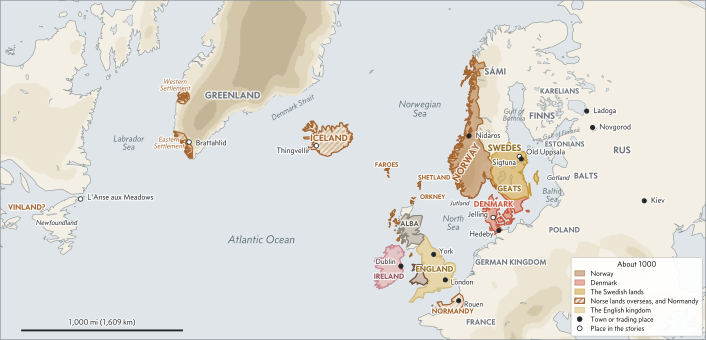
Across the North Sea the Norse settled whole islands. Shetland and Orkney, north of Scotland, and the Faroe (fair-oh) Islands beyond them were Norse by 900, and so were the Hebrides (heb-rih-deez) off Scotland’s west coast and the Isle of Man. In Ireland the Norse founded the first towns, Dublin among them. About 870 settlers from Norway began to farm Iceland, which, the Icelanders’ own histories say, had been empty except for a few Irish hermits. About 985 Erik the Red led settlers from Iceland to the southwest coast of Greenland, and about 1000 his son Leif (layf) sailed on to a country that the sagas, the Icelanders’ prose histories, call Vinland. In 1960 the ruins of a Norse camp were found at L’Anse aux Meadows (lahns oh med-ohz) in Newfoundland, the only Norse site yet known in America.
East of the Baltic lived peoples whose languages were not Germanic at all, unlike Norse and English. The Finns and the Sámi (sah-mee), the reindeer herders of the far north, spoke languages related to Estonian and, distantly, to Hungarian. Farther south, along the eastern shore of the Baltic, lived the Balts, ancestors of the Latvians and Lithuanians. Swedish traders and warriors, whom the Slavs of the eastern plains called the Rus (roos), went up the rivers of the east, ruled Novgorod (nov-guh-rod) and Kiev (kee-ev), now spelled Kyiv, and gave their name to Russia. In the south, the king of France granted land at the mouth of the Seine to a band of Norse raiders in 911. Their land became Normandy, “the land of the Northmen,” and in 1066 one of its dukes conquered England.
Britain and Ireland
Figure S.3 adds a closer view to the third volume’s maps of today (Vol. 3, Geography: Europe, Asia, and Africa). In 1000 England was one kingdom, ruled since 927 by the kings of Wessex, but it had been put together from older ones. The Angles, Saxons, and Jutes who crossed the North Sea after Rome left had founded seven main kingdoms. The greatest were Northumbria (nor-thum-bree-uh), north of the river Humber; Mercia (mur-shee-uh), in the Midlands; East Anglia; and Wessex, the land of the West Saxons, in the south. Their names lived on as the great earldoms of the kingdom, provinces that earls governed for the king. Across the north and east lay the Danelaw (dayn-law), the land of Danish law, where Danish armies had settled in the 870s. A treaty between Alfred of Wessex and the Danish king Guthrum (gooth-rum), about 886, drew its border along the Thames, the rivers Lea and Ouse (ooz), and the old Roman road called Watling Street (Chapter 19).
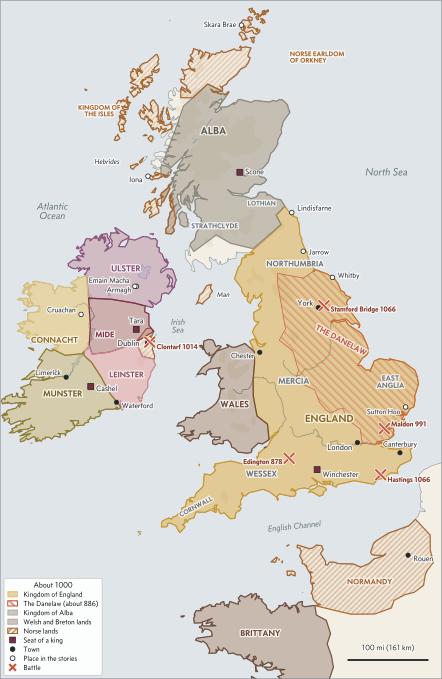
The west belonged to the Britons, the people who had lived in Britain under Rome and spoke a Celtic (kel-tik) language. They held Wales, behind Offa’s Dyke, the long earthwork named for Offa, the Mercian king who is said to have raised it along the border in the late 700s. In Cornwall they lived under English kings but kept their own language, Cornish. Others had crossed the Channel to the peninsula that took their name, Brittany. In the north, the Picts (pikts) and the Scots, Irish settlers from across the narrow sea, had joined in the kingdom of Alba (al-buh), whose kings were made at Scone (skoon). It would later be called Scotland, after the Scots. The Norse earls of Orkney held the islands and the far north of the mainland.
Ireland had no single kingdom. Dozens of small kings were grouped under a few great ones, and the old tales divide the island into five. The Irish word for a province, cúige (koo-ig-uh), comes from an old word for “a fifth.” The five were Ulster in the north, Connacht (kon-ukht) in the west, Leinster (len-stur) in the east, Munster (mun-stur) in the south, and Mide (mee-thuh), “the middle,” where stood Tara (tar-uh), the hill of the high kings. The real kingdoms shifted for centuries, until in 1610 English rule fixed the four provinces of today, with most of Mide given to Leinster.
From Rome to the loss of France
The timeline (Figure S.4) runs from 410, where the seventh volume ended (Vol. 7, The Romans), to 1500. Time runs down the page. The left-hand bands give the rulers of England. The next lane gives the main events in Britain, Ireland, and the north, and the third lane gives the years in which the volume’s stories were written down. The scale changes at each dashed line, so that the crowded twelfth and thirteenth centuries get more room.
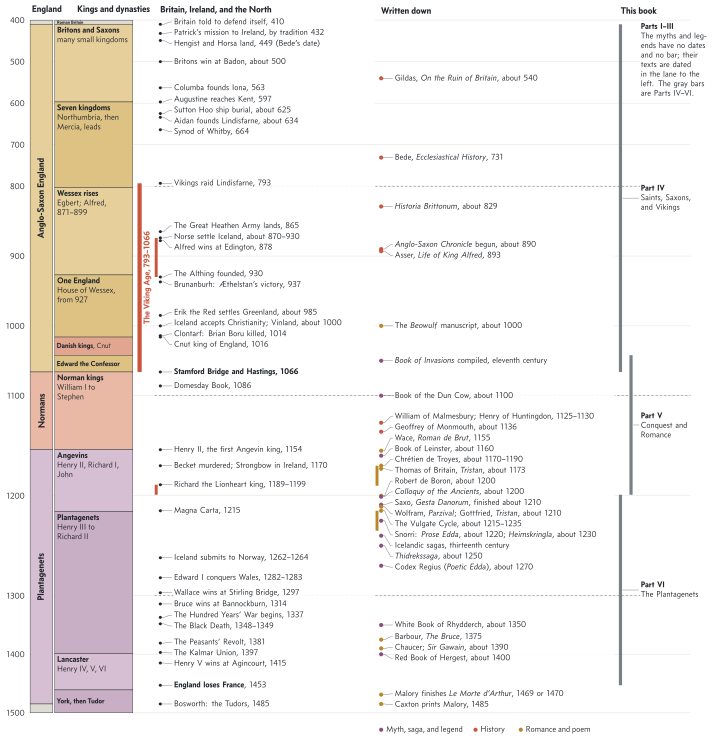
The story has four ages. In the first, from 410 to the 800s, the Britons lost most of what is now England to the Anglo-Saxons, the Germanic settlers from across the North Sea, while missionaries from Rome and from Ireland made Christians of the newcomers. The second is the Viking Age. It is usually counted from the raid on Lindisfarne in 793 to the Battle of Stamford Bridge in 1066, when the last great Norse invasion of England failed. In those years Scandinavian armies conquered half of England and settled much of the North Atlantic. The kings of Wessex fought back and made one England, though Danish kings ruled it from 1016 to 1042. Norway, Denmark, and Sweden became Christian kingdoms in the same years, and in 1397 one queen, Margaret, united all three in the Kalmar Union (Chapter 20).
The third age began in 1066, when William, duke of Normandy, conquered England. His Norman kings ruled until 1154. Then the crown passed to Henry II, count of Anjou (ahn-zhoo) in France, whose mother was the daughter of the Norman king Henry I. He was the first of the Angevins (an-juh-vinz), named after Anjou, and he held more of France than the French king did. Historians call his whole line, down to Richard III in 1485, the Plantagenets (plan-taj-uh-nets), from the sprig of broom, a yellow-flowered shrub, in Latin planta genista, that his father is said to have worn in his hat. Many keep the name Angevins for Henry and his sons, as the timeline’s inner band does. The fourth age began in 1199 with Henry’s son John, who lost Normandy to the French king. In it England’s kings conquered Wales, fought for Scotland and lost, and claimed the crown of France itself. The Hundred Years’ War that followed, from 1337 to 1453, ended with England driven out of France except for Calais (kal-ay). There the twelfth volume begins (Vol. 12, Crown and Parliament).
The nine worlds
The Norse pictured the universe as a number of worlds held together by a tree. A seeress in the Völuspá (vur-luh-spah), “the prophecy of the seeress,” the first poem in the Codex Regius, says in Henry Adams Bellows’s translation of 1923, “Nine worlds I knew, the nine in the tree.” Snorri mentions nine worlds too, but neither he nor any poem lists them. The nine of Figure S.5 are the ones most modern handbooks give. Bellows himself gave a slightly different list, with a world of the dwarves and no separate Hel, which shows that any such list is a modern reconstruction.
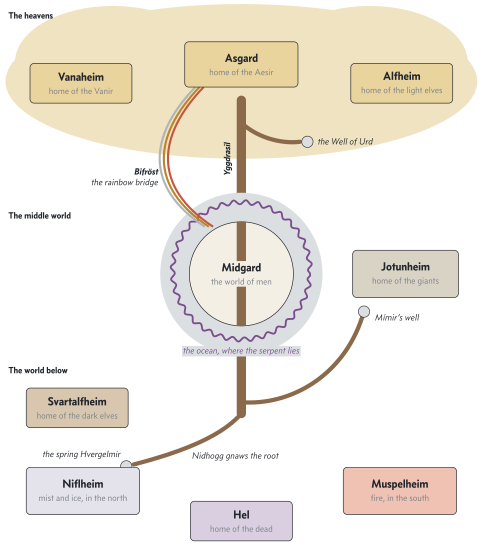
The center of everything is Yggdrasil (ig-druh-sil), a vast ash tree whose branches spread over the worlds and whose three roots reach down among them. At the top stand the homes of the two families of gods: Asgard (ahs-gard), the stronghold of the Aesir (ay-seer), Odin’s family, and Vanaheim (vah-nuh-haym), the home of the Vanir (vah-neer), gods of the sea and of growing things. Alfheim (alf-haym) belongs to the light elves. In the middle lies Midgard, “the middle enclosure,” the world of men, ringed by an ocean in which a great serpent lies coiled. Beyond the ocean, at the edge of the world, is Jotunheim (yoh-tun-haym), the home of the giants, the gods’ oldest enemies. The dark elves of Svartalfheim (svart-alf-haym), which many handbooks also make the dwarves’ country, live under the earth. Below lie Niflheim (niv-ul-haym), a world of mist and ice in the north, and Muspelheim (moos-pel-haym), a world of fire in the south, and the land of the dead, which bears the name of its ruler, the goddess Hel.
From Midgard a bridge, Bifröst (biv-rust), climbs to Asgard. Men see it as the rainbow, and Snorri says that its red is burning fire, to keep the giants off. The making of the worlds from a giant’s body is told in Chapter 1, the halls of Asgard are mapped in Chapter 4, and the end of the worlds comes in Chapter 9.
The gods
The Norse gods are not the gods of Greece under other names (Vol. 4, Classical Myth), and they are not immortal in the same way. They grow old without the apples of a goddess, and they know that most of them will die in a last battle with the giants. Snorri’s Prose Edda is the fullest account of them, and Table S.1 gives one line for each god the chapters meet. Most belong to the Aesir. Njord (nyord) and his son came from the Vanir as hostages after a war between the two families, and his daughter came with them (Chapter 2). The giants, called jötnar (yut-nar) in Old Norse, are not simply monsters. Some are wise, some are beautiful, and many gods have giant mothers or wives. Loki, the cleverest and most dangerous of the gods, was the son of a giant.
| God | Who | Taught in |
|---|---|---|
| Odin (oh-din) | Chief of the Aesir, the “Allfather,” god of wisdom, poetry, magic, and the dead in battle; he gave an eye for wisdom | Chapter 2 |
| Frigg (frig) | Odin’s wife, queen of Asgard, who knows the fates of all | Chapter 2 |
| Baldr (bahl-dur) | Son of Odin and Frigg, the best loved of the gods, whose death begins the end | Chapter 8 |
| Höðr (hur-thur) | Odin’s blind son, Baldr’s brother | Chapter 8 |
| Thor | Odin’s son by Jörd (yurth), “Earth”; god of thunder, enemy of giants | Chapter 6 |
| Sif (siv) | Thor’s wife, with hair of gold | Chapter 5 |
| Magni (mag-nee) and Modi (moh-dee) | Thor’s sons, whose names mean “Strength” and “Wrath” | Chapter 6 |
| Týr (teer) | The one-handed god of war | Chapter 5 |
| Heimdall (haym-dahl) | The watchman of the gods, who guards their bridge | Chapter 4 |
| Bragi (brah-gee) | God of poetry | Chapter 1 |
| Iðunn (ee-thoon) | Bragi’s wife, keeper of the apples of youth | Chapter 3 |
| Víðarr (vee-thar) | The silent god, Odin’s son by the giantess Gríðr (gree-thur) | Chapter 9 |
| Váli (vah-lee) | Odin’s son by Rind, born to avenge Baldr | Chapter 8 |
| Njord | God of the sea and of wealth, one of the Vanir | Chapter 3 |
| Freyr (frayr) | Njord’s son, god of harvests and of peace | Chapter 3 |
| Freyja (fray-uh) | Njord’s daughter, goddess of love, magic, and battle | Chapter 3 |
| Loki (loh-kee) | Son of the giant Fárbauti (far-bow-tee) and of Laufey (low-vay); trickster, shape-shifter, and Odin’s blood-brother | Chapter 5 |
| Sigyn (sig-in) | Loki’s faithful wife | Chapter 9 |
| Angrboda (ahng-gur-boh-duh) | A giantess, mother of Loki’s monstrous children | Chapter 5 |
| Hel | Loki’s daughter, ruler of the dead | Chapter 5 |
| Jörmungandr (yur-mun-gahn-dur) | Loki’s son, the serpent that encircles Midgard | Chapter 5 |
| Fenrir (fen-reer) | Loki’s son, the giant wolf | Chapter 5 |
Figure S.6 shows how they are related, as Snorri gives it. Odin and his brothers Vili (vil-ee) and Vé (vay) were the sons of Borr (bor) and of a giantess, Bestla (best-luh). Odin had sons by several mothers, and Snorri names some of the mothers but not all. The chapters often call the gods’ treasures by name, and the box below says where each one is made or won.

Five languages, and how to read their names
The stories of this volume were first written in five languages, and Table S.2 shows how to tell them apart on the page. Old Norse and Old English were sister languages, both Germanic, and an English and a Norse speaker of 900 could probably make each other out. Middle English is the English of the 1100s to the 1400s, after the Norman Conquest had filled it with French words. Irish and Welsh are both Celtic languages, but they had parted so long before that an Irishman and a Welshman could not understand each other. Many of the volume’s sources were written in Latin, the language of the Church and of learning, and the Arthurian romances in French and German.
| Language | Where and when | How to know it | A sample |
|---|---|---|---|
| Old Norse | Norway and Iceland; the Eddas and sagas, written about 1200 to 1400 | The letters þ and ð, accents on long vowels, ö; nouns ending in -r | deyr fé, deyja frændr, “Cattle die, and kinsmen die” |
| Old English | England, about 700 to 1100; Beowulf, the Chronicle | The letters þ, ð, and æ; no French words | Hwæt! “Listen!”; hronrād, “whale-road,” the sea |
| Middle English | England, about 1100 to 1500; Chaucer, Sir Gawain, Malory | Close to modern English, in old spellings | Whan that Aprill with his shoures soote |
| Irish | Ireland; the Táin and the tales of Fionn, in manuscripts from about 1100 | Accents on long vowels; an h after a consonant, as in bh and ch | Táin Bó Cúailnge, “the Cattle Raid of Cooley” |
| Welsh | Wales; the Mabinogion, in manuscripts of about 1350 to 1400 | w and y used as vowels; ll and dd | Pwyll (poo-ihl), a prince of the Mabinogion |
Norse names
Old Norse names come into English in several spellings, and a reader who knows four rules can recognize them all. First, many Norse nouns end in -r, which marks the subject of a sentence, much as -us does in Latin. English writers often drop it or turn it into -er or -ur, so Baldr (bahl-dur) is also Balder and Baldur, and Freyr (frayr) is Frey, though Týr (teer) keeps it as Tyr. Second, Old Norse had two letters for the sound th. The letter eth, ð, is the soft th of “this,” and the letter thorn, þ, is the hard th of “thin.” English books write them as d or th, so Höðr (hur-thur) is also Hoder and Hod, and Þórr (thohr) is Thor. Third, an accent marks a long vowel, and ö is said much like the u of “fur.” Fourth, the most famous gods have English forms of their own: Odin for Óðinn (oh-thin), Njord for Njörðr (nyur-thur), and Frigg, sometimes written Frigga. This book uses the forms in Table S.1. English remembers four of these gods every week, in Tuesday, the day of Tiw, the Old English Týr; Wednesday, the day of Woden (woh-den), who is Odin; Thursday, Thor’s day; and Friday, the day of Frigg.
Irish and Welsh names
Irish spelling looks hard because it keeps letters that are no longer pronounced. An h after a consonant softens it: bh and mh sound like v, th like h, and ch like the end of Scottish loch. So the hero Cú Chulainn (koo khul-in), “the hound of Culann,” is easier to say than to read, and Fionn mac Cumhaill (fin mak kool) is known in English as Finn MacCool. Welsh spelling has its own rules: w and y are usually vowels, dd is the th of “this,” f is v, and ll is breathed out past the tongue, a sound English lacks.
Words the stories assume
A few words recur so often that the chapters use them freely. A kenning is a short riddle-name used in place of a plain word: the sea is the “whale-road,” a king is a “ring-giver,” because kings rewarded their followers with gold rings, and gold itself is “Sif’s hair.” Old English and Old Norse poets used kennings constantly, and Snorri explained hundreds of them in his handbook for poets (Chapter 1). A skald (skahld) was a Norse court poet, who praised kings in verse so packed with kennings that it reads like a puzzle. A saga, from the Norse word for “something said,” is a prose story written in Iceland or Norway, usually in the 1200s and 1300s, about kings, about early Icelandic families and their feuds, or about legendary heroes. A medieval romance was a long tale of knights, their adventures, and often their loves, in verse or prose; the word first meant a story in French, the everyday tongue, rather than in Latin. A geis (gesh), plural geasa (gas-uh), is a solemn ban or command laid on a hero in Irish tales; the hero who breaks his geis is doomed (Chapter 11).
Other words name the northern peoples and their assemblies. Viking comes from the Norse víkingr, a raider from the sea; the sagas use it for the pirates, not for everyone in Scandinavia, but historians now use it for the whole age. The English chronicles call all Scandinavians “Danes,” wherever they came from, and the Irish called them Gaill, “foreigners.” Celtic names the family of languages that includes Irish, Scottish Gaelic (gal-ik), Welsh, Cornish, and Breton, and so the peoples who spoke them. A thing was a Norse assembly of free men, and Iceland’s Althing (ahl-thing), founded in 930, was the assembly of the whole island (Vol. 3, Geography: Europe, Asia, and Africa).
Who wrote the stories down
Each chapter names the writer behind a story: “Snorri tells,” “Geoffrey of Monmouth invented,” “the Chronicle records.” The list below gives, by tradition and then by date, the writers and manuscripts the chapters rely on, what each wrote, and what it preserves.
The histories of Britain
- Gildas (gil-dus) (wrote about 540), a British monk, wrote a sermon, On the Ruin of Britain, that blames the Britons’ sins for the Saxon conquest. He names their victory at Mount Badon (bay-dun), which happened in his own lifetime, but no Arthur (Chapter 16).
- Bede of Jarrow (jair-oh) (673–735), a monk of Northumbria, finished his Ecclesiastical History of the English People in 731. It tells of Hengist (heng-gist) and Horsa, the brothers who by tradition led the first Saxons to Britain, and of Augustine, the monk whom the pope sent to convert the English. It also tells of the synod, or church council, at Whitby and of the cowherd poet Cædmon (kad-mun) (Chapter 16).
- The Historia Brittonum (his-tor-ee-uh brih-toh-num), the “History of the Britons” (about 829), is traditionally credited to Nennius (nen-ee-us). It first lists Arthur’s twelve battles and tells of the stronghold that the British king Vortigern (vor-tih-gurn) could not build, because its materials vanished every night (Chapter 23).
- The Anglo-Saxon Chronicle is a set of year-by-year records in Old English, begun about 890 in King Alfred’s reign and kept up at several monasteries; the copy made at Peterborough runs to 1154 (Chapter 18 to Chapter 22).
- Asser (as-ur) (died about 909), a Welsh bishop who served King Alfred, wrote the Life of King Alfred in 893, while the king was alive (Chapter 19).
- William of Malmesbury (mahmz-buh-ree) (Deeds of the Kings of the English, about 1125) and Henry of Huntingdon (History of the English, about 1130) were the first to write down several stories that the chapters tell as legends. Among them is the tale of the Danish king Cnut (kuh-noot) and the tide (Chapter 19), and both told of the arrow that struck King Harold at Hastings (Chapter 21).
- John Barbour, archdeacon of Aberdeen, wrote The Bruce in 1375, a long poem in Scots, the English of lowland Scotland, and the first life of Robert the Bruce, the king of Scots who beat the English at Bannockburn (Chapter 27).
The Irish manuscripts
- The Book of the Dun Cow, in Irish Lebor na hUidre (lev-ur nuh hooth-ruh) (about 1100), is the oldest manuscript in Irish. With the Book of Leinster (about 1160) it keeps the Táin Bó Cúailnge (tawn boh kool-nyuh) and the other tales of Ulster (Chapter 11).
- The Book of Invasions, compiled in the eleventh century, tells the history of Ireland from the creation of the world, as a series of peoples who took the island one after another (Chapter 10).
- The Colloquy of the Ancients (about 1200) keeps many of the tales of Fionn and his warriors. The tale of Fionn’s son Oisín (uh-sheen) and his ride to Tír na nÓg (teer nuh nohg), “the Land of Youth,” is best known from an Irish poem of about 1750 by Michael Comyn (kum-in) (Chapter 12).
| Region | In these years | Taught in |
|---|---|---|
| Continental Europe and Byzantium | Clovis and the Franks; Justinian in Constantinople (527–565); Charlemagne crowned emperor (800); the Crusades from 1095; the Turks take Constantinople (1453). | Vol. 9, Cathedrals and Crusades |
| The Islamic world | Muhammad (died 632) and the Arab conquests; the caliphs of Damascus and Baghdad; Saladin retakes Jerusalem (1187); the rise of the Ottomans. | Vol. 37, The House of Islam |
| India | The Gupta age ends; the Chola kings of the south; the Delhi Sultanate (from 1206). | Vol. 39, India |
| China | The Tang (618–907) and Song (960–1279) dynasties; the Mongol conquest under Kublai Khan; the Ming from 1368. | Vol. 40, The Middle Kingdom |
| Japan and Korea | Lady Murasaki’s Tale of Genji (about 1010); the first shogunate (from 1185); Korea’s Goryeo kingdom. | Vol. 41, Islands of the Rising Sun |
| Southeast Asia | The Khmer Empire and Angkor Wat (twelfth century). | Vol. 42, Monsoon and Ocean |
| Africa | The empires of Ghana and Mali; Mansa Musa’s pilgrimage to Mecca (1324); Great Zimbabwe. | Vol. 43, Africa |
| The Americas | The Maya cities; the Aztecs found Tenochtitlan (1325); the Inca rise in Peru. | Vol. 44, Gold, God, and Glory |
The Norse books
- Snorri Sturluson (snor-ee stur-luh-sun) (1179–1241) was an Icelandic chieftain and lawspeaker, the official who recited Iceland’s laws to its assembly. He wrote the Prose Edda about 1220, a handbook for poets that retells the myths, and the Heimskringla (haymz-kring-luh) about 1230, the lives of the kings of Norway from their descent from Freyr. Chapter 1 introduces both books, and Chapter 20 tells his life.
- The Codex Regius (about 1270) is the one manuscript of the Poetic Edda, anonymous poems, many of them older than Snorri. Among them are the Völuspá, the Hávamál (hah-vuh-mahl), Grímnismál (greem-nis-mahl), Vafþrúðnismál (vahv-throoth-nis-mahl), the Lokasenna, and the poems of the Völsungs (vur-sungz), the family of the hero Sigurd (sig-urd) (Chapter 1 to Chapter 9).
- Saxo Grammaticus (sak-soh gruh-mat-ih-kus) (about 1160–after 1208), a Danish clerk, finished his Latin Gesta Danorum (jes-tuh dah-nor-um), “the Deeds of the Danes,” about 1210. It tells the Danish kings and heroes, with its own versions of Baldr, of the warrior Starkad, and of Amleth, the prince behind Shakespeare’s Hamlet (Chapter 8, Chapter 20).
- The Icelandic sagas (thirteenth century) include prose histories of the settlers and their feuds, among them the two sagas of Vinland, and legendary sagas of ancient heroes, among them the Völsunga saga (vur-sung-guh sah-guh) and the Hervarar saga (her-vah-rar) (Chapter 7, Chapter 8, Chapter 20). The Norwegian Thidrekssaga (thid-reks-sah-guh) (about 1250) tells the story of the German hero Dietrich of Bern, that is, of Verona in Italy.
The Welsh books
- The Mabinogion (mab-ih-nog-ee-on) is eleven tales kept in the White Book of Rhydderch (ruh-thairkh) (about 1350) and the Red Book of Hergest (her-gest) (about 1400). Lady Charlotte Guest translated them into English between 1838 and 1845, and her book made the collection’s name familiar (Chapter 13).
The makers of Arthur
- Geoffrey of Monmouth, a cleric from the Welsh border, wrote the History of the Kings of Britain about 1136. It gave Arthur a whole reign, ending with his passing to Avalon, in a line of British kings that began with Brutus of Troy (Chapter 23).
- Wace (wahs), a poet from the Channel island of Jersey, put Geoffrey into French verse in his Roman de Brut (1155) and added the Round Table (Chapter 23).
- Chrétien de Troyes (kray-tyan duh trwah) (wrote about 1170–1190), a poet of Champagne in France, wrote five romances that brought Lancelot, Camelot, and the Grail, a mysterious holy vessel, into the story and gave Yvain (ee-van) a romance of his own (Chapter 24).
- Thomas of Britain wrote a Tristan in French, about 1173 by one reckoning and before 1160 by another, and Gottfried von Strassburg (got-freet fon shtrahs-boork) a German Tristan about 1210, which he left unfinished. Both tell of the knight Tristan and his doomed love for his uncle’s wife (Chapter 24).
- Robert de Boron (roh-bair duh boh-ron) (about 1200) wrote a Joseph of Arimathea, named for the man who, the Gospels say, buried Jesus; it made the Grail the cup of the Last Supper. His Merlin made Merlin a devil’s son whom the devils meant to be an Antichrist, and gave Arthur the sword in the stone (Chapter 23, Chapter 24).
- Wolfram von Eschenbach (volf-rahm fon esh-en-bahkh) wrote the German Parzival (part-sih-fahl) about 1210, in which the Grail is a stone (Chapter 24).
- The Vulgate Cycle (about 1215–1235) is a series of long French prose romances by unknown writers. It gave the legend the pure knight Galahad and made the traitor Mordred Arthur’s son (Chapter 24, Chapter 25).
- Thomas Malory (mal-uh-ree) finished Le Morte d’Arthur, “the death of Arthur,” in 1469 or 1470, gathering the French romances into one English book; William Caxton, England’s first printer, printed it in 1485 (Chapter 25).
One maker came much later. Elias Lönnrot (lurn-root), a Finnish country doctor, collected the songs of Finnish and Karelian singers and made from them the Kalevala (kah-leh-vah-lah), published in 1835 and enlarged in 1849 (Chapter 14).
Whether a real Arthur ever lived is unknown. Gildas, who wrote within living memory of Badon, names no Arthur. The first texts to name him are the Welsh poem Y Gododdin (uh goh-doth-in), perhaps composed about 600 but known only from a copy of about 1265, and the Historia Brittonum, written three centuries after Badon. Most historians treat Arthur as a figure of legend whose existence cannot be shown, and the chapters tell his story as the writers built it, naming for each episode the writer who first told it (Chapter 23).
Meanwhile elsewhere
While Norse ships sailed to Vinland, the Song emperors of China ruled cities larger than any in Europe, and while Chaucer wrote, the Aztecs were building their capital on a lake in Mexico. Table S.3 sets the north beside the rest of the world and names the volumes that teach it.
The Nine Worlds
Chapter 1 · 34 clues
From Ginnungagap to Yggdrasil
When Snorri Sturluson was a small boy in the west of Iceland, his father went to a meeting to settle a lawsuit, and the other side’s wife came at him with a knife. She meant, she said, to make him look like Odin, the one-eyed chief of the gods. Bystanders knocked her arm aside, and the blade cut his cheek instead of his eye. That, at least, is how a saga about Snorri’s family tells it.
The penalty for the attack would have ruined her husband, a priest, so a great chieftain named Jón Loftsson (yohn loft-son), the grandson of a king of Norway and one of the most respected men in Iceland, stepped in with an offer. He would make peace by taking the little boy and raising him at his farm of Oddi (od-ee), a famous center of learning. Snorri never went home again. He grew up among books and poets, and some forty years later he wrote the book from which most of what we know about Odin comes. It opens with a king in disguise, standing before three thrones, asking a simple question. What was the beginning?
Snorri and the two Eddas

The boy from Oddi became one of the richest men in Iceland. Snorri (1179–1241) owned farms and chieftainships, composed poems for kings and earls, and worked as a lawyer. In Iceland a chieftain’s office was property, which could be bought, traded, or inherited like a farm. Twice the chieftains elected him lawspeaker of the Althing, Iceland’s yearly assembly at Thingvellir (thing-vet-lir) (Vol. 3, Geography: Europe, Asia, and Africa). Iceland had no king, and the lawspeaker was the assembly’s one officer: he presided, and he recited the laws aloud to the assembly, a third of them each summer. In 1218 Snorri sailed to Norway, where the teenage King Hákon IV (hoh-kon) and Earl Skúli (skoo-lee), the nobleman who governed for him, loaded him with gifts. He wrote poems in their praise and came home in 1220 a royal favorite. Twenty-one years later his dealings with Norway’s king got him killed, a story told in Chapter 20.
By Snorri’s time Iceland had been Christian for two hundred years. In the year 1000 the Althing had accepted the new faith, and the old gods had become characters in stories. They lived on in one stubborn place, which was poetry. Iceland’s court poets, the skalds described in the Stage, still earned gold by composing praise-poems for kings in the old style, and that style was built of kennings, riddling names like “whale-road” for the sea. Many kennings pointed at myths. Gold could be called “Sif’s hair,” after the golden hair the dwarves made for Thor’s wife (Chapter 5), and poetry could be “Odin’s mead” or “Kvasir’s blood,” after a story told in Chapter 2. A young poet who did not know the stories could not understand the old poems, still less compose new ones. So Snorri wrote a handbook for poets, and to explain the kennings he retold the myths.
Scholars call the court poets’ work skaldic verse. Each poem was the work of a poet whose name was remembered, packed with kennings and inner rhymes, and made to praise a king’s battles and his generosity; a good one could earn its maker a gold arm-ring or a sword. Snorri also quoted a second kind of poem, simpler in style and anonymous, about the gods and the ancient heroes. Those are the poems of the Poetic Edda, and they come into this story in a moment.
His book is now called the Prose Edda, or Snorri’s Edda. Nobody knows for certain what “Edda” means; one meaning of the word in Old Norse is “great-grandmother.” A copy made early in the 1300s, now in the university library of Uppsala, in Sweden, opens by saying that the book is called Edda and that Snorri Sturluson put it together. Seven manuscripts of the book survive, six of them medieval, and no two are quite alike; none is complete. It begins with a short Prologue that opens, like the Bible, “In the beginning God created heaven and earth,” in Arthur Gilchrist Brodeur’s English translation of 1916, and runs through Adam and Eve and Noah’s flood. Only then does Snorri, a Christian writing for Christians, explain that the old gods were once human beings: men from Troy, in Asia, whose descendants traveled north and were worshiped by people who knew no better. Three parts follow.

The first part is Gylfaginning (gil-vah-gin-ing), “the tricking of Gylfi.” Gylfi (gil-vee) is a king of Sweden, and Snorri opens with a joke at his expense. Gylfi once promised a wandering woman, in return for her entertainment, as much of his land as four oxen could plow in a day and a night. She was the goddess Gefjun (gev-yoon), and she fetched four oxen from the land of the giants, her own sons by a giant. They plowed so deep that they tore a whole piece of Sweden loose and dragged it west into the sea, where it became the Danish island of Zealand, on which Copenhagen now stands. The hole they left filled with water and became a lake, and Snorri says its bays match the headlands of Zealand.
No wonder Gylfi wanted to know why the gods were so powerful that everything went as they wished. He set out to visit them in secret, disguised as an old man who called himself Gangleri (gang-leh-ree). The gods saw him coming. In a hall so tall that he could not make out the roof, he found three high seats, one above another, and on them three figures named High, Just-as-High, and Third. Who they really are is a question for Chapter 2. Gylfi asks, and they answer, from the beginning of the world to its end, quoting old poems as they go. Sometimes Gylfi argues back, and sometimes High laughs at him for asking something he ought to know already.
At the very end Gylfi hears a great noise all around him, and when he looks about, the hall has vanished and he is standing alone on a level plain. He goes home and tells what he heard, and from him, Snorri says, the stories passed from man to man. A final passage, perhaps added by a later writer, gives the story a sly ending. The people of the hall sat down together and gave themselves the names of the gods in the stories they had just told, so that later ages would take them for those gods. Read that way, the whole of Gylfaginning is a trick played on a king, and the gods are clever men from Asia, just as the Prologue said.
The second part, Skáldskaparmál (skowld-skah-par-mowl), “the language of poetry,” is the longest. It is set at a feast of the gods, where the sea-giant Ægir (eye-gir) sits beside Bragi (brah-gee), the god of poetry, and asks him where poetry came from and how poets name things (Ægir returns in Chapter 3). Bragi’s answers include some of the best stories in this book, among them the theft of the mead of poetry (Chapter 2), and then run on into long lists of kennings, each with a verse by an old skald to show it in use. The third part, Háttatal (howt-tah-tahl), “the list of meters,” is a long poem of Snorri’s own in praise of King Hákon IV and Earl Skúli, with notes. Each stanza shows off a different verse form, the way a piano book gives one exercise for each scale.

Snorri quoted dozens of older poems, and for centuries they were known only from his quotations. Then, in 1643, the little book whose voyage home opens the Stage came into the hands of Brynjólfur Sveinsson, the bishop of Skálholt. It held the poems themselves, copied out about 1270, some thirty years after Snorri’s death. Scholars had guessed that such a collection once existed, and here it was. The bishop called it an Edda too, since it held what Snorri had drawn on, and it is now the Poetic Edda. He believed the poems had been gathered by Sæmundr the Learned (sy-mun-dur), Jón Loftsson’s grandfather, a priest who had lived at Oddi a century before Snorri, and for a long time the book was called Sæmund’s Edda; scholars now reject the idea. Because the bishop gave it to the king of Denmark, it is called the Codex Regius, “the king’s book.” A codex is a book with pages sewn together at one edge, as opposed to a scroll, and a manuscript is any book written by hand. Eight leaves of this one have been lost from the middle, and with them part of the story of Sigurd (Chapter 7).
The poems of the Codex Regius have no authors’ names, and nobody knows how old they are. Some may have been composed in the 900s, while the gods were still worshiped, and others in Christian times; they lived in memory for generations before anyone wrote them down. They fall into two groups. The first is about the gods, and the chapters that follow cite its poems by their titles. The Völuspá, “the prophecy of the seeress,” stands first: a völva (vul-vah), or seeress, whom Odin seems to have called up from the grave, tells the history of the world from its making to its destruction and rebirth. The Hávamál, “the sayings of the High One,” gathers Odin’s advice and secrets. In Grímnismál, “the sayings of Grímnir” (greem-nir), Odin is held prisoner between two fires and pours out what he knows of the worlds of the gods (both in Chapter 2). Vafþrúðnismál is a contest of knowledge between Odin and a wise giant (Chapter 8), and in the Lokasenna, “Loki’s quarrel,” the trickster insults every god at a feast (Chapter 9). The second group tells of human heroes, among them Sigurd the dragon-slayer (Chapter 7). A few poems survive in other manuscripts too. The Völuspá is also copied in a big Icelandic book of about 1300 called Hauksbók (howks-bohk), and the two copies give its stanzas in different orders.
Snorri worked like an editor. When Gylfaginning tells a myth, it usually quotes a stanza from one of these poems and then explains it in prose, filling the gaps between the verses. Much of what he says can be checked against a surviving poem. Some of it cannot: the cow of the next section appears only in his book, and so do the killing of the first giant and the flood of his blood. Scholars still argue about how much Snorri took from poems now lost and how much he worked out for himself, to make scattered old fragments into one story. Where the poems disagree with him, this book says so.
Two more kinds of source fill out the picture. Icelanders of the thirteenth and fourteenth centuries wrote hundreds of sagas, the prose stories the Stage described, and short tales called þættir (thight-teer) (singular þáttr, “a strand”), many of them tucked inside longer sagas. One, Sörla þáttr (sur-lah), tells how the goddess Freyja (fray-uh) got her necklace (Chapter 3). About 1230 Snorri also wrote, or put together, a history of the kings of Norway now called Heimskringla, “the circle of the world,” after its first words. It begins in legend, with the Ynglinga saga (ing-ling-ah), which traces the kings of Sweden back to the god Freyr (Chapter 3), and it ends in 1177. In this book Snorri again makes the gods into men: Odin is a conqueror and sorcerer from Asia who leads his people north and settles in Sweden, and after his death the Swedes worship him. Later chapters quote it for Harald Fairhair (Chapter 18) and for the Battle of Stamford Bridge (Chapter 21).
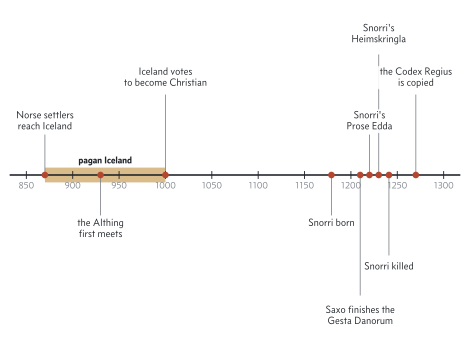
The other great source comes from Denmark. Saxo Grammaticus, a clerk in the service of the archbishop of Lund, then a Danish city and now a Swedish one, wrote a history of the Danes in sixteen books of polished Latin, the Gesta Danorum, “Deeds of the Danes,” which he finished about 1210. His byname, Grammaticus, given him by later writers, means “the learned.” Saxo told the gods’ stories as history. His Odin is a sorcerer whom foolish people took for a god, and his story of Baldr is quite different from Snorri’s (Chapter 8). Saxo admitted a debt to Iceland. In his preface, in Oliver Elton’s English translation, he writes: “Nor may the pains of the men of Thule be blotted in oblivion.” Thule was his name for Iceland, whose people, he says, “account it a delight to learn and to consign to remembrance the history of all nations,” and he had built much of his own book from their stories. Figure 1.4 puts all these books in order.
Outside Iceland the Eddas were almost unknown until 1665, when a Danish scholar, Peder Resen, printed Snorri’s book in Copenhagen with translations into Latin and Danish. Over the next two centuries painters, poets, and composers across Europe borrowed from both Eddas. The German composer Richard Wagner took much of his four-opera Ring of the Nibelung (Vol. 19, Wagner and Verdi) from the Poetic Edda and the sagas.
Fire, ice, and Ymir
After asking who is the oldest of the gods, Gylfi comes to the question from the start of this chapter: what was the beginning? High answers with a verse from the Völuspá, and the seeress of that poem begins the story the same way. Here is her stanza in the American scholar Henry Adams Bellows’s translation of the Poetic Edda, published in 1923.
The yawning gap had a name, Ginnungagap (gin-oon-gah-gahp). Brodeur calls it “the Yawning Void.” The gap itself was empty, but something lay on either side of it. Far to the south, before anything else, Snorri says, lay Muspelheim, a world of fire,Muspelheim is a realm of this phenomenon. → fire•• also called Muspell: bright and hot, “glowing and burning,” and impossible to enter for anyone not born there.
Muspelheim had people of its own. Snorri calls them the sons of Muspell, and they are usually counted as a race of giants,One class of these beings lived in Muspelheim. → giants• the “fire giants” of modern books, though no Norse source calls them giants in so many words. At the border of their land sits a watchman named Surt, holding a flaming sword. At the end of the world, Snorri says, he will ride out, overcome the gods, and burn everything with fire (Chapter 9). An island off Iceland, Surtsey, which rose out of the sea in a volcanic eruption in 1963, is named for him (Vol. 3, Geography: Europe, Asia, and Africa). The word Muspell is itself a puzzle, and it is older than Snorri. A Christian poem in Old High German, copied in Bavaria in the 800s, uses it once, as muspilli, in a passage about the world burning at the Last Judgment. Scholars have proposed more than twenty explanations of the word and agree on none.
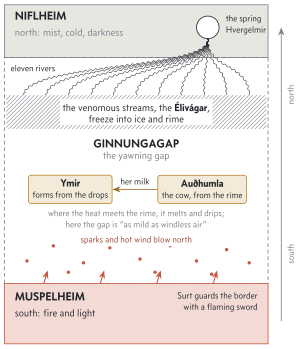
In the north lay Niflheim, “the home of mist,” cold and dark. In the middle of it, Snorri says, lies a spring called Hvergelmir (hvair-gel-meer), and from it flow eleven rivers, which he names one by one; the last, Gjöll (gyurl), runs close to the gates of the land of the dead. A little later in his book Snorri speaks of the streams called the Élivágar (ay-lee-vah-gar), which Brodeur translates “Ice-waves.” They had run so far from their source that the venom in them had hardened, like the slag that runs out of a furnace, and turned to ice. Snorri does not quite say that the eleven rivers and the Ice-waves are the same, but modern retellings join his two passages, and in them eleven rivers called the ÉlivágarIn Norse myth, 11 of these things existed in Ginnungagap and were collectively called the Élivágar. → rivers•• pour into Ginnungagap from the north. Their poison froze there layer upon layer, ice and rime, the white frost that grows on cold things, until the northern half of the gap was choked with it. The picture would not have seemed far-fetched in Iceland, where volcanoes erupt beneath glaciers and fire and ice meet in clouds of steam; one such eruption, in 2010, sent up an ash cloud that stopped air travel across Europe (Vol. 3, Geography: Europe, Asia, and Africa).
From the south, meanwhile, came sparks and glowing embers, flying out of Muspelheim (Figure 1.5). Between the two, in the middle of the gap, the air was “as mild as windless air,” in Brodeur’s words. There the breath of heat met the rime, and the rime melted and dripped. Life quickened in the drops “by the power of that which sent the heat,” a phrase in which many readers hear the Christian Snorri thinking of his own God, and the drops took the shape of a man. His name was Ymir (ee-meer), and he formed between fire and ice,This figure formed in the gap between the realms of fire and ice. → Ymir• in the gap that neither could fill alone. Gylfi asks whether this first being was a god, and Just-as-High answers firmly: “By no means do we acknowledge him God; he was evil and all his kindred.”
Ymir was the first living thing, older than any god and older than the earth. He was the first giant of Norse mythology,Ymir is the primordial giant in this myth system. → Norse mythology• its primordial giant, which means that he was there from the very beginning. The poem Vafþrúðnismál tells his birth more briefly. Odin, in disguise, asks a wise giant where the first giant came from, and the giant answers, in Bellows’s version: “Down from Elivagar did venom drop, / And waxed till a giant it was.” In this telling Ymir is born of the Élivágar’s poison,This figure is born from the poisonous streams of Élivágar. → Ymir•• and that, the giant adds, is why his whole race is so fierce.
Snorri agrees about the fierceness. While Ymir slept he began to sweat, and a man and a woman grew under his left arm, and one of his feet fathered a son on the other. Vafþrúðnismál adds that the son his feet produced had six heads. From these came the frost giants, also called the rime giants, and Snorri is clear that all the frost giants come from Ymir.The 'frost' variety of these beings are descended from Ymir. → giants• In Snorri’s book the frost giants call him by another name, Aurgelmir (owr-gel-meer).

Ymir needed food. As the rime dripped, a second creature rose out of it, a cow called Auðhumla (owth-hoom-lah), also spelled Audhumla. Four rivers of milk ran from her udders, and with her milk the cow fed Ymir.This figure is nourished by the primordial cow Auðhumla. → Ymir••The primordial Norse being Audhumla was one of these animals whose milk fed Ymir. → cattle•• No Eddic poem mentions her; she appears only in Snorri’s Edda. The Danish painter Nicolai Abildgaard (ah-bil-gor) showed the giant lying under her and drinking, in a painting of about 1777 now in Copenhagen.
The cow fed on the only thing there was. She licked the blocks of ice, and the ice was salty. On the first day of her licking, by evening, a man’s hair came out of the ice; on the second day his head appeared; and by the end of the third day she had licked Buri (boo-ree) out of the salty ice.This figure licked Buri free from salty ice. → Auðhumla••This substance is infused into the block of ice licked by the cow Audhumla. → salt•• Buri, Snorri says, was handsome, big, and strong. He had a son named Borr, who married a giantess, Bestla, the daughter of a giant named Bölthorn (bul-thorn). Borr and Bestla had three sons: Odin, Vili, and Vé, whom the Stage introduced. “And this is my belief,” High tells Gylfi, “that he, Odin, with his brothers, must be ruler of heaven and earth.”
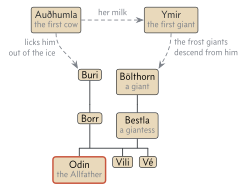
Look at the family tree (Figure 1.7) and notice what it means. Odin’s mother was a giantess, and his grandfather Buri was licked out of the ice by the same cow that fed the first giant. So the chief of the gods was half giant, and gods and giants were kin from the start. Through all the stories that follow they will marry one another, feast together, trick one another, and kill one another, until the end of the world.
The making of the world and of the dwarves
What happened next was a killing. Snorri gives no reason for it; he has said only that Ymir and his kin were evil. Odin and his brothers killed Ymir,Odin and his brothers killed this figure, whose blood flooded the world. → Ymir•Odin and his brothers killed this figure and made the world from his body. → Ymir••• and so much blood gushed from his wounds that it flooded everything and drowned the frost giants; then, out of the body, the three brothers built the world. One giant escaped the flood. His name was Bergelmir (ber-gel-meer), and he got away with his wife on something Snorri calls a lúðr, a word that seems to mean a mill frame or a box, though translators usually make it a boat. Every later giant descends from that couple, and they had good reason to hate the gods. In Vafþrúðnismál, Bergelmir is the oldest thing the wise giant can remember. Bellows translates: “This first knew I well, when the giant wise / In a boat of old was borne.” The poems agree that the world was made from Ymir’s body, but only Snorri tells of the killing and the flood. Like Noah in Genesis (Vol. 5, In the Beginning) and Deucalion and Pyrrha in Greek myth (Vol. 4, Classical Myth), Bergelmir and his wife ride out a flood, but this flood was blood.
Then the brothers carried the body into the middle of Ginnungagap and took it apart (Table 1.1). From Ymir’s flesh they made the earth, and from his blood the sea and the lakes, which they laid in a ring around the land. Seen from above, Snorri’s world is a round disk of land with the ocean in a ring around it, and along the far shore of that ocean the gods gave the giants land to live in. His bones became mountains and crags, and his teeth, with the broken bits of bone, became rocks and gravel. His skull they raised up over the earth as the sky. His brains they threw into the air as clouds. Grímnismál and Vafþrúðnismál, two poems of the Poetic Edda, give much the same list in verse, and Grímnismál adds one more: the trees came from his hair. People who lived on stony coasts, where rock pokes through thin soil like bone through skin, could look around and see the old giant everywhere.
Poets did exactly that. In Skáldskaparmál, Bragi teaches that the sky may be called “Skull of Ymir” or, for the four dwarves who hold it up, “Burden of the Dwarves,” the earth “Flesh of Ymir,” and the sea “Ymir’s Blood.” He quotes an eleventh-century skald, Arnórr (ar-nohr) the Earls’ Poet, praising a young prince who gave the richest gifts ever given “’Neath the ancient Skull of Ymir,” that is, anywhere under the sky. A listener who knew the creation story heard the whole picture in three words. One who did not heard nonsense, and that is the gap Snorri’s book was written to fill.
| Part | Became | Told by |
|---|---|---|
| flesh | the earth | Snorri and both poems |
| blood | the sea and the lakes | Snorri and both poems |
| bones | mountains and crags | Snorri and both poems |
| teeth, broken bones | rocks and gravel | Snorri |
| skull | the sky, held up by four dwarves | Snorri and both poems (the dwarves only in Snorri) |
| brains | the clouds | Snorri and Grímnismál |
| eyebrows | the wall around Midgard | Snorri and Grímnismál |
| hair | the trees | Grímnismál, in a verse Snorri quotes |
The sky had four corners, and under each one the gods set a dwarf to hold it up. Their names were Austri, Vestri, Nordri, and Sudri, which mean East, West, North, and South, the four cardinal directions. These four dwarves named for the directionsFour of these beings named for the cardinal directions hold up the sky. → dwarves•• have held up the sky ever since, Snorri says. Then the gods took the sparks and embers that had flown out of Muspelheim and set them in the sky to light heaven and earth. They gave each light its place and its path, even the ones that wandered free across the sky, which may be the planets, and from them, Snorri says, the days and the years have been counted. Before that, the Völuspá says, the sun had no idea where her home should be, and in Bellows’s translation “The moon knew not what might was his, / The stars knew not where their stations were.”
Where did the dwarves come from? Snorri says the gods sat in judgment and remembered how the dwarves had come to life. They first formed as maggots in Ymir’s flesh,In Snorri’s account, these beings first form as maggots in Ymir’s flesh. → dwarves•• the way maggots come to life in meat, and that flesh was now the earth. By the gods’ decree they gained human minds and the shape of men, but they still live in the earth and in stones. The Völuspá tells it differently: the gods held council to decide who should make the race of dwarves out of Brimir’s blood and Blain’s legs, as Bellows translates it; these may be two more names for Ymir. The first of them, the poem says, was Motsognir, “the mightiest made,” and Durin (doo-rin) came next. Then the poem lists the dwarves by name, more than sixty of them. Bellows and other editors think a later poet inserted this long catalog, and the list will sound familiar to some readers: Durin, Dvalinn (dvah-lin), Thorin, Fili, Kili, Bombur, Nori, and even Gandalf. J. R. R. Tolkien took the names of the dwarves in The Hobbit (1937), and his wizard’s, from this poem (Vol. 21, Trenches and Modernists). The dwarves as a people, the gods’ master smiths, belong to Chapter 5.
One more thing came from Ymir’s body. Around the inner part of the earth, where people would live, the gods built a wall out of his eyebrows to keep the giants out. The land inside it they called Midgard, “the middle enclosure,” the world of men at the center of the diagram in the Stage. Old English had the same word, middangeard, for the world people live in, and from its Middle English form Tolkien took his “Middle-earth.” Now the world had a shape, but nobody lived in the middle of it.
Ask and Embla
“Whence come the men that people the world?” Gylfi asks next. High tells him that the sons of Borr were walking along the shore of the sea when they found two trees. In Snorri’s telling, Odin and his brothers made humans from trees,This figure gives life and breath to Ask and Embla, the first humans. → Odin••Odin, Vili, and Vé performed this action using trees that became Ask and Embla. → creation of humans•The first Norse human pair, Ask and Embla, was created from two of these things. → trees•• and the first of them gave the two new beings breath and life. Snorri does not name him here, but when he listed the sons of Borr he named Odin first, so readers take the first giver to be Odin. Brodeur’s translation lists all three gifts: “the first gave them spirit and life; the second, wit and feeling; the third, form, speech, hearing, and sight.” The Old Norse word for the first gift is önd, which means both breath and spirit, as the Latin word spiritus does.
The brothers gave the pair clothes and names. The man was Ask and the woman Embla (em-blah), and from them, Snorri says, all mankind descends. The names themselves may be the names of trees. Askr is the Old Norse word for an ash tree, and Embla may mean an elm or a vine; nobody is sure. Their new home was Midgard, inside the wall of Ymir’s eyebrows, and from then on humans were the people of Midgard,These beings are the primary inhabitants of Midgard. → humans•• the middle world between the gods above and the giants beyond the wall. Next, Snorri says, the gods built themselves a stronghold in the middle of the world, Asgard, the subject of Chapter 4. He adds, true to his Prologue, that “men call it Troy.”
The Völuspá tells the story differently, and the two versions should not be merged. In the poem three gods, Odin, Hœnir (hur-neer), and Lóðurr (loh-thur), come from their home and find on the land two beings “without fate,” “Ask and Embla, empty of might.” Bellows translates the next stanza, in which he spells the gods’ names in his own way:
Hœnir is a quiet god who turns up in a few stories at Odin’s side (Chapter 2, Chapter 3). Lóðurr is a mystery, and Bellows, like some other scholars, thought he might be Loki under an older name. The poem does not say that Ask and Embla were trees, though their names suggest it. Both versions agree that the first gift was the breath or spirit, and the poem says outright what Snorri’s order implies, that it came from Odin (Table 1.2).
| Snorri, Gylfaginning | Völuspá |
|---|---|
| the sons of Borr, finding two trees on the shore | three gods, finding Ask and Embla on the land |
| first (presumably Odin): spirit and life | Odin: soul (önd) |
| second: wit and feeling | Hœnir: sense |
| third: form, speech, hearing, and sight | Lóðurr: heat and goodly hue |
Other peoples told of the first humans in other ways. In Greek myth Prometheus shaped them from clay (Vol. 4, Classical Myth), and in Genesis God formed Adam from the dust of the ground (Vol. 5, In the Beginning). In the north, people began as two pieces of wood lying on a beach, until the gods breathed into them. The story has a mirror at the other end of time: when this world ends, a new first couple will come out of hiding in a wood to people the next one (Chapter 9).
Sun, moon, and wolves
The sparks of Muspelheim now lit the sky, but somebody had to drive them. Snorri tells of a man named Mundilfari (mun-dil-vah-ree) who had two children so beautiful that he named his daughter Sól (sohl), which means “Sun,” and his son Máni (mah-nee), “Moon.” He married his daughter to a man named Glenr. The gods were angry at the father’s pride, and they took the brother and sister up into the sky. Máni was set to steer the moon and decide its waxing and waning. Sól was set to drive the horses that pull the chariot of the sun, which the gods had made out of Muspelheim’s glowing sparks. In Old Norse, as in German, the sun is a woman and the moon a man. Máni did not travel alone for long. He snatched two children, Bil and Hjúki (hyoo-kee), as they walked from a well carrying a pail on a pole between them, and they follow him still, Snorri says, “as may be seen from the earth.”
The sun’s two horses are named Arvakr (ar-vah-ker) and Alsvidr (als-vih-ther), in Old Norse Árvakr and Alsviðr, which mean “early waker” and “very swift.” Every day Arvakr and Alsvidr pull the sunArvakr and Alsvidr pull this celestial body’s chariot in Norse myth. → the Sun• across the sky. Hauling so much fire is hot work, and the gods set bellows under the horses’ shoulders to cool them, which, Snorri adds, some old records call “iron-coolness.”

The idea of a horse drawing the sun across the sky is far older than Snorri. In 1902, in a peat bog on Zealand, the island Gefjun’s oxen dragged out of Sweden in Snorri’s story, a small bronze horse on wheels came to light, pulling a disk that is gilded on one side and plain on the other. Archaeologists date it to about 1400 BC, some 2,600 years before Snorri wrote. Some of them have suggested that the bright side showed the sun’s journey by day and the dark side its return by night. Whether any memory of such a belief lasted into the Viking Age, nobody can say, but the people of the Bronze Age north had already pictured the sun as something a horse must pull.
Grímnismál adds something Snorri leaves out. Between Sól and the earth stands a shield called SvalinnIn Norse mythology, one of these things named Svalinn is located in front of Sol. → shields•• (svah-lin), “the cooling one,” to keep the sun’s heat from setting the world on fire. In Bellows’s translation the poem says: “In front of the sun does Svalin stand, / The shield for the shining god; / Mountains and sea would be set in flames / If it fell from before the sun.” Bellows notes only one other mention of this shield in all the old poems.
Night and Day have horses too. Night, a dark giantess, rides first, behind a horse named Frosty-Mane, and each morning the foam from his bit falls on the earth as dew. Her son Day follows with Sheen-Mane, whose mane lights all the air and the earth.

Gylfi notices something about the sun. “The sun fares swiftly,” he says, “and almost as if she were afraid.” High replies that it is no wonder, since the one hunting her is close behind and her only escape is to run. Two wolves are in the chase: Sköll (skohl) pursues the sun, and Hati (hah-tee) the moon.Sköll pursues this celestial body in Norse myth. → the Sun•Two of these animals named Skoll and Hati chase the sun and moon across the sky. → wolf••• Sköll will one day catch her, Snorri says. Hati runs ahead of her and wants to seize the moon. The wolves were born of an old giantess who lives in a forest called Ironwood, east of Midgard, and gives birth to giants in the shape of wolves. The Völuspá sees her there, in Bellows’s words: “The giantess old in Ironwood sat, / In the east, and bore the brood of Fenrir.” Fenrir (fen-reer) is the greatest wolf of all, whose story belongs to Chapter 5. The mightiest of her brood, Snorri says, is one called the Moon-Hound, perhaps Hati under another name, who will one day swallow the moon and spatter the heavens with blood (Chapter 9). Iceland itself has never had wild wolves; the wolves of these stories came over with the tales from Norway. Day after day the sun and moon run their courses with the wolves behind them, and the Norse knew how the chase would end.
Yggdrasil
“Where is the chief abode or holy place of the gods?” Gylfi asks. High answers that it is at Yggdrasil, an ash tree,Yggdrasil is an ash variety of these plants. → trees••• the greatest and best of all trees, where the gods meet every day to give judgment. The ash is a tall, straight tree of northern Europe, with gray bark and tough, springy wood that the Norse used for spear shafts. Its branches, Snorri says, spread out over the whole world and reach above the sky.
The seeress of the Völuspá remembers “Nine worlds I knew, the nine in the tree / With mighty roots beneath the mold,” as Bellows translates her. No Norse text lists the nine in one place. Modern handbooks gather them from many passages, and the Stage drew them: Asgard of the gods, Vanaheim of the Vanir, Alfheim of the elves, Midgard of men, Jotunheim of the giants, Svartalfheim of the dark elves, Muspelheim, Niflheim, and Hel. However they are counted, the tree joins the nine worlds,This tree connects the nine worlds of Norse mythology. → Yggdrasil••• its roots in the deepest of them and its branches over the highest.
The tree’s name is a puzzle with a likely answer. One of Odin’s many names is Ygg (ig), “the Terrible,” and drasill is a poetic word for a horse, so Yggdrasil means “Odin’s horse,”This tree's name translates to "Odin's horse." → Yggdrasil• as most scholars read it. Why should a tree be a horse? In the language of kennings a gallows, where a hanged man “rides,” could be called the horse of the hanged. The Hávamál tells how Odin once hung on a windswept tree for nine nights to win wisdom (Chapter 2), and the world tree may be named for that sacrifice. Scholars still argue about it.
A real tree may stand behind the myth. About 1075 Adam of Bremen, a German churchman writing a history of the archbishops of Hamburg, described the great temple of the old gods at Uppsala, in Sweden, from the reports of travelers. Beside it, he wrote, grew a huge tree with spreading branches that stayed green winter and summer, and by the tree was a spring where sacrifices were made. Adam never saw the place, and historians doubt parts of his account. Still, an evergreen tree beside a holy well is just what the Völuspá describes.

Three roots hold the tree up, and under them lie three waters (Figure 1.10). Snorri sets the wells of Urd (oord) and Mímir (mee-meer) and HvergelmirThe wells of Urd and Mimir and the spring Hvergelmir lie beneath the roots of this tree. → Yggdrasil••• under them, one to a root. One root runs to the gods, and beneath it, in heaven, is the holy Well of Urd. Another runs to the frost giants, where Ginnungagap used to be, and beneath it is the well of Mímir, “wherein wisdom and understanding are stored.” Its keeper, Mímir, drinks from it out of a horn and knows the ancient lore; Odin gave one of his eyes for a single drink from it (Chapter 2). The third root stands over Niflheim, and under it is Hvergelmir, the same spring from which the eleven rivers of the beginning flowed. Each day the gods ride to the Well of Urd over the rainbow bridge Bifröst to hold their court (Chapter 4).
Down in Hvergelmir, among more snakes than any tongue can count, lives the serpent Nidhogg (need-hog), who gnaws the root from below.Nidhogg gnaws at the roots of this tree. → Yggdrasil•••One of these animals named Nidhoggr gnaws at the roots of Yggdrasil from its residence of Hvergelmir. → snakes• Nidhogg, in Old Norse Níðhöggr, means something like “the dread biter.” The sources call him both a serpent and a dragon. Grímnismál counts his companions with a joke, in Bellows’s words: “More serpents there are beneath the ash / Than an unwise ape would think,” and then names six of them. The last stanza of the Völuspá shows him rising up out of the dark, “Nithhogg flying from Nithafjoll,” with the bodies of dead men on his wings.
At the top of the tree sits an eagle who, Snorri says, “has understanding of many a thing,” and between his eyes perches a hawk named Vedrfölnir (veth-ur-ful-neer). The eagle and the dragon are enemies, one at the top of the world and one at the bottom. Up and down the trunk between them runs the squirrel Ratatoskr (rah-tah-tos-ker), carrying insultsThe squirrel Ratatoskr carries messages between an eagle and Nidhogg on this tree. → Yggdrasil••• from one to the other. Ratatoskr, whose name may mean “drill-tooth,” is the tree’s messenger and its gossip, and he keeps their quarrel alive. An Icelandic artist of about 1680 drew him bright green, climbing toward the eagle with his message, and labeled every creature on the tree with its name (Figure 1.11).


Elsewhere in the branches four stags, or male deer, bite the leaves.The four stags Dainn, Dvalinn, Duneyrr, and Durathror feed on this tree. → Yggdrasil••Four of these animals eat from the branches of Yggdrasil. → deer•• Their names are Dáinn (dah-in), Dvalinn, Duneyrr (doon-ay-ur), and Durathrór (doo-rah-throhr). Two of them share their names with dwarves in the Völuspá’s list. Nobody knows what the four stags meant to the poets, and Bellows suspected that a later poet had multiplied a single stag into four.
Near the Well of Urd stands a fair hall, and out of it come three maidens called Urd, Verthandi (ver-thahn-dee), and Skuld (skoold). They are the Norns, who decide how long each person will live; Bellows, like many scholars, explains their names as “Past,” “Present,” and “Future.” In the Völuspá they carve fates on wood, and “Laws they made there, and life allotted / To the sons of men, and set their fates,” and in another Eddic poem they weave “the web of fate” for a newborn hero. Gylfi objects that the Norns share out lives very unevenly, giving some people wealth and fame and others little. High’s answer is that there are many norns, some of the gods’ kin, some of the elves’, and some of the dwarves’; good norns give good lives, and evil norns bad ones.
The three great Norns have a daily task. Every day the Norns water the tree,The Norns—Urd, Verthandi, and Skuld—tend this tree with water and earth from the Well of Urd. → Yggdrasil•• sprinkling it with water from the Well of Urd and with the white clay that lies around it, so that its limbs will not wither or rot. The water is so holy, Snorri says, that anything that falls into the well turns white, like the thin skin inside an eggshell. Two swans feed there, and all the swans in the world come from them. The Völuspá knows the tree the same way, “With water white is the great tree wet,” and adds that it is evergreen: “Green by Urth’s well does it ever grow.” The dew that drips from its leaves, Snorri says, is what people call honeydew, and the bees feed on it.

Even so, the tree suffers. Two stanzas of Grímnismál, set far apart in the poem, describe it, both spoken by Odin while he is held between the fires. One calls it the finest of its kind, “The best of trees must Yggdrasil be,” in Bellows’s words. The other says that “Yggdrasil’s ash great evil suffers, / Far more than men do know,” since a stag bites its top, its trunk is rotting, and Nidhogg gnaws beneath. A modern translation gives that second line as “agony more than men know,” and retellings join the two stanzas into one picture: the noblest of trees, in agony.In Grímnismál, this tree is called the noblest of trees but suffers “agony more than men know.” → Yggdrasil•• The tree that holds the worlds together is being eaten from below and above, and it rots in the middle.
That is how things stand when the gods move in. The world has been built from a dead giant, its lights race across a sky with wolves behind them, and the great ash is green but wounded. At the end of the world, the Völuspá says, Yggdrasil will shake (Chapter 9).
What to remember
- Snorri Sturluson (1179–1241), an Icelandic chieftain and lawspeaker, wrote the Prose Edda about 1220 as a handbook for poets: Gylfaginning (Gylfi, as Gangleri, questions High, Just-as-High, and Third), Skáldskaparmál (Ægir and Bragi on kennings), and Háttatal (meters). He also wrote Heimskringla (about 1230), which opens with the Ynglinga saga.
- The Poetic Edda is a set of older anonymous poems, among them the Völuspá, Hávamál, Grímnismál, Vafþrúðnismál, and Lokasenna, kept in the Codex Regius (about 1270), found in 1643 and returned to Iceland in 1971. Saxo Grammaticus told the gods as history in Latin in his Gesta Danorum.
- Iceland became Christian in 1000, so the myths were written down by Christians two centuries or more after the old religion ended.
- In the beginning was Ginnungagap, the yawning gap, between fiery Muspelheim in the south and misty Niflheim in the north, where eleven rivers flow from the spring Hvergelmir; modern retellings call them the Élivágar.
- Ymir, the first frost giant, formed from melting poison where heat met ice; the cow Auðhumla fed him with her milk and licked Buri out of salty ice. Buri’s son Borr and the giantess Bestla had Odin, Vili, and Vé.
- Odin and his brothers killed Ymir, drowned the frost giants in his blood (all but Bergelmir), and made the world from his body. Dwarves formed as maggots in his flesh, and four dwarves named for the directions hold up his skull, the sky.
- The first humans, Ask and Embla, were made from two trees; Odin gave them breath and life, and they lived in Midgard.
- Sól drives the sun’s chariot, pulled by Arvakr and Alsvidr, behind the shield Svalinn; the wolf Sköll chases the sun and Hati the moon.
- Yggdrasil, the ash whose name means “Odin’s horse,” joins the nine worlds. Under its roots lie the Well of Urd, Mímir’s well, and Hvergelmir; the Norns water it, Nidhogg gnaws it, Ratatoskr runs between Nidhogg and the eagle, and four stags bite its leaves.
Chapter 2 · 44 clues
Odin, Frigg, and the Mead of Poetry
Once a week, every speaker of English says the name of a northern god. Wednesday was Wōdnesdæg (wohd-nes-dag) in Old English, “Woden’s day,” and Woden was the god whom the Norse called Odin, in Old Norse Óðinn, and the Germans Wodan. The Romans had given the same day of their week to Mercury, the quick-witted messenger who led the souls of the dead (Vol. 4, Classical Myth), and French still calls it mercredi. When the Germanic peoples, whose languages include English, German, and the tongues of Scandinavia, took over the Roman seven-day week, they put their own gods in the places of most of the Roman ones. For Mercury’s day they chose Woden, the traveler and guide of the dead.
The match was only half right. About 1075 the German churchman Adam of Bremen, describing the great temple of the Swedes at Uppsala from travelers’ reports (Chapter 1), explained the god’s name in four Latin words: Wodan, id est furor, “Wodan, that is, fury.” He was close to the truth. The Old Norse word óðr meant “raging” or “frantic,” and the same word, as a noun, meant “mind” and “poetry.” Odin was a god of battle and of the dead, of magic and of hanged men, and of wisdom and verse. The stories say he paid for what he knew with an eye, with nine nights on a tree, and with a theft. His wife, they add, knew the fate of every man, and never told.
Aesir and Vanir
The Norse sources speak of two families of gods, whose homes the stage placed at the top of the world tree (the Stage). The Aesir, in Old Norse Æsir, were Odin’s family, and they lived in the stronghold of Asgard. The Vanir were gods of fertility and wealth, of good harvests and a calm sea, and their chiefs were Njord and his children Freyr and Freyja, whose home was Vanaheim. In the stories the two families end up living together in Asgard, and Snorri often counts the Vanir among the Aesir. They got there by way of a war.
The oldest account is a few stanzas of the Völuspá, “the prophecy of the seeress,” the poem that opens the Poetic Edda (Chapter 1). Its speaker begins the story, in Henry Adams Bellows’s translation of 1923, “The war I remember, the first in the world.” It starts when the gods, for a reason the poem does not give, strike a woman named Gullveig (gool-vayg), “Gold-Might,” with spears and burn her in Odin’s hall, three times, and three times she is born again. Then comes the first battle: “On the host his spear did Othin hurl, / Then in the world did war first come; / The wall that girdled the gods was broken.” Bellows spells the god “Othin,” because the Old Norse letter ð sounds like the th in “this” (the Stage). The poem never says how the war ended.
Snorri Sturluson, the Icelandic chieftain who wrote down most of the myths about 1220 (Chapter 1), told the war twice. The first telling comes near the start of the Ynglinga saga, the first part of Heimskringla, his history of the kings of Norway, written about 1230. There Snorri tells the gods’ story as if they had been men. Odin was a great chief from “Asaland,” in Asia, who led an army against the people of Vanaland. The Vanir defended themselves well, and the two sides ravaged each other’s lands until both were tired of it. Then they met, made a truce, and exchanged hostages.
A hostage was a person handed over to the other side as a living guarantee of a promise. If the promise was kept, a hostage of high rank was treated as an honored guest; if it was broken, he could pay with his life. The Vanir sent their best men, Njord the Rich and his son Freyr, whose stories fill Chapter 3. In this saga they also sent the wisest man among them, Kvasir (kvah-seer), who will matter later in this chapter. The Aesir sent Hœnir, a tall and handsome man whom they thought fit to be a chief, and with him Mímir, in Samuel Laing’s translation of 1844 “a man of great understanding.”
The Vanir made Hœnir a chief at once, and all went well while Mímir stood at his elbow. But whenever Hœnir had to settle a hard case without him, he gave the same answer: “Now let others give their advice.” The Vanir decided they had been cheated in the exchange. They seized Mímir, cut off his head, and sent the head back to the Aesir.
Odin did not bury it. Snorri says that he “smeared it with herbs so that it should not rot, and sang incantations over it,” and so gave it the power to speak. From then on Odin kept Mímir’s head and consulted it,Odin preserved this figure’s severed head and consulted it for advice. → Mímir•• and it “discovered to him many secrets.” Later in the same saga Odin carries the head with him, and it tells him the news from other countries. The Völuspá keeps the same picture for the end of the world: as the last battle draws near, “To the head of Mim does Othin give heed” (Chapter 9).

Snorri told the peace a second time in Skáldskaparmál, the part of his Prose Edda in which Bragi, the god of poetry, explains the language of poets to the sea giant Ægir (Chapter 1). There the war is only “a dispute,” and the peace is sealed in a stranger way. Both sides went to a vat and spat into it. The gods would not let this token of peace go to waste, so they shaped a man out of it. His name was Kvasir, and he was so wise that no one could ask him a question he could not answer (Figure 2.1). The Austrian scholar Rudolf Simek has pointed out that in some ancient cultures people chewed berries together and spat them into one container to start a brew, so the gods’ vat may be the first step in making a drink.
Snorri never says how his two versions fit together. In one, Kvasir is the wisest of the Vanir, handed over as a hostage; in the other, he is made from the spittle of both families at once. Either way, the war ended with the two families joined. Njord and Freyr stayed in Asgard, and Freyja came with them (Chapter 3).
The Allfather
Odin was met in the cast of the gods (the Stage), and his family runs through his mother into the race of giants. His mother, Bestla, was the daughter of Bölthorn,One of these beings, Bestla, was the daughter of Bölthorn. → giants• a giant descended from Ymir, as the family tree of the first beings shows (Chapter 1). The Hávamál, a poem spoken in Odin’s own voice, even remembers her brother, Odin’s uncle, though it never gives his name. From “the son of Bolthorn, Bestla’s father,” Odin says, he learned “nine mighty songs.” On his father’s side the line ran back to Buri, whom the cow Auðhumla licked out of a block of salty ice (Chapter 1).
Buri’s son was Borr, who married Bestla, and they had three sons. Snorri names them in Gylfaginning, in Arthur Gilchrist Brodeur’s translation of 1916: “one was Odin, the second Vili, the third Vé.” Odin was the brother of Vili and Vé,A son of Borr and Bestla, this figure is the brother of Vili and Vé. → Odin••• the sons of Borr and Bestla, and the three of them killed the giant Ymir and built the world out of his body (Chapter 1). After that the two younger brothers almost vanish from the stories.
The three brothers did not rule as equals. In Brodeur’s translation of Snorri’s Prose Edda, one of the speakers of Gylfaginning says: “Odin is highest and eldest of the Æsir: he rules all things, and mighty as are the other gods, they all serve him as children obey a father.” Odin led the Aesir as their chief:This figure leads the Aesir and is the chief god of Norse mythology. → Odin••• he sat first in their councils and gave out their tasks, and it was Odin who would send Loki’s daughter Hel to rule the dead (Chapter 5).
He had more names than any other god, and the commonest is the Allfather, in Old Norse Alföðr (ahl-fur-thur). Snorri explains it twice. Odin is called Allfather,This figure is known as the Allfather. → Odin••• his speaker says, “because he is father of all the gods,” and elsewhere, because he is father “of all the gods and of men.” The first is not quite true, since Odin’s own brothers were not his children, but many gods were. Snorri adds that Odin is also called Father of the Slain, because all who fall in battle become his adopted sons and go to his hall, Valhalla (val-hal-uh), “the Hall of the Slain” (Chapter 4).
His eldest son was the strongest. In Gylfaginning, Odin’s first son was born to Jörd (yurth), the Earth, “which is Ása-Thor,” Thor of the Aesir. Odin was the father of Thor,This figure is the father of Thor. → Odin•• the thunder god whose journeys among the giants fill Chapter 6. By his wife Frigg he had Baldr the bright and, most readers assume, the blind Höðr, whose story is told in Chapter 8, and two more sons who will avenge their kin: Víðarr (vee-thar), by the giantess Gríðr (gree-thur), and Váli (vah-lee), by Rind.
The names kept coming. The Eddic poem Grímnismál lists more than fifty in a few stanzas, and many of them describe him: Ygg, “the Terrible”; Hár (howr), “the High One”; Grímnir, “the Hooded”; Sithhott (sith-hot), “Broad-Hat”; Bileyg, “the Shifty-Eyed.” Snorri gives two reasons. Some names, his speaker says, came from his wanderings, when he traveled in disguise. Most came because “there being so many branches of tongues in the world, all peoples believed that it was needful for them to turn his name into their own tongue.” The English said Woden, the Germans Wodan, and the Lombards of Italy, as this chapter will show, Godan. The German form became Wotan, the god of Richard Wagner’s operas of the Ring (Vol. 19, Wagner and Verdi).

From one throne in Asgard, Odin could see everything. It was called Hlidskjalf (hlith-skyahlf), in Old Norse Hliðskjálf, and Snorri says that “when Allfather sat in the high-seat there, he looked out over the whole world and saw every man’s acts, and knew all things which he saw.” Odin surveys the worlds from Hlidskjalf,This figure surveys the worlds from his throne Hlidskjalf. → Odin•• and Frigg sometimes sits there beside him, as a story later in this chapter shows. For anyone else, climbing into it was trespassing, as Freyr learned to his cost (Chapter 3).
When he was away from the high seat, his birds were his eyes. Snorri says that two ravens sit on Odin’s shoulders and say into his ear all the news they see or hear. He sends them out at daybreak to fly over the whole world, and they come back by the mid-morning meal. Their names are Huginn (hoo-gin), “Thought,” and Muninn (moo-nin), “Memory,” and because the ravens Huginn and Muninn bring him news,This figure’s ravens Huginn and Muninn bring him news from around the world. → Odin•••Huginn and Muninn are two of these animals owned by Odin. → ravens••• the poets called Odin the Raven-God (Figure 2.2). In the Grímnismál he worries about them, in Bellows’s words: “For Hugin I fear lest he come not home, / But for Munin my care is more.”
Ravens were a fitting bird for a god of war, since they gathered wherever men lay dead on a battlefield, and a Norse poet could call a warrior a “Raven-Feeder.” They have been sacred far beyond Scandinavia. On the other side of Asia lies Kamchatka (kam-chat-kuh), a long peninsula of volcanoes in the Russian Far East. There the Koryak and Itelmen (ee-tel-men) peoples tell of Kutkh (kootkh), a spirit in the form of a raven,Kutkh is a spirit in this animal’s form in Kamchatkan traditions. → ravens• who helped to make the world and plays tricks in it, much as Raven does in the tales of the peoples of North America’s Pacific coast.
Odin kept two beasts of the ground as well, the wolves Geri (geh-ree) and Freki (frek-ee), whose names both mean something like “greedy” or “ravenous.” At the feasts in Valhalla, Snorri says, Odin gives his food to Geri and Freki:This figure gives his food to his wolves Geri and Freki. → Odin•••Odin is accompanied by two of these animals named Geri and Freki. → wolf•• “that food which stands on his board he gives to two wolves which he has.” Wolves, like ravens, haunted the edges of battlefields, and the two together were the beasts of the slain.
He gave his meat away because he did not need it. Odin himself lives on wine alone:This figure consumes only wine. → Odin•• “wine is both food and drink to him,” Snorri says, and the Grímnismál agrees: “But on wine alone does the weapon-decked god, / Othin, forever live.” No vines grew in the north. Wine had to be shipped from the vineyards of the Franks, far to the south, and only kings and the very rich could pour it, while ordinary people drank ale and mead. A god who lived on wine dined like the richest king alive.
He rode the best horse in the world, Sleipnir. When Snorri lists the horses the gods ride each day to their court under the world tree, he puts it first: “Sleipnir is best, which Odin has; he has eight feet.” Each day Odin rides the eight-legged SleipnirThis figure rides the eight-legged horse Sleipnir. → Odin••• to that court, and the horse’s strange birth comes in Chapter 4. The eight legs may be a picture of speed, the way a cartoon draws a running dog with a blur of feet. Long before Snorri, carvers on the Baltic island of Gotland showed a rider on an eight-legged horse on several picture stones of the eighth and ninth centuries (Figure 2.3).
Two of Odin’s treasures were made for him by dwarves, and Chapter 5 will tell how. Odin’s spear was called Gungnir,This figure wields the spear Gungnir. → Odin•••Odin possessed one of these things called Gungnir. → spears•• “the Swaying One.” The Old Norse texts say surprisingly little about it. Snorri, telling how it was forged, says only that the spear “would never stop in its thrust,” and Odin carries it into the last battle at Ragnarök (rahg-nah-rurk), the doom of the gods at the end of the world (Chapter 9). The Völuspá’s spear, hurled over the Vanir host, is never named, though readers often take it to be the same weapon. Modern retellings give the spear a simpler power: Gungnir never misses its target.This weapon of Odin never misses its target. → Gungnir•• In Snorri, the weapon that never misses is Thor’s hammer (Chapter 6).
The other treasure was a ring of gold called Draupnir, “the Dripper.” A king in the north was praised as a “ring-giver,” because he paid his warriors in gold rings and arm-rings, and Odin’s ring made him the greatest ring-giver of all. Every ninth night it dropped eight ringsThis figure possesses the ring Draupnir, which makes eight copies of itself every nine nights. → Odin••• as heavy as itself: in Snorri’s words, “eight rings of the same weight would drop from it every ninth night.” He would one day lay it on his son Baldr’s funeral pyre (Chapter 8).

What Odin wanted most could not be owned. He wanted to know, and the sources tell of two prices he paid for knowledge.
The eye and the runes
One root of the world tree Yggdrasil reaches toward the land of the frost giants, and under it lies the well of Mímir (Chapter 1). Snorri says that “wisdom and understanding are stored” in its water, and that its keeper, Mímir, is full of ancient lore because he drinks from it out of a horn. “Thither came Allfather and craved one drink of the well; but he got it not until he had laid his eye in pledge.” A pledge is something of value left with another person as security for a debt, the way a pawnshop keeps a watch until the loan is repaid. Odin’s pledge was never redeemed. Odin gave an eye to drink from Mímir’s well,This figure sacrificed an eye to drink from Mimir’s well. → Odin••• and the eye stayed in the water.

The seeress of the Völuspá knows where. “I know where Othin’s eye is hidden,” she says, in Bellows’s translation, “Deep in the wide-famed well of Mimir; / Mead from the pledge of Othin each morn / Does Mimir drink.” The well’s keeper, in other words, drinks his morning mead out of the god’s eye, or out of the water where it lies. From then on Odin was the one-eyed god. In the stories that follow, a one-eyed old stranger is nearly always Odin in disguise.
The second price was paid on a tree, for the runes. Runes were the letters the Germanic peoples carved before they learned the Roman alphabet, made of straight strokes that are easy to cut in wood, bone, or stone. The runic alphabet is called the futhark (foo-thark), after the sounds of its first six letters, f, u, th, a, r, and k. Runes were in use by AD 150, and in the Viking Age the northern peoples wrote with a futhark of sixteen letters, cutting them into memorial stones for the dead (Chapter 18). Most runic writing is ordinary: names, owners, and short messages. But runes could also be carved as charms, and people believed that the right runes could heal, protect, or curse.
In the Hávamál, Odin tells in his own voice how he won them. Bellows numbers these two stanzas 139 and 140; most editions number them 138 and 139.
Odin was both the victim and the god who received him: he was offered “to Othin, myself to myself.” Real sacrifices may lie behind the scene. Adam of Bremen heard that at the temple of Uppsala a great festival was held every nine years, at which nine males of every kind of creature were sacrificed and their bodies hung in the sacred grove beside the temple. Elsewhere in the Hávamál, one of Odin’s charms is a rune that makes a hanged man on a tree come and talk to him. In the poems, the gallows and secret knowledge belong together.

The poem counts nine nights and never names the tree; it says only that no one knows where its roots run. The northern peoples counted time in nights, as English still does in the word “fortnight,” fourteen nights. Most readers, Bellows among them, take the windy tree to be Yggdrasil, whose name probably means “Ygg’s horse,” since Ygg is one of Odin’s names and a gallows could be called the horse a hanged man rides (Chapter 1). Modern retellings add the days to the nights: Odin hung on Yggdrasil nine days and nights,Wounded by a spear, this figure hung from Yggdrasil for nine nights to learn the runes. → Odin•••Odin hanged himself from this tree for nine days and nights to learn the runes. → Yggdrasil••Odin hangs from Yggdrasil for this many days and nights to learn the runes. → nine•• wounded by a spear, without food or drink, until he saw the runes, seized them screaming, and fell.
Nine is the north’s favorite number, and it runs through Odin’s whole story. In the myths there are nine worlds (the Stage), nine nights on the tree, nine songs learned from his giant uncle, a ring that drips on the ninth night, and, as the next section shows, nine servants dead in a hayfield. Adam’s festival at Uppsala came every nine years.
The poem that tells of the tree is named for Odin. The Hávamál is attributed to Odin:The poem Hávamál is attributed to this figure. → Odin•• its title means “the Sayings of the High One,” and Hár, the High One, is one of his names. It is a long poem, more than 160 stanzas, put together from several shorter ones. Much of it is plain advice for a traveler, spoken by a god who traveled a great deal: look around you before you walk into a strange hall, do not drink too much, and do not trust too quickly. One famous stanza says that cattle die and kinsmen die, “But a noble name will never die, / If good renown one gets.” Then come Odin’s own adventures, the runes, and a list of eighteen charms he knows. One of the adventures is a robbery.
The Mead of Poetry
Snorri tells the story in Skáldskaparmál, and he gives it to Bragi, the god of poetry. At a feast in Asgard the sea giant Ægir asks Bragi where the art of poetry came from, and Bragi begins with Kvasir, the wise man made from the gods’ spittle at the peace with the Vanir. Kvasir traveled up and down the earth, teaching men. One day he came, by invitation, to the house of two dwarves named Fjalar (fyah-lar) and Galar (gah-lar), who were brothers. They called him aside for a private talk, killed him, and let his blood run into three vessels, a kettle called Ódrerir (oh-threh-reer) and two vats called Bodn (bod-un) and Són (sohn). Then they mixed Kvasir’s blood with honey,These figures kill Kvasir and use his blood to make the Mead of Poetry. → Fjalar and Galar••The Mead of Poetry was made from this figure’s blood mixed with honey. → Kvasir•• and the blood became mead.
Mead is the drink that honey makes when it is mixed with water and left to ferment, and it was the feast-drink of the Viking Age. This mead was different. Whoever drank it, Snorri says, “becomes a skald or scholar.” Skalds were the court poets of the north, who praised kings in elaborate verse and were paid in gold (Chapter 1). The dwarves told the gods a lie, that Kvasir had “choked on his own shrewdness,” since no one was wise enough to ask him questions.
The dwarves were not finished. They invited a giant named Gilling (gil-ing) to visit them with his wife, and took him out rowing. Out at sea they rowed the boat into the breakers and turned it over. Gilling could not swim, and he drowned; the dwarves righted the boat and rowed home. When they told his wife, she wept so loudly that Fjalar lost patience. He asked whether it would comfort her to look out at the sea where Gilling died, and told his brother to climb above the doorway. A millstone is one of the two heavy, round stones that grind grain into flour, and as the widow walked out, Galar dropped a millstone on her head.These figures drown Gilling by overturning his boat, then kill his widow with a millstone. → Fjalar and Galar•• Now the brothers had a dangerous enemy.
Gilling’s son was the giant Suttung (soot-oong). He seized the dwarves, carried them out to sea, and left them on a reef that the rising tide would cover. With the water climbing, they begged for their lives and offered him the mead as payment for his father’s death. In northern law a killing could be settled with a payment to the dead man’s family, and Suttung accepted. He hid the mead inside a mountain called Hnitbjorg (hnit-byorg), with his daughter Gunnlod (goon-lod) to guard it (Figure 2.6).

The story explains a whole family of poets’ phrases. A kenning, the poets’ riddling name for a thing, such as “whale-road” for the sea (the Stage), could hide a whole story. Snorri lists the kennings for poetry that come from this tale: Kvasir’s Blood, the Dwarves’ Drink, the Dwarves’ Ship (because the mead carried them off the reef), and Suttung’s Mead. The phrases are older than Snorri. In the late tenth century an Icelandic skald named Einarr, nicknamed “Tinkling-Scale,” called on a Norwegian earl, a great lord under the king, to listen to his praise poem with the words, in Brodeur’s translation, “Hear, Earl, the Gore of Kvasir,” meaning “Hear my poem.”
Odin wanted the mead, and he set out for the land of the giants alone. He came first to a meadow where nine servants were mowing hay. He offered to sharpen their scythes, the long curved blades for cutting grass, took a whetstone, a sharpening stone, from his belt, and gave the blades such an edge that all nine wanted to buy it. He named a high price, and they all agreed to pay. So he tossed the stone up into the air. Every man grabbed for it with his scythe still in his hand, and each one cut another’s throat.
That night Odin asked for lodging with the farm’s owner, the giant Baugi (bow-ghee), who was Suttung’s brother. Baugi was moaning that his nine servants were dead and he had no one to bring in the harvest. The stranger said his name was Bolverk (bohl-verk), “Evil-Doer,” and offered to do the work of all nine men. For wages he wanted only a single drink of Suttung’s mead. Disguised as Bolverk, Odin worked for BaugiDisguised as Bolverk, this figure worked for Baugi after causing nine servants to kill one another over a whetstone. → Odin•• all summer, doing the work of the nine men he had killed.
When winter came, Bolverk asked for his pay. Baugi went with him to Suttung, but Suttung refused them a single drop. So Bolverk brought out an auger, a long tool for boring holes, called Rati (rah-tee), and told Baugi to drill into the mountain. After a while Baugi said he was through. Bolverk blew into the hole, and the chips flew back into his face, so he knew Baugi was trying to cheat him. Baugi drilled again, and this time the chips blew inward. Then Odin entered the mountain as a snakeThis figure entered a mountain as a snake through a hole drilled by Baugi to obtain the Mead of Poetry. → Odin•• through Baugi’s hole. Baugi stabbed after him from behind with the auger and missed, and the snake was gone into the rock.
Inside the mountain, in the dark, sat Gunnlod, keeping the kettle and the two vats for her father as she had been set to do. Odin spent three nights with Gunnlod,This figure spent three nights with Gunnlod to obtain the Mead of Poetry. → Odin•• and she promised him three drinks. With the first he drained Ódrerir, with the second Bodn, and with the third Són, and all the mead was inside him. The Hávamál tells this part in Odin’s own voice, and it is the one place where the god sounds ashamed. “Gunnloth gave on a golden stool / A drink of the marvelous mead,” he says in Bellows’s translation; “A harsh reward did I let her have / For her heroic heart.” The poem says he had sworn an oath on his ring and broken it: “Who now his troth shall trust?” A troth is a pledged word.

Getting out was harder than getting in. Odin escaped in the shape of an eagleThis figure transformed into an eagle to escape after stealing the Mead of Poetry. → Odin•• and flew for Asgard as fast as he could. Suttung saw the eagle’s flight and took an eagle’s shape to follow. When the Aesir saw the two birds coming, they set out vats in the courtyard. Odin swooped in and spat the mead into them. But Suttung was so close behind him that Odin sent some of the mead out backward. No one bothered to gather that part up. Anyone who wants it may have it, says Snorri, and it is called “the poetaster’s part,” the share of bad poets (Figure 2.7).
Odin had stolen the Mead of Poetry,This figure stole the Mead of Poetry. → Odin••• and he gave it to the Aesir and to the men who know how to make verse. So, Snorri says, poets called poetry “Odin’s Booty and Find, and his Drink and Gift.” The theft cost nine men their lives and Odin his oath, and it left Gunnlod alone in the mountain: “And Gunnloth to grief he left,” says the Hávamál. For centuries afterward, whenever a skald in Norway or Iceland called his verse “Odin’s booty,” a listener who knew the story heard all of it.
Odin the wanderer
In the stories Odin seldom comes as a king in armor. He comes as a stranger: a tall old man in a wide-brimmed hat and a dark cloak, leaning on a staff, with one eye shadowed. His names say so. He is Gangleri, “the Wanderer,” and Grímnir, “the Hooded One.” Poets and painters have drawn him that way ever since (Figure 2.8).

The best story of the wandering god is the Grímnismál, “the Sayings of Grímnir,” which the manuscripts introduce with a long passage of prose. A king had two sons, Agnar (ag-nar), ten years old, and Geirroth (gayr-roth), eight. One day the boys rowed out to fish, and a storm drove them onto a strange shore, where a poor farmer and his wife took them in for the winter. The wife fostered Agnar, and the farmer fostered Geirroth and taught him wisdom. When spring came, the farmer took Geirroth aside and whispered to him. As the boat reached their father’s landing, Geirroth leaped ashore, pushed the boat back out to sea with his brother in it, and shouted, “Go thou now where evil may have thee!” Their father had died, and Geirroth became king.
The farmer and his wife were Odin and Frigg. Years later, the two sat in Hlidskjalf looking over the worlds, and Odin boasted. Frigg’s fosterling, he said, was raising children with a giantess in a cave, while his own was a king. Frigg answered that Geirroth was so stingy that he tortured his guests when too many came. Odin called that the greatest of lies, and they made a bet. Frigg then sent her maid Fulla (fool-lah) to warn King Geirroth that a magician had come to his land, and that he would know the man because no dog would attack him.
The slander was false, but the warning worked. A stranger in a dark-blue cloak arrived, the dogs would not touch him, and he would say only that his name was Grímnir. So the king had him tortured to make him talk, and set him between two fires, and for eight nights the stranger sat between them, without food or drink. Only the king’s young son, who was named Agnar after his lost uncle, took pity on him and brought him a full horn to drink (Figure 2.9).
Then the stranger spoke, and the poem is his speech. With his cloak burning on his back, he describes the halls of the gods, the world tree, the horses, and the rivers, and at last his own names, until he declares who he is: “Now am I Othin, Ygg was I once.” King Geirroth was sitting with his sword half drawn across his knees. He jumped up to pull Odin from the fire, but the sword slipped from his hand and fell hilt down, and Geirroth fell on his own sword,Geirroth tortured this figure between two fires before falling on his own sword. → Odin•• which ran him through. The boy Agnar ruled long afterward. (This King Geirroth is not Geirrod (gayr-rod), the giant whom Thor visits, Chapter 6.)
Sometimes the wanderer came to ask questions. In the Völuspá the speaker is a völva, a seeress (Chapter 1), one of the wise women who traveled from farm to farm in the north and were paid to foretell the future. She begins, in Bellows’s words, “Thou wilt, Valfather, that well I relate / Old tales I remember of men long ago,” and Valfather, “Father of the Slain,” is Odin. She remembers the giants who fed her long ago. The seeress tells Odin of creation and the end:A völva tells this figure about the creation and coming end of the world in the Völuspá. → Odin•• of Ymir and the making of the world (Chapter 1), of the first war, of Baldr’s death, of Ragnarök and the green world rising after it (Chapter 9). Again and again she taunts her listener with the same question: “would you know yet more?” She knows his secrets, even the hiding place of his eye.

Snorri himself wrote one more disguise for Odin. His Gylfaginning, “the tricking of Gylfi,” begins when a Swedish king named Gylfi goes to Asgard disguised as a traveler called Gangleri, and finds three men on three high seats, one above another (Chapter 1). They are called High, Just-as-High, and Third, in Old Norse Hár, Jafnhár (yahfn-howr), and Þriði (thrith-ee), and they answer all his questions about the gods. Snorri never says outright who they are. But High, Just-as-High, and Third are Odin’s names:High, Just-as-High, and Third, the speakers in Gylfaginning, bear names of this figure. → Odin•• all three appear in the list of his names in the Grímnismál, and when Third himself recites that list for Gylfi, he speaks his own name and his companions’ among Odin’s. The joke runs deeper still, because “Gangleri,” the name Gylfi chose as a disguise, is one of Odin’s names too.
Frigg and her attendants
Frigg was Odin’s wifeThis figure is the wife of Odin. → Frigga••This figure is married to Frigg. → Odin•• in every source that tells of them both, and the first of the goddesses; English books often call her Frigga. Snorri says that the race of the Aesir descends from her and Odin, and he gives her a single great power: “she knows all the fates of men, though she speaks no prophecy.” English speakers still name a day for her. Friday was Frīgedæg (free-yeh-dag), “Frig’s day,” the Germanic name for the Roman day of Venus, which French still calls vendredi.
Her home was a hall of her own. Frigg’s hall was called FensalirThis figure's hall is called Fensalir. → Frigga•• (fen-sah-leer), a name that probably means “Fen Halls,” halls in the marshes, and Snorri says only that “it is most glorious.” The Völuspá remembers it in grief: “But in Fensalir did Frigg weep sore,” it says, for the death of her son Baldr (Chapter 8).


Snorri lists the goddesses, the Ásynjur (ah-sin-yur), one by one, and several of them serve Frigg. The fifth is Fulla, a maiden who wears her hair loose with a gold band around her head. In Brodeur’s translation, “she bears the ashen coffer of Frigg, and has charge over her footgear, and knows her secret counsel.” A coffer is a chest or box, and Frigg’s was made of ash wood. Fulla carries Frigg’s box and tends her shoes,This figure’s attendant Fulla carries her box and tends her footwear. → Frigga•• and she is the maid Frigg sent to King Geirroth in the Grímnismál. Poets knew her so well that one of their kennings for gold was “Snood of Fulla,” her headband.
The fourteenth goddess is Gná (gnah), Frigg’s messenger: “her Frigg sends into divers lands on her errands,” that is, into many different lands. Gná rides the horse HófvarpnirThis figure’s messenger Gná rides the horse Hófvarpnir. → Frigga•• (hohv-varp-neer), “Hoof-Tosser,” which runs over sky and sea. Once, Snorri says, some of the Vanir saw her riding through the air and called out to ask what was flying there. She answered in verse that she was not flying, but faring through the air on Hoof-Tosser.
The twelfth is Hlín (hleen), whose name means something like “protector.” Frigg sends Hlín to protect peopleThis figure sends Hlín to protect people from danger. → Frigga•• whom she wants saved: in Brodeur’s words, “she is established as keeper over those men whom Frigg desires to preserve from any danger.” The Völuspá also uses “Hlín” as a name for Frigg herself, when it calls Odin’s death at Ragnarök another blow to Hlín, so the protector may once have been Frigg under another name.
The eleventh, Syn (seen), is a goddess in her own right in Snorri: “she keeps the door in the hall, and locks it before those who should not go in,” and she defends people who are accused at trials. Snorri does not say whose hall she guards. Later retellings make Syn Frigg’s doorkeeper,In later retellings, Syn is this figure’s doorkeeper. → Frigga• standing at the door of Fensalir, and many modern books count her, with Fulla, Gná, and Hlín, among Frigg’s maidens.
Later retellings gave Frigg herself a new task too. Snorri gives her no craft of her own, though spinning was the work of every Norse housewife, and nineteenth-century pictures often set a distaff, the stick that holds wool for spinning, beside her throne. In books of Norse myths for young readers, such as H. A. Guerber’s Myths of the Norsemen of 1909, she sits at a spinning wheel in the sky, and in later retellings Frigg weaves the cloudsIn later retellings, this figure weaves clouds. → Frigga•• (Figure 2.10).
Saxo Grammaticus, the Danish historian whose Latin Gesta Danorum was finished about 1210 (Chapter 1), tells a very different Frigg. Saxo treats the gods as human sorcerers whom foolish people worshiped. In his first book, the kings of the north made a golden statue of Odin, its arms loaded with bracelets, and sent it to Byzantium, the city better known as Constantinople (Vol. 7, The Romans), as a sign of their worship. Odin was delighted. But Frigga had the statue’s gold strippedIn Saxo’s Gesta Danorum, this figure had gold stripped from her husband’s statue for jewelry. → Frigga• to make jewelry for herself; in Oliver Elton’s translation of 1894, she was “desiring to go forth more beautified.” Odin hanged the smiths and set the statue on a pedestal that spoke when anyone touched it. Then, Saxo says, Frigga took one of her servants as a lover, and he broke the statue up for her. Odin, shamed twice over, went into exile.
The oldest story of Frigg was told by the Lombards, a Germanic people who crossed into Italy in 568 and gave their name to Lombardy (Vol. 3, Geography: Europe, Asia, and Africa). A short Latin account of their origins, written in the seventh century, already has it. Paul the Deacon, a Lombard monk, retold it about 790 in his History of the Lombards. Long ago, he says, they were a small tribe called the Winnili (vin-ih-lee), about to fight the much larger tribe of the Vandals (Vol. 7, The Romans). The Vandals prayed to Godan, Paul’s form of Woden, and he promised victory to whichever army he saw first at sunrise. So the Winnili prayed to his wife, whom Paul calls Frea.
Frea gave them a plan. Frea told the Winnili womenThis figure told the Winnili women to arrange their hair as beards, leading to the name Lombards. → Frigga•• to let down their long hair and arrange it over their faces like beards, and to stand with their husbands at dawn where Godan would see them when he looked out toward the east. At sunrise he looked out and asked who these long-beards were. Since he had given them a name, Frea told him, he must give them the victory too. He did, and the Winnili were known ever after as the Langobardi (lahng-goh-bar-dee), the “Long-Beards,” or Lombards. Paul did not believe a word of it: such things deserve laughter, he wrote, since victory is given from heaven and not won by the power of men. One of Odin’s own names in the Grímnismál, as it happens, is Sithskegg, “Long-Bearded.” The tale has the same shape as the Grímnismál: a husband and wife at a window on the world, a contest between their favorites, and a wife who wins by knowing how her husband thinks.
What to remember
- The Aesir (Odin’s gods) fought the Vanir in the first war in the world (Völuspá); in Snorri’s Ynglinga saga the peace sent Njord and Freyr to the Aesir and Hœnir and Mímir to the Vanir, who beheaded Mímir; Odin preserved the head and consulted it.
- In Skáldskaparmál the peace was sealed by both sides spitting into a vat, and the gods made the wise Kvasir from the spittle.
- Odin, the Allfather and chief of the Aesir, was the son of Borr and the giantess Bestla (Bölthorn’s daughter), brother of Vili and Vé, husband of Frigg, and father of Thor by Jörd.
- He sees the worlds from Hlidskjalf; his ravens Huginn (“Thought”) and Muninn (“Memory”) bring him news; he feeds his wolves Geri and Freki and lives on wine alone; he rides the eight-legged Sleipnir; his spear is Gungnir and his ring Draupnir drops eight rings every ninth night.
- He pledged an eye for a drink from Mímir’s well, and in the Hávamál, “the Sayings of the High One,” he hangs nine nights on a windy tree, wounded by a spear, to win the runes; later retellings say nine days and nights on Yggdrasil.
- The dwarves Fjalar and Galar killed Kvasir and brewed his blood with honey into the Mead of Poetry, drowned the giant Gilling, and killed his wife with a millstone; Gilling’s son Suttung took the mead and set his daughter Gunnlod to guard it.
- As Bolverk, Odin made Baugi’s nine servants kill each other over a whetstone, worked a summer for Baugi, crept into the mountain as a snake, spent three nights with Gunnlod, drank all the mead, and escaped as an eagle.
- As Grímnir he was tortured between two fires by King Geirroth, who fell on his own sword; a völva tells him the world’s beginning and end in the Völuspá; High, Just-as-High, and Third of Gylfaginning bear his names.
- Frigg lives in Fensalir; Fulla carries her box and tends her shoes, Gná rides Hófvarpnir on her errands, and Hlín protects those she wants saved; later retellings make Syn her doorkeeper and have her weave the clouds; Saxo’s Frigga stripped Odin’s golden statue, and Paul the Deacon’s Frea named the Lombards.
Chapter 3 · 42 clues
The Vanir: Njord, Freyr, and Freyja
When a Norse farmer wanted his barley to ripen, Snorri suggests, he did not pray to Odin. When a fisherman pushed his boat out into a gray sea, or a young man wanted a girl to love him, he did not pray to Thor either. The gods the North called on above all for harvests, fair winds, full nets, and love belonged, in Snorri’s telling, to another family, though the Swedes told Adam of Bremen that Thor ruled the crops (Chapter 6). They were the Vanir, gods of fertility and of the sea, and in the stories they live in Asgard only because of a war. The Aesir, Odin’s family of gods, fought the Vanir until both sides were worn out, and the peace was sealed with hostages (Chapter 2). In Snorri Sturluson’s telling, the Vanir sent Njord, whom he calls Njord the Rich, and his son Freyr, and Njord’s daughter Freyja came to live among the Aesir as well. The hostages never went home. In time Snorri counted them among the Aesir themselves.
Their stories are strange ones: a goddess whose apples keep the gods young, a giantess who chooses a husband by his feet, a sword given away for love, a magic mill at the bottom of the sea, and a necklace bought at a shameful price. Nearly all of them reach us through Christians writing in Iceland two centuries and more after the old gods had lost their worshipers. Most come from Snorri, the Icelandic chieftain whose Prose Edda of about 1220 retold the myths as a handbook for poets (Chapter 1), and the rest from poems and tales copied down even later. The sources do not always agree, so each story here is told as its own source tells it.
Njord of Nóatún
Njord, in Old Norse Njörðr, lived by the shore, because he was a Vanir god of the sea.Njord is a Vanir god of this domain. → the sea•• He was the god of the sea as people used it: the sailors who crossed it, the fishermen who lived from it, and the traders who grew rich on it. In Gylfaginning, the part of his Prose Edda that tells the myths in order, Snorri gives him a home called Nóatún (noh-ah-toon), “ship-enclosure,” which is to say a harbor, a place where ships lie safe. Njord “rules the course of the wind, and stills sea and fire,” in Arthur Gilchrist Brodeur’s translation of 1916, and “on him shall men call for voyages and for hunting.” The hunting meant here was the fisherman’s and the sealer’s as much as the deer hunter’s. Snorri adds that he is so wealthy he can give his worshipers “great plenty of lands or of gear.”
Snorri is sure of Njord’s family, if not of how it began. Njord was the father of Freyr and Freyja,This figure is Njord’s daughter. → Freyja••This figure is the father of Freyr and Freyja. → Njörðr••This figure is the son of the sea god Njörðr. → Freyr•• a son and a daughter, “fair of face and mighty.” Here Snorri’s two books disagree. Gylfaginning says the children were born at Nóatún, after Njord had come to Asgard, and does not name their mother. The Ynglinga saga, his history of the earliest Swedish kings, has Freyr come to Asgard as a hostage beside his father, and it says that among the Vanir Njord had married his own sister. That was “allowed by their law,” as Samuel Laing translated it in 1844, but the Aesir forbade so close a marriage. No source gives her name. Loki throws the old marriage in Njord’s face at Ægir’s feast (Chapter 9). His later and better-known marriage, to a giantess of the mountains, was a disaster, and it came about through a story that begins with apples (Figure 3.1).
The Ynglinga saga tells a second, stranger version of Njord’s life. In it the gods are not gods at all but ancient kings who came north from Asia and were worshiped after their deaths (Chapter 1). Njord rules the Swedes after Odin, and in his days there is such peace and plenty that the Swedes come to believe he rules the seasons and the prosperity of the people. He dies of sickness in his bed, and before he dies he has himself marked with a spear point, a sign that he is going to Odin, as Odin had done at his own death. The Swedes burn his body and weep over his grave mound. Poets had their own names for him, which Snorri collects in Skáldskaparmál: he is the “God of the Vanir,” the “Father of Freyr and Freyja,” and the “God of Wealth-Bestowal.”

Iðunn’s apples
The gods of Asgard could grow old. They stayed young by eating fruit, and in Snorri’s account Iðunn (ee-thoon) kept the apples that preserved the gods’ youth.Iðunn keeps these fruits to preserve the Norse gods’ youth. → apples•• Iðunn, also spelled Idunn, was the wife of Bragi, the god of poetry. “She guards in her chest of ash those apples which the gods must taste whensoever they grow old,” Snorri writes, in Brodeur’s words, “and then they all become young.” She would keep them so until Ragnarök, the end of the world (Chapter 9). Snorri never says the apples were golden; modern retellings made them so. Iðunn was not one of the Vanir. But her story starts the chain of events that brought a giantess into Njord’s house, so it has to come first.
Snorri tells it in Skáldskaparmál, where it is the first story Bragi tells Ægir at their feast (Chapter 1). Snorri did not invent it. About 900 a Norwegian poet, Thjodolf (thyoh-dolf) of Hvin (hvin), composed Haustlöng (howst-lung), “Autumn-long,” a poem describing pictures painted on a shield he had been given, and one of the pictures showed this tale. Snorri quotes its stanzas later in the same book.
Three of the gods, Odin, Loki, and Hœnir, were traveling over mountains and wasteland where food was hard to find. In a valley they came on a herd of oxen, killed one, and set it to cook in an earth oven, a pit of hot embers. When they opened the pit the meat was raw. They waited and tried again, and it was still raw. Then a voice spoke from the oak above them. An eagle, and no small one, sat in the branches, and it said that it had stopped the cooking. Give it its fill of the ox, it said, and the meat would cook. The gods agreed. The eagle swooped down and at once took both hams and both shoulders for itself.
Loki lost his temper. He snatched up a great pole and drove it at the eagle’s body with all his strength. The eagle leaped into the air, and the pole stuck fast to its back,This figure was carried off after striking an eagle with a pole that stuck fast to it. → Loki•• with Loki’s hands stuck fast to the other end. The bird flew so low that Loki’s feet knocked against stones, rock heaps, and trees, and he thought his arms would be torn from his shoulders. He begged for mercy. The eagle would let him go on one condition: Loki must swear to bring Iðunn out of Asgard with her apples. Loki swore.
He kept his oath. At the agreed time Loki lured Iðunn out of AsgardThis figure lured Idunn out of Asgard with the promise of wonderful apples. → Loki• into a wood, telling her that he had found some apples she would think wonderful, and that she should bring her own to compare. Then the eagle came again. It was the giant Thjazi (thyaht-see), also spelled Thiassi, wearing an eagle’s shape. Thjazi seized IðunnThjazi abducts this figure, the keeper of the gods’ rejuvenating apples. → Iðunn•• with her apples and flew away with her to his home, Thrymheim (thrim-haym), in the mountains of Jotunheim, the land of the giants.

Without the apples the gods began to age at once. They grew “hoary and old,” gray and stooped, and they met in council to ask who had last seen Iðunn. She had last been seen walking out of Asgard with Loki. The gods seized him and threatened him with death or torture, and he was frightened enough to make a promise. He would go and look for her in Jotunheim if Freyja would lend him the feather shape she owned. Freyja lent Loki her cloak of falcon feathers,This figure lends Loki her cloak of falcon feathers. → Freyja•••The Norse goddess Freyja possessed a coat or cloak made of these things. → feathers• a coat that turned whoever wore it into a falcon. Brodeur calls it a “hawk’s plumage,” but the Old Norse word means a falcon’s shape. Loki borrows the same cloak again in a poem about Thor’s stolen hammer (Chapter 6).
Loki flew north and came to Thjazi’s house on a day when the giant had rowed out to sea to fish. Iðunn was at home alone. Loki turned her into a nut, gripped the nut in his claws, and rescued Iðunn from the giant’s house,Loki rescued this figure from the giant Thjazi. → Iðunn•• flying for Asgard with all his speed. When Thjazi came home and found her gone, he put on his eagle’s shape and flew after them, his wings making a mighty rushing sound. The gods on the walls saw the falcon racing in with the nut and the eagle close behind. They had carried bundles of wood shavings out under the wall of Asgard. As soon as the falcon had dropped inside, they set the shavings alight. The eagle could not stop in time, his feathers caught fire, and he fell. The gods killed Thjazi there, inside the gate. That slaying, Snorri says, “is exceeding famous.” Poets afterward called Iðunn the “Keeper of the Apples” and the “Spoil of the Giant Thjazi,” and every listener knew why.
Skadi chooses a husband
A killing in the North did not end with the killing. The dead man’s family had the right to take revenge, and the killers’ family could avoid a feud only by paying a price that both sides accepted, in silver or land or some other settlement. Thjazi had a daughter, and she came for her price. Her name was Skadi (skah-thee), in Old Norse Skaði. She put on a helmet and a coat of mail, took up all her weapons, and marched to Asgard to avenge her father.
She was a creature of the high country. Snorri says that she lived on the mountains at Thrymheim, her father’s old home, and this giantess traveled on skisOne of these beings, Skadi, is associated with skiing. → giants• with a bow and arrows to shoot wild beasts. Brodeur translates the word as “snowshoes,” but the Old Norse means skis, and poets called her the ski goddess. Snorri quotes a stanza of the Eddic poem Grímnismál about her home: “Thrymheimr ’t is called, where Thjazi dwelt, / He the hideous giant; / But now Skadi abides, pure bride of the gods, / In her father’s ancient freehold.”
The gods did not want to fight her. They offered a settlement instead, and its first term was a husband. Skadi could choose any one of the Aesir, but she must choose by his feet alone, seeing nothing else of him. Snorri does not say how this was arranged. She looked along the row of feet, found one pair more beautiful than the rest, and said: “I choose this one: in Baldr little can be loathly.” Baldr, Odin’s son, was the most beautiful of all the gods, and she reckoned that hardly anything about him could be ugly. But she had chosen Njord, mistaking his feet for Baldr’s.Skadi mistook Njord’s feet for this figure’s when choosing a husband. → Baldr••Skadi chose this figure as her husband by his beautiful feet, thinking they belonged to Baldr. → Njörðr•• The sea god of Nóatún became the husband of the giantess of the mountains.

The second term of the settlement was harder. Skadi demanded that the gods make her laugh, which she was sure they could not do. Loki did it. Snorri says that Loki tied a goat’s beard to his own testiclesThis figure ties his testicles to a goat’s beard to make Skadi laugh. → Loki•• with a cord. The goat pulled one way and Loki the other, and both of them screeched, until Loki let himself fall into Skadi’s lap and she laughed in spite of herself. The settlement was complete. As a last gift, Snorri adds, Odin took Thjazi’s eyes and threw them up into the sky, where they became two stars.
At this point in Skáldskaparmál, Ægir asks who Thjazi’s family were, and Bragi tells him. Thjazi’s father, Ölvaldi (url-vahl-dee), had been very rich in gold. When he died, his three sons, Thjazi, Idi, and Gangr, divided the gold by mouthfuls, each taking as much as his mouth would hold, the same number of times. That, says Bragi, is why poets call gold the giants’ “mouth-tale.” The Old Norse word for a count was also the word for talk, so a poet could call gold the giants’ “speech” or “word” and leave his listeners to work out the riddle.
The marriage failed. Skadi wanted to live at Thrymheim, in her father’s old house among the mountains. Njord wanted to live by the sea. They agreed to take turns: in Brodeur’s translation, nine nights in the mountains and then nine at Nóatún, although some manuscripts give the shore only three. When Njord came down from the mountains, he spoke a verse, and Skadi answered with one of her own (see the box). After that Skadi went back up to Thrymheim to live, and she went on skiing and hunting there, and Njord stayed by his sea (Figure 3.4). The Ynglinga saga adds that she afterward married Odin and bore him many sons, one of them Sæming (say-ming), from whom the earls of northern Norway claimed descent. She did not forget who had helped to kill her father. When the gods at last caught and bound Loki, it was Skadi who hung a poisonous snake above his face (Chapter 9).

Ægir, Rán, and the salt sea
Njord was not the sea’s only master. He was the god who calmed it for sailors, but the sea itself had a body and a name. That was Ægir, also written Aegir, whose name is an Old Norse word for the sea. Snorri says he was also called Hlér (hlair) and that he lived on an island named after him, Hlér’s Isle, which is the Danish island of Læsø (leh-suh) in the strait between Denmark and Sweden. Snorri calls him a man skilled in magic; the poems make him a giant. Either way Ægir was a god of the sea,Aegir is a Norse god of this domain. → the sea•• the sea in person, where Njord was the friend of those who sailed on it.
Ægir was famous as a host. Skáldskaparmál opens with his visit to Asgard, where Bragi told him the story of Iðunn’s apples, and he later invited the gods back to his own hall. He brewed their ale there, in a cauldron so huge that Thor had to fetch it from a giant who lived at the edge of heaven (Chapter 6). The feast at Ægir’s hall is the setting of the Lokasenna, the poem in which Loki insults every god at the table in turn (Chapter 9).
His wife was Rán (rahn). At that feast, Snorri says, the gods found out that Rán owned a net, and with it she caught everyone who went out on the sea. A man who drowned was said to have gone to Rán, and the sea itself was “Rán’s road.” A poet whose ship climbed a towering wave, in a verse Snorri quotes, said that “Rán’s Road to the moon soared upward.” Snorri also tells how many children she bore: Ægir and Rán had nine daughters,This figure and Rán are the parents of nine daughters who personify waves. → Ægir••Ægir and Rán have this many daughters. → nine• and the daughters were the waves. He lists their names twice, and every one is a poet’s word for a wave. In Brodeur’s notes they mean such things as “Billow,” “Riser,” “Foam-Fleck,” “Bloody-Hair,” and “the Cool One.” A poet who said that Ægir’s daughters were tossing a ship meant only that the sea was rough. Heimdall (haym-dahl), the watchman of the gods, was also born of nine sisters, and Chapter 4 asks whether they were the same nine.

The salt in the sea had a story of its own, and Snorri tells that too, to explain why poets called gold “Fródi’s meal.” Fródi (froh-thee) was a king of Denmark, a grandson, Snorri says, of one of Odin’s sons. Snorri sets his reign in the time when the Roman emperor Augustus imposed peace on the whole world and Jesus was born. Fródi was the mightiest king in the North, and his reign was so peaceful that men called it “the Peace of Fródi.” No man harmed another, even if he met his own father’s killer, and there were no thieves or robbers, so that a gold ring lay untouched for a long time on Jalangr’s Heath, at Jelling (yel-ing) in Denmark.
In those days two millstones were found in Denmark, so heavy that no man could turn them. They made a magic mill called Grotti (grot-tee), which ground out whatever its turner asked for. On a visit to Sweden, at the court of King Fjölnir (fyurl-neer), Fródi bought two slave women, Fenja (fen-yah) and Menja (men-yah), who were huge and strong. He set them at the mill and told them to grind gold, and they ground him gold, peace, and happiness. But he let them rest only while the cuckoo was silent or while a song could be sung. So they sang a song of their own, the poem called Grottasöngr (grot-tah-surng), “the Song of Grotti,” which is preserved in one manuscript of Snorri’s book. In it they boast of their kin, the mountain giants, among them Idi, the brother of Thjazi: “Of them were we born,” they sing in Brodeur’s translation. As they sang, they ground out an army against the king.

That night a sea-king, or pirate chief, named Mysing (mee-sing) came, killed Fródi, and carried off a great plunder, and the Peace of Fródi was over. Mysing took Grotti aboard his ship, with Fenja and Menja to turn it, and told them to grind salt. At midnight they asked whether he had not had enough salt. He told them to grind on. Soon afterward they ground so much salt that Mysing’s ship sank.Fenja and Menja ground out so much of this substance that Mysing’s ship sank in the Prose Edda. → salt• Since that day, Snorri says, there has been a whirlpool in the sea where the water pours down through the hole in the millstone, and since that day the sea has been salt. Norwegians still told a version of the story in the nineteenth century. Two collectors of Norway’s folktales, Peter Christen Asbjørnsen (ahs-byurn-sen) and Jørgen Moe (yur-gen moo-eh), wrote it down in the 1840s, and in English it is called “Why the Sea Is Salt.” In their folktale a skipper buys a magic hand mill, sets it to grind salt at sea, and does not know how to make it stop. The salt sinks his ship, and the mill is grinding still at the bottom of the sea.
Freyr and Gerðr
Freyr, sometimes written Frey, has a name that means “Lord,” and his sister’s name, Freyja, means “Lady.” Snorri calls him “the most renowned of the Æsir.” He rules over rain and sunshine and the fruits of the earth, and people prayed to him “for fruitful seasons and peace.” Freyr, Freyja’s brother, was the Vanir god of fertility:This figure is Freyja’s brother and a Vanir god of fertility. → Freyr••This figure is Freyr’s sister. → Freyja•• of crops in the field and calves in the barn, and of the prosperity of the people who lived from them. Peace belonged to him too, because a farmer’s harvest needed peace as much as rain. His treasures, a ship that folds up small enough to carry and a boar with golden bristles, were made for him by dwarves (Chapter 5).
The gods gave him a whole world when he was a baby: Freyr received Alfheim as a teething gift.This figure received Alfheim as a teething gift. → Freyr• Alfheim is the home of the light elves, one of the nine worlds joined by the world tree (the Stage). The Eddic poem Grímnismál, in which Odin, in disguise, lists the halls of the gods, says so in Henry Adams Bellows’s translation of 1923: “And Alfheim the gods to Freyr once gave / As a tooth-gift in ancient times.” A tooth-gift was a present given to a baby when its first tooth came through, and Bellows, citing an Icelandic scholar, notes that the custom was still alive in Iceland.
The Swedes made him their ancestor. Snorri’s Heimskringla, the history of the kings of Norway that he wrote about 1230, opens with the Ynglinga saga, and in that saga Freyr rules the Swedes after his father. Freyr builds a great temple at Uppsala and makes it his chief seat, and his reign brings such good harvests and such peace that the people grow rich and worship him above the other gods. He had another name, Yngvi, and from it Freyr became the forefather of the Swedish Ynglings,This figure is regarded as the progenitor of the Swedish Yngling dynasty. → Freyr•• the dynasty that Snorri traces, king by king, from Freyr himself. “This name Yngve was considered long after in his race as a name of honour,” Laing translates, “so that his descendants have since been called Ynglingers.” Snorri traces the kings of Norway back to the same line, among them Harald Fairhair, whom the sagas make the first king of all Norway (Chapter 18).
When Freyr fell ill, the saga goes on, his men let few people near him. They built a great mound with a door and three holes in it, and when he died they carried him into it secretly and told the Swedes that he was still alive. For three years they brought his taxes to the mound, pouring the gold through one hole, the silver through the second, and the copper coins through the third. The good seasons went on, so when the Swedes learned the truth they would not burn his body, and they called him the god of the world. His son Fjölnir, who ruled after him, is the same Fjölnir at whose court King Fródi bought Fenja and Menja. Snorri was not the first to put Freyr at Uppsala. Adam of Bremen, describing the temple there about 1075 (Chapter 1), names among its statues a god he calls Fricco, the giver of peace and pleasure, to whom the Swedes sacrificed when a marriage was to be held. Fricco is usually taken to be Freyr.
His own love story is the most famous thing about him. Snorri tells it in Gylfaginning, and the Eddic poem Skírnismál (skeer-nis-mahl), “the Lay of Skirnir,” tells it in dialogue; the poem survives in the Codex Regius, the manuscript of about 1270 that holds most of the Poetic Edda. One day Freyr climbed into Hlidskjalf, Odin’s high seat, from which a god can see over all the worlds, though it was not his to sit in (Chapter 2). He looked north into Jotunheim and saw a fine house. A young woman was walking toward it, and when she raised her arms to open the door, light shone from them over sky and sea. She was Gerðr (gair-thur), or Gerd, the daughter of the giant Gymir (gee-meer). Freyr went home sick with love. He would not speak or sleep or drink, and no one dared to speak to him. Snorri calls it his punishment for sitting in the holy seat.
His father Njord sent for Freyr’s servant Skirnir (skeer-neer) and told him to find out what was wrong. Freyr told him: he had seen a woman he would die without. Skirnir agreed to go to Jotunheim and woo her for his master, but he named his price. He wanted a horse that could carry him through the flickering flames around Gymir’s house, and he wanted Freyr’s sword, which fought by itself.This figure owns a sword that fights by itself. → Freyr•• In Bellows’s translation of the poem, Skirnir asks for “the sword as well that fights of itself / Against the giants grim,” and Freyr answers that it will, “If a worthy hero wields it.” It was a weapon fit for a god of war, and it belonged to the god of peace.
Freyr did not hesitate. Freyr gave his sword to SkirnirThis figure gives his sword to Skirnir to help woo the giantess Gerðr. → Freyr•• to win him the giantess Gerðr, and Skirnir rode off through the dark and the flames. In the poem he first tries gifts. He offers Gerðr eleven apples of gold, and then a ring that drops eight more gold rings every ninth night. The poem does not name it, but readers take it to be Odin’s ring Draupnir (Chapter 5). She has gold enough in her father’s house, she says. He threatens her with the sword. Then he lays a curse on her with runes and a magic staff. She will sit forever on a hill at the world’s end, gazing toward the land of the dead, and she will live with three-headed giants or never have a husband at all. At that she gives way. In nine nights, she says, she will meet Freyr in Barri, “a forest fair and still.” When Skirnir brings the answer home, Freyr cannot bear the wait: “Long is one night, longer are two; / How then shall I bear three?”

The marriage cost him dearly. Later Freyr had to fight a giant named Beli (bel-ee), and he had no sword. Freyr killed Beli with an antler,This figure kills the giant Beli with an antler. → Freyr• “the horn of a hart,” as Brodeur translates it. In Gylfaginning the questioner, King Gylfi (Chapter 1), asks how so great a lord could give away his sword. Snorri’s answer is that Freyr could have killed Beli with his bare hand, but that he will miss the sword far more on the day when the sons of Muspell, the fire giants, ride to war at Ragnarök (Chapter 9).
Freyja
Snorri calls Freyja “the most renowned of the goddesses.” Her name was a title, “Lady,” and Snorri says that from it came frú, the word for a woman of rank. “Songs of love are well-pleasing to her,” he writes; “it is good to call on her for furtherance in love.” Freyja was a Vanir goddess of love, fertility, and war.This figure is a Vanir goddess associated with love, fertility, and war. → Freyja••• The war belongs to her because she shares the dead of battle with Odin: half of the slain go to his hall, Valhalla, and half to her field, Folkvangr (fohlk-vahng-ur) (Chapter 4). Every giant in the stories wants her. The builder of Asgard’s wall asks for her as his wage (Chapter 4), and more than one of the giants in Thor’s stories means to carry her off (Chapter 6).
She brought a new kind of magic to Asgard. In the Ynglinga saga, Snorri says that Freyja was a priestess of the sacrifices and that Freyja first taught the Aesir seidr (say-thur),This figure introduced the practice of seidr to the Aesir. → Freyja•• the magic that was the custom of the Vanir. Seidr, in Old Norse seiðr, was a magic of trance and chanting. With it, the saga says, one could learn the fate that awaited people and bring them death, ill luck, or sickness, or take the strength or wits from one person and give them to another. Odin learned it too. But the practice left such weakness and dread behind it that it was thought shameful for men, and so, the saga says, it was taught to priestesses.
When Freyja traveled, she went in style. “When she goes forth,” Snorri says, “she drives her cats and sits in a chariot.” In the Old Norse there are two of them, and so Freyja rode in a chariot drawn by two cats.This figure rides a chariot drawn by two cats. → Freyja••• Poets called her the owner of the tomcats. She drove them to Baldr’s funeral, where the gods gathered to burn the most beloved of their sons (Chapter 8). The Swedish painter Nils Blommér (bloo-mair) put the cats into his painting of her in 1852, with a crowd of cupids helping to drive (Figure 3.8).

The husband of the painting’s title is a mystery. Of him Snorri tells very little: Freyja’s husband was Odr,This figure's husband is Odr. → Freyja••• in Old Norse Óðr (oh-thur), and he went away on long journeys. Where he went, and why, and whether he ever came home, no source says. His name is so close to Odin’s, Óðinn in Old Norse, that the two may once have been one god. While he was gone, Freyja wept tears of red gold,This figure weeps tears of red gold when her husband is absent. → Freyja••• and poets of the North called gold “Freyja’s tears.” She went searching for him among strange peoples, Snorri says, and took a new name in every land she visited, which is why she has so many names. Blommér’s painting shows her on that search. They had a daughter so beautiful that precious things were named after her: Freyja was the mother of HnossThis figure is the mother of Hnoss. → Freyja• (hnoss), whose name means “treasure,” and things that are fair and costly were called hnossir after her. The Ynglinga saga gives Freyja a second daughter, Gersemi (gair-seh-mee), whose name means “treasure” as well, and it says that the most precious jewels were named after both girls.
Her home was large and handsome. Freyja’s hall was Sessrúmnir,This figure owns the hall Sessrúmnir. → Freyja•• which means something like “roomy-seated,” and Snorri places it in her field of Folkvangr. The name turns up again in an odd place. Some manuscripts of Skáldskaparmál end with long lists in verse of the names of things, for poets to use: names of giants, of swords, of horses. In the list of ships the name Sessrúmnir appears againSessrúmnir, also the name of Freyja’s hall, appears in a list of these things in the Prose Edda. → ships•• as a ship’s name. The Austrian scholar Rudolf Simek suggested that one of the two uses arose from a misunderstanding, since “roomy-seated” suits a ship with its rows of rowers’ benches as well as it suits a hall.
The strangest story about Freyja comes from a late poem, the Hyndluljóð (hind-loo-lyohth), “the Lay of Hyndla.” It survives in only one manuscript, the enormous Flateyjarbók (flaht-ay-yar-bohk), the “Book of Flatey,” which two Icelandic priests wrote out between 1387 and 1394. In the poem Freyja helps a young man named Ottar, who has wagered his whole inheritance with another man, Angantyr, over whose ancestors were nobler. Ottar has served her faithfully. In Bellows’s translation she says that he built her a shrine of stones and reddened it so often with the blood of beasts that “now to glass the rock has grown.” Now she will repay him.
She comes by night to the cave of Hyndla, a giantess, riding a boar with golden bristles named Hildisvini (hil-dis-vee-nee), “battle-swine.” Hyndla takes one look at the boar and says it is Ottar. Freyja denies it and claims that two dwarves made the boar for her. But at the end of the poem she calls for a drink for “my boar,” and the drink is for Ottar, who must hear the list of his forefathers. Hildisvini was really Ottar in disguise,This figure rides the boar Hildisvini, identified as her devotee Ottar in disguise. → Freyja••• the devotee now carrying the goddess he served.

Hyndla is a völva, a seeress, like the one who tells Odin the world’s beginning and end in the Völuspá (Chapter 2): a wise woman who knew the past and could foretell the future. Freyja wakes her and asks her to come along to Valhalla (Figure 3.9). “From the stall now one of thy wolves lead forth,” Freyja tells her in Bellows’s translation, “And along with my boar shalt thou let him run.” So the seeress Hyndla rode a wolf,The völva Hyndla rides one of these animals. → wolf•• as giantesses in the stories often do, beside the goddess on her boar. Freyja had come to ask two things of her. First Hyndla was to recite Ottar’s ancestry, and she does, through dozens of names of kings and heroes, with the refrain “And all are thy kinsmen, Ottar, thou fool!” Then she was to give Ottar a drink to make him remember.This figure asks Hyndla to recite Ottar’s ancestry and give him a drink so that he remembers it. → Freyja•• “To my boar now bring the memory-beer,” Freyja says, so that he may hold every name in mind on the third morning, when he and his rival must recite their ancestors. Hyndla refuses and insults her. Freyja raises flames around her until she gives way, and the giantess hands over the drink with a curse on it. Freyja answers that the curse will do no harm: “A drink full fair shall Ottar find.” Bellows thought the poem no older than the twelfth century. Somewhere in its copying, part of another poem, a short imitation of the Völuspá, was stitched into it after Hyndla’s list.
Above all, Freyja owned the necklace Brisingamen,This figure owns the necklace Brisingamen. → Freyja••• the most famous jewel in the North. “Freyja had the necklace Brísinga-men,” Snorri writes, and he says no more about it there. Its name seems to mean “necklace of the Brisings,” though nobody knows who the Brisings were. It bursts from her neck in her fury when she is told to put on a bridal veil for a giant (Chapter 6), and Heimdall fights Loki for it in the shape of a seal (Chapter 4). Even the Old English poem Beowulf compares a splendid gift to “the Brisings’ necklace,” in Francis Gummere’s translation (Chapter 17).
How she came to own it is told in Sörla þáttr, “the tale of Sörli,” a short story written into the Flateyjarbók. It sits inside a long saga of King Olaf Tryggvason (trig-vah-son), the king who forced Christianity on Norway in the 990s. Its author treats the gods as human rulers in Asia, and Freyja as Odin’s mistress. One day, the tale says, she passed a great stone where four dwarves lived, Dvalinn among them, and saw them finishing a golden necklace. She offered them gold and silver for it, but they would take only one price: a night with each of them. She agreed, and so Freyja slept with four dwarves to get the necklace.In Sörla þáttr, this figure sleeps with four dwarves to acquire a necklace. → Freyja•• In this tale Loki is one of Odin’s household, valued for bringing him news. He had seen what happened, and he told Odin, and Odin ordered him to bring him the necklace or never come back.
Freyja’s bower was locked, but Loki could change his shape. Loki entered her room as a fly,In Sörla þáttr, Loki steals this figure’s necklace after entering her room as a fly. → Freyja•• through a tiny opening. She was asleep with the necklace on, and he could not reach the clasp. He turned himself into a flea and bit her on the cheek, and when she rolled over he opened the clasp, took the necklace, and carried it to Odin. When Freyja woke and demanded it back, Odin set a condition. She must make two kings, each with twenty lesser kings under him, fight one another forever. Each night they would die, and each morning they would rise and fight again, until a Christian warrior came and killed them for good.
The kings were Hedinn (heth-in) and Högni (hurg-nee), sworn brothers until a woman named Göndul (gurn-dool) came between them. She stirred Hedinn with magic drinks to kill Högni’s wife and carry off his daughter Hild, and in a dream she told Hedinn that she was a valkyrie (val-kir-ee), one of Odin’s choosers of the slain, carrying out Odin’s will. Göndul is usually taken to be Freyja in disguise, and through her Freyja set the armies of Hedinn and Högni fighting.In Sörla þáttr, this figure causes the armies of Hedinn and Högni to fight a battle in which the dead rise again. → Freyja• They fought on the island of Hoy in Orkney, and however they cut one another down, the dead got up and fought again. The battle lasted 143 years, until one of King Olaf’s men, Ivar, a Christian, came to the island and ended it. The legend is far older than the tale. In Snorri’s version Hild herself tries to make peace, offering her father a necklace on Hedinn’s behalf, and when that fails she wakes the dead every night by magic. An image stone carved on the island of Gotland centuries earlier seems to show her between the two armies (Figure 3.10).

What to remember
- The Vanir are the gods of fertility and the sea. After their war with the Aesir, Njord and his son Freyr came to Asgard as hostages, and his daughter Freyja came with them.
- Njord, god of the sea, its winds, and its wealth, lives at Nóatún, “ship-enclosure.” Skadi chose him for a husband by his beautiful feet, thinking they were Baldr’s; the marriage failed between her mountains and his sea.
- Snorri tells how Loki, stuck to an eagle’s back by a pole, lured Iðunn and her apples of youth out of Asgard for the giant Thjazi, then rescued her as a nut in Freyja’s falcon cloak. The gods burned Thjazi’s wings at their wall and killed him.
- Thjazi’s daughter Skadi, a giantess who hunts on skis, came for revenge and was paid with a husband, a laugh (Loki and the goat), and her father’s eyes set in the sky as stars.
- Ægir and his wife Rán are the sea itself; their nine daughters are the waves. The mill Grotti, turned by Fenja and Menja, ground so much salt that the sea-king Mysing’s ship sank, and the sea has been salt ever since.
- Freyr, god of harvests and peace, got Alfheim as a tooth-gift, founded the Swedish Ynglings in the Ynglinga saga, and gave his self-fighting sword to Skirnir to win Gerðr, so he had to kill Beli with an antler.
- Freyja, goddess of love, fertility, and war, drives two cats, rides the boar Hildisvini (her devotee Ottar), weeps red-gold tears for her husband Odr, is Hnoss’s mother, owns the hall Sessrúmnir and the necklace Brisingamen, and taught the Aesir seidr.
- The late Hyndluljóð and Sörla þáttr survive in the Flateyjarbók (1387–1394): the first has the wolf-riding seeress Hyndla and Ottar’s memory-beer; the second, the four dwarves, Loki as a fly, and the endless battle of Hedinn and Högni.
Chapter 4 · 48 clues
Asgard, Bifröst, and Valhalla
In 954 a Norwegian king called Eric Bloodaxe was killed in battle in the north of England. He had been driven out of Norway by his own brother, had ruled for a while over the Viking kingdom of York, and had lost that too. His widow, Queen Gunnhild, had a poem made in his memory, says Fagrskinna (fah-ger-skin-ah), a thirteenth-century history of the Norwegian kings, which preserves the poem’s opening. It is called the Eiríksmál (ay-reeks-mowl), “Eric’s Lay.” In it Odin, the chief of the gods, tells of a dream. He dreamed that he rose before dawn to make his hall ready for slain men. He woke the dead warriors who live there and set them to strewing the benches and rinsing the cups, and he told the women who serve them to bring wine, because a king was on his way.
The poet explained none of this. He did not say where the hall stood, who the warriors were, or who the women were, because the people who heard him knew. About 270 years later an Icelander named Snorri Sturluson wrote about the gods his ancestors had worshiped, as a Christian looking back on a vanished religion (Chapter 1). He set down what was still remembered: where the gods lived, the bridge that led up to them and the god who guarded it, the women who chose the dead, and the hall where the dead were fed. Snorri’s answers, and the older poems he quoted, are the nearest thing we have to a guided tour of the Norse heaven.
The wall of Asgard
The Greeks put their gods on top of Mount Olympus (Vol. 4, Classical Myth). The Norse put theirs in Asgard, in Old Norse Ásgarðr, “the enclosure of the Aesir.” The Aesir, whom the Stage’s cast introduced, were the family of gods led by Odin, and Asgard was the home of the Aesir,This place is the home of the Aesir gods. → Asgard•• shared with the Vanir, who came to them as hostages (Chapter 3). On the Stage’s diagram of the nine worlds, Asgard sits at the top, above Midgard, the world of men. No Norse poem draws a map of it. What we have is a scatter of names in the poems and a fuller description in Snorri’s Gylfaginning, the part of his Prose Edda in which a Swedish king called Gylfi questions three mysterious figures about the gods (Chapter 1).
Snorri says that when Asgard was made, Odin first chose rulers to decide fates with him and to plan the town. They met on the plain of IdavollIdavoll, or the Plain of Ida, lies in the center of this place. → Asgard• (ee-dah-vol), the “Ida-field,” which lay “in the midst of the town,” in the words of Arthur Gilchrist Brodeur’s 1916 translation. The older poem called the Völuspá, “the seeress’s prophecy” (Chapter 1), remembers the gods meeting there at the very beginning, to raise shrines and set up their forges. It says that the gods who survive the end of the world will meet there again (Chapter 9). The first thing they built, Snorri says, was the council hall GladsheimThe gods’ council hall Gladsheim stands in this place. → Asgard•• (glaths-haym). It held twelve seats for the gods and a high seat for Odin, and it was gold inside and out. Beside it they built Vingolf (ving-golf), a hall for the goddesses. Then they made a forge and worked so much gold that every dish they owned was golden, and Snorri calls those first years the Age of Gold. It ended, he says, when women came from the land of the giants. The Völuspá puts it in Henry Adams Bellows’s 1923 translation: “Of gold no lack did the gods then know,— / Till thither came up giant-maids three, / Huge of might, out of Jotunheim.” Neither the poem nor Snorri says who the three were.

Asgard is where Odin lives with his household:Odin lives in this place. → Asgard• his wife Frigg in her hall Fensalir, their son Baldr in Breidablik (bray-thah-blik), and Thor, whose adventures Chapter 6 tells, in the huge hall Bilskirnir (bil-skeer-neer). From his high seat Odin can look out over all the worlds (Chapter 2). Figure 4.1 sets these halls on one plain, as modern handbooks do. Snorri himself was of two minds about the place. In most of Gylfaginning it is a heavenly town. In one passage, though, he says the gods built a city in the middle of the world “which is called Ásgard; men call it Troy.” Snorri was a Christian, and here he explains the old gods as great men of the ancient world whom later people mistook for gods.
The fullest list of the gods’ homes is in the Grímnismál, a poem in which Odin, in disguise and tortured between two fires by a cruel king, recites the wonders of the worlds (Chapter 2). It names thirteen of them. Baldr’s Breidablik lies “in the land I know that lies so fair, / And from evil fate is free,” in Bellows’s version. Glitnir (glit-neer), the hall of Baldr’s son Forseti (for-set-ee), has pillars of gold and a roof of silver, and there Forseti “sets all strife at end.” The poem is a tour, not a map, and it never says how far one hall stands from another.
A town of gods needs a wall, because its neighbors are giants. Snorri tells how the wall was built, in answer to Gylfi’s question about where Odin’s horse came from. Early in the gods’ time, he says, after they had made Midgard and built Valhalla, a builder came to Asgard. Brodeur calls him “a certain wright,” an old word for a craftsman, and he did not say what else he was. He offered to build the gods a stronghold in three seasons, so strong that the mountain giants and the frost giants could never break in, even if they overran Midgard. In payment he would marry Freyja and take the sun and moon.A builder offered to fortify this place in exchange for Freyja, the sun, and the moon. → Asgard••A giant offers to build an impenetrable wall to protect the gods in exchange for marrying this figure. → Freyja•• Freyja was the most beautiful of the goddesses (Chapter 3), and without the sun and the moon the world would be dark.
The gods talked it over and agreed, but on hard terms. He must finish in one winter, with help from no man, and if any part of the work was undone on the first day of summer he would get nothing. The builder asked for one thing: the help of his stallion, Svadilfari (svah-thil-vah-ree). Loki, the clever and changeable god of the Stage’s cast, advised the gods to agree, and they did. Thor was away in the east fighting trolls, but the builder feared for his life if Thor came home, so he also asked for oaths of safety, and many oaths were sworn.

He began on the first day of winter. By night he hauled stones with the stallion, and the gods marveled at the rocks the horse could drag, for it did twice the work of its master. As winter ended the wall stood high and strong, and with three days left only the gate was unfinished. Then the gods took their judgment seats and asked one another who had advised giving Freyja to the giants and taking the sun and the moon out of the sky. They agreed that it must have been Loki, who always gave bad advice, and they told him he would die horribly unless he saved them. Loki was afraid, and he swore that the builder would lose his wages, whatever it cost.
That evening, as the builder drove out for stone, a mare ran out of a wood and whinnied to the stallion. Svadilfari went wild, snapped his traces, and galloped after her into the trees, and the builder ran after them all night, so that the next day little was built. Loki had lured Svadilfari away as a mare,Loki became a mare to distract Svadilfari from building this place’s wall. → Asgard••This figure became a mare to distract Svadilfari from building Asgard’s wall. → Loki•••This figure is the parent of the eight-legged horse Sleipnir. → Loki••• and some time later, Snorri says, Loki “gave birth to a foal, which was gray and had eight feet,” the best horse among gods and men. The foal was Sleipnir, Odin’s eight-legged horse (Chapter 2). The poem Hyndluljóð (Chapter 3) knows the same story and puts it in one line, as Bellows translated it: “And Sleipnir bore he to Svathilfari.”
When the builder saw that the work could not be finished, he flew into a giant’s fury, and the gods saw at last what he was: a mountain giant. They no longer cared about their oaths. They called for Thor, who came at once, and in Brodeur’s words he “paid the wright’s wage, and not with the sun and the moon.” One blow of his hammer, Mjölnir, broke the giant’s skull into small crumbs and sent him down to Niflhel, the misty world of the dead. Snorri ends the story with a stanza of the Völuspá, which asks who had “the air all with evil envenomed, / Or to the Ettin-race Ódr’s maid given.” “Ettins” are giants, and “Ódr’s maid” is Freyja, the wife of Odr (Chapter 3). The next lines tell what the gods did about it: “Broken were oaths then, bond and swearing, / Pledges all sacred which passed between them.” The gods had kept Freyja and the sun by trickery and by killing a builder they had sworn to protect. The Völuspá sets that broken promise among the wrongs that lead to the end of their world (Chapter 9), and Snorri never says that the wall was finished.
Bifröst
The gods’ town had a second defense besides its wall. The only road to it was a bridge, and the bridge was watched. Bifröst joins Midgard to Asgard,This place is connected to Midgard by a rainbow bridge called Bifröst. → Asgard••This bridge connects Midgard and Asgard. → Bifröst•• running from the world of men up to the edge of heaven, as the Stage’s diagram shows. Snorri calls it Bifröst. The older poems call it Bilröst (bil-rust), and they also call it Ásbrú (ows-broo), “the Aesir’s bridge.” Scholars disagree about what the name meant. The Austrian scholar Rudolf Simek takes it to mean a swaying road to heaven, while the British scholar Andy Orchard renders it “the shimmering path.”
In Gylfaginning, the disguised king asks what road leads from earth to heaven, and High, the first of the three figures he is questioning, laughs aloud. Has no one told him, High asks, that the gods built a bridge from earth to heaven? He must have seen it, for men call it the rainbow.Bifrost is a bridge made of this phenomenon. → rainbows•• “It is of three colors,” High goes on in Brodeur’s translation, “and very strong, and made with cunning and with more magic art than other works of craftsmanship.” The red in it is burning fire. Without that fire, Snorri explains, the giants could climb up to heaven whenever they liked.
The fire has an awkward result for Thor, the strongest of the gods. In the Grímnismál, Thor cannot ride over the bridge with the others. Each day he must wade through four rivers instead, “For heaven’s bridge burns all in flame, / And the sacred waters seethe.” The other gods ride across every day. Snorri says that they go to hold court at the Well of Urd,The Well of Urd is located near this place. → Asgard• a holy well near Asgard. Snorri sets it in heaven, the gods’ country, under the root of the world tree Yggdrasil that reaches there, and the three Norns live beside it (Chapter 1). He lists their horses as well, eleven of them, with names that mean “Golden,” “Silver-top,” and “Light-foot.” Sleipnir is the best of them, and another, called Gold-top, belongs to the bridge’s guard.
Snorri’s geography is hard to draw. He puts the well in heaven and yet has the gods ride over Bifröst to reach it, and Figure 4.1 simply sets it outside Asgard’s wall. His bridge is also doomed. When the sons of Muspell, the fire giants, ride over it at the end of the world, it will break (Chapter 9). Gylfi objects that the gods could have built it better. High answers that a good bridge is Bifröst, “but nothing in this world is of such nature that it may be relied on when the sons of Múspell go a-harrying.”

In the Grímnismál, Odin ranks the best thing of each kind: Yggdrasil the best of trees, himself the greatest of gods, Sleipnir the best of steeds, and “Bilrost of bridges.” The bridge outlived the religion. Richard Wagner ended his opera Das Rheingold (1869) with the gods crossing a rainbow bridge into their new fortress (Vol. 19, Wagner and Verdi). At the top of Snorri’s bridge, beside the hall where it reaches heaven, sits Heimdall, who guards the bridgeHeimdall guards this bridge. → Bifröst••This figure guards the rainbow bridge Bifrost. → Heimdall••• against the giants.
Heimdall
Heimdall, in Old Norse Heimdallr, is one of the Aesir. He has few stories but a great many strange details, and Snorri gathers them in one paragraph of Gylfaginning. His great moment comes at the end of the world (Chapter 9), and until then he waits. In the Lokasenna, Loki jeers that his fate is to stand guard forever with a wet back. He is “the White God,” Snorri says, “great and holy.” The Þrymskviða (thrims-kvith-ah), the poem of Thor’s stolen hammer (Chapter 6), calls him the “whitest of the gods”This figure is described as the "whitest" of the Aesir. → Heimdall•• at the moment he steps forward with the plan that gets the hammer back. In Bellows’s translation: “Then Heimdall spake, whitest of the gods, / Like the Wanes he knew the future well.” The “Wanes” are the Vanir. Nobody now knows what his whiteness meant. It may have stood for brightness, or holiness, or simply a shining look.
His other names are just as odd. Snorri says that Heimdall is also called Gullintanni (gool-in-tah-nee), “Gold-Tooth,” because his teeth were of gold.This figure’s name Gullintanni refers to his golden teeth. → Heimdall•••The guardian of Bifrost, Heimdall, had teeth of this substance. → gold• He gives no reason for the golden teeth, and none of the poems explains them. Then Snorri adds the strangest fact of all: “nine maids, all sisters, bore him for a son.” Elsewhere Snorri calls Heimdall a son of Odin as well, without saying how the two accounts fit together. He backs the nine mothers with two lines of a lost poem called Heimdalargaldr, “Heimdall’s Spell,” in which the god speaks for himself: “I am of nine mothers the offspring, / Of sisters nine am I the son.”
Who were the nine sisters? The Hyndluljóð (Chapter 3) has a stanza about a god it does not name, usually taken to be Heimdall: “Nine giant women, at the world’s edge, / Once bore the man so mighty in arms.” It names all nine, and Bellows noted that their names are often said to describe the sea. Some scholars, among them the Frenchman Georges Dumézil (doo-may-zeel), have identified Heimdall’s nine mothersThis figure has nine mothers, sometimes identified with the daughters of Aegir and Ran. → Heimdall•••Heimdallr has this many mothers. → nine•• with the nine daughters of the sea giant Ægir and his wife Rán, who are the waves of the sea (Chapter 3). Dumézil pictured the god born at the edge of the world in the white foam of the waves. It is a guess. The two lists of names do not share a single name.
A watchman needs a watchman’s senses, and Snorri gives Heimdall the best in the world. He can see a hundred leagues, about three hundred miles, by night as well as by day. His hearing is even sharper. He can hear the grass growingThis figure can hear the sound of grass growing. → Heimdall•• on the earth and the wool growing on the sheep, and every louder sound besides. No footstep on the bridge is too soft for him, and no giant can creep up on Asgard while he listens. Nor can anyone wait for him to doze off, because he needs less sleep than a bird.This figure requires less sleep than a bird. → Heimdall•• Snorri does not say how little sleep that is, or when he finds time for it.
He lives at his post. Snorri puts his hall at heaven’s end, at the very head of the bridge, so that anyone climbing up from Midgard must pass his door. The hall is called HiminbjorgThis figure lives in the hall Himinbjorg. → Heimdall•• (him-in-byorg), “Heaven’s Cliffs.” The Grímnismál adds a homely touch: “In his well-built house does the warder of heaven / The good mead gladly drink.” When the gods ride to their court at the Well of Urd, Heimdall rides his own horse, the golden-maned GulltopprThis figure owns the golden-maned horse Gulltoppr. → Heimdall••• (gool-top-er), whose name means “Gold-top.” Gold seems to follow him everywhere, in his teeth, his horse, and his name.
Even his sword is a puzzle. Snorri says simply that “Heimdallr’s sword is called Head,” in Old Norse Höfuð (hur-vooth). Many modern retellings spell it Hofund, Heimdall’s sword,This figure owns the sword Hofund. → Heimdall•• and the name has stuck. In another part of his Edda, the Skáldskaparmál, Snorri says that a poet may call a sword “Heimdall’s head,” because “he was pierced by a man’s head.” The story was told in the lost Heimdalargaldr, so nobody now knows whose head it was or how it pierced a god.
Heimdall also owns a horn, the Gjallarhorn (gyahl-ar-horn), whose blast is heard in all the worlds, and he is saving it for one day only (Chapter 9). The Völuspá has a dark stanza about it. In Bellows’s version: “I know of the horn of Heimdall, hidden / Under the high-reaching holy tree; / On it there pours from Valfather’s pledge / A mighty stream.” “Valfather,” “father of the slain,” is Odin, and his “pledge” is the eye he left in the well of the wise Mímir in exchange for a drink (Chapter 2). The Old Norse word that Bellows translates as “horn” usually means “hearing,” and some scholars read the stanza that way: Heimdall, like Odin, gave up a part of himself to the well. Building on that stanza, some modern retellings have Heimdall drinkIn some modern accounts, this figure drinks from Mimir’s well to gain wisdom. → Heimdall• from Mímir’s well to gain wisdom, as Odin did. No medieval text says that he drinks there.
The fight at Singasteinn
Heimdall’s one real battle before the end of the world is with Loki, and it is over Freyja’s necklace, Brisingamen. The best-known story of that necklace comes from a late tale called Sörla þáttr, in which Loki steals it from Freyja’s room in the shape of a fly (Chapter 3). That tale never mentions Heimdall. A different and much older story is known only in scraps. In the Skáldskaparmál, Snorri lists the phrases a poet may use for Heimdall. He may be called Foe of Loki, and Seeker of Freyja’s Necklace, because at a place called Singasteinn (sing-gah-stayn) “he contended with Loki for the Necklace Brísinga-men.”

Snorri also knew where the story came from. He adds that Úlfr Uggason (ool-ver oog-ah-son), an Icelandic poet, “composed a long passage in the Húsdrápa on that legend,” and that in it Heimdall and Loki fought as seals.This figure fought Loki as a seal to recover Freyja’s Brisingamen. → Heimdall••• The Húsdrápa (hoos-drah-pah), “House Poem,” was recited about 985 at a wedding feast in a new hall in western Iceland, and it described the pictures on the hall’s walls. That means an Icelandic chieftain had this fight on his walls in the tenth century, more than two hundred years before Snorri wrote, with Heimdall, as Snorri understood the scene, winning back Freyja’s necklace from the thief. Snorri quotes a stanza of the poem that says Heimdall reached the jewel first and calls Loki the son of Fárbauti (far-bow-tee).
Rig’s journey
The longest story that may be about Heimdall is told in a poem called the Rígsþula (reegs-thoo-lah), “the List of Rig.” It survives in a single manuscript, the Codex Wormianus, a fourteenth-century copy of Snorri’s Edda, where it fills the last leaf and breaks off unfinished. Above the poem stands a short prose preface, which Bellows thought was written about 1300 or later. He translates it: “They tell in old stories that one of the gods, whose name was Heimdall, went on his way along a certain seashore, and came to a dwelling, where he called himself Rig.” The poem itself never says who Rig (reeg) is.
Rig walks along the shore and comes to a poor hut, where an old couple named Ai and Edda, Great-Grandfather and Great-Grandmother, sit by the fire in old-fashioned clothes. Edda gives him a heavy loaf “swollen with husks” and a bowl of broth. He stays three nights, sleeping in the middle of their bed, and goes on his way. Nine months later Edda bears a son with black hair, wrinkled hands, a twisted back, and an ugly face. He is named Thrall, which means “slave.” He carries loads and gathers firewood all day, marries a bent-legged, sunburned girl named Thir, and their children become the race of thralls.
Rig comes next to a neat house where Afi and Amma, Grandfather and Grandmother, are at work, he shaping wood for a loom and she spinning. Amma serves boiled veal, and nine months after his three nights there she bears a ruddy, bright-eyed boy named Karl, “free man.” Karl tames oxen, makes plows, and builds barns, and his children with his bride, Snör (snur), become the free farmers. Last Rig comes to a fine hall, where Fathir and Mothir, Father and Mother, play with their fingers and gaze at each other. They serve white wheat bread, roast meat, and birds on silver dishes, with wine. Nine months later Mothir bears a son wrapped in silk, with fair hair, bright cheeks, and eyes “grim as a snake’s.” His name is Jarl (yarl), “nobleman.”

Jarl grows up with bows, shields, horses, and hounds. Then Rig comes “striding” out of the woods, teaches him the runes, gives him his own name, and claims him as his son. If the preface is right, then Heimdall, as Rig, fathers Thrall, Karl, and Jarl,As Rig, this figure fathers Thrall, Karl, and Jarl, ancestors of three social classes. → Heimdall••• the first slave, the first free farmer, and the first nobleman, and through them all three classes of men (Figure 4.5). Jarl wins eighteen halls, marries Erna, and has twelve sons. The youngest, Kon the Young, learns the runes even better than his father. His name, Konr ungr, sounds like konungr, the Old Norse word for “king.” The three names survive in English too: thrall is still a word, Karl is a cousin of churl, and Jarl of earl.
The Rígsþula is a poem that tells slaves, farmers, and lords where they belong and says the gods arranged it so. It is plainly a nobleman’s poem, and Bellows thought it was made in the tenth century for a king. He also doubted the preface. He thought the old, wise wanderer who teaches runes sounds much more like Odin, and that the name Rig comes from the Old Irish word for “king,” rí. There is one hint on the other side. The Völuspá opens by asking silence from “Heimdall’s sons, both high and low,” as if all mankind, of every rank, descended from him.
The valkyries
The women in Odin’s dream were valkyries. The word, Old Norse valkyrja, means “chooser of the slain.” The first part, valr, means the dead on a battlefield, the same word as in Valhalla and Valfather. Snorri says that Odin sends the valkyries to every battle, where “they determine men’s feyness and award victory.” To be fey meant to be fated to die. The valkyries decide who will fall and which side will win, and they bring the bravest of the slainValkyries bring the souls of warriors who died bravely in battle to this place. → Valhalla••These figures guide slain warriors to Valhalla. → valkyries••• to Odin’s hall, Valhalla. Snorri names three who always ride to choose the dead, Gudr, Róta, and Skuld, the youngest of the three Norns (Chapter 1).
We can watch the valkyries at work in a poem made only seven years after the Eiríksmál. King Hákon the Good of Norway was the younger brother who had driven Eric Bloodaxe out of the country. Both were sons of Harald Fairhair, remembered as the first king of all Norway, and Hákon had been brought up as a Christian at the court of King Æthelstan (ath-ul-stan) of England. He was killed at the Battle of Fitjar (fit-yar) about 961. His poet, Eyvindr (ay-vin-der), made the Hákonarmál (hoh-kon-ar-mowl), “Hákon’s Lay,” and copied its plan from the poem for Eric. Eyvindr calls Odin by one of his many names, Gautatýr (gow-tah-teer), and has him send two valkyries, Göndul and Skögul (skur-gool). In Nora Kershaw’s 1922 translation the poem begins: “Göndul and Skögul were sent by Gautatýr to choose a king of Yngvi’s race, who should go to join Othin and dwell in Valhöll.” Yngvi’s race is the royal line of the Swedish and Norwegian kings, who traced their descent from the god Freyr (Chapter 3).
The dying king sees the two valkyries “as they sat on their steeds, with helmets upon their heads, holding their shields before them.” They are the shield-maidens of the poems:These figures are often portrayed as shield-maidens. → valkyries•• armed women on horseback, as ready for war as the men they choose. In the heroic poems some of them are kings’ daughters who fight beside heroes and fall in love with them, like Brynhild (brin-hild), whose story Chapter 7 tells. Hákon asks Skögul why she has decided the battle so, when he deserved better of the gods. Skögul answers that he has won the day, and that she and Göndul must now ride “to the green homes of the gods” to tell Odin that a king is coming. In Odin’s hall the god of poetry, Bragi, promises Hákon that none of the dead warriors will harm him and offers him the gods’ ale. The Christian-bred king answers warily that he will keep his helmet and mail coat: “It is well to have one’s gear to hand.”

Valkyries could be terrible, too. Njáls saga (nyowls), an Icelandic saga written about 1280, tells that on Good Friday 1014, the day of the Battle of Clontarf (klon-tarf) near Dublin (Chapter 18), a man in Caithness, in the far north of Scotland, saw riders go into a hut. Looking in, he saw women at an upright loom. Men’s heads were its weights and men’s guts its threads, and a sword and arrows served as its weaving tools. As they wove they sang of the battle they were deciding. Their song, the Darraðarljóð (dar-rah-thar-lyohth), calls the weavers valkyries. When it was done they tore the cloth apart and rode away, six to the north and six to the south.
In Valhalla the valkyries have a gentler task. Snorri says they “bear drink and mind the table-service and ale-flagons,” and he quotes the Grímnismál, where Odin himself names thirteen of them. Bellows’s version begins “Hrist and Mist bring the horn at my will” and ends “Beer to the warriors bring.” Their names are words of war. In Bellows’s notes Hrist means “Shaker,” Hild “Warrior,” Hlok “Shrieking,” and Herfjotur “Host-Fetter,” the one who binds an army in fear. The warriors are the einherjar (ayn-her-yar), the dead who live in Odin’s hall, and the valkyries serve mead to the einherjarThese figures served mead to the Einherjar in the hall of Odin. → valkyries• every night. That is probably why the woman on the Tjängvide (cheng-vee-deh) stone, carved on the Swedish island of Gotland centuries before Snorri, holds out a drinking horn to a rider on an eight-legged horse. The stone was a memorial. Its runes, half worn away, say that someone whose name is lost raised it in memory of his brother Hjörulf (hyur-ulf), so the rider being welcomed may be the dead man himself, arriving in the other world. Many small pendants of the Viking Age show the same figure, a woman in a long dress, sometimes with a horn.

The English had once known the valkyries too. Old English had the same word, wælcyrge, “chooser of the slain,” but by the time of the Viking wars it had come to mean a witch. In 1014 Archbishop Wulfstan (woolf-stan) of York, preaching to the English that the Danish attacks were God’s punishment for their sins, listed witches and wælcyrian among the wicked people of the land.
The valkyries’ armor has had a long afterlife. In 1855 the American writer Thomas Bulfinch retold the northern myths in The Age of Fable, and in his retelling the northern lights reflect their armor.In later retellings, the aurora borealis reflects these figures’ shining armor. → valkyries•• When the valkyries ride out, he wrote, “their armor sheds a strange flickering light, which flashes up over the northern skies, making what men call the ‘Aurora Borealis,’ or ‘Northern Lights.”’ No Norse source says so, but later retellings have repeated the idea ever since.

The nineteenth century gave the valkyries their modern look. The Norwegian painter Peter Nicolai Arbo (ar-boo) painted one in 1869, a young woman in a mail shirt with a spear and a round shield, galloping through the clouds. A year later Richard Wagner’s opera Die Walküre (vahl-kew-reh), “The Valkyrie,” was first performed, and its Ride of the Valkyries made the choosers of the slain famous all over again (Vol. 19, Wagner and Verdi).
Valhalla and Folkvangr
Valhalla, Old Norse Valhöll, means “hall of the slain,” and it is the hall of warriors slain in battle.This place is a hall of slain warriors from Norse mythology. → Valhalla•• It is the most famous building in Norse myth, and the oldest poems already knew it, as the Eiríksmál shows. Snorri says that Odin is called Valfather, “Father of the Slain,” because all who fall in battle become “the sons of his adoption.” Odin presides over the hall,Odin presides over this place. → Valhalla•• choosing its guests and sitting at the head of its feast. The Grímnismál puts it in Gladsheim, the same name Snorri gives to the gods’ council hall: “The fifth is Glathsheim, and gold-bright there / Stands Valhall stretching wide; / And there does Othin each day choose / The men who have fallen in fight.”
But he does not get all the dead. Freyja, the Vanir goddess of love (Chapter 3), has a home of her own called Folkvangr, “the field of the host.” The Grímnismál says of her: “The half of the dead each day does she choose, / And half does Othin have.” Snorri agrees, and adds that wherever she rides to battle, she takes half of the kill. Both homes of the slain stand in Asgard, and they divide the dead between them: Freyja takes half the slain to Folkvangr,Freyja receives half the battle-slain in Folkvangr, while the other half go to this place. → Valhalla••This figure receives half of those slain in battle in Folkvangr. → Freyja•••Valhalla and Freyja’s Folkvangr, which receive the slain, are located in this place. → Asgard•• and the other half go to Odin in Valhalla. Nobody tells us what life is like in Folkvangr or how the dead are sorted, and every poem that describes an afterlife for warriors describes Odin’s half. One saga hints that women hoped to go to Freyja. In Egils saga, written in the thirteenth century, the Icelandic poet Egil Skallagrímsson (skahl-lah-greems-son) shuts himself away to starve after his son drowns. His daughter Thorgerd joins him and says that she has had no supper and will have none until she sups with Freyja.
What did Valhalla look like? Gylfaginning begins with a visitor’s first view of it. King Gylfi, disguised as an old man, set out for Asgard to learn the secret of the gods’ power (Chapter 1). The gods saw him coming and prepared “deceptions of the eye” for him. When he came into the town he saw a hall so high that he could hardly make out the top, and its roof was thatched with golden shields,The roof of this place is thatched with golden shields. → Valhalla•• laid “after the fashion of a shingled roof,” as Brodeur translates. Snorri backs this with a verse by the Norwegian poet Thjodolf of Hvin (Chapter 3) saying that Valhalla was thatched with shields, and the Grímnismál agrees: “Its rafters are spears, with shields is it roofed, / On its benches are breastplates strewn.” It is a warrior’s idea of a house.
Gylfi had more to see in Asgard before he even got inside the hall. Standing in the doorway, Snorri says, was a man juggling with seven swordsIn the Gylfaginning, Gylfi sees a man juggling seven swords at the entrance to a hall in this place. → Asgard• at once, though Brodeur’s word is “anlaces,” an old name for short, broad daggers. The juggler asked the stranger’s name and led him in, and the door closed behind him by itself. Inside were crowds of people, some playing games, some drinking, and some fighting with weapons, and three thrones, on which sat the three figures who would answer all his questions. At the end of Gylfaginning the hall and the town vanish around him (Chapter 1): the whole visit had been a show put on for him.
The Grímnismál gives a few more details of the real hall. A gate called Valgrind stands before it, so old that few can tell how it is locked, and the slain must wade a roaring river called Thund to reach it. Over the hall’s western door, the poem says, “There hangs a wolf by the western door, / And o’er it an eagle hovers.” Nobody knows whether the poet meant carvings, banners, or living beasts. Wolves and eagles were the animals that fed on the dead after a battle, so they were fitting guards for a hall of the slain.

Valhalla was big enough for its guests. The hall has 540 doors, each wide enough for 800 menThis place has 540 doors, each wide enough for 800 men to pass side by side. → Valhalla•• to march out side by side. Odin himself counts them in the Grímnismál: “Five hundred doors and forty there are, / I ween, in Valhall’s walls; / Eight hundred fighters through one door fare / When to war with the wolf they go.” The wolf is Fenrir, Loki’s monstrous son (Chapter 5), whom the gods will fight at the end of the world. In the same poem Odin gives Thor’s hall, Bilskirnir, exactly the same number of rooms.
The einherjar have a strange daily routine. Every morning, Snorri says, they arm themselves, go out into the courtyard, and fight until they have cut each other down. “That is their sport.” When mealtime comes, they ride home together and sit down to drink as friends, the fallen somehow whole again, though Snorri never says how. The einherjar feast until Ragnarök,The einherjar feast in this place until Ragnarok. → Valhalla•• the end of the world, and the fighting is their training for it. When Gylfi remarks on how many men there must be, High answers that “it will seem all too small, in the time when the Wolf shall come.”
That is the secret of Valhalla. Odin is gathering an army for the last battle, and he wants the best fighters in the world for it, so he lets even his favorite heroes lose and die. In the Eiríksmál, when he is asked why he took victory from so great a king as Eric, Odin answers that no one can know the future, since the gray wolf is always lying in wait. The story of the hero Sigmund, whose sword Odin breaks in his last fight, shows the same thing (Chapter 7).
Gylfi wants to know what so many men can eat. High tells him that there is always enough meat, because the warriors feast on the boar Saehrimnir (sy-hrim-neer), in Old Norse Sæhrímnir. The gods’ cook boils it every day in a great kettle, the warriors eat their fill, and by evening the boar is whole again,The warriors in this place feast on Saehrimnir, a boar that revives after being eaten. → Valhalla•• ready for the next day’s feast. Odin himself eats none of it. He gives his food to his two wolves and lives on wine alone (Chapter 2).
Then Gylfi asks what the warriors drink, and whether it is only water. High is offended. “Now thou askest strangely,” he says, “as if Allfather would invite to him kings or earls or other men of might and would give them water to drink!” Their drink comes from a goat. The goat Heiðrun gives the finest meadA goat named Heiðrun at this place produces the finest mead. → Valhalla•• (hayth-roon): it runs from her udder so freely that it fills a huge vat every day, and that vat is enough to make every warrior drunk.

Heiðrun stands on the roof of Valhalla itself, Snorri says, and she feeds there by biting the branches of the tree LaeradrOne of these animals feeds on the Laeradr tree. → goats• (ly-rah-ther), in Old Norse Læraðr, which he calls “that tree which is very famous.” Her mead, it seems, is the tree itself turned into drink. The Grímnismál says that she stands “by Heerfather’s hall,” Heerfather being Odin as father of armies. Bellows thought Laeradr was probably Yggdrasil under another name.
A stag stands on the hall beside her, biting the same tree. His name is Eikthyrnir (ayk-thir-neer), “oak-thorny,” for antlers branched like an oak. From his antlers drips the waterThe stag Eikthyrnir stands above this hall, with drops from its antlers flowing into Hvergelmir. → Valhalla•Rivers originate from the antlers of one of these animals atop Valhalla. → deer• that runs down into Hvergelmir, the spring at the bottom of the world from which, in Snorri’s first account, eleven rivers flow (Chapter 1). Here he names more than two dozen, and the Grímnismál sums them up in Bellows’s words: “From his horns a stream into Hvergelmir drops, / Thence all the rivers run.”
The last wonder stands outside. In the Skáldskaparmál Snorri explains why poets call gold “Glasir’s leaves.” Before the doors of Valhalla, he says, there stands a grove, or a single great tree, called Glasir, whose leaves are all red goldA tree with golden-red leaves stands just outside this place. → Valhalla•• (glah-seer). It is, in Snorri’s words, “the fairest known among gods and men.” Here, as so often, Snorri was explaining a figure of speech that poets were still using two hundred years after their hearers stopped believing in the gods. His explanations are the reason we can still walk around the hall: up the burning bridge, past the watchman who hears the grass grow, through a door wide enough for 800 men, and under a roof of shields.
What to remember
- Asgard is the home of the Aesir and of Odin. Snorri puts the plain of Idavoll at its center, with the council hall Gladsheim, and has the gods ride each day to hold court at the Well of Urd.
- A disguised mountain giant offered to wall Asgard for Freyja, the sun, and the moon, and the gods gave him one winter. Loki, as a mare, lured away his stallion Svadilfari, Thor killed the giant, and Loki gave birth to Sleipnir.
- Bifröst, the rainbow bridge, joins Midgard to Asgard. Its red is fire that keeps out the giants, and it will break at Ragnarök.
- Heimdall guards Bifröst from his hall Himinbjorg. He is the whitest of the gods, called Gullintanni for his golden teeth, son of nine mothers, needs less sleep than a bird, and hears grass grow. His horse is Gulltoppr and his sword is Höfuð, or Hofund.
- Heimdall fought Loki in the shape of seals for Brisingamen, a story Snorri knew from Úlfr Uggason’s Húsdrápa. As Rig, in the Rígsþula, he fathers Thrall, Karl, and Jarl, though only the poem’s prose preface names him.
- The valkyries, “choosers of the slain,” are armed shield-maidens who bring the bravest dead to Valhalla and serve them mead. The northern lights as their armor is a nineteenth-century idea.
- Odin presides over Valhalla, with its 540 doors and its roof of golden shields, and Freyja takes the other half of the slain to Folkvangr. The einherjar fight by day and feast by night on the boar Saehrimnir and the mead of the goat Heiðrun until Ragnarök.
- On Valhalla stand the goat Heiðrun and the stag Eikthyrnir, both eating the tree Laeradr. Water from the stag’s antlers feeds Hvergelmir and all the rivers, and the gold-leaved tree Glasir grows before the doors.
Chapter 5 · 31 clues
Loki, the Dwarves’ Treasures, and Loki’s Children
In 1950 a strange stone turned up on a beach near Snaptun (snap-toon), a little fishing harbor on Horsens Fjord, on the east coast of Jutland in Denmark. It was a flat, half-round slab of soapstone, a soft stone that is easy to carve, brought from Norway or Sweden. About the year 1000 someone had cut a face into it. The face has round, staring eyes, a mustache whose ends curl up into spirals, and a mouth crossed by short lines, like stitches. Below the face, a hole runs through the stone.
The hole tells what the stone was for. It was a hearth stone, which stood upright at a smith’s fire. The nozzle of the smith’s bellows went through the hole, so that air could be blown into the coals while the stone shielded the bellows from the heat. A blacksmith of the Viking Age worked every day with this face looking out over his fire. Whose face was it, and why were its lips sewn shut? The answer is a story first written down in Iceland about 1220, more than two hundred years after the stone was carved. It is a story about a haircut, a bet, and a fly, and about the god whom the other gods could neither trust nor do without.
Loki
Loki has been busy already. He lured the goddess Iðunn and her apples of youth out of Asgard into a giant’s hands, and then had to fetch her back in Freyja’s cloak of falcon feathers (Chapter 3). He turned himself into a mare to lure away a giant builder’s stallion, so that the gods never had to pay for the wall of Asgard (Chapter 4). Snorri Sturluson, the Icelandic chieftain who retold the myths in his Prose Edda about 1220 (Chapter 1), introduces him properly in Gylfaginning, the part of the book in which three mysterious speakers answer a disguised king’s questions about the gods. In Arthur Gilchrist Brodeur’s translation of 1916, Loki is “the mischief-monger of the Æsir, and the first father of falsehoods, and blemish of all gods and men.”
He was not born a god at all. His father was the giant Fárbauti,This figure is the son of the giant Fárbauti. → Loki• one of the race of giants who were the gods’ oldest enemies, and the giant’s name seems to mean “cruel striker.” His mother was Laufey (low-vay), also called Nál (nahl), and about her Snorri says nothing more, not even whether she was a goddess or a giantess. Yet she is the parent the Eddic poems remember. A Norse son was normally named after his father, as Leif, the son of Erik the Red, was Leif Erikson (Chapter 20). Loki should have been named for Fárbauti, and two court poets of the tenth century do call him Fárbauti’s son. But the Eddic poems call him Laufey’s son,This figure is the son of Laufey. → Loki• and so does Snorri: Loki Laufeyjarson. In Henry Adams Bellows’s translation of the Poetic Edda (1923), the poem about the theft of Thor’s hammer says simply, “Then Loki spake, the son of Laufey.” No one knows why the mother’s name stuck.
A giant’s son, Loki was nevertheless “numbered among the Æsir,” as Snorri puts it, and he lived among the gods in Asgard. Long ago, it seems, he and Odin had become blood brothers: two men who mixed a little of their blood, from small cuts, and swore to stand by each other as if they were kin. No story of the ceremony survives. The only witness is Loki himself, in the Lokasenna, the Eddic poem in which he insults nearly every god at a feast (Chapter 9). When the gods try to turn him away from their table, he reminds Odin, in Bellows’s words, “Remember, Othin, in olden days / That we both our blood have mixed,” and Odin, bound by the old oath, has to give him a seat.
Snorri gives him a second name, Loptr (lopt-er), which probably comes from the Norse word for the air, a fitting name for a god who flies in borrowed feathers. Snorri’s portrait is short and exact. Loki is “beautiful and comely to look upon, evil in spirit, very fickle in habit,” and cleverer than anyone at the kind of wisdom called “sleight,” or cunning. Then Snorri gives the plan of nearly every story Loki is in: “he would ever bring the Æsir into great hardships, and then get them out with crafty counsel.” He could change his shape at need. He has already been a falcon, a fly, a seal, and a mare (Chapter 3, Chapter 4), and he will be caught at last in the shape of a salmon (Chapter 9). He often traveled with Thor, a giant’s son walking into the giants’ country beside the great giant-killer (Chapter 6).
The poets had many names for him, and Skáldskaparmál, the part of Snorri’s book that collects them, gives a list that reads like a summary of his whole career. In Brodeur’s translation, a poet may call Loki “Thief … of Brísinga-men, and of Idunn’s Apples, Kinsman of Sleipnir, Husband of Sigyn, Foe of the Gods, Harmer of Sif’s Hair, Forger of Evil, the Sly God.” The list goes on, and near its end come “Contriver of Baldr’s Death, the Bound God.” Each of those names is a story. In the early stories he is a nuisance the gods cannot do without. In the late ones he is their enemy.
Odin, Thor, and Freyr were worshipped. The temple at Uppsala in Sweden that Adam of Bremen described about 1075 held statues of all three (Chapter 6), and places were named after them: the Danish city of Odense means “Odin’s sanctuary.” Loki had nothing of the kind. No source tells of any ritual in which Loki was named, and nothing suggests that anyone ever made offerings to him. He lived in the stories, as the one who makes things happen.

His family was the strangest in Asgard (Figure 5.1). His wife was the goddess Sigyn (sig-in), the one figure in the myths who stays loyal to him to the end. Snorri names their son Narfi (nar-vee), and Loki’s other son, Váli, is usually counted hers as well; Chapter 9 tells their terrible fate. In his mare’s shape he was also the mother of Odin’s eight-legged horse, Sleipnir, sired by the giant builder’s stallion Svadilfari (Chapter 4). And with a giantess he had three more children, who frightened the gods more than anything else in the nine worlds.
Sif’s hair and the six treasures
Snorri tells the most famous Loki story of all in order to explain a phrase. Skáldskaparmál, the part of his Prose Edda in which Ægir questions Bragi at a feast in Asgard (Chapter 1), lit only by the shine of bright swords, is about the roundabout names that poets give to things. These are the kennings, like “whale-road” for the sea (the Stage). Before long Snorri lets the two talkers drop out of sight and simply works through the kennings, one heading after another. One heading asks, in Brodeur’s words, “Why is gold called Sif’s Hair?” The answer is this story.

Sif (siv) was the wife of Thor, the thunder god, and her hair was her glory; one of the poets’ names for her is “Fair-Haired Goddess.” Then Loki, “for mischief’s sake,” as Brodeur translates, cut off every hair on her head. When Thor learned of it, he seized Loki and would have broken every bone in his body. Loki saved himself with a promise. He swore that he would get the dwarves, the smiths who live underground, to make Sif new hair of gold,Loki cut off this figure’s hair and had dwarves replace it with gold. → Sif•••The hair of Thor's wife Sif is made of this substance. → gold• hair that would grow on her head like any other (Figure 5.2). Snorri gives no deeper reason than mischief. The English folklorist Hilda Ellis Davidson, among others, thought that Sif’s golden hair might stand for a field of ripe grain, though no Norse source says so.
Loki went to the dwarves called the sons of ÍvaldiThe Sons of Ivaldi, who forge Gungnir, are these beings. → dwarves•• (ee-vahl-dee), who made him three things: the golden hair, a ship, and a spear that became Odin’s, called Gungnir. Nobody knows who Ívaldi was, and no source names his sons or says how many there were. Their spear, Snorri says, “would never stop in its thrust,” and Odin carries it ever after (Chapter 2).
The ship was meant for Freyr, the god of rain, sunshine, and the harvest, who had come to Asgard from the Vanir with his father Njord (Chapter 3). Its name, Skíðblaðnir (skeeth-blahth-neer), often written Skidbladnir, seems to mean “put together from thin pieces of wood.” Snorri calls it the best of ships. It could carry all the Aesir with their weapons, and as soon as its sail went up it had a fair wind, wherever it was bound. Yet Freyr could fold it like a napkinThis figure owned a foldable ship called Skiðblaðnir. → Freyr••The sons of Ivaldi make this ship for Freyr, who can fold it up and put it in his pocket. → Skíðblaðnir•• and keep it in his pouch. An older poem of the Poetic Edda remembers its makers in two lines that Bellows translates “In days of old did Ivaldi’s sons / Skithblathnir fashion fair.” Snorri himself tells it another way in the Ynglinga saga, the first part of his history of the Norwegian kings (Chapter 1). There Odin is a human king of long ago with magic powers, and the ship that sails over great seas and folds up like a cloth is his.
Loki now had three treasures to bring home. Then he did something reckless. He bet his own head with a dwarf named Brokkr (brok-er) that Brokkr’s brother could not make three treasures as good as these. Heads were a favorite stake in the myths. Odin bets his head that no giant’s horse can match his own (Chapter 6), and a wise giant who stakes his head on a contest of knowledge with Odin loses it (Chapter 8). Loki must have felt sure of winning. The manuscripts of Snorri’s book disagree about the brother’s name: some call him Sindri, others Eitri (ay-tree). The two dwarves went to their smithy. Sindri was the smith, and Brokkr’s job was the bellows, a leather bag pumped open and shut that drives a steady stream of air through a pipe into the coals. A smith’s fire must be blown on to burn hot enough to soften metal, and if the blowing stops, the fire cools.

Sindri laid a pigskin in the hearth, told Brokkr to blow until he came back, and went out. At once a fly settled on Brokkr’s hand and stung it. Brokkr kept blowing, and when Sindri returned he drew out of the fire a boar with mane and bristles of gold. Next Sindri laid gold in the hearth. This time the fly settled on Brokkr’s neck and bit “half again as hard as before,” but Brokkr blew on, and out came a gold ring. Last, Sindri put iron in the fire and warned that it would be spoiled if the blast failed. Now the fly settled between Brokkr’s eyes and stung his eyelid until blood ran into his eyes. Blinded, Brokkr let go of the bellows with one hand just long enough to sweep the fly away, and the bellows sagged flat (Figure 5.3).
Snorri never says who the fly was. He does not need to: only Loki wanted the work spoiled, and Loki could change his shape at will. Sindri came back, said that the fire had nearly ruined everything, and drew out of the hearth a hammer. It was Mjölnir, often spelled Mjolnir, which the dwarf brothers had forgedBrokkr and Sindri, also called Eitri, forge this weapon in competition with the Sons of Ivaldi. → Mjölnir••These beings forged Thor's hammer Mjolnir. → dwarves•• in their contest with the sons of Ívaldi. Brokkr gathered up the three treasures and carried them to Asgard to claim his bet.
The gods sat down in their seats of judgment, and Odin, Thor, and Freyr were to give the verdict. Loki went first. He gave Odin the spear, Thor the golden hair for Sif, which would take root as soon as it touched her head, and Freyr the ship. Then Brokkr gave Odin the ring, Draupnir, from which eight rings of the same weight would drop every ninth night: about 320 new gold rings a year, as Chapter 2 worked out. To Freyr, often written Frey, he gave the boar with bristles of gold,This figure owned a golden boar called Gullinbursti. → Freyr••Gullinbursti was a flying boar belonging to Frey with bristles of this substance. → gold• Gullinbursti (gool-in-bur-stee), “Gold-Bristle.” It could run through the air and over the sea better than any horse, and its bristles shone so brightly that no night was ever too dark for it. Freyr would drive it in his chariot to Baldr’s funeral (Chapter 8).
Last came the hammer. Thor could strike with it as hard as he liked, and it would never fail. If he threw it, it would never miss, and it would always fly back to his hand, and it was small enough, if he liked, to carry inside his shirt. It had one flaw, made by Loki’s third sting: the hammer’s handle was too short.As a fly, this figure stung Brokkr during the forging of Mjolnir, leaving it with a short handle. → Loki••This weapon has a short handle because Loki stung Brokkr during its forging. → Mjölnir••• In Brodeur’s words, “the fore-haft was somewhat short.” The judges did not hesitate. A ring that made gold forever, a boar that outran horses, and a ship that folded into a pouch all ranked below a hammer, because the hammer, Snorri says, was the gods’ greatest defense against the frost giants. Brokkr had won, and Loki’s head was his. Each of the three judges went home with two treasures, one from each workshop (Table 5.1).
| Treasure | Made by | Given to | What it does |
|---|---|---|---|
| Sif’s hair | the sons of Ívaldi | Thor, for Sif | gold that grows like real hair |
| Skíðblaðnir, a ship | the sons of Ívaldi | Freyr | has a fair wind wherever it sails; folds up small enough for a pouch |
| Gungnir, a spear | the sons of Ívaldi | Odin | never stops in its thrust |
| Gullinbursti, a boar | Sindri, with Brokkr at the bellows (stung on the hand) | Freyr | runs over air and sea; its golden bristles light the dark |
| Draupnir, a ring | Sindri and Brokkr (stung on the neck) | Odin | drops eight rings like itself every ninth night |
| Mjölnir, a hammer | Sindri and Brokkr (stung on the eyelid) | Thor | never misses and returns to the hand; its handle is short |
Loki offered to buy back his head, and the dwarf refused. “Take me, then,” said Loki, and in that instant he was far away, for he was wearing shoes in which he could run through the air and over water. Brokkr begged Thor to catch him, and Thor did. Then Brokkr raised his knife. Loki stopped him with a lawyer’s argument: he had wagered his head, he said, so Brokkr might have the head, but not the neck.This figure avoided losing a wagered head by arguing that he had not wagered his neck, but had his lips sewn shut. → Loki••• No one can cut off a head without touching the neck, and so Brokkr could not collect. Instead he decided to close the clever mouth for good. He took a thong, a strip of leather, and tried to bore holes in Loki’s lips with his knife, but the knife would not cut them. Brokkr wished aloud for his brother’s awl, a pointed tool for punching holes in leather, and at once it was in his hand. He pierced Loki’s lips and sewed them shut, and Loki ripped the thong out through the edges of his lips. Snorri even knows the thong’s name: Vartari. The gods kept all six treasures, and Sif wore her hair of gold.

Now look again at the stone from the beach at Snaptun (Figure 5.4). The short lines across its mouth look very like stitches, or the scars that stitches leave, and the face is usually taken for Loki’s. If that reading is right, the story of the bet was already told in Denmark about 1000, two centuries before Snorri wrote it down in Iceland. And the stone was made to guard a smith’s bellows, the very thing the fly had tried to spoil. A smith who set Loki’s sewn-up face over his fire was perhaps enjoying the joke. Today the stone is kept in the Moesgaard (mohs-gor) Museum, near Aarhus (or-hoos), where anyone can look it in the eye.
The six treasures run through the rest of the myths. A giant steals the hammer and will give it back only for Freyja as his bride, and Thor must go to the wedding in a veil to win it back (Chapter 6). Thor hallows Baldr’s funeral pyre with it, Freyr rides to the funeral behind his golden boar, and Odin lays Draupnir on the fire, though the ring comes back from the land of the dead (Chapter 8). When the gods themselves are dead, Thor’s sons will inherit Mjölnir (Chapter 9). Loki made all this possible by cutting off a goddess’s hair for fun.
The dwarves
Every one of the six treasures came out of a dwarf’s forge, and so did nearly every other great possession of the gods. The dwarves, as Chapter 1 told, began as maggots in the flesh of the dead giant Ymir, until the gods gave them human wits and the shape of men. They live inside the earth and in rocks, and four of them hold up the sky. The Völuspá, the seeress’s poem that opens the Poetic Edda, names more than sixty of them in a long roll, the list from which Tolkien took the names of his dwarves (Chapter 1). One dwarf in the roll is even called Draupnir, like Odin’s ring. The poems tell us little about most of them beyond their names. What the stories do tell, again and again, is what the dwarves were for.

The dwarves were the master smithsThese beings are known for their skill as smiths or blacksmiths in Norse mythology. → dwarves•• of Norse myth (Figure 5.5). The gods could fight, rule, and give judgment, but when they needed a weapon or a jewel with magic in it, they went to the dwarves. Four dwarves made Freyja’s necklace, Brisingamen (Chapter 3). The dwarves Fjalar and Galar brewed the mead of poetry out of the murdered Kvasir’s blood (Chapter 2). The dwarves Dvalinn and Durin will forge a cursed sword, Tyrfing (teer-fing), and the dwarf Andvari (ahnd-vah-ree) will curse the gold that Loki takes from him (Chapter 7). They were not friendly people. In the stories they are greedy, secretive, and dangerous to cross, and the gods do not treat them gently either: at Baldr’s funeral Thor kicks a dwarf who runs in front of his feet into the fire (Chapter 8). They hate the daylight, too: in one Eddic poem a dwarf is caught out by the dawn, and daylight was believed to turn dwarves to stone (Chapter 6). The idea of the dwarf as a smith and a hoarder outlived the old religion by many centuries. In Richard Wagner’s cycle of operas The Ring of the Nibelung (1876), the dwarf Alberich forges the ring of the title, and his brother Mime is a smith (Vol. 19, Wagner and Verdi).
Snorri has another name for the people of the forges. In Gylfaginning he describes two kinds of elves. The light elves live in Alfheim, Freyr’s country (Chapter 3), and are “fairer to look upon than the sun”; the dark elves “dwell down in the earth” and are “blacker than pitch.” Elsewhere he speaks of svartálfar (svart-owl-var), “black elves,” perhaps another name for the dark elves. When Thor threatened Loki, Loki swore “to get the Black Elves to make Sif hair of gold,” and then went straight to the sons of Ívaldi, who are dwarves. When Odin needed a fetter, a chain to bind the wolf Fenrir, his messenger went “down into the region of the Black Elves, to certain dwarves.” On the strength of these passages Snorri’s black elves are usually identifiedSnorri’s svartalfar, or dark elves, are sometimes identified with these beings. → dwarves• with the dwarves, and their home, Svartalfheim, is counted as the dwarves’ country among the nine worlds (the Stage). Black elves appear nowhere but in Snorri’s book, however, and he never says outright that they and the dwarves are one people.
One dwarf turns up again and again in the old poems. His name, Dvalinn, also written Dvalin, means something like “the sleeper,” and it belongs as well to one of the four stags that nibble the world tree (Chapter 1) and to one of the four dwarves who made Freyja’s necklace in a late Icelandic tale (Chapter 3). He is also linked with the runes, the letters of the old Germanic alphabet that Odin won by hanging nine nights on a tree (Chapter 2). In the Hávamál, the poem of Odin’s sayings, the god names the one who carved runes for each race of beings, and Dvalinn carved the runes for the dwarves,One of these beings named Dvalinn is said to have introduced runes to the rest of them. → dwarves• as Odin did for the gods. In another poem the dwarves’ own name for the sun is, in Bellows’s words, “the Deceiver of Dvalin,” probably because the daylight that turns dwarves to stone can catch out even the greatest of them.
The gods, then, did not make their own power. Their spear, their ring, their hammer, their ship, and their boar were all won from the dwarves, three of them with Loki’s head as the stake. The strongest bond in the nine worlds would come out of the same forges.
Hel and the World Serpent
Snorri names Loki’s wife and their son and then adds, “Yet more children had Loki.” In Jotunheim, the giants’ country, lived a giantess named Angrboda (ahng-gur-boh-duh), whose name seems to mean “she who bodes grief.” With her Loki had three children: a serpent, a wolf, and a daughter named Hel. The gods learned from prophecies that great harm would come to them from this brood, in Brodeur’s words “first from the mother’s blood, and yet worse from the father’s.” So Odin, whom Snorri calls the Allfather, sent gods into Jotunheim to fetch the children to him, and he dealt with each in turn.

The serpent he threw into the deep sea that runs around the world. There it grew until Loki’s son lay coiled around Midgard,This figure is the father of Jörmungandr, the Midgard Serpent. → Loki•••This figure, a child of Loki and Angrboda, encircles Midgard, the world of humans. → Jörmungandr•• the “middle enclosure” where men live (the Stage), with all the land inside its ring and its own tail in its mouth (Figure 5.6). Its name, Jörmungandr (yur-mun-gahn-dur), often written Jormungandr, means something like “huge monster.” The Norse also called it Miðgarðsormr (mith-garths-or-mer), “the worm of Midgard,” since “worm” was the old word for a serpent or dragon. In English it is the Midgard Serpent or the World Serpent.Jörmungandr is the "Midgard" or "World" type of these animals. → snakes•• The Egyptians had imagined a snake biting its tail as well, the ouroboros, and for them it was a sign of time renewing itself forever (Vol. 5, In the Beginning). The Norse serpent’s circle is not a sign of anything so comforting. It is a monster holding the world in a ring and waiting for the end.
Since the World Serpent lives in the sea,The Jormungandr, or World Serpent, resided in this place. → the sea•• out of sight in the deep, the gods rarely meet it. Among Snorri’s names for Thor is “Foe of the Midgard Serpent,” and Thor earned it. He will meet it twice before the end: once in a giant’s hall, in the shape of a cat he cannot lift, and once on the end of his fishing line. Viking Age carvers cut that fishing scene into stones from Sweden to England (Chapter 6). At Ragnarök, the end of the world, the two will kill each other (Chapter 9).
As for Hel, the Allfather threw her down into Niflheim, the world of cold and mist (Chapter 1). He gave her “power over nine worlds,” in Brodeur’s words, though Snorri never says which nine he means, to give lodging to all who were sent to her, and they were the people who died of sickness or old age (Figure 5.7). Warriors who fell in battle went to Odin’s Valhalla or to Freyja’s Folkvangr (Chapter 4); almost everyone else went down to the underworld ruled by Loki’s daughter,This figure is the father of the goddess Hel. → Loki••The Norse version of this place is ruled over by Hel, a daughter of Loki. → the underworld• and the place had the same name as its ruler. It too was called Hel, and the Norse could say that a man who died had gone “to Hel,” much as we say that someone has passed away.
Snorri furnishes her home like a list of miseries. In Brodeur’s translation, “Her hall is called Sleet-Cold; her dish, Hunger; Famine is her knife.” Her servants are named Idler and Sloven, her threshold Pit of Stumbling, her bed Disease. Her walls are very high and her gates great. The road down to them runs for nine nights through valleys so dark that a rider can see nothing (Chapter 8). Hel herself is “half blue-black and half flesh-color,” so that anyone would know her at once, and “very lowering and fierce.” One day a god will ride down to her gates on Sleipnir to beg her to give back the dead Baldr, and she will name a hard price (Chapter 8). At the end of the world, Snorri says, all her champions will follow Loki against the gods (Chapter 9).

The binding of Fenrir
The third child the gods kept at home. Fenrir, Loki’s son by Angrboda, was a wolf,This figure fathers the wolf Fenrir with the giantess Angrboda. → Loki•••Fenrir, a son of Loki, is one of these animals in Norse mythology. → wolf••• whose name means “fen-dweller.” He is also called the Fenris-wolf. The Aesir raised him in Asgard, and only one of them dared to go near enough to feed him. That was Týr, often written Tyr.
Týr was the boldest of the gods. Snorri says that he was “most daring, and best in stoutness of heart,” with “much authority over victory in battle,” so that brave men prayed to him, and a man who never wavered was called “Týr-valiant.” Týr was a god of war,Tyr is a Norse god of this domain. → war•• and Roman writers called the war god of the Germans by the name of their own war god, Mars (Vol. 4, Classical Myth). When the Germanic peoples took over the Roman week, they gave the day of Mars to Týr. The English knew him as Tiw, and his day is our Tuesday. Snorri calls Týr a son of Odin, though one Eddic poem makes him a giant’s son instead.
The gods watched the wolf grow bigger every day, and they became afraid, for every prophecy said that he would be their ruin. They made a strong fetter, which they called Lædingr (lay-thing-er), and invited the wolf to test his strength against it. He let them put it on and broke it at his first kick. They made a second, half again as strong, called Drómi (droh-mee). The wolf could see that it was strong, but he thought that he had grown stronger too, and that the fame was worth the risk. He shook himself, dashed the fetter against the ground, and broke it so that the pieces flew far. Ever since, Snorri says, people have spoken of getting “to loose out of Lædingr” or “to dash out of Drómi” when anything is exceedingly hard.

Then Odin sent Skirnir, Freyr’s servant (Chapter 3), down to the black elves, to certain dwarves. Out of six things the dwarves made the fetter GleipnirThis figure is bound with Gleipnir, made from such things as a woman’s beard and the sound of a cat’s footsteps. → Fenrir•••These beings created Gleipnir, the chain that bound Fenrir. → dwarves•• (glayp-neer): the noise of a cat’s footfall, the beard of a woman, the roots of a mountain, the sinews of a bear, the breath of a fish, and the spittle of a bird. High, the chief speaker in Gylfaginning, offers a proof that would satisfy any doubter: “thou must have seen that a woman has no beard, and no sound comes from the leap of a cat, and there are no roots under a rock.” The joke is that the dwarves used them all up. The fetter that came back was “soft and smooth as a silken ribbon” (Figure 5.8).
The gods took the wolf out to an island called Lyngvi (ling-vee), in a lake called Ámsvartnir (owm-svart-neer). They showed him the ribbon and dared him to break it. They passed it from hand to hand, tugged at it to show how strong it was, and said that he could surely snap it. If he could not burst so slight a band, they told him, he could not be dangerous to the gods, and they would set him free. The wolf was not fooled. If the band was as thin as it looked, he said, there was no glory in breaking it, but if it was made with cunning, “then, though it seem little, that band shall never come upon my feet.” Yet he would not be called a coward. He would let them bind him if one of them put a hand in his mouth, as a pledge that they meant no trickery.
Each of the Aesir looked at his neighbor, and none of them wanted to lose a hand. Then Týr stretched out his right hand and laid it in the wolf’s mouth. The wolf kicked against the ribbon, and the harder he strained, the tighter it held. Snorri’s next sentence is famous for its bluntness: “Then all laughed except Týr: he lost his hand.” The pledge was forfeit, and Fenrir bit off Týr’s right handThis figure bites off Tyr’s right hand. → Fenrir••This figure sacrifices his hand as a pledge while Fenrir is bound. → Týr•• at the wrist, which the Norse called “the wolf’s joint.” Týr was one-handed ever after, and at Ragnarök he will fight the hound Garm, and each will kill the other (Chapter 9). Snorri adds, dryly, that he “is not called a reconciler of men.” The gods had promised the wolf his freedom if he could not break the ribbon, and they never gave it to him. The hand in his mouth was the pledge for a promise they did not mean to keep, and of all the gods, only Týr paid for it.

The gods fastened the fetter’s chain through a great rock and drove the rock deep into the earth (Figure 5.9). The wolf gaped horribly and snapped at them, so they wedged a sword in his mouth, with its hilt against his lower jaw and its point against his upper, to hold his jaws apart. There he lies, howling, and the slaver, or spit, running from his mouthThe river Van flows from this figure’s saliva. → Fenrir•• becomes a river: “that is the river called Ván,” in Brodeur’s words. The Ván (vahn) flows from the wolf’s jaws until the end of the world, and a poet could call Loki “Father of the Monster of Ván.”
Gangleri, the disguised king who asks the questions in Gylfaginning, wants to know why the gods did not simply kill the wolf. High answers that they honored their holy place so greatly “that they would not stain it with the Wolf’s blood,” though the prophecies said that he would one day kill Odin. So all three of Loki’s children by Angrboda were put away, not destroyed: one in the sea, one in the cold underworld, and one on an island under a ribbon made of things that do not exist. The gods had bought their safety with a trick and a god’s right hand. Loki himself will one day be bound as his son was, and at Ragnarök the wolf will break loose, swallow the Allfather, and die by the hand of Odin’s son Víðarr (Chapter 9).
What to remember
- Loki, son of the giant Fárbauti and of Laufey (so “Laufey’s son”), is a giant’s son counted among the Aesir, Odin’s blood brother, and a shape-shifter who gets the gods into trouble and out of it again.
- Snorri tells the treasures in Skáldskaparmál to explain why poets call gold “Sif’s hair.” Loki cut off the hair of Sif, Thor’s wife, and the dwarves called the sons of Ívaldi made her new hair of gold, Freyr’s folding ship Skíðblaðnir, and Odin’s spear Gungnir.
- Loki bet his head that Brokkr’s brother Sindri, or Eitri, could not do better. They made Freyr’s golden-bristled boar Gullinbursti, Odin’s ring Draupnir, and Thor’s hammer Mjölnir, whose handle is short because a fly, surely Loki, stung Brokkr at the bellows.
- The gods judged the hammer best. Loki argued that Brokkr could have his head but not his neck, so Brokkr sewed his lips shut. The Snaptun stone, carved about 1000, seems to show the stitched mouth.
- The dwarves are the smiths of the gods. Snorri’s svartálfar, or black elves, seem to be the same people, and Dvalinn carved the runes for the dwarves.
- With the giantess Angrboda, Loki fathered Hel, who rules the dead in the underworld also called Hel; Jörmungandr, the Midgard Serpent, which lies in the sea around Midgard biting its own tail; and the wolf Fenrir.
- The dwarves made the fetter Gleipnir from six things that no longer exist. Týr, a god of war, put his right hand in Fenrir’s mouth as a pledge and lost it, and the river Ván flows from the bound wolf’s slaver.
Chapter 6 · 43 clues
Thor Among the Giants
Snorri Sturluson, the Icelandic chieftain who wrote down the Norse myths about 1220 (Chapter 1), passed on a strange household rule. Never toss a whetstone across the floor of a house. A whetstone, or hone, is the gritty stone a farmer draws along a knife or a scythe to sharpen it, and every farm in Iceland had one. The reason for the rule, Snorri said, was that a piece of whetstone was still lodged in the head of the god Thor. Throw a hone across a floor, and the stone in Thor’s head would stir.
That one custom says a great deal about Thor. He was the strongest of the gods, and the one who lived closest to ordinary people: the god of the weather that ruined or saved a harvest, the guard who kept the giants away from the world of men. His stories are journeys. Again and again he sets out east, into the lands of the giants, and comes home with a giant dead, a cauldron won, a rock in his skull, or his pride in pieces. Since 1962 he has also been a hero of American comic books and films, but the Thor of the medieval stories is rougher, hungrier, and much funnier. This chapter tells his stories one after another, as Snorri’s Prose Edda and the poems of the Poetic Edda tell them, and it says which source is speaking whenever the two disagree.
Thor and his household
Thor, in Old Norse Þórr, was met in the cast of the gods (the Stage) as the son of Odin. His name simply means “thunder.” The Anglo-Saxons called the same god Thunor, and the Germans Donar, and English still remembers him once a week: Thursday comes from the Old English Þunresdæg (thoon-rez-dai), “Thunor’s day.” Thor was the Norse god of thunder,This figure is the Norse god of thunder. → Thor•••Thor, who wields Mjolnir, is the Norse god of this phenomenon. → thunder•• the god who swung the hammer Mjölnir and made the sky crack. When he came to fight the giant Hrungnir (hroong-neer), Snorri says, the giant first saw lightning and heard great claps of thunder, and then he saw Thor.
The clearest picture of how people worshipped him comes from outside the north. Adam of Bremen, whose history of the archbishops of Hamburg described the temple at Uppsala about 1075 (Chapter 1), wrote when the archbishops’ missionaries were trying to convert Scandinavia, and he says that three statues of gods sat side by side in the temple. Thor, the mightiest, sat in the middle, with Wodan, that is Odin, on one side and a god Adam calls Fricco, usually taken to be Freyr, on the other. Thor, the Swedes told Adam, ruled the sky: thunder and lightning, wind and rain, fair weather and the crops. A farmer who prayed to him was praying for his harvest. Adam adds that in 1030 an English preacher named Wulfred was killed by an assembly of Swedes who still kept the old religion, for insulting an image of Thor. Names built on Thor’s, such as Thorstein, Thorgerd, and Thorkel, are everywhere in the Icelandic sagas.

Thor had been worshipped in Germany too, before its conversion. Willibald, who wrote the life of the English missionary Saint Boniface in the eighth century, tells how Boniface cut down a great sacred oak in Hesse, which Willibald’s Latin calls the oak of Jupiter, the Roman sky god, and built a church from its timber. Willibald used a Roman name for the god, but the oak is usually taken to have been Donar’s, that is, Thor’s.

Thor’s mother was Jörd,This figure is the son of Jord. → Thor• whose name means “Earth,” and his father was Odin, the chief of the gods (Figure 6.2). Snorri says Jörd was the daughter of Night, who was herself a giant’s daughter, and he counts her among the goddesses, though many modern books call her a giantess. The poem Hárbarðsljóð calls her Fjörgyn (fyur-gin). The Earth and the chief of the gods made a fitting pair of parents for a god whose thunder brought the rain that farmers needed. Jörd herself plays almost no part in the stories, but her name lived on: jörð is still the everyday Icelandic word for the earth, and skalds, the court poets of the Viking Age, used it in their verse as a name for land.
Thor’s wife was Sif,This figure's wife is Sif. → Thor•• the goddess whose hair Loki once cut off as a prank, and whose new hair of real gold the dwarves forged to make amends (Chapter 5). Their daughter was Thrúd (throod), whose name means “Power.” Sif also had a son, Ullr, the god who hunts with a bow and travels on skis, by a father no source names, and Snorri calls Thor his stepfather. Thor was the father of Magni (mag-nee),This figure is the father of Magni. → Thor• whose name means “Strength,” by the giantess Járnsaxa (yarn-sak-sah), and of a second son, Modi (moh-dee), whose mother is never named. Snorri says that after the gods’ last battle, when Thor himself is dead, Magni and Modi will inherit their father’s hammer (Chapter 9).
Thor’s land was called Thrúdvangar (throod-vahn-gar), “the Fields of Strength,” or in the poem Grímnismál, Thrúdheim (throod-haym), “the Home of Strength,” and his hall there was the greatest house in the world. His hall Bilskirnir had 540 rooms,This figure’s hall Bilskirnir has 540 rooms. → Thor•• Snorri says, and he quotes Odin himself, speaking in that poem. In the translation that Henry Adams Bellows published in 1923, Odin says: “Five hundred rooms and forty there are / I ween, in Bilskirnir built.” He goes on: “Of all the homes whose roofs I beheld, / My son’s the greatest meseemed.” (“I ween” means “I believe,” and “meseemed” means “seemed to me.”) The same poem gives Valhalla 540 doors (Chapter 4).

Thor never rode a horse. He drove a chariot drawn by two goats, Tanngrisnir (tahn-gris-neer) and Tanngnjóstr (tahn-gnyohs-ter), names that mean something like “Tooth-Gnasher” and “Tooth-Grinder,” and so Snorri also calls him Öku-Thor (ur-koo), “Driving Thor.” In Scandinavian belief, the rumble of that chariot across the sky was the thunder. The Swedish word for thunder, åska, probably comes from an old phrase meaning “the god’s driving.”
The goats had a stranger use. Thor could kill them on a journey, cook them, and eat them for supper, and in the morning he could stand them up alive again. Snorri says plainly how: he raised the eaten goats with Mjölnir,This figure’s chariot is pulled by the goats Tanngrisnir and Tanngnjóstr, which he can revive after eating them. → Thor•••Tanngrisnir and Tanngnjóstr are two of these animals that pull Thor’s chariot. → goats••Thor used this weapon to revive his goats Tanngrisnir and Tanngnjóstr. → Mjölnir•• holding his hammer over their skins, so that the two goats that pulled his chariot were food that never ran out. There was one rule. Every bone had to be laid back on the skins, whole.
Snorri tells what happened once when the rule was broken. Thor set out from home in his chariot, with Loki for company, and at evening they stopped at a farmer’s house. Thor killed the goats, had them skinned and boiled, and asked the farmer, his wife, and their two children to share the meal. He spread the goatskins on the floor, away from the fire, and told everyone to throw the bones onto them. But the farmer’s son, Thialfi (thyahl-vee), wanted the marrow, the soft fat inside a bone. He split a thighbone with his knife and sucked it out.
Before dawn Thor rose, raised his hammer over the skins, and the goats stood up. One of them was lame in a hind leg. Thor knew at once that somebody had broken its thighbone, and he let his brows sink over his eyes and gripped the hammer’s shaft until his knuckles went white. The family screamed and offered him everything they owned. When he saw how frightened they were, his anger passed. Because Thialfi had cracked the bone, the goat now limped, and in payment Thor took Thialfi and his sister Röskva (rusk-vah) as servants.Thialfi's breaking of one of these things belonging to Thor's goats left the animal with a limp after it was resurrected. → bones••Thjálfi and Röskva became this figure’s servants after Thjálfi broke one of his goats’ bones. → Thor••• In Snorri’s words, as Arthur Gilchrist Brodeur translated them in 1916, they “follow him ever since.” The Eddic poem Hymiskviða also tells of a lame goat of Thor’s, but it blames Loki for the injury.
Mjölnir
Thor’s hammer was made by the dwarf brothers Brokkr and Sindri, in the contest that Loki started by cutting off Sif’s hair. A fly, which could only have been Loki, stung Brokkr as he worked the bellows, and the handle came out a little short; even so, the gods judged the hammer the best of all the dwarves’ treasures (Chapter 5). Its name is a puzzle. Mjölnir may be related to old Slavic words for lightning, or to an Old Norse word meaning “to grind,” which would make it “the crusher.” Either would suit it.
In nearly every story about him, Thor wields the hammer Mjölnir,This figure wields the hammer Mjolnir. → Thor•••This weapon is a hammer wielded by the Norse god Thor. → Mjölnir••• and Snorri says the frost giants and the mountain giants know it the moment it is raised, since it has cracked many of their fathers’ skulls. Its powers are the ones Brokkr listed when he handed it over (Chapter 5). In Brodeur’s translation of the Prose Edda, Thor “might smite as hard as he desired, whatsoever might be before him, and the hammer would not fail.” Thrown, it never missed, and it always returned to Thor’s hand,This weapon always returns to its owner's hand when thrown. → Mjölnir••This figure's hammer returns to him when thrown. → Thor• never flying “so far as not to return.” Not every source gives Thor a hammer. Saxo Grammaticus, the Danish historian who finished his Latin history of the Danes about 1210, arms him with a club instead, and in Saxo’s story the hero Hotherus, as Saxo calls Höðr, lops off its handle in battle (Chapter 8).
Holding it was another matter. Thor needed his gloves, the iron gloves called JárngreiprThe iron gloves Járngreipr are used to wield this weapon. → Mjölnir••This figure owns Járngreipr, a pair of iron gloves. → Thor•• (yarn-gray-per), “iron grippers.” Snorri says Thor “cannot do without them when he uses his hammer-shaft.” Nobody explains why. Perhaps the short handle was too small for a bare fist, and perhaps the hammer came back too hot or too hard to catch.
His third treasure was a belt, Megingjörd (meg-in-gyurd), “power-belt.” When he buckled it on, Snorri says, the strength of a god swelled inside him. How much it swelled depends on the translator. Snorri’s Old Norse can be read as “by half” or as “twice over,” and Brodeur chose the first, writing that his strength “is increased by half.” Most retellings choose the second, so that Megingjörd, the belt, doubled his strength.This figure wears the strength-doubling belt Megingjörd. → Thor•• With the hammer, the gloves, and the belt together, Thor was at his full power. The story of the giant Geirrod shows what happened when he had to go without all three.
Mjölnir did not only kill. It also hallowed: it made a thing holy by blessing it. Thor raised his goats with it. At his wedding the giant Thrym (thrim) calls for the hammer to hallow his bride, and when Baldr is burned on his funeral ship, Thor will hallow the pyre with Mjölnir (Chapter 8). Living people asked the same blessing. Thor is the only god named in a blessing on any Viking Age runestone. The Glavendrup stone, carved early in the tenth century on the Danish island of Funen, asks Thor to hallow its runes, and stones at Virring in Denmark and at Velanda in Sweden ask the same. The Rök (rurk) stone, also in Sweden, calls on Thor too.

People wore the hammer too. About 1,000 small hammer-shaped pendants have been found from the Viking Age, in Scandinavia, England, northern Germany, the Baltic lands, and Russia. Most are plain iron or silver; about 100 are richly decorated. They were amulets: charms worn for protection, like a lucky medal. Many were made in the tenth and eleventh centuries, just when missionaries were winning converts in the north and converts were wearing small crosses. The hammer may have been the old believers’ answer to the cross.
The giants
Thor’s enemies were the jötnar, singular jötunn (yuh-tun), the beings who lived in Jotunheim, “the home of the jötnar.” The Old English form of the same word is eoten, and other Norse words for the same beings were þurs, or thurs, and troll. Translators have nearly always put them into English as “giants.” But the jötnar of Jotunheim are called “giants”The jötnar, who dwell in Jotunheim, are conventionally translated as these beings, although they are not always portrayed as unusually large. → giants••• more out of habit than accuracy, because many of them are no bigger than the gods. They were the oldest beings in the world: the first of them was the frost giant Ymir, from whose body Odin and his brothers built the world (Chapter 1).
Some jötnar were huge, like the giant whose glove Thor slept in, and some were monstrous, like the giantess with 900 heads in the house of the giant Hymir (hee-meer). Many were neither. The giantesses Skadi and Gerd were beautiful enough for gods to marry (Chapter 3). Odin’s own mother, Bestla, was a giant’s daughter (Chapter 2), Thor’s son Magni had a giantess for a mother, and Loki was the son of a giant (Chapter 5). The giants were less a race of monsters than a rival family: older than the gods, often as wise and as strong, and owners of things the gods wanted, a mead, a cauldron, a bride.
Snorri says where they lived (Chapter 1). In his Gylfaginning, the earth is ring-shaped, with “the deep sea” all around it. Along the far shore of that sea the gods gave the giants land to live in. Inside, they walled off a stronghold for men against the giants, using the eyebrows of Ymir for its wall, and called it Midgard, “the middle enclosure”; in the middle of the world they built Asgard for themselves. The giants’ country lay outside, and the giant king whom Thor visits on his longest journey lives at Útgarðr (oot-gar-thur), “the outer enclosure.”
When anything went wrong in Asgard, Thor was usually away fighting them. “Thor had gone into the east to slay trolls,” Snorri writes, in Brodeur’s translation, as a story begins, and in the poems he is forever coming home from the east. Snorri’s list of the ways poets may refer to Thor calls him the defender of Asgard and of Midgard and the slayer of giants. The diagram of the nine worlds (the Stage) stacks them in levels; Figure 6.6 follows Snorri’s flat picture instead, since that is the one his story of the journey east uses. Neither is a map any Norse writer drew.
Thrym’s wedding
One of the funniest of all the Eddic poems is the Þrymskviða, “the Lay of Thrym.” A lay is a short poem that tells a story. This one tells how the giant Thrym stole MjölnirThis figure steals Mjolnir and demands Freyja as his bride in return. → Thrym•• and would give it back only if the gods gave him Freyja, the goddess of love, as his bride. The poem survives only in the Codex Regius, the manuscript of about 1270 that holds the Poetic Edda, and Snorri, oddly, never tells its story. Nobody knows who composed it, or when. Guesses run from about 900 to the thirteenth century, and the Dutch scholar Jan de Vries (duh vrees) read it as a Christian poet’s comic parody of the old gods. The story long outlived the old religion. Ballads of Thor’s lost hammer were sung in Danish, Swedish, Norwegian, and Icelandic, and the Swedish one, written down in the seventeenth century, calls Thor “Torkar” and the giant “Trolletram.” At the heart of every telling is one disguise: Thor won the hammer back dressed as Freyja.This figure dressed as Freyja to retrieve his hammer from Thrym. → Thor•••Thrym stole this weapon, which Thor retrieved by disguising himself as Freyja. → Mjölnir••Thor impersonates this figure as Thrym’s bride to recover Mjolnir. → Freyja•••
Thor’s first thought was Loki, the clever one. The two went to Freyja and asked to borrow her cloak of feathers, which let its wearer fly; she said she would lend it even if it were made of silver or gold. Loki flew off to the land of the giants with the feathers whirring. There he found Thrym, “the giants’ master,” sitting on a mound, plaiting golden leashes for his dogs and smoothing his horses’ manes. Yes, said Thrym, he had hidden the hammer, “Eight miles down deep in the earth,” and nobody would bring it back unless Freyja became his wife.
Loki flew home with the news, and he and Thor went straight to Freyja and told her to put on a bridal veil. Freyja’s answer is the most frightening moment in the poem. She snorted with rage, the hall of the gods shook, and her great necklace, Brisingamen, burst apart (Chapter 3). She would look mad for men, she said, if she drove off to Jotunheim as a giant’s bride.
So the gods and goddesses met in council. Heimdall, the watchman of the gods (Chapter 4), whom the poem calls “whitest of the gods” and says could see the future, spoke up with a plan. It was Heimdall who proposed dressing Thor as Freyja.This figure proposes disguising Thor as Freyja to retrieve Mjolnir. → Heimdall••• Put the bridal veil on Thor, he said, and hang the famous necklace on him. Let a housewife’s keys jingle at his belt and a woman’s dress hang to his knees, with broad jewels on his breast and a pretty cap on his head.

Thor refused. “Me would the gods unmanly call,” he protested, if he let them bind the bridal veil on him. Loki, of all people, talked sense to him. Be quiet, said Loki: the giants would soon be living in Asgard if Thor did not get his hammer back. So they dressed him as the bride, from the veil to the keys. Then Loki offered to go as his maid,This figure accompanied Thor as his maid while Thor impersonated Freyja. → Loki•• and he too dressed as a woman to travel at the bride’s side.
The goats were harnessed, and the chariot set off so fast that the mountains split and the earth burned. Thrym ordered his giants to spread straw on the benches for the wedding feast. He had gold-horned cattle and jet-black oxen and jewels beyond counting, he said, and only Freyja had been missing. The feast began. The bride ate an entire ox, eight salmon, and all the little dishes set out for the women, and drank three tuns of mead (a tun is an enormous cask). Thrym had never seen a bride bite so broadly. The clever maid had an answer ready: Freyja had been so eager to come to Jotunheim that she had not eaten for eight nights.
Thrym lifted the veil to kiss his bride and leaped back the length of the hall. Why were Freyja’s eyes so terrible? They seemed to burn like fire. The maid explained that Freyja had not slept for eight nights either, for longing. Then Thrym’s old sister came in and demanded a bride gift of red-gold rings. At last Thrym called for the hammer to hallow the marriage: lay Mjölnir on the maiden’s knees, he said, and let Vor, the goddess of vows, bless us both.
The poem often calls Thor by another name, Hlórridi (hlohr-rith-ee), which Bellows spells Hlorrithi. “The heart in the breast of Hlorrithi laughed,” it says, when he saw the hammer in his lap. He killed Thrym first, and then all the giants of Thrym’s family; the old sister who had asked for gold got a hammer stroke instead of shillings. The poem ends with one line, “And so his hammer got Othin’s son,” which means, with the words turned around, that Odin’s son got his hammer back.
At Útgarða-Loki’s hall
Snorri saves his best Thor story, the visit to the giant king Útgarða-Loki (oot-gar-thah loh-kee), for late in Gylfaginning, the book in which a king called Gylfi, disguised as a traveler named Gangleri, questions three mysterious speakers about the gods (Chapter 1). Gangleri asks whether Thor ever met anything so strong that he could not overcome it. The speakers hesitate, because everyone must believe that Thor is mightiest. Then the one called Third tells the story anyway.

The journey began at the farmer’s house where the goat was lamed. Thor left his goats there and went on east on foot with Loki, Thialfi, who was the fastest runner of all men and carried the food bag, and Röskva. They came to the sea and crossed “that deep one,” as Snorri calls it, and on the far side they walked all day through a great forest. At nightfall they found an empty hall with a door as wide as the hall itself, and they lay down inside. At midnight the earth shook. The travelers crept into a side room halfway along the hall, and Thor sat in its doorway gripping his hammer, while a roaring and humming went on all night.

At dawn Thor went outside and found the source of the noise: a giant asleep in the wood, snoring. Thor buckled on his belt of strength, but the giant woke and stood up, and for the first time in his life, Snorri says, Thor did not dare to strike. The giant said his name was Skrymir (skree-meer). He knew Thor already, he said, and he asked whether Thor had been dragging his glove about. Then he picked it up, and Thor saw that the “hall” they had slept in was the glove, and the side room was its thumb.
Skrymir offered to travel with them, and he tied all their food into his own bag and strode ahead. That evening he lay down under an oak to sleep and told them to help themselves to supper. Thor could not loosen a single knot of the bag. In a fury he struck the sleeping giant on the head with Mjölnir. Skrymir woke and asked whether a leaf had fallen on him. At midnight Thor struck again, so hard that the hammer sank into the giant’s skull, and Skrymir asked whether an acorn had dropped.After sleeping in Skrymir’s glove, this figure strikes the giant, who mistakes the blows for falling debris such as acorns. → Thor••• Just before dawn Thor swung with all his strength, and Skrymir sat up and said that birds in the tree must have shaken some dirt onto him. Then Skrymir pointed the way east to the castle called Útgarðr, warned them not to boast there, and went off north.
The castle was so tall that they had to bend their heads back to see its top. Its gate was locked, so they squeezed between the bars. In the hall sat a crowd of huge men on two benches, and their king, Útgarða-Loki, “Loki of the Outer Enclosure,” whose name English books often write Utgard-Loki. He smiled scornfully at his guests and asked whether this toddler could really be the famous Thor. Nobody, he said, could stay in his hall unless he was better at something than other men.
Loki said he could eat faster than anyone. A trough of meat was carried in, and Loki sat at one end and a man named Logi (loh-gee) at the other, and each ate as fast as he could. They met in the middle. Loki had eaten all the meat off the bones, but Logi had eaten the meat, the bones, and his half of the trough too. Then Thialfi offered to race anyone. A young man named Hugi (hoo-gee) ran against him three times, and the third time Hugi turned at the finish before Thialfi had reached the halfway mark.
Then it was Thor’s turn, and he offered to drink against anyone. A horn was brought, rather long but not large. A good drinker emptied it in one draft, said Útgarða-Loki, and even a poor one in three. Thor drank until his breath gave out, and the horn looked hardly lower. He drank a second time, and a third, with all his might, and at last a little space showed at the top. Next came a game that the young lads there played, the king said, and thought nothing of: lifting his gray cat off the floor. Thor put his hand under its belly and heaved, but the cat arched its back as he lifted, and when he had stretched as high as he could, it had raised only one paw from the floor.
Thor, angry now, offered to wrestle anybody. Útgarða-Loki said his men would think it beneath them, but Thor might try his old nurse, Elli (el-ee). An old woman came in. The harder Thor gripped her, the firmer she stood, and then she took hold of him, and before long Thor went down on one knee. The king stopped the match. He gave his guests a good night’s lodging and a good breakfast, and walked out with them through the gate. There, as they parted, he asked Thor how he had liked his visit, and Thor admitted that he had been shamed.

Then Útgarða-Loki told him the truth. He himself had been Skrymir. He had tied the food bag with iron, and he had slipped a mountain between his head and the hammer, and the three blows had cut three square valleys into it, one of them deeper than the others. Every contest had been a trick of the same kind. Loki lost to Logi, who was fire,This figure lost an eating contest against Logi, who was fire in disguise. → Loki••Loki lost an eating contest against Logi, the personification of this phenomenon. → fire•• and fire burns a wooden trough as fast as the meat in it. Hugi was the king’s own thought, and no runner can keep up with a thought. Anyone who knew Old Norse could have guessed, since logi is the ordinary word for a flame and hugi means the mind.
The horn had been the greatest marvel. The horn’s far end lay in the sea,This figure was unable to empty a drinking horn because it was secretly connected to the sea. → Thor••This figure tricks Thor into trying to drain a drinking horn that is connected to the sea. → Útgarða-Loki•• a trick Útgarða-Loki had laid for Thor, and he had drunk so much that the whole ocean had dropped. “This is henceforth called ‘ebb-tides,’ ” says the king in Brodeur’s translation, so that the low tide that uncovers every beach is the mark of Thor’s drinking. In the same way, the gray cat was the Midgard Serpent,At Utgard-Loki’s castle, this figure lifts only one paw of a cat that is really the Midgard Serpent. → Thor••Thor tried to lift this figure while it was disguised as a cat. → Jörmungandr•• Jörmungandr, Loki’s monstrous child, whose body circles the whole earth with its tail in its mouth (Chapter 5). When Thor raised one of its paws off the floor, all the giants had been terrified, for his hand had nearly reached the sky.
Last came the wrestling. Elli, the old woman, was Old AgeThis figure wrestled with Elli, the personification of old age, and lost. → Thor•• herself, and Thor had lost to her because everyone does in the end. Old age throws every man who lives long enough, said the king. What amazed the giants was that Thor had gone down only on one knee. Útgarða-Loki asked Thor never to come back, and promised to defend his castle with the same tricks if he did. Thor raised his hammer, but the king had vanished. He turned to smash the castle, and found only a wide, empty plain.
| Who | Contest | Opponent | What it really was |
|---|---|---|---|
| Loki | eating | Logi | fire, which eats everything |
| Thialfi | running | Hugi | thought |
| Thor | drinking | a long horn | a horn whose end was in the sea |
| Thor | lifting | a gray cat | the Midgard Serpent |
| Thor | wrestling | Elli, an old nurse | old age |
Hymir, Hrungnir, and Geirrod
Thor went home to Thrúdvangar, but Snorri says that by then he had resolved to meet the serpent again. Three more stories show him at his most violent, and each costs him something.
Fishing for the serpent
Snorri tells the next story as Thor’s revenge for Útgarðr. He left Asgard without his chariot, his goats, or any companion, disguised as a young boy, and one evening he came to the house of a giant named Hymir. At dawn Hymir got ready to row out fishing, and Thor asked to come along. Hymir said that such a little fellow would be no use and would freeze out on the water. Thor was so angry that he nearly hit him then and there, but he was saving his strength for something bigger. When Hymir told him to find his own bait, Thor walked over to the giant’s herd of oxen, chose the biggest, and twisted off its head.
They rowed out past the banks where Hymir usually fished for flatfish, and then much farther, though Hymir warned that it was dangerous because the Midgard Serpent lay there. Thor rigged a very strong line with a very large hook. Then, baiting the hook with the ox’s head, Thor hooked the Midgard Serpent,This figure hooks the Midgard Serpent with an ox’s head while fishing with Hymir, who cuts the line in one version. → Thor••• and it struck so hard that his fists slammed against the side of the boat. Thor braced himself with all his divine strength, his feet went straight through the planks, and he stood on the sea floor and hauled the monster up to the boat’s edge. Thor glared down at the serpent, and the serpent glared up at him and spat poison. Hymir turned pale. Just as Thor raised his hammer, the giant snatched his bait knife and cut the line, and the serpent sank back into the sea.
Thor threw his hammer after it. Some people say it struck off the serpent’s head on the sea floor, Snorri reports, but he himself believes the serpent still lives. Thor punched Hymir so hard on the ear that he went over the side, heels last, and then Thor waded ashore. The two will meet once more, at the end of the world, and kill each other (Chapter 9).

The fishing trip is one of the oldest Thor stories that can be traced. Bragi Boddason, a ninth-century poet and the earliest skald whose verses survive, described it painted on a shield. A century later the Icelandic poet Úlfr Uggason, whose verses on Heimdall’s fight with Loki Snorri also quotes (Chapter 4), described it carved on the panels of a new hall. He recited his poem at a wedding feast in the house of the chieftain Olaf Hoskuldsson (hus-kulds-son), as the Laxdæla saga (laks-dye-lah) tells it. In some of these early poems Thor seems to kill the serpent outright, with no giant to cut the line. Carvers loved the scene too. The Altuna runestone, found in 1918 built into the wall of a chapel in the Swedish province of Uppland, shows Thor in the boat with his foot through its bottom.
The Eddic poem Hymiskviða (hee-mis-kvee-thah) tells the trip another way. The gods want to feast in the hall of the sea giant Ægir (Chapter 3), but Ægir needs a cauldron big enough to brew ale for all of them. The god Týr says that his father, the giant Hymir, owns a kettle “a mile in depth”; in this poem Týr is a giant’s son, not Odin’s, as Snorri makes him. So Thor and Týr travel east to Hymir’s house, where Týr’s grandmother has 900 heads, and Thor eats two of Hymir’s oxen for supper. In the fishing that follows, Hymir pulls up two whales, and Thor hooks the serpent with an ox’s head and strikes its head with his hammer from above, before “the fish” sinks back into the sea. The text has gaps here, and the poem never says that Hymir cut the line.
Even after the fishing, Hymir would not give up his kettle until Thor proved his strength by breaking a certain cup. Thor hurled it at a stone pillar, and the pillar shattered while the cup came back whole. Then a woman of the house, Hymir’s beloved, whispered advice to him, in Bellows’s words: “Smite the skull of Hymir, heavy with food, / For harder it is than ever was glass.” Thor rose on his knee and threw the goblet at Hymir’s skull,This figure threw a goblet at Hymir's skull before taking a cauldron. → Thor•• and the goblet broke and the skull did not. Týr could not even shift the kettle, so Thor set it upside down on his head and walked off with its handles clattering at his heels. Ægir brewed the gods’ ale in it, and they drank it in his hall that autumn.
The duel with Hrungnir
The story of Hrungnir comes from Snorri’s Skáldskaparmál, the part of the Prose Edda where the god Bragi tells the sea giant Ægir the stories behind the poets’ phrases. Snorri took it from a much older poem, the Haustlöng of Thjodolf of Hvin, the same Norwegian poem of about 900 that tells the story of Iðunn’s apples (Chapter 3). Thjodolf described the duel as he saw it painted on a shield. It began with Odin showing off. He rode his eight-legged horse, Sleipnir (Chapter 4), into Jotunheim and met Hrungnir, the strongest of all the jötnar, who admired the horse. Odin bet his head that no horse in Jotunheim was as good. The giant Hrungnir took the wager,Hrungnir, who wagers that Gullfaxi can outrun Sleipnir, is one of these beings. → giants• swearing that his own horse, Gullfaxi (gool-fak-see), “Gold-Mane,” could outrun Sleipnir, and he leaped on and galloped after Odin to prove it.
Sleipnir won the race, but Hrungnir was in such a fury that he did not stop until he was inside the gates of Asgard. The gods politely asked him in for a drink and gave him the great cups Thor drank from. Hrungnir drained them all, and drunk, he began to boast. He would pick up Valhalla and carry it home, sink Asgard in the sea, and kill all the gods except Freyja and Sif, whom he would take home with him. Freyja alone dared to pour for him. When the gods had heard enough, they called Thor’s name, and Thor walked in at once with his hammer raised.
Hrungnir pointed out that Odin had invited him, so he was a guest under the god’s protection, and that he had left his weapons at home; killing an unarmed man would bring Thor no glory. He challenged Thor to fight a duel at the border instead. No one had ever challenged Thor to single combat before, and he could not refuse.
The giants knew how much depended on the fight. They built a man of clay, 9 miles high, to stand beside Hrungnir, and named him Mökkurkálfi (muk-ur-kowl-vee), but they could find no heart big enough for him except a mare’s, and it trembled when Thor came. Hrungnir’s own heart was of stone, with three sharp corners, and Snorri says that a three-cornered sign was still called “Hrungnir’s heart” in his own day. His head was stone, and so was his shield, and his weapon was a huge whetstone.

Thialfi ran ahead with a trick. Thor was coming at him from under the ground, he called to the giant, so he had better stand on his shield, and Hrungnir did. Thor came on in a storm of lightning and thunder and hurled his hammer, and Hrungnir hurled the whetstone. The two met in the air and the whetstone burst. One part fell to earth, and from it, Snorri says, come all the rocks that whetstones are cut from. The other part struck Thor’s head and lodged in it,This figure killed Hrungnir but was left with a piece of whetstone in his head. → Thor•• and he fell forward to the ground. But the hammer flew on and smashed Hrungnir’s skull to crumbs, and the giant fell dead across Thor, with one huge leg lying over Thor’s neck.
Neither Thialfi nor all the gods together could lift the giant’s leg. Then Magni came up, Thor’s son by the giantess Járnsaxa, a baby only three nights old. He threw the leg off his father and said that it was a pity he had come so late: he could have killed the giant with his fist. Thor was delighted, and promised that the boy would be great. As a reward Thor gave the horse Gullfaxi to Magni,One of these animals named Gullfaxi is given to Magni by Thor. → horses•• the giant’s own Gold-Mane. Odin grumbled that Thor should not have given so good a horse to the son of a giantess instead of to his own father.
Thor went home with the whetstone still in his head. A wise woman named Gróa (groh-ah) came and sang charms over him until it began to work loose. To reward her, Thor told her some happy news. Her husband, Aurvandil (our-vahn-dil), was coming home, for Thor had carried him out of Jotunheim in a basket on his back, wading the icy rivers called the Élivágar (Chapter 1). One of Aurvandil’s toes had stuck out of the basket and frozen, so Thor broke off Aurvandil’s frozen toeThis figure broke off Aurvandil's frostbitten toe and made it into a star. → Thor• and threw it into the sky, where it became the star called Aurvandil’s Toe. Gróa was so happy that she forgot the rest of her charm. That is why the whetstone is still in Thor’s head, and why no one should toss a hone across the floor.
The journey to Geirrod
The last of these stories, also from Skáldskaparmál, catches Thor without his hammer, his belt, or his gloves, and it is Loki’s fault. Snorri quotes the Þórsdrápa (thors-drow-pah), “the poem in praise of Thor,” made by the skald Eilíf Godrúnarson (ay-leev goth-roo-nar-son) for Earl Hákon, who ruled Norway in the late tenth century. But Snorri tells the story in his own prose, which does not follow the poem everywhere. Loki was flying about one day in Frigg’s falcon feathers and, out of curiosity, landed at the window of the giant Geirrod. Geirrod’s man climbed the wall to catch the bird, and Loki waited too long, enjoying the sight, until his feet stuck fast. Geirrod looked into the bird’s eyes and saw a person. He shut Loki in a chest and starved him for three months, and let him go only when Loki swore to bring Thor to Geirrod’s house without his hammer or his belt.
Loki talked Thor into the trip. On the way they spent the night with a friendly giantess, Gríðr, the mother of Odin’s silent son Víðarr, who warned Thor that Geirrod was crafty and dangerous. She lent Thor her own belt of strength, her iron gloves, and her staff. Then they came to Vimur (vee-mur), the greatest of all rivers. Thor buckled on Gríðr’s belt and waded in, leaning on her staff, with Loki clinging to the belt behind him. (In Eilíf’s poem it is Thialfi, not Loki, who goes with Thor and clings to his belt.) In midstream the water rose until it broke over his shoulders.
Looking upstream, Thor saw why. The giantess Gjálp (gyahlp), Geirrod’s daughter, was standing astride the river with one foot in each ravine, and she was making it rise. Snorri does not say how she did it. Most modern retellings say she was urinating, so in their telling Thor had to cross a river swollen with Gjálp’s urine.This figure crosses a river swollen by the giantess Gjalp’s urine. → Thor• “At its source should a river be stemmed,” said Thor, and he picked a boulder out of the river and threw it at her. He did not miss. Then he grabbed a rowan bush on the bank and pulled himself out, and that, says Snorri, is why people call the rowan “Thor’s deliverance.”
At Geirrod’s house the travelers were put in a goat shed, with a single chair for a seat. Thor sat down, and the chair rose under him toward the roof. He shoved Gríðr’s staff against the rafters and pushed down hard. There was a crack and a scream: Geirrod’s daughters, Gjálp and Greip (grayp), had been lifting the chair from beneath, and Thor had broken both their backs. Then Geirrod called Thor into his hall, where great fires burned all along the floor, to play games. The giant picked a glowing lump of iron out of the fire with tongs and threw it at Thor. Thor caught Geirrod’s red-hot ironThis figure used iron gloves lent by Grid to catch and throw back Geirrod’s red-hot iron. → Thor•• in the iron gloves that Gríðr (also written Grid) had lent him, and threw it back. Geirrod ducked behind an iron pillar, but the iron went through the pillar, through Geirrod, through the wall, and into the ground outside. This giant Geirrod is not King Geirroth, who tortured the disguised Odin between two fires (Chapter 2).
Alviss and Harbard
Two short poems of the Poetic Edda show Thor in a war of words instead of a fight, and he wins one and loses the other. In the Alvíssmál (ahl-vees-mahl), “the Sayings of Alviss,” a dwarf named Alviss (ahl-vees), “All-Wise,” arrives to carry home a bride. Thor’s daughter was promised to him while Thor was away from home. Thor looks the stranger over and is not impressed. Why is he so pale around the nose, Thor asks; has he been sleeping among the dead? He was not born for this bride.

Alviss boasts that he lives under the earth, beneath the rocks, and that the gods must not break their promise. Thor answers that a father has the first right over his daughter, and he sets a test. The dwarf may have the girl if he can say what each thing in the world is called in every world. He must tell what men call the earth and what the gods, the giants, and the elves call it, and then do the same for the sky, the moon, the sun, the clouds, the wind, the sea, fire, night, and more. Alviss knows them all, and he answers thirteen questions with delight. The poem is really a list of the poets’ words for things, each answer a string of the names that skalds used in their verse, like the kennings met in the stage (the Stage).
Thor keeps asking, and that is the trick, for Alviss lives under the earth, where no sun shines. The last stanza springs the trap, in Bellows’s words: “The day has caught thee, dwarf! / (Now the sun shines here in the hall.)” The poem stops there, but in Norse belief daylight turns dwarves and trolls to stone, and readers take the hint: Thor has kept Alviss talking until sunrise,This figure kept Alviss talking until sunrise, turning the dwarf to stone before he could marry his daughter. → Thor•• and the dwarf who came for Thor’s daughter stands in the hall as a stone. J. R. R. Tolkien, who taught Old English at Oxford and knew these poems well, used the same trick in The Hobbit (1937), where the wizard Gandalf keeps three trolls quarreling until the dawn turns them to stone. Gandalf’s name, like those of his dwarves, comes from the list of dwarves in the Völuspá (Chapter 1).
In the Hárbarðsljóð (har-barths-lyohth), “the Song of Harbard,” Thor loses. He is coming home from one of his journeys east, carrying a basket of food on his back, when he comes to a wide channel of water. On the far side is a ferryman with a boat, and Thor shouts across for a ride. The ferryman jeers instead. Thor looks like a barefoot beggar, he says, without even stockings, and his mother is dead. He gives his name as Harbard (har-bard), “Gray-Beard.”
What follows is a flyting, a contest of insults and boasts. Thor boasts of the giants he has killed; Harbard boasts of his love affairs and his dealings with witches, and mocks Thor for cowering in a giant’s glove. Thor grows angrier and loses every exchange. Harbard refuses Thor passageThis figure quarrels with the ferryman Harbard, who refuses him passage. → Thor•• to the end, and sends him the long way around on foot, by a road that will bring him to his mother’s land and so home to Asgard. The poem never says outright who Harbard is, but the reader is meant to guess. A gray-bearded old man with a sharp tongue, in disguise and enjoying himself, could only be Odin, Thor’s own father, and Bellows’s notes name him so.
What to remember
- Thor was the Norse god of thunder, son of Odin and Jörd (Earth), husband of Sif, and father of Magni; he lived at Thrúdvangar in the hall Bilskirnir, with its 540 rooms.
- His goats Tanngrisnir and Tanngnjóstr pulled his chariot and could be eaten and raised again with his hammer. When Thialfi broke a thighbone for the marrow, a goat rose lame, and Thialfi and Röskva became Thor’s servants.
- Thor’s three treasures were the hammer Mjölnir, which returned to his hand when thrown, the iron gloves Járngreipr he needed to hold it, and the belt Megingjörd, which increased his strength.
- The jötnar of Jotunheim are called giants, but many were no bigger than the gods, and gods often married them.
- In the Þrymskviða, Thrym steals Mjölnir and demands Freyja; on Heimdall’s plan Thor goes as the bride, with Loki as his maid, and kills Thrym when the hammer is laid in his lap.
- At Útgarða-Loki’s hall Thor sleeps in Skrymir’s glove, cannot drain a horn whose end is in the sea, lifts one paw of a cat that is the Midgard Serpent, and is forced to one knee by Elli, old age; Loki loses to Logi, fire.
- Fishing with Hymir, Thor hooks the serpent on an ox’s head; in Snorri, Hymir cuts the line. In the Hymiskviða, Thor breaks a goblet on Hymir’s skull and carries off the cauldron for Ægir’s feast.
- Hrungnir’s whetstone left a piece in Thor’s head; Thor gave Gullfaxi to Magni and made Aurvandil’s toe a star. On the way to Geirrod, Thor waded the river Gjálp made rise and caught Geirrod’s red-hot iron in Gríðr’s gloves.
- Thor kept the dwarf Alviss answering until sunrise turned him to stone, but lost a flyting to the ferryman Harbard, who was Odin in disguise.
Chapter 7 · 29 clues
The Völsungs
No family in northern legend began higher or ended worse. In the legend, the Völsungs were descended from Odin, and for five generations the god watched over them, gave them gifts, and took the gifts back. Their story was the most famous the North had to tell. Swedes cut it into rock, Norwegians carved it on a church door, and Norse settlers in northern England and on the Isle of Man carved its hero on stone crosses between about 950 and 1000. Poets told it in the heroic poems of the Poetic Edda, kept in the Codex Regius (Chapter 1).
In the second half of the thirteenth century an Icelander whose name is lost wove those poems into one long prose story, the Völsunga saga, “the saga of the Völsungs.” It is a legendary saga, one set in the heroic age before Iceland was settled, when kings were the sons of gods and dragons lay on gold. Eight leaves of the Codex Regius are lost, and the gap falls in the middle of the poems about Sigurd, so for part of his story the saga is the best witness left. This chapter follows the saga and says where the poems or Snorri’s Prose Edda differ.
Sigmund and the sword in the tree
The saga begins with Sigi, a king whom men called a son of Odin, and his son Rerir (ray-rir), who ruled after him. Rerir and his queen had land, gold, and fame, but no child, and they prayed to the gods for one. Frigg heard their prayer and told Odin,This figure interceded for Rerir and his wife, who conceived after receiving a magical apple. → Frigga•• and Odin sent the help his wife asked for (Chapter 2). His messenger was Hljóð (hlyohth), a giant’s daughter whom the saga calls his “wish-maiden,” a word the poets also used for valkyries. She flew in the shape of a crow to where the king sat on a burial mound and let an apple fall into his lap. The queen ate some of it and conceived.
The child would not come. Rerir died on campaign, and the queen carried the baby for six years, until, knowing she was dying, she ordered it cut from her. The boy was already large, and he kissed his mother before she died. He was named Völsung. When he was grown, Hljóð, the maiden who had carried the apple, became his wife. They had ten sons and one daughter, and the eldest son, Sigmund, and the daughter, Signy (sig-nee), were twins (Figure 7.1).

King Völsung built his hall around a living oak. Its trunk stood in the middle of the floor, and its branches blossomed out over the roof. Men called it Barnstokkr (barn-stok-ur), “child-trunk,” which Victorian translators spelled Branstock. Here Signy’s wedding feast was held. Siggeir (sig-gayr), king of Gautland (gowt-land) in what is now western Sweden, had asked for her, and her father had given his word, though she did not want to go.

Fires were burning down the length of the hall that evening when a stranger walked in. He was tall, old, and barefoot, in a spotted cloak and a broad hat, and he had only one eye. The saga never names him, but every listener knew Odin, who had given an eye for a drink from Mímir’s well (Chapter 2). He drove a sword into BarnstokkrDuring a wedding, this figure drives a sword into the tree Barnstokkr. → Odin•• up to the hilt. The English poet and designer William Morris (Vol. 17, The Victorians) and the Icelander Eiríkr (ay-rik-ur) Magnússon (mahg-noo-sohn) published the saga in English in 1870. In their old-fashioned English, the stranger promised the sword as a gift to whoever drew it out, and swore “that never bare he better sword in hand than is this”: no one had ever carried a better. Then he walked out, and no one knew where he went.
Every noble in the hall tried the sword, and none could move it. Then Sigmund set his hand to the hilt and pulled the sword out of BarnstokkrThis figure pulls the sword Gram from the tree Barnstokkr. → Sigmund•• as if it had been lying loose. Later tellers call this sword Gram, though the saga first uses that name at Sigmund’s death, for the blade to be forged from its pieces. Siggeir offered three times its weight in gold, and Sigmund refused him with scorn. Siggeir hid his anger and went home planning revenge.
He invited King Völsung and his sons to Gautland, and there an army was waiting. The old king fell in the battle, and his ten sons were taken. Signy begged her husband not to kill her brothers at once but to set them in the stocks, a heavy beam clamped over their feet, out in the forest, so that she could see them alive a little longer. Siggeir agreed, because a slower death pleased him better.
At midnight an old she-wolf came out of the forest and ate one of the brothers. She came every night, and some said she was Siggeir’s mother, changed into a wolf by witchcraft. After nine nights only Sigmund was left. Before the tenth night, Signy sent a man she trusted to smear honey over Sigmund’s face and put some in his mouth. The wolf smelled it, licked his face, and thrust her tongue into his mouth. Sigmund bit her tongue and held on.After honey is smeared on his face, this figure kills a wolf by biting off its tongue. → Sigmund• She pulled back so hard that the stocks split, and her tongue came out by the roots, and she died.
Sigmund hid in an earth-house, a hut dug into the ground, in the forest, and Signy planned their vengeance. She believed that only a son of pure Völsung blood would be hard enough to help. So she changed shapes with a sorceress and went to her brother’s house for three nights, and he did not know her. Their son, Sinfjötli (sin-fyurt-lee), grew up fearless, and when he was grown he and Sigmund set fire to Siggeir’s hall at night. Signy came out to tell her brother whose son Sinfjötli was. She had done it all for vengeance, she said. Then she kissed them both and walked back into the fire, to die with the husband she had never wanted.
Helgi and the valkyries
Sigmund went home, drove out the king who had seized his father’s land, and ruled. He married Borghild, and their son was Helgi (hel-gee). The Norns, the women who shape fate (Chapter 1), came to the child’s birth, the saga says, and foretold that he would be the most famous of kings. At fifteen he went to war, and he killed King Hunding and then four of Hunding’s sons, and so he was called Helgi Hundingsbane. A bane in Old Norse and Old English is a killer or a death, so the name means “Hunding’s killer.” In the saga he wins a bride as well, Sigrún (sig-roon), daughter of a King Högni (no kin to the Högni met later in this chapter), who rides to battle with her shield-maidens “like burning flames to look on.”
The saga took this from older verse. The Codex Regius holds three poems about a hero named Helgi: two lays of Helgi Hundingsbane and a lay of Helgi Hjörvarthsson (hyur-varth-son), about a different Helgi, son of a King Hjörvarth. That Helgi was a silent boy to whom no name would stick, until he saw nine valkyries riding by, the warrior women who choose the slain (Chapter 4). The fairest of them, Sváfa (svah-vah), spoke to him. She gave him his name, told him where a gold-hilted sword lay, and afterward shielded him in battle. They were betrothed, and he died young.
Whoever wrote the prose notes in the manuscript joined these Helgis together. “Of Helgi and Svava it is said that they were born again,” runs the note at the end of that poem, in Henry Adams Bellows’s translation of 1923, which spells her name Svava. The second lay of Helgi Hundingsbane goes further. The valkyrie Sváfa was born againThese figures include Sváfa, who names Helgi and is said to be reborn as Sigrún and later Kára. → valkyries•• as Sigrún, it says, and Helgi and Sigrún were born a third time, as another Helgi and the valkyrie Kára (kah-rah), in a “Lay of Kara” now lost. The writer did not believe a word of it. “It was believed in olden times that people were born again,” he wrote, “but that is now called old wives’ folly.” He lived in Christian Iceland, more than two centuries after it had given up the old gods.
Sigmund’s last battle
Sinfjötli died before his father. Sigmund’s queen, Borghild, poisoned him for killing her brother, and Sigmund carried the body to a fjord, where a man in a small boat offered to ferry it across. The boat, the boatman, and the body vanished. “The man in the boat is Odin, doubtless,” says a footnote in the 1888 edition of Morris and Magnússon’s translation.
In his old age Sigmund married Hjördís (hyur-dees), daughter of King Eylimi. She chose him over a young rival, another son of Hunding, and the rival came back with a fleet. Hjördís hid in the woods with a maid and the king’s treasure, while Sigmund fought at the front of his outnumbered army, and no blow could touch him. Then a one-eyed man in a blue cloak and a broad hat came against him with a spear. Sigmund’s sword struck the spear and brokeOdin breaks this figure’s sword during his final battle. → Sigmund• in two, his luck left him, and he fell.
That night Hjördís found him among the dead and asked if he could be healed. He refused. Odin did not wish him to draw sword again, he said, “since this my sword and his is broken.” She was carrying his son, and she must keep the pieces, for a new blade would be made from them, and the sword would be called Gram,Gram is an example of one of these things. → swords•• a name that means something like “wrath.” Their son would carry it, and his fame would last as long as the world. Sigmund died at dawn. Alf, son of King Hjálprek (hyowlp-rek) of Denmark, came ashore with his ships soon after and took Hjördís home, promising to marry her. In King Hjálprek’s hall she gave birth to Sigmund’s son, Sigurd.This figure is the son of Sigmund. → Sigurd••
The otter’s ransom
Sigurd grew up at the Danish court, and everyone loved him. His foster-father was ReginThis figure is fostered by the smith Regin. → Sigurd•• (reg-in), the king’s smith. In the North a noble child was often raised by a foster-father, a trusted man who took the boy into his house and taught him, and the bond could be as strong as a father’s. Regin taught Sigurd runes, languages, and board games. The prose of the Eddic poem Reginsmál (reg-inz-mowl) calls him “a dwarf in stature,” wise, fierce, and “skilled in magic.” He was clever and bitter, and he wanted something.
He began by needling the boy. Why did a king’s son go about without a horse of his own? Sigurd went to choose one, and on the way an old man with a long beard told him to drive the horses into a river. All of them swam back to the bank but one, a young gray stallion no one had ridden, and that one Sigurd took. “From Sleipnir’s kin is this horse come,” the old man said, and vanished. The saga says plainly that he was Odin, whose own horse was the eight-legged Sleipnir (Chapter 4). Sigurd named the gray horse GraniThis figure owns a horse named Grani. → Sigurd• (grah-nee), and there was never a better one.
Then Regin told him of a hoard on Gnitaheath (gnee-tah-heeth), guarded by a dragon named Fafnir (fahv-neer), and of how it came there. Regin’s father, Hreidmar (hrayth-mar), had three sons. Fafnir was the biggest and fiercest; Regin was the smith; and Ótr (oh-tur), whose name means “otter,” spent his days as an otter, catching fish in a waterfall. In the same waterfall lived a dwarf named Andvari, in the shape of a pike. One day Odin, Loki, and Hœnir (Chapter 2) came along the river and saw an otter dozing on the bank with a salmon. Loki threw a stone and killed it, and that evening the gods showed off the skin at Hreidmar’s house.
Hreidmar knew his son. In the North a killing could be paid for in money instead of with another killing. The payment was the wergild, the “man-price,” and the dead man’s family named it. Hreidmar seized the gods and named his: the otter’s skin filled with gold, and then covered with gold outside, so that not one hair showed. The killing was Loki’s, and the gold to cover Ótr’s skinThis figure had to cover Ótr’s skin with gold as compensation for killing him. → Loki•• was his to find. He knew where gold lay: in the waterfall, with the dwarf who swam there as a pike. In Snorri’s Prose Edda Loki simply catches the fish with his hands, but the saga and Reginsmál give him a better tool. Loki borrowed the net of Rán,This figure uses a net borrowed from Rán to capture Andvari. → Loki•• the wife of the sea-god Ægir, who draws drowning men down in her net (Chapter 3), cast it in the waterfall, and caught the pike.
Andvari bought his life with all his gold, but he tried to keep back one small ring, and Loki took that too. It was Andvaranaut (ahnd-vah-rah-nowt), “Andvari’s treasure.” The dwarf went into a hollow in the rocks and cursed it: the ring and all the gold, in Morris and Magnússon’s words, would be “the bane of every man who should own it thereafter.” The gods stuffed the skin and covered it, and Hreidmar found one whisker still showing. Odin, who in Snorri’s telling had liked the look of the ring and kept it for himself, pulled it from his finger and covered the whisker.
The curse worked at once (Figure 7.3). Fafnir killed his father for the gold and would share none of it with Regin. He carried it off to Gnitaheath, lay down on it, and became the worst of dragons, a worm, the old word in Norse and English for a dragon or a serpent. Regin went to King Hjálprek and waited for a hero. The saga calls Hreidmar simply “a mighty man,” but Regin’s craft and stature have led many modern retellings to make the whole family dwarves, so that Fafnir is a dwarf before he becomes a dragon.In some retellings, Fafnir is one of these beings before becoming a dragon. → dwarves•

Sigurd and Fafnir
Regin’s story did its work, and Sigurd promised to kill Fafnir if Regin would make him a sword. Regin made one, and Sigurd struck it on the anvil, and it broke. Regin made another, and it broke too. So Sigurd went to his mother, Hjördís,This figure's mother is Hjördís. → Sigurd• and asked for the pieces of Sigmund’s sword. She had kept them since the night his father died, and she gave them to him and told him he would win great fame. Regin was angry at the boy’s meddling in his craft, but he took the pieces into the forge, and Regin forged the shards into Gram.Regin reforges this figure’s sword Gram from the shards of his father’s sword. → Sigurd•• As he carried it out, the smiths seemed to see fire burning along its edges. Sigurd struck the anvil and split it to its base. Then he let a tuft of wool drift down the river against the blade, and the wool fell in two.
First Sigurd killed the sons of Hunding to avenge his father. Then he rode with Regin to Gnitaheath, where Fafnir’s track ran down a cliff to the water. Regin told him to dig a pit in the track and stab upward when the dragon crossed it, and then ran off to hide. As Sigurd dug, an old man with a long beard came by. Dig several pits, he said, so that the blood can run off and not drown you; and he vanished. Fafnir came down to drink, and the earth shook, and he blew poison before him. As he slid over the pit, Sigurd drove Gram into FafnirThis figure kills the dragon Fafnir. → Sigurd••• under the left shoulder, up to the hilt.
The dying dragon asked his name. At first Sigurd would not give it, for, as the prose of the Eddic poem Fáfnismál (fahv-niss-mowl) explains, a dying man’s curse had great power if he knew his enemy’s name. Then he told it: he was Sigurd, Sigmund’s son. Fafnir warned him that the gold would be his death, as it would be the death of everyone who owned it, and that Regin would betray him. Ever after, Sigurd was called Fafnir’s Bane.
Regin came back, drank some of the dragon’s blood, and asked Sigurd to roast Fafnir’s heart for him. Sigurd set it on a spit over the fire and touched it to see if it was done. It burned his finger, and he put the finger in his mouth. As soon as the dragon’s heart-blood touched his tongue,After tasting Fafnir’s blood, this figure understands birds warning that Regin plans to kill him. → Sigurd•• he understood the speech of birds, and the birds in the bushes above him were talking about him. There sits Sigurd, said one, roasting the heart for another. There lies Regin, said another, who means to betray the man who trusts him and avenge his brother. Let Sigurd cut off his head, said a third, and keep the gold. Sigurd cut off Regin’s head with Gram and ate some of the heart. Then he loaded the hoard onto Grani in two great chests, with a golden coat of mail and the Helm of Awe, which Fafnir had worn to frighten all mankind.

About 1030, more than two centuries before the saga was written, a woman named Sigríðr (sig-ree-thur) in eastern Sweden paid for a bridge for the soul of a dead kinsman, and its runes were cut into a smooth rock face at Ramsund (rahm-sund), near Eskilstuna. With the runes the carver cut a picture more than 4 meters (13 feet) long, and the Ramsund carving tells Sigurd’s storyThis figure's life is depicted on the Ramsund carving. → Sigurd• from the dragon to the birds (Figure 7.4). The dragon’s body, with the runes along it, frames every scene, from Sigurd stabbing up out of his pit to Grani tied beneath the talking birds. Even the otter is there. Sigríðr’s neighbors needed no saga to read it.
In the second half of the twelfth century the story was carved again, on the doorway of a stave church, a wooden church whose walls rest on great upright posts called staves. It stood at Hylestad (hee-leh-stah), in the Setesdal (say-tes-dahl) valley of southern Norway. The church was pulled down in the seventeenth century, but two of its door planks survive in the Museum of Cultural History in Oslo. Seven scenes fill them, from Regin’s forge to Gunnar (goon-ar) in a pit of snakes (Figure 7.5). More than a century after Norway turned Christian, worshipers still walked in past a hero from the days of the old gods.


Brynhild and Gudrun
The birds had also told Sigurd of a woman asleep on a mountain. He rode up the mountain Hindarfjall (hin-dar-fyahl) and saw a light on it as if a fire were burning up to the sky. There stood a wall of shields with a banner above it, and inside lay someone asleep in full armor. Sigurd lifted off the helmet and saw a woman. Her coat of mail, says the prose of the Eddic poem in Bellows’s translation, “was as fast as if it had grown to the flesh.” So he cut the mail coat openSigurd awakens this figure by cutting off her armor after finding her behind a wall of shields. → Brynhild•• with Gram, from the neck down and along both sleeves, and she woke.
In the saga she is Brynhild, the daughter of King Budli (bood-lee), a shield-maiden who fought beside kings. The Eddic poem that tells of her waking calls her a valkyrie named Sigrdrífa (sig-ur-dree-vah), “victory-bringer,” and Bellows took that for a title rather than a name. Odin had promised victory to an old king, she told Sigurd, and she had struck the king down instead. For that Odin pricked her with a sleep-thorn and said that she would never again win a battle, but must marry like any other woman. She had vowed in turn to marry only a man who knew no fear. She taught Sigurd runes, and they pledged to marry each other.
Sigurd rode on, the gold on Grani’s back, to the hall of King Gjuki (gyoo-kee), who ruled south of the Rhine. Gjuki had three sons, Gunnar, Högni, and Guttorm (goot-orm), and a daughter, Gudrun (good-roon). His queen, Grimhild (grim-hild), was “a fierce-hearted woman” who knew spells. She saw how much gold the stranger had, and that he loved Brynhild. One night she brought him a horn of drink, and with it all memory of Brynhild left him. He swore brotherhood with Gunnar and Högni, and Sigurd married Gudrun,This figure marries Gudrun. → Sigurd•• Gjuki’s daughter.
Then Grimhild told Gunnar to woo Brynhild. Brynhild now lived in a hall circled by a wall of flame, and she would marry only the man who rode through it. Gunnar’s horse shied from the fire, and Grani would not move for anyone but his master. So Gunnar and Sigurd changed shapes, as Grimhild had taught them, and Grani leaped into the flames under Sigurd while the earth shook. It was Sigurd, wearing Gunnar’s shape, who rode through the ring of fire and won Brynhild as Gunnar’s bride.This figure crosses a ring of fire in Gunnar’s guise to win Brynhild for him. → Sigurd••This figure marries Gunnar after Sigurd woos her in his guise. → Brynhild•
She sat, says the saga, “like unto swan on billow,” like a swan on a wave, with a sword in her hand and a helmet on her head. She knew the man before her only by Gunnar’s face and name, and she yielded because she had sworn to. He stayed three nights, and each night he laid Gram between themSigurd lays his sword between himself and this figure for three nights while posing as Gunnar. → Brynhild• in the bed. She asked why, and he said that this was how he must take his bride, or die. Before he left, he took from her finger Andvaranaut, the ring he had given her when they pledged themselves, and gave her another from Fafnir’s hoard. At Gunnar’s wedding feast Sigurd’s memory came back, and he said nothing.

Years later the two queens went down to the river to bathe, and Brynhild waded out farther than Gudrun, saying that her husband was the braver man, since he had ridden through the fire. Gudrun answered that it was Sigurd, not Gunnar, who had ridden through the fire, and she held up Andvaranaut, which Sigurd had given her. Brynhild knew the ring and went as pale as a dead woman. She told Gunnar that she would leave him unless Sigurd died. Gunnar and Högni had sworn brotherhood with Sigurd, but their young brother Guttorm had sworn nothing. They promised him gold and lands, and one morning he stabbed Sigurd in his bed. Dying, Sigurd hurled Gram after him and cut him in two at the door. Gudrun woke soaked in her husband’s blood, and when Brynhild heard her cry, she laughed.
| Norse | German | Who or what |
|---|---|---|
| Sigurd | Siegfried | the dragon-slayer |
| Sigmund | Siegmund | his father |
| Gudrun | Kriemhild | his wife |
| Gunnar | Gunther | her brother, a king |
| Högni | Hagen | her brother; in German, Gunther’s vassal and Siegfried’s killer |
| Brynhild | Brünhild | the warrior queen Gunnar marries |
| Atli | Etzel | king of the Huns, Attila |
| Gram | Balmung | the hero’s sword |
Then Brynhild stabbed herself. As she died she asked to be burned on Sigurd’s pyre, and to “lay there betwixt us a drawn sword,” as in the nights they had shared. So she was burned at his side. The gold went on with its work. Gudrun married Brynhild’s brother, Atli (aht-lee), king of the Huns, who killed Gunnar and Högni for the hoard. Gunnar died in a pit of snakes, but he had already hidden the gold: “the Rhine river shall rule over the gold,” he said, “rather than that the Huns shall bear it on the hands of them.” Atli is Attila, the Etzel of the German poem (Vol. 7, The Romans).
The German Siegfried
The story traveled south as well as north, and its oldest root is real. In 437 Huns in Roman pay destroyed the kingdom of the Burgundians on the Rhine, and its king, Gundahar, died with it (Vol. 7, The Romans). Gundahar became Gunnar in the North and Gunther in Germany, and Attila became the king at whose court the brothers die. The great German telling is the Nibelungenlied (nee-buh-lung-un-leet), “the Song of the Nibelungs,” written about 1200 by a poet whose name is lost. There the Sigurd of the Völsunga saga is SiegfriedThis figure of the Völsunga Saga is known as Siegfried in German tradition. → Sigurd•• (seeg-freed), a prince of Xanten (ksahn-ten) on the lower Rhine (Table 7.1). Some names shift oddly. The German Gudrun is Kriemhild (kreem-hilt), nearly the name of the Norse Gudrun’s mother, and the grim warrior Hagen (hah-gun) is no longer Gunther’s brother but his vassal, a nobleman sworn to serve him.
The poem’s Siegfried killed his dragon before the story begins, and he bathed in the dragon’s blood,In German tradition, this figure bathes in dragon’s blood but remains vulnerable where a leaf covers his back. → Sigurd•• which hardened his skin like horn. One spot stayed soft. Kriemhild told Hagen where it was, trusting him to guard her husband in battle. In Daniel B. Shumway’s translation of 1909 she says that as Siegfried bathed, “a broad linden leaf did fall betwixt his shoulder blades.” She sewed a little cross on his coat to mark the place, and on a hunt, as Siegfried bent to drink at a spring, Hagen drove a spear through the cross. Achilles’s heel works the same way (Vol. 4, Classical Myth).
A third telling comes from Norway. About 1250 an unknown writer, probably at the court of King Hákon IV in Bergen, gathered German hero tales into the Thidrekssaga, the saga of Thidrek of Bern, that is, of Verona, the legendary form of the Ostrogothic king Theodoric (Vol. 7, The Romans). Its Sigurd has a stranger childhood. His mother, falsely accused of unfaithfulness, is sent into a forest, where she gives birth and lays the baby in a glass vessel. The vessel is knocked into a river, and the infant floats downstream in his glass vessel,In the Thidrekssaga, this figure floats down a river as an infant in a glass vessel. → Sigurd• like Moses in his basket (Vol. 5, In the Beginning). A doe suckles him, and a smith named Mimir, no relation to Odin’s wise Mímir, brings him up. In this version Regin is the dragon.
Six centuries later the German composer Richard Wagner built his four-opera cycle The Ring of the Nibelung, first performed complete at Bayreuth (by-roit) in 1876, from the Norse and German tellings together. The sword Wagner’s Siegmund pulls from a tree is Barnstokkr’s sword again (Vol. 1, The Toolkit, Vol. 19, Wagner and Verdi).
Tyrfing and Völund
Northern swords had names, histories, and sometimes curses. The most famous cursed one is the sword Tyrfing,Tyrfing is an example of one of these things. → swords•• from the Hervarar saga, “Hervor’s saga,” another legendary saga of the thirteenth century. Its first owner was Svafrlami (svahv-ur-lah-mee), a grandson of Odin and a king in Gardariki, the Norse name for the Russian lands. He caught two dwarves, Dvalinn (Chapter 5) and Durin, outside the rock they lived in and would not let them back in until they forged him a sword. It must have a golden hilt, never rust, cut iron like cloth, and always bring him victory. They made it, shining like fire. But as they handed it over, Dvalinn and Durin cursed Tyrfing:Dvalinn and Durin forge this weapon for Svafrlami and curse it to kill someone whenever it is drawn. → Tyrfing•• it would kill a man every time it was drawn, do three great evils, and be Svafrlami’s own death. He struck at Dvalinn, but the dwarf slipped into his rock, and the blade sank deep into the stone.
The curse came true for generations. A berserk, a warrior who fought in a frenzy, killed Svafrlami with Tyrfing itself. The berserk’s son was buried with Tyrfing, and the dead man’s daughter, Hervor (hair-vor), went to his grave mound and made his ghost give it up. Her son Heidrek (hayth-rek) killed his own brother with it, and later matched riddles against Odin himself, as Chapter 8 will tell.
The greatest smith of the North was Völund (vur-lund), the Wayland or Weland of English legend. His poem, the Völundarkviða (vur-lun-dar-kvee-thah), “the Lay of Völund,” is in the Codex Regius, and its prose opening tells how he married. Völund and his brothers, Slagfid and Egil, sons of a king of the Finns, were hunting on skis when they found three women by a lake, spinning flax. “Near them were their swan-garments,” Bellows translates, “for they were Valkyries.” A swan-maiden is a woman who can put on a swan’s feathered skin and fly as a swan, and the three brothers married the swan-maidens.Völund and his brothers marry women whose skins belong to these animals in the Völundarkviða. → swan• After seven winters the women flew away to the wars and never came back. Völund stayed home forging gold rings, until a Swedish king took him captive, had the sinews of his legs cut, and set him to work as a smith on an island. Völund took a terrible revenge on the king’s children, and then he rose into the air, laughing, and was gone.
What to remember
- The Völsunga saga, written in Iceland in the later thirteenth century, retells the Eddic heroic poems as the story of a family descended from Odin.
- Frigg heard Rerir’s prayer, and Odin sent an apple. At Signy’s wedding Odin drove a sword into the oak Barnstokkr, and only her twin, Sigmund, could pull it out.
- Sigmund killed a she-wolf by biting out her tongue after honey was smeared on his face. Odin broke his sword in his last battle.
- The valkyrie Sváfa, who named a Helgi, was said to be reborn as Sigrún, bride of Helgi Hundingsbane, and then as Kára.
- Sigurd, son of Sigmund and Hjördís, was fostered by Regin, rode Grani, and carried Gram, reforged from his father’s sword.
- Loki killed Ótr and had to cover his skin with gold, taken from the dwarf Andvari with Rán’s net; Andvari’s curse followed the gold.
- Sigurd killed Fafnir from a pit, tasted his blood, understood the birds, and killed Regin. The Ramsund carving and the Hylestad portal show the story.
- Sigurd woke Brynhild by cutting her mail, married Gudrun, and won Brynhild for Gunnar in Gunnar’s shape, with Gram between them for three nights.
- In German Sigurd is Siegfried, vulnerable where a linden leaf lay; in the Thidrekssaga he floats downriver as a baby in a glass vessel.
- Dvalinn and Durin cursed the sword Tyrfing to kill whenever drawn; Völund and his brothers married swan-maidens.
Chapter 8 · 30 clues
The Death of Baldr
Near the end of Snorri Sturluson’s Gylfaginning, the disguised Swedish king Gylfi asks the three figures on their high seats whether anything more of note ever befell the gods (Chapter 1). By then he has heard of a wall that a giant almost finished, a wolf tied up with a ribbon made of things that do not exist, and Thor’s fishing trip for the Midgard Serpent. Each of those stories ended well enough for the gods. This time the answer changes key. “Now shall be told of those tidings which seemed of more consequence to the Æsir,” High replies, in Arthur Gilchrist Brodeur’s translation of 1916.
What follows is the story of a god whom everyone loved and nothing could hurt, until something did. Snorri calls his death “the greatest mischance that has ever befallen among gods and men,” and none of the gods’ treasures can undo it. This chapter follows Snorri’s telling and the older poems he drew on, from a set of bad dreams to a giantess in a cave who would not cry. It ends with a Danish historian who told the same story so differently that the killer becomes its hero.
Baldr’s dreams
Baldr, whose name is also spelled Balder and Baldur, belonged to the first family of Asgard. Odin was his father:This figure is the father of Baldr. → Odin•• the one-eyed chief of the Aesir, the gods of Asgard, who had given an eye for a drink of wisdom and hung nine nights on a windy tree to win the runes (Chapter 2). Snorri counts Baldr as Odin’s second son, after Thor. His mother was Frigg,This figure is the mother of Baldr. → Frigga•• Odin’s wife and the first of the goddesses. Snorri says that she knows the fates of all men, “though she speaks no prophecy.” Whatever she knew about her son, she kept to herself.
Snorri praises Baldr more warmly than any other god. “He is best, and all praise him,” Brodeur’s translation reads; “he is so fair of feature, and so bright, that light shines from him.” A certain herb, Snorri adds, is so white that it is likened to Baldr’s brow. That brightness has stuck to him ever since: modern books commonly call him the god of light.This figure is commonly described as the Norse god of light. → Baldr•• Snorri himself gives Baldr no special charge, as he gives Njord the winds and the sea or Týr victory in battle. Baldr is simply the best of the gods: the wisest, the most gracious, and the fairest-spoken. His name probably meant “lord” or “bold one.” Almost no story shows him doing anything. His one story is what was done to him.
He lived in a hall called Breidablik,This figure's hall is called Breidablik. → Baldr• “Broad-Gleaming,” which stood in heaven. In that place, says Snorri, nothing unclean may be. Modern handbooks set it among the other halls of Asgard (Chapter 4). His wife was Nanna (nahn-nah), the daughter of a man or god named Nep, of whom almost nothing else is known. Baldr also had brothers, Odin’s other sons. One of them was Höðr, also written Hod or Hodr, who was blind. Snorri introduces him with a shiver: the gods would rather his name were never spoken, “for the work of his hands shall long be held in memory among gods and men.” Figure 8.1 shows the family this chapter will tear apart.

Baldr and Nanna had a son, Forseti,This figure is the father of Forseti. → Baldr•• whose name means “the one who presides,” like a judge in court. In modern Icelandic forseti is the word for a president. Snorri quotes a stanza of the Eddic poem Grímnismál about his hall: “A hall is called Glitnir, with gold ’t is pillared, / And with silver thatched the same.” Glitnir means “Shining,” and “thatched” here simply means roofed: the hall stood on pillars of gold under a roof of silver. There, says Snorri, Forseti settled disputes in Glitnir:This figure settled disputes in Glitnir, a hall with golden pillars and a silver roof. → Forseti•• everyone who came to him with a quarrel from a lawsuit went home reconciled, and it was the best seat of judgment among gods and men. In a world where quarrels so often ended in killings, the son of the best of the gods was the god who made peace. A god with almost the same name, Fosite, was worshiped by the Frisians on the North Sea coast. Alcuin (al-kwin), Charlemagne’s scholar, wrote about 800 of an island sacred to Fosite, whose spring was so holy that its water had to be drawn in silence.
Then Baldr began to dream of his own death. Snorri says only that he “dreamed great and perilous dreams touching his life,” and told them to the gods. An Eddic poem named for them,An Eddic poem is named for this figure’s dreams of his death. → Baldr•• Baldrs draumar (bahl-durz drow-mar), “Baldr’s Dreams,” tells what Odin did next. It is a short poem of fourteen stanzas. Unlike most of the Eddic poems, it is not in the Codex Regius, the manuscript of about 1270 that keeps most of the others (Chapter 1); it survives in one other manuscript, a fragment of about 1300 now in Copenhagen. Later paper copies call it the Lay of Vegtam (veg-tahm).
The gods met in council, and Odin rose. He laid the saddle on Sleipnir, his gray horse with eight legs (Chapter 4), and rode down toward the land of the dead. A hound came out to meet him, bloody on its breast, and howled at him from afar. Odin rode on, and the earth rang under him, until he reached the high house of Hel, Loki’s daughter, who rules the dead (Chapter 5). At its eastern door was the grave of a seeress, a wise woman who could see the future. Odin spoke spells over the grave until the dead woman rose against her will. In Henry Adams Bellows’s translation of 1923, she complains: “I was snowed on with snow, and smitten with rain, / And drenched with dew; long was I dead.”
Odin did not give her his name. “Vegtam my name,” he said, “I am Valtam’s son.” Vegtam means “Wanderer.” Disguised as Vegtam, Odin questionedDisguised as Vegtam, this figure consulted a dead seeress about Baldr’s dreams. → Odin•• the dead seeress about his son’s dreams. For whom, he asked, were the benches below set out with rings and the platforms with gold? For Baldr, she said; the mead was already brewed. Who would kill him? Höðr would, carrying “the far-famed branch.” Who would avenge him? A son not yet born, of whom more later. After each answer she said she had spoken unwillingly and wished to be still. Then Odin asked a last strange question, about maidens who would weep and toss the sails of ships to the sky, and she knew him. “Vegtam thou art not, as erstwhile I thought; / Othin thou art,” she cried. (Bellows spells the god’s name Othin.) Then she told him to ride home. No one would wake her again, she said, until Loki broke loose from the bonds the gods would one day lay on him, and the destroyers came to the last battle.
The mistletoe
The gods would not wait for the dreams to come true. In Snorri’s telling they took counsel and agreed to ask safety for Baldr from every kind of danger, and Frigg took the oaths herself. Fire and water swore to spare him; so did iron and every other metal, stones, earth, trees, sicknesses, beasts, birds, poisons, and snakes. Each thing gave its oath not to harm Baldr. When the work was done, the gods made a game of it. They stood Baldr up at the Thing, their assembly, and some shot arrows at him, some struck at him with swords, and some threw stones. Nothing hurt him at all, and this, Snorri says, “seemed to them all a very worshipful thing,” a mark of how greatly Baldr was honored.
Loki was watching. He was the son of a giant, counted among the gods, a shape-changer, and Odin’s blood-brother (Chapter 5). It “pleased him ill that Baldr took no hurt,” says Snorri, who gives no other reason. Loki made himself into the likeness of a woman and went to Frigg in her hall of Fensalir. Frigg asked the stranger what the gods were doing at the Thing. They were all shooting at Baldr, the woman said, and he took no hurt. “Neither weapons nor trees may hurt Baldr,” Frigg answered: “I have taken oaths of them all.” Then the woman asked, “Have all things taken oaths to spare Baldr?”
Frigg had no reason to be careful with a woman visiting her own hall, and she told the truth. She had oaths from everything except the mistletoe,Frigg secured promises not to harm this figure from everything except mistletoe. → Baldr•••This figure did not ask mistletoe to spare her son because she thought it too young. → Frigga•• which had seemed to her too young to swear. “There grows a tree-sprout alone westward of Valhall,” she said, meaning the hall of Odin’s chosen dead: “it is called Mistletoe; I thought it too young to ask the oath of.” Mistletoe is a small evergreen plant with white berries. It does not grow in the ground at all but on the branches of trees, rooted in their bark, and it stays green when the tree is bare in winter. The Völuspá, the seeress’s poem that Snorri drew on, saw it differently: in Bellows’s words, “Full grown in strength the mistletoe stood.”

As soon as the woman left, Loki went and pulled the mistletoe up, and he brought it to the Thing. Höðr was standing outside the ring of gods, because he was blind. “Why dost thou not shoot at Baldr?” Loki asked him. “Because I see not where Baldr is,” Höðr answered, “and for this also, that I am weaponless.” Loki told him to do as the others did and show Baldr honor. “I will direct thee where he stands,” he said; “shoot at him with this wand.” With those words Loki tricked the blind Höðr:Loki tricked this figure, who was blind, into killing Baldr with mistletoe. → Höðr••This figure tricked Hodr into killing Baldr with mistletoe. → Loki••• he put the mistletoe in Höðr’s hand and guided his aim, so that Baldr’s own brother would throw it, and Loki would never throw it himself.
Höðr threw, and the shaft flew straight through Baldr. Snorri calls it a wand and a shaft; later retellings make it a dart, a spear, or an arrow. Baldr fell dead, killed with mistletoe,This figure was killed with mistletoe. → Baldr••• the one thing in the world that had never promised to spare him. For a moment the gods could neither speak nor lift their hands to him. Every one of them knew who had done it, but none could take vengeance there, because the Thing was a place of sanctuary, where no blood might be shed in revenge. When they tried to speak, they wept instead. Odin bore it worst of all, says Snorri, “as he had most perception of how great harm and loss for the Æsir were in the death of Baldr.”
The funeral
The gods carried Baldr’s body down to the sea. In the north, a great man’s funeral could be held in a ship, and real chieftains were laid in ships and burned or buried, as Chapter 18 will show. The gods chose Baldr’s own ship, Hringhorni (hring-hor-nee),This figure’s funeral ship was Hringhorni. → Baldr••Hringhorni, used as Baldr’s funeral pyre, was one of these things. → ships•• for his funeral pyre. Hringhorni, whose name means something like “ship with a ring on its prow,” was the greatest of all ships. They meant to launch it and build the pyre on its deck, a high stack of wood on which a body is burned. But when they pushed, the ship would not move.
So the gods sent to Jotunheim, the land of the giants, for a giantess named Hyrrokkin (heer-rok-in). Her name seems to mean “shriveled by fire.” She came riding a wolf, with snakes for reins.This figure rode a wolf with vipers for reins. → Hyrrokkin•The giantess Hyrrokkin rides one of these animals to Baldr's funeral. → wolf•• Brodeur’s translation gives her “a viper for bridle,” a single poisonous snake to steer by, and other translators make it vipers. When she leaped down, Odin called four berserkers to hold her mount. Berserkers were warriors said to fight in a wild frenzy, as though no wound could stop them. The four of them could not hold the wolf until they had knocked it to the ground.

Hyrrokkin walked to the prow, set her hands to the ship, and launched it with one push,This figure launched Baldr’s funeral ship with a push that made the earth tremble. → Hyrrokkin••• so hard that fire burst from the rollers beneath it and all lands trembled. Rollers were logs laid under a ship’s keel so that it could be rolled down to the water. Thor became so angry that he gripped his hammer and would have broken her head, if the other gods had not begged him to spare her. The scene is older than Snorri by more than two hundred years. About 985 the Icelandic poet Úlfr Uggason (Chapter 4) described pictures of Baldr’s funeral on the wall panels of a new hall in western Iceland. In his poem, a mighty giantess of the mountains makes the ship lumber forward while Odin’s warriors fell her mount. A picture stone carved in Denmark a little later shows a woman riding a wolf and holding snakes (Figure 8.3).
Then Baldr’s body was carried onto the ship. When his wife Nanna saw it, her heart burst with grief, and she died. Nanna was laid beside him on the pyre,This figure’s wife Nanna was burned beside him on his funeral pyre. → Baldr•• and the fire was lit. Thor stood by and hallowed the pyre with Mjölnir, the hammer that could bless a thing as well as smash it, just as it had raised his goats from their bones (Chapter 6). Just then a dwarf named Litr (lit-ur) ran in front of his feet, and Thor kicked the dwarf Litr into the fire,This figure kicked the dwarf Litr onto Baldr’s funeral pyre. → Thor•• where he burned. Snorri gives no reason; perhaps Thor was still in a fury after Hyrrokkin, and the dwarf was in the way.
Everyone came to the burning. Odin came with Frigg, the valkyries, and his two ravens. Freyr drove in his chariot with his golden boar, Heimdall rode his horse Gold-Top (Chapter 4), and Freyja drove her cats (Chapter 3). Frost giants and hill giants came too, the gods’ old enemies, to see the best of the gods burned. Then Odin laid the ring DraupnirThe ring Draupnir was placed on this figure's funeral pyre. → Baldr•• on the pyre. It was the gold ring that the dwarves had made for him (Chapter 5), and every ninth night eight rings of equal weight dropped from it. Last of all, Baldr’s horse was led onto the fire with all its harness.
Snorri leaves out one farewell, which other texts know. Before the fire was lit, Odin bent down and whispered something into his dead son’s ear. No one else heard it, and what he said would become the most famous secret in Norse myth.
Hermóðr’s ride and Thokk
Snorri tells one more errand, which had begun before the funeral. As soon as the gods could speak again, Frigg asked which of them would win all her love and favor by riding the road to Hel. There he was to find Baldr and offer a ransom to Hel herself, Loki’s daughter, whom Odin had set to rule the dead in the land below that bears her name (Chapter 5). One of Odin’s sons offered to go, Hermóðr (hair-moh-thur) the Bold, whose name is also written Hermod. He is barely mentioned anywhere else; this ride is his whole story. The gods led out Sleipnir, and Hermóðr rode to HelThis figure rode to Hel to seek Baldr’s release. → Hermóðr•• on Odin’s own horse to ask for his brother back.
Figure 8.4 follows his road. He rode for nine nights through dark, deep valleys, so dark that he saw nothing, until he came to the river Gjöll. Snorri had already named it among the rivers that flow from the spring Hvergelmir and said that it runs hard by Hel’s gates (Chapter 1). Over it ran the Gjöll Bridge, thatched with glittering gold. A maiden named Módguðr (mohd-gooth-ur) guarded it, and she asked him his name and family. The day before, she said, five companies of dead men had ridden over the bridge, but it thundered no less under him alone. “Thou hast not the color of dead men,” she said. “Why ridest thou hither on Hel-way?” Hermóðr told her that he was seeking Baldr. Baldr had crossed the bridge, she answered, “but down and north lieth Hel-way.”

At last he reached Hel’s gate. He got down, tightened the saddle straps, mounted again, and spurred Sleipnir, and the horse leaped so high over the gate that it came nowhere near it. Inside the hall Hermóðr found his brother sitting in the high seat, the place of honor. He stayed the night. In the morning he begged Hel to let Baldr ride home with him, and he told her how all the gods were weeping. Hel answered that this would test whether Baldr was really as beloved as people said. “If all things in the world, quick and dead, weep for him,” she said, using the old word “quick” for living, “then he shall go back to the Æsir; but he shall remain with Hel if any gainsay it or will not weep.”

Baldr walked Hermóðr out of the hall and handed him the ring Draupnir, the same ring that had burned on the pyre, and Hermóðr carried Draupnir back to OdinThis figure returned from Hel carrying Draupnir back to Odin. → Hermóðr• as a remembrance from his son. Nanna sent Frigg a linen robe, and Frigg’s servant Fulla (Chapter 2) a gold finger-ring. Hermóðr rode back to Asgard and told everything he had seen and heard.
The gods sent messengers over all the world to ask everything to weep Baldr out of Hel. Everything did. People and animals wept, and so did the earth, the stones, the trees, and all the metals. Snorri even explains how a stone weeps. Bring one in from the frost to a warm room, and it sweats: “even as thou must have seen that these things weep when they come out of frost and into the heat.” The messengers were on their way home, their errand almost done, when they came to a cave. In it sat a giantess who said that her name was Thokk (thok), in Old Norse Þökk, a word that means “thanks.” They asked her to weep Baldr out of Hel too, and she answered in verse.
One dry pair of eyes was enough. Because Thokk would not weep, Baldr stayedThokk refused to weep for this figure, preventing his release from Hel. → Baldr•••This figure was suspected of being Thokk, who refused to mourn Baldr. → Loki•• with Hel, and Snorri adds what everyone had guessed: “men deem that she who was there was Loki Laufeyarson, who hath wrought most ill among the Æsir.” Laufeyarson, Brodeur’s spelling of Laufeyjarson, means “son of Laufey,” Loki’s mother. He had killed Baldr once with the mistletoe, and now, it seemed, he had killed him a second time by keeping him dead. The gods’ revenge on Loki will be told in Chapter 9.
Odin’s question and Váli’s vengeance
Odin could not bring his son back. He kept one thing of Baldr’s that no one else had: the words he had whispered at the funeral. Two other texts turn those words into a weapon. The first is Vafþrúðnismál, an Eddic poem in the Codex Regius. In it Odin tells Frigg that he means to visit Vafþrúðnir (vahv-throoth-neer), a giant famous for his learning, whose name is also written Vafthrudnir and means “mighty weaver.” He wants to match his own wisdom against the giant’s. Frigg begs him to stay at home, but he goes. At the giant’s door he calls himself Gagnrad (gahgn-rahd), in Old Norse Gagnráðr, which Bellows translates “the Gain-Counsellor.”

The two take turns asking. First Vafþrúðnir asks four questions, and Odin answers them all. Then the giant has them both wager their heads on the contest, and Odin asks question after question about the making of the world and its coming end, and the giant answers every one. At last Odin asks, in Bellows’s words: “What spake Othin himself in the ears of his son, / Ere in the bale-fire he burned?” Only one being in the universe could know. “No man can tell what in olden time / Thou spak’st in the ears of thy son,” the giant replies, and he knows that he has lost his head to Odin himself.
The same question ends a contest in the Hervarar saga, a legendary saga written down in Iceland in the thirteenth century, the saga of the cursed sword Tyrfing (Chapter 7). Its King Heidrek, a later owner of that sword, promised that any man who had offended him could go free by setting him a riddle he could not solve. A man named Gestumblindi (gest-oom-blin-dee), whose name means something like “the blind guest,” was in trouble with the king and prayed to Odin for help. A stranger came to his house, took his clothes and his name, and went to the king in his place. He asked riddle after riddle, more than thirty of them, and Heidrek solved them all. Last of all the stranger asked the question with which Gagnrad had beaten Vafþrúðnir: what Odin had whispered into Baldr’s earUsing the name Gagnrad, this figure defeats Vafthrudnir by asking what he had whispered into Baldr’s ear. → Odin••Odin won a riddle contest by asking what he had whispered into this figure’s ear. → Baldr••• before Baldr was carried to the pyre. Heidrek could not answer, and so the riddle contest was lost. He knew at once that his guest was Odin and slashed at him with Tyrfing. Odin turned into a hawk and flew off, and the sword cut off his tail feathers, which is why, the saga says, the hawk has a short tail.
Neither text tells what the words were. That is the point of the question. Only Odin can answer it, so asking it is the same as saying who he is.
Odin’s other answer to his son’s death was vengeance. The Völuspá and Baldrs draumar tell it in almost the same lines. Odin had a son with Rind, whom Snorri counts among the goddesses, and the boy was born for one purpose. His name was Váli. In Bellows’s words, “the brother of Baldr was born ere long, / And one night old fought Othin’s son.” When he was a day old, Váli killed HöðrOnly a day old, this figure killed Hodr to avenge Baldr. → Váli (son of Odin)•• to avenge Baldr. The poems add that he did not wash his hands or comb his hair until he had brought Baldr’s killer to the funeral fire. No one in the poems suggests that Höðr meant any harm. In the old north a killing called for vengeance from the dead man’s kin, and in this story not even a brother’s killing is let pass. So one son of Odin killed a second by accident, and Odin fathered a third to kill the first.
Baldr’s death was the first great loss of the gods, and the poems treat it as the first step toward the end. “I saw for Baldr, the bleeding god, / The son of Othin, his destiny set,” says the seeress of the Völuspá, in Bellows’s translation, as she looks ahead through the gods’ history. Ragnarök, the doom of the gods, is the last battle, when giants and monsters will destroy the world and most of the gods with it (Chapter 9). Baldr’s death foreshadows Ragnarök,This figure’s death foreshadows Ragnarök. → Baldr•• and the Icelandic sources tie the two together. The seeress of the Völuspá tells his death just before she foresees Loki bound and the end of the world, and the dead seeress of Baldrs draumar said she would not be woken again until Loki broke loose. In Snorri’s telling, Loki will be bound for what he did to Baldr, and when he breaks free, the end begins. Yet the seeress of the Völuspá also foresees that when a new world rises from the sea, Baldr and Höðr will come back from Hel together.
Saxo’s Baldr
Snorri was not the only writer who knew about Baldr. Saxo Grammaticus, the Danish historian (Chapter 1), finished his Latin Gesta Danorum, the “Deeds of the Danes,” about 1210, a decade before Snorri wrote his Edda. Saxo was a Christian who did not believe the old gods had been gods at all. He treated them as men and women skilled in magic, whom ignorant people had worshiped. His version of the story, in his third book, has the same names in it, but almost nothing else is the same. His Balder is a demigod, the son of Odin, “sprung secretly from celestial seed,” in Oliver Elton’s translation. Hotherus, or Hother, as Saxo calls Höðr, is a human hero, the son of a Swedish king. He is brought up at the court of King Gewar (gay-var), and he is neither blind nor Balder’s brother. He is a strong swimmer, a fine archer, and a wonderful musician, and Gewar’s daughter, Nanna, who has grown up with him, falls in love with him.

Then Balder sees Nanna and falls in love with her too. Balder and Hother vie for Gewar’s daughter,In Saxo’s Gesta Danorum, this figure vies for King Gewar’s daughter. → Baldr•• and Balder means to kill his rival. Hother learns from some magical wood-maidens that Balder is a demigod, and from Gewar that steel cannot hurt Balder’s body. Only one sword can wound him, Gewar says, and it is kept in a frozen land by Miming, whom Saxo calls a satyr, borrowing the Latin word for a wild creature of the woods. Hother drives there in a carriage drawn by reindeer and takes the sword from him. When Balder comes to woo her, Nanna turns him down, saying that a god cannot marry a mortal. In the war that follows, Odin and Thor fight on Balder’s side in a great sea battle. Thor smashes every shield with his club until Hother cuts the club off at the handle, and the gods run away. Hother marries Nanna.
The war goes on, and Balder, sick with love, is haunted by phantoms that look like Nanna. At last Hother meets him and plunges his sword into Balder’s side. The next day Balder has himself carried into battle on a litter, so that no one can say he died in his tent. That night the goddess of the dead, whom Saxo calls Proserpine, the Roman name of Persephone, queen of the Greek underworld (Vol. 4, Classical Myth), stands beside him in a dream and promises him her embrace. Three days later he dies, and his army buries him under a mound. Saxo adds two stories of his own day. Springs that Balder had opened by digging into the earth for his thirsty soldiers still bore his name. And when some men led by a certain Harald dug into Balder’s mound by night, hoping for treasure, a roaring flood seemed to burst from the hilltop and sent them running. Saxo was sure the flood was a magic illusion, not real water, and no one dared to dig there again. To avenge Balder, Odin has a son by Rinda, the daughter of the king of the Ruthenians, Saxo’s name for a people of Russia. This son, Bous, kills Hother in battle and dies of his own wounds the next day.
| Snorri, about 1220 | Saxo, about 1210 | |
|---|---|---|
| Baldr | a god, best of all | a demigod and a rival in love |
| His killer | Höðr, his blind brother | Hotherus, a human hero |
| The weapon | mistletoe, guided by Loki | a sword from Miming |
| Nanna | Baldr’s wife, who dies of grief | Hotherus’s wife |
| The avenger | Váli, son of Rind | Bous, son of Rinda |
Saxo’s story has no mistletoe, no Loki, no ride to Hel, and no weeping world. It does keep the frame of the Icelandic story: Odin’s son is killed by Höðr, Nanna is bound up in it, and Odin has a son with Rind to take revenge (Table 8.1). No one knows which telling is older, or whether both grew from a story older than either. More than five centuries later, when Danish poets went looking for subjects in their own past, Johannes Ewald built his tragedy The Death of Balder on Saxo’s plot (Figure 8.7).
What to remember
- Baldr, the son of Odin and Frigg, was the best and brightest of the gods; he lived in Breidablik, his wife was Nanna, and his son Forseti judged disputes in the hall Glitnir.
- In Baldrs draumar, Odin rides Sleipnir to Hel’s door and, as Vegtam, makes a dead seeress tell him that Höðr will kill Baldr.
- Frigg took oaths from everything not to hurt Baldr except the mistletoe; Loki put it in the hand of blind Höðr, who killed his brother with it.
- The giantess Hyrrokkin, riding a wolf with snakes for reins, launched Baldr’s ship Hringhorni; Nanna died of grief and burned with him, Thor kicked the dwarf Litr into the fire, and Odin laid the ring Draupnir on the pyre.
- Hermóðr rode Sleipnir to Hel, where Hel promised to free Baldr if everything wept; he brought Draupnir back to Odin, and the giantess Thokk, probably Loki, would not weep.
- Odin’s whisper in Baldr’s ear became the question that beat Vafþrúðnir and King Heidrek.
- Váli, Odin’s son by Rind, killed Höðr when he was one day old; Baldr’s death is the first step toward Ragnarök.
- In Saxo’s Gesta Danorum, Balder and the human hero Hotherus fight over Nanna, King Gewar’s daughter, and Hotherus kills Balder with the one sword that could wound him.
Chapter 9 · 43 clues
Loki Bound and Ragnarök
Somewhere in the dark, a seeress is speaking. Odin has called her up, perhaps out of her grave, because he wants to know what is coming, and she tells him, whether he likes it or not. Again and again she breaks off to ask him, in Bellows’s words, “would you know yet more?” And as she nears the end, three times her answer gives way to the same refrain: a hound howls before a cave, the fetters will burst, the wolf will run free.
The poem is the Völuspá, “the prophecy of the seeress,” which stands first in the Poetic Edda (Chapter 1). Its poet probably made it in Iceland around the year 1000, as the old gods were giving way to Christianity, and a Christian scribe copied it into the Codex Regius about 1270. Snorri Sturluson retold its ending in prose about 1220 and filled in much that the poem leaves out. Between them they tell how the gods’ luck ran out. Baldr was already dead, killed by Loki’s trick (Chapter 8). This chapter follows Loki from one last drinking party, where he told every god the worst thing he knew, to the rock where he was bound, and on to the day he broke free and the world ended, and began again.
The Lokasenna
The Lokasenna, “Loki’s quarrel,” survives in only one manuscript, the Codex Regius. Henry Adams Bellows, whose translation of the Poetic Edda appeared in 1923, thought it was made in Iceland late in the tenth century. It is a flyting, a contest of insults in verse like Thor’s with the surly ferryman (Chapter 6). The insults need not be true, but they must sting, and a speaker who cannot answer has lost. In this one, Loki takes on a whole hall.
The poem’s quarrel, in which Loki insults nearly every god at the table, takes place at a feast hosted by the sea-giant Ægir,This figure insults the gods at Aegir’s feast in a poem about his “quarrel.” → Loki••Loki insults the gods during one of these events hosted by Aegir in the Lokasenna. → feast•This figure hosts the feast in the Lokasenna and discusses poetic language with Bragi in the Skáldskaparmál. → Ægir•• who brews the gods’ ale (Chapter 3). Snorri’s Skáldskaparmál, the part of his Prose Edda that teaches the language of poetry, opens with Ægir as a guest at a feast in Asgard, seated beside Bragi, the god of poetry, who answers his questions about the poets’ kennings and the stories behind them. When that visit ended, Ægir asked the gods to his own hall. A prose note before the Lokasenna says that he could brew for all of them now, because Thor had won him a kettle big enough (Chapter 6). Every god came except Thor, who was away in the east killing giants.
Ægir’s hall was lit not by fire but by glittering gold, and the ale poured itself. Snorri says this is why poets call gold “Ægir’s fire.” Ægir had two servants, Fimafeng (fee-mah-feng) and Eldir (el-deer), and the guests praised them for how well they served. Loki could not bear to hear it, and he killed the servant FimafengThis figure killed Fimafeng after the servant received praise. → Loki•• where he stood. The gods shook their shields, howled at him, and drove him out into the forest. Then they sat down and went on drinking, as if nothing had happened (Figure 9.1).

Loki came back. Outside the door he met Eldir and told him what he meant to do: “Bale and hatred I bring to the gods, / And their mead with venom I mix.” When he walked in, the hall fell silent. Bragi told him there was no seat for him. Loki turned to Odin and reminded him that long ago the two of them had mixed their blood, and that Odin had promised never to drink unless Loki was served too. Odin gave in. He told his silent son Víðarr to stand up and give “the wolf’s father” a seat, and Víðarr poured him a drink. Loki raised it to every god in the hall except Bragi.
Then he went around the room. Bragi offered him a horse, a sword, and a ring to keep the peace, and Loki answered that Bragi would never be rich in horses or rings and was the least brave fighter in the hall. Iðunn, Bragi’s wife, tried to calm her husband, and Loki turned his tongue on her too. When Odin rebuked him, Loki said that Odin handed out victory unfairly, to men who did not deserve it. Odin answered with an old taunt of his own: Loki had once spent eight winters under the earth as a milkmaid and had borne children there. Loki shot back that Odin had once gone among men on the island of Samsey disguised as a witch, working spells.
Frigg, Odin’s wife, tried to stop them. Old tales, she said, should never be told. Loki turned on her at once and accused Frigg of sleeping with Vili and Vé,In Lokasenna, Loki accuses this figure of sleeping with Vili and Ve. → Frigga•• Odin’s own brothers, the sons of Borr who had helped him build the world (Chapter 1). In Bellows’s words, “For Vili and Ve, thou wife of Vithrir, / Both in thy bosom have lain.” (Vithrir is one of Odin’s names.) Snorri’s Ynglinga saga has a story to match: while Odin was away on a long journey, his brothers ruled in his place and shared his wife. Frigg answered that if she had a son like Baldr beside her, Loki would not leave the hall alive. Loki’s reply is a boast that he caused Baldr’s death: “Mine is the blame that Baldr no more / Thou seest ride home to the hall.”
Freyja, the goddess of love, spoke up for Frigg, and Loki told her that every god and elf in the hall had been her lover. Then he went further. He accused Freyja of sleeping with her brother,In the Lokasenna, Loki accuses this figure of sleeping with her brother, and Njord defends her. → Freyja•• the god Freyr, saying the gods had caught them together, and Njord, the father of both, rose to defend her. It was no great harm, he said, if a woman had “a lord or a lover or both.” The real wonder, Njord added, was that Loki, a god who had borne children, should dare to come into this hall at all. Loki answered that Njord had fathered Freyr on his own sister, which the Ynglinga saga also says.
The insults kept coming. Týr, the one-handed god of war, heard Loki gloat over the hand that Fenrir bit off (Chapter 5). Freyr heard him mock the sword he had given away to win his wife (Chapter 3): “But when Muspell’s sons through Myrkwood ride, / Thou shalt weaponless wait, poor wretch.” (Myrkwood is the dark forest at the edge of the land of fire.) Remember that line. The insults about the past are also threats about the future, and Loki knows how the gods will die. Even the servants joined in. Freyr’s little servant Byggvir (big-vir) boasted that if he were as great as his master he would grind Loki to marrow. Loki asked what small creature was snuffling there, and sneered that Byggvir had hidden in the straw when men went out to fight.
Heimdall, the watchman of the gods (Chapter 4), told Loki he was drunk and should stop. Loki answered that a hateful fate had been fixed for Heimdall long ago: as the gods’ watchman he must stand guard forever with a wet back,In the Lokasenna, Loki taunts this figure for having a wet back while watching for the gods. → Heimdall• out in all weathers while everyone else sat by the fire. The Old Norse words mean a back that is soaked or muddy. Bellows softened them to “With back held stiff must thou ever stand, / As warder of heaven to watch.”
Skadi, the giantess who had married Njord (Chapter 3), answered with a prophecy. “On the rocks the gods bind thee with bowels torn / Forth from thy frost-cold son,” she said. Loki boasted that he had led the killing of her father, Thjazi. Then Sif, Thor’s wife, poured him mead in a crystal cup, hoping to make peace, and he claimed to know her secret too. At that moment a servant heard the mountains shake. Thor was coming home.
Thor told Loki four times to hold his tongue, or Mjölnir would shut his mouth for him. Loki mocked him in return: the great Thor had once hidden in the thumb of a giant’s glove (Chapter 6), and he would fight less fiercely “with the wolf / When he swallows Sigfather up,” Sigfather being Odin. But Loki knew that Thor, unlike the others, would really strike. “Before thee alone do I now go forth,” he said, “For thou fightest well, I ween.” On his way out he laid a curse on his host. Ægir would never give such a feast again, for over all he had “Shall play the flickering flames.”
The binding of Loki
The sources give two reasons for what happened next. A prose note at the end of the Lokasenna says simply that “after that” Loki hid and was caught, as if the gods were punishing his tongue. Snorri, in the Gylfaginning, says the gods hunted him down for Baldr’s death and for keeping Baldr in Hel, and Bellows thought Snorri kept the true tradition. The details of the chase come from Snorri, so this section follows him.
Loki ran to a mountain and built a house with four doors,This figure hid from the gods in a house with a door facing each cardinal direction. → Loki• one facing each of the four cardinal directions, north, south, east, and west (Chapter 1), so that he could watch for the gods whichever way they came. By day he often turned himself into a salmon and hid in a waterfall called Fránangr’s Falls (frah-nahng-ur). There he lay and wondered how the gods might try to catch him in the water.

One evening, sitting by his fire, he took linen twine and knotted it into meshes, “as a net is made since,” says Snorri in Brodeur’s translation. It was the first fishing net in the world, and the cleverest of the gods had just invented the tool that would catch him. Then he saw the gods coming, for Odin had spotted him from Hlidskjalf, the high seat from which he looks out over every world (Chapter 2). Loki jumped up, threw the net he had made into the fire,This figure burned a fishing net he had made before fleeing. → Loki•• and dived into the river. But when the gods reached the house, Kvasir, the wisest of them, looked into the fire and saw the white ash where the net had burned, still in the shape of its knots. He saw at once that it was a tool for catching fish. (This is the same Kvasir whose blood the dwarves brewed into the mead of poetry, Chapter 2. Snorri tells the two stories in different parts of his Edda and never says how Kvasir lived to see this one.)
The gods knotted a net of their own after the pattern in the ash and went to the falls. The first time they dragged it, Loki lay low between two stones and let it pass over him. The second time they weighted the net so that nothing could slip under it, and Loki leaped over it and swam back up into the falls. The third time the gods split into two parties along the banks while Thor waded down the middle of the stream. Loki had to choose between the open sea and one more leap. He leaped, and Thor caught the salmon in his hand.This figure was caught by Thor while hiding in a waterfall as a salmon. → Loki••• It slipped through his grip until his fist closed on the tail, and that, says Snorri, is why the salmon has a “tapering back.”
They carried Loki to a cave. There they set three flat stones on edge and bored a hole through each. Then they brought his two sons, Váli and Narfi. Snorri names Narfi as the son of Loki and his wife, Sigyn, and names no mother for Váli. The gods changed Váli into a wolf,In the Prose Edda, this figure’s son Váli is changed into a wolf and kills his brother Narfi. → Loki•• and the wolf tore his brother Narfi to pieces. This is Snorri’s version, in the Prose Edda. The note at the end of the Lokasenna tells it the other way around, with Narfi as the wolf.
Snorri says Loki was taken “truceless,” beyond any peace or pardon. Then the gods bound Loki with his son’s entrailsThe entrails of this figure's dead son are used to bind him. → Loki•• across the three stones. One stone stood under his shoulders, one under his loins, and one under the backs of his knees, and once the knots were tied the bonds turned to iron. Skadi’s prophecy at Ægir’s feast had come true. Skadi herself, whose father Loki had helped to kill, finished the work. She took a poisonous snake and fastened it above him, so that its venom would drip onto his face.
Only one person stayed with him. His wife Sigyn sits beside him, and Sigyn catches the venom in a bowlThis figure’s wife Sigyn catches the venom dripping onto his face. → Loki•• as it falls from the snake’s fangs. She has sat there ever since, holding the bowl up. But a bowl fills, and when it is full she must turn away to pour it out. In those moments the drops strike his face, and he writhes so hard that the earth shakes.A serpent drips venom onto this figure’s face; his writhing causes earthquakes. → Loki••• In Brodeur’s translation of Snorri, published in 1916, Loki “writhes against it with such force that all the earth trembles: ye call that ‘earthquakes.’ ” There he lies, says Snorri, until the end of the gods. The Völuspá gives the same picture in four lines, which Bellows translates: “One did I see in the wet woods bound, / A lover of ill, and to Loki like; / By his side does Sigyn sit, nor is glad / To see her mate.” Mårten (mor-ten) Eskil Winge’s painting Loki and Sigyn (1863), in the Nationalmuseum in Stockholm, shows her standing over him with the bowl raised in both hands under the snake, while Loki strains against his chains.


These carvings show that the story is older than Snorri. Norse farmers settled the coast of northwest England in the late ninth and tenth centuries. In the churchyard at Gosforth, in Cumbria, a slender cross of red sandstone 4.4 meters (14 feet) tall, carved about 920 to 950, still stands beside the church of St. Mary. Low on its west face a figure lies bound inside a ring, and a woman with long hair kneels beside him, holding something up. At Kirkby Stephen (kur-bee), some 45 miles (70 km) to the east, the broken shaft of another cross shows a horned figure in chains. Christians made both stones. They may have carved the bound Loki because he looked to them like the Devil, chained until Judgment Day. Whatever their reason, people in England were carving Loki’s punishment two and a half centuries or more before Snorri wrote it down (Figure 9.3).
The signs of Ragnarök
The end of the world in Norse myth is called Ragnarök, from two Old Norse words, ragna, “of the gods,” and rök, “fate” or “destiny,” so “the fate of the gods.” Snorri sometimes wrote it ragnarøkkr, “the twilight of the gods,” and from that form German writers took Götterdämmerung (gur-ter-dem-er-oong), the title of the last opera of Richard Wagner’s Ring cycle, first performed in 1876 (Vol. 19, Wagner and Verdi). Three sources tell most of the story. The Völuspá sees it in flashes. In Vafþrúðnismál, Odin draws pieces of it out of a giant in their contest of knowledge (Chapter 8). Snorri lays it all out in order in chapters 51 to 53 of the Gylfaginning, quoting both poems as he goes. All three tell it in the future tense. Ragnarök is not a war the gods once fought. It is a doom they know is coming.
The gods have spent the whole mythology getting ready for it. Odin gave an eye for a drink from Mímir’s well and hung on the tree for the runes, to learn more of what was ahead (Chapter 2). The gods bound Fenrir and threw the serpent into the sea because prophecies warned them that Loki’s children would do them great harm (Chapter 5). Frigg took oaths from everything in the world to keep Baldr safe after his dreams of death (Chapter 8). None of it changes the end. It only tells the gods how to meet it.
The first signs come in winters. Snorri says there will first be three winters of war over the whole world, when brothers kill brothers for greed and no one spares father or son. Then comes the Fimbulvetr (fim-bul-vet-ur), “the mighty winter,” which English books call the Fimbulwinter. Snow drives in from every side, the frost is hard, the winds are sharp, and the sun has no strength. Three such winters come in a row,This event is preceded by the Fimbulvetr, a period of three consecutive winters. → Ragnarök•• with no summer between them, and the last battle will not come until they have passed. Bellows’s Völuspá gives the war years in a rush of short phrases:
Then the wolves catch their prey. Since the beginning of time two wolves have chased the sun and the moon across the sky (Chapter 1). Now one swallows the sun and the other seizes the moon, and the stars vanish from the heavens. The Völuspá says the sun’s thief was one of a brood of wolves born to an old giantess who sits in the Ironwood, in the east.
The giantess has a herdsman, Eggthér (egg-thayr), and he is glad. He sits on a mound, and as the end draws near the giant herdsman plays his harp.The giant herdsman Eggthér plays his harp immediately before this event. → Ragnarök•• Bellows’s Völuspá shows him in the moment before the storm: “On a hill there sat, and smote on his harp, / Eggther the joyous, the giants’ warder.” Bellows thought Eggthér was the giants’ watchman, as Heimdall is the gods’.
Then the birds give the alarm, and three roosters crow,This event is preceded by the crowing of three roosters. → Ragnarök• one for each of the armies that will fight. Above Eggthér, in a wood, a red rooster named Fjalar crows to wake the giants. (He is not the dwarf Fjalar who helped brew the mead of poetry, Chapter 2.) In Valhalla, Gullinkambi (gul-in-kahm-bee), “golden comb,” crows to wake the dead heroes in Odin’s hall. And under the earth, at the gates of Hel, a third rooster, rust-red and unnamed, wakes the dead in Hel’s kingdom.
Then the hound Garm howls before Gnipahellir (gnee-pah-hel-ir), the cave at the gate of Hel, in the first sounding of the Völuspá’s refrain. The whole earth shakes. Trees are torn up by their roots, the mountains fall, and every fetter in the world snaps. Fenrir runs free from the bonds that cost Týr his hand (Chapter 5). And in his cave Loki breaks free from his bonds,This figure's release will signal the beginning of Ragnarok. → Loki•Loki breaks free from his bonds at the approach of this event. → Ragnarök•• at last. His release is the sign that the end has begun. In the Eddic poem Baldrs draumar, the seeress whom Odin woke to ask about Baldr’s dreams says that no one will question her again “Till Loki wanders loose from his bonds, / And to the last strife the destroyers come” (Chapter 8).
The sea rises next. Loki’s monstrous child the Midgard Serpent, Jörmungandr, which lies coiled in the ocean around the world of men (Chapter 5), heaves itself up in giant fury and comes ashore, and the sea floods over the land. On that flood the ship Naglfar (nahg-ul-far) floats free, the largest ship there is, and it is made of dead men’s nails.This ship is made from the nails of the dead and sails at Ragnarok. → Naglfar••The ship Naglfar, made from the nails of the dead, is used during this event. → Ragnarök•• Snorri adds a practical warning: whoever dies with his nails untrimmed adds to the ship’s timbers, and gods and men would both like it finished as late as possible. So the dead should go to their graves with their nails cut.
Who sails it depends on the source. Snorri names its captain, a frost giant called Hrym (hrim), and in his account Hrym steers NaglfarHrym steers this ship at Ragnarok. → Naglfar• to the battle. The Völuspá has Hrym come “from the east” with his shield held high, and then a ship comes over the sea with Loki at the helm. The manuscripts say that ship carries the people of Muspell. Bellows thought this was a slip and printed “the people of Hel” instead.
The sky splits open. Out of the gap ride the sons of Muspell, the people of the land of fire (Chapter 1). Their leader is Surt, the giant who has kept watch at the border of the land of fire since before the world was made. His name means “black” or “swart.” Now Surt rides with a flaming sword,This figure from Muspell wields a flaming sword at Ragnarok. → Surt•• with fire before him and fire behind, and the sword shines brighter than the sun. The Völuspá says “Surt fares from the south with the scourge of branches,” and the scourge of branches is a kenning for fire. As the riders cross Bifröst, the rainbow bridge to Asgard (Chapter 4), it breaks beneath them.
Now the watchman does his last duty. Heimdall blows the Gjallarhorn,This figure will blow the Gjallarhorn to signal the start of Ragnarok. → Heimdall•••This event is announced when Heimdall blows the Gjallarhorn. → Ragnarök•• the “loud-sounding horn,” whose blast is heard in every world, and it wakes all the gods to hold their last council. Odin rides to Mímir’s well to ask the wise Mímir for advice; the Völuspá says he gives heed to Mímir’s head, the head the Vanir cut off and Odin kept to consult (Chapter 2). The world tree Yggdrasil trembles from root to crown, and nothing in heaven or on earth is without fear. The gods put on their armor, and the dead heroes of Valhalla, the einherjar (Chapter 4), take up the weapons they have practiced with every day since they died. This is the day Odin has been preparing for all along: he gathered the bravest of the dead into Valhalla so that he would have an army at Ragnarök. Out of Valhalla’s 540 doors, 800 to a door, at least 432,000 warriors now march to war with the wolf (Chapter 4), about the number of people who live in a large city (Figure 9.4).

The battle of Ragnarök
All the armies march to one place. Snorri says that the sons of Muspell go out to a field called VígrídThe main fighting during this event takes place at a field called Vigrith. → Ragnarök•• (veeg-reeth), which stretches a hundred leagues, many days’ march, in every direction. He quotes the Vafþrúðnismál for it, in Brodeur’s version: “Vígrídr hight the field where in fight shall meet / Surtr and the cherished gods.” (“Hight” is an old word for “is called.”) Fenrir and the Midgard Serpent come there too. Loki comes with all the dead of Hel’s kingdom behind him. And the giants of Jotunheim comeGiants from Jotunheim fight the gods during this event. → Ragnarök•• to fight the gods, the frost giants led by Hrym. The sons of Muspell keep apart in their own army, and it shines.
Odin rides out first, in a golden helmet and a fine coat of mail, with his spear Gungnir in his hand (Chapter 2). He goes straight for Fenrir. The wolf comes on with his mouth so wide that his lower jaw scrapes the earth and his upper jaw the sky, and he would open it wider if there were room. Fire blazes from his eyes and nostrils. Thor fights at Odin’s side but cannot help him, because his hands are full with the serpent. Snorri gives the end in one plain sentence: the wolf swallows Odin.This figure devours Odin at Ragnarok. → Fenrir•••This figure will be killed by the wolf Fenrir at Ragnarok. → Odin•• The Völuspá counts it as Frigg’s second grief, after Baldr. Loki had foretold it at Ægir’s feast (Figure 9.5).

Freyr goes against Surt, and they fight long and hard. But Freyr gave away his sword, the one that fought by itself, to his servant Skirnir as the price of winning the giantess Gerd for his wife (Chapter 3). Without it he once had to kill the giant Beli with a stag’s antler, and the Völuspá calls him “Beli’s fair slayer” as he goes to meet Surt. This time a makeshift weapon is not enough. Surt kills Freyr,This figure kills Freyr at Ragnarok. → Surt•• and Snorri says plainly that the missing sword was the cause of his death. This is what Loki meant when he told Freyr at the feast that he would “weaponless wait.” Elsewhere on the field the hound Garm, loose from his cave, attacks Týr, the god who lost his hand to Fenrir, and each kills the other.

Thor meets his oldest enemy. He once hooked the Midgard Serpent on a fishing line and nearly killed it, until the giant Hymir cut the line (Chapter 6). This time he finishes the job. Thor kills the serpent, then turns and takes nine paces and falls dead,This figure kills Jörmungandr at Ragnarok, then dies from its venom after taking nine steps. → Thor•••This figure kills Thor at Ragnarok with its venom. → Jörmungandr••Thor takes this many paces after killing the Midgard Serpent before dying of its poison. → nine• poisoned by the venom it spat over him. Bellows’s Völuspá gives the scene in two lines: “Nine paces fares the son of Fjorgyn, / And, slain by the serpent, fearless he sinks.” (Fjörgyn is another name for Jörd, the earth, Thor’s mother.)
Now Odin’s son Víðarr steps forward to avenge his father. Snorri calls him the silent god. In the Eddic poem Grímnismál, where Odin lists the homes of the gods (Chapter 2), Víðarr’s land is wild: “Filled with growing trees and high-standing grass / Is Vithi, Vithar’s land.” He has few stories, because he was made for this one. His mother is the giantess Gríðr, the same who lent Thor her iron gloves (Chapter 6), and he is nearly as strong as Thor. He sets one foot on the wolf’s lower jaw. On that foot he wears a thick shoe, and its leather, Snorri explains, has been gathering since the beginning of time. It is made of “the scraps of leather which men cut out of their shoes at toe or heel; therefore he who desires in his heart to come to the Æsir’s help should cast those scraps away.” With one hand Víðarr grips the wolf’s upper jaw and tears Fenrir’s jaws apart,This figure avenges Odin by tearing Fenrir’s jaws apart with the aid of a thick shoe made from leather scraps. → Víðarr••• and that is the death of the wolf. The Vafþrúðnismál agrees, in Bellows’s words: “The terrible jaws shall he tear apart.” The Völuspá tells it differently: Víðarr thrusts his sword into the wolf’s heart. The Gosforth Cross seems to follow the version with the jaws (Figure 9.7).

The last pair are old enemies too. Once, Loki and Heimdall fought in the shape of seals over Freyja’s necklace (Chapter 4). Now Loki and Heimdall kill each other,This figure will kill and be killed by Loki at Ragnarok. → Heimdall•••This figure and Heimdall will kill each other at Ragnarok. → Loki••• and the god who betrayed Asgard and the god who guarded it fall together. Snorri gives their duel a single sentence and does not say how either blow was struck.
Then the fire comes. Surt, who killed Freyr, is still standing. Now the giant who led the sons of Muspell into the battle flings fire over the earthThis figure leads the forces of Muspell and sets the world on fire at Ragnarok. → Surt•• and burns the whole world. The flames climb until they lick the sky, and then the scorched earth sinks beneath the sea. Loki’s curse on Ægir, that flames would play over all he had, comes true for every hall at once. When it is over, most of the Aesir are dead:Most of the Aesir die during this event. → Ragnarök•• Odin, Thor, Freyr, Týr, and Heimdall have all fallen, and so have the dead heroes of Valhalla and every human being but two. In Snorri’s book the questioner, Gangleri, who is King Gylfi in disguise (Chapter 1), puts it starkly: what will be left, “when all the world is burned, and dead are all the gods and all the champions and all mankind”? The Völuspá draws the burning in four lines (Figure 9.8):

The world after Ragnarök
The seeress has not finished. She sees past the fire, and what she sees is green: “Now do I see the earth anew / Rise all green from the waves again; / The cataracts fall, and the eagle flies, / And fish he catches beneath the cliffs.” (Cataracts are waterfalls.) The poem and Snorri both add that the fields will bear grain that no one sowed (Figure 9.9). A few of the gods are left alive, because neither the sea nor Surt’s fire harmed them. Víðarr, who killed the wolf, lives on, and so does Váli, the son Odin fathered to avenge Baldr (Chapter 8). They make their home at Idavoll, the plain where Asgard used to stand (Chapter 4). Thor’s sons come to join them, Magni, “might,” and Modi, “wrath,” and the brothers have Mjölnir,Magni and Modi inherit this weapon after Ragnarok. → Mjölnir• their father’s hammer, which outlived him. The Vafþrúðnismál says it in Bellows’s words: “Mothi and Magni shall Mjollnir have / When Vingnir falls in fight.” Vingnir, “the hurler,” is Thor.

Last of all, Baldr comes back from Hel, and Höðr with him, the blind brother who killed him and was killed for it (Chapter 8). The gods sit down together and talk. They remember their secret wisdom and the old days, the Midgard Serpent and the wolf. Bellows’s Völuspá has them meet at Idavoll and speak “Of the terrible girdler of earth,” a kenning for the serpent that once lay around the world like a belt. Baldr and Höðr, the poem says, now live together in Odin’s old battle-hall. Then, says Snorri, they find golden game piecesAfter this event, survivors discover golden game pieces. → Ragnarök•• lying in the grass, the pieces the gods had owned long ago. The Norse played tafl, a board game of strategy in which one side’s pieces guard a king against a larger army. Chess reached the north only in the century before Snorri wrote, so Brodeur’s word “chess-pieces” is a little too modern for the gods. The Völuspá says these “golden tables” had been the gods’ in the days of old. Early in the poem it tells how the gods, at peace, played at tables (Bellows’s old word for a board game) and knew no lack of gold, before three giant maidens came out of Jotunheim. The game left off at the beginning of the world is picked up again at its new beginning.
The human race survives too. Two people, a woman named Líf (leef), “life,” and a man named Lífthrasir (leef-thrah-sir), “eager for life,” live through the end of everything. They shelter in Hoddmímis holtLif and Lifthrasir survive this event by sheltering in Hoddmimis holt. → Ragnarök••Lif and Lifthrasir survive the world’s destruction in Hoddmimisholt, often identified with this tree. → Yggdrasil••Two of these beings named Líf and Lífthrasir survive the Fimbulwinter and Ragnarök. → humans•• (hod-mee-mis holt), “the wood of Hoddmímir,” and live there on the morning dew. Hoddmímir probably means “Mímir of the hoard,” and Bellows, like many scholars since, took his wood to be Yggdrasil itself, the ash that stands over Mímir’s well (Chapter 1). If so, the tree that trembled at the end of the world sheltered the beginning of the next one. The sources do not quite agree about what the two hide from. In the Vafþrúðnismál Odin asks who will live “when at last there comes / The mighty winter,” and the answer is these two, so they come through the Fimbulwinter. In Snorri they lie hidden during the fire of Surt. From them, Snorri says, come so many children that the whole world is peopled again.
The sky is lit again as well. Before the wolf swallowed her, the sun bore a daughter as bright as herself, and the girl now rides her mother’s road. Hœnir, the god the Aesir once sent to the Vanir as a hostage (Chapter 2), takes up the wand of prophecy. The Völuspá sees a hall roofed with gold, more fair than the sun, standing on a place called Gimlé (gim-lay), where the righteous will live in happiness forever. Then “a mighty lord” comes from above to rule all things.
Snorri sorts the dead of the old world into good halls and bad ones. The best place to be is Gimlé, and there are halls of plenty for good men, one of them of red gold. Far from the sun, on a shore called Nástrond (nowst-rond), stands a great hall woven of the backs of snakes, with its doors facing north. The snakes’ heads hang inward and drip venom, so that rivers of poison run through the hall, and oath-breakers and murderers must wade them. Many readers, Bellows among them, have heard Christian ideas in these heavens and hells and in the “mighty lord,” and the Völuspá was made in the years when Iceland was turning Christian. Snorri, a Christian writing two centuries later, sometimes follows one poem and sometimes another, and the pieces do not always fit (Table 9.1).
| Episode | The poems | Snorri |
|---|---|---|
| Why Loki is bound | after the feast, in the Lokasenna’s closing prose | for Baldr’s death |
| Which son is the wolf | Narfi, in the Lokasenna’s prose | Váli, who kills Narfi |
| Who sails Naglfar | Loki at the helm of a ship (Völuspá) | the giant Hrym |
| How Víðarr kills the wolf | a sword to the heart (Völuspá); tears the jaws (Vafþrúðnismál) | tears the jaws, his foot in the thick shoe |
| What Líf and Lífthrasir escape | the mighty winter (Vafþrúðnismál) | the fire of Surt |
The poem does not end in the golden hall. In its last stanza the dark dragon Nidhogg, who gnaws at the roots of Yggdrasil (Chapter 1), comes flying up from below with the bodies of men on his wings. “But now must I sink,” says the seeress, and she is gone. No one knows whether the dragon belongs to the new world or to the old one passing away, and the poet leaves the question with the reader. Snorri ends his telling with a trick of his own. When High, the first of the three figures on the high seats, has finished the story of the new world, Gangleri hears a great noise on every side, and the hall vanishes, leaving him on an empty plain (Chapter 1).
The Christians of Cumbria carved their own story and the gods’ side by side. Walk around the Gosforth Cross and you meet them in turn. One panel shows Jesus on the cross. Another shows a man forcing apart a monster’s jaws, which most readers take for Víðarr and the wolf. Low on the west face lies the bound figure with the kneeling woman, and elsewhere on the shaft a man with a horn stands before two gaping monsters, often read as Heimdall. The carvers may have seen Christ’s victory over evil and Víðarr’s vengeance as one story told twice.
What to remember
- In the Lokasenna, a flyting, Loki kills Ægir’s servant Fimafeng and insults the gods at Ægir’s feast: Frigg with Vili and Vé, Freyja with her brother (Njord defends her), and Heimdall with his wet back, until Thor drives him out.
- Snorri says the gods hunted Loki for Baldr’s death. He hid in a house with four doors and in a waterfall as a salmon, burned the net he had invented, and was caught by Thor’s hand.
- The gods turned Loki’s son Váli into a wolf, which killed his brother Narfi, and bound Loki with Narfi’s entrails. Skadi hung a snake over him; his wife Sigyn catches its venom in a bowl, and his writhing causes earthquakes.
- Ragnarök, “the fate of the gods,” begins with the Fimbulwinter of three winters, Eggthér’s harp, three roosters, Heimdall’s Gjallarhorn, and Loki breaking free.
- The ship Naglfar is made of dead men’s nails; Snorri says the giant Hrym steers it. Surt leads the sons of Muspell with a flaming sword.
- On the field Vígríd, Fenrir swallows Odin and Víðarr tears the wolf’s jaws apart with his thick shoe; Thor kills the serpent and dies after nine paces; Surt kills Freyr; Loki and Heimdall kill each other; Surt burns the world.
- Afterward the earth rises green. The surviving gods find golden game pieces in the grass, Thor’s sons Magni and Modi have Mjölnir, and Líf and Lífthrasir, who sheltered in Hoddmímir’s wood, perhaps Yggdrasil, people the world again.
The Celtic Otherworld
Chapter 10 · 25 clues
The Book of Invasions and the Tuatha Dé Danann
About the year 1160, at the monastery of Terryglass near the shore of Lough Derg, in the middle of Ireland, an abbot named Áed Ua Crimthainn (ayd oo-uh kriv-in) was filling a great book. Into it, in brown ink on calfskin, went poems, lists of kings, family trees, and the old tales of heroes. His manuscript, now called the Book of Leinster, is kept at Trinity College, Dublin. Among its texts is a history of Ireland that starts with the creation of the world and comes down to kings of Áed’s own lifetime.
Áed was a churchman, and the history he copied was a Christian history. Ireland, it said, had been settled again and again by peoples descended from Noah. Yet among those settlers walk figures far older than any monastery: a king with an arm of silver, a god with a cauldron that never empties, a war goddess who flies over battlefields as a crow. The history had taken Ireland’s old gods and turned them into one more people from overseas, and that is how most of them have come down to us.
The Book of Invasions
The history is the Lebor Gabála Érenn (lev-er gah-vah-lah air-en), known in English as the Book of Invasions. Its Irish title means the Book of the Taking of Ireland,The Book of Invasions recounts the legendary settlement of this country. → Ireland• and it tells how the island was settled and resettled from the Flood onward. It is a legend, though its writers believed it was history, and so did most Irish scholars until the nineteenth century. No single author wrote it. Poets of the tenth and eleventh centuries composed long verse histories of Ireland’s past, and late in the eleventh century an unknown scholar joined their poems together with prose of his own. Within a century there were many copies and no two agreed. The oldest that survives is the one in Áed’s book.
The scholar had a problem to solve. The Bible taught that all mankind descended from Noah’s sons after the Flood. Irish storytellers told of gods and giants who had always been in Ireland. The Book of Invasions makes the two fit. Every people that ever came to Ireland is a branch of Noah’s family, sailing in from the east. The Book tells of six peoples who took IrelandThis work recounts Ireland’s settlement by groups including Cessair’s followers, Partholon, Nemed, and the Milesians. → Book of Invasions•• one after another (Figure 10.1): the followers of Cessair (kess-er), of Partholón (par-huh-lohn), and of Nemed (nev-eth); the Fir Bolg (fir bol-ug); the Tuatha Dé Danann (too-uh-huh day dan-un); and the Milesians. These last were the sons of Míl (meel), and from them the Irish themselves descend. The oldest form of the story, in the Historia Brittonum written in Wales about 829 (Chapter 23), knows only three settlements. By the eleventh century there were six, perhaps to match the six ages into which Christian scholars divided the history of the world.

The first people came before the Flood. Their leader, Cessair, was a granddaughter of Noah, and her name means “sorrow.” Cessair was fleeing the FloodThe Lebor Gabála Érenn attributes the settlement of Ireland to a group of people led by Cessair fleeing one of these events. → floods• when she sailed for the western edge of the world, hoping the waters would never reach so far. Of her three ships, one came to land, at Bantry Bay in the southwest of Ireland, forty days before the rain began. It carried fifty women and three men. The Flood came anyway, and all of them drowned except one man, Fintan mac Bóchra (fin-tun mak boh-khruh). He lived through it as a salmon in a cave under the waters, then became an eagle, then a hawk, and at last a man again, wise with thousands of years of memory.
Ireland lay empty for three hundred years. Then Partholón came with his people from Greece by way of Sicily and Spain. His name is the Latin Bartholomaeus, Bartholomew, probably borrowed from Christian chronicles. In the Book his people cleared plains, brewed the first ale, built the first houses, and divided the island among his sons. They also found that they were not alone. The Fomorians (foh-mor-ee-unz) were already living in Ireland,This country was home to a supernatural race called the Fomorians. → Ireland•• a race older than any settler, who were said to have come out of the sea or from under the earth. Later writers made them giants, or monsters with the heads of goats, or beings with one eye, one arm, and one leg. Partholón beat their leader at Mag Itha, the first battle ever fought in Ireland, as the old historians reckoned. But his whole people, five thousand men and four thousand women, died of plague in a single week, all but a man named Tuan, who, like Fintan, lived on through many animal shapes to tell the tale.

Thirty years later came Nemed. He set out from the Caspian Sea with forty-four ships, and only his own reached Ireland. He fought the Fomorians four times and won, but after he died of plague his people fell under two Fomorian lords, Conand and Morc. Every year at Samhain (sow-in), the feast of November 1 that began the Irish winter, Nemed’s people had to hand over two-thirds of their children, their grain, and their milk. At last they rose and stormed Conand’s Tower, which tradition places on Tory Island off the northwest coast. The sea rose over the battle and drowned nearly everyone. One ship of thirty survivors escaped, and its crew scattered: some to Britain, some to Greece, and some to the islands in the north of the world.
Those who went to Greece were made slaves there and set to carrying bags of earth. After 230 years they sailed back to Ireland as the Fir Bolg, “the men of bags.” Five brothers led them, and the Book says they were the first to divide Ireland into five parts. The legend explains a real word: as the Stage explained, the Irish word for a province, cúige, comes from an old word for “a fifth.” The tellers did not agree about which five there were. In the Fir Bolg’s division Munster made two of the five. In later tradition the five were Ulster, Connacht, Leinster, Munster, and Mide, “the middle,” carved out around the Hill of Uisneach (ush-nakh), which was held to be the navel of Ireland, where the provinces met (Figure 10.3). In Mide stood Tara, the hill where the high king, the king over all the kings of the provinces, was made. Those who had gone to the north came back after them, and they were the gods.

The Tuatha Dé and the Fomorians
The Tuatha Dé Danann, “the peoples of the goddess Danu,” had learned magic in four cities on the islands of the north, along with the lore of the druids, the Celtic priests and wise men whom the Romans described (Vol. 7, The Romans). The Book says they came to Ireland in dark clouds and landed on Sliabh an Iarainn (shleev un eer-in), a mountain in Connacht. Twice they fought for Ireland and twice they won, both times on a plain called Mag TuiredThe Tuatha Dé Danann defeat the Fir Bolg and later the Fomorians at Magh Tuireadh in this country. → Ireland•• (moy toor-uh), in modern Irish Magh Tuireadh and in English Moytura: first against the Fir Bolg, then against the Fomorians. The storytellers put the two plains in different parts of Connacht, one near Cong and one by Lough Arrow. Each battle has its own saga, a long prose tale in Irish. The saga of the first battle says the Tuatha Dé burned their ships on landing, so that no one could think of going home. The saga of the second, the richer of the two, survives in a manuscript of the sixteenth century, but it was put together about the twelfth century from older material, and most of what follows comes from it.
At the first battle the Fir Bolg’s champion, Sreng, struck off the right arm, or in some versions the hand, of Nuada (noo-uh-thuh), the king of the Tuatha Dé.Nuada belongs to this country’s mythology. → Ireland•• The Tuatha Dé won the battle all the same, and in one version the beaten Fir Bolg were allowed to keep Connacht. But Nuada could no longer rule. Among the Tuatha Dé, as in the Irish law of later times, a king had to be whole in body, and a blemished man could not be king. They chose instead Bres, whose mother was of the Tuatha Dé and whose father, Elatha, was a king of the Fomorians. Bres was beautiful, and he was a disaster. He made the noblest of the Tuatha Dé dig ditches and carry firewood, let his father’s people lay tribute on Ireland, and starved his guests. At last the poet Cairbre made the first satire ever spoken in Ireland against him. A satire was a mocking poem, and the Irish believed it could do real harm. Cairbre’s poem wished Bres no food on his dishes and no milk from his cows, and from then on Bres’s luck failed.
Meanwhile the healers went to work. Dian Cécht (dee-un kaykht) made Nuada an arm of silver,This figure receives a silver arm after losing his arm in battle and becoming ineligible for kingship. → Nuada•• with the help of a bronze-smith, and it moved like a living arm. His son Miach (mee-ukh) did better. He found the old arm, set it to the stump joint to joint and sinew to sinew, and in three times nine days it grew whole again. Dian Cécht, jealous of a son who outdid him, killed him. Three hundred and sixty-five herbs grew out of Miach’s grave, one for every joint and sinew of his body. His sister Airmed laid them out on her cloak in order, but Dian Cécht mixed them up, and the saga says that no one has known their right uses since. After seven years of Bres the Tuatha Dé gave Nuada back his kingship, and he is remembered as Nuada Airgetlám (ar-get-lawv), “of the Silver Hand.”
Bres went to his father’s people for an army. Elatha refused, but other Fomorian chiefs agreed, and Balor of the Evil Eye led the Fomorian hostBalor of the Evil Eye leads the Fomorians in this country’s mythology. → Ireland•• with their king Indech. Balor’s title came from his eye, which could destroy an army by looking at it. In the second saga Balor is king of the Isles, the Hebrides off Scotland; later folklore gave him a fortress on Tory Island.

The Tuatha Dé needed a leader, and he came to the gate of Tara during a feast. He was Lugh (loo), a young warrior whose father, Cian (kee-un), was Dian Cécht’s son and whose mother, Ethniu (eth-nyoo), was Balor’s daughter (Figure 10.4). The doorkeeper asked what craft he brought, since no one entered Tara without one. Lugh named them in turn: carpenter, smith, champion, harper, poet, historian, sorcerer, physician, and more. Each time the doorkeeper answered that the Tuatha Dé already had one. Then Lugh asked whether they had one man who could do all of them, and the doorkeeper had to let him in. He was called Samildánach (sah-vil-daw-nakh), “skilled in all the arts together,” and also Lugh Lámfada (lawv-ah-duh), “of the Long Arm.” Nuada saw what he was and gave him the command of the war.
The Tuatha Dé had brought four treasures from the four cities of the north. From Falias came the Lia Fáil (lee-uh fawl), the Stone of Fál, and they set it up at Tara, where the high kings were made. The stone cried out under the rightful kingThe Lia Fáil at Tara cries out when this country’s rightful king stands on it. → Ireland•• when he stood on it, and stayed silent under a false one. Fál became a poet’s name for Ireland itself, Inis Fáil, “the island of Fál.” From Gorias came a spear, and from Findias the sword of Nuada, which no one escaped once it was drawn from its sheath. From Murias came the cauldron of the Dagda (dag-duh), “the good god,” the huge father of the Tuatha Dé, and from it no company ever went away unsatisfied.

The Second Battle of Mag Tuired was fought at Samhain. The spear from Gorias, against which no battle was ever won, belonged to Lugh: it was his spear, one of the four treasures,One of these objects owned by the Celtic god Lugh was one of the Four Jewels of the Tuatha Dé Danann. → spears• which a short Middle Irish text calls the Four Jewels of the Tuatha Dé. Later retellings send it flying through the Fomorian ranks, but in the saga the Tuatha Dé tried to keep Lugh out of the battle altogether, and he slipped away from his guards to join it. In the battle Balor killed Nuada. Then Balor’s eye came into play. It was never opened except on a battlefield, and four men lifted its lid with a polished handle passed through it. No army that it looked on, however large, could stand against even a few warriors. It had taken its poison when Balor looked in at a window while his father’s druids were brewing a spell, and the fumes rose into his eye. As the lid lifted, Lugh cast a stone from his sling. It drove the eye out through the back of Balor’s head, so that its gaze fell on the Fomorians’ own army.

The Fomorians broke and were driven into the sea. Bres was taken alive, and he bargained for his life by promising that the cows of Ireland would always give milk, then four harvests a year. Both offers were refused, and he was spared only when he taught the Tuatha Dé when to plow, when to sow, and when to reap. One theft remained. The retreating Fomorians had carried off the Dagda’s harper, Uaithne (oo-ah-nyeh), and his harp. Lugh, the Dagda, and the champion Ogma followed them to their feasting hall, where the harp hung on the wall. The Dagda called it by its two names and bade it come, summer and winter alike, and it leaped down to him, killing nine men on the way. Then he played the three strains that every master harper knew: the wailing strain until the women wept, the laughing strain until they laughed, and the sleeping strain until the whole hall slept. The three gods walked out. Later retellings give the harper’s name to the instrument and make Uaithne the harp that put the seasons in order,One of these instruments called Uaithne was used by the Dagda to order the seasons. → harp• the summoning of summer and winter taken as its power.
The Tuatha Dé ruled Ireland after that until the sixth people of the Book arrived. From the top of a tower in Spain, a man named Íth (eeth) saw Ireland far off over the sea. He sailed there and was killed, and his kin came to avenge him under the sons of Míl Espáine (meel es-pawn-yeh). That name is the Latin miles Hispaniae (his-pan-ee-eye), “a soldier of Spain,” turned into a man. On their way inland they met three queens of the Tuatha Dé, Banba, Fódla (foh-luh), and Ériu (ay-roo), each of whom asked that the island be named after her. Amergin (av-er-gin), the poet of the sons of Míl, promised each of them, and it is Ériu’s name that lasted: Ériu is the old form of Éire (air-uh), Ireland’s name in Irish, a word with a history of its own (Vol. 3, Geography: Europe, Asia, and Africa). The Tuatha Dé asked the invaders to go back out to sea, the distance of nine waves, and then raised a druid wind against them, but Amergin calmed it with a poem. The sons of Míl landed again and beat the Tuatha Dé at Tailtiu, in Mide. Then the two peoples divided Ireland. The Milesians took the land above the ground, and the Tuatha Dé went beneath it.
The Morrígan, Lir, and Manannán
The Tuatha Dé are a crowd, and most of them are little more than names in a list. Three of the best known are the Morrígan (mor-ee-gun), who belongs to battle, and Lir (leer) and his son Manannán (man-uh-nawn), who belong to the sea.
The Morrígan was a goddess of war,The Morrigan was an Irish goddess of this domain. → war•• and of death in battle. Her name probably means “phantom queen,” though medieval writers took it as “great queen.” In the second saga of Mag Tuired she meets the Dagda, whom other texts make her husband, on the Samhain before the battle. He finds her washing herself in a river in Connacht, one foot on each bank. They lie together, and she promises to destroy the Fomorian king Indech and take the blood of his heart. When the armies meet she chants a poem, and the Fomorians break and flee. After the victory she proclaims peace from the hilltops, and then she prophesies the end of the world: summers without flowers, cows without milk, and an age of treachery.
She was a shape-shifter, and her favorite shape was a bird of the battlefield. The Morrígan takes the shape of a crowThis shapeshifting Irish war figure often takes the form of a crow or raven. → Morrígan•• or a raven, the birds that came to feed on the dead, and in that shape she watches warriors, warns them, or brings them their doom. One Irish word for the hooded crow, badb, is also the name of a war goddess. In the Ulster tales she offers her love to the hero Cú Chulainn, is refused, and fights him as an eel, a wolf, and a heifer (Chapter 11). Old Irish texts often speak of three Morrígans, and the Book of Invasions lists Badb, Macha, and the Morrígan as three sisters, daughters of the goddess Ernmas. In other accounts her triple form is Badb, Macha, and NemainIn some accounts, this figure’s triple form is associated with Badb, Macha, and Nemain. → Morrígan•• (nev-in), three war goddesses who may be three faces of one. Long after the old gods were forgotten, her bird of doom and her cry before a death lived on in the country folklore of the banshee.
Lir is the opposite case: a famous name with almost no story of his own. Lir’s name means “the sea”The Irish figure Lir is associated with this domain. → the sea•• in Old Irish (properly Ler, with Lir the form meaning “of the sea”), and he is the sea itself given a person. He is chiefly known as a father. Whether the Lir whose children became swans is the same Lir, no medieval text says.
His son Manannán mac Lir is the chief god of the seaManannán is an Irish figure associated with this domain. → the sea•• in Irish myth, and his name means “Manannán son of the Sea.” He rides a chariot over the waves, owns a boat called Wave-sweeper that steers itself and a horse that gallops on the sea as on land, and hides his home in a mist of invisibility. He rules a land of plenty over the sea, called the Land of Promise. About 900, Cormac mac Cuilennáin (kul-en-awn), who was both king of Munster and a bishop, explained him away in his glossary of hard words. Manannán, he wrote, had been a famous merchant of the Isle of Man, the best pilot in the west of Europe, who could read fair and foul weather in the sky, so the Irish and the Britons called him a god of the sea. Medieval Irish tradition held that the Isle of Man was named after him.
The children of Lir
Swans in Irish stories are seldom only swans. One of the oldest swan stories belongs to Aengus (ayn-gus), the young god of love, son of the Dagda and of Boann (boh-un), the goddess of the River Boyne. Aengus lived at Brú na Bóinne (broo nuh boh-nyeh), “the mansion on the Boyne,” the great mound now called Newgrange, which farmers built as a tomb about 3100 BC, before the Egyptian pyramids or Stonehenge (Vol. 7, The Romans). In the Old Irish tale The Dream of Aengus, composed in the eighth century, a girl appears beside his bed every night for a year, and every time he reaches for her she vanishes. He falls sick with love. His mother searches Ireland for a year without finding her, and his father for another. At last Bodb Derg (bove derg), a son of the Dagda and king of the fairy mounds of Munster (the hollow hills where the Tuatha Dé lived), finds her at Loch Bél Dracon, “the lake of the dragon’s mouth,” high in the Galtee Mountains.
She was Caer Ibormeith (kair iv-or-meth), the daughter of a lord of the fairy mounds in Connacht, and she lived one year as a girl and the next as a swan. On Samhain Aengus went to the lake and found 150 swans there, linked in pairs by silver chains. He was told he could marry her if he knew her in her swan shape, and Aengus picked out Caer among the swans.Aengus identified one of these animals as his love, Caer Ibormeith. → swan• He called to her, became a swan himself, and the two flew three times around the lake. Then they flew to Brú na Bóinne, singing as they went, and the music put everyone who heard it to sleep for three days and three nights.
The saddest swans are much later. The Fate of the Children of Lir was probably written down in the fourteenth or fifteenth century, and it survives only in copies made centuries later, none of them medieval. Later scholars grouped it with the tales of Deirdre and of the sons of Tuireann as the Three Sorrows of Storytelling. It begins after the Milesians have taken the land above ground. The Tuatha Dé chose Bodb Derg as their king, and Lir, who had wanted the kingship, went home in a sulk. To make peace, Bodb gave him a bride from his own household, Aoibh (eev). She bore Lir a daughter and a son, the twins Fionnuala (fin-noo-luh) (also spelled Fionnula) and Aed, and then twin sons, Fiachra (fee-uh-kruh) and Conn, and she died giving birth to them. Bodb sent Lir her sister, Aoife (ee-fuh), as his second wife.

Aoife loved the children at first, and then she grew jealous of Lir’s love for them. She pretended to be ill for a year. Then she drove the four children to Lough Derravaragh (der-uh-varr-uh), in the middle of Ireland, and ordered her servants to kill them. They refused, and when she drew a sword herself she could not strike. She sent the children into the lake to bathe, and with a druid’s wand Aoife turned Lir’s children into swansAoife turned this figure’s children into swans. → Lir•Aoife transformed Lir’s children, including Fionnula, into these animals for nine hundred years. → swan•• for nine hundred years. They were to spend three hundred years on Lough Derravaragh, three hundred on the cold Sea of Moyle between Ireland and Scotland, and three hundred off Erris on the wild west coast. Fionnuala asked when it would end. When a woman of the south married a man of the north, Aoife answered. Then, partly sorry, she let the swans keep their human speech and gave them a music sweeter than any in the world. Do not confuse her with Aífe (ee-fuh), the warrior woman whom Cú Chulainn meets in Scotland (Chapter 11); in Irish the two names are the same.
Lir found his children on the lake and heard them speak, and he rode to tell Bodb Derg. Bodb asked Aoife what shape she thought worst of all; she said a demon of the air, and he struck her with his own druid’s wand and made her one. For three hundred years the swans sang on Lough Derravaragh, and the Tuatha Dé and the Milesians came to hear them. Then they flew north to the Moyle, where storms scattered them and the freezing sea crusted their feathers. Fionnuala gathered her brothers under her wings, Conn on one side, Fiachra on the other, and Aed under her breast.
When the nine hundred years were over, the swans flew home and found their father’s hill deserted and overgrown with nettles. They flew west again to the island of Inishglora (in-ish-glor-uh), and there they heard a sound they had never heard before, the bell of a Christian monk ringing for prayers. The monk took them in. A king of Connacht had married a princess of Munster, the man of the north and the woman of the south, and she wanted the singing swans. When the king seized them, their feathers fell away, and there stood three withered old men and a withered old woman. Fionnuala asked the monk to baptize them, and they died and were buried together as she asked.
The Irish Otherworld
When the Tuatha Dé went beneath the land, they went into its mounds. The Irish word síd (shee), in a later spelling sídhe, means a mound, especially one of the ancient burial mounds that dot the country, like Brú na Bóinne. The gods lived on inside them, each lord in his own mound, in halls of feasting where no one aged (Figure 10.8). So the Otherworld, the land of the gods and the dead, lay very close: under the hill on the next farm, through a mist, across a lake. In later folklore the people of the mounds, the aos sí (eess shee), became the fairies, the “good people” whom country families took care not to offend.

The Otherworld also lay over the sea to the west, on islands where it was always summer. The Irish voyage tales called immramaImmrama are folk tales of sea voyages, often to the Otherworld, in the stories of this country. → Ireland•• (im-ruh-muh) (singular immram, “rowing about”) follow a hero from island to island. The most famous is The Voyage of Bran, composed in the seventh or eighth century. A woman in strange clothes appears in Bran’s fort with a silver apple branch and sings of an island without sickness or death, and then she vanishes, and the branch springs out of Bran’s hand to follow her. Bran sets out with three crews of nine, meets Manannán on the sea, and comes to the Land of Women. A year there turns out to be centuries at home. When one of his men leaps ashore in Ireland, he falls into a heap of ashes, as if he had been dead a long time. Bran writes his story in ogham, the old Irish alphabet of notches, and sails away for good. In The Voyage of Máel Dúin (mwail doon), written in the eighth or ninth century, a young man sets out to avenge his father’s murder and passes some thirty islands of marvels on the way.
The Otherworld could also come to Tara. The king there in this tale is a different Cormac from the bishop of the glossary: Cormac mac Airt, the wisest of the legendary high kings, whom medieval chroniclers placed in the third century AD. In Cormac’s Adventure in the Land of Promise, a warrior came to his fort carrying a silver branch with three golden apples.Cormac received a silver branch bearing three of these objects, whose music brought sleep. → golden apples•• When it was shaken, its music lulled the wounded, the sick, and women in childbirth to sleep. Cormac asked what the stranger wanted for it and promised to give it. The stranger asked for his wife, his son, and his daughter, and Cormac kept his word. At last he followed them into a magic mist and came to the Land of Promise. His host there was Manannán, who had been the stranger. He gave Cormac back his family and a golden cup that broke when three lies were spoken over it and mended when three truths were spoken. Cormac woke on the green at Tara with his wife, his children, and the cup. A later version of the tale gives the branch nine apples of red gold.
A taboo is a rule that forbids something on pain of supernatural punishment, and taboos ruled every visit to the Otherworld: do not eat the fairies’ food, do not set foot on the ground of home. The heroes of Ireland lived under such rules all their lives. Each was bound by a magical taboo called a geis,Heroes of this country are inhibited by magical taboos called geis. → Ireland• the solemn ban or command described in the Stage; the plural is geasa. A geis was laid on a person at birth, by a druid, or by an Otherworld being. Keeping it brought luck and power; breaking it brought ruin. The Old Irish tale The Destruction of Da Derga’s Hostel shows how. Its hero, the high king Conaire Mór (kon-uh-reh mor), has a bird-man of the Otherworld for a father, so he may never hunt birds. Nor may he let three red men ride ahead of him into a red man’s house. One by one events push him into breaking his geasa, and his reign ends in fire and slaughter. Cú Chulainn dies the same way (Chapter 11).
The Otherworld lived on in the folklore of the countryside, and two of its creatures are famous still. One came to the houses of the living. This is the banshee of Irish folklore,This country's mythology features banshees. → Ireland•• in Irish bean sídhe (ban shee), “woman of the fairy mound.” Her wailing at night foretells a death in the family. Her cry imitates keening, the lament that Irish women sang over the dead, and people said she kept to old Irish families, those whose surnames begin with O or Mac. She is sometimes seen combing her long hair, and in Scotland as a washer at a river ford, scrubbing the clothes of those about to die. In parts of Ireland she was even called the badhb, the old name of the war goddess who flew as a crow.
The other is a much smaller figure. Ireland’s best-known fairy, the leprechaun, the fairy shoemaker,This country is home to the mythical leprechauns. → Ireland•• began as a water sprite. In an eighth-century tale Fergus mac Léti (lay-tee), a king of Ulster, falls asleep on the shore and wakes to find three little beings dragging him into the sea. They are lúchorpáin (loo-khor-pawn), probably “little bodies,” the word from which “leprechaun” comes. Fergus catches them, and they buy their freedom with three wishes, among them the power to breathe under water. In the folklore of later centuries the leprechaun is a solitary old man who mends a single shoe, and he wore a red coat until the twentieth century dressed him in green. If you catch him and never take your eyes off him, he must lead you to his hidden crock of gold. The best-known part of his legend today, the pot of gold at the rainbow’s end,A leprechaun's pot of gold can be found at the end of this phenomenon in Irish mythology. → rainbows•• is modern folklore, unknown to the old tales.
What to remember
- The Book of Invasions (Lebor Gabála Érenn), compiled by a Christian scholar in the eleventh century and kept in the Book of Leinster, tells six takings of Ireland: Cessair’s people, who fled the Flood, Partholón’s, Nemed’s, the Fir Bolg, the Tuatha Dé Danann, and the Milesians, the ancestors of the Irish.
- The Fomorians, a monstrous race older than any settler, fought Partholón and Nemed; the Fir Bolg first divided Ireland into five “fifths,” and in later tradition the high king’s seat was Tara in Mide.
- The Tuatha Dé, Ireland’s old gods made into a people, beat the Fir Bolg and then the Fomorians at Mag Tuired. Nuada lost his arm and his kingship until Dian Cécht made him an arm of silver.
- Lugh, master of all the arts, killed his grandfather Balor of the Evil Eye with a sling-stone. The four treasures were the Lia Fáil, which cried out under the rightful king, Lugh’s spear, Nuada’s sword, and the Dagda’s cauldron.
- The Morrígan was a war goddess who took the shape of a crow; Lir and his son Manannán were gods of the sea.
- Aengus found Caer among the swans; Aoife turned the children of Lir, Fionnuala among them, into swans for nine hundred years.
- The Otherworld lay inside the mounds and over the sea: the immrama tell voyages there, Manannán gave Cormac a silver branch with three golden apples, and geasa bound the heroes.
- In later folklore the banshee’s wail foretells a death and the leprechaun keeps a crock of gold; his pot at the rainbow’s end is modern.
Chapter 11 · 32 clues
Cú Chulainn and the Cattle Raid of Cooley
An Irish story tells how the poets of Ireland once lost their greatest tale. In the seventh century the chief poet, Senchán Torpéist (shen-khawn tor-paysht), asked his fellow poets which of them could recite the whole of the Táin Bó Cúailnge, the “Cattle Raid of Cooley.” Each knew pieces of it; none knew it all. So Senchán’s son Muirgen (mur-ghen) went in search of it. He came to a grave marked by a standing stone and recited a poem over it, as though the stone were the man buried beneath. A mist came down, and out of it stepped Fergus mac Róich (fer-gus mak roykh), a warrior who had ridden in the raid and had been dead for centuries. Fergus told him the whole story from beginning to end.
That is how medieval Irish writers explained where the story came from. The plainer truth is that monks wrote it down. The oldest copy is in the Book of the Dun Cow, a battered book of vellum, or calfskin, written about 1100 at the monastery of Clonmacnoise (klon-mak-noysh), on the Shannon (the Stage). A fuller version fills the Book of Leinster, copied about 1160. At its end the scribe added a note in Latin. He did not believe the story, he wrote: some of it was the trickery of demons, some the inventions of poets, and some was meant only to amuse fools. He had copied every word of it all the same.
The boy Sétanta
The tales of Ulster are set in a heroic age before Ireland became Christian, when it had no single ruler and its five “fifths” (the Stage) raided one another for cattle and glory. Medieval Irish scholars placed them around the time of Christ. The king of Ulster was Conchobar mac Nessa (kon-uh-khur mak ness-uh), “Conchobar son of Ness,” named for his mother. He was a wise ruler and a hard one, and he held court at Emain Macha (ev-in makh-uh). The greatest of his warriors was his sister’s son, Cú Chulainn, and he is the hero of Ireland’s Ulster Cycle.Cú Chulainn is a hero of this country’s Ulster Cycle. → Ireland••• Scholars use that name for the tales of Conchobar’s court, as they speak of the Mythological Cycle of the gods (Chapter 10) and the Fenian Cycle of Fionn (Chapter 12).
Emain Macha is a real place: the hill now called Navan Fort, 1.6 miles (2.6 km) west of Armagh (ar-mah) in Northern Ireland, inside a ring bank 820 feet (250 m) across. In about 95 BC, the year its great central post of oak was felled, a round timber building 130 feet (40 m) wide went up on the hilltop. Then its builders filled it with thousands of stones, set it on fire, and buried the ashes under a mound of earth, for reasons no one knows. An older find is the skull of a Barbary ape, a monkey from North Africa, brought across Europe as a gift or a pet. The Emain of the stories is grander than anything the diggers found, but the storytellers did not put their king in an imaginary place.

Cú Chulainn’s birth is told in a short tale, the Conception of Cú Chulainn. A flock of magic birds leads Conchobar and his nobles south on a hunt, a snowstorm drives them to shelter in a strange house, and a boy is born there in the night. In the better-known version the mother is Conchobar’s sister Deichtine (dekh-tin-uh), who had vanished from Emain Macha, and the child’s father is the god Lugh,This figure is the son of the god Lugh. → Cú Chulainn•• the master of the house. He is the many-skilled god of the Tuatha Dé who killed Balor with a sling-stone (Chapter 10). The child was named Sétanta (shay-dun-duh), and the nobles of Ulster shared in fostering him. An older version is stranger. In it the house is gone in the morning, and the Ulstermen wake beside the great mound of Brú na Bóinne, now called Newgrange; that child dies, and after more strange turns Deichtine bears Sétanta as the wife of a mortal, Sualtam (sool-tuv). The Táin calls the hero Sualtam’s son, but the version most tellers followed made him a god’s son.
The Táin tells of his boyhood through the memories of Ulster exiles. Sétanta grew up on the plain of Muirthemne (mur-hev-nuh), on the coast of what is now County Louth. As a small child he joined the boy troop at Emain Macha, the sons of nobles who were raised there and trained in games and arms. One evening Culann (kul-un) the smith invited Conchobar to a feast. The king saw Sétanta win at hurling, a fast Irish game played with a small ball and a curved wooden stick called a hurley. He asked the boy to come along, and Sétanta said he would follow when his game was over. At the smith’s house the king forgot him, and Culann loosed his great hound to guard the house for the night. When Sétanta came up the road with his hurley and ball, the hound sprang at him. In one telling he drove the ball down its throat with his stick; in another he dashed the dog against a standing stone.
Culann mourned his dog, which had guarded his house and his herds. So the boy offered to rear him a pup of the same breed and, until it was grown, to guard the house himself. The king’s druid, Cathbad (kath-vuth), a priest and prophet, declared that his name would be Cú Chulainn,Originally called Sétanta, this figure gains his best-known name after killing Culann’s hound and offering to replace it. → Cú Chulainn••• “the Hound of Culann,” after the hound he had killed and offered to replace. The Irish word cú also meant a warrior, and the name carried both senses.
Cathbad also made the prophecy that shaped the hero’s life. When the boy was seven he overheard the druid tell his pupils that whoever took up arms that day would be famous forever. Sétanta went straight to the king and asked for weapons, and he broke every spear and shield he was given until Conchobar handed him his own. Too late, Cathbad finished his prophecy: the warrior who took arms that day would be famous, but his life would be short. The boy answered that he did not care if he lived only a day and a night, so long as his deeds were remembered.
He proved it at once. He had the king’s charioteer drive him to the border, where he killed three brothers who boasted that they had slain more Ulstermen than were left alive. He came home with their heads in his chariot, a captured stag running behind it, and a flock of wild swans tied to it by cords. He was still in his battle fury, ready to kill whoever came out to meet him. So Conchobar’s queen led the women of Emain out to meet him with their breasts bare. The boy, still a child, covered his face, and while he could not see, the warriors seized him and plunged him into three tubsAfter women bare their breasts to stop him, this figure is plunged into three tubs of water to cool his battle fury. → Cú Chulainn•• of cold water, one after another. The first burst apart. The second boiled. The third grew only pleasantly warm, and he climbed out calm again.
Scáthach, Aífe, and Emer
As a young man Cú Chulainn was so handsome that, according to the Wooing of Emer, the men of Ulster feared for their wives and daughters and decided that he must marry. He would have no one but Emer (eh-ver), daughter of a lord named Forgall Monach (for-gul mon-ukh). Emer was willing; her father was not. Forgall suggested that the young man first finish his training with Scáthach (skaw-hukh), a warrior woman who kept a school of arms in Alba, as the Irish called Scotland. He hoped Cú Chulainn would never come home. Later tradition put her fortress, Dún Scáith (doon skaw-ih), the “Fort of Shadows,” on the Isle of Skye.
To reach her, the tale says, he had to cross a bridge that flung back anyone who set foot on it, and he crossed it in a single leap. Among his fellow pupils was Ferdiad (fer-dee-uh), a young man of Connacht. The two became foster-brothers, a bond between boys raised or trained together that the Irish held to be as close as the tie of blood.
A spear in that age was what the word still means, a long shaft with a pointed tip,These weapons are composed of a long shaft with a pointed tip. → spears•• made to be thrust or thrown. Scáthach owned one like no other, the Gáe Bulg (gay bulg), a name that may mean “belly spear” or “notched spear.” It was a barbed spear, made from the bone of a sea monster that had died fighting another sea monster, and it was thrown not with the hand but with the foot,This barbed spear is made from a sea monster’s bone and launched with the foot. → Gáe Bulg••• from the fork of the toes. The Book of Leinster says that it went into a man’s body with one wound, like any spear, and then opened into thirty barbs, so that it could be taken out only by cutting the body open. Scáthach taught her two pupils the same feats with one exception: she taught the Gáe Bulg to Cú ChulainnThis figure learns to use the Gae Bulg from Scáthach. → Cú Chulainn•• alone.
While he was in Alba, Scáthach went to war with a rival, the warrior woman Aífe, whom some versions make her sister. Cú Chulainn met Aífe in single combat and found her as strong as himself. So he tricked her. He shouted that her chariot and horses, the things she loved best, had fallen over a cliff, and when she looked away he seized her and held his sword to her throat. He spared her on terms: she must make peace with Scáthach and bear him a son. Before he left he gave her a gold ring for the boy. When the child grew big enough to wear it, she was to send him to Ireland under three geasa, the binding taboos of the Irish heroes (Chapter 10). He must never turn back once he set out, never refuse a fight, and never tell anyone his name. The boy was called Connla (kon-luh).
Home again, Cú Chulainn found Forgall’s fortress shut against him. So he stormed the fortress of Forgall Monach,This figure stormed the castle of Forgall Monach to win the hand of his daughter Emer. → Cú Chulainn• leaping its walls and killing twenty-four of Forgall’s men, and Forgall himself fell from the rampart to his death as he fled. Cú Chulainn carried off Emer and her father’s treasure, and she was his wife from then on, though he was never a faithful husband.
One woman he could not marry came to him as a bird. On his way home from Alba, some versions of the Wooing say, he had saved Derbforgaill (der-uv-or-gil), the daughter of a Scandinavian king, from being handed over as tribute to the Fomorians, the monstrous enemies of the gods (Chapter 10). In a separate tale, The Death of Derbforgaill, she fell in love with him and followed him to Ireland with her maid, the two of them in the shape of swans. Seeing two swans on a lake and not knowing who they were, Cú Chulainn brought one down with his sling.This figure accidentally shot a lover in the form of a swan with his sling. → Cú Chulainn• The stone lodged in her body, and the swan became a woman, wounded. He saved her life by sucking out the stone, but a man who had tasted a woman’s blood, the tale says, could never marry her, and he gave her as a wife to his foster-son.
The Táin
The Táin Bó Cúailnge is the longest tale of the Ulster Cycle and the nearest thing Ireland has to the Iliad (Vol. 4, Classical Myth). Its title means “the driving-off of the cows of Cooley.” Cooley, Cúailnge in Irish, is a mountainous peninsula on the coast of Ulster as the tales drew it, now in County Louth, and the raid is all about cattle.These animals are the subject of the Raid of Cooley in Irish mythology. → cattle•• In early Ireland a lord’s wealth was counted in cows, and the commonest kind of war was the cattle raid, in which young warriors drove off a neighbor’s herds. The language of its oldest parts dates from the eighth century.
The version in the Book of Leinster begins in bed. At their fort of Cruachan (kroo-uh-khun) in Connacht, Queen Medb (mayv) and her husband, King Ailill (al-il), fell to arguing over which of them had brought more wealth to the marriage. Medb was the stronger of the two, a queen who said she would have no husband who was mean, jealous, or afraid. They had their goods brought out and counted: buckets and vats, rings and gold, clothes, then sheep, horses, pigs, and cattle. Item by item they came out equal, until the bulls. Ailill owned a white-horned bull, FinnbennachKing Ailill owned one of these animals called Finnbhennach. → cattle• (fin-ven-ukh) (also spelled Finnbhennach), the finest in Connacht. He had been calved among Medb’s cows but, the tale says, would not be led by a woman and had gone over to the king’s herd.
Medb could not bear to be one bull poorer than her husband. Only one bull in Ireland was Finnbennach’s equal: the Brown Bull of Cooley, Donn Cúailnge, which belonged to a cattle lord of Ulster named Dáire (daw-ruh). To make her wealth equal to Ailill’s,A woman attempted to acquire one of these animals to make her wealth equal to that of her husband Ailill. → cattle••After comparing wealth with her husband Ailill, this figure launches the Cattle Raid of Cooley to obtain a prized bull. → Medb•• Medb sent messengers to borrow the Brown Bull for a year, offering fifty heifers, good land, and a fine chariot. Dáire agreed. But that night the messengers got drunk, and one boasted that if Dáire had refused, Medb would have taken the bull by force. A servant carried the words to Dáire, and in the morning the bargain was off. So Medb called out the armies of Connacht and its allies to take Donn Cúailnge, the bull Cú Chulainn would defend.Donn Cúailnge is one of these animals over which Cúchulainn fought. → cattle• Among them were three thousand exiles from Ulster led by Fergus mac Róich, who had once been king of Ulster himself. Conchobar’s mother, Ness, had tricked Fergus out of his throne. Later Fergus promised safety to Deirdre, the girl Conchobar meant to marry, and to the lover she had run away with, and Conchobar had the lover killed. Fergus left Ulster in fury. Synge later made Deirdre’s story into a play (Vol. 17, The Victorians).

Neither bull was an ordinary animal. A fore-tale of the Táin, the Quarrel of the Two Swineherds, tells that they had once been men. Friuch (frih-ukh) and Rucht (rukht) were swineherds to two kings of the fairy mounds, the hollow hills where the gods lived on (Chapter 10), one in Munster and one in Connacht. They were friends until gossip set them against each other, and each cast spells on the other’s pigs. Dismissed for their thin pigs, they fought on in one shape after another (Figure 11.2): two ravens, two water beasts, two warriors, two phantoms that frightened people to death, and two tiny worms. Each worm was swallowed by a cow as she drank, one in Connacht and one in Cooley, and so the swineherds were born again as bulls.The feuding pig-herders Friuch and Rucht were eventually reincarnated as these animals. → cattle• Their quarrel was older than the war, and the war was its last round.

Medb chose her moment well, for the men of Ulster were under a curse. A separate tale, The Debility of the Ulstermen, explains it. A rich farmer of Ulster had a wife, Macha, who had come to his house from nowhere and brought him good fortune, and who told him never to speak of her. At the king’s fair he boasted that she could outrun the king’s horses. The king ordered her brought to prove it and would not wait, though she was about to give birth. She ran, won, and bore twins at the finishing line. Then she cursed the men of Ulster: in their hour of greatest need they would be as weak as a woman in labor, for five days at a time, for nine generations. The place took the name Emain Macha, “the twins of Macha.” She was probably a form of the goddess Macha, one of the war goddesses grouped with the Morrígan (Chapter 10), and her curse left Ulster helplessMacha's curse left Ulster helpless when the army of Connacht launched an invasion to find one of these animals. → cattle• on the day the army of Connacht crossed the border to seize the bull.
The curse did not touch boys or women, the Táin explains, and it did not touch Cú Chulainn, who was seventeen. He was late to the border, the tale admits, because he had gone to meet a woman, and Medb’s army was already in Ulster when he came back (Figure 11.3). From then on he defended Ulster single-handed,This figure single-handedly defends Ulster against Queen Medb’s forces in the Cattle Raid of Cooley. → Cú Chulainn••• with only his charioteer, Láeg (loyg), to drive for him, for month after month. At first he fought by terror, killing men in the night with his sling. Then, through Fergus, he made an agreement with Medb. Each day she would send one champion to meet him at a ford, and her army might march only while the fight lasted. Fords made natural dueling grounds: a river was a border, and the man who held its crossing held the road.

Between fights a young woman came to him, saying she was a king’s daughter who had loved him for his fame, and offered him her treasure and herself. He sent her away; he had not come there, he said, for a woman. He had refused the Morrígan in disguise,This figure rejected the advances of the disguised goddess Morrigan. → Cú Chulainn• the war goddess who takes the shape of a crow (Chapter 10), and she swore to hinder him. In his next fight, against a Connacht champion named Lóch (lokh), she came at him three times. She was an eel that coiled around his legs in the ford, then a she-wolf that drove cattle into the water against him, then a white, red-eared heifer at the head of the stampede. Each time he wounded her: he broke the eel’s ribs, put out the wolf’s eye with his sling, and broke the heifer’s leg. Afterward she met him as an old woman milking a cow, with the same three wounds, and gave him three drinks of milk. He blessed her for each, and each blessing healed a wound.
At last he was worn out with wounds. Then a tall warrior passed unseen through the Connacht camp, told Cú Chulainn that he was his father, Lugh, and put him to sleep for three days and nights while he healed him. Meanwhile the boy troop of Emain Macha, too young to be under the curse, came down to fight for him and were killed to the last boy. When Cú Chulainn woke and heard, the ríastrad (ree-us-trah) came on him, the “distortion” or warp-spasm that turned him into a monster who knew neither friend nor foe. His body twisted inside his skin until his feet and knees faced backward. One eye sank deep into his head,During this figure’s “warp-spasm” or ríastrad, one eye sinks into his head while the other protrudes. → Cú Chulainn•• so deep, the Táin says, that a wild crane could not have pecked it out, and the other bulged out onto his cheek. A spout of dark blood rose from the crown of his head as high as a ship’s mast. In that state he drove his chariot around the Connacht camp and killed its men by the hundred, avenging each boy six times over.
The duels went on. When Medb sent Fergus himself, the foster-father who had helped to raise Cú Chulainn, neither would fight the other. Cú Chulainn agreed to give ground before Fergus that day if Fergus would give ground before him the next time they met. It was a bargain that would decide the war.
Last of all Medb turned to Ferdiad, the one warrior who had learned every feat Cú Chulainn knew except the Gáe Bulg, and whose skin, the tale says, was horn that no weapon could pierce. Ferdiad did not want to go. Medb plied him with wine, promised him her daughter, and threatened him with the mockery of her poets, which the Irish believed could raise blisters on a man’s face and shame him forever. He went. The two foster-brothers fought at a fordThis figure fights his foster-brother Ferdiad at a ford and kills him with the Gáe Bulg. → Cú Chulainn•• day after day, with darts and light spears the first day, heavy spears the second, and great swords the third. On the first evenings they embraced, sent each other healing herbs and food, and let their charioteers share one fire.

On the last day Ferdiad began to win. Cú Chulainn called to Láeg for the Gáe Bulg, and Láeg sent it floating down the stream. Cú Chulainn caught it between his toes and cast it with his foot, and the Gáe Bulg killed Ferdiad,This figure wields the spear Gae Bulg. → Cú Chulainn•••Cú Chulainn wielded one of these weapons named Gae Bulg. → spears•• its barbs filling every limb. Láeg had to cut the body open to take the spear out. Cú Chulainn carried his friend out of the ford and mourned him. The place was called Áth Fir Diad (aw fir dee-uth), “Ferdiad’s Ford,” and the town that grew there is Ardee (ar-dee), in County Louth. The episode was probably added to the Táin as late as the eleventh century.
Fergus, Caladbolg, and the Luin
Fergus spent the war in two minds. He led Medb’s army the long way round, to give Ulster time, and he sent Cú Chulainn warnings, but he was also Medb’s lover. Early in the march Ailill found the two together, and Ailill’s charioteer slid Fergus’s sword out of its sheath; for the rest of the campaign Fergus carried a sword of wood. By now the men of Ulster were rising from their weakness, first one by one and then all together, and Conchobar led them south to the last battle of the war. Before it began, Ailill gave Fergus back his sword, and Fergus greeted it with a poem. It was the sword CaladbolgCaladbolg is one of these weapons. → swords• (kal-ud-bolg), a name that may mean “hard cleft” or “hard lightning.” It came from the fairy mounds, the tale says, and when it was swung it grew as big as a rainbow in the air.
In the battle Fergus cut his way to Conchobar and had him at his mercy. Conchobar’s son Cormac, who was also Fergus’s foster-son, caught his arm and begged him to spare his father. Fergus turned away in a rage and struck at three hills nearby instead, and with three blows he sheared the tops off all three. A Welsh tale would later give King Arthur a sword with a name very like Caladbolg’s, and Chapter 23 will follow that name to Excalibur.
Then Cú Chulainn, still sore from his fight with Ferdiad, rose from his bed and came into the battle. He called on Fergus to keep his bargain. Fergus gave way before him and led his three thousand men off the field, and the rest of Medb’s allies broke and ran. Cú Chulainn came upon Medb herself, defenseless, and spared her, because he would not kill a woman. Fergus, watching the rout, remarked that a herd led by a mare was bound to go astray.
Medb had the Brown Bull all the same, for her men had driven him to Cruachan during the fighting. There the two bulls met. They fought all night across the whole of Ireland, the tale says, and in the morning the Brown Bull came back past Cruachan with the remains of Finnbennach on his horns. But Finnbennach had given him his death wound. The dying Brown Bull wandered home,After being mortally wounded by Finnbhennach, one of these creatures wandered around the country inspiring placenames before its heart burst. → cattle• scattering pieces of his rival along the way, and the places where they fell took names from them; Áth Luain, now Athlone, on the Shannon, was said to be “the ford of the loin.” When he reached Cooley, his heart burst. Ailill and Medb made peace with Ulster, and the tale says that for seven years afterward no one on either side was killed.
Caladbolg was one of several famous weapons of the Ulster tales. Another was the Luin (loon) of Celtchar (kelt-khar), the great spear of an Ulster champion, which other heroes borrowed for their battles. It was a spear with a thirst for blood. The Destruction of Da Derga’s Hostel, the tale of the high king Conaire Mór (Chapter 10), describes a spy’s view of a warrior holding the Luin, with a cauldron of “black and horrible liquid” in front of him. The warrior keeps the spear in the cauldron,The Luin of Celtchar is one of these weapons, kept in liquid to quench its destructive heat. → spears•• plunging its head into the liquid whenever it begins to blaze. In Whitley Stokes’s translation the tale explains: “A caldron full of poison is needed to quench it when a deed of man-slaying is expected.” Otherwise the spear would burst into flame and pass through the man who held it. Celtchar himself died by his own spear in the end. He killed his hound, which had run wild, and as he lifted the spear, a drop of the dog’s poisonous blood ran down the shaft and through his body and killed him.
Bricriu’s Feast and Mac Da Thó’s pig
At a feast in the Ulster tales, the best cut of the meat belonged to the bravest man present. It was called the curadmír (kur-uth-veer), the “champion’s portion,” and to take it was to claim before everyone that no warrior in the hall could match you. Posidonius, a Greek who traveled among the Celts of Gaul about 100 BC (Vol. 7, The Romans), had written much the same of them. In a passage that the later Greek writer Athenaeus (ath-uh-nee-us) preserves, he says that the bravest man took the thigh of the roast, and if another claimed it, the two might fight to the death. In Ulster the champion’s portion starts two of the best quarrels in Irish literature.
Bricriu (brik-roo) of the Poison Tongue was the troublemaker of Ulster, a man who loved nothing better than setting friends against each other. In Bricriu’s Feast, an eighth-century tale kept in the Book of the Dun Cow, he built a splendid hall at Dún Rudraige, now Dundrum in County Down, only to hold a feast in it. Before the feast he went secretly to three heroes and told each that the champion’s portion was his by right. They were Lóegaire (loy-reh) the Triumphant, Conall Cernach (kon-ul ker-nukh), who had been raised with Cú Chulainn as a boy, and Cú Chulainn himself. The three nearly killed one another at the table, and Bricriu set their wives quarreling too, over which of them should be first into the hall.
The heroes went to be judged by Ailill and Medb at Cruachan, and then by Cú Roí (koo roy), a king of Munster who was also a great sorcerer. Each time Cú Chulainn was named champion, and each time the other two refused to accept it. The last test came at Emain Macha. One night a huge, ugly churl, a lowborn countryman, walked into the hall carrying an axe. He offered a bargain: any man there might cut off his head that night, if he would come back the next night and offer his own neck to the axe. Lóegaire took the axe and beheaded him. The churl picked up his head and walked out, and when he came back the next night, whole, Lóegaire had vanished. Conall did the same. Then Cú Chulainn cut off his head, and the next night, while the hall watched in silence, he laid his own neck on the block.This figure submits his neck for a return axe-blow in the beheading contest at Bricriu’s Feast. → Cú Chulainn•• The churl swung the axe high and brought it down with the blade turned upward. He was Cú Roí in disguise, and he declared Cú Chulainn the champion of Ulster, whom no one could challenge.
The other quarrel over the champion’s portion is a comedy. The Tale of Mac Da Thó’s Pig was probably composed in Leinster about 800 and survives in the Book of Leinster. Mac Da Thó (mak dah hoh) was a rich lord of Leinster who owned a famous hound, Ailbe (al-vuh), which guarded the whole province. Ailill and Medb sent to buy it, and so did Conchobar, each offering a fortune. On his wife’s advice Mac Da Thó promised the hound to each, meaning to let them fight over it, and invited both to collect it at a feast on the same day. For the feast he killed his great pig, which had been fattened on the milk of sixty cows for seven years. At once the champion’s portion of the pigA dispute over the champion's portion of a slaughtered one of these animals occurs at a feast hosted by Mac Da Thó. → pigs• set the two armies quarreling over who should carve it.
Cet mac Mágach (ket mak maw-gukh) of Connacht took the knife and dared any Ulsterman to match his deeds. One after another the Ulster champions rose, and one after another Cet reminded each, before the whole hall, of the day he had beaten him, until each sat down in shame. Then Conall Cernach came in. Cet admitted that Conall was the better man, but said that his own brother would have been a match for him, if only he were there. Conall answered that he was there, took the brother’s head from his belt, and threw it at Cet’s chest. Conall carved the pig and left the men of Connacht only the forefeet. The hall broke into battle, and the hound Ailbe, let loose to choose a side, ran with the men of Ulster and was killed in the chase.
The death of Cú Chulainn
Seven years after Cú Chulainn left Alba, a boy came to the shore of Ulster in a little bronze boat and began to do feats on the beach that no one there had ever seen. Conchobar said that if the boys of that country could do such things, its men would grind Ulster to dust, and he would not let the stranger land unless he gave his name. The boy, bound by his geasa, refused. He sent back the first man who came to ask it, and he humbled Conall Cernach. Then Cú Chulainn went down to the shore. Emer begged him not to go, saying the boy must be Aífe’s son and his own, and he answered that he would fight any stranger for the honor of Ulster. They wrestled in the shallows, and the boy was getting the better of him, until Cú Chulainn killed Connla with the Gáe Bulg.This figure kills Connla, his son by Aife, without recognizing him. → Cú Chulainn•• Dying, the boy said that this was the one thing Scáthach had never taught him. Cú Chulainn carried his son up the beach and showed him to the men of Ulster. The oldest version of the tale, The Death of Aífe’s Only Son, dates from the ninth or tenth century. Fathers fight their sons in single combat in other lands’ stories too: in Persian legend Rostam kills his son Sohrab, and an Old High German poem breaks off as Hildebrand and his son begin to fight.
Cú Chulainn’s own death is told in The Great Rout of the Plain of Muirthemne, a tale in the Book of Leinster. His enemies had grown up meanwhile: the sons of men he had killed. Chief among them was Lugaid (loo-ee), son of Cú Roí, for Cú Chulainn had killed Cú Roí, the same sorcerer who had tested him with the axe, in a quarrel over a woman. Medb gathered them, and with them the three daughters of a sorcerer Cú Chulainn had killed in the Táin; she had sent them abroad to learn witchcraft. They came against Ulster while its men lay weak under Macha’s curse.
Everything warned him. The night before, the Morrígan broke his chariot to keep him from the fight. His horse, the Gray of Macha, would not come to be yoked. On the road, one version adds, he saw a girl at a ford washing bloodstained armor, a sign that its owner was fated to die, and the armor was his own. Then, by the roadside, he passed three old women cooking a dog on spits over a fire. His geasa now pulled against each other. He was forbidden to eat the flesh of a dog, his namesake, but a hero was also bound never to refuse food offered at a hearth. When he tried to ride on, the women mocked him as a proud man who scorned poor people’s food. So he took the dog’s shoulder in his left hand, and he ate the forbidden dog meat.This figure breaks a geis by eating dog meat before his final battle. → Cú Chulainn••• The strength went out of that hand and out of his left thigh.
In the battle that followed, Lugaid and his allies had three spears, and a prophecy said that a king would fall by each. The first killed Láeg, the king of charioteers. The second struck the Gray of Macha, the king of horses. With the third Lugaid pierced Cú Chulainn,This figure's killer was Lugaid. → Cú Chulainn• the king of the heroes of Ireland, and opened his belly. He asked his enemies to let him go to a lake to drink, and they let him. Then, rather than die sitting or lying down, he went to a standing stone on the plain and bound himself to it with his belt,This figure dies tied to a standing stone; his enemies wait until a crow lands on him. → Cú Chulainn••• so that he would die on his feet, facing them. The Gray of Macha came back to guard him and killed many men with his teeth and hooves. Even so, his enemies did not dare come near until a crow flew down and settled on his shoulder, and they knew that he was dead.

Then Lugaid, Cú Roí’s son, cut off his head. It was a mean revenge, taken on a dead man, and the tale did not let it pass. As Lugaid struck, the hero-light, the glow that blazed around Cú Chulainn in battle, flared up once more. The sword dropped from the dead man’s hand and cut off Lugaid’s right hand,After this figure's death, his sword fell and cut off the hand of his killer. → Cú Chulainn•• and his enemies cut off the hero’s sword hand in return. Conall Cernach had sworn that whichever of them died first, the other would avenge him before sunset. He hunted Lugaid down, and because Lugaid had only one hand, Conall fought him with one hand tucked into his belt. He won only when his horse took a bite out of Lugaid’s side.

Cú Chulainn lived on in Ireland’s imagination. When Irish writers set out to revive the old literature, the playwright Lady Gregory retold his life in Cuchulain of Muirthemne (1902), and W. B. Yeats wrote plays and poems about him (Vol. 21, Trenches and Modernists). Patrick Pearse, the schoolmaster who led the Easter Rising of 1916 (Vol. 21, Trenches and Modernists), put a stained-glass picture of Cú Chulainn in his school and held him up to his pupils as a model. In 1935 the Irish government set up a bronze by Oliver Sheppard, made in 1911, in the General Post Office in Dublin, the rebels’ headquarters in 1916, as their memorial. It shows the dying hero nearly unclothed, bound to his pillar stone, his head fallen forward, with the crow perched on his shoulder.
What to remember
- The Ulster Cycle is set at the court of King Conchobar at Emain Macha (Navan Fort); its tales survive in the Book of the Dun Cow (about 1100) and the Book of Leinster (about 1160).
- Cú Chulainn was born Sétanta, the son of the god Lugh and Deichtine; he took his name, “the Hound of Culann,” when he killed the smith’s hound and offered to take its place.
- Scáthach trained him in Alba and taught him alone the Gáe Bulg, a barbed spear of sea-monster bone thrown with the foot; with it he killed his foster-brother Ferdiad at Ardee and his son Connla.
- The Táin Bó Cúailnge begins when Medb and Ailill compare their wealth; to match Ailill’s bull Finnbennach, Medb invades Ulster for the Brown Bull of Cooley, Donn Cúailnge.
- The bulls had been the swineherds Friuch and Rucht; Macha’s curse left the men of Ulster helpless, so the seventeen-year-old Cú Chulainn held the fords alone.
- Fergus mac Róich, the exiled king of Ulster, fought for Medb with the sword Caladbolg; the Luin of Celtchar was a spear kept in a cauldron of dark liquid to quench its heat.
- At Bricriu’s Feast Cú Chulainn alone offered his neck to the churl’s axe; at Mac Da Thó’s feast Conall Cernach won the champion’s portion of the pig.
- Cú Chulainn died after eating dog meat against his geis; bound to a standing stone, he was killed by Lugaid, son of Cú Roí, whose hand his falling sword cut off.
Chapter 12 · 25 clues
Fionn and the Fianna
About the year 1200 an Irish writer imagined a meeting that could never have happened. Saint Patrick, the fifth-century missionary whom the Irish remember as the apostle of their island (Chapter 16 will tell his life), is walking the country with his priests when a band of men comes toward them over the hills. Beside the clerics they look like giants, they are older than anyone has a right to be, and great wolfhounds walk at their heels. The priests are terrified. The strangers are the last survivors of the Fianna (fee-uh-nuh), the warrior band of the hero Fionn, and they have outlived their leader and their whole age.
Patrick sits them down and asks about the men they followed. One of them, Caílte (keel-chuh), answers with a story, and then another, and then a story for every hill and well and ford they pass, until the saint has heard hundreds. When Patrick asks what had sustained them all their lives, Caílte answers that it was the truth in their hearts, the strength in their arms, and keeping their word. The book that tells all this, the Colloquy of the Ancients, is the longest work of medieval Irish literature, about 8,000 lines, and it is the heart of the third great body of Irish legend.
The boy Fionn
Besides their tales of historical kings, medieval Irish writers left three great groups of stories, which modern scholars call cycles. The Mythological Cycle tells of the old gods, the Tuatha Dé Danann (Chapter 10), and the Ulster Cycle of Cú Chulainn and the warriors of the north (Chapter 11). The Fenian Cycle, named for the Fianna, is the youngest of the three. A few poems and short tales about its hero are as old as the seventh and eighth centuries, but most of its stories were written down from the twelfth century on, in prose tales, in the Colloquy, and in hundreds of later ballads called lays. Its hero is Fionn mac Cumhaill, whom English speakers call Finn MacCool. Finn MacCool became the best-loved hero of Ireland,Finn MacCool is a hero from this country. → Ireland••• told of by the fireside in Irish and English into the twentieth century, and in the Gaelic-speaking parts of Scotland and the Isle of Man as well.
The tales set him in the reigns of Conn of the Hundred Battles and of Conn’s grandson Cormac mac Airt, the legendary high king whose silver branch Chapter 10 described, and whom the medieval chroniclers placed in the third century AD. One set of annals even gives the year of Fionn’s death, 283. These dates are legend: the chroniclers worked them out centuries later, and no one knows whether a real Fionn ever lived. The oldest connected account of his youth is The Boyhood Deeds of Fionn, a prose tale of the twelfth century that survives in a manuscript copied in the fifteenth century and now in Oxford. It breaks off before the end, and other tales fill in the rest.

The story begins with a death. Fionn’s father, Cumhall (koo-ul), was the leader of the Fianna. He carried off Muirne (mur-nyuh), the daughter of a druid named Tadg (tyge), against her father’s will, and the high king outlawed him for it. In battle his rival, Goll mac Morna (mor-nuh), killed him and took the leadership of the Fianna for himself. Muirne was already carrying Cumhall’s child. When her son was born, she named the boy DeimneThis figure was originally named Deimne. → Fionn mac Cumhaill•• (day-nee), which means something like “sureness,” and may also mean a young stag (Figure 12.1).
Goll’s men hunted for Cumhall’s son, so the baby could not stay with his mother. She sent him into the forests of Slieve Bloom, in the middle of Ireland, to be raised by two foster mothers. One was Bodhmall (bow-mul), his father’s sister, a druidess: a woman of the druids, the class of priests and teachers that Caesar described in Gaul (Vol. 7, The Romans). The other was the warrior woman Liath LuachraThis figure was raised by Liath Luachra. → Fionn mac Cumhaill•• (lee-uh loo-ukh-ruh), whose name means “the Gray One of Luachair.” The two women taught him to hunt and to fight, and the Boyhood Deeds tells how the boy could run down wild stags on foot. Fionn, like Cú Chulainn (Chapter 11), learned war from women.
When he was old enough to wander, the boy came to a fort on the River Liffey where the boys of the place were playing hurling (Chapter 11), still Ireland’s national sport. He beat them all. When the chief of the fort asked who the stranger was, the boys could only say that he was fair: in Irish, finn. So the chief declared that Fionn should be his name. The word means fair, white, or bright, and it could describe a boy with pale hair. Other storytellers said his hair turned whiteIn one account, this figure receives his best-known name when his hair turns prematurely white. → Fionn mac Cumhaill•• while he was still young, and that the name came from that.
Next the boy went to learn the craft of poetry. In early Ireland a poet was far more than a writer of verses: he was a scholar of law, history, and genealogy, and people believed his words had power. Fionn’s teacher was Finnegas (fin-uh-gus), a poet who lived on the banks of the Boyne. For seven years Finnegas had been fishing a pool in the river for one particular salmon, the Salmon of Knowledge, because a prophecy said that whoever ate it would know everything. The prophecy was for a man named Finn, and Finnegas, whose name means “Finn the Seer,” was sure it meant him.
Other Irish tales explain where the fish got its knowledge. At the source of the Boyne, they say, in the Otherworld, nine hazel trees hang over the Well of Segais (shah-gish), and their nuts drop into the water. The salmon grew wise by eating the hazelnutsIn Irish myth, one of these fish gains wisdom by eating hazelnuts that fall into a well. → salmon• that fell into the well.

At last Finnegas caught the salmon. He gave it to the boy to cook and told him on no account to taste it. As the fish turned over the fire, the boy pressed its skin with his thumb to see whether it was done, and a drop of hot fat burned him. Without thinking, he put the thumb in his mouth. By sucking his burned thumb, he took in the salmon’s wisdom.This figure gains wisdom by sucking his thumb after burning it while cooking the Salmon of Knowledge. → Fionn mac Cumhaill••• When he brought the fish to his master, Finnegas saw something new in his face and asked whether he had eaten any. The boy told him about the thumb. The poet asked his name, and the boy gave his childhood name, Deimne. Then Finnegas told him that his name was Fionn, that the salmon had been meant for him, and he gave him the whole fish to eat. From then on, whenever Fionn needed to know something hidden, he put his thumb in his mouth, and the knowledge came to him.
Fionn’s last boyhood deed won him his father’s place. Tara, the hill in Meath where the high kings held court (Chapter 10), had a terrible enemy. Every year at Samhain, the November feast that began the Irish winter (Chapter 10), when the doors of the Otherworld were believed to stand open, Aillen (al-yen) came out of his fairy mound. He was one of the Tuatha Dé Danann. He played on a timpán (tim-pawn), a small stringed instrument, music so sweet that every man at Tara fell asleep. Then he breathed out fire and burned the royal fort to the ground. He had done it, the Colloquy says, for twenty-three years.
When Fionn came to Tara at Samhain, the high king, Conn, asked who would guard the hill, and the young stranger said he would. An old follower of his father gave him a spear whose bare blade, laid against the forehead, would not let a man sleep: the medieval tellings speak of a poison in the blade, and later retellings make it burn. When the fairy music began and the whole court slumped asleep around him, Fionn kept himself awake with the burning spearThis figure keeps himself awake with a heated spear to defeat the fire-breathing Aillen. → Fionn mac Cumhaill•• pressed to his brow. Aillen breathed his flame. Fionn caught it in his cloak, chased the fire-breather back toward his mound, and killed him with the spear (Figure 12.2). Then he cut off Aillen’s head and brought it back to Tara. The king gave Fionn the leadership of the Fianna, and Goll mac Morna, the man who had killed his father, stepped aside and became his follower.
The Fianna
The fianna were real before they were legend. Early Irish law tracts describe a fian as a band of young men of good family who had finished their upbringing in a foster home but had not yet inherited land. Until they did, they lived in the wild: they hunted, raided other clans’ cattle, trained, and fought as hired soldiers. The Church disliked them and called them “sons of death.” In the stories they grew into something grander, a standing army that guarded Ireland for the high king against invaders.
Geoffrey Keating, an Irish priest who wrote a history of Ireland about 1634, describes how a man got in. He had to know twelve books of poetry. He stood in a hole up to his knees with a shield and a hazel stick while nine warriors threw spears at him, and if he was wounded he was refused. With his hair braided, he ran through the woods with the Fianna chasing him, and he failed if they caught him, if a braid was disturbed by a branch, or if a dry stick cracked under his foot. He had to leap a bar as high as his forehead, stoop under one as low as his knee, and pull a thorn from his foot without slowing down.

Fionn led the FiannaThis figure is the leader of the Fianna. → Fionn mac Cumhaill••• from his fort on the Hill of Allen, a lonely hill in the flat bogland of County Kildare, west of the modern city of Dublin (Figure 12.3). His men were famous for single gifts. Caílte was the fastest runner in Ireland, Goll mac Morna the mightiest fighter, Diarmuid (deer-mid) the handsomest, and Conán (kun-awn) the Bald the man whose sharp tongue started most of the quarrels. Fionn’s son Oisín and his grandson Oscar were among them too. The band had two great families, Fionn’s clan and Goll’s, and the old feud between them, begun when Goll killed Cumhall, smolders through the whole cycle. The Fianna spent their summers hunting, and the poems in the Colloquy are full of deer, hounds, and hills.
No hunter in Ireland had better dogs. Fionn’s two great hounds were Bran and SceolanThis figure’s hounds were named Bran and Sceolan. → Fionn mac Cumhaill•• (shkyoh-lawn), and they were no ordinary animals. Their mother was Uirne (ur-nyuh), the sister of Fionn’s mother. A jealous woman of the Otherworld had struck her with a wand and turned her into a hound while she was pregnant, and she gave birth to two puppies before she became a woman again. The hounds were therefore Fionn’s own cousins (Figure 12.4). Bran’s name means “raven.” He shares it with Brân (brahn) the Blessed, the giant king of Welsh legend (Chapter 13), but the two have nothing else in common.

The Fianna had a long afterlife. When Irish rebels in New York founded a brotherhood in 1858 to free Ireland from British rule by force, they called themselves the Fenian Brotherhood, after Fionn’s band. In 1926 the Irish leader Éamon (ay-mun) de Valera named his new political party Fianna Fáil, “the soldiers of destiny” (Vol. 21, Trenches and Modernists).
Sadhbh and Oisín
One day, as Fionn and his men rode home to the Hill of Allen, a fawn sprang up in front of them, and the whole hunt went after her. Only Fionn and his two hounds kept up. When Bran and Sceolan reached the fawn, they did not attack her. They played with her and licked her face, and she followed Fionn home. That night she came to him as a beautiful young woman. She was Sadhbh (syve), a daughter of Bodb Derg, king of the Tuatha Dé Danann (Chapter 10). A dark druid, the Fear Doirich (far dur-ikh), had wanted her as his wife, and when she refused him he turned her into a deer. A servant of the druid had told her that on Fionn’s land his spells could not hold her. So Fionn met his wife, Sadhbh, the mother of Oisín, as a deer,This figure meets Sadhbh after she has been transformed into a deer. → Fionn mac Cumhaill••This figure is the son of Sadhbh, who was transformed into a deer. → Oisín•Sadhbh, Fionn’s wife and Oisín’s mother, was transformed into one of these animals. → deer•• and the hounds had known her for what she was because they too had been born under a spell. The fullest tellings of this story are late ones, from the folk tradition and its retellings.
Fionn married her, and for a time he gave up hunting and fighting to stay with her. Then raiders landed on the coast, and he went out with the Fianna to drive them off. While he was gone, a figure that looked exactly like Fionn, with two hounds like Bran and Sceolan, appeared outside the fort and called to her. Sadhbh ran out to meet her husband. The figure was the dark druid. He struck her with a hazel wand, and she became a deer again and followed him away.
For seven years Fionn searched Ireland for her. At last, hunting on the slopes of Benbulbin (ben-bul-bin), also spelled Ben Bulben, a mountain in Sligo in the northwest, his hounds found a naked boy with long hair who had been raised in the wild. Fionn knew Sadhbh’s face in the boy’s face and took him home. He named him Oisín, “little deer.” The boy said that a deer had cared for him, and that a dark man had come again and again to speak to her, and she had always shrunk from him in fear. The last time, the man struck her with a hazel wand, and she had to follow him away; the boy never saw her again, and neither did Fionn.

Oisín grew up to be a warrior of the Fianna, but he is remembered for something else. Fionn’s son Oisín became the poetThis figure fathered the poet Oisin. → Fionn mac Cumhaill••This poet son of Fionn mac Cumhaill recounts stories of his father and the Fianna. → Oisín•• who told the deeds of his father and the Fianna, and later centuries put almost every Fenian poem in his mouth. That is why the Fenian Cycle is also called the Ossianic Cycle, from Ossian, another spelling of his name. In many of the lays, the old Oisín sits with Saint Patrick and quarrels with him. Patrick urges him to pray, and Oisín answers that he wants no heaven that Fionn and the Fianna cannot enter.
But how did Oisín live into Patrick’s time? The answer that everyone knows comes from a poem in Irish written about 1750, The Lay of Oisín in the Land of Youth, by Michael Comyn. The Fianna were hunting deer near Loch Léin (lokh layn), the lake at Killarney in the far southwest, when a young woman rode out of the west on a white horse (Figure 12.3). She was Niamh (neev) of the Golden Hair, daughter of the king of Tír na nÓg, “the Land of Youth,” an Otherworld island far in the western sea where no one grows old (Chapter 10 told of the Irish Otherworld). She had fallen in love with Oisín, and she had come to carry him away. He mounted behind her, and the horse galloped over the waves (Figure 12.5).
In the Land of Youth Oisín married Niamh and stayed, as he thought, for three years. In fact three hundred years went by in Ireland. When he grew homesick for his father and his friends, Niamh lent him the white horse and warned him never to set foot on Irish ground, or he could never come back. He found the Fianna gone, their forts overgrown, and small, weak men in their place. In a valley near Dublin, now called Glenasmole (glen-uh-smohl), “the Glen of the Thrushes,” he saw a crowd of men straining to lift a great slab of stone. He leaned down from the saddle and tossed it aside with one hand, but the girth of the saddle snapped, and he fell to the ground. The moment he touched the ground, Oisín grew old:This figure ages suddenly after dismounting on his return from Tír na nÓg. → Oisín• the three hundred years fell on him at once, and the horse galloped away without him. The blind old man was carried to Patrick, and he told the saint the stories of the Fianna.
Irish scholars were indignant at Macpherson’s Scottish Ossian. Oisín was a poet of Ireland,Oisín is a bard or poet from this country. → Ireland•• they protested, and his stories belonged to Irish manuscripts that Macpherson had never read. More than a century later the young W. B. Yeats made Oisín’s journey the subject of his first long narrative poem, The Wanderings of Oisin (1889), in which the old man tells Patrick of his three centuries with Niamh (Vol. 21, Trenches and Modernists).
Diarmuid and Gráinne
The great love story of the cycle is The Pursuit of Diarmuid and Gráinne. Its surviving texts are in a later form of Irish, none of them older than the sixteenth century, but the story is much older: a list of tales from the tenth century already names a lost one about the elopement of Gráinne (grawn-yuh). Diarmuid Ua Duibhne (oo div-nyuh) was a warrior of the Fianna, raised by Aengus Óg, the god of love, in his palace at Brú na Bóinne (Chapter 10). One night, the story goes, Diarmuid and his companions sheltered in a strange house where a young woman, who was Youth herself, turned the others away but touched Diarmuid’s forehead. She gave him a love spot,This figure has a “love spot” that makes women fall in love with him. → Diarmuid Ua Duibhne• in Irish a ball seirce (bal sher-kuh), and from then on any woman who saw it fell in love with him.
Fionn was growing old. He had lost Sadhbh long before, and now a later wife had died, so his men found him a new bride: Gráinne, daughter of the high king Cormac mac Airt, said to be the most beautiful woman in Ireland. Her father left the choice to her, and she agreed to the match. To be betrothed was to be formally promised in marriage, and Fionn and the Fianna came to Tara for the betrothal feast. There Gráinne looked at her bridegroom and saw a man older than her own father. Then she looked across the hall and saw Diarmuid. She sent round a golden cup of drugged wine, and everyone fell asleep except Diarmuid and a few of his friends. She begged him to take her away. He refused, out of loyalty to Fionn, so she put him under a geis, one of the binding taboos of Irish legend (Chapter 10), that he must. Diarmuid fled with Gráinne,This figure elopes with Gráinne, who had been betrothed to Fionn. → Diarmuid Ua Duibhne•• the promised bride of his own chief, that same night.
For years Fionn hunted them across Ireland. The lovers never slept two nights in the same place. When the Fianna surrounded them in a wood, Aengus wrapped Gráinne in his cloak, which made her invisible, and carried her off, and Diarmuid planted the butt of his spear and vaulted clean over the heads of his pursuers. Many of the stone tombs of Ireland’s first farmers, built thousands of years before any Fianna, are still called “Diarmuid and Gráinne’s Bed,” as if the lovers had camped in each of them for a night. At last Aengus made peace between Fionn and the couple. They settled at Keshcorran (kesh-kor-un) in Sligo, where they had five children.

The peace did not last. After years without seeing her father or Diarmuid’s old comrades, Gráinne persuaded Diarmuid to invite them to a feast, Fionn among them. While Fionn was their guest, the baying of a hound in the night drew Diarmuid out to a boar hunt that Fionn’s men had begun on Benbulbin, the great table mountain above the Sligo coast (Figure 12.6). Diarmuid was under a geis never to hunt a pig, and he knew why, but he joined the hunt anyway. When he was a child at Brú na Bóinne, his father had killed the son of Aengus’s steward out of jealousy. The steward struck the dead boy with a magic wand and raised him again as a boar, with the same span of life as Diarmuid, and bound it to bring about his death. That boar, Diarmuid’s own foster brother, was waiting on the mountain. The boar gored Diarmuid on BenbulbinThis figure was mortally wounded by a boar near Ben Bulben. → Diarmuid Ua Duibhne•• even as he killed it, and he lay dying on the heath.
Now Fionn had one more gift: water drunk from his hands would heal any wound. Diarmuid begged him for it and reminded him of all the times he had saved Fionn’s life. Fionn went to a spring and carried the water back in his cupped hands, but as he walked he thought of Gráinne, and he let the healing water run through his fingers.This figure withholds healing water from his hands as Diarmuid lies dying from a boar wound. → Fionn mac Cumhaill••• He went a second time and did the same. Then his grandson Oscar threatened him, and the third time Fionn carried the water all the way, but Diarmuid was dead. Aengus took the body back to Brú na Bóinne, where, the story says, he breathed life into it whenever he wanted to talk with him. The tale is much like the legend of Tristan and Isolde (ih-zohl-duh), first written down in French, in which a young knight runs away to the woods with his king’s bride (Chapter 24 will tell it).
Fionn the giant
In the countryside, Fionn kept growing. W. B. Yeats, collecting Irish folk tales in 1888, remarked that in the people’s imagination the old gods had shrunk into fairies while the old heroes had swollen into giants. By the nineteenth century the Fionn of the fireside was a giant who could tear up a fir tree for a walking stick, and Irish writers began to print his stories. William Carleton, a farmer’s son from County Tyrone, put one in his collection of Irish country tales, and Patrick Kennedy printed another, with a Scottish giant, in 1866.
The best known of them belongs to the north coast of County Antrim. There, about 40,000 columns of black rock, most of them six-sided, step down into the sea toward Scotland, looking for all the world like paving laid by a builder. Cooling lava made them (Vol. 3, Geography: Europe, Asia, and Africa). The story says a giant laid them. A Scottish giant named Benandonner (ben-an-don-er) had challenged Fionn to fight, and Fionn built the Giant’s CausewayThis figure is said to have built the Giant’s Causeway to confront Benandonner. → Fionn mac Cumhaill••Finn MacCool built a 'Causeway' named after these beings. → giants•• across the sea to Scotland so that the two of them could meet. The same columns rise again at Fingal’s Cave on the Scottish island of Staffa, named for Fionn in the form James Macpherson made famous.

When the causeway was finished, Fionn saw Benandonner coming over it and realized, too late, how much bigger the Scotsman was. He ran home to Oonagh (oo-nuh), his wife in this tale, who was the cleverer of the two. She dressed him as a baby and tucked him into a huge cradle. When Benandonner knocked, she told him Fionn was out and gave him griddle cakes to eat while he waited, with iron pans baked inside them, and he broke his teeth. Then she gave a plain cake to “the baby,” who ate it happily. Disguised as a baby, Fionn frightened the giantThis figure disguises himself as a baby to intimidate a giant. → Fionn mac Cumhaill•• away: when Benandonner put his fingers into the baby’s mouth, Fionn bit down hard on one of them. If the baby was that big and that strong, the giant thought, the father must be enormous, and he fled back to Scotland, tearing up the causeway behind him so that Fionn could not follow. Carleton’s version gives the visitor a different name, but the cradle and the iron cakes are the same.
As Benandonner ran, the story goes on, Fionn scooped up a great clod of earth and hurled it after him. It missed and fell into the Irish Sea, and the clod became the Isle of Man.This figure is said to have created the Isle of Man. → Fionn mac Cumhaill•• The hole it left filled with water and became Lough Neagh (lokh nay), the largest lake in the British Isles. Anyone who checks the arithmetic will find the legend a little careless: Lough Neagh covers 148 square miles, while the Isle of Man covers 221, half again as much as the hole it came from.
The heroic Fionn of the old texts had died: the medieval tales tell how he was killed, and how the Fianna were destroyed at the Battle of Gabhra (gow-ruh), where Oscar fell. But the folk tradition refused to let him go. Fionn, it says, is not dead at all. He lies asleep in a cave with the Fianna around him and their hounds at their feet, and several places in Ireland and Scotland claim the cave. When the horn is blown three times, Fionn will wake:This figure will awaken from his slumber when a horn is sounded three times. → Fionn mac Cumhaill•• at the call of the Dord Fiann (dord fee-un), the horn of the Fianna, he will rise as strong as ever to defend Ireland in her hour of greatest need (Figure 12.7). The Welsh and the English told the same of King Arthur, who waits in Avalon to return (Chapter 25 will tell his end).
What to remember
- The Fenian Cycle is the youngest of the three great groups of Irish tales, written down from the twelfth century on, above all in the Colloquy of the Ancients (about 1200) and in later lays.
- Fionn mac Cumhaill (Finn MacCool) was born after his father’s death, named Deimne, and raised in hiding by Bodhmall and Liath Luachra. He got his name, “fair,” from his looks or his white hair.
- He gained his wisdom by sucking the thumb he burned cooking the Salmon of Knowledge, which grew wise on hazelnuts, and he won the leadership of the Fianna by staying awake to kill the fire-breathing Aillen at Tara.
- The Fianna were real bands of young warriors who became, in the tales, Ireland’s standing army; Fionn’s hounds Bran and Sceolan were his cousins, born to his enchanted aunt.
- Fionn met his wife Sadhbh as a deer; their son Oisín, the poet of the Fianna, rode with Niamh to Tír na nÓg and grew old the moment he touched Irish ground, in Michael Comyn’s poem of about 1750.
- Gráinne, promised to the old Fionn, fled with Diarmuid of the love spot; Diarmuid was gored by a boar on Benbulbin, and Fionn let the healing water run through his fingers.
- In folk legend Fionn is a giant who built the Giant’s Causeway to reach Benandonner, scared him off disguised as a baby, threw the clod that became the Isle of Man, and sleeps in a cave until the horn sounds three times.
Chapter 13 · 21 clues
The Mabinogion
In 1837 a young Englishwoman in the iron town of Dowlais, in the valleys of south Wales, began to translate a medieval Welsh tale about a knight, a lady, and a magic fountain. Lady Charlotte Guest was twenty-five, an earl’s daughter who had taught herself Arabic, Hebrew, and Persian as a girl. At twenty-one she had married John Josiah Guest, the forty-eight-year-old owner of the largest ironworks of the day, and in Wales she learned Welsh. She worked from a copy that John Jones, a Welsh clergyman and scholar who wrote poems as Tegid, had made of an old manuscript.
Over the next eight years she published a dozen tales, her English printed with the Welsh, and two of her daughters, born in 1843 and 1844, were given, among their names, Enid and Rhiannon (hree-an-on), two of the tales’ heroines. In these tales a prince changes places with a king of the Otherworld, and a queen must carry strangers on her back. A giant’s head keeps guard over Britain, a boar carries a comb between its ears, and a boy hides from an enchantress as a grain of wheat.
The White and Red Books
The book is now called the Mabinogion: eleven prose tales of medieval Wales. Welsh is the Celtic language of the Britons, who held most of the island when the Romans left (Vol. 7, The Romans) and kept its western hills after the Anglo-Saxons came. Christian writers gave the tales their present form in the twelfth and thirteenth centuries, from stories told aloud long before. They tell of a world of kings and enchanters on the Island of the Mighty, the Welsh name for Britain. Wales has no older or fuller book of its legends: as Snorri’s Prose Edda is for the north (Chapter 1), the Mabinogion is the collection of Welsh myth.This country's myths were compiled in the Mabinogion. → Wales•

Apart from a few earlier fragments, the tales survive in two great books. The White Book of Rhydderch, bound in white, was copied about 1350 in southwest Wales, probably for Rhydderch, a Welsh gentleman whose family had long been patrons of Welsh poets. The Red Book of Hergest, bound in red, was copied about 1400 and is named for Hergest Court, in Herefordshire just over the border from Wales, where it was long kept. It belongs to Jesus College, Oxford, and Tegid’s copy was made from it.

Even the title is a slip of the pen. Each of the four tales at the heart of the book ends by calling itself a “branch” of the Mabinogi (mab-ih-nog-ee), a word whose meaning is unsettled, though it seems to grow from mab, “son.” Once, in one manuscript, a scribe wrote mabynnogyon instead, as if the word needed a plural. A London Welsh scholar, William Owen Pughe, used that form as a title in 1795, and Lady Guest took it for her book. Lady Charlotte Guest translated the tales into EnglishLady Charlotte Guest translated this collection into English. → Mabinogion•• between 1838 and 1845, and her single English volume of 1877 was the one English readers knew for generations.
The heart of the book is the Four Branches of the Mabinogi, four linked tales. One man walks through all four, often in a small part: Pryderi (pruh-deh-ree) appears in every branch,This collection includes the Four Branches of the Mabinogi, all of which feature Pryderi. → Mabinogion•• from his birth as a prince’s son in the first to his death in the fourth (Table 13.1). The other seven tales are a mixed company, and two of them, Culhwch and Olwen and The Dream of Rhonabwy, are taught below. The Dream of Macsen Wledig tells of a Roman emperor who dreams of a Welsh princess, and Lludd and Llefelys (hleedh and hleh-vel-iss) of two royal brothers who free Britain of three plagues. Three romances, Owain, Peredur, and Geraint and Enid, tell stories that the French poet Chrétien de Troyes also told (Chapter 24). Owain, or The Lady of the Fountain, was the tale Lady Guest translated first, and Tennyson’s idyll “Enid” came from her Geraint (Vol. 17, The Victorians). She added a twelfth tale, Taliesin’s, from a much later source.
| Tale | What happens |
|---|---|
| Pwyll, Prince of Dyfed | Pwyll rules the Otherworld for a year and wins Rhiannon; their son is lost, found, and named Pryderi. |
| Branwen, Daughter of Llŷr | Branwen’s marriage to the king of Ireland leads to a war that destroys both islands; Pryderi is one of seven who come home. |
| Manawydan, Son of Llŷr | Manawydan marries Rhiannon; a spell empties Dyfed and traps Pryderi and Rhiannon until Manawydan catches a magic mouse. |
| Math, Son of Mathonwy | The magician Gwydion steals Pryderi’s pigs and kills him in single combat; a wife is made of flowers. |
| Culhwch and Olwen | A prince wins a giant’s daughter with Arthur’s help; the hunt of the boar Twrch Trwyth. |
| The Dream of Rhonabwy | A Welshman of the twelfth century dreams that he visits Arthur’s camp. |
| The Dream of Macsen Wledig | A Roman emperor dreams of a Welsh princess. |
| Lludd and Llefelys | Two brothers rid Britain of three plagues. |
| Owain, Peredur, Geraint and Enid | Three Arthurian romances, close cousins of Chrétien’s. |
| Taliesin | Added by Lady Guest from a tale first written down in the sixteenth century: how the poet was born. |
Pwyll, Arawn, and Rhiannon
The First Branch opens with a hunt. Pwyll (poo-ihl), whose name means “wisdom,” was lord of the seven cantrefs of Dyfed (duv-ed), the districts of the kingdom in the southwest corner of Wales, and his chief court stood at Arberth (ar-behrth), now the town of Narberth. One morning Pwyll, the Welsh prince,Pwyll belongs to this country’s mythology. → Wales• rode out to hunt in Glyn Cuch, a wooded valley in the north of his land. He lost his companions, heard a pack that was not his own, and saw strange hounds pull down a stag in a clearing. Of all the hounds in the world, says Lady Guest’s translation, he had never seen any like these: “their hair was of a brilliant shining white, and their ears were red.”
Pwyll drove the strange hounds off the kill and set his own on it, which was the worst rudeness one hunter could show another. A horseman in gray wool rode up on a large gray horse and said that he was Arawn (ar-own), a king of Annwn (an-oon), the Otherworld. Annwn is the realm beside this one, where the tales place courts of feasting and gold that a mortal may sometimes enter. In Welsh story Arawn’s white hounds have red ears,In this country's mythology, red-eared dogs are markers of the "Otherworld." → Wales••Red-eared ones of these animals belong to Arawn, the king of Annwn. → dogs• and those colors mark them at once as creatures of the Otherworld. In later Welsh folklore Annwn’s hounds, the Cŵn Annwn (koon an-oon), become a ghostly pack like the Wild Hunt that Chapter 15 will describe.
To make amends, Pwyll agreed to take Arawn’s shape and rule Annwn for a year, while Arawn ruled Dyfed in Pwyll’s. At the year’s end he was to meet Arawn’s enemy, Hafgan, another king of Annwn, at a ford, and strike him only once, for a second blow would make him well again. Pwyll struck once, splitting Hafgan’s shield and wounding him to death, and refused his plea for a second stroke, and so the two kingdoms of Annwn became one. All that year he slept beside Arawn’s beautiful queen and never once treated her as his wife, a passage Lady Guest left out of her English. When Arawn learned this, the two kings became friends for life, sending each other horses, hounds, and hawks, and Pwyll was called Pwyll Head of Annwn.

Back in Dyfed, Pwyll climbed the mound above Arberth, of which it was said that whoever sat on it would either suffer blows or see a wonder (Figure 13.3). He saw a lady dressed in gold, riding along the road below on a large, pure white horse at a slow, even pace. Pwyll sent his swiftest rider after her, and the harder the man spurred, the farther ahead of him she was, though she never rode faster. On the third day Pwyll chased her himself, with no better luck, until he called out and asked her to stop. “I will stay gladly,” she answered, “and it were better for thy horse hadst thou asked it long since.” She was Rhiannon, the great horsewoman of Welsh myth,Rhiannon belongs to this country’s mythology. → Wales• daughter of Hefeydd the Old. She was being married against her will, she said, and had chosen Pwyll instead. Her name is usually traced to an old British word for “great queen,” and she is often compared with Epona, the horse goddess of Gaul.

At their wedding feast Pwyll rashly promised a stranger whatever he asked, and the stranger, Gwawl, the suitor she had refused, asked for the bride. A year later, on Rhiannon’s advice, Pwyll came to Gwawl’s own wedding feast as a beggar and asked only that his small bag be filled with food. It was a magic bag that no food could fill until a nobleman trod the food down with both feet, and when Gwawl stepped in to do it, Pwyll pulled the bag up over his head. His knights beat the bag with sticks, a game they called “Badger in the Bag,” until Gwawl gave her up. Pwyll and Rhiannon ruled Dyfed happily for two years, but in the third the nobles began to mutter that their lord had no heir and should take another wife. Before another year was out, a son was born at Arberth.
On the night of the birth, six women sat up to watch the mother and child, and before midnight all of them fell asleep. When they woke at dawn, the baby was gone. Terrified of being burned or put to death, they made a plan. A staghound in the court had a litter of puppies, so they killed some of them, smeared the puppies’ blood on Rhiannon’s faceServants smear puppy blood on this figure’s face to frame her for eating her missing son. → Rhiannon•• and hands, laid the bones beside her, and swore that she had eaten her own son. It was six against one, and no one believed the mother. Pwyll’s nobles urged him to put her away, but he refused, since she had now borne him a child: “if she has done wrong,” he said, “let her do penance for it.”
The penance was cruel. For seven years Rhiannon had to sit each day beside the horse-block outside the gate of Arberth, the stone step that riders used to mount. She had to tell her story to every comer who did not already know it, and offer to carry visitors on her backAfter being accused of killing her child, this figure must offer to carry visitors on her back. → Rhiannon•• up to the court. Few, the tale says, would let her. Meanwhile, in the southeast of Wales, Teyrnon (tayr-non), lord of Gwent Is Coed (gwent eess koyd), owned a mare that foaled every year on the night of the first of May, and every year the foal vanished. That year he kept watch. A huge claw reached in through the window for the newborn colt, and Teyrnon cut off the arm at the elbow. After the shrieking died away, he found at his door a baby boy wrapped in a mantle of satin.
Teyrnon and his wife raised the boy as Gwri (goo-ree) of the Golden Hair, and he grew at a wonderful rate. By the time he was four, Teyrnon had heard of Rhiannon’s punishment and saw that the child had Pwyll’s face. He brought him to Arberth and told the whole story. “There is indeed an end to my trouble,” said Rhiannon, and since her word for trouble, or anxiety, was pryder, the boy was named Pryderi. He grew up to rule Dyfed after his father.
Brân the Blessed
The Second Branch belongs to a giant. Brân, son of Llŷr (hleer), was crowned king of the Island of the Mighty in London, and his court in the story is at Harlech (har-lekh), on a rock above the sea in the northwest of Wales. He was so huge that no house had ever been built to hold him. His name, Brân, means raven,These animals lend their name to the giant Welsh king Bran the Blessed. → ravens• or crow, in Welsh. The Welsh call him Bendigeidfran (ben-dih-gayd-vran), Brân the Blessed.
One afternoon Brân saw thirteen ships coming from Ireland. They brought Matholwch (ma-thol-ookh), king of Ireland, to ask for the hand of Brân’s sister Branwen (bran-wen), and the wedding was held at Aberffraw (ab-er-frow) on the island of Anglesey. But Brân had a half-brother, Efnisien (ev-niss-yen), who loved to make trouble, and no one had asked his consent. In a rage he cut the lips, ears, and tails off the Irish king’s horses. To soothe his guest, Brân gave fresh horses, a staff of silver as tall as Matholwch himself, a plate of gold as broad as his face, and a magic cauldron. A dead man thrown into it would rise the next day as well as ever, except that he could no longer speak.
In Ireland Branwen bore her husband a son, Gwern, and for a year all went well. Then the insult to the horses was remembered. Branwen was sent to cook in the kitchen, and the butcher came every day to box her ears. For three years no ship was allowed to sail to Britain, so that her brother would not hear. Branwen tamed a starling, taught it to speak, tied a letter to its wing, and sent it across the sea. When Brân read the letter, he raised an army.
The army sailed, and Brân, for whom no ship was big enough, waded across the shallow sea beside it. Matholwch’s swineherds ran to him with marvelous news: a forest was moving on the sea, and beside it a mountain with a high ridge and a lake on each side. Only Branwen could explain. The forest was the masts of the British ships, the mountain was her brother, the ridge was his nose, and the lakes were his angry eyes. The Irish fled across a river and broke the bridge behind them. Brân lay down across the river so that his army could walk over him, and Lady Guest’s translation gives his words, which became a Welsh proverb: “he who will be chief, let him be a bridge.”
The Irish offered peace and built, for the first time, a house big enough to hold Brân. At the feast inside it, Efnisien seized Branwen’s little son and threw him headfirst into the fire, and the hall became a battlefield. Each night the Irish threw their dead into the cauldron, and each morning they rose to fight again. At last Efnisien, sorry for the ruin he had brought on his own people, hid among the Irish dead, was thrown in, and stretched himself until the cauldron burst in four pieces, and his own heart with it. Of the whole British army only seven men lived, Pryderi among them, and Brân was wounded in the foot by a poisoned dart.
Dying, Brân told his men to cut off his head and carry it to the White Hill in London, and to bury it there with its face toward France. On the way, he said, they would feast at Harlech for seven years while the birds of Rhiannon sang to them, and then for eighty years in a hall on the island of Gwales, usually identified with Grassholm. All that time the head would talk with them as pleasantly as it had on his body. Landing in Anglesey, Branwen, who had come home with them, looked back toward Ireland and Britain and cried, “two islands have been destroyed because of me!” Then her heart broke, and they buried her beside the river Alaw.
Everything happened as Brân foretold. The seven men forgot their grief at Harlech and at Gwales, until one of them opened a forbidden door that looked toward Cornwall, and all their sorrow came back at once. They carried the head on to London and buried it. While it lay hidden, says the tale, no invasion came across the sea:This figure’s severed head protects Britain from invasion. → Brân the Blessed• the head itself kept guard over Britain. The Welsh Triads, old lists that group famous things in threes, count it among the island’s Three Fortunate Concealments, and its unearthing among the Three Unfortunate Disclosures: Arthur dug it up, saying that Britain should be defended by his strength alone. Later writers put the White Hill where the Tower of London now stands.
Culhwch and the boar
Culhwch and Olwen is probably the oldest story in Welsh prose about Arthur, the British war leader of legend. It is usually dated about 1100, though some scholars place it later in the twelfth century, and its Arthur is not yet the king of all Britain that Geoffrey of Monmouth will make him in the 1130s (Chapter 23). This Arthur keeps no Round Table. He leads a band of heroes with magical gifts, among them Cei (kay), whose breath lasted nine nights under water, and Menw (men-oo), a magician who could make his companions invisible.
The hero, Culhwch (kil-hookh), was a king’s son born in a pig-run when his mother, out of her mind in pregnancy, wandered among a herd of swine, and the tale says his name comes from it. When he told his stepmother that he was too young to marry her daughter, she laid a curse on him: he would marry no one but Olwen (ol-wen), daughter of Ysbaddaden (us-ba-thah-den), Chief of Giants. Culhwch fell in love with a girl he had never seen and rode to Arthur’s court, his cousin’s, to ask for help. He asked his boon in the name of Arthur’s warriors, a list of some two hundred names that runs for pages. Arthur granted it.

Olwen was worth the trouble. Four white trefoils, little three-leaved flowers, sprang up wherever she walked, and her name means “white track.” Her father was another matter. Ysbaddaden’s eyelids drooped so low that servants had to prop them up with forks before he could see his visitors. He knew that he was fated to die when his daughter married, so he threw poisoned darts at Culhwch’s party three times, and three times one of them caught the dart and hurled it back. Then he named his price. The rest of this Mabinogion tale is built on that price: the tasks Ysbaddaden sets Culhwch,This collection includes “Culhwch and Olwen,” in which Culhwch must complete Ysbaddaden’s tasks to marry Olwen. → Mabinogion•• about forty of them, before he may marry Olwen. To each, the giant answers, in Lady Guest’s English, “Though thou get this, there is yet that which thou wilt not get.” To each, Culhwch replies, “It will be easy for me to compass this, although thou mayest think that it will not be easy.”
The hardest was the giant’s haircut. His hair was so thick, said Ysbaddaden, that it could be dressed for the wedding only with the comb and scissors between the ears of Twrch Trwyth (toorkh troo-ith).This figure helped Culhwch obtain the comb and scissors carried by Twrch Trwyth. → King Arthur••Culhwch’s tasks required obtaining the comb and scissors between this creature’s ears. → Twrch Trwyth•Culhwch hunted Twrch Trwyth, one of these animals carrying a comb and scissors between its ears. → boars•• To get them, Culhwch, with Arthur himself and all his men, had to hunt the boar that carried them. A boar is a male pig, and the wild boar of the old European forests, with its tusks and its bad temper, was the most dangerous animal a hunter could face. The boar of Ben Bulben killed Diarmuid in the Irish tales (Chapter 12). Twrch Trwyth was worse, for he had been a king until, as Arthur explained, God turned him into a swineThese animals include Twrch Trwyth. → pigs• for his sins. In Welsh twrch means a hog, and seven young pigs of his own ran with him.
The hunt needed other prizes first, among them a huntsman, Mabon (mab-on), stolen from his mother at three nights old, whom Arthur’s men found by asking the oldest animals in the world, one after another. The boar himself had laid waste a third of Ireland. Menw, in the shape of a bird, flew down onto his lair to see whether the treasures were really there and tried to snatch one. He came away with a single bristle. The boar rose angrily and shook himself,This creature shook itself and poisoned Menw when he approached in bird form. → Twrch Trwyth• some of his poison fell on Menw, and he was never well again.

Twrch Trwyth swam from Ireland to Wales and landed at Porth Clais, by St. Davids (Figure 13.6). For page after page the hunt crosses south Wales through real places: the Preseli hills, the Loughor and Amman valleys, and the Black Mountains. At every stand the boar killed more of Arthur’s champions, and his young pigs died one by one. In the Severn estuary the hunters drove him into the water; Mabon snatched a razor that the boar also carried there, and another rider the scissors, but the boar regained the shore and ran for Cornwall. There the comb was won at last, after worse trouble than all the rest, and Twrch Trwyth was driven into the deep sea, never to be seen again. The story was older than this telling. A list of the wonders of Britain, copied with the Historia Brittonum of about 829, already tells of a stone marked by the paw of Arthur’s dog while he hunted the boar Troynt.
With the marvels gathered at last, Ysbaddaden was shaved, skin and flesh to the bone. “Art thou shaved, man?” asked Culhwch, and the giant answered that he was, and that Olwen was his; but Culhwch should thank Arthur, not him. Then Goreu, the giant’s nephew, whose twenty-three brothers Ysbaddaden had killed, dragged him off by the hair and cut off his head. That night Culhwch married Olwen.
The Dream of Rhonabwy and Dyrnwyn
The Dream of Rhonabwy (hron-ab-oo-ee) begins in real Welsh history. Madog son of Maredudd, prince of Powys (poh-iss) in east Wales, who died in 1160, sent men to hunt down his rebel brother, and one of them was Rhonabwy. He and two companions lodged in a black old hall full of smoke, fleas, and cattle, and Rhonabwy lay down on a yellow calf-skin on the floor and slept for three days and three nights. In his dream he rode to Arthur’s camp at a ford of the Severn, on the eve of Badon, the Britons’ great victory over the Saxons (the Stage).
Then Arthur sat down on a magic mantle, which hid whoever sat on it from every eye, to play a board game with Owain (oh-wine), son of Urien (ir-ee-en). Owain was a real prince of the sixth century in Rheged, a British kingdom of the north, and here he is Arthur’s companion. The game was gwyddbwyll (gwith-bwihlh), “wood-sense,” played with golden pieces on a silver board, and Lady Guest translates it as chess. Three times a messenger came to say that Arthur’s young men were harassing Owain’s ravens, and each time Arthur only told Owain to play on: “Play thy game.” Owain at last had his banner raised, and Owain’s ravens fell on Arthur’s men,In The Dream of Rhonabwy, Owain commands these birds against Arthur’s men while the two leaders play gwyddbwyll. → ravens•• killing many as the two leaders played on. Three times more, messengers ran to Arthur to say that the ravens were killing his men, and now it was Owain who told him to play on. At last Arthur crushed the golden pieces to dust, Owain had the banner lowered, and the slaughter stopped. Odin’s ravens (Chapter 2) bring him news; Owain’s go to war.

Before the game, the dream shows Arthur’s sword. The Earl of Cornwall, whose duty was to arm the king for battle, rose with it in his hand. Lady Guest’s English has “the similitude of two serpents” in gold upon it, and a modern translator, naming them after the fire-breathing monster of Greek myth (Vol. 4, Classical Myth), makes them two golden chimeras on Arthur’s sword.This object is described as carved with two chimeras in The Dream of Rhonabwy. → Excalibur• The word fits: when the sword left its scabbard, flames seemed to burst from the creatures’ jaws, and it was hard for anyone to look at it. The dream does not name the sword, but Culhwch and Olwen does. Its Welsh name, Caledfwlch (ka-led-voolkh), may be akin to the Irish Caladbolg (Chapter 11); Geoffrey of Monmouth turned it into the Latin Caliburnus (kal-ih-bur-nus), and later writers called the sword Excalibur (Chapter 23).
The Welsh named many swords. Late medieval lists of the Thirteen Treasures of the Island of Britain, written down in the fifteenth and sixteenth centuries, include a mantle that makes its wearer invisible, a cauldron that will not boil a coward’s meat, and Dyrnwyn (durn-win), the sword of Rhydderch.Dyrnwyn is one of these weapons. → swords•• Its name means “white hilt.” If a well-born man drew it himself, it burst into flame from hilt to tip. Rhydderch the Generous gave it to anyone who asked, but everyone who learned what it did refused it, and that, the list says, is why he was called generous. He was a real king of the late sixth century, ruling from Dumbarton Rock on the river Clyde, near today’s Glasgow, in the British north where Welsh was then spoken. He is not the Rhydderch of the White Book, who lived more than seven hundred years later.
Taliesin
There was a real Taliesin. He was a British poet of the sixth century who sang the praises of King Urien of Rheged, Owain’s father, and some of the poems in the fourteenth-century Book of Taliesin may be his. But the Welsh made him a legend, and the full story reached writing late, though poems in that book already hint at it. Its earliest surviving telling, the Hanes Taliesin (hah-ness), or Tale of Taliesin, was written down about 1550 by Elis Gruffudd (grif-ith), a Welsh soldier of the English garrison at Calais, in his chronicle of the world’s history. Lady Guest added a version of it to her book.
The enchantress Ceridwen (keh-rid-wen) lived with her husband in the middle of Llyn Tegid (hlin teg-id), the lake at Bala, the town where Lady Guest’s helper John Jones was born. In Lady Guest’s version, her son Afagddu (a-vag-thee) was the ugliest man in the world, and to win him honor she brewed a cauldron of inspiration and knowledge. It had to boil for a year and a day to yield three magic drops. She set Gwion Bach, a boy from Powys, to stir it, and a blind old man named Morda to keep the fire.

Near the end of the year, three drops leaped out onto Gwion’s finger. They burned, he put the finger in his mouth, and at once he knew everything that was to come, including that Ceridwen would kill him. He fled, and the cauldron burst, for all the rest of the brew was poison. Ceridwen chased him. He became a hare, and she a greyhound. He leaped into a river as a fish, and she followed as an otter. He flew up as a bird, and she became a hawk. At last Gwion became a grain of wheatAs Gwion Bach, this figure becomes a grain of wheat and is swallowed by Ceridwen before being reborn. → Taliesin•• in a heap on a barn floor, and Ceridwen, as a black hen, scratched him out and swallowed him. Nine months later she bore him again, as the boy who would become Taliesin, and he was too beautiful to kill. She wrapped him in a leather bag and threw it into the sea. The burned finger is the Welsh twin of Fionn’s thumb and Sigurd’s (Chapter 12).
The bag drifted into the fishing weir of Gwyddno (gwith-no), a fence of stakes that trapped fish on the shore between the river Dyfi and Aberystwyth (ab-er-ust-with), where on May Eve the catch was always worth a hundred pounds. That year Gwyddno had given the catch to his son Elffin, an unlucky young man, and the weir held nothing but the bag. When it was opened, the man who opened it saw the baby’s forehead and cried, “Behold a radiant brow!” “Taliesin be he called,” said Elffin, for that is what the name means. The baby then sang Elffin a poem of comfort, the first, says the tale, that Taliesin ever sang, and grew up to be the chief of bards. Welsh storytellers set him everywhere afterward: in the Second Branch he is one of the seven men who carry home Brân’s head.
What to remember
- The Mabinogion is eleven medieval Welsh tales from the White Book of Rhydderch (about 1350) and the Red Book of Hergest (about 1400), translated by Lady Charlotte Guest (1838–1845), who added Taliesin’s tale.
- The Four Branches of the Mabinogi are Pwyll, Branwen, Manawydan, and Math; Pryderi, son of Pwyll and Rhiannon, appears in all four.
- Pwyll of Dyfed trades places for a year with Arawn, king of the Otherworld, Annwn, whose white hounds have red ears.
- Rhiannon, framed with puppies’ blood for eating her lost son, must offer to carry visitors on her back until the boy, Pryderi, is found.
- Brân the Blessed, a giant whose name means raven or crow, wades to Ireland; his head, buried at the White Hill in London, guards Britain from invasion.
- In Culhwch and Olwen (about 1100), Arthur helps Culhwch meet the giant Ysbaddaden’s tasks by hunting the boar Twrch Trwyth for the comb and scissors between its ears.
- In The Dream of Rhonabwy, Owain’s ravens fight Arthur’s men while the two play gwyddbwyll, and Arthur’s sword bears two chimeras. Dyrnwyn, Rhydderch’s flaming sword, is one of the Thirteen Treasures.
- Gwion Bach tastes three drops from Ceridwen’s cauldron, flees her through many shapes, is swallowed as a grain of wheat, and is reborn as the poet Taliesin.
East of the Baltic, and the Fairy Folk
Chapter 14 · 34 clues
The Kalevala
In 1834 a young doctor from the little town of Kajaani (kah-yah-nee), in the forests of eastern Finland, crossed the border into Russia with a notebook in his pack. His name was Elias Lönnrot, and he was hunting for songs. In the village of Latvajärvi (laht-vah-yair-vee), among the lakes of Russian Karelia (kuh-ree-lee-uh), he found an old peasant named Arhippa Perttunen (ar-hip-pah pairt-too-nen), who knew more of them than anyone he had met. Perttunen sang for days. Lönnrot wrote as fast as his pen would go and carried home thousands of lines: how the world began, how an old singer sang a boastful young man into a swamp, and how heroes fought over a magic mill that ground out riches.
The old man told him something else. In his father’s day, he said, two singers would sit hand in hand by the fire all night and never sing the same song twice, and now the old songs were dying out. Lönnrot had come to believe that the songs he heard in village after village were the broken pieces of one great old poem. Over the next fifteen years he set out to fit the pieces together, and when he had finished, his country had an epic. People still argue about how much of it he found and how much he made.
Lönnrot’s Kalevala and its meter
To see why a country doctor’s notebook mattered, start with Finland’s place in the world in 1834. For six hundred years, from the thirteenth century to 1809, Finland had been the eastern half of the kingdom of Sweden. Its laws, its church, and its one university were Swedish, and so was the language of everyone with an education. Most Finns spoke Finnish, a language unrelated to Swedish or Russian, but it was written down mostly for the church, in Bibles, hymns, and sermons. In 1809 Russia conquered Finland from Sweden. Tsar Alexander I made it a grand duchy, a country with its own laws and government whose grand duke was the Russian emperor himself, and in 1812 he moved its capital from Turku to Helsinki, closer to St. Petersburg (Figure 14.1). A people that had belonged to one empire now belonged to another, and educated Finns began to ask what they had of their own.

Elias Lönnrot was born in 1802 at Sammatti, a village in the south, the son of a poor tailor, and when he had to leave school as a boy he worked for a time at his father’s trade. He studied medicine at the university and wrote his student thesis, in Latin, on Väinämöinen (vy-nuh-moy-nen), the wise old singer of the folk songs. In 1833 he became the district doctor of Kajaani, a post he held for twenty years through famines and epidemics. In 1831 he had been one of the founders of the Finnish Literature Society, which helped to pay for his journeys. Between patients he traveled on foot, on skis, and by boat, and he made eleven collecting trips in fifteen years.

Many of those trips took him to Karelia, the land of lakes and forests that stretches from eastern Finland to the White Sea, and across the border into its Russian half. In western Finland the old songs had died out, replaced by rhymed hymns and ballads from Europe. In the remote villages of Viena (vee-eh-nah), or White Sea Karelia, men like Perttunen still sang them, often two singers together, alternating line by line. The poem Lönnrot made from them begins with exactly such a pair. In W. F. Kirby’s translation of 1907, the first singer says to the second, “Let us clasp our hands together, / Let us interlock our fingers.” The Finns called each song a runo (roo-noh), a word that simply means a poem.
Lönnrot chose a title for his book late in 1834: Kalevala, “the land of Kaleva,” after a giant ancestor whose sons turn up in Finnish and Estonian songs. He signed its preface on February 28, 1835, and the first version, now called the Old Kalevala, came out in 1835 and 1836, with thirty-two poems and 12,078 lines. He went on collecting, and younger scholars sent him more; one of them, a student, found most of the story of the doomed slave Kullervo (kool-ler-voh). In 1849 Lönnrot published the book Finns read today, the New Kalevala: fifty runos compiled by Elias Lönnrot,This work was compiled by Elias Lönnrot. → Kalevala•• 22,795 lines in all, from the songs of dozens of singers.
Finland took the book to heart at once. It is the national epic of Finland,This work is considered the national epic of Finland. → Kalevala•••The Kalevala is this country's national epic. → Finland• a national epic being a long poem that a people takes as the story of its own beginnings, as the Greeks took Homer. It gave a small nation under Russian rule a past of heroes in its own language, and it helped to make Finnish a language of books, schools, and government. The date on Lönnrot’s preface, February 28, is still kept as Kalevala Day. When Finland became independent in 1917, the Kalevala was already the book every Finnish child knew.
Every line of the Kalevala has the same shape (Figure 14.3). As a rule it has eight syllables in four trochees (Vol. 1, The Toolkit), each foot a strong syllable followed by a weak one, DUM-da, as in garden. Finnish suits the trochee, because every Finnish word is stressed on its first syllable. Two more devices bind the lines. One is alliteration, words that begin with the same sound, as in the stock line vaka vanha Väinämöinen, “Väinämöinen, old and steadfast.” The other is parallelism: a second line says what the first line said again, in other words. “In these dismal Northern regions,” sings Kirby, and then, “In the dreary land of Pohja.”

Kirby was an English entomologist, an expert on stick insects, and his Kalevala, the Land of Heroes kept the meter, as John Martin Crawford’s version of 1888 had done. The meter traveled further than the book. The American poet Henry Wadsworth Longfellow, who had learned some Finnish on a visit to Sweden in 1835, borrowed it in 1855 for The Song of Hiawatha (Vol. 30, Whitman to Wharton): “By the shores of Gitche Gumee, / By the shining Big-Sea-Water.” Finland’s great composer, Jean Sibelius (sih-bay-lee-us), built much of his music on the poem’s stories (Vol. 20, The North and the East), and the painter Akseli Gallen-Kallela (ak-seh-lee gah-len kah-leh-lah) painted them in the 1890s. His pictures appear throughout this chapter.
Creation and Väinämöinen
The first runo tells how the world began. At first there was only sea and air. Ilmatar, the virgin daughter of the air (her name means “air-woman”), grew lonely in the empty sky and came down onto the waves. The wind and the sea made her pregnant, but the child would not be born, and she drifted for seven hundred years. At last she cried out to Ukko (ook-koh), “thou of Gods the highest,” the god of the sky and of thunder, the Finnish counterpart of the Norse Thor.
Then a bird came flying over the water, looking for a place to build her nest. Kirby calls her a teal, a small wild duck. Ilmatar raised her knee out of the sea, and the duck, taking it for a green hillock, settled on it and laid six eggs of gold and a seventh of iron. For three days she sat on them, until the knee grew so hot that Ilmatar jerked it, and the eggs rolled into the water and broke. Nothing was wasted. The world was made from the duck’s eggs:In this work, the world is created from a duck egg. → Kalevala•• the lower half of a shell became the earth, the upper half the arch of the sky, the yolk the sun, the white the moon, the speckled bits the stars, and the dark bits the clouds. Then Ilmatar shaped the coasts: where her hand pointed, headlands rose, and where she dived, the deep places of the sea opened.
Her son was in no hurry. He stayed in her womb for thirty summers more, and when he finally pushed his way out he was already old. He drifted on the sea for eight more years before he crawled ashore onto a bare, treeless land, to see the sun, the moon, and the stars of the Great Bear. This is Väinämöinen, the hero of the Kalevala,This work features the character Väinämöinen. → Kalevala••• born old and wise, whose weapon is song. In the Kalevala, as in the old Finnish songs, singing is power: to sing the origin of a thing, to say exactly where it came from, gives the singer command over it.
The world of the poem has two halves. Väinämöinen’s home is Kalevala, also called Väinölä (vy-nuh-lah), a land of heathland and lakes. Far to the north lies Pohjola (poh-hyoh-lah), “the North,” a cold and misty country of rich farms, fierce warriors, and sorcerers. Long before Lönnrot, Väinämöinen was the great heroVäinämöinen is a hero in this country's mythology. → Finland•• of Finnish myth. In 1551 the Lutheran churchman Mikael Agricola, listing the gods the Finns had worshiped before Christianity, wrote that “Väinämöinen forged the songs.” In the poem he is the oldest singer in the world.
Fame brings rivals. In the third runo a jealous young man from the north, Joukahainen (yoh-kah-hy-nen), “the meagre youth of Lapland” in Kirby’s words, drives his sledge straight into Väinämöinen’s on a narrow road and challenges him. Whoever knows less, he says, must give way. He shows off what he knows (that the titmouse is a bird, that the viper is a snake), and then he boasts that he himself plowed the ocean and set the stars in the sky. Väinämöinen, who was there when that was done, calls him “a shameless liar!” Joukahainen threatens to fight with swords instead. So the old man sings, and the earth shakes. He sings Joukahainen’s sledge into the reeds of a lake, his horse into a stone beside a waterfall, and his sword into a flash of lightning. Then he sings the young man into a swamp, first to the waist, then to the armpits, then up to the chin. Väinämöinen has won the singing contest,This figure defeated Joukahainen in a singing contest. → Väinämöinen• and Joukahainen, with mud at his mouth, offers anything to be let out: crossbows, boats, horses, gold, and at last his only sister, Aino, for a wife. Väinämöinen accepts and sings him free.
Aino did not want an old man. In the fourth runo she weeps, refuses her mother’s comforts, and wanders to a strange lake, where she goes into the water and is lost. In the fifth, Väinämöinen fishes up a strange fish, which slips from his hand, tells him that it is Aino, and mocks him before it vanishes. Gallen-Kallela painted the story in 1891 as a triptych, a picture in three panels, now in the Ateneum, Finland’s national gallery in Helsinki. The left panel shows the old man meeting the girl in the forest, the right panel shows Aino alone on a rock by the lake, and the large center panel shows Väinämöinen leaning from his boat as she slips away from him into the water.

Joukahainen did not forgive the swamp. He waited by the shore with a crossbow, and when Väinämöinen rode past on his way north to look for a bride, he shot his horse from under him, and the old man fell into the sea. He drifted for days, until an eagle carried him to the edge of Pohjola. There its mistress took him in: Louhi (loh-hee), the “old and gap-toothed dame of Pohja,” as Kirby calls her, a sorceress and the ruler of the North. She fed him and nursed him, and when he wept to go home, she set a price. If he could forge her a Sampo (sahm-poh), she would send him home, and Louhi would give her daughter’s handThis figure offers her daughter’s hand in exchange for the Sampo. → Louhi•• to the man who made it. The Sampo was a magic object to be made from the tip of a swan’s feather, the milk of a barren cow, a grain of barley, and the wool of a summer ewe. Väinämöinen could not forge it, but he promised to send someone who could: Ilmarinen (il-mah-ree-nen), the smith.
On the road home he met that daughter, the Maiden of Pohjola, sitting on a rainbow and weaving gold. She was beautiful, and the old man asked her to come with him. She set him impossible tasks, last of all to build a boat from the splinters of her spindle. Väinämöinen worked at it for three days. On the third day the evil spirit Hiisi (hee-see) turned his axe aside, and the axe split open Väinämöinen’s knee.This figure’s wounded knee released a flood of blood. → Väinämöinen•• The blood gushed out like a river, flooding every hillock and the heath around it. He knew spells for healing, but he could not remember the words that tell the origin of iron, and without them the wound would not close. He rode from village to village until he found an old man who knew healing charms. In the ninth runo Väinämöinen tells the old man how iron was born, the old man scolds the iron and sings his spells, and the bleeding stops.
Ilmarinen, Louhi, and the Sampo
Ilmarinen is the smith of the poem, and in his own words the craftsman who “forged the heavens” and hammered out the vault of the air before anything else existed. Ilmarinen, the smith of Finnish myth,Ilmarinen is a figure from this country's mythology. → Finland• may once have been a god of the sky, for his name comes from ilma, “air.” In the tenth runo he refuses to go anywhere near the gloomy North. So Väinämöinen tricks him. He sings up a tall pine with the moon shining in its golden top and the Great Bear in its branches, and Ilmarinen climbs it to fetch them. Then Väinämöinen sings up a wind, and the wind blows the smith off to the North.

No object in the Kalevala matters more than the Sampo, the epic’s magic treasure,The magical Sampo appears in this epic. → Kalevala•• and Ilmarinen built it in Pohjola. He set up his forge, put in the strange ingredients, and set his servants to work the bellows. For four days the furnace gave him the wrong things: a golden crossbow, a red boat, a heifer, and a plow with a golden blade. Each was beautiful and each was wicked; the plow, for instance, plowed up the neighbors’ fields. He broke them all and threw them back. Then he called the winds to blow the bellows for three days, and the Sampo rose from the fire with a lid of many colors. On one side it was a mill for grain, on another a mill for salt, and on the third a mill for coins. Each day it ground a chestful for eating, a chestful for trading, and a chestful to store. The Sampo is a magic mill that brings prosperity;This object is a magical mill that brings prosperity in the Kalevala. → Sampo•• what it really was, the poem never says, and scholars have guessed at a world pillar, the sun, a treasure chest, and a decorated shield. Louhi was delighted. She locked it in the copper mountain of Pohjola behind nine locks, and it put down roots 9 fathoms, or 54 feet, deep.
Then Ilmarinen asked for his reward. Louhi had promised her daughter, but the daughter turned the smith down:This figure forges the Sampo for Louhi, but her daughter initially rejects him. → Ilmarinen•• if she left home, she said, who would hear the cuckoo calling and pick the berries on the hills? Ilmarinen went home with his cap pushed sideways in grief, and the North kept the Sampo.
Väinämöinen had not given up on the maiden either. He began to build a boat by magic, and found that he needed three words he did not know. Hunting for them, he went where no living man should go, to Tuonela (twoh-neh-lah), or Manala (mah-nah-lah), the underworld.The Finnish version of this place is called Manala or Tuonela. → the underworld• An underworld is a world of the dead under the earth, like the Norse Hel (Chapter 5). Tuonela is the land of Tuoni (twoh-nee), the god of death, beyond a black river, and its other name, Manala, means “the land below.” Tuoni’s daughter, “short and stunted,” ferried him over, and her mother offered him a tankard of beer with frogs spawning in it and worms wriggling at the sides. Tuoni had no words to give, and he meant to keep his guest forever. While Väinämöinen slept, an old witch of Tuonela spun nets of iron thread and copper wire, a three-fingered wizard wove a hundred more, and Tuoni’s son, with fingers hard as iron, stretched them across the river. But in the night Väinämöinen turned himself into a snake,This figure escaped Tuonela by turning into a snake. → Väinämöinen• “like an iron snake he wriggled,” and slipped through the nets back to the land of the living. In the morning Tuoni’s son found a hundred salmon in his nets and no Väinämöinen. Back home, the old man warned everyone never to go to Tuonela: many had gone there, he said, and few came back.
The three words he finally got from Antero Vipunen, a giant who had lain under the earth so long that trees grew out of him. The giant swallowed him; Väinämöinen set up a forge in the giant’s belly and hammered away until the giant sang out everything he knew. Then he sailed north in his new boat. But Ilmarinen’s sister saw him go and warned her brother, who rode north along the shore. Louhi told her daughter to marry the old man, who was wise and rich; the daughter chose the young smith who had made the Sampo. Louhi set Ilmarinen three deadly tasks: to plow a field of vipers, to bridle the bear of Tuoni and the wolf of Manala, and to catch the great pike of Tuonela’s river. With the maiden’s secret advice he did them all, and six runos describe the wedding. Väinämöinen went home in low spirits, warning every man never to go courting against a younger one. Ilmarinen took his bride home to Kalevala. Remember her: she will meet Kullervo.
Lemminkäinen
A third hero has his own cycle, in Runos 11 to 15, set before the wooing that Ilmarinen won. He is the Kalevala’s reckless LemminkäinenThis work features the character Lemminkäinen. → Kalevala•• (lem-min-ky-nen), also called Kaukomieli: handsome, boastful, quick to love and quick to fight, and very close to his mother. He carried off a girl named Kyllikki from her island and married her, and when she broke her promise to stay away from the village dances, he swore to leave her. Then he made up his mind to go and woo the Maiden of Pohjola himself.
His mother begged him not to go: in Pohjola, she said, he would surely be killed. Lemminkäinen was brushing his hair when she said it, and he threw down his hairbrush and his comb in anger. If anything happened to him, he told her, she would know it, because blood would flow from the comb,This figure’s comb begins to bleed when he dies. → Lemminkäinen•• and from the brush. Then he went north. In Pohjola he sang every man in Louhi’s hall out of the house except one, a blind old cowherd whom he spared because the man looked too wretched to be worth a spell, and whom he mocked instead. The old man was called Märkähattu (mair-kah-haht-too), “Wet-hat,” and he did not forget.
Louhi gave the suitor three tasks. He had to catch the elk of Hiisi on skis, then bridle Hiisi’s fire-breathing horse. He did both. The third task was to go down to the river of Tuonela, and with a single arrow from his crossbow to shoot the swan of Tuonela,This figure is killed while trying to catch the swan of Tuonela. → Lemminkäinen••Lemminkäinen attempts to kill one of these animals in Tuonela. → swan•• the great white bird that swims on the black water of the dead. Märkähattu was waiting by the river. As Lemminkäinen came near, the blind man sent a water snake up out of the waves like a reed, and it went straight through the hero’s heart. Then he threw the body into the river of Tuoni, and Tuoni’s bloodstained son hacked it into eight pieces and scattered them in the water.

At home, Lemminkäinen’s wife and mother saw blood trickling from the comb, and his mother knew. She ran to Pohjola and forced Louhi, by threatening to smash the hinges of the Sampo, to tell her what errand her son had been sent on. She asked the trees and the moon what had happened, and the sun told her: her son lay in the river of Tuonela. She asked Ilmarinen to forge her a rake with a copper handle 5 fathoms long and teeth 100 fathoms long. Wading in the river, she raked it up and down, again and again, and slowly drew out every piece of him: the trunk, the head, the arms, and the shreds of flesh. She fitted them together and sewed the veins with a fine needle. But the body would not breathe or speak (Figure 14.6). So she sent a bee for honey: first to the meadows, then over nine lakes to an island, and at last through nine heavens to the Creator’s halls, where the healing honey was boiled in pots of silver and gold. The bee came back loaded. Anointed with that honey, the son she had raked from the riverThis figure’s mother retrieves his body from a river and revives him using honey. → Lemminkäinen•• woke. “Woe’s me, long have I been sleeping,” were his first words, and he went home with his mother.
The swan of Tuonela had a long life after the poem. Sibelius made it the subject of The Swan of Tuonela, part of his Lemminkäinen Suite of the 1890s, in which an English horn, a low-voiced member of the oboe family, sings the swan’s lonely song over muted strings (Vol. 20, The North and the East). The Irish told of swans too, the enchanted children of Lir (Chapter 10), but there the swans are people under a spell, and here the swan is a creature of the dead.
Kullervo
The darkest story in the Kalevala fills Runos 31 to 36. It begins with two brothers. Kalervo (kah-ler-voh) and Untamo (oon-tah-moh) lived side by side and could not keep the peace. Untamo set his fishing nets in Kalervo’s waters, and Kalervo took the fish; Untamo’s sheep ate Kalervo’s oats, and Kalervo’s dog killed the sheep. Untamo raised an army, killed all of Kalervo’s people, and burned their houses. He left only one young woman of Kalervo’s clan alive, and she was pregnant; he carried her home as a servant. There, in Untamo’s household, she bore a son, Kullervo.
On his third day in the cradle the baby kicked his way out of his swaddling clothes, and at three months he swore to avenge his father. Untamo heard of it and decided the child had to die. He had him shut in a barrel and thrown into the lake; after three nights the boy was found sitting on the waves, fishing with a copper rod. He had him thrown into a great fire; the boy was found poking the embers. He had him hanged from an oak; the boy was found on the tree, covering its bark with carved pictures. Then Untamo tried to make use of him, and that went worse. Set to mind a baby, Kullervo let it die and burned its cradle. Set to build a fence, he built it up to the sky, with no gate. Set to thresh rye, he beat it into chaff. At last Untamo sold him to Ilmarinen the smith, for two worn-out kettles, three broken hooks, five worn-out scythes, and six worn-out rakes.

Ilmarinen’s wife, the Maiden of Pohjola whom the smith had won, made the new slave her herdsman. She did not like him. Before she sent him out with the cows, she baked him a loaf with oats below, wheat above, and a stone in the middle, and she spread it with butter. Late in the day, in the pasture, he drew his knife to cut it, and the blade struck the stone and snapped. That knife was his father’s knife, broken on the stone,This figure’s inherited knife breaks on a stone baked into his bread. → Kullervo•• and it was the only thing Kullervo owned that came from his family. He wept, and then he planned his revenge.
He drove the cows into the swamp, where the wolves and bears ate them. Then he gathered the wolves and bears and sang them into the shape of cattle, the wolves into little cows and the bears into big ones, and in the evening he drove the bears and wolves homeThis figure sends bears and wolves disguised as cattle to kill Ilmarinen’s wife. → Kullervo•• as if they were the herd. He told them what to do. Ilmarinen’s wife came out to milk her cows, and the beasts tore her to pieces. Gallen-Kallela’s painting shows Kullervo just before this, cursing in the forest over his broken knife.
Kullervo ran away into the forest, and there an old woman told him that his family was not all dead: his father, his mother, and some of his brothers and sisters were living on the borders of Lapland. The poem never says how they had escaped Untamo’s raid. He found them. His mother had thought him dead, and she told him that her elder daughter had gone out into the woods to pick berries years before and never come back. Kullervo was no help on the farm; whatever he touched, he spoiled. So his father sent him to pay the family’s taxes.
On the way home in his sledge he met a girl wearing a tin brooch, wandering on the heaths of Pohjola at the borders of Lapland. He asked her into his sledge; she refused and cursed him; he pulled her in. He opened a chest and showed her silver, fine cloth, and stockings embroidered with gold, and the riches won her over, and they slept together under his furs. Only afterward did they ask each other’s families, and Kullervo learned that he had seduced his own sister,This figure in the Kalevala unknowingly seduces his long-lost sister. → Kullervo•• the girl lost picking berries years before. She, when she understood, threw herself into the rapids of a river and drowned.
Kullervo went home and told his mother he would kill himself. She begged him to hide somewhere until his grief passed. He would not hide. He would make war on Untamo first. Marching off to Untamo’s country in high spirits, he prayed: “Ukko, thou, of Gods the highest, / Give me now a sword befitting.” Ukko gave Kullervo a splendid sword,This figure receives a broadsword from Ukko. → Kullervo• “worth an army,” as he had asked; he was the same sky god to whom Ilmatar had cried before the world was made. Kullervo came to Untamola, the homestead of the man who had slaughtered his clan, where Untamo’s people had lived in safety ever since the day they burned Kalervo’s houses. With the sword he slaughtered all of Untamo’s tribe,This figure uses his sword to murder the tribe of Untamo, avenging his family. → Kullervo• burned their houses, and left nothing standing but the hearthstones and a rowan tree in each yard. His family’s murder was avenged.
When he came home, the hearth was cold and the house empty. His father, his mother, and the rest of his family had died while he was away; only an old black dog was left. Kullervo went into the forest with the dog, hunting for food, and came to the place where he had met his sister. There, Kirby’s translation says, “the tender grass was weeping.” He drew his sword and asked it whether it would drink his guilty blood.
Kullervo set the hilt firmly in the ground, turned the point against his chest, and fell on his own sword.This figure kills himself by falling on his own sword. → Kullervo•• When Väinämöinen heard, he drew a lesson about how children are raised: “Never, people, in the future, / Rear a child in crooked fashion.” Kullervo was a boy whom no one had loved and everyone had used, and he destroyed himself and everything near him. Sibelius made his first large work of the story, the choral symphony Kullervo of 1892 (Vol. 20, The North and the East). The young J. R. R. Tolkien retold it too, and drew from it the doomed hero Túrin (too-rin) of his own invented legends, whose sword also speaks before he dies on it (Vol. 21, Trenches and Modernists).
The theft of the Sampo
In Pohjola the Sampo kept grinding, and the North grew rich while Kalevala stayed poor. In the thirty-ninth runo Väinämöinen, Ilmarinen, and Lemminkäinen sailed north together to take it. On the way their boat stuck fast on the back of an enormous pike. Väinämöinen killed it with his sword, and they cooked and ate it. From its bones he made something new: the first kantele (kahn-teh-leh), from the pike’s jawbones,This figure makes the first kantele from a pike’s jawbones. → Väinämöinen•• with the pike’s teeth for tuning pegs and the hair of Hiisi’s gelding for strings. A kantele is the Finnish plucked zither: a shallow wooden box with strings stretched across it, played on the lap. Many people tried to play the fishbone kantele, and it only squealed. Then Väinämöinen played it, and every creature of the air, the land, and the water came to listen, and the old singer’s own tears ran down into the sea and turned into blue pearls.
At Pohjola Väinämöinen asked Louhi to share the Sampo. She refused, and called out her warriors. So he played his kantele again, and everyone in Pohjola fell asleep. The heroes dug the Sampo out of the copper mountain, carried it to the boat, and rowed for home. Then Lemminkäinen, delighted with himself, began to sing, a crane woke up screaming, and the crane woke Pohjola. Louhi sent a fog and a sea monster after them, and then a storm, and in the storm Väinämöinen’s kantele fell overboard and was lost.
At last Louhi came herself (Figure 14.8). She fitted out a warship full of men, and when Väinämöinen sang up a reef that wrecked it, she made herself a monster out of the wreck. She took five sharp scythes for claws, made wings of the ship’s sides and a tail of its rudder, and flew up as a giant eagle with a hundred warriors under her wings. The fight that followed is the sea battle in which the Sampo shattered.This object shatters during a sea battle as Louhi tries to recover it from Väinämöinen and his companions. → Sampo•• Väinämöinen pulled the rudder out of the water and struck at her claws, and all of them broke except the smallest. With that last claw Louhi seized the Sampo and dragged it over the side, and it broke to pieces in the water. The larger pieces sank, and that, the poem says, is why the waters are rich. The smaller pieces washed ashore in Finland, and Väinämöinen gathered them up and planted them, hoping they would bring his people good harvests forever. Louhi flew home to Pohjola with nothing but a scrap of the colored lid, and Pohjola has been poor ever since.

In the runos that follow, Väinämöinen made a second kantele, of birchwood, to replace the one lost in the storm, and Louhi took her revenge. She sent plagues to Kalevala and a great bear to kill its cattle, and Väinämöinen beat them both. Then he played the birchwood kantele so sweetly that the sun and the moon came down from the sky to listen. Louhi caught them. Louhi hid the sun and moonThis figure hides the sun and moon after losing the Sampo. → Louhi•• inside a rocky mountain in Pohjola, and stole the fire from every hearth in Kalevala. The world went dark and cold, and frost killed the crops. Ilmarinen tried to forge a new moon and sun, and they would not shine. Väinämöinen went north and fought, and while Ilmarinen forged tools to break open the mountain, Louhi grew afraid and let the sun and the moon go.
Marjatta
The last runo, the fiftieth, tells of a girl named Marjatta (mar-yaht-tah), so pure that she would not eat the eggs of a hen that had been with a rooster. One day she was out watching her sheep on a hillside when a berry called out to her to pick it. Kirby calls it a cranberry; the Finnish word means a lingonberry, a small red berry of the northern forests. It leaped up from the ground into her mouth, and she swallowed it. In that way the shepherdess Marjatta became pregnant,In this work, the shepherdess Marjatta becomes pregnant with a future king after eating a berry. → Kalevala•• with a son who would one day be a king. Her own family turned her out. No one would give her shelter, until at last she found a stable in a pine wood, where a horse breathed warm steam over her, and she gave birth to her son on the hay.
The baby vanished, and Marjatta searched for him everywhere, until she found him in a swamp. When she brought him to an old man to be baptized, the old man refused to baptize a child with no father until he had been judged. Väinämöinen came to judge him, and he gave his sentence: a child born from a berry should be taken to the swamp and his head broken against a tree. Then the two-week-old baby spoke. “O thou old and wretched creature,” he said in Kirby’s words, and he reminded Väinämöinen of his own crimes: the old man had not been put to death, he said, when he drove young girls to drown in the sea. It was Aino he meant. Then the old man who had refused baptized the child as King of Karelia.
Väinämöinen was ashamed and furious. He sang himself a boat of copper and sailed away,After a child rebukes him, this figure sails away in a copper boat at the end of the Kalevala. → Väinämöinen•• out across the sea to a land between the earth and the heavens. As he went, he sang that one day his people would need him again, to make another Sampo, another kantele, and another sun and moon. He left his kantele and his songs behind for the people of Finland. The meaning of the ending is plain. Marjatta’s story follows the Gospels’ account of the Virgin Mary, down to the newborn laid in a manger, and the baby king who drives out the old singer stands for Christianity coming to Finland and ending the age of the old gods. Longfellow ended Hiawatha the same way, with his hero welcoming Christian missionaries and then paddling his canoe into the sunset forever.
Sámi drums
North of the Finns live the Sámi, the reindeer herders and fishermen of Lapland, the far north of Norway, Sweden, Finland, and Russia’s Kola Peninsula. Their language is a distant cousin of Finnish. In the songs, the north and Lapland are the home of the strongest sorcerers: Joukahainen is “the meagre youth of Lapland,” and Louhi’s Pohjola teems with sorcerers. Lönnrot himself traveled as far north as Inari, in the land of the Finnish Sámi, in 1836 and 1837, and one Norwegian scholar of the nineteenth century, Jens Andreas Friis (frees), even argued that the Sampo had been a Sámi drum.
The Sámi had their own religion, which their Christian neighbors tried for centuries to stamp out. At its center stood the noaidi (noy-dee), a Sámi religious specialist who went into a trance in which, the Sámi believed, his spirit left his body to visit the world of the spirits and the dead and bring back knowledge or a cure. His tool was a drum, a skin of reindeer hide stretched over a wooden frame or a carved bowl, oval in shape. Sámi drums were painted with symbolic figures,Sámi religious practitioners used these percussion instruments painted with symbolic figures. → drums• drawn in a red paste made from alder bark. The pictures show the owner’s world: the sun, gods and spirits, reindeer and the wolves that hunt them, bears, hunters on skis, boats, tents, storehouses, and sometimes a church, the sign of the Christian world closing in. No two drums have the same set of figures.

The drum had two uses. Beaten slowly and then faster and faster, it carried the noaidi into his trance. It also told fortunes. A small pointer of brass or bone, the vuorbi (vwor-bee), was laid on the skin, and when the drum was struck the pointer danced across the pictures. Where it stopped, the drummer read the answer: whether the hunt would go well, whether a sick person would recover, or which god wanted a sacrifice. The oldest description of such a drum is in a Latin history of Norway of the late twelfth century, the Historia Norvegiae (nor-veg-ee-eye), which mentions a drum painted with whales, reindeer, a boat, and skis.
In the seventeenth and eighteenth centuries, Swedish and Danish-Norwegian missionaries set out to convert the Sámi completely. They seized the drums as tools of witchcraft, and many were burned; owners who would not give them up could be put on trial. Others were bought by collectors. Only about seventy to eighty Sámi drums survive today, most of them in museums, and the largest collection is in the Nordic Museum in Stockholm.
Lāčplēsis
Finland was not the only small nation of the Russian Empire hunting for an epic. South of the Gulf of Finland, the Estonians published one of their own, the Kalevipoeg (kah-leh-vee-poh-eg), “son of Kalev,” from 1857 to 1861. South again lay the Latvians, the people of the lower Daugava (dow-gah-vah) River around Riga. German crusaders had conquered them in the thirteenth century, and in the nineteenth century the land still belonged mostly to German nobles, while most Latvians worked it as tenants and laborers. In the 1860s and 1870s young Latvians began a national awakening of their own, with newspapers, song festivals, and a hunt for their past.
The Latvian epic came from a soldier-poet, Andrejs Pumpurs (ahn-drays poom-poors) (1841–1902), a farm boy from the banks of the Daugava who fought as a volunteer for Serbia against the Turks in 1876 and then became an officer in the Russian army. He worked on his poem for fifteen years and published it in 1888, at the third Latvian Song Festival. It is called Lāčplēsis (lahch-play-sis), “the Bear-slayer,” after its hero. Unlike Lönnrot, Pumpurs did not stitch together songs he had collected. He wrote the poem himself, building it from legends and folk motifs, and set it in the time of the crusades. It is a literary epic, a nineteenth-century book like the Kalevala, and it became Latvia’s national epic all the same.
The hero is the young son of the lord of Lielvārde (lyel-vahr-deh), on the Daugava. One day, when he was eighteen, a bear sprang out at him and his father in the forest. The young man caught the bear by its jaws and tore it apart. That deed gave him his name: Lāčplēsis means the Bear-slayer,The Latvian national epic Lāčplēsis is named for a hero who slays one of these animals. → bears•• from lācis (lah-tsis), “bear,” and plēst (playst), “to tear.” His strength had a secret. His mother had been a she-bear, and he had the ears of a bear, and in them lay all his power. He fought giants and monsters, broke the curse on a sunken castle, and won the maiden Laimdota.

The crusaders came, led by priests and knights from Germany, and a Latvian traitor, Kangars, found out the hero’s secret and sold it to them. They brought a champion, the Black Knight. At a tournament at Lielvārde the knight cut off one of Lāčplēsis’s ears and then the other, and with each ear one arm lost its strength. Still the two wrestled on the bank of the Daugava, until both fell into the river, and Lāčplēsis died fighting the Black Knight,This epic’s hero draws strength from his bear ears and dies fighting the Dark Knight. → Lāčplēsis•• whom some translations call the Dark Knight. But the poem ends with a promise: the fight is not over, and one day Lāčplēsis will throw his enemy into the river and the Latvians will be free.
Latvians took the promise to heart. On November 11, 1919, during Latvia’s war of independence, Latvian troops won a decisive victory over an army of German and Russian volunteers beside the Daugava at Riga, and the day has been called Lāčplēsis Day, the day of the Bear-slayer, ever since.
What to remember
- Elias Lönnrot, a country doctor at Kajaani, collected Finnish and Karelian folk songs on eleven trips and compiled them into the Kalevala (1835; enlarged to fifty runos in 1849), Finland’s national epic.
- The Kalevala meter: eight-syllable lines of four trochees, bound by alliteration and by parallelism, a second line that repeats the first in other words. Kirby’s translation (1907) keeps it, and Longfellow borrowed it for Hiawatha.
- The world is made from the broken eggs of a duck nesting on the knee of Ilmatar; her son Väinämöinen is born old and sings the boastful Joukahainen into a swamp.
- Ilmarinen forges the Sampo, a magic mill of plenty, for Louhi, mistress of Pohjola, who had promised her daughter for it; the daughter at first refuses him.
- Lemminkäinen’s comb bleeds when he is killed hunting the swan of Tuonela, the land of the dead (also called Manala); his mother rakes his body from the river and revives him with honey.
- Kullervo, a slave, avenges the stone baked into his bread by sending bears and wolves disguised as cattle; he unknowingly seduces his sister, destroys Untamo’s people with a sword from Ukko, and dies on that sword.
- The heroes steal the Sampo; it shatters in the sea battle with Louhi, who then hides the sun and moon. The epic ends when the virgin Marjatta bears a son from a berry, and Väinämöinen sails away in a copper boat.
- The Sámi noaidi used drums painted with figures for trance and divination; Lāčplēsis (1888), Andrejs Pumpurs’s Latvian epic, tells of a hero with bear’s ears who dies fighting the Black Knight.
Chapter 15 · 39 clues
Baba Yaga, Saint Nicholas, and the Fairy Folk
On the evening of December 5, in the villages of the Austrian Alps, families still wait for a knock at the door. When it comes, an old man with a long white beard steps in, dressed as a bishop in a tall pointed hat, with a golden staff in his hand. He asks the children whether they have said their prayers and done as they were told, and the good ones get apples, nuts, and sweets. Behind him, in the doorway, something rattles a chain. It is hairy and black, with the horns and one hoof of a goat, a long red tongue, and a bundle of birch twigs. On its back is a basket just the size of a naughty child.
Neither visitor comes from a book of myths. The bishop is a saint who lived in the fourth century, on a coast that is now part of Turkey; the creature behind him belongs to no church at all. Between them they show how the old beliefs of Europe lasted after the gods were gone. The gods of the Slavs survive only in a few lines written by their Christian enemies. But the stories that peasants told by the stove survived in thousands, and so did the legends of the saints and the fear of fairies, black dogs, and water-horses. This chapter follows them from the forests of Russia to the lochs of Scotland.
The Slavs and their gods
The largest family of peoples in Europe is defined by the way it speaks. The Slavs are a family of peoples across eastern EuropeThese people are an ethnolinguistic group spanning Eastern Europe. → Slavs• whose languages all come from one ancient tongue, as French, Spanish, and Italian all come from Latin. A people defined by its language in this way is called an ethnolinguistic group, from the Greek ethnos, “people,” and the Latin lingua, “tongue.” The Slavic languages have three branches. The East Slavs speak Russian, Ukrainian, and Belarusian; the West Slavs speak Polish, Czech, and Slovak; and the South Slavs speak Slovene, Serbian, Croatian, Bulgarian, and Macedonian. Many of these languages are still so close that a Pole and a Czech can puzzle out each other’s newspapers.
The Slavs first appear in history about AD 550, in the works of Byzantine writers, the Greek-speaking subjects of the eastern Roman Empire, which was ruled from Constantinople. These writers noticed new peoples crossing the Danube into the Roman lands of the Balkans. Over the next two hundred years the Slavs spread from the Elbe River to the upper Volga and south to the Aegean (ih-jee-un) Sea. About AD 900 the Magyars, horsemen from the steppes who spoke a language unrelated to theirs, settled in the plain of Hungary and cut the South Slavs off from the rest (Figure 15.1). By about 1000 most Slavic princes had been baptized. Missionaries of the Latin church, which looked to Rome, converted the Poles and the Czechs, while the Russians, Serbs, and Bulgarians took their Christianity from Constantinople.

The old religion of the Slavs is known almost entirely from outsiders. In the sixth century the Byzantine historian Procopius (proh-koh-pee-us) wrote that the Slavs believed one god, the maker of lightning, was lord of all things, and that they sacrificed cattle to him. Five hundred years later, in the 1110s, monks at Kiev, the chief city of the East Slavs on the Dnieper (nee-per) River, compiled the Primary Chronicle, the first history of the Rus, as the people of Kiev’s state were called. It tells that in 980 Prince Vladimir (vlad-ih-meer) of Kiev set up a row of wooden idols on a hill outside his palace. The greatest was Perun, the Slavic god of thunder,Perun is a figure in these people's mythology. → Slavs•• whose idol had a head of silver and a mustache of gold. His name comes from an old root meaning “to strike.” Like Thor among the Norse (Chapter 6), he was a god of storms, war, and the oak tree, and peasants who dug up fossils shaped like bullets called them Perun’s arrows. The Lithuanians, the Slavs’ Baltic neighbors, worshiped a thunder god with nearly the same name, Perkūnas (per-koo-nahs).
Eight years after he set up the idols, Vladimir was baptized. The chronicle says he had Perun’s idol tied to a horse’s tail, beaten with sticks by twelve men, and thrown into the Dnieper, while the people who still believed in it wept on the bank (Vol. 9, Cathedrals and Crusades). The thunder god did not quite vanish. Russian peasants gave his work to the prophet Elijah, whom the Bible says a whirlwind carried up to heaven after a chariot of fire appeared, and for centuries they said that thunder was the rumble of Elijah’s chariot.
Beside Perun in Vladimir’s row stood a god whom the chronicle calls Dazhbog, a god of the sunSlavs worshipped a god of this entity called Dazhbog. → the Sun• (dahzh-bog). An old Russian translation of a Greek world history, copied into a chronicle, explains that the sun was a king called Dazhbog, the son of Svarog (svah-rog), the smith god. The poet of The Tale of Igor’s Campaign, a Russian epic of about 1185, calls the people of the Rus the grandchildren of Dazhbog. Another god never stood on the hill at Kiev. When the Rus made treaties with the Byzantine emperors in the tenth century, the chronicle says, they swore by Perun and by Volos, or Veles, the god of cattleVeles is a figure in these people's mythology. → Slavs•• (veh-les). Cattle meant wealth, and Volos may also have ruled the underworld, which some Slavs imagined as a pasture where the souls of the dead grazed like herds. In 1974 two Russian scholars, Vyacheslav Ivanov and Vladimir Toporov, pieced together a myth from folk songs and riddles. In it Perun hurls lightning at Veles, coiled as a serpent at the roots of the world tree, for stealing his cattle. Toporov himself later gave up the idea that Veles was the serpent, and the old sources are too thin to bear the weight of that story.
The western Slavs held out longest. On the cliffs of Cape Arkona (ar-koh-nuh), on the Baltic island of Rügen (roo-gen), stood the temple of Svantevit (svahn-teh-vit), whose idol had four heads looking four ways and held a drinking horn. Saxo Grammaticus, the Danish historian whom the source guide introduced (the Stage), describes it in loving detail, because he could also describe its end. In 1168 King Valdemar I (val-deh-mar) of Denmark took Arkona, had the idol dragged out with a rope around its neck, and burned it for firewood. Modern writers have filled the gaps in these scraps with inventions of their own. In some modern retellings, Perun throws golden applesIn some modern retellings of Slavic mythology, Perun throws these objects as weapons. → golden apples• like thunderbolts, an idea drawn from Balkan folk songs in which golden apples tossed into the sky bring down lightning. No medieval source gives Perun any apples.
Russian wonder tales
The Slavs’ gods vanished, but their stories did not. In Russian villages the long winter evenings were spent spinning, mending, and telling tales, and the tales full of magic, which Russian folklorists call wonder tales, were the best loved. Alexander Afanasyev (ah-fah-nah-syef) (1826–1871), a Moscow archivist, admired the Brothers Grimm and their German Children’s and Household Tales (Vol. 1, The Toolkit) and set out to do the same for Russia. Between 1855 and 1863 he published Russian Folk Tales in eight parts, nearly six hundred stories in all, which made him the Russian Grimm. Many came from a store of tales that the Russian Geographical Society had gathered from all over the empire, and from the notebooks of the dictionary-maker Vladimir Dal. Afanasyev wrote down only about ten himself. Around 1900 the painter Ivan Bilibin (bih-lee-bin) illustrated the best of them in thin picture books, and his pictures have shaped how Russians see these tales ever since. In 1907 the American writer Nathan Haskell Dole put several of them into English, with Bilibin’s pictures, as The Russian Fairy Book, and his translation is the one quoted here.

The most famous figure in them is Baba Yaga, the witch of Slavic folkloreBaba Yaga is a figure in these people's mythology. → Slavs•• (bah-bah yah-gah). Baba means “old woman” or “granny,” and no one is sure what Yaga means. She is first named in print in 1755, in a Russian grammar by the scholar Lomonosov (lom-uh-noh-sof). Baba Yaga is bony, long-nosed, and hungry for human flesh, and when a visitor arrives she sniffs and cries, in Dole’s translation, “Fu! fu! fu! I smell Russian breath!” Yet she does not always eat the heroes who come to her. Sometimes she feeds them, gives them advice, and sends them on their way. Her house is as strange as she is. Deep in the forest, her hut stands on chicken legs,This figure lives in a hut that stands on chicken legs. → Baba Yaga•• and it turns round and round. A visitor has to know the words that make it stop. In “The Frog-Queen,” as Dole translates it, a prince calls out, “Little hut! little hut! stand as you used to—with your face to me and your back to the sea.”
Baba Yaga travels in style. She flies in a mortar, steering with a pestle,This figure flies in a mortar, steering with a pestle. → Baba Yaga• and sweeps away her tracks behind her with a broom. A mortar is a heavy wooden bowl in which peasants pounded grain to flour with a club called a pestle. In “Vasilisa the Beautiful,” in Dole’s words, “she stormed along in a mortar, she whipped it up with her pestle, she swept away the tracks with her besom,” a besom being a broom of twigs. Vasilisa’s story shows her at her most frightening. A cruel stepmother and her daughters send the girl into the forest to fetch fire from Baba Yaga, hoping she will never come back. Vasilisa finds the hut behind a fence of human bones topped with skulls whose eyes glow at night. Three horsemen ride past, one white, one red, and one black, who are Baba Yaga’s Day, Sun, and Night. A little doll that her dying mother gave her does the witch’s impossible chores, and Baba Yaga at last sends her home with a skull on a stick for a lantern. That night its burning eyes stare at the stepmother and her daughters until they are burned to ashes.
The tales’ great villain is Koschei the Deathless, of East Slavic folkloreKoschei the Deathless belongs to these people’s folklore. → Slavs•• (kosh-chay), a gaunt old sorcerer, sometimes spelled Kashchei, who kidnaps princesses and cannot be killed by any blow. In “Marya Morevna,” a young prince named Ivan marries a warrior princess and finds a storeroom in her castle where Koschei hangs bound with twelve chains. Koschei begs for water. Ivan gives him three buckets, and with the third Koschei’s strength returns; he snaps the chains and carries off Ivan’s wife. When Ivan tries to take her back, Koschei cuts him to pieces, seals the pieces in a barrel, and throws it into the sea. Ivan’s three brothers-in-law, who are an eagle, a hawk, and a raven in human form, fish the barrel out. They bring the water of death, which joins the pieces together, and the water of life, which wakes him. Restored, Ivan sets out once more and at last wins his wife back for good.
Koschei’s secret is that he keeps his death outside his body. In “The Frog-Queen,” Afanasyev’s tale of the Frog Princess, a king’s three sons shoot arrows to find brides, and the arrow of the youngest, Prince Ivan, lands in a swamp beside a frog. The frog is really Vasilisa the Wise, put under a spell by her father. When Ivan burns her frog skin too soon, she turns into a white swan and flies away to Koschei. Ivan sets out after her, and on the road he spares a bear, a drake, a hare, and a stranded sturgeon, each of which promises to repay him. Baba Yaga tells him the secret. Koschei hides his death in a needle,This figure hides his death inside a needle, inside an egg, inside a duck, inside a hare. → Koschei•• and the needle is in an egg, the egg in a duck, and the duck in a hare, which is shut in a box at the top of a tall oak. “It is not easy to overcome the immortal one,” she warns, in Dole’s words. Figure 15.3 shows how Ivan’s animals open each layer in turn, until he snaps the needle and Koschei falls dead.

The Firebird belongs to another tale of another Prince Ivan. A tsar is a Russian emperor or king, the word coming from the Roman name Caesar, and a tsar’s son is a tsarevich (tsah-ryay-vich). The hero is called Ivan Tsarevich, “Ivan the tsar’s son.” In “Ivan Tsarevich, the Firebird, and the Gray Wolf,” a tsar has an apple tree in his garden that bears golden fruit. Every night a bird with “golden feathers and eyes like Oriental crystal,” as Dole translates, comes to strip it. The tsar promises half his kingdom to whichever son can catch the thief. The two elder princes fall asleep on watch, but the youngest stays awake, grabs at the bird, and is left holding one tail feather. When the bird stops coming, the tsar sends his sons out into the world after it, and Ivan hunts the Firebird, thief of golden apples,In a Russian folktale, this bird steals a king’s golden apples. → Firebird•In a Russian tale, Ivan Tsarevich pursues the Firebird after it steals these objects. → golden apples••This character is sent to capture the Firebird. → Tsarevich Ivan• down a road of his own. On the road a gray wolf eats his horse, then carries him itself in its place. Twice the wolf tells him exactly what to take and what to leave, and twice Ivan disobeys. He touches the Firebird’s golden cage, then the golden bridle of a horse with a golden mane, and he is caught each time. To pay for his mistakes he must win the horse and then Helen the Beautiful for other kings, and the wolf wins them for him by turning itself into a horse and a princess. At the end Ivan’s jealous brothers kill him and steal his prizes, and the wolf brings him back to life with the waters of death and life.

In 1910 the composer Igor Stravinsky (struh-vin-skee) wove the two tales together in his ballet The Firebird. In it Prince Ivan uses a feather of the bird to summon it, and it shows him the egg that holds Koschei’s soul, which he smashes (Vol. 1, The Toolkit, Vol. 20, The North and the East). The ballet made Stravinsky famous overnight.
Russian peasants believed their whole world was full of spirits. A little bearded domovoi (doh-moh-voy), the house spirit, lived behind the stove of every cottage and had to be fed and flattered, and a leshy (lyeh-shee), the lord of the forest, led travelers in circles until they were lost. Water held its own spirits. A rusalka (roo-sahl-kuh) (plural rusalki) is a water spirit of Slavic folklore, a pale young woman with long, loose, often green hair. She sits by rivers and lakes on summer nights, combing her hair or swinging in the branches of birch trees. In the nineteenth-century folk belief that collectors recorded, a woman who drowns may become a rusalka,In Slavic folklore, a woman who dies in this fashion may become a rusalka. → drowning• above all a girl who threw herself into the water for love or was pushed in. Rusalki were said to lure young men into the water and drown them, or to tickle them to death. They were most dangerous in Rusalka Week, in early June, when villagers did not dare to swim. The writer Nikolai Gogol (goh-gul) told of a drowned girl who becomes a rusalka in his story “May Night” (1831), and the painter Ivan Kramskoi (krahm-skoy) painted her sisters gathering by the water in the moonlight (Figure 15.5). In Rusalka (1901), an opera by the Czech composer Dvořák (dvor-zhahk), the heroine is a water spirit who longs to become human for love of a prince (Vol. 20, The North and the East).

Saint Nicholas and his companions
The bishop at the Alpine door was a real man, though very little is known about him. Nicholas was born, his biographers say, in Patara (pat-uh-ruh), a port on the south coast of what is now Turkey, and Nicholas became the bishop of MyraThis figure was the Bishop of Myra. → Saint Nicholas• (my-ruh), a town of the same coast, in the early fourth century. Tradition says he died on December 6, 343. The first full account of his life that survives was written in the early ninth century by a monk called Michael the Archimandrite (ar-kih-man-dryte) (an archimandrite is the head of a monastery), nearly five hundred years after his death. A saint’s Life of this kind is a biography written to show his holiness and his miracles, and later writers kept adding to it. Christians believe that saints in heaven can pray for the living, so every miracle told of Nicholas also told the faithful what they might ask of him.
His most famous deed is also one of the oldest told of him. Michael tells of a man who had lost his fortune and could not give his three daughters a dowry, the money or goods that a bride’s family gave to the bridegroom when she married. Without dowries the girls could not marry, and their father was ready to send them into prostitution to live. Nicholas was too modest to give his charity in public, so he secretly provided gold for their dowries.This figure secretly provides gold as dowries for three impoverished girls. → Saint Nicholas•• He came by night and threw a bag of gold through the window, and the eldest daughter was married. He came again for the second. The third time the father lay awake, caught him, and fell on his knees, and Nicholas made him promise to tell no one. For centuries western artists showed him holding three bags or three balls of gold. Another early story tells how he saved three innocent men from execution by pushing the executioner’s sword to the ground.
The next story was told much later. In 325 the emperor Constantine called the bishops of the whole empire to the Council of Nicaea (ny-see-uh), a city in Asia Minor, the peninsula that is now Turkey. They met to judge the teaching of Arius (uh-ry-us), a priest of Alexandria who held that the Son of God was created by the Father and was not his equal, and they condemned it (Vol. 7, The Romans). An early list of the bishops who attended includes Nicholas, though no one who was there mentions him. But a legend, first written down in the fourteenth century, says that Nicholas struck Arius at the council,According to a later legend, this figure strikes Arius at the Council of Nicaea. → Saint Nicholas•• losing his temper and slapping him across the face. The bishops stripped him of his rank and locked him up. In the night, the legend goes, Jesus and the Virgin Mary appeared in his cell and freed him. They gave him back his Gospel book, which holds the four accounts of Jesus’s life, and his stole, the band of cloth a bishop wore around his shoulders as a sign of his office. Russian icons often show the two of them at his shoulders, holding out those gifts (Figure 15.6).

The strangest story of all is a late medieval one, not found in any of his early Lives. During a famine, a butcher lures three little children into his shop, kills them, and pickles them in a barrel of brine, planning to sell them as pork. Nicholas, passing through, sees through the lie and makes the sign of the cross over the barrel, and Nicholas raises the three pickled childrenThis figure restores to life three children who were killed and pickled in barrels. → Saint Nicholas•• alive and whole. The story was hugely popular, and so many windows and paintings showed it that artists began to shorten it to Nicholas standing beside a tub with three small children in it. The historian Adam C. English argues that people who had never heard the story drew their own conclusions from the picture: the tub made him a patron of brewers, and the children made him a patron of children. A patron saint is one believed to watch over a particular place, trade, or kind of person. Nicholas collected many: sailors, because he was said to have calmed storms at sea, as well as merchants, students, and whole countries, Russia and Greece among them.
The saint also traveled after his death. In the spring of 1087, while the Seljuk Turks, Muslim newcomers from Central Asia, were overrunning the old Byzantine lands, sailors from the Italian port of Bari (bah-ree) broke open his tomb at Myra and carried off most of his bones. They landed them at Bari on May 9, and a great church was built over them (Figure 15.7). Nine years later the Crusaders, the western knights who marched to win Jerusalem from its Muslim rulers, gathered in Bari on their way east. With his bones now within easy reach of western Europe, Nicholas became one of the best-loved saints of the western church.

Children all over Europe came to expect gifts on his feast. Because Saint Nicholas’s feast day is December 6,This saint's feast day is on December 6. → Saint Nicholas• the presents came that morning, or on the night before. In medieval England the day turned the world upside down for a few weeks. In many cathedrals and schools the choirboys chose one of their own as a “boy bishop,” who wore a little miter, a bishop’s tall pointed hat, led the services, and preached a sermon, until his reign ended on December 28.
In the Netherlands the saint became Sinterklaas (sin-ter-klahs), from Sint Nicolaas, and in Dutch tradition Sinterklaas arrives from Spain with Zwarte PietIn Dutch Sinterklaas tradition, this figure arrives from Spain accompanied by Zwarte Piet. → Saint Nicholas•• (zvar-tuh peet), “Black Pete,” his servant. Every November he steps ashore from a steamboat in his red bishop’s robes, to cheering crowds. In the weeks that follow he rides his white horse over the rooftops at night, and children leave a shoe by the fireplace with a carrot or some hay for the horse. On the evening of December 5 the presents arrive. Why Spain, no one is sure. Bari was later ruled by Spanish kings, and the oranges that were given as Sinterklaas presents came from Spain. Piet first appeared in print, still unnamed, in a picture book of 1850 by an Amsterdam schoolteacher, Jan Schenkman. He is played by actors in a page’s costume, with blackened faces. In old songs he carries off bad children in his sack. Since the 2010s the face paint has been fiercely argued over in the Netherlands, where critics call it a racial stereotype, and many towns now give their Petes only smudges of chimney soot.
New York began in the seventeenth century as New Amsterdam, a Dutch town, and New Yorkers later claimed Sinterklaas as part of that Dutch past. The medievalist Charles W. Jones found no mention of him in the colony’s surviving writings, though not all scholars agree. By 1773 a New York newspaper was reporting the feast of “St. a Claus,” a first try at the name that became Santa Claus. In 1809 the writer Washington Irving made him a jolly Dutchman in his comic History of New York, and in 1823 the poem “A Visit from St. Nicholas” (Vol. 1, The Toolkit) harnessed eight flying reindeer, each with a name, to his sleigh. From 1863 the cartoonist Thomas Nast drew him for the American magazine Harper’s Weekly as a fat, white-bearded man in a fur suit. The saint who was patron of children became the model for Santa Claus,This saint is a patron of children and the model for Santa Claus. → Saint Nicholas•• and he lost his miter and his bishop’s robes on the way.
In Germany the saint does not come alone. His best-known companion there is Knecht Ruprecht (knekht roo-prekht), “Servant Rupert,” a rough figure in a fur or straw coat. He first appears in writing in the seventeenth century, in a Christmas procession at Nuremberg. In German tradition Knecht Ruprecht, with his bag of ashes, accompanies Nicholas.Knecht Ruprecht, who may carry a bag of ashes, accompanies this figure in German tradition. → Saint Nicholas•• He asks the children whether they can say their prayers. Those who can are given apples, nuts, and gingerbread; those who cannot are beaten with the bag of ashes he carries, or are left a switch for their parents to use. The folklorist Jacob Grimm, one of the Brothers Grimm, thought Ruprecht was an old household spirit of German belief, but no one can prove it.

The companion at the Alpine door is fiercer. Masked devils have run through the villages of Austria and Bavaria at this season since at least the sixteenth century, and their leader is the Krampus (krahm-poos). The horned Alpine Krampus punishes naughty childrenThis horned Alpine figure accompanies Saint Nicholas and punishes naughty children with a birch switch. → Krampus•• with a birch switch, while Saint Nicholas rewards the good. He is shaggy and black or brown, with the horns of a goat, one human foot and one cloven hoof, a long red tongue, and chains and bells that clank as he walks. On his back he carries a basket or sack to take bad children away in. December 5 is Krampusnacht, “Krampus Night,” when young men in carved wooden masks and sheepskins still roam the streets in the Krampus run. From the late nineteenth century, Austrians sent each other Krampus cards, like the one in Figure 15.8.
George, Magnus, Hubert, and Giles
Many saints were remembered less for what they did than for the animals in their stories. Several of these stories were gathered in the most widely read book of the late Middle Ages, the Golden Legend. It is a collection of saints’ lives in Latin made in the 1260s by Jacobus de Voragine (voh-rah-jih-nay), a friar of the Dominican order of preachers who became archbishop of Genoa. Before 1501 it went through more printed editions than the Bible, and in 1483 William Caxton printed it in English.
George was a Christian soldier of the Roman army who was put to death, tradition says, on April 23, 303, under the emperor Diocletian, who persecuted the Christians (Vol. 7, The Romans). Nothing in the earliest accounts of him mentions a dragon. The dragon story first appears in an eleventh-century text from Georgia, in the Caucasus, and the Crusaders brought it west, where the Golden Legend gave it the form everyone knows. A dragon in a pond outside the city of Silene (sih-lee-nee), in Libya, poisons the countryside with its breath. The citizens feed it two sheep a day, and when the sheep run out, their children, chosen by lot. At last the lot falls on the king’s daughter. George rides up as she waits by the water, makes the sign of the cross, and charges, wounding the beast with his lance. He asks the princess for her girdle and ties it around the dragon’s neck, and it follows her into the city like a tame dog. When the king and fifteen thousand men have agreed to be baptized, Saint George slays the dragon,This type of creature was famously slain by Saint George. → dragons•• cutting off its head with his sword. In Christian pictures the dragon stood for the devil, overcome by faith.

George became a patron of soldiers and knights. King Edward III of England (Chapter 28) made him the patron of his new order of knights, the Order of the Garter, in 1348 (Chapter 30), and his red cross on white became the flag of England. In 1596 an English writer, Richard Johnson, gave the nameless princess the name Sabra and George’s sword the name Ascalon, in a popular book called The Seven Champions of Christendom. In Russia George was just as loved. Painters in the northern city of Novgorod painted him again and again on his white horse, and he still rides on the coat of arms of Moscow.
Dragons troubled other saints too. Magnus, called the Apostle of the Allgäu (ahl-goy), the hill country of the Bavarian Alps, was a missionary of the eighth century who brought Christianity to its farmers. He built a little monastery at Füssen (fiss-en) on the Lech River, where his bones were later honored. His Life, rewritten in the ninth century, is so full of impossibilities that scholars trust very little of it, and it teems with wild beasts. A legend of the Allgäu, which some retellings set at the village of Ronsberg, says that bears helped Magnus of Füssen defeat dragonsAccording to legend, bears helped Saint Magnus of Füssen defeat some of these beings in Ronsberg. → dragons• that plagued the farmers there. Bears were the great beasts of the northern forests, and the stories of the north give them many parts. Ivan’s bear tears up Koschei’s oak, the Latvian hero Lāčplēsis is named for tearing a bear’s jaws apart (Chapter 14), and the berserkers, Norse warriors who fought in bearskins, will appear with the Vikings (Chapter 18).
Hunters had a saint of their own. Hubert was a Frankish nobleman born about 656 who served at the court of Pepin of Herstal, the most powerful lord of the Franks. When his wife died, the story goes, he gave himself up to grief and to hunting in the forests of the Ardennes (ar-den), in what is now Belgium. One Good Friday, the most solemn day of the Christian year, when he ought to have been in church, he was chasing a magnificent stag, a full-grown male deer. The stag turned, and Hubert saw a crucifix shining between its antlers and heard a voice warning him to turn to God (Figure 15.10). Hubert gave his life to the Church after seeing the crucifix.St. Hubert devoted himself to the Church after seeing a crucifix above one of these animals. → deer• He went to Lambert, bishop of Maastricht (mahs-trikht), became a priest, and in time rose to be the first bishop of Liège (lee-ezh). He died in 727. He is the patron saint of hunters, and his feast, November 3, is still marked with hunting horns and the blessing of hounds.

A gentler saint lived with a deer instead of hunting one. Giles, by legend a Greek from Athens, left the world to live as a hermit, first near the mouth of the Rhône (rohn) and then deep in a forest near Nîmes (neem), in the south of France, about 700. There Giles lived with a hind as his only companion,The hermit Saint Giles lived for years in the wilderness with one of these animals as his only companion. → deer• a female deer that, in some tellings, fed him with her milk. One day, the legend says, the king’s hunters chased the hind to his cave and shot an arrow after her, and it struck the saint instead. The king came to beg his pardon and built him a monastery, around which grew the town of Saint-Gilles (san-zheel), a great stop for pilgrims on the road to Santiago de Compostela in Spain. Because the arrow lamed him, Giles became the patron saint of cripples, and the chief church of Edinburgh (ed-in-bur-uh) is named for him.

The legend calls the king Wamba, a king of the Visigoths, the Germanic people who ruled Spain and the coast around Nîmes, though the first tellers probably had a Frankish king in mind. The papal letters that claimed to record the monastery’s founding are forgeries. None of that harmed the town. Saint-Gilles grew rich on the pilgrims, and Giles became one of the Fourteen Holy Helpers, the saints whom late medieval Germans prayed to in times of plague.
The Easter hare and the Swan Knight
Two more legends of the continent began in Germany and France and spread across the world. The first belongs to Easter, the Christian feast that celebrates the rising of Jesus from the dead, held each spring. In the weeks of fasting before it, called Lent, many Christians gave up eggs, so eggs were plentiful at Easter, and families boiled them, dyed them, and gave them as presents. The word “Easter” itself is a puzzle. Bede, the English monk of Jarrow who wrote in the eighth century (Chapter 16), said that the English named the month of April for a goddess called Eostre (ee-oh-struh). He is the only writer who ever mentioned her, and he linked her with no animal at all.
The hare comes from Germany. In the late seventeenth century, a doctor in southwestern Germany, writing in Latin about Easter eggs, recorded that children were told an Easter hare, the Osterhase (oh-ster-hah-zuh), laid the colored eggs and hid them in the garden for them to find. Hares were a common sight in spring gardens, which may be how the story began. In the eighteenth century, German settlers in Pennsylvania brought the “Oschter Haws” (ohsh-ter hahs) to America, and good children built nests for its eggs in their caps and bonnets. In English the hare turned into a rabbit, but in German tradition the Easter hare hands out or hides eggsOne of these creatures legendarily hands out or hides eggs on Easter. → rabbits• to this day.

The second legend is far older and stranger. In the stories of the north, swans are often enchanted people, like the children of Lir in Ireland (Chapter 10). About 1190 a French monk, John of Alta Silva, wrote down in his Latin Dolopathos (doh-lop-uh-thos) a tale of a young lord’s seven children (six boys and a girl) who were born with gold chains around their necks. The chains let them turn into swans and back again, and when the boys’ chains are stolen while they swim as swans, they are trapped in that shape. All but one become human again when the chains are found, but the goldsmith who was told to melt them into a cup has damaged one, and that brother must stay a swan forever. Within a few years French poets had joined this tale to another, about a knight with no name.
In the Old French poem of the Swan Knight, written about 1192, the German emperor Otto is holding court at Nijmegen (ny-may-gen), on the Waal (vahl), the main branch of the lower Rhine, to judge a quarrel. A widowed duchess of Bouillon (boo-yon) must find a champion, a knight who will fight a duel on her behalf, or lose her lands, and no one will take her side. Then a little boat comes up the river, drawn by a swan on a silver chain, with a knight inside. He is Helias (heh-ly-us), the brother who became human again, and the swan is the brother who did not. Helias wins the duel and marries the duchess’s daughter, but he warns her that she must never ask his name or where he came from. Years later she asks. That same night the swan reappears on the river, Helias steps into the boat, and he is never seen again. A motif is a situation or image that recurs in many stories, and the swan pulling a nameless knight’s boatIn a common European motif, these animals pull the boat of a mysterious knight who must never be asked his name. → swan• became one of the best-known motifs of medieval Europe: the champion who comes from nowhere and must never be asked his name. Their daughter, the poem says, became the mother of Godfrey of Bouillon. Godfrey led one of the armies of the First Crusade and in 1099 became the first Christian ruler of Jerusalem (Vol. 9, Cathedrals and Crusades). Not everyone believed the story, which was already going around before the poets wrote it down. William of Tyre, the great historian of the crusades, writing about 1180, refused to repeat “the fable of the Swan.” In Sabine Baring-Gould’s translation of 1876, his reason was that “this story seems destitute of truth.”
German poets gave the knight a new name. In his Parzival, about 1210, Wolfram von Eschenbach made him Loherangrin, son of Parzival, the knight who wins the Holy Grail, the mysterious treasure of the Arthurian stories (Chapter 24). Loherangrin comes in his swan boat to marry Elsa of Brabant and leaves when she asks the forbidden question. The counts of Cleves, on the lower Rhine, claimed him as an ancestor, and the great tower of their Swan Castle is still linked with his legend. In 1850 Richard Wagner turned the story into his opera Lohengrin (loh-en-grin), whose “Bridal Chorus” is still played as “Here Comes the Bride” (Vol. 1, The Toolkit, Vol. 19, Wagner and Verdi).
Fairies and monsters of the British Isles
The English word fairy comes from the Old French faerie, the land of enchantment, and behind that from the Latin fata, the Fates. In the British Isles the fairies were not the tiny winged sprites of Victorian picture books. They were a people of the hills, about as tall as humans or a little smaller, beautiful, proud, and dangerous, who lived under green mounds and rode out at night. People who believed in them rarely said their name aloud. They called them the Good People, the Gentry, or the Good Neighbors, so as not to give offense. In Ireland they were the people of the síd, the old mounds, heirs of the Tuatha Dé Danann (Chapter 10).
Their worst crime was the theft of a baby. Fairies were thought to steal infants,These creatures were commonly thought to kidnap infants and replace them with 'changelings.' → fairies• leaving in the cradle a changeling: a sickly, wizened fairy child, or even a stick of wood bewitched to look like a baby. A baby who suddenly would not stop wailing, would not grow, and ate ravenously might be one. The English word oaf, once spelled auf, first meant an elf’s child, just such a changeling. Parents laid iron scissors on the cradle, because fairies feared iron, and had their children baptized quickly. A mother who suspected a changeling could test it. In a story told in Ireland and Scotland, she brews beer in a row of eggshells by the fire. The astonished changeling sits up and cries that he is hundreds of years old and has never seen such a thing, and so gives himself away. But the belief also did terrible harm. Children thought to be changelings were starved, scorched, or plunged into rivers to drive the fairy out. As late as 1895, in County Tipperary in Ireland, Michael Cleary burned his wife, Bridget, to death, swearing that she was a fairy changeling and not his wife at all.
Grown men could be taken too. Thomas of Erceldoune (er-sul-doon), a real Scottish landowner of the thirteenth century remembered as Thomas the Rhymer, was said to have been carried off by the Queen of Elfland. A medieval poem tells that he stayed in her land for three years, or seven in some copies, and came home a prophet; a later ballad keeps the seven years and gives him a tongue that could not lie. The ballads of the Scottish Border, the hill country along the line between England and Scotland, are among the finest in English (Vol. 1, The Toolkit). In the Border ballad of “Tam Lin,” maidens are warned to keep away from the woods of Carterhaugh (kar-ter-hawkh), near Selkirk, where young Tam Lin takes a forfeit, a toll, from every girl who passes. Janet goes anyway, because the land is hers by right. She picks a rose, Tam Lin appears, and they fall in love. He tells her that he was once a mortal knight, captured by the Queen of the Fairies when he fell from his horse. Every seven years the fairies pay a teind, a kind of tax called a tithe, to hell, and he fears that this time the tithe will be himself. Halloween is the night they ride, and on that night Janet can win him back if she is brave enough.

At midnight on Halloween, at Miles Cross, Janet lets the black horse and the brown go by, and then she snatches Tam Lin from the fairies,In one story, a heroine rescues Tam Lin from these creatures. → fairies• pulling him down from the milk-white steed. The fairies turn him in her arms into an adder, then a bear and a lion, then a red-hot bar of iron, then a burning coal, but she holds on, as he told her to. When she throws the coal into a well, he comes out a man again, and she covers him with her green mantle. The Queen of the Fairies cries out that she would have taken out his eyes if she had known, but he is free. The ballad is old: a Scottish book of 1549 already lists “The Tale of the Young Tamlene” among the stories people told.
The north of England had darker things. The barghest (bar-gest) was a monstrous black dog with huge teeth and claws and eyes like fire, which haunted lonely lanes in Yorkshire and the counties around it. Its name may mean “town ghost” or “bear ghost”; no one knows. The barghest is a spectral black dog,The barghest is an example of these animals. → dogs•• and to meet it, or to hear it padding behind you with a clank of chains, was a sign of coming death. A ballad of 1830 told how a man who went to call it up in Troller’s Gill, a limestone gorge in the Yorkshire Dales, was found dead with marks on his chest that no human hand had made. East Anglia had its own black dog, Black Shuck. A pamphlet of 1577 reported that on August 4, during a thunderstorm, a black dog burst into the church at Bungay in Suffolk in the middle of the service. It ran among the people and “wrung the necks of them bothe at one instant clene backward,” killing two worshipers as they knelt. At nearby Blythburgh, scorch marks on the church door are still called the devil’s fingerprints.
Worse was the sound of a whole pack in the sky. All over northern Europe people told of the Wild Hunt, a ghostly band of huntsmen who gallop through the air on stormy nights, chasing souls. In Scandinavia it was led by Odin, in Wales by the lord of the otherworld with his hounds of Annwn (Chapter 13), and in the north of England the wailing pack was called Gabriel’s Hounds. Wherever it rode, hounds accompanied the Wild Hunt.These animals accompany the Wild Hunt. → dogs• The earliest English description is in the Anglo-Saxon Chronicle, in the Peterborough copy for 1127. Early that year a greedy new abbot had come to Peterborough, and the monks reported that many people saw huntsmen riding through the deer park and the woods as far as Stamford. In J. A. Giles’s translation, “these hunters were black, and large, and loathly, and their hounds were all black, with wide eyes, and ugly.” From the day he arrived, all through Lent until Easter, the monks heard their horns blowing in the night.
Scotland’s lochs and rivers had the kelpie (kel-pee), a water-horse, called in Gaelic the each-uisge (ekh-oosh-kyuh). It waits by the water in the shape of a handsome gray horse, already bridled. Whoever climbs on its back sticks fast to its hide. Then the kelpie plunges into the water and drowns its rider,Kelpies lure riders onto their backs to inflict this fate in Scottish legends. → drowning• and only a few scraps are washed ashore. One tale from Sunart, in the Highlands, tells of nine children who climbed onto such a horse, whose back stretched to hold them all. A tenth boy only touched it, found his finger stuck, and cut it off to save himself; of the other nine, only the entrails of one were ever found. Tales like these kept children away from deep water. Robert Burns, in his “Address to the Deil” of 1786, blamed the devil for them: “Then, Water-kelpies haunt the foord, / By your direction, / An’ nighted Trav’llers are allur’d / To their destruction.” A foord is a ford, a shallow place to cross a river. Since 2013 two steel horse heads 100 feet high, called The Kelpies, have stood beside a canal at Falkirk (fawl-kurk).
The Border had the cruelest goblin of all. Redcaps haunt the Border of Scotland,Redcaps, said to dye their caps in victims’ blood, haunt the border country of this nation. → Scotland• living in the ruins of the stone towers where wicked deeds were once done. A Victorian collector of northern folklore, William Henderson, described the redcap as a short, thickset old man with long teeth, talons like an eagle’s, iron boots, and a pikestaff. He hurls stones at travelers who shelter in his tower, and if he kills them he dyes his cap in their blood, which is how it stays red. Strength cannot beat him, but a few words of Scripture or a raised cross make him vanish with a yell, leaving behind one of his teeth. Border legend gave the most famous redcap to William de Soulis (soo-lis), lord of Hermitage Castle in Liddesdale. The same legend says that Soulis’s neighbors, sick of his crimes, wrapped him in lead and boiled him in a cauldron. In fact he died a prisoner in Dumbarton Castle after plotting in 1320 against King Robert the Bruce (Chapter 27).
Giants lived in English stories too. “Jack and the Beanstalk” (Vol. 1, The Toolkit), an English fairy tale, was first printed in 1734. In 1807 a London publisher, Benjamin Tabart, added a fairy who explains that the giant had robbed and killed Jack’s father, so that children would not think stealing was clever. Joseph Jacobs, an Australian-born collector who heard the tale as a boy in Australia about 1860, left the fairy out when he printed it in his English Fairy Tales of 1890. Jacobs mostly calls the giant an ogre, a man-eating giant. In his version, when the ogre comes home and smells Jack hiding in the oven, the giant says “Fee-fi-fo-fum”One of these beings says "Fee-fi-fo-fum!" → giants•• and goes on: “I smell the blood of an Englishman, / Be he alive, or be he dead / I’ll have his bones to grind my bread.” The rhyme is older than the printed tale. In Shakespeare’s King Lear, of about 1606, a character pretending to be mad sings “Fie, foh, and fum, / I smell the blood of a British man.” Baba Yaga, sniffing for “Russian breath,” would have understood.
On his second climb Jack steals the giant’s bird that lays golden eggs. Tabart and Jacobs made it a hen. Many modern retellings borrow instead from the fable of the goose that laid the golden eggs, told by the ancient Greek storyteller Aesop (ee-sop), and in them Jack steals the giant’s goose that lays golden eggs.In this fairy tale, Jack steals a goose that lays golden eggs from a giant. → "Jack and the Beanstalk"•• On his third climb he takes a golden harp, which cries out for its master, and Jack chops down the beanstalk with the giant halfway down it. British theaters still stage the story every Christmas as a pantomime, a comic family show with songs, in which the audience boos the giant.

Scotland’s most famous monster is the youngest. The Loch Ness (lokh ness) Monster is said to liveThe Loch Ness Monster is said to live in this country. → Scotland• in Loch Ness, the long, deep lake in the Great Glen of the Scottish Highlands, near Inverness (Vol. 3, Geography: Europe, Asia, and Africa). The loch had kelpie stories like any other, and the oldest tale of a beast nearby is very old indeed. About 700 the Irish abbot Adomnán (ad-uv-nawn) wrote a Life of Columba (kuh-lum-buh), the Irish monk who founded the monastery of Iona (eye-oh-nuh) (Chapter 16). It tells how Columba, on a journey through the land of the Picts in the sixth century, met men burying a swimmer killed by a water beast, in Adomnán’s Latin an aquatilis bestia, in the River Ness. When the beast rose roaring at one of his companions, Columba made the sign of the cross and ordered it back, and it fled. The modern monster was born in 1933, while the old road along the shore of the loch was being rebuilt for motor traffic. That May a local paper reported a couple’s sighting of an enormous beast rolling in the water. Other sightings followed, and newspapers all over Britain sent reporters.
The monster needed a picture, and in April 1934 it got one. The “Surgeon’s Photograph” showed a long-necked creatureThe “Surgeon’s Photograph” purported to show this long-necked creature. → Loch Ness Monster• rising from the loch. It was credited to Robert Kenneth Wilson, a respected London surgeon, which gave the picture its name and made it hard to doubt. In 1994 it was revealed as a hoax. The London newspaper the Daily Mail had sent a big-game hunter named Marmaduke Wetherell to find the monster, and then mocked him when his “monster footprints” turned out to have been made with a stuffed hippopotamus foot. Wetherell took his revenge. His stepson built a head and neck of wood putty on a toy submarine bought at Woolworth’s, a cheap chain store. They photographed it in the loch, and Wilson agreed to take the pictures to be developed and lend them his good name. The confession came from the stepson, Christian Spurling, who had built the model sixty years before.
What to remember
- The Slavs are a family of peoples defined by language, in three branches: East (Russians, Ukrainians, Belarusians), West (Poles, Czechs, Slovaks), and South (Slovenes, Serbs, Croats, Bulgarians, Macedonians).
- Their gods are known from Christian writers: Perun the thunder god and Dazhbog, a sun god, among Vladimir’s idols at Kiev in 980; Volos or Veles, the god of cattle; Svantevit at Arkona. Perun’s golden apples come from modern retellings.
- Afanasyev published nearly six hundred Russian Folk Tales (1855–1863). In them Baba Yaga lives in a hut on chicken legs and flies in a mortar, steering with a pestle; Koschei the Deathless hides his death in a needle, in an egg, in a duck, in a hare; and Ivan Tsarevich chases the Firebird that steals the golden apples.
- A rusalka is a Slavic water spirit, often a girl who drowned.
- Saint Nicholas, bishop of Myra in the fourth century, feast day December 6, secretly gave dowries to three poor girls in his earliest Life; later legends say he struck Arius at Nicaea and raised three pickled children. His relics went to Bari in 1087. He is the patron of children and sailors and the model for Santa Claus.
- His companions: Dutch Sinterklaas comes from Spain with Zwarte Piet; German Knecht Ruprecht carries a bag of ashes; the horned Alpine Krampus punishes bad children with a birch switch.
- In legend, George slew the dragon (the Golden Legend); bears helped Magnus of Füssen against dragons; Hubert, patron of hunters, saw a crucifix between a stag’s antlers, as Eustace had before him; Giles lived with a hind.
- The German Easter hare brings or hides eggs. The Swan Knight comes in a boat drawn by a swan and must never be asked his name; he is Godfrey of Bouillon’s ancestor in French romance and Lohengrin in German.
- British fairies steal babies and leave changelings; Janet rescues Tam Lin from them. The barghest is a black dog, hounds run with the Wild Hunt, kelpies drown their riders, and redcaps of the Scottish Border dye their caps in blood.
- Jack’s giant cries “Fee-fi-fo-fum”; the Loch Ness Monster’s “Surgeon’s Photograph” (1934) was revealed as a hoax in 1994.
Saints, Saxons, and Vikings, 410-1066
Chapter 16 · 27 clues
Patrick, Whitby, and the Saxon Dawn
In the year 627 a king in the north of England called his chief men together to decide whether he should become a Christian. He was Edwin of Northumbria, and the monk Bede, who wrote the story down a century later, gives one of his advisers a speech that has never been forgotten. Our life, the adviser says in John Stevens’s translation of Bede, is “like to the swift flight of a sparrow through the room wherein you sit at supper in winter.” The bird darts in from the storm at one door, feels the fire for a moment, and is gone through the other into the dark. “Of what went before, or what is to follow, we are utterly ignorant.”
Edwin’s hall knew very little of what had gone before. Far to the north, in the Orkney Islands, where the Picts then lived, a village of stone lay under the sand of a beach, older than the Great Pyramid of Egypt. Closer to home, the Roman province that had ended two centuries earlier was a fading memory. This chapter begins with that buried village and ends with a king who drew a line of earth across Britain about 785. Between them, a slave boy goes back to his captors as a bishop, and a mound in Suffolk gives up a king’s ship. Two missions, one from Rome and one from Ireland, quarrel over the calendar, and a cowherd who could not sing becomes the first English poet whose name we know.
Neolithic Orkney
Orkney is a cluster of about seventy low, green islands off the northern tip of Scotland, where the North Sea meets the Atlantic (Vol. 3, Geography: Europe, Asia, and Africa). The wind there hardly ever stops, and few trees grow. The first people to farm the islands built with the one material they had in plenty: flat slabs of stone that split from the shore rocks like the pages of a book. They lived in the Neolithic, the New Stone Age, when people grew crops and herded animals but still made their tools of stone (Vol. 7, The Romans).
In the winter of 1850 a great storm struck Scotland and killed more than two hundred people. On the west coast of Mainland, the largest island of Orkney, it stripped the grass and sand from a high mound beside the Bay of Skaill (skayl). When the wind dropped, villagers saw the tops of stone walls, the outlines of small houses with no roofs. William Watt, the son of the local landowner, dug out four of them before he gave up in 1868. Another storm in 1924 washed away part of one house, and the government decided that the site had to be excavated properly before the sea took it. The job went to V. Gordon Childe, an Australian who had just been made professor of archaeology at the University of Edinburgh. He first came to the site in 1927 and dug there until 1930.

What Childe uncovered was Skara Brae (skar-uh bray), the most complete Neolithic village in Europe. Its houses were set into banks of old household rubbish, which kept out the wind, and joined by low, roofed passages. Every house has the same furniture, all of stone, since there was no wood to spare. A square hearth sits in the middle of the floor, and a bed walled with upright slabs stands against each side wall. Facing the low door stands a dresser of two stone shelves, the first thing a visitor saw. Small tanks of slabs, sealed with clay and set into the floor, may have kept limpets alive for fish bait. Radiocarbon dating, which measures the slow decay of carbon in old bones and seeds, shows that people lived here from about 3180 to 2500 BC, some six hundred years. The first houses are older than Stonehenge’s great stones and older than the Great Pyramid (Vol. 5, In the Beginning).
The finds tell how the villagers lived. They kept cattle and sheep, grew a little barley, and ate fish and shellfish. Their commonest tool was a flake knocked off a sandstone beach pebble to give a sharp cutting edge, and archaeologists named it for the bay: the Skaill knife. Their pots belong to a style called Grooved Ware, flat-bottomed tubs with lines scored around the outside, which seems to have begun in Orkney and spread as far south as the builders of Stonehenge. Because the sand kept even the furniture in place, the village Childe excavated is sometimes called Scotland’s Pompeii,V. Gordon Childe excavated this Neolithic settlement in Orkney, sometimes called Scotland’s “Pompeii,” where Skaill knives and Grooved Ware pottery were found. → Skara Brae•• after the Roman town buried by Vesuvius (Vol. 7, The Romans). The likeness goes only so far. Pompeii died in a day, but Skara Brae seems to have been left slowly, for reasons no one knows, and the sand drifted over it afterward.

Skara Brae was not alone (Figure 16.2). About 5 miles (8 km) inland, on a strip of land between two lakes, the Loch of Stenness (sten-is) and the Loch of Harray, the same farmers raised monuments far too big for any one village. The Standing Stones of Stenness, begun by about 3100 BC, may be the oldest henge in the British Isles. (A henge is a ring of earth bank and ditch, like the one at Stonehenge; Vol. 7, The Romans.) Four of its thin slabs still stand, the tallest about 16 feet (5 m) high. Less than a mile to the northwest, the Ring of Brodgar (brod-gar) is a near-perfect circle 341 feet (104 m) across, longer than a football field, set inside a ditch cut into the solid rock. It once had up to sixty stones, and twenty-seven still stood at the end of the twentieth century. To the east lies Maeshowe (mayz-how), a great grassy mound raised about 2800 BC over a stone burial chamber. Its entrance passage, 36 feet (11 m) long, is lined up so that the low sun at midwinter shines along it onto the chamber’s back wall.

What these monuments were for is unknown, since their builders left no writing. In 1999 UNESCO, the United Nations agency for education, science, and culture, added them to its list of World Heritage Sites, places judged to matter to all mankind. The Ring of Brodgar, the Standing Stones of Stenness, Skara Brae, and Maeshowe together make up Scotland’s Heart of Neolithic Orkney,The Ring of Brodgar, Standing Stones of Stenness and Skara Brae form part of this country’s Heart of Neolithic Orkney World Heritage site. → Scotland•• as the site is called (Figure 16.3). The islands themselves became Scottish only in 1468–69, when the king of Denmark and Norway pledged them to Scotland as part of his daughter’s dowry (Vol. 3, Geography: Europe, Asia, and Africa).
The Celts and the druids
By the time the Romans came, some two and a half thousand years after Skara Brae was left to the sand, the peoples of Britain and Ireland spoke languages of one family, the Celtic languages. The Greeks called the peoples of western Europe Keltoi, and among them were the Gauls whom Julius Caesar conquered (Vol. 7, The Romans). The Celts were never one nation. They were dozens of peoples who spoke related tongues and shared gods, customs, and a style of art. When the Romans reached Britain, its people, the Britons, spoke a Celtic language that was the ancestor of Welsh, Cornish, and Breton, the language of Brittany in northwestern France, while across the Irish Sea people spoke an early form of Irish. You can tell the two branches apart by a single word. “Son” was once map in Welsh but mac in Irish, the Mac of names such as MacDonald. The Celts’ languages are still spoken in Wales and Ireland:These people's namesake languages are still spoken in Wales and Ireland. → Celts• Welsh by about one person in six in Wales, and Irish as one of the two official languages of the Republic of Ireland. Scottish Gaelic also survives in the Highlands, and Breton in Brittany.
Above the warriors and farmers stood the druids, the learned class described in Caesar’s pages (Vol. 7, The Romans). Caesar says that the druids judged quarrels, taught the young, and kept their lore in verses learned by heart, never written down, so that a pupil might study for twenty years. Above all, the druids were the Celts’ priests,Druids were the priests of these people. → Celts• in charge of every sacrifice and every question about the gods. Caesar heard that their teaching had begun in Britain, and that Gauls who wanted to master it crossed the Channel to study there. Caesar also wrote (Vol. 7, The Romans) that some Celts sacrificed men by burning them aliveThese people practiced human sacrifice by burning so-called "wicker men," according to Julius Caesar. → Celts• inside huge figures woven of willow, the “wicker men.” No archaeologist has found a trace of such a burning, and Caesar had reasons to make his enemies look cruel.
Druids did not usually worship in buildings. Roman writers describe sacred woods, and the Celts’ own word for a holy place survives: nemeton (nem-eh-ton), a sacred grove, or a clearing in a wood open to the sky. Celtic druids held their rites in sacred groves of trees, called nemetons,Sacred groves of these things, called nemetons, were used by Celtic druids. → trees• and the word hides in place-names across the Celtic world. Drunemeton, “the oak sanctuary,” was where the Celts who had settled in Asia Minor, now Turkey, held their councils, and Vernemetum, “the great sanctuary,” was a place in Roman Britain. When Roman soldiers took the druids’ island of Anglesey, off the coast of north Wales, the Roman historian Tacitus says, they cut down its groves (Vol. 7, The Romans). Pliny the Elder, a Roman writer on nature, tells of druids in white robes climbing an oak to cut mistletoe with a golden sickle. The word “druid” itself probably meant something like “oak-knower.”
In Ireland, which Rome never conquered, the druids lasted longer. The Irish tales are full of them: Cathbad, the druid of the king of Ulster, foretells Cú Chulainn’s short and glorious life (Chapter 11), and Fionn mac Cumhaill was raised in hiding by a druidess named Bodhmall (Chapter 12). When Christian missionaries came, the druids were their rivals. An Irish prayer known as “Saint Patrick’s Breastplate” asks Christ for protection against the spells of women, of smiths, and of druids.
Then the druids disappeared for more than a thousand years, and came back as a fashion. The English scholar William Stukeley (1687–1765) called himself a druid and taught that Stonehenge and other stone circles were druid temples. That was wrong: Stonehenge is more than two thousand years older than any druid in the records. A London club called the Ancient Order of Druids was founded in 1781, and in 1792 a Welsh stonemason and poet, Edward Williams, who called himself Iolo Morganwg (yol-oh mor-gan-oog), held a gathering of bards on Primrose Hill in London, with rites he had largely invented. From such beginnings grew modern Druidry, a religion practiced today in Britain and elsewhere. Its members, who call themselves druids, stand in a ring for their rites, and many of them say that the circle shows the wholeness of the world.Druids use this shape to show the wholeness of the world. → circle• That is a modern belief, not something any ancient writer recorded of the druids.
Saint Patrick
Ireland had never been part of the Roman Empire. It had no towns and no roads, and it was divided among many small kingdoms. It also had raiders, who crossed the Irish Sea to carry off cattle, goods, and people from Roman Britain. One of the captives left his own account of what happened next, in rough Latin: “I, Patrick, a sinner, the rudest and least of all the faithful,” he begins, in the version James O’Leary published in 1874.
Patrick grew up in Britain in the fifth century, on a small country estate near a town whose site is now unknown. He was born into Christianity, the faith in JesusSaint Patrick practiced this religion. → Christianity• that the Roman emperors had adopted from Constantine on (Vol. 7, The Romans). His father, Calpurnius, was a town councilor and a deacon, a junior clergyman; his grandfather was a priest. Yet Patrick admits that as a boy he “knew not the true God” and ignored the priests who warned him, and he came to see what happened next as a punishment. When he was nearly sixteen, Irish pirates took him captiveAs a youth, this saint was taken captive by pirates. → Saint Patrick•• along with “many thousand” others and kept him as a slave in Ireland. For six years he herded sheep in the woods and on the mountain, through snow, ice, and rain, and he began to pray, he says, as many as a hundred times a day. One night a voice in his sleep told him, “Behold, thy ship is ready.” He ran from his master, walked about two hundred miles to the coast, and talked his way aboard a ship.
Back with his family in Britain, he had another dream. A man came from Ireland carrying many letters, and one was headed “The Voice of the Irish.” As Patrick read it, he heard the people of a wood by the western sea cry out: “We entreat thee, holy youth, to come and walk still amongst us.” He trained as a priest, probably in Gaul, and went back to the island of his slavery as a bishop. He baptized “many thousands,” he says, and ordained priests to serve them. Late in life, churchmen in Britain accused him of wrongdoing, and his Confession is his answer: an anxious, humble, sometimes angry account of a life he believed God had steered.
Patrick’s only other surviving work is a furious open letter. A British king named Coroticus (koh-rot-ih-kus), a Christian at least in name, sent soldiers raiding into Ireland. They killed some of Patrick’s new converts the day after their baptism, while the holy oil was still glistening on their foreheads, and carried others off to be sold. Patrick wrote the Letter to CoroticusThis man wrote the Letter to Coroticus. → Saint Patrick• to excommunicate the king and his men, cutting them off from the Church until they freed the captives. They were, he wrote, fellow citizens not of the holy Romans but of the devil.
Patrick gives no dates. Irish annals, year-by-year lists of events written down much later, say he arrived in 432 and give two different years, 461 and 493, for his death. Historians doubt the first date. A chronicle written at the time records that in 431 the pope sent a bishop named Palladius (puh-lay-dee-us) to the Irish who already believed in Christ, so there were Christians in Ireland before Patrick came. The annalists probably chose 432 so that Patrick, arriving a year after Palladius, would overshadow him. The first Lives of Patrick, biographies written to honor a saint, appeared in the late 600s. By then the Irish remembered him as the man who Christianized Ireland,This country was Christianized by St. Patrick. → Ireland•• and the church of Armagh in the north of Ireland, which claimed to be his, became the head of the Irish Church. A patron saint, as Chapter 15 explained, watches over a particular place, people, or trade. Since at least the seventh century, Patrick has been the patron saint of Ireland,This man is the patron saint of Ireland. → Saint Patrick•• sharing the honor with Brigid, the abbess who ruled the monastery of Kildare, and with Columba, the founder of the monastery of Iona.
Legends gathered around him for a thousand years. The best known is that Patrick drove the snakes out of Ireland.This saint apocryphally drove all the snakes out of Ireland. → Saint Patrick••A saint legendarily banished all snakes from this country. → Ireland•• Ireland has no native snakes at all: they never reached it after the last Ice Age, when the sea rose and cut the island off from Britain. A Roman writer named Solinus noticed the absence as early as the third century, long before Patrick was born. The first writer to give Patrick the credit was Jocelyn of Furness, an English monk, in a Life he wrote about 1185. Patrick, he says, was fasting on a mountain when the snakes attacked him, and he chased them all into the sea. Gerald of Wales, a churchman who knew Ireland, also told the tale, and doubted it.
The second legend explains the emblem of Ireland. Christians believe in the Trinity, one God in three persons, the Father, the Son, and the Holy Spirit (Vol. 5, In the Beginning), a hard idea to explain to anyone. According to the story, Patrick used a shamrock to explain the Trinity,According to legend, this saint used a shamrock to explain the Trinity. → Saint Patrick•• holding up the little three-leaved clover to show three leaves on one stem. Coins of the 1680s already show him holding a shamrock, but the story first appears in writing in 1726, in a book on Irish plants by the botanist Caleb Threlkeld.
A prayer attributed to Patrick, called his Breastplate,A prayer attributed to this person is called his namesake "breastplate." → Saint Patrick• asks Christ, in Old Irish, to guard the one who prays it on every side. Prayers of this kind were called by the Latin word lorica (loh-ry-kuh), a soldier’s breastplate, after Saint Paul’s words in his Letter to the Ephesians, in the New Testament, about putting on “the breastplate of righteousness.” Its language belongs to the 700s, three centuries after Patrick. A medieval note tells a different story of its origin: Patrick sang it while walking to Tara, the hill of Ireland’s high kings, past an ambush laid by the high king’s men, and they saw only a herd of deer go by. In 1889 the Irish hymn-writer Cecil Frances Alexander turned it into an English hymn, still sung on Saint Patrick’s Day.

Saint Patrick’s Day falls on March 17,This saint's namesake holiday is celebrated on March 17th. → Saint Patrick• the day on which, by tradition, Patrick died. It is his feast day, the day each year when Christians honor him, and the Church made it an official feast in the early seventeenth century. Wearing green and shamrocks on the day goes back at least to the 1680s. The great parades, though, began not in Ireland but in North America, among Irish emigrants, in the eighteenth century, and reached Ireland itself only in the twentieth. The most famous custom is younger still. In 1961 plumbers in Chicago, using a dye called fluorescein to trace which buildings were dumping waste into the river, noticed how green it turned the water. The next year, with the backing of the city’s Irish-American mayor, Richard J. Daley, Chicago dyed its river greenChicago dyes its river to celebrate a holiday named after this saint. → Saint Patrick• for Saint Patrick’s Day, and it has done so ever since (Figure 16.4). A vegetable dye replaced the fluorescein, which harmed the river.
The Saxons and Sutton Hoo
In 410 the emperor Honorius told the cities of Britain to see to their own defense (Vol. 7, The Romans). Without the army, Roman life in Britain fell apart within a generation or two. New coins stopped arriving, towns emptied, and people went back to making their pots by hand. Almost the only voice from the next century and a half is a British monk named Gildas, who wrote, about 540, a long and angry sermon called On the Ruin of Britain. He wanted to show that the Britons had brought their troubles on themselves by their sins. Raiders were attacking from the north, he says, and the British council, “together with that proud tyrant,” in J. A. Giles’s translation, invited in the fierce Saxons to fight them off. The Saxons came in three ships of war and soon turned on the people who had hired them.

Two centuries later, the monk Bede, writing at Jarrow in Northumbria with Gildas’s book in front of him, told the same story with names and a date. His Ecclesiastical History of the English People, finished in 731, is the main source for English history in the two centuries that followed (Figure 16.5). “Ecclesiastical” means “of the Church,” and Bede wrote above all about how the English became Christian. In 449, he says, the Britons and their king, Vortigern, called in a people from across the North Sea, who arrived “with three long ships.” Their leaders were the brothers Hengist and Horsa, great-great-grandsons of Woden, the English name of the god the Norse called Odin (Chapter 2). The newcomers beat the raiders from the north, sent home word of a rich land and cowardly hosts, and were joined by far more of their countrymen. Then they quarreled with the Britons over pay and turned their swords on them. Horsa was killed fighting the Britons and buried in Kent. How much of this is history is uncertain: the brothers’ names mean “stallion” and “horse,” which sounds more like a legend than a family. A later tale of Vortigern and his falling tower belongs to the story of Merlin (Chapter 23).
Bede sorted the newcomers into three peoples from what are now northern Germany and Denmark. The Jutes settled Kent and the Isle of Wight. The Saxons founded the kingdoms of the East, South, and West Saxons, whose names survive as Essex, Sussex, and Wessex. The Angles took East Anglia, Mercia in the Midlands, and Northumbria north of the river Humber. Historians call them all Anglo-Saxons, and England is simply “Angle-land.” Their language, Old English, is the ancestor of the English this book is written in (Chapter 17). The Britons did not vanish. About 500 they won a great victory at a place called Badon, which Gildas mentions and no one has found, and they held the west for centuries: Wales, Cornwall and Devon (the kingdom of Dumnonia), and Strathclyde in what is now southwestern Scotland. Many sailed to northwestern Gaul, which is why that region is called Brittany. The English called the Britons wealas, “foreigners,” and so the oldest people of the island became the Welsh.

By about 600 the English had formed kingdoms. Historians since the twelfth century have counted seven of them and called them the Heptarchy, from the Greek for “rule of seven”: Northumbria, Mercia, East Anglia, Essex, Kent, Sussex, and Wessex (Figure 16.6). There were rarely exactly seven at once, but the name stuck. A king was first of all a war leader who rewarded his fighting men with gold, weapons, and land, and when one king grew strong enough to make the others pay him tribute, he was their overlord. Bede names seven such overlords. The fourth may lie in the richest grave of his age ever found in Britain.
In 1938 a widow named Edith Pretty asked a self-taught local excavator, Basil Brown, to dig into the grassy mounds on her land at Sutton Hoo, above the river Deben in Suffolk. In May 1939, in the largest mound, Brown began to find iron rivets lying in the sand in neat rows. They were the rivets of a ship. Its timbers had rotted completely away, but they had left their stain in the sand, a ghost of a vessel 89 feet (27 m) long that had been hauled up from the river and lowered into a trench. In the middle was a burial chamber that robbers had never reached. The acid soil had dissolved every bone, yet everything buried with the dead man was still there.

The dig uncovered a helmet with a face mask, a sword and a shield, a lyre (a small stringed instrument plucked like a harp), and drinking horns. There were silver bowls and a great dish made in the Eastern Roman Empire, ruled from Constantinople, and gold shoulder clasps and a purse lid set with hundreds of slices of red garnet, each cut to fit its cell. A purse held thirty-seven gold coins, each from a different mint in the kingdom of the Franks, the Germanic people who ruled most of what is now France, and they date the burial to between about 610 and 635. Nobody’s name was buried with the treasure. Since the scholar H. M. Chadwick first proposed it in 1940, most writers have taken the ship burial at Sutton Hoo,This Anglo-Saxon site yielded a famous helmet and a ship burial often associated with King Rædwald of East Anglia. → Sutton Hoo•• with its famous helmet, to be the grave of Rædwald (rad-wahld), king of East Anglia, who died about 624 and was the fourth of Bede’s overlords. Bede tells a revealing story about him. Rædwald was baptized in Kent, then went home and, persuaded by his wife, slipped back. “In the same temple he had an altar to sacrifice to Christ, and another small one to offer victims to devils,” Bede writes, meaning the old gods of the English. A ship burial in the old style that also held two silver spoons engraved with the names Saul and Paul, the two names of Saint Paul and perhaps a gift at a christening, would suit such a king well. A coroner’s court, which in England decided who owned buried treasure, ruled that it belonged to Edith Pretty, and she gave all of it to the British Museum. Readers of Beowulf will meet a king sent out to sea on a ship heaped with treasure (Chapter 17).
Augustine, Iona, and Aidan
The English, who still worshiped Woden and the old gods, were converted from two directions at once, by monks from Rome in the south and by monks from Ireland in the north. Iona, the Irish monastery that would send the northern mission, was founded first. Columba, born in 521 into one of the most powerful royal families of Ireland, could have been a king and became a monk instead. In 563 he sailed with twelve companions to Iona, a small island off the west coast of Scotland (Figure 16.6), in the Gaelic kingdom of Dál Riata (dahl ree-uh-tuh), where Irish settlers had crossed the sea. There he founded a monastery, a community of monks living under a rule, a written code for their prayers, work, and meals, and from it his monks worked among the Picts. His biographer Adomnán, who wrote about 700 while he was abbot, or head, of Iona, tells how Columba drove off a water beast in the River Ness, a distant ancestor of the Loch Ness monster (Chapter 15). Columba died on Iona in June 597.
That same year the mission from Rome landed in Kent. Pope Gregory I (Vol. 9, Cathedrals and Crusades), the bishop of Rome and head of the Western Church, had long been thinking about the English. Bede reports a story he had heard: that Gregory, before he became pope, saw fair-haired boys for sale in the slave market at Rome, asked who they were, and was told that they were Angles. “Right,” he said, in Stevens’s translation, “for they have an Angelic face, and it becomes such to be co-heirs with the Angels in heaven.” Later tellers shortened his answer to the pun everyone remembers: “Not Angles but angels.” In 596 he sent Augustine, the prior, or deputy head, of his own monastery in Rome, with about forty monks. (He is not the Augustine of The City of God, who had died in Africa in 430; Vol. 7, The Romans.) Partway across Gaul the monks lost their nerve and begged to come home, and Gregory sent them on with a firm letter. In 597 they landed in Kent, where King Æthelberht (ath-ul-bairt) was the most powerful ruler south of the Humber. His queen, Bertha, a Frankish princess, was already a Christian. Bede says that the king met the monks in the open air, so that they could not work magic on him indoors. He listened, gave them a house in Canterbury, his capital, and was soon baptized. An archbishop is a senior bishop in charge of the others in a region, and Canterbury has been the seat of the senior archbishop of the English Church ever since.
Gregory’s advice to his missionaries was practical. In a letter that Bede copies, he decided “that the temples of the idols in that nation ought not to be destroyed; but let the idols that are in them be destroyed.” The people would then keep coming to the places they knew, now as churches. The mission reached Northumbria in 625, with King Edwin’s new queen, a Christian princess of Kent. In 627 Edwin was baptized at York, after a council at which, Bede says, one of his men compared man’s life to a sparrow’s flight through a lighted hall. Six years later he was killed in battle by Penda, the king of Mercia, who held to the old gods, and his British ally Cadwallon, king of Gwynedd (gwin-eth) in north Wales. The Roman mission in the north collapsed.
Help came from the other direction. As a boy, Oswald, a prince of a rival Northumbrian family, had fled to the Gaels (gaylz), the Irish-speaking people of Dál Riata, and grown up among the monks of Iona. In 634 he came back, beat Cadwallon in battle, and sent to Iona, not Canterbury, for a bishop. The first monk Iona sent, Bede says, returned home grumbling that the English were too stubborn to teach. Another monk, named Aidan, answered that he had been too harsh: he should have fed them milk, as Saint Paul advised for beginners, before solid food. So Aidan was sent instead. About 634 he settled on Lindisfarne, a tidal island (Vol. 3, Geography: Europe, Asia, and Africa), within sight of the king’s fortress at Bamburgh. He walked everywhere, so that he could talk with anyone he met. In the early years his English was so poor that King Oswald himself, who had learned Irish in exile, stood beside him and translated.
Whitby and Easter
The two missions believed the same things, but they did not keep the same calendar. Christians celebrate Easter, the feast of Jesus’s resurrection, on the Sunday after the first full moon of spring, because the Gospels say he rose on a Sunday after the Passover, which is set by the moon (Vol. 5, In the Beginning). That rule ties together three clocks that do not fit: the sun’s year, the moon’s month, and the seven-day week. Lent, the forty days of fasting before Easter, began weeks before that full moon could be seen, and all Christians were meant to keep it together, so the Church worked out its Easters years ahead in tables. Iona’s monks used an old table that allowed Easter Sunday to fall on days 14 to 20 of the Easter moon, counting the day of the new moon as the first. Rome’s table allowed days 15 to 21. In most years the two agreed. When the full moon itself fell on a Sunday, though, Iona kept Easter that day and Rome waited a week (Figure 16.8).
The quarrel came home to the royal family of Northumbria. Oswald was killed in battle against Penda in 642, and his brother Oswiu (oz-wee-oo), also raised among Iona’s monks, became king. Oswiu married Edwin’s daughter Eanflæd (ay-un-flad), who had grown up in Kent with priests trained in the Roman way. Bede says that “Easter was twice kept in one year,” so that when the king had ended his fast and was feasting, the queen and her household “were still fasting, and celebrating Palm Sunday,” the Sunday before Easter.
In 664 King Oswiu called a meeting to decide the question. A synod is a meeting of churchmen that makes rulings, and this one met at the double monastery, a house of monks and nuns living side by side, ruled by the abbess Hilda, a great-niece of King Edwin. Bede says that the English name of her monastery meant “the Bay of the Lighthouse”; Viking settlers later renamed the place Whitby. On one side stood Colman, the bishop of Lindisfarne, with Hilda and the monks of Irish training. On the other stood the queen’s priest and a brilliant, pushy young abbot named Wilfrid, who had been to Rome and come home sure that Rome was right about everything.
Colman spoke first. His Easter, he said, was the one his elders had taught him, the Easter of Saint John the Evangelist, one of Jesus’s twelve apostles, and of Columba, a holy man who had worked miracles. Wilfrid answered that the Roman Easter was kept in Italy, Gaul, Africa, Asia, Egypt, and Greece, by everyone except the Picts and Britons, “who foolishly, in these two remote islands of the world,” set themselves against the rest of the universe. Columba may have been holy, he said, but could he outrank Peter, the chief of the apostles and by tradition the first bishop of Rome, to whom Christ said, “to thee I will give the keys of the kingdom of heaven”? The king asked Colman whether Christ had said that to Peter. Colman agreed that he had. Had Columba been given any such power? None. Then, Oswiu declared, Peter “is the door-keeper, whom I will not contradict,” for fear that when he came to the gates of heaven “there should be none to open them.”
The Synod of Whitby had been called to settle the date of EasterThe Synod of Whitby was convened to establish the date of this holiday in the Kingdom of Northumbria. → Easter•Bede chronicled this synod’s decision to adopt Roman rather than Ionan practices for calculating Easter. → Synod of Whitby• in Northumbria, and in Bede’s account it ended by choosing Rome’s way of calculating Easter over Iona’s. Bede wrote nearly seventy years later and believed that Rome was right, and Oswiu probably had his own reasons, since the Roman Easter matched that of the southern kingdoms he hoped to dominate. Colman would not accept the verdict. He resigned, took some of Aidan’s bones, and sailed away with the monks who agreed with him, at last to a small island off the west coast of Ireland. Hilda and Lindisfarne stayed and accepted Rome’s Easter, and Iona itself followed in 716. There was no separate “Celtic Church”: Iona honored the pope and held the same beliefs. Whitby settled a calendar for one powerful kingdom, and that kingdom set the pattern for the rest of England.
Cædmon
Among the people of Hilda’s monastery at Whitby, Bede tells, was a cowherd who looked after the monastery’s animals. His name was Cædmon, a British name in an English kingdom, and he was no longer young. He could not read, and he could not sing. At feasts, when the harp was passed from hand to hand so that each guest could sing in turn, he would get up as it came near him and slip away.
One night he did so and went out to the shed where the animals were kept, since it was his turn to watch them, and lay down to sleep. In a dream someone stood beside him, called him by name, and said, in John Stevens’s translation of Bede, “Caedmon, sing some song to me.” He answered that he could not sing, which was why he had left the feast. “However, you shall sing,” said the visitor. “What shall I sing?” “Sing the beginning of created beings.” At once Cædmon began to sing verses in praise of God the Creator that he had never heard before. In the morning he told the steward, who took him to Hilda. Her scholars read him a passage of Scripture, and the next morning he came back with it made into fine English verse. Hilda had him become a monk. He learned the stories of the Bible from the monks’ reading and, Bede says, “as it were chewing the cud,” like the animals he had tended, turned each one into poetry: the Creation, Genesis, the Exodus, the life of Christ, and the Last Judgment. He died about 680, peacefully, after asking for the Eucharist, the bread of Communion.
Cædmon is the first English poet whose name we know, and his first song, now called “Cædmon’s Hymn,” survives. Bede gives it only in a Latin paraphrase, but monks wrote the English words into the margins of copies of his book. In the Old English, the hymn opens by praising the guardian of heaven,This illiterate cowherd composed the hymn beginning with praise of the "guardian of heaven." → Cædmon••This poem opens by honoring the "guardian of heaven." → "Cædmon’s Hymn"•• the God who first made heaven as a roof for the children of men and then the earth.
The hymn already has the shape of all Old English poetry. Each line falls into two halves with a pause between them, shown here by a space. The halves are tied together by words that begin with the same sound, a pattern called alliteration (Chapter 14): hergan and hefaen, Metudæs, maecti, and mōdgidanc. Chapter 17 draws such a line and marks its beats. The poem also piles up names for God, “guardian,” “Measurer,” “Father of glory,” and “eternal Lord,” as Old English poets loved to do.

The page in Figure 16.9 was written within a few years of Bede’s death in 735, and the hymn on it was copied at least twenty times in the centuries after. It is the earliest English poem that can be dated with any confidence.
“The Dream of the Rood”
Rood (rood) is an old word in English for the cross on which Jesus was crucified. It survives in Holyrood, “holy cross,” the name of the royal palace in Edinburgh. “The Dream of the Rood” is an Old English poem of 156 lines by a poet whose name is lost. In it a man tells of a dream he had at midnight, while everyone else slept. He saw the most beautiful of trees lifted into the air and wound with light, covered in gold, with gems set at its foot and five more on its crossbeam. Then, through the gold, he saw that the tree was wet with blood, and he was afraid.
Then the tree speaks, and most of the poem is told by the gem-covered cross itself.This poem is narrated from the point of view of a gem-laden cross. → "The Dream of the Rood"•• It remembers how it was cut down at the edge of a wood, how enemies carried it on their shoulders and set it up on a hill as a gallows for criminals, and how it saw the Lord of mankind hurrying to climb it. The cross tells the Crucifixion as an Anglo-Saxon warrior might tell of his lord’s last battle. Christ is “the young hero” who strips for the fight and climbs the cross eagerly and bravely. The cross is his faithful follower, who trembles when Christ embraces it but dares not bend or break, since its lord has not commanded it. It is pierced with dark nails and drenched with blood. Afterward, the cross says, it was buried in a pit, then found by friends of the Lord and adorned with gold and silver, and now men all over the earth pray to it. It ends by telling the dreamer to share his vision, and the dreamer ends hoping that the cross will carry him to the feast of heaven.
The poem survives complete in only one manuscript. The Vercelli (ver-chel-ee) Book preserves “The Dream of the Rood”This poem is preserved in the Vercelli Book. → "The Dream of the Rood"•• among twenty-three sermons and six religious poems in Old English, copied in England in the late tenth century. Nobody knows how it reached Vercelli, a cathedral town in northern Italy, where it still lies in the cathedral library; perhaps an English traveler left it there on the road to Rome. It is one of the four great books that hold almost all surviving Old English poetry, which Chapter 17 names.

Parts of the poem are far older than the manuscript. In the village of Ruthwell (riv-ul), in southwestern Scotland, which was then part of Northumbria, stands a stone cross about 18 feet (5.5 m) tall, carved in the eighth century. Down its narrow sides, around a vine full of birds and beasts, runs a version of the cross’s speech, carved in runes, the old letters of the Germanic peoples (Chapter 2), in an early Northumbrian form of English. The runes may have been added some time after the cross was carved. In 1642 the cross was smashed on the orders of the Church of Scotland, which had ruled that “idolatrous monuments” must be destroyed, and its pieces lay in the churchyard until a minister, Henry Duncan, put them back together in 1823. Since 1887 it has stood inside Ruthwell church.
The high crosses
The Ruthwell Cross belongs to a whole family of monuments. From about the 700s, monks in the northern English kingdoms, and then in Ireland, set up great crosses of carved stone in the open air, beside churches, at the edges of holy ground, and at crossroads. These high crosses, also called standing crosses,Monumental stone "high" or "standing" examples of these objects are examples of Hiberno-Saxon art from the British Isles. → cross• are among the finest works of Hiberno-Saxon (hy-bur-noh) art, also called Insular art, “the art of the islands.” Hibernia was the Latin name of Ireland, so the name means “Irish and English”: the art of the monasteries founded by Iona and its daughter houses, where Irish and English monks worked side by side. It mixes three inheritances: spirals from old Celtic metalwork, knots of interlaced animals like those on the Sutton Hoo gold, and figures of saints and Bible scenes from Mediterranean painting. The same style fills the great painted books of the monasteries, such as the Lindisfarne Gospels, made about 715, and the Book of Kells, made about 800.
English crosses such as Ruthwell’s stayed slender. Irish crosses grew massive, with a stone ring around the crossing of the arms, and their faces became sermons in stone. The finest is Muiredach’s High Cross (mur-ih-dakh) at Monasterboice (mon-us-ter-boyss), a monastery north of Dublin, carved in the ninth or tenth century and about 19 feet (5.8 m) tall with its base. An inscription in Irish at its foot asks the reader to pray for Muiredach, who had the cross made, probably an abbot of the monastery.

Read the east face from the bottom up and it runs from the Garden of Eden to the end of the world. First come Adam and Eve beside the tree, with Cain killing his brother Abel; then David with his sling over the kneeling giant Goliath, Moses striking water from a rock, and the Wise Men bringing gifts to the infant Jesus. Above them Saint Michael weighs a soul on a balance while the Devil tries to pull down the scale, and in the wheel at the top Christ judges the world. Altogether the cross carries 124 carved figures. The carving was probably once painted, and a Bible picture-book of this size, standing in the open, could teach people who could not read. Today the sandstone is gray with weather, and the cross still stands in its churchyard among the graves.
Offa’s Dyke
After Whitby, Northumbria’s power faded, and the strongest English kingdom became Mercia, the kingdom of Penda in the Midlands. Its greatest king was Offa, who came to the throne in 757 after a civil war and ruled until his death in 796. He made himself overlord of Kent, Sussex, Essex, and East Anglia, whose king, a later Æthelberht, he had beheaded in 794. He struck a fine new silver penny that became the base of English money for centuries, and some of his coins show his queen, Cynethryth (kin-eh-thrith), the only Anglo-Saxon queen pictured on a coin. He traded and quarreled with Charlemagne, king of the Franks (Vol. 9, Cathedrals and Crusades), who wrote to him in 796 as a “brother.”

Offa’s most famous work is made of earth. Offa’s Dyke is a great bank with a ditch on its western side, facing the Welsh kingdoms, built about 785 along Mercia’s western frontier with Wales.Offa’s Dyke, built along Mercia’s western frontier, runs near this country’s eastern border. → Wales•• A “dyke” here means an earthwork. With its ditch it was up to 65 feet (20 m) wide, and the bank still rises about 8 feet (2.4 m) in places (Figure 16.12). Asser, the Welsh bishop who wrote the life of King Alfred about a century later (Chapter 19), says that Offa had it built “from sea to sea.” As the archaeologist Cyril Fox traced it in the 1920s, its line runs from near the north coast of Wales to the mouth of the river Severn in the south, though later surveyors doubt that it ever ran unbroken from sea to sea. Today the border between England and Wales runs within a few miles of it for much of the way, and a footpath of 177 miles follows it. No document says what it was for. It had no forts or towers, so it was no sealed wall; it may have marked how far Mercia’s power reached, and it took an enormous force of laborers to build. Nor is all of it Offa’s: radiocarbon dates from a 2014 excavation suggest that one stretch was raised between about 430 and 650, so Offa probably joined and extended older earthworks, and his name stuck to the whole.
Offa died in 796, and his son outlived him by less than five months. By then a new danger had already appeared. In June 793, ships came out of the North Sea to Lindisfarne, the island where Aidan had settled, and the men aboard killed monks and carried off the treasures of the church. What those ships meant is the story of Chapter 18.
What to remember
- Skara Brae, a Neolithic village on Orkney uncovered by a storm in 1850 and excavated by V. Gordon Childe between 1927 and 1930, was lived in from about 3180 to 2500 BC; with the Ring of Brodgar, the Stones of Stenness, and Maeshowe it forms the Heart of Neolithic Orkney.
- The Celts’ druids were their priests and worshiped in sacred groves called nemetons; Caesar told of wicker men; Celtic languages survive in Wales and Ireland; modern Druidry began in the eighteenth century.
- Patrick, a Briton taken by Irish pirates at sixteen, escaped and returned as a bishop; he wrote the Confession and the Letter to Coroticus. The snakes, the shamrock, and the Breastplate are later legends.
- Gildas (about 540) and Bede (731) tell how the Britons invited the Saxons in; Bede names Vortigern, Hengist, and Horsa and dates their coming to 449.
- Sutton Hoo is a ship burial of the 620s, found in 1939, probably the grave of King Rædwald of East Anglia, who died about 624.
- Columba founded Iona in 563; Augustine reached Kent in 597; Aidan came from Iona to Lindisfarne about 634.
- At the Synod of Whitby in 664, King Oswiu chose Rome’s way of calculating Easter over Iona’s.
- Cædmon, a cowherd at Whitby, is the first English poet known by name; his hymn begins by praising the guardian of heaven.
- In “The Dream of the Rood,” kept in the Vercelli Book and carved in part on the Ruthwell Cross, the cross tells the Crucifixion.
- Offa of Mercia (757–796) built the dyke along his frontier with Wales.
Chapter 17 · 45 clues
Beowulf
On October 23, 1731, fire broke out in Ashburnham House, a mansion beside Westminster Abbey in London. The house held the library of medieval manuscripts that Sir Robert Cotton had gathered a century before, which now belonged to the nation, and beside it the old library of the kings of England. The royal librarian, the classical scholar Richard Bentley, escaped with that library’s most famous book under one arm, a Greek Bible of the fifth century. A witness, the headmaster of Westminster School, described the scene in a letter. When it was over, thirteen manuscripts had burned to nothing, and about two hundred more were badly damaged by fire or water.
One of the damaged books was a volume of Old English writing, already more than seven hundred years old, with its pages charred at the edges. Bound inside it was the only copy of a poem 3,182 lines long. It tells of a young warrior who crosses the sea to kill a monster, and of the same man, grown old, who dies killing a dragon. The poem has no title in the book. Today it is called Beowulf, after its hero, and it is the greatest poem in the English language before Chaucer. Seventy-six years after the fire, the first attempt to print it went up in flames, in another country, in a war that had nothing to do with it.
Old English and its manuscripts
The people who made Beowulf called their language Englisc. It came to Britain with the Angles, Saxons, and Jutes, who crossed the North Sea from the coasts of Denmark and northern Germany in the fifth century and took the lowlands of the island from the Britons (Chapter 16). Scholars call it Old English, and they date it from those crossings, about 450, to the generations after the Norman Conquest of 1066 (Chapter 21), when it slowly turned into the Middle English in which Chaucer would write (Chapter 29).
Old English is a Germanic language, a cousin of Old Norse and a near relative of the speech of the Frisians across the North Sea. Many of its everyday words survive almost unchanged: mōdor is “mother,” fæder “father,” hūs “house,” and wæter “water.” Yet a page of it looks foreign. It has letters that modern English has lost: æ, called ash, for the vowel of cat; þ and ð, called thorn and eth, both for the sound th; and wynn, shaped like a p, for w. Its nouns change their endings to show how they are used, as Latin nouns do, so its word order is freer than ours. A reader today must study it before he can read it, much as an English speaker must study German.
Its longest poem, and its most famous, is Beowulf, an epic poem in Old English.This is an Old English epic poem. → Beowulf•••This language was used to write Beowulf. → Old English••• An epic is a long poem in a grand style about a hero (Vol. 1, The Toolkit), like Homer’s Iliad (Vol. 4, Classical Myth). This one tells of fights against three monsters, set among the Danes and their neighbors in the sixth century, and it is full of feasts, funerals, gifts, and old feuds sung by poets in the hall.
Such poems were first composed aloud. A scop (shop) was the poet of an Anglo-Saxon hall, who sang to the harp from a store of old stories and set phrases, much as the Greek singers did before Homer. When monks later wrote poems down, they kept the scop’s line. It is called the alliterative long line, and it works by stress and by alliteration, the repeating of the first sound of words (Chapter 16), rather than by rhyme. Each line has two halves, the a-verse and the b-verse, split by a pause called the caesura (sih-zhoor-uh). Each half has two strongly stressed syllables, called lifts, and any number of weaker ones. The third lift, the first of the second half, must share its first sound with one or both lifts of the first half, and the fourth never does (Figure 17.1). Any vowel alliterates with any other. In this way every line is stitched together across its pause, and a listener could hear where each one ended.

Every Old English poem uses this line. Gummere, the American scholar whose translation of 1909 is quoted here, imitated it in modern English, so his version sounds like the original even where it reads strangely. Three centuries after the Norman Conquest, the poet of Sir Gawain and the Green Knight would still build his stanzas on a looser form of the same line (Chapter 30).
Nearly all the Old English poetry that survives is in four books, each copied in the late tenth or early eleventh century. The largest is the Exeter Book, made about 970. Leofric (lay-oh-frik), the first bishop of Exeter, left it to his cathedral when he died in 1072, and his list of gifts names a large English book of verse on many subjects. It still sits in the cathedral library. The Exeter Book’s poems are in Old English:This language was used for the poems of the Exeter Book. → Old English• some ninety riddles, lives of saints, and the laments that editors call elegies, poems of loss and exile such as “The Wanderer” and “The Seafarer.”
The second book, the Vercelli Book, holds “The Dream of the Rood” (Chapter 16), and no one knows how it came to the cathedral of Vercelli in northern Italy, where it is still kept. The third, the Junius manuscript, holds four poems on stories from the Bible: Genesis, Exodus, Daniel, and Christ and Satan. It is named for Franciscus Junius, the scholar who first printed it in 1655, and it was long credited, wrongly, to the cowherd-poet Cædmon (Chapter 16). It is in the Bodleian Library at Oxford.
The fourth is the Nowell Codex, named for Laurence Nowell, a sixteenth-century collector whose name is written on its first page. Its contents have one thing in common, which may be why they were bound together: monsters. It opens with a damaged life of Saint Christopher, who in some legends was a giant, then The Wonders of the East, a guide to marvelous beasts and peoples, and a letter supposedly sent by Alexander the Great about the monsters of India. After them come Beowulf and Judith, a poem on the Jewish heroine who cut off the head of an enemy general. The Nowell Codex holds the only copyThe Nowell Codex contains the only manuscript of this epic. → Beowulf•• of Beowulf. Two scribes copied it about the year 1000, and the second took over from the first in the middle of line 1939.

Later the book passed to Sir Robert Cotton (1571–1631), a famous collector of old manuscripts. He shelved his books in presses, or bookcases, topped with busts of Roman emperors, and this one stood under the emperor Vitellius, on shelf A, fifteenth in the row. Scholars still call it Cotton Vitellius A. xv. After the fire of 1731 its scorched edges went on crumbling for a century, and letters fell away with them. Some two thousand survive only because an Icelandic scholar working for the Danish government, Grímur (gree-moor) Thorkelin (thor-kuh-lin), came to London in 1786. In 1787 he and a hired copyist each made a full transcript. Thorkelin then spent twenty years on an edition, and in 1807, when the British bombarded Copenhagen to keep the Danish fleet out of Napoleon’s hands, his house burned with his work in it. The transcripts survived. He began again, and the first printed Beowulf appeared in 1815, with a translation into Latin.
No one knows who composed the poem, or when. Scholars have argued for dates from the seventh century to the years of the manuscript itself, about 1000, and studies of its meter and language favor the early eighth century, the age of Bede (Chapter 16). Its world is older still. It is set in the sixth century, among the Danes and the Geats of southern Scandinavia, and one of its events can be dated from outside the poem. A raid by Hygelac (hee-yuh-lahk), king of the Geats, is told by Gregory of Tours, a Frankish bishop and historian, who calls the raider Chlochilaicus. It took place about 521. The English poet was writing, centuries later, about the heroes of his people’s homelands across the sea. He was a Christian, and his heroes were not.
The story is simple to tell. In three great fights the hero, Beowulf, kills the monster Grendel (gren-dl),This poem's hero slays Grendel. → Beowulf••• then Grendel’s mother, and fifty years later a dragon (Figure 17.3). Around these fights the poet sets feasts and speeches, and he fills them with stories of other heroes and older feuds, which the listeners of his time knew well.

Heorot and Grendel
The poem begins as a scop would have begun, by calling for quiet. The poem’s first word is Hwæt (hwat),This work begins with the word "Hwæt!" → Beowulf•• a call for silence in a noisy hall. It is the word that what grew from, and it means something like “Listen!” or “Now then!” (Vol. 1, The Toolkit). The opening lines promise a story of the glory of the Spear-Danes “in days long sped,” as Gummere puts it.
The first story is a funeral. Scyld Scefing (shild shay-ving) came to the Danes as a child, alone in a boat, and Gummere calls him “a foundling.” His name means “Shield, son of Sheaf,” and modern translations call him Shield Sheafson. He grew up to be a terror to his enemies: he tore the mead-benches from their halls, which means that he ended their power to feast and rule. In the end the tribes beyond the whale-road paid him tribute.This epic opens with the tribes "beyond the whale-road" paying tribute to a "ring-giver." → Beowulf•The kenning “whale-road” refers to this place. → the sea• The whale-road is the sea, the path where whales travel, in Old English hronrād; Gummere writes “whale-path.” Such a picture-name is a kenning, the compressed metaphor that northern poets used in place of a plain noun (the Stage). The poem has another for the king himself. It calls Scyld a ring-giver, the lord who broke off gold from the rings on his arm and handed it to his men, and Gummere calls him “the breaker-of-rings.” “A good king he!” the poet says.
When Scyld died, his men did as he had told them. The ship burial of Scyld Scefing,This work opens with the ship burial of Shield Sheafson (Scyld Scefing). → Beowulf•• a funeral at sea, is the poem’s opening scene. They laid him by the mast of a ship heaped with weapons and armor and treasure from far lands, raised a golden banner over his head, and gave him to the waves. He had come with nothing, and he left with a hoard. “No man is able,” Gummere’s poet ends, “to say in sooth … who harbored that freight!” In East Anglia about 625, an English king was laid in a ship with his treasure and buried under a mound at Sutton Hoo (Chapter 16). The poem’s first listeners came of a people who had buried their kings in this way.
Scyld’s son is called Beowulf in the manuscript, but he is not the hero, and most editors print his name as Beow, the form found in the pedigrees of the Anglo-Saxon kings. Beow’s son was Healfdene (hay-alf-den-uh), and Healfdene’s son was Hrothgar (hroth-gar), a king so lucky in war that young men flocked to serve him (Figure 17.4). The family was called the Scyldings, after its founder, and the Danes of the poem are often called by that name.
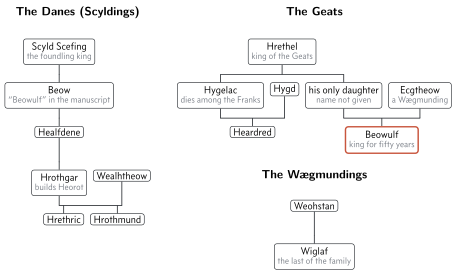
Hrothgar’s luck gave him the wish of every king: a hall greater than any that men had seen. Hrothgar named his mead-hall HeorotIn this poem, Heorot is King Hrothgar's mead-hall. → Beowulf••• (hay-oh-rot), “the Hart,” after the male deer. A mead-hall was a king’s great hall, where he feasted his warriors on mead, a wine made from honey, gave them gifts, and listened to the scop, and where his men slept on its benches at night. There, in Gummere’s words, “the rings he dealt, treasure at banquet.” In the same breath the poet looks far ahead. The gabled hall stood, the poet says, “the hot surge waiting of furious flame,” because Heorot would one day burn in a feud between Hrothgar and his own son-in-law.

Later Danish tradition put the seat of the Scyldings at Lejre (ly-ruh), on the island of Zealand (Figure 17.6). Archaeologists digging there in 1986–88 and again in 2004–05 found the remains of three great halls, each about 50 meters (160 feet) long, the oldest built in the middle of the sixth century. That is about half the length of a football field, and it is the right place and the right age for Heorot. No one can say that it was Heorot, since the hall of the poem is a hall of story.

Not far away, out on the moors, something heard the feasting. Gummere’s poet says that it “endured the dole in his dark abode, that he heard each day the din of revel high in the hall: there harps rang out, clear song of the singer.” Dole is an old word for grief. The noise of the feasting maddened him.This character’s attacks are provoked by loud singing and carousing. → Grendel•• The scop was singing of the Creation: how God made the earth and the waters around it and set the sun and moon in the sky. The listener in the dark was Grendel, and he was not part of that happy world. The poet explains that Grendel was one of the kin of Cain,This character is described as a descendant of Cain. → Grendel••• the son of Adam who in Genesis murders his brother Abel and is condemned by God to wander in exile (Vol. 5, In the Beginning). From Cain, Gummere’s poet says, sprang “Etins and elves and evil-spirits, as well as the giants that warred with God.” An etin (Old English eoten) is a giant.
One night, after a feast, Grendel came to Heorot, found the Danes asleep, seized thirty of them, and carried them off to his lair. The next night he came again, and soon no one would sleep in the hall. The poet calls him a deorc deaþscua, a dark death-shadow,An early line in this work describes people being "hunted down by a dark death-shadow." → Beowulf• “death-shadow dark” in Gummere’s words, who ambushed young and old and lurked through the long nights on the misty moors. No one, the poet says, could tell where such creatures of hell went between their raids. The great hall stood empty every night, and the king whose warriors had beaten every enemy could do nothing to stop the killing. For twelve years Grendel ruled Heorot by night.This character attacks Hrothgar’s mead-hall Heorot for twelve years. → Grendel••• He would make no peace, and he would pay no wergild for the men he killed. Hrothgar’s counselors met in vain. Some of the Danes offered sacrifices at the shrines of their old gods, and the Christian poet stops the story to pity them: they did not know the true God, he says, and “’twas Hell they thought of.”
News of Grendel crossed the sea to the land of the Geats, a people of what is now southern Sweden. There it reached the nephew of King Hygelac, the son of his sister, and the strongest man alive. The poem does not give his name until he reaches Denmark: he is Beowulf, the hero of the Geats.This character is a hero of the Geats. → Beowulf••• He chose fourteen companions, and his elders, who loved him, did not try to stop him. On the second day of sailing the Danish cliffs came into sight. A coast guard rode down to the shore, shook his spear, and demanded who these armed strangers were. He had never seen a man to match their leader, he said.
At Heorot, Hrothgar knew the name at once. He had known the boy, and his father was EcgtheowThis character is the son of Ecgtheow. → Beowulf•• (edj-thay-oh), who had married the only daughter of the Geatish king Hrethel (hreth-el). Hrothgar had more reason than most to remember Ecgtheow, and he told the story himself, as a host welcoming the son of an old friend. It was the story of a killing. Long before, Ecgtheow had killed HeatholafThis character's father killed Heatholaf, a member of the Wulfing tribe. → Beowulf• (hay-uh-thoh-lahf) of the Wulfings, another people of the north, and his own kin, afraid of the feud, would not shelter him. He fled to Hrothgar, who had just become king. Hrothgar paid the wergild, sending old treasures over the sea to the Wulfings, and Ecgtheow swore him oaths of loyalty. Hrothgar saw in the son’s coming a return for that old kindness.
Not everyone was glad of him. At the feast Hrothgar’s spokesman Unferth, who sat at the king’s feet, mocked Beowulf with an old story. Was this the Beowulf who had swum against Breca (brek-uh) for a wager, in the winter sea? “A sennight strove ye,” says Gummere’s Unferth, which is to say seven nights, and Breca won. Beowulf told it differently. He and Breca had been boys, he said, and they had swum with drawn swords to guard themselves from whales. They kept together for five nights, until a storm drove them apart. Then sea monsters dragged him to the bottom, and in the swimming match with Breca he fought sea monstersThis character competes in a swimming contest with Breca and is mocked for allegedly losing after seven days. → Beowulf•••This character claims that he battled sea monsters during a swimming contest. → Beowulf• and killed nine of them before the tide washed him ashore in the land of the Finns. Then he struck back. If Unferth’s courage were as loud as his boasting, he said, Grendel would never have done such harm, and Unferth was remembered chiefly for killing his own brothers.
The hall laughed. Hrothgar’s queen, Wealhtheow (way-alk-thay-oh), went round with the mead-cup, to the king first and then to the warriors, and last to Beowulf. Taking it, he swore that he would do the deed the Danes needed or die in that hall. As night fell, Hrothgar left Heorot to him.
Beowulf took off his coat of mail and his helmet and gave his sword to a servant. Grendel used no weapons, he said, and he would use none either. Then, in Gummere’s words, “Thro’ wan night striding, came the walker-in-shadow.” The poet’s word is sceadugenga, a goer in the shadows,This character is described as a "shadow-stalker." → Grendel• which a modern translation turns into “shadow-stalker.” Grendel burst the door, though it was bound with iron, seized a sleeping Geat and ate him whole, feet and hands, and then reached for Beowulf. Beowulf gripped his arm, and Grendel knew at once that he had never met such a grip.
The hall shook. Mead-benches were torn from the floor, and the Danes outside heard a terrible howling. Beowulf’s men slashed at the monster, not knowing that, as the poet explains, Grendel had put a spell on every blade on earth. Only strength could win. Fighting barehanded and without his armor, Beowulf tore off Grendel’s armThis character rips off Grendel’s arm while fighting without weapons or armor. → Beowulf•••This character has his arm torn off in hand-to-hand combat and displayed in a mead-hall. → Grendel••• at the shoulder, and afterward he hung the whole arm high under the gabled roof of the mead-hall for all to see. Its nails, the Danes said, were like steel. Grendel fled, dying, to his lair in the fens.
So Grendel was the first of the three monstersThis character is the first antagonist killed by Beowulf. → Grendel•• to die at Beowulf’s hands. In the morning the Danes followed his bloody tracks to a lake in the moors, where the water heaved with his blood. They rode home racing their horses and singing, sure that the trouble was over. The young stranger had done what Hrothgar’s whole court could not: Beowulf had saved Heorot from Grendel.This character saves the inhabitants of the hall Heorot from a monster. → Beowulf••• As they rode, a scop made a new song in praise of him, and then sang of older heroes for comparison.
Grendel’s mother
That day Heorot was patched and hung with tapestries for the greatest feast of Hrothgar’s reign. The king gave Beowulf a golden banner, a helmet, a coat of mail, and a famous sword, and eight horses with gold bridles, one of them carrying his own saddle. Every one of Beowulf’s companions got a gift, and gold was paid for the Geat whom Grendel had eaten. Then Hrothgar’s scop sang the lay of Finnsburg, a story of a feud that a marriage had failed to end.
Hildeburh (hil-deh-burkh), a Danish princess, was married to Finn, king of the Frisians, to make peace between their peoples. Her brother Hnæf (hnaf) came to visit with his men, and the old hatred broke out. The Frisians attacked, and Hnæf was killed, and so was Hildeburh’s son by Finn. She laid her brother and her son on one pyre, side by side. The surviving Danes, led by Hnæf’s man Hengest, made a truce and spent the winter with Finn, but in the spring the Danes took their revenge. The Frisian king Finn was slainThis work includes a story about the defeat of the Frisian warrior Finn. → Beowulf• among his own men, and they carried Hildeburh home to Denmark. J. R. R. Tolkien, the author of The Hobbit and a professor of Old English, argued that this Hengest was the same man as the Hengist who, Bede says, led the first Saxons to Britain (Chapter 16).
Then Wealhtheow came forward under her gold crown. Hrothgar had sworn to love Beowulf like a son, and she asked her husband to be generous to the Geats but to leave his kingdom to his own kin. She turned to where Beowulf sat between her two young sons, Hrethric (hreth-rik) and Hrothmund (hroth-mund). Queen Wealhtheow rewarded BeowulfQueen Wealtheow rewards this character for killing a monster. → Beowulf• with a cup, two arm-rings of twisted gold, a coat of mail, and the finest neck-collar the poet had ever heard of. The poet compares it to the Brisings’ necklace of legend, and then he jumps ahead, as he likes to do. The collar would pass to Beowulf’s own king, and Hygelac wore it on his last raid, into the land of the Frisians. There Hygelac was killed by the Franks,In this work, Hygelac is killed by the Franks. → Beowulf• the people of northern Gaul, who took his body, his armor, and the great collar. This is the raid that Gregory of Tours records, about 521. So, in the middle of the happiest night in Heorot, the poet reminds his listeners that the gift and the king who wore it would both be lost.

No one guessed that the danger was not over. The Danes slept in Heorot, with their shields at their heads, and Beowulf slept in another house. Grendel had a mother. She had grieved alone in her cold home under the water, and now she came to avenge her son’s death.This character's death prompts his mother to seek revenge. → Grendel•• The poet calls her by two words at once, a lady and a monster-woman, and Gummere writes “monster of women.” She has no name of her own in the poem, only her son’s, and in the world of the feud her vengeance was a duty. A modern translation makes her a monstrous bride from hell.This character is described as a "monstrous hell-bride." → Grendel’s mother• She too was of Cain’s kin, the poet says, doomed to dwell in “the dreary waters, cold sea-courses.”
She was less terrible than her son, the poet says, as a woman’s strength in war is less than a man’s, and when the Danes snatched up their swords she fled at once. But she took one man with her. She seized ÆschereThis character abducts and decapitates Aeschere. → Grendel’s mother•• (ash-hair-uh) in his bed, Hrothgar’s dearest counselor, who had stood shoulder to shoulder with him in battle. She killed him and carried him off, and the Danes would find his severed head the next day. She took her son’s arm with her too.
In the morning Hrothgar wept for his friend. He had heard countryfolk tell of two such creatures roaming the moors, one in a woman’s shape and one like a man but huger, called Grendel. No one knew who his father was. Grendel’s home lay at the bottom of a lake,This character lives at the bottom of a lake. → Grendel• a dark mere under cliffs, where a frost-bound wood hung over the water and fire burned on the waves at night. In Gummere’s words, even a stag hunted by hounds, “the horn-proud hart,” would give up his life on the bank before he would plunge in. “Seek if thou dare!” said the king. Beowulf answered with the creed of his world: “It beseems us better friends to avenge than fruitlessly mourn them.” Every man must die, he said, so let him win glory first.
They rode to the mere. On the cliff above the water they found Æschere’s head. The water below was boiling with blood, and sea serpents and water monsters lay on the rocks. Beowulf shot one with an arrow, and the Danes dragged it ashore with boar-spears to stare at. Then he armed: a coat of mail that no claw could pierce, and a shining helmet ringed with figures of boars. Unferth, his rival of the night before, now lent him his own sword, an ancient blade called Hrunting (hrun-ting) that had never failed in battle. The poet notes dryly that Unferth did not dare the dive himself.
Beowulf plunged into the mere, and he swam down for the better part of a dayThis character swims for a day to reach an underwater lair. → Beowulf•• before he reached the bottom. In Gummere’s words, “Long while of the day fled ere he felt the floor of the sea.” There Grendel’s mother seized him in her claws. His mail held, and she dragged him to her own hall, a cave under the lake that the water could not enter, where a fire was burning. He swung his sword at her head, but Unferth’s sword Hrunting failed against the water-monster.This character receives Hrunting from Unferth, but the sword fails against an underwater foe. → Beowulf••• It was the first time that famous blade had ever failed its bearer.

Beowulf threw the sword away and trusted to his grip. He seized her by the shoulder and flung her down; she threw him in turn, pinned him to the floor, and drew her broad knife. His mail stopped the point, and the poet adds that God gave him the victory. He got to his feet and saw among the war-gear a giant’s sword, “old-sword of Eotens,” so heavy that no other man could have carried it into battle. He seized it by its hilt and struck. The blade cut through her neck, and so Beowulf killed Grendel’s mother in her underwater hall.This character defeats a monster’s mother in an underwater lair. → Beowulf••• A light blazed up in the cave like the sun in a clear sky. By it he saw Grendel’s body lying on a bed, and he cut off its head.
Up on the cliff the watchers saw the water turn red. By the ninth hour of the day, about three in the afternoon, the Danes gave him up for dead and went home. His Geats stayed, sick at heart, staring at the waves. Below them a wonder was happening. The giant’s sword began to waste away in drops of blood, like icicles. In Gummere’s words, all of the blade meltedIn this poem, the giant's sword melts from the creature's blood after being used. → Beowulf•• “as ice is wont when frosty fetters the Father loosens,” because the monster’s blood was so hot. Of all the treasures in the cave, Beowulf took only Grendel’s head and the golden hilt, and he swam up through water that was clean again.

The Geats greeted him with joy. They marched back to Heorot, four men straining under a spear-shaft from which hung Grendel’s head, Beowulf’s trophy.This character's head is kept as a trophy after his mother is defeated. → Grendel• They dragged it into the hall by the hair, where the king and queen were drinking, and the men stared at it in awe. Beowulf told Hrothgar the whole story of the fight under the water and gave him the hilt, the work of giants. The hilt was engraved with the floodThe giant's sword used by this character has a hilt depicting a flood that wiped out a tribe of giants. → Beowulf•• that, as the poet tells it, destroyed the race of giants, the old enemies of God, in the waters of Noah’s day (Vol. 5, In the Beginning). Runes on its gold named the man for whom the sword was first made.
Hrothgar looked at the hilt for a long time and then spoke to Beowulf at length, warning him against pride. He told of Heremod, a Danish king of old who had been given every gift and grew greedy and cruel, killing his own companions at table. Power, he said, can lull a man’s conscience asleep until death comes upon him. The next morning Beowulf sailed for home, laden with gifts, and told Hygelac everything.
Beowulf’s last fight
Then the poem leaps fifty years in a dozen lines. Hygelac fell on his raid among the Franks, and Beowulf, who fought there, swam home across the sea, carrying, the poet says, thirty suits of armor. Hygelac’s widow, Hygd, offered him the kingdom, since her son Heardred (hay-ard-red) was still a boy. He refused it and served the boy as his guardian, until Heardred was killed in a war with the Swedes. Only then did Beowulf take the throne of the Geats, and he ruled them well for fifty winters.
Long before, at the edge of the sea, the last man of a forgotten noble family had buried his people’s treasure in a barrow, a burial mound with a stone chamber inside. Everyone he loved had died in war, and he spoke a farewell to the gold. “Now hold thou, earth, since heroes may not, what earls have owned!” he says in Gummere’s version. When he too had died, a dragon found the open mound and lay on the hoard, and it guarded the gold for three hundred years.
Then a runaway, fleeing a punishment, stumbled into the barrow and found the dragon asleep. Terrified, he stole a golden cup from the dragon’s hoardIn this work, the theft of a golden goblet invokes a dragon's wrath. → Beowulf•• and took it to his master to buy his pardon. The dragon woke, sniffed along the rock, and found the man’s footprints. It searched the hoard and saw that the cup was gone. It waited, seething, until dark, and then it flew out in flames and burned the countryside of the Geats. It burned Beowulf’s own hall, the gift-throne of his people.
The old king knew that a wooden shield would burn, so he had a shield made all of iron. He set out with eleven men, and the thief walked with them as their guide, the thirteenth man, against his will. On the headland above the barrow Beowulf sat down and spoke of his life. He had been seven years old, he said, when his grandfather, King Hrethel, took him to be raised at court, and Hrethel had loved him like his own sons. Then he told how one of those sons, Hæthcyn (hath-kin), had killed his elder brother Herebeald (heh-reh-bay-ahld) by accident with an arrow, and how the old king, who could neither avenge his son nor punish his son’s killer, died of grief. Wars with the Swedes followed. Then Beowulf told his men to wait, because this fight was his alone.

He went down to the stone arch and shouted. The dragon came out in fire. Beowulf struck, but his blade bit less deeply than he needed, and the flames beat on him. His chosen companions broke and ran into the woods to save their lives. Only WiglafOnly Wiglaf stays to aid this character in his fatal dragon fight. → Beowulf••• (wee-lahf) came to help him: a young man in his first battle, son of Weohstan (way-oh-stahn), of Beowulf’s own family, the Wægmundings (wag-mun-dingz), whom Beowulf had rewarded with land. Wiglaf shouted to the others to remember the mead they had drunk and the promises they had made in the hall, and then he ran through the smoke to his lord. The fire burned his wooden shield down to the boss, the metal knob at its center, and he fought on under Beowulf’s iron one.
The old king struck the dragon’s head with all his strength, and his sword, Nægling (nag-ling), broke: his hand, the poet says, was too strong for any blade. The dragon came on a third time and closed its teeth on Beowulf’s neck. Wiglaf drove his sword in a little lower down, and the fire began to fail. Beowulf drew the knife at his belt and cut the dragon in two. Between them they had killed it. But the poison of the bite was boiling in his chest. Beowulf was dying of the dragon’s wound,This character dies fighting a dragon. → Beowulf••• and he knew it. He sat down by the stone wall of the barrow, and Wiglaf bathed his face.
Beowulf asked to see the gold he had won for his people, and Wiglaf brought armfuls of it out of the barrow: cups, dishes, and a banner woven of gold. The king thanked God that he had won such treasure for the Geats before he died. He asked for a burial mound on the headland called Hronesness (hroh-nes-ness), “Whale’s Headland,” high enough that sailors driving their ships far over the sea would hail it as Beowulf’s Barrow. He gave Wiglaf his gold collar, his helmet, his coat of mail, and his ring. “Thou art end and remnant of all our race, the Wægmunding name,” he said in Gummere’s version, and he died.
Wiglaf turned on the men who had fled. Their families would lose their lands, he told them, when the news of their cowardice spread, and death was better for a warrior than a life of shame. A messenger rode to the Geats with the news, and he warned that now that Beowulf was gone, the Swedes and the Franks would come for revenge.
The Geats did as their king had asked. They built a pyre, hung it with helmets, shields, and bright mail, and burned him on it, while a Geatish woman with her hair bound up sang of the hard days she feared were coming. Around the ashes the Geats raised his barrow in ten daysThis character's followers build a burial mound over 10 days that is visible along the coastline. → Beowulf• on the headland, “by ocean-farers far descried.” Into the mound they put the dragon’s gold, where, the poet says, it still lies, “useless to men as of yore it was.” Then twelve warriors rode around the barrow, mourning their king and praising his deeds.
The poem ends with their praise. In Gummere’s version they said that of all the kings of the earth he was “mildest and most belovéd, to his kin the kindest, keenest for praise.” The last two of those praises, kindest and keenest, name two virtues: his gentleness to his own people and his hunger for glory. Seamus Heaney (shay-mus), the Irish poet who won the Nobel Prize in 1995, published a famous modern translation in 1999, and in it too Beowulf is mourned as kindest and keenestThis poem ends with its title character mourned as "Kindest to his people and keenest to win fame." → Beowulf•• in the last line, in words of Heaney’s own. The poem began with a king’s funeral at sea and ends with a king’s funeral by the sea, and the listener knows that the Geats, like the Danes before them, have years of war ahead.
Kennings and “The Seafarer”
After Thorkelin’s edition of 1815 the poem slowly found its readers. The English scholar John Mitchell Kemble published an English translation in 1837, and William Morris, with A. J. Wyatt, a verse translation in 1895. The edition that scholars used for the next century came from Frederick Klaeber (klay-ber), a German-born professor at the University of Minnesota, who spent nearly thirty years on it. He called it Beowulf and the Fight at Finnsburg (1922), because he printed the Finnsburg Fragment with Beowulf,Frederick Klaeber’s edition of this work pairs it with a fragment about the Fight at Finnsburg. → Beowulf•• about fifty lines of another Old English poem on the night attack on Hnæf’s men. Its only manuscript, a single leaf at Lambeth Palace in London, was copied by the scholar George Hickes, who printed it in 1705, and the leaf has since been lost. It opens with Hnæf waking his men to the glow of torches outside: “’Tis no dawn from eastward; no dragon flies; nor burn on this hall the hornéd gables,” in Gummere’s version. In 1936 Tolkien, then a professor at Oxford, gave a famous lecture, “Beowulf: The Monsters and the Critics.” He argued that the monsters were not a childish distraction from the history in the poem but its heart, and that its subject was death.
Readers who come to the poem in any translation meet its kennings in every scene. When Beowulf decided to sail to Hrothgar, he said he would seek the king “far o’er the swan-road,” in Gummere’s words. The swan-road is the sea,The kenning “swan-road” refers to this place. → the sea• where swans ride the waves, as the whale-road is the sea where whales swim. The poem calls the sea the road-of-sails and the beaker-of-waves, too. The sun is “heaven’s candle,” a gleaming sword the “light-of-battle,” and a coat of mail a battle-shirt. When the flames of Beowulf’s pyre consume him, the poet says they broke his bānhūs, his bone-house, his body.
The reason for so many names is partly the line itself (Figure 17.1). A poet whose third lift must alliterate with the first half of the line needs words for the sea that begin with many different sounds, and a store of kennings gives him one for almost any sound he needs. The poet also loved what scholars call variation, naming the same thing several times over in different words, as when Hrothgar is the son of Healfdene, the helmet of the Scyldings, and the giver of rings within a few lines. To a listener in the hall each new name added a picture.

The other great Old English poem of the sea is in the Exeter Book. It is “The Seafarer,” 124 lines long, spoken by an old sailor who tells the truth about his life, he says, in a song about himself. He tells of nights on watch at the bow while the ship tossed under cliffs, of hunger, of hail, and of cold so bitter that his feet were bound by frostIn this poem, the speaker's feet are benumbed by frost. → "The Seafarer"• as if by chains of ice. Instead of the laughter of men he heard the cry of the gannet and the call of the curlew, and instead of mead-drinking the singing of the gull. No man who lives safe on land, he says, can understand what he suffered on the sea.
Yet his heart will not let him stay ashore. When the woods blossom in spring and the cuckoo calls, he longs to go out again over the deep. Then the poem turns. The joys of the Lord, he says, are warmer to him than this dead life on land, earthly glory passes, and gold will not help a man’s soul when he dies. It ends with a prayer and the word “Amen.” In 1911 the American poet Ezra Pound published a free version that kept the sea and the hardship and left out the prayer. Scholars still argue whether the old sailor’s voyages are real ones or a picture of the Christian life, a journey through hardship toward a home in heaven.
What to remember
- Old English, the language of the Anglo-Saxons from about 450 until after 1066, survives mostly in four books: the Exeter Book, the Vercelli Book, the Junius manuscript, and the Nowell Codex.
- Its poetry uses the alliterative long line: two half-lines split by a caesura, each with two lifts, the third lift alliterating with the first or second.
- Beowulf, 3,182 lines, survives only in the Nowell Codex, scorched in the Cotton library fire of 1731; Thorkelin’s transcripts of 1787 save letters since lost.
- The poem opens with “Hwæt” and Scyld Scefing’s ship funeral. Grendel, of Cain’s kin, raids Hrothgar’s hall Heorot for twelve years until Beowulf the Geat, son of Ecgtheow, tears off his arm.
- Grendel’s mother kills Æschere; Beowulf follows her into the mere, where Unferth’s sword Hrunting fails and a giant’s sword, its hilt engraved with the Flood, kills her and melts.
- Fifty years later a dragon, woken by the theft of a golden cup, kills Beowulf; only Wiglaf stands by him, and the Geats raise his barrow on the headland in ten days.
- The digressions include the lay of Finnsburg, where Finn the Frisian dies, and Hygelac’s fatal raid on the Franks, recorded by Gregory of Tours about 521.
- Kennings such as “whale-road” and “swan-road” (the sea) and “ring-giver” (a king) fill Old English verse; “The Seafarer” in the Exeter Book is its other great poem of the sea.
Chapter 18 · 25 clues
The Viking Age
In the year 793, the Anglo-Saxon Chronicle records, terrible signs came over Northumbria, the northernmost of the English kingdoms. There were whirlwinds and lightning, and, in J. A. Giles’s translation, “fiery dragons were seen flying in the air.” A great famine followed. Then, a little later in the same year, “the ravaging of heathen men lamentably destroyed God’s church at Lindisfarne through rapine and slaughter.” The Chronicle was first compiled from older records about a century later, in the reign of King Alfred (Chapter 19), and its monks had no doubt that the dragons had been a warning.
The Chronicle’s “heathen men” had come out of the North Sea in a few ships. For the next 270 years, men from Norway, Denmark, and Sweden raided, traded, and settled from Greenland to the Volga and from Seville to the Arctic (Figure 18.1). They burned monasteries and founded towns, sold slaves and guarded an emperor, and buried their great dead in ships. The English called them “heathens” or “Danes,” the Franks called them “Northmen,” and the Irish called them simply “foreigners.” We call them Vikings, and the years from 793 to 1066 the Viking Age.

Lindisfarne and the raids
Lindisfarne is a low island off the coast of Northumbria, joined to the mainland twice a day when the tide uncovers the sand flats (Vol. 3, Geography: Europe, Asia, and Africa). The Irish monk Aidan had settled there about 634 (Chapter 16), and by 793 it was the holiest place in the north of England. Saint Cuthbert, its most famous bishop, lay in its church, and pilgrims brought gifts to his tomb. A monastery like this held gold and silver vessels for the altar, books in jeweled covers, fine cloth, and young men who could be sold. It had no walls and no soldiers, and it faced the sea.
The raiders came in the summer of 793. They plundered the church, threw some of the monks into the sea to drown, and carried others away to be sold. Historians conventionally date the beginning of the Viking Age from this raid, in which the raiders killed the monks of Lindisfarne.These people’s raid on Lindisfarne in 793 is conventionally taken as the start of their namesake age. → Vikings•••Vikings killed monks when they raided this Christian monastery in 793. → Lindisfarne•• It was not quite the first. A few years before, in the reign of King Beorhtric (bay-ork-trich) of Wessex, three ships of “Northmen” had put in on his coast, and when the king’s reeve, his local officer, rode down to bring the strangers to the king’s town, they killed him. “These were the first ships of Danishmen which sought the land of the English nation,” the Chronicle says. But Lindisfarne was the raid that shocked Christian Europe, because it struck the church of a saint.
The news reached Alcuin at the court of Charlemagne, king of the Franks (Vol. 9, Cathedrals and Crusades). Alcuin was a Northumbrian, schooled at York, who had become the most learned man at Charlemagne’s court and the master of its palace school. He wrote at once to King Æthelred (ath-ul-red) of Northumbria (not the later English king of the same name) and to Higbald, the bishop of Lindisfarne. Never before, he told the king, had such terror appeared in Britain as the English had now suffered from this “pagan” people, who had poured out the blood of saints around the altar. If Saint Cuthbert could not defend his own church, Alcuin asked, which church in Britain was safe? Like the monks of the Chronicle, he read the raid as God’s punishment, and he told the Northumbrians to look to their own sins, down to the way some of them had begun to cut their hair and beards like the raiders.

No Norse writer tells why the raiders came, and they left no account of 793 at all. Their homelands were Norway, Denmark, and Sweden, a world of farms strung along coasts and fjords, the long, steep-sided inlets of the sea, where the sea was the easiest road. A farmer’s son might spend a summer abroad and come home with silver. In Old Norse such a trip was víking, and a man who made it was a víkingr; where the word itself comes from is still argued. What changed in the 790s is clearer. The Scandinavians now had ships with sails that could cross open water, and the rich monasteries of Britain and Ireland lay on islands and shores a few days’ sailing away.
The water between them was the North Sea, the shallow, stormy arm of the Atlantic that lies between Britain and Scandinavia. From the fjords around Bergen, in western Norway, to Lindisfarne is about 420 miles. At an average of 5 knots, about 6 miles an hour, a ship covers that in three days and nights. Year after year Vikings crossed the North SeaThis sea was crossed by Vikings raiding the east coast of Britain. → North Sea• to raid the east coast of Britain. In 794 they plundered another Northumbrian monastery, Jarrow or its twin house at Wearmouth, though a storm wrecked their ships on the way home and the survivors were killed on the shore. Danes raided the Isle of Sheppey in Kent in 835. Other ships went west-about, past Shetland and Orkney and down the Scottish coast. By 795 they had raided Iona, the island monastery where Aidan had trained, and in that year they reached Ireland.
The monks of Lindisfarne stayed on their island for eighty more years. In 875, with a Danish army loose in Northumbria (Chapter 19), they left at last, carrying Saint Cuthbert’s coffin with them. After seven years of wandering and a century at Chester-le-Street, his body came to rest at Durham in 995, and it still lies there.
Longships
Everything the Vikings did depended on their ships. For raids and for invasions the Vikings used long ships,The Vikings used "long" types of these objects for raiding and invasions. → ships•• in Old Norse langskip: narrow, light hulls with a mast for a single square sail and a row of oars along each side. A longship needed only about 3 feet of water to float. It could run up onto a beach, row far up a river, and be dragged overland past rapids. Under sail the best of them could make about 10 knots. The ship was steered with a big oar on the right-hand side near the stern, which the Norse called the stjórnborði, the “steer-board.” Sailors still call the right side of a ship the starboard (Figure 18.3).

The hull was built in a way called clinker construction. A shipwright began with the keel, the timber backbone along the bottom, and the curved posts at the bow and stern. Onto these he fixed the hull’s planks, called strakes, working upward from the keel, with each plank overlapping the edgeIn this method of building wooden ship hulls, the edges of planks overlap. → clinker construction•• of the one below, like the boards on a clapboard house. Iron rivets through the overlaps held them together, and tarred rope packed between them kept out the water. Only then did he fit the ribs inside. The planks were split from straight old oaks with axes and wedges rather than sawn, so the grain ran the whole length of each one, and a plank an inch thick was strong enough. The result was a hull that flexed with the waves instead of fighting them. A ship built the other way, with its planks laid edge to edge over a frame of ribs, is called carvel-built; from the 1400s the great ocean-going ships of Europe were built like that.
At each end the planking swept up into a tall carved post. The sagas tell that on the greatest warships the stem, the post at the bow, ended in a carved head with gaping jaws, and they call such ships dreki, “dragons.” To the people of the coasts, longships with dragon-headed prowsThese people sailed in longships often decorated with dragon heads. → Vikings•••Norse examples of these vessels often had dragon-headed prows. → ships• became the sign of the Vikings. The most famous in the sagas was the Long Serpent, built for King Olaf Tryggvason of Norway in the winter of 999–1000, with thirty-four pairs of oars. An old Icelandic law, recorded in the Book of Settlements, the medieval Icelanders’ account of how their island was settled, told captains to take the gaping heads off their ships before land came into sight, so as not to frighten the spirits who guarded it. Yet no carved dragon’s head has survived on any ship that archaeologists have found, and we know them from the sagas and from pictures.
The longship had cousins. Beside it sailed the knarr, the karve, and the faering.Variants of these objects included the karve, knarr, and faering. → ships• The knarr was a cargo ship, shorter, broader, and deeper, built to sail more than to row; knarrs carried settlers, cattle, and goods across the open Atlantic to Iceland and Greenland (Chapter 20). The karve was a smaller, broad-beamed ship that could fight or carry people and goods along the coast, and could float in very shallow water. The faering was an open boat with two pairs of oars, the kind a big ship carried as its rowing boat.


We know these ships so well because some Norse chose to be buried in them. In 1904 archaeologists led by Gabriel Gustafson opened a great mound on the farm of Oseberg, near the mouth of Oslo Fjord in southern Norway. Inside lay the Oseberg ship (Figure 18.4), a karve of oak 71 feet long, a little shorter than a tennis court, with fifteen pairs of oar holes. Tree rings in its burial chamber show that it went into the ground in the autumn of 834. Clay below and turf above had kept out the air, so the wood was still there after a thousand years. In a chamber behind the mast lay two women, one about eighty and the other in her fifties. Robbers had broken in long before and taken whatever gold and silver there was. They left a carved wooden cart, four sleighs, beds, chests, cloth, kitchen gear, and the bones of more than a dozen horses. They also left five wooden posts carved with animal heads,This well-preserved Viking burial ship was found with carved wooden animal-head posts. → Oseberg ship•• snarling beasts covered in knotted, gripping creatures. Who the women were is unknown. One guess makes the older of them Queen Åsa (oh-sah), the grandmother of King Harald Fairhair, but nothing in the grave names her.
The Oseberg women were following a Norse custom. Great men and women were laid in a ship to carry the dead,These things are often used to hold the body and possessions of the deceased in Norse funerals. → ships•• with their weapons, jewels, animals, and food, and then the ship was buried under a mound or burned. Poorer people were burned in small boats, or buried inside outlines of standing stones in the shape of a ship. Snorri Sturluson’s Ynglinga saga, the first part of his Heimskringla (Chapter 1), says that Odin made the law of burning: in Samuel Laing’s translation, “every one will come to Valhalla with the riches he had with him upon the pile.” The English had buried a king in a ship at Sutton Hoo two centuries earlier (Chapter 16), and Snorri’s gods burn Baldr on his own ship (Chapter 8).
One Viking funeral was described by a man who saw it. In 921 the caliph in Baghdad, head of the largest Muslim empire, sent an embassy to the king of the Volga Bulgars, a people who lived where the Kama River joins the Volga. Its secretary, Ahmad ibn Fadlan (ib-un fad-lahn), an expert in Islamic law, reached the Bulgar king’s camp in May 922. There he met merchants from the north whom he called the Rus, Scandinavians who had come down the rivers to sell furs and slaves. When one of their chiefs died, Ibn Fadlan watched the Rus funeral.Ibn Fadlan wrote about a Viking funeral involving one of these objects. → ships• The chief’s ship was hauled ashore onto a platform of wood and furnished with a bed, food, and drink. A slave girl who had agreed to die with him was killed and laid at his side, and then his nearest kinsman set the ship on fire. One of the Rus told Ibn Fadlan that the Arabs were fools to bury their dead for the worms to eat, since fire sent a man to paradise at once.
Viking society
Norse society had three ranks. At the top were the jarls, the earls, rich men with great halls and followers. In the middle were the karls, free farmers who owned their land, bore arms, and spoke at the local assembly. At the bottom were the thralls, the slaves,The lowest class in these people's society were slaves known as thralls. → Vikings• who owned nothing, not even themselves. A thrall could be beaten or sold by his master, and when a great man died, his thralls were sometimes killed to go with him, as Ibn Fadlan saw on the Volga and as graves in Scandinavia suggest. The English word “thrall” comes from the Old Norse þræll, and so does “enthrall,” to hold someone captive.
The Norse explained these ranks with a myth. In the Eddic poem Rígsþula, “the List of Rig” (Chapter 4), a wandering god named Rig fathers three sons in three houses: Thrall, the first slave, ugly and bent and born to carry loads; Karl, the first free farmer; and Jarl, the first lord. Many real thralls were not born into the rank but captured. Raiders took men, women, and children from Ireland, Britain, and the Slavic lands and sold them in the markets of Dublin and of the Baltic towns.

The most feared fighters in Norse armies went into battle half mad. Snorri’s Ynglinga saga says that Odin’s men “rushed forwards without armour, were as mad as dogs or wolves, bit their shields, and were strong as bears or wild bulls,” and that neither fire nor iron could hurt them. “These were called Bersærkers,” he adds, in Laing’s spelling. The berserkers appear first in a poem made for King Harald Fairhair of Norway in the late 800s, which counts berserkers, warriors in bearskin shirts,These people's armies included warriors called berserkers. → Vikings••Berserkers wore the skins of these animals. → bears• among his men. Their name is Old Norse berserkr, most likely “bear-shirt,” for a man who fought in the skin of a bear. Snorri’s “without armour” led some later readers, Laing among them, to take it as “bare-shirt,” a man who fought without a coat of mail. Iceland’s medieval law punished going berserk with outlawry, and English still borrows the word for a wild, unstoppable rage.
A Viking’s wealth was silver, and he valued it by weight rather than by count. He kept a little folding balance and a set of weights, and a coin, a bracelet, or a brooch was simply silver to be weighed. To make change he chopped it up. Cut pieces of silver used as money in this way are called hacksilver. On May 15, 1840, workmen repairing the bank of the River Ribble at Cuerdale, near Preston in Lancashire, found a lead chest packed with it. The Cuerdale hoard of hacksilver,These people left behind a large amount of hacksilver at Cuerdale. → Vikings•• coins, and ingots weighs between 32 and 40 kilograms, some 70 to 90 pounds. Its more than 8,600 pieces include coins of the Viking kings of York and of Alfred’s Wessex, of the Franks and of the Muslim world, and hacked-up arm rings and bars from Viking Ireland. It was buried between about 903 and 910, perhaps by Vikings who had been driven out of Dublin in 902. They never came back for it, and most of it is now in the British Museum.

Swords were costly, and the sagas give the best of them names and long histories. About 170 swords of the ninth to the eleventh century, most of them found in northern Europe, carry iron letters inlaid along the blade that spell the Frankish name UlfberhtEarly medieval examples of these weapons bear the Frankish name Ulfberht. → swords• (oolf-bairt), between little crosses: +vlfberh+t. Ulfberht may have been a smith or a workshop in the Rhineland, in the empire of the Franks, whose laws forbade selling such weapons to foreigners; most of the blades probably went north as loot, ransom, or smuggled goods. Some Ulfberht blades are of very fine steel. Others are of poor iron, perhaps copies by smiths who borrowed a famous name.
What a Viking did not wear was a helmet with horns. The only Viking Age helmet found nearly whole, dug up on a Norwegian farm in 1943, is a rounded iron cap with a guard around the eyes. No text of the time mentions horns, and no picture of the time shows a warrior wearing them in battle. The horns come from the nineteenth century. Painters gave them to the heroes of Norse legend, and the costume designer Carl Emil Doepler (dur-pler) put horned helmets on the singers of Richard Wagner’s Ring of the Nibelung at its first full staging in Bayreuth in 1876 (Vol. 19, Wagner and Verdi). That image stuck. But Vikings did not wear horned helmets;These people did not actually wear horned helmets. → Vikings•• Danish bronze helmets with horns do exist, but they are nearly 2,000 years older than any Viking.
Swedish Vikings went east, up the Gulf of Finland and down the rivers of Russia, where they were known as the Rus and as Varangians (vuh-ran-jee-unz). They reached Constantinople, which they called Miklagard, “the Great City,” and from 988 the Byzantine emperor, the Greek-speaking heir of the Roman emperors in the east, kept a bodyguard of these Norsemen, the Varangian GuardThese people served as the Varangian Guard, bodyguards to the Byzantine emperor. → Vikings•• (Vol. 9, Cathedrals and Crusades).
Vikings in Ireland
Ireland in 795, when the raiders first struck its coast, was an island of farms and cattle with no towns in our sense. It was divided among more than a hundred small kings, who owed tribute to the kings of the island’s five great provinces, its “fifths” (the Stage). Above them all, in name, was the high king, the king of Tara (Chapter 10), a title held for centuries by one great family of the north and middle of the island, the Uí Néill (ee nail). The richest places in Ireland were its monasteries. Like Lindisfarne, they kept treasures, and like Lindisfarne, they had no walls.
For forty years the Vikings came and went with the summer. Then, in the winter of 840 to 841, they stayed. In 841 the Annals of Ulster, a year-by-year record kept by Irish monks, report a longphort (long-fort) at Dublin, a shore camp where the raiders pulled up their ships behind a bank and a ditch (Figure 18.7). The camp lay where a little river, the Poddle, ran into the River Liffey and formed a dark tidal pool. The Irish name for that pool, Dubh Linn (duv lin), “black pool,” became the Norse name of the place, and ours. The camp became a market, and the market a town, the first real town in Ireland. Its trade was silver, and above all slaves.

The Irish monks who kept the annals called the newcomers Gaill, “foreigners,” and soon they had to tell two kinds apart. Under the year 851 the annals report that the Dubgaill (duv-gahl) came to Dublin and made a great slaughter of the Finngaill (fin-gahl). These were the “dark” and “fair” foreigners at Dublin,Annals describe “dark” and “fair” foreigners at this city, which developed around a Viking longphort established in 841. → Dublin•• two rival bands of Vikings fighting for the new town. Who they were is still argued. The old explanation was that the dark foreigners were Danes and the fair ones Norwegians. The historian Alfred Smyth suggested that the words meant “new” and “old” foreigners, the newcomers against those who had come first.
In the 850s and 860s three brothers, “kings of the foreigners,” took Dublin in hand. The greatest was Ímar (ee-var), in Old Norse Ívarr. He made war and alliances with Irish kings, and in 870 he and his brother Amlaíb (ow-leev), or Olaf, took Dumbarton Rock, the fortress of Strathclyde, the Britons’ kingdom in what is now western Scotland, after a four-month siege. When he died in 873 the Annals of Ulster named him king of all the Norse in Ireland and Britain, and his descendants ruled Dublin for two hundred years. Some historians, among them Clare Downham, identify Dublin’s king ÍmarThis city’s king Ímar has sometimes been identified with Ivar the Boneless. → Dublin• with Ivar the Boneless, a leader of the Danish Great Army that attacked England in 865 (Chapter 19). Later sagas make Ivar a son of the legendary hero Ragnar Lodbrok. The case rests on timing. Ímar vanishes from the Irish record between 864 and 870, just the years when Ivar was in England, and the English sources stop speaking of Ivar after 870.
Other Viking camps became towns too: Wexford, Waterford, Cork, and Limerick. The ending of Wexford and Waterford is the Norse word fjord. These towns traded with the whole Norse world, and their people married into Irish families and learned Irish. By the year 1000 the Dublin Norse were becoming Christian, and their kings were as much a part of Irish politics as any Irish king.
Brian Boru
Brian, son of Cennétig (ken-ay-dee), was born about 941 into the Dál gCais (dawl gash), a small kingdom on the lower Shannon in the north of Munster. Later writers called him Brian Boru (buh-roo). The name may mean “of the cattle tributes,” or it may come from an old fort beside his family’s seat at Kincora, near Killaloe (kil-uh-loo). His older brother Mathgamain made the family kings of Munster, the southern fifth, and fought the Vikings of Limerick, who had sailed up the Shannon to raid Dál gCais lands. When Mathgamain was murdered in 976, Brian avenged him, killed the Norse king of Limerick, and by 978 was king of all Munster.
For the next twenty years Brian fought his way north against Máel Sechnaill (mwail shekh-nill), the Uí Néill high king. In 1002, at Athlone on the Shannon, Máel Sechnaill gave way, and Brian became high king of all Ireland,Brian Boru was a High King of this island. → Ireland• the first in centuries who was not of the Uí Néill. He meant it to be noticed. In 1005 he visited Armagh, the chief church of Ireland, and gave it 22 ounces of gold. His secretary wrote a note into the Book of Armagh, a ninth-century manuscript of the New Testament and the life of Saint Patrick, calling him Imperator Scotorum, “Emperor of the Irish.” (Scoti was the Latin word for the Irish; Scotland is named after Irish settlers.)
In 1013 the province of Leinster rose against him. Its king, Máel Mórda (mwail mor-duh), joined his nephew Sigtrygg Silkbeard (sig-trig), the Norse king of Dublin. The two had fought Brian together once before, at Glenmama in 999, and lost. This time Sigtrygg sent overseas for help. Sigurd, the Norse earl of the Orkney Islands off the north of Scotland, came with his men, and so did a Viking fleet under a captain named Brodir, from the Isle of Man. In the Icelandic Njáls saga, Sigtrygg promised each of them the kingship of Ireland.
The armies met at Clontarf, on the shore just north of Dublin, on Good Friday, April 23, 1014. Brian, about seventy-three, did not fight; he stayed in his tent behind the lines. The battle lasted from sunrise to sunset. Brian’s son Murchad led his men against the foreign Vikings in their coats of mail. In the end the Leinstermen and the Vikings broke and ran for their ships, and the rising tide cut them off, so that many drowned. Brian’s army won the day at Clontarf,This Irish high king’s army defeated a coalition of Leinster and Viking forces at Clontarf, where he was killed. → Brian Boru••• against the men of Leinster and their Viking allies, but Brian did not live to see it. The War of the Irish with the Foreigners, a history written for Brian’s descendants about a century later, and Njáls saga both tell that Brodir, fleeing, found the old king praying in his tent and killed him, and was killed in turn. Murchad, Murchad’s young son, Máel Mórda, and Earl Sigurd were killed too. In 1860 the Irish scientist Samuel Haughton worked out the tides of that day and found that the sea at Clontarf was high at about 5:30 in the morning and 5:55 in the evening, just as the old history says.
Later Irish writers made Clontarf the day Brian drove the Vikings out of Ireland. It was not quite that. Leinstermen fought on the Viking side and Norsemen fought on Brian’s, and Sigtrygg, who watched from Dublin’s walls, kept his kingdom and ruled it for twenty more years, though Norse Dublin was never again a great power in Ireland. Dublin stayed a Norse town until the English came in 1170 (Chapter 22). Brian’s descendants took their name from him and became the O’Briens. The harp in Trinity College, Dublin, called Brian Boru’s harp, was made centuries after him.
The Danish and Norwegian kings
In the Viking Age the homelands themselves became kingdoms. Before about 900, Norway and Denmark had many small kings, each ruling a few valleys or islands. By 1000 each had one king, and by the 1100s Norway, Denmark, and Sweden had the shapes they would keep for centuries. The Norse remembered how it happened in sagas written down long afterward.
The best-known story is the making of Norway, as Snorri Sturluson tells it in the Heimskringla, written about 1230. Young Harald, king of a small realm in the southeast, sent to ask for a girl named Gyda. She answered that she would not marry a king who ruled only a few districts. Harald took the insult as advice. In Laing’s translation he swore “that never shall I clip or comb my hair until I have subdued the whole of Norway.” He kept his word for ten years, until he had beaten the last of his rivals in a great sea battle at Hafrsfjord (hah-verz-fyord), near Stavanger, traditionally dated 872 but perhaps fought as late as 900. Then a friend, Earl Rognvald, cut his hair, and gave him the name he has had ever since, Harald Fairhair. Snorri wrote three hundred years after Harald’s death, and historians argue about how much of his reign really happened; some doubt that he existed at all.

Harald Fairhair had many sons, and they fought over his kingdom (Figure 18.8). One of them, Eric Bloodaxe, earned his name, the sagas say, by killing his brothers. A younger brother, Hákon the Good (Chapter 4), drove him out of Norway, and Eric ended as the last Viking king of York, killed in 954. His wife Gunnhild, called the “Mother of Kings,” brought their sons up in exile. They fought their way back; their uncle Hákon fell fighting them at Fitjar in 961, and the eldest surviving brother, the Harald later called Greycloak, became king of Norway. This grandson of Fairhair shared his grandfather’s name, Harald.A Norwegian king surnamed Greycloak shared this name, also spelled Harald, with his grandfather Fairhair. → Harold• Snorri tells how the younger Harald got his nickname. An Icelandic ship came to Norway loaded with gray cloaks of shaggy cloth that nobody would buy, until the king took one and wore it. Before his boat rowed away, every man with him had bought one, and within days the whole cargo was gone. About 970 he was lured to Denmark and killed at Hals, on the Limfjord in northern Jutland, in a plot made with the Danish king.
That Danish king was also a Harald. His father, Gorm the Old, ruled from Jelling, in the middle of Jutland, the peninsula that is mainland Denmark, from about 936, and there Gorm raised a runestone for his wife. Its runes say that King Gorm made this monument in memory of Thyra, his wife, and call her the ornament of Denmark; the Norse word can also mean its salvation. It is the oldest known writing in Denmark to name the country. Gorm still worshiped the old gods, and he was first buried in a great mound.
Their son Harald Bluetooth was king from about 958. His nickname is first written down about 1140, and a genealogy of the Danish kings made later in that century explains it as a tooth gone blue-black. Harald became a Christian about 965. A monk of Corvey in Saxony, Widukind (vee-doo-kint), writing in Harald’s own lifetime, tells how it happened. A priest named Poppo told the king that Christ was the only God. When Harald asked him to prove it, Poppo carried a great weight of red-hot iron in his bare hand and showed that he was not burned. Harald then moved his father’s body into a new wooden church and raised a second, larger stone beside the first, for his parents. It has three carved faces. On one is a long runic inscription. On another a great beast fights a snake. On the third is one of the oldest pictures of Christ in Scandinavia, his arms spread wide and wound about with branches instead of nailed to a cross. The runes name Harald as the king who won all of Denmark and Norway for himself and made the Danes Christian, and the Danes call this stone their country’s “baptismal certificate” (Figure 18.9). Between them, Denmark’s Jelling stonesThis country’s Jelling stones honor Gorm’s wife Thyra and commemorate Harald Bluetooth’s Christianization of the Danes. → Denmark•• honor Queen Thyra twice, on her husband’s stone and on her son’s. A copy of the larger stone’s Christ is printed inside every Danish passport.


Harald’s line ruled on. His son Sweyn (swayn) Forkbeard drove him from the throne about 986 and in 1013 conquered England, and Sweyn’s son Cnut ruled England, Denmark, and Norway together (Chapter 19). In 1997 a group of engineers needed a name for a new kind of wireless link between phones and computers. They named it after Harald Bluetooth, the king who had joined the Danes together, and its logo is his initials, H and B, in runes. The Viking Age ended in England in 1066, when another Harald, Hardrada (har-drah-duh) of Norway, died at Stamford Bridge (Chapter 21). The northern kingdoms went on into the Middle Ages, which Chapter 20 follows.
What to remember
- The Viking Age is conventionally dated from the raid on Lindisfarne in 793, when Norse raiders killed and enslaved the monks, to 1066. Alcuin wrote from Charlemagne’s court that Britain had never seen such terror.
- Vikings crossed the North Sea in longships: clinker-built, with each plank overlapping the one below, a square sail, oars, and sometimes a dragon’s head on the prow. Their cousins were the knarr, the karve, and the faering.
- The Oseberg ship was buried in 834 with two women, a cart, sleighs, and five carved animal-head posts, and excavated in 1904. Great Norse dead were buried or burned in ships; Ibn Fadlan watched a Rus ship-burning on the Volga in 922.
- Norse society had jarls, karls, and thralls (slaves). Berserkers fought in bearskins. Vikings paid in silver by weight, like the hacksilver of the Cuerdale hoard, and carried swords marked Ulfberht. They never wore horned helmets.
- The Norse built a longphort at Dublin in 841. The Irish annals tell of “dark” and “fair” foreigners there, and Dublin’s king Ímar may be Ivar the Boneless.
- Brian Boru became high king of Ireland in 1002. His army beat Leinster and its Viking allies at Clontarf in 1014, but he was killed in his tent.
- Harald Fairhair, in Snorri’s story, would not cut his hair until he ruled all Norway; his grandson was Harald Greycloak. In Denmark, the Jelling stones honor Gorm’s queen Thyra and record that Harald Bluetooth made the Danes Christian.
Chapter 19 · 35 clues
Alfred and the Danes
Christmas of the year 877 found the king of the West Saxons at Chippenham, a royal estate on the River Avon in the west of England. The feast ran for twelve days, to Twelfth Night on January 6, and it fell in the dead of winter, when armies sat by their fires and ate what they had stored. Just after Twelfth Night, in the first days of 878, a Danish army rode in through the cold. The king’s household was cut down or scattered. The king himself got away with a few companions into the woods and the flooded marshes of Somerset.
His name was Alfred. He was about twenty-nine, and he was the last English king still fighting: thirteen years earlier there had been four English kingdoms, and three of them had fallen. Within fifty years his family would rule all of England, and within a century and a half a king of Denmark would take it from them.
The Great Heathen Army
In 865 England was not one country. The English had settled the island in several kingdoms (Chapter 16), and four of them still stood: Northumbria in the north, Mercia in the Midlands, East Anglia in the east, and Wessex, the land of the West Saxons, in the south. For seventy years Vikings from Denmark and Norway had raided their coasts and sailed home with plunder (Chapter 18). In the autumn of 865 a new kind of force landed in East Anglia. The Anglo-Saxon Chronicle, the year-by-year record of English history begun in Alfred’s own reign, calls it “a great heathen army,” in J. A. Giles’s translation of 1847. “Heathen” meant not Christian. Historians still call this Viking force the Great Heathen Army,These people formed the Great Heathen Army. → Vikings•• and it did not go home.
Its leaders included two brothers named Ivar, later called the Boneless, and Halfdan. Their method was simple. They seized horses wherever they landed, so that they could move faster than any English army. They wintered in a fortified camp beside a river, where their ships could reach them. Then they waited for the local king to attack and lose, or to pay them to leave. They took York in November 866 and killed both of the Northumbrians’ rival kings there the next spring. In 869 they killed King Edmund of East Anglia; later legend made him a martyr, a saint who dies for his faith, shot full of arrows. In 874 the king of Mercia fled to Rome. Of the four kingdoms, only Wessex was left.
Wessex belonged to the sons of King Æthelwulf (ath-ul-wulf), who had died in 858 (Figure 19.1). Four of them reigned in turn, the crown passing from brother to brother rather than to any of their young sons. Alfred, born about 849 at Wantage, southwest of Oxford, was the youngest, and no one expected him to be king. By 865 the crown had passed to the third of them to reign, Æthelred, called Æthelred I to tell him from a later king of the same name. Alfred, about sixteen, became his second-in-command.

The Great Army turned on Wessex at the end of 870. It seized Reading, on the Thames, and on about January 8, 871, the two armies met on the chalk hills at a place called Ashdown. The fullest account comes from Asser, a Welsh monk who later wrote the king’s life and says he saw the battlefield himself. The Danes held the top of a ridge in two divisions, and the West Saxons drew up below them in two divisions, one under King Æthelred and one under Alfred. Then the king went into his tent to hear Mass, the Church’s central service, and would not come out until the priest had finished. Alfred could see the enemy ready, and he could not wait. Asser compares him to a wild boar as he led his men uphill, around a single small thorn tree. The king joined him, and Alfred helped defeat the Vikings at Ashdown.This ruler helped defeat a Viking army at the Battle of Ashdown. → Alfred the Great•• A Danish king and five earls died there.
The victory changed little. The Danes won the next two battles, and in April 871 King Æthelred died. His sons were small boys, and no one wanted a child to lead a kingdom at war, so Alfred, about twenty-two, became king. By the end of the year his men had fought nine battles, and he made peace, almost certainly by paying. For five years the army went elsewhere. It finished off Mercia and then split in two. Halfdan took one part north to share out land in Northumbria, where, the Chronicle says, his men began to plow. The other part followed a Danish king named Guthrum, and Guthrum wanted Wessex.
Alfred the king
Guthrum struck twice. In 876 he slipped past the West Saxons to Wareham on the south coast, swore peace on a holy ring, and broke his oath. Then, just after Twelfth Night in 878, came the raid on Chippenham, where the king had kept Christmas. Alfred’s defeat at ChippenhamThis ruler suffered a defeat at the Battle of Chippenham. → Alfred the Great• was less a battle than a slaughter of a household caught off guard, and it was the lowest moment of his life. The Chronicle says that the Danes overran the land of the West Saxons and that most of the people submitted, “except king Alfred: and he, with a small band, with difficulty retreated to the woods and to the fastnesses of the moors.” A fastness is a stronghold, a place hard to get into.
The moors were the Somerset Levels, low wetlands that then lay under water for much of the year, a maze of reeds and channels with a few low islands. No army could march through them, and a stranger could not find the way. After Easter, on one of those islands, Alfred built a fortress at AthelneyThis ruler hid at a fortress on the Isle of Athelney before the Battle of Edington. → Alfred the Great• (ath-ul-nee), whose name means “island of the princes.” From it he sent out raiding parties against the Danes and messengers to the men of Wessex who had not given up. It stayed his base until he rode out that May to fight Guthrum at Edington.
The best-known story ever told of an English king comes from these months, and it is almost certainly a legend. Neither the Chronicle nor Asser mentions it. It was first written down about a hundred years after Alfred’s death, in a life of Saint Neot, a holy man of Cornwall. In that story the hunted king takes shelter in the hut of a poor herdsman, and the herdsman’s wife, who has no idea who he is, tells him to watch the loaves baking by her fire. Brooding over his lost kingdom, he lets the peasant woman’s cakes burn,According to legend, this ruler let a peasant woman’s cakes burn. → Alfred the Great•• and she scolds him soundly for a lazy good-for-nothing. The “cakes” were flat loaves of bread.
In the seventh week after Easter, early in May 878, Alfred rode out of the marshes to a landmark called Egbert’s Stone, east of the forest of Selwood. There the fighting men of Somerset, Wiltshire, and part of Hampshire came to meet him, “and they were joyful at his presence,” says the Chronicle. Two days later, at a place the Chronicle calls Ethandun, almost certainly Edington in Wiltshire, Alfred defeated Guthrum at Edington.This king of Wessex defeated Guthrum at the Battle of Edington. → Alfred the Great••• Asser says the English fought in a dense shield wall, men standing shoulder to shoulder behind overlapping shields, until the Danes broke. Alfred chased them back to Chippenham and besieged them for fourteen days, until hunger forced them to give hostages and swear to leave his kingdom.

Then Alfred did something unexpected: instead of destroying his beaten enemy, he adopted him. Guthrum had promised, as part of the peace, to become a Christian, and three weeks later he came with thirty of his chief men to Aller, near Athelney, to be baptized. Alfred stood as Guthrum’s godfather:This ruler stood as godfather when his defeated rival Guthrum was baptized. → Alfred the Great•• the sponsor who answers for a new Christian at baptism and takes on a lifelong duty toward his soul, like a second father. Asser says the king himself raised the Dane from the font, the basin of water in which he was baptized, and took him as an adopted son. Guthrum received a Christian name, Æthelstan.
Eight days after a baptism the white cloth bound around the new Christian’s head was ceremonially removed, and Guthrum’s was taken off at the royal estate of Wedmore. He stayed twelve days as the king’s guest and went away loaded with gifts. The peace made that summer, under which Guthrum led his army out of Wessex, is the agreement traditionally called the Treaty of Wedmore.This ruler reached an agreement with Guthrum traditionally called the Treaty of Wedmore. → Alfred the Great•• No written treaty from 878 survives; the name is a modern label for the terms that the Chronicle and Asser describe. In 880 Guthrum took his men back to East Anglia, shared out the land among them, and ruled there as a Christian king until he died in 890.
A line across England
A written treaty did follow, probably about 886. It is called the Treaty of Alfred and Guthrum, and its first sentence draws a border. The line was to run up the Thames, then up the River Lea to its source, then straight to Bedford, and then up the River Ouse to Watling Street (Figure 19.2). Watling Street was the old Roman road from the Channel ports through London to the northwest. From the Ouse onward, by the usual reading, the treaty used Watling StreetThis ruler’s treaty with Guthrum used Watling Street as part of the boundary with the Danelaw. → Alfred the Great•• as the boundary, and the land northeast of the line was Guthrum’s. The treaty also set the same blood price for an Englishman and a Dane of equal rank. A blood price was the sum a killer’s family paid to his victim’s family to end a feud.
North and east of the line lay the land later called the Danelaw (the Stage), the part of England where Danish law and custom held. The word itself is first recorded in the early eleventh century. It was never one kingdom. Vikings governed the DanelawThese people governed the Danelaw. → Vikings•• through their own kings and earls in three main blocks: Guthrum’s East Anglia; a group of Midland towns later called the Five Boroughs (Derby, Leicester (les-ter), Lincoln, Nottingham, and Stamford); and a kingdom at York. Their rule left hundreds of villages in Lincolnshire and Yorkshire with names ending in -by, the Norse word for a farm or village, as in Grimsby and Whitby, and English borrowed Norse words such as sky, egg, knife, and even they.
In 886 Alfred occupied London, then a half-empty town inside its old Roman walls. He handed it to Æthelred, the lord of English Mercia, the western half of that kingdom, which the Danes had left in English hands in 877. Æthelred married Alfred’s eldest daughter, Æthelflæd, at about this time. The Chronicle says that all the English not under the Danes submitted to Alfred that year. He began to call himself King of the Anglo-Saxons, a title that made a Mercian and a West Saxon one people under one king.
Burhs and laws
Alfred had spent seven years learning how the Danes won, and he rebuilt his kingdom around two lessons: the Danes always fought from a fortified base, and the English army always arrived too late. His answer was the burh (burr), a fortified place: a bank of earth topped with a timber wall and fronted by a ditch, or an old Roman wall put back in repair. The word survives in borough and in town names such as Canterbury. Alfred created a network of burhsThis ruler created fortifications called burhs, many listed in the Burghal Hidage. → Alfred the Great••• so close together that few places in Wessex lay more than about 20 miles, a day’s march, from one. The plan survives in a document called the Burghal Hidage (bur-gul hy-dij), which lists thirty-three burhs in order around Wessex and gives each a number of hides. A hide was a measure of land, roughly enough to support one family, and the king counted what his people owed him in hides. The list was probably written down under Alfred’s son, but it records Alfred’s system. Many of its burhs stood at river crossings to block the Danes’ ships.
He also split the fyrd, the army of farmers who owed the king service when called, into two halves, so that one half was always in the field while the other worked the land. When the Danes came back in 892, the burhs and the divided fyrd were ready for them, and the invaders were kept to the edges of Wessex and Mercia.
About 893 Alfred issued a code of laws. Dom is Old English for “judgment,” so his domboc, or Doom Book, is a book of judgments, with nothing gloomy about it. In its introduction Alfred says that he compiled the Doom Book from earlier laws,This ruler compiled the Doom Book using earlier laws of Æthelberht of Kent and Offa of Mercia. → Alfred the Great••• those of Ine of Wessex, Offa of Mercia, and Æthelberht of Kent, keeping what he liked and dropping what he did not. Ine had ruled Wessex about 700. Offa was the eighth-century king of Mercia who built the great dike against the Welsh, and Æthelberht was the first English king to be baptized (Chapter 16). By drawing on all three, Alfred claimed the traditions of Kent, Mercia, and Wessex as one English inheritance. He opened it with the Ten Commandments in English. Its long tables of fines put a price on every injury, from a lost finger to a killing; only treachery to one’s lord could not be paid off.
Alfred the translator
Alfred believed that the Vikings were God’s punishment on the English, and that soldiers and forts alone would never be enough. Alfred’s Christian faithAlfred the Great practiced this religion. → Christianity• ran through everything he did. Asser says that he carried a little book of prayers and psalms everywhere and gave half his time and half his income to God. In the preface to one of his books Alfred looked back on the ruin of learning. When he became king, he wrote, very few men south of the Humber, the great estuary of northern England, could understand their church services or translate a letter from Latin into English, and he could not remember a single one south of the Thames. Latin was the language of the Church and of books all over western Europe, and a kingdom whose priests could not read it had lost its memory.
His answer was a plan no other king in western Europe was trying. The books that all men most needed to know should be put into English, the language people spoke, and every freeborn boy who could be spared from work should learn to read it.
He began with a handbook for bishops. Alfred translated Pastoral Care,This ruler translated Pastoral Care, an ecclesiastical handbook composed by Pope Gregory I. → Alfred the Great•• the guide that Pope Gregory I, the pope who had sent the first missionaries to the English (Chapter 16), wrote about 590 on how a bishop should teach and lead his flock. Alfred worked on it with his scholars, translating, he says, sometimes word for word and sometimes sense for sense. He sent a copy to every bishop in his kingdom, and the copy for Bishop Wærferth (wair-ferth) of Worcester (wuus-ter) still survives at Oxford. With each book went an æstel, a pointer for following the lines while reading, worth fifty mancuses. A mancus was a gold coin worth about a month’s pay for a skilled craftsman. Alfred commanded that no one take the pointer from the book, or the book from the church.

In 1693 a small treasure of gold with the words “Alfred ordered me made” around its rim was dug up at North Petherton, a few miles from the marsh where the king once hid (Figure 19.3). It may be one of the very pointers he sent out with his books.
A bolder book came next. Boethius (boh-ee-thee-us), a Roman statesman, wrote The Consolation of Philosophy in prison in 524 while he waited to be executed (Vol. 7, The Romans). In it Philosophy, as a woman, teaches a ruined man that true happiness cannot be taken away by bad fortune. A king who had once lost nearly everything had reason to love it. Alfred is traditionally credited with translating Boethius,This ruler was traditionally credited with an Old English translation of Boethius’s Consolation of Philosophy. → Alfred the Great• and the Old English version adds passages of its own about what a king needs in order to rule. Many scholars now doubt that Alfred wrote this translation himself, and call it “Alfredian”: made at his court, perhaps with his help.
We know Alfred better than any other Anglo-Saxon king because of one book. Asser, a Welsh monk and later bishop,The Welsh Bishop Asser was the principal contemporary biographer of this ruler. → Alfred the Great••• came from the monastery of St. David’s in Wales to join Alfred’s circle of scholars about 885. In 893, while the king was still alive, he wrote the Life of King Alfred in Latin. Asser later became bishop of Sherborne, in Dorset, and died about 909. The book’s only medieval manuscript burned in a fire at a London library in 1731, so we read it through copies made before the fire.
Asser also wrote one of the strangest passages in any royal life. As a young man, he says, Alfred suffered from ficus (fy-kus), Latin for “fig” and the doctors’ word for hemorrhoids, painful swollen veins at the anus. Alfred prayed to have it exchanged for some lesser illness that would not make him useless, and, Asser says, it went away. Then, at his wedding feast in 868, he was struck by a sudden, terrible pain that no doctor could name, and it troubled him for the rest of his life. In 1991 a physician reading Asser’s account suggested that the ficus and the pains were Crohn’s diseaseRecords of this ruler's ficus, or hemorrhoids, have been interpreted as a sign he had Crohn's disease. → Alfred the Great• (krohnz), an illness of the gut that often begins in young people and comes and goes. No one can prove it from a Latin text eleven centuries old.
Alfred looked far for a cure. Bald’s Leechbook, a medical book in Old English compiled about fifty years after his death, was named for its owner, Bald; leech was the Old English word for a doctor. It records Alfred’s correspondence with Elias,The Leechbook of Bald records this ruler’s correspondence with Elias, patriarch of Jerusalem. → Alfred the Great• the patriarch of Jerusalem, the head of the Christian Church there, and copies the remedies Elias sent to the king. Asser confirms that letters and gifts from the patriarch reached Alfred.
Edward the Elder and Edward the Martyr
Alfred died on October 26, 899, about fifty years old, and was buried at Winchester. No one in his own time called him great. The title is first found in the thirteenth century and became common only in the sixteenth, when English Protestants, who had broken away from the pope, admired a king who had wanted holy books in English. He is the only English-born monarch called “the Great”;This ruler was the only English-born monarch given the epithet "the Great." → Alfred the Great•• the one other English king with that title, Cnut, was a Dane.

The Victorians made him the founder of nearly everything English, from the navy to the jury, mostly without reason. In 1899, a thousand years after his death, a statue of him was commissioned for Winchester (Figure 19.4).
His son Edward the Elder succeeded him. The name does not mean he was old: late in the tenth century, writers first called him “the Elder” to tell him from a later King Edward, the Martyr. In 910 a Viking army from Northumbria rode deep into Mercia to plunder, believing that Edward’s troops were away with his fleet. On its way home, on August 5, 910, Edward’s West Saxons and their Mercian allies defeatedForces of this king and his Mercian allies defeated the Northumbrians at Tettenhall. → Edward the Elder• the Northumbrians at Tettenhall (tet-un-hawl), near modern Wolverhampton, and three Danish kings died there. Edward’s sister Æthelflæd ruled Mercia herself after her husband died in 911, and the records call her the Lady of the Mercians.
Brother and sister then turned their father’s burhs into a weapon of attack. Year after year they built a new fort on the edge of Danish land, filled it with soldiers, and pushed on, and one Danish district after another submitted. By the end of 918, the year Æthelflæd died, almost everything south of the Humber was English again. Edward died in 924, and his son Æthelstan took York in 927 and became the first king of all England. In 937 he crushed an invading alliance of Scots, Britons, and Vikings from Dublin at a place called Brunanburh, whose site is still debated, though most historians now place it on the Wirral (wir-ul), near Chester.
Æthelstan’s nephew Edgar, Alfred’s great-grandson, reigned from 959 to 975 in such calm that he was later called Edgar the Peaceable. He left two sons by different mothers. The elder, Edward, was about thirteen and was chosen king, but he was violent and disliked. On March 18, 978, he was killed at Corfe in Dorset, at the house of his stepmother, Ælfthryth (alf-thrith). No writer of the time names the killer; writers after 1066 blame Ælfthryth, who wanted the crown for her own son. The murdered king was soon honored as a saint, Edward the Martyr, and his half-brother Æthelred, about ten years old,This ruler's half-brother was Edward the Martyr. → Aethelred the Unready• became king.
Æthelred the Unready
Æthelred reigned, with one short break, for thirty-eight years, from 978 to 1016, and he is remembered by a nickname. His name means “noble counsel.” Later Englishmen called him unræd (un-rad), “no counsel” or “bad counsel,” so that name and nickname together made a joke: “Noble Counsel, No Counsel.” The nickname meant poorly counseled,This Anglo-Saxon king's epithet means he was poorly counselled, not unprepared. → Aethelred the Unready•• not unprepared. The pun is first recorded in the early thirteenth century. When the old word fell out of use, people heard it as “unready,” and the advice he took was often bad enough to make either name fit.
Later writers made the most of his failures. William of Malmesbury, a monk who wrote a history of the English kings about 1125, tells a story of his christening. As a baby, William says, Æthelred fouled the font at his baptism:A later account claims this ruler defecated in a baptismal font as an infant. → Aethelred the Unready• he emptied his bowels in the water. Archbishop Dunstan, who was baptizing him, swore that the child would grow up a worthless man. William wrote some 150 years after the event, and his story is a prophecy made to fit what came after.
Æthelred married twice. His first wife, Ælfgifu (alf-yiv-oo), probably the daughter of a northern nobleman, gave him at least six sons, and the bravest of them was his son Edmund, later called IronsideThis ruler's son was Edmund Ironside. → Aethelred the Unready•• for his courage in war. His second marriage, in 1002, brought a princess from Normandy to England, and with her a tangle of loyalties that runs to the end of this chapter and into Chapter 21.
The Vikings came back early in his reign. A new generation of Scandinavian kings had ships and men to spare, and England was rich. From 980 the raids began again, small at first, then larger. In 991 a large fleet sacked Ipswich and sailed on south to Maldon (mawl-dun) in Essex. One copy of the Chronicle names its leader as Olaf, probably Olaf Tryggvason, a Norwegian who later became his country’s king.
The Battle of Maldon
The ealdorman of Essex, the king’s governor of that shire, was Byrhtnoth (burkht-noth), a tall, gray-haired veteran and one of the greatest lords in England. He met the Danes at Maldon on August 10 or 11, 991, and died there. The Chronicle gives the battle one sentence. An unknown English poet turned this Viking victory over Æthelred’s menA fragmentary Old English poem commemorates a defeat during this ruler’s reign at Maldon. → Aethelred the Unready•These people defeated forces loyal to Aethelred the Unready at the Battle of Maldon. → Vikings• into The Battle of Maldon, one of the finest poems in Old English, though only a fragment of 325 lines survives, with its beginning and end lost. Even that survives by luck: the only manuscript burned in the same fire of 1731 that destroyed Asser’s Life, and the poem lives because a scholar had copied it out a few years before.
What remains opens with Byrhtnoth ordering his men to drive off their horses and go forward on foot. The Vikings were camped on an island in the River Blackwater, joined to the shore by a causeway that the tide covered and uncovered twice a day. A Viking herald shouted across the water: pay tribute in gold, and we will sail away in peace. Byrhtnoth raised his shield, shook his spear, and answered that his people would pay their tribute in spears. In the poem’s Old English he says “hī willað ēow tō gafole gāras syllan”: they will give you spears for tribute.

When the tide went out, three Englishmen held the causeway, and no Viking could cross it. Then the Vikings asked to be let over to fight on open ground. And Byrhtnoth, says the poet, for his ofermōde, “for his over-courage,” let them come. Ofermōd can mean pride or reckless daring, and readers still argue whether the poet blames him or admires him. In the battle that followed Byrhtnoth was cut down. A man named Godric leaped onto his lord’s horse and fled, and many of the English, seeing the familiar horse gallop away, thought Byrhtnoth himself was running, and broke. The rest of the poem belongs to the men who stayed. Each speaks before he dies beside his lord’s body, and the old retainer Byrhtwold (burkht-wold) speaks the most famous lines.
The Danegeld and St. Brice’s Day
After Maldon, Æthelred’s council chose to pay instead of fight. On the advice of Sigeric, the archbishop of Canterbury, the Danes were given 10,000 pounds of silver to leave. In Giles’s translation, the Chronicle says it was decreed “that tribute, for the first time, should be given to the Danish-men, on account of the great terror which they caused by the sea-coast.” The price rose to 16,000 pounds in 994, 24,000 in 1002, 36,000 in 1007, and 48,000 in 1012. A pound of silver made 240 pennies, so the payment of 1012 came to more than eleven million coins. To raise such sums the king taxed the land, hide by hide. The tax called the DanegeldA tax called the Danegeld was levied to pay off these people. → Vikings•• (dayn-geld), “Dane payment,” was levied to pay off the Vikings. The English of the time called it gafol, “tribute,” and the name Danegeld appears only later in the eleventh century, when the tax had become permanent. Rudyard Kipling, the author of The Jungle Book (Vol. 17, The Victorians), put the lesson into a poem of 1911, “Dane-geld”: “That if once you have paid him the Dane-geld / You never get rid of the Dane.”
In the spring of 1002 Æthelred married Emma, the sister of Duke Richard II of Normandy. Normandy, on the French coast across the Channel, had been granted in 911 to a Viking chief named Rollo (Vol. 9, Cathedrals and Crusades), and Emma was his great-granddaughter. Danish fleets had used Normandy’s harbors, and the marriage was meant to close them. The English called their new queen by an English name, Ælfgifu.
That November Æthelred was told that the Danes in England were plotting to kill him and his council and take his kingdom. He gave a terrible order. In Giles’s words, “the king ordered all the Danish-men who were in England to be slain. This was done on St. Brice’s mass-day,” November 13, 1002, the feast of Brice (bryss), a fifth-century bishop of Tours. Æthelred ordered the massacre of DanesThis ruler ordered the massacre of Danes on St. Brice's Day. → Aethelred the Unready•• living among the English. It can hardly have reached the Danelaw, where Danes were too many to kill; it seems to have struck Danish settlers and soldiers living in English towns. At Oxford the Danes fled into the church of St. Frideswide, and the townsmen burned it over their heads. Two years later the king issued a charter, a formal written grant, for rebuilding that church, and in it he called the killing just and the Danes weeds sprung up among the wheat. In 2008 archaeologists digging at St. John’s College, Oxford, found the skeletons of thirty-seven young men who had died violently at about that time, probably victims of the massacre.
Revenge came from Denmark. Its king was Sweyn Forkbeard, the son of Harald Bluetooth (Chapter 18), and William of Malmesbury claims that Sweyn’s own sister died in the massacre, though no earlier writer mentions her. Sweyn raided England again and again. In the summer of 1013 he came to conquer it. He sailed up the Humber and the Trent to Gainsborough, where the Danelaw submitted to him, and marched south to take Oxford, Winchester, and at last London. Emma and her sons fled to her brother in Normandy, and after Christmas Æthelred followed them. Sweyn Forkbeard deposed ÆthelredSweyn Forkbeard deposed this ruler. → Aethelred the Unready•• and was accepted as king of England, but he enjoyed it for only a few weeks: he died at Gainsborough on February 3, 1014.
Cnut
The Danish fleet in England at once chose a new king. Sweyn’s son Harald was to rule Denmark, so the sailors chose his brother. Cnut, the son of Sweyn Forkbeard,This ruler was the son of Sweyn Forkbeard. → Cnut the Great•• was about nineteen, and the English did not want him. They sent for Æthelred, who came home in the spring of 1014 promising to be a better lord, and drove Cnut out. Cnut returned in 1015 with a great fleet. On April 23, 1016, Æthelred died in London. The Londoners chose his son Edmund Ironside as king, and for six months Edmund fought Cnut up and down southern England.
On October 18, 1016, the armies met at Assandun (ass-an-dun) in Essex, probably Ashingdon near the Thames estuary, though some historians place it in the north of the county. Cnut’s victory at Assandun forced Edmund IronsideThis ruler’s victory at Assandun forced Edmund Ironside to divide England with him. → Cnut the Great•• to divide England with him. The two kings met on an island in the River Severn and agreed that Edmund should keep Wessex and Cnut take the rest, and that whichever lived longer should have it all. Edmund died on November 30, and Cnut became king of all England.

He was a foreigner and a conqueror, and he needed to look like a lawful English king. In July 1017 Cnut married Emma of Normandy,This ruler married Emma of Normandy, widow of Aethelred the Unready. → Cnut the Great•• Æthelred’s widow, who was about ten years older than he was. The marriage gave him a queen the English knew and kept her brother in Normandy from backing Edward and Alfred, her two sons by Æthelred, who stayed in exile there. Cnut already had a northern wife, the third Ælfgifu in this story, known as Ælfgifu of Northampton, the mother of his son Harold, later called Harefoot. With Emma he had a son, Harthacnut (har-thuh-kuh-noot), and a daughter, Gunhild (goon-hild). Emma’s sons by both husbands would wear the English crown (Figure 19.1).

To pay off his army in 1018 Cnut raised the largest Danegeld of all, 72,000 pounds, with 10,500 more from London. Then he sent most of the fleet home and ruled England as its own kings had, through bishops and earls, among them an Englishman named Godwin whose sons Chapter 21 will meet. But Cnut ruled more than England. When his brother Harald died, about 1018, he became king of Denmark as well, and in 1028 he drove King Olaf II, later St. Olaf (Chapter 21), out of Norway and took that kingdom too. Historians call the result his North Sea empire: three kingdoms under one king, held together by ships (Figure 19.8).
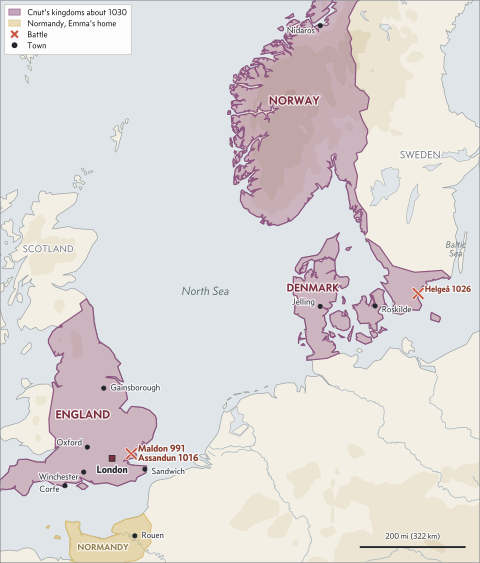
Cnut left Denmark in the care of Ulf, an earl married to his sister Estrid. About 1026, while Cnut was in England, Ulf persuaded the Danes to accept Cnut’s young son Harthacnut as their king, which made Ulf their real ruler. Cnut came north, fought the kings of Norway and Sweden at the Holy River, the Helgeå (hel-geh-oh), and then went to a feast that Ulf gave for him at Roskilde (ross-kil-uh). The Icelandic historian Snorri Sturluson (Chapter 1) tells in his Heimskringla what happened next. The king sat silent and sullen through the feast, and then the two men sat down to chess. Cnut made a false move, Ulf took one of his knights, and Cnut put the piece back and told him to move again. Ulf overturned the board and walked out. “Runnest thou away, Ulf the coward?” the king called after him, in Samuel Laing’s translation of 1844. The next morning Cnut sent a man to kill Ulf, who was run through in the church of Saint Lucius (loo-shus). The quarrel over chess was a pretext;This ruler used a dispute over a chess game as a pretext to kill his rebellious brother-in-law Ulf. → Cnut the Great• Cnut had never forgiven his brother-in-law’s rebellion.
In 1027 Cnut traveled to Rome to see Conrad II crowned emperor, the ruler of Germany and northern Italy, and walked in the procession at his side. The friendship lasted, and Cnut arranged a marriage to seal it. Cnut’s daughter Gunhild married Conrad’s sonThis ruler's daughter Gunhild married the son of Conrad II. → Cnut the Great• Henry, the future emperor Henry III, in 1036, the year after her father’s death.
About 1130 Henry of Huntingdon, an English churchman writing a history of the English, told the story by which Cnut is best remembered. At the height of his power, Henry says, the king had his throne set on the shore as the tide was coming in, and he commanded the rising sea not to wet his robes.This ruler legendarily commanded the tide to spare his robes to show his power was inferior to God’s. → Cnut the Great•• The tide came on regardless and soaked his feet and legs. Cnut leaped back and told everyone present that the power of kings is empty and worthless, and that no one deserves the name of king but God, whom heaven, earth, and sea obey. Afterward, says Henry, Cnut never wore his golden crown again but hung it on a crucifix. In Henry’s telling Cnut never thought he could stop the sea; he meant to show that he could not. Henry wrote nearly a century after Cnut’s death, and no earlier writer tells the story.
Cnut died at Shaftesbury on November 12, 1035, about forty, and was buried at Winchester, Alfred’s city. Harold Harefoot ruled England until 1040, and Harthacnut until 1042, when he collapsed while drinking at a wedding feast. The crown then went back to Alfred’s line, to Emma’s son by Æthelred. He was Edward the Confessor, and with him Chapter 21 begins.
What to remember
- The Vikings’ Great Heathen Army landed in 865 and destroyed every English kingdom but Wessex. Alfred helped his brother Æthelred I win at Ashdown and became king in 871.
- Surprised at Chippenham in 878, Alfred hid at Athelney (the burnt cakes are a later legend), then beat Guthrum at Edington and stood godfather at his baptism. Their peace is called the Treaty of Wedmore.
- The Treaty of Alfred and Guthrum ran the border up the Thames and the Lea, to Bedford and the Ouse, and along Watling Street. The Danish-ruled land beyond it was the Danelaw.
- Alfred built burhs (listed in the Burghal Hidage), compiled the Doom Book, and translated Gregory’s Pastoral Care; the Old English Boethius was long credited to him. Asser wrote his Life in 893.
- Edward the Elder won at Tettenhall (910). Æthelred the Unready, “poorly counseled,” became king in 978 after his half-brother Edward the Martyr was murdered.
- The Battle of Maldon tells Byrhtnoth’s defeat by the Vikings in 991. Æthelred paid the Danegeld, ordered the St. Brice’s Day massacre of 1002, and was deposed by Sweyn Forkbeard in 1013.
- Cnut, Sweyn’s son, won at Assandun in 1016, married Emma, and ruled England, Denmark, and Norway. Snorri tells of Ulf’s killing, Henry of Huntingdon of the tide.
Chapter 20 · 22 clues
Iceland, Vinland, and the Northern Kingdoms
In the summer of the year 1000, Iceland came within a day of civil war. At the island’s great yearly assembly, the Christians, newly baptized by missionaries from Norway, and the men who still sacrificed to Thor and Odin each declared that they would no longer live under the same law as the other. The Christians’ leader handed the matter to the assembly’s chief officer, a chieftain named Thorgeir (thor-gayr) who still followed the old gods. Thorgeir went to his booth, lay down, and spread his cloak over his head. He lay there all that day and the night after, speaking to no one.
The next morning he gave his ruling. If they broke the law in two, he said, they would break the peace as well, so there must be one law for everyone, and it would be the Christian law. So the priest Ari Thorgilsson (thor-gils-son), called Ari the Learned, told the story about 1125 in his short Book of the Icelanders. A whole people had changed its religion by a ruling at law. How did a country with no king come to settle things that way, and what became of it?
Iceland and the Althing
Iceland lies just south of the Arctic Circle, about 600 miles (970 km) of open sea west of Norway, and its volcanoes belong to geography (Vol. 3, Geography: Europe, Asia, and Africa). In the year 800 nobody lived there for good, but Irish monks came in summer. Like the monks of Iona (Chapter 16), they sought what Columba’s biographer Adomnán called a “desert in the ocean,” where they could pray alone. About 825 an Irish scholar in the Frankish empire, Dicuil (dik-wil), wrote that priests had once spent February to August on an island he called Thule, the old Greek and Roman name for a land at the northern edge of the world. At midsummer there, he said, a man could pick the lice from his shirt at midnight as if in daylight. Most scholars take his Thule to be Iceland.
The Norse who came later remembered them. Ari writes that when the first settlers arrived, there were already Christians on the island, Irish hermits whom the Norse called paparMedieval accounts describe Irish hermits called Papar living in this country before Norse settlement. → Iceland• (pah-par), “fathers,” from the Latin word that also gave English “pope.” They went away, Ari says, because as Christians they would not live among worshipers of the old gods, and they left behind Irish books, bells, and croziers, the hooked staffs of abbots and bishops. Archaeologists have found no certain trace of them in Iceland, so the papar rest on what medieval Icelanders wrote.
The Norse began to arrive about 870, and the oldest remains of their farms lie just above a layer of ash from an eruption of about that date, with a few just below it. The Book of Settlements, or Landnámabók (land-nowm-ah-bohk), which names about 400 of the first settlers, says the first was Ingólf Arnarson (ing-olf ar-nar-son), from Norway, in 874. Nearing land, he threw overboard the carved pillars of his high seat, the chief’s chair in a Norse hall, and vowed to settle wherever they drifted ashore. His slaves found them at a bay where steam rose from hot springs, and he named it Reykjavík, “Smoky Bay.” Most settlers came from western Norway, often by way of the Norse colonies in Scotland and Ireland, bringing Irish and Scottish thralls (Chapter 18). Later Icelanders said that their ancestors had fled the rule of Harald Fairhair, whom the sagas call the first king of all Norway (Chapter 18), but most of them probably just wanted land. Within about sixty years all the good land was taken (Figure 20.1).

In Norway, free men settled their quarrels at a thing, the open-air assembly described in the Stage. Iceland soon had local things, but a quarrel between a man of the north and a man of the south had nowhere to go. So the chieftains agreed to make an assembly for the whole island, the Althing, whose name means “the thing of all,” and in 930, by tradition, it first met. The Althing is often called the world’s oldest parliament,Founded in Iceland in 930, this assembly is often called the world’s oldest parliament. → Althing•• though the title is only half true. The Althing made laws and judged cases, but nobody elected its members, since the chieftains sat there by right of their office, and from 1800 to 1845 it did not meet at all. Yet it first met in 930, and it meets still.
The chieftains chose a grassy plain in the southwest, beside a lake and a river and under a long cliff, within a few days’ ride of the busiest districts. The Althing met at Thingvellir,This assembly originally met at Thingvellir. → Althing•• “the plains of the assembly,” for more than eight hundred years. Each June, for about two weeks, chieftains and farmers rode in from every corner of the island and camped in booths of turf and stone roofed with cloth. They argued lawsuits, arranged marriages, traded goods, and told stories.
At the center stood the lawspeaker, the Althing’s only officer, an office Snorri Sturluson twice held (Chapter 1). The lawspeaker presided over the Althing,A Lawspeaker presided over this medieval Icelandic assembly. → Althing• chosen by the chieftains for three years at a time. Until the laws were written down, in the winter of 1117 to 1118, they lived in his memory. Standing at a spot below the cliff called the Law Rock, he recited one third of the whole law each summer, so that in his three years he spoke all of it, and any farmer could ask him what the law said. He could not order anyone to do anything.
Power lay with about three dozen chieftains, the godar (goh-thar) (singular godi), who led their districts and named the judges. Before 1000 they had also led the sacrifices, which is why their title comes from the word for “god.” A free farmer could choose which godi to follow, and change his mind, so a chieftain who treated his people badly could lose them.
The sagas, the prose stories Icelanders wrote in the 1200s and 1300s (the Stage), show this law at work. In Njáls saga, written about 1280 (Chapter 4), lawsuits at the Althing are won and lost on points of procedure. After the wise lawyer Njal and his sons are burned to death in their house, the great case against the burners collapses on such a point, and the two sides fight a pitched battle on the assembly plain. A verdict was only words, because Iceland had no police, and the winner had to enforce it himself, with his friends. The heaviest sentence was full outlawry: the outlaw lost his property and the protection of the law, and anyone could kill him. A lesser outlaw had to leave Iceland for three years.
This was the law that Thorgeir, the lawspeaker, saved in 1000. Norway’s king, Olaf Tryggvason, a fierce convert (Chapter 3), had sent missionaries to Iceland, and later sagas say he held the sons of leading Icelanders hostage in Norway. Thorgeir’s ruling kept the peace by a bargain. Everyone would be baptized, but for a time people could still eat horse meat, which the Church forbade because it was eaten at sacrificial feasts, leave unwanted babies out to die, and even sacrifice to the old gods in secret. A few years later even these were forbidden. Iceland had become Christian by law, and its old gods were left to the poets (Chapter 1).
Greenland and Vinland
Greenland was settled by an outlaw. Erik Thorvaldsson (thor-vahlds-son), called Erik the Red for his hair, came from Norway to Iceland as a boy, when his father was exiled for manslaughter. In the saga that bears his name, Erik’s own slaves start a landslide onto a neighbor’s farm, the neighbor’s kinsman kills them, and Erik kills him and another man. Later, in a fight over some bench boards he had lent and could not get back, Erik kills two of the borrower’s sons. About 982 a local assembly outlawed him for three years.
He had heard that a sailor blown off course decades before had sighted land to the west. So Erik the Red, a Norse farmer with nowhere left to go, became one of the Viking Age’s great explorers.Erik the Red was an explorer among these people. → Vikings•• He sailed west, met the icebound east coast of Greenland, and followed it south around the southern cape. On the far side he found long fjords cutting deep inland, and at their heads meadows of grass with dwarf willow and birch, as good for cattle and sheep as any in Iceland, with no people on them. After three years of exploring he went back to Iceland and named the country Greenland because, the saga says, people would be more eager to go there if the land had a good name.
In 985 or 986, the Book of Settlements says, twenty-five ships set out from Iceland with settlers and livestock, and fourteen arrived. In the 111 years since Ingólf’s landing, the Vikings had colonized Iceland and Greenland,These people colonized Iceland and Greenland. → Vikings•• each island settled from the one before. Greenland, the largest island on Earth (Vol. 2, Geography: The Americas and Oceania), is mostly ice, and only its southwestern fjords could be farmed. Erik took the best land, at Brattahlid (braht-tah-leeth), “Steep Slope.” The settlers spread through two clusters of fjords, which they called the Eastern and the Western Settlement, though both lie on Greenland’s west coast. The Eastern was simply the more southerly, near the southern cape, and the Western lay some 300 miles (500 km) farther up the coast, near the modern capital, Nuuk (nook).
Archaeologists, who have found the ruins of several hundred Norse farms, divide them into Western, Middle, and Eastern Settlements,Archaeologists divide sites on this island into Western, Middle, and Eastern Settlements. → Greenland• because a small group of farms lies between the two great ones, around a fjord at Ivittuut (ee-vit-too-oot). The colony grew to perhaps two or three thousand people. They kept cattle and sheep, hunted seals and caribou, and each summer sailed far north to hunt walrus. Walrus tusks were ivory, and ivory, with walrus-hide rope and polar bear skins, paid for the iron, timber, and grain that Greenland could not supply. From 1126 the colony had its own bishop, at Gardar (gar-thar), near Brattahlid.
Two sagas tell what came next, and they disagree. The Saga of the Greenlanders survives only in the Flateyjarbók, the huge Icelandic manuscript of the 1390s (Chapter 3), and the Saga of Erik the Red in two manuscripts of the 1300s and 1400s. Both were composed in the 1200s from stories told for two centuries. The account below follows the Saga of the Greenlanders.
About 986, it says, a trader named Bjarni Herjólfsson (her-yohlfs-son), lost in fog on his way to Greenland, sighted three unknown coasts to the west but never landed. Some years later Erik’s son Leif Erikson bought Bjarni’s ship and hired a crew of thirty-five. Leif had been born in Iceland, before the family moved, and the saga calls him big, strong, and wise. His father was to lead the voyage, but Erik fell from his horse on the way to the ship, took it as an omen, and stayed home. So Leif, born in Iceland, led the voyageThis Iceland-born Norse explorer led voyages to Vinland in North America around 1000. → Leif Erikson••• west about the year 1000 that reached the land the Norse called Vinland, in North America (Figure 20.2).
He sailed Bjarni’s route backward. First came a land of flat stones running up to glaciers, which he named Helluland (hel-oo-land), “Slab Land,” probably Baffin Island. Next came a low, wooded coast with white sand beaches, Markland, “Forest Land,” probably Labrador. Two days later they found an island and a sound, with salmon bigger than any they had seen, grass that stayed green through the winter, and winter days far longer than in Greenland. They built houses and wintered there. One evening Leif’s foster father, a German named Tyrkir (teer-kir), came back from exploring grinning and babbling in German, and at last explained that he had found grapes. In spring they sailed home with timber and grapes, and Leif named the country Vinland, “Wine Land.”

The Saga of Erik the Red tells it differently. In its version King Olaf Tryggvason sends Leif from Norway to preach Christianity in Greenland, and Leif, blown off course, finds Vinland by accident. In both sagas he rescues shipwrecked sailors on his way home and is called Leif the Lucky ever after.
Others of his family followed. His brother Thorvald found the land beautiful, until his men came upon nine people asleep under three boats of hide and killed eight of them. A fleet of hide boats came to avenge them, and an arrow killed Thorvald. In the sagas, these are the first known meetings between Europeans and the peoples of America. The Norse called the natives skraelingsThese people encountered indigenous groups they called "skraelings." → Vikings•• (skray-lingz), a word of uncertain meaning, perhaps “wretches.” It was an insult rather than the name of a people, and the Norse used it for every native people they met, in Greenland as well as in Vinland. The people of Vinland were probably ancestors of peoples such as the Beothuk (bee-oth-uk) of Newfoundland or the Mi’kmaq (mig-mah) of the Gulf of St. Lawrence.
Next an Icelandic trader, Thorfinn Karlsefni (karl-sev-nee), led a real colony to Vinland, with livestock and women as well as men, and his wife Gudrid bore a son there, the first European child the sagas record as born in America. The natives came to trade furs for milk, but fighting soon broke out. Karlsefni saw that a few dozen settlers could never hold out against so many, and before long he took everyone home. Greenlanders sailed to Markland for timber long afterward, but never settled America.
For more than nine hundred years these were only stories. In 1960 a Norwegian explorer, Helge Ingstad (ing-stahd), and his wife, the archaeologist Anne Stine Ingstad, came to a fishing village at the northern tip of Newfoundland. Newfoundland is a large, rocky island at the mouth of the Gulf of St. Lawrence, off the east coast of Canada (Vol. 2, Geography: The Americas and Oceania). A fisherman, George Decker, showed them some grassy humps near the shore, and Anne Stine Ingstad led the digging there from 1961 to 1968. The humps were the walls of eight buildings of turf over wooden frames, built like the halls of Iceland and Greenland, with a smithy where someone had smelted iron from bog ore, a rusty mud found in swamps. Among the finds were a bronze cloak pin of a Norse pattern and a spindle whorl, the stone weight used in spinning wool.

The Norse settlement at L’Anse aux Meadows,These people established a settlement at L'Anse aux Meadows in Newfoundland. → Vikings••This island’s Norse settlement at L’Anse aux Meadows is associated with the Vinland voyages described in sagas about Leif Erikson. → Newfoundland•• as the Newfoundland site is called, is the only proven Norse site in America outside Greenland, and it is linked to the Vinland voyages that the sagas tell of Leif Erikson and his family. It was not all of Vinland. The diggers found butternuts, a kind of walnut that grows no farther north than New Brunswick, hundreds of miles to the southwest, where wild grapes also grow. The site looks like a base camp at the door of the Gulf, used for a few years.
The Greenland colony that sent these ships lasted about 450 years, longer than the United States has existed, and then it vanished. It died from the north down (Figure 20.4). In 1261 the Greenlanders accepted the king of Norway as their lord. About 1350 a Norwegian priest, Ívar Bárðarson (ee-var bowr-thar-son), sailed to the Western Settlement, which had reported trouble, and found cattle, sheep, and goats running wild and not a single person. In 1379 the Icelandic annals, the yearly records kept in Iceland, note that the skraelings killed eighteen Greenlanders and carried off two boys as slaves. These skraelings were the Inuit, hunters from Arctic Canada who had been moving down Greenland’s west coast since about 1200.


In September 1408 a couple were married in the stone church at Hvalsey (kvahl-say), in the Eastern Settlement. The bride and groom were Icelanders whose ship had been driven to Greenland by storms. The couple later settled in Iceland, and the letters written there to prove their marriage are the last written record of Norse Greenland. By about 1450 the Eastern Settlement was empty too.
Historians still weigh the reasons, and most now think several worked together. The climate cooled from the late 1200s, bringing more sea ice, shorter summers, and less hay for the cattle. Trade withered: elephant ivory came back to European markets, so walrus ivory lost much of its value, and after plague struck Norway in 1349 fewer ships made the voyage. The Inuit, who hunted seals from kayaks and needed nothing from Europe, moved into lands the Norse had once had to themselves. The Norse did adapt, since their bones show that they ate more and more seal, but a small colony that lives by trade can simply run out of people. When the Norwegian missionary Hans Egede came in 1721 to preach to the lost Norse, he found only Inuit and ruins.
Snorri and the sagas
While Greenland faded, Iceland wrote. In the 1200s and 1300s it produced a body of prose that has no match in medieval Europe. Icelanders wrote hundreds of sagas in Old Norse,This country is home to many Old Norse sagas. → Iceland• their own tongue, rather than in Latin, the language of learning elsewhere, and they wrote about their own great-great-grandparents as well as about saints and kings. There were kings’ sagas, such as the lives of the kings of Norway, and legendary sagas of ancient heroes, such as the Völsunga saga (Chapter 7). The most famous kind, the Sagas of Icelanders, are about forty stories of the settler families and their feuds, among them Njáls saga, Egils saga, and the Laxdæla saga (Chapter 6).

Nobody knows who wrote the Sagas of Icelanders. Their style is plain and dry. People speak in short lines, often in understatement, and the reader learns what they feel from what they do. In Njáls saga the hero Gunnar, besieged in his house, asks his wife for two locks of her hair to twist into a new bowstring. She refuses, reminding him of a slap he once gave her, and he fights on with what he has until he is killed. The saga does not say what either of them felt.
The most famous writer of the north was a chieftain. Snorri Sturluson, the author of the Prose Edda and Heimskringla (Chapter 1), was born in Iceland in 1179,Snorri Sturluson is from this country. → Iceland•• at Hvammur (kvahm-ur) in the west. His family, the Sturlungs (stur-lungz), took their name from his father, Sturla. After a boyhood at the learned farm of Oddi (Chapter 1), he married an heiress, and in 1206 he settled at Reykholt (rayk-holt), a rich farm in the west of Iceland, where his round, stone-lined pool, fed by a hot spring, still survives. He served as lawspeaker from 1215 to 1218 and again from 1222 to 1232. About 1220, at home in Iceland, Snorri wrote the Prose Edda,The Prose Edda was written in this country. → Iceland•• the handbook for poets that keeps most of what we know of the Norse gods, and about ten years later he wrote Heimskringla, his history of the kings of Norway.
He lived in a violent time. By 1220 a handful of families held nearly all the chieftaincies, and they fought one another with armies of hundreds. Historians call the years from about 1220 to 1264 the Age of the Sturlungs, after the strongest family, Snorri’s own. On his visit to Norway of 1218 to 1220 (Chapter 1), Snorri had promised King Hákon and Earl Skúli that he would help bring Iceland under the Norwegian crown, then gone home and done little about it. In 1238, at Örlygsstaðir (ur-ligs-stah-thir), the chieftain Gissur Thorvaldsson (gis-ur) and his allies killed Snorri’s brother and four of his brother’s sons.
Snorri was then in Norway, staying with Earl Skúli, who was drifting into rebellion against the king. Hákon forbade him to leave, but in 1239 Snorri sailed home anyway, saying “Út vil ek,” “I will go out,” words that became a saying in Iceland. When Skúli’s revolt failed in 1240, Hákon sent Gissur a letter: Snorri was to be sent back to Norway or killed. On the night of September 23, 1241, Gissur rode to Reykholt with seventy men and broke into the house. They found Snorri in the cellar. As one attacker told another to strike, Snorri said, “Eigi skal höggva!” (“Do not strike!”). Those were his last words. The account comes from his nephew, Sturla Thordarson, who fought in these wars and wrote their history, the Íslendinga saga (ees-len-ding-ah).
Saxo Grammaticus
Denmark found its historian a generation before Snorri. Saxo, the Danish clerk whom Chapter 1 introduced, served Absalon (ab-sah-lon), a warlike churchman who was archbishop of Lund, then a Danish city, from 1178 to 1201. Absalon led fleets against pirates and built the fort that grew into Copenhagen. Absalon wanted the Danes to have a history as grand as Rome’s, and so Saxo wrote the Gesta DanorumThis Danish historian wrote Gesta Danorum. → Saxo Grammaticus• (Chapter 1). He dedicated it to Absalon’s successor, Archbishop Anders Sunesen (soo-neh-sen), and to King Valdemar II, two men who meet again at Lindanise (lin-dah-nee-seh). The last seven books tell real history, partly from Absalon’s memories. The first nine run back through legendary kings, heroes, and gods, whom Saxo, a Christian, treated as men and sorcerers (Chapter 8). His own manuscript is lost except for a few leaves, and the text survives because a Danish scholar, Christiern Pedersen (kris-tyern), had it printed in Paris in 1514.
The ninth book tells of Ragnar Lodbrok, the legendary Danish king whom later sagas make the father of Ivar the Boneless (Chapter 18). Ragnar goes to Norway to avenge his grandfather, killed by a king of Sweden who has handed the women of the dead king’s family over to shame. Women who have suffered the same, or fear it, come to Ragnar’s camp dressed as men. Among them, Saxo tells, is the warrior woman LagerthaThis Danish historian recounted the exploits of the warrior woman Lagertha. → Saxo Grammaticus• (lah-ger-tah). In Oliver Elton’s translation of 1894 she is “Ladgerda, a skilled amazon, who, though a maiden, had the courage of a man, and fought in front among the bravest with her hair loose over her shoulders.” Ragnar woos her. She sets a bear and a dog at her door to keep him out, and he kills both and marries her. Later he divorces her, but when rebels nearly beat him, Lagertha sails to his aid with 120 ships, and her charge around the enemy’s rear wins the day. At home she murders her new husband with a spearhead hidden in her gown, because, in Elton’s words, she “thought it pleasanter to rule without her husband than to share the throne with him.”
The third and fourth books hold a darker story. A Danish lord, Feng, murders his brother Horwendil (hor-ven-dil) and marries the widow. Her son Amleth, fearing he will be next, pretends to be a fool. Feng sends him to Britain with a letter asking the British king to kill him, but Amleth secretly changes it, so that his two escorts are hanged instead. He comes home in time for his own funeral feast, gets the court drunk, burns the hall over their heads, and kills Feng with Feng’s own sword.
The sixth book belongs to Saxo’s greatest warrior, Starkad, the son of Storwerk. Saxo reports a tale that Starkad, born of giants, had extra arms, four of which Thor tore off, and calls it flatly incredible. The story of his first crime he tells in earnest. Odin, the one-eyed chief of the gods (Chapter 2), wanted the Norwegian king Víkarr (vee-kar) dead but did not wish to kill him openly. So, in Saxo’s telling, Odin made Starkad his favored hero.This figure patronized the hero Starkad. → Odin• In Elton’s words he “graced Starkad” with bravery and with skill “in the composing of spells,” and “endowed him with three spans of mortal life, that he might be able to commit in them as many abominable deeds.” Starkad sailed with the king. When storms held the fleet still for most of a year, the warriors drew lots for a human sacrifice to the gods, and the lot fell on the king. Starkad hung him in a noose of willow, saying it was only “the mere semblance of a penalty.” But the knot held, and as the king hung, Starkad finished him with his sword.
The Icelandic Gautreks saga (gow-treks), written down late in the 1200s, tells the same murder with Odin in plain view. Starkad’s foster father, Horsehair Grani, turns out to be Odin, who grants him three lifetimes at a night council of the gods and asks for Víkarr in return. The next day the becalmed warriors stage a pretend hanging with a calf’s guts for a rope, and Starkad touches the king with a reed, giving him to Odin. The reed becomes a spear, the guts a strong rope, and the king dies.
Sturlungs, Birkebeiner, and Kalmar
The kingdom that ended Iceland’s wars had first fought its own. For more than a century after 1130, Norway quarreled over its crown, because any son of a king could claim it, whether or not his parents were married. In 1174 a band of ragged rebels rose against King Magnus Erlingsson (air-lings-son), whom the Church had crowned as a boy. Their enemies mocked them as the Birkebeiner (beer-keh-bay-ner), “birch-legs,” saying they were so poor that they wrapped their legs in birch bark, and the rebels took the insult as their name. From 1177 they were led by Sverre (sveh-reh), a priest raised in the Faroe Islands who claimed to be a king’s son, which many doubted then and historians doubt now. In 1184 he beat King Magnus in a sea battle, and Magnus drowned. In 1194 Norway’s archbishop excommunicated Sverre, cutting him off from the Church, and in 1196 the bishops raised a party of their own, the Bagler (bahg-ler), from the Old Norse word for a bishop’s crozier.

So Norway’s civil war between the Birkebeiner and BaglerThis country experienced a civil war between the Birkebeiner and Bagler parties. → Norway• went on past Sverre’s death in 1202. Its best-loved story comes from the winter of 1206, when two Birkebeiner on skis carried Sverre’s baby grandson, Hákon, through the mountains from Lillehammer to safety in Nidaros, now Trondheim (trond-hime) (Figure 20.7). The Bagler gave up in 1217, and the boy became King Hákon IV, who welcomed Snorri in 1218 and ordered his death twenty-three years later.
Hákon now had Iceland where he wanted it. Gissur Thorvaldsson, Snorri’s killer, became the king’s earl in Iceland, and the exhausted chieftains turned to Norway for peace. In 1262 to 1264, district by district, Icelanders swore an agreement later called the Old Covenant. They would pay the king a tax and be his subjects, and he would keep the peace, respect their laws, and see that ships sailed to Iceland every year, which mattered, since Iceland’s birch woods could not build a ship fit for the ocean. The Old Covenant ended the Age of the SturlungsThis country’s Age of the Sturlungs ended when the Old Covenant brought it under Norwegian rule. → Iceland•• and brought Iceland under Norwegian rule; Greenland had accepted the king the year before. The Althing went on meeting at Thingvellir, now as the king’s court of law.
Sweden’s saint-king belongs to the age of Norway’s civil wars, a century before the Old Covenant. Eric IX ruled from about 1156 until he was killed at Uppsala in 1160, and he became Sweden’s patron saint. Legends first written in the late 1200s say that he led a crusade across the Baltic to Finland with an English bishop named Henry. When the king went home, Henry stayed to Christianize Finland,Tradition says Bishop Henry accompanied Eric IX to Christianize this country and was killed there by Lalli. → Finland•• and there, tradition says, a farmer named Lalli (lahl-lee) killed him. In the Finnish folk poem “The Death-Lay of Bishop Henry,” the bishop’s party takes food and hay from Lalli’s farm while he is away, and Lalli chases the bishop onto the frozen Lake Köyliö (koy-lee-uh) and kills him with an axe. Lalli puts on the bishop’s miter, his tall hat, and when he takes it off, his scalp comes with it. Henry became Finland’s patron saint, though historians cannot confirm that he or his crusade existed. Finland did become part of the Swedish kingdom, and it stayed Swedish until 1809.

Denmark’s crusade is better recorded. In June 1219 King Valdemar II, called the Victorious, sailed to northern Estonia with Archbishop Anders Sunesen, Saxo’s patron, and began building a fort on a hill at a place called Lindanise. On June 15 the Estonians attacked at evening from several sides and nearly routed the Danes, until the king’s men rallied and won. Danish tradition adds a miracle. The archbishop prayed on a hilltop with his arms raised, as Moses does in the Book of Exodus, and the Danes advanced while his arms stayed up. Then, at the worst moment, a red flag with a white cross fell from the sky,This country's flag legendarily fell from the sky at the Battle of Lindanise during a campaign in Estonia. → Denmark•• and under it the Danes won. That flag is the Dannebrog (dan-eh-broh), “the Danish cloth,” the flag of Denmark, which Danes call the oldest national flag in continuous use. Another Henry, the priest Henry of Livonia, who described the battle within about ten years, has no flag from heaven. The legend was first written down in the 1520s, three centuries later, by Christiern Pedersen, the man who printed Saxo, and by a Franciscan friar, Petrus Olai (oh-lah-ee). Neither at first named Lindanise: Pedersen has the flag fall during one of Valdemar’s campaigns overseas, and Petrus Olai first set the miracle at a battle of 1208, then moved it to Lindanise and the year 1219. The fort at Lindanise became the town of Reval, now Tallinn, the capital of Estonia.
The three kingdoms came together under a woman. Margaret, a daughter of King Valdemar IV of Denmark, was born in 1353 and married at ten to King Hákon VI of Norway. Their only son, Olaf, was elected king of Denmark as a child, inherited Norway in 1380, and died in 1387, at sixteen. Margaret had no legal title, but she had shown herself the ablest ruler in either kingdom, and both accepted her rule. In 1388 Swedish nobles, tired of their German-born king, invited her in, and the next year her army took him prisoner. She chose as her heir her sister’s grandson, Eric of Pomerania (pom-eh-ray-nee-ah), and on June 17, 1397, at Kalmar, a Swedish port on the Baltic, he was crowned king of all three kingdoms.
So Margaret I united Denmark, Norway, and SwedenMargaret I united Denmark, Norway and Sweden in this 1397 union. → Kalmar Union•• in the Kalmar Union. It was a personal union: three kingdoms, each with its own laws, council, and nobles, sharing one ruler, as one person might hold three jobs. Through Norway it took in Iceland, the Faroes, Orkney, Shetland, and the last farms of Greenland, and through Sweden it took in Finland. Margaret ruled in Eric’s name until she died in 1412. Sweden broke away for good in 1523 (Vol. 14, From Luther to Mozart), but Norway and Iceland stayed with Denmark for centuries, which is why the great Icelandic manuscripts were kept in Copenhagen until the 1970s (the Stage).
What to remember
- Medieval accounts say Irish hermits, the papar, reached Iceland first; the Norse settled it from about 870.
- The Althing, founded in 930 and often called the world’s oldest parliament, met at Thingvellir, and the lawspeaker presided. In 1000 it made Iceland Christian.
- Erik the Red, an outlaw, settled Greenland about 985. Archaeologists divide its sites into Western, Middle, and Eastern Settlements. The last record is a wedding at Hvalsey in 1408.
- Leif Erikson, born in Iceland, reached Vinland about 1000. The Norse called the natives skraelings. L’Anse aux Meadows in Newfoundland, found in 1960, is the only proven Norse site in America.
- Iceland is the home of the sagas. Snorri Sturluson, born there, wrote the Prose Edda and was killed at Reykholt in 1241 on the king of Norway’s orders.
- Saxo Grammaticus wrote the Latin Gesta Danorum, with the warrior woman Lagertha, Amleth, and Starkad, whom Odin favored with three lifetimes.
- Norway’s civil war set the Birkebeiner against the Bagler. The Old Covenant of 1262 to 1264 ended Iceland’s Age of the Sturlungs and brought it under Norway.
- By tradition Bishop Henry was killed in Finland by Lalli, and by legend the Dannebrog fell from the sky at Lindanise in 1219. Margaret I made the Kalmar Union in 1397.
Conquest and Romance, 1042-1199
Chapter 21 · 41 clues
1066
On December 28, 1065, the bishops and monks of Westminster gathered to consecrate a great new church beside the Thames. The king who had paid for it had been building it for about fifteen years, and he was not there. Edward, king of the English, was past sixty and lay dying in his palace a few hundred yards away. He died a week later, on January 5, 1066. On January 6 he was buried in his new church, and on the same day, probably under the same roof, his brother-in-law Harold Godwinson was crowned king in his place.
Before the year was out England would have four kings, if we count a boy who was chosen and never crowned. Two foreign armies would land on its coasts, three great battles would be fought in less than four weeks, and two of the three grown men who claimed the crown would be dead. The winner, a duke from across the Channel, handed out the land of England to his followers so thoroughly that twenty years later nearly every great estate in the kingdom had a French-speaking lord. This chapter tells that year: who the claimants were, why each believed the crown was his, and how the question was settled, first at a bridge in Yorkshire and then on a hill in Sussex.
Edward the Confessor
Edward was the son of Æthelred the Unready and his second wife, Emma of Normandy (Chapter 19). He was born about 1005, and when he was eight the Danish king Sweyn Forkbeard drove his family out of England. Apart from two years at home in 1014–1016, Edward spent the next quarter of a century in exile, mostly in Normandy among his mother’s family. Cnut, the Danish conqueror, married his mother, and in time her son by Cnut, Harthacnut, became king. In 1036 Edward’s younger brother, another Alfred, crossed to England and was seized by Godwin, the most powerful lord in the south, who handed him to Cnut’s son Harold Harefoot. Alfred was blinded and died of his wounds. Edward never forgave Godwin.
In 1041 the childless Harthacnut invited his half-brother home, probably as his heir, and when Harthacnut collapsed at a wedding feast in June 1042, Edward became king. He was nearly forty, a stranger to the country he ruled, and he ruled it through the great men Cnut had left behind. These were the earls, the greatest lords of the kingdom, each governing a huge province for the king. The Old English word eorl, a nobleman, took on this meaning under Cnut, whose own great lords bore the same title in Danish, jarl. The old kingdoms of Wessex, Mercia, and Northumbria (the Stage) had become their earldoms.
Three earls mattered most. Godwin, earl of Wessex, was the son of a thegn of Sussex, one of the landowning warriors who were the backbone of English society, and Cnut had made him the richest man in England after the king. He had married a Danish noblewoman, the sister of the Earl Ulf whom Cnut had killed after a game of chess (Chapter 19). Leofric, earl of Mercia, came of an old English family. His wife was Godgifu, better known as Godiva, a patron of churches; the story of her naked ride through Coventry was first written down in the thirteenth century, about a century and a half after her death. Siward (see-wurd), earl of Northumbria, was probably a Dane.
Godwin rose highest. In 1045 Edward married his daughter Edith, and Godwin’s sons Harold and Sweyn became earls. Then in 1051 the family fell. Eustace, count of Boulogne, a county on the French side of the Channel, had once been married to Edward’s sister. He visited the king, and on his way home his armed men got into a brawl with the townsmen of Dover in which some forty people were killed. Edward ordered Godwin, whose earldom included Dover, to punish the town. Godwin refused and called out his men. The other earls stood by the king, and Godwin and his sons fled abroad. Edward sent Edith to a nunnery. A year later the Godwins sailed back with a fleet, the king had to take them back, and his Norman favorite, Robert of Jumièges (zhoo-myezh), archbishop of Canterbury, fled across the Channel. Godwin collapsed at the king’s Easter feast in 1053 and died a few days later. Harold, his eldest surviving son, inherited Wessex.
By 1057 Harold’s brothers held earldoms too: Tostig (toss-tig) in Northumbria, after Siward’s death, Gyrth (gurth) in East Anglia, and Leofwine (lay-of-win) in the lands around London. The sons of Godwin governed all of England except Mercia, which stayed with Leofric’s family. Edward reigned, hunted, and built.
His building was a church. West of the walled city of London, on a gravel island in the Thames called Thorney, stood a small monastery of St. Peter. It was called the West Minster, a minster being a monastery church, because it lay west of the city. From about 1050 Edward rebuilt Westminster AbbeyThis ruler rebuilt Westminster Abbey in the Romanesque style. → Edward the Confessor•• as his own burial church, in the new Romanesque style of the continent: round arches, thick walls, and massive piers (Vol. 1, The Toolkit). It was the first church in England built in that style and the first laid out in the shape of a cross. It was very like the Norman abbey of Jumièges, which was rising at the same time, and Edward’s friend Robert had been abbot there. Westminster was then a village outside the city. Today Westminster Abbey stands in London,This city is home to Westminster Abbey. → London•• which long ago swallowed the village, and nearly every English king and queen since 1066 has been crowned there. Henry III began pulling Edward’s church down in 1245 to make room for the Gothic church that stands there now. The only picture of it is in the Bayeux (bah-yur) Tapestry (Figure 21.1).

In October 1065 the thegns of Northumbria rose against Tostig, who had ruled them harshly and taxed them hard. They killed his household men, seized his treasure, and chose a new earl, Morcar (mor-kar), the grandson of Leofric and brother of Edwin, earl of Mercia. Harold was sent to deal with the rebels, and he gave them what they asked: Tostig, who accused his brother of plotting against him, was sent into exile in Flanders, the rich county on the coast northeast of Normandy. Tostig never forgave him.
Edward fell ill that autumn and was too weak to attend the consecration of his church. According to the Life of King Edward, written soon afterward for his widow, the dying king stretched out his hand to Harold and commended to him the queen and the kingdom. Because Edward left no son, his death opened a succession crisis:This battle was prompted by the succession crisis resulting from the death of Edward the Confessor. → Battle of Hastings•The death of Edward the Confessor prompted this ruler to claim the English throne. → William the Conqueror•• three men at once believed the crown was theirs, and one of them, William, duke of Normandy, began to prepare the invasion that would end at Hastings. Less than a century later, in 1161, the pope declared Edward a saint. He is called the Confessor, the church’s title for a saint who was not killed for the faith, which also tells him apart from his uncle, Edward the Martyr (Chapter 19).
The three claimants
Harold Godwinson was crowned on January 6, 1066, as Harold II; Cnut’s son Harold Harefoot had been the first. English writers say that Ealdred (al-dred), archbishop of York, crowned him; Norman writers say it was Stigand (stig-and), the archbishop of Canterbury whom the pope did not recognize. His claim rested on three things. The dying king had named him. The witan, the council of bishops, earls, and great thegns whose advice an English king took, had chosen him. And he was the strongest man in England, the king’s brother-in-law and the ruler of Wessex for thirteen years. He had no royal blood. The one male left of the old royal line was Edgar, the grandson of Edward’s half-brother Edmund Ironside (Chapter 19). His father, Edward the Exile, had been brought home from Hungary in 1057 and had died within days. Edgar was called the Ætheling (ath-uh-ling), “the prince,” a boy of fourteen or fifteen with no lands and no army (Figure 21.2).

The second claimant was William, duke of Normandy,This ruler was Duke of Normandy. → William the Conqueror• the land of the Northmen at the mouth of the Seine (the Stage). He was Emma’s great-nephew, and so Edward’s cousin. Norman writers said that Edward had promised him the crown, probably in 1051, when the Godwins were in exile and Edward had no reason to love them. They said, too, that Harold himself had sworn to support William’s claim. About 1064 Harold’s ship was blown onto the coast of Ponthieu (pon-tyuh), just north of Normandy, and its count threw him into prison. William had him freed, took him on a campaign against the duke of Brittany, Normandy’s western neighbor, and gave him arms. Then, the Normans said, Harold swore an oath on holy relics, the bones of saints kept in precious chests, to be William’s man. The Anglo-Saxon Chronicle says nothing of the journey. The first English writer to tell of it, the Canterbury monk Eadmer (ed-mer), writing early in the twelfth century, says Harold went to free his brother and his nephew, who were held as hostages in Normandy.
William was about thirty-eight in 1066, and he had fought for everything he had. He was born about 1028 at Falaise (fah-lez), the son of the young duke of Normandy, Robert I, and Herleva (her-lee-vuh), a townsman’s daughter whose father later writers called a tanner. They never married: William was the illegitimate son of Robert I and Herleva,This ruler was the illegitimate son of Robert I and his mistress Herleva. → William the Conqueror• and his enemies called him William the Bastard all his life. He is remembered as William the Conqueror. Duke Robert gave Herleva in marriage to one of his knights, and by him she had two more sons. One of them, Odo (oh-doh), became bishop of Bayeux. In 1035 Robert set out on pilgrimage to Jerusalem. Before he left he made his barons swear to accept his son as his heir, and on the way home he died. William was seven or eight.
For twelve years Normandy belonged to whoever could seize the boy. His guardians were murdered one after another, one of them in the boy’s own bedroom while he slept. In 1046 a great rebellion broke out in western Normandy, led by his cousin Guy of Burgundy, and William, according to stories told long afterward, barely escaped capture at night. He rode to the king of France, Henry I, his overlord, the king to whom the dukes of Normandy owed loyalty, and asked for help. In 1047 the king and the young duke met the rebel army on a plain southeast of Caen (kahn), and with King Henry’s help William won at Val-ès-DunesWith help from Henry I of France, this ruler defeated rebels at Val-ès-Dunes. → William the Conqueror• (vahl-ez-doon). The rebels fled, and many drowned in the river Orne. This Henry was king of France from 1031 to 1060, not to be confused with Henry I of England, the Conqueror’s son (Chapter 22). It took William thirteen more years of war, against his own barons and in the end against King Henry himself, to make himself master of Normandy.
He also chose a wife who strengthened him. Matilda was the daughter of Baldwin V, count of Flanders, one of the most powerful princes in northern France. The two families were distantly related, both descended from Rollo, the Viking who had founded Normandy, and the Church then forbade marriage between relatives as distant as seven generations. In October 1049, at a council at Reims (reemz), Pope Leo IX forbade William to marry Matilda.Pope Leo IX opposed this ruler’s marriage to Matilda of Flanders. → William the Conqueror•• William married her anyway, in the early 1050s. A Norman monk, William of Jumièges, says the couple each founded an abbey at Caen as a penance to win the Church’s pardon, and the two great abbeys, the Abbey of Men and the Abbey of Women, still stand. The marriage was a success. Matilda governed Normandy when William was away, and they had four sons and five or six daughters.
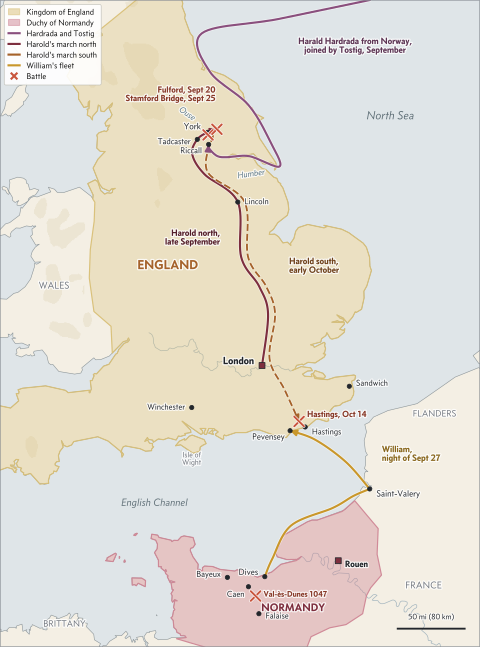
When news came that Harold had been crowned, William called it perjury, the breaking of a sworn oath. He spent the spring and summer of 1066 building a fleet and gathering an army, not only of Normans but of Bretons, Flemings, and Frenchmen eager for English land. He also sent to Rome. His chaplain, the priest of his household, William of Poitiers (pwah-tyay), says that Pope Alexander II gave William his blessingThis ruler received the blessing of Pope Alexander II before his invasion of England. → William the Conqueror•• and sent a papal banner for the army to carry. Only Poitiers mentions the banner, but four years later the pope’s own envoys crowned William a second time, so the papacy plainly approved of the conquest once it was done.
The third claimant was the most famous warrior in the north. Harald Sigurdsson (sig-urd-sun), king of Norway, was a half-brother of St. Olaf, the king who finished making Norway Christian and became its patron saint. At fifteen Harald fought beside Olaf at Stiklestad (stik-leh-stahd) in 1030, where Olaf was killed. He fled east to the court of Yaroslav (yar-uh-slav) the Wise, grand prince of the Rus, in Kiev, and from there went on to Constantinople, where he rose to command the emperor’s Norse bodyguard, the Varangian Guard (Chapter 18). He fought for the emperor in Sicily and Bulgaria, sent his loot north to Yaroslav for safekeeping, married Yaroslav’s daughter, and came home in 1046 one of the richest men in Europe. He shared Norway with his nephew Magnus the Good and ruled it alone from 1047. For seventeen years he fought the Danes and crushed his own nobles, and the Icelanders who wrote his saga gave him the name by which he is known. His Old Norse byname, harðráði, means “hard ruler”;This Norwegian king’s epithet means “hard ruler.” → Harald Hardrada• in English it became Hardrada. A German chronicler, Adam of Bremen, compared him to a thunderbolt.
Harald’s claim was the thinnest of the three. About 1040 Magnus and Harthacnut, then kings of Norway and Denmark, had agreed that whichever of them died without a son would leave his kingdoms to the other. Harthacnut died first. Magnus never collected England, but Harald, as his uncle and heir, said that the pact made England his. What turned a weak claim into an invasion was an English traitor. Tostig had spent the spring of 1066 raiding the English coast from Flanders, from the Isle of Wight to Sandwich and then up into Lincolnshire, where Edwin and Morcar drove him off. With his last twelve ships he took refuge with Malcolm III, king of Scots. By the end of the summer he had made himself Harald’s man.
All summer Harold kept a fleet off the Isle of Wight and the men of the fyrd, the farmers who owed the king military service (Chapter 19), along the south coast, waiting for William. In late April a comet had blazed in the sky for a week, and men took it for a sign of change. Contrary winds kept William in port week after week. On September 8 Harold’s food ran out. The fyrd went home to bring in the harvest and the fleet sailed for London, losing ships on the way. The south coast stood open.
Stamford Bridge
At that moment the third claimant arrived from the north. Before he left his capital at Nidaros, now Trondheim, Snorri Sturluson tells in Heimskringla (Chapter 1), Harald opened St. Olaf’s shrine, clipped his dead brother’s hair and nails, locked the shrine again, and threw the keys into the river. His fleet sailed by way of Shetland and Orkney, where the earls of Orkney joined him. The Anglo-Saxon Chronicle gives him three hundred ships; Snorri says nearly two hundred warships besides supply ships. Tostig met him with his own men, and together they sailed down the coast, into the Humber, and up the river Ouse, landing at Riccall (rik-awl), 10 miles south of York (Figure 21.3).
On Wednesday, September 20, the northern earls, Edwin and Morcar, met the invaders at Fulford, just outside York. The English fought hard, and the Chronicle says many of them were killed, drowned, or driven off, and the Northmen held the field. York surrendered. Its leading men promised hostages and supplies and agreed to join Harald’s march south. The rest of the hostages were to be brought from all over Yorkshire to a crossing of the river Derwent, 7 miles east of York, called Stamford Bridge.
Harold heard the news in the south. He gathered his own household warriors and whatever men he could find and rode north, the Chronicle says, “day and night.” On Sunday, September 24, he reached Tadcaster, about 9 miles from the Norwegian ships. The Norwegians had no idea he was there. On Monday morning he marched straight through York and out the other side.
That Monday was hot. Snorri says that Harald left a third of his army with the ships at Riccall, and that the men who marched to Stamford Bridge left their mail coats behind and carried only shields, helmets, spears, and swords. Near the river they saw a cloud of dust and under it the shine of weapons. “Their shining arms were to the sight like glancing ice,” says Snorri, in Samuel Laing’s translation of 1844.
What happened next Snorri, writing about 160 years later, tells as a meeting before the battle. Twenty horsemen rode out from the English army. One of them asked for Earl Tostig and offered him, from his brother, the whole of Northumbria, and even a third of the kingdom, if he would come over. Tostig asked what King Harold would give the king of Norway for his trouble. Harold would give Hardrada “seven feet of English ground,”According to tradition, this ruler offered Harald Hardrada “seven feet of earth” before Stamford Bridge. → Harold Godwinson (or Harold II)• the rider answered, “or as much more as he may be taller than other men”: room for a grave and no more. Harald was famously tall. Tostig refused to betray his ally and the rider rode away. Then Tostig told Harald who the rider had been: the English king himself. “That was but a little man,” said the Norwegian, “yet he sat firmly in his stirrups.”
Whether or not the meeting happened, the story puts the two kings face to face. Two kings named Harold faced each otherTwo kings with this name fought each other at the Battle of Stamford Bridge. → Harold•• at Stamford Bridge, for Harald and Harold are the same name, spelled the Norse way and the English way. One was known by a nickname and one by his father’s name, and only one of them would leave the field alive.
The battle began at the bridge. A version of the Anglo-Saxon Chronicle, in an entry added later in another hand, tells in J. A. Giles’s translation of “one of the Norwegians who withstood the English people, so that they might not pass over the bridge, nor obtain the victory.” An Englishman threw a javelin at him, “but it availed nothing; and then came another under the bridge, and pierced him terribly inwards under the coat of mail.” About 1130 Henry of Huntingdon (Chapter 19) added the axe and the count: the lone axeman killed more than forty EnglishmenA single axeman reportedly held off the English army at this battle, killing forty men on a bridge. → Battle of Stamford Bridge• before he fell. William of Malmesbury, writing a few years earlier, kills him with a javelin. The man has no name in any source.
Across the bridge, the Norwegians had formed a shield wall, but without their mail they were badly outmatched. Harald fought in front with a sword in both hands until, Snorri says, he “was hit by an arrow in the windpipe, and that was his death-wound.” Harold offered his brother peace and the Norwegians their lives; they refused. Tostig was killed. Late in the day the men left at Riccall came running up in full armor under Eystein Orre, to whom Harald had promised his daughter, some so exhausted that they fell dead without a wound. Their charge, which the Norwegians remembered as “Orre’s storm,” nearly turned the battle, but Eystein was killed too, and the Norwegians broke. Many drowned in the rivers. Harold let Harald’s young son Olaf and the earls of Orkney sail home after they swore never to attack England again. They needed twenty-four ships.
Harold had destroyed Harald Hardrada and TostigHarold Godwinson defeated Harald Hardrada and Tostig at this battle. → Battle of Stamford Bridge••Harold Godwinson defeated Harald Hardrada and Tostig at Stamford Bridge about three weeks before this battle. → Battle of Hastings•••This king allied with Tostig at the Battle of Stamford Bridge. → Harald Hardrada•• together at Stamford Bridge, less than three weeks before he had to fight again at Hastings. It was a crushing victory, and it is often taken as the end of the Viking Age (the Stage). Nineteen days later Harold would lose everything.
Hastings
William’s fleet had been waiting since August at the mouth of the river Dives. In September it moved east along the coast to Saint-Valery, at the mouth of the Somme, losing ships in a storm. On the evening of September 27 the wind turned south. The fleet sailed through the night with William’s ship in the lead, and on the morning of the 28th, three days after Stamford Bridge, William’s army landed unopposed at PevenseyThis battle's winning side landed at Pevensey. → Battle of Hastings••This ruler landed at Pevensey after sailing from Normandy to invade England. → William the Conqueror•• (pev-un-zee), in Sussex. The Normans camped inside the walls of an old Roman fort, then moved about 10 miles east to Hastings, where they threw up a castle of earth and timber and began to burn the countryside. William meant to make Harold come to him, quickly, before winter or the English fleet could trap the invaders in their corner of Sussex.
Harold probably heard of the landing on his way back south. He rested about a week in London, gathered what men he could, and marched for the coast. On the night of October 13 his army camped on a hill about 7 miles from Hastings, by a landmark that one version of the Chronicle calls a gray old apple tree. William’s scouts saw them, and the next morning, Saturday, October 14, 1066, William marched out to attack before Harold could attack him.
Harold drew up his army on the crest of a ridge across the road to London (Figure 21.4). At its heart stood his housecarls, from the Old Norse for “house-men,” professional warriors who lived in the households of the king and the earls, wore mail, and fought with the long-handled Danish axe. Beside and behind them stood the fyrd. All fought on foot. Locking their shields edge to edge, housecarls and fyrd formed a shield wallHousecarls and fyrd troops formed a shield wall on Senlac Hill at this battle. → Battle of Hastings••• along the top of the slope, a hill that an English-born monk, Orderic Vitalis, writing in the early twelfth century, called Senlac (sen-lak). Each army probably numbered somewhere between five and ten thousand men; no one counted.

William attacked in three divisions. His chaplain William of Poitiers puts the Bretons on the left and the Normans in the middle under the duke himself; the right was made up of French and Flemings. In each, archers went first, then foot soldiers in mail, and last the horsemen, the armored mounted warriors called knights, who were the strength of a Norman army. The archers shot uphill, and their arrows struck the shields or flew over the top. The foot soldiers climbed the slope and were met with spears, axes, and stones. The horsemen could not break the wall either. Then the Bretons on the left gave way and ran, and a cry went up that the duke was dead.

William rode among his men, pushed back his helmet so they could see his face, and turned them around (Figure 21.5). Many of the English had run down the hill after the Bretons, and on the open slope the Norman horsemen rode them down; one group made a stand on a small hillock and was overwhelmed. Somewhere in this fighting, or perhaps later, Harold’s brothers Gyrth and Leofwine were killed.This battle's losing commander's brothers Gyrth and Leofwine died during it. → Battle of Hastings• The Tapestry shows them falling just before the fight on the hillock, and a Latin poem written for the Normans soon after the battle says William cut Gyrth down himself.
The shield wall held. In the afternoon, William of Poitiers says, the Normans twice pretended to run away, a feigned flight, and each time some of the English broke ranks to chase them and were cut off. Little by little the best men on the ridge were killed and their places filled by the less armored fyrd. The fighting went on until dusk, about eight hours, an extraordinary length for a medieval battle. Late in the day Harold was killed under his banners. The sources do not agree on how he died, and the best-known answer comes from a strip of embroidery.
With the king dead, the English army broke, and the Battle of Hastings was over. William had defeated and killed Harold,William the Conqueror defeated Harold Godwinson at this 1066 battle. → Battle of Hastings•••This ruler defeated Harold Godwinson at the Battle of Hastings in 1066. → William the Conqueror•••This English king was defeated by William the Conqueror at Hastings. → Harold Godwinson (or Harold II)•• and with him most of the great men of England. Harold’s household men fought on around his body until they were all killed. The rest fled north into the woods in the dusk. Behind the battlefield the Normans rode into a steep ditch, where some of the English turned and fought, and many horsemen fell and were killed. The place was later called the Malfosse (mal-foss), the “evil ditch.” Eustace of Boulogne fought at the Malfosse,Eustace of Boulogne fought at the Malfosse, or “Evil Ditch,” during this battle. → Battle of Hastings•• the same Eustace whose men had fought the townsmen of Dover in 1051. William of Poitiers tells how the duke, coming up, met him leading fifty knights back from the ditch and urging retreat. As they spoke, Eustace was struck between the shoulders with a blow that sent blood pouring from his nose and mouth. His men carried him away, and he barely survived.
The next day Harold’s body was found, so cut about that it could be known only by marks on it; a twelfth-century story says that Edith Swan-neck, who had lived with him as his wife without a church wedding, identified it. His mother, William of Poitiers says, offered William the weight of the body in gold. William refused and had it buried, it was said, on the seashore, though Waltham Abbey, which Harold had refounded, later claimed that his body lay there. The Chronicle says that “the Frenchmen had possession of the place of carnage, all as God granted them for the people’s sins.”
Hastings is the most famous battle in English history because of what followed. Hastings brought about the Norman Conquest:This battle resulted in the Norman Conquest of England. → Battle of Hastings•• the taking of England by a foreign duke and his followers, who within twenty years had taken the land of nearly every English lord. The language of the court and the castle became French, and English, which had been written in charters and chronicles for centuries, sank for three hundred years into the speech of the people.
Battle Abbey was built to commemorate the battle.The Battle Abbey was built to commemorate this battle. → Battle of Hastings• William founded it on the battlefield about 1070, partly as a penance for the blood shed there; the pope’s envoys had laid penances on everyone who had fought. He dedicated it to St. Martin of Tours (Vol. 7, The Romans), and its monks later said that its high altar stood on the very spot where Harold fell. The town of Battle grew up outside its gate.
The Bayeux Tapestry
Most of what anyone pictures of 1066 comes from one object. The Bayeux Tapestry tells the Battle of HastingsThe Bayeux Tapestry depicts this battle. → Battle of Hastings••• and the two years that led up to it in a single strip of cloth about 230 feet long and 20 inches high, as long as three-quarters of a football field. It is not really a tapestry, which is woven, but an embroidery: the pictures are stitched in wool of ten colors onto plain linen. It shows more than six hundred people, nearly a thousand animals, thirty-seven buildings, and forty-one ships in fifty-eight scenes, each with a short Latin caption. The end is lost.
William’s half-brother Odo probably commissioned the Tapestry.This ruler’s half-brother Odo probably commissioned the Bayeux Tapestry. → William the Conqueror• Odo, the son of Herleva, was bishop of Bayeux. After the conquest he also became earl of Kent, one of the richest men in England. The Tapestry was first recorded, in 1476, in the cathedral at Bayeux that Odo built and dedicated in 1077. Odo appears in it four times, and it names three obscure men who held land from him in England. Its style is much like that of manuscripts painted at Canterbury in Kent, Odo’s earldom, and English needlewomen were famous, so it was very probably made in England in the 1070s. A French legend said that Queen Matilda and her ladies stitched it, and in France it is still sometimes called Queen Matilda’s Tapestry.

Walk along it and the story runs left to right like a comic strip without panels. Harold sails to France, is captured, is rescued by William, rides with him to war in Brittany, and swears his oath with his hands on two chests of relics. He comes home to a frail old king. Edward’s body is carried to Westminster before the scene of his death, as if the designer wanted the church shown first. Harold is crowned. Then men in the street point up at a star with a fiery tail (Figure 21.6).
It was the comet now called Halley’s, which returns about every seventy-six years and was seen over England in the last week of April 1066. “Then was, over all England, such a token seen in the heavens, as no man ever before saw,” says the Chronicle. William of Malmesbury tells of an old monk of his own abbey, Eilmer, who as a young man had tried to fly from a tower with wings fastened to his hands and feet. Seeing the comet, says Malmesbury in John Sharpe’s translation, the old man cried out, “Thou art come! a matter of lamentation to many a mother art thou come.” Next in the Tapestry, William orders a fleet, the trees are felled and the ships built, and the army crosses the Channel with its horses.

At Hastings the Tapestry shows the English on foot behind their shields and the Normans on horseback. Odo rides in the middle of the fighting holding a staff, a club-like baton. The caption says he “encourages the young men,” rallying them, it seems, in the panic when the duke was thought dead (Figure 21.7). Whoever designed the scene took care to give the bishop a hero’s moment.
The most famous scene is near the end (Figure 21.8). Over it runs the caption “Here King Harold is killed.” Under the name Harold stands a warrior gripping a shaft that has struck him in the eye, and this figure with the arrow is often identified as Harold.A figure often identified as this ruler is depicted with an arrow in his eye on the Bayeux Tapestry. → Harold Godwinson (or Harold II)••• A little farther on, under the words “is killed,” a second man falls beneath a Norman horseman’s sword. Either could be Harold, or both could be, as the same man shown twice. The Tapestry has also been mended. Drawings made in 1729 and 1730 show the first man holding something like a spear, with no feathers on it. The feathered arrow appears first in the drawings of an English artist, Charles Stothard, begun in 1816, before the cloth was restored later in the nineteenth century.

The written sources disagree as much as the pictures. The arrow first appears in writing within a generation of the battle, in the 1080s, in a history of the Normans by an Italian monk, Amatus of Montecassino. His book survives only in a French version made two centuries later, and the arrow may have been added then. William of Malmesbury and Henry of Huntingdon, writing about 1125 and 1130, tell of an arrow in the head, and Malmesbury adds that a knight then wounded the fallen king. But the Song of the Battle of Hastings, a Latin poem probably written by a French bishop, Guy of Amiens, within a year or two of the battle, says nothing of an arrow: in it four knights, one of them William, cut Harold down. How the last Anglo-Saxon king died cannot now be known.
William the Conqueror
Victory at Hastings did not make William king. In London the witan chose the boy Edgar Ætheling, backed by Archbishop Ealdred and the earls Edwin and Morcar. William took Dover and Canterbury, burned Southwark (suth-urk) across the Thames from London, and marched in a wide circle around the city, burning as he went, crossing the river upstream at Wallingford. Hemmed in, the English leaders came out to meet him at Berkhamsted (bur-kum-sted) in early December, and the Ætheling, the archbishop, and the earls knelt to him.
William was crowned on Christmas Day 1066This ruler was crowned king of England on Christmas Day 1066. → William the Conqueror•• in Edward’s abbey at Westminster, by Archbishop Ealdred. At the moment in the service when the people were asked whether they accepted their new king, the bishops put the question twice, in English and in French, and the congregation answered with a shout of approval, an acclamation. Norman soldiers outside took the shouting for an attackDuring this ruler’s coronation, Norman soldiers mistook acclamation for an attack and set nearby houses on fire. → William the Conqueror•• and set fire to the houses around the abbey. Orderic Vitalis, writing some sixty years later, tells how the people in the church ran out into the smoke while the bishops and monks, terrified, finished the service over a king who was trembling violently.
William was now the first Norman king of England,This ruler was the first Norman king of England. → William the Conqueror•• William I, and still duke of Normandy. After 1072 he spent most of his time in Normandy. Orderic says he tried to learn English late in life and gave up. He held his new kingdom with castles. The Normans built hundreds of them, at first a mound of earth with a timber tower on top and a yard fenced around its foot, a motte and bailey, which a gang of laborers could raise in a matter of weeks. In London he began with a timber fort in the southeast corner of the old Roman walls.

About 1080, in place of the timber fort, William began the White Tower in London,This ruler commissioned the White Tower of London. → William the Conqueror• a great square keep, the strongest tower of a castle, in stone. Gundulf, bishop of Rochester, oversaw the work, and some of its stone was shipped from Caen. Finished by 1100, it was one of the largest buildings in England, and it was meant to be seen: by Londoners, who had to be held down, and by anyone sailing up the Thames (Figure 21.9). It took its name much later, from whitewash.
The English did not accept the conquest quietly. In 1067 Eustace of Boulogne, quarreling with William over his reward, tried to seize Dover; in 1068 Exeter rose and was besieged; Edwin and Morcar rebelled. In January 1069 the men of Northumbria killed the Norman earl William had sent them at Durham, with hundreds of his men. In September the sons of King Sweyn II of Denmark, Cnut’s nephew and Harold’s cousin, sailed into the Humber with 240 ships. Edgar Ætheling and the English of the north joined them, and they stormed York and killed the Norman garrison.
William’s answer was the worst thing he ever did (Figure 21.10). In the winter of 1069 to 1070 he bought off the Danes and then sent his army across Yorkshire and the lands to the north to destroy everything that could feed a rebellion: houses, crops, plows, cattle, and seed corn. The Chronicle says only that he “laid waste all the shire.” Orderic Vitalis, who had praised William for pages, wrote half a century later that he could say nothing good of this brutal slaughter, and that more than 100,000 people died of the famine that followed. The number is probably too high, but in 1086 Domesday Book listed estate after estate in Yorkshire as “waste.” The campaign is known as William’s Harrying of the North,This battle was followed by the Harrying of the North. → Battle of Hastings•This ruler carried out the Harrying of the North to suppress rebellion. → William the Conqueror•• his answer to the rebellions that followed Hastings. He had spent Christmas 1069 wearing his crown in the burned city of York. The last English stand was made in the fens around Ely (ee-lee), where a thegn named Hereward, later called the Wake, held out until 1071.
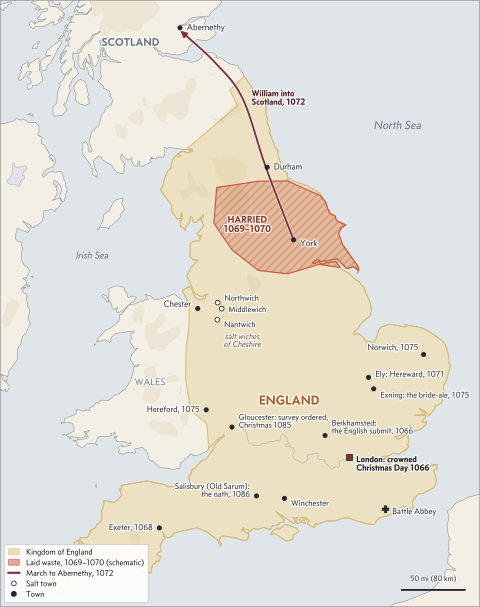
Scotland was the rebels’ refuge. Its king, Malcolm III, had killed Macbeth in 1057 to win his throne (Shakespeare made the story a tragedy, Vol. 11, The Age of Shakespeare), and about 1070 he married Margaret, Edgar Ætheling’s sister. He sheltered English exiles and raided the north of England. In 1072 William marched north with an army while a fleet sailed up the coast. He crossed the Tweed, and at Abernethy (ab-er-neth-ee), near the river Tay, the two kings met. William and Malcolm III made the Treaty of Abernethy:This ruler and Malcolm III signed the Treaty of Abernethy. → William the Conqueror•• the Chronicle says that Malcolm “delivered hostages, and became his liege-man,” that is, his sworn vassal, a man who holds land or power from a lord and owes him loyalty and service in return. One hostage was probably his son Duncan. Edgar had to leave Scotland, and two years later he made his own peace with William.
The last revolt came from William’s own men. In 1075 Ralph, earl of Norfolk, married the sister of Roger, earl of Hereford, and at the wedding feast at Exning in Suffolk the two earls plotted with Waltheof (wawl-thee-of), a son of Earl Siward and the last great English earl, to drive William out. The Chronicle made a rhyme of it: “There was that bride-ale / The source of man’s bale.” William was in Normandy, but he did not need to come home. Lanfranc, the Italian scholar he had made archbishop of Canterbury, and loyal bishops and barons cut Roger off in the west and besieged Ralph’s men in Norwich (nor-ij); Ralph escaped by sea, and a Danish fleet of two hundred ships arrived too late. Roger was imprisoned for life, and Waltheof was beheaded at Winchester on May 31, 1076, the only English earl William ever executed. William’s monarchy survived the Revolt of the EarlsThis ruler's monarchy survived the Revolt of the Earls. → William the Conqueror•• and was never seriously challenged in England again.
Domesday
At Christmas 1085 William held court at Gloucester (glos-ter). The year had been a frightening one: the king of Denmark, another Cnut, had gathered a fleet to conquer England, and William had brought over the largest army England had ever seen and quartered it on his subjects. Now, the Chronicle says, he “had a great consultation, and spoke very deeply with his witan concerning this land, how it was held and what were its tenantry.” Then he sent his men into every shire.
What they made is the most complete survey of a country made anywhere in Europe for centuries afterward. William commissioned the Domesday Book,William the Conqueror commissioned this survey of landholders, their lands, and taxes owed. → Domesday Book••This ruler commissioned the Domesday Book. → William the Conqueror••• a record of every landholder in England, the land each held, and what it was worth and should pay in tax. Seven teams of commissioners rode through the shires. In each district a sworn jury of local men answered the same questions. What was the estate called, who held it in the time of King Edward, and who held it now? How many plows worked it, how many villagers and slaves lived on it, and how many mills and fisheries did it have? What had it been worth in 1066, and what was it worth now? The English chronicler was outraged. “So very narrowly did he cause the survey to be made,” he wrote in Giles’s translation, “that there was not a single hide nor a rood of land” left out. A hide was the land that would support one household (Chapter 19), and a rood was a quarter of an acre. “Nor—it is shameful to relate that which he thought no shame to do—was there an ox, or a cow, or a pig passed by, and that was not set down in the accounts.”

The answers were boiled down by a single scribe into one great volume, now called Great Domesday, and a second, Little Domesday, covered Essex, Norfolk, and Suffolk in more detail (Figure 21.11). Together they name 13,418 places and count 268,984 heads of households, which suggests a population of between about 1.2 and 1.6 million. They record 5,624 mills and about 28,000 slaves. They show the conquest at a glance: in 1066 the land had belonged to thousands of English thegns, and in 1086 the great estates were nearly all held by Normans and other newcomers from France and Flanders, and by the Church. Only a handful of the king’s chief tenants were English. The book was kept in the royal treasury at Winchester and is now in the National Archives at Kew, in London.
Its name was given by the conquered. About 1179 Richard FitzNeal, the treasurer of England, explained that the English called it Domesday, the Day of Judgment, because there was no appeal from it, just as there would be none from the Last Judgment. Doom was the Old English word for a judgment, the same word as in Alfred’s Doom Book (Chapter 19).
Domesday records the small business of the kingdom along with the great. In Cheshire it describes three towns with brine springs, Northwich, Middlewich, and Nantwich, where water far saltier than the sea welled out of the ground and was boiled in pans in little salt-houses until only the salt was left. Each was called a wich, an Old English word for a place of work and trade that in these towns came to mean a salt works. Domesday Book recorded the salt of the Cheshire wichesThe Domesday Book recorded production of this commodity in Cheshire's '-wich' towns. → salt• in careful detail: the tolls on the cartloads and horse-loads carried away, the dues that the king and the earl shared, and the eight salt-houses of Nantwich. Their salt cured meat and fish for the winter, and the towns still carry the old word in their names.
On August 1, 1086, as the results came in, William summoned his council and every landholder of any account to Salisbury, to the hill fort now called Old Sarum. There, the Chronicle says, “all the land-holders of substance in England, whose vassals soever they were, repaired to him there, and they all submitted to him, and became his men, and swore oaths of allegiance, that they would be faithful to him against all others.” Most of them were not the king’s own vassals but the vassals of his barons. In this Oath of Salisbury William’s nobles swore loyaltyThis ruler summoned nobles to swear loyalty in the Oath of Salisbury. → William the Conqueror•• to him directly, even the men who held their land from other lords, and so put the king above every lord in the land. The next year William was injured at the burning of Mantes, on the border of Normandy and France, and he died at Rouen (roo-ahn) in September 1087. How his sons divided what he had won is the story of Chapter 22.
What to remember
- Edward the Confessor, the son of Æthelred and Emma, ruled England from 1042 to 1066 with the great earls, above all Godwin of Wessex, and rebuilt Westminster Abbey, now in London, in the Romanesque style. His death in January 1066 left the crown in dispute.
- Harold Godwinson was crowned on January 6, 1066. William, duke of Normandy, the illegitimate son of Robert I and Herleva, claimed the crown through Emma, Edward’s promise, and Harold’s oath, with Pope Alexander II’s blessing. Harald Hardrada of Norway, “hard ruler,” claimed it through a pact of Magnus and Harthacnut.
- William had won Normandy at Val-ès-Dunes in 1047 with the help of Henry I of France, and married Matilda of Flanders although Pope Leo IX forbade it.
- Hardrada and Tostig won at Fulford on September 20, 1066, and were killed by Harold Godwinson at Stamford Bridge on September 25. Snorri tells of the offer of “seven feet of English ground,” and later chroniclers of the axeman on the bridge.
- William landed at Pevensey on September 28 and won the Battle of Hastings on October 14 against the English shield wall on Senlac Hill. Harold and his brothers Gyrth and Leofwine were killed; Eustace of Boulogne was wounded at the Malfosse. Battle Abbey stands on the battlefield.
- The Bayeux Tapestry, an embroidery about 230 feet long probably commissioned by Bishop Odo, shows the conquest; its figure with an arrow in the eye is often taken for Harold, but the sources disagree about how he died.
- William was crowned on Christmas Day 1066, when his soldiers set fire to houses outside the abbey. He built the White Tower, harried the North in 1069–1070, made the Treaty of Abernethy with Malcolm III in 1072, and survived the Revolt of the Earls in 1075.
- In 1085–1086 William ordered the Domesday Book, a survey of landholders, land, and taxes, which records even the salt-houses of the Cheshire wiches, and in 1086 took the Oath of Salisbury from every landholder of account.
Chapter 22 · 35 clues
The Angevins: Henry II and the Lionheart
On August 2, 1100, a king of England rode out to hunt deer in the New Forest, on the south coast, and before evening an arrow from among the trees had killed him. Ninety-nine years later, on an evening in March 1199, another king of England was walking below the walls of a small castle in west-central France when a crossbowman on the wall shot him in the shoulder. Eleven days later he was dead.
The first king was William Rufus, a son of William the Conqueror (Chapter 21). The second was Richard the Lionheart, the Conqueror’s great-great-grandson. In the century between them the family lost its heir in a shipwreck and fought a civil war over the crown. Through one marriage it came to hold more of France than the king of France did, and one of its kings lost his best friend, the archbishop of Canterbury, to the swords of his own knights. By 1199 the Norman kings of England had become the Angevins, a dynasty from the French county of Anjou.
The Conqueror’s sons
William the Conqueror died at Rouen, the chief city of Normandy, in September 1087. He left three sons and split his lands among them (Figure 22.1). The eldest, Robert, nicknamed Curthose, “short stockings,” got the duchy of Normandy, the family’s homeland. The second, William, got England and was crowned King William II. The youngest, Henry, got five thousand pounds of silver and nothing to rule.

William was called Rufus, Latin for “the red,” probably for his ruddy face. He was a brave soldier, loud and blasphemous, and the monks who wrote the history of his reign hated him for squeezing the Church for money. The Anglo-Saxon Chronicle, the year-by-year record kept in English at a few monasteries (Chapter 19), says in J. A. Giles’s translation that “in his days all justice sank, and all unrighteousness arose.” In 1096 his brother Robert pledged Normandy to him for a loan of 10,000 marks of silver, to pay his way on the First Crusade, the great expedition to win Jerusalem (Vol. 9, Cathedrals and Crusades). For four years Rufus held both halves of his father’s lands.
Like all his family, Rufus loved to hunt deer and wild boar on horseback, the chief sport of kings and a training for war. His father had brought a law from Normandy to protect it. The Conqueror declared great stretches of England to be forest, a word that then meant land under a special royal law, whether or not trees grew on it. Inside a forest the game and the woods that sheltered it belonged to the king, and the people who lived there could not hunt, cut timber, or clear new fields without leave. The Royal Forests existed to protect hunting,Royal Forests were established to protect this activity. → hunting• the king’s above all. About 1079 the Conqueror made a new one in Hampshire and called it the New Forest. The Chronicle remembered that under his law whoever killed a hart or a hind, a male or female red deer, “should be blinded,” and that the king “loved the tall stags as if he were their father.” At its height, under Henry II, about a third of southern England lay under forest law (Chapter 26 tells how the crown loosened it in 1217).
On August 2, 1100, Rufus went hunting in the New Forest with a small party that included his younger brother Henry. The Chronicle says only that the king “was shot with an arrow by his own men, as he was hunting.” A generation later William of Malmesbury, a monk who wrote a history of the English kings about 1125, named the archer. William Rufus was killed while hunting,This ruler died while hunting in the New Forest, traditionally said to have been shot by Walter Tirel. → William II of England••William the Conqueror's son William II Rufus was killed while participating in this activity. → hunting•• he says, by Walter Tirel (tih-rel), a French lord famous as a bowman, who fled across the Channel at once. Tirel denied it for the rest of his life, and Suger, a French abbot who was his friend, reports that he swore he had not even been in that part of the forest. The same forest had already killed Rufus’s brother Richard about 1075, and a nephew of the same name that May, and the monks who told the story saw God’s revenge in it for the farms the Conqueror had cleared for his deer.
Henry did not wait for the funeral. He rode straight to Winchester to seize the royal treasury, and three days after his brother’s death he was crowned at Westminster, so quickly that people have suspected a plot ever since. Henry I, born about 1068, was cool, patient, and well read, and later writers called him Beauclerc (boh-clair), “fine scholar.” He married Matilda of Scotland, who was descended through her mother from the old English kings. When Robert came home from the crusade and tried to take England, Henry beat him at Tinchebray (tansh-bray) in Normandy in 1106 and kept him a prisoner for the rest of his life, nearly twenty-eight years.

Henry had one legitimate son, William, called the Adelin (ad-uh-lin), from the Old English word for a prince of the royal house. On the evening of November 25, 1120, the court sailed home from Barfleur (bar-flur), in Normandy, and the seventeen-year-old prince and his friends took the newest ship in the harbor, the White Ship (Figure 22.2). The fullest account is by Orderic Vitalis, a monk in Normandy. The prince gave the crew wine, he says, and a few passengers, among them the king’s nephew Stephen, got off before it sailed. In the dark the drunken crew raced to overtake the king’s ship, struck a rock outside the harbor, and sank. The prince, William of Malmesbury adds, was put into a small boat, but he turned back at the cries of his half-sister, and the boat was swamped by people clutching at it. William Adelin drowned in the White Ship,William Adelin, Henry I’s son and heir, drowned in this maritime disaster. → White Ship disaster•• with his half-brother Richard and some three hundred others. Only a butcher from Rouen, clinging to the mast, lived to tell the story. A later legend says that Henry never smiled again.
Stephen, Matilda, and the Anarchy
Henry had one legitimate child left, his daughter Matilda, who shared her mother’s name. As a girl of eleven she had been married to the German emperor, Henry V, and she was called the Empress for the rest of her life. When he died in 1125 she came home a childless widow of twenty-three. Her father made his barons swear to accept her as his heir, and in 1128 he married her to Geoffrey, the fourteen-year-old heir of the county of Anjou, Normandy’s old rival on the River Loire. The Norman barons disliked the match, and no woman had ever ruled England in her own right.
Henry I died in Normandy on December 1, 1135, after eating too many lampreys, eel-like fish he loved, as the chronicler Henry of Huntingdon tells it. The oaths did not hold. Stephen of Blois (blwah), son of the Conqueror’s daughter Adela and one of the greatest landowners in England, crossed the Channel at once with a few companions. London welcomed him, and his brother the bishop of Winchester handed him the treasury. Three weeks later Stephen of Blois was crowned as Henry I’s successor,Stephen of Blois succeeded this ruler. → Henry I of England• and the man who had stepped off the White Ship was king.
Matilda did not give up. In September 1139 she landed on the south coast with her half-brother Robert of Gloucester, the ablest of Henry’s sons born outside marriage. For fourteen years England had two rulers, and each side built castles without leave and paid its soldiers with plunder. In February 1141 Stephen was captured at Lincoln, and Matilda took the title Lady of the English. But the Londoners drove her out before she could be crowned, and that autumn Robert was captured at Winchester and exchanged for the king. In December 1142, besieged in Oxford Castle, Matilda slipped out by night and crossed the frozen Thames to safety. Neither side could win.
The monk who kept the Chronicle at Peterborough wrote down what the war felt like in the countryside. The barons, he says, made the peasants build their castles, “and when the castles were finished they filled them with devils and evil men,” who tortured prisoners for their money and burned whole towns. “The earth bare no corn,” he wrote, “and it was said openly that Christ and his saints slept.” Later historians named these years the Anarchy.
The war ended because both sides were tired of it. Henry, Matilda’s eldest son by Geoffrey of Anjou, crossed to England with an army in 1153, and at Wallingford, on the Thames, the barons on both sides refused to fight. That summer Stephen’s elder son Eustace died. In November the old king accepted Henry as his heir, and when Stephen died on October 25, 1154, Henry came into his kingdom in peace.
Henry II
The new king was twenty-one, short, red-haired, bowlegged from riding, and so restless that his court could hardly keep up with him. From his mother he claimed England and Normandy; from his father, Geoffrey, who had died in 1151, he held Anjou, Maine, and Touraine (too-rayn). Geoffrey’s nickname, Plantagenet, probably comes from planta genista, the Latin name of the yellow-flowering broom bush. Historians use it for the whole family descended from him, although the family itself took it as a surname only in the fifteenth century. Henry II was the first Plantagenet king,This ruler was the first of the Plantagenet dynasty to rule England. → Henry II•• and his descendants held the English throne until 1485.
He was already the strongest lord in France, because of his wife. Eleanor of Aquitaine (ak-wih-tayn), born about 1124, had inherited the duchy of Aquitaine, a great sweep of southwestern France from the Loire to the Pyrenees, with the wine port of Bordeaux (bor-doh). At thirteen she had married the heir to the French throne, who became King Louis VII within weeks. After fifteen years they had two daughters and no son (Vol. 9, Cathedrals and Crusades). In March 1152 four archbishops annulled the marriage, declaring that it had never been valid because the couple were too closely related. Eight weeks later, on May 18, 1152, Henry married Eleanor after the annulment,This ruler married Eleanor of Aquitaine after her marriage to Louis VII was annulled. → Henry II• and Aquitaine came with her. Louis had lost a wife and a quarter of France to his most dangerous vassal, a lord who held land from him (Chapter 21). Eleanor’s elder daughter by Louis, Marie de Champagne, grew up to be the patron of the poet Chrétien de Troyes (Chapter 24).

Put together, Henry’s lands ran from the Scottish border to the Pyrenees (Figure 22.3). He was king of England, duke of Normandy and of Aquitaine, and count of Anjou, Maine, and Touraine. He made his son Geoffrey duke of Brittany by marrying him to its heiress, and after 1171 he was lord of Ireland. Historians call the whole collection the Angevin Empire, from Angevin, “of Anjou,” and Henry was the first ruler of the Angevin Empire.This ruler was the first ruler of the Angevin Empire. → Henry II•• No one at the time used the name. The English historian Kate Norgate coined it in 1887, and it fits badly, because Henry ruled each land under its own title and its own customs. He spent his life riding between them.
Henry and Eleanor had five sons and three daughters in thirteen years. Their eldest son died as a small child, and the next, Henry, born in 1155, was crowned in his father’s lifetime and is known as Henry the Young King. Richard, born at Oxford in 1157, was raised to rule his mother’s Aquitaine. Geoffrey, born in 1158, got Brittany, and John, the youngest, born in 1166, had no land set aside for him and was teased as John Lackland. Their daughter Joan married the king of Sicily. Henry and Eleanor’s sons Richard and JohnThis ruler was the father of Richard I and John. → Henry II•This ruler was the son of Henry II and Eleanor of Aquitaine. → Richard I•• would both reign after their father, as Richard I and King John.
England was the one kingdom among his lands, and the Anarchy had left it full of unlicensed castles and seized estates, with justice a patchwork of local courts. In 1166, at his hunting lodge of Clarendon near Salisbury, Henry issued an assize, an ordinance made with his council. The Assize of Clarendon put twelve menThis ruler mandated the inclusion of an early 12-person jury system through the Assize of Clarendon. → Henry II• of each hundred, the district into which a county was divided, on oath to name anyone suspected of robbery, murder, or theft. A body of men sworn to tell the truth is a jury, from the Latin iurare, “to swear.” The twelve only accused. The accused still went to the ordeal of water: he was bound and lowered into a pond, and he was judged innocent if he sank.
The judges were the other half of the plan. Henry sent his own justices out on circuits through the counties to hear the jurors’ accusations, try quarrels over land, and collect the king’s fines. Such a journey was called an eyre (air), from the Latin iter, “journey,” and the traveling judges were justices in eyre.This ruler organized a system of itinerant judges known as eyre justices. → Henry II• Over the generations their rulings, the same in every county, grew into the common law, the law common to all England, which the United States and many other countries later inherited.
Thomas Becket
The one court Henry could not reach was the Church’s, and the man who stood in his way was his closest friend. Thomas Becket was born in London about 1120, the son of a Norman merchant. Tall, quick, and charming, he rose as a clerk in the household of Theobald, the archbishop of Canterbury and head of the Church in England. In 1155 Theobald recommended him to the young king as chancellor, the officer who ran the king’s writing office and kept his seal. The two became inseparable: they hunted together, and Henry sent his eldest son to be brought up in Becket’s household.
When Theobald died, Henry had what seemed a brilliant idea: he would make his friend archbishop, so that Church and crown would never quarrel. In June 1162 Becket, who was not even a priest, was ordained a priest one day and consecrated archbishop the next. Then he changed. He resigned as chancellor, gave up his splendid clothes for a scratchy shirt of coarse hair worn against the skin, and set himself to defend the rights of the Church against the king.
They fought over criminous clerks, men in holy orders who committed crimes. By custom such clerks, from bishops down to boys in the lowest orders, were tried only in church courts, which could not shed blood, so the worst punishment for a murderer was to lose his office. Henry wanted a clerk convicted in a church court handed over to the king’s officers for punishment. In January 1164, at Clarendon, he forced the bishops to accept sixteen articles, the Constitutions of Clarendon, which said so and forbade appeals to the pope without the king’s leave. They are a different document from the Assize of Clarendon, made at the same lodge two years later. Becket agreed, then repented. That October Henry put him on trial at Northampton, and Becket slipped away across the Channel in disguise. For six years he lived in France under the protection of Louis VII, who was glad to shelter anyone who embarrassed Henry.
In 1170 Henry had his son Henry crowned in his own lifetime, as French kings did, to make the succession safe. Crowning a king was the archbishop of Canterbury’s right, and Henry had the archbishop of York do it. Under pressure from the pope the king patched up a truce, and on December 1, 1170, Becket landed in Kent to cheering crowds. He had already excommunicated, or cut off from the Church, the bishops who had helped at the coronation. They hurried to Henry, who was keeping Christmas in Normandy, and the king exploded. Edward Grim, a clerk who was with Becket at his death and wrote his life soon afterward, reports Henry raging that he had nourished and promoted miserable drones and traitors in his household, who let their lord be mocked by a low-born clerk. Later writers polished the outburst into a single line. In 1740 the bookseller Robert Dodsley made Henry beg to be delivered “from this turbulent priest,” and in the legend everyone now knows, Henry asked whether no one would rid himAccording to legend, this ruler asked "Will no one rid me of this turbulent priest?" referring to Thomas Becket. → Henry II•• of the turbulent priest.

Four of the king’s knights, Reginald FitzUrse, Hugh de Morville, William de Tracy, and Richard le Breton, took the outburst as an order. Late on the afternoon of December 29, 1170, they came to the archbishop’s palace at Canterbury. They argued with Becket and stormed out to fetch their weapons. His monks hurried him into the cathedral, where the evening service had begun, and he would not let them bar the door, saying that a church was not a fortress. In the dusk the knights came in shouting for the traitor. Grim raised his arm against the first blow, and the sword nearly cut through it before it struck the archbishop’s head (Figure 22.4). More blows killed Becket on the floor of his cathedral, and the knights went out to plunder his palace.
Christendom, the Christian world, was horrified. Within hours people were dipping cloths in the blood on the floor, and soon the sick who came to the tomb were reported cured. On February 21, 1173, little more than two years after the murder, Pope Alexander III declared Thomas Becket a saint. Already in May 1172, at Avranches in Normandy, Henry had sworn that he had not wished the death but that his angry words might have caused it, and he had given up the articles the pope objected to.
A worse blow followed. In 1173 the Young King, angry that his father gave him a crown but no lands or money, fled to the court of Louis VII, whose daughter he had married, and his brothers Richard and Geoffrey joined him. Their mother backed them, and Henry’s men caught her on her way to Paris, wearing men’s clothes, one chronicler says. The king of Scots, the count of Flanders, and many English barons rose as well. Henry crushed the Revolt of 1173–1174This ruler suppressed the Revolt of 1173-74. → Henry II• with hired soldiers, fast marches, and a stroke of luck. In July 1174 he crossed to England and went first to Canterbury. On July 12 he walked barefoot through the town in a pilgrim’s smock to Becket’s tomb, and bishops and monks beat him with rods as penance, a punishment taken to show sorrow for a sin. The next day the king of Scots, William the Lion, was captured at Alnwick (an-ik) in Northumberland, and people said that the saint had forgiven the king. The rebels submitted. Henry forgave his sons and kept their mother a prisoner for the rest of his life.
Canterbury became the greatest shrine in England. In 1220 the saint’s bones were moved into a tomb plated with gold and jewels behind the high altar, and for three centuries pilgrims came from all over Europe. About two hundred years after the murder Chaucer set his Canterbury Tales on the road to it (Chapter 29). In 1538 Henry VIII, who had his own quarrel with the Church, had the shrine destroyed.
Strongbow in Ireland
In the 1160s Ireland still had no single ruler. Its many kings owed tribute to the kings of its provinces (Chapter 18), and the strongest of these claimed to be high king. In 1166 the high king, Ruaidrí Ua Conchobair (roo-ree oo-uh kon-uh-khur), called Rory O’Connor in English, and his allies drove out Diarmait Mac Murchada (deer-mid mak mur-uh-khuh), Dermot MacMurrough, the king of Leinster in the southeast. Diarmait had made many enemies, among them a king whose wife he had carried off fourteen years before. He sailed to find Henry, who was in Aquitaine, and Henry gave him leave to recruit help among his subjects.
The man who answered was Richard de Clare, a baron of the Welsh border who was out of favor with the king and short of money, remembered by his nickname, Strongbow. Diarmait promised him his eldest daughter, Aoife, in marriage, and the kingdom of Leinster after his own death. Small bands of Norman and Flemish knights and Welsh archers landed in 1169 and won back much of Diarmait’s kingdom. Then, on August 23, 1170, Strongbow himself led the invasion of Ireland,An invasion of this region was led by Richard "Strongbow" de Clare. → Ireland• landing near Waterford with about two hundred knights and a thousand other soldiers. His men stormed Waterford, a Norse port town, and there he married Aoife, no kin of the Aoife who cursed the children of Lir (Chapter 10). On September 21 they took Dublin, which had been a Norse town for three centuries.

When Diarmait died in May 1171, Strongbow claimed Leinster through his wife. That alarmed Henry, because one of his own barons was making himself a king across the sea. In October 1171 Henry sailed from Pembroke in Wales and landed at Waterford with about five hundred knights and four thousand other men, the first reigning king of England to set foot in Ireland. Strongbow submitted and was allowed to keep Leinster as the king’s vassal. Dublin, Wexford, and Waterford became royal towns, and many Irish kings came to Henry and accepted him as overlord, hoping he would hold back the newcomers. Pope Adrian IV, the only English pope, is said to have approved such a venture in 1155 in a letter called Laudabiliter (law-dah-bil-ih-tur), though the text that survives may not be genuine. In 1177 Henry made his youngest son, John, Lord of Ireland. English rule in Ireland began with these years and lasted, in one form or another, into the twentieth century.
Richard and the Third Crusade
Of all Henry’s sons, Richard was his mother’s. He spent his early childhood in England, but from about the age of thirteen he lived mostly in Aquitaine, which Eleanor gave him to rule as duke, and he wrote songs in its southern language, Occitan. He learned war against the lords of Aquitaine, who rebelled against him again and again. In the spring of 1179, at twenty-one, he besieged their strongest castle, Taillebourg (ty-boor), on a cliff above the Charente River with steep drops on three sides and a triple-walled town on the fourth. Richard burned the farms around it, beat the garrison when it came out to fight, and followed the fleeing men in through the open gates. Taking Taillebourg in two daysThe capture of the fortress at Taillebourg was one of this ruler's first military successes. → Richard I• was one of his first great victories, and it frightened the rebel barons into submission.

Men began to call him a lion. Gerald of Wales, a Welsh churchman and writer, called him “this our lion” as early as 1187. The Norman poet Ambroise, who followed him to the Holy Land and wrote a long French poem about the campaign, is the first writer known to use the name that stuck. Richard was nicknamed the Lionheart,This ruler was nicknamed “Lionheart.” → Richard I•• Cœur de Lion (kur duh lee-on) in French, for his courage in battle.
The Young King died of dysentery in 1183 and Geoffrey in 1186, so Richard was heir to everything, but Henry would not say so and seemed to favor John. In Paris there was a new king, Philip II, Louis VII’s son by a later wife, young, patient, and very clever, and Richard joined him against his own father. In the summer of 1189 they drove the sick old king out of Le Mans, his birthplace. Henry accepted all their terms, then learned that John too had gone over to the rebels. He died at Chinon (shee-nohn) on July 6, 1189, and was buried in the abbey church of Fontevraud (fon-tuh-vroh) (Figure 22.6).
Richard was crowned at Westminster on September 3, 1189. The Jews of England, who had come from France after the Conquest and lived as moneylenders under the king’s protection, were barred from the ceremony. When some of their leaders came to the gate with gifts, the crowd beat them, and a rumor spread that the king had ordered the Jews killed. A London mob attacked Jewish houses through the night, and the riot after the coronation killed Jacob of OrléansJacob of Orléans was killed during an anti-Jewish revolt after this ruler's coronation. → Richard I• (or-lay-ahn), a scholar who had come from France, probably to teach. The violence spread with crusading fever, and in March 1190 about 150 Jews of York, besieged in the royal castle, died there, most by their own hands.
The new king had taken the cross, the vow of a crusader. In 1187 Saladin (sal-uh-din), the Muslim ruler, or sultan, of Egypt and Syria, a Kurdish soldier who had united the Muslim lands around the crusaders’ kingdom of Jerusalem (Vol. 37, The House of Islam), had destroyed its army and taken Jerusalem itself. Three rulers set out to win it back in the Third Crusade: the old emperor Frederick Barbarossa, who drowned on the way (Vol. 9, Cathedrals and Crusades); Philip II of France; and Richard. To pay for it Richard sold offices, castles, and lands, and he is said to have joked that he would sell London if he could find a buyer.

Richard and Philip set out together from Vézelay (vayz-lay), in Burgundy, on July 4, 1190 (Figure 22.7). Richard went to Marseille and sailed down the coast of Italy to winter at Messina, in Sicily. Normans had won Sicily from its Muslim rulers in the eleventh century. Their descendant William II of Sicily had died in 1189 without children, and his cousin Tancred of Lecce (lech-ay) had seized the crown, although the lawful heir was William’s aunt Constance, the wife of the German emperor’s son Henry. William’s widow was Richard’s sister Joan, and Tancred held her prisoner and kept the money her marriage had brought her. Richard demanded her back and got her, and when the people of Messina rioted against his soldiers, he stormed and sacked the city. Tancred had to bargain. He paid 20,000 ounces of gold for Joan’s rights, and Richard recognized Tancred as king of Sicily.This ruler negotiated with Tancred of Lecce at Messina to free his sister Joan, recognizing Tancred as king of Sicily. → Richard I•• It made Richard a lasting enemy, for Constance’s husband, soon the emperor Henry VI, wanted Sicily for himself.
Richard had been engaged since childhood to Philip’s half-sister Alys, Louis VII’s daughter by his second wife, not Eleanor’s Alix, and at Messina he broke it off. His mother had found him another bride, Berengaria (beh-ren-gair-ee-uh), daughter of the king of Navarre (nuh-var), a small kingdom in the Pyrenees, and Eleanor, nearly seventy, brought her across the Alps to Messina. Richard’s fleet sailed on April 10, 1191, and a storm scattered it. The ship carrying Joan and Berengaria reached Cyprus, where other ships of the fleet were wrecked. The island’s ruler, Isaac Komnenos (eye-zuk kom-nee-nos), a Greek noble who had broken away from the Byzantine Empire of Constantinople and called himself emperor, imprisoned the shipwrecked men, took their goods, and tried to lure the two women ashore. Richard arrived on May 6 and took the port of Limassol, and on May 12, in its chapel of St. George, Richard married Berengaria of Navarre,This ruler was married to Berengaria of Navarre. → Richard I•• who was crowned queen there. Isaac came to terms, promising to give back what he had taken and to send soldiers to the crusade, and then broke his word and ordered Richard off the island. Because he had threatened Joan and Berengaria and seized the survivors of the wrecks, Richard conquered all of CyprusThis ruler conquered Cyprus after Isaac Komnenos threatened his sister Joan and fiancée Berengaria and seized survivors of his fleet’s shipwrecks. → Richard I•• within a month. Isaac surrendered on condition that he not be put in irons, so, the chroniclers say, he was chained in silver.
Richard needed money more than an island. The Knights Templar were a military order, knights who took the vows of monks and fought for the crusaders’ kingdom (Vol. 9, Cathedrals and Crusades), and Richard sold Cyprus to the TemplarsThis ruler sold Cyprus to the Templars. → Richard I• for 100,000 bezants, gold coins of the eastern Mediterranean. They found it hard to hold, and within a year it passed to Guy of Lusignan (loo-zin-yon), a former king of Jerusalem, whose family ruled it for almost three centuries.
On June 8, 1191, Richard reached Acre (ay-ker), the chief port of the kingdom of Jerusalem, where a crusader army had been besieging the Muslim garrison for almost two years while Saladin’s army besieged the besiegers. Richard’s siege engines battered the walls, and Acre surrendered on July 12. Then the allies quarreled. Duke Leopold of Austria, the leader of the German crusaders, raised his banner over the city beside the two kings’, and Richard’s men threw it into the ditch. Leopold went home in a fury, and at the end of July Philip, sick and angry, sailed home too. Richard stayed to fight Saladin after Philip II left,This king fought Saladin during the Third Crusade, continuing after Philip II of France departed. → Richard I•• with the French troops Philip had left behind.

By the terms of the surrender, Saladin was to pay a ransom, free his Christian prisoners, and return the True Cross, a relic that Christians held to be the cross of Jesus, which he had captured. The payments fell behind, and Richard, who wanted to march south and could neither feed his prisoners nor leave them behind, would not wait. On August 20, 1191, on a low hill outside Acre called Ayyadieh (eye-yah-dee-eh), Richard massacred about three thousand prisoners,This ruler massacred around 3,000 prisoners at Ayyadieh after the Siege of Acre. → Richard I•• the men of the garrison, led out in sight of Saladin’s army. A crusader chronicle counts 2,700 of them, and other accounts run higher. It was the cruelest act of the crusade, and Saladin killed his own Christian prisoners in return.
Richard then marched south along the coast toward Jaffa, the port nearest Jerusalem (Figure 22.8). He moved slowly, with the sea on his right and his fleet keeping pace offshore, while his foot soldiers and crossbowmen walked in a wall on the landward side to shelter the knights’ horses from Turkish archers. On September 7, near Arsuf (ar-soof), Saladin threw his whole army at the column. Richard held his knights back until the Hospitallers, the other great military order, broke ranks and charged; then he sent every horseman after them. Richard defeated Saladin at Arsuf,This ruler defeated Saladin at the Battle of Arsuf. → Richard I•• and the defeat dented Saladin’s name as a general who could not be beaten.
Twice Richard marched inland on Jerusalem, and twice he turned back. In January 1192, in freezing rain, his army reached Beit Nuba (bayt noo-buh), 12 miles from the city. The Templars, the Hospitallers, and the barons of the country warned him that even if he took Jerusalem he could not keep it, for Saladin’s army would still hold the hills, and most crusaders would pray at the holy places and sail home. He retreated, came back in June, and retreated again. Richard failed to retake Jerusalem,This ruler failed to retake Jerusalem during the Third Crusade. → Richard I•• to the bitter disappointment of his soldiers.
The crown of Jerusalem was another quarrel. Richard backed Guy of Lusignan, a lord from his own Poitou (pwah-too), who had been king by right of his wife until she died in 1190. Most of the barons wanted Conrad of Montferrat (mont-fuh-rat), an Italian marquis who had saved the port of Tyre from Saladin in 1187 and had married the late queen’s half-sister and heir. In April 1192 Richard gave way and let the barons choose Conrad. On April 28, in a street of Tyre, two men stabbed Conrad to death. They belonged to the Assassins, a secret Muslim sect of the Syrian mountains that killed its enemies by planned murders, and whose name gave English the word assassin. A week later Conrad’s widow married Richard’s nephew, Henry of Champagne, and Richard was accused of murdering Conrad.This ruler was accused of murdering Conrad of Montferrat. → Richard I•• No one has ever proved it, and the murder remains unsolved.
In late July 1192, while Richard was at Acre, Saladin attacked Jaffa and took the town. Richard came down the coast by sea with a few galleys, waded ashore at the head of his men, and drove Saladin’s soldiers out. On August 5 Saladin came back to catch him camped outside the walls, where Richard had about fifty-four knights, a handful of horses, and some two thousand foot soldiers and crossbowmen. Richard had his men kneel in a line with their spear butts in the ground and the points toward the enemy, with crossbowmen behind them, and the charges broke on the spears. Richard won the Battle of Jaffa,This king won the Battle of Jaffa. → Richard I•• the last battle of the crusade. Saladin’s friend and biographer, Baha ad-Din (bah-hah ad-deen), wrote that the king of England rode the whole length of the Muslim army, lance in hand, and no one came out to fight him.
Both men were worn out and ill, and Richard had news that John and Philip were plotting against him at home. On September 2, 1192, Richard and Saladin made the Treaty of Jaffa,This ruler negotiated the Treaty of Jaffa. → Richard I• a truce for three years. The crusaders kept the coast from Tyre to Jaffa, Saladin kept Jerusalem, and unarmed Christian pilgrims were free to visit the holy places. Richard never went. He and Saladin never met, because Saladin said that kings should meet only after they had made peace, and five weeks after the treaty Richard sailed. Saladin died at Damascus the next March.
Richard’s last years
Richard sailed from Acre on October 9, 1192, and every road home was barred. Philip held the coast of France, and Henry VI, now emperor of Germany, hated him for backing Tancred. Storms drove him to Corfu, and his ship was wrecked at the head of the Adriatic, near Aquileia. He set off overland in disguise with a few companions. Just before Christmas he was recognized at an inn near Vienna. Vienna belonged to Duke Leopold of Austria, whose banner had been thrown into the ditch at Acre and whose cousin Conrad had been murdered. Leopold of Austria captured the kingLeopold of Austria captured this king returning from the Third Crusade and transferred him to Emperor Henry VI’s custody. → Richard I••• on his way home from the crusade and held him in Dürnstein (durn-shtine), a castle above the Danube. In March 1193 Leopold handed him over to the custody of Henry VI. Seizing a crusader was a crime against the Church, and the pope excommunicated Leopold for it.

At Speyer (shpy-er), before the princes of Germany, Henry VI charged Richard with betraying the Holy Land, dealing with Tancred, and murdering Conrad. Richard answered so well, the English chroniclers say, that he won the princes over. He would not bow to the emperor’s judgment, and English tradition gives him a proud reply: a king was born to a rank that acknowledged no superior except God,This ruler declared "I am born in a rank which recognizes no superior but God" to Henry VI while imprisoned. → Richard I•• and so no emperor could try him. The emperor’s own poet, Peter of Eboli, drew the scene the other way, with Richard on the floor begging pardon (Figure 22.9).
The emperor set the ransom at 150,000 marks. Eleanor, freed from her long captivity when Richard became king and now about seventy, raised it. Every free man in England paid a quarter of the value of his goods, and churches gave up their gold and silver plate. The Cistercian monks, whose great abbeys raised sheep and had no treasure, gave a year’s wool. The silver went on into Germany and, in part, to the walls of Vienna (Vol. 9, Cathedrals and Crusades).
John had been scheming against the ministers Richard left in charge ever since the king sailed for the Holy Land, and now John revolted in his brother’s absence.This ruler's brother John Lackland revolted in his absence while he was on the Third Crusade. → Richard I• He went to Paris and did homage to Philip, swearing to be his vassal for Richard’s lands in France, came back to England claiming that Richard was dead, and seized royal castles. Philip and John even offered the emperor 80,000 marks to keep Richard locked up a while longer. When Richard was set free at Mainz on February 4, 1194, after more than a year in prison, Philip sent John a warning that the devil was loose. Richard landed in England in March, the rebellion collapsed, and when John threw himself at his brother’s feet, Richard forgave him and called him a child led astray by bad advisers. John was twenty-seven.
Richard left England that May and never came back; of his ten-year reign he spent about six months there. His last years were a war with Philip for Normandy. To guard the road down the Seine from Paris to Rouen, he built Château Gaillard (sha-toh guy-yar), the “saucy castle,” on a chalk cliff above the river at Les Andelys. It went up in about two years, from 1196 to 1198, when castles of its size often took the better part of ten (Figure 22.10). It had three wards, walled courtyards one behind another, so that an attacker coming along the only level approach had to take each in turn. The inner wall bulged in a row of rounded curves, which left no flat face for siege stones to strike. In May 1198, reports William of Newburgh, an English churchman who wrote a history of these years, a rain of blood fell on Richard’s builders.This ruler built Château Gaillard, during whose construction a chronicler reported a “shower of rain mixed with blood.” → Richard I•• His advisers took it for an evil omen, but Richard, William says, did not slow the work at all: had an angel come down from heaven to urge him to stop, the king would have cursed the angel.

In March 1199 Richard rode south into the Limousin to punish a rebellious vassal, the viscount of Limoges (lee-mohzh), and laid siege to the little castle of Châlus-Chabrol (shah-loo shah-broll), held by a few dozen men. On the evening of March 26 he walked under the walls without his mail coat, and a crossbowman on the ramparts, who by one account had been fending off arrows with a frying pan, shot him in the shoulder. A surgeon cut out the bolt by torchlight, and the wound turned gangrenous. Dying, Richard had the crossbowman brought before him. The chroniclers give the man different names, Pierre Basile (bah-zeel) among them, and he said that the king had killed his father and his brothers. Roger of Howden, a royal clerk who wrote a chronicle of these years, tells that Richard forgave the man who shot him,This ruler reportedly forgave Pierre Basile, who fatally shot him at Châlus-Chabrol, saying “Live on, and by my bounty behold the light of day.” → Richard I•• told him to live on and see the light of day, and ordered him set free with a hundred shillings. After the king’s death, Howden adds, Richard’s mercenary captain had the man skinned alive and hanged.
Richard died on April 6, 1199, at forty-one, with his mother beside him. His heart was buried at Rouen, and his body at Fontevraud, at his father’s feet. He left no legitimate children, so Richard was succeeded by his brother John,This ruler was succeeded by his brother John. → Richard I• who was crowned at Westminster on May 27, 1199, although many lords in Anjou and Brittany wanted Geoffrey’s young son Arthur instead. Within five years John had lost Normandy and Anjou, and Château Gaillard with them, as Chapter 26 tells.
What to remember
- William II Rufus, the Conqueror’s son, was killed while hunting in the New Forest in 1100, by tradition by Walter Tirel’s arrow. The Royal Forests were lands under forest law that protected the king’s hunting.
- Henry I’s heir, William Adelin, drowned in the White Ship in 1120. In 1135 Henry’s nephew Stephen of Blois took the throne, and his war with Henry’s daughter Matilda is called the Anarchy.
- Matilda’s son Henry II (1154–1189) was the first Plantagenet king and the first ruler of the Angevin Empire. He married Eleanor of Aquitaine after her marriage to Louis VII was annulled; their sons included Richard I and John.
- Henry’s Assize of Clarendon (1166) put twelve men of each hundred on oath to name suspects, and his justices in eyre rode circuits: the start of the jury and the common law.
- Thomas Becket, archbishop of Canterbury, defended the church courts against Henry and was murdered in his cathedral on December 29, 1170. The famous line about a “turbulent priest” is a later, legendary form of Henry’s words. Becket became a saint in 1173.
- Henry crushed his sons’ revolt of 1173–1174, doing penance at Becket’s tomb.
- Strongbow invaded Ireland in 1170, and Henry II followed in 1171.
- Richard the Lionheart dealt with Tancred at Messina, conquered Cyprus, married Berengaria, took Acre, killed his prisoners at Ayyadieh, beat Saladin at Arsuf and Jaffa, and made the Treaty of Jaffa, but never retook Jerusalem.
- Leopold of Austria captured Richard and handed him to the emperor Henry VI while John revolted. Richard built Château Gaillard, died at Châlus-Chabrol in 1199, and was succeeded by John.
Chapter 23 · 40 clues
The Making of Arthur
High on the west wall of the Great Hall of Winchester Castle hangs a round tabletop of oak, 18 feet across and weighing more than a ton. It is painted in green and white wedges, like the spokes of a wheel. At the top sits a crowned king with a sword, and around the rim run the names of twenty-four knights: Galahad, Lancelot, Gawain (gah-wayn), Mordred, and the rest. For centuries visitors were told it was King Arthur’s own table. The tree rings of its timbers tell a different story. They were cut between about 1250 and 1280, and the table was probably made for a tournament that King Edward I held near Winchester in April 1290 (Chapter 26 will tell his reign). The paint is later still. It was done for Henry VIII in 1522, and the king at the top has young Henry’s face (Vol. 12, Crown and Parliament).

So by 1290 a king who may never have lived had a court that a real king could copy, with a table, a queen, a wizard, a magic sword, and a famous company of knights (Figure 23.1). None of it came at once. Each piece was added by a writer, in a particular century, and most of those writers can be named. This chapter tells Arthur’s story from the boy who explained a falling tower to the king who defeated Rome, and for each episode it names the writer who told it first.
Who told Arthur’s story
The people who lived closest to Arthur’s time say least about him. The stage told why no one knows whether he lived. About 500 the Britons, the Celtic people who held the island before the English, beat the Saxons at Mount Badon (Chapter 16). Gildas, who wrote about 540, within living memory of the battle, names Badon and names no Arthur. The Welsh poem Y Gododdin, a lament for warriors of the British north who died in battle with the English, praises a fighter who fed the ravens with his enemies, though he was no Arthur. So the poet’s hearers already knew the name as a byword for courage. The poem may have been composed about 600, but it survives only in a copy of about 1265, and that line could have been added at any time before.
The first account of Arthur’s deeds comes in the Historia Brittonum, the “History of the Britons,” written in Wales about 829 and traditionally credited to a monk named Nennius. After the Saxons came, it says, Arthur fought them beside the kings of the Britons. In J. A. Giles’s translation of 1848, “though there were many more noble than himself, yet he was twelve times chosen their commander, and was as often conqueror.” The book names twelve battles that Arthur fought,The Historia Brittonum, traditionally attributed to Nennius, lists twelve battles fought by this figure. → King Arthur• most of them at rivers that no one can now find. At the eighth he carried an image of the Virgin Mary on his shoulders, and at the twelfth, on the hill of Badon, more than nine hundred men fell by his hand alone. This Arthur is a war leader, not a king.
A Welsh chronicle of the tenth century, the Annals of Wales, adds two entries. In James Ingram’s translation, the year that scholars count as 516 saw “the Battle of Badon, in which Arthur carried the Cross of our Lord Jesus Christ for three days and three nights upon his shoulders.” Twenty-one years later, under 537, came “the battle of Camlann, in which Arthur and Medraut fell.” Medraut (med-rowt) is the Welsh form of Mordred, the traitor of the later stories, and Camlann (kam-lan) will be Arthur’s last battle (Chapter 25). In the Welsh tale Culhwch and Olwen, written down about 1100, Arthur is a chieftain with a warband of heroes who could breathe under water and talk with animals (Chapter 13).
Then, about 1136, a cleric named Geoffrey of Monmouth made him an emperor. Geoffrey’s Latin History of the Kings of Britain gave Arthur a father and mother, a conception at Tintagel (tin-taj-ul), a crowning at fifteen, conquests across the north of Europe, a war with Rome, a betrayal, and a passing to the island of Avalon. The book was copied all over Europe, and with it Geoffrey of Monmouth made Arthur famous.This figure's legend was popularized by Geoffrey of Monmouth. → King Arthur• After him, almost every writer who told the story began from his book, and the Welsh translated it into Welsh and read it as their own history. Chroniclers copied his kings into their histories of England, and for four centuries most readers took the hero of the legend for a real king of the Britons,This character is a mythical king of the Britons. → King Arthur• who had ruled the whole island before the English came.
The rest of the legend was added in about a hundred years, most of it in French (Figure 23.2). In 1155 the poet Wace turned Geoffrey’s history into French verse and gave Arthur the Round Table. Between about 1170 and 1190 Chrétien de Troyes, a poet at the court of the counts of Champagne, in northeastern France, brought in Camelot, Lancelot, and the Grail. About 1200 Robert de Boron, a French knight-poet, gave Merlin a demon for a father and Arthur a sword set in a stone. Between about 1215 and 1235 unknown writers of the Vulgate Cycle, the long series of French prose romances that the stage described, added the pure knight Galahad and made Mordred Arthur’s son. Two centuries later an English knight, Thomas Malory, gathered the French books into one English book, Le Morte d’Arthur, finished in 1469 or 1470. William Caxton, England’s first printer, printed it in 1485, and most English readers have met Arthur through Malory ever since.
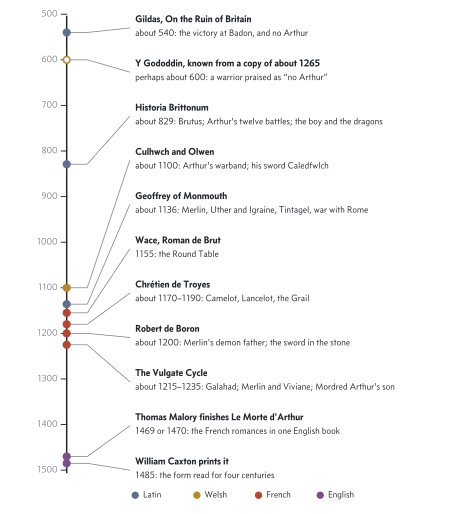
Geoffrey of Monmouth, Brutus, and Crocea Mors
Geoffrey was born between about 1090 and 1100, probably at or near Monmouth, on the border between England and Wales. From 1129 to 1151 his name appears as a witness on charters, written grants of land and rights, at Oxford, often with the title magister, “teacher.” He was probably a canon, one of the priests who served the small college of St. George’s in the castle there. In 1152 he was made bishop of St. Asaph, in north Wales, though he probably never went there, and he died about 1155. He said that Walter, the archdeacon of Oxford, one of a bishop’s chief officers, had given him a book, and that his History was only a translation of it. In the English of Aaron Thompson’s translation, as J. A. Giles revised it, the book was “a very ancient book in the British tongue.” No one has ever found that book. Geoffrey took what he could from Gildas, from Bede (Chapter 16), from the Historia Brittonum, and from Welsh lists of kings, and he invented the rest. He dedicated the book to Robert, Earl of Gloucester, the half-brother of the Empress Matilda, whose war for the crown was then beginning (Chapter 22).
The book was a sensation. About 215 medieval manuscripts of it survive, a huge number for a book of its time. A few readers were not fooled. The Yorkshire churchman William of Newburgh wrote about 1190 that everything Geoffrey said of Arthur, and of the kings before and after him, had been made up, partly by Geoffrey and partly by others. The Welsh churchman Gerald of Wales told of a man tormented by demons. When a Gospel was laid on him, the demons fled, but when someone put Geoffrey’s History on him instead, they came back in greater numbers than before.

Geoffrey begins his history at Troy, the city in Asia Minor that the Greeks burned (Vol. 4, Classical Myth). The Trojan prince Aeneas (ih-nee-us) escaped to Italy, and Geoffrey makes Brutus, the founder of Britain, the great-grandson of Aeneas,Brutus, the mythical founder of Britain, was descended from a prince of this city. → Troy• so that every British king after him descends from a prince of Troy. Soothsayers foretold that the boy would kill his father and his mother. His mother died bearing him, and at fifteen, out hunting, Brutus shot his father with an arrow meant for a deer. Exiled from Italy, he freed the Trojan slaves of a Greek king and sailed west with them. On a deserted island in the Mediterranean, Brutus prayed at a temple of Diana, the goddess of the hunt, and asked where his people should settle. That night she answered him in a dream, in verse that Thompson’s translation renders this way.
Brutus sailed along the coast of Africa, fought his way across part of Gaul, the land that is now France, and landed at Totnes (tot-ness) in Devon (Figure 23.3). The island was then called Albion, and Brutus renamed it Britain after himself. The Historia Brittonum had already told a shorter version, in which Brutus is Aeneas’s grandson, shoots his father by accident, and gives Britain his name. His companion Corineus (kor-in-ee-us) took Cornwall, which Geoffrey says was named for him, and wrestled its last giant, Goëmagot (goh-em-uh-got), whom later tellers call Gogmagog, until the giant broke three of Corineus’s ribs. Then Corineus heaved the giant onto his shoulders and threw him off a cliff into the sea. On the Thames, Brutus built a city he called New Troy, which a later king named Lud renamed for himself: Kaer-Lud (kair-lud), “Lud’s city,” or London.
Geoffrey’s Britain went on for nearly two thousand years of kings, among them Leir, whom Shakespeare would make King Lear (Vol. 11, The Age of Shakespeare). One of its reigns brings in a man from real history. Julius Caesar really did cross to Britain in 55 and 54 BC and met a British war leader named Cassivellaunus (kas-ih-veh-law-nus) (Vol. 7, The Romans). In Geoffrey’s version the Britons drive Caesar off twice, and he wins tribute from them only on a third try, through a British traitor. In the first battle, Cassivellaunus’s brother Nennius meets Caesar himself. Caesar strikes him on the helmet, the blade glances off and sticks fast in Nennius’s shield, and the crowd of fighters forces the two men apart. Nennius pulls the sword free and kills every enemy he strikes with it. Fifteen days later he dies of the wound to his head, and he is buried at the north gate of London with the sword beside him. Geoffrey names Caesar’s sword Crocea MorsCrocea Mors is one of these weapons in Geoffrey of Monmouth’s account. → swords•• (kroh-kee-uh morz), Latin for “Yellow Death,” because no one it wounded ever lived.
Merlin and Vortigern
Bede’s Vortigern was the British king who invited Hengist and Horsa into Britain (Chapter 16). Geoffrey makes him a traitor as well. In his History, Vortigern has the young king Constans, eldest son of the late British king Constantine, murdered and takes the crown. Constans’s two little brothers, Aurelius Ambrosius (aw-ree-lee-us am-broh-zee-us) and Uther (yoo-ther), who would one day be Arthur’s father, are carried to safety in Brittany. The Saxons Vortigern hired then turn on him. At a peace meeting near Amesbury (aymz-bur-ee), on Salisbury Plain, Hengist’s men draw knives hidden in their clothes and kill 460 British nobles. Vortigern flees into the mountains of Wales to build a tower he can hold.
The tower would not stand. The Historia Brittonum tells it first. Every night the stones and timber vanished, and Vortigern’s wise men told him to find a boy born without a father and sprinkle his blood on the ground. The king’s messengers found such a boy playing ball. Brought before Vortigern to die, the boy asked the wise men what lay under the ground, and when they could not say, he told them. Under the hill was a pool, in the pool two vessels, in the vessels a folded tent, and in the tent two sleeping serpents, one red and one white. When the tent was opened they woke and fought, and at last the red one drove the white one out. The boy said his name was Ambrose, in Welsh Emrys (em-riss). A hill fort in Snowdonia is still called Dinas Emrys (dee-nas), “the fort of Ambrose.”

Geoffrey retold the scene and gave the boy a new name. In his version Vortigern’s messengers come to Carmarthen (kar-mar-thun), in southwest Wales, and hear one boy taunt another for having no father. The boy’s name is Merlin, “who was also called Ambrose.” His mother is a daughter of a king of southwest Wales who lives as a nun, and she tells Vortigern that a spirit in the shape of a handsome young man visited her and left her with child. A learned man at court explains that such spirits, called incubi, live between the moon and the earth and sometimes father children. Merlin tells the king that a pool beneath the hill is sinking his foundations, and that two dragons sleep at the bottom of it. The pool is drained, and in two hollow stones Merlin reveals the red and white dragons, which fightThis figure explains that red and white dragons fighting beneath Vortigern’s tower cause it to collapse. → Merlin•••Two of these creatures, one red and one white, were discovered under a tower by Merlin at the behest of Vortigern. → dragons• as soon as they wake, breathing fire. The white drives the red to the edge of the pool, and then the red turns and drives it back (Figure 23.4). Robert de Boron’s Merlin, about 1200, made the point plainer still: the two dragons lay beneath the water under the tower, and whenever they turned over, the tower fell. In Geoffrey, Merlin bursts into tears and explains. The red dragon stands for the Britons, and the white for the Saxons whom Vortigern invited in. The white will drive the red almost out of the land, though in the end, Merlin says, the oppressed will rise again. A red dragon on green and white has been the official flag of Wales since 1959.
Merlin’s prophecy runs on for pages, in dark images of boars, lions, and eagles. Geoffrey had first published it on its own, as the Prophecies of Merlin, and readers studied it for centuries for news of their own times. Its first pages seemed to foretell Arthur himself. In Giles’s translation, “a boar of Cornwall shall give his assistance, and trample their necks under his feet,” and “the house of Romulus shall dread his courage, and his end shall be doubtful.” The house of Romulus is Rome, and the doubtful end is Arthur’s passing to Avalon (Chapter 25). Merlin’s name came from Wales. Welsh poems spoke of a prophet called Myrddin (mur-thin), who went mad after a battle and lived wild in the woods, and Geoffrey turned his name into the Latin Merlinus. The French scholar Gaston Paris guessed that Geoffrey avoided the more natural form, Merdinus, because it sounded like the French word for dung.
About 1200 Robert de Boron turned Geoffrey’s spirit into a plot hatched in hell. In his poem Merlin, the devils are furious because Jesus, as Christians believe, went down into hell after his death and freed the souls they held there. They plan a child who will undo his work. One of them fathers Merlin on a good young woman. She confesses everything to a priest, and the baby is baptized at once: washed with water in the rite that makes a person a Christian. That baptism saved him from the demons’ purpose.In Robert de Boron’s account, this figure is conceived by a demon but saved from its purpose by baptism. → Merlin•• He kept the devils’ knowledge of everything past, and God added knowledge of the future, so Merlin could see both ways in time. Three centuries later Malory still remembered his father. Nimue (nim-oo-ay), the enchantress who would be Merlin’s end, was afraid of him, Malory says, “because he was a devil’s son.”
Uther and Igraine
Merlin told Vortigern to flee the fire of King Constantine’s sons, and Geoffrey’s next pages show them coming. Aurelius Ambrosius and Uther landed from Brittany, the Britons crowned Aurelius king, and he burned Vortigern alive inside his tower. Then he beat the Saxons and had Hengist beheaded. At Amesbury he wept over the graves of the nobles Hengist had murdered and asked his builders for a monument fit for them. They told him the work was beyond them, and the archbishop told him to send for Merlin.
Merlin told the king to fetch the Giant’s Dance, a ring of enormous stones on Mount Killaraus (kil-uh-ray-us) in Ireland. Giants had brought them from Africa long ago, he said, and every stone had healing power: water that had washed them cured the sick. Aurelius laughed, but he sent Uther with fifteen thousand men. They defeated the young king of Ireland, who could not believe anyone would go to war for stones, and then tried to move the ring with ropes and ladders and failed. Merlin laughed at them, set up engines of his own, and took the stones down with ease. In Geoffrey’s account Merlin brought the stones from IrelandIn Geoffrey of Monmouth’s account, this figure transports the stones of Stonehenge from Ireland. → Merlin••This structure was thought to have been built by Merlin according to folklore. → Stonehenge• and raised them around the graves on Salisbury Plain, “a manifest proof of the prevalence of art above strength,” in Giles’s words. That ring is Stonehenge. Archaeologists know it was begun more than three thousand years before Geoffrey’s Britons (Vol. 7, The Romans), though most of its smaller stones really did come from the west, from the hills of Wales.

Not long after, Aurelius fell sick at Winchester, and a Saxon dressed as a monk and doctor gave him poison in a cup of medicine. As he died, a star appeared with a ball of fire shaped like a dragon at the end of its beam. Merlin told Uther it meant that his brother was dead, that Uther would be king, and that he would have a mighty son. Uther had two golden dragons made, gave one to the cathedral at Winchester, and carried the other into battle. From then on he was Uther Pendragon (pen-drag-un), which Geoffrey says means “dragon’s head” in the Britons’ tongue. The mighty son of Merlin’s prophecy would be Arthur, the nephew of Aurelius Ambrosius,This figure was the nephew of Aurelius Ambrosius. → King Arthur• the king who raised Stonehenge.
The new king held his Easter feast in London, and among his guests came Gorlois (gor-loyss), Duke of Cornwall, and his wife Igraine (ih-grayn), the most beautiful woman in Britain. Uther fell in love with her at once. He sent her dishes from his own table and golden cups of wine, and Gorlois, in a rage, rode home without leave. Uther followed with an army. Gorlois shut himself in one castle and put Igraine for safety in Tintagel, a fortress on a rock in the sea, which could be entered only by a narrow ridge that three men could hold against a kingdom. After a week of siege Uther told his friend Ulfin he would die of love. Ulfin said that only Merlin could help, and Merlin could. By his drugs and arts Merlin gave Uther the likeness of Gorlois,This figure disguises Uther Pendragon as Gorlois so he can enter Tintagel and sleep with Igraine. → Merlin••This figure was conceived after Uther Pendragon took Gorlois’s appearance. → King Arthur• turned Ulfin into one of the duke’s friends, and changed himself as well.
The gates of Tintagel opened for the man they took for their duke, and that night Igraine conceived Arthur. In the same hours the real Gorlois was killed leading his men out against the besiegers. Uther took off his disguise and married the widow, and the boy she bore was Arthur, the son of Uther Pendragon,This figure is the son of Uther Pendragon. → King Arthur•• conceived by a trick in another man’s shape. Geoffrey gives them a daughter too, Anna. Malory, three centuries later, tells the night the same way, though he leaves the duke unnamed and gives Merlin a price for his help: the baby, to bring up as he saw fit.

There really was a stronghold at Tintagel long before Geoffrey. Archaeologists have found the remains of buildings of the fifth and sixth centuries on the rock, with broken jars of wine and oil shipped from the Mediterranean, the home of a powerful British ruler. Geoffrey says only that Arthur was conceived there, but the tradition that grew from his book holds that Arthur was born at TintagelThis figure was born at Tintagel. → King Arthur•• as well. In 1233 Richard, Earl of Cornwall, the brother of King Henry III, built a castle on the rock, probably because of the story, and its ruins still stand.
Malory, following the French romances, gives Igraine three daughters by her first husband (Figure 23.7). Morgause (mor-gawz) married King Lot of Lothian, the country around Edinburgh, and of the Orkney Islands, and their sons Gawain, Agravain (ag-ruh-vayn), Gaheris (ga-her-iss), and Gareth were knights of Arthur’s court. Elaine married another king. The youngest, Morgan le Fay, “Morgan the Fairy,” learned magic in a nunnery and married King Urien, and her son was Yvain. Arthur’s own mother, Igraine, the duchess of Tintagel,This figure's mother was Igraine. → King Arthur•• was mother to them all, so Arthur’s enemies and best knights were often his own kin. Their story belongs to the end of his reign (Chapter 25).

The Sword in the Stone and Excalibur
Geoffrey’s Arthur needs no sword in a stone. Uther grew old and sick, and when the Saxons came back he had himself carried against them in a horse-litter and beat them at Verulamium, the Roman town beside today’s St. Albans. Then the Saxons poisoned the spring he drank from, and he died with a hundred others who drank after him. The bishops buried him beside his brother inside the Giant’s Dance. The nobles met at Silchester, and the archbishop of Caerleon (kar-lee-un), the “City of the Legions” in south Wales, crowned Uther’s son, who was fifteen years old.
Malory, following Robert de Boron, tells a stranger story. Merlin carried the baby out of a postern gate, a small back gate of the castle, had him christened Arthur, and gave him to a good knight, Sir Ector, to bring up with his own son, Kay. When Uther died, the lords did not know who or where his son was, and the strongest of them fought among themselves for the crown. Then Merlin went to the Archbishop of Canterbury. He told him to call every lord in the land to London at Christmas, when God would show by a miracle who should be king. Robert de Boron had told the story first, about 1200, and in his poem it is Merlin who foretells that a sword will show the true king: whoever draws it will be king.This figure foretells that whoever draws the Sword in the Stone will be king. → Merlin••

On Christmas morning, in the churchyard of the greatest church in London, there appeared “a great stone four square, like unto a marble stone,” and in it an anvil of steel with a naked sword stuck through it. Letters of gold around the sword said: “Whoso pulleth out this sword of this stone and anvil, is rightwise king born of all England.” Rightwise means “rightfully.” Lord after lord tried and failed. On New Year’s Day the barons held a tournament, and Sir Kay, newly knighted, found he had left his sword at his lodging. Young Arthur rode back for it, found nobody at home, and decided that his foster brother should not go swordless. He rode to the churchyard, and Arthur pulled the sword from the stoneThis figure pulls a sword from a stone to claim his throne. → King Arthur••• “lightly and fiercely.” Kay saw at once what it was and claimed to have drawn it, but Sir Ector made him swear on a book, and Kay told the truth. Arthur put the sword back and drew it out again. The lords made him repeat the feat on Twelfth Day, January 6, at Candlemas in February, at Easter, and at Pentecost, seven weeks after Easter, and at last the common people cried out that they would have Arthur for their king.
Malory’s young king soon met a famous wanderer. Out hunting, Arthur chased a deer until his horse fell dead, and he sat down by a fountain to think. There came “the strangest beast that ever he saw or heard of” to drink. From its belly came a noise like thirty couple of hounds questing, that is, sixty hunting dogs baying on a scent, and so it is called the Questing Beast. Later in his book Malory describes it: it had a head like a serpent’s, a body like a leopard’s, the hindquarters of a lion, and the feet of a deer. As Arthur dozed, a knight came to him on foot. That was how Arthur first met King PellinoreThis figure meets King Pellinore after encountering the Questing Beast. → King Arthur• (pel-ih-nor). Pellinore had chased the beast for a year and killed his own horse doing so, and he asked for Arthur’s fresh one. When Arthur offered to take up the quest himself, Pellinore answered, “It shall never be achieved but by me, or my next kin,” and he mounted Arthur’s horse and rode off after the beast.
Arthur soon had his revenge, or tried to. Pellinore set up a pavilion beside a well and made every knight who passed fight him. Arthur rode against him, broke three spears, and fought on with his sword, until Pellinore’s blade cut it in two. Pellinore would have cut off Arthur’s head if Merlin had not put him to sleep with a spell. Arthur had no sword, and Merlin led him to a broad lake. In the middle of it rose “an arm clothed in white samite, that held a fair sword in that hand.” Samite was a rich silk cloth. A damsel walked across the water to them, and Merlin said she was the Lady of the Lake. In return for a gift to be named later, the Lady of the Lake gave ArthurIn Malory, the Lady of the Lake gives Arthur this sword after his earlier sword breaks against Pellinore. → Excalibur•• a new sword, to replace the one that had broken against Pellinore. He rowed out in a barge, took the sword and its scabbard from the hand, and the arm sank beneath the water. On the road back they met Pellinore, who rode past without a word, because Merlin had made them invisible to him.

That sword was Excalibur, the sword of King Arthur.This object is a sword wielded by King Arthur. → Excalibur••This figure wielded the sword Excalibur. → King Arthur••Excalibur is an example of one of these objects. → swords••• When the Lady came later to claim her gift, she told him its name, “that is as much to say as Cut-steel.” On the ride back from the lake, Merlin had asked Arthur which he liked better, the sword or the scabbard. The sword, said Arthur. “Ye are more unwise,” said Merlin, “for the scabbard is worth ten of the swords.” While Arthur wore the scabbard, Merlin said, he would lose no bloodThis object's scabbard prevents its owner from bleeding or dying of blood loss. → Excalibur•• however badly he was wounded, and he warned him to guard it well.
Later tellers wrote on the blade. In “The Coming of Arthur” (1869), one of Tennyson’s Idylls of the King (Vol. 17, The Victorians), Excalibur bears words on both its faces. One side, in the oldest tongue in the world, says “Take me,” and the other, in the speech of the reader, says “Cast me away!” Some retellings since give the words on opposite sides of the blade as “Take me up” and “Cast me away.”Opposite sides of this object are engraved with the phrases "take me up" and "cast me away." → Excalibur•• They hint that the sword must one day go back to the water.
The name is older than the lake. Geoffrey calls the sword Caliburnus, forged in the isle of Avalon. Behind it lies the Welsh Caledfwlch of Culhwch and Olwen (Chapter 13), and French writers turned Caliburnus into Escalibor and Excalibur. The name may be related to Caladbolg,The name of this object may be related to Caladbolg, a rainbow-producing possession of Fergus mac Roich. → Excalibur• the sword of the Ulster hero Fergus mac Róich, which grew as big as a rainbow when he swung it (Chapter 11). Both names seem to begin with an old Celtic word for “hard,” and both may once have meant something like “hard cleft.”
Camelot and the Round Table
Malory says that for most of his life Arthur “was ruled much by the counsel of Merlin.” Merlin advised Arthur in warThis figure advised King Arthur. → Merlin••• and in peace. He told the young king whom to fight and whom to spare, he found knights for him, and he foresaw the dangers ahead. When the barons pressed Arthur to marry, he went to Merlin for advice about that too.
Arthur had already chosen. Geoffrey had given him a queen of Roman family, the most beautiful woman in the island, brought up in the household of the Duke of Cornwall, and later writers called her Guinevere (gwin-uh-veer). In Malory she is the daughter of King Leodegrance (lee-oh-deh-grans) of Cameliard (kuh-mel-ee-ard), and Arthur told Merlin he loved her more than any lady living. Merlin warned him quietly, Malory says, that she was “not wholesome for him to take to wife,” because the knight Lancelot would love her and she him again. But a man whose heart is set, Merlin knew, will not turn back. Arthur married GuinevereThis figure's wife is Queen Guinevere. → King Arthur•• all the same, and the warning came true (Chapter 24).
Geoffrey’s Arthur kept his court at Caerleon, where the ruins of a Roman fortress still stood. The name Camelot first appears in passing in Chrétien’s Knight of the Cart, written about 1180 for Marie de Champagne, the daughter of Eleanor of Aquitaine (Chapter 22). One Ascension Day, the feast forty days after Easter, the poem says, Arthur held a rich court at Camelot. The French prose romances made it his chief city, and ever since Arthur’s court has been at Camelot.This figure’s court is at Camelot. → King Arthur••• Where it was, nobody agrees. Malory wrote of “the City of Camelot, that is in English Winchester,” the city whose great hall holds the table in Figure 23.1. Caxton, in the preface to his edition, put Camelot in Wales, and in 1542 the antiquary John Leland, a pioneer of English local history, reported that people near Cadbury Castle, an old hill fort in Somerset, called it Camelot.
The Round Table is Wace’s. He wrote that Arthur had it made because each of his proud barons thought himself the best, and at a round table none could claim the higher place. The Bretons told many tales of it, Wace added. About 1200 the English priest Layamon (ly-uh-mun) put Wace’s poem into English, and he says that Wace presented it to Eleanor of Aquitaine, Henry II’s queen. Layamon explained the table with a brawl over seats at a Christmas feast, after which a carpenter from Cornwall built Arthur a huge table that could be carried wherever he went.
Robert de Boron made the table holy. In his Merlin, Merlin builds it for Uther in memory of the table of the Last Supper, the meal that, the Gospels say, Jesus shared with his disciples the night before he died, and one seat is always left empty. In the Vulgate Cycle that seat waits for Galahad and is called the Siege Perilous (seej pair-ih-lus), the “dangerous seat,” from the French siège, “seat.” Anyone else who sat in it would be destroyed. In Malory, Merlin made the Round Table himself,This figure designs the Round Table, including the Siege Perilous. → Merlin•• round “in tokening of roundness of the world,” and when the knights asked for a seat for the best knight to come, “he made the Siege Perilous.”
Malory’s Uther gave the table to Leodegrance, and Leodegrance sent it to Arthur with Guinevere as her dowry, together with a hundred knights to sit at it. Merlin searched the land for more and found twenty-eight. The Archbishop of Canterbury blessed the seats, and when the knights rose, the name of each was found written in gold on his seat. The company took its name from the furniture. They were the Knights of the Round Table,This group served King Arthur and sat around its namesake piece of furniture. → Knights of the Round Table•• who served Arthur and sat around it as equals. Wace’s barons had each claimed the highest place, but at a round table no seat stood at the head.
The round table did not make the king one knight among many. In Malory, all his reign Arthur led the Knights of the Round TableThis figure leads the Knights of the Round Table. → King Arthur••• as their lord. He had made them knights, he sent them out on quests, he heard their reports when they came home, and he judged their quarrels, until in the end their quarrels destroyed the fellowship.
Three of the knights matter most for the next chapters. Gawain, son of King Lot and Arthur’s half-sister Morgause, was the king’s nephew. In Malory, on the day Arthur married Guinevere he asked to be made a knight, and Arthur knighted him, making him one of the first Knights of the Round Table.This group includes Gawain. → Knights of the Round Table• In the late fourteenth century he became the hero of the English poem Sir Gawain and the Green Knight (Chapter 30).
Lancelot, who crossed the sword bridge to rescue the queen (Vol. 1, The Toolkit), is the hero of Chrétien’s Knight of the Cart. In the later romances Lancelot joined the fellowship of the Round TableThis group includes Lancelot. → Knights of the Round Table•• as its greatest knight, the son of King Ban of Benwick, raised by the Lady of the Lake. In Malory, Merlin tells Lancelot’s mother that the boy was first named Galahad, the name his own son would bear. His love for the queen would one day split the fellowship in two.
In the Vulgate Cycle and Malory, Lancelot’s son, Galahad, came last and was the purest of them all. On the day he arrived at Camelot, Galahad joined the Round TableThis group includes Galahad. → Knights of the Round Table•• as the knight Merlin had foretold, sitting unharmed in the Siege Perilous. The Holy Grail was a sacred vessel. Robert de Boron made it the cup of the Last Supper. In his story Joseph of Arimathea (ar-ih-muh-thee-uh), the rich man who, the Gospels say, buried Jesus, caught Jesus’s blood in it, and Joseph’s followers carried it west to Britain. When the Grail appeared at Camelot, the knights rode out on quests for the Grail,Members of this group went on quests for the Holy Grail. → Knights of the Round Table•• and the Vulgate Cycle tells how Galahad achieved it (Chapter 24).
Merlin and Nimue

Merlin’s end is not in Geoffrey. It comes from the French prose romances, and Malory tells it this way. Merlin fell in love with one of the damsels of the lake, Nimue, whom King Pellinore had brought to court. He followed her everywhere and taught her his crafts, and she learned everything she wanted. He knew what would happen. He told Arthur he would soon be gone, “put in the earth quick,” that is, buried alive, and he warned him that a woman he trusted would steal his sword and scabbard.
Nimue grew weary of Merlin and afraid of him, and she made him swear never to use his magic on her. In Cornwall he showed her a wonder in a rock, under a great stone. She persuaded him to go under the stone to show her its marvels, and then, Malory says, “she wrought so there for him that he came never out for all the craft he could do.” The one surviving manuscript of Malory’s book mostly spells her name Nynyve; Caxton printed it Nymue, among other spellings, and later editors made that Nimue.
The Vulgate Cycle calls her Viviane (viv-yahn). In one of its romances Merlin falls asleep under a flowering hawthorn in the forest of Brocéliande (broh-say-lee-ahnd), in Brittany, and she shuts him inside a prison of air that no one else can see. Most versions agree that she imprisoned him with magic he had taught her.This figure is imprisoned by Nimue or Viviane using magic he taught her—in some versions, inside a tree. → Merlin••• Only the prison changes, and other versions make it a cave, a tomb, or a tree. In Tennyson’s “Merlin and Vivien” (Vol. 17, The Victorians) she works her charm “Of woven paces and of waving hands,” and Merlin lies “in the hollow oak” as if dead. The Victorian painter Edward Burne-Jones showed him caught in a hawthorn (Figure 23.10).
Arthur’s wars
Geoffrey’s Arthur is above all a conqueror. Crowned at fifteen, he drove the Saxons out, subdued the Scots and Picts, and then took Ireland, Iceland, Norway, Denmark, and Gaul. When his empire was won, he wore his crown at a great feast at Caerleon one Pentecost. In the middle of the feast came envoys with a letter from Lucius Tiberius, who governed the Roman state. Lucius demanded the tribute that Britain had paid since Julius Caesar’s day and summoned Arthur to Rome to be judged. Arthur’s answer was that Britain owed Rome nothing, since British kings had once taken Rome itself. He left the kingdom in the care of his nephew Mordred and his queen, and sailed for Gaul.

He sailed from Hamo’s Port, now Southampton. At sea he dreamed of a bear flying through the air and a dragon from the west that burned it to the ground. His men said the bear was some giant he would kill, though Arthur thought it meant the emperor. He landed at the mouth of the river at Barfleur, in Normandy. There he heard that a giant from Spain had carried off Helena, the niece of Hoel (hoh-el), king of Brittany, to the top of Mont-Saint-Michel (mon san mee-shel), a steep rocky island off the Norman coast where an abbey now stands. Arthur went at night with two companions, Kay and Bedivere (bed-ih-veer). On a smaller rock nearby they found Helena’s old nurse weeping beside a fresh grave, for the girl had died of fright. Arthur climbed the mount alone and found the giant by his fire, his face smeared with the blood of the pigs he was roasting. The giant snatched up a club that two strong men could hardly lift, and in the struggle he forced Arthur to his knees. Then Arthur killed the giant of Mont-Saint-Michel,This figure defeated a giant at Mont Saint Michel. → King Arthur• driving his sword through the monster’s skull, and laughed as it fell. He said he had fought none so strong since the giant Ritho, who made himself a cloak from the beards of the kings he had killed.
The armies met in a valley Geoffrey calls Siesia, between Langres (lahn-gruh) and Autun (oh-tuhn) in Burgundy. Hoel of Brittany fought beside Gawain, Arthur’s nephew and one of the best of Arthur’s knights,This figure counted Sir Gawain among his knights. → King Arthur• who cut his way through the Roman ranks to fight Lucius hand to hand. Arthur had hidden a legion among the hills, and late in the day it fell on the Romans from behind. In the end Lucius was killed by a lance from an unknown hand, and the Romans broke and fled. Arthur had the body carried to Rome, to tell the Senate, in Giles’s words, “that was the only tribute which Britain ought to pay them.” The next summer Arthur set out to cross the Alps for Rome itself. Then a messenger came from Britain with the news that Mordred had seized the crown and the queen, and Chapter 25 will tell what followed.
Malory changes the ending of the war. In his version Lucius is “the Emperor,” and Arthur defeated the Roman emperor LuciusThis figure defeated the Roman Emperor Lucius. → King Arthur•• with his own hand, striking with Excalibur through his head down to his breast. Then Arthur marches on to Rome and is crowned emperor by the pope’s own hand. Caxton, his printer, set Arthur just as high. His preface calls him one of the Nine Worthies, the nine greatest heroes of history, and “the first of the three Christian men” among them, ahead of Charlemagne.
What to remember
- No one knows whether Arthur lived. Gildas (about 540) names Badon but no Arthur; Y Gododdin mentions him once; the Historia Brittonum (about 829) lists his twelve battles.
- Geoffrey of Monmouth’s History of the Kings of Britain (about 1136) made Arthur famous and invented most of his reign. Wace (1155) added the Round Table; Chrétien (about 1170–1190) Camelot, Lancelot, and the Grail; Robert de Boron (about 1200) the sword in the stone; the Vulgate Cycle (about 1215–1235) Galahad; Malory finished Le Morte d’Arthur in 1469 or 1470.
- Geoffrey’s Britain was founded by Brutus, great-grandson of the Trojan Aeneas. His Nennius captured Julius Caesar’s sword, Crocea Mors.
- Merlin, Ambrose in the Historia Brittonum, revealed the red and white dragons beneath Vortigern’s tower, which stood for the Britons and the Saxons. Robert de Boron’s Merlin has a demon father but is saved by baptism.
- In Geoffrey, Merlin moved Stonehenge from Mount Killaraus in Ireland, and disguised Uther Pendragon as Gorlois so that Igraine conceived Arthur at Tintagel.
- In Malory, Arthur pulls the sword from the stone, meets King Pellinore after seeing the Questing Beast, and receives Excalibur from the Lady of the Lake. Its scabbard keeps him from bleeding.
- Arthur married Guinevere and held court at Camelot. Merlin made the Round Table and its Siege Perilous; Gawain, Lancelot, and Galahad were among its knights, who sought the Holy Grail.
- Nimue, or Viviane, imprisoned Merlin with his own magic. In Geoffrey, Arthur killed the giant of Mont-Saint-Michel and defeated the Roman ruler Lucius.
Chapter 24 · 52 clues
Lancelot, Gawain, Tristan, and the Grail
About 1180, in the town of Troyes in northeastern France, a poet began a new story with a bow to his patron. “Since my lady of Champagne wishes me to undertake to write a romance,” wrote Chrétien de Troyes, in the English of W. W. Comfort’s translation of 1914, “I shall very gladly do so.” The lady was Marie, Countess of Champagne, a daughter of Eleanor of Aquitaine and King Louis VII of France (Chapter 22). Chrétien admits that she gave him both the story and the way to tell it. The story was about a knight who would do anything for the queen he loved, even ride through the streets in a cart like a criminal.
Arthur’s court had knights before Chrétien, but most of them were little more than names in a list. Over the next fifty years French and German writers gave each of the great knights a story of his own, most of them in the lifetimes of Henry II and his sons, and English poets added more later. The stories are set in Britain, but most of them were written in France and Germany (Figure 24.1). The knights changed as the tellers did, so every story below comes with the name of the writer who first told it, and Table 24.1 sets the knights side by side.
Lancelot
A knight was a soldier who fought on horseback and in armor, and the word named an occupation long before it named an honor. In Old English a cniht was a boy or a servant, and the French word, chevalier, means simply a horseman. A noble boy served as a page in a lord’s household from about the age of seven and became a squire at about fourteen, carrying a knight’s armor and caring for his horses. When he was grown he was dubbed a knight, touched with a sword before witnesses. In the romances Lancelot and Gawain are knightsLancelot and Sir Gawain are members of the Round Table who hold this occupation. → knights•• of the Round Table, the fellowship of King Arthur’s court, which sat at a round table so that no knight could claim the head of it (Chapter 23).
| Knight | Known for | First told by |
|---|---|---|
| Lancelot, son of King Ban of Benwick | the cart; his love for Queen Guinevere | Chrétien, The Knight of the Cart, 1180 |
| Gawain, son of King Lot of Orkney | Arthur’s nephew; strength that grows till noon | Welsh tales; William of Malmesbury, 1125 |
| Yvain, son of King Urien | the lion | Chrétien, Yvain, 1180 |
| Gingalain, son of Gawain | the Fair Unknown | Renaut de Beaujeu, 1200 |
| Tristan, son of King Meliodas | the love potion; the harp | Béroul and Thomas, later twelfth century |
| Palamedes, son of King Esclabor | hopeless love for Isolde | the prose Tristan, 1235 |
| Perceval | the question he did not ask | Chrétien, Perceval, 1190 |
| Balin | two swords; the Dolorous Stroke | a French prose romance, about 1240 |
| Galahad, son of Lancelot | the Siege Perilous; the Grail | the Vulgate Quest, 1225 |
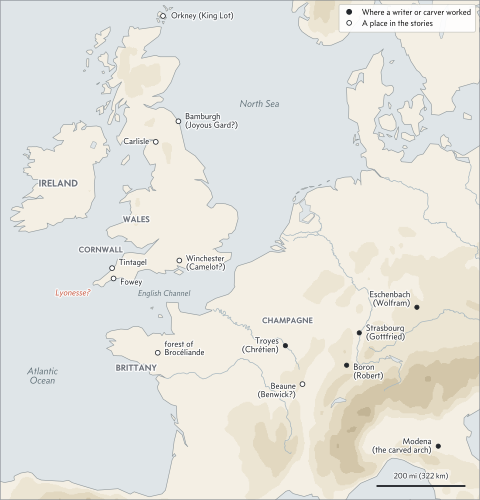

Lancelot is a French knight, and a late one. Scholars have proposed Welsh ancestors for him, but none is agreed on. He first appears as a bare name, third in a list of Arthur’s knights, in Chrétien’s Erec and Enide of about 1170, and his story grew backward from there. Chrétien knew that a fairy had raised him. The full story of his childhood, though, comes from the long French prose romances of about 1215 to 1235 called the Vulgate Cycle (Chapter 23), which Thomas Malory followed in his English Le Morte d’Arthur, finished in 1469 or 1470. In the Vulgate, Lancelot is the son of King Ban of Benwick,This figure is the son of King Ban of Benwick. → Lancelot•• a kingdom on the borders of Brittany and Gaul. Malory guessed that Benwick was Beaune (bohn), in Burgundy, or Bayonne, in the far southwest of France.
Ban’s enemy, King Claudas, set fire to his last castle. Ban escaped with his wife and their baby son, saw the smoke behind him, and died of grief on the road. While Lancelot’s mother, Queen Elaine,This figure's mother is named Elaine. → Lancelot• knelt over her dying husband, a woman of the fairy kind took up the child and carried him off into a lake. Elaine later became a nun. The lake was magic, an illusion that hid a country of its own, and there the Lady of the Lake raised Lancelot,This figure was raised by the Lady of the Lake. → Lancelot•• which is why he is called Lancelot du Lac, “of the Lake.” The Vulgate makes her the same enchantress, Ninianne or Viviane, who learned her magic from Merlin and used it to imprison him (Chapter 23).
Ban’s brother, King Bors of Gaul, died soon afterward, and the Lady’s servants rescued his two small sons from Claudas’s court and brought them to the lake. So Lancelot’s cousins, Lionel and Bors,This figure's cousins are Lionel and Bors. → Lancelot• grew up beside him. Their mothers were sisters, Elaine and Evaine, so the three boys were cousins twice over (Figure 24.3). The younger Bors would one day see the Holy Grail, the sacred vessel at the center of the legend’s greatest quest.
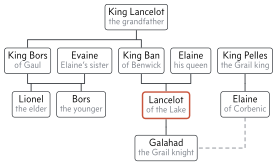
The Lady kept her foster son from knowing his name or his family. When he was fifteen, though he claimed to be eighteen, she brought him to Arthur’s court to be knighted, and he rode out in silver armor on a white horse, known only as the White Knight. His first great deed was in the north of Britain, at a castle called Dolorous Gard, the “Sorrowful Guard,” which lay under an evil enchantment. Lancelot conquered Dolorous GardThis figure conquered Dolorous Gard and renamed it Joyous Gard. → Lancelot•• alone, broke the spell, and renamed the castle Joyous Gard, and it was his home ever after. Malory thought it might be Bamburgh Castle, on the coast of Northumberland, or Alnwick, a few miles inland.
The castle had a graveyard, and in it lay a great slab of metal that, the Vulgate says, only the man who won the castle could raise. There he lifted the metal slabThis figure discovers his name by lifting a metal slab in a cemetery. → Lancelot• and read the words cut beneath it: here would lie Lancelot of the Lake, son of King Ban of Benwick. So he learned his own name from the grave that was waiting for him.
The Vulgate wrote down that childhood about forty years after Chrétien’s poem, and the poem itself begins in the middle of Lancelot’s life. In The Knight of the Cart, a proud prince named Meleagant (mel-ee-uh-gant) rides into Camelot and carries off Queen Guinevere to his father’s kingdom of Gorre (gor), a land from which, Chrétien says, no stranger ever escapes. A knight with no name, who is Lancelot, gives chase. He rides his horse to death and goes on in full armor on foot, until he overtakes a cart driven by a dwarf. In those days, Chrétien explains, a cart did the work of a pillory, a public stand of shame: criminals were dragged through the streets in it and lost every right they had. People used to say, “When thou dost see and meet a cart, cross thyself and call upon God, that no evil may befall thee.”
The dwarf promised news of the queen if the knight would climb in. The knight hesitated for two steps, and then he rode in the dwarf’s cartIn Chrétien de Troyes’s The Knight of the Cart, this figure rides in a cart to rescue Guinevere from Meleagant. → Lancelot••• to rescue Guinevere from Meleagant, while the townspeople jeered at him from the roadside. That night, at a castle, a damsel told him that a man who had ridden in a cart was not fit for the splendid bed in the hall. He lay down in it anyway. At midnight, in Comfort’s words, “there descended from the rafters suddenly a lance,” with “a pennon all ablaze”: its little flag was on fire. The flaming lance fell onto his bed,This figure is nearly killed when a flaming lance falls onto the bed he is sleeping in. → Lancelot• set the covers alight, and grazed his side. The knight put out the fire, tossed the lance into the hall without getting up, and went back to sleep.
The road into Gorre crossed a river by one of two bridges, one under the water and one shaped like a sword. Lancelot crossed the sword bridge into Gorre,This figure crosses a sword-shaped bridge to enter the kingdom of Gorre. → Lancelot•• cutting his hands and feet on its edge (Vol. 1, The Toolkit). He found the queen, and still Chrétien’s reader did not know his name. Chrétien keeps it hidden for more than three thousand lines, until the queen herself speaks it: “the name of the knight, I know, is Lancelot of the Lake.”
Guinevere greeted her rescuer coldly at first. She had heard about the two steps of hesitation, and in her eyes a true lover would not have paused for a moment before shame. When they were reconciled, Lancelot came to her room by night, pulling the iron bars from her window. Chrétien was the first to tell that Lancelot was Queen Guinevere’s lover,This figure had an affair with Queen Guinevere. → Lancelot••• probably at his patron’s wish. Marie of Champagne was famous for her interest in the ideal of a knight who serves a married lady with secret and perfect devotion, which later scholars named courtly love and which is traced to the troubadours of the south (Vol. 9, Cathedrals and Crusades). Chrétien never finished the poem. Another writer, Godefroi, added its last thousand lines, in which Lancelot kills Meleagant.
The Vulgate later told the love affair from its beginning. There the lovers’ first kiss is arranged by Lancelot’s devoted friend Galehaut (gal-uh-hoh), a prince who had come to conquer Arthur and stayed to serve him. A century after the Vulgate, the Italian poet Dante placed two lovers, Paolo and Francesca, in his Inferno. Francesca says that they were reading the story of Lancelot together, and that when they came to that kiss, Paolo kissed her. The book, she says, was their Galehaut, their go-between (Vol. 9, Cathedrals and Crusades).
Malory’s Lancelot is the best knight of the world and its finest jouster. A joust was a contest between two knights on horseback who charged at each other down a fenced field, called the lists, each trying to strike the other’s shield and knock him out of the saddle. The weapon was the lance, a long wooden spear held under the arm. Knights jousted with these spears,These weapons are sometimes used during jousting. → spears• and for sport the point was blunted or spread into a little crown of prongs, so that it would unseat a man without running him through. Tournaments full of such contests were the great sport of the knightly class from the twelfth century to the sixteenth.
Malory also gives Lancelot a joke. Sir Dinadan (din-uh-dan), a knight of the Round Table, was famous for mocking lovers and their foolishness, and at a tournament at Surluse, Lancelot and the queen played a trick on him. Lancelot put a maiden’s dress over his armor,This figure dons a dress over his armor to win a joust against Dinadan. → Lancelot• rode into the lists with a borrowed spear, and knocked Dinadan backward over his horse’s tail. His friends then carried Dinadan into the forest, stripped him to his shirt, dressed him in a woman’s gown, and led him back before the whole court. Queen Guinevere, says Malory, “laughed that she fell down.”
The deepest trick was played on Lancelot himself. At the castle of Corbenic lived King Pelles (pel-eez), the keeper of the Grail, who knew from a prophecy that Lancelot would give his daughter a son, and that the son would win the Grail. But Lancelot loved only Guinevere. So an enchantress, Dame Brisen, sent him a ring that seemed to come from the queen, with a message that she was waiting for him at a castle 5 miles away. That night, by Brisen’s magic, Elaine of Corbenic, King Pelles’s daughter, deceived LancelotElaine of Corbenic deceived this figure into sleeping with her and conceiving Galahad. → Lancelot•••This figure’s mother, Elaine of Corbenic, is King Pelles’s daughter. → Galahad•• into taking her for Guinevere, and she conceived his son, Galahad. When he saw by daylight what had been done, Lancelot drew his sword on her, and then forgave her. The Vulgate tells the story first, and Malory follows it.
Gawain and the Fair Unknown
Gawain is far older than Lancelot. Welsh storytellers knew him as Gwalchmei (gwalkh-may), a name often explained as “hawk of May,” though the meaning of its second half is uncertain. In Culhwch and Olwen, the oldest Welsh prose tale of Arthur (Chapter 13), Gwalchmei is already the son of Arthur’s sister, and he is one of the six men Arthur sends to help Culhwch win his bride, though the tale gives him nothing more to do. About 1125 the English historian William of Malmesbury wrote that the grave of “Walwen,” Arthur’s nephew, had been found in Pembrokeshire, in the southwest corner of Wales. Geoffrey of Monmouth, ten years later, called him Gualguanus. In every version Gawain is Arthur’s nephew,This character is a nephew of King Arthur. → Sir Gawain•• the son of a sister of the king, and in the romances he is the model of courtesy against whom every new knight is measured.

His father was King Lot, who ruled Lothian, in the southeast of Scotland, and the Orkney Islands off its northern tip. Geoffrey names his mother Anna. The French prose romances and Malory call her Morgause, one of Arthur’s half-sisters (Chapter 23), and so Gawain is the son of Lot and Morgause.This figure is the son of Morgause and King Lot of Orkney. → Sir Gawain•• His brothers were Agravain, Gaheris, and Gareth, and his half-brother was Mordred, and the fate of that family belongs to the end of Arthur’s story (Chapter 25).
Geoffrey adds a strange detail. As a boy of twelve, he says, Gawain had been sent to Rome to serve Pope Sulpicius (sul-pish-us), who knighted him; no pope of that name ever lived. A Latin romance of the late twelfth or the thirteenth century, The Rise of Gawain, Nephew of Arthur, builds a whole boyhood on that sentence. Here Gawain is the secret son of Lot and Anna, sent away as a baby, and the boy is raised under Pope SulpiciusThis figure is raised under Pope Sulpicius. → Sir Gawain• in Rome and trained as an officer of the emperor’s cavalry. No one knows who he is, not even Gawain. The pirates he fights at sea hurl Greek fire, a burning liquid that water could not put out, and the romance stops to give a recipe for it, one of the earliest in Europe. He also defeats a Persian giant in single combat. All this time he is known as the Knight of the Surcoat,This figure is initially identified as "the Knight of the Surcoat." → Sir Gawain• from the surcoat, a cloth tunic worn over armor. On his way to Britain, still unknown, he knocks his own uncle Arthur into the River Usk, and only after Gawain has won a war that Arthur’s own army lost does Arthur tell him who he is.
The French prose romances give Gawain a gift. A holy man, they say, baptized the baby, gave him his own name, and promised that every day his strength would grow toward the hour of the baptism, which was noon. In Malory, from nine in the morning Gawain’s strength grew until noon,This knight's strength is greatest at noon. → Sir Gawain• increasing “as much as thrice his strength,” and Arthur ordered that every trial by combat at his court should begin in the morning, for Gawain’s sake. The American scholar Roger Sherman Loomis argued that Gawain began as a hero of the sun, and as a Welsh cousin of the Irish Cú Chulainn (Chapter 11), whose beheading game he would play in an English poem (Chapter 30).
Gawain’s horse has a name of its own, which is rare. Gawain’s horse was GringoletThis character's horse is named Gringolet. → Sir Gawain• (gring-guh-let), first named in Chrétien’s Erec and Enide. Two centuries later it still carries Gawain to the Green Chapel in Sir Gawain and the Green Knight. In one French prose romance Gawain wins it from a Saxon king, and in story after story he cares for it and talks to it like a friend.
His shield changes from story to story. In Perlesvaus (per-les-vohs), a fierce French prose sequel to Chrétien’s Grail poem written early in the thirteenth century, a knight rides out of a castle with a red shield bearing a golden eagle and challenges Gawain to win it. It belonged, he says, to the best knight of his faith who ever lived: Judas Maccabeus (mak-uh-bee-us), the Jewish hero who led a revolt against the Greek kings of Syria in the 160s BC. Medieval Christians counted him among the Nine Worthies (Chapter 23), along with Arthur himself. Gawain unhorses the challenger with his spear, and from then on Gawain carried the shield of Judas Maccabeus.This knight carried a shield said to have belonged to Judas Maccabeus. → Sir Gawain•
The French prose romances of the thirteenth century made Gawain proud and quick to kill. In England he remained a hero, and English poets of the fourteenth and fifteenth centuries made him the center of comic and magical adventures. In The Wedding of Sir Gawain and Dame Ragnelle (rag-nel), a poem of the fifteenth century, a stranger knight catches Arthur alone and unarmed in Inglewood Forest, near Carlisle. He spares the king on one condition: in a year Arthur must come back and say what women desire most. A hideous old woman, the kind of character called a loathly lady, offers the answer if she may marry Gawain, and Gawain agrees, to save his uncle’s life. Her answer is “sovereignty,” to have their own way, and it saves the king.
So Gawain married the loathly lady Ragnelle,This figure marries the "loathly lady" Ragnelle. → Sir Gawain• and in their bedroom she became the most beautiful woman he had ever seen. She could be beautiful by day or by night, she told him, but not both, and he must choose. Gawain gave the choice to her, and by giving it he broke her enchantment for good. Chaucer’s Wife of Bath tells a tale built on the same riddle (Chapter 29).
Another English poem, Sir Gawain and the Carle of Carlisle, written about 1400, sends Gawain, Sir Kay, and a bishop to shelter from a storm in a castle near Carlisle. Its lord is a carle, a rough peasant, who is also a giant and kills any guest who disobeys him. Kay is rude and is knocked flat. Gawain obeys every order, even when the Carle tells him to throw a spear at his host’s face. The Carle is delighted, and Gawain spends the night with the Carle’s daughter.In a poem, this character sleeps with the Carle of Carlisle's daughter. → Sir Gawain• When the spell on the castle is broken, Gawain marries her, and the poem ends by saying that the Carle, made a knight, built the church that became Carlisle Cathedral.
Gawain fathered a hero of his own. About 1200 the French poet Renaut de Beaujeu (ruh-noh duh boh-zhur) wrote Le Bel Inconnu (bel an-kaw-new), “The Fair Unknown,” about a handsome youth who comes to Arthur’s court not knowing his own name. Gawain’s son is the Fair Unknown,This figure's son is known as the 'Fair Unknown' or Le Bel Inconnu. → Sir Gawain• though the poem keeps the secret until the youth’s greatest deed is done. A maiden comes to court to beg help for her mistress, Blonde Esmerée (ez-meh-ray), the queen of Wales, whom two enchanters have turned into a serpent. The youth rides to her city and defeats the enchanter Mabon, and the serpent kisses him and becomes a woman again. Then a voice tells him who he is: Guinglain, son of Gawain and a fairy.
In English the hero became Gingalain (ging-guh-layn). Thomas Chestre retold his story in an English poem of the fourteenth century, the Ragnelle poet made him Ragnelle’s son, and Malory names him among his father’s company. The Round Table included Gingalain,This group includes Gingalain, who rescues Blonde Esmerée from Mabon. → Knights of the Round Table• the knight who freed Blonde Esmerée from Mabon and married her.
Yvain
Chrétien wrote Yvain in the same years as The Knight of the Cart, about 1177 to 1181, and the two poems share characters and events. Its hero is the son of King Urien. Behind him stands Owain son of Urien, a real prince of the sixth century in the north of Britain, whom Geoffrey of Monmouth had already placed at Arthur’s court. A Welsh telling of this very story, Owain, or the Lady of the Fountain, stands in the Mabinogion (Chapter 13).
Yvain’s cousin Calogrenant, a knight of Arthur’s court, tells how, beyond the forest of Brocéliande in Brittany, where Merlin met his end in one telling (Chapter 23), he found a spring under a great pine. He poured water from a basin onto a stone beside it, a terrible storm broke, and a knight rode out and threw him to the ground. Yvain rides off alone to avenge him. He mortally wounds the knight of the fountain, follows him into his castle, and is trapped between its gates. A clever maid named Lunete (loo-net) gives him a ring that makes him invisible. He falls in love with the dead man’s widow, Laudine (loh-deen), and Lunete persuades her to marry him, since the fountain needs a defender.

Gawain soon talks Yvain into leaving to win fame at tournaments, and Laudine gives him a year. He forgets the day, a messenger from her shames him before the whole court, and he goes mad and lives like a wild man in the woods. A lady cures him with an ointment from Morgan the Wise, Chrétien’s name here for Morgan le Fay (Chapter 23). Riding on through a forest, he hears a dreadful cry. In a clearing Yvain rescues a lion from a dragon,Yvain rescued one of these animals from a dragon and gained it as a companion. → lions•• which Comfort’s translation calls “a serpent which held him by the tail, burning his hind-quarters with flames of fire.” Yvain decides that the poisonous creature deserves to die, cuts it in two, and has to cut off the tip of the lion’s tail to free it. The lion stands on its hind legs, bows its face to the ground, and kneels to him in thanks.
From then on the lion hunts for Yvain and fights beside him, and Yvain hides his name and calls himself “the Knight with the Lion.” Once, finding him fallen in a faint with his own sword cutting his neck, the lion thinks its master dead and tries to kill itself on the blade. At the end Yvain fights Gawain, neither knowing the other; neither can win, and when they learn the truth each insists that the other is the victor. Lunete tricks Laudine into forgiving him. About 1200 the German poet Hartmann von Aue (ow-uh) retold the poem as Iwein.
Tristan, Isolde, and Palamedes
The story of Tristan and Isolde began outside Arthur’s world and was pulled into it. Welsh tradition knew a Drystan, nephew of King March, or Mark, and lover of his wife, and the first French poets to write it down barely mention Arthur. Béroul (bay-rool) wrote his version in the later twelfth century. Thomas of Britain wrote his, in French, probably for readers at the English court of Henry II, about 1173 by one reckoning and before 1160 by another, and the German Gottfried von Strassburg followed Thomas about 1210. In the 1230s a long French prose romance, the prose Tristan, made the hero a knight of the Round Table, and Malory took his long “Book of Sir Tristram” from it. Fionn’s Irish story of Diarmuid and Gráinne has the same pattern of a young warrior, his lord’s bride, and a flight to the woods, and in 1913 an American scholar’s study of the legend’s sources argued that it helped shape the Tristan story (Chapter 12).
Malory begins with a birth. In his telling Tristan was the son of King MeliodasThis figure is a son of King Meliodas. → Tristan• (mel-ee-oh-dus), who ruled the country of Lyonesse (lee-uh-ness), and of his queen, Elizabeth, who was King Mark’s sister. When Meliodas was carried off by an enchantress, Elizabeth went into the forest to find him and gave birth there, with only a gentlewoman to help her. Dying, she asked that the child be named Tristram, “that is as much to say as a sorrowful birth.” In Gottfried his father is a different lord, Rivalin, and his mother is Blancheflor; the opening of Thomas’s poem is lost.
Tristan’s homeland, Lyonesse,This figure is from Lyonesse. → Tristan•• is a land of legend. Malory says only that it was Meliodas’s country. Later Cornish storytellers placed it beyond Land’s End, the western tip of Cornwall, and told how it sank under the sea in a single night, leaving only the Isles of Scilly above the waves. One man escaped, they said, galloping ahead of the water on a white horse, and fishermen claimed that on calm days they could still hear its church bells ringing under the sea.
As a young man Tristan came to the court of his uncle, King Mark of Cornwall,This figure is a nephew of King Mark of Cornwall. → Tristan••King Mark ruled this region. → Cornwall• the rocky peninsula at the southwest end of Britain, whose people, like the Welsh, still spoke a Celtic language in the Middle Ages. A real king may stand behind Mark. A Breton saint’s life written in 884 mentions a King Mark whose other name was Quonomorus. A stone pillar of the sixth century near Fowey, in Cornwall, carries a worn Latin inscription that is usually read as marking the grave of Drustan, son of Cunomorus, though not every scholar accepts that reading.

When Tristan was young, the Morholt (mor-holt), a giant of a knight from Ireland and the brother of the Irish queen, came to Cornwall to collect a tribute that Mark could not pay. Tristan offered to fight him on a little island off the coast. Tristan killed the MorholtThis figure kills Morholt, leaving a fragment of his sword in the wound. → Tristan•• with a blow that broke off a piece of his sword in the giant’s skull. The Morholt sailed home to die, and his sister kept the fragment of steel. But the Morholt’s spear had been poisoned, and Tristan’s wound would not heal. He set out in a boat with his harp and came at last to Ireland, where the queen’s daughter, Isolde, healed him without knowing who he was. Later, in Malory’s telling, the queen fitted the steel from her brother’s skull into the notch in a stranger’s sword, and Tristan’s secret was out.
Tristan went back to Ireland to win Isolde as a bride for his uncle. Her mother, a woman skilled in herbs and spells, brewed a love potion for Isolde and Mark to drink on their wedding night and gave it to Isolde’s maid, Brangaine (bran-gayn), to keep. On the voyage the day was hot, and by mistake the potion was served instead of wine. Tristan and Isolde drank the love potionThis figure drinks a love potion with Isolde while bringing her to marry King Mark. → Tristan•• on the way to her wedding with Mark, and from that hour they loved each other more than honor, loyalty, or life. In Béroul the potion’s power lasts three years; in Thomas and Gottfried it lasts forever (Figure 24.7).


Isolde married Mark, and Tristan and Mark’s wife IsoldeThis figure, one of Arthur’s knights, has an affair with King Mark’s wife Isolde. → Tristan•• became lovers under the king’s own roof. Mark’s barons spied on them, the lovers lied their way out of trap after trap, and at last, in Béroul’s poem, Mark condemned them, Tristan to hang and Isolde to burn. They escaped and fled into the forest of Morrois. Béroul tells that Tristan’s dog, HusdentThis figure owns a dog named Husdent. → Tristan• (hooz-dent), howled for his master until he was set free, then tracked him to the woods, where Tristan trained him to hunt in silence so that his barking would not give them away. In later tales, when Tristan comes back to court disguised as a madman, Husdent alone knows him. In the forest, one day Mark found the lovers asleep in a hut, with Tristan’s naked sword lying between them. He took it for a sign of innocence, laid his own sword in its place, and went away without waking them. In the end the lovers made peace with Mark, Isolde went home to her husband, and Tristan left Cornwall.
The prose Tristan gave him a rival. Palamedes (pal-uh-mee-deez) was a knight from the East, a son of King Esclabor (es-kluh-bor), and the romances call him “the Saracen,” their word for a Muslim, or for almost anyone of the East who was not a Christian. He fell in love with Isolde in Ireland, lost to Tristan in a tournament there, and never stopped loving her. Tristan dueled PalamedesThis figure repeatedly duels with the Saracen knight Palamedes. → Tristan•• again and again, in fights that were usually broken off or left undecided, and the two became something between friends and enemies. Palamedes also hunted the Questing Beast that King Pellinore had chased before him (Chapter 23).
His family came with him into the fellowship. His brother Segwarides (seg-war-ih-deez) became a knight of King Mark’s court, and Palamedes and Segwarides, sons of Esclabor,Palamedes and Segwarides, sons of Esclabor, belong to this group. → Knights of the Round Table• both sat at the Round Table, as did their youngest brother, Safir. At the end of Malory’s tale of Tristram, Palamedes is baptized a Christian, with Tristan beside him.
In Thomas’s poem, Tristan, exiled to Brittany, meets a duke’s daughter with the same name, Isolde of the White Hands, the sister of his friend Kaherdin (kah-her-din). Tristan marries Isolde of the White HandsThis figure marries Isolde of the White Hands while loving another Isolde. → Tristan•• for her name and her beauty while he still loves Isolde the Fair, Mark’s queen, and he never lives with his wife as a husband. She knows it, and she is bitterly jealous.
There are two deaths of Tristan. In Thomas’s poem he is wounded by a poisoned lance in a fight in Brittany, and only Isolde the Fair can heal him. He sends Kaherdin to Cornwall to fetch her, with orders to hoist a white sail on the way home if she is aboard, and a black one if she is not. She comes. But his wife has overheard, and when the ship appears she tells him that its sail is black. Tristan dies believing the sail is black,This figure dies after being falsely told that an approaching ship has black sails. → Tristan•• and Isolde lands, finds him dead, lies down beside him, and dies too. The lie echoes the Greek story of Theseus (thee-see-us), whose father saw a black sail and believed him dead (Vol. 4, Classical Myth).
The prose Tristan tells a harsher end. Tristan has come back to Cornwall, and as he sits harping for Isolde, King Mark comes up behind him. Mark stabs Tristan with a poisoned lanceIn some versions, this figure is stabbed with a poisoned lance while playing the harp. → Tristan• while he plays the harp, and the lovers die together. Malory gives the same end in a single sentence: “that traitor king slew the noble knight Sir Tristram, as he sat harping afore his lady La Beale Isoud, with a trenchant glaive.” A glaive is a spear, and trenchant means sharp.
Gottfried’s German poem, the most admired of all the versions, follows Thomas closely and runs to nearly twenty thousand lines. It breaks off before the end, with Tristan in Brittany torn between the two Isoldes, and later poets wrote endings for it. Gottfried von Strassburg told Tristan’s story in GermanThis figure's story was told in German by Gottfried von Strassburg. → Tristan• as the story of a love stronger than any law, and Richard Wagner built his opera Tristan und Isolde of 1865 on it, with its famous unresolved chord (Vol. 1, The Toolkit, Vol. 19, Wagner and Verdi).
The Grail from Chrétien to Wolfram
The Holy Grail began in a poem that was never finished. About 1190 Chrétien was writing Perceval, the Story of the Grail for a new patron, Count Philip of Flanders, who died on crusade at Acre in 1191, and the poem breaks off after some nine thousand lines. Its hero is a boy raised in the Welsh forest by a widowed mother, who had kept from him every word about knights, since knighthood had killed his father and brothers. When he first sees knights in armor, he takes them for angels. He rides to Arthur’s court in rough clothes, kills a Red Knight and takes his armor, and learns the rules of knighthood from an old lord, Gornemant, who warns him among other things not to talk too much.
One evening Perceval comes to a river where a richly dressed man is fishing from a boat, and the man invites him to his castle. This is the Fisher King, wounded by a javelin through both thighs, so that he cannot ride or hunt, and fishing is the only sport left to him. At supper a strange procession passes through the hall. A youth carries a white lance, and a drop of blood runs from its tip down to his hand. Two boys carry candlesticks. A maiden carries a graal of gold and jewels, so bright that the candles pale beside it, and another maiden carries a silver dish. In Chrétien’s French a graal is simply a wide, deep serving dish, and he calls this one “a grail,” not “the Grail.” Perceval longs to ask whom the grail serves and why the lance bleeds, but he remembers Gornemant’s advice and says nothing (Figure 24.8).

In the morning the castle is empty. A cousin Perceval meets in the forest tells him what he has done: if he had asked, the king would have been healed and his lands made whole. Years later a hermit, who turns out to be his uncle, explains that the grail carries a single host, the wafer of bread that Christians receive at Mass as the body of Christ, and that this host alone keeps the Fisher King’s old father alive. Then the poem returns to Gawain’s adventures and stops. Four later poets wrote continuations, some fifty thousand lines more, and the Welsh tale Peredur tells a version of the same story (Chapter 13).
Within a few years the dish had become a cup. Robert de Boron, a knight and poet from near Montbéliard (mohn-bay-lyar), in eastern France, wrote his poem Joseph of Arimathea about 1200. In the Gospels, Joseph of Arimathea is a rich follower of Jesus who asked Pontius Pilate, the Roman governor, for the body after the crucifixion and laid it in his own new tomb (Chapter 23). In Robert’s poem Joseph receives the vessel of the Last Supper and catches in it the blood from Jesus’ wounds. Thrown into prison, Joseph is kept alive by the vessel. When he is freed, his family and followers carry it west, and its keeper, his brother-in-law Bron, the Rich Fisher, brings it to the “vales of Avaron,” a name that later writers took for Avalon (Chapter 25). So Robert de Boron linked the Grail to Joseph of Arimathea,Robert de Boron associated this object with Joseph of Arimathea. → Holy Grail• and in the romances from his time on it was the Holy Grail, the holiest of all relics.
The name invited a guess. In French the Holy Grail is the san graal or saint graal, and if the letters are divided differently, they give sang réal, “royal blood,” as if the vessel were named for the blood of Christ the King. That reading was invented in the fifteenth century by the English chronicler John Hardyng, and Malory’s name for the Grail, the Sangreal, carries it. It is wrong, since graal most likely comes from a medieval Latin word for a dish, gradalis. Still, the false “royal blood” etymologyA dubious etymology for this object linked its French name to "royal blood." → Holy Grail• has never died, and a best-selling book of 1982, The Holy Blood and the Holy Grail, built a fantasy of a secret royal bloodline on it.
In Germany the Grail took a third shape. Wolfram von Eschenbach, a Bavarian knight who claimed that he could not read, retold Chrétien’s poem as Parzival about 1210, and unlike Chrétien he finished it. Wolfram’s Grail is a stone, which he calls lapsit exillis, kept by a brotherhood of knights in the castle of Munsalvaesche (moon-zahl-vesh-uh). It feeds them with whatever food they wish, and every Good Friday a dove brings a wafer from heaven and lays it on the stone. The Grail king, Anfortas (an-for-tus), suffers from a wound that will not heal. Parzival fails to ask the question, as Perceval did, wanders for years, and at last comes back to ask his uncle what ails him, and Anfortas is healed and Parzival becomes the Grail king. Richard Wagner made the poem into his last opera, Parsifal (1882), and T. S. Eliot made the Fisher King and his ruined land the frame of The Waste Land of 1922 (Vol. 19, Wagner and Verdi, Vol. 21, Trenches and Modernists).
Balin and Galahad
The French prose romances tied the Grail’s wounded king to a crime. Malory took this story from a French romance of about 1240 and tells it as his “Tale of Balin.” Balin (bay-lin) the Savage, a poor knight from Northumberland, drew a sword from a damsel’s scabbard that only a good knight “without villainy or treachery” could draw. Then he refused to give it back, though she warned him that with it he would kill the man he loved best in the world. Carrying two swords, he rode through a chain of disasters. At the castle of King Pellam, a kinsman of Joseph of Arimathea, he killed Pellam’s brother Garlon, an invisible knight who struck men down from ambush, at the king’s own feast. Pellam struck back, and Balin’s sword broke in two.
Weaponless, Balin ran from room to room with the king behind him. In a rich chamber he found a man lying on a bed of gold cloth, who, Malory says, was Joseph of Arimathea himself, and on a table of gold, in Malory’s words, “a marvellous spear strangely wrought.” He seized it and struck the king down. This was the Dolorous Stroke, the “sorrowful blow.” Balin struck with the bleeding spearBalin strikes the Dolorous Stroke with a bleeding example of this type of weapon. → spears• of the Grail castle, which Malory says was the spear of Longinus (lon-jy-nus), the name Christian tradition gives the Roman soldier who, John’s Gospel says, pierced Jesus’s side at the crucifixion. The castle fell in on them, and for three days they lay in its ruins. When Balin rode out, the people of three countries lay dead around him, and the survivors cried that he had done it. Pellam lay wounded for years, the Maimed King, and “might never be whole,” says Malory, “till Galahad the haut prince healed him,” haut being French for “high.” Pellam is not King Pelles of Corbenic, Galahad’s grandfather, though the names are close: the French romances make the two kings father and son, or brothers, and Malory sometimes runs them together.
Balin’s own end came soon. He fought a strange knight on an island, and only when both were dying did he learn that the knight was his own brother, Balan, as the damsel had foretold. Merlin buried them in one tomb. Then he set Balin’s sword in a block of marble that floated upright on the water, and years later it drifted down the river to Camelot, which Malory says is Winchester.
It arrived on the day Galahad came. The French Quest of the Holy Grail, a part of the Vulgate written about 1225, gathers the knights at Camelot for Pentecost, the Christian feast seven weeks after Easter. Galahad is the Vulgate’s invention, and the Vulgate gave him the name that Lancelot himself had been given at his baptism, before he took his grandfather’s name. That morning, in Malory’s telling, the knights found new letters of gold on the Siege Perilous, the empty seat at the Round Table that Merlin had made for the best knight to come, which destroyed anyone unworthy who sat in it (Chapter 23). It was to be filled, the letters said, “four hundred winters and four and fifty” after Jesus’ death, and Lancelot worked out that the day had come.
Then a squire ran in with strange news. A red marble stone was floating in the river with a sword stuck in it, and on the pommel was a promise in gold letters: “Never shall man take me hence, but only he by whose side I ought to hang.” Lancelot would not touch it, saying it was not his. Gawain tried at Arthur’s command and could not move it, and Lancelot warned him that the sword would one day wound him for it. At dinner the doors and windows of the hall shut by themselves. An old man in white led in a young knight in red armor, with an empty scabbard and no shield, and lifted the silk that covered the seat. The letters now read, “This is the siege of Galahad, the haut prince.” The old man set him there, and Galahad sat safely in the Siege Perilous,This figure could sit safely in the Siege Perilous. → Galahad••• as no knight before him had done. The whole court marveled that one so young had dared.

When the queen saw the young knight’s face, she said that never two men looked more alike. She guessed the truth: this was Lancelot’s son, the knight who would find the Grail,This figure is Lancelot’s illegitimate son. → Galahad••Lancelot's illegitimate son Galahad found this object. → Holy Grail• whom Lancelot had been tricked into fathering at Corbenic, come at last to his father’s court. Lancelot, who had knighted the youth at a nunnery in the forest only that morning, looked at his son and was glad.
After dinner Arthur led Galahad down to the river. The young knight said that the adventure of the stone was his and no one else’s, which was why he had come with only a scabbard. Then Galahad drew the sword from the floating stoneThis figure draws a sword from a stone floating down a river. → Galahad•• as easily as from a sheath. “Now have I that sword,” he said, “that sometime was the good knight’s, Balin le Savage.” A damsel rode up on a white palfrey and told Lancelot, weeping, that he was no longer the best knight in the world, though he was still the best “of any sinful man.”
That evening the hall rang with thunder, and a light seven times brighter than day filled it. The Grail came in, covered in white silk, though no one could see who carried it, and every knight found before him the food and drink he liked best. Then it was gone. Gawain was the first to swear to seek it, and nearly every knight followed him. Arthur wept, because he knew the fellowship of the Round Table would never sit together whole again (Figure 24.10).

Galahad still had no shield. At an abbey of white monks he found one, white with a red cross, that no other knight could carry without coming to harm. A mysterious knight in white told its story. It had belonged to Evelake, a king of the East whom Joseph of Arimathea’s son Josephus had converted, and when Josephus lay dying, he bled from the nose and drew a cross on the shield with his own blood. That is why Galahad’s white shield bore a red cross,This figure bears a white shield marked with a red cross made from Josephus’s blood. → Galahad•• made from the blood of Josephus and never fading. Malory gives the deed to Joseph himself, but the French Quest gives it to his son.
Galahad succeeds where his father fails for one reason. He is pure: a virgin, and free of serious sin, and the Quest, written under the influence of the white monks of the Cistercian order, measures every knight by that standard. Gawain kills fellow knights without need and finds nothing. Lancelot, the best knight in the world among sinful men, glimpses the Grail through a doorway at Corbenic, is struck down for twenty-four days and nights, and wakes to repent. Only Galahad’s purity let him achieve the Grail,This figure’s purity enables him to achieve the Holy Grail. → Galahad••• and Tennyson, in his short poem “Sir Galahad” of 1842, gave him the lines “My strength is as the strength of ten, / Because my heart is pure.”

Two companions shared the end of the quest. Percival, Chrétien’s old hero, was now a virgin like Galahad, and Bors, Lancelot’s cousin, had sinned only once. Bors and Percival rode with GalahadThis figure was accompanied by Bors and Percival on his quest for the Holy Grail. → Galahad•• to Corbenic, where the three saw the Grail and Galahad healed the Maimed King with blood from the spear. Then they sailed in the ship of Solomon, carrying the Grail, to Sarras, a holy city in the East. Its king threw them into prison, where the Grail fed them, and when he died the people made Galahad their king.
A year later, at Mass, Galahad saw the Grail’s mysteries plainly. In Malory he prayed: “Now, blessed Lord, would I not longer live, if it might please thee, Lord.” Galahad chose to dieAfter seeing the Grail, this figure chooses to die and ascends to heaven. → Galahad•• and ascend to heaven. He kissed his companions, sent word to his father to “remember of this unstable world,” and knelt, and “a great multitude of angels bare his soul up to heaven.” A hand came down from the sky and took away the vessel and the spear. Percival died a hermit, and Bors rode home alone to Camelot to tell what he had seen. “Sithen,” since then, Malory ends, “was there never man so hardy to say that he had seen the Sangreal.” The first weaving of Burne-Jones’s picture of the scene hung in a Victorian dining room, more than six and a half centuries after the French Quest was written (Figure 24.11).
What to remember
- A knight was a mounted soldier, dubbed after serving as page and squire. Lancelot, Gawain, Yvain, Tristan, and Galahad were knights of the Round Table, and their stories were added by different writers over three centuries.
- Lancelot, son of King Ban of Benwick and Queen Elaine, was raised by the Lady of the Lake with his cousins Lionel and Bors. He won Dolorous Gard, renamed it Joyous Gard, and found his name under a metal slab there (the Vulgate).
- In Chrétien’s Knight of the Cart (about 1180), written for Marie of Champagne, Lancelot rides in a cart, survives the flaming lance, crosses the sword bridge into Gorre, rescues Guinevere from Meleagant, and becomes her lover.
- Gawain, Arthur’s nephew and the son of Lot and Morgause, was, in The Rise of Gawain, raised in Rome under Pope Sulpicius as the Knight of the Surcoat. His strength grows until noon, his horse is Gringolet, and his son Gingalain is the Fair Unknown, who rescues Blonde Esmerée from Mabon.
- In Chrétien’s Yvain, the hero saves a lion from a fire-breathing serpent and becomes the Knight with the Lion.
- Tristan of Lyonesse, Malory’s son of Meliodas, killed the Morholt, drank the love potion with Isolde on her way to marry his uncle Mark of Cornwall, married Isolde of the White Hands, and dueled Palamedes, “the Saracen.” He dies by the black-sail lie in Thomas, and by Mark’s lance as he harps in the prose Tristan and Malory.
- The Grail is a dish in Chrétien’s Perceval, the cup of the Last Supper brought west by Joseph of Arimathea in Robert de Boron, and a stone in Wolfram’s Parzival. “Royal blood” (sang réal) is a false etymology.
- Balin’s Dolorous Stroke with the bleeding spear wounded the Grail king. Galahad, Lancelot’s son by Elaine of Corbenic, sat in the Siege Perilous, drew the sword from the floating stone, bore the white shield with Josephus’s red cross, achieved the Grail with Bors and Percival, and chose to die.
Chapter 25 · 34 clues
The Death of Arthur
Sometime between March 1469 and March 1470, an English knight came to the end of a very long book. He had written much of it, he said, as a prisoner. He asked every reader to pray for him while he lived, “that God send me good deliverance,” and to pray for his soul when he was dead. Then he dated the book to the ninth year of the reign of King Edward the Fourth and signed it Sir Thomas Malory, knight.
His book told the whole life of King Arthur, and it ended with the fall of everything Arthur had built. A quarrel breaks the fellowship of his knights, his best friend becomes his enemy, his son seizes his crown, and his kingdom dies in a single day of battle. That ending had been told and retold for three hundred years before Malory, in Welsh, Latin, French, and English. This chapter tells it mostly as Malory did, and names, for each part, the older writer who first set it down.
Mordred’s birth
Arthur’s family, drawn as a tree in Chapter 23, is the key to his fall. His mother, Igraine, had three daughters by her first husband, the Duke of Tintagel, Geoffrey’s Gorlois, so Arthur had three half-sisters, sisters through one parent only. They were Morgause, the queen of Orkney and mother of Gawain and his brothers; Elaine, who married King Nentres of Garlot; and the youngest, Morgan le Fay. Arthur, raised far from court by his foster father, Sir Ector, grew up knowing none of them.
Malory’s book was first printed in 1485 by William Caxton, England’s first printer, and this chapter quotes Caxton’s text in the modern spelling of Ernest Rhys’s edition of 1906. Early in Arthur’s reign, Malory says, Lot’s wife came to his court at Caerleon, in south Wales, with her four sons. She had been sent to spy on the young king. She was a beautiful woman, and she stayed a month. In that month Arthur fathered Mordred on his half-sister Morgause,This figure fathers Mordred with his half-sister Morgause. → King Arthur•••This figure is the son of Arthur and his half-sister Morgause. → Mordred•• though Arthur, Malory says, did not know that she was his sister. Soon afterward Merlin, the prophet who had arranged Arthur’s own birth, told him what he had done: “ye have lain by your sister, and on her ye have gotten a child that shall destroy you and all the knights of your realm.”
Merlin added that the child who would destroy him would be born on May Day, the first of May. Arthur sent for every child born on that day to a lord and a lady, on pain of death, and Lot’s wife sent her baby with the rest. Some were four weeks old and some younger. Arthur had them all put into one ship and sent out to sea, where it was driven against a castle and broken to pieces, and only the infant Mordred came ashore alive.This figure orders children born on May Day put to sea in an attempt to kill Mordred. → King Arthur••Born on May Day, this figure survives being cast to sea with other infants. → Mordred•• A good man found him and raised him until he was fourteen. The lords who had lost their sons were furious at so cruel an order, but Malory says they blamed Merlin more than the king, and out of fear and love they held their peace.
None of this is in the oldest version of the story. In Geoffrey of Monmouth’s History of the Kings of Britain (about 1136), Mordred, in Latin Modredus, is Arthur’s nephew, the lawful son of King Lot and Arthur’s sister Anna, and Gawain’s brother. The French prose romances of the Vulgate Cycle (about 1215 to 1235) made him Arthur’s son by his own sister. A later French romance, the Suite du Merlin (sweet doo mer-lan) (about 1240), added the drowned children of May Day, and Malory took both. Tennyson’s Mordred, four hundred years later, is a nephew again (Vol. 17, The Victorians).
Morgan le Fay
The youngest of Igraine’s daughters had the longest career in literature. She first appears about 1150, as a healer on an island of apples, in a Latin poem by Geoffrey of Monmouth, and there she is no relation of Arthur’s at all. French poets called her Morgain la fée, “Morgan the fairy,” and Malory made the epithet le Fay. Chrétien de Troyes already calls her Arthur’s sister (Chapter 24), and by the thirteenth century the French romances had made her Igraine’s daughter and the enchantress wife of King Urien.This figure is an enchantress married to King Urien. → Morgan le Fay•• Urien was a real king of the sixth century, ruler of Rheged in the British north and father of the Owain of Welsh story (Chapter 13). The romances made him king of Gore, and his son by Morgan is Yvain, the knight of the lion (Chapter 24).
The Vulgate Cycle gives her a past. As a young queen, unhappy in her marriage, she served at court as a companion of Guinevere, Arthur’s wife, and the two women were friends until Morgan was caught with her lover GuiomarThis figure was caught having an affair with Guiomar. → Morgan le Fay•• (ghee-oh-mar), Guinevere’s cousin. Guinevere broke off the affair to save the court’s honor, and Morgan never forgave her: from then on, in story after story, she works to shame the queen. She left Camelot with all her wealth to find Merlin, who was in love with her. Merlin taught Morgan his magic,This figure mentored Morgan le Fay. → Merlin•• adding his dark arts to what she had first learned as a girl in a nunnery. Malory leaves out Guiomar and Merlin’s lessons and keeps only her schooling: she “was put to school in a nunnery, and there she learned so much that she was a great clerk of necromancy,” a scholar of black magic.
In Malory she turns that learning on her brother, in a plot Malory found in the Suite du Merlin. One day Arthur, King Urien, and Sir Accolon (ak-uh-lon) of Gaul, a young knight who was secretly Morgan’s lover, chased a stag so far that their horses died under them. On a riverbank they found a little ship hung with silk, where twelve maidens served them supper and led them to bed. Urien woke at home beside his wife. Accolon woke at the edge of a deep well. Arthur woke in the dungeon of a treacherous lord, Sir Damas, among twenty starving prisoners, and could win his freedom only by fighting as Damas’s champion the next morning.

The knight he was to fight was Accolon. Arthur’s sword was Excalibur, the gift of the Lady of the Lake, and its scabbard was worth even more, for whoever wore it lost no blood however he was wounded (Chapter 23). Arthur, who trusted his sister more than his own wife, had left the sword in her keeping, and Morgan sent Excalibur to AccolonMorgan le Fay gives this sword to Accolon while Arthur fights with a counterfeit. → Excalibur•• with orders to fight without mercy. To Arthur, as he mounted, a maiden brought a sword and scabbard that looked like his own, a counterfeit, “brittle and false.” Arthur’s blade would not bite, his blood ran fast, and at last it broke at the hilt. Then Nimue, the Lady of the Lake who had shut Merlin under a stone, cast a spell that made Excalibur fall from Accolon’s hand. Arthur seized it, tore the scabbard from Accolon’s side, and beat him down. Dying, Accolon confessed that Morgan had meant to kill her brother, then her husband, and make Accolon king.
Meanwhile in Camelot, Morgan lifted her sleeping husband’s sword to kill him, and their son Uwaine, Malory’s Yvain, caught her by the hand. Then she heard that Accolon was dead and that Arthur had Excalibur back. She rode to the abbey of nuns where her brother lay resting from his wounds and found him asleep, the naked sword in his right hand. She dared not touch it, so she took the scabbard and rode away. Arthur woke and gave chase. When she saw she would be caught, she rode to a lake and threw the scabbard into the deepest water,This figure throws away Excalibur’s scabbard. → Morgan le Fay• where it sank, heavy with gold and jewels. “Whatsoever come of me,” she said, “my brother shall not have this scabbard.” Then she turned herself, her horse, and her forty men into great stones in a valley, and Arthur rode past them. He had his sword, but from that day he could bleed like any other man.
The fall of the Round Table
Arthur’s ruin, as Malory tells it, grew out of a feud inside his own fellowship. Lot’s sons believed that King Pellinore, the knight who hunted the Questing Beast (Chapter 23), had killed their father in battle, and Gawain and Gaheris killed Pellinore in revenge. Pellinore’s son, Sir Lamorak (lam-uh-rak), was by Malory’s count the third-best knight in the world, after Lancelot and Tristram, and he became the lover of Lot’s widow, Morgause. Gaheris found them together and struck off his own mother’s head. Lamorak escaped him that night but not the brothers. Gawain, Agravain, Gaheris, and Mordred set on him in a lonely place, killed his horse, and fought him on foot for three hours, and Mordred stabbed Lamorak in the back.This figure stabs Lamorak in the back. → Mordred•• Gareth, the youngest brother, swore that he would never love the others again for that deed.
The brothers’ next quarrel broke open in May, at Carlisle. For years Lancelot, the greatest of Arthur’s knights, had loved Queen Guinevere, and she him (Chapter 24). Agravain and Mordred, says Malory, had “ever a privy hate,” a secret hatred, for them both. One day in Arthur’s chamber Agravain said aloud what the whole court knew. Gawain begged him to keep silent, reminding him how often Lancelot had saved their lives, and Gaheris and Gareth walked out with him. Agravain and Mordred went to the king anyway, and though Arthur loved Lancelot, he agreed to a trap. He rode out hunting and sent word that he would be away all night. When Lancelot went to the queen’s chamber, unarmed, Mordred and his half-brother Agravain exposed the lovers,With his half-brother Agravain, this figure exposed the affair between Lancelot and Guinevere. → Mordred•• coming to the chamber door with twelve armed knights and shouting so that all the court could hear.
Lancelot killed the first man through the door, put on the dead man’s armor, and killed Agravain and the rest of the twelve (Figure 25.2). Only Mordred got away, wounded, to tell the king. The law in those days, Malory explains, put to death anyone found guilty of treason, and a queen’s adultery with the king’s knight was treason. Arthur ordered Guinevere burned. Gawain refused to have any part in it. His younger brothers Gaheris and Gareth obeyed the king’s command to stand by, but they went without armor, to show that they would not fight.
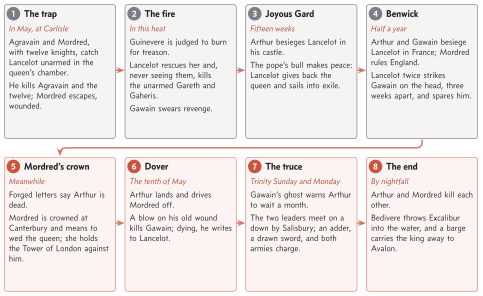
Guinevere was led out of Carlisle to the stake. Lancelot and his kinsmen charged, cutting down everyone who stood in their way, and in the crush Lancelot killed Gareth and Gaheris,This knight feuds with Lancelot after the deaths of his brothers Gareth and Gaheris. → Sir Gawain••While rescuing Guinevere, this figure accidentally killed Gareth and Gaheris, provoking Gawain’s enmity. → Lancelot•• Gawain’s unarmed brothers, without ever seeing them. “In very truth Sir Launcelot saw them not,” Malory writes. Gareth had loved Lancelot more than his own brothers, for Lancelot had made him a knight. Lancelot carried the queen away to his castle of Joyous Gard, and Arthur grieved more for his knights than for his wife: “queens I might have enow, but such a fellowship of good knights shall never be together in no company.” When Gawain learned that Gareth was dead, he fainted. When he woke, he swore to the king that he would pursue Lancelot “until the one of us have slain the other.”
Arthur went to war against Lancelot,This figure waged war against Lancelot. → King Arthur• with Gawain driving him on. For fifteen weeks he besieged Joyous Gard, and Malory says that some placed the castle at Alnwick and some at Bamburgh, both in Northumberland (Figure 25.4). When Lancelot at last rode out to fight, he would not strike the king, and when Arthur was knocked from his horse, Lancelot set him back in the saddle. Then the pope sent a bull, a sealed letter of command, ordering peace. Lancelot gave the queen back to Arthur, but Gawain would not let the king forgive him, and Lancelot sailed into exile to his own city of Benwick, in France.
Arthur followed with Gawain and a great army. He left behind him as ruler of England, with the queen in his care, the son he had once tried to drown: Mordred, chosen, Malory says, because he was Arthur’s son. For half a year they besieged Benwick, and every day Gawain rode to the gate and called Lancelot a traitor until he came out to fight. Gawain had a strange gift, as Chapter 24 told: from nine in the morning until noon his strength grew threefold. Lancelot only defended himself for those three hours. Then he struck Gawain on the helmet so hard that he fell, and walked away rather than strike a fallen man. Three weeks later Gawain came back for more, and this time Lancelot’s blow landed “upon the old wound.”

At home, Mordred had letters forged, as if sent from across the sea, saying that Arthur had been killed fighting Lancelot. He called a parliament, a great council of the lords, made them choose him king, and seized Arthur’s throne while he was overseas,This figure seizes Arthur’s throne during his absence. → Mordred•• with a coronation at Canterbury. Then he declared that he would marry the queen, “his uncle’s wife and his father’s wife,” for Arthur was both his uncle and his father. Guinevere pretended to agree. She asked leave to go to London to buy what she needed for the wedding, and instead seized the Tower of London, filled it with food and soldiers, and held it against him. Mordred besieged her with siege engines and with “great guns,” cannon from Malory’s own century, not Arthur’s. The Bishop of Canterbury, as Malory calls him, cursed Mordred with book, bell, and candle, the solemn rite of excommunication, and fled for his life to a hermitage near Glastonbury.
Much of England came over to Mordred. With Arthur, people said, there had been nothing but war, and with Mordred there would be joy. Malory stops his story to scold them: “Lo ye all Englishmen, see ye not what a mischief here was!” He was writing during the Wars of the Roses, when English lords changed sides between the royal houses of Lancaster and York (Vol. 12, Crown and Parliament), and he may have changed sides himself.
Camlann
Arthur’s last battle has a Welsh name, older than any story told about it. The Annals of Wales, in Latin the Annales Cambriae (an-ah-leez kam-bree-eye), are a list of years with a line of news beside some of them, put together in the second half of the tenth century. As Chapter 23 told, under the year 537 they record, in James Ingram’s translation, “the battle of Camlann, in which Arthur and Medraut fell.” That line is the earliest mention of the battle and of Mordred, under his Welsh name. It does not say whether the two men fought each other, or even on which side. Geoffrey of Monmouth made Camlann the end of Arthur’s reign, and the French romances, followed by Malory, moved it to the plain near Salisbury, without using the Welsh name at all.
When the news reached Benwick, Arthur broke off the siege and sailed for home. Mordred was waiting at Dover to stop him landing, but Arthur’s knights fought their way ashore and drove him off. When the fighting was over, Gawain was found lying in a boat, half dead. In the landing a blow had reopened Gawain’s old head wound,This knight dies after an old head wound from a duel reopens in battle. → Sir Gawain• the one Lancelot gave him before Benwick. “Through the same wound that thou gavest me I am come to my death day,” he wrote to Lancelot, blaming himself for the war and begging him to come back to England and pray at his tomb. Then he died. Caxton, Malory’s printer, wrote that visitors to Dover Castle could still be shown Gawain’s skull.
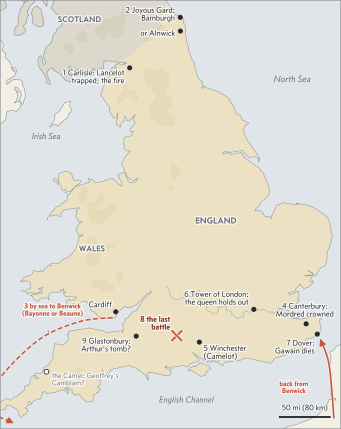
Arthur moved west along the coast, and a day was fixed for the two armies to meet on a down, an open grassy hill, beside Salisbury, not far from the sea. The day was the Monday after Trinity Sunday, eight weeks after Easter, so late in May or in June. On the Sunday night Arthur dreamed that he sat in cloth of gold on a great wheel above black water full of serpents, and that the wheel turned over and threw him down among them. Then Gawain came to him in a vision, with the ladies he had fought for in his life, to warn him not to fight. If he waited a month, Lancelot would come.
Arthur sent Sir Lucan the Butler and his brother, Sir Bedivere, to buy a truce, and Mordred agreed to take Cornwall and Kent while Arthur lived and all England after his death. The two leaders would meet between the armies, each with fourteen men, to seal the treaty, and each, trusting the other not at all, told his army to charge if they saw a sword drawn. They met, agreed, and drank wine together. Then an adder slid out of a little heath bush and stung a knight on the foot, and the knight drew his sword to kill the snake,A truce that nearly averted this battle was broken when a knight drew his sword to kill a snake. → Battle of Camlann• thinking of no harm. Both armies saw the blade, blew their trumpets and horns, and charged. “Alas this unhappy day!” said Arthur. Malory found the adder in a fourteenth-century English poem, the Stanzaic Morte Arthur, which he sometimes follows word for word.
The Battle of Camlann lasted all day, and by evening, Malory says, a hundred thousand men lay dead upon the down. Of Arthur’s host only Lucan and Bedivere were still alive, both badly wounded, and of Mordred’s only Mordred, leaning on his sword among a heap of the dead. Lucan begged the king to let Mordred be, since the field was won and the day of destiny was past. “Tide me death, betide me life,” said Arthur, “now I see him yonder alone he shall never escape mine hands.” He took his spear in both hands, ran at Mordred, and drove it through his body under the shield. Feeling his death wound, Mordred thrust himself up the spear as far as the hand guard and, with his last strength, struck Arthur a mortal blow on the head,Both King Arthur and Mordred were mortally wounded at this battle. → Battle of Camlann•This figure kills and is killed by Arthur at Camlann. → Mordred••Mordred mortally wounds this figure at the Battle of Camlann. → King Arthur••• through the helmet and into the skull. Mordred fell dead, and Arthur fell beside him in a swoon.
Lucan and Bedivere half carried the king to a little chapel near the sea. When they tried to lift him again, Lucan, who had a wound in the belly, fell dead. Then Arthur gave Bedivere his last command: to take Excalibur to the water nearby, throw it in, and come back to tell what he saw. Bedivere looked at the jeweled hilt and could not bear to waste it. He hid the sword under a tree and told the king he had seen “nothing but waves and winds.” Arthur knew it was a lie and sent him back. The second time Bedivere hid it again and reported “the waters wappe and waves wanne,” the water lapping and the waves ebbing. “Ah, traitor untrue,” said Arthur, and swore to kill him with his own hands. The third time Bedivere bound the belt around the hilt and threw Excalibur far out into the water,After Camlann, Bedivere throws this sword into a lake, where a hand catches it. → Excalibur•••This figure asks Bedivere to return his sword to the lake. → King Arthur•• and an arm and a hand rose up, caught it, brandished it three times, and vanished with it.


Malory found the scene in older books. In the French prose Death of King Arthur (about 1230), the last romance of the Vulgate Cycle, the knight with the sword is Griflet, and the water is a lake (Figure 25.5). The Stanzaic Morte Arthur gave the part to Bedivere, and Malory followed it. Bedivere himself is far older. As Bedwyr (bed-weer), he stands beside Cei near the head of Arthur’s warriors in Culhwch and Olwen, the Welsh tale of Arthur’s court (Chapter 13), and Geoffrey of Monmouth had already killed him off in Arthur’s war against Rome.
Geoffrey had told the battle differently. His Mordred, the nephew, had married the queen and brought in Saxons, Scots, Picts, and Irish. Arthur beat him twice and chased him into Cornwall, to the river Camblam, where Mordred fell in the charge and Arthur was mortally wounded, in the year 542. Before he was carried away, Arthur handed his crown to a kinsman, Constantine, son of Cador, Duke of Cornwall. Mordred’s two sons rose with the Saxons against the new king, and when they were beaten one fled to the church of St. Amphibalus in Winchester and the other to a house of friars in London. Each had claimed sanctuary, the protection a church gave to anyone inside it. Constantine killed each of Mordred’s sons before the altarConstantine kills this figure’s sons at church altars. → Mordred•• all the same. Three years later, says Geoffrey, God’s vengeance found him: his nephew Conan killed him, and he was buried at Stonehenge. Geoffrey probably built the murders from Gildas (Chapter 16), who in the sixth century accused a real king, Constantine of Dumnonia in the southwest, of disguising himself as an abbot and killing two royal youths at a church altar.
Avalon
Bedivere took the dying king on his back and carried him to the water’s edge. There, close by the bank, floated a little barge full of ladies in black hoods, who wept and shrieked when they saw Arthur. They took him aboard, and he laid his head in a queen’s lap (Figure 25.6). “Ah, dear brother,” she said, “why have ye tarried so long from me?” Malory names the women later: one of the three queens was Morgan le Fay,This figure helps carry the wounded Arthur to Avalon. → Morgan le Fay•• the sister who had plotted Arthur’s death. The others were the Queen of North Wales and the Queen of the Waste Lands, and with them came Nimue, the chief Lady of the Lake. As they rowed away, Arthur called back to Bedivere that he was going to Avalon,Arthur is taken to this legendary island to heal his wounds after the Battle of Camlann. → Avalon••Arthur is taken to Avalon after this battle. → Battle of Camlann•After being mortally wounded, this man was taken to the Isle of Avalon. → King Arthur•• Malory’s “vale of Avilion,” to be healed of the wound he took at Camlann. “If thou hear never more of me,” he said, “pray for my soul.”

The next morning Bedivere came to a chapel near Glastonbury where a hermit, who had once been the Bishop of Canterbury, knelt beside a new tomb. At midnight, said the hermit, a company of ladies had brought a body and paid him to bury it. Bedivere stayed there as a hermit for the rest of his life. Malory will not choose between the tomb and the island. He found no more of Arthur, he says, “in books that be authorised.” He reports what “some men say,” that Arthur is not dead and shall come again, though, he adds, “I will not say it shall be so.” He reports also the verse that “many men say” is written on his tomb: Hic jacet Arthurus Rex, quondam Rex que futurus, “Here lies Arthur, king once and king to be.” From it comes the phrase “the once and future king,” which T. H. White took as the title of his Arthurian novel in 1958. Guinevere became a nun at Amesbury, and Lancelot, coming too late, became a hermit and a priest and died some seven years later.
Avalon was Geoffrey of Monmouth’s island. In his History the wounded Arthur was carried, in Aaron Thompson’s translation as revised by J. A. Giles in 1848, “to the isle of Avallon to be cured of his wounds,” the same island where, earlier in the book, Arthur’s sword had been forged. The name comes from the old British language that became Welsh, and Avalon means the island of apples:This island’s name is associated with apples. → Avalon•• in Welsh an apple is afal. In his later Latin poem, the Vita Merlini (vee-tuh mer-lee-nee), or Life of Merlin (about 1150), Geoffrey calls it the Island of Apples, also called the Fortunate Isle. Its fields need no plow. Grain and grapes grow there by themselves, apple trees spring up in its woods, and its people live a hundred years or more.
Nine sisters rule the island, the Vita Merlini goes on, by a gentle law. The first of them, Morgen, is the most beautiful and the best at healing. She knows the use of every herb, can change her shape, and can fly through the air on new wings. Her sisters’ names are stranger still, and among the nine sisters is GlitoneaNine sisters, including Glitonea, live on this island. → Avalon• (glit-oh-nee-uh), with Gliten and Gliton beside her. The poem is a conversation between Merlin and the bard Taliesin (Chapter 13), and Taliesin tells how, after Camlann, he helped bring the wounded Arthur to the island. Morgen laid the king on a golden bed and promised to heal him if he stayed with her a long time. This Morgen, a healer with a grudge against no one, is the first Morgan of all.
Geoffrey’s Arthur goes to Avalon to be cured, not to die, and many people believed that he never died at all. About 1125 William of Malmesbury wrote that Arthur’s grave was nowhere to be seen, and that old tales therefore said he would come again. In Brittany, Cornwall, and Wales, men told that Arthur was only waiting. A hope that a lost leader will return to save his people is called messianic, after the Messiah, the savior-king long awaited in Jewish belief. The French romances called Arthur’s kingdom Logres (loh-gres), from the Welsh Lloegr (hloy-gur), England, and they told how the king of Logres would returnAccording to a messianic tradition, the king of Logres will one day return from this place to lead his people against their enemies. → Avalon• from Avalon to lead his people against their enemies.

Then Avalon got an address. Glastonbury, in Somerset, was in those days almost an island, a steep hill rising out of marshes, with a rich old abbey at its foot. About 1191 its monks announced that they had found Arthur’s grave in their cemetery: 16 feet down lay a coffin made of a hollowed log, holding a man’s huge bones, and with it a lead cross with a Latin inscription. Gerald of Wales, the churchman met in Chapter 22, saw the cross and copied its words. He wrote that Glastonbury had once been called the Isle of Avalon, in Welsh Ynys Afallach, the Island of Apples, and that the tale of Arthur’s survival was a fable of the Britons and their poets. The monks probably staged the find to bring in pilgrims and money after a fire burned their church in 1184. In 1278 King Edward I (Chapter 26) watched the bones reburied before the abbey’s high altar.
Avalon took in other heroes, too. Ogier (oh-zhee-ay) the Dane was one of the paladins, the great lords of Charlemagne in the French epics (Vol. 9, Cathedrals and Crusades). In French romances of the fourteenth century, Morgan finds him in his old age, makes him young again, and carries Ogier the Dane to Avalon,Ogier the Dane is brought to this place. → Avalon• where Arthur is still alive, to be her lover for two hundred years. When France needs him, he rides out to fight again, and when the magic of her ring fails him he is old in an instant. The Danes made him their own as Holger Danske, a hero who sleeps until Denmark needs him, like Arthur waiting in Avalon.
Malory’s Le Morte d’Arthur
The book that told all this to English readers has a French title that is not quite French: Le Morte d’Arthur, “the death of Arthur,” where French would say la mort. Malory seems to have meant it as the title of his last tale only; Caxton put it on the whole. Thomas Malory wrote Le Morte d’ArthurThomas Malory wrote an account of this figure’s life and death. → King Arthur••This author wrote Le Morte d’Arthur. → Thomas Malory• as the story of Arthur’s whole life, from his begetting to his death, in eight long tales. Again and again he cites “the French book,” and most of it comes from French romances: the Vulgate and the Suite du Merlin, the French prose Tristan, and, for the end, the Death of King Arthur. Two English poems gave him more, the Alliterative Morte Arthure for Arthur’s war with Rome and the Stanzaic Morte Arthur for the last battle. He cut, joined, and simplified, and told it all in plain, strong English prose (Table 25.1).


| Part of the story | First told in |
|---|---|
| Camlann; Arthur and Medraut fall | Annales Cambriae, tenth century |
| Mordred’s treason; Avalon; Constantine and the altars | Geoffrey of Monmouth, History, about 1136 |
| Morgen and her eight sisters | Geoffrey, Vita Merlini, about 1150 |
| Mordred as Arthur’s son; Morgan and Guiomar | The Vulgate Cycle, about 1215–1235 |
| Lancelot exposed; Gawain’s brothers killed; Gawain’s wound; the sword thrown back; the barge | The Death of King Arthur, about 1230 |
| The May Day children; Accolon | Suite du Merlin, about 1240 |
| Bedivere throws the sword | Stanzaic Morte Arthur, fourteenth century |
| “Once and future king” | Malory, 1469 or 1470 |
The author names himself Sir Thomas Malory, knight, and in one manuscript he calls himself a “knight prisoner.” Several men of that name were alive in the 1460s. Since 1894, when the Harvard professor George Lyman Kittredge found him in the records, most scholars have chosen Sir Thomas Malory of Newbold Revel in Warwickshire. He was a soldier and a member of Parliament who turned, in the 1450s, into something close to an outlaw. He was charged with ambushing the Duke of Buckingham, with extortion, with robbing an abbey, with stealing horses, and with rape. He escaped from one prison by swimming its moat, and he spent much of the decade in London jails. A general pardon freed him in 1461. The pardons King Edward IV granted from 1468 to 1470 left out by name a Thomas Malory, probably the same man, and Malory of Newbold Revel died on March 14, 1471. Others, among them William Matthews in 1966, have argued that this Malory would have been past seventy by then and proposed other men of the name, and the question is not settled.
The book does not say which prison it was written in. Malory probably wrote the book in Newgate prison,This work was composed in Newgate Prison. → Le Morte d’Arthur• the jail at London’s west gate, though no record proves it. Newgate stood a few steps from the Greyfriars, the great church of the Franciscan friars, whose library had been paid for by Richard Whittington, the famous mayor of London. A prisoner with money could buy comforts in a medieval jail, perhaps even the loan of French books, and in 1471 Malory was buried at the Greyfriars.
The printer who made the book famous was William Caxton, a London cloth merchant who had lived about twenty-five years in Bruges (broozh), in Flanders. In Cologne and Bruges he learned the new craft of printing with movable type, which Gutenberg had begun in Mainz (Vol. 1, The Toolkit). In 1476 he set up the first printing press in England, at Westminster, and soon printed Chaucer’s Canterbury Tales, which Chapter 29 will tell. On July 31, 1485, he finished printing Malory. Three weeks later, on August 22, King Richard III was killed at Bosworth, and Henry Tudor, who claimed descent from the old British kings and named his eldest son Arthur, took the crown as Henry VII (Vol. 12, Crown and Parliament).
Caxton divided Malory’s eight tales into twenty-one books and more than five hundred short chapters, each headed with a line telling what happens in it. In his preface he admitted that some men held there had been no Arthur at all. But gentlemen had pointed him to Arthur’s tomb at Glastonbury, Gawain’s skull at Dover Castle, and the Round Table at Winchester, and he decided to print. As for believing it all, he told his readers, “ye be at your liberty.” Only two copies of his edition survive, one in New York and one in Manchester (Figure 25.8). His successor, Wynkyn de Worde, reprinted it in 1498, and in edition after edition Caxton’s text was the Malory that England read for four hundred years, and the one Tennyson used (Vol. 17, The Victorians).
Then, in June 1934, Walter Oakeshott, a young schoolmaster cataloging the library of Winchester College, found a fifteenth-century manuscript of the book, now called the Winchester Manuscript. It was not Caxton’s text. It kept Malory’s own notes about the “knight prisoner,” it was divided into eight tales instead of twenty-one books, and its account of Arthur’s war with Rome was more than twice as long as Caxton’s, which had cut it. Smudges on its pages turned out to be printer’s ink in Caxton’s own type, so this very copy had once lain in his shop. The scholar Eugène Vinaver published it in 1947 as The Works of Sir Thomas Malory, and it is now in the British Library.
What to remember
- In Geoffrey of Monmouth (about 1136), Mordred is Arthur’s nephew, son of Lot and Anna; from the Vulgate Cycle on, and in Malory, he is Arthur’s son by his half-sister Morgause, and he alone survives the ship of May Day children.
- Morgan le Fay was Arthur’s half-sister and King Urien’s wife. She learned magic from Merlin in the Vulgate; in Malory she gives Excalibur to her lover Accolon and throws the scabbard into a lake.
- The Round Table falls in order: Lamorak’s murder, the exposure of Lancelot and Guinevere by Agravain and Mordred, the deaths of Gareth and Gaheris, Gawain’s feud, Arthur’s war on Lancelot, and Mordred’s seizure of the crown.
- At Camlann, first named in the Welsh Annals under 537, a drawn sword breaks the truce, and Arthur and Mordred kill each other; Bedivere at last throws Excalibur into the water, and a hand catches it.
- Avalon, the island of apples, is Geoffrey’s; in his Vita Merlini it is ruled by nine sisters led by Morgen, and the romances carried both Arthur and Ogier the Dane there.
- Malory, a “knight prisoner,” finished Le Morte d’Arthur in 1469 or 1470, probably in Newgate; Caxton printed it in 1485, and the Winchester Manuscript was found in 1934.
The Plantagenets, 1199-1453
Chapter 26 · 32 clues
Magna Carta and Edward Longshanks
Late in March 1208 the churches of England fell silent. On orders from Rome, priests locked their doors and stopped saying Mass. The dead were buried outside the churchyards, in unblessed ground, and the only rites still allowed were the baptism of babies and the confession of the dying. A ban of this kind was called an interdict, and this one lasted more than six years.
The quarrel behind it was over who should be archbishop of Canterbury. On one side stood the pope, who claimed the right to judge every king in Christendom; on the other stood the king of England, John. By the time the churches reopened in July 1214, John had lost most of his lands in France and had made his kingdom a possession of the pope. Within a year his own barons forced on him the charter that the English-speaking world still calls the Great Charter. His son spent half a century quarreling with the barons over what it meant. His grandson, a tall, hard soldier, made the king’s law reach farther than it ever had, from the courts of every county to the mountains of Wales.
John and the barons
John was the youngest son of Henry II and Eleanor of Aquitaine, born at Christmas 1166 (Chapter 22). As a younger son he had been promised no great lands, and his father teased him with a nickname, John Lackland. He became king in 1199 when his brother Richard I died childless (Figure 26.1). He was clever and tireless, a king who heard lawsuits himself and watched his revenues closely. He was also suspicious, cruel, and faithless, and the men who served him never knew where they stood.

Not everyone wanted John. His elder brother Geoffrey, duke of Brittany, had died in 1186, leaving a son, Arthur, who was twelve in 1199. By the custom of Normandy a dead king’s brother came before his nephew; by the custom of Anjou the nephew came first. Most lords of Anjou and Brittany chose Arthur. So did Philip II of France, king since 1180, who wanted nothing so much as to break up the Angevin lands (Vol. 9, Cathedrals and Crusades).
John gave Philip his chance. In August 1200 he married Isabella of Angoulême (ahn-goo-lem), a girl of twelve or fourteen and the heiress of a county in western France. She was already engaged to Hugh of Lusignan, a great lord of Poitou, and Hugh appealed to Philip. For his French lands John was Philip’s vassal, and a vassal could be summoned to his lord’s court. John refused to come. In 1202 Philip’s court declared all his French lands forfeit, and Philip invaded Normandy.
At first John struck back brilliantly. In July 1202 Arthur, now fifteen, besieged his own grandmother, the old queen Eleanor, in the castle of Mirebeau (meer-boh) in Poitou. John marched about 80 miles from Le Mans in less than two days, caught the besiegers asleep, and captured Arthur and the rebel lords. Arthur was imprisoned at Falaise and then at Rouen, and in 1203 he vanished. The annals of Margam, a Welsh abbey, say that John, drunk, killed the boy with his own hand and threw the body into the Seine tied to a heavy stone. Whatever the truth of that story, Arthur was never seen again, and the rumor that his uncle had killed him did John more harm than any defeat.

The barons of Normandy and Anjou deserted a king they could not trust. In March 1204 Philip took Château Gaillard, Richard’s great castle on the Seine, and in June Rouen surrendered. Normandy, the duchy from which the Conqueror had come, was lost to the kings of England after nearly a century and a half, and Maine, Anjou, and Touraine went with it (Figure 26.2). John kept only Gascony, around Bordeaux, and part of Poitou. He spent the next ten years, and every penny he could find, trying to win the rest back.
The money came from his barons. A baron was a great landholder who held his estates directly from the king and owed him knights for his army in return. The barons were among the richest men in England, and the greatest of them were earls. Under John they paid as they never had before. A baron who did not send his knights to war paid scutage (skyoo-tij), “shield money,” instead, and John demanded it eleven times in seventeen years, as often as the three kings before him together. An heir paid huge sums to inherit his father’s lands. Widows and heiresses were sold in marriage to the highest bidder. When William de Braose, a great lord of the Welsh border, could not pay what John demanded, the king seized his wife Maud and their eldest son and starved them to death in Corfe Castle in 1210.
The church quarreled with John too. When the archbishop of Canterbury died in 1205, the monks of the cathedral and the king each chose a man, and both sides appealed to the pope. Innocent III, pope since 1198, believed that the pope stood above every king, and he set both men aside. In 1207 he consecrated his own choice, Stephen Langton, an Englishman who had taught theology at Paris for many years and is credited with dividing the Bible into the chapters still used today. John refused to let him land in England. Innocent laid the interdict on the kingdom in 1208 and excommunicated John in 1209, cutting him off from the sacraments of the church (Chapter 22). John answered by seizing the church’s lands, and for a few years he grew rich on them.
But Innocent could also call on Philip to invade, and by 1213 a French fleet was gathering. In May 1213 John gave way completely. He accepted Langton, and he surrendered England and Ireland to the pope, taking them back as the pope’s vassal for 1,000 marks a year, about £667, since a mark was two-thirds of a pound. It looked like humiliation, and it was shrewd: from then on the pope protected John as his own man.

Now John could try to win back his lands. In February 1214 he landed at La Rochelle with an army of hired soldiers, while his allies gathered in the north: his nephew Otto IV, the German emperor; the count of Flanders; and his half-brother William, earl of Salisbury. The plan was to catch Philip between two armies. On July 2, at La Roche-aux-Moines, John dared not fight Philip’s son Louis with barons of Poitou he did not trust, and he had to retreat. On July 27, near the village of Bouvines (boo-veen) in Flanders, Philip’s knights routed the allies, and Salisbury and the count were taken prisoner. The defeat at Bouvines left John with no army, no money, and no hope of Normandy, and less than a year later he sealed Magna Carta.This document was sealed after King John’s allies lost the Battle of Bouvines. → Magna Carta••
Magna Carta
John came home in October 1214 to barons who had paid for everything and won nothing. Langton had already shown them a weapon. At a council in August 1213 the archbishop had read aloud the charter that Henry I, the Conqueror’s son, had issued at his coronation in 1100, promising to give up the unjust exactions of his brother’s reign. A charter was a formal written grant, sealed by the king, and a king could be held to what he had granted. In January 1215 the rebels demanded that John confirm Henry’s charter. In May they renounced their homage, the solemn promise of loyalty a vassal made to his lord, chose Robert Fitzwalter as “Marshal of the Army of God and Holy Church,” and on May 17 rode into London, whose citizens opened the gates.
Without London John had to bargain. Langton, still the man in the middle, went back and forth between the king’s camp and the rebels. He had worked with the barons on their list of grievances all through the spring, and Langton helped shape the barons’ demandsArchbishop Stephen Langton helped shape the demands embodied in this document. → Magna Carta•• into the long, orderly charter that came out of the talks. The meeting place was Runnymede (run-ee-meed), a meadow beside the Thames between the king’s castle at Windsor and the town of Staines. There the rebels laid before the king a draft of their demands, now called the Articles of the Barons, and the final text grew out of it. On June 15, 1215, John sealed the charter at Runnymede.King John sealed this document at Runnymede in 1215. → Magna Carta••• Kings did not sign their names. The royal seal, a disk of wax pressed with the king’s image and hung from the parchment, made the document his act.
Clerks wrote out copies and sent them to the bishops and to the sheriffs, the king’s officers who ran each county, and four of them survive: two in the British Library, one at Lincoln, and one at Salisbury (Figure 26.4). The text runs on without a break. The sixty-three numbered clauses by which it is now quoted were given it by the lawyer William Blackstone in 1759. In it John still called himself duke of Normandy and count of Anjou.

The first clause promised that the English church should be free. Most of the rest were rights granted to the baronsThese people were granted rights by the Magna Carta. → barons• and the knights who held land under them. The heir of an earl or a baron would pay £100 to inherit, no more. No widow would be forced to remarry. No scutage would be raised without the common counsel of the kingdom, meaning a council of the bishops and barons, except to ransom the king, to knight his eldest son, or to marry his eldest daughter. These were a lord’s complaints, written by lords, and the barons got most of what they had come for.
Some clauses touched everyone. Fishermen built weirs, fences of stakes and nets across a river to trap fish. They earned their owners good money, but they blocked the boats that carried England’s trade. The thirty-third clause ordered all fishing weirs removed from the rivers,The thirty-third of this document's 63 clauses mandated the removal of all fish-weirs from rivers. → Magna Carta••Magna Carta ordered the removal of weirs used for this activity from the Thames, Medway, and other English rivers. → fishing• from the Thames and the Medway and throughout England, except on the seacoast. Rivers were the highways of medieval England, and an open river meant cheaper grain, wool, and timber in the towns. Merchants were cheated by measures that changed from town to town, so the thirty-fifth clause decreed one measure of wine, ale, and cornClause 35 of this document called for standardized measures for wine, ale, and corn. → Magna Carta• throughout the realm, and one width of cloth. Corn meant grain, not the maize of America, which no European had yet seen, and its measure was to be the London quarter.
Two short clauses became the most famous of all. In the translation by the Scottish historian William Sharp McKechnie (muh-kek-nee), as Albert Beebe White and Wallace Notestein printed it in 1915, they read:
To be disseised was to be put out of one’s land, and one’s peers were one’s equals. In 1215 the clause protected free men against a king who jailed and ruined barons without trial, and free men were a minority of the English, for most peasants were serfs, bound to a lord’s land. Four centuries later, lawyers who opposed the Stuart kings of the 1600s read it more broadly. The writ of habeas corpus (hay-bee-us kor-pus), Latin for “you shall have the body,” orders a jailer to bring his prisoner before a judge and show by what right he is held. In 1627 the lawyer and scholar John Selden argued in court that the charter’s protection against unlawful imprisonmentThis document's protections against unlawful imprisonment helped shape the later development of habeas corpus. → Magna Carta•• stood behind that writ, and on such arguments later lawyers built the safeguard of habeas corpus.
The sixty-first clause was meant to make the rest stick. Twenty-five barons would watch the king, and if he broke his word they could seize his castles and lands until he made amends. No king could live with that for long, and John did not mean to. He had already written to the pope.
The war for the charter
Innocent III was now John’s feudal lord, and he took John’s side. In a letter of August 24, 1215, he called the charter shameful, unjust, and forced on the king, and declared it null and void forever.Pope Innocent III’s annulment of this document helped precipitate the First Barons’ War. → Magna Carta•••This document was declared "null, and void of all validity for ever" by Pope Innocent III. → Magna Carta•• The rebels had no legal ground left, and the annulment helped set off the First Barons’ War. Both sides were already arming. In the autumn John besieged the rebels in Rochester Castle. His miners dug under a corner of its great stone tower, and he ordered forty of the fattest pigs sent to him, so that their fat could feed the fire that burned away the props of the tunnel. The corner collapsed, but the garrison held out behind the tower’s inner wall until hunger forced it to surrender on November 30.
The rebels then offered the crown of England to Philip’s son Louis, who landed in May 1216, entered London, and held half the kingdom. John fought on. In October, crossing the tidal sands where rivers run into the Wash, a shallow bay of the North Sea, his baggage train was caught by the tide. Roger of Wendover, a monk of St. Albans writing some years later, says his treasure and household goods were swallowed by quicksand and whirlpools. Sick with dysentery, John died at Newark Castle on the night of October 18, 1216, and he was buried at Worcester.
His son Henry was nine years old. Ten days later, at Gloucester, a few loyal lords crowned the boy king, and within two weeks they made William Marshal, earl of Pembroke, regent, the man who governs for a king too young to rule. Marshal was about seventy, the most famous knight in Christendom, a champion of the tournaments in his youth who had served Henry II, Richard, and John; he was also Strongbow’s son-in-law (Chapter 22). He and the pope’s envoy made a clever move. In November 1216 they reissued the charter in the boy’s name, leaving out the twenty-five barons, so that no rebel could say he was fighting for the charter.
On May 20, 1217, Marshal marched to relieve Lincoln Castle, whose castellan, or keeper, Nicola de la Haye, had held it for the king against Louis’s army. The fighting ran through the steep streets of the city for about six hours. Marshal routed the rebel baronsThese people were defeated by William Marshal in battle. → barons• and their French allies, the French commander was killed, and Marshal’s men looted the town so thoroughly that the battle was nicknamed the Fair of Lincoln. In August an English fleet destroyed Louis’s reinforcements off Sandwich, and in September Louis made peace and went home.
That November, as part of the peace, Marshal’s government reissued the charter and issued a Charter of the ForestA 1217 reissue of this document accompanied the Charter of the Forest. → Magna Carta•This 1217 companion to Magna Carta abolished death or mutilation as penalties for taking royal deer. → Charter of the Forest• beside it, which ended death and mutilation as punishments for taking the king’s deer. The Royal Forests were the great stretches of country under the king’s own hunting law, where poachers had been blinded or hanged (Chapter 22). From now on, the forest charter said, no one would lose life or limb for the king’s venison; he would be fined or jailed instead. Because the forest charter was the smaller of the two, people began to call the other one the Great Charter: in Latin, Magna Carta. Henry issued both again in 1225, of his own free will, in exchange for a tax, and that version became the one judges cited. In 1297 his son confirmed it as part of the law of England.
Henry III and Oxford
Henry III reigned for fifty-six years, from 1216 to 1272, the longest reign of any English king until George III. He was pious, generous, and fond of beautiful things, and he loved above all the memory of Edward the Confessor (Chapter 21). From 1245 he rebuilt Westminster Abbey in the new French Gothic style, with soaring pointed arches, as a shrine for the Confessor’s bones (Figure 26.5). He was a poor judge of men and a worse judge of money.

In 1236 he married Eleanor of Provence (proh-vahnss), from the south of France, and her uncles from Savoy, a county in the Alps, came with her to high office. His mother, Isabella of Angoulême, had remarried in France, and her Lusignan sons, Henry’s half-brothers, came too. The English barons hated the newcomers. Then, in 1254, the pope offered the crown of Sicily, a kingdom of southern Italy and its island, to Henry’s younger son Edmund, and Henry promised to pay for the war to conquer it. He could not. By 1258 he owed the pope sums far beyond his income, Llywelyn (hluh-wel-in) ap Gruffudd, the strongest of the Welsh princes, had beaten his armies in Wales, and a failed harvest had brought famine.
In April 1258 a group of barons walked into Westminster Hall, the great hall of the king’s palace, in armor and demanded reform, and the king swore to accept it. A parliament met at Oxford on June 11. A parliament, from the French for “a talking,” was a great council of barons and bishops that the king summoned to discuss the kingdom’s business and grant taxes. At Oxford Henry accepted the Provisions of Oxford,Barons forced this ruler to accept the Provisions of Oxford. → Henry III of England•Henry III accepted constitutional provisions named for this city at the “Mad Parliament.” → Oxford•• a plan that put the government in the hands of a council of fifteen and required parliament to meet three times a year. The barons sent the Provisions to every county in Latin, in French, and in English, the first government document issued in English since the Norman Conquest. A London chronicle calls the meeting insane parliamentum, the “Mad Parliament,” and the name stuck, though the scribe may first have written insigne, “distinguished.”
The parliament met in a city already famous for something else. Oxford had England’s oldest university,This city houses England’s oldest university, a traditional rival of Cambridge. → Oxford•• a self-governing guild of masters and students; the Latin universitas meant a guild or corporation. Teachers were working there by about 1096, and the schools grew fast after 1167, when Henry II forbade English students to study in Paris. In 1209, after the townsmen hanged two students, a party of scholars left and settled at Cambridge, and Cambridge has been Oxford’s rival ever since. Henry III granted Oxford a royal charter in 1248, and the first colleges were founded in his reign (Chapter 30 will tell what their scholars did a century later).
The leader of the reformers was a Frenchman. Simon de Montfort (mont-furt) was the son of a famous crusader, and he had come to England about 1230 to claim his family’s earldom of Leicester. In 1238 he married the king’s sister Eleanor, a widow, and he became a brother-in-law Henry could neither love nor do without. Simon was brave, devout, and unbending, and he believed that the king had sworn an oath to the Provisions and must keep it. Henry got the pope to free him from his oath, and at last both sides asked the French king, Louis IX, to judge between them. In January 1264 Louis found for his fellow king on every point, and the barons went to war again, in what is called the Second Barons’ War.
Edward I the lawgiver
The war was fought for the king by his heir. Edward, born at Westminster in June 1239 and named for the Confessor, was the eldest son of Henry III.This ruler's father was Henry III. → Edward I•• He fell ill as a boy in 1246, 1247, and 1251, and his parents feared for him, but he grew up strong and athletic. In the end he stood 6 feet 2 inches tall, a head above most of his subjects, and because of his long legs, or shanks, men called him Longshanks.This ruler was known as "Longshanks." → Edward I••• His long arms gave him a swordsman’s reach, and he loved tournaments and hunting. He was quick to anger and slow to forgive, and in his youth he followed first his mother’s Savoyard uncles and then his father’s Lusignan half-brothers. For a few months in 1259 he took the reformers’ side, but when war came Edward fought for his father.This ruler supported his father during the Second Barons' War. → Edward I•

By then he had been married for ten years, to a wife his father had chosen for him. In 1254, to protect Gascony from a Castilian attack, Henry arranged for Edward to marry Eleanor, the thirteen-year-old half-sister of the king of Castile (kas-teel) in Spain, and so Edward married Eleanor of CastileThis ruler married Eleanor of Castile. → Edward I• at Burgos that November. The match made for politics became one of the happiest royal marriages of the Middle Ages. Eleanor bore at least fourteen children and went everywhere with him, even on crusade.
On May 14, 1264, the armies met on the chalk hills, or downs, above Lewes (loo-iss) in Sussex (Figure 26.7). Edward’s cavalry charge broke the Londoners in Simon’s army, and he chased them for miles. When he rode back, his father’s army had been beaten, and king and prince both became Simon’s prisoners. For a year Simon governed England in the king’s name. In January 1265 he summoned a parliament that included, besides the barons and two knights from each county, two burgesses, or citizens, from each of the larger towns. That mixture of knights and townsmen grew into the House of Commons.

On May 28, 1265, at Hereford, the prince rode out with his guards to exercise their horses, galloped away from them, and escaped. He joined Gilbert de Clare, earl of Gloucester, a lord of the Welsh border who had broken with Simon, and they trapped Simon’s army in a loop of the river Avon at Evesham (eev-shum), as Simon marched to join his son’s forces at Kenilworth. On August 4, 1265, Edward beat Simon de Montfort at Evesham.Before becoming king, this man defeated Simon de Montfort at Evesham during the Second Barons’ War. → Edward I•• Outnumbered about two to one, and deserted early in the fight by the Welsh foot soldiers his ally Llywelyn had sent him, Simon was killed and his body hacked to pieces. Robert of Gloucester, who wrote a rhyming chronicle in English a generation later, called it the murder of Evesham, for it was no battle. The last rebels held out until the summer of 1267, when the Second Barons’ War ended.
In 1270 Edward went on crusade. At Acre, the crusaders’ port in the Holy Land, in June 1272, an assassin wounded him with a dagger thought to be poisoned; in 1586 the historian William Camden first published in England the legend that Eleanor sucked the poison from the wound. On the way home Edward learned that his father had died on November 16, 1272. He was in no hurry, and he was crowned at Westminster only on August 19, 1274.
The new king wanted to know what he owned. That autumn he sent commissioners into every hundred, the district into which each county was divided (Chapter 22), to put questions to sworn juries: which lands and rights belonged to the crown, who had taken them, and which royal officials had taken bribes. The answers were written on long rolls of parchment, hundred by hundred, and so Edward’s surveys are called the Hundred Rolls.This ruler ordered the Hundred Rolls surveys. → Edward I• A second inquiry in 1279 and 1280 tried to record every landholder and his tenants, in effect an attempt at a second Domesday Book (Chapter 21).

The rolls showed that barons held many rights that had once been the king’s: their own courts, gallows, markets, and hunting grounds. From 1278 Edward’s judges summoned lord after lord to show quo warranto (kwoh wuh-ran-toh), “by what warrant,” he held them. Walter of Guisborough (giz-bruh), a Yorkshire canon who wrote a chronicle of these years, tells that Earl Warenne answered by drawing a rusty sword. His ancestors, he said, had come with William the Conqueror and won their lands by the sword, and by the sword he would keep them. In the end Edward compromised, in a statute, a written law made by the king in parliament. The Statute of Quo WarrantoThis ruler issued the statute of Quo Warranto. → Edward I• of 1290 let a lord keep any right he could show his family had used since the coronation of Richard I in 1189.
Statutes poured out of Edward’s parliaments, from the first Statute of Westminster in 1275 to Quo Warranto in 1290. They set rules for land, debt, inheritance, and keeping the peace, and many lasted for centuries. In the seventeenth century the lawyer Edward Coke (kook) named Edward the English Justinian,This ruler was called the "English Justinian." → Edward I• after the sixth-century emperor whose lawyers gathered Roman law into one great code (Vol. 9, Cathedrals and Crusades).
On November 28, 1290, Eleanor died at the village of Harby, near Lincoln. The king brought her body to Westminster Abbey in a slow procession, and at each place where it rested for the night he had a tall stone cross raised in her memory. There were twelve, from Lincoln to Charing, at the edge of Westminster, and three still stand, at Geddington, at Hardingstone near Northampton, and at Waltham Cross (Figure 26.8). Edward married again nine years later, but the crosses kept Eleanor’s name on the road to London for centuries.
The expulsion of the Jews
The first Jews in England came from Rouen after the Norman Conquest; William of Malmesbury says that the Conqueror brought them. They lived in the towns, in London, Lincoln, York, Norwich, and Oxford, and most made their living by lending money. The church forbade Christians to lend at interest, which it called usury, so kings, barons, and abbeys borrowed from Jews. In law the Jews belonged to the king. He protected them, and he could tax them whenever he liked and as heavily as he liked.
That protection grew thinner every reign. After Richard I’s coronation in 1189, mobs killed Jews in London, and in 1190 in York (Chapter 22). The blood libel, the false charge that Jews murdered Christian children in secret rites, was first told in England: the earliest known case anywhere was at Norwich in 1144. In 1255, when a boy named Hugh was found dead in a well at Lincoln, Henry III himself had one Jew executed and eighteen more hanged, the first time an English king gave the lie his support. In 1264 Simon de Montfort’s followers massacred Jews in London. Henry III had taxed the community so hard that by the 1270s it was small and poor, perhaps two or three thousand people.

Edward finished what his father had begun. The Statute of the Jewry of 1275 forbade Jews to lend at interest, taking away the trade by which most of them lived, and ordered every Jew over seven to wear a badge of yellow felt shaped like the two tablets of the Ten Commandments. In 1278 hundreds of Jews were arrested on charges of clipping coins, shaving silver from their edges, and about three hundred were put to death. In 1287 Edward expelled the Jews of Gascony. On July 18, 1290, he issued the Edict of Expulsion against England’s JewsThis ruler's Edict of Expulsion expelled the Jews from England. → Edward I••England’s 1290 Edict of Expulsion targeted these people. → Jews•• (Figure 26.9). They were ordered to leave the kingdom by All Saints’ Day, November 1. The date of the order was the ninth day of the Jewish month of Av, Tisha B’Av (tish-uh buh-ahv), when Jews mourn the destruction of the Temple in Jerusalem, and the choice was probably no accident.
The Jews could take their money and what they could carry. Their houses, their synagogues, and the debts owed them went to the king. That same summer Parliament granted Edward a tax of £116,000, probably the largest of the Middle Ages, and no record of the debate survives to say whether the expulsion was its price or its reward. Most of the exiles crossed safely to France, but not all. A chronicler tells that a ship’s captain, near the mouth of the Thames, led his Jewish passengers onto a sandbank at low tide, then went back aboard as the tide rose and told them to call on Moses for help. They drowned.
Philip II of France had driven the Jews from his lands in 1182, but he let them back sixteen years later. England’s ban lasted far longer. Jews could not live openly in England again until 1656, when Oliver Cromwell’s government allowed them to return (Vol. 12, Crown and Parliament).
The conquest of Wales
Wales in Edward’s youth was two countries. In the east and south, along the border and the coast, lay the March, an old word for a borderland. After 1066 Norman barons had pushed into Wales from Chester, Hereford, and the lands between and carved out lordships of their own, and the kings let them keep what they could hold. Within their lands the Marcher lords governed the borderMarcher Lords governed this country's eastern border. → Wales•• like little kings, with their own courts and their own wars, and the king’s writs, his written orders, did not run there. Their power lasted until Henry VIII’s Laws in Wales Acts of 1535 and 1542.
In the north and west, behind the mountains of Snowdon, the Welsh princes still ruled, and the strongest of them were the princes of Gwynedd. Llywelyn ap Gruffudd, the prince Henry III could not beat, was a grandson of Llywelyn the Great, who had ruled Gwynedd until 1240; ap means “son of.” His father, Gruffudd, had fallen to his death in 1244 trying to escape from the Tower of London. By 1258 Llywelyn had united most of Wales under him and called himself Prince of Wales, and in 1267, by the Treaty of Montgomery, Henry III recognized the title.
Edward was not his father. Llywelyn would not do homage to the new king, though summoned again and again, and he planned to marry Eleanor de Montfort, the daughter of Edward’s dead enemy. In 1275 men in Edward’s pay seized her ship at sea. In 1277 Edward marched along the north coast from Chester while his fleet seized Anglesey, the island whose wheat fed Gwynedd, at harvest time. Hungry and surrounded, Llywelyn made peace in the Treaty of Aberconwy that November. He kept only Gwynedd west of the river Conwy (kon-oo-ee), and Edward built castles at Flint, Rhuddlan (rith-lan), Builth (bilth), and Aberystwyth to hold the rest (Figure 26.10). The next year Llywelyn married Eleanor at Worcester, and Edward came to the wedding.

The peace lasted four years. On Palm Sunday, March 22, 1282, Llywelyn’s brother Dafydd (dav-ith) stormed the English castle at Hawarden (har-den), and Llywelyn joined the rising. This time Edward meant to finish Wales for good. In December Llywelyn rode south to raise the men of mid-Wales. On December 11, 1282, near Builth, the English beat the Welsh in the Battle of Orewin Bridge, on the river Irfon (eer-von). Llywelyn, separated from his main army with a few companions, was killed near Orewin BridgeLlywelyn ap Gruffudd, called “the Last,” was a ruler of this country killed near the Battle of Orewin Bridge. → Wales•• that day. The accounts disagree on how it happened. In one, an English soldier ran him through with a lance without knowing who he was; in another, he was trapped in a wood and cut down after asking for a priest. His head was sent to London, crowned with ivy to mock a prophecy that a Welsh prince would be crowned there, and set over the gate of the Tower. The Welsh call him Llywelyn the Last, the last prince of an independent Wales.
Dafydd fought on in the mountains until his own people handed him over in June 1283. With Llywelyn dead and Dafydd taken, Edward had conquered Wales.This ruler conquered Wales after defeating Llywelyn ap Gruffudd, known as Llywelyn the Last. → Edward I•• In October he had Dafydd hanged, drawn, and quartered, a traitor’s death of deliberate torture, the first man of high birth to die that way. Then he ended the princes’ line. Llywelyn’s baby daughter, Gwenllian (gwen-hlee-an), was shut away in a priory in Lincolnshire, where she lived for fifty-four years, and Dafydd’s sons died in English prisons. In March 1284, at Rhuddlan Castle, Edward issued the Statute of Rhuddlan,The Statute of Rhuddlan imposed English administration on conquered parts of this country. → Wales• which brought English government to the lands he had conquered. It divided Gwynedd into counties on the English model, Anglesey, Caernarfon (kyre-nar-von), and Merioneth, with a fourth at Flint, each under a sheriff. English criminal law replaced Welsh law, though Welsh custom still settled some quarrels over land.
Edward made sure that Wales would stay conquered. His master mason, James of St. George, from Savoy, began new castles at Conwy, Caernarfon, and Harlech in 1283, and Conwy and Caernarfon each had a walled town beside it, settled by English colonists. When the Welsh rose again in 1294, Edward added Beaumaris (boh-marr-iss) on Anglesey in 1295. Caernarfon was the grandest. Its towers are not round but many-sided, and its walls are striped with bands of darker stone; the historian Arnold Taylor argued that they were meant to recall the land walls of Constantinople, an emperor’s city. The castle and town walls cost between £20,000 and £25,000, far more than Richard’s Château Gaillard, and parts were never finished.

Edward’s queen was at Caernarfon in April 1284, and there, on April 25, she gave birth to their son Edward, called Edward of Caernarfon after his birthplace (Figure 26.11). On February 7, 1301, at a parliament in Lincoln, the king made the boy, now sixteen, Prince of Wales, the title Llywelyn had held. Ever since, the title has gone to the heir apparent, the heir to the throne whom no later birth can push aside, and today the heir is made Prince of WalesThe title of 'Prince' of this country is given to the heir apparent to the British throne. → Wales•• by the monarch rather than by right of birth. Caernarfon, where the first English prince was born, saw the investiture, the ceremony that presents a new prince to his people, of two of them in 1911 and 1969.
The Welsh kept one emblem that Edward could not take away. The red dragon was the beast that stood for the Britons against the white dragon of the Saxons in the old story of Vortigern’s tower (Chapter 23). Henry Tudor, whose grandfather was Welsh, marched to the Battle of Bosworth in 1485 under a red dragon banner and won the crown as Henry VII (Vol. 12, Crown and Parliament). Today Wales flies a red dragon on its flag,A red dragon appears on this country's flag. → Wales• Y Ddraig Goch (uh thryg gohkh), “the red dragon,” on a field of white and green, the Tudor colors; it was made the official flag of Wales in 1959.
What to remember
- King John lost Normandy and Anjou to Philip II of France in 1204 and 1205, and his allies were routed at Bouvines in 1214. His quarrel with Innocent III over Stephen Langton brought an interdict on England from 1208 to 1214.
- On June 15, 1215, at Runnymede, John sealed Magna Carta, a peace treaty shaped by Langton that granted rights mainly to the barons. Its thirty-third clause removed fish-weirs from the Thames and the Medway, its thirty-fifth set one measure of wine, ale, and corn, and its thirty-ninth forbade imprisoning a free man except by lawful judgment, a protection later lawyers tied to habeas corpus.
- Innocent III declared the charter null and void, and the First Barons’ War followed. William Marshal beat the rebel barons at Lincoln in 1217, and the charter was reissued that year with the Charter of the Forest, which ended death and mutilation for taking the king’s deer.
- Henry III (1216–1272) accepted the Provisions of Oxford at the “Mad Parliament” of 1258. Oxford has England’s oldest university; scholars who left it in 1209 settled at Cambridge.
- Edward I, “Longshanks,” Henry III’s eldest son, fought for his father in the Second Barons’ War and beat Simon de Montfort at Evesham in 1265. As king (1272–1307) he ordered the Hundred Rolls, issued the Statute of Quo Warranto and many other statutes, and was later called the “English Justinian.” His queen was Eleanor of Castile.
- By the Edict of Expulsion of July 18, 1290, Edward drove all Jews out of England; they were allowed back in 1656.
- Edward conquered Wales after Llywelyn ap Gruffudd, “the Last,” was killed near Orewin Bridge in 1282. The Statute of Rhuddlan (1284) brought English government; Marcher lords ruled the border; since 1301 the heir to the throne has been made Prince of Wales; and a red dragon flies on Wales’s flag.
Chapter 27 · 36 clues
Wallace and the Bruce
Early on Christmas Day 1950, four Scottish students broke into Westminster Abbey in London. Under the abbey’s ancient Coronation Chair, the wooden throne on which English kings and queens are crowned, lay a block of red sandstone 26 inches long and weighing 336 pounds, about as much as two grown men. The students dragged it out, and as they did so it broke in two. They hid the pieces and later smuggled them north, while the police of all Britain hunted for them in vain. On April 11, 1951, the stone was found lying on the altar of the ruined abbey at Arbroath (ar-brohth), on the east coast of Scotland.
The students had tried to take home the Stone of Destiny, on which the kings of Scotland had once been made, and which an English king had carried off as a trophy in 1296. The stone went back to Westminster, and it stayed there until 1996, when it was returned to Scotland. How it came to London, and how a small, poor kingdom fought England for thirty years to remain a kingdom at all, is a story that begins with a king riding home in the dark.
The Great Cause
In 1286 Scotland was an old kingdom with settled borders. It had grown out of Alba, the kingdom of the Picts and the Scots (the Stage). Since 1266, when its king bought the Western Isles, the Hebrides, from Norway, its kings had ruled almost the whole of the northern third of Great Britain except Orkney and Shetland. The border with England ran, roughly as it still runs, from the river Tweed in the east to the Solway Firth in the west. The king was Alexander III, who had come to the throne at the age of seven in 1249. He had married Margaret, a daughter of King Henry III of England, so the English king Edward I, the tall, hard soldier whose wars in Wales Chapter 26 tells, was his brother-in-law. The two kingdoms were at peace, and later Scots remembered his reign as a golden age.
Then his family died around him. His queen died in 1275, his younger son in 1281, his daughter in 1283, and his elder son in January 1284. His only living descendant was a baby granddaughter in Norway. In 1285 Alexander married again, a young French noblewoman named Yolande (yoh-lahnd), hoping for a son. On March 18, 1286, he held a council at Edinburgh Castle that ran late into a stormy evening. He then decided to ride to Yolande, who was waiting across the Firth of Forth, the broad sea inlet north of Edinburgh, at Kinghorn in Fife. The next day was her birthday. He crossed the water by ferry against advice. At Inverkeithing (in-vur-kee-thing), on the far shore, a townsman told him bluntly that night riding would do him no good. Alexander rode on with two local guides and was separated from them in the dark. The next morning he was found dead with a broken neck on the shore. The king had fallen from his horse near Kinghorn;King Alexander III of this country died after a fall while riding near Kinghorn on a stormy night. → Scotland• the horse had probably lost its footing on the steep, rocky bank.
Andrew of Wyntoun (win-tun), the prior of a small monastery on an island in Loch Leven, copied a short poem of mourning for him into the verse chronicle of Scotland that he finished about 1420. It is written in Scots, the northern form of English that Lowland Scots spoke.
The Maid of Norway
The heir was that granddaughter. Margaret had been born in Norway in 1283, the only child of King Eric II of Norway and Alexander’s daughter, who had died at or soon after her birth. Scots call her the Maid of Norway, maid meaning a girl. She is not to be confused with Margaret I, the Danish queen who united the three northern kingdoms a century later (Chapter 20). The Maid was three when her grandfather died. Six Guardians, regents chosen to rule until she could, governed Scotland in her name: two bishops, two earls, and two barons. In July 1290 they agreed by the Treaty of Birgham that she would marry Edward I’s son and heir, Edward of Caernarfon, the future Edward II. Their children would one day rule both kingdoms, but the treaty promised that Scotland would stay a separate kingdom, free of any subjection to England.
Late in the summer of 1290 the seven-year-old girl sailed from Bergen in her father’s ship. She fell ill at sea, and when the ship put in at Orkney, then a Norwegian earldom off the north of Scotland, she died there, probably between September 26 and 29 (Figure 27.1). The Scottish lords, who had gathered at Scone for her crowning, heard the news in October. Her death set off the Great Cause,The death of Margaret, Maid of Norway, sparked the succession dispute called the Great Cause in this country. → Scotland•• the name Scottish historians give to the lawsuit over who should be king. Thirteen men came forward to claim the throne. The strongest were John Balliol (bay-lee-ul) and an old lord named Robert Bruce, who arrived at Scone with armed men behind him, and Scotland seemed close to civil war.

King Edward’s court
William Fraser, the bishop of St. Andrews and one of the Guardians, wrote to Edward I and asked him to help keep the peace. Edward saw his chance. English kings had long claimed to be overlords of Scotland, with the right to command its king as a lord commands his vassal. Scottish kings had always refused. In May 1291, at Norham Castle on the English bank of the Tweed, Edward told the claimants that he would judge between them only if they first accepted him as overlord. They needed his judgment more than they feared his claim, and one by one they agreed.
The court that heard the case had 104 judges, called auditors: Edward chose twenty-four, and Balliol and Bruce forty each. It sat at Berwick (berr-ik), Scotland’s busiest port, near the mouth of the Tweed. Most of the thirteen claims were weak, because they came through children born outside marriage or through foreign princes. The real contest was between two cousins. Both descended from David, earl of Huntingdon, the younger brother of King William the Lion, and the family tree shows why each thought he had the better claim (Figure 27.2).

On November 17, 1292, in the great hall of Berwick Castle, Edward gave judgment for Balliol. John Balliol was about forty-three, a rich lord with estates in Galloway, northern England, and France, and his father had founded Balliol College at Oxford. On November 30, St. Andrew’s Day, he was made king at Scone, the abbey near Perth (the Stage). There, outside the abbey on a mound called the Moot Hill, the kings of Scots were inaugurated (formally set up as king) by being seated on a block of sandstone, the Stone of Scone. At their coronations, Scottish kings were enthroned upon the StoneIn Scotland, these events typically took place on the Stone of Scone. → coronations• in the open air, before their lords, as Balliol was, and the first enthronement on it that a record describes is Alexander III’s in 1249.
The stone was the one the students took in 1950: red sandstone, 26 inches long, with a cross roughly cut on one face and an iron ring at each end for carrying it. Scots called it the Stone of Destiny, and later chroniclers told that it had come from Ireland, or even that it was the pillow on which Jacob dreamed in the book of Genesis. The Irish kept a Stone of Destiny of their own at Tara, which is a different rock (Chapter 10). Geologists have shown that the Scottish stone is a sandstone of the kind quarried near Scone itself. The Abbey of Scone kept the Stone,This country's Abbey of Scone held the Stone of Destiny (Stone of Scone). → Scotland• and there each new king was set upon it.
The Hammer of the Scots
Edward I meant to rule Scotland through Balliol, and he made sure everyone knew it. When Scottish lords lost lawsuits in Balliol’s courts, Edward let them appeal to him in England. In 1293 he summoned the Scottish king to answer before the English Parliament in a Scottish lord’s lawsuit, as if Balliol were an ordinary English baron. In 1294 Edward went to war with King Philip IV of France (Vol. 9, Cathedrals and Crusades) over Gascony, the English-held duchy in southwestern France, and demanded that the Scots send soldiers to serve under him. For the Scots this was the last straw. In July 1295 a council of twelve lords and bishops took the government into its own hands. No one knows whether it meant to push the king aside or to stiffen him.
The council looked for a friend abroad. On October 23, 1295, its envoys signed a treaty in Paris with Philip IV: if England attacked either kingdom, the other would attack England, and Balliol’s son Edward would marry Philip’s niece. The Scots later called it the “Auld Alliance,” Scots for “old alliance,” because it was renewed by nearly every king of either country for more than 250 years. Balliol’s Scotland entered the Auld AllianceJohn Balliol’s kingdom entered the Auld Alliance with France in this country. → Scotland••• with France against their common enemy, and more than once an English war with France brought a Scottish army over the border, as at Flodden in 1513, where a Scottish king died fighting the English. The alliance is usually said to have ended in 1560, when Scotland turned Protestant (Vol. 12, Crown and Parliament).
1296
Edward struck first. On March 30, 1296, his army stormed Berwick, Scotland’s richest town, and killed its townspeople by the thousand. Chroniclers give figures from 4,000 to 17,000; no one really counted. On April 27, at Dunbar on the coast to the north, an English force under John de Warenne, earl of Surrey, routed the Scottish army. Warenne was Balliol’s own father-in-law. The Scottish castles surrendered one after another, and Edward marched north as far as Elgin, almost unopposed (Figure 27.1).

On July 10, 1296, in the churchyard of Stracathro (strak-uh-throh), near Montrose, Balliol surrendered his kingdom. To abdicate is to give up a throne, and Edward made Balliol abdicateThis ruler forced John Balliol to abdicate and imprisoned him in the Tower of London. → Edward I•• in a ceremony meant to shame him, then sent him south a prisoner, to the Tower of London, the fortress William the Conqueror had begun (Chapter 21). A tabard was the short coat a knight wore over his armor, embroidered with his coat of arms, so that friends and enemies could tell who he was. Balliol’s royal arms, the red lion of Scotland, were ripped from his tabard in front of the English. To his own people he became Toom Tabard (toom tab-urd), and the Scots mocked their kingJohn Balliol, a king of this country, was mocked as “Toom Tabard,” or “empty coat.” → Scotland•• with the name, for toom is Scots for “empty”: an empty coat, a king with nothing inside (Figure 27.3).
Balliol was held in the Tower until 1299, when he was handed over to the keeping of the pope. When his baggage was searched at Dover, the English found the golden crown and the great seal of Scotland packed among his things. Edward kept the seal and sent the crown to the shrine of Thomas Becket at Canterbury. Balliol lived out his life on his family’s lands in Picardy, in northern France, and died there in 1314. He never saw Scotland again.

Edward set out to erase the kingdom itself. He made nearly 2,000 Scottish landowners swear homage to him at Berwick, the solemn oath by which a man became another’s vassal, and their names fill the long parchment lists later called the Ragman Rolls. He carried off the kingdom’s records, its crown jewels, and the Black Rood, a fragment said to be of the cross on which Jesus died, which had belonged to Saint Margaret, Scotland’s eleventh-century queen. Above all, Edward seized the Stone of DestinyThis ruler seized the Stone of Destiny. → Edward I•• from Scone and took it to Westminster Abbey, where he had a wooden chair made around it (Figure 27.4). From the fourteenth century nearly every English, and later British, monarch was crowned in that chair, seated above the Scots’ stone. A Scottish throne had become the footstool of an English one.
The epithet
Edward was proud of his conquests, and he was cruel to people who rose against him. When he died in 1307, he was buried in Westminster Abbey in a plain tomb of dark marble, without even a statue on top. In the sixteenth century, probably on the orders of John Feckenham, the abbot of Westminster, someone painted Latin words on its side: Edwardus Primus Scottorum Malleus hic est … Pactum serva, “Here is Edward the First, Hammer of the Scots … Keep the vow.” Malleus (mal-ee-us) is Latin for “hammer.” Though the words were painted more than two hundred years after his death, Edward I, the Hammer of the Scots,This ruler was known as "the Hammer of the Scots." → Edward I••Edward I was known as the 'Hammer' of the people of this country. → Scotland•• is still called by them. Traces of them can be read on the tomb today.
Wallace
In 1296 Edward thought Scotland was finished business. He left Warenne to govern it, with a treasurer, Hugh de Cressingham (kress-ing-um), to collect its taxes, and went home. Within a year the country was in revolt.
The leader who mattered most came from almost nowhere. William Wallace was the son of a small landholder in the southwest, perhaps in Ayrshire. A seal he used in 1297 names his father as Alan Wallace. Nothing certain is known of his life before he was about twenty-five. A Scottish chronicle of the 1440s, Walter Bower’s Scotichronicon (skot-ih-kron-ih-kon), says he was a tall man with the body of a giant. A long poem by a minstrel called Blind Harry, written about 1477, says he stood 7 feet tall and fills his youth with adventures that no record confirms. In May 1297 he killed William Heselrig, the English sheriff of Lanark, the officer who kept the king’s peace there. Blind Harry says he did it to avenge his wife, whom the sheriff had killed. Wallace fought for Scotland’s independenceWilliam Wallace fought for this country's independence from England. → Scotland••• from that day until his death, always in the name of King John Balliol, never in his own. In the north, a young lord named Andrew Moray (mur-ee) raised a second rebellion, and by September the two had joined their forces.
Stirling Bridge
Stirling Castle stands on a high rock at the point where the River Forth narrows enough to be bridged. To the west lay a great bog, and to the east the river widens into the firth. An army going north from Edinburgh, or south from the Highlands, had to cross at Stirling, which is why the town has long been called the key to Scotland. In 1297 the only crossing was a narrow wooden bridge, just upstream from the old stone bridge that stands there now. At its northern end a raised track, or causeway, ran across soft, flat ground inside a loop of the river toward a steep hill called the Abbey Craig.

On September 11, 1297, Warenne and Cressingham faced Wallace and Moray across the river, with an army larger than theirs. A Scottish knight who had changed sides offered to lead a force of cavalry over a ford 2 miles upstream, where sixty men could cross abreast, and to come at the Scots from behind. Cressingham, eager to finish the campaign quickly, persuaded Warenne to attack straight across the bridge. It was so narrow that only two horsemen could ride over it side by side. All morning the English filed across while the Scots watched from the high ground. Walter of Guisborough, a Yorkshire canon who chronicled Edward’s reign (Chapter 26), says the Scots waited until as many had crossed as they thought they could beat. Then the Scottish spearmen charged down the hill and seized the northern end of the bridge. The men already across were trapped in the loop of the river, cut off from the rest of their army, and most of them were killed. Wallace defeated King Edward’s army at Stirling Bridge,William Wallace defeated an English army at this 1297 battle at a crossing of the River Forth. → Battle of Stirling Bridge•This king's forces lost the Battle of Stirling Bridge. → Edward I•• and Warenne, who had stayed on the south bank with the bulk of his army, broke down the bridge and fled for Berwick.
Guisborough counted the English dead at 100 horsemen and 5,000 foot soldiers. The best known of them was the treasurer, who had led the way across. Hugh de Cressingham was killed at Stirling,Hugh de Cressingham was killed at this country's Battle of Stirling Bridge. → Scotland•• and Guisborough says the Scots, who hated him as the man who had taxed them, flayed his body and shared out the skin in pieces. A chronicle kept at Lanercost Priory, near Carlisle, says Wallace had a broad strip of his skin taken from head to heel to make a belt for his sword. Andrew Moray was badly wounded in the battle and died before the end of the year. Wallace was knighted and named Guardian of Scotland, and that winter he led his army south to plunder northern England as far as Newcastle.
Falkirk
Edward came north himself in the summer of 1298 with perhaps 2,000 horsemen and many thousands of foot soldiers, thousands of them Welsh. Wallace drew up his army near Falkirk, between Edinburgh and Stirling, on July 22. Most of his men were farmers and townsmen armed with long spears and little armor, and cavalry could ride them down in the open. So he formed them into four great rings. In each schiltron (shil-trun) hundreds of men stood shoulder to shoulder, several ranks deep, with their spears pointing outward at different heights like the spines of a hedgehog, perhaps behind a fence of stakes tied together with ropes. Wallace’s soldiers formed schiltronsSoldiers fighting for this country’s independence formed schiltrons. → Scotland• so that a horse charging them would meet a wall of iron points on every side. Archers stood in the gaps between the rings, and about 500 mounted knights waited behind.
The Scottish knights rode away almost at once, and the English horsemen cut down the archers. The schiltrons held. English records show the king later paying his knights for 111 horses killed on the spears. Then Edward brought up his archers, crossbowmen, and slingers and had them shoot into the rings, where every arrow found a man. When the ranks thinned, the cavalry broke in. Edward won the Battle of Falkirk,This king won the Battle of Falkirk against William Wallace. → Edward I••Edward I defeated this country's armies at the Battle of Falkirk. → Scotland•• and thousands of Scots died, though the chroniclers’ numbers are too large to trust. Wallace escaped and gave up the guardianship. He never led an army again.
Westminster Hall
For the next seven years Wallace was a hunted man. He went to France to plead with Philip IV, and a letter of the French king’s from 1300 asks his envoys at Rome to recommend him to the pope. By 1304 every important Scottish lord had made peace with Edward. Wallace alone would not. On August 5, 1305, at Robroyston, near Glasgow, a Scottish knight in Edward’s service, John de Menteith (men-teeth), handed him over to the English. He was taken to London and tried in Westminster Hall as a traitor. His defense was that he could not be a traitor to a king to whom he had never sworn loyalty. It made no difference. On August 23 he was dragged through the streets to Smithfield and put to the cruelest death the law allowed, hanging, drawing, and quartering. His head was set on a spike on London Bridge, and the four quarters of his body were sent to be shown at Newcastle, Berwick, Stirling, and Perth.
Edward meant to make Wallace a warning. He made him a martyr. Blind Harry’s poem, put into modern English by William Hamilton in 1722, kept Wallace alive for Scottish readers; Robert Burns, Scotland’s national poet (Vol. 15, The Age of Revolution), wrote that a boyhood reading of it poured “a Scottish prejudice” into his veins. In the 1860s Scots raised the Wallace Monument on the Abbey Craig, where he is said to have watched the English gather (Figure 27.5). In 1995 the American film Braveheart made him famous around the world, though its Battle of Stirling Bridge has no bridge in it.
Robert the Bruce and Bannockburn
The man who finished what Wallace began was a great lord, not a small one. Robert Bruce, remembered as Robert the Bruce, was born on July 11, 1274, the grandson of the Competitor. His family, the de Brus, came from Normandy and had held land in Scotland since about 1124, and they held estates in England too. From his mother he inherited the earldom of Carrick, in the Gaelic-speaking southwest, so he probably grew up speaking French, Gaelic, and the northern English that became Scots. For ten years he changed sides as his interests changed. He joined the rising of 1297, served as a Guardian with his family’s rival, John Comyn, from 1298, and in 1302 made his peace with Edward. Yet the man who led Scotland’s wars of independenceThis country was led in its wars of independence by Robert the Bruce. → Scotland•• from 1306 to the end was this same restless earl.
Murder at Dumfries
John Comyn, called the Red Comyn, was Balliol’s nephew and the most powerful noble in Scotland, and he too had a claim to the crown. On February 10, 1306, the two men met in the church of the Greyfriars, the Franciscan friars, at Dumfries (dum-freess), in the southwest. They quarreled, and Bruce stabbed Comyn in front of the high altar. John Barbour, the archdeacon of Aberdeen, a senior churchman there, whose long poem The Bruce, finished about 1375, is the first life of the king, says Bruce accused Comyn of betraying an agreement between them to Edward. Bower’s Scotichronicon adds that when Bruce’s companions heard that Comyn still lived, one of them, Roger Kirkpatrick, went back into the church saying “I mak siccar,” “I’ll make sure,” and finished him off. Barbour tells no such story.

To kill a man in a church was sacrilege, a crime against a holy place as well as against a man. The penalty was excommunication, the Church’s sentence that cut a sinner off from its holy rites, such as the Mass, and from Christian company (Chapter 22). The pope of the day was Clement V, a Frenchman from Gascony who was friendly to Edward. A few years later he settled the papal court at Avignon (ah-veen-yohn), in southern France, where the popes stayed for nearly seventy years (Vol. 9, Cathedrals and Crusades). Clement V excommunicated Bruce for killing Comyn.Pope Clement V excommunicated this ruler after his killing of John Comyn. → Robert the Bruce•• The bishop of Glasgow, Robert Wishart, who had backed Wallace, absolved him anyway, forgiving the sin in the Church’s name, and urged the Scottish clergy to support him.
Bruce had nothing left to lose. Scotland had now been without a king for ten years, since Edward deposed Balliol at Stracathro, removing him from the throne. On March 25, 1306, six weeks after the murder, he was enthroned at Scone by William Lamberton, Fraser’s successor as bishop of St. Andrews, without the Stone, which was in Westminster. A day or two later Isabella MacDuff, countess of Buchan, set a crown on his head, because by old custom the head of her family, the MacDuff earls of Fife, crowned the king. Bruce claimed the empty Scottish throneThis ruler claimed the Scottish throne after John Balliol’s deposition and a period without a Scottish king. → Robert the Bruce• as the heir of the Competitor, and from that day he called himself King Robert I.
The king in hiding
The first months of his reign were a catastrophe. On June 19, 1306, an English army surprised his men at Methven (meth-ven), near Perth, and scattered them (Figure 27.8). His wife, his daughter Marjorie, his sisters, and the countess who had crowned him were captured. Edward had Bruce’s sister Mary and the countess shut in wooden cages at Roxburgh and Berwick castles, where passersby could stare at them, and kept them there for about four years. Three of Bruce’s four brothers were executed. Bruce himself became a hunted outlaw. He spent the winter of 1306 to 1307 hiding somewhere off the west coast, perhaps in the Hebrides, perhaps on Rathlin, a small island off the north coast of Ireland.

The most famous story about Bruce belongs to these months, and it is almost certainly a legend. It first appears in Walter Scott’s Tales of a Grandfather (1828), a history of Scotland that the novelist (Vol. 15, The Age of Revolution) wrote for his grandson. In Scott’s telling, Bruce lay on his wretched bed in a cabin on Rathlin, wondering whether to give up and go to fight in the Holy Land. He watched a spider trying to swing on its thread from one roof beam to another, to fix a line for its web. It failed six times, and Bruce remembered that he had fought six battles against the English and lost them all. If the spider tried a seventh time and won, he decided, he would try his fortune once more. It swung a seventh time, the thread held, and its persistence encouraged Bruce to fight onAccording to legend, watching a spider persist in spinning a web encouraged this ruler to keep fighting. → Robert the Bruce•• (Figure 27.7). Scott adds that he had met people named Bruce who would never kill a spider. The tale may first have been told of Bruce’s friend James Douglas, and stories of the same kind are told of other kings.
In February 1307 Bruce landed at Turnberry, his own castle on the Carrick coast. In May he beat an English army at Loudoun Hill. Edward I, sixty-eight years old and ill with dysentery, came north for one more campaign. On July 7, 1307, at Burgh by Sands, on the English side of the Solway Firth, within sight of Scotland, he died in his servants’ arms as they lifted him to eat. The new king was his son Edward II, a man of twenty-three who had none of his father’s will, and he soon turned back to England.

Bruce spent the next seven years winning back his kingdom piece by piece. In 1308 he crushed the Comyns and burned their lands in the northeast, a campaign remembered as the Harrying of Buchan. He took the English-held castles one by one and pulled down their walls, so that the English could never hold them again. In February 1314 James Douglas took Roxburgh, and in March Bruce’s nephew Thomas Randolph and his men climbed the cliff of Edinburgh’s castle rock at night and took the castle. Bruce’s brother, Edward Bruce, was besieging Stirling Castle. Its commander, Philip Mowbray (moh-bray), made a bargain: if no English army relieved the castle by Midsummer Day, June 24, 1314, he would hand it over. That bargain forced Edward II to fight.
Bannockburn
Edward II led north the largest army that had ever invaded Scotland, about 2,000 armored horsemen and many thousands of foot soldiers. Bruce had perhaps 6,000 or 7,000 men, nearly all of them spearmen. He chose his ground with care. The old road from Falkirk to Stirling crossed a stream called the Bannock Burn (burn is Scots for a brook) and then ran through the New Park, a royal hunting forest about 2 miles south of the castle. North and east of the burn, toward the Forth, lay the carse, flat ground cut by streams and pools. The fullest account of the battle comes from Barbour’s poem. Barbour says that along the road where it passed through the park, Bruce had pits dug near Stirling,Robert the Bruce prepared pits near Stirling Castle before this Scottish victory over Edward II. → Battle of Bannockburn•• each a foot across and as deep as a man’s knee, covered with sticks and turf, so that the English horses would stumble and break their legs.
On the first day, June 23, the English vanguard came up the road. An English knight, Henry de Bohun, saw Bruce riding before his lines on a small horse with only an axe in his hand, and charged him with his lance. Bruce turned aside at the last moment, stood in his stirrups, and split de Bohun’s helmet and head with one blow. Barbour says that when his lords scolded him for the risk, the king said only that he had broken his good axe. The English attacks that day failed, and that night their army crossed the burn and camped on the carse, between the Bannock Burn and the Forth.

At dawn on June 24 the Scots came out of the wood and advanced across the open ground toward them. When they knelt to pray, Barbour says, Edward cried out that they were kneeling for mercy. A knight in his army, Ingram de Umfraville, answered that they were asking mercy of God, not of him, and that these men would win or die. This time the schiltrons attacked. They pushed the English knights back into a ground too cramped for a charge, with the Bannock Burn behind them and the Forth on their flank. Five hundred Scottish horsemen under Robert Keith rode down the English archers before they could do at Bannockburn what they had done at Falkirk. The English ranks broke. Bruce defeated Edward II at Bannockburn,This king defeated Edward II at the Battle of Bannockburn. → Robert the Bruce•••Robert the Bruce defeated this king at Bannockburn. → Edward II•• and many English knights and soldiers drowned in the burn and the Forth as they fled (Figure 27.9).
Edward II’s bodyguards seized his horse’s reins and dragged him from the field. Stirling Castle refused to let him in, so he rode for Dunbar and escaped by boat to Berwick. The earl of Gloucester, his nephew, was among the dead, and the earl of Hereford was among the many captured. Bruce exchanged Hereford for his wife, his daughter, his sisters, and the bishop of Glasgow, who had been prisoners in England for eight years.
Edward II

The king who lost Bannockburn, Edward II, bore his father’s name.The king of this name who lost the Battle of Bannockburn had a father of the same name. → Edward• He was the fourth son of Edward I, born on April 25, 1284, at Caernarfon in Wales, and the Plantagenet family tree in Chapter 26 shows his place among the kings. His three older brothers died young, and in 1301 his father made him Prince of Wales, the first heir to the English throne to bear the title. He liked rowing, hedging, and ditching, the work of laborers on a farm, and the barons thought it beneath a king.
He also liked one man more than anyone else. Piers Gaveston (gav-is-tun), the son of a knight from Gascony, had been placed in the prince’s household in 1300, and the two young men became inseparable. Edward I found the friendship so troubling that he exiled Gaveston early in 1307. As soon as his father died, the new king called him back and made him earl of Cornwall, a title usually kept for members of the royal family. At his coronation feast in 1308 Edward paid more attention to Gaveston than to his twelve-year-old bride, Isabella, the daughter of Philip IV of France. A favorite was a courtier whom a king raised to power because he loved him. Piers Gaveston, the king’s favorite,Piers Gaveston was this ruler’s favorite and possible lover. → Edward II•• took the gifts and offices that the barons thought were theirs, and he mocked them with nicknames: one earl was “burst-belly,” another “the black dog of Arden.” A chronicler of the 1320s wrote that the king bound himself to Gaveston with a bond of love above all other men. Many modern writers think they were lovers. The historian Pierre Chaplais argued instead that they were sworn brothers, men bound by a solemn vow of friendship. The sources do not settle it.
The barons forced the king to accept a list of reforms, the Ordinances of 1311, and to banish Gaveston again. Gaveston came back. In June 1312 a group of earls led by the king’s cousin Thomas, earl of Lancaster, hunted him down, and on June 19 they had him beheaded on Blacklow Hill, near Warwick (wor-ik). Edward never forgave them. Christopher Marlowe made their story into a tragedy, Edward II, about 1592 (Vol. 11, The Age of Shakespeare).
After Bannockburn the reign went from bad to worse. Famine struck in 1315, Scots raiders burned the north of England, and the king found new favorites, a father and son named Hugh Despenser (dih-spen-ser), who were greedier than Gaveston had been. In 1322 Edward beat Lancaster at Boroughbridge and had him executed. In 1325 Queen Isabella went to France on the king’s business and refused to come back. There she joined Roger Mortimer, a Marcher lord, one of the barons of the borderland of Wales, who had escaped from the Tower of London, and in 1326 they landed in England with a small army. Edward’s support melted away. The Despensers were executed, and in January 1327 the captured king was forced to give up his crown to his fourteen-year-old son, Edward III. He died that September at Berkeley (bark-lee) Castle, probably murdered on Mortimer’s orders. His tomb at Gloucester drew so many pilgrims that the monks rebuilt their church with the money, and how the boy king took back his kingdom from his mother and her lover is told in Chapter 28.
Arbroath and Northampton
Bannockburn won Scotland’s freedom in fact, but Bruce still needed it recognized in law. England would not call him king, and neither would the pope, who listened to the English. Clement V’s successor, Pope John XXII, also at Avignon, ordered a truce in 1317. Bruce ignored it, and in 1320 the pope excommunicated him again.
The Scots answered with a letter (Figure 27.11). On April 6, 1320, at Arbroath Abbey, on the coast northeast of Dundee, a letter in Latin was written in the name of eight earls and thirty-one barons and sent to Pope John XXII. It was probably composed by Bernard, the abbot of Arbroath, who was also the king’s chancellor, the officer who wrote the king’s letters. It tells the pope that the Scots had come from Scythia, far to the east, long ago, that 113 kings of their own blood had ruled them, and that Saint Andrew, the brother of Saint Peter, had been their first apostle. It describes Edward I’s cruelties and calls Robert their deliverer. Then it says something no king had asked them to say: if Robert ever gave Scotland up to the English, they would drive him out as an enemy and choose another king. As long as a hundred of them remained alive, they wrote, they would never submit to English rule, for they fought not for glory, riches, or honors, but for freedom alone, which no good man gives up except with his life. This letter to Pope John XXII is now called the Declaration of Arbroath.The Declaration of Arbroath, which was about this ruler, was directed to Pope John XXII. → Robert the Bruce•The 1320 Declaration of Arbroath asserted this country’s independence in a letter to Pope John XXII. → Scotland•• Since it was first printed, in the 1680s, it has often been read as an early statement that a king rules by the consent of his people.

The pope urged Edward II to make peace, but England still would not give way. The end came after Edward II’s fall, when Isabella and Mortimer ruled in the name of the boy Edward III. A Scottish army raided northern England in 1327 and nearly captured the young king in Weardale, and Mortimer decided that peace was cheaper than war. Bruce signed the treaty at Edinburgh on March 17, 1328, and the English Parliament agreed to it at Northampton in May, so it is called the Treaty of Edinburgh–Northampton, or simply the Treaty of Northampton. In it England gave up every claim to rule Scotland, and the border was to be where it had been in Alexander III’s time. Bruce’s four-year-old son, David, would marry Edward III’s six-year-old sister, Joan, and the Scots would pay £20,000. The Treaty of Northampton recognized BruceThis ruler's sovereignty was recognized by the Treaty of Northampton. → Robert the Bruce•• and his heirs as kings of a Scotland free of any subjection to England. The English are said to have promised to send back the Stone of Destiny as well, but it never left Westminster.
The war that had begun with the sack of Berwick in 1296 and ended with this treaty is called the First War of Scottish Independence. Robert the Bruce had won it,This ruler won the First War of Scottish Independence. → Robert the Bruce•• and he lived just long enough to see it end. Many English lords called the treaty the “Shameful Peace,” and in 1333, once Edward III ruled for himself, England went to war again; the Second War dragged on until 1357, but Scotland stayed a kingdom.
Bruce was ill for his last years, perhaps with leprosy, as English chroniclers said, though a modern study of a cast of his skull found no sign of it. He died on June 7, 1329, at his manor of Cardross, on the Firth of Clyde, a month before his fifty-fifth birthday, and he was buried in Dunfermline (dun-furm-lin) Abbey, the burial church of Scotland’s kings. He had vowed to go on crusade and never had, so his friend James Douglas carried his embalmed heart in a silver casket to fight the Muslim kingdom of Granada in Spain. Douglas was killed at Teba (tay-bah) in 1330, and the heart was brought home and buried at Melrose Abbey, where a casket found in 1996 was buried again in 1998.
Barbour’s The Bruce, nearly 14,000 lines of Scots verse, was written in the reign of the king’s grandson, Robert II, who rewarded the poet with a pension. Its most famous lines are a song in praise of what the war was fought for. In Barbour’s own Scots:
Scotland’s emblems
Bruce’s daughter Marjorie, freed after Bannockburn, married Walter, the High Steward of Scotland, the great officer in charge of the king’s household, an office his family had held for generations and from which it took its surname, Stewart. Marjorie died young, in 1316 or 1317, and tradition says she was thrown from her horse near Paisley while she was pregnant. Her son Robert outlived his uncle, Bruce’s son David II, who died childless in 1371, and became King Robert II, the first of the Stewart kings (Figure 27.2). Mary, Queen of Scots, who grew up in France, spelled the name the French way, Stuart. The House of Stuart began in ScotlandThe House of Stuart originated in this country. → Scotland• with Marjorie’s son, and in 1603 her descendant James VI of Scotland inherited the English crown as well, as James I of England (Vol. 12, Crown and Parliament). So the Stuarts sat on the Stone of Scone after all, as kings of England, in Westminster.
The symbols by which the world knows Scotland grew up over the centuries that followed. The oldest is a saint’s cross. Saint Andrew, Scotland’s patron saint, was one of the twelve apostles of Jesus, a fisherman of Galilee, as the Gospels tell. A tradition says that he was put to death at Patras (pat-rass) in Greece on a cross shaped like an X, and a cross of that shape is called a saltire (sal-tire). Legends tell that his bones were brought to the place in Fife that became the town of St. Andrews, and that in 832 a Pictish king, Óengus (oyn-gus), saw a white X of cloud in a blue sky before a victory over the English. Scottish seals showed Andrew on his cross by 1180, and in 1385 the Scottish Parliament ordered every soldier to wear a white St. Andrew’s cross. Scotland’s flag, Saint Andrew’s white saltireA blue flag with a diagonal cross representing this country's patron saint Andrew is a symbol of it. → Scotland• on a blue field, is recorded on a Scottish warship in 1507, and it became the Scottish part of the British Union Flag in 1606.

Scotland’s beast is the unicorn. Medieval writers described it as a fierce, proud animal, the natural enemy of the lion, and England’s royal arms bore lions. James I of Scotland, who reigned from 1406 to 1437, used a unicorn on his seals, and in the fifteenth century, Scotland struck gold coins called unicorns. Later kings set two unicorns, crowned and chained, on either side of the royal shield, and carved unicorns topped the market crosses of royal towns. The unicorn became Scotland’s national animalThis creature is the heraldic symbol and national animal of Scotland. → unicorns• and its heraldic symbol, its emblem in coats of arms. When James VI became king of England, his arms paired the English lion with the Scottish unicorn, and they stand together on the royal arms of the United Kingdom today. A nursery rhyme, first recorded in 1708, the year after England and Scotland joined to form one kingdom, tells how “the lion and the unicorn were fighting for the crown.”
The kilt is younger still. In the sixteenth century the Highlanders wore the great kilt, or belted plaid, a long blanket of woolen cloth wrapped around the waist and thrown over the shoulder. The short pleated kilt worn today was made from its lower half in the 1720s. Its cloth is tartan, woven in colored stripes that cross to make checks, which Americans call plaid. After the Highland clans rose for the exiled Stuarts in 1745 (Vol. 12, Crown and Parliament), Parliament banned Highland dress from 1746 to 1782. When King George IV visited Edinburgh in 1822, Walter Scott, who organized the visit, dressed the city in tartan, and the kilt became the costume of all Scots. Neither Wallace nor Bruce ever wore one, and the bagpipe is first recorded in Scotland only about 1400. Even so, Scotland means kilts and bagpipesThis country is stereotypically associated with plaid kilts and bagpipes. → Scotland•• to most of the world.
The Great Highland bagpipe has a bag, a chanter, and three drones (Vol. 1, The Toolkit). In the nineteenth century the Scottish regiments of the British army joined their pipers to drummers to make a new kind of band, which spread with the army to Canada, Australia, New Zealand, and beyond. Scottish pipe bands pair bagpipes with drums:This country's "pipe bands" pair bagpipes with drummers. → Scotland• a row of pipers in front, then snare drums, tenor drums, and one great bass drum. Every August the World Pipe Band Championships are held in Glasgow.
One of Scotland’s best-known songs is a farewell. Loch Lomond (loh-mund), northwest of Glasgow, is the largest lake in Scotland, and “The Bonnie Banks o’ Loch Lomond” (bonnie is Scots for “beautiful”) was first printed about 1840. Its singer recalls the loch’s banks and the lover he will never meet there again. The chorus of “Loch Lomond”In the chorus of "Loch Lomond," a song from this country, the singer instructs "Take the high road and I'll take the low road." → Scotland• tells the listener to take the high road, while the singer takes the low road and will be in Scotland first. One common explanation is that the singer is a Highland soldier of 1746, condemned to die in England, perhaps at Carlisle, and that the “low road” is the road of the dead, by which his spirit will travel home. Nobody knows who wrote the song, so the explanation is only a guess.
What to remember
- Alexander III died in a fall from his horse near Kinghorn in 1286. His heir, Margaret, the Maid of Norway, died in Orkney in 1290, and the Great Cause followed: Edward I, accepted as overlord, chose John Balliol over Robert Bruce the Competitor in 1292.
- Scottish kings were enthroned on the Stone of Scone (the Stone of Destiny) at Scone Abbey. Edward I took it to Westminster in 1296; it came back to Scotland in 1996.
- Balliol’s treaty with France in 1295 began the Auld Alliance. Edward invaded in 1296, forced Balliol to abdicate (“Toom Tabard,” the empty coat), and imprisoned him in the Tower. A sixteenth-century inscription on his tomb calls him the Hammer of the Scots.
- William Wallace and Andrew Moray beat the English at Stirling Bridge in 1297, where the treasurer Hugh de Cressingham was killed. Edward broke Wallace’s schiltrons at Falkirk in 1298, and Wallace was executed in London in 1305.
- Robert the Bruce killed John Comyn at Dumfries in 1306, was excommunicated by Clement V, and was crowned at Scone. The spider story first appears in Walter Scott’s Tales of a Grandfather (1828).
- At Bannockburn, near Stirling, in June 1314, Bruce, with pits dug by the road and attacking schiltrons, defeated Edward II, son of Edward I.
- Edward II’s favorite Piers Gaveston was killed by the barons in 1312; Edward was deposed in 1327.
- The Declaration of Arbroath (1320) asked Pope John XXII to recognize Scotland’s independence. The Treaty of Edinburgh–Northampton (1328) recognized Bruce as king and ended the First War of Scottish Independence. Barbour’s The Bruce (about 1375) is his first life.
- The Stuarts descend from Bruce’s daughter Marjorie. Scotland’s emblems are Saint Andrew’s white saltire on blue, the unicorn, kilts, bagpipes and pipe bands, and songs such as “Loch Lomond.”
Chapter 28 · 28 clues
Edward III, the Black Death, and the Peasants’ Revolt
On the night of October 19, 1330, a handful of young knights climbed through a passage cut in the rock beneath Nottingham Castle, in the English Midlands. A friend inside had shown them the way. They burst into the rooms where the most powerful man in England sat with the queen mother, killed two guards who tried to stop them, and seized him. His name was Roger Mortimer. The raid was the plan of the king of England, Edward III, who was seventeen years old and had worn the crown for nearly four years without being allowed to rule. Whether he climbed the passage with the knights or waited close by, the accounts do not agree. A chronicler says that the queen mother, guessing her son was among the men in the dark, begged him to have pity on gentle Mortimer.
Seventy years later Edward’s grandson would lose the same crown to a cousin and die in a prison cell. Between those two nights England grew rich on the backs of its sheep, lost perhaps half its people to a plague, and saw an army of its own farmers burn the palaces of London and corner a boy king in the Tower.
Edward III
Edward was the son of Edward II, the king whom the Scots had beaten at Bannockburn (Chapter 27), and of Isabella, the daughter of King Philip IV of France. In January 1327 Isabella and her lover Roger Mortimer, a lord of the March, the borderland between England and Wales, forced Edward II to give up the crown to his fourteen-year-old son. That September the old king died in Berkeley Castle, probably murdered on Mortimer’s orders, and he was buried in the abbey church at Gloucester (Chapter 27 tells his fall).
For three years Mortimer ruled in the boy’s name. He made himself Earl of March, took lands for his friends, and in 1328 made a peace that recognized Robert the Bruce as king of Scots (Chapter 27), which many English lords called shameful. The young king grew up watching him. After the night at Nottingham, Mortimer was carried to London and condemned by Parliament without being allowed to speak, and on November 29, 1330, Edward had Mortimer hanged at TyburnThis ruler executed Roger Mortimer. → Edward III• as a traitor, outside London on the road to the west. Isabella was spared. She lived for nearly thirty more years in comfort, much of the time at Castle Rising in Norfolk.

Edward’s mother gave him a claim to a far larger kingdom. Her three brothers had each been king of France, and each had died without a son; the last of them, Charles IV, died in 1328. Edward, a grandson of Philip IV, was his nearest male relative. But the French lords would accept neither a claim that passed through a woman nor an English king, and they crowned Charles’s cousin, Philip of Valois (val-wah), as Philip VI. For nine years Edward knelt to Philip as his vassal for the duchy of Aquitaine, the lands around Bordeaux that English kings had held since Eleanor of Aquitaine married Henry II (Chapter 22). In 1337 Philip declared the duchy forfeit. Edward answered by calling himself the rightful king of France, and in 1340 he put the golden lilies of France beside the lions of England on his coat of arms.
That quarrel of 1337 began the war later called the Hundred Years’ War.The Hundred Years’ War began during this ruler’s reign. → Edward III• It was really a string of wars and truces between the kings of England and France, and it lasted, with long pauses, until 1453: 116 years. Another volume tells its battles from the French side (Vol. 9, Cathedrals and Crusades). In the war’s first twenty years the English won almost all of them: at sea off Sluys (sloys) in 1340, and at Crécy (kres-ee) in 1346, where English longbowmen cut down the French knights. Calais fell to them in 1347 after an eleven-month siege and stayed English for two centuries.
The hero of that war was the king’s eldest son. Born on June 15, 1330, four months before the coup at Nottingham, he was a prince also named Edward,The prince nicknamed “the Black Prince” had this first name. → Edward• Edward of Woodstock, after the palace where he was born, and history knows him as the Black Prince. At twelve he was made Prince of Wales, the title of the king’s heir since 1301 (Chapter 26). At sixteen he commanded a division at Crécy, and at Poitiers in 1356 his army captured the French king, John II. Nobody called him the Black Prince while he lived. The name first appears in writing in the 1530s, more than a century and a half after his death, and no one knows where it came from. It may have come from the black shield he carried in tournaments, or from the dread his raids left in France. He fell ill while campaigning in Spain in 1367 and never recovered. He died on June 8, 1376, a year before his father, and his nine-year-old son Richard became heir to the throne (Figure 28.2).

Wool
England paid for Edward’s war with its sheep. The finest cloth in northern Europe was woven in Flanders, the county on the coast just across the narrow sea, where the cities of Bruges, Ghent (gent), and Ypres (ee-pruh) held thousands of weavers, dyers, and fullers, who cleaned and thickened the woven cloth. Much of their raw wool came from England, because English wool was the finest in Europe:The finest variety of this good was produced in England until the rise of the merino breed in Spain. → wool• the long, soft, strong fleeces of the Cotswold hills, mostly in Gloucestershire and Oxfordshire, of the Welsh border, and of Lincolnshire fetched the highest prices anywhere. England kept that lead until the rise of the merino, a breed of sheep with even finer, softer wool. Merinos were raised in great flocks in Castile, in Spain, driven each year between summer and winter pastures by a powerful guild of sheep owners called the Mesta (Vol. 9, Cathedrals and Crusades). By the end of the 1400s Spanish merino wool was rivaling England’s best, by the middle of the 1500s it equaled it, and for centuries Spain forbade the export of a single living merino.
Wool that leaves a country through a few ports is easy to tax. In 1275 Parliament granted Edward I, Edward III’s grandfather (Chapter 26), a duty on every sack of wool sent abroad. A sack was a fixed weight of 364 pounds, the fleeces of a couple of hundred sheep. The export tax called the Great CustomThis good was the subject of an English export tax known as the "Great Custom." → wool•• was half a mark, or 6 shillings and 8 pence, on each sack, and it was paid at the port before the ship could sail.
The king needed money faster than any tax could bring it in, so he borrowed from merchants and repaid them out of the customs. The greatest of the English lenders was a merchant of Hull, the port on the Humber in Yorkshire. William de la Pole made his fortune in wool,William de la Pole established his wealth by trading in this raw material. → wool• buying fleeces in the north and shipping them across the North Sea. In 1332 he became Hull’s first mayor, and between June 1338 and October 1339 he lent Edward more than £100,000. He even redeemed the king’s great crown, which Edward had pawned to the archbishop of Trier. When Edward’s plan to make a fortune by controlling the sale of English wool abroad failed in 1340, the king had de la Pole arrested, and later forced him to cancel the royal debts in return for a pardon. Still, a chronicle of the next generation called him second to no merchant in England, and his son Michael became Earl of Suffolk and King Richard II’s chancellor.

To make the trade easier to tax and to control, the king made merchants sell their wool at a single market abroad, called the Staple. From 1363 nearly all English wool sent overseas had to pass through the Staple at Calais (Figure 28.3). Merchants who wanted to dodge the tax, or to sell where the law forbade, ran their wool across the Channel secretly instead, often at night from lonely beaches such as Romney Marsh in Kent. Exporting wool without leave was made a crime under Edward III in 1367, and it stayed one until 1824. The smugglers came to be called owlers, perhaps because they worked at night like owls, and smuggling wool out of England was called “owling,”Smuggling this good out of England without permission was known as "owling." → wool•• a word first recorded in the late 1600s, when the trade was at its height.
The wool trade even paid a poet. From 1374 to 1386 Geoffrey Chaucer earned his living in the port of London as the controller of the wool custom, checking the collectors’ accounts by day and writing poems in the evenings (Chapter 29).
Parliament still remembers what wool meant to Edward III. In the House of Lords the presiding officer has for centuries sat on a great square cushion of red cloth stuffed with wool. Tradition says that Edward III first ordered his chancellor to sit on a bale of wool, to remind the lords where England’s wealth came from. The cushion is called the Woolsack. Until 2006 the Lord Chancellor sat on it. Since then the Lords have elected a Lord Speaker of their own to preside over them, and the Lord Speaker sits on the Woolsack.The Lord Speaker sits on a sack of this material. → wool•• In 1938 it was found to be stuffed with horsehair, and it was refilled with wool from Britain and from fifteen countries of the Commonwealth.

Over the next century the English learned to weave more of their own wool, and in the course of the 1400s cloth made in England overtook raw wool as the country’s chief export. The clothiers of Suffolk and the Cotswolds grew rich, and they spent part of their money on their parish churches. The Church taught that the souls of most of the dead passed through purgatory, a place of cleansing before heaven, and that prayers and good works could shorten their stay there. A merchant who paid for a new nave or a tower hoped to be prayed for, and to be seen to be rich. So the wool churches of East Anglia and the CotswoldsThis good is the namesake of a type of church common in East Anglia and the Cotswolds. → wool•• rose, far too large for their villages: at Lavenham and Long Melford in Suffolk (Figure 28.4), and at Northleach, Chipping Campden, and Cirencester in the Cotswolds. Nearly all of them are built in the last English Gothic style, which this chapter meets again with Richard II.
The Black Death
In June 1348 a ship from Gascony, the part of Aquitaine around Bordeaux that England still held, put in at Melcombe, now part of Weymouth, on the coast of Dorset. One of its sailors carried the plague. The disease had already crossed Europe from the east (Vol. 9, Cathedrals and Crusades). It was bubonic plague, a disease carried by the fleas of black rats. Its victims ran a high fever and broke out in painful black swellings, called buboes, in the groin and the armpits, and most of them died within a week. Nobody at the time knew what caused it. People called it the great pestilence or the great mortality; the name Black Death, used by Danish and Swedish chroniclers, came into English only in the 1750s.
The plague reached London that autumn and covered the whole country by the summer of 1349. Whole villages were emptied, and in some the dead outnumbered the living who could bury them. Estimates of the dead now run from 40 to 60 percent of all the people of England. The disease came back in 1361 and 1362, killing perhaps a fifth of the people again, and it kept returning for three hundred years.
Then came a shortage that no one alive had known. Crops stood unharvested for lack of reapers, and the laborers who survived could ask what they liked. Some left their own lords’ manors to work for strangers who paid more. Landowners were furious, and the king’s council sided with them. On June 18, 1349, it issued the Ordinance of Labourers. Every able-bodied man and woman under sixty who had no land or trade must work for whoever asked, and nobody might pay or take more than the wages of the twentieth year of Edward III’s reign, 1346 to 1347, before the plague. In 1351 Parliament made the rule permanent as the Statute of Labourers, which capped wagesLabor shortages after this pandemic prompted England’s Ordinance and Statute of Labourers to restrict wages. → Black Death••The Statute of Labourers capped wages during this ruler’s reign after the Black Death. → Edward III• at the old rates, with lists of the lawful pay for each kind of work and with stocks in every town for those who refused.
The law was enforced by local landowners, sitting as justices, or local judges, and they were the very men who paid the wages. For thirty years the countryside watched lords use the courts to hold down the price of work. That anger had nowhere to go until 1381.
The Peasants’ Revolt
The great rising of 1381, known as the Peasants’ Revolt, grew out of the aftermath of the Black Death.This event took place in the aftermath of the Black Death. → Peasants' Revolt• Many English villagers were serfs, also called villeins: they held their land from a lord in return for unpaid work on his fields, and they could not leave the manor, or even marry off a daughter, without his consent. Before the plague there had been too many people for the land, and the lords had the upper hand. After it there were too few, and serfs saw no reason to work for nothing when free men were paid well.
In 1377 villagers across southern England tried the law. Domesday Book, William the Conqueror’s great survey of 1086 (Chapter 21), showed which manors had then belonged to the king, and by old law the tenants of such manors owed lighter services. Villagers paid for copies of the entries for their manors, banded together, and refused to work for their lords until the courts heard them. Landowners in Parliament complained of the movement, which historians call the “Great Rumour” of 1377,This event was preceded by a period of unrest called the "Great Rumour." → Peasants' Revolt• using the old sense of “rumor” as an uproar. The courts ruled against the villagers, and the anger stayed.
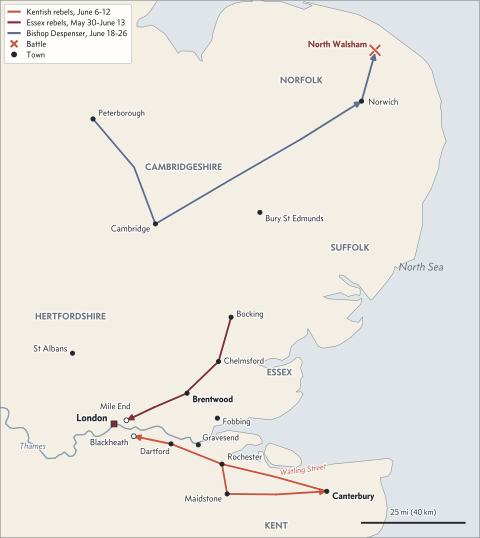
The poll tax
In June 1377 Edward III died. His grandson Richard II, the Black Prince’s son, was ten. The government was run by councils, and above them loomed the boy’s uncle John of Gaunt (gawnt), named for Ghent, where he was born. Gaunt was Duke of Lancaster, the richest man in England, and widely hated, because people blamed him for a failing war and heavy taxes. Meanwhile the war in France was going badly, and the French were raiding the south coast. Parliament tried a new kind of tax, a poll tax, a tax on every head (“poll” is an old word for head). In 1377 it was 4 pence on everyone over fourteen. In 1379 it was graded by rank. In November 1380 Parliament voted a third: a shilling, 12 pence, a head on everyone over fifteen, three times the first tax. Each village owed a shilling for every head it counted; the richer were supposed to help the poorer pay, but nobody was to pay less than 4 pence. For a laborer and his wife who paid the full shilling each, that was a week’s lawful wages or more.
So people hid. When the returns came in early in 1381, the counties reported about a third fewer people over fifteen than they had four years before, a drop no plague could explain. In March 1381 the council sent commissioners into the countryside to find the missing taxpayers.
The spark came on May 30, 1381, when one of them, John Bampton, a member of Parliament and a justice of the peace, opened a poll-tax inquiry at BrentwoodThis revolt was sparked by attempts to collect a poll tax, including John Bampton’s investigation in Essex. → Peasants' Revolt•• in Essex and summoned the men of the nearby villages of Fobbing, Corringham, and Stanford-le-Hope. Thomas Baker, speaking for Fobbing, said that his village had paid already and would pay no more. When Bampton tried to arrest him, the villagers fought. Bampton fled to London, and three of his clerks were killed. Within days Essex was in arms.
Across the Thames, in Kent, a lord seized a man at Gravesend as his runaway serf and shut him in Rochester Castle. On June 6 a crowd surrounded the castle, and its constable gave it up without a fight and let the man go. On June 7, at Maidstone, the Kentish rebels chose a leader (Figure 28.5). His name was Wat Tyler, and almost nothing is known of him before that week. “Wat” is short for Walter, and “Tyler” may mean that he tiled roofs. He came from Kent or Essex, and some chroniclers say he had fought in France as an archer. He turned out to be a born commander. Several accounts also name another leader, a captain who called himself Jack Straw.A leader of this event may have used the pseudonym Jack Straw. → Peasants' Revolt• Nobody knows whether Straw was a real man or a false name used by Tyler himself or by John Wrawe, a priest who led the rising in Suffolk.
In Maidstone jail the rebels had found John Ball, a priest who had been preaching in the villages of Essex and Kent for twenty years. Ball taught that the lords and the rich clergy had no right to their wealth and that all men were equal before God, and Simon Sudbury, the Archbishop of Canterbury, had thrown him in prison for it more than once. The rebels set him free. They marched to Canterbury on June 10, then back along the old Roman road to Blackheath, a high common just southeast of London, where they camped on June 12. There, the chronicler Thomas Walsingham (wawl-sing-um), a monk of St. Albans Abbey, tells, John Ball preached on an old rhymeThis priest associated with the Peasants’ Revolt preached “When Adam delved and Eve span, who was then the gentleman?” → John Ball•• that asked who had been the gentleman when Adam “delved” and Eve “span”: when Adam dug the earth and Eve spun thread. In the Garden of Eden, that is, there were no lords. God had made all men alike, Ball said, and serfdom had come from the wickedness of men, and now the time had come to throw it off (Figure 28.6).


London
Inside the Tower of London, the king’s fortress at the eastern edge of the city, sat Richard II, fourteen years old,Richard II was fourteen when this English revolt broke out against his government in 1381. → Peasants' Revolt••• with his mother, Joan of Kent; Archbishop Sudbury, who was also chancellor, the king’s chief minister; and the treasurer, Robert Hales. Almost all the king’s soldiers were in France or on the Scottish border. On the morning of June 13 Richard went down the Thames by barge to talk with the Kentishmen, but his councilors would not let him land, and he turned back.
That afternoon the gates of London Bridge were opened to the rebels, from fear or from sympathy, and the Essex men came in through Aldgate on the eastern side (Figure 28.7). Many Londoners joined them. They broke open the prisons, burned the records in the Temple, where London’s lawyers had their halls, and wrecked the Savoy, John of Gaunt’s palace beside the river, the most splendid house in England. They smashed its plate, ground its jewels to powder, and threw the pieces into the Thames, but according to Henry Knighton, a chronicler at Leicester, they stole nothing, because they meant to be seen as men seeking justice, not as thieves.

The crowds turned on foreigners too. Edward III had invited Flemish weavers to settle in England, and London’s own weavers hated them as rivals. On June 13 and 14 rebels and Londoners hunted Flemings through the streets, and thirty-five were dragged out of a single church, St. Martin Vintry, and beheaded. A London chronicle says that anyone the crowd suspected was ordered to say “bread and cheese” in English,Flemish speakers were reportedly singled out by their pronunciation of “bread and cheese” during this revolt. → Peasants' Revolt• and a man who said it the Flemish way, something like “brod and case,” lost his head. Geoffrey Chaucer, who lived in rooms above Aldgate, mentioned the revolt only once in all his poems. In a comic tale about a rooster and a fox, he says that the farm people chasing the fox shrieked louder than Jack Straw and his gang when they killed Flemings (Chapter 29).
On the morning of June 14 Richard rode out with a small escort to Mile End, a meadow outside the walls to the east. The rebels there asked for the end of serfdom, rents of 4 pence an acre, a pardon for all, and the punishment of the “traitors” around the king. Richard agreed to almost everything, and clerks began writing out charters of freedom for each county, copying through the night. The king’s promises at Mile EndAn agreement meant to end this event was made at Mile End. → Peasants' Revolt• were meant to send the rebels home, and many of the Essex men went.
But the Tower gates had been left open for the king’s return, and while he was at Mile End about four hundred rebels walked in. They found Archbishop Sudbury at prayer in the chapel of the White Tower, the great keep at its heart. The chancellor whose poll tax had driven them to revolt was dragged out with Robert Hales to Tower Hill, just outside the walls, where the rebels beheaded Archbishop Sudbury.Simon Sudbury was dragged from the Tower of London and killed during this revolt. → Peasants' Revolt•• An account written two centuries later, by the London historian John Stow, says it took eight blows. Sudbury’s head was set on London Bridge, and his skull is still kept in the church of St. Gregory at Sudbury, the Suffolk town of his birth. In the same rooms the rebels found the king’s cousin, Henry Bolingbroke (bol-ing-bruk), John of Gaunt’s son, also fourteen. A royal guard named John Ferrour pleaded for him, and he was spared. Remember him.
Smithfield
On June 15 Richard prayed at Westminster Abbey and then rode to Smithfield, an open field outside the walls to the northwest, where horses and cattle were sold. Wat Tyler rode out to meet him on a small horse. One chronicler, writing in French at York, tells the scene closely. Tyler dismounted, half bent his knee, shook the king’s hand, and called him brother. He demanded more charters. Then he called for a jug of water, rinsed his mouth rudely in front of the king, and climbed back on his horse. At that a young attendant of the king’s, a man from Kent, called out that he knew Tyler for the worst thief and robber in the county. Tyler drew his dagger. William Walworth, the mayor of London, a rich fishmonger, tried to arrest him, and Tyler stabbed at him, but Walworth wore armor under his coat. Walworth struck Tyler downWilliam Walworth struck down this leader of the Peasants’ Revolt at Smithfield after an attendant called him “the greatest thief and robber in all Kent.” → Wat Tyler•• with a blow to the neck and head, and a squire of the king’s ran him through.
Tyler rode a short way and fell, and the rebels began to bend their bows. Then Richard did the bravest thing of his life. He rode out alone toward them and, as the chroniclers report, told them that he was their king and would be their leader, and that they should follow him. They followed him north to the fields of Clerkenwell. There Walworth surrounded them with armed citizens, and the king let them go home. Tyler was dragged from the hospital where his men had carried him and beheaded, and his head replaced Sudbury’s on London Bridge. Richard knighted Walworth on the spot.
The end of the rising
The revolt had spread to Hertfordshire, Suffolk, Cambridgeshire, and Norfolk, where a dyer named Geoffrey Litster called himself King of the Commons and held Norwich. The bishop of Norwich, Henry Despenser, was a nobleman who had fought for the pope in Italy as a young man before he became a bishop. He rode home from the Midlands with eight men-at-arms and a few archers, gathering more as he went, routed the rebels at Peterborough, and rode on by way of Cambridge into Norfolk. Walsingham says that Despenser led the charge himself. The “Fighting Bishop,” as he came to be called, defeated the rebels at North WalshamHenry Despenser, the “Fighting Bishop,” defeated rebels at North Walsham during this revolt. → Peasants' Revolt•• on June 25 or 26, and he saw Litster hanged, drawn, and quartered, the death the law gave traitors: hanged, cut down alive, and cut to pieces.

Richard did not keep his word. When men from Essex came to ask him to confirm the charters of Mile End, Walsingham reports, he told them that they were peasants still and would remain in bondage, harsher than before. On July 2 the charters were canceled. John Ball was caught at Coventry and on July 15 was hanged, drawn, and quartered at St. Albans, with the king present (Figure 28.8). By November at least 1,500 rebels had been killed or executed. Yet the lords had been badly frightened. No medieval Parliament tried another poll tax on the whole people, and serfdom, which no law abolished, faded away in the next century as lords found they could keep their tenants only by freeing them.
Perpendicular Gothic and the Wilton Diptych
Gothic architecture, the style of the pointed arch, the rib vault, and the flying buttress, began in France in the 1140s (Vol. 1, The Toolkit). It reached England within a generation, and English builders made their own versions of it. In the early 1800s the architect Thomas Rickman sorted English Gothic into three stages, which he called “Early English,” “Decorated,” and, last, a style that lasted from the 1300s into the 1500s. The latest stage, named “Perpendicular” for its upright lines,In England, the latest period of this style emphasized verticality and was named "Perpendicular." → Gothic architecture• is found almost nowhere outside England. Its windows grew so large that walls became frames for glass. Their tracery, the stone bars that hold the glass, runs in straight vertical lines from the sill to the top of the arch, crossed by horizontal bars, and the same grid of upright panels is carved over the walls between them. Its arches are often flatter than earlier pointed arches, and its vaults sprout extra ribs.
The style began about 1330, in London and in Gloucester. Edward I’s chapel of St. Stephen in the palace of Westminster, built over half a century and finished in the 1340s, and the chapter house, or meeting hall, of St. Paul’s Cathedral, begun about 1332, already showed its panels and upright window bars. Both were destroyed long ago: St. Paul’s in the Great Fire of 1666, St. Stephen’s in the fire of 1834 that burned most of the old palace (Vol. 17, The Victorians). The oldest Perpendicular that still stands in a great church is at Gloucester.

Edward II’s tomb made the abbey’s fortune. Pilgrims came to pray at the grave of a king believed murdered, and his son, Edward III, gave generously. Between about 1337 and 1357 the masons remade the choir, the eastern part of the church where the monks sang their services (Figure 28.9). They kept the heavy round-arched Norman walls of about 1100 and covered them with a cage of slender stone panels. They raised a lofty vault with a net of ribs, and filled the east end with a window about 72 feet high and 38 feet wide, put in during the 1350s and said to be the largest in the world at the time. In the cloister beside the church, between about 1351 and 1377, they built the first fan vaults, in which the ribs spread from each column like the folds of an opened fan. Gloucester was then a Benedictine abbey; it became a cathedral only in 1541.
Perpendicular remained the English style for two hundred years. The wool churches were built in it, and so were the chapel of King’s College, Cambridge, and the chapel of Henry VII at Westminster. When the Houses of Parliament were rebuilt after 1834, Charles Barry chose Perpendicular for them (Vol. 17, The Victorians).
The Wilton Diptych
The finest English painting of Richard II’s time is small enough to carry. A diptych (dip-tik) is a picture painted on two hinged panels that close like a book. The Wilton Diptych, whose panels are each about 21 inches tall and 15 inches wide, was painted for Richard about 1395 to 1399, probably as a portable altarpiece to pray before on his travels. It is named after Wilton House in Wiltshire, where the earls of Pembroke kept it for two centuries, and it has been in the National Gallery in London since 1929. Nobody knows who painted it, or even whether the painter was English or French.


Open it, and walk across it from left to right (Figure 28.11). On the left panel Richard kneels on bare rocky ground, young and beardless, in a robe of red and gold patterned with white harts, the deer that was his personal badge. Around his neck is a collar of broom pods, the planta genista that gave his family the name Plantagenet. Behind him stand three saints who present him to heaven, each holding the object by which he is known. King Edmund the Martyr holds an arrow, because, the legend says, the Danes shot him with arrows when they killed him in 869 (Chapter 19). King Edward the Confessor, the builder of Westminster Abbey (Chapter 21), holds the ring that, by legend, he gave to a beggar who turned out to be St. John the Evangelist. John the Baptist holds a lamb.
On the right panel the Virgin Mary holds the Christ Child in a meadow of flowers, surrounded by eleven angels. Here the color changes. The Virgin and the angels are dressed almost entirely in blue.The figures on the right side of the Wilton Diptych wear clothes almost entirely of this color. → blue• It is ultramarine, made by grinding lapis lazuli (lap-is laz-yuh-lee), a stone mined in the mountains of Afghanistan; by the time the ground pigment reached a painter in London or Paris, it could cost as much as gold. Each angel wears Richard’s own badge, the white hart. One holds a banner with the red cross of St. George, and on the orb at the top of its staff is painted a tiny green island with a white castle, which probably stands for England, though some think it is Ireland. The Child leans toward the banner as if to bless it. The likeliest meaning is that the king is giving his kingdom into the Virgin’s keeping, and that the angels wear his badge as his own followers on earth did.
Richard had himself painted as no English king before him. The over-life-size portrait in Westminster Abbey shows him enthroned like an icon (Figure 28.10). He rebuilt Westminster Hall with a great oak hammerbeam roof, a roof held up on brackets that jut from the walls, so that the hall needed no pillars. At court he came to be addressed as “majesty,” where earlier kings had been plain “highness.” The Wilton Diptych shows a king who believed his crown came from God and not from any lord or Parliament. Within a few years of its painting, the lords and Parliament took it from him.
The Treaty of Windsor
Richard’s uncle John of Gaunt wanted a crown of his own. In 1371 he had married Constance, the daughter of a murdered king of Castile, and he called himself king of Castile by her right. The kingdom next door to Castile gave him his chance. In 1383 King Ferdinand I of Portugal died, leaving only a daughter who was married to the king of Castile. The Portuguese would not be swallowed by Castile, and in 1385 they chose as king Ferdinand’s half brother, John, the master of the military order of Aviz (uh-veesh). The Castilians invaded, and on August 14, 1385, John’s army, helped by a few hundred English archers, routed them at Aljubarrota (al-joo-buh-roh-tuh) (Vol. 9, Cathedrals and Crusades).
John I of Portugal and Gaunt had the same enemy, so they made common cause. In May 1386, at Windsor Castle, England and Portugal signed the Treaty of Windsor,John I of Portugal and England concluded this 1386 agreement, establishing an enduring alliance between the two kingdoms. → Treaty of Windsor•• promising each other perpetual friendship and help against any enemy. In July Gaunt sailed for Spain with an army to claim Castile, with Portugal’s support.
The alliance was sealed with a wedding. Gaunt brought his eldest daughter with him, Philippa of Lancaster, who was twenty-six and the sister of Henry Bolingbroke. In February 1387, at Porto, John I married Philippa of Lancaster,John I’s marriage to Philippa of Lancaster helped seal the Anglo-Portuguese alliance established by this treaty. → Treaty of Windsor• and she became queen of Portugal. Her sons are called in Portugal the Illustrious Generation; among them was Prince Henry, later called the Navigator, who sent Portuguese ships down the coast of Africa (Vol. 9, Cathedrals and Crusades). Gaunt’s own campaign failed, and in 1388 he gave up his claim to Castile for a large payment and the marriage of another daughter to the Castilian heir.
The friendship of 1386 outlived both kingdoms. Only from 1580 to 1640, when Portugal shared its king with Spain and was drawn into Spain’s wars against England, did the two stand on opposite sides. Otherwise England and Portugal, and later Britain and Portugal, have never fought each other, and the alliance is the oldest in the world still in force. In 1943, during the Second World War, Britain invoked it to ask for bases in the Azores, Portugal’s islands in the Atlantic, and Portugal agreed.
Richard II’s fall
As Richard grew up he gathered friends of his own: Michael de la Pole, the son of the Hull wool merchant, whom he made chancellor and Earl of Suffolk, and Robert de Vere, a young earl whom he made Duke of Ireland. The great lords hated them. In 1386 Parliament forced de la Pole out of office. In 1387 and 1388 five lords, among them Richard’s uncle Thomas, Duke of Gloucester, and his cousin Henry Bolingbroke, took up arms, beat de Vere’s army at Radcot Bridge, and had the king’s friends condemned in what was called the Merciless Parliament (Chapter 31). Richard had to accept it. He did not forget.
For eight years he ruled quietly. He made a long truce with France and married the six-year-old daughter of the French king, after his first wife, Anne of Bohemia, died in 1394. Then, in 1397, he took his revenge. The Earl of Arundel was executed, the Duke of Gloucester was murdered in prison at Calais, and the Earl of Warwick was banished. In 1398 Bolingbroke quarreled with another lord, and the two were to settle it by combat at Coventry. At the last moment Richard stopped the fight and exiled both of them, Bolingbroke for ten years.
On February 3, 1399, John of Gaunt died. Richard seized the Lancaster lands, the greatest inheritance in England, and made Bolingbroke’s exile lifelong. Every lord in England could see that if a king could take the Duke of Lancaster’s lands, he could take anyone’s. In May Richard sailed to Ireland with his army. At the end of June Bolingbroke landed at Ravenspurn, on the Yorkshire coast, saying he had come only to claim his inheritance. The great northern lords joined him, and the king’s uncle Edmund, Duke of York, whom Richard had left in charge, gave way. Richard came back through Wales too late. On August 19 he surrendered at Flint Castle and was taken to the Tower of London as a prisoner.
There, the official record says, he gave up his crown willingly. On September 30, 1399, an assembly of lords and commons in Westminster Hall, the hall Richard himself had roofed, heard thirty-three charges of misgovernment against him and accepted his abdication. Then Henry Bolingbroke deposed Richard and became Henry IV,Henry Bolingbroke deposed this ruler and became Henry IV. → Richard II••This ruler succeeded Richard II. → Henry IV of England• the first king of the House of Lancaster (Chapter 31). He was crowned on October 13, the feast of Edward the Confessor, the saint who presents Richard in the Wilton Diptych. By descent through the elder line the heir was not Henry at all but a seven-year-old boy, Edmund Mortimer, descended from Edward III’s second surviving son, Lionel, and also from the Roger Mortimer whom Edward III had hanged.
Richard was sent north to Pontefract (pon-tih-frakt) Castle in Yorkshire. In January 1400 a group of his friends plotted to kill Henry and set Richard free, and the plot was betrayed. Within a few weeks Richard was dead, probably starved, about February 14, 1400. He was thirty-three. His body was shown at St. Paul’s so that everyone could see he was dead, and the reign that had begun with a boy facing down a rebel army at Smithfield ended in a locked room.
What to remember
- Edward III took power in 1330 by seizing and hanging Roger Mortimer, his mother’s lover. In 1337 he claimed the crown of France, beginning the Hundred Years’ War. His eldest son, Edward of Woodstock, was the Black Prince.
- English wool was the finest in Europe until Spain’s merino. Edward I’s Great Custom (1275) taxed its export; smuggling it was “owling”; William de la Pole of Hull grew rich on it; the Lord Speaker sits on the Woolsack; clothiers built the wool churches of East Anglia and the Cotswolds.
- The Black Death reached England in 1348 and killed perhaps half the people. The Ordinance (1349) and Statute (1351) of Labourers tried to hold wages at the old rates.
- The Peasants’ Revolt (1381) followed the “Great Rumour” of 1377 and the poll taxes. It began with John Bampton’s inquiry at Brentwood, Essex. John Ball preached at Blackheath, Wat Tyler led the Kentishmen, and some named a captain Jack Straw.
- In London the rebels killed Flemings and Archbishop Sudbury. Richard II, aged fourteen, made promises at Mile End; at Smithfield Mayor Walworth struck Tyler down; Bishop Henry Despenser beat the Norfolk rebels at North Walsham.
- Perpendicular, the last English Gothic, began about 1330 in London and in Gloucester’s choir. The Wilton Diptych shows Richard II kneeling before the Virgin and angels dressed in blue.
- The Treaty of Windsor (1386), sealed by John I of Portugal’s marriage to Philippa of Lancaster, began the oldest alliance still in force.
- In 1399 Henry Bolingbroke deposed his cousin Richard II and became Henry IV.
Chapter 29 · 50 clues
Chaucer
In 1556 a London lawyer and minor poet named Nicholas Brigham paid for a new tomb in Westminster Abbey. It was a chest of gray marble under a carved stone canopy, and into it he moved the bones of a man who had been dead for more than 150 years. The man had been neither a king nor a bishop. He had been a customs officer, a diplomat, a member of Parliament, and for two years the clerk in charge of the king’s buildings. He lay in the abbey because in the last months of his life he had rented a house in its grounds. Brigham’s inscription gave the day of his death as October 25, 1400, and it is the only record of that date that survives.
In 1599 the poet Edmund Spenser, author of The Faerie Queene (fair-ee kween) (Vol. 11, The Age of Shakespeare), was buried nearby. Spenser had called the dead man “Dan Chaucer, well of English vndefyled,” Master Chaucer, the pure spring of the English language. Over the next centuries so many writers were buried or remembered around the two of them that the south arm of the abbey church became Poets’ Corner. The customs officer was Geoffrey Chaucer. He worked all his life for three kings, and in his spare hours, at a court where poems were read in French, he wrote his in English.
Middle English
When William the Conqueror took England in 1066 (Chapter 21), the language of its rulers changed. The new king, his barons, and his bishops spoke French. For nearly three hundred years French was the language of the court, the great households, and the law courts, while Latin remained the language of the Church and of learning. English did not die. It was the speech of the great majority, the farmers, servants, and townspeople, and the children of Norman lords picked it up from their nurses. But it was seldom written, and with no court or school to hold it steady it changed fast.
Scholars call the result Middle English: the English spoken and written from about 1100 to about 1500, between the Old English of Beowulf (Chapter 17) and the English of Shakespeare. Three things set it apart. Most of the endings that Old English nouns and adjectives had carried wore away, so that the order of the words, not their endings, showed who did what to whom. Thousands of French words came in, especially words for government, law, war, religion, food, and fashion: court, judge, jury, parliament, beef, and pork. And spelling was not fixed. Each writer spelled as he spoke, and English was spoken one way in Kent, another in London, and another again in the Midlands and the North.
One of the oldest Middle English poems that is still a pleasure to read is a quarrel between two birds. The Owl and the Nightingale is a debate poem in early Middle English,The Owl and the Nightingale was written in this language. → Middle English• nearly 1,800 lines long, probably written about 1200, though some scholars date it later. The poet overhears a nightingale on a blossoming branch insulting an owl on an ivy-covered bough. The nightingale says the owl is ugly and filthy and that her hooting brings only gloom. The owl answers that the nightingale’s songs stir up lust, while her own cry warns men to think of their sins. They agree to put the case to a wise man, Master Nicholas of Guildford (gill-ferd), and the poem ends with the two birds flying off to find him, so that we never learn who won.
By Chaucer’s time the balance had tipped back. In 1362, when he was about nineteen, Parliament complained that French was little understood in the realm, so that men in the courts could not follow what was said for and against them, and it ordered that cases be pleaded in English. Poets still had to choose. Chaucer’s friend John Gower (gow-er), a landowner whose family held property in Kent and Suffolk, wrote one long poem in French, one in Latin, and one in English, as if he could not tell which language would last. Chaucer wrote in Middle English,Geoffrey Chaucer wrote in this language. → Middle English•• in the speech of London, which lay between the dialects of the south and the Midlands. Within two generations of his death the clerks of the king’s government were writing a standard form of London English, and it became an ancestor of the spelling we use today.
English was also the language of the first English plays. A morality play was a play whose characters are not people but virtues, vices, and other ideas given bodies, an allegory (Vol. 1, The Toolkit) acted on a stage, in which good and evil fight over a human soul. The oldest complete one, and the oldest full-length play in English, is The Castle of Perseverance, a morality play in Middle EnglishThe Castle of Perseverance was written in this language. → Middle English• of about 1420, 3,649 lines long. Its hero is Mankind himself, followed from his birth to his death. His Bad Angel leads him to the World, the Flesh, and the Devil and to the Seven Deadly Sins. Repentance places him in the Castle of Perseverance, where the Virtues beat off the besiegers by pelting them with roses. In old age Covetousness, the sin of greed, tempts him out again, and Death strikes him with a dart. At the end four daughters of God argue over his soul, and God sides with Mercy.

The most famous morality play came later still. Everyman, written in late Middle EnglishEveryman was written in this language. → Middle English• about 1500 and printed about 1530, after the end of this volume’s story, may be a translation of a Dutch play. God sends Death to summon Everyman to his reckoning, and all his friends, Fellowship, Kindred, and Goods among them, refuse to go with him. Only Good Deeds goes with him into the grave (Vol. 11, The Age of Shakespeare).
Chaucer’s life
Nearly five hundred records of Chaucer’s working life survive, and not one of them mentions a poem (Figure 29.4). Geoffrey Chaucer was born in London about 1343, the son of John Chaucer, a prosperous wine merchant who supplied the king’s household. His surname comes from the French chaucier, a maker of shoes or hose. The first record of his life is a household account of 1357, which shows that he was a page to Elizabeth de Burgh (duh burg), Countess of Ulster, the wife of Lionel, the second of King Edward III’s sons to survive childhood. A page (Chapter 24) waited at table, carried messages, and learned manners, and a clever page could rise from there into the king’s own service.
Two years later Edward III invaded France in the war over his claim to the French crown (Chapter 28), and Chaucer went with Lionel’s company. In 1360 he was captured near Reims, and the king paid £16 toward his ransom. That was serious money. Thirty years later Chaucer would draw two shillings a day as clerk of the king’s works; at that rate £16 was 160 days’ pay. About 1366 he married Philippa Roet (roh-et), a lady-in-waiting to Edward III’s queen, also named Philippa. Her sister Katherine Swynford later became the mistress, and in 1396 the third wife, of John of Gaunt, Duke of Lancaster, Edward III’s third surviving son and the richest lord in England (Chapter 28). He was named for Ghent in Flanders, his birthplace, which the English called Gaunt. Chaucer and Philippa had at least two sons, Thomas, who later became Speaker of the House of Commons, and Lewis.
The crown used Chaucer as a messenger and envoy. In 1372 and 1373 he traveled to Genoa and Florence on royal business, and in 1378 to Milan. Probably on these journeys he came to know the poems of Dante, Petrarch, and Giovanni Boccaccio (boh-kah-choh), the three great writers of Florence (Vol. 9, Cathedrals and Crusades), and he brought home stories and forms that no English poet had used. On St. George’s Day, April 23, 1374, Edward III granted him a gallon of wine every day for life. In June of that year he became controller of the customs in the port of London, the officer who checked the accounts of the tax on exported wool (Chapter 28). He lived for twelve years in rooms over Aldgate, one of the gates in the city wall.
In May 1380 a woman named Cecily Chaumpaigne (shom-payn), the daughter of the late William Chaumpaigne and his wife Agnes, signed a legal deed that released Chaucer from all claims of raptus,Cecily Chaumpaigne released this author from claims involving "raptus." → Geoffrey Chaucer• “concerning my raptus.” Raptus was a Latin word of the law that could mean rape, or could mean seizing and carrying a person away, and the deed does not say which it meant. In 2022 two scholars, Euan Roger and Sebastian Sobecki, published records of a lawsuit of 1379 and 1380. Cecily’s former employer, Thomas Staundon, had sued both her and Chaucer. She had left his service before her term was up, and Chaucer had taken her into his, against the Statute of Labourers, the law passed after the Black Death that fixed wages (Chapter 28) and held servants to their masters until their terms were up. Some scholars now think the release belongs to that quarrel; others still read it as clearing Chaucer of a charge of rape. No record says what happened.
Chaucer moved to Kent, and in 1386 he sat in Parliament as one of its two knights of the shire, the members elected for each county. Philippa seems to have died the next year. From 1389 to 1391 he was clerk of the king’s works, in charge of repairs at Westminster Palace, St. George’s Chapel at Windsor, and the Tower of London, and of the stands for a great tournament in 1390. That September robbers attacked him, perhaps more than once, while he was carrying the king’s money.

In those years he wrote a book in prose for his son. An astrolabe is a brass disk, small enough to hold in one hand, for measuring the height of the sun or a star above the horizon. With it a person could tell the time, find his latitude, and work out where the sun stood among the stars. Chaucer wrote A Treatise on the AstrolabeThis author wrote A Treatise on the Astrolabe. → Geoffrey Chaucer• for Lewis, who was ten, and it is the oldest book in English about a scientific instrument. “Litell Lowis my sone,” it begins, and Chaucer explains why it is in English: “Latin ne canstow yit but smal” (you know only a little Latin yet). He had given the boy an astrolabe made for the latitude of Oxford. Two of its worked examples are dated March 12, 1391.

In 1399 Richard II was overthrown by his cousin Henry Bolingbroke, John of Gaunt’s son, who became Henry IV (Chapter 28). Chaucer sent the new king a comic poem begging his purse, his “lady dere,” to be heavy again, and Henry renewed his pension. On December 24, 1399, Chaucer leased a house in the grounds of Westminster Abbey. The last record of him alive is a payment of June 5, 1400. About ten years later Thomas Hoccleve (hok-leev), a clerk who wrote letters under the Privy Seal, the king’s personal seal, called Chaucer his master and hailed him as “the firste fyndere of our fair langage,” the first poet of the English tongue. A few stanzas later he had Chaucer’s portrait painted in the margin.

The dream visions
Chaucer’s first long poems belong to a kind that every reader of his day knew. A dream vision is a poem in which the poet tells of a dream. He cannot sleep, or he falls asleep over a book, and dreams of a garden, a temple, or a strange journey, where he meets figures who teach him something, usually about love. Then he wakes and writes it down. The model was the French Romance of the Rose, a long allegory of the thirteenth century that Chaucer partly translated. He wrote four dream visions of his own.
The first was a poem of mourning. Blanche of Lancaster, John of Gaunt’s first wife, died on September 12, 1368, probably of plague, in her twenties. In The Book of the Duchess, written soon afterward, the sleepless poet reads Ovid’s story of a queen who learns in a dream that her husband has drowned, then falls asleep himself. He dreams of a hunt, follows a puppy into the forest, and finds a knight dressed in black, alone and grieving. Fortune, Fortuna in Latin, was the goddess whom medieval people pictured turning a great wheel that lifted men up and threw them down. The knight says he played chess with Fortune,In this author's Book of the Duchess, a knight describes losing a chess game to Fortuna. → Geoffrey Chaucer• and that “she stal on me, and took my fers”: she crept up on him and took his queen. Then she checkmated him with a pawn. The dreamer does not understand and tells him not to grieve so for a game. At last the knight says it plainly: “She is deed!” Her name, he has said, was “gode faire Whyte,” and blanche is French for white. At the end Chaucer even hides Lancaster in the phrase “a long castel,” and Richmond, of which Gaunt was earl, in “a riche hil,” and so readers take the knight in black to be Gaunt himself.
The House of Fame, Chaucer’s strangest poem,This author wrote The House of Fame. → Geoffrey Chaucer•• was probably written about 1380, and he never finished it. It runs to more than two thousand lines in three books of short rhyming couplets, and it opens with the poet wondering aloud why some dreams come true and others do not. Then, like The Book of the Duchess, it takes the form of a dream vision.This poem takes the form of a dream vision. → The House of Fame• On the night of December 10, the poet falls asleep and finds himself inside a temple of Venus, the goddess of love, filled with golden images. It is “a temple y-mad of glas.” On a brass tablet on its wall he reads the first lines of Virgil’s Aeneid (ih-nee-id) (Vol. 7, The Romans): “I wol now singe, if that I can, / The armes, and al-so the man.” Around him he sees the Aeneid retold in the glass temple,In this poem, the narrator sees a retelling of the Aeneid in a glass temple. → The House of Fame•• scene by scene, and he lingers longest over Dido (dy-doh), the queen of Carthage whom Aeneas loved and left, and over all the other women deceived by their lovers.
When he steps outside, he finds an empty, sandy plain, and a golden eagle swoops out of the sky. The eagle seizes the poet and carries him up in its claws, so high that he faints. When he wakes it is talking to him, and it calls him by name: “Geffrey.” Jupiter has sent it, the eagle explains, because the poet has served Love for years without reward. After his day’s work, the eagle goes on, when he has made up his accounts, he goes home and sits at another book, “domb as any stoon,” till his eyes are dazed. That was a joke about his job at the customs house. The eagle carries him to the House of Fame,In this poem, an eagle carries the narrator to the title structure. → The House of Fame•• built on a rock of ice carved with the names of the famous, half melted where the sun strikes them. Inside sits the goddess Fame, with as many eyes as birds have feathers and as many ears and tongues as beasts have hairs, handing out glory or slander with no regard for what anyone deserves. A spinning house of twigs nearby holds every rumor in the world. The poem breaks off as “a man of greet auctoritee” appears, and no one knows who he was meant to be.
Cicero, the Roman orator, had ended his book on the best state with a dream: a young Roman named Scipio (skip-ee-oh) is shown the universe by his famous grandfather by adoption, Scipio Africanus (Vol. 7, The Romans). Chaucer begins The Parlement of Foules, “the Parliament of Birds,” about 1380, with the poet reading that book, which he calls “Tullius of the dreme of Scipioun” (Cicero’s full name was Marcus Tullius Cicero). The poem’s first line is still quoted: “The lyf so short, the craft so long to lerne.” That night Africanus appears to the dreamer and leads him to the gate of a beautiful park. Past a temple of Venus, on a hill of flowers, sits the goddess Nature, and around her every kind of bird has gathered, “For this was on seynt Valentynes day, / Whan every foul cometh ther to chese his make.” To “chese his make” is to choose a mate.
The poem links Valentine’s Day with choosing mates,This author's Parlement of Foules links Valentine's Day with choosing mates. → Geoffrey Chaucer•• and that link seems to be Chaucer’s invention. St. Valentine was a Roman martyr with no connection to love, and the scholar Jack Oruch, searching the writings that survive from before Chaucer, found no earlier tie between his feast and lovers. In the poem three noble eagles court one female eagle, each claiming to love her best. The lower birds lose patience: the goose, the duck, and the cuckoo shout their own coarse advice, and the debate turns into a comic parliament. Nature at last lets the female wait a year before she chooses. The other birds pair off and fly away singing to welcome the summer.
The fourth dream vision is a penance. In the Prologue to The Legend of Good Women, the God of Love appears to the dreamer with his queen, Alceste (al-ses-tee), the wife who in Greek myth died in her husband’s place. The god is angry. This poet, he says, has slandered love by writing of Criseyde (krih-say-duh), who was false to her lover, in Troilus and Criseyde. Alceste pleads for Chaucer and sets his penance: he must write the lives of women who were true in love. Chaucer wrote The Legend of Good WomenThis author wrote The Legend of Good Women. → Geoffrey Chaucer• about 1386 to 1388, but he finished only nine legends, among them Cleopatra’s, Thisbe’s, and Dido’s, and the last breaks off in the middle of a sentence. It is probably the first long English poem in heroic couplets, rhyming pairs of iambic pentameter lines, the form he went on to use for most of The Canterbury Tales.
Troilus and Criseyde
The Troilus (troy-lus) of Greek myth was a boy, a young son of King Priam of Troy, ambushed and killed by Achilles (Vol. 4, Classical Myth). Medieval writers made him a lover. About 1160 the French poet Benoît de Sainte-Maure (ben-wah duh sant-mor) gave him a sweetheart who abandons him for a Greek, and about 1340 Boccaccio turned the episode into a whole poem, Il Filostrato (eel fee-loh-strah-toh). Chaucer wrote Troilus and CriseydeThis author wrote Troilus and Criseyde. → Geoffrey Chaucer•• from it in the mid-1380s, in five books and more than eight thousand lines, and many readers think it his finest work. It is written in rhyme royal, a stanza of seven lines of iambic pentameter rhyming ababbcc, which Chaucer was the first to use in English. It tells of two tragic loversThis poem tells the story of two tragic lovers during the Trojan War. → Troilus and Criseyde•• in the last years of the Trojan War.
Calchas (kal-kus), a Trojan priest, foresees that Troy will fall and deserts to the Greeks, leaving behind his widowed daughter Criseyde. Troilus, a son of Priam and a brave fighter, has always mocked lovers. At a festival in the temple he sees Criseyde in her widow’s black, and love strikes him like an arrow. His friend Pandarus (pan-duh-rus), who is Criseyde’s uncle, sets out to bring them together, with letters, visits, and a great deal of scheming. In the third book Pandarus invites his niece to supper. When the evening is over, “as every thing hath ende,” she wants to go home, but a storm of rain keeps her in the house, and that night she and Troilus become lovers. That half-line is often credited with the proverbThis poem is often credited with the phrase "all good things must come to an end." → Troilus and Criseyde•• “all good things must come to an end.”

Then the war takes her. The Trojans agree to send Criseyde to her father in the Greek camp in exchange for a captured Trojan. She promises Troilus that she will come back within ten days. In the camp the Greek warrior Diomede (dy-oh-meed) courts her, and she gives way and gives him the brooch that Troilus had given her. Troilus waits on the walls day after day. At last he sees the brooch on a piece of Diomede’s armor taken in battle, and knows. He fights in a fury until Achilles kills him. His soul rises up through the spheres of heaven, and from there he laughs at the sorrow of those who weep for his death. “Go, litel book, go litel myn tregedie,” Chaucer writes as he closes, and he sends it to “moral Gower” to correct. From Pandarus came the English word pander, a go-between in love affairs, and Criseyde’s name became a byword for faithlessness, as in Shakespeare’s play Troilus and Cressida.
The General Prologue
Chaucer wrote The Canterbury TalesThis author wrote The Canterbury Tales. → Geoffrey Chaucer••• from about 1387 until he died, and he never finished it. It is a frame story, a collection of stories held together by an outer story about the people who tell them. Boccaccio’s Decameron (Vol. 9, Cathedrals and Crusades) had ten young Florentines escape the plague to a country villa and tell a hundred tales. Chaucer’s frame is a pilgrimage. A pilgrimage was a journey to a holy place, made to pray, to do penance for sin, or to beg a saint to cure an illness. Its opening is the most famous passage in Middle English.
It is one long sentence, eighteen lines in all, and it begins with the weather. April’s sweet showers end the drought of March:This work opens by describing the "drought of March" being relieved by the "sweet showers" of April. → The Canterbury Tales•• they soak through the dry ground to the roots and fill every plant with the sap that makes the flowers grow. The west wind breathes new life into every wood and field, and the young sun has run half its course through the sign of the Ram. The birds feel it too. The little birds make melody,This work's opening describes "small fowls" that "make melody." → The Canterbury Tales• and they sleep all night, Chaucer says, with their eyes open, because Nature spurs their hearts. At just that season, people long to go on pilgrimages. Some set out for shrines in distant lands across the sea, but most, from every corner of England, ride to one place.
The pilgrims are riding to Becket’s shrineThe pilgrims in this work travel to the shrine of Thomas Becket. → The Canterbury Tales••• at Canterbury, about 55 miles southeast of London, to “the holy blisful martir” who, they believed, had healed them when they were sick. He was Thomas Becket, the archbishop murdered in his cathedral in 1170 (Chapter 22). Within three years the pope made him a saint, and his shrine was the greatest in England until Henry VIII destroyed it in 1538. Chaucer’s pilgrims follow the old road from London to the coast of Kent (Figure 29.6).


Pilgrims came home with proof of where they had been. At Canterbury they bought small badges of cheap lead or tin, cast with the saint’s head, his shrine, or his murder, to pin to their hats, and tiny flasks called ampullae filled with “Canterbury water,” said to be tinged with Becket’s blood. Archaeologists have found tens of thousands of such badges from all over Europe, most of them in the mud of rivers. Not all were holy. Some, found mostly in the Low Countries, are shaped as sexual organs, and scholars still argue whether they were jokes, charms against bad luck, or charms to bring children; on the last reading, medieval pilgrims wore fertility badgesIn the Middle Ages, these people donned fertility badges. → pilgrims• beside their saints.
Chaucer’s pilgrimage begins in Southwark, the suburb at the south end of London Bridge, where inns crowded the road to Kent. One evening in April, he says, he was lodging at the Tabard, ready to set out, when twenty-nine pilgrims gathered at the Tabard Inn.The pilgrims in this work gather at the Tabard Inn. → The Canterbury Tales••• A tabard was a short sleeveless coat, painted on the inn’s sign. Chaucer joins them. The Host, the innkeeper, whom the Cook later calls Harry Bailly, serves them supper and makes a proposal. Each pilgrim will tell two tales on the way to Canterbury and two on the way back, and whoever tells the best will eat a free supper at the others’ cost when they return. The Host will ride along as judge. Next morning, at the Watering of St. Thomas, a brook where the road left Southwark, the pilgrims draw lots to see who will begin, and the first tale falls to the Knight.This collection's first tale is told by the Knight. → The Canterbury Tales•••
Before any tale, Chaucer describes the pilgrims one by one. They are a cross-section of England below the great lords. A Knight has come home from crusades at Alexandria and in Prussia and Lithuania, and rides with his son the Squire. A Monk loves hunting more than prayer, and a Friar hears confessions in return for gifts. There are a poor scholar from Oxford, a Wife from near Bath, and a good country Parson with his brother the Plowman, the two ideal Christians of the company. And there are rogues, among them a Miller, a Reeve, a Pardoner, and a Summoner, who served summonses for the Church’s courts. The Prioress, the head of a small convent of nuns, is called Madame Eglentyne (eg-lun-teen). She speaks French “after the scole of Stratford atte Bowe,” the French of an English convent, not of Paris. She never drips sauce on her dress, and she weeps if she sees a mouse caught in a trap. On her rosary hangs a brooch of gold, and the nun’s brooch reads Amor vincit omniaIn this work, a nun has a pendant that says "Amor Vincit Omnia." → The Canterbury Tales• (ah-mor vin-kit om-nee-ah), “Love conquers all,” under a crowned letter A. The words are adapted from Virgil. Whether the motto means the love of God or love of another kind, Chaucer does not say.


No manuscript in Chaucer’s own hand survives. There are eighty-four manuscripts of The Canterbury Tales, more than of any other English poem of the Middle Ages except a long religious one, and they disagree about the order of the tales. Only twenty-four tales were written, not the 120 or so that four tales from each pilgrim would have made, and two of them break off unfinished. The most beautiful copy is the Ellesmere manuscript (elz-meer) (Figure 29.9), made just after Chaucer’s death on 240 leaves of fine parchment, with a painted portrait of each teller beside his or her tale. It takes its name from a later owner, Thomas Egerton, Baron Ellesmere, and in 1917 the American railroad millionaire Henry Huntington bought it. Most modern editions follow its order of the tales (Figure 29.8). William Caxton, the first printer in England, printed the Tales about 1476.
The Knight’s, Miller’s, and Reeve’s Tales
The Knight tells a story his author had long known. Chaucer had written the Knight’s TaleThis author wrote "The Knight's Tale." → Geoffrey Chaucer• years before he planned the pilgrimage. In the Prologue to The Legend of Good Women he lists among his works a poem on the love of Palamon (pal-uh-mon) and Arcite (ar-see-tuh), two princes of Thebes. Few people know their story, he adds. The tale adapts Boccaccio’s TeseidaThis tale adapts Boccaccio's Teseida. → "The Knight's Tale"• (teh-zay-ih-dah), an Italian epic about the Greek hero Theseus, written about 1340, that ran to nearly ten thousand lines in twelve books. Chaucer cut it to 2,250 lines and made it a romance of chivalry. The Ellesmere painter shows the Knight beside its opening (Figure 29.10).


Theseus, duke of Athens, is riding home in triumph with his bride Hippolyta (hih-pol-ih-tuh), queen of the Amazons, and her young sister Emily, when a band of weeping widows kneels in his road. Creon (kree-on), the tyrant of Thebes, has refused to let their husbands’ bodies be buried (Vol. 4, Classical Myth). Theseus marches on Thebes, kills Creon, and takes the city. Among the heaps of dead his men find two young knights, cousins of the Theban royal blood, wounded but alive: Palamon and Arcite. Theseus imprisons the two Theban knightsIn this tale, Theseus imprisons two Theban knights. → "The Knight's Tale"•• in a tower in Athens for life, and he will take no ransom.
Years pass. One May morning Palamon, looking down from the tower window, sees Emily gathering flowers in the garden below, and cries out as if he had been stabbed. He thinks she may be Venus herself. Arcite looks, and loves her too, and the sworn brothers become rivals. Palamon and Arcite compete for EmilyIn this tale, Palamon and Arcite compete for Emily's hand. → "The Knight's Tale"••• for the rest of the tale. Arcite is released on condition that he never return to Athens, and comes back in disguise to serve in Emily’s household. Palamon escapes, and the two meet in a grove and fight, ankle-deep in blood, until Theseus comes upon them while hunting. He sets a tournament for fifty weeks later, with a hundred knights on each side, and Emily to the winner. Before dawn on the day before the tournament, Palamon prays to Venus for Emily, Arcite to Mars for victory, and Emily to Diana that she may stay unmarried. In heaven Venus and Mars quarrel over the two knights’ prayers, until the old god Saturn finds a way to grant both. Arcite wins the tournament. Then, at Saturn’s bidding, a fury springs out of the ground, his horse throws him, and he dies. Years later Theseus makes a speech on the order of the world and on dying well, and Palamon marries Emily.
When the Knight finishes, the Host calls on the Monk to tell the next tale. But the Miller, so drunk he can hardly sit on his horse, shouts that he will “quyte” (repay) the Knight’s tale with one of his own, about a carpenter and his wife, and the Miller tells his taleThe Miller tells a story in this collection. → The Canterbury Tales•• instead. The Reeve, who was a carpenter in his youth, tells him to shut up. The Miller tells a fabliau (fab-lee-oh), a short, coarse, comic story in verse about tricks, cheating husbands and wives, and the body, the opposite of a knightly romance.
John is a rich old carpenter of Oxford, jealous of his young wife Alisoun (al-ih-soon), who is eighteen. Their lodger, a poor student named Nicholas, studies astrology and plots to win her. He tells John that the stars foretell a second flood, greater than Noah’s, coming next Monday night. The student persuades John to hang tubsIn this tale, a student convinces the carpenter John to hang tubs from the ceiling in preparation for a flood. → "The Miller's Tale"•• from the roof beams, one each for John, Alisoun, and Nicholas, ready to be cut loose and float away when the water comes. The terrified carpenter buys three big kneading tubs, the wooden troughs used for making bread, and hauls them up into the rafters with food for a day. On Monday night all three climb up. John falls asleep, snoring, and Nicholas slips down to sleep with Alisoun.In this tale, Nicholas sleeps with the married Alisoun. → "The Miller's Tale"••
Absolon (ab-suh-lon), a dandy parish clerk with curly golden hair who plays a small guitar under her window, is also in love with Alisoun. That same night, before dawn, he comes to the bedroom window to beg a kiss. In the dark Alisoun puts her bottom out of the window,In this tale, a woman puts her buttocks out of a window. → "The Miller's Tale"• and Absolon kisses it. He goes off in a rage to the blacksmith Gervase and borrows a coulter (kohl-ter), the iron blade of a plow, still red-hot from the forge. Summaries usually call it a poker. He knocks again. This time Nicholas puts his own bottom out of the window and lets fly a fart in Absolon’s face, as loud as a thunderclap, and Absolon brands Nicholas with the red-hot coulter.In this tale, Absolon brands a man's buttocks with a hot poker after being farted at. → "The Miller's Tale"•• “Help! Water! Water!” Nicholas howls. John wakes, thinks the flood has come, cuts the rope, and crashes to the floor, breaking his arm, and the whole town decides that he is mad.
The Reeve takes it personally. A reeve was the manager of a lord’s farms, and this one, Oswald, a thin, bad-tempered old man from Norfolk, answers with a fabliau about a cheating miller. The Reeve tells his taleThe Reeve tells a story in this collection. → The Canterbury Tales• of Symkyn, a miller at Trumpington near Cambridge, who steals flour from two Cambridge students. They pay him back that night in his own house, in the dark, at the cost of his wife’s and daughter’s honor, and he ends the night beaten by his own wife. The Canterbury Tales is written in the Middle EnglishThis work was written in Middle English. → The Canterbury Tales• of London, and here Chaucer makes a joke of the language itself: the two students come from the far north, and he gives them its speech. They say “I is” for “I am,” and it is the earliest surviving attempt in English to write down another region’s dialect for its sound.
The Wife of Bath
The Wife of Bath is a pilgrimThis character is a pilgrim in Geoffrey Chaucer's Canterbury Tales. → Wife of Bath•• who comes from near Bath, the town in Somerset, and she is the best-known character Chaucer made. Ypres and Ghent were the great cloth towns of Flanders, where much of England’s wool was woven (Chapter 28). The Wife is a clothmaker, and her cloth-making surpassed that of Ypres and Ghent:This character’s cloth-making surpasses that of Ypres and Gaunt. → Wife of Bath• “She passed hem of Ypres and of Gaunt.” On Sundays she wears kerchiefs that Chaucer swears weighed ten pounds, and her stockings are scarlet. On the road she rides in a hat as broad as a shield, with sharp spurs on her heels. She has been to Jerusalem three times, and to Rome, Cologne, and the shrine of St. James in Spain. She is gap-toothed, loud, merry, and a little deaf, and she has had five husbands “at chirche-dore.”
Her own prologue is longer than her tale, and it is a defense of her life. “Experience, though noon auctoritee / Were in this world, were right y-nough to me,” she begins: even without the authority of books, her own experience is enough for her to speak about the woes of marriage. She was first married at twelve. Learned men tell her that a woman should marry only once, since Jesus went to only one wedding. She answers that God told mankind to increase and multiply, and she cites Solomon to defend her marriages:This character cites Solomon to defend her five marriages. → Wife of Bath•• “Lo, here the wyse king, dan Salomon; / I trowe he hadde wyves mo than oon.” (“I think he had more than one wife.” The Bible gives him seven hundred.) Three of her husbands, she says, were good, which is to say rich and old, and two were bad.
While her fourth husband was alive, she walked in the fields with Jankyn (jang-kin), a twenty-year-old Oxford student, when she was forty. To catch his interest she told him that he had bewitched her. Then she claimed to have dreamed of a bed full of blood.This character claims to have dreamed of a bed filled with blood. → Wife of Bath• All night, she said, she had dreamed that he was killing her as she lay, and her bed was full of blood. That was a good sign, “For blood bitokeneth gold” (blood is a sign of gold). Then she admits to the pilgrims that it was all a lie, a trick her mother had taught her. When her fourth husband died, she watched Jankyn’s legs as he walked behind the coffin, and within a month she married him and gave him all her land.
Jankyn had a book. It bound together old writings against women, and he read it aloud every night by the fire, tale after tale of wicked wives from Eve onward. One night she could stand no more. She tore three pages out of the book and hit him so hard that he fell back into the fire. He jumped up and struck her on the head, and the blow left her deaf in one ear.This character loses hearing in one ear after Jankyn strikes her for tearing pages from his book. → Wife of Bath•• She lay as if dead, and when he knelt over her in fright, she hit him again. In the end he burned the book and gave her “the brydel in myn hond,” control of their house, their land, and his own tongue and hand. Once she had won “al the soveraynetee,” she says, they never quarreled again.

Then, after a squabble between the Friar and the Summoner, comes one of the most famous stories in the collection, the Wife of Bath’s TaleThis collection includes "The Wife of Bath's Tale." → The Canterbury Tales••• (Figure 29.11). She sets it in King Arthur’s time (Chapter 23), when, she says, the land was full of fairies and the elf-queen danced in the green meadows. Now there are none. Friars were members of the begging orders of the Church, who lived on alms and wandered the country preaching and hearing confessions, and some went from door to door within a fixed district. The fairies are gone, the Wife says, because of all the blessing done by these friars, who are as thick as specks of dust in a sunbeam. The friars have replaced the fairies:This character says friars have replaced fairies. → Wife of Bath•• where an elf used to walk, now walks the friar.
One day a young knight of Arthur’s court, riding home from the river, meets a girl walking alone and rapes her. The court condemns him to death. The queen and her ladies beg the king to let them judge him, and the queen gives him a chance to save his life. He must find out what women most desire, and he has a year and a day. He asks everywhere and hears every answer: wealth, honor, pleasure, fine clothes, flattery, to be free, to be trusted with a secret.
The Wife cannot resist answering that last one with a story. Ovid tells that King Midas (my-dus) of Phrygia had a donkey’s ears, and that the barber who knew the secret whispered it into a hole in the ground (Vol. 4, Classical Myth). The Wife retells the story of Midas’s earsThis tale retells the story of King Midas's asses' ears. → "The Wife of Bath's Tale"• with a change. In her version it is Midas’s wife who knows, and who cannot keep it in. She runs to a marsh, puts her mouth to the water, and whispers, “Myn housbond hath longe asses eres two!” “The remenant of the tale if ye wol here,” the Wife adds, “Redeth Ovyde.”
The year is almost over when the knight sees twenty-four ladies dancing at the edge of a forest. As he comes near, they vanish, and in their place sits an old woman, the ugliest he has ever seen. She promises him the answer if he will grant the next thing she asks. Sovereignty means rule or mastery. Before the queen’s court the knight gives the answer he has learned: women most desire sovereignty.In this tale, a knight learns that women most desire sovereignty. → "The Wife of Bath's Tale"••• “Wommen desyren to have sovereyntee / As wel over hir housbond as hir love,” he says, and not one woman in the court can deny it, so his life is saved. Then the old woman asks her reward: he must marry her.
On their wedding night he lies in misery and tells her why: she is old, ugly, and low-born. She answers with a long lecture. True nobility, she says, comes from noble deeds, not from birth, and poverty and age have their own virtues. Then she offers him a choice. She can be old and ugly and a faithful wife, or young and beautiful and take her chances with the men who will come calling. The knight sighs and puts the choice in her hands, and with it the mastery. She has won, and she gives him both. The old woman becomes young and beautiful,In this tale, a knight marries an old woman who becomes young and beautiful. → "The Wife of Bath's Tale"•• and faithful too, and they live in perfect joy.
The Franklin’s and Pardoner’s Tales
A franklin was a free landowner, rich but not noble. Chaucer’s Franklin is a white-bearded country gentleman so hospitable that “It snewed in his hous of mete and drinke”: it snowed food and drink in his house. He tells a Breton lay, a short romance of the kind said to have been sung in Brittany. Dorigen (dor-ih-gen), a lady of Brittany, has married the knight Arveragus (ar-vuh-ray-gus) as an equal. While he is away in England she sits on the cliffs and dreads the black rocks of the coast, which could wreck his ship on the way home. A young squire, Aurelius, loves her. To be rid of him she makes a rash promise, half in jest: she will love him if he removes every rock from the coast of Brittany.
Aurelius falls ill with despair, and his brother remembers a scholar at Orléans who studied magic. For a thousand pounds, in the dead of winter, the magician makes the rocks appear to vanishIn this work, a character uses a magician's help to make all rocks appear to vanish from the coast to win Dorigen's love. → The Canterbury Tales• for a week or two, by tables of the stars and a very high tide, and Aurelius claims Dorigen’s love. Dorigen thinks of killing herself. Arveragus, home again, weeps but tells her she must keep her word: “Trouthe is the hyeste thing that man may kepe.” Aurelius, moved, releases her, and the scholar in turn forgives Aurelius his thousand pounds. The Franklin ends with a question for the pilgrims: which of the three men was the most generous?
The Pardoner is the rogue of the company. A pardoner was a man licensed by the Church to collect money for a hospital or other good cause, giving in return a pardon, a document promising that God would lessen the punishment due for the giver’s sins. Chaucer’s Pardoner has hair as yellow as wax, a voice as thin as a goat’s, and a bag of fake relics, among them a pillowcase that he says is the Virgin Mary’s veil and some pig’s bones. In his prologue he boasts to the pilgrims how he cheats poor people. His sermon always has the same text: Radix malorum est cupiditas (rah-diks mah-lor-um est koo-pid-ih-tahs), “greed is the root of evil.”
His tale proves it. Three young drunkards are drinking in a tavern in Flanders during a plague when a bell rings for a corpse being carried to its grave. It is their old friend, a servant tells them, killed by a thief called Death, who has slain a thousand in the district. The three swear to be brothers and to hunt Death down and kill him. On the road they meet an old man who longs to die and cannot. They bully him, and he tells them they will find Death under an oak tree up a crooked path. Under the tree they find a heap of gold coins. They send the youngest to town for bread and wine. While he is gone, the other two plot to stab him, and he buys rat poison to put in their wine. When he returns, they kill him, sit down to drink, and die in agony: the three men seeking Death kill one anotherIn this collection's "Pardoner's Tale," three men seeking Death kill one another over gold. → The Canterbury Tales•• over gold, and Death has found them. When the Pardoner finishes, he tries to sell pardons to the pilgrims after all, and the Host answers him so coarsely that the Knight has to make them kiss and make peace.
The Prioress’s Tale, “Sir Thopas,” and the Nun’s Priest’s Tale
The Prioress tells a miracle of the Virgin, a story in which the Virgin Mary works a wonder for someone devoted to her. In a city in Asia lives a little boy of seven, a widow’s son. He learns the Latin hymn Alma redemptoris mater (ahl-mah reh-demp-tor-is mah-ter), “Loving mother of the Redeemer,” and sings it every day on his way to school through the street where the Jews live. In the tale the Jews hire a murderer, who cuts the boy’s throat and throws him into a pit. His mother searches for him, and the dead child begins to sing the hymn aloud from the pit. At his funeral he tells an abbot that the Virgin laid a grain on his tongue, and the murdered boy sings until the grain is removed.In this work, a boy's throat is cut by Jews, but he miraculously sings until a grain of wheat is removed from his tongue. → The Canterbury Tales• When the abbot lifts it away, he dies. It is a tale of the hatred of Jews that ran through medieval Christian Europe. The charge that Jews murdered Christian children, the blood libel (Chapter 26), was false, and the Prioress ends by naming one such case, the boy Hugh of Lincoln, whose death in 1255 led Henry III to hang Jews of that city. By Chaucer’s time no Jews had lived openly in England for a century, since Edward I expelled them in 1290.
The tale leaves the pilgrims silent and solemn, and the Host turns for something cheerful to Chaucer himself, the quiet man who stares at the ground. Chaucer the pilgrim says he knows only one rhyme, learned long ago, and begins “Sir Thopas” (toh-pas), a romance about a knight from Flanders who rides off to find an elf-queen and runs from a giant called Sir Olifaunt, “Elephant.” It is a parody of the popular romances of the day, written in their jog-trot tail-rhyme, short lines in which each pair of rhymes is followed by a still shorter “tail” line. The Host cannot bear it, and after about thirty stanzas he interrupts Chaucer’s “Sir Thopas”:In this collection, the author's own tale of Sir Thopas is interrupted for rhyming "not worth a turd." → The Canterbury Tales• “Thy drasty ryming is nat worth a tord,” your wretched rhyming is not worth a turd. The greatest poet of the company is the only one thrown out of the game for bad verse. Chaucer meekly starts again with Melibee, a long moral tale in prose.

The Nun’s Priest, one of the three priests traveling with the Prioress, tells a beast fable, a story with animals for characters and a moral at the end, taken from the old French tales of Reynard the Fox. A poor widow keeps a rooster named Chanticleer (chawn-tuh-kleer), Chauntecleer in Chaucer’s spelling, whose crowing is merrier than a church organ, and seven hens, of whom he loves Pertelote (pur-tuh-loht) best. One night he dreams of a beast in the yard, red and yellow, with black-tipped ears. Pertelote tells him that dreams come from indigestion and prescribes a dose of laxative herbs. Chanticleer answers with a learned speech to prove that dreams can be warnings. He cites the Roman writer Macrobius (muh-kroh-bee-us) (Vol. 7, The Romans), who wrote a commentary on Scipio’s dream, the same dream that opens The Parlement of Foules. Then he forgets his own argument and flies down into the yard.
There the fox, Russell, is waiting in the cabbages. He praises the voice of Chanticleer’s late father, who used to stand on tiptoe, stretch out his neck, and shut his eyes to crow. Chanticleer, flattered, does the same, and the fox seizes him by the throat and runs for the woods. The widow, her daughters, the dog Colle, the cows, the pigs, the ducks, the geese, and even the bees pour out after him. They make more noise, Chaucer says, than Jack Straw and his men made when they hunted down Flemings in London in the Peasants’ Revolt of 1381 (Chapter 28). Then the rooster has an idea. He tells the fox to turn and shout at the people chasing him. The fox opens his mouth to do it, and Chanticleer escapes from the foxIn this collection's "Nun's Priest's Tale," Chanticleer escapes from a fox. → The Canterbury Tales•• into a tree. The fox tries flattery again, and fails. The rooster draws his moral, “he that winketh, whan he sholde see,” deserves no luck, and the fox draws his: bad luck to anyone who chatters when he should hold his peace.
The pilgrims never reach Canterbury in the poem. The last teller, the Parson, gives a long prose sermon as they come into a village late in the day. After it Chaucer added a short prayer, his “Retraction,” asking forgiveness for his writings of “worldly vanitees.” He names them: Troilus, the book of Fame, the book of the Ladies, the Duchess, the Parliament of Birds, “the tales of Caunterbury,” those that tend toward sin, and “the book of the Leoun.” All but the last survived. The book of the Lion is lost.
What to remember
- Middle English was the English of about 1100 to 1500, full of French words. Its works include The Owl and the Nightingale (about 1200), Chaucer’s poems, The Castle of Perseverance (about 1420), and Everyman (about 1500).
- Geoffrey Chaucer (about 1343–1400), a wine merchant’s son, began as a page to a countess, served three kings as soldier, envoy, customs officer, and clerk of the king’s works, and was buried in Westminster Abbey, the first poet in Poets’ Corner.
- In 1380 Cecily Chaumpaigne released him from claims of raptus, a word that could mean rape or abduction. He wrote A Treatise on the Astrolabe for his son Lewis in 1391.
- His dream visions are The Book of the Duchess, for Blanche of Lancaster; The House of Fame, with its glass temple and talking eagle; The Parlement of Foules, the earliest known poem to tie Valentine’s Day to choosing mates; and The Legend of Good Women.
- Troilus and Criseyde, from Boccaccio, tells of a Trojan prince betrayed by the woman he loves, with Pandarus as go-between.
- The Canterbury Tales begins with April showers and twenty-nine pilgrims at the Tabard Inn in Southwark, riding to Becket’s shrine. The Knight’s Tale comes first; the Ellesmere manuscript gives the order most editions follow.
- The Knight’s Tale (Palamon, Arcite, and Emily, from Boccaccio’s Teseida) is answered by the Miller’s fabliau of the flood tubs and the hot coulter, and the Reeve’s of a cheating miller.
- The Wife of Bath has had five husbands, was deafened by Jankyn’s blow, and tells of a knight who learns that women most desire sovereignty.
- The Franklin’s magician makes Dorigen’s rocks vanish; the Pardoner’s three rioters find Death in a heap of gold; the Prioress’s tale repeats a medieval slander of the Jews; “Sir Thopas” is stopped by the Host; and Chanticleer escapes the fox.
Chapter 30 · 24 clues
Ockham, Julian, and the Gawain Poet
On May 26, 1328, a small party of Franciscan friars slipped out of Avignon, the city on the Rhône in southern France where the popes then lived. The pope had forbidden them to leave. Their leader was Michael of Cesena (cheh-zeh-nah), the head of their order, and with him went an English scholar of about forty, William, from the village of Ockham (ok-um) in Surrey. They seem to have meant to sail for Naples, whose king favored them, but a storm drove their galley back to the little port of Aigues-Mortes (ayg-mort). There a second ship was waiting, sent by the pope’s great enemy, the German emperor Louis IV, and it carried them to Pisa. On June 6 the pope excommunicated them, cutting them off from the Church.
Ockham never saw England again. The England he left was entering the age of Edward III’s wars and the Black Death (Chapter 28), and of Chaucer (Chapter 29). It was also an age of other English minds. At Oxford, scholars learned to reason about speed with numbers. In Norwich a woman wrote down what she had seen in a day and a night of illness, and in the northwest a poet whose name is lost wrote the finest Arthurian poem in English (Figure 30.1).

William of Ockham
William was born about 1287 at Ockham, about 20 miles southwest of London. As a boy he joined the Franciscans, the order of friars founded by Francis of Assisi about 1209 (Vol. 9, Cathedrals and Crusades). A friar (Chapter 29), from the Latin frater, “brother,” lived in the towns rather than behind a monastery’s walls, preaching and begging his bread. The Franciscan rule bound him to own nothing at all, since the friars held that Jesus and his apostles had owned nothing. The order sent William to its house at Oxford, the oldest university in England (Chapter 26). There, about 1317 to 1319, he lectured on the standard textbook of theology, the Sentences of Peter Lombard. He qualified as a master, a full teacher of theology, but never took up a master’s chair, so admirers later called him the Venerable Inceptor, a man ready to begin who never began.
In 1324 he was summoned to the papal court at Avignon, because an enemy at Oxford had picked out passages in his lectures that looked like heresy, belief the Church condemns. A committee of theologians studied them and found fault with many, but the case never came to a verdict. Meanwhile a larger quarrel swept Ockham up. Pope John XXII had declared it heretical to say that Jesus and his apostles owned nothing, which was what the Franciscans said of their founder and of themselves. Michael of Cesena asked Ockham to read the pope’s decrees, and Ockham decided that the pope was the heretic. That was the reason for the flight of 1328. Louis IV had been crowned emperor in Rome that January without the pope’s consent, and he wanted learned men to argue his case. He sheltered the friars at his court in Munich. There Ockham wrote against three popes in turn, and there he died in April 1347, just before the Black Death reached the city.

His fame rests on what he wrote before Avignon. More than a thousand years earlier, the Greek scholar Porphyry had asked a question and refused to answer it (Vol. 6, The Greeks): do kinds such as “animal” or “man” really exist in the world, or only in our minds? Words like these are called universals, because each one applies to many things at once; “man” fits Socrates, Plato, and every other man. Many philosophers before him, among them the Scottish Franciscan John Duns Scotus, held that a common nature, humanity, truly exists in each man and makes him a man. Ockham thought this a mistake. Everything that exists, he said, is an individual: this horse, that stone, Socrates. In his great textbook, the Summa Logicae (soo-muh loh-jih-see) or “Sum of Logic,” written about 1323, he argued that universals are mental concepts,This nominalist philosopher argued in Summa Logicae that universals are mental concepts. → William of Ockham•• signs in the mind that each stand for many similar individuals. The view that general words and concepts name nothing beyond the particular things they gather is called nominalism, from the Latin nomen, “name” (Vol. 1, The Toolkit), and Ockham became its most famous champion.
That left a harder question: what is a concept? At first Ockham answered that it was a fictum (fik-tum), Latin for “something made up”: a picture-like object that exists only by being thought of, as a castle exists in an architect’s head before anyone builds it. Other Oxford friars, above all his rival Walter Chatton, objected that this put a strange third thing between the mind and the world. Ockham came around. In his later writings he replaced the fictum with the intellectioThis philosopher transitioned from a "fictum-theory" to an "intellectio-theory" regarding universals. → William of Ockham•• (in-tel-ek-tee-oh), “the act of understanding”: a concept is simply the mind’s own act of thinking about horses, and nothing more is needed. He had shaved his own theory with the principle that bears his name.
That principle is Ockham’s razor: never suppose more things than you need to explain what you see. Ockham put it in several ways, such as “plurality must never be posited without necessity.” He did not invent the rule, but he used it so often and so sharply that it took his name. Older philosophers, for example, explained sight by tiny images called species that flew from an object into the mind; Ockham shaved them away, since the thing itself, seen, is enough. The phrase “Ockham’s razor” came three centuries later, when a theologian of Louvain, Libert Froidmont, claimed in 1649 to have coined it. The razor’s best-known form, “entities should not be multiplied without necessity”,This philosopher’s namesake razor is often paraphrased as “entities should not be multiplied without necessity.” → William of Ockham•• is not Ockham’s either. Those words were written in 1639 by John Punch, an Irish Franciscan.
He took the razor to Aristotle, whose Categories sorts everything that can be said of a thing into ten kinds, beginning with substance, quantity, quality, and relation (Vol. 6, The Greeks). Many medieval readers treated the list as an ontology, an account of what exists, with ten kinds of thing in the world. Ockham cut the ten categories to two:This philosopher reduced Aristotle's ten ontological categories to just two: substance and quality. → William of Ockham•• substances, such as this horse, and qualities, such as its whiteness or its warmth. The rest are ways of speaking. “The horse is six feet tall” names only the horse, with its parts spread out; “Socrates is like Plato” names only two men who are both wise. No separate thing called tallness or likeness needs to exist.
How, then, does the mind meet individual things? Ockham gave two answers. He called the first intuitive cognition:This philosopher developed the notion of "intuitive cognition," which he distinguished from "abstractive cognition." → William of Ockham• the direct awareness of a thing that is present, which lets the mind judge at once that it exists and what it is like. Seeing this wall, you know that it is here and that it is white. The second he called abstractive cognition, knowledge of the same thing that “abstracts from” whether it exists at all. When you picture a friend who lives in another town, the picture is just as clear whether he is alive today or not.
Last, Ockham held that thought runs on natural signs,This philosopher held that thought operates via "natural signs" analogous to spoken language. → William of Ockham• in a language of its own. Spoken words are signs by agreement: the English say “man,” the French homme, and the Romans said homo, and any of them might have chosen another sound. The concept behind those words is the same in every mind, and it signifies men naturally, as smoke signifies fire or a groan signifies pain. Concepts join into mental sentences, with their own nouns and verbs, much as spoken words join into spoken sentences. A spoken sentence is true or false only because of the mental sentence it expresses. Ockham’s followers called his way of doing philosophy the via moderna, “the modern way.”
The Merton Calculators
Ockham’s Oxford was a town of about five thousand people, and its university was a community of clergymen. Masters and students wore the gown of a cleric and had the crowns of their heads shaved, and most lodged in rented halls. A few lived in colleges, endowed houses where a warden and his fellows, the scholars of the house, ate, prayed, and studied together under written rules. One of the first was founded in the 1260s by Walter de Merton, chief minister to Henry III (Chapter 26), and it is still called Merton College.
From about 1328 to 1350 a handful of Merton men tried to describe with numbers how a quality such as heat or speed grows stronger or weaker. Thomas Bradwardine (brad-wor-deen) began it with a treatise on the ratios of speeds in 1328. He rose to be Archbishop of Canterbury in 1349 and died of the plague thirty-eight days after his consecration. William Heytesbury (hayts-bur-ee) and John Dumbleton followed him, and Richard Swineshead (swinz-hed) wrote a Book of Calculations so dense with numbers that later scholars called him simply “the Calculator.” The group is known as the Oxford Calculators, or the Merton Calculators.
Their best result concerned speed. They defined uniform acceleration as speeding up by equal amounts in equal times, and they spoke of a body’s speed at a single instant, a new and difficult idea. About 1335 Heytesbury stated the rule now called the mean speed theorem of accelerated motion.The Merton Calculators developed a mean-speed theorem describing this process. → motion• A body that speeds up uniformly for a certain time, it says, covers exactly the same distance as a body moving for the same time at a steady speed equal to its speed at the middle instant, its mean speed. The Calculators argued it out in words, without algebra. In the 1350s Nicole Oresme (oh-rem), a scholar in Paris, drew the proof as a picture, in effect one of the first graphs of motion (Figure 30.3). Three centuries later Galileo began his account of falling bodies, in his Two New Sciences of 1638, with the same theorem (Vol. 10, Rebirth).

Outside Merton’s walls, Oxford was a rougher place. Townsmen and scholars, “town and gown,” had brawled for well over a century (Chapter 26). February 10 is the feast of Saint Scholastica, the sister of Saint Benedict, the father of Western monks (Vol. 9, Cathedrals and Crusades). On that day in 1355, some students were drinking at the Swindlestock Tavern at Carfax, the crossroads in the middle of the town. Two of them complained about their wine to the taverner, John de Croydon. He refused to listen, and one of them threw the wine in his face and, according to the town’s later petition to Parliament, beat him with the quart pot. Within half an hour the St. Scholastica’s Day riot had begunThe St. Scholastica's Day Riot occurred in this city. → Oxford•• in Oxford. On the second day perhaps two thousand men from the countryside poured in under a black banner, and the scholars’ halls were broken open one after another; Merton’s alone was spared, for its students were known to be quiet. In three days up to sixty-three scholars and perhaps twenty townsmen were killed.
Edward III took the university’s side, fined the town 500 marks (a mark was two-thirds of a pound), and put its markets under the university’s chancellor. The Bishop of Lincoln, in whose diocese Oxford lay, laid a yearly penance on the town: every February 10 the mayor and sixty citizens had to hear Mass for the dead scholars and pay a penny for each of them. The penance lapsed only in 1825, and in 1955, six hundred years on, town and university made peace.
Julian of Norwich
Norwich, in East Anglia, was perhaps the second city of England in the fourteenth century, rich from trade and crowded with churches and friaries. Some of its holiest people were never seen in the streets. These were anchorites, who had chosen to be shut up for life in a small cell built against the wall of a church, to pray. A woman anchorite was an anchoress. At her enclosure, psalms from the service for the dead were sung over her, and the door of her cell was sealed. She kept a window into the church, to see the altar, and another through which she could speak with the people who came to her for advice.
The most famous of them took her name, it seems, from her church, St. Julian’s, though Julian may have been her own name. She tells us that she was thirty and a half in May 1373, which places her birth in 1342 or 1343, and that in that month she fell so ill that everyone around her believed she would die. Her parish priest came, set a crucifix before her face, and told her to look at it. As she gazed, she writes, she saw the figure on the cross begin to bleed. In the hours that followed she received fifteen shewings, as she called them, visions and understandings of Jesus’s suffering and of God’s love, and a sixteenth on the following night. Then she recovered.
She soon wrote a short account of what she had seen. For twenty years and more she went on thinking about it, and then she wrote a much longer version, the Long Text. Together they are the earliest writings in English known to be by a woman, and Julian is counted among the great Christian mystics, writers who describe a direct experience of God. A Benedictine monk who printed the long version in 1670 gave it the title it has kept: Revelations of Divine Love.Revelations of this concept title a mystical work by Julian of Norwich. → love•

Her book is gentle where much medieval preaching was fierce. In one shewing, she writes in Grace Warrack’s modern-English version of 1901, God showed her “a little thing, the quantity of an hazel-nut, in the palm of my hand.” She asked what it could be and was answered, “It is all that is made.” It lasts, she understood, only because God loves it. When she asked why God had allowed sin at all, she writes, Jesus answered, in Warrack’s words, “all shall be well, and all shall be well, and all manner of thing shall be well.” She dared to call Jesus “our Mother,” who feeds and carries his children as a mother does. At the end of the Long Text she tells how, more than fifteen years after the shewings, she asked what they had meant and was given her answer: “Love was His meaning.”
She lived on in her cell into old age. Wills made in Norwich between 1394 and 1416 leave money to “Julian, anchoress,” and about 1414 a restless pilgrim from King’s Lynn, Margery Kempe, came to ask her advice. The cell was pulled down in the 1530s, when Henry VIII dissolved England’s religious houses (Vol. 12, Crown and Parliament).
The Pearl poet
Sir Robert Cotton, the collector who shelved his manuscripts under busts of Roman emperors (Chapter 17), owned a small, plain book of ninety leaves of vellum, or calfskin, each about 5 by 7 inches. A Yorkshire collector, Henry Savile, had described it before 1614 as “An owld booke in English verse beginninge Perle plesant to Princes pay,” and Cotton’s list called it, in Latin, “the deeds of King Arthur and other matters in English verse.” Its shelfmark, the label that says where it stood, is Cotton Nero A. x: under the bust of the emperor Nero, shelf A, the tenth book. It is now in the British Library.


One scribe copied it, about 1400. It holds four poems, none with a title or an author’s name. Pearl comes first, then Cleanness, also called Purity, which tells of Noah’s Flood and Belshazzar’s feast as warnings against sin, then Patience, the story of Jonah and the whale, and last Sir Gawain and the Green Knight. Twelve paintings illustrate them, nearly all filling a whole page; each was first drawn in ink and then colored, with much less skill. For four hundred years the book was almost unknown. Frederic Madden of the British Museum printed Sir Gawain in 1839 and gave it its title, and the other three poems were printed in 1864.
All four poems are written in one dialect, that of the northwest Midlands, and in one rich, alliterating style, and so they are usually credited to one man. He knew the Bible, the manners of great houses, and the language of hunting, but his name is lost; the name most often put forward, John Massey of Cotton in Cheshire, has never been proved and has won few supporters. Scholars call him after his works. Because Pearl comes first in the book, older scholars named him the Pearl Poet, and under that name he is credited with Sir GawainThis poem is attributed to the Pearl Poet. → Sir Gawain and the Green Knight••This poet is credited with Sir Gawain and the Green Knight. → Pearl Poet•• as well as the three religious poems. He wrote in Chaucer’s lifetime, perhaps between the 1360s and 1400, but his northwestern Middle English is much harder for us than Chaucer’s London speech. Since his Arthurian poem is now the best known of the four, he is also called the Gawain Poet.This poet is also known as the "Gawain Poet." → Pearl Poet•
Pearl is a poem of 1,212 lines in 101 stanzas of twelve rhyming lines. The stanzas are chained together: a key word of each stanza’s last line returns in the first line of the next, and the poem’s last line echoes its first, so that it closes on itself like the round jewel it names. A man has lost a pearl, a gem fit for a prince, which slipped from him through the grass of a garden into the earth. In August, at a high feast, when the grain is being cut, he comes back to the spot, overcome by grief and the scent of the flowers. He lies down on the mound where his pearl was lost, and in that green garden he falls asleep.The narrator of a poem by this author falls asleep in a "garden green." → Pearl Poet•
His spirit leaves his body, and he finds himself in a country of crystal cliffs and shining woods, beside a river whose bed is paved with jewels. Across the water stands a maiden in white, crowned and covered in pearls, and he knows her. She was nearer to him, he says, than aunt or niece, and she lived less than two years on earth, so most readers take her to be his daughter, who died as a baby (Figure 30.5). He longs to cross to her. She tells him that no living man may cross that water, and she rebukes his grief. She is a queen in heaven now, she says, one of the brides of the Lamb, the Book of Revelation’s name for Jesus. To show how a baby could win such a crown, she tells Jesus’s parable of the laborers in the vineyard, who were all paid the same penny whether they started work at dawn or at the last hour. At last she shows him the heavenly Jerusalem, as Revelation describes it, with each of its twelve gates made of a single pearl, and the Lamb in procession with the maidens, herself among them. In his longing he plunges into the river to swim across, and wakes in the garden with his head on the mound.
Sir Gawain and the Green Knight
Sir Gawain and the Green Knight is 2,530 lines long, and it opens where Geoffrey of Monmouth opened his history of Britain (Chapter 23). Troy falls, Aeneas and his kin scatter over the west, and Felix Brutus founds Britain, a land where war, ruin, and wonder have taken turns ever since. Of all its kings, the poet says, Arthur was the most courteous, and he will tell one of Arthur’s marvels. The quotations here are from William Allan Neilson’s close prose translation of 1917.
The beheading game begins at Christmas,This Middle English poem begins its beheading game at a Christmas feast in Camelot. → Sir Gawain and the Green Knight•• in Camelot. Arthur is keeping the feast there with the knights of the Round Table, and it lasts fifteen days, with jousting by day and dancing at night. On New Year’s Day the court exchanges gifts and sits down to dinner, but Arthur, by his custom, will not eat until he has heard of some marvel. The first course has just been served when a horseman rides into the hall. He is half a giant, broad in the chest and slim at the waist, and he is green: his skin, his hair, his beard “as big as a bush,” his clothes, his saddle, and his huge horse. He wears no armor. In one hand he holds a great axe of green steel and gold, and in the other a holly bough,This character carries a holly bough. → the Green Knight• “that is greenest when groves are bare,” in Neilson’s words. The branch, he says, shows that he comes in peace.
He asks for “a Christmas game.” Any man may strike him one blow with the axe, if he will take a blow in return a twelvemonth and a day later. The hall sits in silence. The stranger laughs at the famous Round Table, and Arthur, red with shame, seizes the axe himself. Then Gawain, who sits beside Queen Guinevere, asks for the adventure instead. He is Arthur’s nephew, the son of Arthur’s sister (Chapter 24), and a knight of the Round Table,The protagonist of this poem is a member of King Arthur's Round Table. → Sir Gawain and the Green Knight• and his request is a model of courtesy. “I am the weakest, I know, and feeblest of wit,” he says in Neilson’s version, “and to tell the truth there would be the least loss in my life.” His only merit, he says, is that the king is his uncle.
The Green Knight dismounts, bows his head, and sweeps his long hair forward to bare his neck. Gawain swings, and the blade shears through flesh and bone and bites into the floor. The head rolls among the diners’ feet, and some of them kick it. The body does not fall. The Green Knight strides forward, picks up the head Gawain struck off,This character beheads the Green Knight. → Sir Gawain•••This character is beheaded by Gawain but picks up his own head. → the Green Knight•• and mounts again, holding it up by the hair (Figure 30.6). The head lifts its eyelids and speaks: Gawain must seek out “the knight of the green chapel” and take his blow on New Year’s morning. The stranger rides out, and sparks fly from the stones under his horse’s hooves. Arthur tells the queen that such marvels suit Christmas, and the axe is hung on the wall.

The year turns, in some of the loveliest stanzas in English, from the hard fasting of Lent through summer to the harvest wind. Gawain stays at court for the feast of All Saints, November 1, and on the next morning he arms. His shield is red, and on it, in gold, is painted the pentangle,This figure bears a pentangle-emblazoned shield. → Sir Gawain• a five-pointed star drawn in one line that crosses itself and never ends. The English, says the poet, call it “the endless knot,” and Solomon set it as “a token of truth.” Gawain bears it because he is faultless in five fives. He is perfect in his five senses and his five fingers, he trusts in the five wounds of Christ and the five joys of the Virgin Mary, and he has five virtues, which Neilson gives as generosity, fellowship, purity, courtesy, and pity. The Virgin’s image is painted on the shield too, to keep up his courage.
He rides on his horse Gringolet into North Wales, in search of the Green Chapel, and keeps “all the isles of Anglesey on the left side.” At a place the poem calls the Holy Head he crosses into the Wirral, a wilderness, says the poet, where few loved God or man. He fights serpents, wolves, wild men, bears, and giants, but the poet hurries past them, because the winter is worse: Gawain sleeps in his armor on bare rocks under icicles. On Christmas Eve he prays to Mary for a place to hear Mass, and he sees a castle shining through the oaks.
The lord of the castle, a huge man with a beaver-brown beard, welcomes him warmly. The poem keeps his name back until the last scene; it is Bertilak (ber-tih-lak). His wife, Lady Bertilak, seems to Gawain lovelier than Guinevere, and with her walks an ugly old lady whom everyone treats with honor. The Green Chapel, the lord says, is not 2 miles away, so Gawain may stay until New Year’s morning. For the last three days the host proposes a second game. He will hunt each day while Gawain rests, and each evening each will give the other whatever he has won.
Three times the same pattern repeats, and the poet cuts between the forest and the bedroom. While the lord chases deer, the lady comes to Gawain’s bed and tries to make him her lover, and he answers with such courtesy that she gets only one kiss. That evening the lord gives Gawain the deer, and Gawain gives him the kiss in exchange,This character exchanges kisses received from Lady Bertilak for her husband's hunting spoils, including deer. → Sir Gawain••• without saying where it came from. On the second day the lord kills a great boar, and Gawain repays him with two kisses. On the third the lord hunts a fox, and Gawain has three kisses to give. But that morning the lady had offered him a gold ring, which he refused, and then her girdle, a belt of green silk worked with gold. Whoever wears it, she said, cannot be killed. Gawain thought of the axe, took the girdle, and promised her to hide it from her husband. That evening he took the fox’s skin for his three kisses and said nothing of the girdle.
On New Year’s morning, after a night of driving snow, a guide leads him near the Green Chapel and leaves him. It is no church at all but a grassy mound, hollow inside, beside a stream, and from the rocks above comes the whirring of an axe on a grindstone. The Green Knight steps out, and Gawain bares his neck. At the first stroke Gawain flinches, and the knight stops the axe and mocks him: he himself never budged at Camelot, though his head flew to his feet. At the second Gawain stands like a stone, and again the knight holds the blow back. The third comes down and only cuts the skin at the side of his neck, so that the blood shines on the snow. Gawain leaps away with his sword drawn and says that he owes no more. The knight leans on his axe and laughs. The two feints, he explains, paid for the two days on which Gawain kept their bargain; the nick of the third blowThis figure conceals Lady Bertilak’s girdle and receives a nick on the neck for breaking his bargain. → Sir Gawain•••This character twice feigns a beheading before nicking his opponent's neck with a third blow. → the Green Knight• was for the girdle Gawain hid on the third. “It is my weed that thou wearest,” he says, “that same woven girdle.” A weed is a garment: the belt is his own, and he sent his wife to test Gawain himself.
Then he gives his name. He is Bertilak de Hautdesert,This character is revealed to be Bertilak, his opponent's host. → the Green Knight• Gawain’s own host. (Older editions read the name as Bernlak or Bercilak, and Neilson prints Bernlak.) The old lady of the castle is Morgan le Fay, Arthur’s half-sister and Gawain’s aunt, who learned her magic from Merlin (Chapter 25). Through her power he was made green, and she sent him to Camelot to test the pride of the Round Table and to frighten Guinevere to death.
Gawain is ashamed. He curses his cowardice and his covetousness and flings the girdle at Bertilak, then accepts it back, to wear “in sign of my fault.” He rides home with it tied under his left arm and tells Camelot everything, the nick on his neck and all. The court laughs with relief, and every knight and lady of the Round Table agrees to wear a green sash for his sake. After the last line a different hand has written the motto of the Order of the Garter, the brotherhood of knights that Edward III founded about 1348: Hony soyt qui mal pence, “shame on him who thinks evil of it.”
The verse is as old as the story. Each stanza begins with a run of unrhymed alliterative long lines, the meter of Beowulf (Chapter 17), grown looser over four centuries. Each line has a pause near the middle, with two or three strongly stressed syllables before it and two after, and most of the stressed syllables begin with the same sound. The poet uses as many long lines as the matter needs, from twelve to thirty-eight in a stanza. Then each stanza ends with a bob and wheelThis poem uses a bob-and-wheel structure. → Sir Gawain and the Green Knight•• (Figure 30.7). The bob is a line of one stress, often only two syllables, and the wheel is four short lines of three stresses each, rhymed with the bob in the pattern ababa. The long lines carry the story; the bob and wheel turn it, often with a summary or a wry comment. The poem belongs to the Alliterative Revival, a late flowering of this old verse in the north and west of England, which also produced William Langland’s dream poem Piers Plowman. In 1925 J. R. R. Tolkien, later a professor at Merton College, edited the poem with E. V. Gordon (Vol. 21, Trenches and Modernists).

What to remember
- William of Ockham (about 1287–1347), a Franciscan friar of Oxford, held that only individual things exist and that universals are concepts in the mind (Summa Logicae, about 1323); summoned to Avignon in 1324, he fled to the emperor Louis IV in 1328.
- Ockham’s razor: do not suppose more things than you need. The wording “entities should not be multiplied without necessity” is John Punch’s, of 1639. Ockham cut Aristotle’s ten categories to two, substance and quality.
- He moved from treating a concept as a fictum to treating it as an intellectio, the act of understanding; he distinguished intuitive from abstractive cognition, and held that thought is a mental language of natural signs.
- The Merton Calculators of Oxford stated the mean speed theorem for uniformly accelerated motion about 1335. The St. Scholastica’s Day riot of 1355 set Oxford’s town against its gown.
- Julian of Norwich, an anchoress, received sixteen shewings in May 1373 and wrote them down in the book now called Revelations of Divine Love: “all shall be well,” and “Love was His meaning.”
- One manuscript, Cotton Nero A. x (about 1400), holds Pearl, Cleanness, Patience, and Sir Gawain and the Green Knight, all thought to be by one northwest Midlands poet, the Pearl or Gawain Poet. In Pearl a father falls asleep in a garden and meets his dead daughter across a river.
- In Sir Gawain, the Green Knight, carrying holly and an axe, offers a beheading game at Camelot’s Christmas feast. Gawain beheads him; he picks up his head. Gawain bears the pentangle, trades Lady Bertilak’s kisses for the deer, boar, and fox, but hides the green girdle, and so takes two feints and a nick. The Green Knight is his host, Bertilak, sent by Morgan le Fay.
- The poem’s stanzas are alliterative long lines ending in a bob and wheel, rhymed ababa.
Chapter 31 · 28 clues
Bolingbroke, Agincourt, and Robin Hood
In the early hours of August 31, 1422, in the royal castle of Vincennes (van-sen), just east of Paris, the king of England died. He was thirty-five. He had probably caught dysentery, the camp disease of armies, at a long winter siege, and in his last weeks his soldiers had carried him in a litter. He left a son not yet nine months old and a title no English king had held before: by a treaty signed two years earlier, he was the recognized heir to the crown of France. The French king, Charles VI, had been mad on and off for thirty years. He outlived the man who was to succeed him by seven weeks.
The dead king was Henry V, and his father had seized the English throne only twenty-three years before. Their family, the house of Lancaster, rose by rebellion, won half of France, and lost it again by 1453. In the same years an English composer taught the musicians of Europe a new sweetness, and Englishmen began to write down the songs of a forest outlaw called Robin Hood.
Henry Bolingbroke
The future Henry IV was born in April 1367 at Bolingbroke Castle in Lincolnshire, and from his birthplace he is known as Henry Bolingbroke.This ruler was known as Bolingbroke. → Henry IV of England• He was a grandson of King Edward III, who had begun the Hundred Years’ War by claiming the crown of France (Chapter 28). His father was Edward’s third surviving son, John of Gaunt, Duke of Lancaster, the richest lord in England. His mother, Blanche of Lancaster, died young, and Geoffrey Chaucer mourned her in The Book of the Duchess (Chapter 29). Edward’s eldest son, the Black Prince, died before his father, so in 1377 the crown passed to the Black Prince’s ten-year-old son, Richard II. Henry and Richard were first cousins, born a few months apart, and as boys they were made Knights of the Garter together.
The cousins grew up to be rivals. Richard, proud and touchy, ruled through a few favorites, above all Robert de Vere, Earl of Oxford, and showered them with lands and titles. In 1387 three great lords rose against the favorites: the king’s uncle Thomas, Duke of Gloucester, and the Earls of Arundel and Warwick. They used an old legal procedure called an appeal, a formal accusation of treason, and so they are remembered as the Lords Appellant, “the appealers.” That winter Henry joined the Lords AppellantThis ruler opposed his predecessor by joining the Lords Appellant. → Henry IV of England• against his cousin, along with Thomas Mowbray, Earl of Nottingham. When de Vere marched south with an army to rescue the king’s friends, Henry’s men blocked the bridge at Radcot, on the upper Thames, and scattered it. In 1388 the “Merciless Parliament” condemned the favorites. Several were executed, and Richard could do nothing to save them.
Henry spent the quiet years that followed as a traveling knight. In 1390 he sailed for Prussia, on the southern shore of the Baltic, to join the Teutonic Knights, a German order of monks who were also soldiers. They had conquered Prussia as crusaders, and every year they invited knights from all over Europe to join a campaign against Lithuania, whose rulers had kept their old gods longer than any others in Europe (Vol. 9, Cathedrals and Crusades). Lithuania’s grand duke, Jogaila (yoh-gye-luh), had been baptized in 1386 to become king of Poland as well, but the Knights argued before the pope that his conversion was insincere. His cousin Vytautas (vee-tow-tus), later called the Great, wanted Lithuania for himself and had allied with the Knights. In September 1390 Vytautas and the Knights laid siege to Vilnius (vil-nee-us), Lithuania’s capital, and Henry fought beside Vytautas’s forcesBefore becoming king, this man joined Vytautas the Great's forces during a Teutonic siege of Vilnius. → Henry IV of England• with seventy or eighty men of his household. His account book survives, with sixty-six shillings and eightpence paid to miners working a siege engine before the walls. The besiegers burned one of the city’s castles but could not take the others, and after five weeks the autumn weather sent them home. Two years later Henry went on as a pilgrim to Jerusalem, where he prayed at the Holy Sepulchre, the church built where Christians believe Jesus was buried.
Richard took his revenge on the Appellants in 1397, and in 1398 he banished Henry. When John of Gaunt died in February 1399, the king seized the whole Lancaster inheritance, and that summer Henry came home with an army, took his cousin prisoner, and made himself king (Chapter 28). He claimed the crown before Parliament in English, the first king since the Norman Conquest whose mother tongue was English, and he was crowned as Henry IV on October 13, 1399.

Owain Glyndŵr
The first and longest rising against the new king came from Wales. Edward I had conquered the last Welsh principality in 1282 and 1283, and since then Wales had been ruled by English officials and by the Marcher lords, the English barons of the border country (Chapter 26). Owain Glyndŵr (glin-door) was one of the few native Welshmen still rich and respected. Born about 1359, he descended from the old princes of both north and south Wales. He may have studied law in London, he had served Richard II against the Scots in 1385, and Welsh poets sang of his moated house, its fishpond, and its deer park.
In 1400 Owain quarreled with his English neighbor Reginald Grey, Lord of Ruthin, who had seized some of his land. Owain took the case to Parliament and was brushed aside, for Grey was a friend of the new king. On September 16, 1400, Owain’s followers proclaimed him Prince of Wales, and two days later they burned Grey’s town of Ruthin. The title was a challenge. The last native prince of Wales had died fighting Edward I in 1282, and since 1301 the title had belonged to the English king’s eldest son (Chapter 26). In 1400 it was held by Henry IV’s son, the future Henry V. Wales now had two princes, and Owain would be the last native Welshman to claim it.Owain Glyndŵr led a revolt and was the last native ruler to claim the title of Prince of this country. → Wales••
The revolt spread fast. On Good Friday 1401 two of Owain’s cousins, Rhys and Gwilym ap Tudur, seized the great castle of Conwy. Parliament answered with harsh laws that shut Welshmen out of high office and forbade them to buy land in the English towns, which only drove more men into the rising. Welsh students left Oxford to join it, and Welsh laborers left their English masters. Year after year Henry IV marched against Glyndŵr’s revolt,This king fought Owain Glyndŵr’s revolt in Wales. → Henry IV of England•• and year after year Owain’s men vanished into the mountains while storms soaked the royal army. The English soldiers came home believing that Owain could raise the weather by magic.
In June 1402, at Bryn Glas, on the border near Pilleth, Owain’s men destroyed an English army and captured its commander, Sir Edmund Mortimer. Owain offered to release him for a ransom. Henry refused to pay, for a reason he could not say aloud: Sir Edmund’s nephew, the young Earl of March, had a better claim to the throne than the king himself. So the captive changed sides. He married Owain’s daughter Catrin and declared that his nephew was the rightful king.
Sir Edmund’s sister Elizabeth was the wife of Sir Henry Percy, whom English and Scots alike called Harry Hotspur for his speed and fury in attack. He was the son and heir of the Earl of Northumberland. The Percys had helped Henry to the throne in 1399 and had guarded the north against the Scots ever since. Now they believed the king had cheated them. He owed them money for the border’s defense, he claimed the ransoms of the Scottish lords they had captured at Homildon Hill in 1402, and he would not ransom Hotspur’s brother-in-law. In July 1403 Hotspur raised an army in Cheshire and marched on Shrewsbury (shrohz-bree), hoping to join Owain. The king got there first, after a march of 32 miles in a single day. On July 21, 1403, just north of the town, the king crushed Hotspur’s rebellion at Shrewsbury.This king defeated Harry Hotspur’s rebellion at Shrewsbury. → Henry IV of England•• It was the first battle in which English longbowmen shot at one another on English soil. Hotspur was killed, and when rumors said he still lived, Henry had the body dug up, salted, and propped between two millstones in Shrewsbury’s marketplace. Then it was cut into quarters and sent around the kingdom.
The king’s son had fought beside him. Prince Henry, the future Henry V, was sixteen and leading the left wing when an arrow struck him in the face, beside the nose. The shaft broke off when it was pulled, and the iron head stayed buried 6 inches deep in the bone. He was carried to Kenilworth Castle, and the doctors there could not get it out. Then the royal surgeon John Bradmore drew out the arrowhead.The royal physician John Bradmore treated an arrow wound in this monarch's face. → Henry V• Bradmore was a Londoner who served the king’s household and also worked metal, and he had once been charged with forging coins and pardoned. He made a new instrument for the task, a pair of hollow tongs with a screw through the middle. He widened the wound with probes, slid the tongs into the socket of the arrowhead, turned the screw until they spread and gripped it, and drew it out. Then he washed the wound with white wine and dressed it with honey. The prince lived, probably with a scar for life, and Bradmore described the operation in Latin in his book on surgery, Philomena.

Owain’s fortunes rose higher still. In 1404 he took the castles of Harlech and Aberystwyth and held a Welsh parliament at Machynlleth (mah-hun-hleth), with envoys from France, Scotland, and Castile. In February 1405 he, Sir Edmund Mortimer, and Hotspur’s father signed the Tripartite Indenture, an agreement to divide England and Wales among them: Owain was to have a Wales stretching east to the Severn and the Mersey, the Percys the north, and the Mortimers the south. A French army landed in Wales that summer. Then the tide turned. Prince Henry, who had learned that summer raids achieved little, starved the Welsh castles one by one. Harlech fell early in 1409, Sir Edmund died during the siege, and Owain’s wife and daughters were taken to the Tower of London. Owain escaped and fought on from the hills, but he was last seen in 1412. He was never captured or betrayed, he never accepted a pardon, and no one knows where he died, probably about 1415 or 1416. Welsh poets came to speak of him as they spoke of Arthur, as a hero who might yet return.
Henry V
Henry IV kept his crown, but it wore him out. In 1405 the Archbishop of York, Richard Scrope (skroop), joined a northern rising, and Henry had him tried in haste and beheaded, the first English archbishop ever executed by a king’s command. Many said that God punished Henry for it. From that year he suffered from a disfiguring skin disease and from attacks of an illness no one has identified, and by 1410 his son was governing for him. Henry still meant to go on crusade. Raphael Holinshed, the Tudor chronicler whose Chronicles (1577, enlarged in 1587) Shakespeare later used, tells the story of his end. A prophecy had told the king that he would die in Jerusalem. In March 1413 he collapsed while praying at the shrine of Edward the Confessor in Westminster Abbey and was carried into the abbot’s house. When he asked where he lay, he was told the room was called Jerusalem, and he knew the prophecy was fulfilled. Whatever the truth of the prophecy, on March 20, 1413, he died in the Jerusalem Chamber.This ruler died in the Jerusalem Chamber of Westminster Abbey. → Henry IV of England•

His son, Henry of Monmouth, named for the castle on the Welsh border where he was born in 1386, was crowned on April 9, 1413, in a snowstorm. He was twenty-six, tall and lean, with a long face and nose and hair cut round above the ears like a monk’s. The chronicler Thomas Walsingham, a monk of St. Albans, wrote that on becoming king he was changed into a new man, and later legend, and Shakespeare after it (Vol. 11, The Age of Shakespeare), gave him a wild youth in London taverns. Those who served him knew a pious, tireless, and severe soldier who had commanded armies in Wales since boyhood.

He had one great aim, which was France. His great-grandfather Edward III had claimed the French crown through his French mother (Chapter 28). France was in no state to resist. Charles VI had suffered fits of madness since 1392, at times believing himself made of glass. Two parties of princes, the Armagnacs (ar-mun-yaks), named for their leader, the Count of Armagnac, and the Burgundians, the followers of the Duke of Burgundy, were fighting a civil war for control of him (Vol. 9, Cathedrals and Crusades). Henry demanded Normandy, Anjou, and Aquitaine, the old lands of Henry II (Chapter 22), with the king’s daughter Catherine as his bride. When the French refused, he prepared for war.
In July 1415 his army gathered at Southampton, on the south coast, ready to sail. There, on July 31, the king learned of a conspiracy. It had three leaders. Richard, Earl of Cambridge, was the king’s cousin, a younger son of Edward III’s son Edmund of Langley. Henry, Lord Scrope of Masham (mass-um), was the king’s friend and once treasurer of England, and a nephew of the beheaded archbishop. The third was a northern knight, Sir Thomas Grey. They meant to proclaim the young Edmund Mortimer, Earl of March, as king. Cambridge had a family reason, for he had married Mortimer’s sister Anne, and their children would come next in line (Figure 31.1). But Mortimer, twenty-three, chose the king over the plotters and told him everything. So ended the Southampton Plot to crown Edmund Mortimer.Henry Scrope and Richard, Earl of Cambridge, conspired against this monarch. → Henry V••The conspiracy against this monarch by Scrope and Cambridge was called the Southampton Plot. → Henry V•The Southampton Plot aimed to replace this monarch with Edmund Mortimer. → Henry V• Grey was beheaded on August 2 and Cambridge and Scrope three days later, and on August 11 the fleet sailed.

Henry landed on August 14 near Harfleur (ar-flur), the chief port at the mouth of the Seine, with about 11,000 men. He wanted a harbor in Normandy, just as Calais, English since 1347, was a harbor in Picardy (Figure 31.5). On August 18 Henry laid siege to Harfleur,This monarch besieged Harfleur. → Henry V• and his guns battered its walls for five weeks. Dysentery, the “bloody flux,” spread through his camp in the late-summer heat, killing or disabling well over a thousand men, among them the Bishop of Norwich. On September 22 the town surrendered. It was late in the year, and Henry’s council advised him to go home. Instead he decided to march to Calais, about 150 miles along the coast through country the French held, to show that he could cross what he called his own duchy unopposed. He set out on October 8 with about 8,500 men and food for eight days.
The march went wrong at the Somme. The ford of Blanchetaque (blahnsh-tahk), where Edward III had crossed before Crécy, was held against them, so the English turned inland and marched up the river’s south bank, a week out of their way, with a French army shadowing them along the other side. On October 19 they found two unguarded crossings near Nesle and got over at last. Six days later, on October 25, 1415, the feast of Saint Crispin, the French army stood across their road near the village of Agincourt (aj-in-kort), in French Azincourt. The English were hungry, sick, and outnumbered. They held a narrow field of fresh-plowed mud between two woods, and their archers, about four of every five men, drove sharpened stakes into the ground before them. The French men-at-arms, in heavy plate armor, struggled forward through the mud into the arrows and were crushed together so tightly that many could not lift their weapons. By nightfall Henry had won the Battle of Agincourt.This monarch won the Battle of Agincourt. → Henry V••• Some 6,000 Frenchmen were dead, among them three dukes and the constable of France, the commander of the royal army, while the English lost a few hundred. One of them was Edward, Duke of York, the elder brother of the beheaded Earl of Cambridge. Another volume tells the battle in full (Vol. 9, Cathedrals and Crusades). Henry marched on to Calais, and London greeted him on November 23 with pageants.
Agincourt made Henry the most admired soldier in Europe, and it won him an ally. Sigismund (sij-is-mund), king of Hungary and of Germany, had been elected to become Holy Roman Emperor, the overlord of Germany and northern Italy, though he was not crowned emperor until 1433. He was trying to end the Great Schism, the scandal of three rival popes, through a church council at Constance (Vol. 9, Cathedrals and Crusades), and he believed that England and France must make peace first. In May 1416 he came to England to arrange it. Henry entertained him lavishly and made him a Knight of the Garter. When the French rejected his peace, Sigismund took England’s side, and on August 15 the two kings signed the Treaty of Canterbury, an alliance with Sigismund.This monarch secured an alliance with Holy Roman Emperor Sigismund in the Treaty of Canterbury. → Henry V•• In it the emperor-elect accepted Henry’s claims and promised help against France. He never sent an army, but all Europe saw whom he thought in the right.
In 1417 Henry came back, this time to conquer. Town by town, with cannon, he took Normandy, the duchy that King John had lost in 1204 (Chapter 26). Caen fell in 1417. Rouen, the Norman capital, held out for six months, until January 1419, while the poor folk the garrison had driven out of the gates starved in the ditch beneath the walls. Then France’s civil war handed Henry the rest. In September 1419, at a parley on the bridge of Montereau (mon-tuh-roh), the followers of the Dauphin Charles, the French king’s son and heir, murdered John the Fearless, Duke of Burgundy. John’s son, Philip the Good, took England’s side to avenge him, and the mad king, with Burgundy and his own queen against his son, gave way. On May 21, 1420, Henry signed the Treaty of Troyes with Charles VI.This monarch signed the Treaty of Troyes to secure his claim to the French throne. → Henry V••This monarch signed the Treaty of Troyes with Charles VI of France. → Henry V• It made Henry regent of France at once, ruling in place of the mad king, and heir to the French crown on Charles’s death, and it disinherited the Dauphin as a murderer. One day, if all went to plan, a single king would wear the crowns of England and France (Figure 31.7). The treaty gave Henry Catherine of ValoisThis monarch married Catherine of Valois. → Henry V••This monarch's marriage to Catherine of Valois was arranged through the Treaty of Troyes. → Henry V• as his wife. She was Charles’s daughter, of the Valois, the French royal house, and the two were married at Troyes on June 2, 1420.
Henry spent the rest of his life making the treaty real, besieging the towns that held out for the Dauphin. In December 1421, at Windsor, Catherine bore him a son, named Henry like his father. That winter he besieged Meaux (moh), east of Paris, for seven months, and in the summer after it fell he grew gravely ill; on August 31, 1422, he died at Vincennes. Charles VI followed him on October 21. By the treaty, the two crowns now belonged to a baby.
Dunstaple and the contenance angloise
Henry V kept a famous choir in his Chapel Royal, the singers and priests of the king’s own household, and English church music had never been more admired abroad. The best surviving book of it, the Old Hall Manuscript, finished about 1421, even holds two pieces headed “Roy Henry,” King Henry, probably Henry V himself. But the composer whose name crossed the Channel was John Dunstaple (dun-stuh-pul), born about 1390 and probably named after the town of Dunstable in Bedfordshire. Little is known of his life. He is thought to have served Henry V’s brother John, Duke of Bedford, who governed English France from 1422 to 1435, and his music probably traveled with the duke’s household. His epitaph in a London church praised him as an astronomer and mathematician as well as a musician. He died on Christmas Eve, 1453. Most English copies of his music were destroyed a century later, when Henry VIII closed the monasteries (Vol. 12, Crown and Parliament), and his fifty or so surviving works come down to us mostly in Italian and German manuscripts.


To hear what was new in his music, recall how medieval music was built. Composers wrote polyphony, several melodies sung at once (Vol. 1, The Toolkit), and they rested it on the perfect consonances, the octave and the fifth, which sound pure and hollow. Thirds and sixths were counted imperfect consonances, sweeter but less stable, to be passed through on the way to a fifth or an octave. English singers had long liked them better, and Dunstaple’s music is full of them, in whole chords of a third and a sixth above the lowest voice, with the hollow fifth and octave kept for the ends of phrases (Figure 31.8). About 1441 the French poet Martin le Franc, in a long poem in defense of women called Le Champion des Dames, praised the two leading composers of the day, Guillaume Dufay (doo-fye) and Gilles Binchois (ban-shwah). They had found a new way to make sweet harmony, he wrote, because they had taken on the contenance angloise (kon-tuh-nahnss ahn-glwahz), the “English manner,” and followed Dunstaple. About 1476 the Flemish music theorist Johannes Tinctoris (tink-tor-iss) named Dunstaple as the source of the new art.

Dunstaple’s best-known piece shows the manner plainly. Quam pulchra es (kwahm pool-krah ess) is a motet, a sacred song in Latin for several voices, sung in church outside the fixed texts of the Mass. Its words come from the Song of Songs, the love poem of the Bible, which medieval Christians often sang in honor of the Virgin Mary; the King James Version renders its opening “How fair and how pleasant art thou, O love, for delights!” Dunstaple set it for three voices that move together, syllable by syllable, so that every word can be heard, and nearly every chord is full. The motet is a textbook case of the contenance angloise, sweet with thirds and sixths,This composer’s Quam pulchra es exemplifies the contenance angloise. → John Dunstaple•This country’s namesake “contenance” style of polyphony emphasizes thirds and sixths. → United Kingdom•• and within a generation that sweetness had become the sound of European music.
Robin Hood
About 1377 the poet William Langland, in Piers Plowman, a long dream-poem about the search for a Christian life, let the Seven Deadly Sins (pride, envy, sloth, and the rest) come forward one by one to confess. Sloth appears as a lazy priest. He cannot say the Lord’s Prayer perfectly, he admits, but he knows “rymes of Robyn Hood.” That is the first sure mention of the outlaw in English literature, and it shows the songs were already familiar. They were ballads, stories in short stanzas made to be sung (Vol. 1, The Toolkit), and they passed from singer to singer long before anyone wrote them down. No one has found the man behind them. From 1261 English court records use “Robinhood” as a nickname for outlaws, as if it were already a byword.
The oldest ballad that survives, “Robin Hood and the Monk,” was copied into a manuscript, now at Cambridge, a little after 1450. It calls the outlaws’ home “mery Scherwode,” and in most of the tales, and in the legend ever since, Robin lives in Sherwood Forest,This figure lives in Sherwood Forest. → Robin Hood•• though a few early ones set him instead in Barnsdale (barnz-dayl), a stretch of forest in Yorkshire. Sherwood was a royal forest north of Nottingham, a great stretch of wood and heath under the king’s forest law, which protected his deer (Chapter 22), and Robin’s enemy is the Sheriff of Nottingham, the king’s officer for the county. In the ballad Robin insists on going into Nottingham to hear Mass in St. Mary’s church. A monk he once robbed recognizes him and raises the alarm, and Robin is taken. His men rescue him. Little John and Much the Miller’s Son waylay the monk on his way to the king, kill him and his little page, and carry his letters to the king themselves. The king, fooled, sends John back to the sheriff with his own seal. John drinks with the sheriff until he sleeps, and by night tricks and kills the jailer and sets Robin free.
The band in these early ballads is a company of yeomen, free commoners ranking below knights and above peasants, who dress in green and shoot the longbow, the weapon of the English archers at Agincourt. Robin leads his Merry MenThis figure leads the Merry Men. → Robin Hood•• as a lord leads his household. He calls them “my mery men,” and they kneel when he summons them with his horn; in the longest of the early poems the king himself marvels that Robin’s men obey him better than the king’s own men obey their king. First among them is Little John, Robin’s right-hand man,This figure's Merry Men include Little John. → Robin Hood•• whose name is a joke on his size. In a seventeenth-century ballad Robin meets a stranger 7 feet tall on a narrow footbridge, and neither will give way. They fight with staffs, the stranger knocks Robin into the stream, and the band, delighted, turns John Little into Little John. Will Scarlet and Much complete the early company.

The longest of the early poems, A Gest of Robyn Hode, was printed about 1500; a gest is a tale of deeds, and this one joins several ballads into a single story. In it Robin gives his men their rules. They are to do no harm to a “husbonde,” a farmer, “That tilleth with his ploughe,” nor to any good yeoman, knight, or squire, but they may beat and bind bishops and archbishops, and they must never forget the Sheriff of Nottingham. Robin lends a poor knight £400 to save his lands from a greedy abbot, and when Robin’s men stop a monk of the same abbey on the road, the monk pays the loan back twice over. The poem ends with Robin bled to death by a treacherous prioress, and with the verdict “For he was a good outlawe, / And dyde pore men moch god”: he did poor men much good. From such stories grew the saying that he robbed the rich to give to the poor,This figure robs the rich to give to the poor. → Robin Hood•• first stated outright by the antiquary John Stow in 1592.
The grimmest of the early tales is “Robin Hood and Guy of Gisborne.” It survives only in a manuscript of about 1650, but a fragment of a play telling the same story was written down about 1475. Guy is a yeoman hunting Robin for the sheriff, and he goes about dressed in a horse’s hide, “Topp, and tayle, and mayne.” Robin meets him in the wood, and without giving their names they shoot at a target, a slender wand set in the ground, which Robin splits. Then they name themselves and fight with swords for two hours. Robin trips on a root and is wounded, prays to the Virgin Mary, springs up, and with an awkward stroke Robin kills Guy of Gisborne.In one ballad, this figure kills Guy of Gisborne. → Robin Hood•• He cuts off Guy’s head and sticks it on the end of his bow, slashes the face so that no one could know it, and puts on the horsehide himself. Blowing Guy’s horn, he walks up to the sheriff, who thinks Guy has killed Robin Hood, and frees Little John, who shoots the fleeing sheriff through the heart.
Friar Tuck and Maid Marian, two figures every modern reader expects, are not in the early ballads at all. They came from the stage. From the 1400s English towns and parishes kept May Day and the weeks after it with May games: dancing, archery, a May King and a Queen of the May, and plays. The first record of a Robin Hood game comes from Exeter in 1426. By 1500 Robin Hood plays at the May gamesPlays about this figure were part of English May Games. → Robin Hood• were raising money for parish churches in many towns, as Robin and his men collected from the crowds. In 1510 the young Henry VIII and eleven courtiers dressed as Robin Hood’s men to surprise his queen. A jolly friar was a stock figure of the games, and on the stage Friar Tuck joined Robin’s company.Friar Tuck is one of this figure's companions. → Robin Hood•• He appears in the play fragment of about 1475, and a May-game play printed in 1560 pits Robin against a fighting friar, the story later sung in the ballad of the Curtal Friar, in which the friar carries Robin across a stream and throws him in. The name is older still. In 1417, in Henry V’s reign, royal writs named a Sussex chaplain, Robert Stafford, who led a gang of outlaws under the alias “Frere Tuk.”
Maid Marian most likely came from France. In thirteenth-century French songs Robin and Marion were a shepherd and a shepherdess. About 1283 the poet Adam de la Halle made them the hero and heroine of a play, Le Jeu de Robin et Marion, in which Marion turns away a knight who tries to win her and stays true to Robin. The pair presided over French May festivities, and in England Marian came to be linked with the Queen of the May. Early in the sixteenth century the poet Alexander Barclay still named them apart, wishing for a merry song about Maid Marian or else about Robin Hood. In the May games of that century the shepherd Robin and the outlaw became one man, and Maid Marian became Robin’s sweetheart.Maid Marian is this figure's love interest. → Robin Hood• Later writers moved the outlaw back in time and up in the world. The Scottish historian John Major set him in the reign of Richard the Lionheart in 1521, the playwright Anthony Munday made him a dispossessed Earl of Huntingdon in 1598, and Walter Scott’s Ivanhoe of 1819 made him a Saxon hero against Norman lords (Vol. 15, The Age of Revolution).
Henry VI and the loss of France
Henry VI became king on September 1, 1422, not yet nine months old, and king of France seven weeks later. His father’s will divided the work between two uncles. John, Duke of Bedford, governed English France as regent, and Humphrey, Duke of Gloucester, kept order at home as protector. His mother, Catherine of Valois, a widow at twenty, secretly married a Welsh squire at her court, Owen Tudor, whose uncles Rhys and Gwilym had seized Conwy for Glyndŵr. Their grandson would become Henry VII, the first Tudor king (Vol. 12, Crown and Parliament).

Under Bedford the English held their ground and even advanced, until 1429. That spring a peasant girl from the borders of Lorraine, Joan of Arc, who said that the voices of saints had sent her, raised the English siege of Orléans, on the Loire, and led the Dauphin to Reims, where French kings were crowned. He was crowned there as Charles VII on July 17, 1429. Her story belongs to the history of France (Vol. 9, Cathedrals and Crusades). The English answered with ceremonies of their own. Henry, aged seven, was crowned at Westminster in November 1429, and on December 16, 1431, aged ten, he was crowned in Notre-Dame in Paris, the only king of England ever crowned king of France. By then Joan had been captured, tried by churchmen in English pay, and burned at Rouen. But the tide had turned. In 1435 Bedford died, and Philip the Good made his peace with Charles VII at Arras. Paris opened its gates to the French the next year (Figure 31.10).
Henry grew up gentle, pious, and unwarlike, happier founding Eton College and King’s College, Cambridge, for poor scholars than leading armies. In 1445 he married Charles VII’s niece, Margaret of Anjou, and to buy peace he secretly promised to give up Maine, the county that guarded Normandy’s southern border. When war returned in 1449, the French came with an artillery train that broke English castles in days. At Formigny (for-meen-yee), on April 15, 1450, French cannon helped destroy the last English field army in Normandy, and by August the duchy Henry V had conquered was French again. Gascony, the land around Bordeaux, which English kings had held for three hundred years, since Eleanor of Aquitaine married Henry II (Chapter 22), fell in 1451. Its wine merchants, whose trade ran to England, invited the English back, and in 1452 the old soldier John Talbot, Earl of Shrewsbury, retook Bordeaux. On July 17, 1453, at Castillon (kas-tee-yon), on the Dordogne, Talbot charged a fortified French camp and was killed with many of his men under the fire of French guns. Bordeaux surrendered in October. Of all the Plantagenets’ lands in France only Calais was left, and England kept it until 1558.
That August, Henry VI collapsed. For seventeen months he sat silent and unknowing, unable to speak or to recognize anyone, and he did not know that in October his queen had borne him a son. Someone had to rule, and the lords chose Richard, Duke of York, the son of the Earl of Cambridge beheaded at Southampton in 1415, who carried the Mortimer claim through his mother (Figure 31.1). He became protector in 1454. When the king recovered, York and the queen’s friends could not share power, and in May 1455 they fought at St. Albans, the first battle of the Wars of the Roses between Lancaster and York. Those wars are a story of their own (Vol. 12, Crown and Parliament), and Shakespeare’s three plays of Henry VI put them on the stage (Vol. 11, The Age of Shakespeare). The claim that the Southampton plotters had tried to press with a conspiracy in 1415 was now pressed with an army.
What to remember
- Henry Bolingbroke, John of Gaunt’s son, was one of the Lords Appellant against his cousin Richard II, fought beside Vytautas at the siege of Vilnius in 1390, and seized the crown as Henry IV in 1399.
- Owain Glyndŵr, proclaimed Prince of Wales in 1400, was the last native Welshman to claim the title. His revolt lasted until about 1412, and he was never captured.
- Henry IV crushed Hotspur at Shrewsbury in 1403, where an arrow struck Prince Henry’s face; the surgeon John Bradmore drew out its head. The king died in the Jerusalem Chamber in 1413.
- Henry V broke the Southampton Plot to crown Edmund Mortimer, took Harfleur, and won at Agincourt on October 25, 1415.
- The Treaty of Canterbury (1416) allied him with Sigismund, and the Treaty of Troyes (1420) made him heir to Charles VI and gave him Catherine of Valois.
- John Dunstaple’s Quam pulchra es shows the contenance angloise, the English manner, full of thirds and sixths.
- Robin Hood of Sherwood, with Little John and the Merry Men, kills Guy of Gisborne in one ballad; Friar Tuck and Maid Marian joined him through the May games.
- Henry VI, king as a baby, lost Normandy in 1450 and Gascony at Castillon in 1453, leaving only Calais; his breakdown that year opened the way to the Wars of the Roses.
Back matter
Answers by Type
Every question asks for one kind of thing, and its first words usually say which: “this god,” “this king,” “this battle,” “this poem.” That kind of thing is the question’s answer type. The chapters of this volume told the stories of the north in order, from the giant whose body became the world to Henry V’s victory at Agincourt. This section takes the volume’s 244 answers out of those stories and sorts them by type into twenty-two groups. The gods, giants, heroes, and treasures of the Norse myths come first, then the Irish, Welsh, Finnish, and Slavic figures, the animals and things of nature, and the Arthurian legend. After them come the saints, the kings, battles, and charters, the lands and cities, the poems and their makers, and last a philosopher, a few works of art, and a composer.
Each group opens with a table for comparing its answers at a glance and then gives a short entry for each answer, with the chapter that teaches it. The entries reprint only the clues that tell an answer from its look-alikes. The north reused its names as freely as Rome did. Boxes at the end of a group take apart the ones that players confuse most: Frigg and Freyja, the two Vális, three Harolds, seven Edwards, five King Henrys, two Isoldes, Morgause and Morgan, and the swords of three peoples.
The Norse gods
Nineteen answers are the gods of Asgard and their kin, nearly all of them as Snorri Sturluson describes them in the Prose Edda (Table A.1). They belong to two families. The Aesir are Odin’s family; the Vanir, Njord and his children Freyr and Freyja, came to Asgard as hostages after a war between the two. Clues for a god name a parent, a hall, a possession, or the way the god dies at Ragnarök, so the surest way to tell the gods apart is to know each one’s family and treasures (Figure A.1). Three pairs cause most of the mistakes: Frigg and Freyja, the two great goddesses of different families; Freyr and Freyja, brother and sister; and the two gods named Váli.
| God | Family | Known for | Treasures and home | Ch. |
|---|---|---|---|---|
| Odin | Son of Borr and Bestla; chief of the Aesir | Gave an eye for wisdom; hung nine nights for the runes; stole the Mead of Poetry; swallowed by Fenrir | Gungnir, Draupnir, Sleipnir; the ravens Huginn and Muninn; the throne Hlidskjalf | 2 |
| Frigga | Odin’s wife | Mother of Baldr; took oaths from all things but the mistletoe; her maids Fulla, Gná, and Hlín | The hall Fensalir | 2 |
| Thor | Son of Odin and Jörd | God of thunder and enemy of giants; kills the Midgard Serpent and dies of its venom | Mjölnir, the iron gloves, the belt Megingjörd; two goats; the hall Bilskirnir | 6 |
| Sif | Thor’s wife | Loki cut off her hair, and dwarves made her new hair of gold | 5 | |
| Baldr | Son of Odin and Frigg | Killed with mistletoe; his wife Nanna burned beside him | The hall Breidablik; the ship Hringhorni | 8 |
| Höðr | Odin’s blind son | Threw the mistletoe, with Loki guiding his aim | 8 | |
| Váli | Son of Odin and Rind | Killed Höðr at one day old; lives through Ragnarök | 8 | |
| Víðarr | Son of Odin and Gríðr | The silent god; tears Fenrir’s jaws apart | A thick shoe | 9 |
| Forseti | Son of Baldr and Nanna | Settles disputes | The hall Glitnir | 8 |
| Hermóðr | Odin’s son, Baldr’s brother | Rode Sleipnir to Hel to ask for Baldr back | Brought back Draupnir | 8 |
| Heimdall | Son of nine mothers | Watchman of the gods; hears grass grow; kills Loki and dies | Gulltoppr, Hofund, the Gjallarhorn; the hall Himinbjorg | 4 |
| Týr | One of the Aesir | One-handed god of war; kills and is killed by Garm | 5 | |
| Loki | Son of Fárbauti and Laufey | Trickster; father of Hel, Fenrir, and Jörmungandr, and mother of Sleipnir; bound until Ragnarök | 5, 9 | |
| Kvasir | Made at the truce of the two families, or a Vanir hostage | The wisest being; his blood became the Mead of Poetry | 2 | |
| Mímir | A hostage sent by the Aesir | Beheaded by the Vanir; Odin kept the head | Mímir’s well | 2 |
| Njörðr | Vanir god of the sea and wealth | Father of Freyr and Freyja; chosen by Skadi for his feet | Nóatún, “ship-enclosure” | 3 |
| Freyr | Njord’s son | God of harvests and peace; forefather of the Ynglings; killed by Surt | Skíðblaðnir, the boar Gullinbursti, Alfheim | 3 |
| Freyja | Njord’s daughter | Goddess of love, fertility, war, and seidr; takes half the slain | Brisingamen, the falcon cloak, two cats; Sessrúmnir in Folkvangr | 3 |
| Iðunn | Bragi’s wife | Keeper of the apples of youth; carried off by Thjazi | 3 |
Odin. The one-eyed chief of the Aesir, whom Snorri calls the Allfather. He gave an eye to drink from Mímir’s well,This figure sacrificed an eye to drink from Mimir’s well. → Odin••• hung nine nights on Yggdrasil to win the runes, and stole the Mead of Poetry from the giants. Each day Odin rides the eight-legged SleipnirThis figure rides the eight-legged horse Sleipnir. → Odin••• to the gods’ court under the world tree. His weapon is a spear, not a hammer: Odin’s spear was called Gungnir.This figure wields the spear Gungnir. → Odin••• In the Grímnismál King Geirroth tortured him between two fires until Geirroth fell on his own sword.Geirroth tortured this figure between two fires before falling on his own sword. → Odin•• The sayings of “the High One” are his, for the Hávamál is attributed to Odin.The poem Hávamál is attributed to this figure. → Odin•• At Ragnarök the wolf Fenrir swallows him. Taught in Chapter 2 and Chapter 9.
Frigga. Frigg, often written Frigga in English, the first of the goddesses and one of the Aesir. In every source that names them both, Frigg was Odin’s wife,This figure is the wife of Odin. → Frigga•• and she was Baldr’s mother, who took oaths from everything in the world except the mistletoe. She kept a household of maids, and Frigg’s hall was called Fensalir,This figure's hall is called Fensalir. → Frigga•• the “Fen Halls.” Paul the Deacon calls her Frea in the oldest story of her, from the Lombards, where Frea told the Winnili womenThis figure told the Winnili women to arrange their hair as beards, leading to the name Lombards. → Frigga•• to arrange their long hair over their faces like beards before a battle. She is not Freyja, the Vanir goddess whose hall is Sessrúmnir. Taught in Chapter 2 and Chapter 8.
Thor. The god of thunder, Odin’s son by Jörd, “Earth,” who wields Mjölnir with the iron gloves Járngreipr and the belt Megingjörd. Most of his clues come from his journeys among the giants. When Thrym stole the hammer, Thor won the hammer back dressed as Freyja.This figure dressed as Freyja to retrieve his hammer from Thrym. → Thor••• Out fishing with the giant Hymir, Thor hooked the Midgard SerpentThis figure hooks the Midgard Serpent with an ox’s head while fishing with Hymir, who cuts the line in one version. → Thor••• with an ox’s head for bait. At another giant’s hall Thor caught Geirrod’s red-hot ironThis figure used iron gloves lent by Grid to catch and throw back Geirrod’s red-hot iron. → Thor•• in gloves the giantess Grid had lent him; the Geirroth who tortured Odin was a human king. At Ragnarök he kills the Midgard Serpent and takes nine paces and falls dead.This figure kills Jörmungandr at Ragnarok, then dies from its venom after taking nine steps. → Thor••• Taught in Chapter 6 and Chapter 9.
Sif. Thor’s wife, the goddess with hair of gold. Loki cut off her hair as a prank, and to save himself he promised that the dwarves would make Sif new hair of goldLoki cut off this figure’s hair and had dwarves replace it with gold. → Sif••• that would grow like any other. The same errand produced Gungnir, Skíðblaðnir, and at last Mjölnir. Taught in Chapter 5.
Baldr. The best loved of the gods, son of Odin and Frigg, and so bright that modern books call him the god of light. Frigg took oaths from everything to spare him, but Baldr fell dead, killed with mistletoeThis figure was killed with mistletoe. → Baldr••• that his blind brother threw. The gods chose Baldr’s own ship, Hringhorni,This figure’s funeral ship was Hringhorni. → Baldr•• for his pyre, and his wife Nanna was burned beside him. Saxo Grammaticus tells another story, in which Balder and Hother vie for Gewar’s daughterIn Saxo’s Gesta Danorum, this figure vies for King Gewar’s daughter. → Baldr•• and Balder is a demigod whom steel cannot hurt. Taught in Chapter 8.
Höðr. Odin’s blind son, Baldr’s brother. When the gods made a game of shooting at Baldr, Loki tricked the blind Höðr,Loki tricked this figure, who was blind, into killing Baldr with mistletoe. → Höðr•• put the mistletoe in his hand, and guided his aim. Váli killed him for it, and after Ragnarök he and Baldr live together again in Odin’s old hall. Saxo’s Hother is the same name given to a human hero. Taught in Chapter 8.
Váli (son of Odin). Odin’s son by Rind, born for one deed: when he was a day old, Váli killed HöðrOnly a day old, this figure killed Hodr to avenge Baldr. → Váli (son of Odin)•• to avenge Baldr. He lives through Ragnarök. The Váli whom the gods turn into a wolf is a son of Loki, a different god with the same name. Taught in Chapter 8.
Víðarr. The silent god, Odin’s son by the giantess Gríðr, who has few stories because he was made for one. When Fenrir swallows Odin at Ragnarök, Víðarr sets his thick shoe in the wolf’s lower jaw and tears Fenrir’s jaws apart.This figure avenges Odin by tearing Fenrir’s jaws apart with the aid of a thick shoe made from leather scraps. → Víðarr••• He lives on into the new world. Taught in Chapter 9.
Forseti. The son of Baldr and Nanna, whose name means “the one who presides.” In a hall with pillars of gold and a roof of silver, Forseti settled disputes in Glitnir,This figure settled disputes in Glitnir, a hall with golden pillars and a silver roof. → Forseti•• and Snorri says that everyone who came to him with a quarrel went home reconciled. Taught in Chapter 8.
Hermóðr. Another of Odin’s sons in Snorri’s account, and Baldr’s brother. After Baldr’s death Hermóðr rode to Hel on Odin’s own horseThis figure rode to Hel to seek Baldr’s release. → Hermóðr•• to ask for his brother back, and Hermóðr carried Draupnir back to OdinThis figure returned from Hel carrying Draupnir back to Odin. → Hermóðr• as a remembrance from his son. He is not Höðr, the blind brother who threw the mistletoe. Taught in Chapter 8.
Heimdall. The watchman of the gods, who guards Bifröst from his hall Himinbjorg and needs less sleep than a bird. He can hear the grass growing on the earthThis figure can hear the sound of grass growing. → Heimdall•• and the wool growing on the sheep. Snorri calls him the son of nine mothers, and some scholars have identified Heimdall’s nine mothers with the waves,This figure has nine mothers, sometimes identified with the daughters of Aegir and Ran. → Heimdall••• the nine daughters of the sea giant Ægir. At the end he blows the Gjallarhorn, and Loki and Heimdall kill each other.This figure will kill and be killed by Loki at Ragnarok. → Heimdall••• Taught in Chapter 4 and Chapter 9.
Týr. The one-handed god of war, whom Roman writers matched with their own Mars. When the gods bound Fenrir, Týr laid his right hand in the wolf’s mouth as a pledge, and when the fetter held, Fenrir bit off Týr’s right handThis figure sacrifices his hand as a pledge while Fenrir is bound. → Týr•• at the wrist. At Ragnarök he and the hound Garm kill each other. Taught in Chapter 5.
Loki. The trickster, son of the giant Fárbauti and of Laufey, Odin’s blood-brother and at last the gods’ worst enemy. By the giantess Angrboda he fathered the wolf Fenrir, the Midgard Serpent, and Hel, who rules the dead.This figure is the father of the goddess Hel. → Loki•• He was mother as well as father: as a mare he lured away the giant builder’s stallion Svadilfari, and Loki later bore the eight-legged Sleipnir.This figure is the parent of the eight-legged horse Sleipnir. → Loki••• He arranged Baldr’s death, and the gods punished him through his sons: they changed Váli into a wolf,In the Prose Edda, this figure’s son Váli is changed into a wolf and kills his brother Narfi. → Loki•• and the wolf tore his brother Narfi apart. Before they bound him he hid as a salmon in a waterfall, and Thor caught the salmon in his hand.This figure was caught by Thor while hiding in a waterfall as a salmon. → Loki••• He is not Logi, the fire that beat him at eating. Taught in Chapter 5, Chapter 4, Chapter 8, and Chapter 9.
Kvasir. The wisest being in the world. Snorri’s Skáldskaparmál says the gods made him from the spittle of both families at their truce; his Ynglinga saga makes him a Vanir hostage. The dwarves Fjalar and Galar killed him, and they mixed Kvasir’s blood with honeyThe Mead of Poetry was made from this figure’s blood mixed with honey. → Kvasir•• to brew the Mead of Poetry. Taught in Chapter 2.
Mímir. A wise being with two stories that do not fit together. In Snorri’s Gylfaginning he keeps the well under a root of Yggdrasil where Odin gave his eye. In the Ynglinga saga he is a hostage whom the Vanir beheaded, and Odin kept Mímir’s head and consulted it.Odin preserved this figure’s severed head and consulted it for advice. → Mímir•• Taught in Chapter 2.
Njörðr. Njord, the Vanir god of the sea and of wealth, who lived by the shore at Nóatún and came to Asgard as a hostage. Njord was the father of Freyr and Freyja.This figure is the father of Freyr and Freyja. → Njörðr•• The giantess Skadi had to choose a husband by his feet alone, and she chose Njord, mistaking his feetSkadi chose this figure as her husband by his beautiful feet, thinking they belonged to Baldr. → Njörðr•• for Baldr’s. Ægir, the other sea being of the myths, is a giant. Taught in Chapter 3.
Freyr. The Vanir god of harvests, rain and sunshine, and peace, Njord’s son. Freyr was Freyja’s brother,This figure is Freyja’s brother and a Vanir god of fertility. → Freyr•• and their names mean “Lord” and “Lady.” He owned the folding ship Skíðblaðnir and the golden boar Gullinbursti, and from his other name, Yngvi, Freyr became the forefather of the Swedish Ynglings.This figure is regarded as the progenitor of the Swedish Yngling dynasty. → Freyr•• To win the giantess Gerðr Freyr gave his sword to Skirnir,This figure gives his sword to Skirnir to help woo the giantess Gerðr. → Freyr•• and without it he falls to Surt at Ragnarök. Taught in Chapter 3 and Chapter 5.
Freyja. The goddess of love, fertility, war, and the magic called seidr, Njord’s daughter and Freyr’s sister. Freyja was a Vanir goddess,This figure is a Vanir goddess associated with love, fertility, and war. → Freyja••• not one of the Aesir as Frigg was. Freyja owned the necklace Brisingamen,This figure owns the necklace Brisingamen. → Freyja••• the most famous jewel in the North, and a cloak of falcon feathers. Where Thor has goats, Freyja rode in a chariot drawn by two cats.This figure rides a chariot drawn by two cats. → Freyja••• Half the slain go to her field, Folkvangr, and giants keep asking for her as a bride. Taught in Chapter 3 and Chapter 4.
Iðunn. The wife of Bragi, god of poetry, and the keeper of the apples that kept the gods young. Loki lured her out of Asgard, and Thjazi seized Iðunn with her apples.Thjazi abducts this figure, the keeper of the gods’ rejuvenating apples. → Iðunn•• The gods grew old until Loki rescued Iðunn from the giant’s house,Loki rescued this figure from the giant Thjazi. → Iðunn•• flying in Freyja’s falcon cloak with her in his claws as a nut. Taught in Chapter 3.
Giants, dwarves, monsters, and valkyries
Thirteen answers are the gods’ neighbors and enemies (Table A.2). The first giant and the cow that fed him begin the world. The giants as a race are one answer, and five of them are answers by name. The dwarves made the gods’ treasures, Loki’s two monstrous sons will help to end the world, and the valkyries carry the slain to Odin. The Norse word for the giants, jötnar, does not mean “big,” and many of them are no larger than the gods. Clues usually call any of these “this figure,” so the deed decides: an eating contest, a stolen hammer, a funeral ship pushed into the sea, a flaming sword.
| Answer | What | Known for | Ch. |
|---|---|---|---|
| Ymir | The first giant | Formed between fire and ice; fed by Auðhumla; killed by Odin and his brothers, who built the world from his body | 1 |
| Auðhumla | The first cow | Fed Ymir with four rivers of milk; licked Buri out of the salty ice | 1 |
| giants | The jötnar of Jotunheim | Frost giants descended from Ymir; the sons of Muspell; Bestla, Skadi, Hrungnir; “Fee-fi-fo-fum” | 1 |
| Ægir | A sea giant | The sea in person; his nine daughters by Rán are the waves; host of the feast where Loki quarrels | 3 |
| Fjalar and Galar | Two dwarves | Killed Kvasir; drowned the giant Gilling and dropped a millstone on his wife | 2 |
| dwarves | The smiths of the myths | Formed as maggots in Ymir’s flesh; four hold up the sky; made Mjölnir, Gungnir, and Gleipnir | 5 |
| Fenrir | A wolf, Loki’s son | Bit off Týr’s hand; bound with Gleipnir; swallows Odin at Ragnarök | 5 |
| Jörmungandr | The Midgard Serpent, Loki’s son | Lies coiled around Midgard; disguised as a cat Thor could not lift; kills Thor with its venom | 5 |
| valkyries | Odin’s shield-maidens | Choose the slain and bring the bravest to Valhalla; serve the warriors mead | 4 |
| Útgarða-Loki | A giant king, also Skrymir | Beat Thor with tricks: the horn joined to the sea, the cat, and Elli, Old Age | 6 |
| Thrym | A giant | Stole Mjölnir and would return it only for Freyja as his bride | 6 |
| Hyrrokkin | A giantess | Launched Baldr’s funeral ship with one push; rode a wolf with snakes for reins | 8 |
| Surt | The fire giant of Muspell | Flaming sword; kills Freyr; burns the world at Ragnarök | 9 |
Ymir. The first giant, who formed in the gap between the fire of Muspelheim and the ice of Niflheim. While he slept, the cow fed Ymir with her milk.This figure is nourished by the primordial cow Auðhumla. → Ymir•• All the frost giants descended from him. Then Odin and his brothers killed Ymir,Odin and his brothers killed this figure and made the world from his body. → Ymir••• drowned the frost giants in his blood, and built the world from his body, with his skull raised up as the sky. Taught in Chapter 1.
Auðhumla. The first cow, who appeared with Ymir at the beginning of the world and lived by licking the salty blocks of ice. By the end of three days she had licked Buri out of the ice,This figure licked Buri free from salty ice. → Auðhumla•• the grandfather of Odin. She fed Ymir; she did not make him. Taught in Chapter 1.
giants. The jötnar, the gods’ oldest enemies and often their wives and mothers. Snorri says that all the frost giants come from Ymir.The 'frost' variety of these beings are descended from Ymir. → giants• The usual English word misleads, because the jötnar of Jotunheim are called giantsThe jötnar, who dwell in Jotunheim, are conventionally translated as these beings, although they are not always portrayed as unusually large. → giants••• more from habit than from size. In English fairy tales a giant is simply huge, like the one who smells Jack in the oven. Taught in Chapter 1, Chapter 2, Chapter 3, Chapter 6, Chapter 12, and Chapter 15.
Ægir. A giant of the sea, the sea itself in person, where Njord is the god of those who sail on it. His wife Rán drew drowning men down in her net, and Ægir and Rán had nine daughters,This figure and Rán are the parents of nine daughters who personify waves. → Ægir•• who were the waves. He brews the gods’ ale and holds the feast where Loki insults every god at the table. Taught in Chapter 3 and Chapter 9.
Fjalar and Galar. Two murderous dwarves, Kvasir’s killers, who made the Mead of Poetry from his blood. They drowned the giant Gilling by overturning his boat, and when his wife wept too loudly Galar dropped a millstone on her head.These figures drown Gilling by overturning his boat, then kill his widow with a millstone. → Fjalar and Galar•• Gilling’s son Suttung took the mead from them as the price of their lives. Taught in Chapter 2.
dwarves. The master smiths of the myths, who live underground. Snorri says that they first formed as maggots in Ymir’s flesh.In Snorri’s account, these beings first form as maggots in Ymir’s flesh. → dwarves•• Four of them, named for the directions, hold up the sky. Their work includes Sif’s golden hair, Gungnir, Mjölnir, and Gleipnir, the fetter of Fenrir, and Snorri’s black elves are usually identifiedSnorri’s svartalfar, or dark elves, are sometimes identified with these beings. → dwarves• with them. Taught in Chapter 1 and Chapter 5.
Fenrir. The giant wolf, Loki’s son by Angrboda, who broke every chain the gods made for him. The dwarves made the fetter GleipnirThis figure is bound with Gleipnir, made from such things as a woman’s beard and the sound of a cat’s footsteps. → Fenrir••• from six things that do not exist, among them the beard of a woman and the noise of a cat’s footfall. At Ragnarök the wolf swallows Odin,This figure devours Odin at Ragnarok. → Fenrir••• and Víðarr kills him. He is not Fafnir, the dragon Sigurd kills. Taught in Chapter 5 and Chapter 9.
Jörmungandr. The Midgard Serpent, Loki’s son by Angrboda, thrown by Odin into the sea, where it grew until Loki’s son lay coiled around MidgardThis figure, a child of Loki and Angrboda, encircles Midgard, the world of humans. → Jörmungandr•• with its tail in its mouth. At Útgarða-Loki’s hall Thor could lift only one paw of a gray cat, because the gray cat was the Midgard Serpent.Thor tried to lift this figure while it was disguised as a cat. → Jörmungandr•• At Ragnarök the two kill each other. Taught in Chapter 5, Chapter 6, and Chapter 9.
valkyries. Odin’s “choosers of the slain,” armed women on horseback who decide who falls and bring the bravest of the slainThese figures guide slain warriors to Valhalla. → valkyries••• to Valhalla, where they serve the warriors mead. They are the shield-maidens of the poems,These figures are often portrayed as shield-maidens. → valkyries•• with helmets and shields. Brynhild and Sigrún, the heroines of the Völsung poems, are valkyries too. Taught in Chapter 4 and Chapter 7.
Útgarða-Loki. The giant king of Útgarðr, who met Thor on the road as the huge Skrymir and then beat him and his companions in five contests. The horn’s far end lay in the sea,This figure tricks Thor into trying to drain a drinking horn that is connected to the sea. → Útgarða-Loki•• so Thor could not empty it, the cat was the Midgard Serpent, and the old woman who forced him down on one knee was Old Age. Taught in Chapter 6.
Thrym. The giant who stole Mjölnir and demanded FreyjaThis figure steals Mjolnir and demands Freyja as his bride in return. → Thrym•• as his bride. Freyja refused, so Thor went in her place, dressed as a bride, with Loki as his maid, and killed Thrym when the hammer was laid in his lap. Taught in Chapter 6.
Hyrrokkin. The giantess whom the gods sent for when no one could launch Baldr’s funeral ship. She came riding a wolf with snakes for reins, set her hands to the prow, and launched it with one push,This figure launched Baldr’s funeral ship with a push that made the earth tremble. → Hyrrokkin••• so hard that fire flew from the rollers and the earth shook. Taught in Chapter 8.
Surt. The fire giant who has kept watch at the border of Muspelheim since before the world was made, and who leads its sons at Ragnarök. Surt rides with a flaming swordThis figure from Muspell wields a flaming sword at Ragnarok. → Surt•• that shines brighter than the sun. On the field he kills Freyr,This figure kills Freyr at Ragnarok. → Surt•• who had given his own sword away, and at the end he flings fire over the earth and burns the whole world. Taught in Chapter 9.
Worlds, heroes, and the end of the world
Thirteen answers are the places, the people, and the great events of the Norse myths outside the gods’ own families (Table A.3). They run in the order of the story. First come the making of the world and of men and the tree that holds the nine worlds together (Figure A.2). Then come the gods’ stronghold and the halls of the dead, the three heroes of the Völsung saga, the great hero tale of the north, and last the end of everything at Ragnarök. Place clues give a feature and ask where it stands. The commonest traps are Asgard, the whole stronghold, against Valhalla, one hall inside it, and Valhalla’s 540 doors against the 540 rooms of Thor’s hall, Bilskirnir.
| Answer | What | Known for | Ch. |
|---|---|---|---|
| Norse mythology | The myths of the north | Told in the two Eddas; Ymir is its first giant | 1 |
| creation of humans | The first man and woman | Odin and his brothers made Ask and Embla from two trees | 1 |
| humans | The people of Midgard | Live in the middle world; Líf and Lífthrasir survive Ragnarök | 1 |
| Yggdrasil | The world tree, an ash | Joins the nine worlds; the Norns water it; Nidhogg, Ratatoskr, and four stags; “Odin’s horse” | 1 |
| Asgard | The gods’ stronghold | Home of the Aesir; its wall built by a giant who asked for Freyja, the sun, and the moon; Gladsheim and Idavoll | 4 |
| Valhalla | Odin’s hall of the slain | 540 doors; a roof of golden shields; the goat Heiðrun, the boar Saehrimnir, and the stag Eikthyrnir | 4 |
| Bifröst | The rainbow bridge | Runs from Midgard up to Asgard; Heimdall guards it | 4 |
| the underworld | The land of the dead | Hel, ruled by Loki’s daughter; Tuonela, or Manala, in Finland | 5 |
| Sigmund | A Völsung, Sigurd’s father | Drew Odin’s sword from the tree Barnstokkr; Odin broke it in his last battle | 7 |
| Sigurd | Sigmund’s son | Killed Fafnir with Gram; rode through the fire for Gunnar; the German Siegfried | 7 |
| Brynhild | A valkyrie and shield-maiden | Woken by Sigurd; married Gunnar; burned on Sigurd’s pyre | 7 |
| Ragnarök | The doom of the gods | Fimbulwinter; the Gjallarhorn; the battle on Vígríd; a green world after | 9 |
| Naglfar | A ship | Made of dead men’s nails; Hrym steers it in Snorri; in the Völuspá Loki steers a ship | 9 |
Norse mythology. The gods, giants, and heroes of the Norse peoples, known mostly from two Icelandic books of the thirteenth century, the Poetic Edda and Snorri’s Prose Edda. A clue that names a figure and asks for “this myth system” wants it, as when Ymir is called the first giant of Norse mythology.Ymir is the primordial giant in this myth system. → Norse mythology• Taught in Chapter 1.
creation of humans. The making of the first man and woman. Walking by the sea, Snorri says, Odin and his brothers made humans from trees,Odin, Vili, and Vé performed this action using trees that became Ask and Embla. → creation of humans• Ask and Embla, and gave them breath and life. The Völuspá gives the work to a different trio, Odin, Hœnir, and Lóðurr. Taught in Chapter 1.
humans. The people of Midgard, whom the gods walled in with Ymir’s eyebrows, so that humans were the people of Midgard,These beings are the primary inhabitants of Midgard. → humans•• between the gods above and the giants beyond the wall. At Ragnarök they shelter in Hoddmímis holt,Two of these beings named Líf and Lífthrasir survive the Fimbulwinter and Ragnarök. → humans•• Líf and Lífthrasir, the man and woman who survive to people the new world. Taught in Chapter 1 and Chapter 9.
Yggdrasil. The world tree, an ash. One of Odin’s names is Ygg, “the Terrible,” so most scholars read Yggdrasil as “Odin’s horse”,This tree's name translates to "Odin's horse." → Yggdrasil• perhaps for the tree on which he hung, as a gallows was the hanged man’s horse. The tree joins the nine worlds,This tree connects the nine worlds of Norse mythology. → Yggdrasil••• with a root over each of three springs. The Norns water it every day, and the serpent Nidhogg gnaws the rootNidhogg gnaws at the roots of this tree. → Yggdrasil••• from below, while the squirrel Ratatoskr carries insults between him and the eagle at the top. Taught in Chapter 1.
Asgard. The stronghold of the gods, “the enclosure of the Aesir,” where the Vanir hostages lived too. It was the home of the Aesir,This place is the home of the Aesir gods. → Asgard•• with the council hall Gladsheim and the plain of Idavoll in its midst. A giant offered to wall it in exchange for Freyja, so a clue about the builder wants this place, for he would marry Freyja and take the sun and moon.A builder offered to fortify this place in exchange for Freyja, the sun, and the moon. → Asgard•• Taught in Chapter 4.
Valhalla. “The hall of the slain,” Odin’s hall in Asgard. The warriors whom the valkyries bring there fight every day for practice, and the einherjar feast until Ragnarök,The einherjar feast in this place until Ragnarok. → Valhalla•• eating the boar Saehrimnir and drinking the goat Heiðrun’s mead. The hall has 540 doors, each wide enough for 800 men,This place has 540 doors, each wide enough for 800 men to pass side by side. → Valhalla•• while Thor’s hall Bilskirnir has 540 rooms. When King Gylfi came to Asgard in disguise, he saw that its roof was thatched with golden shields.The roof of this place is thatched with golden shields. → Valhalla•• Taught in Chapter 4.
Bifröst. The bridge of the gods, which men see as the rainbow. Bifröst joins Midgard to Asgard,This bridge connects Midgard and Asgard. → Bifröst•• from the world of men up to the edge of heaven, and Heimdall keeps watch at its top. At Ragnarök it breaks under the riders of Muspell. Taught in Chapter 4.
the underworld. The land of the dead, which a clue names by its people’s word for it. The Norse version is the underworld ruled by Loki’s daughter,The Norse version of this place is ruled over by Hel, a daughter of Loki. → the underworld• cold and dim, which took her name, Hel. The Finnish one is Tuonela, or Manala,The Finnish version of this place is called Manala or Tuonela. → the underworld• beyond a black river where a swan swims. Taught in Chapter 5 and Chapter 14.
Sigmund. The Völsung hero, Sigurd’s father. At his sister Signy’s wedding a one-eyed stranger drove a sword into the tree Barnstokkr, and only Sigmund pulled the sword out of Barnstokkr.This figure pulls the sword Gram from the tree Barnstokkr. → Sigmund•• In his last battle the same stranger stood in his way, Sigmund’s sword struck the spear and broke,Odin breaks this figure’s sword during his final battle. → Sigmund• and he fell; the pieces became his son’s sword, Gram. Taught in Chapter 7.
Sigurd. The greatest hero of the north, Sigmund’s son, fostered by the smith Regin. With the reforged sword Gram Sigurd drove Gram into Fafnir,This figure kills the dragon Fafnir. → Sigurd••• the dragon, and when the dragon’s heart-blood touched his tongueAfter tasting Fafnir’s blood, this figure understands birds warning that Regin plans to kill him. → Sigurd•• he understood the birds, who warned him that Regin meant to kill him. He woke Brynhild, married Gudrun, and won Brynhild for Gunnar in Gunnar’s shape. In German tradition the Sigurd of the Völsunga saga is Siegfried.This figure of the Völsunga Saga is known as Siegfried in German tradition. → Sigurd•• Taught in Chapter 7.
Brynhild. The shield-maiden whom Odin pricked with a sleep-thorn, behind a wall of shields; the Eddic poem calls her Sigrdrífa. Sigurd found her in her mail, and he cut the mail coat open with Gram,Sigurd awakens this figure by cutting off her armor after finding her behind a wall of shields. → Brynhild•• and she woke. Later, in Gunnar’s shape, he rode through her ring of fire and so won Brynhild as Gunnar’s bride,This figure marries Gunnar after Sigurd woos her in his guise. → Brynhild• a deception that ended in Sigurd’s murder and in her own death, burned at his side. Taught in Chapter 7.
Ragnarök. The doom of the gods at the end of the world. First three winters come in a rowThis event is preceded by the Fimbulvetr, a period of three consecutive winters. → Ragnarök•• with no summer between them, the Fimbulwinter, and then the wolves swallow the sun and moon, Loki breaks free, and Heimdall blows the Gjallarhorn,This event is announced when Heimdall blows the Gjallarhorn. → Ragnarök•• whose blast is heard in every world. The gods and giants meet on a field called Vígríd,The main fighting during this event takes place at a field called Vigrith. → Ragnarök•• a hundred leagues each way, and most of the gods die before a green world rises from the sea. Taught in Chapter 9.
Naglfar. The largest ship there is, which floats free on the flood at the end of the world. It is made of dead men’s nails,This ship is made from the nails of the dead and sails at Ragnarok. → Naglfar•• so Snorri warns that the dead should go to their graves with their nails cut. In his account Hrym steers Naglfar to the battle;Hrym steers this ship at Ragnarok. → Naglfar• the Völuspá puts Loki at the helm of a ship. Taught in Chapter 9.
Weapons, treasures, and golden apples
Eleven answers are things: the gods’ great treasures, a spear and a sword of the heroes, and six plain answers, swords, spears, shields, gold, apples, and golden apples, whose clues name one famous example and ask for the kind (Table A.4). Most of the Norse treasures came from a single contest of dwarf smiths that Loki set going. A clue that names a weapon and asks “these weapons” wants the generic answer; one that describes a weapon and asks “this weapon” wants its name. The swords and spears of three peoples are easy to cross, and so are three kinds of magic apples.
| Answer | Owner | Made by | Known for | Ch. |
|---|---|---|---|---|
| Mjölnir | Thor | The dwarves Brokkr and Sindri | Short handle; always returns to Thor’s hand; stolen by Thrym; inherited by Magni and Modi | 6 |
| Gungnir | Odin | The sons of Ívaldi, dwarves | Never stops in its thrust (Snorri); never misses (modern retellings) | 2 |
| Skíðblaðnir | Freyr | The sons of Ívaldi | A ship that folds like a napkin into a pouch | 5 |
| Gáe Bulg | Cú Chulainn | Bone of a sea monster | A barbed spear thrown with the foot; Scáthach taught it to him alone | 11 |
| Tyrfing | King Svafrlami, then Hervor | The dwarves Dvalinn and Durin | Cursed to kill a man every time it is drawn | 7 |
| swords | Gram, Tyrfing, Caladbolg, Dyrnwyn, Excalibur, Crocea Mors; Ulfberht blades | 7 | ||
| spears | Gungnir, the Gáe Bulg, Lugh’s spear, the Luin of Celtchar, the bleeding spear | 11 | ||
| shields | Svalinn, which stands before the sun | 1 | ||
| gold | Heimdall’s teeth, the bristles of Gullinbursti, Sif’s hair | 5 | ||
| apples | Iðunn | Keep the gods young | 3 | |
| golden apples | Cormac’s silver branch; stolen by the Firebird; thrown by Perun in modern retellings | 15 |
Mjölnir. Thor’s hammer, the best of the dwarves’ treasures, which the dwarf brothers had forgedBrokkr and Sindri, also called Eitri, forge this weapon in competition with the Sons of Ivaldi. → Mjölnir•• in their contest with the sons of Ívaldi, while Loki, as a fly, stung Brokkr at the bellows and spoiled the handle. Thrown, it never missed, and it always returned to Thor’s hand.This weapon always returns to its owner's hand when thrown. → Mjölnir•• After Ragnarök it passes to his sons. Taught in Chapter 5 and Chapter 6.
Gungnir. Odin’s spear, “the Swaying One,” made by the sons of Ívaldi. Snorri says only that it would never stop in its thrust, but in modern retellings Gungnir never misses its target.This weapon of Odin never misses its target. → Gungnir•• In Snorri the weapon that never misses is Thor’s hammer. Taught in Chapter 2.
Skíðblaðnir. Freyr’s ship, made by the sons of Ívaldi, big enough to carry all the gods with their weapons and always given a fair wind. Yet Freyr could fold it like a napkinThe sons of Ivaldi make this ship for Freyr, who can fold it up and put it in his pocket. → Skíðblaðnir•• and keep it in his pouch. Hringhorni is Baldr’s funeral ship, and Naglfar, the giants’ ship of dead men’s nails, belongs to the end of the world. Taught in Chapter 5.
Gáe Bulg. Cú Chulainn’s barbed spear, made from the bone of a sea monster and taught to him alone by the warrior woman Scáthach. It was thrown not with the hand but with the foot, from the fork of the toes,This barbed spear is made from a sea monster’s bone and launched with the foot. → Gáe Bulg••• and once in a body its barbs opened. With it he killed his foster-brother Ferdiad and his own son Connla. Taught in Chapter 11.
Tyrfing. The most famous cursed sword of the north, from the Hervarar saga. King Svafrlami forced two dwarves to make it, and Dvalinn and Durin cursed TyrfingDvalinn and Durin forge this weapon for Svafrlami and curse it to kill someone whenever it is drawn. → Tyrfing•• to kill a man every time it was drawn and to be Svafrlami’s own death. Hervor later made her dead father’s ghost give it up from his grave mound. Taught in Chapter 7.
swords. A generic answer whose clues name a famous blade. In Geoffrey of Monmouth’s history Caesar’s sword Crocea MorsCrocea Mors is one of these weapons in Geoffrey of Monmouth’s account. → swords•• killed everyone it wounded. The Ulster hero Fergus mac Róich swung the sword Caladbolg,Caladbolg is one of these weapons. → swords• which grew as big as a rainbow. Among the Thirteen Treasures of the Island of Britain is Dyrnwyn, the sword of Rhydderch.Dyrnwyn is one of these weapons. → swords•• Gram, Tyrfing, and Excalibur are swords too, and about 170 real Viking-age blades bear the Frankish name Ulfberht. Taught in Chapter 7, Chapter 11, Chapter 13, Chapter 18, and Chapter 23.
spears. A generic answer whose clues name a famous spear. Among the four treasures of the Tuatha Dé Danann was Lugh’s spear, one of the four treasures,One of these objects owned by the Celtic god Lugh was one of the Four Jewels of the Tuatha Dé Danann. → spears• against which no battle was ever won. The Luin of Celtchar blazed so hot that the warrior keeps the spear in the cauldron.The Luin of Celtchar is one of these weapons, kept in liquid to quench its destructive heat. → spears•• Odin’s Gungnir and Cú Chulainn’s Gáe Bulg are spears, and so is the bleeding spear of the Grail castle. Taught in Chapter 2, Chapter 10, Chapter 11, and Chapter 24.
shields. A generic answer with one clue in this volume. Between the sun and the earth, says the Eddic poem Grímnismál, stands a shield called Svalinn,In Norse mythology, one of these things named Svalinn is located in front of Sol. → shields•• “the cooling one,” and without it the sun’s heat would set the world on fire. Taught in Chapter 1.
gold. The metal of the gods’ treasures, and of many of their bodies. Heimdall was called Gold-Tooth because his teeth were of gold,The guardian of Bifrost, Heimdall, had teeth of this substance. → gold• and Freyr’s boar Gullinbursti had bristles of gold. Sif’s hair was gold, and Freyja wept tears of red gold. Taught in Chapter 4 and Chapter 5.
apples. The fruit that kept the Norse gods young. In Snorri’s account Iðunn kept the applesIðunn keeps these fruits to preserve the Norse gods’ youth. → apples•• in a chest of ash and gave them to the gods whenever they began to grow old. Snorri never says they were golden; modern retellings made them so. Taught in Chapter 3.
golden apples. Magic apples of gold, in several stories. In an Irish tale a stranger brought King Cormac a silver branch with three golden apples,Cormac received a silver branch bearing three of these objects, whose music brought sleep. → golden apples•• whose music lulled the sick and wounded to sleep. In a Russian one, a bird strips the tsar’s tree of its golden fruit, and his son Ivan hunts the Firebird, thief of golden apples.In a Russian tale, Ivan Tsarevich pursues the Firebird after it steals these objects. → golden apples•• Taught in Chapter 10 and Chapter 15.
Irish and Welsh gods and heroes
Twelve answers come from the Celtic stories of Ireland and Wales (Table A.5). The Irish tales fall into three cycles. The Mythological Cycle tells of the Tuatha Dé Danann, the gods who took Ireland in the Book of Invasions. The Ulster Cycle belongs to Cú Chulainn and the war over the Brown Bull of Cooley, and the Fenian Cycle to Fionn mac Cumhaill and his band, the Fianna. The Welsh answers come from the tales Lady Charlotte Guest gathered as the Mabinogion. The cycle a clue names usually settles the answer. The look-alike names do the damage here: Lugh and Lugaid, Aoife and Aífe, three Finns, and three Brans.
| Answer | Cycle or tale | Who | Known for | Ch. |
|---|---|---|---|---|
| Nuada | Mythological | King of the Tuatha Dé | Lost his arm fighting the Fir Bolg; Dian Cécht made him one of silver | 10 |
| Lir | Mythological | The sea in person | His children turned into swans by their stepmother, Aoife; father of Manannán | 10 |
| Morrígan | Mythological | War goddess | Takes the shape of a crow or raven; triple form Badb, Macha, Nemain | 10 |
| Cú Chulainn | Ulster | Son of Lugh, hero of Ulster | The Hound of Culann; held Ulster alone in the Táin; the Gáe Bulg; killed Ferdiad and Connla; died bound to a stone | 11 |
| Medb | Ulster | Queen of Connacht | Launched the Cattle Raid of Cooley to match her husband Ailill’s bull | 11 |
| Fionn mac Cumhaill | Fenian | Leader of the Fianna | Salmon of Knowledge; hounds Bran and Sceolan; Giant’s Causeway; father of Oisín | 12 |
| Diarmuid Ua Duibhne | Fenian | One of the Fianna | The love spot; eloped with Gráinne; gored by a boar on Benbulbin | 12 |
| Oisín | Fenian | Fionn’s son, a poet | Son of Sadhbh; rode to Tír na nÓg and grew old when he touched Irish ground | 12 |
| Brân the Blessed | Second Branch of the Mabinogi | Giant king of Britain | His severed head guarded Britain from invasion | 13 |
| Rhiannon | First Branch | Pwyll’s wife, a horsewoman | Framed with puppies’ blood; carried visitors on her back | 13 |
| Taliesin | Hanes Taliesin | The great bard | As Gwion Bach, became a grain of wheat and was swallowed by Ceridwen | 13 |
| Twrch Trwyth | “Culhwch and Olwen” | A king turned into a boar | Carried a comb and scissors between his ears | 13 |
Nuada. The king of the Tuatha Dé Danann when they took Ireland. In the first battle of Mag Tuired the Fir Bolg’s champion cut off his arm, and a blemished king could not rule, until Dian Cécht made Nuada an arm of silver.This figure receives a silver arm after losing his arm in battle and becoming ineligible for kingship. → Nuada•• He took back his kingship and is remembered as Nuada of the Silver Hand. Taught in Chapter 10.
Lir. The sea in person, whose name means “of the sea,” and the father of the sea god Manannán. His best-known clue comes from a later tale, which never says that its Lir is the same figure: jealous of his first wife’s children, Aoife turned Lir’s children into swansAoife turned this figure’s children into swans. → Lir• for nine hundred years. This Aoife is not Aífe, the warrior woman who bore Cú Chulainn a son. Taught in Chapter 10.
Morrígan. The Irish goddess of war and of death in battle, sometimes counted as three goddesses in one. The Morrígan takes the shape of a crowThis shapeshifting Irish war figure often takes the form of a crow or raven. → Morrígan•• or a raven, the birds that came to feed on the dead. In some accounts her triple form is Badb, Macha, and Nemain.In some accounts, this figure’s triple form is associated with Badb, Macha, and Nemain. → Morrígan•• Cú Chulainn refused her, and she swore to hinder him. Taught in Chapter 10 and Chapter 11.
Cú Chulainn. The hero of the Ulster Cycle, born Sétanta. He killed the smith Culann’s hound and offered to take its place, so the druid Cathbad declared that his name would be Cú Chulainn,Originally called Sétanta, this figure gains his best-known name after killing Culann’s hound and offering to replace it. → Cú Chulainn••• “the Hound of Culann.” In the better-known version of his birth the child’s father is the god Lugh.This figure is the son of the god Lugh. → Cú Chulainn•• The warrior woman Scáthach taught him the Gáe Bulg, and with it Cú Chulainn killed Connla,This figure kills Connla, his son by Aife, without recognizing him. → Cú Chulainn•• his own son by Aífe, a boy bound never to tell his name. In the Táin he held Ulster alone, and at the end Lugaid pierced Cú ChulainnThis figure's killer was Lugaid. → Cú Chulainn• with a spear, and the hero bound himself to a standing stone to die on his feet. Taught in Chapter 11.
Medb. The queen of Connacht. In bed she and her husband Ailill compared their wealth, and his white-horned bull made him richer, so to make her wealth equal to Ailill’sAfter comparing wealth with her husband Ailill, this figure launches the Cattle Raid of Cooley to obtain a prized bull. → Medb•• she set out to take the Brown Bull of Cooley. That raid is the Táin Bó Cúailnge. Taught in Chapter 11.
Fionn mac Cumhaill. Finn MacCool in English, the leader of the Fianna, the band of hunters and warriors of the Fenian Cycle. As a boy he burned his thumb cooking the Salmon of Knowledge, and by sucking his burned thumbThis figure gains wisdom by sucking his thumb after burning it while cooking the Salmon of Knowledge. → Fionn mac Cumhaill••• he took in its wisdom. Grown, Fionn led the FiannaThis figure is the leader of the Fianna. → Fionn mac Cumhaill••• from his fort on the Hill of Allen, in the bogland of Kildare. He hunted with dogs that were no ordinary animals: Fionn’s two great hounds were Bran and Sceolan,This figure’s hounds were named Bran and Sceolan. → Fionn mac Cumhaill•• born under a spell. Folk tales make him a giant who built the Giant’s Causeway. Taught in Chapter 12.
Diarmuid Ua Duibhne. A warrior of the Fianna, raised by Aengus Óg. A young woman who was Youth herself gave him a love spot,This figure has a “love spot” that makes women fall in love with him. → Diarmuid Ua Duibhne• and any woman who saw it loved him. On the night of Gráinne’s betrothal to Fionn, Diarmuid fled with Gráinne,This figure elopes with Gráinne, who had been betrothed to Fionn. → Diarmuid Ua Duibhne•• and Fionn hunted the pair for years. At last a boar gored him on Benbulbin, and Fionn let the healing water run through his fingers. Taught in Chapter 12.
Oisín. Fionn’s son by Sadhbh, who had come to Fionn as a deer. Oisín became the poet who told the deedsThis poet son of Fionn mac Cumhaill recounts stories of his father and the Fianna. → Oisín•• of his father and the Fianna. He rode with Niamh to Tír na nÓg, the Land of Youth, and returned three hundred years later; the moment he touched the ground, Oisín grew old.This figure ages suddenly after dismounting on his return from Tír na nÓg. → Oisín• James Macpherson’s “Ossian” is the same name. Taught in Chapter 12.
Brân the Blessed. The giant king of Britain in the Second Branch of the Mabinogi, who could wade the sea to Ireland. Wounded in the foot by a poisoned dart, he told his men to cut off his head and bury it at the White Hill in London, and while it lay there no invasion came across the sea.This figure’s severed head protects Britain from invasion. → Brân the Blessed• His name means “raven.” Taught in Chapter 13.
Rhiannon. The horsewoman of Welsh myth, the wife of Pwyll, whose newborn son vanished while her women slept. To save themselves, the women smeared the puppies’ blood on Rhiannon’s faceServants smear puppy blood on this figure’s face to frame her for eating her missing son. → Rhiannon•• and swore she had eaten her child. For seven years she sat by the horse-block at the gate and had to offer to carry visitors on her backAfter being accused of killing her child, this figure must offer to carry visitors on her back. → Rhiannon•• up to the court. Taught in Chapter 13.
Taliesin. The great bard of Welsh legend, whose birth story was first written down in the sixteenth century. As the boy Gwion Bach he tasted the witch Ceridwen’s brew of wisdom and fled her through many shapes, until Gwion became a grain of wheatAs Gwion Bach, this figure becomes a grain of wheat and is swallowed by Ceridwen before being reborn. → Taliesin•• and she, as a hen, swallowed him; she bore him again as Taliesin. Taught in Chapter 13.
Twrch Trwyth. A king turned into a boar for his sins, the beast of the great hunt in “Culhwch and Olwen.” Culhwch needed the comb and scissors between its ears, and Arthur’s men chased it across Ireland and Wales. When the shape-changer Menw came near in a bird’s form, the boar rose angrily and shook himself,This creature shook itself and poisoned Menw when he approached in bird form. → Twrch Trwyth• and its poison crippled him. Taught in Chapter 13.
Finnish, Slavic, and fairy-tale figures
Sixteen answers come from east of the Baltic and from the fairy lore of all northern Europe (Table A.6). Six belong to the Kalevala, the epic that Elias Lönnrot made from Finnish and Karelian songs in 1835 and enlarged in 1849. Five belong to the Slavs, the peoples of eastern Europe, and their folk tales, and the rest come from the folk belief and fairy tales of the west: Krampus, fairies, dragons, a lake monster, and a beanstalk with a giant at the top. The Kalevala’s three heroes are easy to mix up, so learn each by his trade: Väinämöinen sings, Ilmarinen forges, and Lemminkäinen fights and courts.
| Answer | From | Who or what | Known for | Ch. |
|---|---|---|---|---|
| Väinämöinen | Finnish | Old, wise singer | Won the singing contest with Joukahainen; the first kantele; sailed away in a copper boat | 14 |
| Ilmarinen | Finnish | The smith | Forged the Sampo for Louhi | 14 |
| Lemminkäinen | Finnish | Reckless hero | Killed hunting the swan of Tuonela; his mother raked him from the river | 14 |
| Louhi | Finnish | Mistress of Pohjola, the North | Promised her daughter for the Sampo; hid the sun and moon | 14 |
| Kullervo | Finnish | A slave, the tragic hero | Father’s knife broken on a stone baked in bread; seduced his sister; fell on his sword | 14 |
| Sampo | Finnish | A magic mill | Brings prosperity; shattered in a sea battle | 14 |
| Baba Yaga | Slavic | A witch | Hut on chicken legs; flies in a mortar | 15 |
| Koschei | East Slavic | A deathless sorcerer | His death hidden in a needle, in an egg, in a duck, in a hare | 15 |
| Firebird | Russian | A fiery bird | Steals the tsar’s golden apples | 15 |
| Tsarevich Ivan | Russian | The tsar’s youngest son | Hunts the Firebird | 15 |
| Slavs | Peoples of eastern Europe | Perun, Veles, Baba Yaga, and Koschei | 15 | |
| Krampus | Alpine | Horned companion of Saint Nicholas | Punishes naughty children with a birch switch | 15 |
| fairies | British and Irish | The fairy folk | Leave changelings; Tam Lin | 15 |
| dragons | Saint George; Magnus of Füssen; Merlin’s red and white dragons | 15 | ||
| Loch Ness Monster | Scottish | A creature of the loch | The “Surgeon’s Photograph” | 15 |
| “Jack and the Beanstalk” | English, first printed 1734 | A fairy tale | “Fee-fi-fo-fum”; the goose that lays golden eggs | 15 |
Väinämöinen. The old, wise hero of the Kalevala, born old, whose weapon is song. Väinämöinen has won the singing contestThis figure defeated Joukahainen in a singing contest. → Väinämöinen• against young Joukahainen, singing him into a swamp up to the chin. From a giant pike he made the first kantele, from the pike’s jawbones,This figure makes the first kantele from a pike’s jawbones. → Väinämöinen•• the Finnish harp. At the end he sails away in a copper boat. Taught in Chapter 14.
Ilmarinen. The smith of Finnish myth, perhaps once a sky god, whose name comes from the word for “air.” He forged the Sampo for Louhi, but the daughter turned the smith down,This figure forges the Sampo for Louhi, but her daughter initially rejects him. → Ilmarinen•• and he went home with nothing. Taught in Chapter 14.
Lemminkäinen. The reckless, handsome hero of the Kalevala, quick to love and quick to fight. Louhi set him three tasks for her daughter, and the third was to shoot the swan of TuonelaThis figure is killed while trying to catch the swan of Tuonela. → Lemminkäinen•• on the river of the dead, where he was killed and his body hacked to pieces and scattered in the water. His mother raked the pieces from the river and anointed them with honey, and the son she had raked out woke.This figure’s mother retrieves his body from a river and revives him using honey. → Lemminkäinen•• Taught in Chapter 14.
Louhi. The mistress of Pohjola, the gloomy North. She promised that Louhi would give her daughter’s handThis figure offers her daughter’s hand in exchange for the Sampo. → Louhi•• to the man who forged her a Sampo. When the heroes stole it and it shattered, Louhi hid the sun and moonThis figure hides the sun and moon after losing the Sampo. → Louhi•• inside a rocky mountain. Taught in Chapter 14.
Kullervo. The darkest hero of the Kalevala, sold as a slave as a boy. Ilmarinen’s wife baked a stone into his bread, and his father’s knife broke on it; in revenge he drove wolves and bears home as her cattle. Later he had seduced his own sisterThis figure in the Kalevala unknowingly seduces his long-lost sister. → Kullervo•• without knowing her, and in despair Kullervo fell on his own sword.This figure kills himself by falling on his own sword. → Kullervo•• Taught in Chapter 14.
Sampo. The magic treasure of the Kalevala, which Ilmarinen built in Pohjola. It is a magic mill that brings prosperity;This object is a magical mill that brings prosperity in the Kalevala. → Sampo•• what it really was, the poem never says. Väinämöinen and his companions stole it, and Louhi chased them, so that it broke in the sea battle in which the Sampo shattered.This object shatters during a sea battle as Louhi tries to recover it from Väinämöinen and his companions. → Sampo•• Taught in Chapter 14.
Baba Yaga. The witch of Slavic folklore, a bony old woman who may help or eat the heroes who find her. Deep in the forest her hut stands on chicken legs,This figure lives in a hut that stands on chicken legs. → Baba Yaga•• and it turns round and round. Instead of a broomstick she flies in a mortar, steering with a pestle.This figure flies in a mortar, steering with a pestle. → Baba Yaga• Taught in Chapter 15.
Koschei. Koschei the Deathless, the gaunt sorcerer of East Slavic tales, who carries off princesses and cannot be killed by any blow, because Koschei hides his death in a needle,This figure hides his death inside a needle, inside an egg, inside a duck, inside a hare. → Koschei•• inside an egg, inside a duck, inside a hare. Taught in Chapter 15.
Firebird. The bird of Russian tales whose feathers shine like fire. Night after night the Firebird stole the tsar’s golden applesIn a Russian folktale, this bird steals a king’s golden apples. → Firebird• from his garden, until his youngest son rode out after it. Taught in Chapter 15.
Tsarevich Ivan. Ivan the tsar’s son, the youngest of three, the hero of “Ivan Tsarevich, the Firebird, and the Gray Wolf.” His father sent his sons after the bird that stripped his tree of golden apples, and Ivan was sent to capture the Firebird,This character is sent to capture the Firebird. → Tsarevich Ivan• riding at last on the back of a gray wolf. Taught in Chapter 15.
Slavs. A family of peoples across eastern Europe whose languages all come from one ancient tongue. A clue names one of their gods or monsters and asks for the people: Perun, the Slavic god of thunder,Perun is a figure in these people's mythology. → Slavs•• had an idol with a head of silver and a mustache of gold. Veles, Baba Yaga, and Koschei are theirs too. Taught in Chapter 15.
Krampus. The horned figure of Alpine tradition who comes with Saint Nicholas on the eve of his feast. The horned Alpine Krampus punishes naughty childrenThis horned Alpine figure accompanies Saint Nicholas and punishes naughty children with a birch switch. → Krampus•• with a birch switch, while the saint rewards the good. Knecht Ruprecht and Zwarte Piet play the same part in German and Dutch custom. Taught in Chapter 15.
fairies. The fairy folk of the British Isles, more often dangerous than charming. Fairies were thought to steal infants,These creatures were commonly thought to kidnap infants and replace them with 'changelings.' → fairies• leaving a sickly changeling in the cradle. In the Border ballad, Janet pulls Tam Lin from the fairies’ milk-white horse on Halloween night. The banshee and the leprechaun are Irish fairies. Taught in Chapter 15.
dragons. Monsters of the saints’ legends as well as of the myths. In the Golden Legend Saint George slays the dragonThis type of creature was famously slain by Saint George. → dragons•• once the king and his people agree to be baptized. In Geoffrey of Monmouth, Merlin shows Vortigern the red and white dragonsTwo of these creatures, one red and one white, were discovered under a tower by Merlin at the behest of Vortigern. → dragons• fighting under his tower, the Britons and the Saxons. Fafnir is a dragon too. Taught in Chapter 15 and Chapter 23.
Loch Ness Monster. The long-necked creature said to live in Loch Ness, in the Scottish Highlands. Its most famous picture, the “Surgeon’s Photograph”,The “Surgeon’s Photograph” purported to show this long-necked creature. → Loch Ness Monster• was published in 1934 and later shown to be a hoax made with a toy submarine. Taught in Chapter 15.
Jack and the Beanstalk. The English fairy tale, first printed in 1734, of a boy who climbs a beanstalk to a giant’s house in the sky. In many modern retellings Jack steals the giant’s goose that lays golden eggs,In this fairy tale, Jack steals a goose that lays golden eggs from a giant. → "Jack and the Beanstalk"•• borrowed from Aesop’s fable. Taught in Chapter 15.
Animals
Sixteen answers are kinds of animals (Table A.7). Each clue names one animal of a story, usually by its own name, and asks what kind of creature it is: Huginn and Muninn are ravens, Sköll and Hati are wolves, the Brown Bull of Cooley is cattle. Most come from the Norse and Celtic myths, a few from the saints’ legends and from Scottish heraldry. The traps are between close kinds. A boar is a wild pig, so Twrch Trwyth is a clue for both; a stag is a deer, and a hound is a dog.
| Animal | What the clues name | Ch. |
|---|---|---|
| bears | Lāčplēsis, the Latvian Bear-slayer; the bearskin shirts of the berserkers | 14 |
| boars | Twrch Trwyth, with the comb and scissors; Freyr’s Gullinbursti; Valhalla’s Saehrimnir | 13 |
| cattle | Auðhumla, the first cow; the Brown Bull of Cooley and Finnbennach; Macha’s curse | 11 |
| deer | The four stags in Yggdrasil; Eikthyrnir on Valhalla; Sadhbh; Hubert’s stag; Giles’s hind | 15 |
| dogs | Arawn’s white hounds with red ears; the barghest; the hounds of the Wild Hunt | 15 |
| goats | Thor’s Tanngrisnir and Tanngnjóstr; Heiðrun on Valhalla | 4 |
| horses | Gullfaxi, given by Thor to Magni | 6 |
| lions | Yvain’s lion | 24 |
| pigs | The champion’s portion of Mac Da Thó’s pig; Twrch Trwyth | 11 |
| rabbits | The Easter hare | 15 |
| ravens | Odin’s Huginn and Muninn; Kutkh; Owain’s ravens; Brân’s name | 2 |
| salmon | The Salmon of Knowledge | 12 |
| snakes | Nidhogg at the root of Yggdrasil; the Midgard Serpent | 1 |
| swan | The children of Lir; Caer; the swan of Tuonela; swan-maidens; the swan knight | 10 |
| wolf | Sköll and Hati; Geri and Freki; Fenrir; the wolves of Hyndla and Hyrrokkin | 1 |
| unicorns | Scotland’s national animal | 27 |
bears. The strongest beasts of the northern forests. The Latvian hero, who tore a bear’s jaws apart, has a name that says so: Lāčplēsis means the Bear-slayer.The Latvian national epic Lāčplēsis is named for a hero who slays one of these animals. → bears•• The Norse berserkers fought in bearskin shirts. Taught in Chapter 14 and Chapter 18.
boars. Wild pigs, hunted by kings and heroes. The great boar of the Welsh tales is Twrch Trwyth, and Culhwch needed the comb and scissors between Twrch Trwyth’s ears.Culhwch hunted Twrch Trwyth, one of these animals carrying a comb and scissors between its ears. → boars•• The boar that killed Diarmuid on Benbulbin was another, and Freyr owned a golden one. Taught in Chapter 13.
cattle. The wealth of early Ireland and the north, and so the prize of many stories. In the Norse beginning the cow fed Ymir,The primordial Norse being Audhumla was one of these animals whose milk fed Ymir. → cattle•• and the Táin is a war over bulls: Ailill owned a white-horned bull, Finnbennach,King Ailill owned one of these animals called Finnbhennach. → cattle• and Medb went to war for the Brown Bull of Cooley to match it. Taught in Chapter 1 and Chapter 11.
deer. Stags and hinds, in myth and in saints’ lives. Four stags, or male deer, bite the leavesFour of these animals eat from the branches of Yggdrasil. → deer•• of Yggdrasil, and another stands on Valhalla. In Ireland Sadhbh, the mother of Oisín, came to Fionn as a deer.Sadhbh, Fionn’s wife and Oisín’s mother, was transformed into one of these animals. → deer•• Saint Hubert saw a crucifix between a stag’s antlers, and Saint Giles lived with a hind. Taught in Chapter 1, Chapter 4, Chapter 12, and Chapter 15.
dogs. Hounds, many of them from the other world. In Welsh story Arawn’s white hounds have red ears,Red-eared ones of these animals belong to Arawn, the king of Annwn. → dogs• the mark of the Otherworld. In northern England the barghest is a spectral black dogThe barghest is an example of these animals. → dogs•• whose coming foretells a death. Fionn’s hounds Bran and Sceolan are dogs too. Taught in Chapter 13 and Chapter 15.
goats. Thor ate his goats and raised them again with his hammer, so that the two goats that pulled his chariotTanngrisnir and Tanngnjóstr are two of these animals that pull Thor’s chariot. → goats•• were food that never ran out. On Valhalla’s roof the goat Heiðrun gives mead instead of milk. Taught in Chapter 4 and Chapter 6.
horses. A generic answer with one clue here. When Thor killed the giant Hrungnir, Thor gave the horse Gullfaxi to Magni,One of these animals named Gullfaxi is given to Magni by Thor. → horses•• his young son, who had freed him. Sleipnir, Gulltoppr, and Grani are horses too. Taught in Chapter 6.
lions. In Chrétien’s Yvain, Yvain rescued a lion from a dragon,Yvain rescued one of these animals from a dragon and gained it as a companion. → lions•• and the lion became his companion. Taught in Chapter 24.
pigs. Pigs mattered at Irish feasts, where the best cut, the champion’s portion, went to the bravest man, and at Mac Da Thó’s feast the champion’s portion of the pigA dispute over the champion's portion of a slaughtered one of these animals occurs at a feast hosted by Mac Da Thó. → pigs• set two armies quarreling. Twrch Trwyth, the Welsh boar, is a swine too. Taught in Chapter 11 and Chapter 13.
rabbits. The animal of the Easter eggs. In German tradition the Easter hare hands out or hides eggs,One of these creatures legendarily hands out or hides eggs on Easter. → rabbits• and in English the hare turned into a rabbit. Taught in Chapter 15.
ravens. The birds of battlefields and of Odin. The ravens Huginn and Muninn bring him news,Huginn and Muninn are two of these animals owned by Odin. → ravens••• and so the poets called him the Raven-God. In Welsh, Brân means raven,These animals lend their name to the giant Welsh king Bran the Blessed. → ravens• and in The Dream of Rhonabwy Owain’s ravens fall on Arthur’s men. Taught in Chapter 2 and Chapter 13.
salmon. The fish of wisdom in Irish story. The salmon grew wise by eating the hazelnutsIn Irish myth, one of these fish gains wisdom by eating hazelnuts that fall into a well. → salmon• that fell into its well, and the boy Fionn, cooking it, burned his thumb and sucked out its wisdom. Taught in Chapter 12.
snakes. Serpents of the Norse cosmos. Down in Hvergelmir lives the serpent Nidhogg, who gnaws the rootOne of these animals named Nidhoggr gnaws at the roots of Yggdrasil from its residence of Hvergelmir. → snakes• of Yggdrasil, and Loki’s son Jörmungandr is the Midgard Serpent or the World Serpent.Jörmungandr is the "Midgard" or "World" type of these animals. → snakes•• Patrick drove the snakes out of Ireland, in a legend first told about 1185. Taught in Chapter 1 and Chapter 5.
swan. The bird of transformed lovers and children. Aengus won his love because Aengus picked out Caer among the swans,Aengus identified one of these animals as his love, Caer Ibormeith. → swan• and Lir’s children spent nine hundred years as swans. In a medieval motif the swan pulling a nameless knight’s boatIn a common European motif, these animals pull the boat of a mysterious knight who must never be asked his name. → swan• brings a champion who must never be asked his name. The swan of Tuonela swims on the river of the dead, and in the Völundarkviða Völund and his brothers marry swan-maidens. Taught in Chapter 10, Chapter 7, Chapter 14, and Chapter 15.
wolf. The beast of the slain, and of the end of the world. Sköll pursues the sun, and Hati the moon,Two of these animals named Skoll and Hati chase the sun and moon across the sky. → wolf••• until at Ragnarök they catch them. At Odin’s table Odin gives his food to Geri and Freki,Odin is accompanied by two of these animals named Geri and Freki. → wolf•• his two wolves. Fenrir is a wolf, and the seeress Hyndla and the giantess Hyrrokkin ride wolves. Taught in Chapter 1, Chapter 2, Chapter 3, Chapter 5, and Chapter 8.
unicorns. A creature of heraldry rather than of myth. The unicorn became Scotland’s national animalThis creature is the heraldic symbol and national animal of Scotland. → unicorns• and its emblem in coats of arms; a unicorn has stood on Edinburgh’s market cross since 1617. Taught in Chapter 27.
Nature, numbers, and ideas
Seventeen answers are things of nature, numbers, and ideas, each given by one example from a story (Table A.8). The clue names a god, a creature, or an event, and asks for what it stands for, rules over, or is made of: Thor is the god of thunder, Muspelheim is a world of fire, and the waves are Ægir’s daughters. Most come from the Norse myths. Two traps stand out. The sea has four gods in this volume, Njord, Ægir, Lir, and Manannán; and the number nine turns up so often in the Norse stories that a clue must give the thing counted.
| Answer | What the clues name | Ch. |
|---|---|---|
| rivers | The eleven rivers of the Élivágar | 1 |
| the Sun | Its horses Arvakr and Alsvidr; Sköll, the wolf that chases it; the Slavic Dazhbog | 1 |
| fire | Muspelheim; Logi, who beat Loki at eating | 1 |
| salt | The salty ice Auðhumla licked; the mill of Fenja and Menja; the Cheshire wiches | 1 |
| trees | Yggdrasil, an ash; Ask and Embla; the druids’ sacred groves | 1 |
| the sea | Njord, Ægir, Lir, and Manannán; the World Serpent; “whale-road” and “swan-road” | 3 |
| rainbows | Bifröst; the leprechaun’s pot of gold | 4 |
| thunder | Thor | 6 |
| floods | Cessair’s flight from Noah’s Flood | 10 |
| drowning | The kelpie; the rusalka | 15 |
| nine | Odin’s nights on the tree; Heimdall’s mothers; Ægir’s daughters; Thor’s last paces | 2 |
| war | Týr; the Morrígan | 5 |
| feast | Ægir’s feast in the Lokasenna | 9 |
| bones | The goat’s leg bone that Thialfi cracked | 6 |
| feathers | Freyja’s falcon cloak | 3 |
| drums | The painted drums of the Sámi | 14 |
| harp | The Dagda’s harp, Uaithne | 10 |
rivers. One clue, from the Norse beginning. Snorri tells of rivers that flowed into the great gap before the world, and modern retellings join his two passages so that eleven rivers called the ÉlivágarIn Norse myth, 11 of these things existed in Ginnungagap and were collectively called the Élivágar. → rivers•• pour into Ginnungagap from the north. Taught in Chapter 1.
the Sun. The sun in Norse and Slavic myth. Every day Arvakr and Alsvidr pull the sunArvakr and Alsvidr pull this celestial body’s chariot in Norse myth. → the Sun• across the sky, chased by the wolf Sköll, which will catch it at Ragnarök. Among the Slavs’ gods, the row of idols that Prince Vladimir set up at Kiev included Dazhbog, a god of the sun.Slavs worshipped a god of this entity called Dazhbog. → the Sun• Taught in Chapter 1 and Chapter 15.
fire. The first element of the Norse beginning, for Muspelheim, a world of fire,Muspelheim is a realm of this phenomenon. → fire•• lay far to the south before anything else. At Útgarða-Loki’s hall Loki lost to Logi, who was fire,Loki lost an eating contest against Logi, the personification of this phenomenon. → fire•• because fire burns the trough as fast as the meat. Taught in Chapter 1 and Chapter 6.
salt. A substance with three clues in three stories. Snorri says that the slave women Fenja and Menja, set to work a magic mill on the sea-king Mysing’s ship, ground so much salt that Mysing’s ship sank.Fenja and Menja ground out so much of this substance that Mysing’s ship sank in the Prose Edda. → salt• In England Domesday Book recorded the saltThe Domesday Book recorded production of this commodity in Cheshire's '-wich' towns. → salt• of the Cheshire towns whose names end in “-wich.” Taught in Chapter 1, Chapter 3, and Chapter 21.
trees. The world of the Norse stands in one: Yggdrasil, an ash tree,Yggdrasil is an ash variety of these plants. → trees••• where the gods meet each day. The first man and woman were made from two trees. Among the Celts sacred groves of trees, called nemetons,Sacred groves of these things, called nemetons, were used by Celtic druids. → trees• were the druids’ temples. Taught in Chapter 1 and Chapter 16.
the sea. A domain with four gods in this volume and two famous kennings. Ægir was a god of the sea,Aegir is a Norse god of this domain. → the sea•• the sea in person, while Njord was the god of those who sailed on it. Lir and his son Manannán were the Irish gods of the sea, and the World Serpent lies coiled in the Norse sea around Midgard. In Old English poetry the swan-road is the sea,The kenning “swan-road” refers to this place. → the sea• and so is the whale-road. Taught in Chapter 3, Chapter 5, Chapter 10, and Chapter 17.
rainbows. Two clues, one old and one modern. Bifröst, the gods’ bridge, is what men call the rainbow.Bifrost is a bridge made of this phenomenon. → rainbows•• The leprechaun’s pot of gold at the rainbow’s endA leprechaun's pot of gold can be found at the end of this phenomenon in Irish mythology. → rainbows•• is modern folklore, unknown to the old Irish tales. Taught in Chapter 4 and Chapter 10.
thunder. The sound of Thor’s chariot and hammer. His name means “thunder,” and Thor was the Norse god of thunder,Thor, who wields Mjolnir, is the Norse god of this phenomenon. → thunder•• as Thursday, “Thunor’s day,” still remembers. Perun was the Slavic god of thunder. Taught in Chapter 6.
floods. One clue, from the Book of Invasions. The first people to take Ireland were led by Noah’s granddaughter, and Cessair was fleeing the FloodThe Lebor Gabála Érenn attributes the settlement of Ireland to a group of people led by Cessair fleeing one of these events. → floods• when she sailed for the western edge of the world. Taught in Chapter 10.
drowning. The fate that water spirits bring. In Scotland the kelpie plunges into the water and drowns its rider,Kelpies lure riders onto their backs to inflict this fate in Scottish legends. → drowning• and in Slavic belief a woman who drowns may become a rusalka.In Slavic folklore, a woman who dies in this fashion may become a rusalka. → drowning• Taught in Chapter 15.
nine. The Norse number of power. Odin hung nine nights on the tree, and modern retellings say nine days and nights;Odin hangs from Yggdrasil for this many days and nights to learn the runes. → nine•• Heimdall had nine mothers, and Ægir nine daughters. At Ragnarök Thor kills the serpent and takes nine paces and falls dead.Thor takes this many paces after killing the Midgard Serpent before dying of its poison. → nine• Taught in Chapter 2, Chapter 3, Chapter 4, and Chapter 9.
war. A domain with two gods here. Týr was a god of war,Tyr is a Norse god of this domain. → war•• matched with Mars by Roman writers, and in Ireland the Morrígan was a goddess of war,The Morrigan was an Irish goddess of this domain. → war•• and of death in battle. Odin and Freyja took the slain. Taught in Chapter 5 and Chapter 10.
feast. The occasion of Loki’s great quarrel in the Lokasenna, which takes place at a feast hosted by the sea-giant Ægir,Loki insults the gods during one of these events hosted by Aegir in the Lokasenna. → feast• who brews the gods’ ale. Loki killed a servant there and insulted nearly every god at the table. Taught in Chapter 9.
bones. Thor shared his goats with a farmer’s family and told them to throw the bones onto the skins. But the boy Thialfi split a thighbone for the marrow,Thialfi's breaking of one of these things belonging to Thor's goats left the animal with a limp after it was resurrected. → bones•• so one goat limped when Thor raised them, and in payment Thor took Thialfi and his sister Röskva as servants. Taught in Chapter 6.
feathers. Freyja’s cloak was made of them, and Freyja lent Loki her cloak of falcon feathers,The Norse goddess Freyja possessed a coat or cloak made of these things. → feathers• which turned its wearer into a falcon, to fetch Iðunn home. Taught in Chapter 3.
drums. The instruments of the Sámi, the reindeer-herding people of the far north. Sámi drums were painted with symbolic figuresSámi religious practitioners used these percussion instruments painted with symbolic figures. → drums• in a red paste made from alder bark, and their drummers used them in their rites. Taught in Chapter 14.
harp. The Dagda’s harp, which in later retellings is named Uaithne, after its harper, and becomes the harp that put the seasons in order.One of these instruments called Uaithne was used by the Dagda to order the seasons. → harp• Taught in Chapter 10.
The Arthurian legend
Fourteen answers belong to the legend of King Arthur: his family and his knights, his sword, the Grail, the island where he was carried, and his last battle (Table A.9). The legend was built over more than three centuries by many writers, and each added people and episodes. Geoffrey of Monmouth gave Arthur a whole reign about 1136, Wace added the Round Table, and Chrétien de Troyes brought in Lancelot, Camelot, and the Grail. Robert de Boron and the French Vulgate Cycle finished the story by 1235, and Thomas Malory gathered it into one English book (Figure A.3). A clue that quotes a source often settles the answer by its date. Arthur’s family is the other great trap (Figure A.4), because two half-sisters with nearly the same name, Morgause and Morgan, stand behind Mordred and Gawain.
| Answer | Who or what | First told by | Known for | Ch. |
|---|---|---|---|---|
| King Arthur | King of the Britons | Historia Brittonum, 829; Geoffrey, 1136 | Son of Uther and Igraine; the sword in the stone; Camelot; Camlann; Avalon | 23 |
| Merlin | Prophet and enchanter | Geoffrey, 1136, renaming the Historia’s boy | Vortigern’s dragons; Stonehenge; Uther’s disguise; imprisoned by Nimue | 23 |
| Knights of the Round Table | Arthur’s fellowship | Wace, 1155 | Sat as equals; the Siege Perilous; the quests for the Grail | 23 |
| Excalibur | Arthur’s sword | Geoffrey’s Caliburn; Welsh Caledfwlch | From the Lady of the Lake; the scabbard; thrown back into the water | 23 |
| Lancelot | The greatest knight | Chrétien: a name about 1170; The Knight of the Cart, 1180 | Son of King Ban; raised by the Lady of the Lake; Guinevere’s lover | 24 |
| Galahad | Lancelot’s son | The Vulgate Quest, 1225 | The Siege Perilous; achieved the Grail | 24 |
| Sir Gawain | Arthur’s nephew | Welsh tales; William of Malmesbury, 1125 | Son of Lot and Morgause; strength that grows till noon | 24 |
| Tristan | Mark’s nephew | Béroul and Thomas, later twelfth century | The love potion; two Isoldes | 24 |
| knights | The calling | Lancelot and Gawain | 24 | |
| Holy Grail | The cup of the Last Supper | Chrétien, 1190; Robert de Boron, 1200 | Joseph of Arimathea; achieved by Galahad | 24 |
| Mordred | Arthur’s son, or nephew | Welsh Annals (Medraut); Geoffrey’s traitor | Seized the throne; killed at Camlann | 25 |
| Morgan le Fay | Enchantress, Arthur’s half-sister | Geoffrey, Vita Merlini, 1150 | Wife of Urien; stole the scabbard; carried Arthur to Avalon | 25 |
| Avalon | The island of apples | Geoffrey | Arthur taken there to be healed | 25 |
| Battle of Camlann | Arthur’s last battle | Welsh Annals, under 537 | An adder broke the truce; Arthur and Mordred fell | 25 |
King Arthur. The king of the Britons of legend, whom the Historia Brittonum of about 829 first credits with victories: it names twelve battles that Arthur fought.The Historia Brittonum, traditionally attributed to Nennius, lists twelve battles fought by this figure. → King Arthur• Geoffrey of Monmouth made him the son of Uther Pendragon,This figure is the son of Uther Pendragon. → King Arthur•• conceived at Tintagel when Merlin gave Uther another man’s shape, and gave him a reign of conquests that carried him into a war with Rome, until Mordred’s treason called him home. Robert de Boron added the proof of his kingship: Arthur pulled the sword from the stone.This figure pulls a sword from a stone to claim his throne. → King Arthur••• He married Guinevere, and since the French prose romances Arthur’s court has been at Camelot.This figure’s court is at Camelot. → King Arthur••• He fell at Camlann and was carried to Avalon. Taught in Chapter 23 and Chapter 25.
Merlin. The prophet and enchanter of the legend. The Historia Brittonum tells of a fatherless boy who showed King Vortigern a red serpent and a white one under his falling tower; Geoffrey gave the boy the name Merlin and made the beasts the red and white dragons.This figure explains that red and white dragons fighting beneath Vortigern’s tower cause it to collapse. → Merlin••• Robert de Boron made his father a demon, whose plan failed because baptism saved him from the demons’ purpose.In Robert de Boron’s account, this figure is conceived by a demon but saved from its purpose by baptism. → Merlin•• He raised Stonehenge and disguised Uther as Gorlois. At last Nimue, or Viviane, imprisoned him with magic he had taught her.This figure is imprisoned by Nimue or Viviane using magic he taught her—in some versions, inside a tree. → Merlin••• Taught in Chapter 23.
Knights of the Round Table. Arthur’s fellowship, who served Arthur and sat around it as equals,This group served King Arthur and sat around its namesake piece of furniture. → Knights of the Round Table•• so that no knight could claim the head of the table. Wace added the table in 1155; in Malory, Merlin makes it and its Siege Perilous, where only the best knight could sit. Galahad joined the Round TableThis group includes Galahad. → Knights of the Round Table•• by sitting there unharmed. The great knights below were all members. Taught in Chapter 23 and Chapter 24.
Excalibur. Arthur’s sword, Geoffrey’s Caliburn and the Welsh Caledfwlch. In Malory the Lady of the Lake gave ArthurIn Malory, the Lady of the Lake gives Arthur this sword after his earlier sword breaks against Pellinore. → Excalibur•• a new sword after the one he drew from the stone broke against Pellinore, and Merlin told him its scabbard was worth ten swords. Later retellings write “Take me up” and “Cast me away”Opposite sides of this object are engraved with the phrases "take me up" and "cast me away." → Excalibur•• on its two sides. At the end Bedivere threw Excalibur far out into the water,After Camlann, Bedivere throws this sword into a lake, where a hand catches it. → Excalibur••• and a hand caught it. Taught in Chapter 23 and Chapter 25.
Lancelot. The greatest of Arthur’s knights, son of King Ban of Benwick and Queen Elaine. Lancelot’s mother, Queen Elaine,This figure's mother is named Elaine. → Lancelot• lost him as a baby, and the Lady of the Lake raised LancelotThis figure was raised by the Lady of the Lake. → Lancelot•• in her hidden country, so he is Lancelot du Lac. Chrétien first told his love for Guinevere, and in The Knight of the Cart he rode in the dwarf’s cartIn Chrétien de Troyes’s The Knight of the Cart, this figure rides in a cart to rescue Guinevere from Meleagant. → Lancelot••• to rescue Guinevere. Elaine of Corbenic tricked him into fathering Galahad. Taught in Chapter 24.
Galahad. The pure knight of the Vulgate Cycle, Lancelot’s son. Elaine of Corbenic, King Pelles’s daughter,This figure’s mother, Elaine of Corbenic, is King Pelles’s daughter. → Galahad•• conceived him by tricking Lancelot. He sat unharmed in the Siege Perilous, and Galahad drew the sword from the floating stone,This figure draws a sword from a stone floating down a river. → Galahad•• a different sword from Arthur’s. With Bors and Percival he saw the Grail, and then he asked to die. Taught in Chapter 24.
Sir Gawain. Arthur’s nephew and the model of courtesy, the son of King Lot of Orkney and, in the French romances and Malory, of Morgause: Gawain is the son of Lot and Morgause.This figure is the son of Morgause and King Lot of Orkney. → Sir Gawain•• In Malory Gawain’s strength grew until noon.This knight's strength is greatest at noon. → Sir Gawain• His brothers’ deaths at Lancelot’s hands turned him into Lancelot’s enemy, and an old head wound killed him. He is also the hero of Sir Gawain and the Green Knight, in which Gawain strikes off the Green Knight’s head.This character beheads the Green Knight. → Sir Gawain••• Taught in Chapter 24, Chapter 25, and Chapter 30.
Tristan. The son of King Meliodas of Lyonesse and nephew of King Mark of Cornwall. Tristan and Mark’s wife Isolde became loversThis figure, one of Arthur’s knights, has an affair with King Mark’s wife Isolde. → Tristan•• after drinking a love potion meant for her wedding. In Brittany Tristan married Isolde of the White HandsThis figure marries Isolde of the White Hands while loving another Isolde. → Tristan•• for her name but never loved her. In Thomas’s poem a lie about a black sail kills him, for Tristan died believing the sail was black;This figure dies after being falsely told that an approaching ship has black sails. → Tristan•• in Malory, Mark stabs him with a lance. Taught in Chapter 24.
knights. The calling of Arthur’s men: mounted warriors sworn to a lord. A clue that names Arthur’s men and asks for their occupation wants this answer, for Lancelot and Gawain are knightsLancelot and Sir Gawain are members of the Round Table who hold this occupation. → knights•• of the Round Table. Taught in Chapter 24.
Holy Grail. The vessel that the Grail knights sought. Chrétien’s grail, about 1190, was a mysterious dish; Robert de Boron linked the Grail to Joseph of ArimatheaRobert de Boron associated this object with Joseph of Arimathea. → Holy Grail• and made it the cup of the Last Supper. Galahad achieved it. The reading of its French name as “royal blood,” the false “royal blood” etymology,A dubious etymology for this object linked its French name to "royal blood." → Holy Grail• was invented by the English chronicler John Hardyng in the fifteenth century. Taught in Chapter 24.
Mordred. The traitor of the legend. The Welsh Annals name a Medraut who fell at Camlann; Geoffrey made Mordred Arthur’s nephew; the Vulgate and Malory made him Arthur’s son, for Arthur fathered Mordred on his half-sister Morgause.This figure is the son of Arthur and his half-sister Morgause. → Mordred•• Left to rule while Arthur fought abroad, he seized Arthur’s throne,This figure seizes Arthur’s throne during his absence. → Mordred•• and at Camlann father and son killed each other. Taught in Chapter 25.
Morgan le Fay. The enchantress, Arthur’s half-sister and his enemy. She first appears about 1150 in Geoffrey’s Vita Merlini as a healer on an island of apples, no kin to Arthur; the French romances made her the enchantress wife of King UrienThis figure is an enchantress married to King Urien. → Morgan le Fay•• and the mother of Yvain. She stole Excalibur’s scabbard and threw the scabbard into the deepest water,This figure throws away Excalibur’s scabbard. → Morgan le Fay• yet at the end she was one of the queens who carried Arthur to Avalon. Taught in Chapter 25.
Avalon. The island to which Arthur was carried after Camlann. Its name comes from the old British language that became Welsh, and Avalon means the island of apples.This island’s name is associated with apples. → Avalon•• There he was going to AvalonArthur is taken to this legendary island to heal his wounds after the Battle of Camlann. → Avalon•• to be healed of his wound, Malory says, and the French romances promised that he would return. Morgan and her eight sisters lived there in Geoffrey’s poem. Taught in Chapter 25.
Battle of Camlann. Arthur’s last battle, first named in the Welsh Annals under the year 537. In Malory, Arthur and Mordred had agreed a truce when an adder stung a knight, and the knight drew his swordA truce that nearly averted this battle was broken when a knight drew his sword to kill a snake. → Battle of Camlann• to kill the snake; the armies saw the drawn sword, blew their trumpets and horns, and charged. Arthur and Mordred killed each other. Taught in Chapter 25.
Saints and the Church
Eight answers come from the Christian life of the north and from the religion before it (Table A.10). Two are saints, the patron saints of Ireland and of children, whose legends grew far beyond what is known of their lives. Three are the faith itself, its chief feast, and the synod that settled when to keep it. The others are a book of visions, the pilgrims who traveled to the shrines, and the modern Druids’ circle. A clue about a saint usually gives a miracle from his legend or a custom of his feast day, so the date and the custom are the quickest guides: March 17 and the shamrock for Patrick, December 6 and the gifts for Nicholas.
| Answer | What | Known for | Ch. |
|---|---|---|---|
| Saint Patrick | Briton, bishop, patron saint of Ireland | Captured by Irish pirates; the Letter to Coroticus; the shamrock and the snakes (legends); March 17 | 16 |
| Saint Nicholas | Bishop of Myra, early fourth century | Patron of children; three dowries; the pickled children; December 6; Santa Claus | 15 |
| Christianity | The faith | Patrick’s and Alfred’s religion | 16 |
| Easter | The feast of the Resurrection | Its date in Northumbria was settled at Whitby | 16 |
| Synod of Whitby | A Church council, 664 | King Oswiu chose Rome’s way of reckoning Easter over Iona’s | 16 |
| love | In a book’s title | Julian of Norwich’s Revelations of Divine Love | 30 |
| pilgrims | Travelers to shrines | Chaucer’s pilgrims to Becket’s shrine; fertility badges | 29 |
| circle | A shape | Modern Druids stand in one for their rites | 16 |
Saint Patrick. A Briton of the fifth century, the son of a Christian family, whom Irish pirates took captiveAs a youth, this saint was taken captive by pirates. → Saint Patrick•• when he was nearly sixteen. After six years as a slave he escaped, and he came back as a bishop to convert his captors. Since at least the seventh century, Patrick has been the patron saint of Ireland.This man is the patron saint of Ireland. → Saint Patrick•• The snakes are a legend first told of him about 1185, and the story that Patrick used a shamrock to explain the TrinityAccording to legend, this saint used a shamrock to explain the Trinity. → Saint Patrick•• was first written down in 1726. Taught in Chapter 16.
Saint Nicholas. Nicholas became the bishop of Myra,This figure was the Bishop of Myra. → Saint Nicholas• on the south coast of what is now Turkey, in the early fourth century. His legend says he secretly gave three poor girls gold for their dowries and raised three murdered children from a barrel. The patron of children became the model for Santa Claus,This saint is a patron of children and the model for Santa Claus. → Saint Nicholas•• and the presents came on his feast day, December 6, or the night before. Taught in Chapter 15.
Christianity. The faith in Jesus that the Roman emperors adopted from Constantine on and that came to the north in this volume’s centuries. Patrick was born into ChristianitySaint Patrick practiced this religion. → Christianity• in Britain and carried it to Ireland, and Alfred’s faith ran through everything he did. Taught in Chapter 16 and Chapter 19.
Easter. The Christian feast of the Resurrection, whose date moves from year to year. Irish monks from Iona and missionaries from Rome reckoned it differently, and the Synod of Whitby was called to settle the date of EasterThe Synod of Whitby was convened to establish the date of this holiday in the Kingdom of Northumbria. → Easter• in Northumbria. Taught in Chapter 16.
Synod of Whitby. The Church council of 664 at which King Oswiu of Northumbria chose between two traditions. In Bede’s account it ended by choosing Rome’s wayBede chronicled this synod’s decision to adopt Roman rather than Ionan practices for calculating Easter. → Synod of Whitby• of calculating Easter over Iona’s. Taught in Chapter 16.
love. The subject of the earliest writings in English known to be by a woman. Julian of Norwich, an anchoress, received sixteen visions in May 1373, and the long version of her account was printed in 1670 as Revelations of Divine Love.Revelations of this concept title a mystical work by Julian of Norwich. → love• Taught in Chapter 30.
pilgrims. Travelers to the shrines of the saints, such as the pilgrims Chaucer gathered at the Tabard Inn on their way to Becket’s tomb at Canterbury. They wore badges from each shrine, and on one reading medieval pilgrims wore fertility badgesIn the Middle Ages, these people donned fertility badges. → pilgrims• beside their saints. Taught in Chapter 29.
circle. One clue, about the modern Druids, who have revived the name of the ancient Celtic priests and stand in a ring for their rites. Many of them say that the circle shows the wholeness of the world.Druids use this shape to show the wholeness of the world. → circle• Taught in Chapter 16.
Kings before the Conquest
Nine answers come from before the Norman Conquest: eight kings, six of whom ruled in England, and one name that several kings shared (Table A.11). The kings of Wessex, Alfred’s house, made England one kingdom, and the Danes took it from them twice, under Sweyn Forkbeard and his son Cnut. Figure A.5 sets every king who is an answer in this volume on one line of time. Names come back again and again: Edward, Harold, Æthelred, and Edmund each belong to several men, so a clue that gives only a name usually adds a nickname, a father, a wife, or a battle, and that is the thing to listen for.
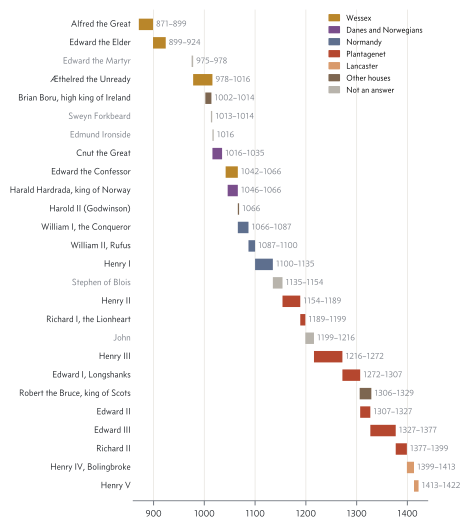
| King | House | Reign | Known for | Ch. |
|---|---|---|---|---|
| Alfred the Great | Wessex | 871–899 | Edington and Guthrum; the burhs; the Doom Book; the cakes (a legend) | 19 |
| Edward the Elder | Wessex | 899–924 | Alfred’s son; beat the Northumbrians at Tettenhall in 910 | 19 |
| Aethelred the Unready | Wessex | 978–1016 | “No counsel”; St. Brice’s Day; Maldon; the Danegeld; Edmund Ironside’s father | 19 |
| Brian Boru | High king of Ireland | 1002–1014 | Killed in his tent at Clontarf, the battle his army won | 18 |
| Cnut the Great | Denmark | 1016–1035 | Sweyn’s son; Assandun; married Emma; the tide (a legend) | 19 |
| Edward the Confessor | Wessex | 1042–1066 | Rebuilt Westminster Abbey; died childless | 21 |
| Harald Hardrada | Norway | 1046–1066 | “Hard ruler”; killed at Stamford Bridge | 21 |
| Harold Godwinson | Godwin’s son | 1066 | Won at Stamford Bridge; killed at Hastings | 21 |
| Harold | A name | Two kings of the name met at Stamford Bridge; Harald Greycloak | 18, 21 |
Alfred the Great. King of Wessex from 871 to 899, the only English-born king called “the Great.” Surprised at Chippenham in 878, he hid in the marshes at Athelney, and in May Alfred defeated Guthrum at Edington,This king of Wessex defeated Guthrum at the Battle of Edington. → Alfred the Great••• then stood godfather at his baptism. The story that he lets the peasant woman’s cakes burnAccording to legend, this ruler let a peasant woman’s cakes burn. → Alfred the Great•• was first written down about a hundred years after his death. He built the burhs, and he compiled the Doom Book from earlier laws,This ruler compiled the Doom Book using earlier laws of Æthelberht of Kent and Offa of Mercia. → Alfred the Great••• a code not to be confused with Domesday Book. Taught in Chapter 19.
Edward the Elder. Alfred’s son, king of Wessex from 899 to 924, who with his sister Æthelflæd, the Lady of the Mercians, won back the Danish Midlands. On August 5, 910, Edward’s West Saxons and their Mercian alliesForces of this king and his Mercian allies defeated the Northumbrians at Tettenhall. → Edward the Elder• beat the Northumbrians at Tettenhall, where three Danish kings died. He is the first of the seven Edwards set apart in the box at the end of the next group. Taught in Chapter 19.
Aethelred the Unready. Æthelred II, king from 978 to 1016, whose nickname, Old English unræd, means “no counsel.” When Edward the Martyr was murdered at Corfe in 978, his half-brother ÆthelredThis ruler's half-brother was Edward the Martyr. → Aethelred the Unready• became king at about ten. He paid the Danegeld, and on November 13, 1002, Æthelred ordered the massacre of DanesThis ruler ordered the massacre of Danes on St. Brice's Day. → Aethelred the Unready•• living among the English. Sweyn Forkbeard drove him from his throne in 1013. Of his sons the bravest was his son Edmund, later called Ironside.This ruler's son was Edmund Ironside. → Aethelred the Unready•• Taught in Chapter 19.
Brian Boru. The king of Munster who in 1002 became high king of all Ireland, the first in centuries not of the Uí Néill. On Good Friday 1014 Brian’s army won the day at ClontarfThis Irish high king’s army defeated a coalition of Leinster and Viking forces at Clontarf, where he was killed. → Brian Boru••• against Leinster and its Viking allies, but he was killed in his tent. Taught in Chapter 18.
Cnut the Great. A Dane, the son of Sweyn Forkbeard,This ruler was the son of Sweyn Forkbeard. → Cnut the Great•• who beat Edmund Ironside at Assandun in 1016 and ruled England until 1035, and Denmark and Norway as well. He married Æthelred’s widow, Emma. Henry of Huntingdon, about 1130, tells how he commanded the rising seaThis ruler legendarily commanded the tide to spare his robes to show his power was inferior to God’s. → Cnut the Great•• not to wet his robes, to show his courtiers that a king’s power was nothing beside God’s. Taught in Chapter 19.
Edward the Confessor. Æthelred’s son by Emma, king from 1042 to 1066, remembered for his piety. From about 1050 Edward rebuilt Westminster AbbeyThis ruler rebuilt Westminster Abbey in the Romanesque style. → Edward the Confessor•• in the new Romanesque style as his burial church. He died childless on January 5, 1066, and three men claimed his crown. Taught in Chapter 21.
Harald Hardrada. The king of Norway from 1046, who had commanded the Byzantine emperor’s Varangian Guard. His Old Norse byname, harðráði, means “hard ruler”.This Norwegian king’s epithet means “hard ruler.” → Harald Hardrada• He invaded England in September 1066 in alliance with Harold Godwinson’s exiled brother: Harald Hardrada and TostigThis king allied with Tostig at the Battle of Stamford Bridge. → Harald Hardrada•• won at Fulford and died together at Stamford Bridge. Taught in Chapter 21.
Harold Godwinson (or Harold II). The son of Earl Godwin and the last Anglo-Saxon king, who had no royal blood. Snorri says that before Stamford Bridge Harold offered Hardrada only “seven feet of English ground”,According to tradition, this ruler offered Harald Hardrada “seven feet of earth” before Stamford Bridge. → Harold Godwinson (or Harold II)• room for a grave. He won that battle, and less than three weeks later William had defeated and killed HaroldThis English king was defeated by William the Conqueror at Hastings. → Harold Godwinson (or Harold II)•• at Hastings. Taught in Chapter 21.
Harold. A name, not a person, spelled Harald in Norse. A clue that asks “this name” wants this answer, as when two kings named Harold faced each otherTwo kings with this name fought each other at the Battle of Stamford Bridge. → Harold•• at Stamford Bridge in 1066. Two Norwegian kings shared it earlier, for Harald Greycloak, king in the 960s, shared his grandfather’s name,A Norwegian king surnamed Greycloak shared this name, also spelled Harald, with his grandfather Fairhair. → Harold• Harald Fairhair. Taught in Chapter 18 and Chapter 21.
Kings from the Conquest to Agincourt
Fourteen answers are twelve of the kings of England from William the Conqueror to Henry V, one king of Scotland, and the name Edward (Table A.12). Apart from Stephen of Blois, who is not an answer, three houses held the English crown: the Normans, the Angevins or Plantagenets, who began with Henry II, and the Lancastrians, a branch of the Plantagenets. The ordinals repeat, so learn each king’s numeral with one fact: Henry I lost his son in the White Ship, Henry II quarreled with Becket, Henry III gave way to the barons at Oxford, Henry IV was Bolingbroke, and Henry V won at Agincourt. The three Edwards ruled one after another, father, son, and grandson: Edward I hammered the Scots, Edward II lost to them at Bannockburn, and Edward III began the Hundred Years’ War.
| King | House | Reign | Known for | Ch. |
|---|---|---|---|---|
| William the Conqueror | Normandy | 1066–1087 | Hastings; crowned on Christmas Day; the Harrying of the North; Domesday Book | 21 |
| William II | Normandy | 1087–1100 | Rufus; killed hunting in the New Forest | 22 |
| Henry I | Normandy | 1100–1135 | His heir drowned in the White Ship; Stephen of Blois succeeded him | 22 |
| Henry II | Anjou, the first Plantagenet | 1154–1189 | Married Eleanor of Aquitaine; Becket; the Assize of Clarendon; the justices in eyre | 22 |
| Richard I | Anjou | 1189–1199 | The Lionheart; the Third Crusade; held by the Emperor Henry VI | 22 |
| Henry III | Plantagenet | 1216–1272 | The Provisions of Oxford; the Second Barons’ War | 26 |
| Edward I | Plantagenet | 1272–1307 | Longshanks; conquered Wales; expelled the Jews; Hammer of the Scots | 26, 27 |
| Robert the Bruce | Bruce, king of Scots | 1306–1329 | Killed Comyn; the spider (a legend); Bannockburn | 27 |
| Edward II | Plantagenet | 1307–1327 | Piers Gaveston; lost Bannockburn; deposed | 27 |
| Edward III | Plantagenet | 1327–1377 | Hanged Mortimer; began the Hundred Years’ War; the Statute of Labourers | 28 |
| Richard II | Plantagenet | 1377–1399 | Fourteen at the Peasants’ Revolt; deposed by Bolingbroke | 28 |
| Henry IV | Lancaster | 1399–1413 | Bolingbroke; Glyndŵr; Shrewsbury; died in the Jerusalem Chamber | 31 |
| Henry V | Lancaster | 1413–1422 | The Southampton Plot; Agincourt; the Treaty of Troyes | 31 |
| Edward | A name | Edward II’s father; the Black Prince | 27, 28 |
William the Conqueror. Duke of Normandy from 1035 and king of England from 1066 to 1087. Born at Falaise about 1028, William was the illegitimate son of Robert I and Herleva,This ruler was the illegitimate son of Robert I and his mistress Herleva. → William the Conqueror• a townsman’s daughter. As a young duke with King Henry’s help William won at Val-ès-DunesWith help from Henry I of France, this ruler defeated rebels at Val-ès-Dunes. → William the Conqueror• in 1047; this Henry was Henry I of France. He beat Harold at Hastings, was crowned on Christmas Day 1066, harried the North, and at Christmas 1085 William commissioned the Domesday Book,This ruler commissioned the Domesday Book. → William the Conqueror••• the survey made the next year. Taught in Chapter 21.
William II of England. The Conqueror’s son, king from 1087 to 1100, called Rufus, “the red,” probably for his ruddy face. On August 2, 1100, William Rufus was killed while huntingThis ruler died while hunting in the New Forest, traditionally said to have been shot by Walter Tirel. → William II of England•• in the New Forest, by tradition shot by Walter Tirel, and his younger brother Henry rode to Winchester to seize the treasury. Taught in Chapter 22.
Henry I of England. Rufus’s younger brother, called Beauclerc, king from 1100 to 1135, who lost his only legitimate son, William Adelin, in the wreck of the White Ship in 1120. He made his barons swear to accept his daughter Matilda, but Stephen of Blois was crownedStephen of Blois succeeded this ruler. → Henry I of England• as Henry I’s successor, and civil war followed. Taught in Chapter 22.
Henry II. Matilda’s son, count of Anjou and duke of Normandy, king from 1154 to 1189. Henry married Eleanor after the annulmentThis ruler married Eleanor of Aquitaine after her marriage to Louis VII was annulled. → Henry II• of her marriage to Louis VII of France, and Aquitaine came with her, so that Henry was the first ruler of the Angevin Empire,This ruler was the first ruler of the Angevin Empire. → Henry II•• from the Scottish border to the Pyrenees. He reformed the law, and he quarreled with Thomas Becket; in the legend everyone now knows, Henry asked whether no one would rid himAccording to legend, this ruler asked "Will no one rid me of this turbulent priest?" referring to Thomas Becket. → Henry II•• of the turbulent priest. Taught in Chapter 22.
Richard I. Henry II’s son, king from 1189 to 1199. Richard was nicknamed the LionheartThis ruler was nicknamed “Lionheart.” → Richard I•• for his courage in battle. On the Third Crusade he took Cyprus, and Richard defeated Saladin at Arsuf,This ruler defeated Saladin at the Battle of Arsuf. → Richard I•• but he failed to retake Jerusalem. On his way home Leopold of Austria captured the king,Leopold of Austria captured this king returning from the Third Crusade and transferred him to Emperor Henry VI’s custody. → Richard I••• and the Emperor Henry VI held him for a huge ransom. He died of a crossbow wound in 1199. Taught in Chapter 22.
Henry III of England. King John’s son, who came to the throne at nine in 1216 and reigned fifty-six years. Deep in debt and beaten in Wales, in 1258 Henry accepted the Provisions of Oxford,Barons forced this ruler to accept the Provisions of Oxford. → Henry III of England• which put the government in the hands of a council. The Second Barons’ War followed, and his son Edward beat Simon de Montfort at Evesham. Taught in Chapter 26.
Edward I. Henry III’s son, king from 1272 to 1307, six feet two inches tall, so that men called him Longshanks.This ruler was known as "Longshanks." → Edward I••• He married Eleanor of Castile, and after Llywelyn’s death in 1282 Edward had conquered Wales.This ruler conquered Wales after defeating Llywelyn ap Gruffudd, known as Llywelyn the Last. → Edward I•• He expelled the Jews in 1290. In Scotland he took the Stone of Destiny and won at Falkirk, and his tomb’s later inscription calls him Edward I, the Hammer of the Scots.This ruler was known as "the Hammer of the Scots." → Edward I•• Taught in Chapter 26 and Chapter 27.
Robert the Bruce. Robert I, king of Scots from 1306 to 1329. He killed his rival John Comyn at Dumfries and was excommunicated for it, then claimed the crown. About two miles south of Stirling Castle Bruce defeated Edward II at BannockburnThis king defeated Edward II at the Battle of Bannockburn. → Robert the Bruce••• in 1314, and in 1328 the Treaty of Northampton recognized his kingdom. In the tale of the spider, first written in Walter Scott’s Tales of a Grandfather (1828), a spider’s persistence encouraged Bruce to fight on.According to legend, watching a spider persist in spinning a web encouraged this ruler to keep fighting. → Robert the Bruce•• Taught in Chapter 27.
Edward II. Edward I’s son, king from 1307 to 1327. The barons hated Piers Gaveston, the king’s favorite,Piers Gaveston was this ruler’s favorite and possible lover. → Edward II•• and killed him. In 1314 Bruce defeated Edward II at Bannockburn,Robert the Bruce defeated this king at Bannockburn. → Edward II•• and in 1327 he was forced to give up the crown to his son. Taught in Chapter 27.
Edward III. Edward II’s son, king from 1327 to 1377. At seventeen he seized power from his mother’s ally, and Edward had Mortimer hanged at TyburnThis ruler executed Roger Mortimer. → Edward III• in 1330. When the French king declared his duchy in France forfeit in 1337, the quarrel began the war later called the Hundred Years’ War.The Hundred Years’ War began during this ruler’s reign. → Edward III• The Black Death struck in his reign. Taught in Chapter 28.
Richard II. The Black Prince’s son and Edward III’s grandson, king from 1377 to 1399. He faced the rebels of 1381 at fourteen, and in 1399 Henry Bolingbroke deposed RichardHenry Bolingbroke deposed this ruler and became Henry IV. → Richard II•• and took the crown. Taught in Chapter 28.
Henry IV of England. John of Gaunt’s son and Richard II’s cousin, who succeeded him as king from 1399 to 1413, the first king of the house of Lancaster. From his birthplace, Bolingbroke Castle in Lincolnshire, he is known as Henry Bolingbroke.This ruler was known as Bolingbroke. → Henry IV of England• As king he faced risings on every side, and Henry IV marched against Glyndŵr’s revoltThis king fought Owain Glyndŵr’s revolt in Wales. → Henry IV of England•• in Wales year after year. On July 21, 1403, the king crushed Hotspur’s rebellion at Shrewsbury,This king defeated Harry Hotspur’s rebellion at Shrewsbury. → Henry IV of England•• and he died in the Jerusalem Chamber at Westminster. Taught in Chapter 28 and Chapter 31.
Henry V. Henry IV’s son, king from 1413 to 1422. Before he sailed for France he broke the Southampton Plot to crown Edmund Mortimer.The Southampton Plot aimed to replace this monarch with Edmund Mortimer. → Henry V• He took Harfleur, and on October 25, 1415, Henry had won the battle of Agincourt.This monarch won the Battle of Agincourt. → Henry V••• Five years later, in 1420, he married Catherine of Valois and became heir to France by the Treaty of Troyes with Charles VI.This monarch signed the Treaty of Troyes to secure his claim to the French throne. → Henry V•• He died two years later, leaving a baby son. Taught in Chapter 31.
Edward. A name, not a person, borne by more than a dozen men in this volume, seven of whom the box below sets apart. A clue that asks for the name wants this answer, as when it notes that the king who lost Bannockburn, Edward II, bore his father’s name,The king of this name who lost the Battle of Bannockburn had a father of the same name. → Edward• or that the Black Prince, Edward III’s eldest son, was a prince also named Edward.The prince nicknamed “the Black Prince” had this first name. → Edward• Taught in Chapter 27 and Chapter 28.
Battles, revolts, and disasters
Nine answers are battles, a revolt and its two leaders, a plague, and a shipwreck (Table A.13). Two pairs are easy to cross. Stamford Bridge and Hastings were fought less than three weeks apart in 1066, by the same English king against two different invaders. Stirling Bridge and Bannockburn were both Scottish victories near Stirling, seventeen years apart, the first Wallace’s and the second Bruce’s. A battle clue that names a commander, a weapon, or a trick of the ground usually settles which.
| Answer | Date | Place | Who, and what happened | Ch. |
|---|---|---|---|---|
| Battle of Stamford Bridge | September 25, 1066 | Near York | Harold Godwinson killed Harald Hardrada and Tostig | 21 |
| Battle of Hastings | October 14, 1066 | Senlac, in Sussex | William of Normandy killed Harold; the Norman Conquest | 21 |
| White Ship disaster | November 25, 1120 | Off Barfleur, Normandy | Henry I’s heir, William Adelin, drowned | 22 |
| Battle of Stirling Bridge | September 11, 1297 | The Forth at Stirling | Wallace beat Warenne’s English army | 27 |
| Battle of Bannockburn | June 1314 | Near Stirling | Robert the Bruce beat Edward II | 27 |
| Black Death | 1348–1349 in England | All of Europe | Killed perhaps half the people; wages and the Statute of Labourers | 28 |
| Peasants’ Revolt | May–June 1381 | Essex, Kent, and London | Rebels against the poll tax and Richard II’s ministers | 28 |
| Wat Tyler | Killed June 15, 1381 | Smithfield | The rebels’ leader, struck down by the mayor | 28 |
| John Ball | 1381 | Blackheath | The priest of “When Adam delved” | 28 |
Battle of Stamford Bridge. The battle near York on September 25, 1066, where Harold had destroyed Harald Hardrada and Tostig together.Harold Godwinson defeated Harald Hardrada and Tostig at this battle. → Battle of Stamford Bridge•• A later addition to the Anglo-Saxon Chronicle tells of one Norwegian who held the bridge alone, and about 1130 Henry of Huntingdon added the axe and the more than forty men he killed.A single axeman reportedly held off the English army at this battle, killing forty men on a bridge. → Battle of Stamford Bridge• Taught in Chapter 21.
Battle of Hastings. The battle of October 14, 1066, fought on the hill that Orderic Vitalis called Senlac, about seven miles from Hastings. Hastings brought about the Norman Conquest,This battle resulted in the Norman Conquest of England. → Battle of Hastings•• the taking of England by a foreign duke and his followers. Three days after Stamford Bridge William’s army landed unopposed at Pevensey,This battle's winning side landed at Pevensey. → Battle of Hastings•• and Harold’s housecarls and fyrd held a shield wall on the ridge until Harold fell. The Bayeux Tapestry tells the Battle of HastingsThe Bayeux Tapestry depicts this battle. → Battle of Hastings••• in a strip of cloth about 230 feet long. Taught in Chapter 21.
White Ship disaster. The wreck of the newest ship in the harbor at Barfleur, which struck a rock leaving port on the night of November 25, 1120, with a drunken crew. William Adelin drowned in the White Ship,William Adelin, Henry I’s son and heir, drowned in this maritime disaster. → White Ship disaster•• and with him Henry’s hope of a son to succeed him. Taught in Chapter 22.
Battle of Stirling Bridge. William Wallace’s victory of September 11, 1297, where the English army crossed the Forth by a narrow wooden bridge and the Scots fell on the men who had crossed before the rest could follow. Wallace defeated King Edward’s army at Stirling Bridge,William Wallace defeated an English army at this 1297 battle at a crossing of the River Forth. → Battle of Stirling Bridge• and the treasurer Cressingham was killed. Taught in Chapter 27.
Battle of Bannockburn. Robert the Bruce’s victory of June 1314 near Stirling Castle, against an English army come to relieve it. John Barbour’s poem tells that Bruce had pits dug near Stirling,Robert the Bruce prepared pits near Stirling Castle before this Scottish victory over Edward II. → Battle of Bannockburn•• covered with sticks and turf, to break the English horses’ legs, and the Scottish schiltrons drove the English into the burn. Taught in Chapter 27.
Black Death. The plague that reached England in June 1348 and killed perhaps half the people. So many laborers died that wages rose, and Parliament tried to hold them down with the Statute of LabourersLabor shortages after this pandemic prompted England’s Ordinance and Statute of Labourers to restrict wages. → Black Death•• of 1351. Its aftermath fed the revolt of 1381. Taught in Chapter 28.
Peasants’ Revolt. The great rising of 1381 in Essex, Kent, and London, sparked by a poll-tax inquiry at Brentwood in Essex.This revolt was sparked by attempts to collect a poll tax, including John Bampton’s investigation in Essex. → Peasants' Revolt•• The rebels wrecked the Savoy, dragged Archbishop Sudbury, the chancellor, out of the Tower and beheaded him, and met the king, Richard II, fourteen years old,Richard II was fourteen when this English revolt broke out against his government in 1381. → Peasants' Revolt••• at Mile End and Smithfield. The king’s promises at Mile EndAn agreement meant to end this event was made at Mile End. → Peasants' Revolt• sent many of the Essex men home. Taught in Chapter 28.
Wat Tyler. The leader of the rebels of 1381, of whom almost nothing is known before that week. At Smithfield on June 15 he spoke roughly to the king, and the mayor of London, William Walworth, struck Tyler downWilliam Walworth struck down this leader of the Peasants’ Revolt at Smithfield after an attendant called him “the greatest thief and robber in all Kent.” → Wat Tyler•• while a squire ran him through. Taught in Chapter 28.
John Ball. The wandering priest of the revolt, whom the archbishop had imprisoned more than once for preaching that all men were equal before God. At Blackheath, the chronicler Thomas Walsingham tells, John Ball preached on an old rhymeThis priest associated with the Peasants’ Revolt preached “When Adam delved and Eve span, who was then the gentleman?” → John Ball•• that asked who was the gentleman when Adam “delved” and Eve “span,” when Adam dug and Eve spun. Taught in Chapter 28.
Charters, treaties, and the business of the realm
Twelve answers are the laws, charters, and treaties of the kingdoms of the north, and the groups and trades they governed (Table A.14). Three are English documents of the eleventh to thirteenth centuries; two are unions or alliances; one is the assembly of Iceland. The rest are plain answers whose clues name a law or a custom: the barons of Magna Carta, the Jews whom Edward I expelled, the wool that made England rich, the hunting the Royal Forests protected. Domesday Book is easy to confuse with Alfred’s Doom Book, a code of laws nearly two hundred years older.
| Answer | Date | What, and what clues ask | Ch. |
|---|---|---|---|
| Althing | 930 | Iceland’s assembly at Thingvellir; the lawspeaker; “the oldest parliament” | 20 |
| Domesday Book | 1086 | William I’s survey of every landholder in England | 21 |
| hunting | William Rufus died at it; the Royal Forests protected it | 22 | |
| Magna Carta | 1215 | Sealed by John at Runnymede; Stephen Langton; annulled by Innocent III; reissued 1217 | 26 |
| barons | 1215–1217 | Granted rights by Magna Carta; routed at Lincoln by William Marshal | 26 |
| fishing | 1215 | Magna Carta removed the fishing weirs from the rivers | 26 |
| Charter of the Forest | 1217 | Ended death and mutilation for taking the king’s deer | 26 |
| Jews | 1290 | Expelled from England by Edward I’s Edict of Expulsion | 26 |
| coronations | Scottish kings were enthroned on the Stone of Scone | 27 | |
| wool | England’s great export: the Woolsack, the wool churches, the Great Custom, owling | 28 | |
| Treaty of Windsor | 1386 | England’s lasting alliance with Portugal | 28 |
| Kalmar Union | 1397 | Margaret I joined Denmark, Norway, and Sweden | 20 |
Althing. The assembly of Iceland’s chieftains, founded in 930, which met at ThingvellirThis assembly originally met at Thingvellir. → Althing•• each summer for more than eight hundred years, with the lawspeaker presiding. The Althing is often called the world’s oldest parliament,Founded in Iceland in 930, this assembly is often called the world’s oldest parliament. → Althing•• though the title is only half true. Taught in Chapter 20.
Domesday Book. William the Conqueror’s great survey of 1086. William commissioned the Domesday Book,William the Conqueror commissioned this survey of landholders, their lands, and taxes owed. → Domesday Book•• a record of every landholder in England, the land each held, and what it was worth. It is not Alfred’s Doom Book, his code of laws of about 893. Taught in Chapter 21.
hunting. The sport of kings, which the Normans guarded with harsh laws. The Royal Forests existed to protect hunting,Royal Forests were established to protect this activity. → hunting• the king’s above all, and William Rufus died at it in the New Forest. Taught in Chapter 22.
Magna Carta. The “Great Charter” of liberties that John sealed at RunnymedeKing John sealed this document at Runnymede in 1215. → Magna Carta••• on June 15, 1215, after his defeat at Bouvines left him without money or army. Archbishop Langton helped shape the barons’ demandsArchbishop Stephen Langton helped shape the demands embodied in this document. → Magna Carta•• into the charter. Within weeks Pope Innocent III declared it null and void forever,This document was declared "null, and void of all validity for ever" by Pope Innocent III. → Magna Carta•• but it was reissued in 1216, 1217, and 1225. Taught in Chapter 26.
barons. The great landholders who forced Magna Carta on King John; most of its clauses were rights granted to the baronsThese people were granted rights by the Magna Carta. → barons• and the knights who held land under them. In 1217 Marshal routed the rebel baronsThese people were defeated by William Marshal in battle. → barons• at Lincoln. Taught in Chapter 26.
fishing. One clue, from Magna Carta, whose thirty-third clause ordered all fishing weirs removed from the rivers,Magna Carta ordered the removal of weirs used for this activity from the Thames, Medway, and other English rivers. → fishing• the fences and traps that blocked boats on the Thames, the Medway, and every other river. Taught in Chapter 26.
Charter of the Forest. The companion to Magna Carta, issued in November 1217 by the government of William Marshal. It ended death and mutilation as punishmentsThis 1217 companion to Magna Carta abolished death or mutilation as penalties for taking royal deer. → Charter of the Forest• for taking the king’s deer. Taught in Chapter 26.
Jews. The Jewish communities of England, which had come from Rouen after the Norman Conquest. On July 18, 1290, Edward I issued the Edict of Expulsion against England’s Jews,England’s 1290 Edict of Expulsion targeted these people. → Jews•• and Jews could not live openly in England again until 1656. Taught in Chapter 26.
coronations. One clue, from Scotland, where Scottish kings were enthroned upon the StoneIn Scotland, these events typically took place on the Stone of Scone. → coronations• of Scone in the open air before their lords, until Edward I carried it off to Westminster in 1296. Taught in Chapter 27.
wool. The raw material that made medieval England rich, for English wool was the finest in Europe.The finest variety of this good was produced in England until the rise of the merino breed in Spain. → wool• Its export tax was the Great Custom; its merchants built the wool churches; smuggling it was “owling”; and to this day the Lord Speaker sits on the Woolsack.The Lord Speaker sits on a sack of this material. → wool•• Taught in Chapter 28.
Treaty of Windsor. The alliance of 1386 between England and Portugal. At Windsor Castle England and Portugal signed the Treaty of Windsor,John I of Portugal and England concluded this 1386 agreement, establishing an enduring alliance between the two kingdoms. → Treaty of Windsor•• promising perpetual friendship, and the next year John I of Portugal married John of Gaunt’s daughter Philippa. Taught in Chapter 28.
Kalmar Union. The union of the three Scandinavian kingdoms, made at Kalmar in Sweden in 1397, where Margaret I united Denmark, Norway, and SwedenMargaret I united Denmark, Norway and Sweden in this 1397 union. → Kalmar Union•• and had her great-nephew, Eric of Pomerania, crowned king of all three. Taught in Chapter 20.
Vikings, Celts, and buried ships
Nine answers are peoples of the north and the things archaeologists have dug from its ground (Table A.15). The Celts and the Vikings are answers as peoples, and their clues gather customs: the druids and the wicker men for the one, longships, berserkers, and the Danegeld for the other. Two great ship burials are easy to confuse, because both were dug up in the twentieth century and both were rich graves of great people, perhaps of a king and a queen. Sutton Hoo is Anglo-Saxon, in Suffolk, and famous for a helmet; Oseberg is Norwegian and famous for its carved animal heads. Skara Brae, older than either by more than three thousand years, is a whole village of stone.
| Answer | When | Where | Known for | Ch. |
|---|---|---|---|---|
| Skara Brae | Neolithic | Orkney | A stone village bared by a storm in 1850; dug by V. Gordon Childe; “Scotland’s Pompeii” | 16 |
| Celts | Britain and Ireland | Druids, their priests; Caesar’s wicker men; languages still spoken in Wales and Ireland | 16 | |
| Sutton Hoo | About 624 | Suffolk | A ship burial with a famous helmet; probably King Rædwald’s grave | 16 |
| Lindisfarne | 793 | Northumbria | The monastery whose sacking began the Viking Age | 18 |
| Vikings | 793–1066 | From Scandinavia | Longships; berserkers; the Varangian Guard; the Danegeld; no horned helmets | 18–20 |
| ships | Longships, knarrs, karves, and faerings; ship burials; the Rus funeral Ibn Fadlan saw | 18 | ||
| clinker construction | Hull planks that overlap like clapboards | 18 | ||
| Oseberg ship | Buried 834 | Southern Norway | Dug out in 1904; carved posts with animal heads; two women buried in it | 18 |
| Leif Erikson | About 1000 | Born in Iceland | Erik the Red’s son, who sailed to Vinland | 20 |
Skara Brae. A village of stone houses in Orkney, built in the Neolithic, the New Stone Age, and buried under sand until a great storm bared it in 1850. Because the sand kept even the furniture in place, the village Gordon Childe excavated is sometimes called Scotland’s Pompeii.V. Gordon Childe excavated this Neolithic settlement in Orkney, sometimes called Scotland’s “Pompeii,” where Skaill knives and Grooved Ware pottery were found. → Skara Brae•• It belongs to the Heart of Neolithic Orkney, with the Ring of Brodgar. Taught in Chapter 16.
Celts. The peoples whose languages, all of one family, were spoken across Britain and Ireland before the Romans came. Above all the druids were the Celts’ priests.Druids were the priests of these people. → Celts• Julius Caesar wrote that some Celts sacrificed men by burning themThese people practiced human sacrifice by burning so-called "wicker men," according to Julius Caesar. → Celts• inside huge figures woven of willow, the “wicker men,” though no trace of such a burning has been found. Their languages are still spoken in Wales and Ireland. Taught in Chapter 16.
Sutton Hoo. The burial mounds above the river Deben in Suffolk where, in May 1939, the excavator Basil Brown found rows of iron rivets in the sand, the outline of a buried ship. Most writers have taken the ship burial at Sutton HooThis Anglo-Saxon site yielded a famous helmet and a ship burial often associated with King Rædwald of East Anglia. → Sutton Hoo•• to be the grave of Rædwald, king of East Anglia, who died about 624. Its treasure includes a famous helmet with a face mask. Taught in Chapter 16.
Lindisfarne. The island monastery off the coast of Northumbria, founded by Aidan about 634. In 793 raiders from the sea killed the monks of Lindisfarne,Vikings killed monks when they raided this Christian monastery in 793. → Lindisfarne•• and historians date the start of the Viking Age from that raid. Taught in Chapter 18.
Vikings. The seafaring raiders, traders, and settlers from Scandinavia, from the raid on Lindisfarne in 793 to 1066. Their warriors included berserkers, and in Constantinople the emperors kept the Varangian GuardThese people served as the Varangian Guard, bodyguards to the Byzantine emperor. → Vikings•• of Norsemen. Despite the costumes, Vikings did not wear horned helmets.These people did not actually wear horned helmets. → Vikings•• In the west they colonized Iceland and Greenland, and Erik the Red became one of the Viking Age’s great explorers.Erik the Red was an explorer among these people. → Vikings•• Taught in Chapter 18, Chapter 19, and Chapter 20.
ships. The Vikings’ great tool, in war, trade, and death. For raids and for invasions the Vikings used long ships,The Vikings used "long" types of these objects for raiding and invasions. → ships•• with one square sail and a row of oars along each side, and sailed cargo in knarrs. Great men and women were buried or burned in ships, and in 922 the Arab envoy Ibn Fadlan watched the Rus funeralIbn Fadlan wrote about a Viking funeral involving one of these objects. → ships• of a chief, burned in his ship. Baldr’s pyre was his ship, Hringhorni. Taught in Chapter 3, Chapter 8, and Chapter 18.
clinker construction. The Norse way of building a hull from the keel up, with each plank overlapping the one below,In this method of building wooden ship hulls, the edges of planks overlap. → clinker construction•• like the boards on a clapboard house, and riveted through. Taught in Chapter 18.
Oseberg ship. A karve of oak 71 feet long, buried with two women in a mound near the mouth of Oslo Fjord in 834 and dug out in 1904. With it lay a cart, sleighs, and five wooden posts carved with animal heads.This well-preserved Viking burial ship was found with carved wooden animal-head posts. → Oseberg ship•• Unlike Sutton Hoo, the wood itself survived. Taught in Chapter 18.
Leif Erikson. Erik the Red’s son, born in Iceland, who bought another man’s ship and led the voyage west about the year 1000This Iceland-born Norse explorer led voyages to Vinland in North America around 1000. → Leif Erikson••• that reached Vinland, in North America. L’Anse aux Meadows, in Newfoundland, is the only proven Norse site in America outside Greenland. Taught in Chapter 20.
Lands, cities, and sites
Sixteen answers are places: countries and islands, cities, a sea, and one stone circle (Table A.16). Their clues gather events from many centuries, so a clue for Scotland may name a Neolithic village, a medieval king, or a modern song. Most of the countries are named as they are today, and a clue that asks for “this country” wants today’s name even when the event is medieval. Figure A.6 shows the northern ones as they were about 1000. Two pairs of names cross the borders: two Margarets and two Erics, which the box at the end takes apart.
| Answer | Today | What clues ask | Ch. |
|---|---|---|---|
| Ireland | The Republic of Ireland and Northern Ireland | The Fomorians and the Tuatha Dé; the Lia Fáil; leprechauns, banshees, and geasa; Patrick; Brian Boru; Strongbow | 10 |
| Wales | Part of the United Kingdom | The Mabinogion, Pwyll, and Rhiannon; Offa’s Dyke; the Marcher lords; Llywelyn the Last; Rhuddlan; the Prince of Wales; the red dragon; Glyndŵr | 13, 26 |
| Scotland | Part of the United Kingdom | Neolithic Orkney; Balliol and the Great Cause; Wallace and Bruce; Arbroath; Scone; the saltire; kilts and bagpipes | 16, 27 |
| Cornwall | A county of England | King Mark’s kingdom | 24 |
| Iceland | Iceland | Irish hermits; the sagas; Snorri; the Old Covenant | 20 |
| Greenland | Part of the Kingdom of Denmark | Its Western, Middle, and Eastern Settlements | 20 |
| Newfoundland | Canada | L’Anse aux Meadows | 20 |
| Norway | Norway | The civil war of the Birkebeiner and the Bagler | 20 |
| Denmark | Denmark | The Jelling stones; the flag that fell from the sky in 1219 | 18, 20 |
| Finland | Finland | The Kalevala; Bishop Henry and Eric IX | 14, 20 |
| Dublin | Ireland | The Viking longphort of 841; the dark and fair foreigners | 18 |
| London | England | Westminster Abbey | 21 |
| Oxford | England | The oldest university; the Provisions of Oxford; the St. Scholastica’s Day riot | 26, 30 |
| Troy | Turkey | Geoffrey’s Brutus, founder of Britain, descended from its princes | 23 |
| North Sea | Crossed by the Viking raiders | 18 | |
| Stonehenge | England | Merlin brought its stones from Ireland, in Geoffrey’s story | 23 |
Ireland. The island of the Irish myths and of Saint Patrick. In the Book of Invasions six peoples took it in turn, and the Fomorians were already living in IrelandThis country was home to a supernatural race called the Fomorians. → Ireland•• before any of them. The Irish told voyage tales called immrama,Immrama are folk tales of sea voyages, often to the Otherworld, in the stories of this country. → Ireland•• of heroes rowing from one Otherworld island to the next, and by the late 600s the Irish remembered Saint Patrick as the man who Christianized Ireland,This country was Christianized by St. Patrick. → Ireland•• though there were Christians there before him. Taught in Chapter 10, Chapter 12, Chapter 16, Chapter 18, and Chapter 22.
Wales. The land of the Welsh, the Britons whom the English pushed west. Edward I conquered it after Llywelyn was killed near Orewin BridgeLlywelyn ap Gruffudd, called “the Last,” was a ruler of this country killed near the Battle of Orewin Bridge. → Wales•• in 1282, and since 1301 the title of Prince of Wales has gone to the English heir; today the heir is made Prince of WalesThe title of 'Prince' of this country is given to the heir apparent to the British throne. → Wales•• by the monarch. Owain Glyndŵr, who rose against Henry IV, was the last native Welshman to claim it.Owain Glyndŵr led a revolt and was the last native ruler to claim the title of Prince of this country. → Wales•• Its flag is a red dragon. Taught in Chapter 13, Chapter 26, and Chapter 31.
Scotland. The northern kingdom of Britain. When the little queen Margaret, the Maid of Norway, died in 1290, her death set off the Great Cause,The death of Margaret, Maid of Norway, sparked the succession dispute called the Great Cause in this country. → Scotland•• the lawsuit over who should be king. Its winner was John Balliol, whom the Scots mockedJohn Balliol, a king of this country, was mocked as “Toom Tabard,” or “empty coat.” → Scotland•• as “Toom Tabard,” an empty coat, and then came Wallace and Bruce. In 1320 a letter to the pope asserted the kingdom’s freedom: the Declaration of Arbroath.The 1320 Declaration of Arbroath asserted this country’s independence in a letter to Pope John XXII. → Scotland•• Taught in Chapter 15, Chapter 16, and Chapter 27.
Cornwall. The rocky peninsula at the southwest end of Britain, whose people, like the Welsh, still spoke a Celtic language in the Middle Ages. In the Tristan stories it is the kingdom of his uncle, King Mark of Cornwall.King Mark ruled this region. → Cornwall• Taught in Chapter 24.
Iceland. The island settled from Norway from about 870. Before the Norse came, Irish hermits whom the Norse called paparMedieval accounts describe Irish hermits called Papar living in this country before Norse settlement. → Iceland• lived there. Its people wrote hundreds of sagas in their own tongue, and at home in Iceland Snorri wrote the Prose EddaThe Prose Edda was written in this country. → Iceland•• about 1220. The Old Covenant of 1262 to 1264 brought it under the king of Norway. Taught in Chapter 20.
Greenland. The great island settled by Erik the Red about 985. Archaeologists, who have found the ruins of several hundred Norse farms, divide them into Western, Middle, and Eastern Settlements.Archaeologists divide sites on this island into Western, Middle, and Eastern Settlements. → Greenland• The last written record of the colony is a wedding at Hvalsey in September 1408, and the Norse farmers vanished later in the 1400s. Taught in Chapter 20.
Newfoundland. The island off eastern Canada where the Norse settlement at L’Anse aux MeadowsThis island’s Norse settlement at L’Anse aux Meadows is associated with the Vinland voyages described in sagas about Leif Erikson. → Newfoundland•• was found, the only proven Norse site in America outside Greenland, linked to the Vinland voyages of Leif Erikson’s family. Taught in Chapter 20.
Norway. The kingdom of the western Norse, made one by Harald Fairhair. In the late twelfth century, Norway’s civil war between the Birkebeiner and BaglerThis country experienced a civil war between the Birkebeiner and Bagler parties. → Norway• raged on past the death of King Sverre in 1202. Taught in Chapter 20.
Denmark. The kingdom of the southern Norse. At Jelling, King Gorm and his son Harald Bluetooth raised great runestones, and Denmark’s Jelling stones honor Queen Thyra.This country’s Jelling stones honor Gorm’s wife Thyra and commemorate Harald Bluetooth’s Christianization of the Danes. → Denmark•• In a legend first written down in the 1520s, the Danish flag, a white cross on red, fell from the sky at Lindanise in Estonia in 1219. Taught in Chapter 18 and Chapter 20.
Finland. The land of the Finns. The Kalevala is the national epic of Finland.The Kalevala is this country's national epic. → Finland• Tradition says Saint Eric IX of Sweden brought Bishop Henry there, and Henry stayed to Christianize Finland,Tradition says Bishop Henry accompanied Eric IX to Christianize this country and was killed there by Lalli. → Finland•• where a farmer named Lalli killed him. Taught in Chapter 14 and Chapter 20.
Dublin. The city that grew from a Viking ship-camp, a longphort, founded in 841. The Irish annals tell of “dark” and “fair” foreigners at Dublin,Annals describe “dark” and “fair” foreigners at this city, which developed around a Viking longphort established in 841. → Dublin•• two rival bands of Vikings fighting for it. Some historians identify Dublin’s king Ímar with Ivar the Boneless,This city’s king Ímar has sometimes been identified with Ivar the Boneless. → Dublin• a leader of the Great Army in England. Taught in Chapter 18.
London. The chief city of England, which long ago swallowed the village of Westminster, so that Westminster Abbey stands in London.This city is home to Westminster Abbey. → London•• Nearly every English king and queen since 1066 has been crowned there. Taught in Chapter 21.
Oxford. The town on the Thames with England’s oldest university,This city houses England’s oldest university, a traditional rival of Cambridge. → Oxford•• a guild of masters and students. Henry III accepted the Provisions of Oxford there in 1258, and on February 10, 1355, the St. Scholastica’s Day riotThe St. Scholastica's Day Riot occurred in this city. → Oxford•• began there, setting town against gown. Taught in Chapter 26 and Chapter 30.
Troy. The city of the Iliad and the Aeneid (Vol. 4, Classical Myth). Geoffrey of Monmouth made Brutus, the founder of Britain,Brutus, the mythical founder of Britain, was descended from a prince of this city. → Troy• the great-grandson of the Trojan Aeneas, so that every British king descended from a prince of Troy. Taught in Chapter 23.
North Sea. The sea between Britain and Scandinavia, the Vikings’ road west. Year after year Vikings crossed the North SeaThis sea was crossed by Vikings raiding the east coast of Britain. → North Sea• to raid the east coast of Britain. Taught in Chapter 18.
Stonehenge. The great stone circle on Salisbury Plain (Vol. 7, The Romans), built long before any of this volume’s stories. Geoffrey of Monmouth says that Merlin brought the stones from IrelandThis structure was thought to have been built by Merlin according to folklore. → Stonehenge• and raised them over the graves of murdered British lords. Taught in Chapter 23.
Beowulf and the Old English poems
Nine answers belong to the poetry of the Anglo-Saxons, written in Old English, the language of England before 1066 (Table A.17). Four of them come from Beowulf, and the commonest trap is between the poem and its hero, who share a name: listen for whether the clue asks for “this poem” or “this character.” The two monsters, Grendel and his mother, are told apart by what they do and by where and how Beowulf kills them. The other poems are short. “The Dream of the Rood” and “The Seafarer” survive in two of the four great Old English manuscripts, and “Cædmon’s Hymn” in the margins of copies of Bede’s History.
| Answer | What | Kept in, or told by | Known for | Ch. |
|---|---|---|---|---|
| Beowulf (the poem) | Epic poem | The Nowell Codex, the only copy | “Hwæt”; Scyld’s ship burial; Heorot; the Finnsburg story | 17 |
| Beowulf (the hero) | Hero of the Geats | Son of Ecgtheow; the swim with Breca; kills Grendel, his mother, and the dragon | 17 | |
| Grendel | Monster | Of Cain’s kin; raided Heorot twelve years; lost his arm | 17 | |
| Grendel’s mother | Monster | Carried off Æschere; killed in her hall under the lake | 17 | |
| Cædmon | Cowherd poet of Whitby | Bede | The first English poet known by name | 16 |
| “Cædmon’s Hymn” | Poem | Bede | Praise of the “guardian of heaven” | 16 |
| “The Dream of the Rood” | Dream poem | The Vercelli Book; part on the Ruthwell Cross | Told by the cross | 16 |
| “The Seafarer” | Elegy | The Exeter Book, about 970 | An old sailor’s feet bound by frost | 17 |
| Old English | Language | The language of Beowulf and the Exeter Book | 17 |
Beowulf (the poem). The longest and most famous Old English poem, an epic poem in Old English,This is an Old English epic poem. → Beowulf••• of more than three thousand lines, kept in a single manuscript, the Nowell Codex. The poem’s first word is Hwæt,This work begins with the word "Hwæt!" → Beowulf•• a call for silence in a noisy hall. It opens with the ship burial of Scyld Scefing and tells three fights, against Grendel, his mother, and a dragon. Inside it a singer tells the story of Finnsburg, where the Frisian king Finn was slain.This work includes a story about the defeat of the Frisian warrior Finn. → Beowulf• Taught in Chapter 17.
Beowulf (the hero). The poem’s hero, a prince of the Geats in southern Sweden, the hero of the Geats,This character is a hero of the Geats. → Beowulf••• whose father, Ecgtheow, had once been sheltered by the Danish king Hrothgar. He comes to Hrothgar’s hall, Heorot, tears off Grendel’s arm barehanded, and killed Grendel’s mother in her underwater hall.This character defeats a monster’s mother in an underwater lair. → Beowulf••• Fifty years later, a king himself, he dies killing a dragon, and only Wiglaf came to help him.Only Wiglaf stays to aid this character in his fatal dragon fight. → Beowulf••• Taught in Chapter 17.
Grendel. The first of the poem’s monsters, one of the kin of Cain,This character is described as a descendant of Cain. → Grendel••• the brother-killer of Genesis. Maddened by the noise of feasting, he raided Heorot by night, and for twelve years Grendel ruled Heorot,This character attacks Hrothgar’s mead-hall Heorot for twelve years. → Grendel••• until Grendel became the first of the three monsters to dieThis character is the first antagonist killed by Beowulf. → Grendel•• at Beowulf’s hands, his arm torn off at the shoulder. Taught in Chapter 17.
Grendel’s mother. The second monster, who lives in a hall at the bottom of a dark lake. To avenge her son she seized Æschere in his bed,This character abducts and decapitates Aeschere. → Grendel’s mother•• Hrothgar’s dearest counselor, and Beowulf followed her down into the water and killed her with a giant’s sword. A modern translation calls her a monstrous bride from hell.This character is described as a "monstrous hell-bride." → Grendel’s mother• Taught in Chapter 17.
Cædmon. The first English poet known by name, a cowherd at the abbey of Whitby who, Bede says, could not sing until a stranger in a dream told him to sing of the Creation. He sang verses he had never heard before, and Bede gives their sense: a hymn to the guardian of heaven.This illiterate cowherd composed the hymn beginning with praise of the "guardian of heaven." → Cædmon•• Taught in Chapter 16.
Cædmon’s Hymn. The short poem that Bede says Cædmon sang in his dream, the first poem in English by a poet whose name we know. In the Old English, the hymn opens by praisingThis poem opens by honoring the "guardian of heaven." → "Cædmon’s Hymn"•• the guardian of heaven, who made heaven as a roof for the children of men. Taught in Chapter 16.
The Dream of the Rood. An Old English dream poem in which the dreamer sees the cross, the “rood,” covered in gold and jewels and wet with blood, and most of the poem is told by the gem-covered cross itself.This poem is narrated from the point of view of a gem-laden cross. → "The Dream of the Rood"•• The Vercelli Book preserves the poem,This poem is preserved in the Vercelli Book. → "The Dream of the Rood"•• and part of it is carved in runes on the Ruthwell Cross. Taught in Chapter 16.
The Seafarer. An Old English elegy, a poem of loss and exile, in the Exeter Book of about 970, in which a sailor tells of the hardships of life at sea. On winter watches his feet were bound by frost.In this poem, the speaker's feet are benumbed by frost. → "The Seafarer"• Taught in Chapter 17.
Old English. The language of the Anglo-Saxons, from their coming in the fifth century to about 1100, the ancestor of the English spoken today. The Exeter Book’s poems are in Old English,This language was used for the poems of the Exeter Book. → Old English• and so is Beowulf. Taught in Chapter 17.
Sagas, epics, and books of myth
Five answers are four books that preserve the myths of this volume and the man who wrote a fifth (Table A.18). Each belongs to one people and one language, and the book’s date matters, because some were compiled centuries after the stories were first told and two were made in the nineteenth century, one stitched together from folk songs and one written from folk legend. Saxo Grammaticus, the Danish historian, wrote in Latin. The Welsh tales owe the name Mabinogion to a scribe’s slip, which William Owen Pughe used as a title in 1795 and Lady Charlotte Guest’s translation made familiar. Lönnrot’s Kalevala and Pumpurs’s Lāčplēsis are national epics built in the age of nations.
| Answer | Made by | Language | Date | Known for | Ch. |
|---|---|---|---|---|---|
| Book of Invasions | Unknown compilers | Irish | Eleventh century | Six peoples take Ireland | 10 |
| Saxo Grammaticus | Danish clerk | Latin | Gesta Danorum, finished about 1210 | Lagertha, Amleth, Starkad, and Saxo’s Balder | 20 |
| Mabinogion | Unknown tellers; the name made familiar by Lady Charlotte Guest | Welsh | Manuscripts about 1350 and 1400; translated 1838–1845 | The Four Branches; “Culhwch and Olwen” | 13 |
| Kalevala | Elias Lönnrot | Finnish | 1835; enlarged 1849 | Finland’s national epic | 14 |
| Lāčplēsis | Andrejs Pumpurs | Latvian | 1888 | The Bear-slayer | 14 |
Book of Invasions. The Lebor Gabála Érenn, “the Book of the Taking of Ireland,” compiled in the eleventh century. It tells of six peoples who took IrelandThis work recounts Ireland’s settlement by groups including Cessair’s followers, Partholon, Nemed, and the Milesians. → Book of Invasions•• one after another: Cessair’s followers, Partholón’s, and Nemed’s, the Fir Bolg, the Tuatha Dé Danann, and the Milesians, from whom the Irish descend. Taught in Chapter 10.
Saxo Grammaticus. The Danish clerk who wrote for Archbishop Absalon of Lund. Saxo wrote the Gesta Danorum,This Danish historian wrote Gesta Danorum. → Saxo Grammaticus• the “Deeds of the Danes,” in sixteen books of Latin so learned that he was nicknamed Grammaticus. Among its heroes Saxo tells of the warrior woman Lagertha,This Danish historian recounted the exploits of the warrior woman Lagertha. → Saxo Grammaticus• and his Baldr and Starkad differ from the Icelanders’, while his Amleth became Shakespeare’s Hamlet (Vol. 11, The Age of Shakespeare). Taught in Chapter 20.
Mabinogion. Eleven Welsh tales kept in the White Book of Rhydderch, of about 1350, and the Red Book of Hergest, of about 1400. Lady Charlotte Guest translated the talesLady Charlotte Guest translated this collection into English. → Mabinogion•• into English between 1838 and 1845, and her book made the collection’s name familiar. Its heart is the Four Branches of the Mabinogi, and Pryderi appears in every branch.This collection includes the Four Branches of the Mabinogi, all of which feature Pryderi. → Mabinogion•• Taught in Chapter 13.
Kalevala. Finland’s national epic, which Elias Lönnrot made from the songs of Karelian singers: the Old Kalevala of 1835, and the New of 1849, fifty runos compiled by Elias Lönnrot.This work was compiled by Elias Lönnrot. → Kalevala•• In its first runo the world was made from a duck’s eggs:In this work, the world is created from a duck egg. → Kalevala•• earth and sky from a shell, the sun from a yolk, and the moon from a white. The poem goes on to tell of Väinämöinen, Ilmarinen, Lemminkäinen, and the Sampo. Taught in Chapter 14.
Lāčplēsis. The Latvian national epic, published in 1888 by Andrejs Pumpurs and built from folk legend. Its hero, the Bear-slayer, draws his strength from his bear’s ears, and in the end Lāčplēsis died fighting the Black KnightThis epic’s hero draws strength from his bear ears and dies fighting the Dark Knight. → Lāčplēsis•• in the river Daugava. Taught in Chapter 14.
Chaucer, the Gawain poet, Malory, and Robin Hood
Fifteen answers are the literature of England in Middle English, the language between Old English and modern English (Table A.19). Eight of them are Chaucer, his works, his tales, and his most famous pilgrim, and one is the language he wrote in. Three belong to an unnamed poet of the northwest Midlands, two to Sir Thomas Malory, and one to the ballads of Robin Hood. With Chaucer the trap is between a collection, a tale in it, and a teller: The Canterbury Tales is the book, “The Wife of Bath’s Tale” is one story in it, and the Wife of Bath is the pilgrim who tells it. With the Gawain poet it is between Gawain, the poem’s hero, and the Green Knight, his opponent.
| Answer | By | Date | Known for | Ch. |
|---|---|---|---|---|
| Geoffrey Chaucer | About 1343–1400 | A wine merchant’s son, soldier, and customs officer; buried in Westminster Abbey | 29 | |
| The House of Fame | Chaucer | About 1380 | A dream vision: the glass temple; the eagle | 29 |
| Troilus and Criseyde | Chaucer | Mid-1380s | Trojan lovers; “all good things must come to an end” | 29 |
| The Canterbury Tales | Chaucer | From about 1387 | Pilgrims at the Tabard Inn ride to Becket’s shrine; unfinished | 29 |
| “The Knight’s Tale” | Chaucer | Palamon and Arcite love Emily; from Boccaccio | 29 | |
| “The Miller’s Tale” | Chaucer | John the carpenter, Alisoun, Nicholas, and Absolon; the flood | 29 | |
| “The Wife of Bath’s Tale” | Chaucer | What women most desire: sovereignty | 29 | |
| Wife of Bath | Chaucer’s pilgrim | Five husbands; deaf in one ear; a clothmaker | 29 | |
| Middle English | About 1100–1500 | Chaucer; The Owl and the Nightingale; Everyman | 29 | |
| Pearl Poet | Unknown | Late fourteenth century | Pearl and Sir Gawain, in one manuscript | 30 |
| Sir Gawain and the Green Knight | The Pearl Poet | The beheading game at Christmas; the bob and wheel | 30 | |
| the Green Knight | Carries holly; picks up his own head; is Bertilak | 30 | ||
| Thomas Malory | Died 1471 | A knight prisoner | 25 | |
| Le Morte d’Arthur | Malory | 1469 or 1470; printed 1485 | Probably written in Newgate prison | 25 |
| Robin Hood | Ballads | Sung by 1377; written from about 1450 | Sherwood; Little John; Guy of Gisborne | 31 |
Geoffrey Chaucer. The greatest English poet of the Middle Ages, born in London about 1343, a wine merchant’s son who served three kings and was buried in Westminster Abbey. Beside the Tales he wrote Troilus and dream poems. In The Book of the Duchess a grieving knight says he played chess with FortuneIn this author's Book of the Duchess, a knight describes losing a chess game to Fortuna. → Geoffrey Chaucer• and lost his queen, and the Parlement of Foules, the “Parliament of Birds,” links Valentine’s Day with choosing mates.This author's Parlement of Foules links Valentine's Day with choosing mates. → Geoffrey Chaucer•• He wrote in prose as well: for his ten-year-old son Lewis Chaucer wrote A Treatise on the Astrolabe,This author wrote A Treatise on the Astrolabe. → Geoffrey Chaucer• the oldest English book on a scientific instrument. Taught in Chapter 29.
The House of Fame. Chaucer’s strangest poem, unfinished, of about 1380. Like his other early poems it takes the form of a dream vision.This poem takes the form of a dream vision. → The House of Fame• The dreamer sees the Aeneid told on the walls of a temple of glass, and then the eagle seizes the poetIn this poem, an eagle carries the narrator to the title structure. → The House of Fame•• and carries him to Fame’s house. Taught in Chapter 29.
Troilus and Criseyde. Chaucer’s long poem of the mid-1380s, taken from Boccaccio, which tells of two tragic loversThis poem tells the story of two tragic lovers during the Trojan War. → Troilus and Criseyde•• in the last years of the Trojan War. Troilus is a son of King Priam, and Criseyde leaves him for a Greek. One of its half-lines is often credited with the proverbThis poem is often credited with the phrase "all good things must come to an end." → Troilus and Criseyde•• “all good things must come to an end.” Taught in Chapter 29.
The Canterbury Tales. Chaucer’s unfinished collection of stories, begun about 1387, written in the Middle English of London. It opens with spring, when April’s sweet showers end the drought of MarchThis work opens by describing the "drought of March" being relieved by the "sweet showers" of April. → The Canterbury Tales•• and people long to go on pilgrimage. One evening twenty-nine pilgrims gathered at the Tabard InnThe pilgrims in this work gather at the Tabard Inn. → The Canterbury Tales••• in Southwark, and the Host, the innkeeper, proposed a contest of tales, with a free supper for the best. The pilgrims are riding to Becket’s shrineThe pilgrims in this work travel to the shrine of Thomas Becket. → The Canterbury Tales••• at Canterbury, and the Knight tells the first tale. Taught in Chapter 29.
The Knight’s Tale. The first of the Canterbury Tales, a romance of ancient Greece. The tale adapts Boccaccio’s Teseida,This tale adapts Boccaccio's Teseida. → "The Knight's Tale"• an Italian epic about Theseus. Theseus imprisons two Theban knights, and Palamon and Arcite compete for Emily,In this tale, Palamon and Arcite compete for Emily's hand. → "The Knight's Tale"••• whom they see from their tower. Taught in Chapter 29.
The Miller’s Tale. The drunken Miller’s answer to the Knight, a comic tale of a carpenter, John, his young wife Alisoun, and their lodger, the student Nicholas. To get John out of the way the student persuades John to hang tubsIn this tale, a student convinces the carpenter John to hang tubs from the ceiling in preparation for a flood. → "The Miller's Tale"•• from the roof against a second Flood. The parish clerk Absolon gets a kiss he did not expect, and in revenge Absolon brands Nicholas with the red-hot coulter.In this tale, Absolon brands a man's buttocks with a hot poker after being farted at. → "The Miller's Tale"•• Taught in Chapter 29.
The Wife of Bath’s Tale. The Wife’s story of a knight of Arthur’s court, sentenced to die unless he learns what women most desire. An old woman gives him the answer, women most desire sovereignty,In this tale, a knight learns that women most desire sovereignty. → "The Wife of Bath's Tale"••• and makes him marry her. When he lets her choose, the old woman becomes young and beautiful.In this tale, a knight marries an old woman who becomes young and beautiful. → "The Wife of Bath's Tale"•• Gawain’s marriage to the loathly lady Ragnelle is another version of the story. Taught in Chapter 29.
Wife of Bath. Alisoun, the best-known pilgrim Chaucer made, who has buried five husbands. She comes from near Bath, and her cloth-making surpassed that of Ypres and Ghent.This character’s cloth-making surpasses that of Ypres and Gaunt. → Wife of Bath• Her fifth, Jankyn, read her a book of wicked wives until she tore out its pages, and he struck her so hard that the blow left her deaf in one ear.This character loses hearing in one ear after Jankyn strikes her for tearing pages from his book. → Wife of Bath•• She is not the young Alisoun of “The Miller’s Tale.” Taught in Chapter 29.
Middle English. The English of about 1100 to 1500, between the Old English of Beowulf and modern English, written while French was still the language of the court. Chaucer wrote in Middle English,Geoffrey Chaucer wrote in this language. → Middle English•• in the speech of London, and so did the unknown authors of The Owl and the Nightingale and The Castle of Perseverance. At its very end, about 1500, comes Everyman, written in late Middle English.Everyman was written in this language. → Middle English• Taught in Chapter 29.
Pearl Poet. The unknown poet of the northwest Midlands whose four poems, Pearl, Cleanness, Patience, and Sir Gawain and the Green Knight, survive in a single manuscript. In Pearl the dreamer lies on the mound where his pearl was lost, and in that green garden he falls asleep.The narrator of a poem by this author falls asleep in a "garden green." → Pearl Poet• Since his Arthurian poem is now the best known, he is also called the Gawain Poet.This poet is also known as the "Gawain Poet." → Pearl Poet• Taught in Chapter 30.
Sir Gawain and the Green Knight. The Pearl Poet’s Arthurian romance, the finest in English. The beheading game begins at Christmas, in Camelot.This Middle English poem begins its beheading game at a Christmas feast in Camelot. → Sir Gawain and the Green Knight•• Its long alliterative verses are grouped into stanzas, so that each stanza ends with a bob and wheel,This poem uses a bob-and-wheel structure. → Sir Gawain and the Green Knight•• a short line of one stress and four short lines of three stresses, rhymed ababa. Taught in Chapter 30.
the Green Knight. The giant in green who rides into Camelot at Christmas with an axe in one hand and in the other a holly bough.This character carries a holly bough. → the Green Knight• He offers his neck, and picks up his head when Gawain strikes it off. A year later he spares Gawain with a nick, and he is Bertilak de Hautdesert, Gawain’s own host.This character is revealed to be Bertilak, his opponent's host. → the Green Knight• Taught in Chapter 30.
Thomas Malory. The “knight prisoner” who wrote the greatest English book of Arthur. Most scholars take him to be Sir Thomas Malory of Newbold Revel, who died in 1471. Thomas Malory wrote Le Morte d’Arthur,This author wrote Le Morte d’Arthur. → Thomas Malory• the story of Arthur’s whole life from his begetting to his death, in eight long tales taken from French romances and English poems. Taught in Chapter 25.
Le Morte d’Arthur. Malory’s book, finished in 1469 or 1470 and printed by William Caxton in 1485. Malory probably wrote the book in Newgate prison,This work was composed in Newgate Prison. → Le Morte d’Arthur• though no record proves it. Its title means “the death of Arthur.” Taught in Chapter 25.
Robin Hood. The outlaw of English ballads and May games. Robin lives in Sherwood ForestThis figure lives in Sherwood Forest. → Robin Hood•• with his Merry Men, Little John first among them. In one ballad Robin kills Guy of Gisborne,In one ballad, this figure kills Guy of Gisborne. → Robin Hood•• a yeoman hunting Robin for the sheriff; Friar Tuck and Maid Marian joined from the May games, and the saying that he robbed the rich to give to the poor was first written by John Stow in 1592. Taught in Chapter 31.
Ockham and the Oxford Calculators
Two answers come from the philosophers of Oxford in the fourteenth century (Table A.20). One is a person, the Franciscan William of Ockham; the other is the subject of a theorem that a group of Merton College scholars proved. A clue that names a razor, universals, or the Summa Logicae wants Ockham; one that names the mean speed theorem wants motion.
| Answer | When | Known for | Ch. |
|---|---|---|---|
| William of Ockham | About 1287–1347 | The razor; universals as concepts in the mind; the Summa Logicae | 30 |
| motion | About 1335 | Heytesbury’s mean speed theorem of accelerated motion | 30 |
William of Ockham. The Franciscan friar from the village of Ockham in Surrey, a nominalist. In his Summa Logicae he argued that universals are mental concepts,This nominalist philosopher argued in Summa Logicae that universals are mental concepts. → William of Ockham•• not things in the world. The principle of economy called his razor is best known as “entities should not be multiplied without necessity”,This philosopher’s namesake razor is often paraphrased as “entities should not be multiplied without necessity.” → William of Ockham•• though he never wrote those words. He died in exile in Munich in 1347. Taught in Chapter 30.
motion. One clue, from the Oxford Calculators of Merton College, who tried to describe with numbers how a quality grows stronger or weaker. About 1335 William Heytesbury stated the mean speed theorem of accelerated motion.The Merton Calculators developed a mean-speed theorem describing this process. → motion• Taught in Chapter 30.
Crosses, colors, and Gothic
Three answers come from the art and architecture of the British Isles (Table A.21). Each clue names a work or a style and asks for one plain thing about it: the kind of monument, the color, the style.
| Answer | When | What clues name | Ch. |
|---|---|---|---|
| cross | From about the 700s | The high crosses of Hiberno-Saxon art | 16 |
| blue | About 1395–1399 | The Virgin and angels of the Wilton Diptych | 28 |
| Gothic architecture | Perpendicular from about 1330 | Its latest English stage, Perpendicular | 28 |
cross. The great carved stone crosses of Ireland and Britain, among them the Ruthwell Cross. These high crosses, also called standing crosses,Monumental stone "high" or "standing" examples of these objects are examples of Hiberno-Saxon art from the British Isles. → cross• are among the finest works of Hiberno-Saxon, or Insular, art. Taught in Chapter 16.
blue. The color worn by the figures on the right-hand panel of the Wilton Diptych, painted for Richard II about 1395 to 1399, where the Virgin and the angels are dressed almost entirely in blue.The figures on the right side of the Wilton Diptych wear clothes almost entirely of this color. → blue• Taught in Chapter 28.
Gothic architecture. The style of pointed arches and great windows, whose latest stage, named “Perpendicular”In England, the latest period of this style emphasized verticality and was named "Perpendicular." → Gothic architecture• for its upright lines, is found almost nowhere outside England. The oldest that still stands in a great church is at Gloucester. Taught in Chapter 28.
The English manner in music
Two answers come from one fifteenth-century fashion in music (Table A.22). A clue that names a composer wants Dunstaple; one that asks which country gave its name to the style wants the country.
| Answer | When | What clues name | Ch. |
|---|---|---|---|
| John Dunstaple | Born about 1390 | His motet Quam pulchra es | 31 |
| United Kingdom | Fifteenth century | The contenance angloise, the “English manner” | 31 |
John Dunstaple. The English composer, born about 1390, whose music crossed the Channel. His motet Quam pulchra es is a textbook case of the contenance angloise, sweet with thirds and sixths,This composer’s Quam pulchra es exemplifies the contenance angloise. → John Dunstaple• and Martin le Franc’s poem praised Dufay and Binchois for following him. Taught in Chapter 31.
United Kingdom. The country a clue asks for when it names the English style of the fifteenth century, though the United Kingdom did not yet exist and the style was England’s: the contenance angloise,This country’s namesake “contenance” style of polyphony emphasizes thirds and sixths. → United Kingdom•• the “English manner,” with its full chords of thirds and sixths. Taught in Chapter 31.